Cambridge A Level Hinduism 9014 — 2012 Oct/Nov Paper 1 · Variant 1
9014/11/O/N/12
The question paper and its mark scheme, free to read here and free to download. This is Cambridge’s own paper, exactly as it was sat.
Question paper4 pages
Mark scheme
No mark scheme is in the library for this paper.
Paper as text
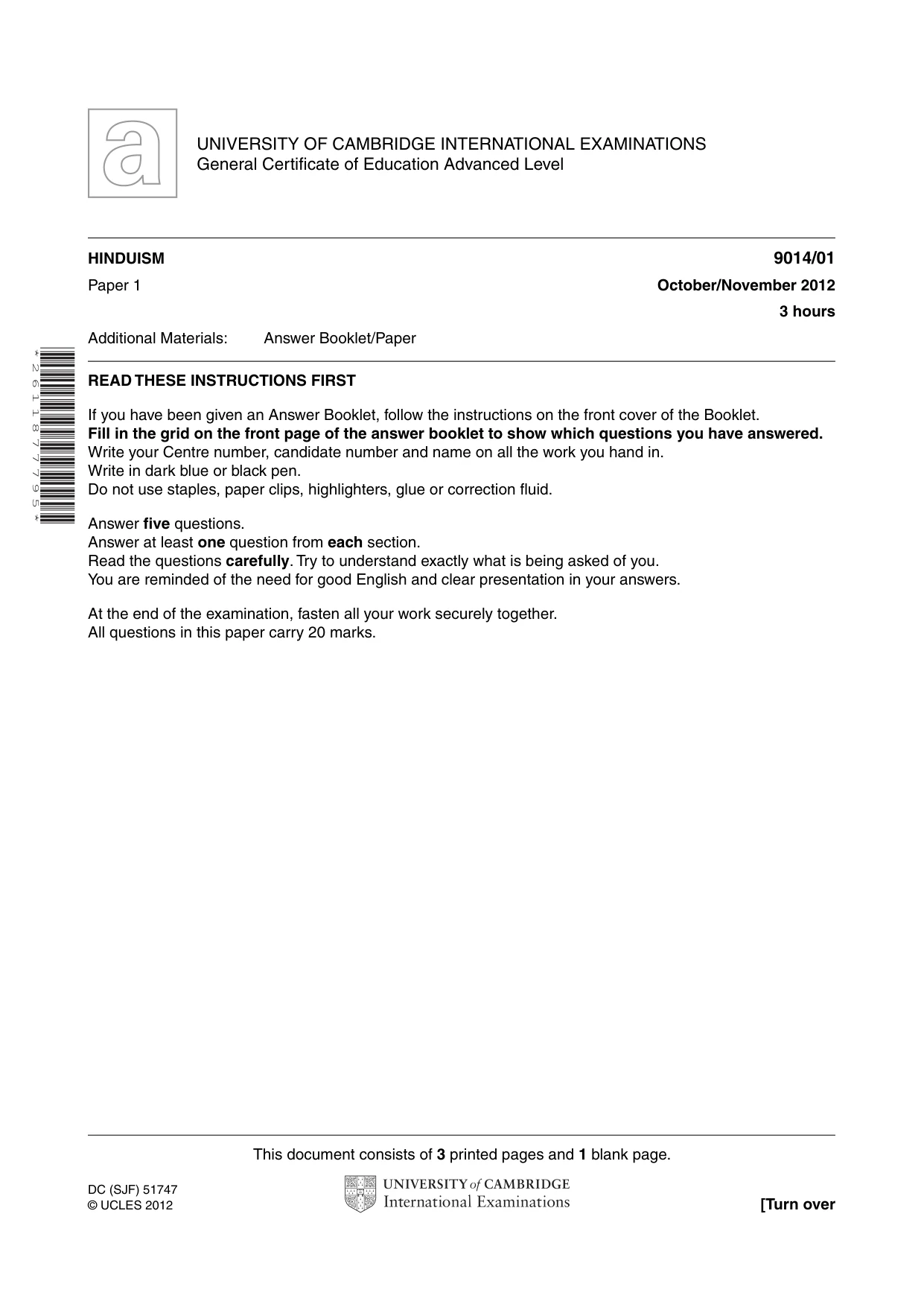
Question paper, page 1
This document consists of 3 printed pages and 1 blank page. DC (SJF) 51747 © UCLES 2012 [Turn over UNIVERSITY OF CAMBRIDGE INTERNATIONAL EXAMINATIONS General Certificate of Education Advanced Level HINDUISM 9014/01 Paper 1 October/November 2012 3 hours Additional Materials: Answer Booklet/Paper READ THESE INSTRUCTIONS FIRST If you have been given an Answer Booklet, follow the instructions on the front cover of the Booklet. Fill in the grid on the front page of the answer booklet to show which questions you have answered. Write your Centre number, candidate number and name on all the work you hand in. Write in dark blue or black pen. Do not use staples, paper clips, highlighters, glue or correction fluid. Answer five questions. Answer at least one question from each section. Read the questions carefully. Try to understand exactly what is being asked of you. You are reminded of the need for good English and clear presentation in your answers. At the end of the examination, fasten all your work securely together. All questions in this paper carry 20 marks. * 2 6 1 1 8 7 7 7 9 5 *
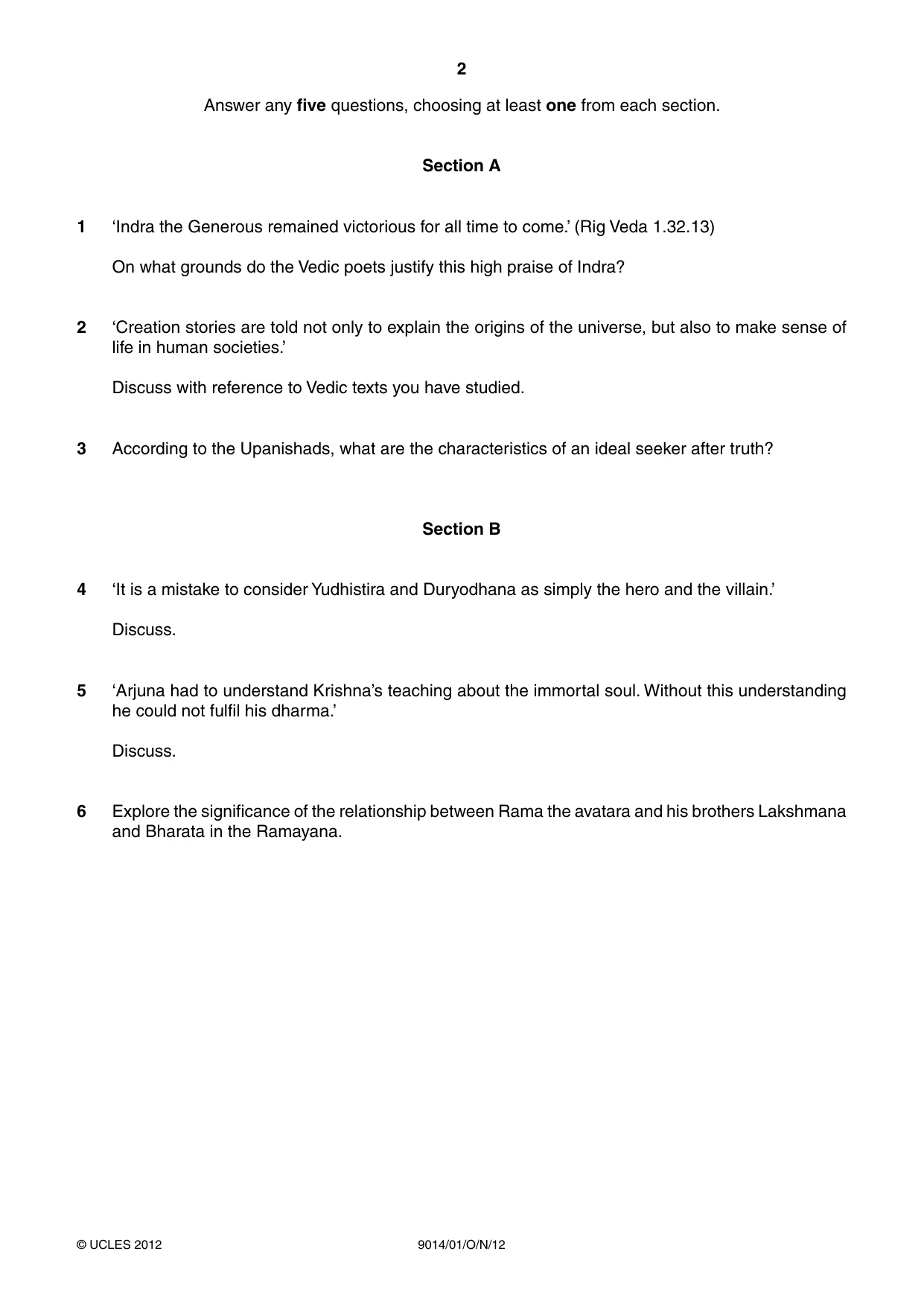
Question paper, page 2
2 9014/01/O/N/12 © UCLES 2012 Answer any five questions, choosing at least one from each section. Section A 1 ‘Indra the Generous remained victorious for all time to come.’ (Rig Veda 1.32.13) On what grounds do the Vedic poets justify this high praise of Indra? 2 ‘Creation stories are told not only to explain the origins of the universe, but also to make sense of life in human societies.’ Discuss with reference to Vedic texts you have studied. 3 According to the Upanishads, what are the characteristics of an ideal seeker after truth? Section B 4 ‘It is a mistake to consider Yudhistira and Duryodhana as simply the hero and the villain.’ Discuss. 5 ‘Arjuna had to understand Krishna’s teaching about the immortal soul. Without this understanding he could not fulfil his dharma.’ Discuss. 6 Explore the significance of the relationship between Rama the avatara and his brothers Lakshmana and Bharata in the Ramayana.
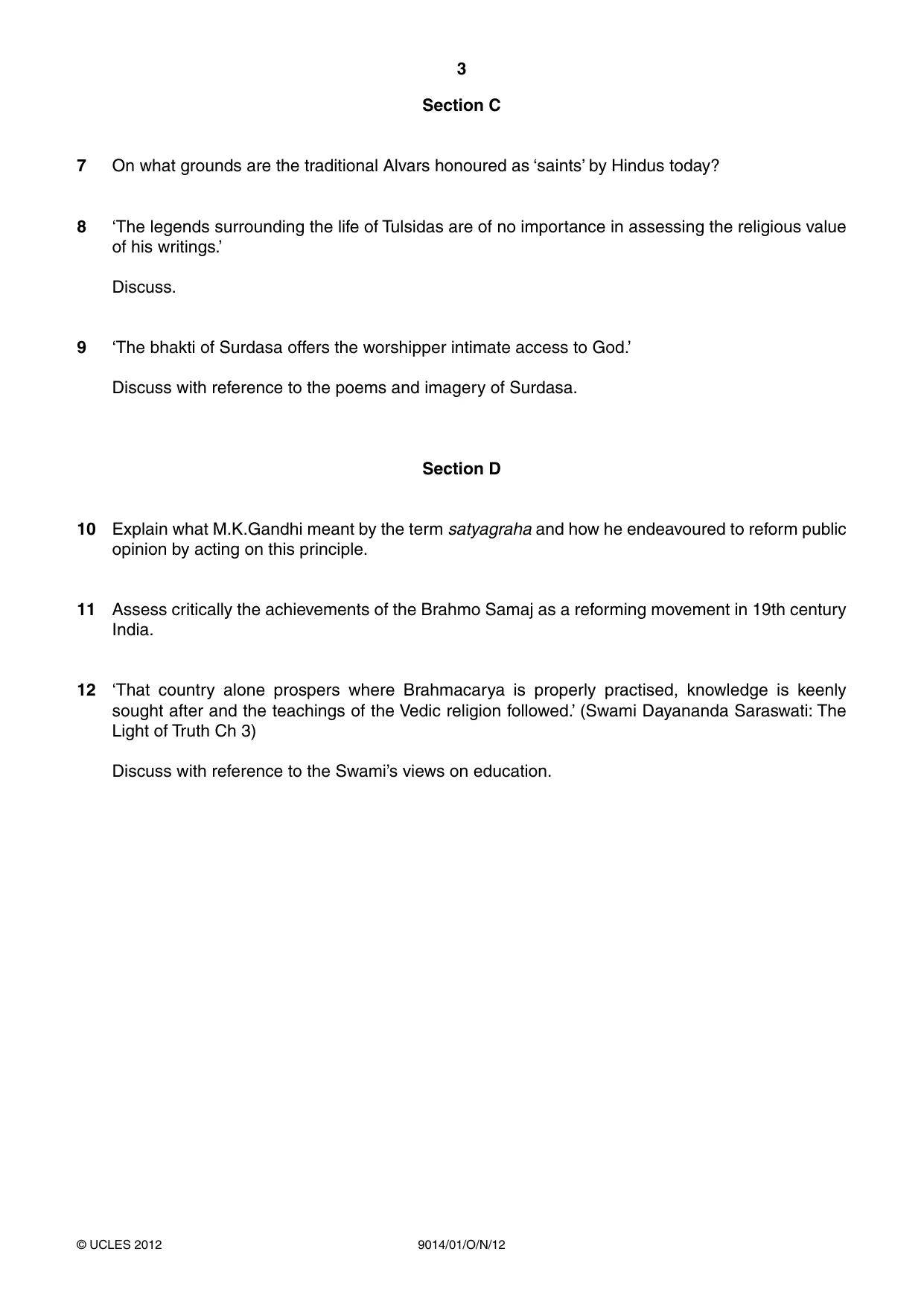
Question paper, page 3
3 9014/01/O/N/12 © UCLES 2012 Section C 7 On what grounds are the traditional Alvars honoured as ‘saints’ by Hindus today? 8 ‘The legends surrounding the life of Tulsidas are of no importance in assessing the religious value of his writings.’ Discuss. 9 ‘The bhakti of Surdasa offers the worshipper intimate access to God.’ Discuss with reference to the poems and imagery of Surdasa. Section D 10 Explain what M.K.Gandhi meant by the term satyagraha and how he endeavoured to reform public opinion by acting on this principle. 11 Assess critically the achievements of the Brahmo Samaj as a reforming movement in 19th century India. 12 ‘That country alone prospers where Brahmacarya is properly practised, knowledge is keenly sought after and the teachings of the Vedic religion followed.’ (Swami Dayananda Saraswati: The Light of Truth Ch 3) Discuss with reference to the Swami’s views on education.
Question paper, page 4
4 9014/01/O/N/12 © UCLES 2012 Permission to reproduce items where third-party owned material protected by copyright is included has been sought and cleared where possible. Every reasonable effort has been made by the publisher (UCLES) to trace copyright holders, but if any items requiring clearance have unwittingly been included, the publisher will be pleased to make amends at the earliest possible opportunity. University of Cambridge International Examinations is part of the Cambridge Assessment Group. Cambridge Assessment is the brand name of University of Cambridge Local Examinations Syndicate (UCLES), which is itself a department of the University of Cambridge. BLANK PAGE