Cambridge A Level Hindi (A Level only) 9687 — 2019 Oct/Nov Paper 2 · Variant 1
9687/21/O/N/19 · 70 marks · ≈79 min
The question paper and its mark scheme, free to read here and free to download. This is Cambridge’s own paper, exactly as it was sat.
Question paper12 pages


Mark scheme14 pages
Answers below. Sit the paper first if you are practising.
Paper as text
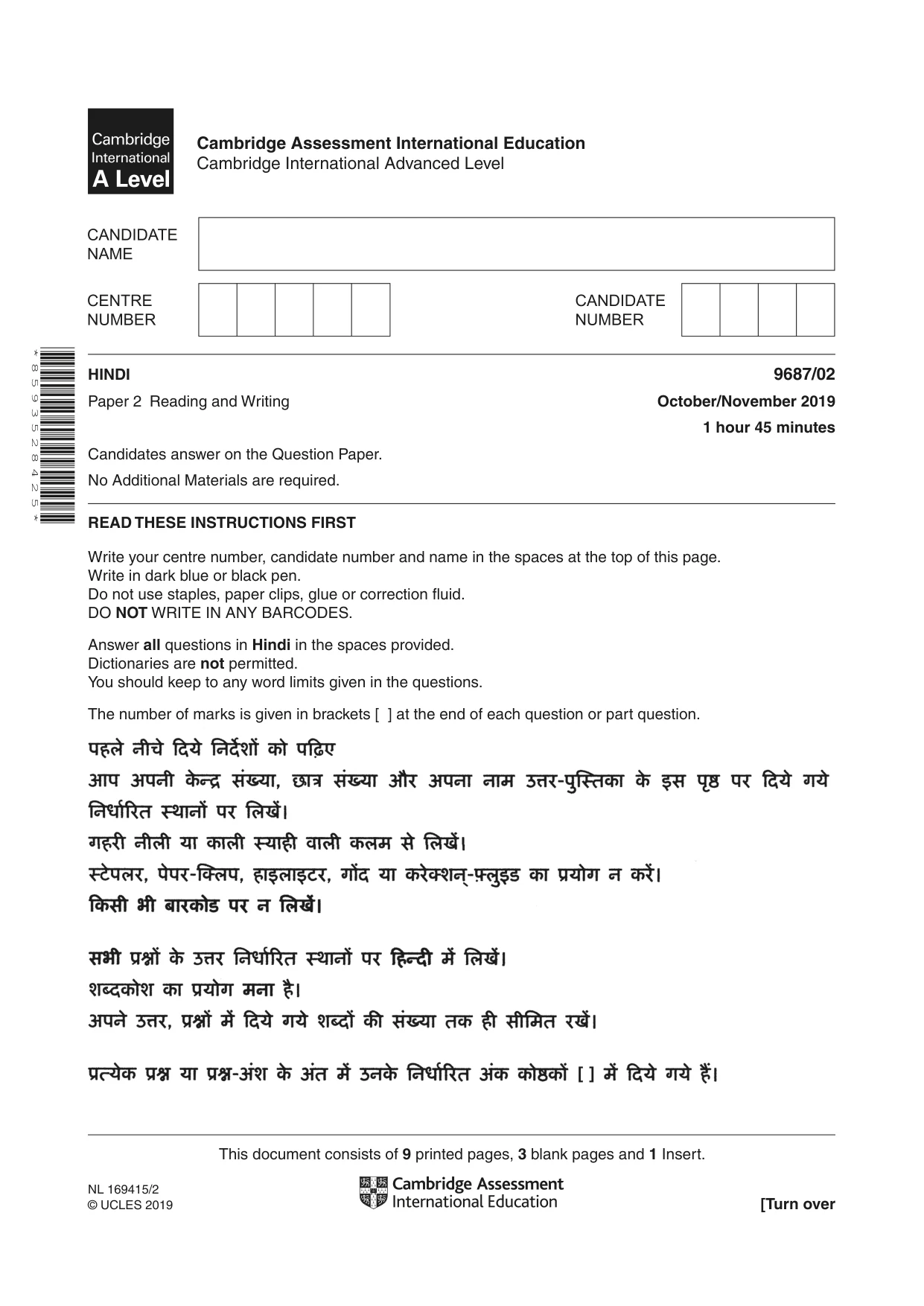
Question paper, page 1
This document consists of 9 printed pages, 3 blank pages and 1 Insert. NL 169415/2 © UCLES 2019 [Turn over Cambridge Assessment International Education Cambridge International Advanced Level HINDI 9687/02 Paper 2 Reading and Writing October/November 2019 1 hour 45 minutes Candidates answer on the Question Paper. No Additional Materials are required. READ THESE INSTRUCTIONS FIRST Write your centre number, candidate number and name in the spaces at the top of this page. Write in dark blue or black pen. Do not use staples, paper clips, glue or correction fluid. DO NOT WRITE IN ANY BARCODES. Answer all questions in Hindi in the spaces provided. Dictionaries are not permitted. You should keep to any word limits given in the questions. The number of marks is given in brackets [ ] at the end of each question or part question. [ ] * 8 5 9 3 5 2 8 4 2 5 *
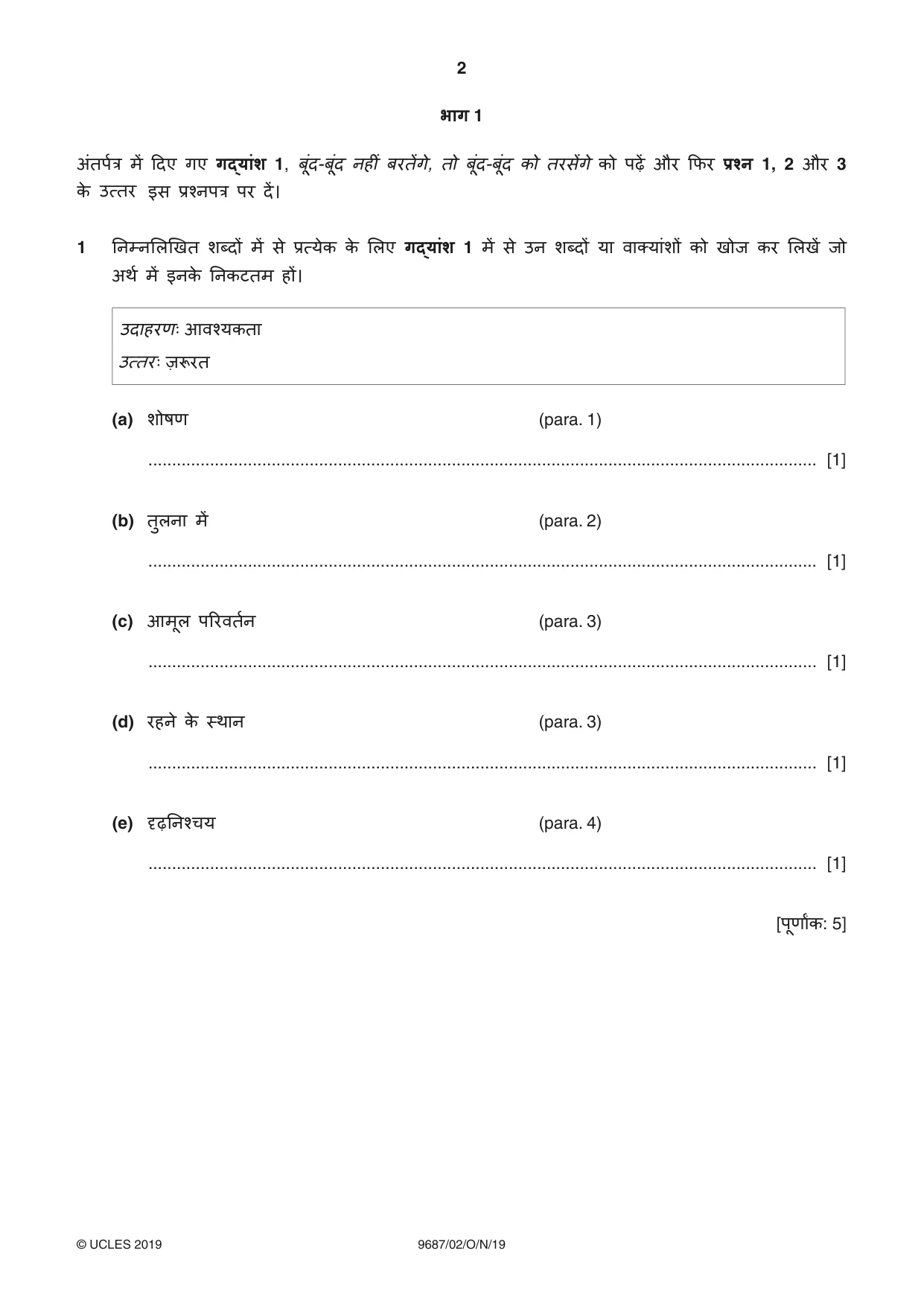
Question paper, page 2
2 9687/02/O/N/19 © UCLES 2019 भाग 1 अंतर्पत्र में दिए गए गद्ाांश 1, बूंि-बूंि नहीं बरतेंगे, तो बूंि-बूंि को तरसेंगे को रढ़ें और फिर प्रश्न 1, 2 और 3 के `× इस प्रशनरत्र रर िें। 1 ननमनलिखित शबिों में से प्रत्ेक के लिए गद्ाांश 1 में से उन शबिों ्ा वाक्ांशों को िोज कर लििें जो अर्प में इनके ननकटतम हों। (a) शोषण (para. 1) … [1] (b) तुिना में (para. 2) … [1] (c) आमूि रररवत्पन (para. 3) … [1] (d) रहने के सरान (para. 3) … [1] (e) दृढ़ननश्च् (para. 4) … [1] [रूणाांक: 5] उिाहरणः आवश्कता ः ज़रूरत `×
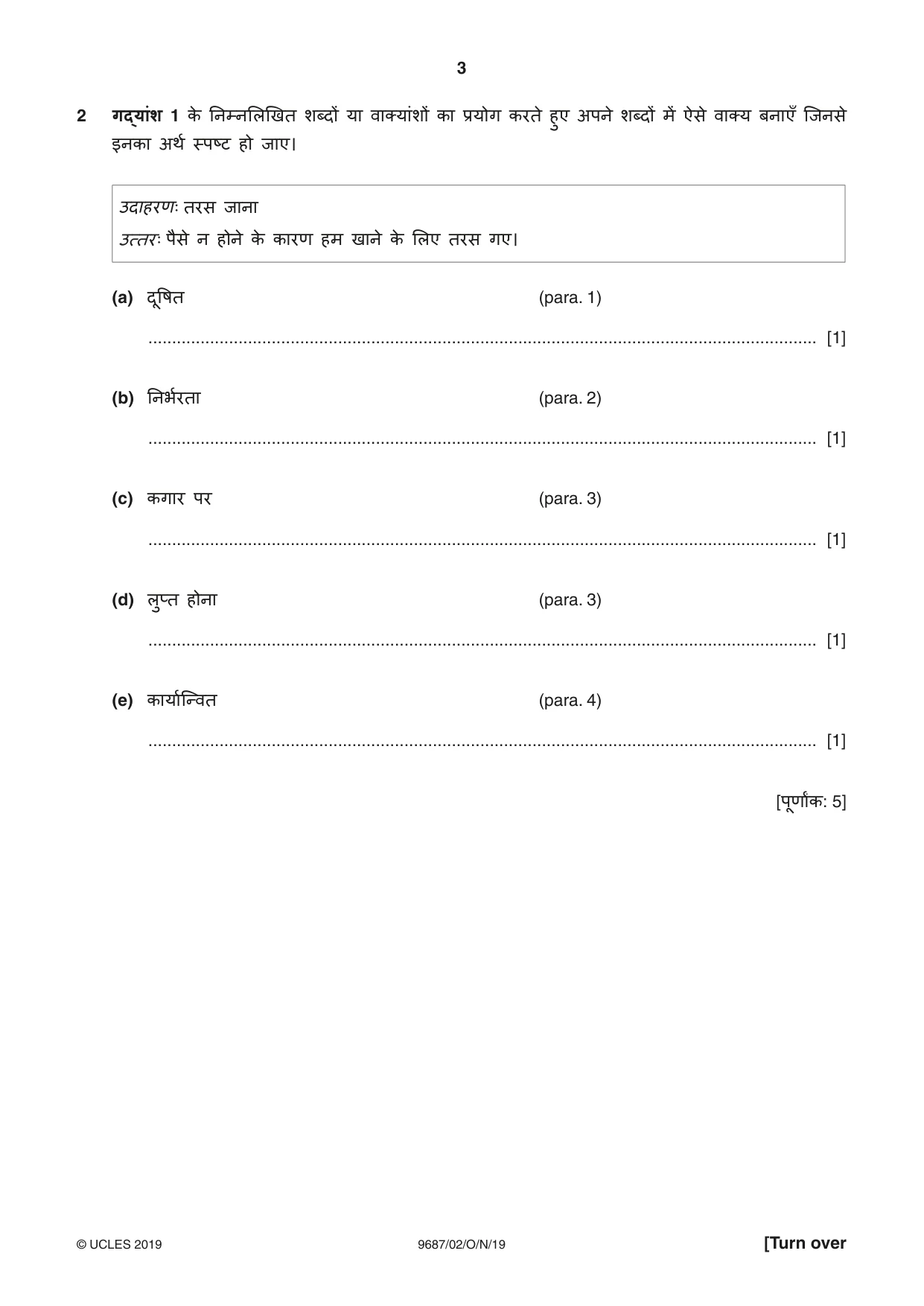
Question paper, page 3
3 9687/02/O/N/19 © UCLES 2019 [Turn over 2 गद्ाांश 1 के ननमनलिखित शबिों ्ा वाक्ांशों का प्र्ोग करते हुए अरने शबिों में ऐसे वाक् बनाएँ जजनसे इनका अर्प सरषट हो जाए। (a) िूषषत (para. 1) … [1] (b) ननर्परता (para. 2) … [1] (c) कगार रर (para. 3) … [1] (d) िुपत होना (para. 3) … [1] (e) का्ा्पज्वत (para. 4) … [1] [रूणाांक: 5] उिाहरणः तरस जाना ः रैसे न होने के कारण हम िाने के लिए तरस गए। `×
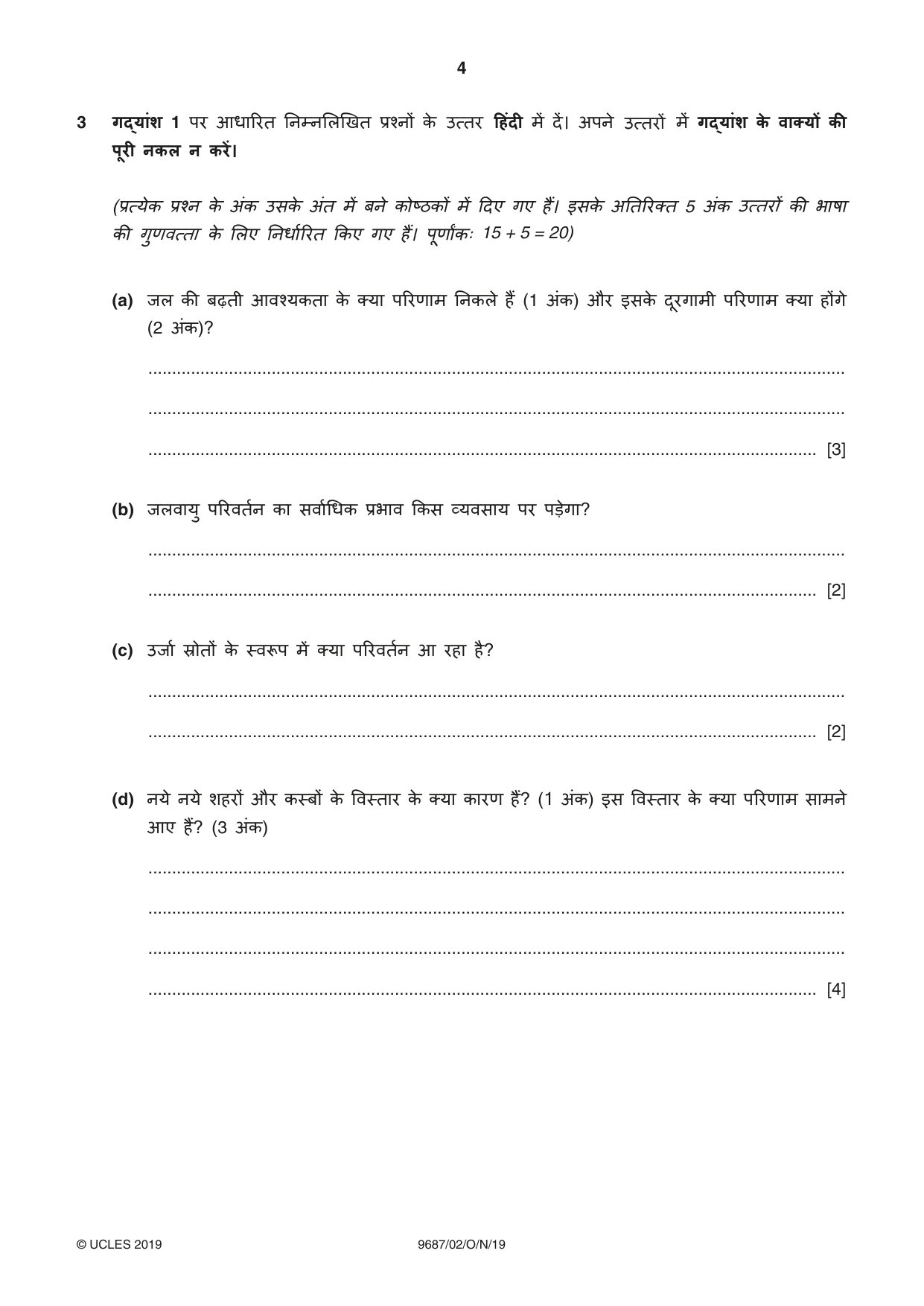
Question paper, page 4
4 9687/02/O/N/19 © UCLES 2019 3 गद्ाांश 1 रर आधाररत ननमनलिखित प्रशनों के `× हिांदी में िें। अरने `×ɉ में गद्ाांश के वाक्ों की पूरी ्नकल ्न करें। (प्रत्ेक प्रशन के अंक उसके अंत में बने कोष्ठकों में दिए गए हैं। इसके अनतररकत 5 अंक `×ɉ की राषा की गु×ȡ के लिए ननधा्पररत फकए गए हैं। रूणाांकः 15 + 5 = 20) (a) जि की बढ़ती आवश्कता के क्ा रररणाम ननकिे हैं (1 अंक) और इसके िूरगामी रररणाम क्ा होंगे (2 अंक)? … … … [3] (b) जिवा्ु रररवत्पन का सवा्पधधक प्रराव फकस व्वसा् रर रडेगा? … … [2] (c) उजा्प स्ोतों के सवरूर में क्ा रररवत्पन आ रहा है? … … [2] (d) न्े न्े शहरों और कसबों के षवसतार के क्ा कारण हैं? (1 अंक) इस षवसतार के क्ा रररणाम सामने आए हैं? (3 अंक) … … … … [4]
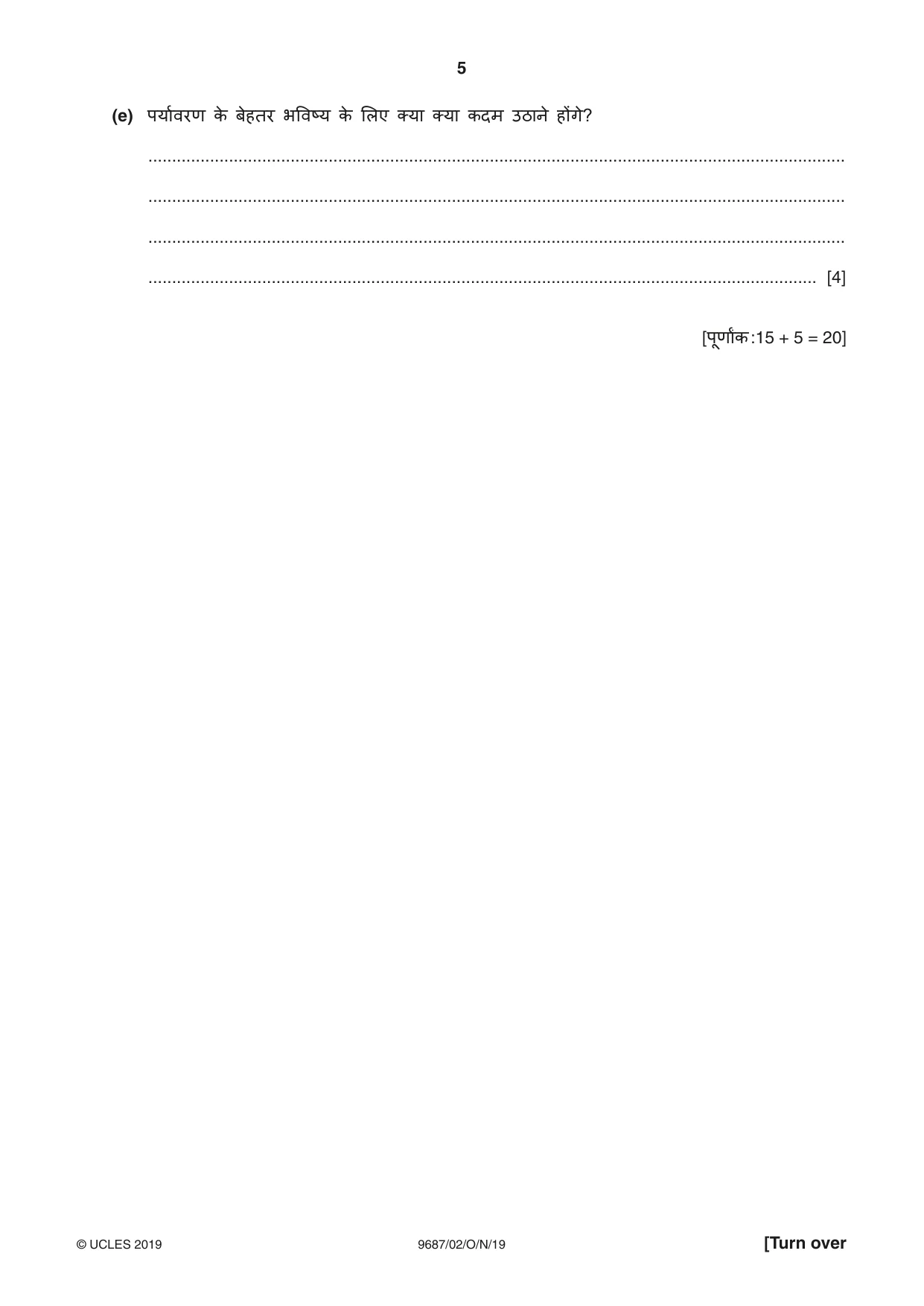
Question paper, page 5
5 9687/02/O/N/19 © UCLES 2019 [Turn over (e) र्ा्पवरण के बेहतर रषवष् के लिए क्ा क्ा किम उ्ठाने होंगे? … … … … [4] [रूणाांक :15 + 5 = 20]
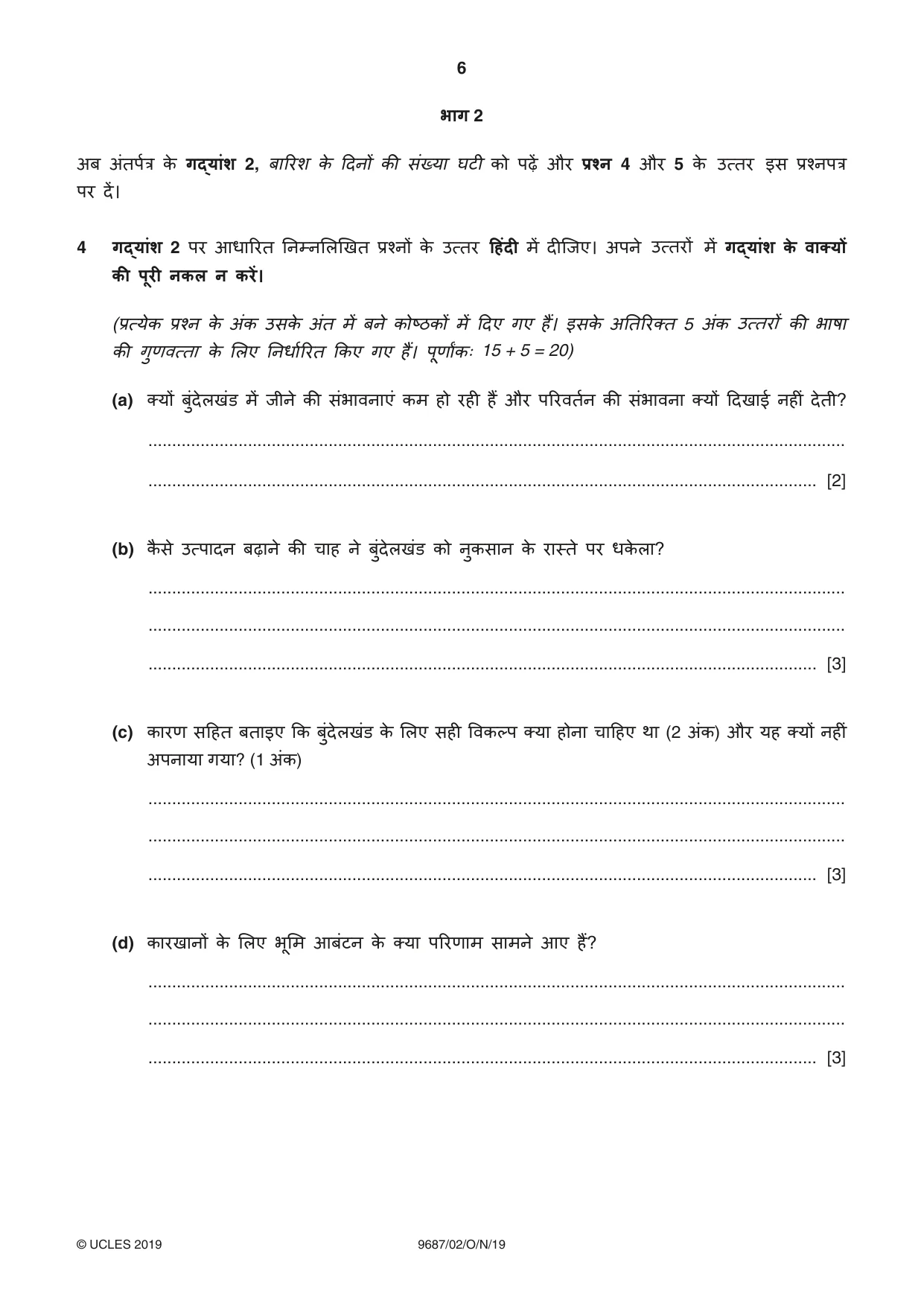
Question paper, page 6
6 9687/02/O/N/19 © UCLES 2019 भाग 2 अब अंतर्पत्र के गद्ाांश 2, बाररश के दिनों की संख्ा घटी को रढ़ें और प्रश्न 4 और 5 के `× इस प्रशनरत्र रर िें। 4 गद्ाांश 2 रर आधाररत ननमनलिखित प्रशनों के `× हिांदी में िीजजए। अरने `×ɉ में गद्ाांश के वाक्ों की पूरी ्नकल ्न करें। (प्रत्ेक प्रशन के अंक उसके अंत में बने कोष्ठकों में दिए गए हैं। इसके अनतररकत 5 अंक `×ɉ की राषा की गु×ȡ के लिए ननधा्पररत फकए गए हैं। रूणाांकः 15 + 5 = 20) (a) क्ों बुंिेििंड में जीने की संरावनाएं कम हो रही हैं और रररवत्पन की संरावना क्ों दििाई नहीं िेती? … … [2] (b) कैसे उतरािन बढ़ाने की ्चाह ने बुंिेििंड को नुकसान के रासते रर धकेिा? … … … [3] (c) कारण सदहत बताइए फक बुंिेििंड के लिए सही षवकलर क्ा होना ्चादहए रा (2 अंक) और ्ह क्ों नहीं अरना्ा ग्ा? (1 अंक) … … … [3] (d) कारिानों के लिए रूलम आबंटन के क्ा रररणाम सामने आए हैं? … … … [3]
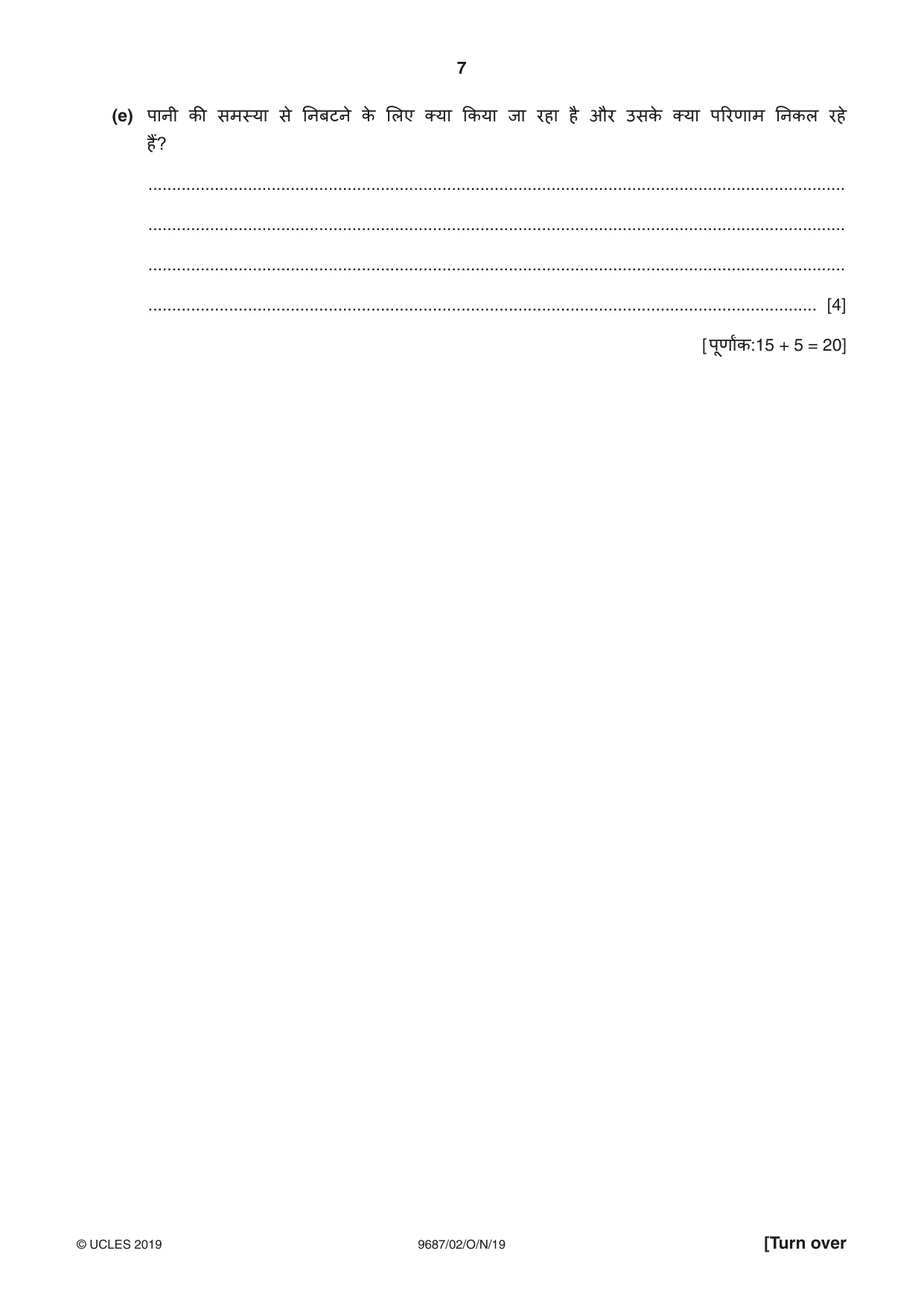
Question paper, page 7
7 9687/02/O/N/19 © UCLES 2019 [Turn over (e) रानी की समस्ा से ननबटने के लिए क्ा फक्ा जा रहा है और उसके क्ा रररणाम ननकि रहे हैं? … … … … [4] [ रूणाांक:15 + 5 = 20]
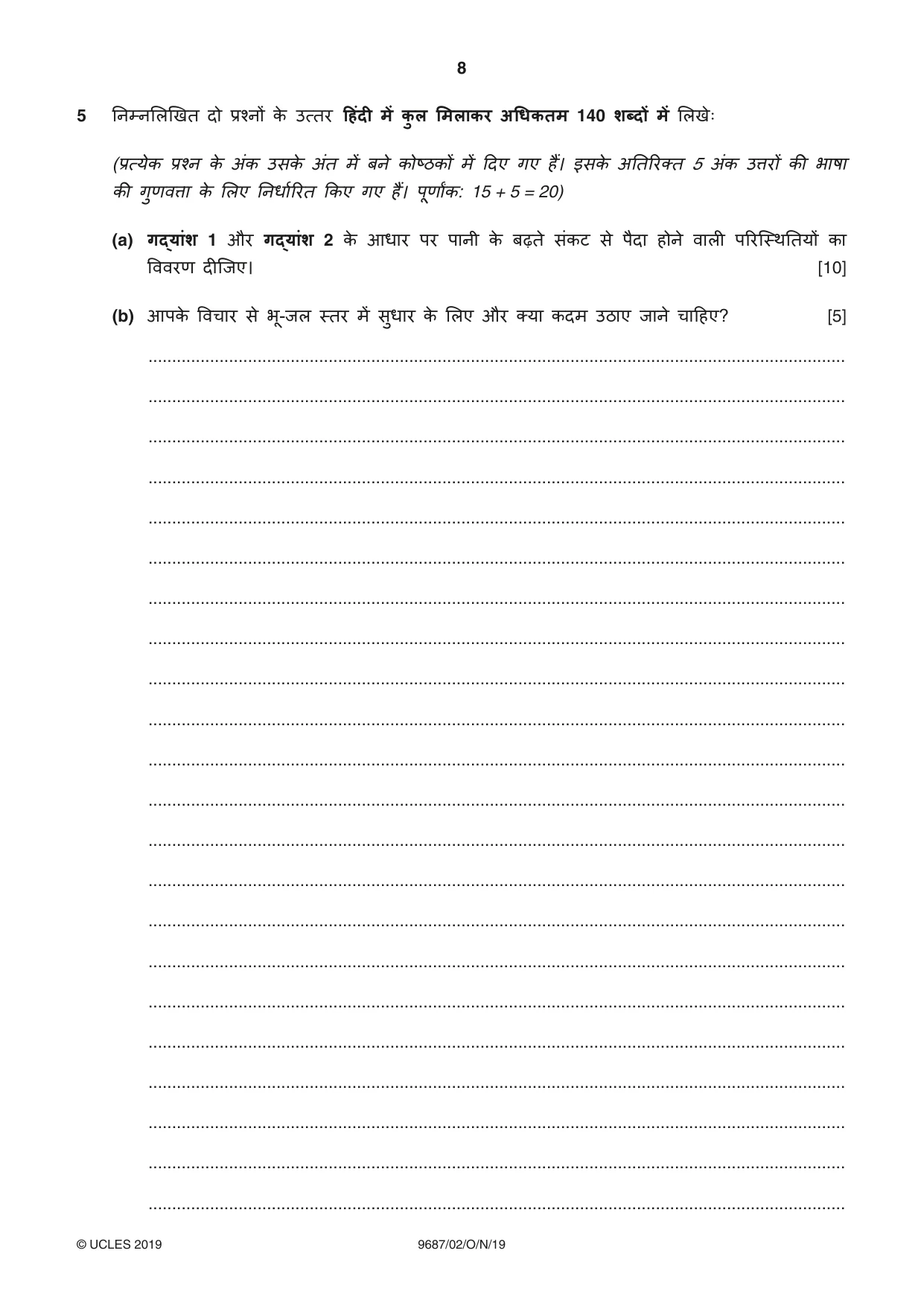
Question paper, page 8
8 9687/02/O/N/19 © UCLES 2019 5 ननमनलिखित िो प्रशनों के `× हिांदी में कुल ममलाकर अधिकतम 140 शबदों में लििेः (प्रत्ेक प्रशन के अंक उसके अंत में बने कोष्ठकों में दिए गए हैं। इसके अनतररकत 5 अंक उत्तरों की राषा की गुणवत्ता के लिए ननधा्पररत फकए गए हैं। रूणाांक: 15 + 5 = 20) (a) गद्ाांश 1 और गद्ाांश 2 के आधार रर रानी के बढ़ते संकट से रैिा होने वािी रररजसरनत्ों का षववरण िीजजए। [10] (b) आरके षव्चार से रू-जि सतर में सुधार के लिए और क्ा किम उ्ठाए जाने ्चादहए? [5] … … … … … … … … … … … … … … … … … … … … … …
Question paper, page 9
9 9687/02/O/N/19 © UCLES 2019 … … … … … … … … … … … … … … … … … … … … … … … … … … … [रूणाांक :15 + 5 = 20]
Question paper, page 10
10 9687/02/O/N/19 © UCLES 2019 BLANK PAGE
Question paper, page 11
11 9687/02/O/N/19 © UCLES 2019 BLANK PAGE
Question paper, page 12
12 9687/02/O/N/19 © UCLES 2019 BLANK PAGE Permission to reproduce items where third-party owned material protected by copyright is included has been sought and cleared where possible. Every reasonable effort has been made by the publisher (UCLES) to trace copyright holders, but if any items requiring clearance have unwittingly been included, the publisher will be pleased to make amends at the earliest possible opportunity. To avoid the issue of disclosure of answer-related information to candidates, all copyright acknowledgements are reproduced online in the Cambridge Assessment International Education Copyright Acknowledgements Booklet. This is produced for each series of examinations and is freely available to download at www.cambridgeinternational.org after the live examination series. Cambridge Assessment International Education is part of the Cambridge Assessment Group. Cambridge Assessment is the brand name of the University of Cambridge Local Examinations Syndicate (UCLES), which itself is a department of the University of Cambridge.
Mark scheme, page 1
This document consists of 14 printed pages. © UCLES 2019 [Turn over Cambridge Assessment International Education Cambridge International Advanced Level HINDI 9687/02 Paper 2 Reading and Writing October/November 2019 MARK SCHEME Maximum Mark: 70 Published This mark scheme is published as an aid to teachers and candidates, to indicate the requirements of the examination. It shows the basis on which Examiners were instructed to award marks. It does not indicate the details of the discussions that took place at an Examiners’ meeting before marking began, which would have considered the acceptability of alternative answers. Mark schemes should be read in conjunction with the question paper and the Principal Examiner Report for Teachers. Cambridge International will not enter into discussions about these mark schemes. Cambridge International is publishing the mark schemes for the October/November 2019 series for most Cambridge IGCSE™, Cambridge International A and AS Level components and some Cambridge O Level components.
Mark scheme, page 2
9687/02 Cambridge International A Level – Mark Scheme PUBLISHED October/November 2019 © UCLES 2019 Page 2 of 14 Generic Marking Principles These general marking principles must be applied by all examiners when marking candidate answers. They should be applied alongside the specific content of the mark scheme or generic level descriptors for a question. Each question paper and mark scheme will also comply with these marking principles. GENERIC MARKING PRINCIPLE 1: Marks must be awarded in line with: • the specific content of the mark scheme or the generic level descriptors for the question • the specific skills defined in the mark scheme or in the generic level descriptors for the question • the standard of response required by a candidate as exemplified by the standardisation scripts. GENERIC MARKING PRINCIPLE 2: Marks awarded are always whole marks (not half marks, or other fractions). GENERIC MARKING PRINCIPLE 3: Marks must be awarded positively: • marks are awarded for correct/valid answers, as defined in the mark scheme. However, credit is given for valid answers which go beyond the scope of the syllabus and mark scheme, referring to your Team Leader as appropriate • marks are awarded when candidates clearly demonstrate what they know and can do • marks are not deducted for errors • marks are not deducted for omissions • answers should only be judged on the quality of spelling, punctuation and grammar when these features are specifically assessed by the question as indicated by the mark scheme. The meaning, however, should be unambiguous. GENERIC MARKING PRINCIPLE 4: Rules must be applied consistently e.g. in situations where candidates have not followed instructions or in the application of generic level descriptors.
Mark scheme, page 3
9687/02 Cambridge International A Level – Mark Scheme PUBLISHED October/November 2019 © UCLES 2019 Page 3 of 14 GENERIC MARKING PRINCIPLE 5: Marks should be awarded using the full range of marks defined in the mark scheme for the question (however; the use of the full mark range may be limited according to the quality of the candidate responses seen). GENERIC MARKING PRINCIPLE 6: Marks awarded are based solely on the requirements as defined in the mark scheme. Marks should not be awarded with grade thresholds or grade descriptors in mind.
Mark scheme, page 4
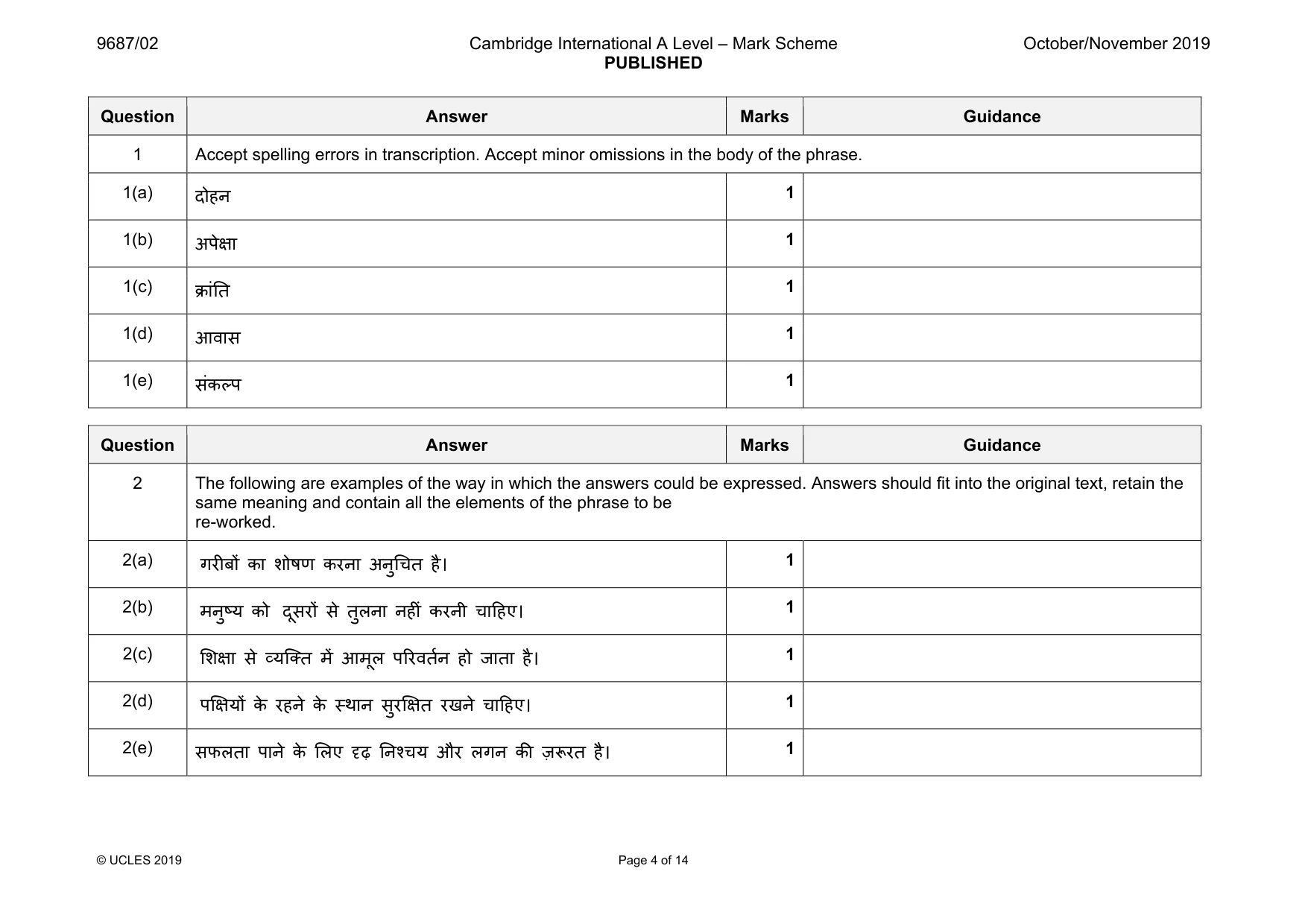
9687/02 Cambridge International A Level – Mark Scheme PUBLISHED October/November 2019 © UCLES 2019 Page 4 of 14 Question Answer Marks Guidance 1 Accept spelling errors in transcription. Accept minor omissions in the body of the phrase. 1(a) दोहन 1 1(b) अपे¢ा 1 1(c) ĐांǓत 1 1(d) आवास 1 1(e) संकãप 1 Question Answer Marks Guidance 2 The following are examples of the way in which the answers could be expressed. Answers should fit into the original text, retain the same meaning and contain all the elements of the phrase to be re-worked. 2(a) गरȣबɉ का शोषण करना अनुͬचत है। 1 2(b) मनुçय को दूसरɉ से तुलना नहȣं करनी चाǑहए। 1 2(c) ͧश¢ा से åयिÈत मɅ आमूल पǐरवत[न हो जाता है। 1 2(d) पͯ¢यɉ के रहने के èथान सुरͯ¢त रखने चाǑहए। 1 2(e) सफलता पाने के ͧलए Ǻढ़ Ǔनæचय और लगन कȧ ज़Ǿरत है। 1
Mark scheme, page 5
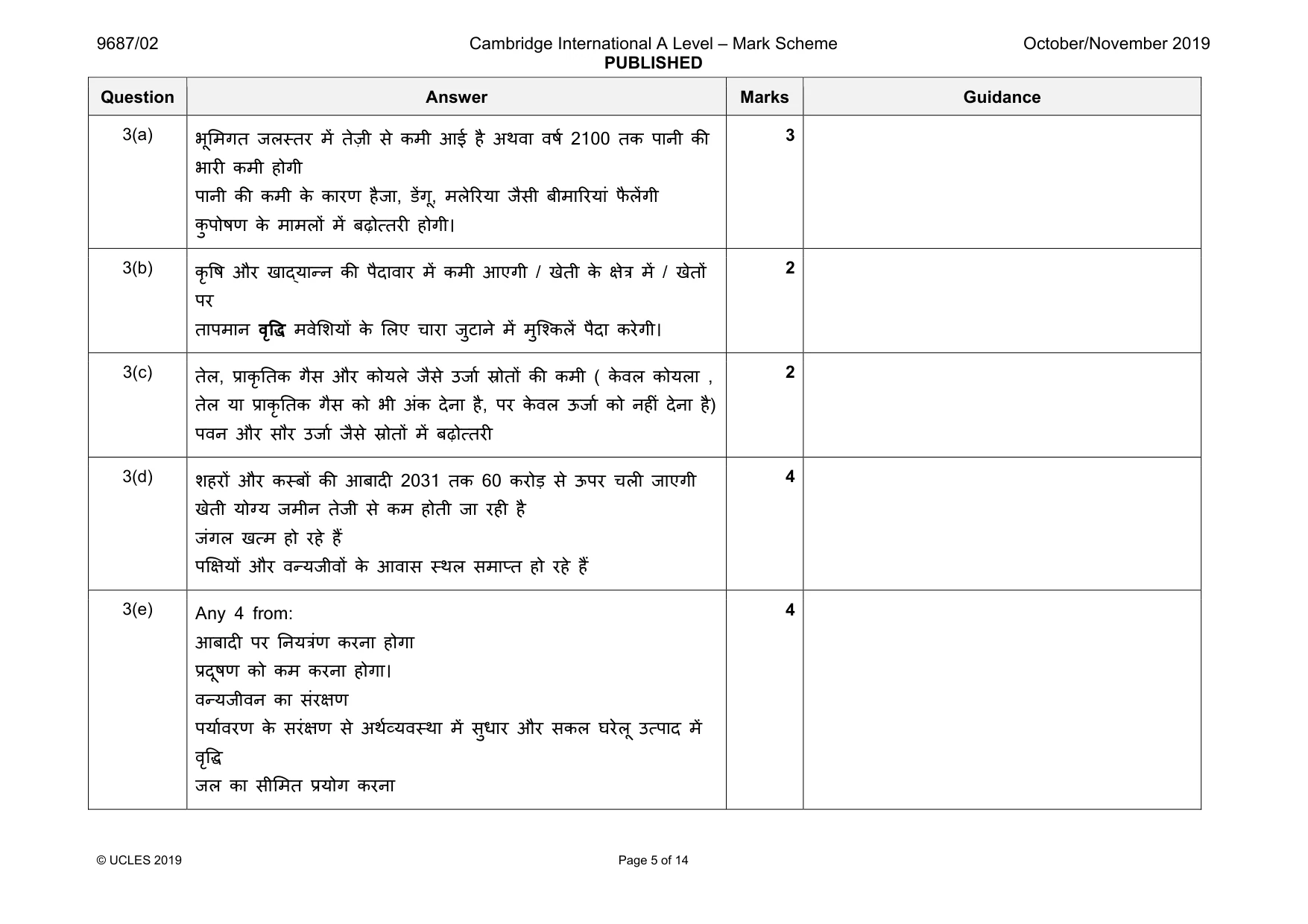
9687/02 Cambridge International A Level – Mark Scheme PUBLISHED October/November 2019 © UCLES 2019 Page 5 of 14 Question Answer Marks Guidance 3(a) भूͧमगत जलèतर मɅ तेज़ी से कमी आई है अथवा वष[ 2100 तक पानी कȧ भारȣ कमी होगी पानी कȧ कमी के कारण हैजा, डɅगू, मलेǐरया जैसी बीमाǐरयां फैलɅगी कुपोषण के मामलɉ मɅ बढ़ो×तरȣ होगी। 3 3(b) कृͪष और खाɮयाÛन कȧ पैदावार मɅ कमी आएगी / खेती के ¢ेğ मɅ / खेतɉ पर तापमान वृͪƨ मवेͧशयɉ के ͧलए चारा जुटाने मɅ मुिæकलɅ पैदा करेगी। 2 3(c) तेल, ĤाकृǓतक गैस और कोयलेजैसे उजा[ İोतɉ कȧ कमी ( केवल कोयला , तेल या ĤाकृǓतक गैस को भी अंक देना है, पर केवल ऊजा[ को नहȣं देना है) पवन और सौर उजा[ जैसे İोतɉ मɅ बढ़ो×तरȣ 2 3(d) शहरɉ और कèबɉ कȧ आबादȣ 2031 तक 60 करोड़ से ऊपर चलȣ जाएगी खेती योÊय जमीन तेजी से कम होती जा रहȣ है जंगल ख×म हो रहे हɇ पͯ¢यɉ और वÛयजीवɉ के आवास èथल समाÜत हो रहे हɇ 4 3(e) Any 4 from: आबादȣ पर Ǔनयğंण करना होगा Ĥदूषण को कम करना होगा। वÛयजीवन का संर¢ण पया[वरण के सरं¢ण से अथ[åयवèथा मɅ सुधार और सकल घरेलू उ×पाद मɅ वृͪƨ जल का सीͧमत Ĥयोग करना 4
Mark scheme, page 6
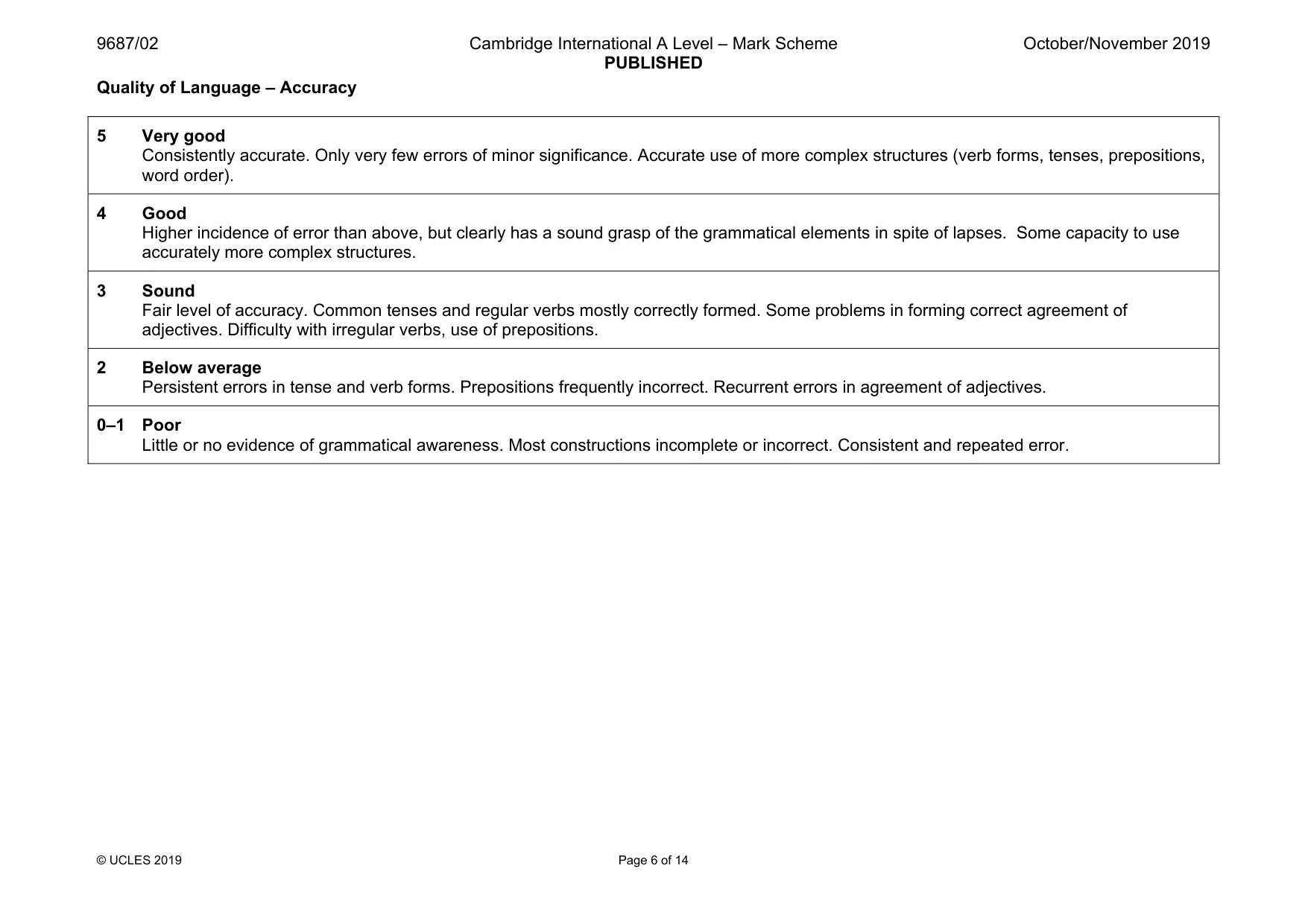
9687/02 Cambridge International A Level – Mark Scheme PUBLISHED October/November 2019 © UCLES 2019 Page 6 of 14 Quality of Language – Accuracy 5 Very good Consistently accurate. Only very few errors of minor significance. Accurate use of more complex structures (verb forms, tenses, prepositions, word order). 4 Good Higher incidence of error than above, but clearly has a sound grasp of the grammatical elements in spite of lapses. Some capacity to use accurately more complex structures. 3 Sound Fair level of accuracy. Common tenses and regular verbs mostly correctly formed. Some problems in forming correct agreement of adjectives. Difficulty with irregular verbs, use of prepositions. 2 Below average Persistent errors in tense and verb forms. Prepositions frequently incorrect. Recurrent errors in agreement of adjectives. 0–1 Poor Little or no evidence of grammatical awareness. Most constructions incomplete or incorrect. Consistent and repeated error.
Mark scheme, page 7
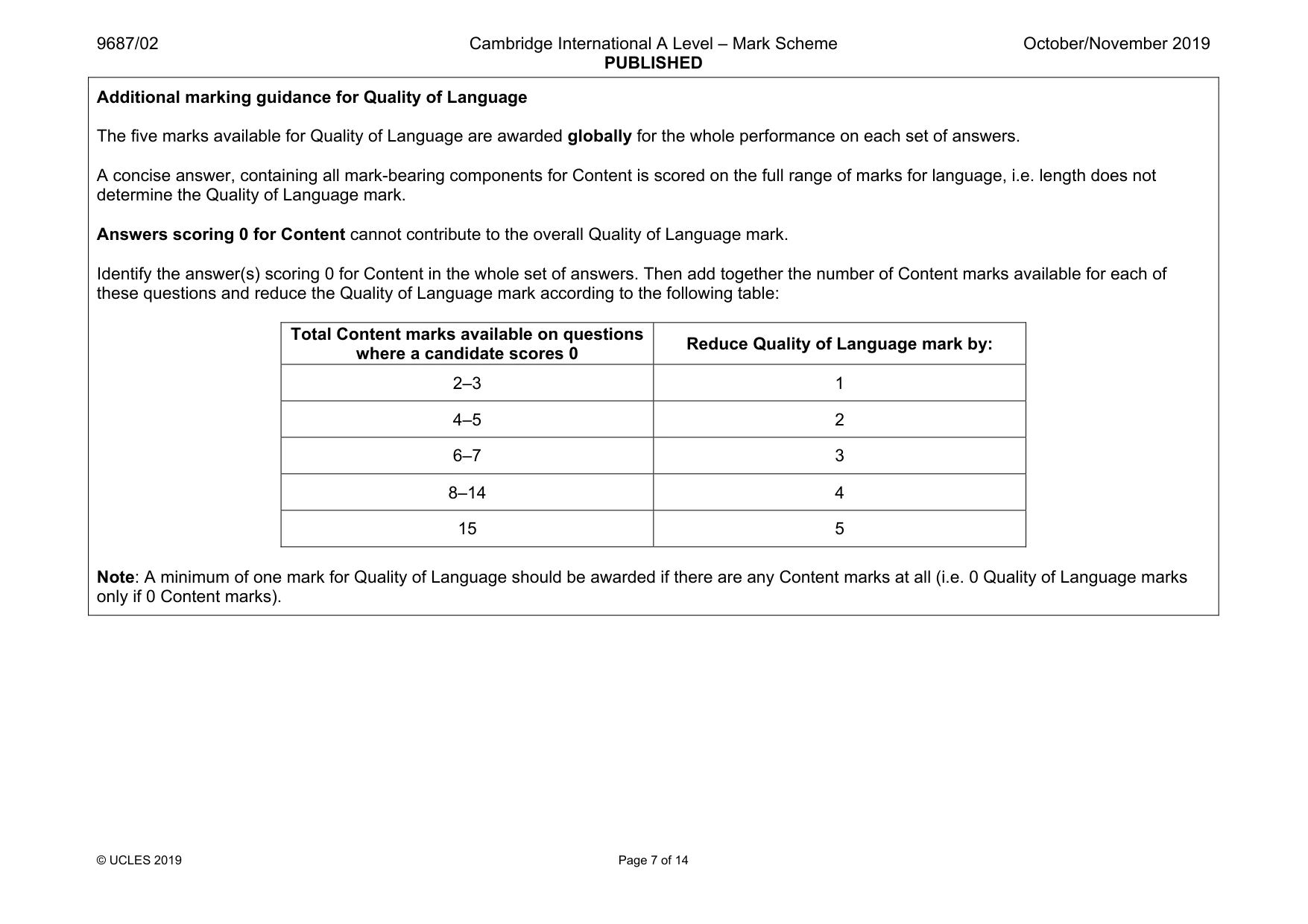
9687/02 Cambridge International A Level – Mark Scheme PUBLISHED October/November 2019 © UCLES 2019 Page 7 of 14 Additional marking guidance for Quality of Language The five marks available for Quality of Language are awarded globally for the whole performance on each set of answers. A concise answer, containing all mark-bearing components for Content is scored on the full range of marks for language, i.e. length does not determine the Quality of Language mark. Answers scoring 0 for Content cannot contribute to the overall Quality of Language mark. Identify the answer(s) scoring 0 for Content in the whole set of answers. Then add together the number of Content marks available for each of these questions and reduce the Quality of Language mark according to the following table: Total Content marks available on questions where a candidate scores 0 Reduce Quality of Language mark by: 2–3 1 4–5 2 6–7 3 8–14 4 15 5 Note: A minimum of one mark for Quality of Language should be awarded if there are any Content marks at all (i.e. 0 Quality of Language marks only if 0 Content marks).
Mark scheme, page 8
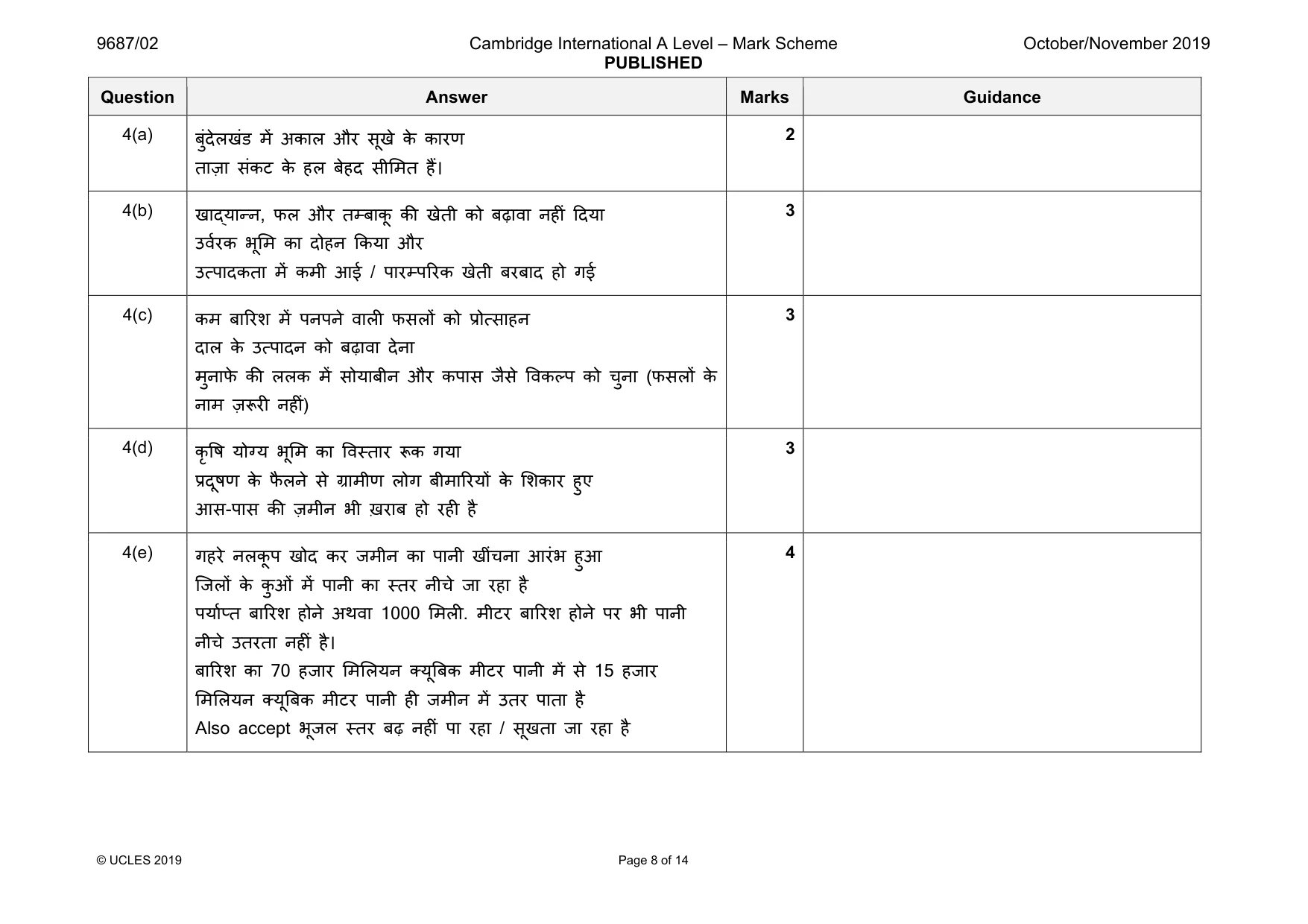
9687/02 Cambridge International A Level – Mark Scheme PUBLISHED October/November 2019 © UCLES 2019 Page 8 of 14 Question Answer Marks Guidance 4(a) बुंदेलखंड मɅ अकाल और सूखे के कारण ताज़ा संकट के हल बेहद सीͧमत हɇ। 2 4(b) खाɮयाÛन, फल और तàबाकू कȧ खेती को बढ़ावा नहȣं Ǒदया उव[रक भूͧम का दोहन ͩकया और उ×पादकता मɅ कमी आई / पारàपǐरक खेती बरबाद हो गई 3 4(c) कम बाǐरशमɅ पनपने वालȣ फसलɉ को Ĥो×साहन दाल के उ×पादन को बढ़ावा देना मुनाफे कȧ ललक मɅ सोयाबीन और कपास जैसे ͪवकãप को चुना (फसलɉ के नाम ज़Ǿरȣ नहȣं) 3 4(d) कृͪष योÊय भूͧम का ͪवèतार Ǿक गया Ĥदूषण के फैलने से Ēामीण लोग बीमाǐरयɉ के ͧशकार हुए आस-पास कȧ ज़मीन भी ख़राब हो रहȣ है 3 4(e) गहरे नलकूप खोद कर जमीन कापानी खींचना आरंभ हुआ िजलɉ के कुओं मɅ पानी का èतर नीचे जा रहा है पया[Üत बाǐरश होने अथवा 1000 ͧमलȣ. मीटर बाǐरश होने पर भी पानी नीचे उतरता नहȣं है। बाǐरश का 70 हजार ͧमͧलयन Èयूǒबक मीटर पानी मɅ से 15 हजार ͧमͧलयन Èयूǒबक मीटर पानी हȣ जमीन मɅ उतर पाता है Also accept भूजल èतर बढ़ नहȣं पा रहा / सूखता जा रहा है 4
Mark scheme, page 9
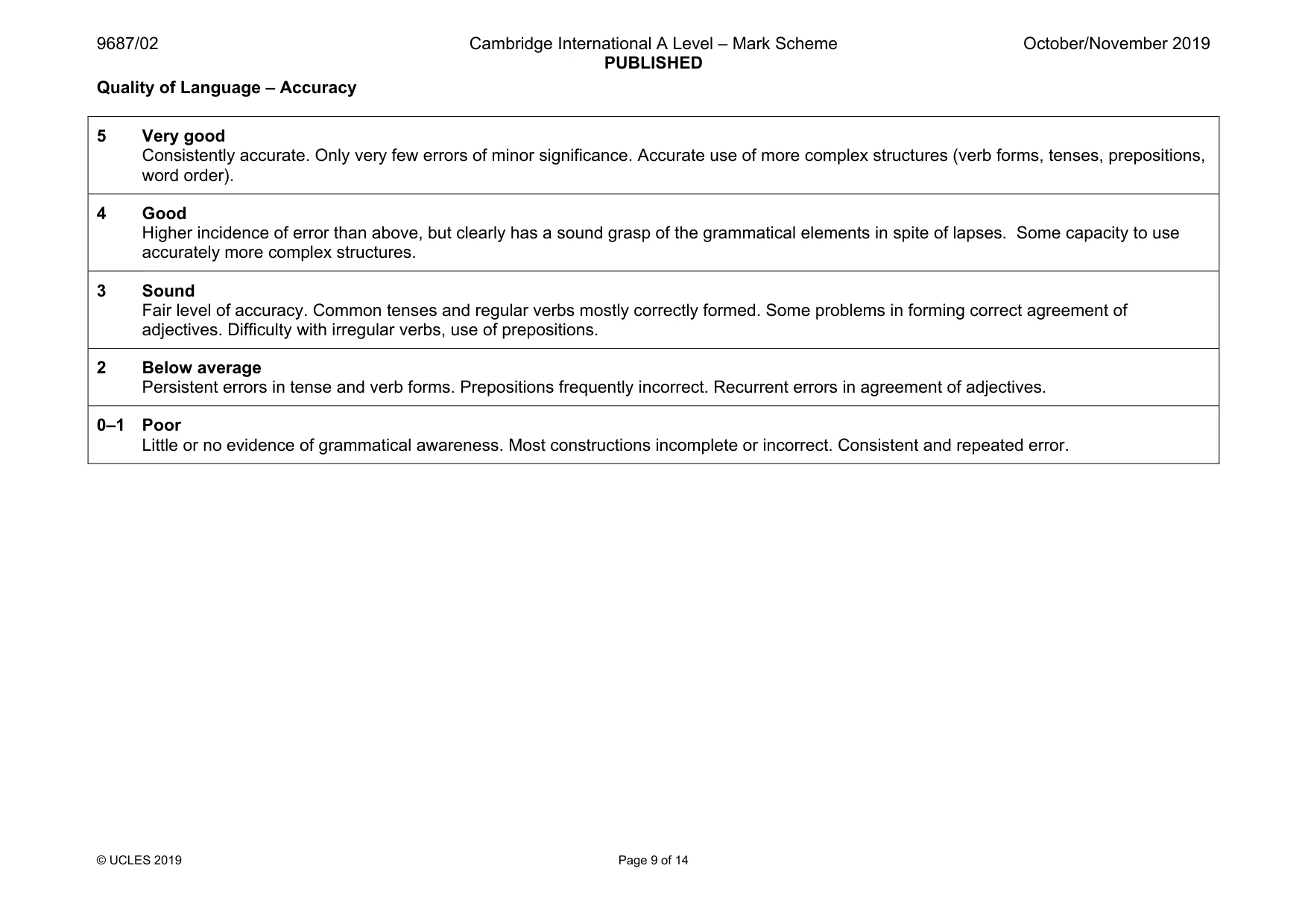
9687/02 Cambridge International A Level – Mark Scheme PUBLISHED October/November 2019 © UCLES 2019 Page 9 of 14 Quality of Language – Accuracy 5 Very good Consistently accurate. Only very few errors of minor significance. Accurate use of more complex structures (verb forms, tenses, prepositions, word order). 4 Good Higher incidence of error than above, but clearly has a sound grasp of the grammatical elements in spite of lapses. Some capacity to use accurately more complex structures. 3 Sound Fair level of accuracy. Common tenses and regular verbs mostly correctly formed. Some problems in forming correct agreement of adjectives. Difficulty with irregular verbs, use of prepositions. 2 Below average Persistent errors in tense and verb forms. Prepositions frequently incorrect. Recurrent errors in agreement of adjectives. 0–1 Poor Little or no evidence of grammatical awareness. Most constructions incomplete or incorrect. Consistent and repeated error.
Mark scheme, page 10
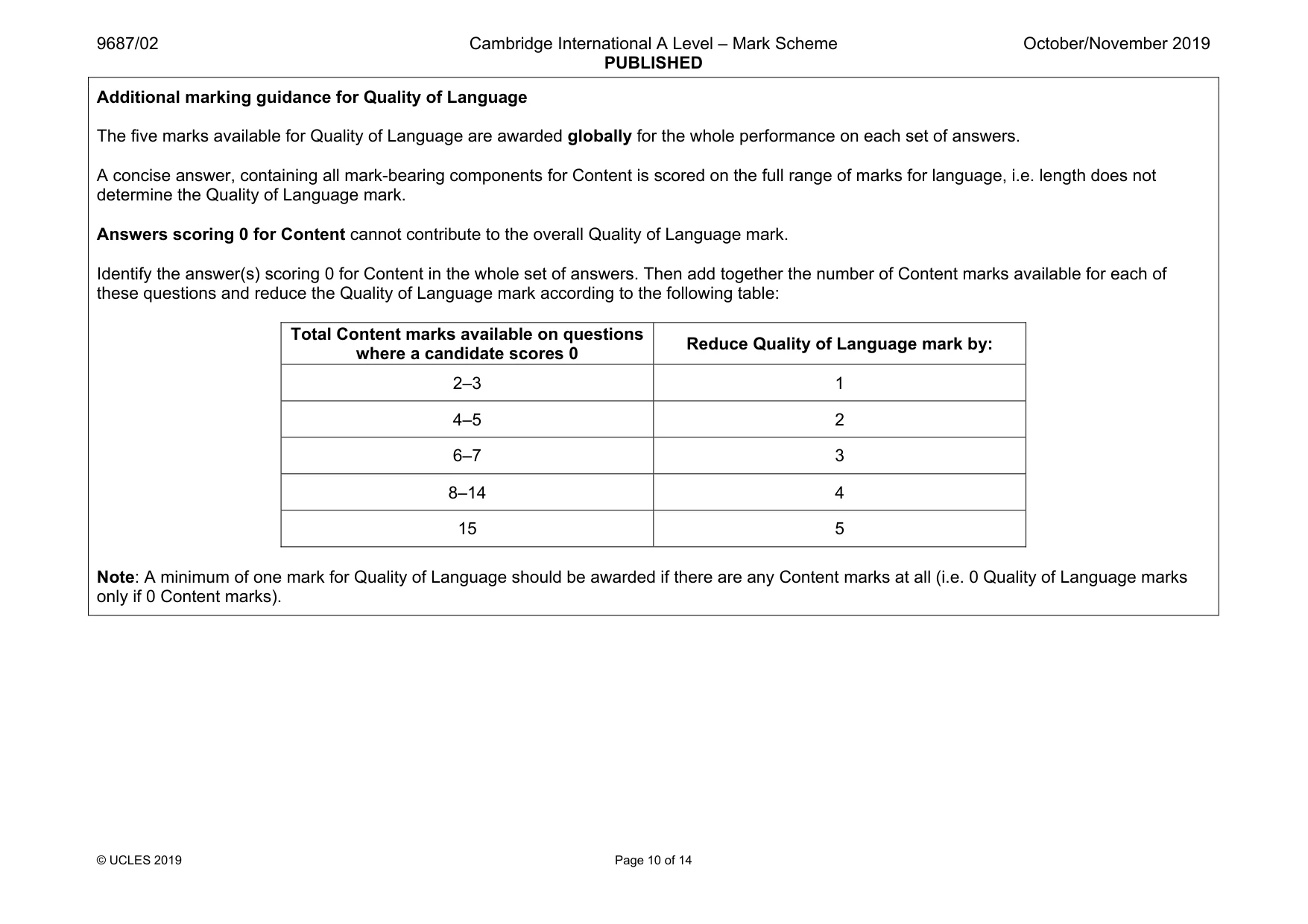
9687/02 Cambridge International A Level – Mark Scheme PUBLISHED October/November 2019 © UCLES 2019 Page 10 of 14 Additional marking guidance for Quality of Language The five marks available for Quality of Language are awarded globally for the whole performance on each set of answers. A concise answer, containing all mark-bearing components for Content is scored on the full range of marks for language, i.e. length does not determine the Quality of Language mark. Answers scoring 0 for Content cannot contribute to the overall Quality of Language mark. Identify the answer(s) scoring 0 for Content in the whole set of answers. Then add together the number of Content marks available for each of these questions and reduce the Quality of Language mark according to the following table: Total Content marks available on questions where a candidate scores 0 Reduce Quality of Language mark by: 2–3 1 4–5 2 6–7 3 8–14 4 15 5 Note: A minimum of one mark for Quality of Language should be awarded if there are any Content marks at all (i.e. 0 Quality of Language marks only if 0 Content marks).
Mark scheme, page 11
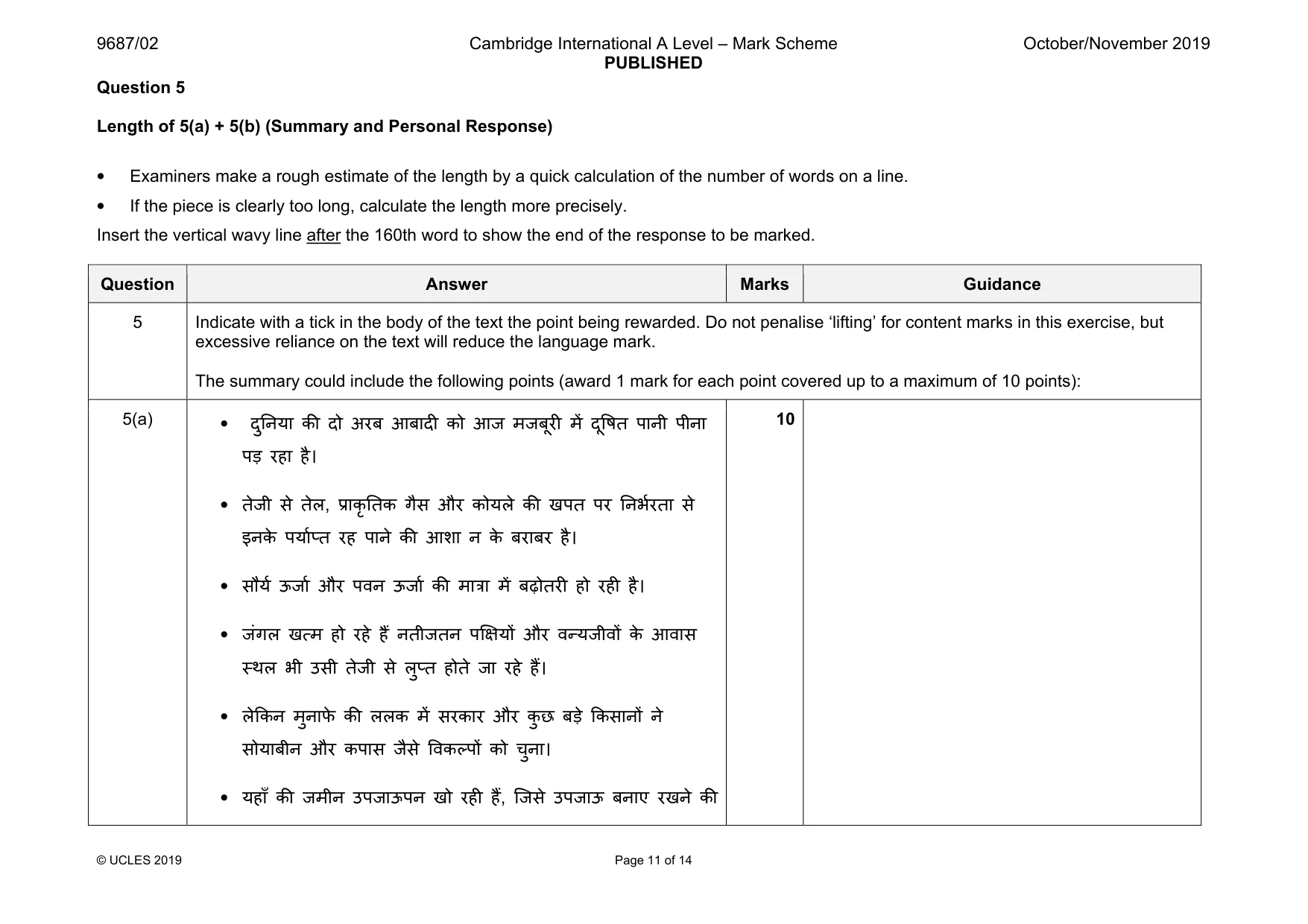
9687/02 Cambridge International A Level – Mark Scheme PUBLISHED October/November 2019 © UCLES 2019 Page 11 of 14 Question 5 Length of 5(a) + 5(b) (Summary and Personal Response) • Examiners make a rough estimate of the length by a quick calculation of the number of words on a line. • If the piece is clearly too long, calculate the length more precisely. Insert the vertical wavy line after the 160th word to show the end of the response to be marked. Question Answer Marks Guidance 5 Indicate with a tick in the body of the text the point being rewarded. Do not penalise ‘lifting’ for content marks in this exercise, but excessive reliance on the text will reduce the language mark. The summary could include the following points (award 1 mark for each point covered up to a maximum of 10 points): 5(a) • दुǓनया कȧ दो अरब आबादȣ को आज मजबूरȣ मɅ दूͪषत पानी पीना पड़ रहा है। • तेजी से तेल, ĤाकृǓतक गैस और कोयले कȧ खपत पर Ǔनभ[रता से इनके पया[Üत रह पाने कȧ आशा न के बराबर है। • सौय[ ऊजा[ और पवन ऊजा[ कȧ माğा मɅ बढ़ोतरȣ हो रहȣ है। • जंगल ख×म हो रहे हɇ नतीजतन पͯ¢यɉ और वÛयजीवɉ के आवास èथल भी उसी तेजी से लुÜत होते जा रहे हɇ। • लेͩकन मुनाफे कȧ ललक मɅ सरकार और कुछ बड़े ͩकसानɉ ने सोयाबीन और कपास जैसे ͪवकãपɉ को चुना। • यहाँ कȧ जमीन उपजाऊपन खो रहȣ हɇ, िजसे उपजाऊ बनाए रखने कȧ 10
Mark scheme, page 12
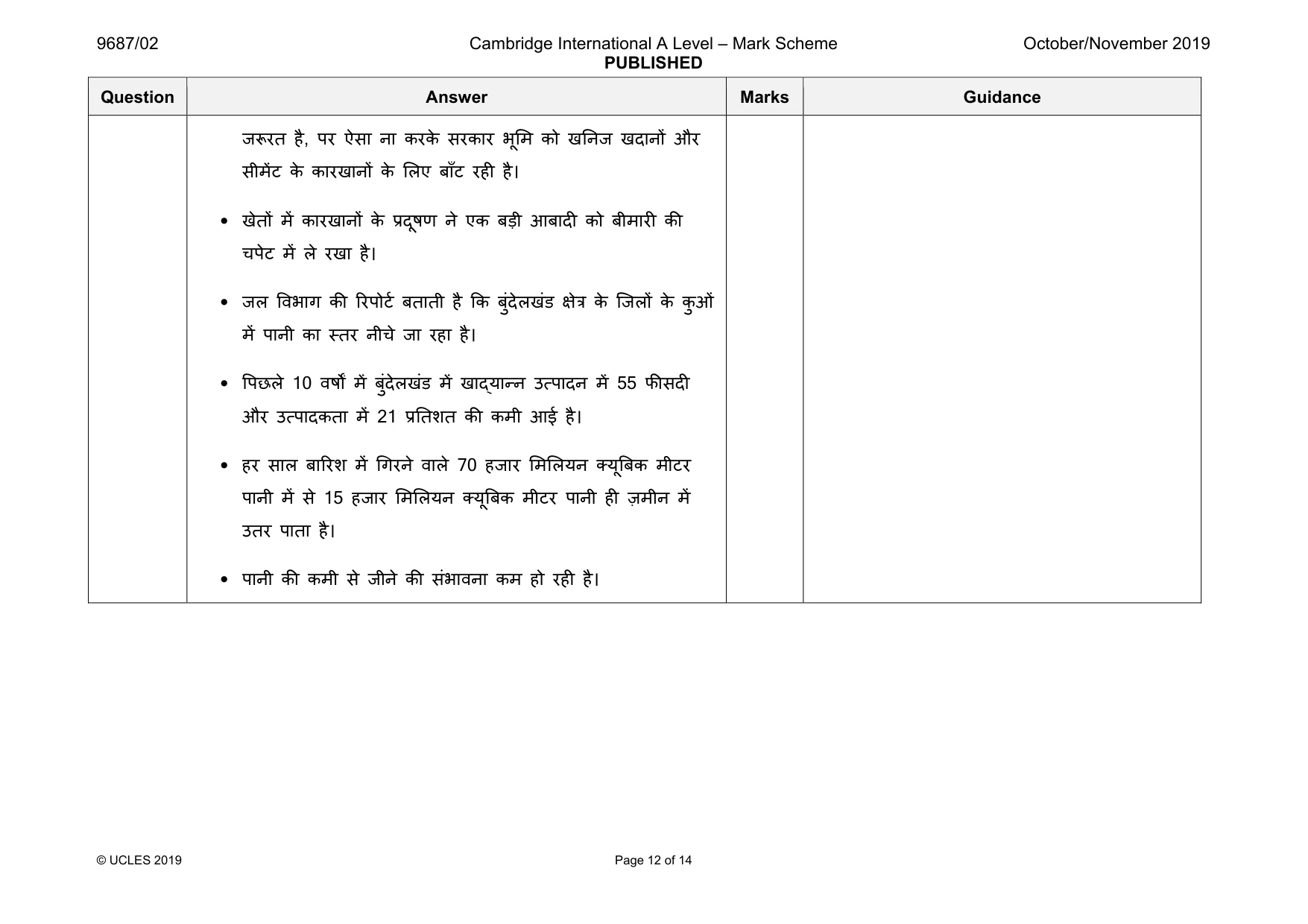
9687/02 Cambridge International A Level – Mark Scheme PUBLISHED October/November 2019 © UCLES 2019 Page 12 of 14 Question Answer Marks Guidance जǾरत है, पर ऐसा ना करके सरकार भूͧम को खǓनज खदानɉ और सीमɅट के कारखानɉ के ͧलए बाँट रहȣ है। • खेतɉ मɅ कारखानɉ के Ĥदूषण ने एक बड़ी आबादȣ को बीमारȣ कȧ चपेट मɅ ले रखा है। • जल ͪवभाग कȧ ǐरपोट[ बताती है ͩक बुंदेलखंड ¢ेğ के िजलɉ के कुओं मɅ पानी का èतर नीचे जा रहा है। • ͪपछले 10 वषɟ मɅ बुंदेलखंड मɅ खाɮयाÛन उ×पादन मɅ 55 फȧसदȣ और उ×पादकता मɅ 21 ĤǓतशत कȧ कमी आई है। • हर साल बाǐरश मɅ ͬगरने वाले 70 हजार ͧमͧलयन Èयूǒबक मीटर पानी मɅ से 15 हजार ͧमͧलयन Èयूǒबक मीटर पानी हȣ ज़मीन मɅ उतर पाता है। • पानी कȧ कमी से जीने कȧ संभावना कम हो रहȣ है।
Mark scheme, page 13
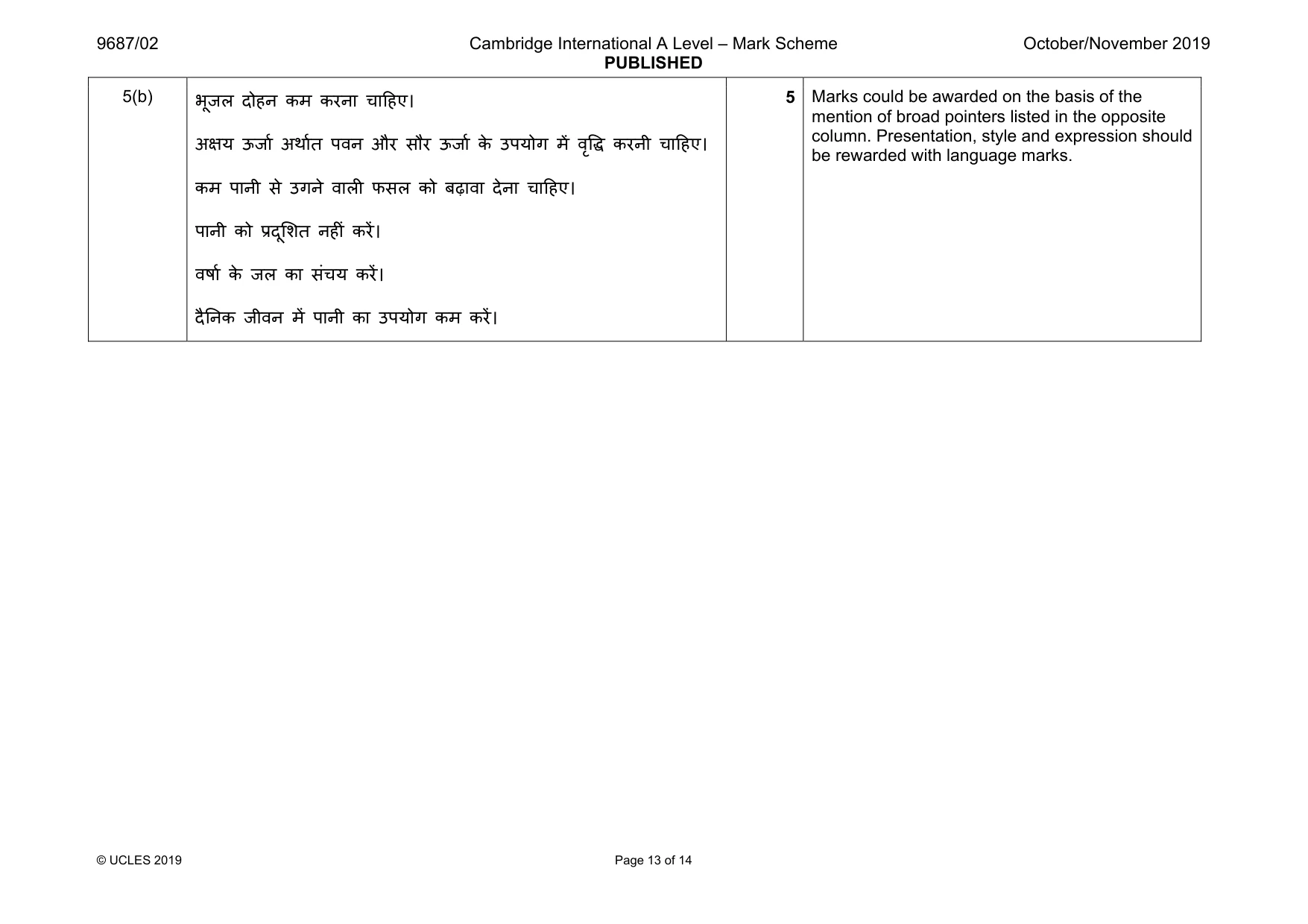
9687/02 Cambridge International A Level – Mark Scheme PUBLISHED October/November 2019 © UCLES 2019 Page 13 of 14 5(b) भूजल दोहन कम करना चाǑहए। अ¢य ऊजा[ अथा[त पवन और सौर ऊजा[ के उपयोग मɅ वृͪƨ करनी चाǑहए। कम पानी से उगने वालȣ फसल को बढ़ावा देना चाǑहए। पानी को Ĥदूͧशत नहȣं करɅ। वषा[ के जल का संचय करɅ। दैǓनक जीवन मɅ पानी का उपयोग कम करɅ। 5 Marks could be awarded on the basis of the mention of broad pointers listed in the opposite column. Presentation, style and expression should be rewarded with language marks.
Mark scheme, page 14
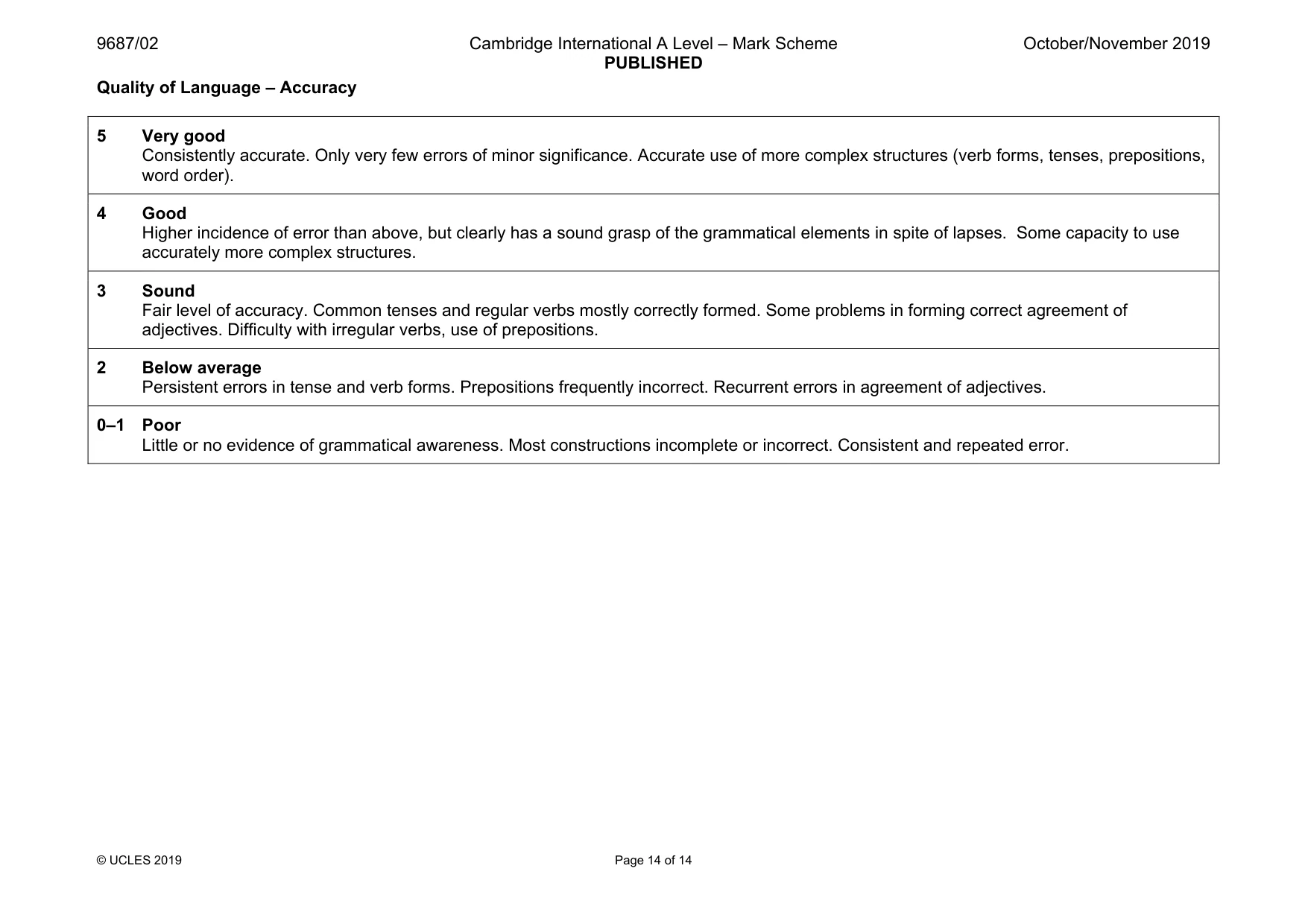
9687/02 Cambridge International A Level – Mark Scheme PUBLISHED October/November 2019 © UCLES 2019 Page 14 of 14 Quality of Language – Accuracy 5 Very good Consistently accurate. Only very few errors of minor significance. Accurate use of more complex structures (verb forms, tenses, prepositions, word order). 4 Good Higher incidence of error than above, but clearly has a sound grasp of the grammatical elements in spite of lapses. Some capacity to use accurately more complex structures. 3 Sound Fair level of accuracy. Common tenses and regular verbs mostly correctly formed. Some problems in forming correct agreement of adjectives. Difficulty with irregular verbs, use of prepositions. 2 Below average Persistent errors in tense and verb forms. Prepositions frequently incorrect. Recurrent errors in agreement of adjectives. 0–1 Poor Little or no evidence of grammatical awareness. Most constructions incomplete or incorrect. Consistent and repeated error.
What you needed in this session
Cambridge’s own grade thresholds for 2019 Oct/Nov, Paper 2 · Variant 1. A higher threshold means an easier paper — the bar moves with how the cohort did.