Cambridge A Level German (A Level only) 9717 — 2016 Oct/Nov Paper 2 · Variant 2
9717/22/O/N/16 · 70 marks · ≈79 min
The question paper and its mark scheme, free to read here and free to download. This is Cambridge’s own paper, exactly as it was sat.
Question paper8 pages
Mark scheme10 pages
Answers below. Sit the paper first if you are practising.
Paper as text
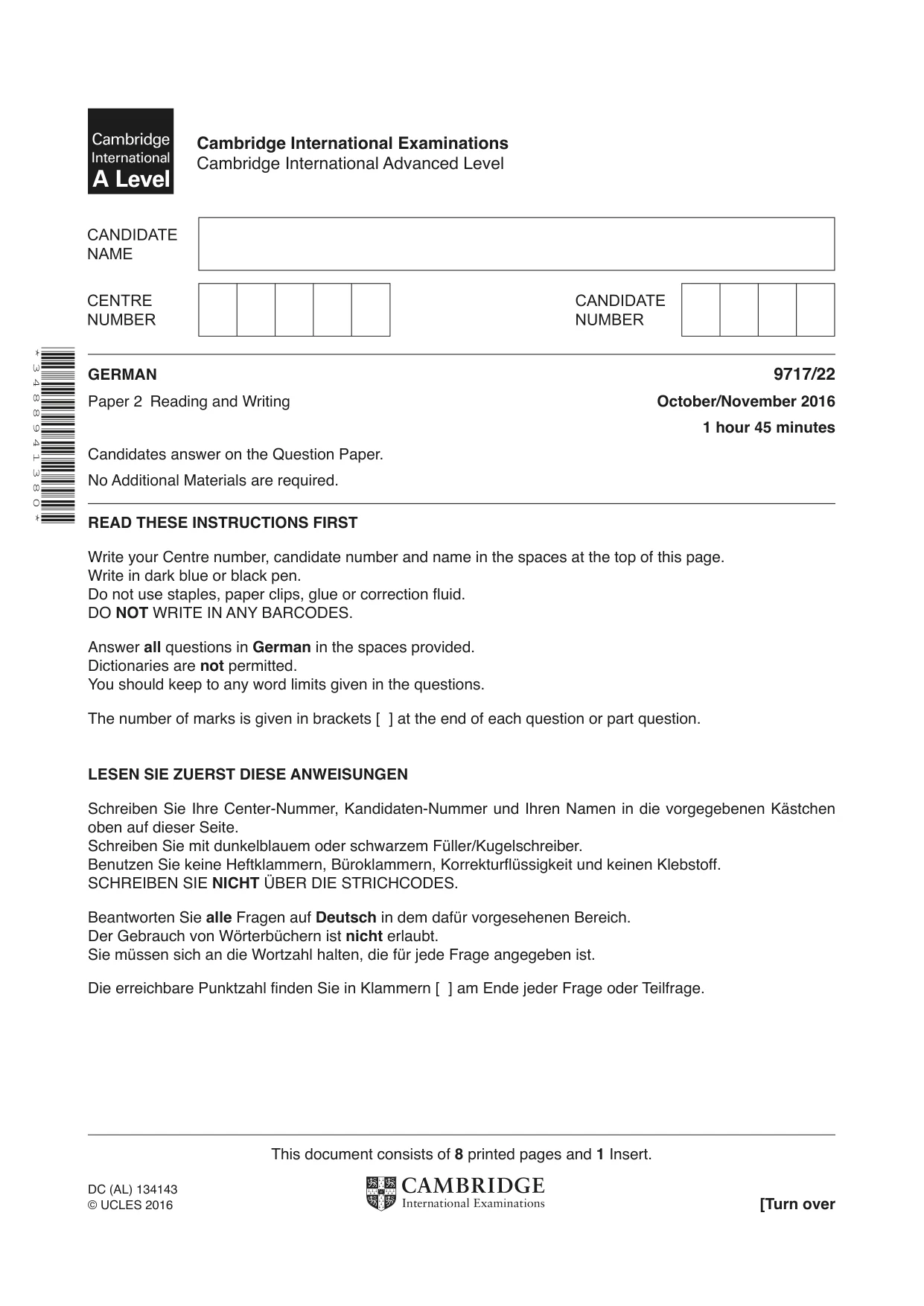
Question paper, page 1
This document consists of 8 printed pages and 1 Insert. DC (AL) 134143 © UCLES 2016 [Turn over Cambridge International Examinations Cambridge International Advanced Level * 3 4 8 8 9 4 1 3 8 0 * GERMAN 9717/22 Paper 2 Reading and Writing October/November 2016 1 hour 45 minutes Candidates answer on the Question Paper. No Additional Materials are required. READ THESE INSTRUCTIONS FIRST Write your Centre number, candidate number and name in the spaces at the top of this page. Write in dark blue or black pen. Do not use staples, paper clips, glue or correction fluid. DO NOT WRITE IN ANY BARCODES. Answer all questions in German in the spaces provided. Dictionaries are not permitted. You should keep to any word limits given in the questions. The number of marks is given in brackets [ ] at the end of each question or part question. LESEN SIE ZUERST DIESE ANWEISUNGEN Schreiben Sie Ihre Center-Nummer, Kandidaten-Nummer und Ihren Namen in die vorgegebenen Kästchen oben auf dieser Seite. Schreiben Sie mit dunkelblauem oder schwarzem Füller/Kugelschreiber. Benutzen Sie keine Heftklammern, Büroklammern, Korrekturflüssigkeit und keinen Klebstoff. SCHREIBEN SIE NICHT ÜBER DIE STRICHCODES. Beantworten Sie alle Fragen auf Deutsch in dem dafür vorgesehenen Bereich. Der Gebrauch von Wörterbüchern ist nicht erlaubt. Sie müssen sich an die Wortzahl halten, die für jede Frage angegeben ist. Die erreichbare Punktzahl finden Sie in Klammern [ ] am Ende jeder Frage oder Teilfrage.
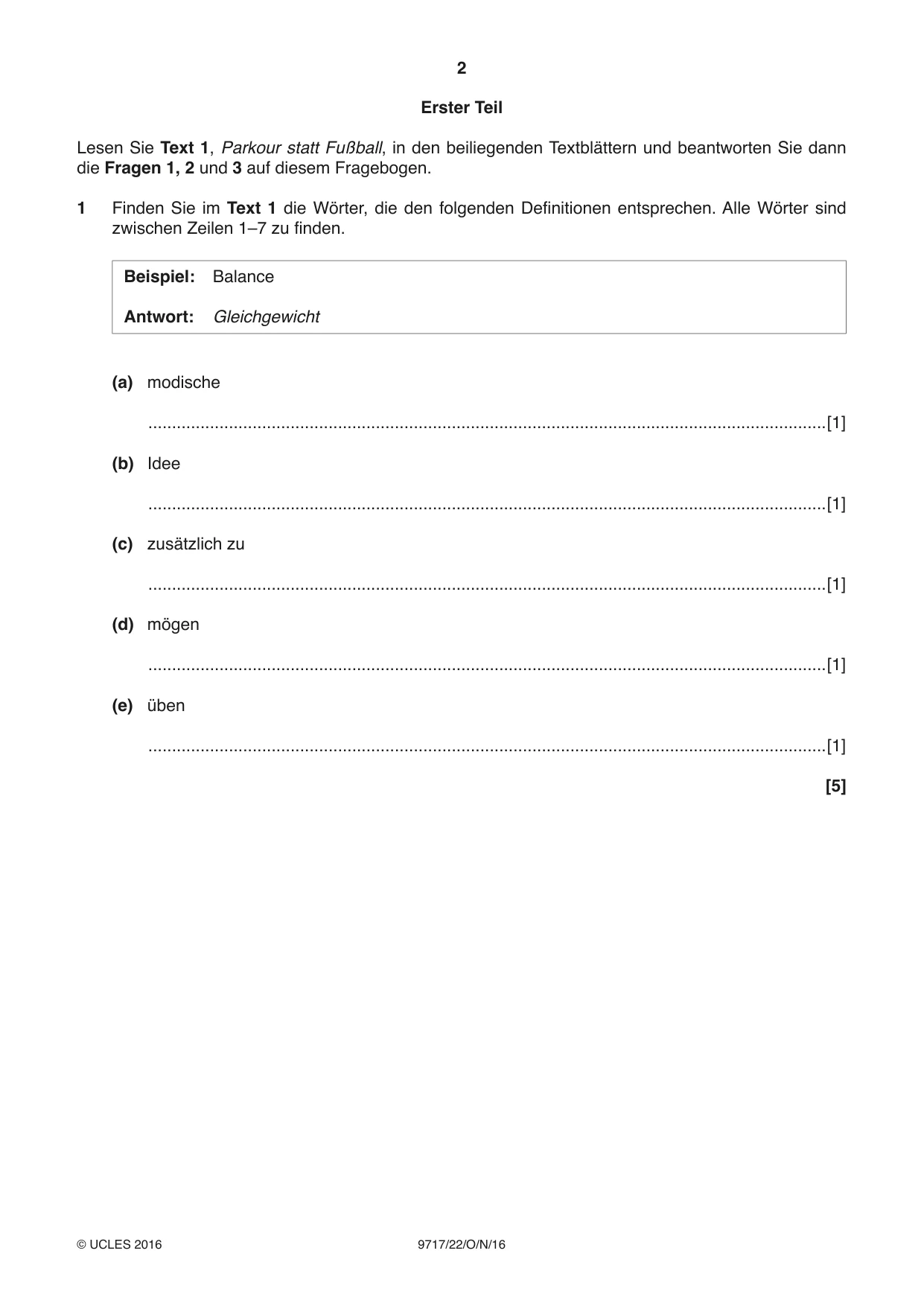
Question paper, page 2
2 9717/22/O/N/16 © UCLES 2016 Erster Teil Lesen Sie Text 1, Parkour statt Fußball, in den beiliegenden Textblättern und beantworten Sie dann die Fragen 1, 2 und 3 auf diesem Fragebogen. 1 Finden Sie im Text 1 die Wörter, die den folgenden Definitionen entsprechen. Alle Wörter sind zwischen Zeilen 1–7 zu finden. Beispiel: Balance Antwort: Gleichgewicht (a) modische …[1] (b) Idee …[1] (c) zusätzlich zu …[1] (d) mögen …[1] (e) üben …[1] [5]
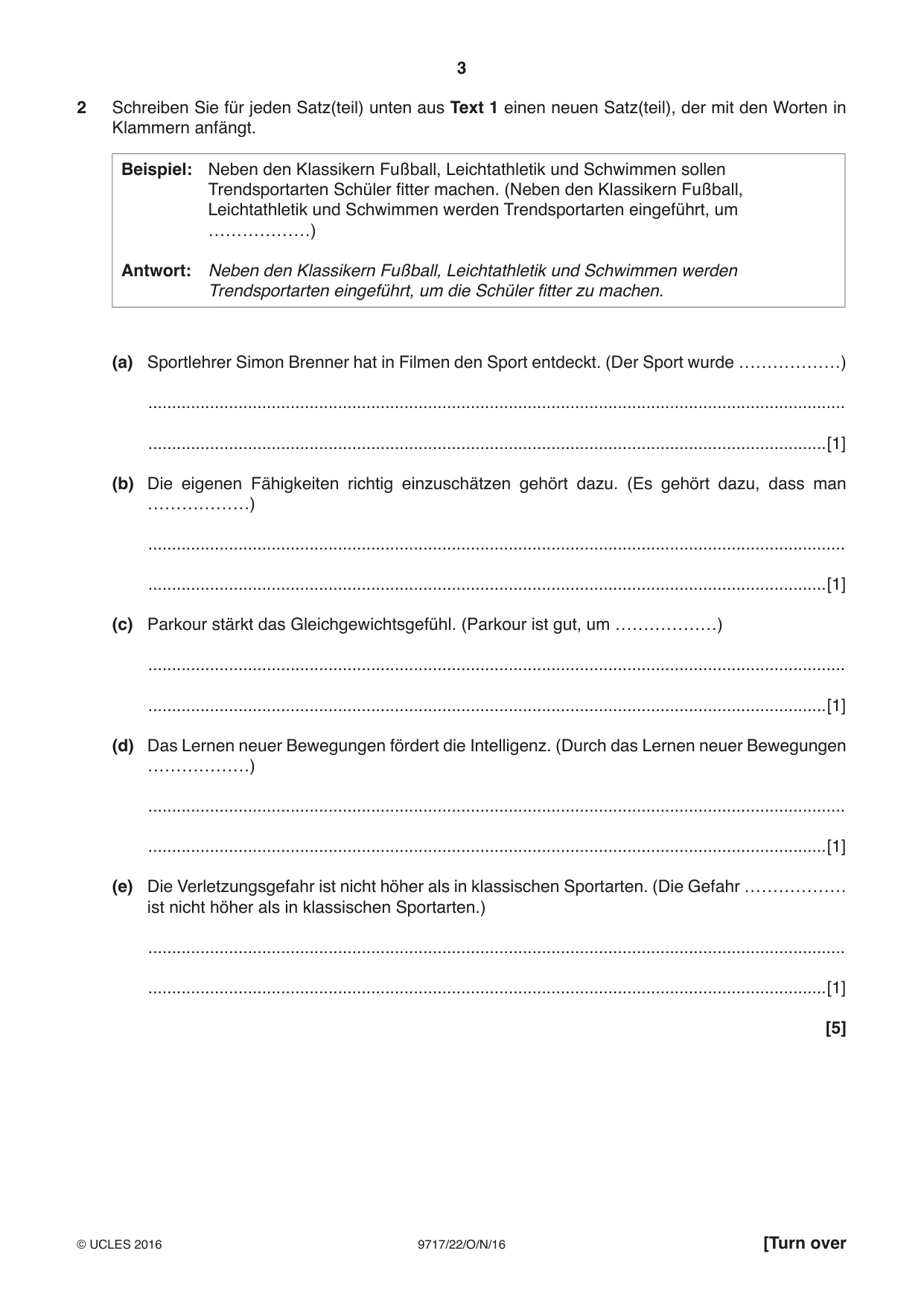
Question paper, page 3
3 9717/22/O/N/16 © UCLES 2016 [Turn over 2 Schreiben Sie für jeden Satz(teil) unten aus Text 1 einen neuen Satz(teil), der mit den Worten in Klammern anfängt. Beispiel: Neben den Klassikern Fußball, Leichtathletik und Schwimmen sollen Trendsportarten Schüler fitter machen. (Neben den Klassikern Fußball, Leichtathletik und Schwimmen werden Trendsportarten eingeführt, um ………………) Antwort: Neben den Klassikern Fußball, Leichtathletik und Schwimmen werden Trendsportarten eingeführt, um die Schüler fitter zu machen. (a) Sportlehrer Simon Brenner hat in Filmen den Sport entdeckt. (Der Sport wurde ………………) … …[1] (b) Die eigenen Fähigkeiten richtig einzuschätzen gehört dazu. (Es gehört dazu, dass man ………………) … …[1] (c) Parkour stärkt das Gleichgewichtsgefühl. (Parkour ist gut, um ………………) … …[1] (d) Das Lernen neuer Bewegungen fördert die Intelligenz. (Durch das Lernen neuer Bewegungen ………………) … …[1] (e) Die Verletzungsgefahr ist nicht höher als in klassischen Sportarten. (Die Gefahr ……………… ist nicht höher als in klassischen Sportarten.) … …[1] [5]
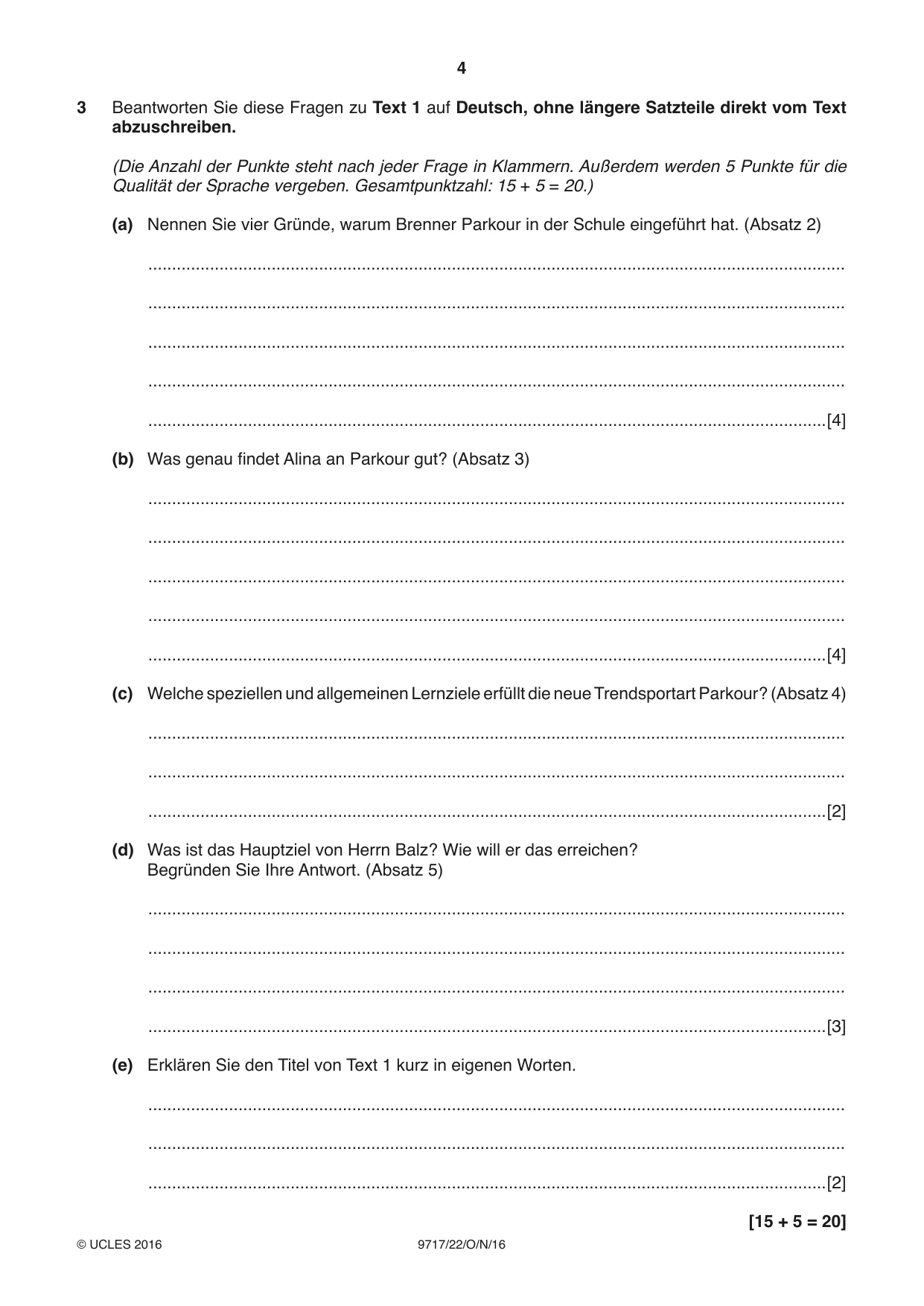
Question paper, page 4
4 9717/22/O/N/16 © UCLES 2016 3 Beantworten Sie diese Fragen zu Text 1 auf Deutsch, ohne längere Satzteile direkt vom Text abzuschreiben. (Die Anzahl der Punkte steht nach jeder Frage in Klammern. Außerdem werden 5 Punkte für die Qualität der Sprache vergeben. Gesamtpunktzahl: 15 + 5 = 20.) (a) Nennen Sie vier Gründe, warum Brenner Parkour in der Schule eingeführt hat. (Absatz 2) … … … … …[4] (b) Was genau findet Alina an Parkour gut? (Absatz 3) … … … … …[4] (c) Welche speziellen und allgemeinen Lernziele erfüllt die neue Trendsportart Parkour? (Absatz 4) … … …[2] (d) Was ist das Hauptziel von Herrn Balz? Wie will er das erreichen? Begründen Sie Ihre Antwort. (Absatz 5) … … … …[3] (e) Erklären Sie den Titel von Text 1 kurz in eigenen Worten. … … …[2] [15 + 5 = 20]
Question paper, page 5
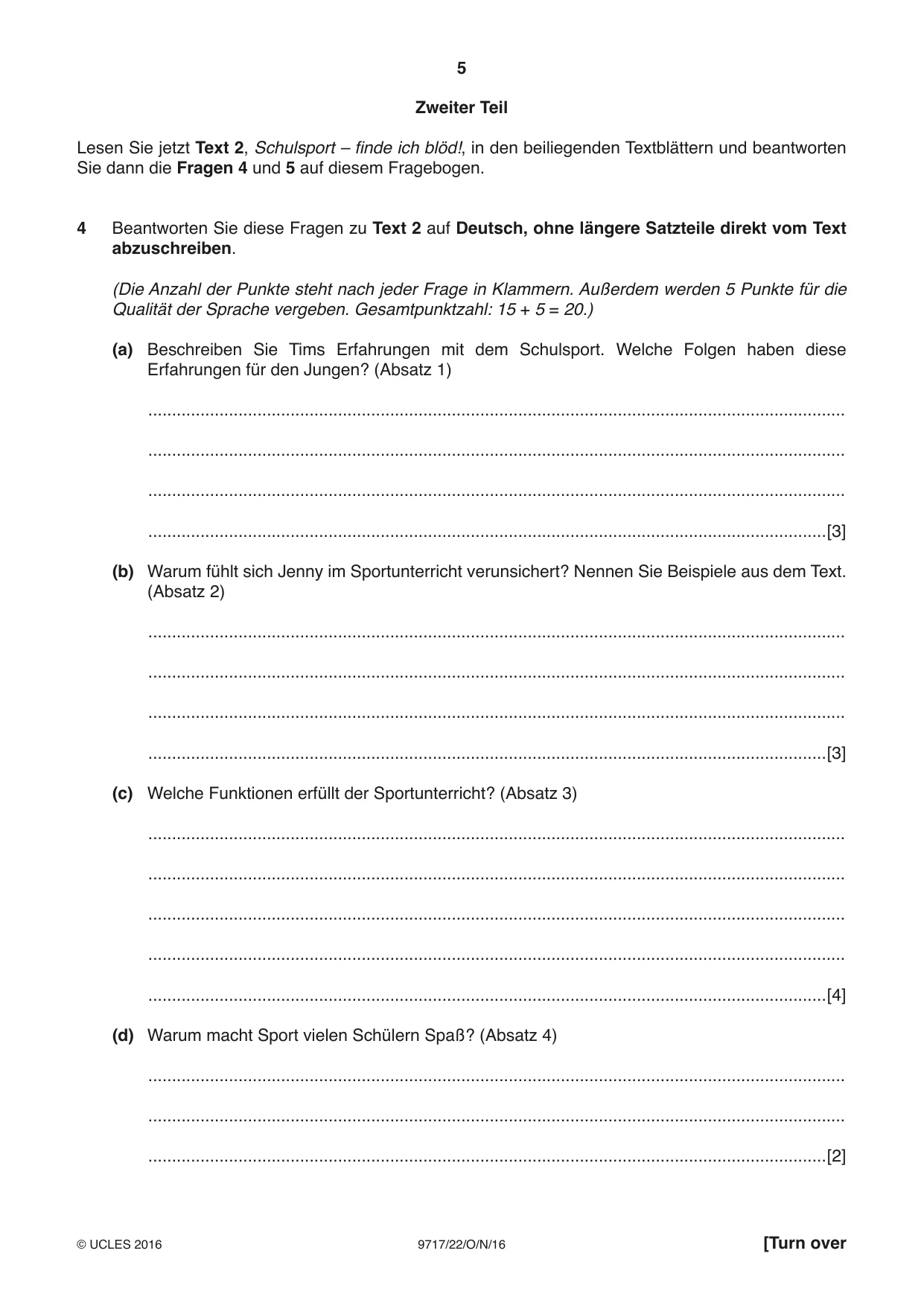
5 9717/22/O/N/16 © UCLES 2016 [Turn over Zweiter Teil Lesen Sie jetzt Text 2, Schulsport – finde ich blöd!, in den beiliegenden Textblättern und beantworten Sie dann die Fragen 4 und 5 auf diesem Fragebogen. 4 Beantworten Sie diese Fragen zu Text 2 auf Deutsch, ohne längere Satzteile direkt vom Text abzuschreiben. (Die Anzahl der Punkte steht nach jeder Frage in Klammern. Außerdem werden 5 Punkte für die Qualität der Sprache vergeben. Gesamtpunktzahl: 15 + 5 = 20.) (a) Beschreiben Sie Tims Erfahrungen mit dem Schulsport. Welche Folgen haben diese Erfahrungen für den Jungen? (Absatz 1) … … … …[3] (b) Warum fühlt sich Jenny im Sportunterricht verunsichert? Nennen Sie Beispiele aus dem Text. (Absatz 2) … … … …[3] (c) Welche Funktionen erfüllt der Sportunterricht? (Absatz 3) … … … … …[4] (d) Warum macht Sport vielen Schülern Spaß? (Absatz 4) … … …[2]
Question paper, page 6
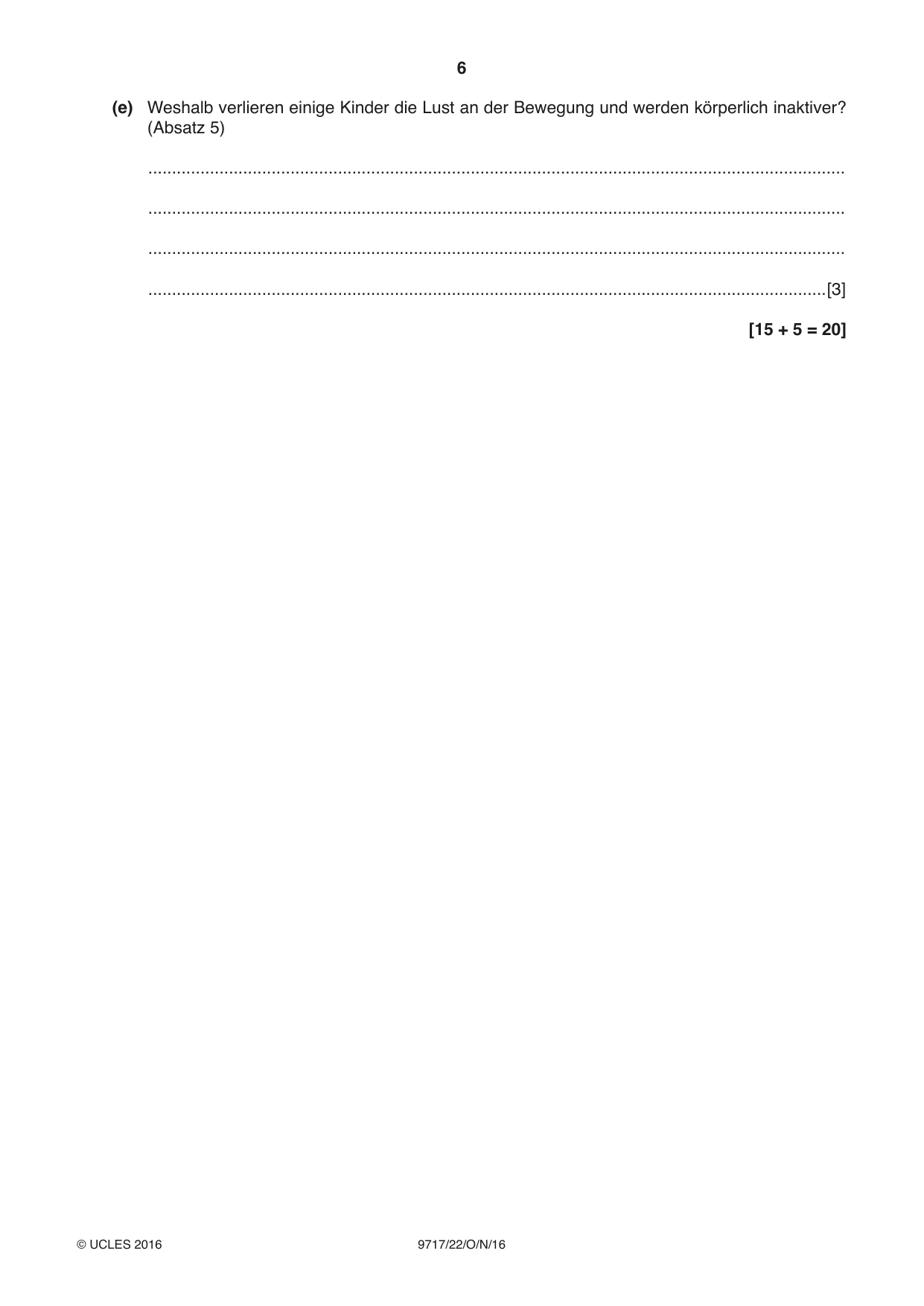
6 9717/22/O/N/16 © UCLES 2016 (e) Weshalb verlieren einige Kinder die Lust an der Bewegung und werden körperlich inaktiver? (Absatz 5) … … … …[3] [15 + 5 = 20]
Question paper, page 7
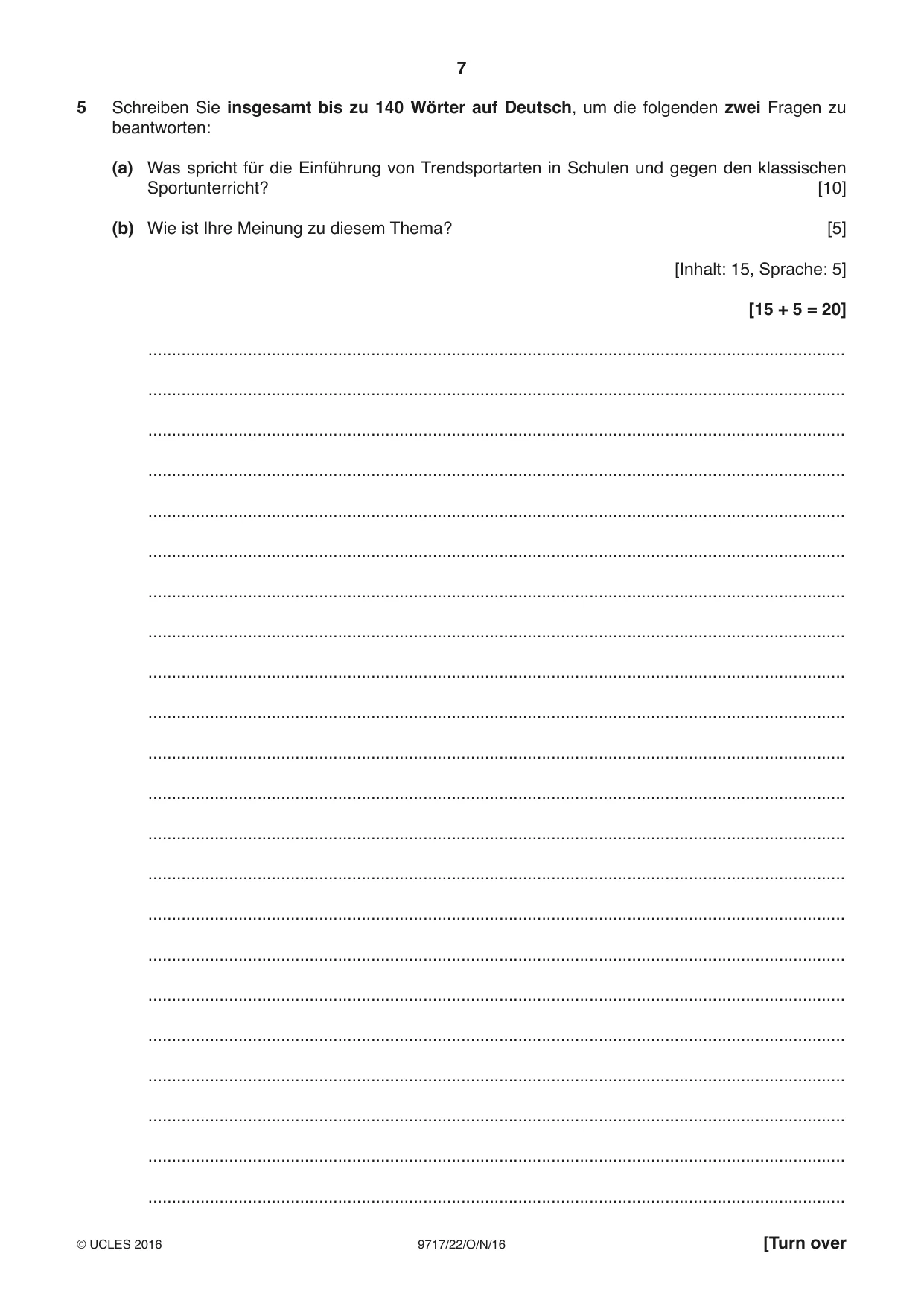
7 9717/22/O/N/16 © UCLES 2016 [Turn over 5 Schreiben Sie insgesamt bis zu 140 Wörter auf Deutsch, um die folgenden zwei Fragen zu beantworten: (a) Was spricht für die Einführung von Trendsportarten in Schulen und gegen den klassischen Sportunterricht? [10] (b) Wie ist Ihre Meinung zu diesem Thema? [5] [Inhalt: 15, Sprache: 5] [15 + 5 = 20] … … … … … … … … … … … … … … … … … … … … … …
Question paper, page 8
8 9717/22/O/N/16 © UCLES 2016 Permission to reproduce items where third-party owned material protected by copyright is included has been sought and cleared where possible. Every reasonable effort has been made by the publisher (UCLES) to trace copyright holders, but if any items requiring clearance have unwittingly been included, the publisher will be pleased to make amends at the earliest possible opportunity. To avoid the issue of disclosure of answer-related information to candidates, all copyright acknowledgements are reproduced online in the Cambridge International Examinations Copyright Acknowledgements Booklet. This is produced for each series of examinations and is freely available to download at www.cie.org.uk after the live examination series. Cambridge International Examinations is part of the Cambridge Assessment Group. Cambridge Assessment is the brand name of University of Cambridge Local Examinations Syndicate (UCLES), which is itself a department of the University of Cambridge. … … … … … … … … … … … … … … … …
Mark scheme, page 1
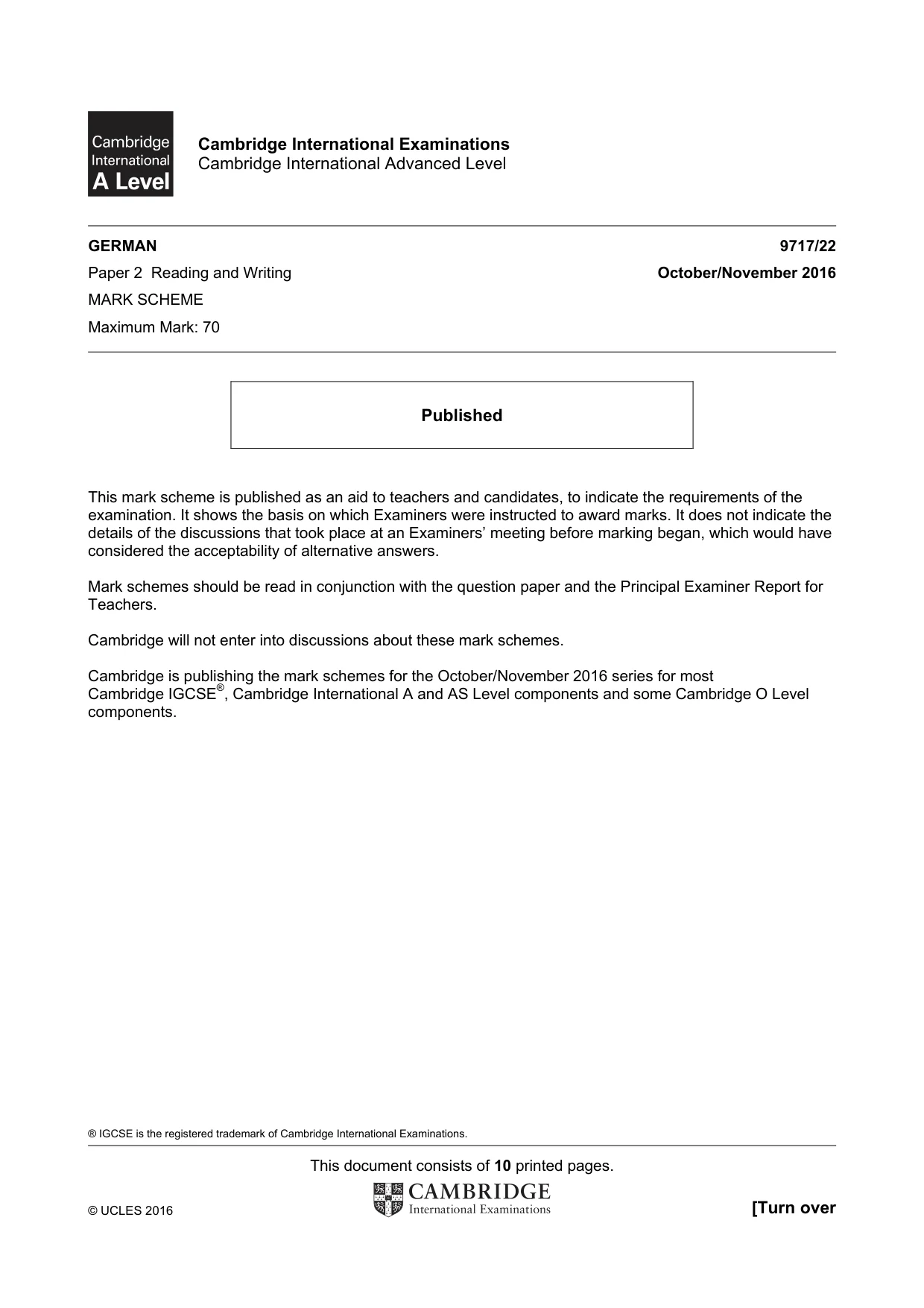
® IGCSE is the registered trademark of Cambridge International Examinations. This document consists of 10 printed pages. © UCLES 2016 [Turn over Cambridge International Examinations Cambridge International Advanced Level GERMAN 9717/22 Paper 2 Reading and Writing October/November 2016 MARK SCHEME Maximum Mark: 70 Published This mark scheme is published as an aid to teachers and candidates, to indicate the requirements of the examination. It shows the basis on which Examiners were instructed to award marks. It does not indicate the details of the discussions that took place at an Examiners’ meeting before marking began, which would have considered the acceptability of alternative answers. Mark schemes should be read in conjunction with the question paper and the Principal Examiner Report for Teachers. Cambridge will not enter into discussions about these mark schemes. Cambridge is publishing the mark schemes for the October/November 2016 series for most Cambridge IGCSE®, Cambridge International A and AS Level components and some Cambridge O Level components.
Mark scheme, page 2
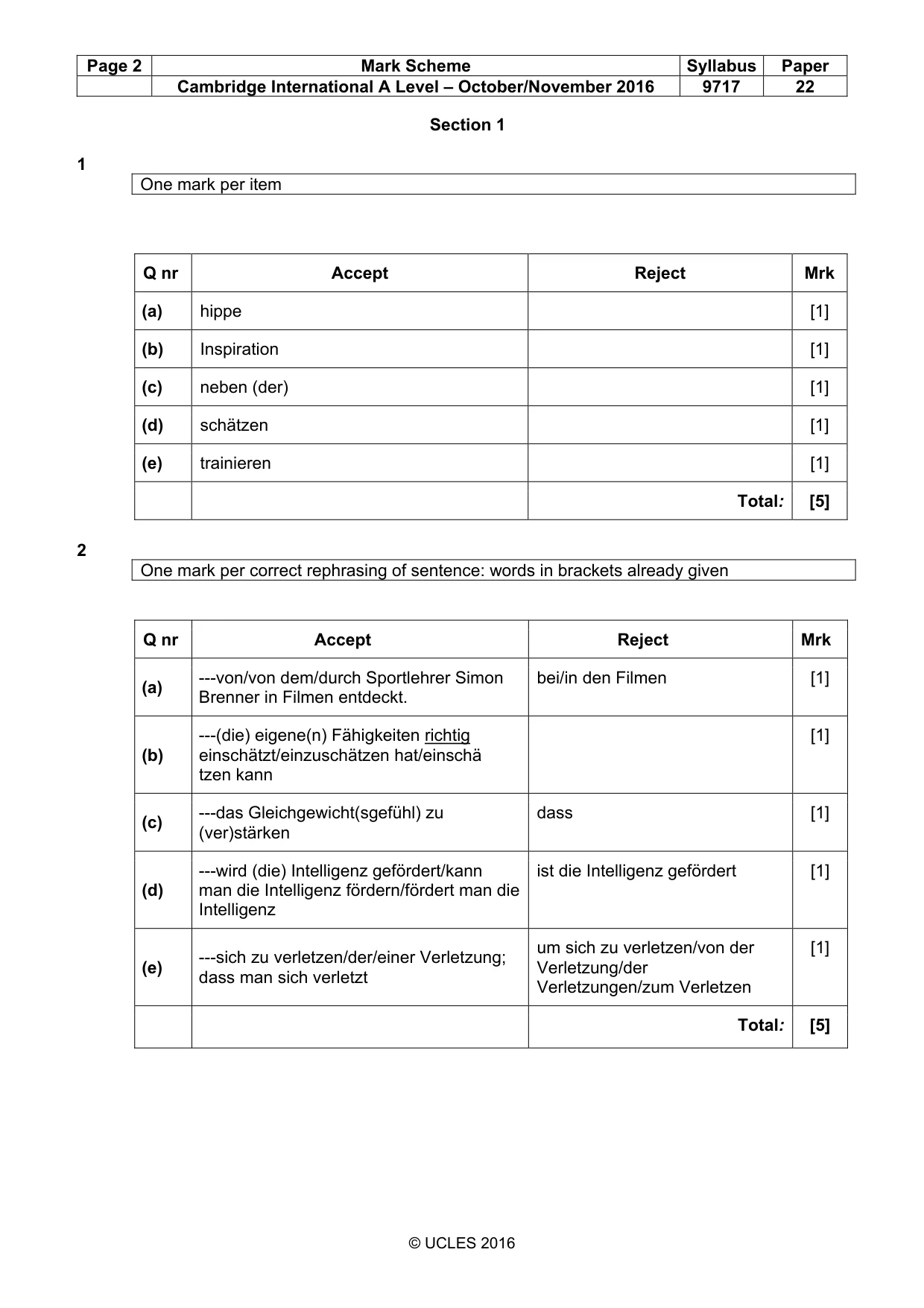
Page 2 Mark Scheme Syllabus Paper Cambridge International A Level – October/November 2016 9717 22 © UCLES 2016 Section 1 1 One mark per item Q nr Accept Reject Mrk (a) hippe [1] (b) Inspiration [1] (c) neben (der) [1] (d) schätzen [1] (e) trainieren [1] Total: [5] 2 One mark per correct rephrasing of sentence: words in brackets already given Q nr Accept Reject Mrk (a) ---von/von dem/durch Sportlehrer Simon Brenner in Filmen entdeckt. bei/in den Filmen [1] (b) ---(die) eigene(n) Fähigkeiten richtig einschätzt/einzuschätzen hat/einschä tzen kann [1] (c) ---das Gleichgewicht(sgefühl) zu (ver)stärken dass [1] (d) ---wird (die) Intelligenz gefördert/kann man die Intelligenz fördern/fördert man die Intelligenz ist die Intelligenz gefördert [1] (e) ---sich zu verletzen/der/einer Verletzung; dass man sich verletzt um sich zu verletzen/von der Verletzung/der Verletzungen/zum Verletzen [1] Total: [5]
Mark scheme, page 3
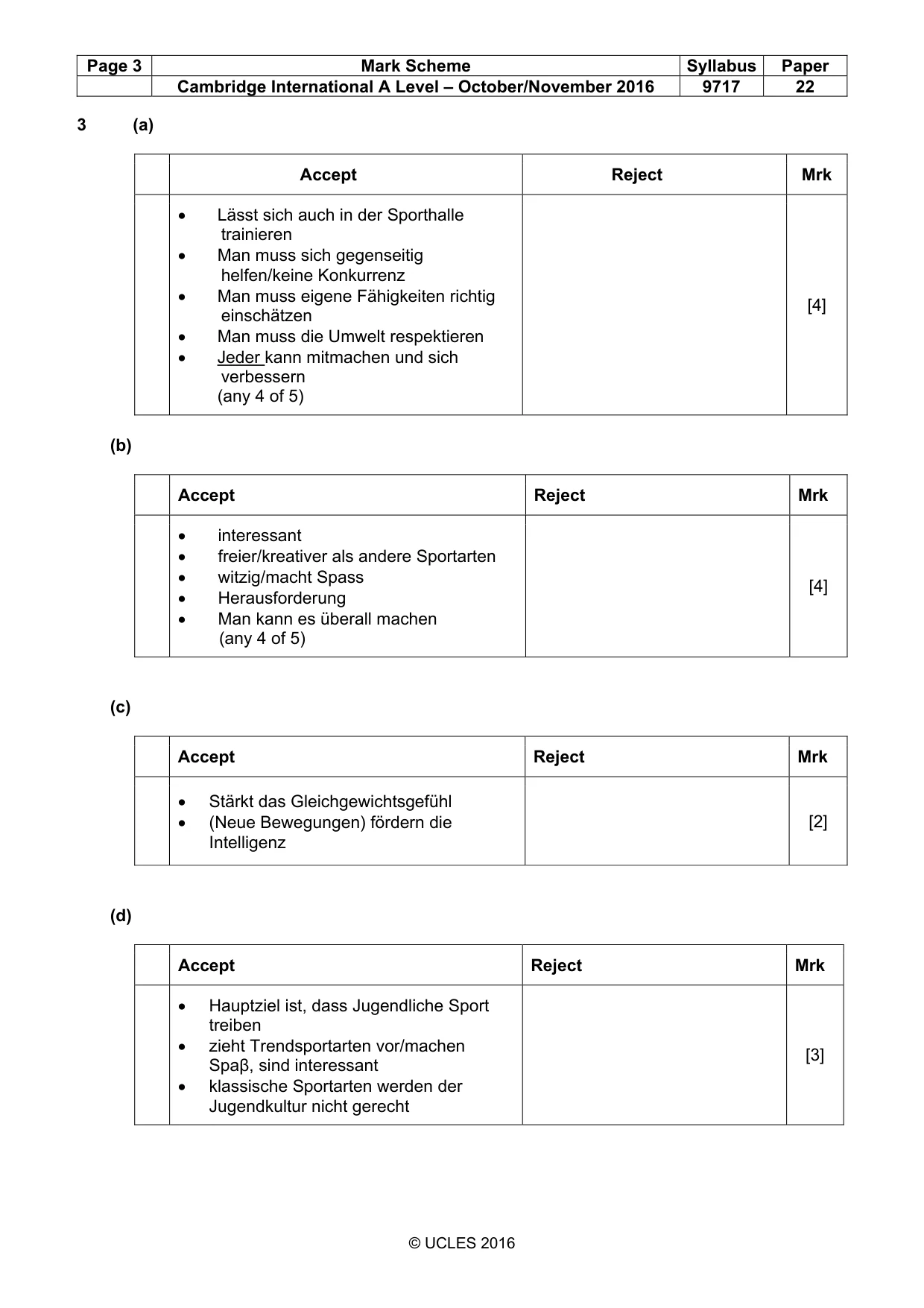
Page 3 Mark Scheme Syllabus Paper Cambridge International A Level – October/November 2016 9717 22 © UCLES 2016 3 (a) Accept Reject Mrk • Lässt sich auch in der Sporthalle trainieren • Man muss sich gegenseitig helfen/keine Konkurrenz • Man muss eigene Fähigkeiten richtig einschätzen • Man muss die Umwelt respektieren • Jeder kann mitmachen und sich verbessern (any 4 of 5) [4] (b) Accept Reject Mrk • interessant • freier/kreativer als andere Sportarten • witzig/macht Spass • Herausforderung • Man kann es überall machen (any 4 of 5) [4] (c) Accept Reject Mrk • Stärkt das Gleichgewichtsgefühl • (Neue Bewegungen) fördern die Intelligenz [2] (d) Accept Reject Mrk • Hauptziel ist, dass Jugendliche Sport treiben • zieht Trendsportarten vor/machen Spaβ, sind interessant • klassische Sportarten werden der Jugendkultur nicht gerecht [3]
Mark scheme, page 4
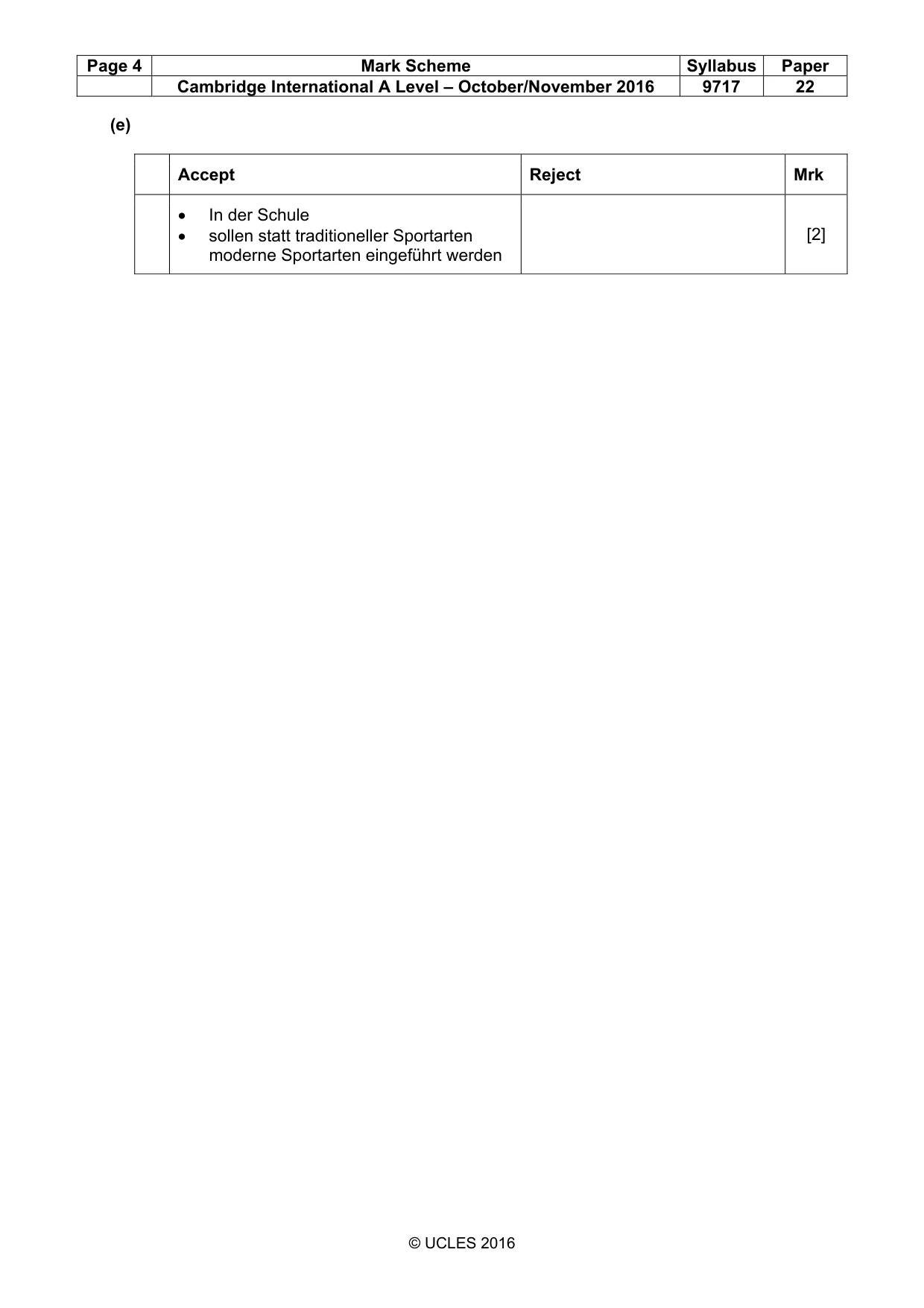
Page 4 Mark Scheme Syllabus Paper Cambridge International A Level – October/November 2016 9717 22 © UCLES 2016 (e) Accept Reject Mrk • In der Schule • sollen statt traditioneller Sportarten moderne Sportarten eingeführt werden [2]
Mark scheme, page 5
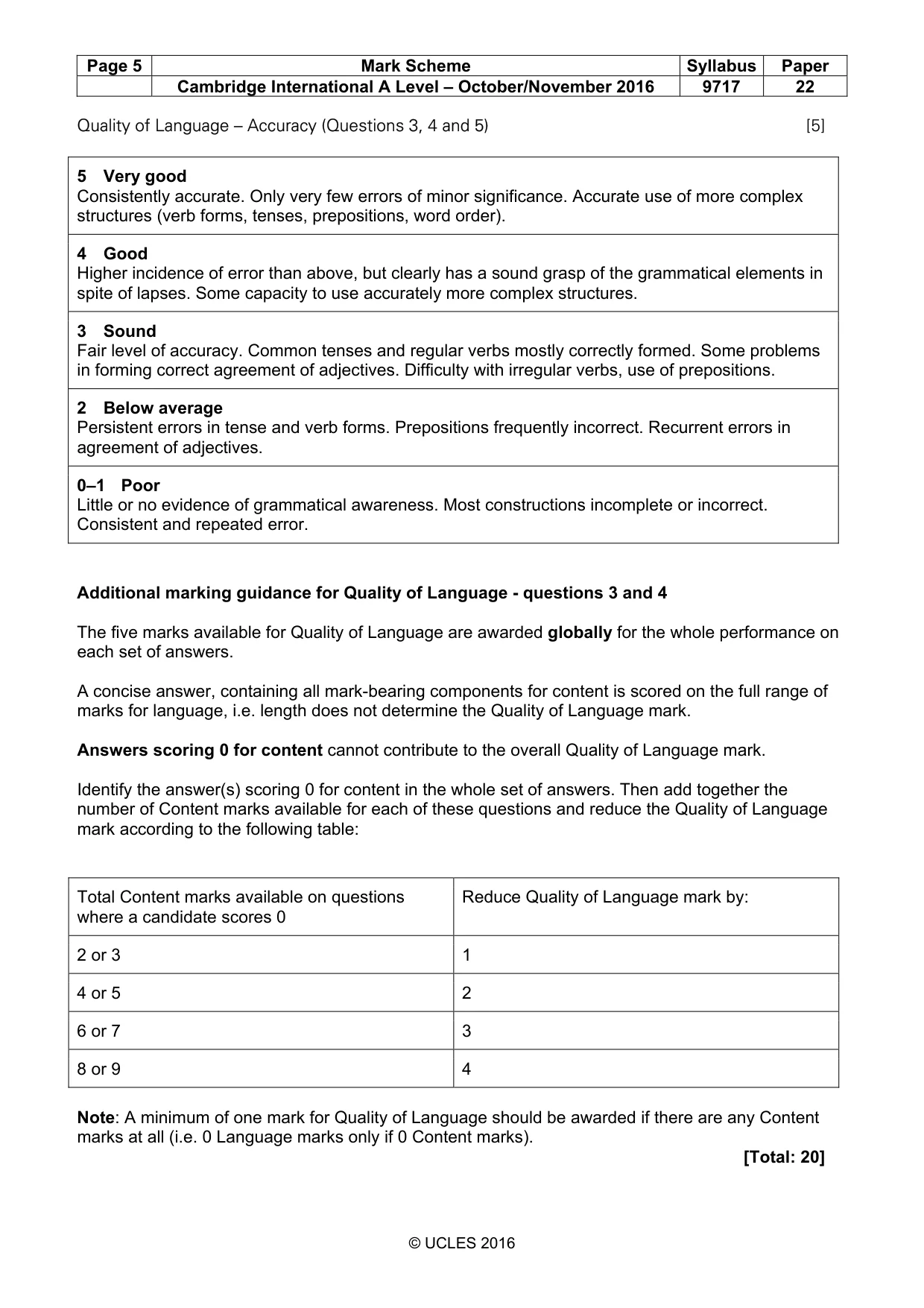
Page 5 Mark Scheme Syllabus Paper Cambridge International A Level – October/November 2016 9717 22 © UCLES 2016 Quality of Language – Accuracy (Questions 3, 4 and 5) [5] 5 Very good Consistently accurate. Only very few errors of minor significance. Accurate use of more complex structures (verb forms, tenses, prepositions, word order). 4 Good Higher incidence of error than above, but clearly has a sound grasp of the grammatical elements in spite of lapses. Some capacity to use accurately more complex structures. 3 Sound Fair level of accuracy. Common tenses and regular verbs mostly correctly formed. Some problems in forming correct agreement of adjectives. Difficulty with irregular verbs, use of prepositions. 2 Below average Persistent errors in tense and verb forms. Prepositions frequently incorrect. Recurrent errors in agreement of adjectives. 0–1 Poor Little or no evidence of grammatical awareness. Most constructions incomplete or incorrect. Consistent and repeated error. Additional marking guidance for Quality of Language - questions 3 and 4 The five marks available for Quality of Language are awarded globally for the whole performance on each set of answers. A concise answer, containing all mark-bearing components for content is scored on the full range of marks for language, i.e. length does not determine the Quality of Language mark. Answers scoring 0 for content cannot contribute to the overall Quality of Language mark. Identify the answer(s) scoring 0 for content in the whole set of answers. Then add together the number of Content marks available for each of these questions and reduce the Quality of Language mark according to the following table: Total Content marks available on questions where a candidate scores 0 Reduce Quality of Language mark by: 2 or 3 1 4 or 5 2 6 or 7 3 8 or 9 4 Note: A minimum of one mark for Quality of Language should be awarded if there are any Content marks at all (i.e. 0 Language marks only if 0 Content marks). [Total: 20]
Mark scheme, page 6
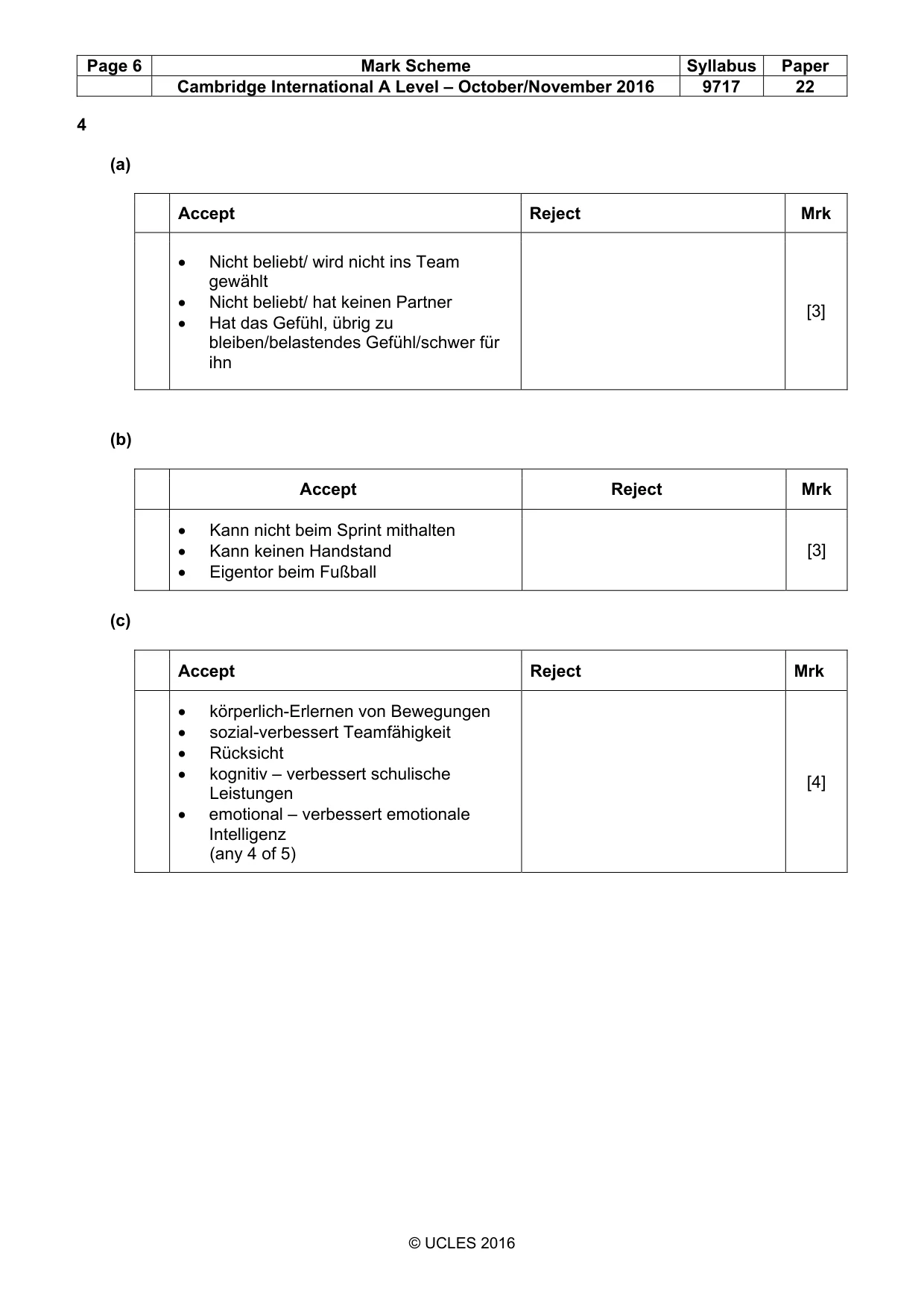
Page 6 Mark Scheme Syllabus Paper Cambridge International A Level – October/November 2016 9717 22 © UCLES 2016 4 (a) Accept Reject Mrk • Nicht beliebt/ wird nicht ins Team gewählt • Nicht beliebt/ hat keinen Partner • Hat das Gefühl, übrig zu bleiben/belastendes Gefühl/schwer für ihn [3] (b) Accept Reject Mrk • Kann nicht beim Sprint mithalten • Kann keinen Handstand • Eigentor beim Fußball [3] (c) Accept Reject Mrk • körperlich-Erlernen von Bewegungen • sozial-verbessert Teamfähigkeit • Rücksicht • kognitiv – verbessert schulische Leistungen • emotional – verbessert emotionale Intelligenz (any 4 of 5) [4]
Mark scheme, page 7
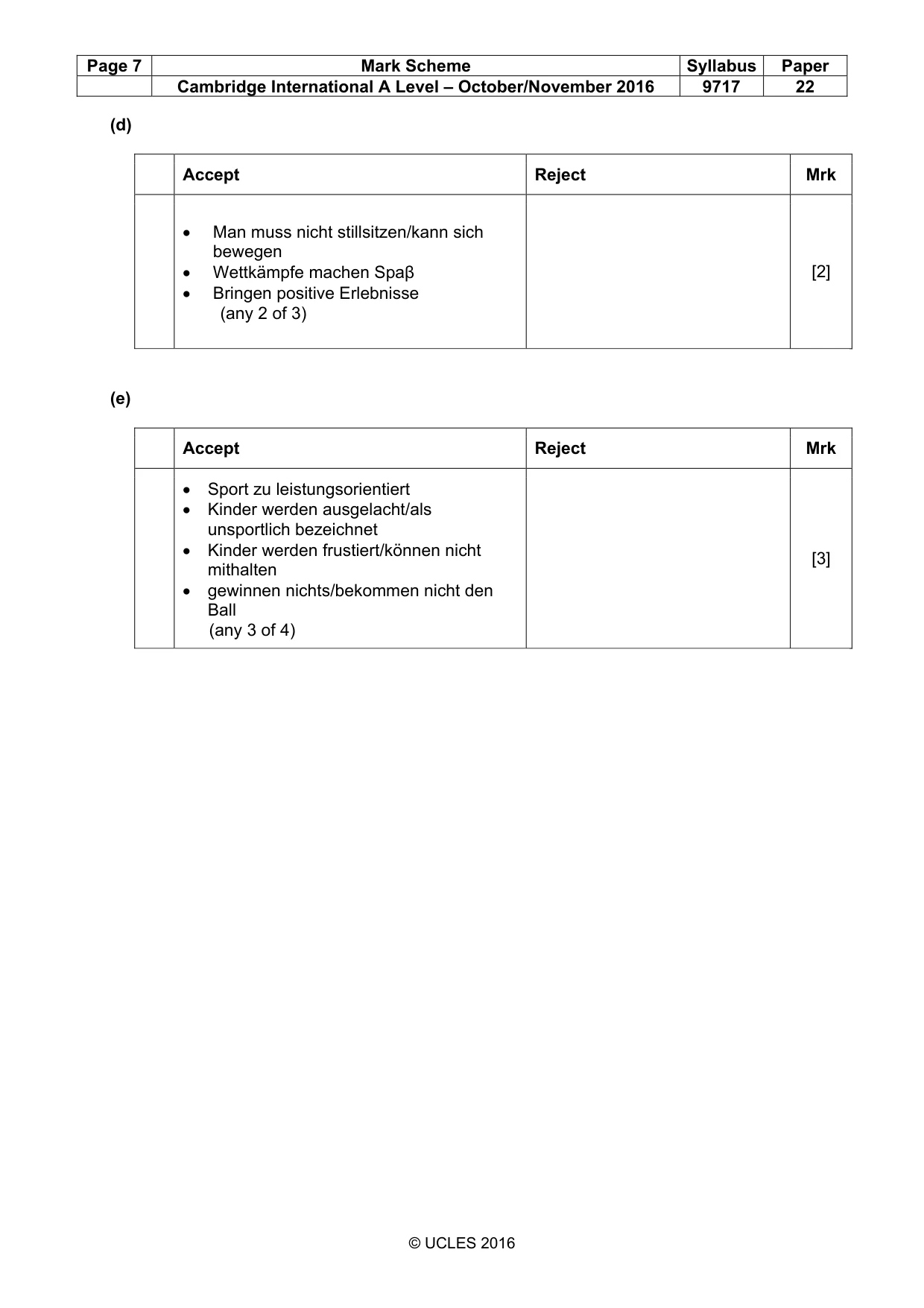
Page 7 Mark Scheme Syllabus Paper Cambridge International A Level – October/November 2016 9717 22 © UCLES 2016 (d) Accept Reject Mrk • Man muss nicht stillsitzen/kann sich bewegen • Wettkämpfe machen Spaβ • Bringen positive Erlebnisse (any 2 of 3) [2] (e) Accept Reject Mrk • Sport zu leistungsorientiert • Kinder werden ausgelacht/als unsportlich bezeichnet • Kinder werden frustiert/können nicht mithalten • gewinnen nichts/bekommen nicht den Ball (any 3 of 4) [3]
Mark scheme, page 8
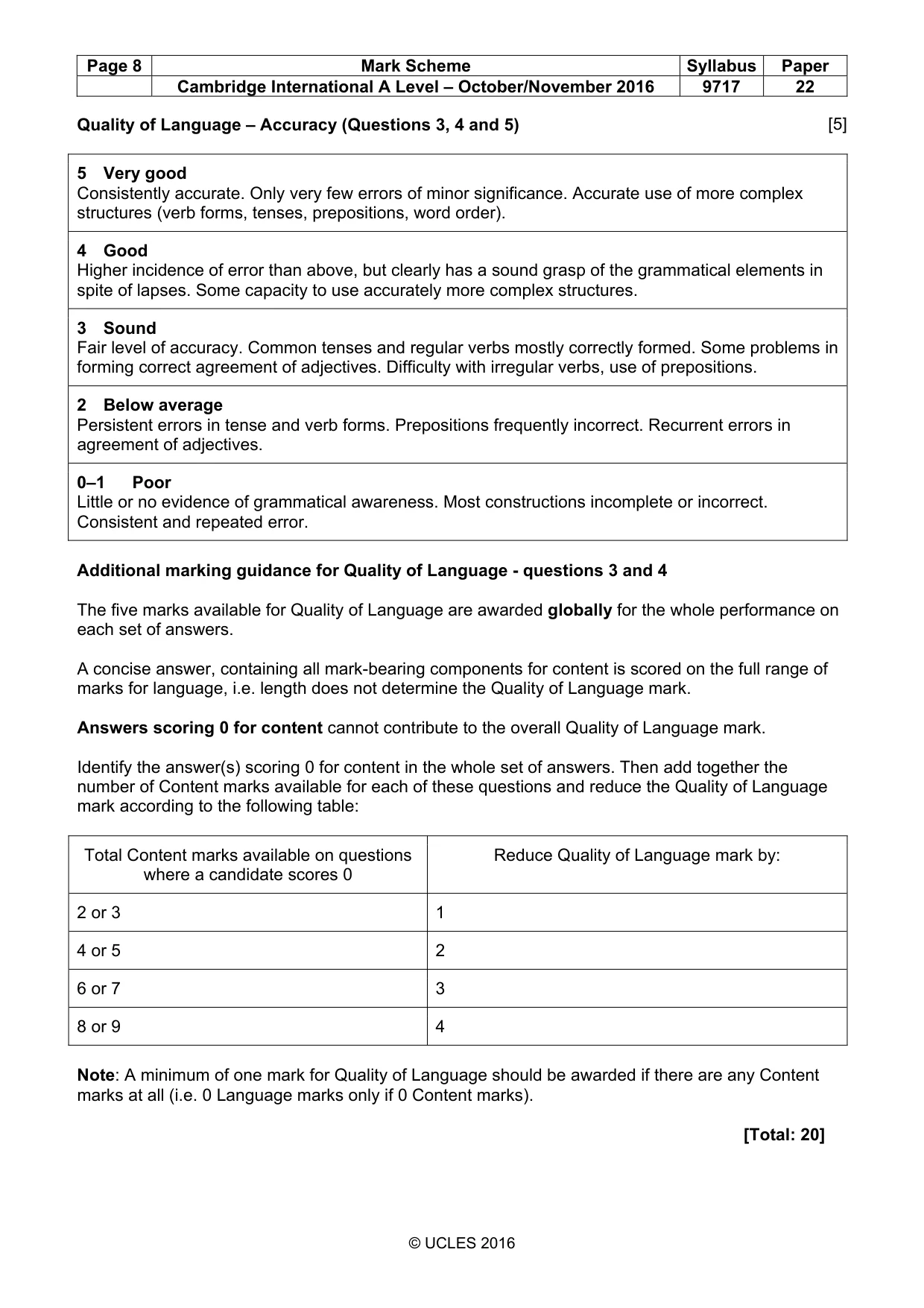
Page 8 Mark Scheme Syllabus Paper Cambridge International A Level – October/November 2016 9717 22 © UCLES 2016 Quality of Language – Accuracy (Questions 3, 4 and 5) [5] 5 Very good Consistently accurate. Only very few errors of minor significance. Accurate use of more complex structures (verb forms, tenses, prepositions, word order). 4 Good Higher incidence of error than above, but clearly has a sound grasp of the grammatical elements in spite of lapses. Some capacity to use accurately more complex structures. 3 Sound Fair level of accuracy. Common tenses and regular verbs mostly correctly formed. Some problems in forming correct agreement of adjectives. Difficulty with irregular verbs, use of prepositions. 2 Below average Persistent errors in tense and verb forms. Prepositions frequently incorrect. Recurrent errors in agreement of adjectives. 0–1 Poor Little or no evidence of grammatical awareness. Most constructions incomplete or incorrect. Consistent and repeated error. Additional marking guidance for Quality of Language - questions 3 and 4 The five marks available for Quality of Language are awarded globally for the whole performance on each set of answers. A concise answer, containing all mark-bearing components for content is scored on the full range of marks for language, i.e. length does not determine the Quality of Language mark. Answers scoring 0 for content cannot contribute to the overall Quality of Language mark. Identify the answer(s) scoring 0 for content in the whole set of answers. Then add together the number of Content marks available for each of these questions and reduce the Quality of Language mark according to the following table: Total Content marks available on questions where a candidate scores 0 Reduce Quality of Language mark by: 2 or 3 1 4 or 5 2 6 or 7 3 8 or 9 4 Note: A minimum of one mark for Quality of Language should be awarded if there are any Content marks at all (i.e. 0 Language marks only if 0 Content marks). [Total: 20]
Mark scheme, page 9
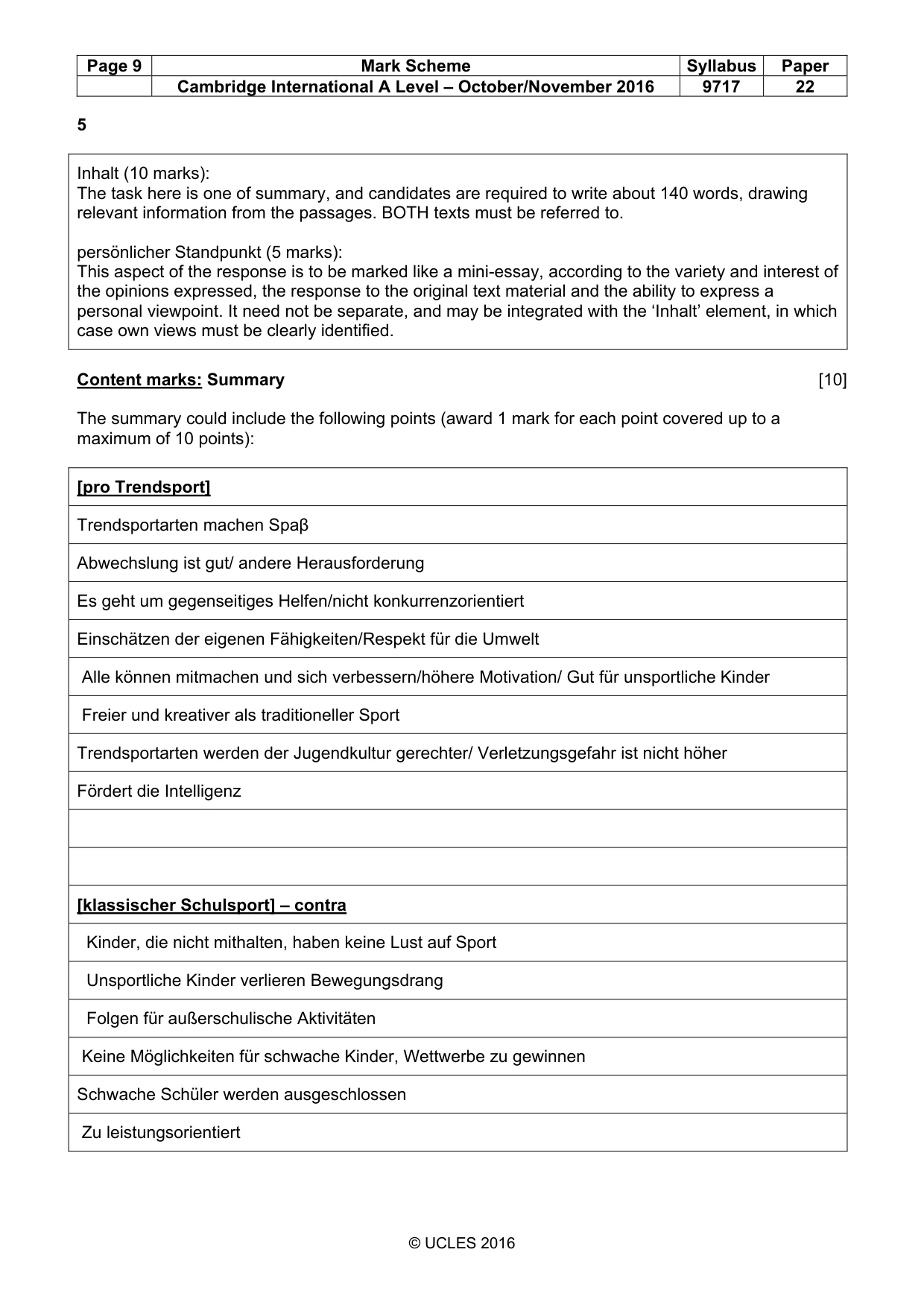
Page 9 Mark Scheme Syllabus Paper Cambridge International A Level – October/November 2016 9717 22 © UCLES 2016 5 Inhalt (10 marks): The task here is one of summary, and candidates are required to write about 140 words, drawing relevant information from the passages. BOTH texts must be referred to. persönlicher Standpunkt (5 marks): This aspect of the response is to be marked like a mini-essay, according to the variety and interest of the opinions expressed, the response to the original text material and the ability to express a personal viewpoint. It need not be separate, and may be integrated with the ‘Inhalt’ element, in which case own views must be clearly identified. Content marks: Summary [10] The summary could include the following points (award 1 mark for each point covered up to a maximum of 10 points): [pro Trendsport] Trendsportarten machen Spaβ Abwechslung ist gut/ andere Herausforderung Es geht um gegenseitiges Helfen/nicht konkurrenzorientiert Einschätzen der eigenen Fähigkeiten/Respekt für die Umwelt Alle können mitmachen und sich verbessern/höhere Motivation/ Gut für unsportliche Kinder Freier und kreativer als traditioneller Sport Trendsportarten werden der Jugendkultur gerechter/ Verletzungsgefahr ist nicht höher Fördert die Intelligenz [klassischer Schulsport] – contra Kinder, die nicht mithalten, haben keine Lust auf Sport Unsportliche Kinder verlieren Bewegungsdrang Folgen für außerschulische Aktivitäten Keine Möglichkeiten für schwache Kinder, Wettwerbe zu gewinnen Schwache Schüler werden ausgeschlossen Zu leistungsorientiert
Mark scheme, page 10
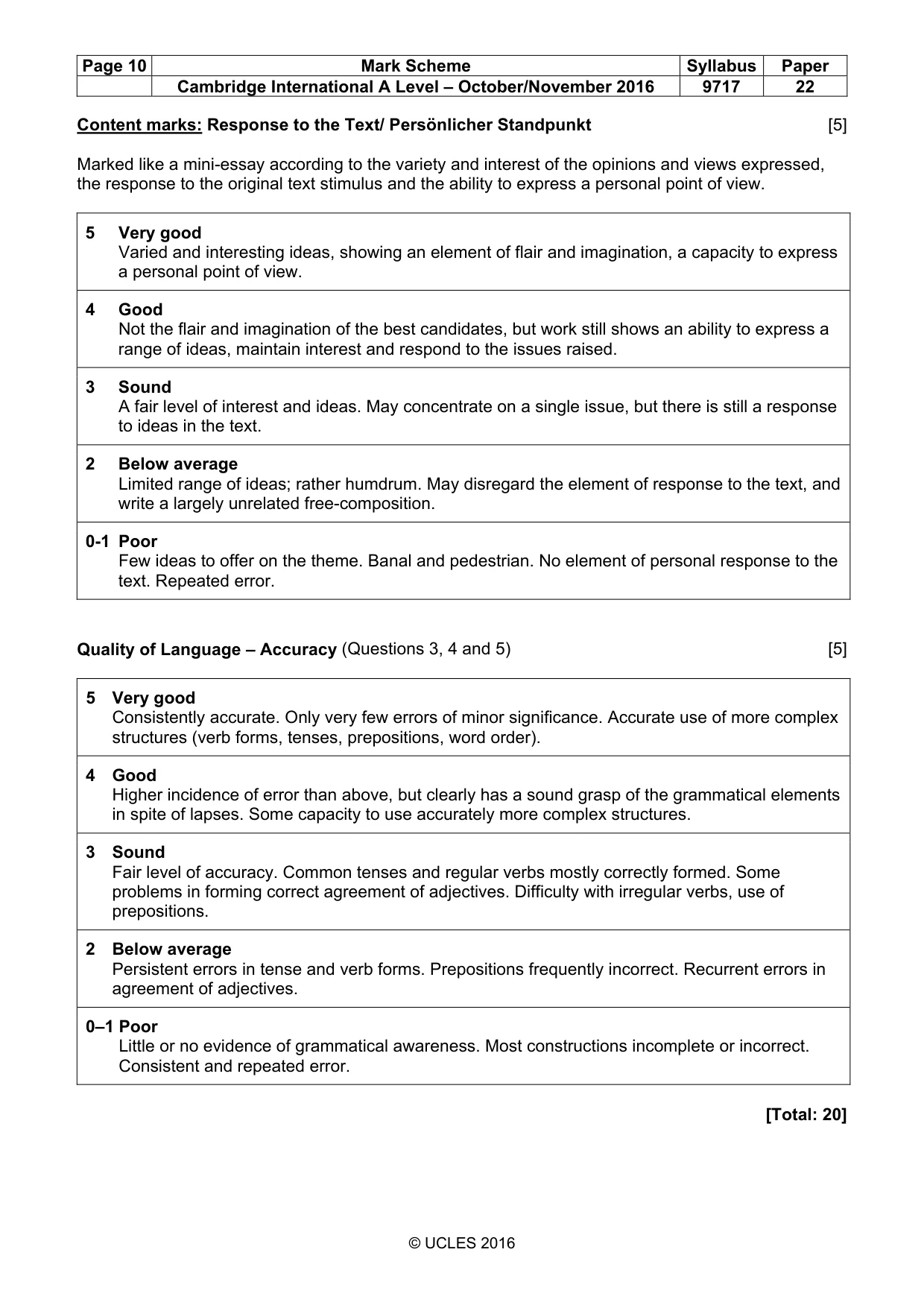
Page 10 Mark Scheme Syllabus Paper Cambridge International A Level – October/November 2016 9717 22 © UCLES 2016 Content marks: Response to the Text/ Persönlicher Standpunkt [5] Marked like a mini-essay according to the variety and interest of the opinions and views expressed, the response to the original text stimulus and the ability to express a personal point of view. 5 Very good Varied and interesting ideas, showing an element of flair and imagination, a capacity to express a personal point of view. 4 Good Not the flair and imagination of the best candidates, but work still shows an ability to express a range of ideas, maintain interest and respond to the issues raised. 3 Sound A fair level of interest and ideas. May concentrate on a single issue, but there is still a response to ideas in the text. 2 Below average Limited range of ideas; rather humdrum. May disregard the element of response to the text, and write a largely unrelated free-composition. 0-1 Poor Few ideas to offer on the theme. Banal and pedestrian. No element of personal response to the text. Repeated error. Quality of Language – Accuracy (Questions 3, 4 and 5) [5] 5 Very good Consistently accurate. Only very few errors of minor significance. Accurate use of more complex structures (verb forms, tenses, prepositions, word order). 4 Good Higher incidence of error than above, but clearly has a sound grasp of the grammatical elements in spite of lapses. Some capacity to use accurately more complex structures. 3 Sound Fair level of accuracy. Common tenses and regular verbs mostly correctly formed. Some problems in forming correct agreement of adjectives. Difficulty with irregular verbs, use of prepositions. 2 Below average Persistent errors in tense and verb forms. Prepositions frequently incorrect. Recurrent errors in agreement of adjectives. 0–1 Poor Little or no evidence of grammatical awareness. Most constructions incomplete or incorrect. Consistent and repeated error. [Total: 20]
What you needed in this session
Cambridge’s own grade thresholds for 2016 Oct/Nov, Paper 2 · Variant 2. A higher threshold means an easier paper — the bar moves with how the cohort did.