Cambridge A Level German (A Level only) 9717 — 2013 Oct/Nov Paper 4 · Variant 2
9717/42/O/N/13 · 75 marks · ≈84 min
The question paper and its mark scheme, free to read here and free to download. This is Cambridge’s own paper, exactly as it was sat.
Question paper9 pages


Mark scheme3 pages
Answers below. Sit the paper first if you are practising.
Paper as text
Question paper, page 1
This document consists of 5 printed pages and 3 blank pages. DC (NH) 77698/2 © UCLES 2013 [Turn over UNIVERSITY OF CAMBRIDGE INTERNATIONAL EXAMINATIONS General Certificate of Education Advanced Level * 5 6 3 6 0 8 6 8 2 0 * GERMAN 9717/42 Paper 4 Texts October/November 2013 2 hours 30 minutes Additional Materials: Answer Booklet/Paper Invigilators must refer to the Additional Materials List for instructions on the use of set texts in the examination. READ THESE INSTRUCTIONS FIRST If you have been given an Answer Booklet, follow the instructions on the front cover of the Booklet. Write your Centre number, candidate number and name on all the work you hand in. Write in dark blue or black pen. Do not use staples, paper clips, highlighters, glue or correction fluid. Answer any three questions, each on a different text. You must choose one question from Section 1, one from Section 2 and one other. Write your answers in German. Dictionaries are not permitted. You should write between 500 and 600 words for each answer. At the end of the examination, fasten all your work securely together. All questions in this paper carry equal marks. LESEN SIE ZUERST DIESE ANWEISUNGEN Falls Ihnen ein Antwortbogen gegeben wurde, folgen Sie den Anweisungen auf dessen Titelseite. Schreiben Sie Ihre Centernummer, Kandidatennummer und Ihren Namen auf jedes Blatt, das Sie abgeben. Schreiben Sie mit dunkelblauem oder schwarzem Füller/Kugelschreiber. Benutzen Sie keine Heftklammern, Büroklammern, Korrekturflüssigkeit, keinen Textmarker oder Klebstoff. Beantworten Sie insgesamt drei Fragen. Jede Frage bezieht sich auf einen anderen Text. Wählen Sie eine Frage aus dem ersten Teil, eine Frage aus dem zweiten Teil, und eine andere Frage. Schreiben Sie Ihre Antworten auf Deutsch. Es ist nicht erlaubt, Wörterbücher zu benutzen. Schreiben Sie 500 bis 600 Worte zu jeder Frage. Falls Sie mehrere Blätter beschreiben, heften Sie die Blätter am Ende der Prüfung sicher zusammen. Alle Antworten werden gleich bewertet.
Question paper, page 2
2 9717/42/O/N/13 © UCLES 2013 Section 1 1 UWE TIMM, Die Entdeckung der Currywurst Entweder (a) Lesen Sie den folgenden Auszug und beantworten Sie dann die Fragen. Der Beamte, ein junger, freundlich-ruhiger Mann, nagte gedankenverloren an seiner Unterlippe. Sie solle Bescheid sagen, wenn Holzinger defätistische Äußerungen mache. Ob sie PG. sei? Nein. Hmm. Der Mann verpflichtete sie zum Schweigen. Damit war sie entlassen. Sie hatte Holzinger gesagt, daß sie über ihn befragt worden sei. Seitdem bestellte sie jedesmal Fisch, wenn, wie heute, Gauredner Grün kam. Der Vater von Grün hatte einen Fischladen, und Grün hatte mehrmals betont, daß ihm, wenn er Fisch auch nur rieche, übel werde. Als Junge habe er nämlich Fische aus dem Frischwasserbottich keschen, dann mit einem Schlag auf den Kopf betäuben, aufschlitzen und ausnehmen müssen. Lena Brückner telefonierte mit der Fischhalle, die sagten, nicht ein einziger Fisch sei angelandet worden. Es komme kein Fischdampfer mehr die Elbe hoch, weil drüben, am anderen Ufer, schon der Tommy sitze. Sie rief bei der Freibank an, und die hatten mehrere Kilogramm Pansen. Gestern nacht seien Bomben in Langenhorn gefallen, eine direkt neben einen Bauernhof, eine Luftmine. Der Stall sei stehengeblieben, aber Fenster und Türen waren raus. Alle Kühe lagen tot da, ganz und hübsch appetitlich. Nur die Lungen waren ihnen aus dem Leib gerissen worden. Pansen, wir können zwanzig Kilo Pansen bekommen. Sehr gut, sagte Holzinger, wir machen Kutteln. Kartoffeln haben wir ja gebunkert. Lena Brücker deckte die Tische der leitenden Herren. Das machte sie persönlich. Sogar Papierservietten gab es noch. Vor einem halben Jahr war eine Lieferung für die nächsten 1000 Jahre eingegangen. Die Servietten wurden auch als Toilettenpapier benutzt. (i) Der Koch Holzinger und Frau Brücker arbeiten in einer Werkskantine. Was passiert in dieser Episode? (ii) Sind die beiden aus der Sicht der Nationalsozialisten pflichtbewusst? Oder (b) Wie stehen die sogenannten „kleinen Leute“ (Holzinger, Frau Brücker etc.) den Reden des Gauleiters und anderer Propaganda gegenüber? 5 10 15 20
Question paper, page 3
3 9717/42/O/N/13 © UCLES 2013 [Turn over 2 KARIN KÖNIG, Ich fühl mich so fifty-fifty Entweder (a) Lesen Sie den folgenden Auszug und beantworten Sie dann die Fragen. „Gute Abiturnoten verbessern die Statistik“, kritisiert Herr Dehnert, „nicht, dass ich es dir nicht gönne, Sabine. Aber es ist doch immer dasselbe, schlechte Abiturienten gibt es bei uns nicht.“ Sabine ist das egal. Hauptsache, die Schulzeit ist endgültig vorbei. Ausgelassen feiert sie mit den Klassenkameraden. Erst einmal den Sommer genießen. Im Herbst würde sie dann mit dem ungeliebten Pädagogikstudium beginnen. Schon in der achten Klasse war diese Entscheidung gefallen. Lehrer wurden gebraucht, da musste man sich fügen. Doch zunächst hatte sich Sabine nicht gefügt. Verzweifelt hatte sie um einen anderen Studienplatz gekämpft. Psychologie wollte sie studieren oder Sprachen, ganz ausgefallene, zum Beispiel Japanisch. Ihre Eltern hatten sie bei ihrem Wunsch unterstützt, aber sie waren in der Schule nur auf taube Ohren gestoßen. Pädagogik oder sonst nichts. Aus Wut, aber auch aus Verzweiflung wurde Sabine krank. Sie aß nichts mehr, nahm rapide ab, hatte Schlafstörungen und war nur noch traurig. Die spannendsten Romane ihres Vaters lenkten sie nicht ab, der Kuchen ihrer Mutter blieb unberührt stehen, auch die Westschokolade, von Mario organisiert, half nichts. Erst nach Wochen war sie bereit wieder in die Schule zu gehen, wenn auch lustlos. Getröstet hatte sie nur, dass viele in ihrer Klasse auch nicht studieren durften, was sie wollten. Doch daran denkt Sabine heute nicht. Sie hat ihre erste Verabredung mit Thomas im Eiscafe Pinguin. (i) Sabines Schullaufbahn ist schon früh festgelegt worden. Was erfahren wir darüber? (ii) Sabine hat ihr Abitur bestanden. Wie würde ihr Leben in der DDR danach weitergehen? Oder (b) Wie stellt sich Sabine ihre Zukunft vor? Beeinflussen ihre Erfahrungen mit der Schule ihre Entscheidung zu fliehen? 5 10 15 20
Question paper, page 4
4 9717/42/O/N/13 © UCLES 2013 3 FRANZ KAFKA, Die Verwandlung Entweder (a) Lesen Sie den folgenden Auszug und beantworten Sie dann die Fragen. Gregor hatte den Kopf bis knapp zum Rande des Kanapees vorgeschoben und beobachtete sie. Ob sie wohl bemerken würde, daß er die Milch stehen gelassen hatte, und zwar keineswegs aus Mangel an Hunger, und ob sie eine andere Speise hereinbringen würde, die ihm besser entsprach? Täte sie es nicht von selbst, er wollte lieber verhungern, als sie darauf aufmerksam machen, trotzdem es ihn eigentlich ungeheuer drängte, unterm Kanapee vorzuschießen, sich der Schwester zu Füßen zu werfen und sie um irgendetwas Gutes zum Essen zu bitten. Aber die Schwester bemerkte sofort mit Verwunderung den noch vollen Napf, aus dem nur ein wenig Milch ringsherum verschüttet war, sie hob ihn gleich auf, zwar nicht mit den bloßen Händen, sondern mit einem Fetzen, und trug ihn hinaus. Gregor war äußerst neugierig, was sie zum Ersatz bringen würde, und er machte sich die verschiedensten Gedanken darüber. Niemals aber hätte er erraten können, was die Schwester in ihrer Güte wirklich tat. Sie brachte ihm, um seinen Geschmack zu prüfen, eine ganze Auswahl, alles auf einer alten Zeitung ausgebreitet. Da war altes halbverfaultes Gemüse; Knochen vom Nachtmahl her, die von festgewordener weißer Sauce umgeben waren; ein paar Rosinen und Mandeln; ein Käse, den Gregor vor zwei Tagen für ungenießbar erklärt hatte; ein trockenes Brot, ein mit Butter beschmiertes Brot und ein mit Butter beschmiertes und gesalzenes Brot. Außerdem stellte sie zu dem allen noch den wahrscheinlich ein für allemal für Gregor bestimmten Napf, in den sie Wasser gegossen hatte. Und aus Zartgefühl, da sie wußte, daß Gregor vor ihr nicht essen würde, entfernte sie sich eiligst und drehte sogar den Schlüssel um, damit nur Gregor merken könne, daß er es sich so behaglich machen dürfe, wie er wolle. Gregors Beinchen schwirrten, als es zum Essen ging. (i) Gregors Schwester bringt ihm sein Essen. Wie läuft dies für Gregor ab? (ii) Wie ändert sich Gregors Beziehung zu Nahrungsmitteln im Laufe der Geschichte? Oder (b) Welche Rolle spielt das Essen in der Geschichte? 5 10 15 20
Question paper, page 5
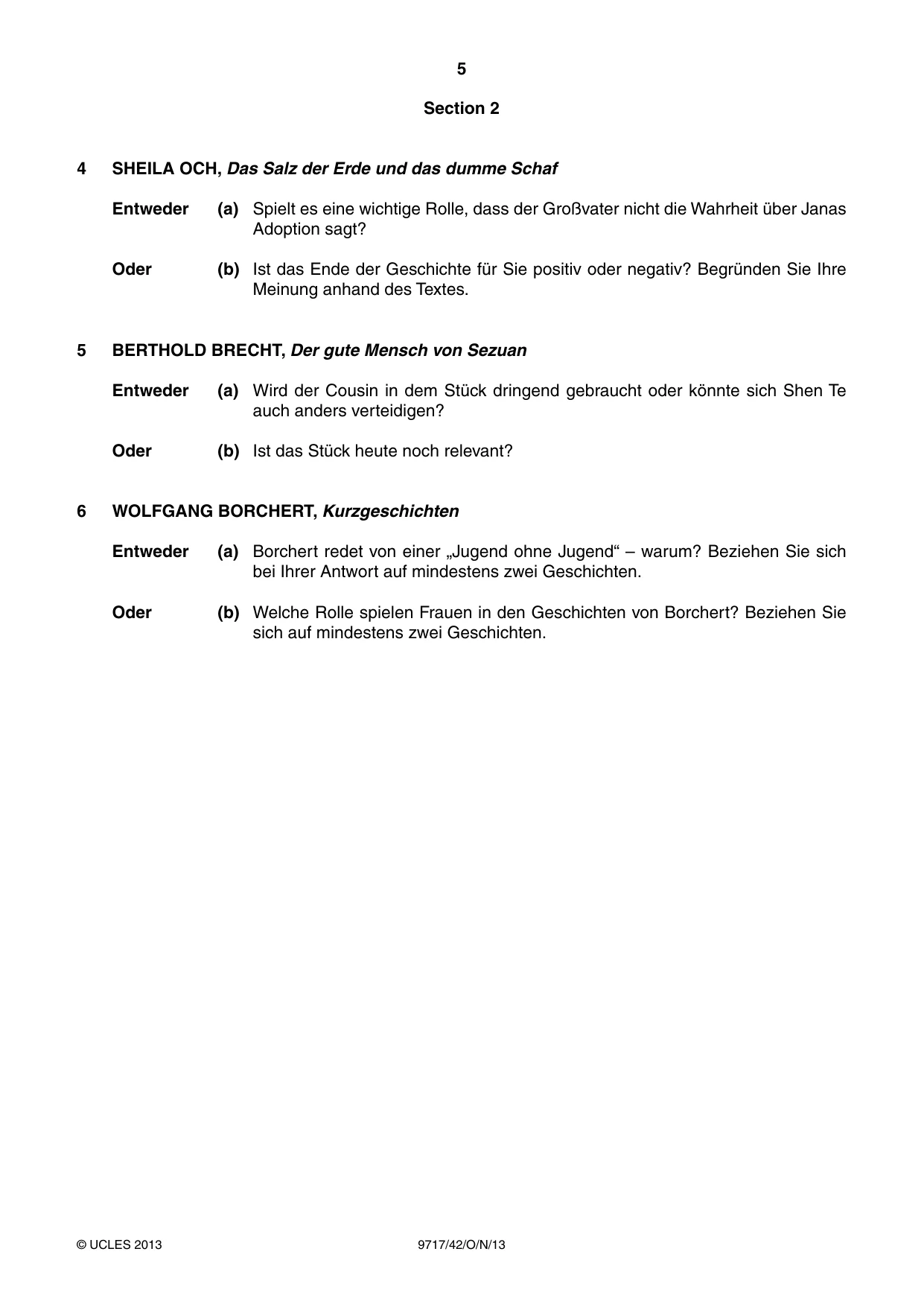
5 9717/42/O/N/13 © UCLES 2013 Section 2 4 SHEILA OCH, Das Salz der Erde und das dumme Schaf Entweder (a) Spielt es eine wichtige Rolle, dass der Großvater nicht die Wahrheit über Janas Adoption sagt? Oder (b) Ist das Ende der Geschichte für Sie positiv oder negativ? Begründen Sie Ihre Meinung anhand des Textes. 5 BERTHOLD BRECHT, Der gute Mensch von Sezuan Entweder (a) Wird der Cousin in dem Stück dringend gebraucht oder könnte sich Shen Te auch anders verteidigen? Oder (b) Ist das Stück heute noch relevant? 6 WOLFGANG BORCHERT, Kurzgeschichten Entweder (a) Borchert redet von einer „Jugend ohne Jugend“ – warum? Beziehen Sie sich bei Ihrer Antwort auf mindestens zwei Geschichten. Oder (b) Welche Rolle spielen Frauen in den Geschichten von Borchert? Beziehen Sie sich auf mindestens zwei Geschichten.
Question paper, page 6
6 9717/42/O/N/13 © UCLES 2013 BLANK PAGE
Question paper, page 7
7 9717/42/O/N/13 © UCLES 2013 BLANK PAGE
Question paper, page 8
8 9717/42/O/N/13 © UCLES 2013 BLANK PAGE Copyright Acknowledgements: Question 1 © Uwe Timm; Die Entdeckung der Currywurst ; dtv; 2007. Question 2 © Karin König; Ich fühl mich so fifty-fifty; dtv junior; 2000. Permission to reproduce items where third-party owned material protected by copyright is included has been sought and cleared where possible. Every reasonable effort has been made by the publisher (UCLES) to trace copyright holders, but if any items requiring clearance have unwittingly been included, the publisher will be pleased to make amends at the earliest possible opportunity. Cambridge International Examinations is part of the Cambridge Assessment Group. Cambridge Assessment is the brand name of University of Cambridge Local Examinations Syndicate (UCLES), which is itself a department of the University of Cambridge.
Question paper, page 9
Os = — = — = = UNIVERSITY OF CAMBRIDGE INTERNATIONAL EXAMINATIONS General Certificate of Education Advanced Level GERMAN 9717/42 Paper 4 Texts October/November 2013 2 hours 30 minutes Additional Materials: Answer Booklet/Paper Invigilators must refer to the Additional Materials List for instructions on the use of set texts in the examination. READ THESE INSTRUCTIONS FIRST If you have been given an Answer Booklet, follow the instructions on the front cover of the Booklet. Write your Centre number, candidate number and name on ail the work you hand in. Write in dark blue or black pen. Do not use staples, paper clips, highlighters, glue or correction fluid. Answer any three questions, each on a different text. You must choose one question from Section 1, one from Section 2 and one other. Write your answers in German. Dictionaries are not permitted. You should write between 500 and 600 words for each answer. At the end of the examination, fasten all your work securely together. All questions in this paper carry equal marks. LESEN SIE ZUERST DIESE ANWEISUNGEN Falls Ihnen ein Antwortbogen gegeben wurde, folgen Sie den Anweisungen auf dessen Titelseite. Schreiben Sie Ihre Centernummer, Kandidatennummer und Ihren Namen auf jedes Blatt, das Sie abgeben. Schreiben Sie mit dunkelblauem oder schwarzem Filler/Kugelschreiber. Benutzen Sie keine Heftklammern, Buroklammern, Korrekturflussigkeit, keinen Textmarker oder Klebstoff. Beantworten Sie insgesamt drei Fragen. Jede Frage bezieht sich auf einen anderen Text. Wahlen Sie eine Frage aus dem ersten Teil, eine Frage aus dem zweiten Teil, und eine andere Frage. Schreiben Sie Ihre Antworten auf Deutsch. Es ist nicht erlaubt, Worterbiicher zu benutzen. Schreiben Sie 500 bis 600 Worte zu jeder Frage. ieee aoe A Falls Sie mehrere Blatter beschreiben, heften Sie die Blatter am Ani Priftung vais GOPY Alle Antworten werden gleich bewertet. Chec’-. . Date:.. LL [ /2 rs This document consists of 5 printed pages and 3 blank pages. DC (NH) 77698/2 #59) UNIVERSITY of CAMBRIDGE ©@UCLES 2013 § International Examinations [Turn over
Mark scheme, page 1
CAMBRIDGE INTERNATIONAL EXAMINATIONS GCE Advanced Level MARK SCHEME for the October/November 2013 series 9717 GERMAN 9717/42 Paper 4 (Texts), maximum raw mark 75 This mark scheme is published as an aid to teachers and candidates, to indicate the requirements of the examination. It shows the basis on which Examiners were instructed to award marks. It does not indicate the details of the discussions that took place at an Examiners’ meeting before marking began, which would have considered the acceptability of alternative answers. Mark schemes should be read in conjunction with the question paper and the Principal Examiner Report for Teachers. Cambridge will not enter into discussions about these mark schemes. Cambridge is publishing the mark schemes for the October/November 2013 series for most IGCSE, GCE Advanced Level and Advanced Subsidiary Level components and some Ordinary Level components.
Mark scheme, page 2
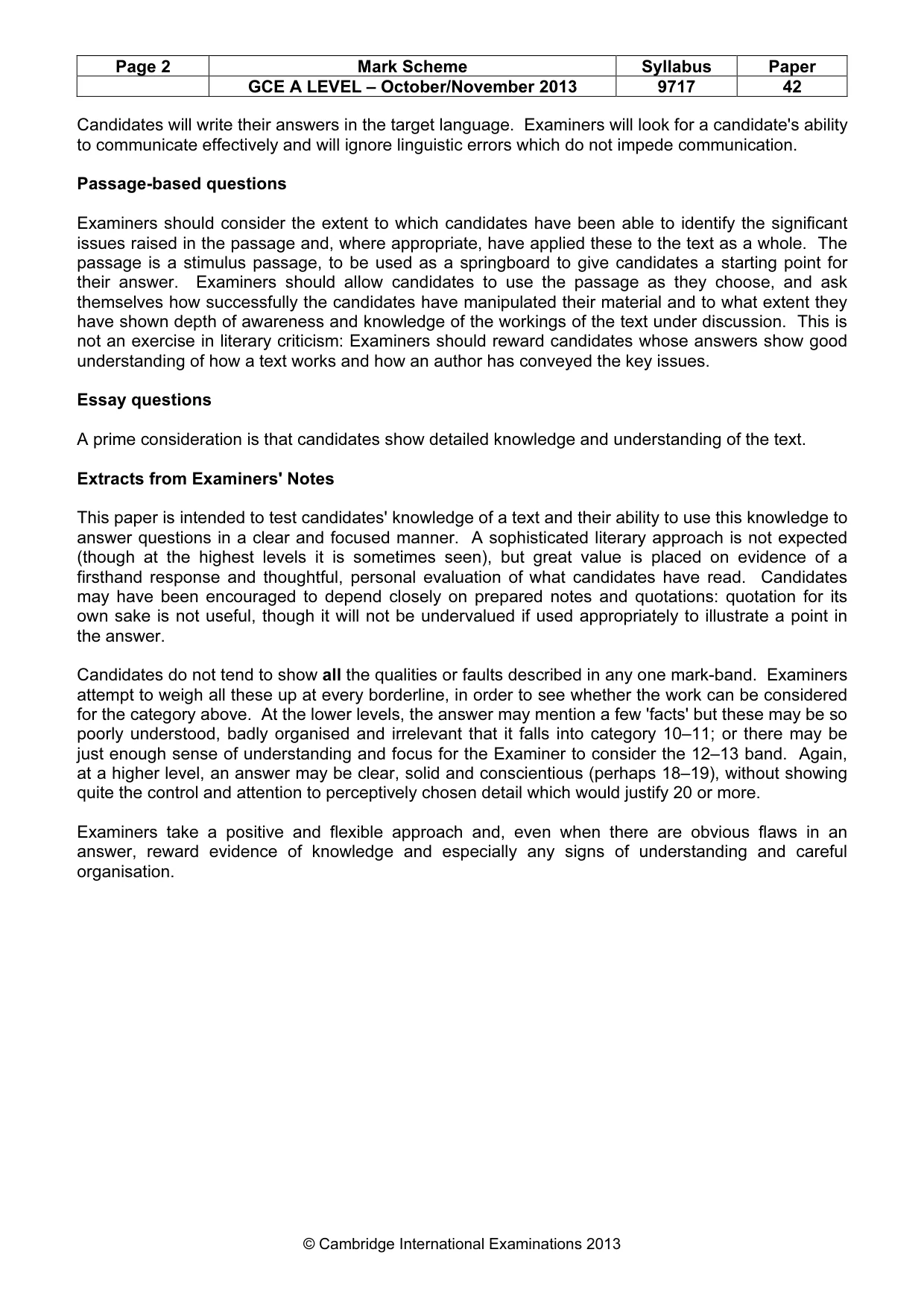
Page 2 Mark Scheme Syllabus Paper GCE A LEVEL – October/November 2013 9717 42 © Cambridge International Examinations 2013 Candidates will write their answers in the target language. Examiners will look for a candidate's ability to communicate effectively and will ignore linguistic errors which do not impede communication. Passage-based questions Examiners should consider the extent to which candidates have been able to identify the significant issues raised in the passage and, where appropriate, have applied these to the text as a whole. The passage is a stimulus passage, to be used as a springboard to give candidates a starting point for their answer. Examiners should allow candidates to use the passage as they choose, and ask themselves how successfully the candidates have manipulated their material and to what extent they have shown depth of awareness and knowledge of the workings of the text under discussion. This is not an exercise in literary criticism: Examiners should reward candidates whose answers show good understanding of how a text works and how an author has conveyed the key issues. Essay questions A prime consideration is that candidates show detailed knowledge and understanding of the text. Extracts from Examiners' Notes This paper is intended to test candidates' knowledge of a text and their ability to use this knowledge to answer questions in a clear and focused manner. A sophisticated literary approach is not expected (though at the highest levels it is sometimes seen), but great value is placed on evidence of a firsthand response and thoughtful, personal evaluation of what candidates have read. Candidates may have been encouraged to depend closely on prepared notes and quotations: quotation for its own sake is not useful, though it will not be undervalued if used appropriately to illustrate a point in the answer. Candidates do not tend to show all the qualities or faults described in any one mark-band. Examiners attempt to weigh all these up at every borderline, in order to see whether the work can be considered for the category above. At the lower levels, the answer may mention a few 'facts' but these may be so poorly understood, badly organised and irrelevant that it falls into category 10–11; or there may be just enough sense of understanding and focus for the Examiner to consider the 12–13 band. Again, at a higher level, an answer may be clear, solid and conscientious (perhaps 18–19), without showing quite the control and attention to perceptively chosen detail which would justify 20 or more. Examiners take a positive and flexible approach and, even when there are obvious flaws in an answer, reward evidence of knowledge and especially any signs of understanding and careful organisation.
Mark scheme, page 3
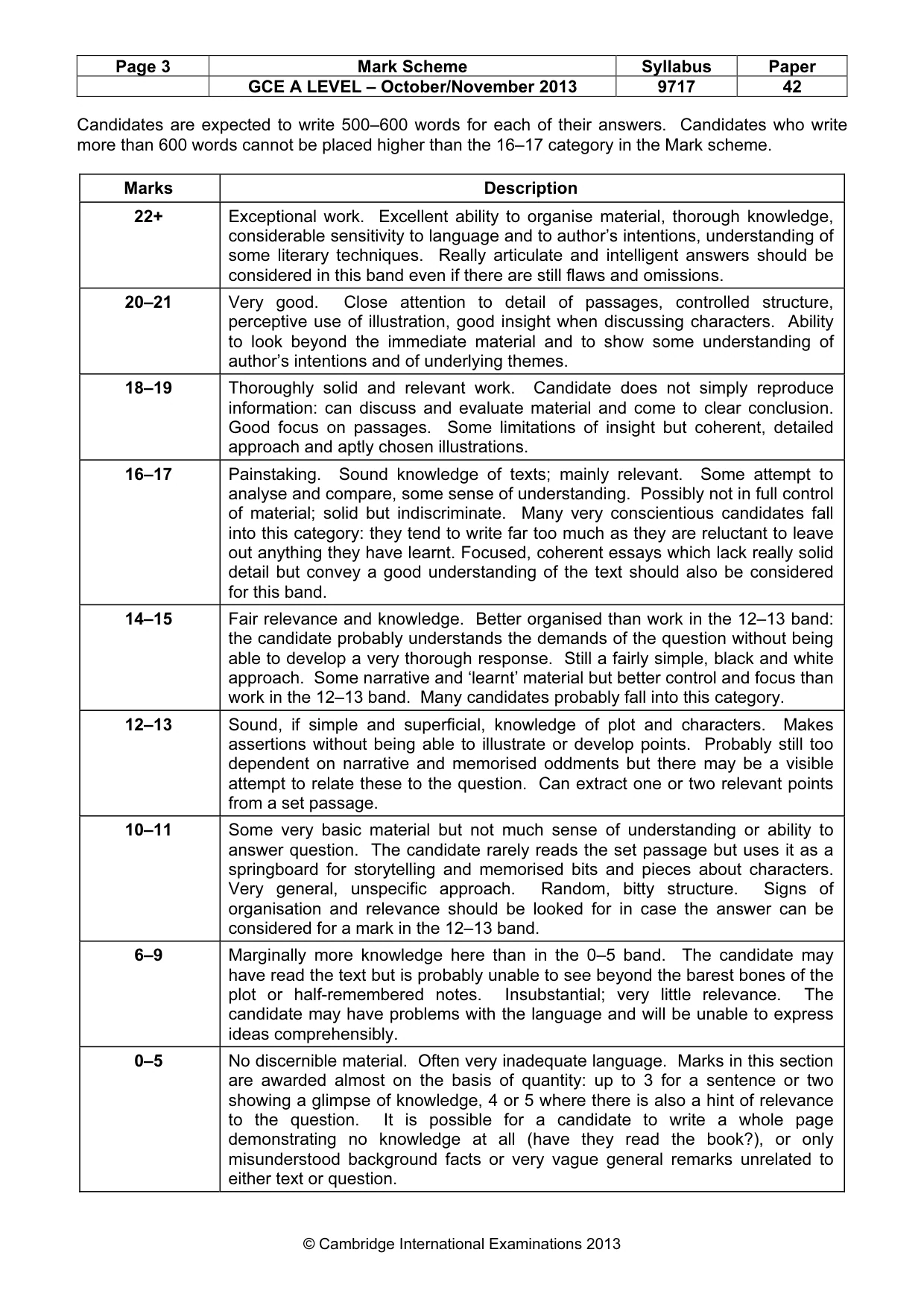
Page 3 Mark Scheme Syllabus Paper GCE A LEVEL – October/November 2013 9717 42 © Cambridge International Examinations 2013 Candidates are expected to write 500–600 words for each of their answers. Candidates who write more than 600 words cannot be placed higher than the 16–17 category in the Mark scheme. Marks Description 22+ Exceptional work. Excellent ability to organise material, thorough knowledge, considerable sensitivity to language and to author’s intentions, understanding of some literary techniques. Really articulate and intelligent answers should be considered in this band even if there are still flaws and omissions. 20–21 Very good. Close attention to detail of passages, controlled structure, perceptive use of illustration, good insight when discussing characters. Ability to look beyond the immediate material and to show some understanding of author’s intentions and of underlying themes. 18–19 Thoroughly solid and relevant work. Candidate does not simply reproduce information: can discuss and evaluate material and come to clear conclusion. Good focus on passages. Some limitations of insight but coherent, detailed approach and aptly chosen illustrations. 16–17 Painstaking. Sound knowledge of texts; mainly relevant. Some attempt to analyse and compare, some sense of understanding. Possibly not in full control of material; solid but indiscriminate. Many very conscientious candidates fall into this category: they tend to write far too much as they are reluctant to leave out anything they have learnt. Focused, coherent essays which lack really solid detail but convey a good understanding of the text should also be considered for this band. 14–15 Fair relevance and knowledge. Better organised than work in the 12–13 band: the candidate probably understands the demands of the question without being able to develop a very thorough response. Still a fairly simple, black and white approach. Some narrative and ‘learnt’ material but better control and focus than work in the 12–13 band. Many candidates probably fall into this category. 12–13 Sound, if simple and superficial, knowledge of plot and characters. Makes assertions without being able to illustrate or develop points. Probably still too dependent on narrative and memorised oddments but there may be a visible attempt to relate these to the question. Can extract one or two relevant points from a set passage. 10–11 Some very basic material but not much sense of understanding or ability to answer question. The candidate rarely reads the set passage but uses it as a springboard for storytelling and memorised bits and pieces about characters. Very general, unspecific approach. Random, bitty structure. Signs of organisation and relevance should be looked for in case the answer can be considered for a mark in the 12–13 band. 6–9 Marginally more knowledge here than in the 0–5 band. The candidate may have read the text but is probably unable to see beyond the barest bones of the plot or half-remembered notes. Insubstantial; very little relevance. The candidate may have problems with the language and will be unable to express ideas comprehensibly. 0–5 No discernible material. Often very inadequate language. Marks in this section are awarded almost on the basis of quantity: up to 3 for a sentence or two showing a glimpse of knowledge, 4 or 5 where there is also a hint of relevance to the question. It is possible for a candidate to write a whole page demonstrating no knowledge at all (have they read the book?), or only misunderstood background facts or very vague general remarks unrelated to either text or question.
What you needed in this session
Cambridge’s own grade thresholds for 2013 Oct/Nov, Paper 4 · Variant 2. A higher threshold means an easier paper — the bar moves with how the cohort did.