Cambridge A Level French (A Level only) 9716 — 2022 May/June Paper 4 · Variant 3
9716/43/M/J/22 · 75 marks · ≈84 min
The question paper and its mark scheme, free to read here and free to download. This is Cambridge’s own paper, exactly as it was sat.
Question paper12 pages




Mark scheme4 pages
Answers below. Sit the paper first if you are practising.
Paper as text
Question paper, page 1
This document has 12 pages. Any blank pages are indicated. [Turn over Cambridge International A Level FRENCH 9716/43 Paper 4 Texts May/June 2022 2 hours 30 minutes You must answer on the enclosed answer booklet. You will need: Answer booklet (enclosed) Invigilators must refer to the Additional Materials List for instructions on the use of set texts in the examination. INSTRUCTIONS ● Answer three questions in total in French, each on a different text: Answer at least one question from Section 1. Answer at least one question from Section 2. Answer one other question from either Section 1 or Section 2. ● Follow the instructions on the front cover of the answer booklet. If you need additional answer paper, ask the invigilator for a continuation booklet. ● Dictionaries are not allowed. INFORMATION ● The total mark for this paper is 75. ● Each question is worth 25 marks. INSTRUCTIONS ● Répondez en français à trois questions, chacune sur une œuvre différente : Répondez à au moins une question de la Section 1. Répondez à au moins une question de la Section 2. Répondez à une autre question, soit de la Section 1, soit de la Section 2. ● Suivez les instructions sur la toute première page du livret-réponse. Les instructions vous sont aussi données en français ci-dessous. Si vous avez besoin de papier supplémentaire pour vos réponses, demandez un deuxième livret-réponse au surveillant. ● Les dictionnaires ne sont pas permis. RENSEIGNEMENTS ● Le nombre maximum de points pour cette épreuve est 75 points. ● Chaque question vaut 25 points. DC (CE) 311802 © UCLES 2022 * 3 4 0 2 5 2 2 6 6 2 *
Question paper, page 2
2 9716/43/ M / J /22 © UCLES 2022 INSTRUCTIONS POUR LE LIVRET-RÉPONSE Écrivez en stylo noir ou bleu foncé. Vous pouvez utiliser un crayon HB pour vos diagrammes ou graphiques. Écrivez votre nom, le numéro de votre centre et votre numéro de candidat dans les cases situées en haut de cette page. Écrivez clairement et utilisez des lettres majuscules. N’utilisez ni stylo effaçable, ni liquide correcteur. N’écrivez pas sur les codes-barres. Écrivez vos réponses dans le livret-réponse. Utilisez les deux côtés de chaque feuille. Laissez deux lignes entre chacune de vos réponses. Écrivez dans la première marge le numéro de la question à laquelle vous répondez. Question Part 1 1 (a)(i) (a)(ii) Si la question à laquelle vous répondez contient deux ou plusieurs parties (par exemple : 1a), écrivez la partie dans la deuxième marge. Utilisez ce livret-réponse pour tous vos brouillons. Sans rendre vos brouillons illisibles, rayez tout ce que vous ne voulez pas que l’examinateur corrige. N’enlevez aucun élément du livret-résponse. Vous devez rendre toutes les feuilles que vous avez utilisées à la fin de l’examen. Si vous avez utilisé un deuxième livret-réponse, placez-le à l’intérieur du premier livret-réponse.
Question paper, page 3
3 9716/43/M/J/22 © UCLES 2022 [Turn over BLANK PAGE
Question paper, page 4
4 9716/43/M/J/22 © UCLES 2022 Vous devez répondre à trois questions en tout. Vous devez choisir un texte différent pour chaque réponse. Choisissez une question dans la Section 1, une question dans la Section 2 et une autre question. Section 1 1 Le Mariage de Figaro, Beaumarchais Choisissez soit la partie (a) soit la partie (b) et écrivez, en français, une rédaction de 500 à 600 mots. SOIT (a) Lisez cet extrait et répondez aux questions suivantes : BARTHOLO le regard aller. – Ce drôle est toujours le même ! et à moins qu’on ne l’écorche vif, je prédis qu’il mourra dans la peau du plus fier insolent… MARCELINE le retourne. – Enfin vous voilà donc, éternel Docteur ? toujours si grave et compassé qu’on pourrait mourir en attendant vos secours, comme on s’est marié jadis, malgré vos précautions. BARTHOLO. – Toujours amère et provoquante ! Hé bien, qui rend donc ma présence au château si nécessaire ? Monsieur le Comte a-t-il eu quelque accident ? MARCELINE. – Non, Docteur. BARTHOLO. – La Rosine, sa trompeuse comtesse, est-elle incommodée, Dieu merci ? MARCELINE. – Elle languit. BARTHOLO. – Et de quoi ? MARCELINE. – Son mari la néglige. BARTHOLO, avec joie. – Ah, le digne époux qui me venge ! MARCELINE. – On ne sait comment définir le Comte ; il est jaloux et libertin. BARTHOLO. – Libertin par ennui, jaloux par vanité ; cela va sans dire. MARCELINE. – Aujourd’hui, par exemple, il marie notre Suzanne à son Figaro qu’il comble en faveur de cette union… BARTHOLO. – Que Son Excellence a rendue nécessaire ! MARCELINE. – Pas tout à fait ; mais dont Son Excellence voudrait égayer en secret l’événement avec l’épousée… BARTHOLO. – De Monsieur Figaro ? C’est un marché qu’on peut conclure avec lui. MARCELINE. – Bazile assure que non. 5 10 15 20
Question paper, page 5
5 9716/43/M/J/22 © UCLES 2022 [Turn over BARTHOLO. – Cet autre maraud loge ici ? C’est une caverne ! Hé, qu’y fait-il ? MARCELINE. – Tout le mal dont il est capable. Mais le pis que j’y trouve, est cette ennuyeuse passion qu’il a pour moi, depuis si longtemps. BARTHOLO. – Je me serais débarrassé vingt fois de sa poursuite. MARCELINE. – De quelle manière ? BARTHOLO. – En l’épousant. MARCELINE. – Railleur fade et cruel, que ne vous débarrassez-vous de la mienne à ce prix ? ne le devez-vous pas ? où est le souvenir de vos engagements ? qu’est devenu celui de notre petit Emmanuel, ce fruit d’un amour oublié, qui devait nous conduire à des noces ? (Acte I, sc. IV) (i) Expliquez l’attitude de Bartholo envers la Comtesse. (ii) Qu’est-ce qu’on apprend de cet extrait au sujet des relations entre Bartholo et Marceline ? (iii) Quelle est l’importance de ‘notre petit Emmanuel’ (ligne 32) par la suite ? SOIT (b) Analysez les relations entre la Comtesse et Suzanne au cours de la pièce. 25 30
Question paper, page 6
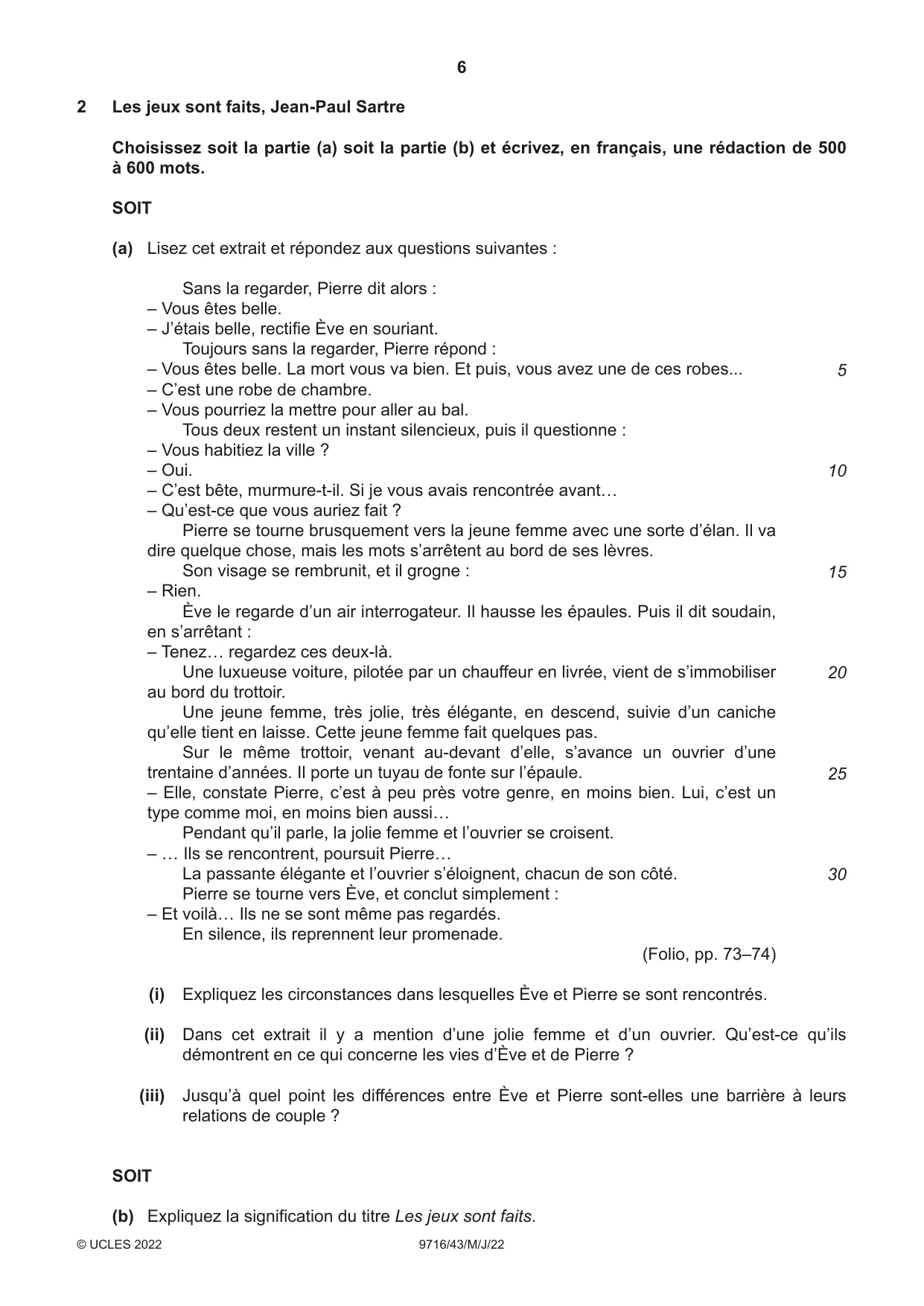
6 9716/43/M/J/22 © UCLES 2022 2 Les jeux sont faits, Jean-Paul Sartre Choisissez soit la partie (a) soit la partie (b) et écrivez, en français, une rédaction de 500 à 600 mots. SOIT (a) Lisez cet extrait et répondez aux questions suivantes : Sans la regarder, Pierre dit alors : – Vous êtes belle. – J’étais belle, rectifie Ève en souriant. Toujours sans la regarder, Pierre répond : – Vous êtes belle. La mort vous va bien. Et puis, vous avez une de ces robes... – C’est une robe de chambre. – Vous pourriez la mettre pour aller au bal. Tous deux restent un instant silencieux, puis il questionne : – Vous habitiez la ville ? – Oui. – C’est bête, murmure-t-il. Si je vous avais rencontrée avant… – Qu’est-ce que vous auriez fait ? Pierre se tourne brusquement vers la jeune femme avec une sorte d’élan. Il va dire quelque chose, mais les mots s’arrêtent au bord de ses lèvres. Son visage se rembrunit, et il grogne : – Rien. Ève le regarde d’un air interrogateur. Il hausse les épaules. Puis il dit soudain, en s’arrêtant : – Tenez… regardez ces deux-là. Une luxueuse voiture, pilotée par un chauffeur en livrée, vient de s’immobiliser au bord du trottoir. Une jeune femme, très jolie, très élégante, en descend, suivie d’un caniche qu’elle tient en laisse. Cette jeune femme fait quelques pas. Sur le même trottoir, venant au-devant d’elle, s’avance un ouvrier d’une trentaine d’années. Il porte un tuyau de fonte sur l’épaule. – Elle, constate Pierre, c’est à peu près votre genre, en moins bien. Lui, c’est un type comme moi, en moins bien aussi… Pendant qu’il parle, la jolie femme et l’ouvrier se croisent. – … Ils se rencontrent, poursuit Pierre… La passante élégante et l’ouvrier s’éloignent, chacun de son côté. Pierre se tourne vers Ève, et conclut simplement : – Et voilà… Ils ne se sont même pas regardés. En silence, ils reprennent leur promenade. (Folio, pp. 73–74) (i) Expliquez les circonstances dans lesquelles Ève et Pierre se sont rencontrés. (ii) Dans cet extrait il y a mention d’une jolie femme et d’un ouvrier. Qu’est-ce qu’ils démontrent en ce qui concerne les vies d’Ève et de Pierre ? (iii) Jusqu’à quel point les différences entre Ève et Pierre sont-elles une barrière à leurs relations de couple ? SOIT (b) Expliquez la signification du titre Les jeux sont faits. 5 10 15 20 25 30
Question paper, page 7
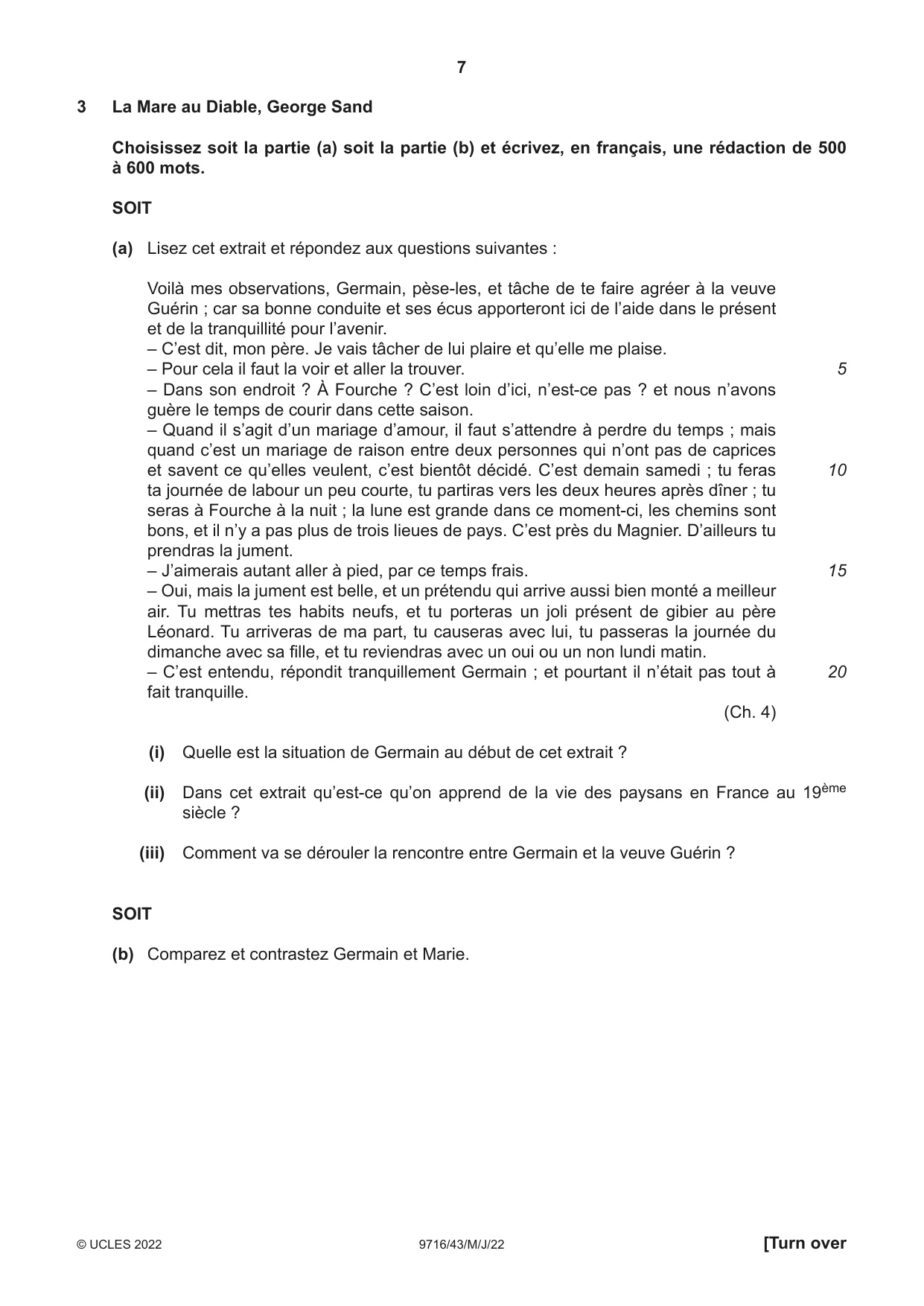
7 9716/43/M/J/22 © UCLES 2022 [Turn over 3 La Mare au Diable, George Sand Choisissez soit la partie (a) soit la partie (b) et écrivez, en français, une rédaction de 500 à 600 mots. SOIT (a) Lisez cet extrait et répondez aux questions suivantes : Voilà mes observations, Germain, pèse-les, et tâche de te faire agréer à la veuve Guérin ; car sa bonne conduite et ses écus apporteront ici de l’aide dans le présent et de la tranquillité pour l’avenir. – C’est dit, mon père. Je vais tâcher de lui plaire et qu’elle me plaise. – Pour cela il faut la voir et aller la trouver. – Dans son endroit ? À Fourche ? C’est loin d’ici, n’est-ce pas ? et nous n’avons guère le temps de courir dans cette saison. – Quand il s’agit d’un mariage d’amour, il faut s’attendre à perdre du temps ; mais quand c’est un mariage de raison entre deux personnes qui n’ont pas de caprices et savent ce qu’elles veulent, c’est bientôt décidé. C’est demain samedi ; tu feras ta journée de labour un peu courte, tu partiras vers les deux heures après dîner ; tu seras à Fourche à la nuit ; la lune est grande dans ce moment-ci, les chemins sont bons, et il n’y a pas plus de trois lieues de pays. C’est près du Magnier. D’ailleurs tu prendras la jument. – J’aimerais autant aller à pied, par ce temps frais. – Oui, mais la jument est belle, et un prétendu qui arrive aussi bien monté a meilleur air. Tu mettras tes habits neufs, et tu porteras un joli présent de gibier au père Léonard. Tu arriveras de ma part, tu causeras avec lui, tu passeras la journée du dimanche avec sa fille, et tu reviendras avec un oui ou un non lundi matin. – C’est entendu, répondit tranquillement Germain ; et pourtant il n’était pas tout à fait tranquille. (Ch. 4) (i) Quelle est la situation de Germain au début de cet extrait ? (ii) Dans cet extrait qu’est-ce qu’on apprend de la vie des paysans en France au 19ème siècle ? (iii) Comment va se dérouler la rencontre entre Germain et la veuve Guérin ? SOIT (b) Comparez et contrastez Germain et Marie. 5 10 15 20
Question paper, page 8
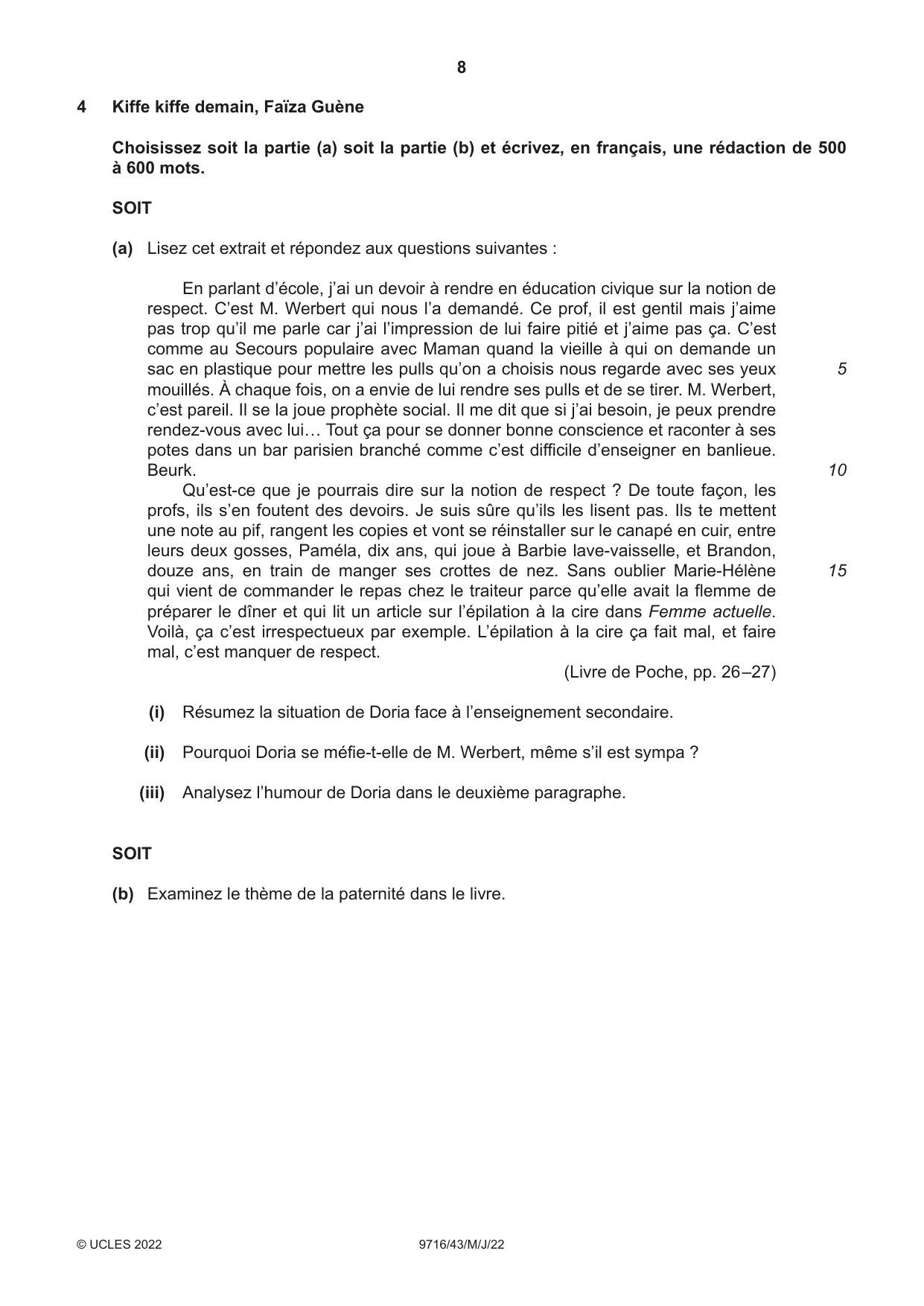
8 9716/43/M/J/22 © UCLES 2022 4 Kiffe kiffe demain, Faïza Guène Choisissez soit la partie (a) soit la partie (b) et écrivez, en français, une rédaction de 500 à 600 mots. SOIT (a) Lisez cet extrait et répondez aux questions suivantes : En parlant d’école, j’ai un devoir à rendre en éducation civique sur la notion de respect. C’est M. Werbert qui nous l’a demandé. Ce prof, il est gentil mais j’aime pas trop qu’il me parle car j’ai l’impression de lui faire pitié et j’aime pas ça. C’est comme au Secours populaire avec Maman quand la vieille à qui on demande un sac en plastique pour mettre les pulls qu’on a choisis nous regarde avec ses yeux mouillés. À chaque fois, on a envie de lui rendre ses pulls et de se tirer. M. Werbert, c’est pareil. Il se la joue prophète social. Il me dit que si j’ai besoin, je peux prendre rendez-vous avec lui… Tout ça pour se donner bonne conscience et raconter à ses potes dans un bar parisien branché comme c’est difficile d’enseigner en banlieue. Beurk. Qu’est-ce que je pourrais dire sur la notion de respect ? De toute façon, les profs, ils s’en foutent des devoirs. Je suis sûre qu’ils les lisent pas. Ils te mettent une note au pif, rangent les copies et vont se réinstaller sur le canapé en cuir, entre leurs deux gosses, Paméla, dix ans, qui joue à Barbie lave-vaisselle, et Brandon, douze ans, en train de manger ses crottes de nez. Sans oublier Marie-Hélène qui vient de commander le repas chez le traiteur parce qu’elle avait la flemme de préparer le dîner et qui lit un article sur l’épilation à la cire dans Femme actuelle. Voilà, ça c’est irrespectueux par exemple. L’épilation à la cire ça fait mal, et faire mal, c’est manquer de respect. (Livre de Poche, pp. 26 –27) (i) Résumez la situation de Doria face à l’enseignement secondaire. (ii) Pourquoi Doria se méfie-t-elle de M. Werbert, même s’il est sympa ? (iii) Analysez l’humour de Doria dans le deuxième paragraphe. SOIT (b) Examinez le thème de la paternité dans le livre. 5 10 15
Question paper, page 9
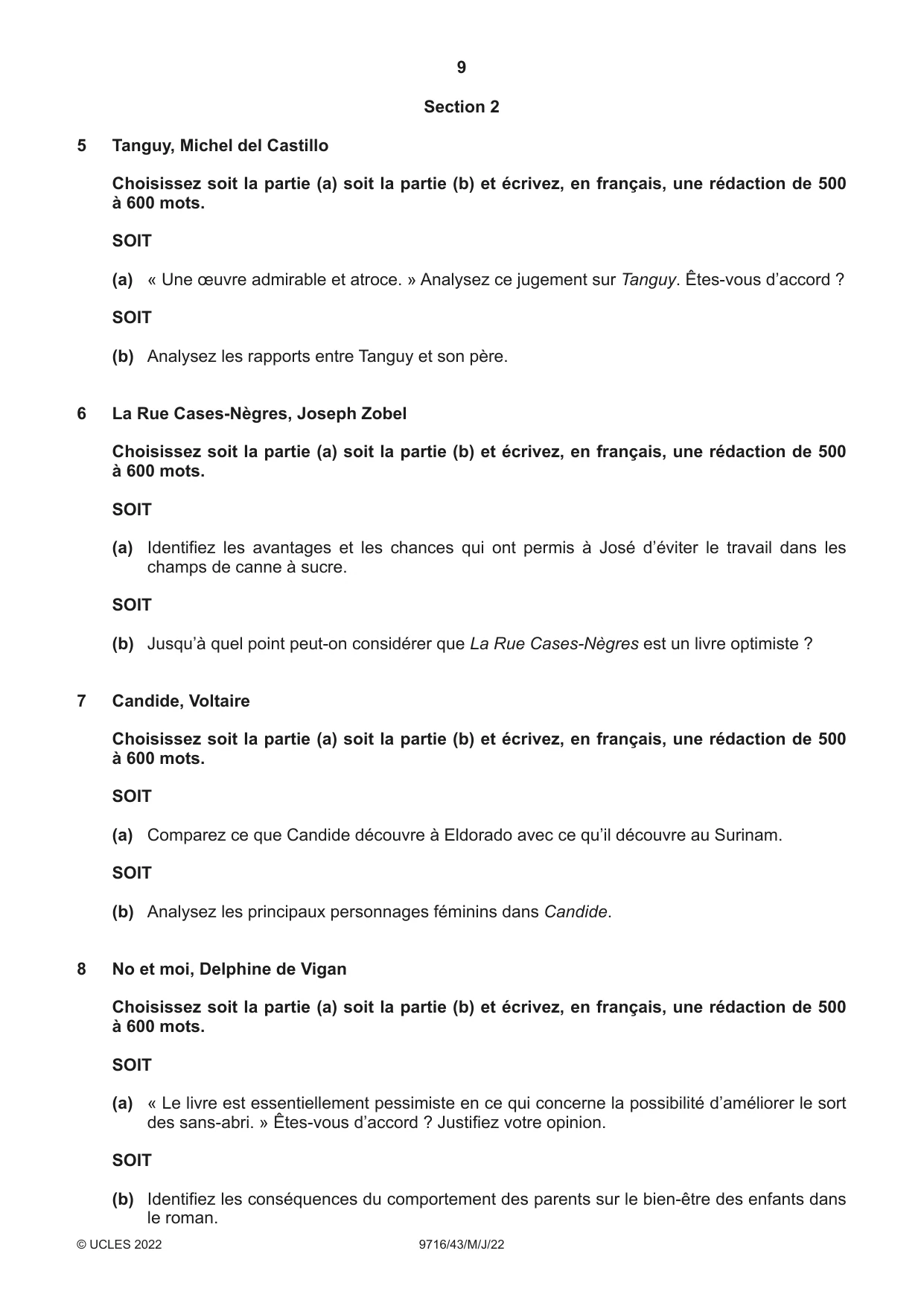
9 9716/43/M/J/22 © UCLES 2022 Section 2 5 Tanguy, Michel del Castillo Choisissez soit la partie (a) soit la partie (b) et écrivez, en français, une rédaction de 500 à 600 mots. SOIT (a) « Une œuvre admirable et atroce. » Analysez ce jugement sur Tanguy. Êtes-vous d’accord ? SOIT (b) Analysez les rapports entre Tanguy et son père. 6 La Rue Cases-Nègres, Joseph Zobel Choisissez soit la partie (a) soit la partie (b) et écrivez, en français, une rédaction de 500 à 600 mots. SOIT (a) Identifiez les avantages et les chances qui ont permis à José d’éviter le travail dans les champs de canne à sucre. SOIT (b) Jusqu’à quel point peut-on considérer que La Rue Cases-Nègres est un livre optimiste ? 7 Candide, Voltaire Choisissez soit la partie (a) soit la partie (b) et écrivez, en français, une rédaction de 500 à 600 mots. SOIT (a) Comparez ce que Candide découvre à Eldorado avec ce qu’il découvre au Surinam. SOIT (b) Analysez les principaux personnages féminins dans Candide. 8 No et moi, Delphine de Vigan Choisissez soit la partie (a) soit la partie (b) et écrivez, en français, une rédaction de 500 à 600 mots. SOIT (a) « Le livre est essentiellement pessimiste en ce qui concerne la possibilité d’améliorer le sort des sans-abri. » Êtes-vous d’accord ? Justifiez votre opinion. SOIT (b) Identifiez les conséquences du comportement des parents sur le bien-être des enfants dans le roman.
Question paper, page 10
10 9716/43/M/J/22 © UCLES 2022 BLANK PAGE
Question paper, page 11
11 9716/43/M/J/22 © UCLES 2022 BLANK PAGE
Question paper, page 12
12 9716/43/M/J/22 © UCLES 2022 Permission to reproduce items where third-party owned material protected by copyright is included has been sought and cleared where possible. Every reasonable effort has been made by the publisher (UCLES) to trace copyright holders, but if any items requiring clearance have unwittingly been included, the publisher will be pleased to make amends at the earliest possible opportunity. To avoid the issue of disclosure of answer-related information to candidates, all copyright acknowledgements are reproduced online in the Cambridge Assessment International Education Copyright Acknowledgements Booklet. This is produced for each series of examinations and is freely available to download at www.cambridgeinternational.org after the live examination series. Cambridge Assessment International Education is part of Cambridge Assessment. Cambridge Assessment is the brand name of the University of Cambridge Local Examinations Syndicate (UCLES), which is a department of the University of Cambridge. BLANK PAGE
Mark scheme, page 1
This document consists of 4 printed pages. © UCLES 2022 [Turn over Cambridge International A Level FRENCH 9716/43 Paper 4 Texts May/June 2022 MARK SCHEME Maximum Mark: 75 Published This mark scheme is published as an aid to teachers and candidates, to indicate the requirements of the examination. It shows the basis on which Examiners were instructed to award marks. It does not indicate the details of the discussions that took place at an Examiners’ meeting before marking began, which would have considered the acceptability of alternative answers. Mark schemes should be read in conjunction with the question paper and the Principal Examiner Report for Teachers. Cambridge International will not enter into discussions about these mark schemes. Cambridge International is publishing the mark schemes for the May/June 2022 series for most Cambridge IGCSE, Cambridge International A and AS Level and Cambridge Pre-U components, and some Cambridge O Level components.
Mark scheme, page 2
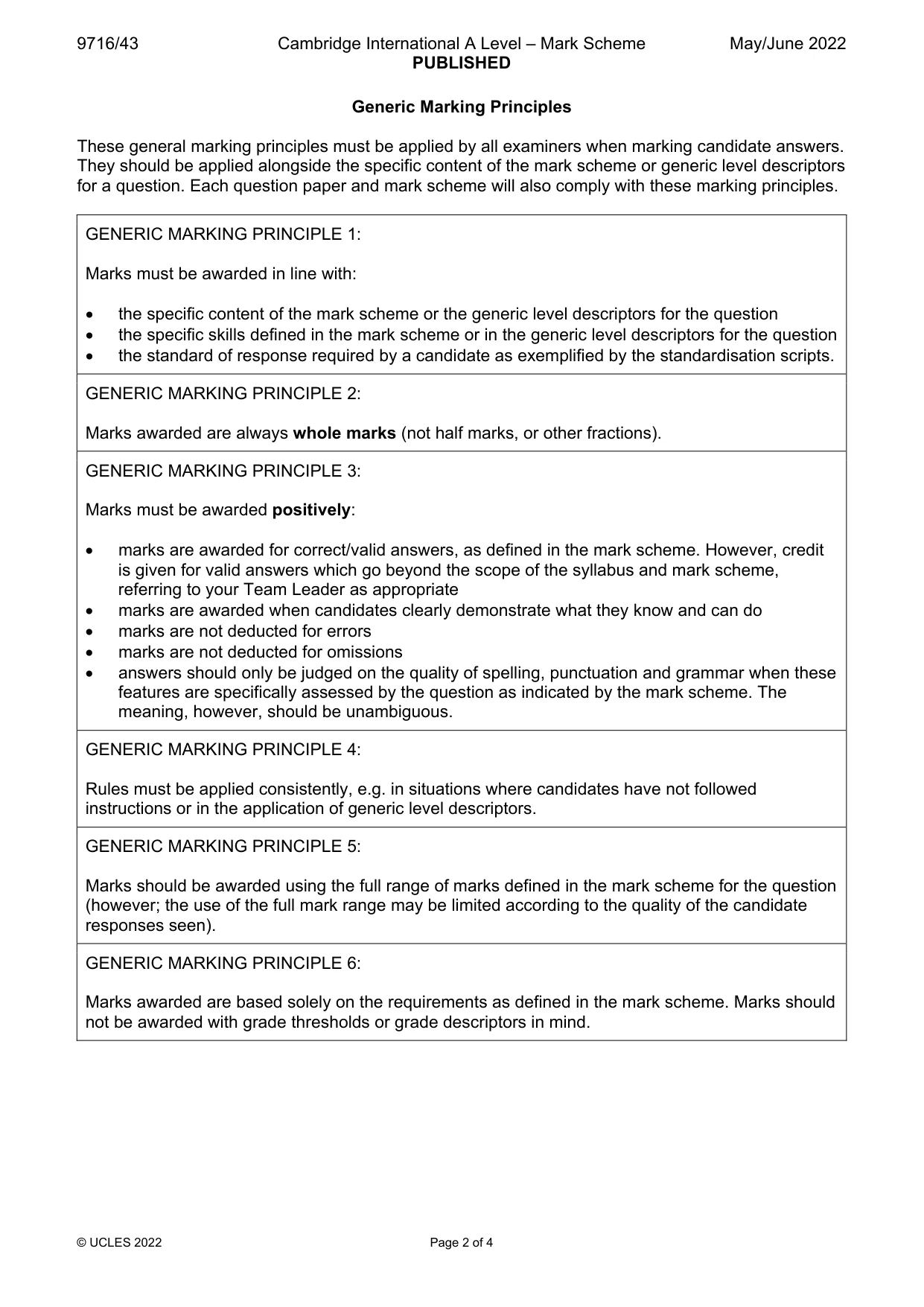
9716/43 Cambridge International A Level – Mark Scheme PUBLISHED May/June 2022 © UCLES 2022 Page 2 of 4 Generic Marking Principles These general marking principles must be applied by all examiners when marking candidate answers. They should be applied alongside the specific content of the mark scheme or generic level descriptors for a question. Each question paper and mark scheme will also comply with these marking principles. GENERIC MARKING PRINCIPLE 1: Marks must be awarded in line with: the specific content of the mark scheme or the generic level descriptors for the question the specific skills defined in the mark scheme or in the generic level descriptors for the question the standard of response required by a candidate as exemplified by the standardisation scripts. GENERIC MARKING PRINCIPLE 2: Marks awarded are always whole marks (not half marks, or other fractions). GENERIC MARKING PRINCIPLE 3: Marks must be awarded positively: marks are awarded for correct/valid answers, as defined in the mark scheme. However, credit is given for valid answers which go beyond the scope of the syllabus and mark scheme, referring to your Team Leader as appropriate marks are awarded when candidates clearly demonstrate what they know and can do marks are not deducted for errors marks are not deducted for omissions answers should only be judged on the quality of spelling, punctuation and grammar when these features are specifically assessed by the question as indicated by the mark scheme. The meaning, however, should be unambiguous. GENERIC MARKING PRINCIPLE 4: Rules must be applied consistently, e.g. in situations where candidates have not followed instructions or in the application of generic level descriptors. GENERIC MARKING PRINCIPLE 5: Marks should be awarded using the full range of marks defined in the mark scheme for the question (however; the use of the full mark range may be limited according to the quality of the candidate responses seen). GENERIC MARKING PRINCIPLE 6: Marks awarded are based solely on the requirements as defined in the mark scheme. Marks should not be awarded with grade thresholds or grade descriptors in mind.
Mark scheme, page 3
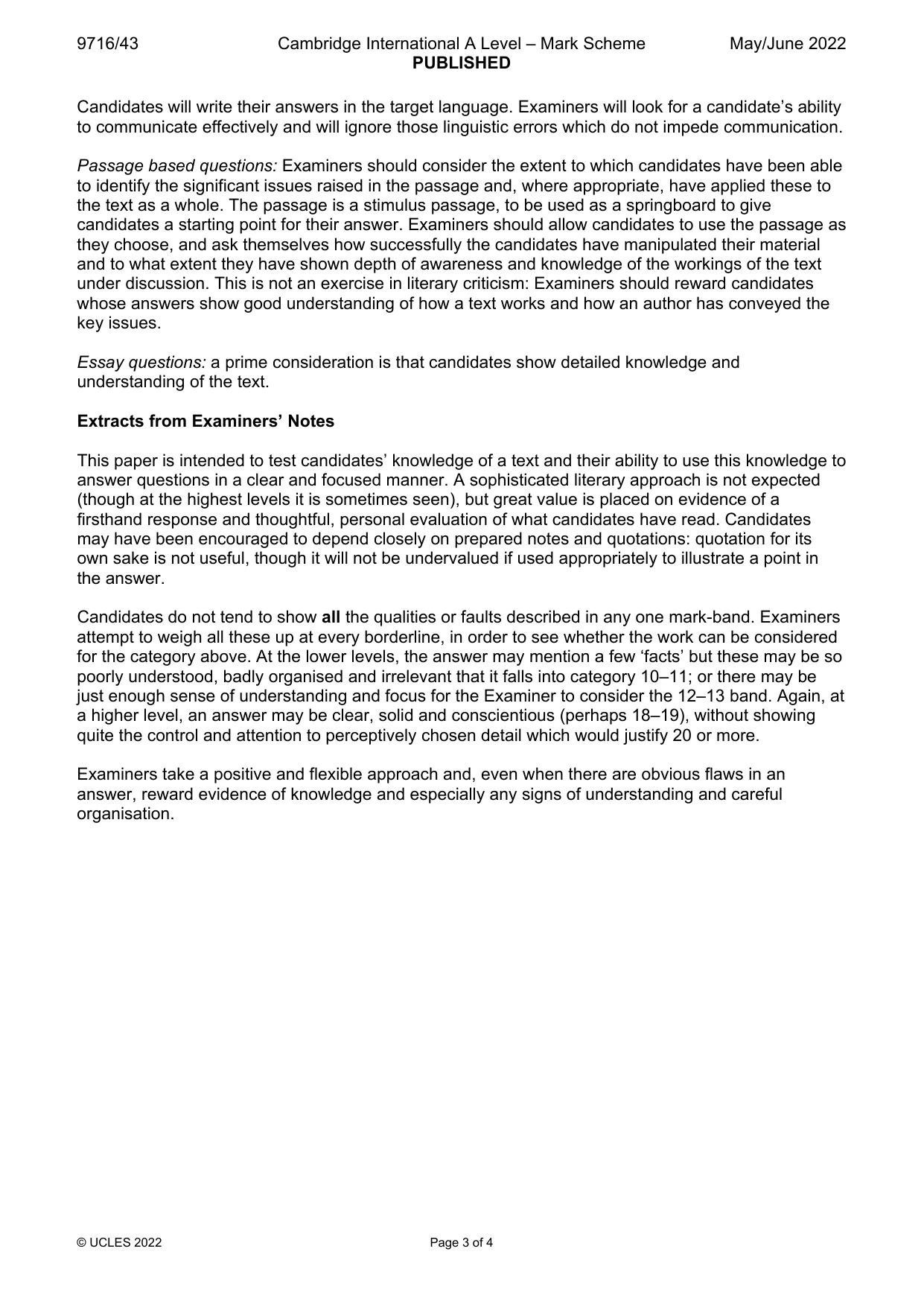
9716/43 Cambridge International A Level – Mark Scheme PUBLISHED May/June 2022 © UCLES 2022 Page 3 of 4 Candidates will write their answers in the target language. Examiners will look for a candidate’s ability to communicate effectively and will ignore those linguistic errors which do not impede communication. Passage based questions: Examiners should consider the extent to which candidates have been able to identify the significant issues raised in the passage and, where appropriate, have applied these to the text as a whole. The passage is a stimulus passage, to be used as a springboard to give candidates a starting point for their answer. Examiners should allow candidates to use the passage as they choose, and ask themselves how successfully the candidates have manipulated their material and to what extent they have shown depth of awareness and knowledge of the workings of the text under discussion. This is not an exercise in literary criticism: Examiners should reward candidates whose answers show good understanding of how a text works and how an author has conveyed the key issues. Essay questions: a prime consideration is that candidates show detailed knowledge and understanding of the text. Extracts from Examiners’ Notes This paper is intended to test candidates’ knowledge of a text and their ability to use this knowledge to answer questions in a clear and focused manner. A sophisticated literary approach is not expected (though at the highest levels it is sometimes seen), but great value is placed on evidence of a firsthand response and thoughtful, personal evaluation of what candidates have read. Candidates may have been encouraged to depend closely on prepared notes and quotations: quotation for its own sake is not useful, though it will not be undervalued if used appropriately to illustrate a point in the answer. Candidates do not tend to show all the qualities or faults described in any one mark-band. Examiners attempt to weigh all these up at every borderline, in order to see whether the work can be considered for the category above. At the lower levels, the answer may mention a few ‘facts’ but these may be so poorly understood, badly organised and irrelevant that it falls into category 10–11; or there may be just enough sense of understanding and focus for the Examiner to consider the 12–13 band. Again, at a higher level, an answer may be clear, solid and conscientious (perhaps 18–19), without showing quite the control and attention to perceptively chosen detail which would justify 20 or more. Examiners take a positive and flexible approach and, even when there are obvious flaws in an answer, reward evidence of knowledge and especially any signs of understanding and careful organisation.
Mark scheme, page 4
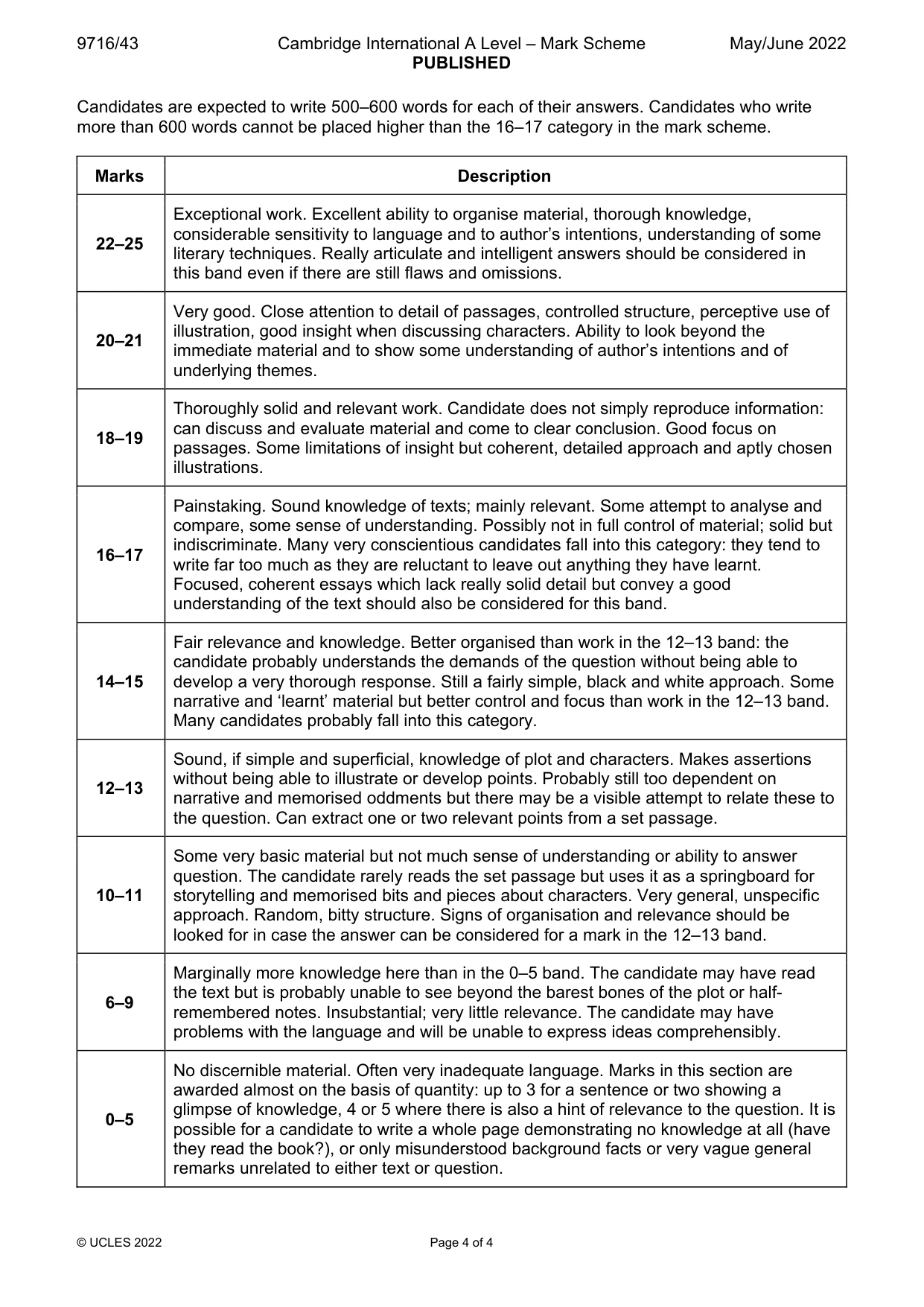
9716/43 Cambridge International A Level – Mark Scheme PUBLISHED May/June 2022 © UCLES 2022 Page 4 of 4 Candidates are expected to write 500–600 words for each of their answers. Candidates who write more than 600 words cannot be placed higher than the 16–17 category in the mark scheme. Marks Description 22–25 Exceptional work. Excellent ability to organise material, thorough knowledge, considerable sensitivity to language and to author’s intentions, understanding of some literary techniques. Really articulate and intelligent answers should be considered in this band even if there are still flaws and omissions. 20–21 Very good. Close attention to detail of passages, controlled structure, perceptive use of illustration, good insight when discussing characters. Ability to look beyond the immediate material and to show some understanding of author’s intentions and of underlying themes. 18–19 Thoroughly solid and relevant work. Candidate does not simply reproduce information: can discuss and evaluate material and come to clear conclusion. Good focus on passages. Some limitations of insight but coherent, detailed approach and aptly chosen illustrations. 16–17 Painstaking. Sound knowledge of texts; mainly relevant. Some attempt to analyse and compare, some sense of understanding. Possibly not in full control of material; solid but indiscriminate. Many very conscientious candidates fall into this category: they tend to write far too much as they are reluctant to leave out anything they have learnt. Focused, coherent essays which lack really solid detail but convey a good understanding of the text should also be considered for this band. 14–15 Fair relevance and knowledge. Better organised than work in the 12–13 band: the candidate probably understands the demands of the question without being able to develop a very thorough response. Still a fairly simple, black and white approach. Some narrative and ‘learnt’ material but better control and focus than work in the 12–13 band. Many candidates probably fall into this category. 12–13 Sound, if simple and superficial, knowledge of plot and characters. Makes assertions without being able to illustrate or develop points. Probably still too dependent on narrative and memorised oddments but there may be a visible attempt to relate these to the question. Can extract one or two relevant points from a set passage. 10–11 Some very basic material but not much sense of understanding or ability to answer question. The candidate rarely reads the set passage but uses it as a springboard for storytelling and memorised bits and pieces about characters. Very general, unspecific approach. Random, bitty structure. Signs of organisation and relevance should be looked for in case the answer can be considered for a mark in the 12–13 band. 6–9 Marginally more knowledge here than in the 0–5 band. The candidate may have read the text but is probably unable to see beyond the barest bones of the plot or half- remembered notes. Insubstantial; very little relevance. The candidate may have problems with the language and will be unable to express ideas comprehensibly. 0–5 No discernible material. Often very inadequate language. Marks in this section are awarded almost on the basis of quantity: up to 3 for a sentence or two showing a glimpse of knowledge, 4 or 5 where there is also a hint of relevance to the question. It is possible for a candidate to write a whole page demonstrating no knowledge at all (have they read the book?), or only misunderstood background facts or very vague general remarks unrelated to either text or question.
What you needed in this session
Cambridge’s own grade thresholds for 2022 May/June, Paper 4 · Variant 3. A higher threshold means an easier paper — the bar moves with how the cohort did.