Cambridge A Level French (A Level only) 9716 — 2021 May/June Paper 4 · Variant 1
9716/41/M/J/21 · 75 marks · ≈84 min
The question paper and its mark scheme, free to read here and free to download. This is Cambridge’s own paper, exactly as it was sat.
Question paper12 pages



Mark scheme4 pages
Answers below. Sit the paper first if you are practising.
Paper as text
Question paper, page 1
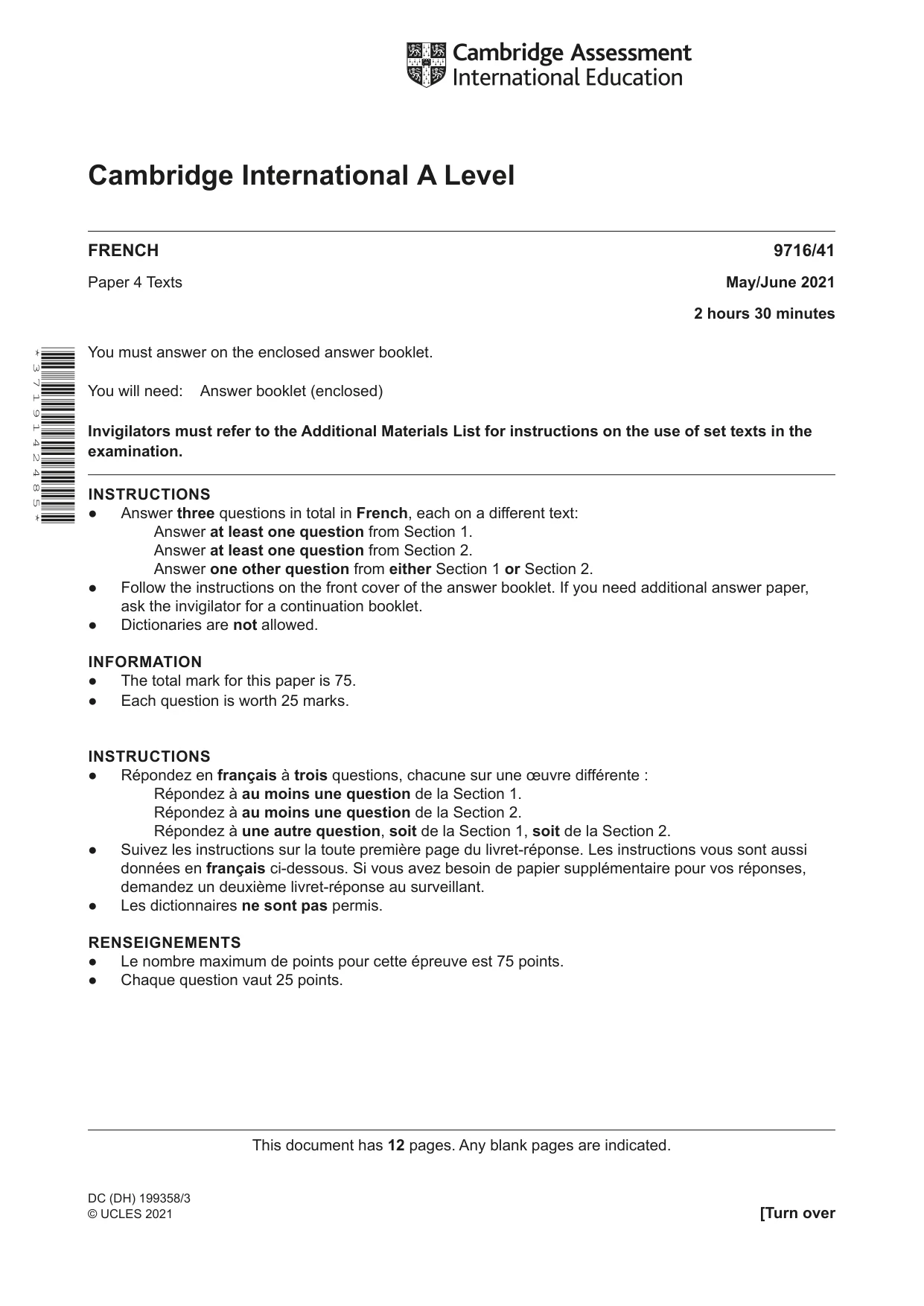
This document has 12 pages. Any blank pages are indicated. Cambridge International A Level * 3 7 1 9 1 4 2 4 8 5 * DC (DH) 199358/3 © UCLES 2021 [Turn over FRENCH 9716/41 Paper 4 Texts May/June 2021 2 hours 30 minutes You must answer on the enclosed answer booklet. You will need: Answer booklet (enclosed) Invigilators must refer to the Additional Materials List for instructions on the use of set texts in the examination. INSTRUCTIONS ● Answer three questions in total in French, each on a different text: Answer at least one question from Section 1. Answer at least one question from Section 2. Answer one other question from either Section 1 or Section 2. ● Follow the instructions on the front cover of the answer booklet. If you need additional answer paper, ask the invigilator for a continuation booklet. ● Dictionaries are not allowed. INFORMATION ● The total mark for this paper is 75. ● Each question is worth 25 marks. INSTRUCTIONS ● Répondez en français à trois questions, chacune sur une œuvre différente : Répondez à au moins une question de la Section 1. Répondez à au moins une question de la Section 2. Répondez à une autre question, soit de la Section 1, soit de la Section 2. ● Suivez les instructions sur la toute première page du livret-réponse. Les instructions vous sont aussi données en français ci-dessous. Si vous avez besoin de papier supplémentaire pour vos réponses, demandez un deuxième livret-réponse au surveillant. ● Les dictionnaires ne sont pas permis. RENSEIGNEMENTS ● Le nombre maximum de points pour cette épreuve est 75 points. ● Chaque question vaut 25 points.
Question paper, page 2
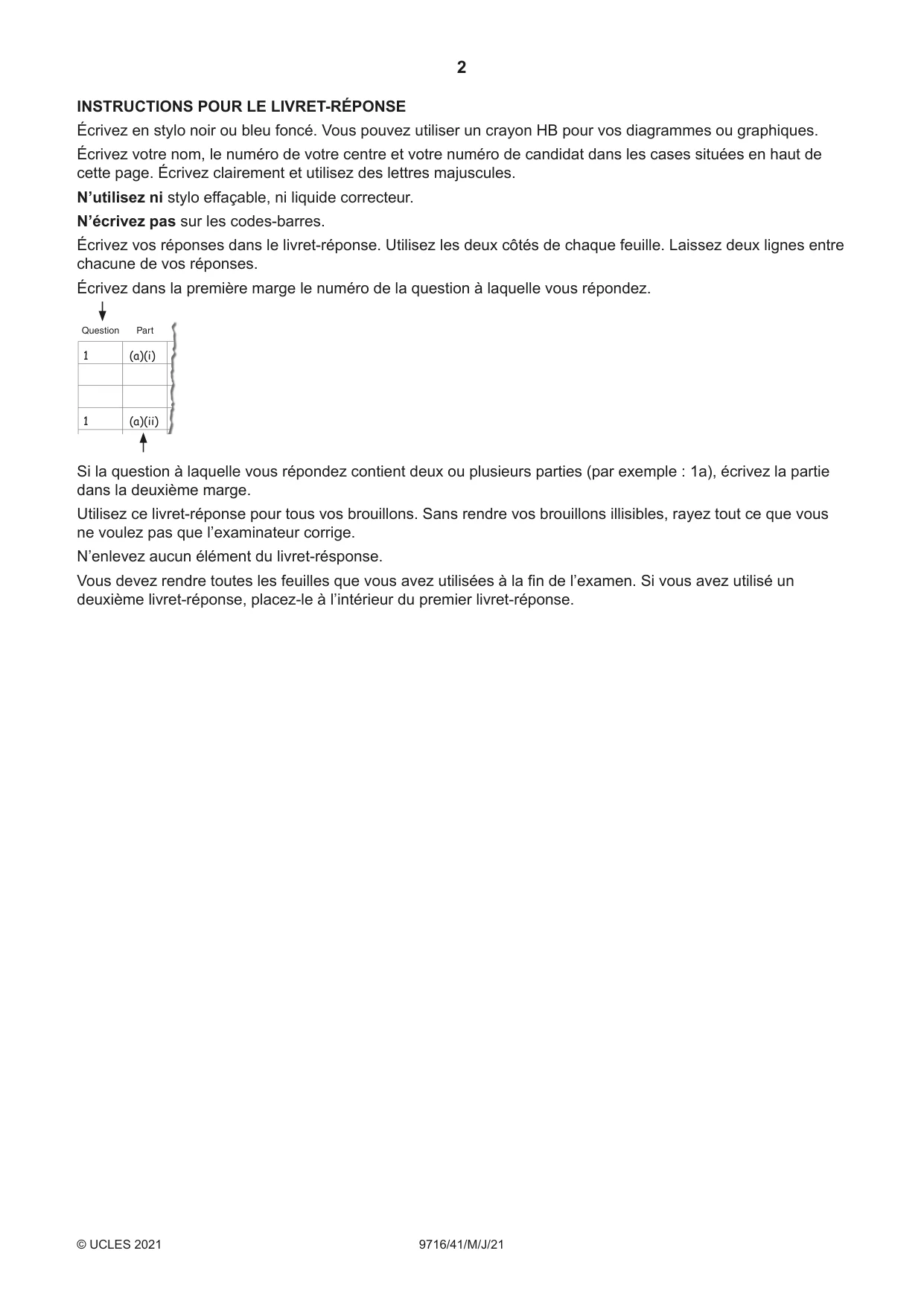
2 9716/41/ M / J /21 © UCLES 2021 INSTRUCTIONS POUR LE LIVRET-RÉPONSE Écrivez en stylo noir ou bleu foncé. Vous pouvez utiliser un crayon HB pour vos diagrammes ou graphiques. Écrivez votre nom, le numéro de votre centre et votre numéro de candidat dans les cases situées en haut de cette page. Écrivez clairement et utilisez des lettres majuscules. N’utilisez ni stylo effaçable, ni liquide correcteur. N’écrivez pas sur les codes-barres. Écrivez vos réponses dans le livret-réponse. Utilisez les deux côtés de chaque feuille. Laissez deux lignes entre chacune de vos réponses. Écrivez dans la première marge le numéro de la question à laquelle vous répondez. Question Part 1 1 (a)(i) (a)(ii) Si la question à laquelle vous répondez contient deux ou plusieurs parties (par exemple : 1a), écrivez la partie dans la deuxième marge. Utilisez ce livret-réponse pour tous vos brouillons. Sans rendre vos brouillons illisibles, rayez tout ce que vous ne voulez pas que l’examinateur corrige. N’enlevez aucun élément du livret-résponse. Vous devez rendre toutes les feuilles que vous avez utilisées à la fin de l’examen. Si vous avez utilisé un deuxième livret-réponse, placez-le à l’intérieur du premier livret-réponse.
Question paper, page 3
3 9716/41/M/J/21 © UCLES 2021 [Turn over BLANK PAGE
Question paper, page 4
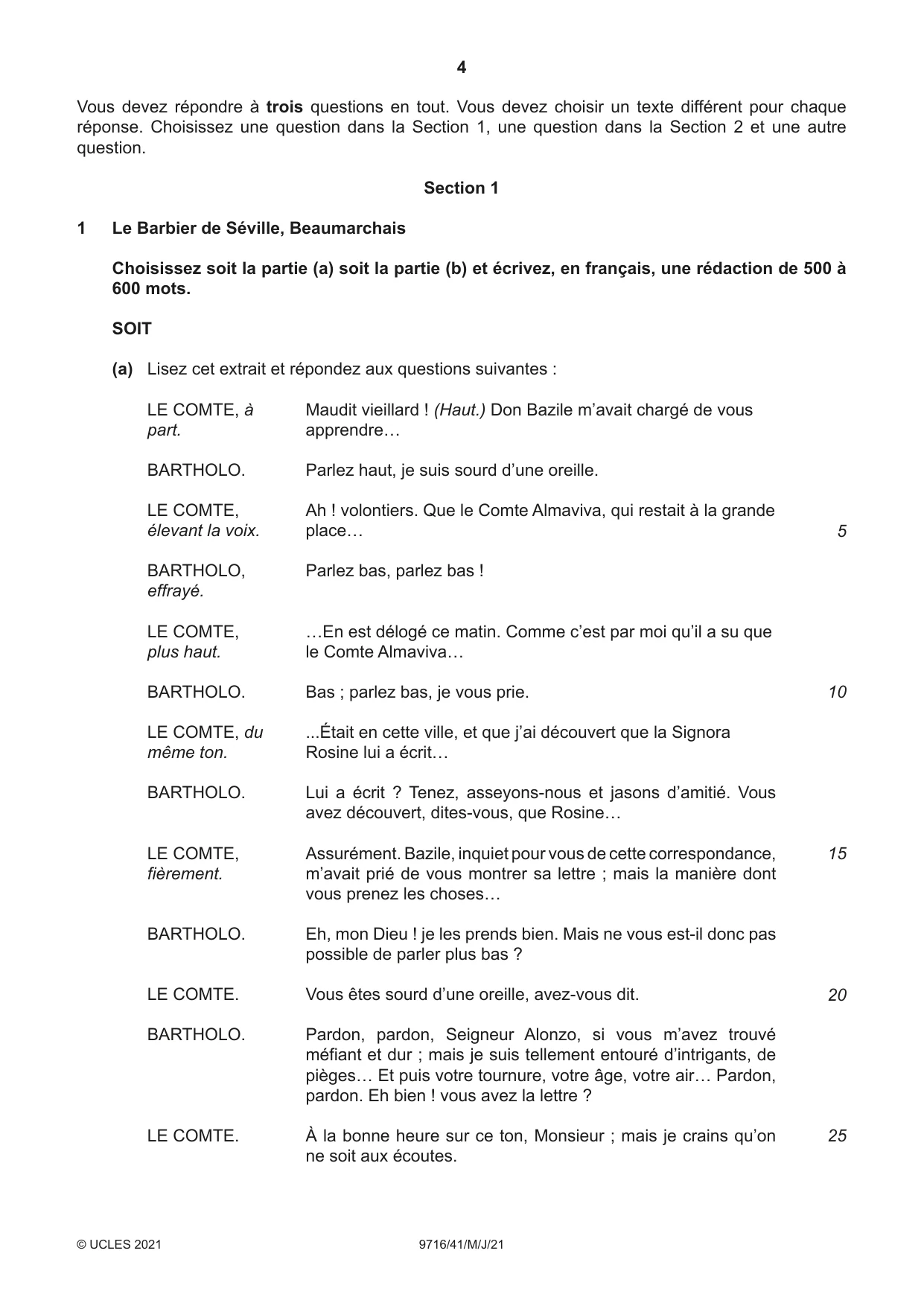
4 9716/41/M/J/21 © UCLES 2021 Vous devez répondre à trois questions en tout. Vous devez choisir un texte différent pour chaque réponse. Choisissez une question dans la Section 1, une question dans la Section 2 et une autre question. Section 1 1 Le Barbier de Séville, Beaumarchais Choisissez soit la partie (a) soit la partie (b) et écrivez, en français, une rédaction de 500 à 600 mots. SOIT (a) Lisez cet extrait et répondez aux questions suivantes : LE COMTE, à Maudit vieillard ! (Haut.) Don Bazile m’avait chargé de vous part. apprendre… BARTHOLO. Parlez haut, je suis sourd d’une oreille. LE COMTE, Ah ! volontiers. Que le Comte Almaviva, qui restait à la grande élevant la voix. place… BARTHOLO, Parlez bas, parlez bas ! effrayé. LE COMTE, …En est délogé ce matin. Comme c’est par moi qu’il a su que plus haut. le Comte Almaviva… BARTHOLO. Bas ; parlez bas, je vous prie. LE COMTE, du ...Était en cette ville, et que j’ai découvert que la Signora même ton. Rosine lui a écrit… BARTHOLO. Lui a écrit ? Tenez, asseyons-nous et jasons d’amitié. Vous avez découvert, dites-vous, que Rosine… LE COMTE, Assurément. Bazile, inquiet pour vous de cette correspondance, fièrement. m’avait prié de vous montrer sa lettre ; mais la manière dont vous prenez les choses… BARTHOLO. Eh, mon Dieu ! je les prends bien. Mais ne vous est-il donc pas possible de parler plus bas ? LE COMTE. Vous êtes sourd d’une oreille, avez-vous dit. BARTHOLO. Pardon, pardon, Seigneur Alonzo, si vous m’avez trouvé méfiant et dur ; mais je suis tellement entouré d’intrigants, de pièges… Et puis votre tournure, votre âge, votre air… Pardon, pardon. Eh bien ! vous avez la lettre ? LE COMTE. À la bonne heure sur ce ton, Monsieur ; mais je crains qu’on ne soit aux écoutes. 5 10 15 20 25
Question paper, page 5
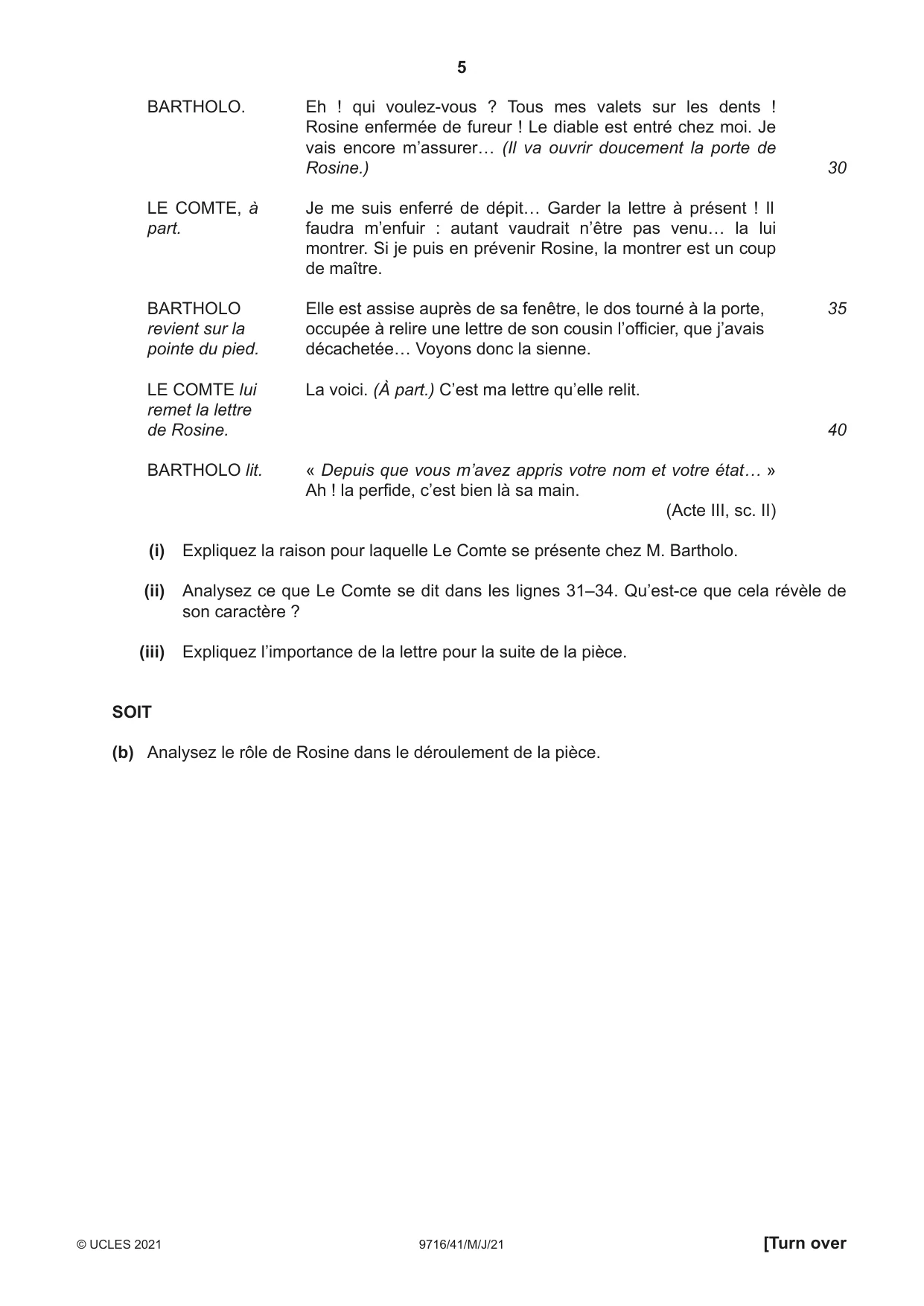
5 9716/41/M/J/21 © UCLES 2021 [Turn over BARTHOLO. Eh ! qui voulez-vous ? Tous mes valets sur les dents ! Rosine enfermée de fureur ! Le diable est entré chez moi. Je vais encore m’assurer… (Il va ouvrir doucement la porte de Rosine.) LE COMTE, à Je me suis enferré de dépit… Garder la lettre à présent ! Il part. faudra m’enfuir : autant vaudrait n’être pas venu… la lui montrer. Si je puis en prévenir Rosine, la montrer est un coup de maître. BARTHOLO Elle est assise auprès de sa fenêtre, le dos tourné à la porte, revient sur la occupée à relire une lettre de son cousin l’officier, que j’avais pointe du pied. décachetée… Voyons donc la sienne. LE COMTE lui La voici. (À part.) C’est ma lettre qu’elle relit. remet la lettre de Rosine. BARTHOLO lit. « Depuis que vous m’avez appris votre nom et votre état… » Ah ! la perfide, c’est bien là sa main. (Acte III, sc. II) (i) Expliquez la raison pour laquelle Le Comte se présente chez M. Bartholo. (ii) Analysez ce que Le Comte se dit dans les lignes 31–34. Qu’est-ce que cela révèle de son caractère ? (iii) Expliquez l’importance de la lettre pour la suite de la pièce. SOIT (b) Analysez le rôle de Rosine dans le déroulement de la pièce. 30 35 40
Question paper, page 6
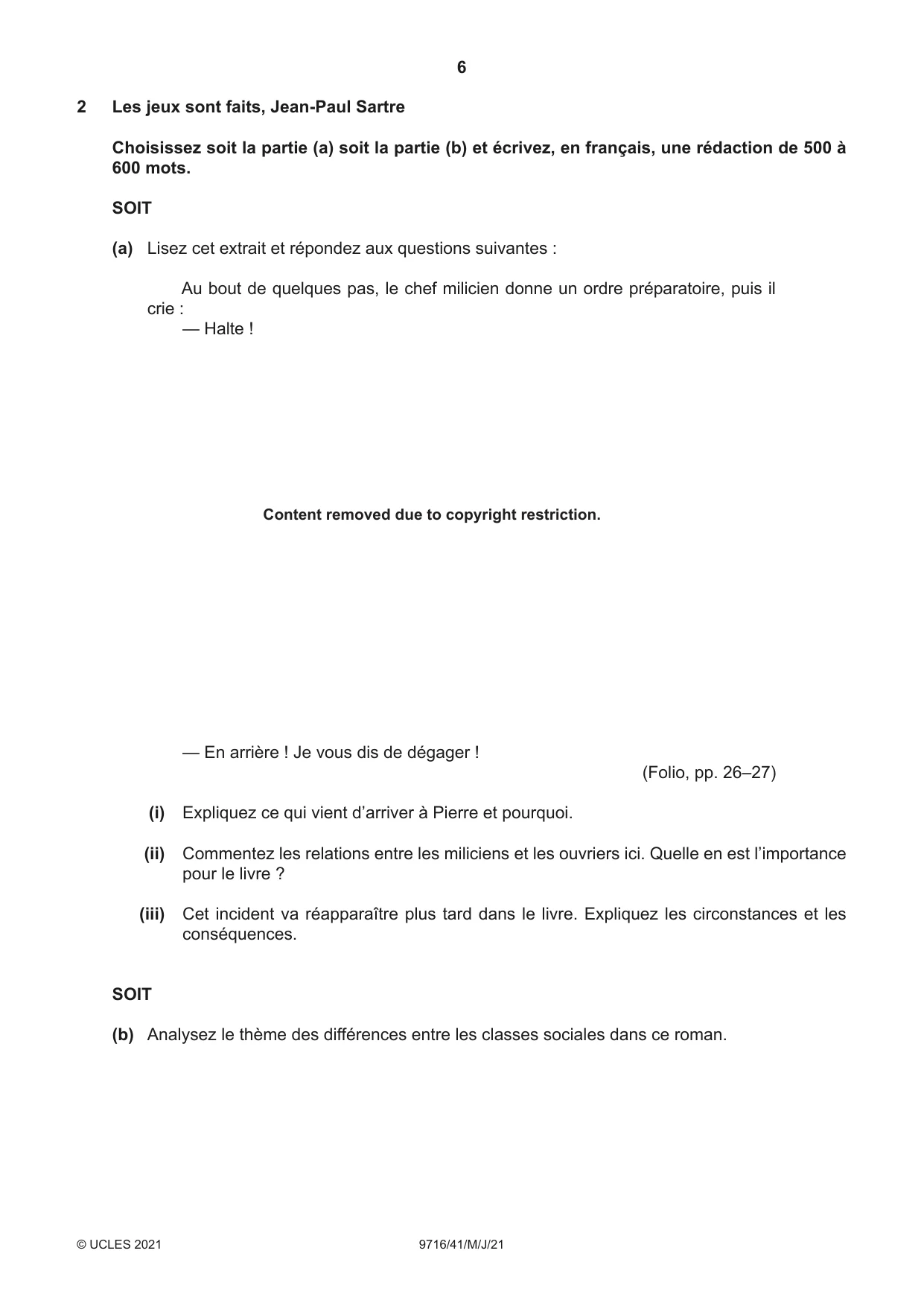
6 9716/41/M/J/21 © UCLES 2021 2 Les jeux sont faits, Jean-Paul Sartre Choisissez soit la partie (a) soit la partie (b) et écrivez, en français, une rédaction de 500 à 600 mots. SOIT (a) Lisez cet extrait et répondez aux questions suivantes : Au bout de quelques pas, le chef milicien donne un ordre préparatoire, puis il crie : — Halte ! — En arrière ! Je vous dis de dégager ! (Folio, pp. 26–27) (i) Expliquez ce qui vient d’arriver à Pierre et pourquoi. (ii) Commentez les relations entre les miliciens et les ouvriers ici. Quelle en est l’importance pour le livre ? (iii) Cet incident va réapparaître plus tard dans le livre. Expliquez les circonstances et les conséquences. SOIT (b) Analysez le thème des différences entre les classes sociales dans ce roman. Content removed due to copyright restriction.
Question paper, page 7
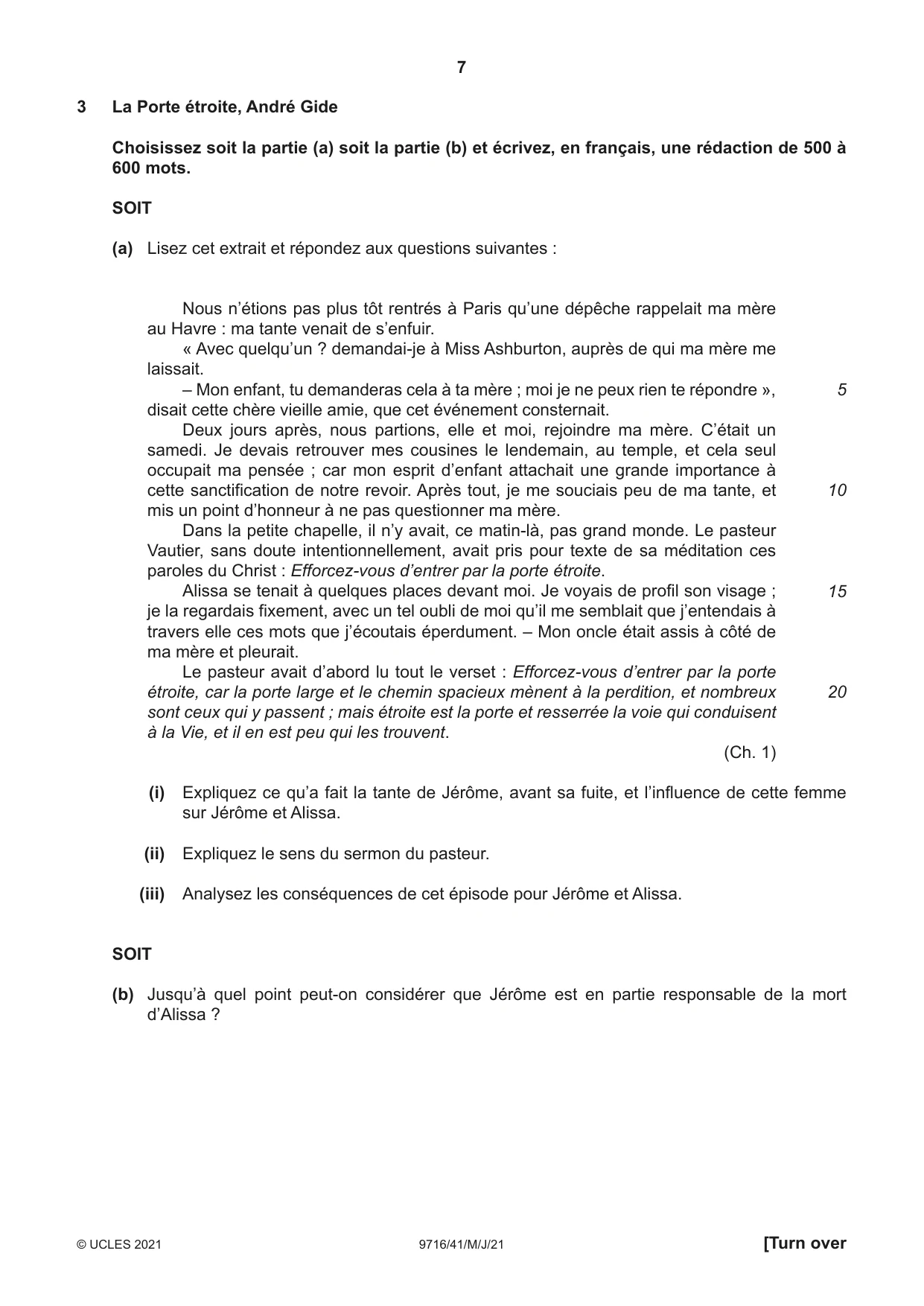
7 9716/41/M/J/21 © UCLES 2021 [Turn over 3 La Porte étroite, André Gide Choisissez soit la partie (a) soit la partie (b) et écrivez, en français, une rédaction de 500 à 600 mots. SOIT (a) Lisez cet extrait et répondez aux questions suivantes : Nous n’étions pas plus tôt rentrés à Paris qu’une dépêche rappelait ma mère au Havre : ma tante venait de s’enfuir. « Avec quelqu’un ? demandai-je à Miss Ashburton, auprès de qui ma mère me laissait. – Mon enfant, tu demanderas cela à ta mère ; moi je ne peux rien te répondre », disait cette chère vieille amie, que cet événement consternait. Deux jours après, nous partions, elle et moi, rejoindre ma mère. C’était un samedi. Je devais retrouver mes cousines le lendemain, au temple, et cela seul occupait ma pensée ; car mon esprit d’enfant attachait une grande importance à cette sanctification de notre revoir. Après tout, je me souciais peu de ma tante, et mis un point d’honneur à ne pas questionner ma mère. Dans la petite chapelle, il n’y avait, ce matin-là, pas grand monde. Le pasteur Vautier, sans doute intentionnellement, avait pris pour texte de sa méditation ces paroles du Christ : Efforcez-vous d’entrer par la porte étroite. Alissa se tenait à quelques places devant moi. Je voyais de profil son visage ; je la regardais fixement, avec un tel oubli de moi qu’il me semblait que j’entendais à travers elle ces mots que j’écoutais éperdument. – Mon oncle était assis à côté de ma mère et pleurait. Le pasteur avait d’abord lu tout le verset : Efforcez-vous d’entrer par la porte étroite, car la porte large et le chemin spacieux mènent à la perdition, et nombreux sont ceux qui y passent ; mais étroite est la porte et resserrée la voie qui conduisent à la Vie, et il en est peu qui les trouvent. (Ch. 1) (i) Expliquez ce qu’a fait la tante de Jérôme, avant sa fuite, et l’influence de cette femme sur Jérôme et Alissa. (ii) Expliquez le sens du sermon du pasteur. (iii) Analysez les conséquences de cet épisode pour Jérôme et Alissa. SOIT (b) Jusqu’à quel point peut-on considérer que Jérôme est en partie responsable de la mort d’Alissa ? 5 10 15 20
Question paper, page 8
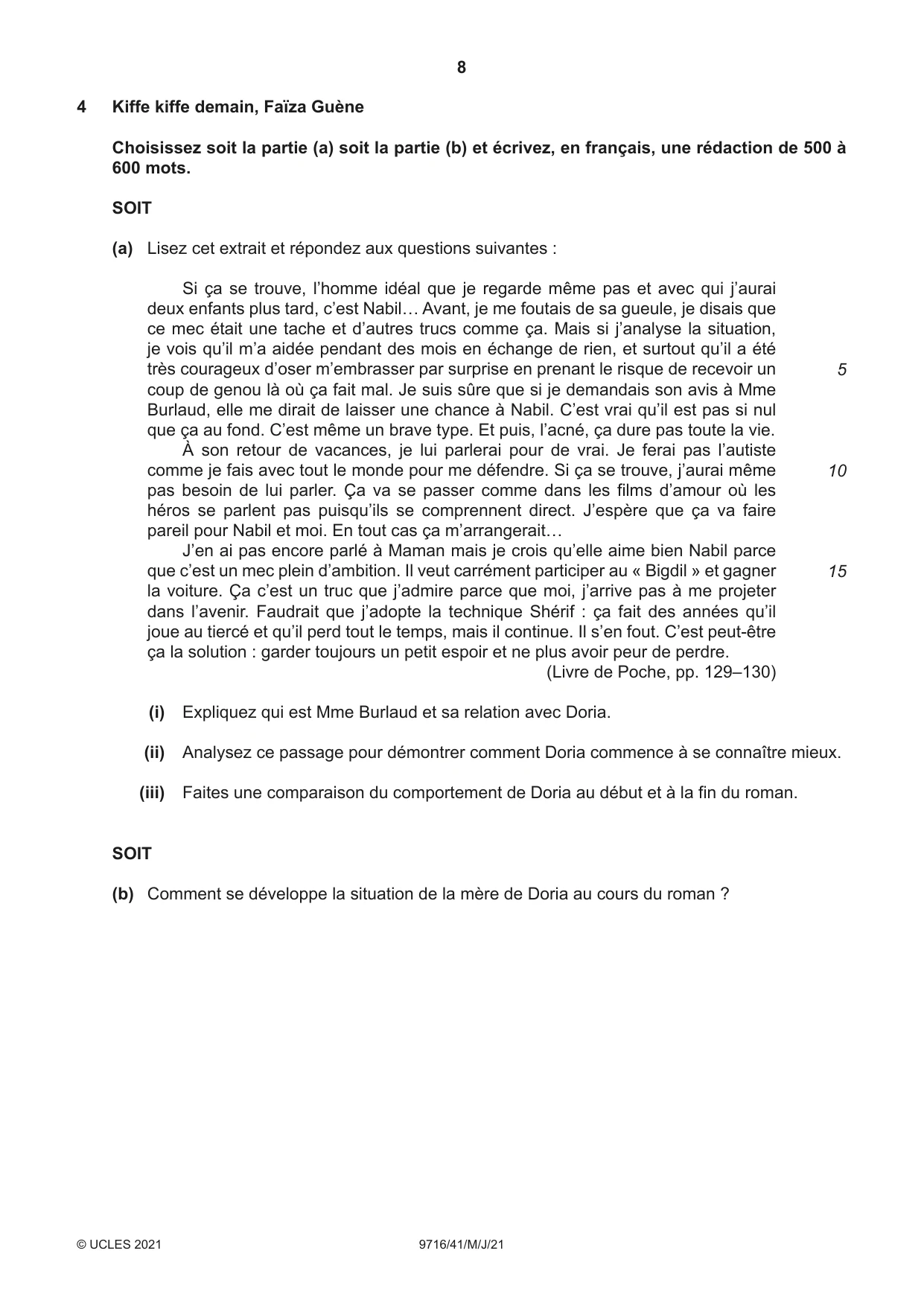
8 9716/41/M/J/21 © UCLES 2021 4 Kiffe kiffe demain, Faïza Guène Choisissez soit la partie (a) soit la partie (b) et écrivez, en français, une rédaction de 500 à 600 mots. SOIT (a) Lisez cet extrait et répondez aux questions suivantes : Si ça se trouve, l’homme idéal que je regarde même pas et avec qui j’aurai deux enfants plus tard, c’est Nabil… Avant, je me foutais de sa gueule, je disais que ce mec était une tache et d’autres trucs comme ça. Mais si j’analyse la situation, je vois qu’il m’a aidée pendant des mois en échange de rien, et surtout qu’il a été très courageux d’oser m’embrasser par surprise en prenant le risque de recevoir un coup de genou là où ça fait mal. Je suis sûre que si je demandais son avis à Mme Burlaud, elle me dirait de laisser une chance à Nabil. C’est vrai qu’il est pas si nul que ça au fond. C’est même un brave type. Et puis, l’acné, ça dure pas toute la vie. À son retour de vacances, je lui parlerai pour de vrai. Je ferai pas l’autiste comme je fais avec tout le monde pour me défendre. Si ça se trouve, j’aurai même pas besoin de lui parler. Ça va se passer comme dans les films d’amour où les héros se parlent pas puisqu’ils se comprennent direct. J’espère que ça va faire pareil pour Nabil et moi. En tout cas ça m’arrangerait… J’en ai pas encore parlé à Maman mais je crois qu’elle aime bien Nabil parce que c’est un mec plein d’ambition. Il veut carrément participer au « Bigdil » et gagner la voiture. Ça c’est un truc que j’admire parce que moi, j’arrive pas à me projeter dans l’avenir. Faudrait que j’adopte la technique Shérif : ça fait des années qu’il joue au tiercé et qu’il perd tout le temps, mais il continue. Il s’en fout. C’est peut-être ça la solution : garder toujours un petit espoir et ne plus avoir peur de perdre. (Livre de Poche, pp. 129–130) (i) Expliquez qui est Mme Burlaud et sa relation avec Doria. (ii) Analysez ce passage pour démontrer comment Doria commence à se connaître mieux. (iii) Faites une comparaison du comportement de Doria au début et à la fin du roman. SOIT (b) Comment se développe la situation de la mère de Doria au cours du roman ? 5 10 15
Question paper, page 9
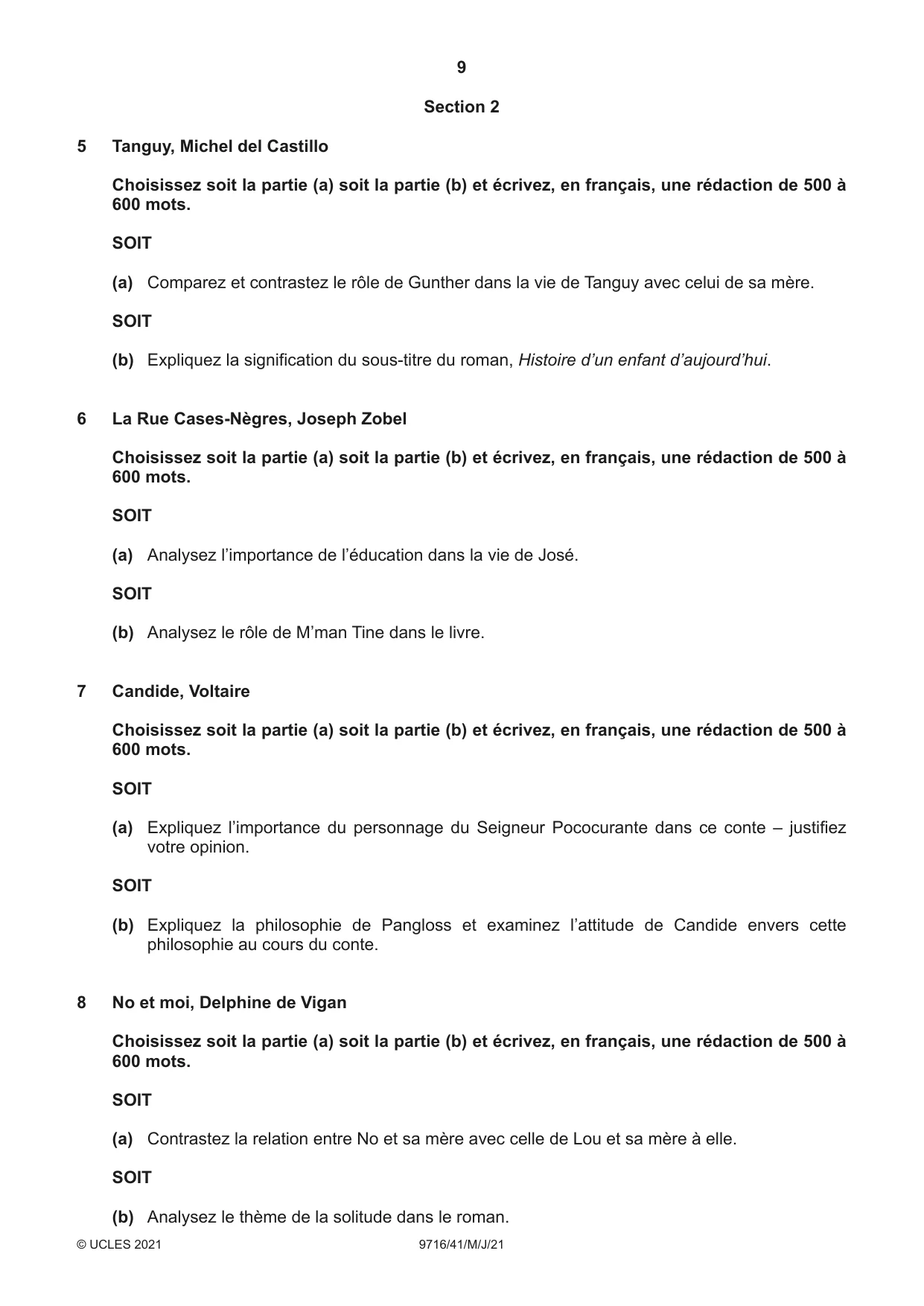
9 9716/41/M/J/21 © UCLES 2021 Section 2 5 Tanguy, Michel del Castillo Choisissez soit la partie (a) soit la partie (b) et écrivez, en français, une rédaction de 500 à 600 mots. SOIT (a) Comparez et contrastez le rôle de Gunther dans la vie de Tanguy avec celui de sa mère. SOIT (b) Expliquez la signification du sous-titre du roman, Histoire d’un enfant d’aujourd’hui. 6 La Rue Cases-Nègres, Joseph Zobel Choisissez soit la partie (a) soit la partie (b) et écrivez, en français, une rédaction de 500 à 600 mots. SOIT (a) Analysez l’importance de l’éducation dans la vie de José. SOIT (b) Analysez le rôle de M’man Tine dans le livre. 7 Candide, Voltaire Choisissez soit la partie (a) soit la partie (b) et écrivez, en français, une rédaction de 500 à 600 mots. SOIT (a) Expliquez l’importance du personnage du Seigneur Pococurante dans ce conte – justifiez votre opinion. SOIT (b) Expliquez la philosophie de Pangloss et examinez l’attitude de Candide envers cette philosophie au cours du conte. 8 No et moi, Delphine de Vigan Choisissez soit la partie (a) soit la partie (b) et écrivez, en français, une rédaction de 500 à 600 mots. SOIT (a) Contrastez la relation entre No et sa mère avec celle de Lou et sa mère à elle. SOIT (b) Analysez le thème de la solitude dans le roman.
Question paper, page 10
10 9716/41/M/J/21 © UCLES 2021 BLANK PAGE
Question paper, page 11
11 9716/41/M/J/21 © UCLES 2021 BLANK PAGE
Question paper, page 12
12 9716/41/M/J/21 © UCLES 2021 Permission to reproduce items where third-party owned material protected by copyright is included has been sought and cleared where possible. Every reasonable effort has been made by the publisher (UCLES) to trace copyright holders, but if any items requiring clearance have unwittingly been included, the publisher will be pleased to make amends at the earliest possible opportunity. To avoid the issue of disclosure of answer-related information to candidates, all copyright acknowledgements are reproduced online in the Cambridge Assessment International Education Copyright Acknowledgements Booklet. This is produced for each series of examinations and is freely available to download at www.cambridgeinternational.org after the live examination series. Cambridge Assessment International Education is part of the Cambridge Assessment Group. Cambridge Assessment is the brand name of the University of Cambridge Local Examinations Syndicate (UCLES), which itself is a department of the University of Cambridge. BLANK PAGE
Mark scheme, page 1
This document consists of 4 printed pages. © UCLES 2021 [Turn over Cambridge International A Level FRENCH 9716/41 Paper 4 Texts May/June 2021 MARK SCHEME Maximum Mark: 75 Published This mark scheme is published as an aid to teachers and candidates, to indicate the requirements of the examination. It shows the basis on which Examiners were instructed to award marks. It does not indicate the details of the discussions that took place at an Examiners’ meeting before marking began, which would have considered the acceptability of alternative answers. Mark schemes should be read in conjunction with the question paper and the Principal Examiner Report for Teachers. Cambridge International will not enter into discussions about these mark schemes. Cambridge International is publishing the mark schemes for the May/June 2021 series for most Cambridge IGCSE™, Cambridge International A and AS Level components and some Cambridge O Level components.
Mark scheme, page 2
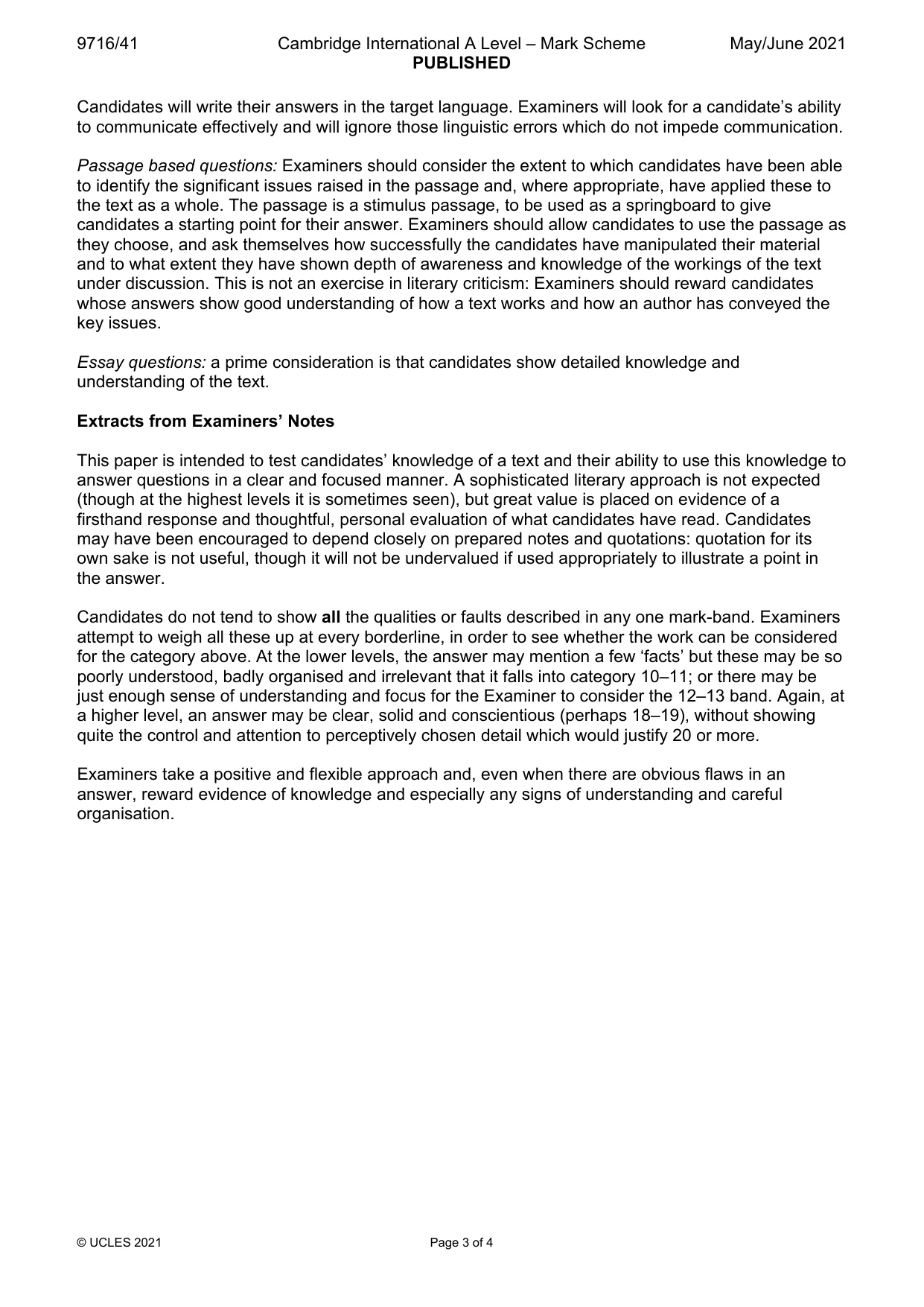
9716/41 Cambridge International A Level – Mark Scheme PUBLISHED May/June 2021 © UCLES 2021 Page 2 of 4 Generic Marking Principles These general marking principles must be applied by all examiners when marking candidate answers. They should be applied alongside the specific content of the mark scheme or generic level descriptors for a question. Each question paper and mark scheme will also comply with these marking principles. GENERIC MARKING PRINCIPLE 1: Marks must be awarded in line with: • the specific content of the mark scheme or the generic level descriptors for the question • the specific skills defined in the mark scheme or in the generic level descriptors for the question • the standard of response required by a candidate as exemplified by the standardisation scripts. GENERIC MARKING PRINCIPLE 2: Marks awarded are always whole marks (not half marks, or other fractions). GENERIC MARKING PRINCIPLE 3: Marks must be awarded positively: • marks are awarded for correct/valid answers, as defined in the mark scheme. However, credit is given for valid answers which go beyond the scope of the syllabus and mark scheme, referring to your Team Leader as appropriate • marks are awarded when candidates clearly demonstrate what they know and can do • marks are not deducted for errors • marks are not deducted for omissions • answers should only be judged on the quality of spelling, punctuation and grammar when these features are specifically assessed by the question as indicated by the mark scheme. The meaning, however, should be unambiguous. GENERIC MARKING PRINCIPLE 4: Rules must be applied consistently, e.g. in situations where candidates have not followed instructions or in the application of generic level descriptors. GENERIC MARKING PRINCIPLE 5: Marks should be awarded using the full range of marks defined in the mark scheme for the question (however; the use of the full mark range may be limited according to the quality of the candidate responses seen). GENERIC MARKING PRINCIPLE 6: Marks awarded are based solely on the requirements as defined in the mark scheme. Marks should not be awarded with grade thresholds or grade descriptors in mind.
Mark scheme, page 3
9716/41 Cambridge International A Level – Mark Scheme PUBLISHED May/June 2021 © UCLES 2021 Page 3 of 4 Candidates will write their answers in the target language. Examiners will look for a candidate’s ability to communicate effectively and will ignore those linguistic errors which do not impede communication. Passage based questions: Examiners should consider the extent to which candidates have been able to identify the significant issues raised in the passage and, where appropriate, have applied these to the text as a whole. The passage is a stimulus passage, to be used as a springboard to give candidates a starting point for their answer. Examiners should allow candidates to use the passage as they choose, and ask themselves how successfully the candidates have manipulated their material and to what extent they have shown depth of awareness and knowledge of the workings of the text under discussion. This is not an exercise in literary criticism: Examiners should reward candidates whose answers show good understanding of how a text works and how an author has conveyed the key issues. Essay questions: a prime consideration is that candidates show detailed knowledge and understanding of the text. Extracts from Examiners’ Notes This paper is intended to test candidates’ knowledge of a text and their ability to use this knowledge to answer questions in a clear and focused manner. A sophisticated literary approach is not expected (though at the highest levels it is sometimes seen), but great value is placed on evidence of a firsthand response and thoughtful, personal evaluation of what candidates have read. Candidates may have been encouraged to depend closely on prepared notes and quotations: quotation for its own sake is not useful, though it will not be undervalued if used appropriately to illustrate a point in the answer. Candidates do not tend to show all the qualities or faults described in any one mark-band. Examiners attempt to weigh all these up at every borderline, in order to see whether the work can be considered for the category above. At the lower levels, the answer may mention a few ‘facts’ but these may be so poorly understood, badly organised and irrelevant that it falls into category 10–11; or there may be just enough sense of understanding and focus for the Examiner to consider the 12–13 band. Again, at a higher level, an answer may be clear, solid and conscientious (perhaps 18–19), without showing quite the control and attention to perceptively chosen detail which would justify 20 or more. Examiners take a positive and flexible approach and, even when there are obvious flaws in an answer, reward evidence of knowledge and especially any signs of understanding and careful organisation.
Mark scheme, page 4
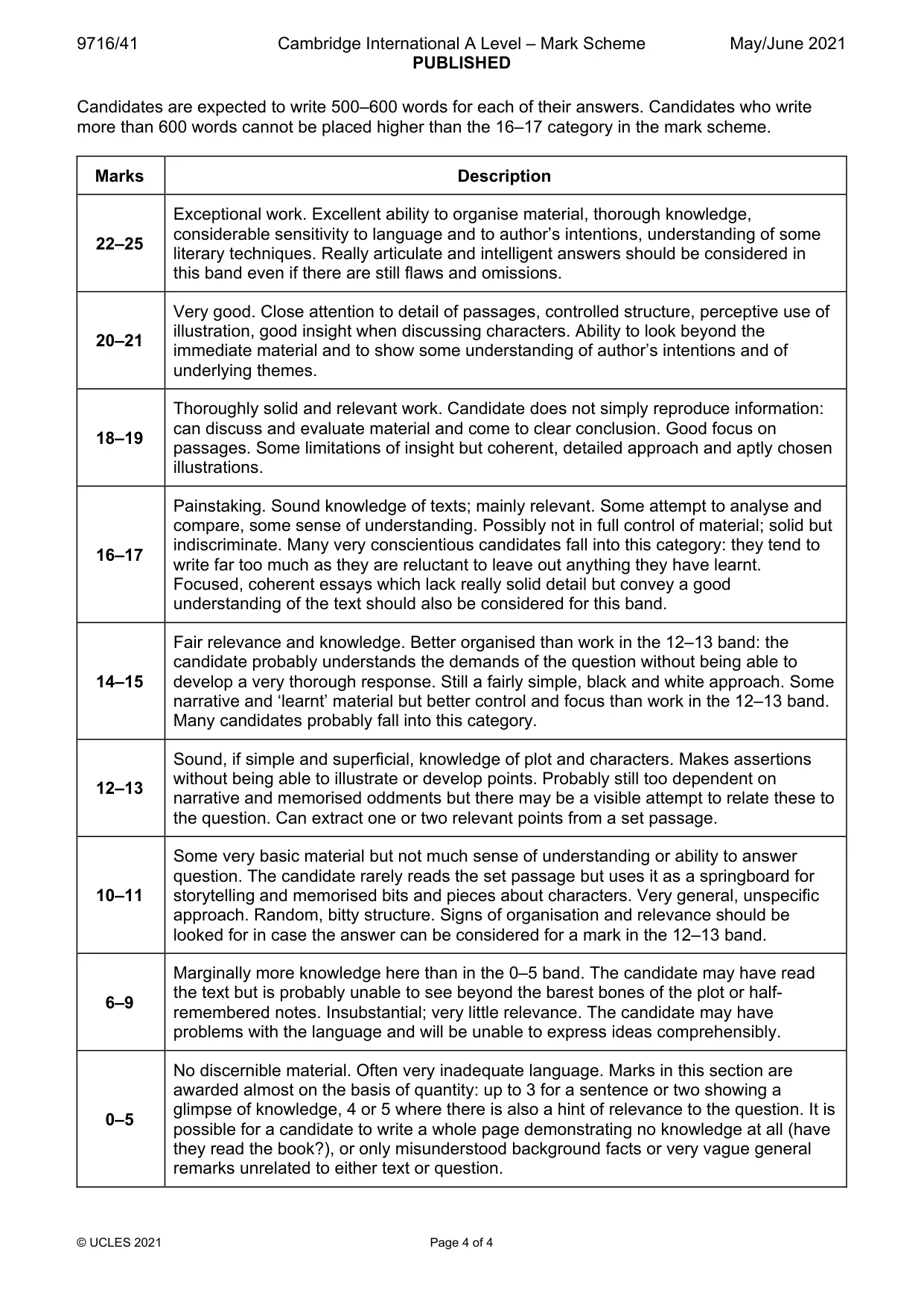
9716/41 Cambridge International A Level – Mark Scheme PUBLISHED May/June 2021 © UCLES 2021 Page 4 of 4 Candidates are expected to write 500–600 words for each of their answers. Candidates who write more than 600 words cannot be placed higher than the 16–17 category in the mark scheme. Marks Description 22–25 Exceptional work. Excellent ability to organise material, thorough knowledge, considerable sensitivity to language and to author’s intentions, understanding of some literary techniques. Really articulate and intelligent answers should be considered in this band even if there are still flaws and omissions. 20–21 Very good. Close attention to detail of passages, controlled structure, perceptive use of illustration, good insight when discussing characters. Ability to look beyond the immediate material and to show some understanding of author’s intentions and of underlying themes. 18–19 Thoroughly solid and relevant work. Candidate does not simply reproduce information: can discuss and evaluate material and come to clear conclusion. Good focus on passages. Some limitations of insight but coherent, detailed approach and aptly chosen illustrations. 16–17 Painstaking. Sound knowledge of texts; mainly relevant. Some attempt to analyse and compare, some sense of understanding. Possibly not in full control of material; solid but indiscriminate. Many very conscientious candidates fall into this category: they tend to write far too much as they are reluctant to leave out anything they have learnt. Focused, coherent essays which lack really solid detail but convey a good understanding of the text should also be considered for this band. 14–15 Fair relevance and knowledge. Better organised than work in the 12–13 band: the candidate probably understands the demands of the question without being able to develop a very thorough response. Still a fairly simple, black and white approach. Some narrative and ‘learnt’ material but better control and focus than work in the 12–13 band. Many candidates probably fall into this category. 12–13 Sound, if simple and superficial, knowledge of plot and characters. Makes assertions without being able to illustrate or develop points. Probably still too dependent on narrative and memorised oddments but there may be a visible attempt to relate these to the question. Can extract one or two relevant points from a set passage. 10–11 Some very basic material but not much sense of understanding or ability to answer question. The candidate rarely reads the set passage but uses it as a springboard for storytelling and memorised bits and pieces about characters. Very general, unspecific approach. Random, bitty structure. Signs of organisation and relevance should be looked for in case the answer can be considered for a mark in the 12–13 band. 6–9 Marginally more knowledge here than in the 0–5 band. The candidate may have read the text but is probably unable to see beyond the barest bones of the plot or half- remembered notes. Insubstantial; very little relevance. The candidate may have problems with the language and will be unable to express ideas comprehensibly. 0–5 No discernible material. Often very inadequate language. Marks in this section are awarded almost on the basis of quantity: up to 3 for a sentence or two showing a glimpse of knowledge, 4 or 5 where there is also a hint of relevance to the question. It is possible for a candidate to write a whole page demonstrating no knowledge at all (have they read the book?), or only misunderstood background facts or very vague general remarks unrelated to either text or question.
What you needed in this session
Cambridge’s own grade thresholds for 2021 May/June, Paper 4 · Variant 1. A higher threshold means an easier paper — the bar moves with how the cohort did.