Cambridge A Level French (A Level only) 9716 — 2016 Oct/Nov Paper 4 · Variant 1
9716/41/O/N/16 · 75 marks · ≈84 min
The question paper and its mark scheme, free to read here and free to download. This is Cambridge’s own paper, exactly as it was sat.
Question paper8 pages
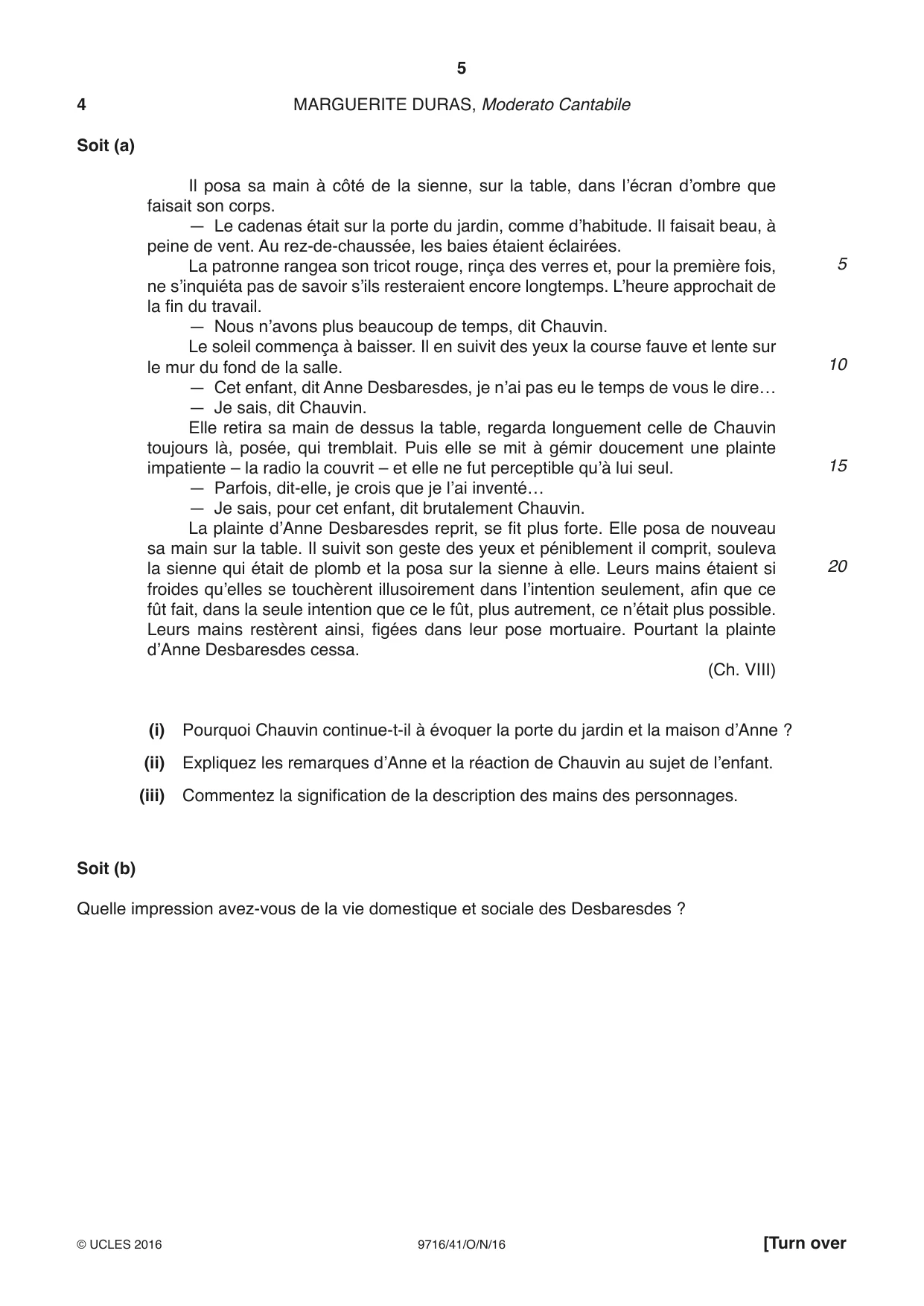
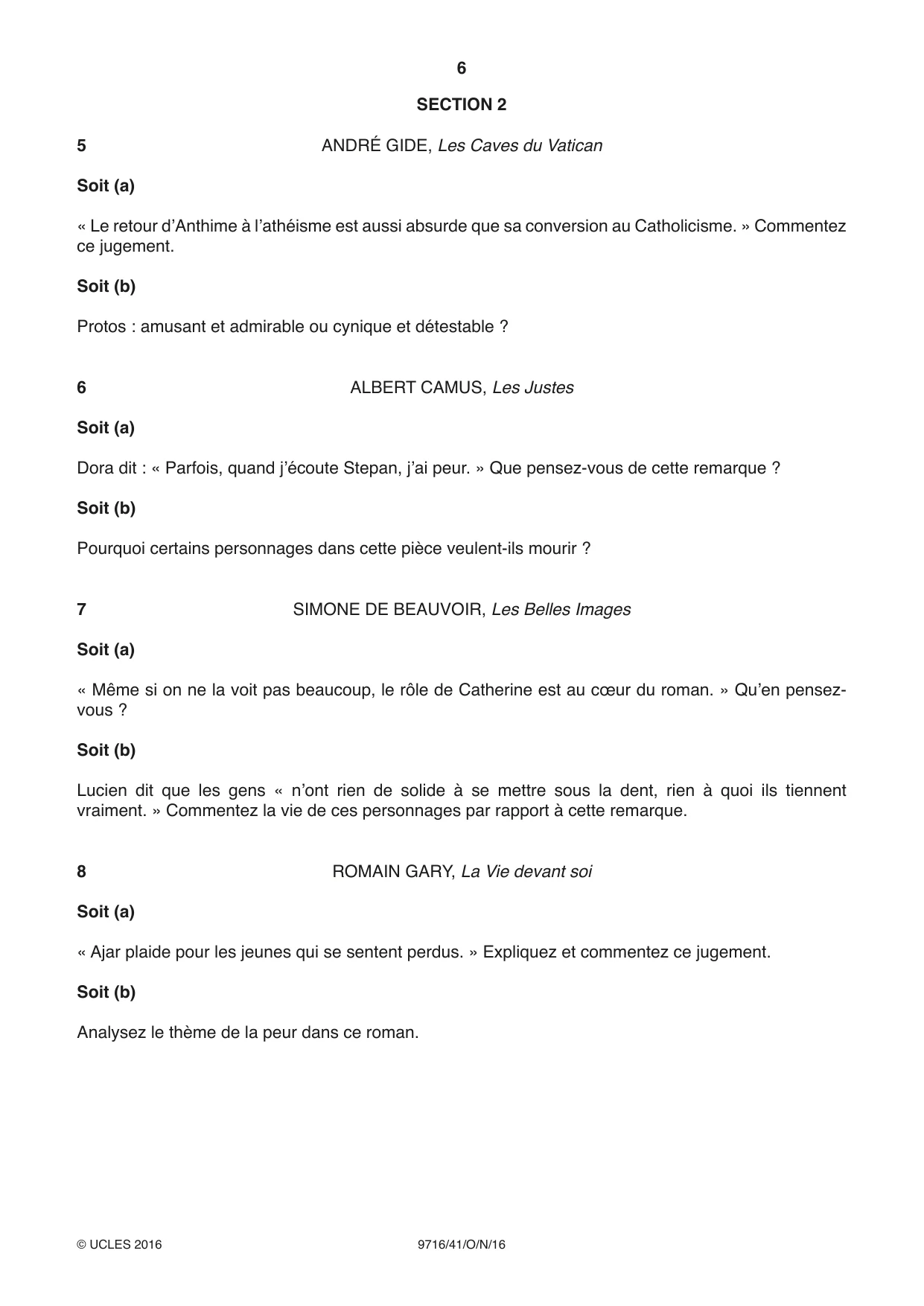


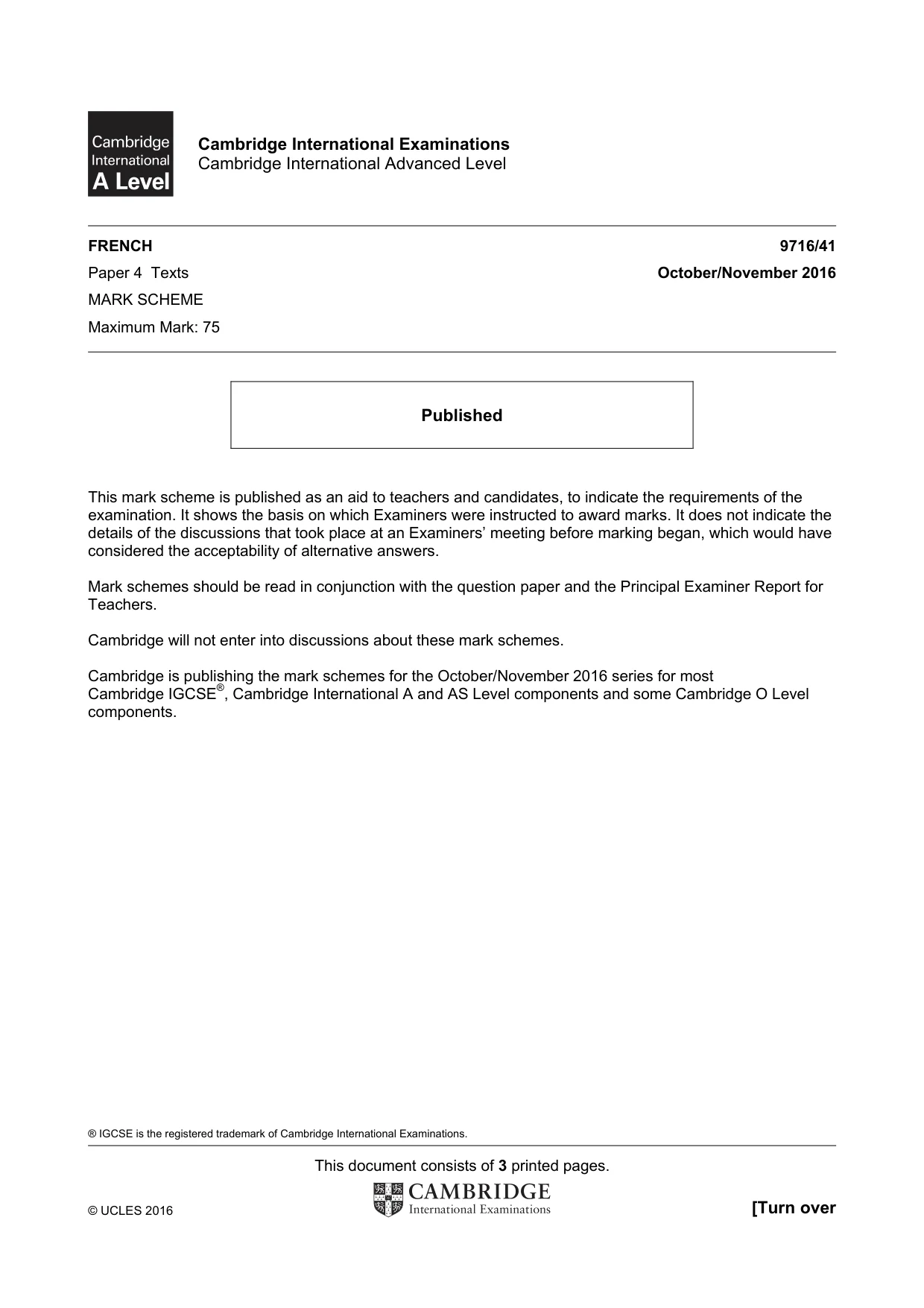
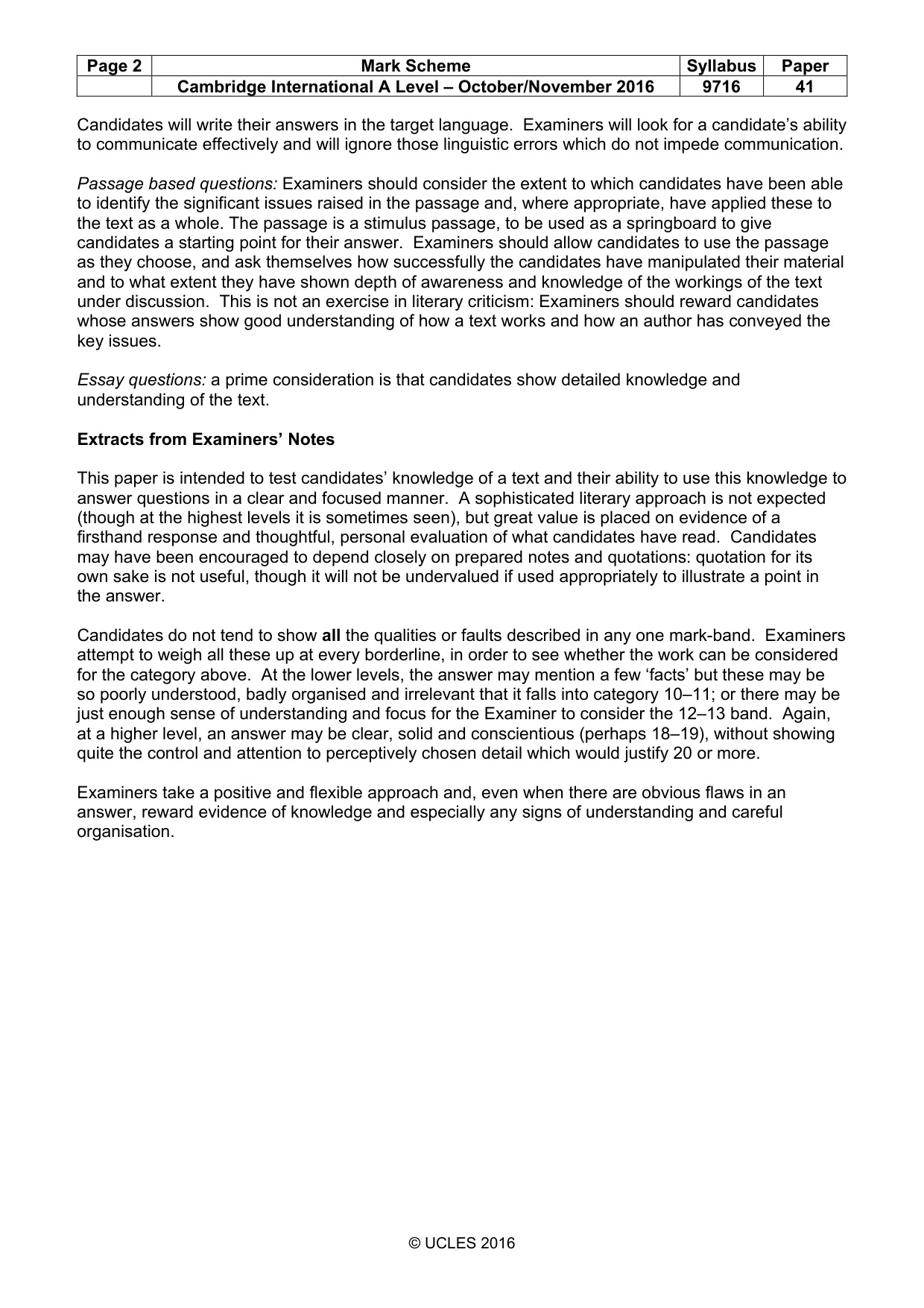
Mark scheme3 pages
Answers below. Sit the paper first if you are practising.
Paper as text
Question paper, page 1
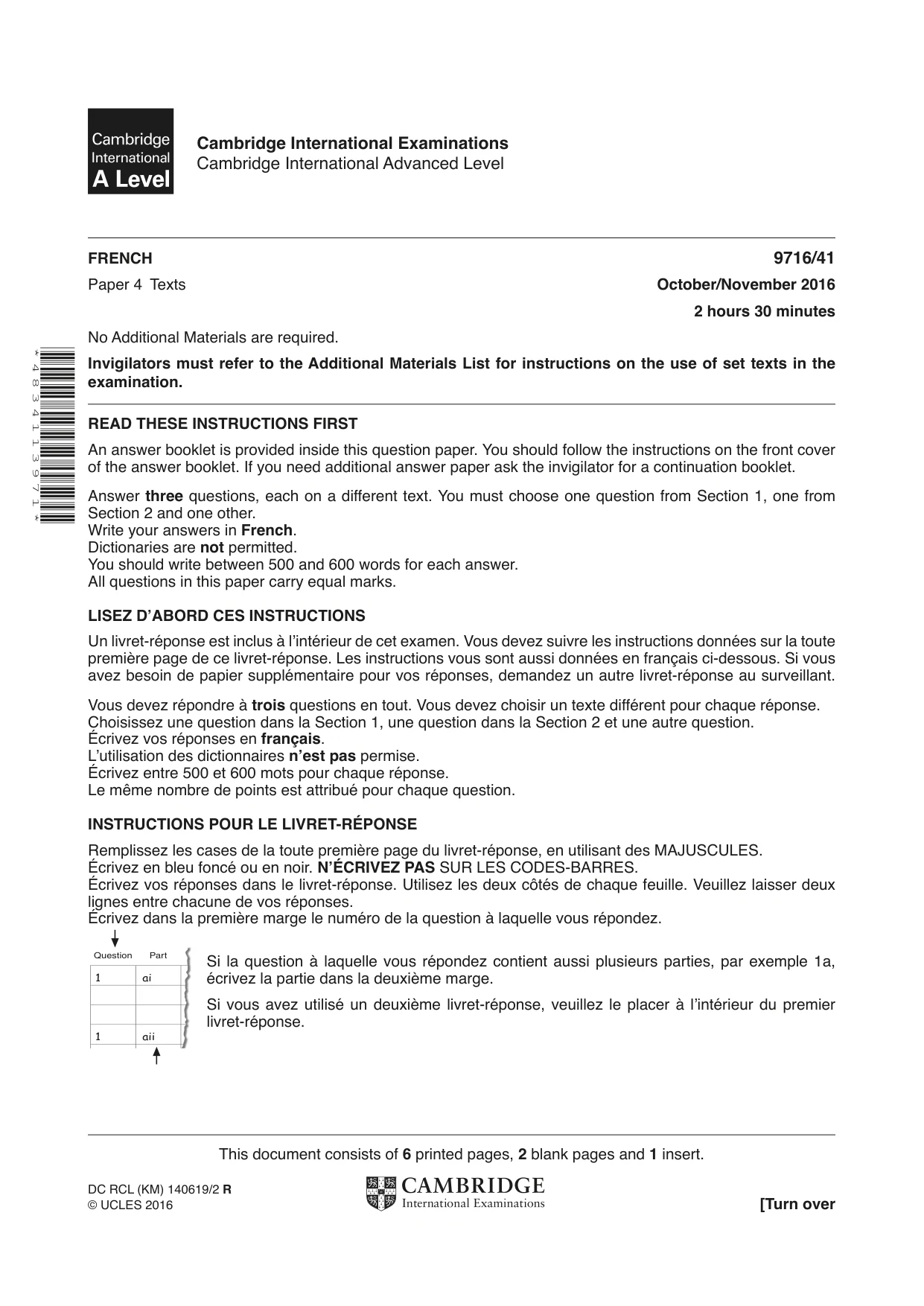
This document consists of 6 printed pages, 2 blank pages and 1 insert. DC RCL (KM) 140619/2 R © UCLES 2016 [Turn over Cambridge International Examinations Cambridge International Advanced Level * 4 8 3 4 1 1 3 9 7 1 * FRENCH 9716/41 Paper 4 Texts October/November 2016 2 hours 30 minutes No Additional Materials are required. Invigilators must refer to the Additional Materials List for instructions on the use of set texts in the examination. READ THESE INSTRUCTIONS FIRST An answer booklet is provided inside this question paper. You should follow the instructions on the front cover of the answer booklet. If you need additional answer paper ask the invigilator for a continuation booklet. Answer three questions, each on a different text. You must choose one question from Section 1, one from Section 2 and one other. Write your answers in French. Dictionaries are not permitted. You should write between 500 and 600 words for each answer. All questions in this paper carry equal marks. LISEZ D’ABORD CES INSTRUCTIONS Un livret-réponse est inclus à l’intérieur de cet examen. Vous devez suivre les instructions données sur la toute première page de ce livret-réponse. Les instructions vous sont aussi données en français ci-dessous. Si vous avez besoin de papier supplémentaire pour vos réponses, demandez un autre livret-réponse au surveillant. Vous devez répondre à trois questions en tout. Vous devez choisir un texte différent pour chaque réponse. Choisissez une question dans la Section 1, une question dans la Section 2 et une autre question. Écrivez vos réponses en français. L’utilisation des dictionnaires n’est pas permise. Écrivez entre 500 et 600 mots pour chaque réponse. Le même nombre de points est attribué pour chaque question. INSTRUCTIONS POUR LE LIVRET-RÉPONSE Remplissez les cases de la toute première page du livret-réponse, en utilisant des MAJUSCULES. Écrivez en bleu foncé ou en noir. N’ÉCRIVEZ PAS SUR LES CODES-BARRES. Écrivez vos réponses dans le livret-réponse. Utilisez les deux côtés de chaque feuille. Veuillez laisser deux lignes entre chacune de vos réponses. Écrivez dans la première marge le numéro de la question à laquelle vous répondez. Si la question à laquelle vous répondez contient aussi plusieurs parties, par exemple 1a, écrivez la partie dans la deuxième marge. Si vous avez utilisé un deuxième livret-réponse, veuillez le placer à l’intérieur du premier livret-réponse. Question Part 1 1 ai aii
Question paper, page 2
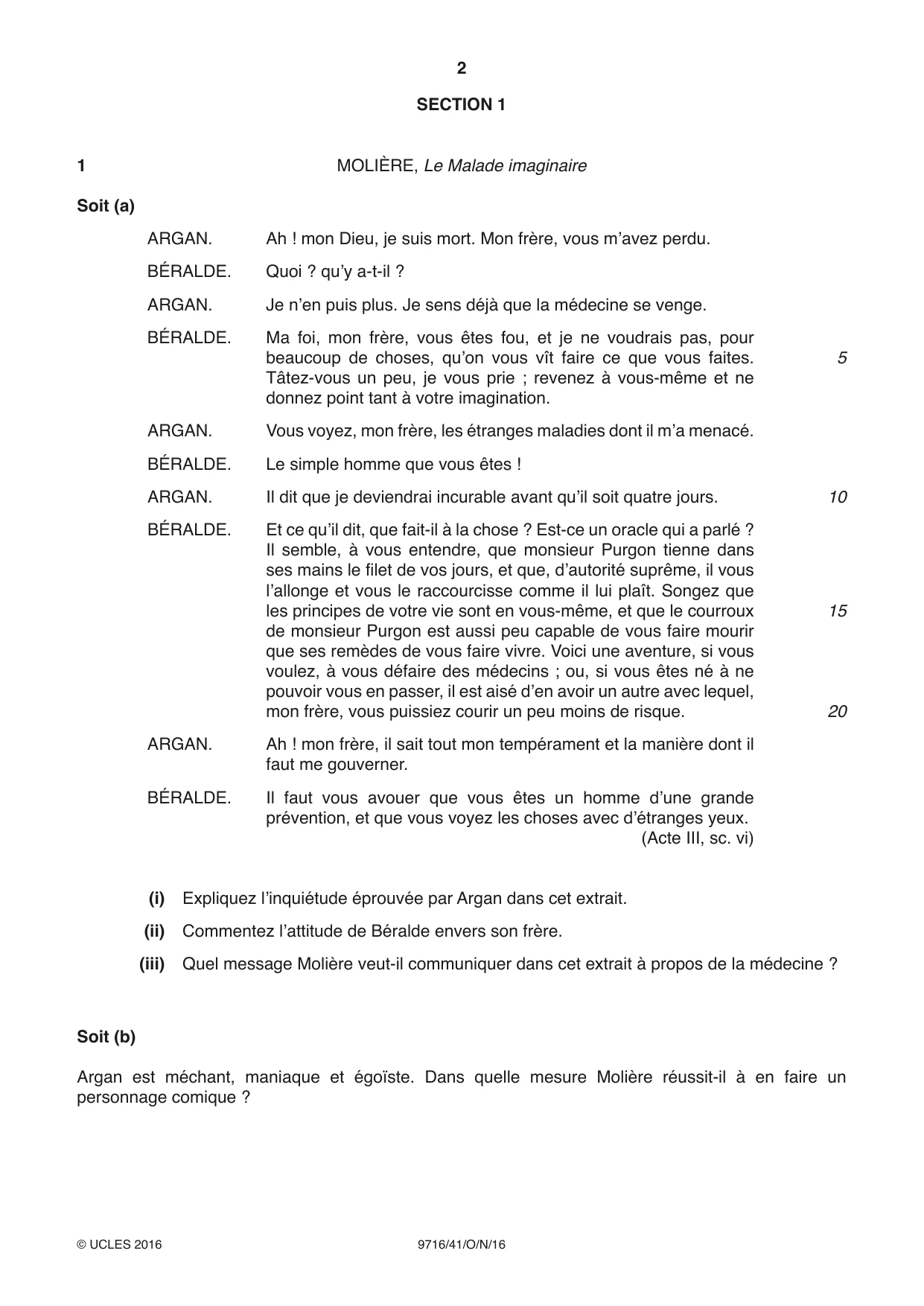
2 9716/41/O/N/16 © UCLES 2016 SECTION 1 1 MOLIÈRE, Le Malade imaginaire Soit (a) ARGAN. Ah ! mon Dieu, je suis mort. Mon frère, vous m’avez perdu. BÉRALDE. Quoi ? qu’y a-t-il ? ARGAN. Je n’en puis plus. Je sens déjà que la médecine se venge. BÉRALDE. Ma foi, mon frère, vous êtes fou, et je ne voudrais pas, pour beaucoup de choses, qu’on vous vît faire ce que vous faites. Tâtez-vous un peu, je vous prie ; revenez à vous-même et ne donnez point tant à votre imagination. 5 ARGAN. Vous voyez, mon frère, les étranges maladies dont il m’a menacé. BÉRALDE. Le simple homme que vous êtes ! ARGAN. Il dit que je deviendrai incurable avant qu’il soit quatre jours. 10 BÉRALDE. Et ce qu’il dit, que fait-il à la chose ? Est-ce un oracle qui a parlé ? Il semble, à vous entendre, que monsieur Purgon tienne dans ses mains le filet de vos jours, et que, d’autorité suprême, il vous l’allonge et vous le raccourcisse comme il lui plaît. Songez que les principes de votre vie sont en vous-même, et que le courroux de monsieur Purgon est aussi peu capable de vous faire mourir que ses remèdes de vous faire vivre. Voici une aventure, si vous voulez, à vous défaire des médecins ; ou, si vous êtes né à ne pouvoir vous en passer, il est aisé d’en avoir un autre avec lequel, mon frère, vous puissiez courir un peu moins de risque. 15 20 ARGAN. Ah ! mon frère, il sait tout mon tempérament et la manière dont il faut me gouverner. BÉRALDE. Il faut vous avouer que vous êtes un homme d’une grande prévention, et que vous voyez les choses avec d’étranges yeux. (Acte III, sc. vi) (i) Expliquez l’inquiétude éprouvée par Argan dans cet extrait. (ii) Commentez l’attitude de Béralde envers son frère. (iii) Quel message Molière veut-il communiquer dans cet extrait à propos de la médecine ? Soit (b) Argan est méchant, maniaque et égoïste. Dans quelle mesure Molière réussit-il à en faire un personnage comique ?
Question paper, page 3
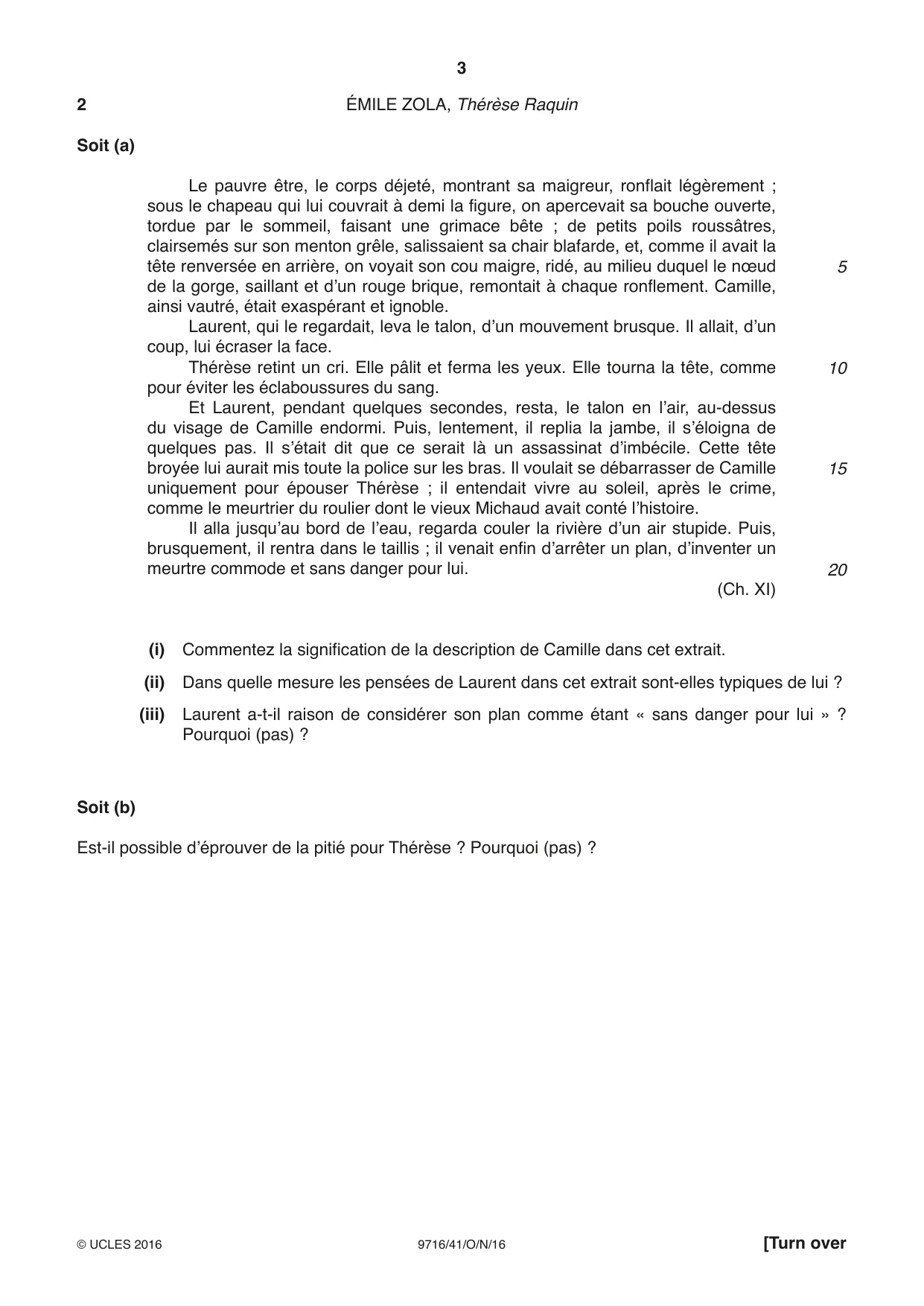
3 9716/41/O/N/16 © UCLES 2016 [Turn over 2 ÉMILE ZOLA, Thérèse Raquin Soit (a) Le pauvre être, le corps déjeté, montrant sa maigreur, ronflait légèrement ; sous le chapeau qui lui couvrait à demi la figure, on apercevait sa bouche ouverte, tordue par le sommeil, faisant une grimace bête ; de petits poils roussâtres, clairsemés sur son menton grêle, salissaient sa chair blafarde, et, comme il avait la tête renversée en arrière, on voyait son cou maigre, ridé, au milieu duquel le nœud de la gorge, saillant et d’un rouge brique, remontait à chaque ronflement. Camille, ainsi vautré, était exaspérant et ignoble. Laurent, qui le regardait, leva le talon, d’un mouvement brusque. Il allait, d’un coup, lui écraser la face. Thérèse retint un cri. Elle pâlit et ferma les yeux. Elle tourna la tête, comme pour éviter les éclaboussures du sang. Et Laurent, pendant quelques secondes, resta, le talon en l’air, au-dessus du visage de Camille endormi. Puis, lentement, il replia la jambe, il s’éloigna de quelques pas. Il s’était dit que ce serait là un assassinat d’imbécile. Cette tête broyée lui aurait mis toute la police sur les bras. Il voulait se débarrasser de Camille uniquement pour épouser Thérèse ; il entendait vivre au soleil, après le crime, comme le meurtrier du roulier dont le vieux Michaud avait conté l’histoire. Il alla jusqu’au bord de l’eau, regarda couler la rivière d’un air stupide. Puis, brusquement, il rentra dans le taillis ; il venait enfin d’arrêter un plan, d’inventer un meurtre commode et sans danger pour lui. (Ch. XI) (i) Commentez la signification de la description de Camille dans cet extrait. (ii) Dans quelle mesure les pensées de Laurent dans cet extrait sont-elles typiques de lui ? (iii) Laurent a-t-il raison de considérer son plan comme étant « sans danger pour lui » ? Pourquoi (pas) ? Soit (b) Est-il possible d’éprouver de la pitié pour Thérèse ? Pourquoi (pas) ? 5 10 15 20
Question paper, page 4
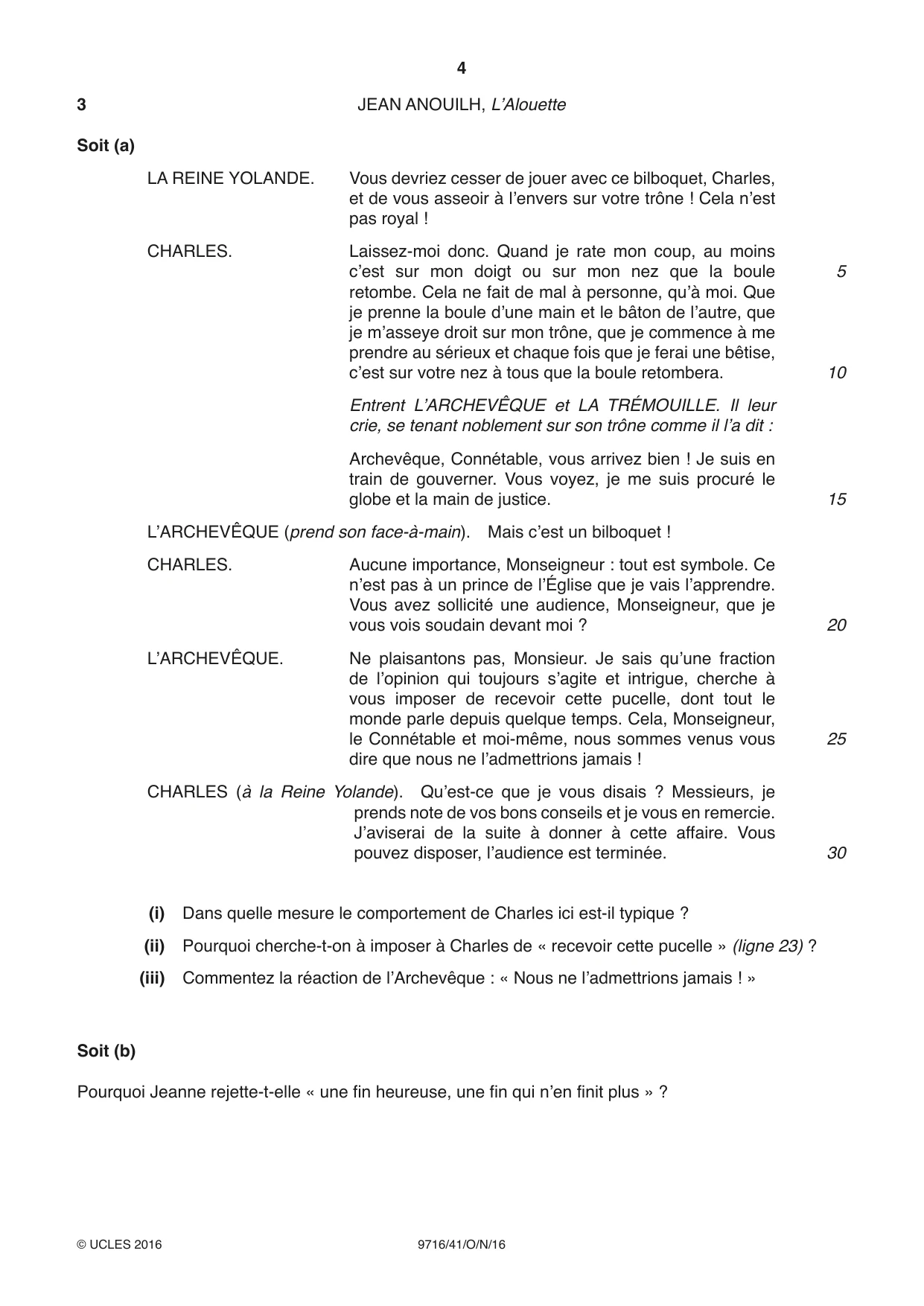
4 9716/41/O/N/16 © UCLES 2016 3 JEAN ANOUILH, L’Alouette Soit (a) LA REINE YOLANDE. Vous devriez cesser de jouer avec ce bilboquet, Charles, et de vous asseoir à l’envers sur votre trône ! Cela n’est pas royal ! CHARLES. Laissez-moi donc. Quand je rate mon coup, au moins c’est sur mon doigt ou sur mon nez que la boule retombe. Cela ne fait de mal à personne, qu’à moi. Que je prenne la boule d’une main et le bâton de l’autre, que je m’asseye droit sur mon trône, que je commence à me prendre au sérieux et chaque fois que je ferai une bêtise, c’est sur votre nez à tous que la boule retombera. 5 10 Entrent L’ARCHEVÊQUE et LA TRÉMOUILLE. Il leur crie, se tenant noblement sur son trône comme il l’a dit : Archevêque, Connétable, vous arrivez bien ! Je suis en train de gouverner. Vous voyez, je me suis procuré le globe et la main de justice. 15 L’ARCHEVÊQUE (prend son face-à-main). Mais c’est un bilboquet ! CHARLES. Aucune importance, Monseigneur : tout est symbole. Ce n’est pas à un prince de l’Église que je vais l’apprendre. Vous avez sollicité une audience, Monseigneur, que je vous vois soudain devant moi ? 20 L’ARCHEVÊQUE. Ne plaisantons pas, Monsieur. Je sais qu’une fraction de l’opinion qui toujours s’agite et intrigue, cherche à vous imposer de recevoir cette pucelle, dont tout le monde parle depuis quelque temps. Cela, Monseigneur, le Connétable et moi-même, nous sommes venus vous dire que nous ne l’admettrions jamais ! 25 CHARLES (à la Reine Yolande). Qu’est-ce que je vous disais ? Messieurs, je prends note de vos bons conseils et je vous en remercie. J’aviserai de la suite à donner à cette affaire. Vous pouvez disposer, l’audience est terminée. 30 (i) Dans quelle mesure le comportement de Charles ici est-il typique ? (ii) Pourquoi cherche-t-on à imposer à Charles de « recevoir cette pucelle » (ligne 23) ? (iii) Commentez la réaction de l’Archevêque : « Nous ne l’admettrions jamais ! » Soit (b) Pourquoi Jeanne rejette-t-elle « une fin heureuse, une fin qui n’en finit plus » ?
Question paper, page 5
5 9716/41/O/N/16 © UCLES 2016 [Turn over 4 MARGUERITE DURAS, Moderato Cantabile Soit (a) Il posa sa main à côté de la sienne, sur la table, dans l’écran d’ombre que faisait son corps. — Le cadenas était sur la porte du jardin, comme d’habitude. Il faisait beau, à peine de vent. Au rez-de-chaussée, les baies étaient éclairées. La patronne rangea son tricot rouge, rinça des verres et, pour la première fois, ne s’inquiéta pas de savoir s’ils resteraient encore longtemps. L’heure approchait de la fin du travail. — Nous n’avons plus beaucoup de temps, dit Chauvin. Le soleil commença à baisser. Il en suivit des yeux la course fauve et lente sur le mur du fond de la salle. — Cet enfant, dit Anne Desbaresdes, je n’ai pas eu le temps de vous le dire… — Je sais, dit Chauvin. Elle retira sa main de dessus la table, regarda longuement celle de Chauvin toujours là, posée, qui tremblait. Puis elle se mit à gémir doucement une plainte impatiente – la radio la couvrit – et elle ne fut perceptible qu’à lui seul. — Parfois, dit-elle, je crois que je l’ai inventé… — Je sais, pour cet enfant, dit brutalement Chauvin. La plainte d’Anne Desbaresdes reprit, se fit plus forte. Elle posa de nouveau sa main sur la table. Il suivit son geste des yeux et péniblement il comprit, souleva la sienne qui était de plomb et la posa sur la sienne à elle. Leurs mains étaient si froides qu’elles se touchèrent illusoirement dans l’intention seulement, afin que ce fût fait, dans la seule intention que ce le fût, plus autrement, ce n’était plus possible. Leurs mains restèrent ainsi, figées dans leur pose mortuaire. Pourtant la plainte d’Anne Desbaresdes cessa. (Ch. VIII) (i) Pourquoi Chauvin continue-t-il à évoquer la porte du jardin et la maison d’Anne ? (ii) Expliquez les remarques d’Anne et la réaction de Chauvin au sujet de l’enfant. (iii) Commentez la signification de la description des mains des personnages. Soit (b) Quelle impression avez-vous de la vie domestique et sociale des Desbaresdes ? 5 10 15 20
Question paper, page 6
6 9716/41/O/N/16 © UCLES 2016 SECTION 2 5 ANDRÉ GIDE, Les Caves du Vatican Soit (a) « Le retour d’Anthime à l’athéisme est aussi absurde que sa conversion au Catholicisme. » Commentez ce jugement. Soit (b) Protos : amusant et admirable ou cynique et détestable ? 6 ALBERT CAMUS, Les Justes Soit (a) Dora dit : « Parfois, quand j’écoute Stepan, j’ai peur. » Que pensez-vous de cette remarque ? Soit (b) Pourquoi certains personnages dans cette pièce veulent-ils mourir ? 7 SIMONE DE BEAUVOIR, Les Belles Images Soit (a) « Même si on ne la voit pas beaucoup, le rôle de Catherine est au cœur du roman. » Qu’en pensez- vous ? Soit (b) Lucien dit que les gens « n’ont rien de solide à se mettre sous la dent, rien à quoi ils tiennent vraiment. » Commentez la vie de ces personnages par rapport à cette remarque. 8 ROMAIN GARY, La Vie devant soi Soit (a) « Ajar plaide pour les jeunes qui se sentent perdus. » Expliquez et commentez ce jugement. Soit (b) Analysez le thème de la peur dans ce roman.
Question paper, page 7
7 9716/41/O/N/16 © UCLES 2016 BLANK PAGE
Question paper, page 8
8 9716/41/O/N/16 © UCLES 2016 BLANK PAGE Permission to reproduce items where third-party owned material protected by copyright is included has been sought and cleared where possible. Every reasonable effort has been made by the publisher (UCLES) to trace copyright holders, but if any items requiring clearance have unwittingly been included, the publisher will be pleased to make amends at the earliest possible opportunity. To avoid the issue of disclosure of answer-related information to candidates, all copyright acknowledgements are reproduced online in the Cambridge International Examinations Copyright Acknowledgements Booklet. This is produced for each series of examinations and is freely available to download at www.cie.org.uk after the live examination series. Cambridge International Examinations is part of the Cambridge Assessment Group. Cambridge Assessment is the brand name of University of Cambridge Local Examinations Syndicate (UCLES), which is itself a department of the University of Cambridge.
Mark scheme, page 1
® IGCSE is the registered trademark of Cambridge International Examinations. This document consists of 3 printed pages. © UCLES 2016 [Turn over Cambridge International Examinations Cambridge International Advanced Level FRENCH 9716/41 Paper 4 Texts October/November 2016 MARK SCHEME Maximum Mark: 75 Published This mark scheme is published as an aid to teachers and candidates, to indicate the requirements of the examination. It shows the basis on which Examiners were instructed to award marks. It does not indicate the details of the discussions that took place at an Examiners’ meeting before marking began, which would have considered the acceptability of alternative answers. Mark schemes should be read in conjunction with the question paper and the Principal Examiner Report for Teachers. Cambridge will not enter into discussions about these mark schemes. Cambridge is publishing the mark schemes for the October/November 2016 series for most Cambridge IGCSE®, Cambridge International A and AS Level components and some Cambridge O Level components.
Mark scheme, page 2
Page 2 Mark Scheme Syllabus Paper Cambridge International A Level – October/November 2016 9716 41 © UCLES 2016 Candidates will write their answers in the target language. Examiners will look for a candidate’s ability to communicate effectively and will ignore those linguistic errors which do not impede communication. Passage based questions: Examiners should consider the extent to which candidates have been able to identify the significant issues raised in the passage and, where appropriate, have applied these to the text as a whole. The passage is a stimulus passage, to be used as a springboard to give candidates a starting point for their answer. Examiners should allow candidates to use the passage as they choose, and ask themselves how successfully the candidates have manipulated their material and to what extent they have shown depth of awareness and knowledge of the workings of the text under discussion. This is not an exercise in literary criticism: Examiners should reward candidates whose answers show good understanding of how a text works and how an author has conveyed the key issues. Essay questions: a prime consideration is that candidates show detailed knowledge and understanding of the text. Extracts from Examiners’ Notes This paper is intended to test candidates’ knowledge of a text and their ability to use this knowledge to answer questions in a clear and focused manner. A sophisticated literary approach is not expected (though at the highest levels it is sometimes seen), but great value is placed on evidence of a firsthand response and thoughtful, personal evaluation of what candidates have read. Candidates may have been encouraged to depend closely on prepared notes and quotations: quotation for its own sake is not useful, though it will not be undervalued if used appropriately to illustrate a point in the answer. Candidates do not tend to show all the qualities or faults described in any one mark-band. Examiners attempt to weigh all these up at every borderline, in order to see whether the work can be considered for the category above. At the lower levels, the answer may mention a few ‘facts’ but these may be so poorly understood, badly organised and irrelevant that it falls into category 10–11; or there may be just enough sense of understanding and focus for the Examiner to consider the 12–13 band. Again, at a higher level, an answer may be clear, solid and conscientious (perhaps 18–19), without showing quite the control and attention to perceptively chosen detail which would justify 20 or more. Examiners take a positive and flexible approach and, even when there are obvious flaws in an answer, reward evidence of knowledge and especially any signs of understanding and careful organisation.
Mark scheme, page 3
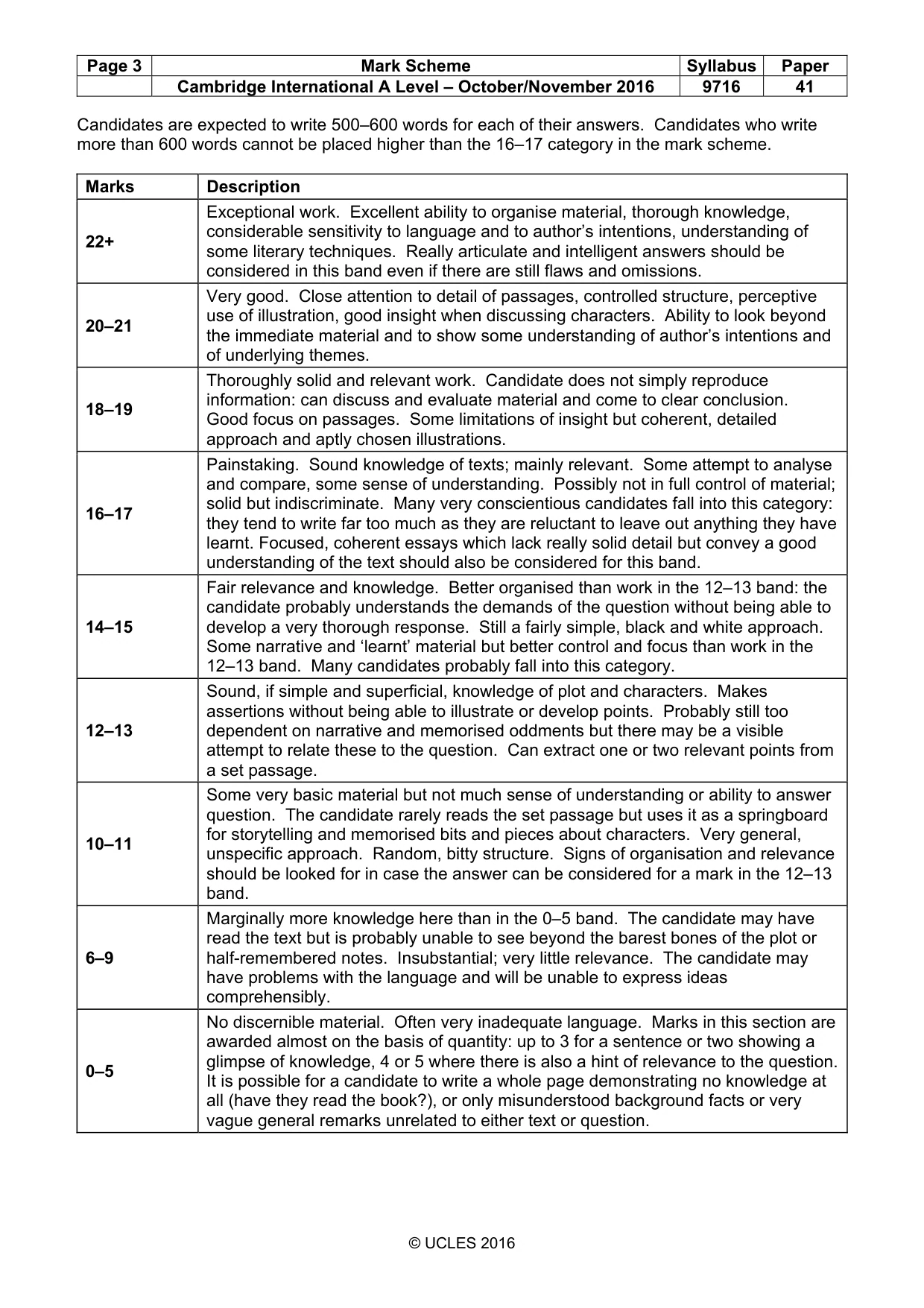
Page 3 Mark Scheme Syllabus Paper Cambridge International A Level – October/November 2016 9716 41 © UCLES 2016 Candidates are expected to write 500–600 words for each of their answers. Candidates who write more than 600 words cannot be placed higher than the 16–17 category in the mark scheme. Marks Description 22+ Exceptional work. Excellent ability to organise material, thorough knowledge, considerable sensitivity to language and to author’s intentions, understanding of some literary techniques. Really articulate and intelligent answers should be considered in this band even if there are still flaws and omissions. 20–21 Very good. Close attention to detail of passages, controlled structure, perceptive use of illustration, good insight when discussing characters. Ability to look beyond the immediate material and to show some understanding of author’s intentions and of underlying themes. 18–19 Thoroughly solid and relevant work. Candidate does not simply reproduce information: can discuss and evaluate material and come to clear conclusion. Good focus on passages. Some limitations of insight but coherent, detailed approach and aptly chosen illustrations. 16–17 Painstaking. Sound knowledge of texts; mainly relevant. Some attempt to analyse and compare, some sense of understanding. Possibly not in full control of material; solid but indiscriminate. Many very conscientious candidates fall into this category: they tend to write far too much as they are reluctant to leave out anything they have learnt. Focused, coherent essays which lack really solid detail but convey a good understanding of the text should also be considered for this band. 14–15 Fair relevance and knowledge. Better organised than work in the 12–13 band: the candidate probably understands the demands of the question without being able to develop a very thorough response. Still a fairly simple, black and white approach. Some narrative and ‘learnt’ material but better control and focus than work in the 12–13 band. Many candidates probably fall into this category. 12–13 Sound, if simple and superficial, knowledge of plot and characters. Makes assertions without being able to illustrate or develop points. Probably still too dependent on narrative and memorised oddments but there may be a visible attempt to relate these to the question. Can extract one or two relevant points from a set passage. 10–11 Some very basic material but not much sense of understanding or ability to answer question. The candidate rarely reads the set passage but uses it as a springboard for storytelling and memorised bits and pieces about characters. Very general, unspecific approach. Random, bitty structure. Signs of organisation and relevance should be looked for in case the answer can be considered for a mark in the 12–13 band. 6–9 Marginally more knowledge here than in the 0–5 band. The candidate may have read the text but is probably unable to see beyond the barest bones of the plot or half-remembered notes. Insubstantial; very little relevance. The candidate may have problems with the language and will be unable to express ideas comprehensibly. 0–5 No discernible material. Often very inadequate language. Marks in this section are awarded almost on the basis of quantity: up to 3 for a sentence or two showing a glimpse of knowledge, 4 or 5 where there is also a hint of relevance to the question. It is possible for a candidate to write a whole page demonstrating no knowledge at all (have they read the book?), or only misunderstood background facts or very vague general remarks unrelated to either text or question.
What you needed in this session
Cambridge’s own grade thresholds for 2016 Oct/Nov, Paper 4 · Variant 1. A higher threshold means an easier paper — the bar moves with how the cohort did.