Cambridge A Level French (A Level only) 9716 — 2009 May/June Paper 4 · Variant 1
9716/41/M/J/09 · 75 marks · ≈84 min
The question paper and its mark scheme, free to read here and free to download. This is Cambridge’s own paper, exactly as it was sat.
Question paper8 pages
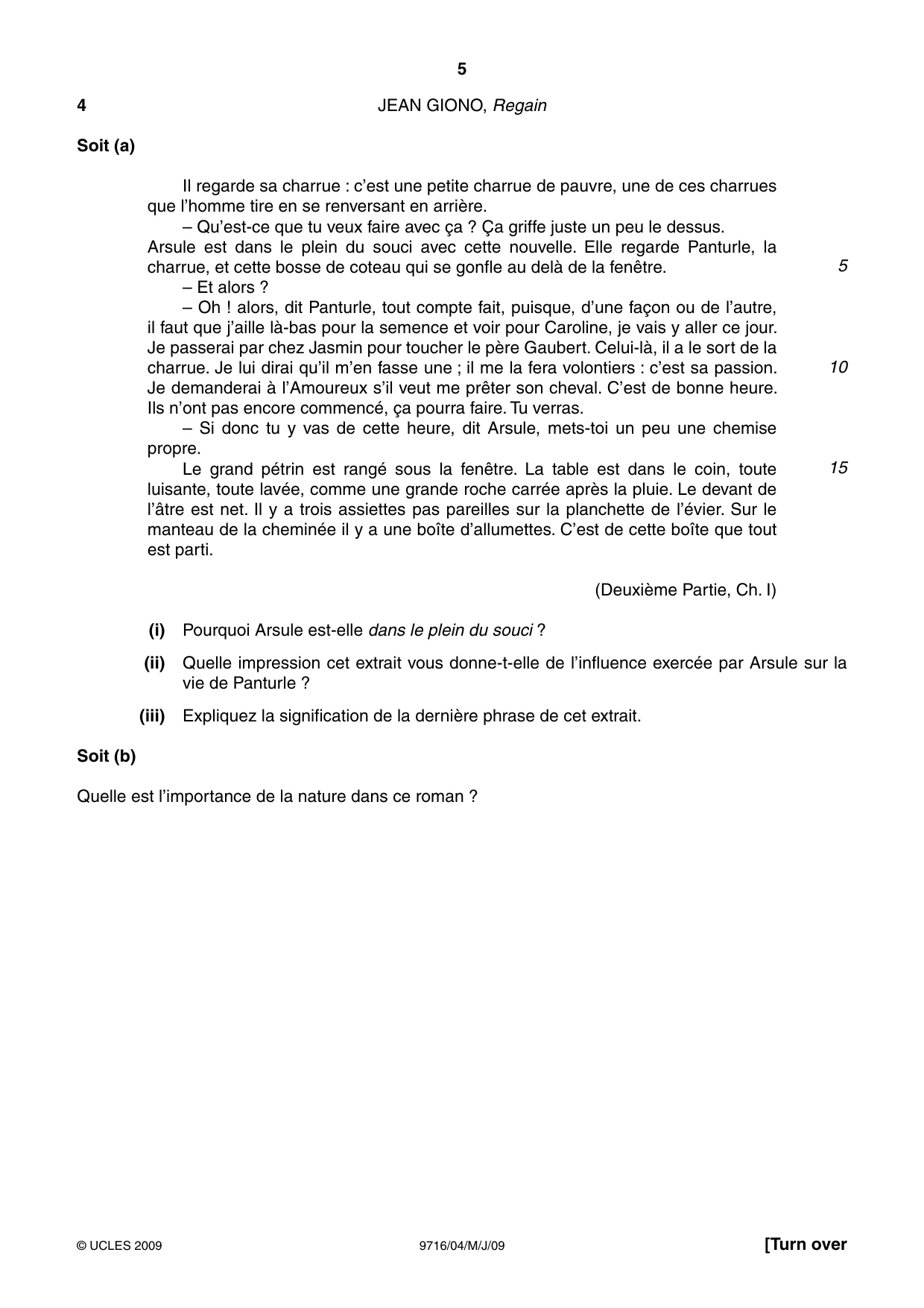
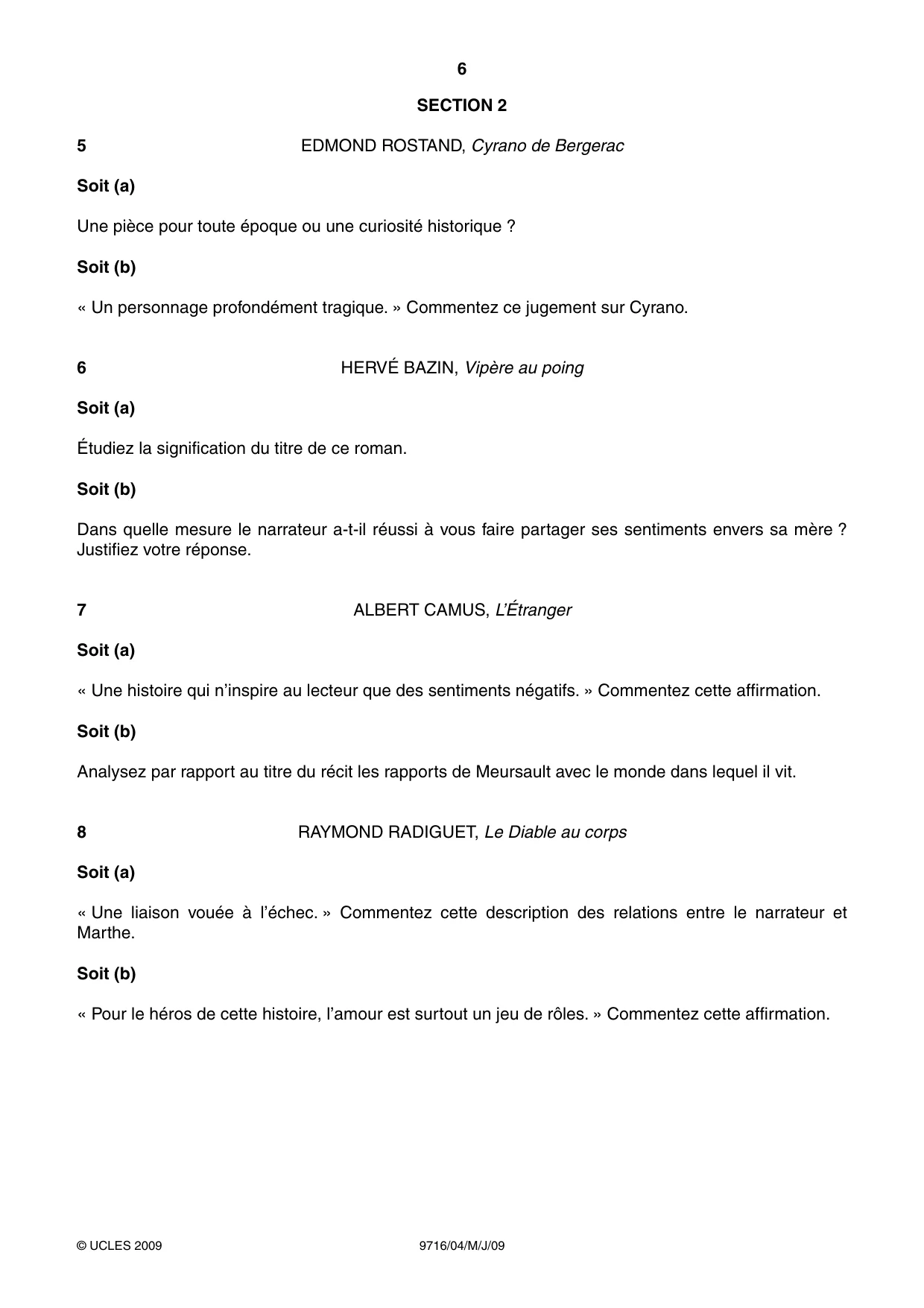

Mark scheme3 pages
Answers below. Sit the paper first if you are practising.
Paper as text
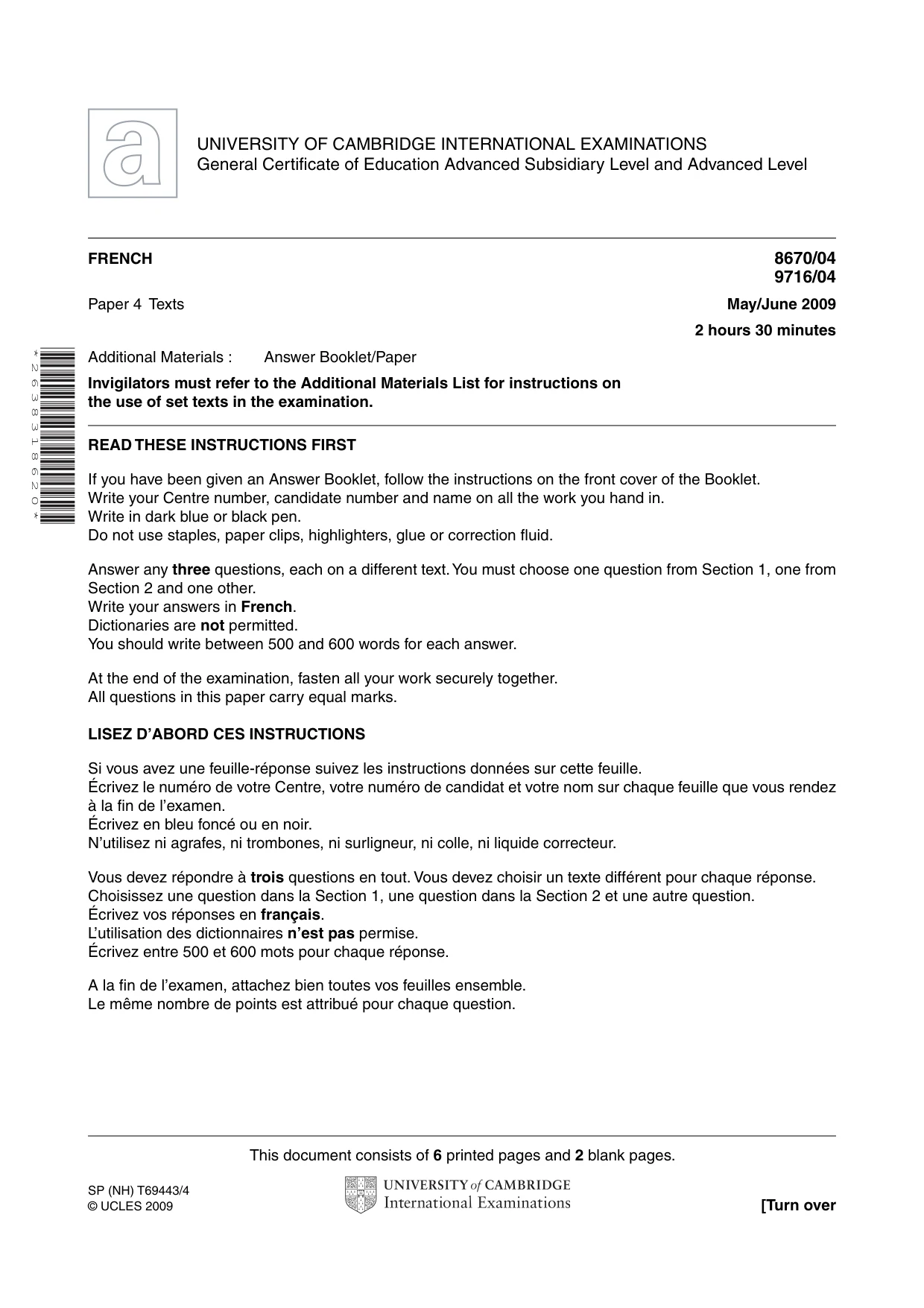
Question paper, page 1
This document consists of 6 printed pages and 2 blank pages. SP (NH) T69443/4 © UCLES 2009 [Turn over UNIVERSITY OF CAMBRIDGE INTERNATIONAL EXAMINATIONS General Certificate of Education Advanced Subsidiary Level and Advanced Level READ THESE INSTRUCTIONS FIRST If you have been given an Answer Booklet, follow the instructions on the front cover of the Booklet. Write your Centre number, candidate number and name on all the work you hand in. Write in dark blue or black pen. Do not use staples, paper clips, highlighters, glue or correction fluid. Answer any three questions, each on a different text. You must choose one question from Section 1, one from Section 2 and one other. Write your answers in French. Dictionaries are not permitted. You should write between 500 and 600 words for each answer. At the end of the examination, fasten all your work securely together. All questions in this paper carry equal marks. LISEZ D’ABORD CES INSTRUCTIONS Si vous avez une feuille-réponse suivez les instructions données sur cette feuille. Écrivez le numéro de votre Centre, votre numéro de candidat et votre nom sur chaque feuille que vous rendez à la fin de l’examen. Écrivez en bleu foncé ou en noir. N’utilisez ni agrafes, ni trombones, ni surligneur, ni colle, ni liquide correcteur. Vous devez répondre à trois questions en tout. Vous devez choisir un texte différent pour chaque réponse. Choisissez une question dans la Section 1, une question dans la Section 2 et une autre question. Écrivez vos réponses en français. L’utilisation des dictionnaires n’est pas permise. Écrivez entre 500 et 600 mots pour chaque réponse. A la fin de l’examen, attachez bien toutes vos feuilles ensemble. Le même nombre de points est attribué pour chaque question. * 2 6 3 8 3 1 8 6 2 0 * FRENCH 8670/04 9716/04 Paper 4 Texts May/June 2009 2 hours 30 minutes Additional Materials : Answer Booklet/Paper Invigilators must refer to the Additional Materials List for instructions on the use of set texts in the examination.
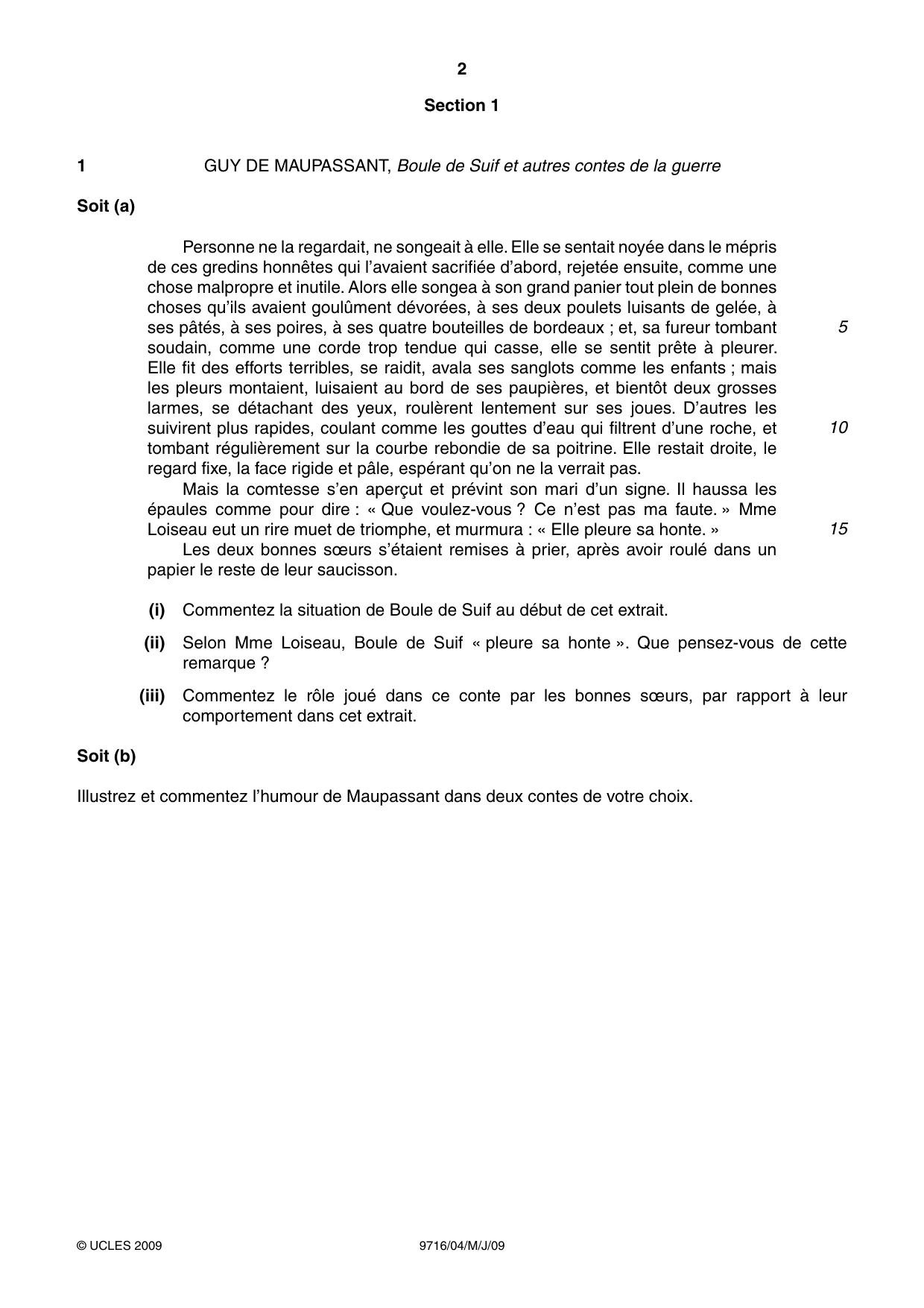
Question paper, page 2
2 9716/04/M/J/09 © UCLES 2009 Section 1 1 GUY DE MAUPASSANT, Boule de Suif et autres contes de la guerre Soit (a) Personne ne la regardait, ne songeait à elle. Elle se sentait noyée dans le mépris de ces gredins honnêtes qui l’avaient sacrifiée d’abord, rejetée ensuite, comme une chose malpropre et inutile. Alors elle songea à son grand panier tout plein de bonnes choses qu’ils avaient goulûment dévorées, à ses deux poulets luisants de gelée, à ses pâtés, à ses poires, à ses quatre bouteilles de bordeaux ; et, sa fureur tombant soudain, comme une corde trop tendue qui casse, elle se sentit prête à pleurer. Elle fit des efforts terribles, se raidit, avala ses sanglots comme les enfants ; mais les pleurs montaient, luisaient au bord de ses paupières, et bientôt deux grosses larmes, se détachant des yeux, roulèrent lentement sur ses joues. D’autres les suivirent plus rapides, coulant comme les gouttes d’eau qui filtrent d’une roche, et tombant régulièrement sur la courbe rebondie de sa poitrine. Elle restait droite, le regard fixe, la face rigide et pâle, espérant qu’on ne la verrait pas. Mais la comtesse s’en aperçut et prévint son mari d’un signe. Il haussa les épaules comme pour dire : « Que voulez-vous ? Ce n’est pas ma faute. » Mme Loiseau eut un rire muet de triomphe, et murmura : « Elle pleure sa honte. » Les deux bonnes sœurs s’étaient remises à prier, après avoir roulé dans un papier le reste de leur saucisson. (i) Commentez la situation de Boule de Suif au début de cet extrait. (ii) Selon Mme Loiseau, Boule de Suif « pleure sa honte ». Que pensez-vous de cette remarque ? (iii) Commentez le rôle joué dans ce conte par les bonnes sœurs, par rapport à leur comportement dans cet extrait. Soit (b) Illustrez et commentez l’humour de Maupassant dans deux contes de votre choix. 5 10 15
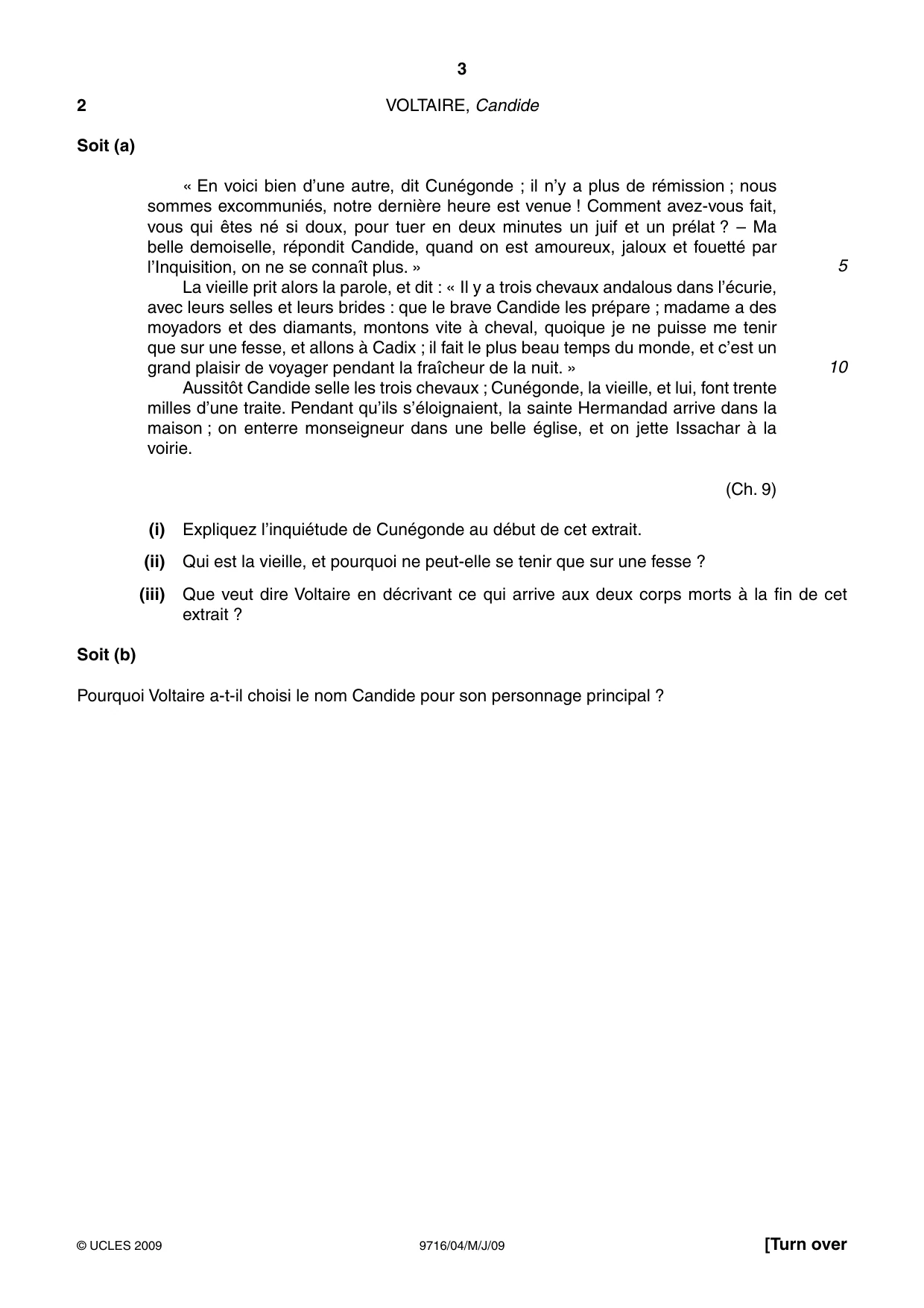
Question paper, page 3
3 9716/04/M/J/09 © UCLES 2009 [Turn over 2 VOLTAIRE, Candide Soit (a) « En voici bien d’une autre, dit Cunégonde ; il n’y a plus de rémission ; nous sommes excommuniés, notre dernière heure est venue ! Comment avez-vous fait, vous qui êtes né si doux, pour tuer en deux minutes un juif et un prélat ? – Ma belle demoiselle, répondit Candide, quand on est amoureux, jaloux et fouetté par l’Inquisition, on ne se connaît plus. » La vieille prit alors la parole, et dit : « Il y a trois chevaux andalous dans l’écurie, avec leurs selles et leurs brides : que le brave Candide les prépare ; madame a des moyadors et des diamants, montons vite à cheval, quoique je ne puisse me tenir que sur une fesse, et allons à Cadix ; il fait le plus beau temps du monde, et c’est un grand plaisir de voyager pendant la fraîcheur de la nuit. » Aussitôt Candide selle les trois chevaux ; Cunégonde, la vieille, et lui, font trente milles d’une traite. Pendant qu’ils s’éloignaient, la sainte Hermandad arrive dans la maison ; on enterre monseigneur dans une belle église, et on jette Issachar à la voirie. (Ch. 9) (i) Expliquez l’inquiétude de Cunégonde au début de cet extrait. (ii) Qui est la vieille, et pourquoi ne peut-elle se tenir que sur une fesse ? (iii) Que veut dire Voltaire en décrivant ce qui arrive aux deux corps morts à la fin de cet extrait ? Soit (b) Pourquoi Voltaire a-t-il choisi le nom Candide pour son personnage principal ? 5 10
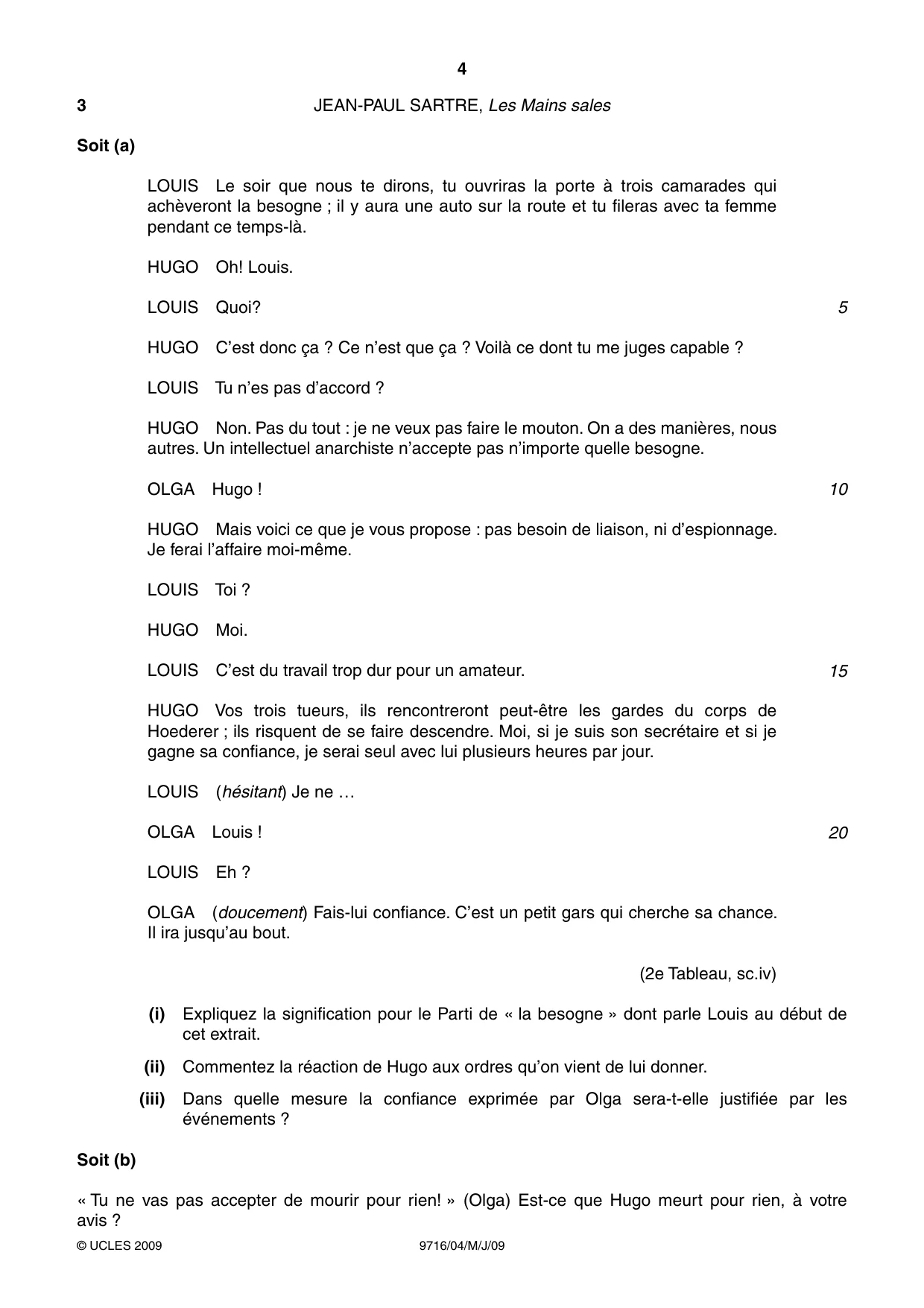
Question paper, page 4
4 9716/04/M/J/09 © UCLES 2009 3 JEAN-PAUL SARTRE, Les Mains sales Soit (a) LOUIS Le soir que nous te dirons, tu ouvriras la porte à trois camarades qui achèveront la besogne ; il y aura une auto sur la route et tu fileras avec ta femme pendant ce temps-là. HUGO Oh! Louis. LOUIS Quoi? HUGO C’est donc ça ? Ce n’est que ça ? Voilà ce dont tu me juges capable ? LOUIS Tu n’es pas d’accord ? HUGO Non. Pas du tout : je ne veux pas faire le mouton. On a des manières, nous autres. Un intellectuel anarchiste n’accepte pas n’importe quelle besogne. OLGA Hugo ! HUGO Mais voici ce que je vous propose : pas besoin de liaison, ni d’espionnage. Je ferai l’affaire moi-même. LOUIS Toi ? HUGO Moi. LOUIS C’est du travail trop dur pour un amateur. HUGO Vos trois tueurs, ils rencontreront peut-être les gardes du corps de Hoederer ; ils risquent de se faire descendre. Moi, si je suis son secrétaire et si je gagne sa confiance, je serai seul avec lui plusieurs heures par jour. LOUIS (hésitant) Je ne … OLGA Louis ! LOUIS Eh ? OLGA (doucement) Fais-lui confiance. C’est un petit gars qui cherche sa chance. Il ira jusqu’au bout. (2e Tableau, sc.iv) (i) Expliquez la signification pour le Parti de « la besogne » dont parle Louis au début de cet extrait. (ii) Commentez la réaction de Hugo aux ordres qu’on vient de lui donner. (iii) Dans quelle mesure la confiance exprimée par Olga sera-t-elle justifiée par les événements ? Soit (b) « Tu ne vas pas accepter de mourir pour rien! » (Olga) Est-ce que Hugo meurt pour rien, à votre avis ? 5 10 15 20
Question paper, page 5
5 9716/04/M/J/09 © UCLES 2009 [Turn over 4 JEAN GIONO, Regain Soit (a) Il regarde sa charrue : c’est une petite charrue de pauvre, une de ces charrues que l’homme tire en se renversant en arrière. – Qu’est-ce que tu veux faire avec ça ? Ça griffe juste un peu le dessus. Arsule est dans le plein du souci avec cette nouvelle. Elle regarde Panturle, la charrue, et cette bosse de coteau qui se gonfle au delà de la fenêtre. – Et alors ? – Oh ! alors, dit Panturle, tout compte fait, puisque, d’une façon ou de l’autre, il faut que j’aille là-bas pour la semence et voir pour Caroline, je vais y aller ce jour. Je passerai par chez Jasmin pour toucher le père Gaubert. Celui-là, il a le sort de la charrue. Je lui dirai qu’il m’en fasse une ; il me la fera volontiers : c’est sa passion. Je demanderai à l’Amoureux s’il veut me prêter son cheval. C’est de bonne heure. Ils n’ont pas encore commencé, ça pourra faire. Tu verras. – Si donc tu y vas de cette heure, dit Arsule, mets-toi un peu une chemise propre. Le grand pétrin est rangé sous la fenêtre. La table est dans le coin, toute luisante, toute lavée, comme une grande roche carrée après la pluie. Le devant de l’âtre est net. Il y a trois assiettes pas pareilles sur la planchette de l’évier. Sur le manteau de la cheminée il y a une boîte d’allumettes. C’est de cette boîte que tout est parti. (Deuxième Partie, Ch. I) (i) Pourquoi Arsule est-elle dans le plein du souci ? (ii) Quelle impression cet extrait vous donne-t-elle de l’influence exercée par Arsule sur la vie de Panturle ? (iii) Expliquez la signification de la dernière phrase de cet extrait. Soit (b) Quelle est l’importance de la nature dans ce roman ? 5 10 15
Question paper, page 6
6 9716/04/M/J/09 © UCLES 2009 SECTION 2 5 EDMOND ROSTAND, Cyrano de Bergerac Soit (a) Une pièce pour toute époque ou une curiosité historique ? Soit (b) « Un personnage profondément tragique. » Commentez ce jugement sur Cyrano. 6 HERVÉ BAZIN, Vipère au poing Soit (a) Étudiez la signification du titre de ce roman. Soit (b) Dans quelle mesure le narrateur a-t-il réussi à vous faire partager ses sentiments envers sa mère ? Justifiez votre réponse. 7 ALBERT CAMUS, L’Étranger Soit (a) « Une histoire qui n’inspire au lecteur que des sentiments négatifs. » Commentez cette affirmation. Soit (b) Analysez par rapport au titre du récit les rapports de Meursault avec le monde dans lequel il vit. 8 RAYMOND RADIGUET, Le Diable au corps Soit (a) « Une liaison vouée à l’échec. » Commentez cette description des relations entre le narrateur et Marthe. Soit (b) « Pour le héros de cette histoire, l’amour est surtout un jeu de rôles. » Commentez cette affirmation.
Question paper, page 8
8 9716/04/M/J/09 BLANK PAGE Copyright Acknowledgements: Question 1 © Maupassant; Boule de Suif et autres contes de la guerre; Chambers Harraps Ltd; 1982. Question 3 © Sartre; Les Mains sales; Editions Gallimard; 1963. Question 4 © Giono; Regain; Editions Bernard Grasset; 1967. Permission to reproduce items where third-party owned material protected by copyright is included has been sought and cleared where possible. Every reasonable effort has been made by the publisher (UCLES) to trace copyright holders, but if any items requiring clearance have unwittingly been included, the publisher will be pleased to make amends at the earliest possible opportunity. University of Cambridge International Examinations is part of the Cambridge Assessment Group. Cambridge Assessment is the brand name of University of Cambridge Local Examinations Syndicate (UCLES), which is itself a department of the University of Cambridge.
Mark scheme, page 1
UNIVERSITY OF CAMBRIDGE INTERNATIONAL EXAMINATIONS GCE Advanced Subsidiary Level and GCE Advanced Level MARK SCHEME for the May/June 2009 question paper for the guidance of teachers 9716 FRENCH 8670 FRENCH LITERATURE 9716/04 and 8670/04 Paper 4 (Texts), maximum raw mark 75 This mark scheme is published as an aid to teachers and candidates, to indicate the requirements of the examination. It shows the basis on which Examiners were instructed to award marks. It does not indicate the details of the discussions that took place at an Examiners’ meeting before marking began, which would have considered the acceptability of alternative answers. Mark schemes must be read in conjunction with the question papers and the report on the examination. • CIE will not enter into discussions or correspondence in connection with these mark schemes. CIE is publishing the mark schemes for the May/June 2009 question papers for most IGCSE, GCE Advanced Level and Advanced Subsidiary Level syllabuses and some Ordinary Level syllabuses.
Mark scheme, page 2
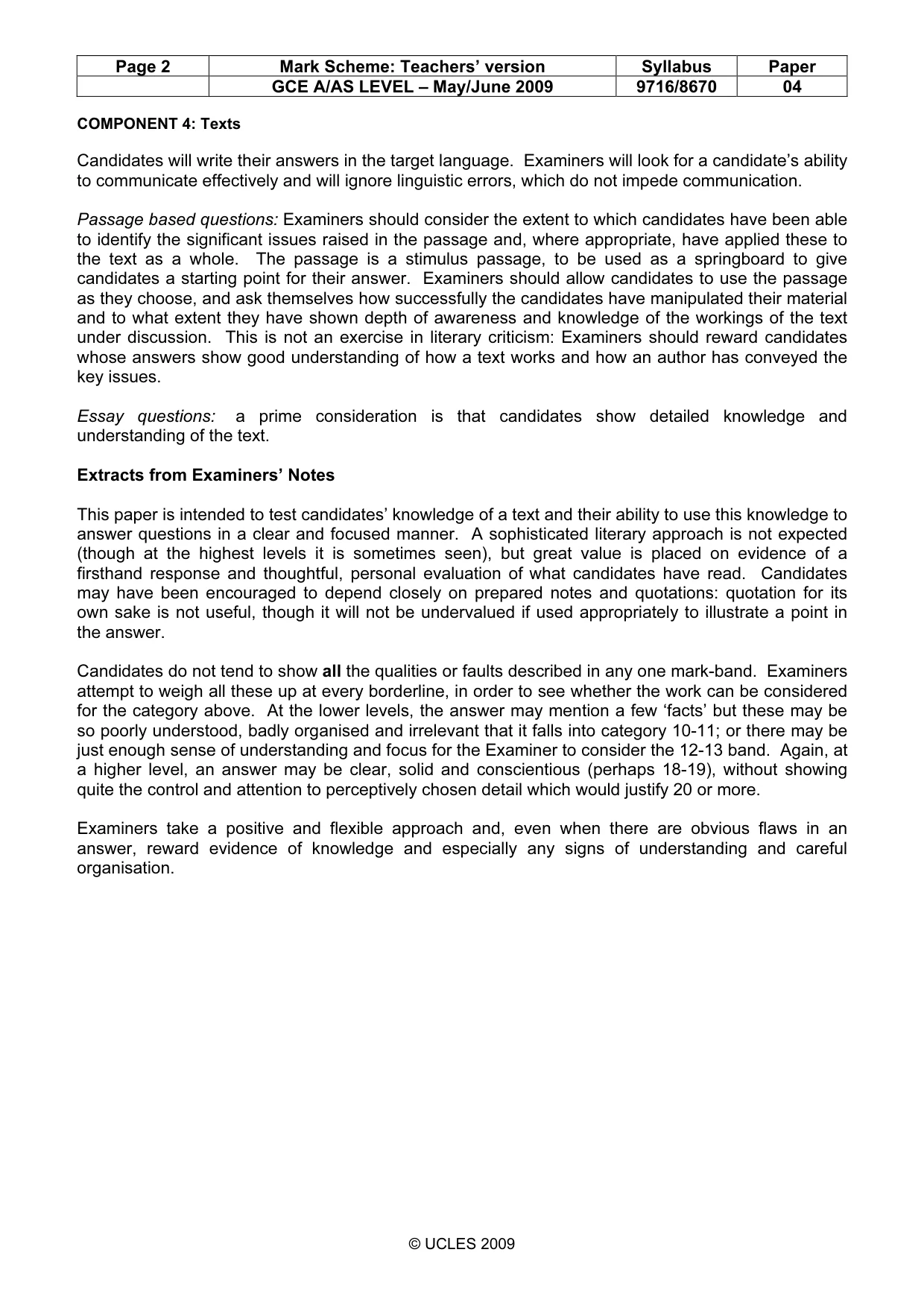
Page 2 Mark Scheme: Teachers’ version Syllabus Paper GCE A/AS LEVEL – May/June 2009 9716/8670 04 © UCLES 2009 COMPONENT 4: Texts Candidates will write their answers in the target language. Examiners will look for a candidate’s ability to communicate effectively and will ignore linguistic errors, which do not impede communication. Passage based questions: Examiners should consider the extent to which candidates have been able to identify the significant issues raised in the passage and, where appropriate, have applied these to the text as a whole. The passage is a stimulus passage, to be used as a springboard to give candidates a starting point for their answer. Examiners should allow candidates to use the passage as they choose, and ask themselves how successfully the candidates have manipulated their material and to what extent they have shown depth of awareness and knowledge of the workings of the text under discussion. This is not an exercise in literary criticism: Examiners should reward candidates whose answers show good understanding of how a text works and how an author has conveyed the key issues. Essay questions: a prime consideration is that candidates show detailed knowledge and understanding of the text. Extracts from Examiners’ Notes This paper is intended to test candidates’ knowledge of a text and their ability to use this knowledge to answer questions in a clear and focused manner. A sophisticated literary approach is not expected (though at the highest levels it is sometimes seen), but great value is placed on evidence of a firsthand response and thoughtful, personal evaluation of what candidates have read. Candidates may have been encouraged to depend closely on prepared notes and quotations: quotation for its own sake is not useful, though it will not be undervalued if used appropriately to illustrate a point in the answer. Candidates do not tend to show all the qualities or faults described in any one mark-band. Examiners attempt to weigh all these up at every borderline, in order to see whether the work can be considered for the category above. At the lower levels, the answer may mention a few ‘facts’ but these may be so poorly understood, badly organised and irrelevant that it falls into category 10-11; or there may be just enough sense of understanding and focus for the Examiner to consider the 12-13 band. Again, at a higher level, an answer may be clear, solid and conscientious (perhaps 18-19), without showing quite the control and attention to perceptively chosen detail which would justify 20 or more. Examiners take a positive and flexible approach and, even when there are obvious flaws in an answer, reward evidence of knowledge and especially any signs of understanding and careful organisation.
Mark scheme, page 3
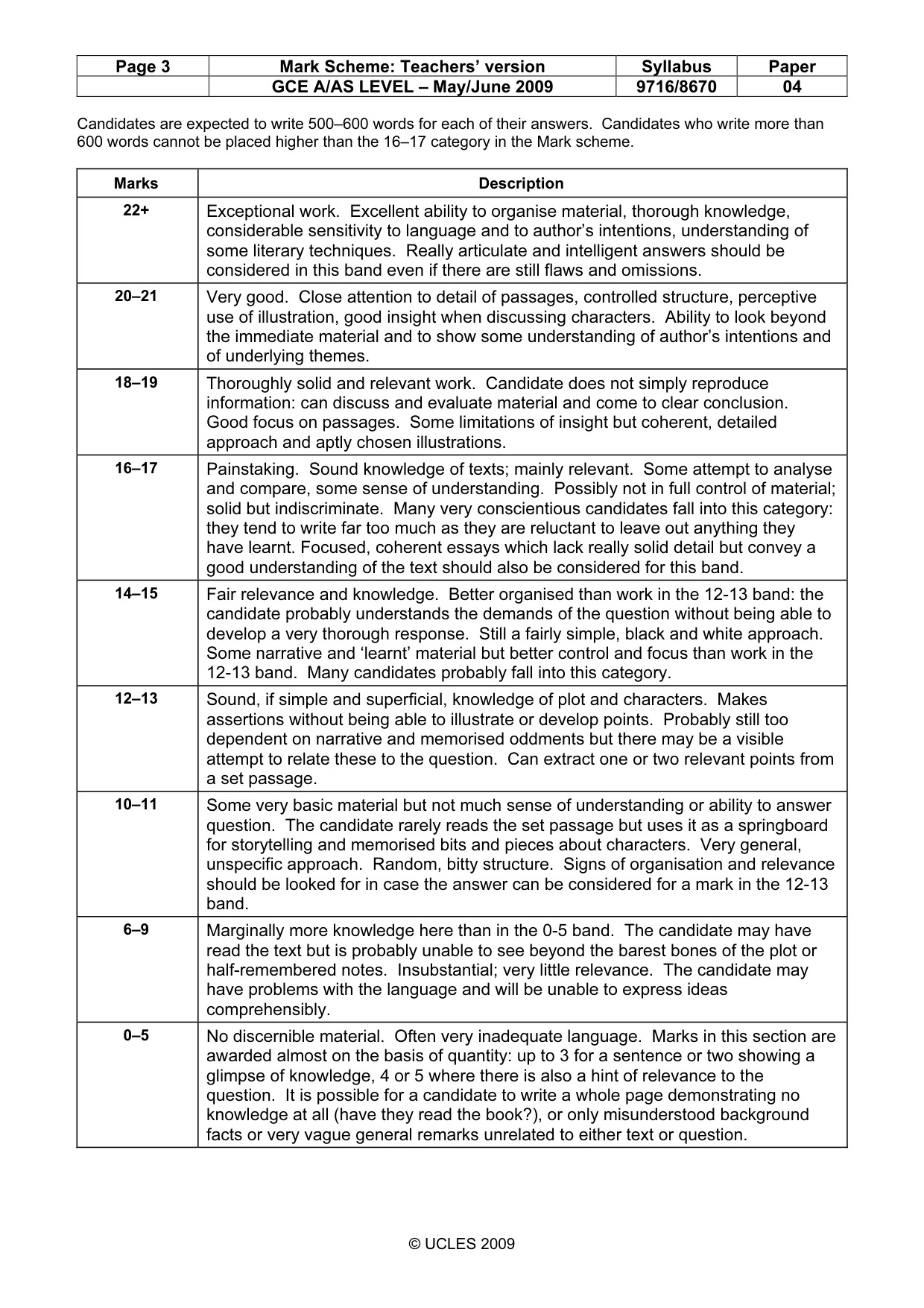
Page 3 Mark Scheme: Teachers’ version Syllabus Paper GCE A/AS LEVEL – May/June 2009 9716/8670 04 © UCLES 2009 Candidates are expected to write 500–600 words for each of their answers. Candidates who write more than 600 words cannot be placed higher than the 16–17 category in the Mark scheme. Marks Description 22+ Exceptional work. Excellent ability to organise material, thorough knowledge, considerable sensitivity to language and to author’s intentions, understanding of some literary techniques. Really articulate and intelligent answers should be considered in this band even if there are still flaws and omissions. 20–21 Very good. Close attention to detail of passages, controlled structure, perceptive use of illustration, good insight when discussing characters. Ability to look beyond the immediate material and to show some understanding of author’s intentions and of underlying themes. 18–19 Thoroughly solid and relevant work. Candidate does not simply reproduce information: can discuss and evaluate material and come to clear conclusion. Good focus on passages. Some limitations of insight but coherent, detailed approach and aptly chosen illustrations. 16–17 Painstaking. Sound knowledge of texts; mainly relevant. Some attempt to analyse and compare, some sense of understanding. Possibly not in full control of material; solid but indiscriminate. Many very conscientious candidates fall into this category: they tend to write far too much as they are reluctant to leave out anything they have learnt. Focused, coherent essays which lack really solid detail but convey a good understanding of the text should also be considered for this band. 14–15 Fair relevance and knowledge. Better organised than work in the 12-13 band: the candidate probably understands the demands of the question without being able to develop a very thorough response. Still a fairly simple, black and white approach. Some narrative and ‘learnt’ material but better control and focus than work in the 12-13 band. Many candidates probably fall into this category. 12–13 Sound, if simple and superficial, knowledge of plot and characters. Makes assertions without being able to illustrate or develop points. Probably still too dependent on narrative and memorised oddments but there may be a visible attempt to relate these to the question. Can extract one or two relevant points from a set passage. 10–11 Some very basic material but not much sense of understanding or ability to answer question. The candidate rarely reads the set passage but uses it as a springboard for storytelling and memorised bits and pieces about characters. Very general, unspecific approach. Random, bitty structure. Signs of organisation and relevance should be looked for in case the answer can be considered for a mark in the 12-13 band. 6–9 Marginally more knowledge here than in the 0-5 band. The candidate may have read the text but is probably unable to see beyond the barest bones of the plot or half-remembered notes. Insubstantial; very little relevance. The candidate may have problems with the language and will be unable to express ideas comprehensibly. 0–5 No discernible material. Often very inadequate language. Marks in this section are awarded almost on the basis of quantity: up to 3 for a sentence or two showing a glimpse of knowledge, 4 or 5 where there is also a hint of relevance to the question. It is possible for a candidate to write a whole page demonstrating no knowledge at all (have they read the book?), or only misunderstood background facts or very vague general remarks unrelated to either text or question.
What you needed in this session
Cambridge’s own grade thresholds for 2009 May/June, Paper 4 · Variant 1. A higher threshold means an easier paper — the bar moves with how the cohort did.