Cambridge A Level English - Language AS Level (until 2013) 8693 — 2013 Oct/Nov Paper 1 · Variant 3
8693/13/O/N/13
The question paper and its mark scheme, free to read here and free to download. This is Cambridge’s own paper, exactly as it was sat.
Question paper8 pages
Mark scheme4 pages
Answers below. Sit the paper first if you are practising.
Paper as text
Question paper, page 1
This document consists of 7 printed pages and 1 blank page. DC (LK) 91829 © UCLES 2013 [Turn over UNIVERSITY OF CAMBRIDGE INTERNATIONAL EXAMINATIONS General Certificate of Education Advanced Subsidiary Level and Advanced Level * 2 3 3 5 5 4 5 7 5 4 * ENGLISH LANGUAGE 8693/13 Paper 1 Passages for Comment October/November 2013 2 hours Additional Materials: Answer Booklet/Paper READ THESE INSTRUCTIONS FIRST If you have been given an Answer Booklet, follow the instructions on the front cover of the Booklet. Write your Centre number, candidate number and name on all the work you hand in. Write in dark blue or black pen. Do not use staples, paper clips, highlighters, glue or correction fluid. DO NOT WRITE IN ANY BARCODES. Answer two questions. You are reminded of the need for good English and clear presentation in your answers. At the end of the examination, fasten all your work securely together. The number of marks is given in brackets [ ] at the end of each question or part question.
Question paper, page 2
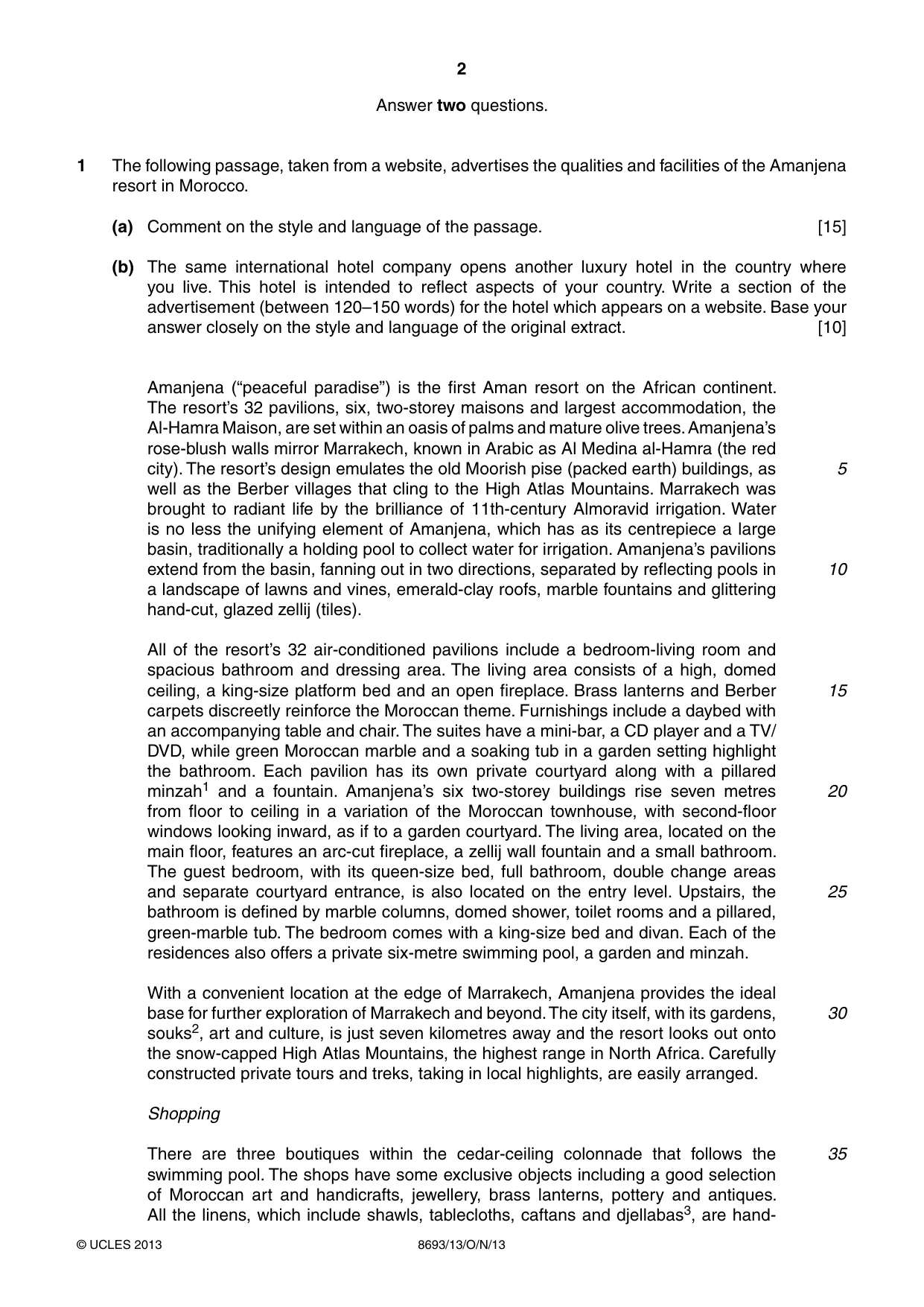
2 8693/13/O/N/13 © UCLES 2013 Answer two questions. 1 The following passage, taken from a website, advertises the qualities and facilities of the Amanjena resort in Morocco. (a) Comment on the style and language of the passage. [15] (b) The same international hotel company opens another luxury hotel in the country where you live. This hotel is intended to reflect aspects of your country. Write a section of the advertisement (between 120–150 words) for the hotel which appears on a website. Base your answer closely on the style and language of the original extract. [10] Amanjena (“peaceful paradise”) is the first Aman resort on the African continent. The resort’s 32 pavilions, six, two-storey maisons and largest accommodation, the Al-Hamra Maison, are set within an oasis of palms and mature olive trees. Amanjena’s rose-blush walls mirror Marrakech, known in Arabic as Al Medina al-Hamra (the red city). The resort’s design emulates the old Moorish pise (packed earth) buildings, as well as the Berber villages that cling to the High Atlas Mountains. Marrakech was brought to radiant life by the brilliance of 11th-century Almoravid irrigation. Water is no less the unifying element of Amanjena, which has as its centrepiece a large basin, traditionally a holding pool to collect water for irrigation. Amanjena’s pavilions extend from the basin, fanning out in two directions, separated by reflecting pools in a landscape of lawns and vines, emerald-clay roofs, marble fountains and glittering hand-cut, glazed zellij (tiles). All of the resort’s 32 air-conditioned pavilions include a bedroom-living room and spacious bathroom and dressing area. The living area consists of a high, domed ceiling, a king-size platform bed and an open fireplace. Brass lanterns and Berber carpets discreetly reinforce the Moroccan theme. Furnishings include a daybed with an accompanying table and chair. The suites have a mini-bar, a CD player and a TV/ DVD, while green Moroccan marble and a soaking tub in a garden setting highlight the bathroom. Each pavilion has its own private courtyard along with a pillared minzah1 and a fountain. Amanjena’s six two-storey buildings rise seven metres from floor to ceiling in a variation of the Moroccan townhouse, with second-floor windows looking inward, as if to a garden courtyard. The living area, located on the main floor, features an arc-cut fireplace, a zellij wall fountain and a small bathroom. The guest bedroom, with its queen-size bed, full bathroom, double change areas and separate courtyard entrance, is also located on the entry level. Upstairs, the bathroom is defined by marble columns, domed shower, toilet rooms and a pillared, green-marble tub. The bedroom comes with a king-size bed and divan. Each of the residences also offers a private six-metre swimming pool, a garden and minzah. With a convenient location at the edge of Marrakech, Amanjena provides the ideal base for further exploration of Marrakech and beyond. The city itself, with its gardens, souks2, art and culture, is just seven kilometres away and the resort looks out onto the snow-capped High Atlas Mountains, the highest range in North Africa. Carefully constructed private tours and treks, taking in local highlights, are easily arranged. Shopping There are three boutiques within the cedar-ceiling colonnade that follows the swimming pool. The shops have some exclusive objects including a good selection of Moroccan art and handicrafts, jewellery, brass lanterns, pottery and antiques. All the linens, which include shawls, tablecloths, caftans and djellabas3, are hand- 5 10 15 20 25 30 35
Question paper, page 3
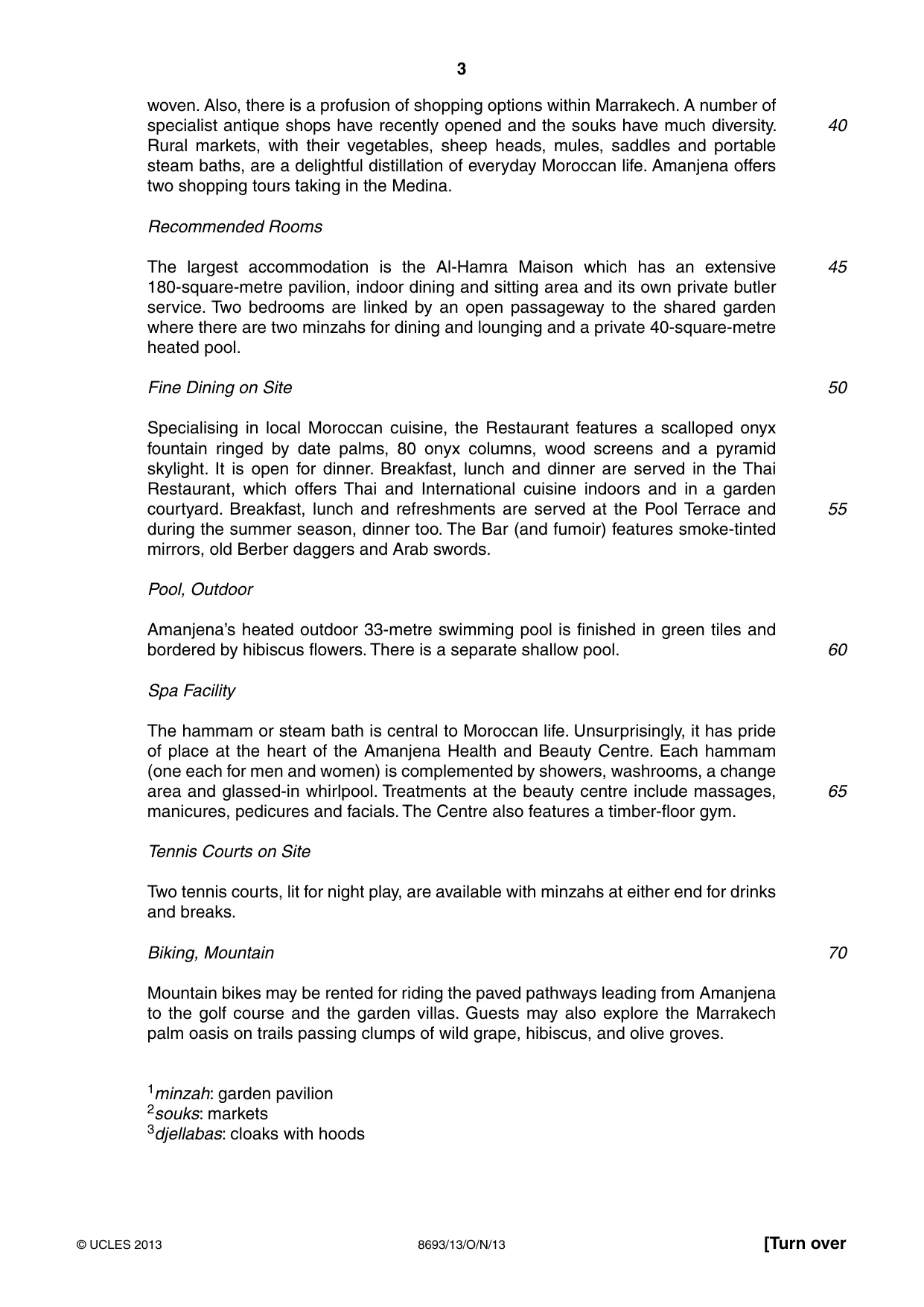
3 8693/13/O/N/13 © UCLES 2013 [Turn over woven. Also, there is a profusion of shopping options within Marrakech. A number of specialist antique shops have recently opened and the souks have much diversity. Rural markets, with their vegetables, sheep heads, mules, saddles and portable steam baths, are a delightful distillation of everyday Moroccan life. Amanjena offers two shopping tours taking in the Medina. Recommended Rooms The largest accommodation is the Al-Hamra Maison which has an extensive 180-square-metre pavilion, indoor dining and sitting area and its own private butler service. Two bedrooms are linked by an open passageway to the shared garden where there are two minzahs for dining and lounging and a private 40-square-metre heated pool. Fine Dining on Site Specialising in local Moroccan cuisine, the Restaurant features a scalloped onyx fountain ringed by date palms, 80 onyx columns, wood screens and a pyramid skylight. It is open for dinner. Breakfast, lunch and dinner are served in the Thai Restaurant, which offers Thai and International cuisine indoors and in a garden courtyard. Breakfast, lunch and refreshments are served at the Pool Terrace and during the summer season, dinner too. The Bar (and fumoir) features smoke-tinted mirrors, old Berber daggers and Arab swords. Pool, Outdoor Amanjena’s heated outdoor 33-metre swimming pool is finished in green tiles and bordered by hibiscus flowers. There is a separate shallow pool. Spa Facility The hammam or steam bath is central to Moroccan life. Unsurprisingly, it has pride of place at the heart of the Amanjena Health and Beauty Centre. Each hammam (one each for men and women) is complemented by showers, washrooms, a change area and glassed-in whirlpool. Treatments at the beauty centre include massages, manicures, pedicures and facials. The Centre also features a timber-floor gym. Tennis Courts on Site Two tennis courts, lit for night play, are available with minzahs at either end for drinks and breaks. Biking, Mountain Mountain bikes may be rented for riding the paved pathways leading from Amanjena to the golf course and the garden villas. Guests may also explore the Marrakech palm oasis on trails passing clumps of wild grape, hibiscus, and olive groves. 1minzah: garden pavilion 2souks: markets 3djellabas: cloaks with hoods 40 45 50 55 60 65 70
Question paper, page 4
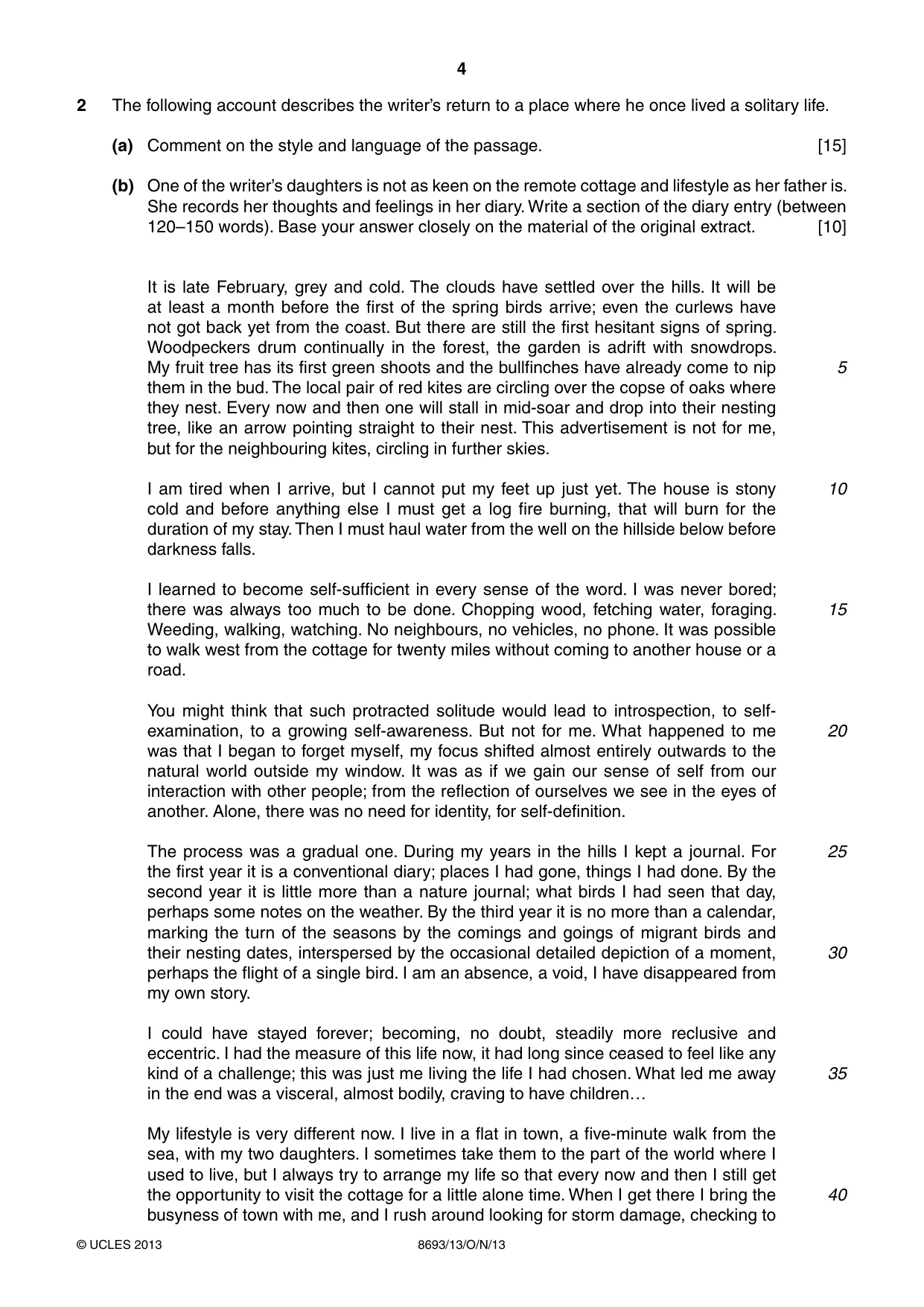
4 8693/13/O/N/13 © UCLES 2013 2 The following account describes the writer’s return to a place where he once lived a solitary life. (a) Comment on the style and language of the passage. [15] (b) One of the writer’s daughters is not as keen on the remote cottage and lifestyle as her father is. She records her thoughts and feelings in her diary. Write a section of the diary entry (between 120–150 words). Base your answer closely on the material of the original extract. [10] It is late February, grey and cold. The clouds have settled over the hills. It will be at least a month before the first of the spring birds arrive; even the curlews have not got back yet from the coast. But there are still the first hesitant signs of spring. Woodpeckers drum continually in the forest, the garden is adrift with snowdrops. My fruit tree has its first green shoots and the bullfinches have already come to nip them in the bud. The local pair of red kites are circling over the copse of oaks where they nest. Every now and then one will stall in mid-soar and drop into their nesting tree, like an arrow pointing straight to their nest. This advertisement is not for me, but for the neighbouring kites, circling in further skies. I am tired when I arrive, but I cannot put my feet up just yet. The house is stony cold and before anything else I must get a log fire burning, that will burn for the duration of my stay. Then I must haul water from the well on the hillside below before darkness falls. I learned to become self-sufficient in every sense of the word. I was never bored; there was always too much to be done. Chopping wood, fetching water, foraging. Weeding, walking, watching. No neighbours, no vehicles, no phone. It was possible to walk west from the cottage for twenty miles without coming to another house or a road. You might think that such protracted solitude would lead to introspection, to self- examination, to a growing self-awareness. But not for me. What happened to me was that I began to forget myself, my focus shifted almost entirely outwards to the natural world outside my window. It was as if we gain our sense of self from our interaction with other people; from the reflection of ourselves we see in the eyes of another. Alone, there was no need for identity, for self-definition. The process was a gradual one. During my years in the hills I kept a journal. For the first year it is a conventional diary; places I had gone, things I had done. By the second year it is little more than a nature journal; what birds I had seen that day, perhaps some notes on the weather. By the third year it is no more than a calendar, marking the turn of the seasons by the comings and goings of migrant birds and their nesting dates, interspersed by the occasional detailed depiction of a moment, perhaps the flight of a single bird. I am an absence, a void, I have disappeared from my own story. I could have stayed forever; becoming, no doubt, steadily more reclusive and eccentric. I had the measure of this life now, it had long since ceased to feel like any kind of a challenge; this was just me living the life I had chosen. What led me away in the end was a visceral, almost bodily, craving to have children… My lifestyle is very different now. I live in a flat in town, a five-minute walk from the sea, with my two daughters. I sometimes take them to the part of the world where I used to live, but I always try to arrange my life so that every now and then I still get the opportunity to visit the cottage for a little alone time. When I get there I bring the busyness of town with me, and I rush around looking for storm damage, checking to 5 10 15 20 25 30 35 40
Question paper, page 5
5 8693/13/O/N/13 © UCLES 2013 [Turn over see if the mice have breached my defences and raided my cache of food, checking my wood supply, my water supply. But when darkness falls and I light a few candles for the evening and put my feet up by the fireside, the scales of society fall from my eyes, and time slips away. In the morning I rise with the light and set out to visit the ravens. They are the early birds, the very first to nest. The site they have chosen is absurdly beautiful, in a tiny copse of trees on the sheerest slope of my mountain, looking out across the valley at the hills beyond. They have chosen the same tall tree to nest in for more than twenty successive years to my knowledge. These are long-lived birds and it’s quite plausible this has been the same pair throughout. As I come into view, the pair fly out and over my head, calling to let me know they have spotted me. A drifting buzzard1 approaches a little too close to the nest and they gang up to drive it away, mobbing it relentlessly in pincer formation. The buzzard doesn’t stand a chance. Then the pair circle back. First one, and then the other, flips over on to its back and flies upside down, in display, in celebration. It’s good to be back. 1buzzard: bird of prey 45 50 55
Question paper, page 6
6 8693/13/O/N/13 © UCLES 2013 3 The following passage describes the writer’s visit to Neverland, once owned by the pop star Michael Jackson. Neverland was built as a large fantasy home. The writer meets Elizabeth Taylor, a famous film star and friend of Michael Jackson. (a) Comment on the style and language of the passage. [15] (b) Continue the account (between 120–150 words), although you do not have to bring it to a conclusion. Base your answer closely on the style and language of the original extract. [10] Neverland, a toytown wilderness of carnival rides and doll houses and zoo animals Content removed due to copyright restrictions.
Question paper, page 7
7 8693/13/O/N/13 © UCLES 2013 circular drive in front of Michael’s house, a statue of Mercury (god of merchandise and merchants). 1bangs: drooping curls Content removed due to copyright restrictions.
Question paper, page 8
8 8693/13/O/N/13 © UCLES 2013 BLANK PAGE Copyright Acknowledgements: Question 1 © Amanjena, Marrakech, Morocco; http://www.fivestaralliance.com/luxury-hotels/marrakech/amanjena; 2011. Question 2 © Neil Ansell; My Life as a Hermit ; http://www.guardian.co.uk/environment/2011/mar/27/neil-ansell-my-life-as-hermit; The Observer; Guardian News & Media Ltd; 27 March 2011. Question 3 © Paul Theroux; My trip to Neverland and the call from Michael Jackson I’ll never forget ; http://www.telegraph.co.uk/comment/5664968/My-trip-to- Neverland-and-the-call-from-Michael-Jackson-Ill-never-forget-by-Paul-Theroux.html; Telegraph Media Group Ltd; 27 June 2009. Permission to reproduce items where third-party owned material protected by copyright is included has been sought and cleared where possible. Every reasonable effort has been made by the publisher (UCLES) to trace copyright holders, but if any items requiring clearance have unwittingly been included, the publisher will be pleased to make amends at the earliest possible opportunity. University of Cambridge International Examinations is part of the Cambridge Assessment Group. Cambridge Assessment is the brand name of University of Cambridge Local Examinations Syndicate (UCLES), which is itself a department of the University of Cambridge.
Mark scheme, page 1
CAMBRIDGE INTERNATIONAL EXAMINATIONS GCE Advanced Subsidiary Level and GCE Advanced Level MARK SCHEME for the October/November 2013 series 8693 ENGLISH LANGUAGE 8693/13 Paper 1 (Passages for Comment), maximum raw mark 50 This mark scheme is published as an aid to teachers and candidates, to indicate the requirements of the examination. It shows the basis on which Examiners were instructed to award marks. It does not indicate the details of the discussions that took place at an Examiners’ meeting before marking began, which would have considered the acceptability of alternative answers. Mark schemes should be read in conjunction with the question paper and the Principal Examiner Report for Teachers. Cambridge will not enter into discussions about these mark schemes. Cambridge is publishing the mark schemes for the October/November 2013 series for most IGCSE, GCE Advanced Level and Advanced Subsidiary Level components and some Ordinary Level components.
Mark scheme, page 2
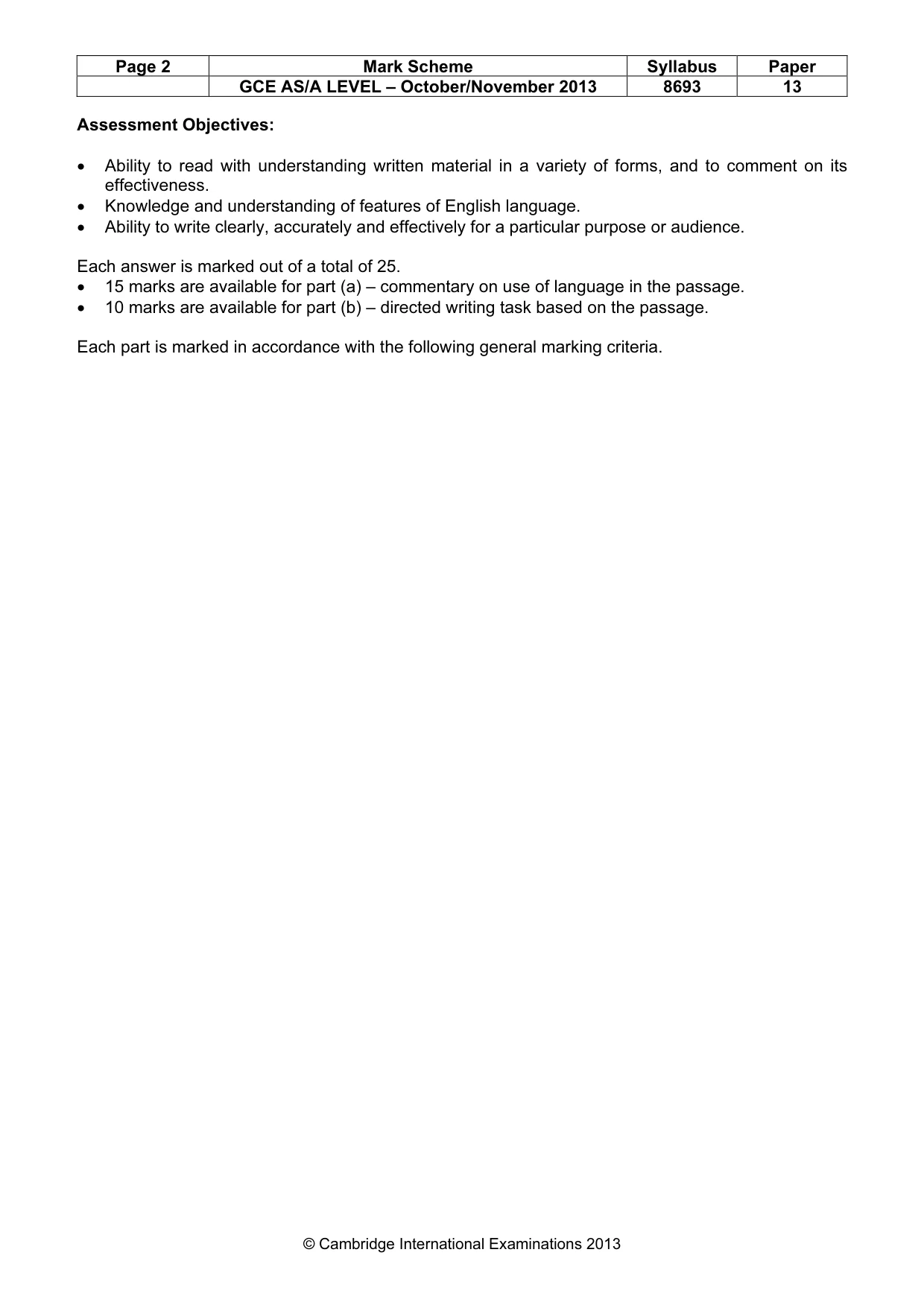
Page 2 Mark Scheme Syllabus Paper GCE AS/A LEVEL – October/November 2013 8693 13 © Cambridge International Examinations 2013 Assessment Objectives: • Ability to read with understanding written material in a variety of forms, and to comment on its effectiveness. • Knowledge and understanding of features of English language. • Ability to write clearly, accurately and effectively for a particular purpose or audience. Each answer is marked out of a total of 25. • 15 marks are available for part (a) – commentary on use of language in the passage. • 10 marks are available for part (b) – directed writing task based on the passage. Each part is marked in accordance with the following general marking criteria.
Mark scheme, page 3
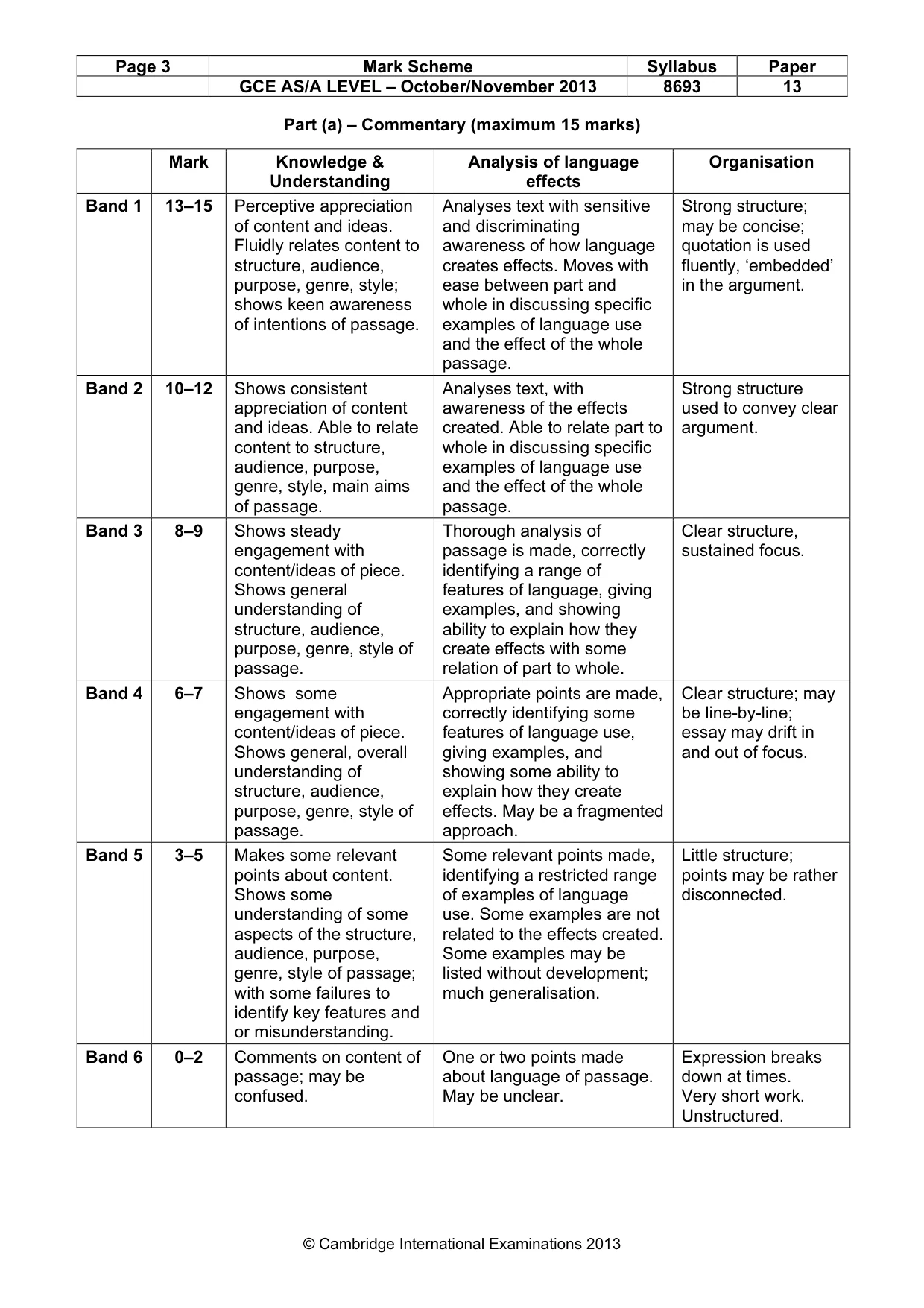
Page 3 Mark Scheme Syllabus Paper GCE AS/A LEVEL – October/November 2013 8693 13 © Cambridge International Examinations 2013 Part (a) – Commentary (maximum 15 marks) Mark Knowledge & Understanding Analysis of language effects Organisation Band 1 13–15 Perceptive appreciation of content and ideas. Fluidly relates content to structure, audience, purpose, genre, style; shows keen awareness of intentions of passage. Analyses text with sensitive and discriminating awareness of how language creates effects. Moves with ease between part and whole in discussing specific examples of language use and the effect of the whole passage. Strong structure; may be concise; quotation is used fluently, ‘embedded’ in the argument. Band 2 10–12 Shows consistent appreciation of content and ideas. Able to relate content to structure, audience, purpose, genre, style, main aims of passage. Analyses text, with awareness of the effects created. Able to relate part to whole in discussing specific examples of language use and the effect of the whole passage. Strong structure used to convey clear argument. Band 3 8–9 Shows steady engagement with content/ideas of piece. Shows general understanding of structure, audience, purpose, genre, style of passage. Thorough analysis of passage is made, correctly identifying a range of features of language, giving examples, and showing ability to explain how they create effects with some relation of part to whole. Clear structure, sustained focus. Band 4 6–7 Shows some engagement with content/ideas of piece. Shows general, overall understanding of structure, audience, purpose, genre, style of passage. Appropriate points are made, correctly identifying some features of language use, giving examples, and showing some ability to explain how they create effects. May be a fragmented approach. Clear structure; may be line-by-line; essay may drift in and out of focus. Band 5 3–5 Makes some relevant points about content. Shows some understanding of some aspects of the structure, audience, purpose, genre, style of passage; with some failures to identify key features and or misunderstanding. Some relevant points made, identifying a restricted range of examples of language use. Some examples are not related to the effects created. Some examples may be listed without development; much generalisation. Little structure; points may be rather disconnected. Band 6 0–2 Comments on content of passage; may be confused. One or two points made about language of passage. May be unclear. Expression breaks down at times. Very short work. Unstructured.
Mark scheme, page 4
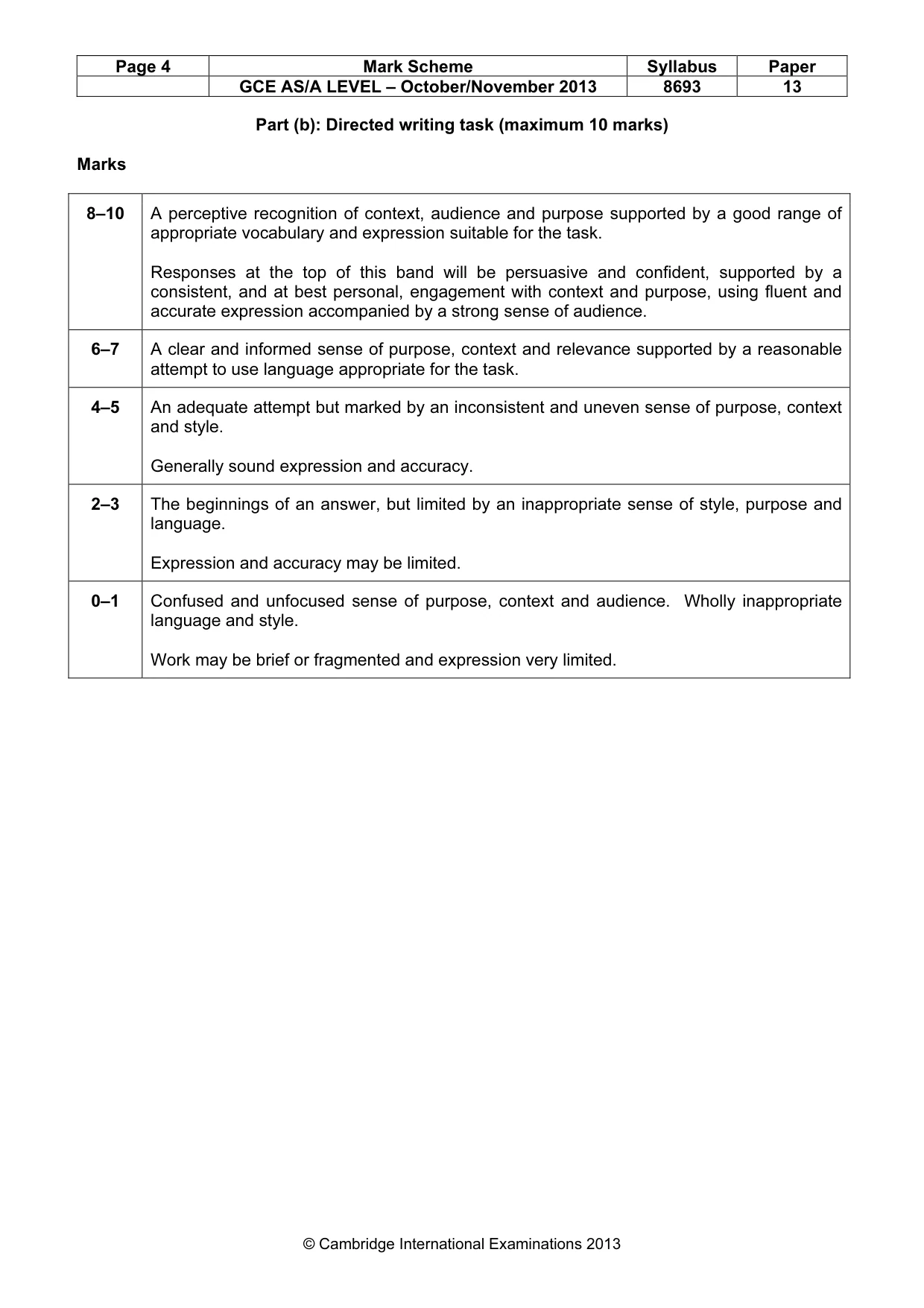
Page 4 Mark Scheme Syllabus Paper GCE AS/A LEVEL – October/November 2013 8693 13 © Cambridge International Examinations 2013 Part (b): Directed writing task (maximum 10 marks) Marks 8–10 A perceptive recognition of context, audience and purpose supported by a good range of appropriate vocabulary and expression suitable for the task. Responses at the top of this band will be persuasive and confident, supported by a consistent, and at best personal, engagement with context and purpose, using fluent and accurate expression accompanied by a strong sense of audience. 6–7 A clear and informed sense of purpose, context and relevance supported by a reasonable attempt to use language appropriate for the task. 4–5 An adequate attempt but marked by an inconsistent and uneven sense of purpose, context and style. Generally sound expression and accuracy. 2–3 The beginnings of an answer, but limited by an inappropriate sense of style, purpose and language. Expression and accuracy may be limited. 0–1 Confused and unfocused sense of purpose, context and audience. Wholly inappropriate language and style. Work may be brief or fragmented and expression very limited.