Cambridge A Level English - Language AS Level (until 2013) 8693 — 2011 Oct/Nov Paper 1 · Variant 3
8693/13/O/N/11 · 50 marks · ≈56 min
The question paper and its mark scheme, free to read here and free to download. This is Cambridge’s own paper, exactly as it was sat.
Question paper8 pages

Mark scheme4 pages
Answers below. Sit the paper first if you are practising.
Paper as text
Question paper, page 1
This document consists of 7 printed pages and 1 blank page. DC CB (NB) 29211/3 © UCLES 2011 [Turn over UNIVERSITY OF CAMBRIDGE INTERNATIONAL EXAMINATIONS General Certificate of Education Advanced Subsidiary Level and Advanced Level * 9 4 7 0 4 7 2 2 5 7 * ENGLISH LANGUAGE 8693/13 Paper 1 Passages for Comment October/November 2011 2 hours Additional Materials: Answer Booklet/Paper READ THESE INSTRUCTIONS FIRST If you have been given an Answer Booklet, follow the instructions on the front cover of the Booklet. Write your Centre number, candidate number and name on all the work you hand in. Write in dark blue or black pen. Do not use staples, paper clips, highlighters, glue or correction fluid. Answer two questions. You are reminded of the need for good English and clear presentation in your answers. At the end of the examination, fasten all your work securely together. The number of marks is given in brackets [ ] at the end of each question or part question.
Question paper, page 2
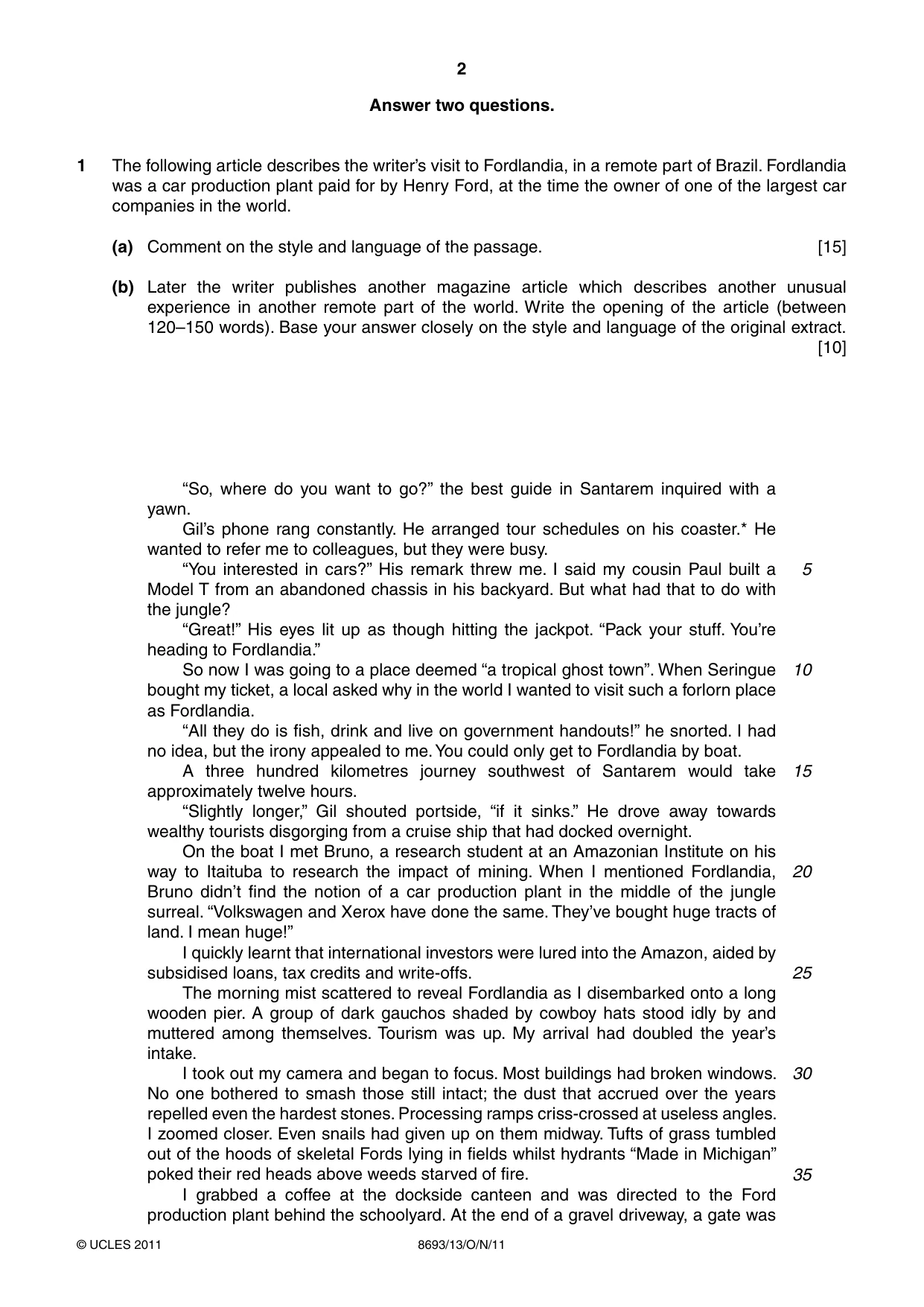
2 8693/13/O/N/11 © UCLES 2011 Answer two questions. 1 The following article describes the writer’s visit to Fordlandia, in a remote part of Brazil. Fordlandia was a car production plant paid for by Henry Ford, at the time the owner of one of the largest car companies in the world. (a) Comment on the style and language of the passage. [15] (b) Later the writer publishes another magazine article which describes another unusual experience in another remote part of the world. Write the opening of the article (between 120–150 words). Base your answer closely on the style and language of the original extract. [10] “So, where do you want to go?” the best guide in Santarem inquired with a yawn. Gil’s phone rang constantly. He arranged tour schedules on his coaster.* He wanted to refer me to colleagues, but they were busy. “You interested in cars?” His remark threw me. I said my cousin Paul built a Model T from an abandoned chassis in his backyard. But what had that to do with the jungle? “Great!” His eyes lit up as though hitting the jackpot. “Pack your stuff. You’re heading to Fordlandia.” So now I was going to a place deemed “a tropical ghost town”. When Seringue bought my ticket, a local asked why in the world I wanted to visit such a forlorn place as Fordlandia. “All they do is fish, drink and live on government handouts!” he snorted. I had no idea, but the irony appealed to me. You could only get to Fordlandia by boat. A three hundred kilometres journey southwest of Santarem would take approximately twelve hours. “Slightly longer,” Gil shouted portside, “if it sinks.” He drove away towards wealthy tourists disgorging from a cruise ship that had docked overnight. On the boat I met Bruno, a research student at an Amazonian Institute on his way to Itaituba to research the impact of mining. When I mentioned Fordlandia, Bruno didn’t find the notion of a car production plant in the middle of the jungle surreal. “Volkswagen and Xerox have done the same. They’ve bought huge tracts of land. I mean huge!” I quickly learnt that international investors were lured into the Amazon, aided by subsidised loans, tax credits and write-offs. The morning mist scattered to reveal Fordlandia as I disembarked onto a long wooden pier. A group of dark gauchos shaded by cowboy hats stood idly by and muttered among themselves. Tourism was up. My arrival had doubled the year’s intake. I took out my camera and began to focus. Most buildings had broken windows. No one bothered to smash those still intact; the dust that accrued over the years repelled even the hardest stones. Processing ramps criss-crossed at useless angles. I zoomed closer. Even snails had given up on them midway. Tufts of grass tumbled out of the hoods of skeletal Fords lying in fields whilst hydrants “Made in Michigan” poked their red heads above weeds starved of fire. I grabbed a coffee at the dockside canteen and was directed to the Ford production plant behind the schoolyard. At the end of a gravel driveway, a gate was 5 10 15 20 25 30 35
Question paper, page 3
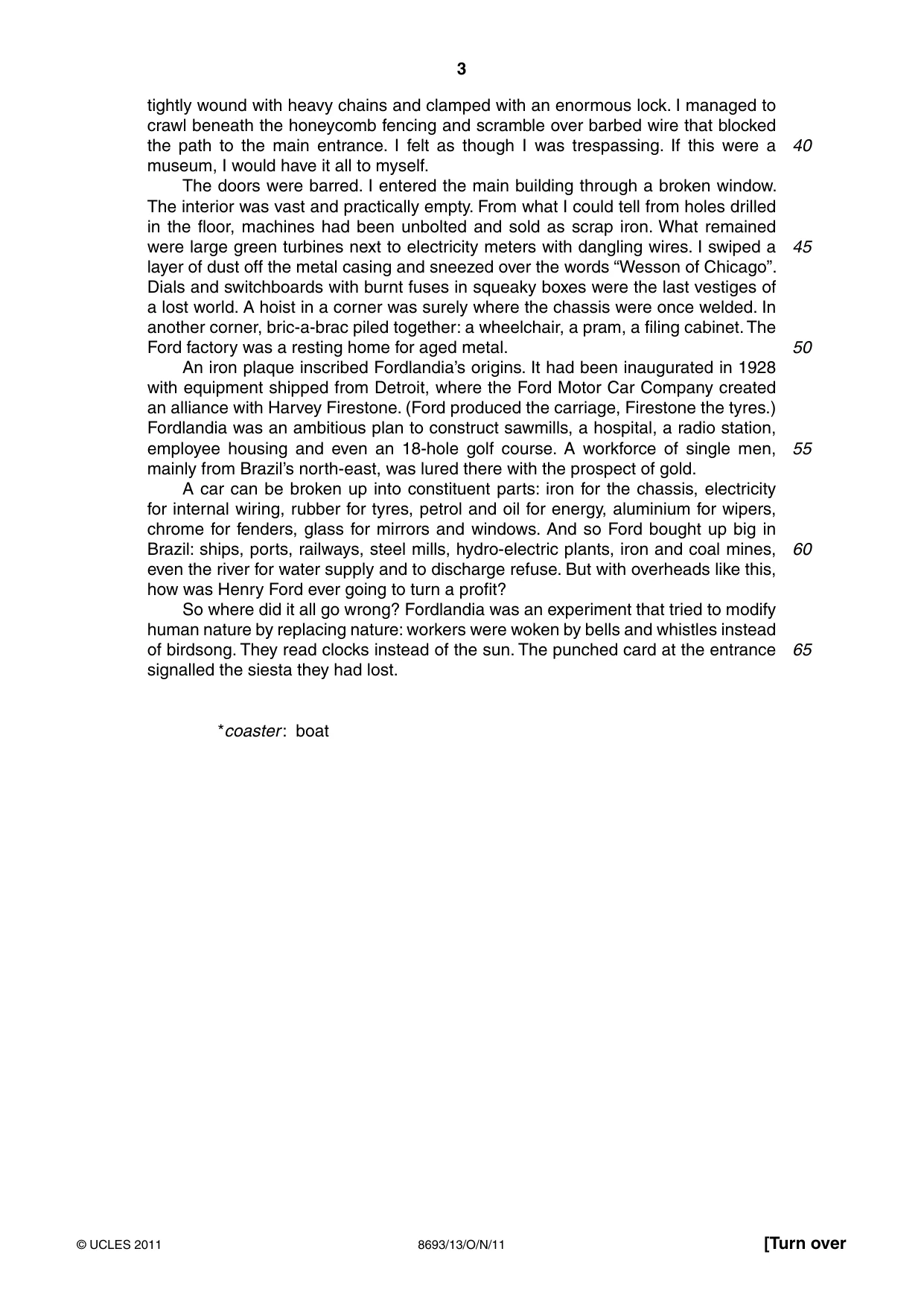
3 8693/13/O/N/11 © UCLES 2011 [Turn over tightly wound with heavy chains and clamped with an enormous lock. I managed to crawl beneath the honeycomb fencing and scramble over barbed wire that blocked the path to the main entrance. I felt as though I was trespassing. If this were a museum, I would have it all to myself. The doors were barred. I entered the main building through a broken window. The interior was vast and practically empty. From what I could tell from holes drilled in the floor, machines had been unbolted and sold as scrap iron. What remained were large green turbines next to electricity meters with dangling wires. I swiped a layer of dust off the metal casing and sneezed over the words “Wesson of Chicago”. Dials and switchboards with burnt fuses in squeaky boxes were the last vestiges of a lost world. A hoist in a corner was surely where the chassis were once welded. In another corner, bric-a-brac piled together: a wheelchair, a pram, a filing cabinet. The Ford factory was a resting home for aged metal. An iron plaque inscribed Fordlandia’s origins. It had been inaugurated in 1928 with equipment shipped from Detroit, where the Ford Motor Car Company created an alliance with Harvey Firestone. (Ford produced the carriage, Firestone the tyres.) Fordlandia was an ambitious plan to construct sawmills, a hospital, a radio station, employee housing and even an 18-hole golf course. A workforce of single men, mainly from Brazil’s north-east, was lured there with the prospect of gold. A car can be broken up into constituent parts: iron for the chassis, electricity for internal wiring, rubber for tyres, petrol and oil for energy, aluminium for wipers, chrome for fenders, glass for mirrors and windows. And so Ford bought up big in Brazil: ships, ports, railways, steel mills, hydro-electric plants, iron and coal mines, even the river for water supply and to discharge refuse. But with overheads like this, how was Henry Ford ever going to turn a profit? So where did it all go wrong? Fordlandia was an experiment that tried to modify human nature by replacing nature: workers were woken by bells and whistles instead of birdsong. They read clocks instead of the sun. The punched card at the entrance signalled the siesta they had lost. *coaster : boat 40 45 50 55 60 65
Question paper, page 4
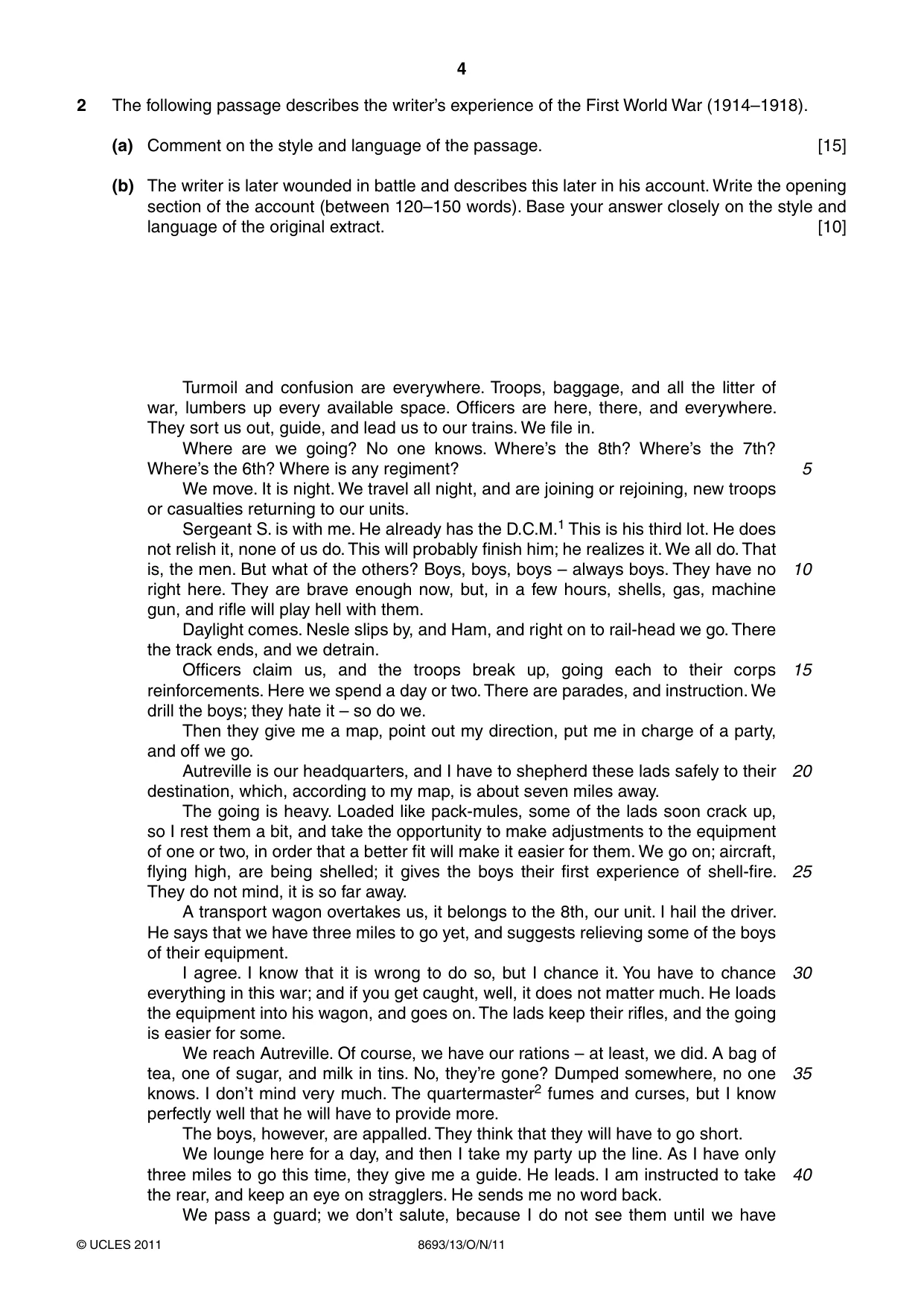
4 8693/13/O/N/11 © UCLES 2011 2 The following passage describes the writer’s experience of the First World War (1914–1918). (a) Comment on the style and language of the passage. [15] (b) The writer is later wounded in battle and describes this later in his account. Write the opening section of the account (between 120–150 words). Base your answer closely on the style and language of the original extract. [10] Turmoil and confusion are everywhere. Troops, baggage, and all the litter of war, lumbers up every available space. Officers are here, there, and everywhere. They sort us out, guide, and lead us to our trains. We file in. Where are we going? No one knows. Where’s the 8th? Where’s the 7th? Where’s the 6th? Where is any regiment? We move. It is night. We travel all night, and are joining or rejoining, new troops or casualties returning to our units. Sergeant S. is with me. He already has the D.C.M.1 This is his third lot. He does not relish it, none of us do. This will probably finish him; he realizes it. We all do. That is, the men. But what of the others? Boys, boys, boys – always boys. They have no right here. They are brave enough now, but, in a few hours, shells, gas, machine gun, and rifle will play hell with them. Daylight comes. Nesle slips by, and Ham, and right on to rail-head we go. There the track ends, and we detrain. Officers claim us, and the troops break up, going each to their corps reinforcements. Here we spend a day or two. There are parades, and instruction. We drill the boys; they hate it – so do we. Then they give me a map, point out my direction, put me in charge of a party, and off we go. Autreville is our headquarters, and I have to shepherd these lads safely to their destination, which, according to my map, is about seven miles away. The going is heavy. Loaded like pack-mules, some of the lads soon crack up, so I rest them a bit, and take the opportunity to make adjustments to the equipment of one or two, in order that a better fit will make it easier for them. We go on; aircraft, flying high, are being shelled; it gives the boys their first experience of shell-fire. They do not mind, it is so far away. A transport wagon overtakes us, it belongs to the 8th, our unit. I hail the driver. He says that we have three miles to go yet, and suggests relieving some of the boys of their equipment. I agree. I know that it is wrong to do so, but I chance it. You have to chance everything in this war; and if you get caught, well, it does not matter much. He loads the equipment into his wagon, and goes on. The lads keep their rifles, and the going is easier for some. We reach Autreville. Of course, we have our rations – at least, we did. A bag of tea, one of sugar, and milk in tins. No, they’re gone? Dumped somewhere, no one knows. I don’t mind very much. The quartermaster2 fumes and curses, but I know perfectly well that he will have to provide more. The boys, however, are appalled. They think that they will have to go short. We lounge here for a day, and then I take my party up the line. As I have only three miles to go this time, they give me a guide. He leads. I am instructed to take the rear, and keep an eye on stragglers. He sends me no word back. We pass a guard; we don’t salute, because I do not see them until we have 5 10 15 20 25 30 35 40
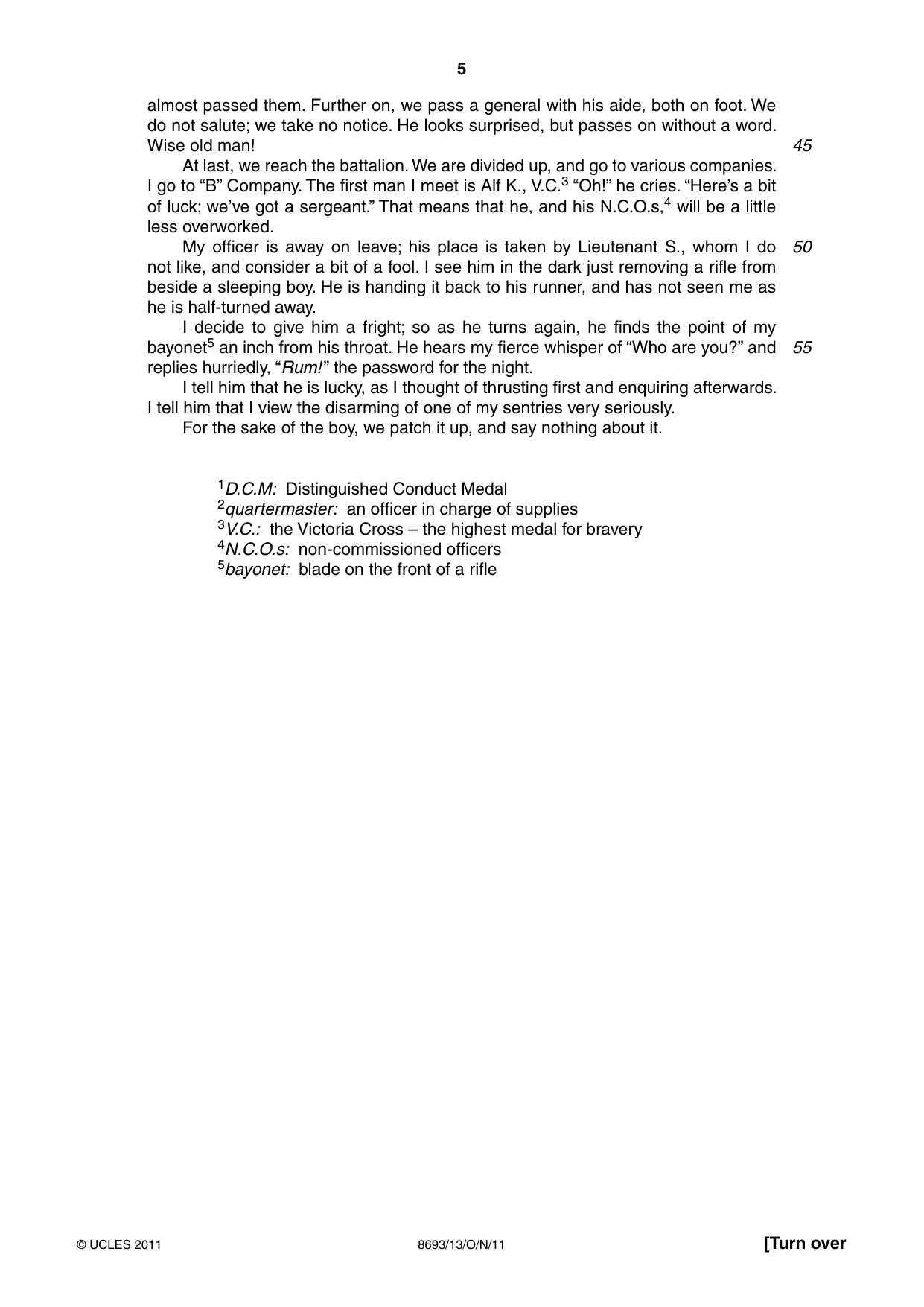
Question paper, page 5
5 8693/13/O/N/11 © UCLES 2011 [Turn over almost passed them. Further on, we pass a general with his aide, both on foot. We do not salute; we take no notice. He looks surprised, but passes on without a word. Wise old man! At last, we reach the battalion. We are divided up, and go to various companies. I go to “B” Company. The first man I meet is Alf K., V.C.3 “Oh!” he cries. “Here’s a bit of luck; we’ve got a sergeant.” That means that he, and his N.C.O.s,4 will be a little less overworked. My officer is away on leave; his place is taken by Lieutenant S., whom I do not like, and consider a bit of a fool. I see him in the dark just removing a rifle from beside a sleeping boy. He is handing it back to his runner, and has not seen me as he is half-turned away. I decide to give him a fright; so as he turns again, he finds the point of my bayonet5 an inch from his throat. He hears my fierce whisper of “Who are you?” and replies hurriedly, “Rum! ” the password for the night. I tell him that he is lucky, as I thought of thrusting first and enquiring afterwards. I tell him that I view the disarming of one of my sentries very seriously. For the sake of the boy, we patch it up, and say nothing about it. 1D.C.M: Distinguished Conduct Medal 2quartermaster: an officer in charge of supplies 3V.C.: the Victoria Cross – the highest medal for bravery 4N.C.O.s: non-commissioned officers 5bayonet: blade on the front of a rifle 45 50 55
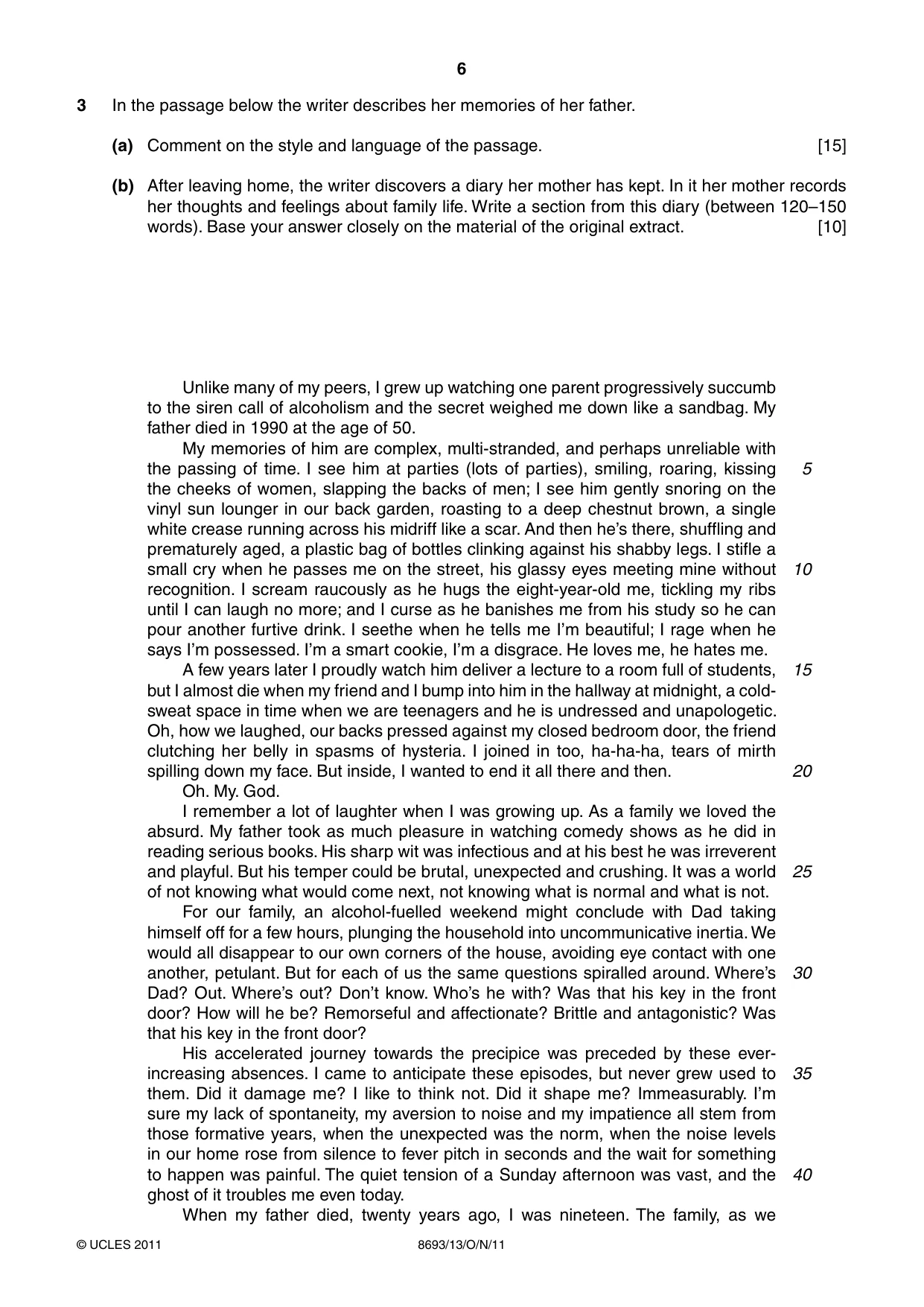
Question paper, page 6
6 8693/13/O/N/11 © UCLES 2011 3 In the passage below the writer describes her memories of her father. (a) Comment on the style and language of the passage. [15] (b) After leaving home, the writer discovers a diary her mother has kept. In it her mother records her thoughts and feelings about family life. Write a section from this diary (between 120–150 words). Base your answer closely on the material of the original extract. [10] Unlike many of my peers, I grew up watching one parent progressively succumb to the siren call of alcoholism and the secret weighed me down like a sandbag. My father died in 1990 at the age of 50. My memories of him are complex, multi-stranded, and perhaps unreliable with the passing of time. I see him at parties (lots of parties), smiling, roaring, kissing the cheeks of women, slapping the backs of men; I see him gently snoring on the vinyl sun lounger in our back garden, roasting to a deep chestnut brown, a single white crease running across his midriff like a scar. And then he’s there, shuffling and prematurely aged, a plastic bag of bottles clinking against his shabby legs. I stifle a small cry when he passes me on the street, his glassy eyes meeting mine without recognition. I scream raucously as he hugs the eight-year-old me, tickling my ribs until I can laugh no more; and I curse as he banishes me from his study so he can pour another furtive drink. I seethe when he tells me I’m beautiful; I rage when he says I’m possessed. I’m a smart cookie, I’m a disgrace. He loves me, he hates me. A few years later I proudly watch him deliver a lecture to a room full of students, but I almost die when my friend and I bump into him in the hallway at midnight, a cold- sweat space in time when we are teenagers and he is undressed and unapologetic. Oh, how we laughed, our backs pressed against my closed bedroom door, the friend clutching her belly in spasms of hysteria. I joined in too, ha-ha-ha, tears of mirth spilling down my face. But inside, I wanted to end it all there and then. Oh. My. God. I remember a lot of laughter when I was growing up. As a family we loved the absurd. My father took as much pleasure in watching comedy shows as he did in reading serious books. His sharp wit was infectious and at his best he was irreverent and playful. But his temper could be brutal, unexpected and crushing. It was a world of not knowing what would come next, not knowing what is normal and what is not. For our family, an alcohol-fuelled weekend might conclude with Dad taking himself off for a few hours, plunging the household into uncommunicative inertia. We would all disappear to our own corners of the house, avoiding eye contact with one another, petulant. But for each of us the same questions spiralled around. Where’s Dad? Out. Where’s out? Don’t know. Who’s he with? Was that his key in the front door? How will he be? Remorseful and affectionate? Brittle and antagonistic? Was that his key in the front door? His accelerated journey towards the precipice was preceded by these ever- increasing absences. I came to anticipate these episodes, but never grew used to them. Did it damage me? I like to think not. Did it shape me? Immeasurably. I’m sure my lack of spontaneity, my aversion to noise and my impatience all stem from those formative years, when the unexpected was the norm, when the noise levels in our home rose from silence to fever pitch in seconds and the wait for something to happen was painful. The quiet tension of a Sunday afternoon was vast, and the ghost of it troubles me even today. When my father died, twenty years ago, I was nineteen. The family, as we 5 10 15 20 25 30 35 40
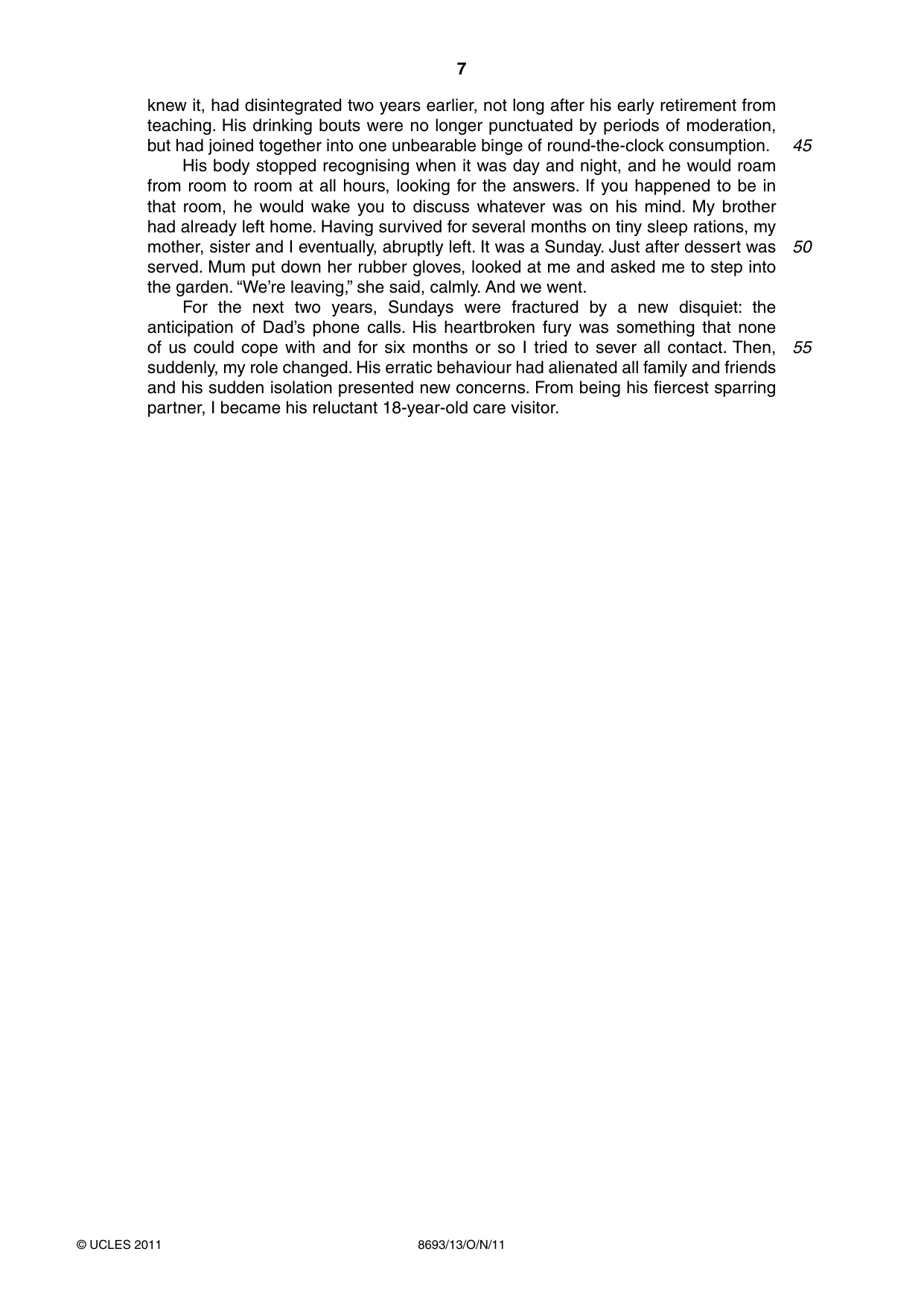
Question paper, page 7
7 8693/13/O/N/11 © UCLES 2011 knew it, had disintegrated two years earlier, not long after his early retirement from teaching. His drinking bouts were no longer punctuated by periods of moderation, but had joined together into one unbearable binge of round-the-clock consumption. His body stopped recognising when it was day and night, and he would roam from room to room at all hours, looking for the answers. If you happened to be in that room, he would wake you to discuss whatever was on his mind. My brother had already left home. Having survived for several months on tiny sleep rations, my mother, sister and I eventually, abruptly left. It was a Sunday. Just after dessert was served. Mum put down her rubber gloves, looked at me and asked me to step into the garden. “We’re leaving,” she said, calmly. And we went. For the next two years, Sundays were fractured by a new disquiet: the anticipation of Dad’s phone calls. His heartbroken fury was something that none of us could cope with and for six months or so I tried to sever all contact. Then, suddenly, my role changed. His erratic behaviour had alienated all family and friends and his sudden isolation presented new concerns. From being his fiercest sparring partner, I became his reluctant 18-year-old care visitor. 45 50 55
Question paper, page 8
8 8693/13/O/N/11 © UCLES 2011 BLANK PAGE Copyright Acknowledgements: Question 1 © Jorge Sotirios; Fordlandia, the lost city of the Amazon; text found at: www.onlineopinion.com.au; 12 May 2009. Question 2 © Alfred Grosch; Everyman at War, 1930; text found at: www.firstworldwar.com/diaries. Question 3 © Isabel Ashdown; The Guardian, www.guardian.co.uk; 17 October 2009. Permission to reproduce items where third-party owned material protected by copyright is included has been sought and cleared where possible. Every reasonable effort has been made by the publisher (UCLES) to trace copyright holders, but if any items requiring clearance have unwittingly been included, the publisher will be pleased to make amends at the earliest possible opportunity. University of Cambridge International Examinations is part of the Cambridge Assessment Group. Cambridge Assessment is the brand name of University of Cambridge Local Examinations Syndicate (UCLES), which is itself a department of the University of Cambridge.
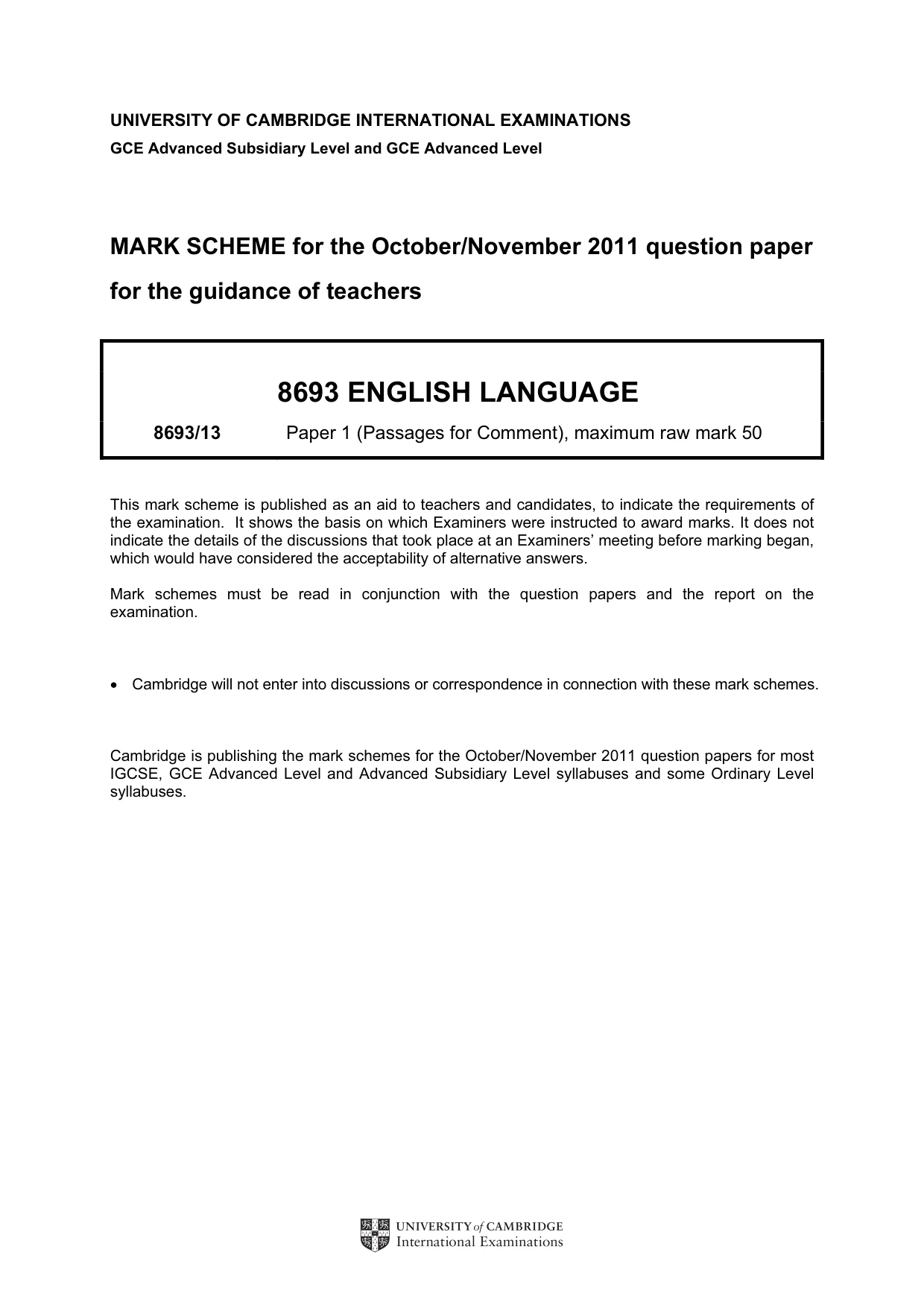
Mark scheme, page 1
UNIVERSITY OF CAMBRIDGE INTERNATIONAL EXAMINATIONS GCE Advanced Subsidiary Level and GCE Advanced Level MARK SCHEME for the October/November 2011 question paper for the guidance of teachers 8693 ENGLISH LANGUAGE 8693/13 Paper 1 (Passages for Comment), maximum raw mark 50 This mark scheme is published as an aid to teachers and candidates, to indicate the requirements of the examination. It shows the basis on which Examiners were instructed to award marks. It does not indicate the details of the discussions that took place at an Examiners’ meeting before marking began, which would have considered the acceptability of alternative answers. Mark schemes must be read in conjunction with the question papers and the report on the examination. • Cambridge will not enter into discussions or correspondence in connection with these mark schemes. Cambridge is publishing the mark schemes for the October/November 2011 question papers for most IGCSE, GCE Advanced Level and Advanced Subsidiary Level syllabuses and some Ordinary Level syllabuses.
Mark scheme, page 2
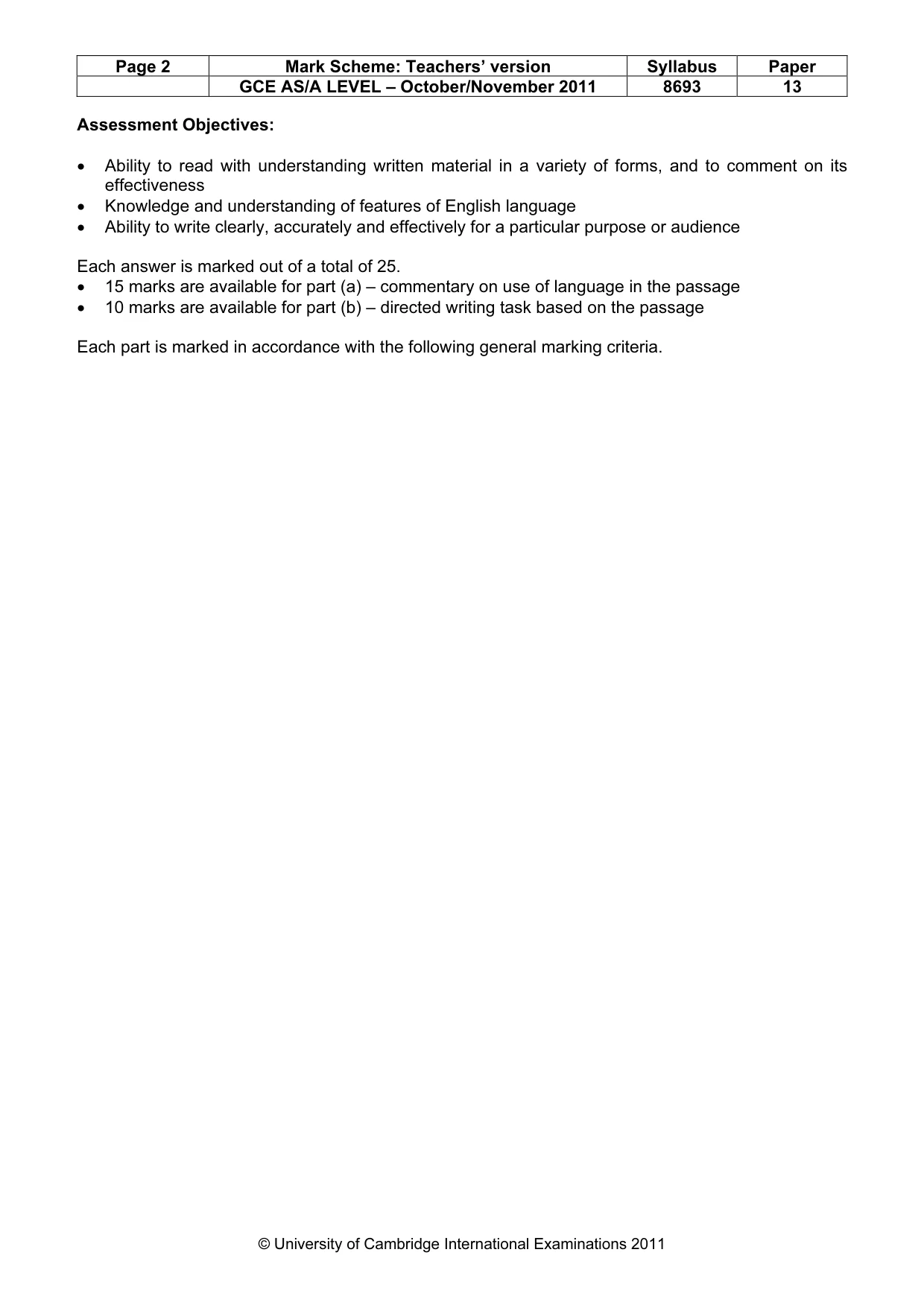
Page 2 Mark Scheme: Teachers’ version Syllabus Paper GCE AS/A LEVEL – October/November 2011 8693 13 © University of Cambridge International Examinations 2011 Assessment Objectives: • Ability to read with understanding written material in a variety of forms, and to comment on its effectiveness • Knowledge and understanding of features of English language • Ability to write clearly, accurately and effectively for a particular purpose or audience Each answer is marked out of a total of 25. • 15 marks are available for part (a) – commentary on use of language in the passage • 10 marks are available for part (b) – directed writing task based on the passage Each part is marked in accordance with the following general marking criteria.
Mark scheme, page 3
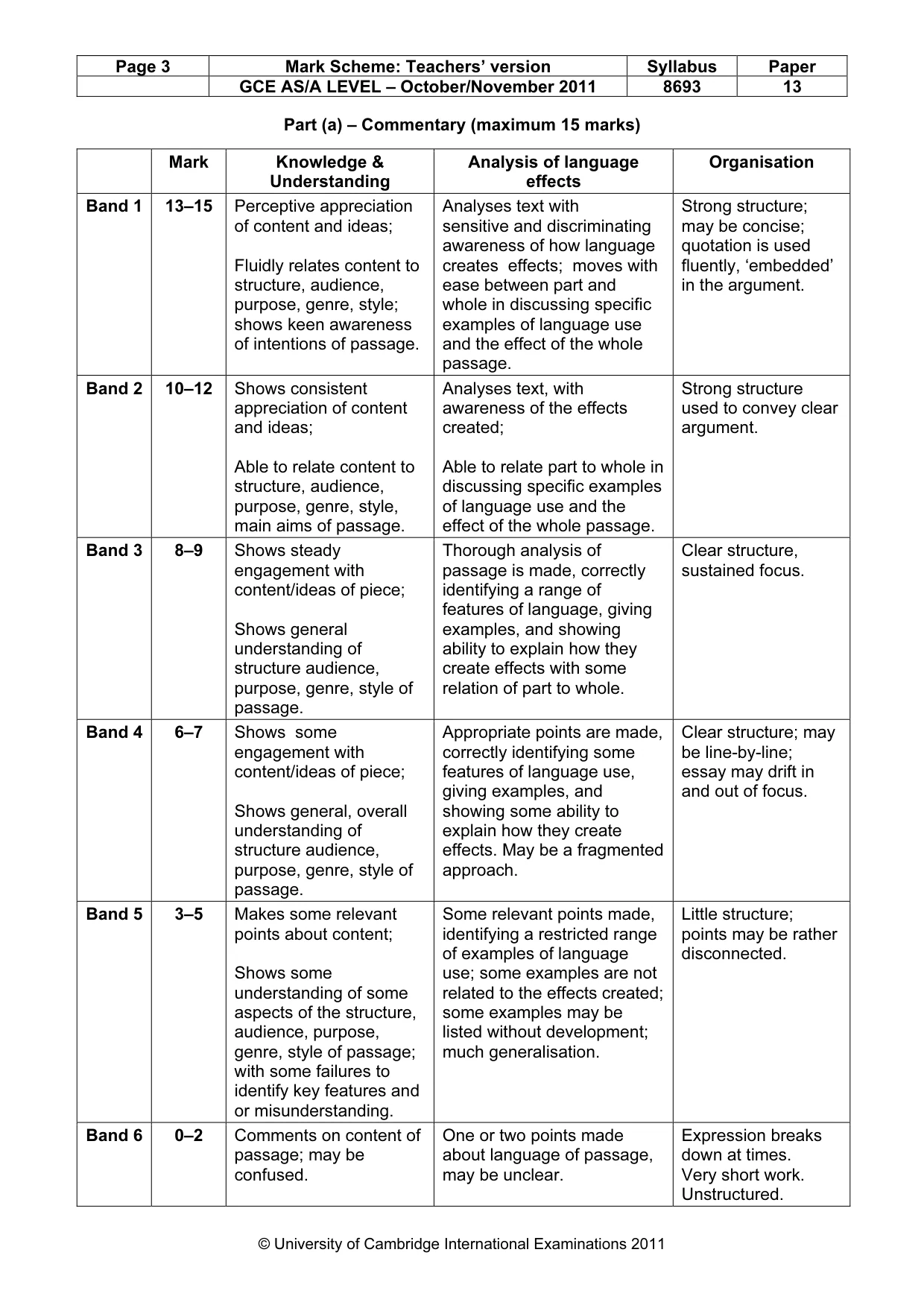
Page 3 Mark Scheme: Teachers’ version Syllabus Paper GCE AS/A LEVEL – October/November 2011 8693 13 © University of Cambridge International Examinations 2011 Part (a) – Commentary (maximum 15 marks) Mark Knowledge & Understanding Analysis of language effects Organisation Band 1 13–15 Perceptive appreciation of content and ideas; Fluidly relates content to structure, audience, purpose, genre, style; shows keen awareness of intentions of passage. Analyses text with sensitive and discriminating awareness of how language creates effects; moves with ease between part and whole in discussing specific examples of language use and the effect of the whole passage. Strong structure; may be concise; quotation is used fluently, ‘embedded’ in the argument. Band 2 10–12 Shows consistent appreciation of content and ideas; Able to relate content to structure, audience, purpose, genre, style, main aims of passage. Analyses text, with awareness of the effects created; Able to relate part to whole in discussing specific examples of language use and the effect of the whole passage. Strong structure used to convey clear argument. Band 3 8–9 Shows steady engagement with content/ideas of piece; Shows general understanding of structure audience, purpose, genre, style of passage. Thorough analysis of passage is made, correctly identifying a range of features of language, giving examples, and showing ability to explain how they create effects with some relation of part to whole. Clear structure, sustained focus. Band 4 6–7 Shows some engagement with content/ideas of piece; Shows general, overall understanding of structure audience, purpose, genre, style of passage. Appropriate points are made, correctly identifying some features of language use, giving examples, and showing some ability to explain how they create effects. May be a fragmented approach. Clear structure; may be line-by-line; essay may drift in and out of focus. Band 5 3–5 Makes some relevant points about content; Shows some understanding of some aspects of the structure, audience, purpose, genre, style of passage; with some failures to identify key features and or misunderstanding. Some relevant points made, identifying a restricted range of examples of language use; some examples are not related to the effects created; some examples may be listed without development; much generalisation. Little structure; points may be rather disconnected. Band 6 0–2 Comments on content of passage; may be confused. One or two points made about language of passage, may be unclear. Expression breaks down at times. Very short work. Unstructured.
Mark scheme, page 4
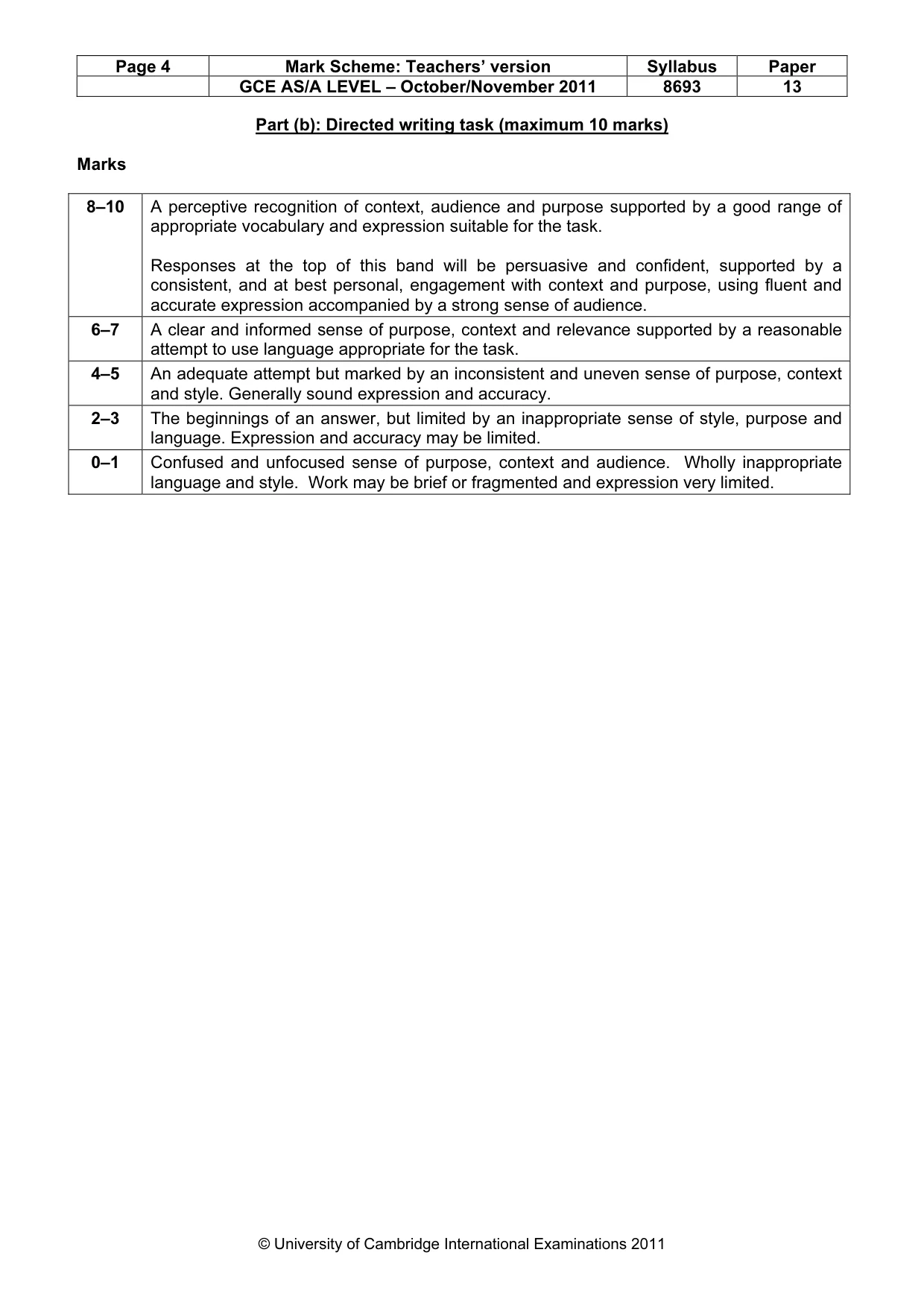
Page 4 Mark Scheme: Teachers’ version Syllabus Paper GCE AS/A LEVEL – October/November 2011 8693 13 © University of Cambridge International Examinations 2011 Part (b): Directed writing task (maximum 10 marks) Marks 8–10 A perceptive recognition of context, audience and purpose supported by a good range of appropriate vocabulary and expression suitable for the task. Responses at the top of this band will be persuasive and confident, supported by a consistent, and at best personal, engagement with context and purpose, using fluent and accurate expression accompanied by a strong sense of audience. 6–7 A clear and informed sense of purpose, context and relevance supported by a reasonable attempt to use language appropriate for the task. 4–5 An adequate attempt but marked by an inconsistent and uneven sense of purpose, context and style. Generally sound expression and accuracy. 2–3 The beginnings of an answer, but limited by an inappropriate sense of style, purpose and language. Expression and accuracy may be limited. 0–1 Confused and unfocused sense of purpose, context and audience. Wholly inappropriate language and style. Work may be brief or fragmented and expression very limited.
What you needed in this session
Cambridge’s own grade thresholds for 2011 Oct/Nov, Paper 1 · Variant 3. A higher threshold means an easier paper — the bar moves with how the cohort did.