Cambridge A Level English General Paper 8021 — 2022 Oct/Nov Paper 1 · Variant 3
8021/13/O/N/22 · 30 marks · ≈34 min
The question paper and its mark scheme, free to read here and free to download. This is Cambridge’s own paper, exactly as it was sat.
Question paper4 pages


Mark scheme13 pages
Answers below. Sit the paper first if you are practising.
Paper as text
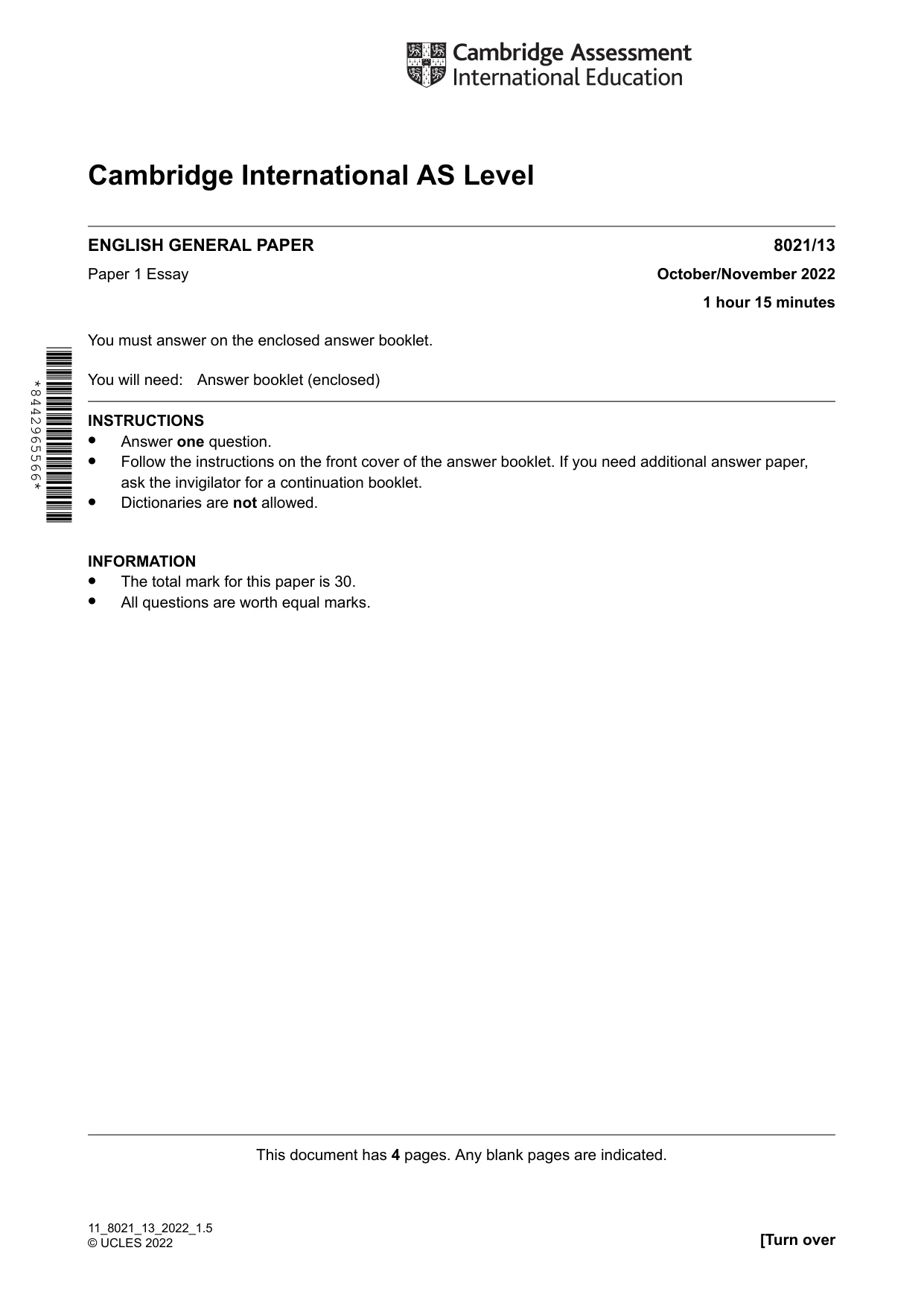
Question paper, page 1
Cambridge International AS Level 8021/13 October/November 2022 1 hour 15 minutes ENGLISH GENERAL PAPER Paper 1 Essay You must answer on the enclosed answer booklet. You will need: Answer booklet (enclosed) INSTRUCTIONS • Answer one question. • Follow the instructions on the front cover of the answer booklet. If you need additional answer paper, ask the invigilator for a continuation booklet. • Dictionaries are not allowed. INFORMATION • The total mark for this paper is 30. • All questions are worth equal marks. This document has 4 pages. Any blank pages are indicated. [Turn over 11_8021_13_2022_1.5 © UCLES 2022 *8442965566*
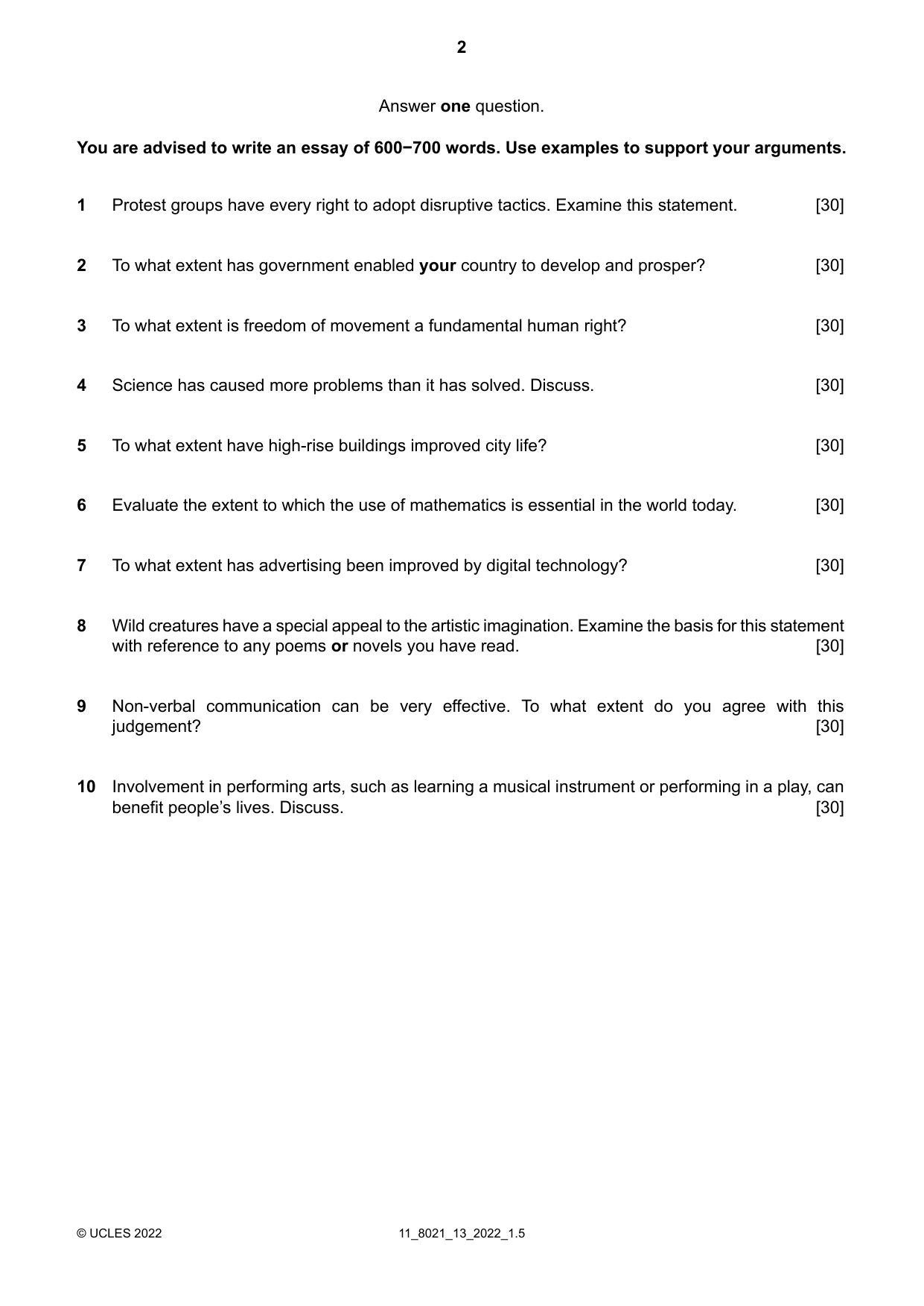
Question paper, page 2
Answer one question. You are advised to write an essay of 600−700 words. Use examples to support your arguments. Protest groups have every right to adopt disruptive tactics. Examine this statement. [30] 1 To what extent has government enabled your country to develop and prosper? [30] 2 To what extent is freedom of movement a fundamental human right? [30] 3 Science has caused more problems than it has solved. Discuss. [30] 4 To what extent have high-rise buildings improved city life? [30] 5 Evaluate the extent to which the use of mathematics is essential in the world today. [30] 6 To what extent has advertising been improved by digital technology? [30] 7 Wild creatures have a special appeal to the artistic imagination. Examine the basis for this statement with reference to any poems or novels you have read. [30] 8 Non-verbal communication can be very effective. To what extent do you agree with this judgement? [30] 9 Involvement in performing arts, such as learning a musical instrument or performing in a play, can benefit people’s lives. Discuss. [30] 10 11_8021_13_2022_1.5 © UCLES 2022 2
Question paper, page 3
BLANK PAGE 11_8021_13_2022_1.5 © UCLES 2022 3
Question paper, page 4
BLANK PAGE Permission to reproduce items where third-party owned material protected by copyright is included has been sought and cleared where possible. Every reasonable effort has been made by the publisher (UCLES) to trace copyright holders, but if any items requiring clearance have unwittingly been included, the publisher will be pleased to make amends at the earliest possible opportunity. To avoid the issue of disclosure of answer-related information to candidates, all copyright acknowledgements are reproduced online in the Cambridge Assessment International Education Copyright Acknowledgements Booklet. This is produced for each series of examinations and is freely available to download at www.cambridgeinternational.org after the live examination series. Cambridge Assessment International Education is part of Cambridge Assessment. Cambridge Assessment is the brand name of the University of Cambridge Local Examinations Syndicate (UCLES), which is a department of the University of Cambridge. 11_8021_13_2022_1.5 © UCLES 2022 4
Mark scheme, page 1
This document consists of 13 printed pages. © UCLES 2022 [Turn over Cambridge International AS Level ENGLISH GENERAL PAPER 8021/13 Paper 1 Essay October/November 2022 MARK SCHEME Maximum Mark: 30 Published This mark scheme is published as an aid to teachers and candidates, to indicate the requirements of the examination. It shows the basis on which Examiners were instructed to award marks. It does not indicate the details of the discussions that took place at an Examiners’ meeting before marking began, which would have considered the acceptability of alternative answers. Mark schemes should be read in conjunction with the question paper and the Principal Examiner Report for Teachers. Cambridge International will not enter into discussions about these mark schemes. Cambridge International is publishing the mark schemes for the October/November 2022 series for most Cambridge IGCSE™, Cambridge International A and AS Level components and some Cambridge O Level components.
Mark scheme, page 2
8021/13 Cambridge International AS Level – Mark Scheme PUBLISHED October/November 2022 © UCLES 2022 Page 2 of 13 Generic Marking Principles These general marking principles must be applied by all examiners when marking candidate answers. They should be applied alongside the specific content of the mark scheme or generic level descriptors for a question. Each question paper and mark scheme will also comply with these marking principles. GENERIC MARKING PRINCIPLE 1: Marks must be awarded in line with: • the specific content of the mark scheme or the generic level descriptors for the question • the specific skills defined in the mark scheme or in the generic level descriptors for the question • the standard of response required by a candidate as exemplified by the standardisation scripts. GENERIC MARKING PRINCIPLE 2: Marks awarded are always whole marks (not half marks, or other fractions). GENERIC MARKING PRINCIPLE 3: Marks must be awarded positively: • Marks are awarded for correct/valid answers, as defined in the mark scheme. However, credit is given for valid answers which go beyond the scope of the syllabus and mark scheme, referring to your Team Leader as appropriate. • Marks are awarded when candidates clearly demonstrate what they know and can do. • Marks are not deducted for errors. • Marks are not deducted for omissions. • Answers should only be judged on the quality of spelling, punctuation and grammar when these features are specifically assessed by the question as indicated by the mark scheme. The meaning, however, should be unambiguous. GENERIC MARKING PRINCIPLE 4: Rules must be applied consistently, e.g. in situations where candidates have not followed instructions or in the application of generic level descriptors. GENERIC MARKING PRINCIPLE 5: Marks should be awarded using the full range of marks defined in the mark scheme for the question (however; the use of the full mark range may be limited according to the quality of the candidate responses seen). GENERIC MARKING PRINCIPLE 6: Marks awarded are based solely on the requirements as defined in the mark scheme. Marks should not be awarded with grade thresholds or grade descriptors in mind.
Mark scheme, page 3
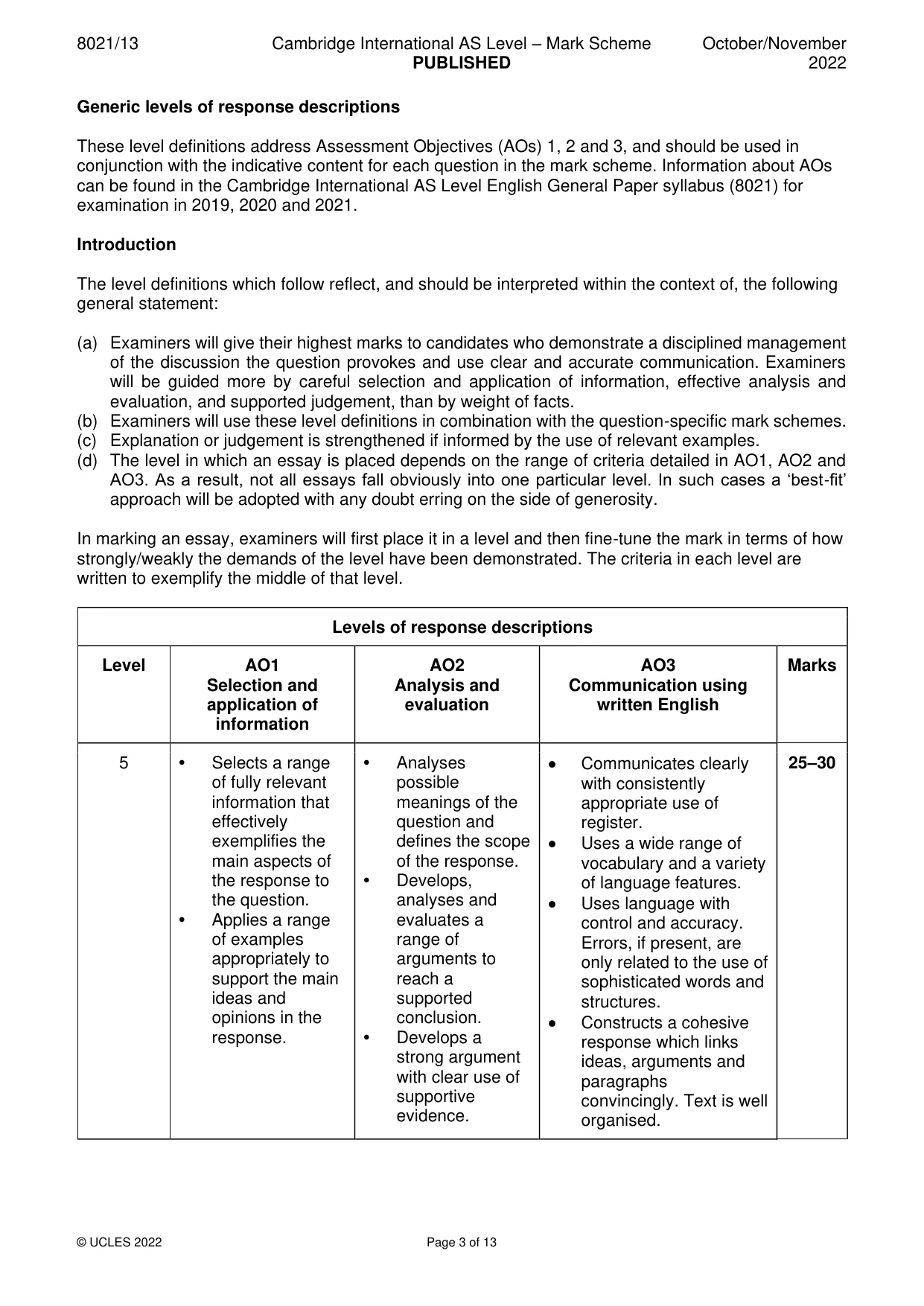
8021/13 Cambridge International AS Level – Mark Scheme PUBLISHED October/November 2022 © UCLES 2022 Page 3 of 13 Generic levels of response descriptions These level definitions address Assessment Objectives (AOs) 1, 2 and 3, and should be used in conjunction with the indicative content for each question in the mark scheme. Information about AOs can be found in the Cambridge International AS Level English General Paper syllabus (8021) for examination in 2019, 2020 and 2021. Introduction The level definitions which follow reflect, and should be interpreted within the context of, the following general statement: (a) Examiners will give their highest marks to candidates who demonstrate a disciplined management of the discussion the question provokes and use clear and accurate communication. Examiners will be guided more by careful selection and application of information, effective analysis and evaluation, and supported judgement, than by weight of facts. (b) Examiners will use these level definitions in combination with the question-specific mark schemes. (c) Explanation or judgement is strengthened if informed by the use of relevant examples. (d) The level in which an essay is placed depends on the range of criteria detailed in AO1, AO2 and AO3. As a result, not all essays fall obviously into one particular level. In such cases a ‘best-fit’ approach will be adopted with any doubt erring on the side of generosity. In marking an essay, examiners will first place it in a level and then fine-tune the mark in terms of how strongly/weakly the demands of the level have been demonstrated. The criteria in each level are written to exemplify the middle of that level. Levels of response descriptions Level AO1 Selection and application of information AO2 Analysis and evaluation AO3 Communication using written English Marks 5 • Selects a range of fully relevant information that effectively exemplifies the main aspects of the response to the question. • Applies a range of examples appropriately to support the main ideas and opinions in the response. • Analyses possible meanings of the question and defines the scope of the response. • Develops, analyses and evaluates a range of arguments to reach a supported conclusion. • Develops a strong argument with clear use of supportive evidence. • Communicates clearly with consistently appropriate use of register. • Uses a wide range of vocabulary and a variety of language features. • Uses language with control and accuracy. Errors, if present, are only related to the use of sophisticated words and structures. • Constructs a cohesive response which links ideas, arguments and paragraphs convincingly. Text is well organised. 25–30
Mark scheme, page 4
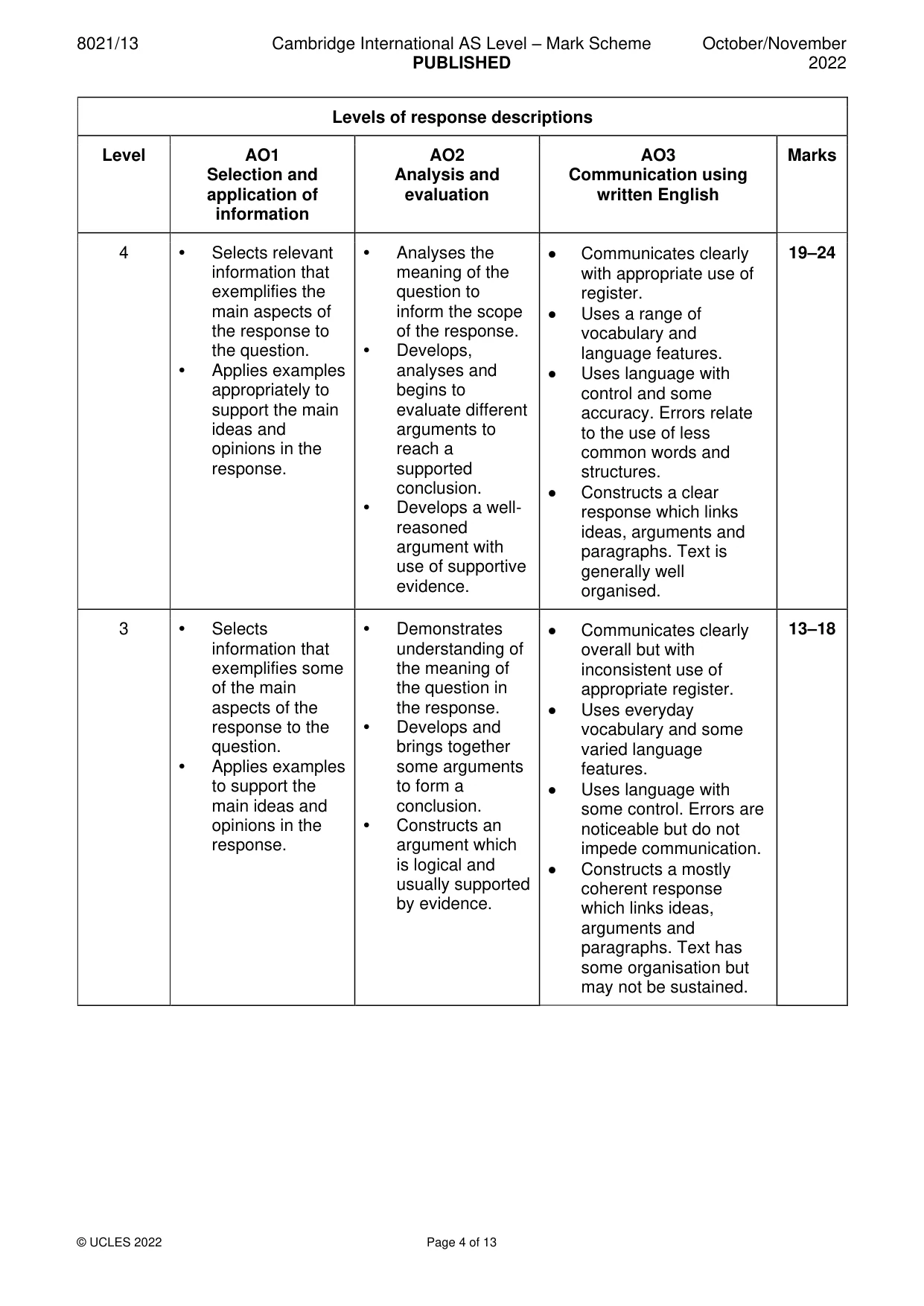
8021/13 Cambridge International AS Level – Mark Scheme PUBLISHED October/November 2022 © UCLES 2022 Page 4 of 13 Levels of response descriptions Level AO1 Selection and application of information AO2 Analysis and evaluation AO3 Communication using written English Marks 4 • Selects relevant information that exemplifies the main aspects of the response to the question. • Applies examples appropriately to support the main ideas and opinions in the response. • Analyses the meaning of the question to inform the scope of the response. • Develops, analyses and begins to evaluate different arguments to reach a supported conclusion. • Develops a well- reasoned argument with use of supportive evidence. • Communicates clearly with appropriate use of register. • Uses a range of vocabulary and language features. • Uses language with control and some accuracy. Errors relate to the use of less common words and structures. • Constructs a clear response which links ideas, arguments and paragraphs. Text is generally well organised. 19–24 3 • Selects information that exemplifies some of the main aspects of the response to the question. • Applies examples to support the main ideas and opinions in the response. • Demonstrates understanding of the meaning of the question in the response. • Develops and brings together some arguments to form a conclusion. • Constructs an argument which is logical and usually supported by evidence. • Communicates clearly overall but with inconsistent use of appropriate register. • Uses everyday vocabulary and some varied language features. • Uses language with some control. Errors are noticeable but do not impede communication. • Constructs a mostly coherent response which links ideas, arguments and paragraphs. Text has some organisation but may not be sustained. 13–18
Mark scheme, page 5
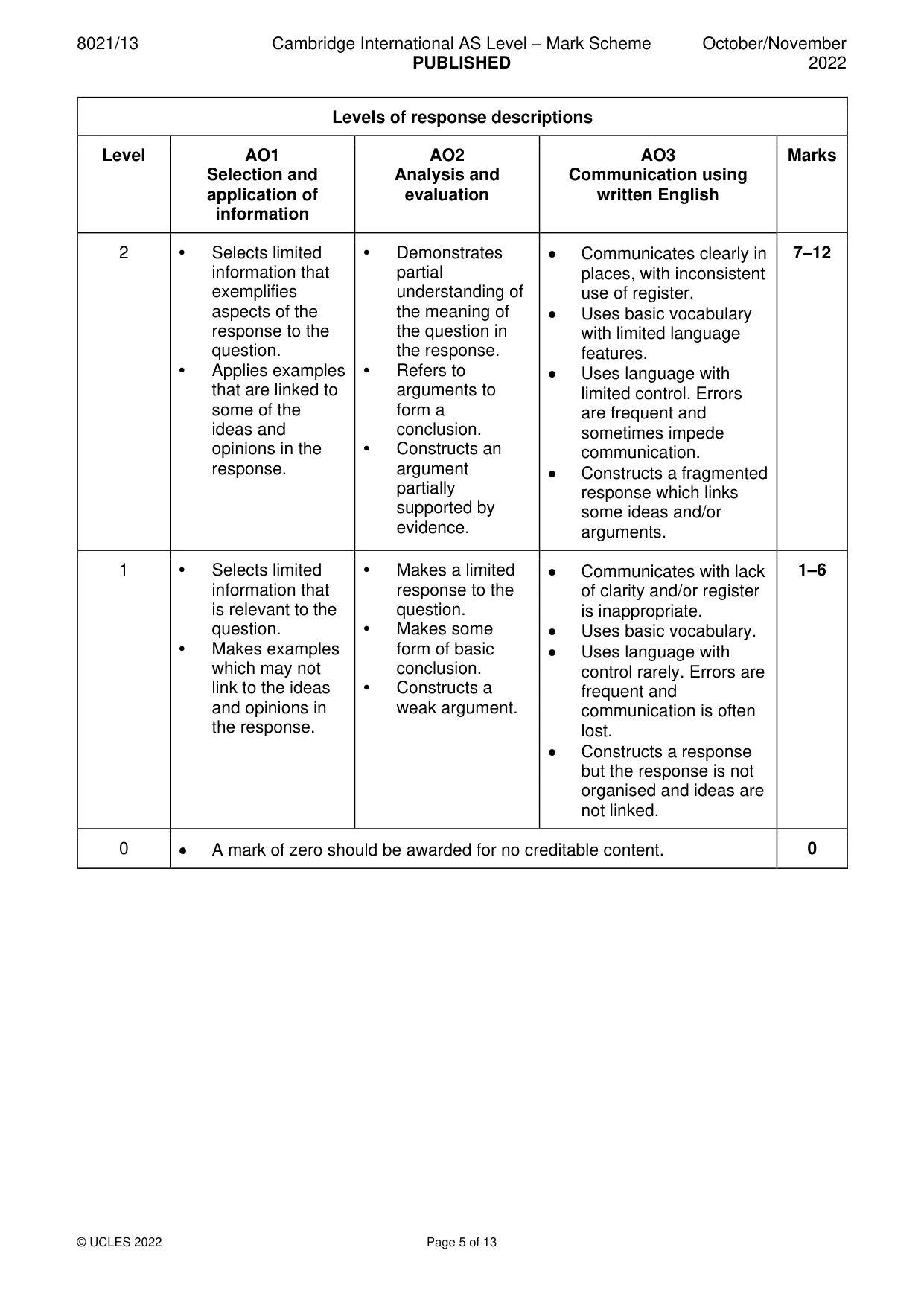
8021/13 Cambridge International AS Level – Mark Scheme PUBLISHED October/November 2022 © UCLES 2022 Page 5 of 13 Levels of response descriptions Level AO1 Selection and application of information AO2 Analysis and evaluation AO3 Communication using written English Marks 2 • Selects limited information that exemplifies aspects of the response to the question. • Applies examples that are linked to some of the ideas and opinions in the response. • Demonstrates partial understanding of the meaning of the question in the response. • Refers to arguments to form a conclusion. • Constructs an argument partially supported by evidence. • Communicates clearly in places, with inconsistent use of register. • Uses basic vocabulary with limited language features. • Uses language with limited control. Errors are frequent and sometimes impede communication. • Constructs a fragmented response which links some ideas and/or arguments. 7–12 1 • Selects limited information that is relevant to the question. • Makes examples which may not link to the ideas and opinions in the response. • Makes a limited response to the question. • Makes some form of basic conclusion. • Constructs a weak argument. • Communicates with lack of clarity and/or register is inappropriate. • Uses basic vocabulary. • Uses language with control rarely. Errors are frequent and communication is often lost. • Constructs a response but the response is not organised and ideas are not linked. 1–6 0 • A mark of zero should be awarded for no creditable content. 0
Mark scheme, page 6
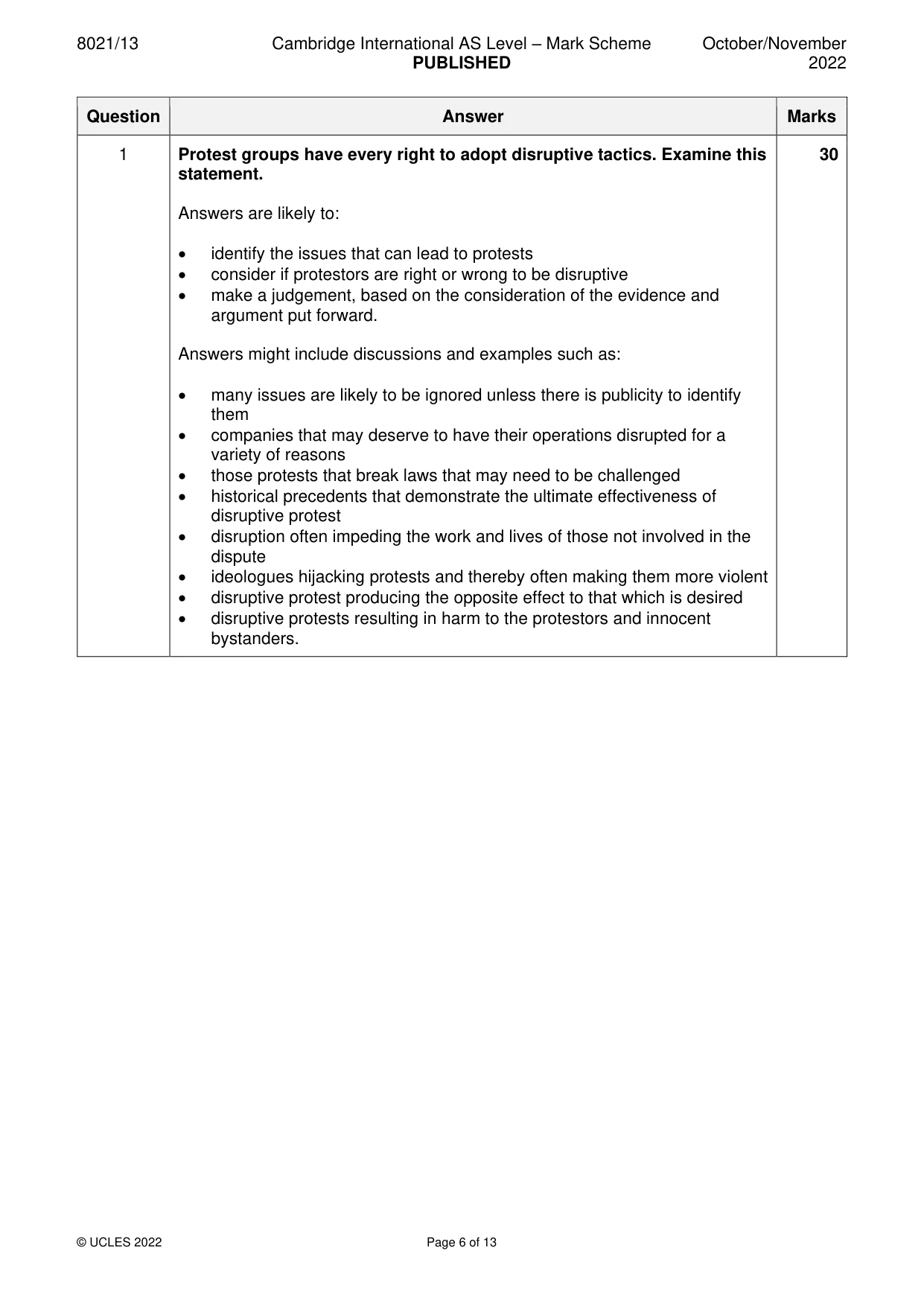
8021/13 Cambridge International AS Level – Mark Scheme PUBLISHED October/November 2022 © UCLES 2022 Page 6 of 13 Question Answer Marks 1 Protest groups have every right to adopt disruptive tactics. Examine this statement. Answers are likely to: • identify the issues that can lead to protests • consider if protestors are right or wrong to be disruptive • make a judgement, based on the consideration of the evidence and argument put forward. Answers might include discussions and examples such as: • many issues are likely to be ignored unless there is publicity to identify them • companies that may deserve to have their operations disrupted for a variety of reasons • those protests that break laws that may need to be challenged • historical precedents that demonstrate the ultimate effectiveness of disruptive protest • disruption often impeding the work and lives of those not involved in the dispute • ideologues hijacking protests and thereby often making them more violent • disruptive protest producing the opposite effect to that which is desired • disruptive protests resulting in harm to the protestors and innocent bystanders. 30
Mark scheme, page 7
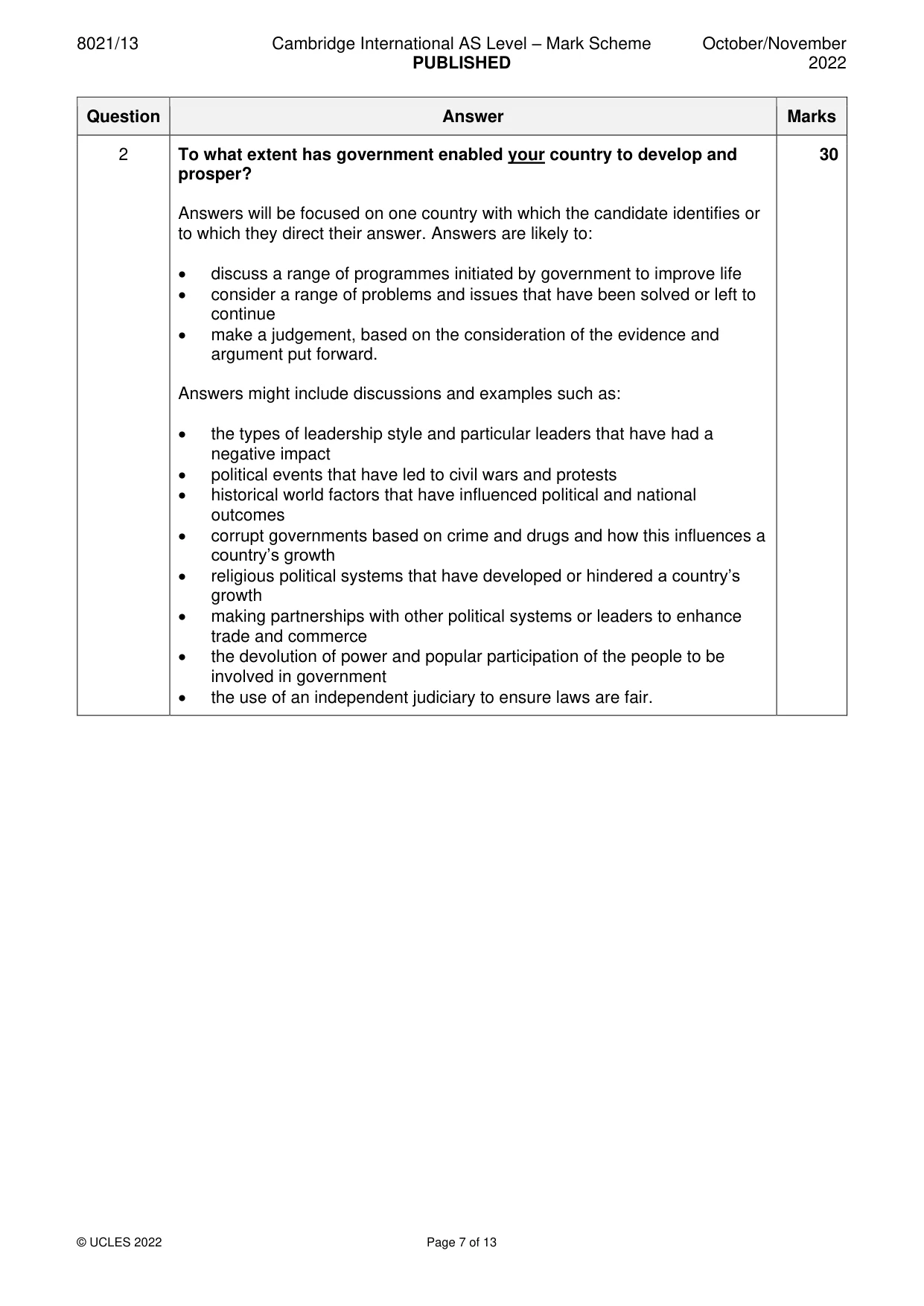
8021/13 Cambridge International AS Level – Mark Scheme PUBLISHED October/November 2022 © UCLES 2022 Page 7 of 13 Question Answer Marks 2 To what extent has government enabled your country to develop and prosper? Answers will be focused on one country with which the candidate identifies or to which they direct their answer. Answers are likely to: • discuss a range of programmes initiated by government to improve life • consider a range of problems and issues that have been solved or left to continue • make a judgement, based on the consideration of the evidence and argument put forward. Answers might include discussions and examples such as: • the types of leadership style and particular leaders that have had a negative impact • political events that have led to civil wars and protests • historical world factors that have influenced political and national outcomes • corrupt governments based on crime and drugs and how this influences a country’s growth • religious political systems that have developed or hindered a country’s growth • making partnerships with other political systems or leaders to enhance trade and commerce • the devolution of power and popular participation of the people to be involved in government • the use of an independent judiciary to ensure laws are fair. 30
Mark scheme, page 8
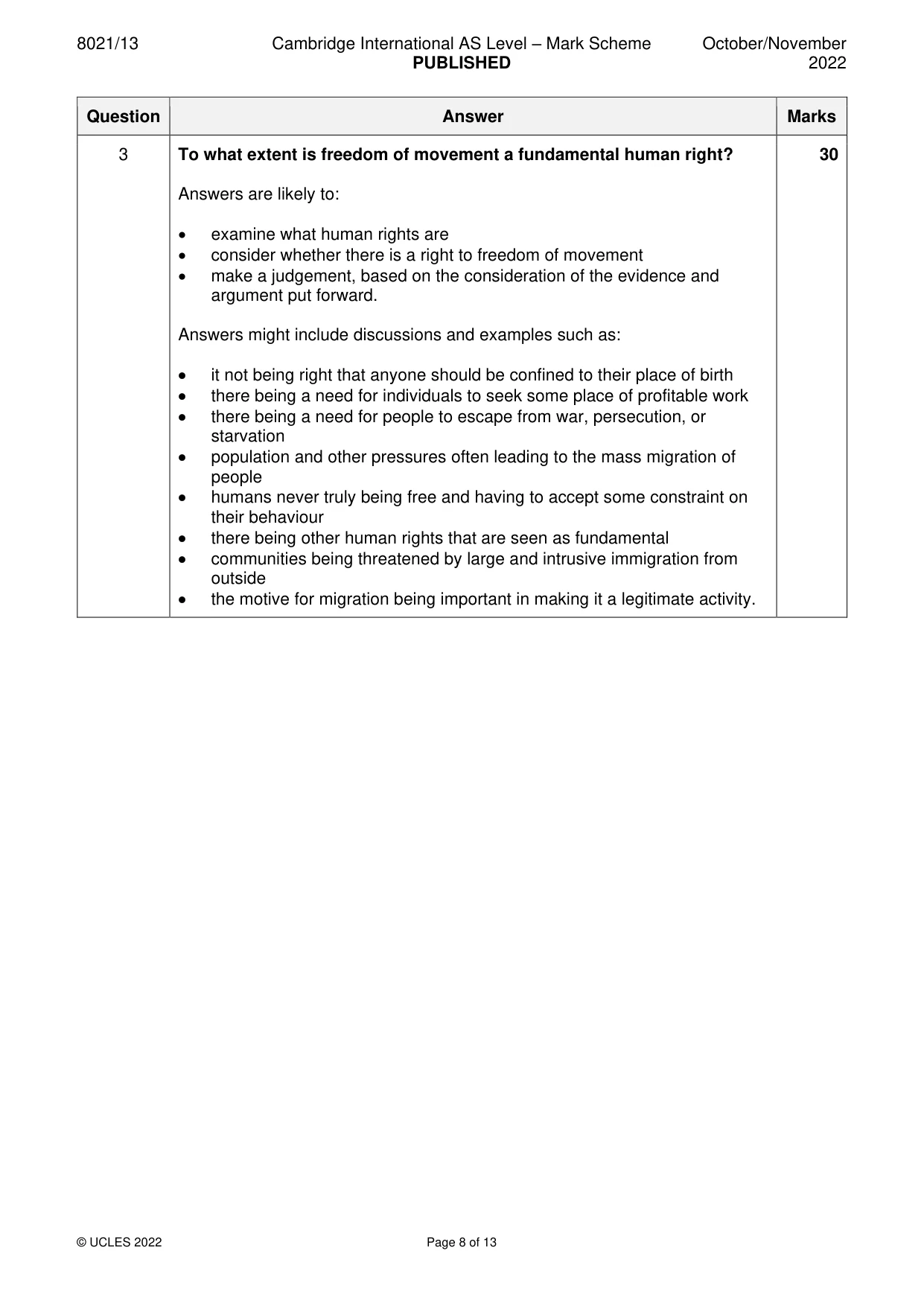
8021/13 Cambridge International AS Level – Mark Scheme PUBLISHED October/November 2022 © UCLES 2022 Page 8 of 13 Question Answer Marks 3 To what extent is freedom of movement a fundamental human right? Answers are likely to: • examine what human rights are • consider whether there is a right to freedom of movement • make a judgement, based on the consideration of the evidence and argument put forward. Answers might include discussions and examples such as: • it not being right that anyone should be confined to their place of birth • there being a need for individuals to seek some place of profitable work • there being a need for people to escape from war, persecution, or starvation • population and other pressures often leading to the mass migration of people • humans never truly being free and having to accept some constraint on their behaviour • there being other human rights that are seen as fundamental • communities being threatened by large and intrusive immigration from outside • the motive for migration being important in making it a legitimate activity. 30
Mark scheme, page 9
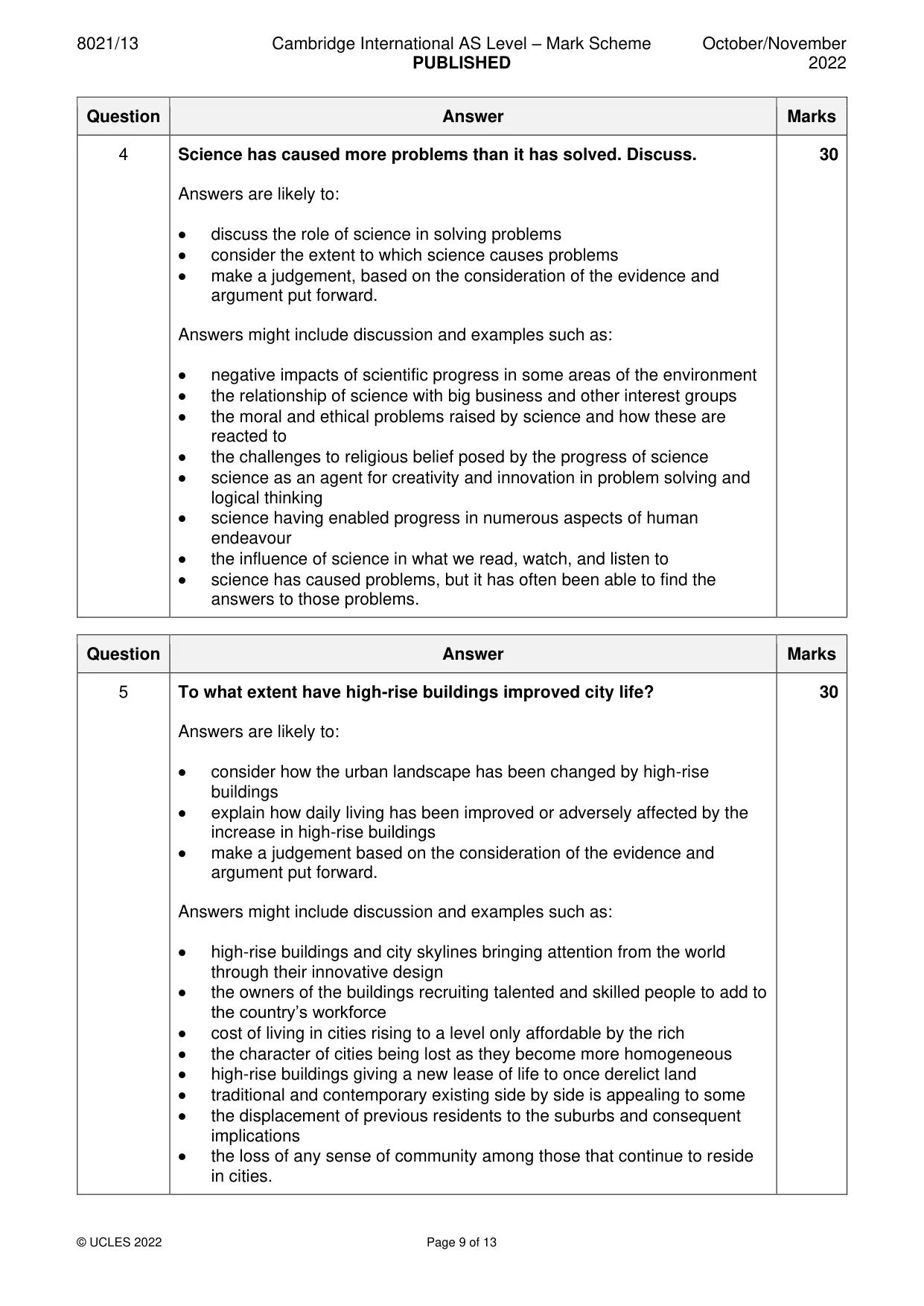
8021/13 Cambridge International AS Level – Mark Scheme PUBLISHED October/November 2022 © UCLES 2022 Page 9 of 13 Question Answer Marks 4 Science has caused more problems than it has solved. Discuss. Answers are likely to: • discuss the role of science in solving problems • consider the extent to which science causes problems • make a judgement, based on the consideration of the evidence and argument put forward. Answers might include discussion and examples such as: • negative impacts of scientific progress in some areas of the environment • the relationship of science with big business and other interest groups • the moral and ethical problems raised by science and how these are reacted to • the challenges to religious belief posed by the progress of science • science as an agent for creativity and innovation in problem solving and logical thinking • science having enabled progress in numerous aspects of human endeavour • the influence of science in what we read, watch, and listen to • science has caused problems, but it has often been able to find the answers to those problems. 30 Question Answer Marks 5 To what extent have high-rise buildings improved city life? Answers are likely to: • consider how the urban landscape has been changed by high-rise buildings • explain how daily living has been improved or adversely affected by the increase in high-rise buildings • make a judgement based on the consideration of the evidence and argument put forward. Answers might include discussion and examples such as: • high-rise buildings and city skylines bringing attention from the world through their innovative design • the owners of the buildings recruiting talented and skilled people to add to the country’s workforce • cost of living in cities rising to a level only affordable by the rich • the character of cities being lost as they become more homogeneous • high-rise buildings giving a new lease of life to once derelict land • traditional and contemporary existing side by side is appealing to some • the displacement of previous residents to the suburbs and consequent implications • the loss of any sense of community among those that continue to reside in cities. 30
Mark scheme, page 10
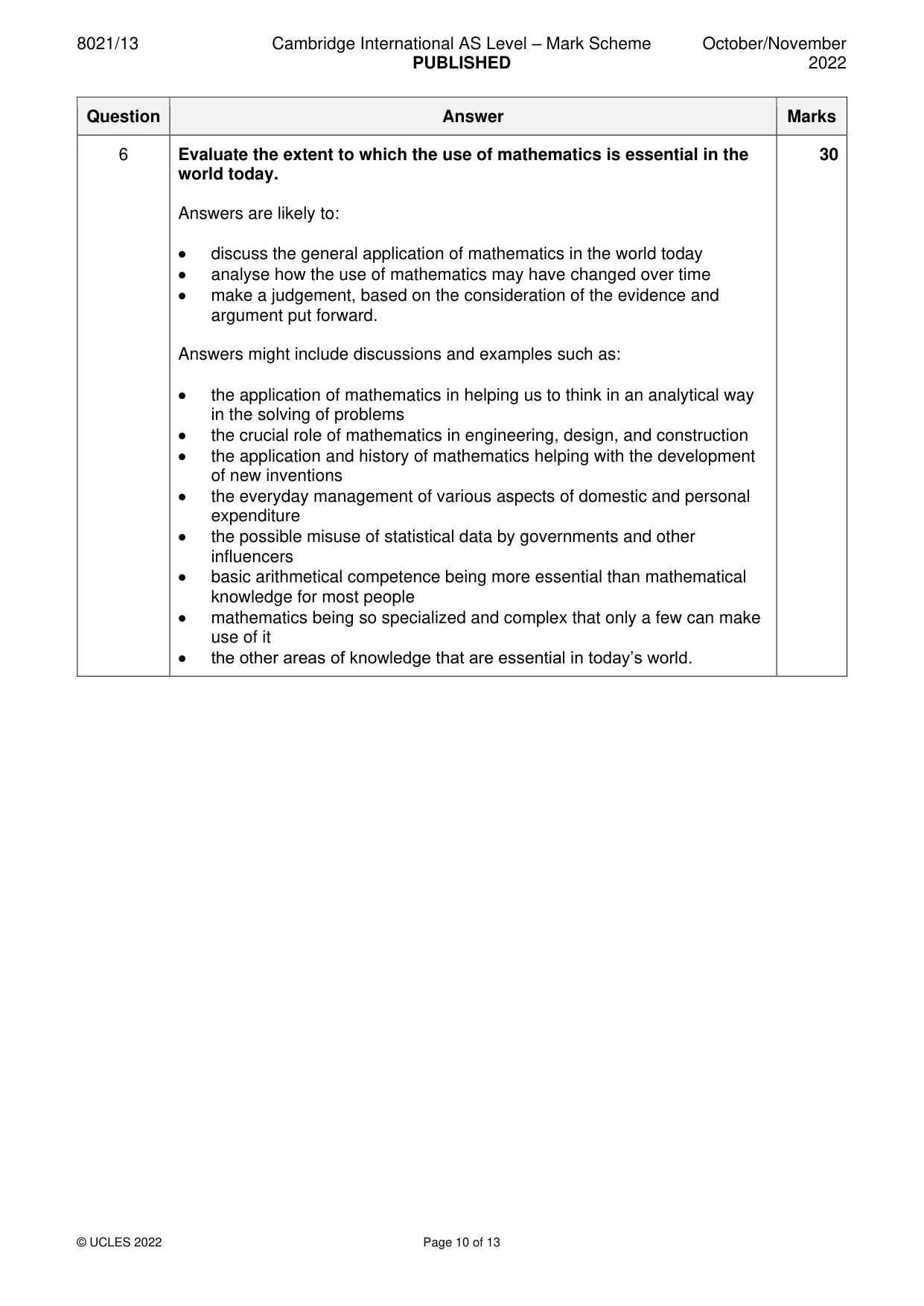
8021/13 Cambridge International AS Level – Mark Scheme PUBLISHED October/November 2022 © UCLES 2022 Page 10 of 13 Question Answer Marks 6 Evaluate the extent to which the use of mathematics is essential in the world today. Answers are likely to: • discuss the general application of mathematics in the world today • analyse how the use of mathematics may have changed over time • make a judgement, based on the consideration of the evidence and argument put forward. Answers might include discussions and examples such as: • the application of mathematics in helping us to think in an analytical way in the solving of problems • the crucial role of mathematics in engineering, design, and construction • the application and history of mathematics helping with the development of new inventions • the everyday management of various aspects of domestic and personal expenditure • the possible misuse of statistical data by governments and other influencers • basic arithmetical competence being more essential than mathematical knowledge for most people • mathematics being so specialized and complex that only a few can make use of it • the other areas of knowledge that are essential in today’s world. 30
Mark scheme, page 11
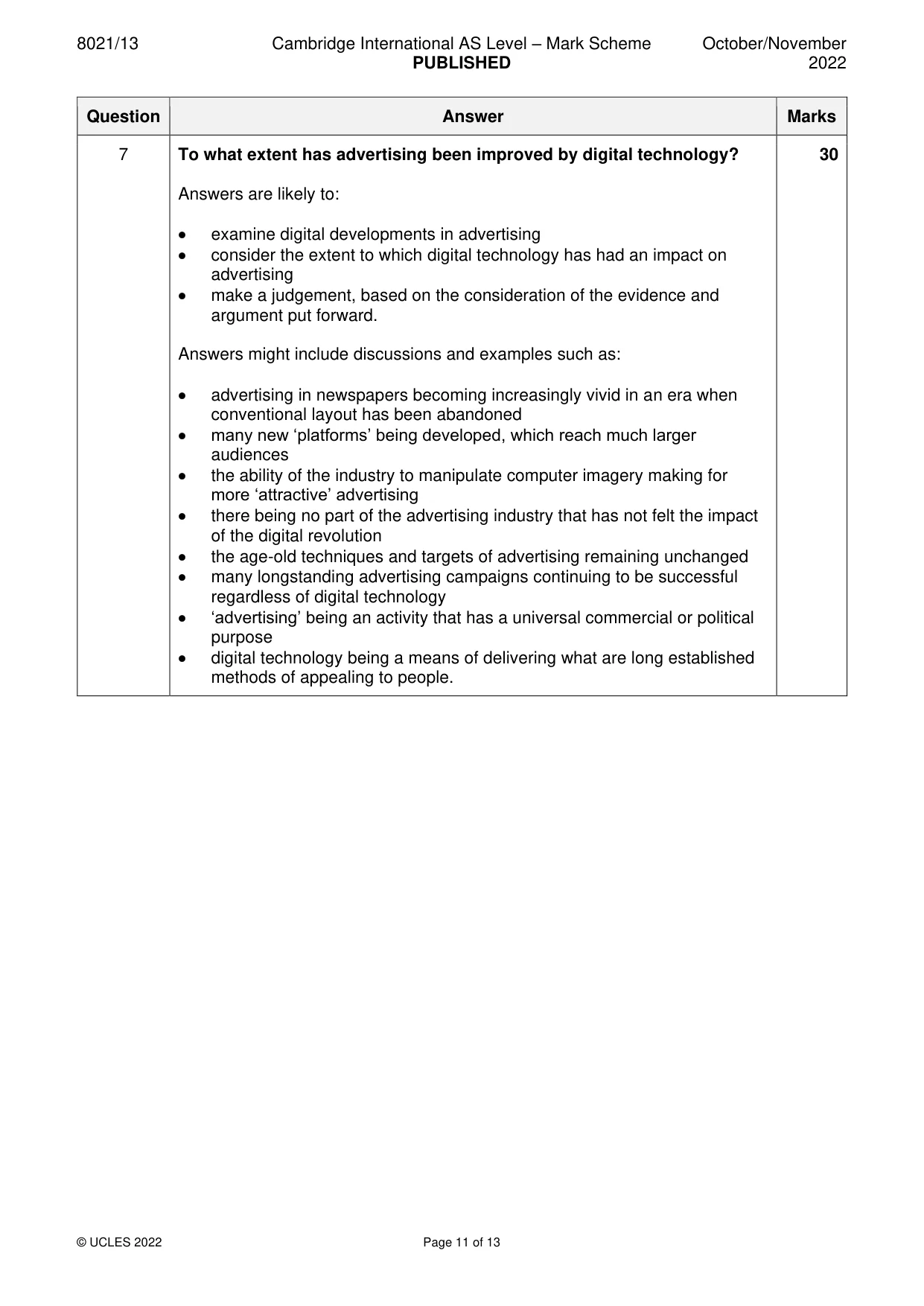
8021/13 Cambridge International AS Level – Mark Scheme PUBLISHED October/November 2022 © UCLES 2022 Page 11 of 13 Question Answer Marks 7 To what extent has advertising been improved by digital technology? Answers are likely to: • examine digital developments in advertising • consider the extent to which digital technology has had an impact on advertising • make a judgement, based on the consideration of the evidence and argument put forward. Answers might include discussions and examples such as: • advertising in newspapers becoming increasingly vivid in an era when conventional layout has been abandoned • many new ‘platforms’ being developed, which reach much larger audiences • the ability of the industry to manipulate computer imagery making for more ‘attractive’ advertising • there being no part of the advertising industry that has not felt the impact of the digital revolution • the age-old techniques and targets of advertising remaining unchanged • many longstanding advertising campaigns continuing to be successful regardless of digital technology • ‘advertising’ being an activity that has a universal commercial or political purpose • digital technology being a means of delivering what are long established methods of appealing to people. 30
Mark scheme, page 12
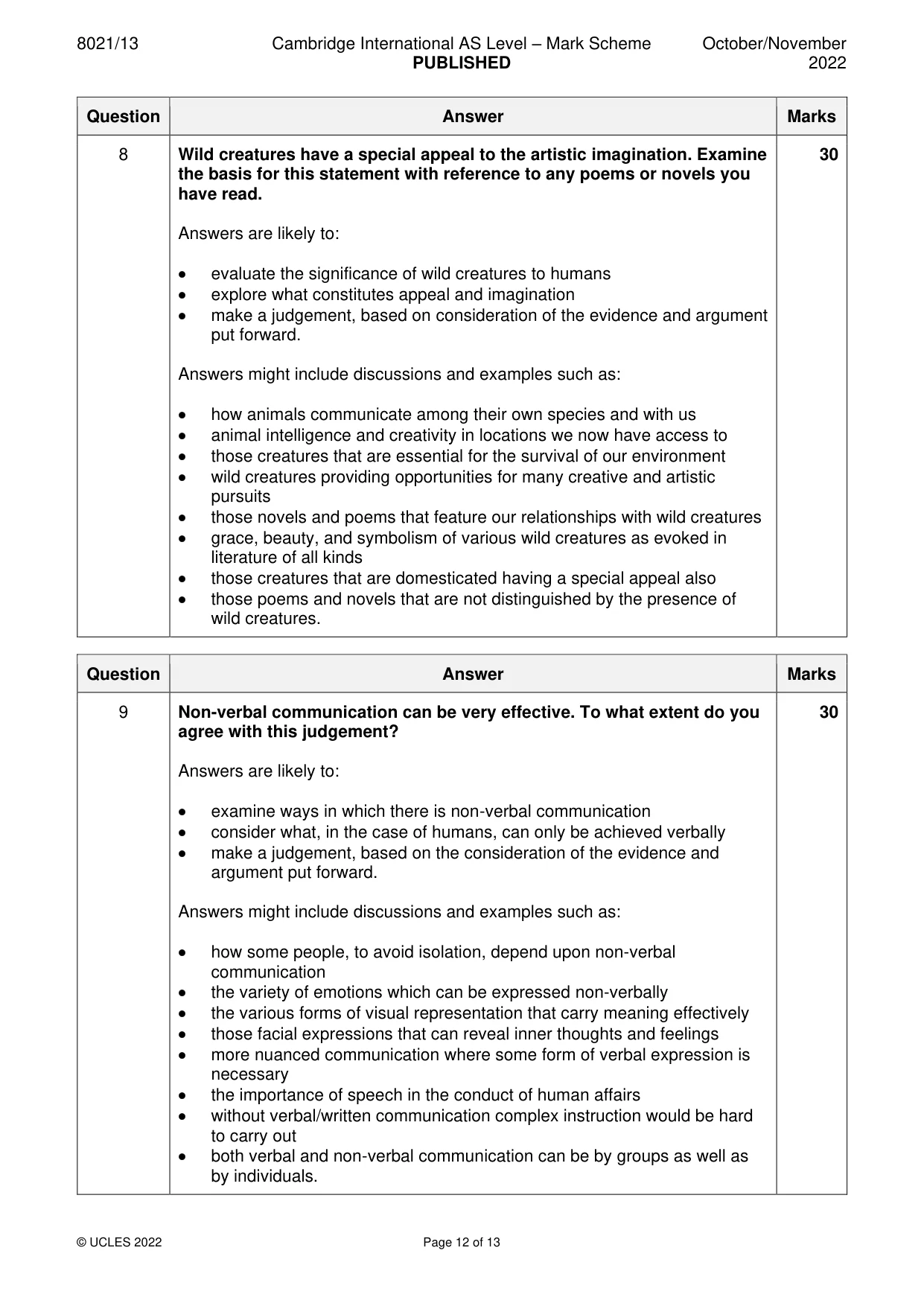
8021/13 Cambridge International AS Level – Mark Scheme PUBLISHED October/November 2022 © UCLES 2022 Page 12 of 13 Question Answer Marks 8 Wild creatures have a special appeal to the artistic imagination. Examine the basis for this statement with reference to any poems or novels you have read. Answers are likely to: • evaluate the significance of wild creatures to humans • explore what constitutes appeal and imagination • make a judgement, based on consideration of the evidence and argument put forward. Answers might include discussions and examples such as: • how animals communicate among their own species and with us • animal intelligence and creativity in locations we now have access to • those creatures that are essential for the survival of our environment • wild creatures providing opportunities for many creative and artistic pursuits • those novels and poems that feature our relationships with wild creatures • grace, beauty, and symbolism of various wild creatures as evoked in literature of all kinds • those creatures that are domesticated having a special appeal also • those poems and novels that are not distinguished by the presence of wild creatures. 30 Question Answer Marks 9 Non-verbal communication can be very effective. To what extent do you agree with this judgement? Answers are likely to: • examine ways in which there is non-verbal communication • consider what, in the case of humans, can only be achieved verbally • make a judgement, based on the consideration of the evidence and argument put forward. Answers might include discussions and examples such as: • how some people, to avoid isolation, depend upon non-verbal communication • the variety of emotions which can be expressed non-verbally • the various forms of visual representation that carry meaning effectively • those facial expressions that can reveal inner thoughts and feelings • more nuanced communication where some form of verbal expression is necessary • the importance of speech in the conduct of human affairs • without verbal/written communication complex instruction would be hard to carry out • both verbal and non-verbal communication can be by groups as well as by individuals. 30
Mark scheme, page 13
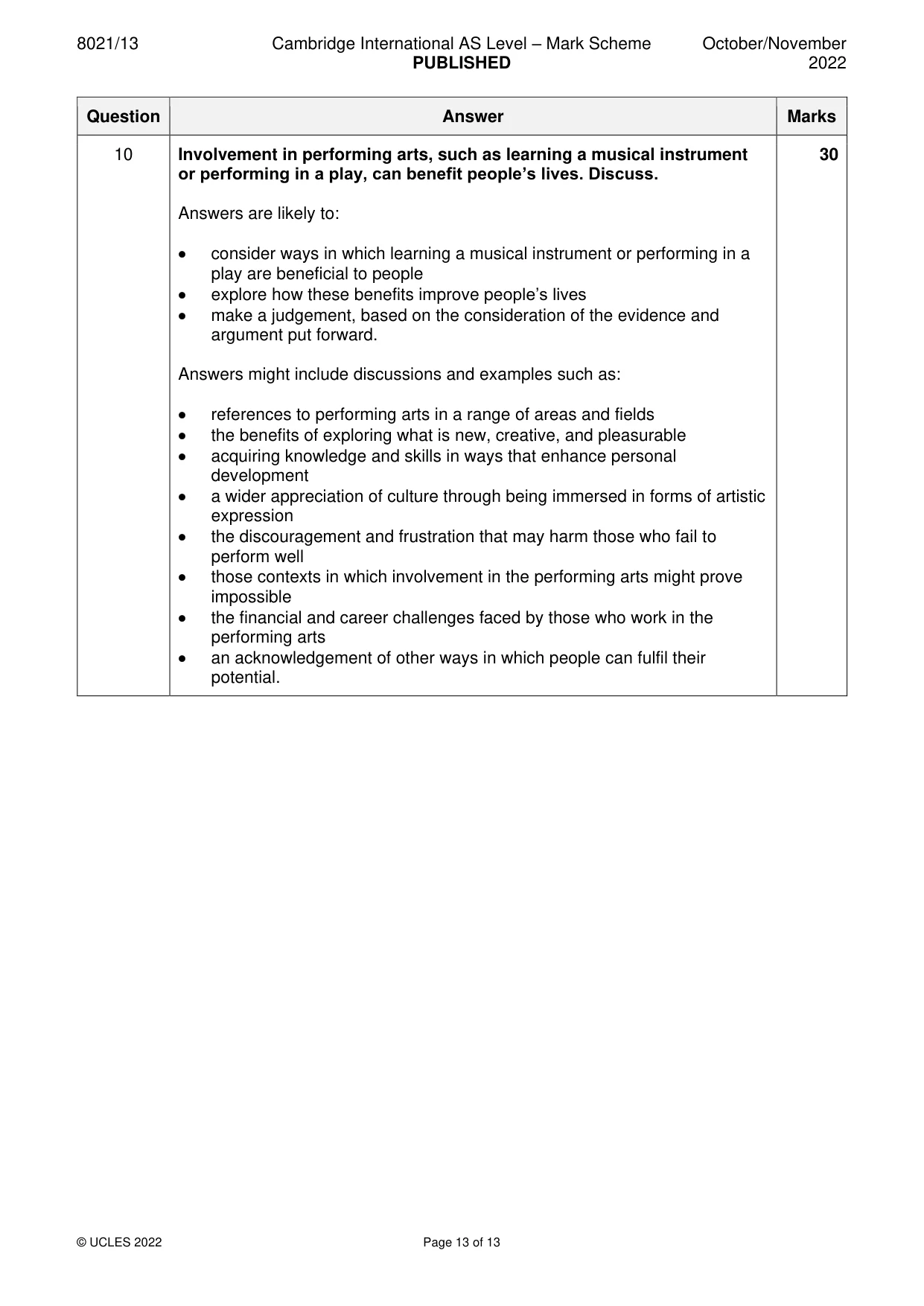
8021/13 Cambridge International AS Level – Mark Scheme PUBLISHED October/November 2022 © UCLES 2022 Page 13 of 13 Question Answer Marks 10 Involvement in performing arts, such as learning a musical instrument or performing in a play, can benefit people’s lives. Discuss. Answers are likely to: • consider ways in which learning a musical instrument or performing in a play are beneficial to people • explore how these benefits improve people’s lives • make a judgement, based on the consideration of the evidence and argument put forward. Answers might include discussions and examples such as: • references to performing arts in a range of areas and fields • the benefits of exploring what is new, creative, and pleasurable • acquiring knowledge and skills in ways that enhance personal development • a wider appreciation of culture through being immersed in forms of artistic expression • the discouragement and frustration that may harm those who fail to perform well • those contexts in which involvement in the performing arts might prove impossible • the financial and career challenges faced by those who work in the performing arts • an acknowledgement of other ways in which people can fulfil their potential. 30
What you needed in this session
Cambridge’s own grade thresholds for 2022 Oct/Nov, Paper 1 · Variant 3. A higher threshold means an easier paper — the bar moves with how the cohort did.