Cambridge A Level English General Paper 8021 — 2021 May/June Paper 1 · Variant 3
8021/13/M/J/21 · 30 marks · ≈34 min
The question paper and its mark scheme, free to read here and free to download. This is Cambridge’s own paper, exactly as it was sat.
Question paper4 pages


Mark scheme16 pages
Answers below. Sit the paper first if you are practising.
Paper as text
Question paper, page 1
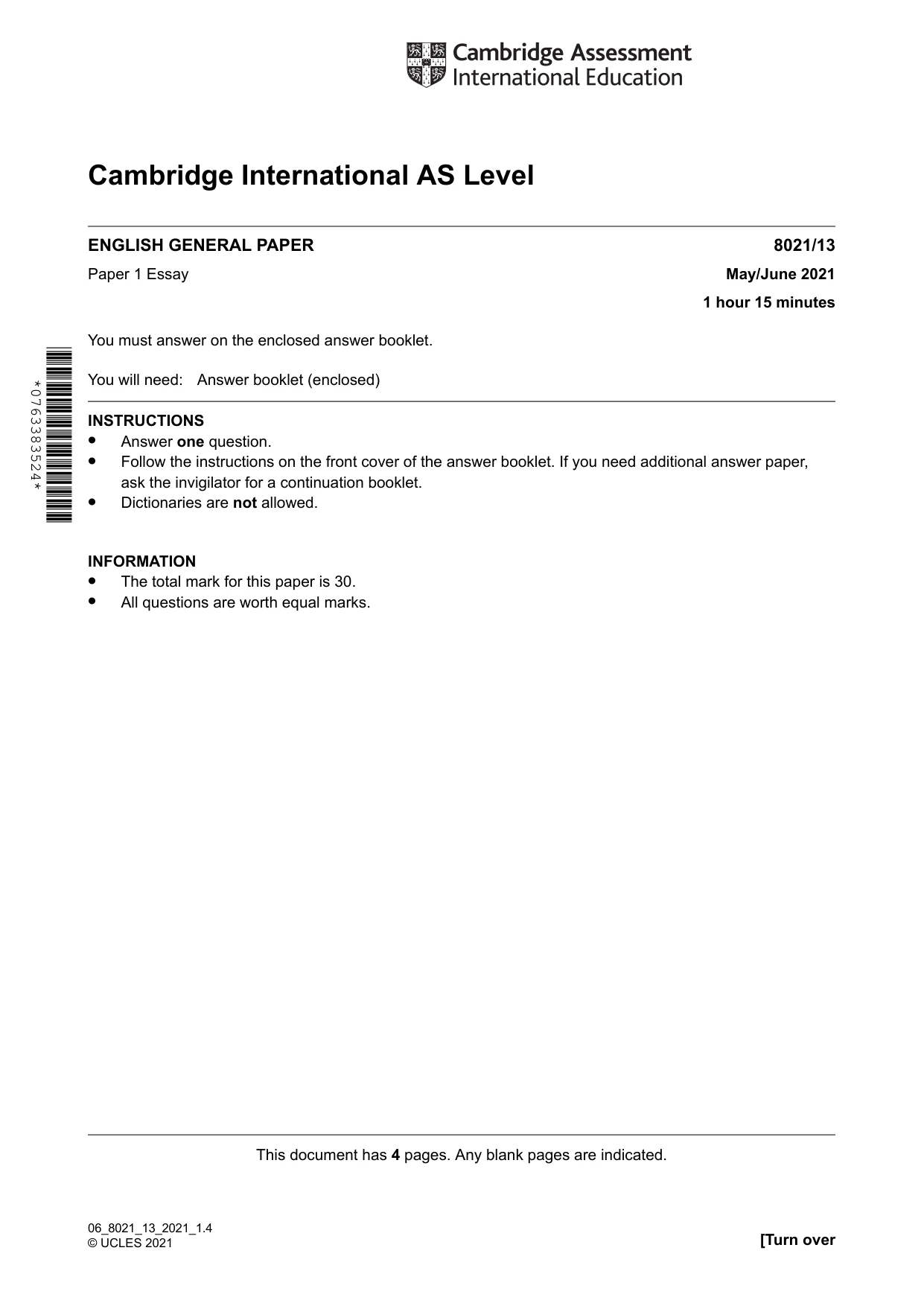
Cambridge International AS Level 8021/13 May/June 2021 1 hour 15 minutes ENGLISH GENERAL PAPER Paper 1 Essay You must answer on the enclosed answer booklet. You will need: Answer booklet (enclosed) INSTRUCTIONS • Answer one question. • Follow the instructions on the front cover of the answer booklet. If you need additional answer paper, ask the invigilator for a continuation booklet. • Dictionaries are not allowed. INFORMATION • The total mark for this paper is 30. • All questions are worth equal marks. This document has 4 pages. Any blank pages are indicated. [Turn over 06_8021_13_2021_1.4 © UCLES 2021 *0763383524*
Question paper, page 2
BLANK PAGE 06_8021_13_2021_1.4 © UCLES 2021 2
Question paper, page 3
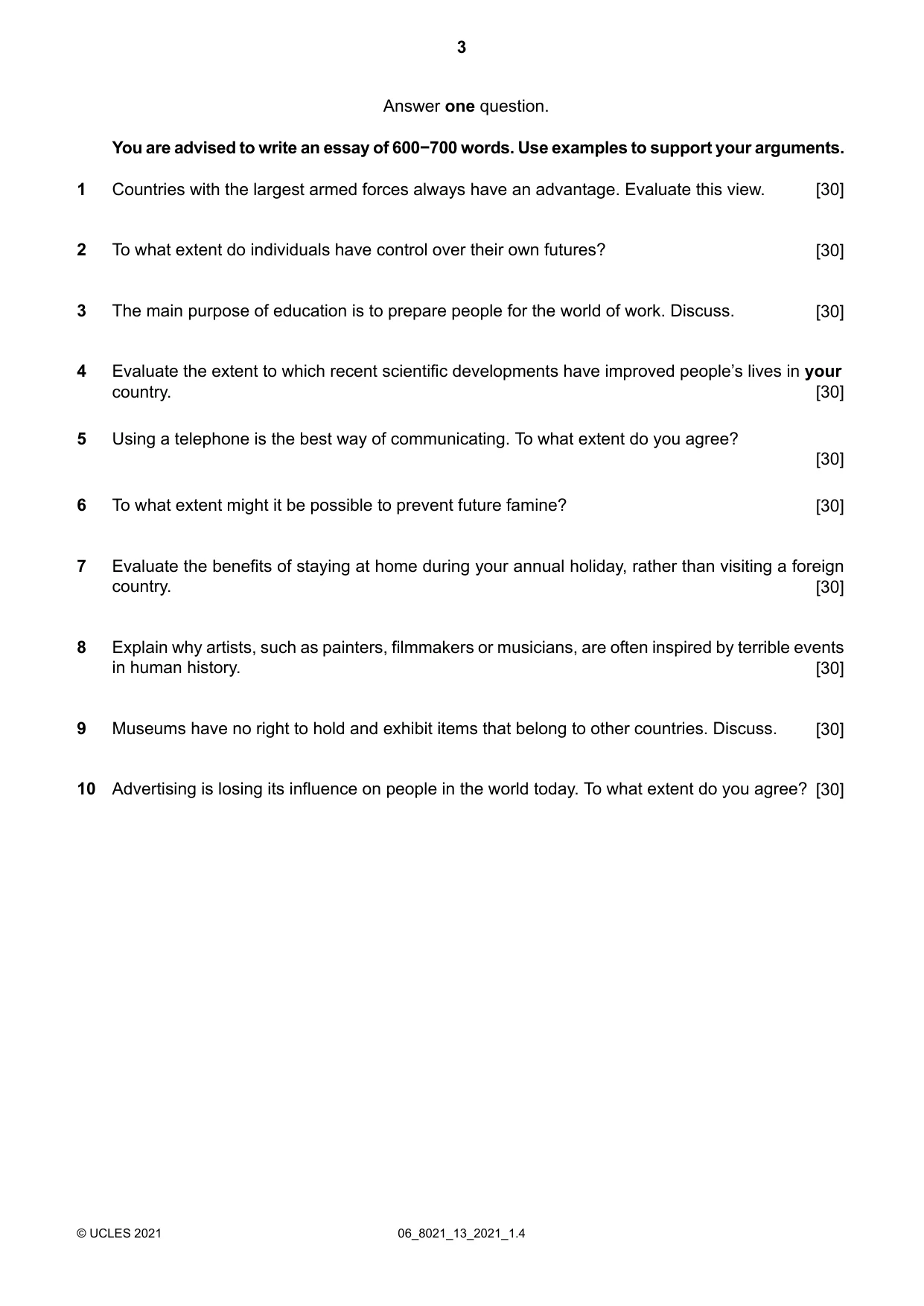
Answer one question. You are advised to write an essay of 600−700 words. Use examples to support your arguments. Countries with the largest armed forces always have an advantage. Evaluate this view. [30] 1 To what extent do individuals have control over their own futures? [30] 2 The main purpose of education is to prepare people for the world of work. Discuss. [30] 3 Evaluate the extent to which recent scientific developments have improved people’s lives in your country. [30] 4 Using a telephone is the best way of communicating. To what extent do you agree? [30] 5 To what extent might it be possible to prevent future famine? [30] 6 Evaluate the benefits of staying at home during your annual holiday, rather than visiting a foreign country. [30] 7 Explain why artists, such as painters, filmmakers or musicians, are often inspired by terrible events in human history. [30] 8 Museums have no right to hold and exhibit items that belong to other countries. Discuss. [30] 9 Advertising is losing its influence on people in the world today. To what extent do you agree? [30] 10 06_8021_13_2021_1.4 © UCLES 2021 3
Question paper, page 4
BLANK PAGE Permission to reproduce items where third-party owned material protected by copyright is included has been sought and cleared where possible. Every reasonable effort has been made by the publisher (UCLES) to trace copyright holders, but if any items requiring clearance have unwittingly been included, the publisher will be pleased to make amends at the earliest possible opportunity. To avoid the issue of disclosure of answer-related information to candidates, all copyright acknowledgements are reproduced online in the Cambridge Assessment International Education Copyright Acknowledgements Booklet. This is produced for each series of examinations and is freely available to download at www.cambridgeinternational.org after the live examination series. Cambridge Assessment International Education is part of the Cambridge Assessment Group. Cambridge Assessment is the brand name of the University of Cambridge Local Examinations Syndicate (UCLES), which itself is a department of the University of Cambridge. 06_8021_13_2021_1.4 © UCLES 2021 4
Mark scheme, page 1
This document consists of 16 printed pages. © UCLES 2021 [Turn over Cambridge International AS Level ENGLISH GENERAL PAPER 8021/13 Paper 1 Essay May/June 2021 MARK SCHEME Maximum Mark: 30 Published This mark scheme is published as an aid to teachers and candidates, to indicate the requirements of the examination. It shows the basis on which Examiners were instructed to award marks. It does not indicate the details of the discussions that took place at an Examiners’ meeting before marking began, which would have considered the acceptability of alternative answers. Mark schemes should be read in conjunction with the question paper and the Principal Examiner Report for Teachers. Cambridge International will not enter into discussions about these mark schemes. Cambridge International is publishing the mark schemes for the May/June 2021 series for most Cambridge IGCSE™, Cambridge International A and AS Level components and some Cambridge O Level components.
Mark scheme, page 2
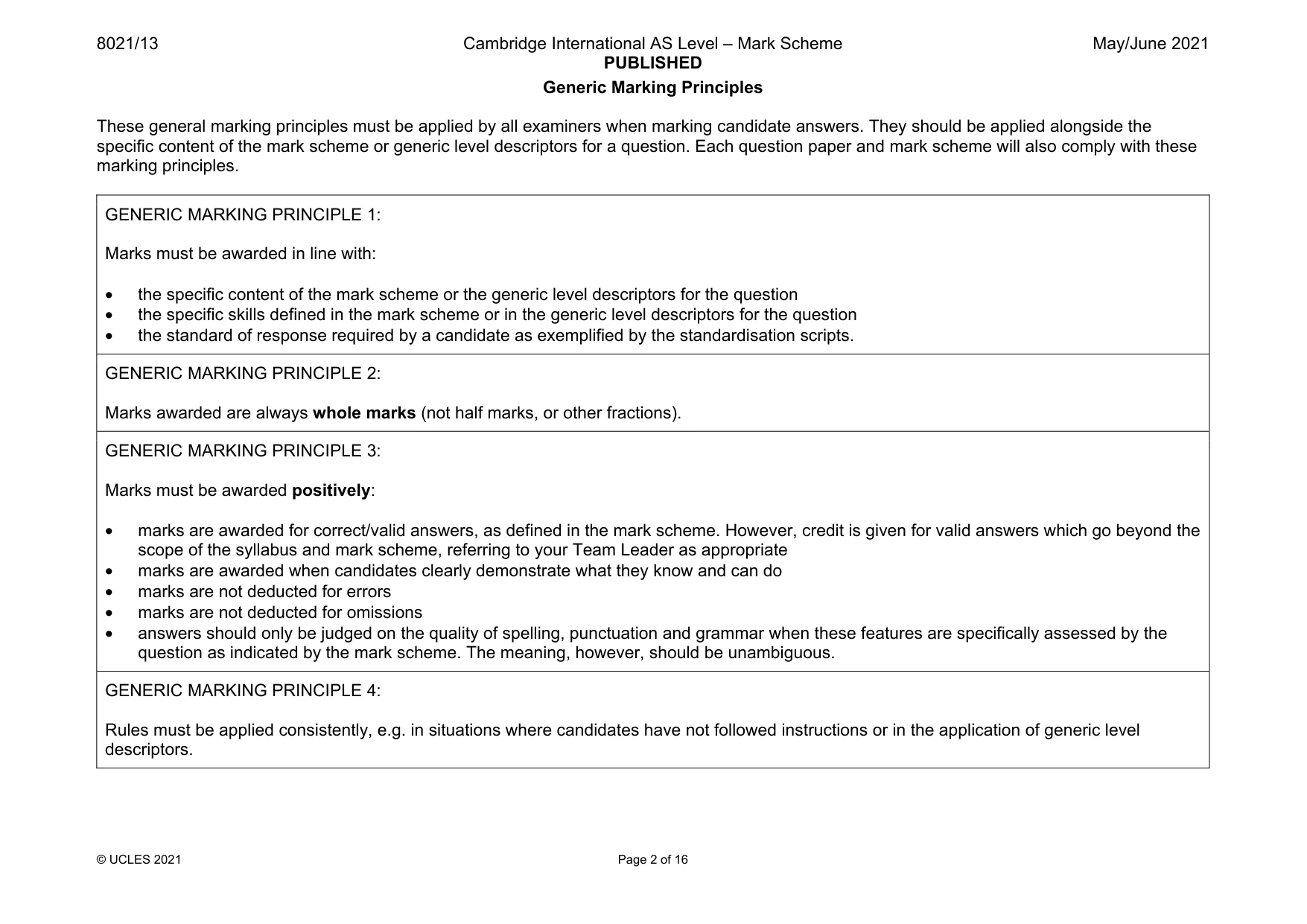
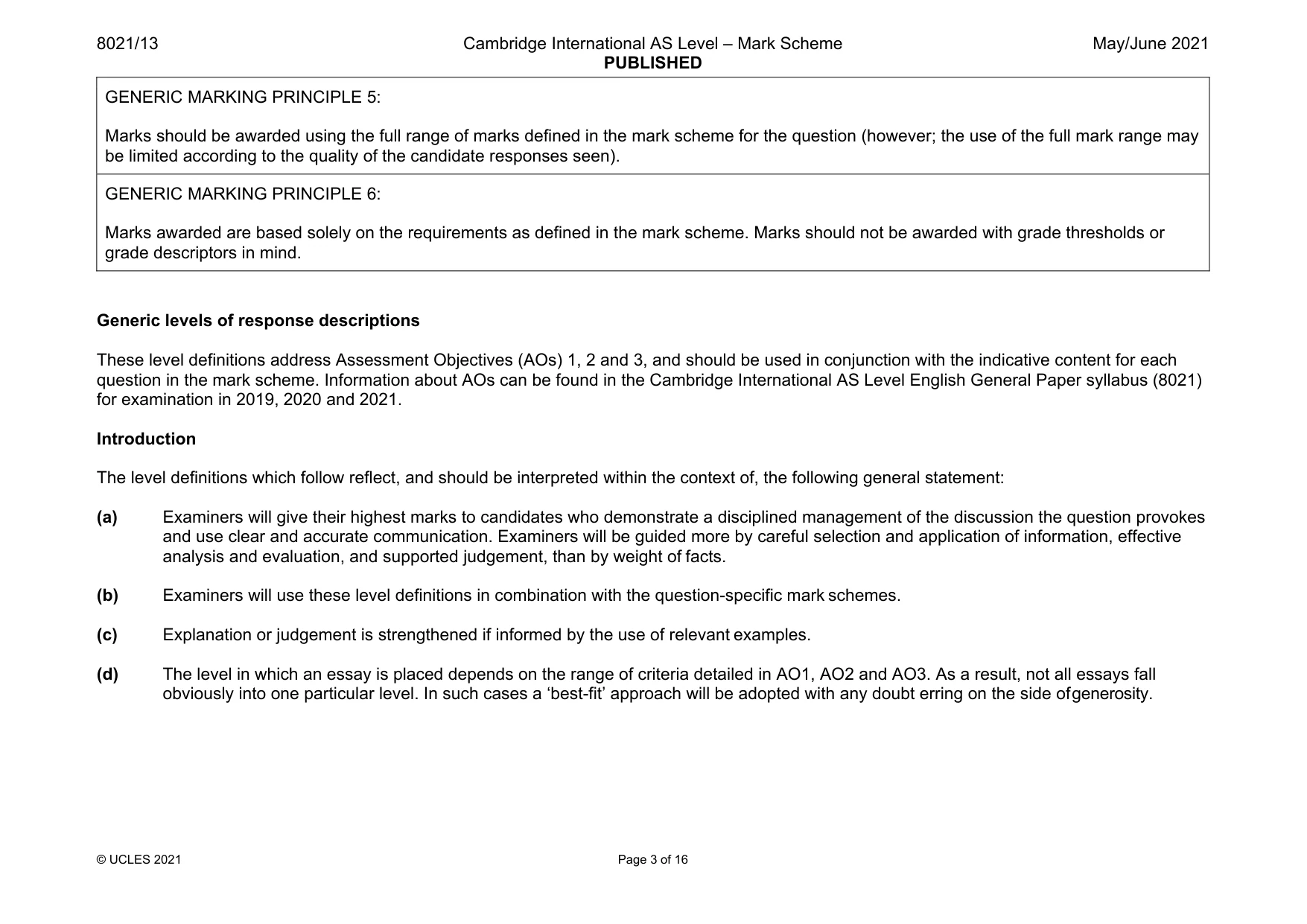
8021/13 Cambridge International AS Level – Mark Scheme PUBLISHED May/June 2021 © UCLES 2021 Page 2 of 16 Generic Marking Principles These general marking principles must be applied by all examiners when marking candidate answers. They should be applied alongside the specific content of the mark scheme or generic level descriptors for a question. Each question paper and mark scheme will also comply with these marking principles. GENERIC MARKING PRINCIPLE 1: Marks must be awarded in line with: • the specific content of the mark scheme or the generic level descriptors for the question • the specific skills defined in the mark scheme or in the generic level descriptors for the question • the standard of response required by a candidate as exemplified by the standardisation scripts. GENERIC MARKING PRINCIPLE 2: Marks awarded are always whole marks (not half marks, or other fractions). GENERIC MARKING PRINCIPLE 3: Marks must be awarded positively: • marks are awarded for correct/valid answers, as defined in the mark scheme. However, credit is given for valid answers which go beyond the scope of the syllabus and mark scheme, referring to your Team Leader as appropriate • marks are awarded when candidates clearly demonstrate what they know and can do • marks are not deducted for errors • marks are not deducted for omissions • answers should only be judged on the quality of spelling, punctuation and grammar when these features are specifically assessed by the question as indicated by the mark scheme. The meaning, however, should be unambiguous. GENERIC MARKING PRINCIPLE 4: Rules must be applied consistently, e.g. in situations where candidates have not followed instructions or in the application of generic level descriptors.
Mark scheme, page 3
8021/13 Cambridge International AS Level – Mark Scheme PUBLISHED May/June 2021 © UCLES 2021 Page 3 of 16 GENERIC MARKING PRINCIPLE 5: Marks should be awarded using the full range of marks defined in the mark scheme for the question (however; the use of the full mark range may be limited according to the quality of the candidate responses seen). GENERIC MARKING PRINCIPLE 6: Marks awarded are based solely on the requirements as defined in the mark scheme. Marks should not be awarded with grade thresholds or grade descriptors in mind. Generic levels of response descriptions These level definitions address Assessment Objectives (AOs) 1, 2 and 3, and should be used in conjunction with the indicative content for each question in the mark scheme. Information about AOs can be found in the Cambridge International AS Level English General Paper syllabus (8021) for examination in 2019, 2020 and 2021. Introduction The level definitions which follow reflect, and should be interpreted within the context of, the following general statement: (a) Examiners will give their highest marks to candidates who demonstrate a disciplined management of the discussion the question provokes and use clear and accurate communication. Examiners will be guided more by careful selection and application of information, effective analysis and evaluation, and supported judgement, than by weight of facts. (b) Examiners will use these level definitions in combination with the question-specific mark schemes. (c) Explanation or judgement is strengthened if informed by the use of relevant examples. (d) The level in which an essay is placed depends on the range of criteria detailed in AO1, AO2 and AO3. As a result, not all essays fall obviously into one particular level. In such cases a ‘best-fit’ approach will be adopted with any doubt erring on the side of generosity.
Mark scheme, page 4
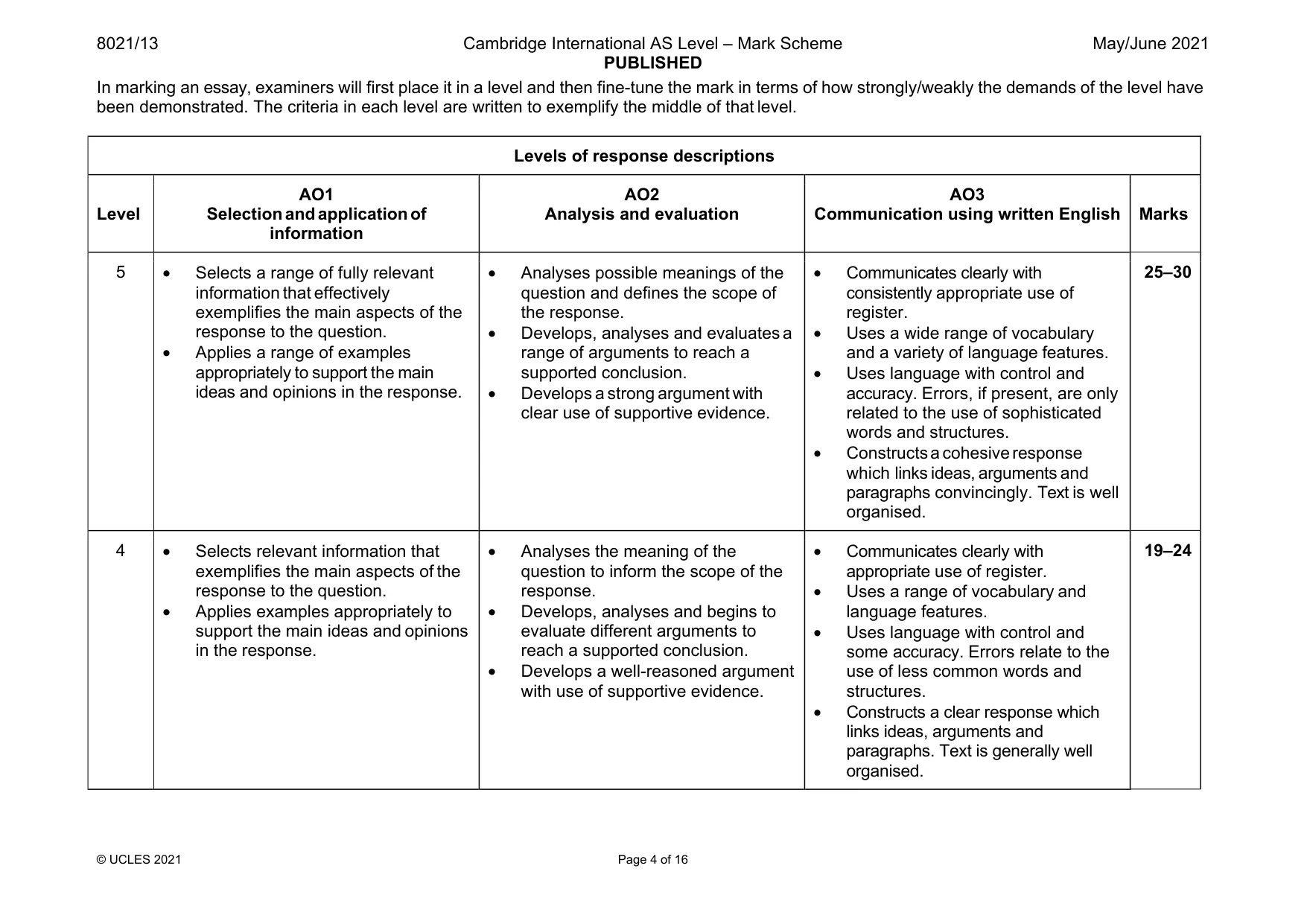
8021/13 Cambridge International AS Level – Mark Scheme PUBLISHED May/June 2021 © UCLES 2021 Page 4 of 16 In marking an essay, examiners will first place it in a level and then fine-tune the mark in terms of how strongly/weakly the demands of the level have been demonstrated. The criteria in each level are written to exemplify the middle of that level. Levels of response descriptions Level AO1 Selection and application of information AO2 Analysis and evaluation AO3 Communication using written English Marks 5 • Selects a range of fully relevant information that effectively exemplifies the main aspects of the response to the question. • Applies a range of examples appropriately to support the main ideas and opinions in the response. • Analyses possible meanings of the question and defines the scope of the response. • Develops, analyses and evaluates a range of arguments to reach a supported conclusion. • Develops a strong argument with clear use of supportive evidence. • Communicates clearly with consistently appropriate use of register. • Uses a wide range of vocabulary and a variety of language features. • Uses language with control and accuracy. Errors, if present, are only related to the use of sophisticated words and structures. • Constructs a cohesive response which links ideas, arguments and paragraphs convincingly. Text is well organised. 25–30 4 • Selects relevant information that exemplifies the main aspects of the response to the question. • Applies examples appropriately to support the main ideas and opinions in the response. • Analyses the meaning of the question to inform the scope of the response. • Develops, analyses and begins to evaluate different arguments to reach a supported conclusion. • Develops a well-reasoned argument with use of supportive evidence. • Communicates clearly with appropriate use of register. • Uses a range of vocabulary and language features. • Uses language with control and some accuracy. Errors relate to the use of less common words and structures. • Constructs a clear response which links ideas, arguments and paragraphs. Text is generally well organised. 19–24
Mark scheme, page 5
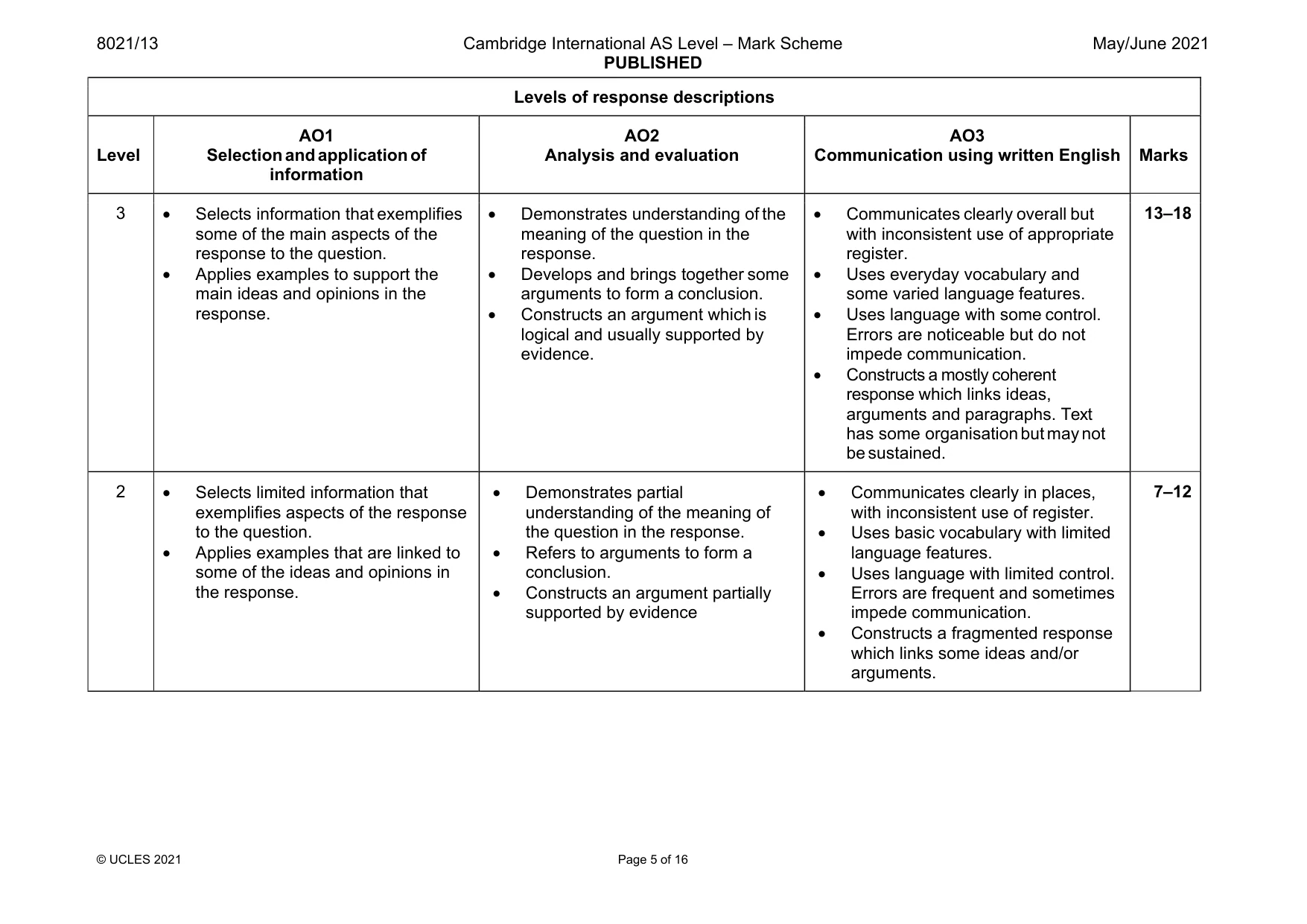
8021/13 Cambridge International AS Level – Mark Scheme PUBLISHED May/June 2021 © UCLES 2021 Page 5 of 16 Levels of response descriptions Level AO1 Selection and application of information AO2 Analysis and evaluation AO3 Communication using written English Marks 3 • Selects information that exemplifies some of the main aspects of the response to the question. • Applies examples to support the main ideas and opinions in the response. • Demonstrates understanding of the meaning of the question in the response. • Develops and brings together some arguments to form a conclusion. • Constructs an argument which is logical and usually supported by evidence. • Communicates clearly overall but with inconsistent use of appropriate register. • Uses everyday vocabulary and some varied language features. • Uses language with some control. Errors are noticeable but do not impede communication. • Constructs a mostly coherent response which links ideas, arguments and paragraphs. Text has some organisation but may not be sustained. 13–18 2 • Selects limited information that exemplifies aspects of the response to the question. • Applies examples that are linked to some of the ideas and opinions in the response. • Demonstrates partial understanding of the meaning of the question in the response. • Refers to arguments to form a conclusion. • Constructs an argument partially supported by evidence • Communicates clearly in places, with inconsistent use of register. • Uses basic vocabulary with limited language features. • Uses language with limited control. Errors are frequent and sometimes impede communication. • Constructs a fragmented response which links some ideas and/or arguments. 7–12
Mark scheme, page 6
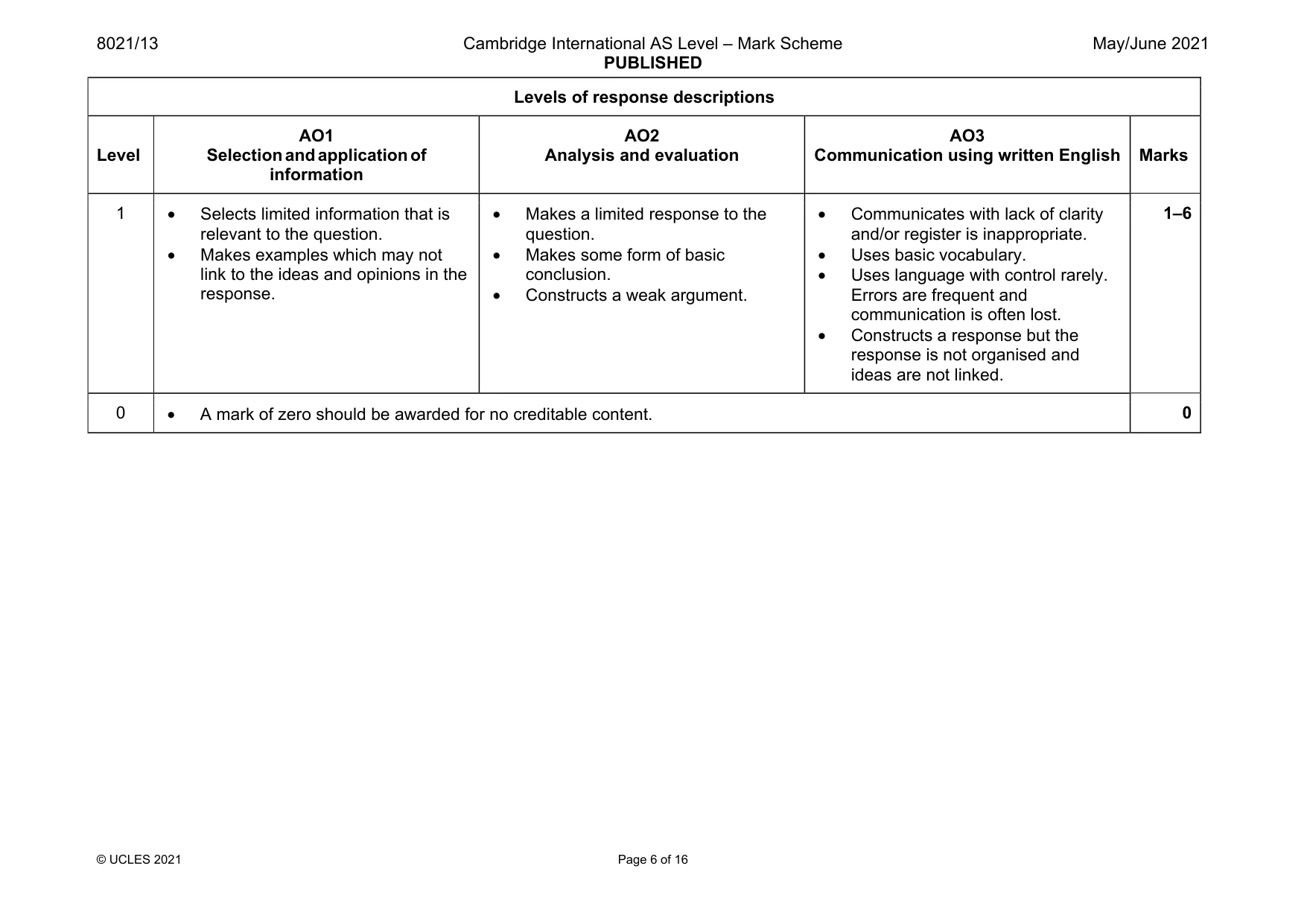
8021/13 Cambridge International AS Level – Mark Scheme PUBLISHED May/June 2021 © UCLES 2021 Page 6 of 16 Levels of response descriptions Level AO1 Selection and application of information AO2 Analysis and evaluation AO3 Communication using written English Marks 1 • Selects limited information that is relevant to the question. • Makes examples which may not link to the ideas and opinions in the response. • Makes a limited response to the question. • Makes some form of basic conclusion. • Constructs a weak argument. • Communicates with lack of clarity and/or register is inappropriate. • Uses basic vocabulary. • Uses language with control rarely. Errors are frequent and communication is often lost. • Constructs a response but the response is not organised and ideas are not linked. 1–6 0 • A mark of zero should be awarded for no creditable content. 0
Mark scheme, page 7
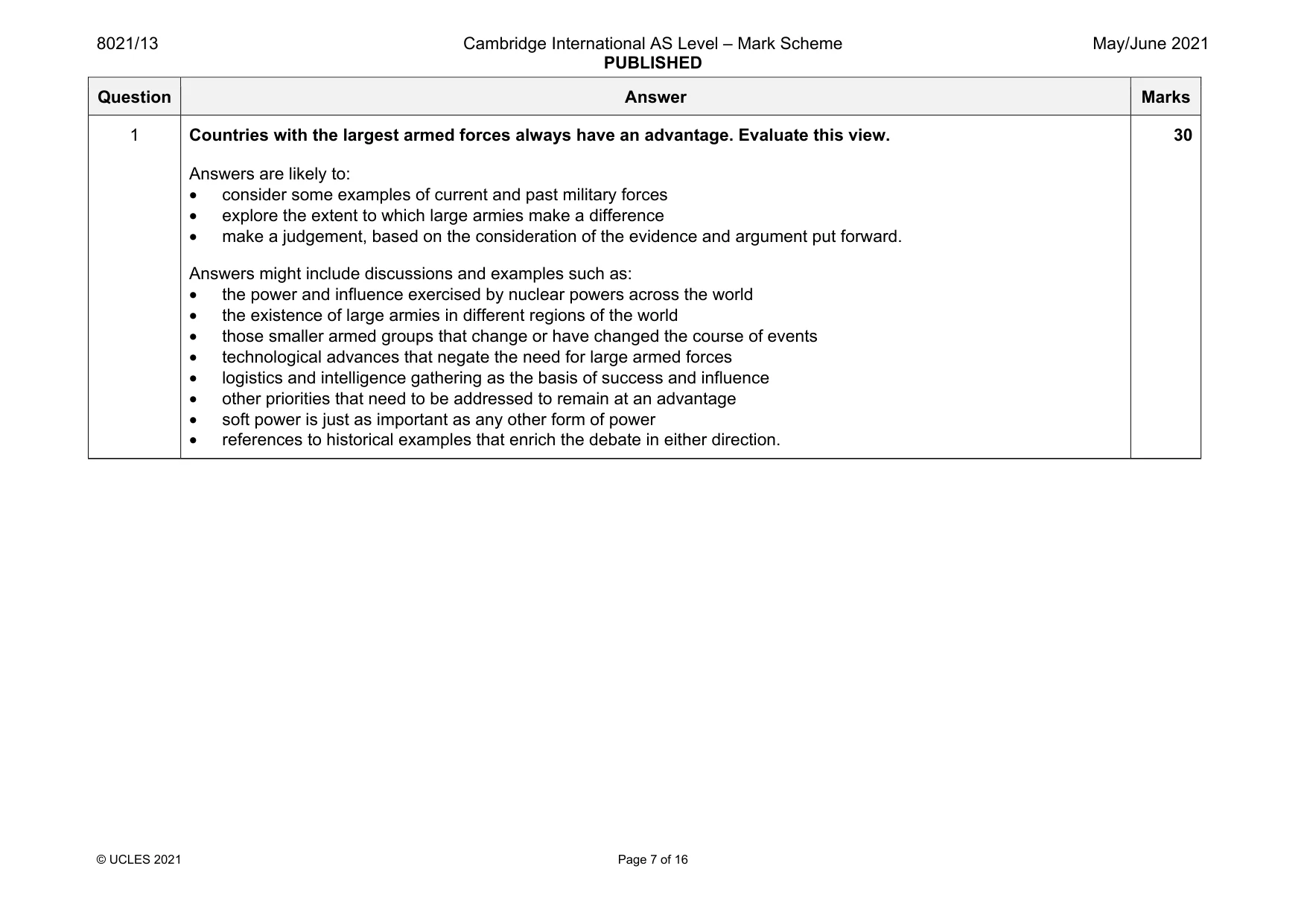
8021/13 Cambridge International AS Level – Mark Scheme PUBLISHED May/June 2021 © UCLES 2021 Page 7 of 16 Question Answer Marks 1 Countries with the largest armed forces always have an advantage. Evaluate this view. Answers are likely to: • consider some examples of current and past military forces • explore the extent to which large armies make a difference • make a judgement, based on the consideration of the evidence and argument put forward. Answers might include discussions and examples such as: • the power and influence exercised by nuclear powers across the world • the existence of large armies in different regions of the world • those smaller armed groups that change or have changed the course of events • technological advances that negate the need for large armed forces • logistics and intelligence gathering as the basis of success and influence • other priorities that need to be addressed to remain at an advantage • soft power is just as important as any other form of power • references to historical examples that enrich the debate in either direction. 30
Mark scheme, page 8
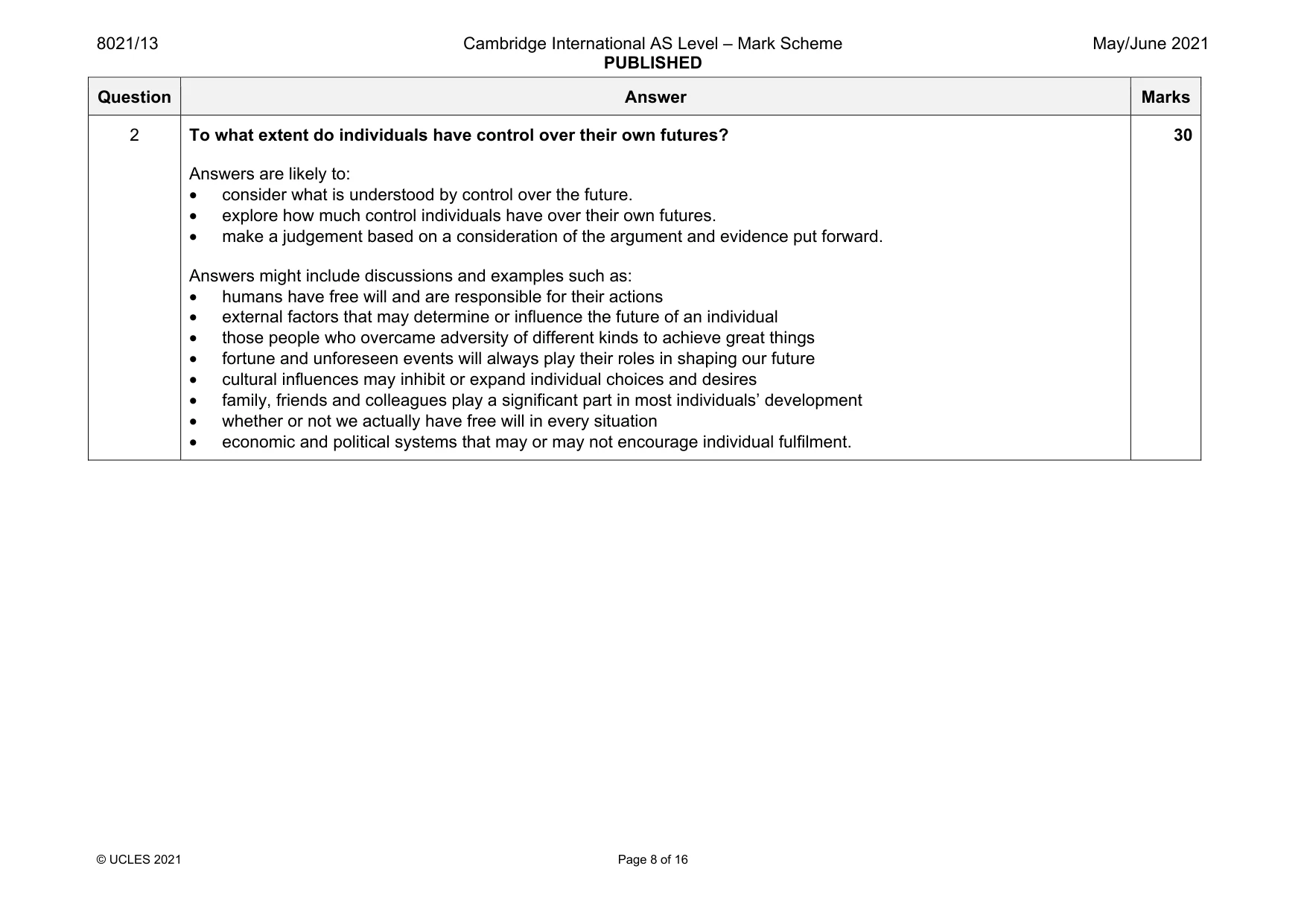
8021/13 Cambridge International AS Level – Mark Scheme PUBLISHED May/June 2021 © UCLES 2021 Page 8 of 16 Question Answer Marks 2 To what extent do individuals have control over their own futures? Answers are likely to: • consider what is understood by control over the future. • explore how much control individuals have over their own futures. • make a judgement based on a consideration of the argument and evidence put forward. Answers might include discussions and examples such as: • humans have free will and are responsible for their actions • external factors that may determine or influence the future of an individual • those people who overcame adversity of different kinds to achieve great things • fortune and unforeseen events will always play their roles in shaping our future • cultural influences may inhibit or expand individual choices and desires • family, friends and colleagues play a significant part in most individuals’ development • whether or not we actually have free will in every situation • economic and political systems that may or may not encourage individual fulfilment. 30
Mark scheme, page 9
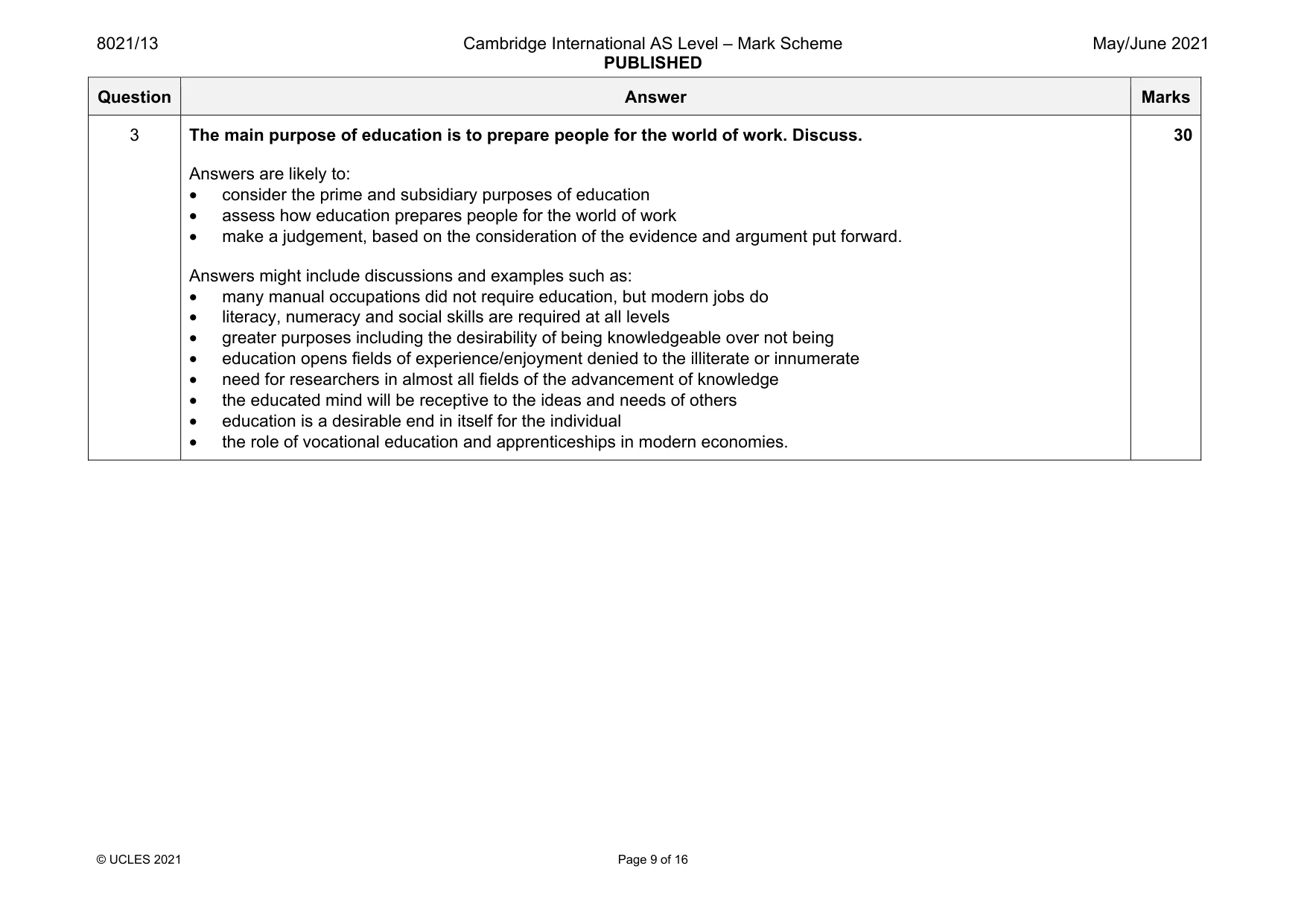
8021/13 Cambridge International AS Level – Mark Scheme PUBLISHED May/June 2021 © UCLES 2021 Page 9 of 16 Question Answer Marks 3 The main purpose of education is to prepare people for the world of work. Discuss. Answers are likely to: • consider the prime and subsidiary purposes of education • assess how education prepares people for the world of work • make a judgement, based on the consideration of the evidence and argument put forward. Answers might include discussions and examples such as: • many manual occupations did not require education, but modern jobs do • literacy, numeracy and social skills are required at all levels • greater purposes including the desirability of being knowledgeable over not being • education opens fields of experience/enjoyment denied to the illiterate or innumerate • need for researchers in almost all fields of the advancement of knowledge • the educated mind will be receptive to the ideas and needs of others • education is a desirable end in itself for the individual • the role of vocational education and apprenticeships in modern economies. 30
Mark scheme, page 10
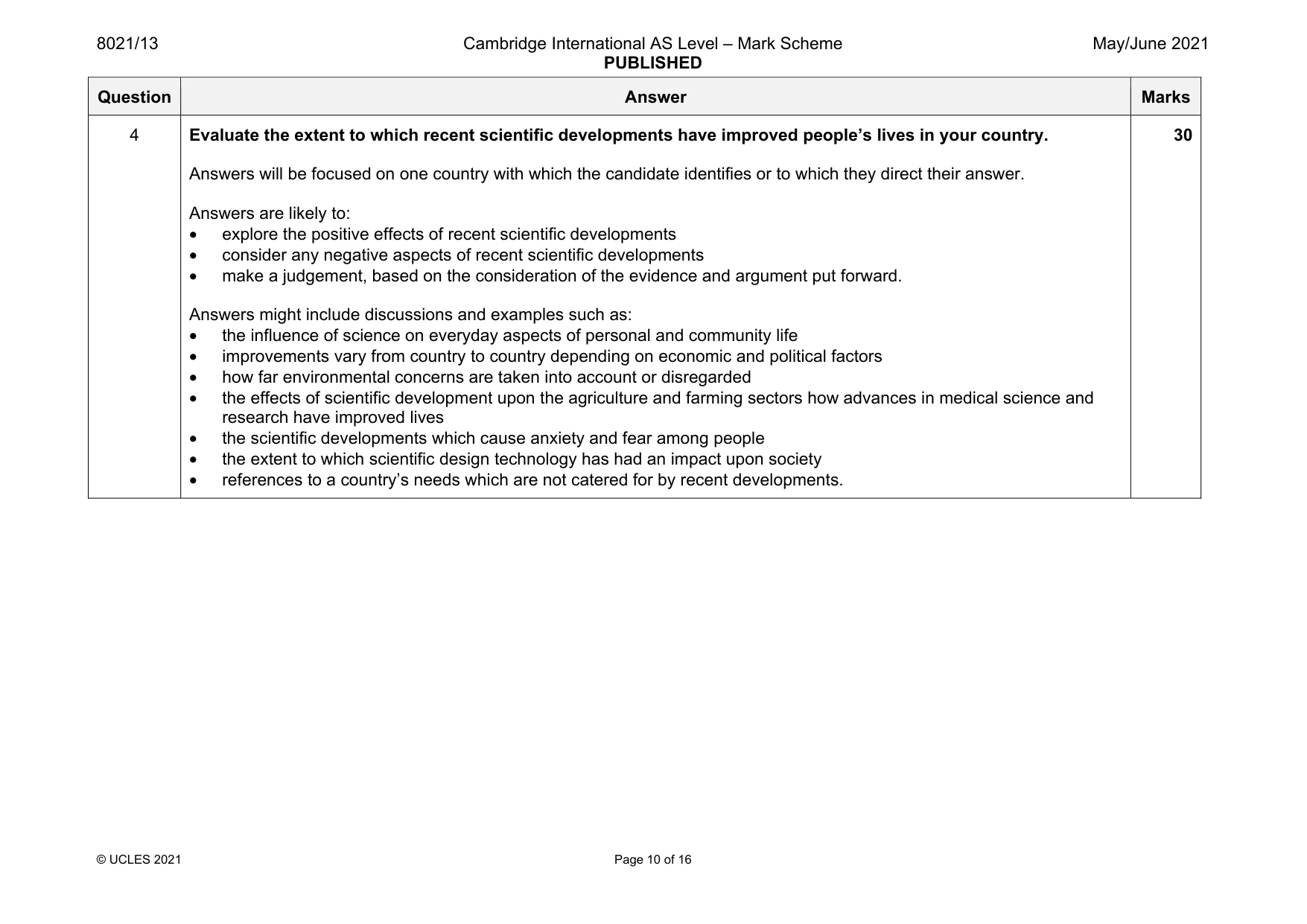
8021/13 Cambridge International AS Level – Mark Scheme PUBLISHED May/June 2021 © UCLES 2021 Page 10 of 16 Question Answer Marks 4 Evaluate the extent to which recent scientific developments have improved people’s lives in your country. Answers will be focused on one country with which the candidate identifies or to which they direct their answer. Answers are likely to: • explore the positive effects of recent scientific developments • consider any negative aspects of recent scientific developments • make a judgement, based on the consideration of the evidence and argument put forward. Answers might include discussions and examples such as: • the influence of science on everyday aspects of personal and community life • improvements vary from country to country depending on economic and political factors • how far environmental concerns are taken into account or disregarded • the effects of scientific development upon the agriculture and farming sectors how advances in medical science and research have improved lives • the scientific developments which cause anxiety and fear among people • the extent to which scientific design technology has had an impact upon society • references to a country’s needs which are not catered for by recent developments. 30
Mark scheme, page 11
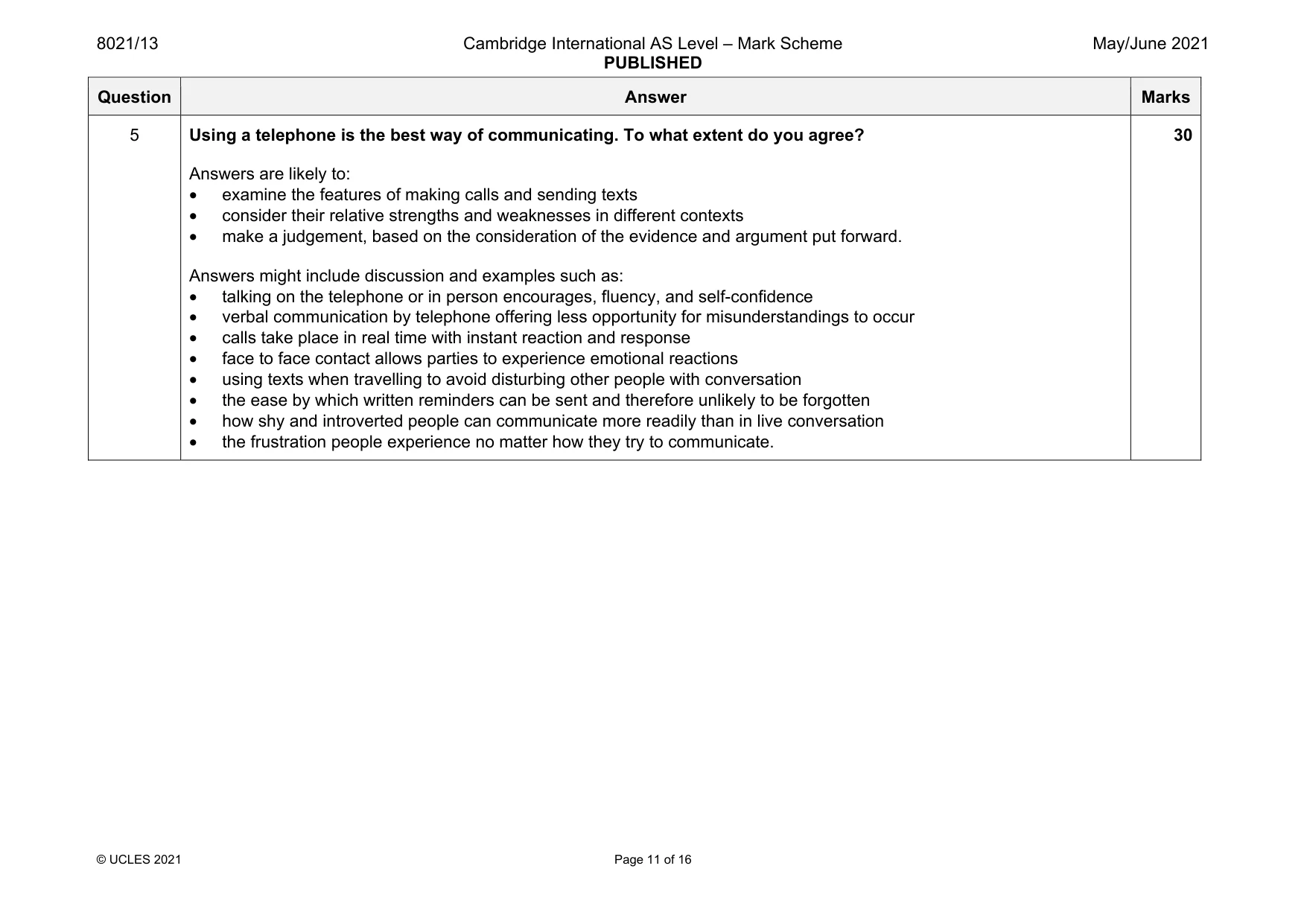
8021/13 Cambridge International AS Level – Mark Scheme PUBLISHED May/June 2021 © UCLES 2021 Page 11 of 16 Question Answer Marks 5 Using a telephone is the best way of communicating. To what extent do you agree? Answers are likely to: • examine the features of making calls and sending texts • consider their relative strengths and weaknesses in different contexts • make a judgement, based on the consideration of the evidence and argument put forward. Answers might include discussion and examples such as: • talking on the telephone or in person encourages, fluency, and self-confidence • verbal communication by telephone offering less opportunity for misunderstandings to occur • calls take place in real time with instant reaction and response • face to face contact allows parties to experience emotional reactions • using texts when travelling to avoid disturbing other people with conversation • the ease by which written reminders can be sent and therefore unlikely to be forgotten • how shy and introverted people can communicate more readily than in live conversation • the frustration people experience no matter how they try to communicate. 30
Mark scheme, page 12
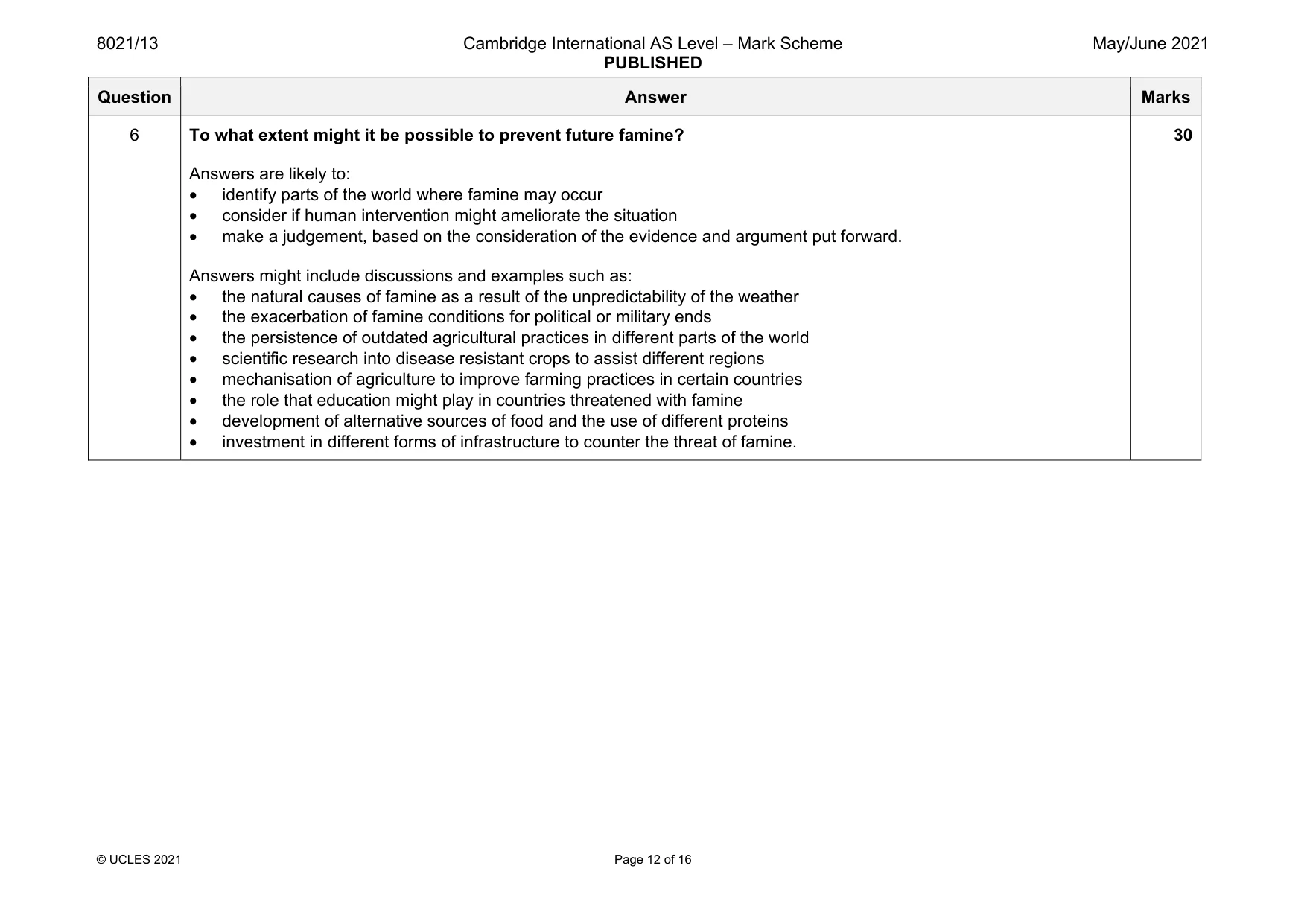
8021/13 Cambridge International AS Level – Mark Scheme PUBLISHED May/June 2021 © UCLES 2021 Page 12 of 16 Question Answer Marks 6 To what extent might it be possible to prevent future famine? Answers are likely to: • identify parts of the world where famine may occur • consider if human intervention might ameliorate the situation • make a judgement, based on the consideration of the evidence and argument put forward. Answers might include discussions and examples such as: • the natural causes of famine as a result of the unpredictability of the weather • the exacerbation of famine conditions for political or military ends • the persistence of outdated agricultural practices in different parts of the world • scientific research into disease resistant crops to assist different regions • mechanisation of agriculture to improve farming practices in certain countries • the role that education might play in countries threatened with famine • development of alternative sources of food and the use of different proteins • investment in different forms of infrastructure to counter the threat of famine. 30
Mark scheme, page 13
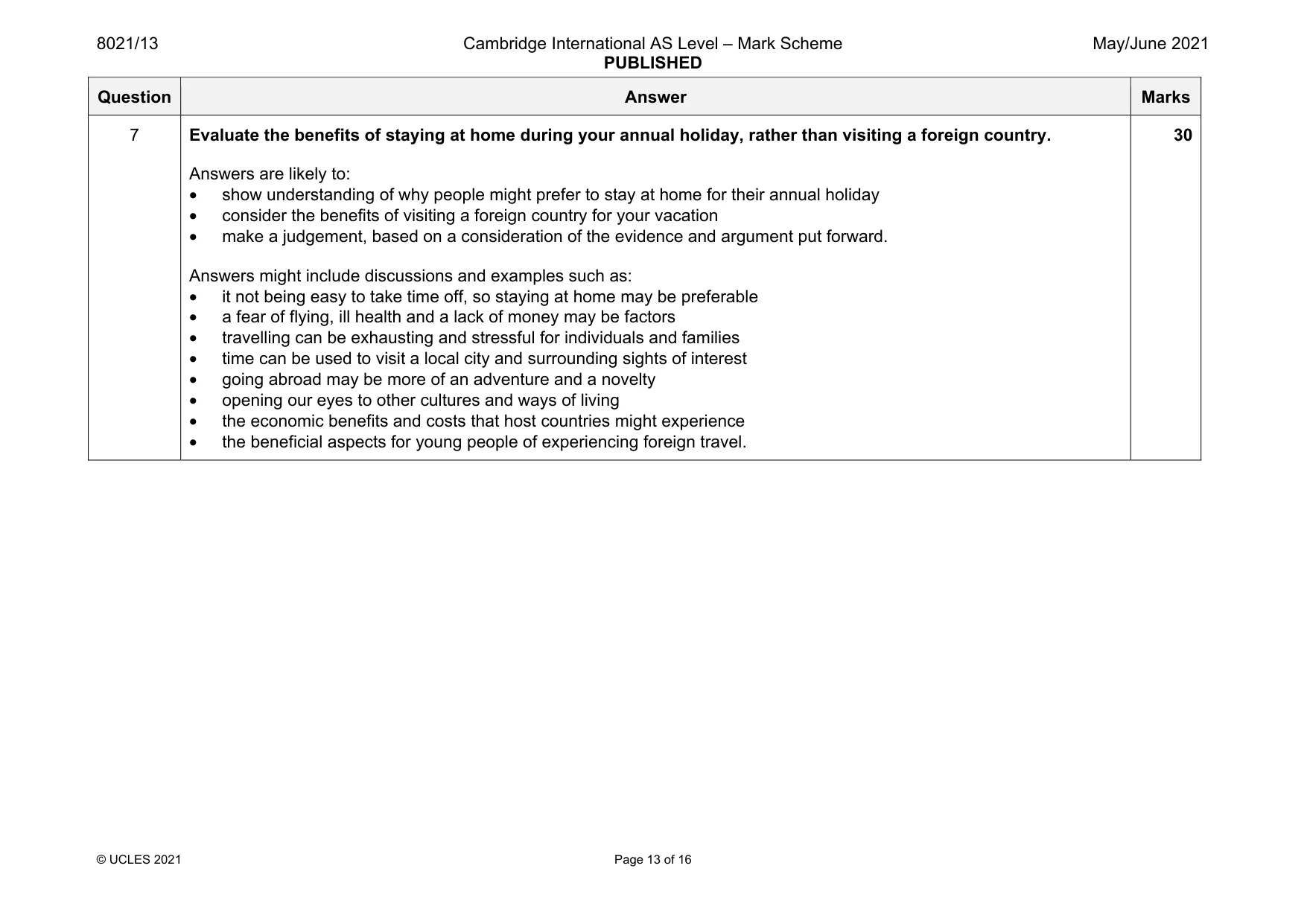
8021/13 Cambridge International AS Level – Mark Scheme PUBLISHED May/June 2021 © UCLES 2021 Page 13 of 16 Question Answer Marks 7 Evaluate the benefits of staying at home during your annual holiday, rather than visiting a foreign country. Answers are likely to: • show understanding of why people might prefer to stay at home for their annual holiday • consider the benefits of visiting a foreign country for your vacation • make a judgement, based on a consideration of the evidence and argument put forward. Answers might include discussions and examples such as: • it not being easy to take time off, so staying at home may be preferable • a fear of flying, ill health and a lack of money may be factors • travelling can be exhausting and stressful for individuals and families • time can be used to visit a local city and surrounding sights of interest • going abroad may be more of an adventure and a novelty • opening our eyes to other cultures and ways of living • the economic benefits and costs that host countries might experience • the beneficial aspects for young people of experiencing foreign travel. 30
Mark scheme, page 14
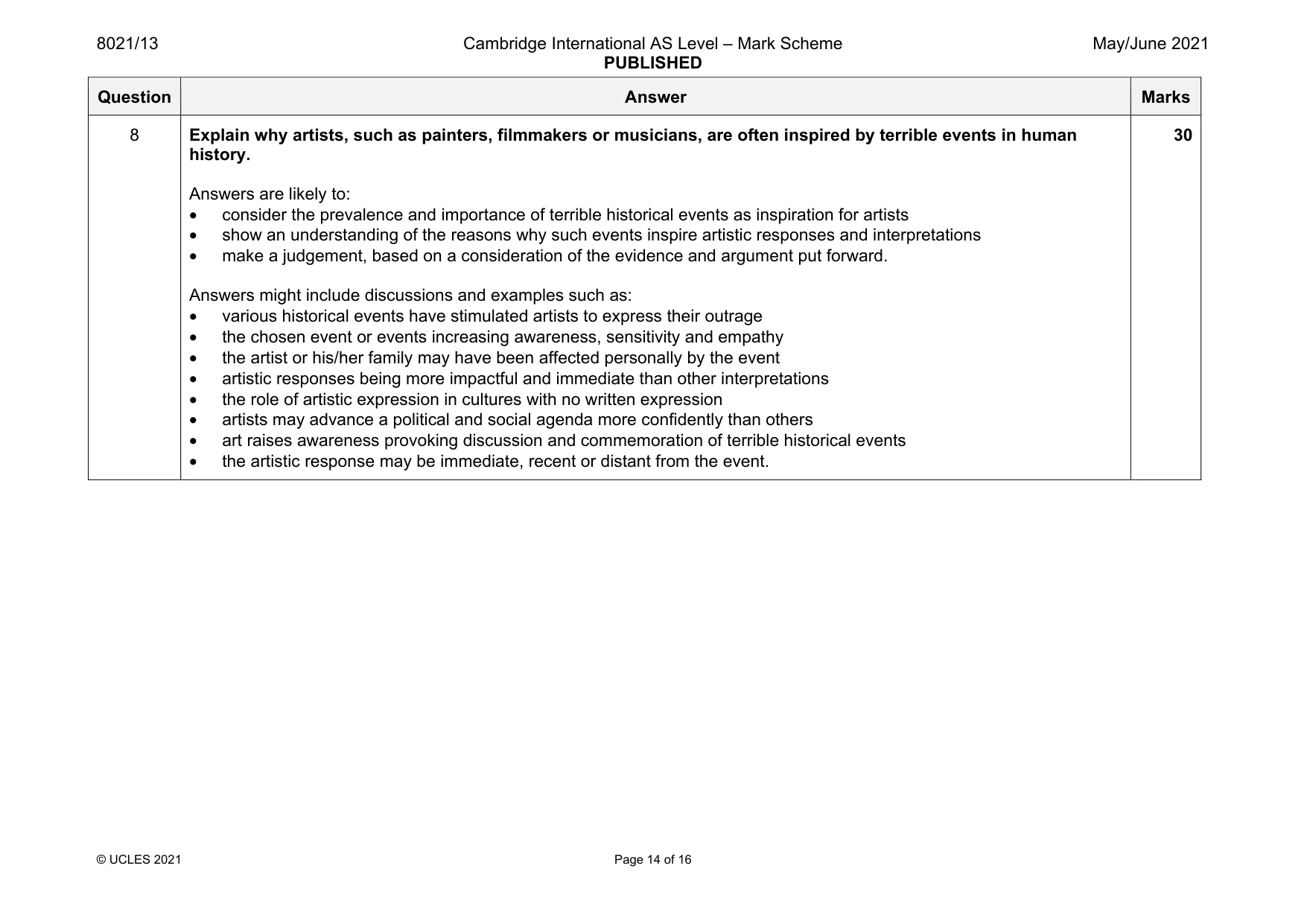
8021/13 Cambridge International AS Level – Mark Scheme PUBLISHED May/June 2021 © UCLES 2021 Page 14 of 16 Question Answer Marks 8 Explain why artists, such as painters, filmmakers or musicians, are often inspired by terrible events in human history. Answers are likely to: • consider the prevalence and importance of terrible historical events as inspiration for artists • show an understanding of the reasons why such events inspire artistic responses and interpretations • make a judgement, based on a consideration of the evidence and argument put forward. Answers might include discussions and examples such as: • various historical events have stimulated artists to express their outrage • the chosen event or events increasing awareness, sensitivity and empathy • the artist or his/her family may have been affected personally by the event • artistic responses being more impactful and immediate than other interpretations • the role of artistic expression in cultures with no written expression • artists may advance a political and social agenda more confidently than others • art raises awareness provoking discussion and commemoration of terrible historical events • the artistic response may be immediate, recent or distant from the event. 30
Mark scheme, page 15
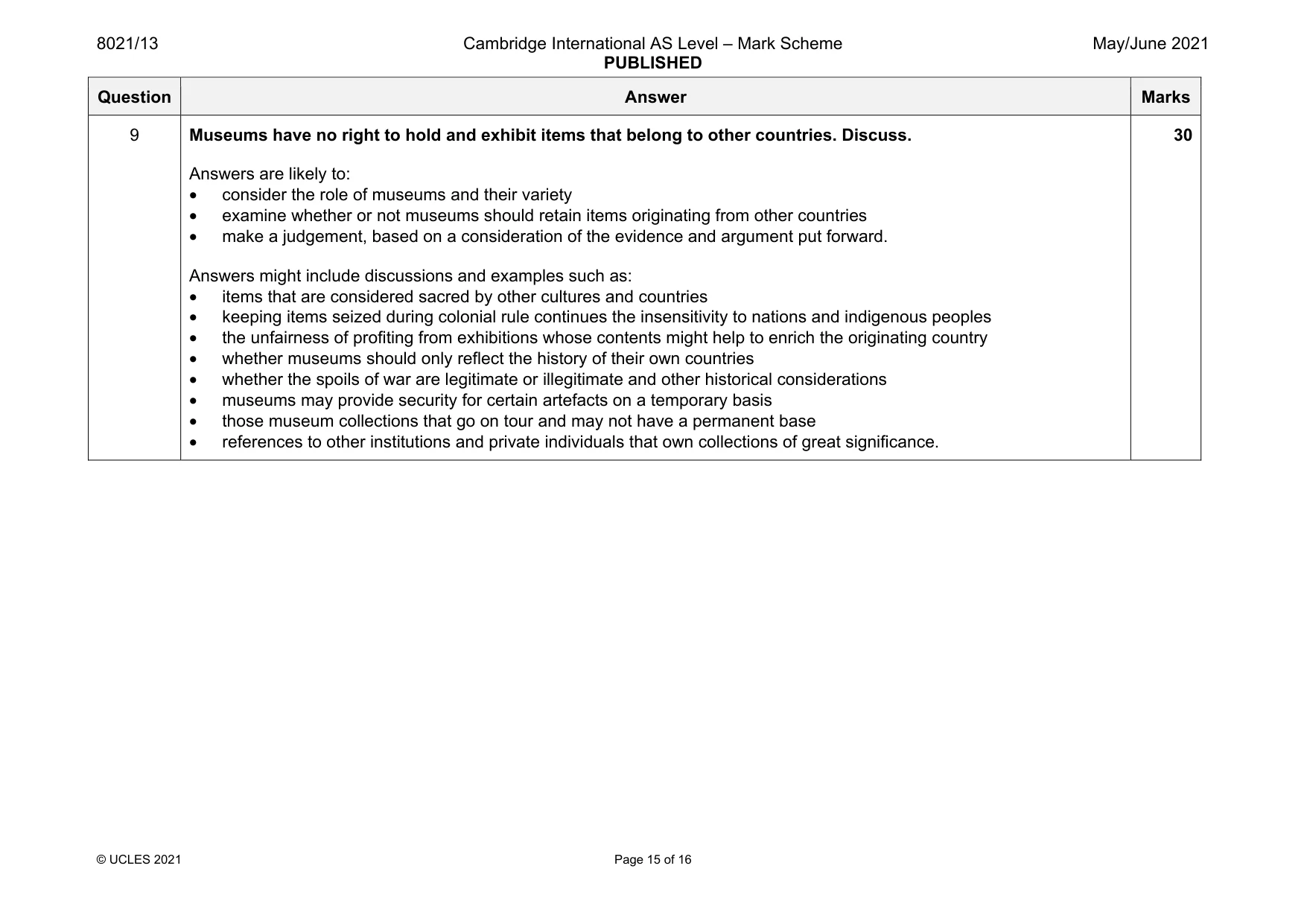
8021/13 Cambridge International AS Level – Mark Scheme PUBLISHED May/June 2021 © UCLES 2021 Page 15 of 16 Question Answer Marks 9 Museums have no right to hold and exhibit items that belong to other countries. Discuss. Answers are likely to: • consider the role of museums and their variety • examine whether or not museums should retain items originating from other countries • make a judgement, based on a consideration of the evidence and argument put forward. Answers might include discussions and examples such as: • items that are considered sacred by other cultures and countries • keeping items seized during colonial rule continues the insensitivity to nations and indigenous peoples • the unfairness of profiting from exhibitions whose contents might help to enrich the originating country • whether museums should only reflect the history of their own countries • whether the spoils of war are legitimate or illegitimate and other historical considerations • museums may provide security for certain artefacts on a temporary basis • those museum collections that go on tour and may not have a permanent base • references to other institutions and private individuals that own collections of great significance. 30
Mark scheme, page 16
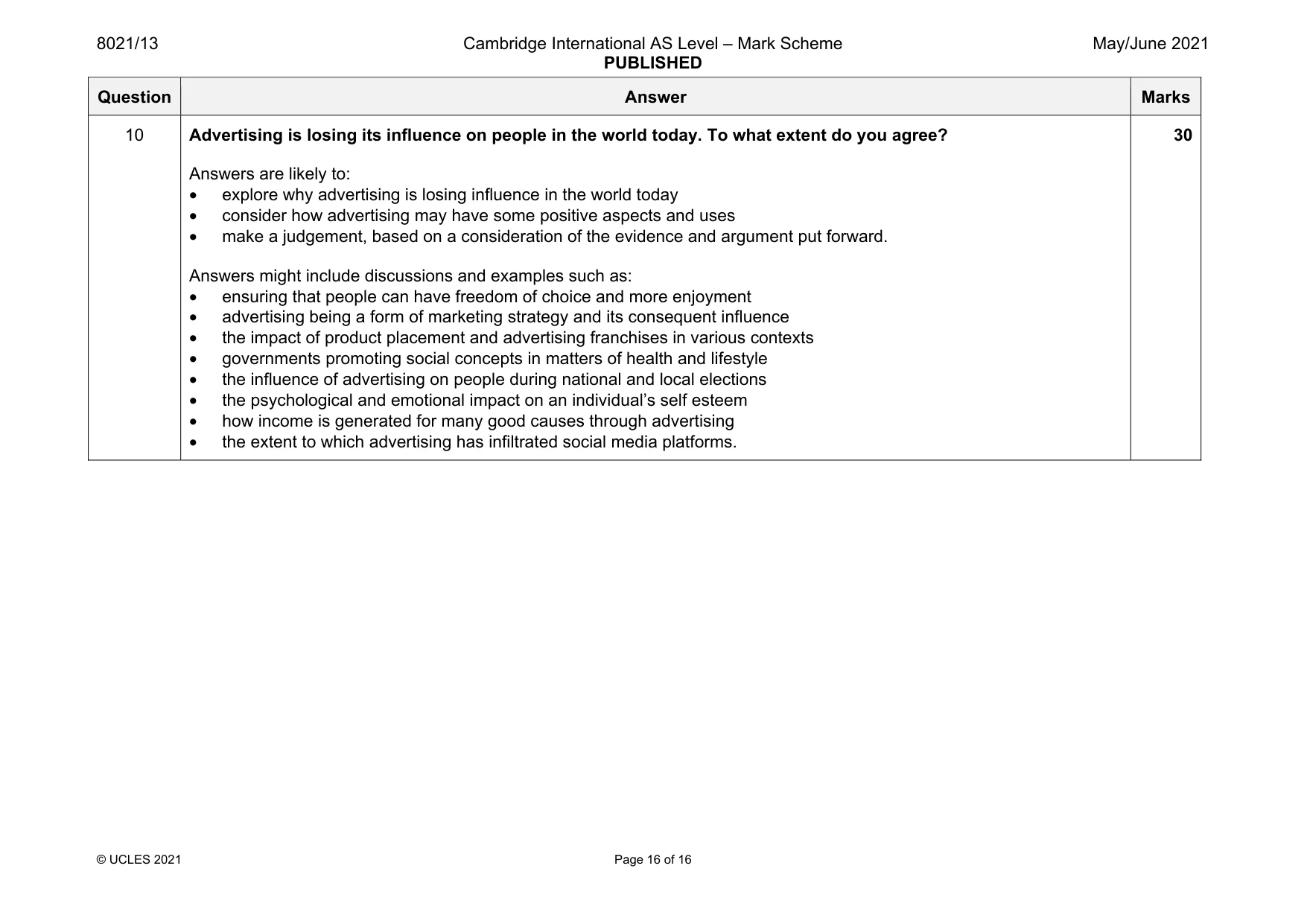
8021/13 Cambridge International AS Level – Mark Scheme PUBLISHED May/June 2021 © UCLES 2021 Page 16 of 16 Question Answer Marks 10 Advertising is losing its influence on people in the world today. To what extent do you agree? Answers are likely to: • explore why advertising is losing influence in the world today • consider how advertising may have some positive aspects and uses • make a judgement, based on a consideration of the evidence and argument put forward. Answers might include discussions and examples such as: • ensuring that people can have freedom of choice and more enjoyment • advertising being a form of marketing strategy and its consequent influence • the impact of product placement and advertising franchises in various contexts • governments promoting social concepts in matters of health and lifestyle • the influence of advertising on people during national and local elections • the psychological and emotional impact on an individual’s self esteem • how income is generated for many good causes through advertising • the extent to which advertising has infiltrated social media platforms. 30
What you needed in this session
Cambridge’s own grade thresholds for 2021 May/June, Paper 1 · Variant 3. A higher threshold means an easier paper — the bar moves with how the cohort did.