Cambridge A Level English General Paper 8021 — 2020 May/June Paper 1 · Variant 3
8021/13/M/J/20
The question paper and its mark scheme, free to read here and free to download. This is Cambridge’s own paper, exactly as it was sat.
Question paper4 pages


Mark scheme16 pages
Answers below. Sit the paper first if you are practising.
Paper as text
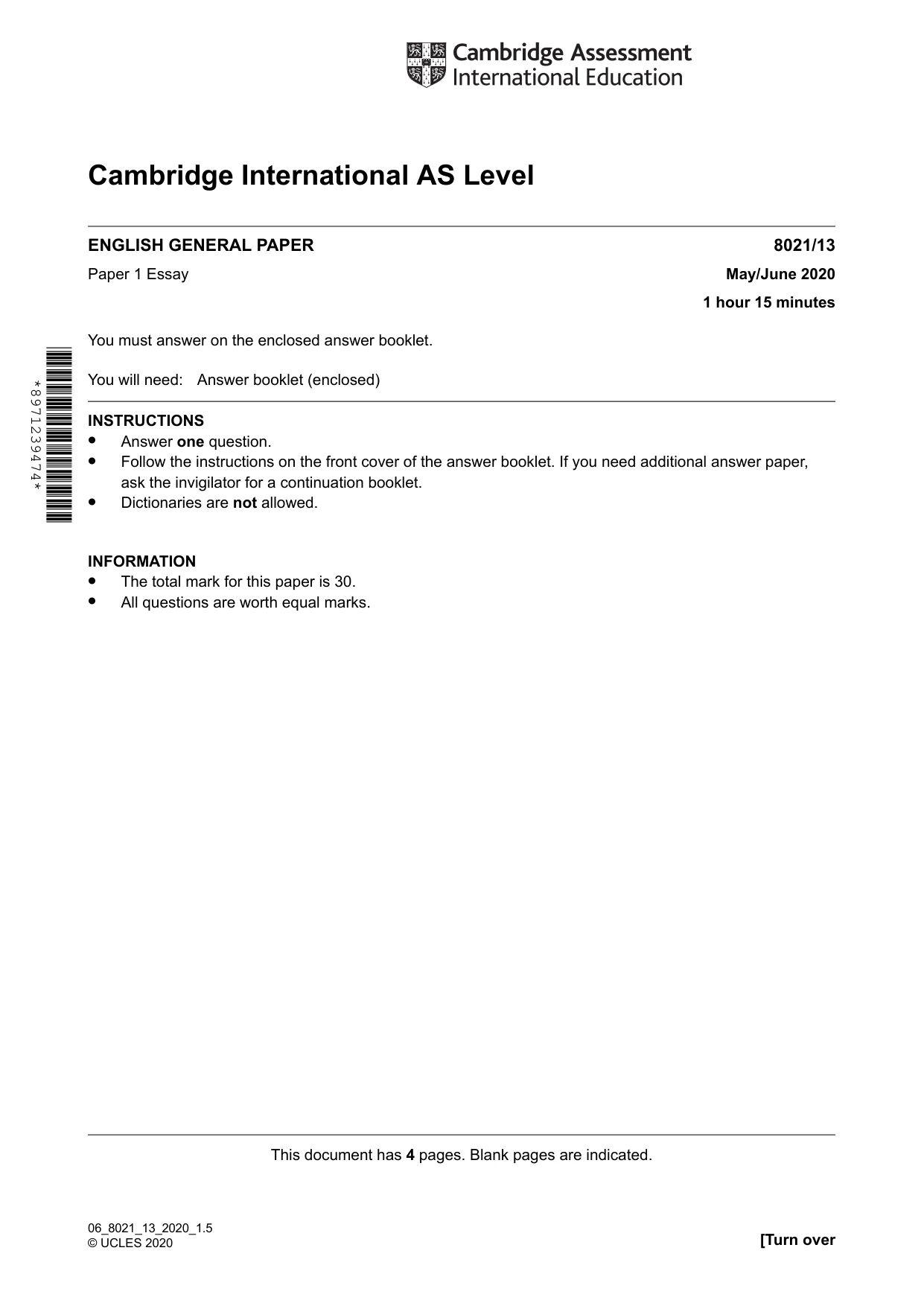
Question paper, page 1
Cambridge International AS Level 8021/13 May/June 2020 1 hour 15 minutes ENGLISH GENERAL PAPER Paper 1 Essay You must answer on the enclosed answer booklet. You will need: Answer booklet (enclosed) INSTRUCTIONS • Answer one question. • Follow the instructions on the front cover of the answer booklet. If you need additional answer paper, ask the invigilator for a continuation booklet. • Dictionaries are not allowed. INFORMATION • The total mark for this paper is 30. • All questions are worth equal marks. This document has 4 pages. Blank pages are indicated. [Turn over 06_8021_13_2020_1.5 © UCLES 2020 *8971239474*
Question paper, page 2
BLANK PAGE 06_8021_13_2020_1.5 © UCLES 2020 2
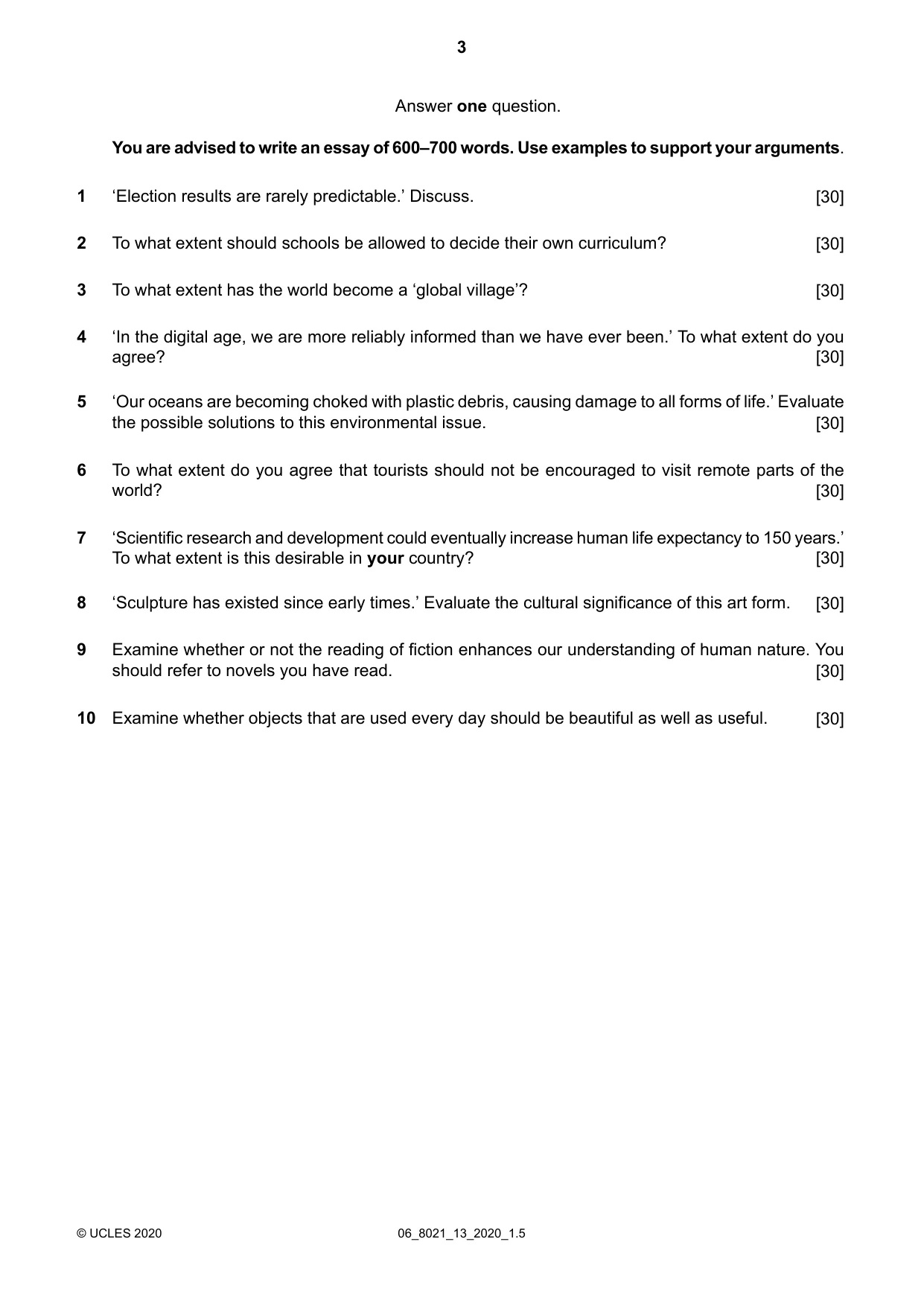
Question paper, page 3
Answer one question. You are advised to write an essay of 600–700 words. Use examples to support your arguments. ‘Election results are rarely predictable.’ Discuss. [30] 1 To what extent should schools be allowed to decide their own curriculum? [30] 2 To what extent has the world become a ‘global village’? [30] 3 ‘In the digital age, we are more reliably informed than we have ever been.’ To what extent do you agree? [30] 4 ‘Our oceans are becoming choked with plastic debris, causing damage to all forms of life.’ Evaluate the possible solutions to this environmental issue. [30] 5 To what extent do you agree that tourists should not be encouraged to visit remote parts of the world? [30] 6 ‘Scientific research and development could eventually increase human life expectancy to 150 years.’ To what extent is this desirable in your country? [30] 7 ‘Sculpture has existed since early times.’ Evaluate the cultural significance of this art form. [30] 8 Examine whether or not the reading of fiction enhances our understanding of human nature. You should refer to novels you have read. [30] 9 Examine whether objects that are used every day should be beautiful as well as useful. [30] 10 06_8021_13_2020_1.5 © UCLES 2020 3
Question paper, page 4
BLANK PAGE Permission to reproduce items where third-party owned material protected by copyright is included has been sought and cleared where possible. Every reasonable effort has been made by the publisher (UCLES) to trace copyright holders, but if any items requiring clearance have unwittingly been included, the publisher will be pleased to make amends at the earliest possible opportunity. To avoid the issue of disclosure of answer-related information to candidates, all copyright acknowledgements are reproduced online in the Cambridge Assessment International Education Copyright Acknowledgements Booklet. This is produced for each series of examinations and is freely available to download at www.cambridgeinternational.org after the live examination series. Cambridge Assessment International Education is part of the Cambridge Assessment Group. Cambridge Assessment is the brand name of the University of Cambridge Local Examinations Syndicate (UCLES), which itself is a department of the University of Cambridge. 06_8021_13_2020_1.5 © UCLES 2020 4
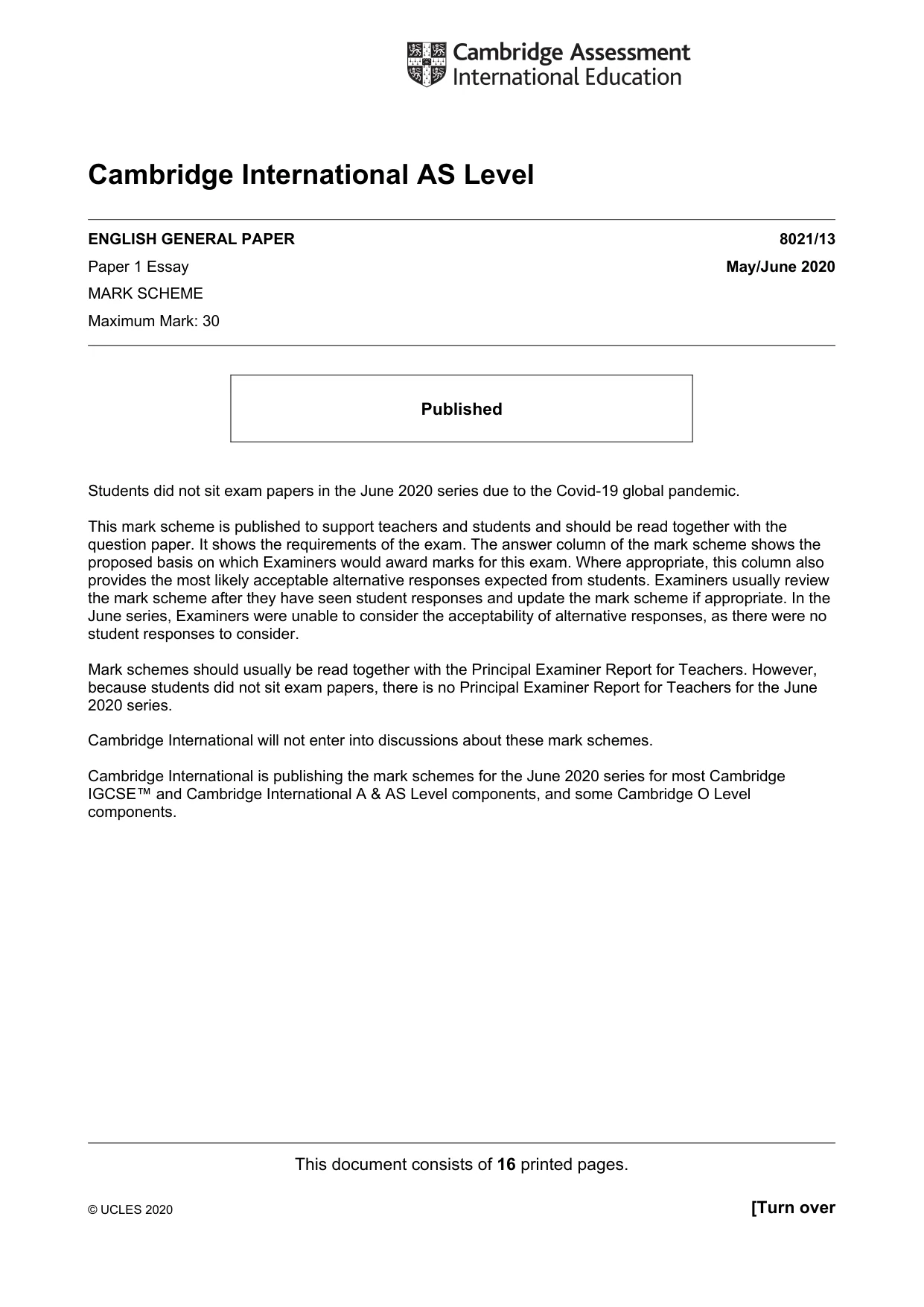
Mark scheme, page 1
This document consists of 16 printed pages. © UCLES 2020 [Turn over Cambridge International AS Level ENGLISH GENERAL PAPER 8021/13 Paper 1 Essay May/June 2020 MARK SCHEME Maximum Mark: 30 Published Students did not sit exam papers in the June 2020 series due to the Covid-19 global pandemic. This mark scheme is published to support teachers and students and should be read together with the question paper. It shows the requirements of the exam. The answer column of the mark scheme shows the proposed basis on which Examiners would award marks for this exam. Where appropriate, this column also provides the most likely acceptable alternative responses expected from students. Examiners usually review the mark scheme after they have seen student responses and update the mark scheme if appropriate. In the June series, Examiners were unable to consider the acceptability of alternative responses, as there were no student responses to consider. Mark schemes should usually be read together with the Principal Examiner Report for Teachers. However, because students did not sit exam papers, there is no Principal Examiner Report for Teachers for the June 2020 series. Cambridge International will not enter into discussions about these mark schemes. Cambridge International is publishing the mark schemes for the June 2020 series for most Cambridge IGCSE™ and Cambridge International A & AS Level components, and some Cambridge O Level components.
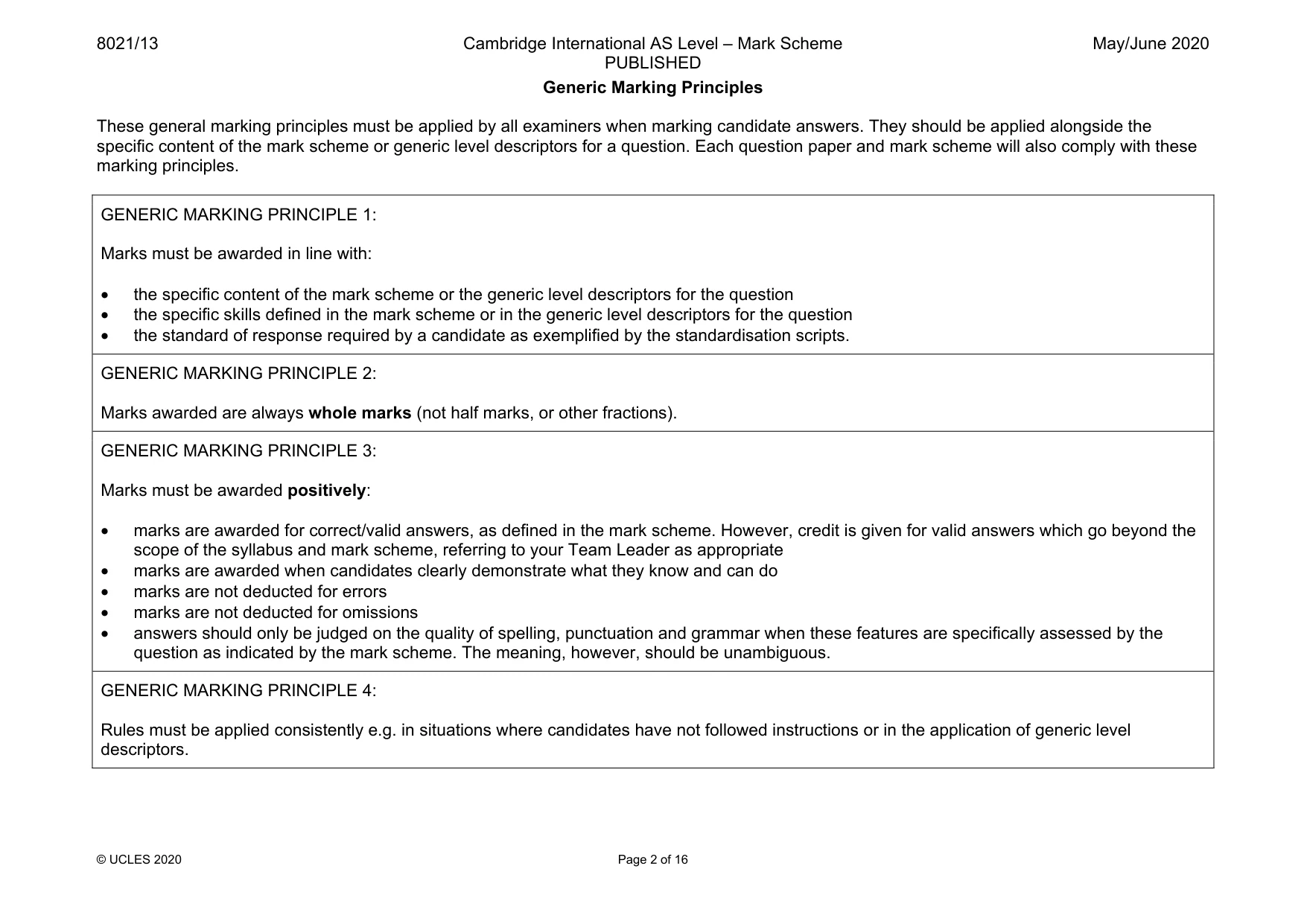
Mark scheme, page 2
8021/13 Cambridge International AS Level – Mark Scheme PUBLISHED May/June 2020 © UCLES 2020 Page 2 of 16 Generic Marking Principles These general marking principles must be applied by all examiners when marking candidate answers. They should be applied alongside the specific content of the mark scheme or generic level descriptors for a question. Each question paper and mark scheme will also comply with these marking principles. GENERIC MARKING PRINCIPLE 1: Marks must be awarded in line with: • the specific content of the mark scheme or the generic level descriptors for the question • the specific skills defined in the mark scheme or in the generic level descriptors for the question • the standard of response required by a candidate as exemplified by the standardisation scripts. GENERIC MARKING PRINCIPLE 2: Marks awarded are always whole marks (not half marks, or other fractions). GENERIC MARKING PRINCIPLE 3: Marks must be awarded positively: • marks are awarded for correct/valid answers, as defined in the mark scheme. However, credit is given for valid answers which go beyond the scope of the syllabus and mark scheme, referring to your Team Leader as appropriate • marks are awarded when candidates clearly demonstrate what they know and can do • marks are not deducted for errors • marks are not deducted for omissions • answers should only be judged on the quality of spelling, punctuation and grammar when these features are specifically assessed by the question as indicated by the mark scheme. The meaning, however, should be unambiguous. GENERIC MARKING PRINCIPLE 4: Rules must be applied consistently e.g. in situations where candidates have not followed instructions or in the application of generic level descriptors.
Mark scheme, page 3
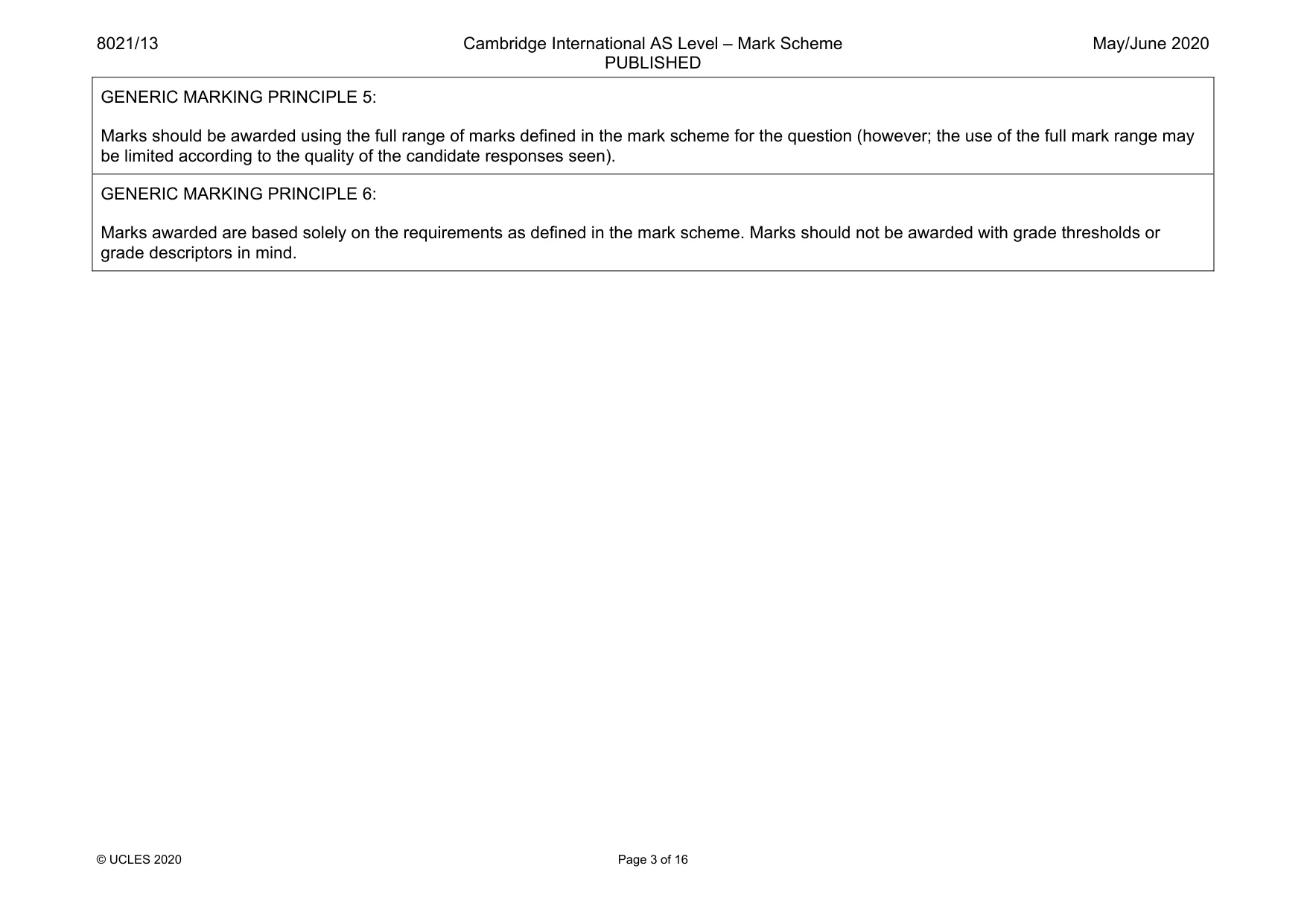
8021/13 Cambridge International AS Level – Mark Scheme PUBLISHED May/June 2020 © UCLES 2020 Page 3 of 16 GENERIC MARKING PRINCIPLE 5: Marks should be awarded using the full range of marks defined in the mark scheme for the question (however; the use of the full mark range may be limited according to the quality of the candidate responses seen). GENERIC MARKING PRINCIPLE 6: Marks awarded are based solely on the requirements as defined in the mark scheme. Marks should not be awarded with grade thresholds or grade descriptors in mind.
Mark scheme, page 4
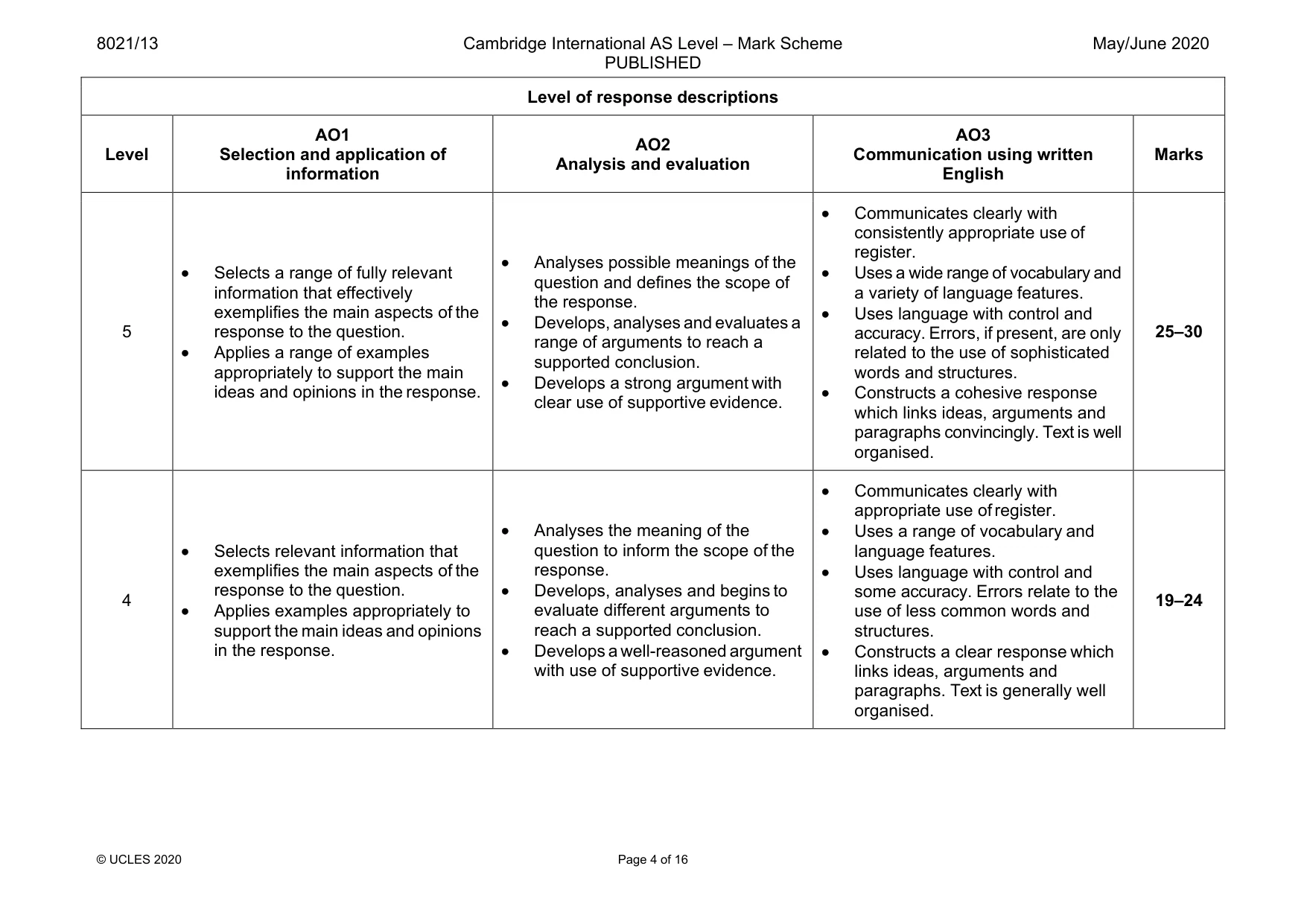
8021/13 Cambridge International AS Level – Mark Scheme PUBLISHED May/June 2020 © UCLES 2020 Page 4 of 16 Level of response descriptions Level AO1 Selection and application of information AO2 Analysis and evaluation AO3 Communication using written English Marks 5 • Selects a range of fully relevant information that effectively exemplifies the main aspects of the response to the question. • Applies a range of examples appropriately to support the main ideas and opinions in the response. • Analyses possible meanings of the question and defines the scope of the response. • Develops, analyses and evaluates a range of arguments to reach a supported conclusion. • Develops a strong argument with clear use of supportive evidence. • Communicates clearly with consistently appropriate use of register. • Uses a wide range of vocabulary and a variety of language features. • Uses language with control and accuracy. Errors, if present, are only related to the use of sophisticated words and structures. • Constructs a cohesive response which links ideas, arguments and paragraphs convincingly. Text is well organised. 25–30 4 • Selects relevant information that exemplifies the main aspects of the response to the question. • Applies examples appropriately to support the main ideas and opinions in the response. • Analyses the meaning of the question to inform the scope of the response. • Develops, analyses and begins to evaluate different arguments to reach a supported conclusion. • Develops a well-reasoned argument with use of supportive evidence. • Communicates clearly with appropriate use of register. • Uses a range of vocabulary and language features. • Uses language with control and some accuracy. Errors relate to the use of less common words and structures. • Constructs a clear response which links ideas, arguments and paragraphs. Text is generally well organised. 19–24
Mark scheme, page 5
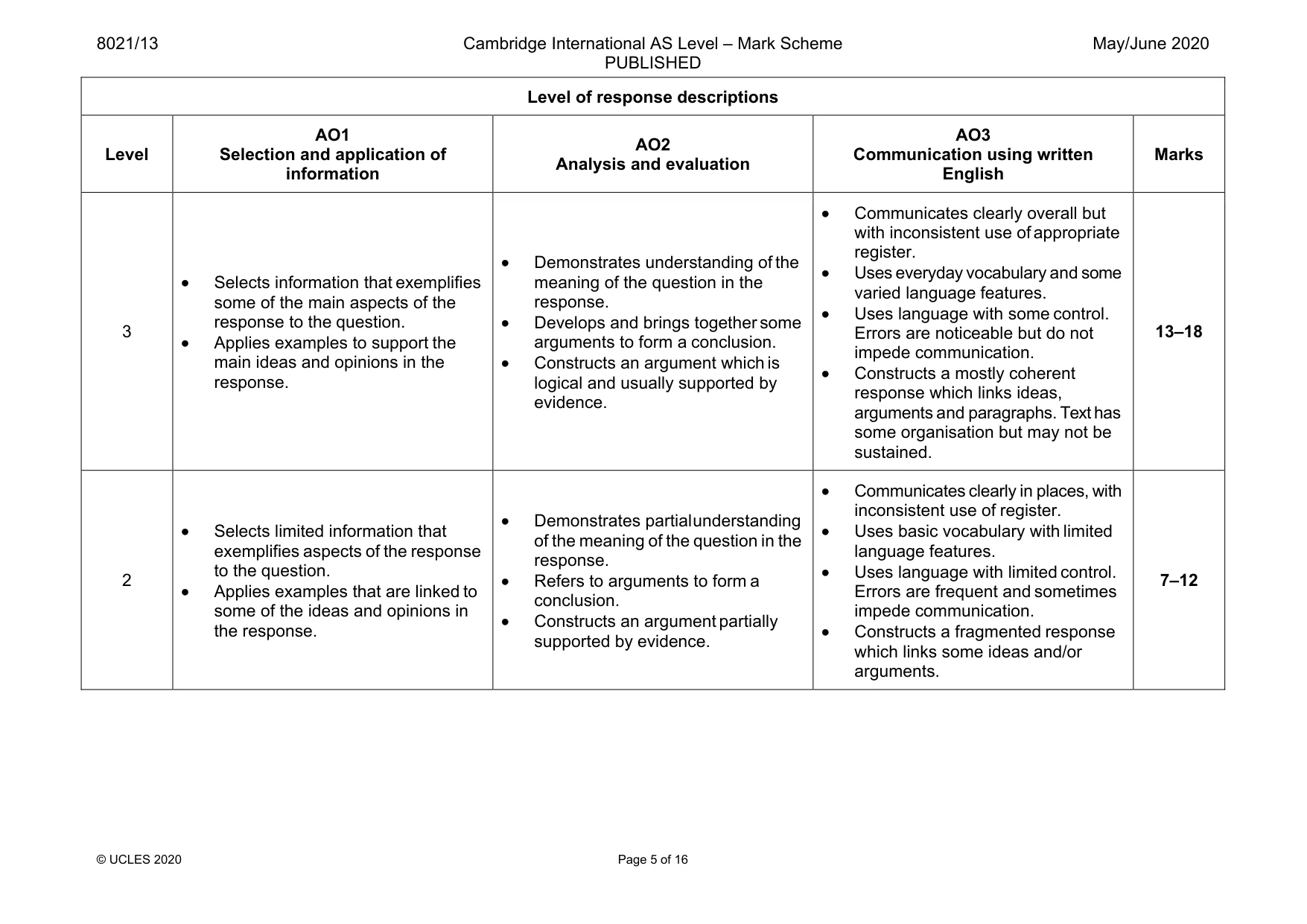
8021/13 Cambridge International AS Level – Mark Scheme PUBLISHED May/June 2020 © UCLES 2020 Page 5 of 16 Level of response descriptions Level AO1 Selection and application of information AO2 Analysis and evaluation AO3 Communication using written English Marks 3 • Selects information that exemplifies some of the main aspects of the response to the question. • Applies examples to support the main ideas and opinions in the response. • Demonstrates understanding of the meaning of the question in the response. • Develops and brings together some arguments to form a conclusion. • Constructs an argument which is logical and usually supported by evidence. • Communicates clearly overall but with inconsistent use of appropriate register. • Uses everyday vocabulary and some varied language features. • Uses language with some control. Errors are noticeable but do not impede communication. • Constructs a mostly coherent response which links ideas, arguments and paragraphs. Text has some organisation but may not be sustained. 13–18 2 • Selects limited information that exemplifies aspects of the response to the question. • Applies examples that are linked to some of the ideas and opinions in the response. • Demonstrates partial understanding of the meaning of the question in the response. • Refers to arguments to form a conclusion. • Constructs an argument partially supported by evidence. • Communicates clearly in places, with inconsistent use of register. • Uses basic vocabulary with limited language features. • Uses language with limited control. Errors are frequent and sometimes impede communication. • Constructs a fragmented response which links some ideas and/or arguments. 7–12
Mark scheme, page 6
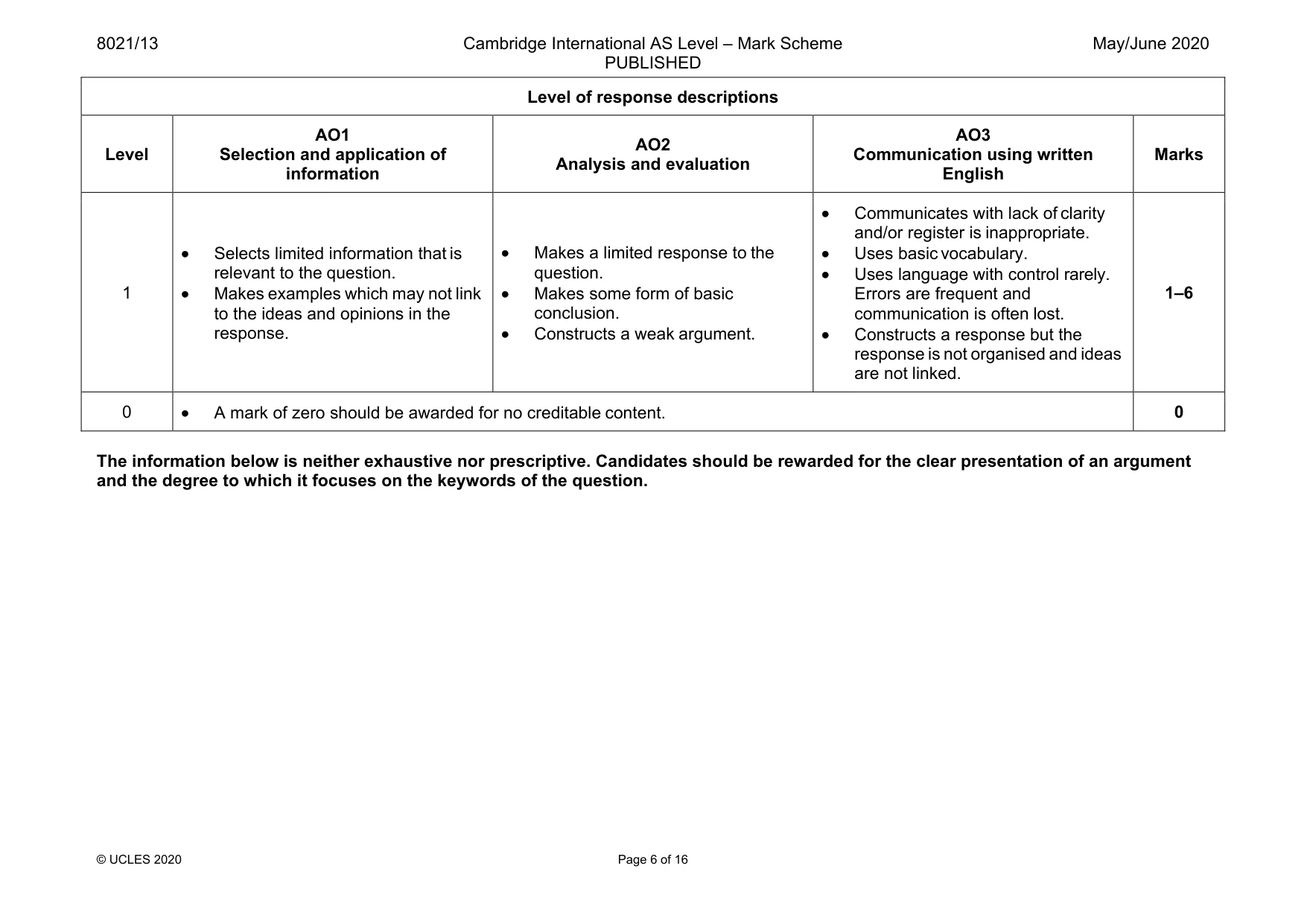
8021/13 Cambridge International AS Level – Mark Scheme PUBLISHED May/June 2020 © UCLES 2020 Page 6 of 16 Level of response descriptions Level AO1 Selection and application of information AO2 Analysis and evaluation AO3 Communication using written English Marks 1 • Selects limited information that is relevant to the question. • Makes examples which may not link to the ideas and opinions in the response. • Makes a limited response to the question. • Makes some form of basic conclusion. • Constructs a weak argument. • Communicates with lack of clarity and/or register is inappropriate. • Uses basic vocabulary. • Uses language with control rarely. Errors are frequent and communication is often lost. • Constructs a response but the response is not organised and ideas are not linked. 1–6 0 • A mark of zero should be awarded for no creditable content. 0 The information below is neither exhaustive nor prescriptive. Candidates should be rewarded for the clear presentation of an argument and the degree to which it focuses on the keywords of the question.
Mark scheme, page 7
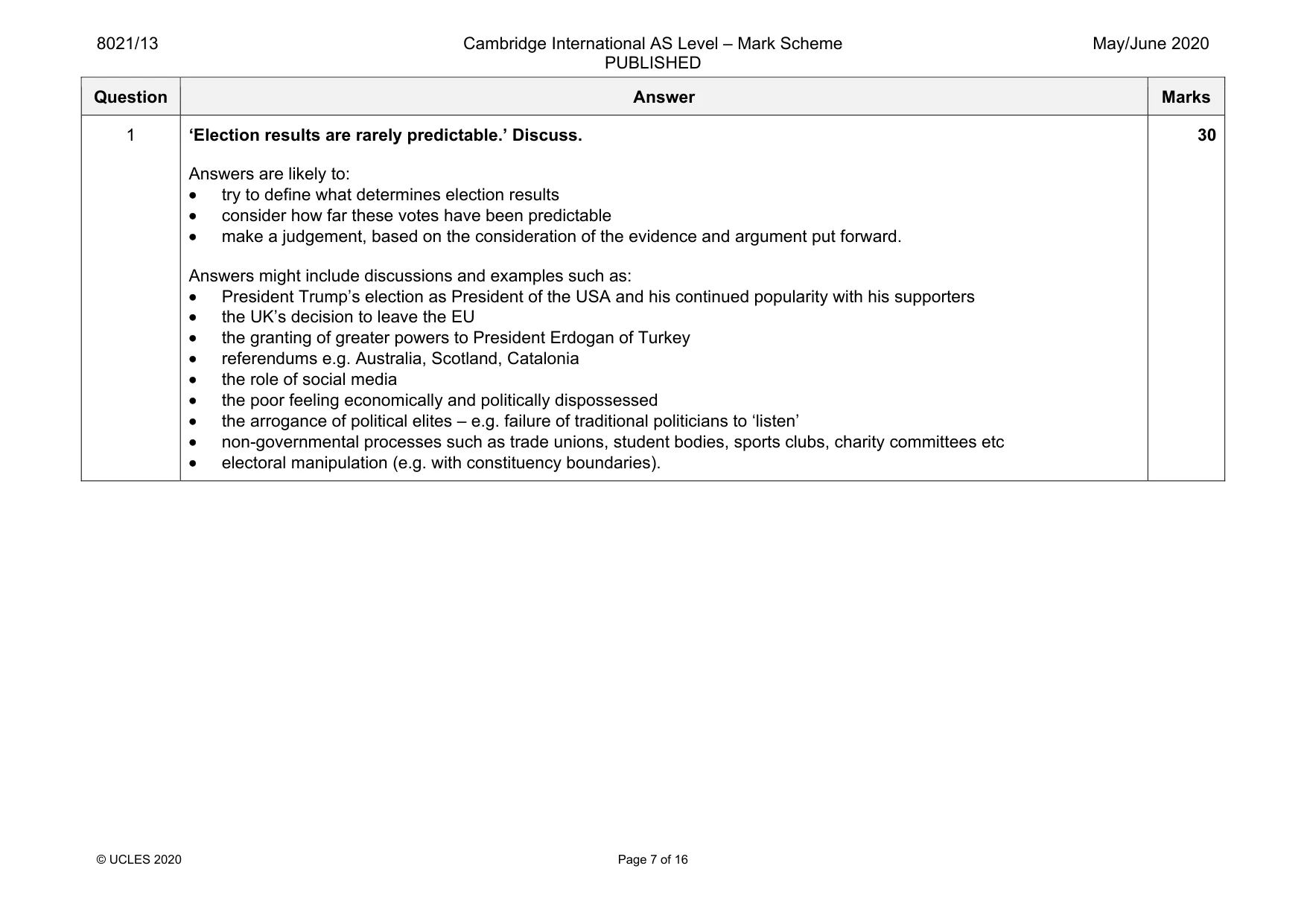
8021/13 Cambridge International AS Level – Mark Scheme PUBLISHED May/June 2020 © UCLES 2020 Page 7 of 16 Question Answer Marks 1 ‘Election results are rarely predictable.’ Discuss. Answers are likely to: • try to define what determines election results • consider how far these votes have been predictable • make a judgement, based on the consideration of the evidence and argument put forward. Answers might include discussions and examples such as: • President Trump’s election as President of the USA and his continued popularity with his supporters • the UK’s decision to leave the EU • the granting of greater powers to President Erdogan of Turkey • referendums e.g. Australia, Scotland, Catalonia • the role of social media • the poor feeling economically and politically dispossessed • the arrogance of political elites – e.g. failure of traditional politicians to ‘listen’ • non-governmental processes such as trade unions, student bodies, sports clubs, charity committees etc • electoral manipulation (e.g. with constituency boundaries). 30
Mark scheme, page 8
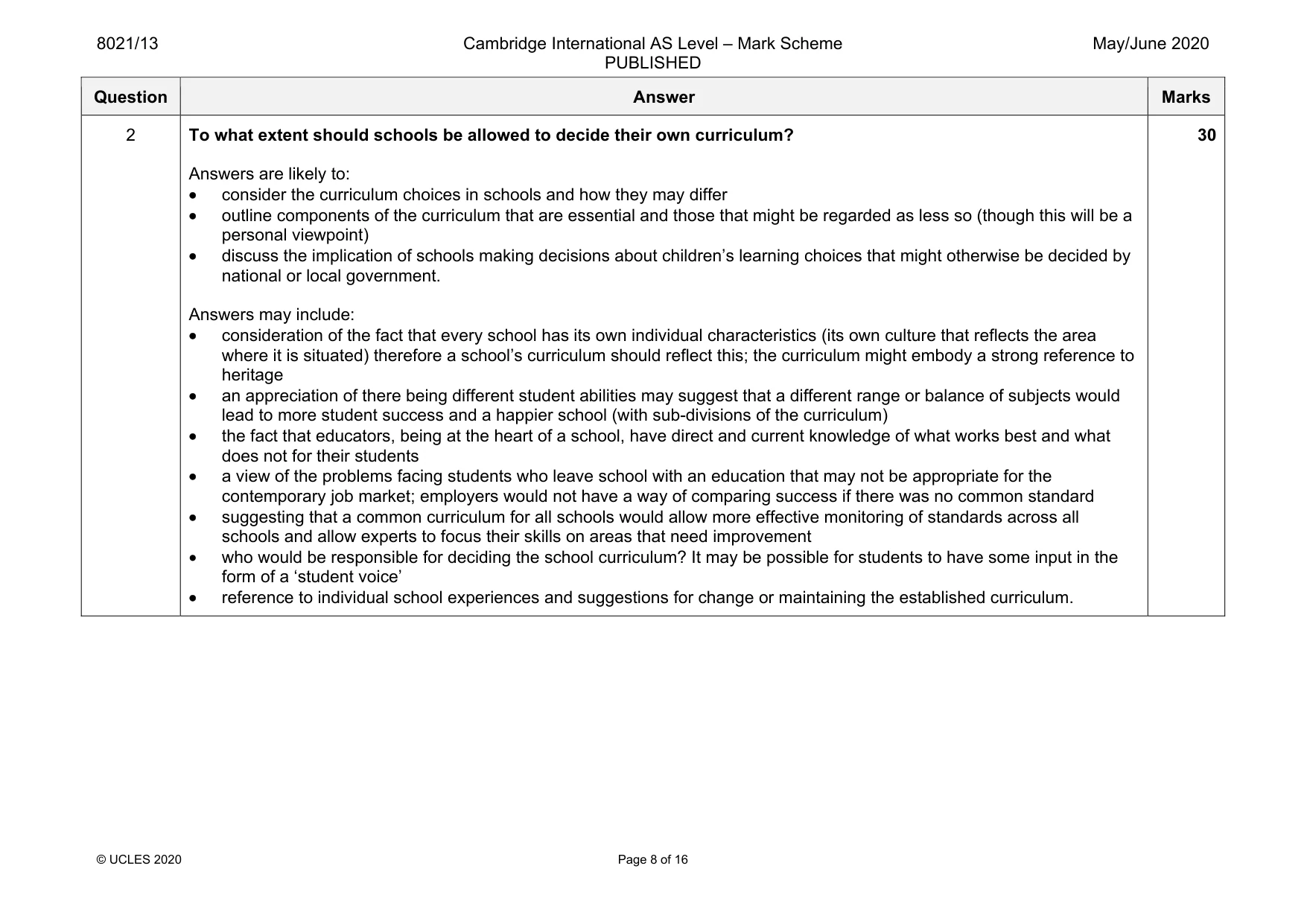
8021/13 Cambridge International AS Level – Mark Scheme PUBLISHED May/June 2020 © UCLES 2020 Page 8 of 16 Question Answer Marks 2 To what extent should schools be allowed to decide their own curriculum? Answers are likely to: • consider the curriculum choices in schools and how they may differ • outline components of the curriculum that are essential and those that might be regarded as less so (though this will be a personal viewpoint) • discuss the implication of schools making decisions about children’s learning choices that might otherwise be decided by national or local government. Answers may include: • consideration of the fact that every school has its own individual characteristics (its own culture that reflects the area where it is situated) therefore a school’s curriculum should reflect this; the curriculum might embody a strong reference to heritage • an appreciation of there being different student abilities may suggest that a different range or balance of subjects would lead to more student success and a happier school (with sub-divisions of the curriculum) • the fact that educators, being at the heart of a school, have direct and current knowledge of what works best and what does not for their students • a view of the problems facing students who leave school with an education that may not be appropriate for the contemporary job market; employers would not have a way of comparing success if there was no common standard • suggesting that a common curriculum for all schools would allow more effective monitoring of standards across all schools and allow experts to focus their skills on areas that need improvement • who would be responsible for deciding the school curriculum? It may be possible for students to have some input in the form of a ‘student voice’ • reference to individual school experiences and suggestions for change or maintaining the established curriculum. 30
Mark scheme, page 9
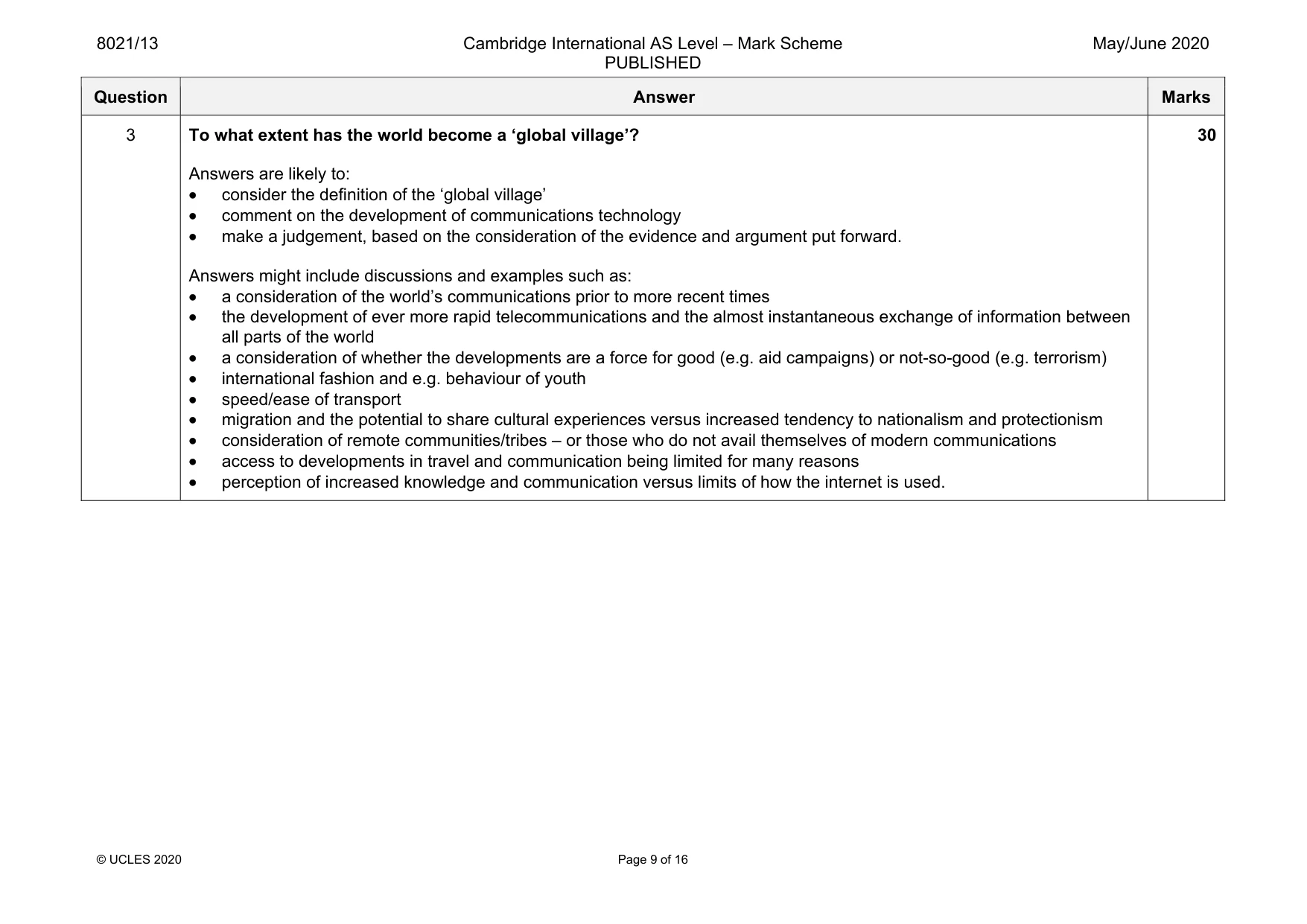
8021/13 Cambridge International AS Level – Mark Scheme PUBLISHED May/June 2020 © UCLES 2020 Page 9 of 16 Question Answer Marks 3 To what extent has the world become a ‘global village’? Answers are likely to: • consider the definition of the ‘global village’ • comment on the development of communications technology • make a judgement, based on the consideration of the evidence and argument put forward. Answers might include discussions and examples such as: • a consideration of the world’s communications prior to more recent times • the development of ever more rapid telecommunications and the almost instantaneous exchange of information between all parts of the world • a consideration of whether the developments are a force for good (e.g. aid campaigns) or not-so-good (e.g. terrorism) • international fashion and e.g. behaviour of youth • speed/ease of transport • migration and the potential to share cultural experiences versus increased tendency to nationalism and protectionism • consideration of remote communities/tribes – or those who do not avail themselves of modern communications • access to developments in travel and communication being limited for many reasons • perception of increased knowledge and communication versus limits of how the internet is used. 30
Mark scheme, page 10
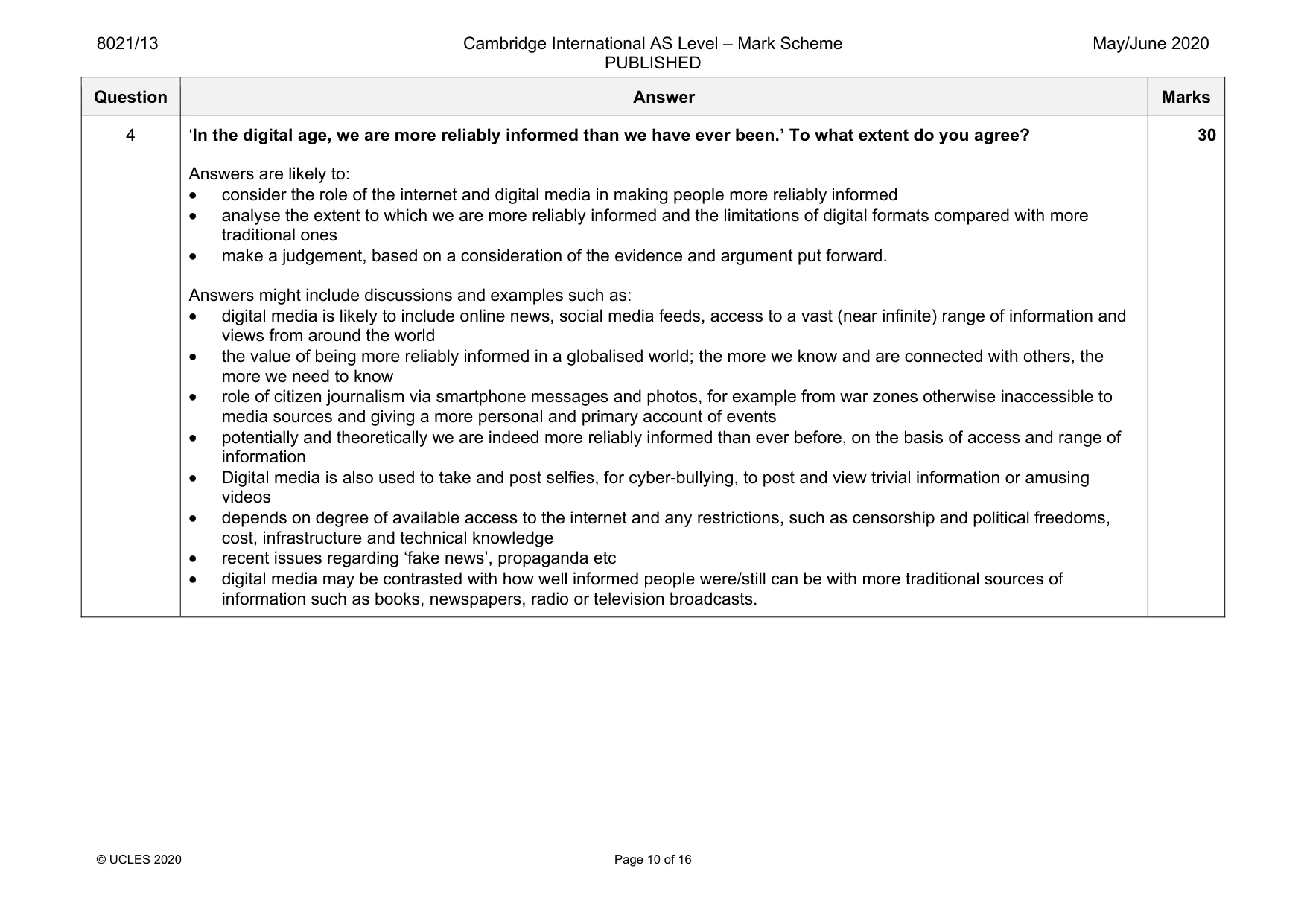
8021/13 Cambridge International AS Level – Mark Scheme PUBLISHED May/June 2020 © UCLES 2020 Page 10 of 16 Question Answer Marks 4 ‘In the digital age, we are more reliably informed than we have ever been.’ To what extent do you agree? Answers are likely to: • consider the role of the internet and digital media in making people more reliably informed • analyse the extent to which we are more reliably informed and the limitations of digital formats compared with more traditional ones • make a judgement, based on a consideration of the evidence and argument put forward. Answers might include discussions and examples such as: • digital media is likely to include online news, social media feeds, access to a vast (near infinite) range of information and views from around the world • the value of being more reliably informed in a globalised world; the more we know and are connected with others, the more we need to know • role of citizen journalism via smartphone messages and photos, for example from war zones otherwise inaccessible to media sources and giving a more personal and primary account of events • potentially and theoretically we are indeed more reliably informed than ever before, on the basis of access and range of information • Digital media is also used to take and post selfies, for cyber-bullying, to post and view trivial information or amusing videos • depends on degree of available access to the internet and any restrictions, such as censorship and political freedoms, cost, infrastructure and technical knowledge • recent issues regarding ‘fake news’, propaganda etc • digital media may be contrasted with how well informed people were/still can be with more traditional sources of information such as books, newspapers, radio or television broadcasts. 30
Mark scheme, page 11
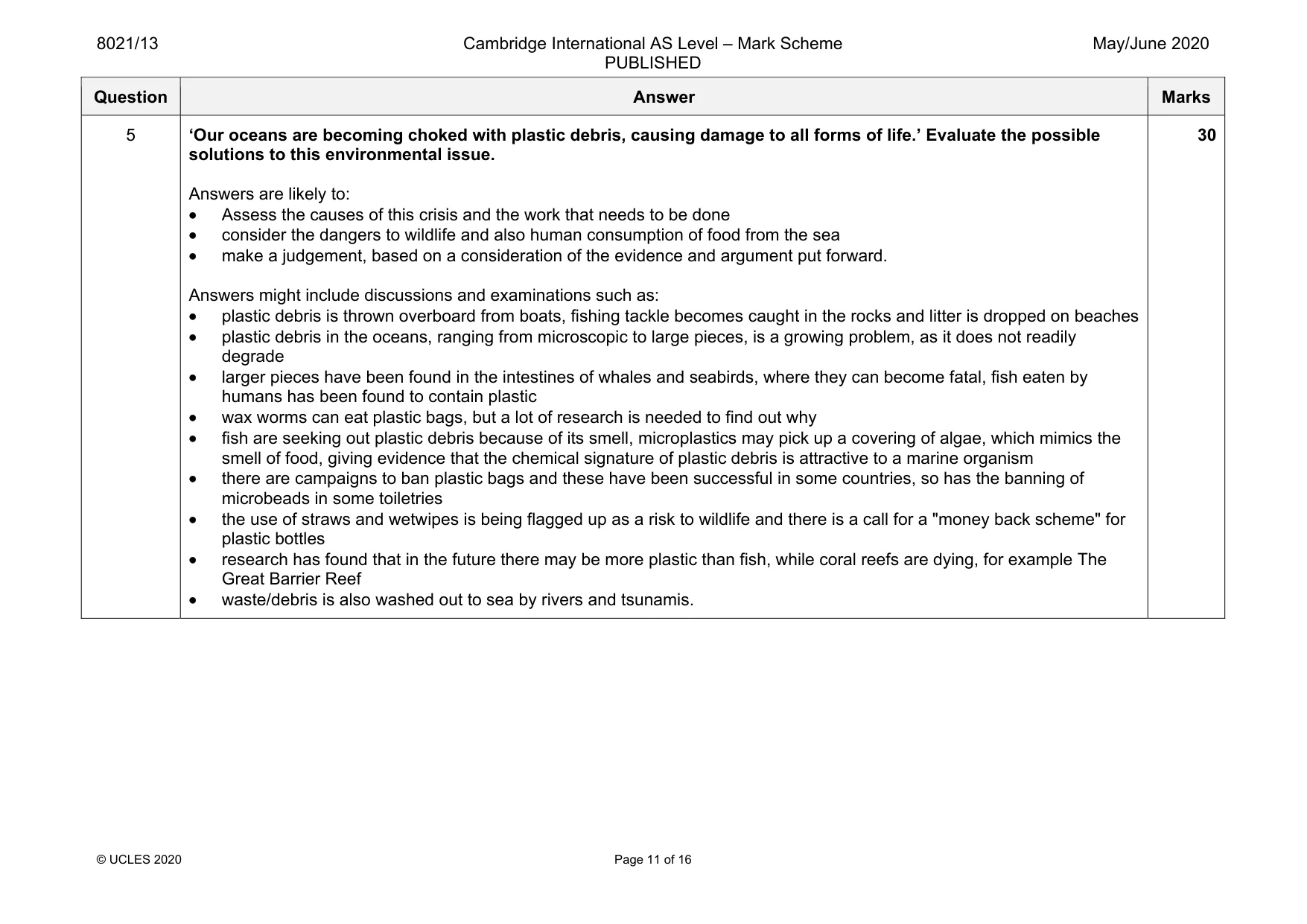
8021/13 Cambridge International AS Level – Mark Scheme PUBLISHED May/June 2020 © UCLES 2020 Page 11 of 16 Question Answer Marks 5 ‘Our oceans are becoming choked with plastic debris, causing damage to all forms of life.’ Evaluate the possible solutions to this environmental issue. Answers are likely to: • Assess the causes of this crisis and the work that needs to be done • consider the dangers to wildlife and also human consumption of food from the sea • make a judgement, based on a consideration of the evidence and argument put forward. Answers might include discussions and examinations such as: • plastic debris is thrown overboard from boats, fishing tackle becomes caught in the rocks and litter is dropped on beaches • plastic debris in the oceans, ranging from microscopic to large pieces, is a growing problem, as it does not readily degrade • larger pieces have been found in the intestines of whales and seabirds, where they can become fatal, fish eaten by humans has been found to contain plastic • wax worms can eat plastic bags, but a lot of research is needed to find out why • fish are seeking out plastic debris because of its smell, microplastics may pick up a covering of algae, which mimics the smell of food, giving evidence that the chemical signature of plastic debris is attractive to a marine organism • there are campaigns to ban plastic bags and these have been successful in some countries, so has the banning of microbeads in some toiletries • the use of straws and wetwipes is being flagged up as a risk to wildlife and there is a call for a "money back scheme" for plastic bottles • research has found that in the future there may be more plastic than fish, while coral reefs are dying, for example The Great Barrier Reef • waste/debris is also washed out to sea by rivers and tsunamis. 30
Mark scheme, page 12
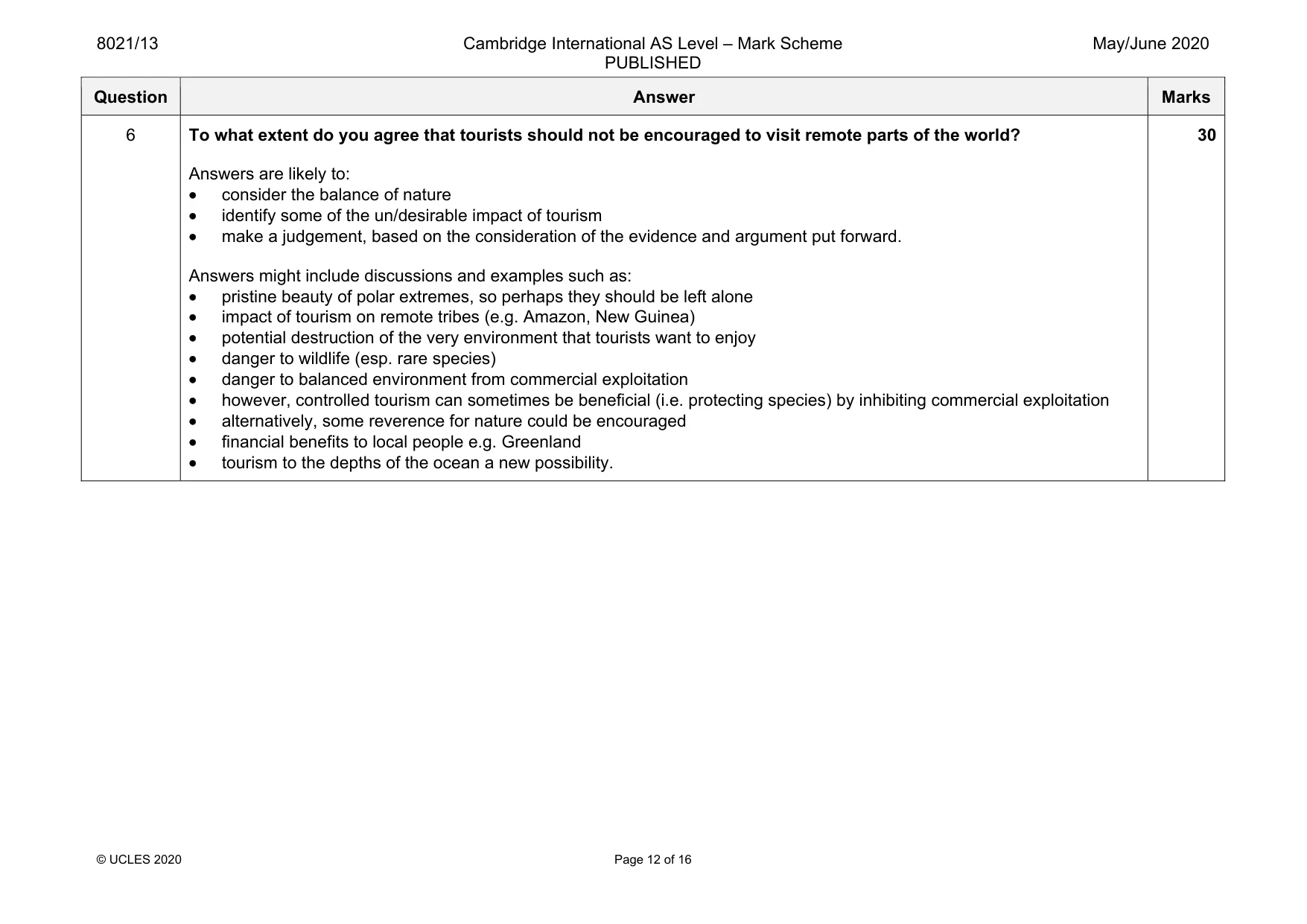
8021/13 Cambridge International AS Level – Mark Scheme PUBLISHED May/June 2020 © UCLES 2020 Page 12 of 16 Question Answer Marks 6 To what extent do you agree that tourists should not be encouraged to visit remote parts of the world? Answers are likely to: • consider the balance of nature • identify some of the un/desirable impact of tourism • make a judgement, based on the consideration of the evidence and argument put forward. Answers might include discussions and examples such as: • pristine beauty of polar extremes, so perhaps they should be left alone • impact of tourism on remote tribes (e.g. Amazon, New Guinea) • potential destruction of the very environment that tourists want to enjoy • danger to wildlife (esp. rare species) • danger to balanced environment from commercial exploitation • however, controlled tourism can sometimes be beneficial (i.e. protecting species) by inhibiting commercial exploitation • alternatively, some reverence for nature could be encouraged • financial benefits to local people e.g. Greenland • tourism to the depths of the ocean a new possibility. 30
Mark scheme, page 13
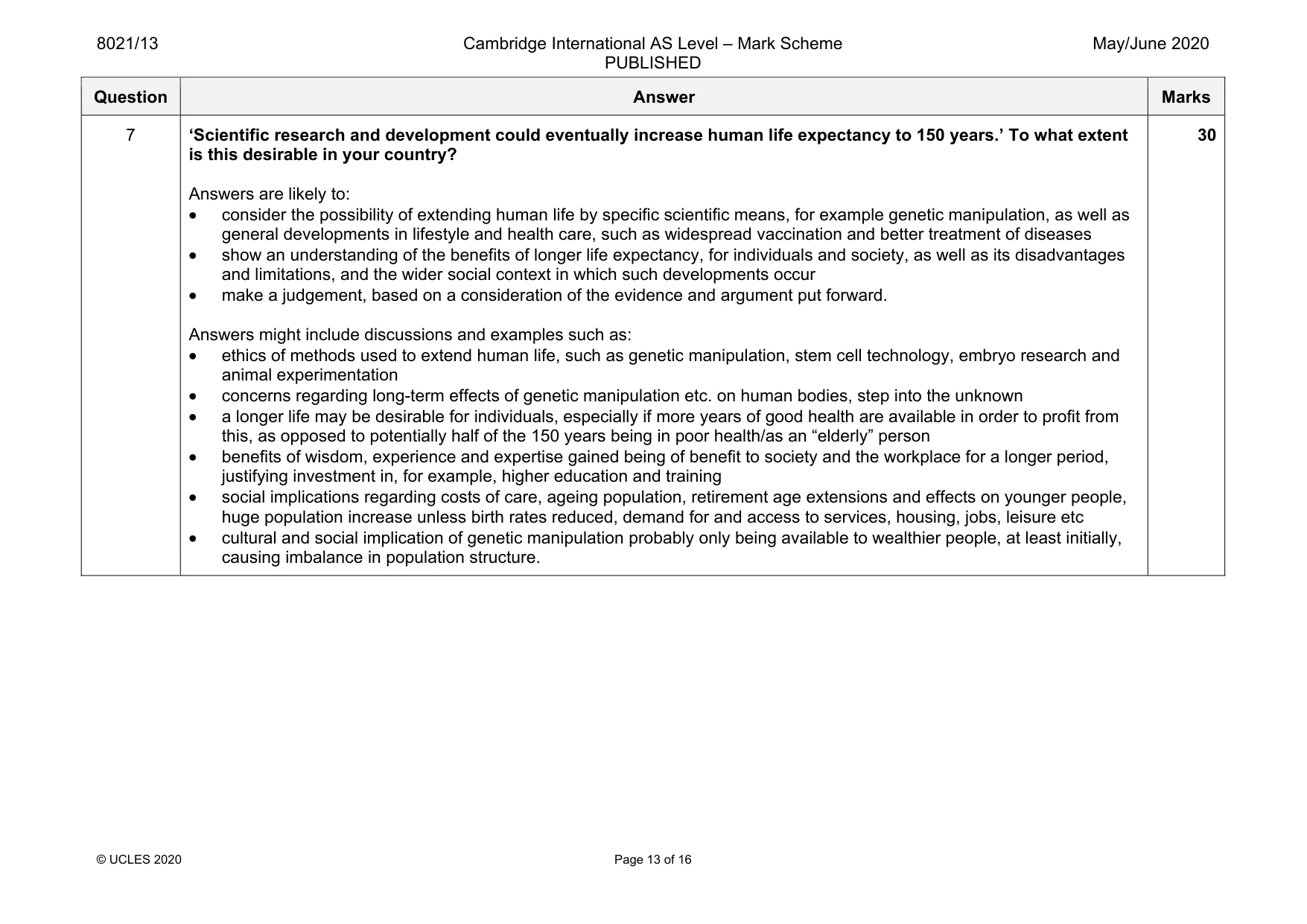
8021/13 Cambridge International AS Level – Mark Scheme PUBLISHED May/June 2020 © UCLES 2020 Page 13 of 16 Question Answer Marks 7 ‘Scientific research and development could eventually increase human life expectancy to 150 years.’ To what extent is this desirable in your country? Answers are likely to: • consider the possibility of extending human life by specific scientific means, for example genetic manipulation, as well as general developments in lifestyle and health care, such as widespread vaccination and better treatment of diseases • show an understanding of the benefits of longer life expectancy, for individuals and society, as well as its disadvantages and limitations, and the wider social context in which such developments occur • make a judgement, based on a consideration of the evidence and argument put forward. Answers might include discussions and examples such as: • ethics of methods used to extend human life, such as genetic manipulation, stem cell technology, embryo research and animal experimentation • concerns regarding long-term effects of genetic manipulation etc. on human bodies, step into the unknown • a longer life may be desirable for individuals, especially if more years of good health are available in order to profit from this, as opposed to potentially half of the 150 years being in poor health/as an “elderly” person • benefits of wisdom, experience and expertise gained being of benefit to society and the workplace for a longer period, justifying investment in, for example, higher education and training • social implications regarding costs of care, ageing population, retirement age extensions and effects on younger people, huge population increase unless birth rates reduced, demand for and access to services, housing, jobs, leisure etc • cultural and social implication of genetic manipulation probably only being available to wealthier people, at least initially, causing imbalance in population structure. 30
Mark scheme, page 14
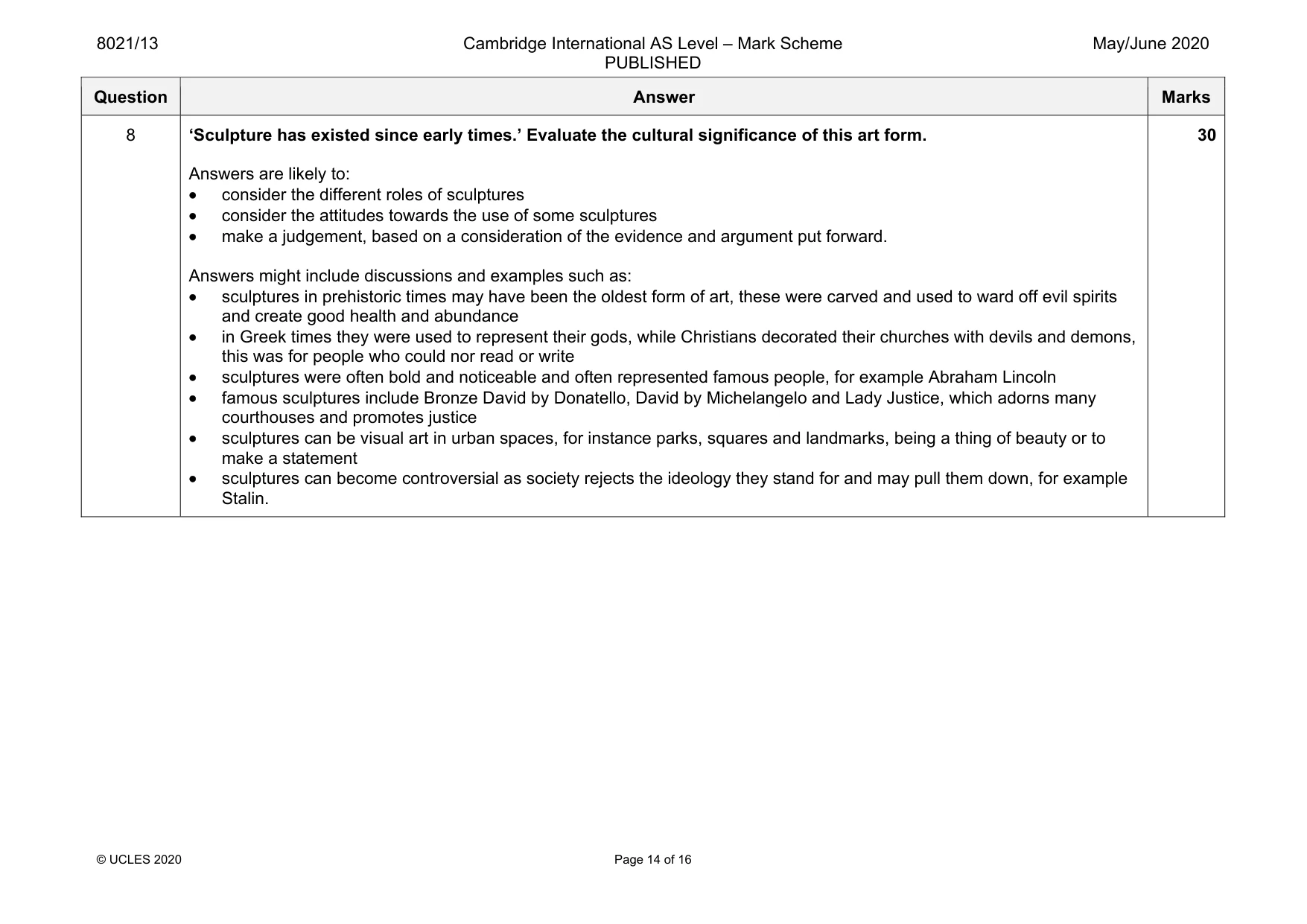
8021/13 Cambridge International AS Level – Mark Scheme PUBLISHED May/June 2020 © UCLES 2020 Page 14 of 16 Question Answer Marks 8 ‘Sculpture has existed since early times.’ Evaluate the cultural significance of this art form. Answers are likely to: • consider the different roles of sculptures • consider the attitudes towards the use of some sculptures • make a judgement, based on a consideration of the evidence and argument put forward. Answers might include discussions and examples such as: • sculptures in prehistoric times may have been the oldest form of art, these were carved and used to ward off evil spirits and create good health and abundance • in Greek times they were used to represent their gods, while Christians decorated their churches with devils and demons, this was for people who could nor read or write • sculptures were often bold and noticeable and often represented famous people, for example Abraham Lincoln • famous sculptures include Bronze David by Donatello, David by Michelangelo and Lady Justice, which adorns many courthouses and promotes justice • sculptures can be visual art in urban spaces, for instance parks, squares and landmarks, being a thing of beauty or to make a statement • sculptures can become controversial as society rejects the ideology they stand for and may pull them down, for example Stalin. 30
Mark scheme, page 15
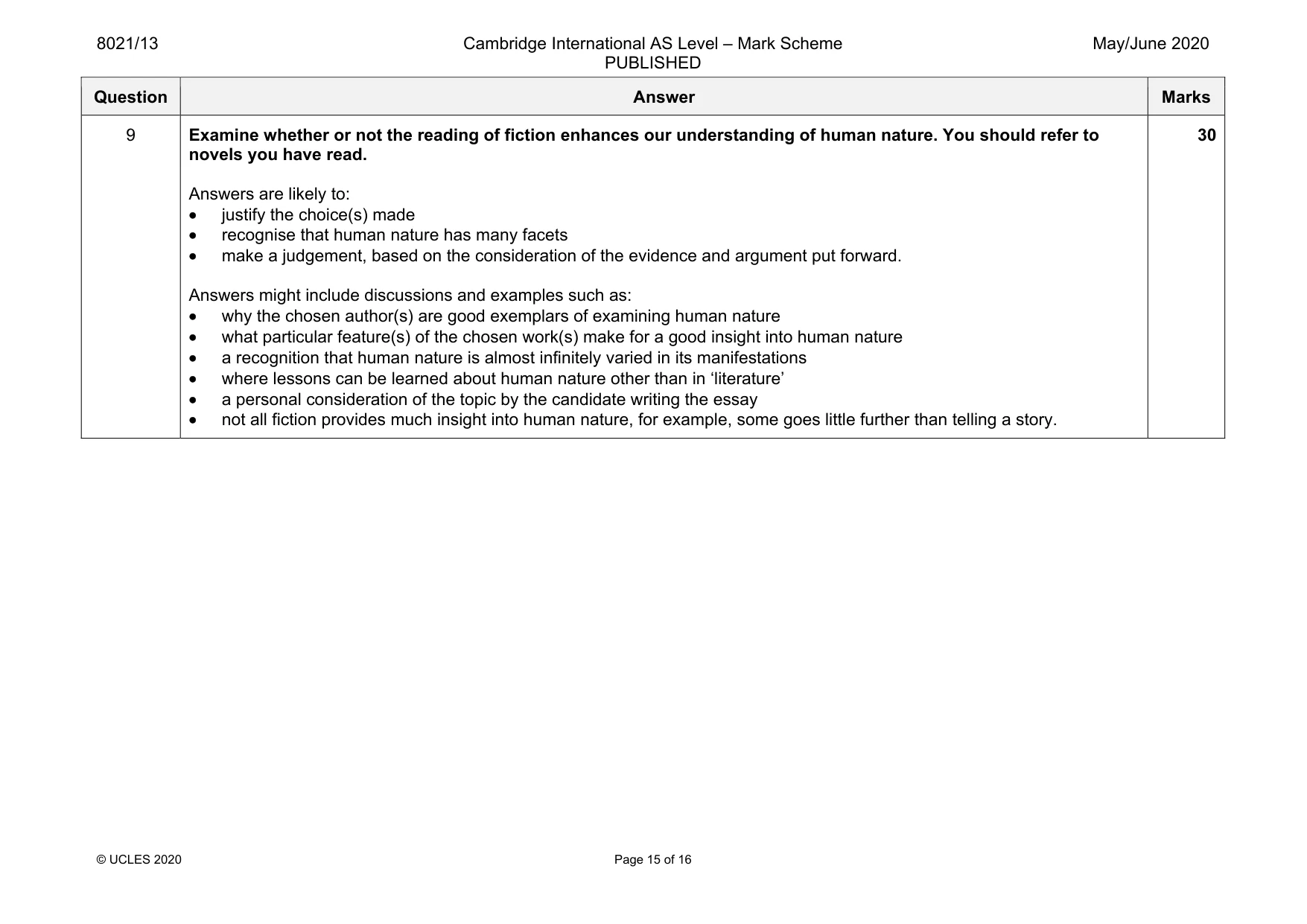
8021/13 Cambridge International AS Level – Mark Scheme PUBLISHED May/June 2020 © UCLES 2020 Page 15 of 16 Question Answer Marks 9 Examine whether or not the reading of fiction enhances our understanding of human nature. You should refer to novels you have read. Answers are likely to: • justify the choice(s) made • recognise that human nature has many facets • make a judgement, based on the consideration of the evidence and argument put forward. Answers might include discussions and examples such as: • why the chosen author(s) are good exemplars of examining human nature • what particular feature(s) of the chosen work(s) make for a good insight into human nature • a recognition that human nature is almost infinitely varied in its manifestations • where lessons can be learned about human nature other than in ‘literature’ • a personal consideration of the topic by the candidate writing the essay • not all fiction provides much insight into human nature, for example, some goes little further than telling a story. 30
Mark scheme, page 16
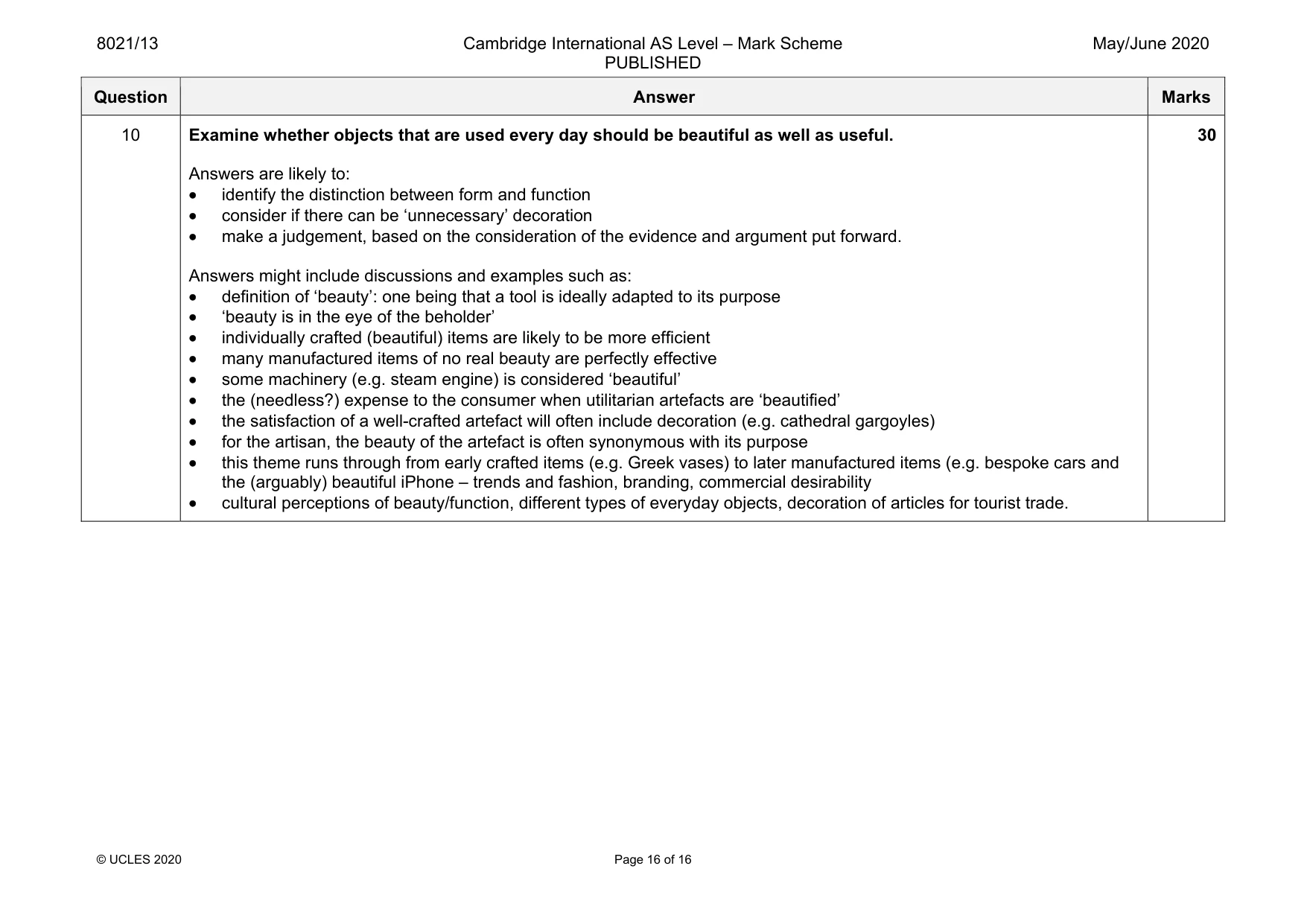
8021/13 Cambridge International AS Level – Mark Scheme PUBLISHED May/June 2020 © UCLES 2020 Page 16 of 16 Question Answer Marks 10 Examine whether objects that are used every day should be beautiful as well as useful. Answers are likely to: • identify the distinction between form and function • consider if there can be ‘unnecessary’ decoration • make a judgement, based on the consideration of the evidence and argument put forward. Answers might include discussions and examples such as: • definition of ‘beauty’: one being that a tool is ideally adapted to its purpose • ‘beauty is in the eye of the beholder’ • individually crafted (beautiful) items are likely to be more efficient • many manufactured items of no real beauty are perfectly effective • some machinery (e.g. steam engine) is considered ‘beautiful’ • the (needless?) expense to the consumer when utilitarian artefacts are ‘beautified’ • the satisfaction of a well-crafted artefact will often include decoration (e.g. cathedral gargoyles) • for the artisan, the beauty of the artefact is often synonymous with its purpose • this theme runs through from early crafted items (e.g. Greek vases) to later manufactured items (e.g. bespoke cars and the (arguably) beautiful iPhone – trends and fashion, branding, commercial desirability • cultural perceptions of beauty/function, different types of everyday objects, decoration of articles for tourist trade. 30