Cambridge A Level English General Paper 8021 — 2019 Oct/Nov Paper 1 · Variant 3
8021/13/O/N/19 · 30 marks · ≈34 min
The question paper and its mark scheme, free to read here and free to download. This is Cambridge’s own paper, exactly as it was sat.
Question paper4 pages


Mark scheme10 pages
Answers below. Sit the paper first if you are practising.
Paper as text
Question paper, page 1
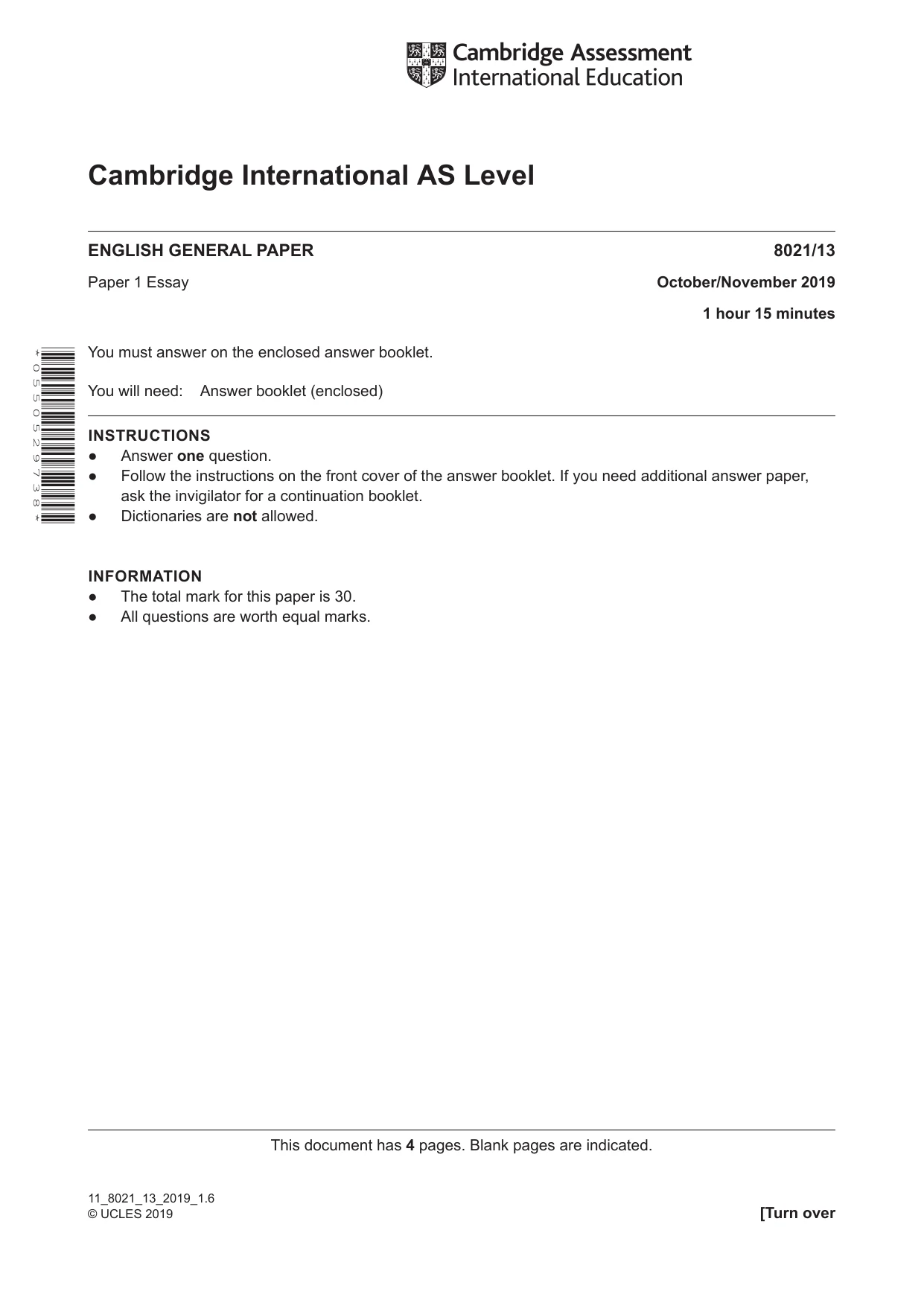
Cambridge International AS Level 11_8021_13_2019_1.6 © UCLES 2019 [Turn over This document has 4 pages. Blank pages are indicated. * 0 5 5 0 5 2 9 7 3 8 * ENGLISH GENERAL PAPER 8021/13 Paper 1 Essay October/November 2019 1 hour 15 minutes You must answer on the enclosed answer booklet. You will need: Answer booklet (enclosed) INSTRUCTIONS ● Answer one question. ● Follow the instructions on the front cover of the answer booklet. If you need additional answer paper, ask the invigilator for a continuation booklet. ● Dictionaries are not allowed. INFORMATION ● The total mark for this paper is 30. ● All questions are worth equal marks.
Question paper, page 2
BLANK PAGE 11_8021_13_2019_1.6 © UCLES 2019 2
Question paper, page 3
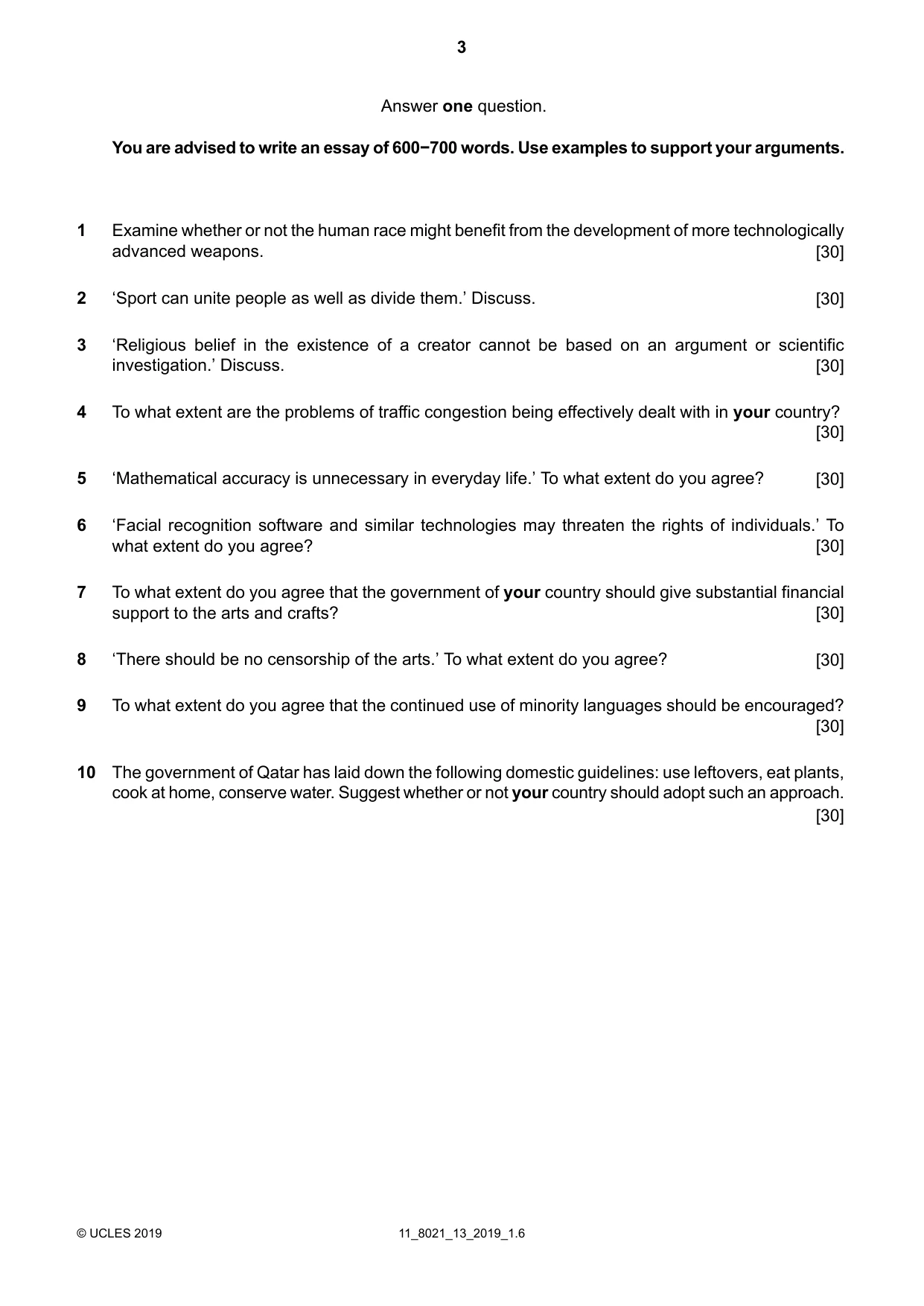
Answer one question. You are advised to write an essay of 600−700 words. Use examples to support your arguments. Examine whether or not the human race might benefit from the development of more technologically advanced weapons. [30] 1 ‘Sport can unite people as well as divide them.’ Discuss. [30] 2 ‘Religious belief in the existence of a creator cannot be based on an argument or scientific investigation.’ Discuss. [30] 3 To what extent are the problems of traffic congestion being effectively dealt with in your country? [30] 4 ‘Mathematical accuracy is unnecessary in everyday life.’ To what extent do you agree? [30] 5 ‘Facial recognition software and similar technologies may threaten the rights of individuals.’ To what extent do you agree? [30] 6 To what extent do you agree that the government of your country should give substantial financial support to the arts and crafts? [30] 7 ‘There should be no censorship of the arts.’ To what extent do you agree? [30] 8 To what extent do you agree that the continued use of minority languages should be encouraged? [30] 9 The government of Qatar has laid down the following domestic guidelines: use leftovers, eat plants, cook at home, conserve water. Suggest whether or not your country should adopt such an approach. [30] 10 11_8021_13_2019_1.6 © UCLES 2019 3
Question paper, page 4
BLANK PAGE Permission to reproduce items where third-party owned material protected by copyright is included has been sought and cleared where possible. Every reasonable effort has been made by the publisher (UCLES) to trace copyright holders, but if any items requiring clearance have unwittingly been included, the publisher will be pleased to make amends at the earliest possible opportunity. To avoid the issue of disclosure of answer-related information to candidates, all copyright acknowledgements are reproduced online in the Cambridge Assessment International Education Copyright Acknowledgements Booklet. This is produced for each series of examinations and is freely available to download at www.cambridgeinternational.org after the live examination series. Cambridge Assessment International Education is part of the Cambridge Assessment Group. Cambridge Assessment is the brand name of the University of Cambridge Local Examinations Syndicate (UCLES), which itself is a department of the University of Cambridge. 11_8021_13_2019_1.6 © UCLES 2019 4
Mark scheme, page 1
This document consists of 10 printed pages. © UCLES 2019 [Turn over Cambridge International AS Level ENGLISH GENERAL PAPER 8021/13 Paper 1 Essay October/November 2019 MARK SCHEME Maximum Mark: 30 Published This mark scheme is published as an aid to teachers and candidates, to indicate the requirements of the examination. It shows the basis on which Examiners were instructed to award marks. It does not indicate the details of the discussions that took place at an Examiners’ meeting before marking began, which would have considered the acceptability of alternative answers. Mark schemes should be read in conjunction with the question paper and the Principal Examiner Report for Teachers. Cambridge International will not enter into discussions about these mark schemes. Cambridge International is publishing the mark schemes for the October/November 2019 series for most Cambridge IGCSE™, Cambridge International A and AS Level components and some Cambridge O Level components.
Mark scheme, page 2
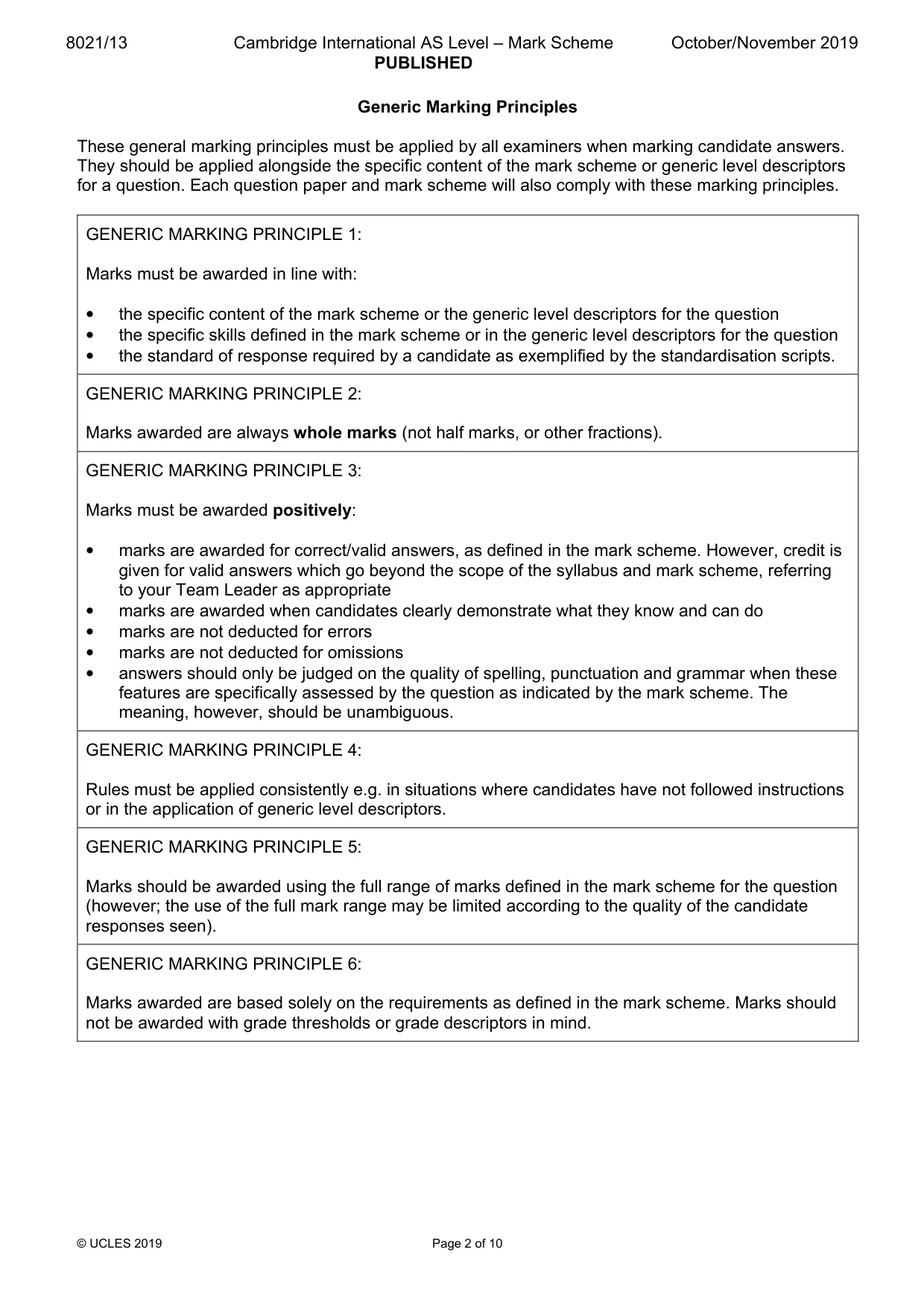
8021/13 Cambridge International AS Level – Mark Scheme PUBLISHED October/November 2019 © UCLES 2019 Page 2 of 10 Generic Marking Principles These general marking principles must be applied by all examiners when marking candidate answers. They should be applied alongside the specific content of the mark scheme or generic level descriptors for a question. Each question paper and mark scheme will also comply with these marking principles. GENERIC MARKING PRINCIPLE 1: Marks must be awarded in line with: • the specific content of the mark scheme or the generic level descriptors for the question • the specific skills defined in the mark scheme or in the generic level descriptors for the question • the standard of response required by a candidate as exemplified by the standardisation scripts. GENERIC MARKING PRINCIPLE 2: Marks awarded are always whole marks (not half marks, or other fractions). GENERIC MARKING PRINCIPLE 3: Marks must be awarded positively: • marks are awarded for correct/valid answers, as defined in the mark scheme. However, credit is given for valid answers which go beyond the scope of the syllabus and mark scheme, referring to your Team Leader as appropriate • marks are awarded when candidates clearly demonstrate what they know and can do • marks are not deducted for errors • marks are not deducted for omissions • answers should only be judged on the quality of spelling, punctuation and grammar when these features are specifically assessed by the question as indicated by the mark scheme. The meaning, however, should be unambiguous. GENERIC MARKING PRINCIPLE 4: Rules must be applied consistently e.g. in situations where candidates have not followed instructions or in the application of generic level descriptors. GENERIC MARKING PRINCIPLE 5: Marks should be awarded using the full range of marks defined in the mark scheme for the question (however; the use of the full mark range may be limited according to the quality of the candidate responses seen). GENERIC MARKING PRINCIPLE 6: Marks awarded are based solely on the requirements as defined in the mark scheme. Marks should not be awarded with grade thresholds or grade descriptors in mind.
Mark scheme, page 3
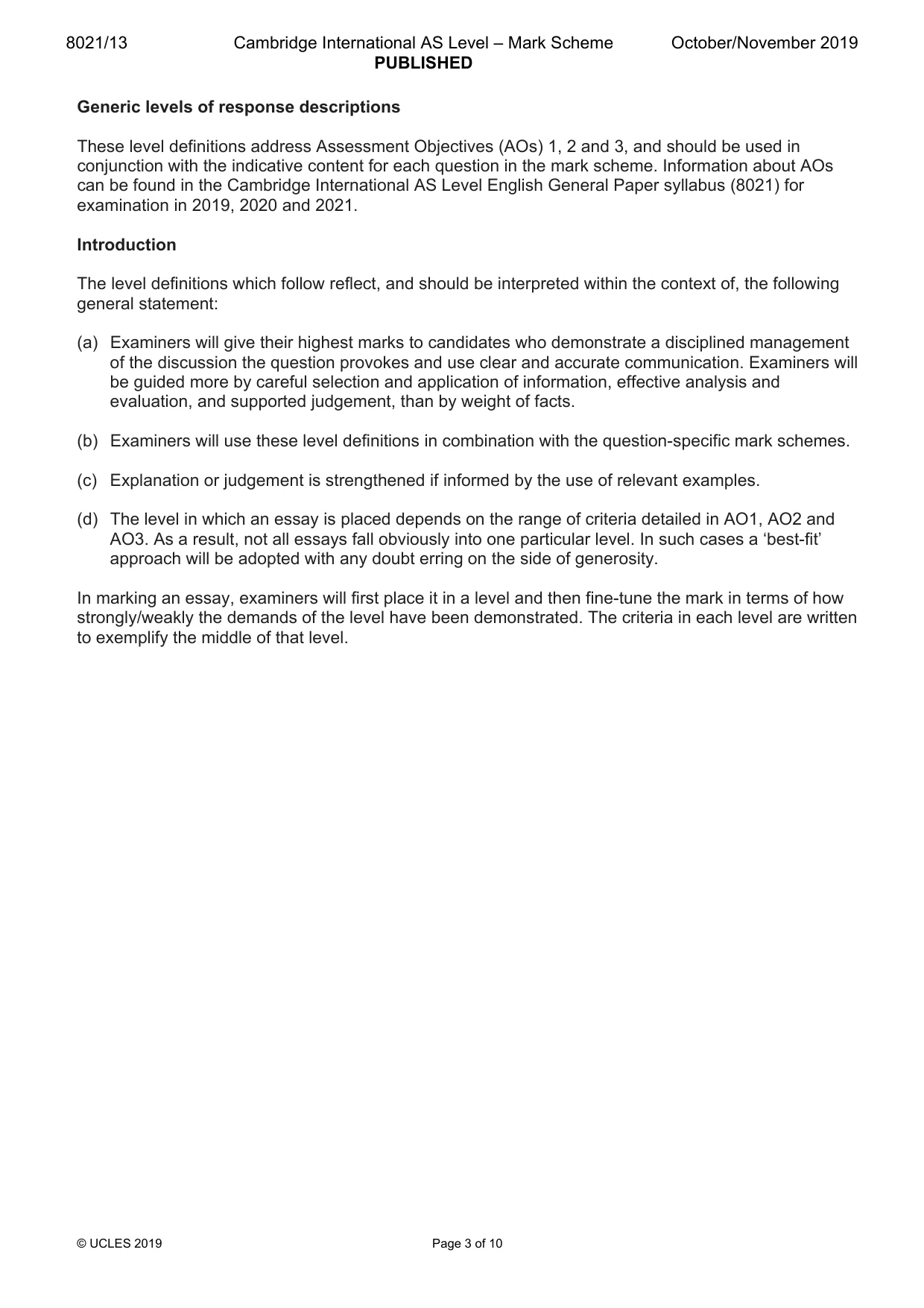
8021/13 Cambridge International AS Level – Mark Scheme PUBLISHED October/November 2019 © UCLES 2019 Page 3 of 10 Generic levels of response descriptions These level definitions address Assessment Objectives (AOs) 1, 2 and 3, and should be used in conjunction with the indicative content for each question in the mark scheme. Information about AOs can be found in the Cambridge International AS Level English General Paper syllabus (8021) for examination in 2019, 2020 and 2021. Introduction The level definitions which follow reflect, and should be interpreted within the context of, the following general statement: (a) Examiners will give their highest marks to candidates who demonstrate a disciplined management of the discussion the question provokes and use clear and accurate communication. Examiners will be guided more by careful selection and application of information, effective analysis and evaluation, and supported judgement, than by weight of facts. (b) Examiners will use these level definitions in combination with the question-specific mark schemes. (c) Explanation or judgement is strengthened if informed by the use of relevant examples. (d) The level in which an essay is placed depends on the range of criteria detailed in AO1, AO2 and AO3. As a result, not all essays fall obviously into one particular level. In such cases a ‘best-fit’ approach will be adopted with any doubt erring on the side of generosity. In marking an essay, examiners will first place it in a level and then fine-tune the mark in terms of how strongly/weakly the demands of the level have been demonstrated. The criteria in each level are written to exemplify the middle of that level.
Mark scheme, page 4
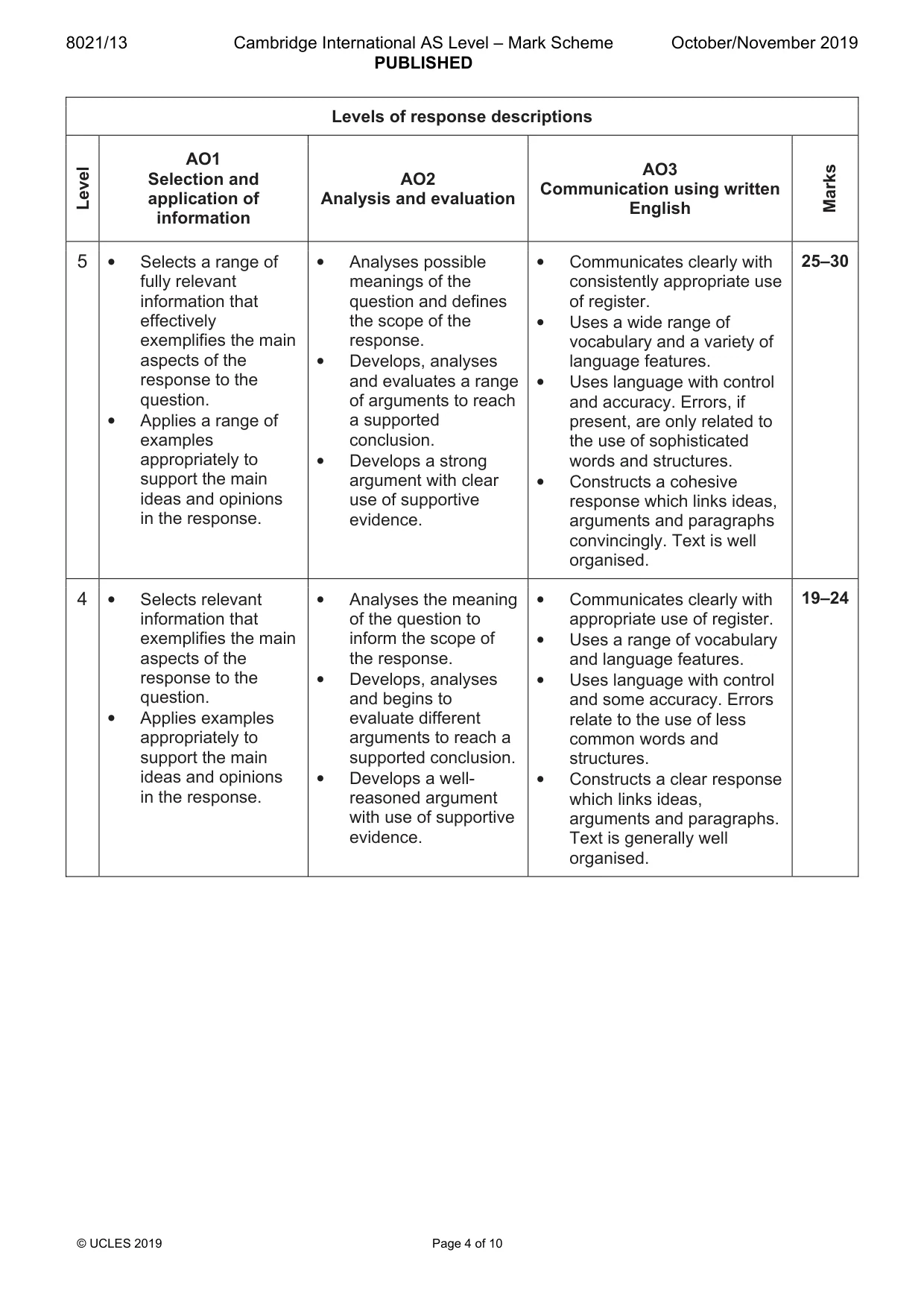
8021/13 Cambridge International AS Level – Mark Scheme PUBLISHED October/November 2019 © UCLES 2019 Page 4 of 10 Levels of response descriptions Level AO1 Selection and application of information AO2 Analysis and evaluation AO3 Communication using written English Marks 5 • Selects a range of fully relevant information that effectively exemplifies the main aspects of the response to the question. • Applies a range of examples appropriately to support the main ideas and opinions in the response. • Analyses possible meanings of the question and defines the scope of the response. • Develops, analyses and evaluates a range of arguments to reach a supported conclusion. • Develops a strong argument with clear use of supportive evidence. • Communicates clearly with consistently appropriate use of register. • Uses a wide range of vocabulary and a variety of language features. • Uses language with control and accuracy. Errors, if present, are only related to the use of sophisticated words and structures. • Constructs a cohesive response which links ideas, arguments and paragraphs convincingly. Text is well organised. 25–30 4 • Selects relevant information that exemplifies the main aspects of the response to the question. • Applies examples appropriately to support the main ideas and opinions in the response. • Analyses the meaning of the question to inform the scope of the response. • Develops, analyses and begins to evaluate different arguments to reach a supported conclusion. • Develops a well- reasoned argument with use of supportive evidence. • Communicates clearly with appropriate use of register. • Uses a range of vocabulary and language features. • Uses language with control and some accuracy. Errors relate to the use of less common words and structures. • Constructs a clear response which links ideas, arguments and paragraphs. Text is generally well organised. 19–24
Mark scheme, page 5
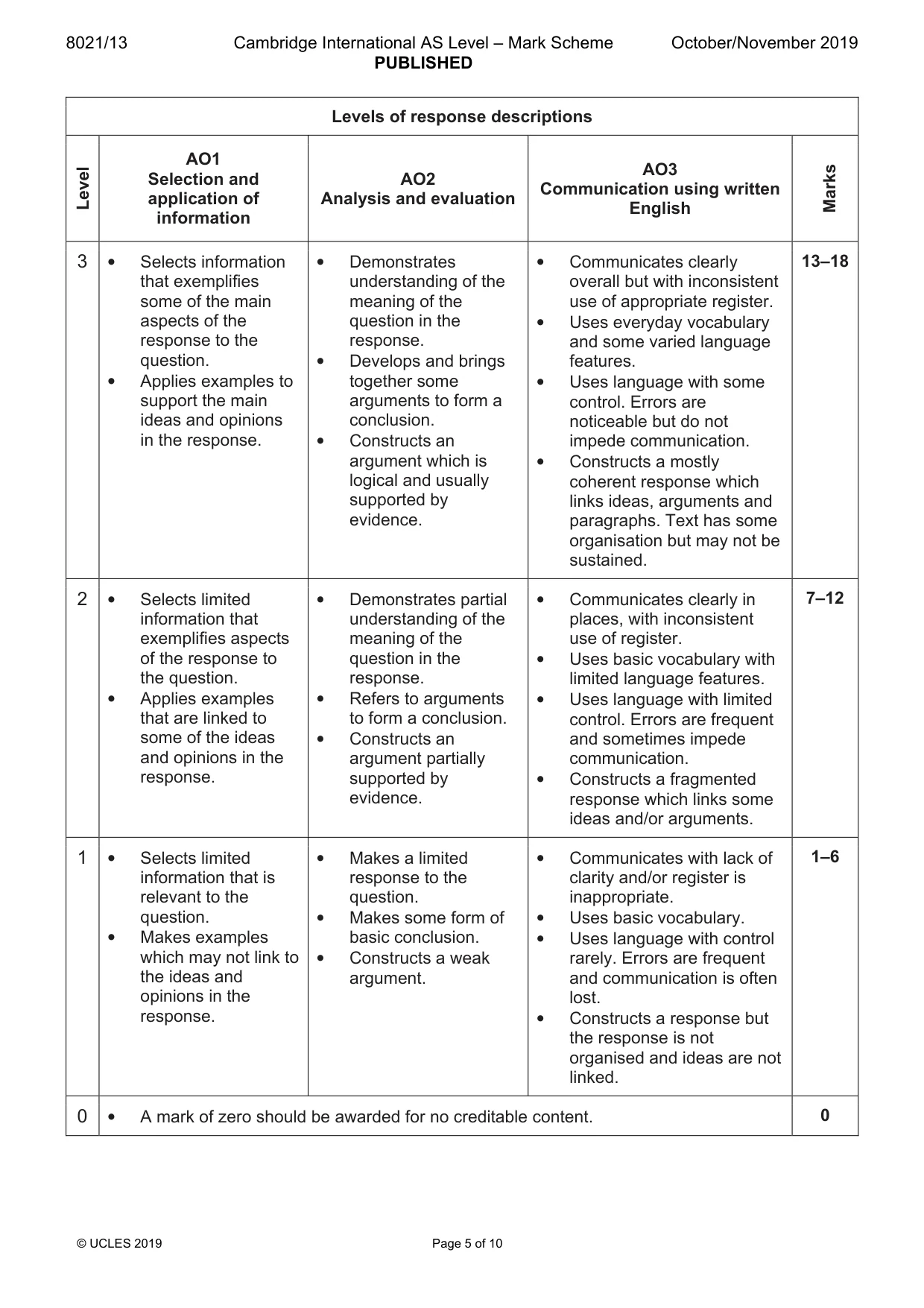
8021/13 Cambridge International AS Level – Mark Scheme PUBLISHED October/November 2019 © UCLES 2019 Page 5 of 10 Levels of response descriptions Level AO1 Selection and application of information AO2 Analysis and evaluation AO3 Communication using written English Marks 3 • Selects information that exemplifies some of the main aspects of the response to the question. • Applies examples to support the main ideas and opinions in the response. • Demonstrates understanding of the meaning of the question in the response. • Develops and brings together some arguments to form a conclusion. • Constructs an argument which is logical and usually supported by evidence. • Communicates clearly overall but with inconsistent use of appropriate register. • Uses everyday vocabulary and some varied language features. • Uses language with some control. Errors are noticeable but do not impede communication. • Constructs a mostly coherent response which links ideas, arguments and paragraphs. Text has some organisation but may not be sustained. 13–18 2 • Selects limited information that exemplifies aspects of the response to the question. • Applies examples that are linked to some of the ideas and opinions in the response. • Demonstrates partial understanding of the meaning of the question in the response. • Refers to arguments to form a conclusion. • Constructs an argument partially supported by evidence. • Communicates clearly in places, with inconsistent use of register. • Uses basic vocabulary with limited language features. • Uses language with limited control. Errors are frequent and sometimes impede communication. • Constructs a fragmented response which links some ideas and/or arguments. 7–12 1 • Selects limited information that is relevant to the question. • Makes examples which may not link to the ideas and opinions in the response. • Makes a limited response to the question. • Makes some form of basic conclusion. • Constructs a weak argument. • Communicates with lack of clarity and/or register is inappropriate. • Uses basic vocabulary. • Uses language with control rarely. Errors are frequent and communication is often lost. • Constructs a response but the response is not organised and ideas are not linked. 1–6 0 • A mark of zero should be awarded for no creditable content. 0
Mark scheme, page 6
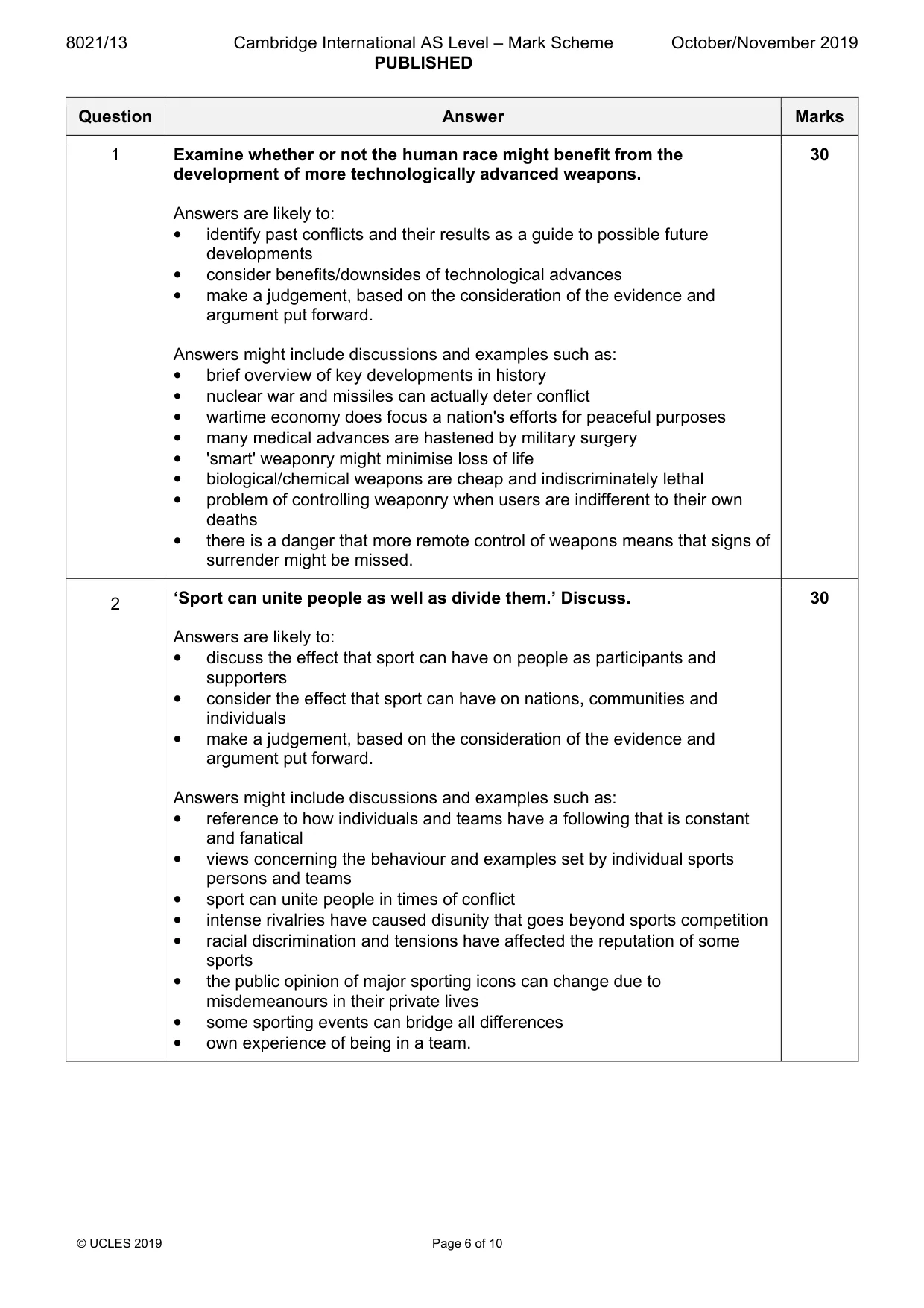
8021/13 Cambridge International AS Level – Mark Scheme PUBLISHED October/November 2019 © UCLES 2019 Page 6 of 10 Question Answer Marks 1 Examine whether or not the human race might benefit from the development of more technologically advanced weapons. Answers are likely to: • identify past conflicts and their results as a guide to possible future developments • consider benefits/downsides of technological advances • make a judgement, based on the consideration of the evidence and argument put forward. Answers might include discussions and examples such as: • brief overview of key developments in history • nuclear war and missiles can actually deter conflict • wartime economy does focus a nation's efforts for peaceful purposes • many medical advances are hastened by military surgery • 'smart' weaponry might minimise loss of life • biological/chemical weapons are cheap and indiscriminately lethal • problem of controlling weaponry when users are indifferent to their own deaths • there is a danger that more remote control of weapons means that signs of surrender might be missed. 30 2 ‘Sport can unite people as well as divide them.’ Discuss. Answers are likely to: • discuss the effect that sport can have on people as participants and supporters • consider the effect that sport can have on nations, communities and individuals • make a judgement, based on the consideration of the evidence and argument put forward. Answers might include discussions and examples such as: • reference to how individuals and teams have a following that is constant and fanatical • views concerning the behaviour and examples set by individual sports persons and teams • sport can unite people in times of conflict • intense rivalries have caused disunity that goes beyond sports competition • racial discrimination and tensions have affected the reputation of some sports • the public opinion of major sporting icons can change due to misdemeanours in their private lives • some sporting events can bridge all differences • own experience of being in a team. 30
Mark scheme, page 7
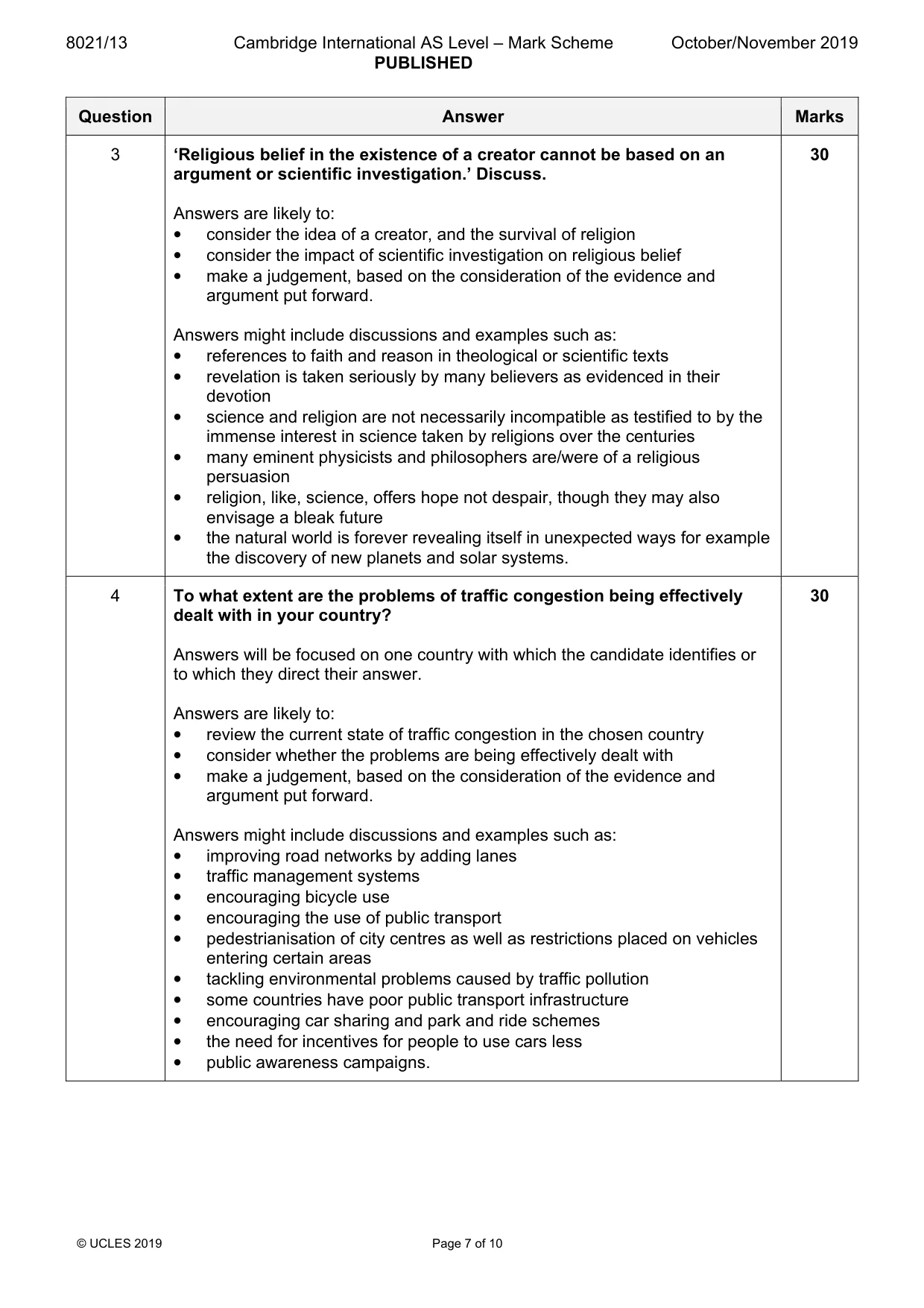
8021/13 Cambridge International AS Level – Mark Scheme PUBLISHED October/November 2019 © UCLES 2019 Page 7 of 10 Question Answer Marks 3 ‘Religious belief in the existence of a creator cannot be based on an argument or scientific investigation.’ Discuss. Answers are likely to: • consider the idea of a creator, and the survival of religion • consider the impact of scientific investigation on religious belief • make a judgement, based on the consideration of the evidence and argument put forward. Answers might include discussions and examples such as: • references to faith and reason in theological or scientific texts • revelation is taken seriously by many believers as evidenced in their devotion • science and religion are not necessarily incompatible as testified to by the immense interest in science taken by religions over the centuries • many eminent physicists and philosophers are/were of a religious persuasion • religion, like, science, offers hope not despair, though they may also envisage a bleak future • the natural world is forever revealing itself in unexpected ways for example the discovery of new planets and solar systems. 30 4 To what extent are the problems of traffic congestion being effectively dealt with in your country? Answers will be focused on one country with which the candidate identifies or to which they direct their answer. Answers are likely to: • review the current state of traffic congestion in the chosen country • consider whether the problems are being effectively dealt with • make a judgement, based on the consideration of the evidence and argument put forward. Answers might include discussions and examples such as: • improving road networks by adding lanes • traffic management systems • encouraging bicycle use • encouraging the use of public transport • pedestrianisation of city centres as well as restrictions placed on vehicles entering certain areas • tackling environmental problems caused by traffic pollution • some countries have poor public transport infrastructure • encouraging car sharing and park and ride schemes • the need for incentives for people to use cars less • public awareness campaigns. 30
Mark scheme, page 8
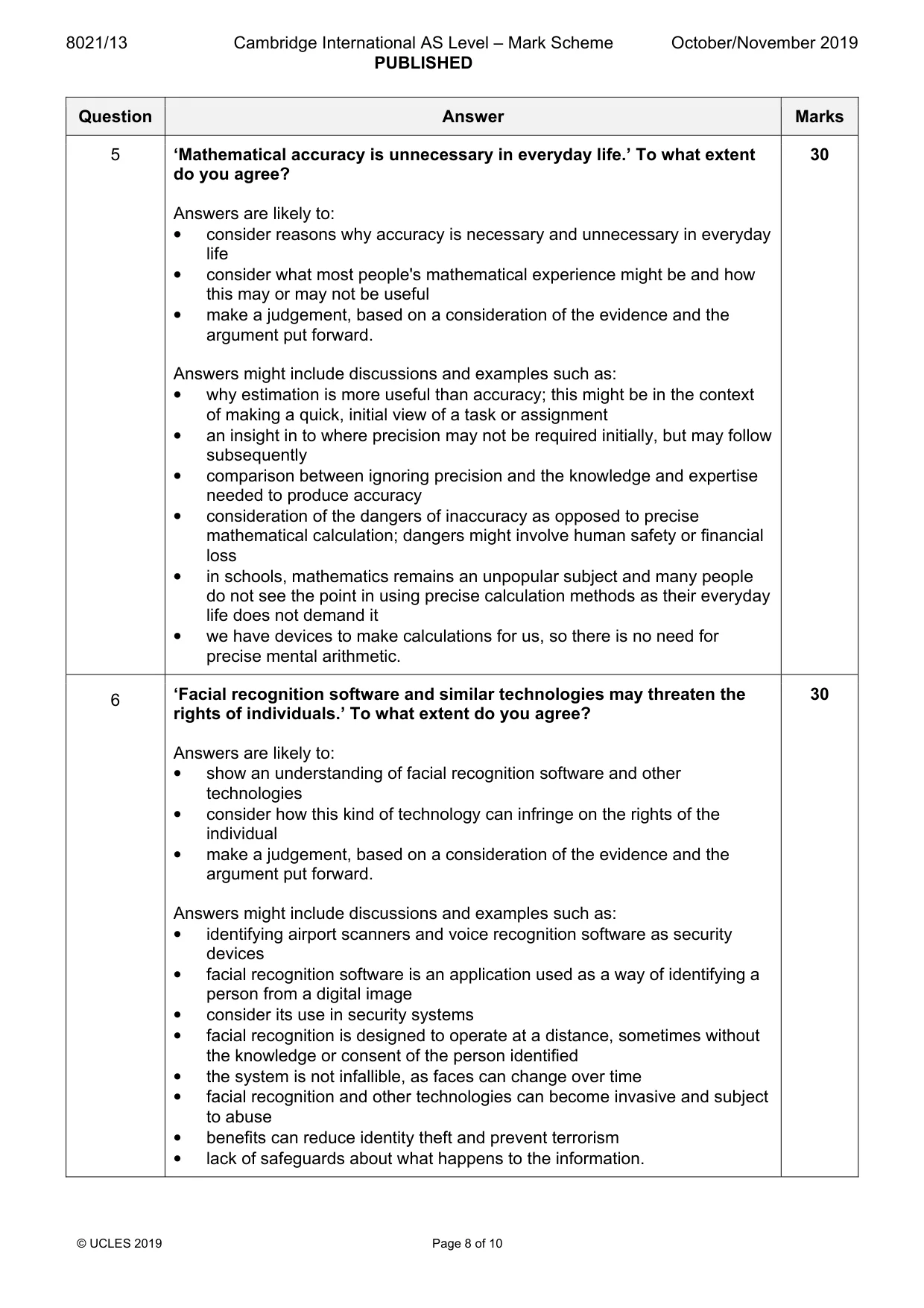
8021/13 Cambridge International AS Level – Mark Scheme PUBLISHED October/November 2019 © UCLES 2019 Page 8 of 10 Question Answer Marks 5 ‘Mathematical accuracy is unnecessary in everyday life.’ To what extent do you agree? Answers are likely to: • consider reasons why accuracy is necessary and unnecessary in everyday life • consider what most people's mathematical experience might be and how this may or may not be useful • make a judgement, based on a consideration of the evidence and the argument put forward. Answers might include discussions and examples such as: • why estimation is more useful than accuracy; this might be in the context of making a quick, initial view of a task or assignment • an insight in to where precision may not be required initially, but may follow subsequently • comparison between ignoring precision and the knowledge and expertise needed to produce accuracy • consideration of the dangers of inaccuracy as opposed to precise mathematical calculation; dangers might involve human safety or financial loss • in schools, mathematics remains an unpopular subject and many people do not see the point in using precise calculation methods as their everyday life does not demand it • we have devices to make calculations for us, so there is no need for precise mental arithmetic. 30 6 ‘Facial recognition software and similar technologies may threaten the rights of individuals.’ To what extent do you agree? Answers are likely to: • show an understanding of facial recognition software and other technologies • consider how this kind of technology can infringe on the rights of the individual • make a judgement, based on a consideration of the evidence and the argument put forward. Answers might include discussions and examples such as: • identifying airport scanners and voice recognition software as security devices • facial recognition software is an application used as a way of identifying a person from a digital image • consider its use in security systems • facial recognition is designed to operate at a distance, sometimes without the knowledge or consent of the person identified • the system is not infallible, as faces can change over time • facial recognition and other technologies can become invasive and subject to abuse • benefits can reduce identity theft and prevent terrorism • lack of safeguards about what happens to the information. 30
Mark scheme, page 9
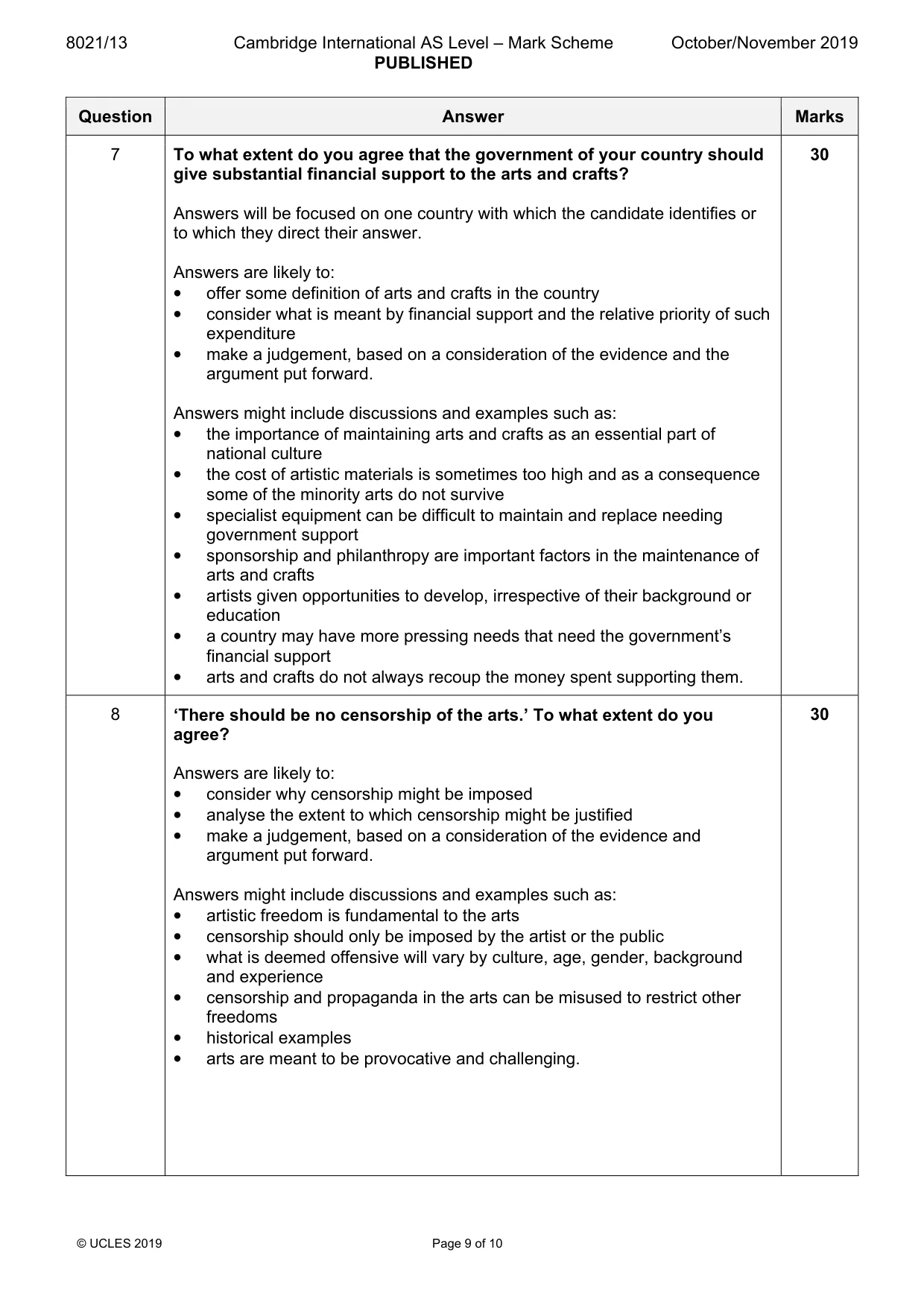
8021/13 Cambridge International AS Level – Mark Scheme PUBLISHED October/November 2019 © UCLES 2019 Page 9 of 10 Question Answer Marks 7 To what extent do you agree that the government of your country should give substantial financial support to the arts and crafts? Answers will be focused on one country with which the candidate identifies or to which they direct their answer. Answers are likely to: • offer some definition of arts and crafts in the country • consider what is meant by financial support and the relative priority of such expenditure • make a judgement, based on a consideration of the evidence and the argument put forward. Answers might include discussions and examples such as: • the importance of maintaining arts and crafts as an essential part of national culture • the cost of artistic materials is sometimes too high and as a consequence some of the minority arts do not survive • specialist equipment can be difficult to maintain and replace needing government support • sponsorship and philanthropy are important factors in the maintenance of arts and crafts • artists given opportunities to develop, irrespective of their background or education • a country may have more pressing needs that need the government’s financial support • arts and crafts do not always recoup the money spent supporting them. 30 8 ‘There should be no censorship of the arts.’ To what extent do you agree? Answers are likely to: • consider why censorship might be imposed • analyse the extent to which censorship might be justified • make a judgement, based on a consideration of the evidence and argument put forward. Answers might include discussions and examples such as: • artistic freedom is fundamental to the arts • censorship should only be imposed by the artist or the public • what is deemed offensive will vary by culture, age, gender, background and experience • censorship and propaganda in the arts can be misused to restrict other freedoms • historical examples • arts are meant to be provocative and challenging. 30
Mark scheme, page 10
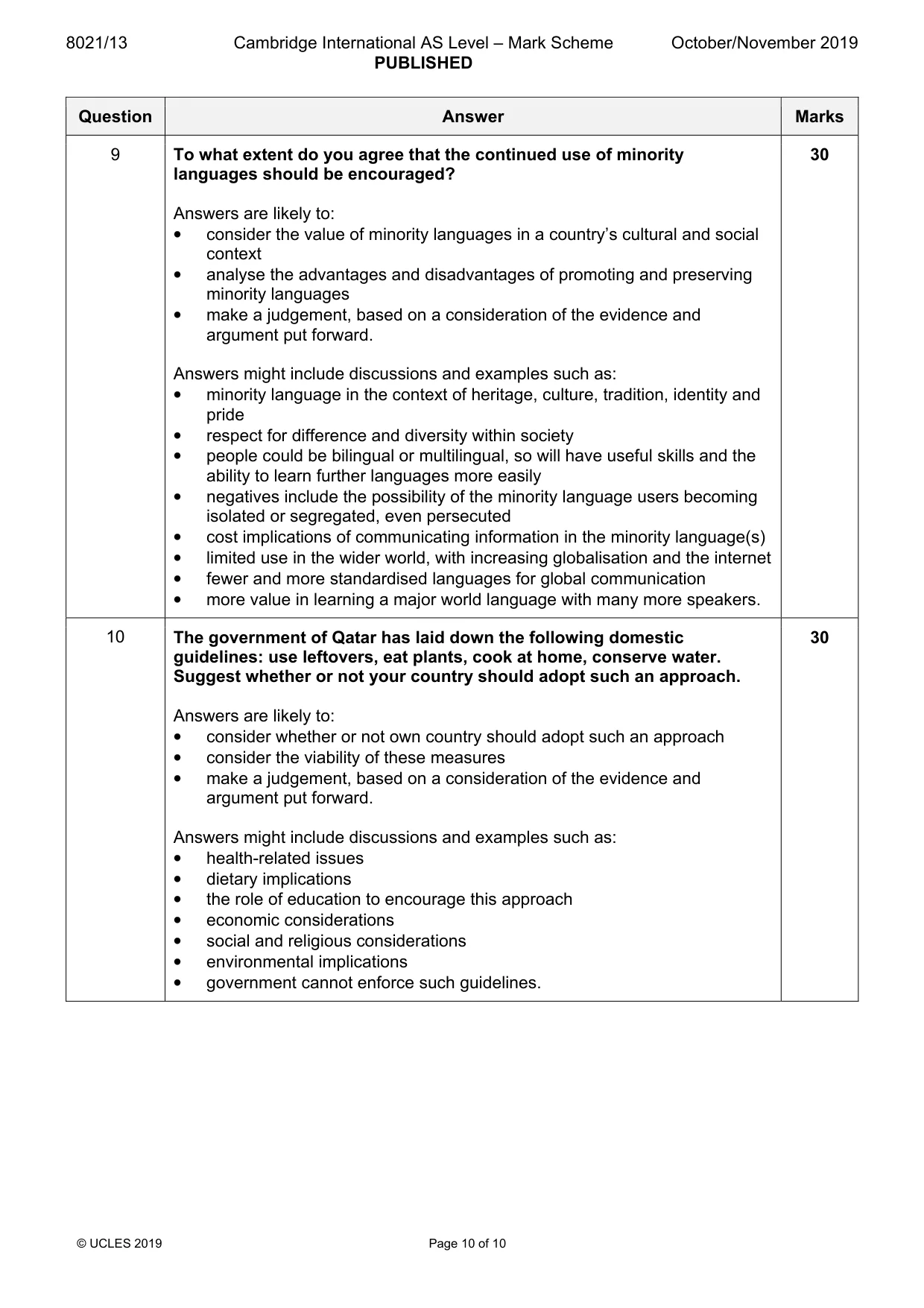
8021/13 Cambridge International AS Level – Mark Scheme PUBLISHED October/November 2019 © UCLES 2019 Page 10 of 10 Question Answer Marks 9 To what extent do you agree that the continued use of minority languages should be encouraged? Answers are likely to: • consider the value of minority languages in a country’s cultural and social context • analyse the advantages and disadvantages of promoting and preserving minority languages • make a judgement, based on a consideration of the evidence and argument put forward. Answers might include discussions and examples such as: • minority language in the context of heritage, culture, tradition, identity and pride • respect for difference and diversity within society • people could be bilingual or multilingual, so will have useful skills and the ability to learn further languages more easily • negatives include the possibility of the minority language users becoming isolated or segregated, even persecuted • cost implications of communicating information in the minority language(s) • limited use in the wider world, with increasing globalisation and the internet • fewer and more standardised languages for global communication • more value in learning a major world language with many more speakers. 30 10 The government of Qatar has laid down the following domestic guidelines: use leftovers, eat plants, cook at home, conserve water. Suggest whether or not your country should adopt such an approach. Answers are likely to: • consider whether or not own country should adopt such an approach • consider the viability of these measures • make a judgement, based on a consideration of the evidence and argument put forward. Answers might include discussions and examples such as: • health-related issues • dietary implications • the role of education to encourage this approach • economic considerations • social and religious considerations • environmental implications • government cannot enforce such guidelines. 30
What you needed in this session
Cambridge’s own grade thresholds for 2019 Oct/Nov, Paper 1 · Variant 3. A higher threshold means an easier paper — the bar moves with how the cohort did.