Cambridge A Level English General Paper 8021 — 2019 May/June Paper 1 · Variant 3
8021/13/M/J/19 · 30 marks · ≈34 min
The question paper and its mark scheme, free to read here and free to download. This is Cambridge’s own paper, exactly as it was sat.
Question paper4 pages


Mark scheme13 pages
Answers below. Sit the paper first if you are practising.
Paper as text
Question paper, page 1
Cambridge International AS Level 06_8021_13_2019_1.7 © UCLES 2019 [Turn over This document has 4 pages. Blank pages are indicated. * 8 0 8 3 9 0 4 3 7 7 * ENGLISH GENERAL PAPER 8021/13 Paper 1 Essay May/June 2019 1 hour 15 minutes You must answer on the enclosed answer booklet. You will need: Answer booklet (enclosed) INSTRUCTIONS ● Answer one question. ● Follow the instructions on the front cover of the answer booklet. If you need additional answer paper, ask the invigilator for a continuation booklet. ● Dictionaries are not allowed. INFORMATION ● The total mark for this paper is 30. ● All questions are worth equal marks.
Question paper, page 2
BLANK PAGE 06_8021_13_2019_1.7 © UCLES 2019 2
Question paper, page 3
Answer one question. You are advised to write an essay of 600−700 words. Use examples to support your arguments. ‘In the production of food, animal welfare should be a higher priority than cost.’ To what extent do you agree? [30] 1 ‘International organisations, such as the World Health Organization and the International Monetary Fund, have become more important in recent years.’ To what extent do you agree? [30] 2 ‘Inequality in life expectancy between the rich and poor is growing.’ To what extent is health the responsibility of the individual? [30] 3 Assess whether it is important that areas of natural beauty should be preserved and protected in your country. [30] 4 ‘It is difficult to justify spending money on space exploration while poverty exists.’ To what extent do you agree? [30] 5 ‘Social media is now one of the main forms of communication.’ Assess the impact of this on society today. [30] 6 ‘News media cannot be trusted to report the truth.’ To what extent is this the case in your country? [30] 7 ‘Works of art are not just found in museums and galleries, but everywhere around us.’ Evaluate this statement. [30] 8 ‘Cookery is the only art form available to everyone.’ To what extent do you agree? [30] 9 Identify an author from your country and justify the study of one or more of their works in schools. [30] 10 06_8021_13_2019_1.7 © UCLES 2019 3
Question paper, page 4
BLANK PAGE Permission to reproduce items where third-party owned material protected by copyright is included has been sought and cleared where possible. Every reasonable effort has been made by the publisher (UCLES) to trace copyright holders, but if any items requiring clearance have unwittingly been included, the publisher will be pleased to make amends at the earliest possible opportunity. To avoid the issue of disclosure of answer-related information to candidates, all copyright acknowledgements are reproduced online in the Cambridge Assessment International Education Copyright Acknowledgements Booklet. This is produced for each series of examinations and is freely available to download at www.cambridgeinternational.org after the live examination series. Cambridge Assessment International Education is part of the Cambridge Assessment Group. Cambridge Assessment is the brand name of the University of Cambridge Local Examinations Syndicate (UCLES), which itself is a department of the University of Cambridge. 06_8021_13_2019_1.7 © UCLES 2019 4
Mark scheme, page 1
8021/13 Cambridge International AS Level – Mark Scheme PUBLISHED May/June 2019 © UCLES 2019 Page 1 of 13 Cambridge International AS Level ENGLISH GENERAL PAPER 8021/13 Paper 1 Essay May/June 2019 MARK SCHEME Maximum Mark: 30 Published This mark scheme is published as an aid to teachers and candidates, to indicate the requirements of the examination. It shows the basis on which Examiners were instructed to award marks. It does not indicate the details of the discussions that took place at an Examiners’ meeting before marking began, which would have considered the acceptability of alternative answers. Mark schemes should be read in conjunction with the question paper and the Principal Examiner Report for Teachers. Cambridge International will not enter into discussions about these mark schemes. Cambridge International is publishing the mark schemes for the May/June 2019 series for most Cambridge IGCSE™, Cambridge International A and AS Level and Cambridge Pre-U components, and some Cambridge O Level components.
Mark scheme, page 2
8021/13 Cambridge International AS Level – Mark Scheme PUBLISHED May/June 2019 © UCLES 2019 Page 2 of 13 Generic Marking Principles These general marking principles must be applied by all examiners when marking candidate answers. They should be applied alongside the specific content of the mark scheme or generic level descriptors for a question. Each question paper and mark scheme will also comply with these marking principles. GENERIC MARKING PRINCIPLE 1: Marks must be awarded in line with: • the specific content of the mark scheme or the generic level descriptors for the question • the specific skills defined in the mark scheme or in the generic level descriptors for the question • the standard of response required by a candidate as exemplified by the standardisation scripts. GENERIC MARKING PRINCIPLE 2: Marks awarded are always whole marks (not half marks, or other fractions). GENERIC MARKING PRINCIPLE 3: Marks must be awarded positively: • marks are awarded for correct/valid answers, as defined in the mark scheme. However, credit is given for valid answers which go beyond the scope of the syllabus and mark scheme, referring to your Team Leader as appropriate • marks are awarded when candidates clearly demonstrate what they know and can do • marks are not deducted for errors • marks are not deducted for omissions • answers should only be judged on the quality of spelling, punctuation and grammar when these features are specifically assessed by the question as indicated by the mark scheme. The meaning, however, should be unambiguous. GENERIC MARKING PRINCIPLE 4: Rules must be applied consistently e.g. in situations where candidates have not followed instructions or in the application of generic level descriptors. GENERIC MARKING PRINCIPLE 5: Marks should be awarded using the full range of marks defined in the mark scheme for the question (however; the use of the full mark range may be limited according to the quality of the candidate responses seen). GENERIC MARKING PRINCIPLE 6: Marks awarded are based solely on the requirements as defined in the mark scheme. Marks should not be awarded with grade thresholds or grade descriptors in mind.
Mark scheme, page 3
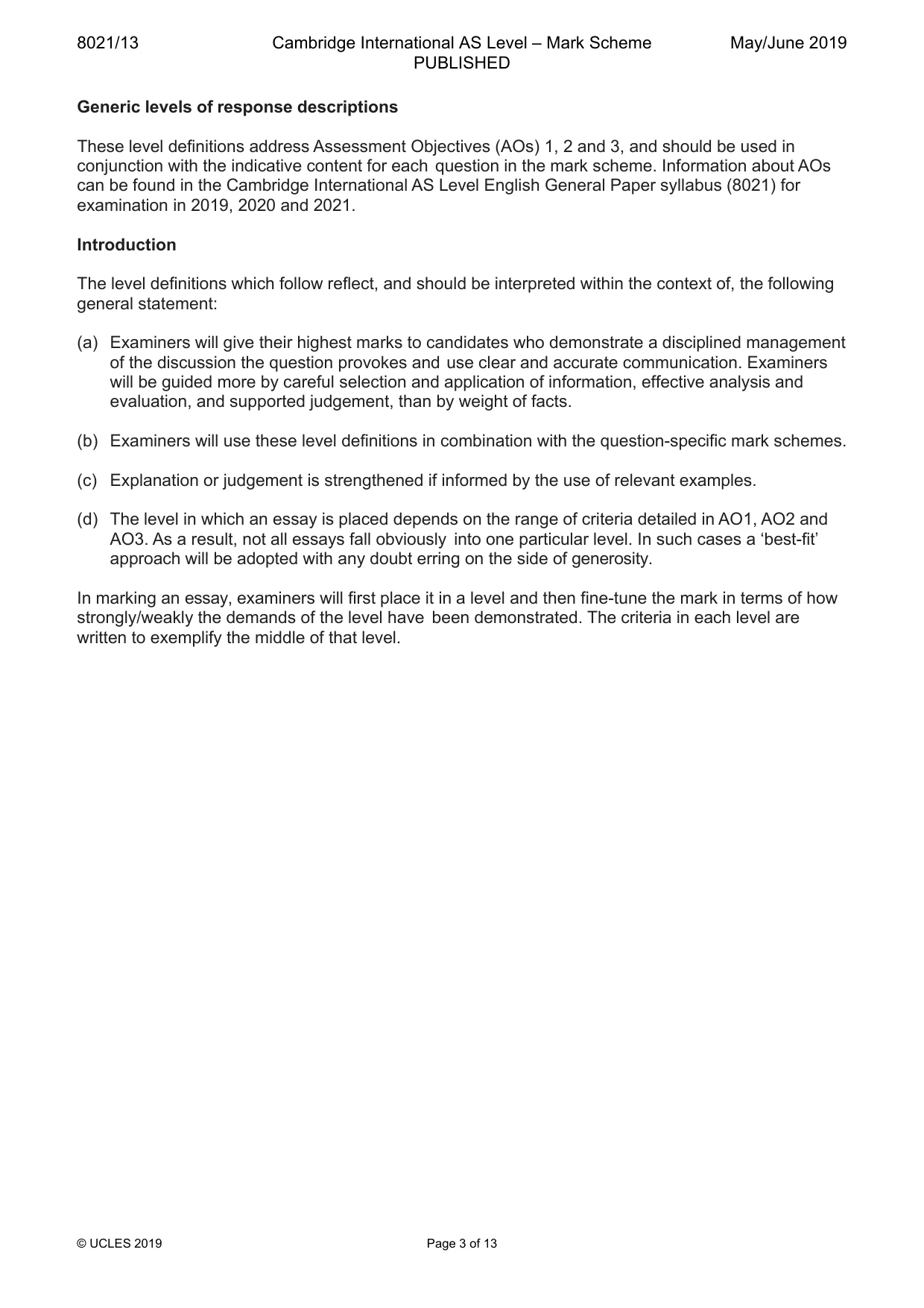
8021/13 Cambridge International AS Level – Mark Scheme PUBLISHED May/June 2019 © UCLES 2019 Page 3 of 13 Generic levels of response descriptions These level definitions address Assessment Objectives (AOs) 1, 2 and 3, and should be used in conjunction with the indicative content for each question in the mark scheme. Information about AOs can be found in the Cambridge International AS Level English General Paper syllabus (8021) for examination in 2019, 2020 and 2021. Introduction The level definitions which follow reflect, and should be interpreted within the context of, the following general statement: (a) Examiners will give their highest marks to candidates who demonstrate a disciplined management of the discussion the question provokes and use clear and accurate communication. Examiners will be guided more by careful selection and application of information, effective analysis and evaluation, and supported judgement, than by weight of facts. (b) Examiners will use these level definitions in combination with the question-specific mark schemes. (c) Explanation or judgement is strengthened if informed by the use of relevant examples. (d) The level in which an essay is placed depends on the range of criteria detailed in AO1, AO2 and AO3. As a result, not all essays fall obviously into one particular level. In such cases a ‘best-fit’ approach will be adopted with any doubt erring on the side of generosity. In marking an essay, examiners will first place it in a level and then fine-tune the mark in terms of how strongly/weakly the demands of the level have been demonstrated. The criteria in each level are written to exemplify the middle of that level.
Mark scheme, page 4
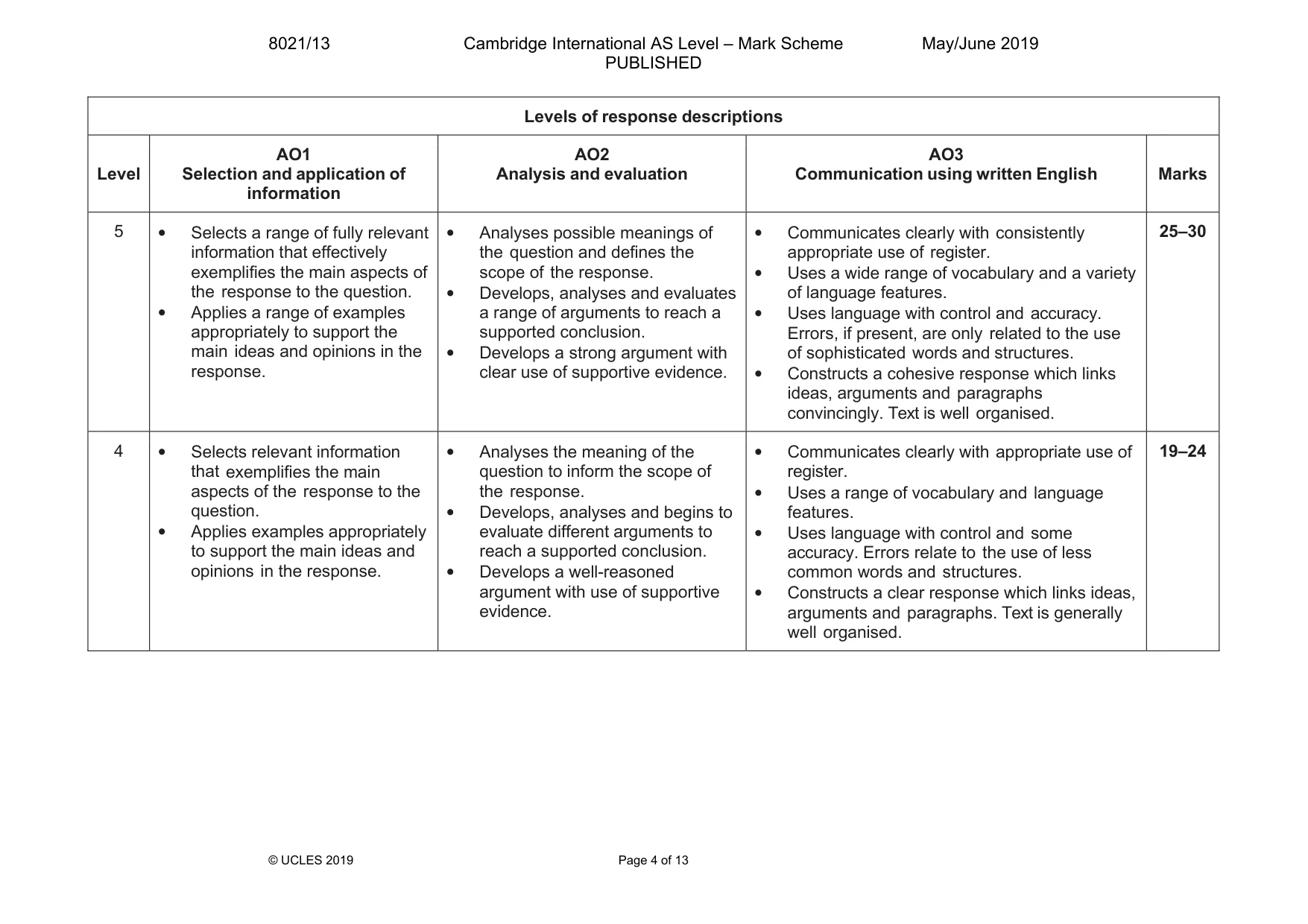
8021/13 Cambridge International AS Level – Mark Scheme PUBLISHED May/June 2019 © UCLES 2019 Page 4 of 13 Levels of response descriptions Level AO1 Selection and application of information AO2 Analysis and evaluation AO3 Communication using written English Marks 5 • Selects a range of fully relevant information that effectively exemplifies the main aspects of the response to the question. • Applies a range of examples appropriately to support the main ideas and opinions in the response. • Analyses possible meanings of the question and defines the scope of the response. • Develops, analyses and evaluates a range of arguments to reach a supported conclusion. • Develops a strong argument with clear use of supportive evidence. • Communicates clearly with consistently appropriate use of register. • Uses a wide range of vocabulary and a variety of language features. • Uses language with control and accuracy. Errors, if present, are only related to the use of sophisticated words and structures. • Constructs a cohesive response which links ideas, arguments and paragraphs convincingly. Text is well organised. 25–30 4 • Selects relevant information that exemplifies the main aspects of the response to the question. • Applies examples appropriately to support the main ideas and opinions in the response. • Analyses the meaning of the question to inform the scope of the response. • Develops, analyses and begins to evaluate different arguments to reach a supported conclusion. • Develops a well-reasoned argument with use of supportive evidence. • Communicates clearly with appropriate use of register. • Uses a range of vocabulary and language features. • Uses language with control and some accuracy. Errors relate to the use of less common words and structures. • Constructs a clear response which links ideas, arguments and paragraphs. Text is generally well organised. 19–24
Mark scheme, page 5
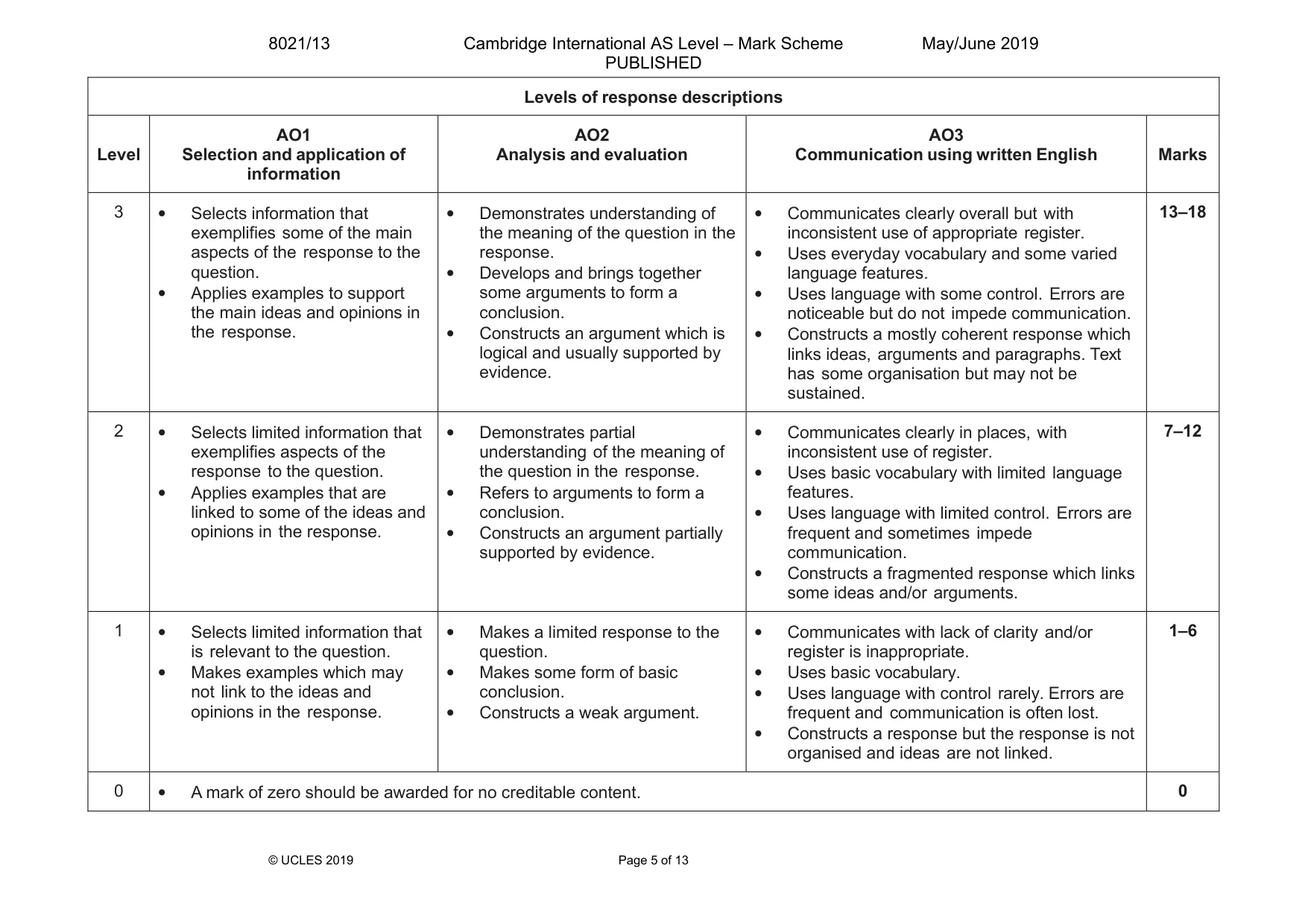
8021/13 Cambridge International AS Level – Mark Scheme PUBLISHED May/June 2019 © UCLES 2019 Page 5 of 13 Levels of response descriptions Level AO1 Selection and application of information AO2 Analysis and evaluation AO3 Communication using written English Marks 3 • Selects information that exemplifies some of the main aspects of the response to the question. • Applies examples to support the main ideas and opinions in the response. • Demonstrates understanding of the meaning of the question in the response. • Develops and brings together some arguments to form a conclusion. • Constructs an argument which is logical and usually supported by evidence. • Communicates clearly overall but with inconsistent use of appropriate register. • Uses everyday vocabulary and some varied language features. • Uses language with some control. Errors are noticeable but do not impede communication. • Constructs a mostly coherent response which links ideas, arguments and paragraphs. Text has some organisation but may not be sustained. 13–18 2 • Selects limited information that exemplifies aspects of the response to the question. • Applies examples that are linked to some of the ideas and opinions in the response. • Demonstrates partial understanding of the meaning of the question in the response. • Refers to arguments to form a conclusion. • Constructs an argument partially supported by evidence. • Communicates clearly in places, with inconsistent use of register. • Uses basic vocabulary with limited language features. • Uses language with limited control. Errors are frequent and sometimes impede communication. • Constructs a fragmented response which links some ideas and/or arguments. 7–12 1 • Selects limited information that is relevant to the question. • Makes examples which may not link to the ideas and opinions in the response. • Makes a limited response to the question. • Makes some form of basic conclusion. • Constructs a weak argument. • Communicates with lack of clarity and/or register is inappropriate. • Uses basic vocabulary. • Uses language with control rarely. Errors are frequent and communication is often lost. • Constructs a response but the response is not organised and ideas are not linked. 1–6 0 • A mark of zero should be awarded for no creditable content. 0
Mark scheme, page 6
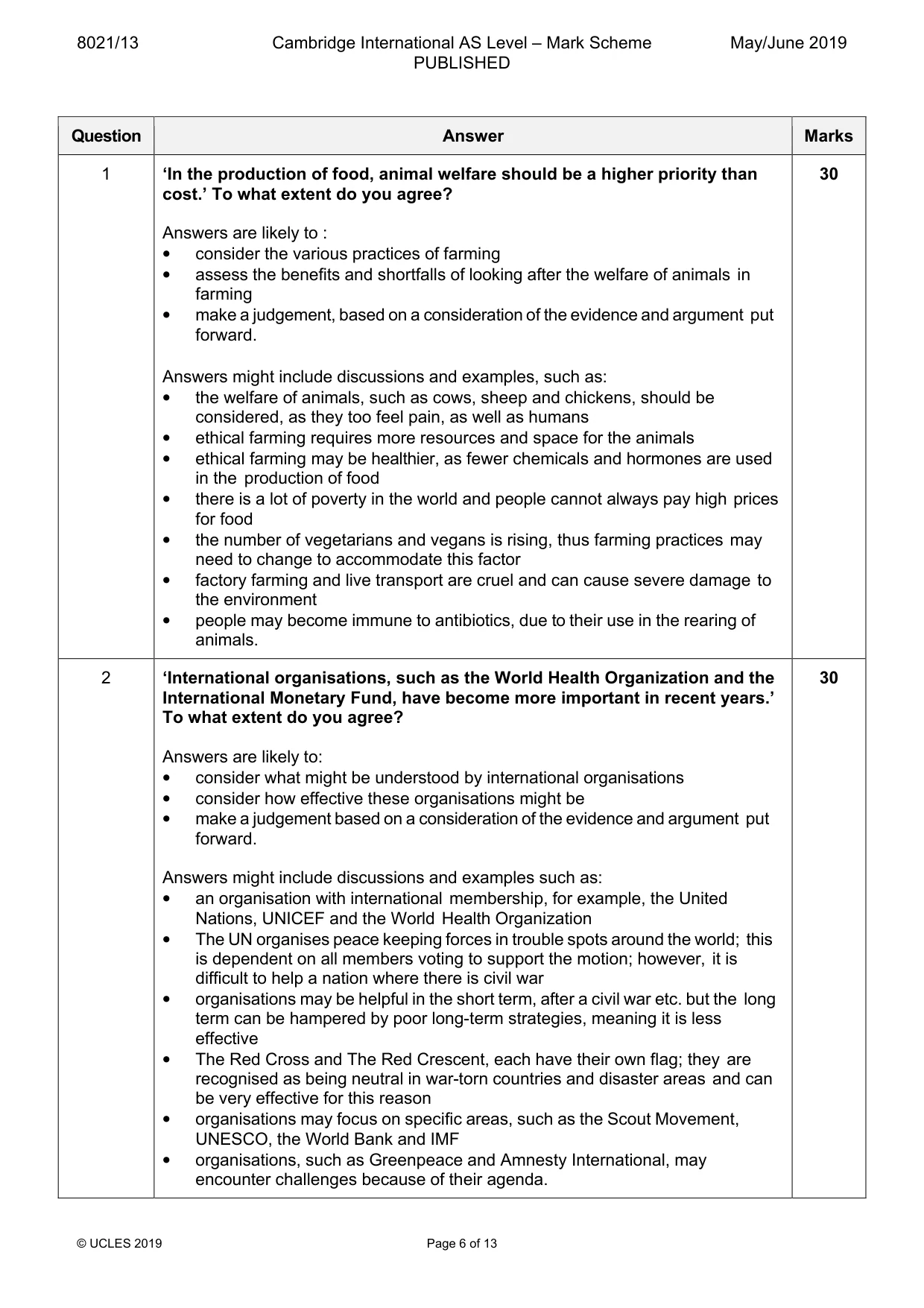
8021/13 Cambridge International AS Level – Mark Scheme PUBLISHED May/June 2019 © UCLES 2019 Page 6 of 13 Question Answer Marks 1 ‘In the production of food, animal welfare should be a higher priority than cost.’ To what extent do you agree? Answers are likely to : • consider the various practices of farming • assess the benefits and shortfalls of looking after the welfare of animals in farming • make a judgement, based on a consideration of the evidence and argument put forward. Answers might include discussions and examples, such as: • the welfare of animals, such as cows, sheep and chickens, should be considered, as they too feel pain, as well as humans • ethical farming requires more resources and space for the animals • ethical farming may be healthier, as fewer chemicals and hormones are used in the production of food • there is a lot of poverty in the world and people cannot always pay high prices for food • the number of vegetarians and vegans is rising, thus farming practices may need to change to accommodate this factor • factory farming and live transport are cruel and can cause severe damage to the environment • people may become immune to antibiotics, due to their use in the rearing of animals. 30 2 ‘International organisations, such as the World Health Organization and the International Monetary Fund, have become more important in recent years.’ To what extent do you agree? Answers are likely to: • consider what might be understood by international organisations • consider how effective these organisations might be • make a judgement based on a consideration of the evidence and argument put forward. Answers might include discussions and examples such as: • an organisation with international membership, for example, the United Nations, UNICEF and the World Health Organization • The UN organises peace keeping forces in trouble spots around the world; this is dependent on all members voting to support the motion; however, it is difficult to help a nation where there is civil war • organisations may be helpful in the short term, after a civil war etc. but the long term can be hampered by poor long-term strategies, meaning it is less effective • The Red Cross and The Red Crescent, each have their own flag; they are recognised as being neutral in war-torn countries and disaster areas and can be very effective for this reason • organisations may focus on specific areas, such as the Scout Movement, UNESCO, the World Bank and IMF • organisations, such as Greenpeace and Amnesty International, may encounter challenges because of their agenda. 30
Mark scheme, page 7
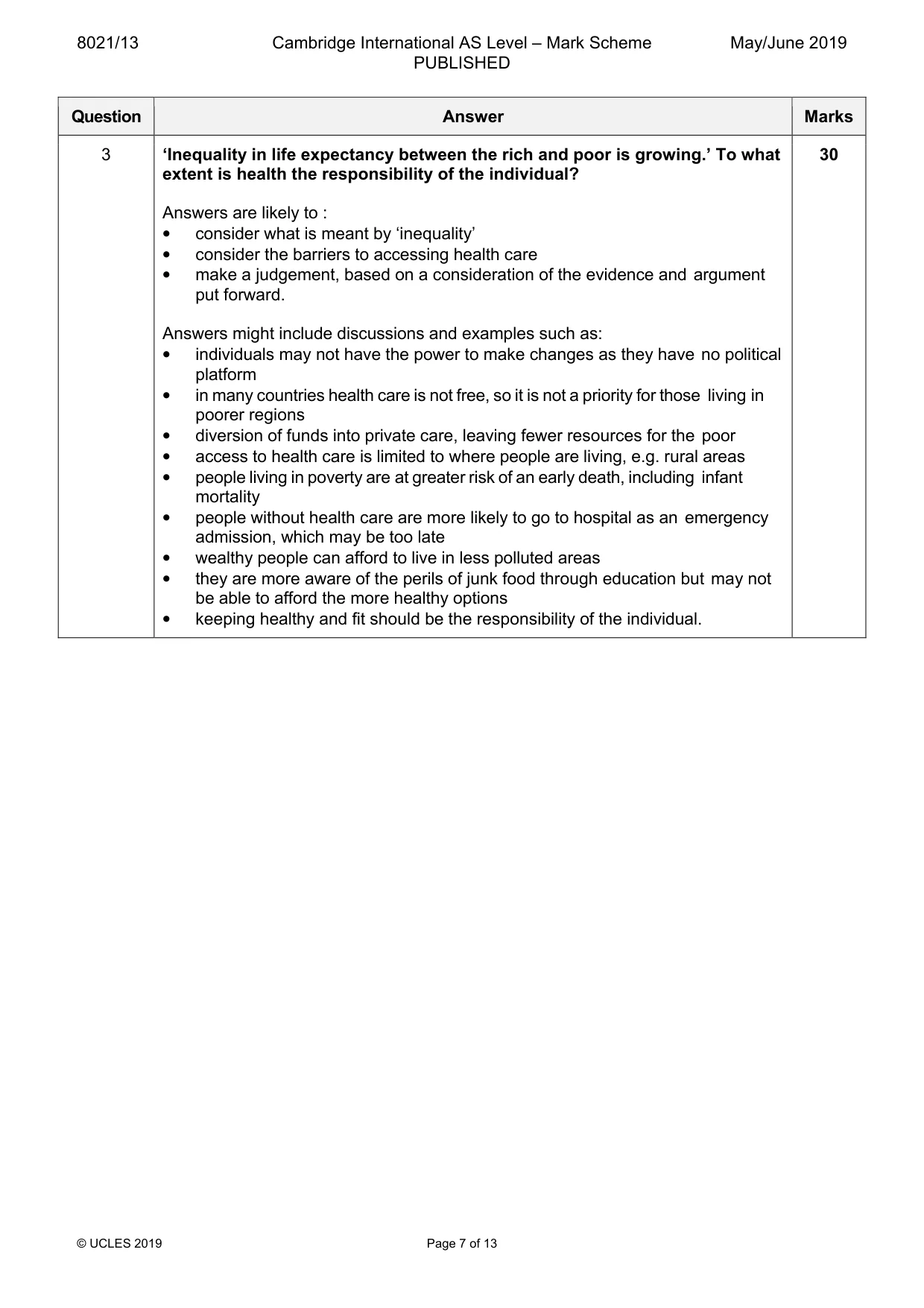
8021/13 Cambridge International AS Level – Mark Scheme PUBLISHED May/June 2019 © UCLES 2019 Page 7 of 13 Question Answer Marks 3 ‘Inequality in life expectancy between the rich and poor is growing.’ To what extent is health the responsibility of the individual? Answers are likely to : • consider what is meant by ‘inequality’ • consider the barriers to accessing health care • make a judgement, based on a consideration of the evidence and argument put forward. Answers might include discussions and examples such as: • individuals may not have the power to make changes as they have no political platform • in many countries health care is not free, so it is not a priority for those living in poorer regions • diversion of funds into private care, leaving fewer resources for the poor • access to health care is limited to where people are living, e.g. rural areas • people living in poverty are at greater risk of an early death, including infant mortality • people without health care are more likely to go to hospital as an emergency admission, which may be too late • wealthy people can afford to live in less polluted areas • they are more aware of the perils of junk food through education but may not be able to afford the more healthy options • keeping healthy and fit should be the responsibility of the individual. 30
Mark scheme, page 8
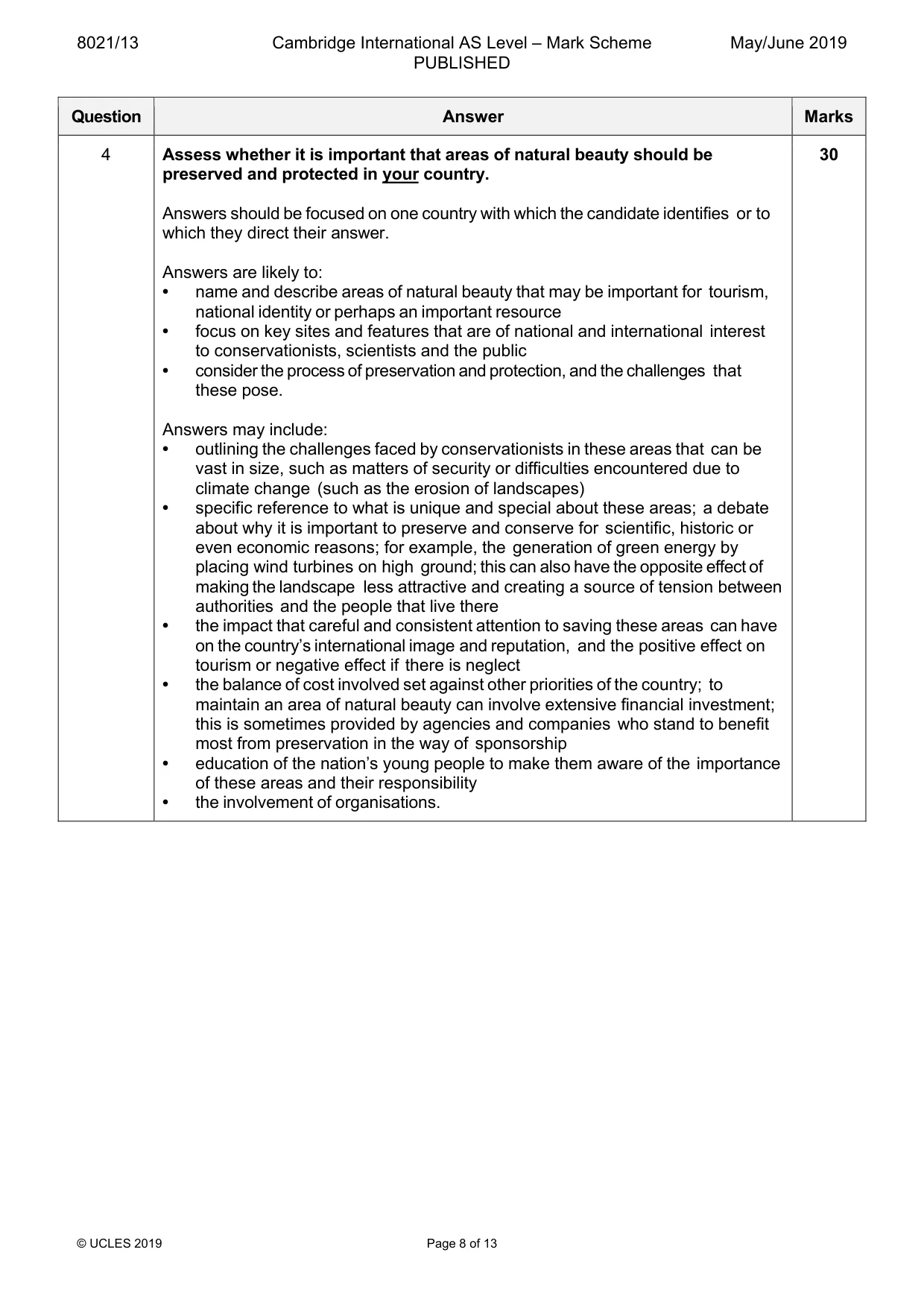
8021/13 Cambridge International AS Level – Mark Scheme PUBLISHED May/June 2019 © UCLES 2019 Page 8 of 13 Question Answer Marks 4 Assess whether it is important that areas of natural beauty should be preserved and protected in your country. Answers should be focused on one country with which the candidate identifies or to which they direct their answer. Answers are likely to: • name and describe areas of natural beauty that may be important for tourism, national identity or perhaps an important resource • focus on key sites and features that are of national and international interest to conservationists, scientists and the public • consider the process of preservation and protection, and the challenges that these pose. Answers may include: • outlining the challenges faced by conservationists in these areas that can be vast in size, such as matters of security or difficulties encountered due to climate change (such as the erosion of landscapes) • specific reference to what is unique and special about these areas; a debate about why it is important to preserve and conserve for scientific, historic or even economic reasons; for example, the generation of green energy by placing wind turbines on high ground; this can also have the opposite effect of making the landscape less attractive and creating a source of tension between authorities and the people that live there • the impact that careful and consistent attention to saving these areas can have on the country’s international image and reputation, and the positive effect on tourism or negative effect if there is neglect • the balance of cost involved set against other priorities of the country; to maintain an area of natural beauty can involve extensive financial investment; this is sometimes provided by agencies and companies who stand to benefit most from preservation in the way of sponsorship • education of the nation’s young people to make them aware of the importance of these areas and their responsibility • the involvement of organisations. 30
Mark scheme, page 9
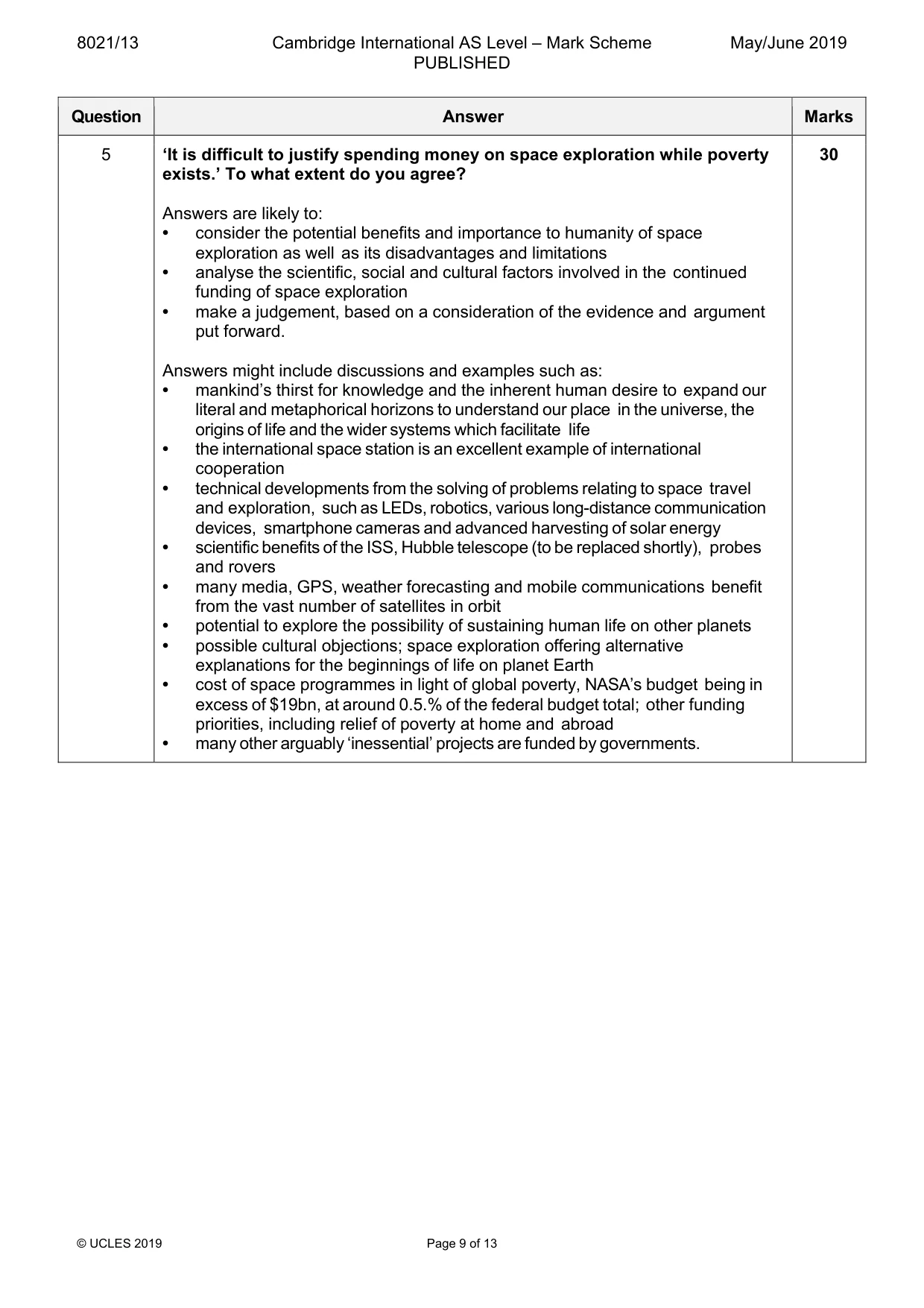
8021/13 Cambridge International AS Level – Mark Scheme PUBLISHED May/June 2019 © UCLES 2019 Page 9 of 13 Question Answer Marks 5 ‘It is difficult to justify spending money on space exploration while poverty exists.’ To what extent do you agree? Answers are likely to: • consider the potential benefits and importance to humanity of space exploration as well as its disadvantages and limitations • analyse the scientific, social and cultural factors involved in the continued funding of space exploration • make a judgement, based on a consideration of the evidence and argument put forward. Answers might include discussions and examples such as: • mankind’s thirst for knowledge and the inherent human desire to expand our literal and metaphorical horizons to understand our place in the universe, the origins of life and the wider systems which facilitate life • the international space station is an excellent example of international cooperation • technical developments from the solving of problems relating to space travel and exploration, such as LEDs, robotics, various long-distance communication devices, smartphone cameras and advanced harvesting of solar energy • scientific benefits of the ISS, Hubble telescope (to be replaced shortly), probes and rovers • many media, GPS, weather forecasting and mobile communications benefit from the vast number of satellites in orbit • potential to explore the possibility of sustaining human life on other planets • possible cultural objections; space exploration offering alternative explanations for the beginnings of life on planet Earth • cost of space programmes in light of global poverty, NASA’s budget being in excess of $19bn, at around 0.5.% of the federal budget total; other funding priorities, including relief of poverty at home and abroad • many other arguably ‘inessential’ projects are funded by governments. 30
Mark scheme, page 10
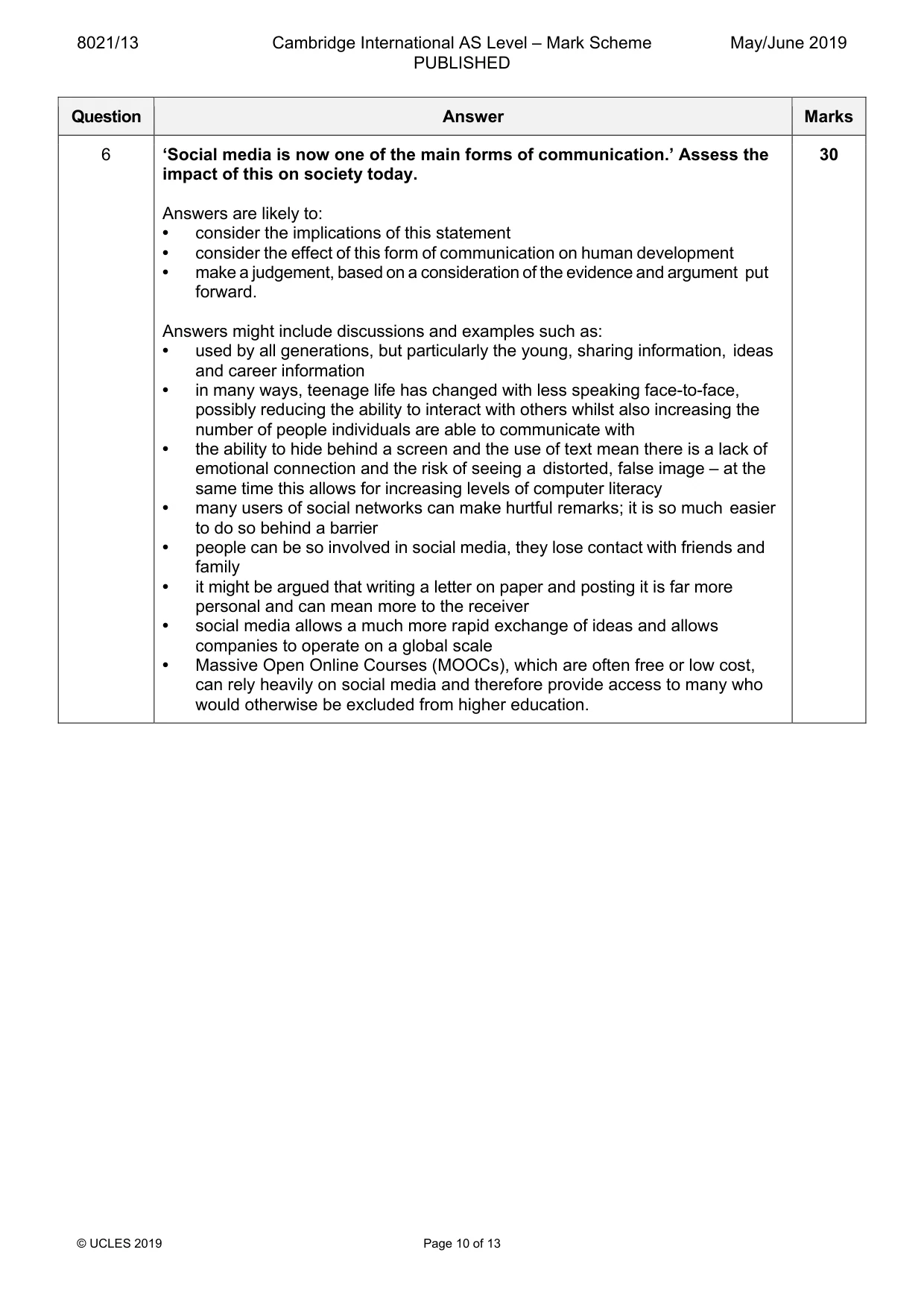
8021/13 Cambridge International AS Level – Mark Scheme PUBLISHED May/June 2019 © UCLES 2019 Page 10 of 13 Question Answer Marks 6 ‘Social media is now one of the main forms of communication.’ Assess the impact of this on society today. Answers are likely to: • consider the implications of this statement • consider the effect of this form of communication on human development • make a judgement, based on a consideration of the evidence and argument put forward. Answers might include discussions and examples such as: • used by all generations, but particularly the young, sharing information, ideas and career information • in many ways, teenage life has changed with less speaking face-to-face, possibly reducing the ability to interact with others whilst also increasing the number of people individuals are able to communicate with • the ability to hide behind a screen and the use of text mean there is a lack of emotional connection and the risk of seeing a distorted, false image – at the same time this allows for increasing levels of computer literacy • many users of social networks can make hurtful remarks; it is so much easier to do so behind a barrier • people can be so involved in social media, they lose contact with friends and family • it might be argued that writing a letter on paper and posting it is far more personal and can mean more to the receiver • social media allows a much more rapid exchange of ideas and allows companies to operate on a global scale • Massive Open Online Courses (MOOCs), which are often free or low cost, can rely heavily on social media and therefore provide access to many who would otherwise be excluded from higher education. 30
Mark scheme, page 11
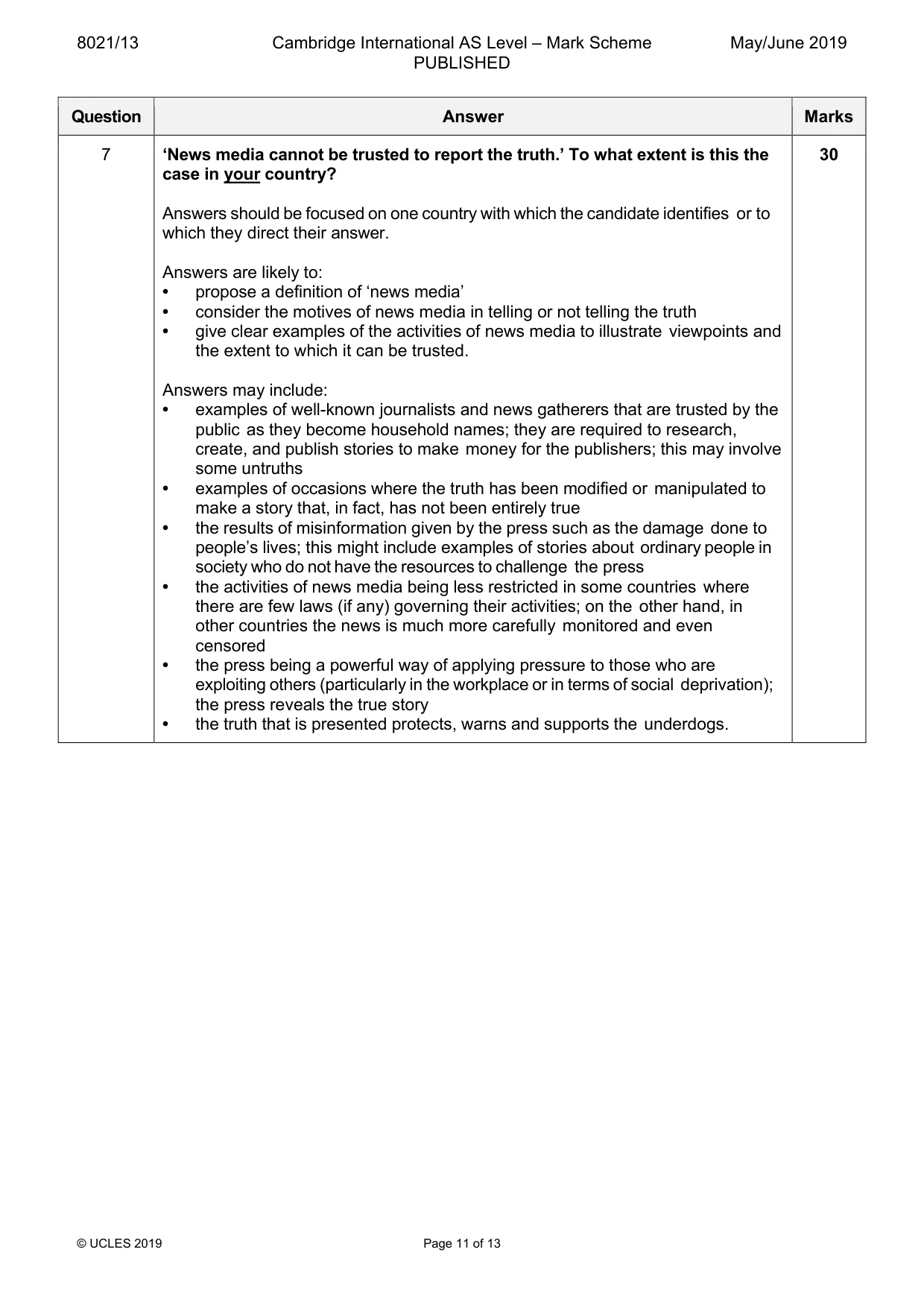
8021/13 Cambridge International AS Level – Mark Scheme PUBLISHED May/June 2019 © UCLES 2019 Page 11 of 13 Question Answer Marks 7 ‘News media cannot be trusted to report the truth.’ To what extent is this the case in your country? Answers should be focused on one country with which the candidate identifies or to which they direct their answer. Answers are likely to: • propose a definition of ‘news media’ • consider the motives of news media in telling or not telling the truth • give clear examples of the activities of news media to illustrate viewpoints and the extent to which it can be trusted. Answers may include: • examples of well-known journalists and news gatherers that are trusted by the public as they become household names; they are required to research, create, and publish stories to make money for the publishers; this may involve some untruths • examples of occasions where the truth has been modified or manipulated to make a story that, in fact, has not been entirely true • the results of misinformation given by the press such as the damage done to people’s lives; this might include examples of stories about ordinary people in society who do not have the resources to challenge the press • the activities of news media being less restricted in some countries where there are few laws (if any) governing their activities; on the other hand, in other countries the news is much more carefully monitored and even censored • the press being a powerful way of applying pressure to those who are exploiting others (particularly in the workplace or in terms of social deprivation); the press reveals the true story • the truth that is presented protects, warns and supports the underdogs. 30
Mark scheme, page 12
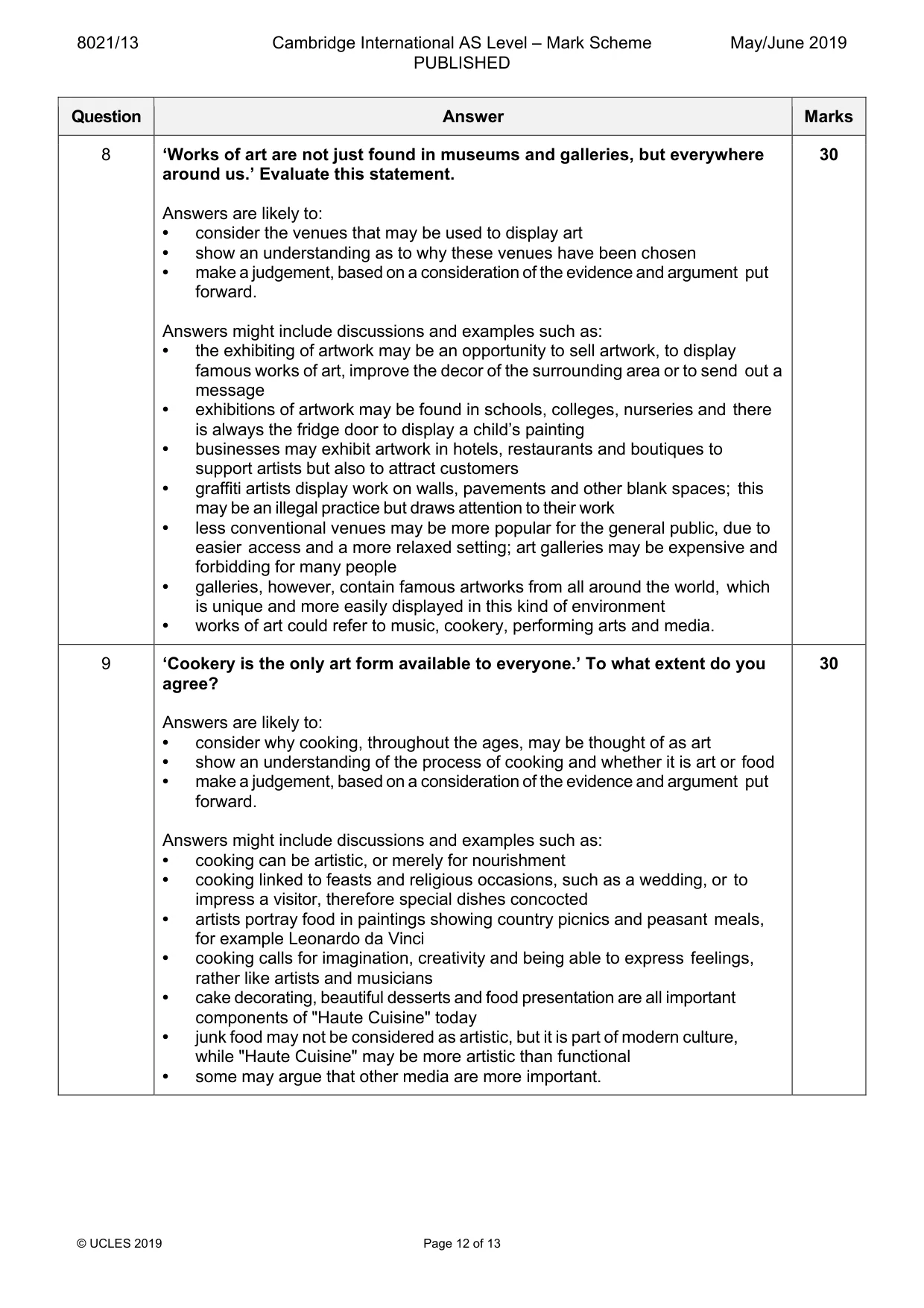
8021/13 Cambridge International AS Level – Mark Scheme PUBLISHED May/June 2019 © UCLES 2019 Page 12 of 13 Question Answer Marks 8 ‘Works of art are not just found in museums and galleries, but everywhere around us.’ Evaluate this statement. Answers are likely to: • consider the venues that may be used to display art • show an understanding as to why these venues have been chosen • make a judgement, based on a consideration of the evidence and argument put forward. Answers might include discussions and examples such as: • the exhibiting of artwork may be an opportunity to sell artwork, to display famous works of art, improve the decor of the surrounding area or to send out a message • exhibitions of artwork may be found in schools, colleges, nurseries and there is always the fridge door to display a child’s painting • businesses may exhibit artwork in hotels, restaurants and boutiques to support artists but also to attract customers • graffiti artists display work on walls, pavements and other blank spaces; this may be an illegal practice but draws attention to their work • less conventional venues may be more popular for the general public, due to easier access and a more relaxed setting; art galleries may be expensive and forbidding for many people • galleries, however, contain famous artworks from all around the world, which is unique and more easily displayed in this kind of environment • works of art could refer to music, cookery, performing arts and media. 30 9 ‘Cookery is the only art form available to everyone.’ To what extent do you agree? Answers are likely to: • consider why cooking, throughout the ages, may be thought of as art • show an understanding of the process of cooking and whether it is art or food • make a judgement, based on a consideration of the evidence and argument put forward. Answers might include discussions and examples such as: • cooking can be artistic, or merely for nourishment • cooking linked to feasts and religious occasions, such as a wedding, or to impress a visitor, therefore special dishes concocted • artists portray food in paintings showing country picnics and peasant meals, for example Leonardo da Vinci • cooking calls for imagination, creativity and being able to express feelings, rather like artists and musicians • cake decorating, beautiful desserts and food presentation are all important components of "Haute Cuisine" today • junk food may not be considered as artistic, but it is part of modern culture, while "Haute Cuisine" may be more artistic than functional • some may argue that other media are more important. 30
Mark scheme, page 13
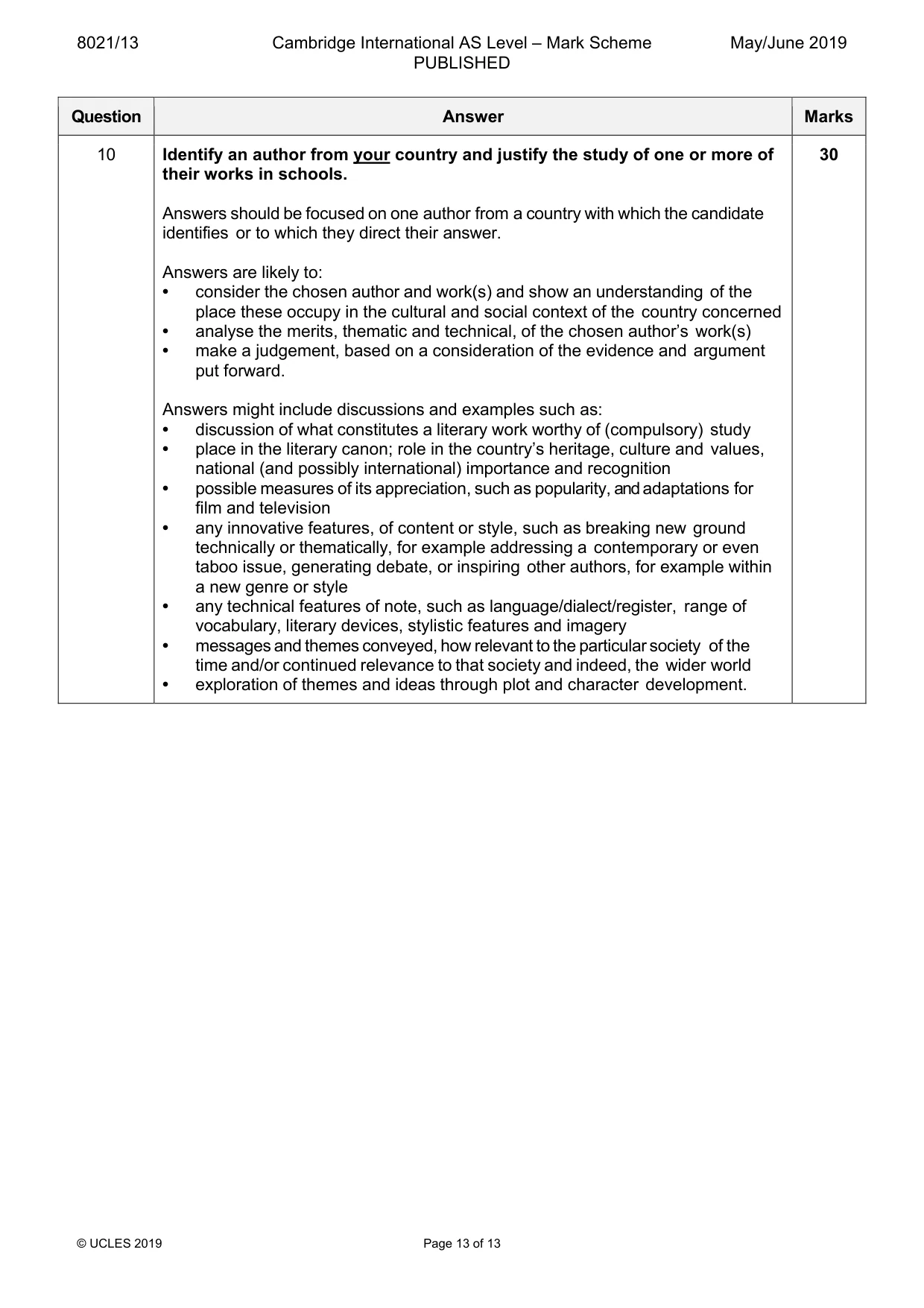
8021/13 Cambridge International AS Level – Mark Scheme PUBLISHED May/June 2019 © UCLES 2019 Page 13 of 13 Question Answer Marks 10 Identify an author from your country and justify the study of one or more of their works in schools. Answers should be focused on one author from a country with which the candidate identifies or to which they direct their answer. Answers are likely to: • consider the chosen author and work(s) and show an understanding of the place these occupy in the cultural and social context of the country concerned • analyse the merits, thematic and technical, of the chosen author’s work(s) • make a judgement, based on a consideration of the evidence and argument put forward. Answers might include discussions and examples such as: • discussion of what constitutes a literary work worthy of (compulsory) study • place in the literary canon; role in the country’s heritage, culture and values, national (and possibly international) importance and recognition • possible measures of its appreciation, such as popularity, and adaptations for film and television • any innovative features, of content or style, such as breaking new ground technically or thematically, for example addressing a contemporary or even taboo issue, generating debate, or inspiring other authors, for example within a new genre or style • any technical features of note, such as language/dialect/register, range of vocabulary, literary devices, stylistic features and imagery • messages and themes conveyed, how relevant to the particular society of the time and/or continued relevance to that society and indeed, the wider world • exploration of themes and ideas through plot and character development. 30
What you needed in this session
Cambridge’s own grade thresholds for 2019 May/June, Paper 1 · Variant 3. A higher threshold means an easier paper — the bar moves with how the cohort did.