Cambridge A Level Economics 9708 — 2025 Oct/Nov Paper 3 · Variant 4
9708/34/O/N/25 · 30 marks · ≈34 min
The question paper and its mark scheme, free to read here and free to download. This is Cambridge’s own paper, exactly as it was sat.
Question paper12 pages

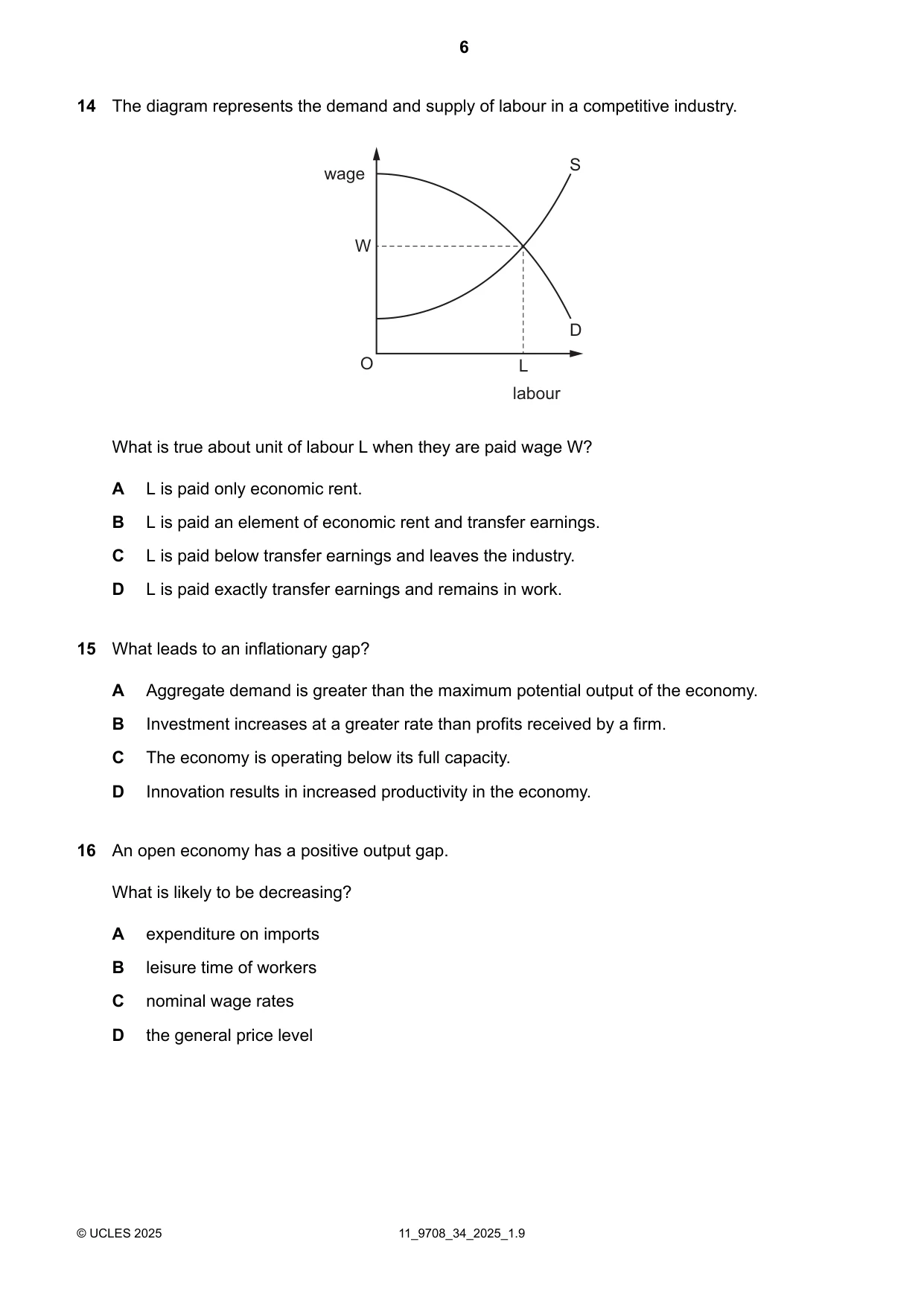
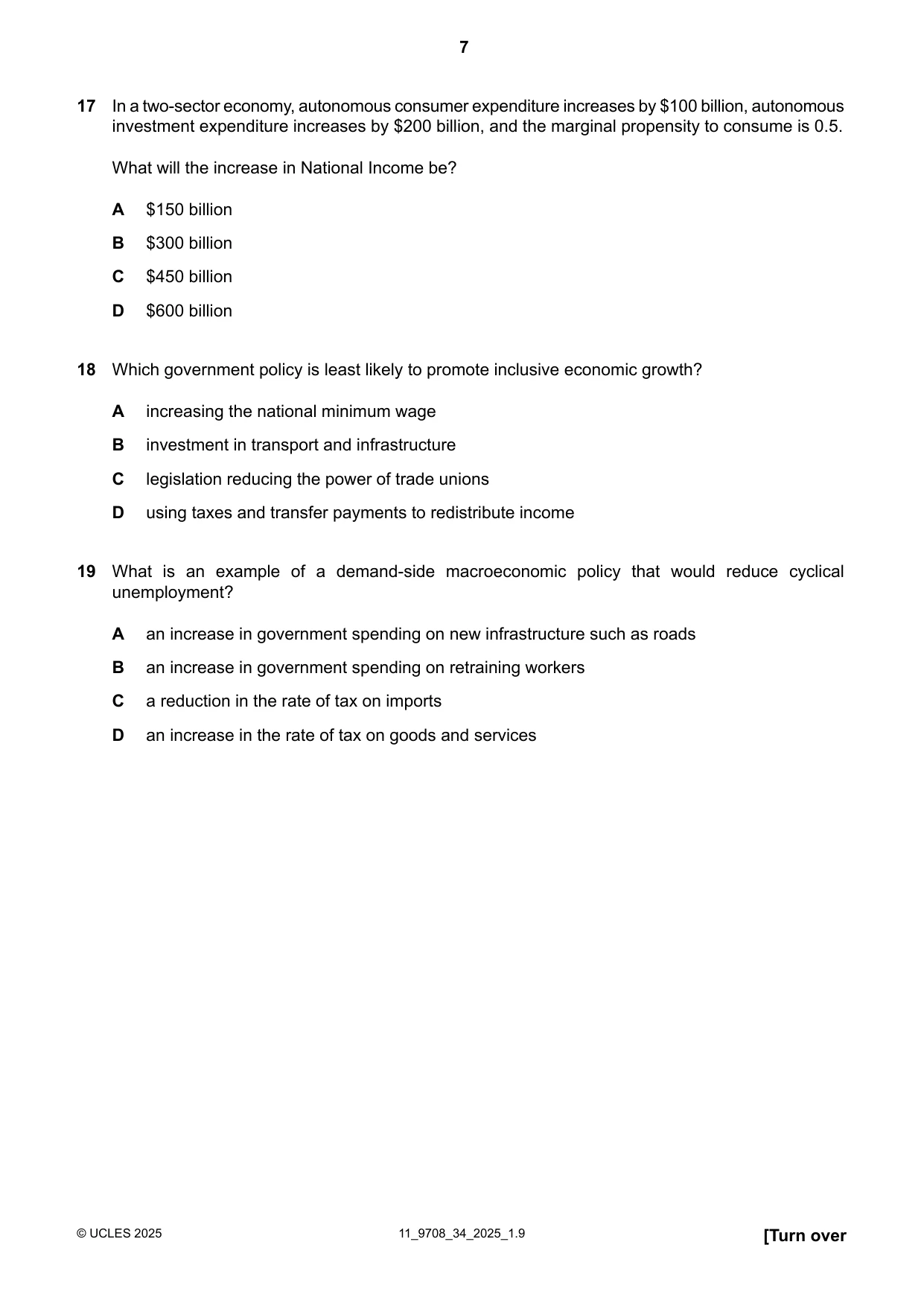
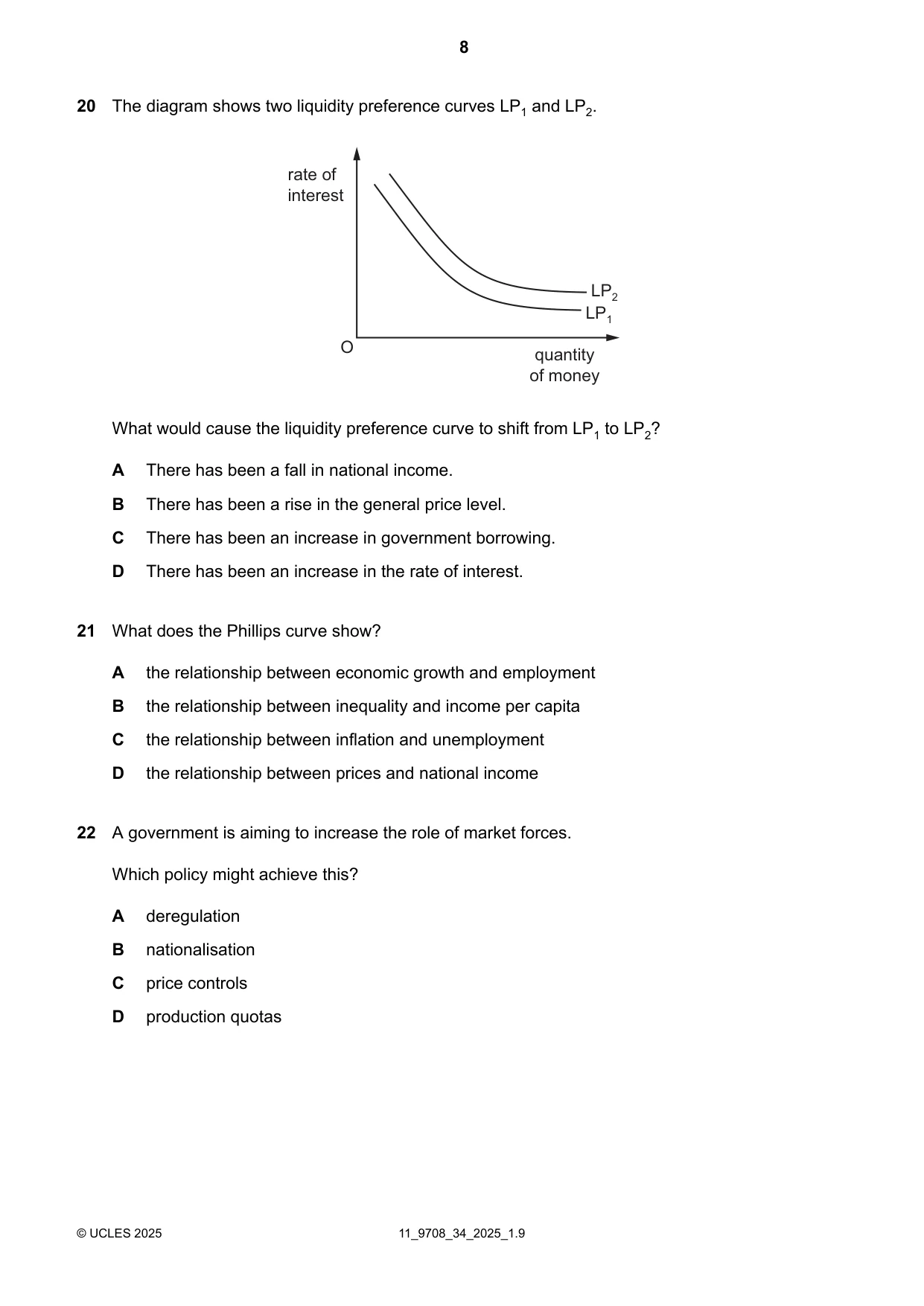
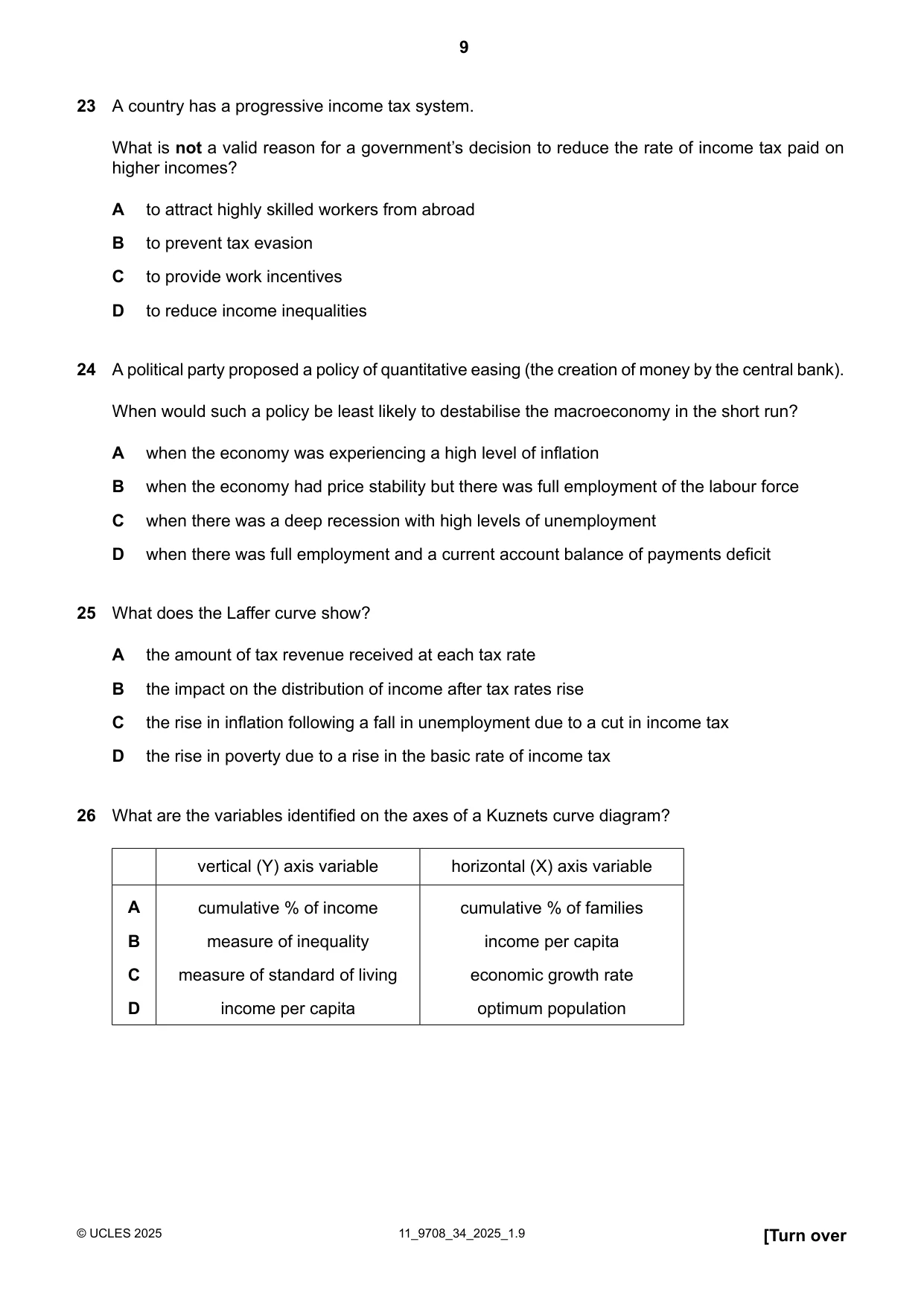

Mark scheme3 pages
Answers below. Sit the paper first if you are practising.
Paper as text
Question paper, page 1
This document has 12 pages. Any blank pages are indicated. 11_9708_34_2025_1.9a © UCLES 2025 [Turn over *6316912461* Cambridge International AS & A Level ECONOMICS 9708/34 Paper 3 A Level Multiple Choice October/November 2025 1 hour 15 minutes You must answer on the multiple choice answer sheet. You will need: Multiple choice answer sheet Soft clean eraser Soft pencil (type B or HB is recommended) INSTRUCTIONS There are thirty questions on this paper. Answer all questions. For each question there are four possible answers A, B, C and D. Choose the one you consider correct and record your choice in soft pencil on the multiple choice answer sheet. Follow the instructions on the multiple choice answer sheet. Write in soft pencil. Write your name, centre number and candidate number on the multiple choice answer sheet in the spaces provided unless this has been done for you. Do not use correction fluid. Do not write on any bar codes. You may use a calculator. INFORMATION The total mark for this paper is 30. Each correct answer will score one mark. Any rough working should be done on this question paper.
Question paper, page 2
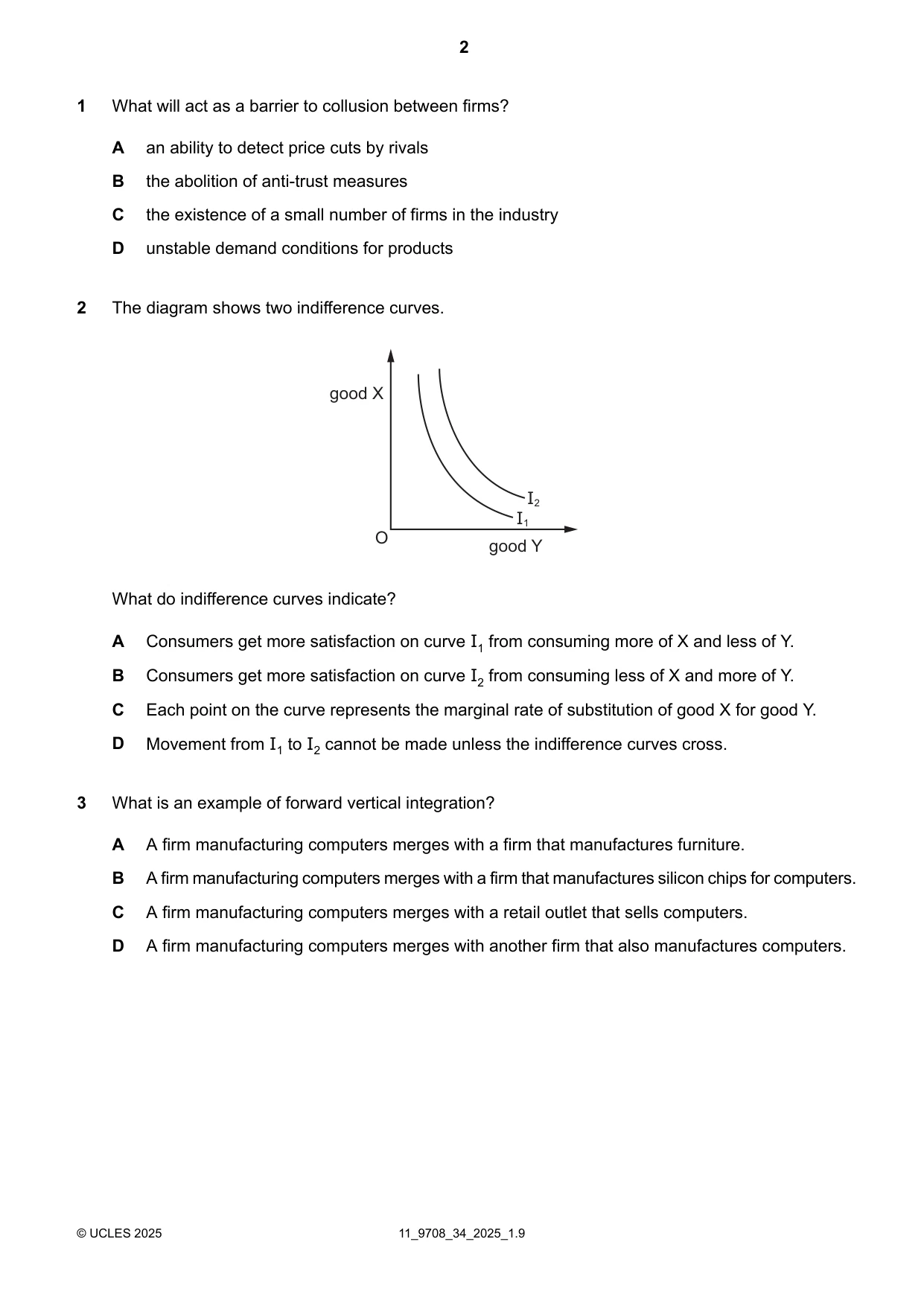
What will act as a barrier to collusion between firms? 1 an ability to detect price cuts by rivals A the abolition of anti-trust measures B the existence of a small number of firms in the industry C unstable demand conditions for products D The diagram shows two indifference curves. 2 good Y good X O I1 I2 What do indifference curves indicate? Consumers get more satisfaction on curve I1 from consuming more of X and less of Y. A Consumers get more satisfaction on curve I2 from consuming less of X and more of Y. B Each point on the curve represents the marginal rate of substitution of good X for good Y. C Movement from I1 to I2 cannot be made unless the indifference curves cross. D What is an example of forward vertical integration? 3 A firm manufacturing computers merges with a firm that manufactures furniture. A A firm manufacturing computers merges with a firm that manufactures silicon chips for computers. B A firm manufacturing computers merges with a retail outlet that sells computers. C A firm manufacturing computers merges with another firm that also manufactures computers. D 11_9708_34_2025_1.9 © UCLES 2025 2
Question paper, page 3
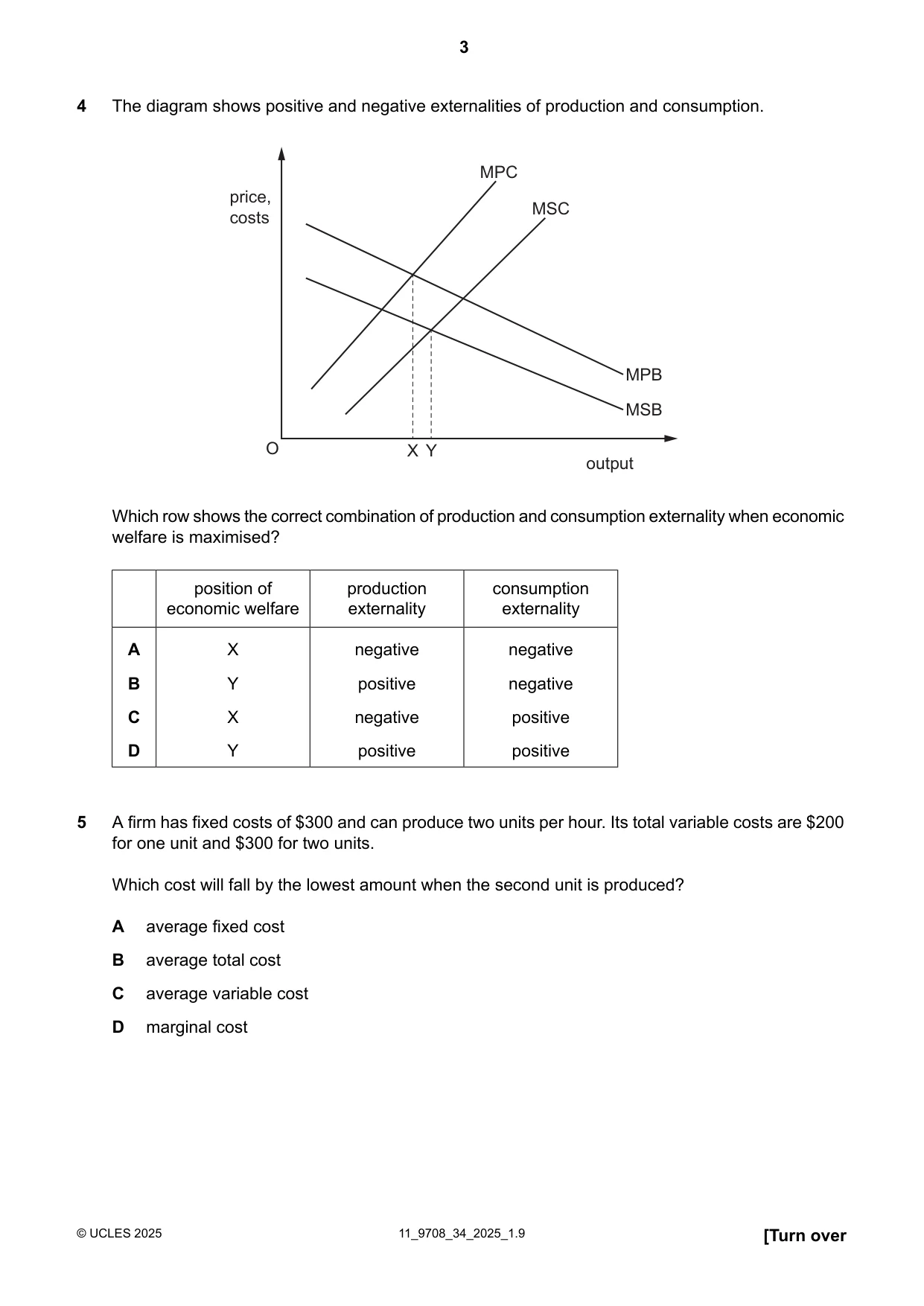
The diagram shows positive and negative externalities of production and consumption. 4 O price, costs X Y output MPC MSC MPB MSB Which row shows the correct combination of production and consumption externality when economic welfare is maximised? consumption externality production externality position of economic welfare negative negative X A negative positive Y B positive negative X C positive positive Y D A firm has fixed costs of $300 and can produce two units per hour. Its total variable costs are $200 for one unit and $300 for two units. Which cost will fall by the lowest amount when the second unit is produced? 5 average fixed cost A average total cost B average variable cost C marginal cost D [Turn over 11_9708_34_2025_1.9 © UCLES 2025 3
Question paper, page 4
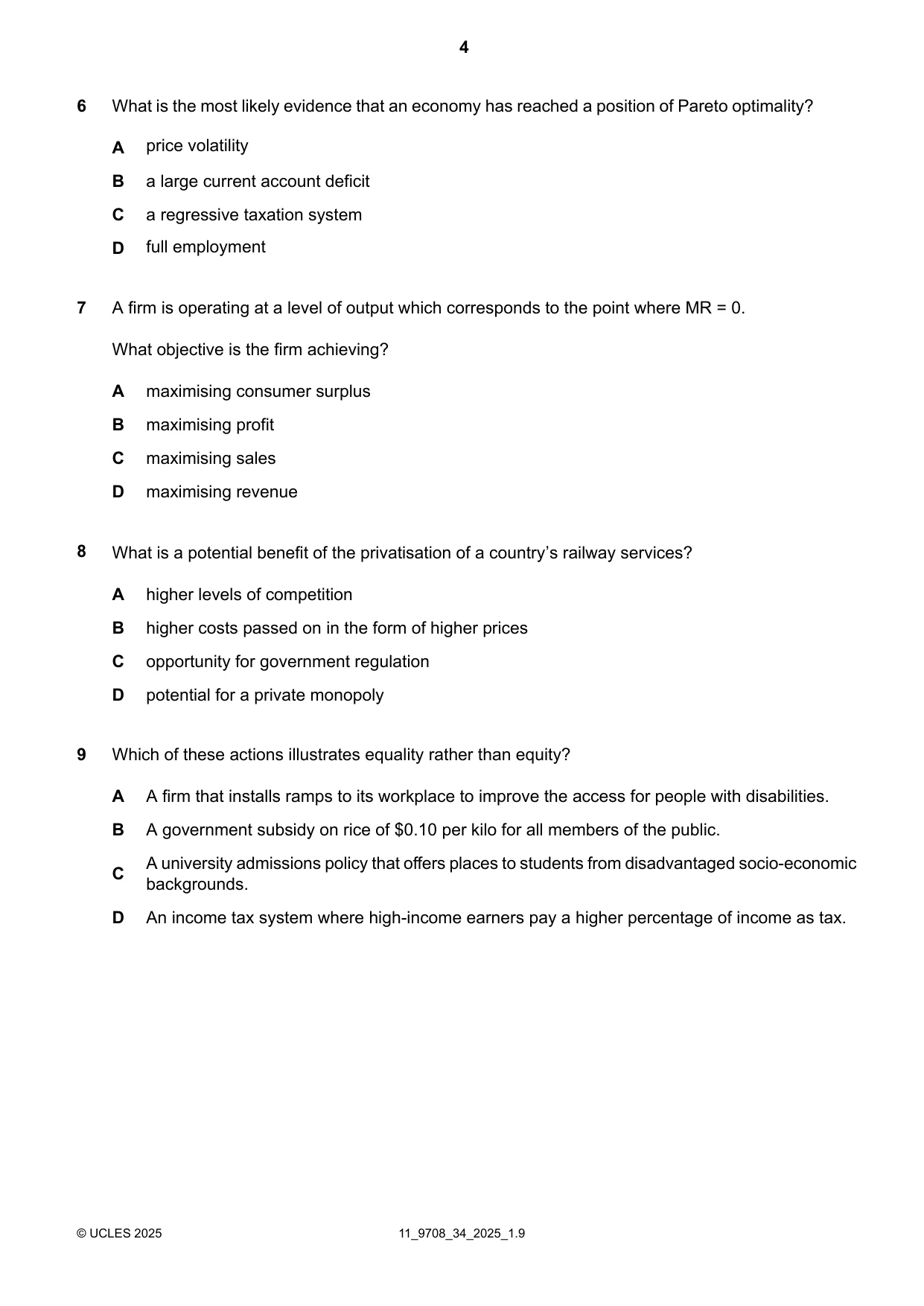
What is the most likely evidence that an economy has reached a position of Pareto optimality? 6 price volatility A a large current account deficit B a regressive taxation system C full employment D A firm is operating at a level of output which corresponds to the point where MR = 0. What objective is the firm achieving? 7 maximising consumer surplus A maximising profit B maximising sales C maximising revenue D What is a potential benefit of the privatisation of a country’s railway services? 8 higher levels of competition A higher costs passed on in the form of higher prices B opportunity for government regulation C potential for a private monopoly D Which of these actions illustrates equality rather than equity? 9 A firm that installs ramps to its workplace to improve the access for people with disabilities. A A government subsidy on rice of $0.10 per kilo for all members of the public. B A university admissions policy that offers places to students from disadvantaged socio-economic backgrounds. C An income tax system where high-income earners pay a higher percentage of income as tax. D 11_9708_34_2025_1.9 © UCLES 2025 4
Question paper, page 5
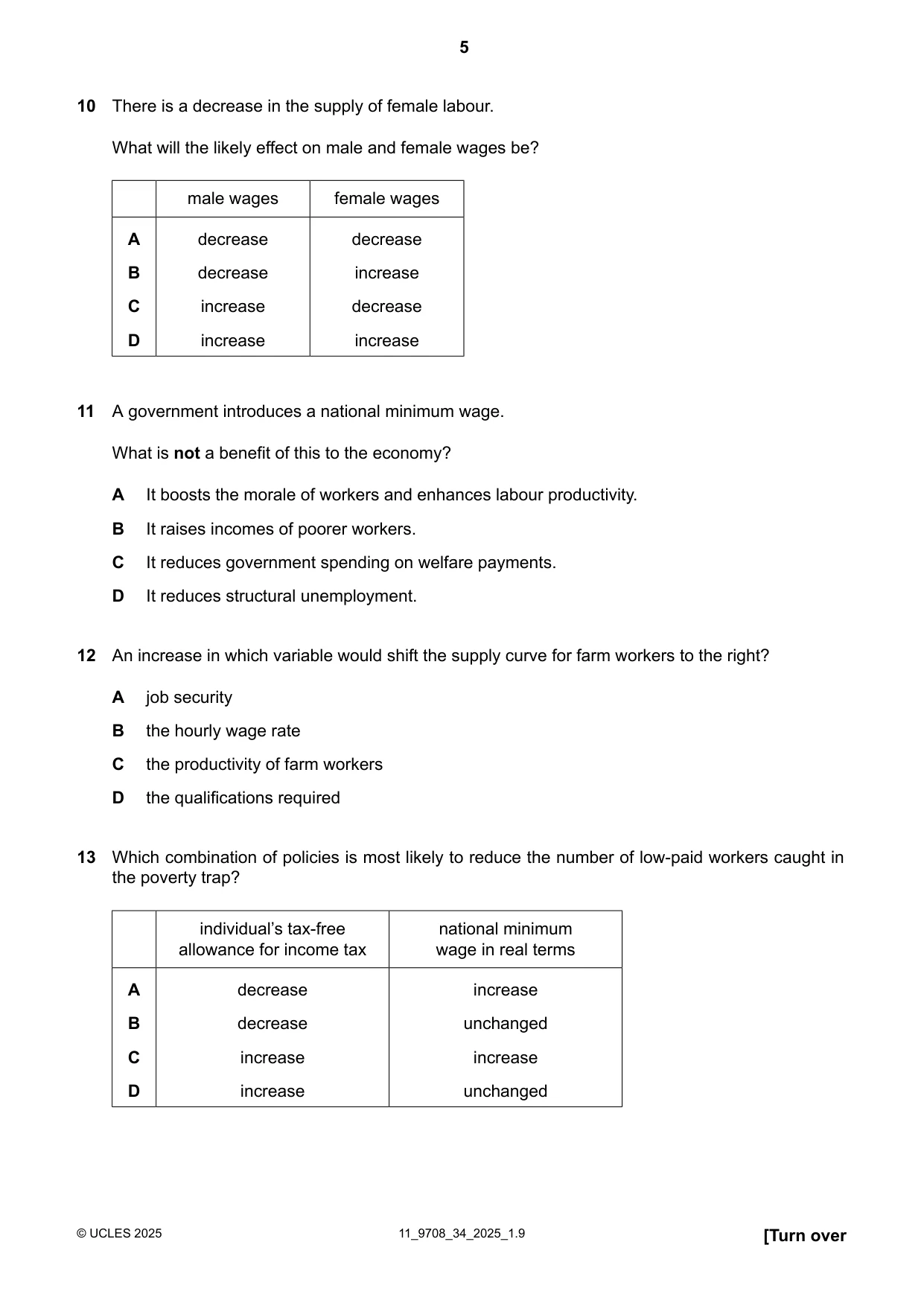
There is a decrease in the supply of female labour. What will the likely effect on male and female wages be? 10 female wages male wages decrease decrease A increase decrease B decrease increase C increase increase D A government introduces a national minimum wage. What is not a benefit of this to the economy? 11 It boosts the morale of workers and enhances labour productivity. A It raises incomes of poorer workers. B It reduces government spending on welfare payments. C It reduces structural unemployment. D An increase in which variable would shift the supply curve for farm workers to the right? 12 job security A the hourly wage rate B the productivity of farm workers C the qualifications required D Which combination of policies is most likely to reduce the number of low-paid workers caught in the poverty trap? 13 national minimum wage in real terms individual’s tax-free allowance for income tax increase decrease A unchanged decrease B increase increase C unchanged increase D [Turn over 11_9708_34_2025_1.9 © UCLES 2025 5
Question paper, page 6
The diagram represents the demand and supply of labour in a competitive industry. 14 wage O labour W L S D What is true about unit of labour L when they are paid wage W? L is paid only economic rent. A L is paid an element of economic rent and transfer earnings. B L is paid below transfer earnings and leaves the industry. C L is paid exactly transfer earnings and remains in work. D What leads to an inflationary gap? 15 Aggregate demand is greater than the maximum potential output of the economy. A Investment increases at a greater rate than profits received by a firm. B The economy is operating below its full capacity. C Innovation results in increased productivity in the economy. D An open economy has a positive output gap. What is likely to be decreasing? 16 expenditure on imports A leisure time of workers B nominal wage rates C the general price level D 11_9708_34_2025_1.9 © UCLES 2025 6
Question paper, page 7
In a two-sector economy, autonomous consumer expenditure increases by $100 billion, autonomous investment expenditure increases by $200 billion, and the marginal propensity to consume is 0.5. What will the increase in National Income be? 17 $150 billion A $300 billion B $450 billion C $600 billion D Which government policy is least likely to promote inclusive economic growth? 18 increasing the national minimum wage A investment in transport and infrastructure B legislation reducing the power of trade unions C using taxes and transfer payments to redistribute income D What is an example of a demand-side macroeconomic policy that would reduce cyclical unemployment? 19 an increase in government spending on new infrastructure such as roads A an increase in government spending on retraining workers B a reduction in the rate of tax on imports C an increase in the rate of tax on goods and services D [Turn over 11_9708_34_2025_1.9 © UCLES 2025 7
Question paper, page 8
The diagram shows two liquidity preference curves LP1 and LP2. 20 rate of interest quantity of money O LP1 LP2 What would cause the liquidity preference curve to shift from LP1 to LP2? There has been a fall in national income. A There has been a rise in the general price level. B There has been an increase in government borrowing. C There has been an increase in the rate of interest. D What does the Phillips curve show? 21 the relationship between economic growth and employment A the relationship between inequality and income per capita B the relationship between inflation and unemployment C the relationship between prices and national income D A government is aiming to increase the role of market forces. Which policy might achieve this? 22 deregulation A nationalisation B price controls C production quotas D 11_9708_34_2025_1.9 © UCLES 2025 8
Question paper, page 9
A country has a progressive income tax system. What is not a valid reason for a government’s decision to reduce the rate of income tax paid on higher incomes? 23 to attract highly skilled workers from abroad A to prevent tax evasion B to provide work incentives C to reduce income inequalities D A political party proposed a policy of quantitative easing (the creation of money by the central bank). When would such a policy be least likely to destabilise the macroeconomy in the short run? 24 when the economy was experiencing a high level of inflation A when the economy had price stability but there was full employment of the labour force B when there was a deep recession with high levels of unemployment C when there was full employment and a current account balance of payments deficit D What does the Laffer curve show? 25 the amount of tax revenue received at each tax rate A the impact on the distribution of income after tax rates rise B the rise in inflation following a fall in unemployment due to a cut in income tax C the rise in poverty due to a rise in the basic rate of income tax D What are the variables identified on the axes of a Kuznets curve diagram? 26 horizontal (X) axis variable vertical (Y) axis variable cumulative % of families cumulative % of income A income per capita measure of inequality B economic growth rate measure of standard of living C optimum population income per capita D [Turn over 11_9708_34_2025_1.9 © UCLES 2025 9
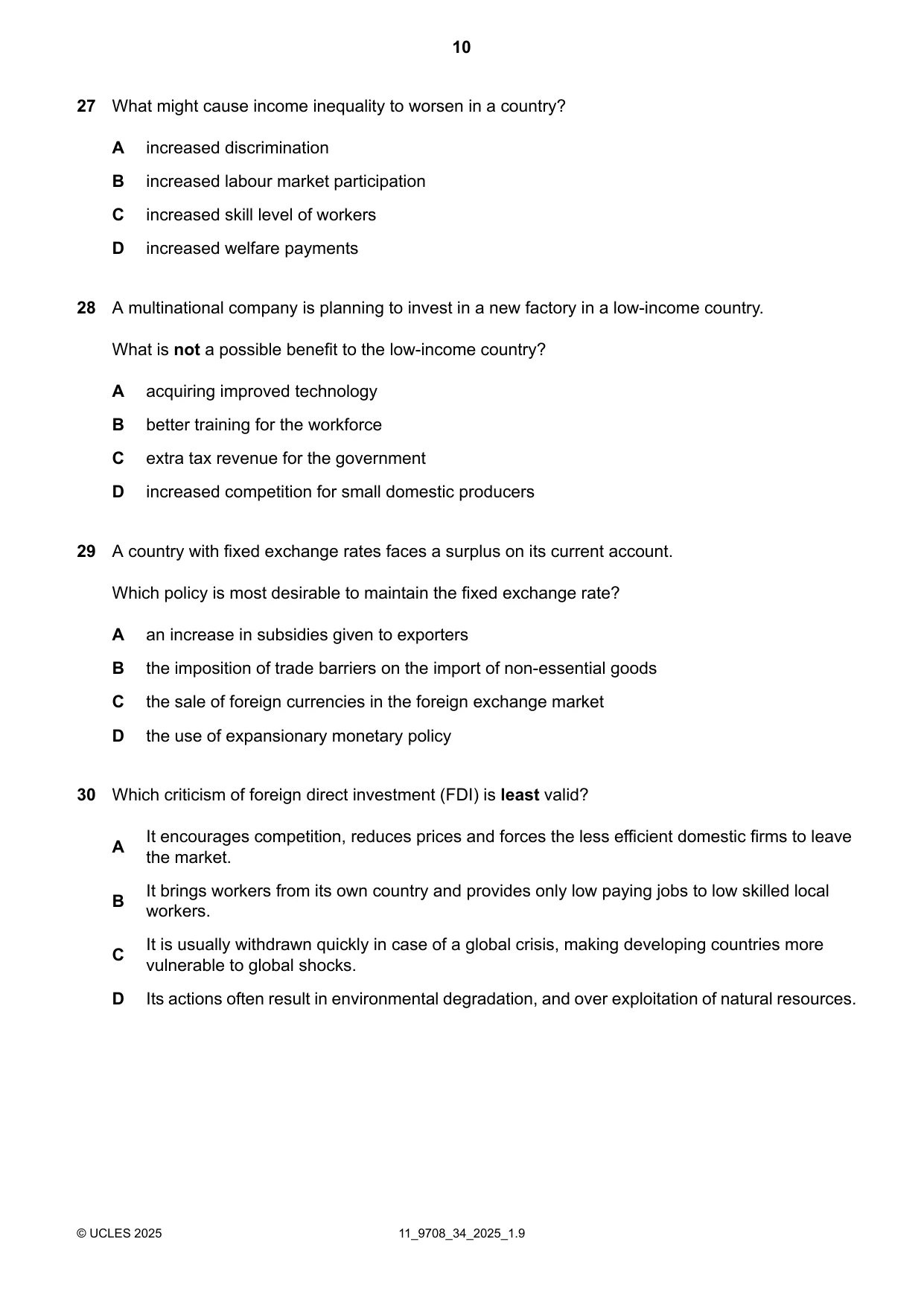
Question paper, page 10
What might cause income inequality to worsen in a country? 27 increased discrimination A increased labour market participation B increased skill level of workers C increased welfare payments D A multinational company is planning to invest in a new factory in a low-income country. What is not a possible benefit to the low-income country? 28 acquiring improved technology A better training for the workforce B extra tax revenue for the government C increased competition for small domestic producers D A country with fixed exchange rates faces a surplus on its current account. Which policy is most desirable to maintain the fixed exchange rate? 29 an increase in subsidies given to exporters A the imposition of trade barriers on the import of non-essential goods B the sale of foreign currencies in the foreign exchange market C the use of expansionary monetary policy D Which criticism of foreign direct investment (FDI) is least valid? 30 It encourages competition, reduces prices and forces the less efficient domestic firms to leave the market. A It brings workers from its own country and provides only low paying jobs to low skilled local workers. B It is usually withdrawn quickly in case of a global crisis, making developing countries more vulnerable to global shocks. C Its actions often result in environmental degradation, and over exploitation of natural resources. D 11_9708_34_2025_1.9 © UCLES 2025 10
Question paper, page 11
11 © UCLES 2025 11_9708_34_2025_1.9 BLANK PAGE
Question paper, page 12
12 Permission to reproduce items where third-party owned material protected by copyright is included has been sought and cleared where possible. Every reasonable effort has been made by the publisher (UCLES) to trace copyright holders, but if any items requiring clearance have unwittingly been included, the publisher will be pleased to make amends at the earliest possible opportunity. To avoid the issue of disclosure of answer-related information to candidates, all copyright acknowledgements are reproduced online in the Cambridge Assessment International Education Copyright Acknowledgements Booklet. This is produced for each series of examinations and is freely available to download at www.cambridgeinternational.org after the live examination series. Cambridge Assessment International Education is part of Cambridge Assessment. Cambridge Assessment is the brand name of the University of Cambridge Local Examinations Syndicate (UCLES), which is a department of the University of Cambridge. © UCLES 2025 11_9708_34_2025_1.9 BLANK PAGE
Mark scheme, page 1
This document consists of 3 printed pages. © Cambridge University Press & Assessment 2025 [Turn over Cambridge International AS & A Level ECONOMICS 9708/34 Paper 3 A Level Multiple Choice October/November 2025 MARK SCHEME Maximum Mark: 30 Published This mark scheme is published as an aid to teachers and candidates, to indicate the requirements of the examination. Mark schemes should be read in conjunction with the question paper and the Principal Examiner Report for Teachers. Cambridge International will not enter into discussions about these mark schemes. Cambridge International is publishing the mark schemes for the October/November 2025 series for most Cambridge IGCSE, Cambridge International A and AS Level components, and some Cambridge O Level components.
Mark scheme, page 2
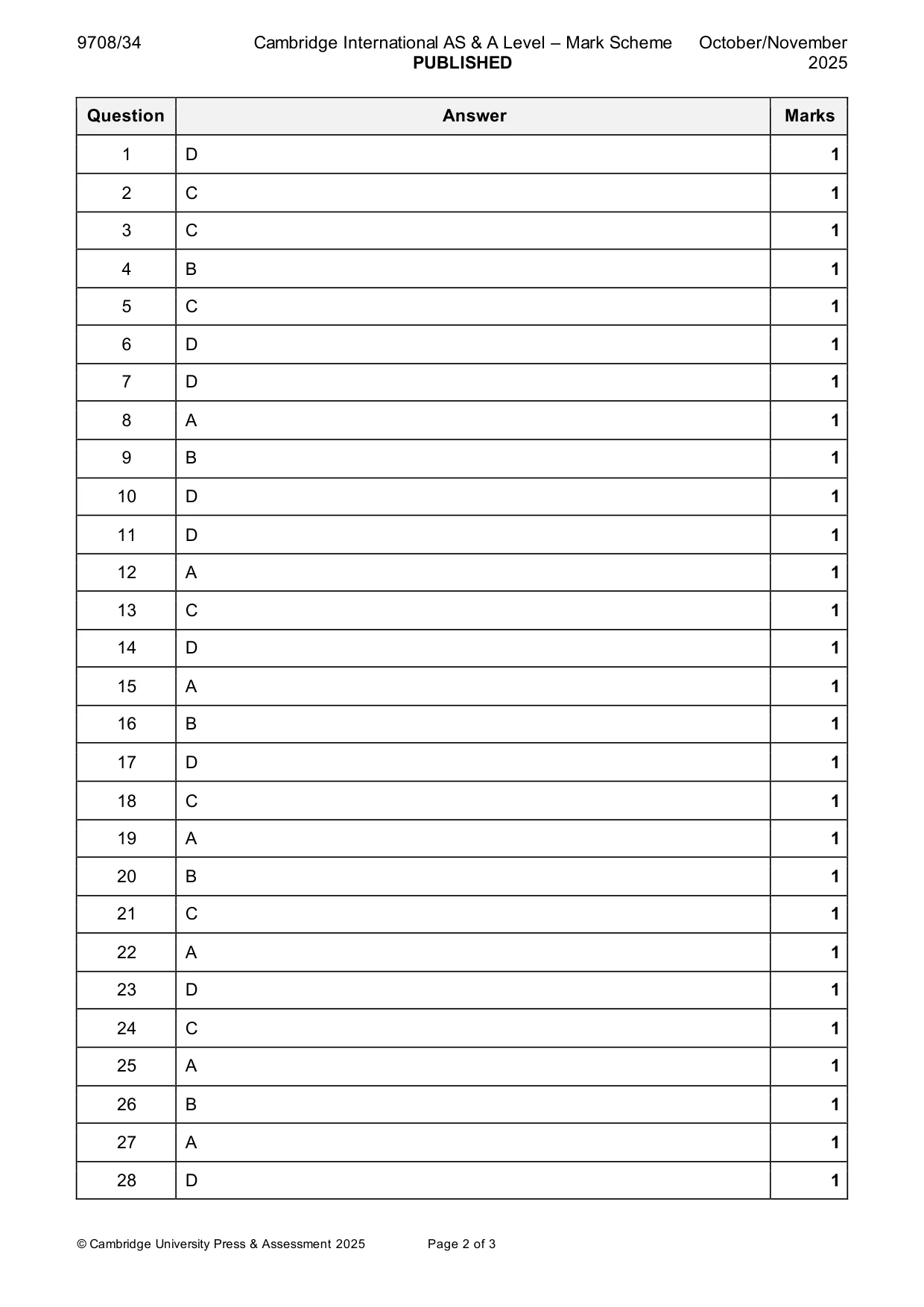
9708/34 Cambridge International AS & A Level – Mark Scheme PUBLISHED October/November 2025 © Cambridge University Press & Assessment 2025 Page 2 of 3 Question Answer Marks 1 D 1 2 C 1 3 C 1 4 B 1 5 C 1 6 D 1 7 D 1 8 A 1 9 B 1 10 D 1 11 D 1 12 A 1 13 C 1 14 D 1 15 A 1 16 B 1 17 D 1 18 C 1 19 A 1 20 B 1 21 C 1 22 A 1 23 D 1 24 C 1 25 A 1 26 B 1 27 A 1 28 D 1
Mark scheme, page 3
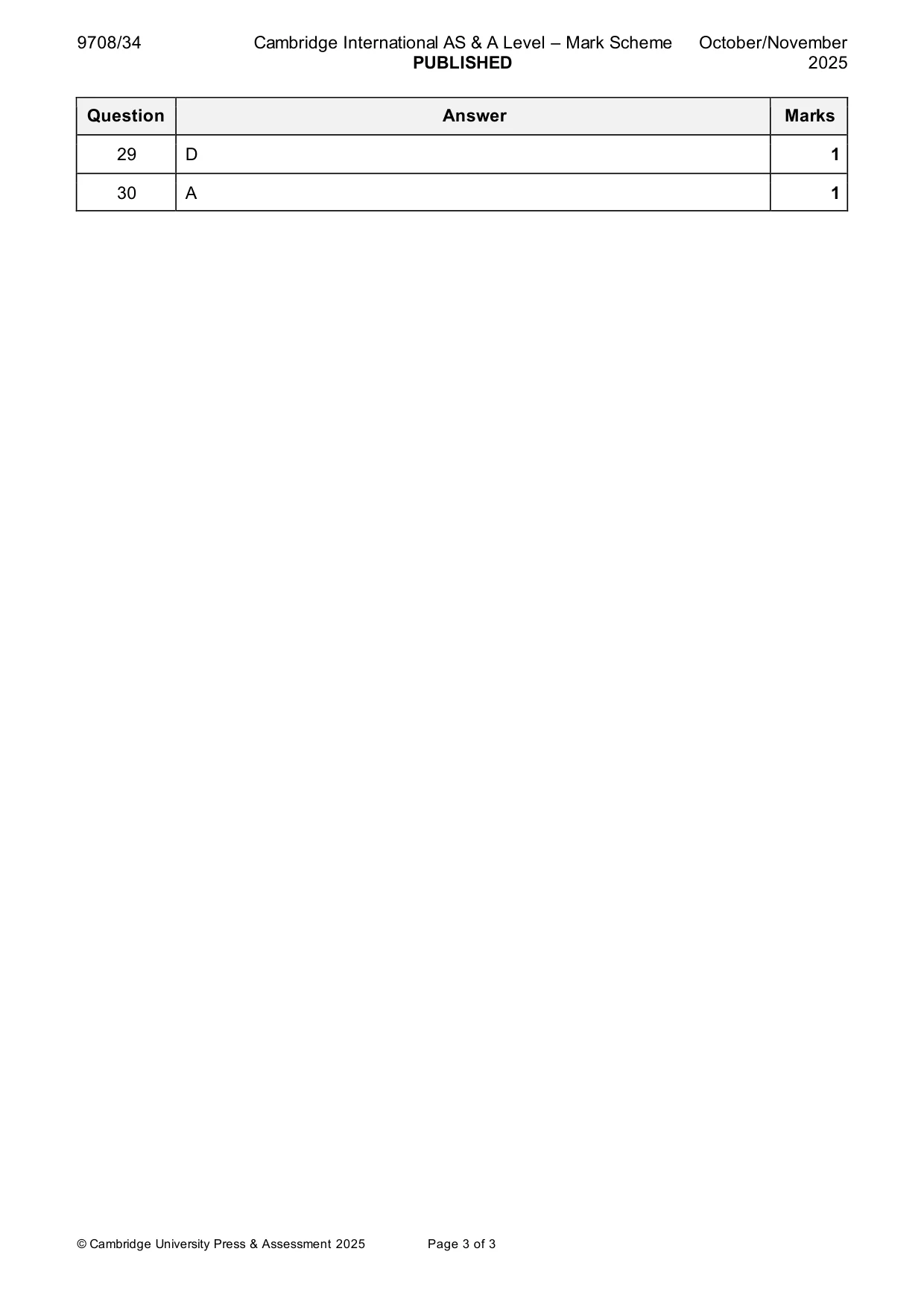
9708/34 Cambridge International AS & A Level – Mark Scheme PUBLISHED October/November 2025 © Cambridge University Press & Assessment 2025 Page 3 of 3 Question Answer Marks 29 D 1 30 A 1
What you needed in this session
Cambridge’s own grade thresholds for 2025 Oct/Nov, Paper 3 · Variant 4. A higher threshold means an easier paper — the bar moves with how the cohort did.