Cambridge A Level Divinity 9011 — 2021 Oct/Nov Paper 1 · Variant 2
9011/12/O/N/21 · 100 marks · ≈113 min
The question paper and its mark scheme, free to read here and free to download. This is Cambridge’s own paper, exactly as it was sat.
Question paper8 pages

Mark scheme23 pages
Answers below. Sit the paper first if you are practising.
Paper as text
Question paper, page 1
This document has 8 pages. Cambridge International A Level * 2 3 9 5 0 5 5 6 5 0 * DC (CJ) 217082/2 © UCLES 2021 [Turn over DIVINITY 9011/12 Paper 1 The Prophets of the Old Testament October/November 2021 3 hours You must answer on the enclosed answer booklet. You will need: Answer booklet (enclosed) INSTRUCTIONS ● Answer four questions in total: Answer Question 10 in Section C and three other questions, including at least one question from Section A and one from Section B. ● Answer Question 10 in one version only. Revised Standard Version of Question 10 begins on page 3. New International Version of Question 10 begins on page 6. ● Follow the instructions on the front cover of the answer booklet. If you need additional answer paper, ask the invigilator for a continuation booklet. INFORMATION ● The total mark for this paper is 100. ● All questions are worth 25 marks.
Question paper, page 2
2 9011/12/O/N/21 © UCLES 2021 Section A Prophecy in general and Pre-canonical Prophets 1 ‘Moses was not a real person: he was a model of what a true prophet should be like.’ Assess this view. [25] 2 Assess the importance of Samuel in the development of Old Testament prophecy. [25] 3 ‘Elijah is best described as a champion of justice.’ How far do you agree? [25] 4 ‘In pre-exilic Israel all prophets were cultic prophets.’ Discuss. [25] 5 ‘Miracles were the most effective way of delivering a prophet’s message.’ How far do you agree? [25] Section B Pre-exilic Prophets, with special reference to Amos, Hosea, Isaiah of Jerusalem and Jeremiah 6 Discuss the main ideas in the prophecies of Amos. [25] 7 Examine what Hosea teaches about God’s love for Israel. [25] 8 Examine Isaiah’s main prophetic teachings in chapters 1–12 of his book. [25] 9 Consider the effects of Jeremiah’s call on his prophetic message. [25]
Question paper, page 3
3 9011/12/O/N/21 © UCLES 2021 [Turn over Section C REVISED STANDARD VERSION 10 Comment on points of interest or difficulty in four of the following passages (wherever possible answers should refer to the context of the passage but should not retell the story from which the passage is taken): [25] (a) So Moses went out and told the people the words of the Lord; and he gathered seventy men of the elders of the people, and placed them round about the tent. Then the Lord came down in the cloud and spoke to him, and took some of the spirit that was upon him and put it upon the seventy elders; and when the spirit rested upon them, they prophesied. But they did so no more. (Numbers 11:24–25) (b) Then Samuel took a vial of oil and poured it on his head, and kissed him and said, “Has not the Lord anointed you to be prince over his people Israel? And you shall reign over the people of the Lord and you will save them from the hand of their enemies round about. And this shall be the sign to you that the Lord has anointed you to be prince over his heritage. When you depart from me today you will meet two men by Rachel’s tomb in the territory of Benjamin at Zelzah, and they will say to you, ‘The asses which you went to seek are found, and now your father has ceased to care about the asses and is anxious about you, saying, “What shall I do about my son?”’” (1 Samuel 10:1–2) (c) In those days the Philistines gathered their forces for war, to fight against Israel. And A’chish said to David, “Understand that you and your men are to go out with me in the army.” David said to A’chish, “Very well, you shall know what your servant can do.” And A’chish said to David, “Very well, I will make you my bodyguard for life.” Now Samuel had died, and all Israel had mourned for him and buried him in Ramah, his own city. And Saul had put the mediums and the wizards out of the land. (1 Samuel 28:1–3) (d) In all places where I have moved with all the people of Israel, did I speak a word with any of the judges of Israel, whom I commanded to shepherd my people Israel, saying, “Why have you not built me a house of cedar?” Now therefore thus you shall say to my servant David, ‘Thus says the Lord of hosts, I took you from the pasture, from following the sheep, that you should be prince over my people Israel; and I have been with you wherever you went, and have cut off all your enemies from before you; and I will make for you a great name, like the name of the great ones of the earth.’ (2 Samuel 7:7–9) (e) And Jehosh’aphat said to the king of Israel, “I am as you are, my people as your people, my horses as your horses.” And Jehosh’aphat said to the king of Israel, “Inquire first for the word of the Lord.” Then the king of Israel gathered the prophets together, about four hundred men, and said to them, “Shall I go to battle against Ramoth-gilead, or shall I forbear?” And they said, “Go up; for the Lord will give it into the hand of the king.” But Jehosh’aphat said, “Is there not here another prophet of the Lord of whom we may inquire?” (1 Kings 22:4b–7) (f) “Behold, I will press you down in your place, as a cart full of sheaves presses down. Flight shall perish from the swift, and the strong shall not retain his strength, nor shall the mighty save his life; he who handles the bow shall not stand, and he who is swift of foot shall not save himself, nor shall he who rides the horse save his life; and he who is stout of heart among the mighty shall flee away naked in that day,” says the Lord. (Amos 2:13–16)
Question paper, page 4
4 9011/12/O/N/21 © UCLES 2021 (g) They shall return to the land of Egypt, and Assyria shall be their king, because they have refused to return to me. The sword shall rage against their cities, consume the bars of their gates, and devour them in their fortresses. My people are bent on turning away from me; so they are appointed to the yoke, and none shall remove it. (Hosea 11:5–7) (h) He shall not judge by what his eyes see, or decide by what his ears hear; but with righteousness he shall judge the poor, and decide with equity for the meek of the earth; and he shall smite the earth with the rod of his mouth, and with the breath of his lips he shall slay the wicked. Righteousness shall be the girdle of his waist, and faithfulness the girdle of his loins. (Isaiah 11:3b–5) (i) Woe to those who go down to Egypt for help and rely on horses, who trust in chariots because they are many and in horsemen because they are very strong, but do not look to the Holy One of Israel or consult the Lord! And yet he is wise and brings disaster, he does not call back his words, but will arise against the house of the evildoers, and against the helpers of those who work iniquity. The Egyptians are men, and not God; and their horses are flesh, and not spirit. When the Lord stretches out his hand, the helper will stumble, and he who is helped will fall, and they will all perish together. (Isaiah 31:1–3) (j) “For the sons of Judah have done evil in my sight, says the Lord; they have set their abominations in the house which is called by my name, to defile it. And they have built the high place of Topheth, which is in the valley of the son of Hinnom, to burn their sons and their daughters in the fire; which I did not command, nor did it come into my mind. Therefore, behold, the days are coming, says the Lord, when it will no more be called Topheth, or the valley of the son of Hinnom, but the valley of Slaughter: for they will bury in Topheth, because there is no room elsewhere. And the dead bodies of this people will be food for the birds of the air, and for the beasts of the earth; and none will frighten them away. And I will make to cease from the cities of Judah and from the streets of Jerusalem the voice of mirth and the voice of gladness, the voice of the bridegroom and the voice of the bride; for the land shall become a waste. (Jeremiah 7:30–34) (k) “Woe to the shepherds who destroy and scatter the sheep of my pasture!” says the Lord. Therefore thus says the Lord, the God of Israel, concerning the shepherds who care for my people: “You have scattered my flock, and have driven them away, and you have not attended to them. Behold, I will attend to you for your evil doings, says the Lord. Then I will gather the remnant of my flock out of all the countries where I have driven them, and I will bring them back to their fold, and they shall be fruitful and multiply. I will set shepherds over them who will care for them, and they shall fear no more, nor be dismayed, neither shall any be missing, says the Lord.
Question paper, page 5
5 9011/12/O/N/21 © UCLES 2021 [Turn over “Behold, the days are coming, says the Lord, when I will raise up for David a righteous Branch, and he shall reign as king and deal wisely, and shall execute justice and righteousness in the land. (Jeremiah 23:1–5)
Question paper, page 6
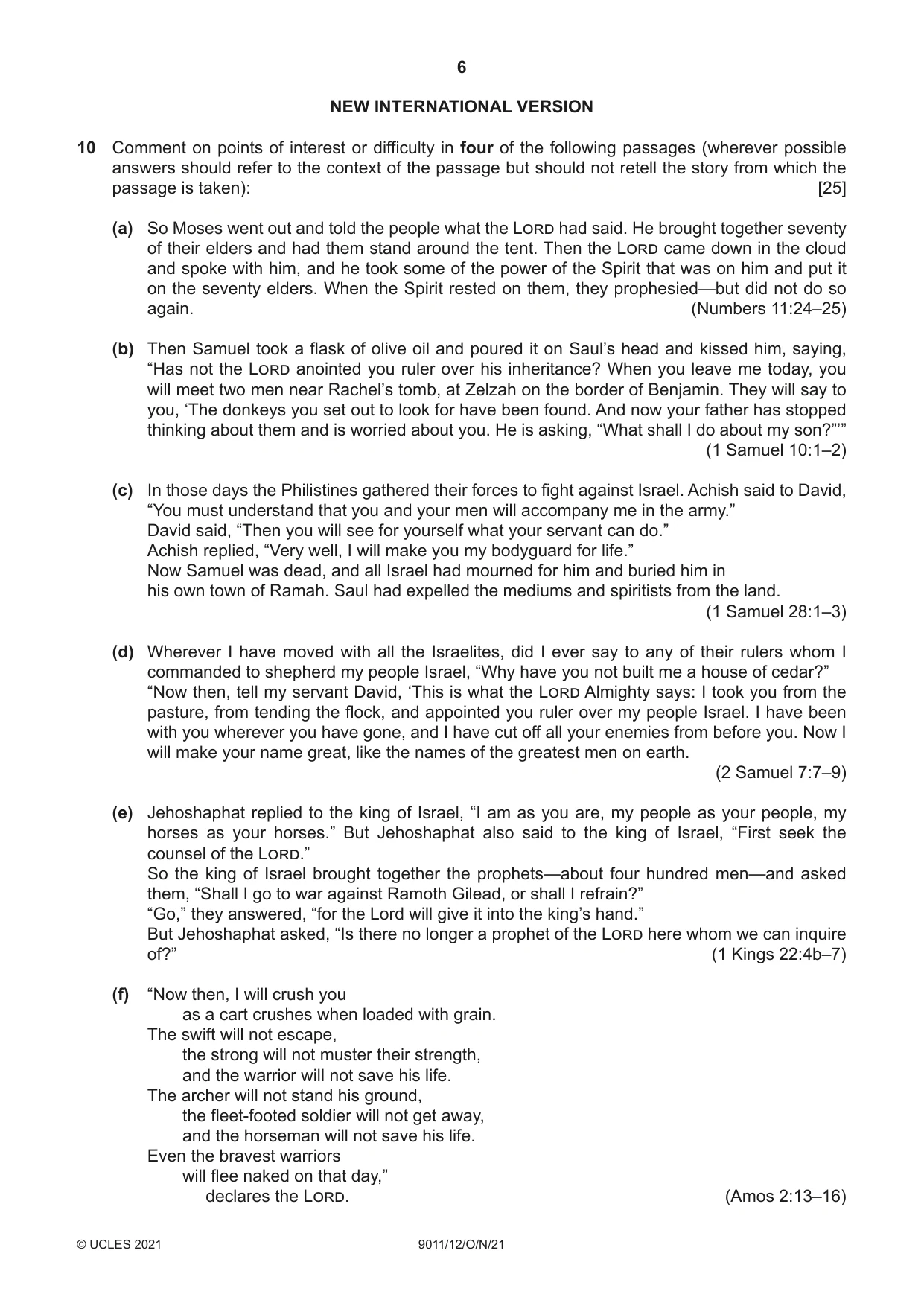
6 9011/12/O/N/21 © UCLES 2021 NEW INTERNATIONAL VERSION 10 Comment on points of interest or difficulty in four of the following passages (wherever possible answers should refer to the context of the passage but should not retell the story from which the passage is taken): [25] (a) So Moses went out and told the people what the Lord had said. He brought together seventy of their elders and had them stand around the tent. Then the Lord came down in the cloud and spoke with him, and he took some of the power of the Spirit that was on him and put it on the seventy elders. When the Spirit rested on them, they prophesied—but did not do so again. (Numbers 11:24–25) (b) Then Samuel took a flask of olive oil and poured it on Saul’s head and kissed him, saying, “Has not the Lord anointed you ruler over his inheritance? When you leave me today, you will meet two men near Rachel’s tomb, at Zelzah on the border of Benjamin. They will say to you, ‘The donkeys you set out to look for have been found. And now your father has stopped thinking about them and is worried about you. He is asking, “What shall I do about my son?”’” (1 Samuel 10:1–2) (c) In those days the Philistines gathered their forces to fight against Israel. Achish said to David, “You must understand that you and your men will accompany me in the army.” David said, “Then you will see for yourself what your servant can do.” Achish replied, “Very well, I will make you my bodyguard for life.” Now Samuel was dead, and all Israel had mourned for him and buried him in his own town of Ramah. Saul had expelled the mediums and spiritists from the land. (1 Samuel 28:1–3) (d) Wherever I have moved with all the Israelites, did I ever say to any of their rulers whom I commanded to shepherd my people Israel, “Why have you not built me a house of cedar?” “Now then, tell my servant David, ‘This is what the Lord Almighty says: I took you from the pasture, from tending the flock, and appointed you ruler over my people Israel. I have been with you wherever you have gone, and I have cut off all your enemies from before you. Now I will make your name great, like the names of the greatest men on earth. (2 Samuel 7:7–9) (e) Jehoshaphat replied to the king of Israel, “I am as you are, my people as your people, my horses as your horses.” But Jehoshaphat also said to the king of Israel, “First seek the counsel of the Lord.” So the king of Israel brought together the prophets—about four hundred men—and asked them, “Shall I go to war against Ramoth Gilead, or shall I refrain?” “Go,” they answered, “for the Lord will give it into the king’s hand.” But Jehoshaphat asked, “Is there no longer a prophet of the Lord here whom we can inquire of?” (1 Kings 22:4b–7) (f) “Now then, I will crush you as a cart crushes when loaded with grain. The swift will not escape, the strong will not muster their strength, and the warrior will not save his life. The archer will not stand his ground, the fleet-footed soldier will not get away, and the horseman will not save his life. Even the bravest warriors will flee naked on that day,” declares the Lord. (Amos 2:13–16)
Question paper, page 7
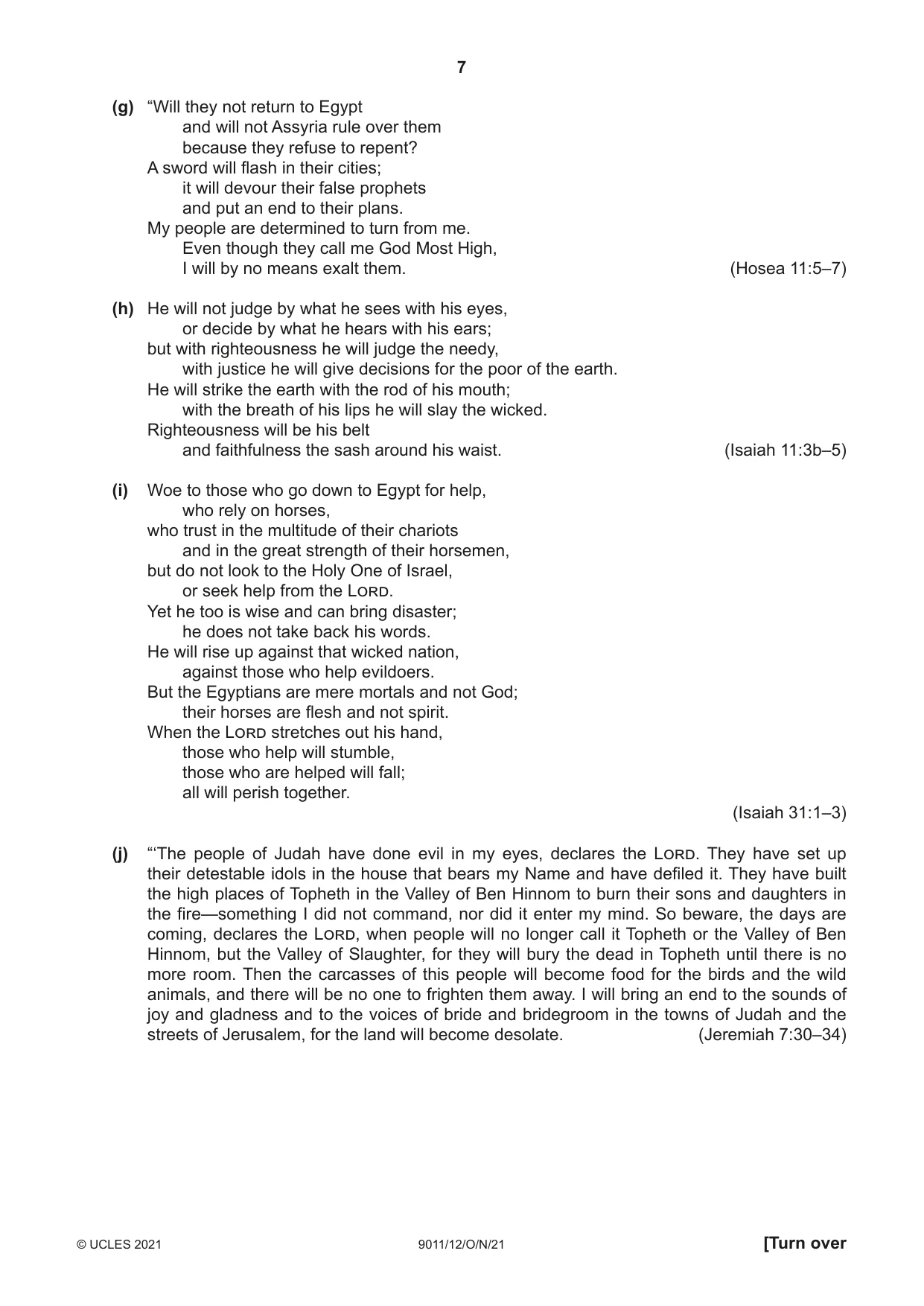
7 9011/12/O/N/21 © UCLES 2021 [Turn over (g) “Will they not return to Egypt and will not Assyria rule over them because they refuse to repent? A sword will flash in their cities; it will devour their false prophets and put an end to their plans. My people are determined to turn from me. Even though they call me God Most High, I will by no means exalt them. (Hosea 11:5–7) (h) He will not judge by what he sees with his eyes, or decide by what he hears with his ears; but with righteousness he will judge the needy, with justice he will give decisions for the poor of the earth. He will strike the earth with the rod of his mouth; with the breath of his lips he will slay the wicked. Righteousness will be his belt and faithfulness the sash around his waist. (Isaiah 11:3b–5) (i) Woe to those who go down to Egypt for help, who rely on horses, who trust in the multitude of their chariots and in the great strength of their horsemen, but do not look to the Holy One of Israel, or seek help from the Lord. Yet he too is wise and can bring disaster; he does not take back his words. He will rise up against that wicked nation, against those who help evildoers. But the Egyptians are mere mortals and not God; their horses are flesh and not spirit. When the Lord stretches out his hand, those who help will stumble, those who are helped will fall; all will perish together. (Isaiah 31:1–3) (j) “‘The people of Judah have done evil in my eyes, declares the Lord. They have set up their detestable idols in the house that bears my Name and have defiled it. They have built the high places of Topheth in the Valley of Ben Hinnom to burn their sons and daughters in the fire—something I did not command, nor did it enter my mind. So beware, the days are coming, declares the Lord, when people will no longer call it Topheth or the Valley of Ben Hinnom, but the Valley of Slaughter, for they will bury the dead in Topheth until there is no more room. Then the carcasses of this people will become food for the birds and the wild animals, and there will be no one to frighten them away. I will bring an end to the sounds of joy and gladness and to the voices of bride and bridegroom in the towns of Judah and the streets of Jerusalem, for the land will become desolate. (Jeremiah 7:30–34)
Question paper, page 8
8 9011/12/O/N/21 © UCLES 2021 Permission to reproduce items where third-party owned material protected by copyright is included has been sought and cleared where possible. Every reasonable effort has been made by the publisher (UCLES) to trace copyright holders, but if any items requiring clearance have unwittingly been included, the publisher will be pleased to make amends at the earliest possible opportunity. To avoid the issue of disclosure of answer-related information to candidates, all copyright acknowledgements are reproduced online in the Cambridge Assessment International Education Copyright Acknowledgements Booklet. This is produced for each series of examinations and is freely available to download at www.cambridgeinternational.org after the live examination series. Cambridge Assessment International Education is part of the Cambridge Assessment Group. Cambridge Assessment is the brand name of the University of Cambridge Local Examinations Syndicate (UCLES), which itself is a department of the University of Cambridge. (k) “Woe to the shepherds who are destroying and scattering the sheep of my pasture!” declares the Lord. Therefore this is what the Lord, the God of Israel, says to the shepherds who tend my people: “Because you have scattered my flock and driven them away and have not bestowed care on them, I will bestow punishment on you for the evil you have done,” declares the Lord. “I myself will gather the remnant of my flock out of all the countries where I have driven them and will bring them back to their pasture, where they will be fruitful and increase in number. I will place shepherds over them who will tend them, and they will no longer be afraid or terrified, nor will any be missing,” declares the Lord. “The days are coming,” declares the Lord, “when I will raise up for David a righteous Branch, a King who will reign wisely and do what is just and right in the land.” (Jeremiah 23:1–5)
Mark scheme, page 1
This document consists of 23 printed pages. © UCLES 2021 [Turn over Cambridge International A Level DIVINITY 9011/12 Paper 1 Prophets of the Old Testament October/November 2021 MARK SCHEME Maximum Mark: 100 Published This mark scheme is published as an aid to teachers and candidates, to indicate the requirements of the examination. It shows the basis on which Examiners were instructed to award marks. It does not indicate the details of the discussions that took place at an Examiners’ meeting before marking began, which would have considered the acceptability of alternative answers. Mark schemes should be read in conjunction with the question paper and the Principal Examiner Report for Teachers. Cambridge International will not enter into discussions about these mark schemes. Cambridge International is publishing the mark schemes for the October/November 2021 series for most Cambridge IGCSE™, Cambridge International A and AS Level components and some Cambridge O Level components.
Mark scheme, page 2
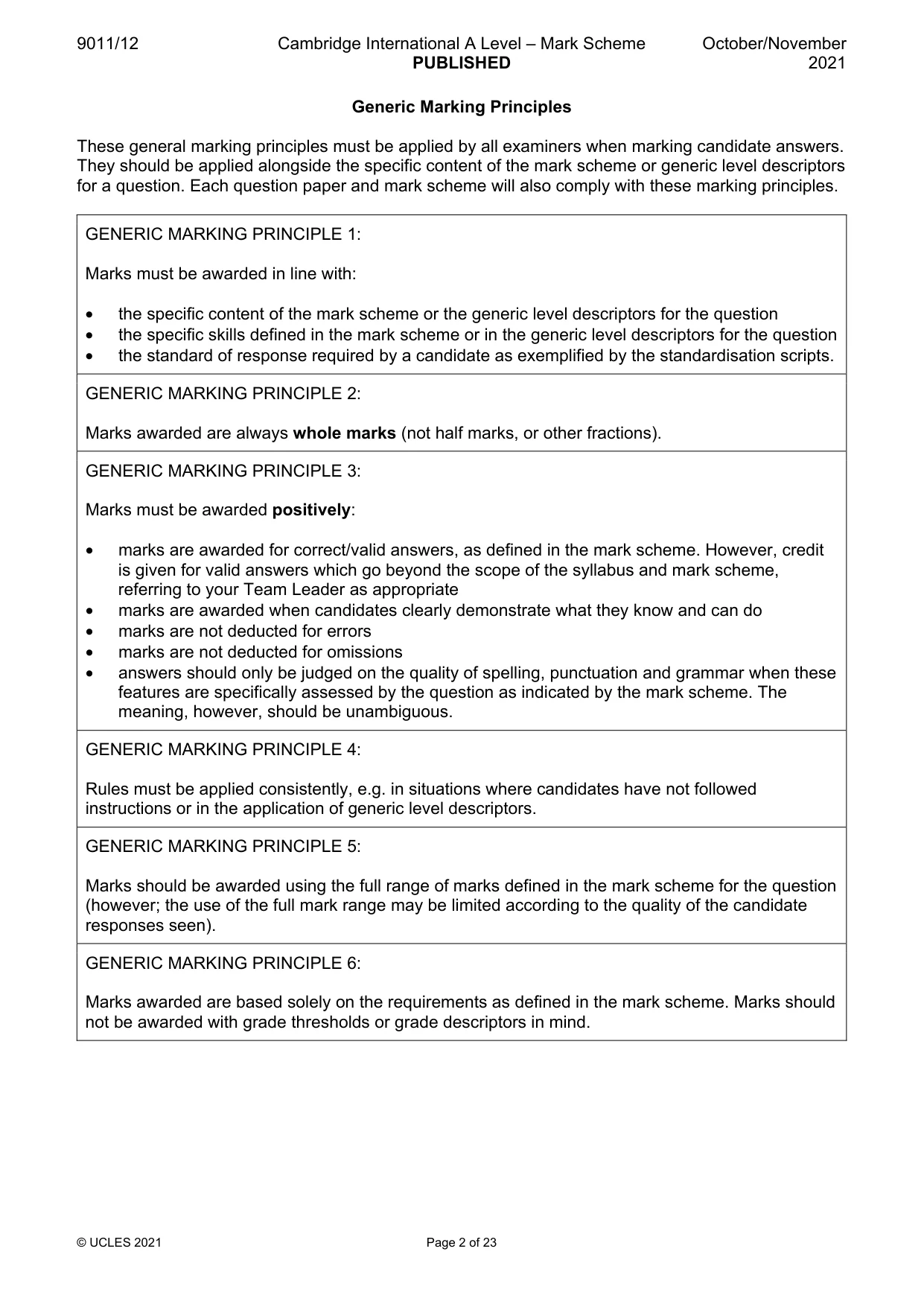
9011/12 Cambridge International A Level – Mark Scheme PUBLISHED October/November 2021 © UCLES 2021 Page 2 of 23 Generic Marking Principles These general marking principles must be applied by all examiners when marking candidate answers. They should be applied alongside the specific content of the mark scheme or generic level descriptors for a question. Each question paper and mark scheme will also comply with these marking principles. GENERIC MARKING PRINCIPLE 1: Marks must be awarded in line with: • the specific content of the mark scheme or the generic level descriptors for the question • the specific skills defined in the mark scheme or in the generic level descriptors for the question • the standard of response required by a candidate as exemplified by the standardisation scripts. GENERIC MARKING PRINCIPLE 2: Marks awarded are always whole marks (not half marks, or other fractions). GENERIC MARKING PRINCIPLE 3: Marks must be awarded positively: • marks are awarded for correct/valid answers, as defined in the mark scheme. However, credit is given for valid answers which go beyond the scope of the syllabus and mark scheme, referring to your Team Leader as appropriate • marks are awarded when candidates clearly demonstrate what they know and can do • marks are not deducted for errors • marks are not deducted for omissions • answers should only be judged on the quality of spelling, punctuation and grammar when these features are specifically assessed by the question as indicated by the mark scheme. The meaning, however, should be unambiguous. GENERIC MARKING PRINCIPLE 4: Rules must be applied consistently, e.g. in situations where candidates have not followed instructions or in the application of generic level descriptors. GENERIC MARKING PRINCIPLE 5: Marks should be awarded using the full range of marks defined in the mark scheme for the question (however; the use of the full mark range may be limited according to the quality of the candidate responses seen). GENERIC MARKING PRINCIPLE 6: Marks awarded are based solely on the requirements as defined in the mark scheme. Marks should not be awarded with grade thresholds or grade descriptors in mind.
Mark scheme, page 3
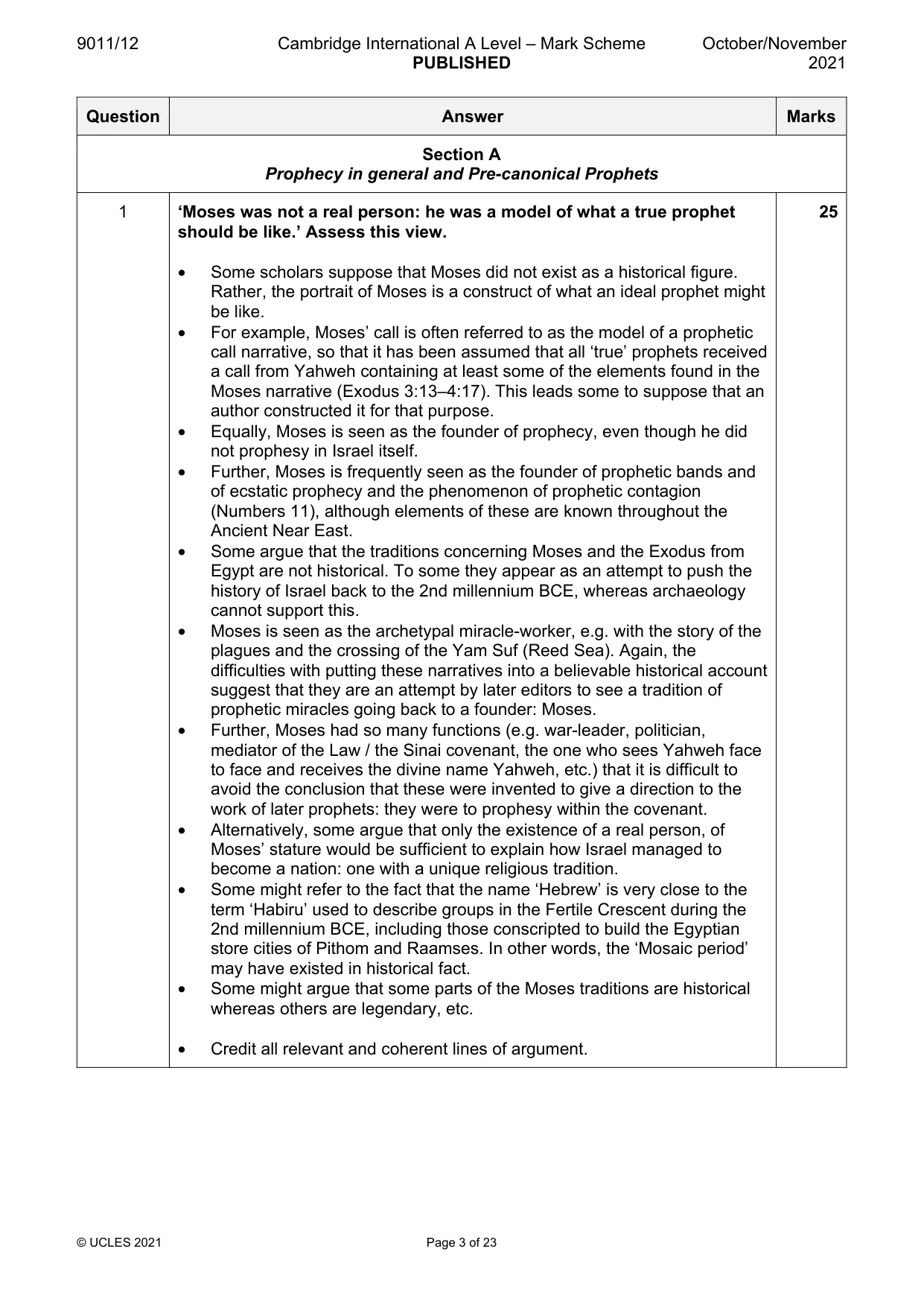
9011/12 Cambridge International A Level – Mark Scheme PUBLISHED October/November 2021 © UCLES 2021 Page 3 of 23 Question Answer Marks Section A Prophecy in general and Pre-canonical Prophets 1 ‘Moses was not a real person: he was a model of what a true prophet should be like.’ Assess this view. • Some scholars suppose that Moses did not exist as a historical figure. Rather, the portrait of Moses is a construct of what an ideal prophet might be like. • For example, Moses’ call is often referred to as the model of a prophetic call narrative, so that it has been assumed that all ‘true’ prophets received a call from Yahweh containing at least some of the elements found in the Moses narrative (Exodus 3:13–4:17). This leads some to suppose that an author constructed it for that purpose. • Equally, Moses is seen as the founder of prophecy, even though he did not prophesy in Israel itself. • Further, Moses is frequently seen as the founder of prophetic bands and of ecstatic prophecy and the phenomenon of prophetic contagion (Numbers 11), although elements of these are known throughout the Ancient Near East. • Some argue that the traditions concerning Moses and the Exodus from Egypt are not historical. To some they appear as an attempt to push the history of Israel back to the 2nd millennium BCE, whereas archaeology cannot support this. • Moses is seen as the archetypal miracle-worker, e.g. with the story of the plagues and the crossing of the Yam Suf (Reed Sea). Again, the difficulties with putting these narratives into a believable historical account suggest that they are an attempt by later editors to see a tradition of prophetic miracles going back to a founder: Moses. • Further, Moses had so many functions (e.g. war-leader, politician, mediator of the Law / the Sinai covenant, the one who sees Yahweh face to face and receives the divine name Yahweh, etc.) that it is difficult to avoid the conclusion that these were invented to give a direction to the work of later prophets: they were to prophesy within the covenant. • Alternatively, some argue that only the existence of a real person, of Moses’ stature would be sufficient to explain how Israel managed to become a nation: one with a unique religious tradition. • Some might refer to the fact that the name ‘Hebrew’ is very close to the term ‘Habiru’ used to describe groups in the Fertile Crescent during the 2nd millennium BCE, including those conscripted to build the Egyptian store cities of Pithom and Raamses. In other words, the ‘Mosaic period’ may have existed in historical fact. • Some might argue that some parts of the Moses traditions are historical whereas others are legendary, etc. • Credit all relevant and coherent lines of argument. 25
Mark scheme, page 4
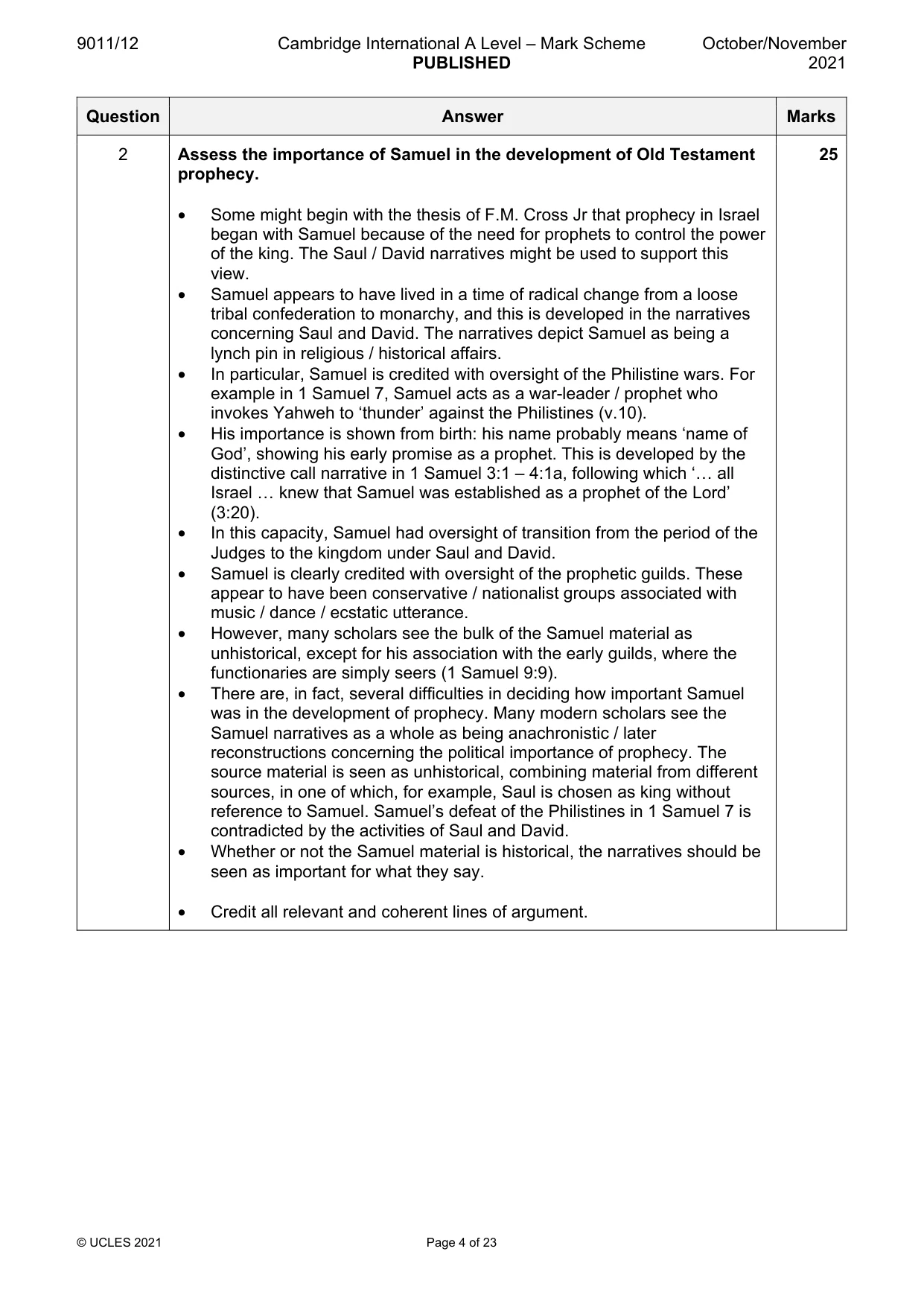
9011/12 Cambridge International A Level – Mark Scheme PUBLISHED October/November 2021 © UCLES 2021 Page 4 of 23 Question Answer Marks 2 Assess the importance of Samuel in the development of Old Testament prophecy. • Some might begin with the thesis of F.M. Cross Jr that prophecy in Israel began with Samuel because of the need for prophets to control the power of the king. The Saul / David narratives might be used to support this view. • Samuel appears to have lived in a time of radical change from a loose tribal confederation to monarchy, and this is developed in the narratives concerning Saul and David. The narratives depict Samuel as being a lynch pin in religious / historical affairs. • In particular, Samuel is credited with oversight of the Philistine wars. For example in 1 Samuel 7, Samuel acts as a war-leader / prophet who invokes Yahweh to ‘thunder’ against the Philistines (v.10). • His importance is shown from birth: his name probably means ‘name of God’, showing his early promise as a prophet. This is developed by the distinctive call narrative in 1 Samuel 3:1 – 4:1a, following which ‘… all Israel … knew that Samuel was established as a prophet of the Lord’ (3:20). • In this capacity, Samuel had oversight of transition from the period of the Judges to the kingdom under Saul and David. • Samuel is clearly credited with oversight of the prophetic guilds. These appear to have been conservative / nationalist groups associated with music / dance / ecstatic utterance. • However, many scholars see the bulk of the Samuel material as unhistorical, except for his association with the early guilds, where the functionaries are simply seers (1 Samuel 9:9). • There are, in fact, several difficulties in deciding how important Samuel was in the development of prophecy. Many modern scholars see the Samuel narratives as a whole as being anachronistic / later reconstructions concerning the political importance of prophecy. The source material is seen as unhistorical, combining material from different sources, in one of which, for example, Saul is chosen as king without reference to Samuel. Samuel’s defeat of the Philistines in 1 Samuel 7 is contradicted by the activities of Saul and David. • Whether or not the Samuel material is historical, the narratives should be seen as important for what they say. • Credit all relevant and coherent lines of argument. 25
Mark scheme, page 5
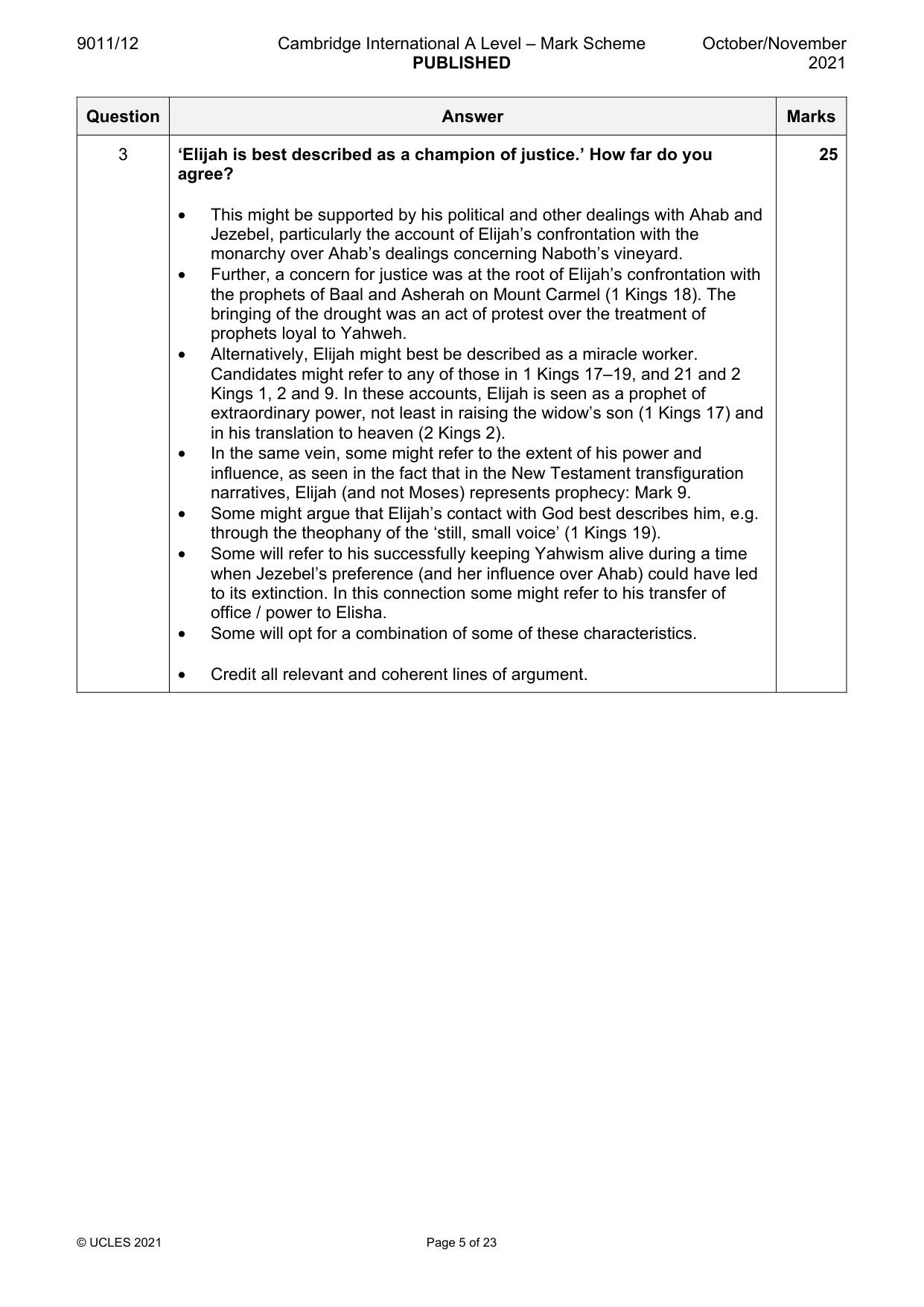
9011/12 Cambridge International A Level – Mark Scheme PUBLISHED October/November 2021 © UCLES 2021 Page 5 of 23 Question Answer Marks 3 ‘Elijah is best described as a champion of justice.’ How far do you agree? • This might be supported by his political and other dealings with Ahab and Jezebel, particularly the account of Elijah’s confrontation with the monarchy over Ahab’s dealings concerning Naboth’s vineyard. • Further, a concern for justice was at the root of Elijah’s confrontation with the prophets of Baal and Asherah on Mount Carmel (1 Kings 18). The bringing of the drought was an act of protest over the treatment of prophets loyal to Yahweh. • Alternatively, Elijah might best be described as a miracle worker. Candidates might refer to any of those in 1 Kings 17–19, and 21 and 2 Kings 1, 2 and 9. In these accounts, Elijah is seen as a prophet of extraordinary power, not least in raising the widow’s son (1 Kings 17) and in his translation to heaven (2 Kings 2). • In the same vein, some might refer to the extent of his power and influence, as seen in the fact that in the New Testament transfiguration narratives, Elijah (and not Moses) represents prophecy: Mark 9. • Some might argue that Elijah’s contact with God best describes him, e.g. through the theophany of the ‘still, small voice’ (1 Kings 19). • Some will refer to his successfully keeping Yahwism alive during a time when Jezebel’s preference (and her influence over Ahab) could have led to its extinction. In this connection some might refer to his transfer of office / power to Elisha. • Some will opt for a combination of some of these characteristics. • Credit all relevant and coherent lines of argument. 25
Mark scheme, page 6
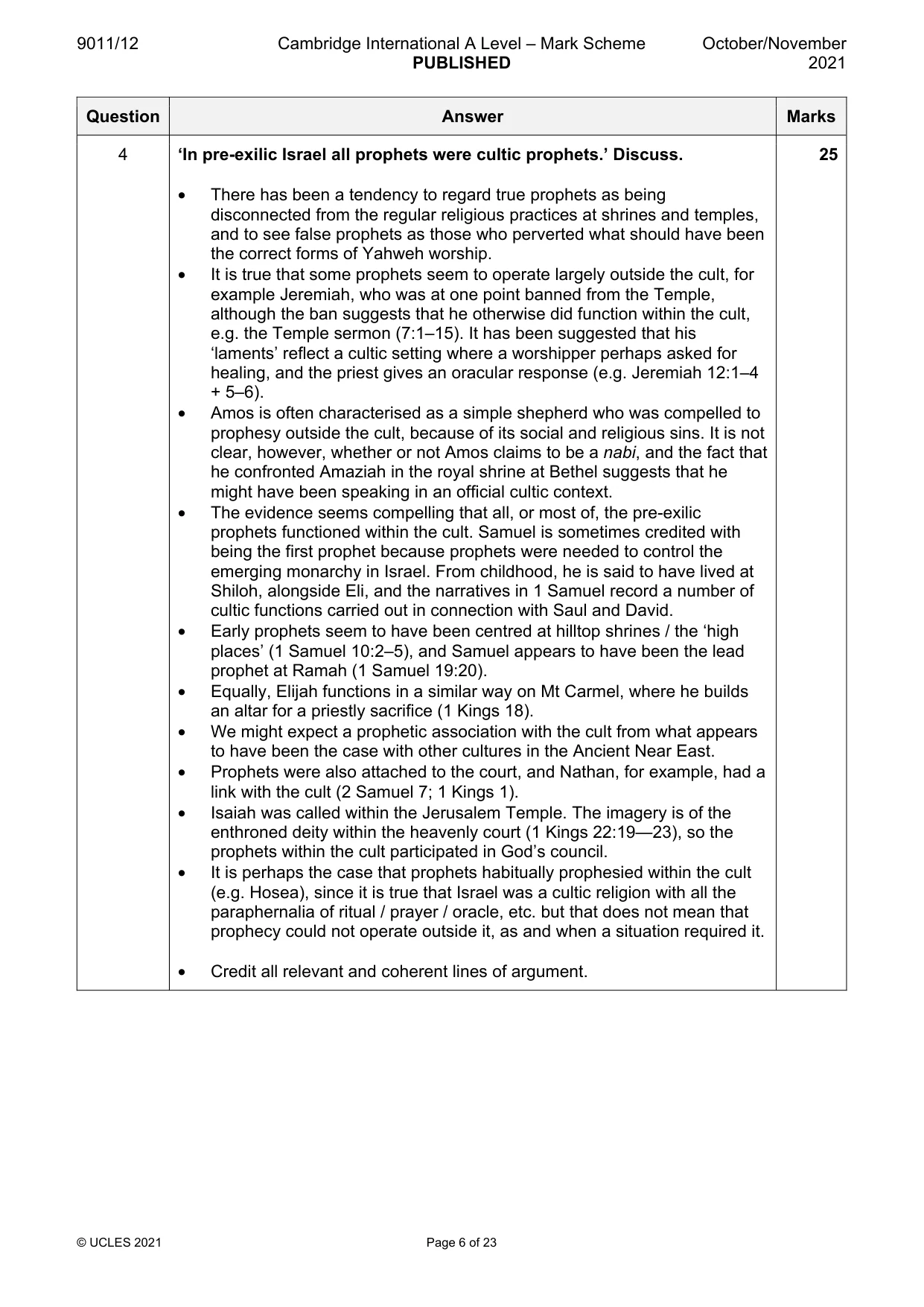
9011/12 Cambridge International A Level – Mark Scheme PUBLISHED October/November 2021 © UCLES 2021 Page 6 of 23 Question Answer Marks 4 ‘In pre-exilic Israel all prophets were cultic prophets.’ Discuss. • There has been a tendency to regard true prophets as being disconnected from the regular religious practices at shrines and temples, and to see false prophets as those who perverted what should have been the correct forms of Yahweh worship. • It is true that some prophets seem to operate largely outside the cult, for example Jeremiah, who was at one point banned from the Temple, although the ban suggests that he otherwise did function within the cult, e.g. the Temple sermon (7:1–15). It has been suggested that his ‘laments’ reflect a cultic setting where a worshipper perhaps asked for healing, and the priest gives an oracular response (e.g. Jeremiah 12:1–4 + 5–6). • Amos is often characterised as a simple shepherd who was compelled to prophesy outside the cult, because of its social and religious sins. It is not clear, however, whether or not Amos claims to be a nabi, and the fact that he confronted Amaziah in the royal shrine at Bethel suggests that he might have been speaking in an official cultic context. • The evidence seems compelling that all, or most of, the pre-exilic prophets functioned within the cult. Samuel is sometimes credited with being the first prophet because prophets were needed to control the emerging monarchy in Israel. From childhood, he is said to have lived at Shiloh, alongside Eli, and the narratives in 1 Samuel record a number of cultic functions carried out in connection with Saul and David. • Early prophets seem to have been centred at hilltop shrines / the ‘high places’ (1 Samuel 10:2–5), and Samuel appears to have been the lead prophet at Ramah (1 Samuel 19:20). • Equally, Elijah functions in a similar way on Mt Carmel, where he builds an altar for a priestly sacrifice (1 Kings 18). • We might expect a prophetic association with the cult from what appears to have been the case with other cultures in the Ancient Near East. • Prophets were also attached to the court, and Nathan, for example, had a link with the cult (2 Samuel 7; 1 Kings 1). • Isaiah was called within the Jerusalem Temple. The imagery is of the enthroned deity within the heavenly court (1 Kings 22:19—23), so the prophets within the cult participated in God’s council. • It is perhaps the case that prophets habitually prophesied within the cult (e.g. Hosea), since it is true that Israel was a cultic religion with all the paraphernalia of ritual / prayer / oracle, etc. but that does not mean that prophecy could not operate outside it, as and when a situation required it. • Credit all relevant and coherent lines of argument. 25
Mark scheme, page 7
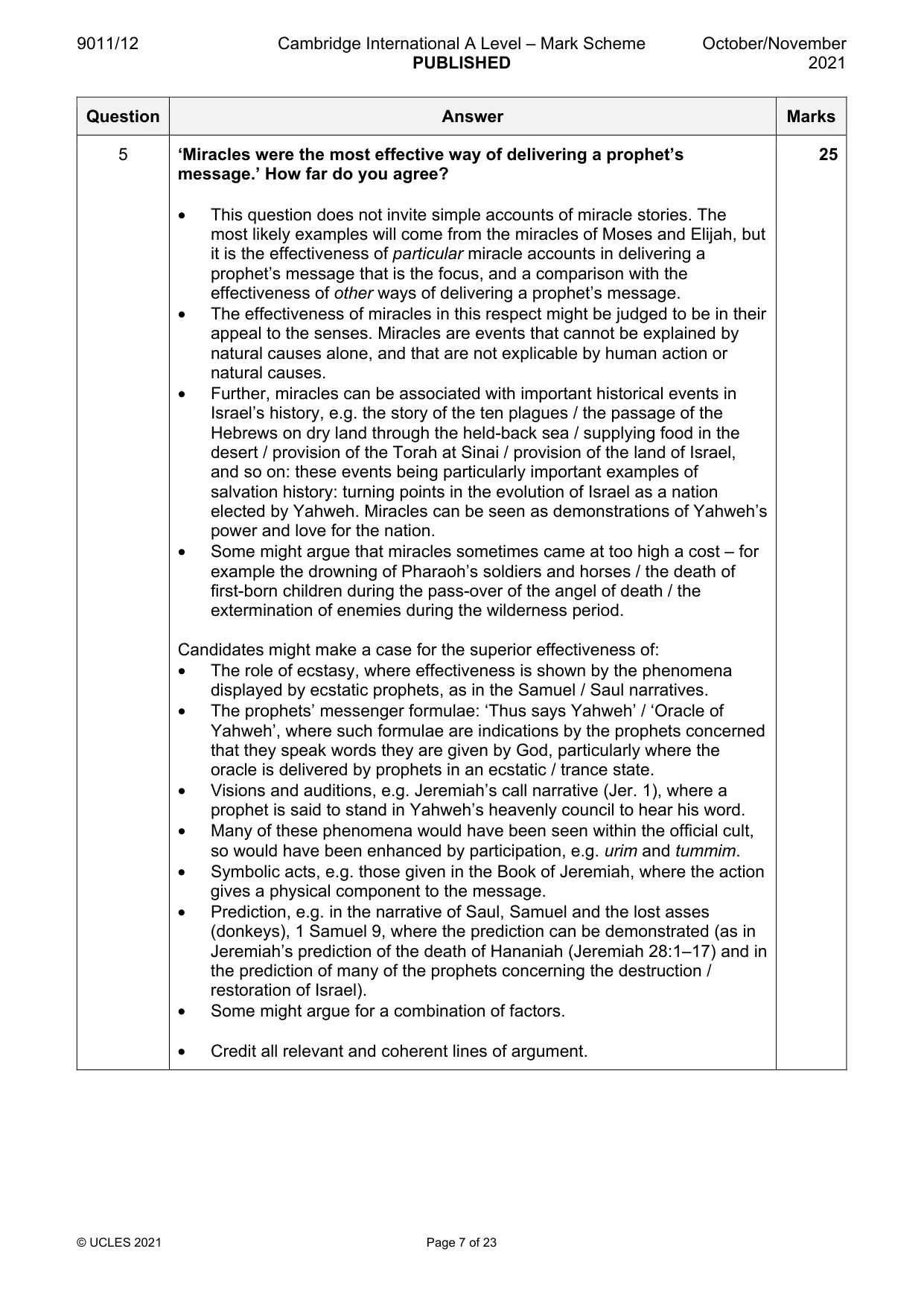
9011/12 Cambridge International A Level – Mark Scheme PUBLISHED October/November 2021 © UCLES 2021 Page 7 of 23 Question Answer Marks 5 ‘Miracles were the most effective way of delivering a prophet’s message.’ How far do you agree? • This question does not invite simple accounts of miracle stories. The most likely examples will come from the miracles of Moses and Elijah, but it is the effectiveness of particular miracle accounts in delivering a prophet’s message that is the focus, and a comparison with the effectiveness of other ways of delivering a prophet’s message. • The effectiveness of miracles in this respect might be judged to be in their appeal to the senses. Miracles are events that cannot be explained by natural causes alone, and that are not explicable by human action or natural causes. • Further, miracles can be associated with important historical events in Israel’s history, e.g. the story of the ten plagues / the passage of the Hebrews on dry land through the held-back sea / supplying food in the desert / provision of the Torah at Sinai / provision of the land of Israel, and so on: these events being particularly important examples of salvation history: turning points in the evolution of Israel as a nation elected by Yahweh. Miracles can be seen as demonstrations of Yahweh’s power and love for the nation. • Some might argue that miracles sometimes came at too high a cost – for example the drowning of Pharaoh’s soldiers and horses / the death of first-born children during the pass-over of the angel of death / the extermination of enemies during the wilderness period. Candidates might make a case for the superior effectiveness of: • The role of ecstasy, where effectiveness is shown by the phenomena displayed by ecstatic prophets, as in the Samuel / Saul narratives. • The prophets’ messenger formulae: ‘Thus says Yahweh’ / ‘Oracle of Yahweh’, where such formulae are indications by the prophets concerned that they speak words they are given by God, particularly where the oracle is delivered by prophets in an ecstatic / trance state. • Visions and auditions, e.g. Jeremiah’s call narrative (Jer. 1), where a prophet is said to stand in Yahweh’s heavenly council to hear his word. • Many of these phenomena would have been seen within the official cult, so would have been enhanced by participation, e.g. urim and tummim. • Symbolic acts, e.g. those given in the Book of Jeremiah, where the action gives a physical component to the message. • Prediction, e.g. in the narrative of Saul, Samuel and the lost asses (donkeys), 1 Samuel 9, where the prediction can be demonstrated (as in Jeremiah’s prediction of the death of Hananiah (Jeremiah 28:1–17) and in the prediction of many of the prophets concerning the destruction / restoration of Israel). • Some might argue for a combination of factors. • Credit all relevant and coherent lines of argument. 25
Mark scheme, page 8
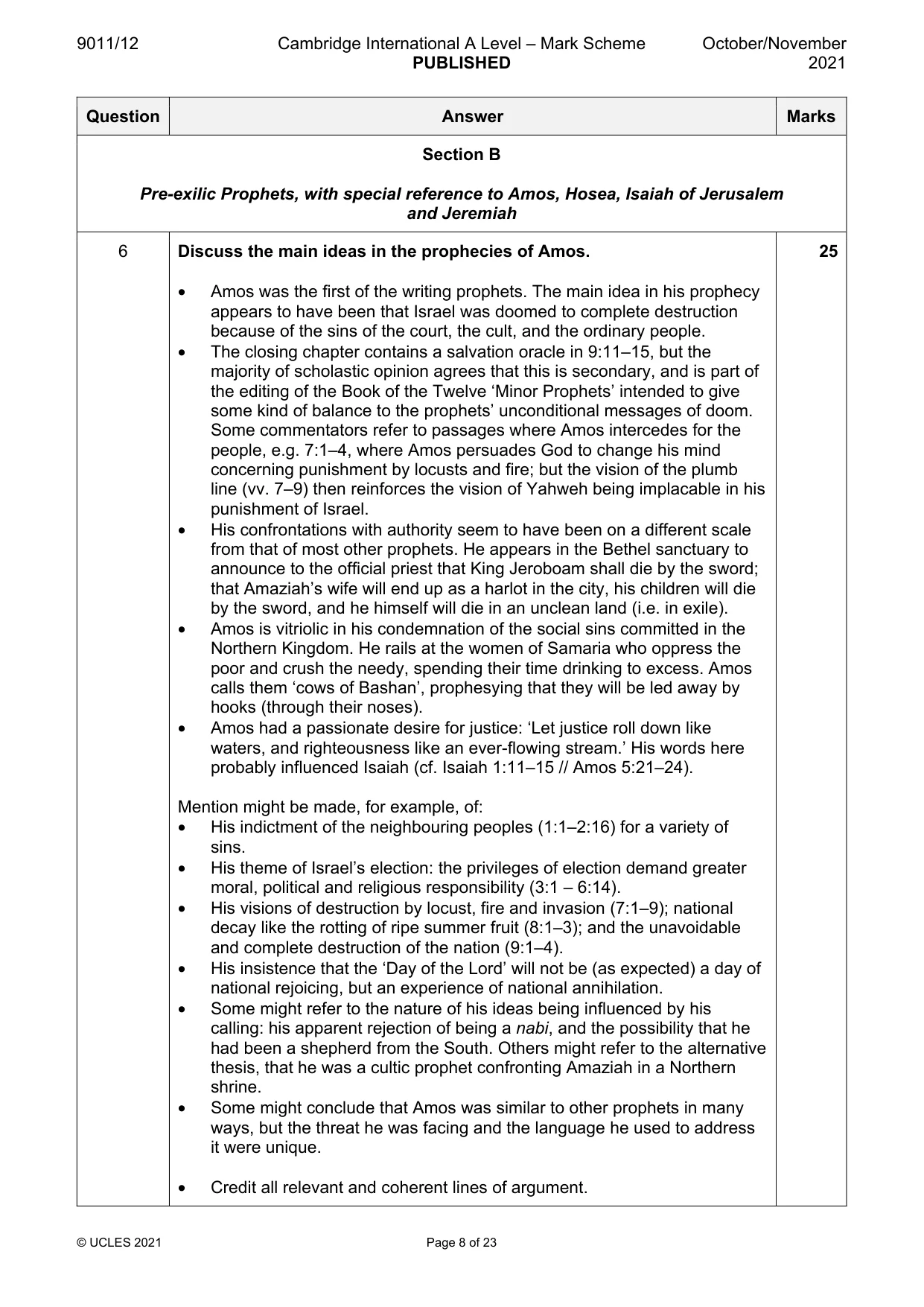
9011/12 Cambridge International A Level – Mark Scheme PUBLISHED October/November 2021 © UCLES 2021 Page 8 of 23 Question Answer Marks Section B Pre-exilic Prophets, with special reference to Amos, Hosea, Isaiah of Jerusalem and Jeremiah 6 Discuss the main ideas in the prophecies of Amos. • Amos was the first of the writing prophets. The main idea in his prophecy appears to have been that Israel was doomed to complete destruction because of the sins of the court, the cult, and the ordinary people. • The closing chapter contains a salvation oracle in 9:11–15, but the majority of scholastic opinion agrees that this is secondary, and is part of the editing of the Book of the Twelve ‘Minor Prophets’ intended to give some kind of balance to the prophets’ unconditional messages of doom. Some commentators refer to passages where Amos intercedes for the people, e.g. 7:1–4, where Amos persuades God to change his mind concerning punishment by locusts and fire; but the vision of the plumb line (vv. 7–9) then reinforces the vision of Yahweh being implacable in his punishment of Israel. • His confrontations with authority seem to have been on a different scale from that of most other prophets. He appears in the Bethel sanctuary to announce to the official priest that King Jeroboam shall die by the sword; that Amaziah’s wife will end up as a harlot in the city, his children will die by the sword, and he himself will die in an unclean land (i.e. in exile). • Amos is vitriolic in his condemnation of the social sins committed in the Northern Kingdom. He rails at the women of Samaria who oppress the poor and crush the needy, spending their time drinking to excess. Amos calls them ‘cows of Bashan’, prophesying that they will be led away by hooks (through their noses). • Amos had a passionate desire for justice: ‘Let justice roll down like waters, and righteousness like an ever-flowing stream.’ His words here probably influenced Isaiah (cf. Isaiah 1:11–15 // Amos 5:21–24). Mention might be made, for example, of: • His indictment of the neighbouring peoples (1:1–2:16) for a variety of sins. • His theme of Israel’s election: the privileges of election demand greater moral, political and religious responsibility (3:1 – 6:14). • His visions of destruction by locust, fire and invasion (7:1–9); national decay like the rotting of ripe summer fruit (8:1–3); and the unavoidable and complete destruction of the nation (9:1–4). • His insistence that the ‘Day of the Lord’ will not be (as expected) a day of national rejoicing, but an experience of national annihilation. • Some might refer to the nature of his ideas being influenced by his calling: his apparent rejection of being a nabi, and the possibility that he had been a shepherd from the South. Others might refer to the alternative thesis, that he was a cultic prophet confronting Amaziah in a Northern shrine. • Some might conclude that Amos was similar to other prophets in many ways, but the threat he was facing and the language he used to address it were unique. • Credit all relevant and coherent lines of argument. 25
Mark scheme, page 9
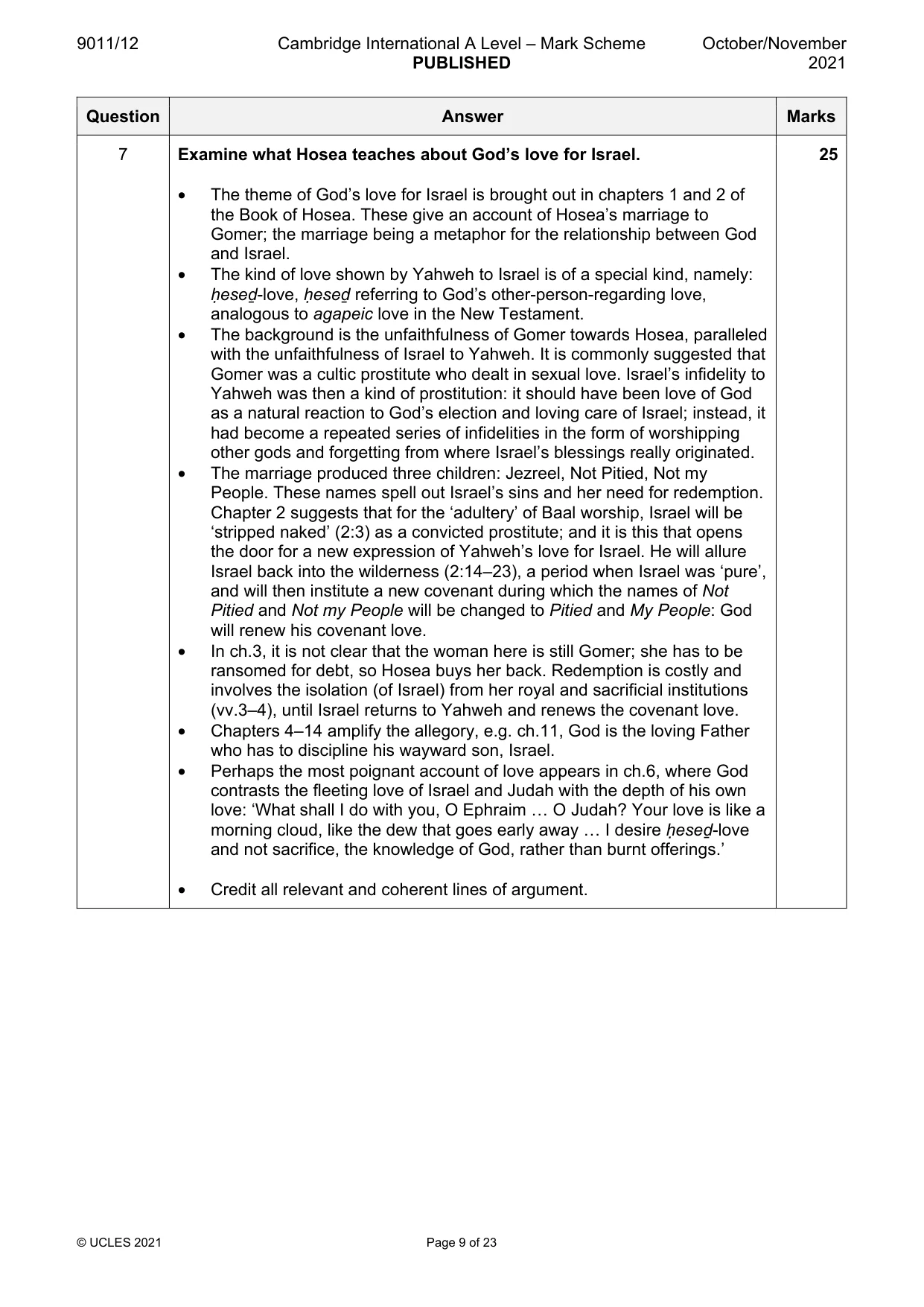
9011/12 Cambridge International A Level – Mark Scheme PUBLISHED October/November 2021 © UCLES 2021 Page 9 of 23 Question Answer Marks 7 Examine what Hosea teaches about God’s love for Israel. • The theme of God’s love for Israel is brought out in chapters 1 and 2 of the Book of Hosea. These give an account of Hosea’s marriage to Gomer; the marriage being a metaphor for the relationship between God and Israel. • The kind of love shown by Yahweh to Israel is of a special kind, namely: ḥeseḏ-love, ḥeseḏ referring to God’s other-person-regarding love, analogous to agapeic love in the New Testament. • The background is the unfaithfulness of Gomer towards Hosea, paralleled with the unfaithfulness of Israel to Yahweh. It is commonly suggested that Gomer was a cultic prostitute who dealt in sexual love. Israel’s infidelity to Yahweh was then a kind of prostitution: it should have been love of God as a natural reaction to God’s election and loving care of Israel; instead, it had become a repeated series of infidelities in the form of worshipping other gods and forgetting from where Israel’s blessings really originated. • The marriage produced three children: Jezreel, Not Pitied, Not my People. These names spell out Israel’s sins and her need for redemption. Chapter 2 suggests that for the ‘adultery’ of Baal worship, Israel will be ‘stripped naked’ (2:3) as a convicted prostitute; and it is this that opens the door for a new expression of Yahweh’s love for Israel. He will allure Israel back into the wilderness (2:14–23), a period when Israel was ‘pure’, and will then institute a new covenant during which the names of Not Pitied and Not my People will be changed to Pitied and My People: God will renew his covenant love. • In ch.3, it is not clear that the woman here is still Gomer; she has to be ransomed for debt, so Hosea buys her back. Redemption is costly and involves the isolation (of Israel) from her royal and sacrificial institutions (vv.3–4), until Israel returns to Yahweh and renews the covenant love. • Chapters 4–14 amplify the allegory, e.g. ch.11, God is the loving Father who has to discipline his wayward son, Israel. • Perhaps the most poignant account of love appears in ch.6, where God contrasts the fleeting love of Israel and Judah with the depth of his own love: ‘What shall I do with you, O Ephraim … O Judah? Your love is like a morning cloud, like the dew that goes early away … I desire ḥeseḏ-love and not sacrifice, the knowledge of God, rather than burnt offerings.’ • Credit all relevant and coherent lines of argument. 25
Mark scheme, page 10
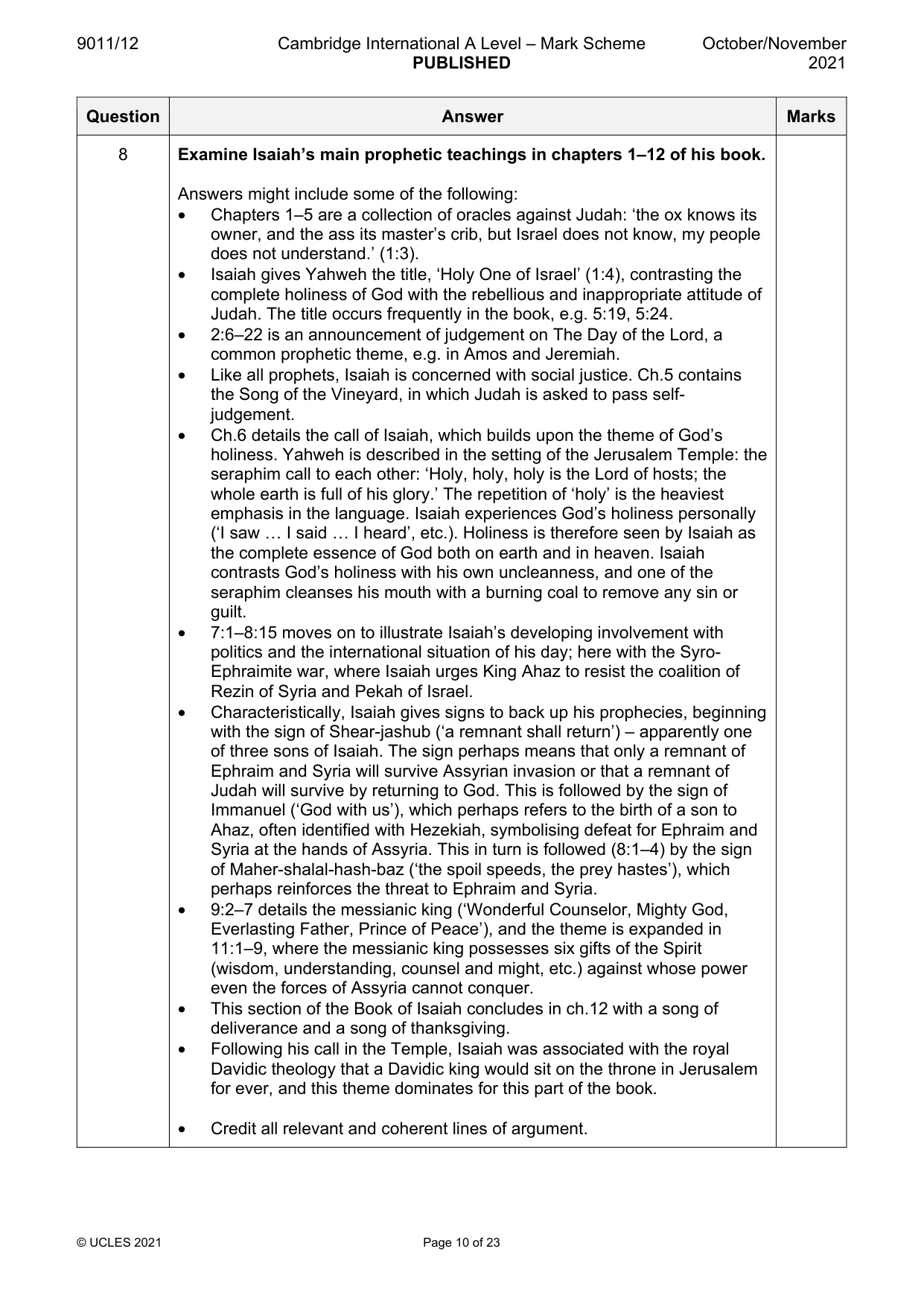
9011/12 Cambridge International A Level – Mark Scheme PUBLISHED October/November 2021 © UCLES 2021 Page 10 of 23 Question Answer Marks 8 Examine Isaiah’s main prophetic teachings in chapters 1–12 of his book. Answers might include some of the following: • Chapters 1–5 are a collection of oracles against Judah: ‘the ox knows its owner, and the ass its master’s crib, but Israel does not know, my people does not understand.’ (1:3). • Isaiah gives Yahweh the title, ‘Holy One of Israel’ (1:4), contrasting the complete holiness of God with the rebellious and inappropriate attitude of Judah. The title occurs frequently in the book, e.g. 5:19, 5:24. • 2:6–22 is an announcement of judgement on The Day of the Lord, a common prophetic theme, e.g. in Amos and Jeremiah. • Like all prophets, Isaiah is concerned with social justice. Ch.5 contains the Song of the Vineyard, in which Judah is asked to pass self- judgement. • Ch.6 details the call of Isaiah, which builds upon the theme of God’s holiness. Yahweh is described in the setting of the Jerusalem Temple: the seraphim call to each other: ‘Holy, holy, holy is the Lord of hosts; the whole earth is full of his glory.’ The repetition of ‘holy’ is the heaviest emphasis in the language. Isaiah experiences God’s holiness personally (‘I saw … I said … I heard’, etc.). Holiness is therefore seen by Isaiah as the complete essence of God both on earth and in heaven. Isaiah contrasts God’s holiness with his own uncleanness, and one of the seraphim cleanses his mouth with a burning coal to remove any sin or guilt. • 7:1–8:15 moves on to illustrate Isaiah’s developing involvement with politics and the international situation of his day; here with the Syro- Ephraimite war, where Isaiah urges King Ahaz to resist the coalition of Rezin of Syria and Pekah of Israel. • Characteristically, Isaiah gives signs to back up his prophecies, beginning with the sign of Shear-jashub (‘a remnant shall return’) – apparently one of three sons of Isaiah. The sign perhaps means that only a remnant of Ephraim and Syria will survive Assyrian invasion or that a remnant of Judah will survive by returning to God. This is followed by the sign of Immanuel (‘God with us’), which perhaps refers to the birth of a son to Ahaz, often identified with Hezekiah, symbolising defeat for Ephraim and Syria at the hands of Assyria. This in turn is followed (8:1–4) by the sign of Maher-shalal-hash-baz (‘the spoil speeds, the prey hastes’), which perhaps reinforces the threat to Ephraim and Syria. • 9:2–7 details the messianic king (‘Wonderful Counselor, Mighty God, Everlasting Father, Prince of Peace’), and the theme is expanded in 11:1–9, where the messianic king possesses six gifts of the Spirit (wisdom, understanding, counsel and might, etc.) against whose power even the forces of Assyria cannot conquer. • This section of the Book of Isaiah concludes in ch.12 with a song of deliverance and a song of thanksgiving. • Following his call in the Temple, Isaiah was associated with the royal Davidic theology that a Davidic king would sit on the throne in Jerusalem for ever, and this theme dominates for this part of the book. • Credit all relevant and coherent lines of argument.
Mark scheme, page 11
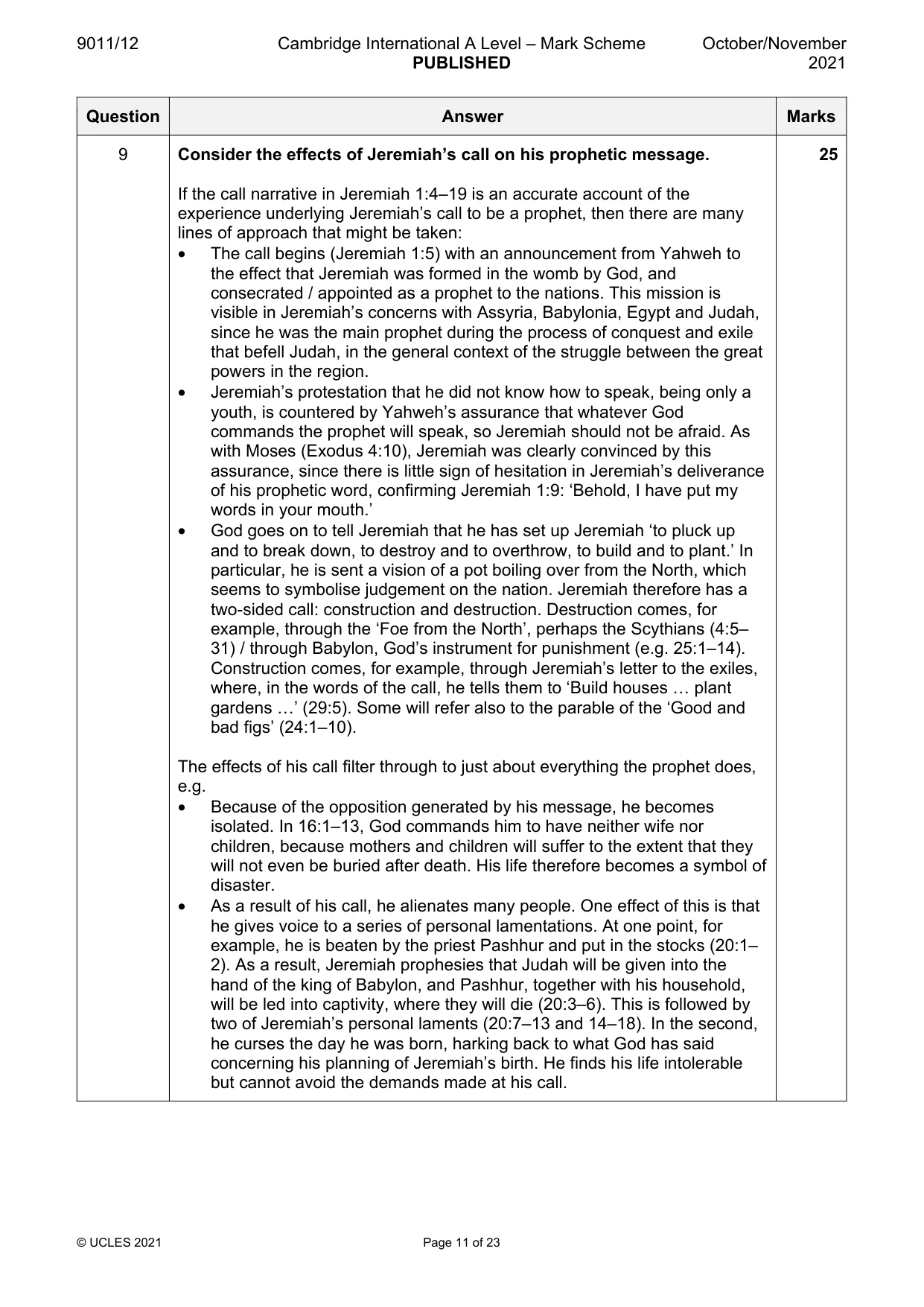
9011/12 Cambridge International A Level – Mark Scheme PUBLISHED October/November 2021 © UCLES 2021 Page 11 of 23 Question Answer Marks 9 Consider the effects of Jeremiah’s call on his prophetic message. If the call narrative in Jeremiah 1:4–19 is an accurate account of the experience underlying Jeremiah’s call to be a prophet, then there are many lines of approach that might be taken: • The call begins (Jeremiah 1:5) with an announcement from Yahweh to the effect that Jeremiah was formed in the womb by God, and consecrated / appointed as a prophet to the nations. This mission is visible in Jeremiah’s concerns with Assyria, Babylonia, Egypt and Judah, since he was the main prophet during the process of conquest and exile that befell Judah, in the general context of the struggle between the great powers in the region. • Jeremiah’s protestation that he did not know how to speak, being only a youth, is countered by Yahweh’s assurance that whatever God commands the prophet will speak, so Jeremiah should not be afraid. As with Moses (Exodus 4:10), Jeremiah was clearly convinced by this assurance, since there is little sign of hesitation in Jeremiah’s deliverance of his prophetic word, confirming Jeremiah 1:9: ‘Behold, I have put my words in your mouth.’ • God goes on to tell Jeremiah that he has set up Jeremiah ‘to pluck up and to break down, to destroy and to overthrow, to build and to plant.’ In particular, he is sent a vision of a pot boiling over from the North, which seems to symbolise judgement on the nation. Jeremiah therefore has a two-sided call: construction and destruction. Destruction comes, for example, through the ‘Foe from the North’, perhaps the Scythians (4:5– 31) / through Babylon, God’s instrument for punishment (e.g. 25:1–14). Construction comes, for example, through Jeremiah’s letter to the exiles, where, in the words of the call, he tells them to ‘Build houses … plant gardens …’ (29:5). Some will refer also to the parable of the ‘Good and bad figs’ (24:1–10). The effects of his call filter through to just about everything the prophet does, e.g. • Because of the opposition generated by his message, he becomes isolated. In 16:1–13, God commands him to have neither wife nor children, because mothers and children will suffer to the extent that they will not even be buried after death. His life therefore becomes a symbol of disaster. • As a result of his call, he alienates many people. One effect of this is that he gives voice to a series of personal lamentations. At one point, for example, he is beaten by the priest Pashhur and put in the stocks (20:1– 2). As a result, Jeremiah prophesies that Judah will be given into the hand of the king of Babylon, and Pashhur, together with his household, will be led into captivity, where they will die (20:3–6). This is followed by two of Jeremiah’s personal laments (20:7–13 and 14–18). In the second, he curses the day he was born, harking back to what God has said concerning his planning of Jeremiah’s birth. He finds his life intolerable but cannot avoid the demands made at his call. 25
Mark scheme, page 12
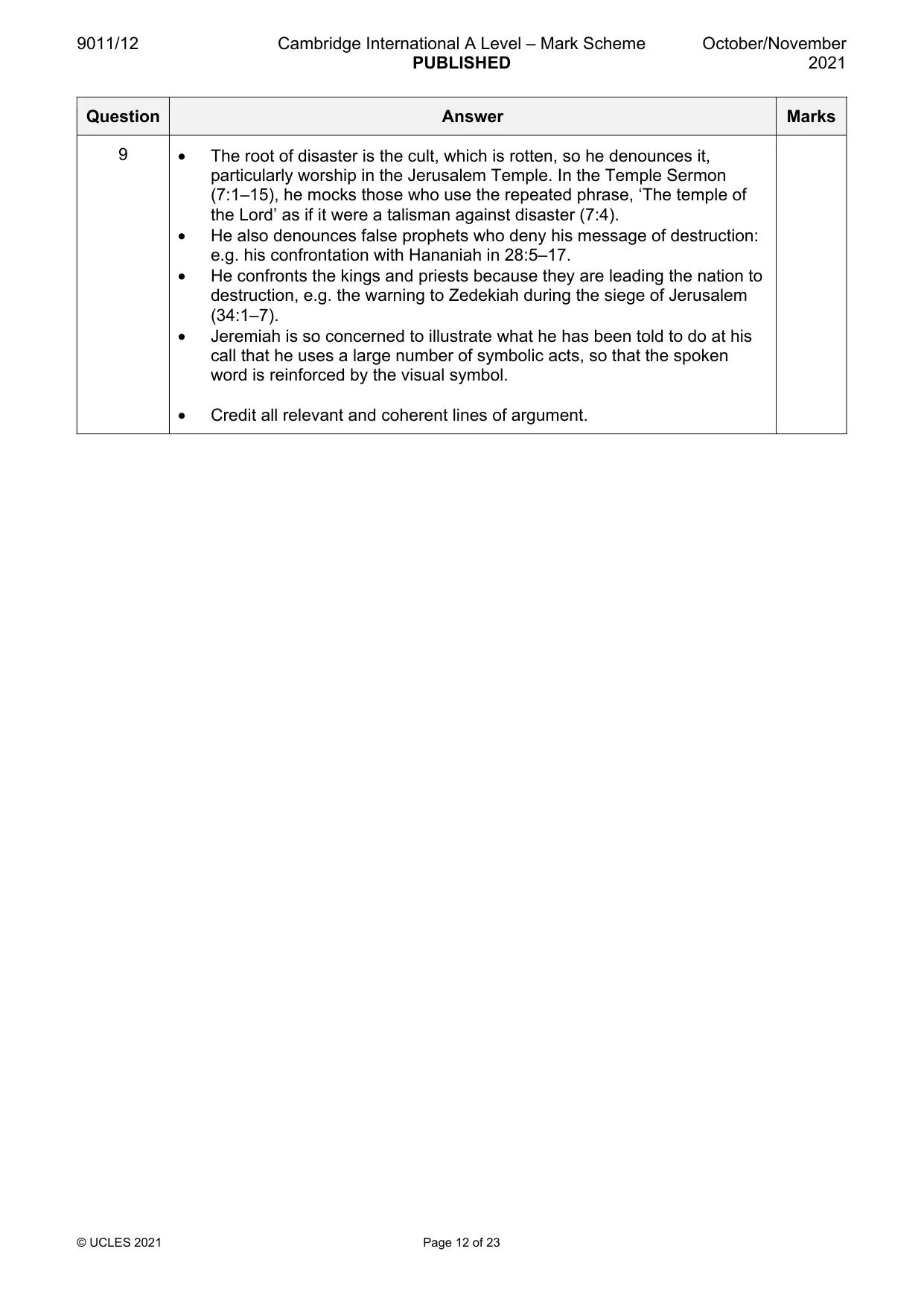
9011/12 Cambridge International A Level – Mark Scheme PUBLISHED October/November 2021 © UCLES 2021 Page 12 of 23 Question Answer Marks 9 • The root of disaster is the cult, which is rotten, so he denounces it, particularly worship in the Jerusalem Temple. In the Temple Sermon (7:1–15), he mocks those who use the repeated phrase, ‘The temple of the Lord’ as if it were a talisman against disaster (7:4). • He also denounces false prophets who deny his message of destruction: e.g. his confrontation with Hananiah in 28:5–17. • He confronts the kings and priests because they are leading the nation to destruction, e.g. the warning to Zedekiah during the siege of Jerusalem (34:1–7). • Jeremiah is so concerned to illustrate what he has been told to do at his call that he uses a large number of symbolic acts, so that the spoken word is reinforced by the visual symbol. • Credit all relevant and coherent lines of argument.
Mark scheme, page 13
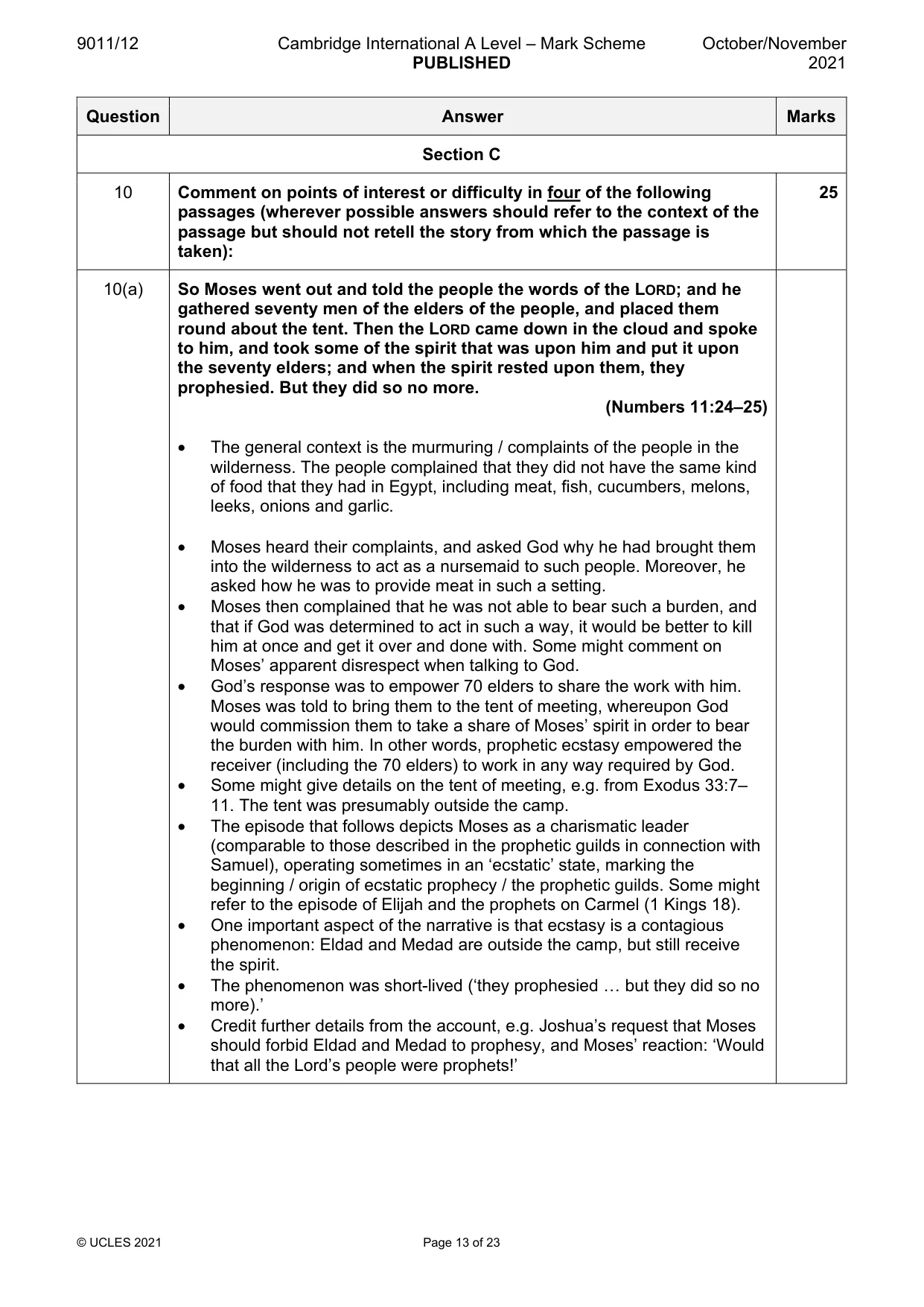
9011/12 Cambridge International A Level – Mark Scheme PUBLISHED October/November 2021 © UCLES 2021 Page 13 of 23 Question Answer Marks Section C 10 Comment on points of interest or difficulty in four of the following passages (wherever possible answers should refer to the context of the passage but should not retell the story from which the passage is taken): 25 10(a) So Moses went out and told the people the words of the LORD; and he gathered seventy men of the elders of the people, and placed them round about the tent. Then the LORD came down in the cloud and spoke to him, and took some of the spirit that was upon him and put it upon the seventy elders; and when the spirit rested upon them, they prophesied. But they did so no more. (Numbers 11:24–25) • The general context is the murmuring / complaints of the people in the wilderness. The people complained that they did not have the same kind of food that they had in Egypt, including meat, fish, cucumbers, melons, leeks, onions and garlic. • Moses heard their complaints, and asked God why he had brought them into the wilderness to act as a nursemaid to such people. Moreover, he asked how he was to provide meat in such a setting. • Moses then complained that he was not able to bear such a burden, and that if God was determined to act in such a way, it would be better to kill him at once and get it over and done with. Some might comment on Moses’ apparent disrespect when talking to God. • God’s response was to empower 70 elders to share the work with him. Moses was told to bring them to the tent of meeting, whereupon God would commission them to take a share of Moses’ spirit in order to bear the burden with him. In other words, prophetic ecstasy empowered the receiver (including the 70 elders) to work in any way required by God. • Some might give details on the tent of meeting, e.g. from Exodus 33:7– 11. The tent was presumably outside the camp. • The episode that follows depicts Moses as a charismatic leader (comparable to those described in the prophetic guilds in connection with Samuel), operating sometimes in an ‘ecstatic’ state, marking the beginning / origin of ecstatic prophecy / the prophetic guilds. Some might refer to the episode of Elijah and the prophets on Carmel (1 Kings 18). • One important aspect of the narrative is that ecstasy is a contagious phenomenon: Eldad and Medad are outside the camp, but still receive the spirit. • The phenomenon was short-lived (‘they prophesied … but they did so no more).’ • Credit further details from the account, e.g. Joshua’s request that Moses should forbid Eldad and Medad to prophesy, and Moses’ reaction: ‘Would that all the Lord’s people were prophets!’
Mark scheme, page 14
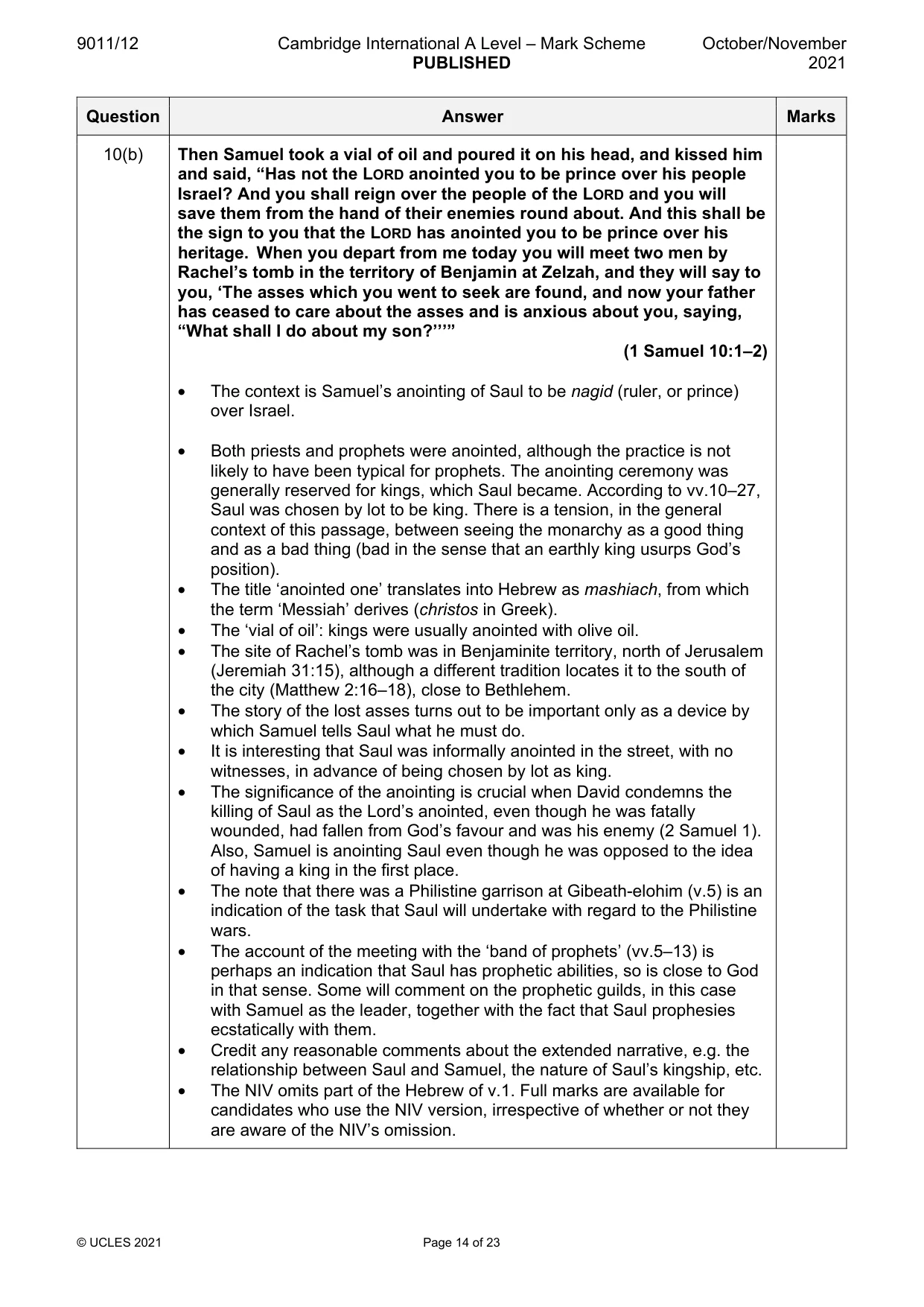
9011/12 Cambridge International A Level – Mark Scheme PUBLISHED October/November 2021 © UCLES 2021 Page 14 of 23 Question Answer Marks 10(b) Then Samuel took a vial of oil and poured it on his head, and kissed him and said, “Has not the LORD anointed you to be prince over his people Israel? And you shall reign over the people of the LORD and you will save them from the hand of their enemies round about. And this shall be the sign to you that the LORD has anointed you to be prince over his heritage. When you depart from me today you will meet two men by Rachel’s tomb in the territory of Benjamin at Zelzah, and they will say to you, ‘The asses which you went to seek are found, and now your father has ceased to care about the asses and is anxious about you, saying, “What shall I do about my son?’’’” (1 Samuel 10:1–2) • The context is Samuel’s anointing of Saul to be nagid (ruler, or prince) over Israel. • Both priests and prophets were anointed, although the practice is not likely to have been typical for prophets. The anointing ceremony was generally reserved for kings, which Saul became. According to vv.10–27, Saul was chosen by lot to be king. There is a tension, in the general context of this passage, between seeing the monarchy as a good thing and as a bad thing (bad in the sense that an earthly king usurps God’s position). • The title ‘anointed one’ translates into Hebrew as mashiach, from which the term ‘Messiah’ derives (christos in Greek). • The ‘vial of oil’: kings were usually anointed with olive oil. • The site of Rachel’s tomb was in Benjaminite territory, north of Jerusalem (Jeremiah 31:15), although a different tradition locates it to the south of the city (Matthew 2:16–18), close to Bethlehem. • The story of the lost asses turns out to be important only as a device by which Samuel tells Saul what he must do. • It is interesting that Saul was informally anointed in the street, with no witnesses, in advance of being chosen by lot as king. • The significance of the anointing is crucial when David condemns the killing of Saul as the Lord’s anointed, even though he was fatally wounded, had fallen from God’s favour and was his enemy (2 Samuel 1). Also, Samuel is anointing Saul even though he was opposed to the idea of having a king in the first place. • The note that there was a Philistine garrison at Gibeath-elohim (v.5) is an indication of the task that Saul will undertake with regard to the Philistine wars. • The account of the meeting with the ‘band of prophets’ (vv.5–13) is perhaps an indication that Saul has prophetic abilities, so is close to God in that sense. Some will comment on the prophetic guilds, in this case with Samuel as the leader, together with the fact that Saul prophesies ecstatically with them. • Credit any reasonable comments about the extended narrative, e.g. the relationship between Saul and Samuel, the nature of Saul’s kingship, etc. • The NIV omits part of the Hebrew of v.1. Full marks are available for candidates who use the NIV version, irrespective of whether or not they are aware of the NIV’s omission.
Mark scheme, page 15
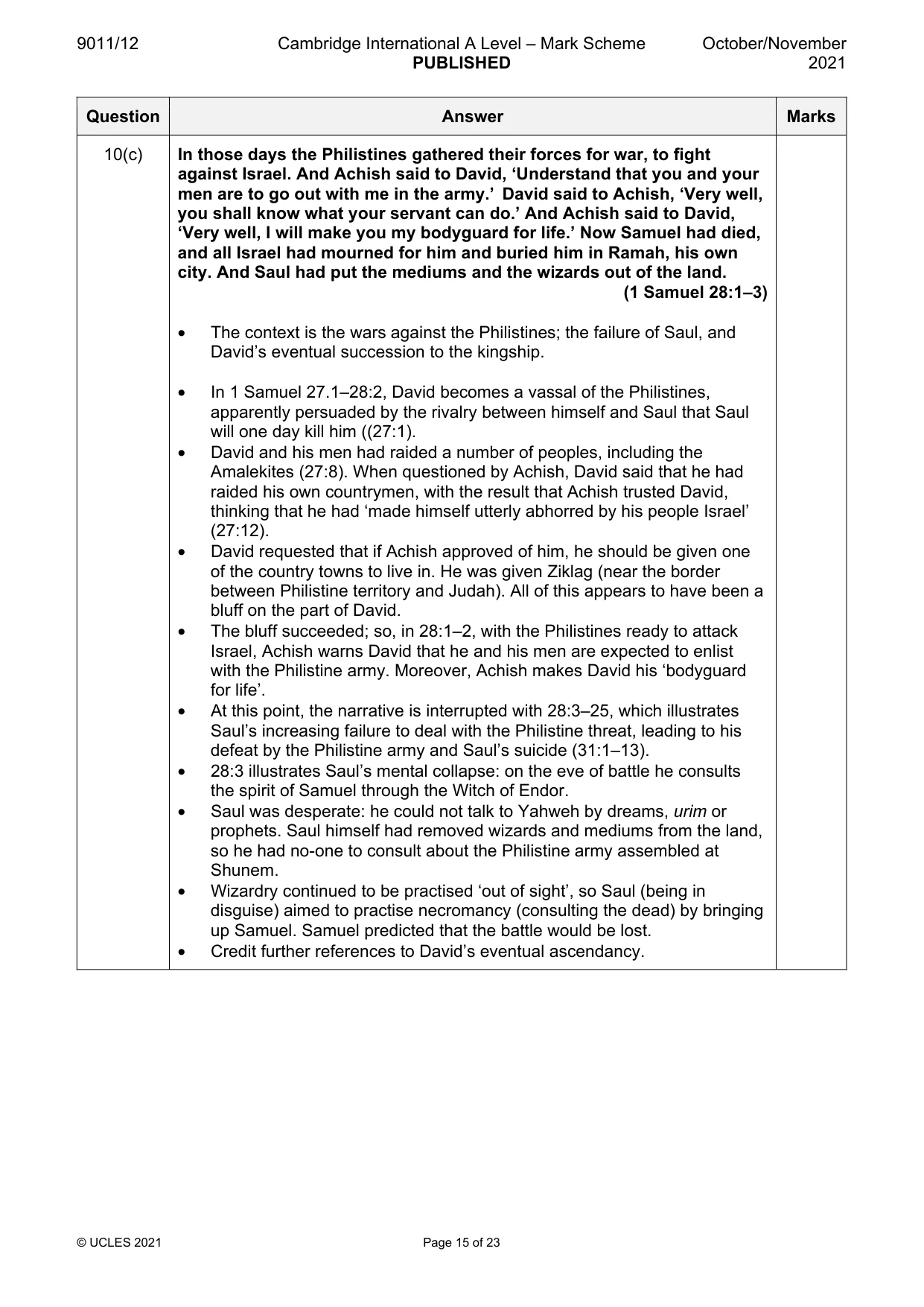
9011/12 Cambridge International A Level – Mark Scheme PUBLISHED October/November 2021 © UCLES 2021 Page 15 of 23 Question Answer Marks 10(c) In those days the Philistines gathered their forces for war, to fight against Israel. And Achish said to David, ‘Understand that you and your men are to go out with me in the army.’ David said to Achish, ‘Very well, you shall know what your servant can do.’ And Achish said to David, ‘Very well, I will make you my bodyguard for life.’ Now Samuel had died, and all Israel had mourned for him and buried him in Ramah, his own city. And Saul had put the mediums and the wizards out of the land. (1 Samuel 28:1–3) • The context is the wars against the Philistines; the failure of Saul, and David’s eventual succession to the kingship. • In 1 Samuel 27.1–28:2, David becomes a vassal of the Philistines, apparently persuaded by the rivalry between himself and Saul that Saul will one day kill him ((27:1). • David and his men had raided a number of peoples, including the Amalekites (27:8). When questioned by Achish, David said that he had raided his own countrymen, with the result that Achish trusted David, thinking that he had ‘made himself utterly abhorred by his people Israel’ (27:12). • David requested that if Achish approved of him, he should be given one of the country towns to live in. He was given Ziklag (near the border between Philistine territory and Judah). All of this appears to have been a bluff on the part of David. • The bluff succeeded; so, in 28:1–2, with the Philistines ready to attack Israel, Achish warns David that he and his men are expected to enlist with the Philistine army. Moreover, Achish makes David his ‘bodyguard for life’. • At this point, the narrative is interrupted with 28:3–25, which illustrates Saul’s increasing failure to deal with the Philistine threat, leading to his defeat by the Philistine army and Saul’s suicide (31:1–13). • 28:3 illustrates Saul’s mental collapse: on the eve of battle he consults the spirit of Samuel through the Witch of Endor. • Saul was desperate: he could not talk to Yahweh by dreams, urim or prophets. Saul himself had removed wizards and mediums from the land, so he had no-one to consult about the Philistine army assembled at Shunem. • Wizardry continued to be practised ‘out of sight’, so Saul (being in disguise) aimed to practise necromancy (consulting the dead) by bringing up Samuel. Samuel predicted that the battle would be lost. • Credit further references to David’s eventual ascendancy.
Mark scheme, page 16
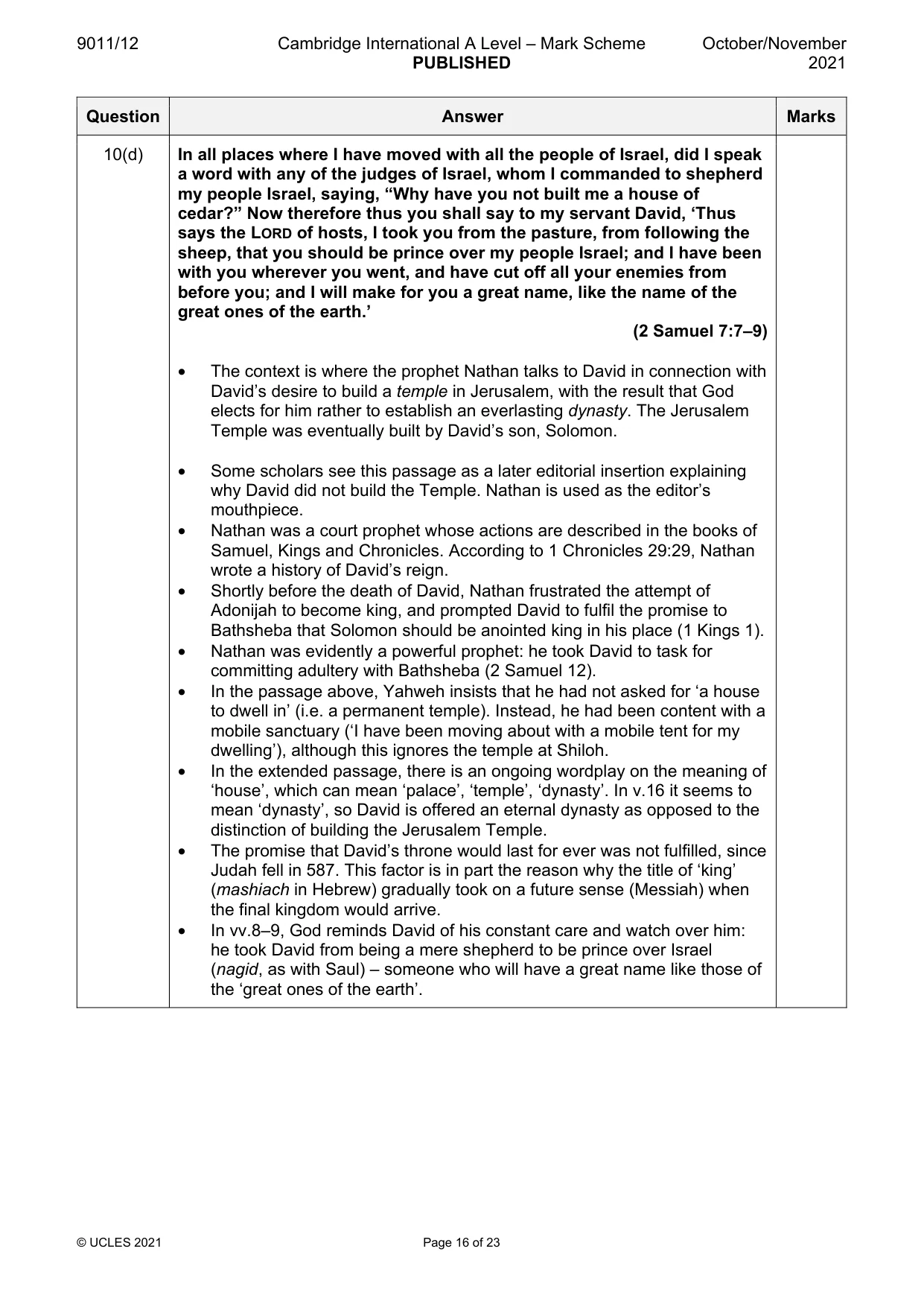
9011/12 Cambridge International A Level – Mark Scheme PUBLISHED October/November 2021 © UCLES 2021 Page 16 of 23 Question Answer Marks 10(d) In all places where I have moved with all the people of Israel, did I speak a word with any of the judges of Israel, whom I commanded to shepherd my people Israel, saying, “Why have you not built me a house of cedar?” Now therefore thus you shall say to my servant David, ‘Thus says the LORD of hosts, I took you from the pasture, from following the sheep, that you should be prince over my people Israel; and I have been with you wherever you went, and have cut off all your enemies from before you; and I will make for you a great name, like the name of the great ones of the earth.’ (2 Samuel 7:7–9) • The context is where the prophet Nathan talks to David in connection with David’s desire to build a temple in Jerusalem, with the result that God elects for him rather to establish an everlasting dynasty. The Jerusalem Temple was eventually built by David’s son, Solomon. • Some scholars see this passage as a later editorial insertion explaining why David did not build the Temple. Nathan is used as the editor’s mouthpiece. • Nathan was a court prophet whose actions are described in the books of Samuel, Kings and Chronicles. According to 1 Chronicles 29:29, Nathan wrote a history of David’s reign. • Shortly before the death of David, Nathan frustrated the attempt of Adonijah to become king, and prompted David to fulfil the promise to Bathsheba that Solomon should be anointed king in his place (1 Kings 1). • Nathan was evidently a powerful prophet: he took David to task for committing adultery with Bathsheba (2 Samuel 12). • In the passage above, Yahweh insists that he had not asked for ‘a house to dwell in’ (i.e. a permanent temple). Instead, he had been content with a mobile sanctuary (‘I have been moving about with a mobile tent for my dwelling’), although this ignores the temple at Shiloh. • In the extended passage, there is an ongoing wordplay on the meaning of ‘house’, which can mean ‘palace’, ‘temple’, ‘dynasty’. In v.16 it seems to mean ‘dynasty’, so David is offered an eternal dynasty as opposed to the distinction of building the Jerusalem Temple. • The promise that David’s throne would last for ever was not fulfilled, since Judah fell in 587. This factor is in part the reason why the title of ‘king’ (mashiach in Hebrew) gradually took on a future sense (Messiah) when the final kingdom would arrive. • In vv.8–9, God reminds David of his constant care and watch over him: he took David from being a mere shepherd to be prince over Israel (nagid, as with Saul) – someone who will have a great name like those of the ‘great ones of the earth’.
Mark scheme, page 17
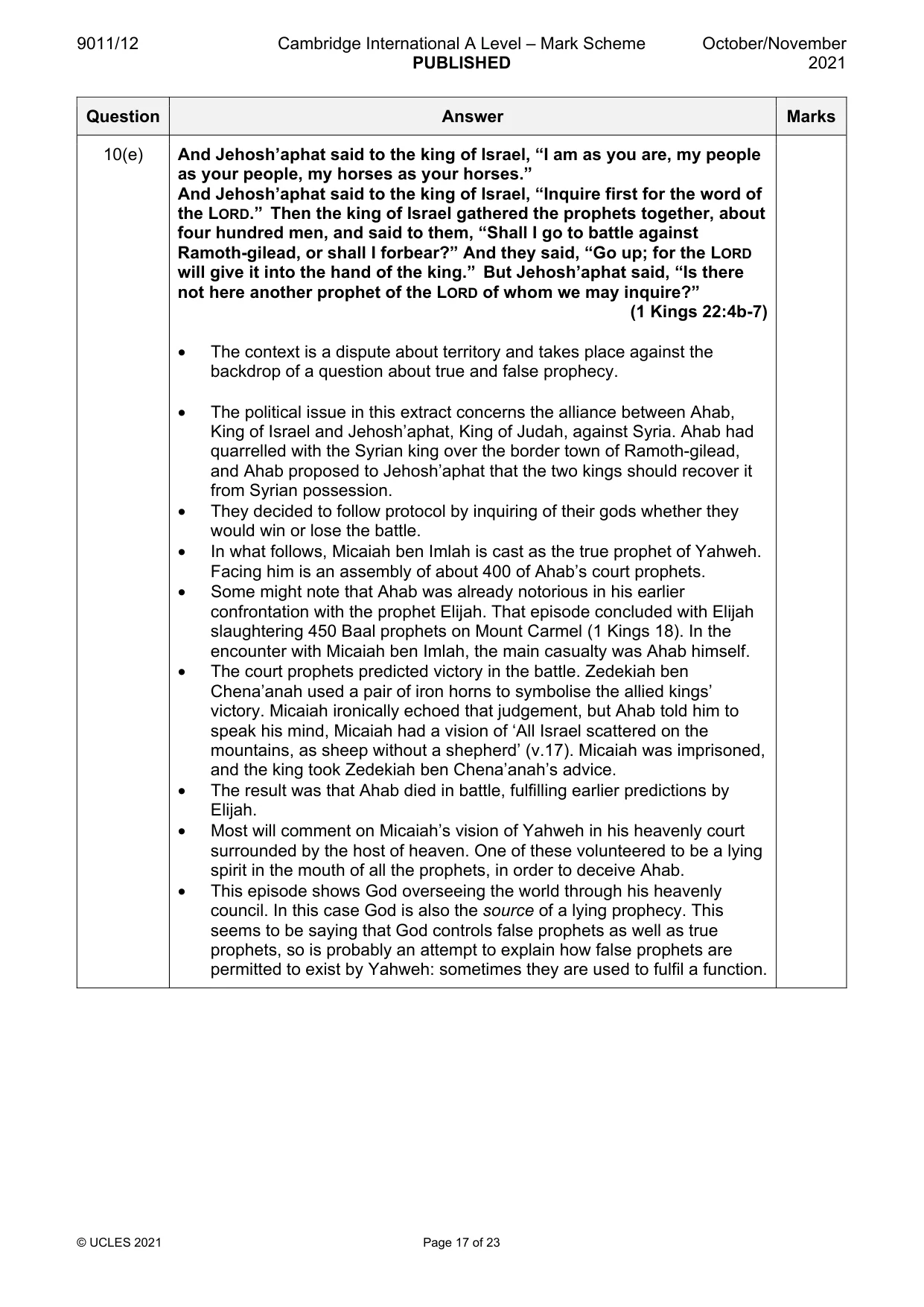
9011/12 Cambridge International A Level – Mark Scheme PUBLISHED October/November 2021 © UCLES 2021 Page 17 of 23 Question Answer Marks 10(e) And Jehosh’aphat said to the king of Israel, “I am as you are, my people as your people, my horses as your horses.” And Jehosh’aphat said to the king of Israel, “Inquire first for the word of the LORD.” Then the king of Israel gathered the prophets together, about four hundred men, and said to them, “Shall I go to battle against Ramoth-gilead, or shall I forbear?” And they said, “Go up; for the LORD will give it into the hand of the king.” But Jehosh’aphat said, “Is there not here another prophet of the LORD of whom we may inquire?” (1 Kings 22:4b-7) • The context is a dispute about territory and takes place against the backdrop of a question about true and false prophecy. • The political issue in this extract concerns the alliance between Ahab, King of Israel and Jehosh’aphat, King of Judah, against Syria. Ahab had quarrelled with the Syrian king over the border town of Ramoth-gilead, and Ahab proposed to Jehosh’aphat that the two kings should recover it from Syrian possession. • They decided to follow protocol by inquiring of their gods whether they would win or lose the battle. • In what follows, Micaiah ben Imlah is cast as the true prophet of Yahweh. Facing him is an assembly of about 400 of Ahab’s court prophets. • Some might note that Ahab was already notorious in his earlier confrontation with the prophet Elijah. That episode concluded with Elijah slaughtering 450 Baal prophets on Mount Carmel (1 Kings 18). In the encounter with Micaiah ben Imlah, the main casualty was Ahab himself. • The court prophets predicted victory in the battle. Zedekiah ben Chena’anah used a pair of iron horns to symbolise the allied kings’ victory. Micaiah ironically echoed that judgement, but Ahab told him to speak his mind, Micaiah had a vision of ‘All Israel scattered on the mountains, as sheep without a shepherd’ (v.17). Micaiah was imprisoned, and the king took Zedekiah ben Chena’anah’s advice. • The result was that Ahab died in battle, fulfilling earlier predictions by Elijah. • Most will comment on Micaiah’s vision of Yahweh in his heavenly court surrounded by the host of heaven. One of these volunteered to be a lying spirit in the mouth of all the prophets, in order to deceive Ahab. • This episode shows God overseeing the world through his heavenly council. In this case God is also the source of a lying prophecy. This seems to be saying that God controls false prophets as well as true prophets, so is probably an attempt to explain how false prophets are permitted to exist by Yahweh: sometimes they are used to fulfil a function.
Mark scheme, page 18
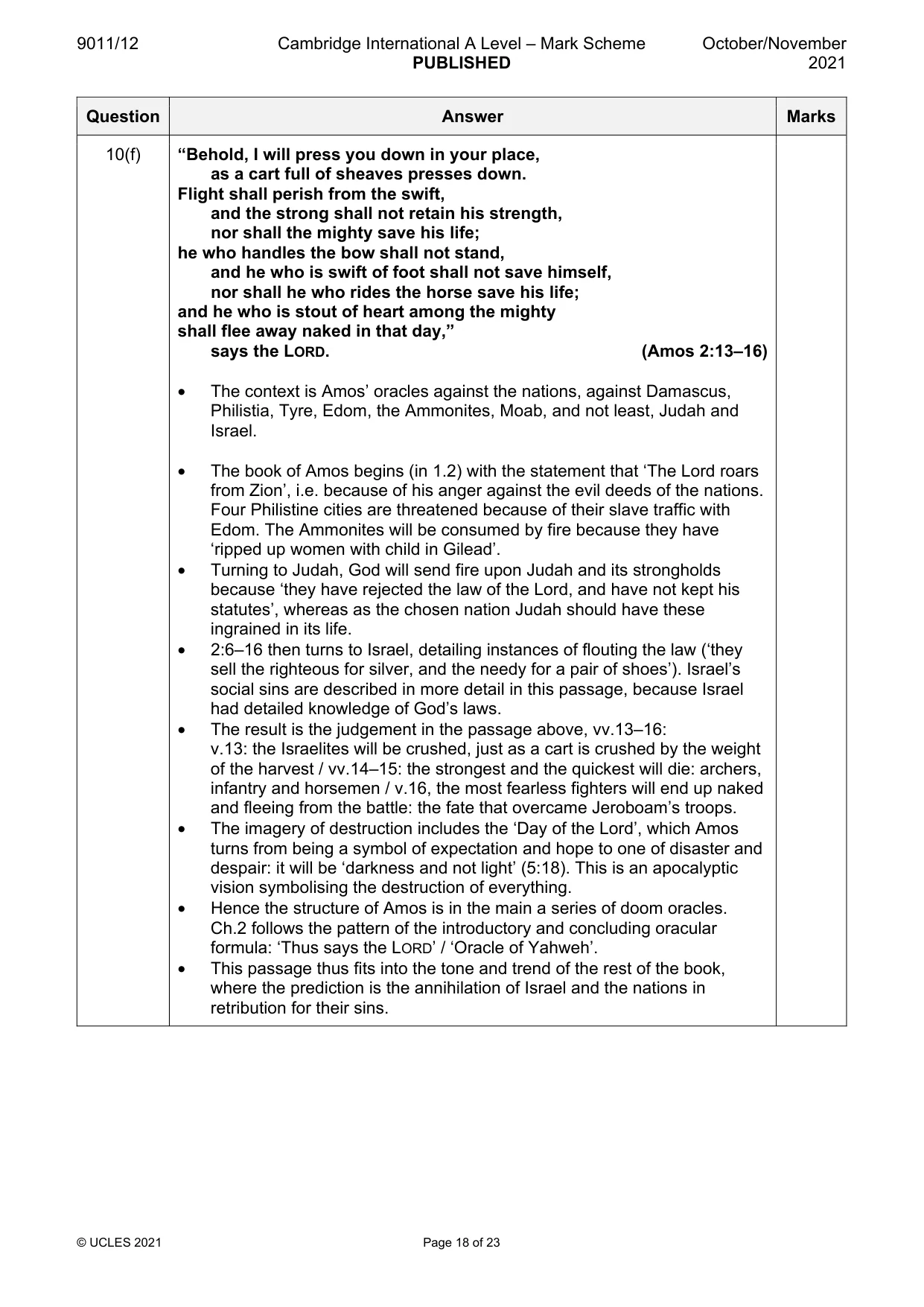
9011/12 Cambridge International A Level – Mark Scheme PUBLISHED October/November 2021 © UCLES 2021 Page 18 of 23 Question Answer Marks 10(f) “Behold, I will press you down in your place, as a cart full of sheaves presses down. Flight shall perish from the swift, and the strong shall not retain his strength, nor shall the mighty save his life; he who handles the bow shall not stand, and he who is swift of foot shall not save himself, nor shall he who rides the horse save his life; and he who is stout of heart among the mighty shall flee away naked in that day,” says the LORD. (Amos 2:13–16) • The context is Amos’ oracles against the nations, against Damascus, Philistia, Tyre, Edom, the Ammonites, Moab, and not least, Judah and Israel. • The book of Amos begins (in 1.2) with the statement that ‘The Lord roars from Zion’, i.e. because of his anger against the evil deeds of the nations. Four Philistine cities are threatened because of their slave traffic with Edom. The Ammonites will be consumed by fire because they have ‘ripped up women with child in Gilead’. • Turning to Judah, God will send fire upon Judah and its strongholds because ‘they have rejected the law of the Lord, and have not kept his statutes’, whereas as the chosen nation Judah should have these ingrained in its life. • 2:6–16 then turns to Israel, detailing instances of flouting the law (‘they sell the righteous for silver, and the needy for a pair of shoes’). Israel’s social sins are described in more detail in this passage, because Israel had detailed knowledge of God’s laws. • The result is the judgement in the passage above, vv.13–16: v.13: the Israelites will be crushed, just as a cart is crushed by the weight of the harvest / vv.14–15: the strongest and the quickest will die: archers, infantry and horsemen / v.16, the most fearless fighters will end up naked and fleeing from the battle: the fate that overcame Jeroboam’s troops. • The imagery of destruction includes the ‘Day of the Lord’, which Amos turns from being a symbol of expectation and hope to one of disaster and despair: it will be ‘darkness and not light’ (5:18). This is an apocalyptic vision symbolising the destruction of everything. • Hence the structure of Amos is in the main a series of doom oracles. Ch.2 follows the pattern of the introductory and concluding oracular formula: ‘Thus says the LORD’ / ‘Oracle of Yahweh’. • This passage thus fits into the tone and trend of the rest of the book, where the prediction is the annihilation of Israel and the nations in retribution for their sins.
Mark scheme, page 19
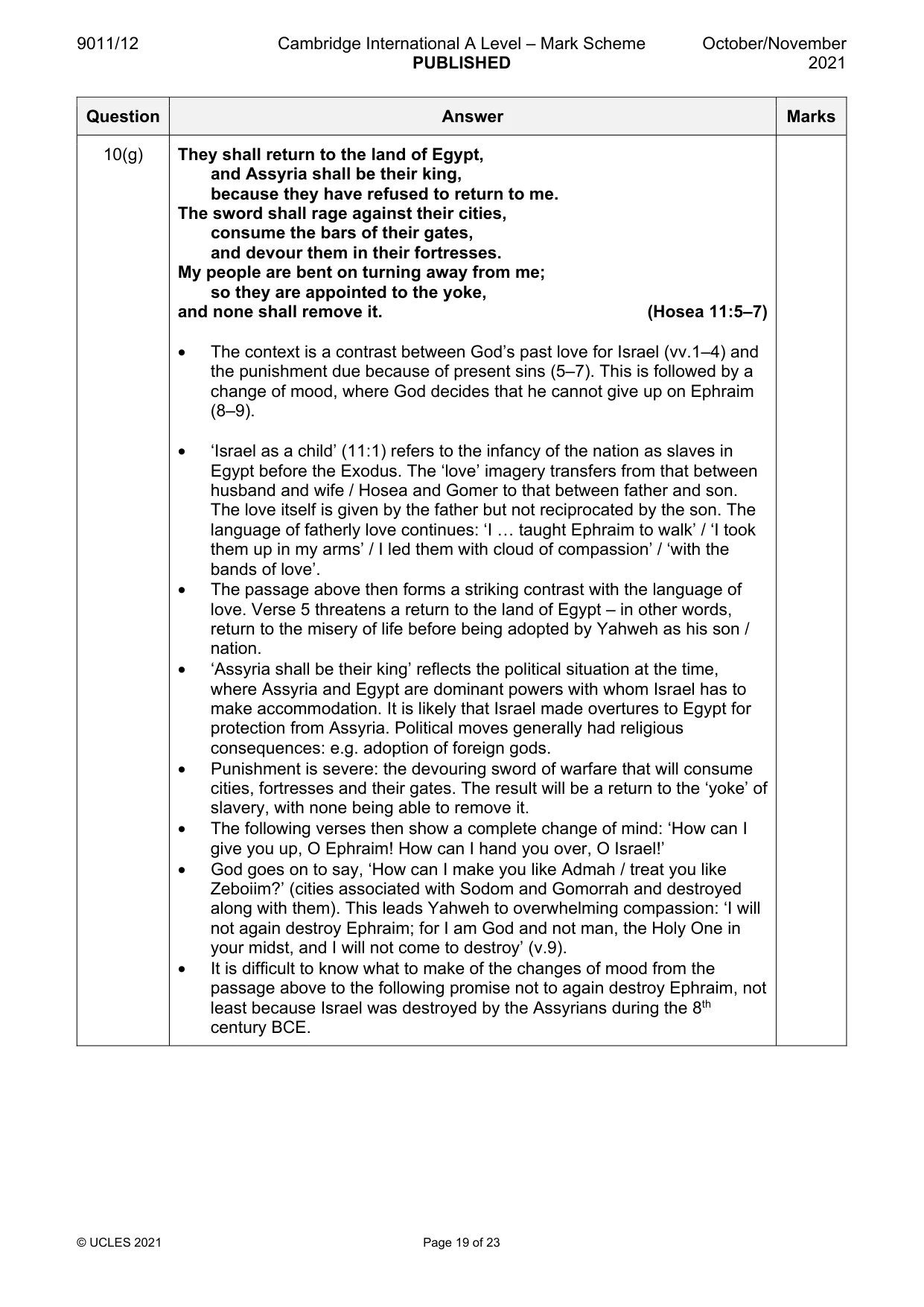
9011/12 Cambridge International A Level – Mark Scheme PUBLISHED October/November 2021 © UCLES 2021 Page 19 of 23 Question Answer Marks 10(g) They shall return to the land of Egypt, and Assyria shall be their king, because they have refused to return to me. The sword shall rage against their cities, consume the bars of their gates, and devour them in their fortresses. My people are bent on turning away from me; so they are appointed to the yoke, and none shall remove it. (Hosea 11:5–7) • The context is a contrast between God’s past love for Israel (vv.1–4) and the punishment due because of present sins (5–7). This is followed by a change of mood, where God decides that he cannot give up on Ephraim (8–9). • ‘Israel as a child’ (11:1) refers to the infancy of the nation as slaves in Egypt before the Exodus. The ‘love’ imagery transfers from that between husband and wife / Hosea and Gomer to that between father and son. The love itself is given by the father but not reciprocated by the son. The language of fatherly love continues: ‘I … taught Ephraim to walk’ / ‘I took them up in my arms’ / I led them with cloud of compassion’ / ‘with the bands of love’. • The passage above then forms a striking contrast with the language of love. Verse 5 threatens a return to the land of Egypt – in other words, return to the misery of life before being adopted by Yahweh as his son / nation. • ‘Assyria shall be their king’ reflects the political situation at the time, where Assyria and Egypt are dominant powers with whom Israel has to make accommodation. It is likely that Israel made overtures to Egypt for protection from Assyria. Political moves generally had religious consequences: e.g. adoption of foreign gods. • Punishment is severe: the devouring sword of warfare that will consume cities, fortresses and their gates. The result will be a return to the ‘yoke’ of slavery, with none being able to remove it. • The following verses then show a complete change of mind: ‘How can I give you up, O Ephraim! How can I hand you over, O Israel!’ • God goes on to say, ‘How can I make you like Admah / treat you like Zeboiim?’ (cities associated with Sodom and Gomorrah and destroyed along with them). This leads Yahweh to overwhelming compassion: ‘I will not again destroy Ephraim; for I am God and not man, the Holy One in your midst, and I will not come to destroy’ (v.9). • It is difficult to know what to make of the changes of mood from the passage above to the following promise not to again destroy Ephraim, not least because Israel was destroyed by the Assyrians during the 8th century BCE.
Mark scheme, page 20
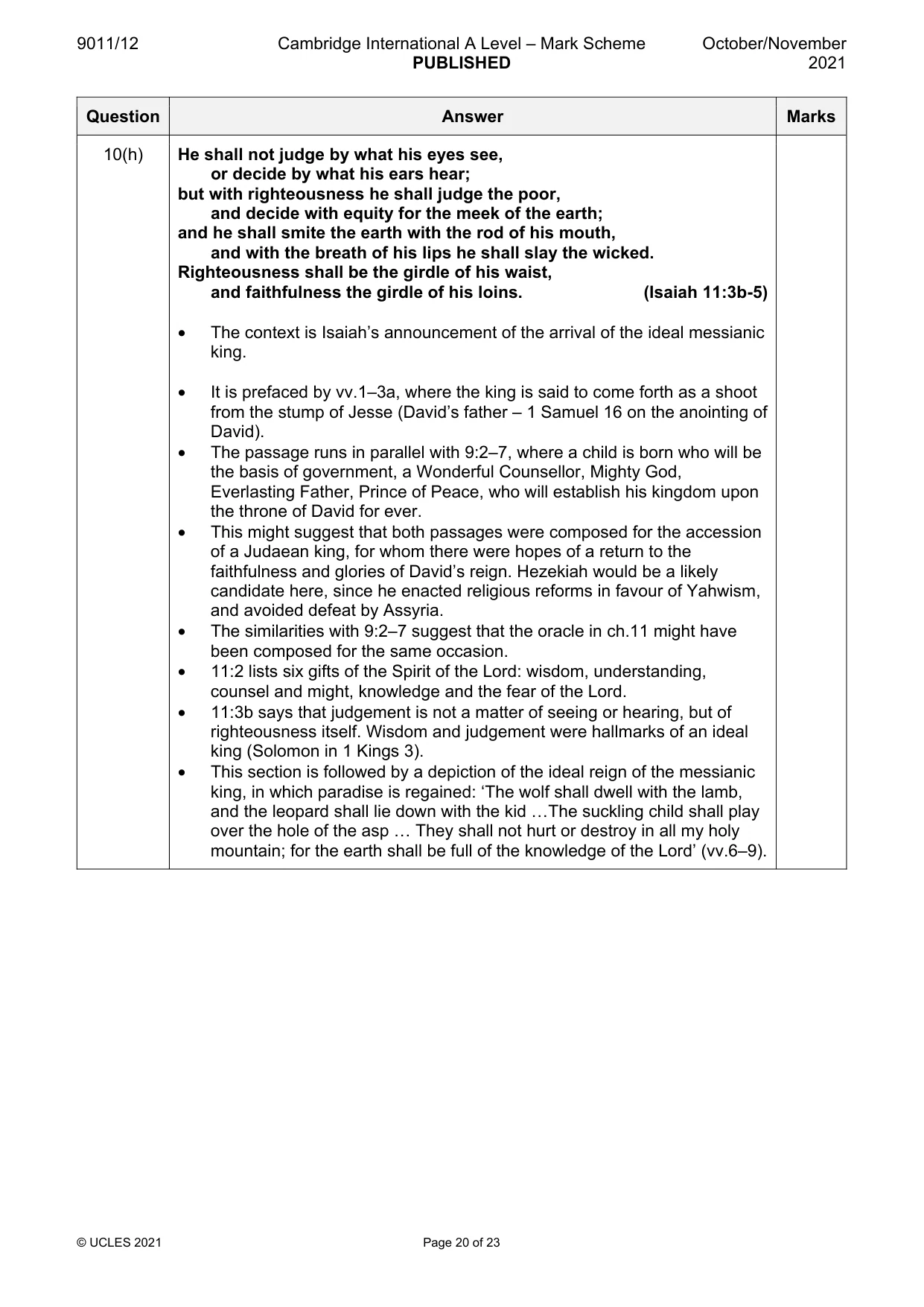
9011/12 Cambridge International A Level – Mark Scheme PUBLISHED October/November 2021 © UCLES 2021 Page 20 of 23 Question Answer Marks 10(h) He shall not judge by what his eyes see, or decide by what his ears hear; but with righteousness he shall judge the poor, and decide with equity for the meek of the earth; and he shall smite the earth with the rod of his mouth, and with the breath of his lips he shall slay the wicked. Righteousness shall be the girdle of his waist, and faithfulness the girdle of his loins. (Isaiah 11:3b-5) • The context is Isaiah’s announcement of the arrival of the ideal messianic king. • It is prefaced by vv.1–3a, where the king is said to come forth as a shoot from the stump of Jesse (David’s father – 1 Samuel 16 on the anointing of David). • The passage runs in parallel with 9:2–7, where a child is born who will be the basis of government, a Wonderful Counsellor, Mighty God, Everlasting Father, Prince of Peace, who will establish his kingdom upon the throne of David for ever. • This might suggest that both passages were composed for the accession of a Judaean king, for whom there were hopes of a return to the faithfulness and glories of David’s reign. Hezekiah would be a likely candidate here, since he enacted religious reforms in favour of Yahwism, and avoided defeat by Assyria. • The similarities with 9:2–7 suggest that the oracle in ch.11 might have been composed for the same occasion. • 11:2 lists six gifts of the Spirit of the Lord: wisdom, understanding, counsel and might, knowledge and the fear of the Lord. • 11:3b says that judgement is not a matter of seeing or hearing, but of righteousness itself. Wisdom and judgement were hallmarks of an ideal king (Solomon in 1 Kings 3). • This section is followed by a depiction of the ideal reign of the messianic king, in which paradise is regained: ‘The wolf shall dwell with the lamb, and the leopard shall lie down with the kid …The suckling child shall play over the hole of the asp … They shall not hurt or destroy in all my holy mountain; for the earth shall be full of the knowledge of the Lord’ (vv.6–9).
Mark scheme, page 21
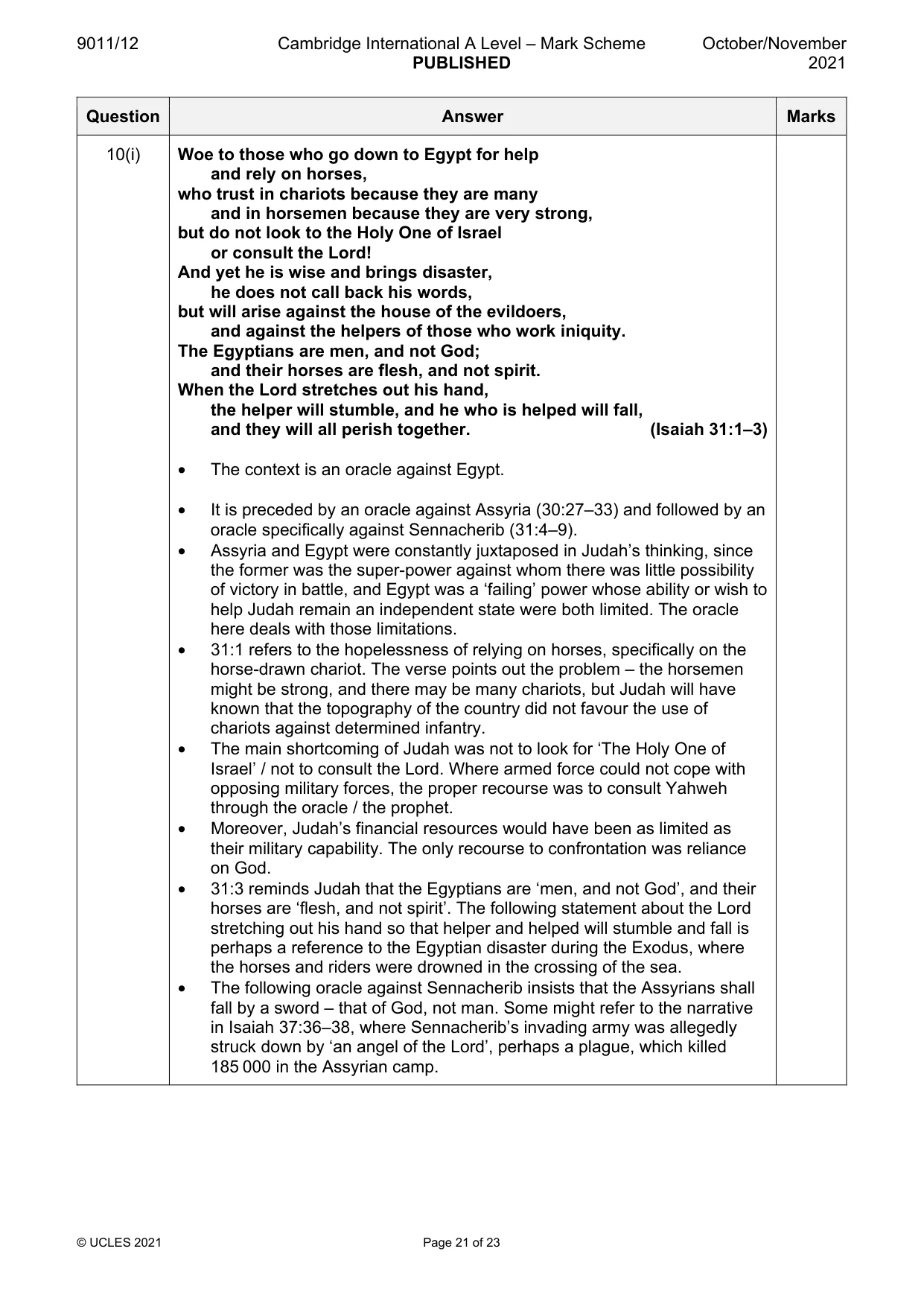
9011/12 Cambridge International A Level – Mark Scheme PUBLISHED October/November 2021 © UCLES 2021 Page 21 of 23 Question Answer Marks 10(i) Woe to those who go down to Egypt for help and rely on horses, who trust in chariots because they are many and in horsemen because they are very strong, but do not look to the Holy One of Israel or consult the Lord! And yet he is wise and brings disaster, he does not call back his words, but will arise against the house of the evildoers, and against the helpers of those who work iniquity. The Egyptians are men, and not God; and their horses are flesh, and not spirit. When the Lord stretches out his hand, the helper will stumble, and he who is helped will fall, and they will all perish together. (Isaiah 31:1–3) • The context is an oracle against Egypt. • It is preceded by an oracle against Assyria (30:27–33) and followed by an oracle specifically against Sennacherib (31:4–9). • Assyria and Egypt were constantly juxtaposed in Judah’s thinking, since the former was the super-power against whom there was little possibility of victory in battle, and Egypt was a ‘failing’ power whose ability or wish to help Judah remain an independent state were both limited. The oracle here deals with those limitations. • 31:1 refers to the hopelessness of relying on horses, specifically on the horse-drawn chariot. The verse points out the problem – the horsemen might be strong, and there may be many chariots, but Judah will have known that the topography of the country did not favour the use of chariots against determined infantry. • The main shortcoming of Judah was not to look for ‘The Holy One of Israel’ / not to consult the Lord. Where armed force could not cope with opposing military forces, the proper recourse was to consult Yahweh through the oracle / the prophet. • Moreover, Judah’s financial resources would have been as limited as their military capability. The only recourse to confrontation was reliance on God. • 31:3 reminds Judah that the Egyptians are ‘men, and not God’, and their horses are ‘flesh, and not spirit’. The following statement about the Lord stretching out his hand so that helper and helped will stumble and fall is perhaps a reference to the Egyptian disaster during the Exodus, where the horses and riders were drowned in the crossing of the sea. • The following oracle against Sennacherib insists that the Assyrians shall fall by a sword – that of God, not man. Some might refer to the narrative in Isaiah 37:36–38, where Sennacherib’s invading army was allegedly struck down by ‘an angel of the Lord’, perhaps a plague, which killed 185 000 in the Assyrian camp.
Mark scheme, page 22
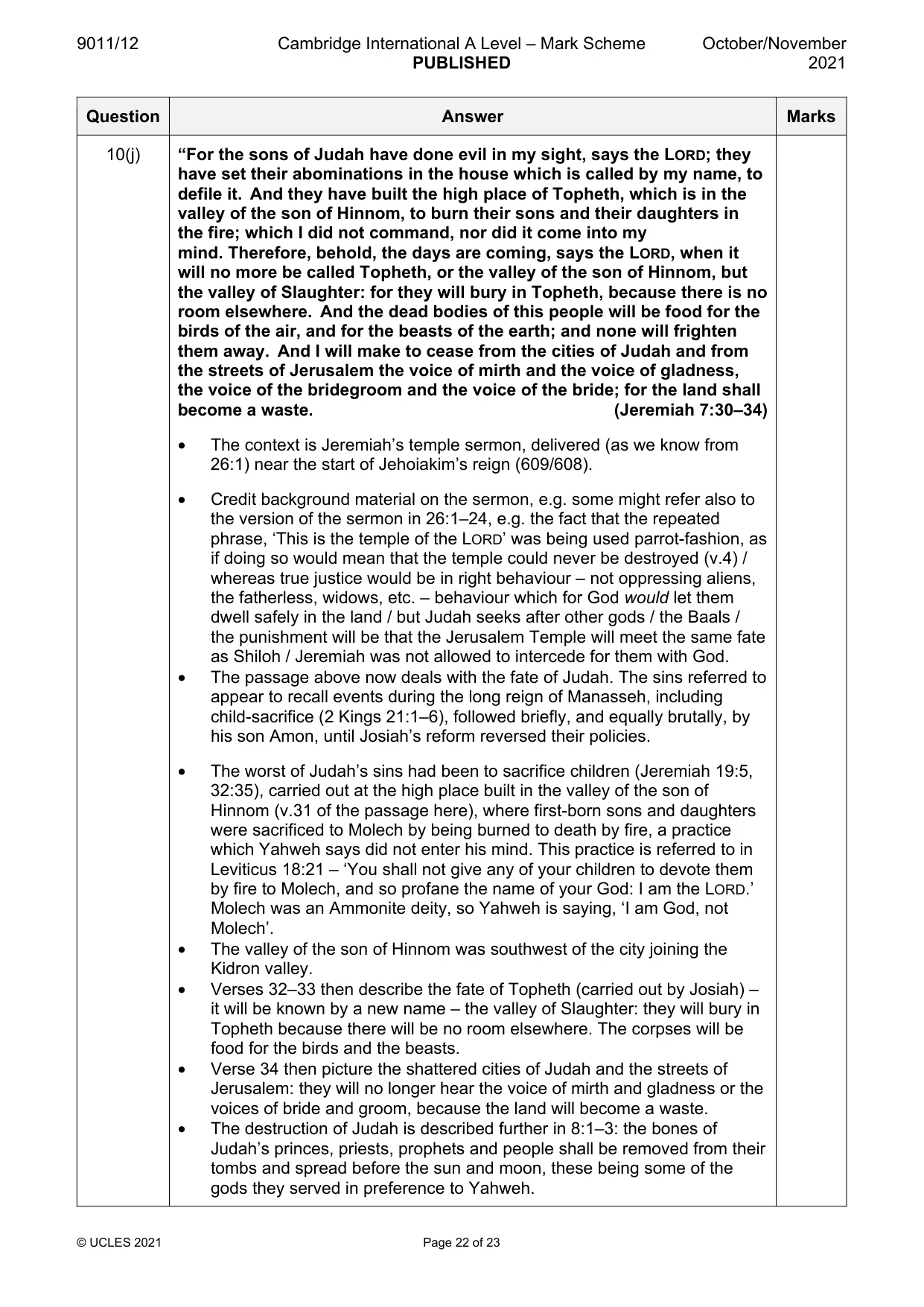
9011/12 Cambridge International A Level – Mark Scheme PUBLISHED October/November 2021 © UCLES 2021 Page 22 of 23 Question Answer Marks 10(j) “For the sons of Judah have done evil in my sight, says the LORD; they have set their abominations in the house which is called by my name, to defile it. And they have built the high place of Topheth, which is in the valley of the son of Hinnom, to burn their sons and their daughters in the fire; which I did not command, nor did it come into my mind. Therefore, behold, the days are coming, says the LORD, when it will no more be called Topheth, or the valley of the son of Hinnom, but the valley of Slaughter: for they will bury in Topheth, because there is no room elsewhere. And the dead bodies of this people will be food for the birds of the air, and for the beasts of the earth; and none will frighten them away. And I will make to cease from the cities of Judah and from the streets of Jerusalem the voice of mirth and the voice of gladness, the voice of the bridegroom and the voice of the bride; for the land shall become a waste. (Jeremiah 7:30–34) • The context is Jeremiah’s temple sermon, delivered (as we know from 26:1) near the start of Jehoiakim’s reign (609/608). • Credit background material on the sermon, e.g. some might refer also to the version of the sermon in 26:1–24, e.g. the fact that the repeated phrase, ‘This is the temple of the LORD’ was being used parrot-fashion, as if doing so would mean that the temple could never be destroyed (v.4) / whereas true justice would be in right behaviour – not oppressing aliens, the fatherless, widows, etc. – behaviour which for God would let them dwell safely in the land / but Judah seeks after other gods / the Baals / the punishment will be that the Jerusalem Temple will meet the same fate as Shiloh / Jeremiah was not allowed to intercede for them with God. • The passage above now deals with the fate of Judah. The sins referred to appear to recall events during the long reign of Manasseh, including child-sacrifice (2 Kings 21:1–6), followed briefly, and equally brutally, by his son Amon, until Josiah’s reform reversed their policies. • The worst of Judah’s sins had been to sacrifice children (Jeremiah 19:5, 32:35), carried out at the high place built in the valley of the son of Hinnom (v.31 of the passage here), where first-born sons and daughters were sacrificed to Molech by being burned to death by fire, a practice which Yahweh says did not enter his mind. This practice is referred to in Leviticus 18:21 – ‘You shall not give any of your children to devote them by fire to Molech, and so profane the name of your God: I am the LORD.’ Molech was an Ammonite deity, so Yahweh is saying, ‘I am God, not Molech’. • The valley of the son of Hinnom was southwest of the city joining the Kidron valley. • Verses 32–33 then describe the fate of Topheth (carried out by Josiah) – it will be known by a new name – the valley of Slaughter: they will bury in Topheth because there will be no room elsewhere. The corpses will be food for the birds and the beasts. • Verse 34 then picture the shattered cities of Judah and the streets of Jerusalem: they will no longer hear the voice of mirth and gladness or the voices of bride and groom, because the land will become a waste. • The destruction of Judah is described further in 8:1–3: the bones of Judah’s princes, priests, prophets and people shall be removed from their tombs and spread before the sun and moon, these being some of the gods they served in preference to Yahweh.
Mark scheme, page 23
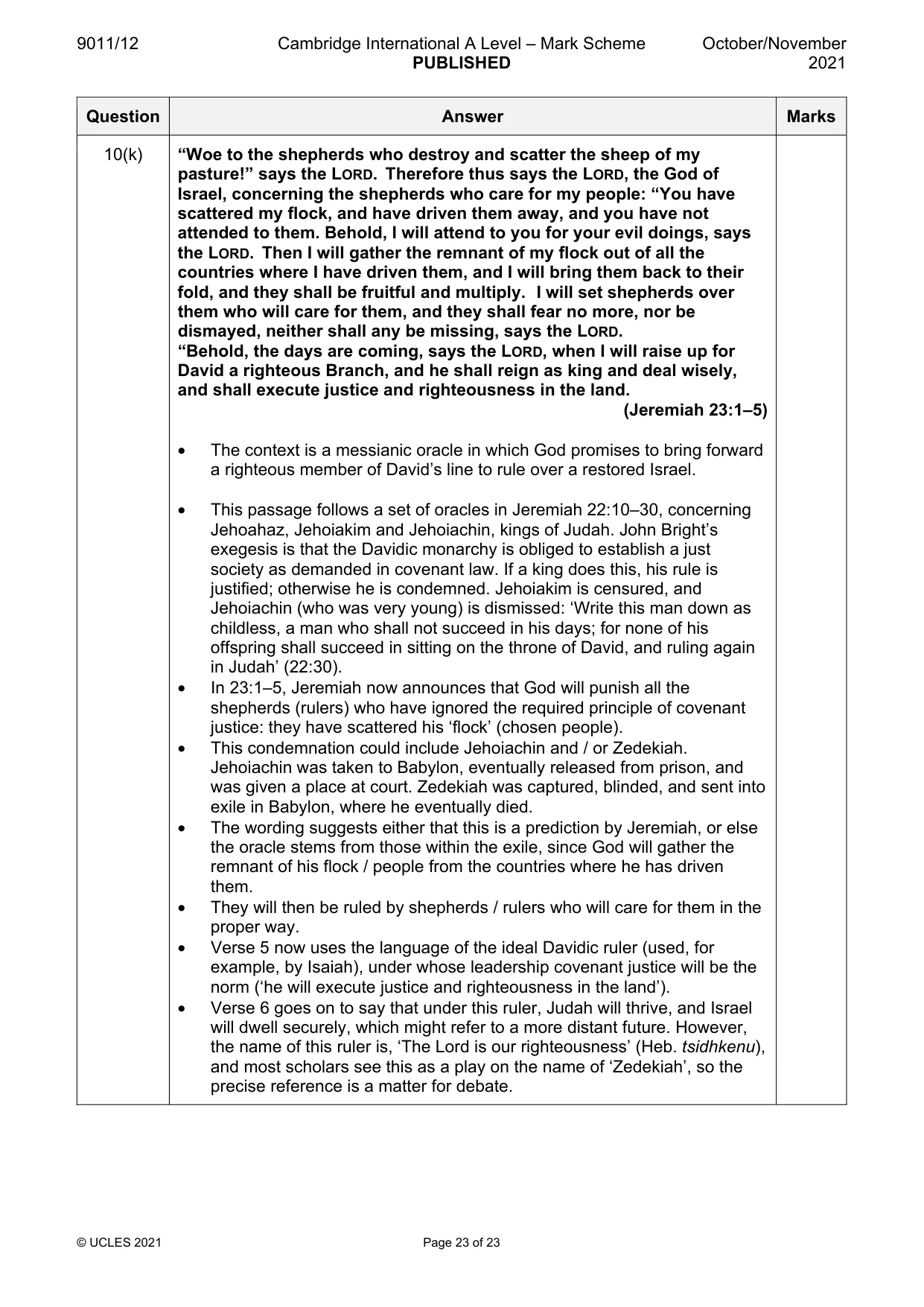
9011/12 Cambridge International A Level – Mark Scheme PUBLISHED October/November 2021 © UCLES 2021 Page 23 of 23 Question Answer Marks 10(k) “Woe to the shepherds who destroy and scatter the sheep of my pasture!” says the LORD. Therefore thus says the LORD, the God of Israel, concerning the shepherds who care for my people: “You have scattered my flock, and have driven them away, and you have not attended to them. Behold, I will attend to you for your evil doings, says the LORD. Then I will gather the remnant of my flock out of all the countries where I have driven them, and I will bring them back to their fold, and they shall be fruitful and multiply. I will set shepherds over them who will care for them, and they shall fear no more, nor be dismayed, neither shall any be missing, says the LORD. “Behold, the days are coming, says the LORD, when I will raise up for David a righteous Branch, and he shall reign as king and deal wisely, and shall execute justice and righteousness in the land. (Jeremiah 23:1–5) • The context is a messianic oracle in which God promises to bring forward a righteous member of David’s line to rule over a restored Israel. • This passage follows a set of oracles in Jeremiah 22:10–30, concerning Jehoahaz, Jehoiakim and Jehoiachin, kings of Judah. John Bright’s exegesis is that the Davidic monarchy is obliged to establish a just society as demanded in covenant law. If a king does this, his rule is justified; otherwise he is condemned. Jehoiakim is censured, and Jehoiachin (who was very young) is dismissed: ‘Write this man down as childless, a man who shall not succeed in his days; for none of his offspring shall succeed in sitting on the throne of David, and ruling again in Judah’ (22:30). • In 23:1–5, Jeremiah now announces that God will punish all the shepherds (rulers) who have ignored the required principle of covenant justice: they have scattered his ‘flock’ (chosen people). • This condemnation could include Jehoiachin and / or Zedekiah. Jehoiachin was taken to Babylon, eventually released from prison, and was given a place at court. Zedekiah was captured, blinded, and sent into exile in Babylon, where he eventually died. • The wording suggests either that this is a prediction by Jeremiah, or else the oracle stems from those within the exile, since God will gather the remnant of his flock / people from the countries where he has driven them. • They will then be ruled by shepherds / rulers who will care for them in the proper way. • Verse 5 now uses the language of the ideal Davidic ruler (used, for example, by Isaiah), under whose leadership covenant justice will be the norm (‘he will execute justice and righteousness in the land’). • Verse 6 goes on to say that under this ruler, Judah will thrive, and Israel will dwell securely, which might refer to a more distant future. However, the name of this ruler is, ‘The Lord is our righteousness’ (Heb. tsidhkenu), and most scholars see this as a play on the name of ‘Zedekiah’, so the precise reference is a matter for debate.
What you needed in this session
Cambridge’s own grade thresholds for 2021 Oct/Nov, Paper 1 · Variant 2. A higher threshold means an easier paper — the bar moves with how the cohort did.