Cambridge A Level Divinity 9011 — 2020 Oct/Nov Paper 1 · Variant 2
9011/12/O/N/20 · 100 marks · ≈113 min
The question paper and its mark scheme, free to read here and free to download. This is Cambridge’s own paper, exactly as it was sat.
Question paper8 pages


Mark scheme23 pages
Answers below. Sit the paper first if you are practising.
Paper as text
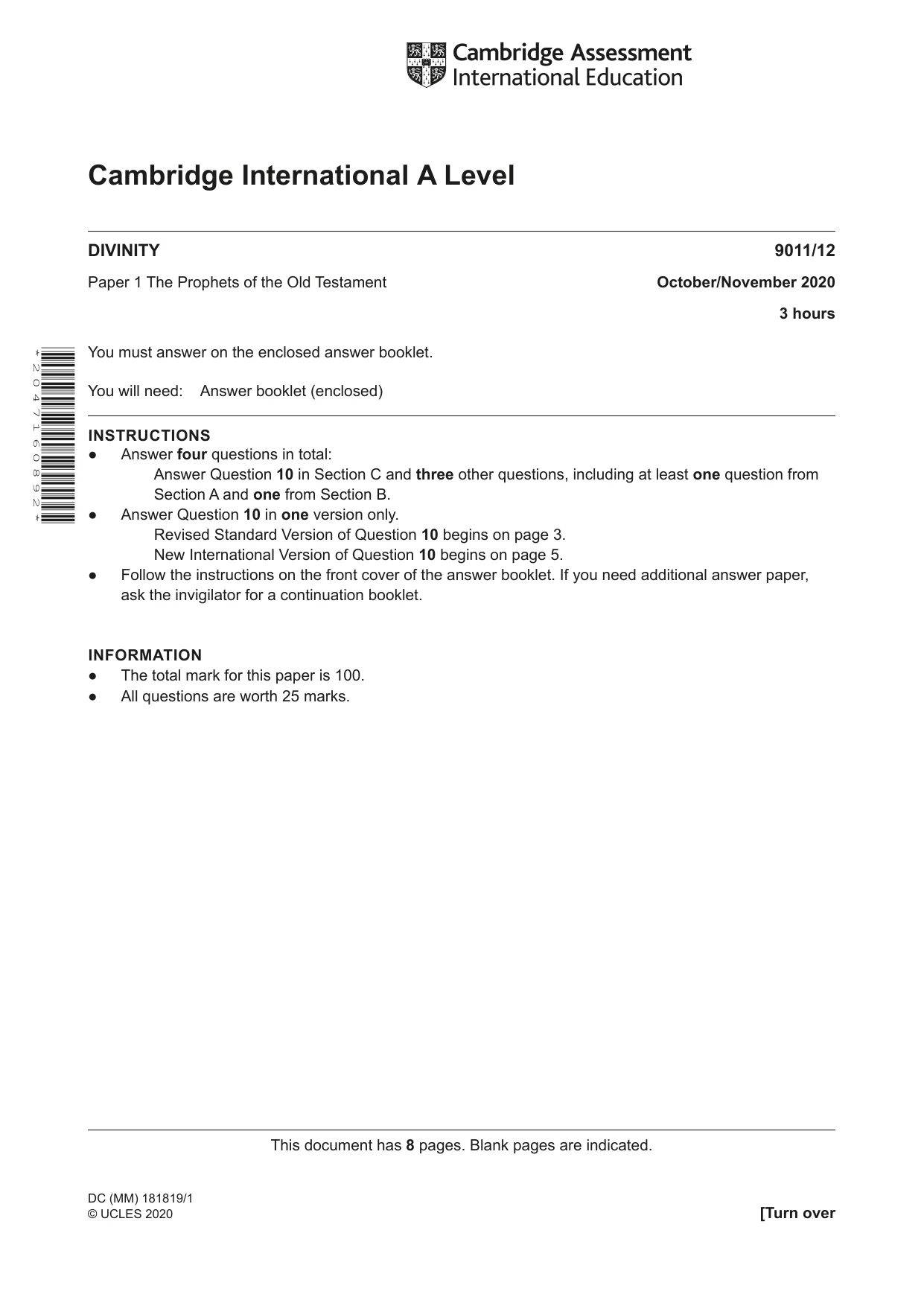
Question paper, page 1
Cambridge International A Level This document has 8 pages. Blank pages are indicated. DC (MM) 181819/1 © UCLES 2020 [Turn over DIVINITY 9011/12 Paper 1 The Prophets of the Old Testament October/November 2020 3 hours You must answer on the enclosed answer booklet. You will need: Answer booklet (enclosed) INSTRUCTIONS ● Answer four questions in total: Answer Question 10 in Section C and three other questions, including at least one question from Section A and one from Section B. ● Answer Question 10 in one version only. Revised Standard Version of Question 10 begins on page 3. New International Version of Question 10 begins on page 5. ● Follow the instructions on the front cover of the answer booklet. If you need additional answer paper, ask the invigilator for a continuation booklet. INFORMATION ● The total mark for this paper is 100. ● All questions are worth 25 marks. * 2 0 4 7 1 6 0 8 9 2 *
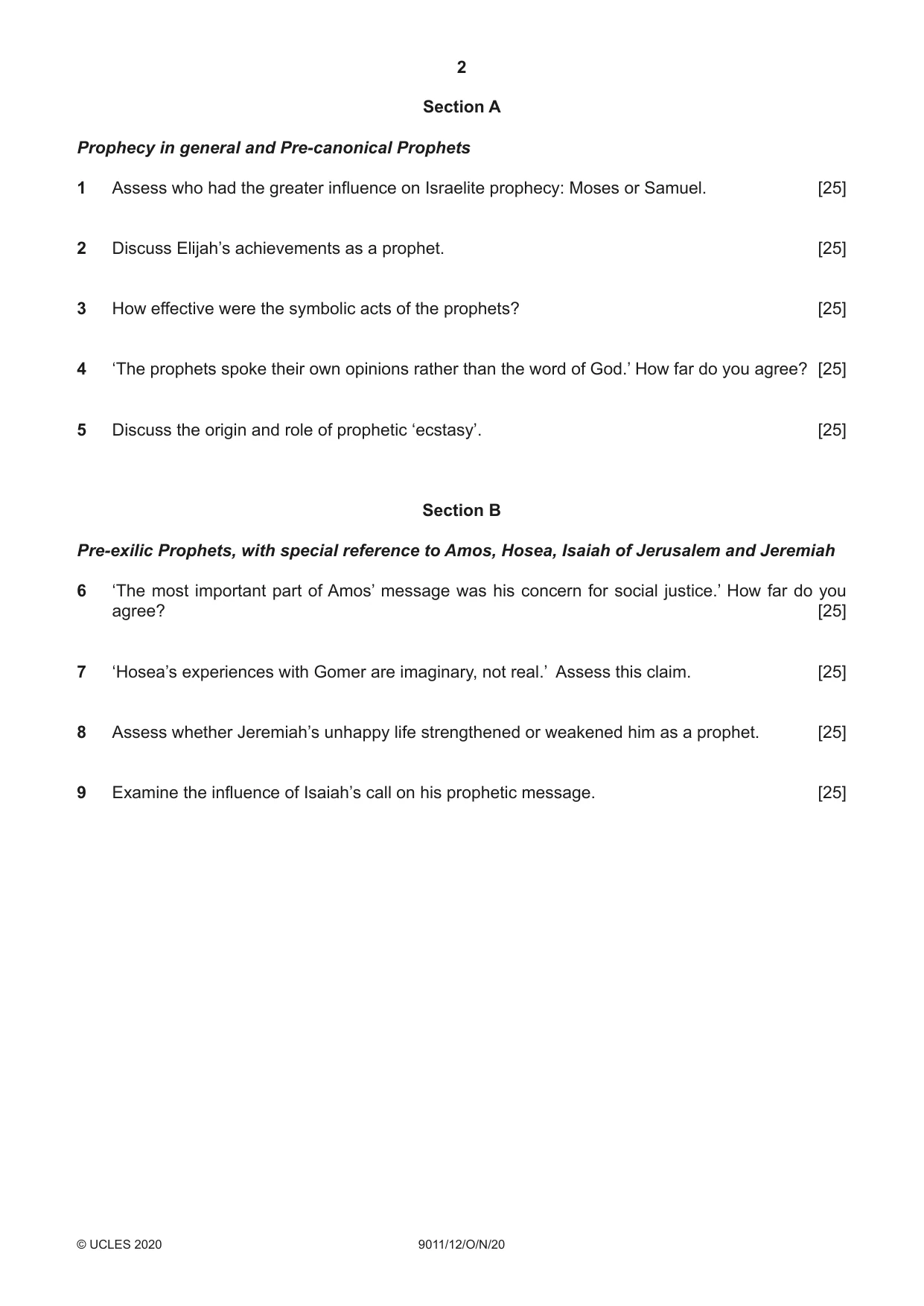
Question paper, page 2
2 9011/12/O/N/20 © UCLES 2020 Section A Prophecy in general and Pre-canonical Prophets 1 Assess who had the greater influence on Israelite prophecy: Moses or Samuel. [25] 2 Discuss Elijah’s achievements as a prophet. [25] 3 How effective were the symbolic acts of the prophets? [25] 4 ‘The prophets spoke their own opinions rather than the word of God.’ How far do you agree? [25] 5 Discuss the origin and role of prophetic ‘ecstasy’. [25] Section B Pre-exilic Prophets, with special reference to Amos, Hosea, Isaiah of Jerusalem and Jeremiah 6 ‘The most important part of Amos’ message was his concern for social justice.’ How far do you agree? [25] 7 ‘Hosea’s experiences with Gomer are imaginary, not real.’ Assess this claim. [25] 8 Assess whether Jeremiah’s unhappy life strengthened or weakened him as a prophet. [25] 9 Examine the influence of Isaiah’s call on his prophetic message. [25]
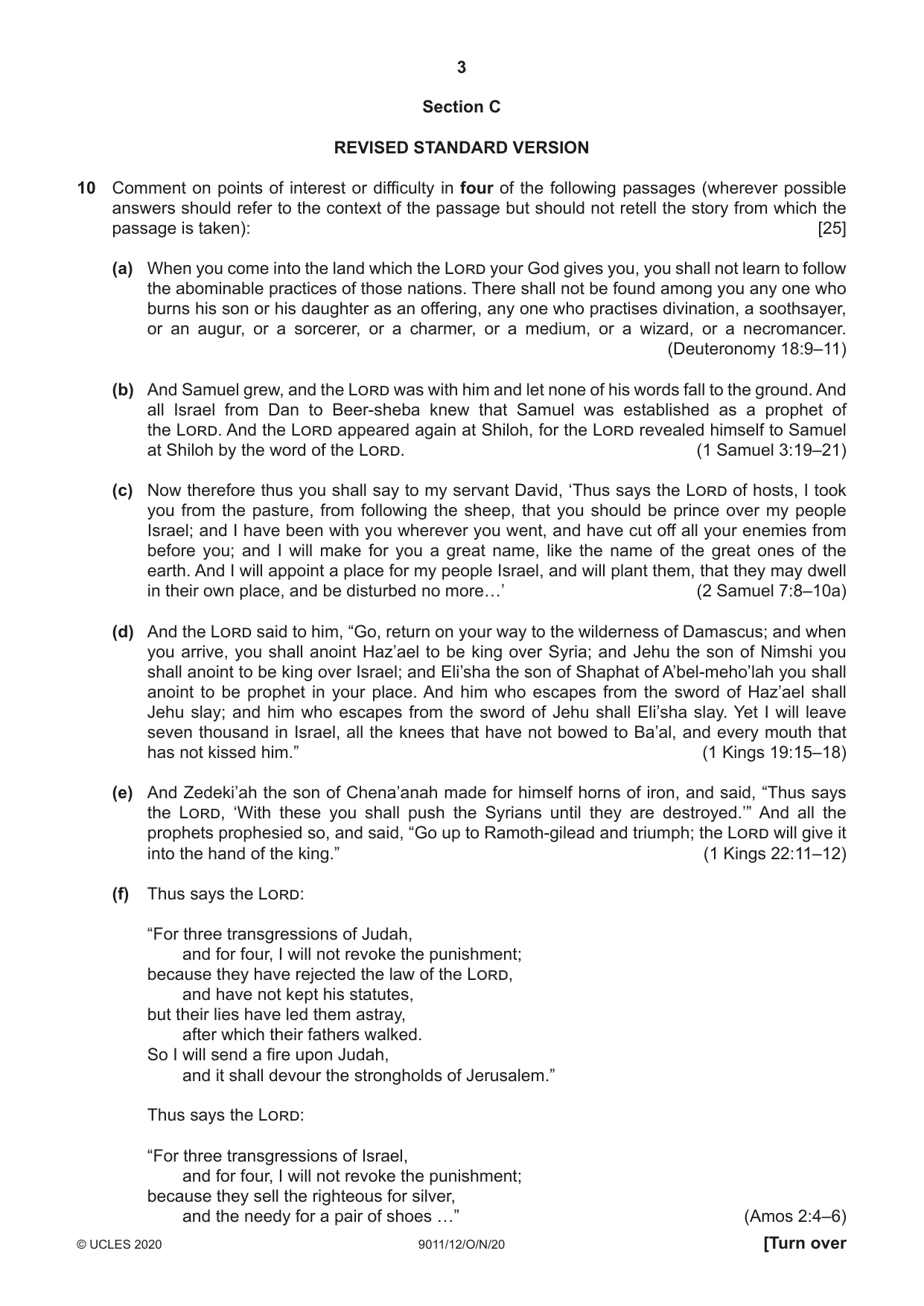
Question paper, page 3
3 9011/12/O/N/20 © UCLES 2020 [Turn over Section C REVISED STANDARD VERSION 10 Comment on points of interest or difficulty in four of the following passages (wherever possible answers should refer to the context of the passage but should not retell the story from which the passage is taken): [25] (a) When you come into the land which the Lord your God gives you, you shall not learn to follow the abominable practices of those nations. There shall not be found among you any one who burns his son or his daughter as an offering, any one who practises divination, a soothsayer, or an augur, or a sorcerer, or a charmer, or a medium, or a wizard, or a necromancer. (Deuteronomy 18:9–11) (b) And Samuel grew, and the Lord was with him and let none of his words fall to the ground. And all Israel from Dan to Beer-sheba knew that Samuel was established as a prophet of the Lord. And the Lord appeared again at Shiloh, for the Lord revealed himself to Samuel at Shiloh by the word of the Lord. (1 Samuel 3:19–21) (c) Now therefore thus you shall say to my servant David, ‘Thus says the Lord of hosts, I took you from the pasture, from following the sheep, that you should be prince over my people Israel; and I have been with you wherever you went, and have cut off all your enemies from before you; and I will make for you a great name, like the name of the great ones of the earth. And I will appoint a place for my people Israel, and will plant them, that they may dwell in their own place, and be disturbed no more…’ (2 Samuel 7:8–10a) (d) And the Lord said to him, “Go, return on your way to the wilderness of Damascus; and when you arrive, you shall anoint Haz’ael to be king over Syria; and Jehu the son of Nimshi you shall anoint to be king over Israel; and Eli’sha the son of Shaphat of A’bel-meho’lah you shall anoint to be prophet in your place. And him who escapes from the sword of Haz’ael shall Jehu slay; and him who escapes from the sword of Jehu shall Eli’sha slay. Yet I will leave seven thousand in Israel, all the knees that have not bowed to Ba’al, and every mouth that has not kissed him.” (1 Kings 19:15–18) (e) And Zedeki’ah the son of Chena’anah made for himself horns of iron, and said, “Thus says the Lord, ‘With these you shall push the Syrians until they are destroyed.’” And all the prophets prophesied so, and said, “Go up to Ramoth-gilead and triumph; the Lord will give it into the hand of the king.” (1 Kings 22:11–12) (f) Thus says the Lord: “For three transgressions of Judah, and for four, I will not revoke the punishment; because they have rejected the law of the Lord, and have not kept his statutes, but their lies have led them astray, after which their fathers walked. So I will send a fire upon Judah, and it shall devour the strongholds of Jerusalem.” Thus says the Lord: “For three transgressions of Israel, and for four, I will not revoke the punishment; because they sell the righteous for silver, and the needy for a pair of shoes …” (Amos 2:4–6)
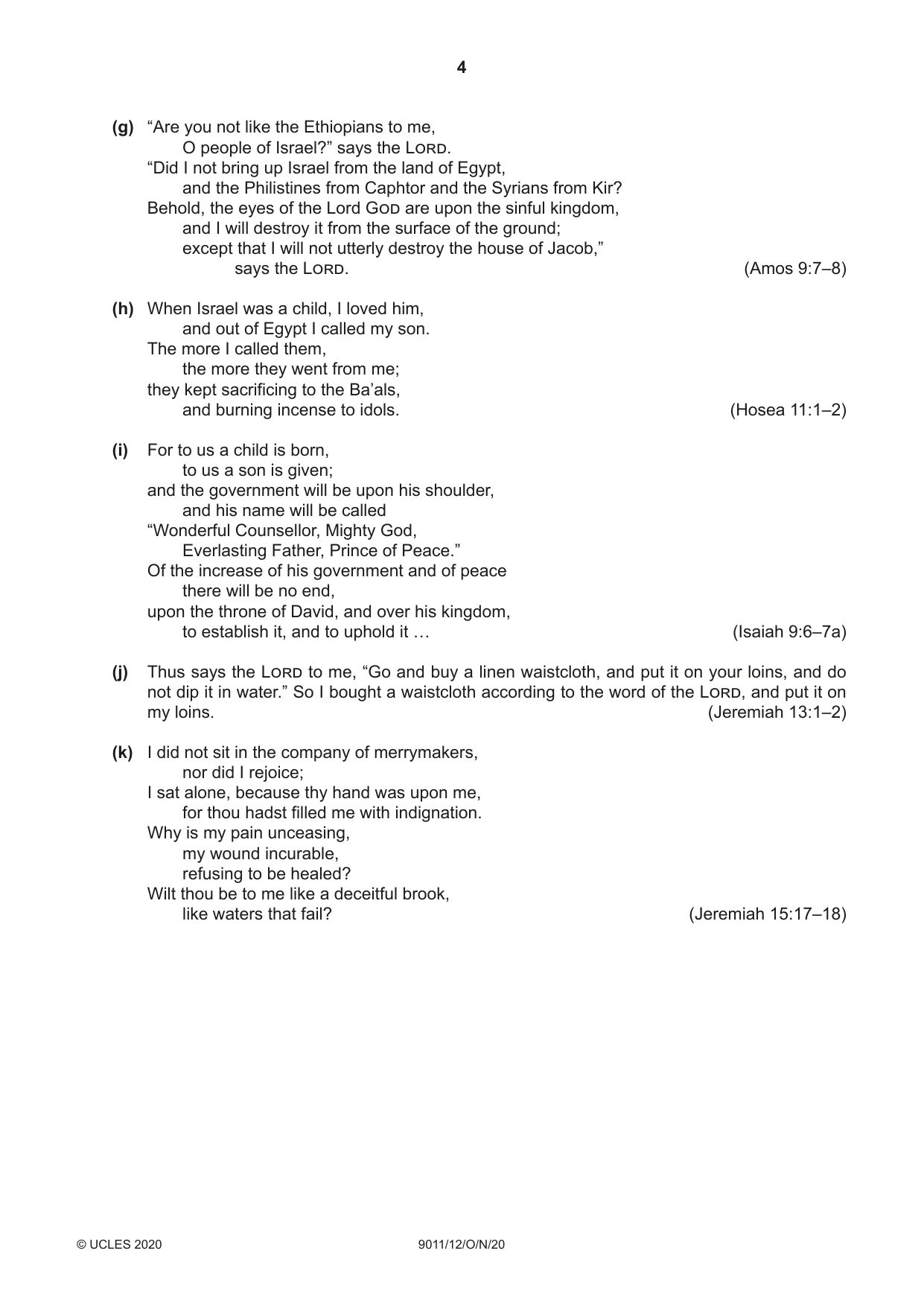
Question paper, page 4
4 9011/12/O/N/20 © UCLES 2020 (g) “Are you not like the Ethiopians to me, O people of Israel?” says the Lord. “Did I not bring up Israel from the land of Egypt, and the Philistines from Caphtor and the Syrians from Kir? Behold, the eyes of the Lord God are upon the sinful kingdom, and I will destroy it from the surface of the ground; except that I will not utterly destroy the house of Jacob,” says the Lord. (Amos 9:7–8) (h) When Israel was a child, I loved him, and out of Egypt I called my son. The more I called them, the more they went from me; they kept sacrificing to the Ba’als, and burning incense to idols. (Hosea 11:1–2) (i) For to us a child is born, to us a son is given; and the government will be upon his shoulder, and his name will be called “Wonderful Counsellor, Mighty God, Everlasting Father, Prince of Peace.” Of the increase of his government and of peace there will be no end, upon the throne of David, and over his kingdom, to establish it, and to uphold it … (Isaiah 9:6–7a) (j) Thus says the Lord to me, “Go and buy a linen waistcloth, and put it on your loins, and do not dip it in water.” So I bought a waistcloth according to the word of the Lord, and put it on my loins. (Jeremiah 13:1–2) (k) I did not sit in the company of merrymakers, nor did I rejoice; I sat alone, because thy hand was upon me, for thou hadst filled me with indignation. Why is my pain unceasing, my wound incurable, refusing to be healed? Wilt thou be to me like a deceitful brook, like waters that fail? (Jeremiah 15:17–18)
Question paper, page 5
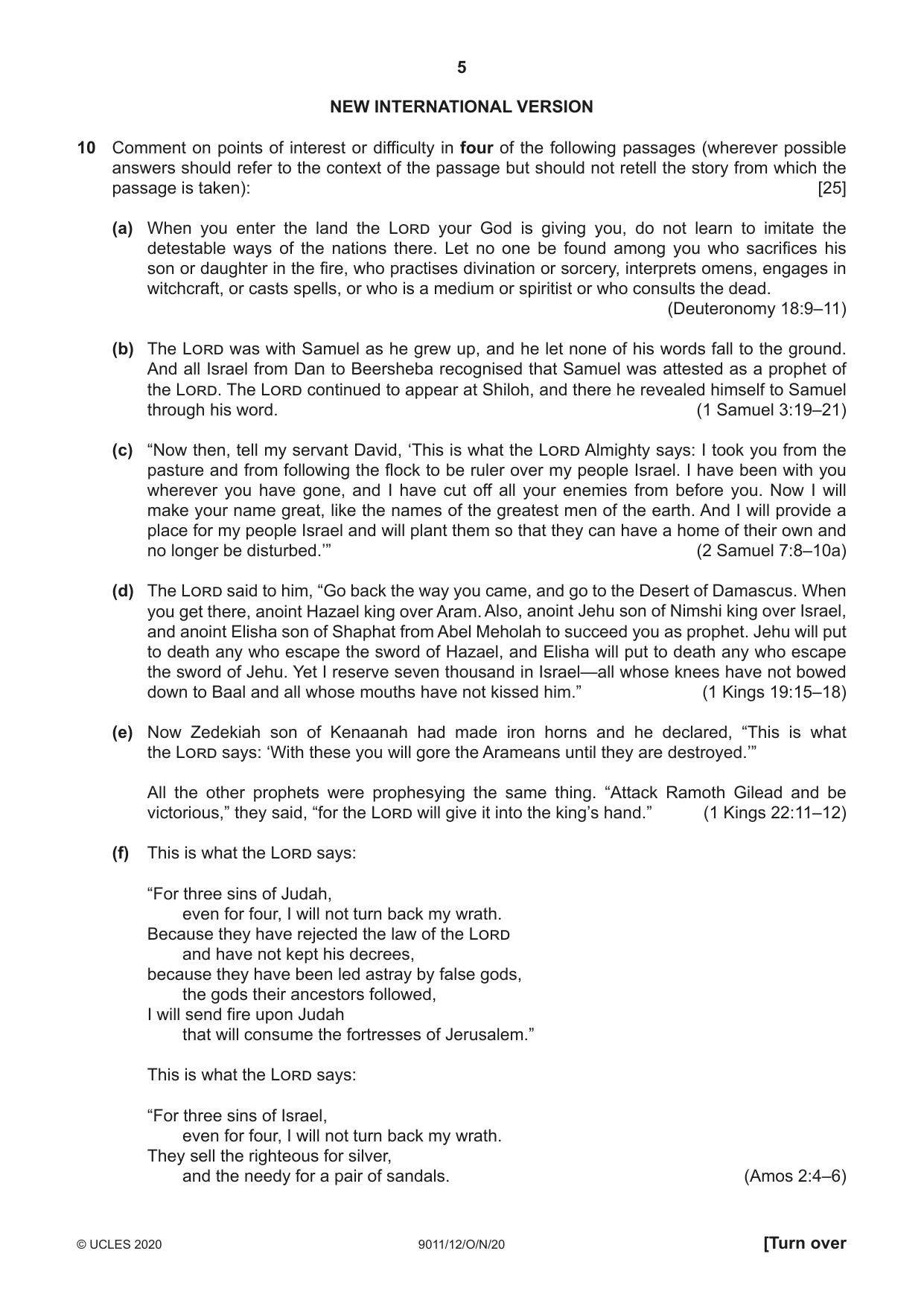
5 9011/12/O/N/20 © UCLES 2020 [Turn over NEW INTERNATIONAL VERSION 10 Comment on points of interest or difficulty in four of the following passages (wherever possible answers should refer to the context of the passage but should not retell the story from which the passage is taken): [25] (a) When you enter the land the Lord your God is giving you, do not learn to imitate the detestable ways of the nations there. Let no one be found among you who sacrifices his son or daughter in the fire, who practises divination or sorcery, interprets omens, engages in witchcraft, or casts spells, or who is a medium or spiritist or who consults the dead. (Deuteronomy 18:9–11) (b) The Lord was with Samuel as he grew up, and he let none of his words fall to the ground. And all Israel from Dan to Beersheba recognised that Samuel was attested as a prophet of the Lord. The Lord continued to appear at Shiloh, and there he revealed himself to Samuel through his word. (1 Samuel 3:19–21) (c) “Now then, tell my servant David, ‘This is what the Lord Almighty says: I took you from the pasture and from following the flock to be ruler over my people Israel. I have been with you wherever you have gone, and I have cut off all your enemies from before you. Now I will make your name great, like the names of the greatest men of the earth. And I will provide a place for my people Israel and will plant them so that they can have a home of their own and no longer be disturbed.’” (2 Samuel 7:8–10a) (d) The Lord said to him, “Go back the way you came, and go to the Desert of Damascus. When you get there, anoint Hazael king over Aram. Also, anoint Jehu son of Nimshi king over Israel, and anoint Elisha son of Shaphat from Abel Meholah to succeed you as prophet. Jehu will put to death any who escape the sword of Hazael, and Elisha will put to death any who escape the sword of Jehu. Yet I reserve seven thousand in Israel—all whose knees have not bowed down to Baal and all whose mouths have not kissed him.” (1 Kings 19:15–18) (e) Now Zedekiah son of Kenaanah had made iron horns and he declared, “This is what the Lord says: ‘With these you will gore the Arameans until they are destroyed.’” All the other prophets were prophesying the same thing. “Attack Ramoth Gilead and be victorious,” they said, “for the Lord will give it into the king’s hand.” (1 Kings 22:11–12) (f) This is what the Lord says: “For three sins of Judah, even for four, I will not turn back my wrath. Because they have rejected the law of the Lord and have not kept his decrees, because they have been led astray by false gods, the gods their ancestors followed, I will send fire upon Judah that will consume the fortresses of Jerusalem.” This is what the Lord says: “For three sins of Israel, even for four, I will not turn back my wrath. They sell the righteous for silver, and the needy for a pair of sandals. (Amos 2:4–6)
Question paper, page 6
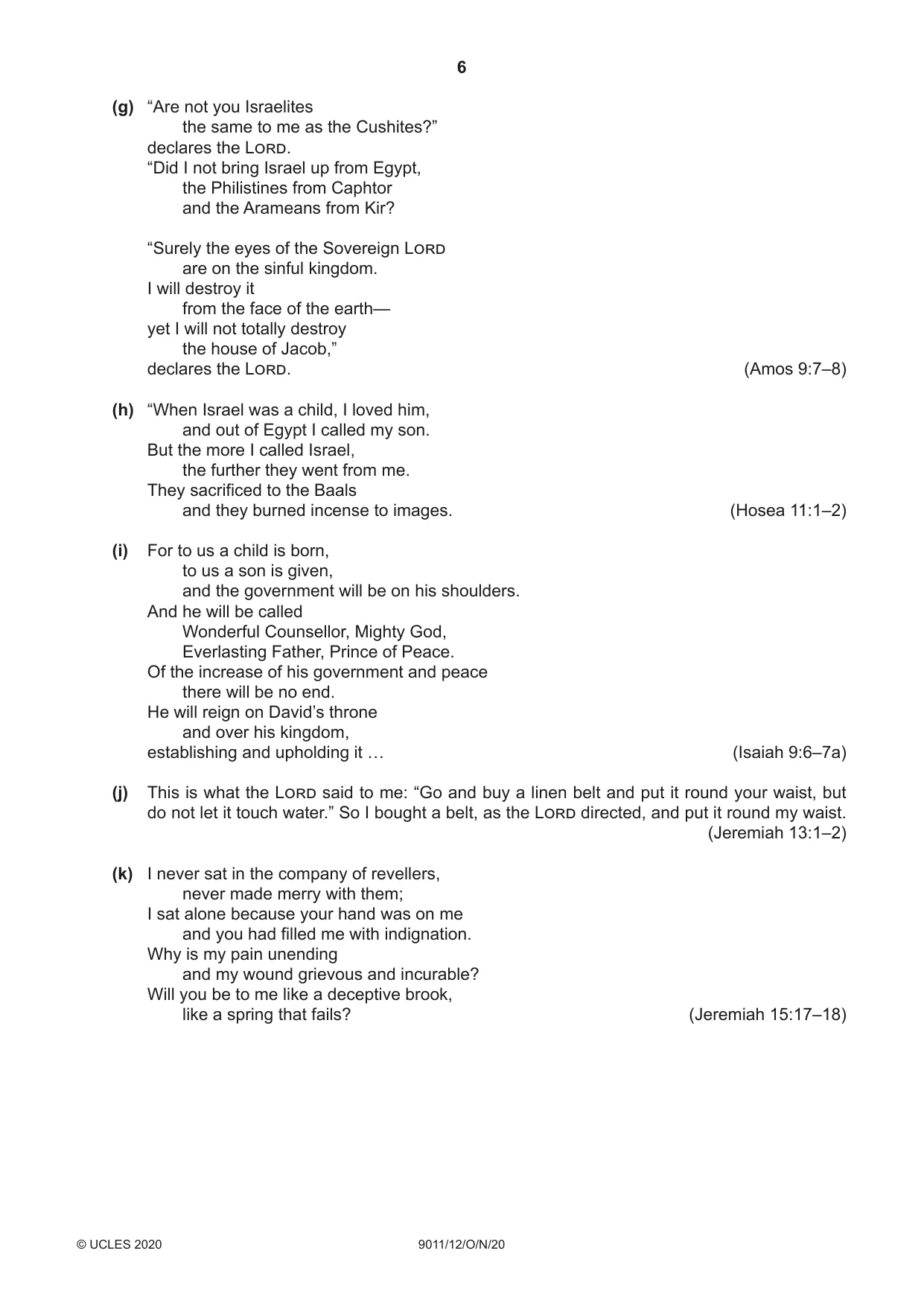
6 9011/12/O/N/20 © UCLES 2020 (g) “Are not you Israelites the same to me as the Cushites?” declares the Lord. “Did I not bring Israel up from Egypt, the Philistines from Caphtor and the Arameans from Kir? “Surely the eyes of the Sovereign Lord are on the sinful kingdom. I will destroy it from the face of the earth— yet I will not totally destroy the house of Jacob,” declares the Lord. (Amos 9:7–8) (h) “When Israel was a child, I loved him, and out of Egypt I called my son. But the more I called Israel, the further they went from me. They sacrificed to the Baals and they burned incense to images. (Hosea 11:1–2) (i) For to us a child is born, to us a son is given, and the government will be on his shoulders. And he will be called Wonderful Counsellor, Mighty God, Everlasting Father, Prince of Peace. Of the increase of his government and peace there will be no end. He will reign on David’s throne and over his kingdom, establishing and upholding it … (Isaiah 9:6–7a) (j) This is what the Lord said to me: “Go and buy a linen belt and put it round your waist, but do not let it touch water.” So I bought a belt, as the Lord directed, and put it round my waist. (Jeremiah 13:1–2) (k) I never sat in the company of revellers, never made merry with them; I sat alone because your hand was on me and you had filled me with indignation. Why is my pain unending and my wound grievous and incurable? Will you be to me like a deceptive brook, like a spring that fails? (Jeremiah 15:17–18)
Question paper, page 7
7 9011/12/O/N/20 © UCLES 2020 BLANK PAGE
Question paper, page 8
8 9011/12/O/N/20 © UCLES 2020 Permission to reproduce items where third-party owned material protected by copyright is included has been sought and cleared where possible. Every reasonable effort has been made by the publisher (UCLES) to trace copyright holders, but if any items requiring clearance have unwittingly been included, the publisher will be pleased to make amends at the earliest possible opportunity. To avoid the issue of disclosure of answer-related information to candidates, all copyright acknowledgements are reproduced online in the Cambridge Assessment International Education Copyright Acknowledgements Booklet. This is produced for each series of examinations and is freely available to download at www.cambridgeinternational.org after the live examination series. Cambridge Assessment International Education is part of the Cambridge Assessment Group. Cambridge Assessment is the brand name of the University of Cambridge Local Examinations Syndicate (UCLES), which itself is a department of the University of Cambridge. BLANK PAGE
Mark scheme, page 1
This document consists of 23 printed pages. © UCLES 2020 [Turn over Cambridge International A Level DIVINITY 9011/12 Paper 1 The Prophets of the Old Testament October/November 2020 MARK SCHEME Maximum Mark: 100 Published This mark scheme is published as an aid to teachers and candidates, to indicate the requirements of the examination. It shows the basis on which Examiners were instructed to award marks. It does not indicate the details of the discussions that took place at an Examiners’ meeting before marking began, which would have considered the acceptability of alternative answers. Mark schemes should be read in conjunction with the question paper and the Principal Examiner Report for Teachers. Cambridge International will not enter into discussions about these mark schemes. Cambridge International is publishing the mark schemes for the October/November 2020 series for most Cambridge IGCSE™, Cambridge International A and AS Level and Cambridge Pre-U components, and some Cambridge O Level components.
Mark scheme, page 2
9011/12 Cambridge International A Level – Mark Scheme PUBLISHED October/November 2020 © UCLES 2020 Page 2 of 23 Generic Marking Principles These general marking principles must be applied by all examiners when marking candidate answers. They should be applied alongside the specific content of the mark scheme or generic level descriptors for a question. Each question paper and mark scheme will also comply with these marking principles. GENERIC MARKING PRINCIPLE 1: Marks must be awarded in line with: • the specific content of the mark scheme or the generic level descriptors for the question • the specific skills defined in the mark scheme or in the generic level descriptors for the question • the standard of response required by a candidate as exemplified by the standardisation scripts. GENERIC MARKING PRINCIPLE 2: Marks awarded are always whole marks (not half marks, or other fractions). GENERIC MARKING PRINCIPLE 3: Marks must be awarded positively: • marks are awarded for correct/valid answers, as defined in the mark scheme. However, credit is given for valid answers which go beyond the scope of the syllabus and mark scheme, referring to your Team Leader as appropriate • marks are awarded when candidates clearly demonstrate what they know and can do • marks are not deducted for errors • marks are not deducted for omissions • answers should only be judged on the quality of spelling, punctuation and grammar when these features are specifically assessed by the question as indicated by the mark scheme. The meaning, however, should be unambiguous. GENERIC MARKING PRINCIPLE 4: Rules must be applied consistently, e.g. in situations where candidates have not followed instructions or in the application of generic level descriptors. GENERIC MARKING PRINCIPLE 5: Marks should be awarded using the full range of marks defined in the mark scheme for the question (however; the use of the full mark range may be limited according to the quality of the candidate responses seen). GENERIC MARKING PRINCIPLE 6: Marks awarded are based solely on the requirements as defined in the mark scheme. Marks should not be awarded with grade thresholds or grade descriptors in mind.
Mark scheme, page 3
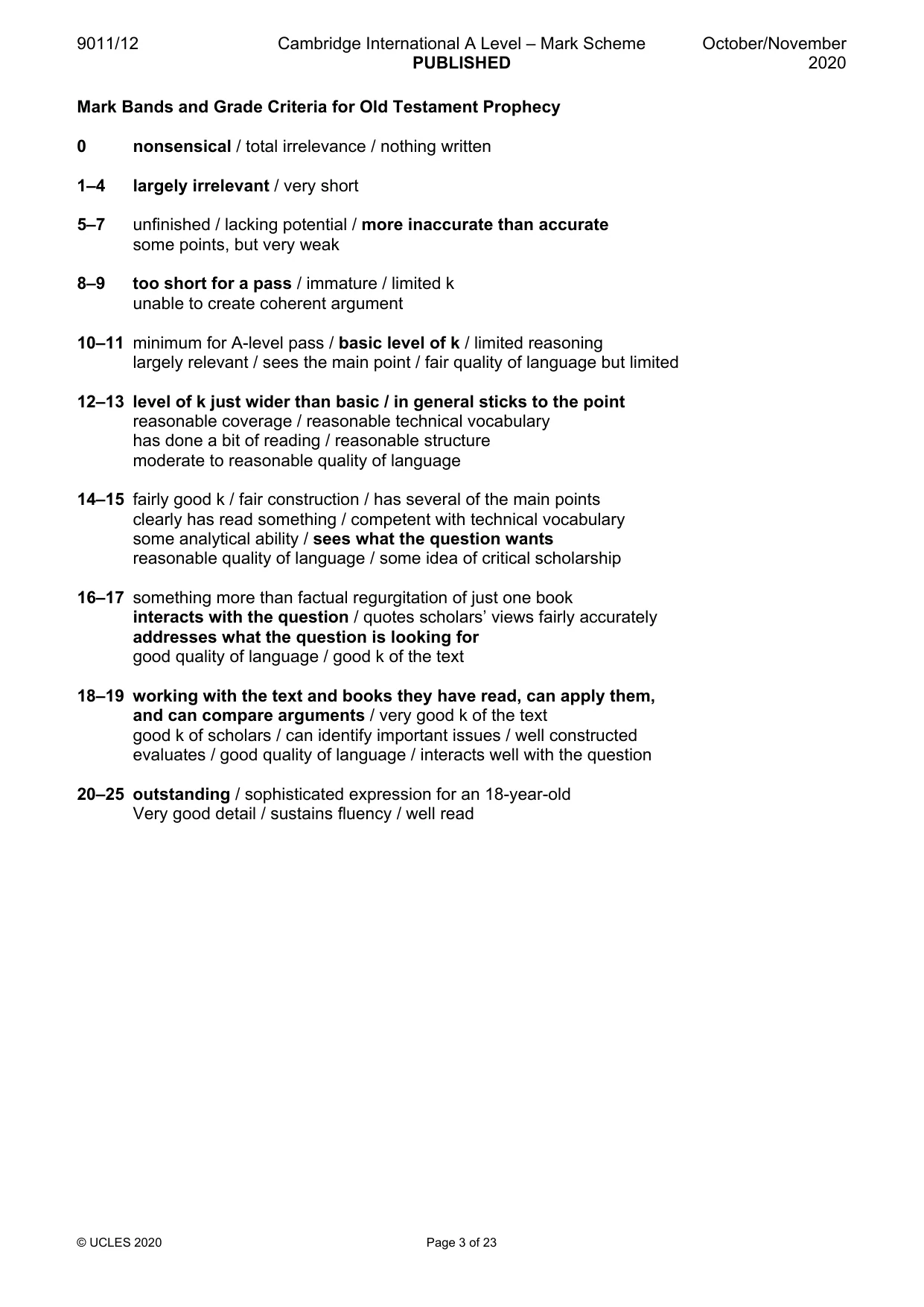
9011/12 Cambridge International A Level – Mark Scheme PUBLISHED October/November 2020 © UCLES 2020 Page 3 of 23 Mark Bands and Grade Criteria for Old Testament Prophecy 0 nonsensical / total irrelevance / nothing written 1–4 largely irrelevant / very short 5–7 unfinished / lacking potential / more inaccurate than accurate some points, but very weak 8–9 too short for a pass / immature / limited k unable to create coherent argument 10–11 minimum for A-level pass / basic level of k / limited reasoning largely relevant / sees the main point / fair quality of language but limited 12–13 level of k just wider than basic / in general sticks to the point reasonable coverage / reasonable technical vocabulary has done a bit of reading / reasonable structure moderate to reasonable quality of language 14–15 fairly good k / fair construction / has several of the main points clearly has read something / competent with technical vocabulary some analytical ability / sees what the question wants reasonable quality of language / some idea of critical scholarship 16–17 something more than factual regurgitation of just one book interacts with the question / quotes scholars’ views fairly accurately addresses what the question is looking for good quality of language / good k of the text 18–19 working with the text and books they have read, can apply them, and can compare arguments / very good k of the text good k of scholars / can identify important issues / well constructed evaluates / good quality of language / interacts well with the question 20–25 outstanding / sophisticated expression for an 18-year-old Very good detail / sustains fluency / well read
Mark scheme, page 4
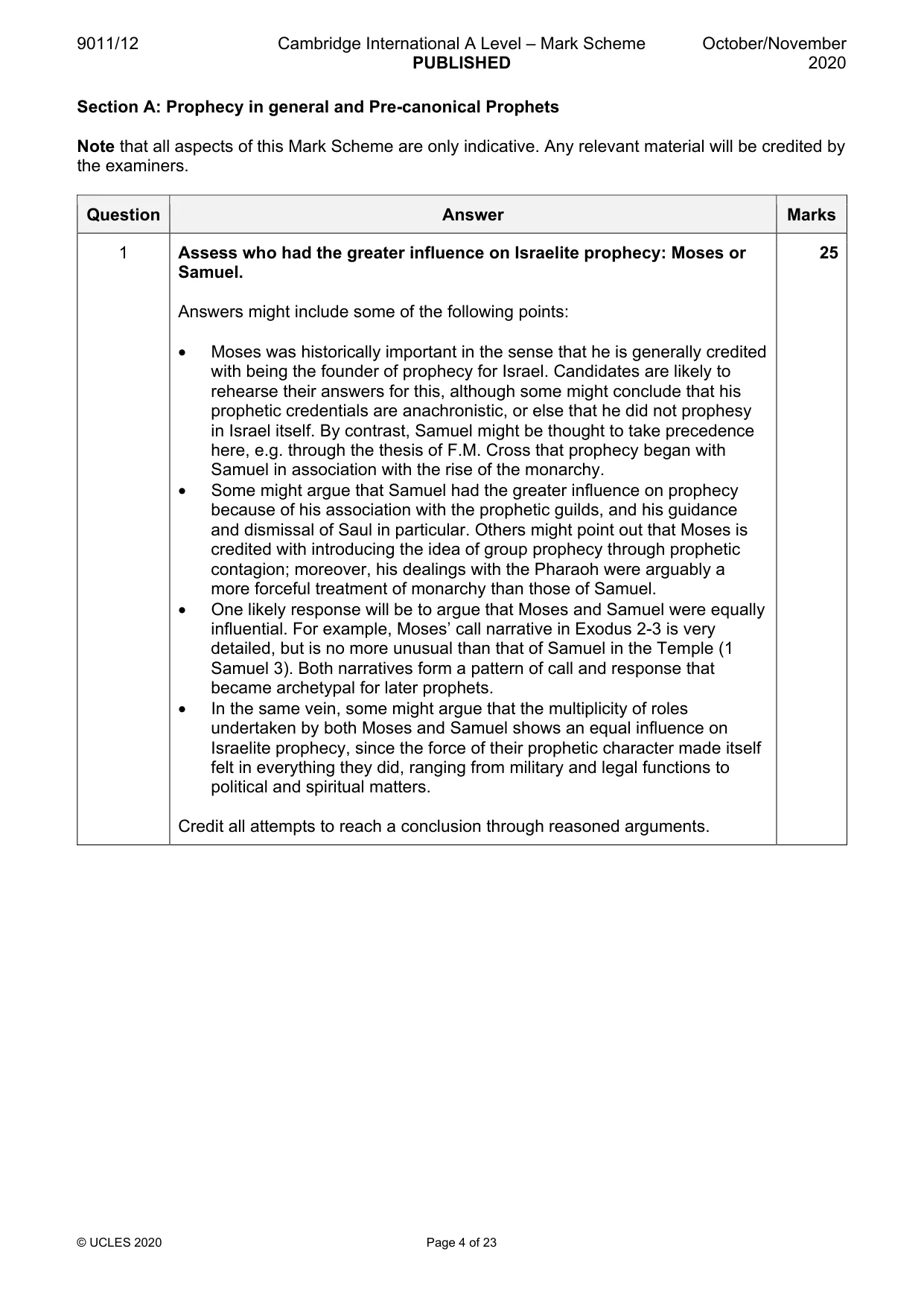
9011/12 Cambridge International A Level – Mark Scheme PUBLISHED October/November 2020 © UCLES 2020 Page 4 of 23 Section A: Prophecy in general and Pre-canonical Prophets Note that all aspects of this Mark Scheme are only indicative. Any relevant material will be credited by the examiners. Question Answer Marks 1 Assess who had the greater influence on Israelite prophecy: Moses or Samuel. Answers might include some of the following points: • Moses was historically important in the sense that he is generally credited with being the founder of prophecy for Israel. Candidates are likely to rehearse their answers for this, although some might conclude that his prophetic credentials are anachronistic, or else that he did not prophesy in Israel itself. By contrast, Samuel might be thought to take precedence here, e.g. through the thesis of F.M. Cross that prophecy began with Samuel in association with the rise of the monarchy. • Some might argue that Samuel had the greater influence on prophecy because of his association with the prophetic guilds, and his guidance and dismissal of Saul in particular. Others might point out that Moses is credited with introducing the idea of group prophecy through prophetic contagion; moreover, his dealings with the Pharaoh were arguably a more forceful treatment of monarchy than those of Samuel. • One likely response will be to argue that Moses and Samuel were equally influential. For example, Moses’ call narrative in Exodus 2-3 is very detailed, but is no more unusual than that of Samuel in the Temple (1 Samuel 3). Both narratives form a pattern of call and response that became archetypal for later prophets. • In the same vein, some might argue that the multiplicity of roles undertaken by both Moses and Samuel shows an equal influence on Israelite prophecy, since the force of their prophetic character made itself felt in everything they did, ranging from military and legal functions to political and spiritual matters. Credit all attempts to reach a conclusion through reasoned arguments. 25
Mark scheme, page 5
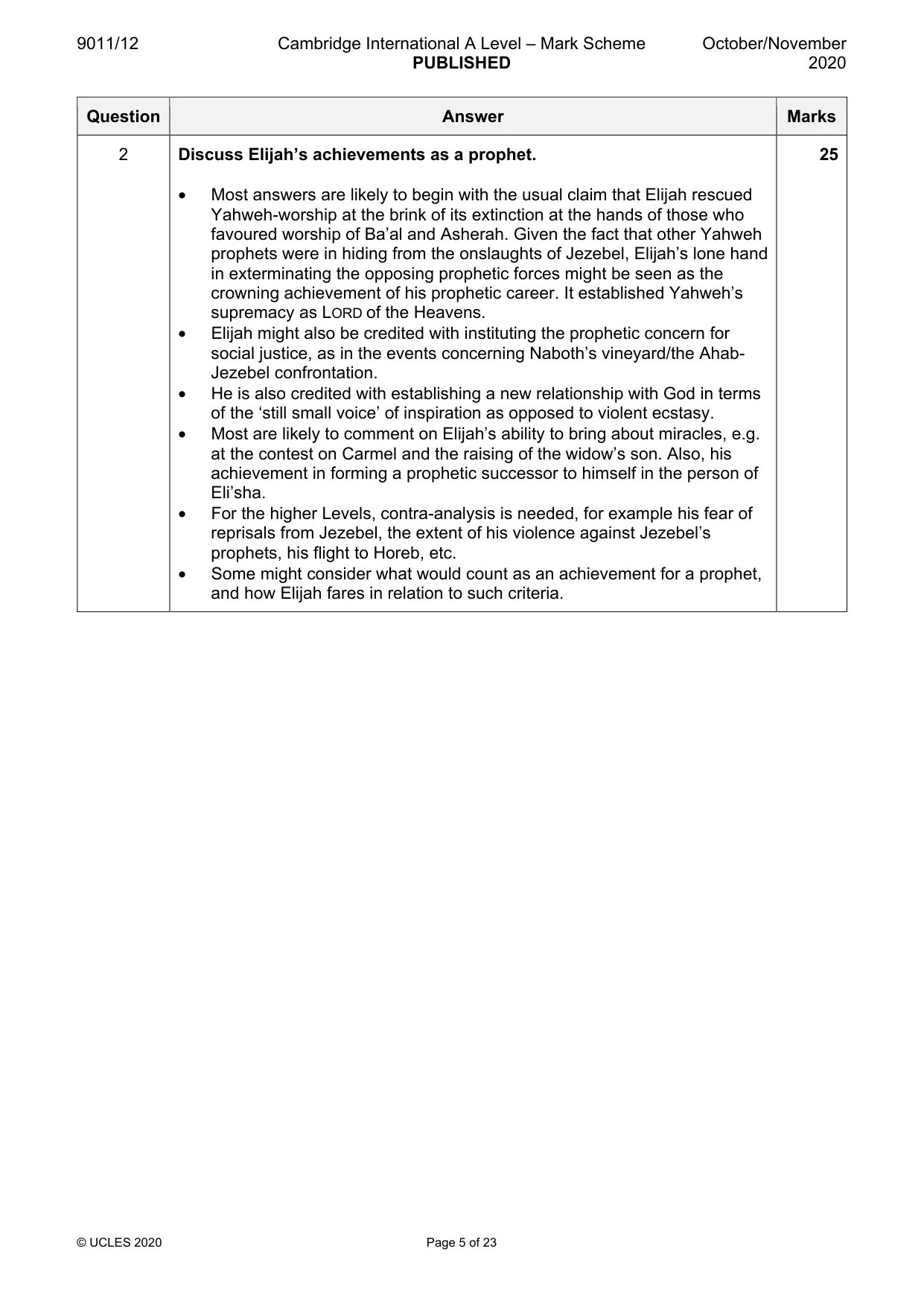
9011/12 Cambridge International A Level – Mark Scheme PUBLISHED October/November 2020 © UCLES 2020 Page 5 of 23 Question Answer Marks 2 Discuss Elijah’s achievements as a prophet. • Most answers are likely to begin with the usual claim that Elijah rescued Yahweh-worship at the brink of its extinction at the hands of those who favoured worship of Ba’al and Asherah. Given the fact that other Yahweh prophets were in hiding from the onslaughts of Jezebel, Elijah’s lone hand in exterminating the opposing prophetic forces might be seen as the crowning achievement of his prophetic career. It established Yahweh’s supremacy as LORD of the Heavens. • Elijah might also be credited with instituting the prophetic concern for social justice, as in the events concerning Naboth’s vineyard/the Ahab- Jezebel confrontation. • He is also credited with establishing a new relationship with God in terms of the ‘still small voice’ of inspiration as opposed to violent ecstasy. • Most are likely to comment on Elijah’s ability to bring about miracles, e.g. at the contest on Carmel and the raising of the widow’s son. Also, his achievement in forming a prophetic successor to himself in the person of Eli’sha. • For the higher Levels, contra-analysis is needed, for example his fear of reprisals from Jezebel, the extent of his violence against Jezebel’s prophets, his flight to Horeb, etc. • Some might consider what would count as an achievement for a prophet, and how Elijah fares in relation to such criteria. 25
Mark scheme, page 6
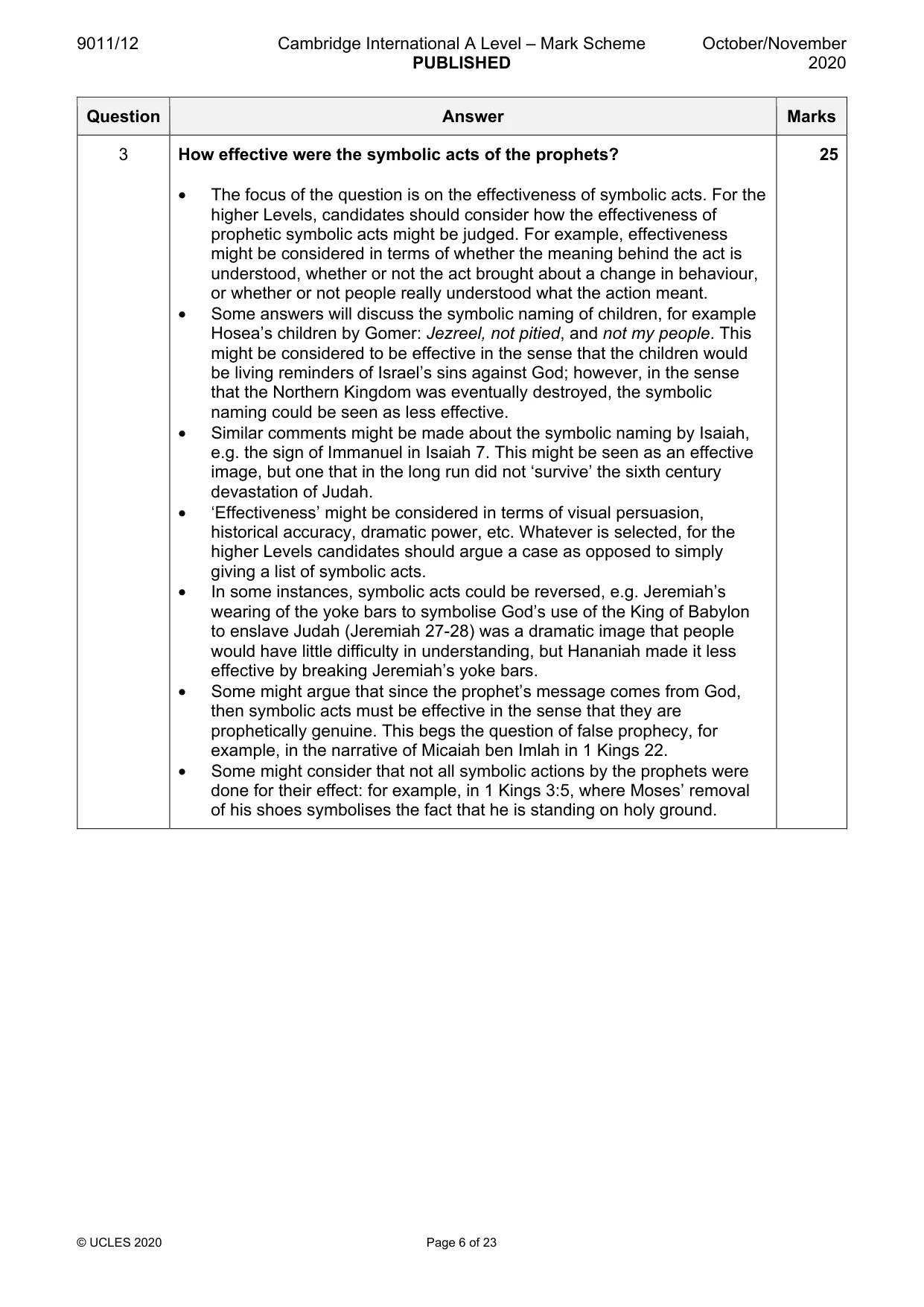
9011/12 Cambridge International A Level – Mark Scheme PUBLISHED October/November 2020 © UCLES 2020 Page 6 of 23 Question Answer Marks 3 How effective were the symbolic acts of the prophets? • The focus of the question is on the effectiveness of symbolic acts. For the higher Levels, candidates should consider how the effectiveness of prophetic symbolic acts might be judged. For example, effectiveness might be considered in terms of whether the meaning behind the act is understood, whether or not the act brought about a change in behaviour, or whether or not people really understood what the action meant. • Some answers will discuss the symbolic naming of children, for example Hosea’s children by Gomer: Jezreel, not pitied, and not my people. This might be considered to be effective in the sense that the children would be living reminders of Israel’s sins against God; however, in the sense that the Northern Kingdom was eventually destroyed, the symbolic naming could be seen as less effective. • Similar comments might be made about the symbolic naming by Isaiah, e.g. the sign of Immanuel in Isaiah 7. This might be seen as an effective image, but one that in the long run did not ‘survive’ the sixth century devastation of Judah. • ‘Effectiveness’ might be considered in terms of visual persuasion, historical accuracy, dramatic power, etc. Whatever is selected, for the higher Levels candidates should argue a case as opposed to simply giving a list of symbolic acts. • In some instances, symbolic acts could be reversed, e.g. Jeremiah’s wearing of the yoke bars to symbolise God’s use of the King of Babylon to enslave Judah (Jeremiah 27-28) was a dramatic image that people would have little difficulty in understanding, but Hananiah made it less effective by breaking Jeremiah’s yoke bars. • Some might argue that since the prophet’s message comes from God, then symbolic acts must be effective in the sense that they are prophetically genuine. This begs the question of false prophecy, for example, in the narrative of Micaiah ben Imlah in 1 Kings 22. • Some might consider that not all symbolic actions by the prophets were done for their effect: for example, in 1 Kings 3:5, where Moses’ removal of his shoes symbolises the fact that he is standing on holy ground. 25
Mark scheme, page 7
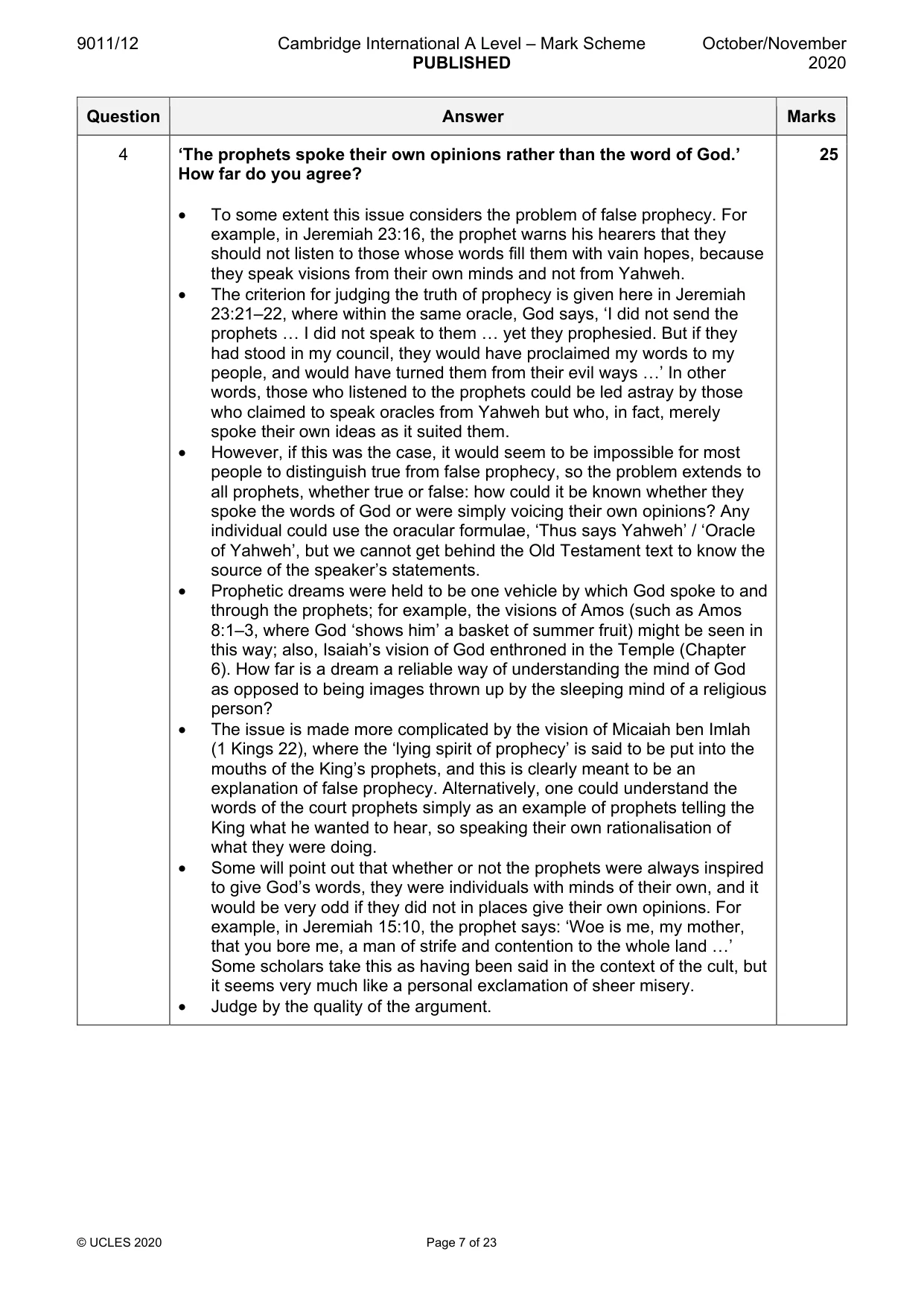
9011/12 Cambridge International A Level – Mark Scheme PUBLISHED October/November 2020 © UCLES 2020 Page 7 of 23 Question Answer Marks 4 ‘The prophets spoke their own opinions rather than the word of God.’ How far do you agree? • To some extent this issue considers the problem of false prophecy. For example, in Jeremiah 23:16, the prophet warns his hearers that they should not listen to those whose words fill them with vain hopes, because they speak visions from their own minds and not from Yahweh. • The criterion for judging the truth of prophecy is given here in Jeremiah 23:21–22, where within the same oracle, God says, ‘I did not send the prophets … I did not speak to them … yet they prophesied. But if they had stood in my council, they would have proclaimed my words to my people, and would have turned them from their evil ways …’ In other words, those who listened to the prophets could be led astray by those who claimed to speak oracles from Yahweh but who, in fact, merely spoke their own ideas as it suited them. • However, if this was the case, it would seem to be impossible for most people to distinguish true from false prophecy, so the problem extends to all prophets, whether true or false: how could it be known whether they spoke the words of God or were simply voicing their own opinions? Any individual could use the oracular formulae, ‘Thus says Yahweh’ / ‘Oracle of Yahweh’, but we cannot get behind the Old Testament text to know the source of the speaker’s statements. • Prophetic dreams were held to be one vehicle by which God spoke to and through the prophets; for example, the visions of Amos (such as Amos 8:1–3, where God ‘shows him’ a basket of summer fruit) might be seen in this way; also, Isaiah’s vision of God enthroned in the Temple (Chapter 6). How far is a dream a reliable way of understanding the mind of God as opposed to being images thrown up by the sleeping mind of a religious person? • The issue is made more complicated by the vision of Micaiah ben Imlah (1 Kings 22), where the ‘lying spirit of prophecy’ is said to be put into the mouths of the King’s prophets, and this is clearly meant to be an explanation of false prophecy. Alternatively, one could understand the words of the court prophets simply as an example of prophets telling the King what he wanted to hear, so speaking their own rationalisation of what they were doing. • Some will point out that whether or not the prophets were always inspired to give God’s words, they were individuals with minds of their own, and it would be very odd if they did not in places give their own opinions. For example, in Jeremiah 15:10, the prophet says: ‘Woe is me, my mother, that you bore me, a man of strife and contention to the whole land …’ Some scholars take this as having been said in the context of the cult, but it seems very much like a personal exclamation of sheer misery. • Judge by the quality of the argument. 25
Mark scheme, page 8
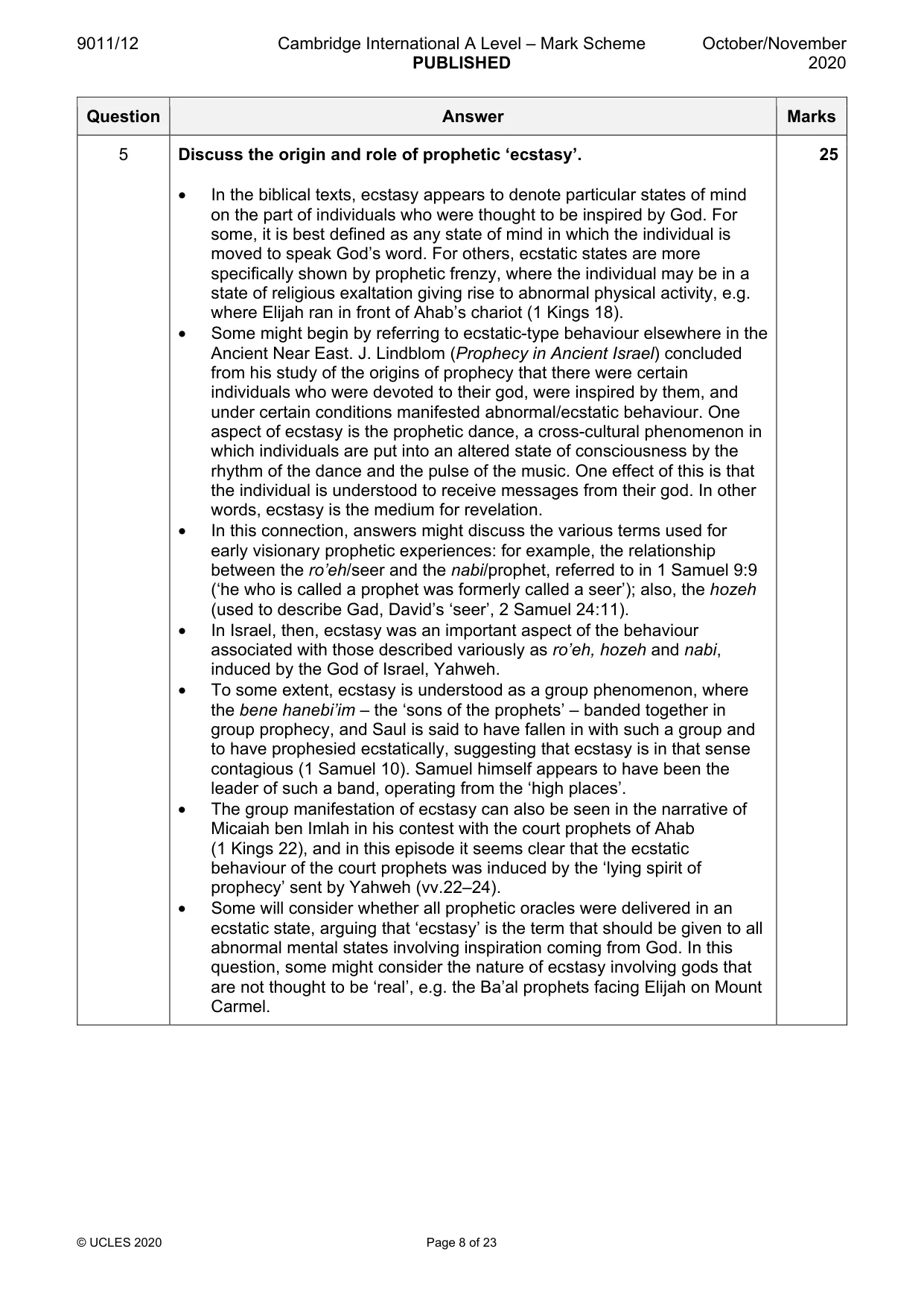
9011/12 Cambridge International A Level – Mark Scheme PUBLISHED October/November 2020 © UCLES 2020 Page 8 of 23 Question Answer Marks 5 Discuss the origin and role of prophetic ‘ecstasy’. • In the biblical texts, ecstasy appears to denote particular states of mind on the part of individuals who were thought to be inspired by God. For some, it is best defined as any state of mind in which the individual is moved to speak God’s word. For others, ecstatic states are more specifically shown by prophetic frenzy, where the individual may be in a state of religious exaltation giving rise to abnormal physical activity, e.g. where Elijah ran in front of Ahab’s chariot (1 Kings 18). • Some might begin by referring to ecstatic-type behaviour elsewhere in the Ancient Near East. J. Lindblom (Prophecy in Ancient Israel) concluded from his study of the origins of prophecy that there were certain individuals who were devoted to their god, were inspired by them, and under certain conditions manifested abnormal/ecstatic behaviour. One aspect of ecstasy is the prophetic dance, a cross-cultural phenomenon in which individuals are put into an altered state of consciousness by the rhythm of the dance and the pulse of the music. One effect of this is that the individual is understood to receive messages from their god. In other words, ecstasy is the medium for revelation. • In this connection, answers might discuss the various terms used for early visionary prophetic experiences: for example, the relationship between the ro’eh/seer and the nabi/prophet, referred to in 1 Samuel 9:9 (‘he who is called a prophet was formerly called a seer’); also, the hozeh (used to describe Gad, David’s ‘seer’, 2 Samuel 24:11). • In Israel, then, ecstasy was an important aspect of the behaviour associated with those described variously as ro’eh, hozeh and nabi, induced by the God of Israel, Yahweh. • To some extent, ecstasy is understood as a group phenomenon, where the bene hanebi’im – the ‘sons of the prophets’ – banded together in group prophecy, and Saul is said to have fallen in with such a group and to have prophesied ecstatically, suggesting that ecstasy is in that sense contagious (1 Samuel 10). Samuel himself appears to have been the leader of such a band, operating from the ‘high places’. • The group manifestation of ecstasy can also be seen in the narrative of Micaiah ben Imlah in his contest with the court prophets of Ahab (1 Kings 22), and in this episode it seems clear that the ecstatic behaviour of the court prophets was induced by the ‘lying spirit of prophecy’ sent by Yahweh (vv.22–24). • Some will consider whether all prophetic oracles were delivered in an ecstatic state, arguing that ‘ecstasy’ is the term that should be given to all abnormal mental states involving inspiration coming from God. In this question, some might consider the nature of ecstasy involving gods that are not thought to be ‘real’, e.g. the Ba’al prophets facing Elijah on Mount Carmel. 25
Mark scheme, page 9
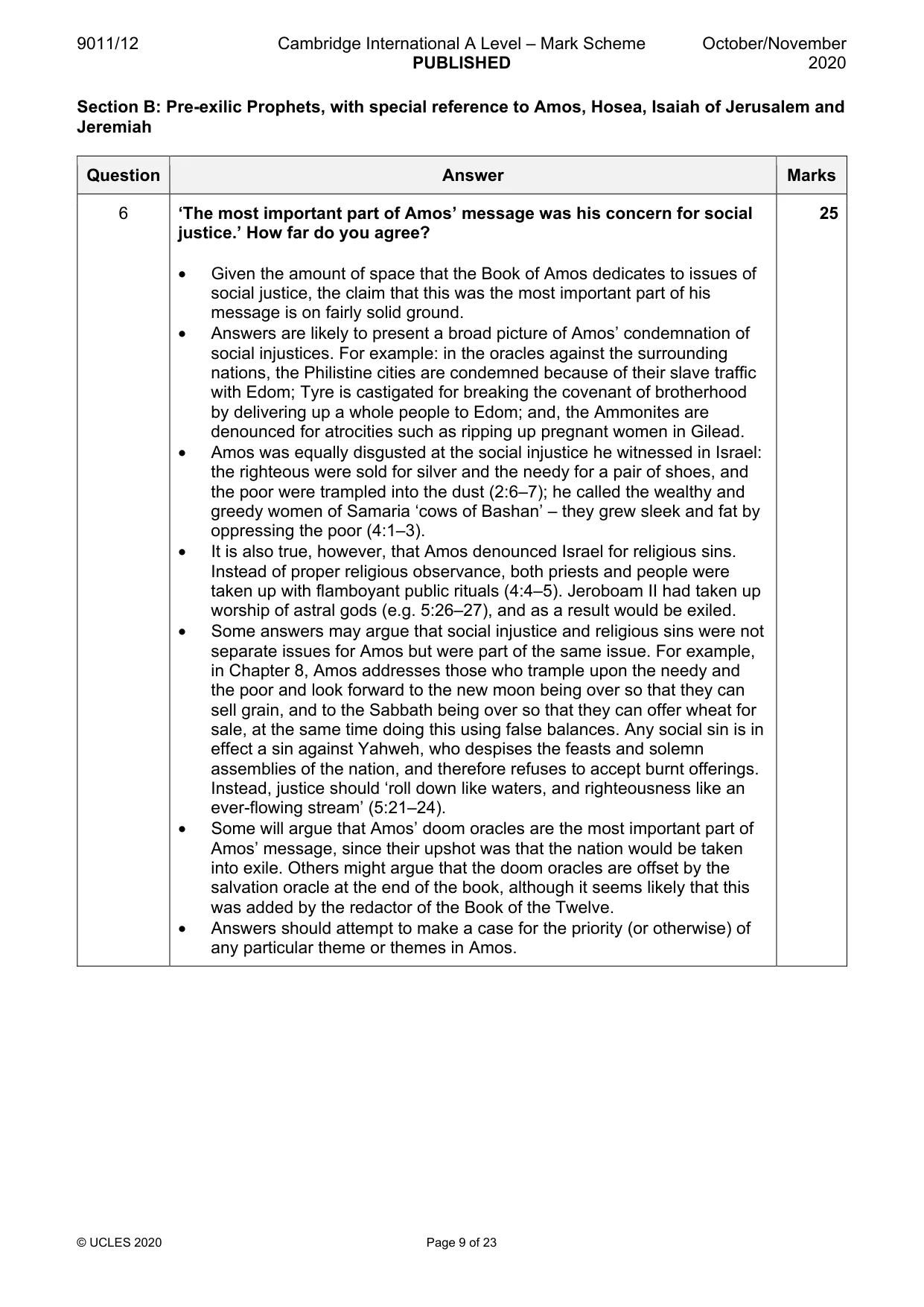
9011/12 Cambridge International A Level – Mark Scheme PUBLISHED October/November 2020 © UCLES 2020 Page 9 of 23 Section B: Pre-exilic Prophets, with special reference to Amos, Hosea, Isaiah of Jerusalem and Jeremiah Question Answer Marks 6 ‘The most important part of Amos’ message was his concern for social justice.’ How far do you agree? • Given the amount of space that the Book of Amos dedicates to issues of social justice, the claim that this was the most important part of his message is on fairly solid ground. • Answers are likely to present a broad picture of Amos’ condemnation of social injustices. For example: in the oracles against the surrounding nations, the Philistine cities are condemned because of their slave traffic with Edom; Tyre is castigated for breaking the covenant of brotherhood by delivering up a whole people to Edom; and, the Ammonites are denounced for atrocities such as ripping up pregnant women in Gilead. • Amos was equally disgusted at the social injustice he witnessed in Israel: the righteous were sold for silver and the needy for a pair of shoes, and the poor were trampled into the dust (2:6–7); he called the wealthy and greedy women of Samaria ‘cows of Bashan’ – they grew sleek and fat by oppressing the poor (4:1–3). • It is also true, however, that Amos denounced Israel for religious sins. Instead of proper religious observance, both priests and people were taken up with flamboyant public rituals (4:4–5). Jeroboam II had taken up worship of astral gods (e.g. 5:26–27), and as a result would be exiled. • Some answers may argue that social injustice and religious sins were not separate issues for Amos but were part of the same issue. For example, in Chapter 8, Amos addresses those who trample upon the needy and the poor and look forward to the new moon being over so that they can sell grain, and to the Sabbath being over so that they can offer wheat for sale, at the same time doing this using false balances. Any social sin is in effect a sin against Yahweh, who despises the feasts and solemn assemblies of the nation, and therefore refuses to accept burnt offerings. Instead, justice should ‘roll down like waters, and righteousness like an ever-flowing stream’ (5:21–24). • Some will argue that Amos’ doom oracles are the most important part of Amos’ message, since their upshot was that the nation would be taken into exile. Others might argue that the doom oracles are offset by the salvation oracle at the end of the book, although it seems likely that this was added by the redactor of the Book of the Twelve. • Answers should attempt to make a case for the priority (or otherwise) of any particular theme or themes in Amos. 25
Mark scheme, page 10
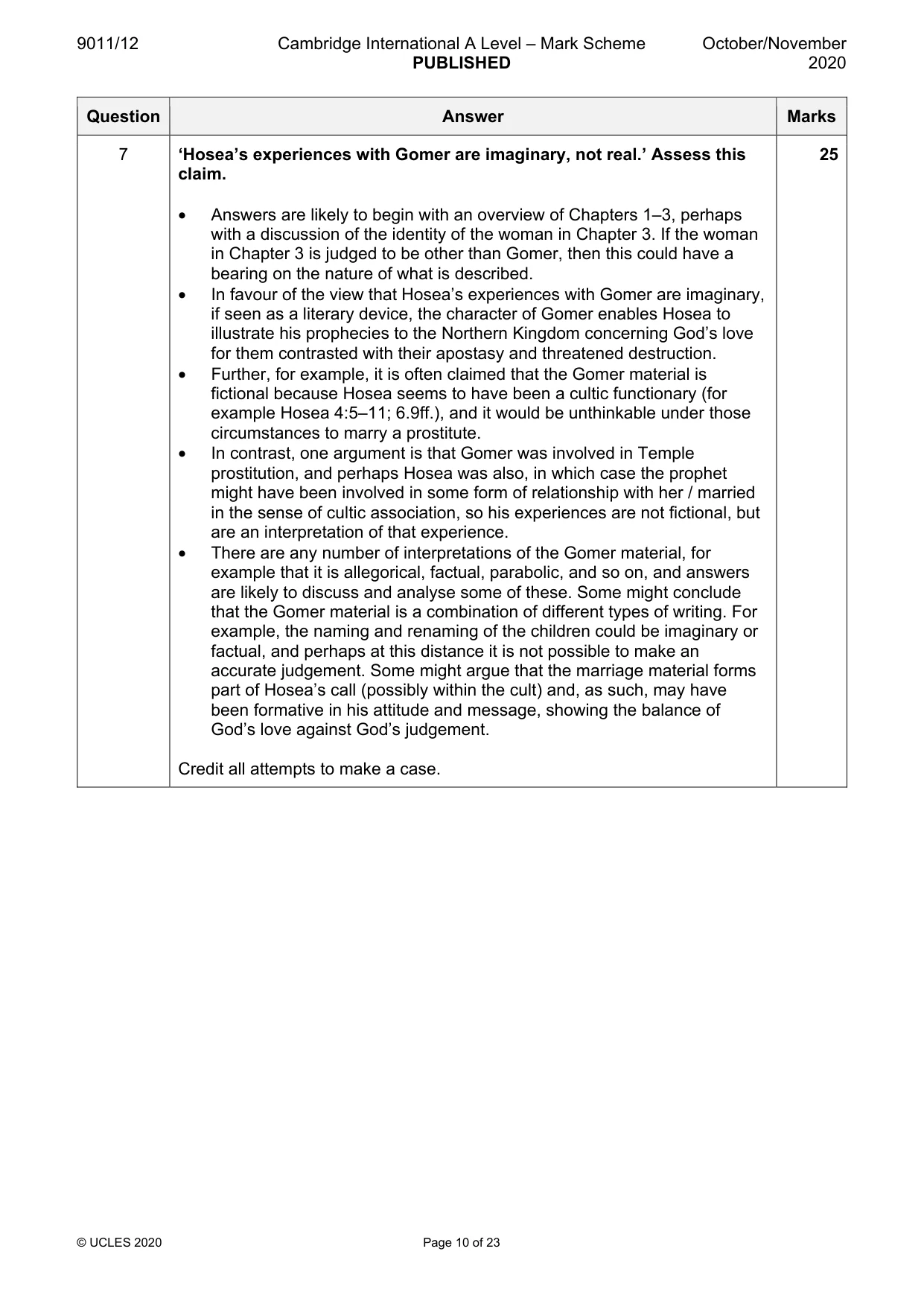
9011/12 Cambridge International A Level – Mark Scheme PUBLISHED October/November 2020 © UCLES 2020 Page 10 of 23 Question Answer Marks 7 ‘Hosea’s experiences with Gomer are imaginary, not real.’ Assess this claim. • Answers are likely to begin with an overview of Chapters 1–3, perhaps with a discussion of the identity of the woman in Chapter 3. If the woman in Chapter 3 is judged to be other than Gomer, then this could have a bearing on the nature of what is described. • In favour of the view that Hosea’s experiences with Gomer are imaginary, if seen as a literary device, the character of Gomer enables Hosea to illustrate his prophecies to the Northern Kingdom concerning God’s love for them contrasted with their apostasy and threatened destruction. • Further, for example, it is often claimed that the Gomer material is fictional because Hosea seems to have been a cultic functionary (for example Hosea 4:5–11; 6.9ff.), and it would be unthinkable under those circumstances to marry a prostitute. • In contrast, one argument is that Gomer was involved in Temple prostitution, and perhaps Hosea was also, in which case the prophet might have been involved in some form of relationship with her / married in the sense of cultic association, so his experiences are not fictional, but are an interpretation of that experience. • There are any number of interpretations of the Gomer material, for example that it is allegorical, factual, parabolic, and so on, and answers are likely to discuss and analyse some of these. Some might conclude that the Gomer material is a combination of different types of writing. For example, the naming and renaming of the children could be imaginary or factual, and perhaps at this distance it is not possible to make an accurate judgement. Some might argue that the marriage material forms part of Hosea’s call (possibly within the cult) and, as such, may have been formative in his attitude and message, showing the balance of God’s love against God’s judgement. Credit all attempts to make a case. 25
Mark scheme, page 11
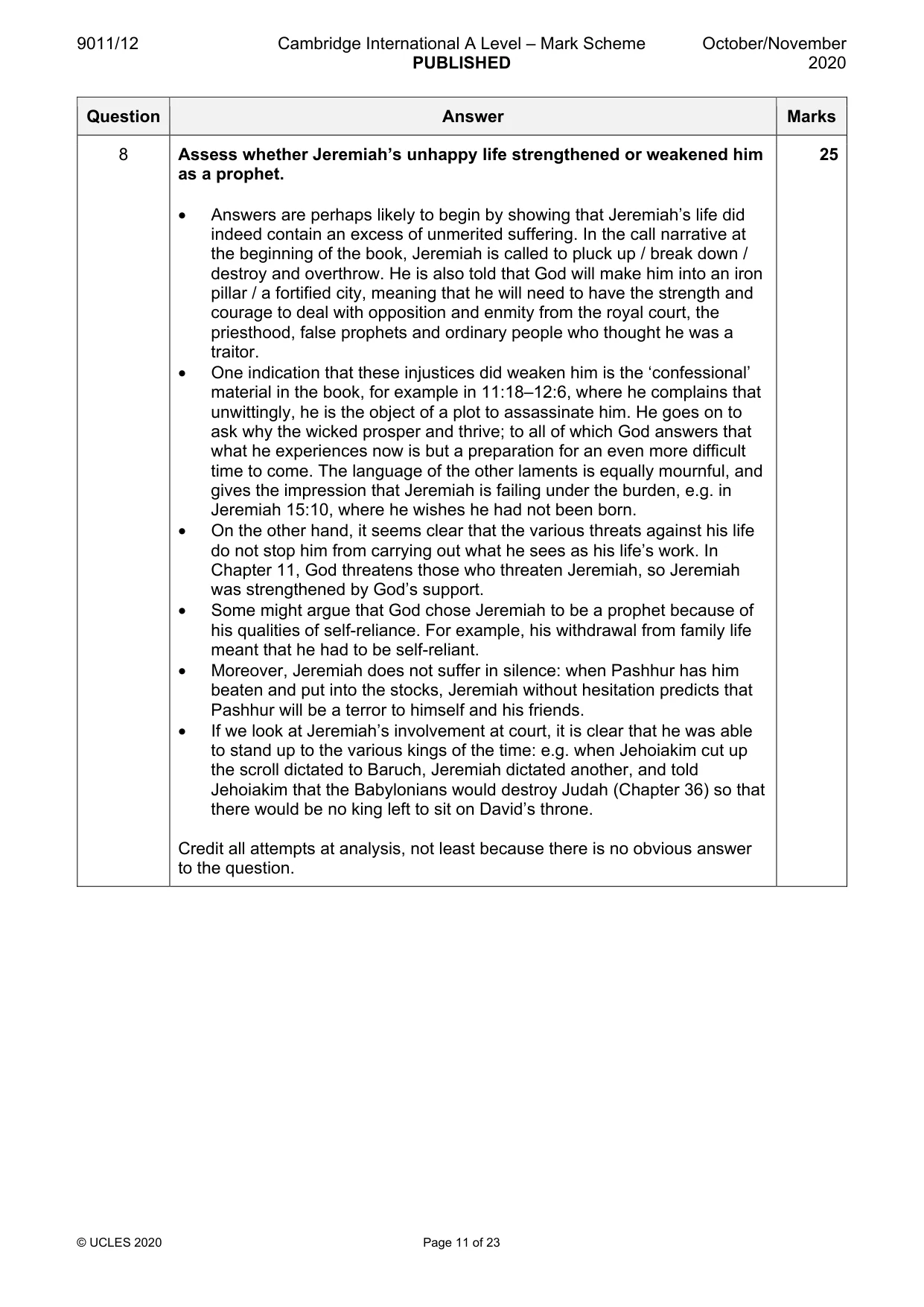
9011/12 Cambridge International A Level – Mark Scheme PUBLISHED October/November 2020 © UCLES 2020 Page 11 of 23 Question Answer Marks 8 Assess whether Jeremiah’s unhappy life strengthened or weakened him as a prophet. • Answers are perhaps likely to begin by showing that Jeremiah’s life did indeed contain an excess of unmerited suffering. In the call narrative at the beginning of the book, Jeremiah is called to pluck up / break down / destroy and overthrow. He is also told that God will make him into an iron pillar / a fortified city, meaning that he will need to have the strength and courage to deal with opposition and enmity from the royal court, the priesthood, false prophets and ordinary people who thought he was a traitor. • One indication that these injustices did weaken him is the ‘confessional’ material in the book, for example in 11:18–12:6, where he complains that unwittingly, he is the object of a plot to assassinate him. He goes on to ask why the wicked prosper and thrive; to all of which God answers that what he experiences now is but a preparation for an even more difficult time to come. The language of the other laments is equally mournful, and gives the impression that Jeremiah is failing under the burden, e.g. in Jeremiah 15:10, where he wishes he had not been born. • On the other hand, it seems clear that the various threats against his life do not stop him from carrying out what he sees as his life’s work. In Chapter 11, God threatens those who threaten Jeremiah, so Jeremiah was strengthened by God’s support. • Some might argue that God chose Jeremiah to be a prophet because of his qualities of self-reliance. For example, his withdrawal from family life meant that he had to be self-reliant. • Moreover, Jeremiah does not suffer in silence: when Pashhur has him beaten and put into the stocks, Jeremiah without hesitation predicts that Pashhur will be a terror to himself and his friends. • If we look at Jeremiah’s involvement at court, it is clear that he was able to stand up to the various kings of the time: e.g. when Jehoiakim cut up the scroll dictated to Baruch, Jeremiah dictated another, and told Jehoiakim that the Babylonians would destroy Judah (Chapter 36) so that there would be no king left to sit on David’s throne. Credit all attempts at analysis, not least because there is no obvious answer to the question. 25
Mark scheme, page 12
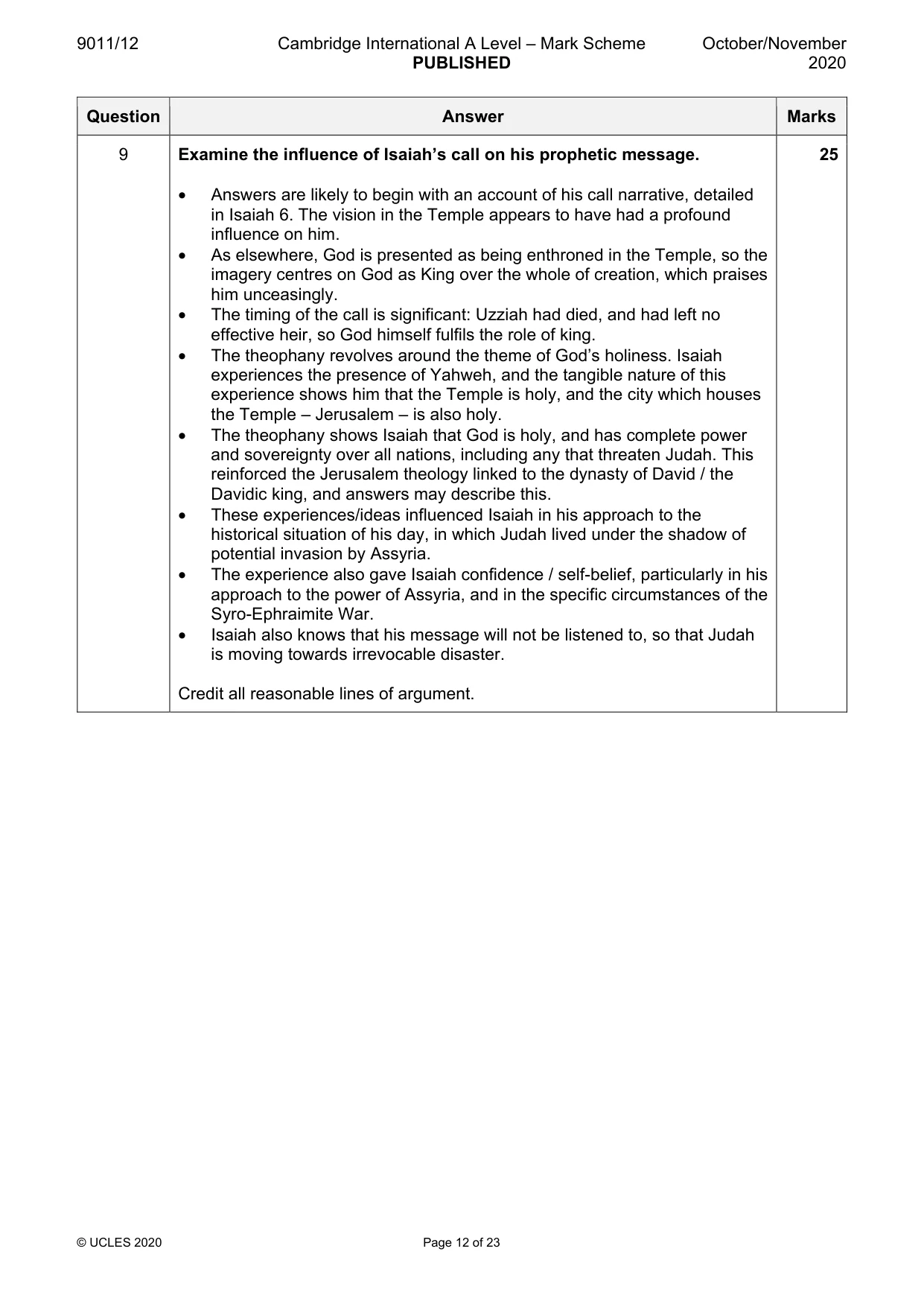
9011/12 Cambridge International A Level – Mark Scheme PUBLISHED October/November 2020 © UCLES 2020 Page 12 of 23 Question Answer Marks 9 Examine the influence of Isaiah’s call on his prophetic message. • Answers are likely to begin with an account of his call narrative, detailed in Isaiah 6. The vision in the Temple appears to have had a profound influence on him. • As elsewhere, God is presented as being enthroned in the Temple, so the imagery centres on God as King over the whole of creation, which praises him unceasingly. • The timing of the call is significant: Uzziah had died, and had left no effective heir, so God himself fulfils the role of king. • The theophany revolves around the theme of God’s holiness. Isaiah experiences the presence of Yahweh, and the tangible nature of this experience shows him that the Temple is holy, and the city which houses the Temple – Jerusalem – is also holy. • The theophany shows Isaiah that God is holy, and has complete power and sovereignty over all nations, including any that threaten Judah. This reinforced the Jerusalem theology linked to the dynasty of David / the Davidic king, and answers may describe this. • These experiences/ideas influenced Isaiah in his approach to the historical situation of his day, in which Judah lived under the shadow of potential invasion by Assyria. • The experience also gave Isaiah confidence / self-belief, particularly in his approach to the power of Assyria, and in the specific circumstances of the Syro-Ephraimite War. • Isaiah also knows that his message will not be listened to, so that Judah is moving towards irrevocable disaster. Credit all reasonable lines of argument. 25
Mark scheme, page 13
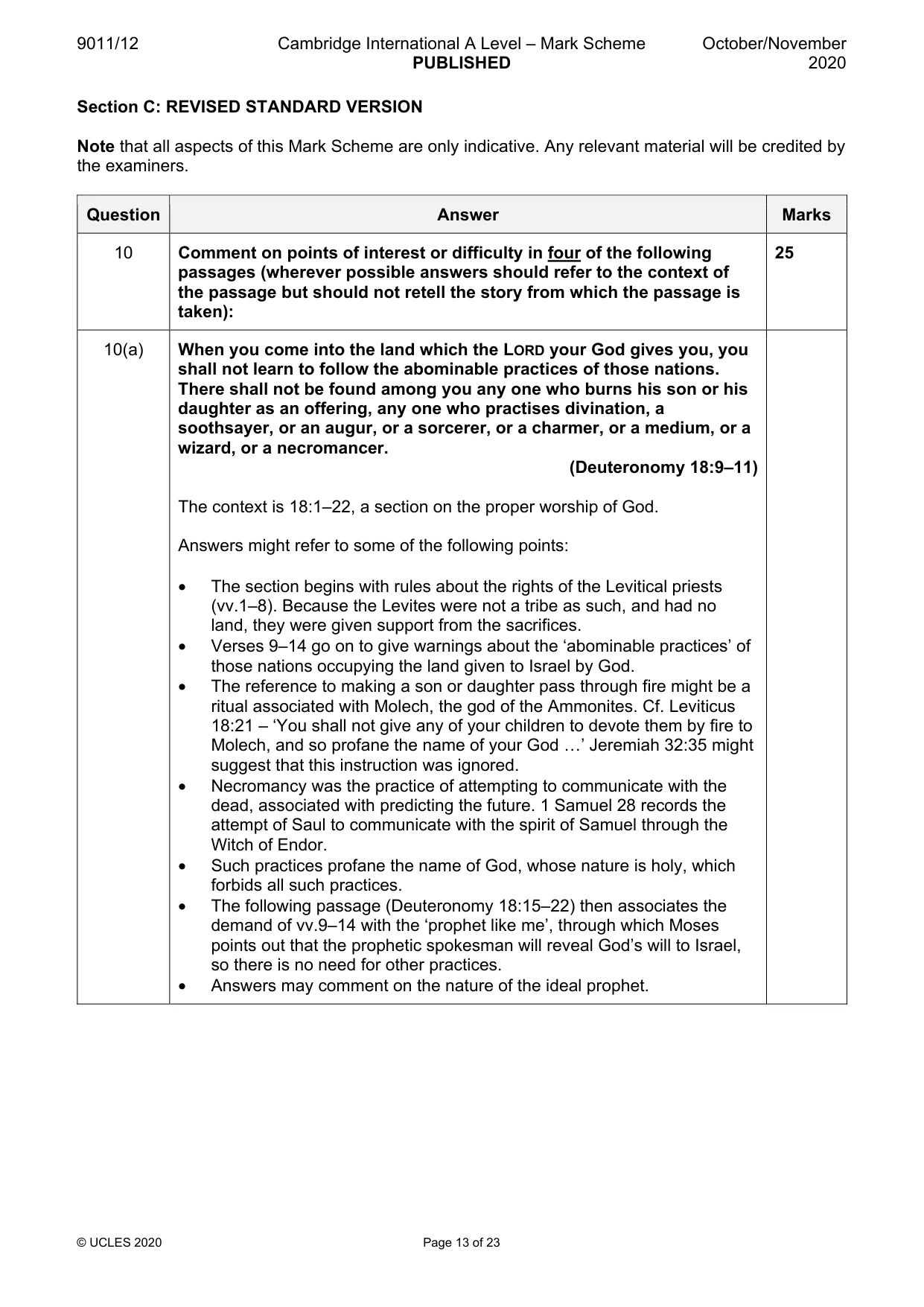
9011/12 Cambridge International A Level – Mark Scheme PUBLISHED October/November 2020 © UCLES 2020 Page 13 of 23 Section C: REVISED STANDARD VERSION Note that all aspects of this Mark Scheme are only indicative. Any relevant material will be credited by the examiners. Question Answer Marks 10 Comment on points of interest or difficulty in four of the following passages (wherever possible answers should refer to the context of the passage but should not retell the story from which the passage is taken): 25 10(a) When you come into the land which the LORD your God gives you, you shall not learn to follow the abominable practices of those nations. There shall not be found among you any one who burns his son or his daughter as an offering, any one who practises divination, a soothsayer, or an augur, or a sorcerer, or a charmer, or a medium, or a wizard, or a necromancer. (Deuteronomy 18:9–11) The context is 18:1–22, a section on the proper worship of God. Answers might refer to some of the following points: • The section begins with rules about the rights of the Levitical priests (vv.1–8). Because the Levites were not a tribe as such, and had no land, they were given support from the sacrifices. • Verses 9–14 go on to give warnings about the ‘abominable practices’ of those nations occupying the land given to Israel by God. • The reference to making a son or daughter pass through fire might be a ritual associated with Molech, the god of the Ammonites. Cf. Leviticus 18:21 – ‘You shall not give any of your children to devote them by fire to Molech, and so profane the name of your God …’ Jeremiah 32:35 might suggest that this instruction was ignored. • Necromancy was the practice of attempting to communicate with the dead, associated with predicting the future. 1 Samuel 28 records the attempt of Saul to communicate with the spirit of Samuel through the Witch of Endor. • Such practices profane the name of God, whose nature is holy, which forbids all such practices. • The following passage (Deuteronomy 18:15–22) then associates the demand of vv.9–14 with the ‘prophet like me’, through which Moses points out that the prophetic spokesman will reveal God’s will to Israel, so there is no need for other practices. • Answers may comment on the nature of the ideal prophet.
Mark scheme, page 14
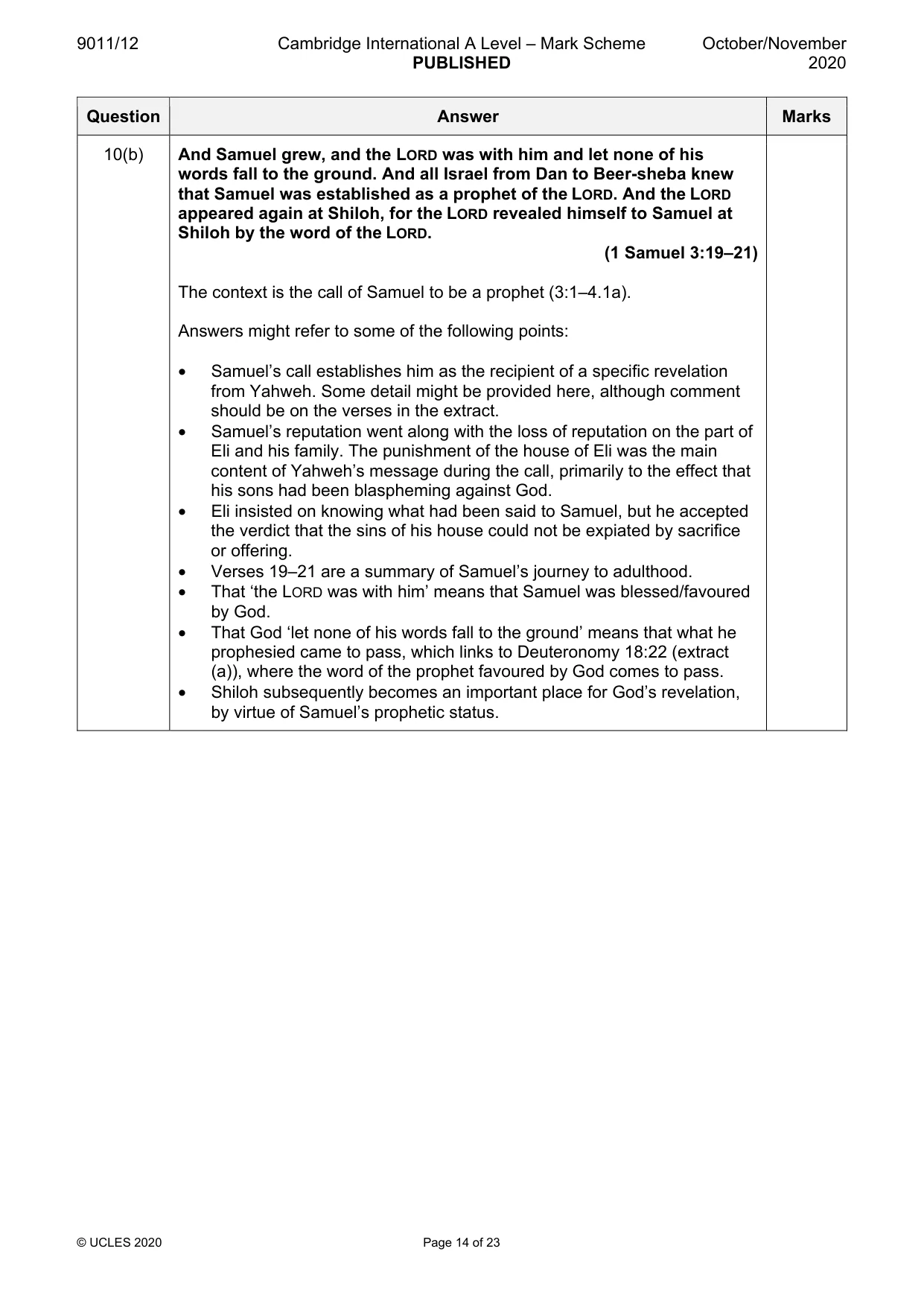
9011/12 Cambridge International A Level – Mark Scheme PUBLISHED October/November 2020 © UCLES 2020 Page 14 of 23 Question Answer Marks 10(b) And Samuel grew, and the LORD was with him and let none of his words fall to the ground. And all Israel from Dan to Beer-sheba knew that Samuel was established as a prophet of the LORD. And the LORD appeared again at Shiloh, for the LORD revealed himself to Samuel at Shiloh by the word of the LORD. (1 Samuel 3:19–21) The context is the call of Samuel to be a prophet (3:1–4.1a). Answers might refer to some of the following points: • Samuel’s call establishes him as the recipient of a specific revelation from Yahweh. Some detail might be provided here, although comment should be on the verses in the extract. • Samuel’s reputation went along with the loss of reputation on the part of Eli and his family. The punishment of the house of Eli was the main content of Yahweh’s message during the call, primarily to the effect that his sons had been blaspheming against God. • Eli insisted on knowing what had been said to Samuel, but he accepted the verdict that the sins of his house could not be expiated by sacrifice or offering. • Verses 19–21 are a summary of Samuel’s journey to adulthood. • That ‘the LORD was with him’ means that Samuel was blessed/favoured by God. • That God ‘let none of his words fall to the ground’ means that what he prophesied came to pass, which links to Deuteronomy 18:22 (extract (a)), where the word of the prophet favoured by God comes to pass. • Shiloh subsequently becomes an important place for God’s revelation, by virtue of Samuel’s prophetic status.
Mark scheme, page 15
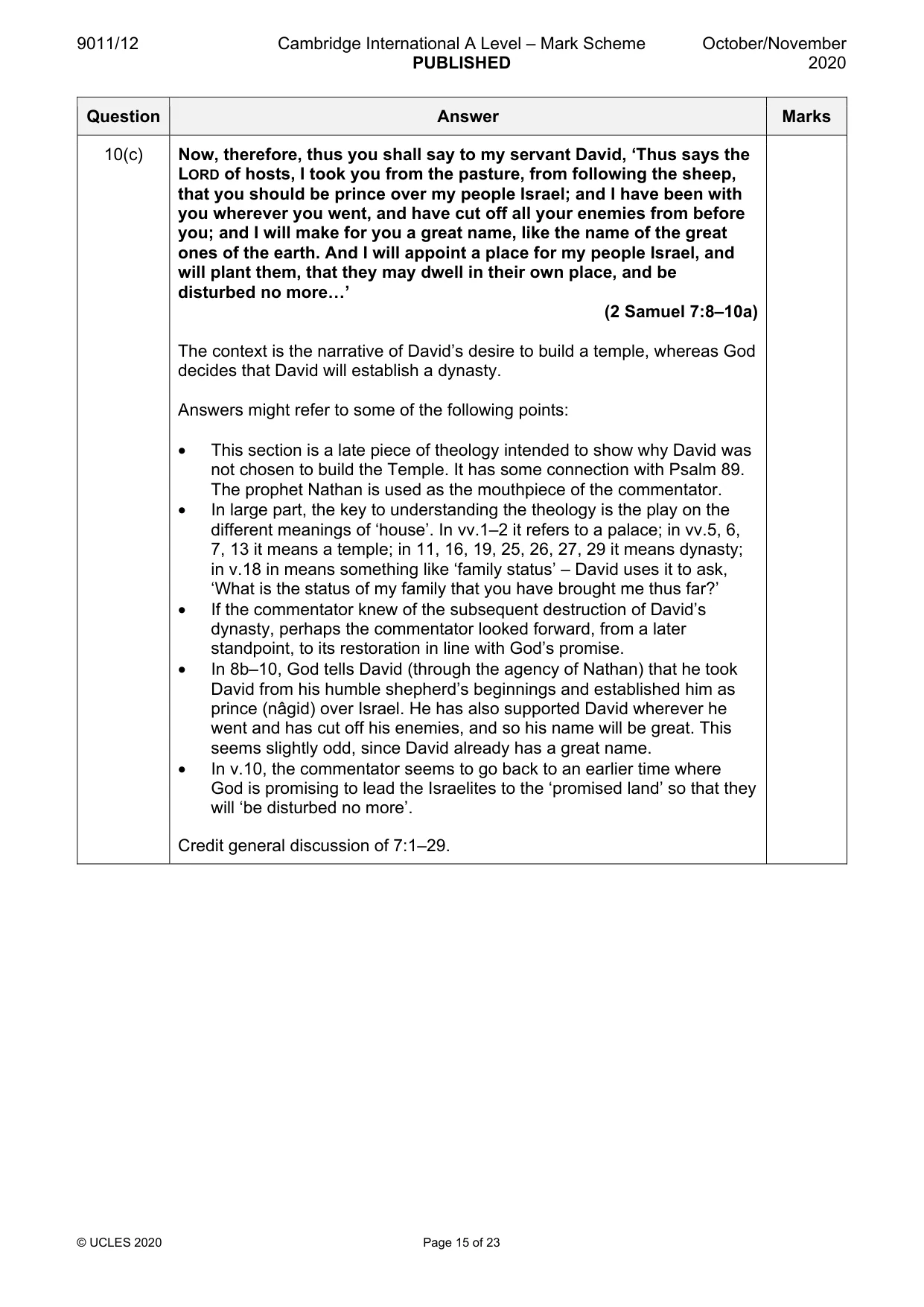
9011/12 Cambridge International A Level – Mark Scheme PUBLISHED October/November 2020 © UCLES 2020 Page 15 of 23 Question Answer Marks 10(c) Now, therefore, thus you shall say to my servant David, ‘Thus says the LORD of hosts, I took you from the pasture, from following the sheep, that you should be prince over my people Israel; and I have been with you wherever you went, and have cut off all your enemies from before you; and I will make for you a great name, like the name of the great ones of the earth. And I will appoint a place for my people Israel, and will plant them, that they may dwell in their own place, and be disturbed no more…’ (2 Samuel 7:8–10a) The context is the narrative of David’s desire to build a temple, whereas God decides that David will establish a dynasty. Answers might refer to some of the following points: • This section is a late piece of theology intended to show why David was not chosen to build the Temple. It has some connection with Psalm 89. The prophet Nathan is used as the mouthpiece of the commentator. • In large part, the key to understanding the theology is the play on the different meanings of ‘house’. In vv.1–2 it refers to a palace; in vv.5, 6, 7, 13 it means a temple; in 11, 16, 19, 25, 26, 27, 29 it means dynasty; in v.18 in means something like ‘family status’ – David uses it to ask, ‘What is the status of my family that you have brought me thus far?’ • If the commentator knew of the subsequent destruction of David’s dynasty, perhaps the commentator looked forward, from a later standpoint, to its restoration in line with God’s promise. • In 8b–10, God tells David (through the agency of Nathan) that he took David from his humble shepherd’s beginnings and established him as prince (nâgid) over Israel. He has also supported David wherever he went and has cut off his enemies, and so his name will be great. This seems slightly odd, since David already has a great name. • In v.10, the commentator seems to go back to an earlier time where God is promising to lead the Israelites to the ‘promised land’ so that they will ‘be disturbed no more’. Credit general discussion of 7:1–29.
Mark scheme, page 16
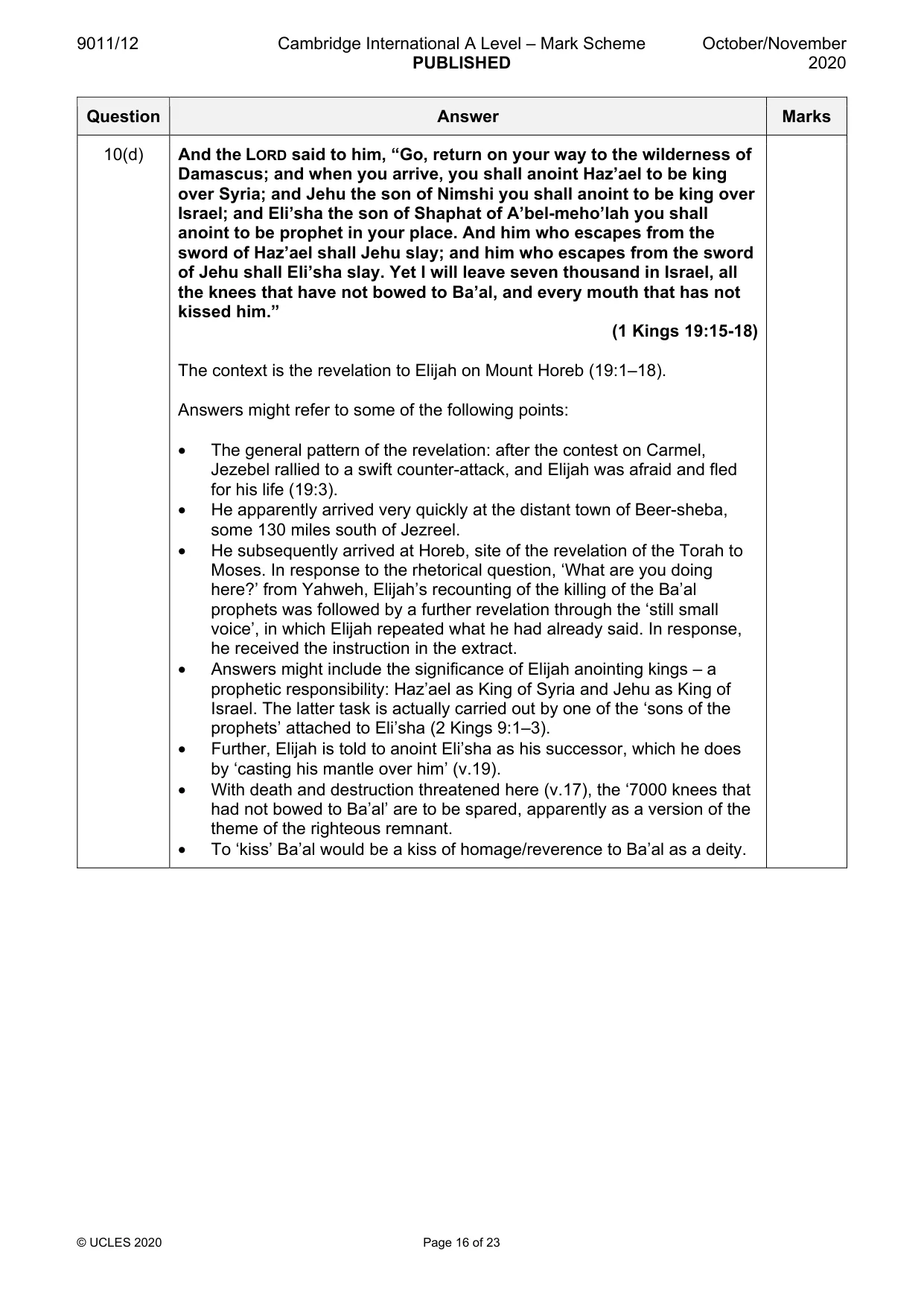
9011/12 Cambridge International A Level – Mark Scheme PUBLISHED October/November 2020 © UCLES 2020 Page 16 of 23 Question Answer Marks 10(d) And the LORD said to him, “Go, return on your way to the wilderness of Damascus; and when you arrive, you shall anoint Haz’ael to be king over Syria; and Jehu the son of Nimshi you shall anoint to be king over Israel; and Eli’sha the son of Shaphat of A’bel-meho’lah you shall anoint to be prophet in your place. And him who escapes from the sword of Haz’ael shall Jehu slay; and him who escapes from the sword of Jehu shall Eli’sha slay. Yet I will leave seven thousand in Israel, all the knees that have not bowed to Ba’al, and every mouth that has not kissed him.” (1 Kings 19:15-18) The context is the revelation to Elijah on Mount Horeb (19:1–18). Answers might refer to some of the following points: • The general pattern of the revelation: after the contest on Carmel, Jezebel rallied to a swift counter-attack, and Elijah was afraid and fled for his life (19:3). • He apparently arrived very quickly at the distant town of Beer-sheba, some 130 miles south of Jezreel. • He subsequently arrived at Horeb, site of the revelation of the Torah to Moses. In response to the rhetorical question, ‘What are you doing here?’ from Yahweh, Elijah’s recounting of the killing of the Ba’al prophets was followed by a further revelation through the ‘still small voice’, in which Elijah repeated what he had already said. In response, he received the instruction in the extract. • Answers might include the significance of Elijah anointing kings – a prophetic responsibility: Haz’ael as King of Syria and Jehu as King of Israel. The latter task is actually carried out by one of the ‘sons of the prophets’ attached to Eli’sha (2 Kings 9:1–3). • Further, Elijah is told to anoint Eli’sha as his successor, which he does by ‘casting his mantle over him’ (v.19). • With death and destruction threatened here (v.17), the ‘7000 knees that had not bowed to Ba’al’ are to be spared, apparently as a version of the theme of the righteous remnant. • To ‘kiss’ Ba’al would be a kiss of homage/reverence to Ba’al as a deity.
Mark scheme, page 17
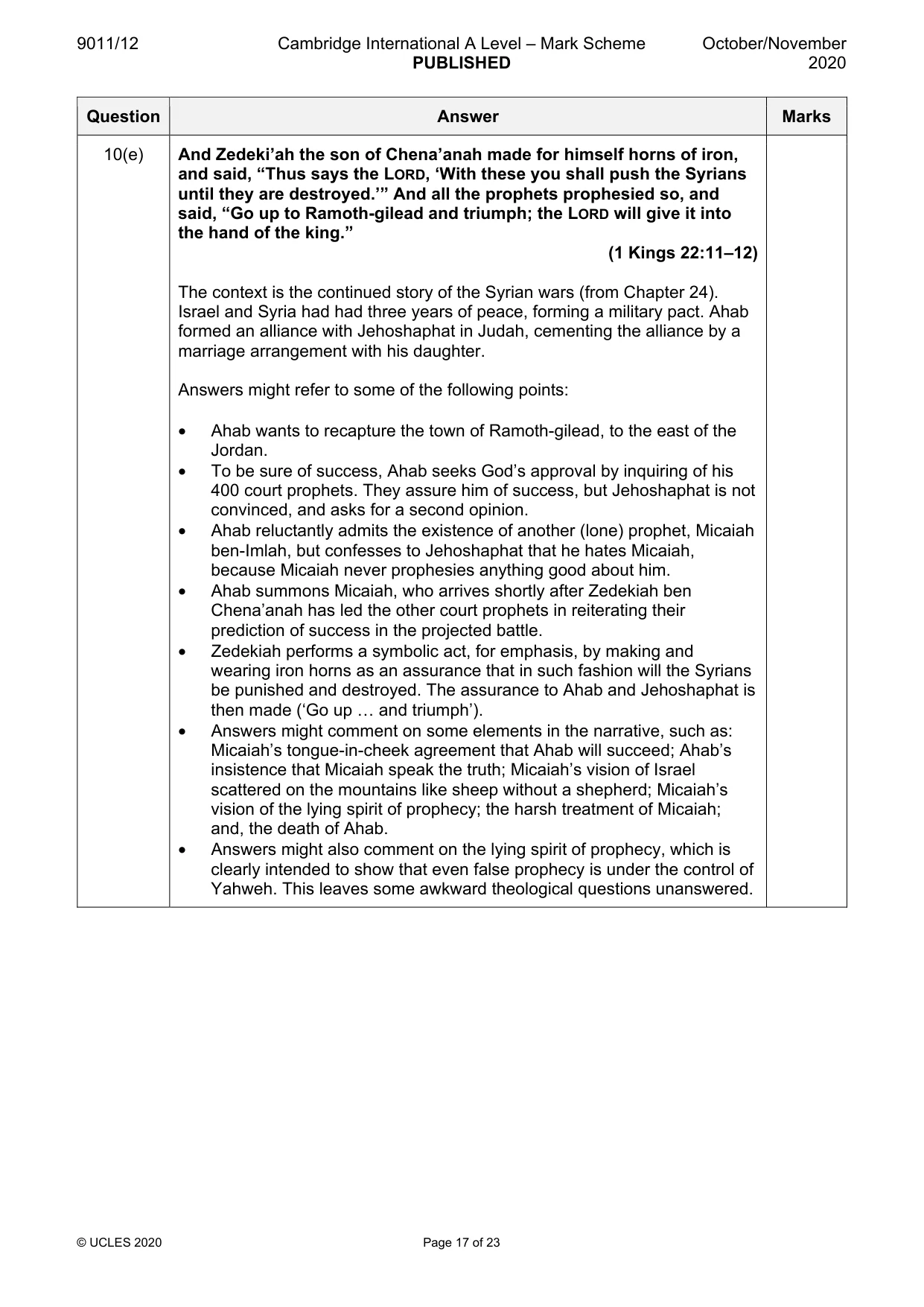
9011/12 Cambridge International A Level – Mark Scheme PUBLISHED October/November 2020 © UCLES 2020 Page 17 of 23 Question Answer Marks 10(e) And Zedeki’ah the son of Chena’anah made for himself horns of iron, and said, “Thus says the LORD, ‘With these you shall push the Syrians until they are destroyed.’” And all the prophets prophesied so, and said, “Go up to Ramoth-gilead and triumph; the LORD will give it into the hand of the king.” (1 Kings 22:11–12) The context is the continued story of the Syrian wars (from Chapter 24). Israel and Syria had had three years of peace, forming a military pact. Ahab formed an alliance with Jehoshaphat in Judah, cementing the alliance by a marriage arrangement with his daughter. Answers might refer to some of the following points: • Ahab wants to recapture the town of Ramoth-gilead, to the east of the Jordan. • To be sure of success, Ahab seeks God’s approval by inquiring of his 400 court prophets. They assure him of success, but Jehoshaphat is not convinced, and asks for a second opinion. • Ahab reluctantly admits the existence of another (lone) prophet, Micaiah ben-Imlah, but confesses to Jehoshaphat that he hates Micaiah, because Micaiah never prophesies anything good about him. • Ahab summons Micaiah, who arrives shortly after Zedekiah ben Chena’anah has led the other court prophets in reiterating their prediction of success in the projected battle. • Zedekiah performs a symbolic act, for emphasis, by making and wearing iron horns as an assurance that in such fashion will the Syrians be punished and destroyed. The assurance to Ahab and Jehoshaphat is then made (‘Go up … and triumph’). • Answers might comment on some elements in the narrative, such as: Micaiah’s tongue-in-cheek agreement that Ahab will succeed; Ahab’s insistence that Micaiah speak the truth; Micaiah’s vision of Israel scattered on the mountains like sheep without a shepherd; Micaiah’s vision of the lying spirit of prophecy; the harsh treatment of Micaiah; and, the death of Ahab. • Answers might also comment on the lying spirit of prophecy, which is clearly intended to show that even false prophecy is under the control of Yahweh. This leaves some awkward theological questions unanswered.
Mark scheme, page 18
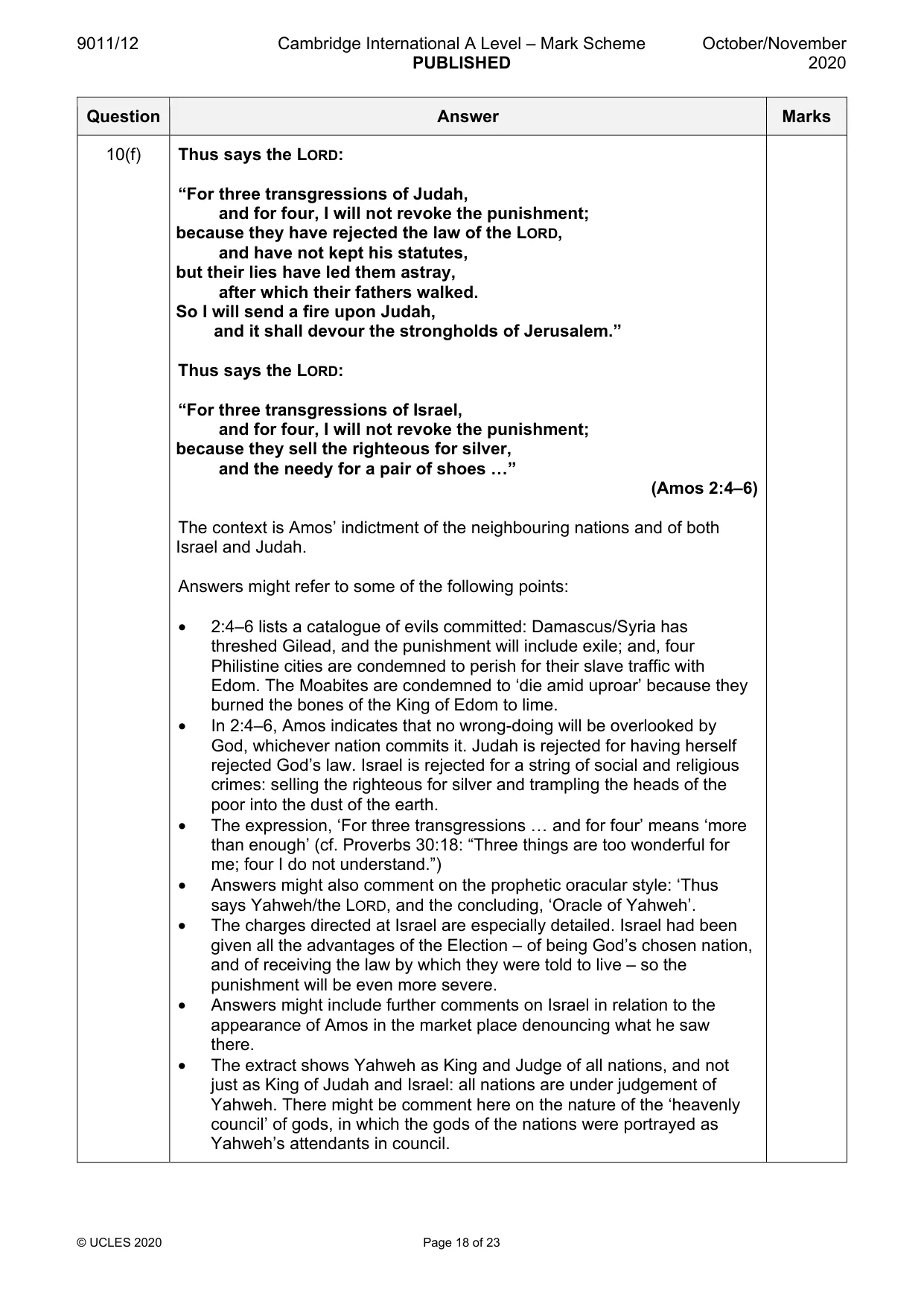
9011/12 Cambridge International A Level – Mark Scheme PUBLISHED October/November 2020 © UCLES 2020 Page 18 of 23 Question Answer Marks 10(f) Thus says the LORD: “For three transgressions of Judah, and for four, I will not revoke the punishment; because they have rejected the law of the LORD, and have not kept his statutes, but their lies have led them astray, after which their fathers walked. So I will send a fire upon Judah, and it shall devour the strongholds of Jerusalem.” Thus says the LORD: “For three transgressions of Israel, and for four, I will not revoke the punishment; because they sell the righteous for silver, and the needy for a pair of shoes …” (Amos 2:4–6) The context is Amos’ indictment of the neighbouring nations and of both Israel and Judah. Answers might refer to some of the following points: • 2:4–6 lists a catalogue of evils committed: Damascus/Syria has threshed Gilead, and the punishment will include exile; and, four Philistine cities are condemned to perish for their slave traffic with Edom. The Moabites are condemned to ‘die amid uproar’ because they burned the bones of the King of Edom to lime. • In 2:4–6, Amos indicates that no wrong-doing will be overlooked by God, whichever nation commits it. Judah is rejected for having herself rejected God’s law. Israel is rejected for a string of social and religious crimes: selling the righteous for silver and trampling the heads of the poor into the dust of the earth. • The expression, ‘For three transgressions … and for four’ means ‘more than enough’ (cf. Proverbs 30:18: “Three things are too wonderful for me; four I do not understand.”) • Answers might also comment on the prophetic oracular style: ‘Thus says Yahweh/the LORD, and the concluding, ‘Oracle of Yahweh’. • The charges directed at Israel are especially detailed. Israel had been given all the advantages of the Election – of being God’s chosen nation, and of receiving the law by which they were told to live – so the punishment will be even more severe. • Answers might include further comments on Israel in relation to the appearance of Amos in the market place denouncing what he saw there. • The extract shows Yahweh as King and Judge of all nations, and not just as King of Judah and Israel: all nations are under judgement of Yahweh. There might be comment here on the nature of the ‘heavenly council’ of gods, in which the gods of the nations were portrayed as Yahweh’s attendants in council.
Mark scheme, page 19
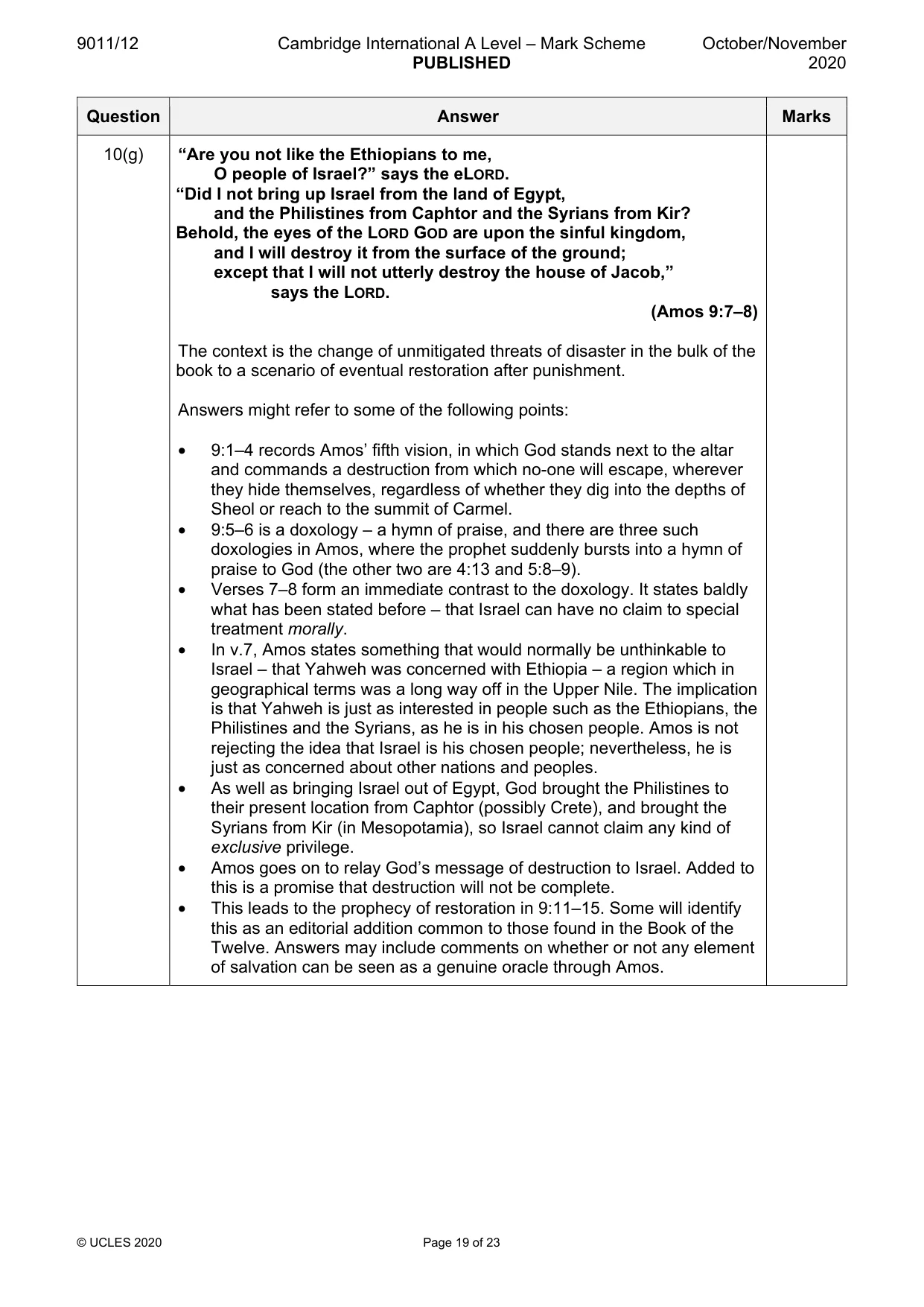
9011/12 Cambridge International A Level – Mark Scheme PUBLISHED October/November 2020 © UCLES 2020 Page 19 of 23 Question Answer Marks 10(g) “Are you not like the Ethiopians to me, O people of Israel?” says the eLORD. “Did I not bring up Israel from the land of Egypt, and the Philistines from Caphtor and the Syrians from Kir? Behold, the eyes of the LORD GOD are upon the sinful kingdom, and I will destroy it from the surface of the ground; except that I will not utterly destroy the house of Jacob,” says the LORD. (Amos 9:7–8) The context is the change of unmitigated threats of disaster in the bulk of the book to a scenario of eventual restoration after punishment. Answers might refer to some of the following points: • 9:1–4 records Amos’ fifth vision, in which God stands next to the altar and commands a destruction from which no-one will escape, wherever they hide themselves, regardless of whether they dig into the depths of Sheol or reach to the summit of Carmel. • 9:5–6 is a doxology – a hymn of praise, and there are three such doxologies in Amos, where the prophet suddenly bursts into a hymn of praise to God (the other two are 4:13 and 5:8–9). • Verses 7–8 form an immediate contrast to the doxology. It states baldly what has been stated before – that Israel can have no claim to special treatment morally. • In v.7, Amos states something that would normally be unthinkable to Israel – that Yahweh was concerned with Ethiopia – a region which in geographical terms was a long way off in the Upper Nile. The implication is that Yahweh is just as interested in people such as the Ethiopians, the Philistines and the Syrians, as he is in his chosen people. Amos is not rejecting the idea that Israel is his chosen people; nevertheless, he is just as concerned about other nations and peoples. • As well as bringing Israel out of Egypt, God brought the Philistines to their present location from Caphtor (possibly Crete), and brought the Syrians from Kir (in Mesopotamia), so Israel cannot claim any kind of exclusive privilege. • Amos goes on to relay God’s message of destruction to Israel. Added to this is a promise that destruction will not be complete. • This leads to the prophecy of restoration in 9:11–15. Some will identify this as an editorial addition common to those found in the Book of the Twelve. Answers may include comments on whether or not any element of salvation can be seen as a genuine oracle through Amos.
Mark scheme, page 20
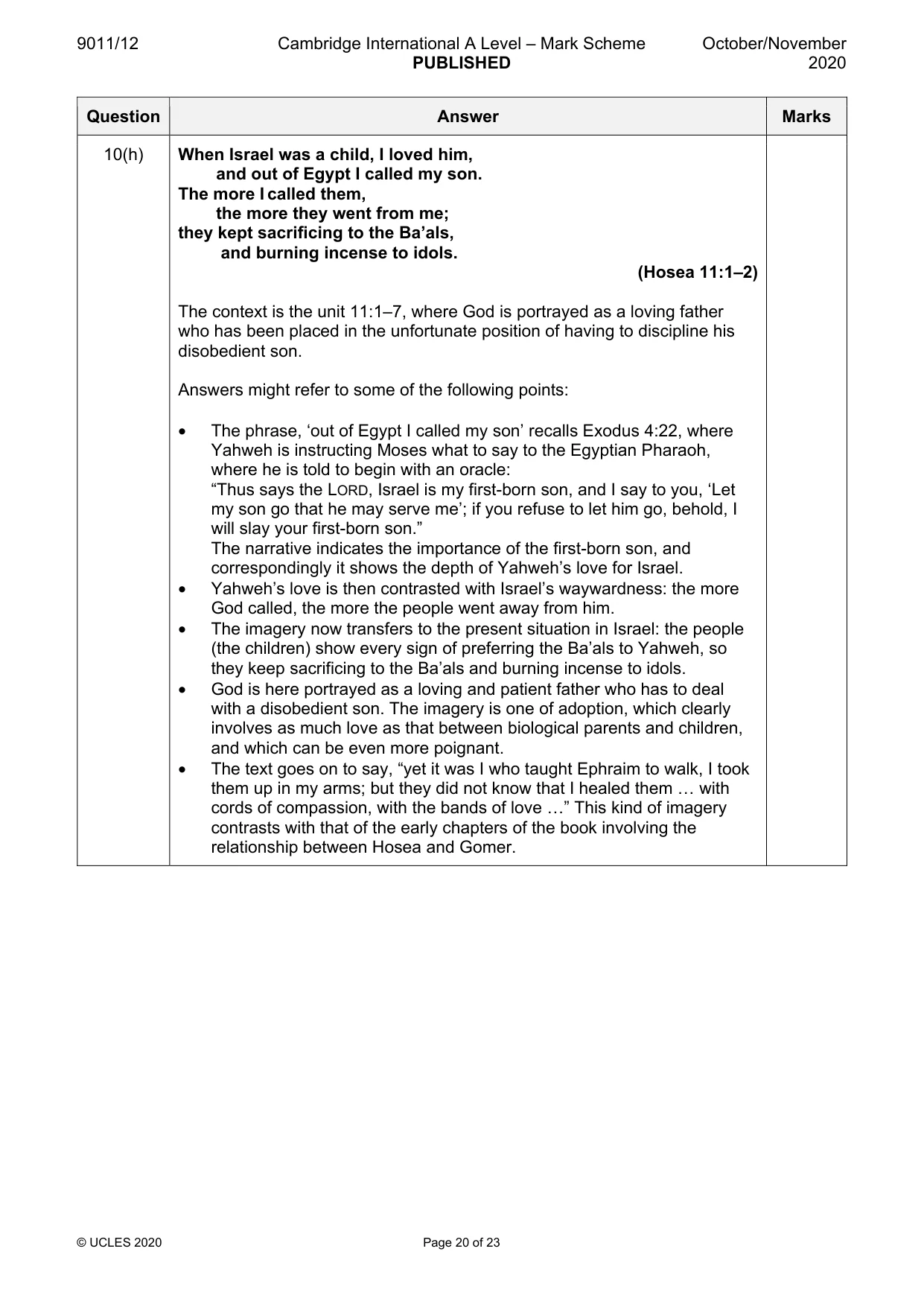
9011/12 Cambridge International A Level – Mark Scheme PUBLISHED October/November 2020 © UCLES 2020 Page 20 of 23 Question Answer Marks 10(h) When Israel was a child, I loved him, and out of Egypt I called my son. The more I called them, the more they went from me; they kept sacrificing to the Ba’als, and burning incense to idols. (Hosea 11:1–2) The context is the unit 11:1–7, where God is portrayed as a loving father who has been placed in the unfortunate position of having to discipline his disobedient son. Answers might refer to some of the following points: • The phrase, ‘out of Egypt I called my son’ recalls Exodus 4:22, where Yahweh is instructing Moses what to say to the Egyptian Pharaoh, where he is told to begin with an oracle: “Thus says the LORD, Israel is my first-born son, and I say to you, ‘Let my son go that he may serve me’; if you refuse to let him go, behold, I will slay your first-born son.” The narrative indicates the importance of the first-born son, and correspondingly it shows the depth of Yahweh’s love for Israel. • Yahweh’s love is then contrasted with Israel’s waywardness: the more God called, the more the people went away from him. • The imagery now transfers to the present situation in Israel: the people (the children) show every sign of preferring the Ba’als to Yahweh, so they keep sacrificing to the Ba’als and burning incense to idols. • God is here portrayed as a loving and patient father who has to deal with a disobedient son. The imagery is one of adoption, which clearly involves as much love as that between biological parents and children, and which can be even more poignant. • The text goes on to say, “yet it was I who taught Ephraim to walk, I took them up in my arms; but they did not know that I healed them … with cords of compassion, with the bands of love …” This kind of imagery contrasts with that of the early chapters of the book involving the relationship between Hosea and Gomer.
Mark scheme, page 21
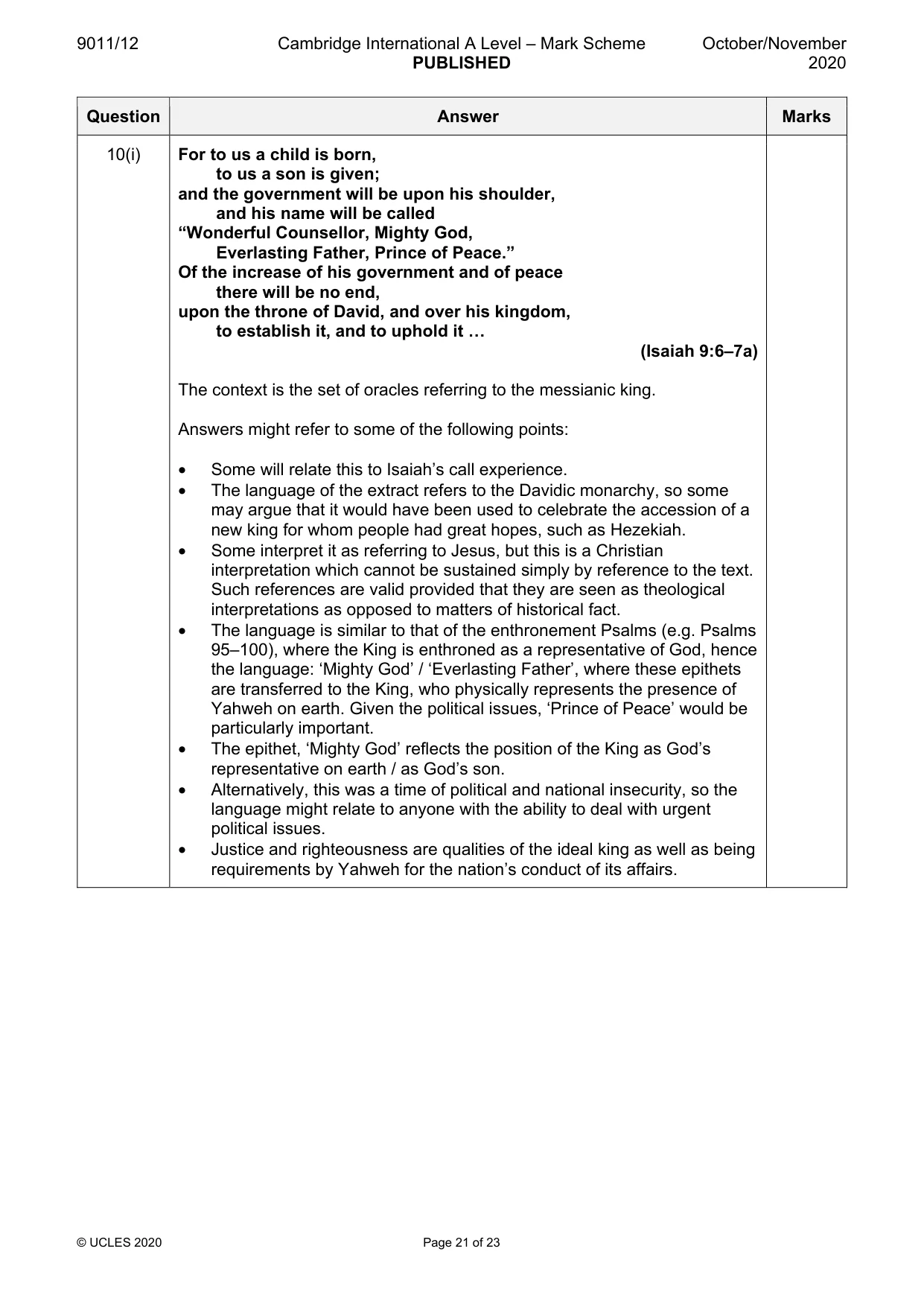
9011/12 Cambridge International A Level – Mark Scheme PUBLISHED October/November 2020 © UCLES 2020 Page 21 of 23 Question Answer Marks 10(i) For to us a child is born, to us a son is given; and the government will be upon his shoulder, and his name will be called “Wonderful Counsellor, Mighty God, Everlasting Father, Prince of Peace.” Of the increase of his government and of peace there will be no end, upon the throne of David, and over his kingdom, to establish it, and to uphold it … (Isaiah 9:6–7a) The context is the set of oracles referring to the messianic king. Answers might refer to some of the following points: • Some will relate this to Isaiah’s call experience. • The language of the extract refers to the Davidic monarchy, so some may argue that it would have been used to celebrate the accession of a new king for whom people had great hopes, such as Hezekiah. • Some interpret it as referring to Jesus, but this is a Christian interpretation which cannot be sustained simply by reference to the text. Such references are valid provided that they are seen as theological interpretations as opposed to matters of historical fact. • The language is similar to that of the enthronement Psalms (e.g. Psalms 95–100), where the King is enthroned as a representative of God, hence the language: ‘Mighty God’ / ‘Everlasting Father’, where these epithets are transferred to the King, who physically represents the presence of Yahweh on earth. Given the political issues, ‘Prince of Peace’ would be particularly important. • The epithet, ‘Mighty God’ reflects the position of the King as God’s representative on earth / as God’s son. • Alternatively, this was a time of political and national insecurity, so the language might relate to anyone with the ability to deal with urgent political issues. • Justice and righteousness are qualities of the ideal king as well as being requirements by Yahweh for the nation’s conduct of its affairs.
Mark scheme, page 22
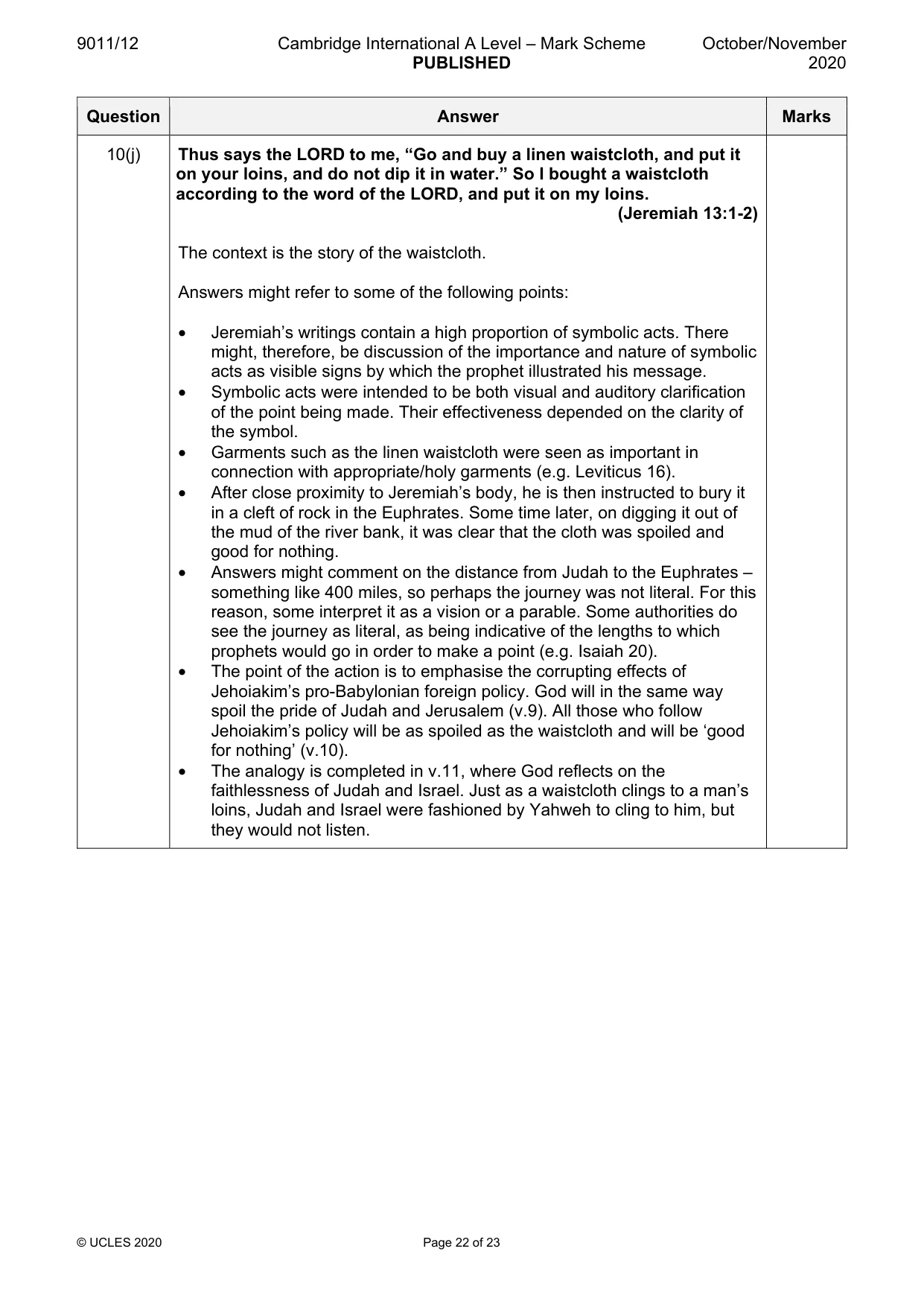
9011/12 Cambridge International A Level – Mark Scheme PUBLISHED October/November 2020 © UCLES 2020 Page 22 of 23 Question Answer Marks 10(j) Thus says the LORD to me, “Go and buy a linen waistcloth, and put it on your loins, and do not dip it in water.” So I bought a waistcloth according to the word of the LORD, and put it on my loins. (Jeremiah 13:1-2) The context is the story of the waistcloth. Answers might refer to some of the following points: • Jeremiah’s writings contain a high proportion of symbolic acts. There might, therefore, be discussion of the importance and nature of symbolic acts as visible signs by which the prophet illustrated his message. • Symbolic acts were intended to be both visual and auditory clarification of the point being made. Their effectiveness depended on the clarity of the symbol. • Garments such as the linen waistcloth were seen as important in connection with appropriate/holy garments (e.g. Leviticus 16). • After close proximity to Jeremiah’s body, he is then instructed to bury it in a cleft of rock in the Euphrates. Some time later, on digging it out of the mud of the river bank, it was clear that the cloth was spoiled and good for nothing. • Answers might comment on the distance from Judah to the Euphrates – something like 400 miles, so perhaps the journey was not literal. For this reason, some interpret it as a vision or a parable. Some authorities do see the journey as literal, as being indicative of the lengths to which prophets would go in order to make a point (e.g. Isaiah 20). • The point of the action is to emphasise the corrupting effects of Jehoiakim’s pro-Babylonian foreign policy. God will in the same way spoil the pride of Judah and Jerusalem (v.9). All those who follow Jehoiakim’s policy will be as spoiled as the waistcloth and will be ‘good for nothing’ (v.10). • The analogy is completed in v.11, where God reflects on the faithlessness of Judah and Israel. Just as a waistcloth clings to a man’s loins, Judah and Israel were fashioned by Yahweh to cling to him, but they would not listen.
Mark scheme, page 23
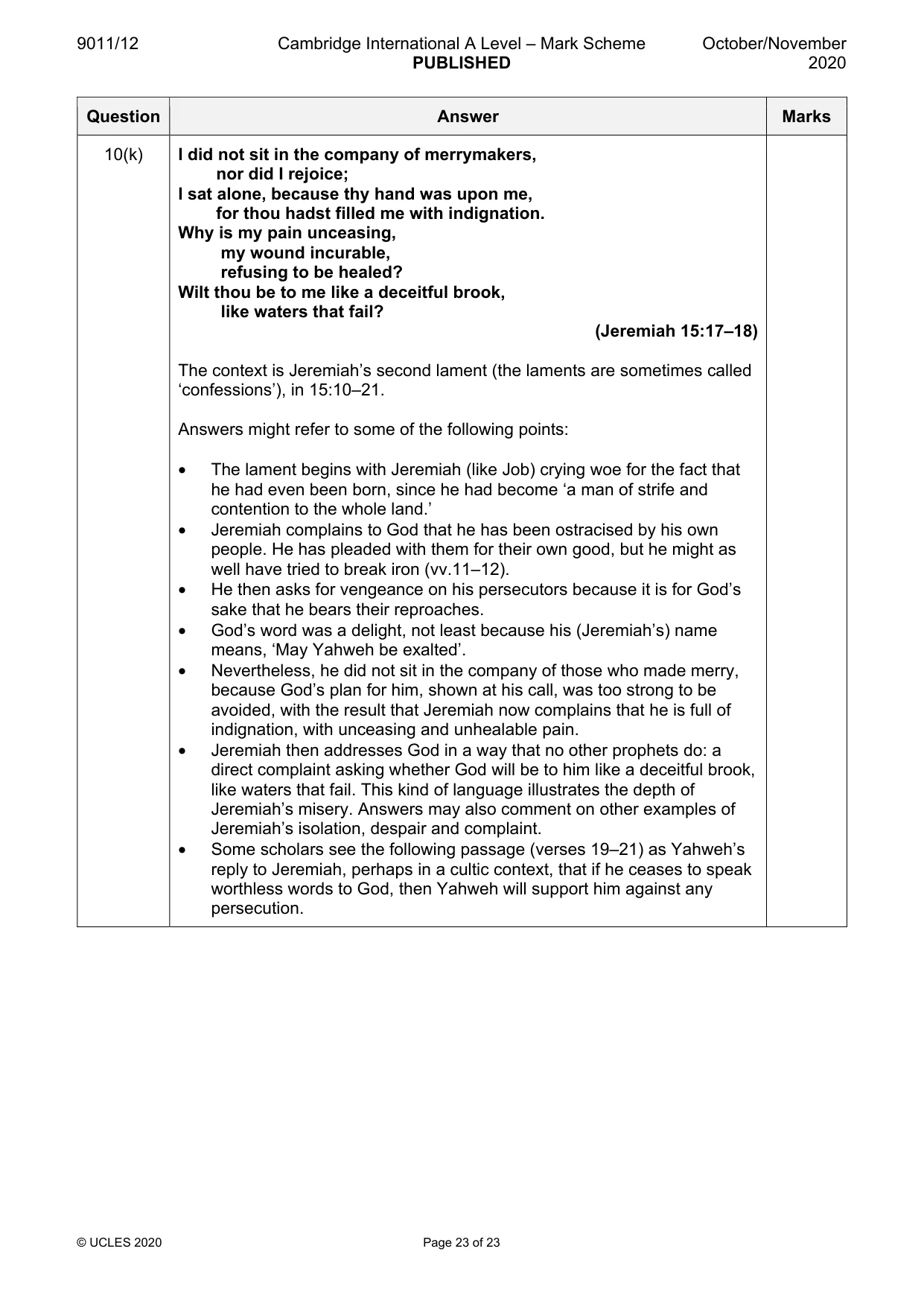
9011/12 Cambridge International A Level – Mark Scheme PUBLISHED October/November 2020 © UCLES 2020 Page 23 of 23 Question Answer Marks 10(k) I did not sit in the company of merrymakers, nor did I rejoice; I sat alone, because thy hand was upon me, for thou hadst filled me with indignation. Why is my pain unceasing, my wound incurable, refusing to be healed? Wilt thou be to me like a deceitful brook, like waters that fail? (Jeremiah 15:17–18) The context is Jeremiah’s second lament (the laments are sometimes called ‘confessions’), in 15:10–21. Answers might refer to some of the following points: • The lament begins with Jeremiah (like Job) crying woe for the fact that he had even been born, since he had become ‘a man of strife and contention to the whole land.’ • Jeremiah complains to God that he has been ostracised by his own people. He has pleaded with them for their own good, but he might as well have tried to break iron (vv.11–12). • He then asks for vengeance on his persecutors because it is for God’s sake that he bears their reproaches. • God’s word was a delight, not least because his (Jeremiah’s) name means, ‘May Yahweh be exalted’. • Nevertheless, he did not sit in the company of those who made merry, because God’s plan for him, shown at his call, was too strong to be avoided, with the result that Jeremiah now complains that he is full of indignation, with unceasing and unhealable pain. • Jeremiah then addresses God in a way that no other prophets do: a direct complaint asking whether God will be to him like a deceitful brook, like waters that fail. This kind of language illustrates the depth of Jeremiah’s misery. Answers may also comment on other examples of Jeremiah’s isolation, despair and complaint. • Some scholars see the following passage (verses 19–21) as Yahweh’s reply to Jeremiah, perhaps in a cultic context, that if he ceases to speak worthless words to God, then Yahweh will support him against any persecution.
What you needed in this session
Cambridge’s own grade thresholds for 2020 Oct/Nov, Paper 1 · Variant 2. A higher threshold means an easier paper — the bar moves with how the cohort did.