Cambridge A Level Computer Science 9618 — 2025 Oct/Nov Paper 3 · Variant 1
9618/31/O/N/25 · 11 questions · 75 marks · ≈84 min
The question paper and its mark scheme, free to read here and free to download. This is Cambridge’s own paper, exactly as it was sat.
Question paper12 pages






Mark scheme15 pages
Answers below. Sit the paper first if you are practising.

Questions as text
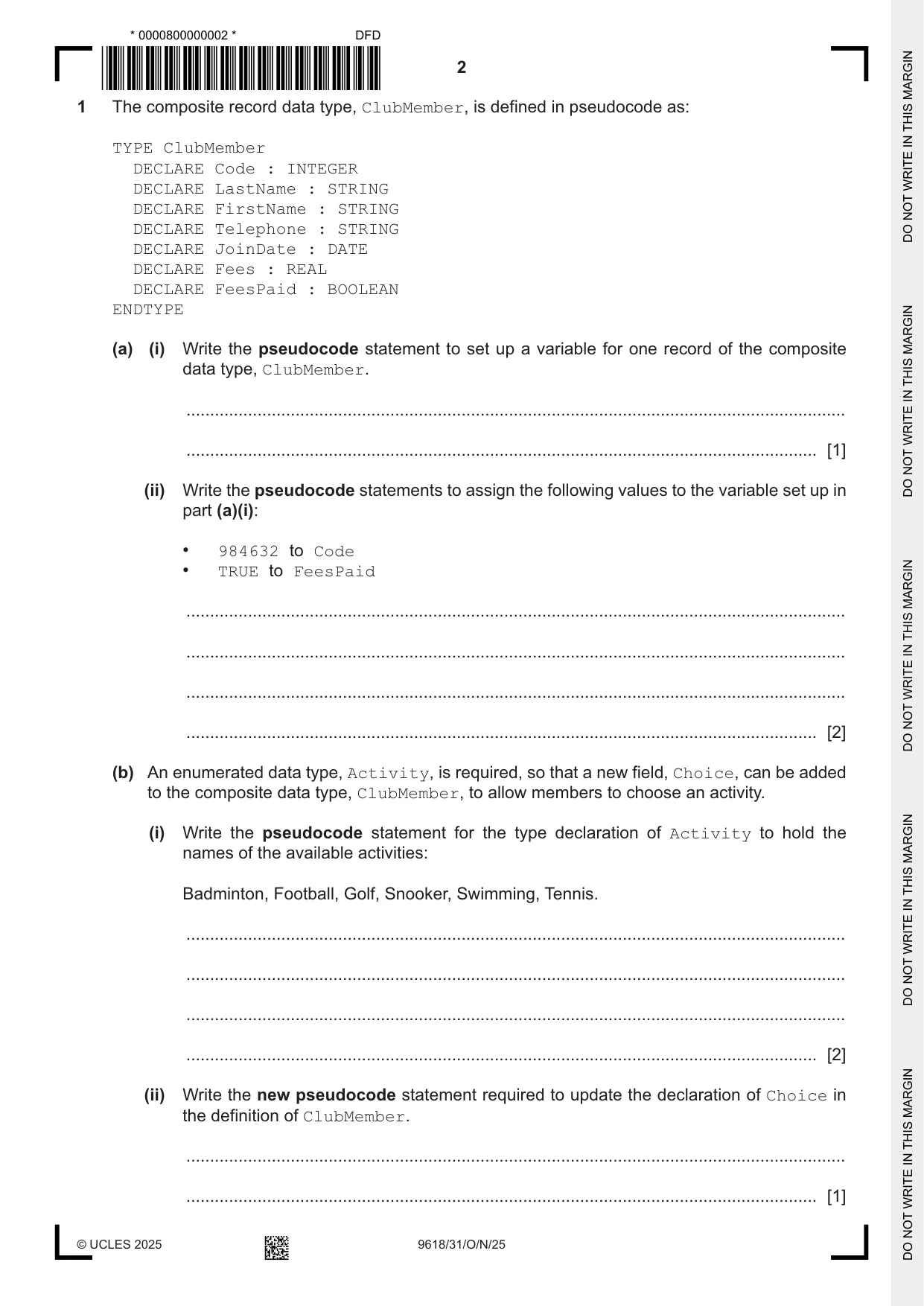
Q1 · The composite record data type, ClubMember, is defined in pseudocode as: TYPE ClubMember…
1 The composite record data type, ClubMember, is defined in pseudocode as: TYPE ClubMember DECLARE Code : INTEGER DECLARE LastName : STRING DECLARE FirstName : STRING DECLARE Telephone : STRING DECLARE JoinDate : DATE DECLARE Fees : REAL DECLARE FeesPaid : BOOLEAN ENDTYPE (a) (i) Write the pseudocode statement to set up a variable for one record of the composite data type, ClubMember. ........................................................................................................................................... ..................................................................................................................................... [1] (ii) Write the pseudocode statements to assign the following values to the variable set up in part (a)(i): • 984632 to Code • TRUE to FeesPaid ........................................................................................................................................... ........................................................................................................................................... ........................................................................................................................................... ..................................................................................................................................... [2] (b) An enumerated data type, Activity, is required, so that a new field, Choice, can be added to the composite data type, ClubMember, to allow members to choose an activity. (i) Write the pseudocode statement for the type declaration of Activity to hold the names of the available activities: Badminton, Football, Golf, Snooker, Swimming, Tennis. ........................................................................................................................................... ........................................................................................................................................... ........................................................................................................................................... ..................................................................................................................................... [2] (ii) Write the new pseudocode statement required to update the declaration of Choice in the definition of ClubMember. ........................................................................................................................................... ..................................................................................................................................... [1]
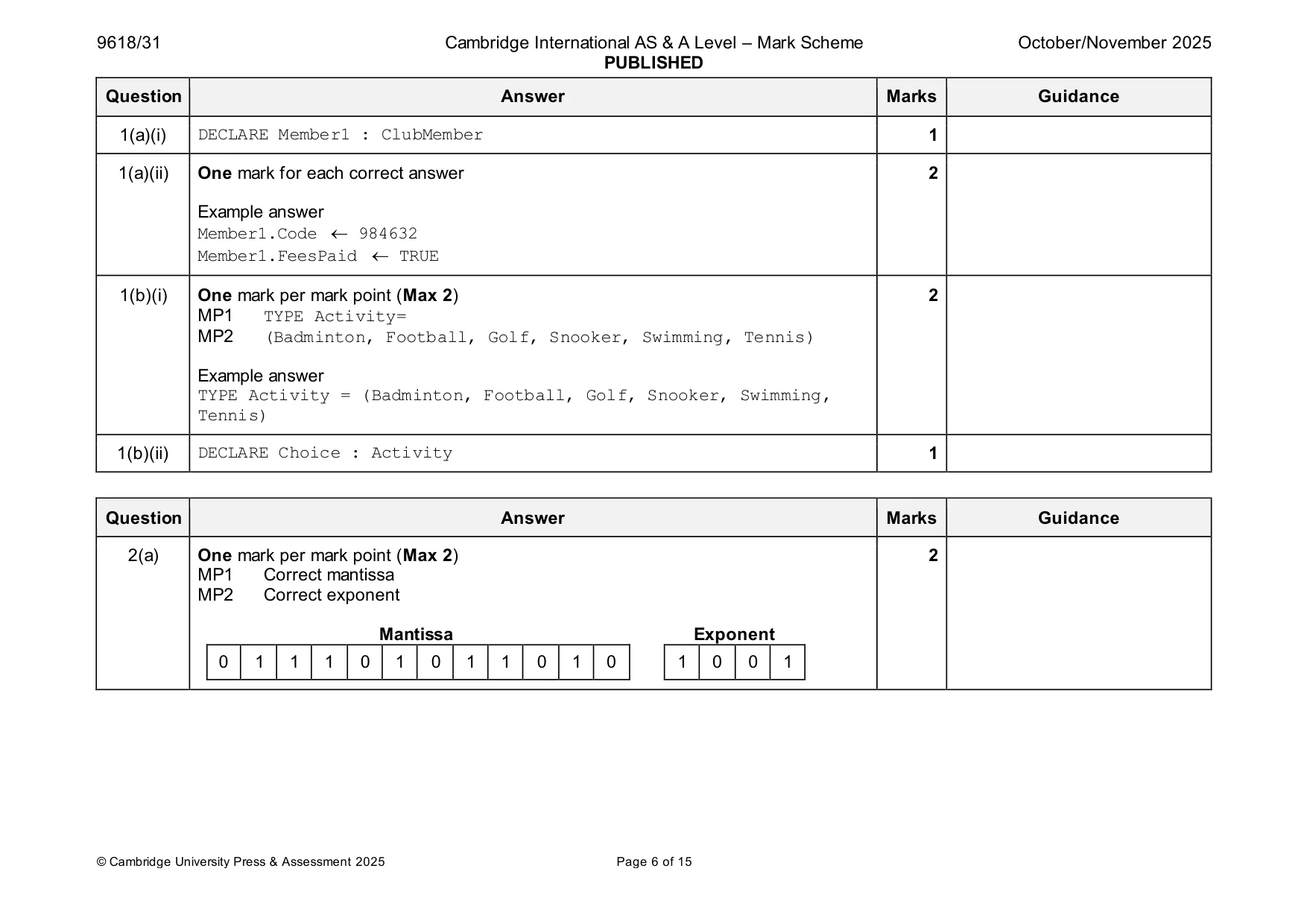
Mark scheme: Question Answer Marks Guidance 1(a)(i) DECLARE Member1 : ClubMember 1 1(a)(ii) One mark for each correct answer 2 Example answer Member1.Code 984632 Member1.FeesPaid TRUE 1(b)(i) One mark per mark point (Max 2) 2 MP1 TYPE Activity= MP2 (Badminton, Football, Golf, Snooker, Swimming, Tennis) Example answer TYPE Activity = (Badminton, Football, Golf, Snooker, Swimming, Tennis) 1(b)(ii) DECLARE Choice : Activity 1
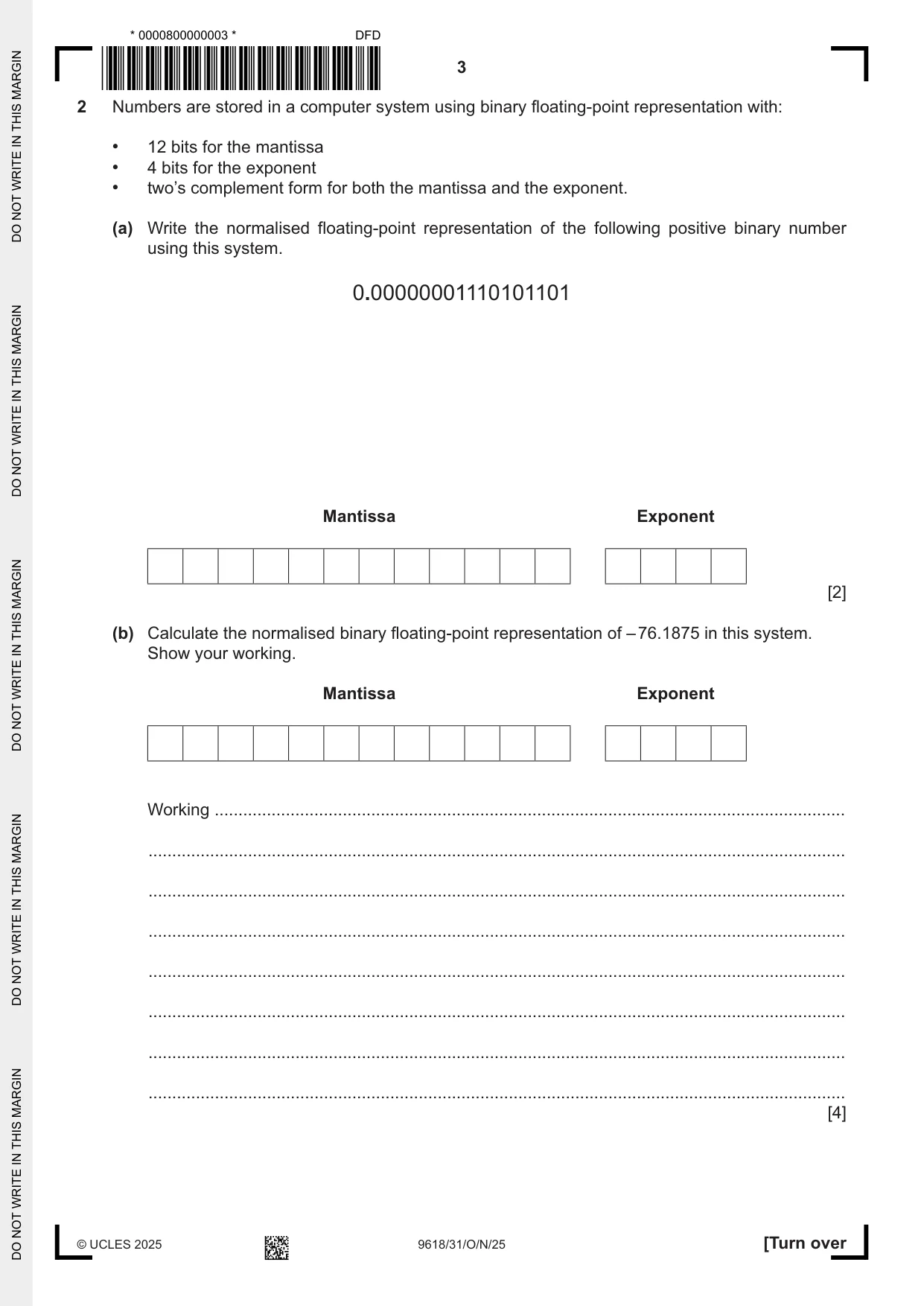
Q2 · Numbers are stored in a computer system using binary floating‑point representation with…
2 Numbers are stored in a computer system using binary floating‑point representation with: • 12 bits for the mantissa • 4 bits for the exponent • two’s complement form for both the mantissa and the exponent. (a) Write the normalised floating‑point representation of the following positive binary number using this system. 0.00000001110101101 Mantissa Exponent [2] (b) Calculate the normalised binary floating‑point representation of – 76.1875 in this system. Show your working. Mantissa Exponent Working ..................................................................................................................................... ................................................................................................................................................... ................................................................................................................................................... ................................................................................................................................................... ................................................................................................................................................... ................................................................................................................................................... ................................................................................................................................................... ................................................................................................................................................... [4]
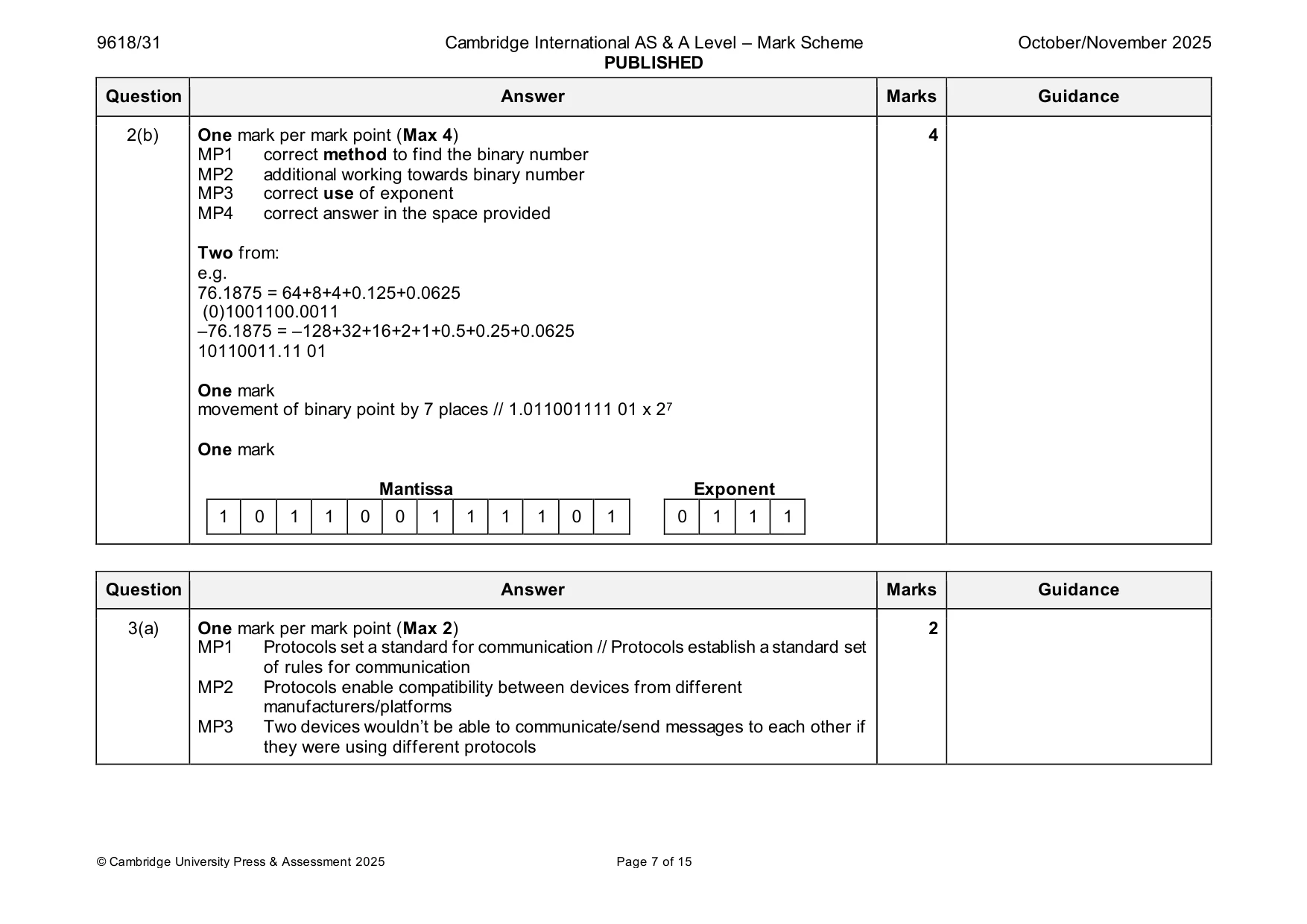
Mark scheme: 2(a) One mark per mark point (Max 2) 2 MP1 Correct mantissa MP2 Correct exponent Mantissa Exponent 0 1 1 1 0 1 0 1 1 0 1 0 1 0 0 1 2(b) One mark per mark point (Max 4) 4 MP1 correct method to find the binary number MP2 additional working towards binary number MP3 correct use of exponent MP4 correct answer in the space provided Two from: e.g. 76.1875 = 64+8+4+0.125+0.0625 (0)1001100.0011 –76.1875 = –128+32+16+2+1+0.5+0.25+0.0625 10110011.11 01 One mark movement of binary point by 7 places // 1.011001111 01 x 27 One mark Mantissa Exponent 1 0 1 1 0 0 1 1 1 1 0 1 0 1 1 1
Q3 · Explain why protocols are essential for communication between computer systems
3 (a) Explain why protocols are essential for communication between computer systems. ................................................................................................................................................... ................................................................................................................................................... ................................................................................................................................................... ............................................................................................................................................. [2] (b) POP3 is an email communication protocol. Identify and describe two other communication protocols that are used when sending or receiving emails. Protocol 1 .................................................................................................................................. Description ................................................................................................................................ ................................................................................................................................................... ................................................................................................................................................... Protocol 2 .................................................................................................................................. Description ................................................................................................................................ ................................................................................................................................................... ................................................................................................................................................... [4] (c) Describe two ways in which packet switching ensures a complete message is received when passing messages across a network. 1 ................................................................................................................................................ ................................................................................................................................................... ................................................................................................................................................... ................................................................................................................................................... 2 ................................................................................................................................................ ................................................................................................................................................... ................................................................................................................................................... ................................................................................................................................................... [4]
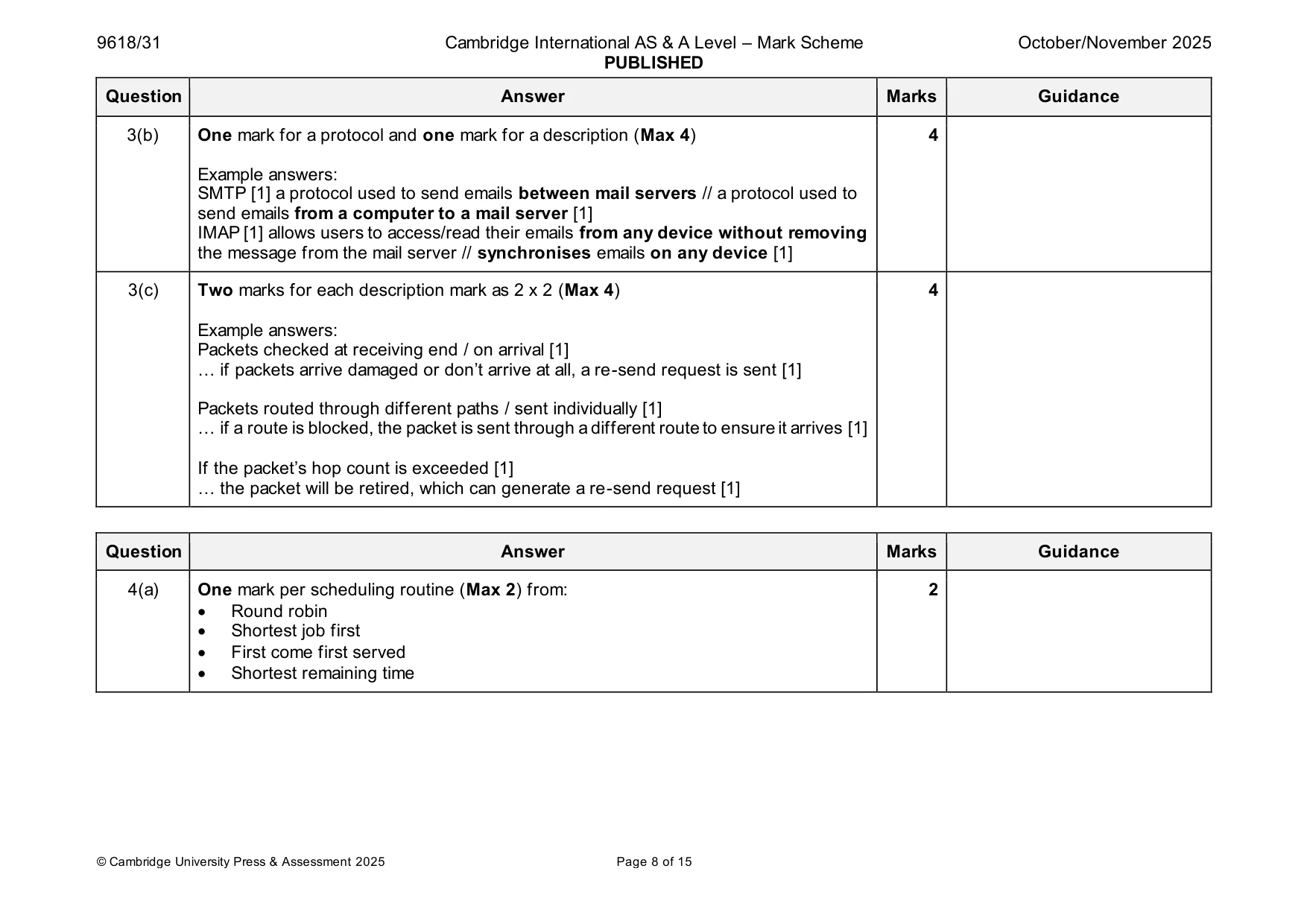
Mark scheme: 3(a) One mark per mark point (Max 2) 2 MP1 Protocols set a standard for communication // Protocols establish a standard set of rules for communication MP2 Protocols enable compatibility between devices from different manufacturers/platforms MP3 Two devices wouldn’t be able to communicate/send messages to each other if they were using different protocols 3(b) One mark for a protocol and one mark for a description (Max 4) 4 Example answers: SMTP [1] a protocol used to send emails between mail servers // a protocol used to send emails from a computer to a mail server [1] IMAP [1] allows users to access/read their emails from any device without removing the message from the mail server // synchronises emails on any device [1] 3(c) Two marks for each description mark as 2 x 2 (Max 4) 4 Example answers: Packets checked at receiving end / on arrival [1] … if packets arrive damaged or don’t arrive at all, a re-send request is sent [1] Packets routed through different paths / sent individually [1] … if a route is blocked, the packet is sent through a different route to ensure it arrives [1] If the packet’s hop count is exceeded [1] … the packet will be retired, which can generate a re-send request [1]
Q4 · A scheduling routine determines how processes are managed by the operating system
4 (a) A scheduling routine determines how processes are managed by the operating system. Identify two scheduling routines. 1 ................................................................................................................................................ 2 ................................................................................................................................................ [2] (b) Describe two ways in which the complexities of the computer hardware are hidden from the user. 1 ................................................................................................................................................ ................................................................................................................................................... ................................................................................................................................................... ................................................................................................................................................... 2 ................................................................................................................................................ ................................................................................................................................................... ................................................................................................................................................... ................................................................................................................................................... [4]
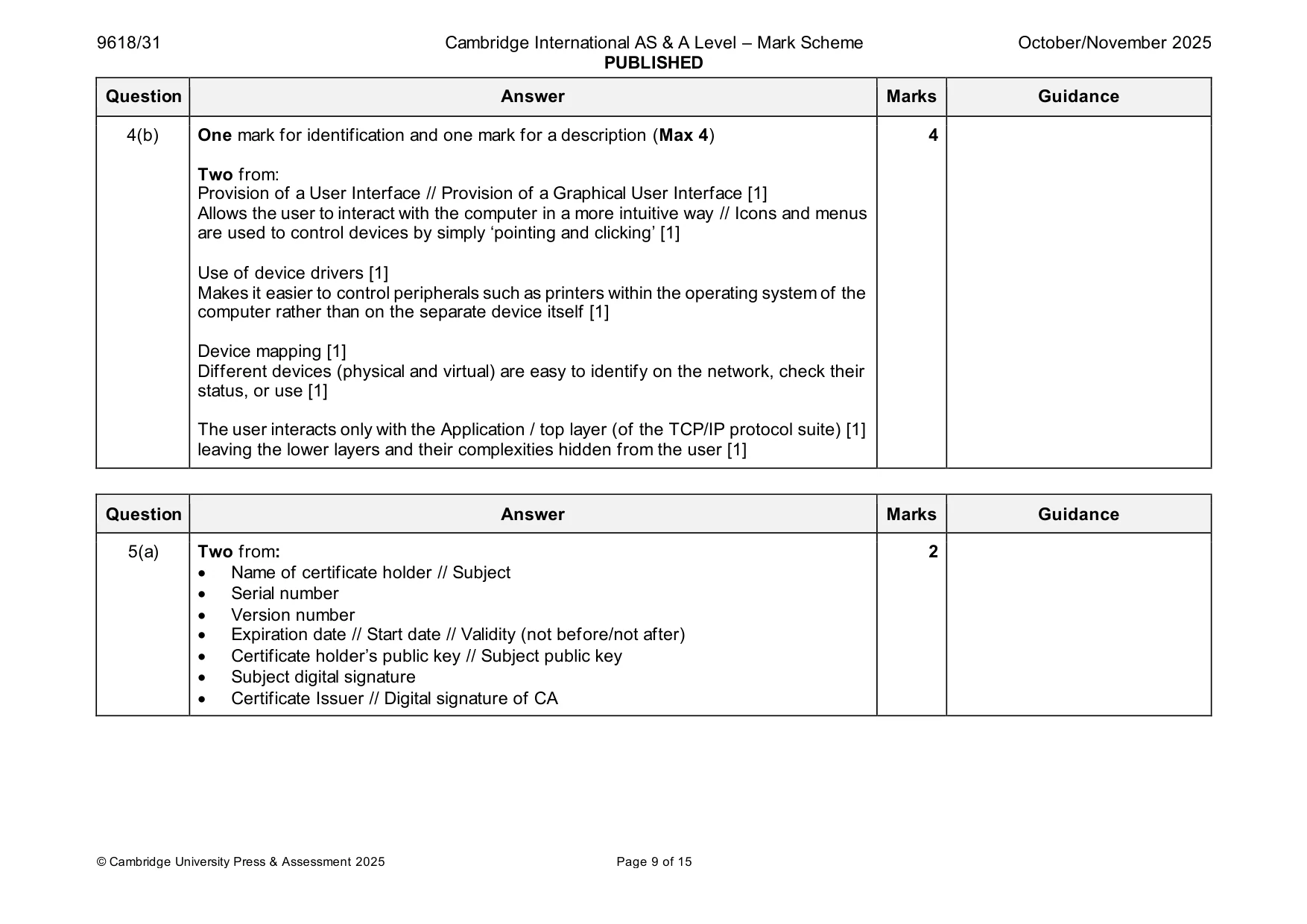
Mark scheme: 4(a) One mark per scheduling routine (Max 2) from: 2 • Round robin • Shortest job first • First come first served • Shortest remaining time 4(b) One mark for identification and one mark for a description (Max 4) 4 Two from: Provision of a User Interface // Provision of a Graphical User Interface [1] Allows the user to interact with the computer in a more intuitive way // Icons and menus are used to control devices by simply ‘pointing and clicking’ [1] Use of device drivers [1] Makes it easier to control peripherals such as printers within the operating system of the computer rather than on the separate device itself [1] Device mapping [1] Different devices (physical and virtual) are easy to identify on the network, check their status, or use [1] The user interacts only with the Application / top layer (of the TCP/IP protocol suite) [1] leaving the lower layers and their complexities hidden from the user [1]
Q5 · Identify two items commonly found within a digital certificate
5 (a) Identify two items commonly found within a digital certificate. 1 ................................................................................................................................................ ................................................................................................................................................... 2 ................................................................................................................................................ ................................................................................................................................................... [2] (b) Explain why a digital certificate is required to validate a digital signature. ................................................................................................................................................... ................................................................................................................................................... ................................................................................................................................................... ................................................................................................................................................... ................................................................................................................................................... ............................................................................................................................................. [3]
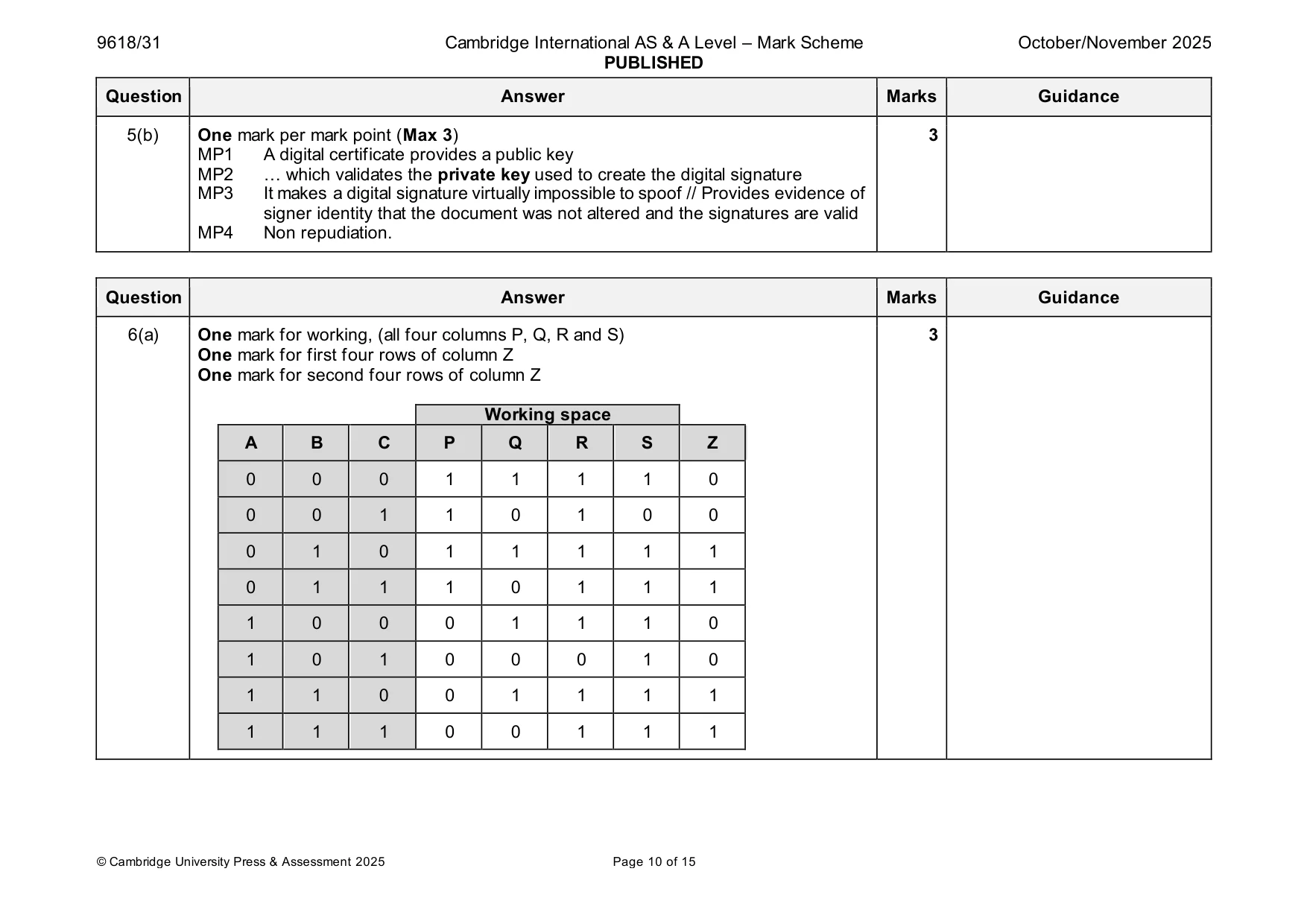
Mark scheme: 5(a) Two from: 2 • Name of certificate holder // Subject • Serial number • Version number • Expiration date // Start date // Validity (not before/not after) • Certificate holder’s public key // Subject public key • Subject digital signature • Certificate Issuer // Digital signature of CA 5(b) One mark per mark point (Max 3) 3 MP1 A digital certificate provides a public key MP2 … which validates the private key used to create the digital signature MP3 It makes a digital signature virtually impossible to spoof // Provides evidence of signer identity that the document was not altered and the signatures are valid MP4 Non repudiation.
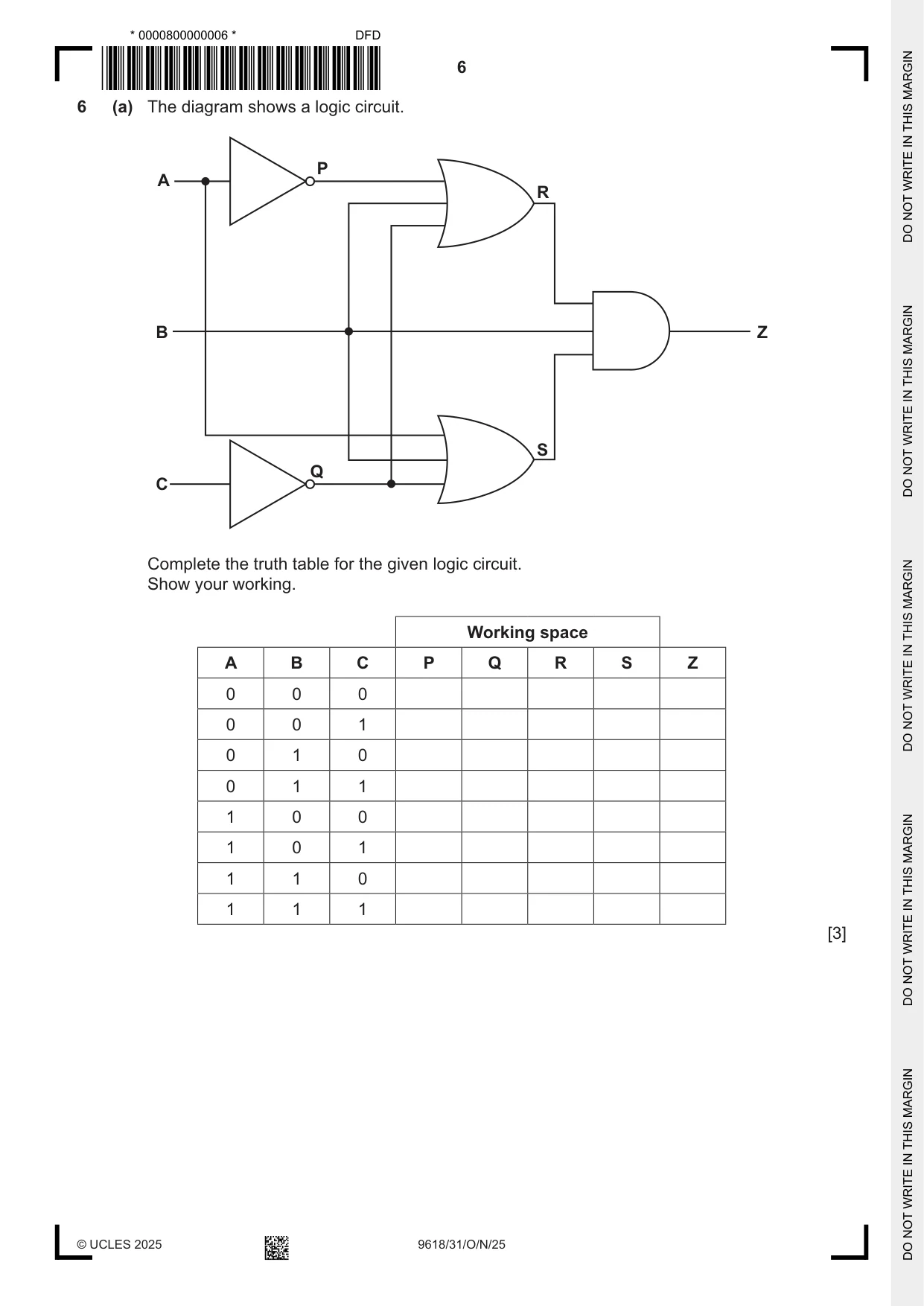
Q6 · The diagram shows a logic circuit
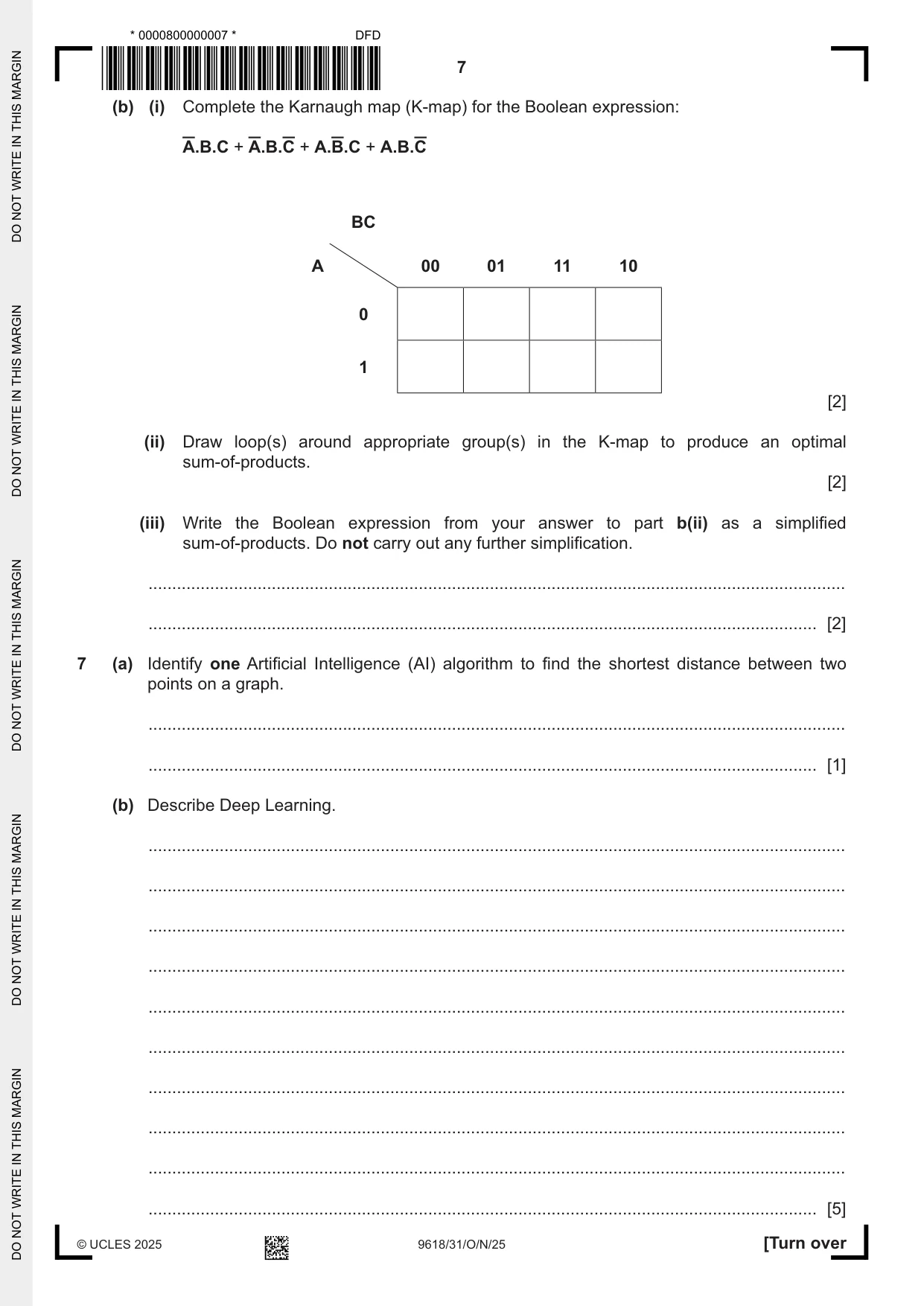
6 (a) The diagram shows a logic circuit. P A R B Z S Q C Complete the truth table for the given logic circuit. Show your working. Working space A B C P Q R S Z 0 0 0 0 0 1 0 1 0 0 1 1 1 0 0 1 0 1 1 1 0 1 1 1 [3] (b) (i) Complete the Karnaugh map (K‑map) for the Boolean expression: A.B.C + A.B.C + A.B.C + A.B.C BC A 00 01 11 10 0 1 [2] (ii) Draw loop(s) around appropriate group(s) in the K‑map to produce an optimal sum‑of‑products. [2] (iii) Write the Boolean expression from your answer to part b(ii) as a simplified sum‑of‑products. Do not carry out any further simplification. ................................................................................................................................................... ............................................................................................................................................. [2]
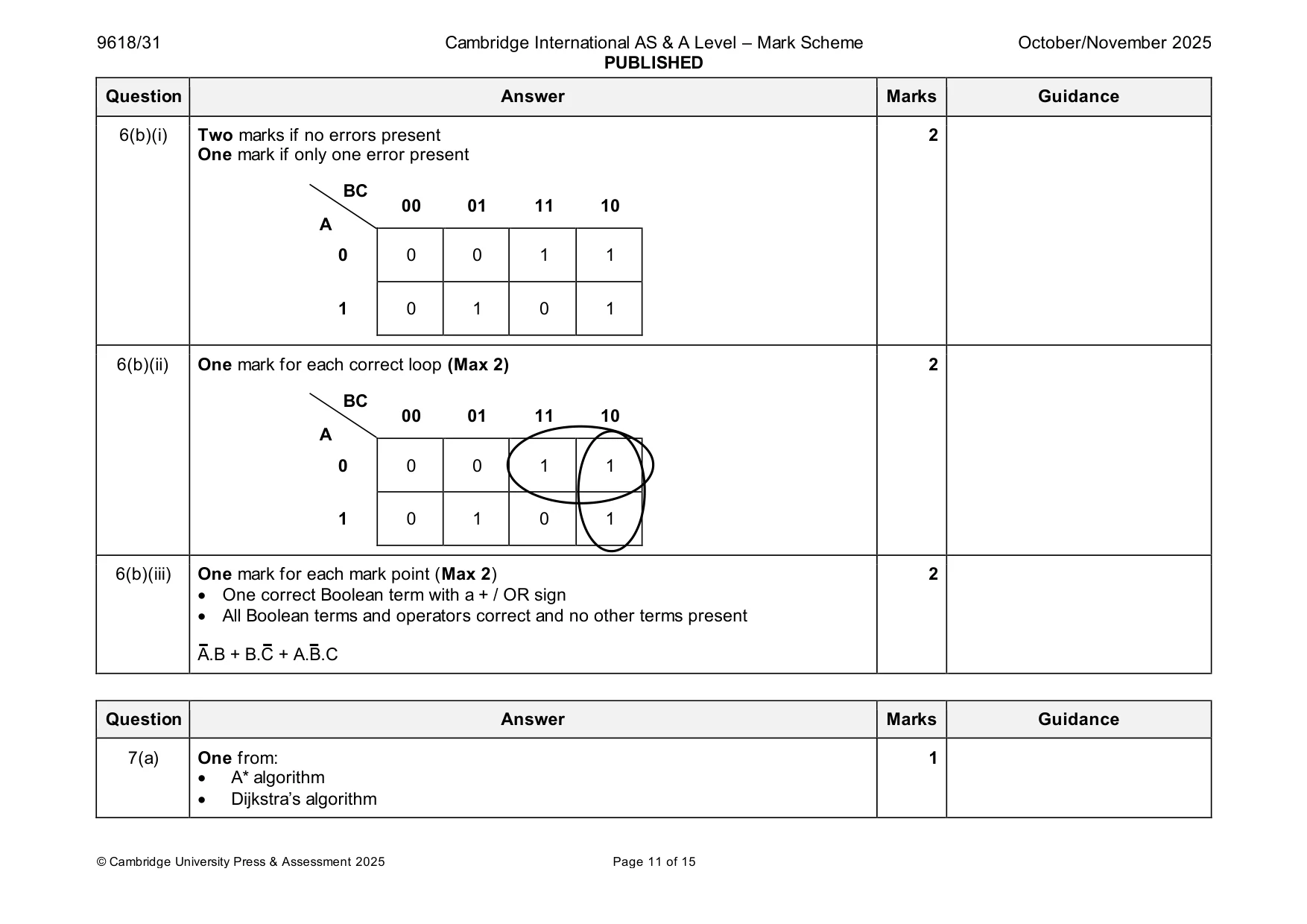
Mark scheme: 6(a) One mark for working, (all four columns P, Q, R and S) 3 One mark for first four rows of column Z One mark for second four rows of column Z Working space A B C P Q R S Z 0 0 0 1 1 1 1 0 0 0 1 1 0 1 0 0 0 1 0 1 1 1 1 1 0 1 1 1 0 1 1 1 1 0 0 0 1 1 1 0 1 0 1 0 0 0 1 0 1 1 0 0 1 1 1 1 1 1 1 0 0 1 1 1 6(b)(i) Two marks if no errors present 2 One mark if only one error present BC 00 01 11 10 A 0 0 0 1 1 1 0 1 0 1 6(b)(ii) One mark for each correct loop (Max 2) 2 BC 00 01 11 10 A 0 0 0 1 1 1 0 1 0 1 6(b)(iii) One mark for each mark point (Max 2) 2 • One correct Boolean term with a + / OR sign • All Boolean terms and operators correct and no other terms present A.B + B.C + A.B.C
Q7 · Identify one Artificial Intelligence (AI) algorithm to find the shortest distance between…
7 (a) Identify one Artificial Intelligence (AI) algorithm to find the shortest distance between two points on a graph. ................................................................................................................................................... ............................................................................................................................................. [1] (b) Describe Deep Learning. ................................................................................................................................................... ................................................................................................................................................... ................................................................................................................................................... ................................................................................................................................................... ................................................................................................................................................... ................................................................................................................................................... ................................................................................................................................................... ................................................................................................................................................... ................................................................................................................................................... ............................................................................................................................................. [5]
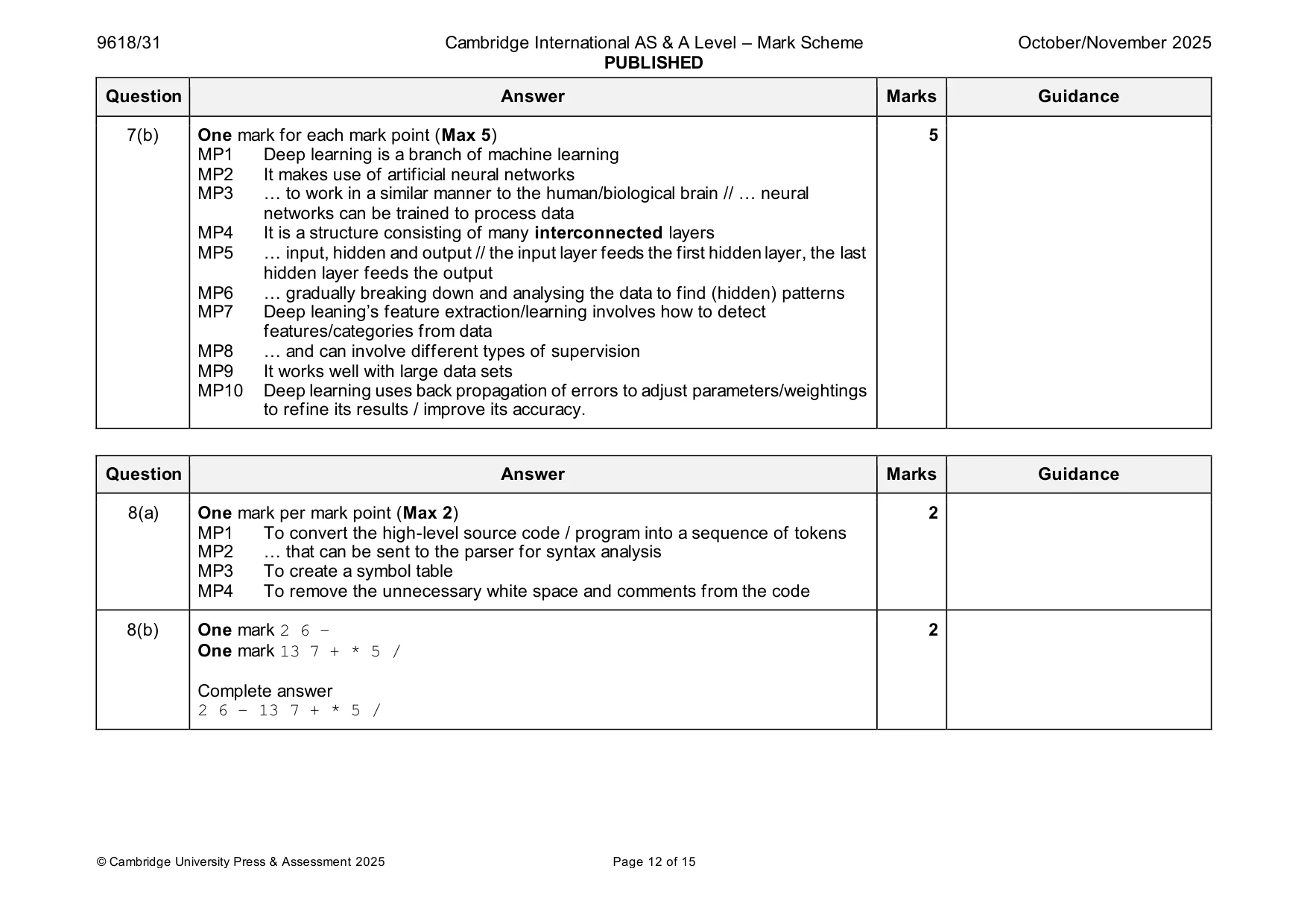
Mark scheme: 7(a) One from: 1 • A* algorithm • Dijkstra’s algorithm 7(b) One mark for each mark point (Max 5) 5 MP1 Deep learning is a branch of machine learning MP2 It makes use of artificial neural networks MP3 … to work in a similar manner to the human/biological brain // … neural networks can be trained to process data MP4 It is a structure consisting of many interconnected layers MP5 … input, hidden and output // the input layer feeds the first hidden layer, the last hidden layer feeds the output MP6 … gradually breaking down and analysing the data to find (hidden) patterns MP7 Deep leaning’s feature extraction/learning involves how to detect features/categories from data MP8 … and can involve different types of supervision MP9 It works well with large data sets MP10 Deep learning uses back propagation of errors to adjust parameters/weightings to refine its results / improve its accuracy.
Q8 · Outline the purpose of lexical analysis during the compilation of a program
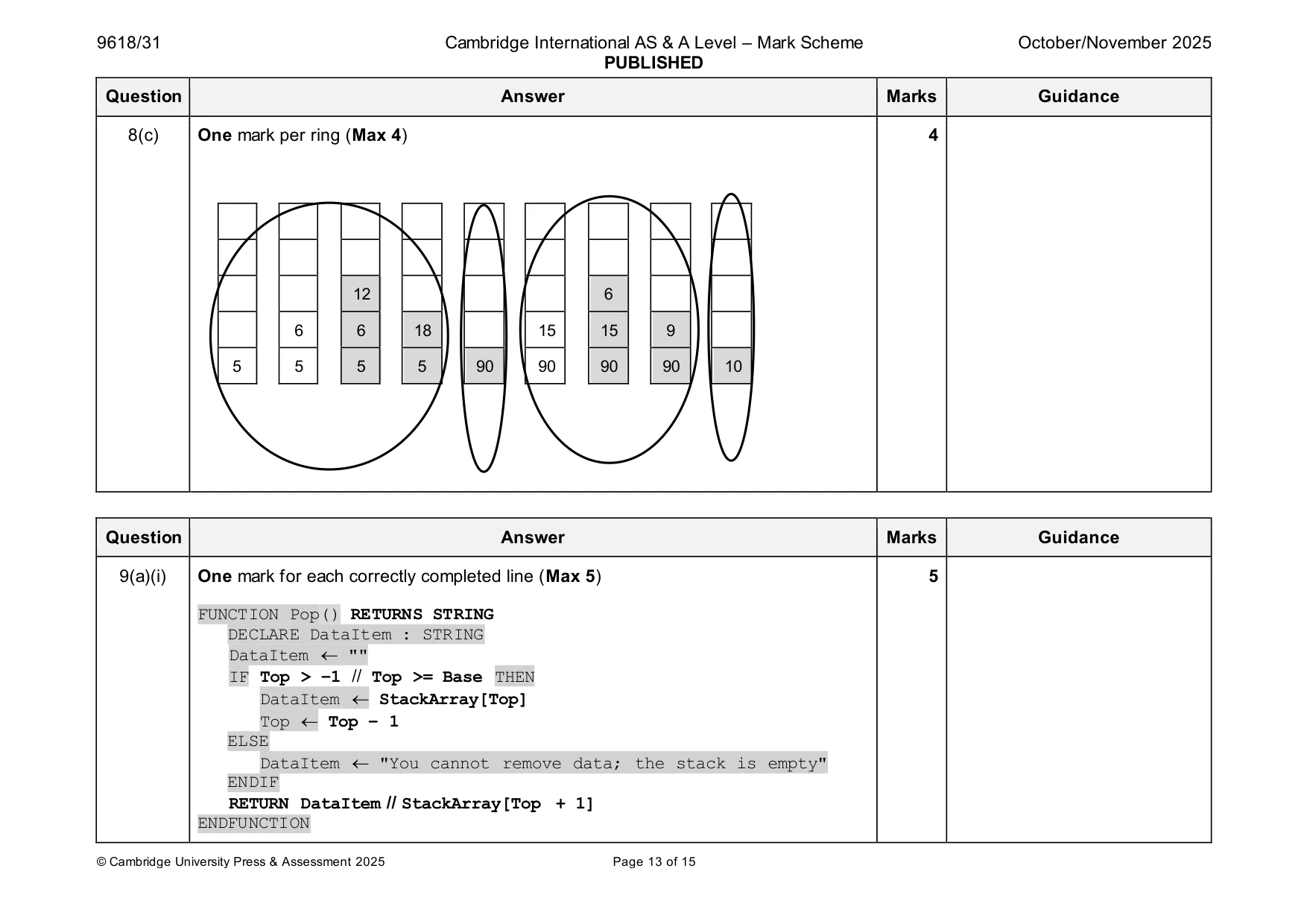
8 (a) Outline the purpose of lexical analysis during the compilation of a program. ................................................................................................................................................... ................................................................................................................................................... ................................................................................................................................................... ............................................................................................................................................. [2] (b) Write the Reverse Polish Notation (RPN) for the given infix expression: (2 – 6) * (13 + 7) / 5 ................................................................................................................................................... ................................................................................................................................................... ................................................................................................................................................... ............................................................................................................................................. [2] (c) The RPN expression: d a b + * c a ‑ / is to be evaluated, where: a = 6, b = 12, c = 15 and d = 5. Show the changing contents of the stack as the RPN expression is evaluated. [4]
Mark scheme: 8(a) One mark per mark point (Max 2) 2 MP1 To convert the high-level source code / program into a sequence of tokens MP2 … that can be sent to the parser for syntax analysis MP3 To create a symbol table MP4 To remove the unnecessary white space and comments from the code 8(b) One mark 2 6 – 2 One mark 13 7 + * 5 / Complete answer 2 6 – 13 7 + * 5 / 8(c) One mark per ring (Max 4) 4 12 6 6 6 18 15 15 9 5 5 5 5 90 90 90 90 10
Q9 · A stack has been implemented using pseudocode to store a maximum of 100 string items…
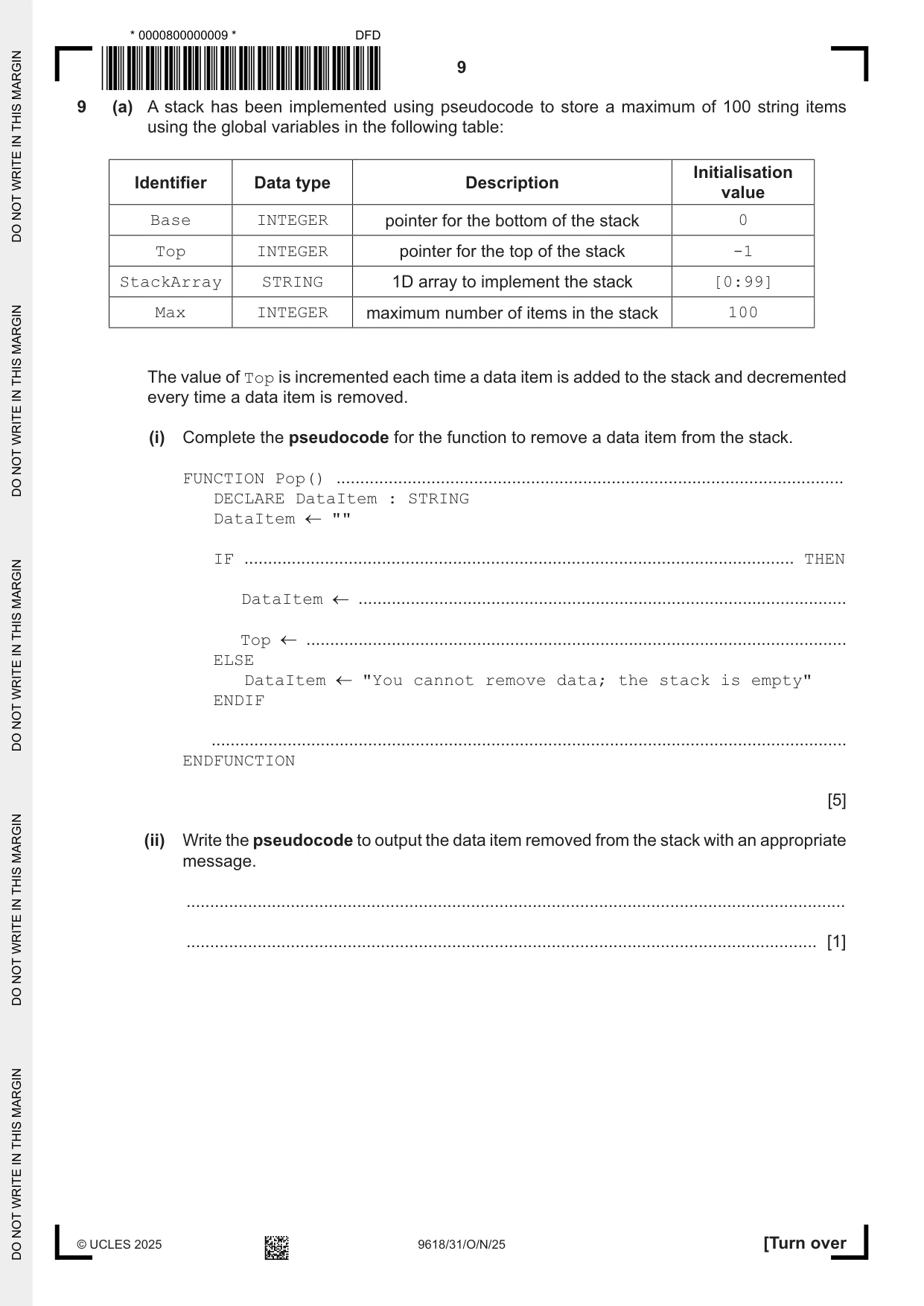
9 (a) A stack has been implemented using pseudocode to store a maximum of 100 string items using the global variables in the following table: Initialisation Identifier Data type Description value Base INTEGER pointer for the bottom of the stack 0 Top INTEGER pointer for the top of the stack ‑1 StackArray STRING 1D array to implement the stack [0:99] Max INTEGER maximum number of items in the stack 100 The value of Top is incremented each time a data item is added to the stack and decremented every time a data item is removed. (i) Complete the pseudocode for the function to remove a data item from the stack. FUNCTION Pop() ........................................................................................................... DECLARE DataItem : STRING DataItem "" IF .................................................................................................................... THEN DataItem ....................................................................................................... Top .................................................................................................................. ELSE DataItem "You cannot remove data; the stack is empty" ENDIF ...................................................................................................................................... ENDFUNCTION [5] (ii) Write the pseudocode to output the data item removed from the stack with an appropriate message. ........................................................................................................................................... ..................................................................................................................................... [1] (b) A stack is used to implement recursion. State the three essential features of recursion. 1 ................................................................................................................................................ ................................................................................................................................................... 2 ................................................................................................................................................ ................................................................................................................................................... 3 ................................................................................................................................................ ................................................................................................................................................... [3]
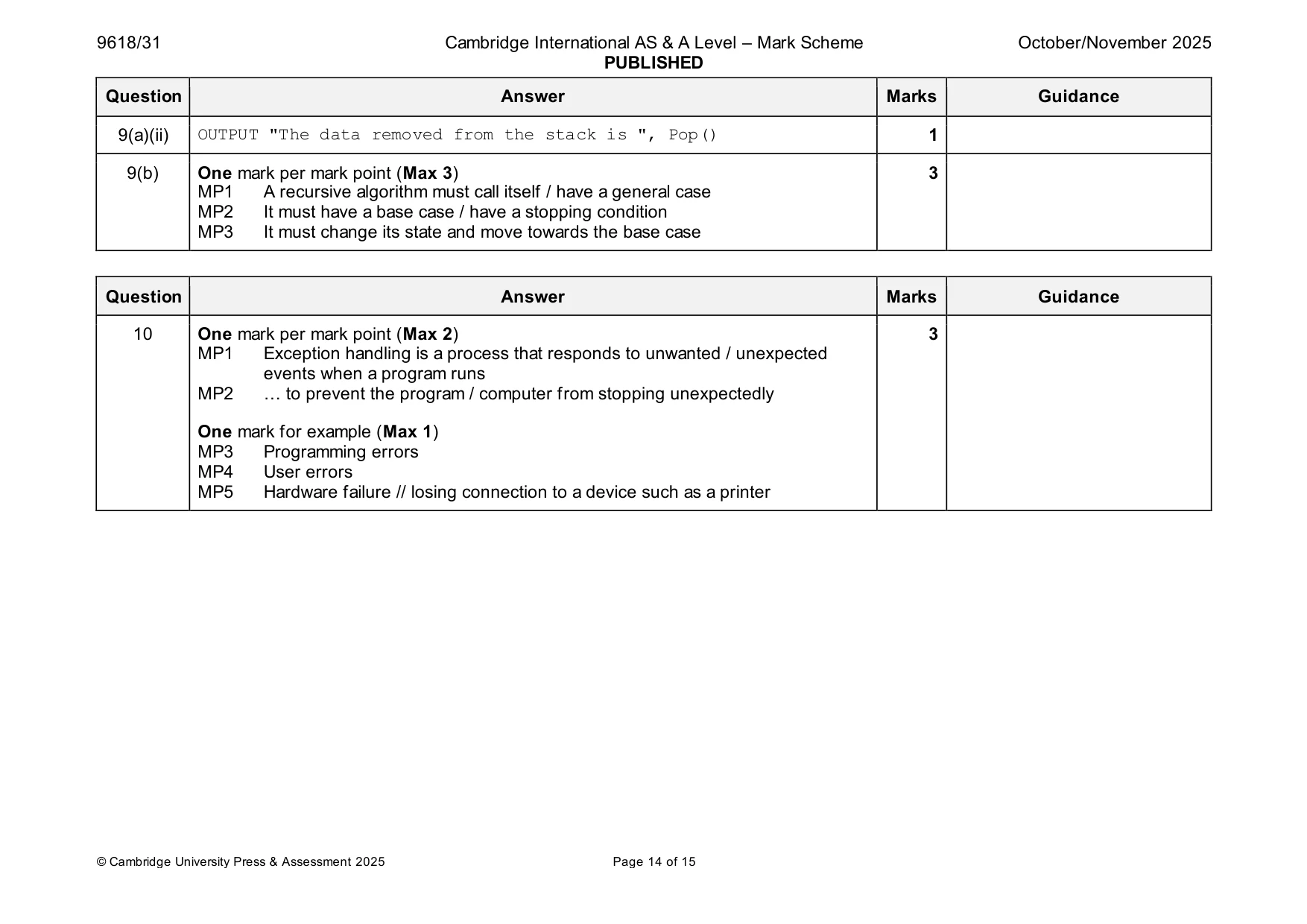
Mark scheme: 9(a)(i) One mark for each correctly completed line (Max 5) 5 FUNCTION Pop() RETURNS STRING DECLARE DataItem : STRING DataItem "" IF Top > –1 // Top >= Base THEN DataItem StackArray[Top] Top Top – 1 ELSE DataItem "You cannot remove data; the stack is empty" ENDIF RETURN DataItem // StackArray[Top + 1] ENDFUNCTION 9(a)(ii) OUTPUT "The data removed from the stack is ", Pop() 1 9(b) One mark per mark point (Max 3) 3 MP1 A recursive algorithm must call itself / have a general case MP2 It must have a base case / have a stopping condition MP3 It must change its state and move towards the base case
Q10 · Explain what is meant by exception handling
10 Explain what is meant by exception handling. Include an example of a possible cause of an exception in your answer. Explanation ....................................................................................................................................... .......................................................................................................................................................... .......................................................................................................................................................... .......................................................................................................................................................... Example ........................................................................................................................................... [3]
Mark scheme: 10 One mark per mark point (Max 2) 3 MP1 Exception handling is a process that responds to unwanted / unexpected events when a program runs MP2 … to prevent the program / computer from stopping unexpectedly One mark for example (Max 1) MP3 Programming errors MP4 User errors MP5 Hardware failure // losing connection to a device such as a printer
Q11 · The table shows assembly language instructions for a processor that has one register, the…
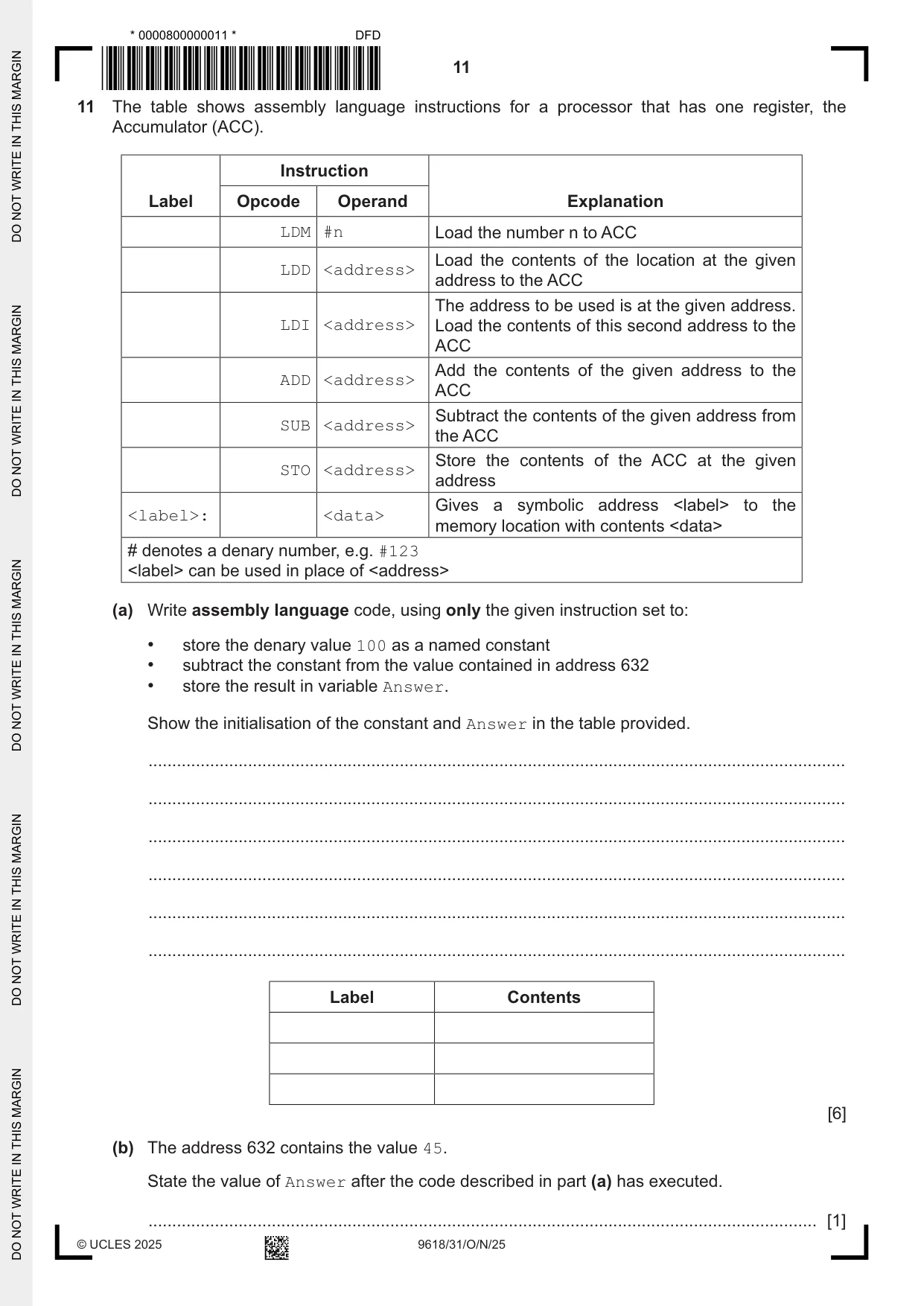
11 The table shows assembly language instructions for a processor that has one register, the Accumulator (ACC). Instruction Label Opcode Operand Explanation LDM #n Load the number n to ACC Load the contents of the location at the given LDD <address> address to the ACC The address to be used is at the given address. LDI <address> Load the contents of this second address to the ACC Add the contents of the given address to the ADD <address> ACC Subtract the contents of the given address from SUB <address> the ACC Store the contents of the ACC at the given STO <address> address Gives a symbolic address <label> to the <label>: <data> memory location with contents <data> # denotes a denary number, e.g. #123 <label> can be used in place of <address> (a) Write assembly language code, using only the given instruction set to: • store the denary value 100 as a named constant • subtract the constant from the value contained in address 632 • store the result in variable Answer. Show the initialisation of the constant and Answer in the table provided. ................................................................................................................................................... ................................................................................................................................................... ................................................................................................................................................... ................................................................................................................................................... ................................................................................................................................................... ................................................................................................................................................... Label Contents [6] (b) The address 632 contains the value 45. State the value of Answer after the code described in part (a) has executed. ............................................................................................................................................. [1]
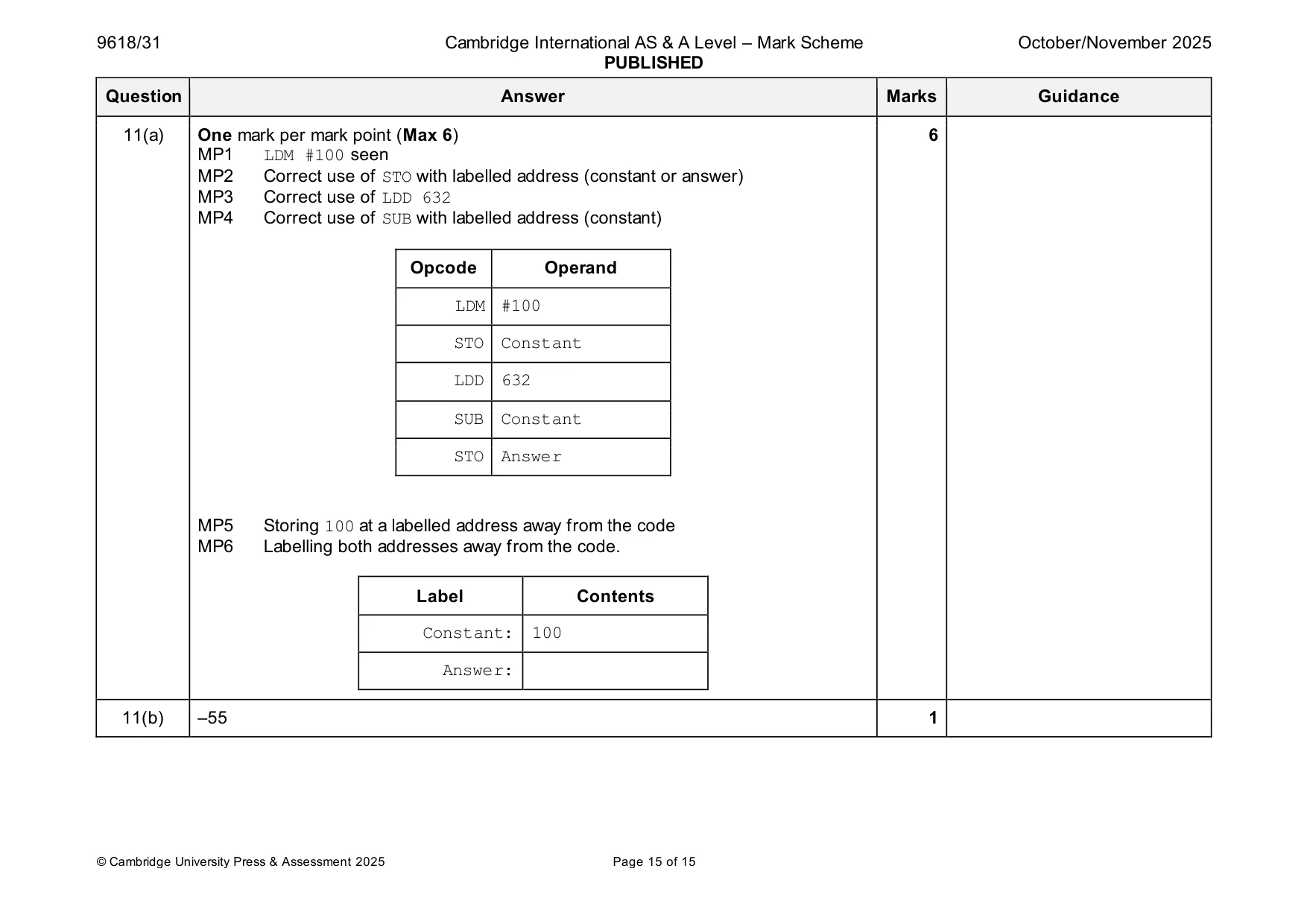
Mark scheme: 11(a) One mark per mark point (Max 6) 6 MP1 LDM #100 seen MP2 Correct use of STO with labelled address (constant or answer) MP3 Correct use of LDD 632 MP4 Correct use of SUB with labelled address (constant) Opcode Operand LDM #100 STO Constant LDD 632 SUB Constant STO Answer MP5 Storing 100 at a labelled address away from the code MP6 Labelling both addresses away from the code. Label Contents Constant: 100 Answer: 11(b) –55 1
What you needed in this session
Cambridge’s own grade thresholds for 2025 Oct/Nov, Paper 3 · Variant 1. A higher threshold means an easier paper — the bar moves with how the cohort did.