Cambridge A Level Computer Science 9618 — 2025 May/June Paper 3 · Variant 1
9618/31/M/J/25 · 12 questions · 75 marks · ≈84 min
The question paper and its mark scheme, free to read here and free to download. This is Cambridge’s own paper, exactly as it was sat.
Question paper16 pages







Mark scheme15 pages
Answers below. Sit the paper first if you are practising.




Questions as text
Q1 · A programmer is writing a program to manage bookings for a small taxi company
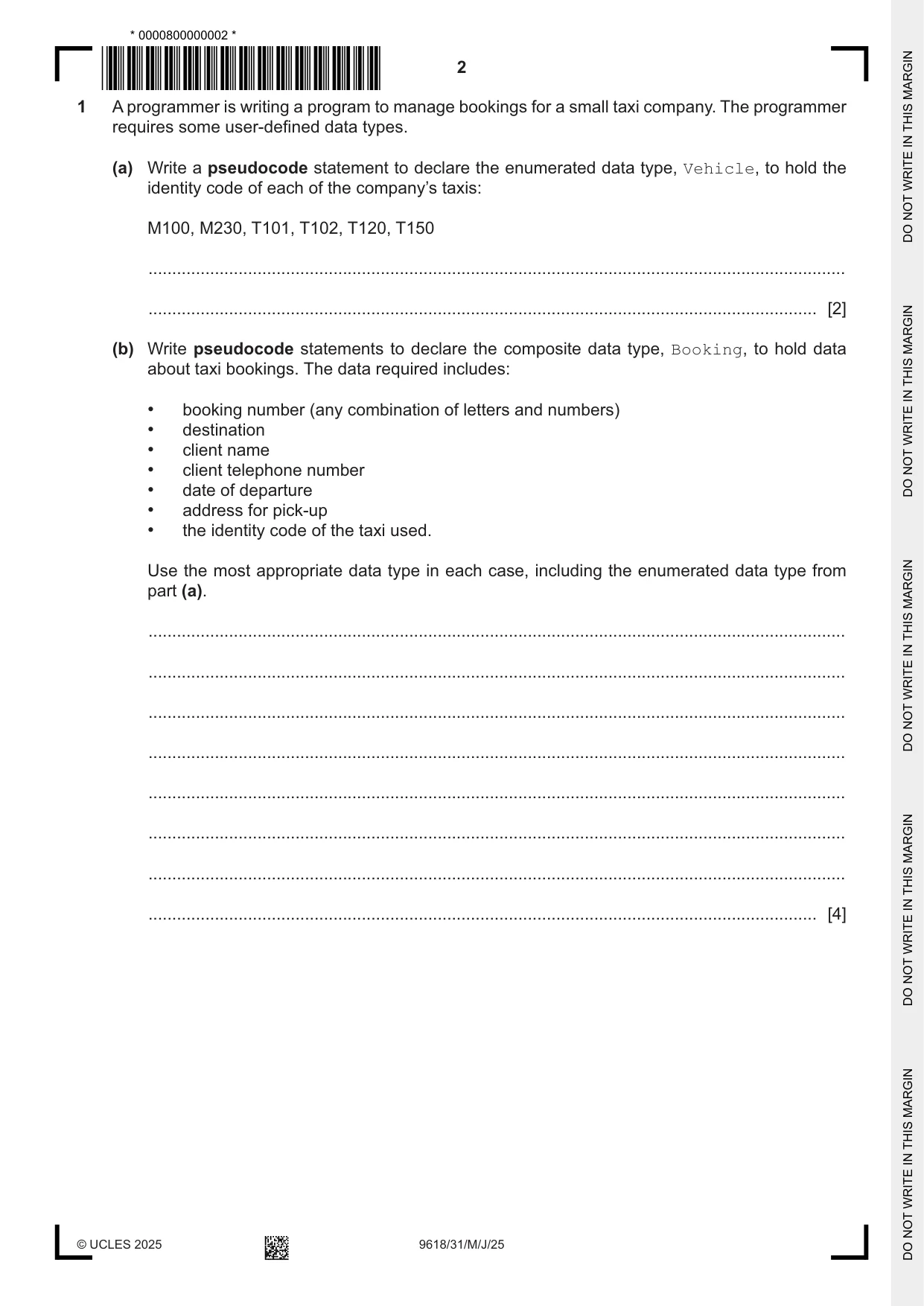
1 A programmer is writing a program to manage bookings for a small taxi company. The programmer requires some user-defined data types. (a) Write a pseudocode statement to declare the enumerated data type, Vehicle, to hold the identity code of each of the company’s taxis: M100, M230, T101, T102, T120, T150 ................................................................................................................................................... ............................................................................................................................................. [2] (b) Write pseudocode statements to declare the composite data type, Booking, to hold data about taxi bookings. The data required includes: • booking number (any combination of letters and numbers) • destination • client name • client telephone number • date of departure • address for pick-up • the identity code of the taxi used. Use the most appropriate data type in each case, including the enumerated data type from part (a). ................................................................................................................................................... ................................................................................................................................................... ................................................................................................................................................... ................................................................................................................................................... ................................................................................................................................................... ................................................................................................................................................... ................................................................................................................................................... ............................................................................................................................................. [4]
Mark scheme: Question Answer Marks 1(a) One mark per mark point 2 MP1 TYPE Vehicle = MP2 (M100, M230, T101, T102, T120, T150) Example answer: TYPE Vehicle = (M100, M230, T101, T102, T120, T150) 1(b) One mark per mark point 4 MP1 TYPE Booking and ENDTYPE correct MP2 Declare used correctly for every field in the response MP3 Any four fields correct MP4 Remaining fields correct Example answer: TYPE Booking DECLARE BookingNumber : STRING DECLARE Destination : STRING DECLARE ClientName : STRING DECLARE ClientTelephone : STRING DECLARE DateOfDeparture : DATE DECLARE PickupAddress : STRING DECLARE TaxiUsed : Vehicle ENDTYPE
Q2 · Numbers are stored in a computer using binary floating-point representation with: • 10…
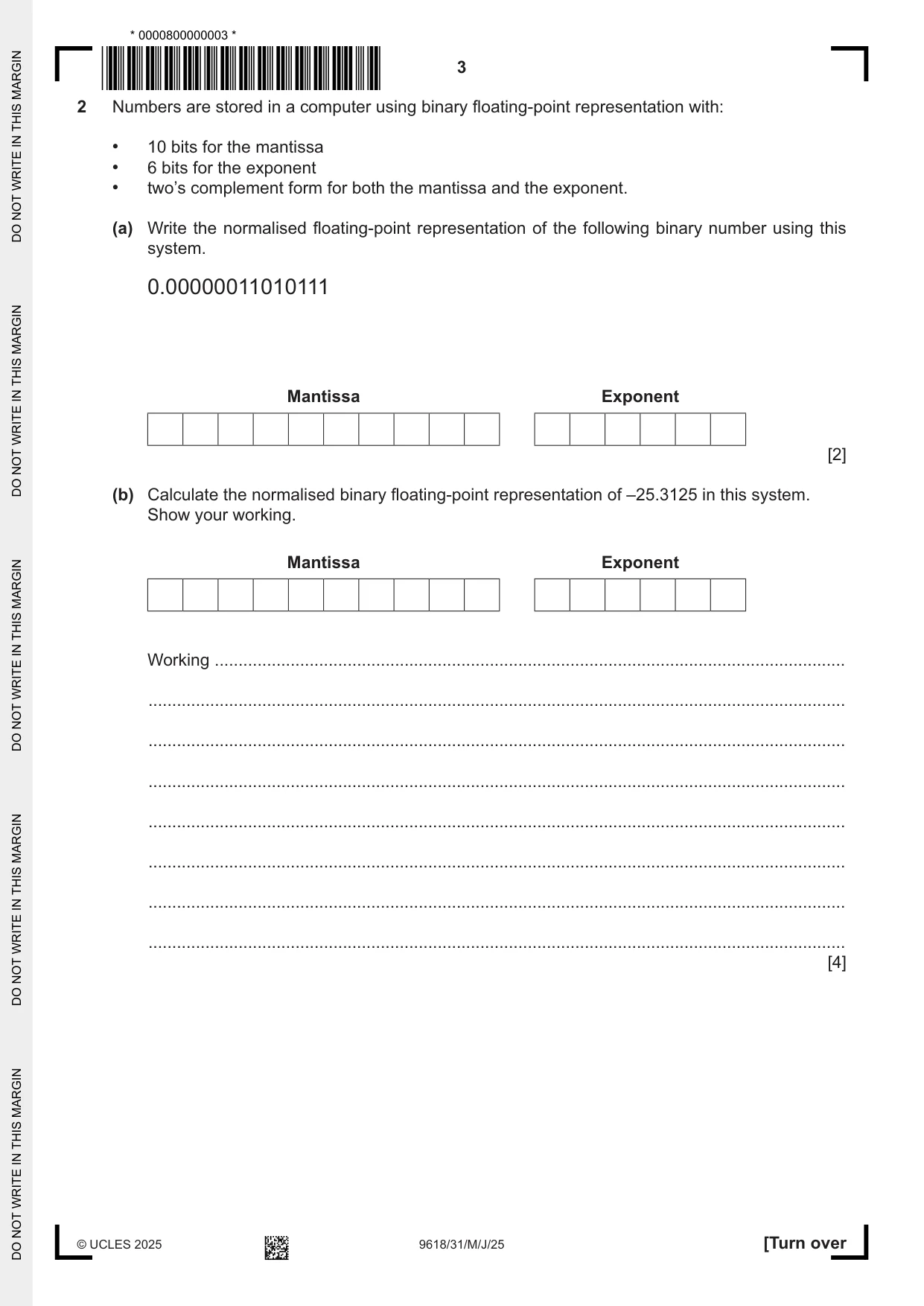
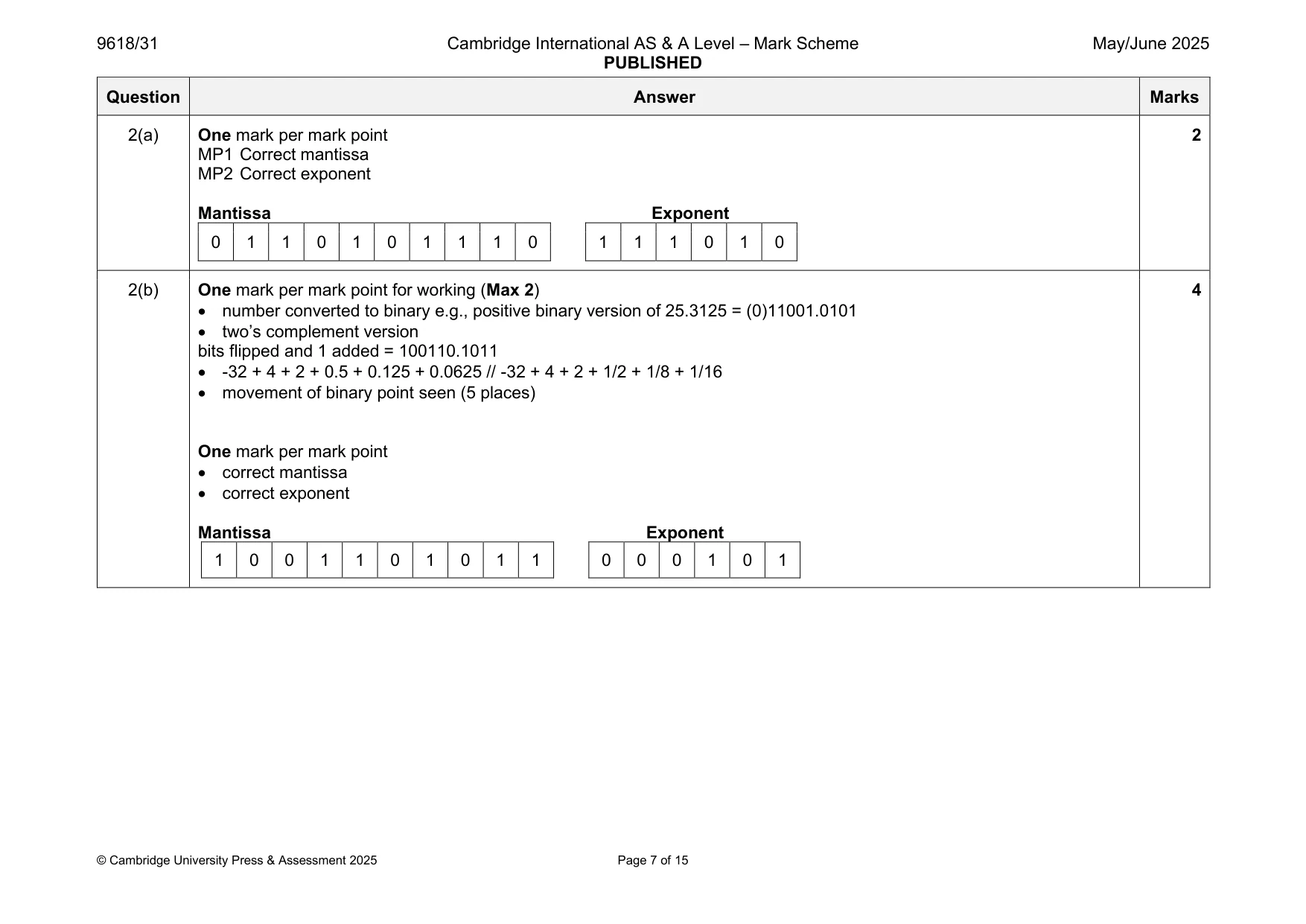
2 Numbers are stored in a computer using binary floating-point representation with: • 10 bits for the mantissa • 6 bits for the exponent • two’s complement form for both the mantissa and the exponent. (a) Write the normalised floating-point representation of the following binary number using this system. 0.00000011010111 Mantissa Exponent [2] (b) Calculate the normalised binary floating-point representation of –25.3125 in this system. Show your working. Mantissa Exponent Working ..................................................................................................................................... ................................................................................................................................................... ................................................................................................................................................... ................................................................................................................................................... ................................................................................................................................................... ................................................................................................................................................... ................................................................................................................................................... ................................................................................................................................................... [4]
Mark scheme: 2(a) One mark per mark point 2 MP1 Correct mantissa MP2 Correct exponent Mantissa Exponent 0 1 1 0 1 0 1 1 1 0 1 1 1 0 1 0 2(b) One mark per mark point for working (Max 2) 4 • number converted to binary e.g., positive binary version of 25.3125 = (0)11001.0101 • two’s complement version bits flipped and 1 added = 100110.1011 • -32 + 4 + 2 + 0.5 + 0.125 + 0.0625 // -32 + 4 + 2 + 1/2 + 1/8 + 1/16 • movement of binary point seen (5 places) One mark per mark point • correct mantissa • correct exponent Mantissa Exponent 1 0 0 1 1 0 1 0 1 1 0 0 0 1 0 1
Q3 · The Application Layer and Transport Layer are two layers of the TCP/IP protocol suite
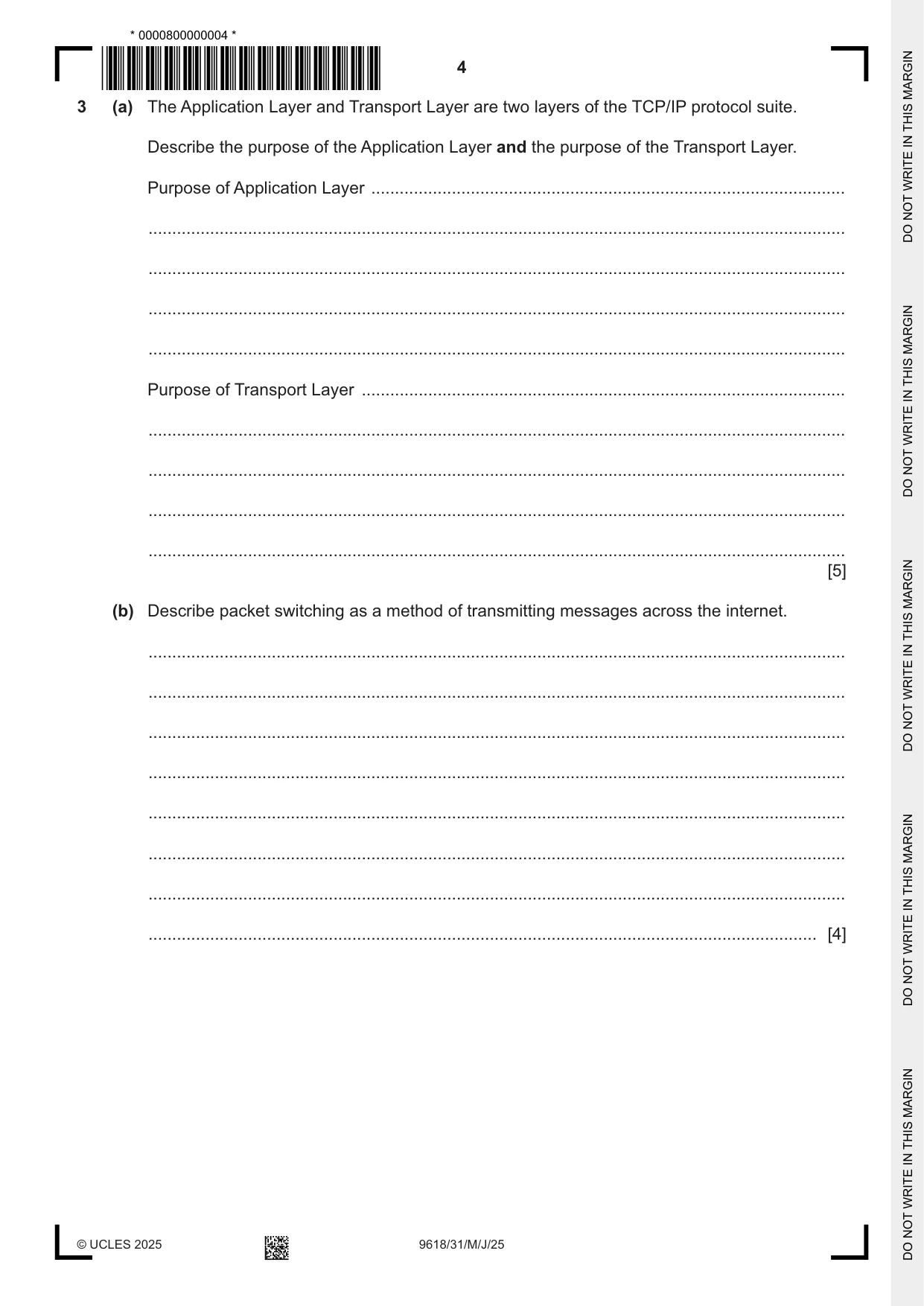
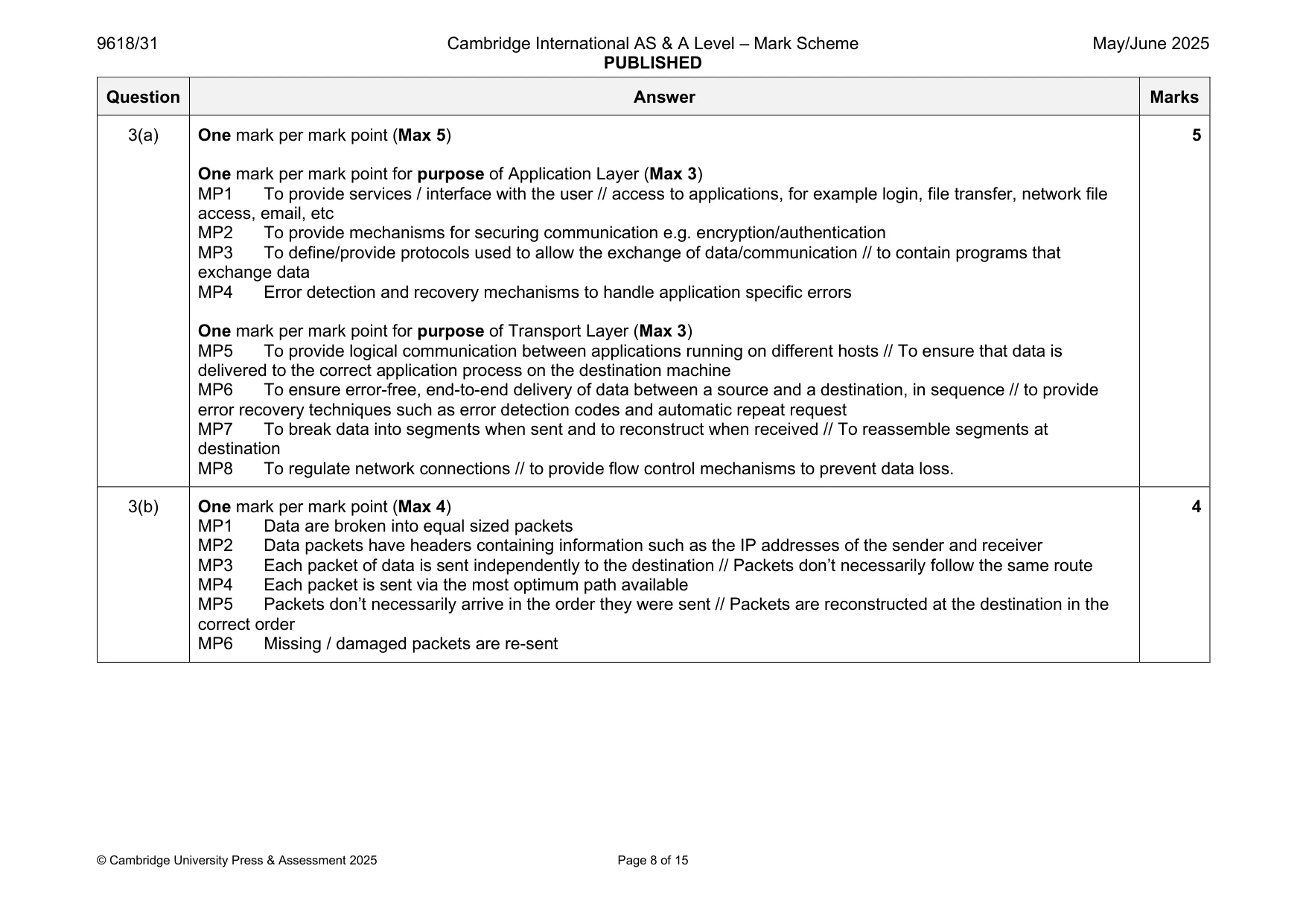
3 (a) The Application Layer and Transport Layer are two layers of the TCP/IP protocol suite. Describe the purpose of the Application Layer and the purpose of the Transport Layer. Purpose of Application Layer .................................................................................................... ................................................................................................................................................... ................................................................................................................................................... ................................................................................................................................................... ................................................................................................................................................... Purpose of Transport Layer ...................................................................................................... ................................................................................................................................................... ................................................................................................................................................... ................................................................................................................................................... ................................................................................................................................................... [5] (b) Describe packet switching as a method of transmitting messages across the internet. ................................................................................................................................................... ................................................................................................................................................... ................................................................................................................................................... ................................................................................................................................................... ................................................................................................................................................... ................................................................................................................................................... ................................................................................................................................................... ............................................................................................................................................. [4]
Mark scheme: 3(a) One mark per mark point (Max 5) 5 One mark per mark point for purpose of Application Layer (Max 3) MP1 To provide services / interface with the user // access to applications, for example login, file transfer, network file access, email, etc MP2 To provide mechanisms for securing communication e.g. encryption/authentication MP3 To define/provide protocols used to allow the exchange of data/communication // to contain programs that exchange data MP4 Error detection and recovery mechanisms to handle application specific errors One mark per mark point for purpose of Transport Layer (Max 3) MP5 To provide logical communication between applications running on different hosts // To ensure that data is delivered to the correct application process on the destination machine MP6 To ensure error-free, end-to-end delivery of data between a source and a destination, in sequence // to provide error recovery techniques such as error detection codes and automatic repeat request MP7 To break data into segments when sent and to reconstruct when received // To reassemble segments at destination MP8 To regulate network connections // to provide flow control mechanisms to prevent data loss. 3(b) One mark per mark point (Max 4) 4 MP1 Data are broken into equal sized packets MP2 Data packets have headers containing information such as the IP addresses of the sender and receiver MP3 Each packet of data is sent independently to the destination // Packets don’t necessarily follow the same route MP4 Each packet is sent via the most optimum path available MP5 Packets don’t necessarily arrive in the order they were sent // Packets are reconstructed at the destination in the correct order MP6 Missing / damaged packets are re-sent
Q4 · A linked list of nodes is used to store an ordered list of integers
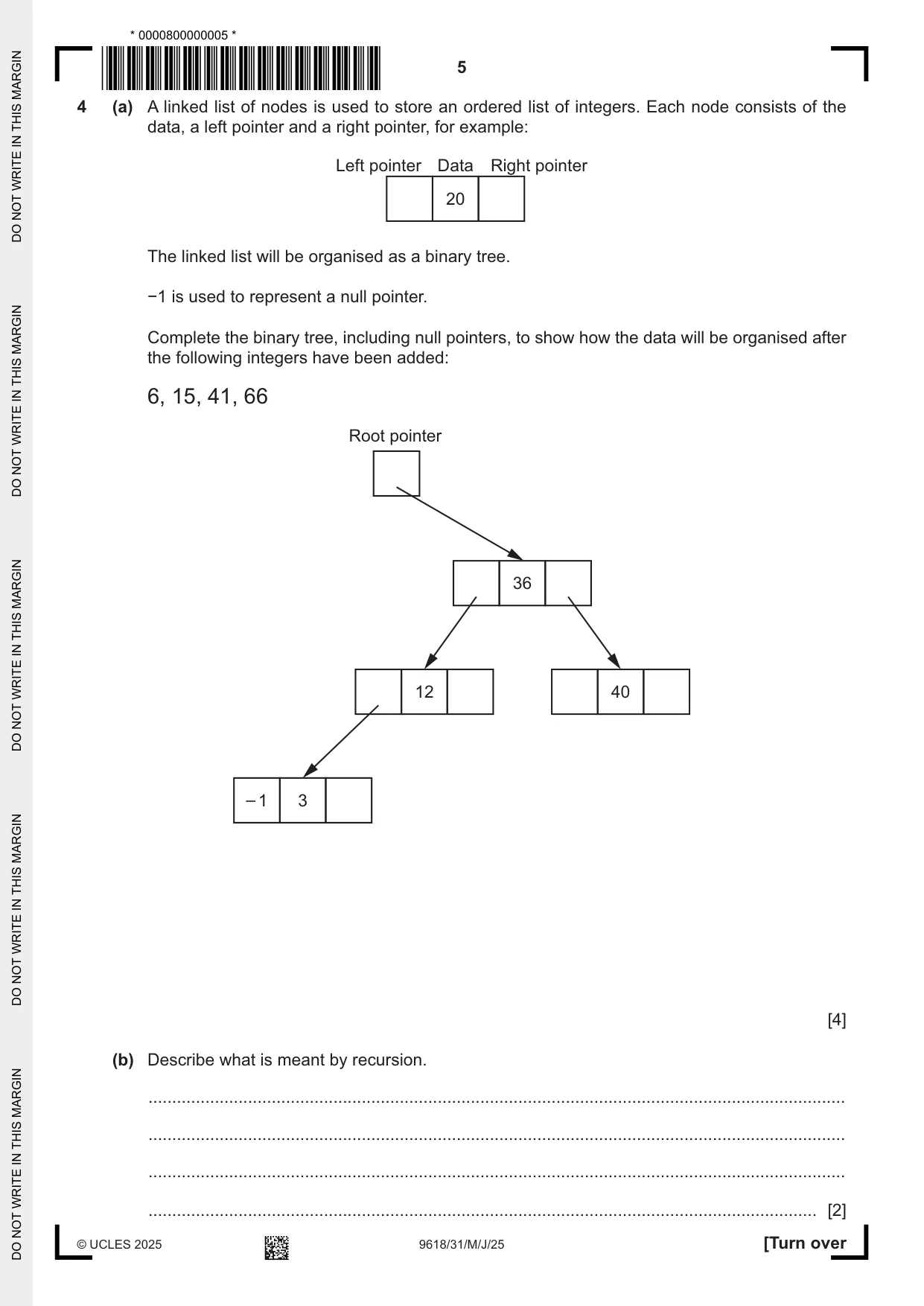
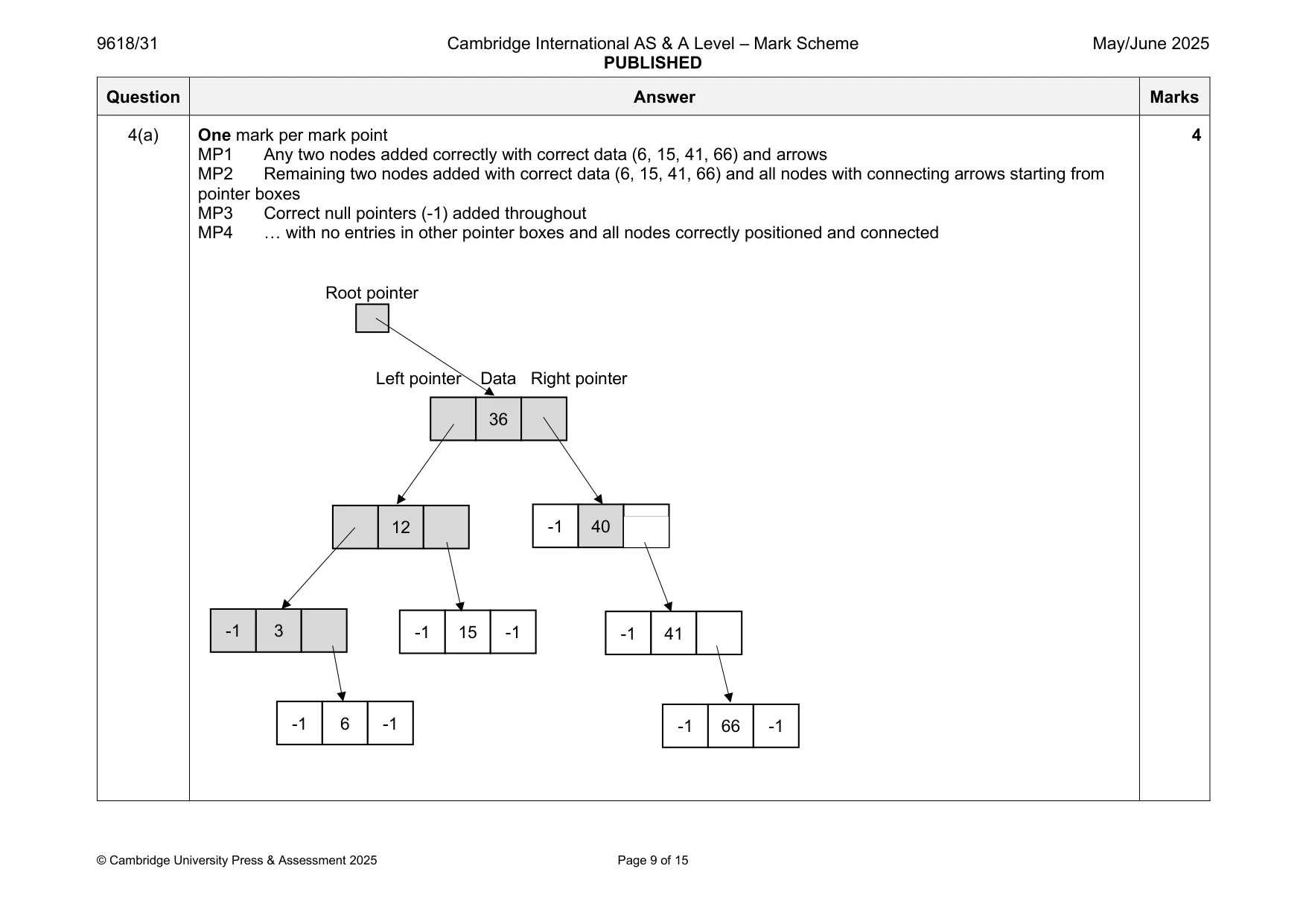
4 (a) A linked list of nodes is used to store an ordered list of integers. Each node consists of the data, a left pointer and a right pointer, for example: Left pointer Data Right pointer 20 The linked list will be organised as a binary tree. −1 is used to represent a null pointer. Complete the binary tree, including null pointers, to show how the data will be organised after the following integers have been added: 6, 15, 41, 66 Root pointer 36 12 40 – 1 3 [4] (b) Describe what is meant by recursion. ................................................................................................................................................... ................................................................................................................................................... ................................................................................................................................................... ............................................................................................................................................. [2] (c) A binary tree is a suitable Abstract Data Type (ADT) that a designer can implement using recursive algorithms. Identify one other ADT that a designer can implement using recursive algorithms. ............................................................................................................................................. [1]
Mark scheme: 4(a) One mark per mark point 4 MP1 Any two nodes added correctly with correct data (6, 15, 41, 66) and arrows MP2 Remaining two nodes added with correct data (6, 15, 41, 66) and all nodes with connecting arrows starting from pointer boxes MP3 Correct null pointers (-1) added throughout MP4 … with no entries in other pointer boxes and all nodes correctly positioned and connected Root pointer Left pointer Data Right pointer 36 12 -1 40 -1 3 -1 15 -1 -1 41 -1 6 -1 -1 66 -1 4(b) One mark per mark point 2 MP1 A technique used to solve problems using a function/procedure/subroutine that calls itself (general case) MP2 … until the terminating condition / base case is achieved, when no further recursive calls are made 4(c) One mark 1 • Stack
Q5 · This truth table represents a logic circuit
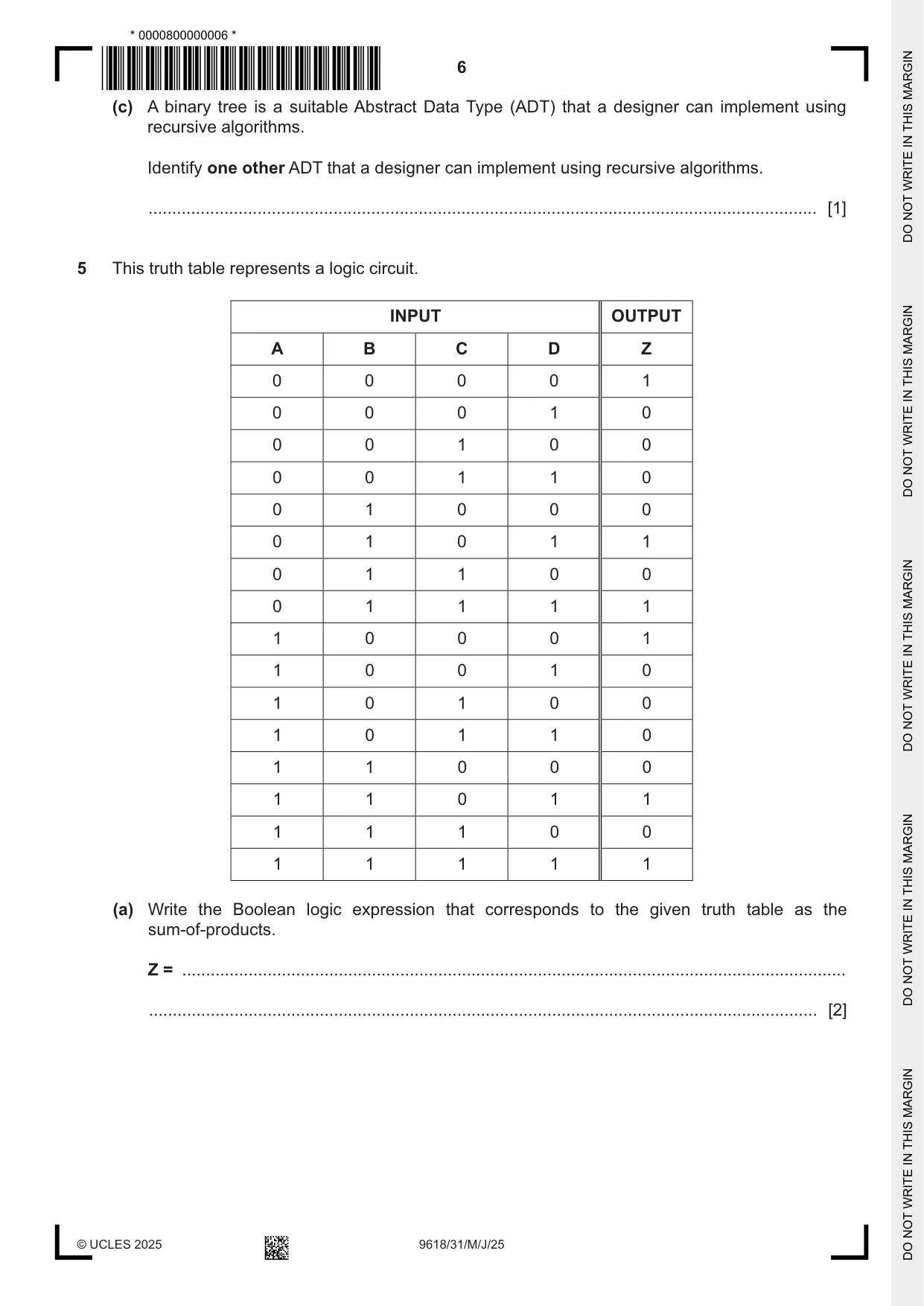
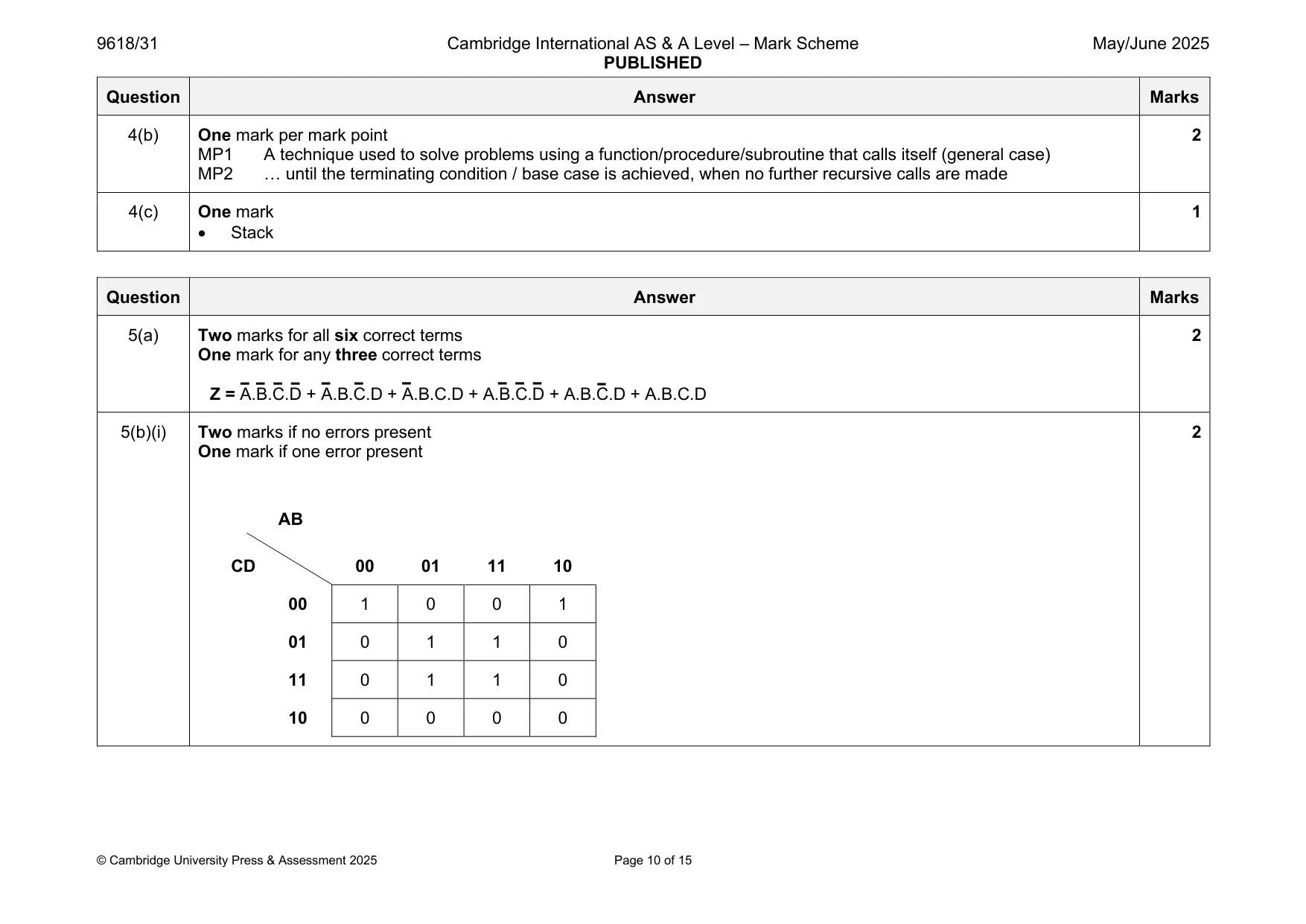
5 This truth table represents a logic circuit. INPUT OUTPUT A B C D Z 0 0 0 0 1 0 0 0 1 0 0 0 1 0 0 0 0 1 1 0 0 1 0 0 0 0 1 0 1 1 0 1 1 0 0 0 1 1 1 1 1 0 0 0 1 1 0 0 1 0 1 0 1 0 0 1 0 1 1 0 1 1 0 0 0 1 1 0 1 1 1 1 1 0 0 1 1 1 1 1 (a) Write the Boolean logic expression that corresponds to the given truth table as the sum-of-products. Z = ............................................................................................................................................ ............................................................................................................................................. [2] (b) (i) Complete the Karnaugh map (K-map) for the given truth table. AB 00 01 11 10 CD 00 01 11 10 [2] (ii) Draw loop(s) around appropriate group(s) in the K-map to produce an optimal sum-of-products. [2] (iii) Write the Boolean logic expression from your answer to part (b)(ii) as the simplified sum-of-products. Z = ..................................................................................................................................... ..................................................................................................................................... [2]
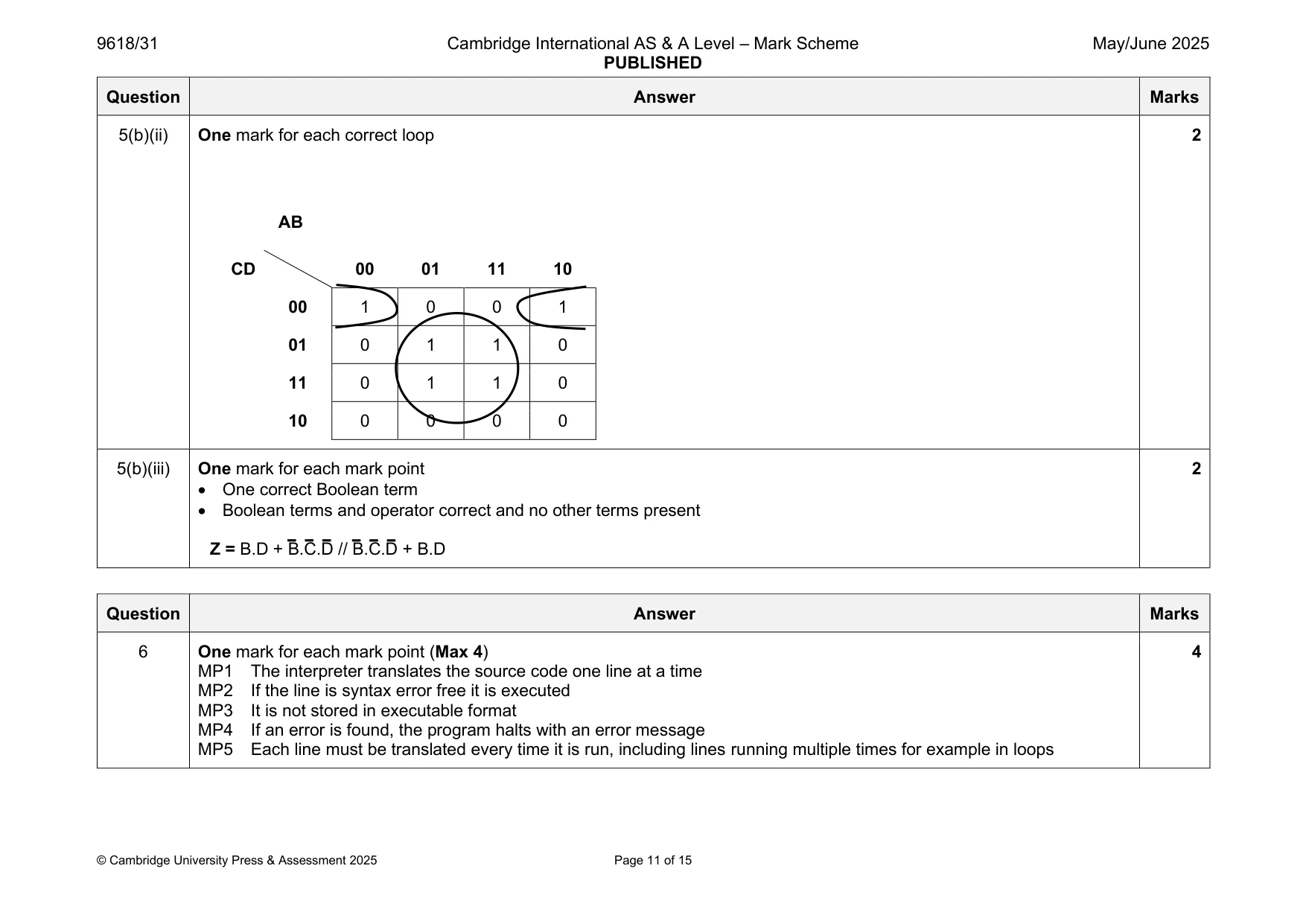
Mark scheme: 5(a) Two marks for all six correct terms 2 One mark for any three correct terms Z = A.B.C.D + A.B.C.D + A.B.C.D + A.B.C.D + A.B.C.D + A.B.C.D 5(b)(i) Two marks if no errors present 2 One mark if one error present AB CD 00 01 11 10 00 1 0 0 1 01 0 1 1 0 11 0 1 1 0 10 0 0 0 0 5(b)(ii) One mark for each correct loop 2 AB CD 00 01 11 10 00 1 0 0 1 01 0 1 1 0 11 0 1 1 0 10 0 0 0 0 5(b)(iii) One mark for each mark point 2 • One correct Boolean term • Boolean terms and operator correct and no other terms present Z = B.D + B.C.D // B.C.D + B.D
Q6 · Describe the process of executing a program using an interpreter
6 Describe the process of executing a program using an interpreter. .......................................................................................................................................................... .......................................................................................................................................................... .......................................................................................................................................................... .......................................................................................................................................................... .......................................................................................................................................................... .......................................................................................................................................................... .......................................................................................................................................................... .................................................................................................................................................... [4]
Mark scheme: 6 One mark for each mark point (Max 4) 4 MP1 The interpreter translates the source code one line at a time MP2 If the line is syntax error free it is executed MP3 It is not stored in executable format MP4 If an error is found, the program halts with an error message MP5 Each line must be translated every time it is run, including lines running multiple times for example in loops
Q7 · Several syntax diagrams are shown
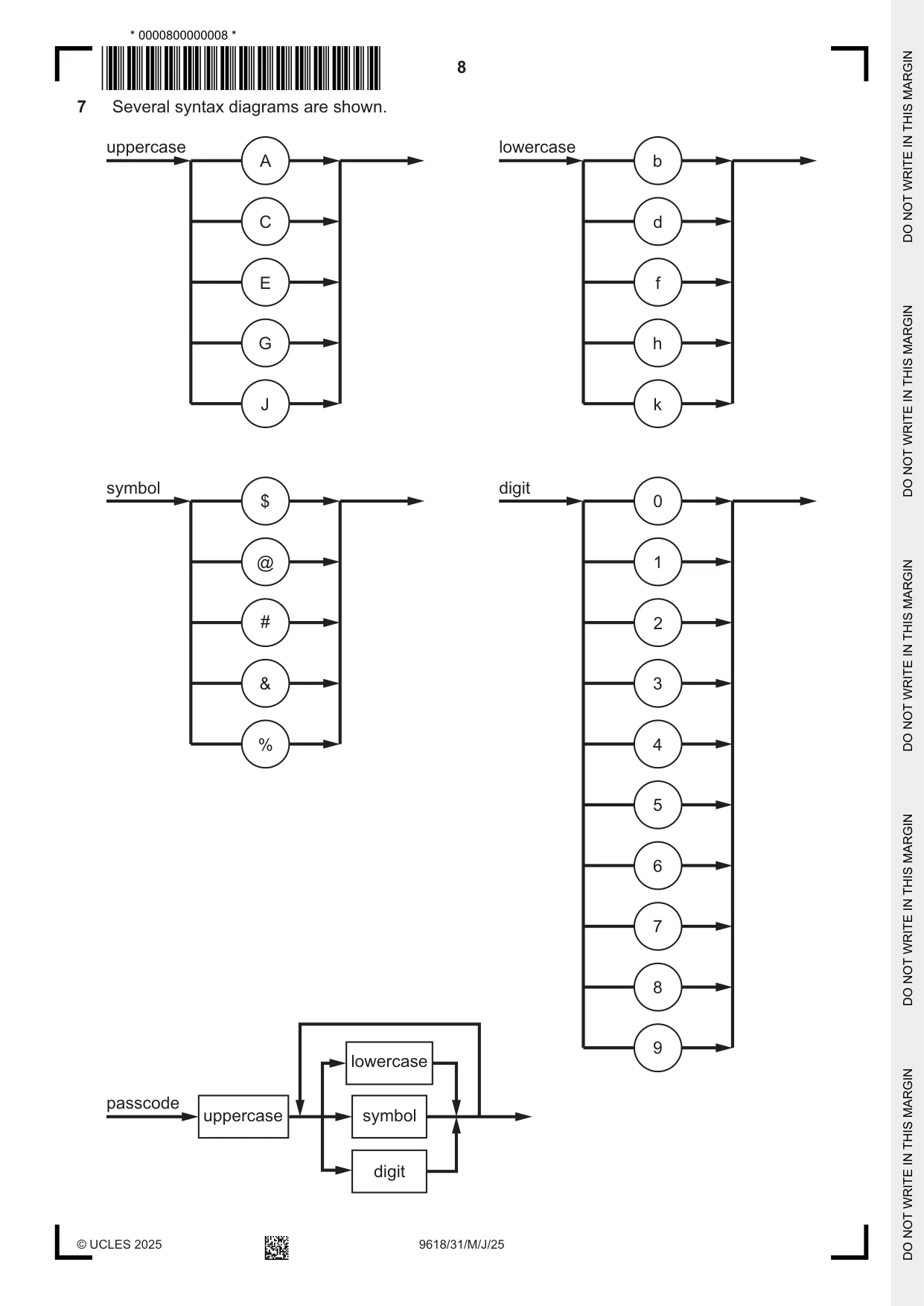
7 Several syntax diagrams are shown. uppercase lowercase A b C d E f G h J k symbol digit $ 0 @ 1 # 2 & 3 % 4 5 6 7 8 9 lowercase passcode uppercase symbol digit (a) State why each passcode is invalid for the given syntax diagrams. #Jd7 Reason ..................................................................................................................................... ................................................................................................................................................... C%6A Reason ..................................................................................................................................... ................................................................................................................................................... [2] (b) Complete the Backus-Naur Form (BNF) for <uppercase> and <passcode>. <uppercase> ::= ................................................................................................................. ................................................................................................................................................... <passcode> ::= ................................................................................................................... ................................................................................................................................................... ................................................................................................................................................... ................................................................................................................................................... ................................................................................................................................................... ................................................................................................................................................... [4]
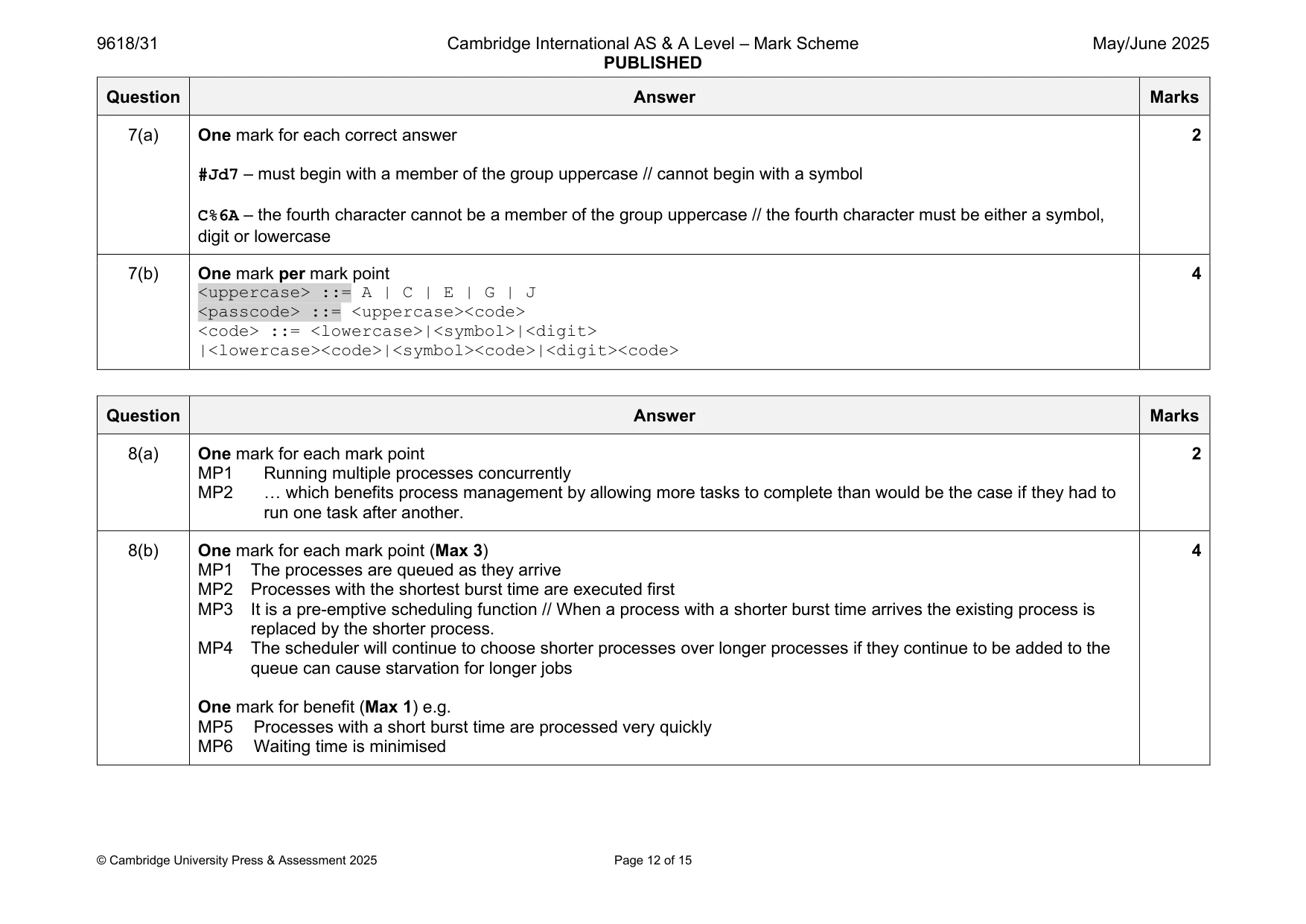
Mark scheme: 7(a) One mark for each correct answer 2 #Jd7 – must begin with a member of the group uppercase // cannot begin with a symbol C%6A – the fourth character cannot be a member of the group uppercase // the fourth character must be either a symbol, digit or lowercase 7(b) One mark per mark point 4 <uppercase> ::= A | C | E | G | J <passcode> ::= <uppercase><code> <code> ::= <lowercase>|<symbol>|<digit> |<lowercase><code>|<symbol><code>|<digit><code>
Q8 · Describe what is meant by multi-tasking and how it benefits process management
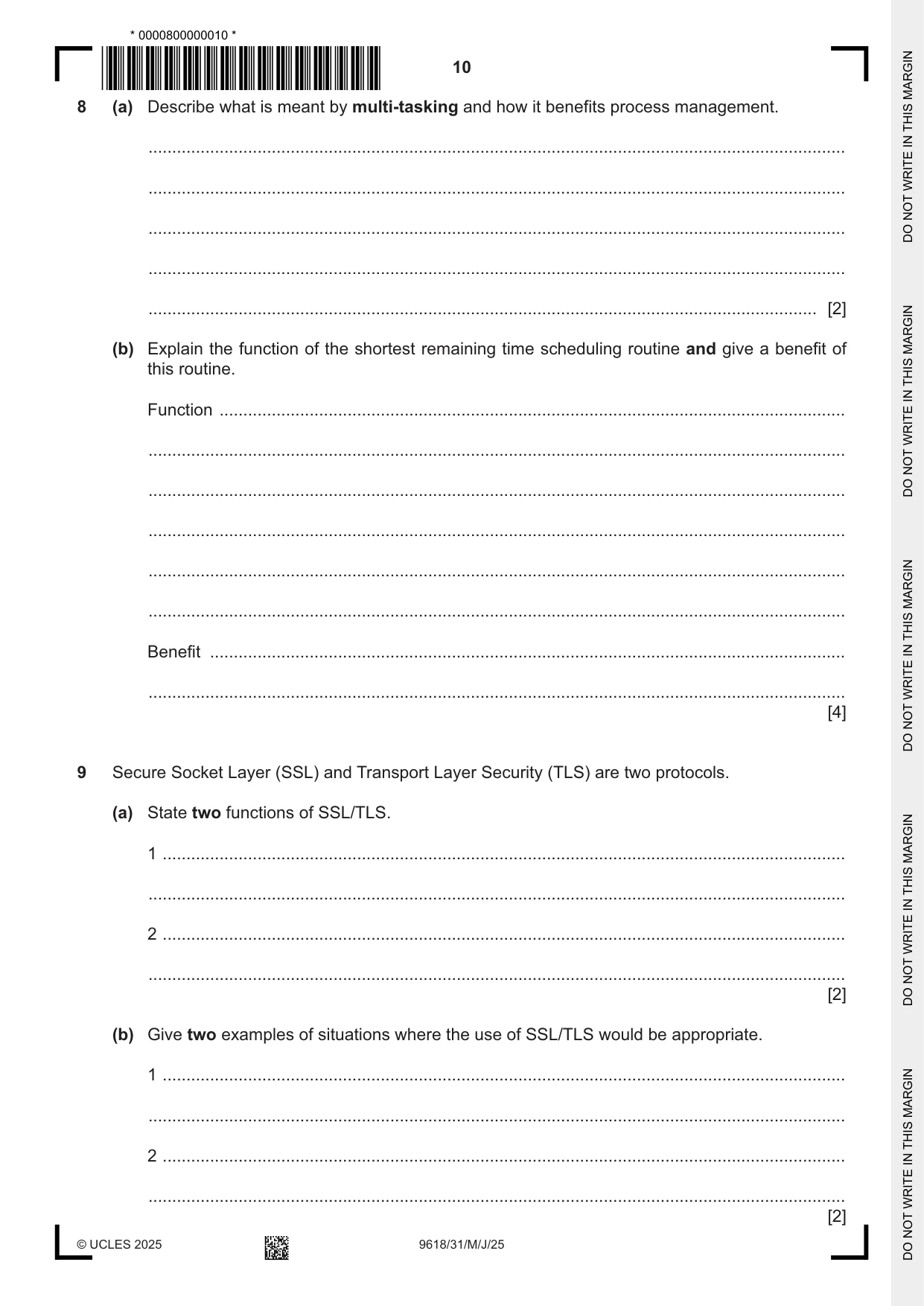
8 (a) Describe what is meant by multi-tasking and how it benefits process management. ................................................................................................................................................... ................................................................................................................................................... ................................................................................................................................................... ................................................................................................................................................... ............................................................................................................................................. [2] (b) Explain the function of the shortest remaining time scheduling routine and give a benefit of this routine. Function .................................................................................................................................... ................................................................................................................................................... ................................................................................................................................................... ................................................................................................................................................... ................................................................................................................................................... ................................................................................................................................................... Benefit ...................................................................................................................................... ................................................................................................................................................... [4]
Mark scheme: 8(a) One mark for each mark point 2 MP1 Running multiple processes concurrently MP2 … which benefits process management by allowing more tasks to complete than would be the case if they had to run one task after another. 8(b) One mark for each mark point (Max 3) 4 MP1 The processes are queued as they arrive MP2 Processes with the shortest burst time are executed first MP3 It is a pre-emptive scheduling function // When a process with a shorter burst time arrives the existing process is replaced by the shorter process. MP4 The scheduler will continue to choose shorter processes over longer processes if they continue to be added to the queue can cause starvation for longer jobs One mark for benefit (Max 1) e.g. MP5 Processes with a short burst time are processed very quickly MP6 Waiting time is minimised
Q9 · Secure Socket Layer (SSL) and Transport Layer Security (TLS) are two protocols
9 Secure Socket Layer (SSL) and Transport Layer Security (TLS) are two protocols. (a) State two functions of SSL/TLS. 1 ................................................................................................................................................ ................................................................................................................................................... 2 ................................................................................................................................................ ................................................................................................................................................... [2] (b) Give two examples of situations where the use of SSL/TLS would be appropriate. 1 ................................................................................................................................................ ................................................................................................................................................... 2 ................................................................................................................................................ ................................................................................................................................................... [2]
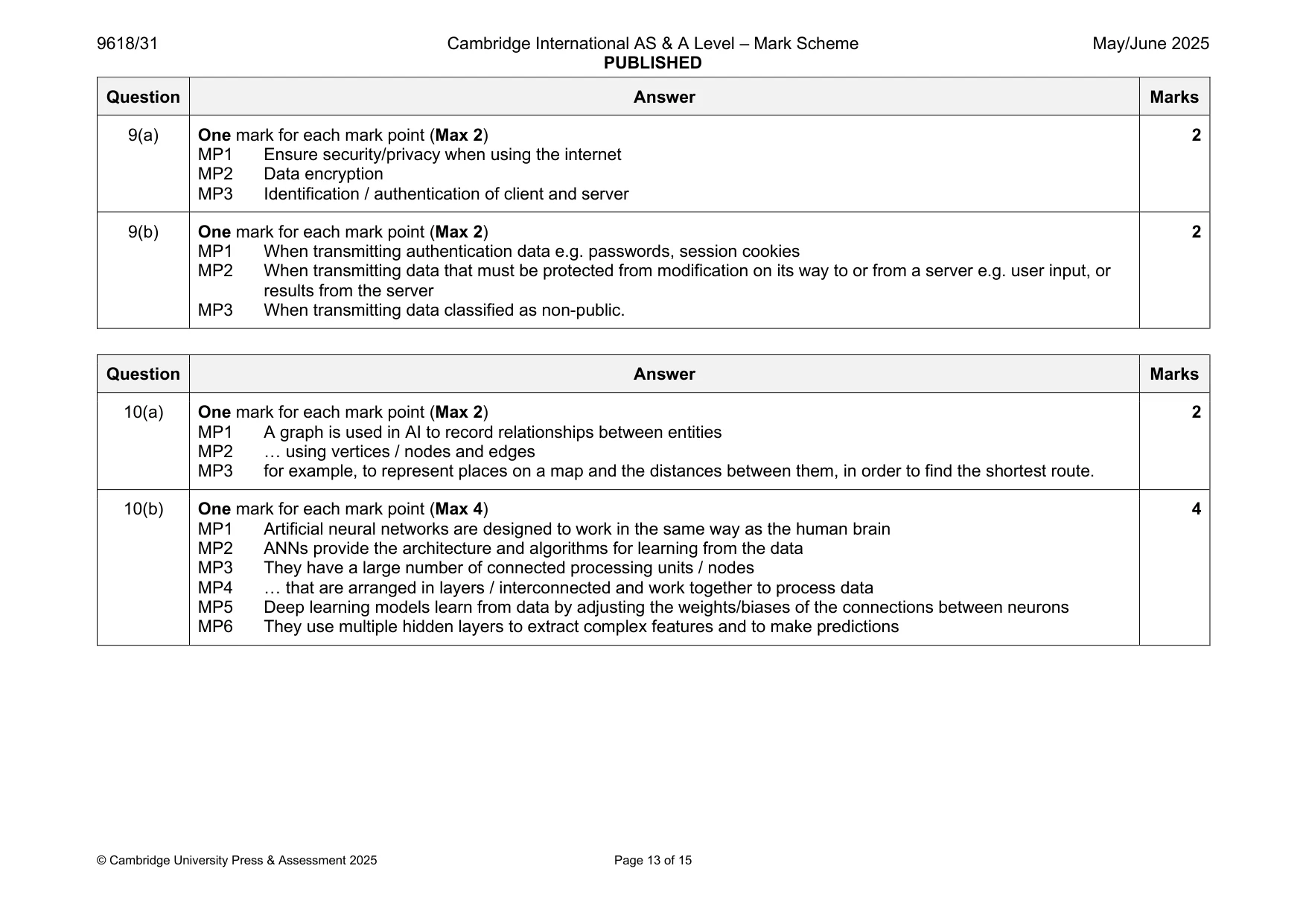
Mark scheme: 9(a) One mark for each mark point (Max 2) 2 MP1 Ensure security/privacy when using the internet MP2 Data encryption MP3 Identification / authentication of client and server 9(b) One mark for each mark point (Max 2) 2 MP1 When transmitting authentication data e.g. passwords, session cookies MP2 When transmitting data that must be protected from modification on its way to or from a server e.g. user input, or results from the server MP3 When transmitting data classified as non-public.
Q10 · Describe the purpose of a graph when used in an Artificial Intelligence (AI) system
10 (a) Describe the purpose of a graph when used in an Artificial Intelligence (AI) system. ................................................................................................................................................... ................................................................................................................................................... ................................................................................................................................................... ............................................................................................................................................. [2] (b) Explain the use of artificial neural networks in Deep Learning. ................................................................................................................................................... ................................................................................................................................................... ................................................................................................................................................... ................................................................................................................................................... ................................................................................................................................................... ................................................................................................................................................... ................................................................................................................................................... ............................................................................................................................................. [4]
Mark scheme: 10(a) One mark for each mark point (Max 2) 2 MP1 A graph is used in AI to record relationships between entities MP2 … using vertices / nodes and edges MP3 for example, to represent places on a map and the distances between them, in order to find the shortest route. 10(b) One mark for each mark point (Max 4) 4 MP1 Artificial neural networks are designed to work in the same way as the human brain MP2 ANNs provide the architecture and algorithms for learning from the data MP3 They have a large number of connected processing units / nodes MP4 … that are arranged in layers / interconnected and work together to process data MP5 Deep learning models learn from data by adjusting the weights/biases of the connections between neurons MP6 They use multiple hidden layers to extract complex features and to make predictions
Q11 · A medical centre uses objects of the class Appointment to record treatments given and…
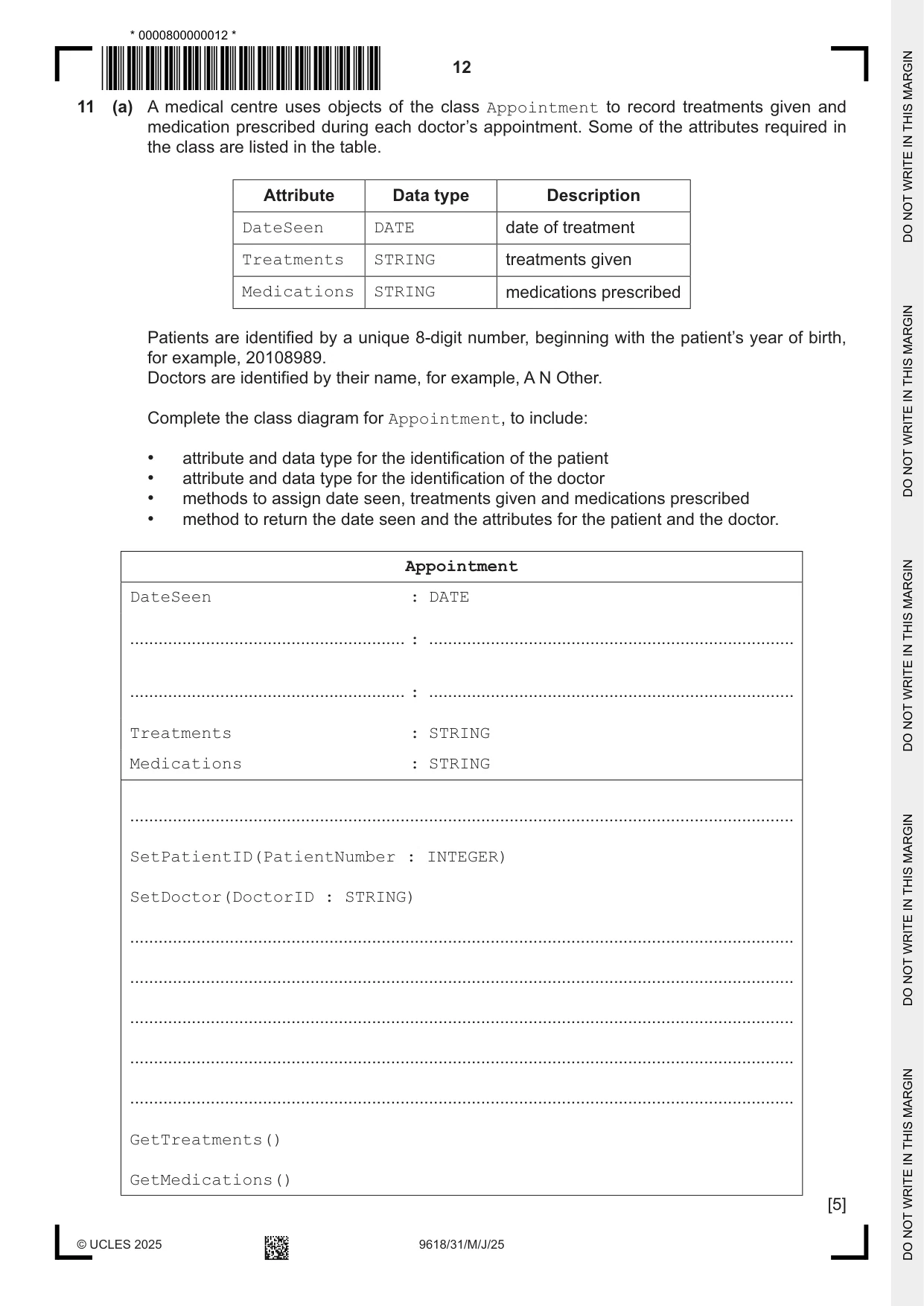
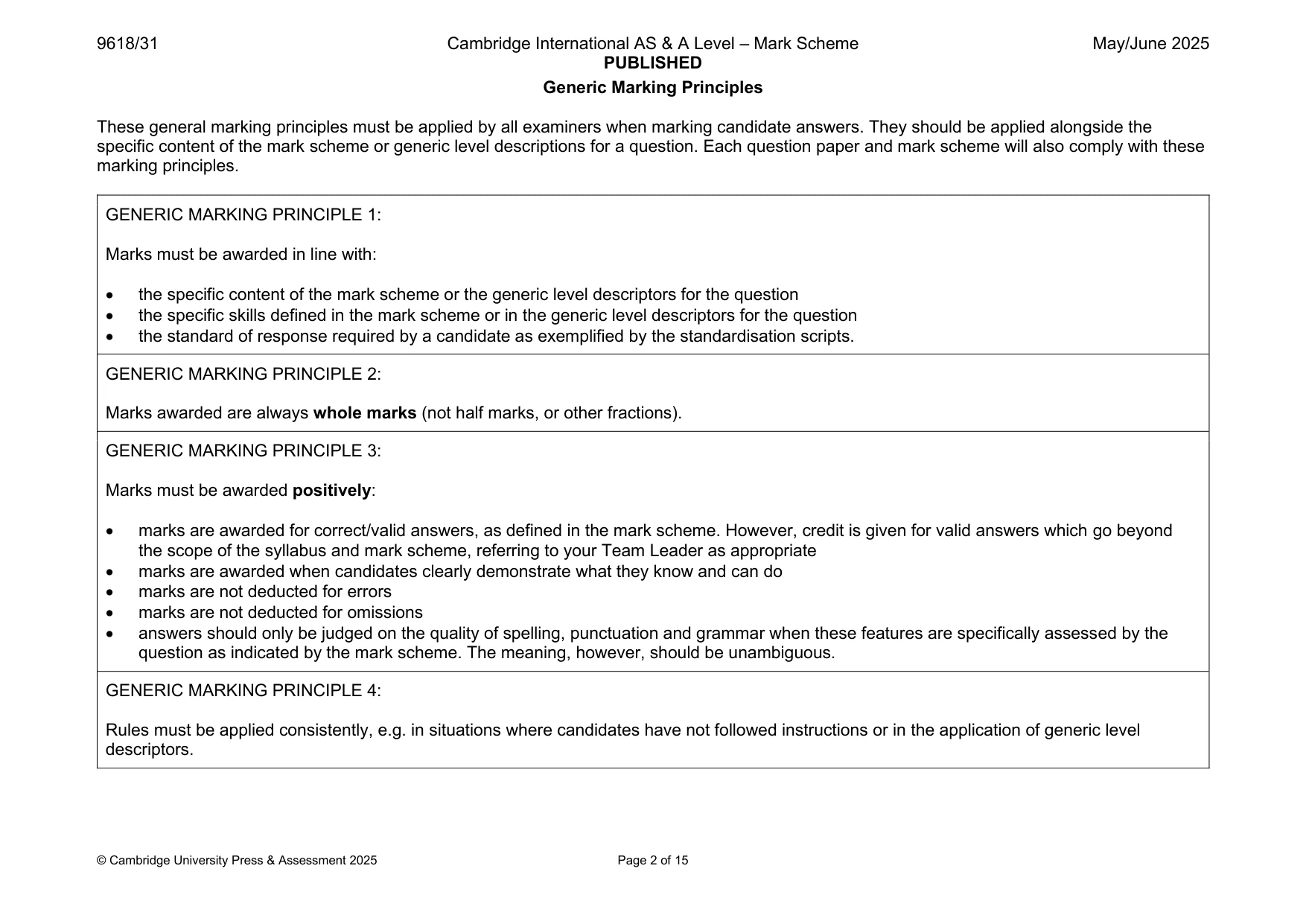
11 (a) A medical centre uses objects of the class Appointment to record treatments given and medication prescribed during each doctor’s appointment. Some of the attributes required in the class are listed in the table. Attribute Data type Description DateSeen DATE date of treatment Treatments STRING treatments given Medications STRING medications prescribed Patients are identified by a unique 8-digit number, beginning with the patient’s year of birth, for example, 20108989. Doctors are identified by their name, for example, A N Other. Complete the class diagram for Appointment, to include: • attribute and data type for the identification of the patient • attribute and data type for the identification of the doctor • methods to assign date seen, treatments given and medications prescribed • method to return the date seen and the attributes for the patient and the doctor. Appointment DateSeen : DATE .......................................................... : ............................................................................. .......................................................... : ............................................................................. Treatments : STRING Medications : STRING ............................................................................................................................................ SetPatientID(PatientNumber : INTEGER) SetDoctor(DoctorID : STRING) ............................................................................................................................................ ............................................................................................................................................ ............................................................................................................................................ ............................................................................................................................................ ............................................................................................................................................ GetTreatments() GetMedications() [5] (b) (i) Identify the object-oriented programming (OOP) feature whose function includes restricting external access to the data. ..................................................................................................................................... [1] (ii) Describe what is meant by the OOP feature inheritance. ........................................................................................................................................... ........................................................................................................................................... ........................................................................................................................................... ..................................................................................................................................... [2]
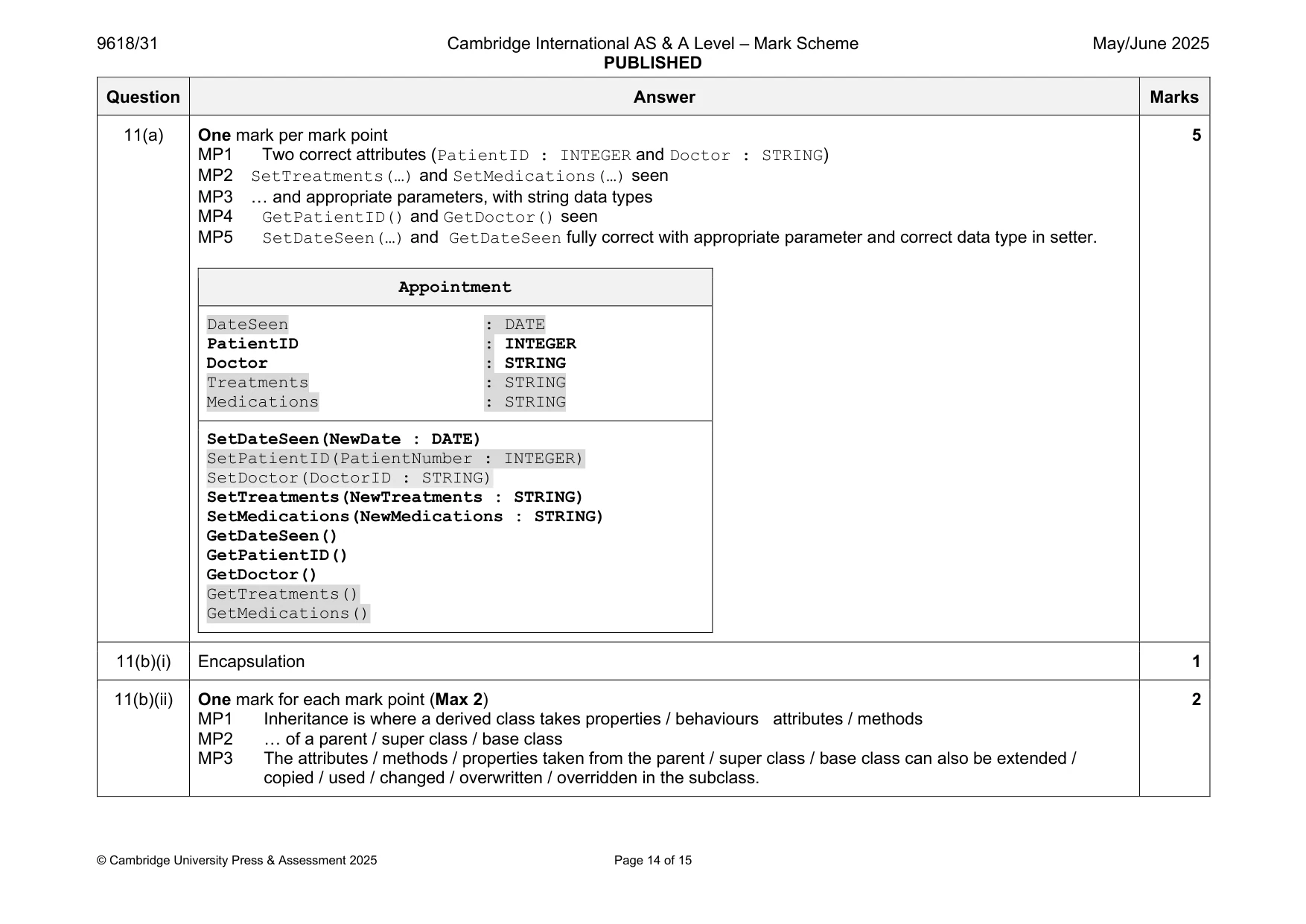
Mark scheme: 11(a) One mark per mark point 5 MP1 Two correct attributes (PatientID : INTEGER and Doctor : STRING) MP2 SetTreatments(…) and SetMedications(…) seen MP3 … and appropriate parameters, with string data types MP4 GetPatientID() and GetDoctor() seen MP5 SetDateSeen(…) and GetDateSeen fully correct with appropriate parameter and correct data type in setter. Appointment DateSeen : DATE PatientID : INTEGER Doctor : STRING Treatments : STRING Medications : STRING SetDateSeen(NewDate : DATE) SetPatientID(PatientNumber : INTEGER) SetDoctor(DoctorID : STRING) SetTreatments(NewTreatments : STRING) SetMedications(NewMedications : STRING) GetDateSeen() GetPatientID() GetDoctor() GetTreatments() GetMedications() 11(b)(i) Encapsulation 1 11(b)(ii) One mark for each mark point (Max 2) 2 MP1 Inheritance is where a derived class takes properties / behaviours attributes / methods MP2 … of a parent / super class / base class MP3 The attributes / methods / properties taken from the parent / super class / base class can also be extended / copied / used / changed / overwritten / overridden in the subclass.
Q12 · The pseudocode algorithm checks whether a location in a stock file StockList.dat is empty…
12 The pseudocode algorithm checks whether a location in a stock file StockList.dat is empty or not. The location is given by the user. If the location is empty, a suitable message is displayed, otherwise the item stored at that location is displayed. Complete this file-handling pseudocode algorithm. DECLARE Location : INTEGER DECLARE Item : STRING DECLARE Continue : BOOLEAN DECLARE Answer : CHAR Continue TRUE OPENFILE ....................................................................................................................................... WHILE Continue OUTPUT "Enter a location between 1 and 500: " INPUT Location .................................................................................................................................................... GETRECORD .............................................................................................................................. IF Item = "" THEN OUTPUT "This record is missing." ELSE OUTPUT "The item in stock is ", ........................................................................ ENDIF OUTPUT "Another location (Y or N)?" INPUT Answer IF Answer <> 'Y' THEN Continue FALSE ENDIF ENDWHILE .......................................................................................................................................................... OUTPUT "End of program" [5]
Mark scheme: 12 One mark for each correctly completed line (Max 5) 5 DECLARE Location : INTEGER DECLARE Item : STRING DECLARE Continue : BOOLEAN DECLARE Answer : CHAR Continue TRUE OPENFILE "StockList.dat" FOR RANDOM WHILE Continue OUTPUT "Enter a location between 1 and 500: " INPUT Location SEEK "StockList.dat", Location GETRECORD "StockList.dat", Item IF Item = "" THEN OUTPUT "This record is missing" ELSE OUTPUT "The item in stock is ", Item ENDIF OUTPUT "Another location (Y or N)?" INPUT Answer IF Answer <> 'Y' THEN Continue FALSE ENDIF ENDWHILE CLOSEFILE "StockList.dat" OUTPUT "End of program"
What you needed in this session
Cambridge’s own grade thresholds for 2025 May/June, Paper 3 · Variant 1. A higher threshold means an easier paper — the bar moves with how the cohort did.