Cambridge A Level Chemistry 9701 — 2022 Oct/Nov Paper 4 · Variant 1
9701/41/O/N/22 · 9 questions · 100 marks · ≈113 min
The question paper and its mark scheme, free to read here and free to download. This is Cambridge’s own paper, exactly as it was sat.
Question paper28 pages


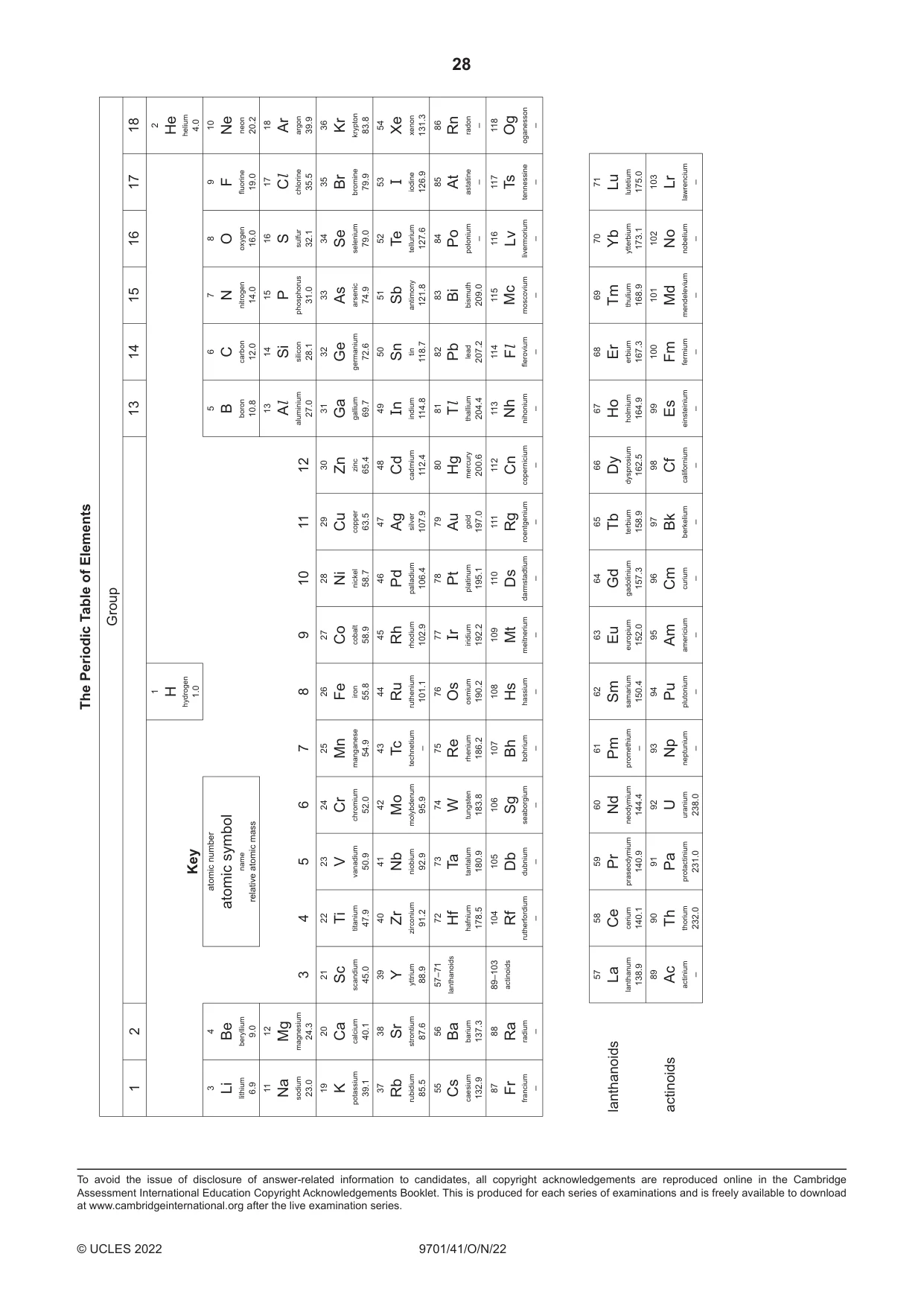
Mark scheme16 pages
Answers below. Sit the paper first if you are practising.
Questions as text
Q1 · Potassium chloride, KCl, and magnesium chloride, MgCl 2, are both ionic solids
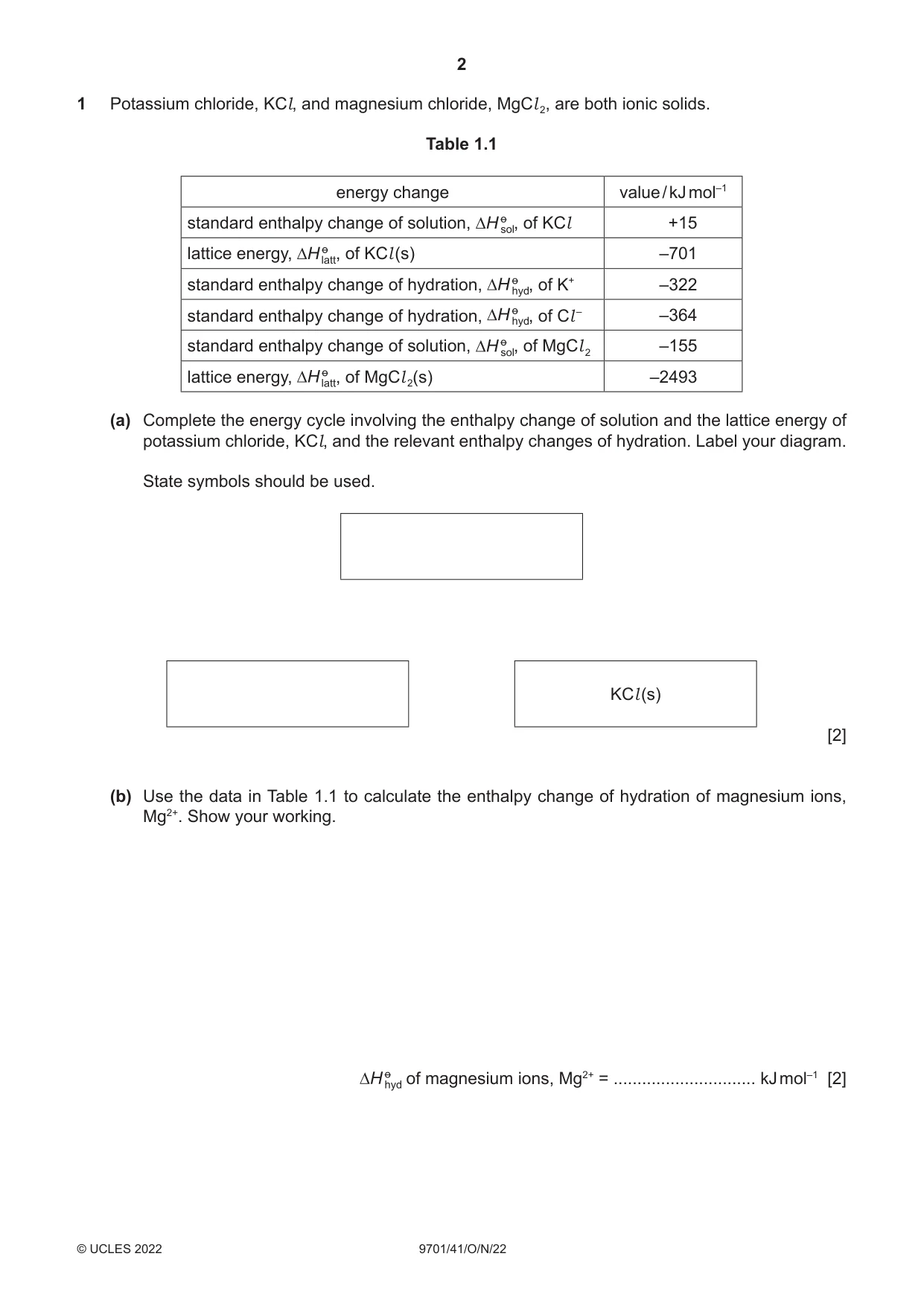
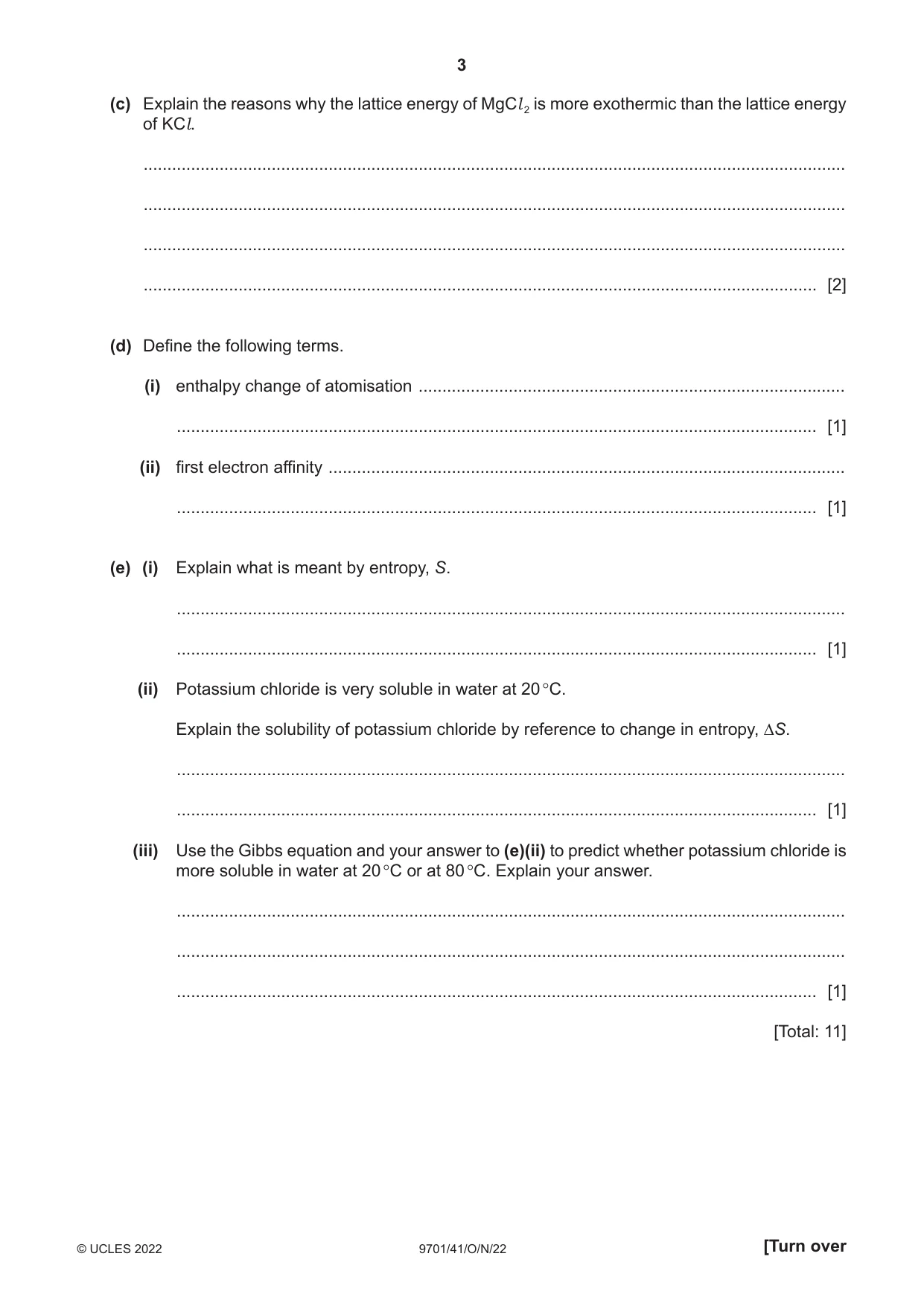
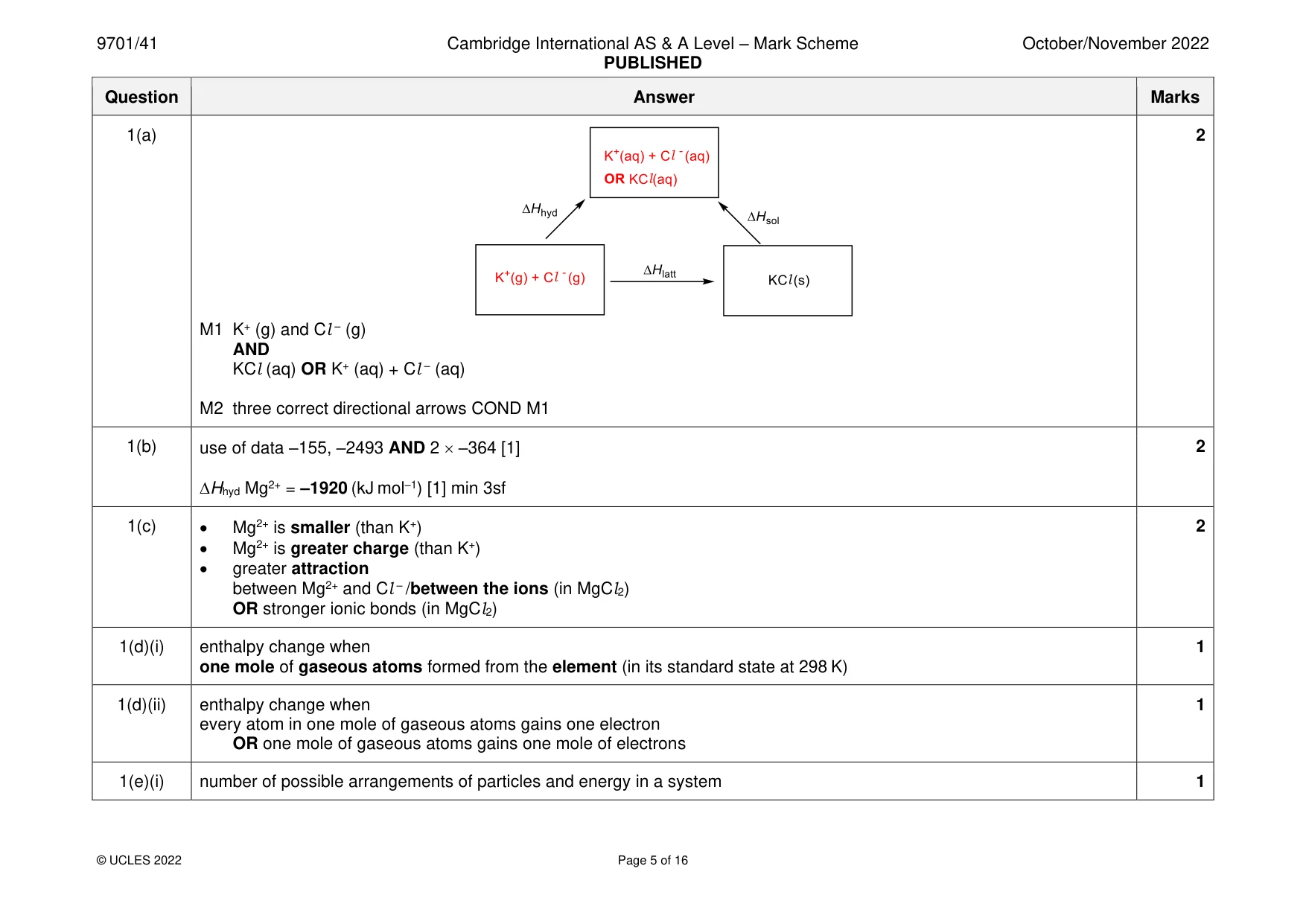
1 Potassium chloride, KCl, and magnesium chloride, MgCl 2, are both ionic solids. Table 1.1 energy change value / kJ mol–1 standard enthalpy change of solution, , of KCl +15 lattice energy, , of KCl (s) –701 standard enthalpy change of hydration, , of K+ –322 standard enthalpy change of hydration, , of Cl – –364 standard enthalpy change of solution, , of MgCl 2 –155 lattice energy, , of MgCl 2(s) –2493 (a) Complete the energy cycle involving the enthalpy change of solution and the lattice energy of potassium chloride, KCl, and the relevant enthalpy changes of hydration. Label your diagram. State symbols should be used. KCl (s) [2] (b) Use the data in Table 1.1 to calculate the enthalpy change of hydration of magnesium ions, Mg2+. Show your working. of magnesium ions, Mg2+ = .............................. kJ mol–1 [2] (c) Explain the reasons why the lattice energy of MgCl 2 is more exothermic than the lattice energy of KCl. .................................................................................................................................................... .................................................................................................................................................... .................................................................................................................................................... .............................................................................................................................................. [2] (d) Define the following terms. (i) enthalpy change of atomisation .......................................................................................... ....................................................................................................................................... [1] (ii) first electron affinity ............................................................................................................. ....................................................................................................................................... [1] (e) (i) Explain what is meant by entropy, S. ............................................................................................................................................. ....................................................................................................................................... [1] (ii) Potassium chloride is very soluble in water at 20 °C. Explain the solubility of potassium chloride by reference to change in entropy, ∆S. ............................................................................................................................................. ....................................................................................................................................... [1] (iii) Use the Gibbs equation and your answer to (e)(ii) to predict whether potassium chloride is more soluble in water at 20 °C or at 80 °C. Explain your answer. ............................................................................................................................................. ............................................................................................................................................. ....................................................................................................................................... [1] [Total: 11]
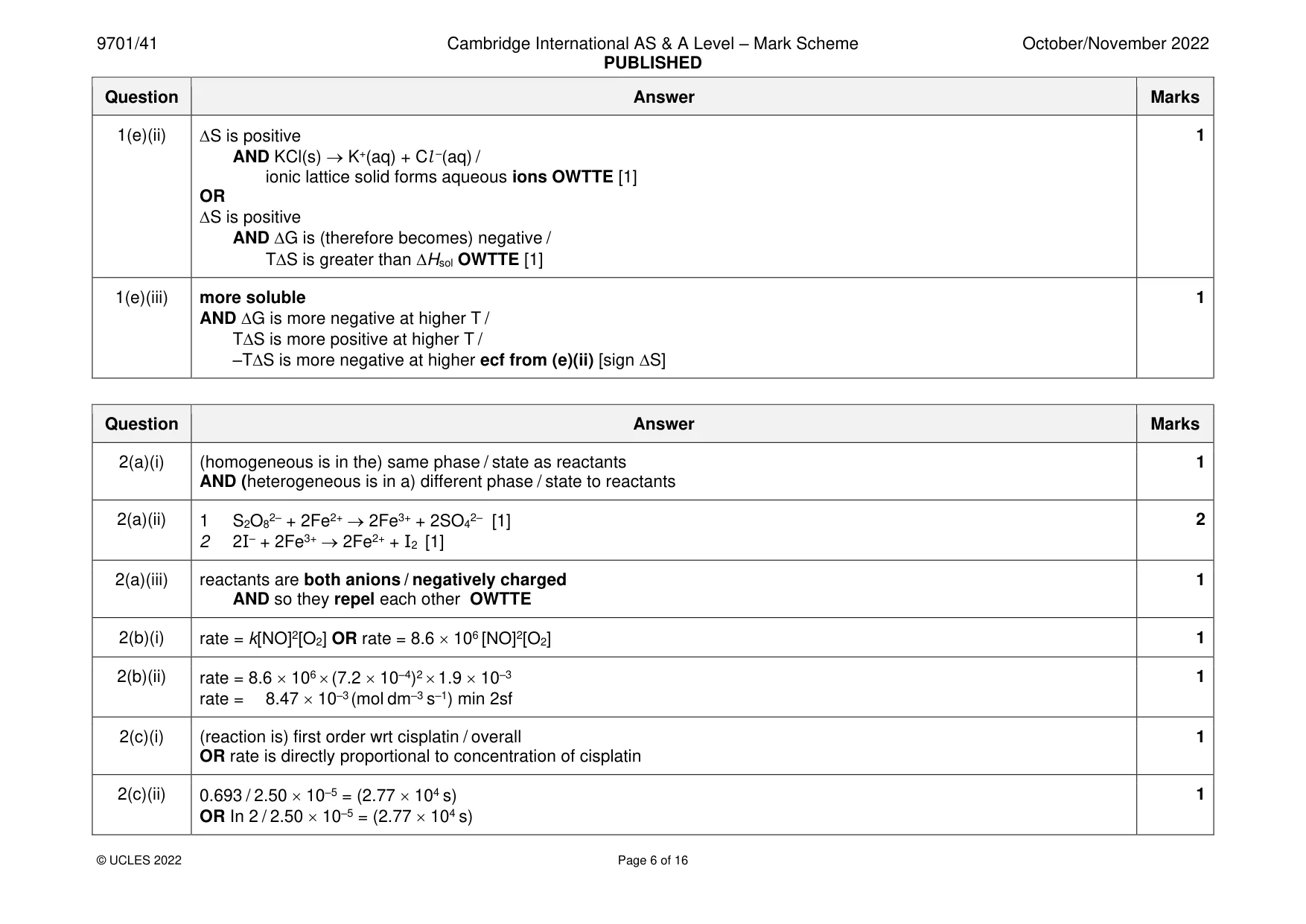
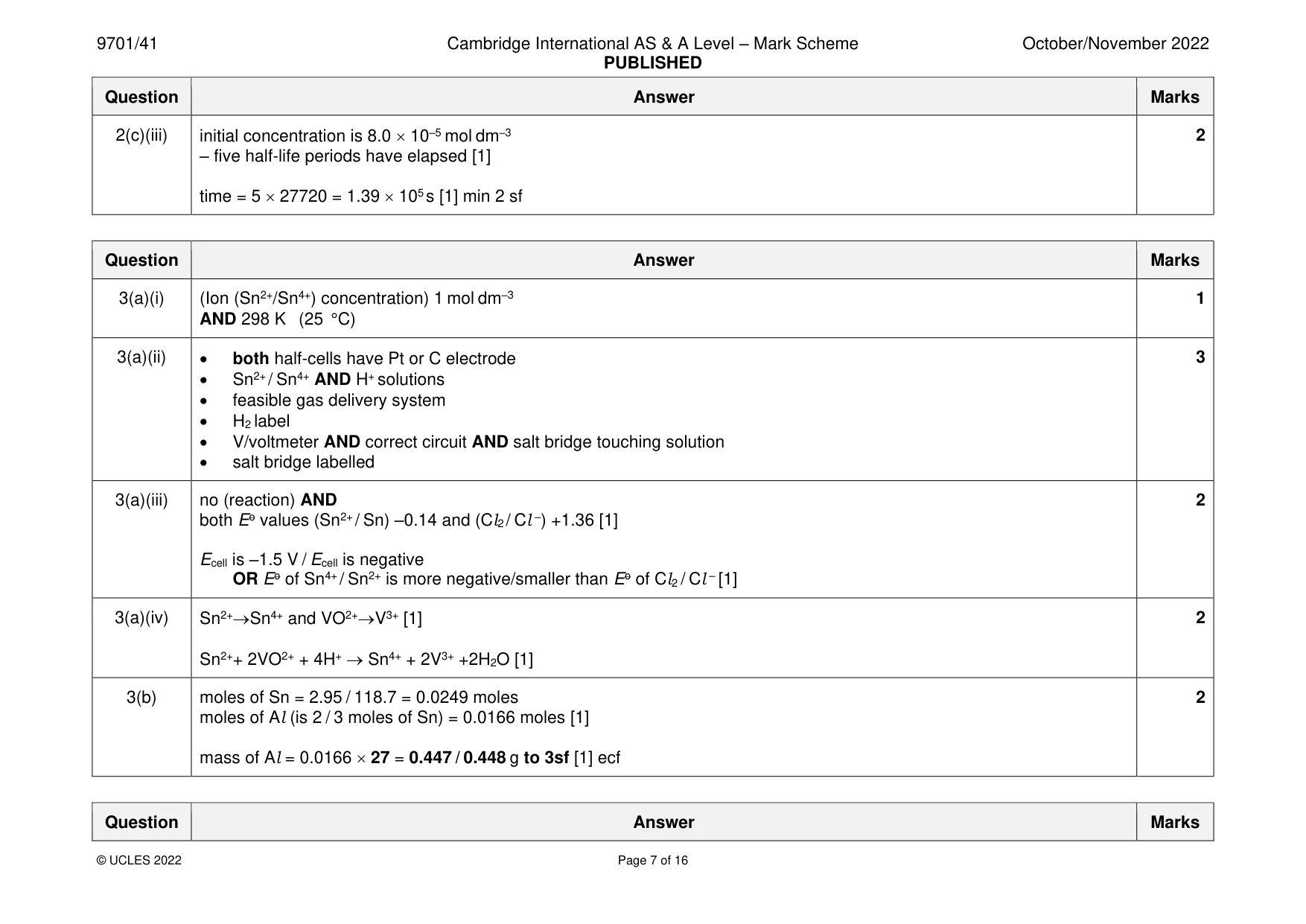
Mark scheme: Question Answer Marks 1(a) 2 M1 K+ (g) and Cl – (g) AND KCl (aq) OR K+ (aq) + Cl – (aq) M2 three correct directional arrows COND M1 1(b) use of data –155, –2493 AND 2 –364 [1] 2 Hhyd Mg2+ = –1920 (kJ mol–1) [1] min 3sf 1(c) • Mg2+ is smaller (than K+) 2 • Mg2+ is greater charge (than K+) • greater attraction between Mg2+ and Cl – /between the ions (in MgCl2) OR stronger ionic bonds (in MgCl2) 1(d)(i) enthalpy change when 1 one mole of gaseous atoms formed from the element (in its standard state at 298 K) 1(d)(ii) enthalpy change when 1 every atom in one mole of gaseous atoms gains one electron OR one mole of gaseous atoms gains one mole of electrons 1(e)(i) number of possible arrangements of particles and energy in a system 1 1(e)(ii) S is positive 1 AND KCl(s) → K+(aq) + Cl –(aq) / ionic lattice solid forms aqueous ions OWTTE [1] OR S is positive AND G is (therefore becomes) negative / TS is greater than Hsol OWTTE [1] 1(e)(iii) more soluble 1 AND G is more negative at higher T / TS is more positive at higher T / –TS is more negative at higher ecf from (e)(ii) [sign S]
Q2 · Explain what is meant by the following terms: homogeneous catalyst…
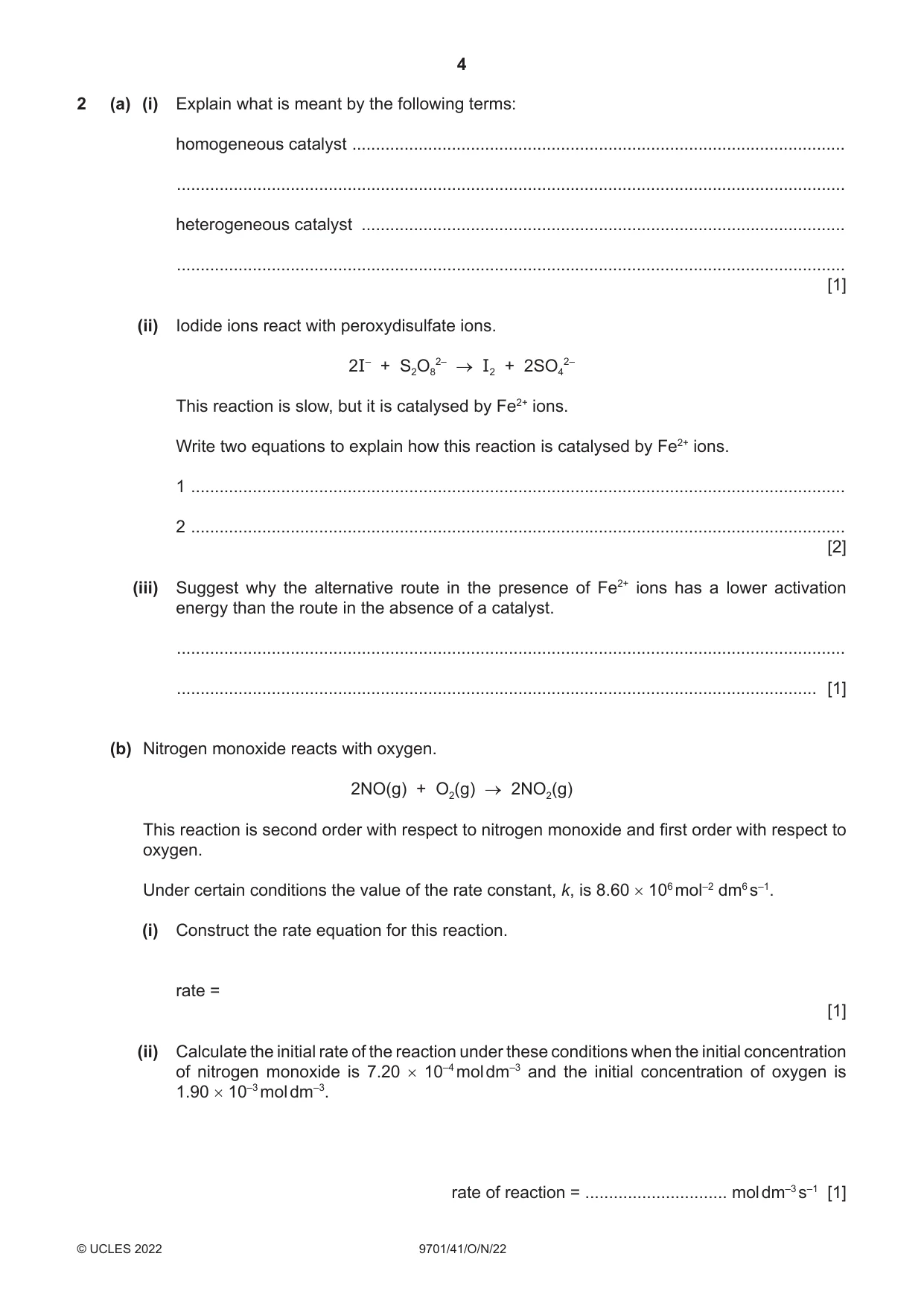
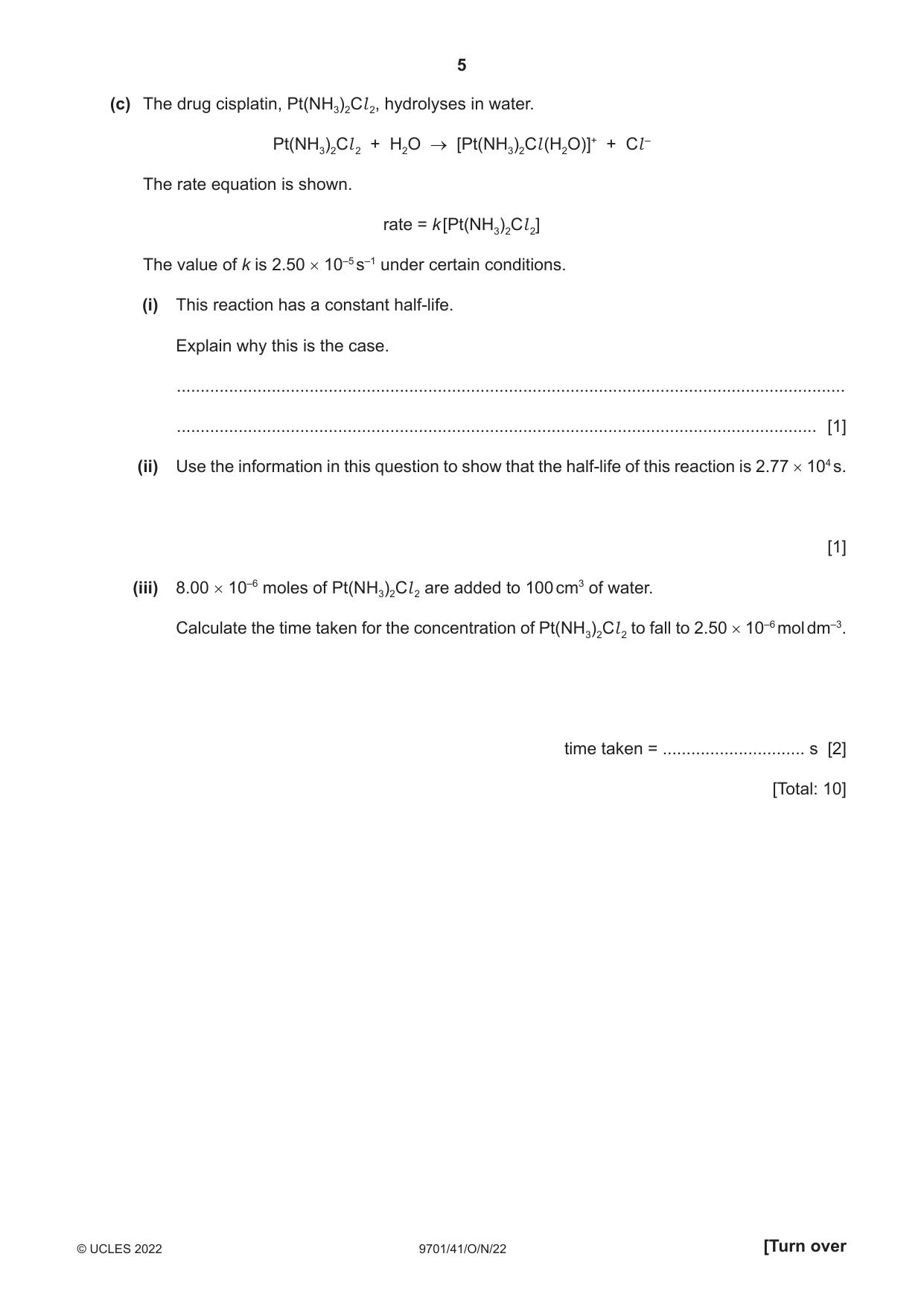
2 (a) (i) Explain what is meant by the following terms: homogeneous catalyst ........................................................................................................ ............................................................................................................................................. heterogeneous catalyst ....................................................................................................... ............................................................................................................................................. [1] (ii) Iodide ions react with peroxydisulfate ions. 2I– + S2O82– → I2 + 2SO42– This reaction is slow, but it is catalysed by Fe2+ ions. Write two equations to explain how this reaction is catalysed by Fe2+ ions. 1 .......................................................................................................................................... 2 .......................................................................................................................................... [2] (iii) Suggest why the alternative route in the presence of Fe2+ ions has a lower activation energy than the route in the absence of a catalyst. ............................................................................................................................................. ....................................................................................................................................... [1] (b) Nitrogen monoxide reacts with oxygen. 2NO(g) + O2(g) → 2NO2(g) This reaction is second order with respect to nitrogen monoxide and first order with respect to oxygen. Under certain conditions the value of the rate constant, k, is 8.60 × 10⁶ mol–2 dm6 s–1. (i) Construct the rate equation for this reaction. rate = [1] (ii) Calculate the initial rate of the reaction under these conditions when the initial concentration of nitrogen monoxide is 7.20 × 10⁻⁴ mol dm–3 and the initial concentration of oxygen is 1.90 × 10⁻³ mol dm–3. rate of reaction = .............................. mol dm–3 s–1 [1] (c) The drug cisplatin, Pt(NH3)2Cl 2, hydrolyses in water. Pt(NH3)2Cl 2 + H2O → [Pt(NH3)2Cl (H2O)]+ + Cl – The rate equation is shown. rate = k [Pt(NH3)2Cl 2] The value of k is 2.50 × 10⁻⁵ s–1 under certain conditions. (i) This reaction has a constant half-life. Explain why this is the case. ............................................................................................................................................. ....................................................................................................................................... [1] (ii) Use the information in this question to show that the half-life of this reaction is 2.77 × 10⁴ s. [1] (iii) 8.00 × 10⁻⁶ moles of Pt(NH3)2Cl 2 are added to 100 cm3 of water. Calculate the time taken for the concentration of Pt(NH3)2Cl 2 to fall to 2.50 × 10⁻⁶ mol dm–3. time taken = .............................. s [2] [Total: 10]
Mark scheme: 2(a)(i) (homogeneous is in the) same phase / state as reactants 1 AND (heterogeneous is in a) different phase / state to reactants 2(a)(ii) 1 S2O82– + 2Fe2+ → 2Fe3+ + 2SO42– [1] 2 2 2I– + 2Fe3+ → 2Fe2+ + I2 [1] 2(a)(iii) reactants are both anions / negatively charged 1 AND so they repel each other OWTTE 2(b)(i) rate = k[NO]2[O2] OR rate = 8.6 106 [NO]2[O2] 1 2(b)(ii) rate = 8.6 106 (7.2 10–4)2 1.9 10–3 1 rate = 8.47 10–3 (mol dm–3 s–1) min 2sf 2(c)(i) (reaction is) first order wrt cisplatin / overall 1 OR rate is directly proportional to concentration of cisplatin 2(c)(ii) 0.693 / 2.50 10–5 = (2.77 104 s) 1 OR In 2 / 2.50 10–5 = (2.77 104 s) 2(c)(iii) initial concentration is 8.0 10–5 mol dm–3 2 – five half-life periods have elapsed [1] time = 5 27720 = 1.39 105 s [1] min 2 sf
More questions on Simple rate equations, orders of reaction and rate constants
Q3 · Data should be selected from Table 3.1 in order to answer some parts of this question
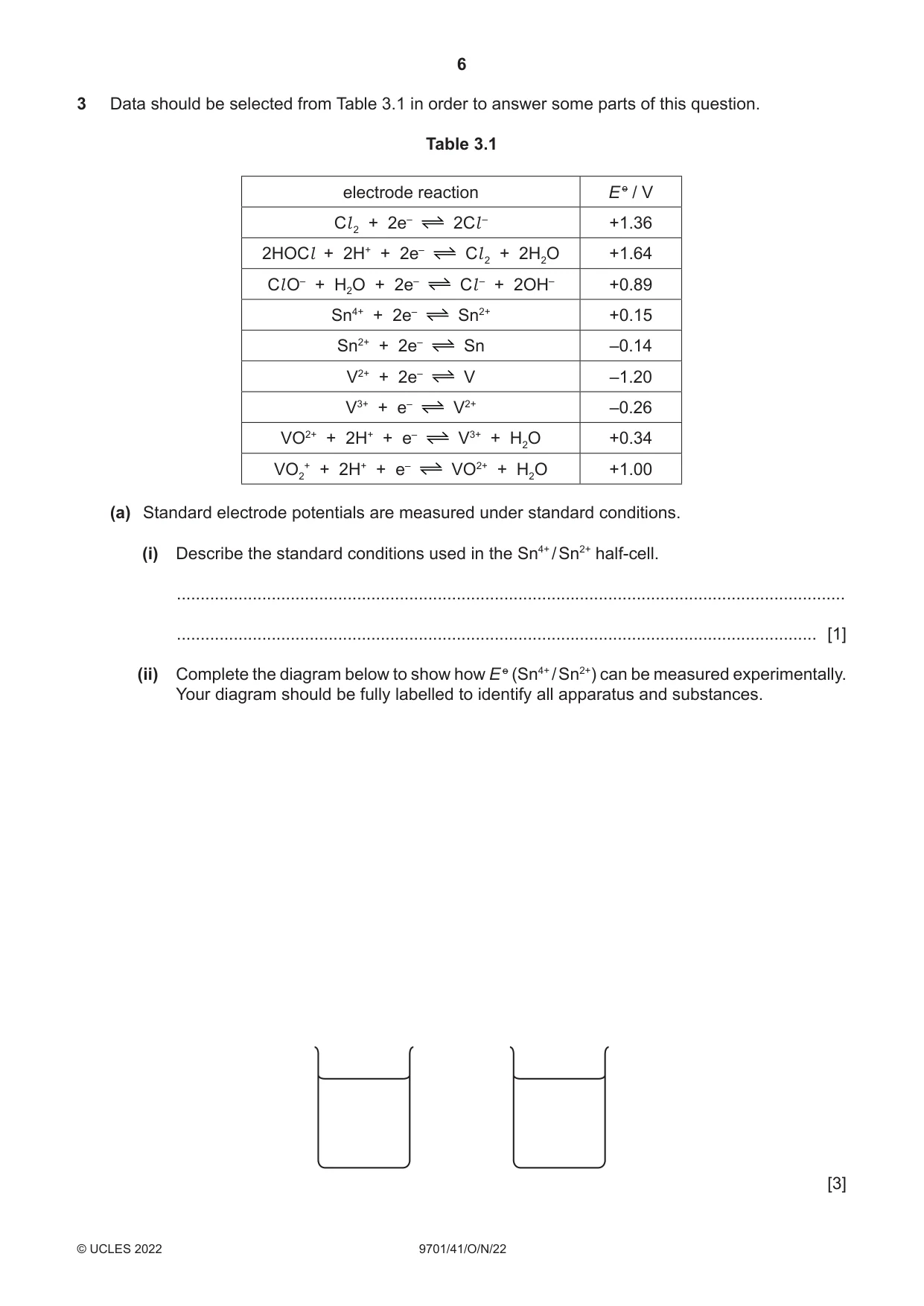
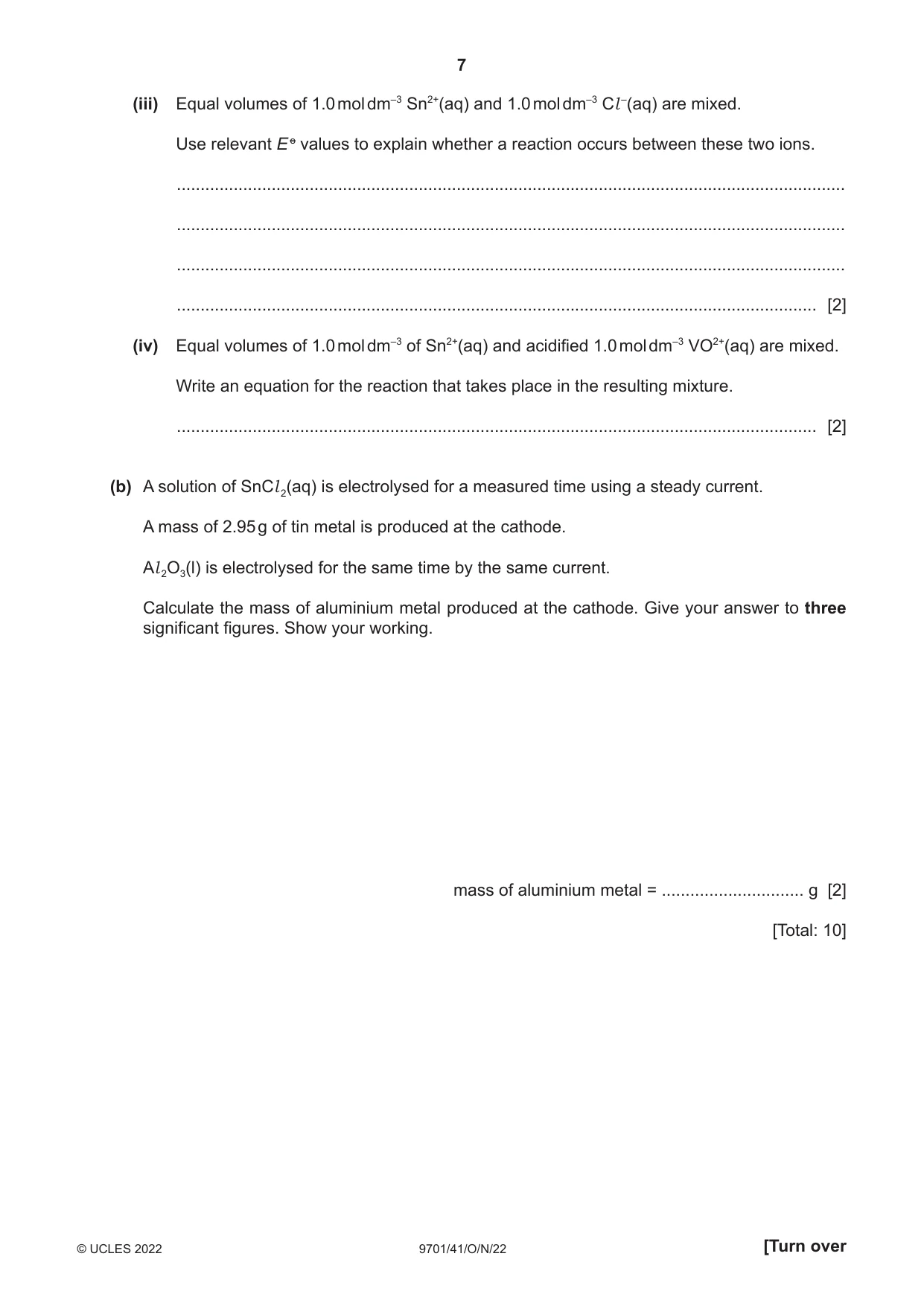
3 Data should be selected from Table 3.1 in order to answer some parts of this question. Table 3.1 electrode reaction E o / V Cl 2 + 2e– 2Cl – +1.36 2HOCl + 2H+ + 2e– Cl 2 + 2H2O +1.64 Cl O– + H2O + 2e– Cl – + 2OH– +0.89 Sn4+ + 2e– Sn2+ +0.15 Sn2+ + 2e– Sn –0.14 V2+ + 2e– V –1.20 V3+ + e– V2+ –0.26 VO2+ + 2H+ + e– V3+ + H2O +0.34 VO2+ + 2H+ + e– VO2+ + H2O +1.00 (a) Standard electrode potentials are measured under standard conditions. (i) Describe the standard conditions used in the Sn4+ / Sn2+ half-cell. ............................................................................................................................................. ....................................................................................................................................... [1] (ii) Complete the diagram below to show how E o (Sn4+ / Sn2+) can be measured experimentally. Your diagram should be fully labelled to identify all apparatus and substances. [3] (iii) Equal volumes of 1.0 mol dm–3 Sn2+(aq) and 1.0 mol dm–3 Cl –(aq) are mixed. Use relevant E o values to explain whether a reaction occurs between these two ions. ............................................................................................................................................. ............................................................................................................................................. ............................................................................................................................................. ....................................................................................................................................... [2] (iv) Equal volumes of 1.0 mol dm–3 of Sn2+(aq) and acidified 1.0 mol dm–3 VO2+(aq) are mixed. Write an equation for the reaction that takes place in the resulting mixture. ....................................................................................................................................... [2] (b) A solution of SnCl 2(aq) is electrolysed for a measured time using a steady current. A mass of 2.95 g of tin metal is produced at the cathode. Al 2O3(l) is electrolysed for the same time by the same current. Calculate the mass of aluminium metal produced at the cathode. Give your answer to three significant figures. Show your working. mass of aluminium metal = .............................. g [2] [Total: 10]
Mark scheme: 3(a)(i) (Ion (Sn2+/Sn4+) concentration) 1 mol dm–3 1 AND 298 K (25 °C) 3(a)(ii) • both half-cells have Pt or C electrode 3 • Sn2+ / Sn4+ AND H+ solutions • feasible gas delivery system • H2 label • V/voltmeter AND correct circuit AND salt bridge touching solution • salt bridge labelled 3(a)(iii) no (reaction) AND 2 both Eo values (Sn2+ / Sn) –0.14 and (Cl2 / Cl –) +1.36 [1] Ecell is –1.5 V / Ecell is negative OR Eo of Sn4+ / Sn2+ is more negative/smaller than Eo of Cl2 / Cl – [1] 3(a)(iv) Sn2+→Sn4+ and VO2+→V3+ [1] 2 Sn2++ 2VO2+ + 4H+ → Sn4+ + 2V3+ +2H2O [1] 3(b) moles of Sn = 2.95 / 118.7 = 0.0249 moles 2 moles of Al (is 2 / 3 moles of Sn) = 0.0166 moles [1] mass of Al = 0.0166 27 = 0.447 / 0.448 g to 3sf [1] ecf Question Answer Marks
Q4 · A sample of butanoic acid, CH3(CH2)2COOH, is shaken with a mixture of two immiscible…
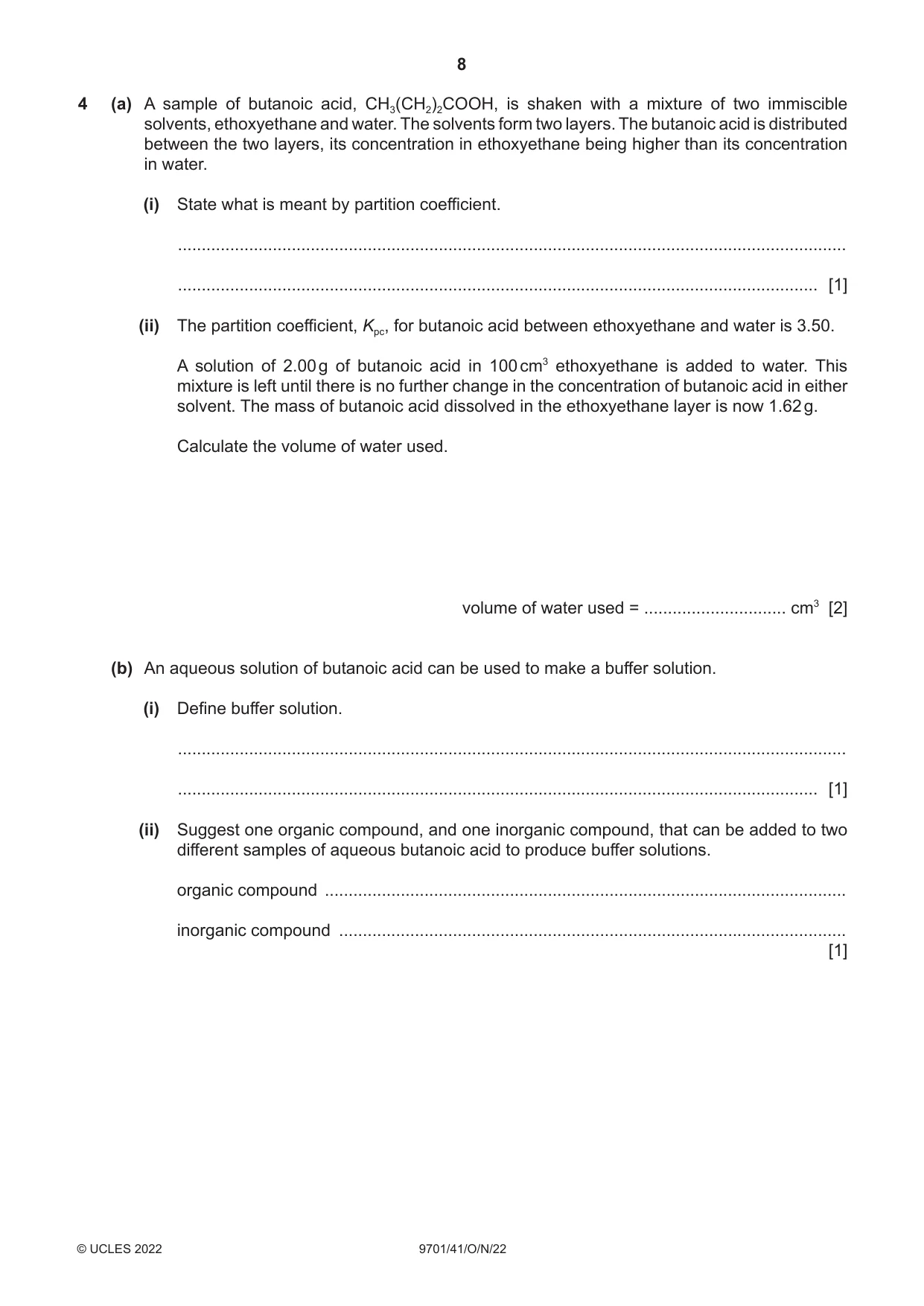
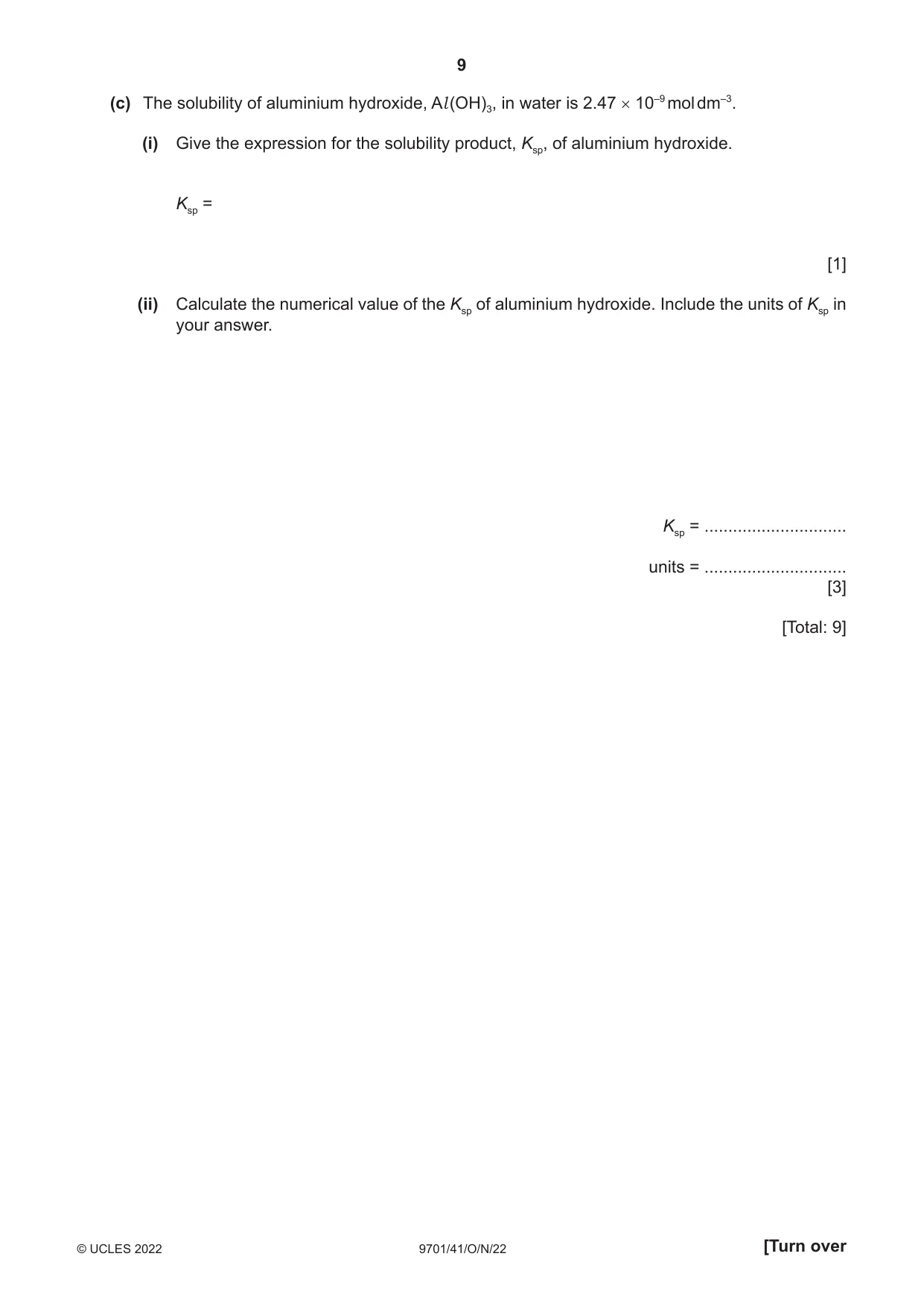
4 (a) A sample of butanoic acid, CH3(CH2)2COOH, is shaken with a mixture of two immiscible solvents, ethoxyethane and water. The solvents form two layers. The butanoic acid is distributed between the two layers, its concentration in ethoxyethane being higher than its concentration in water. (i) State what is meant by partition coefficient. ............................................................................................................................................. ....................................................................................................................................... [1] (ii) The partition coefficient, Kpc, for butanoic acid between ethoxyethane and water is 3.50. A solution of 2.00 g of butanoic acid in 100 cm3 ethoxyethane is added to water. This mixture is left until there is no further change in the concentration of butanoic acid in either solvent. The mass of butanoic acid dissolved in the ethoxyethane layer is now 1.62 g. Calculate the volume of water used. volume of water used = .............................. cm3 [2] (b) An aqueous solution of butanoic acid can be used to make a buffer solution. (i) Define buffer solution. ............................................................................................................................................. ....................................................................................................................................... [1] (ii) Suggest one organic compound, and one inorganic compound, that can be added to two different samples of aqueous butanoic acid to produce buffer solutions. organic compound ............................................................................................................... inorganic compound ............................................................................................................ [1] (c) The solubility of aluminium hydroxide, Al (OH)3, in water is 2.47 × 10⁻⁹ mol dm–3. (i) Give the expression for the solubility product, Ksp, of aluminium hydroxide. Ksp = [1] (ii) Calculate the numerical value of the Ksp of aluminium hydroxide. Include the units of Ksp in your answer. Ksp = .............................. units = .............................. [3] [Total: 9]
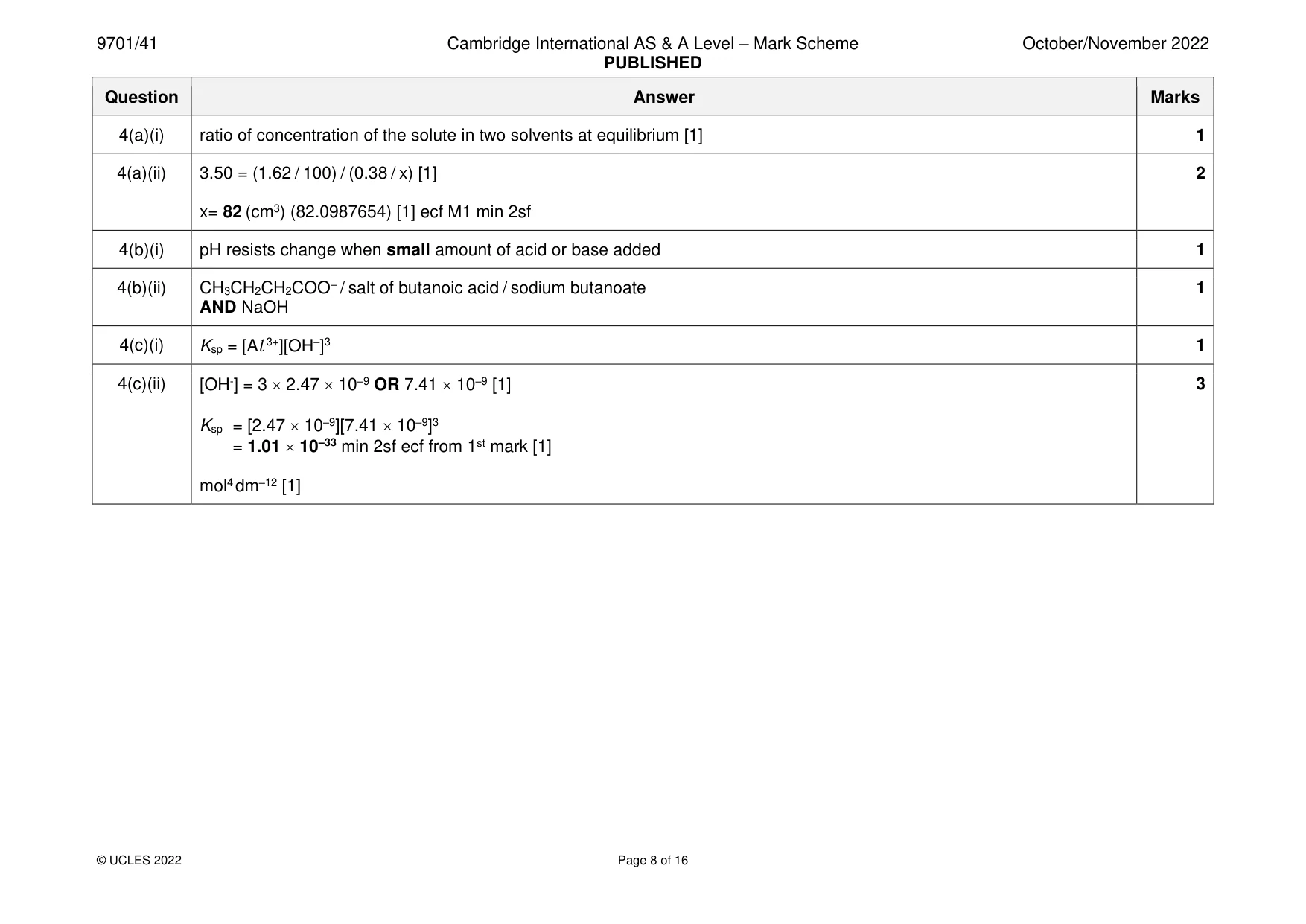
Mark scheme: 4(a)(i) ratio of concentration of the solute in two solvents at equilibrium [1] 1 4(a)(ii) 3.50 = (1.62 / 100) / (0.38 / x) [1] 2 x= 82 (cm3) (82.0987654) [1] ecf M1 min 2sf 4(b)(i) pH resists change when small amount of acid or base added 1 4(b)(ii) CH3CH2CH2COO– / salt of butanoic acid / sodium butanoate 1 AND NaOH 4(c)(i) Ksp = [Al 3+][OH–]3 1 4(c)(ii) [OH-] = 3 2.47 10–9 OR 7.41 10–9 [1] 3 Ksp = [2.47 10–9][7.41 10–9]3 = 1.01 10–33 min 2sf ecf from 1st mark [1] mol4 dm–12 [1]
Q5 · A transition element is a d-block element which forms one or more stable ions with…
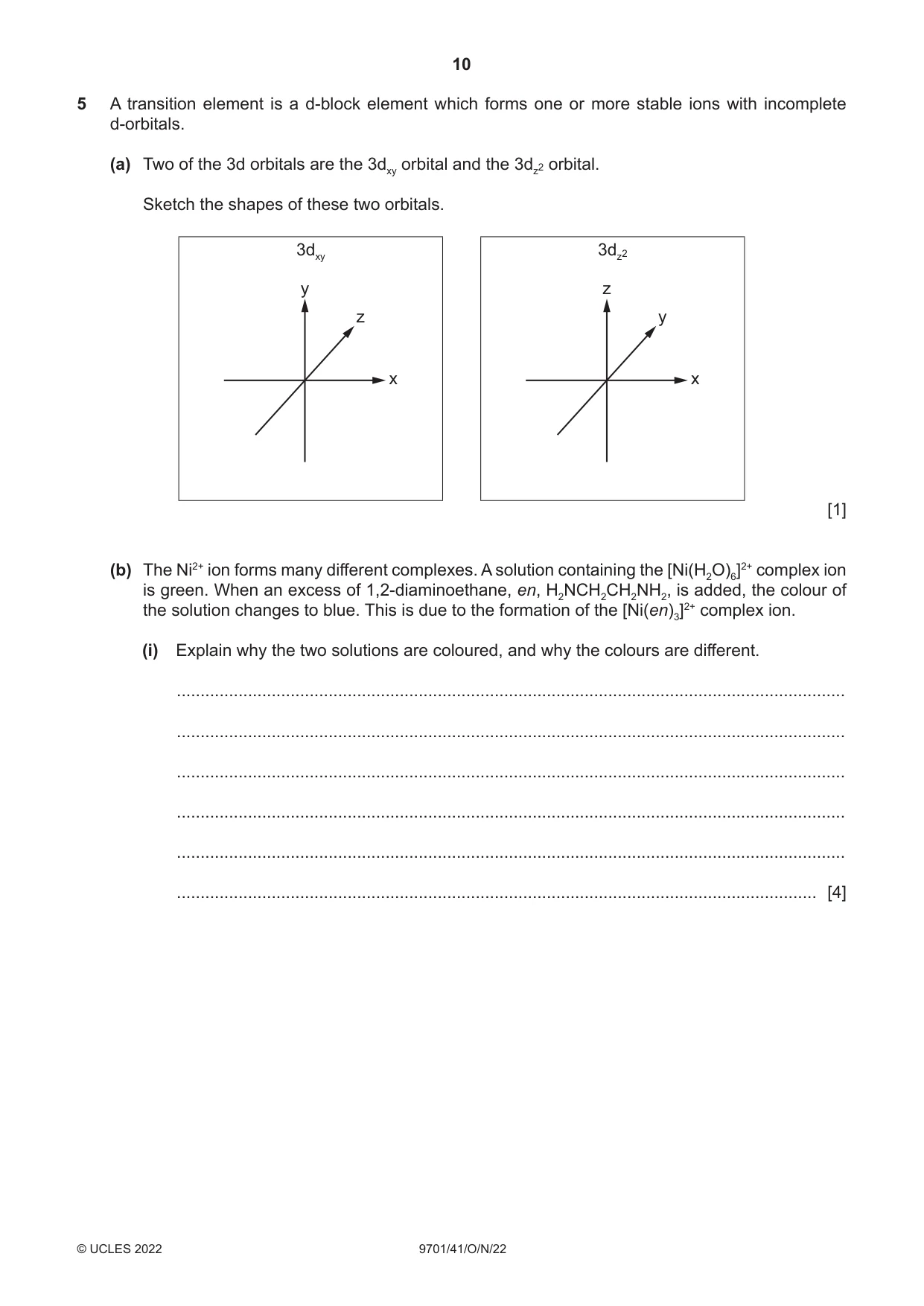
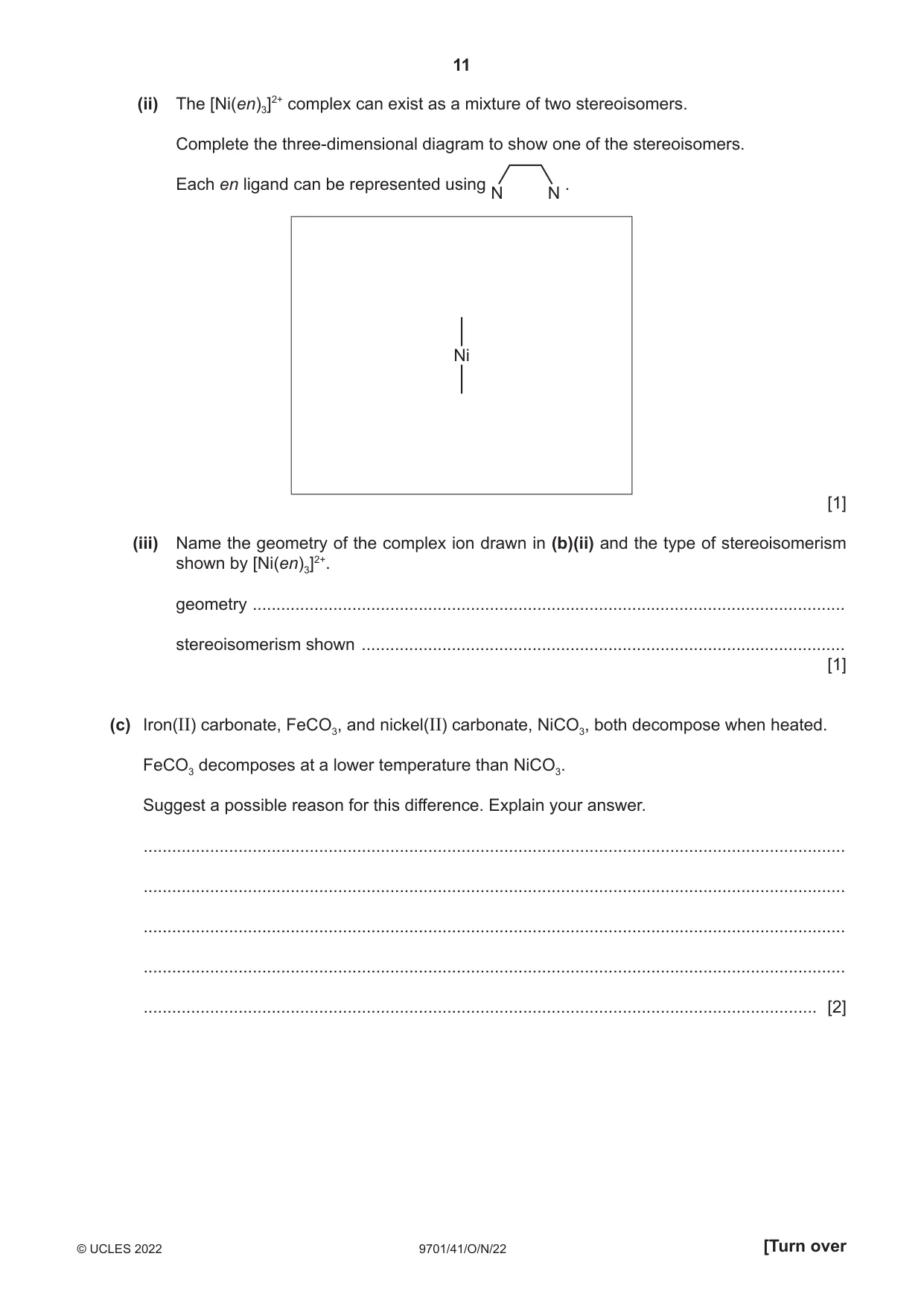
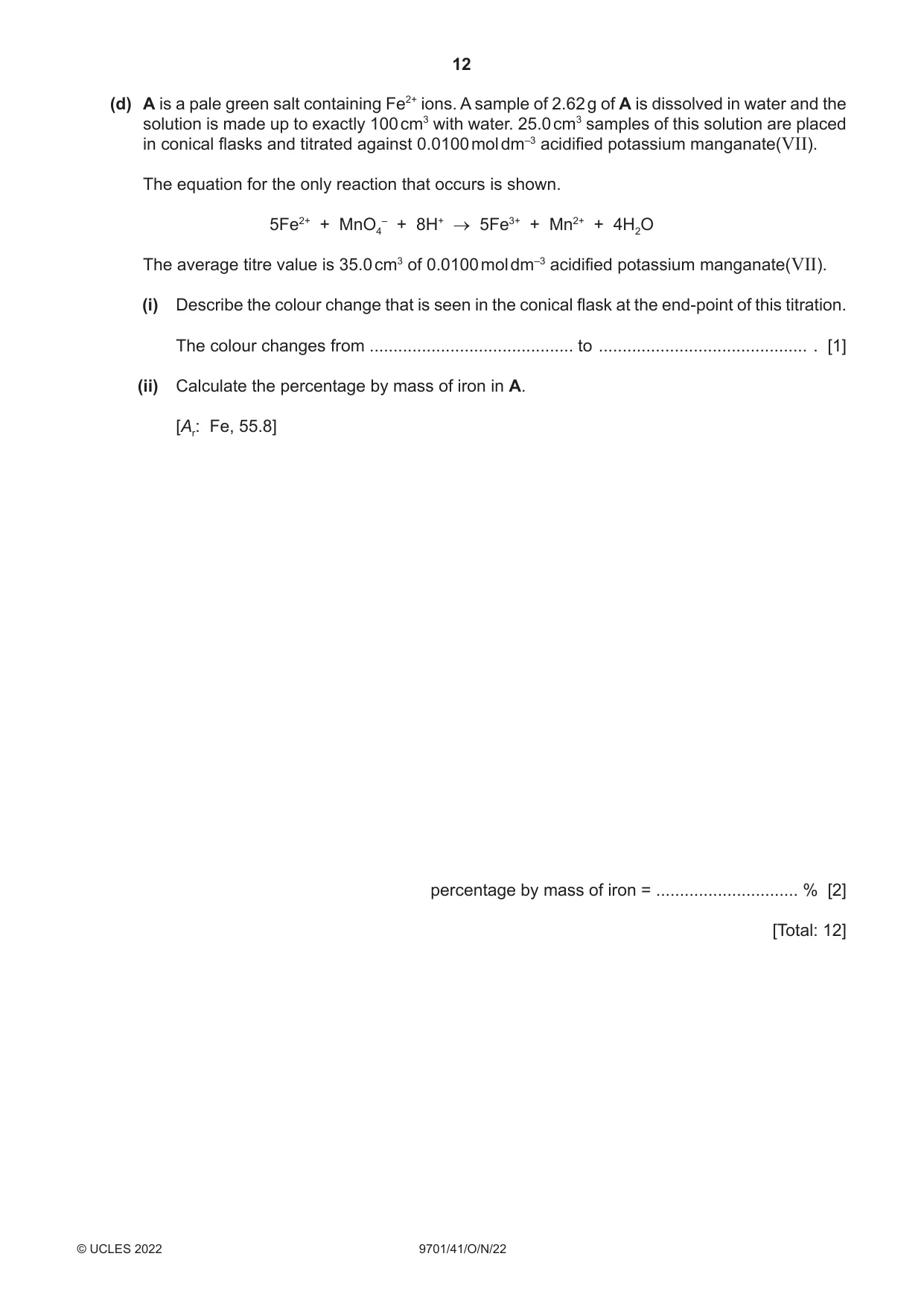
5 A transition element is a d-block element which forms one or more stable ions with incomplete d-orbitals. (a) Two of the 3d orbitals are the 3dxy orbital and the 3dz2 orbital. Sketch the shapes of these two orbitals. 3dxy 3dz2 y z z y x x [1] (b) The Ni2+ ion forms many different complexes. A solution containing the [Ni(H2O)6]2+ complex ion is green. When an excess of 1,2-diaminoethane, en, H2NCH2CH2NH2, is added, the colour of the solution changes to blue. This is due to the formation of the [Ni(en)3]2+ complex ion. (i) Explain why the two solutions are coloured, and why the colours are different. ............................................................................................................................................. ............................................................................................................................................. ............................................................................................................................................. ............................................................................................................................................. ............................................................................................................................................. ....................................................................................................................................... [4] (ii) The [Ni(en)3]2+ complex can exist as a mixture of two stereoisomers. Complete the three-dimensional diagram to show one of the stereoisomers. Each en ligand can be represented using . N N Ni [1] (iii) Name the geometry of the complex ion drawn in (b)(ii) and the type of stereoisomerism shown by [Ni(en)3]2+. geometry ............................................................................................................................. stereoisomerism shown ...................................................................................................... [1] (c) Iron(II) carbonate, FeCO3, and nickel(II) carbonate, NiCO3, both decompose when heated. FeCO3 decomposes at a lower temperature than NiCO3. Suggest a possible reason for this difference. Explain your answer. .................................................................................................................................................... .................................................................................................................................................... .................................................................................................................................................... .................................................................................................................................................... .............................................................................................................................................. [2] (d) A is a pale green salt containing Fe2+ ions. A sample of 2.62 g of A is dissolved in water and the solution is made up to exactly 100 cm3 with water. 25.0 cm3 samples of this solution are placed in conical flasks and titrated against 0.0100 mol dm–3 acidified potassium manganate(VII). The equation for the only reaction that occurs is shown. 5Fe2+ + MnO4– + 8H+ → 5Fe3+ + Mn2+ + 4H2O The average titre value is 35.0 cm3 of 0.0100 mol dm–3 acidified potassium manganate(VII). (i) Describe the colour change that is seen in the conical flask at the end-point of this titration. The colour changes from ........................................... to �������������������������������������������� . [1] (ii) Calculate the percentage by mass of iron in A. [Ar: Fe, 55.8] percentage by mass of iron = .............................. % [2] [Total: 12] Question 6 starts on the next page.
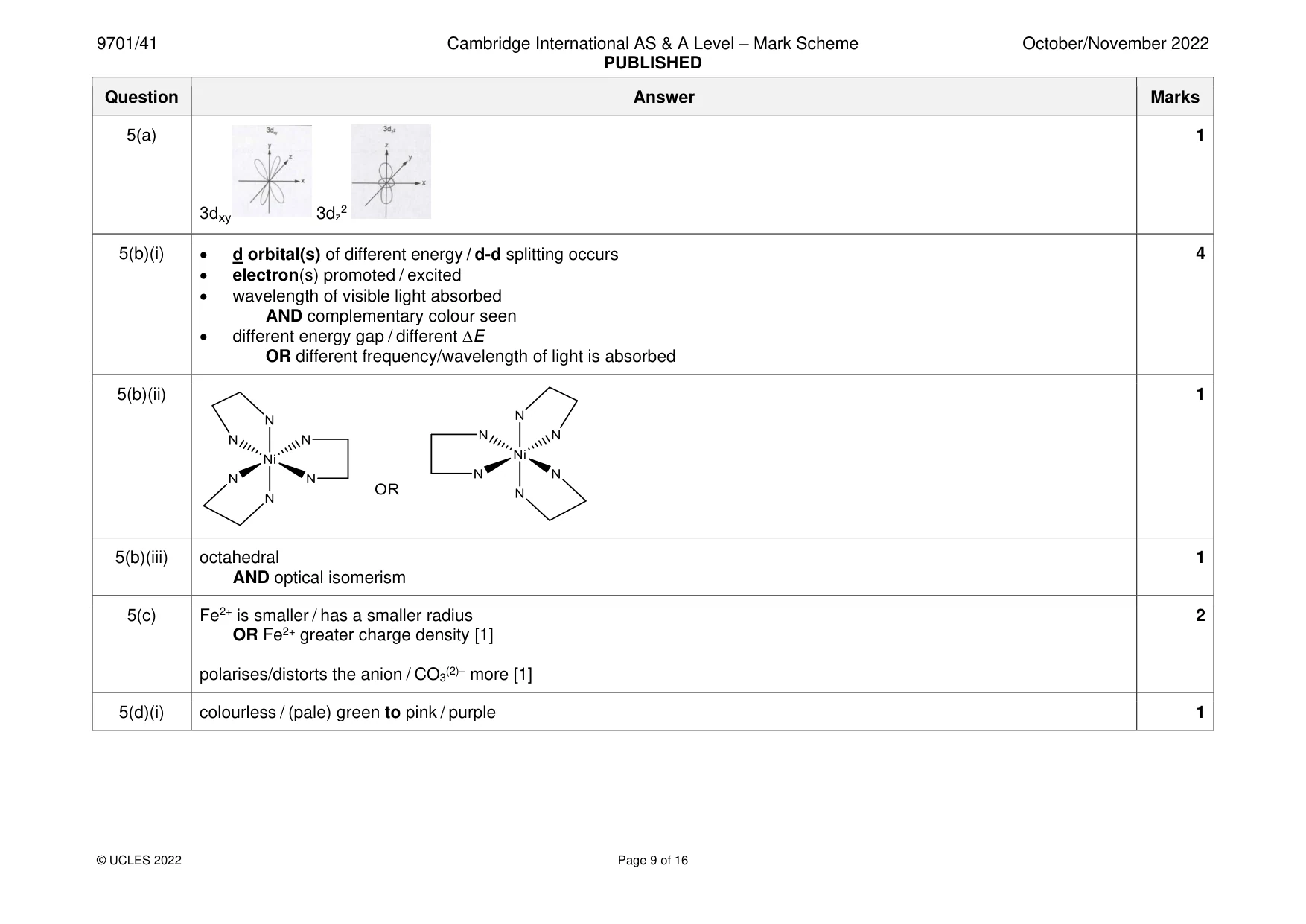
Mark scheme: 5(a) 1 3dxy 3dz2 5(b)(i) • d orbital(s) of different energy / d-d splitting occurs 4 • electron(s) promoted / excited • wavelength of visible light absorbed AND complementary colour seen • different energy gap / different E OR different frequency/wavelength of light is absorbed 5(b)(ii) 1 5(b)(iii) octahedral 1 AND optical isomerism 5(c) Fe2+ is smaller / has a smaller radius 2 OR Fe2+ greater charge density [1] polarises/distorts the anion / CO3(2)– more [1] 5(d)(i) colourless / (pale) green to pink / purple 1 5(d)(ii) moles MnO4– = 0.0100 0.0350 OR 3.50 10–4 2 moles Fe2+ = 5 3.50 10–4 OR 1.75 10–3 [1] moles Fe2+ = 1.75 10–3 4 = 7.00 10–3 % of Fe = (7.00 10–3 55.8) = 0.3906 g = 0.3906 / 2.62 100 = 14.9 % by mass [1] ecf M1 min 2sf
Q6 · An aqueous solution of copper(II) sulfate is a blue colour due to the presence of…
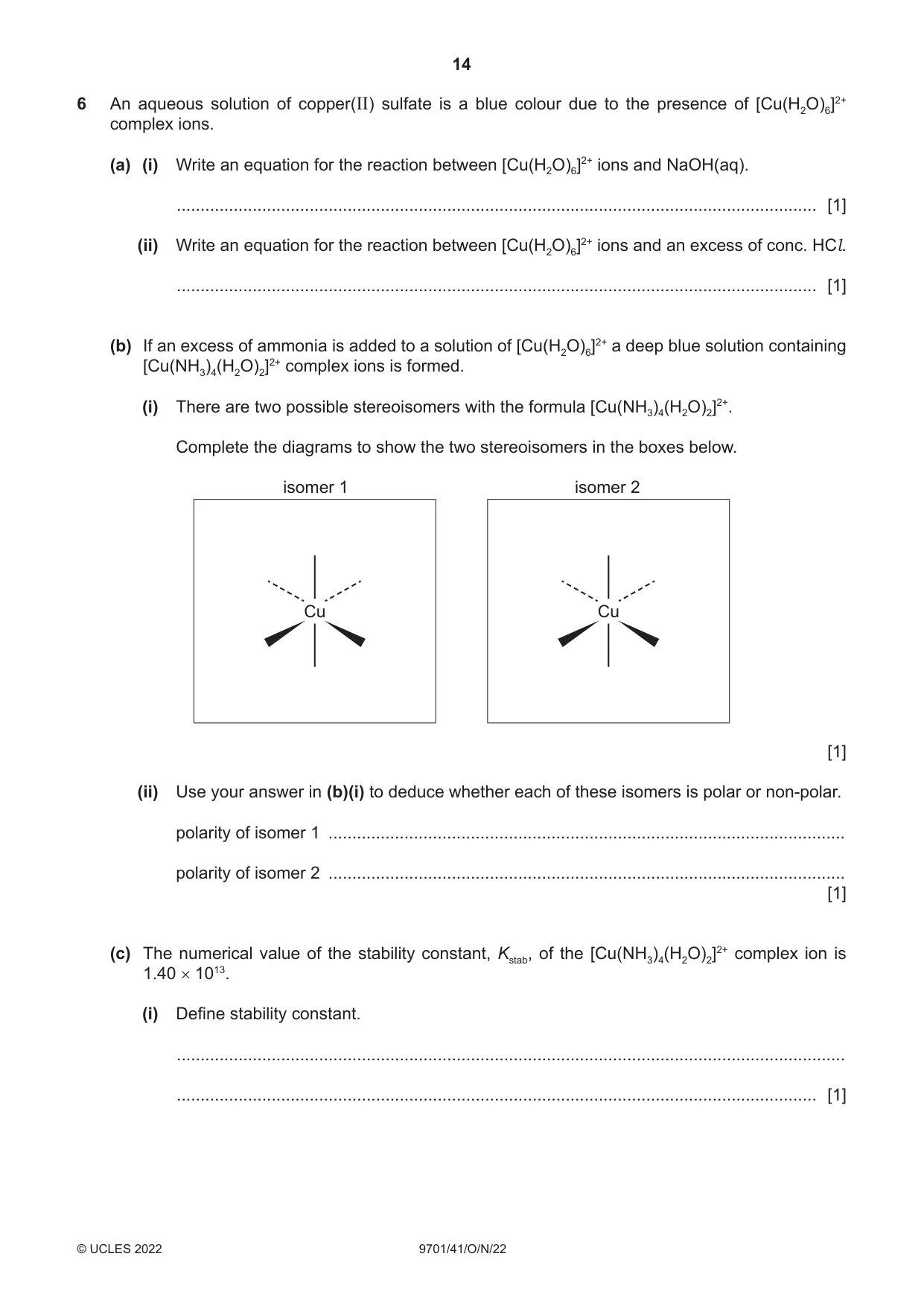
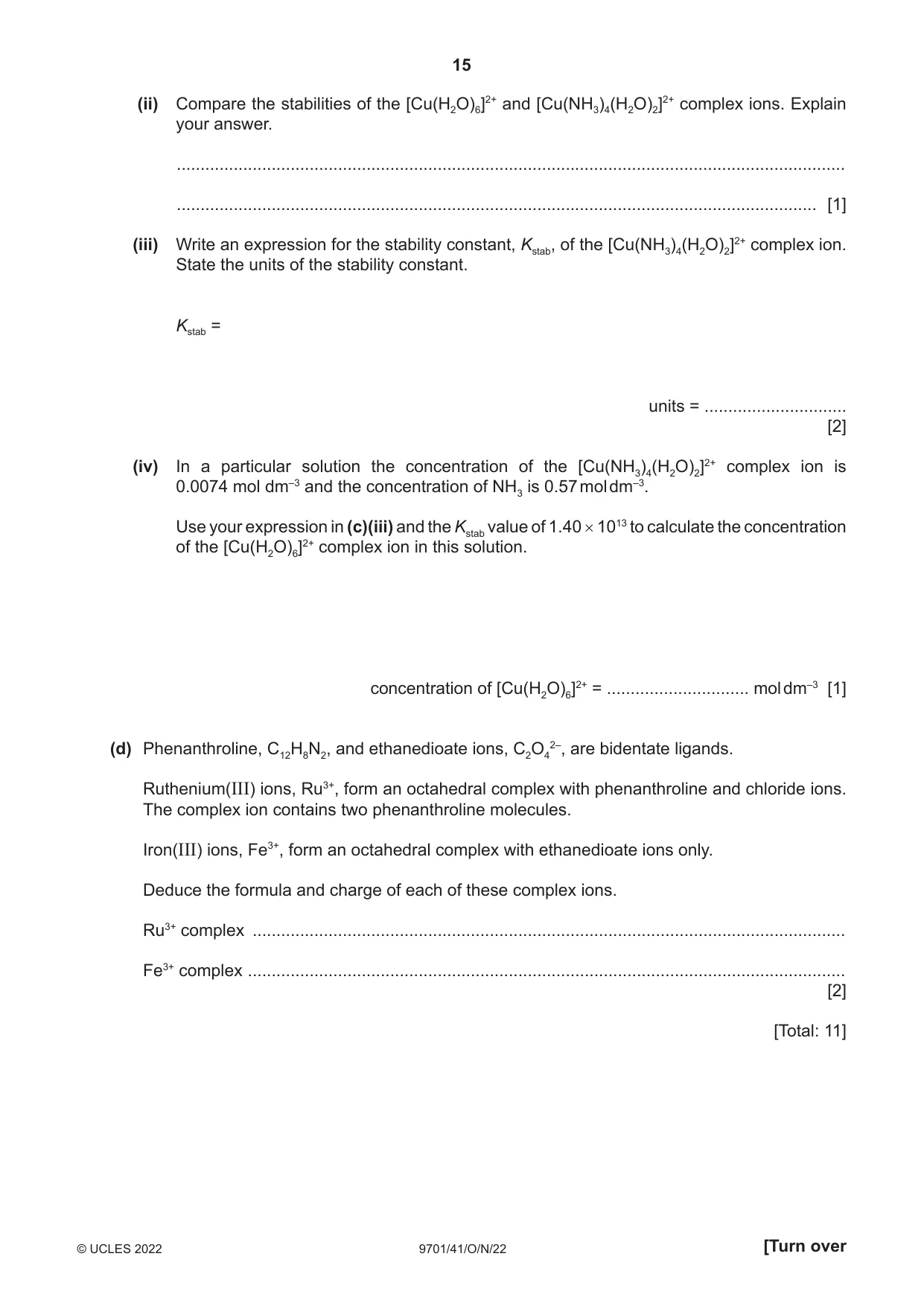
6 An aqueous solution of copper(II) sulfate is a blue colour due to the presence of [Cu(H2O)6]2+ complex ions. (a) (i) Write an equation for the reaction between [Cu(H2O)6]2+ ions and NaOH(aq). ....................................................................................................................................... [1] (ii) Write an equation for the reaction between [Cu(H2O)6]2+ ions and an excess of conc. HCl. ....................................................................................................................................... [1] (b) If an excess of ammonia is added to a solution of [Cu(H2O)6]2+ a deep blue solution containing [Cu(NH3)4(H2O)2]2+ complex ions is formed. (i) There are two possible stereoisomers with the formula [Cu(NH3)4(H2O)2]2+. Complete the diagrams to show the two stereoisomers in the boxes below. isomer 1 isomer 2 Cu Cu [1] (ii) Use your answer in (b)(i) to deduce whether each of these isomers is polar or non-polar. polarity of isomer 1 .............................................................................................................. polarity of isomer 2 .............................................................................................................. [1] (c) The numerical value of the stability constant, Kstab, of the [Cu(NH3)4(H2O)2]2+ complex ion is 1.40 × 10¹³. (i) Define stability constant. ............................................................................................................................................. ....................................................................................................................................... [1] (ii) Compare the stabilities of the [Cu(H2O)6]2+ and [Cu(NH3)4(H2O)2]2+ complex ions. Explain your answer. ............................................................................................................................................. ....................................................................................................................................... [1] (iii) Write an expression for the stability constant, Kstab, of the [Cu(NH3)4(H2O)2]2+ complex ion. State the units of the stability constant. Kstab = units = .............................. [2] (iv) In a particular solution the concentration of the [Cu(NH3)4(H2O)2]2+ complex ion is 0.0074 mol dm–3 and the concentration of NH3 is 0.57 mol dm–3. Use your expression in (c)(iii) and the Kstab value of 1.40 × 10¹³ to calculate the concentration of the [Cu(H2O)6]2+ complex ion in this solution. concentration of [Cu(H2O)6]2+ = .............................. mol dm–3 [1] (d) Phenanthroline, C12H8N2, and ethanedioate ions, C2O42–, are bidentate ligands. Ruthenium(III) ions, Ru3+, form an octahedral complex with phenanthroline and chloride ions. The complex ion contains two phenanthroline molecules. Iron(III) ions, Fe3+, form an octahedral complex with ethanedioate ions only. Deduce the formula and charge of each of these complex ions. Ru3+ complex .............................................................................................................................. Fe3+ complex .............................................................................................................................. [2] [Total: 11]
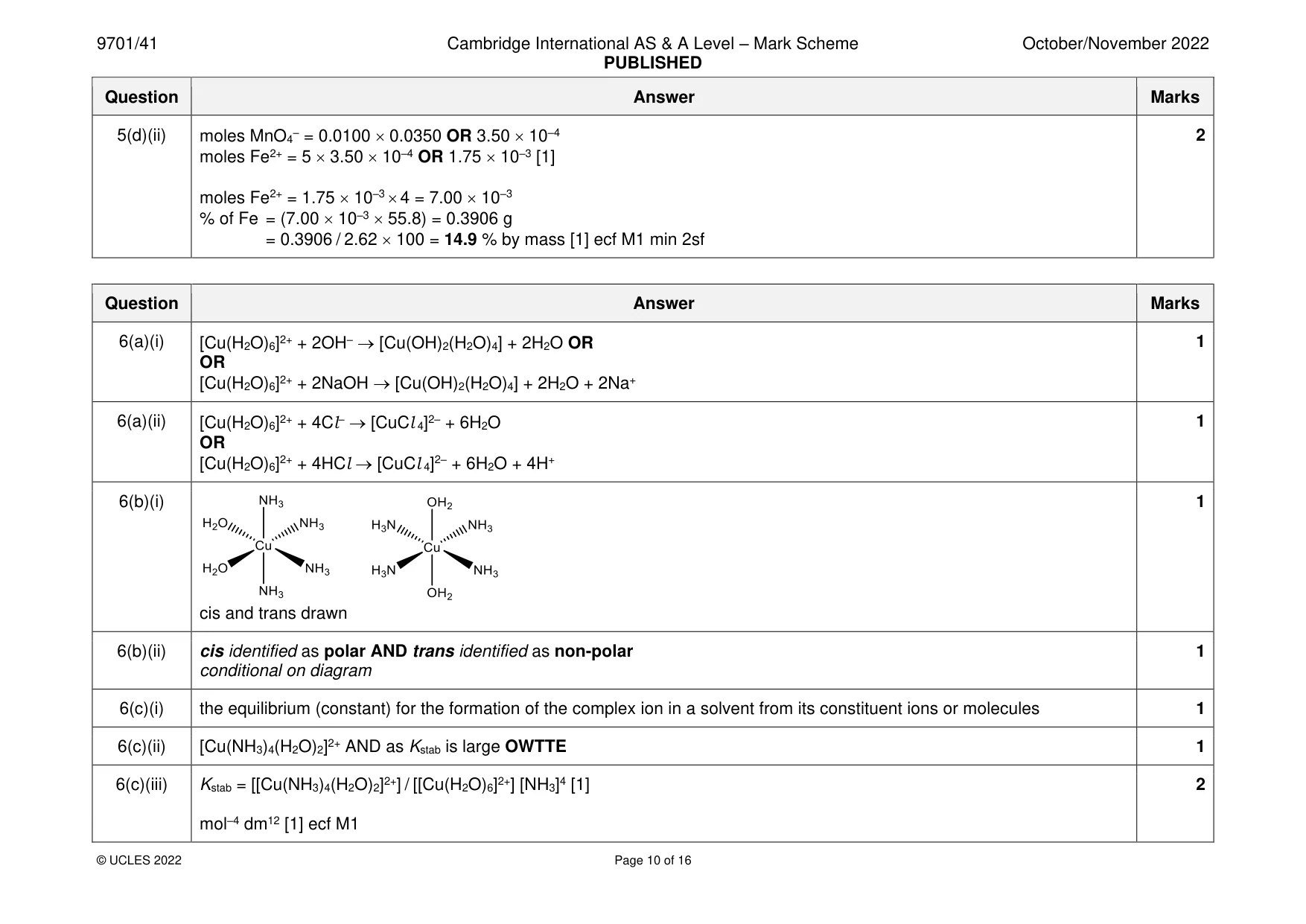
Mark scheme: 6(a)(i) [Cu(H2O)6]2+ + 2OH– → [Cu(OH)2(H2O)4] + 2H2O OR 1 OR [Cu(H2O)6]2+ + 2NaOH → [Cu(OH)2(H2O)4] + 2H2O + 2Na+ 6(a)(ii) [Cu(H2O)6]2+ + 4Cl– → [CuCl 4]2– + 6H2O 1 OR [Cu(H2O)6]2+ + 4HCl → [CuCl 4]2– + 6H2O + 4H+ 6(b)(i) 1 cis and trans drawn 6(b)(ii) cis identified as polar AND trans identified as non-polar 1 conditional on diagram 6(c)(i) the equilibrium (constant) for the formation of the complex ion in a solvent from its constituent ions or molecules 1 6(c)(ii) [Cu(NH3)4(H2O)2]2+ AND as Kstab is large OWTTE 1 6(c)(iii) Kstab = [[Cu(NH3)4(H2O)2]2+] / [[Cu(H2O)6]2+] [NH3]4 [1] 2 mol–4 dm12 [1] ecf M1 6(c)(iv) [Cu(H2O)6]2+] = (0.0074) ÷ (1.4 1013 0.574) 1 [Cu(H2O)6]2+] = 5.01 10–15 min 2sf ecf 6(c)(iii) 6(d) [Ru(C12H8N2)2Cl2]+ [1] 2 [Fe(C2O4)3]3– [1]
More questions on Stereoisomerism in transition element complexes
Q7 · The structure of compound P is shown in Fig
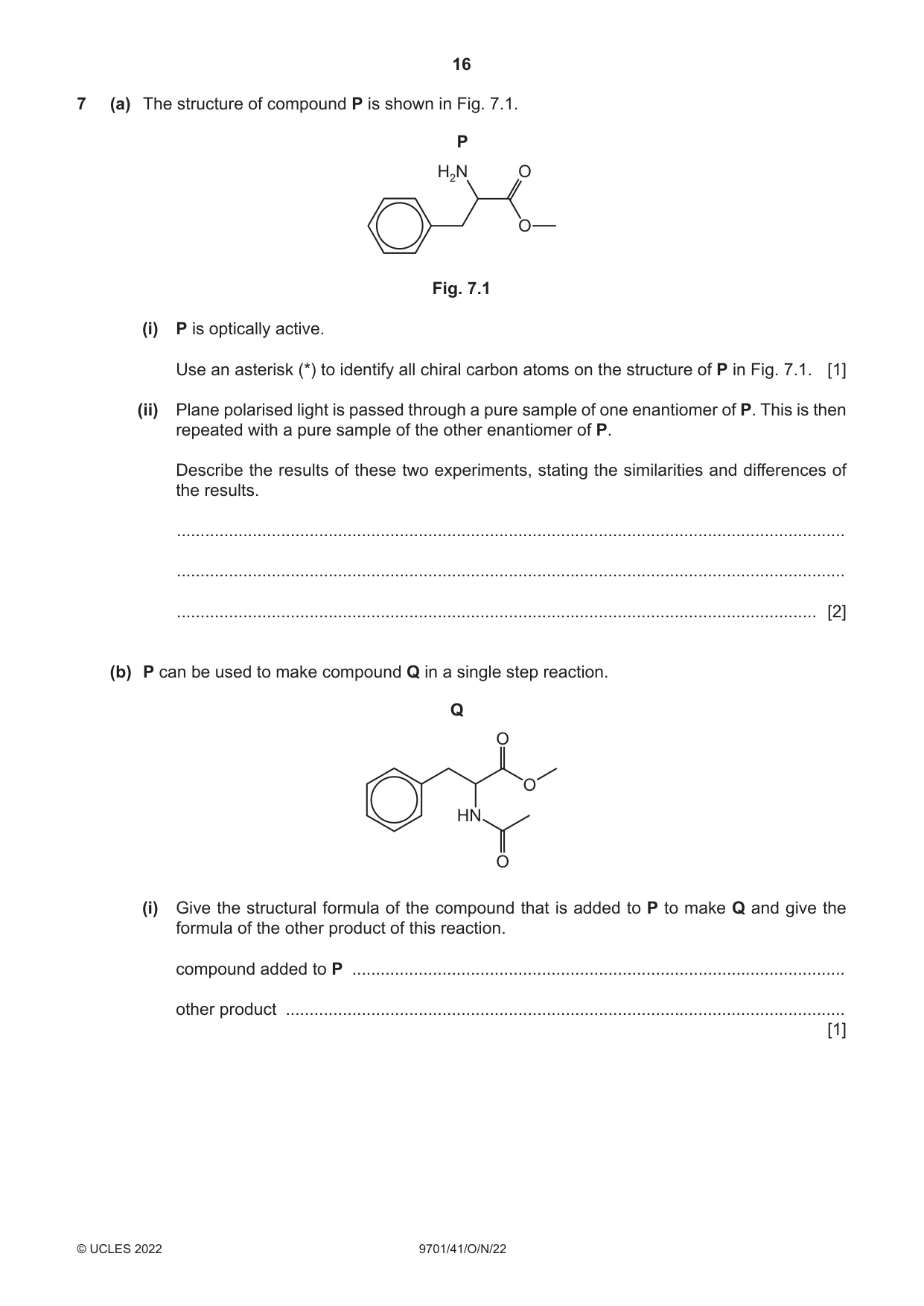
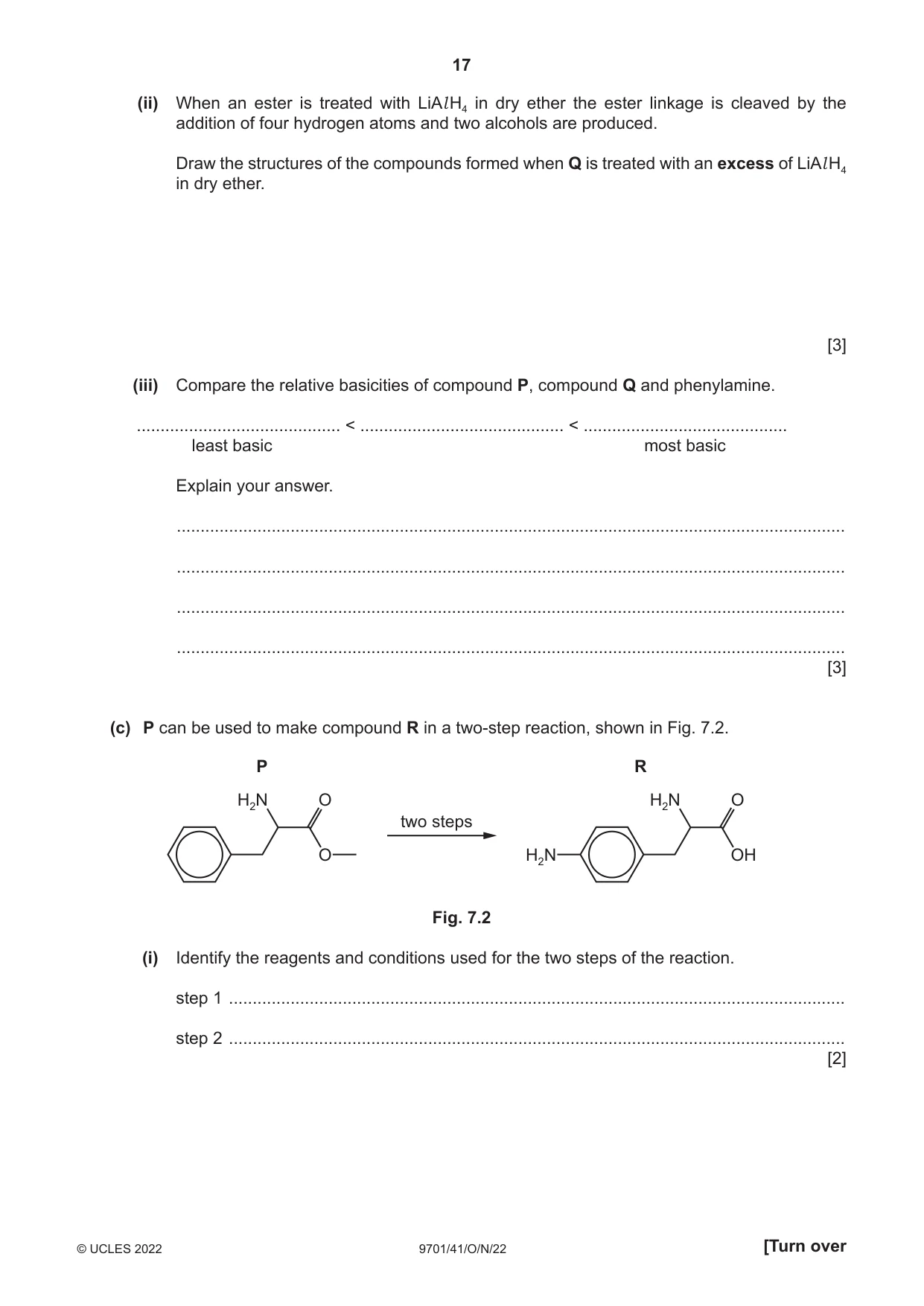
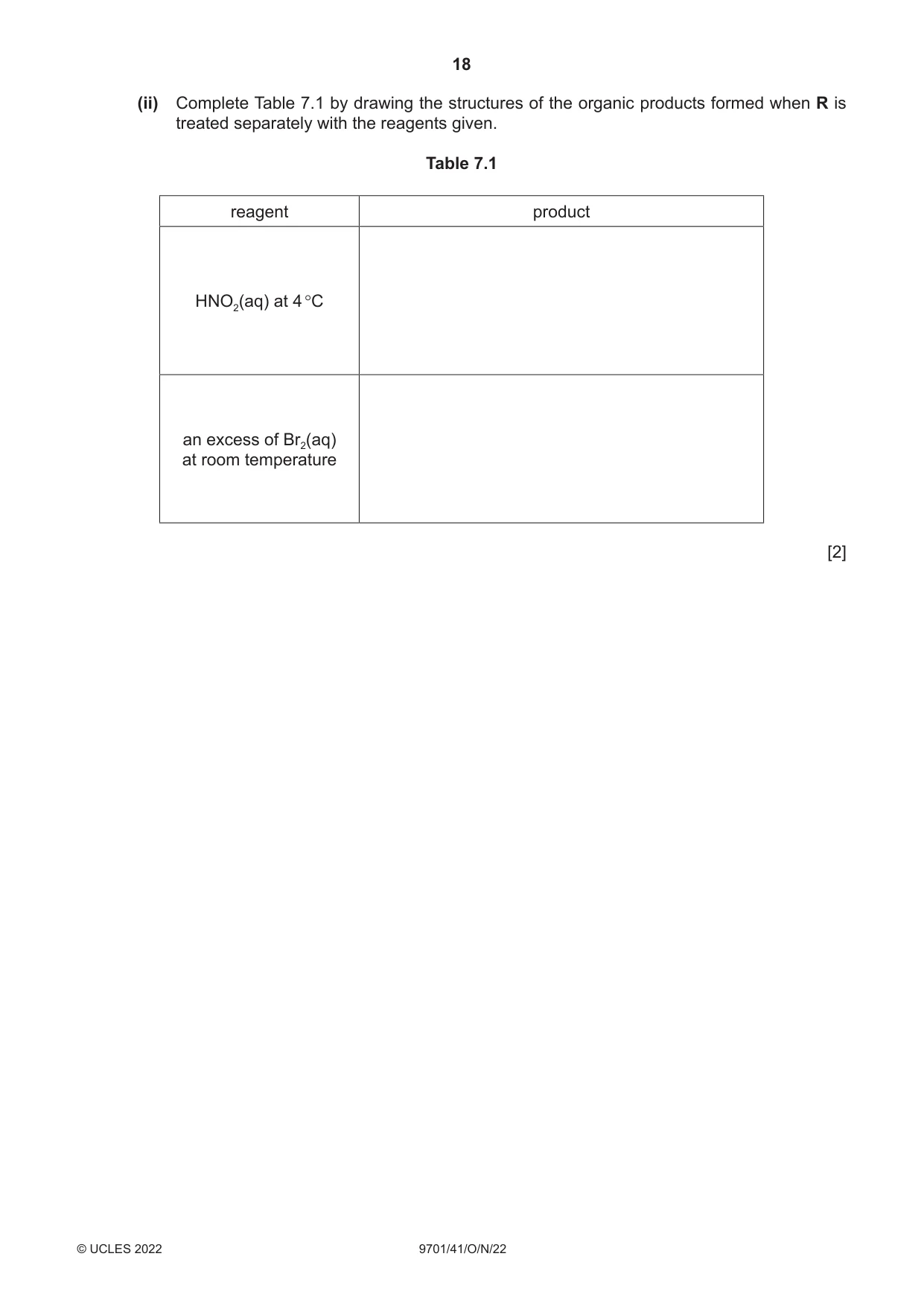
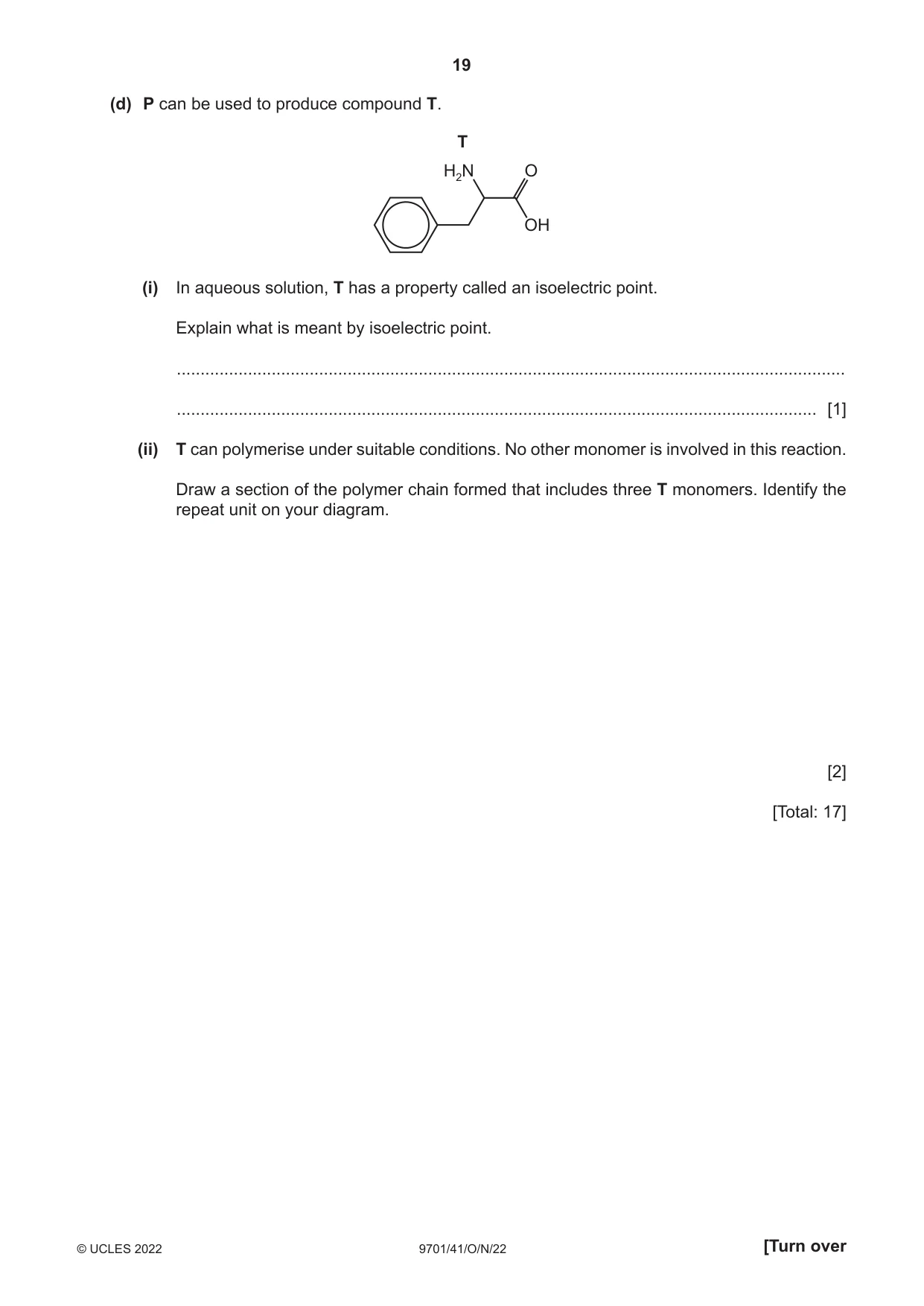
7 (a) The structure of compound P is shown in Fig. 7.1. P H2N O O Fig. 7.1 (i) P is optically active. Use an asterisk (*) to identify all chiral carbon atoms on the structure of P in Fig. 7.1. [1] (ii) Plane polarised light is passed through a pure sample of one enantiomer of P. This is then repeated with a pure sample of the other enantiomer of P. Describe the results of these two experiments, stating the similarities and differences of the results. ............................................................................................................................................. ............................................................................................................................................. ....................................................................................................................................... [2] (b) P can be used to make compound Q in a single step reaction. Q O O HN O (i) Give the structural formula of the compound that is added to P to make Q and give the formula of the other product of this reaction. compound added to P ......................................................................................................... other product ....................................................................................................................... [1] (ii) When an ester is treated with LiAl H4 in dry ether the ester linkage is cleaved by the addition of four hydrogen atoms and two alcohols are produced. Draw the structures of the compounds formed when Q is treated with an excess of LiAl H4 in dry ether. [3] (iii) Compare the relative basicities of compound P, compound Q and phenylamine. ........................................... < ........................................... < ........................................... least basic most basic Explain your answer. ............................................................................................................................................. ............................................................................................................................................. ............................................................................................................................................. ............................................................................................................................................. [3] (c) P can be used to make compound R in a two-step reaction, shown in Fig. 7.2. P R H2N O H2N O two steps O H2N OH Fig. 7.2 (i) Identify the reagents and conditions used for the two steps of the reaction. step 1 .................................................................................................................................. step 2 .................................................................................................................................. [2] (ii) Complete Table 7.1 by drawing the structures of the organic products formed when R is treated separately with the reagents given. Table 7.1 reagent product HNO2(aq) at 4 °C an excess of Br2(aq) at room temperature [2] (d) P can be used to produce compound T. T H2N O OH (i) In aqueous solution, T has a property called an isoelectric point. Explain what is meant by isoelectric point. ............................................................................................................................................. ....................................................................................................................................... [1] (ii) T can polymerise under suitable conditions. No other monomer is involved in this reaction. Draw a section of the polymer chain formed that includes three T monomers. Identify the repeat unit on your diagram. [2] [Total: 17]
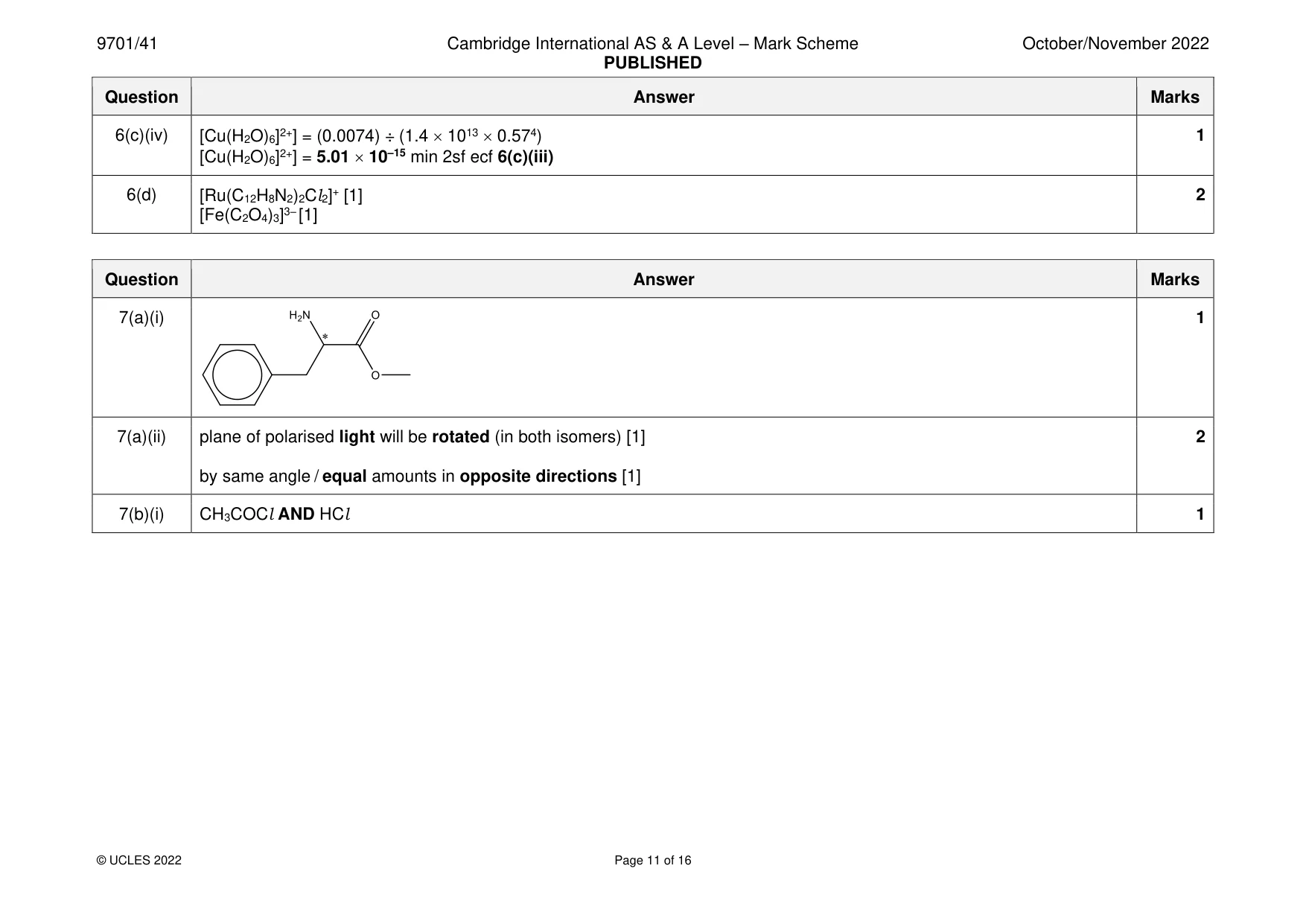
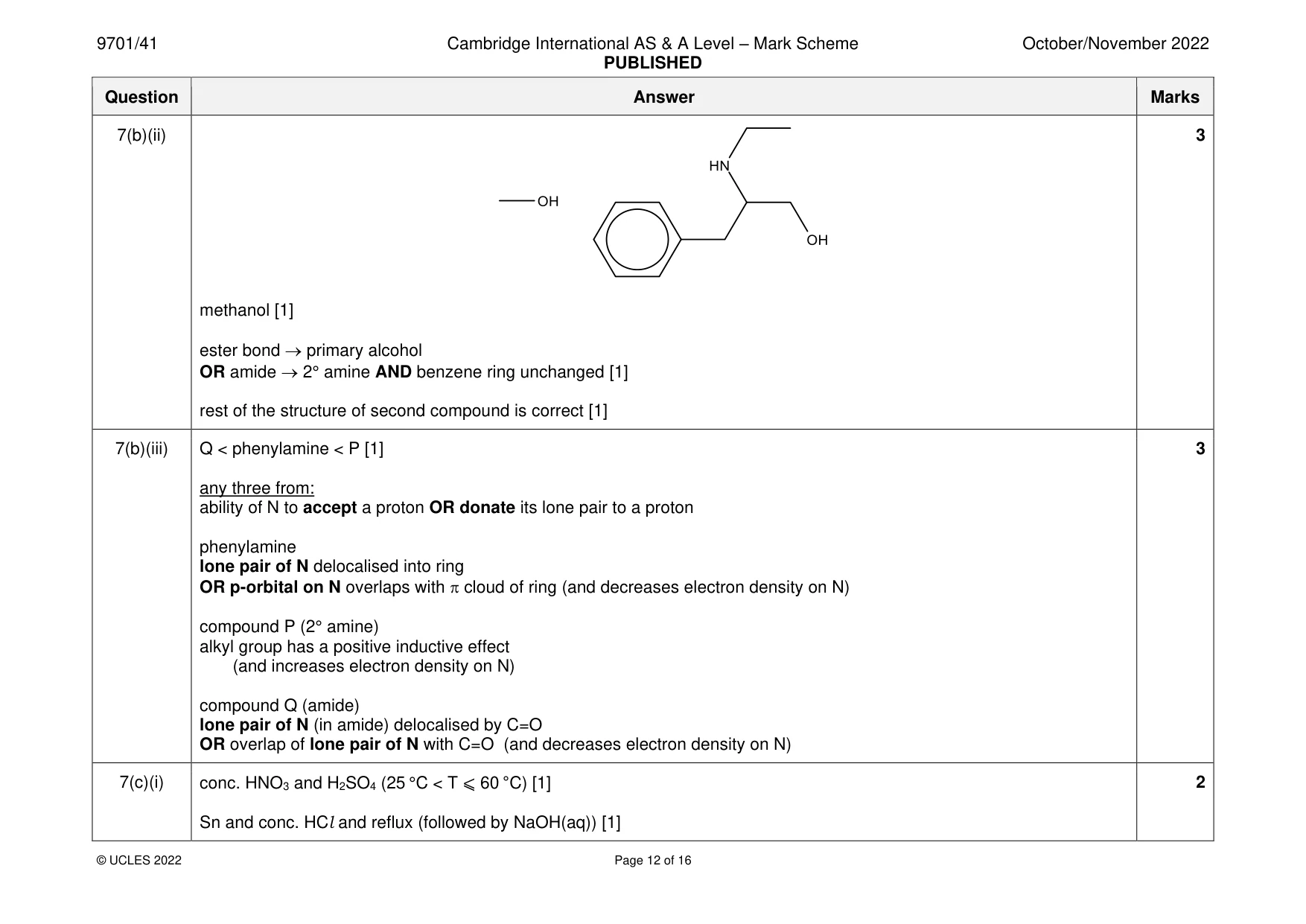
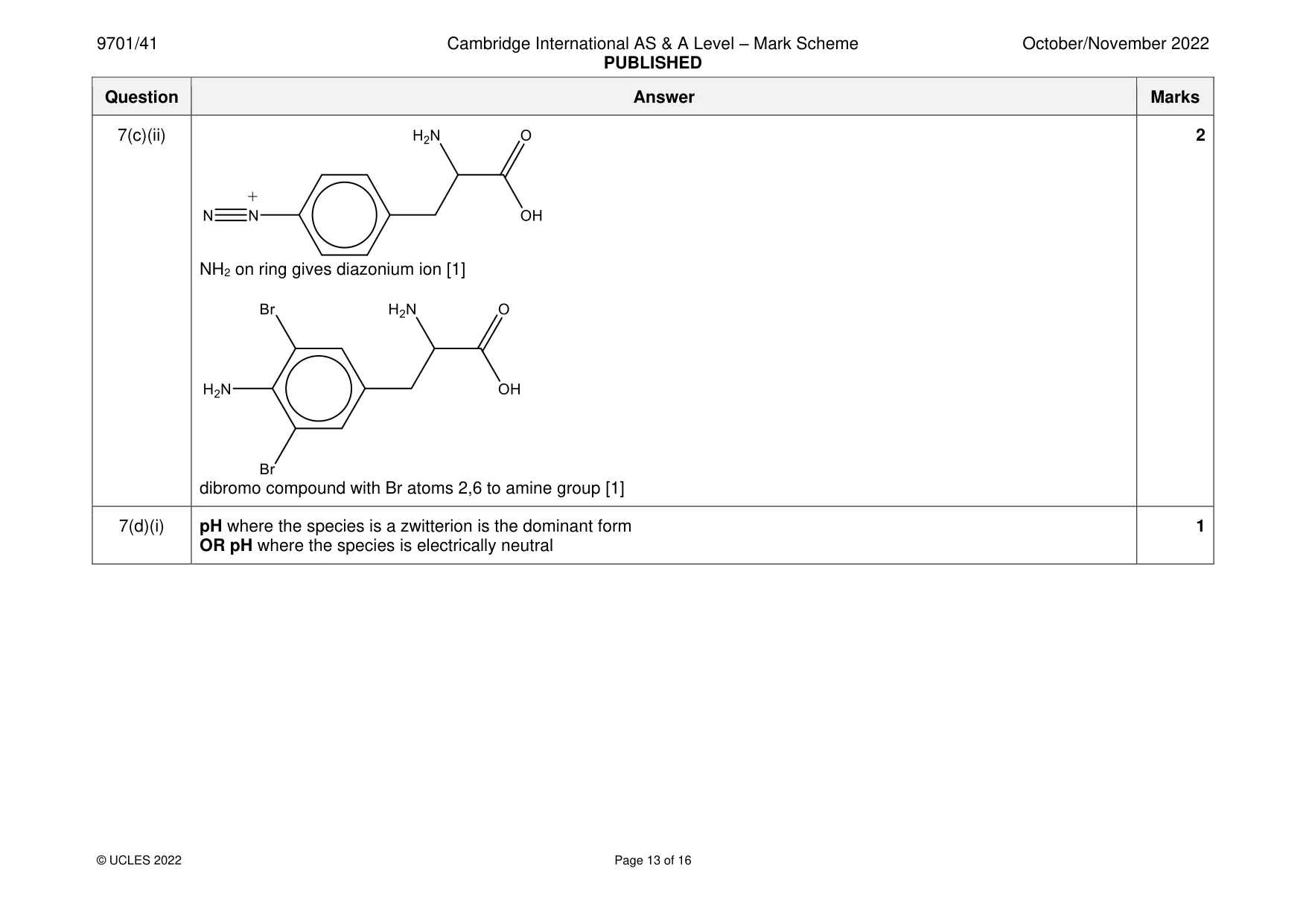
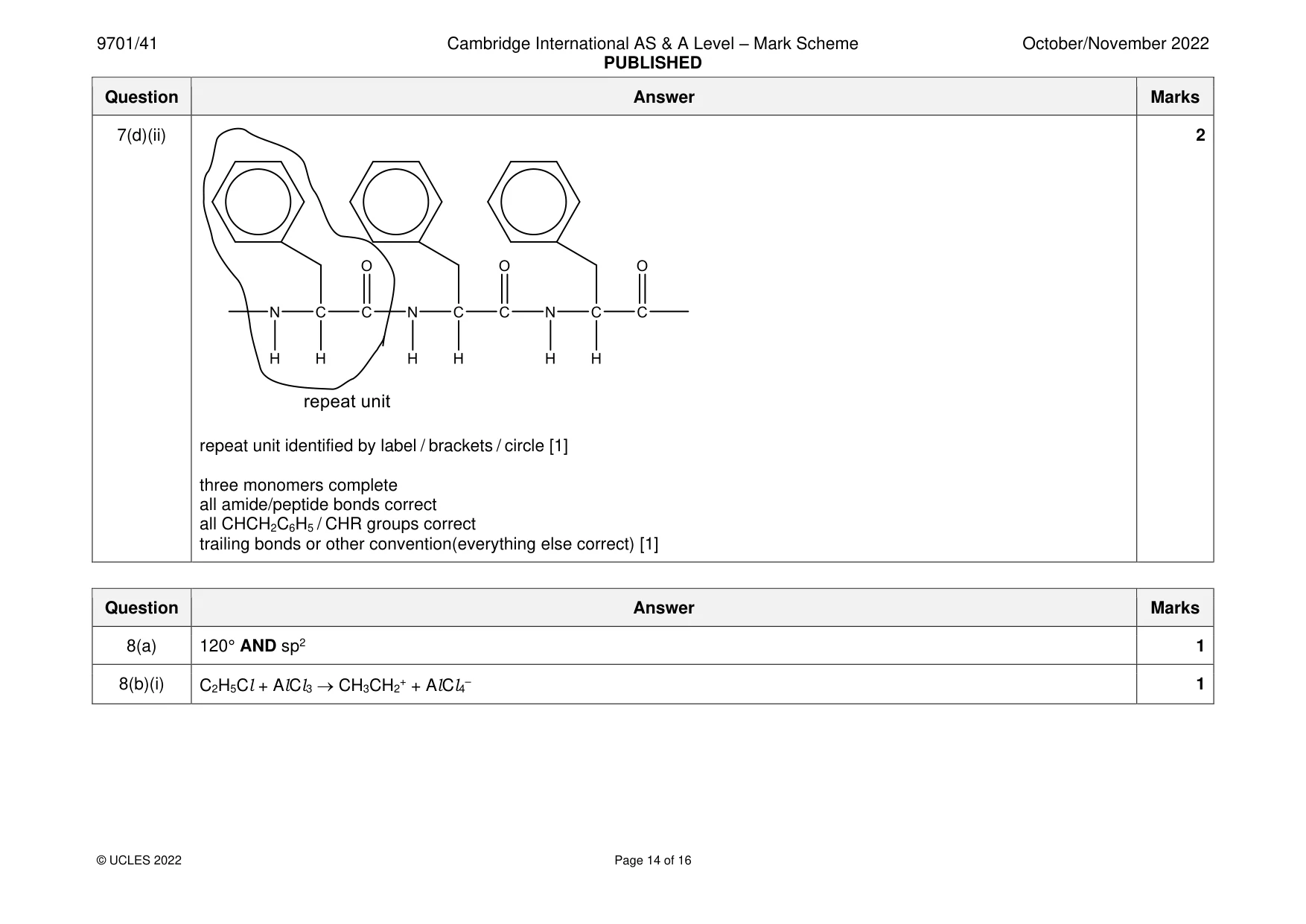
Mark scheme: 7(a)(i) 1 7(a)(ii) plane of polarised light will be rotated (in both isomers) [1] 2 by same angle / equal amounts in opposite directions [1] 7(b)(i) CH3COCl AND HCl 1 7(b)(ii) 3 methanol [1] ester bond → primary alcohol OR amide → 2° amine AND benzene ring unchanged [1] rest of the structure of second compound is correct [1] 7(b)(iii) Q < phenylamine < P [1] 3 any three from: ability of N to accept a proton OR donate its lone pair to a proton phenylamine lone pair of N delocalised into ring OR p-orbital on N overlaps with cloud of ring (and decreases electron density on N) compound P (2° amine) alkyl group has a positive inductive effect (and increases electron density on N) compound Q (amide) lone pair of N (in amide) delocalised by C=O OR overlap of lone pair of N with C=O (and decreases electron density on N) 7(c)(i) conc. HNO3 and H2SO4 (25 °C < T ⩽ 60 °C) [1] 2 Sn and conc. HCl and reflux (followed by NaOH(aq)) [1] 7(c)(ii) 2 NH2 on ring gives diazonium ion [1] dibromo compound with Br atoms 2,6 to amine group [1] 7(d)(i) pH where the species is a zwitterion is the dominant form 1 OR pH where the species is electrically neutral 7(d)(ii) 2 repeat unit identified by label / brackets / circle [1] three monomers complete all amide/peptide bonds correct all CHCH2C6H5 / CHR groups correct trailing bonds or other convention(everything else correct) [1]
Q8 · Benzene, C6H6, is an aromatic molecule
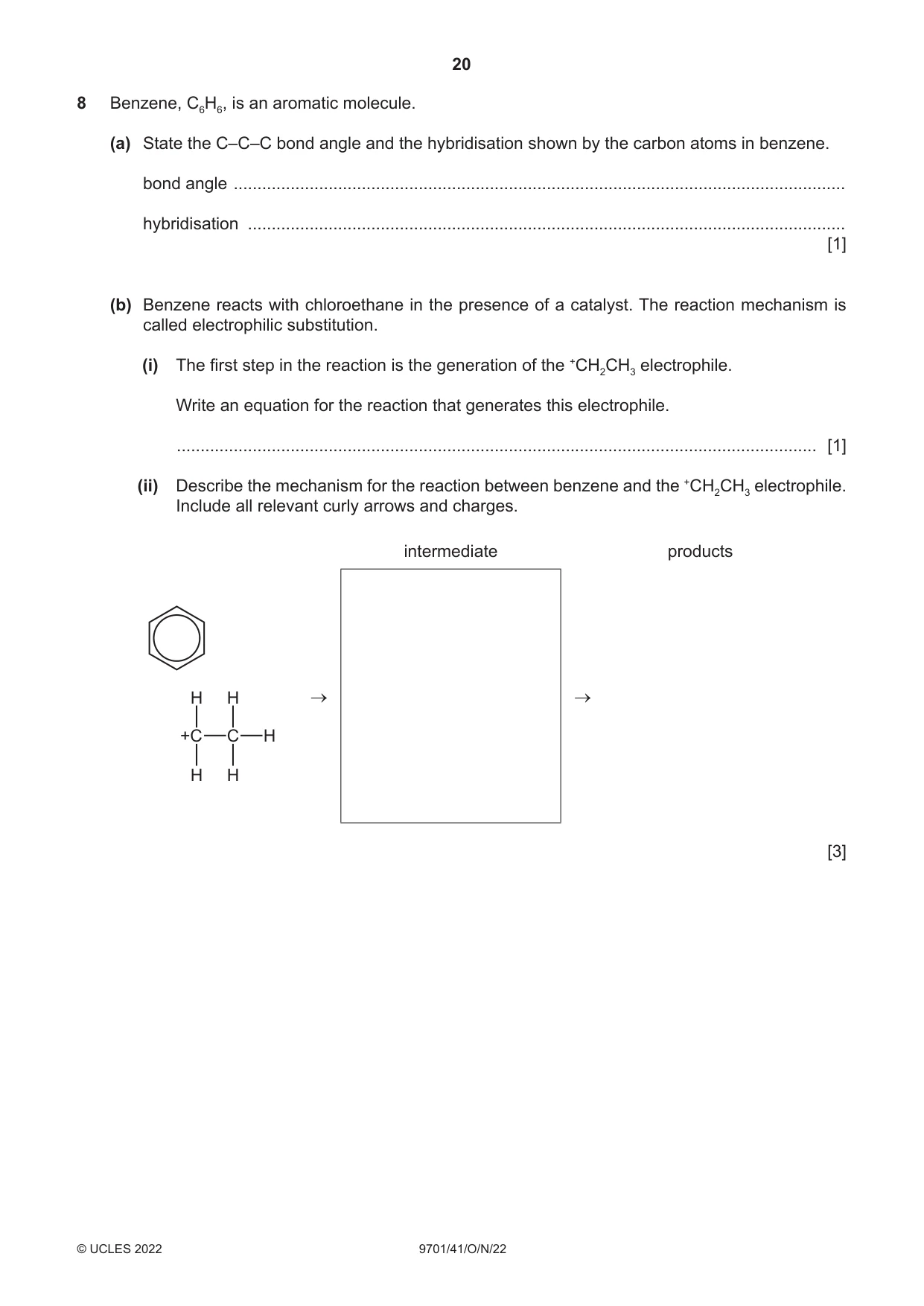
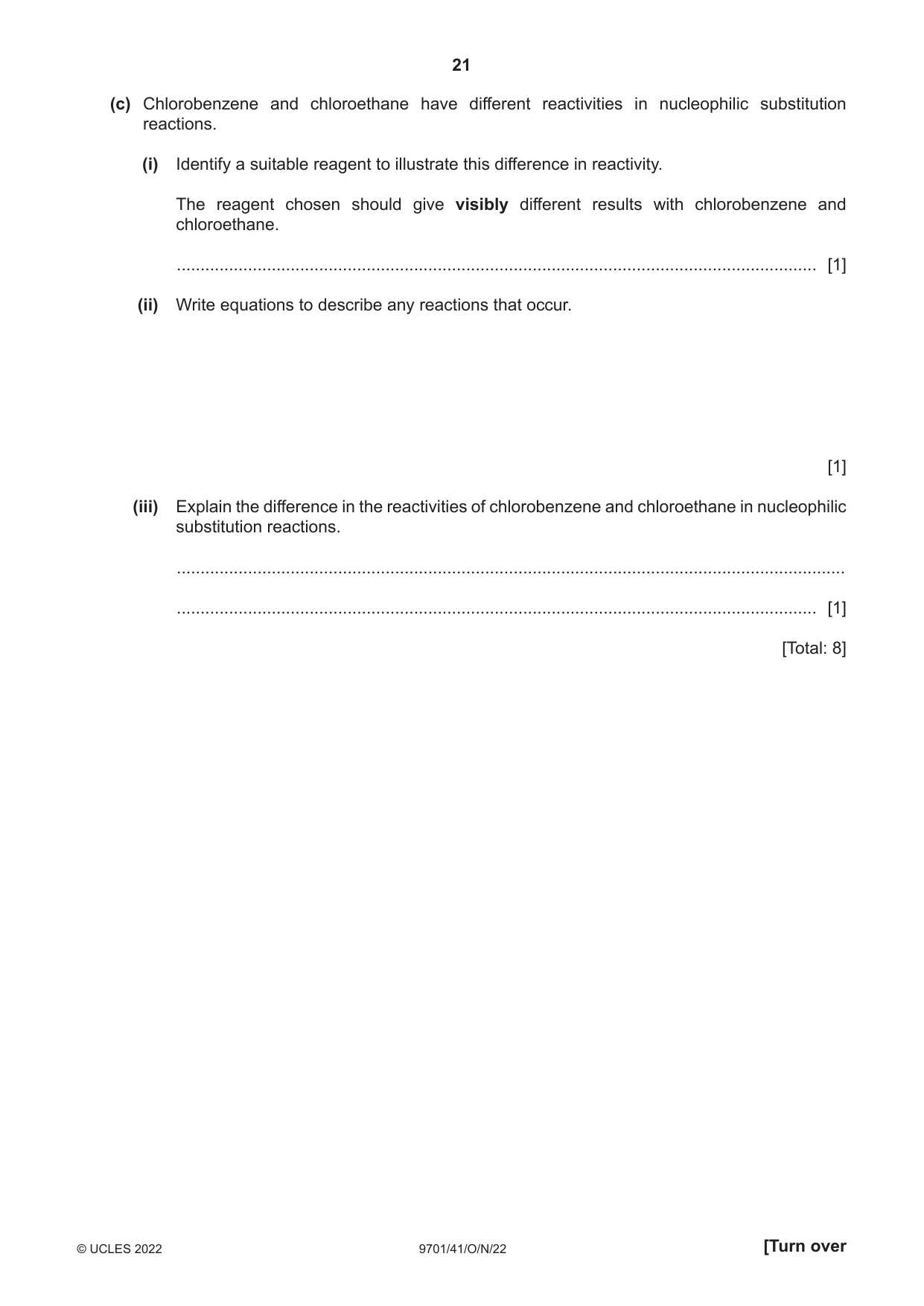
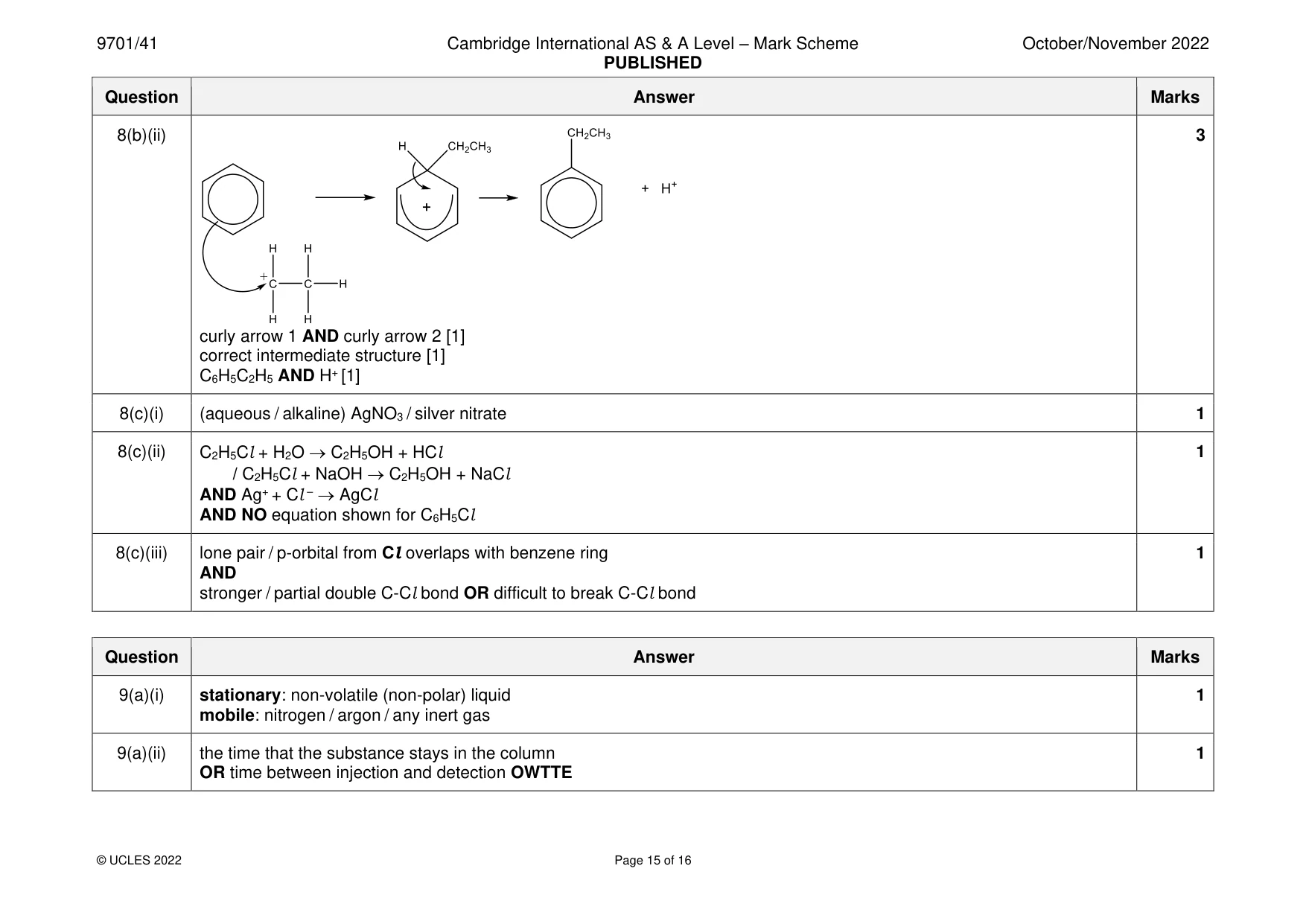
8 Benzene, C6H6, is an aromatic molecule. (a) State the C–C–C bond angle and the hybridisation shown by the carbon atoms in benzene. bond angle ................................................................................................................................. hybridisation ............................................................................................................................... [1] (b) Benzene reacts with chloroethane in the presence of a catalyst. The reaction mechanism is called electrophilic substitution. (i) The first step in the reaction is the generation of the +CH2CH3 electrophile. Write an equation for the reaction that generates this electrophile. ....................................................................................................................................... [1] (ii) Describe the mechanism for the reaction between benzene and the +CH2CH3 electrophile. Include all relevant curly arrows and charges. intermediate products H H → → +C C H H H [3] (c) Chlorobenzene and chloroethane have different reactivities in nucleophilic substitution reactions. (i) Identify a suitable reagent to illustrate this difference in reactivity. The reagent chosen should give visibly different results with chlorobenzene and chloroethane. ....................................................................................................................................... [1] (ii) Write equations to describe any reactions that occur. [1] (iii) Explain the difference in the reactivities of chlorobenzene and chloroethane in nucleophilic substitution reactions. ............................................................................................................................................. ....................................................................................................................................... [1] [Total: 8]
Mark scheme: 8(a) 120° AND sp2 1 8(b)(i) C2H5Cl + AlCl3 → CH3CH2+ + AlCl4– 1 8(b)(ii) 3 curly arrow 1 AND curly arrow 2 [1] correct intermediate structure [1] C6H5C2H5 AND H+ [1] 8(c)(i) (aqueous / alkaline) AgNO3 / silver nitrate 1 8(c)(ii) C2H5Cl + H2O → C2H5OH + HCl 1 / C2H5Cl + NaOH → C2H5OH + NaCl AND Ag+ + Cl – → AgCl AND NO equation shown for C6H5Cl 8(c)(iii) lone pair / p-orbital from Cl overlaps with benzene ring 1 AND stronger / partial double C-Cl bond OR difficult to break C-Cl bond
Q9 · Gas-liquid chromatography involves a stationary phase and a mobile phase
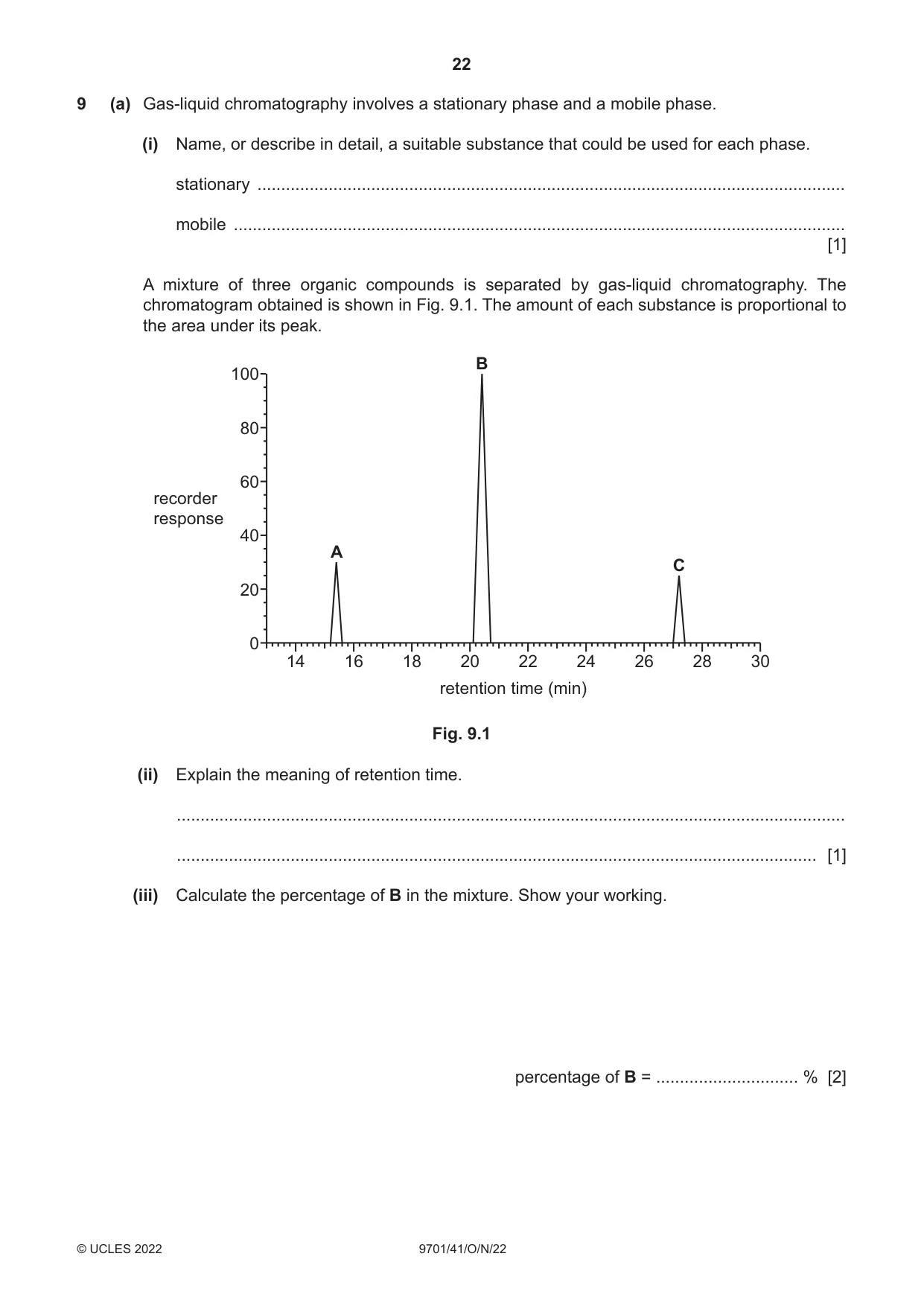
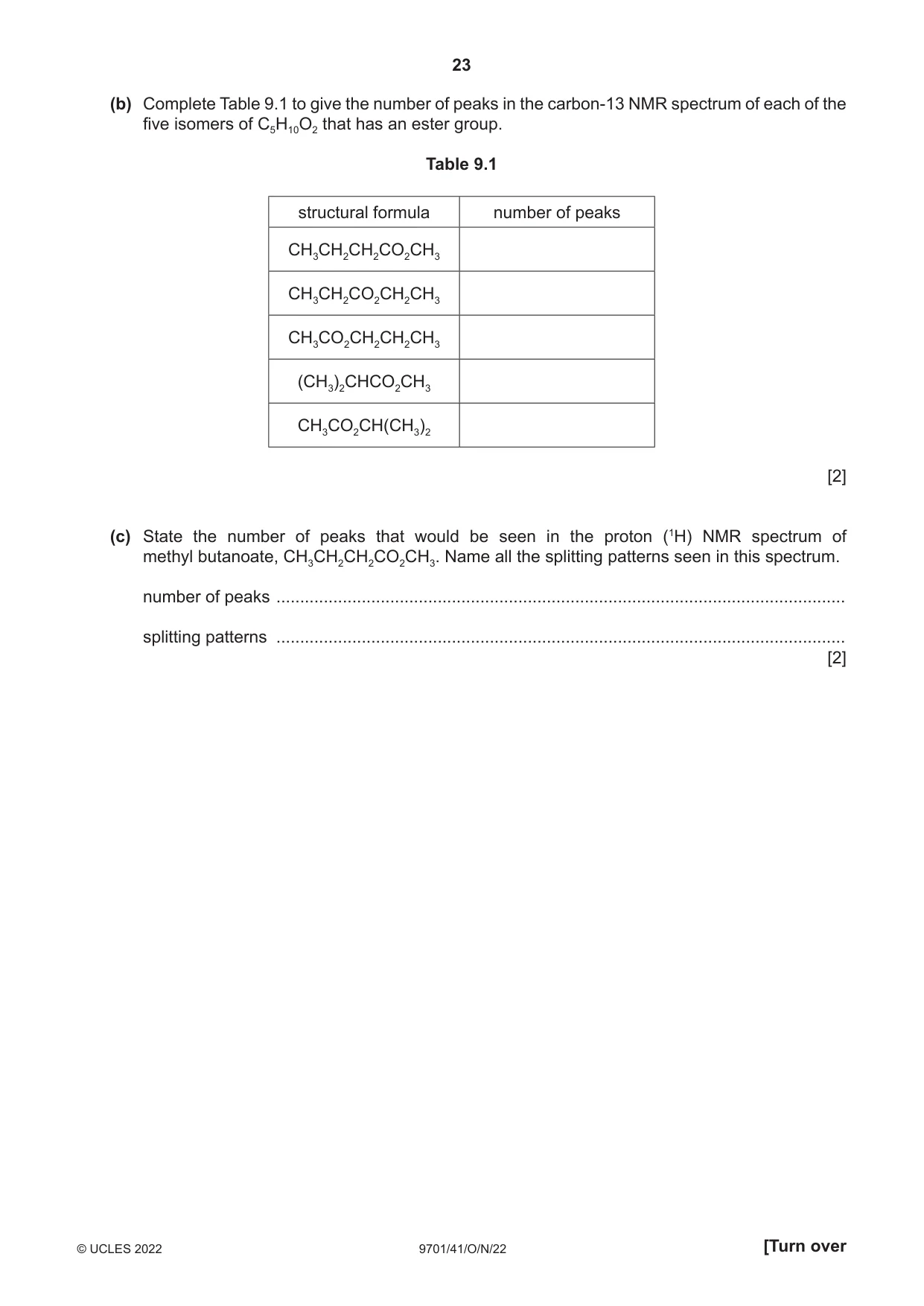
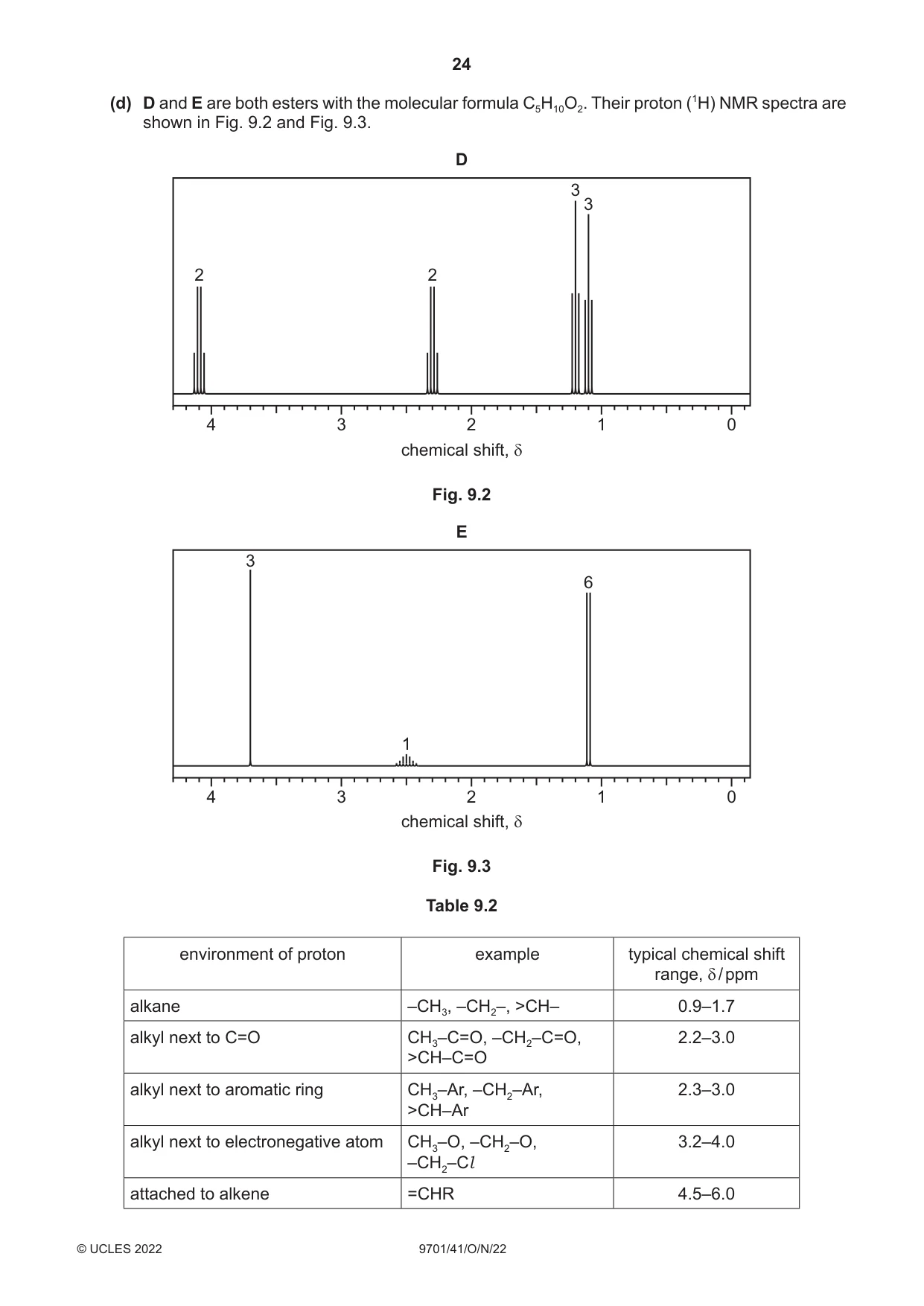
9 (a) Gas-liquid chromatography involves a stationary phase and a mobile phase. (i) Name, or describe in detail, a suitable substance that could be used for each phase. stationary ............................................................................................................................. mobile .................................................................................................................................. [1] A mixture of three organic compounds is separated by gas-liquid chromatography. The chromatogram obtained is shown in Fig. 9.1. The amount of each substance is proportional to the area under its peak. B 100 80 60 recorder response 40 A C 20 0 14 16 18 20 22 24 26 28 30 retention time (min) Fig. 9.1 (ii) Explain the meaning of retention time. ............................................................................................................................................. ....................................................................................................................................... [1] (iii) Calculate the percentage of B in the mixture. Show your working. percentage of B = .............................. % [2] (b) Complete Table 9.1 to give the number of peaks in the carbon-13 NMR spectrum of each of the five isomers of C5H10O2 that has an ester group. Table 9.1 structural formula number of peaks CH3CH2CH2CO2CH3 CH3CH2CO2CH2CH3 CH3CO2CH2CH2CH3 (CH3)2CHCO2CH3 CH3CO2CH(CH3)2 [2] (c) State the number of peaks that would be seen in the proton (1H) NMR spectrum of methyl butanoate, CH3CH2CH2CO2CH3. Name all the splitting patterns seen in this spectrum. number of peaks ........................................................................................................................ splitting patterns ......................................................................................................................... [2] (d) D and E are both esters with the molecular formula C5H10O2. Their proton (1H) NMR spectra are shown in Fig. 9.2 and Fig. 9.3. D 3 3 2 2 4 3 2 1 0 chemical shift, Fig. 9.2 E 3 6 1 4 3 2 1 0 chemical shift, Fig. 9.3 Table 9.2 environment of proton example typical chemical shift range, δ / ppm alkane –CH3, –CH2–, >CH– 0.9–1.7 alkyl next to C=O CH3–C=O, –CH2–C=O, 2.2–3.0 >CH–C=O alkyl next to aromatic ring CH3–Ar, –CH2–Ar, 2.3–3.0 >CH–Ar alkyl next to electronegative atom CH3–O, –CH2–O, 3.2–4.0 –CH2–Cl attached to alkene =CHR 4.5–6.0
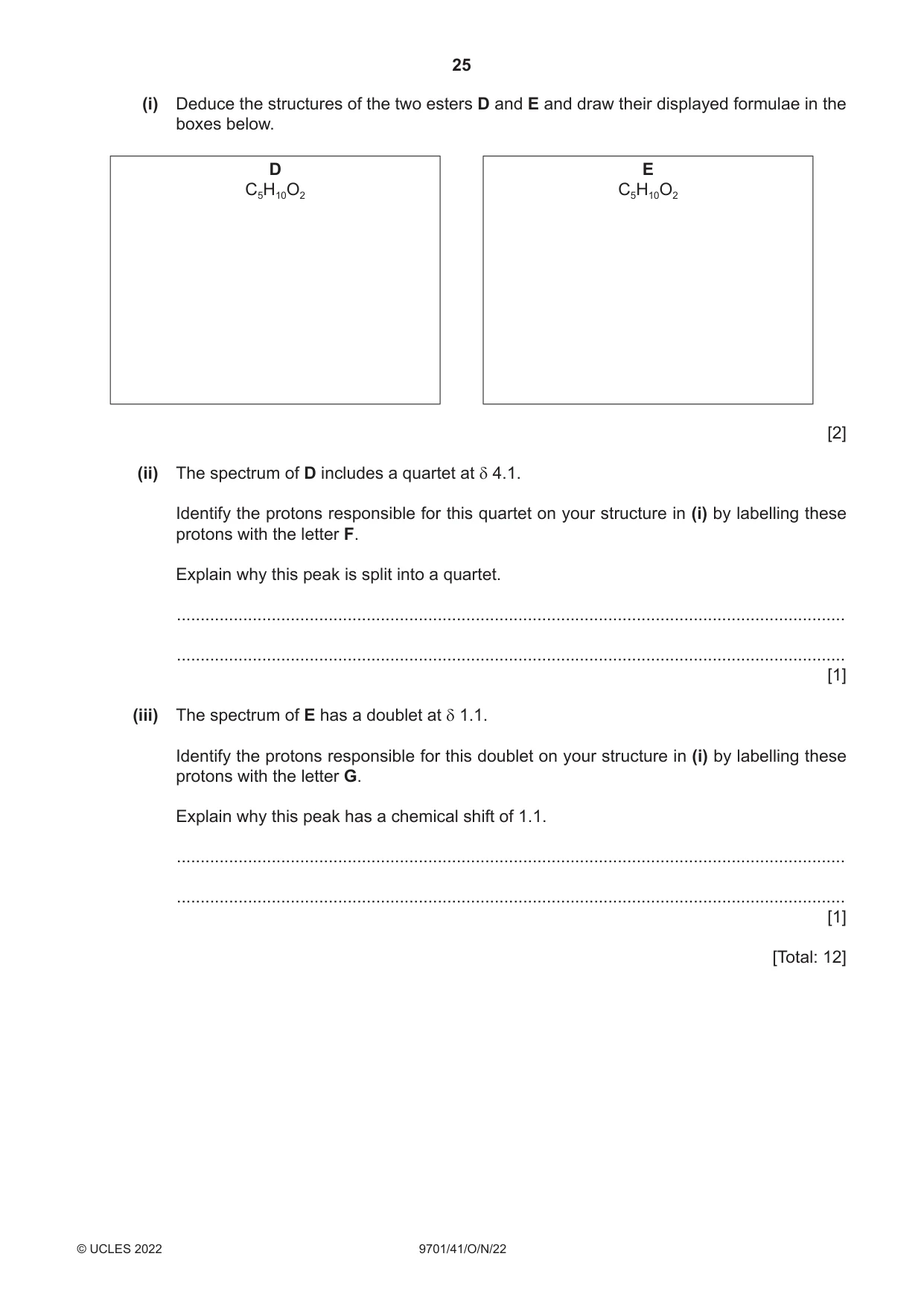
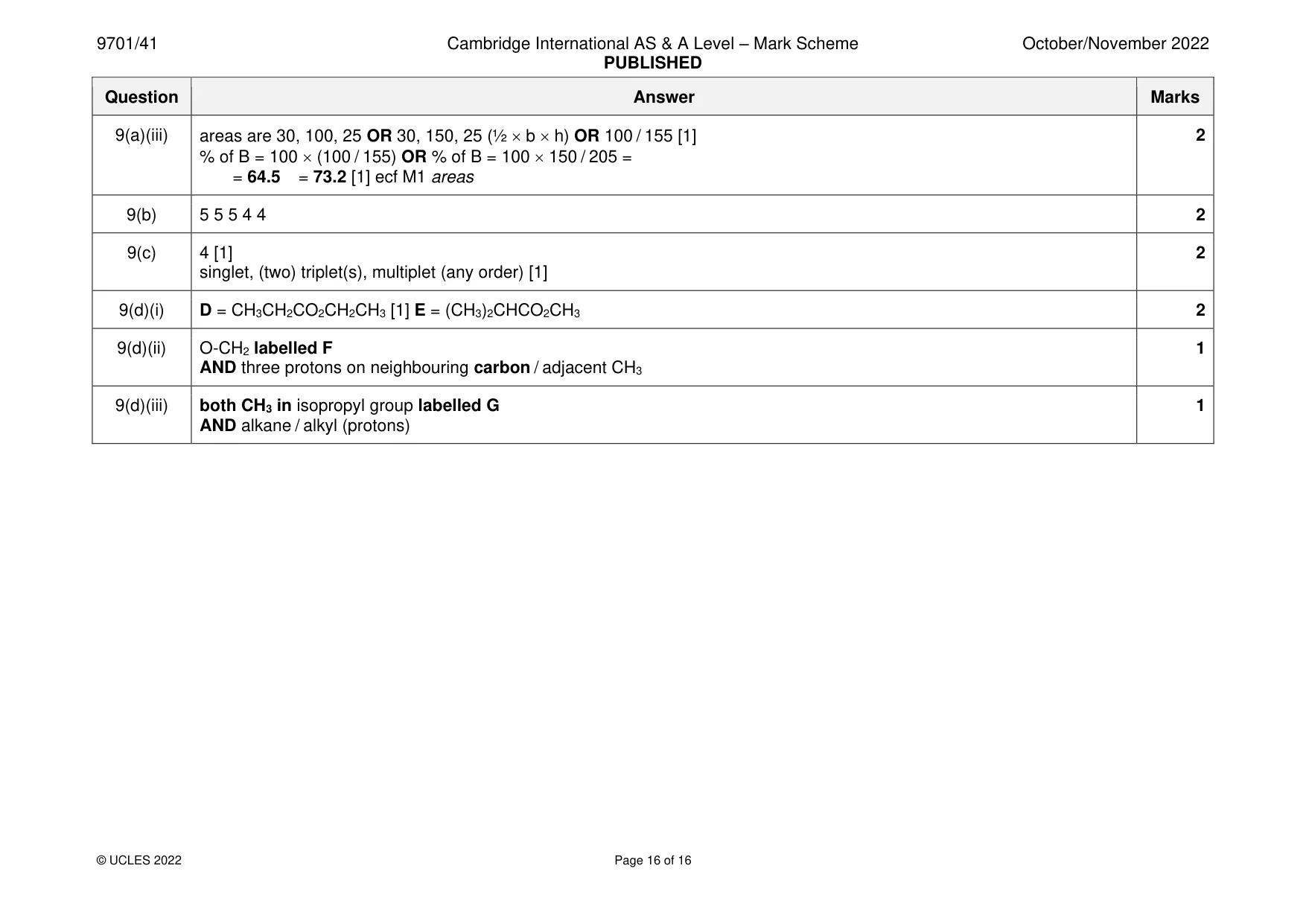
Mark scheme: 9(a)(i) stationary: non-volatile (non-polar) liquid 1 mobile: nitrogen / argon / any inert gas 9(a)(ii) the time that the substance stays in the column 1 OR time between injection and detection OWTTE 9(a)(iii) areas are 30, 100, 25 OR 30, 150, 25 (½ b h) OR 100 / 155 [1] 2 % of B = 100 (100 / 155) OR % of B = 100 150 / 205 = = 64.5 = 73.2 [1] ecf M1 areas 9(b) 5 5 5 4 4 2 9(c) 4 [1] 2 singlet, (two) triplet(s), multiplet (any order) [1] 9(d)(i) D = CH3CH2CO2CH2CH3 [1] E = (CH3)2CHCO2CH3 2 9(d)(ii) O-CH2 labelled F 1 AND three protons on neighbouring carbon / adjacent CH3 9(d)(iii) both CH3 in isopropyl group labelled G 1 AND alkane / alkyl (protons)
What was in this paper
The subtopics covered by these 9 questions, and how many questions each got. Open one in a new tab to see every Cambridge question on it.
1Arenes1Colour of complexes1Enthalpies of solution and hydration1Gas / liquid chromatography1Partition coefficients1Simple rate equations, orders of reaction and rate constants1Standard electrode potentials E ⦵, standard cell potentials E ⦵ cell and the Nernst equation1Stereoisomerism in transition element complexes1What you needed in this session
Cambridge’s own grade thresholds for 2022 Oct/Nov, Paper 4 · Variant 1. A higher threshold means an easier paper — the bar moves with how the cohort did.