Cambridge A Level Chemistry 9701 — 2019 Oct/Nov Paper 4 · Variant 1
9701/41/O/N/19 · 9 questions · 100 marks · ≈113 min
The question paper and its mark scheme, free to read here and free to download. This is Cambridge’s own paper, exactly as it was sat.
Question paper20 pages
Mark scheme14 pages
Answers below. Sit the paper first if you are practising.
Questions as text
Q1 · An electrochemical cell is constructed using two half-cells
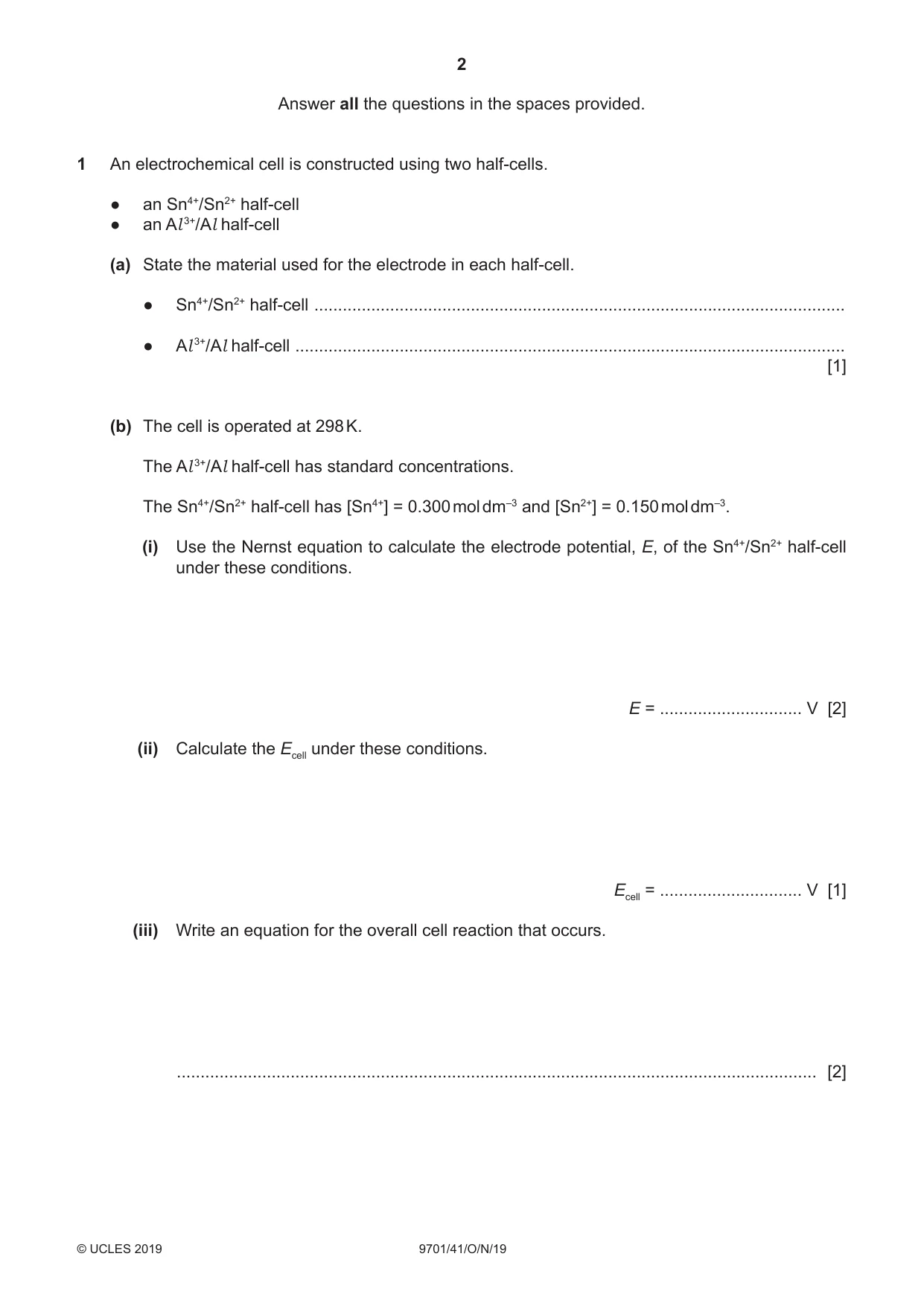
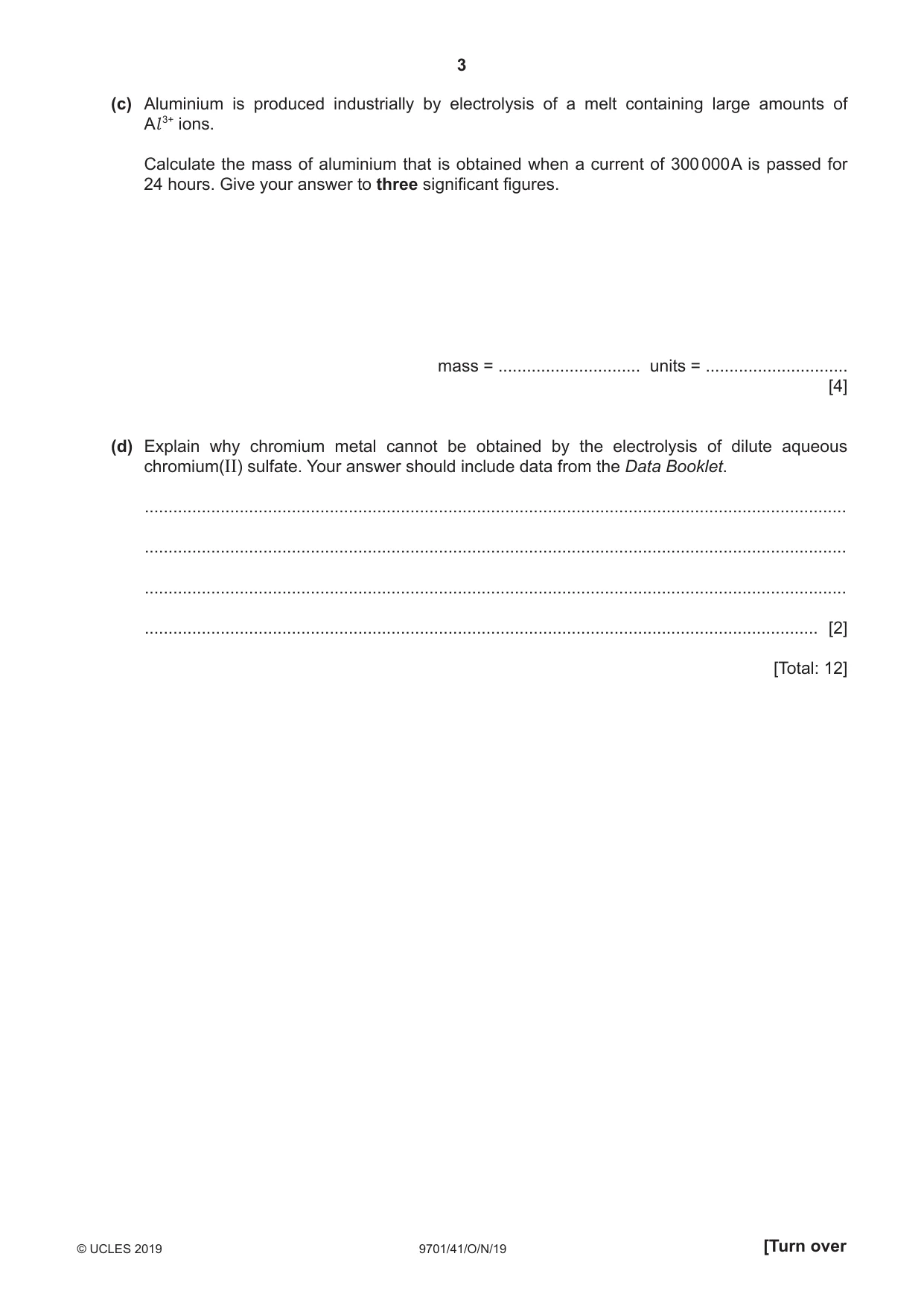
1 An electrochemical cell is constructed using two half-cells. ●● an Sn4+/Sn2+ half-cell ●● an Al 3+/Al half-cell (a) State the material used for the electrode in each half-cell. ●● Sn4+/Sn2+ half-cell ................................................................................................................ ●● Al 3+/Al half-cell .................................................................................................................... [1] (b) The cell is operated at 298 K. The Al 3+/Al half-cell has standard concentrations. The Sn4+/Sn2+ half-cell has [Sn4+] = 0.300 mol dm–3 and [Sn2+] = 0.150 mol dm–3. (i) Use the Nernst equation to calculate the electrode potential, E, of the Sn4+/Sn2+ half‑cell under these conditions. E = .............................. V [2] (ii) Calculate the Ecell under these conditions. Ecell = .............................. V [1] (iii) Write an equation for the overall cell reaction that occurs. ....................................................................................................................................... [2] (c) Aluminium is produced industrially by electrolysis of a melt containing large amounts of Al 3+ ions. Calculate the mass of aluminium that is obtained when a current of 300 000 A is passed for 24 hours. Give your answer to three significant figures. mass = .............................. units = .............................. [4] (d) Explain why chromium metal cannot be obtained by the electrolysis of dilute aqueous chromium(II) sulfate. Your answer should include data from the Data Booklet. .................................................................................................................................................... .................................................................................................................................................... .................................................................................................................................................... .............................................................................................................................................. [2] [Total: 12]
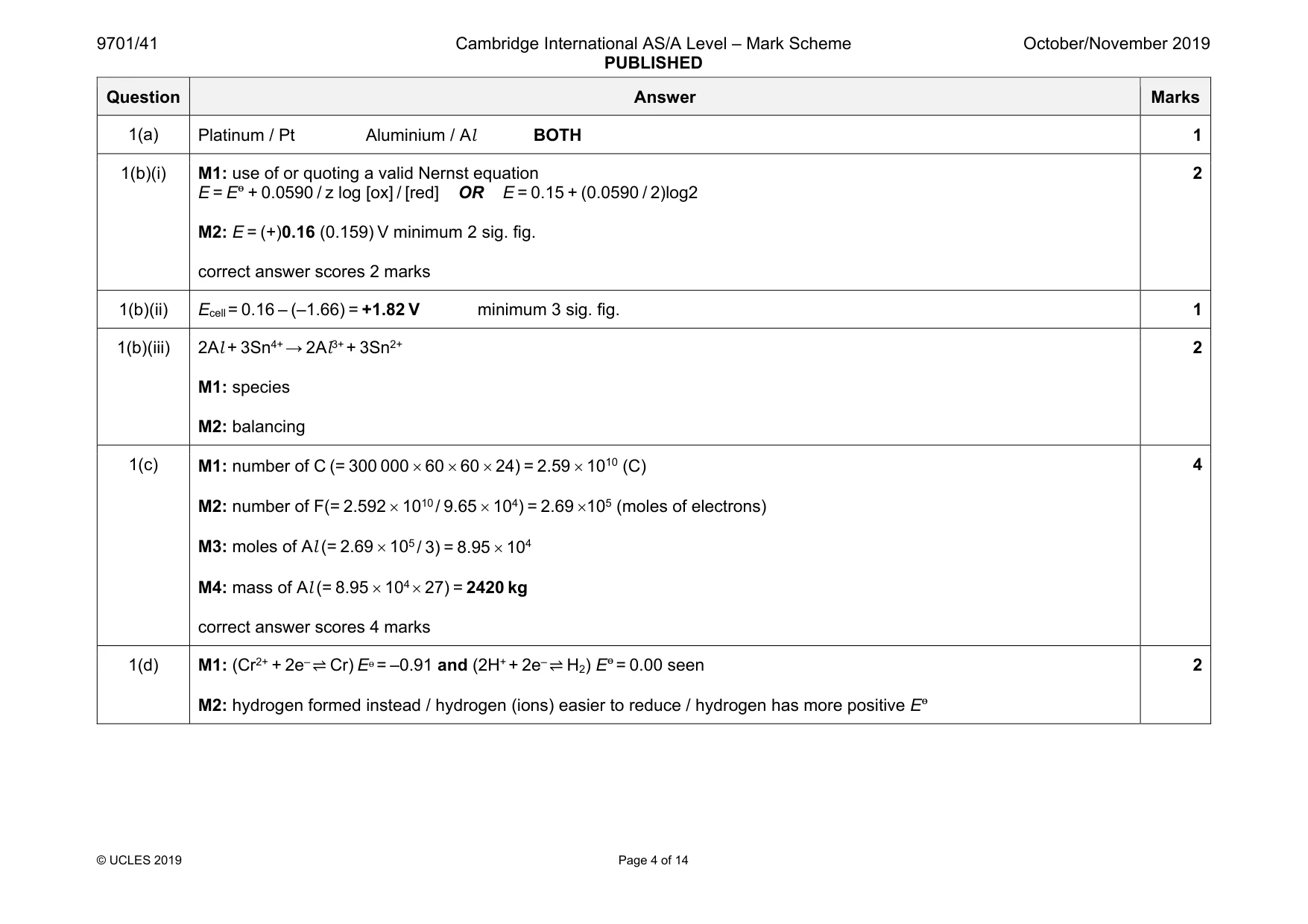
Mark scheme: 1(a) Platinum / Pt BOTH 1 1(b)(i) M1: use of or quoting a valid Nernst equation E = Eᶱ + 0.0590 / z log [ox] / [red] OR E = 0.15 + (0.0590 / 2)log2 M2: E = (+)0.16 (0.159) V minimum 2 sig. fig. correct answer scores 2 marks 2 1(b)(ii) Ecell= 0.16 – (–1.66) = +1.82 V minimum 3 sig. fig. 1 1(b)(iii) 2Al + 3Sn4+ → 2Al3+ + 3Sn2+ M1: species M2: balancing 2 1(c) M1: number of C (= 300 000 × 60 × 60 × 24) = 2.59 × 10¹⁰ (C) M2: number of F(= 2.592 × 10¹⁰ / 9.65 × 10⁴) = 2.69 ×10⁵ (moles of electrons) M3: moles of Al (= 2.69 × 10⁵ / 3) = 8.95 × 10⁴ M4: mass of Al (= 8.95 × 104 × 27) = 2420 kg correct answer scores 4 marks 4 1(d) M1: (Cr2+ + 2e– ⇌ Cr) Eɵ = –0.91 and (2H+ + 2e– ⇌ H2) Eᶱ = 0.00 seen M2: hydrogen formed instead / hydrogen (ions) easier to reduce / hydrogen has more positive Eᶱ 2
Q2 · When Cl NO2 reacts with NO an equilibrium is established
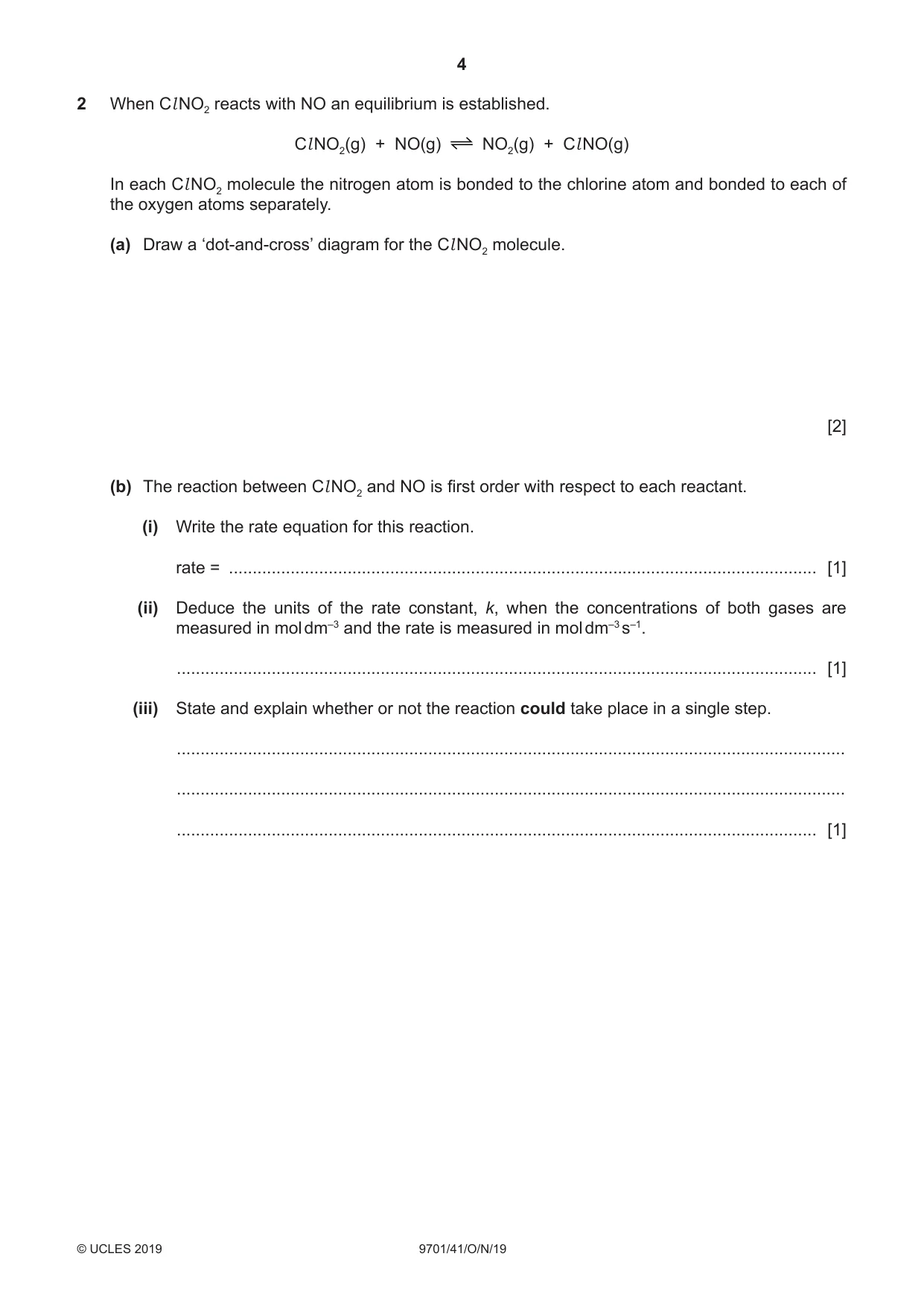
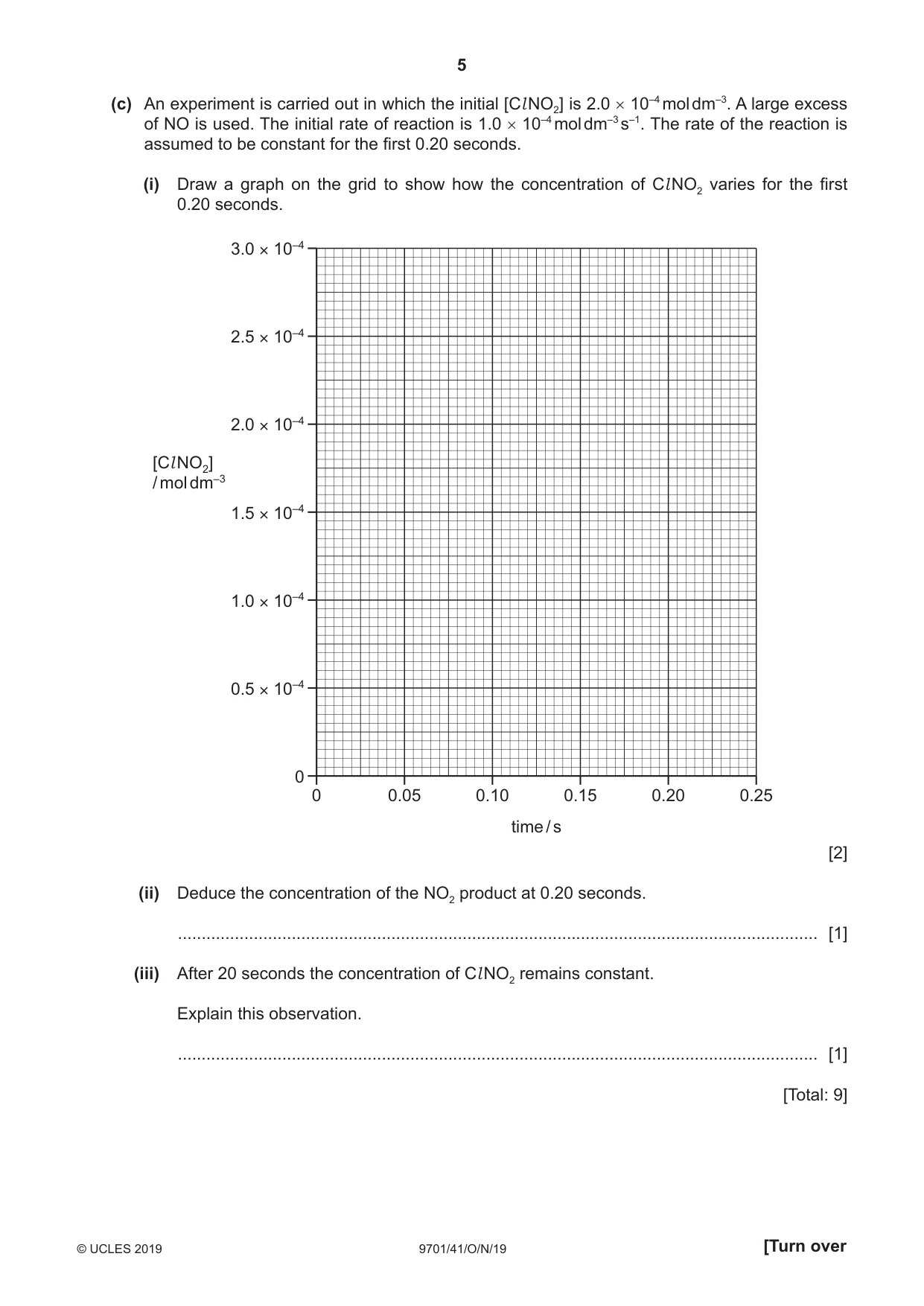
2 When Cl NO2 reacts with NO an equilibrium is established. Cl NO2(g) + NO(g) NO2(g) + Cl NO(g) In each Cl NO2 molecule the nitrogen atom is bonded to the chlorine atom and bonded to each of the oxygen atoms separately. (a) Draw a ‘dot-and-cross’ diagram for the Cl NO2 molecule. [2] (b) The reaction between Cl NO2 and NO is first order with respect to each reactant. (i) Write the rate equation for this reaction. rate = ............................................................................................................................. [1] (ii) Deduce the units of the rate constant, k, when the concentrations of both gases are measured in mol dm–3 and the rate is measured in mol dm–3 s–1. ....................................................................................................................................... [1] (iii) State and explain whether or not the reaction could take place in a single step. ............................................................................................................................................. ............................................................................................................................................. ....................................................................................................................................... [1] (c) An experiment is carried out in which the initial [Cl NO2] is 2.0 × 10⁻⁴ mol dm–3. A large excess of NO is used. The initial rate of reaction is 1.0 × 10⁻⁴ mol dm–3 s–1. The rate of the reaction is assumed to be constant for the first 0.20 seconds. (i) Draw a graph on the grid to show how the concentration of Cl NO2 varies for the first 0.20 seconds. 3.0 × 10⁻⁴ 2.5 × 10⁻⁴ 2.0 × 10⁻⁴ [Cl NO2] / mol dm–3 1.5 × 10⁻⁴ 1.0 × 10⁻⁴ 0.5 × 10⁻⁴ 0 0 0.05 0.10 0.15 0.20 0.25 time / s [2] (ii) Deduce the concentration of the NO2 product at 0.20 seconds. ....................................................................................................................................... [1] (iii) After 20 seconds the concentration of Cl NO2 remains constant. Explain this observation. ....................................................................................................................................... [1] [Total: 9]
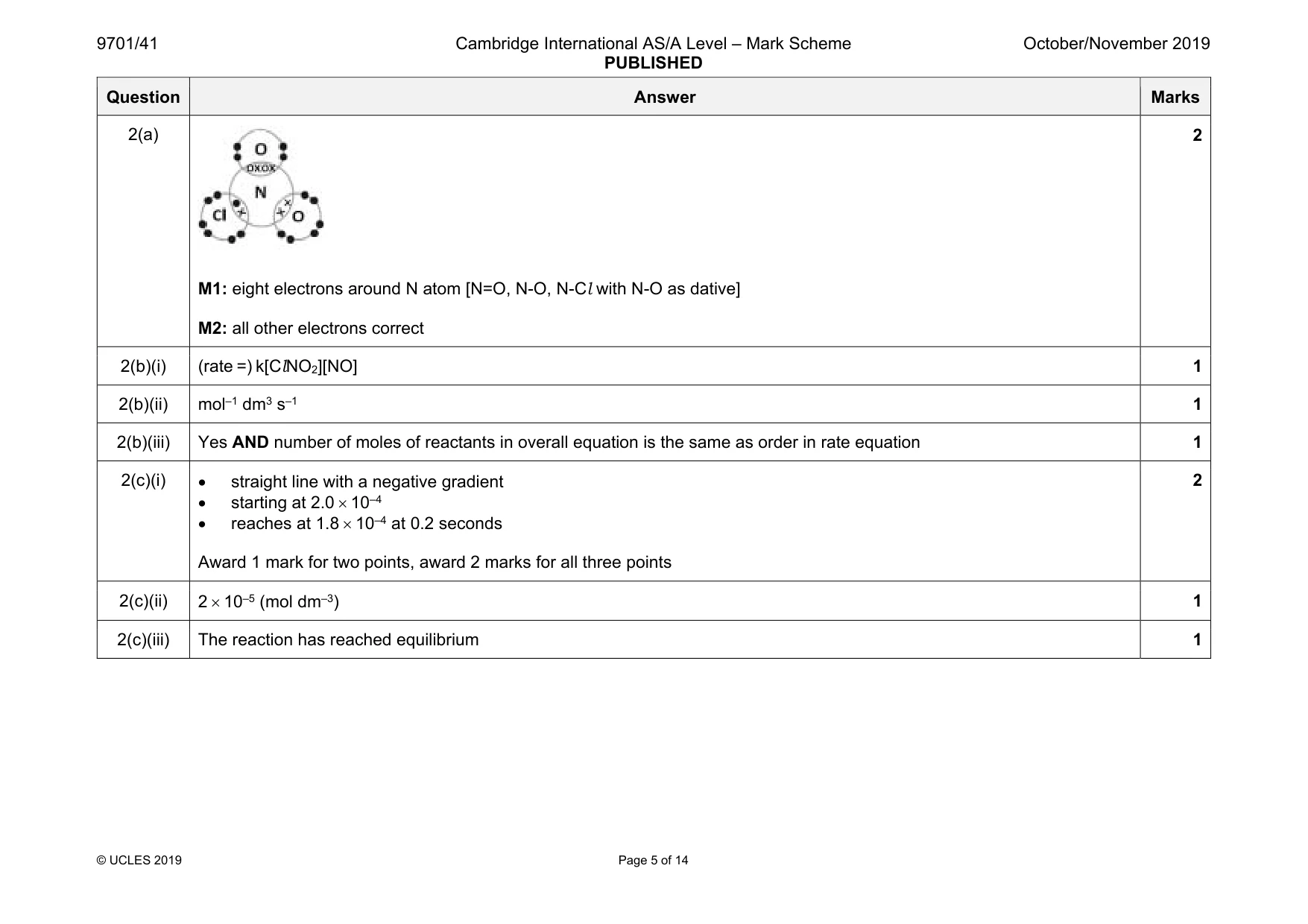
Mark scheme: 2(a) M1: eight electrons around N atom [N=O, N-O, N-Cl with N-O as dative] M2: all other electrons correct 2 2(b)(i) (rate =) k[ClNO2][NO] 1 2(b)(ii) mol–1 dm3 s–1 1 2(b)(iii) Yes AND number of moles of reactants in overall equation is the same as order in rate equation 1 2(c)(i) • straight line with a negative gradient • starting at 2.0 × 10⁻⁴ • reaches at 1.8 × 10⁻⁴ at 0.2 seconds Award 1 mark for two points, award 2 marks for all three points 2 2(c)(ii) 2 × 10⁻⁵ (mol dm–3) 1 2(c)(iii) The reaction has reached equilibrium 1
More questions on Chemical equilibria: reversible reactions, dynamic equilibrium
Q3 · Explain what is meant by the term entropy of a system
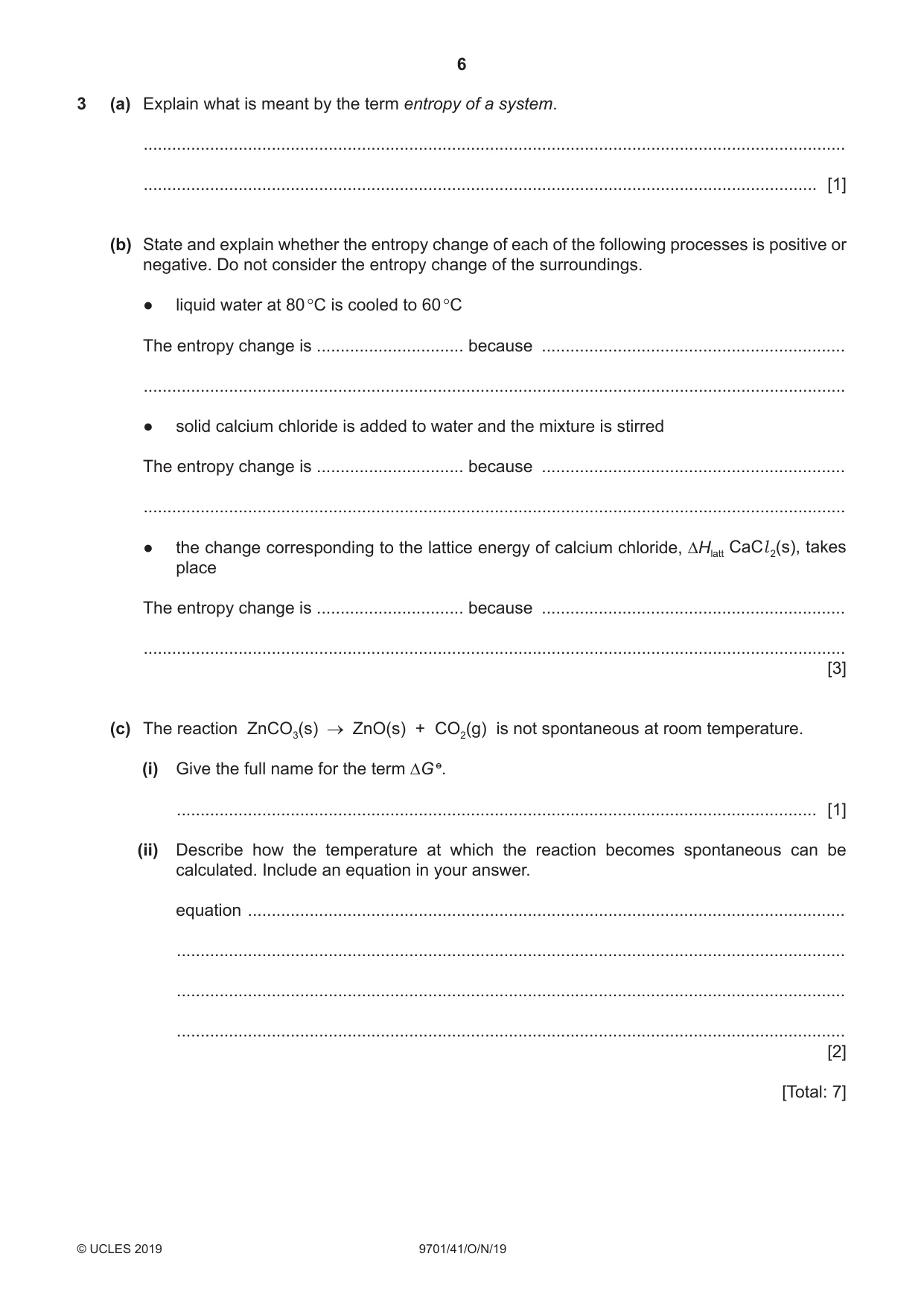
3 (a) Explain what is meant by the term entropy of a system. .................................................................................................................................................... .............................................................................................................................................. [1] (b) State and explain whether the entropy change of each of the following processes is positive or negative. Do not consider the entropy change of the surroundings. ●● liquid water at 80 °C is cooled to 60 °C The entropy change is ............................... because ................................................................. .................................................................................................................................................... ●● solid calcium chloride is added to water and the mixture is stirred The entropy change is ............................... because ................................................................. .................................................................................................................................................... ●● the change corresponding to the lattice energy of calcium chloride, ΔHlatt CaCl 2(s), takes place The entropy change is ............................... because ................................................................. .................................................................................................................................................... [3] (c) The reaction ZnCO3(s) ZnO(s) + CO2(g) is not spontaneous at room temperature. (i) Give the full name for the term ΔG o. ....................................................................................................................................... [1] (ii) Describe how the temperature at which the reaction becomes spontaneous can be calculated. Include an equation in your answer. equation .............................................................................................................................. ............................................................................................................................................. ............................................................................................................................................. ............................................................................................................................................. [2] [Total: 7]
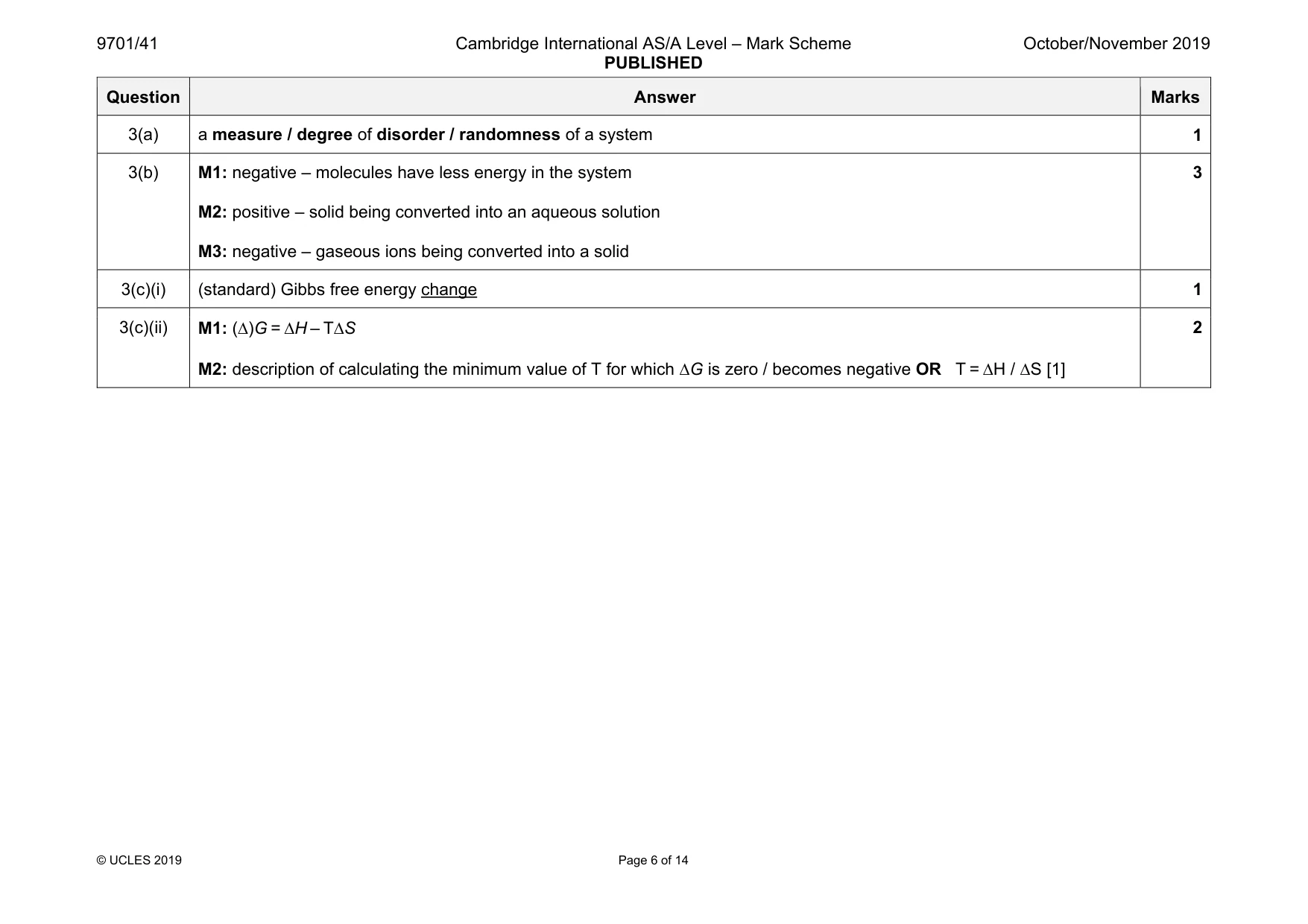
Mark scheme: 3(a) a measure / degree of disorder / randomness of a system 1 3(b) M1: negative – molecules have less energy in the system M2: positive – solid being converted into an aqueous solution M3: negative – gaseous ions being converted into a solid 3 3(c)(i) (standard) Gibbs free energy change 1 3(c)(ii) M1: (∆)G = ∆H – T∆S M2: description of calculating the minimum value of T for which ∆G is zero / becomes negative OR T = ∆H / ∆S [1] 2
Q4 · Phenylethanone is an important chemical with many uses
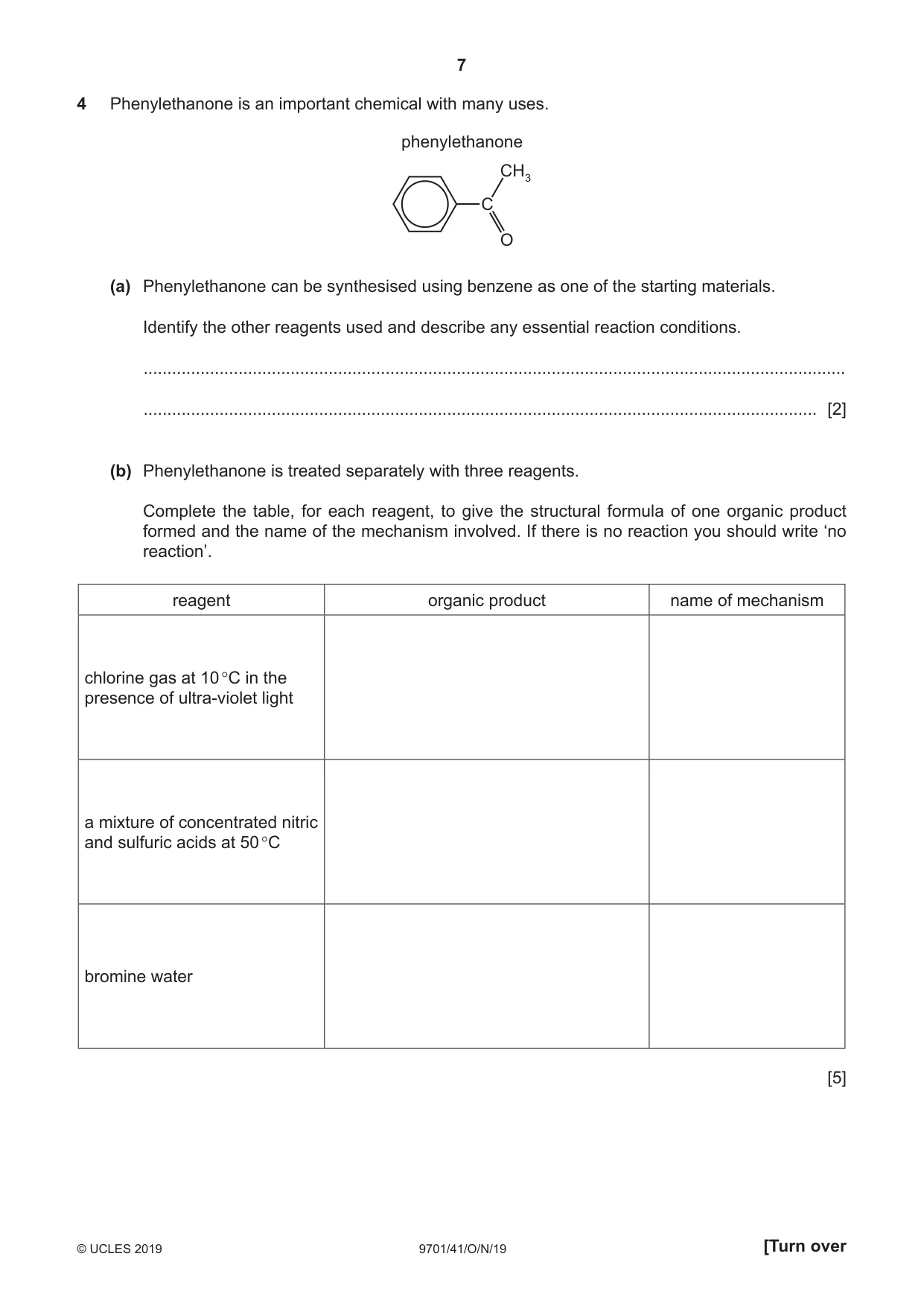
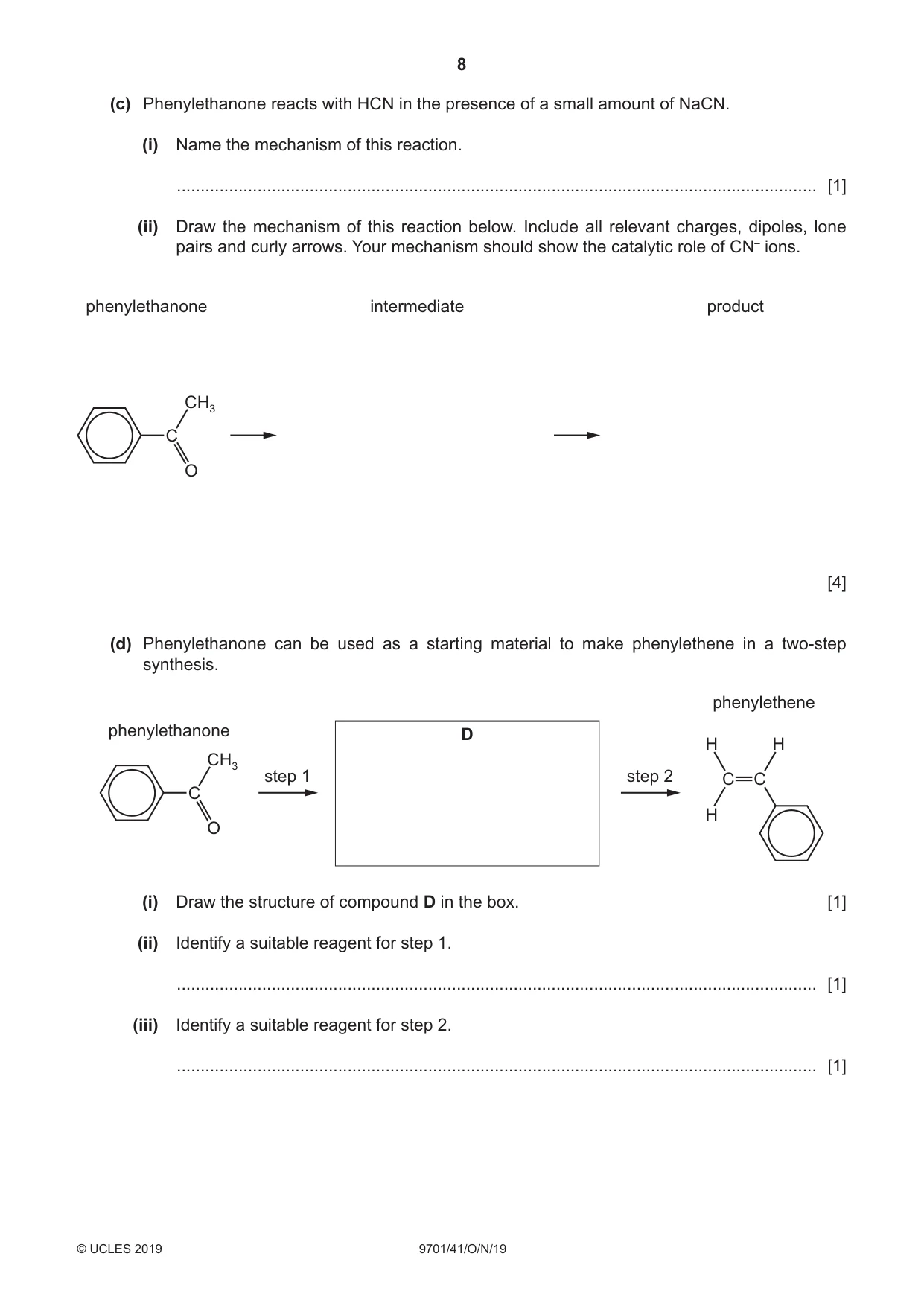
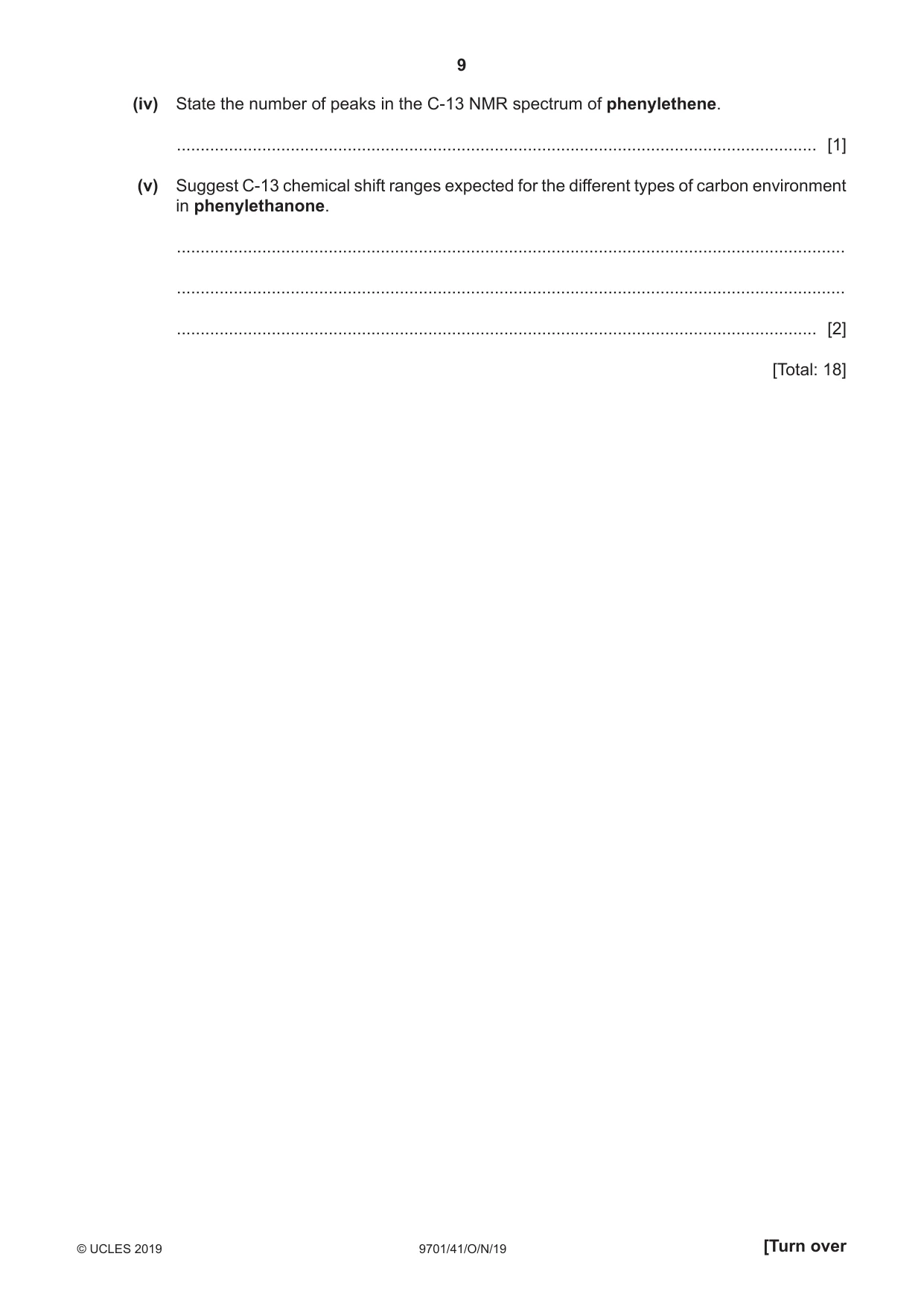
4 Phenylethanone is an important chemical with many uses. phenylethanone CH3 C O (a) Phenylethanone can be synthesised using benzene as one of the starting materials. Identify the other reagents used and describe any essential reaction conditions. .................................................................................................................................................... .............................................................................................................................................. [2] (b) Phenylethanone is treated separately with three reagents. Complete the table, for each reagent, to give the structural formula of one organic product formed and the name of the mechanism involved. If there is no reaction you should write ‘no reaction’. reagent organic product name of mechanism chlorine gas at 10 °C in the presence of ultra-violet light a mixture of concentrated nitric and sulfuric acids at 50 °C bromine water [5] (c) Phenylethanone reacts with HCN in the presence of a small amount of NaCN. (i) Name the mechanism of this reaction. ....................................................................................................................................... [1] (ii) Draw the mechanism of this reaction below. Include all relevant charges, dipoles, lone pairs and curly arrows. Your mechanism should show the catalytic role of CN– ions. phenylethanone intermediate product CH3 C O [4] (d) Phenylethanone can be used as a starting material to make phenylethene in a two‑step synthesis. phenylethene phenylethanone D H H CH3 step 1 step 2 C C C H O (i) Draw the structure of compound D in the box. [1] (ii) Identify a suitable reagent for step 1. ....................................................................................................................................... [1] (iii) Identify a suitable reagent for step 2. ....................................................................................................................................... [1] (iv) State the number of peaks in the C-13 NMR spectrum of phenylethene. ....................................................................................................................................... [1] (v) Suggest C-13 chemical shift ranges expected for the different types of carbon environment in phenylethanone. ............................................................................................................................................. ............................................................................................................................................. ....................................................................................................................................... [2] [Total: 18]
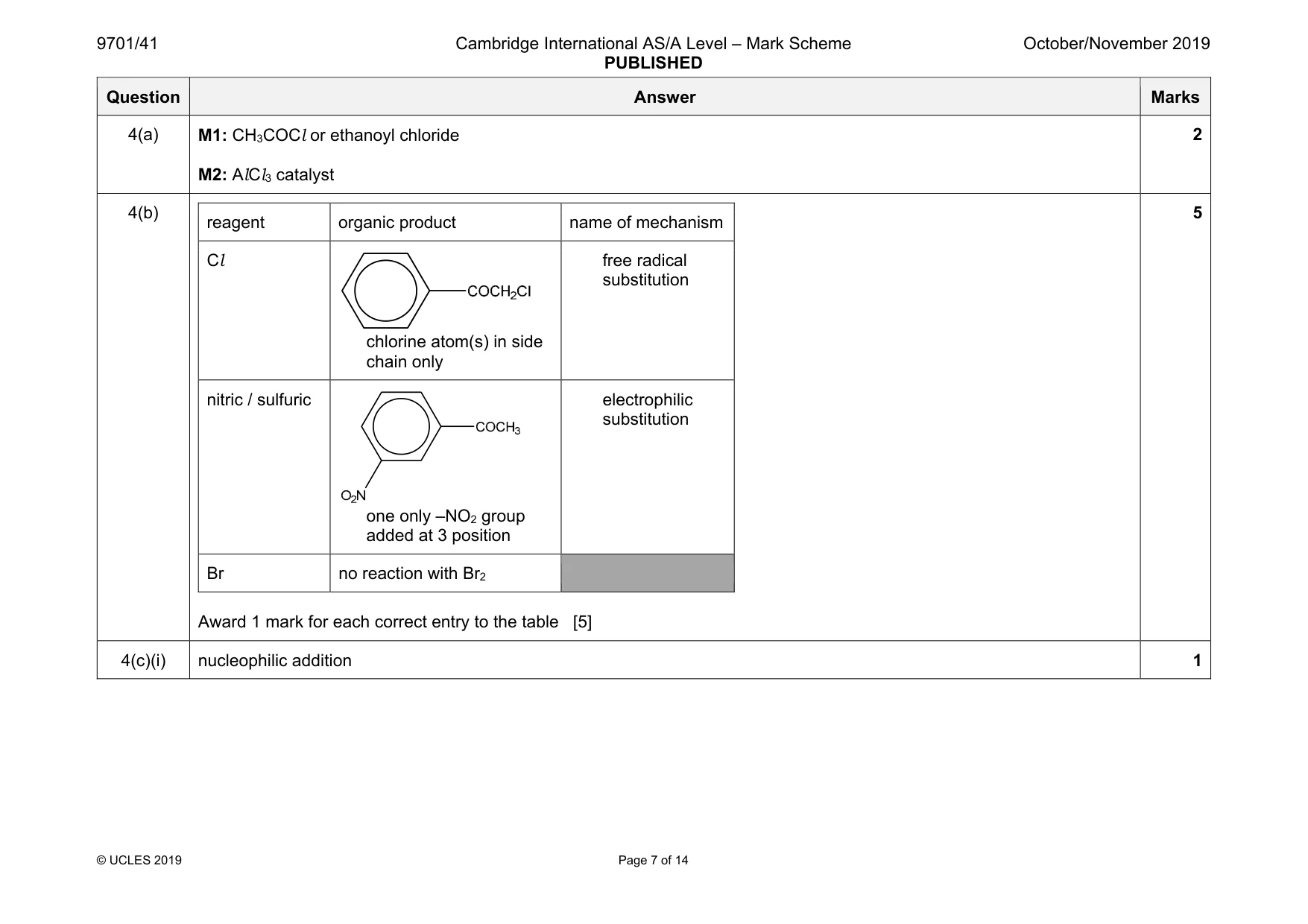
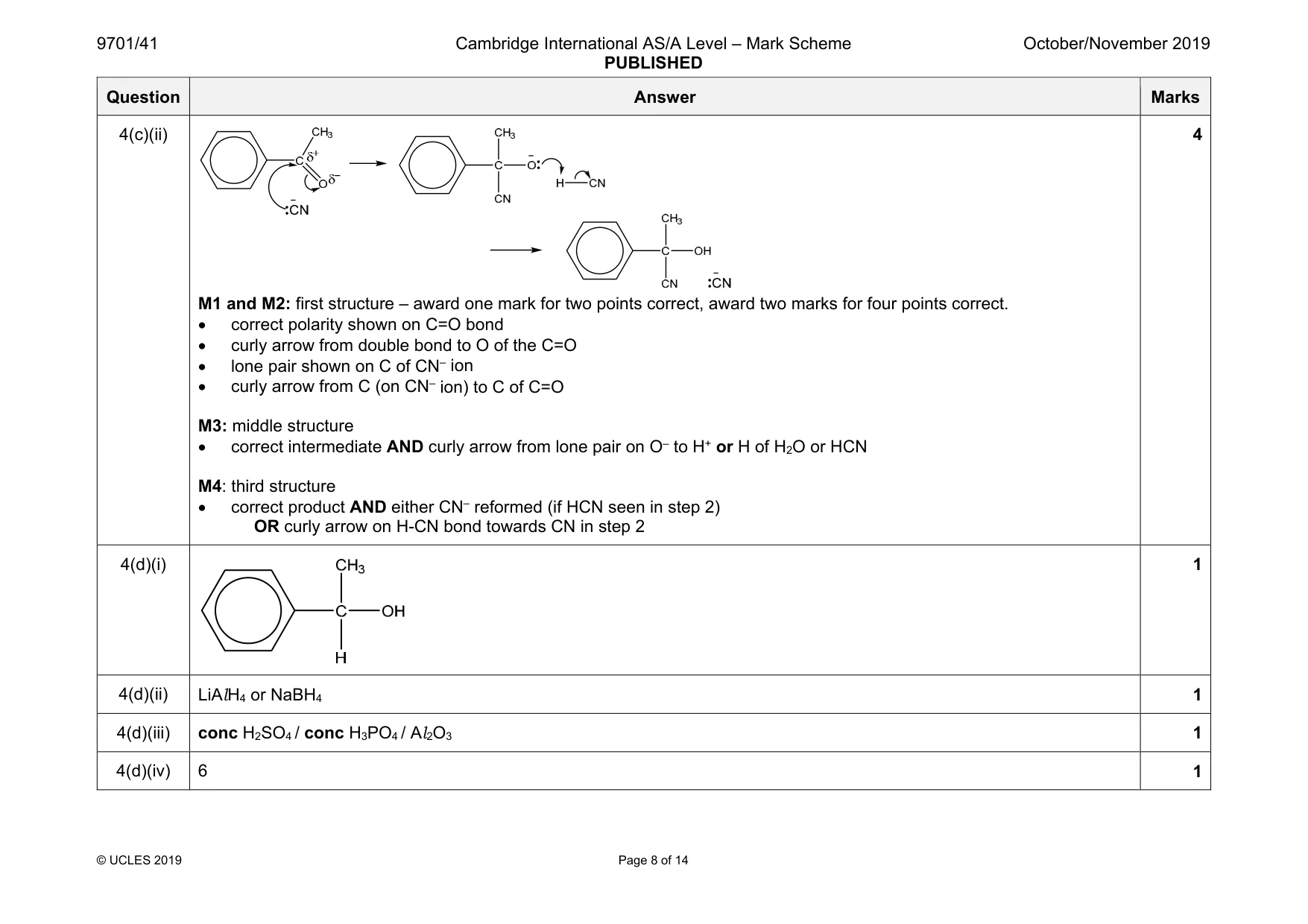
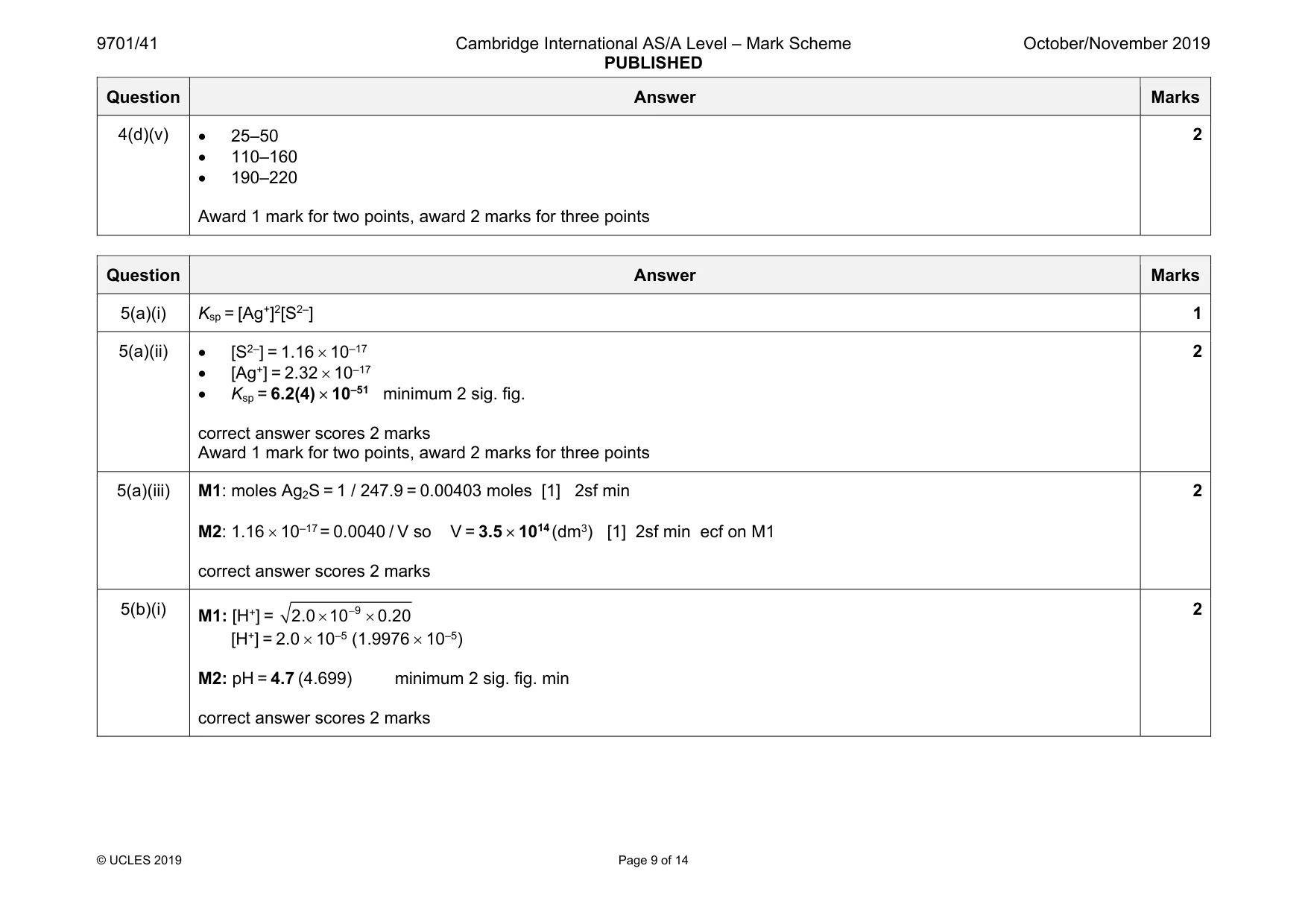
Mark scheme: 4(a) M2: AlCl3 catalyst 2 4(b) reagent organic product name of mechanism Cl chlorine atom(s) in side chain only free radical substitution nitric / sulfuric one only –NO2 group added at 3 position electrophilic substitution Br no reaction with Br2 Award 1 mark for each correct entry to the table [5] 5 4(c)(i) nucleophilic addition 1 Question Answer Marks 4(c)(ii) M1 and M2: first structure – award one mark for two points correct, award two marks for four points correct. • correct polarity shown on C=O bond • curly arrow from double bond to O of the C=O • lone pair shown on C of CN– ion • curly arrow from C (on CN– ion) to C of C=O M3: middle structure • correct intermediate AND curly arrow from lone pair on O– to H+ or H of H2O or HCN M4: third structure • correct product AND either CN– reformed (if HCN seen in step 2) OR curly arrow on H-CN bond towards CN in step 2 4 4(d)(i) 1 4(d)(ii) LiAlH4 or NaBH4 1 4(d)(iii) conc H2SO4 / conc H3PO4 / Al2O3 1 4(d)(iv) 6 1 Question Answer Marks 4(d)(v) • 25–50 • 110–160 • 190–220 Award 1 mark for two points, award 2 marks for three points 2
Q5 · Silver sulfide, Ag2S, is very insoluble in water
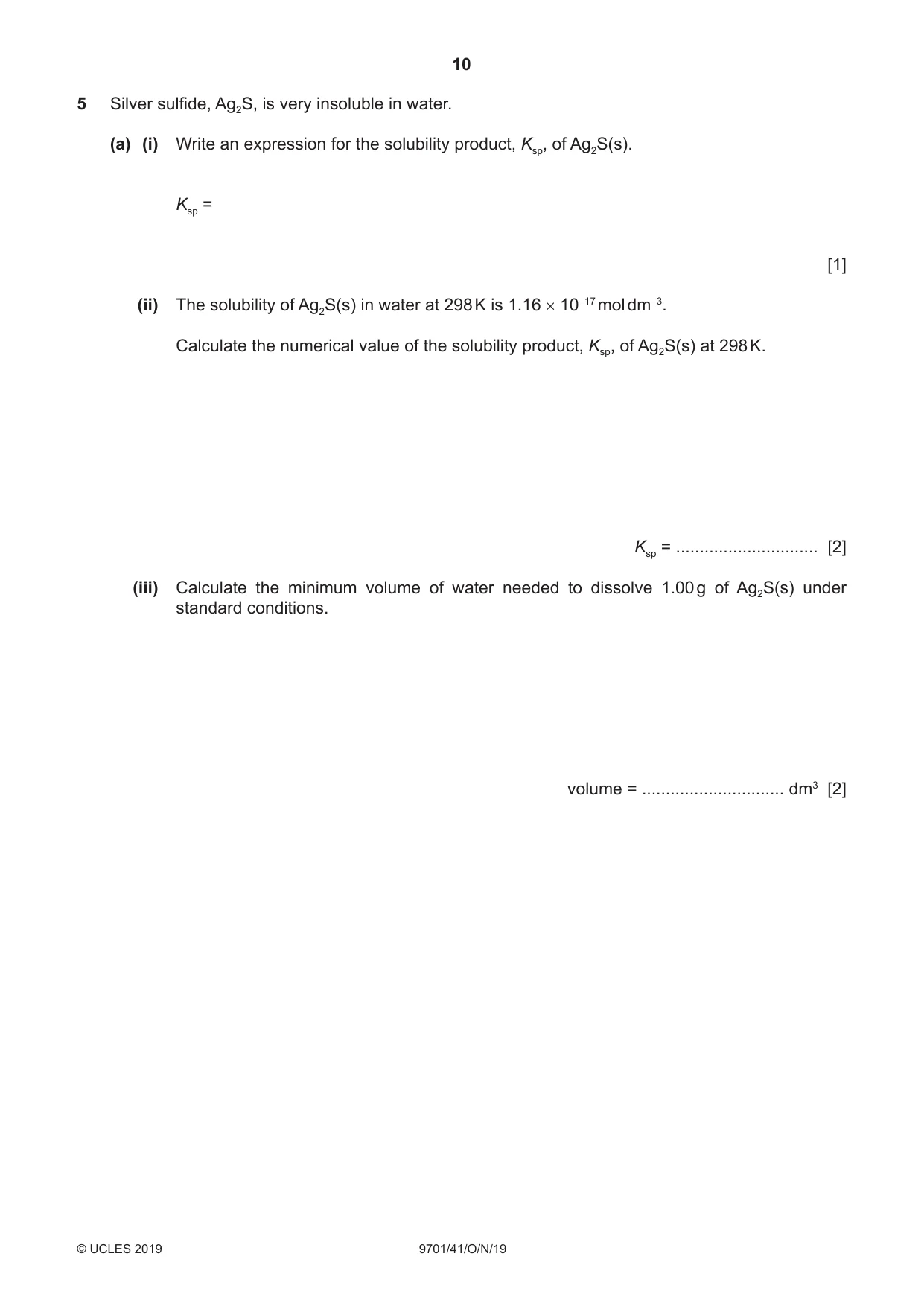
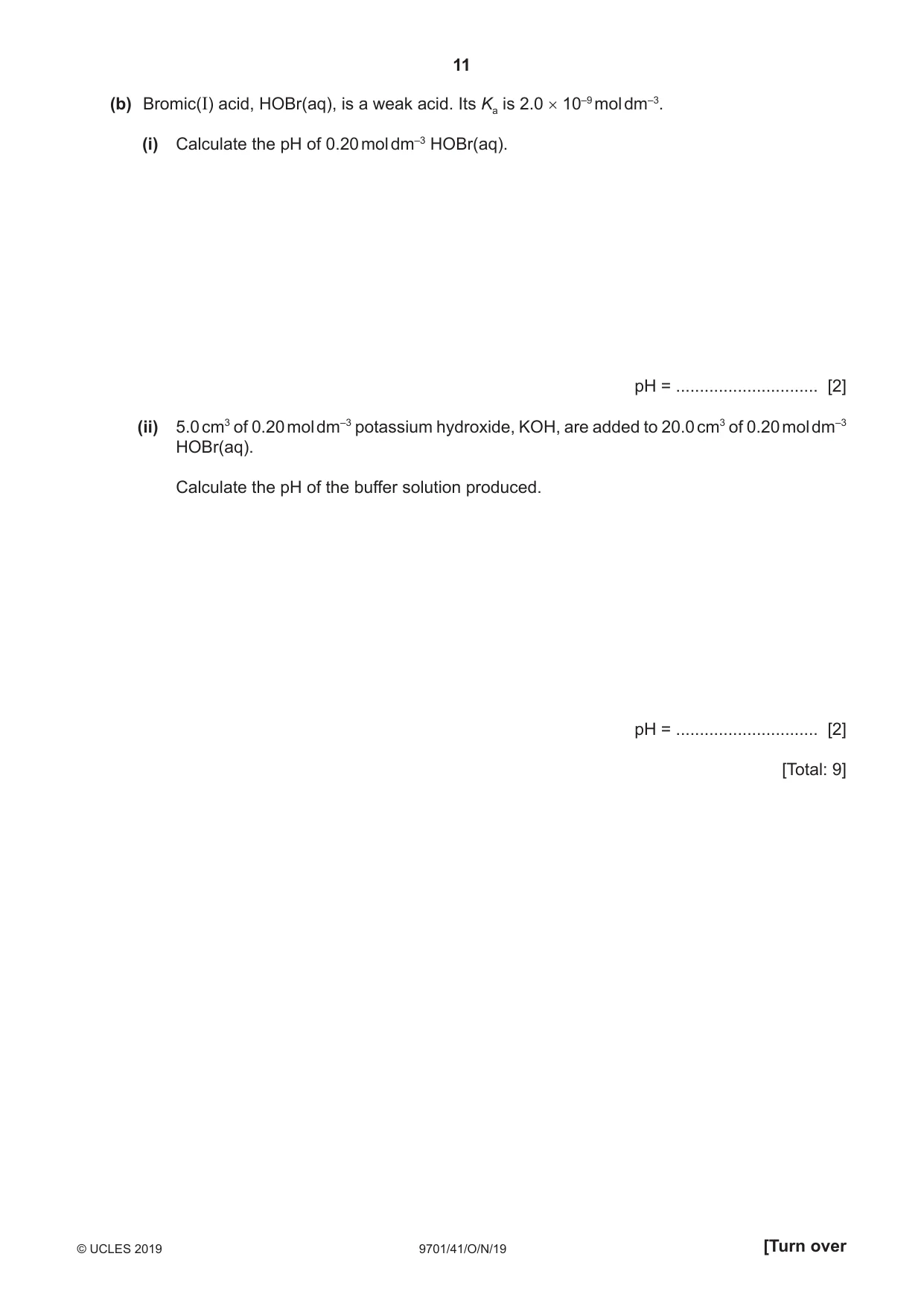
5 Silver sulfide, Ag2S, is very insoluble in water. (a) (i) Write an expression for the solubility product, Ksp, of Ag2S(s). Ksp = [1] (ii) The solubility of Ag2S(s) in water at 298 K is 1.16 × 10⁻¹⁷ mol dm–3. Calculate the numerical value of the solubility product, Ksp, of Ag2S(s) at 298 K. Ksp = .............................. [2] (iii) Calculate the minimum volume of water needed to dissolve 1.00 g of Ag2S(s) under standard conditions. volume = .............................. dm3 [2] (b) Bromic(I) acid, HOBr(aq), is a weak acid. Its Ka is 2.0 × 10⁻⁹ mol dm–3. (i) Calculate the pH of 0.20 mol dm–3 HOBr(aq). pH = .............................. [2] (ii) 5.0 cm3 of 0.20 mol dm–3 potassium hydroxide, KOH, are added to 20.0 cm3 of 0.20 mol dm–3 HOBr(aq). Calculate the pH of the buffer solution produced. pH = .............................. [2] [Total: 9]
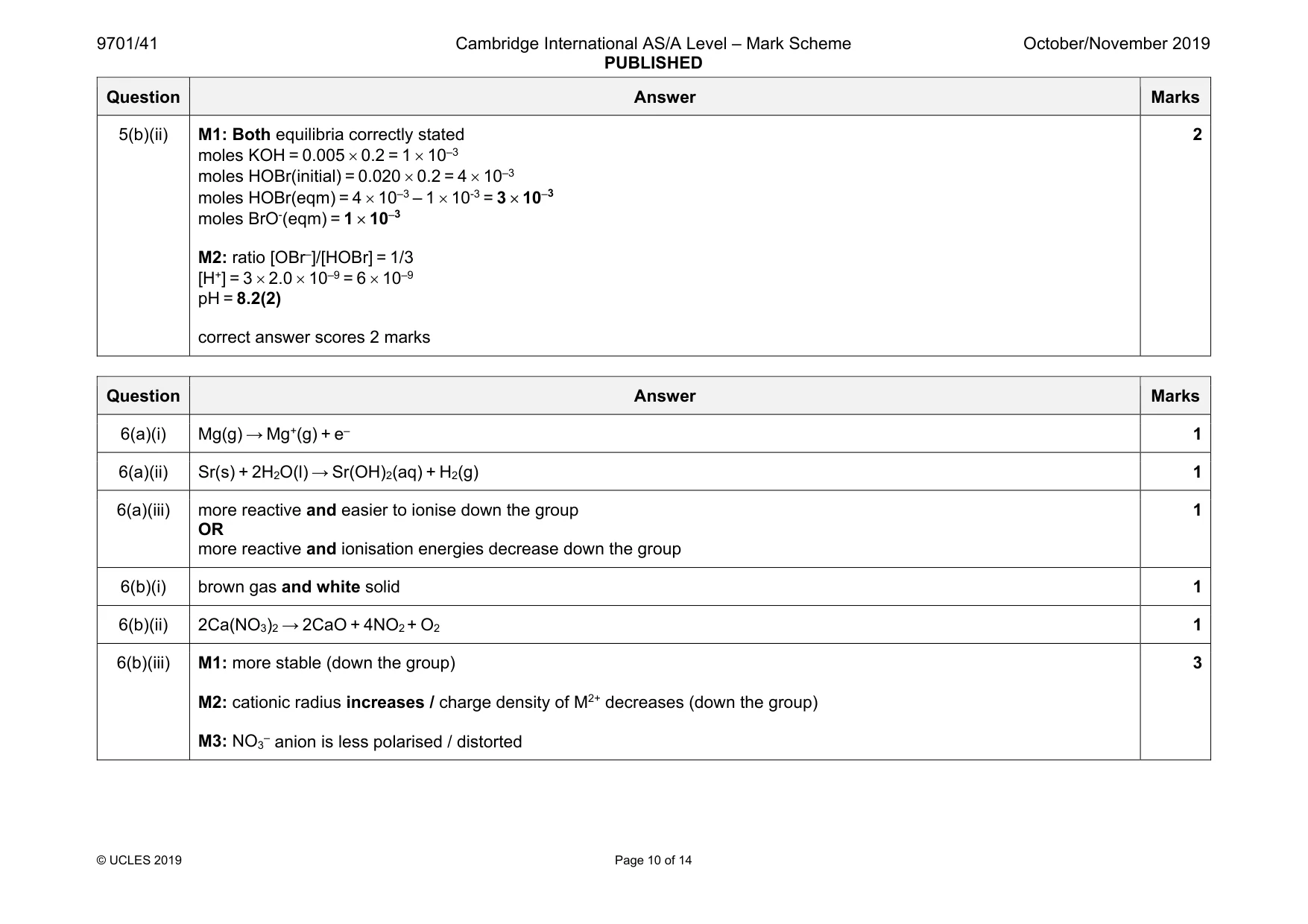
Mark scheme: 5(a)(i) Ksp = [Ag+]2[S2–] 1 5(a)(ii) • [S2–] = 1.16 × 10⁻¹⁷ • [Ag+] = 2.32 × 10⁻¹⁷ • Ksp = 6.2(4) × 10–51 minimum 2 sig. fig. correct answer scores 2 marks Award 1 mark for two points, award 2 marks for three points 2 5(a)(iii) M1: moles Ag2S = 1 / 247.9 = 0.00403 moles [1] 2sf min M2: 1.16 × 10–17 = 0.0040 / V so V = 3.5 × 10¹⁴ (dm3) [1] 2sf min ecf on M1 correct answer scores 2 marks 2 5(b)(i) M1: [H+] = − × × 9 2.0 10 0.20 [H+] = 2.0 × 10⁻⁵ (1.9976 × 10⁻⁵) M2: pH = 4.7 (4.699) minimum 2 sig. fig. min correct answer scores 2 marks 2 Question Answer Marks 5(b)(ii) M1: Both equilibria correctly stated moles KOH = 0.005 × 0.2 = 1 × 10⁻³ moles HOBr(initial) = 0.020 × 0.2 = 4 × 10⁻³ moles HOBr(eqm) = 4 × 10⁻³ – 1 × 10-3 = 3 × 10⁻³ moles BrO-(eqm) = 1 × 10⁻³ M2: ratio [OBr–]/[HOBr] = 1/3 [H+] = 3 × 2.0 × 10–9 = 6 × 10⁻⁹ pH = 8.2(2) correct answer scores 2 marks 2
Q6 · The elements in Group 2 include magnesium, calcium, strontium and barium
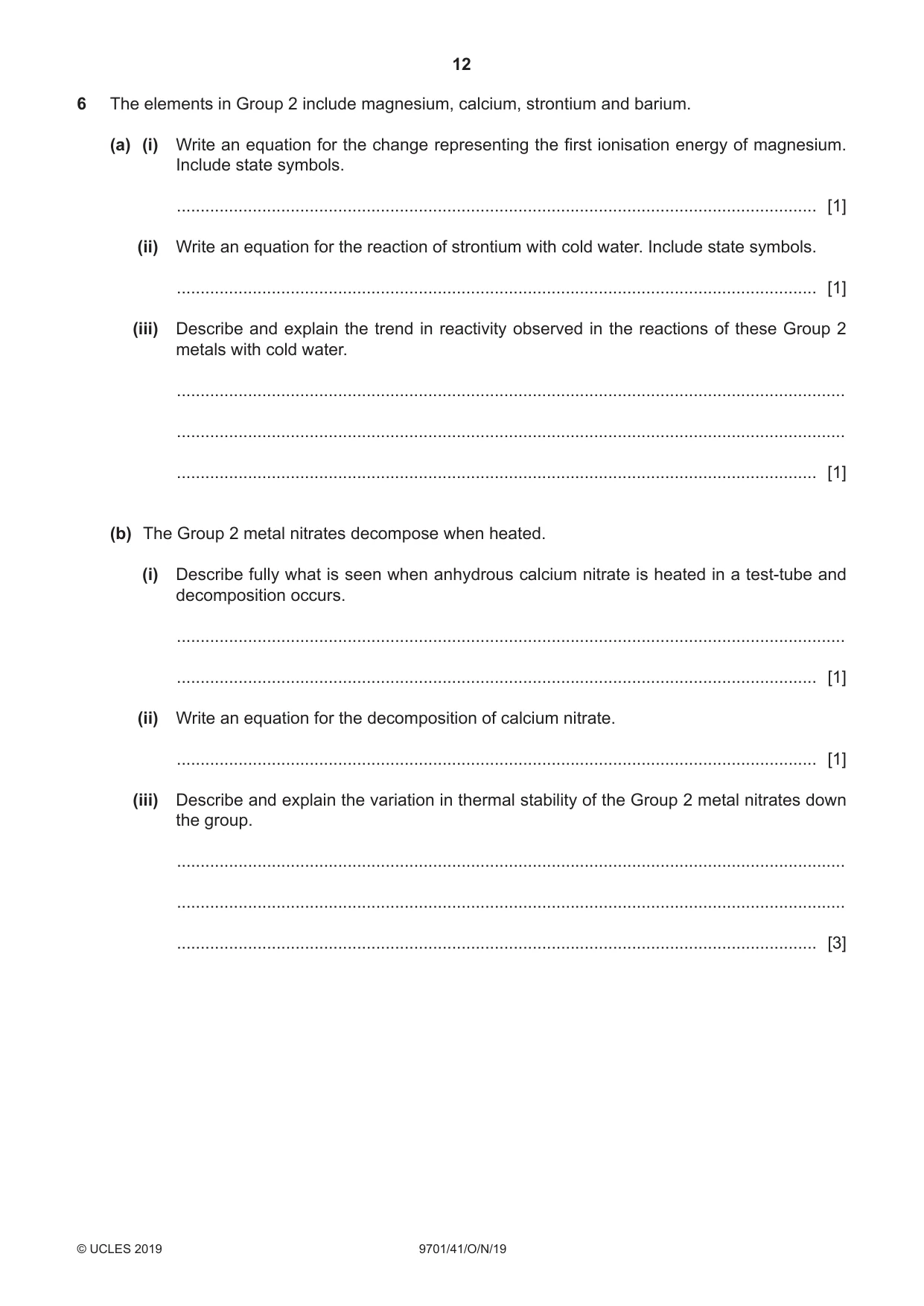
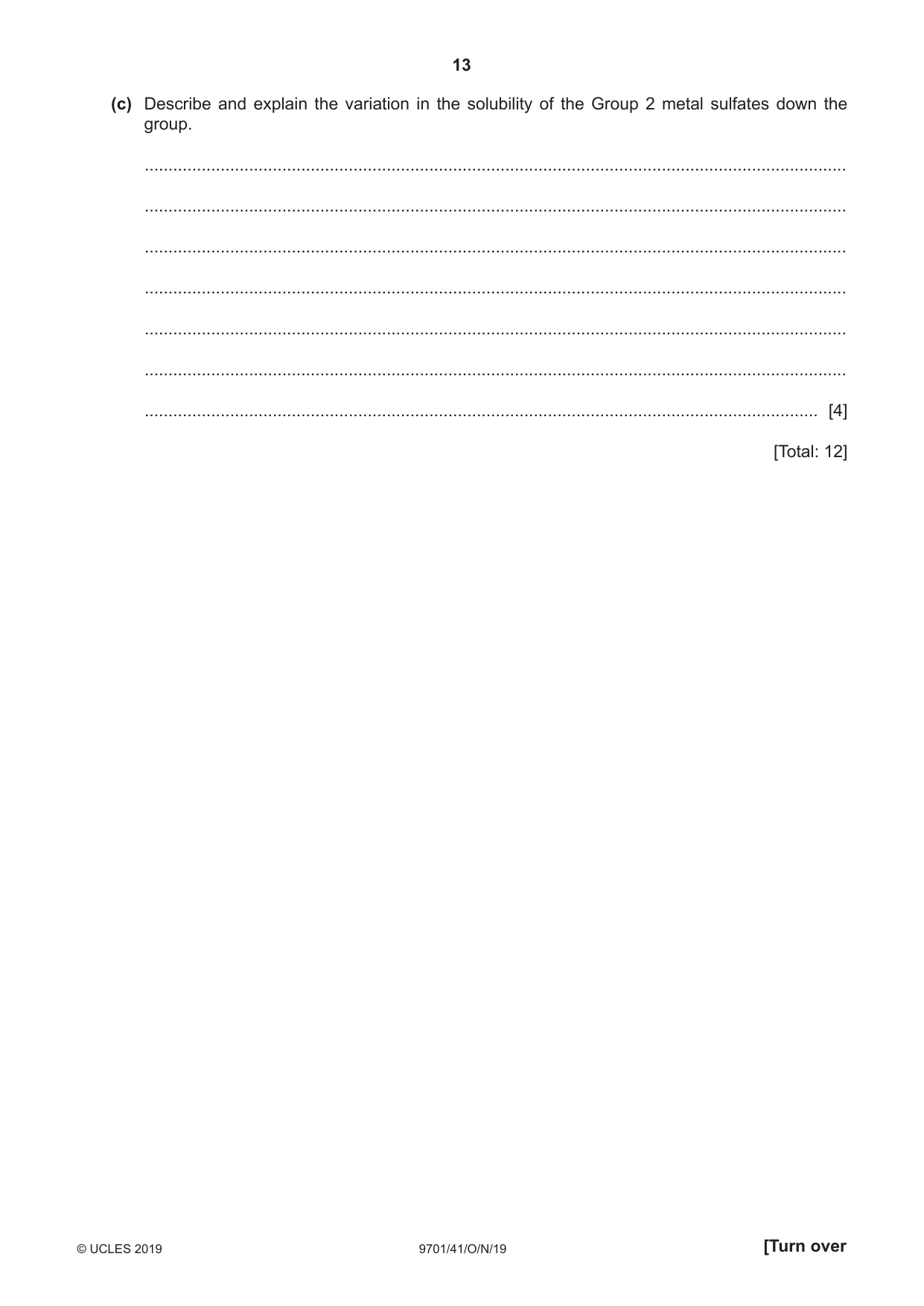
6 The elements in Group 2 include magnesium, calcium, strontium and barium. (a) (i) Write an equation for the change representing the first ionisation energy of magnesium. Include state symbols. ....................................................................................................................................... [1] (ii) Write an equation for the reaction of strontium with cold water. Include state symbols. ....................................................................................................................................... [1] (iii) Describe and explain the trend in reactivity observed in the reactions of these Group 2 metals with cold water. ............................................................................................................................................. ............................................................................................................................................. ....................................................................................................................................... [1] (b) The Group 2 metal nitrates decompose when heated. (i) Describe fully what is seen when anhydrous calcium nitrate is heated in a test‑tube and decomposition occurs. ............................................................................................................................................. ....................................................................................................................................... [1] (ii) Write an equation for the decomposition of calcium nitrate. ....................................................................................................................................... [1] (iii) Describe and explain the variation in thermal stability of the Group 2 metal nitrates down the group. ............................................................................................................................................. ............................................................................................................................................. ....................................................................................................................................... [3] (c) Describe and explain the variation in the solubility of the Group 2 metal sulfates down the group. .................................................................................................................................................... .................................................................................................................................................... .................................................................................................................................................... .................................................................................................................................................... .................................................................................................................................................... .................................................................................................................................................... .............................................................................................................................................. [4] [Total: 12]
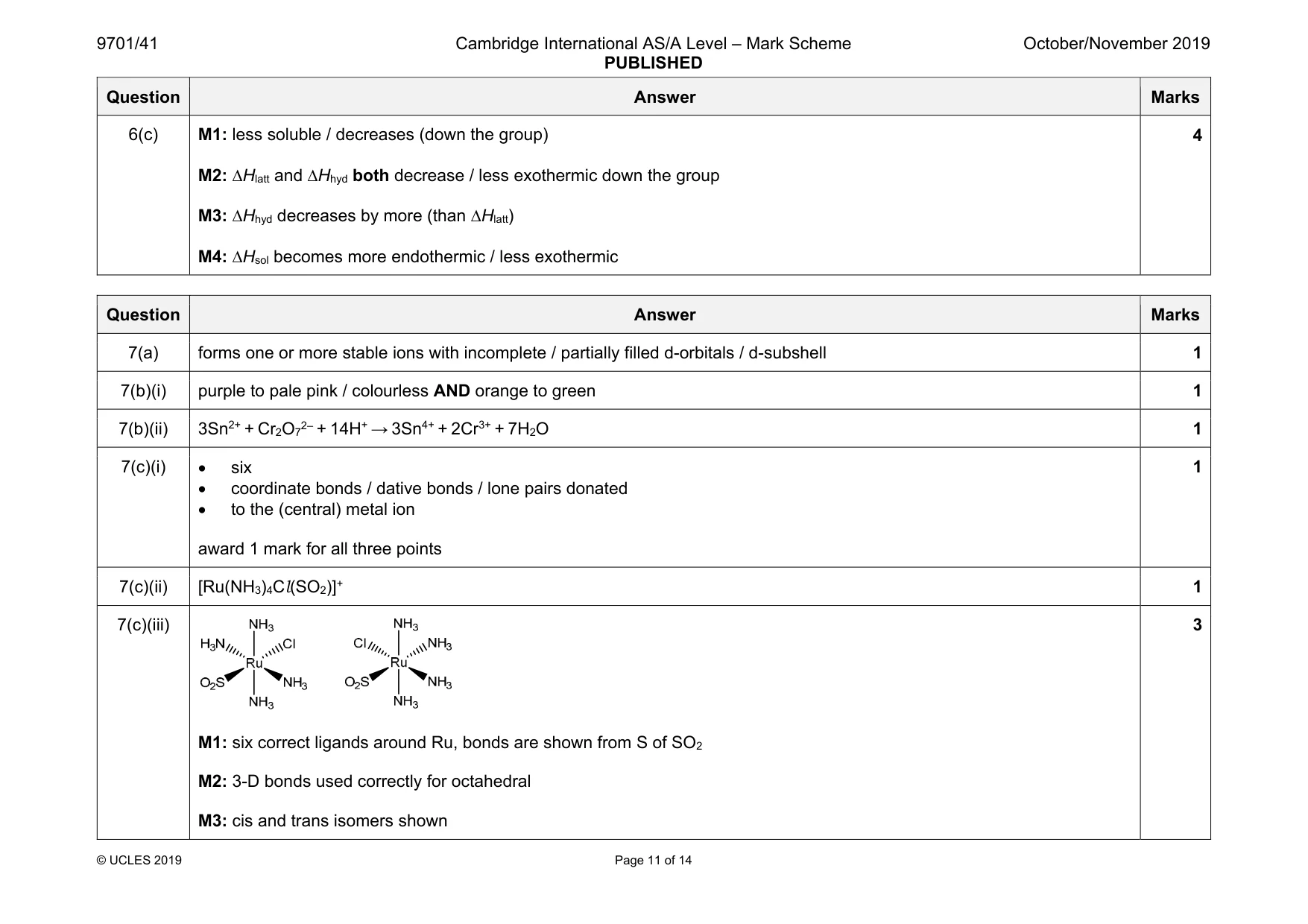
Mark scheme: 6(a)(i) Mg(g) → Mg+(g) + e– 1 6(a)(ii) Sr(s) + 2H2O(l) → Sr(OH)2(aq) + H2(g) 1 6(a)(iii) more reactive and easier to ionise down the group OR more reactive and ionisation energies decrease down the group 1 6(b)(i) brown gas and white solid 1 6(b)(ii) 2Ca(NO3)2 → 2CaO + 4NO2+ O2 1 6(b)(iii) M1: more stable (down the group) M2: cationic radius increases / charge density of M2+ decreases (down the group) M3: NO3– anion is less polarised / distorted 3 Question Answer Marks 6(c) M1: less soluble / decreases (down the group) M2: ∆Hlatt and ∆Hhyd both decrease / less exothermic down the group M3: ∆Hhyd decreases by more (than ∆Hlatt) M4: ∆Hsol becomes more endothermic / less exothermic 4
Q7 · Manganese, chromium and ruthenium are all transition elements
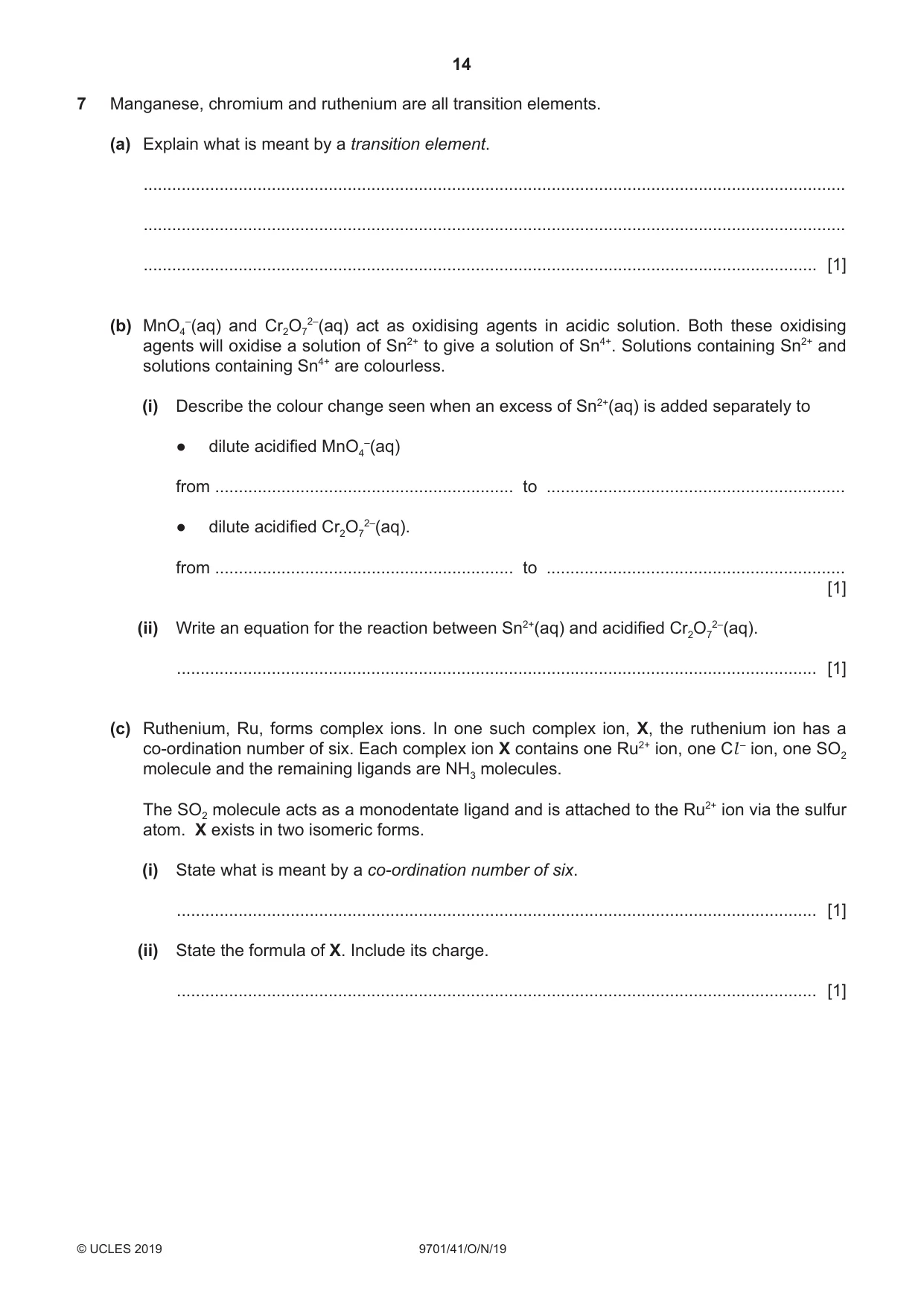
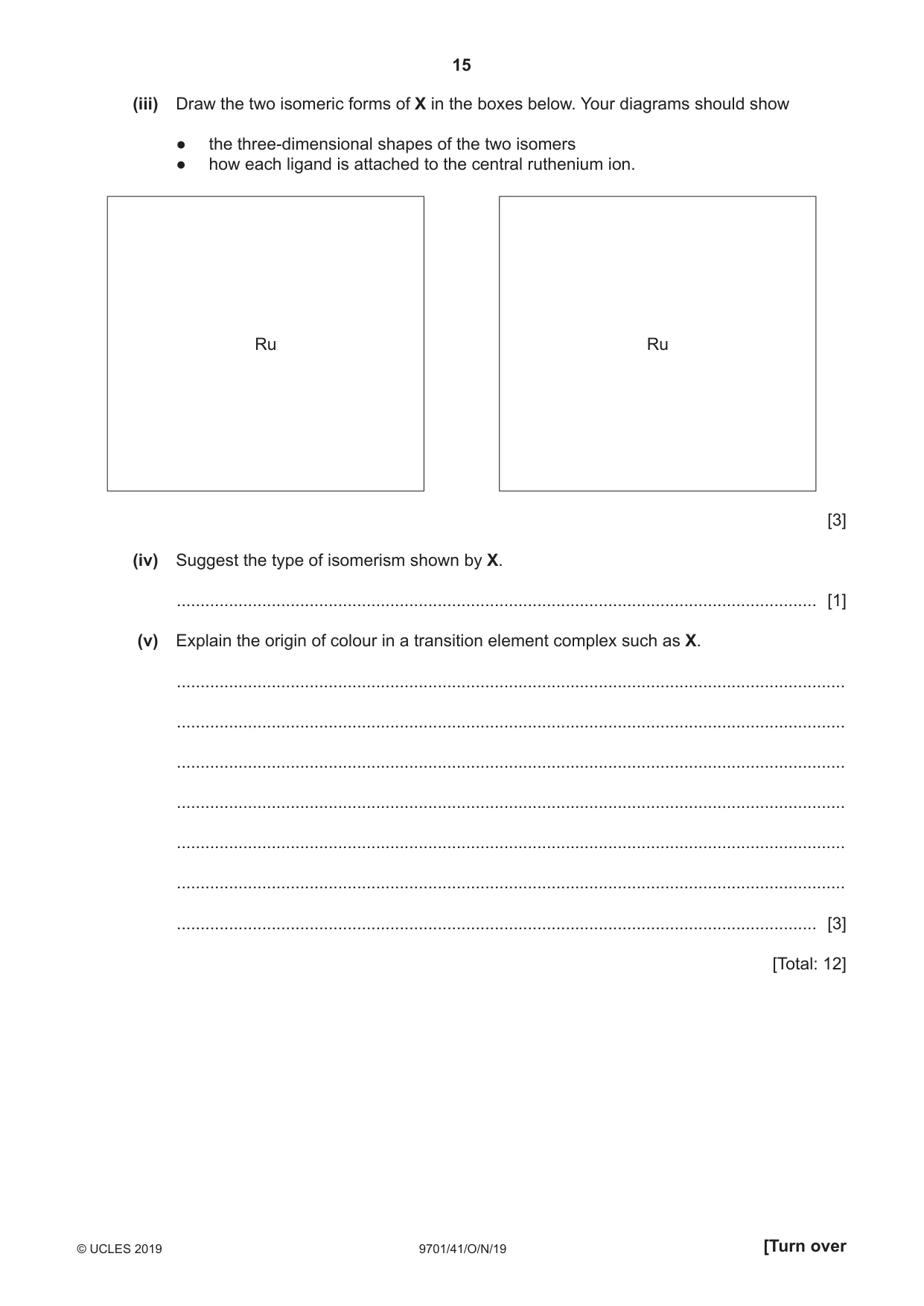
7 Manganese, chromium and ruthenium are all transition elements. (a) Explain what is meant by a transition element. .................................................................................................................................................... .................................................................................................................................................... .............................................................................................................................................. [1] (b) MnO4–(aq) and Cr2O72–(aq) act as oxidising agents in acidic solution. Both these oxidising agents will oxidise a solution of Sn2+ to give a solution of Sn4+. Solutions containing Sn2+ and solutions containing Sn4+ are colourless. (i) Describe the colour change seen when an excess of Sn2+(aq) is added separately to ● dilute acidified MnO4–(aq) from ............................................................... to ................................................................ ● dilute acidified Cr2O72–(aq). from ............................................................... to ................................................................ [1] (ii) Write an equation for the reaction between Sn2+(aq) and acidified Cr2O72–(aq). ....................................................................................................................................... [1] (c) Ruthenium, Ru, forms complex ions. In one such complex ion, X, the ruthenium ion has a co‑ordination number of six. Each complex ion X contains one Ru2+ ion, one Cl – ion, one SO2 molecule and the remaining ligands are NH3 molecules. The SO2 molecule acts as a monodentate ligand and is attached to the Ru2+ ion via the sulfur atom. X exists in two isomeric forms. (i) State what is meant by a co-ordination number of six. ....................................................................................................................................... [1] (ii) State the formula of X. Include its charge. ....................................................................................................................................... [1] (iii) Draw the two isomeric forms of X in the boxes below. Your diagrams should show ●● the three-dimensional shapes of the two isomers ●● how each ligand is attached to the central ruthenium ion. Ru Ru [3] (iv) Suggest the type of isomerism shown by X. ....................................................................................................................................... [1] (v) Explain the origin of colour in a transition element complex such as X. ............................................................................................................................................. ............................................................................................................................................. ............................................................................................................................................. ............................................................................................................................................. ............................................................................................................................................. ............................................................................................................................................. ....................................................................................................................................... [3] [Total: 12]
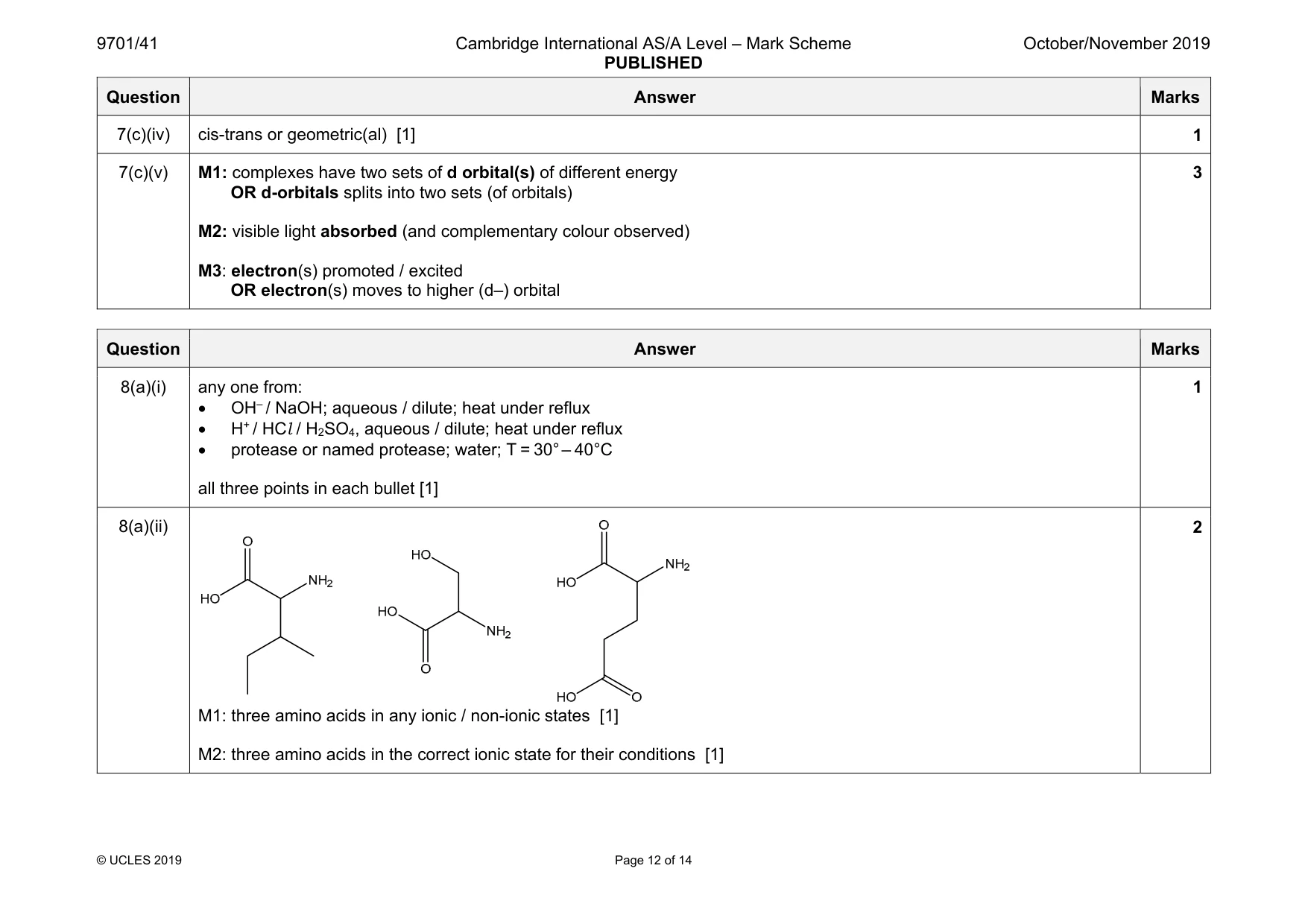
Mark scheme: 7(a) forms one or more stable ions with incomplete / partially filled d-orbitals / d-subshell 1 7(b)(i) purple to pale pink / colourless AND orange to green 1 7(b)(ii) 3Sn2+ + Cr2O72– + 14H+ → 3Sn4+ + 2Cr3+ + 7H2O 1 7(c)(i) • six • coordinate bonds / dative bonds / lone pairs donated • to the (central) metal ion award 1 mark for all three points 1 7(c)(ii) [Ru(NH3)4Cl(SO2)]+ 1 7(c)(iii) M1: six correct ligands around Ru, bonds are shown from S of SO2 M2: 3-D bonds used correctly for octahedral M3: cis and trans isomers shown 3 Question Answer Marks 7(c)(iv) cis-trans or geometric(al) [1] 1 7(c)(v) M1: complexes have two sets of d orbital(s) of different energy OR d-orbitals splits into two sets (of orbitals) M2: visible light absorbed (and complementary colour observed) M3: electron(s) promoted / excited OR electron(s) moves to higher (d–) orbital 3
More questions on Stereoisomerism in transition element complexes
Q8 · Proteins are natural polymers
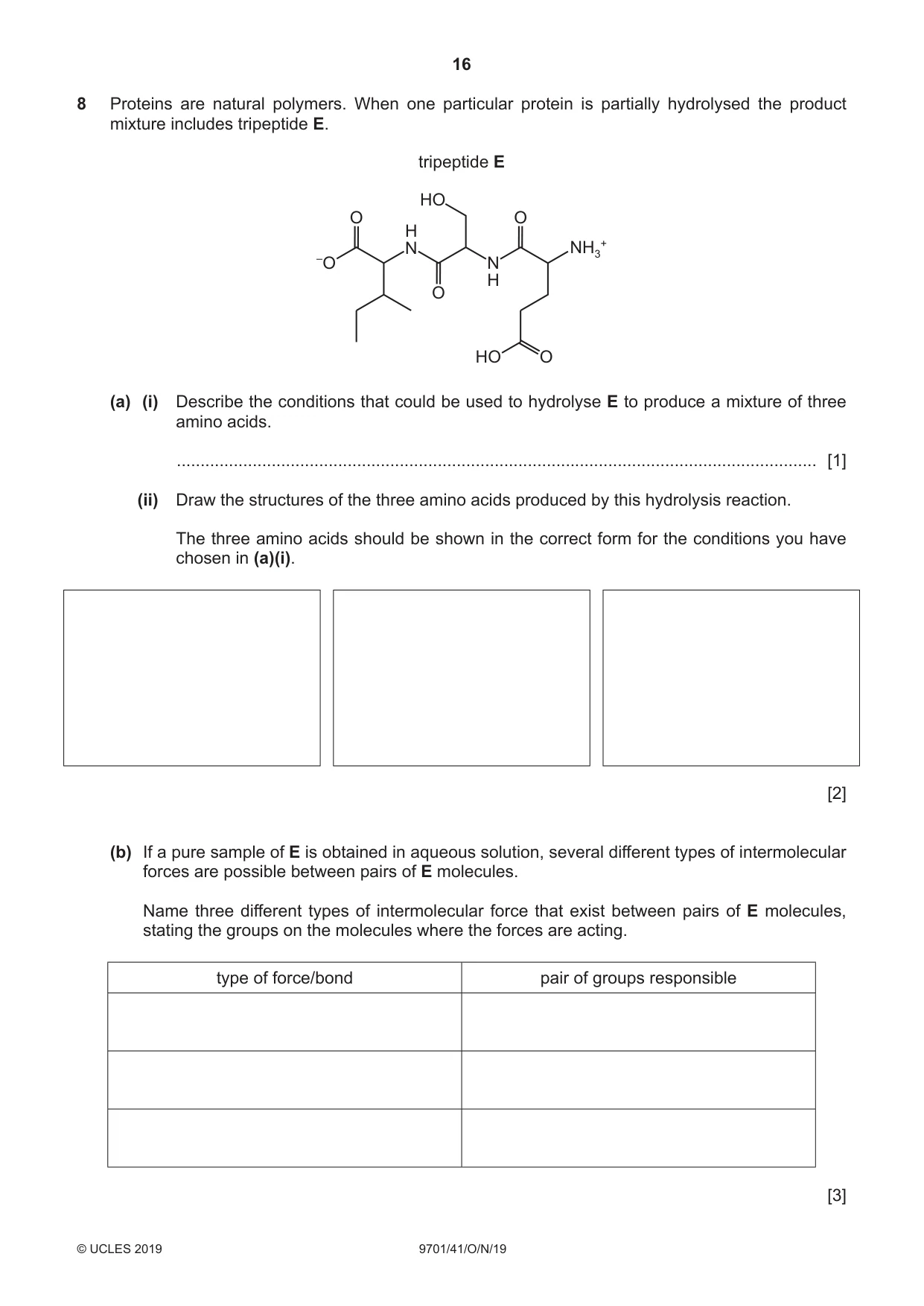
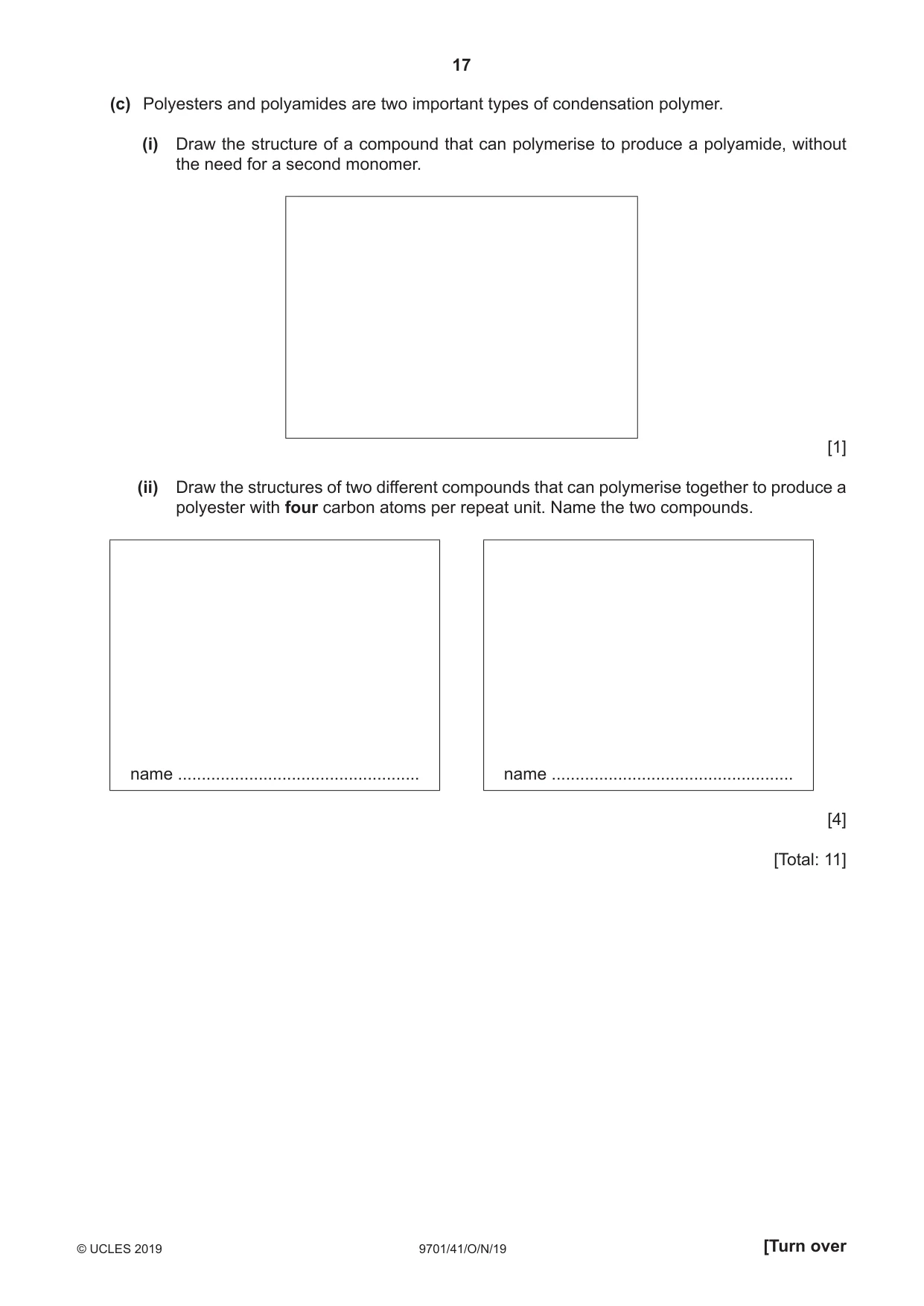
8 Proteins are natural polymers. When one particular protein is partially hydrolysed the product mixture includes tripeptide E. tripeptide E HO O O H N NH3 + –O N H O HO O (a) (i) Describe the conditions that could be used to hydrolyse E to produce a mixture of three amino acids. ....................................................................................................................................... [1] (ii) Draw the structures of the three amino acids produced by this hydrolysis reaction. The three amino acids should be shown in the correct form for the conditions you have chosen in (a)(i). [2] (b) If a pure sample of E is obtained in aqueous solution, several different types of intermolecular forces are possible between pairs of E molecules. Name three different types of intermolecular force that exist between pairs of E molecules, stating the groups on the molecules where the forces are acting. type of force/bond pair of groups responsible [3] (c) Polyesters and polyamides are two important types of condensation polymer. (i) Draw the structure of a compound that can polymerise to produce a polyamide, without the need for a second monomer. [1] (ii) Draw the structures of two different compounds that can polymerise together to produce a polyester with four carbon atoms per repeat unit. Name the two compounds. name ................................................... name ................................................... [4] [Total: 11]
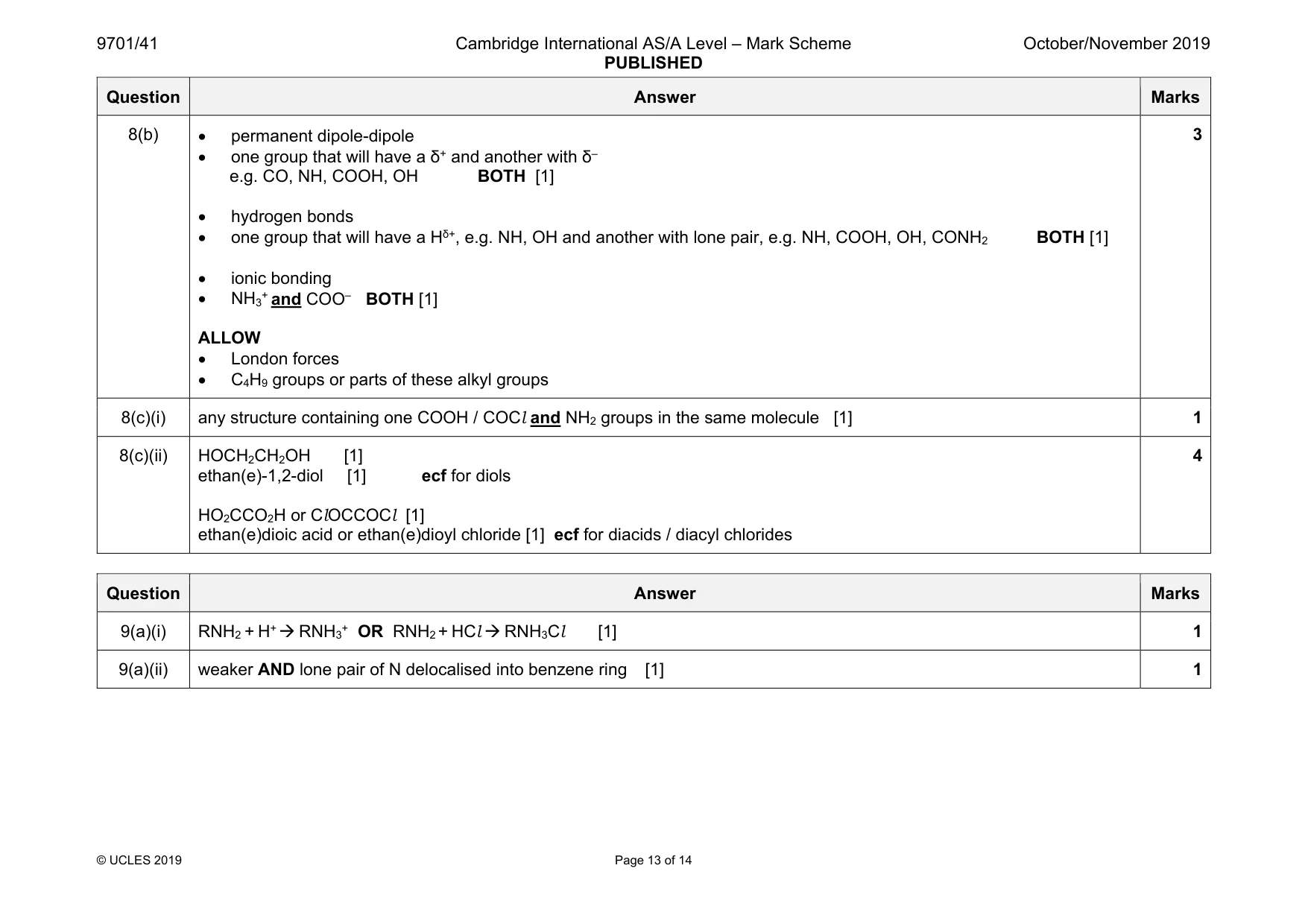
Mark scheme: 8(a)(i) any one from: • OH– / NaOH; aqueous / dilute; heat under reflux • H+ / HCl / H2SO4, aqueous / dilute; heat under reflux • protease or named protease; water; T = 30° – 40°C all three points in each bullet [1] 1 8(a)(ii) M1: three amino acids in any ionic / non-ionic states [1] M2: three amino acids in the correct ionic state for their conditions [1] 2 Question Answer Marks 8(b) • permanent dipole-dipole • one group that will have a δ+ and another with δ– e.g. CO, NH, COOH, OH BOTH [1] • hydrogen bonds • one group that will have a Hδ+, e.g. NH, OH and another with lone pair, e.g. NH, COOH, OH, CONH2 BOTH [1] • ionic bonding • NH3+ and COO– BOTH [1] ALLOW • London forces • C4H9 groups or parts of these alkyl groups 3 8(c)(i) any structure containing one COOH / COCl and NH2 groups in the same molecule [1] 1 8(c)(ii) HOCH2CH2OH [1] ethan(e)-1,2-diol [1] ecf for diols HO2CCO2H or ClOCCOCl [1] ethan(e)dioic acid or ethan(e)dioyl chloride [1] ecf for diacids / diacyl chlorides 4
Q9 · The structure of butamben is shown
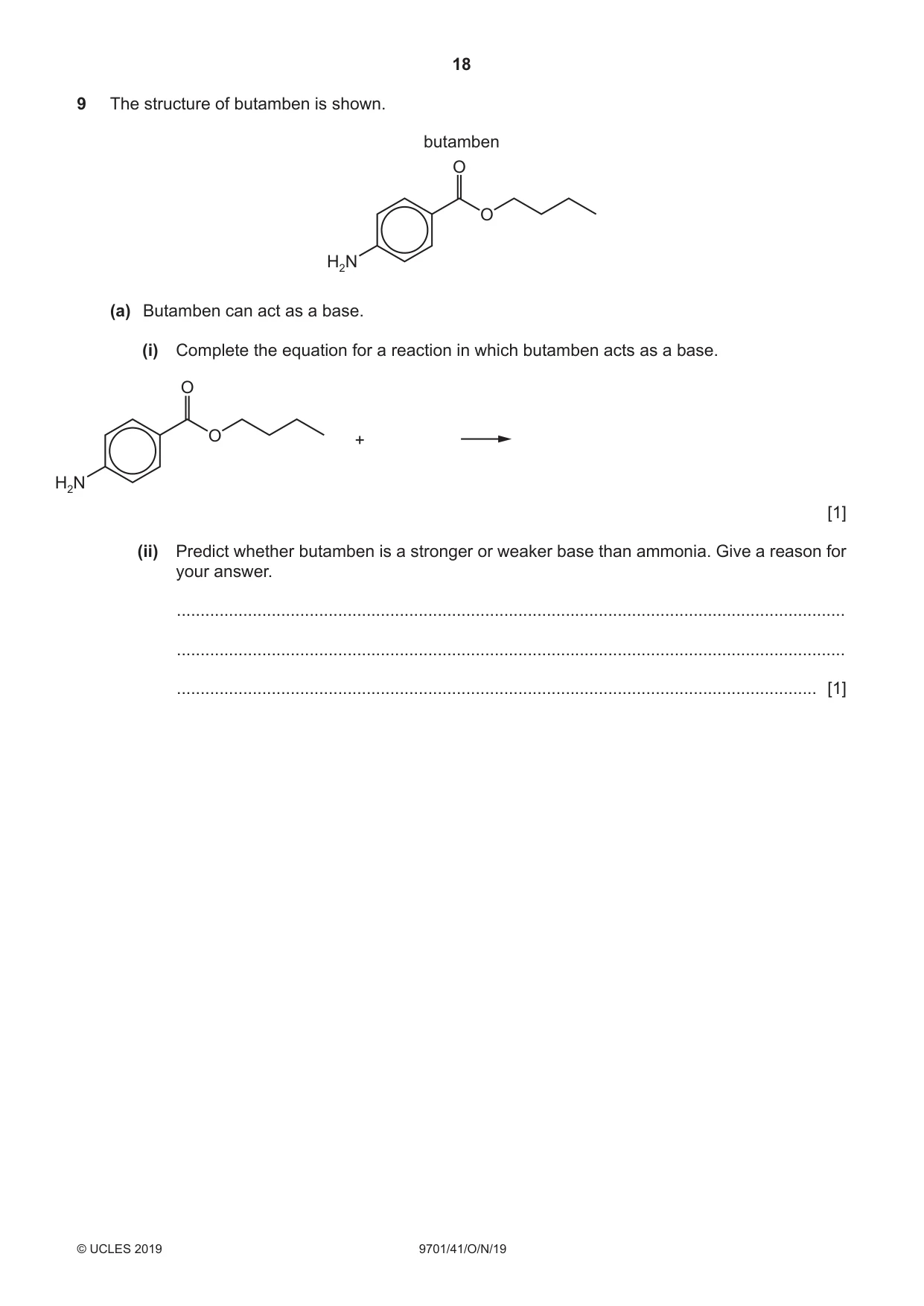
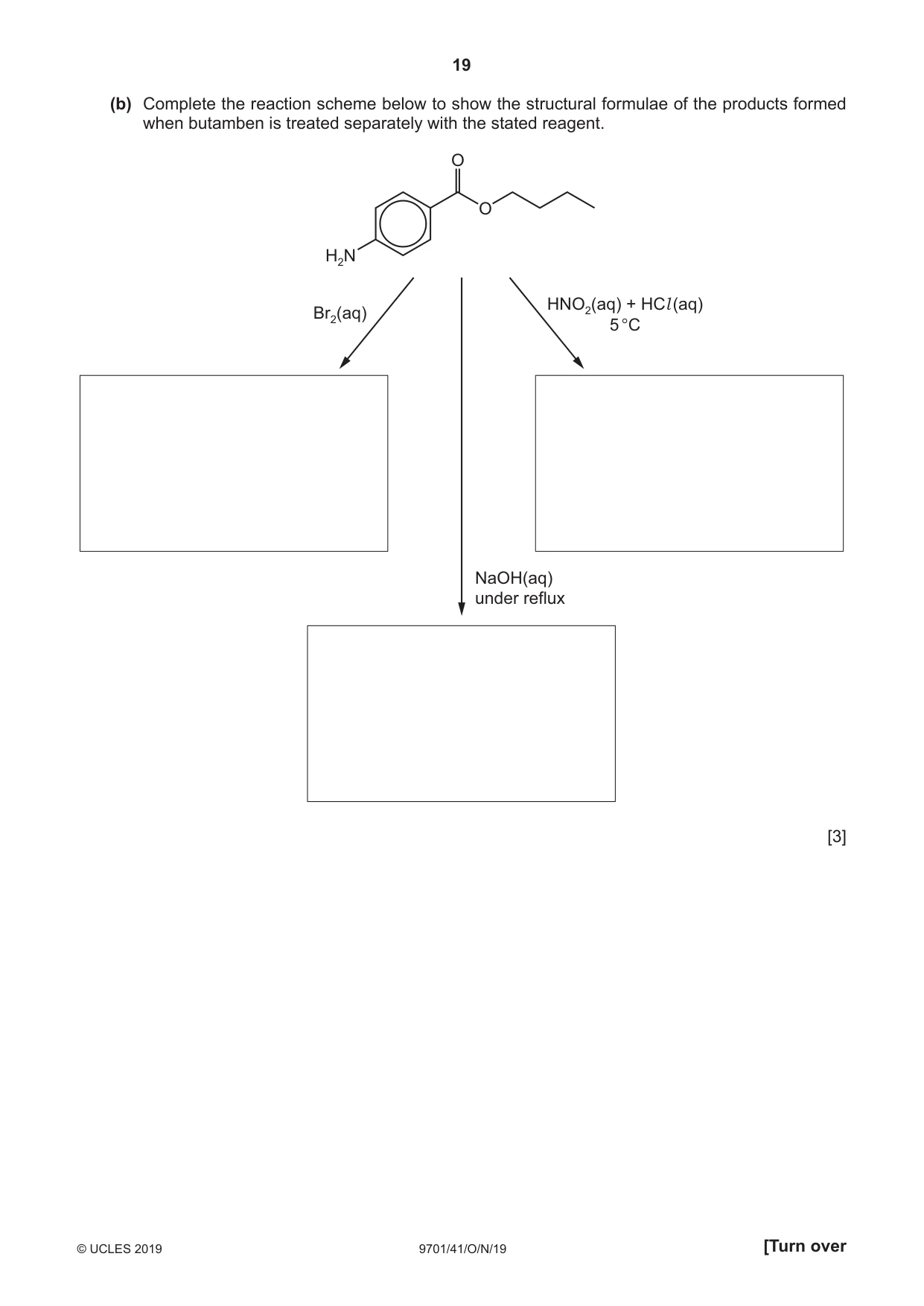
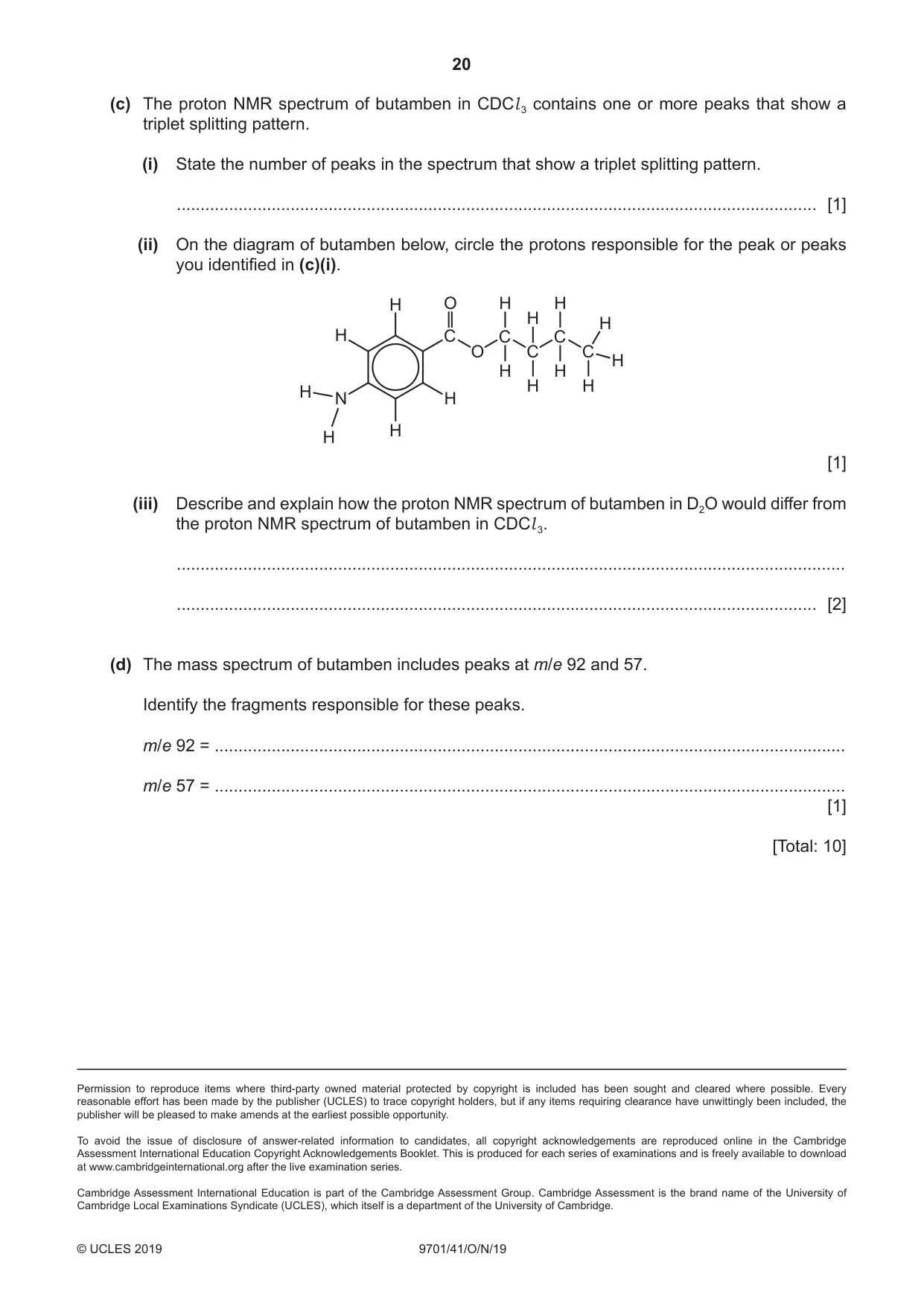
9 The structure of butamben is shown. butamben O O H2N (a) Butamben can act as a base. (i) Complete the equation for a reaction in which butamben acts as a base. O O + H2N [1] (ii) Predict whether butamben is a stronger or weaker base than ammonia. Give a reason for your answer. ............................................................................................................................................. ............................................................................................................................................. ....................................................................................................................................... [1] (b) Complete the reaction scheme below to show the structural formulae of the products formed when butamben is treated separately with the stated reagent. O O H2N HNO2(aq) + HCl (aq) Br2(aq) 5 °C NaOH(aq) under reflux [3] (c) The proton NMR spectrum of butamben in CDCl 3 contains one or more peaks that show a triplet splitting pattern. (i) State the number of peaks in the spectrum that show a triplet splitting pattern. ....................................................................................................................................... [1] (ii) On the diagram of butamben below, circle the protons responsible for the peak or peaks you identified in (c)(i). H O H H H H H C C C O C C H H H H H H N H H H [1] (iii) Describe and explain how the proton NMR spectrum of butamben in D2O would differ from the proton NMR spectrum of butamben in CDCl 3. ............................................................................................................................................. ....................................................................................................................................... [2] (d) The mass spectrum of butamben includes peaks at m/e 92 and 57. Identify the fragments responsible for these peaks. m/e 92 = ..................................................................................................................................... m/e 57 = ..................................................................................................................................... [1] [Total: 10]
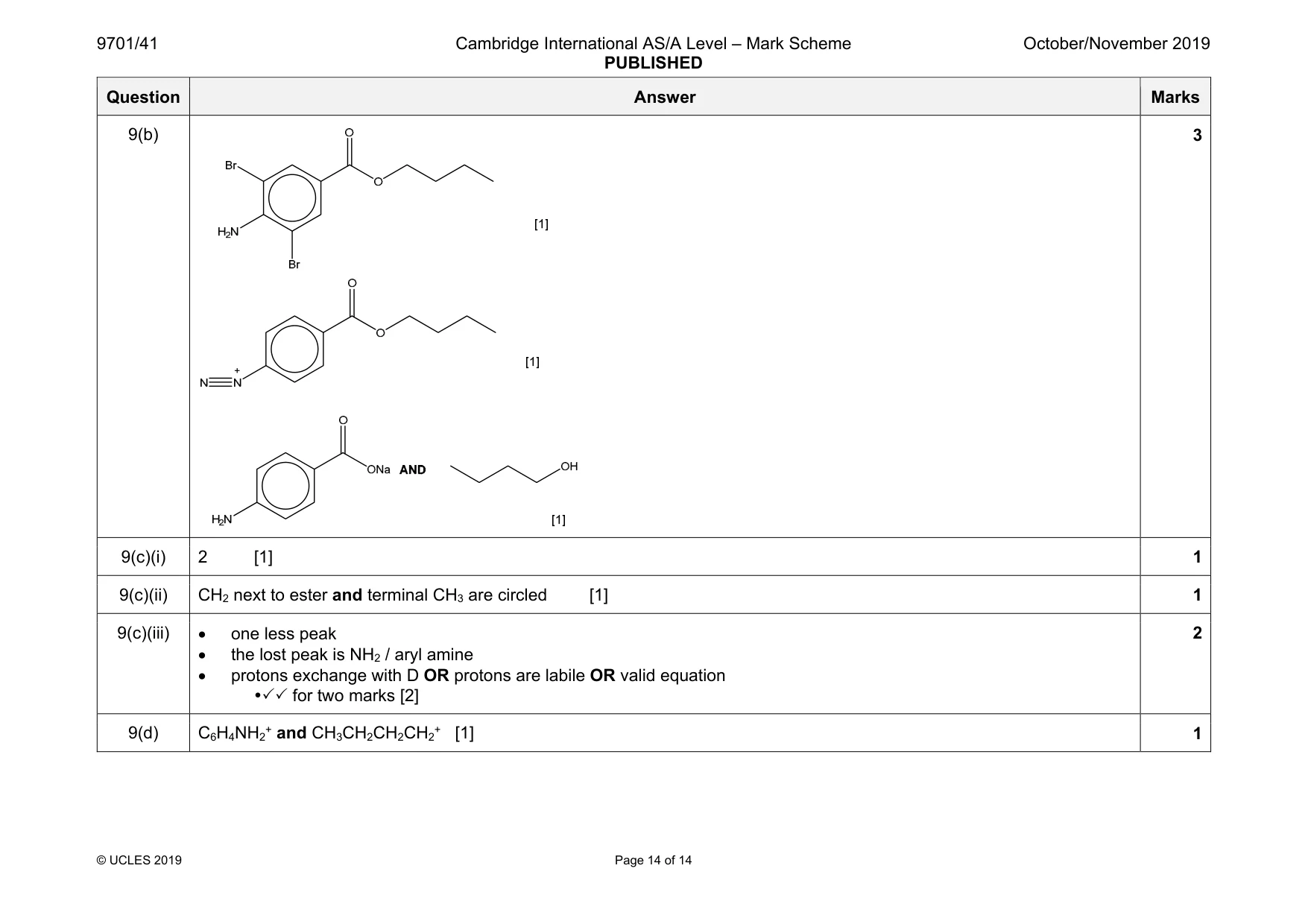
Mark scheme: 9(a)(i) 1 9(a)(ii) weaker AND lone pair of N delocalised into benzene ring [1] 1 Question Answer Marks 9(b) 3 9(c)(i) 2 [1] 1 9(c)(ii) CH2 next to ester and terminal CH3 are circled [1] 1 9(c)(iii) • one less peak • the lost peak is NH2 / aryl amine • protons exchange with D OR protons are labile OR valid equation y33 for two marks [2] 2 9(d) C6H4NH2+ and CH3CH2CH2CH2+ [1] 1
What was in this paper
The subtopics covered by these 9 questions, and how many questions each got. Open one in a new tab to see every Cambridge question on it.
1Arenes1Chemical equilibria: reversible reactions, dynamic equilibrium1Condensation polymerisation1Entropy change, ΔS1Proton (1H) NMR spectroscopy1Similarities and trends in the properties of the Group 2 metals, magnesium to barium, and their compounds1Standard electrode potentials E ⦵, standard cell potentials E ⦵ cell and the Nernst equation1Stereoisomerism in transition element complexes1What you needed in this session
Cambridge’s own grade thresholds for 2019 Oct/Nov, Paper 4 · Variant 1. A higher threshold means an easier paper — the bar moves with how the cohort did.