Cambridge A Level Chemistry 9701 — 2014 Oct/Nov Paper 4 · Variant 1
9701/41/O/N/14 · 100 marks · ≈113 min
The question paper and its mark scheme, free to read here and free to download. This is Cambridge’s own paper, exactly as it was sat.
Question paper20 pages

Mark scheme13 pages
Answers below. Sit the paper first if you are practising.
Paper as text
Question paper, page 1
This document consists of 19 printed pages and 1 blank page. [Turn over IB14 11_9701_41/4RP © UCLES 2014 *7028137345* For Examiner’s Use 1 2 3 4 5 6 7 8 Total READ THESE INSTRUCTIONS FIRST Write your Centre number, candidate number and name on all the work you hand in. Write in dark blue or black pen. You may use an HB pencil for any diagrams or graphs. Do not use staples, paper clips, glue or correction fl uid. DO NOT WRITE IN ANY BARCODES. Section A Answer all questions. Section B Answer all questions. Electronic calculators may be used. You may lose marks if you do not show your working or if you do not use appropriate units. A Data Booklet is provided. At the end of the examination, fasten all your work securely together. The number of marks is given in brackets [ ] at the end of each question or part question. CHEMISTRY 9701/41 Paper 4 Structured Questions October/November 2014 2 hours Candidates answer on the Question Paper. Additional Materials: Data Booklet Cambridge International Examinations Cambridge International Advanced Level
Question paper, page 2
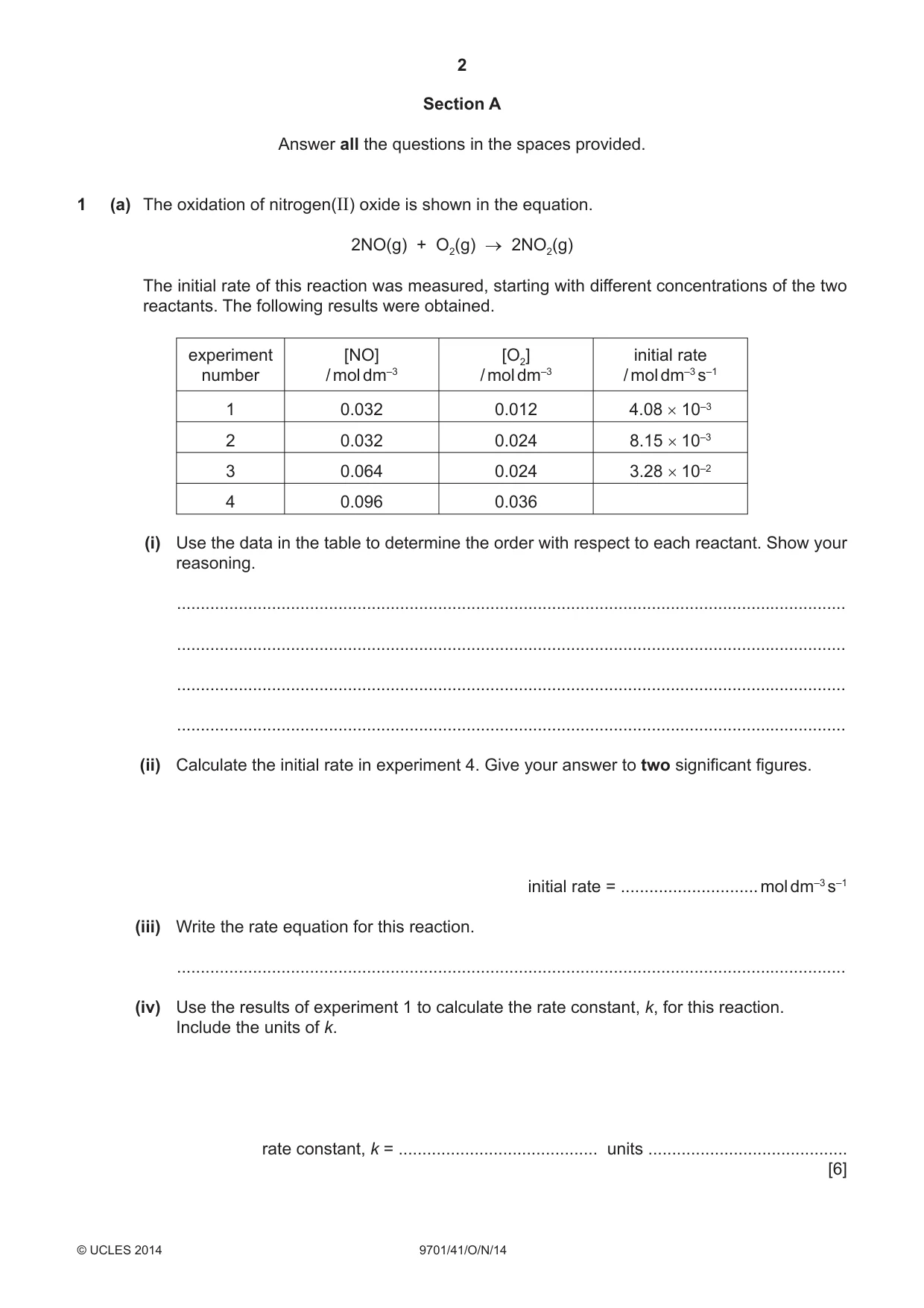
2 9701/41/O/N/14 © UCLES 2014 Section A Answer all the questions in the spaces provided. 1 (a) The oxidation of nitrogen(II) oxide is shown in the equation. 2NO(g) + O2(g) → 2NO2(g) The initial rate of this reaction was measured, starting with different concentrations of the two reactants. The following results were obtained. experiment number [NO] / mol dm–3 [O2] / mol dm–3 initial rate / mol dm–3 s–1 1 0.032 0.012 4.08 × 10⁻³ 2 0.032 0.024 8.15 × 10⁻³ 3 0.064 0.024 3.28 × 10⁻² 4 0.096 0.036 (i) Use the data in the table to determine the order with respect to each reactant. Show your reasoning. … … … … (ii) Calculate the initial rate in experiment 4. Give your answer to two signifi cant fi gures. initial rate = … mol dm–3 s–1 (iii) Write the rate equation for this reaction. … (iv) Use the results of experiment 1 to calculate the rate constant, k, for this reaction. Include the units of k. rate constant, k = … units … [6]
Question paper, page 3
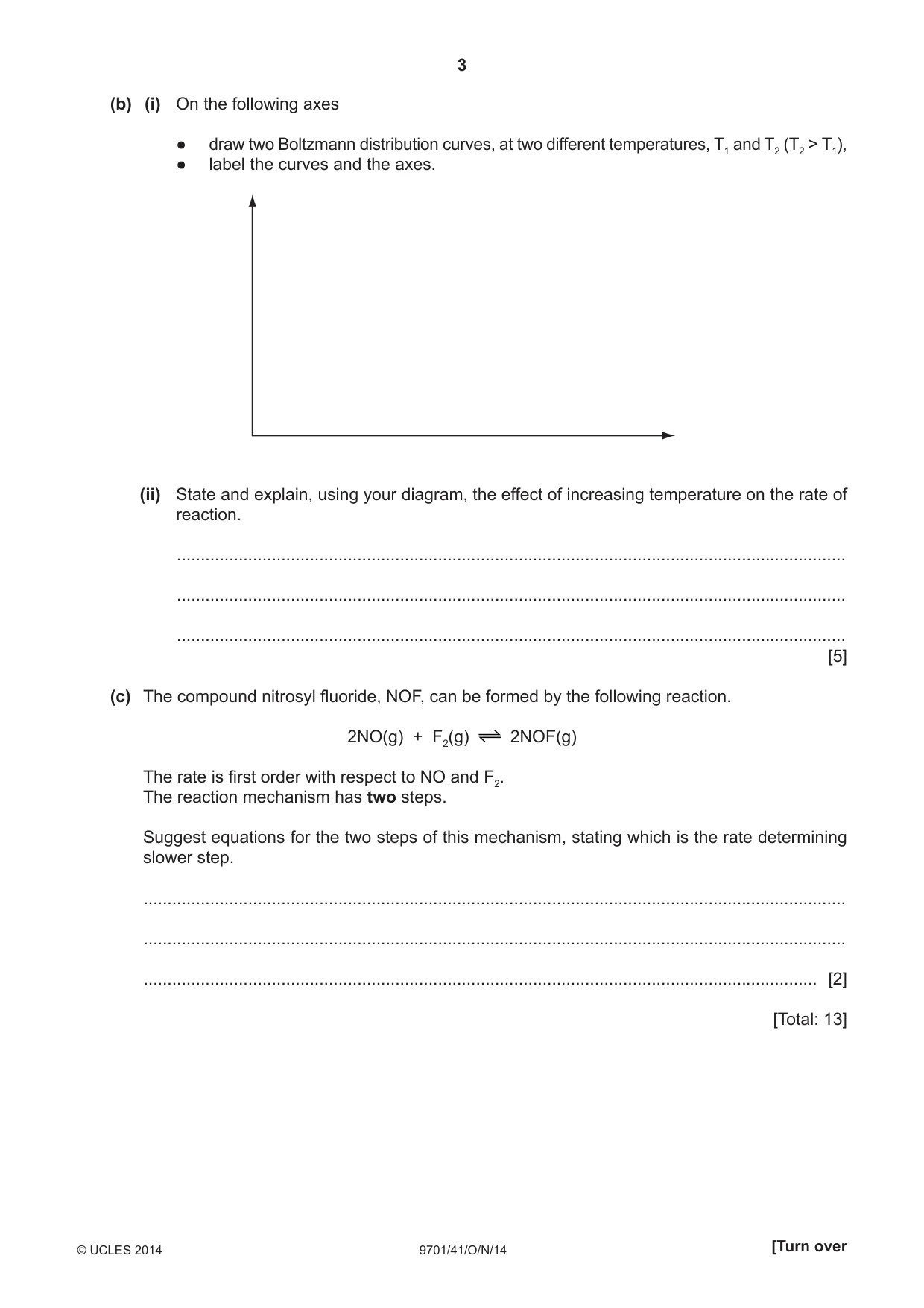
3 9701/41/O/N/14 © UCLES 2014 [Turn over (b) (i) On the following axes ● draw two Boltzmann distribution curves, at two different temperatures, T1 and T2 (T2 > T1), ● label the curves and the axes. (ii) State and explain, using your diagram, the effect of increasing temperature on the rate of reaction. … … … [5] (c) The compound nitrosyl fl uoride, NOF, can be formed by the following reaction. 2NO(g) + F2(g) 2NOF(g) The rate is fi rst order with respect to NO and F2. The reaction mechanism has two steps. Suggest equations for the two steps of this mechanism, stating which is the rate determining slower step. … … … [2] [Total: 13]
Question paper, page 4
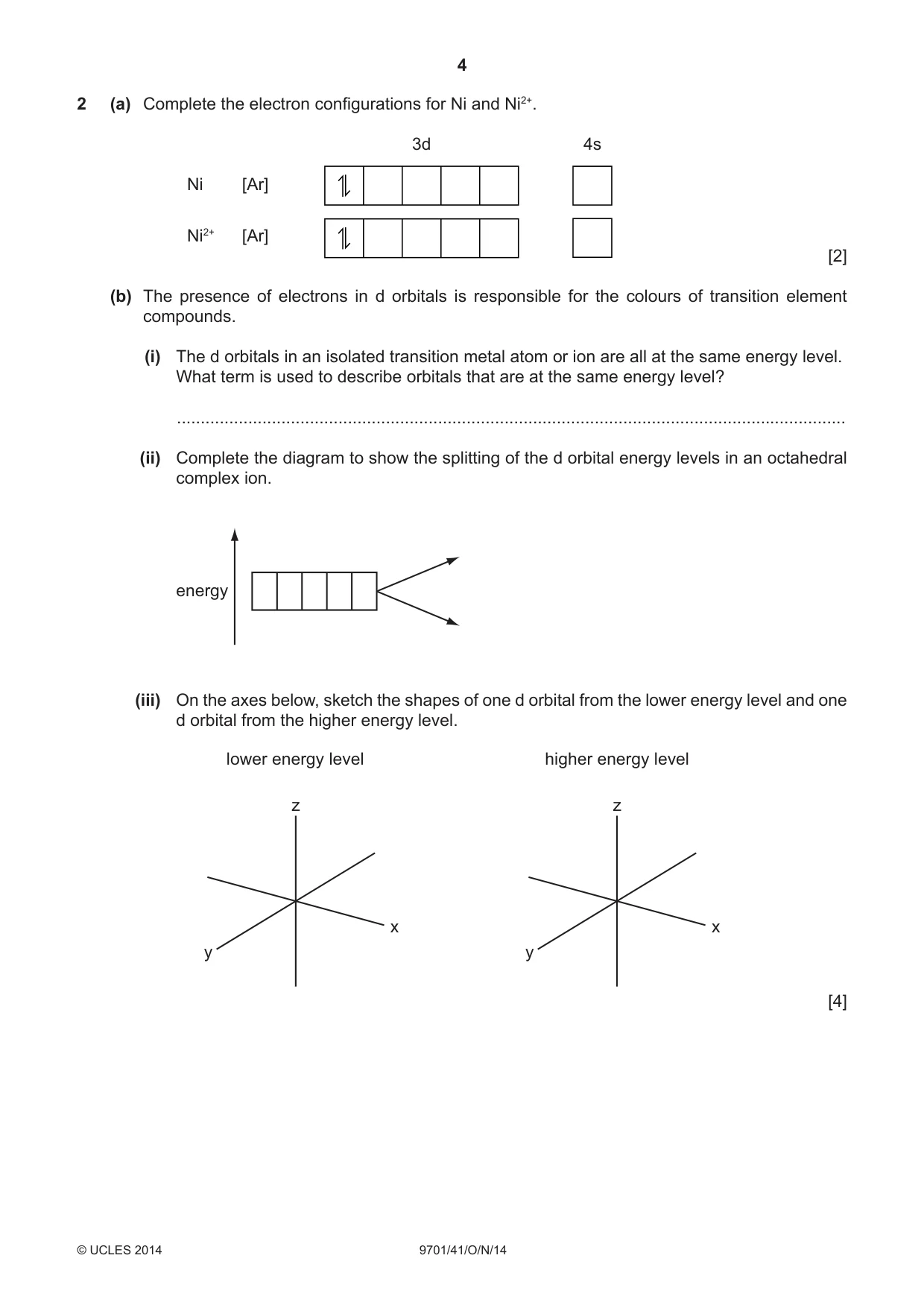
4 9701/41/O/N/14 © UCLES 2014 2 (a) Complete the electron confi gurations for Ni and Ni2+. 3d 4s Ni [Ar] Ni2+ [Ar] [2] (b) The presence of electrons in d orbitals is responsible for the colours of transition element compounds. (i) The d orbitals in an isolated transition metal atom or ion are all at the same energy level. What term is used to describe orbitals that are at the same energy level? … (ii) Complete the diagram to show the splitting of the d orbital energy levels in an octahedral complex ion. energy (iii) On the axes below, sketch the shapes of one d orbital from the lower energy level and one d orbital from the higher energy level. y lower energy level z x y z x higher energy level [4]
Question paper, page 5
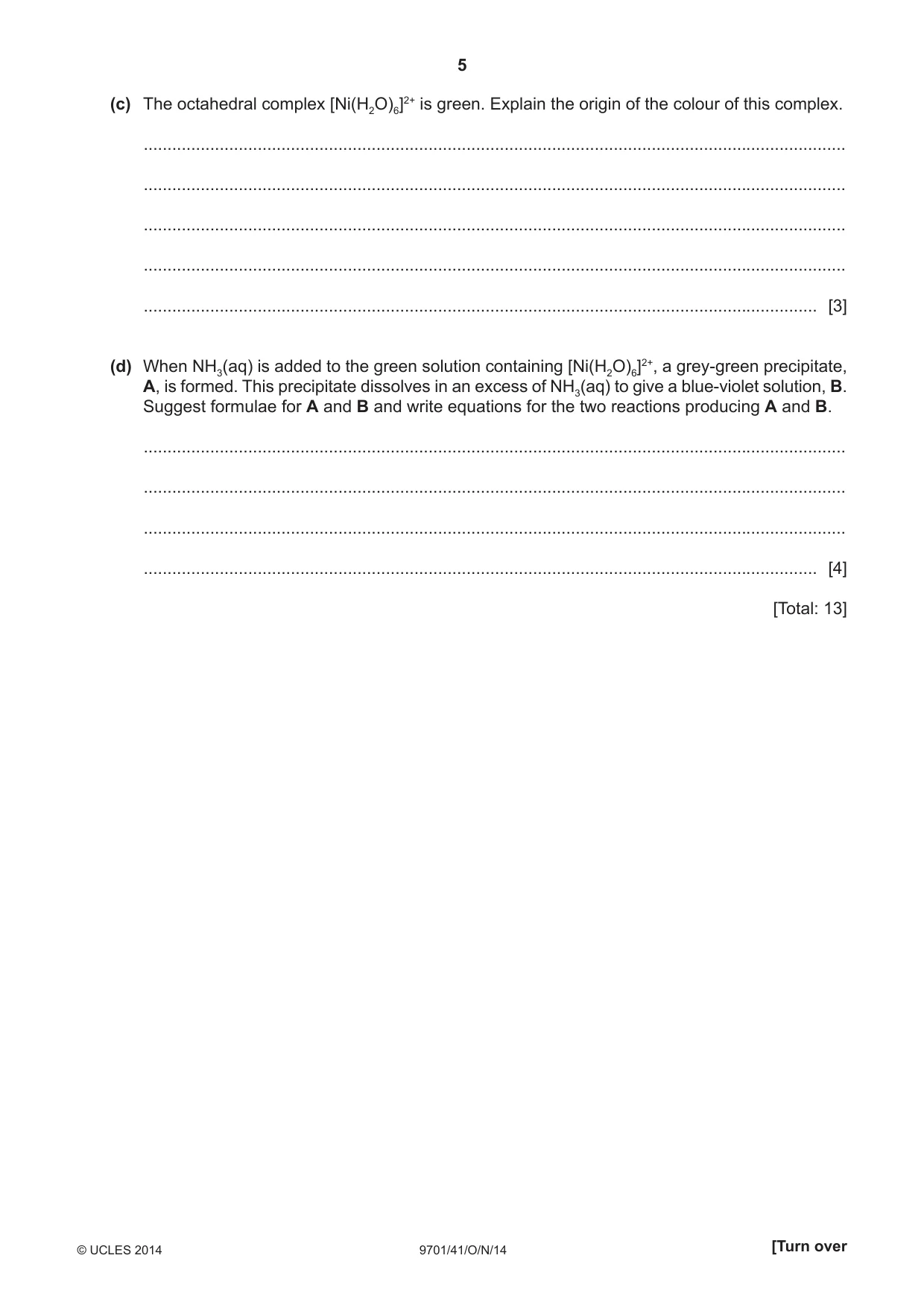
5 9701/41/O/N/14 © UCLES 2014 [Turn over (c) The octahedral complex [Ni(H2O)6]2+ is green. Explain the origin of the colour of this complex. … … … … … [3] (d) When NH3(aq) is added to the green solution containing [Ni(H2O)6]2+, a grey-green precipitate, A, is formed. This precipitate dissolves in an excess of NH3(aq) to give a blue-violet solution, B. Suggest formulae for A and B and write equations for the two reactions producing A and B. … … … … [4] [Total: 13]
Question paper, page 6
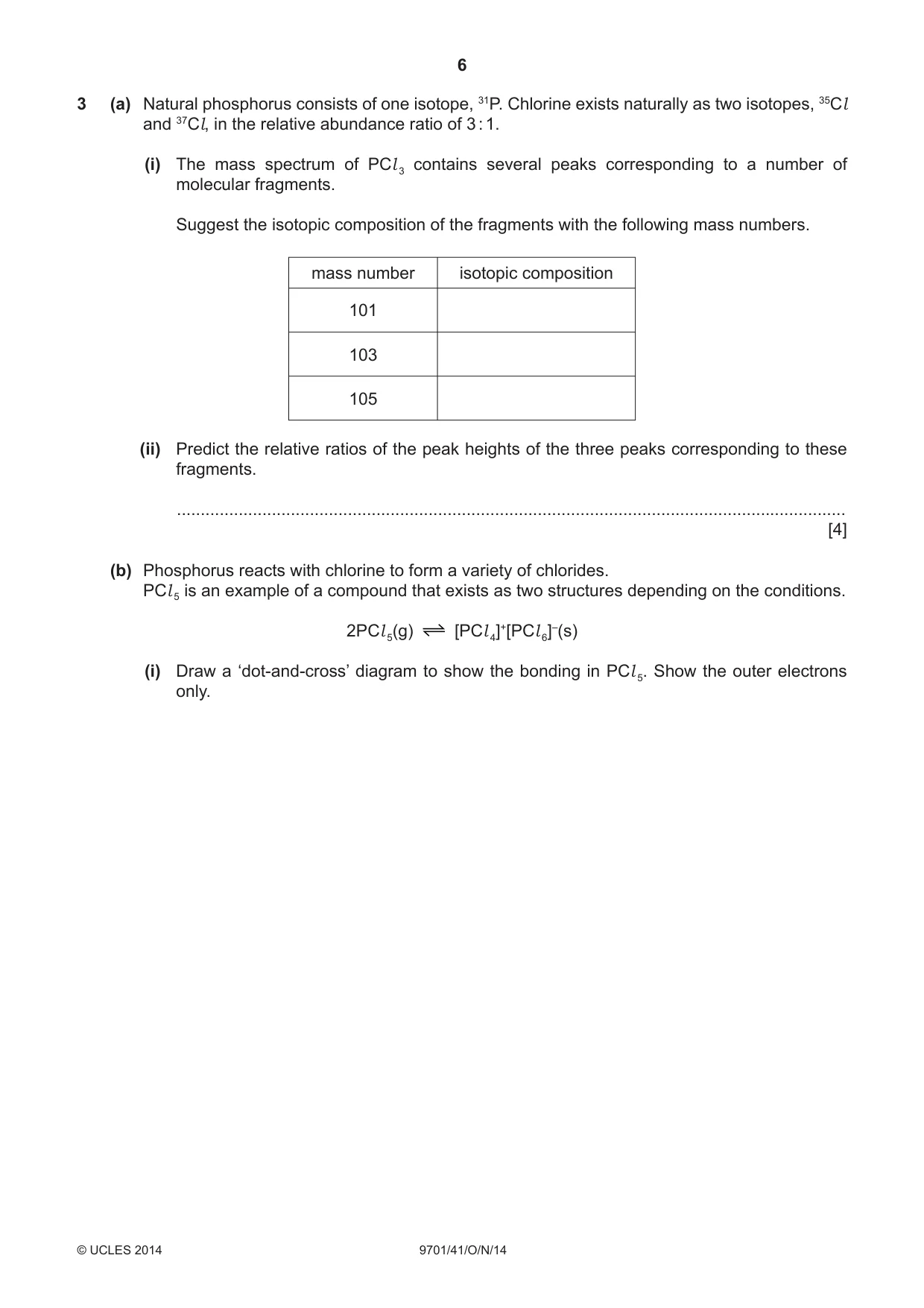
6 9701/41/O/N/14 © UCLES 2014 3 (a) Natural phosphorus consists of one isotope, 31P. Chlorine exists naturally as two isotopes, 35Cl and 37Cl, in the relative abundance ratio of 3 : 1. (i) The mass spectrum of PCl 3 contains several peaks corresponding to a number of molecular fragments. Suggest the isotopic composition of the fragments with the following mass numbers. mass number isotopic composition 101 103 105 (ii) Predict the relative ratios of the peak heights of the three peaks corresponding to these fragments. … [4] (b) Phosphorus reacts with chlorine to form a variety of chlorides. PCl 5 is an example of a compound that exists as two structures depending on the conditions. 2PCl 5(g) [PCl 4]+[PCl 6]–(s) (i) Draw a ‘dot-and-cross’ diagram to show the bonding in PCl 5. Show the outer electrons only.
Question paper, page 7
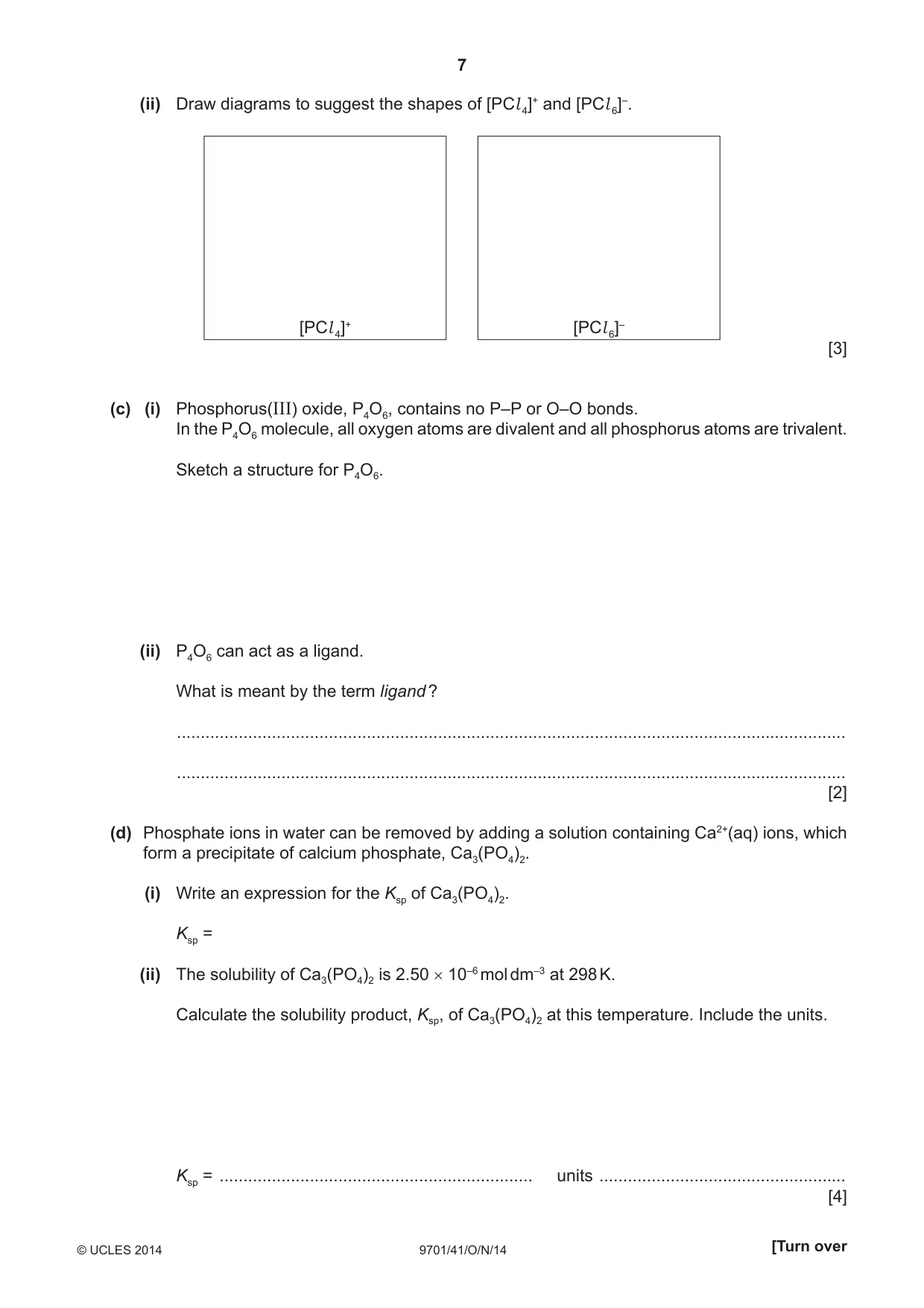
7 9701/41/O/N/14 © UCLES 2014 [Turn over (ii) Draw diagrams to suggest the shapes of [PCl 4]+ and [PCl 6]–. [PCl 4]+ [PCl 6]– [3] (c) (i) Phosphorus(III) oxide, P4O6, contains no P–P or O–O bonds. In the P4O6 molecule, all oxygen atoms are divalent and all phosphorus atoms are trivalent. Sketch a structure for P4O6. (ii) P4O6 can act as a ligand. What is meant by the term ligand ? … … [2] (d) Phosphate ions in water can be removed by adding a solution containing Ca2+(aq) ions, which form a precipitate of calcium phosphate, Ca3(PO4)2. (i) Write an expression for the Ksp of Ca3(PO4)2. Ksp = (ii) The solubility of Ca3(PO4)2 is 2.50 × 10⁻⁶ mol dm–3 at 298 K. Calculate the solubility product, Ksp, of Ca3(PO4)2 at this temperature. Include the units. Ksp = … units … [4]
Question paper, page 8
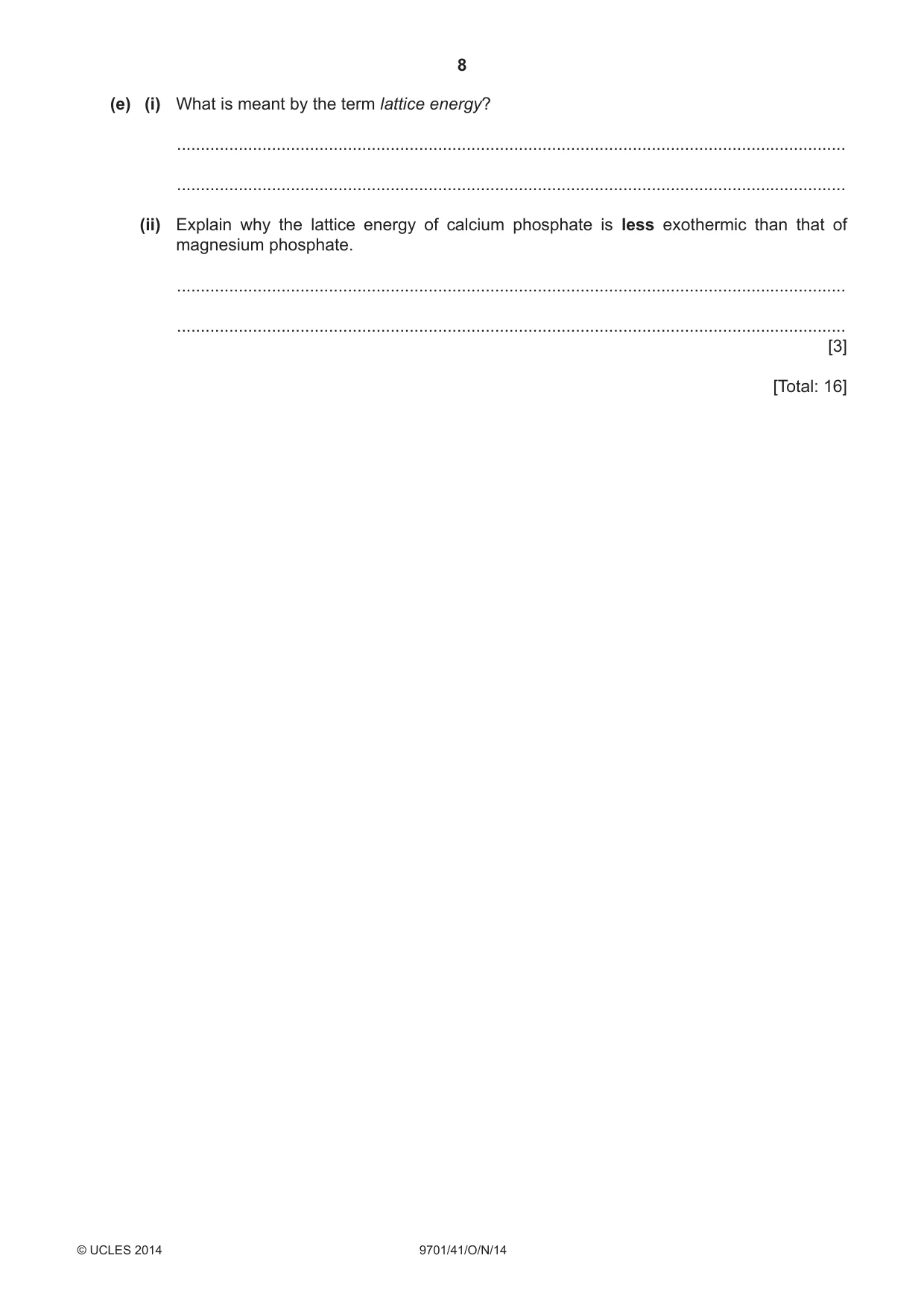
8 9701/41/O/N/14 © UCLES 2014 (e) (i) What is meant by the term lattice energy? … … (ii) Explain why the lattice energy of calcium phosphate is less exothermic than that of magnesium phosphate. … … [3] [Total: 16]
Question paper, page 9
9 9701/41/O/N/14 © UCLES 2014 [Turn over Question 4 starts on the next page.
Question paper, page 10
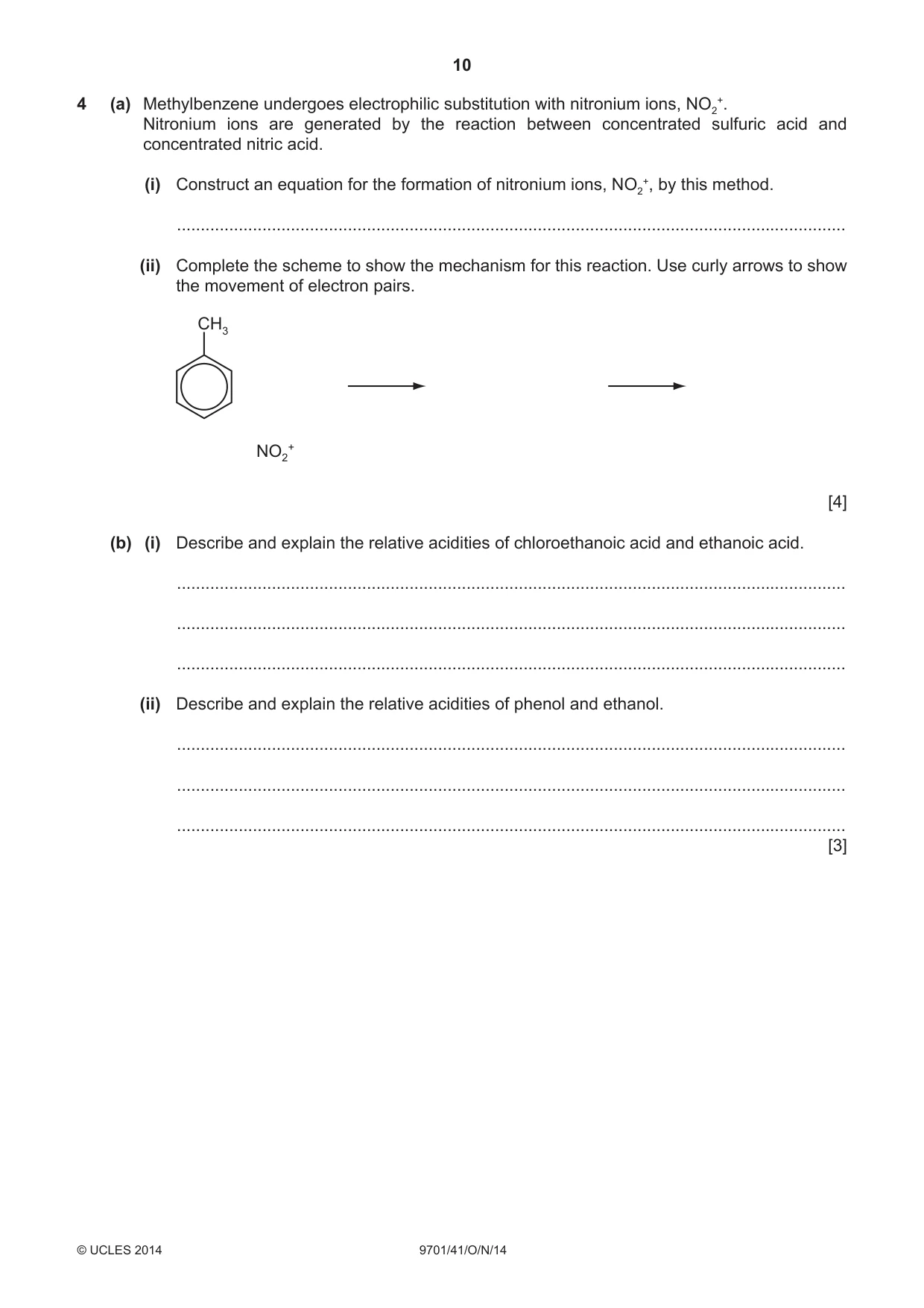
10 9701/41/O/N/14 © UCLES 2014 4 (a) Methylbenzene undergoes electrophilic substitution with nitronium ions, NO2 +. Nitronium ions are generated by the reaction between concentrated sulfuric acid and concentrated nitric acid. (i) Construct an equation for the formation of nitronium ions, NO2 +, by this method. … (ii) Complete the scheme to show the mechanism for this reaction. Use curly arrows to show the movement of electron pairs. CH3 NO2 + [4] (b) (i) Describe and explain the relative acidities of chloroethanoic acid and ethanoic acid. … … … (ii) Describe and explain the relative acidities of phenol and ethanol. … … … [3]
Question paper, page 11
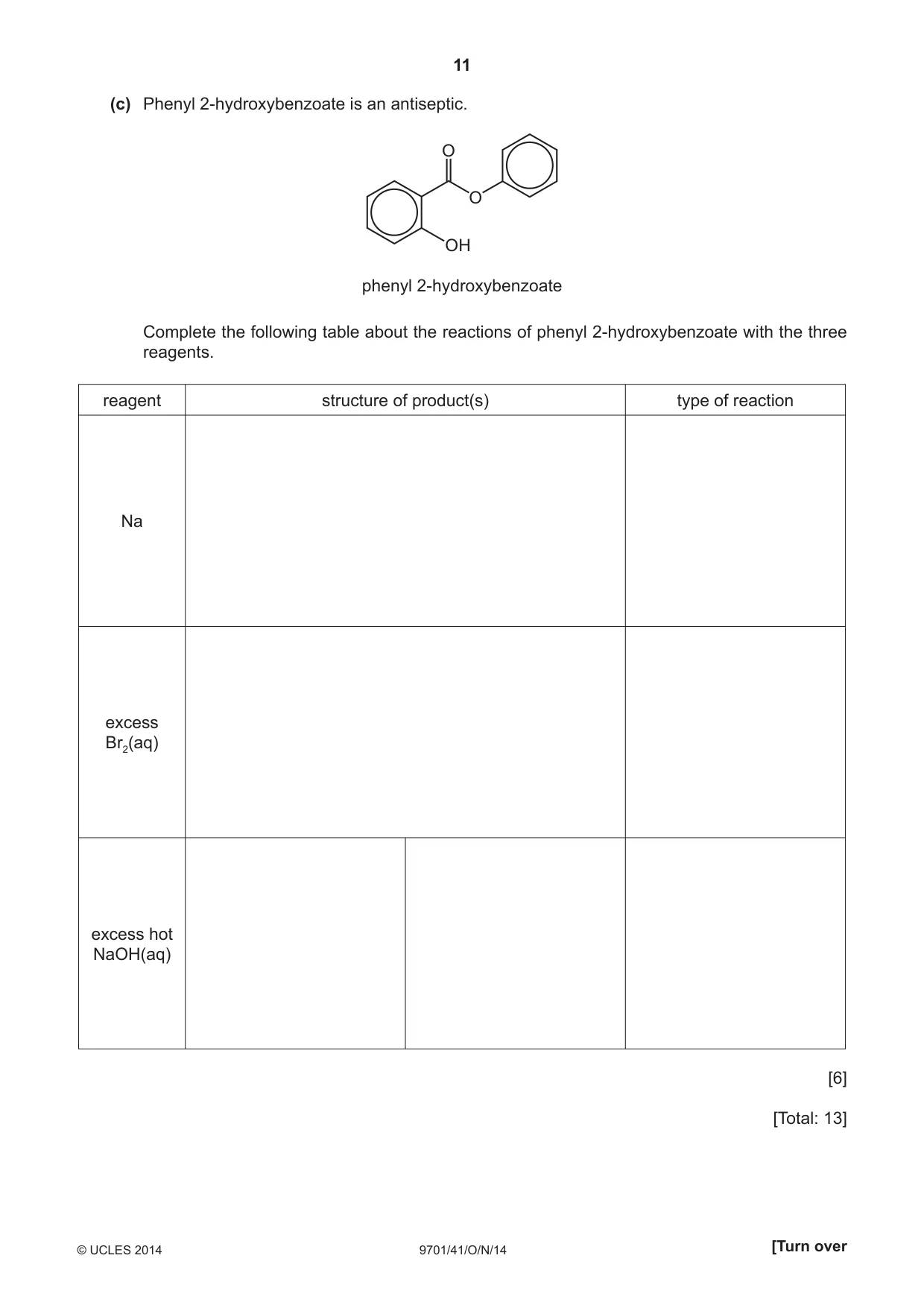
11 9701/41/O/N/14 © UCLES 2014 [Turn over (c) Phenyl 2-hydroxybenzoate is an antiseptic. OH O O phenyl 2-hydroxybenzoate Complete the following table about the reactions of phenyl 2-hydroxybenzoate with the three reagents. reagent structure of product(s) type of reaction Na excess Br2(aq) excess hot NaOH(aq) [6] [Total: 13]
Question paper, page 12
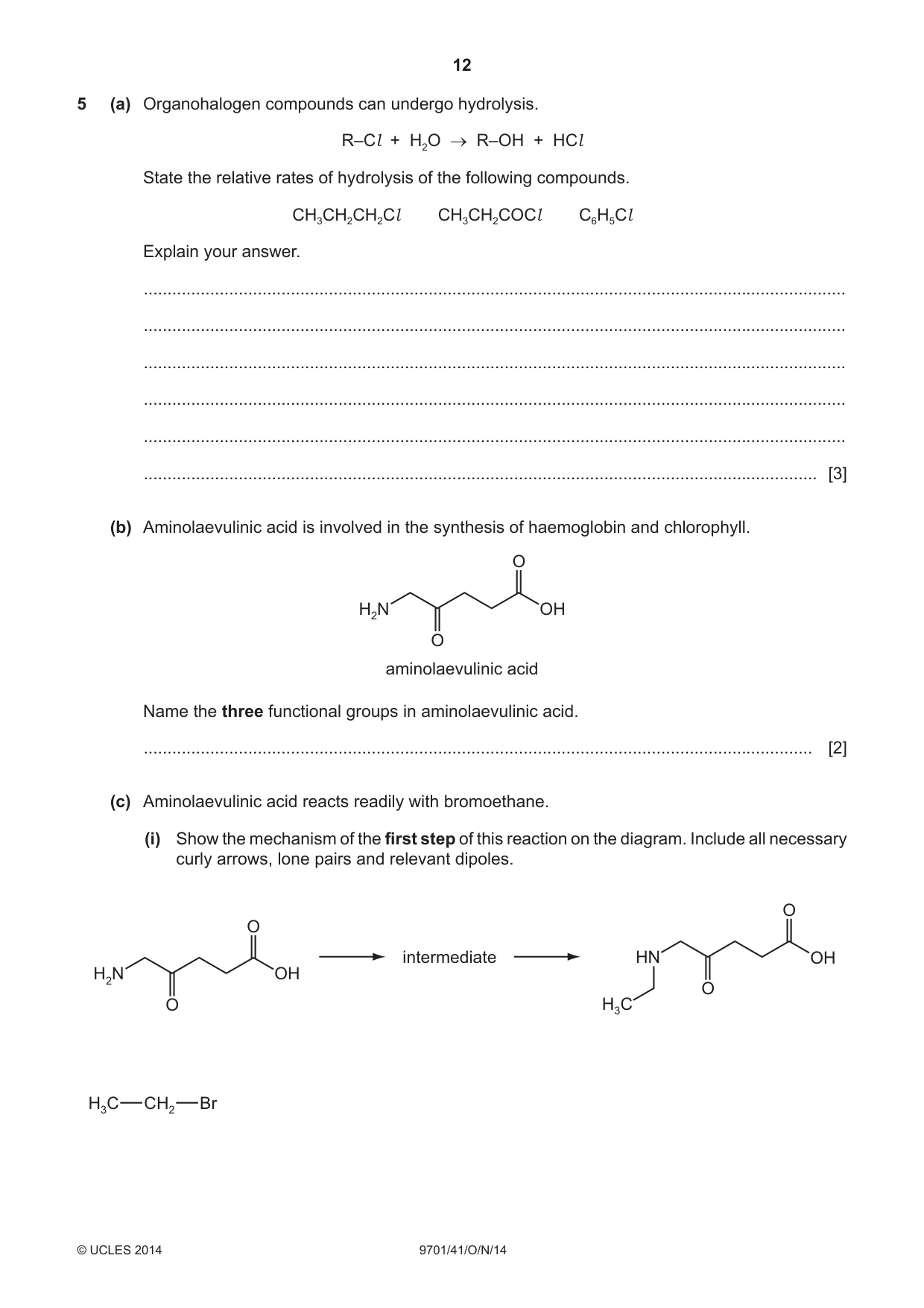
12 9701/41/O/N/14 © UCLES 2014 5 (a) Organohalogen compounds can undergo hydrolysis. R–Cl + H2O → R–OH + HCl State the relative rates of hydrolysis of the following compounds. CH3CH2CH2Cl CH3CH2COCl C6H5Cl Explain your answer. … … … … … … [3] (b) Aminolaevulinic acid is involved in the synthesis of haemoglobin and chlorophyll. OH O O H2N aminolaevulinic acid Name the three functional groups in aminolaevulinic acid. … [2] (c) Aminolaevulinic acid reacts readily with bromoethane. (i) Show the mechanism of the fi rst step of this reaction on the diagram. Include all necessary curly arrows, lone pairs and relevant dipoles. OH O O H2N OH O O HN H3C H3C CH2 Br intermediate
Question paper, page 13
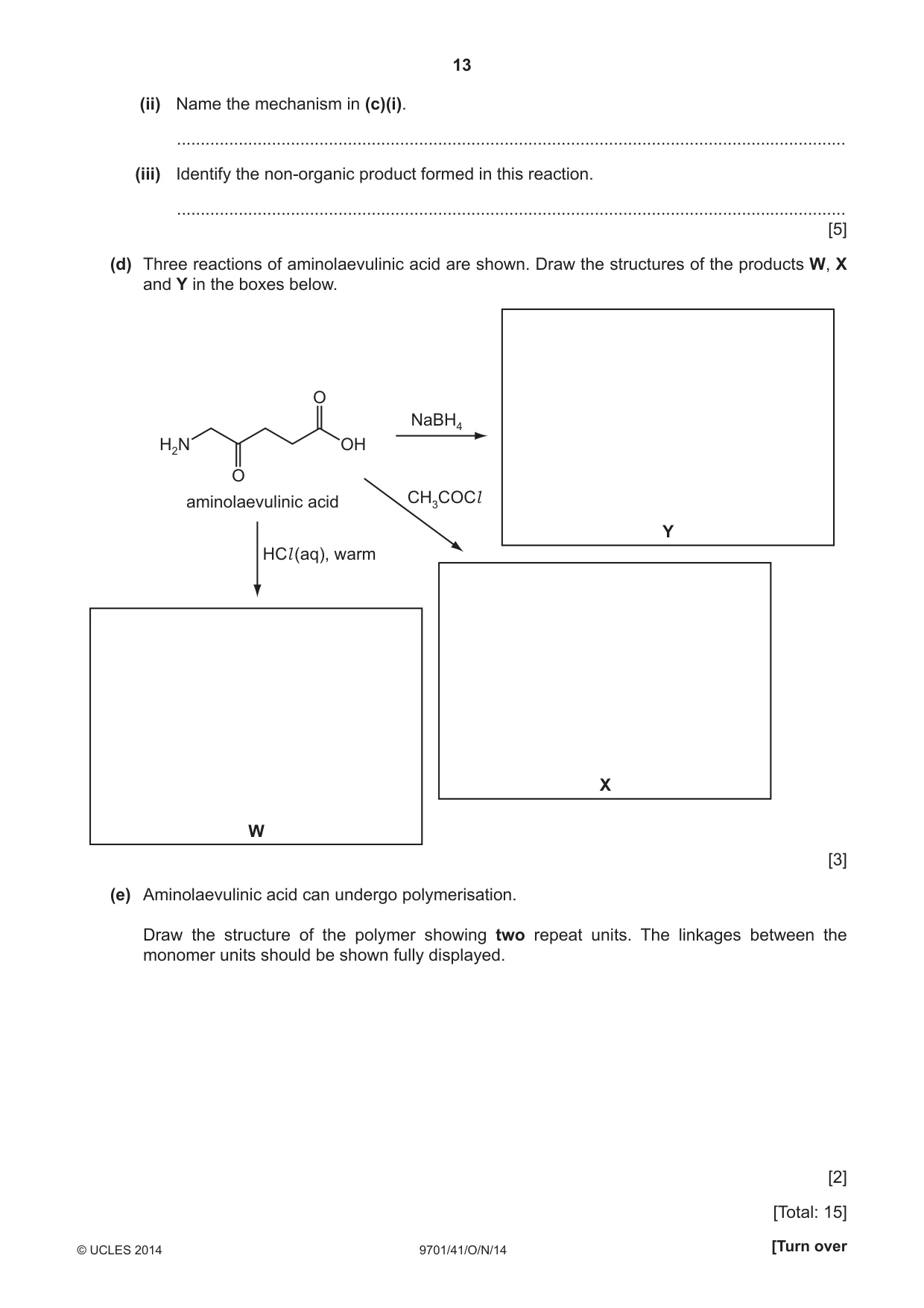
13 9701/41/O/N/14 © UCLES 2014 [Turn over (ii) Name the mechanism in (c)(i). … (iii) Identify the non-organic product formed in this reaction. … [5] (d) Three reactions of aminolaevulinic acid are shown. Draw the structures of the products W, X and Y in the boxes below. OH O O H2N CH3COCl NaBH4 HCl (aq), warm W X Y aminolaevulinic acid [3] (e) Aminolaevulinic acid can undergo polymerisation. Draw the structure of the polymer showing two repeat units. The linkages between the monomer units should be shown fully displayed. [2] [Total: 15]
Question paper, page 14
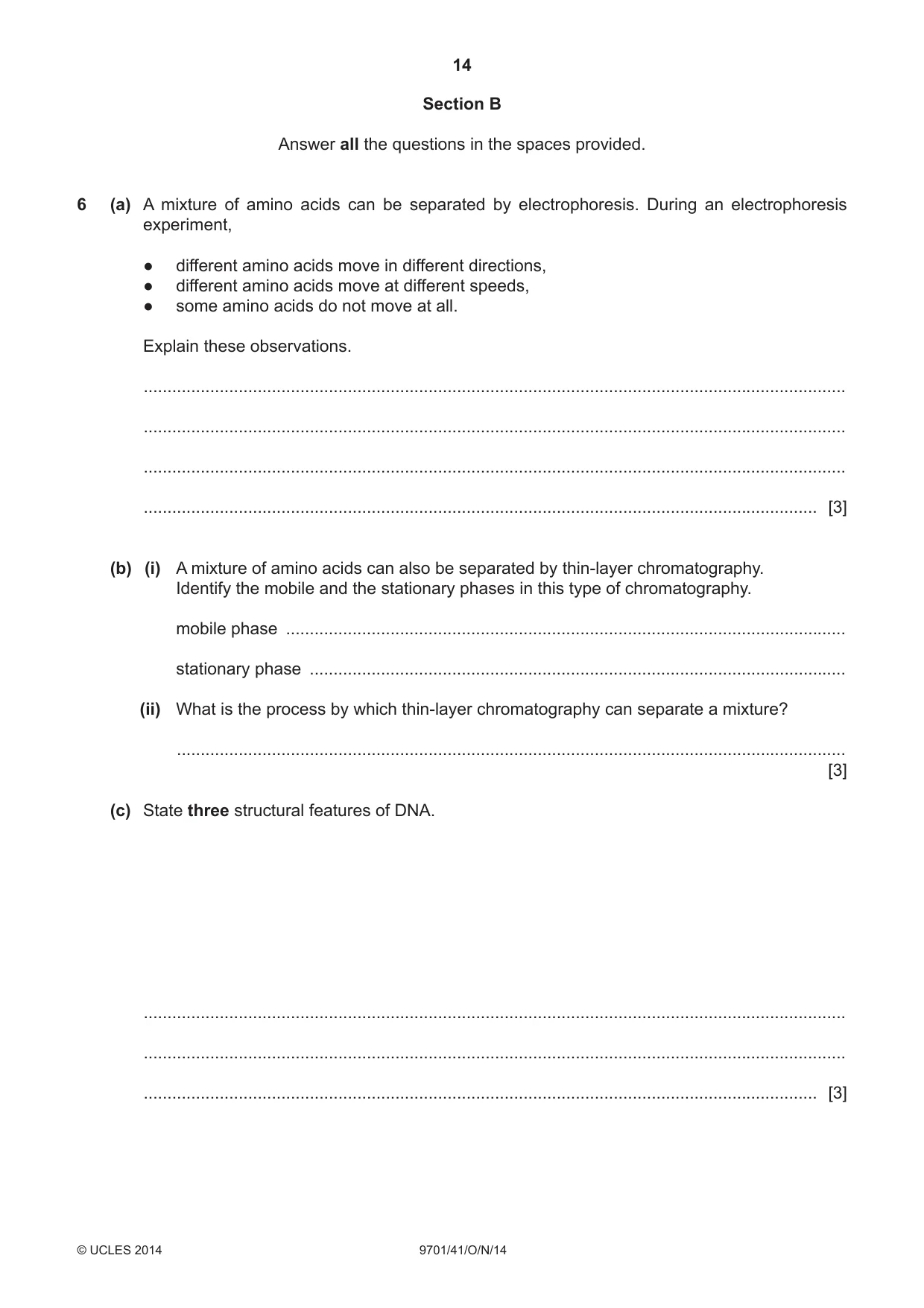
14 9701/41/O/N/14 © UCLES 2014 Section B Answer all the questions in the spaces provided. 6 (a) A mixture of amino acids can be separated by electrophoresis. During an electrophoresis experiment, ● different amino acids move in different directions, ● different amino acids move at different speeds, ● some amino acids do not move at all. Explain these observations. … … … … [3] (b) (i) A mixture of amino acids can also be separated by thin-layer chromatography. Identify the mobile and the stationary phases in this type of chromatography. mobile phase … stationary phase … (ii) What is the process by which thin-layer chromatography can separate a mixture? … [3] (c) State three structural features of DNA. … … … [3]
Question paper, page 15
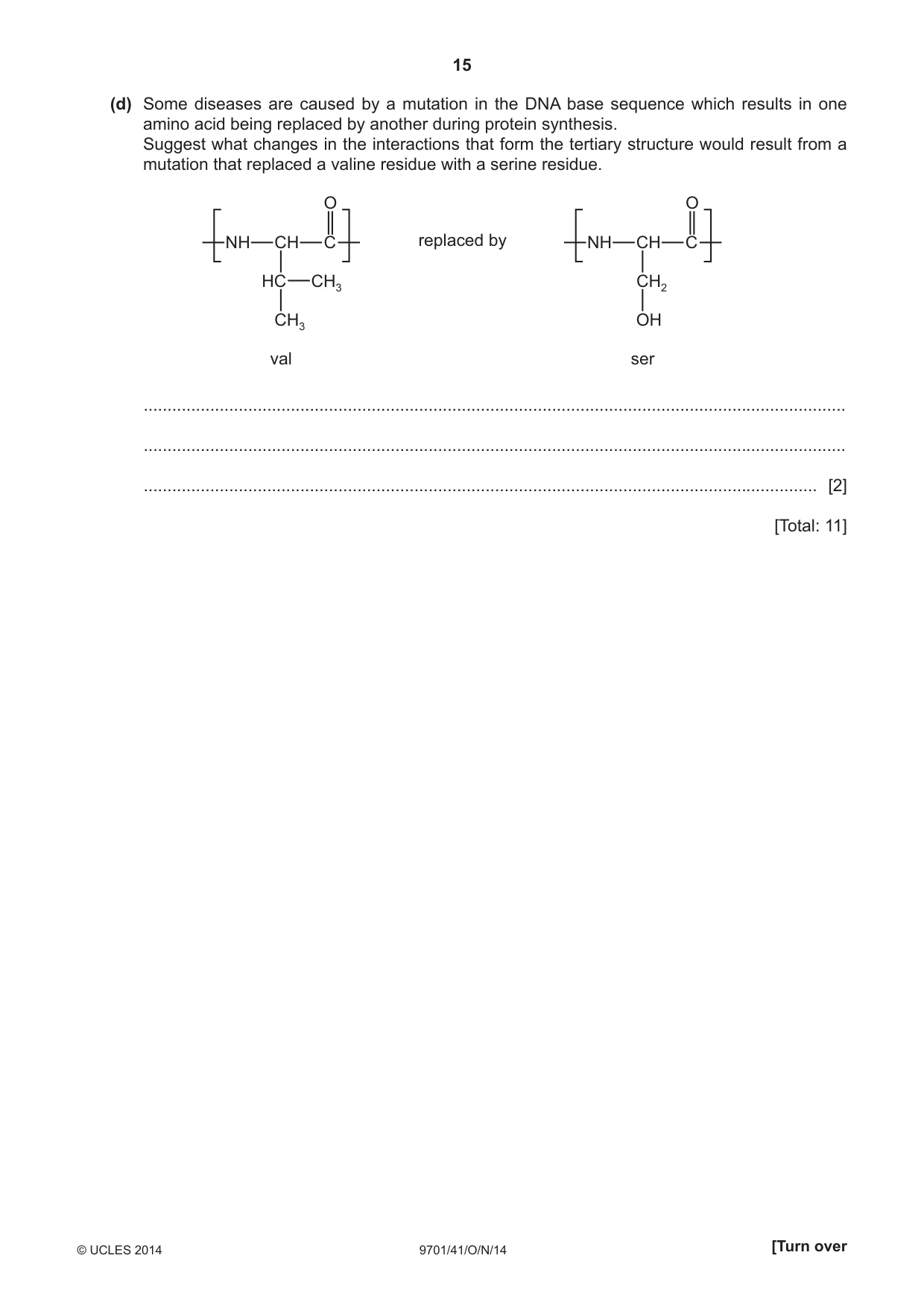
15 9701/41/O/N/14 © UCLES 2014 [Turn over (d) Some diseases are caused by a mutation in the DNA base sequence which results in one amino acid being replaced by another during protein synthesis. Suggest what changes in the interactions that form the tertiary structure would result from a mutation that replaced a valine residue with a serine residue. CH3 CH3 CH C HC val NH O OH CH2 CH C ser NH O replaced by … … … [2] [Total: 11]
Question paper, page 16
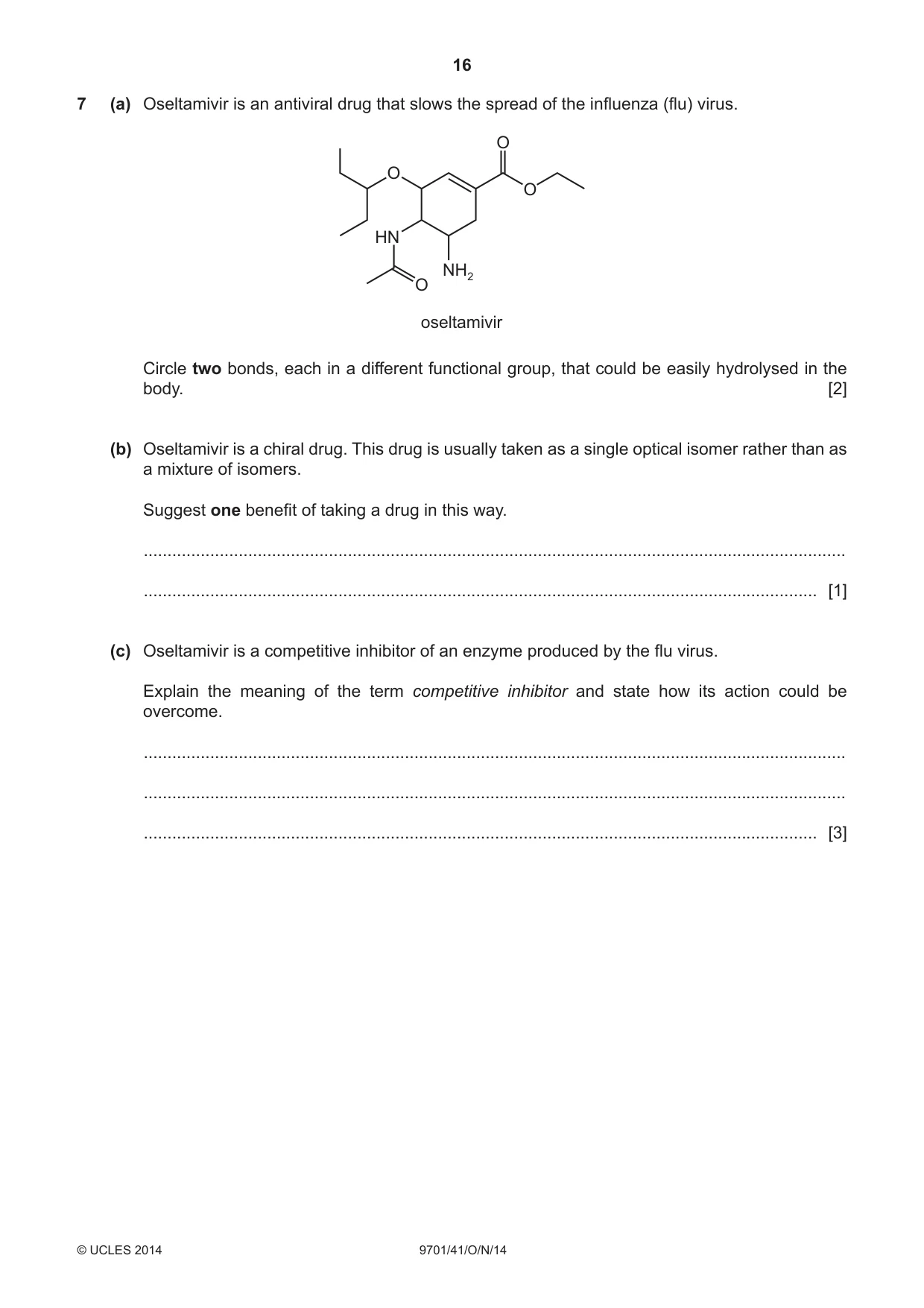
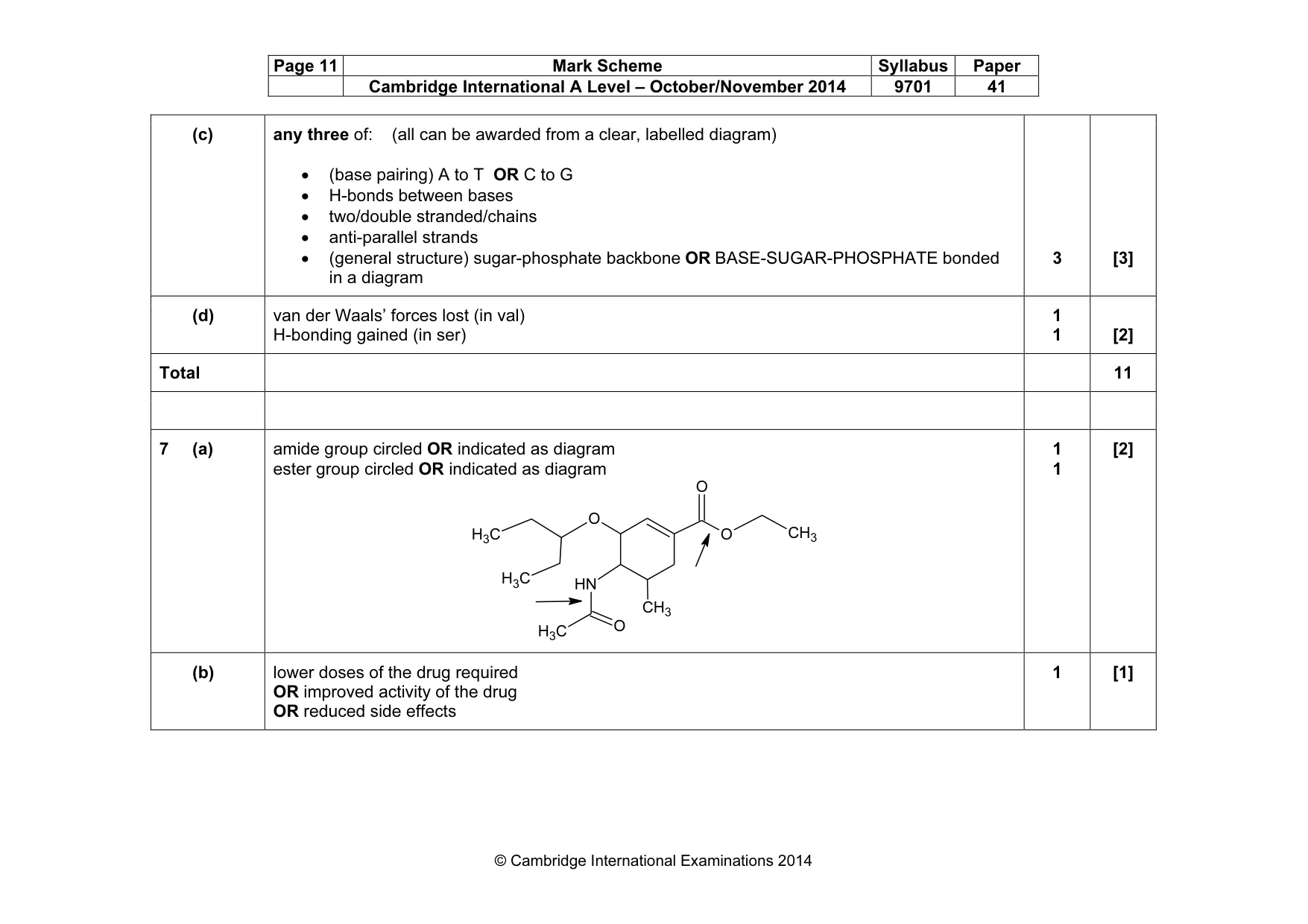
16 9701/41/O/N/14 © UCLES 2014 7 (a) Oseltamivir is an antiviral drug that slows the spread of the infl uenza (fl u) virus. O HN O O O NH2 oseltamivir Circle two bonds, each in a different functional group, that could be easily hydrolysed in the body. [2] (b) Oseltamivir is a chiral drug. This drug is usually taken as a single optical isomer rather than as a mixture of isomers. Suggest one benefi t of taking a drug in this way. … … [1] (c) Oseltamivir is a competitive inhibitor of an enzyme produced by the fl u virus. Explain the meaning of the term competitive inhibitor and state how its action could be overcome. … … … [3]
Question paper, page 17
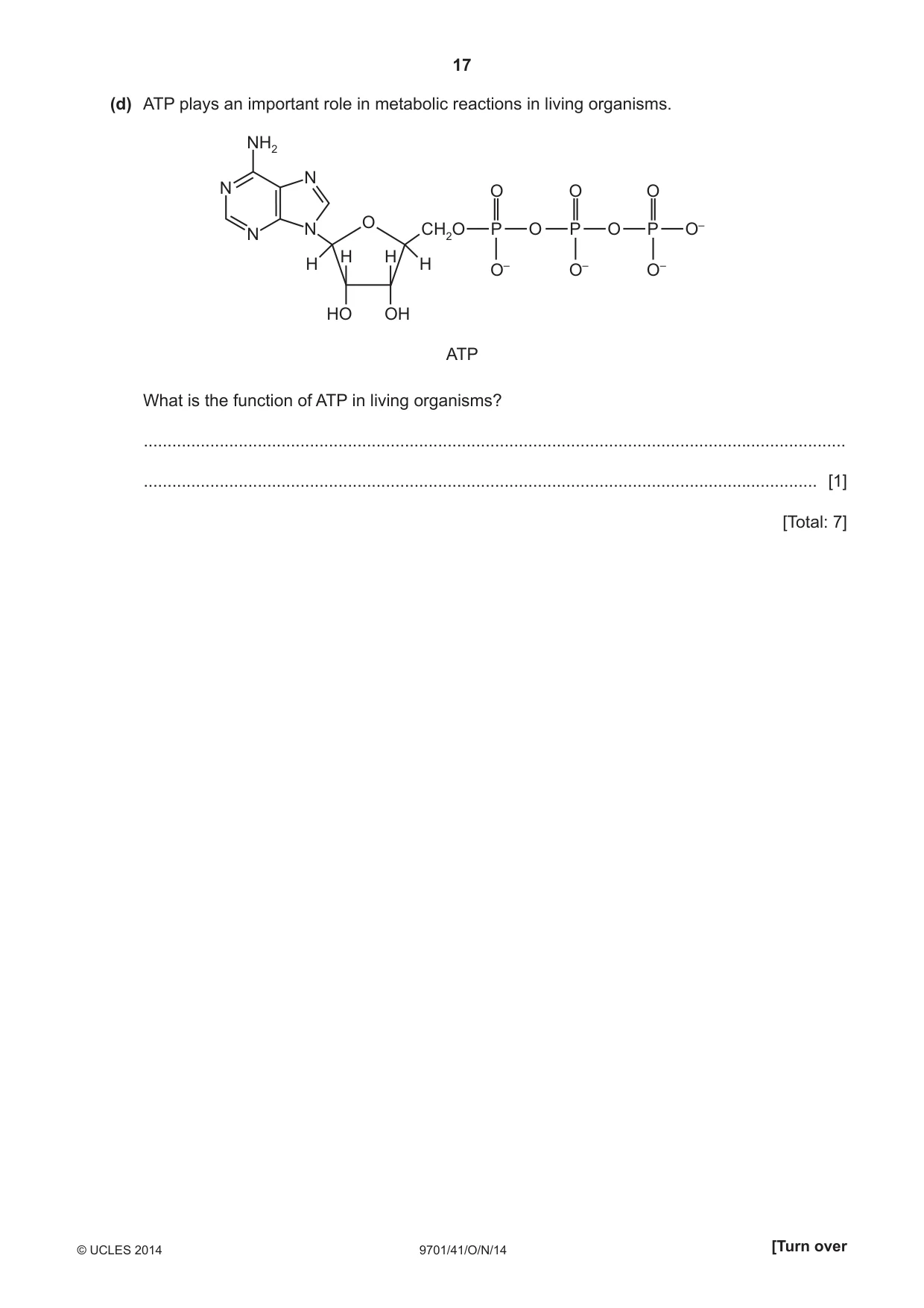
17 9701/41/O/N/14 © UCLES 2014 [Turn over (d) ATP plays an important role in metabolic reactions in living organisms. NH2 N N N CH2O P H H N H O HO H OH O P O P O– O– O– O O O O– ATP What is the function of ATP in living organisms? … … [1] [Total: 7]
Question paper, page 18
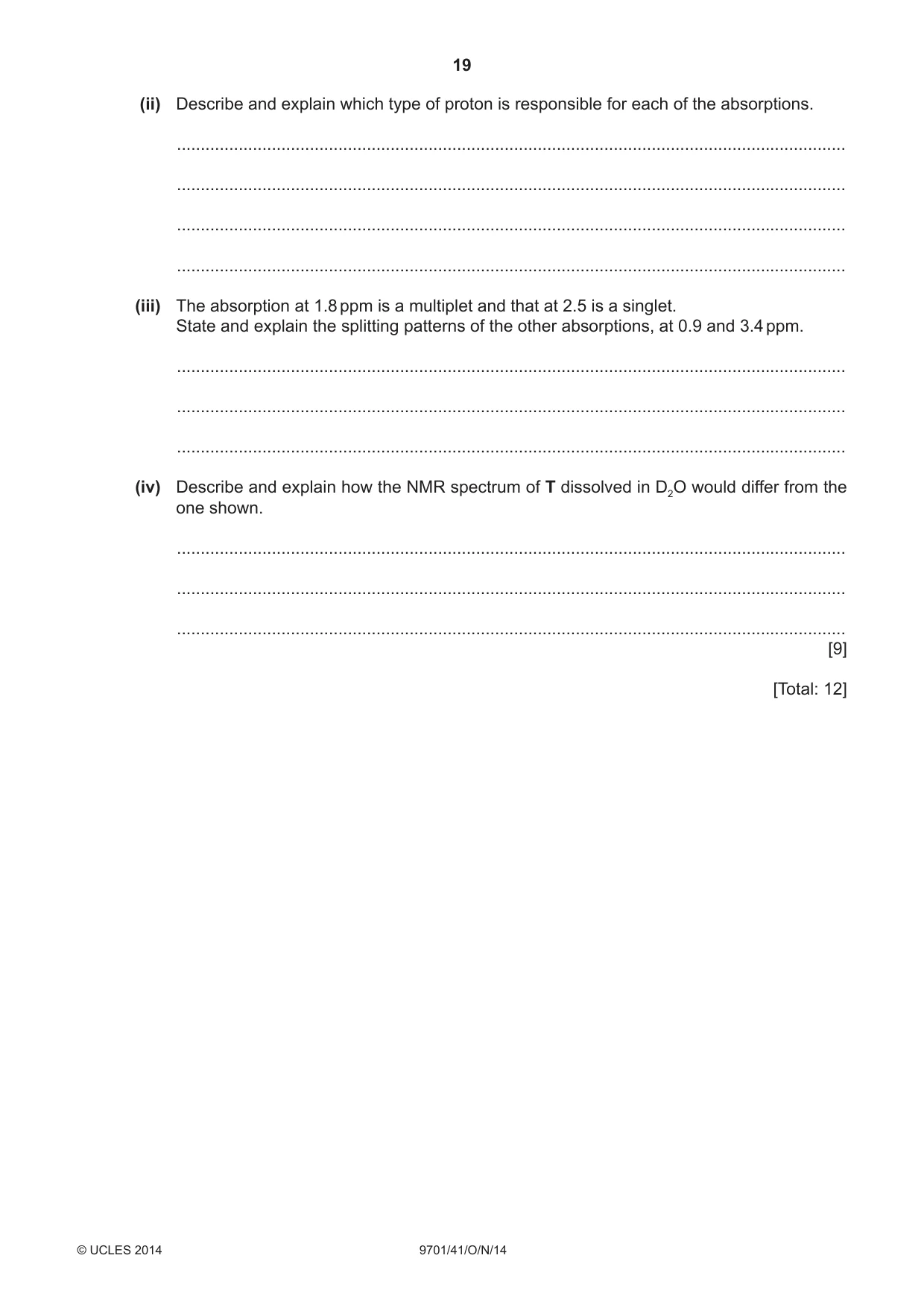
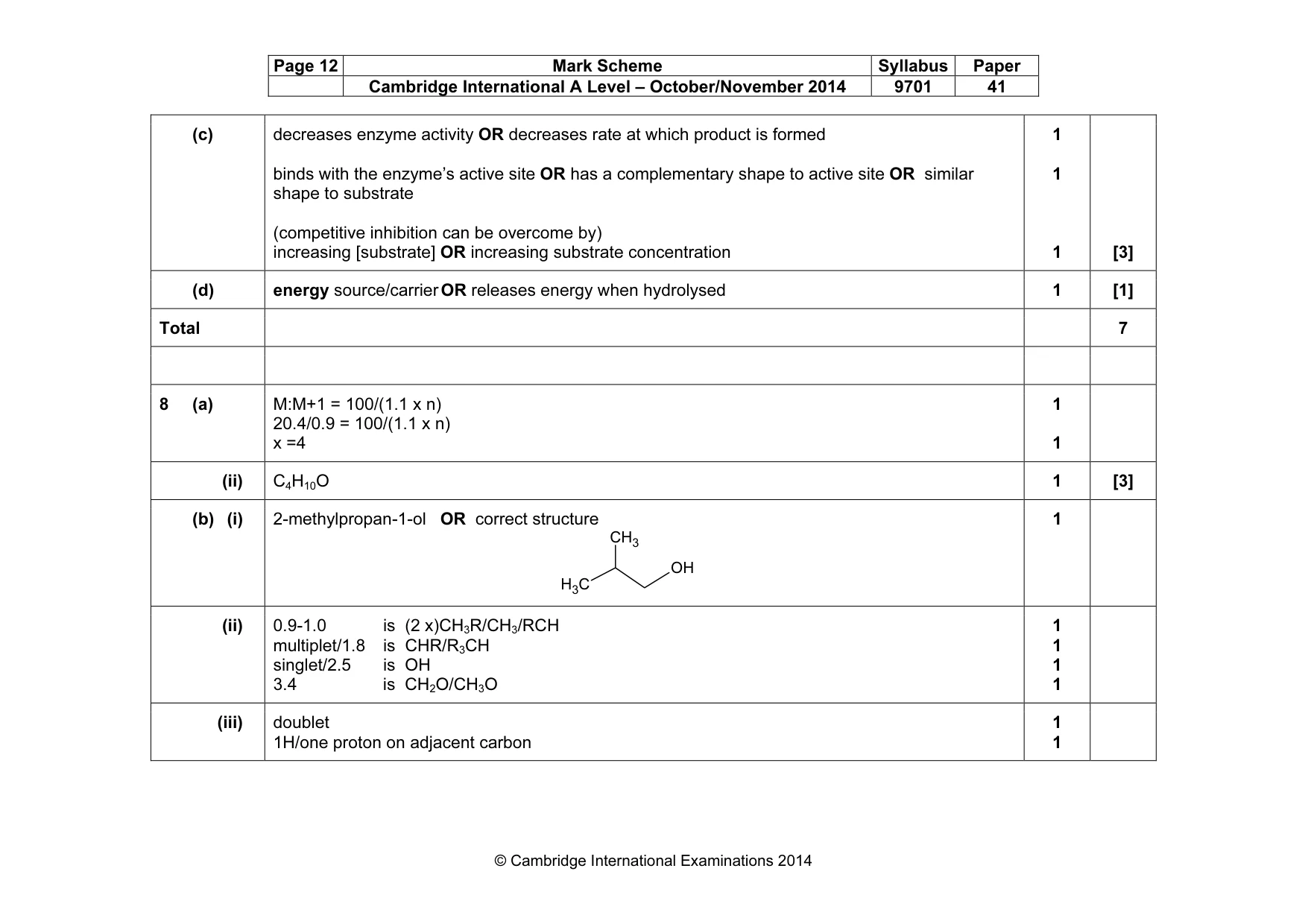
18 9701/41/O/N/14 © UCLES 2014 8 T is a saturated alcohol. It was analysed by mass spectroscopy and NMR spectroscopy. In the mass spectrum, the molecular ion peak, M, was at an m/e value of 74 and the ratio of the heights of the M and M+1 peaks was 20.4 : 0.9. (a) (i) Use the ratio of the heights of the M and M+1 peaks to calculate the number of carbon atoms in a molecule of T. (ii) What is the molecular formula of T? molecular formula = … [3] (b) The NMR spectrum of T given below shows four absorptions. The absorption at 1.8 ppm is a multiplet and that at 2.5 ppm is a singlet. 9 8 11 10 7 6 5 4 3 2 1 0 δ / ppm (i) Use this information and your answer to (a)(ii) to deduce the structure of T. T
Question paper, page 19
19 9701/41/O/N/14 © UCLES 2014 [Turn over (ii) Describe and explain which type of proton is responsible for each of the absorptions. … … … … (iii) The absorption at 1.8 ppm is a multiplet and that at 2.5 is a singlet. State and explain the splitting patterns of the other absorptions, at 0.9 and 3.4 ppm. … … … (iv) Describe and explain how the NMR spectrum of T dissolved in D2O would differ from the one shown. … … … [9] [Total: 12]
Question paper, page 20
20 Permission to reproduce items where third-party owned material protected by copyright is included has been sought and cleared where possible. Every reasonable effort has been made by the publisher (UCLES) to trace copyright holders, but if any items requiring clearance have unwittingly been included the publisher will be pleased to make amends at the earliest possible opportunity. Cambridge International Examinations is part of the Cambridge Assessment Group. Cambridge Assessment is the brand name of University of Cambridge Local Examinations Syndicate (UCLES), which is itself a department of the University of Cambridge. 9701/41/O/N/14 © UCLES 2014 BLANK PAGE
Mark scheme, page 1
® IGCSE is the registered trademark of Cambridge International Examinations. CAMBRIDGE INTERNATIONAL EXAMINATIONS Cambridge International Advanced Level MARK SCHEME for the October/November 2014 series 9701 CHEMISTRY 9701/41 Paper 4 (A2 Structured Questions), maximum raw mark 100 This mark scheme is published as an aid to teachers and candidates, to indicate the requirements of the examination. It shows the basis on which Examiners were instructed to award marks. It does not indicate the details of the discussions that took place at an Examiners’ meeting before marking began, which would have considered the acceptability of alternative answers. Mark schemes should be read in conjunction with the question paper and the Principal Examiner Report for Teachers. Cambridge will not enter into discussions about these mark schemes. Cambridge is publishing the mark schemes for the October/November 2014 series for most Cambridge IGCSE®, Cambridge International A and AS Level components and some Cambridge O Level components.
Mark scheme, page 2
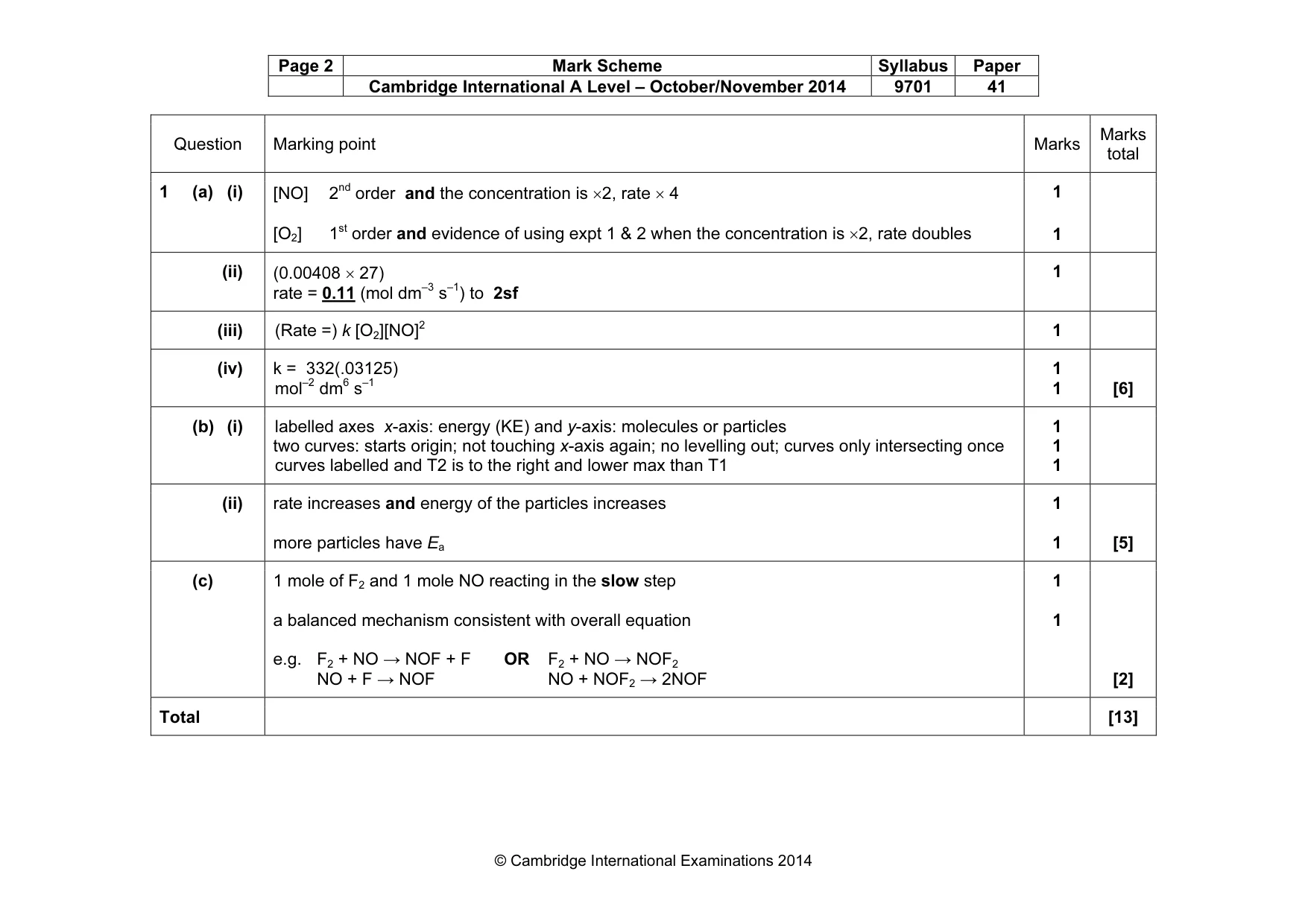
Page 2 Mark Scheme Syllabus Paper Cambridge International A Level – October/November 2014 9701 41 © Cambridge International Examinations 2014 Question Marking point Marks Marks total 1 (a) (i) [NO] 2nd order and the concentration is ×2, rate × 4 [O2] 1st order and evidence of using expt 1 & 2 when the concentration is ×2, rate doubles 1 1 (ii) (0.00408 × 27) rate = 0.11 (mol dm–3 s–1) to 2sf 1 (iii) (Rate =) k [O2][NO]2 1 (iv) k = 332(.03125) mol–2 dm6 s–1 1 1 [6] (b) (i) labelled axes x-axis: energy (KE) and y-axis: molecules or particles two curves: starts origin; not touching x-axis again; no levelling out; curves only intersecting once curves labelled and T2 is to the right and lower max than T1 1 1 1 (ii) rate increases and energy of the particles increases more particles have Ea 1 1 [5] (c) 1 mole of F2 and 1 mole NO reacting in the slow step a balanced mechanism consistent with overall equation e.g. F2 + NO → NOF + F OR F2 + NO → NOF2 NO + F → NOF NO + NOF2 → 2NOF 1 1 [2] Total [13]
Mark scheme, page 3
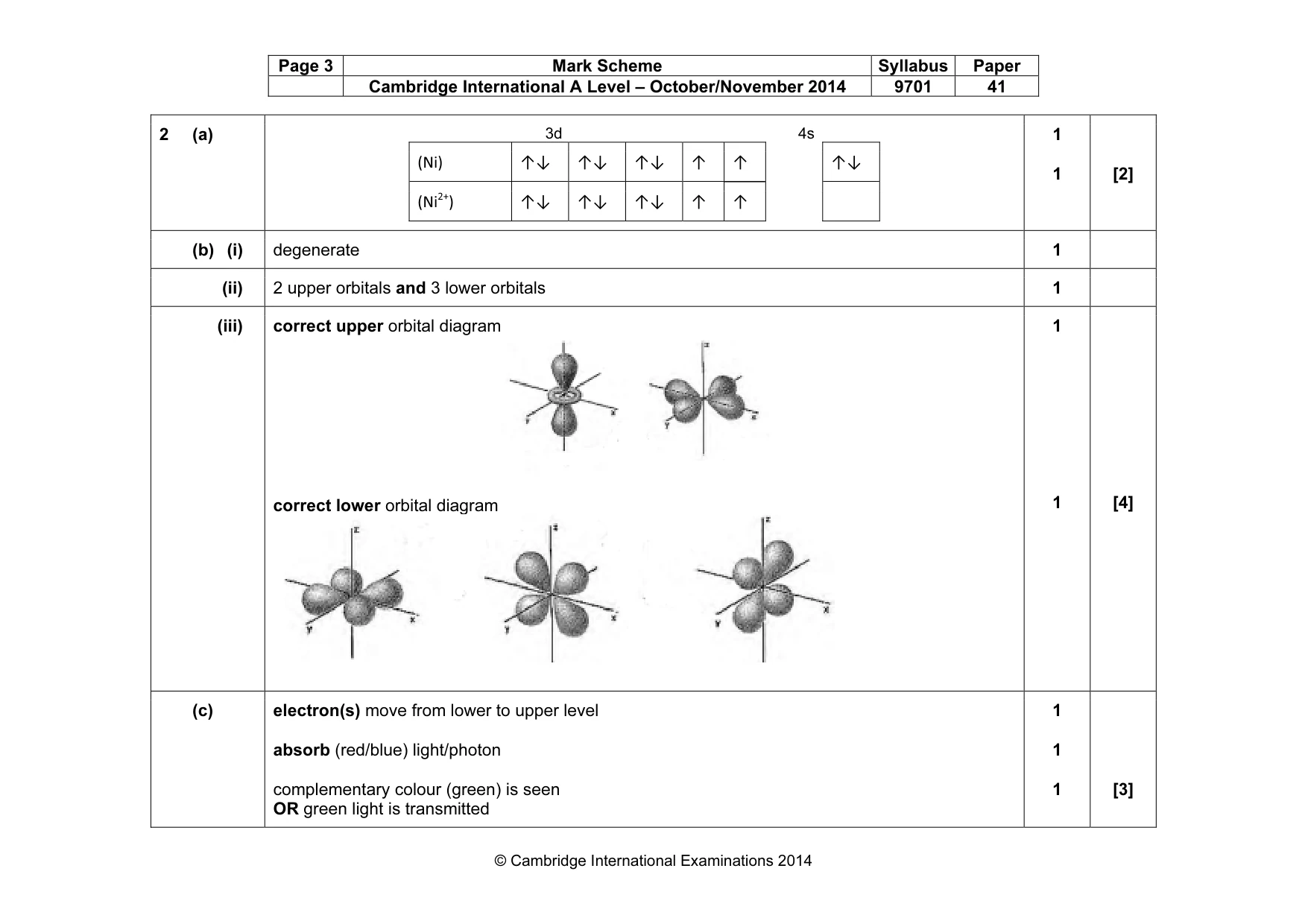
Page 3 Mark Scheme Syllabus Paper Cambridge International A Level – October/November 2014 9701 41 © Cambridge International Examinations 2014 2 (a) 3d 4s (Ni) ↑↓ ↑↓ ↑↓ ↑ ↑ ↑↓ (Ni2+) ↑↓ ↑↓ ↑↓ ↑ ↑ 1 1 [2] (b) (i) degenerate 1 (ii) 2 upper orbitals and 3 lower orbitals 1 (iii) correct upper orbital diagram correct lower orbital diagram 1 1 [4] (c) electron(s) move from lower to upper level absorb (red/blue) light/photon complementary colour (green) is seen OR green light is transmitted 1 1 1 [3]
Mark scheme, page 4
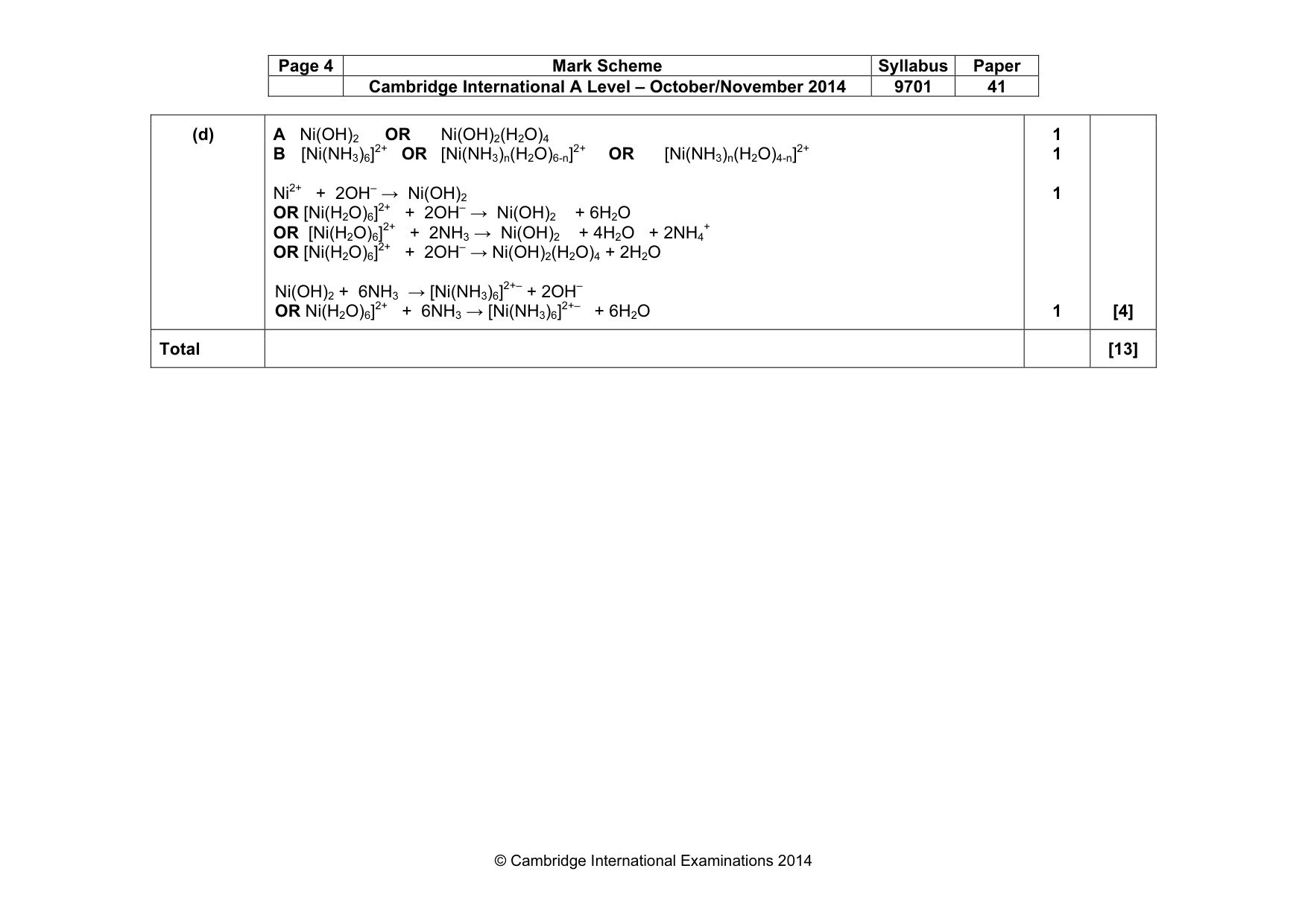
Page 4 Mark Scheme Syllabus Paper Cambridge International A Level – October/November 2014 9701 41 © Cambridge International Examinations 2014 (d) A Ni(OH)2 OR Ni(OH)2(H2O)4 B [Ni(NH3)6]2+ OR [Ni(NH3)n(H2O)6-n]2+ OR [Ni(NH3)n(H2O)4-n]2+ Ni2+ + 2OH– → Ni(OH)2 OR [Ni(H2O)6]2+ + 2OH– → Ni(OH)2 + 6H2O OR [Ni(H2O)6]2+ + 2NH3 → Ni(OH)2 + 4H2O + 2NH4 + OR [Ni(H2O)6]2+ + 2OH– → Ni(OH)2(H2O)4 + 2H2O Ni(OH)2 + 6NH3 → [Ni(NH3)6]2+– + 2OH– OR Ni(H2O)6]2+ + 6NH3 → [Ni(NH3)6]2+– + 6H2O 1 1 1 1 [4] Total [13]
Mark scheme, page 5
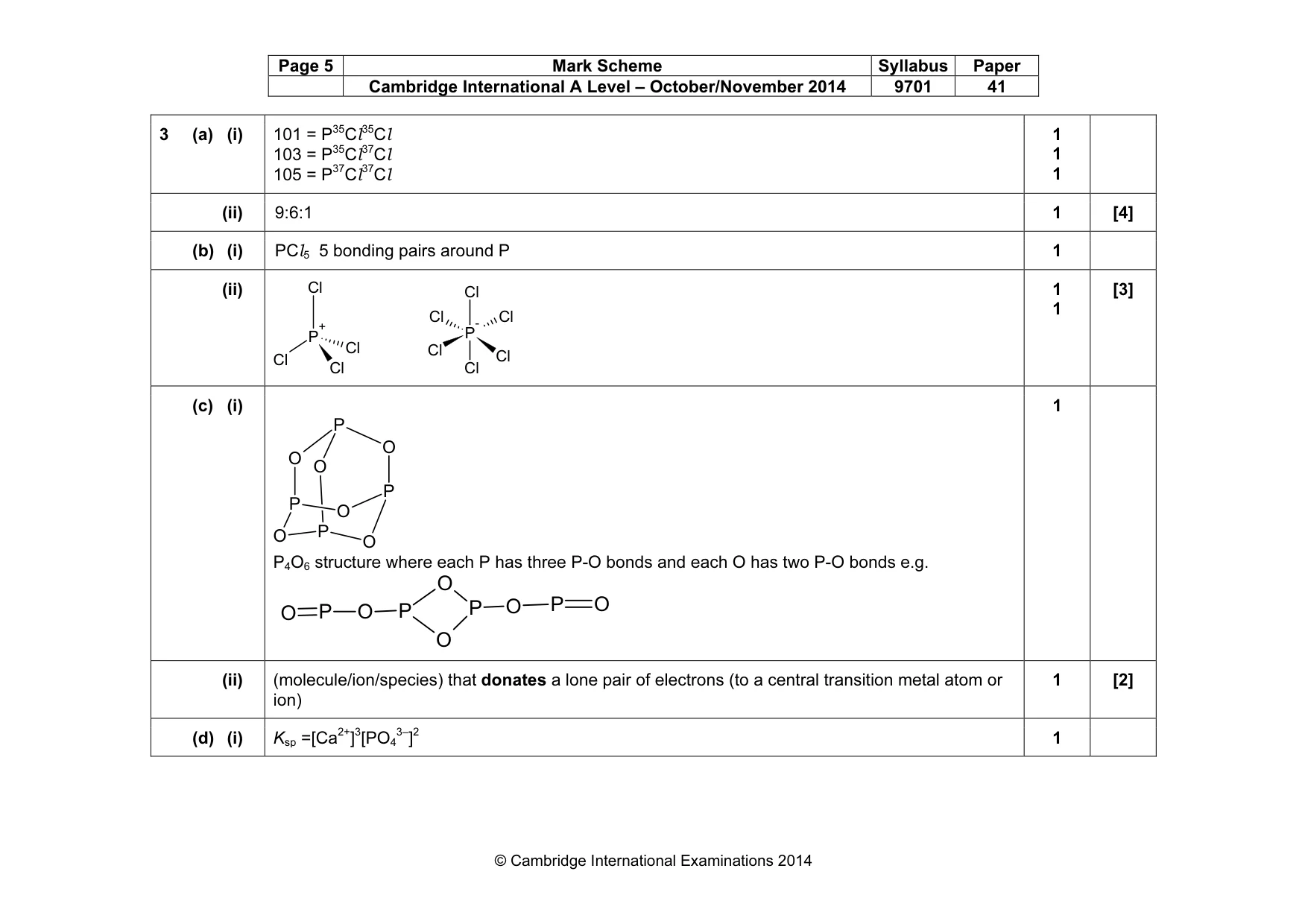
Page 5 Mark Scheme Syllabus Paper Cambridge International A Level – October/November 2014 9701 41 © Cambridge International Examinations 2014 3 (a) (i) 101 = P35Cl35Cl 103 = P35Cl37Cl 105 = P37Cl37Cl 1 1 1 (ii) 9:6:1 1 [4] (b) (i) PCl5 5 bonding pairs around P 1 (ii) Cl P + Cl Cl Cl Cl P - Cl Cl Cl Cl Cl 1 1 [3] (c) (i) P O P P O O O P O O P4O6 structure where each P has three P-O bonds and each O has two P-O bonds e.g. O P O P O O P O P O 1 (ii) (molecule/ion/species) that donates a lone pair of electrons (to a central transition metal atom or ion) 1 [2] (d) (i) Ksp =[Ca2+]3[PO4 3–]2 1
Mark scheme, page 6
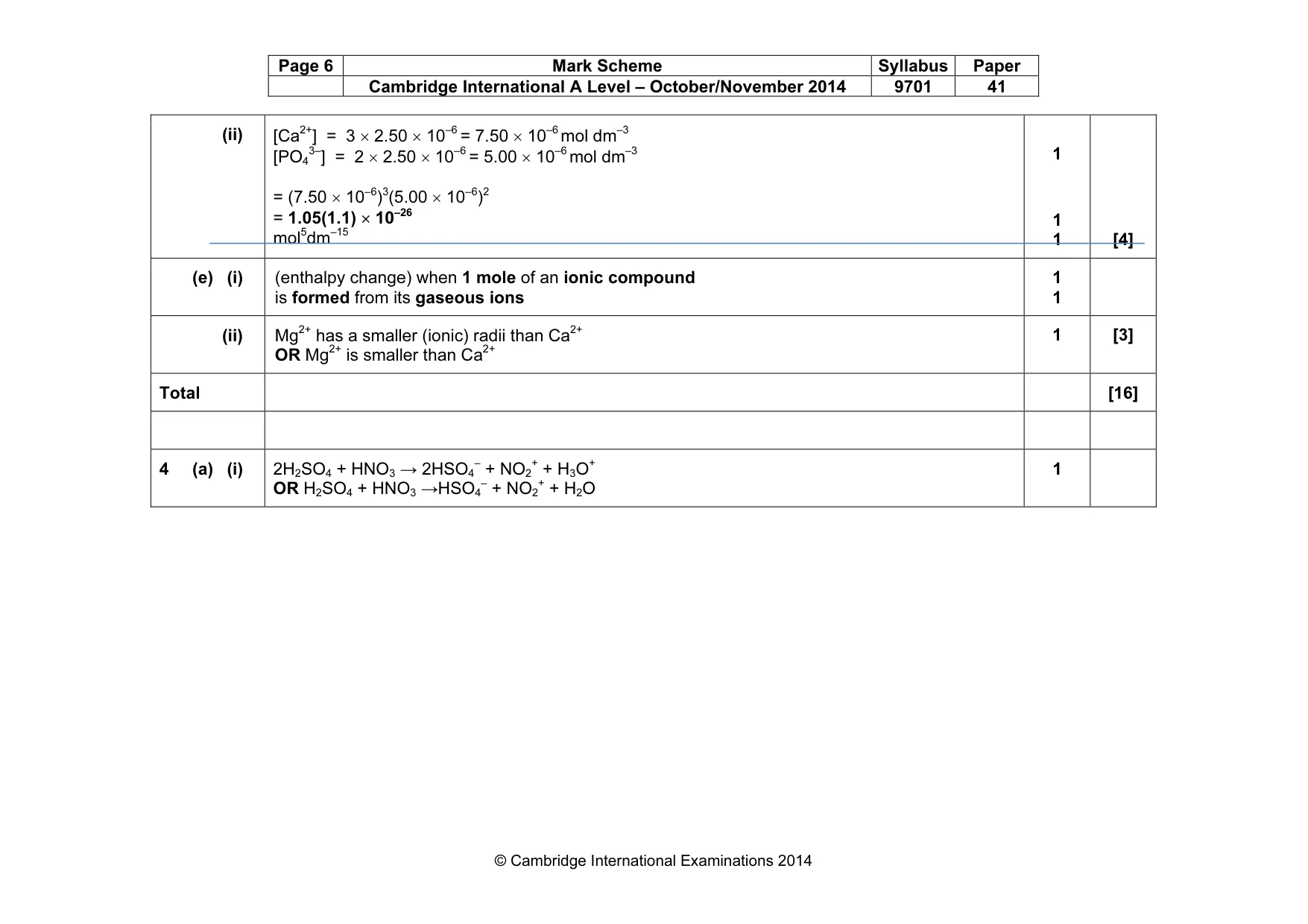
Page 6 Mark Scheme Syllabus Paper Cambridge International A Level – October/November 2014 9701 41 © Cambridge International Examinations 2014 (ii) [Ca2+] = 3 × 2.50 × 10–6 = 7.50 × 10⁻⁶ mol dm–3 [PO4 3–] = 2 × 2.50 × 10–6 = 5.00 × 10⁻⁶ mol dm–3 = (7.50 × 10⁻⁶)3(5.00 × 10⁻⁶)2 = 1.05(1.1) × 10–26 mol5dm–15 1 1 1 [4] (e) (i) (enthalpy change) when 1 mole of an ionic compound is formed from its gaseous ions 1 1 (ii) Mg2+ has a smaller (ionic) radii than Ca2+ OR Mg2+ is smaller than Ca2+ 1 [3] Total [16] 4 (a) (i) 2H2SO4 + HNO3 → 2HSO4 – + NO2 + + H3O+ OR H2SO4 + HNO3 →HSO4 – + NO2 + + H2O 1
Mark scheme, page 7
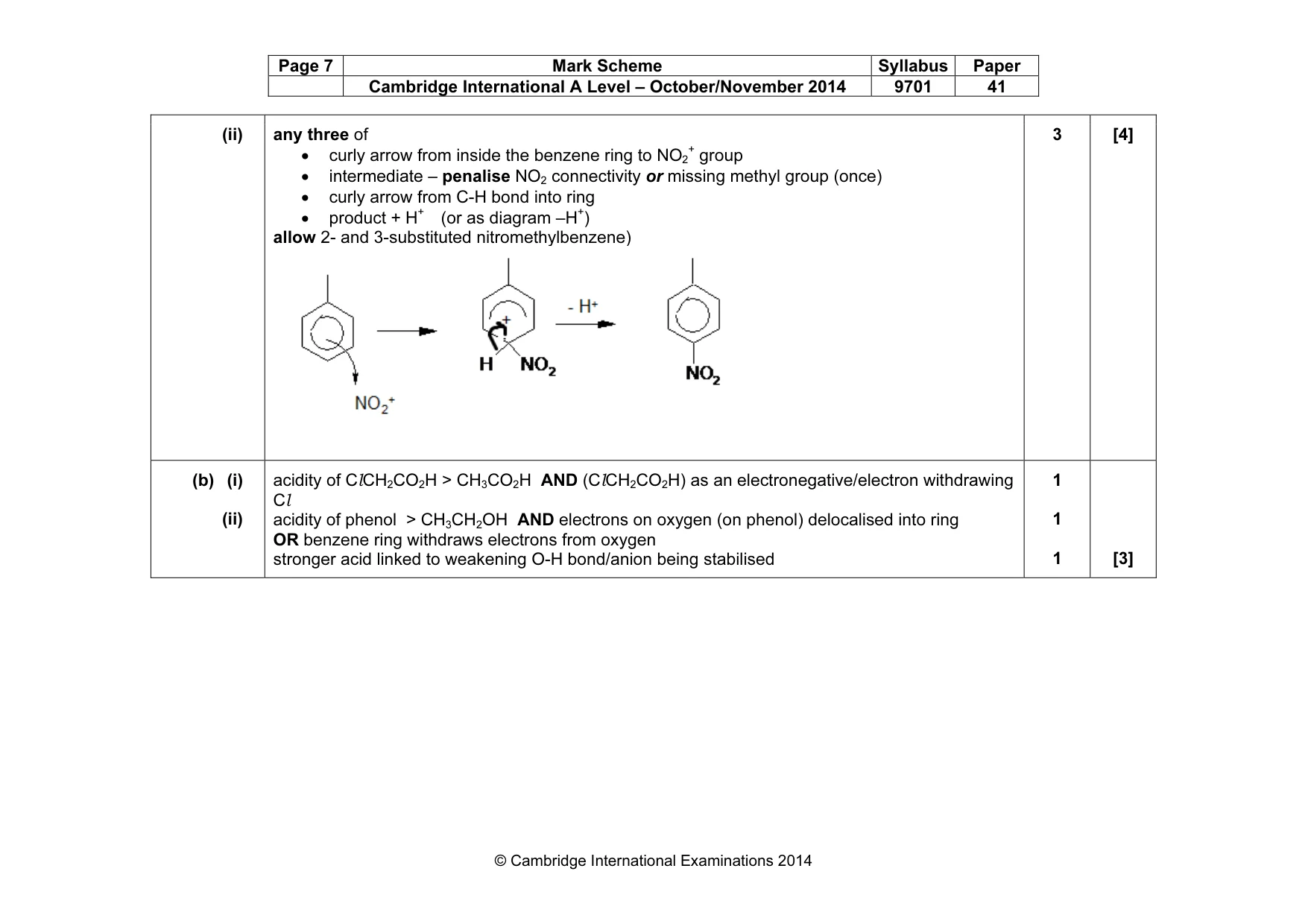
Page 7 Mark Scheme Syllabus Paper Cambridge International A Level – October/November 2014 9701 41 © Cambridge International Examinations 2014 (ii) any three of • curly arrow from inside the benzene ring to NO2 + group • intermediate – penalise NO2 connectivity or missing methyl group (once) • curly arrow from C-H bond into ring • product + H+ (or as diagram –H+) allow 2- and 3-substituted nitromethylbenzene) 3 [4] (b) (i) (ii) acidity of ClCH2CO2H > CH3CO2H AND (ClCH2CO2H) as an electronegative/electron withdrawing Cl acidity of phenol > CH3CH2OH AND electrons on oxygen (on phenol) delocalised into ring OR benzene ring withdraws electrons from oxygen stronger acid linked to weakening O-H bond/anion being stabilised 1 1 1 [3]
Mark scheme, page 8
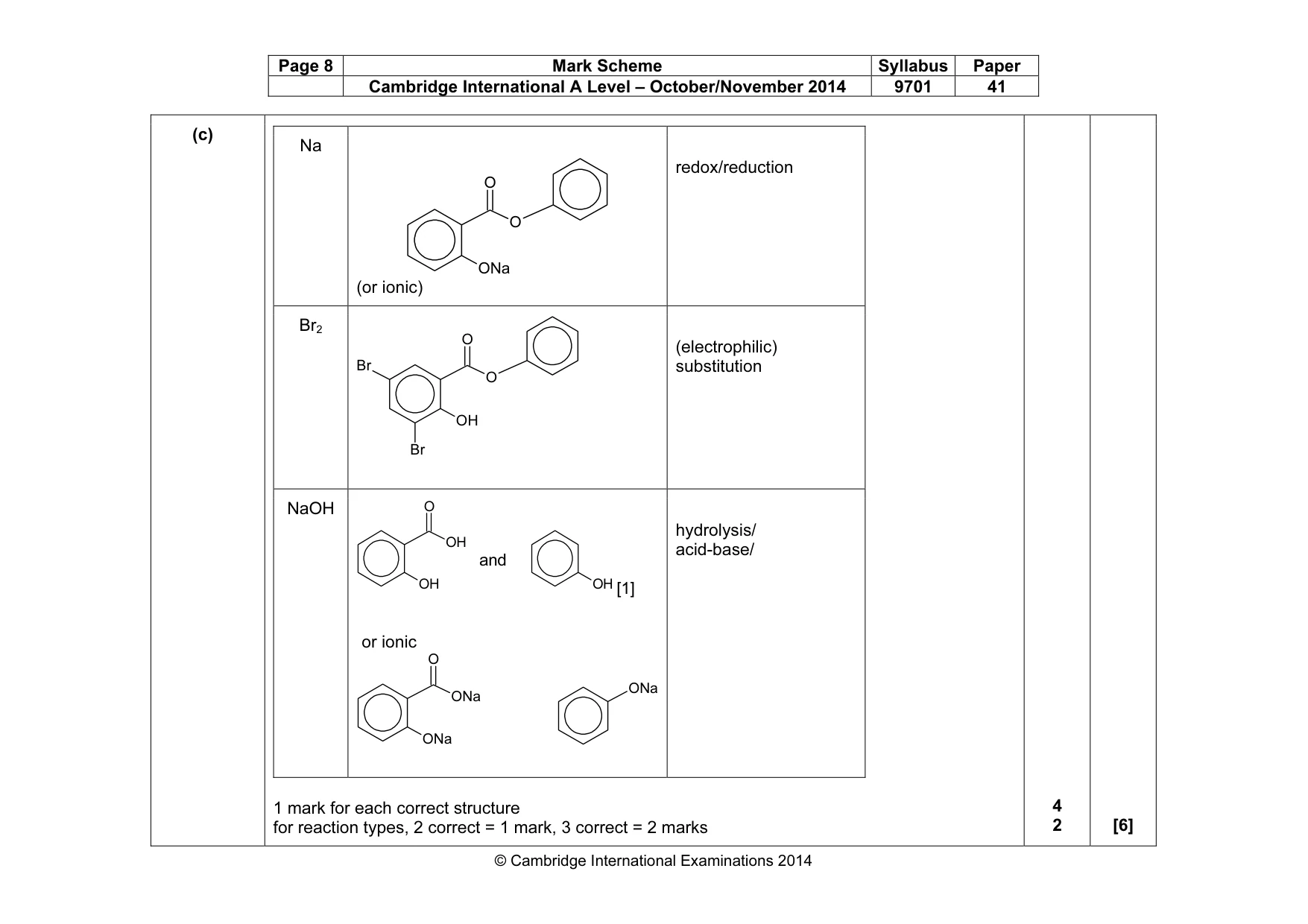
Page 8 Mark Scheme Syllabus Paper Cambridge International A Level – October/November 2014 9701 41 © Cambridge International Examinations 2014 (c) Na O O ONa (or ionic) redox/reduction Br2 O O OH Br Br (electrophilic) substitution NaOH O OH OH and OH [1] or ionic O ONa ONa ONa hydrolysis/ acid-base/ 1 mark for each correct structure for reaction types, 2 correct = 1 mark, 3 correct = 2 marks 4 2 [6]
Mark scheme, page 9
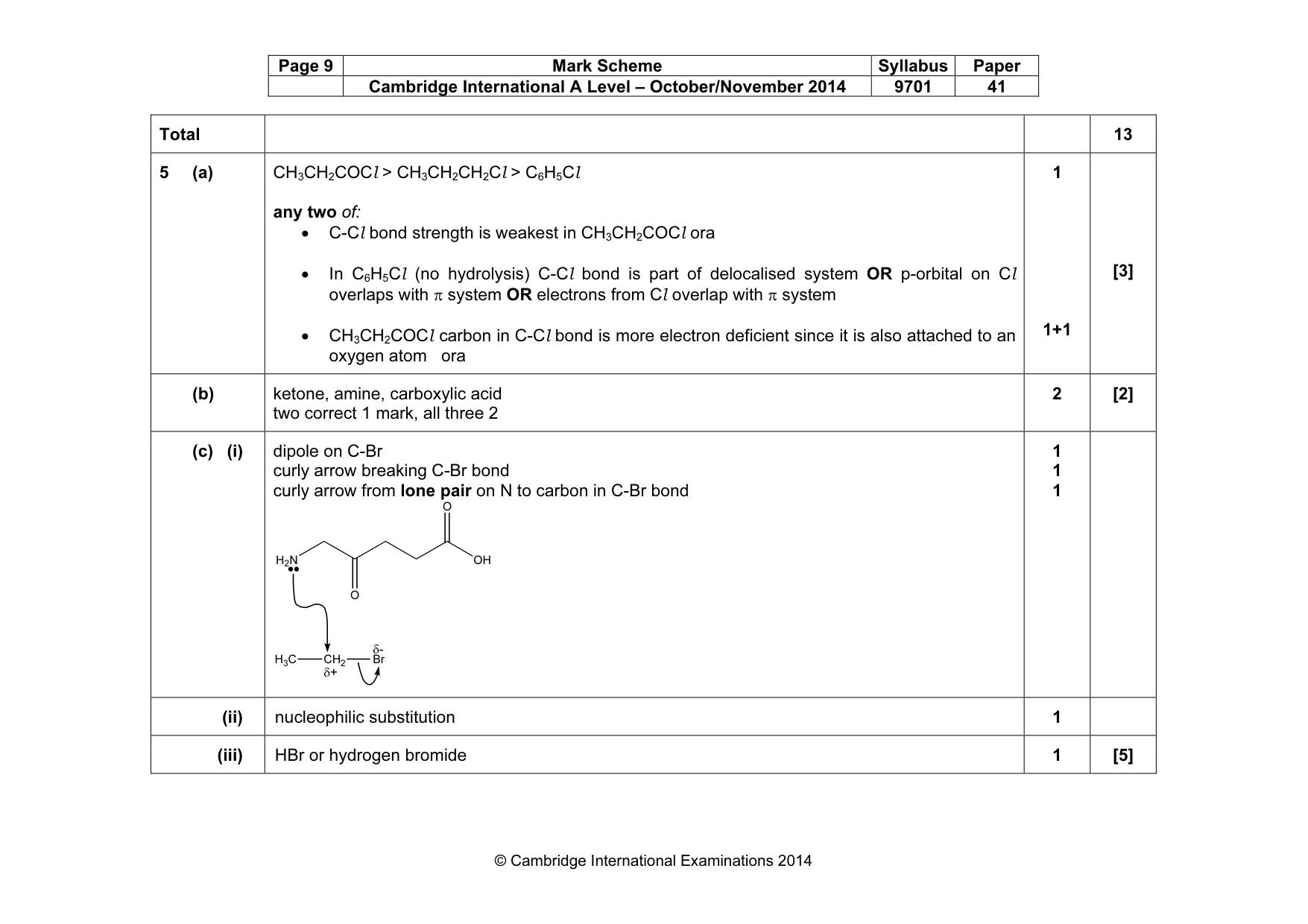
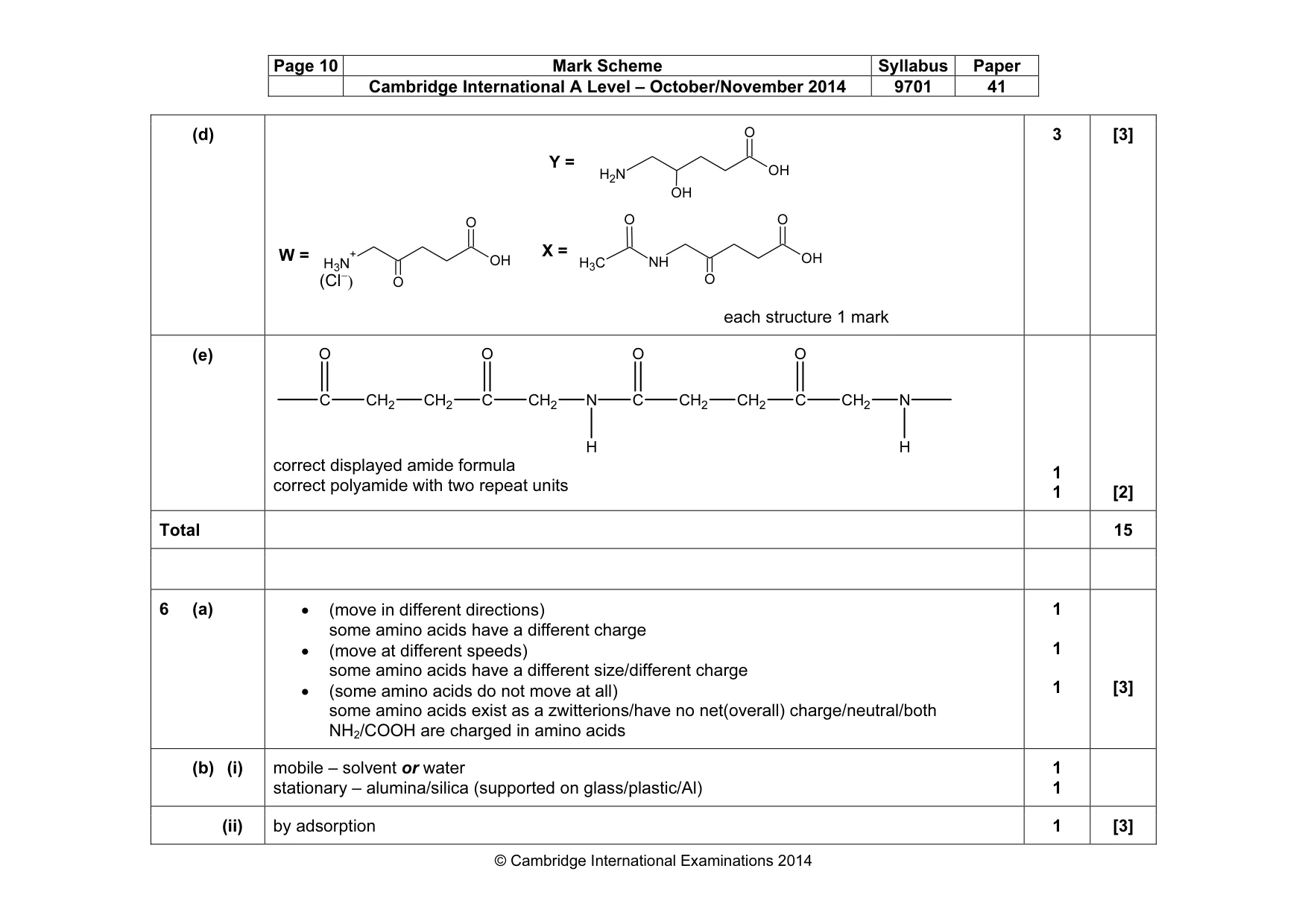
Page 9 Mark Scheme Syllabus Paper Cambridge International A Level – October/November 2014 9701 41 © Cambridge International Examinations 2014 Total 13 5 (a) CH3CH2COCl > CH3CH2CH2Cl > C6H5Cl any two of: • C-Cl bond strength is weakest in CH3CH2COCl ora • In C6H5Cl (no hydrolysis) C-Cl bond is part of delocalised system OR p-orbital on Cl overlaps with π system OR electrons from Cl overlap with π system • CH3CH2COCl carbon in C-Cl bond is more electron deficient since it is also attached to an oxygen atom ora 1 1+1 [3] (b) ketone, amine, carboxylic acid two correct 1 mark, all three 2 2 [2] (c) (i) dipole on C-Br curly arrow breaking C-Br bond curly arrow from lone pair on N to carbon in C-Br bond H2N OH O O H3C CH2 δ+ δ- Br 1 1 1 (ii) nucleophilic substitution 1 (iii) HBr or hydrogen bromide 1 [5]
Mark scheme, page 10
Page 10 Mark Scheme Syllabus Paper Cambridge International A Level – October/November 2014 9701 41 © Cambridge International Examinations 2014 (d) OH N H3 + O O (Cl−) W = OH O O NH C H3 O X = OH O N H2 OH Y = each structure 1 mark 3 [3] (e) C CH2 CH2 C CH2 O N C CH2 CH2 C CH2 N H O O H O correct displayed amide formula correct polyamide with two repeat units 1 1 [2] Total 15 6 (a) • (move in different directions) some amino acids have a different charge • (move at different speeds) some amino acids have a different size/different charge • (some amino acids do not move at all) some amino acids exist as a zwitterions/have no net(overall) charge/neutral/both NH2/COOH are charged in amino acids 1 1 1 [3] (b) (i) mobile – solvent or water stationary – alumina/silica (supported on glass/plastic/Al) 1 1 (ii) by adsorption 1 [3]
Mark scheme, page 11
Page 11 Mark Scheme Syllabus Paper Cambridge International A Level – October/November 2014 9701 41 © Cambridge International Examinations 2014 (c) any three of: (all can be awarded from a clear, labelled diagram) • (base pairing) A to T OR C to G • H-bonds between bases • two/double stranded/chains • anti-parallel strands • (general structure) sugar-phosphate backbone OR BASE-SUGAR-PHOSPHATE bonded in a diagram 3 [3] (d) van der Waals’ forces lost (in val) H-bonding gained (in ser) 1 1 [2] Total 11 7 (a) amide group circled OR indicated as diagram ester group circled OR indicated as diagram O O CH3 O C H3 C H3 CH3 N H O C H3 1 1 [2] (b) lower doses of the drug required OR improved activity of the drug OR reduced side effects 1 [1]
Mark scheme, page 12
Page 12 Mark Scheme Syllabus Paper Cambridge International A Level – October/November 2014 9701 41 © Cambridge International Examinations 2014 (c) decreases enzyme activity OR decreases rate at which product is formed binds with the enzyme’s active site OR has a complementary shape to active site OR similar shape to substrate (competitive inhibition can be overcome by) increasing [substrate] OR increasing substrate concentration 1 1 1 [3] (d) energy source/carrier OR releases energy when hydrolysed 1 [1] Total 7 8 (a) M:M+1 = 100/(1.1 x n) 20.4/0.9 = 100/(1.1 x n) x =4 1 1 (ii) C4H10O 1 [3] (b) (i) 2-methylpropan-1-ol OR correct structure OH CH3 C H3 1 (ii) 0.9-1.0 is (2 x)CH3R/CH3/RCH multiplet/1.8 is CHR/R3CH singlet/2.5 is OH 3.4 is CH2O/CH3O 1 1 1 1 (iii) doublet 1H/one proton on adjacent carbon 1 1
Mark scheme, page 13
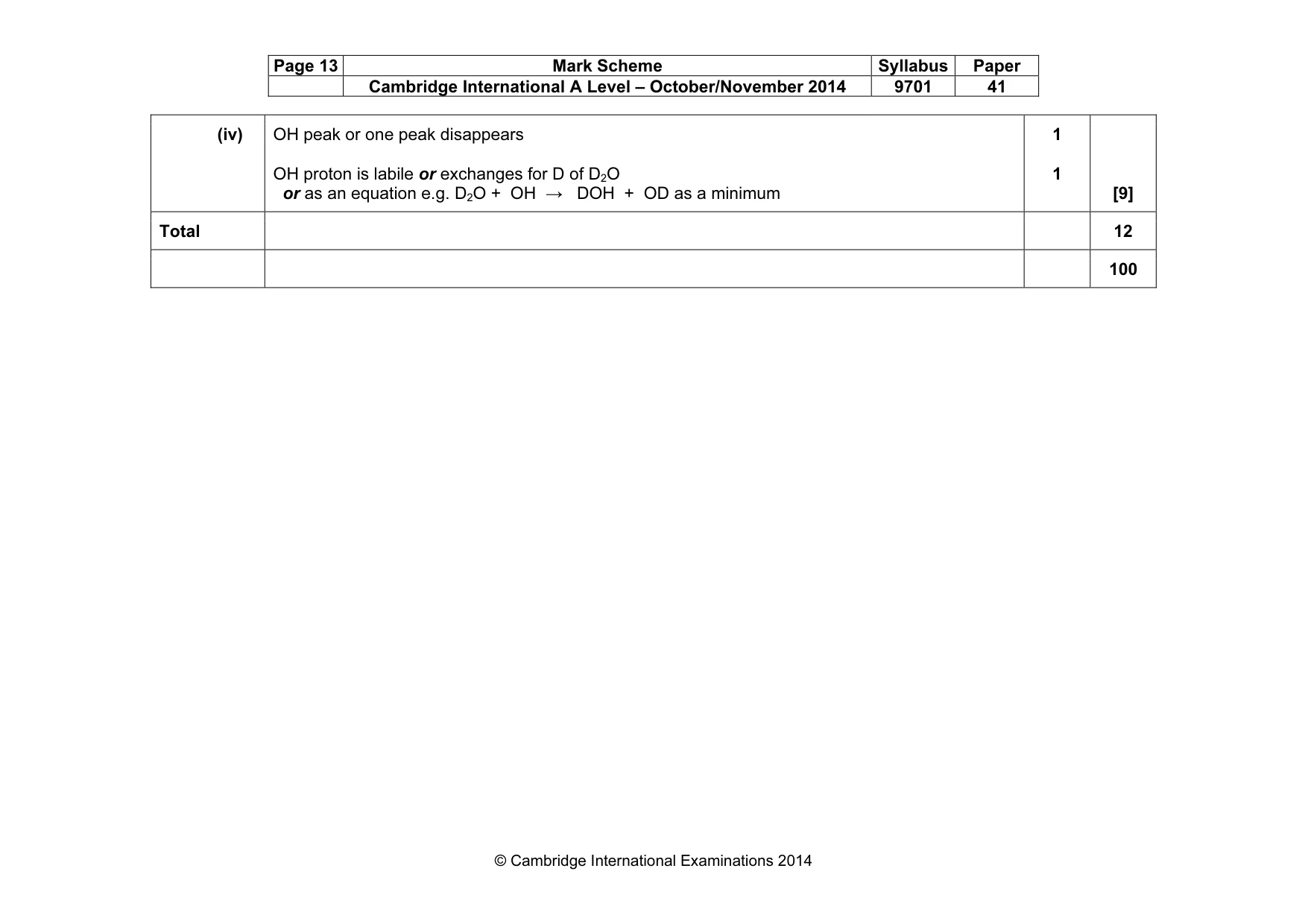
Page 13 Mark Scheme Syllabus Paper Cambridge International A Level – October/November 2014 9701 41 © Cambridge International Examinations 2014 (iv) OH peak or one peak disappears OH proton is labile or exchanges for D of D2O or as an equation e.g. D2O + OH → DOH + OD as a minimum 1 1 [9] Total 12 100
What you needed in this session
Cambridge’s own grade thresholds for 2014 Oct/Nov, Paper 4 · Variant 1. A higher threshold means an easier paper — the bar moves with how the cohort did.