Cambridge A Level Chemistry 9701 — 2010 May/June Paper 4 · Variant 1
9701/41/M/J/10 · 100 marks · ≈113 min
The question paper and its mark scheme, free to read here and free to download. This is Cambridge’s own paper, exactly as it was sat.
Question paper20 pages

Mark scheme8 pages
Answers below. Sit the paper first if you are practising.
Paper as text
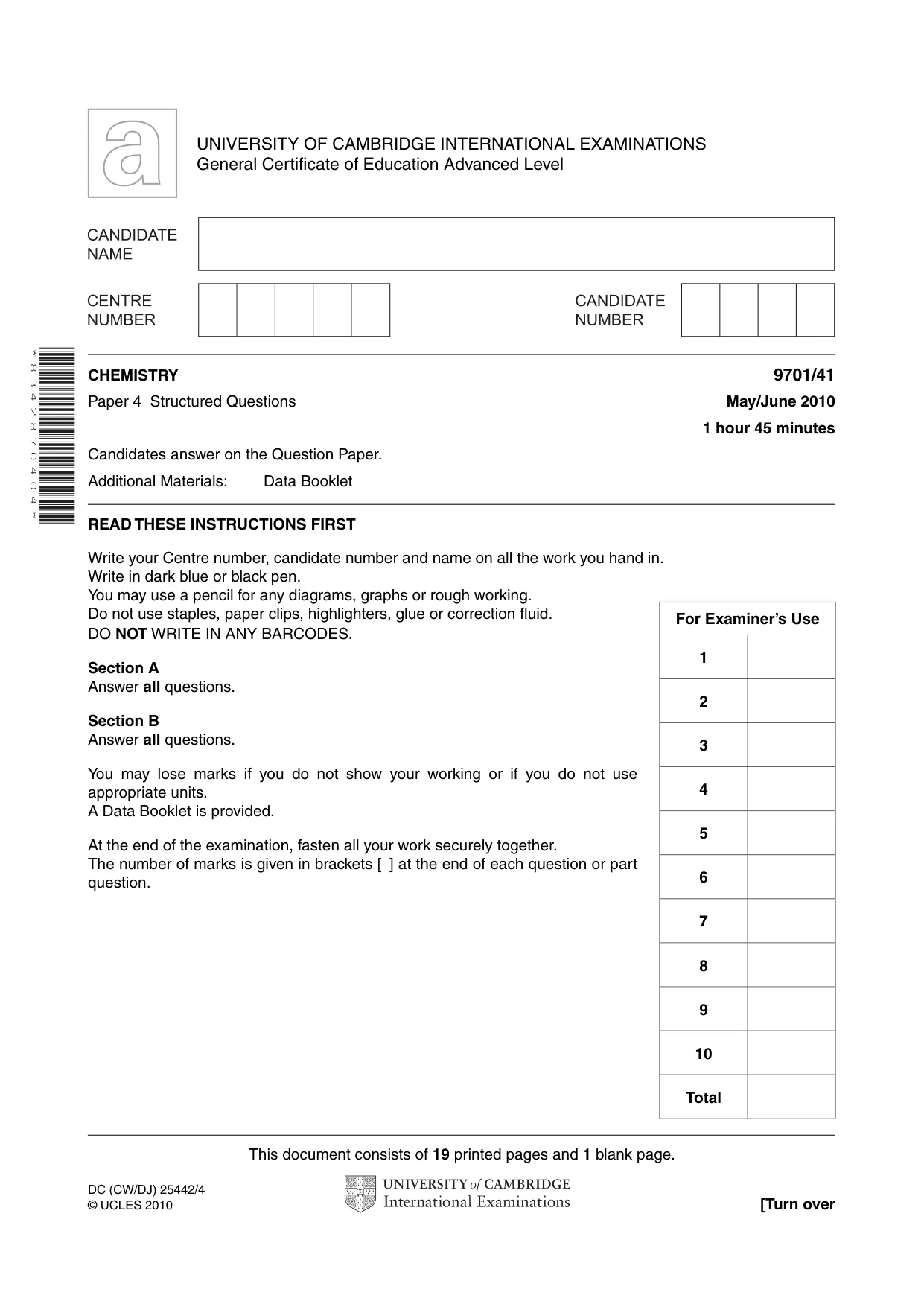
Question paper, page 1
This document consists of 19 printed pages and 1 blank page. DC (CW/DJ) 25442/4 © UCLES 2010 [Turn over UNIVERSITY OF CAMBRIDGE INTERNATIONAL EXAMINATIONS General Certificate of Education Advanced Level READ THESE INSTRUCTIONS FIRST Write your Centre number, candidate number and name on all the work you hand in. Write in dark blue or black pen. You may use a pencil for any diagrams, graphs or rough working. Do not use staples, paper clips, highlighters, glue or correction fluid. DO NOT WRITE IN ANY BARCODES. Section A Answer all questions. Section B Answer all questions. You may lose marks if you do not show your working or if you do not use appropriate units. A Data Booklet is provided. At the end of the examination, fasten all your work securely together. The number of marks is given in brackets [ ] at the end of each question or part question. * 8 3 4 2 8 7 0 4 0 4 * CHEMISTRY 9701/41 Paper 4 Structured Questions May/June 2010 1 hour 45 minutes Candidates answer on the Question Paper. Additional Materials: Data Booklet For Examiner’s Use 1 2 3 4 5 6 7 8 9 10 Total
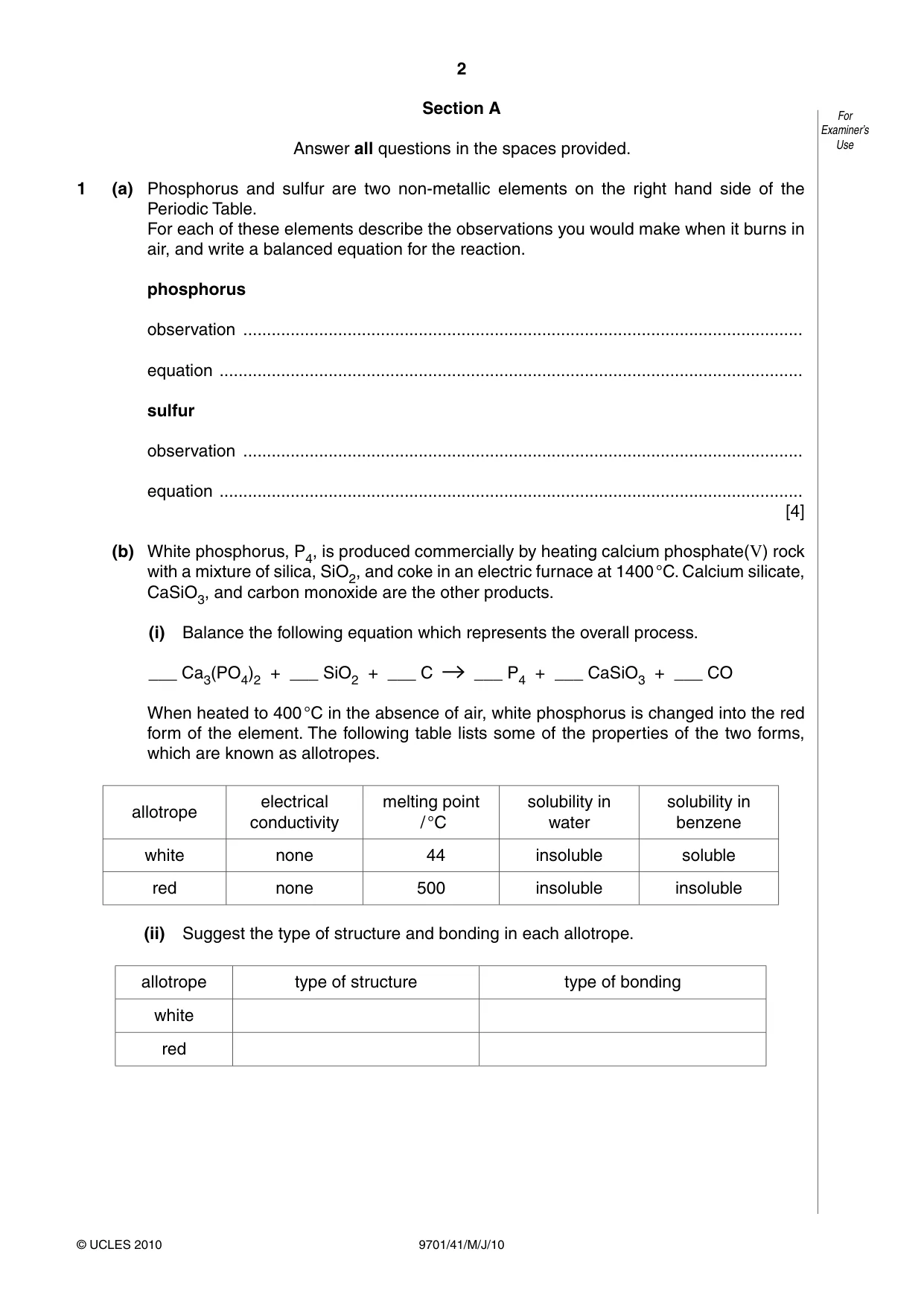
Question paper, page 2
2 9701/41/M/J/10 © UCLES 2010 For Examiner’s Use Section A Answer all questions in the spaces provided. 1 (a) Phosphorus and sulfur are two non-metallic elements on the right hand side of the Periodic Table. For each of these elements describe the observations you would make when it burns in air, and write a balanced equation for the reaction. phosphorus observation … equation … sulfur observation … equation … [4] (b) White phosphorus, P4, is produced commercially by heating calcium phosphate(V) rock with a mixture of silica, SiO2, and coke in an electric furnace at 1400 °C. Calcium silicate, CaSiO3, and carbon monoxide are the other products. (i) Balance the following equation which represents the overall process. ___ Ca3(PO4)2 + ___ SiO2 + ___ C ___ P4 + ___ CaSiO3 + ___ CO When heated to 400 °C in the absence of air, white phosphorus is changed into the red form of the element. The following table lists some of the properties of the two forms, which are known as allotropes. allotrope electrical conductivity melting point / °C solubility in water solubility in benzene white none 44 insoluble soluble red none 500 insoluble insoluble (ii) Suggest the type of structure and bonding in each allotrope. allotrope type of structure type of bonding white red
Question paper, page 3
3 9701/41/M/J/10 © UCLES 2010 [Turn over For Examiner’s Use (iii) In both allotropes, phosphorus has a valency of 3. Suggest by means of diagrams how the phosphorus atoms might be joined together in each allotrope. white phosphorus red phosphorus [7] [Total: 11]
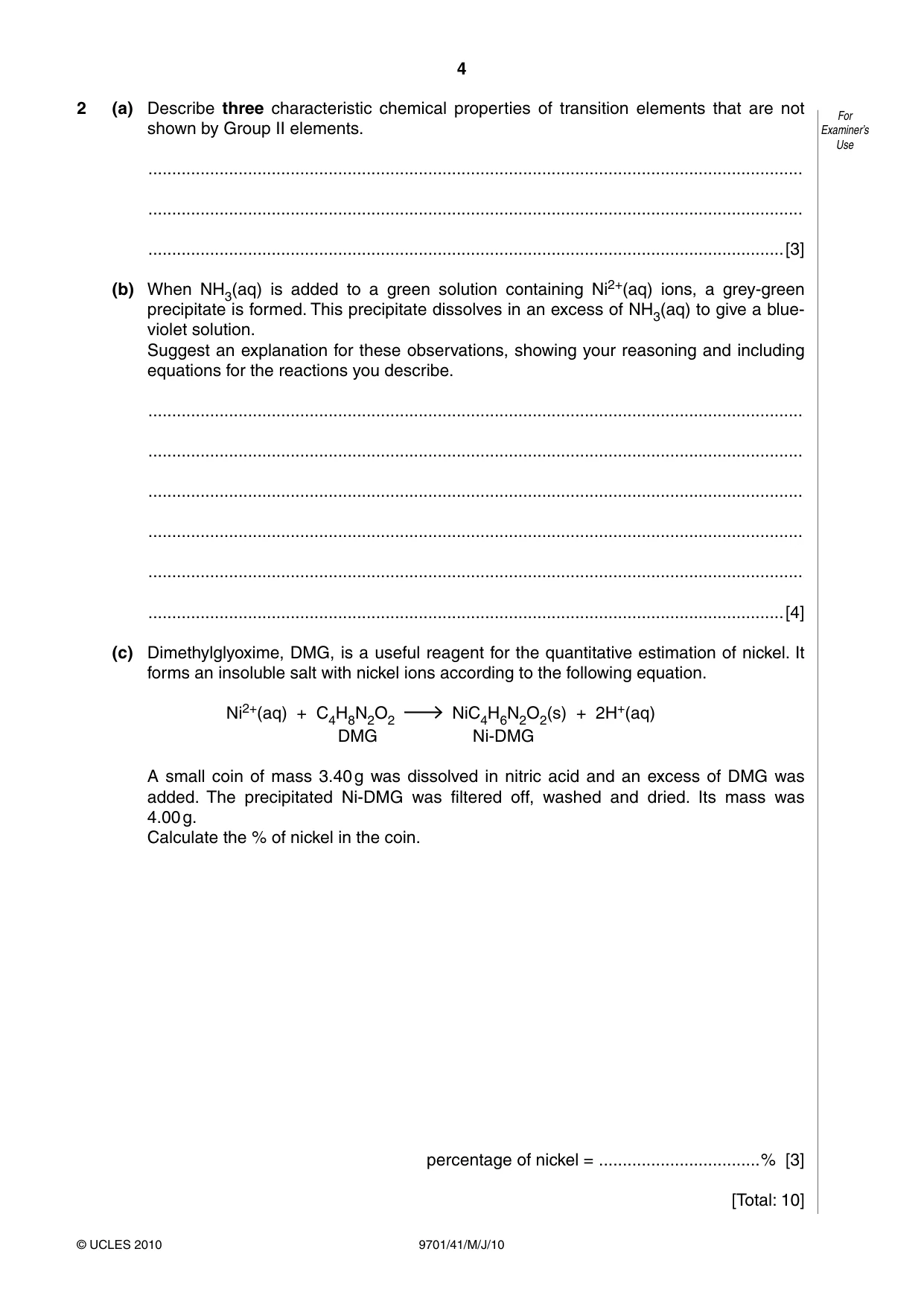
Question paper, page 4
4 9701/41/M/J/10 © UCLES 2010 For Examiner’s Use 2 (a) Describe three characteristic chemical properties of transition elements that are not shown by Group II elements. … … …[3] (b) When NH3(aq) is added to a green solution containing Ni2+(aq) ions, a grey-green precipitate is formed. This precipitate dissolves in an excess of NH3(aq) to give a blue- violet solution. Suggest an explanation for these observations, showing your reasoning and including equations for the reactions you describe. … … … … … …[4] (c) Dimethylglyoxime, DMG, is a useful reagent for the quantitative estimation of nickel. It forms an insoluble salt with nickel ions according to the following equation. Ni2+(aq) + C4H8N2O2 NiC4H6N2O2(s) + 2H+(aq) DMG Ni-DMG A small coin of mass 3.40 g was dissolved in nitric acid and an excess of DMG was added. The precipitated Ni-DMG was filtered off, washed and dried. Its mass was 4.00 g. Calculate the % of nickel in the coin. percentage of nickel = …% [3] [Total: 10]
Question paper, page 5
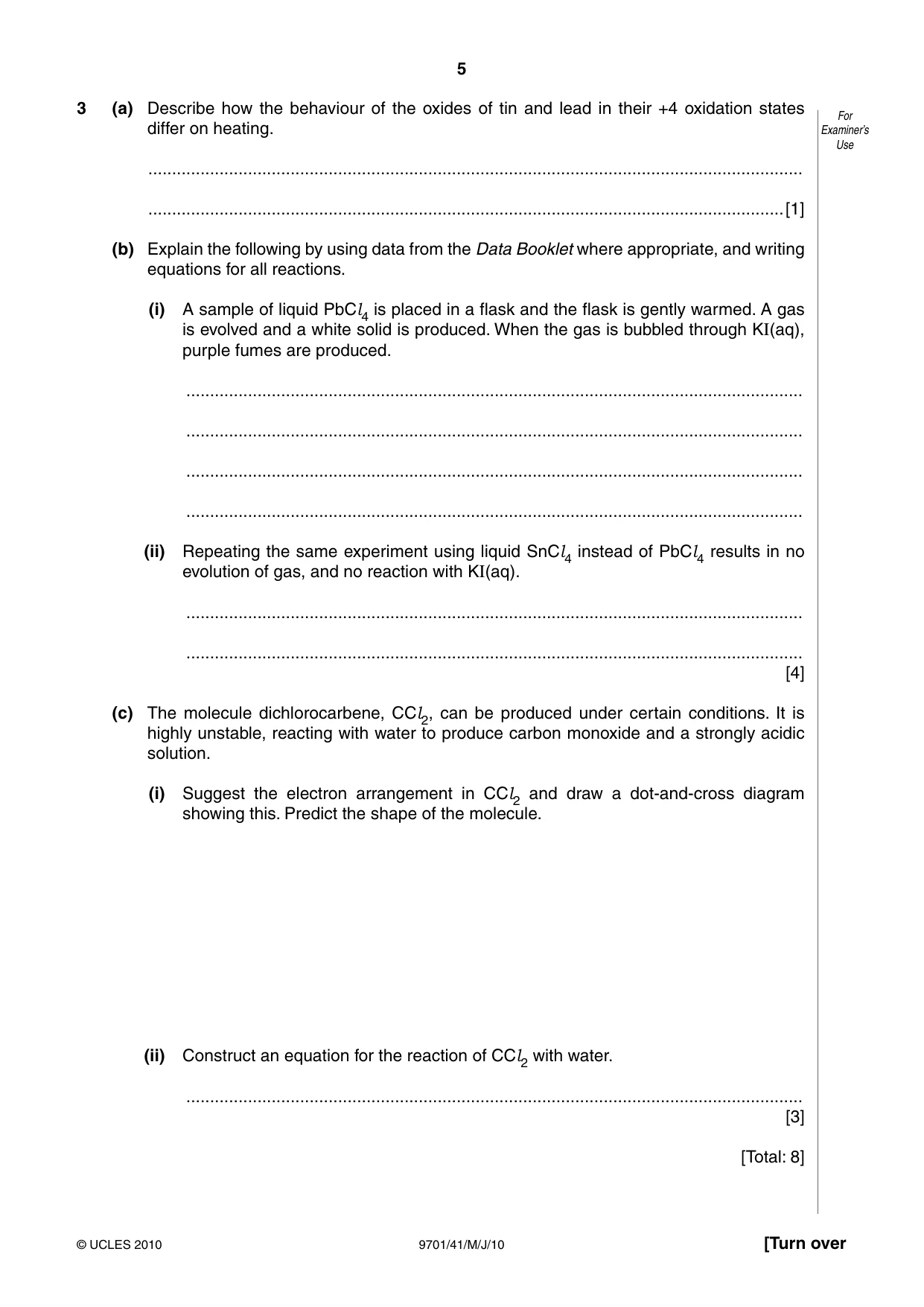
5 9701/41/M/J/10 © UCLES 2010 [Turn over For Examiner’s Use 3 (a) Describe how the behaviour of the oxides of tin and lead in their +4 oxidation states differ on heating. … …[1] (b) Explain the following by using data from the Data Booklet where appropriate, and writing equations for all reactions. (i) A sample of liquid PbCl4 is placed in a flask and the flask is gently warmed. A gas is evolved and a white solid is produced. When the gas is bubbled through KI(aq), purple fumes are produced. … … … … (ii) Repeating the same experiment using liquid SnCl4 instead of PbCl4 results in no evolution of gas, and no reaction with KI(aq). … … [4] (c) The molecule dichlorocarbene, CCl2, can be produced under certain conditions. It is highly unstable, reacting with water to produce carbon monoxide and a strongly acidic solution. (i) Suggest the electron arrangement in CCl2 and draw a dot-and-cross diagram showing this. Predict the shape of the molecule. (ii) Construct an equation for the reaction of CCl2 with water. … [3] [Total: 8]
Question paper, page 6
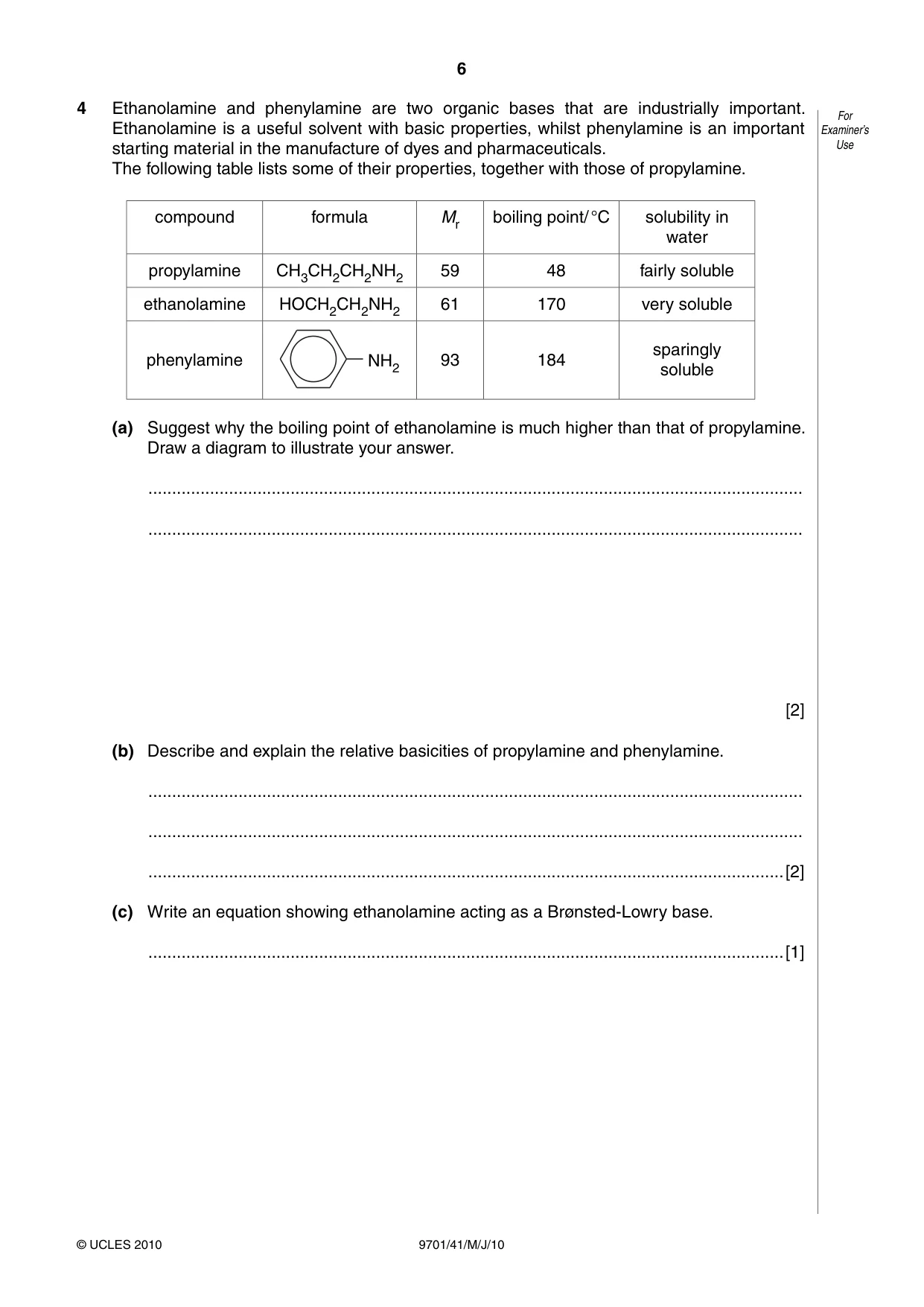
6 9701/41/M/J/10 © UCLES 2010 For Examiner’s Use 4 Ethanolamine and phenylamine are two organic bases that are industrially important. Ethanolamine is a useful solvent with basic properties, whilst phenylamine is an important starting material in the manufacture of dyes and pharmaceuticals. The following table lists some of their properties, together with those of propylamine. compound formula Mr boiling point/ °C solubility in water propylamine CH3CH2CH2NH2 59 48 fairly soluble ethanolamine HOCH2CH2NH2 61 170 very soluble phenylamine NH2 93 184 sparingly soluble (a) Suggest why the boiling point of ethanolamine is much higher than that of propylamine. Draw a diagram to illustrate your answer. … … [2] (b) Describe and explain the relative basicities of propylamine and phenylamine. … … …[2] (c) Write an equation showing ethanolamine acting as a Brønsted-Lowry base. …[1]
Question paper, page 7
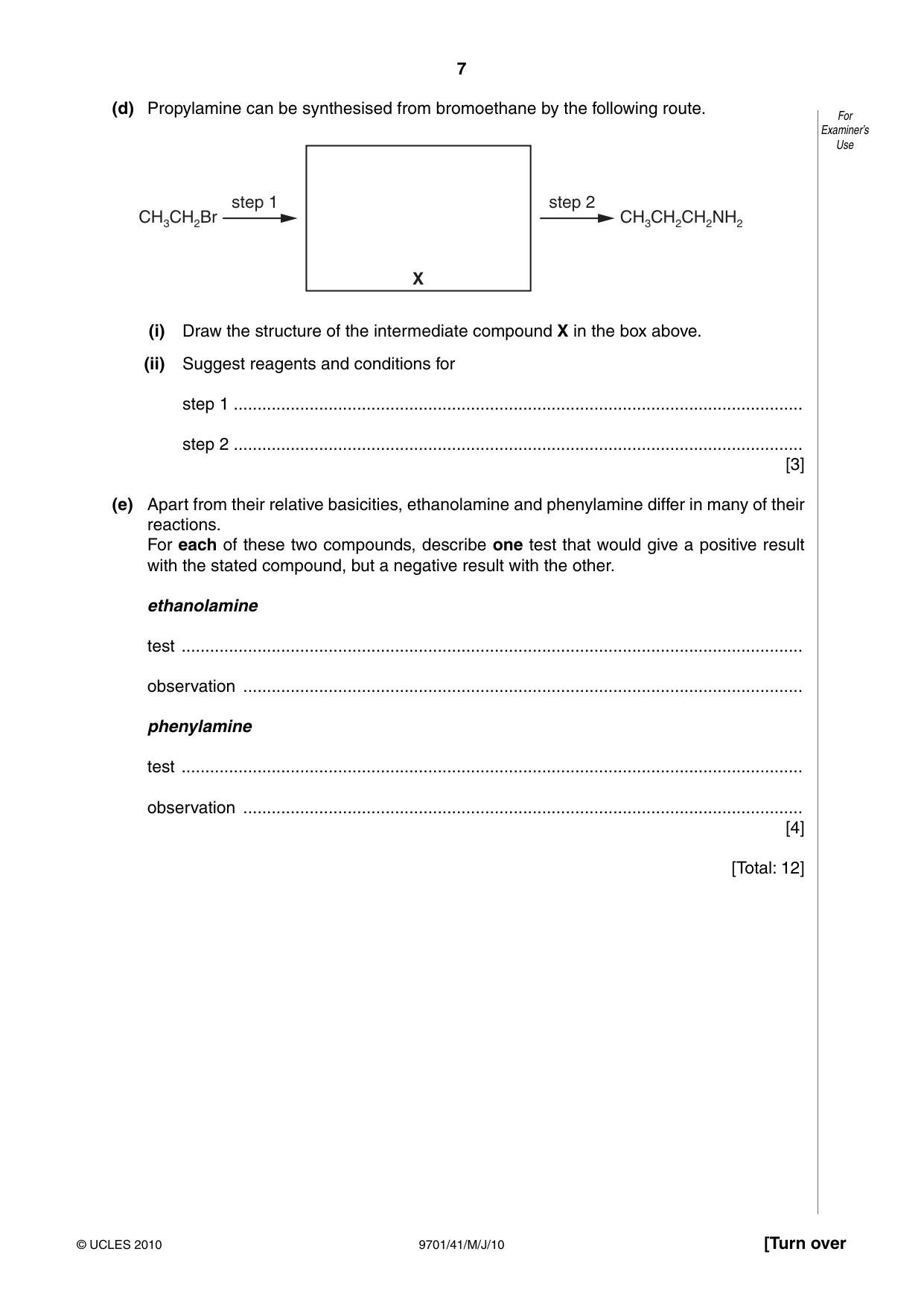
7 9701/41/M/J/10 © UCLES 2010 [Turn over For Examiner’s Use (d) Propylamine can be synthesised from bromoethane by the following route. CH3CH2Br CH3CH2CH2NH2 step 1 X step 2 (i) Draw the structure of the intermediate compound X in the box above. (ii) Suggest reagents and conditions for step 1 … step 2 … [3] (e) Apart from their relative basicities, ethanolamine and phenylamine differ in many of their reactions. For each of these two compounds, describe one test that would give a positive result with the stated compound, but a negative result with the other. ethanolamine test … observation … phenylamine test … observation … [4] [Total: 12]
Question paper, page 8
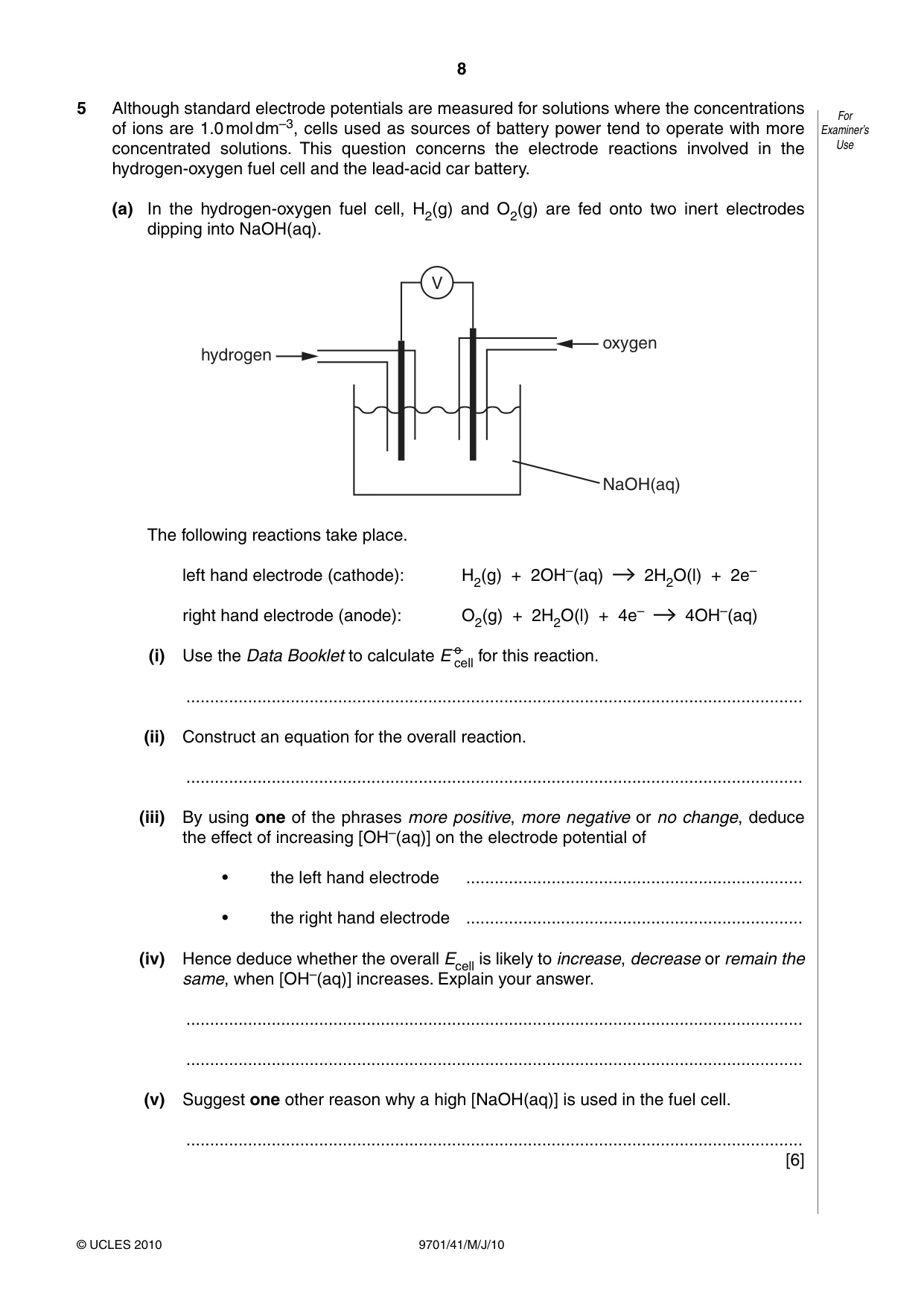
8 9701/41/M/J/10 © UCLES 2010 For Examiner’s Use 5 Although standard electrode potentials are measured for solutions where the concentrations of ions are 1.0 mol dm–3, cells used as sources of battery power tend to operate with more concentrated solutions. This question concerns the electrode reactions involved in the hydrogen-oxygen fuel cell and the lead-acid car battery. (a) In the hydrogen-oxygen fuel cell, H2(g) and O2(g) are fed onto two inert electrodes dipping into NaOH(aq). V hydrogen oxygen NaOH(aq) The following reactions take place. left hand electrode (cathode): H2(g) + 2OH–(aq) 2H2O(l) + 2e– right hand electrode (anode): O2(g) + 2H2O(l) + 4e– 4OH–(aq) (i) Use the Data Booklet to calculate E o–– cell for this reaction. … (ii) Construct an equation for the overall reaction. … (iii) By using one of the phrases more positive, more negative or no change, deduce the effect of increasing [OH–(aq)] on the electrode potential of • the left hand electrode … • the right hand electrode … (iv) Hence deduce whether the overall Ecell is likely to increase, decrease or remain the same, when [OH–(aq)] increases. Explain your answer. … … (v) Suggest one other reason why a high [NaOH(aq)] is used in the fuel cell. … [6]
Question paper, page 9
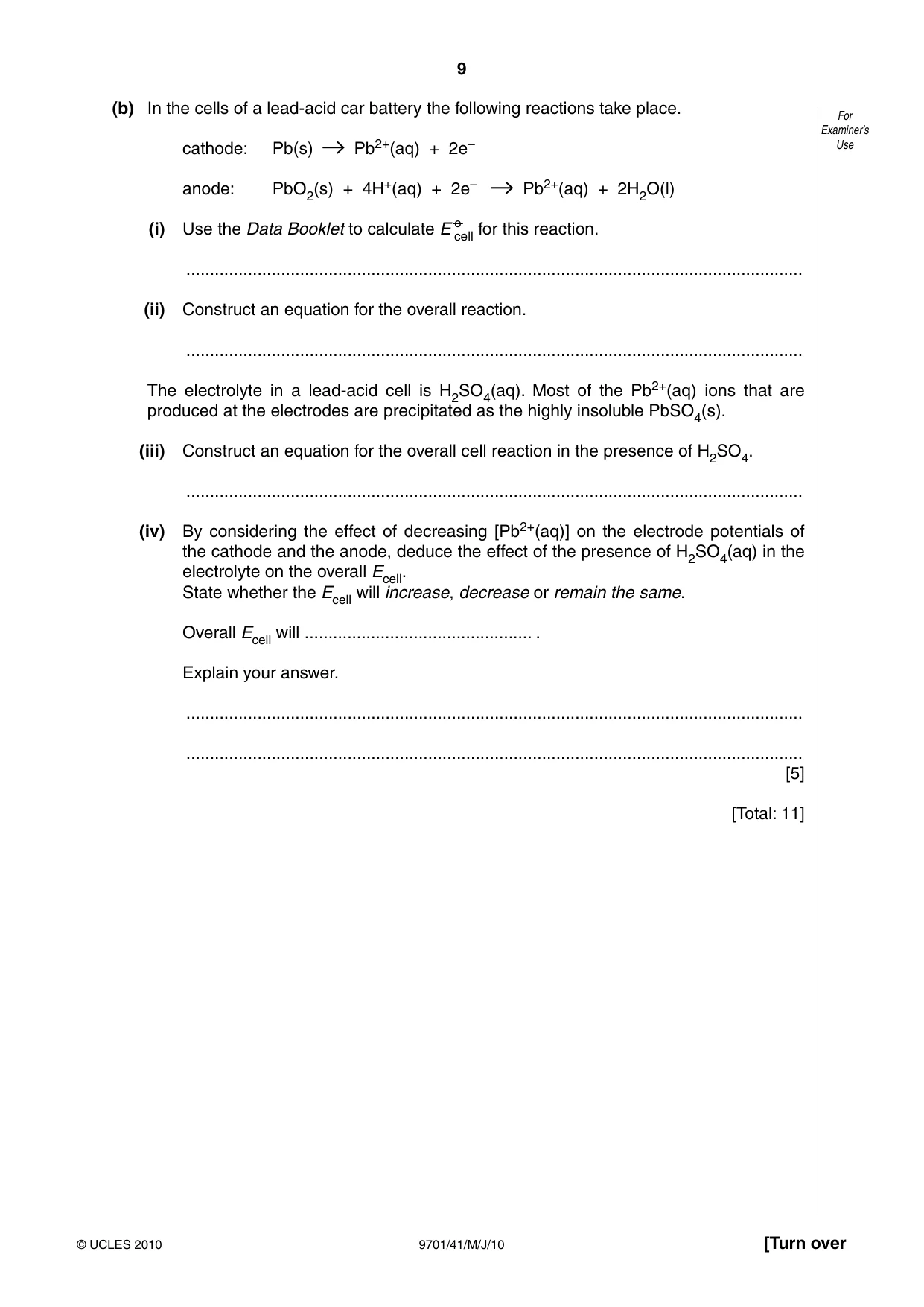
9 9701/41/M/J/10 © UCLES 2010 [Turn over For Examiner’s Use (b) In the cells of a lead-acid car battery the following reactions take place. cathode: Pb(s) Pb2+(aq) + 2e– anode: PbO2(s) + 4H+(aq) + 2e– Pb2+(aq) + 2H2O(l) (i) Use the Data Booklet to calculate E o–– cell for this reaction. … (ii) Construct an equation for the overall reaction. … The electrolyte in a lead-acid cell is H2SO4(aq). Most of the Pb2+(aq) ions that are produced at the electrodes are precipitated as the highly insoluble PbSO4(s). (iii) Construct an equation for the overall cell reaction in the presence of H2SO4. … (iv) By considering the effect of decreasing [Pb2+(aq)] on the electrode potentials of the cathode and the anode, deduce the effect of the presence of H2SO4(aq) in the electrolyte on the overall Ecell. State whether the Ecell will increase, decrease or remain the same. Overall Ecell will … . Explain your answer. … … [5] [Total: 11]
Question paper, page 10
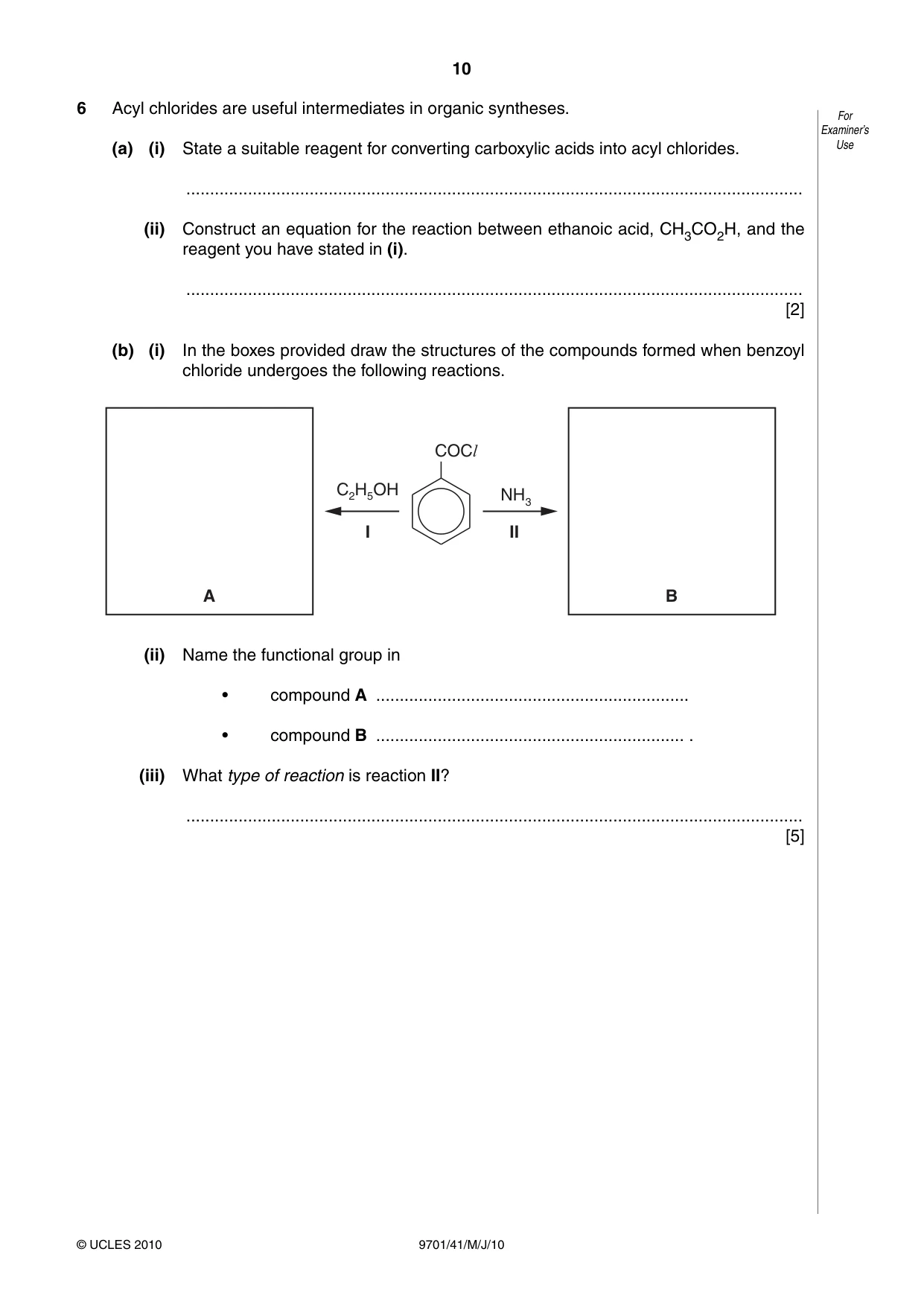
10 9701/41/M/J/10 © UCLES 2010 For Examiner’s Use 6 Acyl chlorides are useful intermediates in organic syntheses. (a) (i) State a suitable reagent for converting carboxylic acids into acyl chlorides. … (ii) Construct an equation for the reaction between ethanoic acid, CH3CO2H, and the reagent you have stated in (i). … [2] (b) (i) In the boxes provided draw the structures of the compounds formed when benzoyl chloride undergoes the following reactions. C2H5OH COCl I II A NH3 B (ii) Name the functional group in • compound A … • compound B … . (iii) What type of reaction is reaction II? … [5]
Question paper, page 11
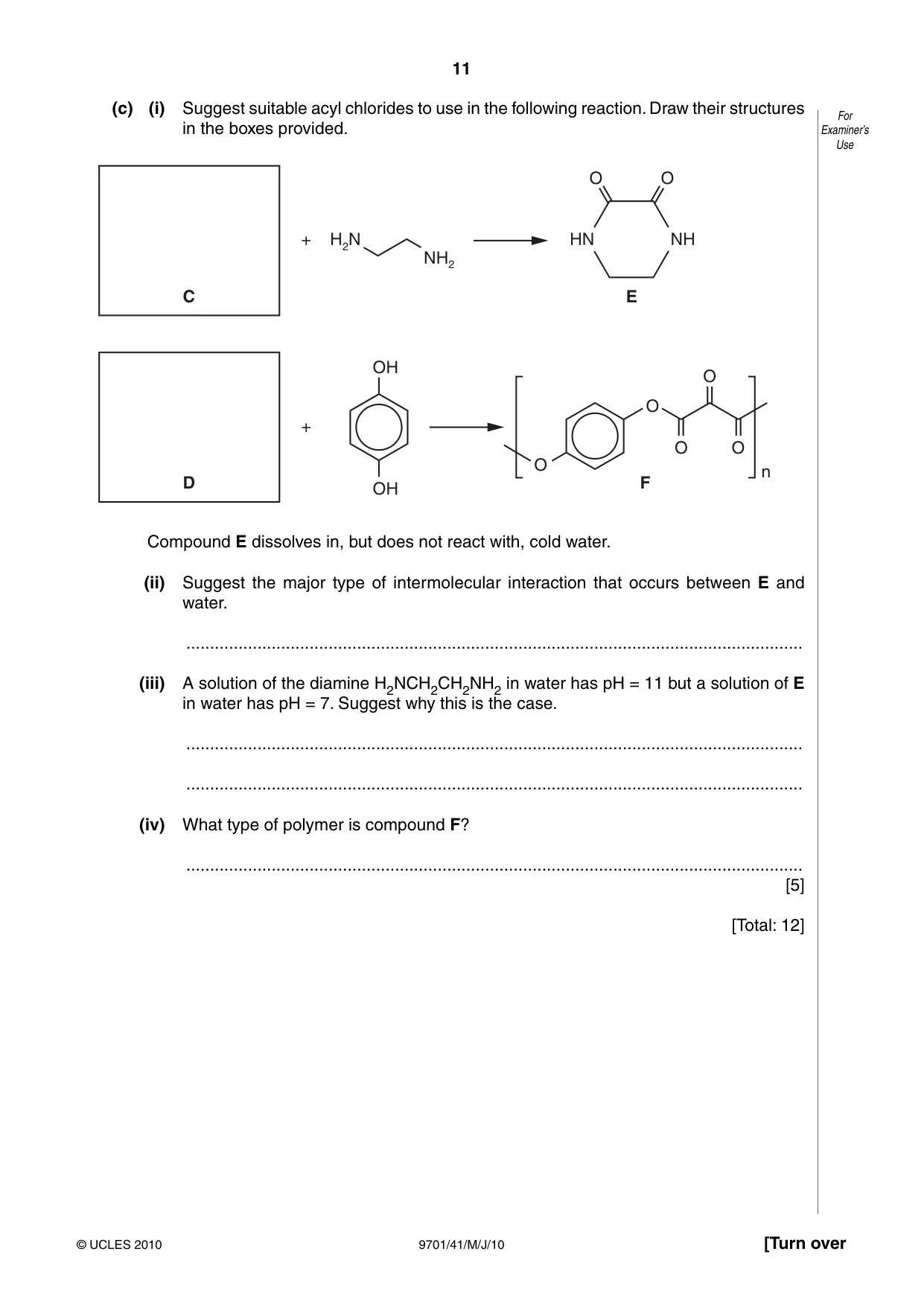
11 9701/41/M/J/10 © UCLES 2010 [Turn over For Examiner’s Use (c) (i) Suggest suitable acyl chlorides to use in the following reaction. Draw their structures in the boxes provided. + H2N NH2 NH HN O O OH OH O O C E O O O n + D F Compound E dissolves in, but does not react with, cold water. (ii) Suggest the major type of intermolecular interaction that occurs between E and water. … (iii) A solution of the diamine H2NCH2CH2NH2 in water has pH = 11 but a solution of E in water has pH = 7. Suggest why this is the case. … … (iv) What type of polymer is compound F? … [5] [Total: 12]
Question paper, page 12
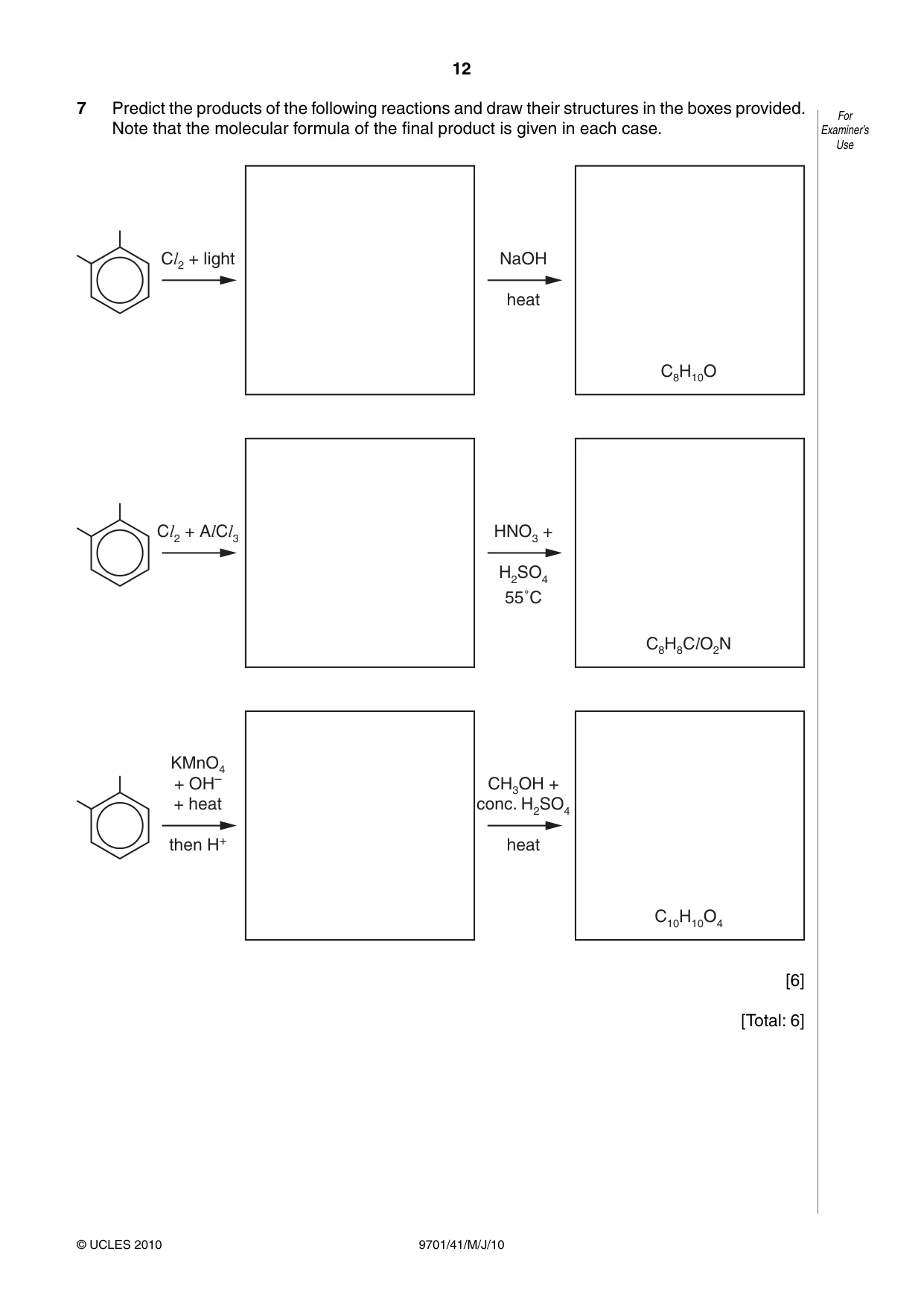
12 9701/41/M/J/10 © UCLES 2010 For Examiner’s Use 7 Predict the products of the following reactions and draw their structures in the boxes provided. Note that the molecular formula of the final product is given in each case. Cl2 + light C8H10O NaOH heat Cl2 + AlCl3 C8H8ClO2N HNO3 + H2SO4 55˚C KMnO4 + OH– + heat then H+ C10H10O4 CH3OH + conc. H2SO4 heat [6] [Total: 6]
Question paper, page 13
13 9701/41/M/J/10 © UCLES 2010 [Turn over BLANK PAGE
Question paper, page 14
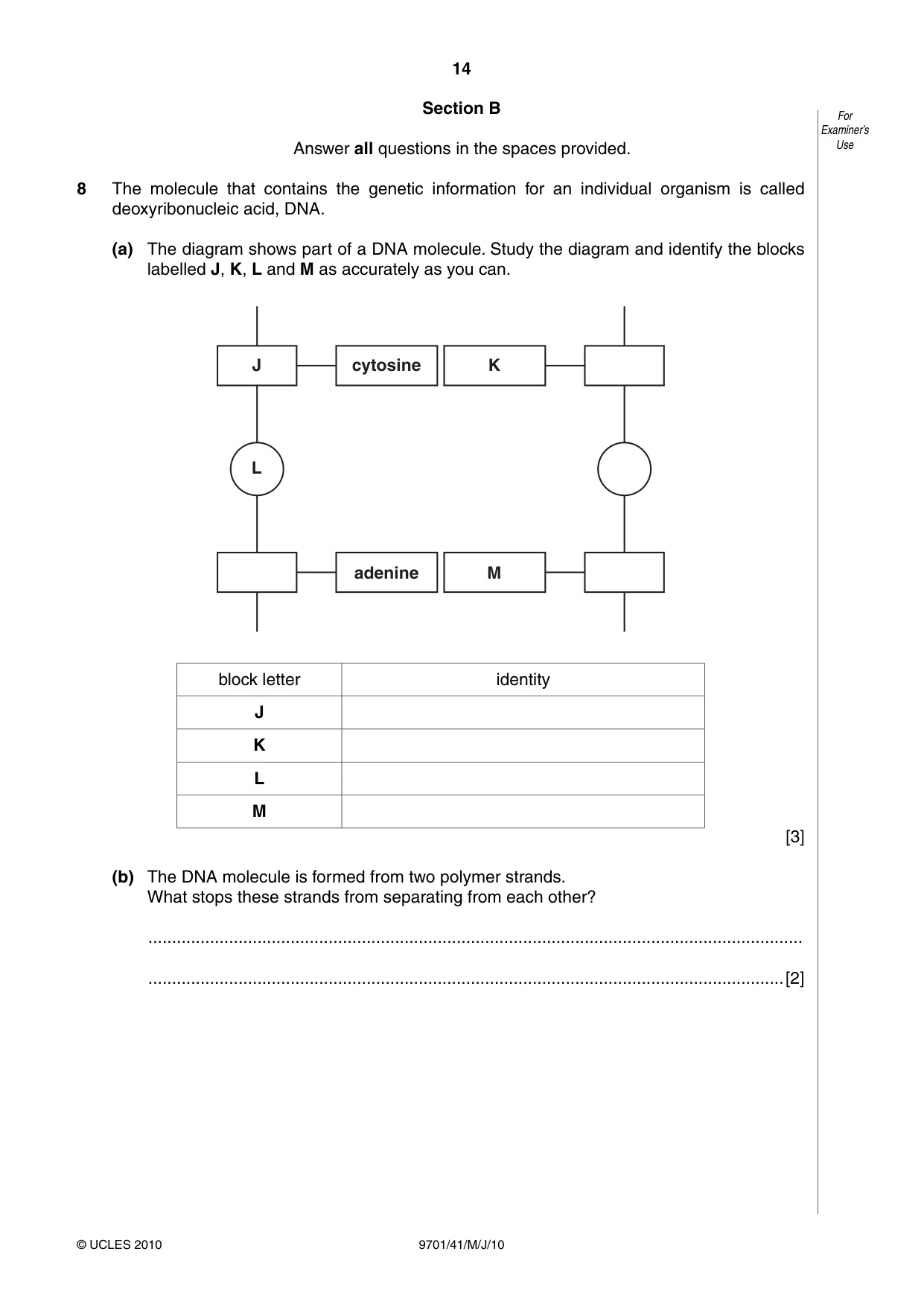
14 9701/41/M/J/10 © UCLES 2010 For Examiner’s Use Section B Answer all questions in the spaces provided. 8 The molecule that contains the genetic information for an individual organism is called deoxyribonucleic acid, DNA. (a) The diagram shows part of a DNA molecule. Study the diagram and identify the blocks labelled J, K, L and M as accurately as you can. J cytosine K adenine M L block letter identity J K L M [3] (b) The DNA molecule is formed from two polymer strands. What stops these strands from separating from each other? … …[2]
Question paper, page 15
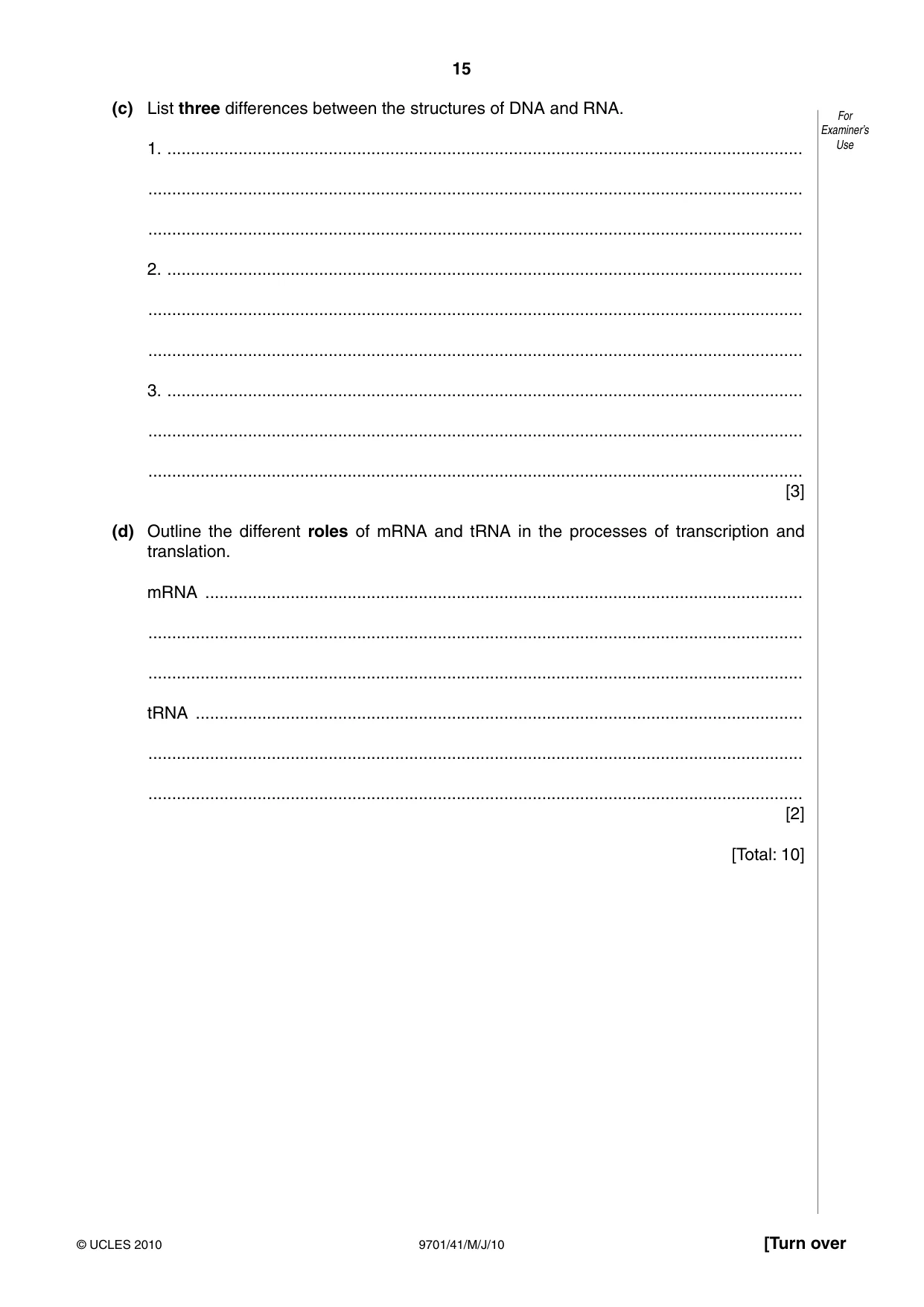
15 9701/41/M/J/10 © UCLES 2010 [Turn over For Examiner’s Use (c) List three differences between the structures of DNA and RNA. 1. … … … 2. … … … 3. … … … [3] (d) Outline the different roles of mRNA and tRNA in the processes of transcription and translation. mRNA … … … tRNA … … … [2] [Total: 10]
Question paper, page 16
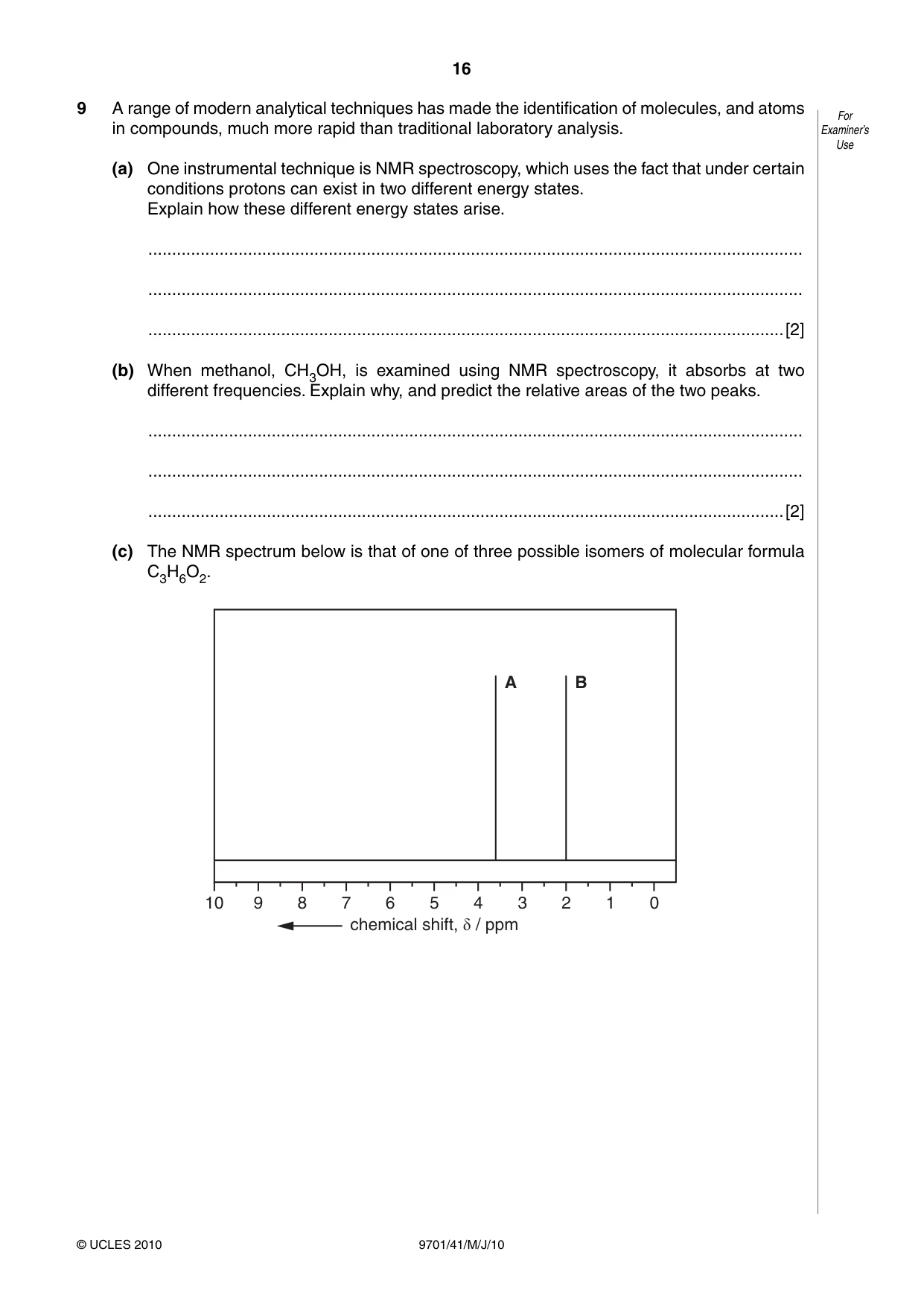
16 9701/41/M/J/10 © UCLES 2010 For Examiner’s Use 9 A range of modern analytical techniques has made the identification of molecules, and atoms in compounds, much more rapid than traditional laboratory analysis. (a) One instrumental technique is NMR spectroscopy, which uses the fact that under certain conditions protons can exist in two different energy states. Explain how these different energy states arise. … … …[2] (b) When methanol, CH3OH, is examined using NMR spectroscopy, it absorbs at two different frequencies. Explain why, and predict the relative areas of the two peaks. … … …[2] (c) The NMR spectrum below is that of one of three possible isomers of molecular formula C3H6O2. 10 9 8 7 6 5 chemical shift, δ / ppm A B 4 3 2 1 0
Question paper, page 17
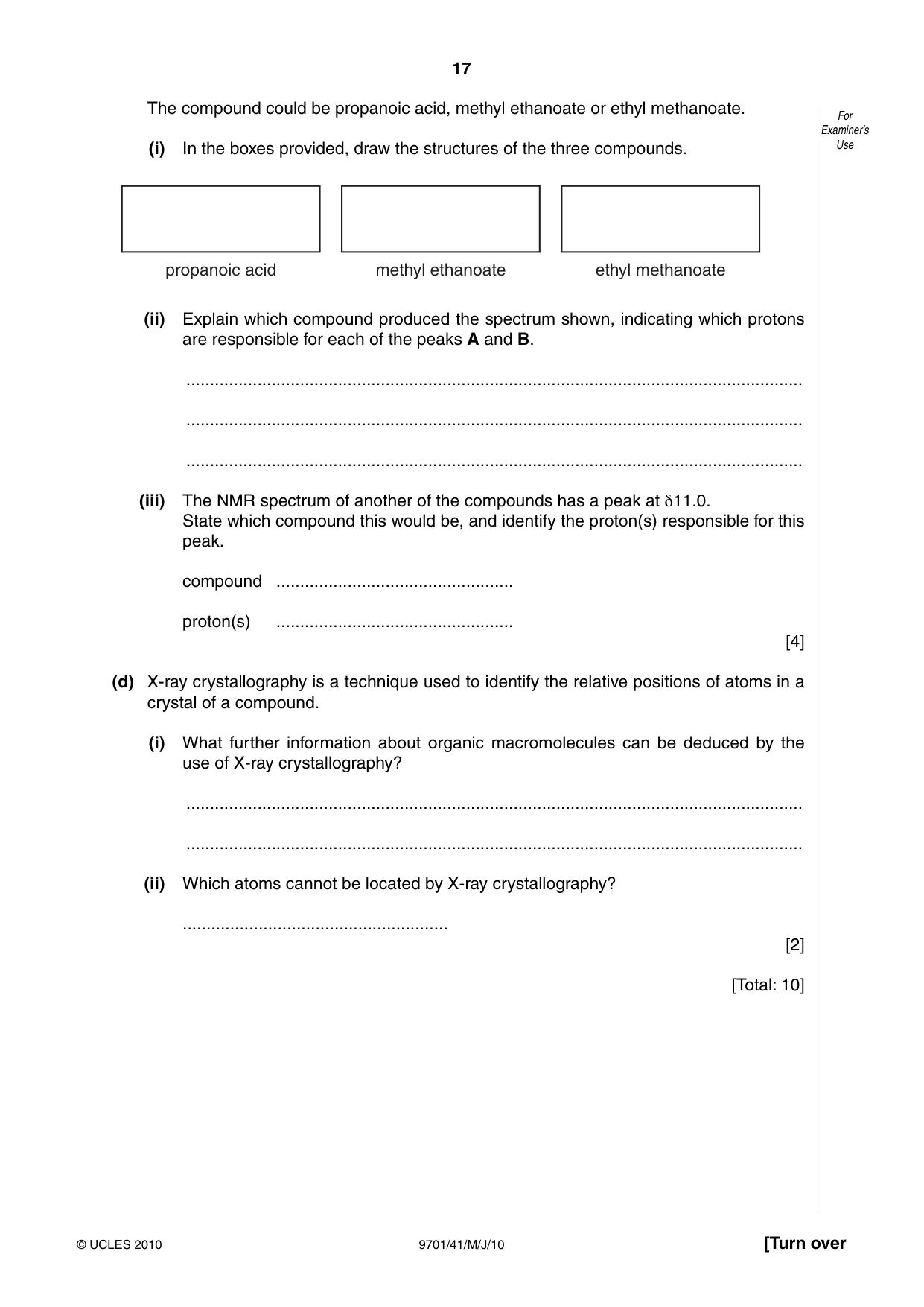
17 9701/41/M/J/10 © UCLES 2010 [Turn over For Examiner’s Use The compound could be propanoic acid, methyl ethanoate or ethyl methanoate. (i) In the boxes provided, draw the structures of the three compounds. propanoic acid methyl ethanoate ethyl methanoate (ii) Explain which compound produced the spectrum shown, indicating which protons are responsible for each of the peaks A and B. … … … (iii) The NMR spectrum of another of the compounds has a peak at δ11.0. State which compound this would be, and identify the proton(s) responsible for this peak. compound … proton(s) … [4] (d) X-ray crystallography is a technique used to identify the relative positions of atoms in a crystal of a compound. (i) What further information about organic macromolecules can be deduced by the use of X-ray crystallography? … … (ii) Which atoms cannot be located by X-ray crystallography? … [2] [Total: 10]
Question paper, page 18
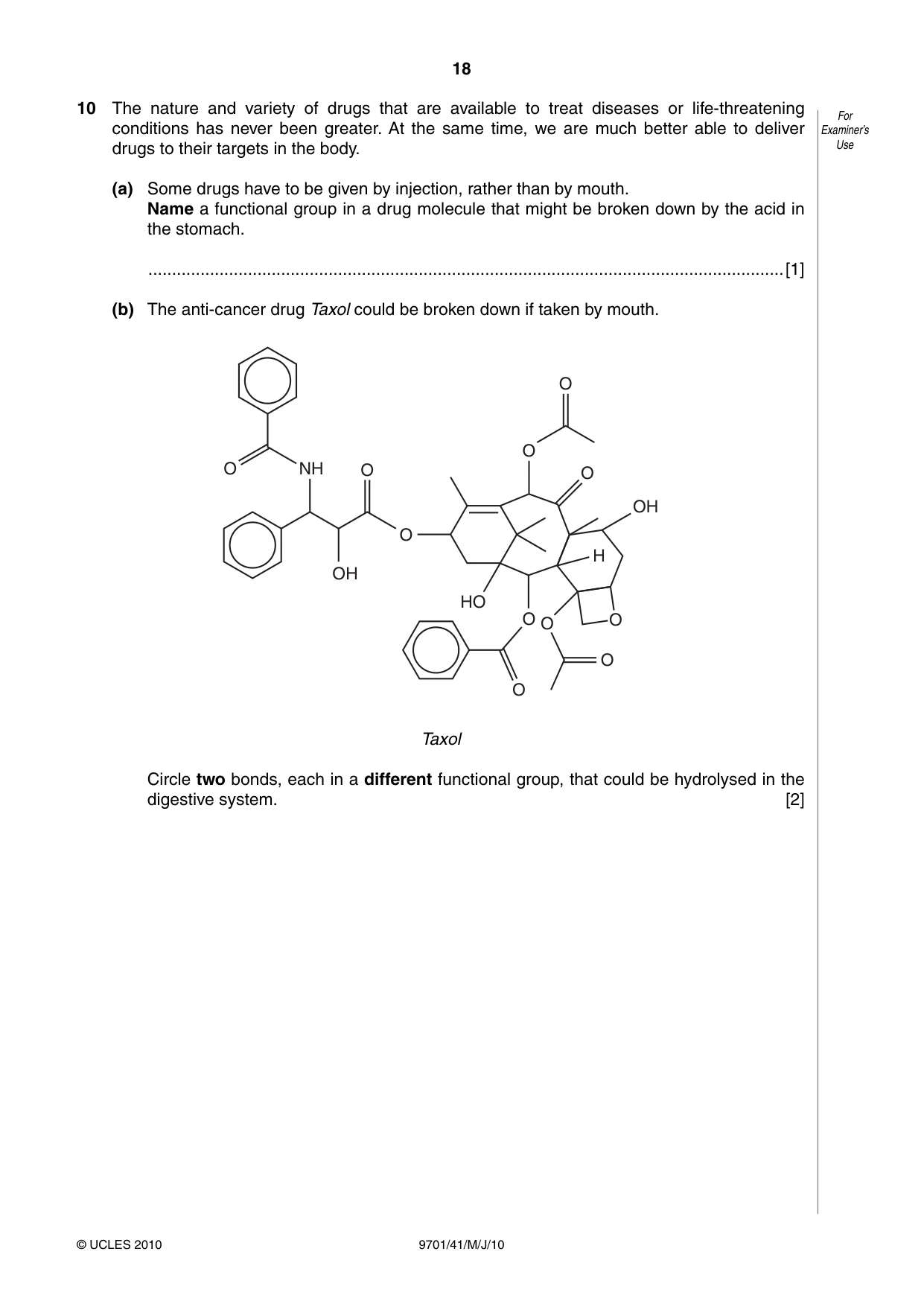
18 9701/41/M/J/10 © UCLES 2010 For Examiner’s Use 10 The nature and variety of drugs that are available to treat diseases or life-threatening conditions has never been greater. At the same time, we are much better able to deliver drugs to their targets in the body. (a) Some drugs have to be given by injection, rather than by mouth. Name a functional group in a drug molecule that might be broken down by the acid in the stomach. …[1] (b) The anti-cancer drug Taxol could be broken down if taken by mouth. O O O O O O O O O O OH O NH HO OH H Taxol Circle two bonds, each in a different functional group, that could be hydrolysed in the digestive system. [2]
Question paper, page 19
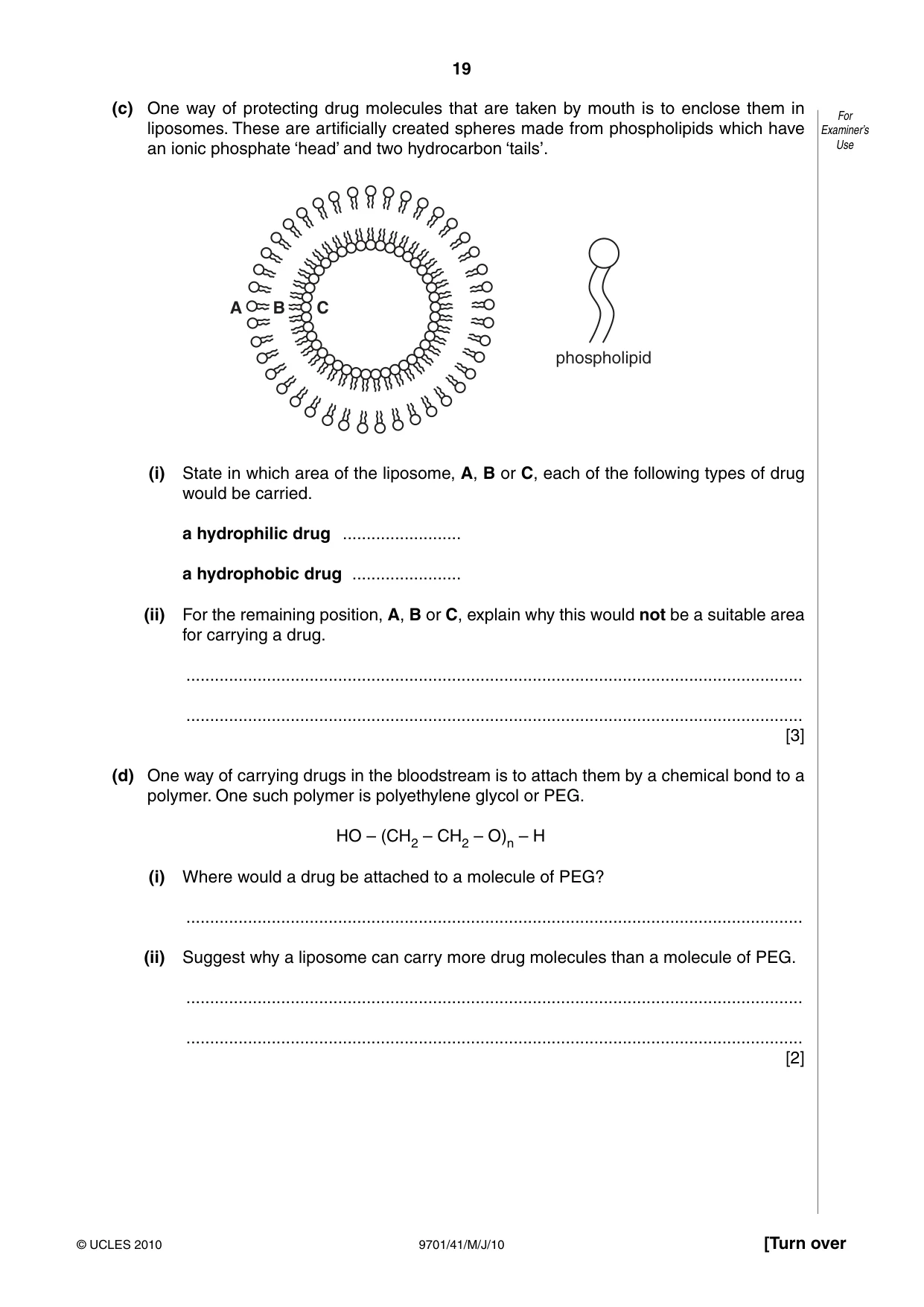
19 9701/41/M/J/10 © UCLES 2010 [Turn over For Examiner’s Use (c) One way of protecting drug molecules that are taken by mouth is to enclose them in liposomes. These are artificially created spheres made from phospholipids which have an ionic phosphate ‘head’ and two hydrocarbon ‘tails’. B A C phospholipid (i) State in which area of the liposome, A, B or C, each of the following types of drug would be carried. a hydrophilic drug … a hydrophobic drug … (ii) For the remaining position, A, B or C, explain why this would not be a suitable area for carrying a drug. … … [3] (d) One way of carrying drugs in the bloodstream is to attach them by a chemical bond to a polymer. One such polymer is polyethylene glycol or PEG. HO – (CH2 – CH2 – O)n – H (i) Where would a drug be attached to a molecule of PEG? … (ii) Suggest why a liposome can carry more drug molecules than a molecule of PEG. … … [2]
Question paper, page 20
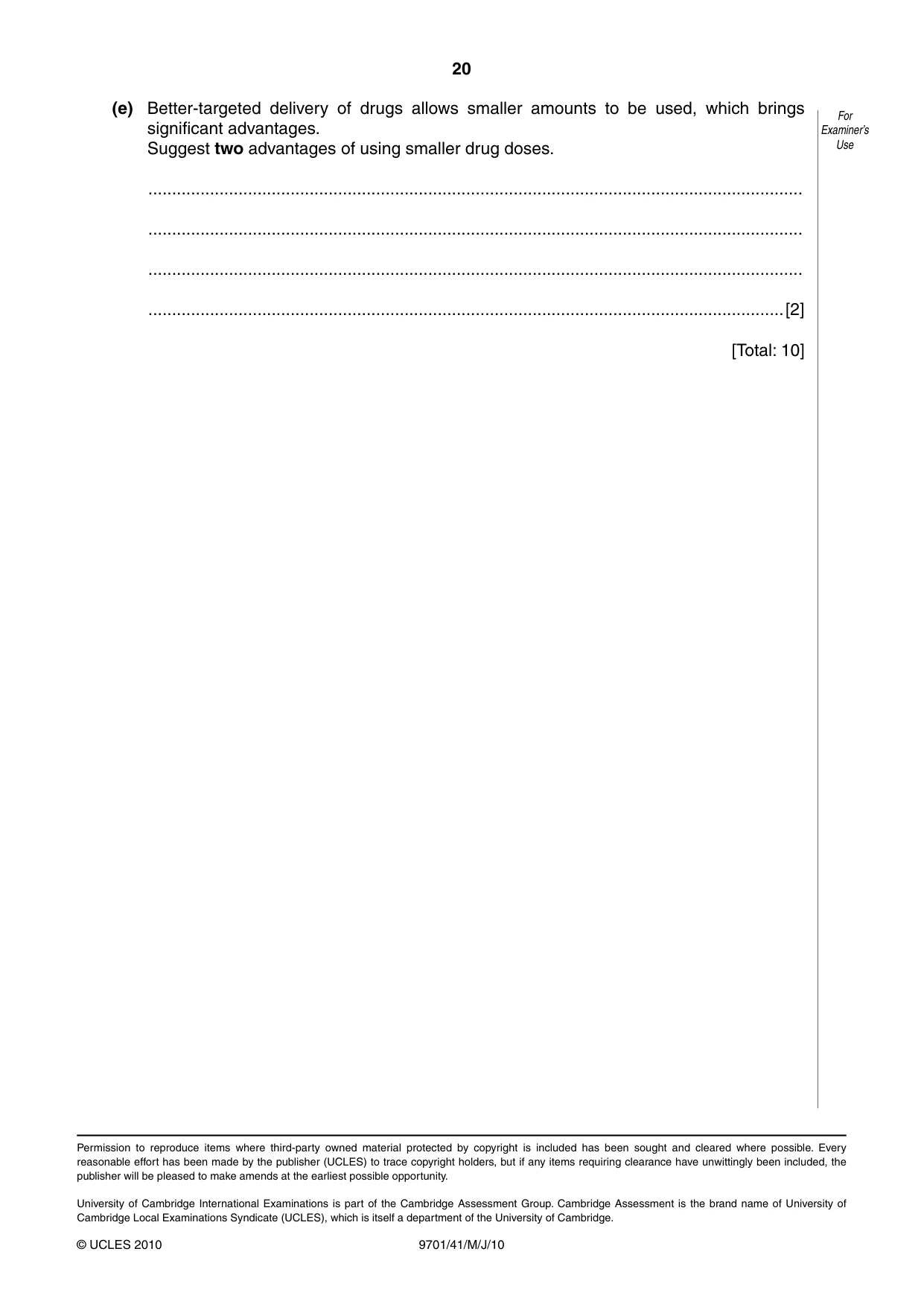
20 9701/41/M/J/10 © UCLES 2010 For Examiner’s Use (e) Better-targeted delivery of drugs allows smaller amounts to be used, which brings significant advantages. Suggest two advantages of using smaller drug doses. … … … …[2] [Total: 10] Permission to reproduce items where third-party owned material protected by copyright is included has been sought and cleared where possible. Every reasonable effort has been made by the publisher (UCLES) to trace copyright holders, but if any items requiring clearance have unwittingly been included, the publisher will be pleased to make amends at the earliest possible opportunity. University of Cambridge International Examinations is part of the Cambridge Assessment Group. Cambridge Assessment is the brand name of University of Cambridge Local Examinations Syndicate (UCLES), which is itself a department of the University of Cambridge.
Mark scheme, page 1
UNIVERSITY OF CAMBRIDGE INTERNATIONAL EXAMINATIONS GCE Advanced Subsidiary Level and GCE Advanced Level MARK SCHEME for the May/June 2010 question paper for the guidance of teachers 9701 CHEMISTRY 9701/41 Paper 4 (A2 Structured Questions), maximum raw mark 100 This mark scheme is published as an aid to teachers and candidates, to indicate the requirements of the examination. It shows the basis on which Examiners were instructed to award marks. It does not indicate the details of the discussions that took place at an Examiners’ meeting before marking began, which would have considered the acceptability of alternative answers. Mark schemes must be read in conjunction with the question papers and the report on the examination. • CIE will not enter into discussions or correspondence in connection with these mark schemes. CIE is publishing the mark schemes for the May/June 2010 question papers for most IGCSE, GCE Advanced Level and Advanced Subsidiary Level syllabuses and some Ordinary Level syllabuses.
Mark scheme, page 2
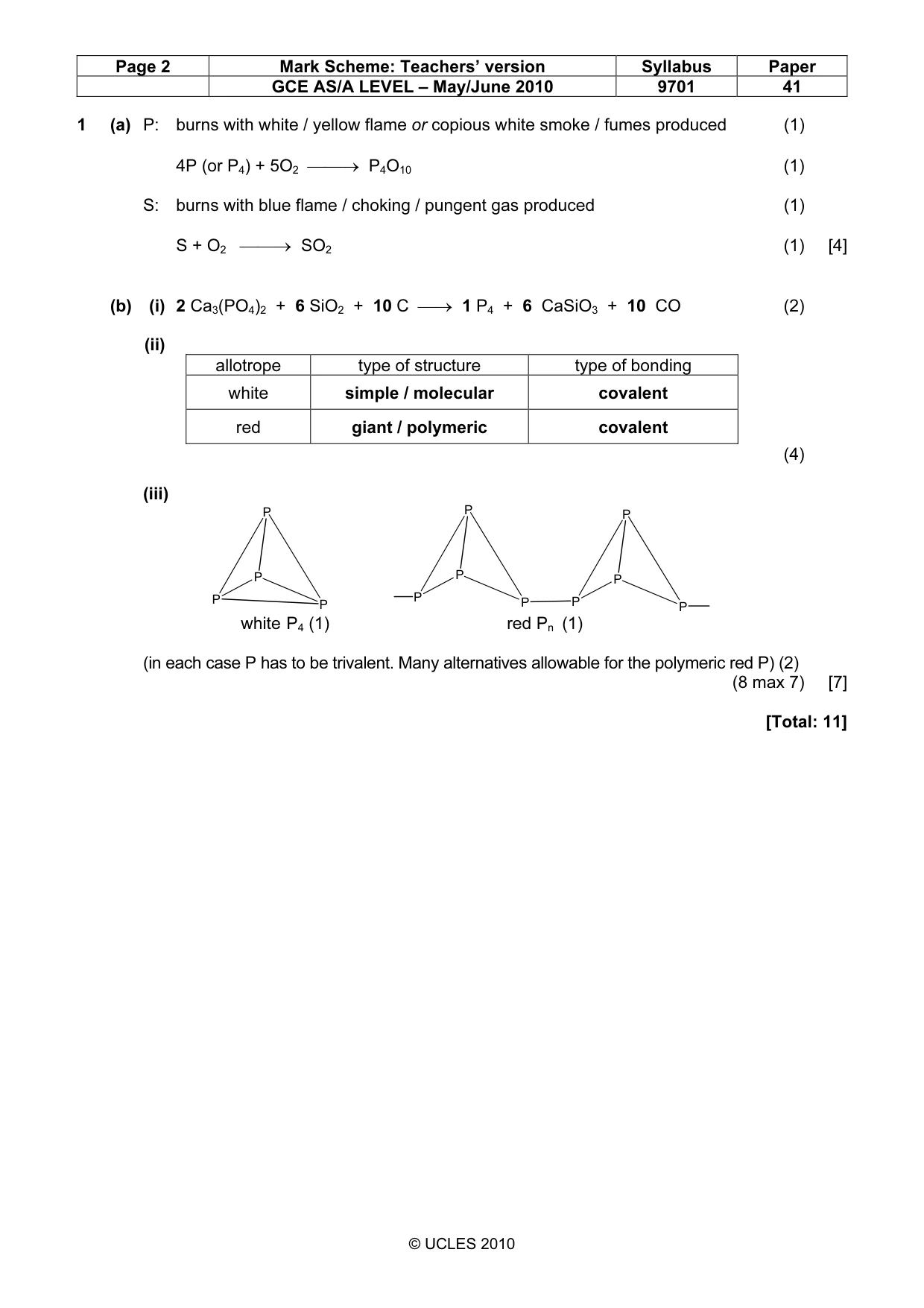
Page 2 Mark Scheme: Teachers’ version Syllabus Paper GCE AS/A LEVEL – May/June 2010 9701 41 © UCLES 2010 1 (a) P: burns with white / yellow flame or copious white smoke / fumes produced (1) 4P (or P4) + 5O2 → P4O10 (1) S: burns with blue flame / choking / pungent gas produced (1) S + O2 → SO2 (1) [4] (b) (i) 2 Ca3(PO4)2 + 6 SiO2 + 10 C → 1 P4 + 6 CaSiO3 + 10 CO (2) (ii) allotrope type of structure type of bonding white simple / molecular covalent red giant / polymeric covalent (4) (iii) P P P P P P P P P P P P white P4 (1) red Pn (1) (in each case P has to be trivalent. Many alternatives allowable for the polymeric red P) (2) (8 max 7) [7] [Total: 11]
Mark scheme, page 3
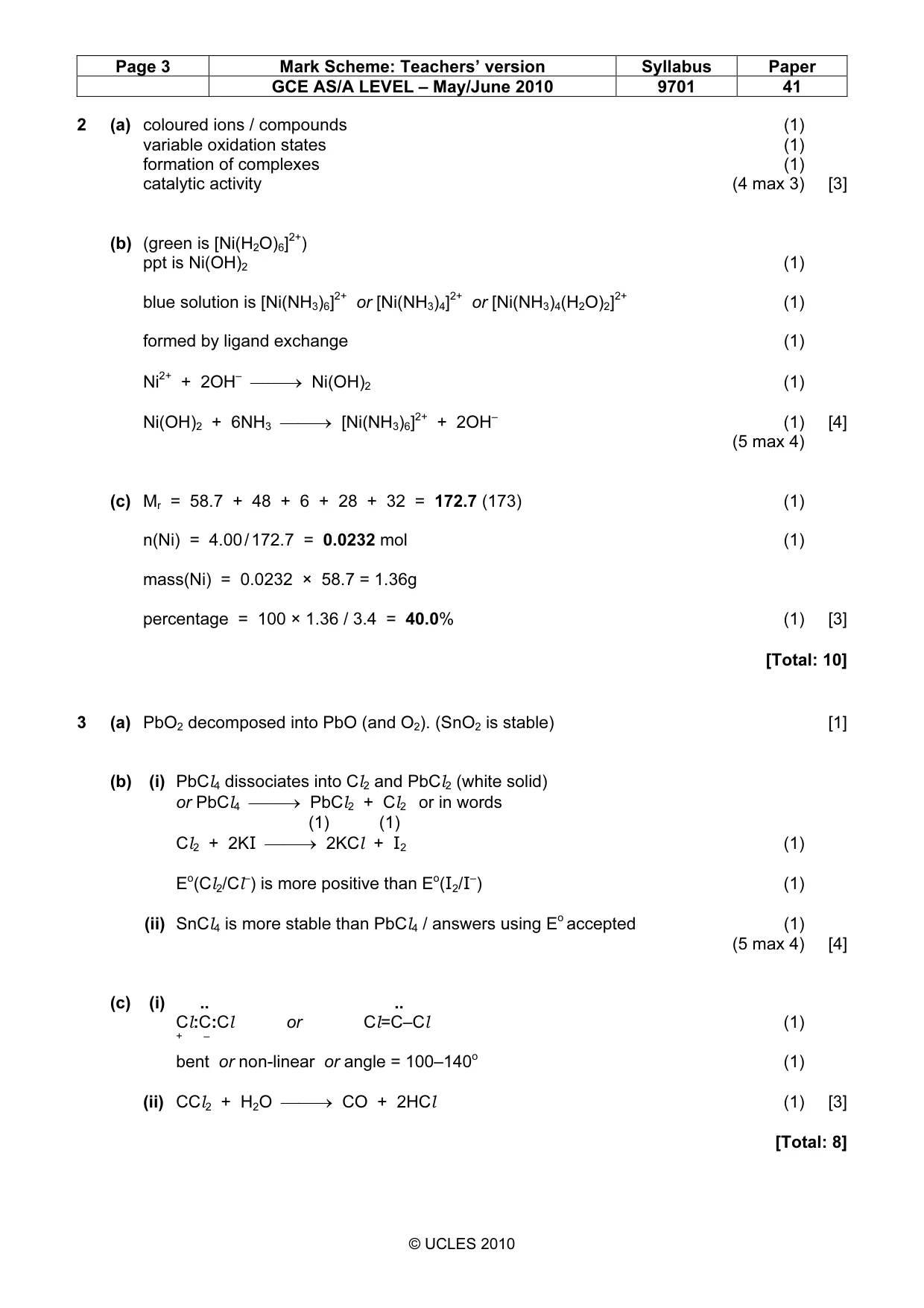
Page 3 Mark Scheme: Teachers’ version Syllabus Paper GCE AS/A LEVEL – May/June 2010 9701 41 © UCLES 2010 2 (a) coloured ions / compounds (1) variable oxidation states (1) formation of complexes (1) catalytic activity (4 max 3) [3] (b) (green is [Ni(H2O)6]2+) ppt is Ni(OH)2 (1) blue solution is [Ni(NH3)6]2+ or [Ni(NH3)4]2+ or [Ni(NH3)4(H2O)2]2+ (1) formed by ligand exchange (1) Ni2+ + 2OH– → Ni(OH)2 (1) Ni(OH)2 + 6NH3 → [Ni(NH3)6]2+ + 2OH– (1) [4] (5 max 4) (c) Mr = 58.7 + 48 + 6 + 28 + 32 = 172.7 (173) (1) n(Ni) = 4.00 / 172.7 = 0.0232 mol (1) mass(Ni) = 0.0232 × 58.7 = 1.36g percentage = 100 × 1.36 / 3.4 = 40.0% (1) [3] [Total: 10] 3 (a) PbO2 decomposed into PbO (and O2). (SnO2 is stable) [1] (b) (i) PbCl4 dissociates into Cl2 and PbCl2 (white solid) or PbCl4 → PbCl2 + Cl2 or in words (1) (1) Cl2 + 2KI → 2KCl + I2 (1) Eo(Cl2/Cl–) is more positive than Eo(I2/I–) (1) (ii) SnCl4 is more stable than PbCl4 / answers using Eo accepted (1) (5 max 4) [4] (c) (i) .. .. Cl:C:Cl or Cl=C–Cl (1) + – bent or non-linear or angle = 100–140o (1) (ii) CCl2 + H2O → CO + 2HCl (1) [3] [Total: 8]
Mark scheme, page 4
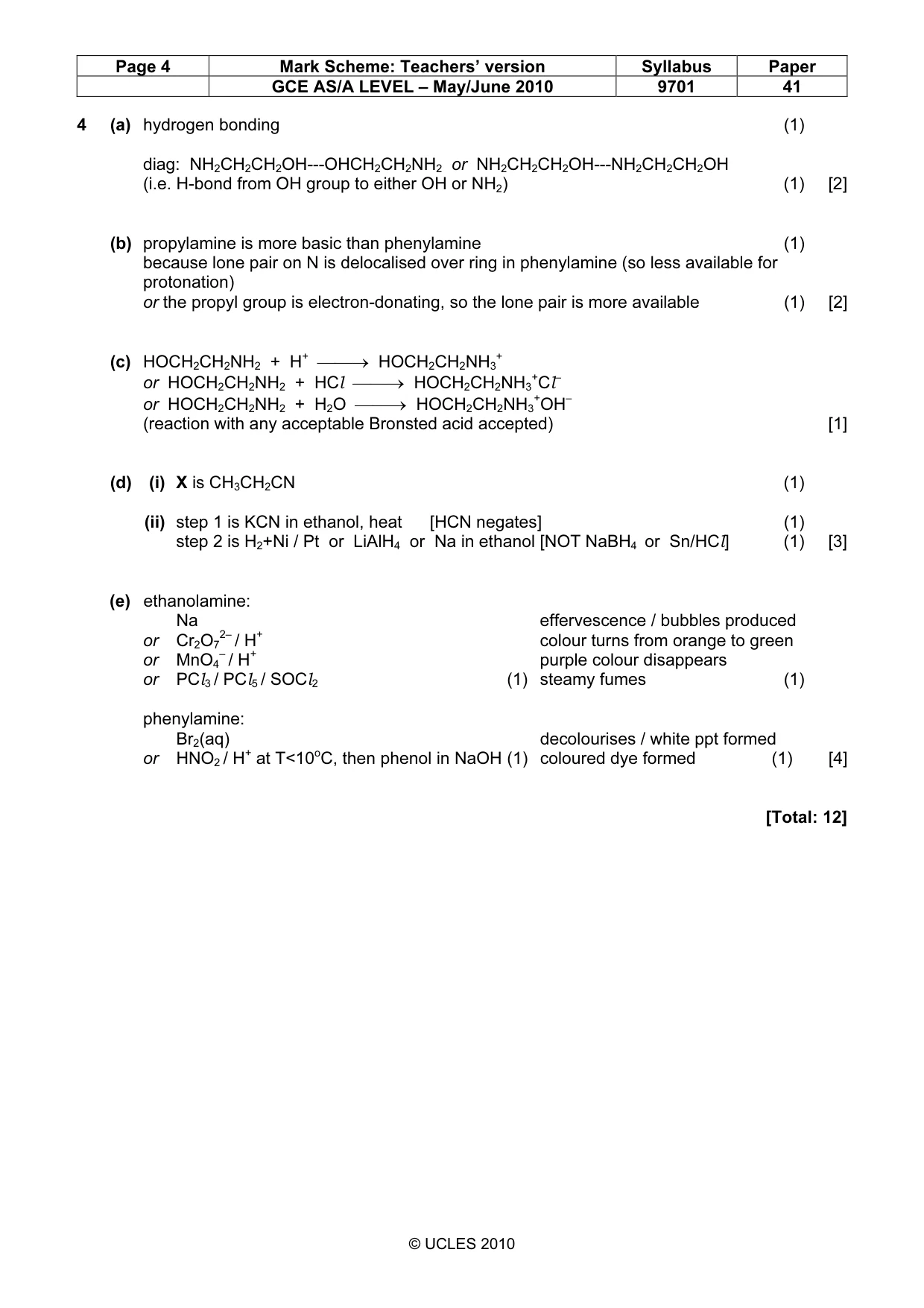
Page 4 Mark Scheme: Teachers’ version Syllabus Paper GCE AS/A LEVEL – May/June 2010 9701 41 © UCLES 2010 4 (a) hydrogen bonding (1) diag: NH2CH2CH2OH---OHCH2CH2NH2 or NH2CH2CH2OH---NH2CH2CH2OH (i.e. H-bond from OH group to either OH or NH2) (1) [2] (b) propylamine is more basic than phenylamine (1) because lone pair on N is delocalised over ring in phenylamine (so less available for protonation) or the propyl group is electron-donating, so the lone pair is more available (1) [2] (c) HOCH2CH2NH2 + H+ → HOCH2CH2NH3 + or HOCH2CH2NH2 + HCl → HOCH2CH2NH3 +Cl– or HOCH2CH2NH2 + H2O → HOCH2CH2NH3 +OH– (reaction with any acceptable Bronsted acid accepted) [1] (d) (i) X is CH3CH2CN (1) (ii) step 1 is KCN in ethanol, heat [HCN negates] (1) step 2 is H2+Ni / Pt or LiAlH4 or Na in ethanol [NOT NaBH4 or Sn/HCl] (1) [3] (e) ethanolamine: Na effervescence / bubbles produced or Cr2O7 2– / H+ colour turns from orange to green or MnO4 – / H+ purple colour disappears or PCl3 / PCl5 / SOCl2 (1) steamy fumes (1) phenylamine: Br2(aq) decolourises / white ppt formed or HNO2 / H+ at T<10oC, then phenol in NaOH (1) coloured dye formed (1) [4] [Total: 12]
Mark scheme, page 5
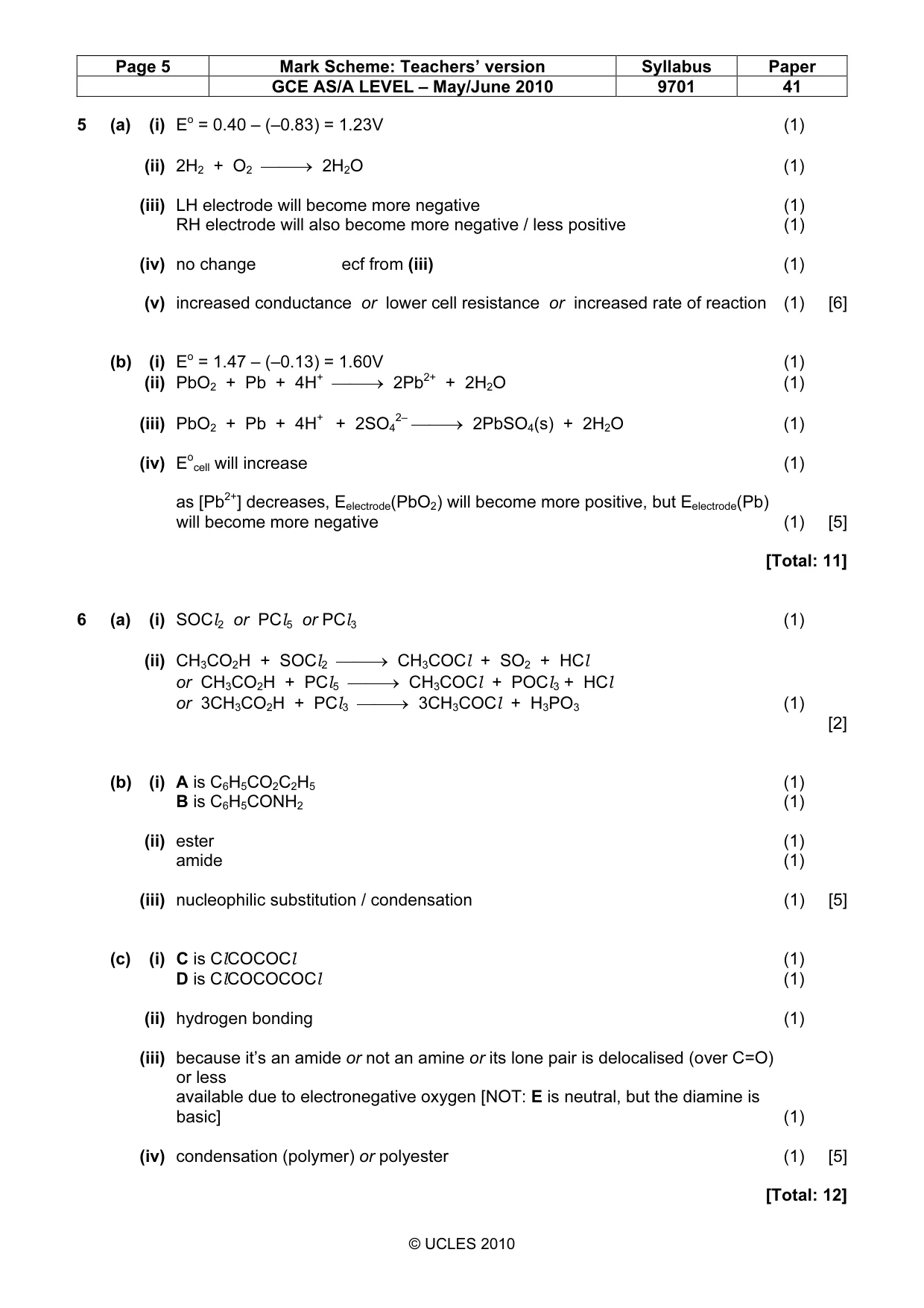
Page 5 Mark Scheme: Teachers’ version Syllabus Paper GCE AS/A LEVEL – May/June 2010 9701 41 © UCLES 2010 5 (a) (i) Eo = 0.40 – (–0.83) = 1.23V (1) (ii) 2H2 + O2 → 2H2O (1) (iii) LH electrode will become more negative (1) RH electrode will also become more negative / less positive (1) (iv) no change ecf from (iii) (1) (v) increased conductance or lower cell resistance or increased rate of reaction (1) [6] (b) (i) Eo = 1.47 – (–0.13) = 1.60V (1) (ii) PbO2 + Pb + 4H+ → 2Pb2+ + 2H2O (1) (iii) PbO2 + Pb + 4H+ + 2SO4 2– → 2PbSO4(s) + 2H2O (1) (iv) Eo cell will increase (1) as [Pb2+] decreases, Eelectrode(PbO2) will become more positive, but Eelectrode(Pb) will become more negative (1) [5] [Total: 11] 6 (a) (i) SOCl2 or PCl5 or PCl3 (1) (ii) CH3CO2H + SOCl2 → CH3COCl + SO2 + HCl or CH3CO2H + PCl5 → CH3COCl + POCl3 + HCl or 3CH3CO2H + PCl3 → 3CH3COCl + H3PO3 (1) [2] (b) (i) A is C6H5CO2C2H5 (1) B is C6H5CONH2 (1) (ii) ester (1) amide (1) (iii) nucleophilic substitution / condensation (1) [5] (c) (i) C is ClCOCOCl (1) D is ClCOCOCOCl (1) (ii) hydrogen bonding (1) (iii) because it’s an amide or not an amine or its lone pair is delocalised (over C=O) or less available due to electronegative oxygen [NOT: E is neutral, but the diamine is basic] (1) (iv) condensation (polymer) or polyester (1) [5] [Total: 12]
Mark scheme, page 6
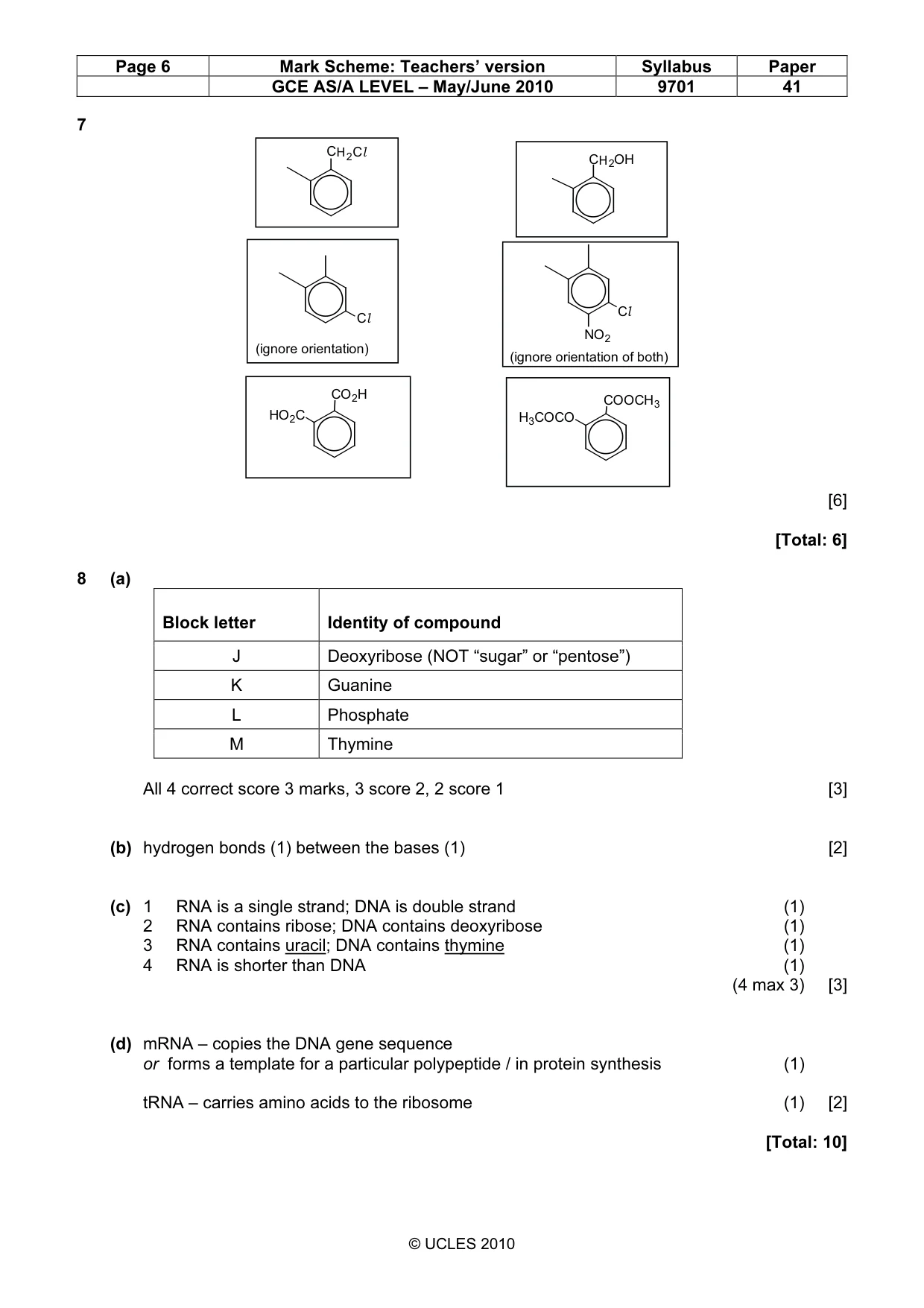
Page 6 Mark Scheme: Teachers’ version Syllabus Paper GCE AS/A LEVEL – May/June 2010 9701 41 © UCLES 2010 7 C 2 Cl NO2 HO2C H3C O C O CO2H COOCH3 (ignore orientation) (ignore orientation of both) H Cl C 2 H OH Cl [6] [Total: 6] 8 (a) Block letter Identity of compound J Deoxyribose (NOT “sugar” or “pentose”) K Guanine L Phosphate M Thymine All 4 correct score 3 marks, 3 score 2, 2 score 1 [3] (b) hydrogen bonds (1) between the bases (1) [2] (c) 1 RNA is a single strand; DNA is double strand (1) 2 RNA contains ribose; DNA contains deoxyribose (1) 3 RNA contains uracil; DNA contains thymine (1) 4 RNA is shorter than DNA (1) (4 max 3) [3] (d) mRNA – copies the DNA gene sequence or forms a template for a particular polypeptide / in protein synthesis (1) tRNA – carries amino acids to the ribosome (1) [2] [Total: 10]
Mark scheme, page 7
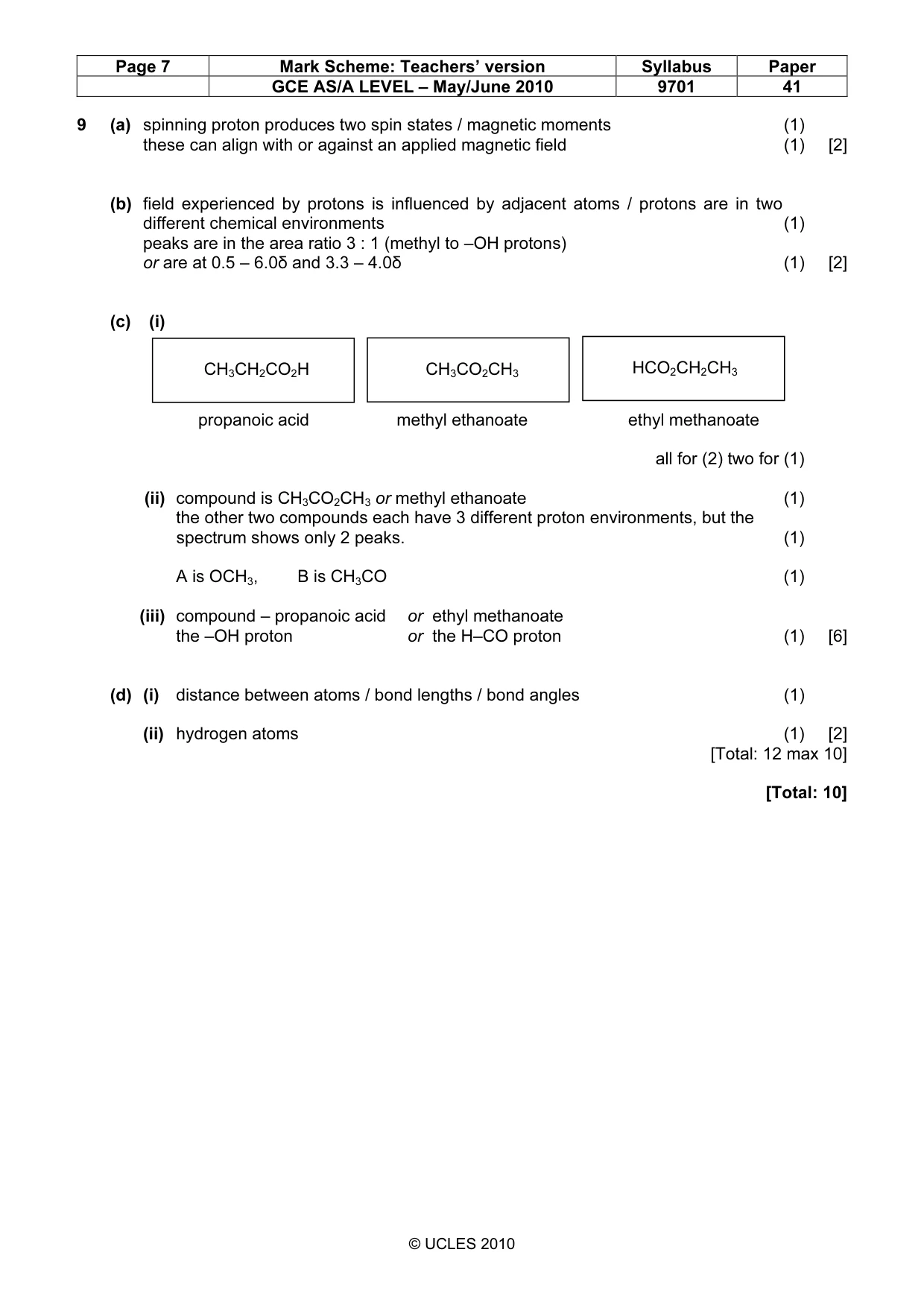
Page 7 Mark Scheme: Teachers’ version Syllabus Paper GCE AS/A LEVEL – May/June 2010 9701 41 © UCLES 2010 9 (a) spinning proton produces two spin states / magnetic moments (1) these can align with or against an applied magnetic field (1) [2] (b) field experienced by protons is influenced by adjacent atoms / protons are in two different chemical environments (1) peaks are in the area ratio 3 : 1 (methyl to –OH protons) or are at 0.5 – 6.0δ and 3.3 – 4.0δ (1) [2] (c) (i) propanoic acid methyl ethanoate ethyl methanoate all for (2) two for (1) (ii) compound is CH3CO2CH3 or methyl ethanoate (1) the other two compounds each have 3 different proton environments, but the spectrum shows only 2 peaks. (1) A is OCH3, B is CH3CO (1) (iii) compound – propanoic acid or ethyl methanoate the –OH proton or the H–CO proton (1) [6] (d) (i) distance between atoms / bond lengths / bond angles (1) (ii) hydrogen atoms (1) [2] [Total: 12 max 10] [Total: 10] CH3CH2CO2H CH3CO2CH3 HCO2CH2CH3
Mark scheme, page 8
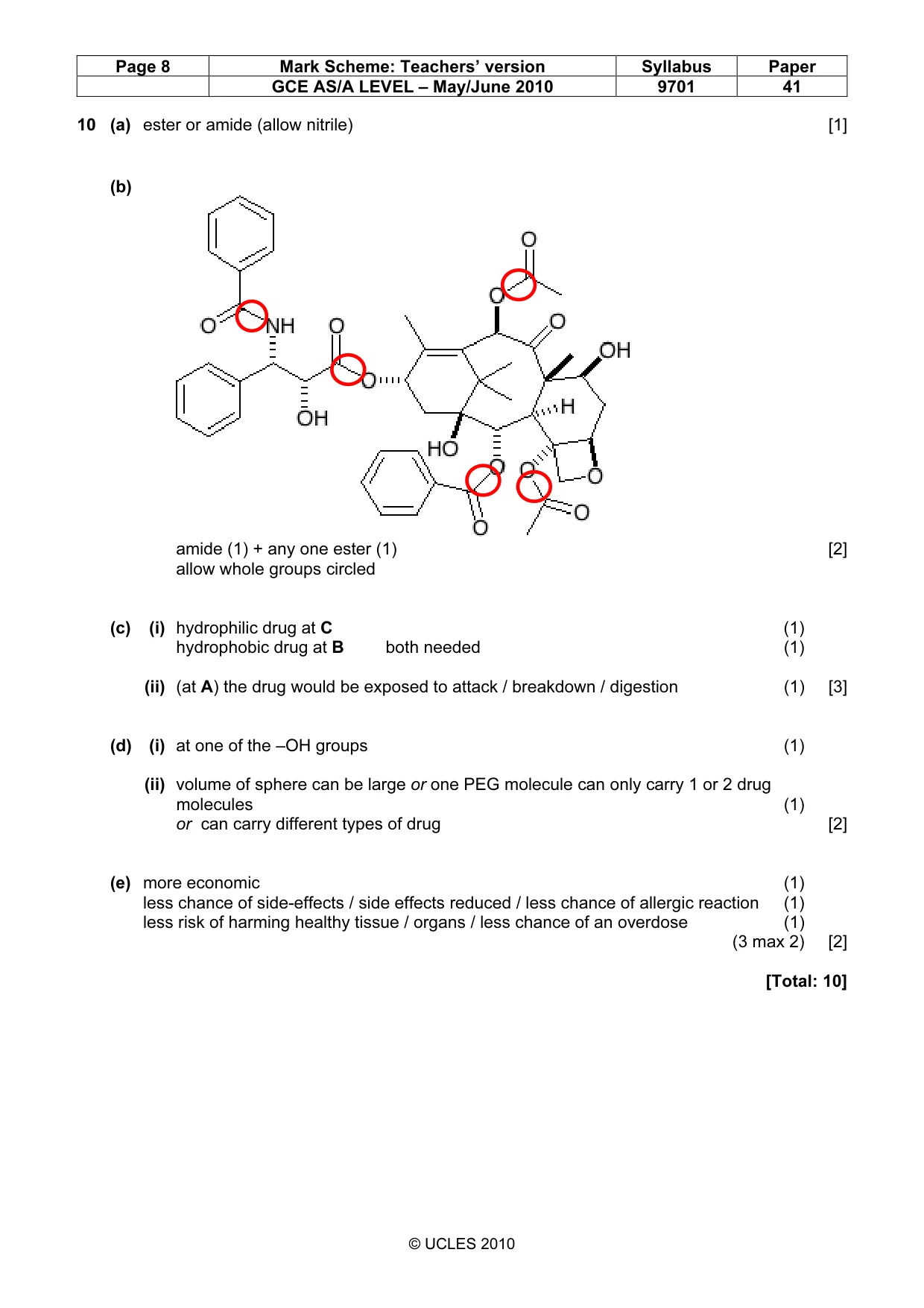
Page 8 Mark Scheme: Teachers’ version Syllabus Paper GCE AS/A LEVEL – May/June 2010 9701 41 © UCLES 2010 10 (a) ester or amide (allow nitrile) [1] (b) amide (1) + any one ester (1) [2] allow whole groups circled (c) (i) hydrophilic drug at C (1) hydrophobic drug at B both needed (1) (ii) (at A) the drug would be exposed to attack / breakdown / digestion (1) [3] (d) (i) at one of the –OH groups (1) (ii) volume of sphere can be large or one PEG molecule can only carry 1 or 2 drug molecules (1) or can carry different types of drug [2] (e) more economic (1) less chance of side-effects / side effects reduced / less chance of allergic reaction (1) less risk of harming healthy tissue / organs / less chance of an overdose (1) (3 max 2) [2] [Total: 10]
What you needed in this session
Cambridge’s own grade thresholds for 2010 May/June, Paper 4 · Variant 1. A higher threshold means an easier paper — the bar moves with how the cohort did.