Cambridge A Level Chemistry 9701 — 2008 May/June Paper 4 · Variant 1
9701/41/M/J/08 · 100 marks · ≈113 min
The question paper and its mark scheme, free to read here and free to download. This is Cambridge’s own paper, exactly as it was sat.
Question paper20 pages

Mark scheme9 pages
Answers below. Sit the paper first if you are practising.
Paper as text
Question paper, page 1
This document consists of 19 printed pages and 1 blank page. SPA (SHW (00018 4/07) T51891/2 © UCLES 2008 [Turn over UNIVERSITY OF CAMBRIDGE INTERNATIONAL EXAMINATIONS General Certificate of Education Advanced Subsidiary Level and Advanced Level READ THESE INSTRUCTIONS FIRST Write your Centre number, candidate number and name on all the work you hand in. Write in dark blue or black pen. You may use a pencil for any diagrams, graphs or rough working. Do not use staples, paper clips, highlighters, glue or correction fluid. DO NOT WRITE IN ANY BARCODES. Section A Answer all questions. Section B Answer all questions. You may lose marks if you do not show your working or if you do not use appropriate units. A Data Booklet is provided. At the end of the examination, fasten all your work securely together. The number of marks is given in brackets [ ] at the end of each question or part question. * 7 2 6 2 3 0 7 6 8 4 * CHEMISTRY 9701/04 Paper 4 Structured Questions May/June 2008 1 hour 45 minutes Candidates answer on the Question Paper. Additional Materials: Data Booklet For Examiner’s Use 1 2 3 4 5 6 7 8 9 10 Total
Question paper, page 2
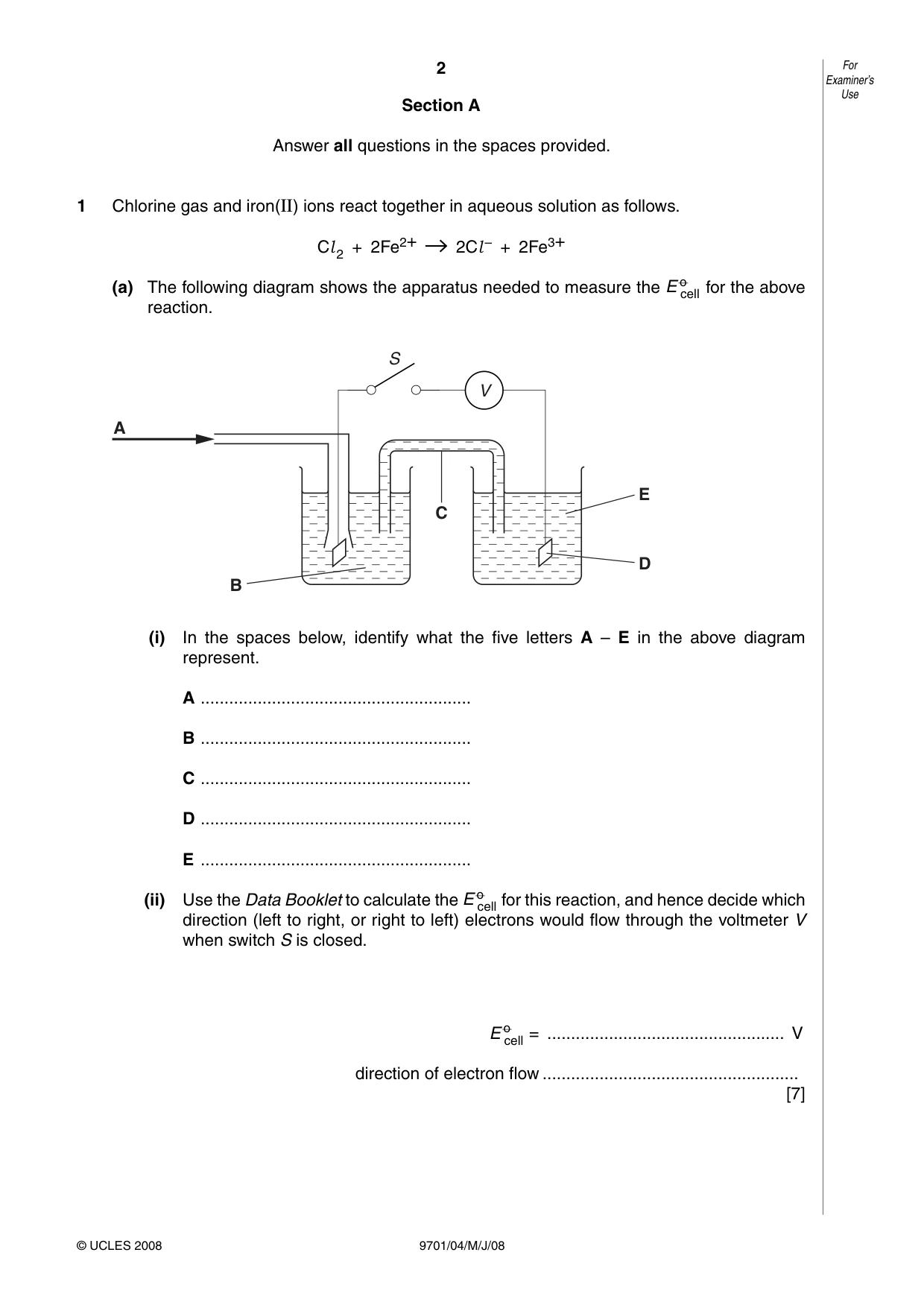
9701/04/M/J/08 For Examiner’s Use © UCLES 2008 Section A Answer all questions in the spaces provided. 1 Chlorine gas and iron(II) ions react together in aqueous solution as follows. Cl 2 + 2Fe2+ 2Cl – + 2Fe3+ (a) The following diagram shows the apparatus needed to measure the E o cell for the above reaction. V S A B C E D (i) In the spaces below, identify what the five letters A – E in the above diagram represent. A … B … C … D … E … (ii) Use the Data Booklet to calculate the E o cell for this reaction, and hence decide which direction (left to right, or right to left) electrons would flow through the voltmeter V when switch S is closed. E o cell = … V direction of electron flow … [7] 2
Question paper, page 3
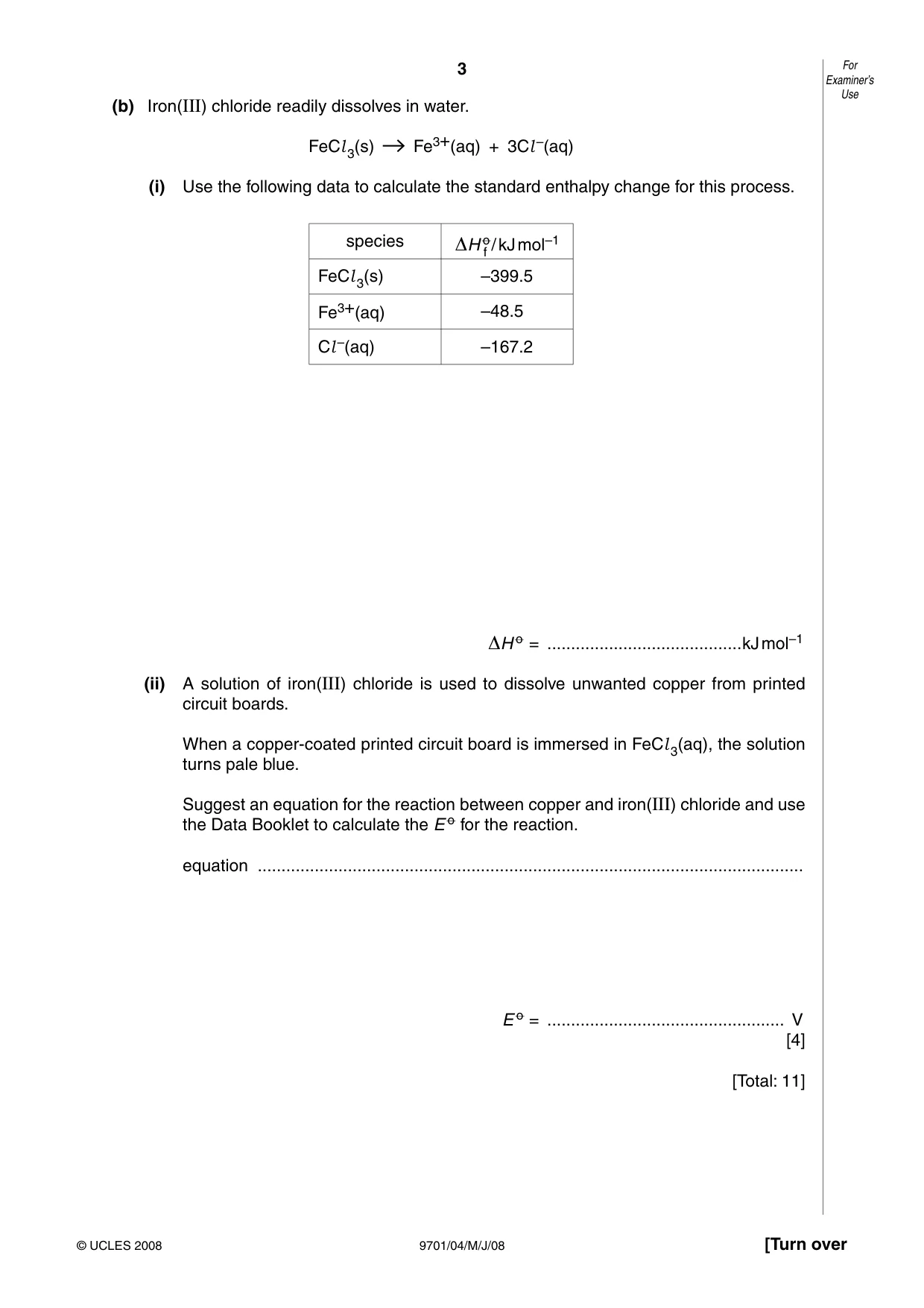
3 9701/04/M/J/08 [Turn over For Examiner’s Use © UCLES 2008 (b) Iron(III) chloride readily dissolves in water. FeCl 3(s) Fe3+(aq) + 3Cl –(aq) (i) Use the following data to calculate the standard enthalpy change for this process. species DH o f / kJ mol–1 FeCl 3(s) –399.5 Fe3+(aq) –48.5 Cl –(aq) –167.2 DH o = …kJ mol–1 (ii) A solution of iron(III) chloride is used to dissolve unwanted copper from printed circuit boards. When a copper-coated printed circuit board is immersed in FeCl 3(aq), the solution turns pale blue. Suggest an equation for the reaction between copper and iron(III) chloride and use the Data Booklet to calculate the E o for the reaction. equation … E o = … V [4] [Total: 11]
Question paper, page 4
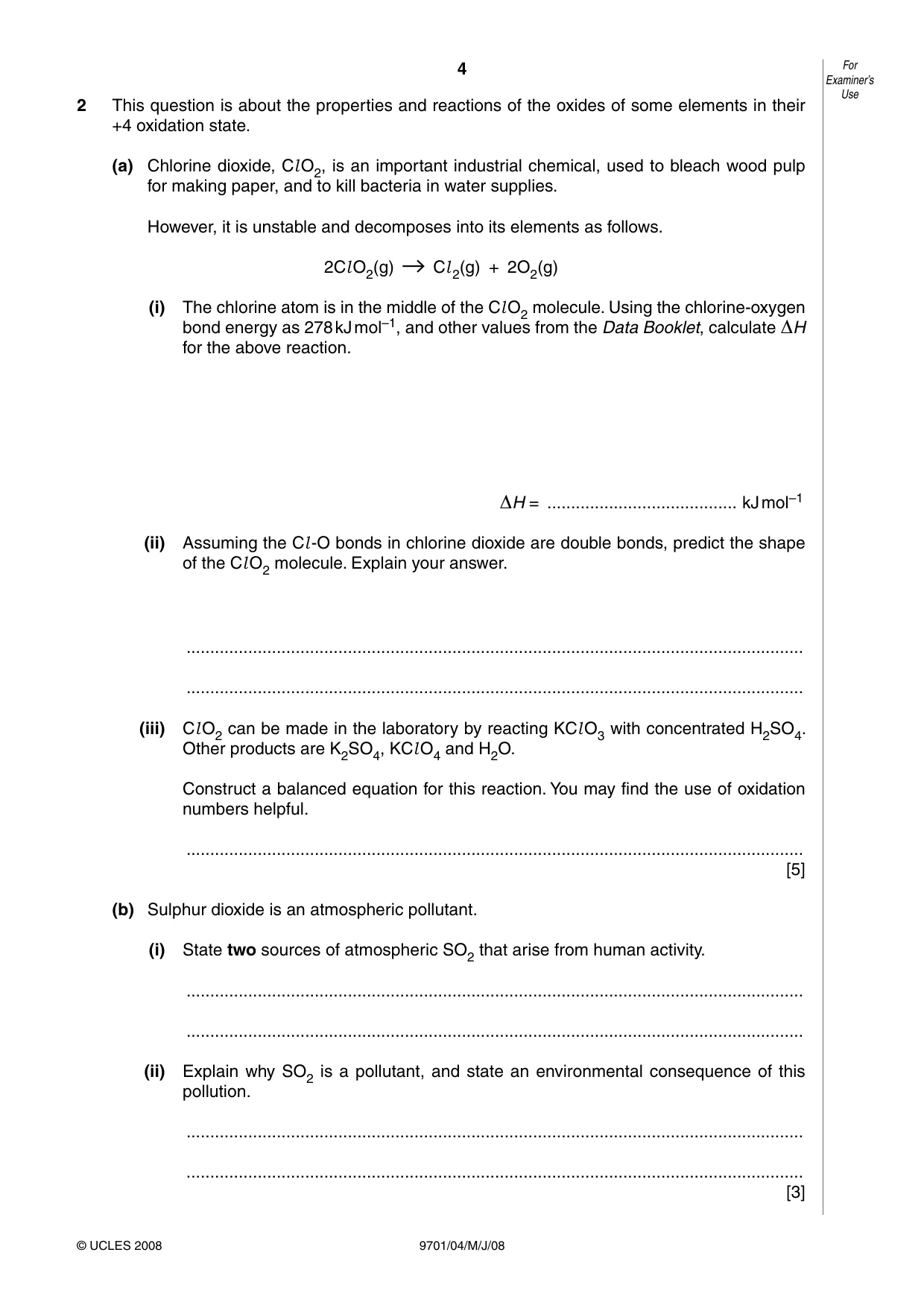
4 9701/04/M/J/08 For Examiner’s Use © UCLES 2008 2 This question is about the properties and reactions of the oxides of some elements in their +4 oxidation state. (a) Chlorine dioxide, Cl O2, is an important industrial chemical, used to bleach wood pulp for making paper, and to kill bacteria in water supplies. However, it is unstable and decomposes into its elements as follows. 2Cl O2(g) Cl 2(g) + 2O2(g) (i) The chlorine atom is in the middle of the Cl O2 molecule. Using the chlorine-oxygen bond energy as 278 kJ mol–1, and other values from the Data Booklet, calculate DH for the above reaction. DH = … kJ mol–1 (ii) Assuming the Cl -O bonds in chlorine dioxide are double bonds, predict the shape of the Cl O2 molecule. Explain your answer. … … (iii) Cl O2 can be made in the laboratory by reacting KCl O3 with concentrated H2SO4. Other products are K2SO4, KCl O4 and H2O. Construct a balanced equation for this reaction. You may find the use of oxidation numbers helpful. … [5] (b) Sulphur dioxide is an atmospheric pollutant. (i) State two sources of atmospheric SO2 that arise from human activity. … … (ii) Explain why SO2 is a pollutant, and state an environmental consequence of this pollution. … … [3]
Question paper, page 5
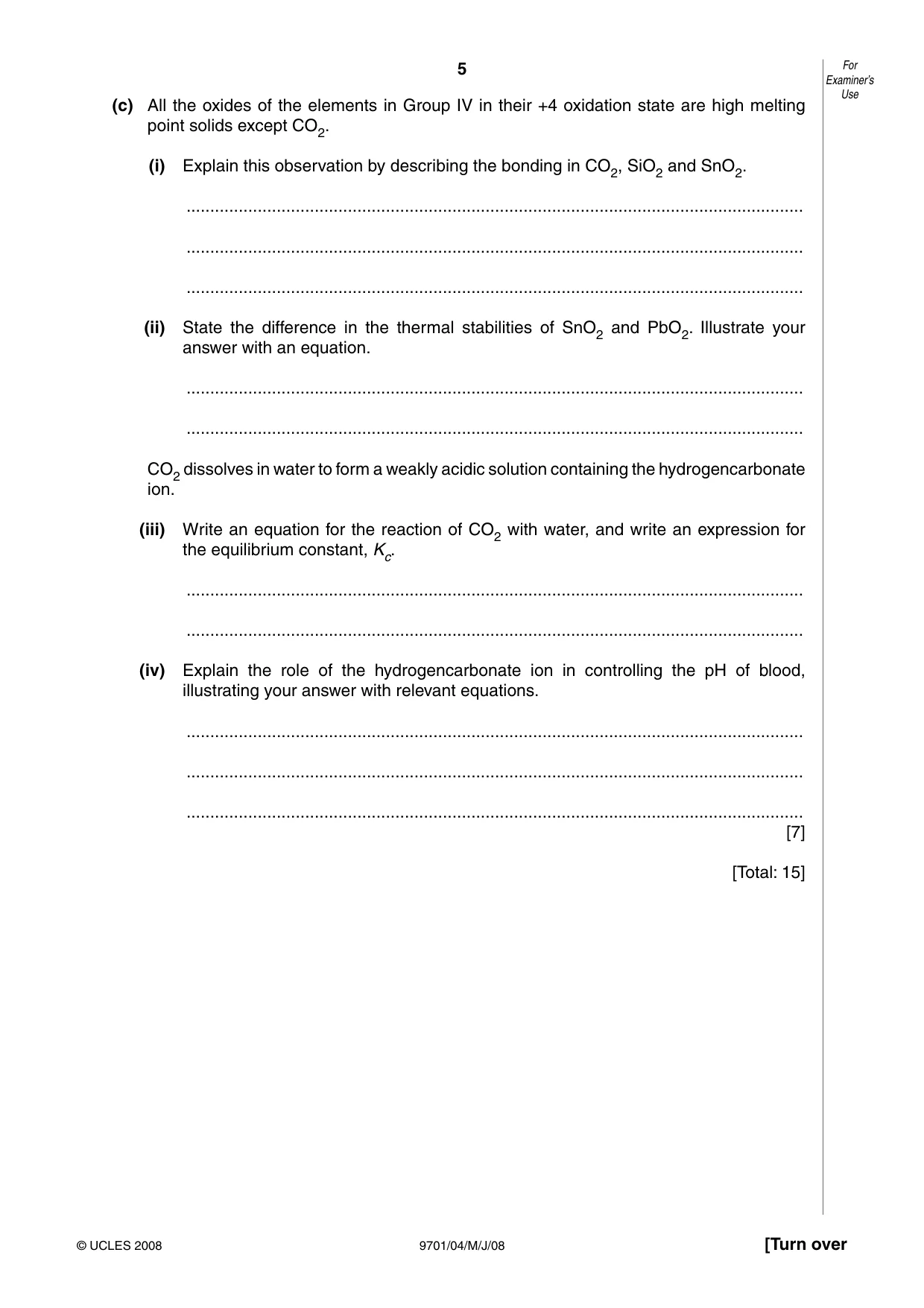
5 9701/04/M/J/08 [Turn over For Examiner’s Use © UCLES 2008 (c) All the oxides of the elements in Group IV in their +4 oxidation state are high melting point solids except CO2. (i) Explain this observation by describing the bonding in CO2, SiO2 and SnO2. … … … (ii) State the difference in the thermal stabilities of SnO2 and PbO2. Illustrate your answer with an equation. … … CO2 dissolves in water to form a weakly acidic solution containing the hydrogencarbonate ion. (iii) Write an equation for the reaction of CO2 with water, and write an expression for the equilibrium constant, Kc. … … (iv) Explain the role of the hydrogencarbonate ion in controlling the pH of blood, illustrating your answer with relevant equations. … … … [7] [Total: 15]
Question paper, page 6
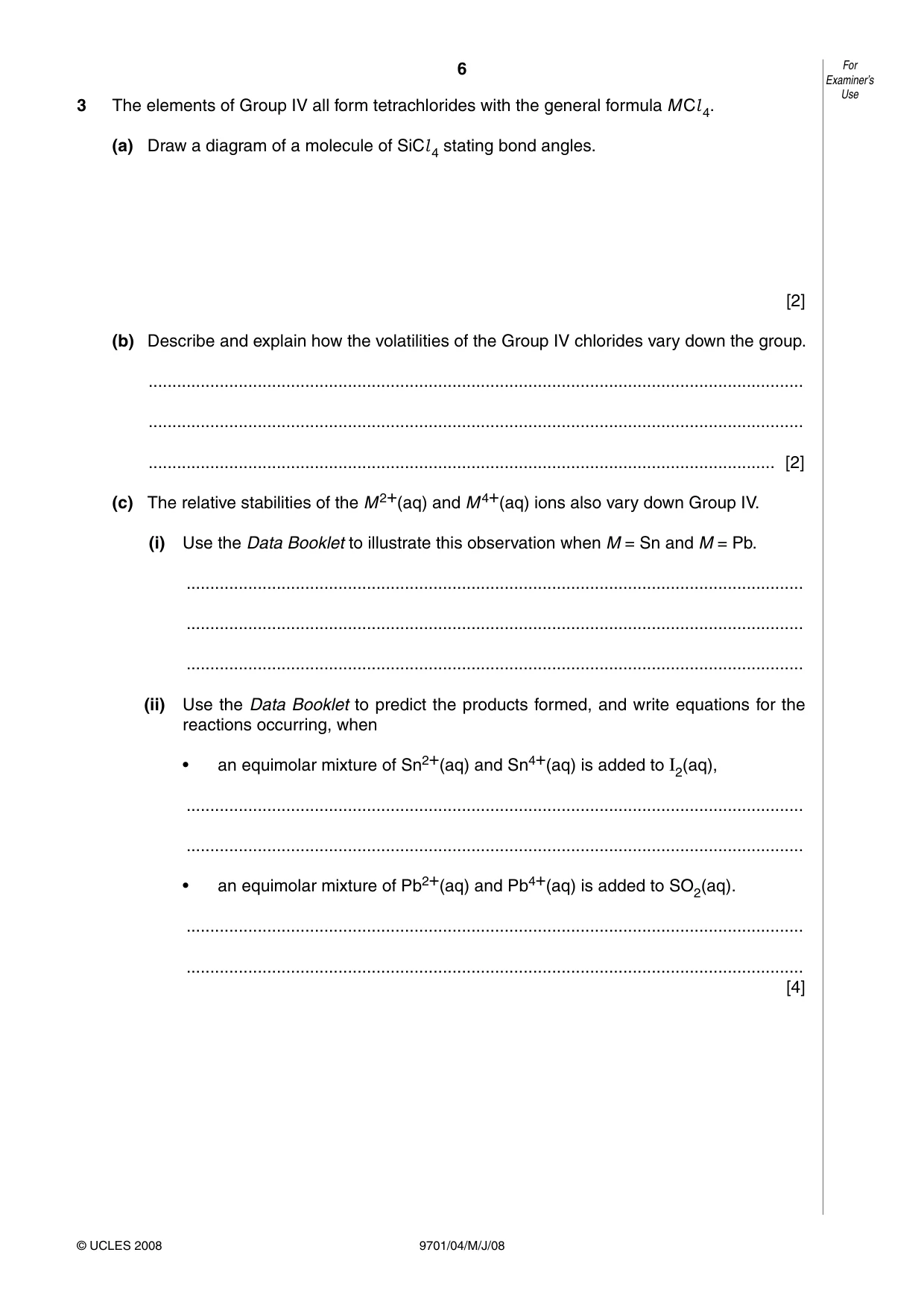
6 9701/04/M/J/08 For Examiner’s Use © UCLES 2008 3 The elements of Group IV all form tetrachlorides with the general formula M Cl 4. (a) Draw a diagram of a molecule of SiCl 4 stating bond angles. [2] (b) Describe and explain how the volatilities of the Group IV chlorides vary down the group. … … … [2] (c) The relative stabilities of the M 2+(aq) and M 4+(aq) ions also vary down Group IV. (i) Use the Data Booklet to illustrate this observation when M = Sn and M = Pb. … … … (ii) Use the Data Booklet to predict the products formed, and write equations for the reactions occurring, when • an equimolar mixture of Sn2+(aq) and Sn4+(aq) is added to I2(aq), … … • an equimolar mixture of Pb2+(aq) and Pb4+(aq) is added to SO2(aq). … … [4]
Question paper, page 7
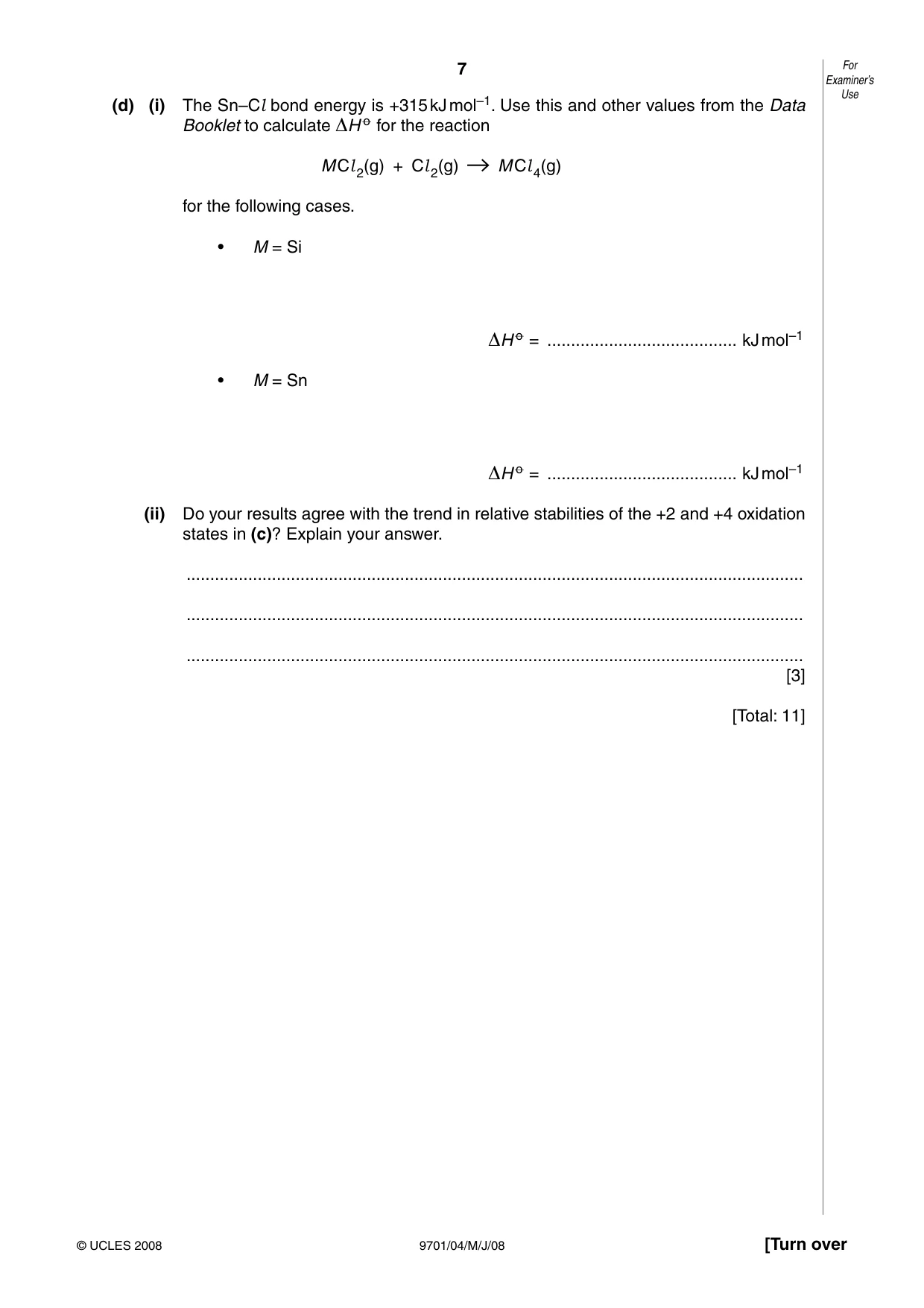
7 9701/04/M/J/08 [Turn over For Examiner’s Use © UCLES 2008 (d) (i) The Sn–Cl bond energy is +315 kJ mol–1. Use this and other values from the Data Booklet to calculate DH o for the reaction M Cl 2(g) + Cl 2(g) M Cl 4(g) for the following cases. • M = Si DH o = … kJ mol–1 • M = Sn DH o = … kJ mol–1 (ii) Do your results agree with the trend in relative stabilities of the +2 and +4 oxidation states in (c)? Explain your answer. … … … [3] [Total: 11]
Question paper, page 8
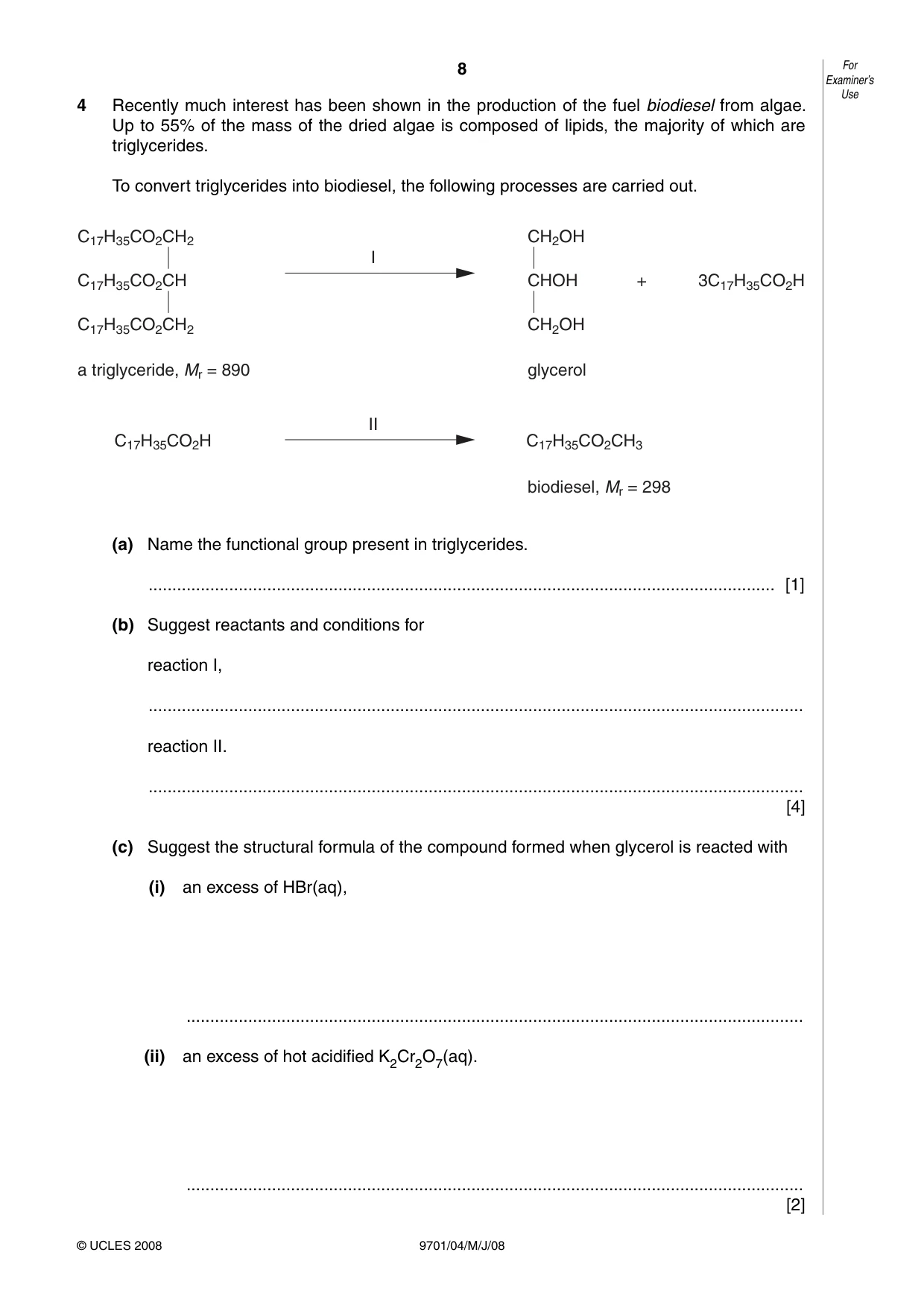
8 9701/04/M/J/08 For Examiner’s Use © UCLES 2008 4 Recently much interest has been shown in the production of the fuel biodiesel from algae. Up to 55% of the mass of the dried algae is composed of lipids, the majority of which are triglycerides. To convert triglycerides into biodiesel, the following processes are carried out. C17H35CO2CH2 3C17H35CO2H C17H35CO2H C17H35CO2CH2 a triglyceride, Mr = 890 biodiesel, Mr = 298 C17H35CO2CH CH2OH C17H35CO2CH3 CH2OH glycerol CHOH + I II (a) Name the functional group present in triglycerides. … [1] (b) Suggest reactants and conditions for reaction I, … reaction II. … [4] (c) Suggest the structural formula of the compound formed when glycerol is reacted with (i) an excess of HBr(aq), … (ii) an excess of hot acidified K2Cr2O7(aq). … [2]
Question paper, page 9
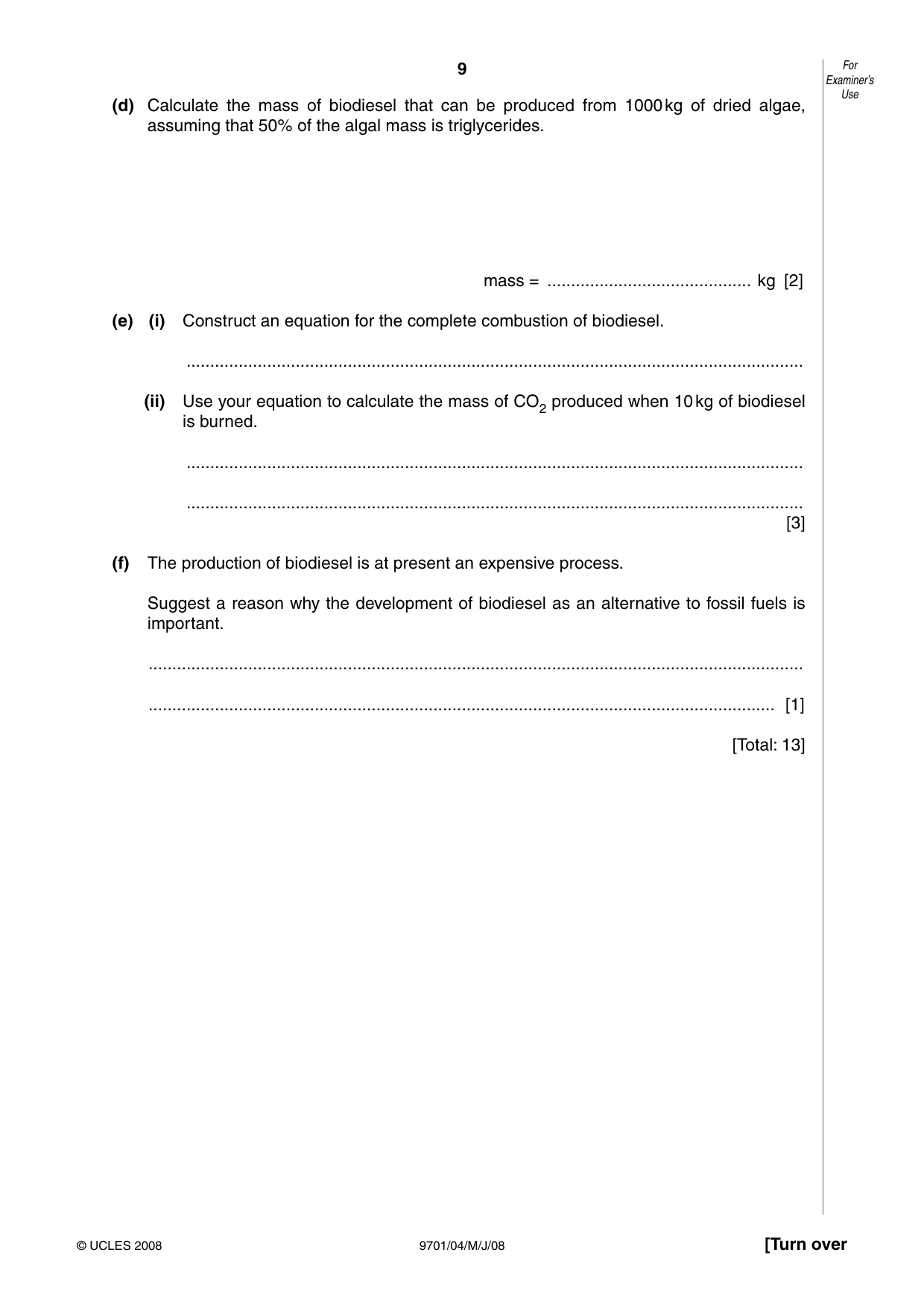
9 9701/04/M/J/08 [Turn over For Examiner’s Use © UCLES 2008 (d) Calculate the mass of biodiesel that can be produced from 1000 kg of dried algae, assuming that 50% of the algal mass is triglycerides. mass = … kg [2] (e) (i) Construct an equation for the complete combustion of biodiesel. … (ii) Use your equation to calculate the mass of CO2 produced when 10 kg of biodiesel is burned. … … [3] (f) The production of biodiesel is at present an expensive process. Suggest a reason why the development of biodiesel as an alternative to fossil fuels is important. … … [1] [Total: 13]
Question paper, page 10
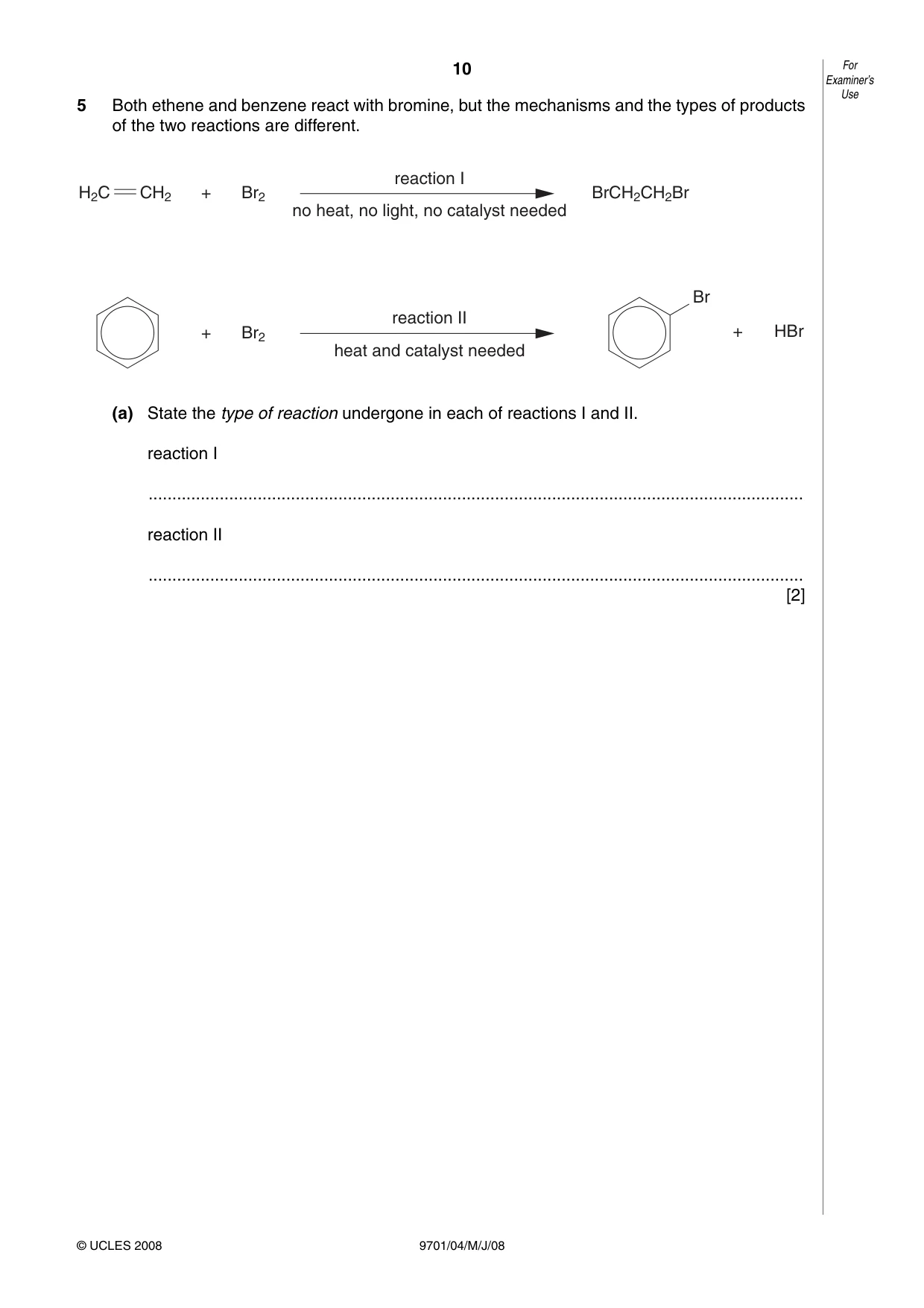
10 9701/04/M/J/08 For Examiner’s Use © UCLES 2008 5 Both ethene and benzene react with bromine, but the mechanisms and the types of products of the two reactions are different. Br2 Br BrCH2CH2Br H2C CH2 + HBr + reaction I no heat, no light, no catalyst needed Br2 + reaction II heat and catalyst needed (a) State the type of reaction undergone in each of reactions I and II. reaction I … reaction II … [2]
Question paper, page 11
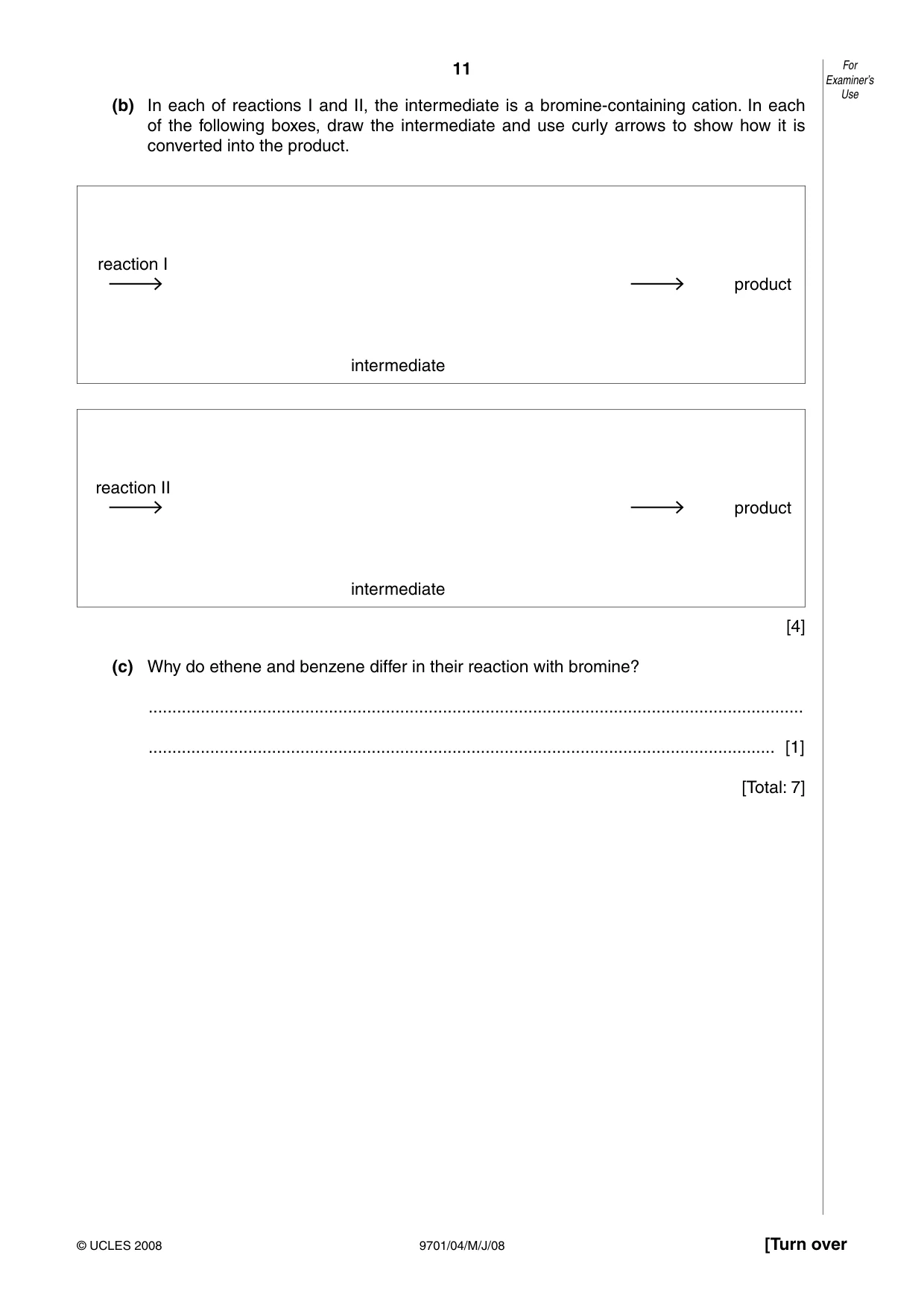
11 9701/04/M/J/08 [Turn over For Examiner’s Use © UCLES 2008 (b) In each of reactions I and II, the intermediate is a bromine-containing cation. In each of the following boxes, draw the intermediate and use curly arrows to show how it is converted into the product. reaction I product intermediate reaction II product intermediate [4] (c) Why do ethene and benzene differ in their reaction with bromine? … … [1] [Total: 7]
Question paper, page 12
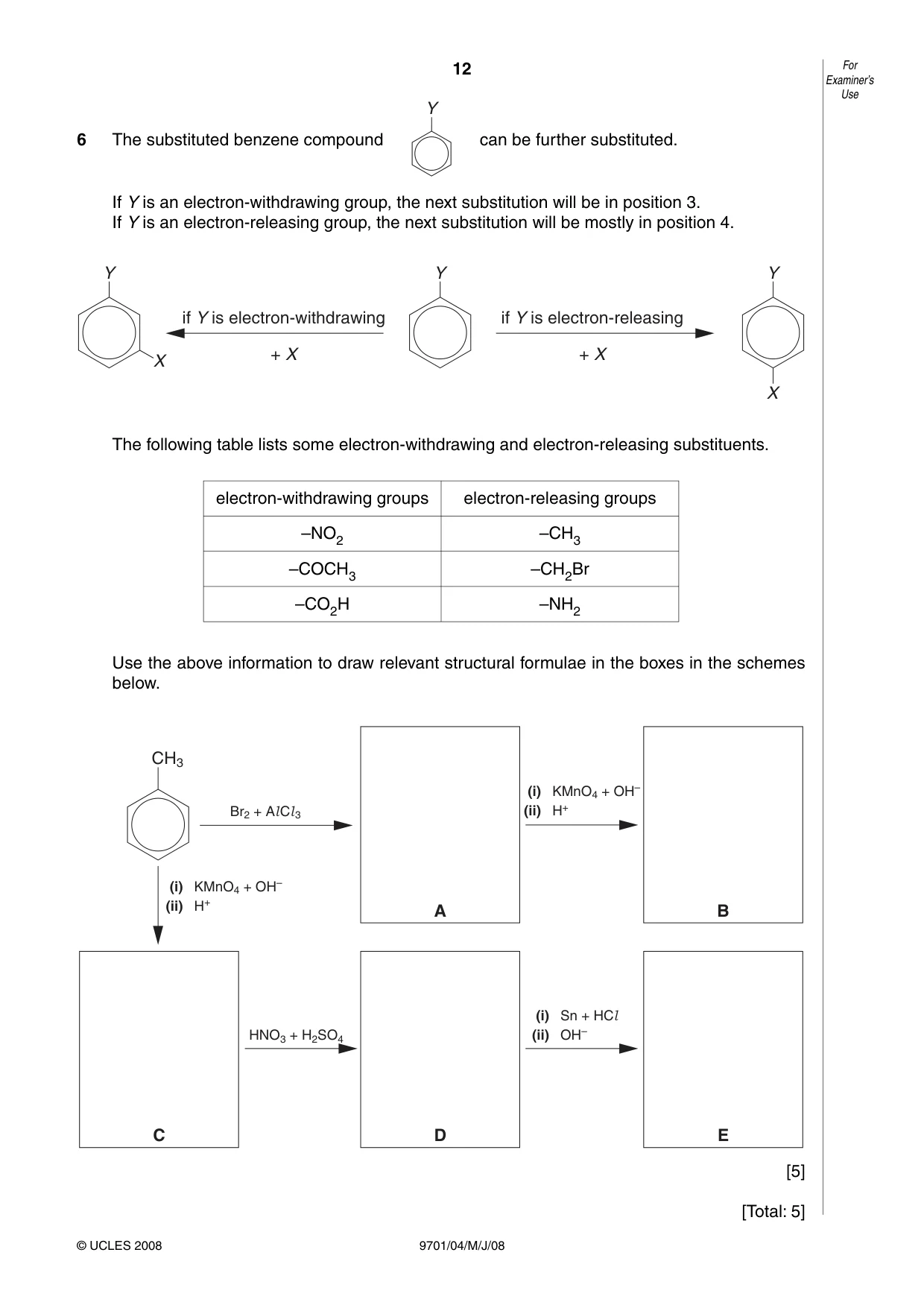
12 9701/04/M/J/08 For Examiner’s Use © UCLES 2008 6 The substituted benzene compound Y can be further substituted. If Y is an electron-withdrawing group, the next substitution will be in position 3. If Y is an electron-releasing group, the next substitution will be mostly in position 4. X + X if Y is electron-withdrawing + X if Y is electron-releasing Y Y Y X The following table lists some electron-withdrawing and electron-releasing substituents. electron-withdrawing groups electron-releasing groups –NO2 –CH3 –COCH3 –CH2Br –CO2H –NH2 Use the above information to draw relevant structural formulae in the boxes in the schemes below. CH3 (i) (ii) H+ KMnO4 + OH– (i) (ii) H+ KMnO4 + OH– (i) (ii) OH– Sn + HCl Br2 + Al Cl 3 E D C B A HNO3 + H2SO4 [5] [Total: 5]
Question paper, page 13
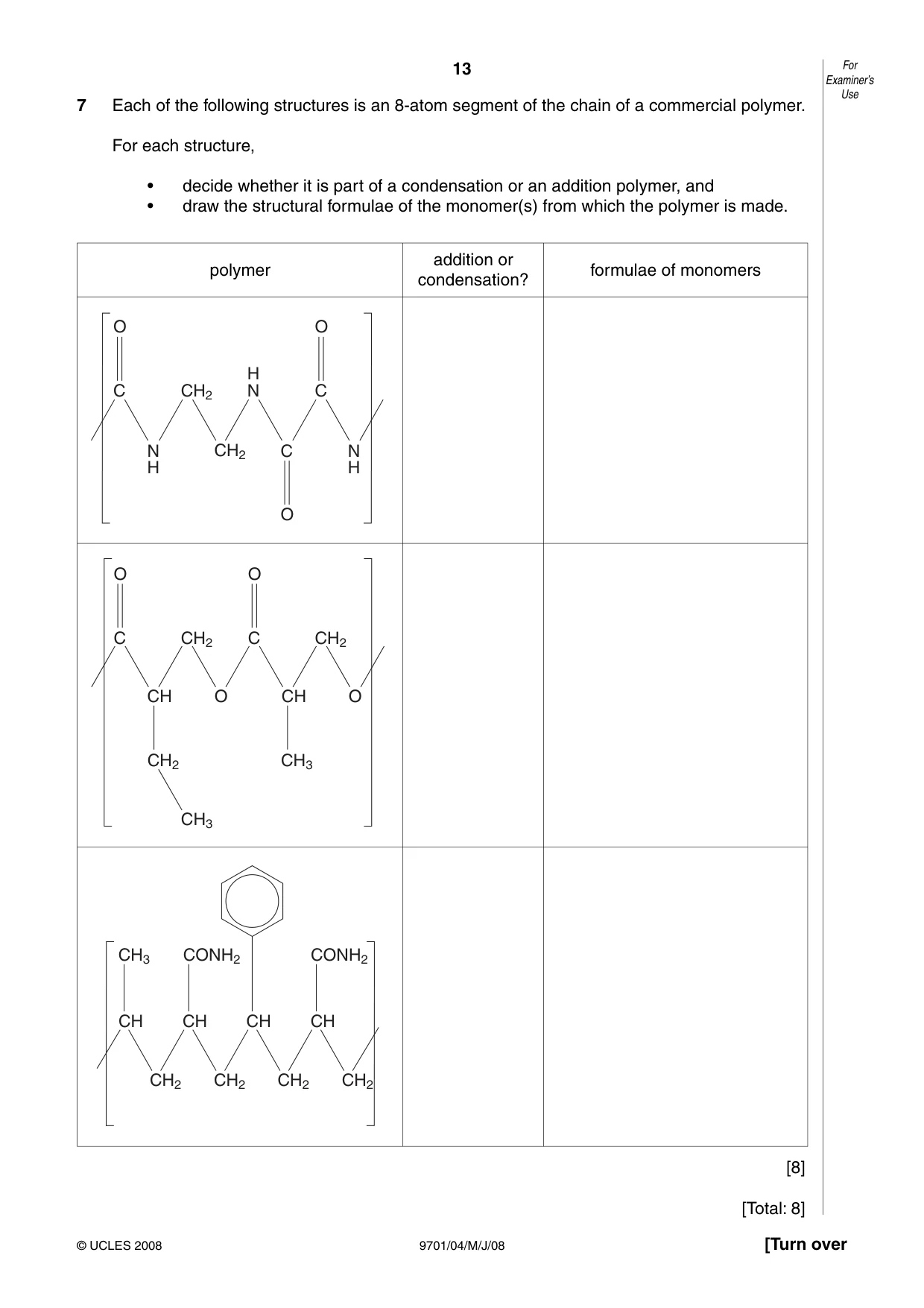
13 9701/04/M/J/08 [Turn over For Examiner’s Use © UCLES 2008 7 Each of the following structures is an 8-atom segment of the chain of a commercial polymer. For each structure, • decide whether it is part of a condensation or an addition polymer, and • draw the structural formulae of the monomer(s) from which the polymer is made. polymer addition or condensation? formulae of monomers H N H N CH2 CH2 O C H N O C O C O O O C CH2 CH2 CH2 CH3 CH3 CH CH O C CONH2 CH2 CH CH2 CH CH2 CH CH2 CH CH3 CONH2 [8] [Total: 8]
Question paper, page 14
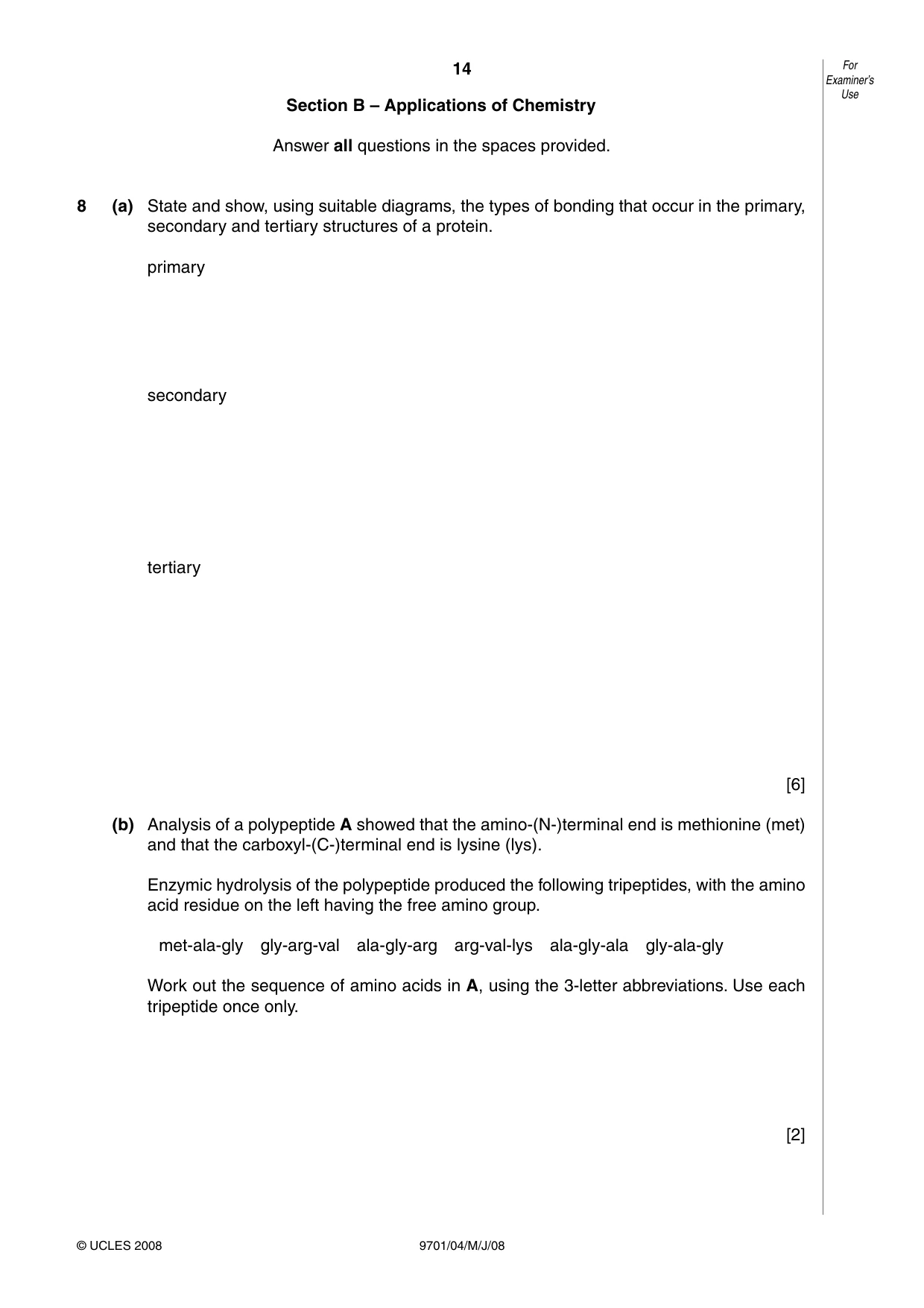
14 9701/04/M/J/08 For Examiner’s Use © UCLES 2008 Section B – Applications of Chemistry Answer all questions in the spaces provided. 8 (a) State and show, using suitable diagrams, the types of bonding that occur in the primary, secondary and tertiary structures of a protein. primary secondary tertiary [6] (b) Analysis of a polypeptide A showed that the amino-(N-)terminal end is methionine (met) and that the carboxyl-(C-)terminal end is lysine (lys). Enzymic hydrolysis of the polypeptide produced the following tripeptides, with the amino acid residue on the left having the free amino group. met-ala-gly gly-arg-val ala-gly-arg arg-val-lys ala-gly-ala gly-ala-gly Work out the sequence of amino acids in A, using the 3-letter abbreviations. Use each tripeptide once only. [2]
Question paper, page 15
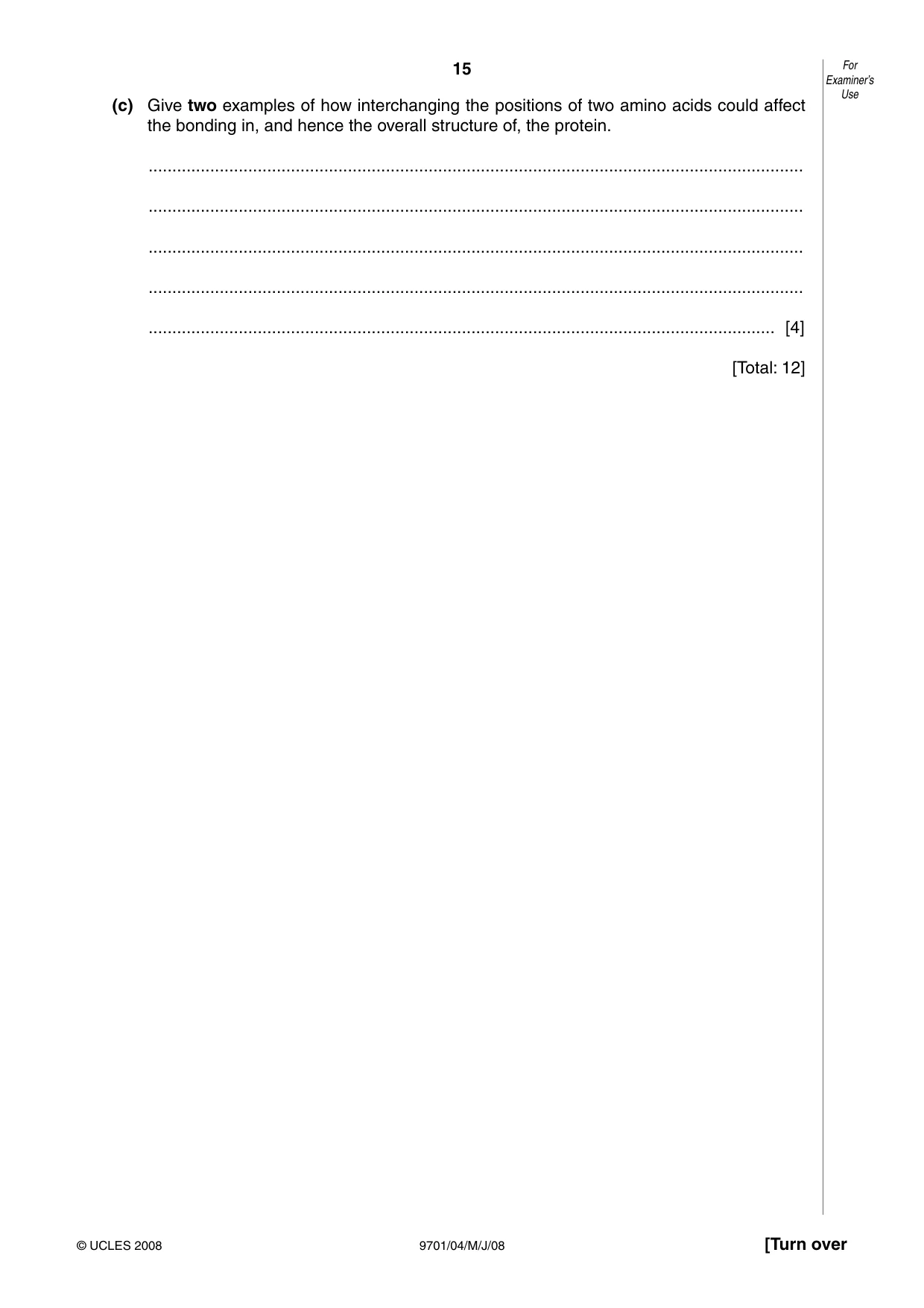
15 9701/04/M/J/08 [Turn over For Examiner’s Use © UCLES 2008 (c) Give two examples of how interchanging the positions of two amino acids could affect the bonding in, and hence the overall structure of, the protein. … … … … … [4] [Total: 12]
Question paper, page 16
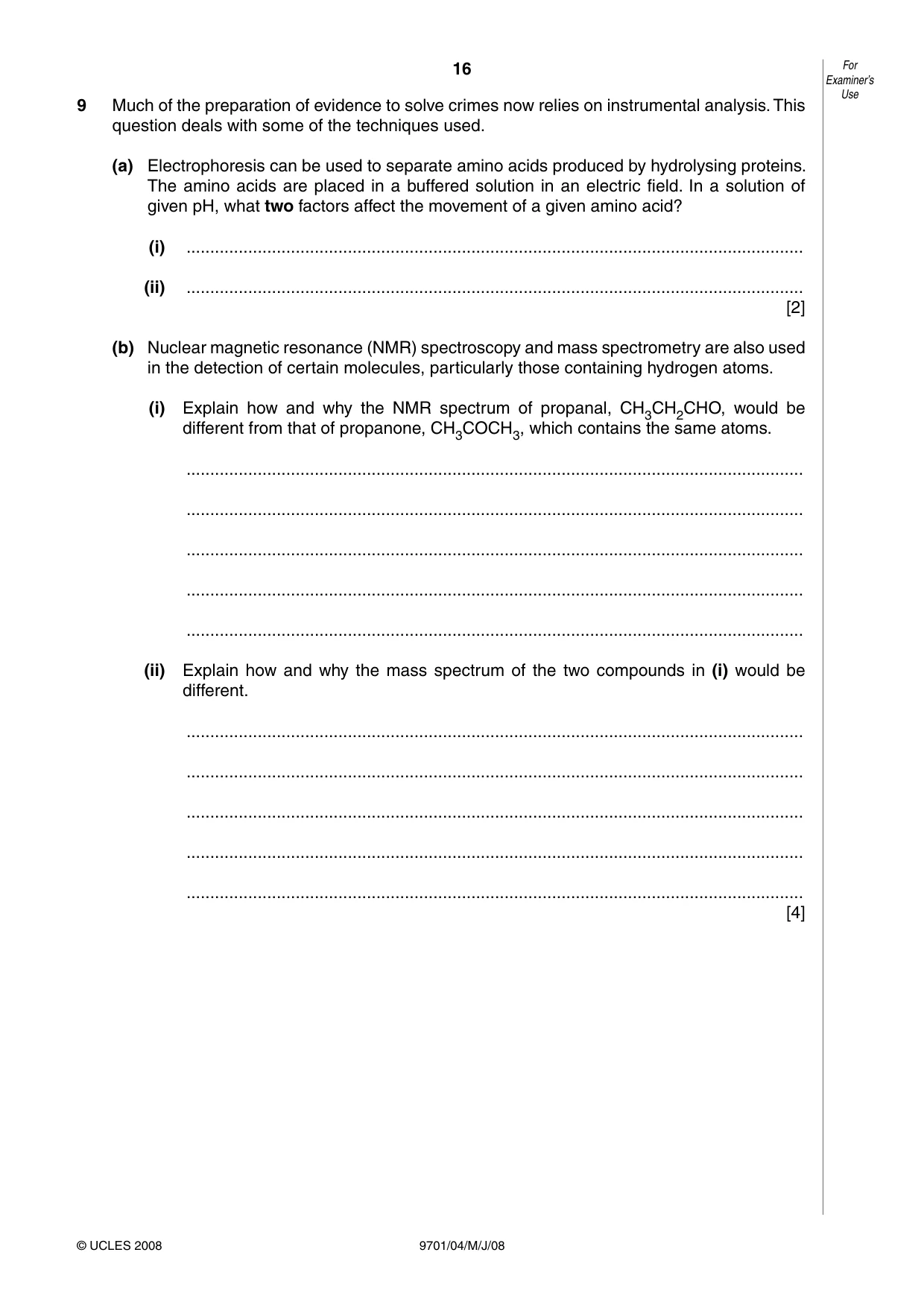
16 9701/04/M/J/08 For Examiner’s Use © UCLES 2008 9 Much of the preparation of evidence to solve crimes now relies on instrumental analysis. This question deals with some of the techniques used. (a) Electrophoresis can be used to separate amino acids produced by hydrolysing proteins. The amino acids are placed in a buffered solution in an electric field. In a solution of given pH, what two factors affect the movement of a given amino acid? (i) … (ii) … [2] (b) Nuclear magnetic resonance (NMR) spectroscopy and mass spectrometry are also used in the detection of certain molecules, particularly those containing hydrogen atoms. (i) Explain how and why the NMR spectrum of propanal, CH3CH2CHO, would be different from that of propanone, CH3COCH3, which contains the same atoms. … … … … … (ii) Explain how and why the mass spectrum of the two compounds in (i) would be different. … … … … … [4]
Question paper, page 17
17 9701/04/M/J/08 [Turn over For Examiner’s Use © UCLES 2008 (c) At one time, bromomethane, CH3Br, was widely used to control insect pests in agricultural crops and timber. It is now known to break down in the stratosphere and contribute to the destruction of the ozone layer. Samples can be screened for traces of bromomethane by subjecting them to mass spectrometry. (i) Which peak(s) would show the presence of bromine in the compound? … (ii) How could you tell by studying the M and M+2 peaks that the compound contained bromine rather than chlorine? … … [3] [Total: 9]
Question paper, page 18
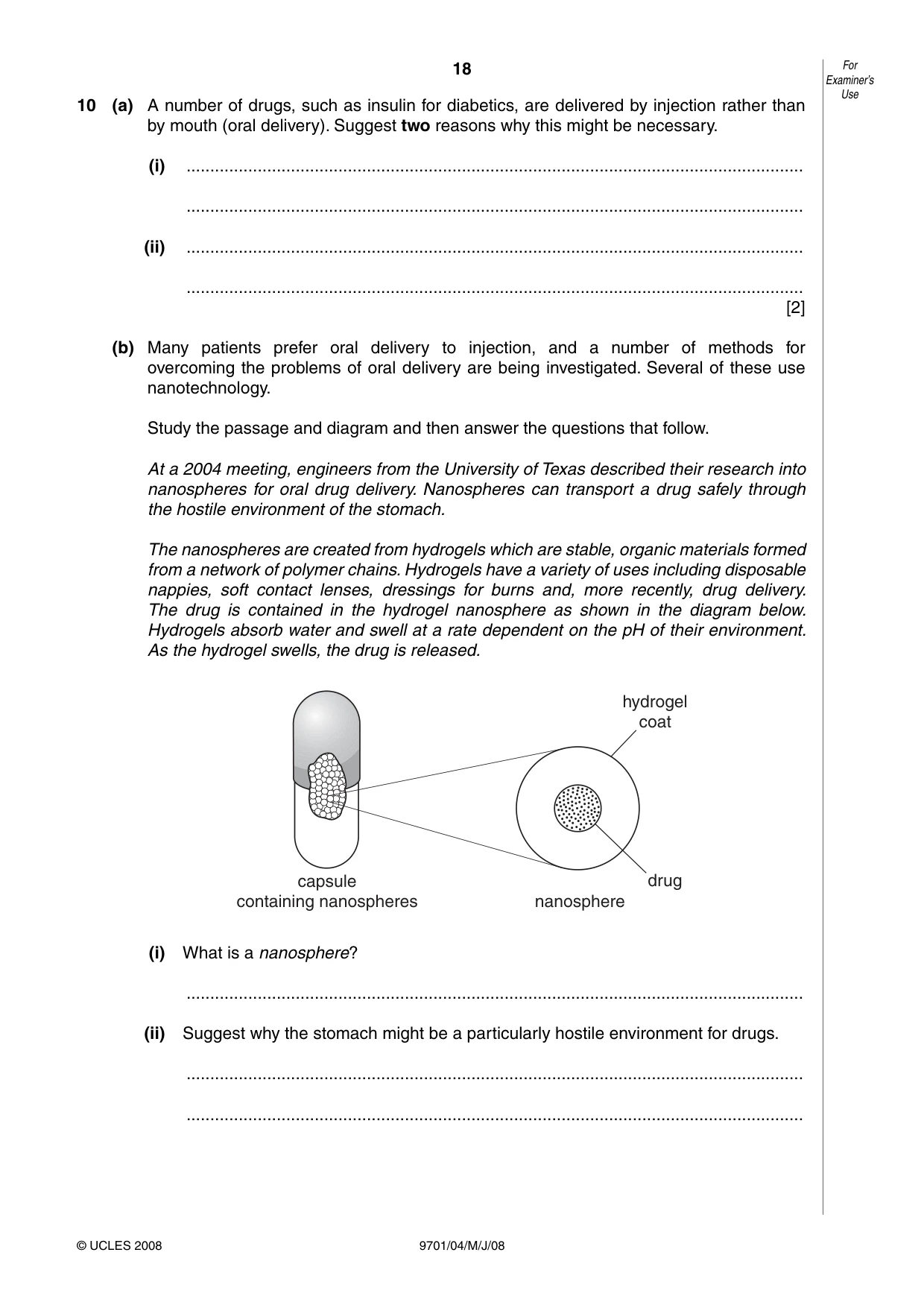
18 9701/04/M/J/08 For Examiner’s Use © UCLES 2008 10 (a) A number of drugs, such as insulin for diabetics, are delivered by injection rather than by mouth (oral delivery). Suggest two reasons why this might be necessary. (i) … … (ii) … … [2] (b) Many patients prefer oral delivery to injection, and a number of methods for overcoming the problems of oral delivery are being investigated. Several of these use nanotechnology. Study the passage and diagram and then answer the questions that follow. At a 2004 meeting, engineers from the University of Texas described their research into nanospheres for oral drug delivery. Nanospheres can transport a drug safely through the hostile environment of the stomach. The nanospheres are created from hydrogels which are stable, organic materials formed from a network of polymer chains. Hydrogels have a variety of uses including disposable nappies, soft contact lenses, dressings for burns and, more recently, drug delivery. The drug is contained in the hydrogel nanosphere as shown in the diagram below. Hydrogels absorb water and swell at a rate dependent on the pH of their environment. As the hydrogel swells, the drug is released. capsule containing nanospheres nanosphere hydrogel coat drug (i) What is a nanosphere? … (ii) Suggest why the stomach might be a particularly hostile environment for drugs. … …
Question paper, page 19
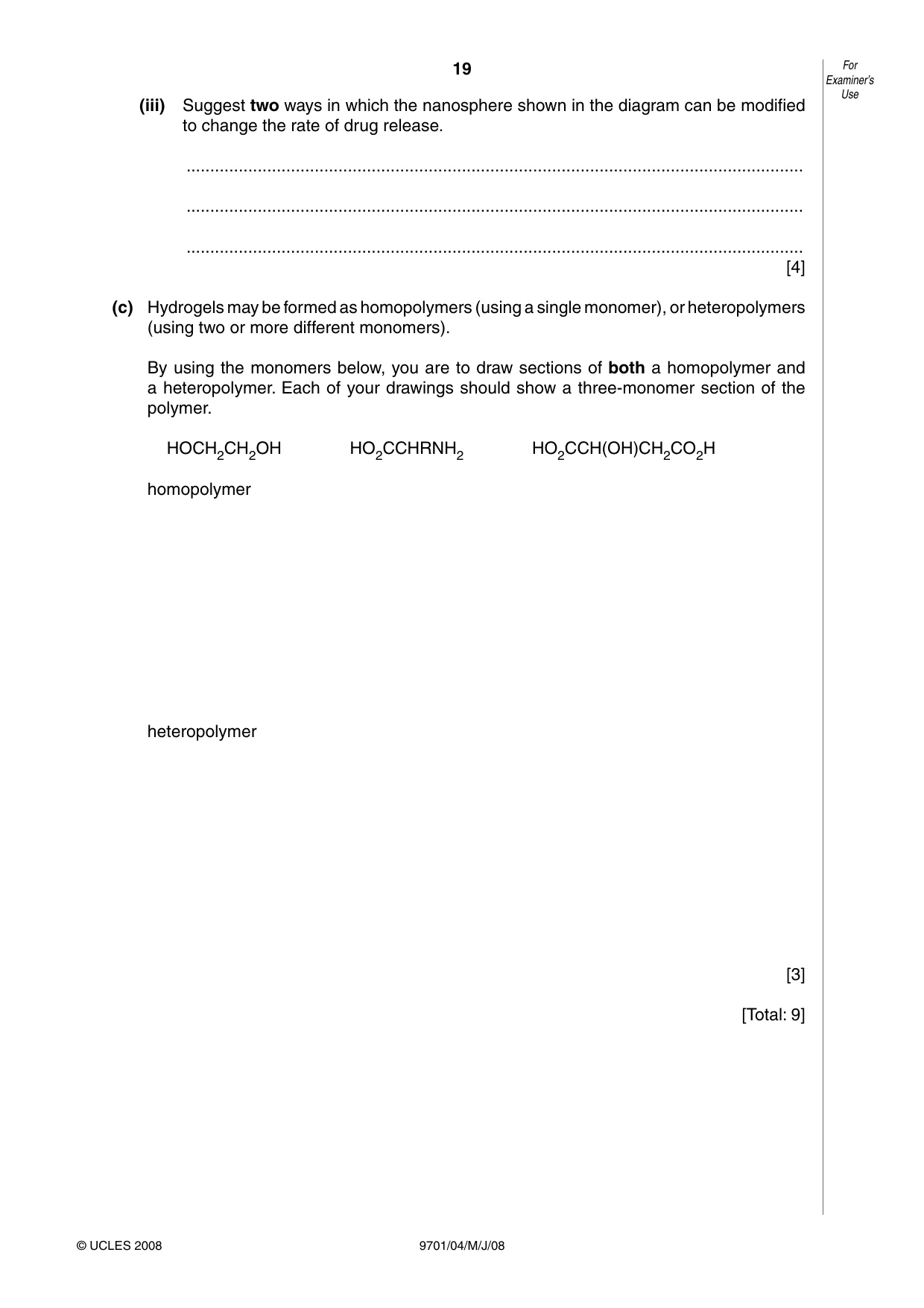
19 9701/04/M/J/08 For Examiner’s Use © UCLES 2008 (iii) Suggest two ways in which the nanosphere shown in the diagram can be modified to change the rate of drug release. … … … [4] (c) Hydrogels may be formed as homopolymers (using a single monomer), or heteropolymers (using two or more different monomers). By using the monomers below, you are to draw sections of both a homopolymer and a heteropolymer. Each of your drawings should show a three-monomer section of the polymer. HOCH2CH2OH HO2CCHRNH2 HO2CCH(OH)CH2CO2H homopolymer heteropolymer [3] [Total: 9]
Question paper, page 20
20 9701/04/M/J/08 BLANK PAGE Permission to reproduce items where third-party owned material protected by copyright is included has been sought and cleared where possible. Every reasonable effort has been made by the publisher (UCLES) to trace copyright holders, but if any items requiring clearance have unwittingly been included, the publisher will be pleased to make amends at the earliest possible opportunity. University of Cambridge International Examinations is part of the Cambridge Assessment Group. Cambridge Assessment is the brand name of University of Cambridge Local Examinations Syndicate (UCLES), which is itself a department of the University of Cambridge.
Mark scheme, page 1
UNIVERSITY OF CAMBRIDGE INTERNATIONAL EXAMINATIONS GCE Advanced Subsidiary Level and GCE Advanced Level MARK SCHEME for the May/June 2008 question paper 9701 CHEMISTRY 9701/04 Paper 4 (A2 Structured Questions), maximum raw mark 100 This mark scheme is published as an aid to teachers and candidates, to indicate the requirements of the examination. It shows the basis on which Examiners were instructed to award marks. It does not indicate the details of the discussions that took place at an Examiners’ meeting before marking began. All Examiners are instructed that alternative correct answers and unexpected approaches in candidates’ scripts must be given marks that fairly reflect the relevant knowledge and skills demonstrated. Mark schemes must be read in conjunction with the question papers and the report on the examination. • CIE will not enter into discussions or correspondence in connection with these mark schemes. CIE is publishing the mark schemes for the May/June 2008 question papers for most IGCSE, GCE Advanced Level and Advanced Subsidiary Level syllabuses and some Ordinary Level syllabuses.
Mark scheme, page 2
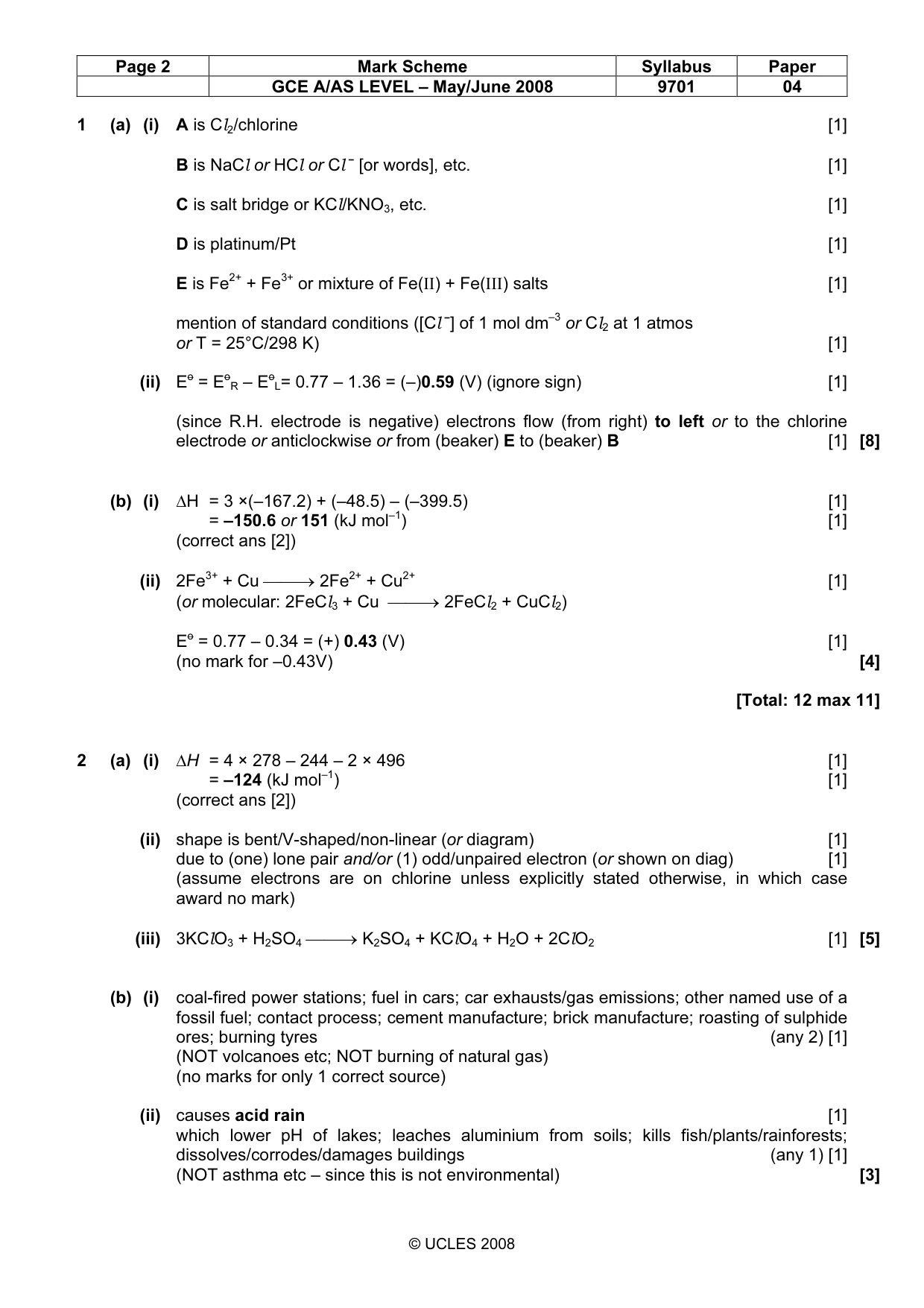
Page 2 Mark Scheme Syllabus Paper GCE A/AS LEVEL – May/June 2008 9701 04 © UCLES 2008 1 (a) (i) A is Cl2/chlorine [1] B is NaCl or HCl or Cl ¯ [or words], etc. [1] C is salt bridge or KCl/KNO3, etc. [1] D is platinum/Pt [1] E is Fe2+ + Fe3+ or mixture of Fe(II) + Fe(III) salts [1] mention of standard conditions ([Cl ¯] of 1 mol dm–3 or Cl2 at 1 atmos or T = 25°C/298 K) [1] (ii) Eo = Eo R – Eo L= 0.77 – 1.36 = (–)0.59 (V) (ignore sign) [1] (since R.H. electrode is negative) electrons flow (from right) to left or to the chlorine electrode or anticlockwise or from (beaker) E to (beaker) B [1] [8] (b) (i) ∆H = 3 ×(–167.2) + (–48.5) – (–399.5) [1] = –150.6 or 151 (kJ mol–1) [1] (correct ans [2]) (ii) 2Fe3+ + Cu → 2Fe2+ + Cu2+ [1] (or molecular: 2FeCl3 + Cu → 2FeCl2 + CuCl2) Eo = 0.77 – 0.34 = (+) 0.43 (V) [1] (no mark for –0.43V) [4] [Total: 12 max 11] 2 (a) (i) ∆H = 4 × 278 – 244 – 2 × 496 [1] = –124 (kJ mol–1) [1] (correct ans [2]) (ii) shape is bent/V-shaped/non-linear (or diagram) [1] due to (one) lone pair and/or (1) odd/unpaired electron (or shown on diag) [1] (assume electrons are on chlorine unless explicitly stated otherwise, in which case award no mark) (iii) 3KClO3 + H2SO4 → K2SO4 + KClO4 + H2O + 2ClO2 [1] [5] (b) (i) coal-fired power stations; fuel in cars; car exhausts/gas emissions; other named use of a fossil fuel; contact process; cement manufacture; brick manufacture; roasting of sulphide ores; burning tyres (any 2) [1] (NOT volcanoes etc; NOT burning of natural gas) (no marks for only 1 correct source) (ii) causes acid rain [1] which lower pH of lakes; leaches aluminium from soils; kills fish/plants/rainforests; dissolves/corrodes/damages buildings (any 1) [1] (NOT asthma etc – since this is not environmental) [3]
Mark scheme, page 3
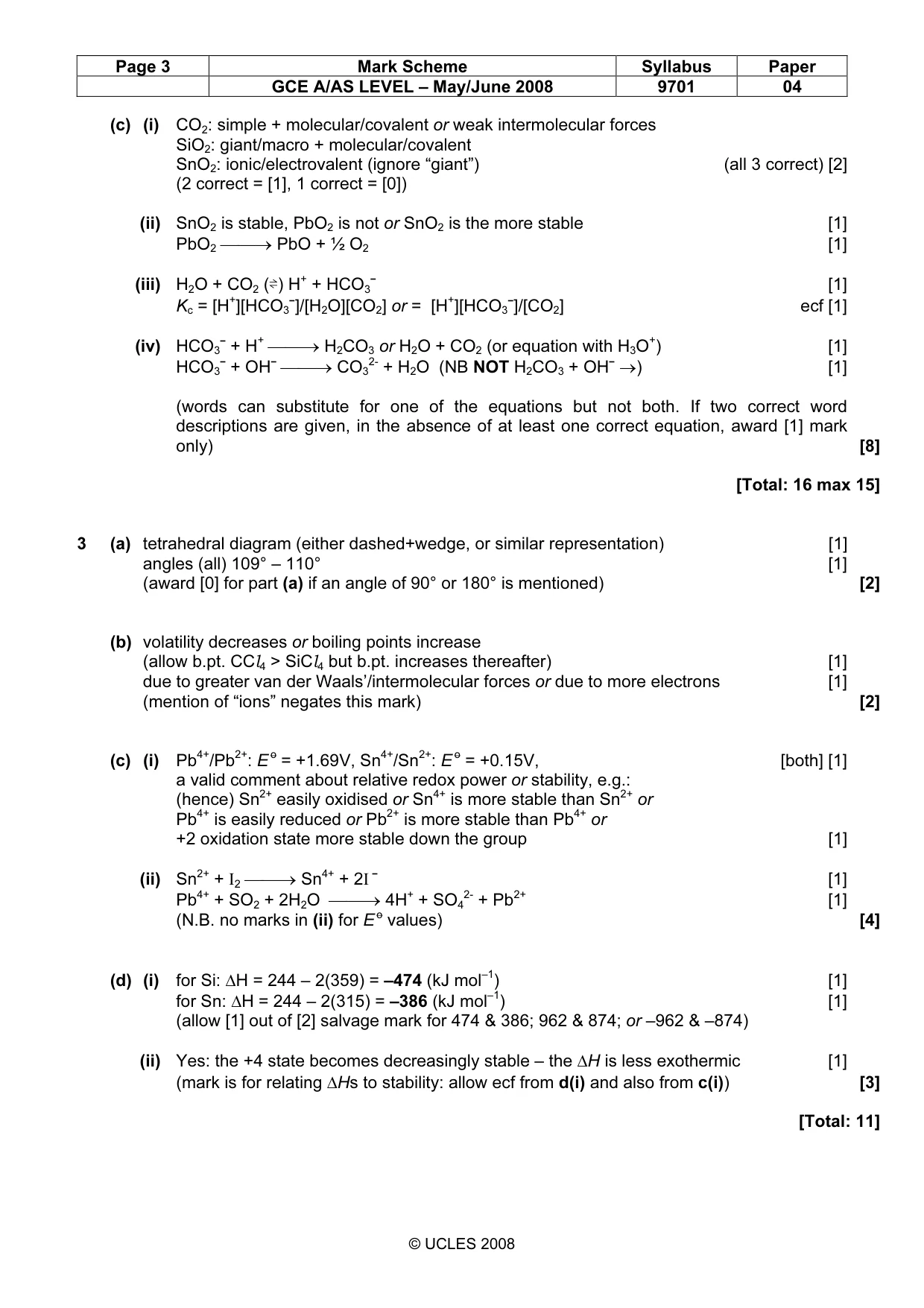
Page 3 Mark Scheme Syllabus Paper GCE A/AS LEVEL – May/June 2008 9701 04 © UCLES 2008 (c) (i) CO2: simple + molecular/covalent or weak intermolecular forces SiO2: giant/macro + molecular/covalent SnO2: ionic/electrovalent (ignore “giant”) (all 3 correct) [2] (2 correct = [1], 1 correct = [0]) (ii) SnO2 is stable, PbO2 is not or SnO2 is the more stable [1] PbO2 → PbO + ½ O2 [1] (iii) H2O + CO2 (⇌) H+ + HCO3¯ [1] Kc = [H+][HCO3¯]/[H2O][CO2] or = [H+][HCO3¯]/[CO2] ecf [1] (iv) HCO3¯ + H+ → H2CO3 or H2O + CO2 (or equation with H3O+) [1] HCO3¯ + OH¯ → CO3 2- + H2O (NB NOT H2CO3 + OH¯ →) [1] (words can substitute for one of the equations but not both. If two correct word descriptions are given, in the absence of at least one correct equation, award [1] mark only) [8] [Total: 16 max 15] 3 (a) tetrahedral diagram (either dashed+wedge, or similar representation) [1] angles (all) 109° – 110° [1] (award [0] for part (a) if an angle of 90° or 180° is mentioned) [2] (b) volatility decreases or boiling points increase (allow b.pt. CCl4 > SiCl4 but b.pt. increases thereafter) [1] due to greater van der Waals’/intermolecular forces or due to more electrons [1] (mention of “ions” negates this mark) [2] (c) (i) Pb4+/Pb2+: E o = +1.69V, Sn4+/Sn2+: E o = +0.15V, [both] [1] a valid comment about relative redox power or stability, e.g.: (hence) Sn2+ easily oxidised or Sn4+ is more stable than Sn2+ or Pb4+ is easily reduced or Pb2+ is more stable than Pb4+ or +2 oxidation state more stable down the group [1] (ii) Sn2+ + I2 → Sn4+ + 2I ¯ [1] Pb4+ + SO2 + 2H2O → 4H+ + SO4 2- + Pb2+ [1] (N.B. no marks in (ii) for E o values) [4] (d) (i) for Si: ∆H = 244 – 2(359) = –474 (kJ mol–1) [1] for Sn: ∆H = 244 – 2(315) = –386 (kJ mol–1) [1] (allow [1] out of [2] salvage mark for 474 & 386; 962 & 874; or –962 & –874) (ii) Yes: the +4 state becomes decreasingly stable – the ∆H is less exothermic [1] (mark is for relating ∆Hs to stability: allow ecf from d(i) and also from c(i)) [3] [Total: 11]
Mark scheme, page 4
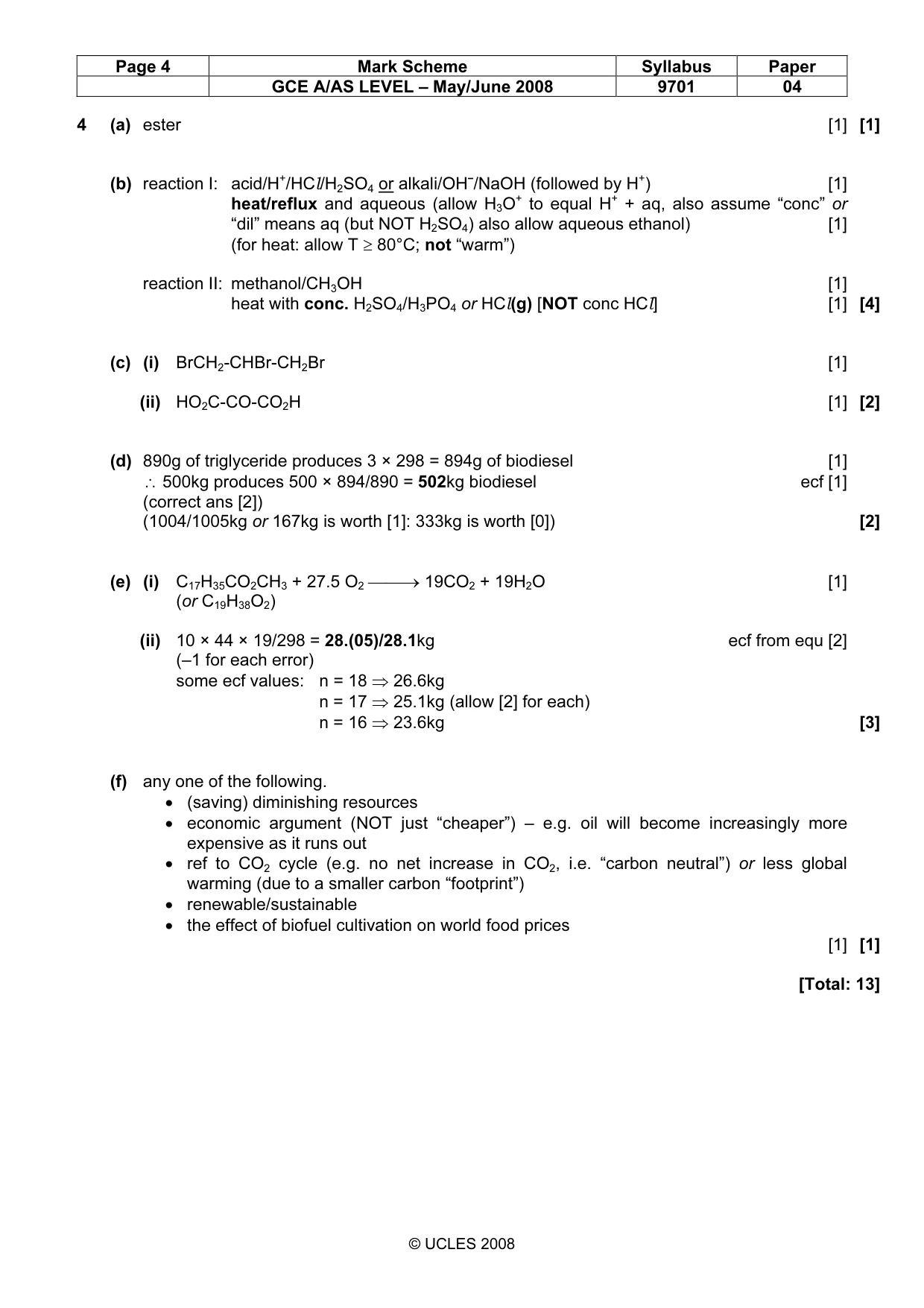
Page 4 Mark Scheme Syllabus Paper GCE A/AS LEVEL – May/June 2008 9701 04 © UCLES 2008 4 (a) ester [1] [1] (b) reaction I: acid/H+/HCl/H2SO4 or alkali/OH¯/NaOH (followed by H+) [1] heat/reflux and aqueous (allow H3O+ to equal H+ + aq, also assume “conc” or “dil” means aq (but NOT H2SO4) also allow aqueous ethanol) [1] (for heat: allow T ≥ 80°C; not “warm”) reaction II: methanol/CH3OH [1] heat with conc. H2SO4/H3PO4 or HCl(g) [NOT conc HCl] [1] [4] (c) (i) BrCH2-CHBr-CH2Br [1] (ii) HO2C-CO-CO2H [1] [2] (d) 890g of triglyceride produces 3 × 298 = 894g of biodiesel [1] ∴ 500kg produces 500 × 894/890 = 502kg biodiesel ecf [1] (correct ans [2]) (1004/1005kg or 167kg is worth [1]: 333kg is worth [0]) [2] (e) (i) C17H35CO2CH3 + 27.5 O2 → 19CO2 + 19H2O [1] (or C19H38O2) (ii) 10 × 44 × 19/298 = 28.(05)/28.1kg ecf from equ [2] (–1 for each error) some ecf values: n = 18 ⇒ 26.6kg n = 17 ⇒ 25.1kg (allow [2] for each) n = 16 ⇒ 23.6kg [3] (f) any one of the following. • (saving) diminishing resources • economic argument (NOT just “cheaper”) – e.g. oil will become increasingly more expensive as it runs out • ref to CO2 cycle (e.g. no net increase in CO2, i.e. “carbon neutral”) or less global warming (due to a smaller carbon “footprint”) • renewable/sustainable • the effect of biofuel cultivation on world food prices [1] [1] [Total: 13]
Mark scheme, page 5
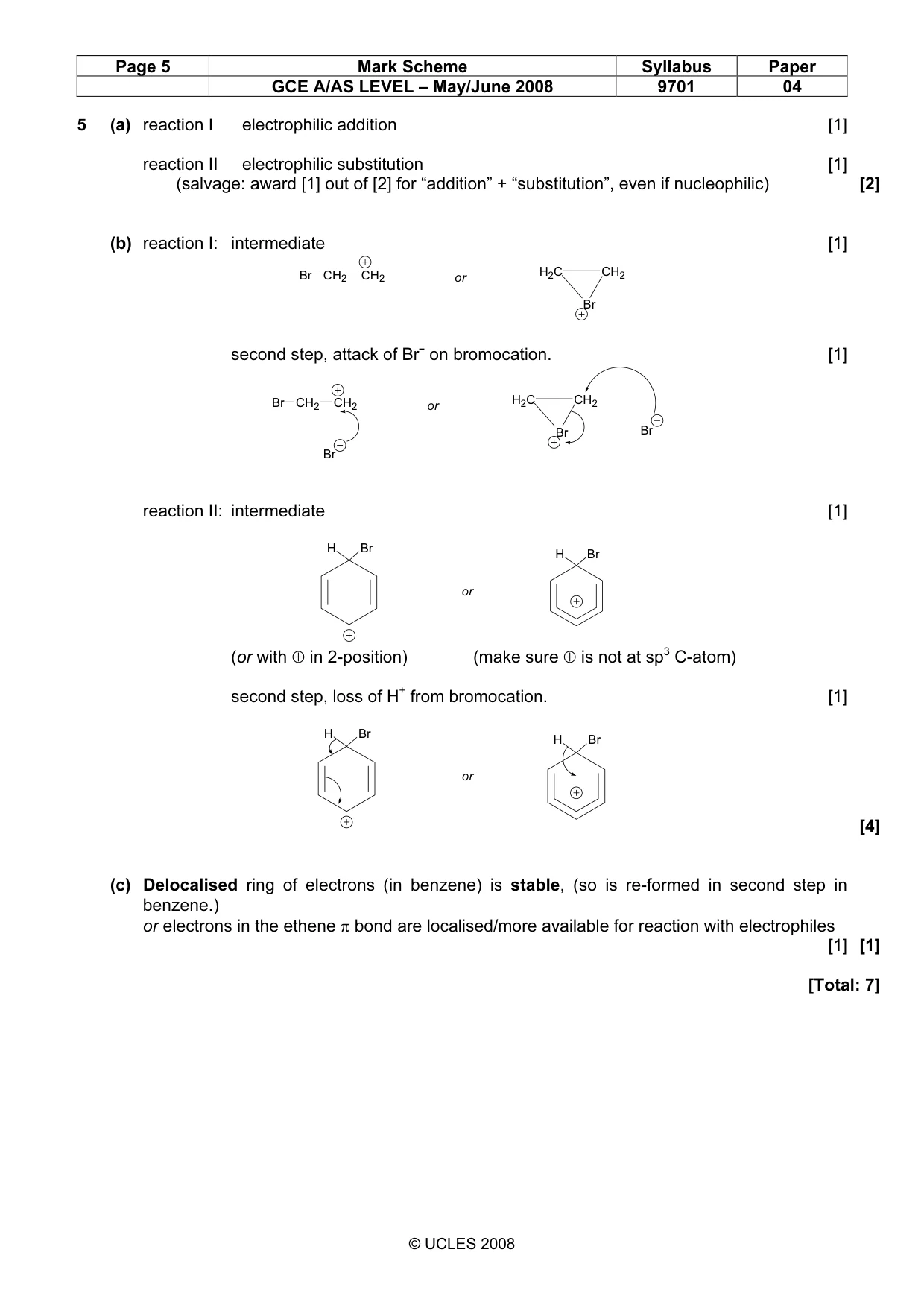
Page 5 Mark Scheme Syllabus Paper GCE A/AS LEVEL – May/June 2008 9701 04 © UCLES 2008 5 (a) reaction I electrophilic addition [1] reaction II electrophilic substitution [1] (salvage: award [1] out of [2] for “addition” + “substitution”, even if nucleophilic) [2] (b) reaction I: intermediate [1] Br CH2 CH2 or H2C CH2 Br second step, attack of Br¯ on bromocation. [1] Br CH2 CH2 or H2C CH2 Br Br Br reaction II: intermediate [1] H Br H Br or (or with ⊕ in 2-position) (make sure ⊕ is not at sp3 C-atom) second step, loss of H+ from bromocation. [1] H Br H Br or [4] (c) Delocalised ring of electrons (in benzene) is stable, (so is re-formed in second step in benzene.) or electrons in the ethene π bond are localised/more available for reaction with electrophiles [1] [1] [Total: 7]
Mark scheme, page 6
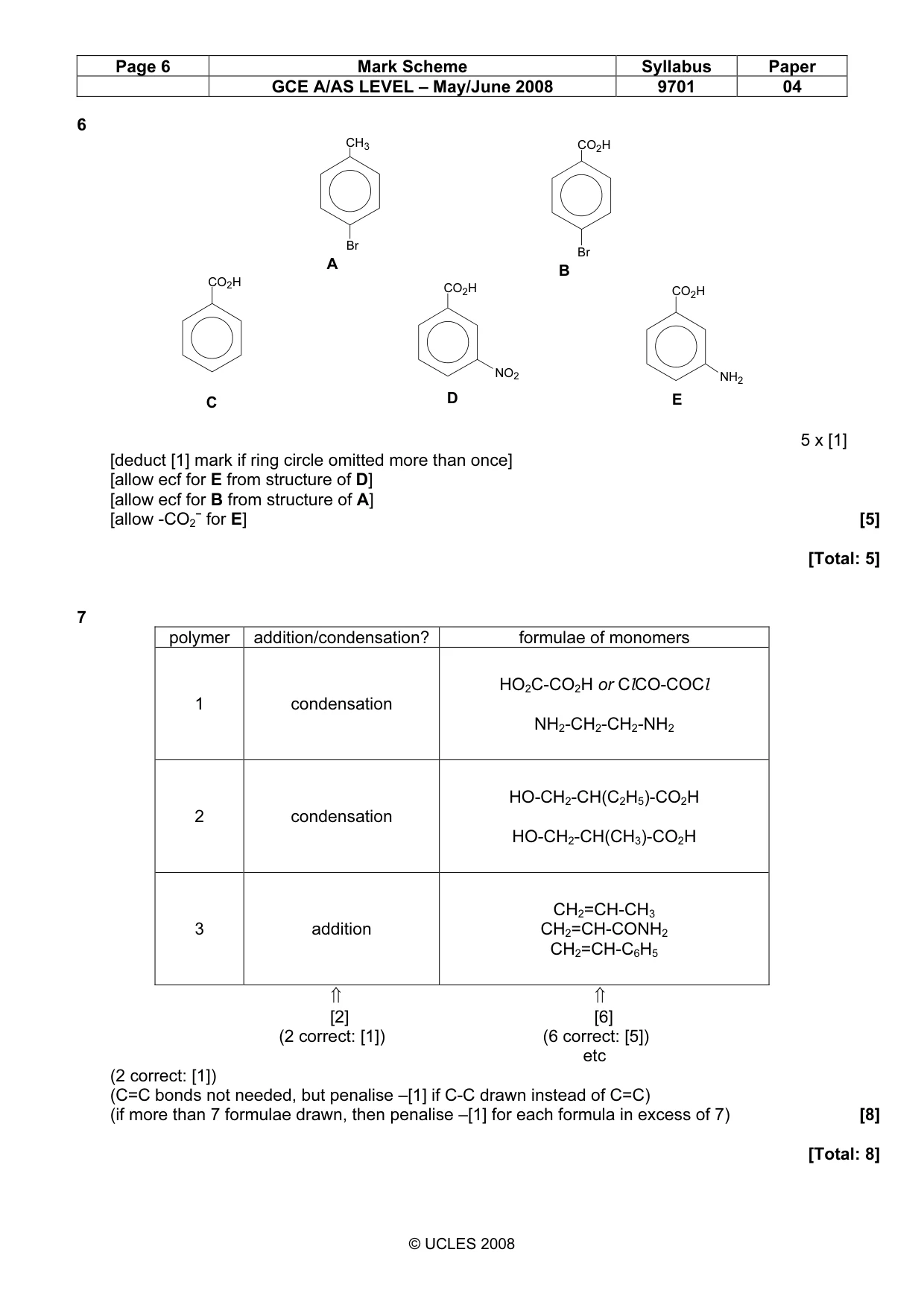
Page 6 Mark Scheme Syllabus Paper GCE A/AS LEVEL – May/June 2008 9701 04 © UCLES 2008 6 CH3 Br CO2H CO2H CO2H Br NO2 CO2H NH2 A B C D E 5 x [1] [deduct [1] mark if ring circle omitted more than once] [allow ecf for E from structure of D] [allow ecf for B from structure of A] [allow -CO2¯ for E] [5] [Total: 5] 7 polymer addition/condensation? formulae of monomers 1 condensation HO2C-CO2H or ClCO-COCl NH2-CH2-CH2-NH2 2 condensation HO-CH2-CH(C2H5)-CO2H HO-CH2-CH(CH3)-CO2H 3 addition CH2=CH-CH3 CH2=CH-CONH2 CH2=CH-C6H5 ⇑ ⇑ [2] [6] (2 correct: [1]) (6 correct: [5]) etc (2 correct: [1]) (C=C bonds not needed, but penalise –[1] if C-C drawn instead of C=C) (if more than 7 formulae drawn, then penalise –[1] for each formula in excess of 7) [8] [Total: 8]
Mark scheme, page 7
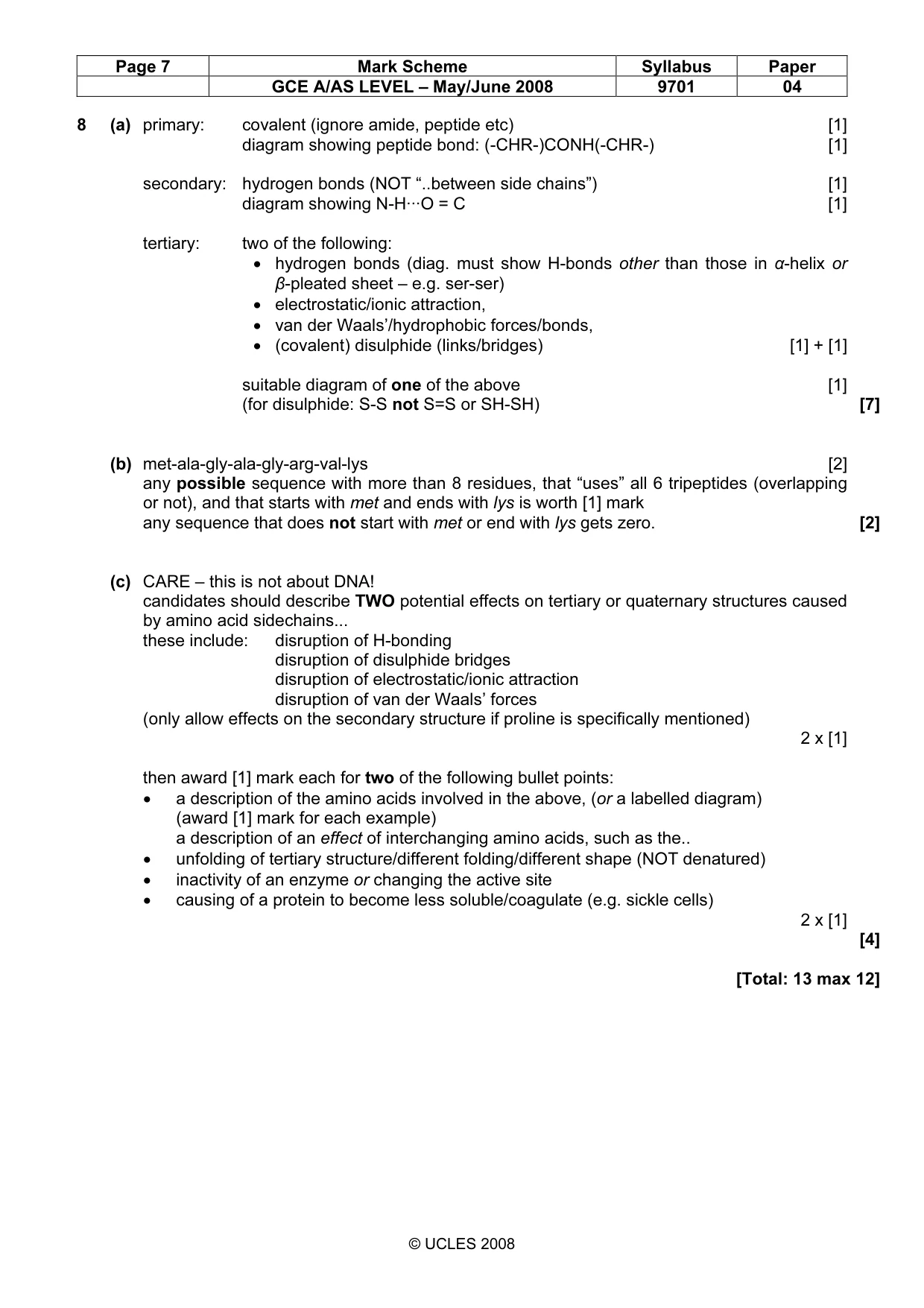
Page 7 Mark Scheme Syllabus Paper GCE A/AS LEVEL – May/June 2008 9701 04 © UCLES 2008 8 (a) primary: covalent (ignore amide, peptide etc) [1] diagram showing peptide bond: (-CHR-)CONH(-CHR-) [1] secondary: hydrogen bonds (NOT “..between side chains”) [1] diagram showing N-H···O = C [1] tertiary: two of the following: • hydrogen bonds (diag. must show H-bonds other than those in α-helix or β-pleated sheet – e.g. ser-ser) • electrostatic/ionic attraction, • van der Waals’/hydrophobic forces/bonds, • (covalent) disulphide (links/bridges) [1] + [1] suitable diagram of one of the above [1] (for disulphide: S-S not S=S or SH-SH) [7] (b) met-ala-gly-ala-gly-arg-val-lys [2] any possible sequence with more than 8 residues, that “uses” all 6 tripeptides (overlapping or not), and that starts with met and ends with lys is worth [1] mark any sequence that does not start with met or end with lys gets zero. [2] (c) CARE – this is not about DNA! candidates should describe TWO potential effects on tertiary or quaternary structures caused by amino acid sidechains... these include: disruption of H-bonding disruption of disulphide bridges disruption of electrostatic/ionic attraction disruption of van der Waals’ forces (only allow effects on the secondary structure if proline is specifically mentioned) 2 x [1] then award [1] mark each for two of the following bullet points: • a description of the amino acids involved in the above, (or a labelled diagram) (award [1] mark for each example) a description of an effect of interchanging amino acids, such as the.. • unfolding of tertiary structure/different folding/different shape (NOT denatured) • inactivity of an enzyme or changing the active site • causing of a protein to become less soluble/coagulate (e.g. sickle cells) 2 x [1] [4] [Total: 13 max 12]
Mark scheme, page 8
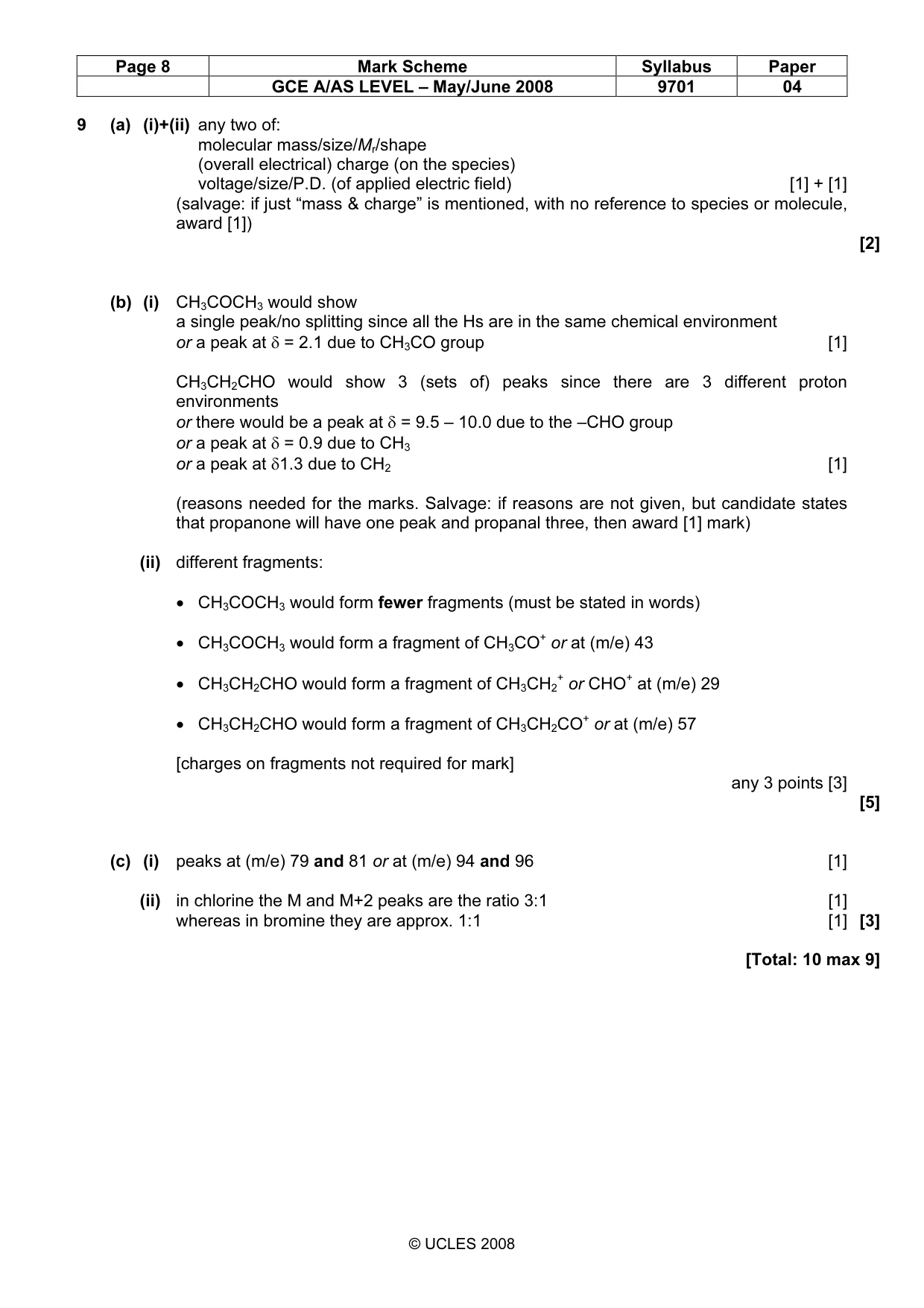
Page 8 Mark Scheme Syllabus Paper GCE A/AS LEVEL – May/June 2008 9701 04 © UCLES 2008 9 (a) (i)+(ii) any two of: molecular mass/size/Mr/shape (overall electrical) charge (on the species) voltage/size/P.D. (of applied electric field) [1] + [1] (salvage: if just “mass & charge” is mentioned, with no reference to species or molecule, award [1]) [2] (b) (i) CH3COCH3 would show a single peak/no splitting since all the Hs are in the same chemical environment or a peak at δ = 2.1 due to CH3CO group [1] CH3CH2CHO would show 3 (sets of) peaks since there are 3 different proton environments or there would be a peak at δ = 9.5 – 10.0 due to the –CHO group or a peak at δ = 0.9 due to CH3 or a peak at δ1.3 due to CH2 [1] (reasons needed for the marks. Salvage: if reasons are not given, but candidate states that propanone will have one peak and propanal three, then award [1] mark) (ii) different fragments: • CH3COCH3 would form fewer fragments (must be stated in words) • CH3COCH3 would form a fragment of CH3CO+ or at (m/e) 43 • CH3CH2CHO would form a fragment of CH3CH2 + or CHO+ at (m/e) 29 • CH3CH2CHO would form a fragment of CH3CH2CO+ or at (m/e) 57 [charges on fragments not required for mark] any 3 points [3] [5] (c) (i) peaks at (m/e) 79 and 81 or at (m/e) 94 and 96 [1] (ii) in chlorine the M and M+2 peaks are the ratio 3:1 [1] whereas in bromine they are approx. 1:1 [1] [3] [Total: 10 max 9]
Mark scheme, page 9
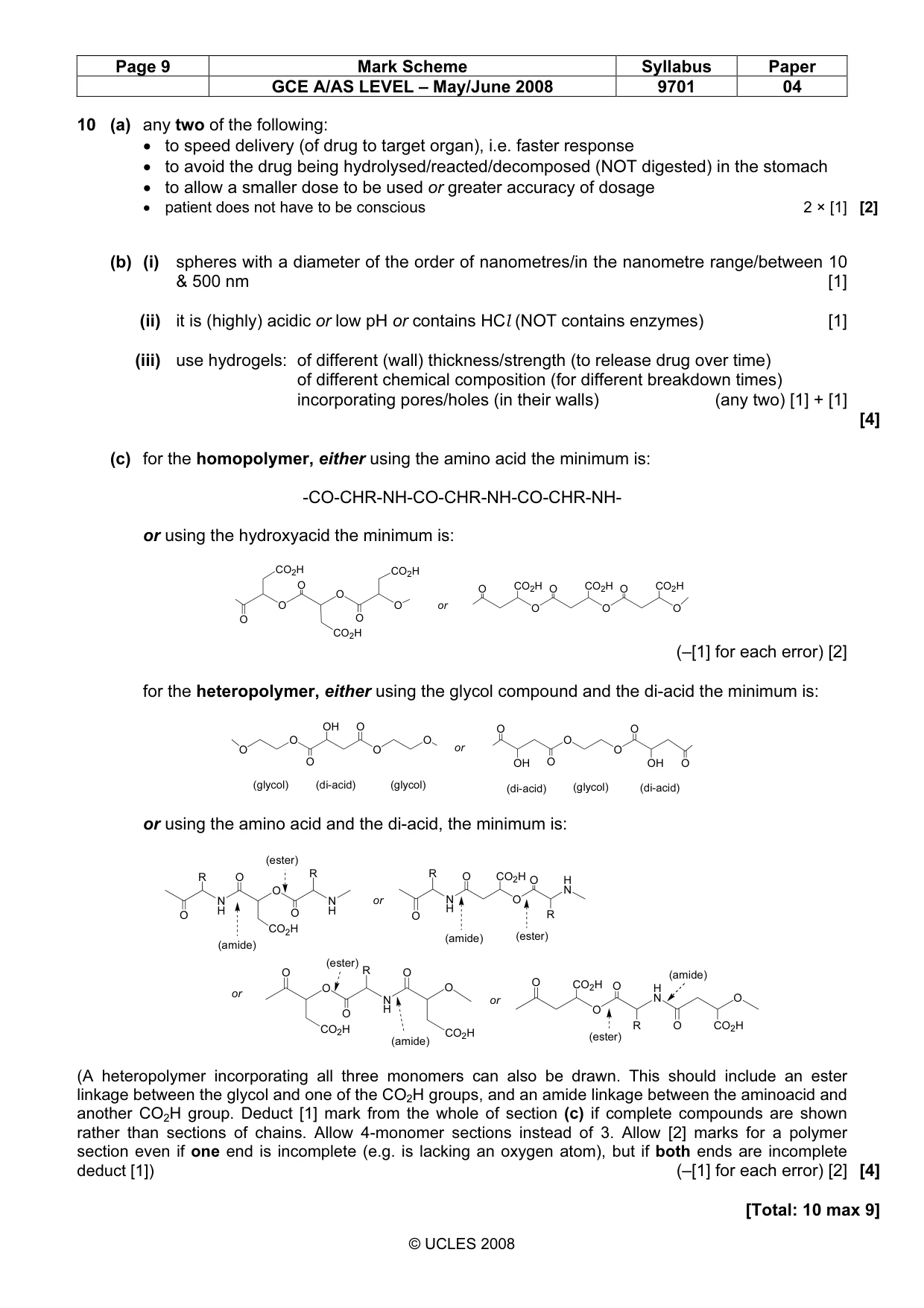
Page 9 Mark Scheme Syllabus Paper GCE A/AS LEVEL – May/June 2008 9701 04 © UCLES 2008 10 (a) any two of the following: • to speed delivery (of drug to target organ), i.e. faster response • to avoid the drug being hydrolysed/reacted/decomposed (NOT digested) in the stomach • to allow a smaller dose to be used or greater accuracy of dosage • patient does not have to be conscious 2 × [1] [2] (b) (i) spheres with a diameter of the order of nanometres/in the nanometre range/between 10 & 500 nm [1] (ii) it is (highly) acidic or low pH or contains HCl (NOT contains enzymes) [1] (iii) use hydrogels: of different (wall) thickness/strength (to release drug over time) of different chemical composition (for different breakdown times) incorporating pores/holes (in their walls) (any two) [1] + [1] [4] (c) for the homopolymer, either using the amino acid the minimum is: -CO-CHR-NH-CO-CHR-NH-CO-CHR-NH- or using the hydroxyacid the minimum is: O O O O CO2H O CO2H O CO2H O O O O CO2H O CO2H O CO2H or (–[1] for each error) [2] for the heteropolymer, either using the glycol compound and the di-acid the minimum is: O O O O O O O OH O or O OH O O OH O (glycol) (di-acid) (glycol) (di-acid) (glycol) (di-acid) or using the amino acid and the di-acid, the minimum is: N H O N H N H O H N O R O CO2H O R O R O CO2H O R or (amide) (ester) (amide) (ester) O N H O CO2H O R O O CO2H (ester) (amide) or O H N O O CO2H O R O CO2H (ester) (amide) or (A heteropolymer incorporating all three monomers can also be drawn. This should include an ester linkage between the glycol and one of the CO2H groups, and an amide linkage between the aminoacid and another CO2H group. Deduct [1] mark from the whole of section (c) if complete compounds are shown rather than sections of chains. Allow 4-monomer sections instead of 3. Allow [2] marks for a polymer section even if one end is incomplete (e.g. is lacking an oxygen atom), but if both ends are incomplete deduct [1]) (–[1] for each error) [2] [4] [Total: 10 max 9]
What you needed in this session
Cambridge’s own grade thresholds for 2008 May/June, Paper 4 · Variant 1. A higher threshold means an easier paper — the bar moves with how the cohort did.