Cambridge A Level Chemistry 9701 — 2007 May/June Paper 4 · Variant 1
9701/41/M/J/07 · 100 marks · ≈113 min
The question paper and its mark scheme, free to read here and free to download. This is Cambridge’s own paper, exactly as it was sat.
Question paper16 pages
Mark scheme8 pages
Answers below. Sit the paper first if you are practising.
Paper as text
Question paper, page 1
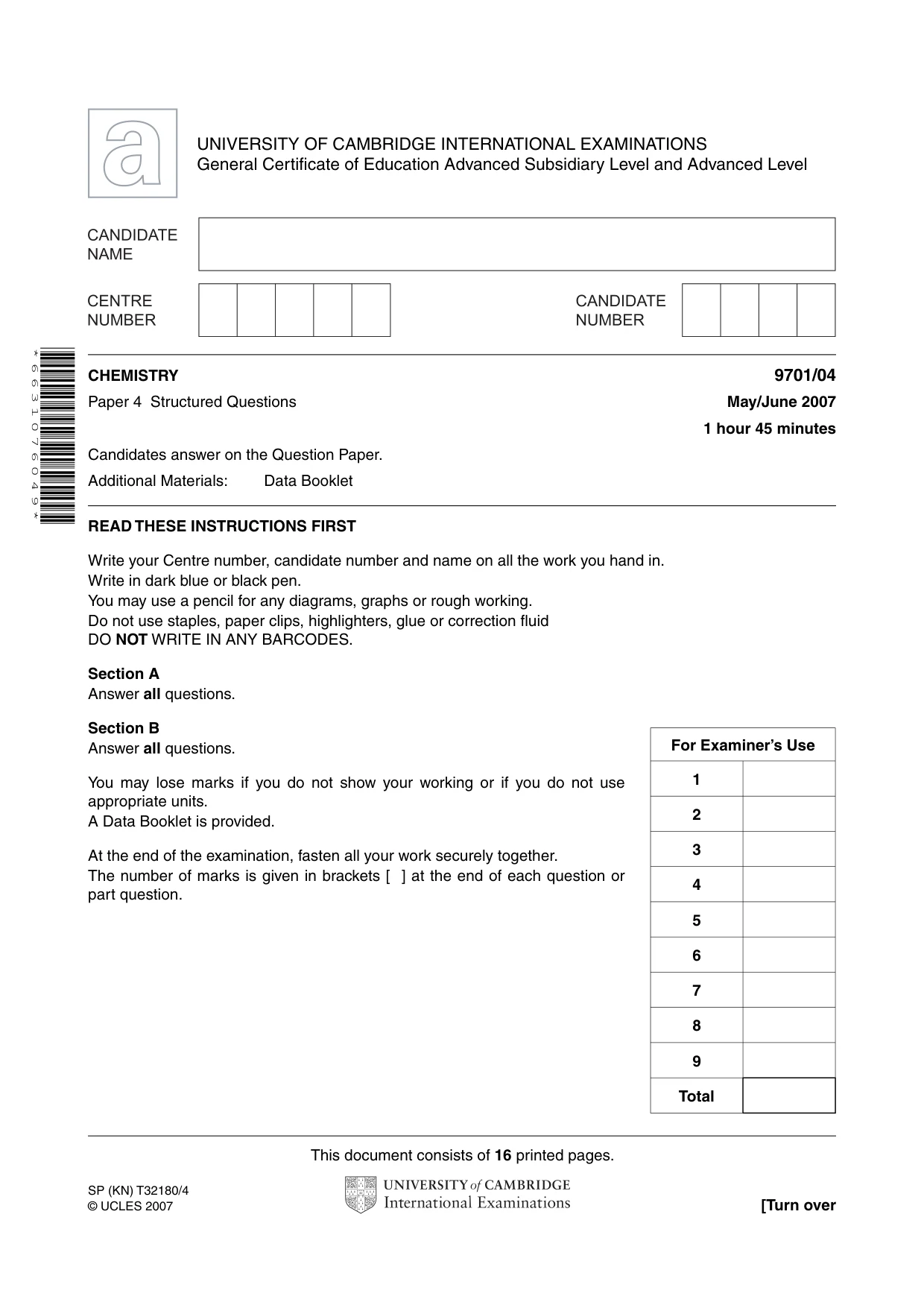
This document consists of 16 printed pages. SP (KN) T32180/4 © UCLES 2007 [Turn over UNIVERSITY OF CAMBRIDGE INTERNATIONAL EXAMINATIONS General Certificate of Education Advanced Subsidiary Level and Advanced Level * 6 6 3 1 0 7 6 0 4 9 * CHEMISTRY 9701/04 Paper 4 Structured Questions May/June 2007 1 hour 45 minutes Candidates answer on the Question Paper. Additional Materials: Data Booklet READ THESE INSTRUCTIONS FIRST Write your Centre number, candidate number and name on all the work you hand in. Write in dark blue or black pen. You may use a pencil for any diagrams, graphs or rough working. Do not use staples, paper clips, highlighters, glue or correction fluid DO NOT WRITE IN ANY BARCODES. Section A Answer all questions. Section B Answer all questions. You may lose marks if you do not show your working or if you do not use appropriate units. A Data Booklet is provided. At the end of the examination, fasten all your work securely together. The number of marks is given in brackets [ ] at the end of each question or part question. For Examiner’s Use 1 2 3 4 5 6 7 8 9 Total
Question paper, page 2
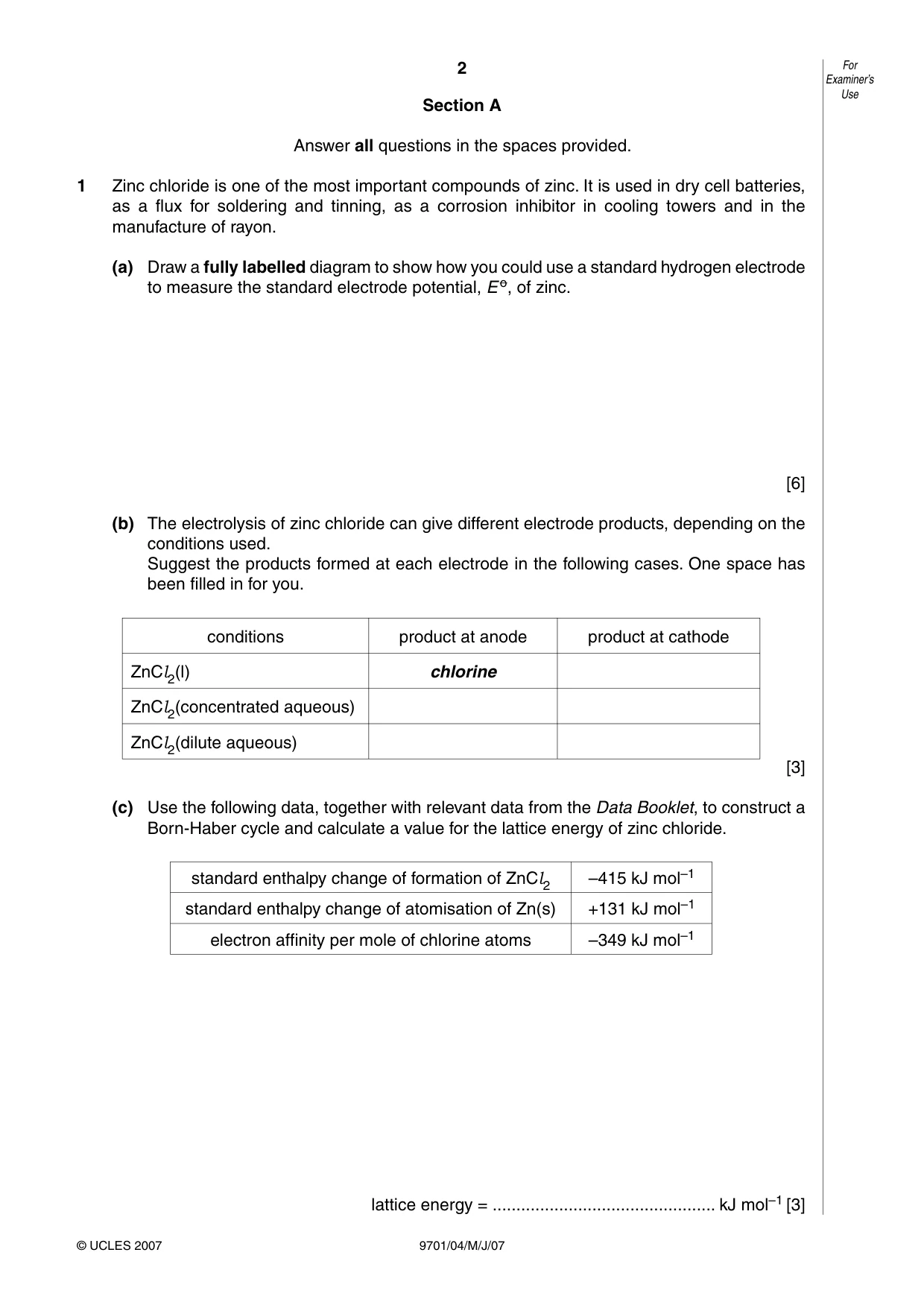
2 9701/04/M/J/07 For Examiner’s Use © UCLES 2007 Section A Answer all questions in the spaces provided. 1 Zinc chloride is one of the most important compounds of zinc. It is used in dry cell batteries, as a flux for soldering and tinning, as a corrosion inhibitor in cooling towers and in the manufacture of rayon. (a) Draw a fully labelled diagram to show how you could use a standard hydrogen electrode to measure the standard electrode potential, E o, of zinc. [6] (b) The electrolysis of zinc chloride can give different electrode products, depending on the conditions used. Suggest the products formed at each electrode in the following cases. One space has been filled in for you. conditions product at anode product at cathode ZnCl2(l) chlorine ZnCl2(concentrated aqueous) ZnCl2(dilute aqueous) [3] (c) Use the following data, together with relevant data from the Data Booklet, to construct a Born-Haber cycle and calculate a value for the lattice energy of zinc chloride. standard enthalpy change of formation of ZnCl2 –415 kJ mol–1 standard enthalpy change of atomisation of Zn(s) +131 kJ mol–1 electron affinity per mole of chlorine atoms –349 kJ mol–1 lattice energy = … kJ mol–1 [3]
Question paper, page 3
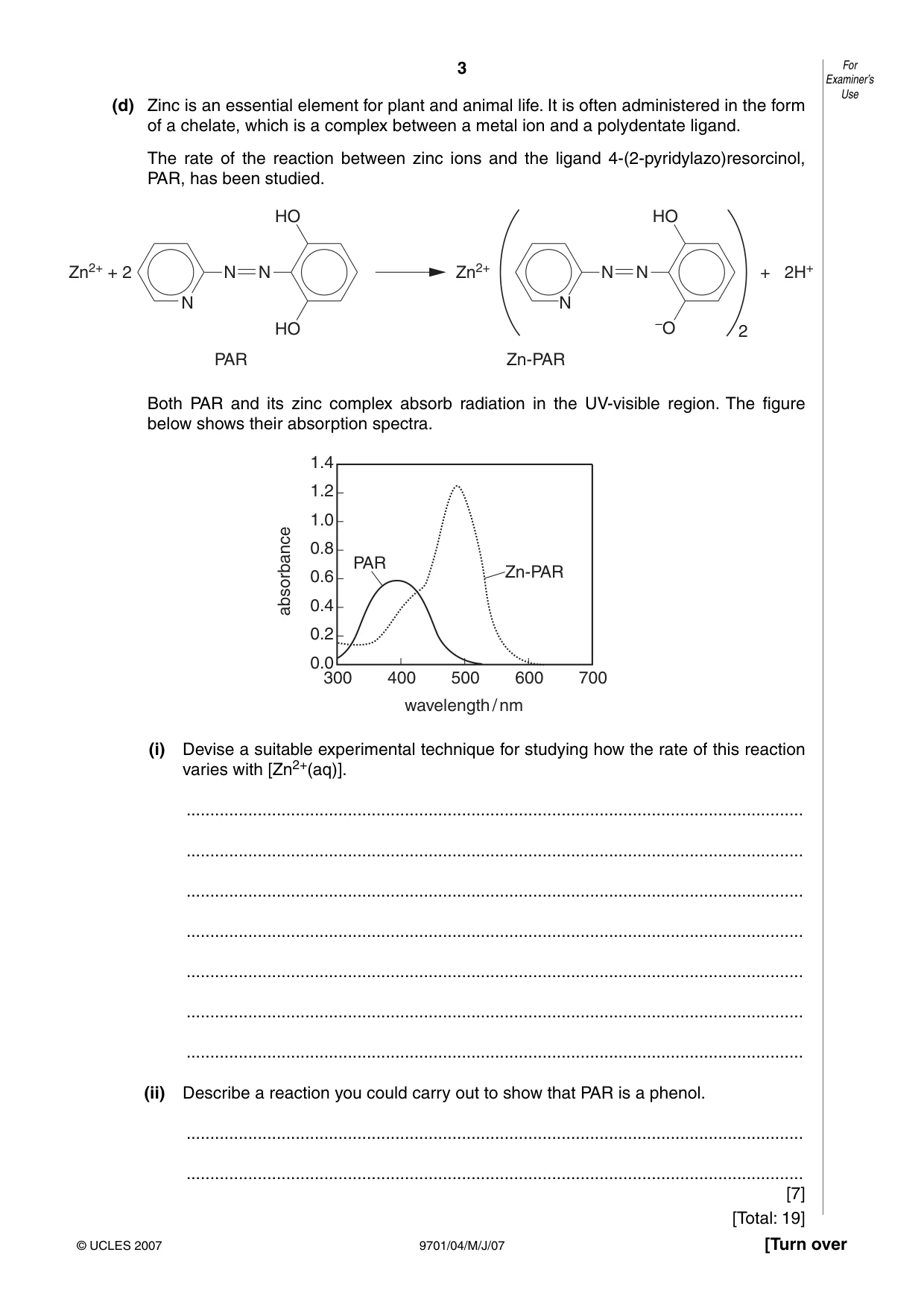
3 9701/04/M/J/07 [Turn over For Examiner’s Use © UCLES 2007 (d) Zinc is an essential element for plant and animal life. It is often administered in the form of a chelate, which is a complex between a metal ion and a polydentate ligand. The rate of the reaction between zinc ions and the ligand 4-(2-pyridylazo)resorcinol, PAR, has been studied. Zn2+ + 2 HO HO PAR N N Zn2+ HO –O Zn-PAR N N N N + 2H+ 2 Both PAR and its zinc complex absorb radiation in the UV-visible region. The figure below shows their absorption spectra. 0.0 0.2 0.4 0.6 0.8 1.0 1.2 1.4 absorbance 300 400 500 wavelength / nm 600 700 PAR Zn-PAR (i) Devise a suitable experimental technique for studying how the rate of this reaction varies with [Zn2+(aq)]. … … … … … … … (ii) Describe a reaction you could carry out to show that PAR is a phenol. … … [7] [Total: 19]
Question paper, page 4
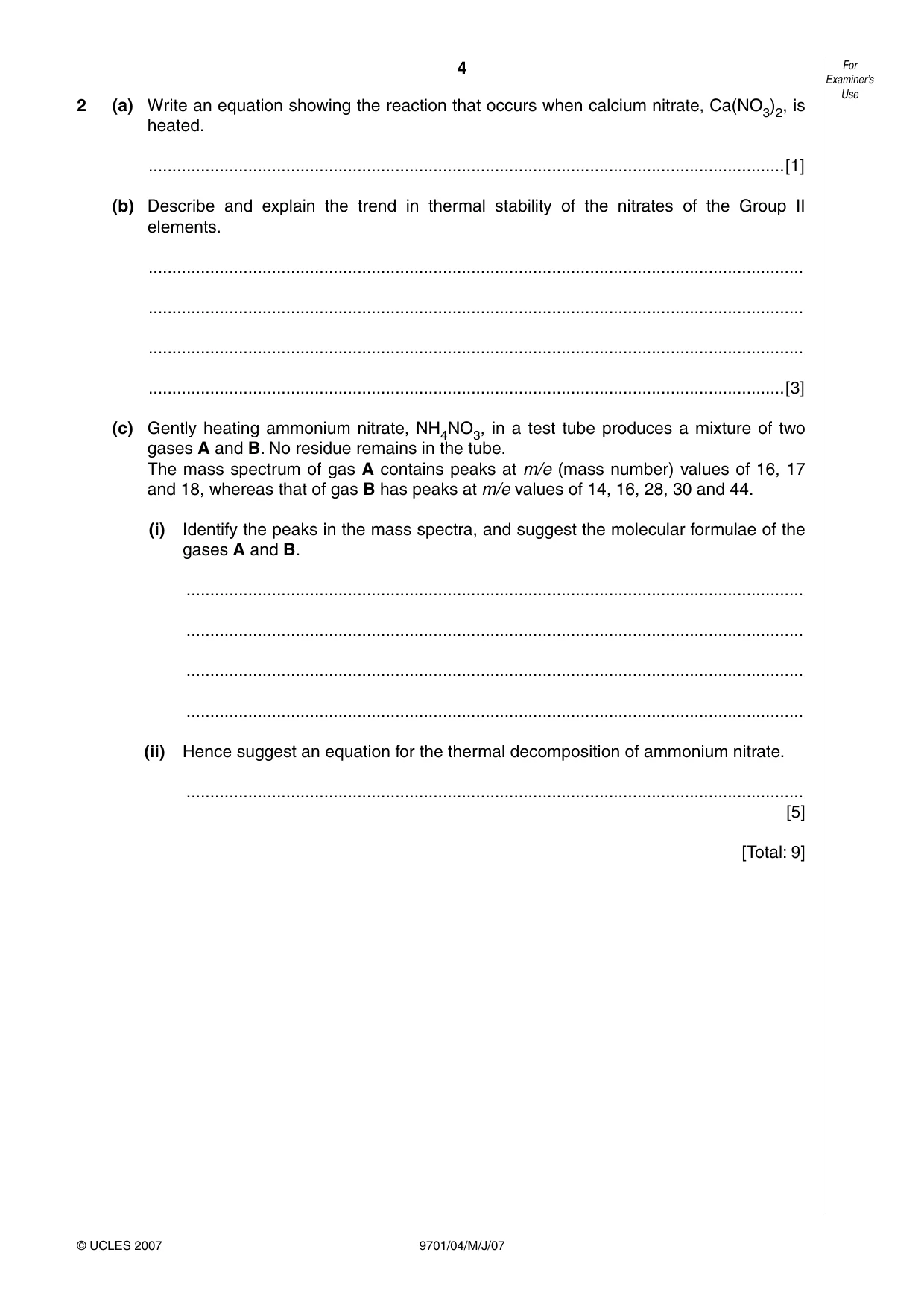
4 9701/04/M/J/07 For Examiner’s Use © UCLES 2007 2 (a) Write an equation showing the reaction that occurs when calcium nitrate, Ca(NO3)2, is heated. …[1] (b) Describe and explain the trend in thermal stability of the nitrates of the Group II elements. … … … …[3] (c) Gently heating ammonium nitrate, NH4NO3, in a test tube produces a mixture of two gases A and B. No residue remains in the tube. The mass spectrum of gas A contains peaks at m/e (mass number) values of 16, 17 and 18, whereas that of gas B has peaks at m/e values of 14, 16, 28, 30 and 44. (i) Identify the peaks in the mass spectra, and suggest the molecular formulae of the gases A and B. … … … … (ii) Hence suggest an equation for the thermal decomposition of ammonium nitrate. … [5] [Total: 9]
Question paper, page 5
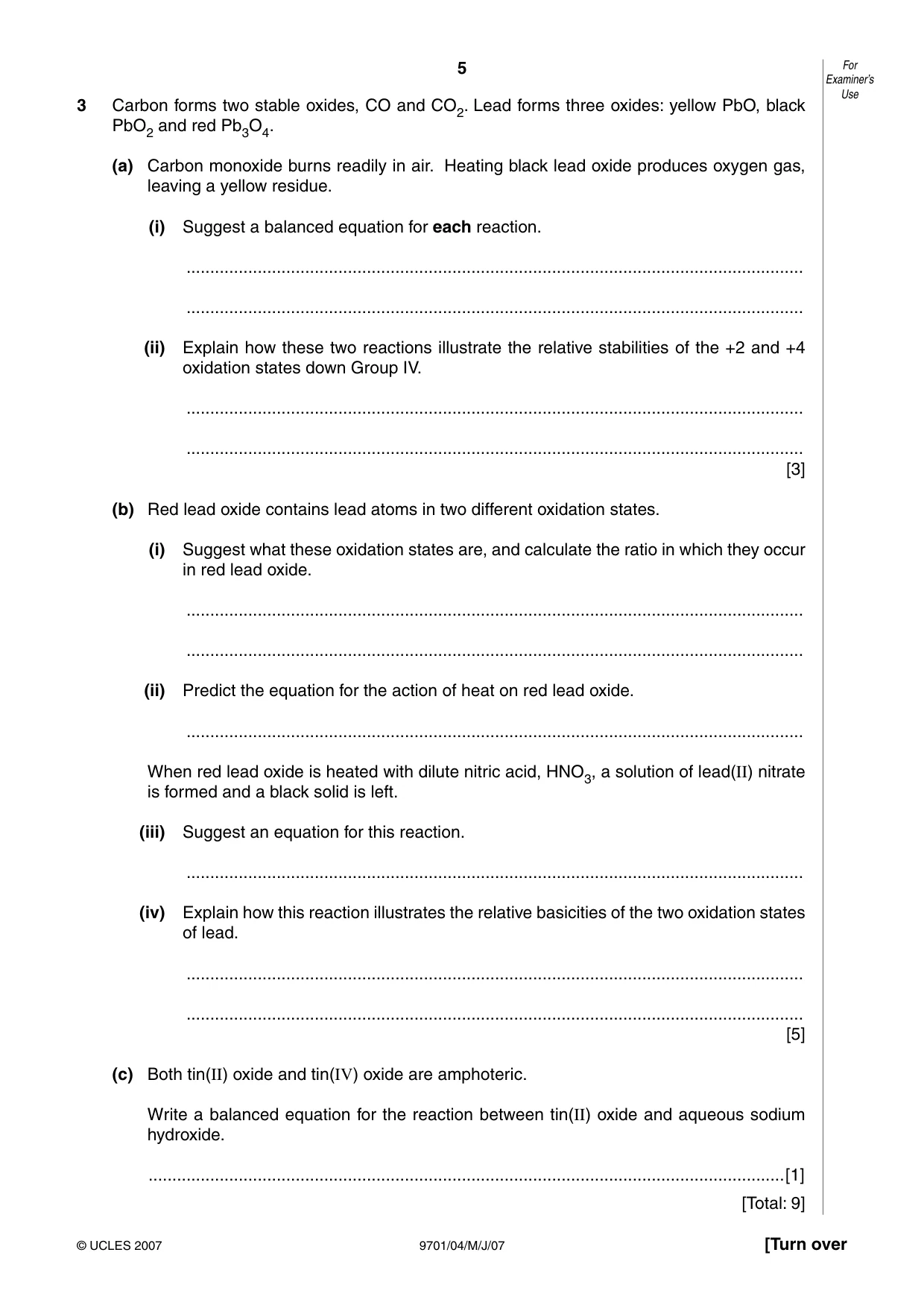
5 9701/04/M/J/07 [Turn over For Examiner’s Use © UCLES 2007 3 Carbon forms two stable oxides, CO and CO2. Lead forms three oxides: yellow PbO, black PbO2 and red Pb3O4. (a) Carbon monoxide burns readily in air. Heating black lead oxide produces oxygen gas, leaving a yellow residue. (i) Suggest a balanced equation for each reaction. … … (ii) Explain how these two reactions illustrate the relative stabilities of the +2 and +4 oxidation states down Group IV. … … [3] (b) Red lead oxide contains lead atoms in two different oxidation states. (i) Suggest what these oxidation states are, and calculate the ratio in which they occur in red lead oxide. … … (ii) Predict the equation for the action of heat on red lead oxide. … When red lead oxide is heated with dilute nitric acid, HNO3, a solution of lead(II) nitrate is formed and a black solid is left. (iii) Suggest an equation for this reaction. … (iv) Explain how this reaction illustrates the relative basicities of the two oxidation states of lead. … … [5] (c) Both tin(II) oxide and tin(IV) oxide are amphoteric. Write a balanced equation for the reaction between tin(II) oxide and aqueous sodium hydroxide. …[1] [Total: 9]
Question paper, page 6
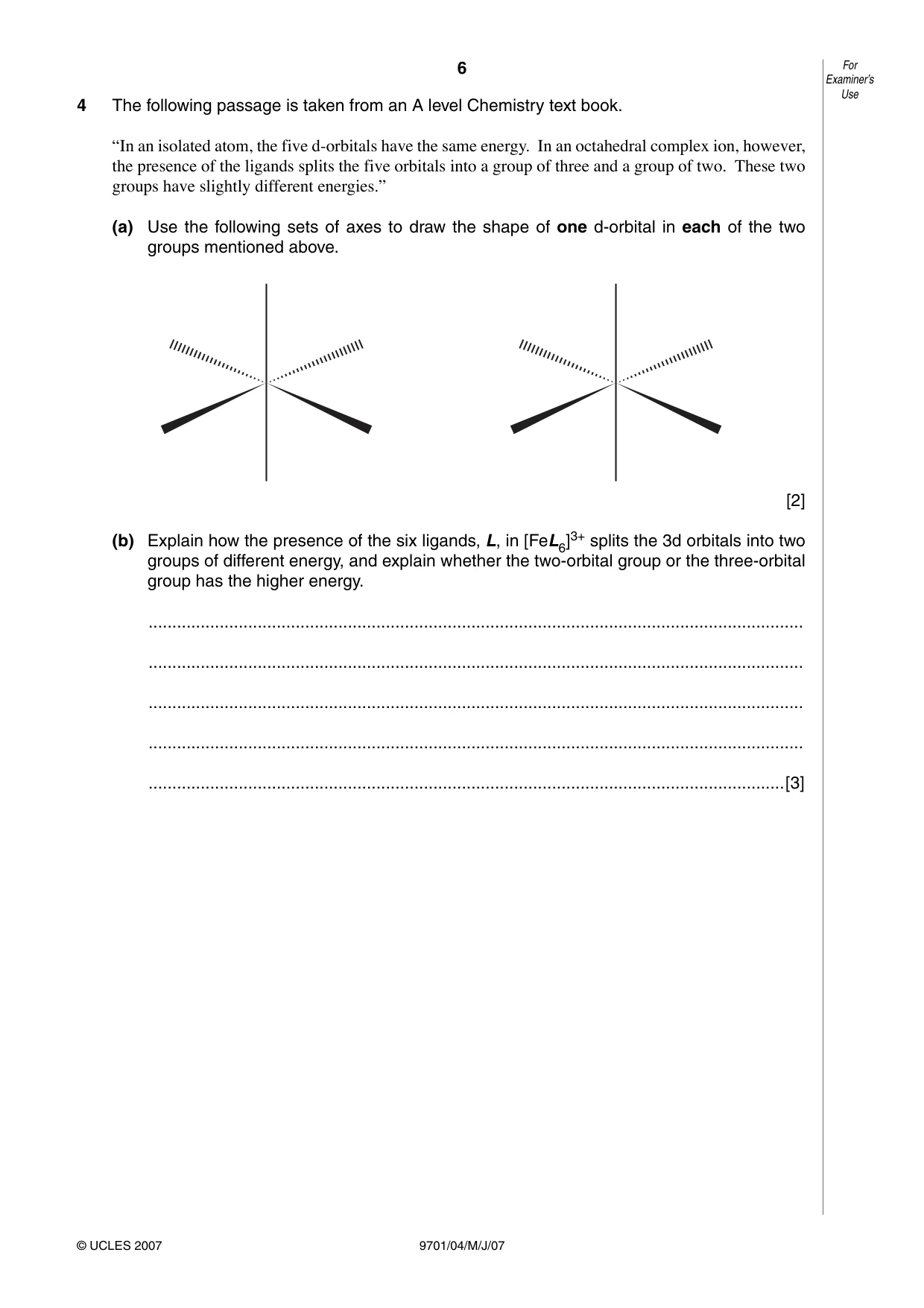
6 9701/04/M/J/07 For Examiner’s Use © UCLES 2007 4 The following passage is taken from an A level Chemistry text book. “In an isolated atom, the five d-orbitals have the same energy. In an octahedral complex ion, however, the presence of the ligands splits the five orbitals into a group of three and a group of two. These two groups have slightly different energies.” (a) Use the following sets of axes to draw the shape of one d-orbital in each of the two groups mentioned above. [2] (b) Explain how the presence of the six ligands, L, in [FeL6]3+ splits the 3d orbitals into two groups of different energy, and explain whether the two-orbital group or the three-orbital group has the higher energy. … … … … …[3]
Question paper, page 7
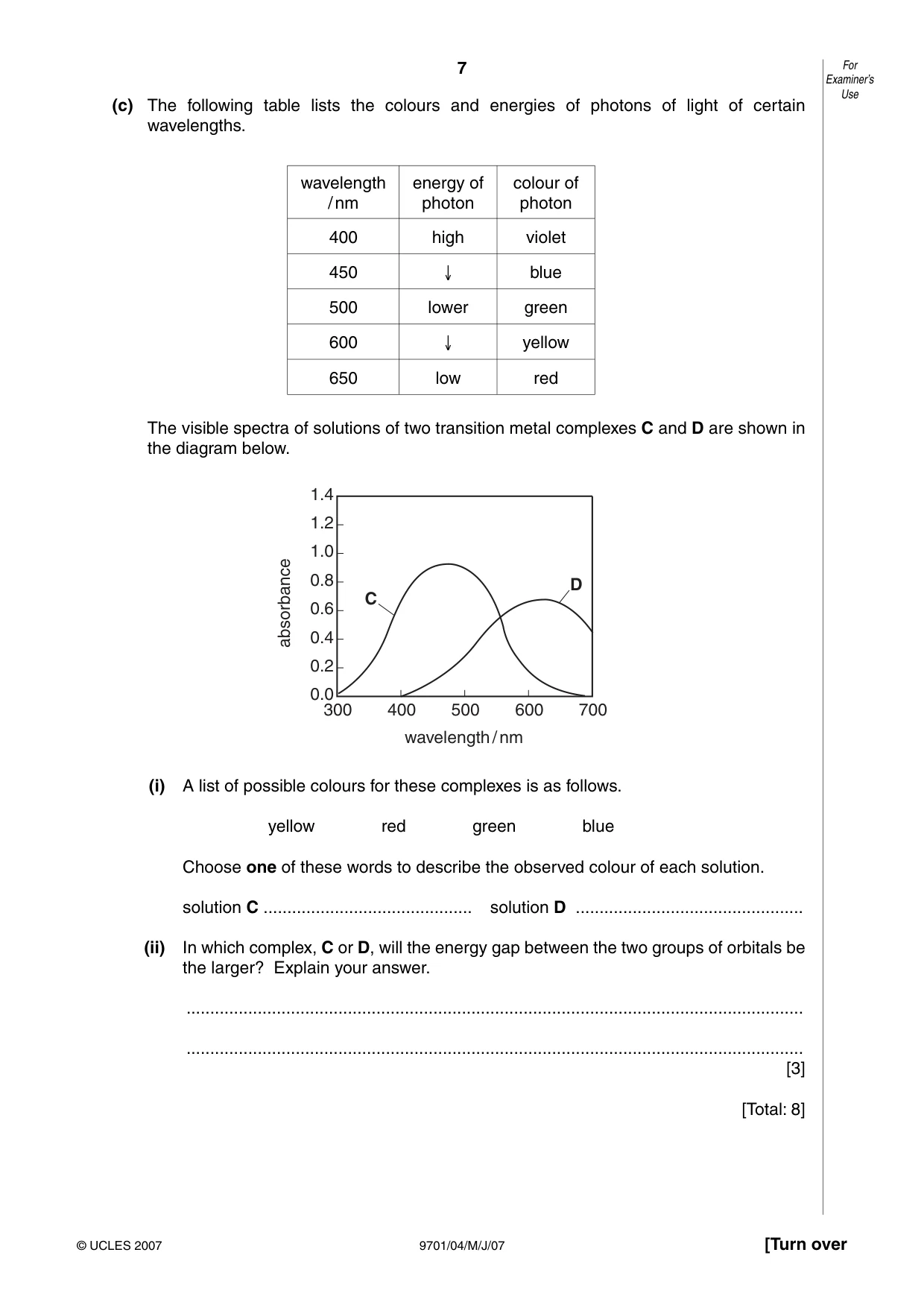
7 9701/04/M/J/07 [Turn over For Examiner’s Use © UCLES 2007 (c) The following table lists the colours and energies of photons of light of certain wavelengths. wavelength / nm energy of photon colour of photon 400 high violet 450 ↓ blue 500 lower green 600 ↓ yellow 650 low red The visible spectra of solutions of two transition metal complexes C and D are shown in the diagram below. 0.0 0.2 0.4 0.6 0.8 1.0 1.2 1.4 absorbance 300 400 500 wavelength / nm 600 700 C D (i) A list of possible colours for these complexes is as follows. yellow red green blue Choose one of these words to describe the observed colour of each solution. solution C … solution D … (ii) In which complex, C or D, will the energy gap between the two groups of orbitals be the larger? Explain your answer. … … [3] [Total: 8]
Question paper, page 8
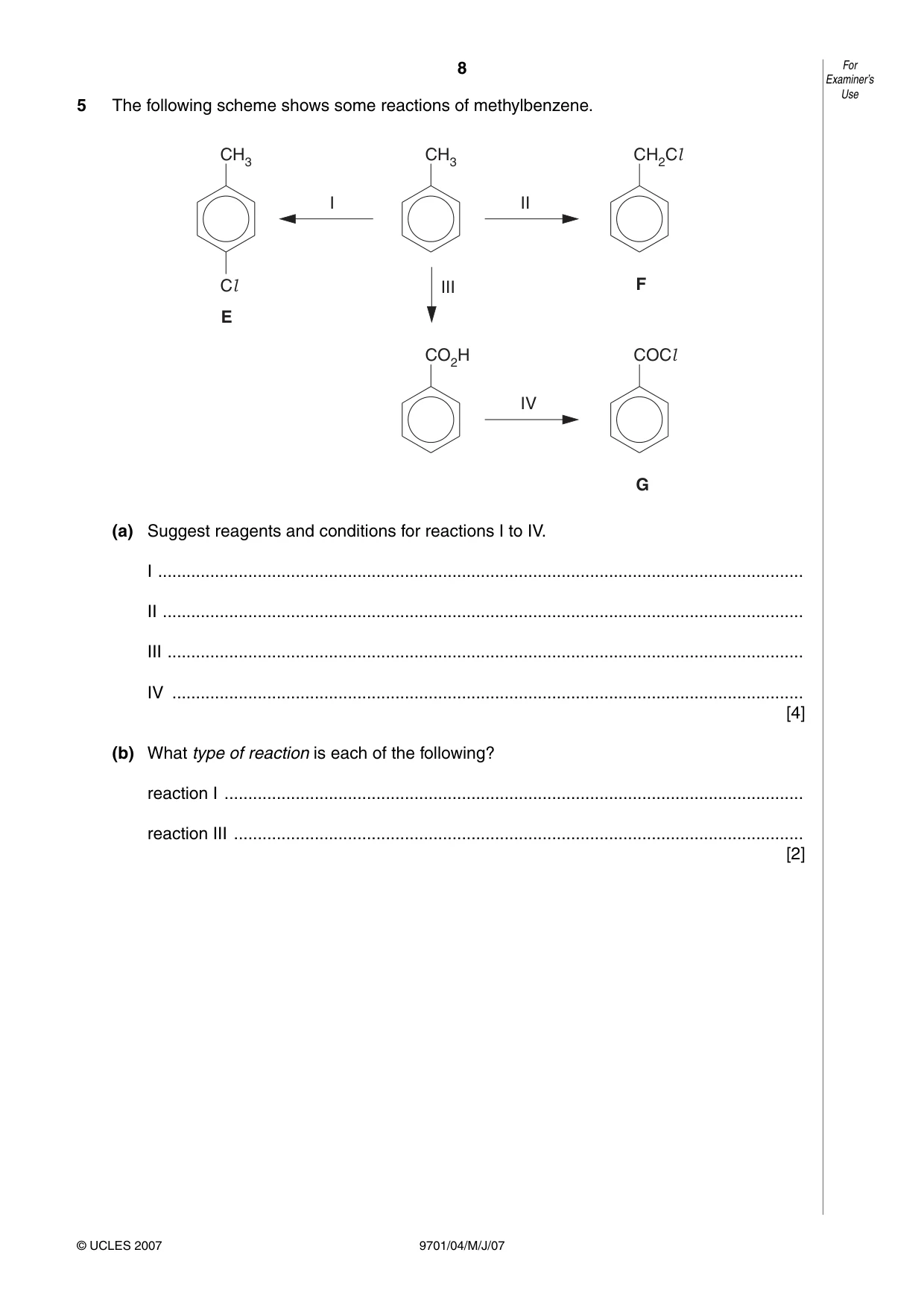
8 9701/04/M/J/07 For Examiner’s Use © UCLES 2007 5 The following scheme shows some reactions of methylbenzene. CH3 Cl I II III CH3 CH2Cl E F IV CO2H COCl G (a) Suggest reagents and conditions for reactions I to IV. I … II … III … IV … [4] (b) What type of reaction is each of the following? reaction I … reaction III … [2]
Question paper, page 9
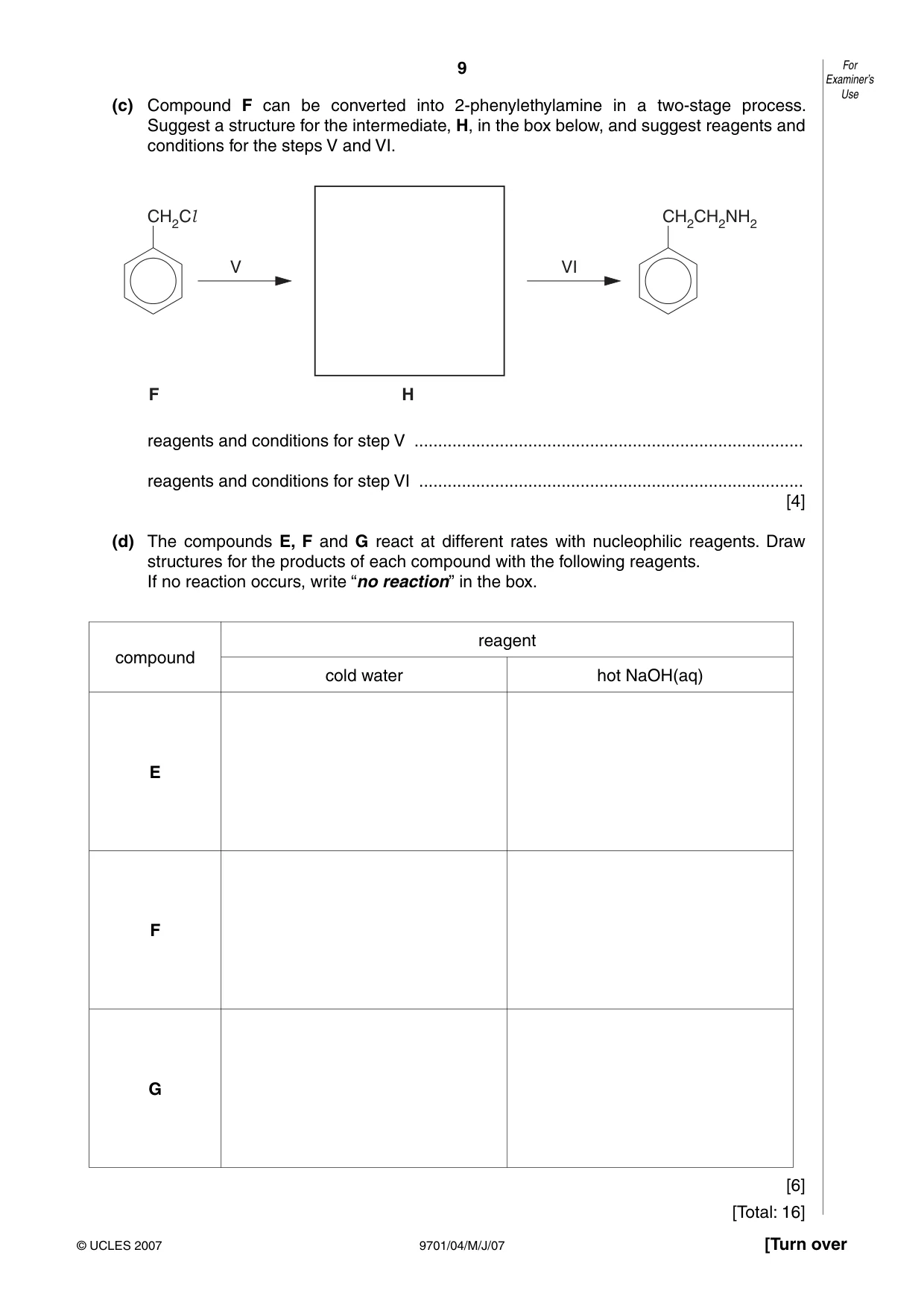
9 9701/04/M/J/07 [Turn over For Examiner’s Use © UCLES 2007 (c) Compound F can be converted into 2-phenylethylamine in a two-stage process. Suggest a structure for the intermediate, H, in the box below, and suggest reagents and conditions for the steps V and VI. CH2Cl V VI CH2CH2NH2 H F reagents and conditions for step V … reagents and conditions for step VI … [4] (d) The compounds E, F and G react at different rates with nucleophilic reagents. Draw structures for the products of each compound with the following reagents. If no reaction occurs, write “no reaction” in the box. compound reagent cold water hot NaOH(aq) E F G [6] [Total: 16]
Question paper, page 10
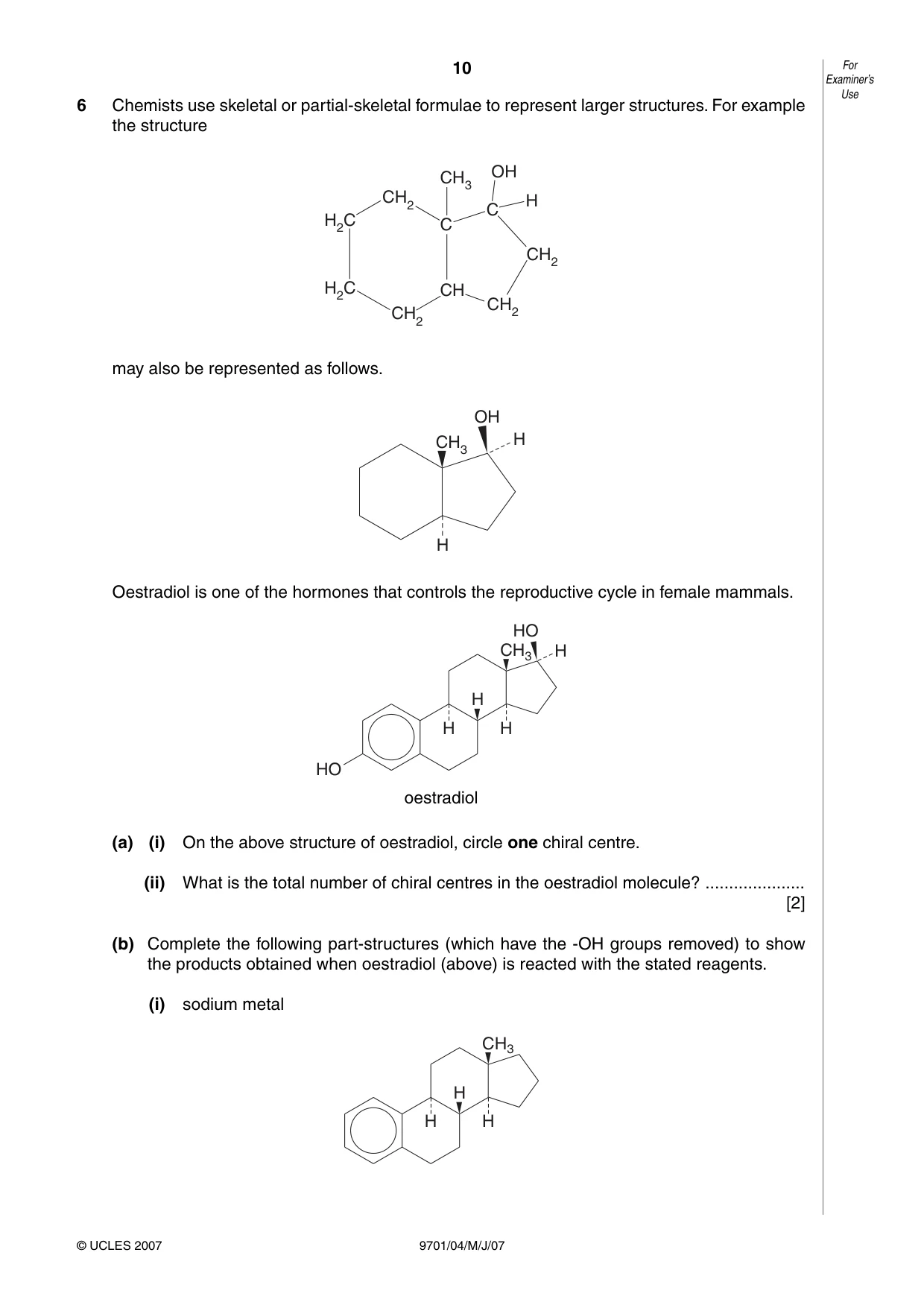
10 9701/04/M/J/07 For Examiner’s Use © UCLES 2007 6 Chemists use skeletal or partial-skeletal formulae to represent larger structures. For example the structure CH3 CH2 CH2 CH2 CH2 H2C H2C CH C C H OH may also be represented as follows. CH3 H H OH Oestradiol is one of the hormones that controls the reproductive cycle in female mammals. CH3 H H H H HO HO oestradiol (a) (i) On the above structure of oestradiol, circle one chiral centre. (ii) What is the total number of chiral centres in the oestradiol molecule? … [2] (b) Complete the following part-structures (which have the -OH groups removed) to show the products obtained when oestradiol (above) is reacted with the stated reagents. (i) sodium metal CH3 H H H
Question paper, page 11
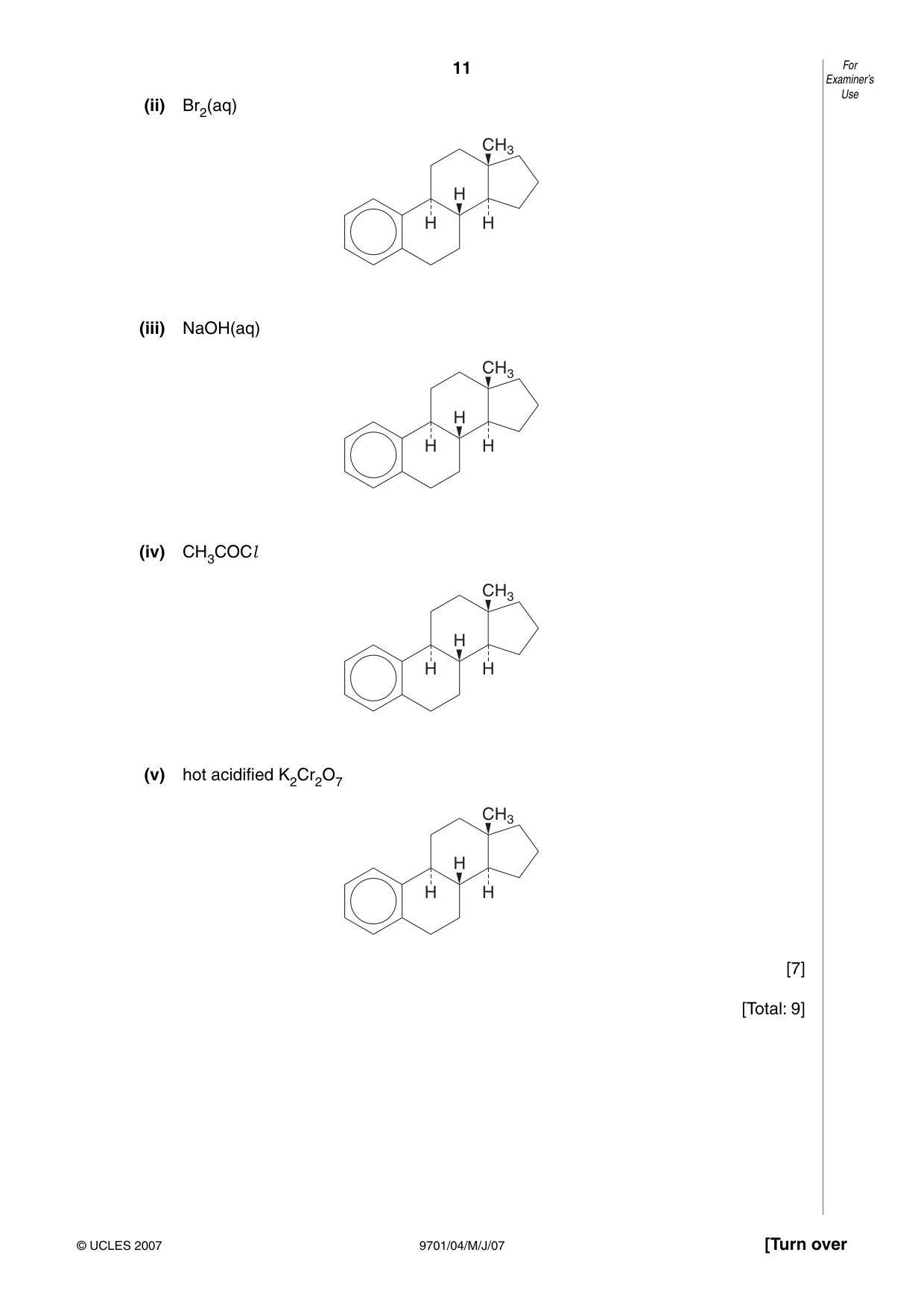
11 9701/04/M/J/07 [Turn over For Examiner’s Use © UCLES 2007 (ii) Br2(aq) CH3 H H H (iii) NaOH(aq) CH3 H H H (iv) CH3COCl CH3 H H H (v) hot acidified K2Cr2O7 CH3 H H H [7] [Total: 9]
Question paper, page 12
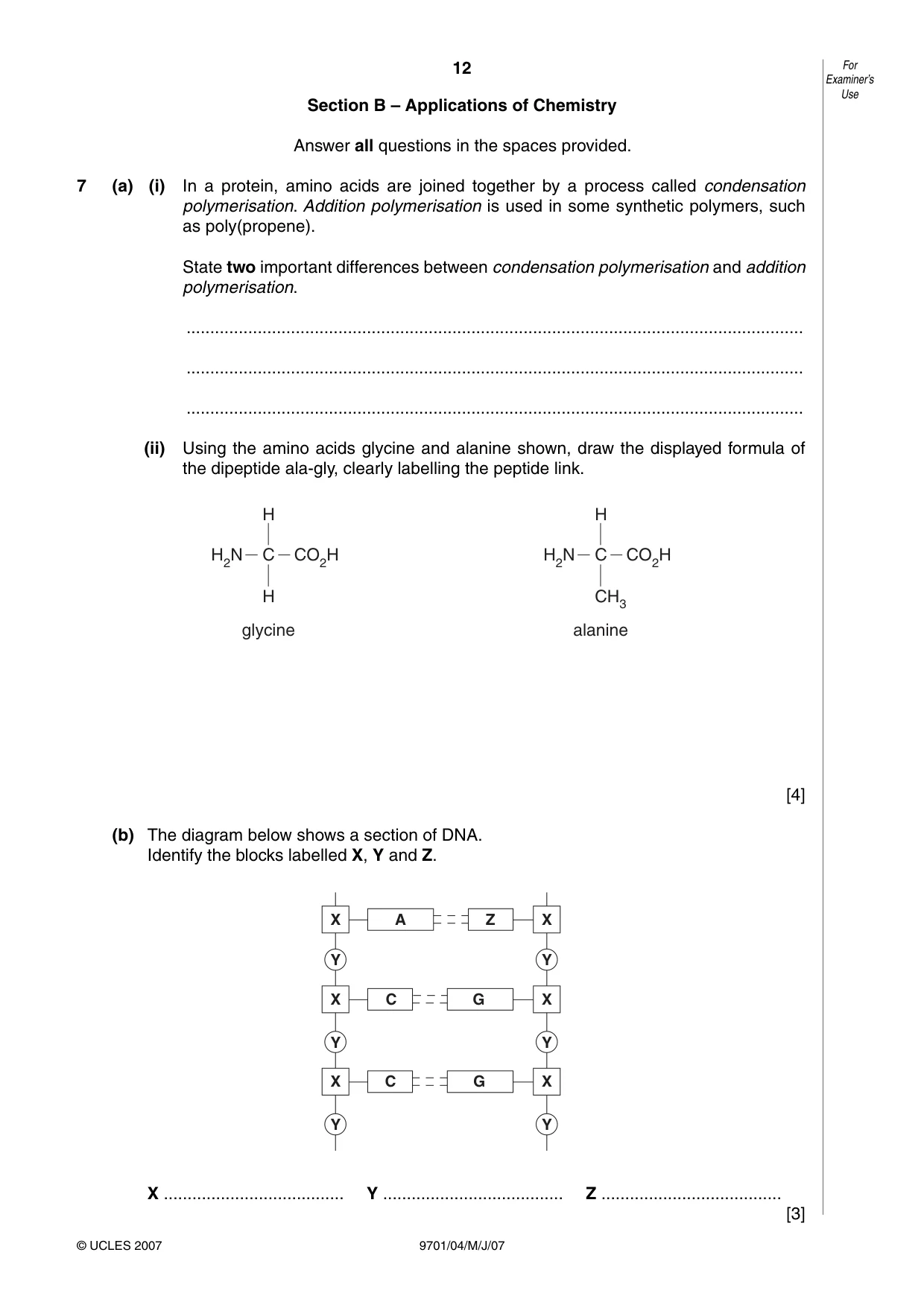
12 9701/04/M/J/07 For Examiner’s Use © UCLES 2007 Section B – Applications of Chemistry Answer all questions in the spaces provided. 7 (a) (i) In a protein, amino acids are joined together by a process called condensation polymerisation. Addition polymerisation is used in some synthetic polymers, such as poly(propene). State two important differences between condensation polymerisation and addition polymerisation. … … … (ii) Using the amino acids glycine and alanine shown, draw the displayed formula of the dipeptide ala-gly, clearly labelling the peptide link. CO2H C H glycine H H2N CO2H C CH3 alanine H H2N [4] (b) The diagram below shows a section of DNA. Identify the blocks labelled X, Y and Z. X X A Z X X C G Y Y X X C G Y Y Y Y X … Y … Z … [3]
Question paper, page 13
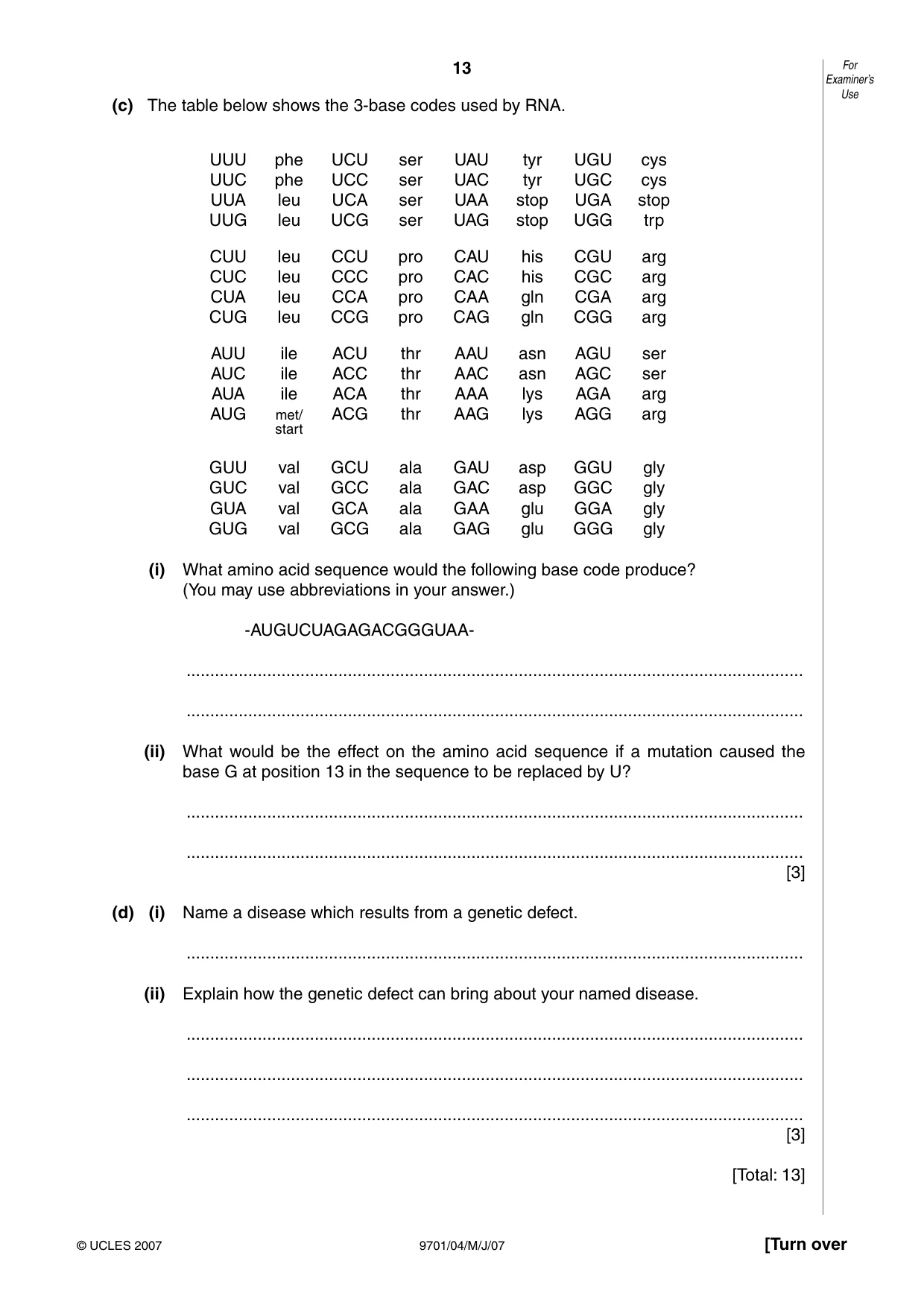
13 9701/04/M/J/07 [Turn over For Examiner’s Use © UCLES 2007 (c) The table below shows the 3-base codes used by RNA. UUU UUC UUA UUG phe phe leu leu UCU UCC UCA UCG ser ser ser ser UAU UAC UAA UAG tyr tyr stop stop UGU UGC UGA UGG cys cys stop trp CUU CUC CUA CUG leu leu leu leu CCU CCC CCA CCG pro pro pro pro CAU CAC CAA CAG his his gln gln CGU CGC CGA CGG arg arg arg arg AUU AUC AUA AUG ile ile ile met/ start ACU ACC ACA ACG thr thr thr thr AAU AAC AAA AAG asn asn lys lys AGU AGC AGA AGG ser ser arg arg GUU GUC GUA GUG val val val val GCU GCC GCA GCG ala ala ala ala GAU GAC GAA GAG asp asp glu glu GGU GGC GGA GGG gly gly gly gly (i) What amino acid sequence would the following base code produce? (You may use abbreviations in your answer.) -AUGUCUAGAGACGGGUAA- … … (ii) What would be the effect on the amino acid sequence if a mutation caused the base G at position 13 in the sequence to be replaced by U? … … [3] (d) (i) Name a disease which results from a genetic defect. … (ii) Explain how the genetic defect can bring about your named disease. … … … [3] [Total: 13]
Question paper, page 14
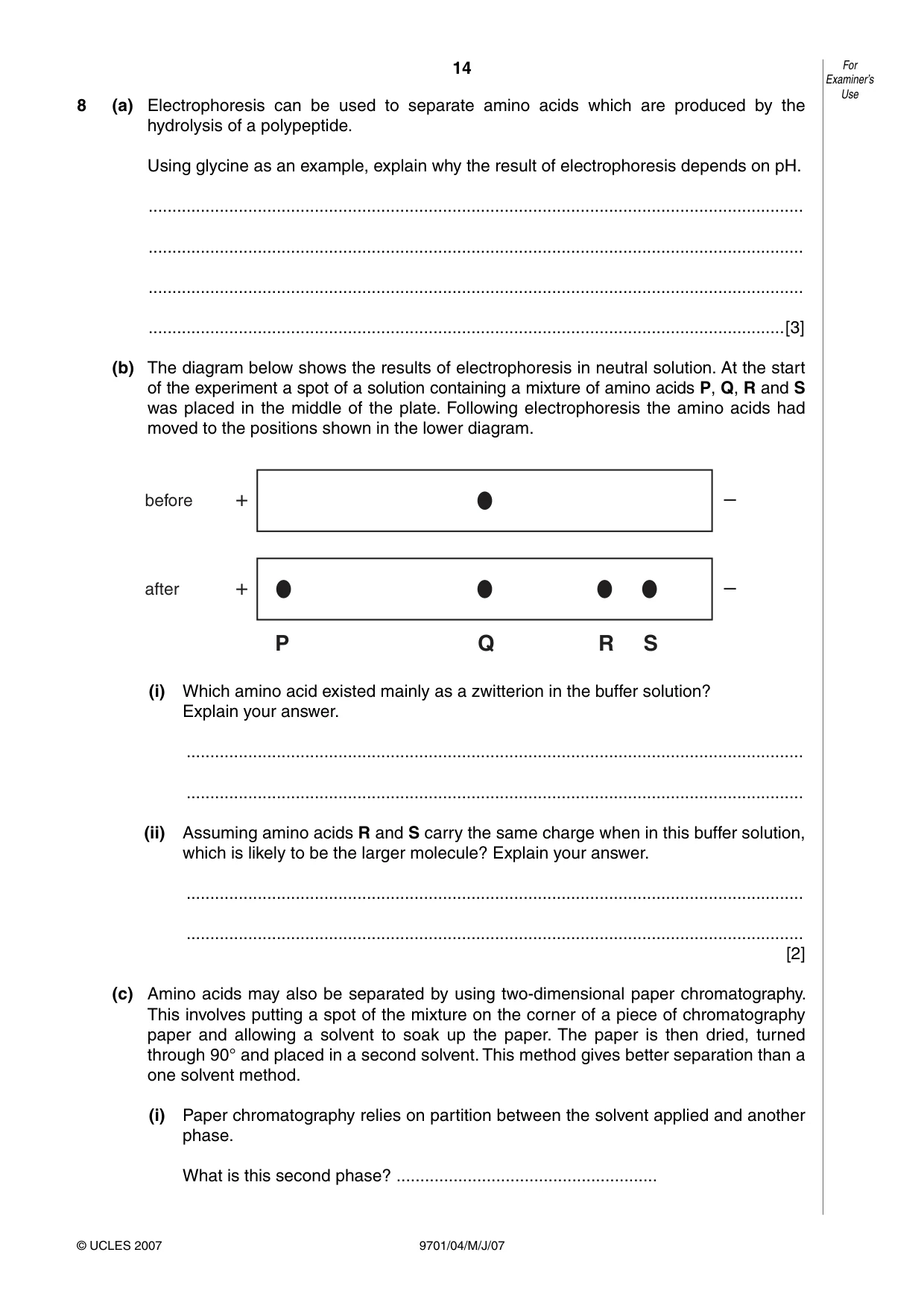
14 9701/04/M/J/07 For Examiner’s Use © UCLES 2007 8 (a) Electrophoresis can be used to separate amino acids which are produced by the hydrolysis of a polypeptide. Using glycine as an example, explain why the result of electrophoresis depends on pH. … … … …[3] (b) The diagram below shows the results of electrophoresis in neutral solution. At the start of the experiment a spot of a solution containing a mixture of amino acids P, Q, R and S was placed in the middle of the plate. Following electrophoresis the amino acids had moved to the positions shown in the lower diagram. before + – after + – P Q R S (i) Which amino acid existed mainly as a zwitterion in the buffer solution? Explain your answer. … … (ii) Assuming amino acids R and S carry the same charge when in this buffer solution, which is likely to be the larger molecule? Explain your answer. … … [2] (c) Amino acids may also be separated by using two-dimensional paper chromatography. This involves putting a spot of the mixture on the corner of a piece of chromatography paper and allowing a solvent to soak up the paper. The paper is then dried, turned through 90° and placed in a second solvent. This method gives better separation than a one solvent method. (i) Paper chromatography relies on partition between the solvent applied and another phase. What is this second phase? …
Question paper, page 15
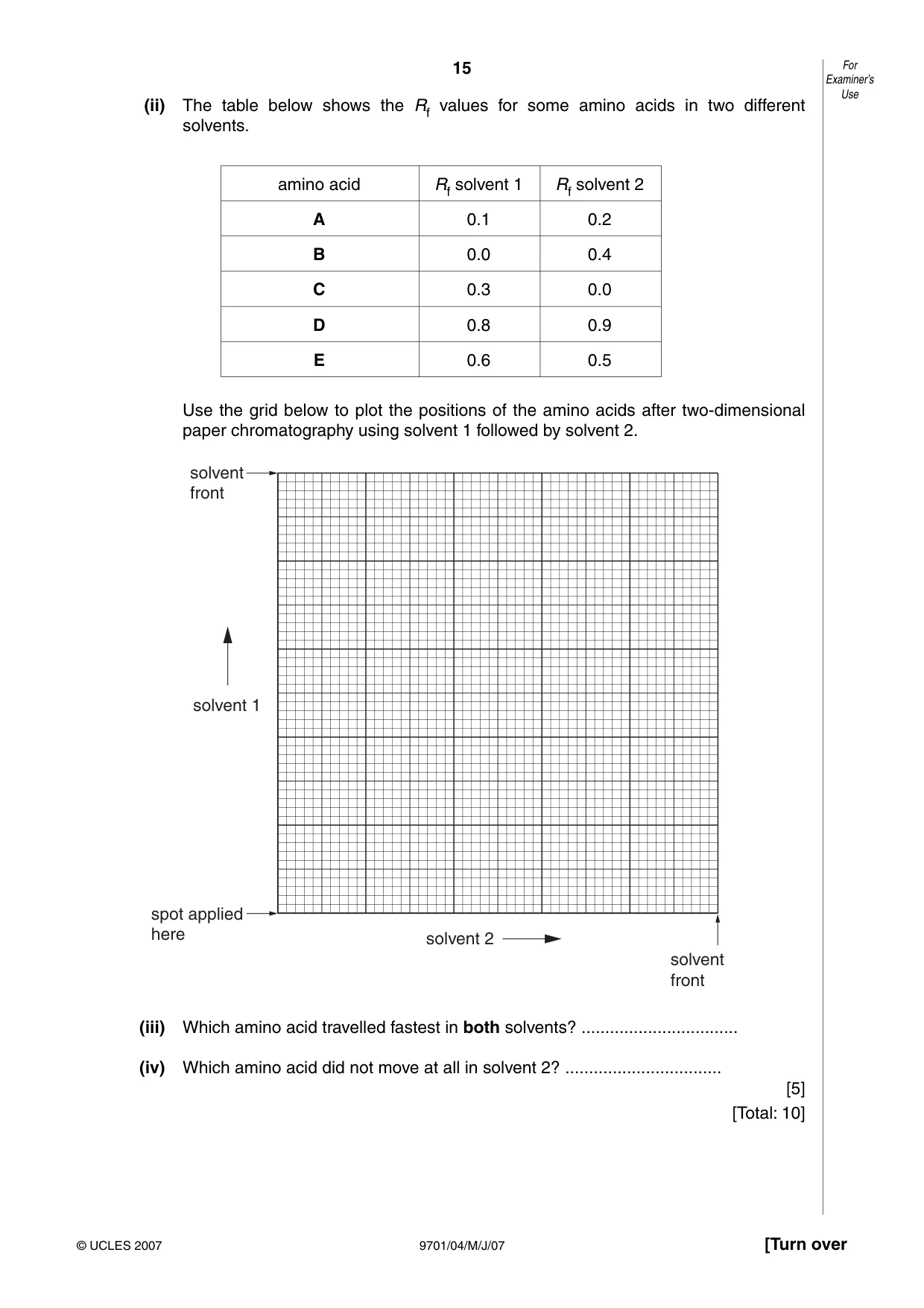
15 9701/04/M/J/07 [Turn over For Examiner’s Use © UCLES 2007 (ii) The table below shows the Rf values for some amino acids in two different solvents. amino acid Rf solvent 1 Rf solvent 2 A 0.1 0.2 B 0.0 0.4 C 0.3 0.0 D 0.8 0.9 E 0.6 0.5 Use the grid below to plot the positions of the amino acids after two-dimensional paper chromatography using solvent 1 followed by solvent 2. solvent 2 solvent 1 solvent front solvent front spot applied here (iii) Which amino acid travelled fastest in both solvents? … (iv) Which amino acid did not move at all in solvent 2? … [5] [Total: 10]
Question paper, page 16
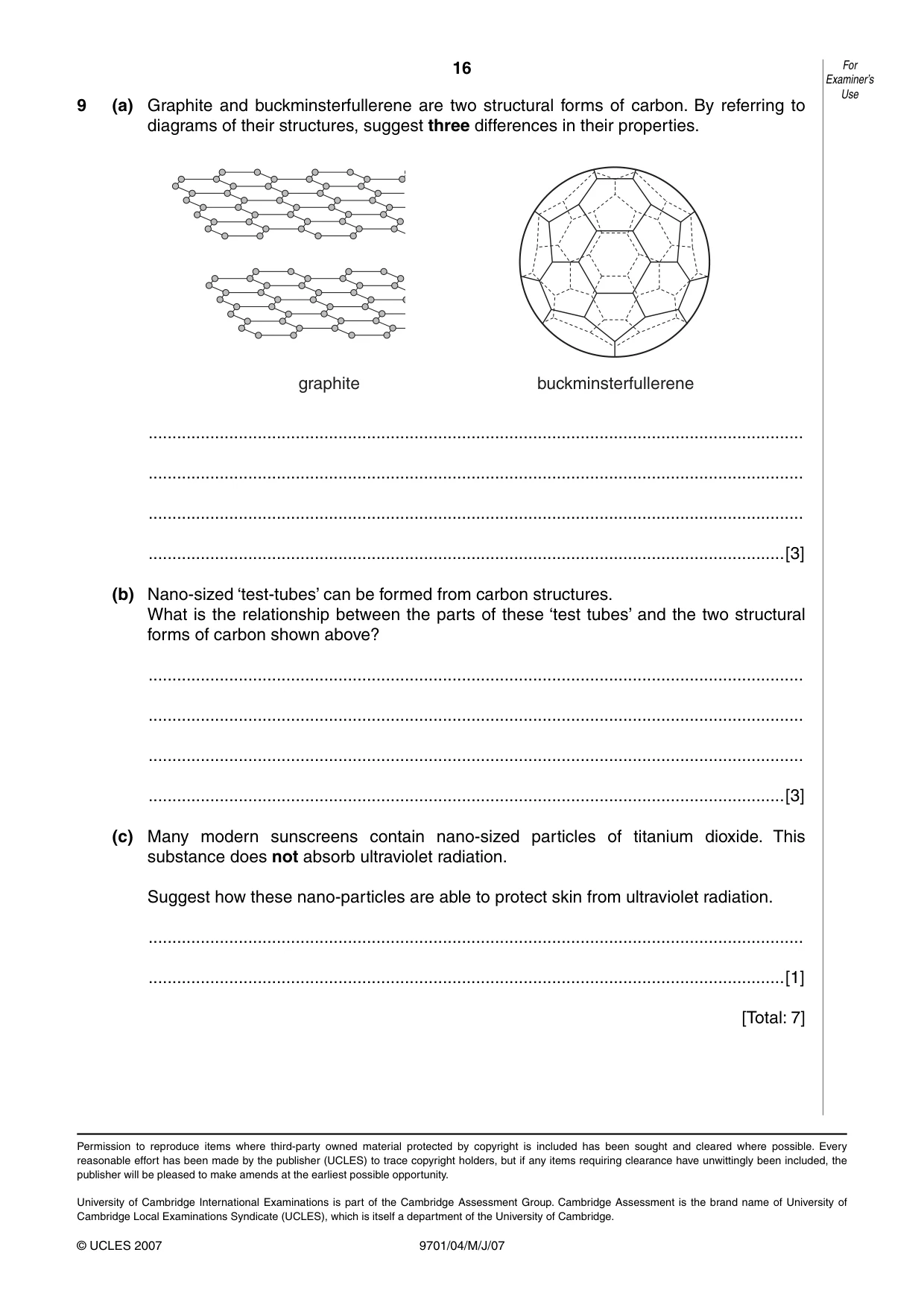
16 9701/04/M/J/07 © UCLES 2007 9 (a) Graphite and buckminsterfullerene are two structural forms of carbon. By referring to diagrams of their structures, suggest three differences in their properties. graphite buckminsterfullerene … … … …[3] (b) Nano-sized ‘test-tubes’ can be formed from carbon structures. What is the relationship between the parts of these ‘test tubes’ and the two structural forms of carbon shown above? … … … …[3] (c) Many modern sunscreens contain nano-sized particles of titanium dioxide. This substance does not absorb ultraviolet radiation. Suggest how these nano-particles are able to protect skin from ultraviolet radiation. … …[1] [Total: 7] Permission to reproduce items where third-party owned material protected by copyright is included has been sought and cleared where possible. Every reasonable effort has been made by the publisher (UCLES) to trace copyright holders, but if any items requiring clearance have unwittingly been included, the publisher will be pleased to make amends at the earliest possible opportunity. University of Cambridge International Examinations is part of the Cambridge Assessment Group. Cambridge Assessment is the brand name of University of Cambridge Local Examinations Syndicate (UCLES), which is itself a department of the University of Cambridge. For Examiner’s Use
Mark scheme, page 1
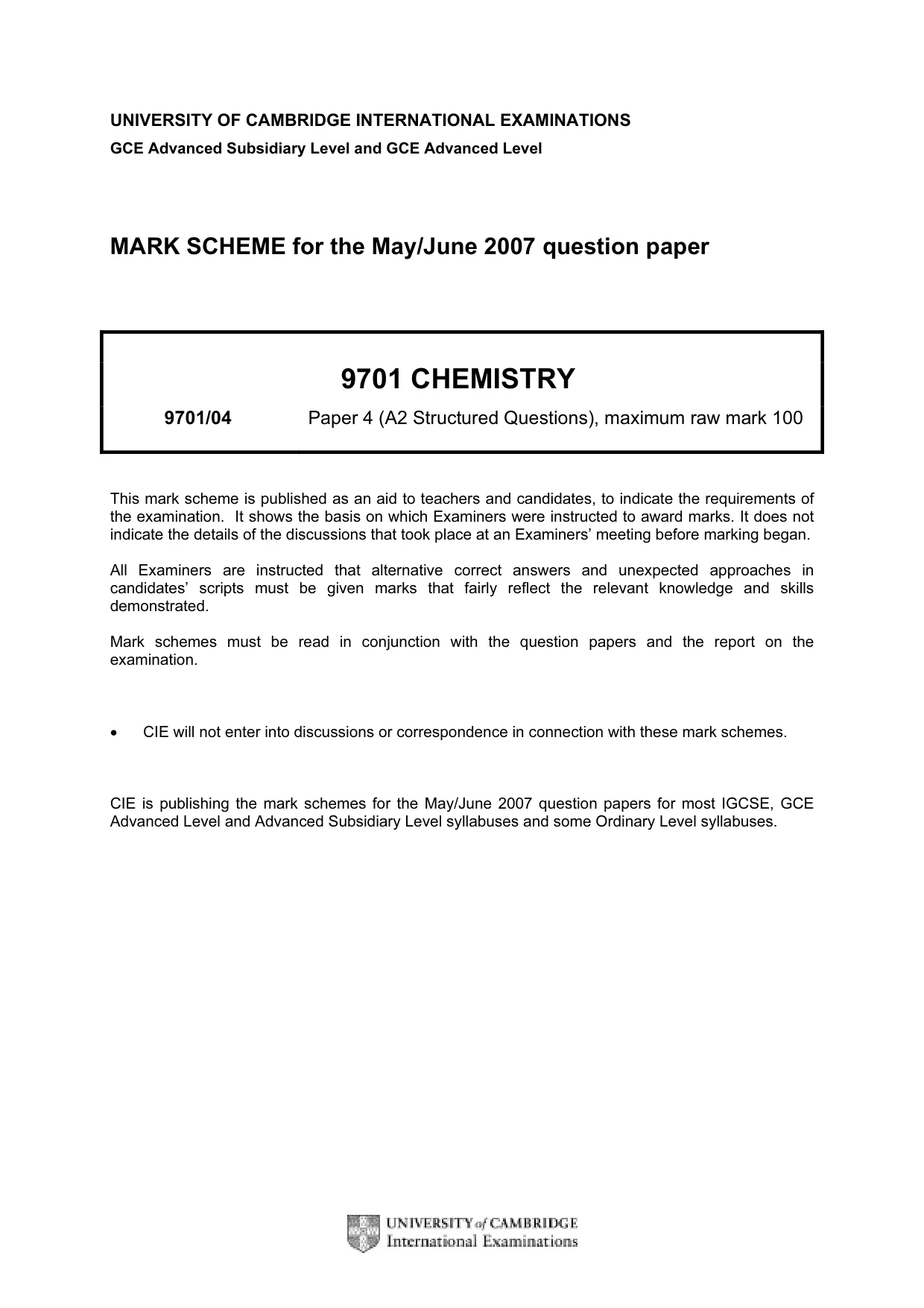
UNIVERSITY OF CAMBRIDGE INTERNATIONAL EXAMINATIONS GCE Advanced Subsidiary Level and GCE Advanced Level MARK SCHEME for the May/June 2007 question paper 9701 CHEMISTRY 9701/04 Paper 4 (A2 Structured Questions), maximum raw mark 100 This mark scheme is published as an aid to teachers and candidates, to indicate the requirements of the examination. It shows the basis on which Examiners were instructed to award marks. It does not indicate the details of the discussions that took place at an Examiners’ meeting before marking began. All Examiners are instructed that alternative correct answers and unexpected approaches in candidates’ scripts must be given marks that fairly reflect the relevant knowledge and skills demonstrated. Mark schemes must be read in conjunction with the question papers and the report on the examination. • CIE will not enter into discussions or correspondence in connection with these mark schemes. CIE is publishing the mark schemes for the May/June 2007 question papers for most IGCSE, GCE Advanced Level and Advanced Subsidiary Level syllabuses and some Ordinary Level syllabuses.
Mark scheme, page 2
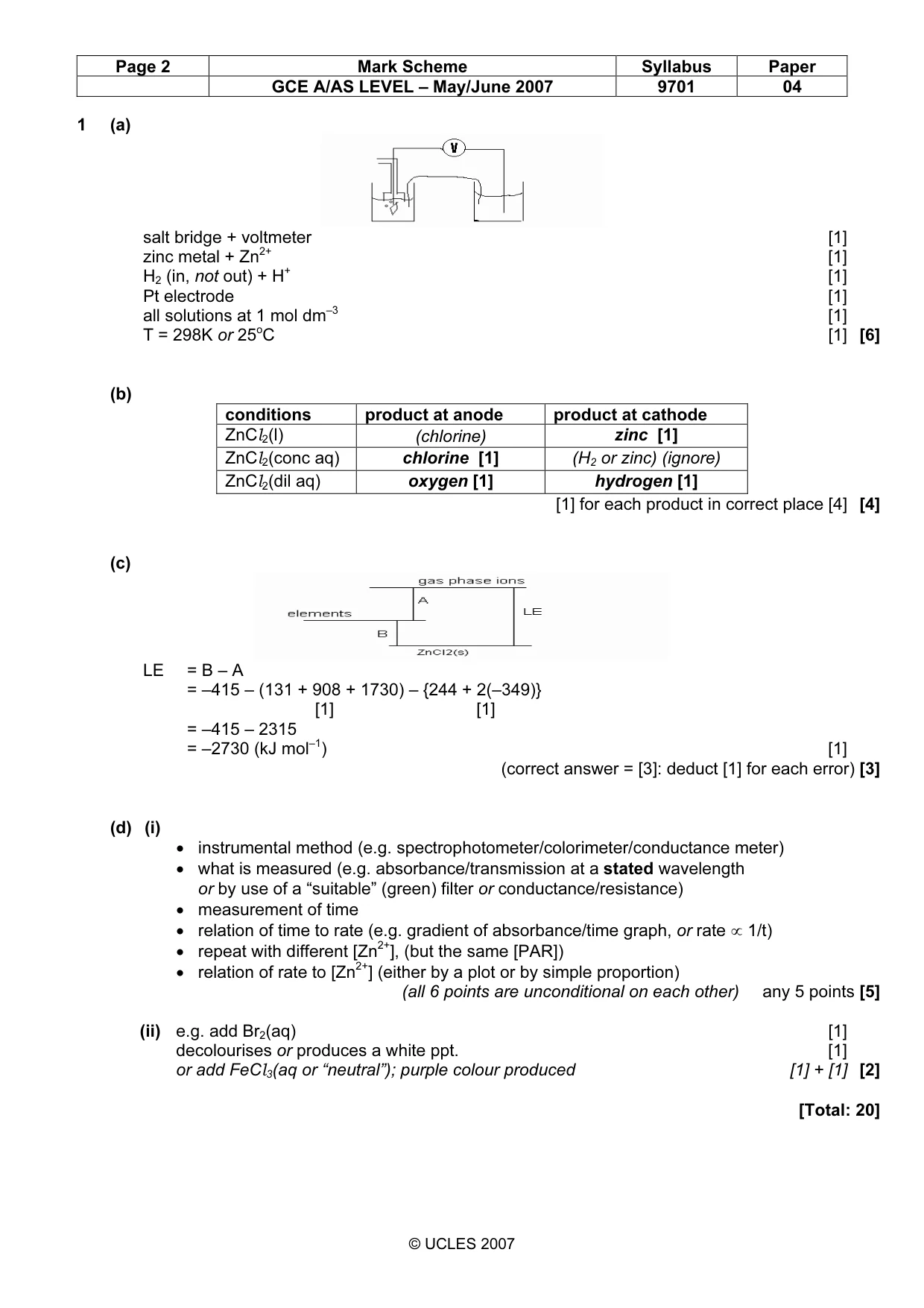
Page 2 Mark Scheme Syllabus Paper GCE A/AS LEVEL – May/June 2007 9701 04 © UCLES 2007 1 (a) salt bridge + voltmeter [1] zinc metal + Zn2+ [1] H2 (in, not out) + H+ [1] Pt electrode [1] all solutions at 1 mol dm–3 [1] T = 298K or 25oC [1] [6] (b) conditions product at anode product at cathode ZnCl2(l) (chlorine) zinc [1] ZnCl2(conc aq) chlorine [1] (H2 or zinc) (ignore) ZnCl2(dil aq) oxygen [1] hydrogen [1] [1] for each product in correct place [4] [4] (c) LE = B – A = –415 – (131 + 908 + 1730) – {244 + 2(–349)} [1] [1] = –415 – 2315 = –2730 (kJ mol–1) [1] (correct answer = [3]: deduct [1] for each error) [3] (d) (i) • instrumental method (e.g. spectrophotometer/colorimeter/conductance meter) • what is measured (e.g. absorbance/transmission at a stated wavelength or by use of a “suitable” (green) filter or conductance/resistance) • measurement of time • relation of time to rate (e.g. gradient of absorbance/time graph, or rate ∝ 1/t) • repeat with different [Zn2+], (but the same [PAR]) • relation of rate to [Zn2+] (either by a plot or by simple proportion) (all 6 points are unconditional on each other) any 5 points [5] (ii) e.g. add Br2(aq) [1] decolourises or produces a white ppt. [1] or add FeCl3(aq or “neutral”); purple colour produced [1] + [1] [2] [Total: 20]
Mark scheme, page 3
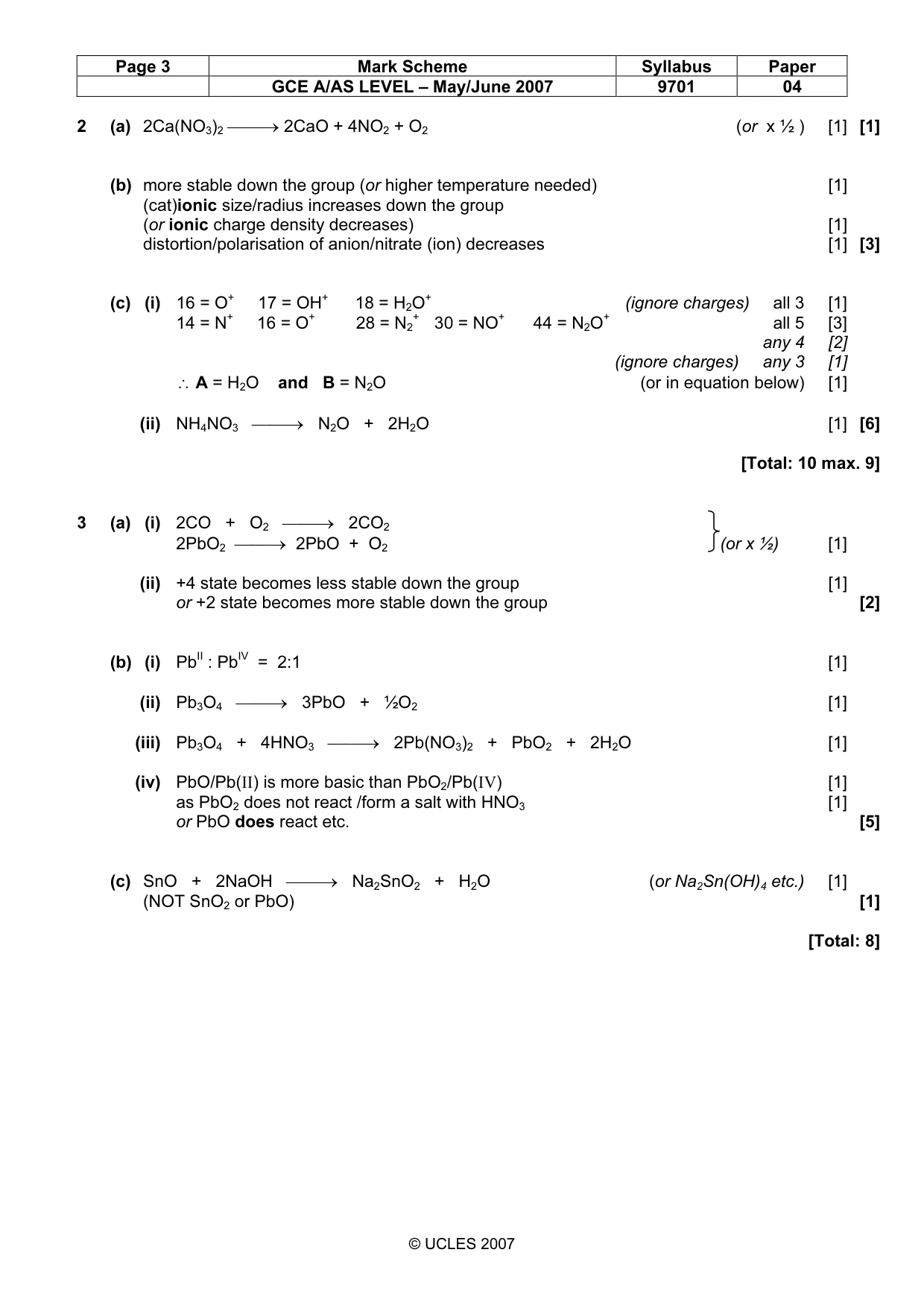
Page 3 Mark Scheme Syllabus Paper GCE A/AS LEVEL – May/June 2007 9701 04 © UCLES 2007 2 (a) 2Ca(NO3)2 → 2CaO + 4NO2 + O2 (or x ½ ) [1] [1] (b) more stable down the group (or higher temperature needed) [1] (cat)ionic size/radius increases down the group (or ionic charge density decreases) [1] distortion/polarisation of anion/nitrate (ion) decreases [1] [3] (c) (i) 16 = O+ 17 = OH+ 18 = H2O+ (ignore charges) all 3 [1] 14 = N+ 16 = O+ 28 = N2 + 30 = NO+ 44 = N2O+ all 5 [3] any 4 [2] (ignore charges) any 3 [1] ∴ A = H2O and B = N2O (or in equation below) [1] (ii) NH4NO3 → N2O + 2H2O [1] [6] [Total: 10 max. 9] 3 (a) (i) 2CO + O2 → 2CO2 2PbO2 → 2PbO + O2 (or x ½) [1] (ii) +4 state becomes less stable down the group [1] or +2 state becomes more stable down the group [2] (b) (i) PbII : PbIV = 2:1 [1] (ii) Pb3O4 → 3PbO + ½O2 [1] (iii) Pb3O4 + 4HNO3 → 2Pb(NO3)2 + PbO2 + 2H2O [1] (iv) PbO/Pb(II) is more basic than PbO2/Pb(IV) [1] as PbO2 does not react /form a salt with HNO3 [1] or PbO does react etc. [5] (c) SnO + 2NaOH → Na2SnO2 + H2O (or Na2Sn(OH)4 etc.) [1] (NOT SnO2 or PbO) [1] [Total: 8]
Mark scheme, page 4
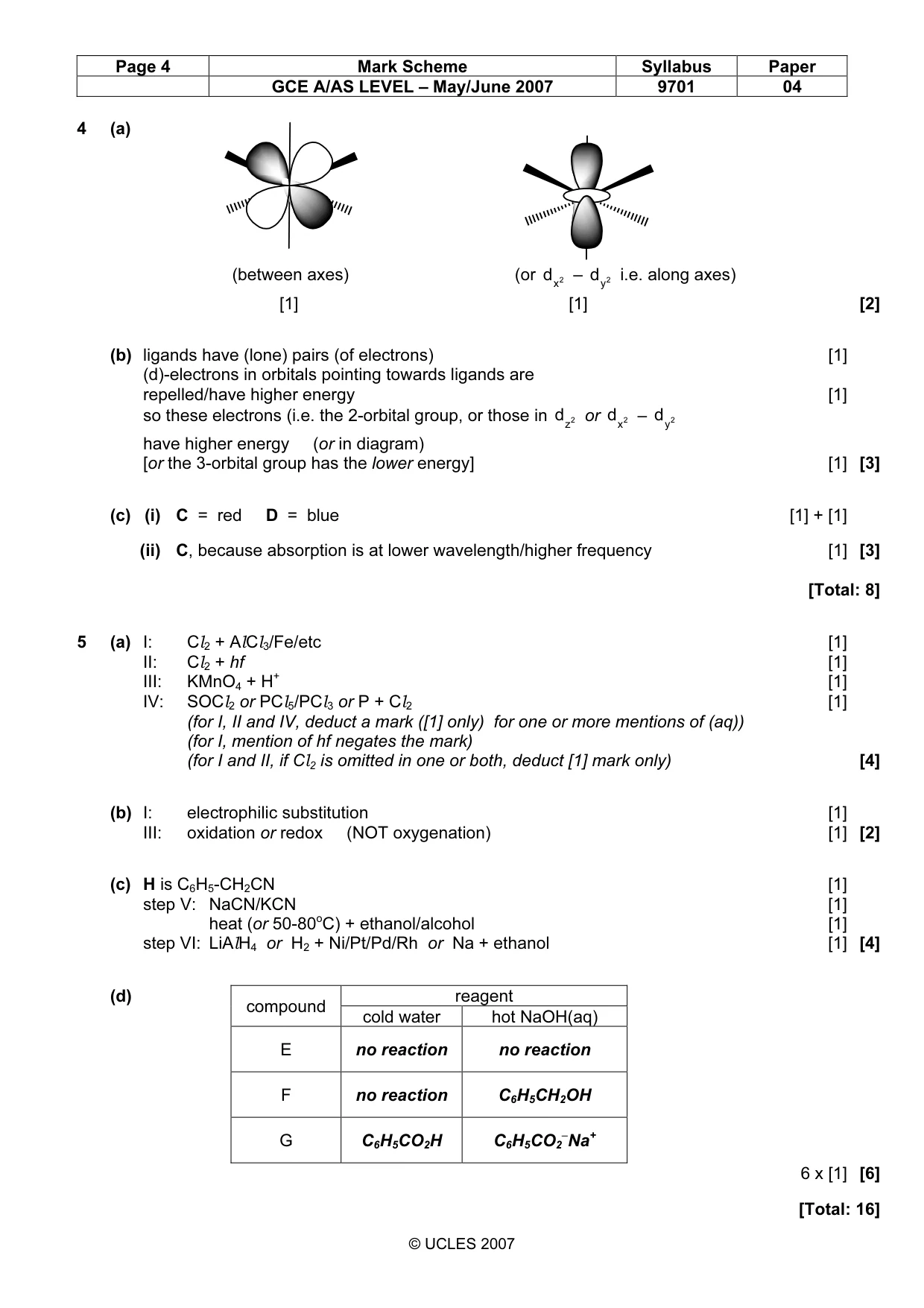
Page 4 Mark Scheme Syllabus Paper GCE A/AS LEVEL – May/June 2007 9701 04 © UCLES 2007 4 (a) (between axes) (or 2 x d – 2 y d i.e. along axes) [1] [1] [2] (b) ligands have (lone) pairs (of electrons) [1] (d)-electrons in orbitals pointing towards ligands are repelled/have higher energy [1] so these electrons (i.e. the 2-orbital group, or those in 2 z d or 2 x d – 2 y d have higher energy (or in diagram) [or the 3-orbital group has the lower energy] [1] [3] (c) (i) C = red D = blue [1] + [1] (ii) C, because absorption is at lower wavelength/higher frequency [1] [3] [Total: 8] 5 (a) I: Cl2 + AlCl3/Fe/etc [1] II: Cl2 + hf [1] III: KMnO4 + H+ [1] IV: SOCl2 or PCl5/PCl3 or P + Cl2 [1] (for I, II and IV, deduct a mark ([1] only) for one or more mentions of (aq)) (for I, mention of hf negates the mark) (for I and II, if Cl2 is omitted in one or both, deduct [1] mark only) [4] (b) I: electrophilic substitution [1] III: oxidation or redox (NOT oxygenation) [1] [2] (c) H is C6H5-CH2CN [1] step V: NaCN/KCN [1] heat (or 50-80oC) + ethanol/alcohol [1] step VI: LiAlH4 or H2 + Ni/Pt/Pd/Rh or Na + ethanol [1] [4] (d) reagent compound cold water hot NaOH(aq) E no reaction no reaction F no reaction C6H5CH2OH G C6H5CO2H C6H5CO2 –Na+ 6 x [1] [6] [Total: 16]
Mark scheme, page 5
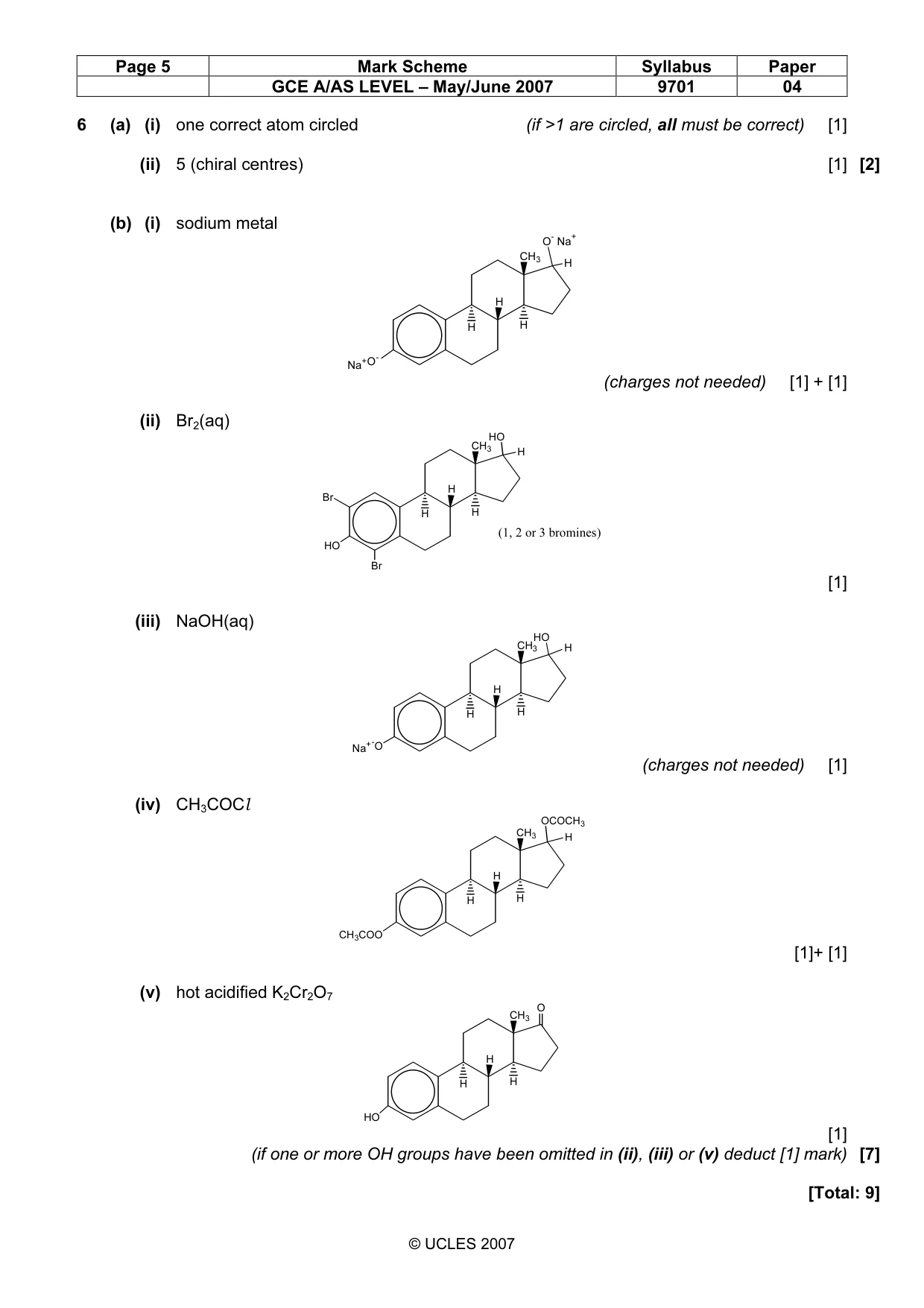
Page 5 Mark Scheme Syllabus Paper GCE A/AS LEVEL – May/June 2007 9701 04 © UCLES 2007 6 (a) (i) one correct atom circled (if >1 are circled, all must be correct) [1] (ii) 5 (chiral centres) [1] [2] (b) (i) sodium metal H H CH3 H O- O- Na+ H Na+ (charges not needed) [1] + [1] (ii) Br2(aq) H H CH3 H HO H HO Br Br (1, 2 or 3 bromines) [1] (iii) NaOH(aq) H H CH3 H HO H -O Na+ (charges not needed) [1] (iv) CH3COCl H H CH3 H CH3COO OCOCH3 H [1]+ [1] (v) hot acidified K2Cr2O7 H H CH3 H HO O [1] (if one or more OH groups have been omitted in (ii), (iii) or (v) deduct [1] mark) [7] [Total: 9]
Mark scheme, page 6
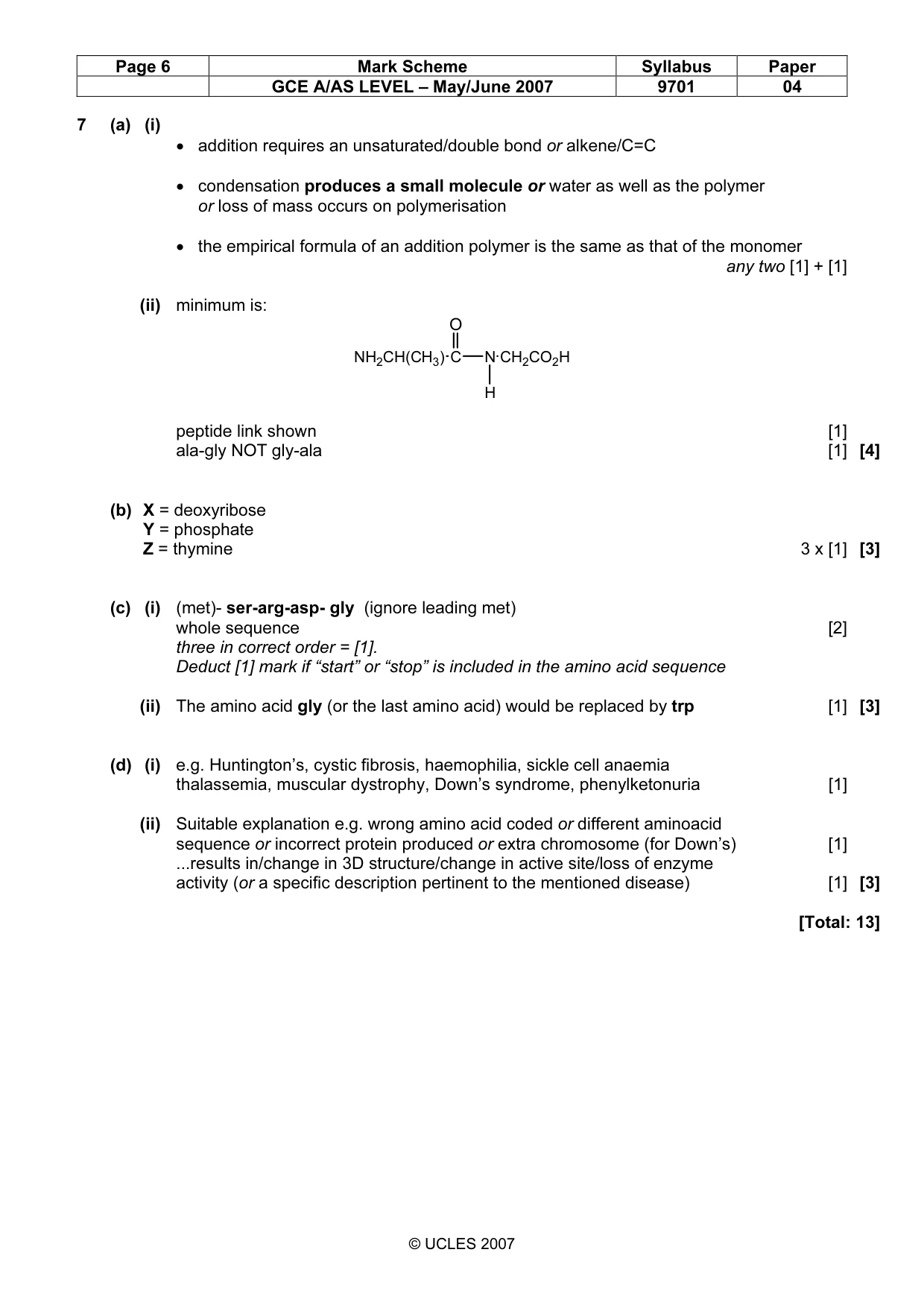
Page 6 Mark Scheme Syllabus Paper GCE A/AS LEVEL – May/June 2007 9701 04 © UCLES 2007 7 (a) (i) • addition requires an unsaturated/double bond or alkene/C=C • condensation produces a small molecule or water as well as the polymer or loss of mass occurs on polymerisation • the empirical formula of an addition polymer is the same as that of the monomer any two [1] + [1] (ii) minimum is: NH2CH(CH3) C O N H CH2CO2H peptide link shown [1] ala-gly NOT gly-ala [1] [4] (b) X = deoxyribose Y = phosphate Z = thymine 3 x [1] [3] (c) (i) (met)- ser-arg-asp- gly (ignore leading met) whole sequence [2] three in correct order = [1]. Deduct [1] mark if “start” or “stop” is included in the amino acid sequence (ii) The amino acid gly (or the last amino acid) would be replaced by trp [1] [3] (d) (i) e.g. Huntington’s, cystic fibrosis, haemophilia, sickle cell anaemia thalassemia, muscular dystrophy, Down’s syndrome, phenylketonuria [1] (ii) Suitable explanation e.g. wrong amino acid coded or different aminoacid sequence or incorrect protein produced or extra chromosome (for Down’s) [1] ...results in/change in 3D structure/change in active site/loss of enzyme activity (or a specific description pertinent to the mentioned disease) [1] [3] [Total: 13]
Mark scheme, page 7
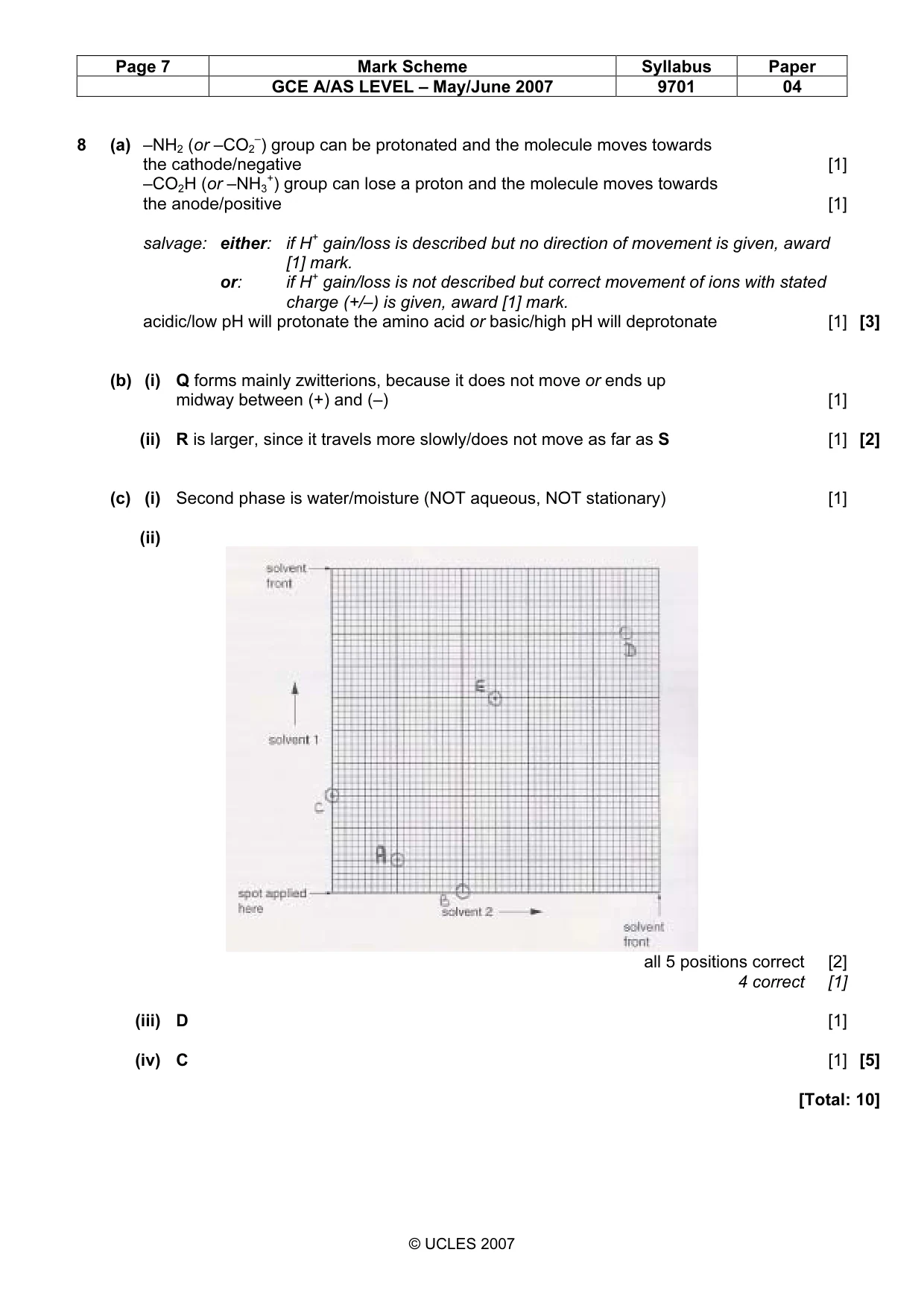
Page 7 Mark Scheme Syllabus Paper GCE A/AS LEVEL – May/June 2007 9701 04 © UCLES 2007 8 (a) –NH2 (or –CO2 –) group can be protonated and the molecule moves towards the cathode/negative [1] –CO2H (or –NH3 +) group can lose a proton and the molecule moves towards the anode/positive [1] salvage: either: if H+ gain/loss is described but no direction of movement is given, award [1] mark. or: if H+ gain/loss is not described but correct movement of ions with stated charge (+/–) is given, award [1] mark. acidic/low pH will protonate the amino acid or basic/high pH will deprotonate [1] [3] (b) (i) Q forms mainly zwitterions, because it does not move or ends up midway between (+) and (–) [1] (ii) R is larger, since it travels more slowly/does not move as far as S [1] [2] (c) (i) Second phase is water/moisture (NOT aqueous, NOT stationary) [1] (ii) all 5 positions correct [2] 4 correct [1] (iii) D [1] (iv) C [1] [5] [Total: 10]
Mark scheme, page 8
Page 8 Mark Scheme Syllabus Paper GCE A/AS LEVEL – May/June 2007 9701 04 © UCLES 2007 9 (a) Three properties e.g. • graphite conducts electricity • layers in graphite slide over one another or is slippery or acts as a lubricant • buckyballs are more slippery or have lower coefficient of friction due to their property of being “molecular ball bearings” • graphite has higher m.pt. • graphite has higher density • graphite has lower solubility • buckyballs can trap elements/atoms/particles within themselves • (Some comment about the strength in each of 3 dimensions) (any three of the above) 3 x [1] [3] (b) The (walls of) nano-sized test tubes consists of (rolled/single) sheets of graphite [1] The ends are half a buckyball (buckminsterfullerene) [1] [2] (c) Particles are similar in size to the wavelength of uv light [1] and reflect/deflect/scatter (NOT absorb) the harmful radiation [1] [2] [Total: 7]
What you needed in this session
Cambridge’s own grade thresholds for 2007 May/June, Paper 4 · Variant 1. A higher threshold means an easier paper — the bar moves with how the cohort did.