Cambridge A Level Chemistry 9701 — 2006 Oct/Nov Paper 4 · Variant 1
9701/41/O/N/06 · 60 marks · ≈68 min
The question paper and its mark scheme, free to read here and free to download. This is Cambridge’s own paper, exactly as it was sat.
Question paper12 pages

Mark scheme6 pages
Answers below. Sit the paper first if you are practising.
Paper as text
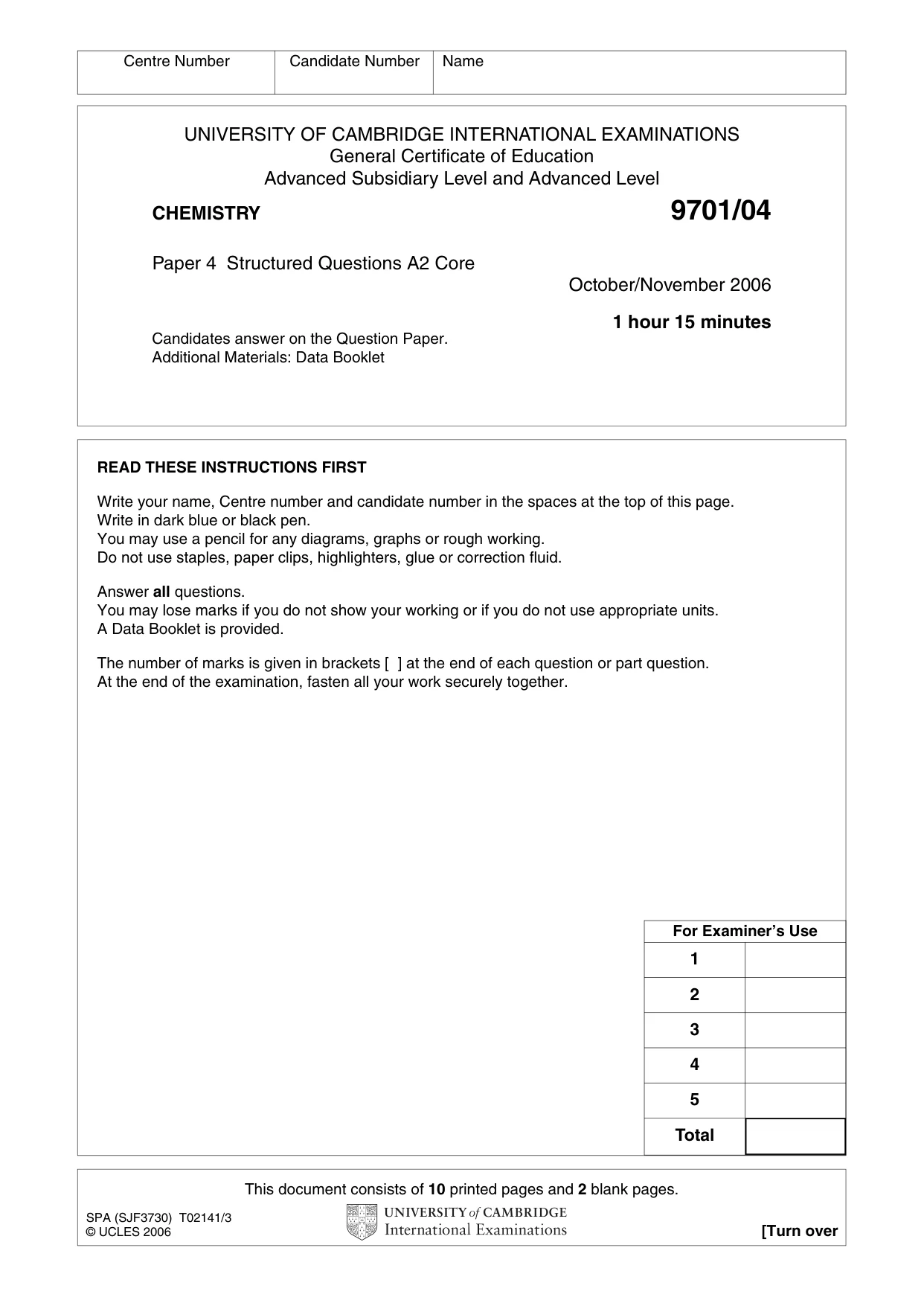
Question paper, page 1
This document consists of 10 printed pages and 2 blank pages. SPA (SJF3730) T02141/3 © UCLES 2006 [Turn over UNIVERSITY OF CAMBRIDGE INTERNATIONAL EXAMINATIONS General Certificate of Education Advanced Subsidiary Level and Advanced Level CHEMISTRY 9701/04 Paper 4 Structured Questions A2 Core October/November 2006 1 hour 15 minutes Candidates answer on the Question Paper. Additional Materials: Data Booklet READ THESE INSTRUCTIONS FIRST Write your name, Centre number and candidate number in the spaces at the top of this page. Write in dark blue or black pen. You may use a pencil for any diagrams, graphs or rough working. Do not use staples, paper clips, highlighters, glue or correction fluid. Answer all questions. You may lose marks if you do not show your working or if you do not use appropriate units. A Data Booklet is provided. The number of marks is given in brackets [ ] at the end of each question or part question. At the end of the examination, fasten all your work securely together. Centre Number Candidate Number Name For Examiner’s Use 1 2 3 4 5 Total
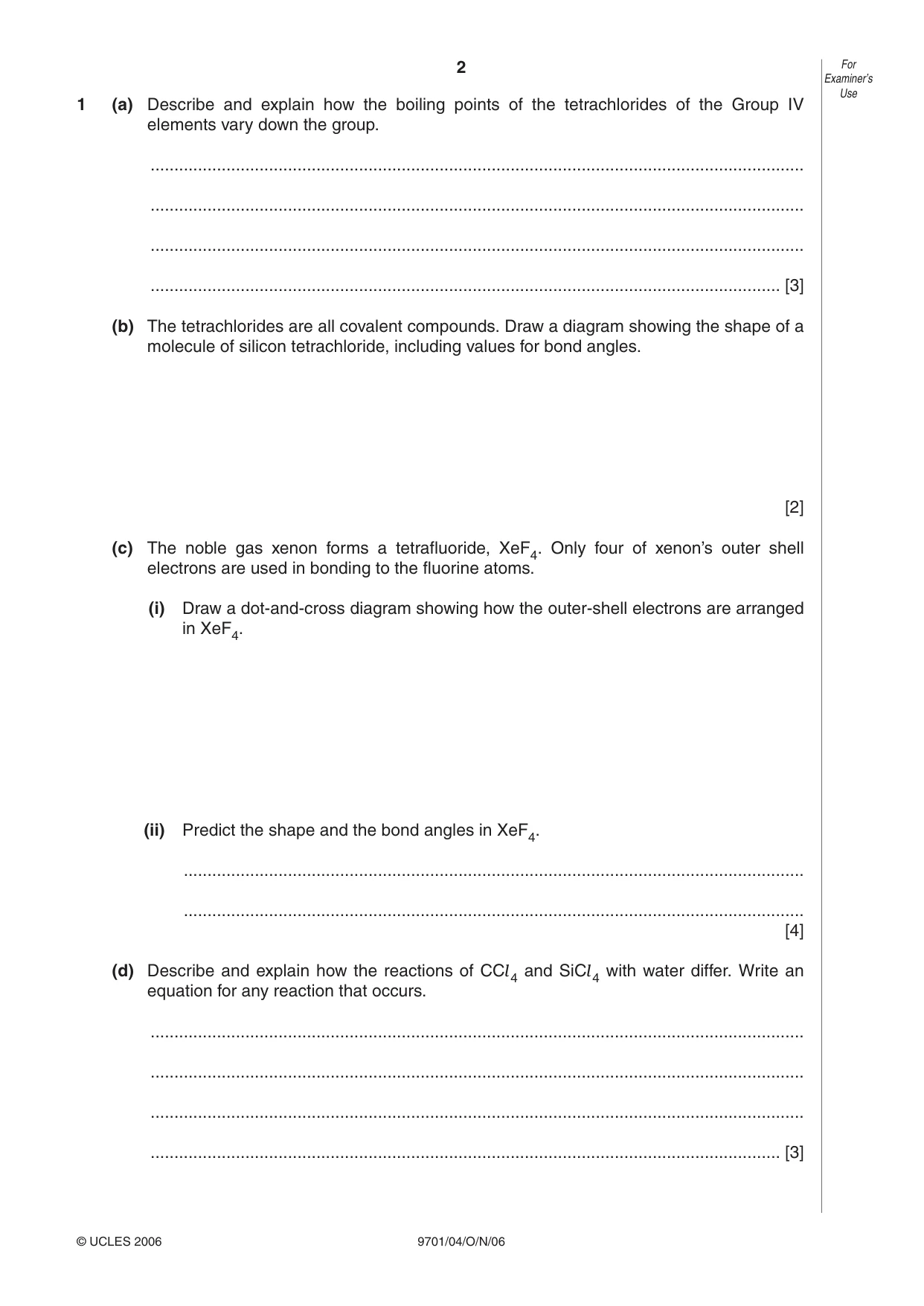
Question paper, page 2
2 9701/04/O/N/06 1 (a) Describe and explain how the boiling points of the tetrachlorides of the Group IV elements vary down the group. … … … … [3] (b) The tetrachlorides are all covalent compounds. Draw a diagram showing the shape of a molecule of silicon tetrachloride, including values for bond angles. [2] (c) The noble gas xenon forms a tetrafluoride, XeF4. Only four of xenon’s outer shell electrons are used in bonding to the fluorine atoms. (i) Draw a dot-and-cross diagram showing how the outer-shell electrons are arranged in XeF4. (ii) Predict the shape and the bond angles in XeF4. … … [4] (d) Describe and explain how the reactions of CCl4 and SiCl4 with water differ. Write an equation for any reaction that occurs. … … … … [3] For Examiner’s Use © UCLES 2006
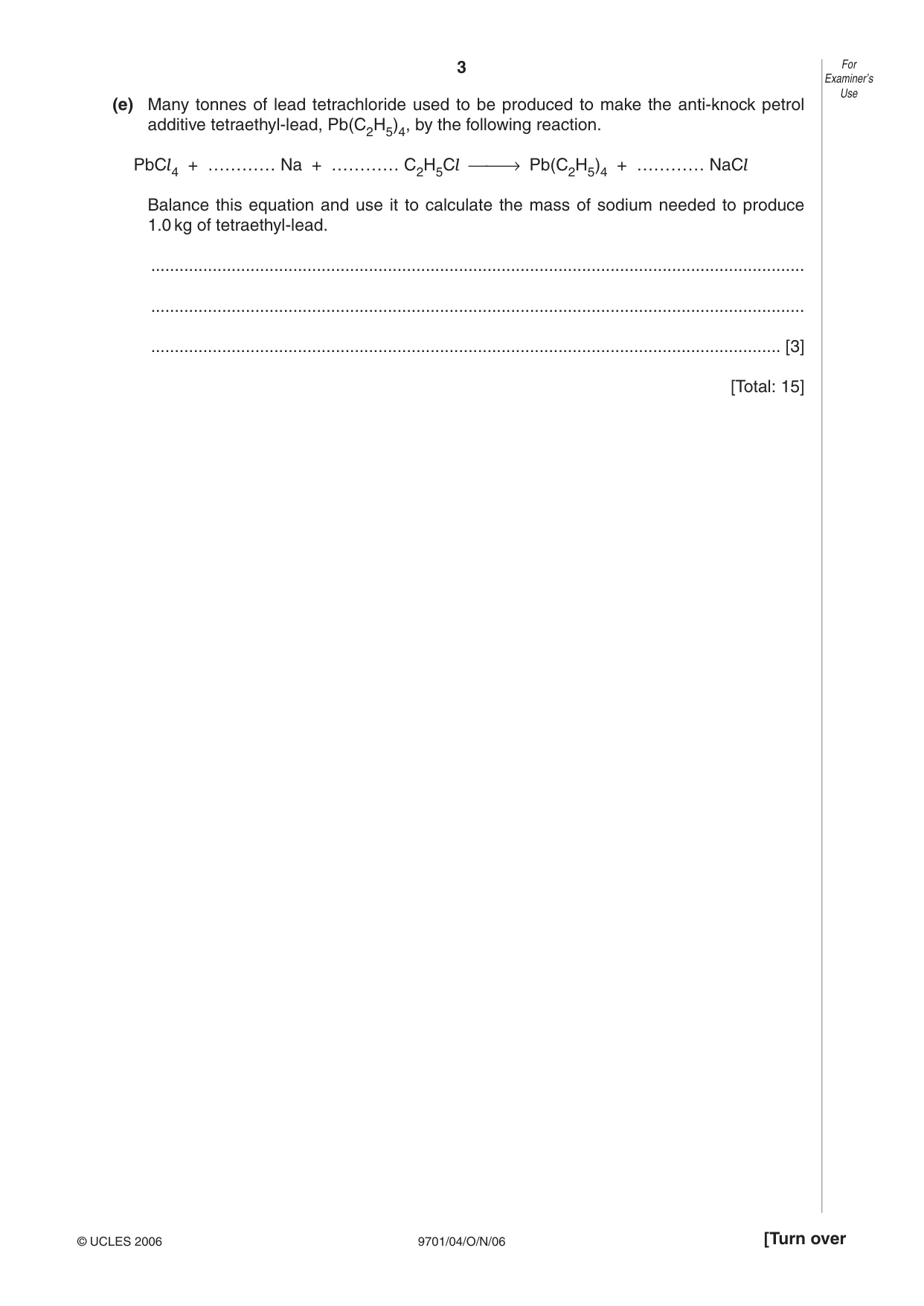
Question paper, page 3
3 9701/04/O/N/06 [Turn over (e) Many tonnes of lead tetrachloride used to be produced to make the anti-knock petrol additive tetraethyl-lead, Pb(C2H5)4, by the following reaction. PbCl4 + ………… Na + ………… C2H5Cl ⎯⎯→ Pb(C2H5)4 + ………… NaCl Balance this equation and use it to calculate the mass of sodium needed to produce 1.0 kg of tetraethyl-lead. … … … [3] [Total: 15] For Examiner’s Use © UCLES 2006
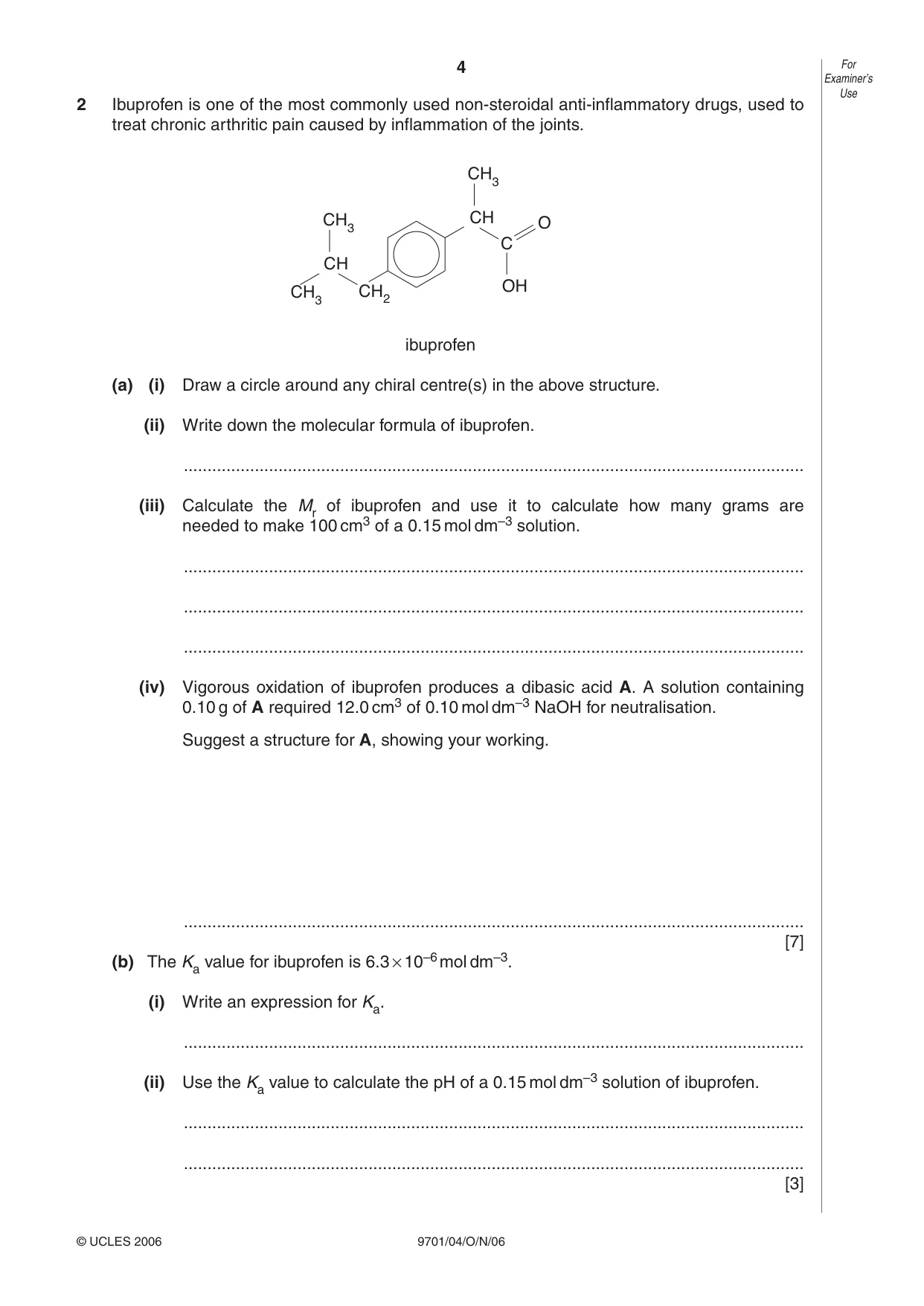
Question paper, page 4
4 9701/04/O/N/06 2 Ibuprofen is one of the most commonly used non-steroidal anti-inflammatory drugs, used to treat chronic arthritic pain caused by inflammation of the joints. ibuprofen (a) (i) Draw a circle around any chiral centre(s) in the above structure. (ii) Write down the molecular formula of ibuprofen. … (iii) Calculate the Mr of ibuprofen and use it to calculate how many grams are needed to make 100 cm3 of a 0.15 mol dm–3 solution. … … … (iv) Vigorous oxidation of ibuprofen produces a dibasic acid A. A solution containing 0.10 g of A required 12.0 cm3 of 0.10 mol dm–3 NaOH for neutralisation. Suggest a structure for A, showing your working. … [7] (b) The Ka value for ibuprofen is 6.3 ×10⁻⁶mol dm–3. (i) Write an expression for Ka. … (ii) Use the Ka value to calculate the pH of a 0.15 mol dm–3 solution of ibuprofen. … … [3] For Examiner’s Use © UCLES 2006 CH CH2 CH3 CH3 C O CH OH CH3
Question paper, page 5
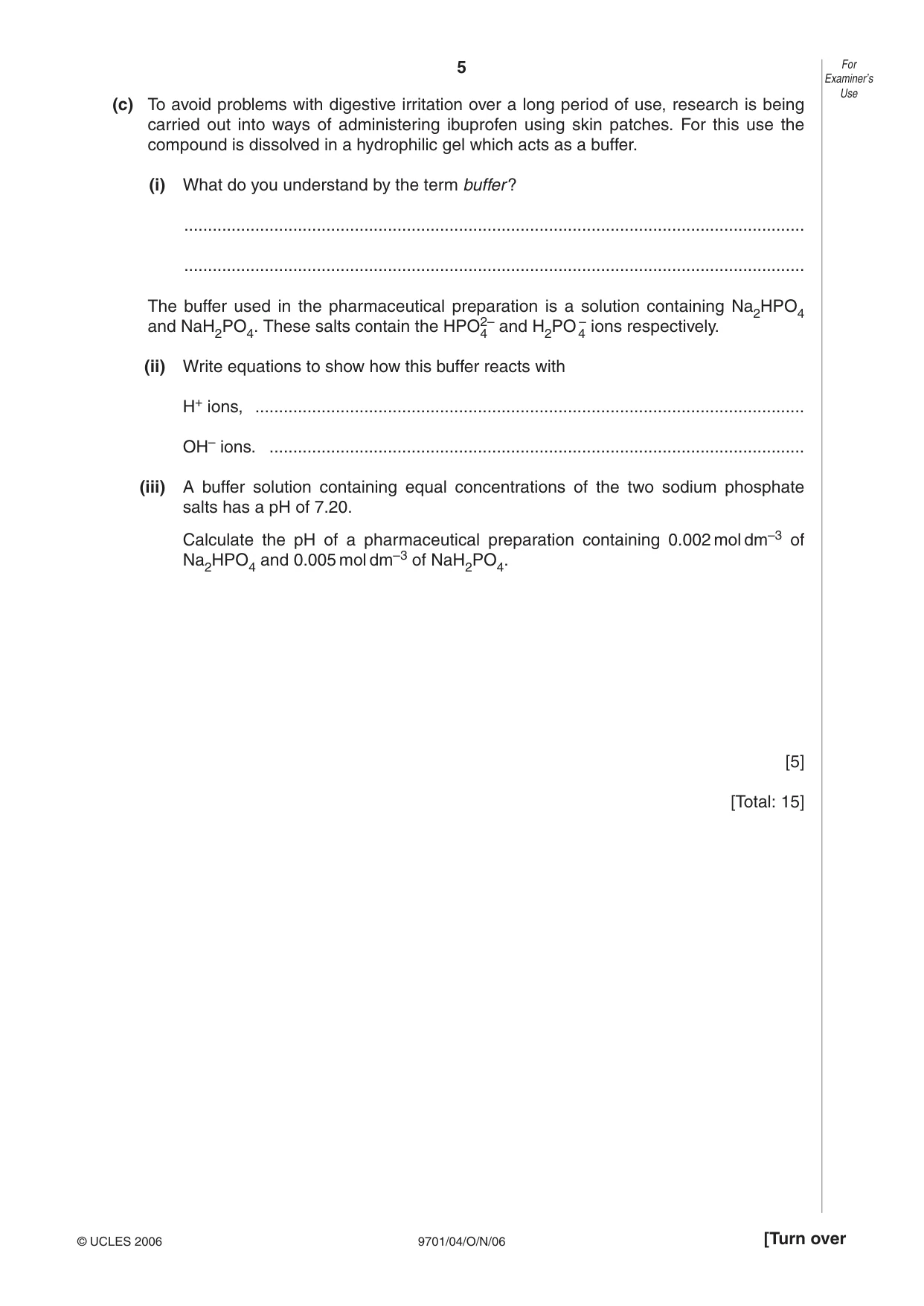
5 9701/04/O/N/06 [Turn over (c) To avoid problems with digestive irritation over a long period of use, research is being carried out into ways of administering ibuprofen using skin patches. For this use the compound is dissolved in a hydrophilic gel which acts as a buffer. (i) What do you understand by the term buffer? … … The buffer used in the pharmaceutical preparation is a solution containing Na2HPO4 and NaH2PO4. These salts contain the HPO4 2– and H2PO4 – ions respectively. (ii) Write equations to show how this buffer reacts with H+ ions, … OH– ions. … (iii) A buffer solution containing equal concentrations of the two sodium phosphate salts has a pH of 7.20. Calculate the pH of a pharmaceutical preparation containing 0.002 mol dm–3 of Na2HPO4 and 0.005 mol dm–3 of NaH2PO4. [5] [Total: 15] For Examiner’s Use © UCLES 2006
Question paper, page 6
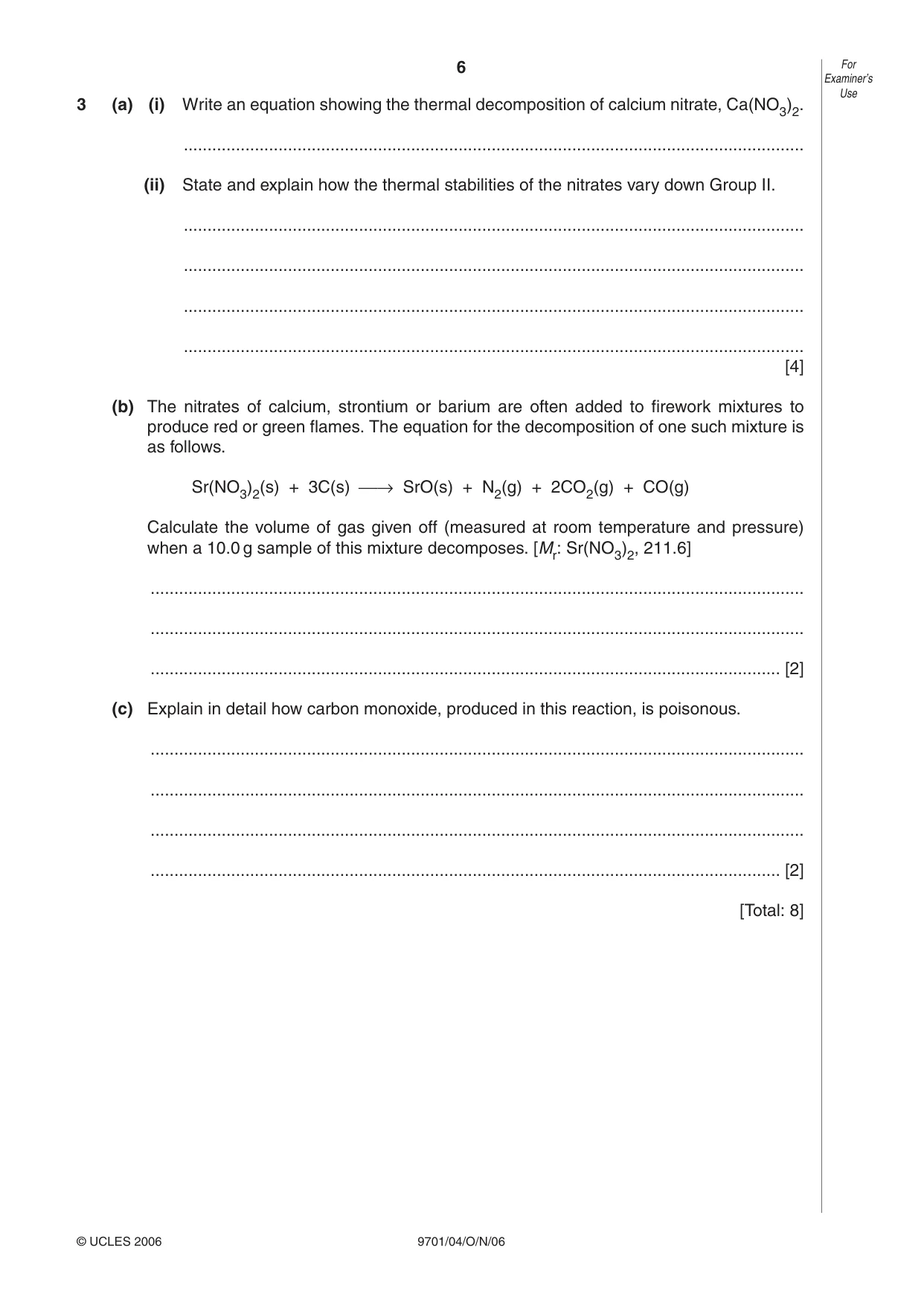
6 9701/04/O/N/06 3 (a) (i) Write an equation showing the thermal decomposition of calcium nitrate, Ca(NO3)2. … (ii) State and explain how the thermal stabilities of the nitrates vary down Group II. … … … … [4] (b) The nitrates of calcium, strontium or barium are often added to firework mixtures to produce red or green flames. The equation for the decomposition of one such mixture is as follows. Sr(NO3)2(s) + 3C(s) ⎯→SrO(s) + N2(g) + 2CO2(g) + CO(g) Calculate the volume of gas given off (measured at room temperature and pressure) when a 10.0 g sample of this mixture decomposes. [Mr: Sr(NO3)2, 211.6] … … … [2] (c) Explain in detail how carbon monoxide, produced in this reaction, is poisonous. … … … … [2] [Total: 8] For Examiner’s Use © UCLES 2006
Question paper, page 8
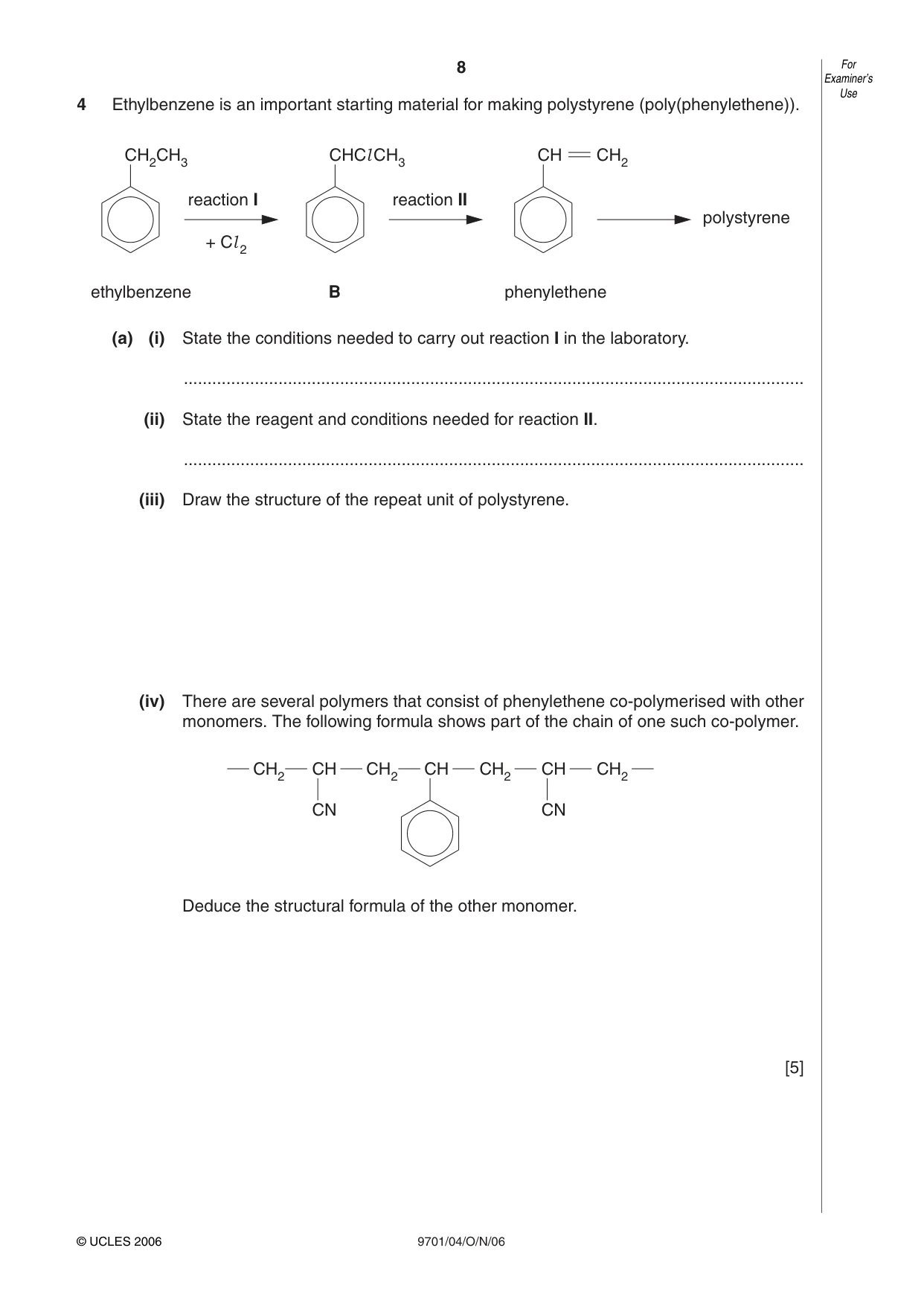
8 9701/04/O/N/06 4 Ethylbenzene is an important starting material for making polystyrene (poly(phenylethene)). (a) (i) State the conditions needed to carry out reaction I in the laboratory. … (ii) State the reagent and conditions needed for reaction II. … (iii) Draw the structure of the repeat unit of polystyrene. (iv) There are several polymers that consist of phenylethene co-polymerised with other monomers. The following formula shows part of the chain of one such co-polymer. Deduce the structural formula of the other monomer. [5] CH CH2 CH2 CH CN CH2 CH CN CH2 For Examiner’s Use © UCLES 2006 CH2CH3 + Cl 2 reaction I CHCl CH3 reaction II CH CH2 polystyrene ethylbenzene B phenylethene
Question paper, page 9
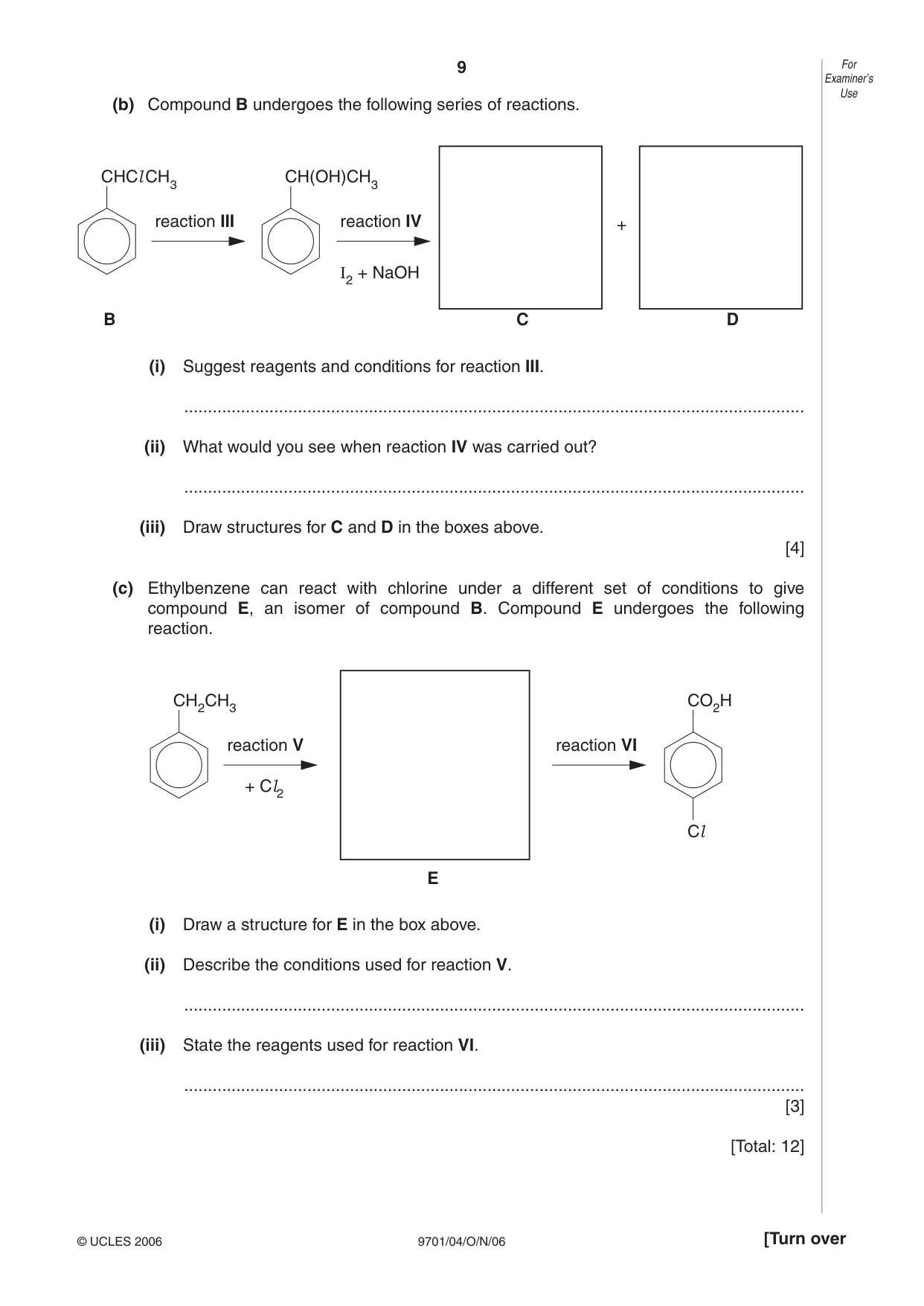
9 9701/04/O/N/06 [Turn over (b) Compound B undergoes the following series of reactions. (i) Suggest reagents and conditions for reaction III. … (ii) What would you see when reaction IV was carried out? … (iii) Draw structures for C and D in the boxes above. [4] (c) Ethylbenzene can react with chlorine under a different set of conditions to give compound E, an isomer of compound B. Compound E undergoes the following reaction. (i) Draw a structure for E in the box above. (ii) Describe the conditions used for reaction V. … (iii) State the reagents used for reaction VI. … [3] [Total: 12] For Examiner’s Use © UCLES 2006 + CHCl CH3 reaction III B C D CH(OH)CH3 reaction IV I2 + NaOH CH2CH3 + Cl2 Cl reaction V CO2H reaction VI E
Question paper, page 10
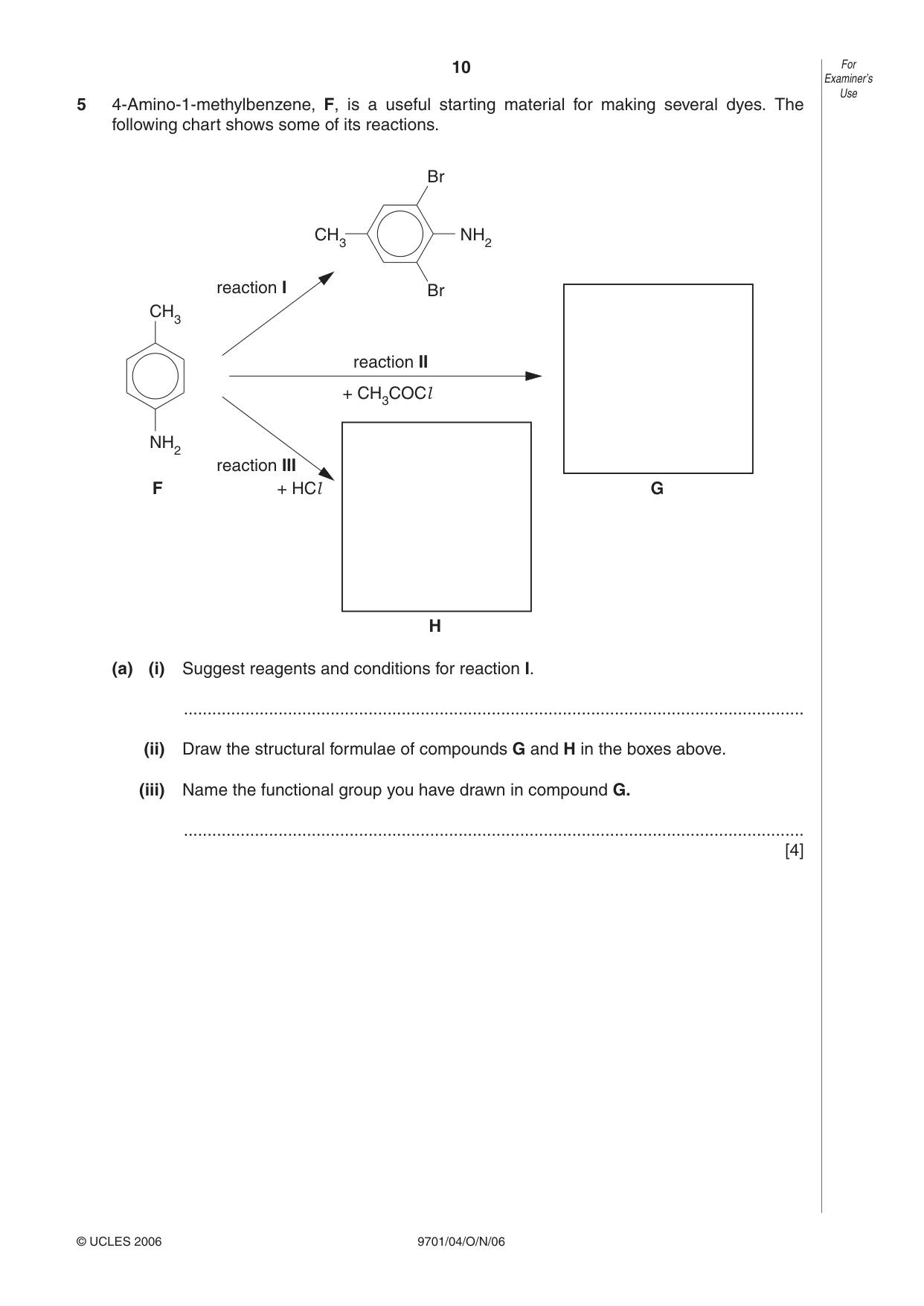
10 9701/04/O/N/06 For Examiner’s Use © UCLES 2006 5 4-Amino-1-methylbenzene, F, is a useful starting material for making several dyes. The following chart shows some of its reactions. (a) (i) Suggest reagents and conditions for reaction I. … (ii) Draw the structural formulae of compounds G and H in the boxes above. (iii) Name the functional group you have drawn in compound G. … [4] CH3 CH3 NH2 Br Br NH2 + CH3COCl + HCl reaction II reaction I reaction III H G F
Question paper, page 11
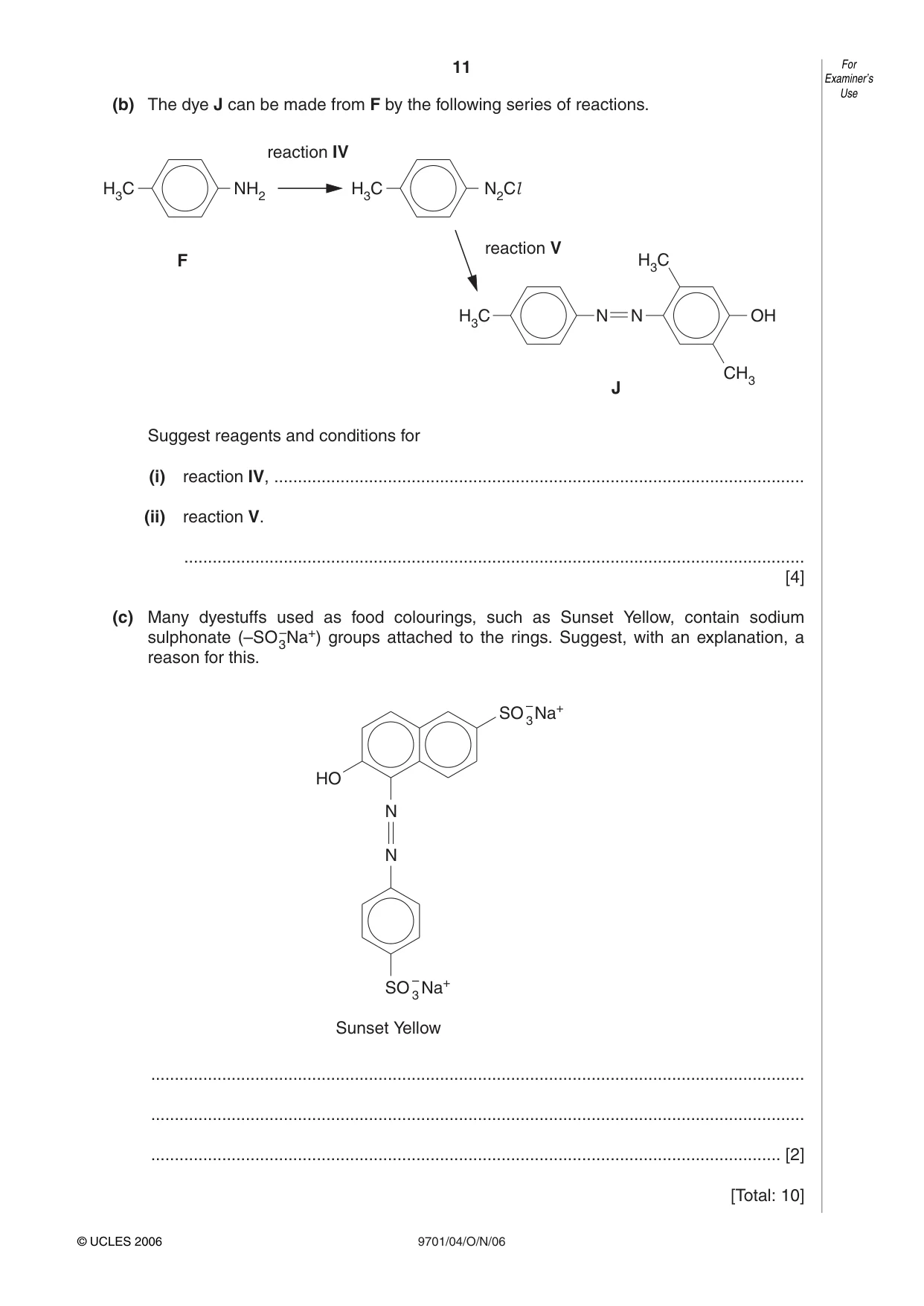
11 9701/04/O/N/06 (b) The dye J can be made from F by the following series of reactions. Suggest reagents and conditions for (i) reaction IV, … (ii) reaction V. … [4] (c) Many dyestuffs used as food colourings, such as Sunset Yellow, contain sodium sulphonate (–SO3 –Na+) groups attached to the rings. Suggest, with an explanation, a reason for this. … … … [2] [Total: 10] N N SO 3 Na+ Sunset Yellow SO 3 Na+ HO – – H3C NH2 reaction IV reaction V H3C N2Cl H3C H3C CH3 N N OH F J For Examiner’s Use © UCLES 2006
Question paper, page 12
12 9701/04/O/N/06 BLANK PAGE Permission to reproduce items where third-party owned material protected by copyright is included has been sought and cleared where possible. Every reasonable effort has been made by the publisher (UCLES) to trace copyright holders, but if any items requiring clearance have unwittingly been included, the publisher will be pleased to make amends at the earliest possible opportunity. University of Cambridge International Examinations is part of the University of Cambridge Local Examinations Syndicate (UCLES), which is itself a department of the University of Cambridge.
Mark scheme, page 1
UNIVERSITY OF CAMBRIDGE INTERNATIONAL EXAMINATIONS GCE Advanced Subsidiary Level and GCE Advanced Level MARK SCHEME for the October/November 2006 question paper 9701 CHEMISTRY 9701/04 Paper 4 (Theory 2), maximum raw mark 60 This mark scheme is published as an aid to teachers and students, to indicate the requirements of the examination. It shows the basis on which Examiners were instructed to award marks. It does not indicate the details of the discussions that took place at an Examiners’ meeting before marking began. All Examiners are instructed that alternative correct answers and unexpected approaches in candidates’ scripts must be given marks that fairly reflect the relevant knowledge and skills demonstrated. Mark schemes must be read in conjunction with the question papers and the report on the examination. The grade thresholds for various grades are published in the report on the examination for most IGCSE, GCE Advanced Level and Advanced Subsidiary Level syllabuses. • CIE will not enter into discussions or correspondence in connection with these mark schemes. CIE is publishing the mark schemes for the October/November 2006 question papers for most IGCSE, GCE Advanced Level and Advanced Subsidiary Level syllabuses and some Ordinary Level syllabuses.
Mark scheme, page 2
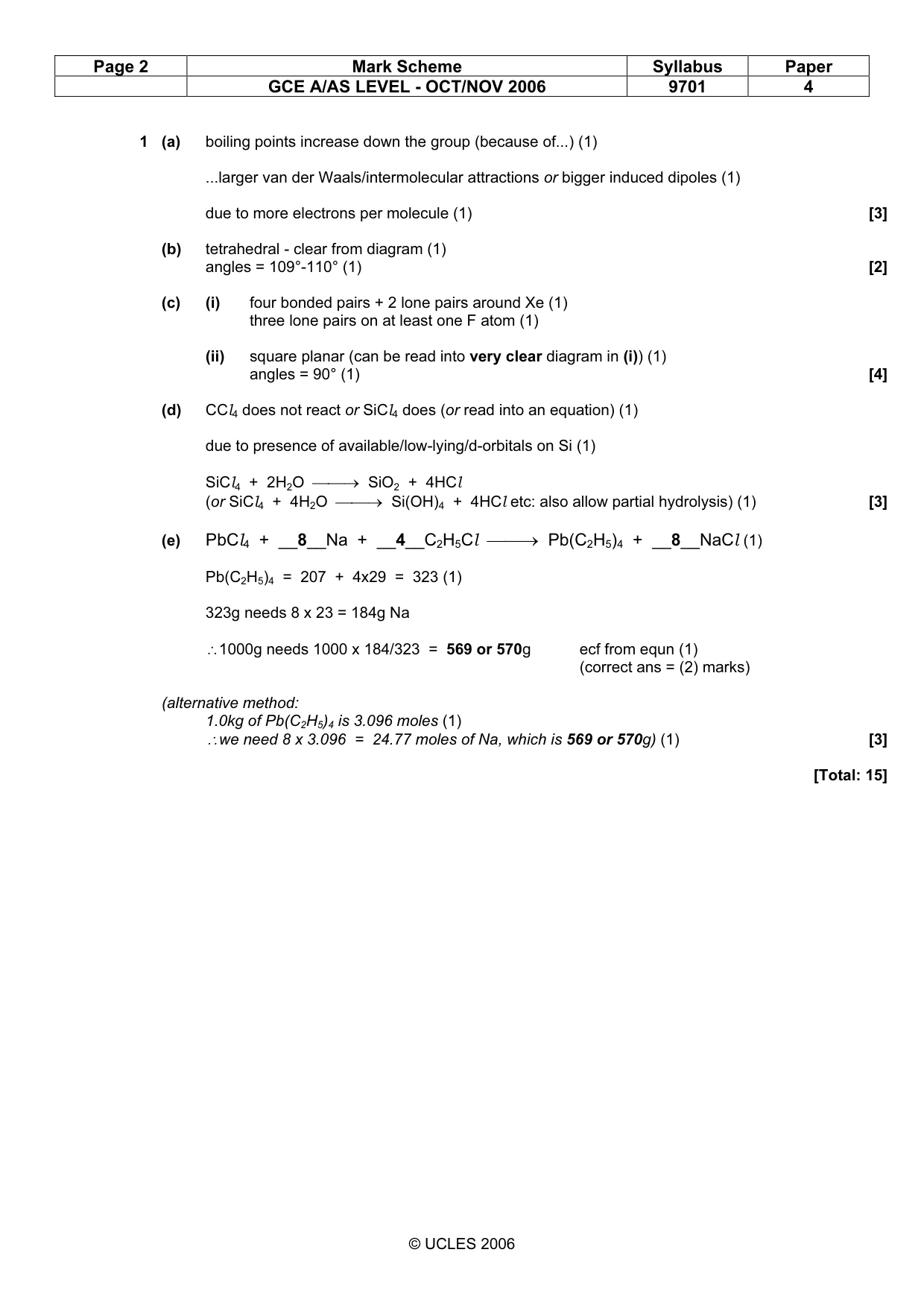
Page 2 Mark Scheme Syllabus Paper GCE A/AS LEVEL - OCT/NOV 2006 9701 4 © UCLES 2006 1 (a) boiling points increase down the group (because of...) (1) ...larger van der Waals/intermolecular attractions or bigger induced dipoles (1) due to more electrons per molecule (1) [3] (b) tetrahedral - clear from diagram (1) angles = 109°-110° (1) [2] (c) (i) four bonded pairs + 2 lone pairs around Xe (1) three lone pairs on at least one F atom (1) (ii) square planar (can be read into very clear diagram in (i)) (1) angles = 90° (1) [4] (d) CCl4 does not react or SiCl4 does (or read into an equation) (1) due to presence of available/low-lying/d-orbitals on Si (1) SiCl4 + 2H2O → SiO2 + 4HCl (or SiCl4 + 4H2O → Si(OH)4 + 4HCl etc: also allow partial hydrolysis) (1) [3] (e) PbCl4 + __8__Na + __4__C2H5Cl → Pb(C2H5)4 + __8__NaCl (1) Pb(C2H5)4 = 207 + 4x29 = 323 (1) 323g needs 8 x 23 = 184g Na ∴1000g needs 1000 x 184/323 = 569 or 570g ecf from equn (1) (correct ans = (2) marks) (alternative method: 1.0kg of Pb(C2H5)4 is 3.096 moles (1) ∴we need 8 x 3.096 = 24.77 moles of Na, which is 569 or 570g) (1) [3] [Total: 15]
Mark scheme, page 3
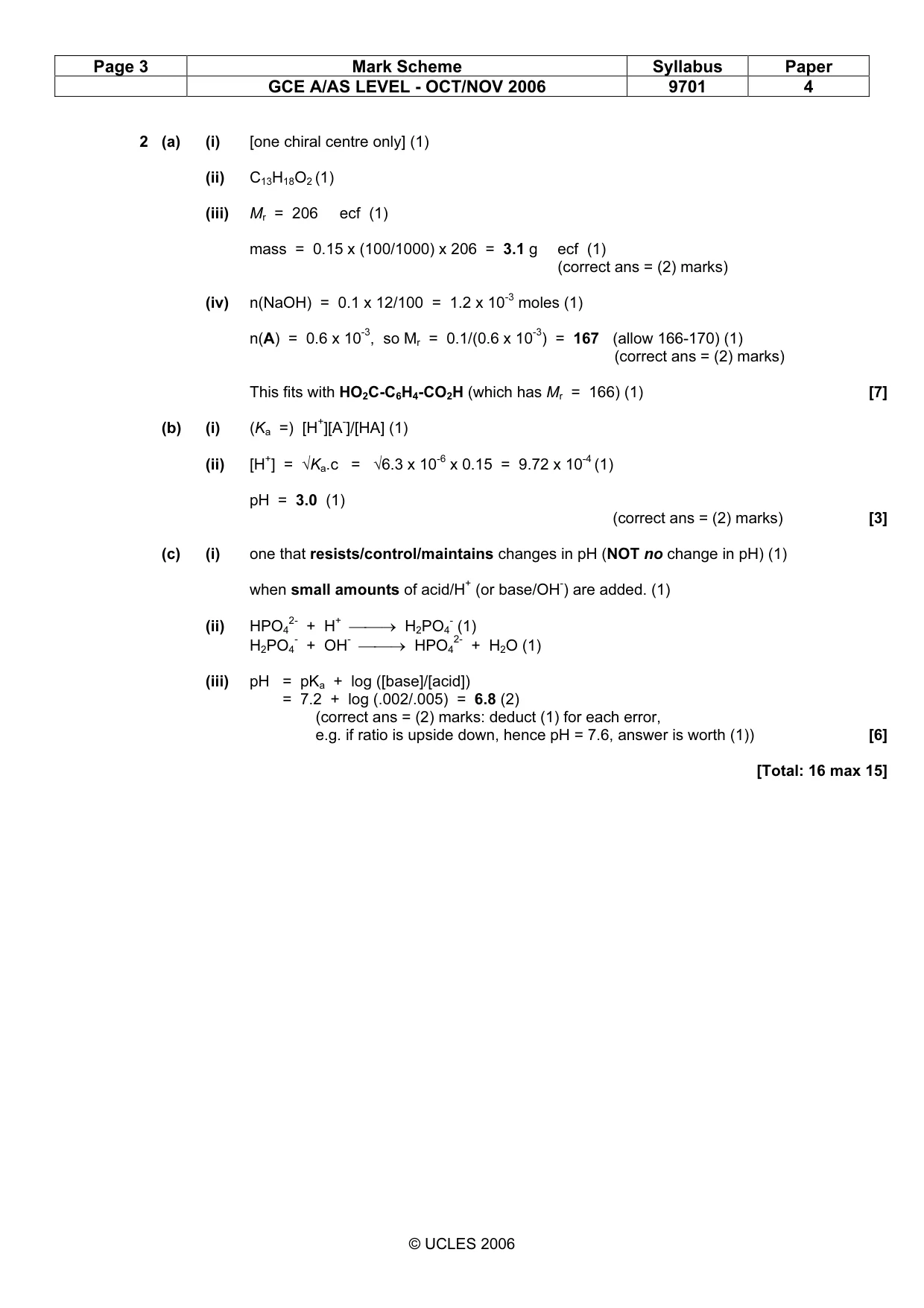
Page 3 Mark Scheme Syllabus Paper GCE A/AS LEVEL - OCT/NOV 2006 9701 4 © UCLES 2006 2 (a) (i) [one chiral centre only] (1) (ii) C13H18O2 (1) (iii) Mr = 206 ecf (1) mass = 0.15 x (100/1000) x 206 = 3.1 g ecf (1) (correct ans = (2) marks) (iv) n(NaOH) = 0.1 x 12/100 = 1.2 x 10⁻³ moles (1) n(A) = 0.6 x 10⁻³, so Mr = 0.1/(0.6 x 10-3) = 167 (allow 166-170) (1) (correct ans = (2) marks) This fits with HO2C-C6H4-CO2H (which has Mr = 166) (1) [7] (b) (i) (Ka =) [H+][A-]/[HA] (1) (ii) [H+] = √Ka.c = √6.3 x 10-6 x 0.15 = 9.72 x 10⁻⁴ (1) pH = 3.0 (1) (correct ans = (2) marks) [3] (c) (i) one that resists/control/maintains changes in pH (NOT no change in pH) (1) when small amounts of acid/H+ (or base/OH-) are added. (1) (ii) HPO4 2- + H+ → H2PO4 - (1) H2PO4 - + OH- → HPO4 2- + H2O (1) (iii) pH = pKa + log ([base]/[acid]) = 7.2 + log (.002/.005) = 6.8 (2) (correct ans = (2) marks: deduct (1) for each error, e.g. if ratio is upside down, hence pH = 7.6, answer is worth (1)) [6] [Total: 16 max 15]
Mark scheme, page 4
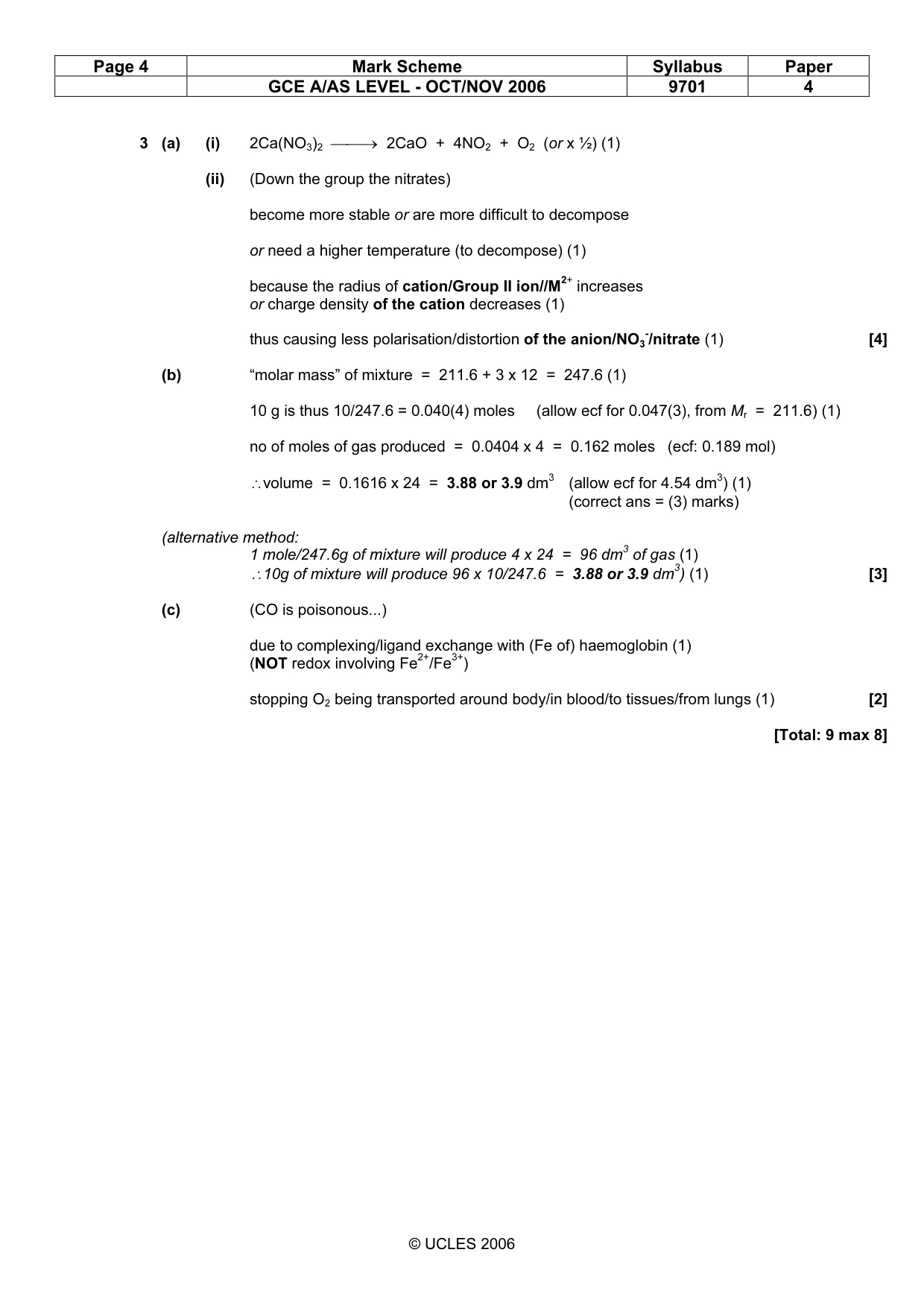
Page 4 Mark Scheme Syllabus Paper GCE A/AS LEVEL - OCT/NOV 2006 9701 4 © UCLES 2006 3 (a) (i) 2Ca(NO3)2 → 2CaO + 4NO2 + O2 (or x ½) (1) (ii) (Down the group the nitrates) become more stable or are more difficult to decompose or need a higher temperature (to decompose) (1) because the radius of cation/Group II ion//M2+ increases or charge density of the cation decreases (1) thus causing less polarisation/distortion of the anion/NO3 -/nitrate (1) [4] (b) “molar mass” of mixture = 211.6 + 3 x 12 = 247.6 (1) 10 g is thus 10/247.6 = 0.040(4) moles (allow ecf for 0.047(3), from Mr = 211.6) (1) no of moles of gas produced = 0.0404 x 4 = 0.162 moles (ecf: 0.189 mol) ∴volume = 0.1616 x 24 = 3.88 or 3.9 dm3 (allow ecf for 4.54 dm3) (1) (correct ans = (3) marks) (alternative method: 1 mole/247.6g of mixture will produce 4 x 24 = 96 dm3 of gas (1) ∴10g of mixture will produce 96 x 10/247.6 = 3.88 or 3.9 dm3) (1) [3] (c) (CO is poisonous...) due to complexing/ligand exchange with (Fe of) haemoglobin (1) (NOT redox involving Fe2+/Fe3+) stopping O2 being transported around body/in blood/to tissues/from lungs (1) [2] [Total: 9 max 8]
Mark scheme, page 5
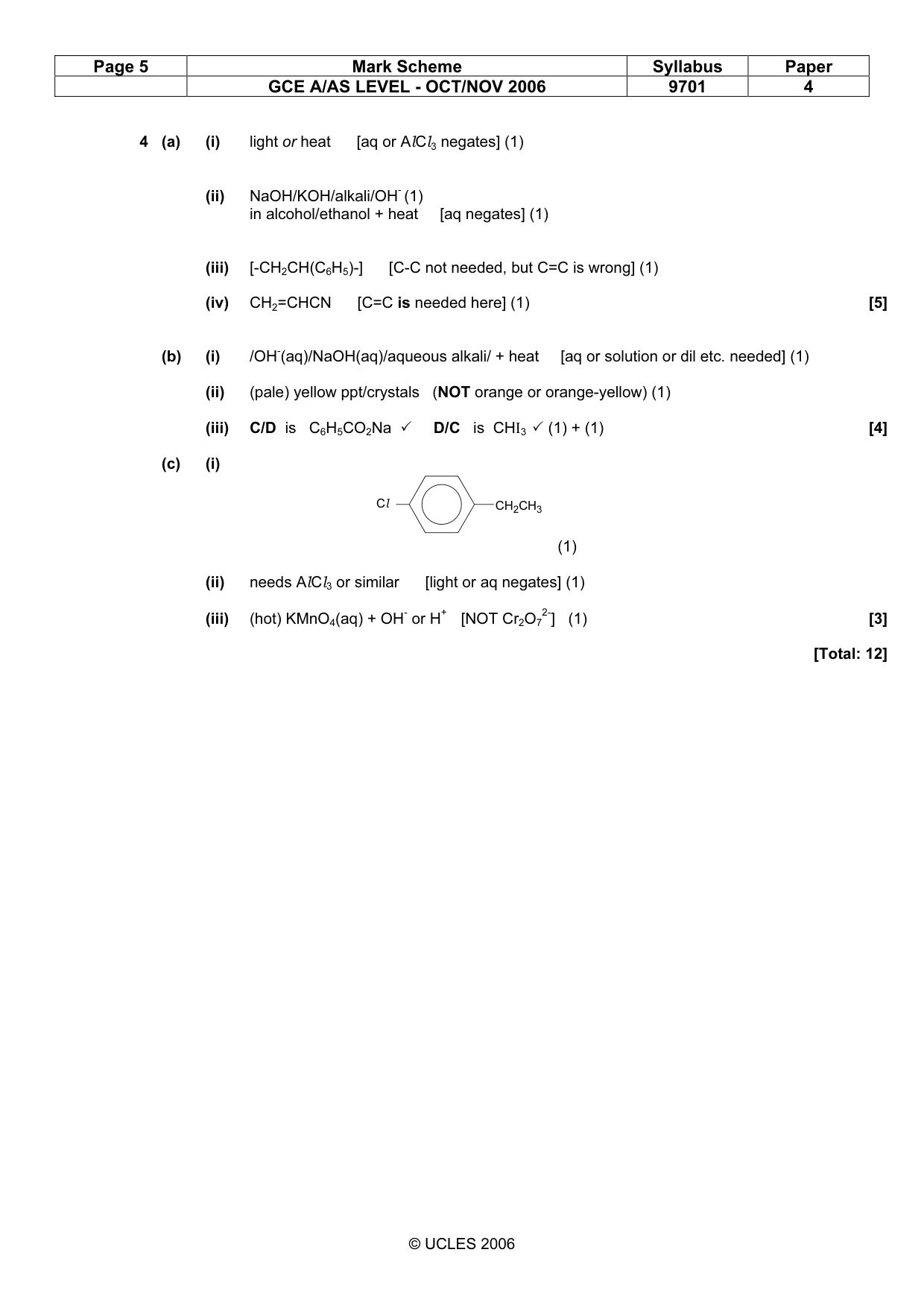
Page 5 Mark Scheme Syllabus Paper GCE A/AS LEVEL - OCT/NOV 2006 9701 4 © UCLES 2006 4 (a) (i) light or heat [aq or AlCl3 negates] (1) (ii) NaOH/KOH/alkali/OH- (1) in alcohol/ethanol + heat [aq negates] (1) (iii) [-CH2CH(C6H5)-] [C-C not needed, but C=C is wrong] (1) (iv) CH2=CHCN [C=C is needed here] (1) [5] (b) (i) /OH-(aq)/NaOH(aq)/aqueous alkali/ + heat [aq or solution or dil etc. needed] (1) (ii) (pale) yellow ppt/crystals (NOT orange or orange-yellow) (1) (iii) C/D is C6H5CO2Na ✓ D/C is CHI3 ✓ (1) + (1) [4] (c) (i) Cl CH2CH3 (1) (ii) needs AlCl3 or similar [light or aq negates] (1) (iii) (hot) KMnO4(aq) + OH- or H+ [NOT Cr2O7 2-] (1) [3] [Total: 12] Cl
Mark scheme, page 6
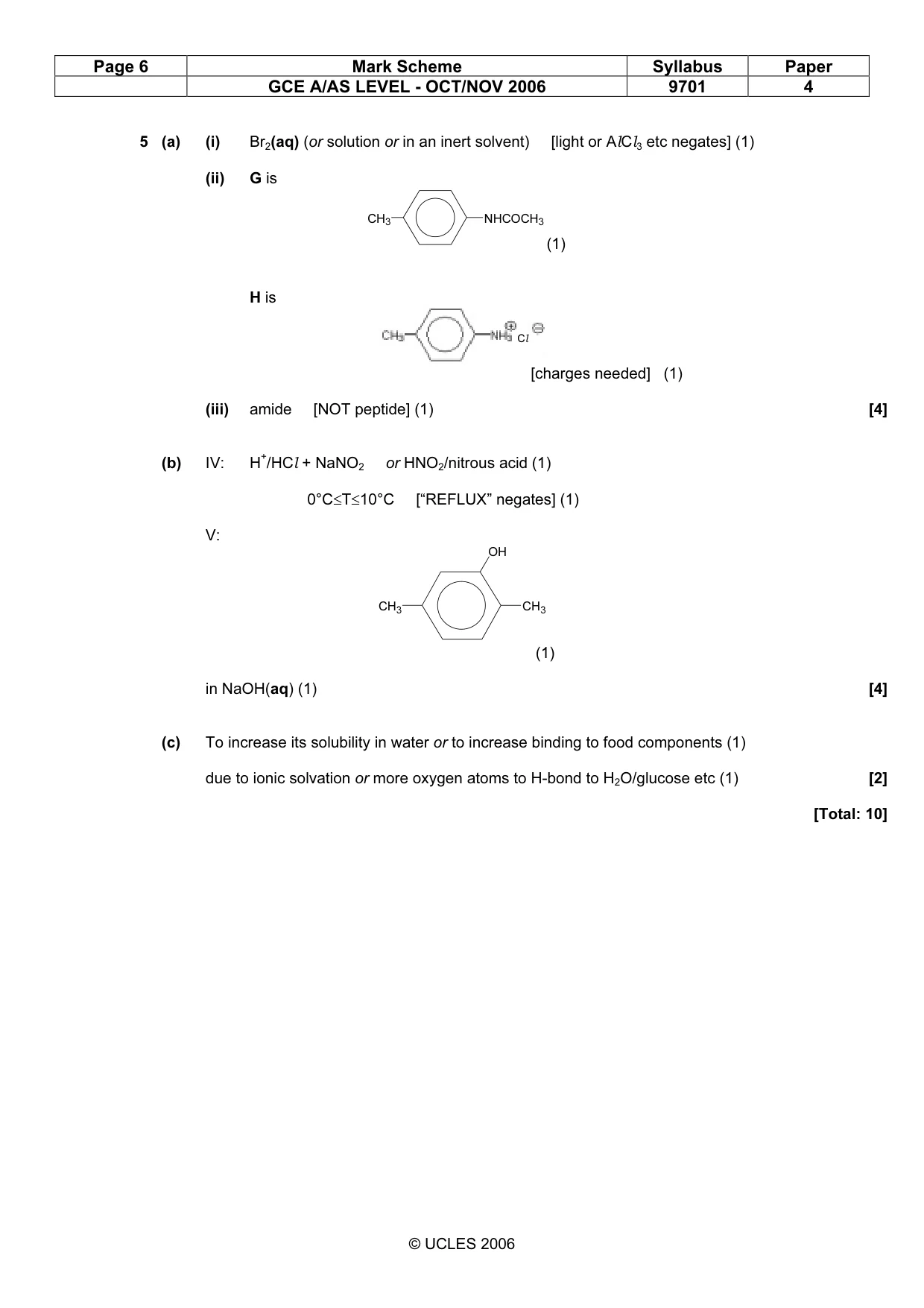
Page 6 Mark Scheme Syllabus Paper GCE A/AS LEVEL - OCT/NOV 2006 9701 4 © UCLES 2006 5 (a) (i) Br2(aq) (or solution or in an inert solvent) [light or AlCl3 etc negates] (1) (ii) G is CH3 NHCOCH3 (1) H is [charges needed] (1) (iii) amide [NOT peptide] (1) [4] (b) IV: H+/HCl + NaNO2 or HNO2/nitrous acid (1) 0°C≤T≤10°C [“REFLUX” negates] (1) V: OH CH3 CH3 (1) in NaOH(aq) (1) [4] (c) To increase its solubility in water or to increase binding to food components (1) due to ionic solvation or more oxygen atoms to H-bond to H2O/glucose etc (1) [2] [Total: 10] Cl
What you needed in this session
Cambridge’s own grade thresholds for 2006 Oct/Nov, Paper 4 · Variant 1. A higher threshold means an easier paper — the bar moves with how the cohort did.