Cambridge A Level Chemistry 9701 — 2005 Oct/Nov Paper 4 · Variant 1
9701/41/O/N/05
The question paper and its mark scheme, free to read here and free to download. This is Cambridge’s own paper, exactly as it was sat.
Question paper12 pages

Mark scheme6 pages
Answers below. Sit the paper first if you are practising.
Paper as text
Question paper, page 1
This document consists of 10 printed pages and 2 blank pages. SPA (MML 8078 3/04) S77894/4 © UCLES 2005 [Turn over UNIVERSITY OF CAMBRIDGE INTERNATIONAL EXAMINATIONS General Certificate of Education Advanced Subsidiary Level and Advanced Level CHEMISTRY 9701/04 Paper 4 Structured Questions A2 Core October/November 2005 1 hour 15 minutes Candidates answer on the Question Paper. Additional Materials: Data Booklet READ THESE INSTRUCTIONS FIRST Write your name, Centre number and candidate number in the spaces at the top of this page. Write in dark blue or black pen in the spaces provided on the Question Paper. You may use a pencil for any diagrams, graphs, or rough working. Do not use staples, paper clips, highlighters, glue or correction fluid. Answer all questions. The number of marks is given in brackets [ ] at the end of each question or part question. You may lose marks if you do not show your working or if you do not use appropriate units. A Data Booklet is provided. You may use a calculator. Centre Number Candidate Number Name If you have been given a label, look at the details. If any details are incorrect or missing, please fill in your correct details in the space given at the top of this page. Stick your personal label here, if provided. For Examiner’s Use 4 3 2 1 5 TOTAL
Question paper, page 2
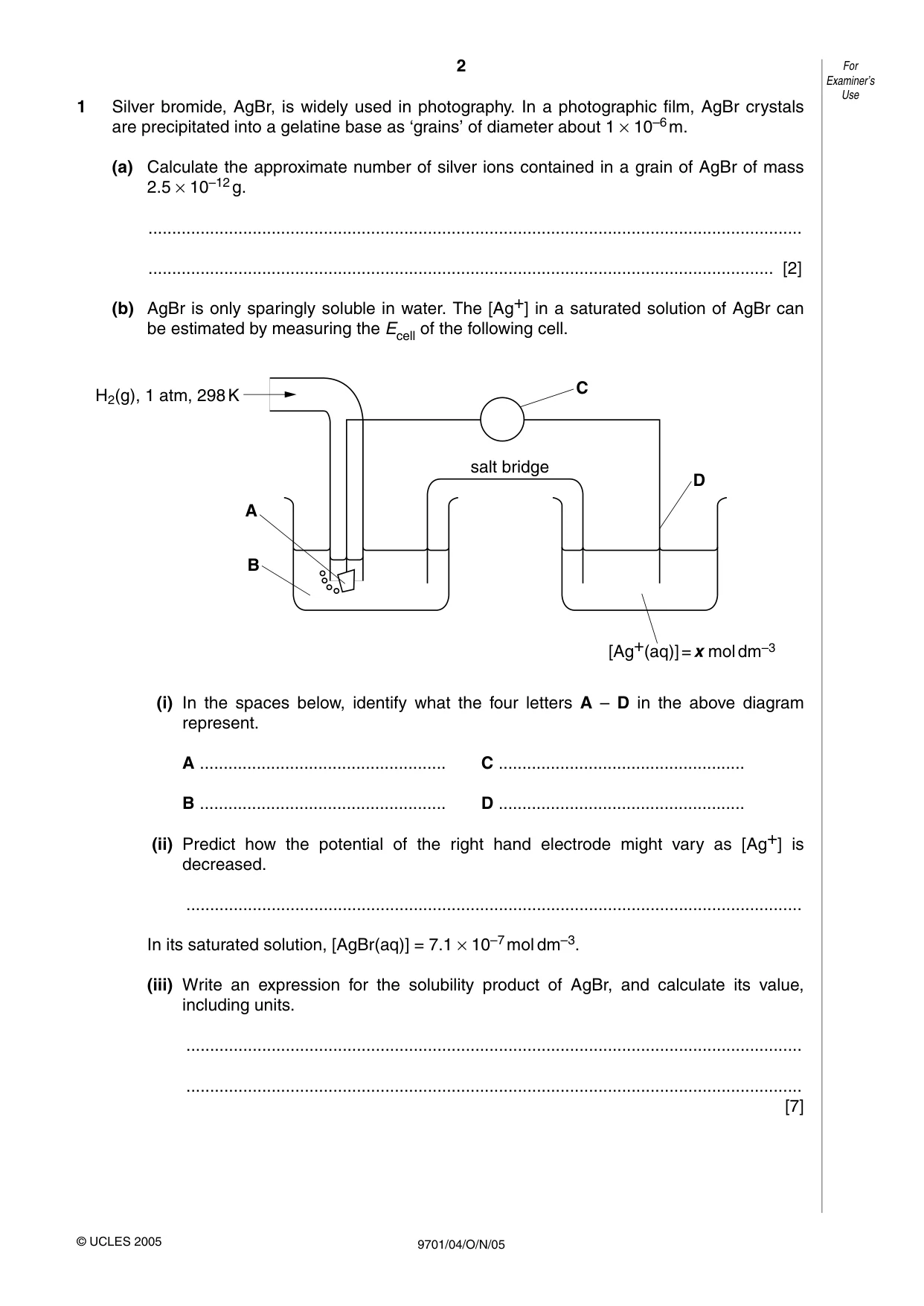
1 Silver bromide, AgBr, is widely used in photography. In a photographic film, AgBr crystals are precipitated into a gelatine base as ‘grains’ of diameter about 1 × 10⁻⁶m. (a) Calculate the approximate number of silver ions contained in a grain of AgBr of mass 2.5 × 10⁻¹²g. … … [2] (b) AgBr is only sparingly soluble in water. The [Ag+] in a saturated solution of AgBr can be estimated by measuring the Ecell of the following cell. (i) In the spaces below, identify what the four letters A – D in the above diagram represent. A … C … B … D … (ii) Predict how the potential of the right hand electrode might vary as [Ag+] is decreased. … In its saturated solution, [AgBr(aq)] = 7.1 × 10⁻⁷mol dm–3. (iii) Write an expression for the solubility product of AgBr, and calculate its value, including units. … … [7] salt bridge H2(g), 1 atm, 298 K [Ag+(aq)] = x mol dm–3 A B C D 2 9701/04/O/N/05 © UCLES 2005 For Examiner’s Use
Question paper, page 3
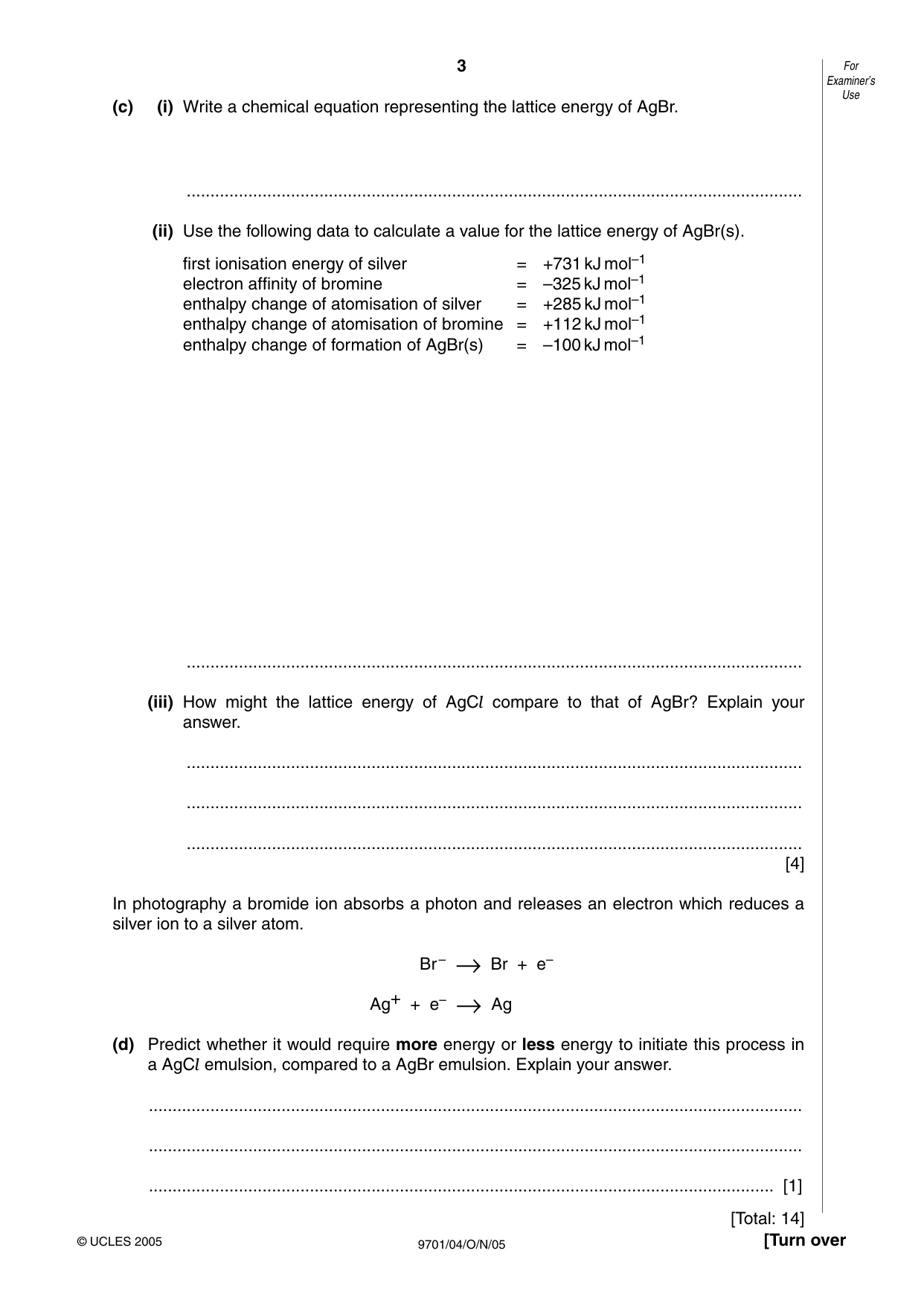
(c) (i) Write a chemical equation representing the lattice energy of AgBr. … (ii) Use the following data to calculate a value for the lattice energy of AgBr(s). first ionisation energy of silver = +731 kJ mol–1 electron affinity of bromine = –325 kJ mol–1 enthalpy change of atomisation of silver = +285 kJ mol–1 enthalpy change of atomisation of bromine = +112 kJ mol–1 enthalpy change of formation of AgBr(s) = –100 kJ mol–1 … (iii) How might the lattice energy of AgCl compare to that of AgBr? Explain your answer. … … … [4] In photography a bromide ion absorbs a photon and releases an electron which reduces a silver ion to a silver atom. Br– →Br + e– Ag+ + e– →Ag (d) Predict whether it would require more energy or less energy to initiate this process in a AgCl emulsion, compared to a AgBr emulsion. Explain your answer. … … … [1] [Total: 14] 3 [Turn over 9701/04/O/N/05 © UCLES 2005 For Examiner’s Use
Question paper, page 4
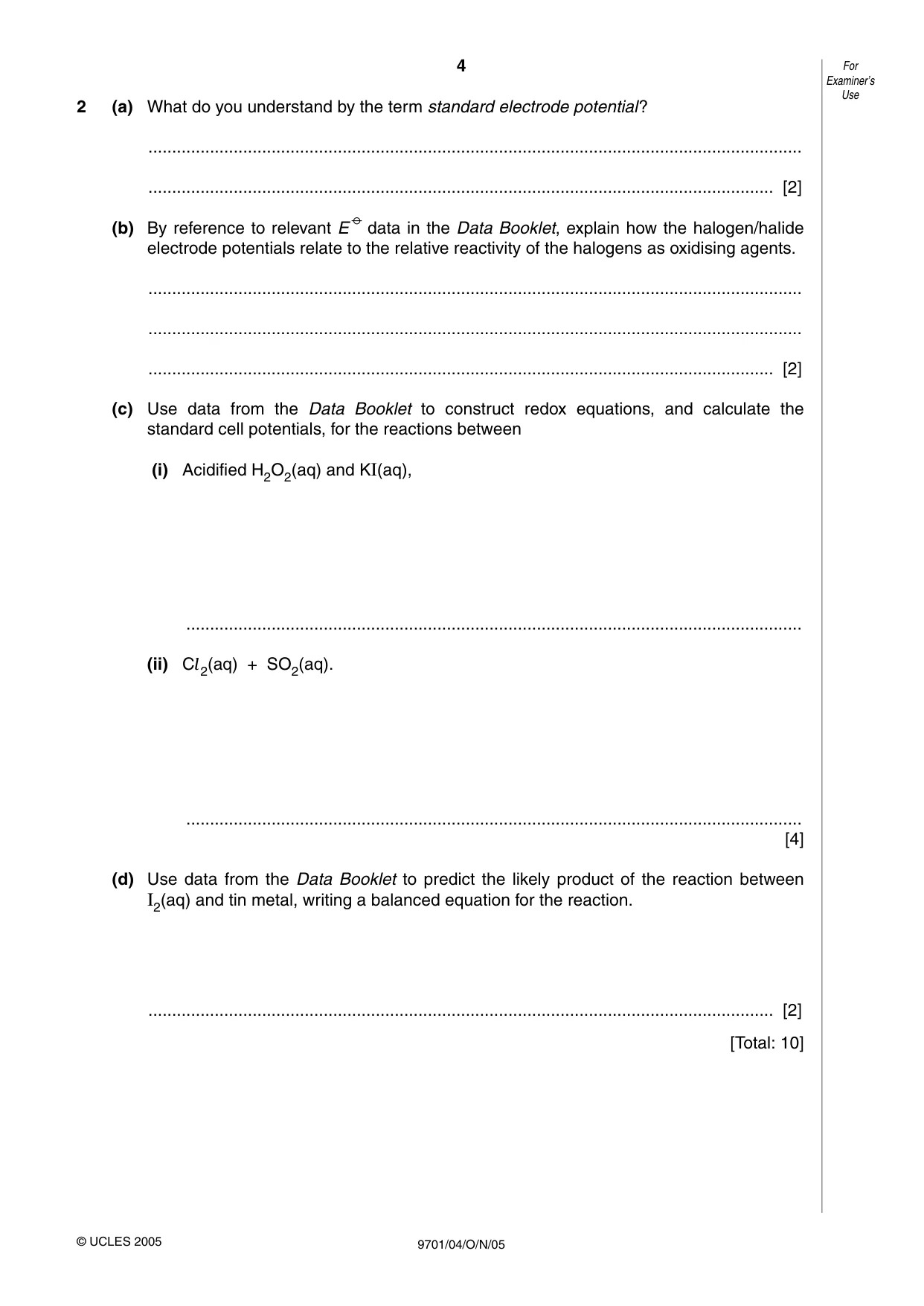
2 (a) What do you understand by the term standard electrode potential? … … [2] (b) By reference to relevant E data in the Data Booklet, explain how the halogen/halide electrode potentials relate to the relative reactivity of the halogens as oxidising agents. … … … [2] (c) Use data from the Data Booklet to construct redox equations, and calculate the standard cell potentials, for the reactions between (i) Acidified H2O2(aq) and KI(aq), … (ii) Cl2(aq) + SO2(aq). … [4] (d) Use data from the Data Booklet to predict the likely product of the reaction between I2(aq) and tin metal, writing a balanced equation for the reaction. … [2] [Total: 10] 4 9701/04/O/N/05 © UCLES 2005 For Examiner’s Use
Question paper, page 6
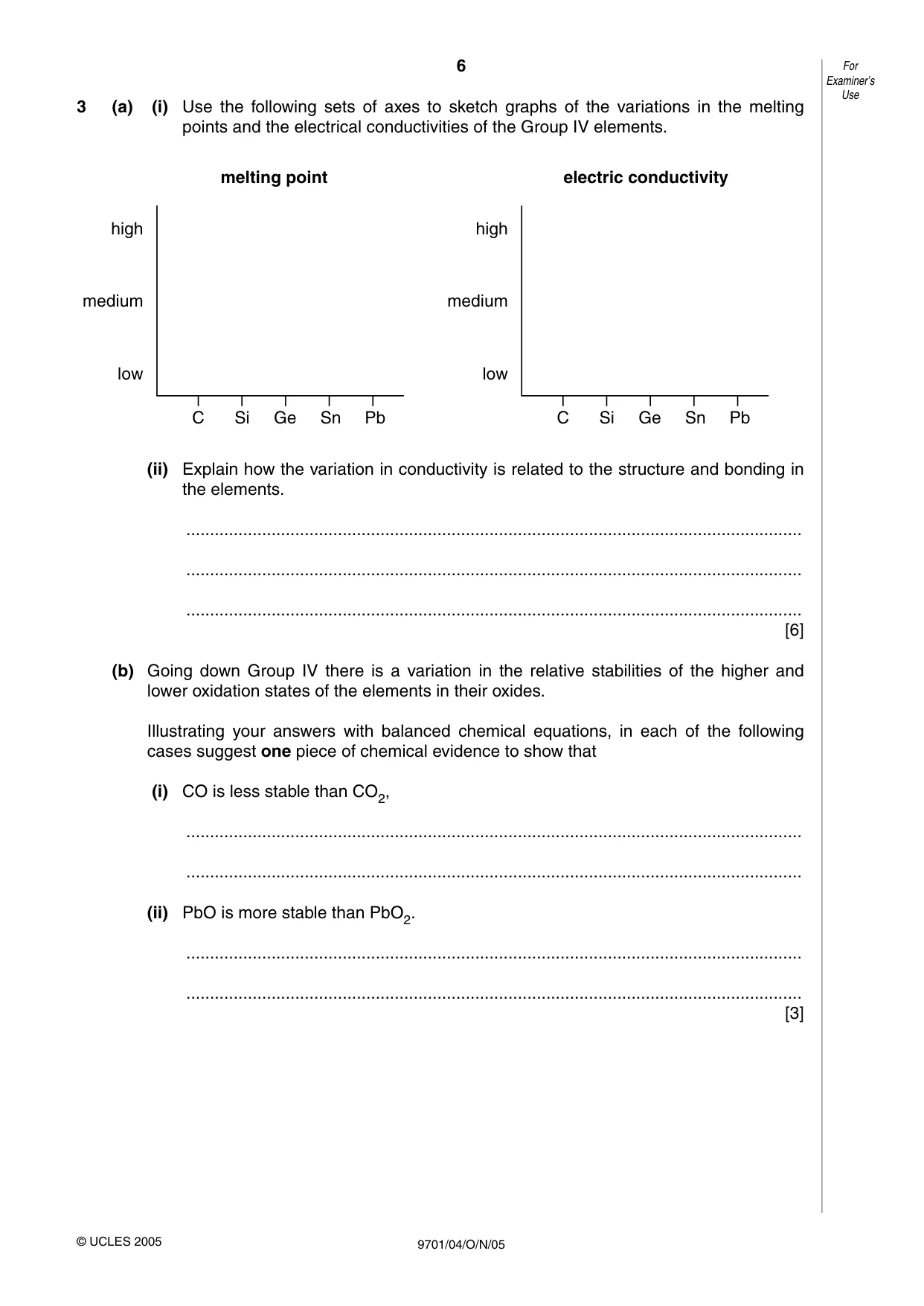
3 (a) (i) Use the following sets of axes to sketch graphs of the variations in the melting points and the electrical conductivities of the Group IV elements. (ii) Explain how the variation in conductivity is related to the structure and bonding in the elements. … … … [6] (b) Going down Group IV there is a variation in the relative stabilities of the higher and lower oxidation states of the elements in their oxides. Illustrating your answers with balanced chemical equations, in each of the following cases suggest one piece of chemical evidence to show that (i) CO is less stable than CO2, … … (ii) PbO is more stable than PbO2. … … [3] C low medium high melting point electric conductivity Si Ge Sn Pb C low medium high Si Ge Sn Pb 6 9701/04/O/N/05 © UCLES 2005 For Examiner’s Use
Question paper, page 7
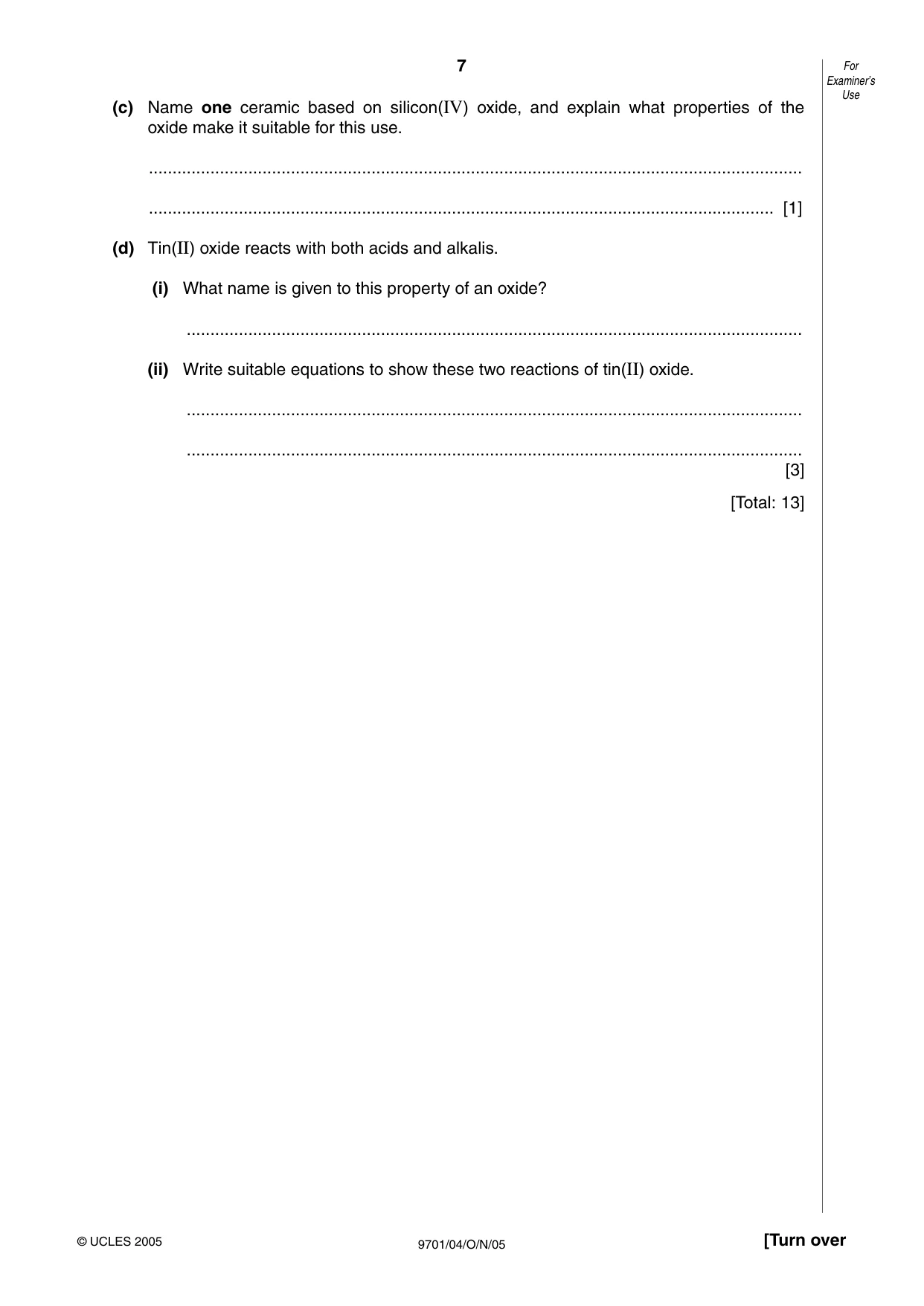
(c) Name one ceramic based on silicon(IV) oxide, and explain what properties of the oxide make it suitable for this use. … … [1] (d) Tin(II) oxide reacts with both acids and alkalis. (i) What name is given to this property of an oxide? … (ii) Write suitable equations to show these two reactions of tin(II) oxide. … … [3] [Total: 13] 7 [Turn over 9701/04/O/N/05 © UCLES 2005 For Examiner’s Use
Question paper, page 8
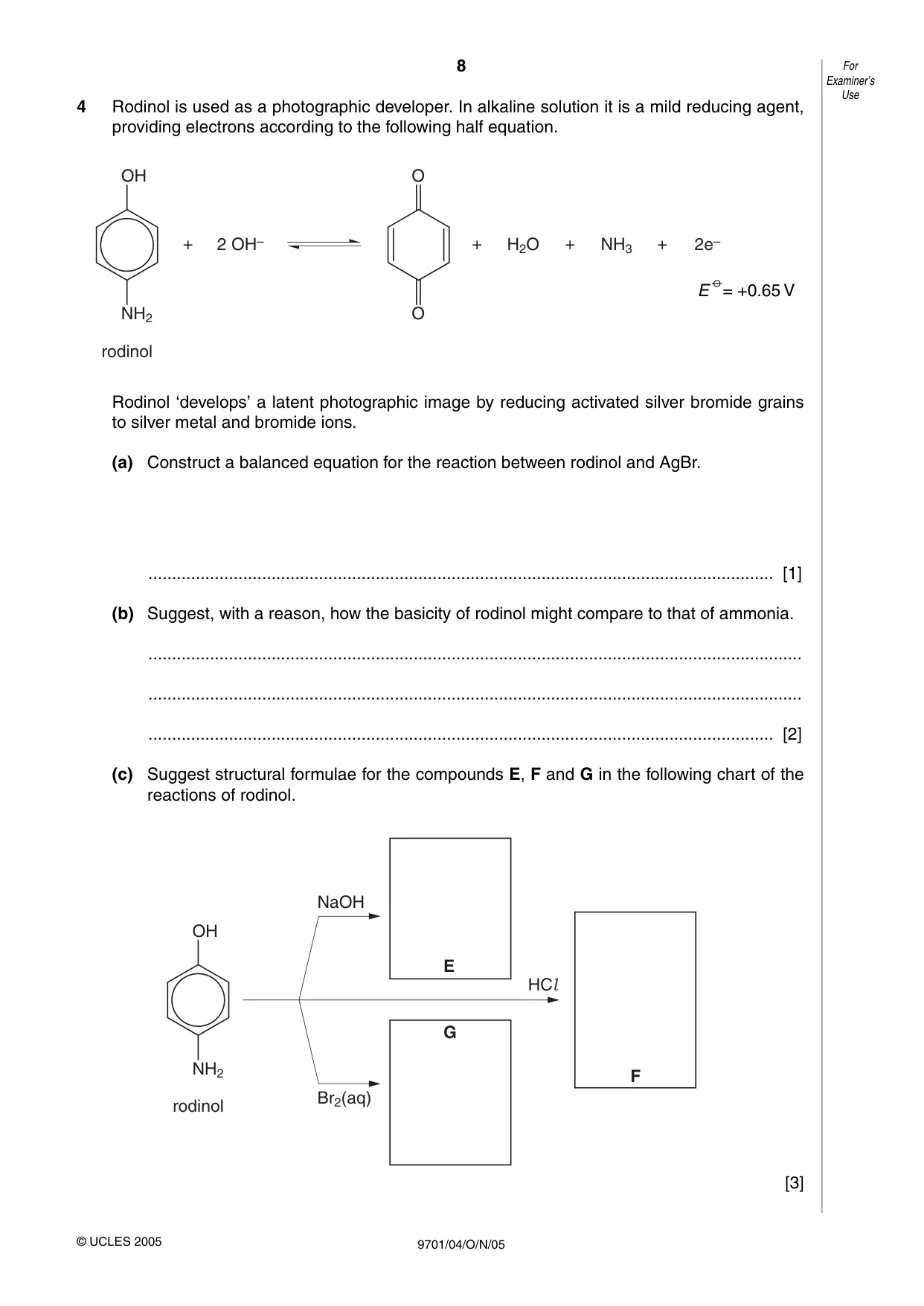
4 Rodinol is used as a photographic developer. In alkaline solution it is a mild reducing agent, providing electrons according to the following half equation. Rodinol ‘develops’ a latent photographic image by reducing activated silver bromide grains to silver metal and bromide ions. (a) Construct a balanced equation for the reaction between rodinol and AgBr. … [1] (b) Suggest, with a reason, how the basicity of rodinol might compare to that of ammonia. … … … [2] (c) Suggest structural formulae for the compounds E, F and G in the following chart of the reactions of rodinol. [3] NH2 rodinol OH E F G HCl NaOH Br2(aq) NH2 rodinol OH O O 2 OH– + + + + H2O NH3 2e– 8 9701/04/O/N/05 © UCLES 2005 For Examiner’s Use E = +0.65 V
Question paper, page 9
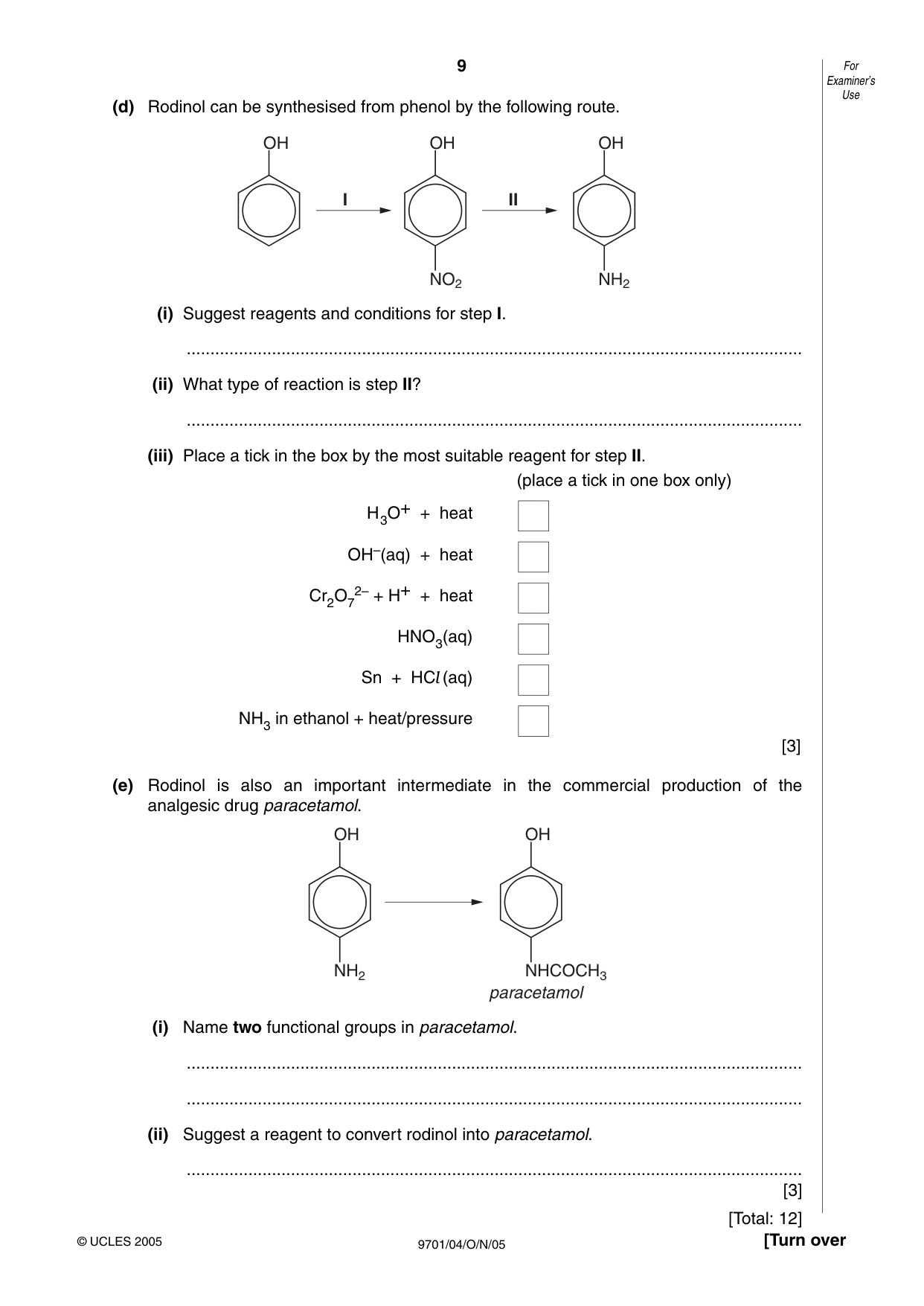
(d) Rodinol can be synthesised from phenol by the following route. (i) Suggest reagents and conditions for step I. … (ii) What type of reaction is step II? … (iii) Place a tick in the box by the most suitable reagent for step II. (place a tick in one box only) H3O+ + heat OH–(aq) + heat Cr2O7 2– + H+ + heat HNO3(aq) Sn + HCl(aq) NH3 in ethanol + heat/pressure (e) Rodinol is also an important intermediate in the commercial production of the analgesic drug paracetamol. (i) Name two functional groups in paracetamol. … … (ii) Suggest a reagent to convert rodinol into paracetamol. … [3] [Total: 12] OH NH2 OH paracetamol NHCOCH3 [3] OH NO2 OH OH NH2 I II 9 [Turn over 9701/04/O/N/05 © UCLES 2005 For Examiner’s Use
Question paper, page 10
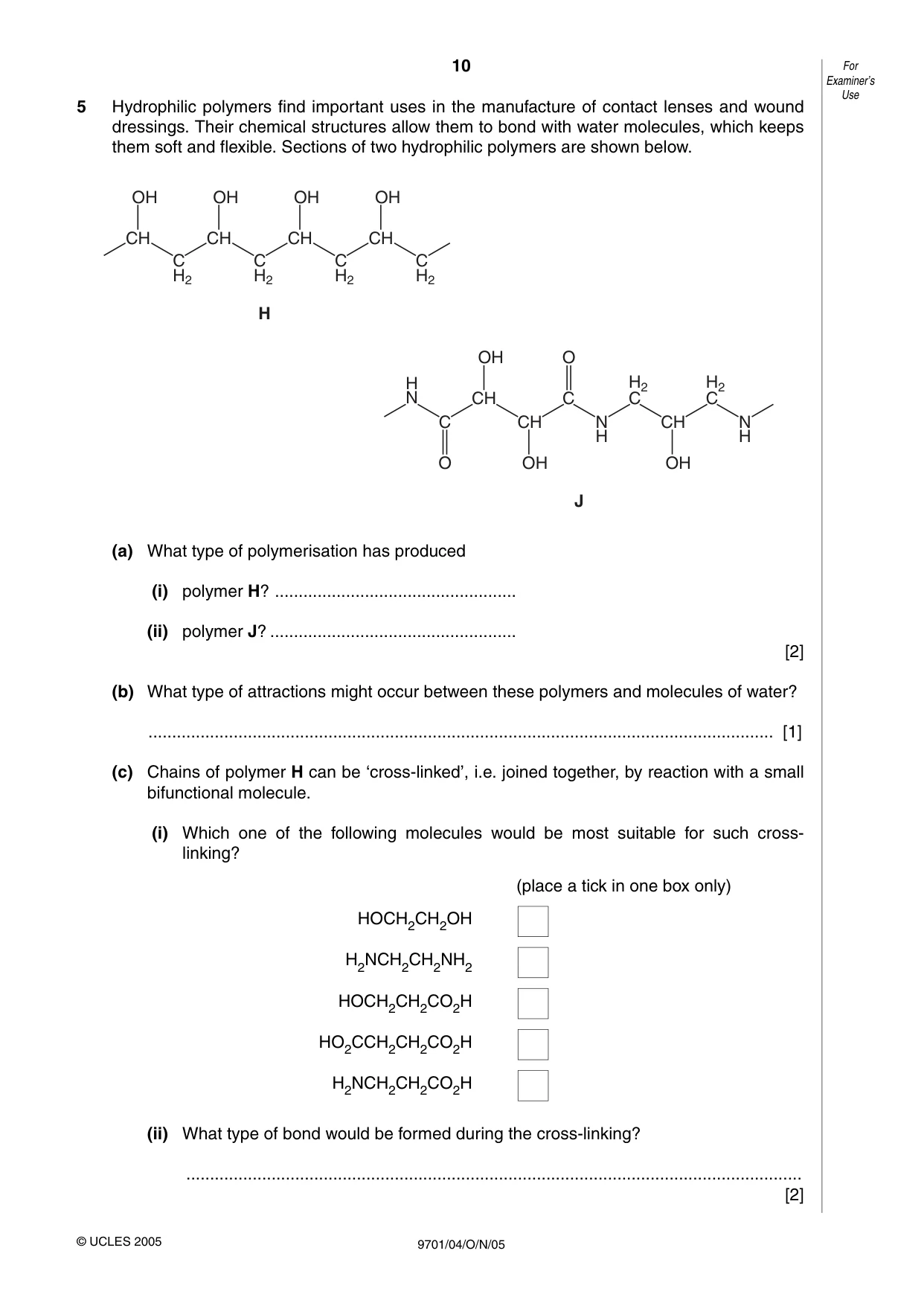
5 Hydrophilic polymers find important uses in the manufacture of contact lenses and wound dressings. Their chemical structures allow them to bond with water molecules, which keeps them soft and flexible. Sections of two hydrophilic polymers are shown below. (a) What type of polymerisation has produced (i) polymer H? … (ii) polymer J? … [2] (b) What type of attractions might occur between these polymers and molecules of water? … [1] (c) Chains of polymer H can be ‘cross-linked’, i.e. joined together, by reaction with a small bifunctional molecule. (i) Which one of the following molecules would be most suitable for such cross- linking? (place a tick in one box only) HOCH2CH2OH H2NCH2CH2NH2 HOCH2CH2CO2H HO2CCH2CH2CO2H H2NCH2CH2CO2H (ii) What type of bond would be formed during the cross-linking? … [2] OH CH C C C C O O H2 OH CH C H2 OH CH C H2 H H J N H H2 H2 N H N OH OH OH CH CH CH C OH CH C H2 10 9701/04/O/N/05 © UCLES 2005 For Examiner’s Use
Question paper, page 11
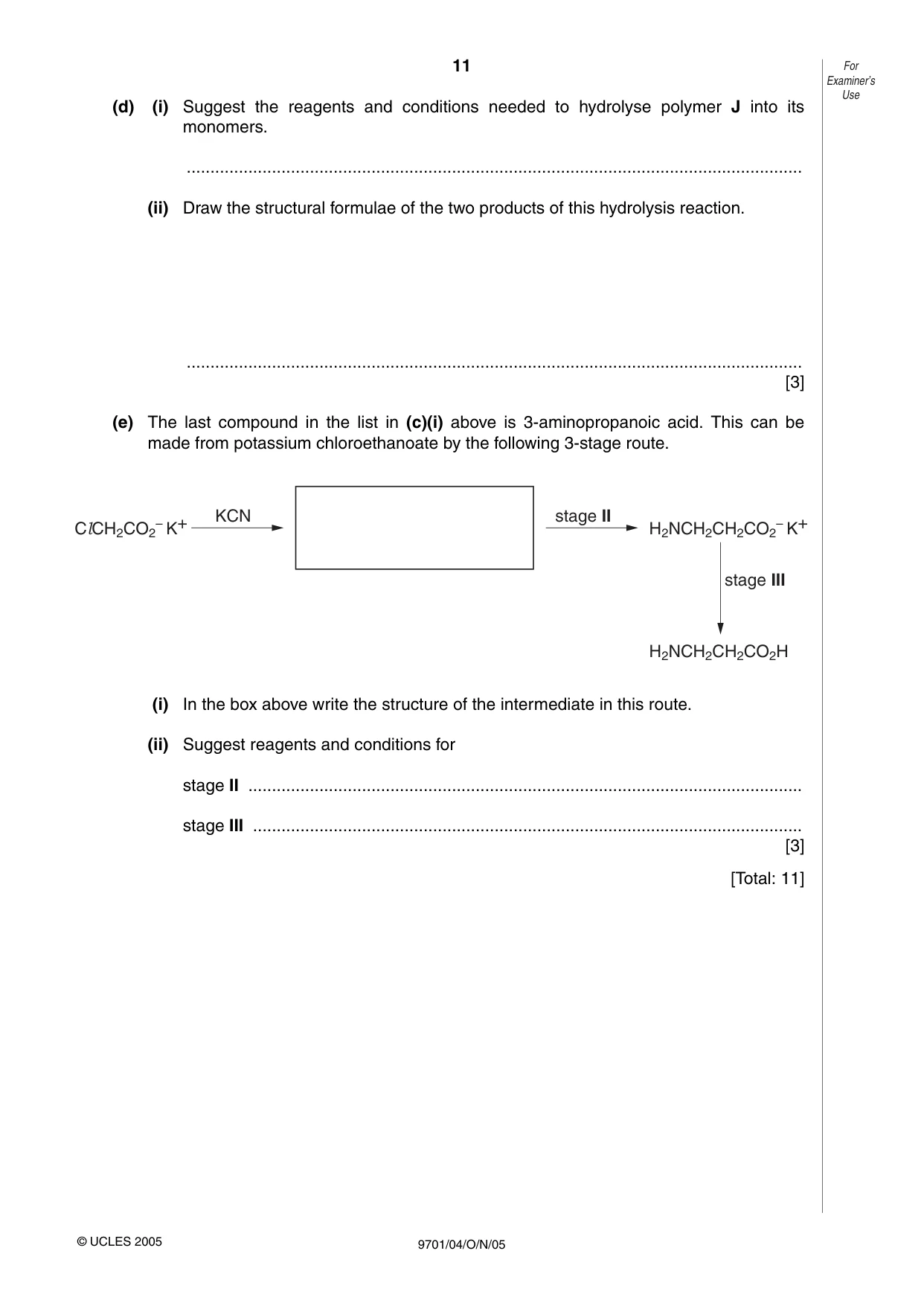
For Examiner’s Use (d) (i) Suggest the reagents and conditions needed to hydrolyse polymer J into its monomers. … (ii) Draw the structural formulae of the two products of this hydrolysis reaction. … [3] (e) The last compound in the list in (c)(i) above is 3-aminopropanoic acid. This can be made from potassium chloroethanoate by the following 3-stage route. (i) In the box above write the structure of the intermediate in this route. (ii) Suggest reagents and conditions for stage II … stage III … [3] [Total: 11] 11 9701/04/O/N/05 © UCLES 2005 ClCH2CO2– K+ H2NCH2CH2CO2– K+ H2NCH2CH2CO2H KCN stage II stage III
Question paper, page 12
BLANK PAGE 12 9701/04/O/N/05 Permission to reproduce items where third-party owned material protected by copyright is included has been sought and cleared where possible. Every reasonable effort has been made by the publisher (UCLES) to trace copyright holders, but if any items requiring clearance have unwittingly been included, the publisher will be pleased to make amends at the earliest possible opportunity. University of Cambridge International Examinations is part of the University of Cambridge Local Examinations Syndicate (UCLES), which is itself a department of the University of Cambridge.
Mark scheme, page 1
UNIVERSITY OF CAMBRIDGE INTERNATIONAL EXAMINATIONS GCE Advanced Level MARK SCHEME for the November 2005 question paper 9701 CHEMISTRY 9701/04 Paper 4 (Structured Questions A2 Core), maximum raw mark 60 This mark scheme is published as an aid to teachers and students, to indicate the requirements of the examination. It shows the basis on which Examiners were initially instructed to award marks. It does not indicate the details of the discussions that took place at an Examiners’ meeting before marking began. Any substantial changes to the mark scheme that arose from these discussions will be recorded in the published Report on the Examination. All Examiners are instructed that alternative correct answers and unexpected approaches in candidates’ scripts must be given marks that fairly reflect the relevant knowledge and skills demonstrated. Mark schemes must be read in conjunction with the question papers and the Report on the Examination. • CIE will not enter into discussion or correspondence in connection with these mark schemes. CIE is publishing the mark schemes for the November 2005 question papers for most IGCSE and GCE Advanced Level and Advanced Subsidiary Level syllabuses and some Ordinary Level syllabuses.
Mark scheme, page 2
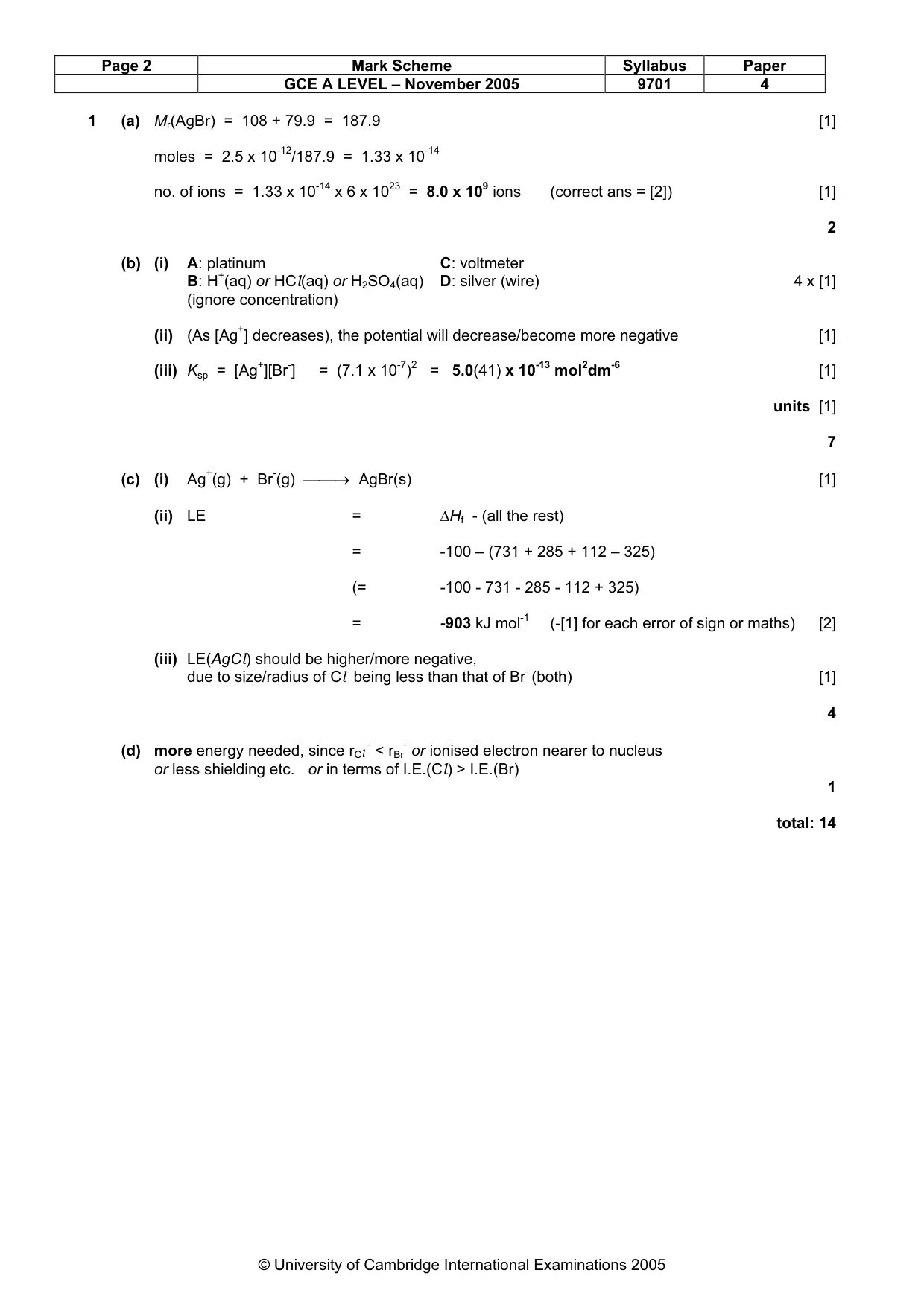
Page 2 Mark Scheme Syllabus Paper GCE A LEVEL – November 2005 9701 4 © University of Cambridge International Examinations 2005 1 (a) Mr(AgBr) = 108 + 79.9 = 187.9 [1] moles = 2.5 x 10⁻¹²/187.9 = 1.33 x 10⁻¹⁴ no. of ions = 1.33 x 10-14 x 6 x 1023 = 8.0 x 10⁹ ions (correct ans = [2]) [1] 2 (b) (i) A: platinum C: voltmeter B: H+(aq) or HCl(aq) or H2SO4(aq) D: silver (wire) 4 x [1] (ignore concentration) (ii) (As [Ag+] decreases), the potential will decrease/become more negative [1] (iii) Ksp = [Ag+][Br-] = (7.1 x 10⁻⁷)2 = 5.0(41) x 10-13 mol2dm-6 [1] units [1] 7 (c) (i) Ag+(g) + Br-(g) → AgBr(s) [1] (ii) LE = ∆Hf - (all the rest) = -100 – (731 + 285 + 112 – 325) (= -100 - 731 - 285 - 112 + 325) = -903 kJ mol-1 (-[1] for each error of sign or maths) [2] (iii) LE(AgCl) should be higher/more negative, due to size/radius of Cl- being less than that of Br- (both) [1] 4 (d) more energy needed, since rCl - < rBr - or ionised electron nearer to nucleus or less shielding etc. or in terms of I.E.(Cl) > I.E.(Br) 1 total: 14
Mark scheme, page 3
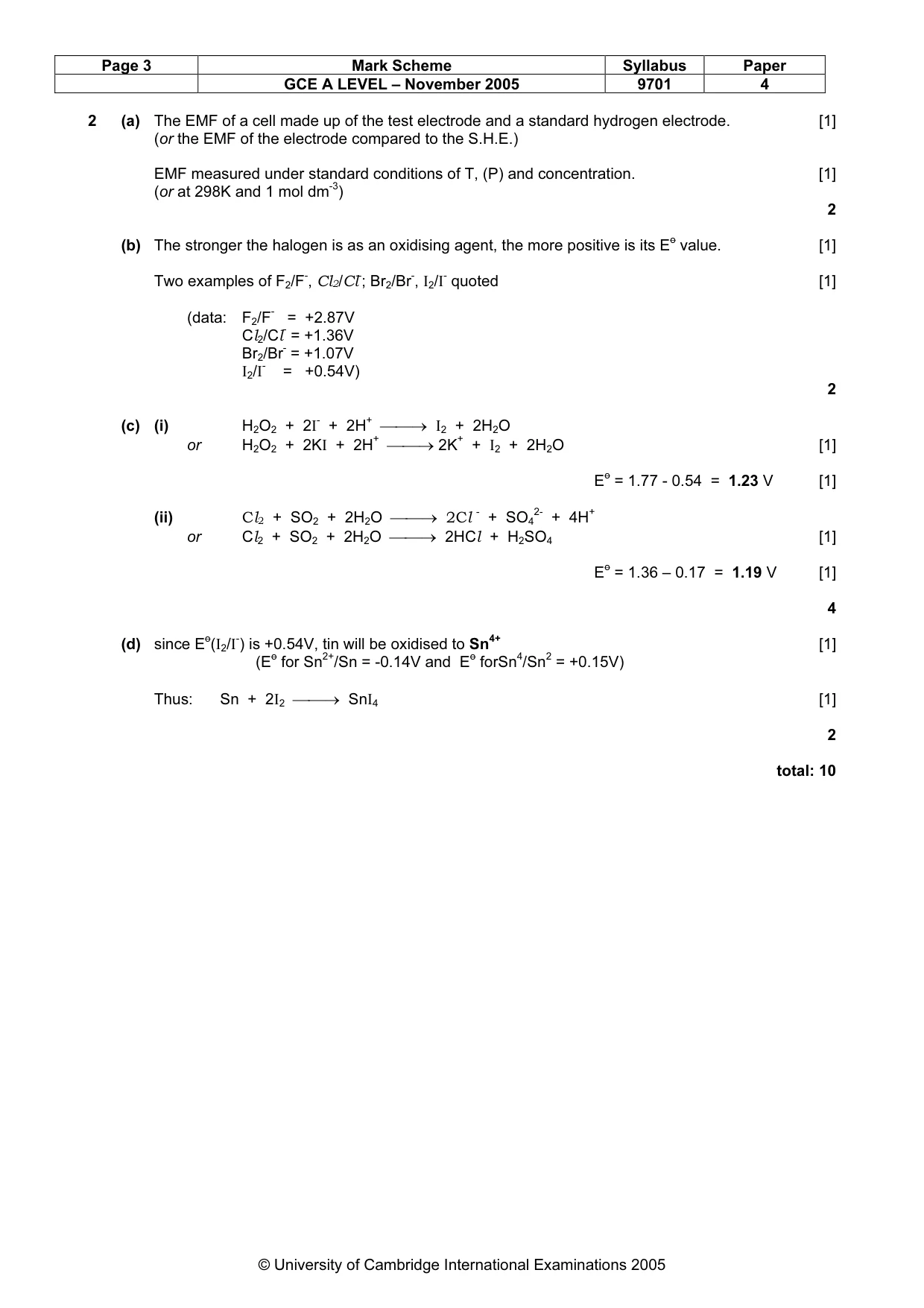
Page 3 Mark Scheme Syllabus Paper GCE A LEVEL – November 2005 9701 4 © University of Cambridge International Examinations 2005 2 (a) The EMF of a cell made up of the test electrode and a standard hydrogen electrode. [1] (or the EMF of the electrode compared to the S.H.E.) EMF measured under standard conditions of T, (P) and concentration. [1] (or at 298K and 1 mol dm-3) 2 (b) The stronger the halogen is as an oxidising agent, the more positive is its Eo value. [1] Two examples of F2/F-, Cl2/Cl-; Br2/Br-, I2/I- quoted [1] (data: F2/F- = +2.87V Cl2/Cl- = +1.36V Br2/Br- = +1.07V I2/I- = +0.54V) 2 (c) (i) H2O2 + 2I- + 2H+ → I2 + 2H2O or H2O2 + 2KI + 2H+ → 2K+ + I2 + 2H2O [1] Eo = 1.77 - 0.54 = 1.23 V [1] (ii) Cl2 + SO2 + 2H2O → 2Cl - + SO4 2- + 4H+ or Cl2 + SO2 + 2H2O → 2HCl + H2SO4 [1] Eo = 1.36 – 0.17 = 1.19 V [1] 4 (d) since Eo(I2/I-) is +0.54V, tin will be oxidised to Sn4+ [1] (Eo for Sn2+/Sn = -0.14V and Eo forSn4/Sn2 = +0.15V) Thus: Sn + 2I2 → SnI4 [1] 2 total: 10
Mark scheme, page 4
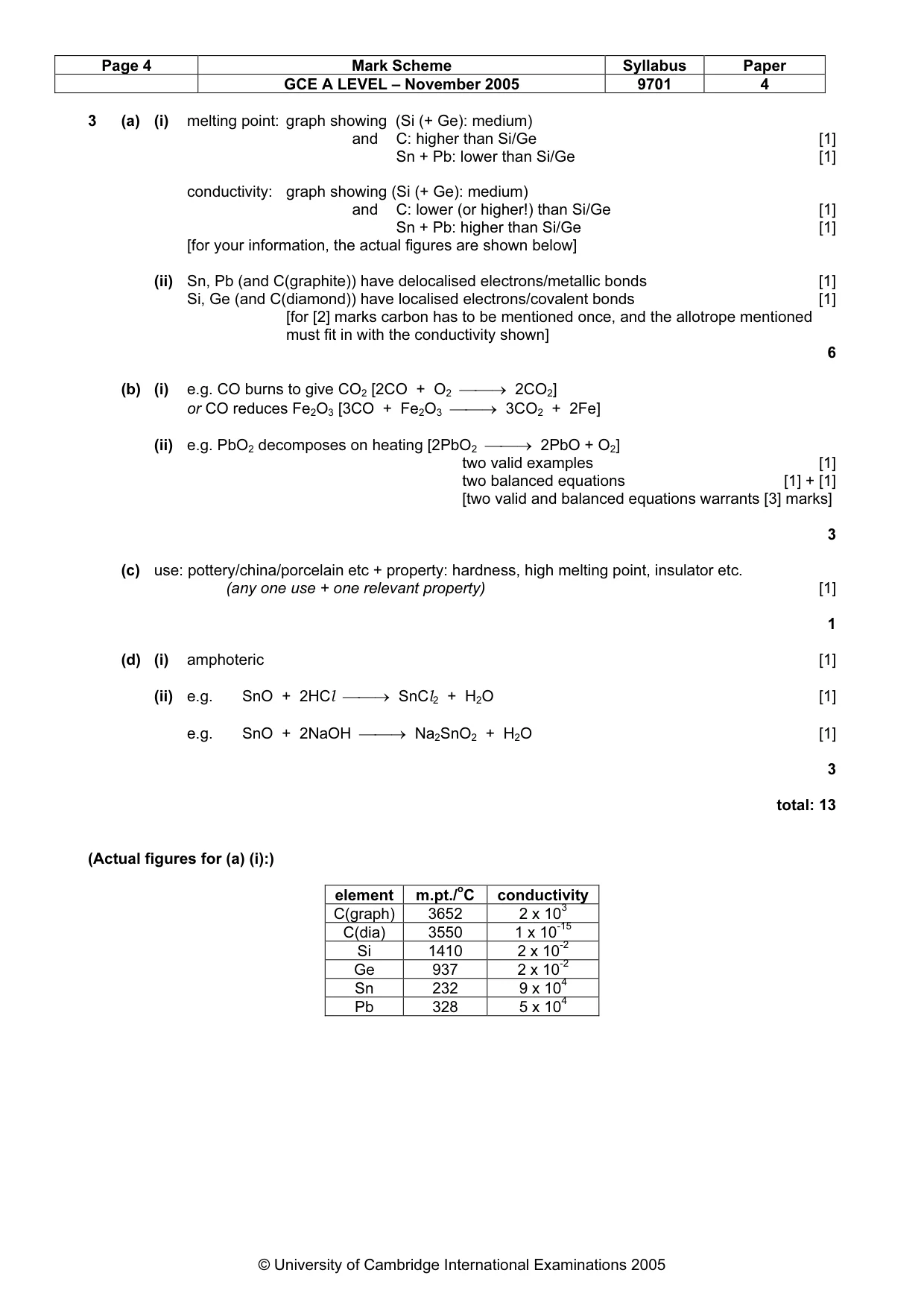
Page 4 Mark Scheme Syllabus Paper GCE A LEVEL – November 2005 9701 4 © University of Cambridge International Examinations 2005 3 (a) (i) melting point: graph showing (Si (+ Ge): medium) and C: higher than Si/Ge [1] Sn + Pb: lower than Si/Ge [1] conductivity: graph showing (Si (+ Ge): medium) and C: lower (or higher!) than Si/Ge [1] Sn + Pb: higher than Si/Ge [1] [for your information, the actual figures are shown below] (ii) Sn, Pb (and C(graphite)) have delocalised electrons/metallic bonds [1] Si, Ge (and C(diamond)) have localised electrons/covalent bonds [1] [for [2] marks carbon has to be mentioned once, and the allotrope mentioned must fit in with the conductivity shown] 6 (b) (i) e.g. CO burns to give CO2 [2CO + O2 → 2CO2] or CO reduces Fe2O3 [3CO + Fe2O3 → 3CO2 + 2Fe] (ii) e.g. PbO2 decomposes on heating [2PbO2 → 2PbO + O2] two valid examples [1] two balanced equations [1] + [1] [two valid and balanced equations warrants [3] marks] 3 (c) use: pottery/china/porcelain etc + property: hardness, high melting point, insulator etc. (any one use + one relevant property) [1] 1 (d) (i) amphoteric [1] (ii) e.g. SnO + 2HCl → SnCl2 + H2O [1] e.g. SnO + 2NaOH → Na2SnO2 + H2O [1] 3 total: 13 (Actual figures for (a) (i):) element m.pt./oC conductivity C(graph) 3652 2 x 10³ C(dia) 3550 1 x 10-15 Si 1410 2 x 10⁻² Ge 937 2 x 10⁻² Sn 232 9 x 10⁴ Pb 328 5 x 10⁴
Mark scheme, page 5
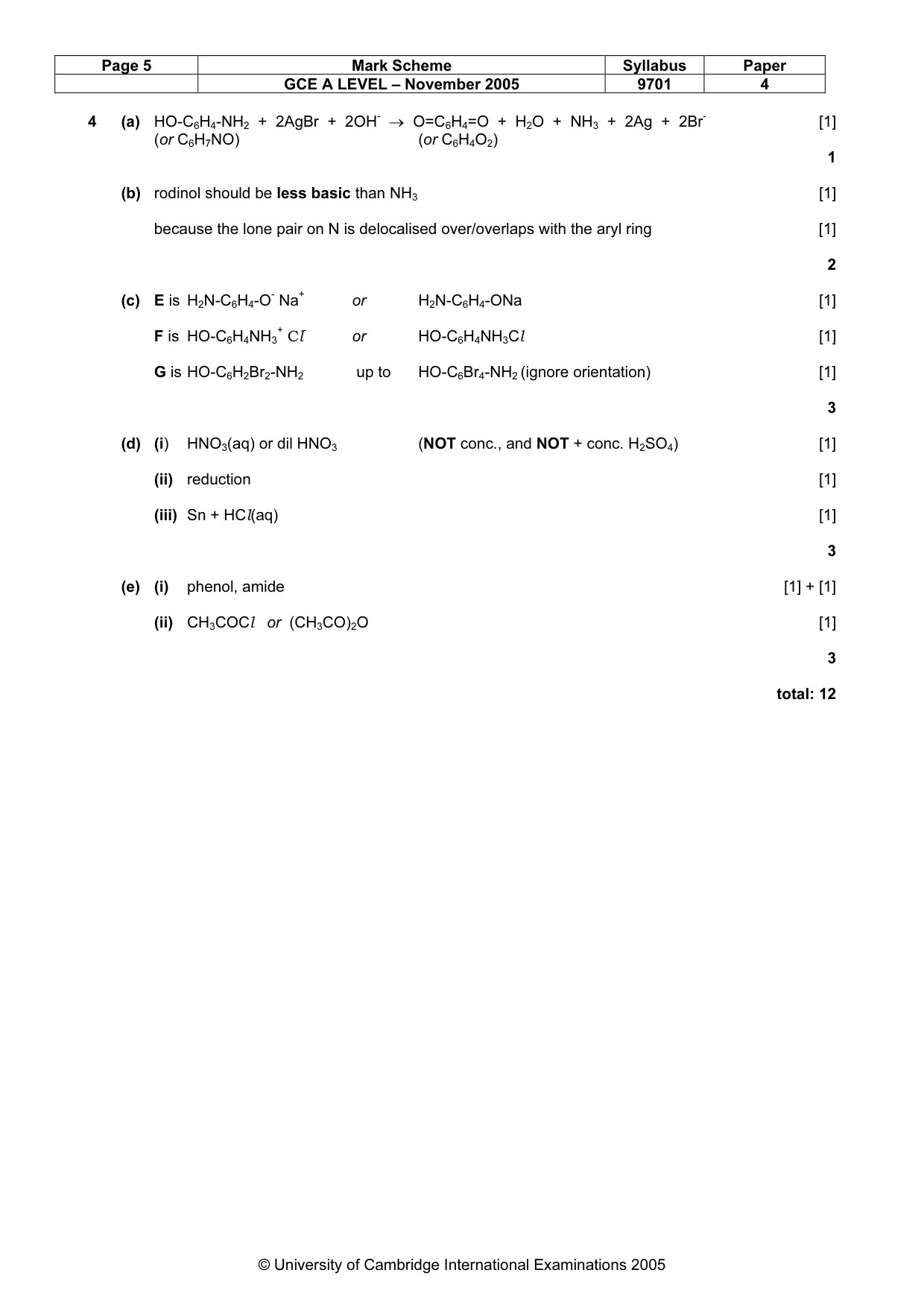
Page 5 Mark Scheme Syllabus Paper GCE A LEVEL – November 2005 9701 4 © University of Cambridge International Examinations 2005 4 (a) HO-C6H4-NH2 + 2AgBr + 2OH- → O=C6H4=O + H2O + NH3 + 2Ag + 2Br- [1] (or C6H7NO) (or C6H4O2) 1 (b) rodinol should be less basic than NH3 [1] because the lone pair on N is delocalised over/overlaps with the aryl ring [1] 2 (c) E is H2N-C6H4-O- Na+ or H2N-C6H4-ONa [1] F is HO-C6H4NH3 + Cl- or HO-C6H4NH3Cl [1] G is HO-C6H2Br2-NH2 up to HO-C6Br4-NH2 (ignore orientation) [1] 3 (d) (i) HNO3(aq) or dil HNO3 (NOT conc., and NOT + conc. H2SO4) [1] (ii) reduction [1] (iii) Sn + HCl(aq) [1] 3 (e) (i) phenol, amide [1] + [1] (ii) CH3COCl or (CH3CO)2O [1] 3 total: 12
Mark scheme, page 6
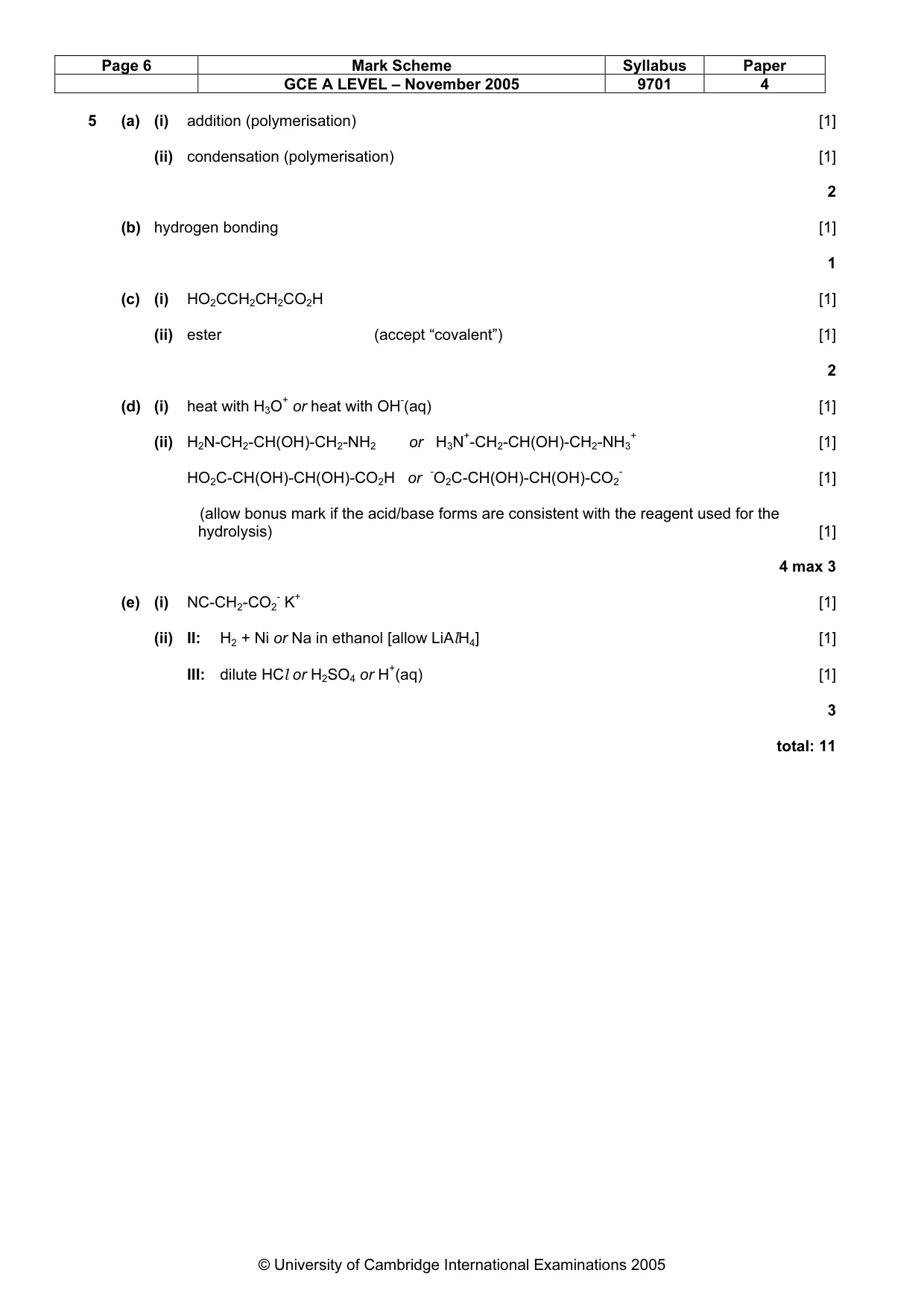
Page 6 Mark Scheme Syllabus Paper GCE A LEVEL – November 2005 9701 4 © University of Cambridge International Examinations 2005 5 (a) (i) addition (polymerisation) [1] (ii) condensation (polymerisation) [1] 2 (b) hydrogen bonding [1] 1 (c) (i) HO2CCH2CH2CO2H [1] (ii) ester (accept “covalent”) [1] 2 (d) (i) heat with H3O+ or heat with OH-(aq) [1] (ii) H2N-CH2-CH(OH)-CH2-NH2 or H3N+-CH2-CH(OH)-CH2-NH3 + [1] HO2C-CH(OH)-CH(OH)-CO2H or -O2C-CH(OH)-CH(OH)-CO2 - [1] (allow bonus mark if the acid/base forms are consistent with the reagent used for the hydrolysis) [1] 4 max 3 (e) (i) NC-CH2-CO2 - K+ [1] (ii) II: H2 + Ni or Na in ethanol [allow LiAlH4] [1] III: dilute HCl or H2SO4 or H+(aq) [1] 3 total: 11