Cambridge A Level Chemistry 9701 — 2004 Oct/Nov Paper 4 · Variant 1
9701/41/O/N/04
The question paper and its mark scheme, free to read here and free to download. This is Cambridge’s own paper, exactly as it was sat.
Question paper12 pages
Mark scheme8 pages
Answers below. Sit the paper first if you are practising.
Paper as text
Question paper, page 1
This document consists of 12 printed pages. SPA (SJF3046/GR) S61559/4 © UCLES 2004 [Turn over UNIVERSITY OF CAMBRIDGE INTERNATIONAL EXAMINATIONS General Certificate of Education Advanced Subsidiary Level and Advanced Level CHEMISTRY 9701/04 Paper 4 Structured Questions A2 Core October/November 2004 1 hour 15 minutes Candidates answer on the Question Paper. Additional Materials: Data Booklet READ THESE INSTRUCTIONS FIRST Write your Centre number, candidate number and name on all the work you hand in. Write in dark blue or black pen in the spaces provided on the Question Paper. You may use a pencil for any diagrams, graphs or rough working. You may use a calculator. Do not use staples, paper clips, highlighters, glue or correction fluid. Answer all questions. At the end of the examination, fasten all your work securely together. The number of marks is given in brackets [ ] at the end of each question or part question. You may lose marks if you do not show your working or if you do not use appropriate units. Centre Number Candidate Number Name If you have been given a label, look at the details. If any details are incorrect or missing, please fill in your correct details in the space given at the top of this page. Stick your personal label here, if provided. 3 2 1 For Examiner’s Use 4 5 6 7 Total
Question paper, page 2
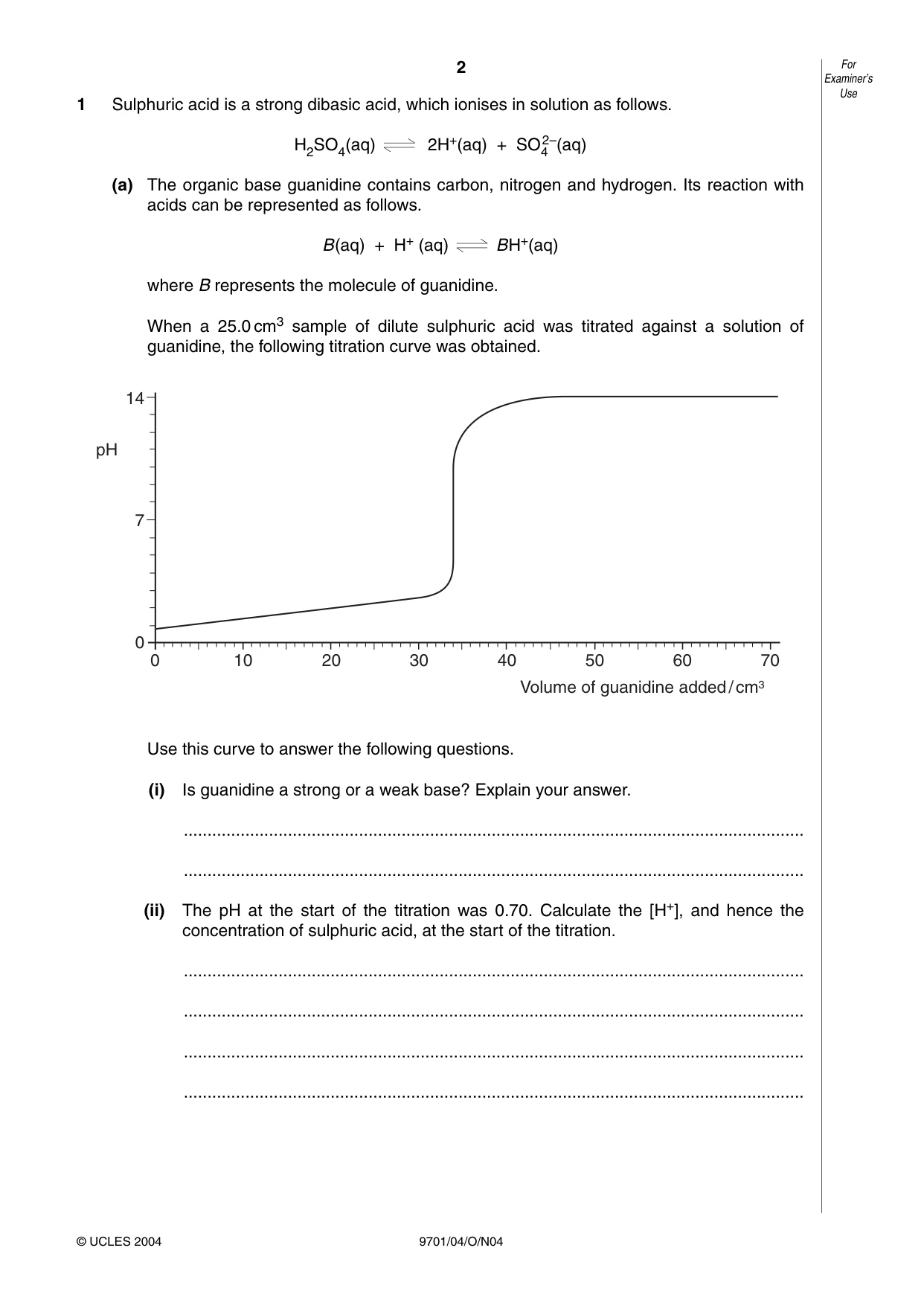
2 9701/04/O/N04 1 Sulphuric acid is a strong dibasic acid, which ionises in solution as follows. H2SO4(aq) 2H+(aq) + SO4 2–(aq) (a) The organic base guanidine contains carbon, nitrogen and hydrogen. Its reaction with acids can be represented as follows. B(aq) + H+ (aq) BH+(aq) where B represents the molecule of guanidine. When a 25.0 cm3 sample of dilute sulphuric acid was titrated against a solution of guanidine, the following titration curve was obtained. Use this curve to answer the following questions. (i) Is guanidine a strong or a weak base? Explain your answer. … … (ii) The pH at the start of the titration was 0.70. Calculate the [H+], and hence the concentration of sulphuric acid, at the start of the titration. … … … … 0 0 7 pH 14 10 20 30 40 50 60 Volume of guanidine added / cm3 70 For Examiner’s Use © UCLES 2004
Question paper, page 3
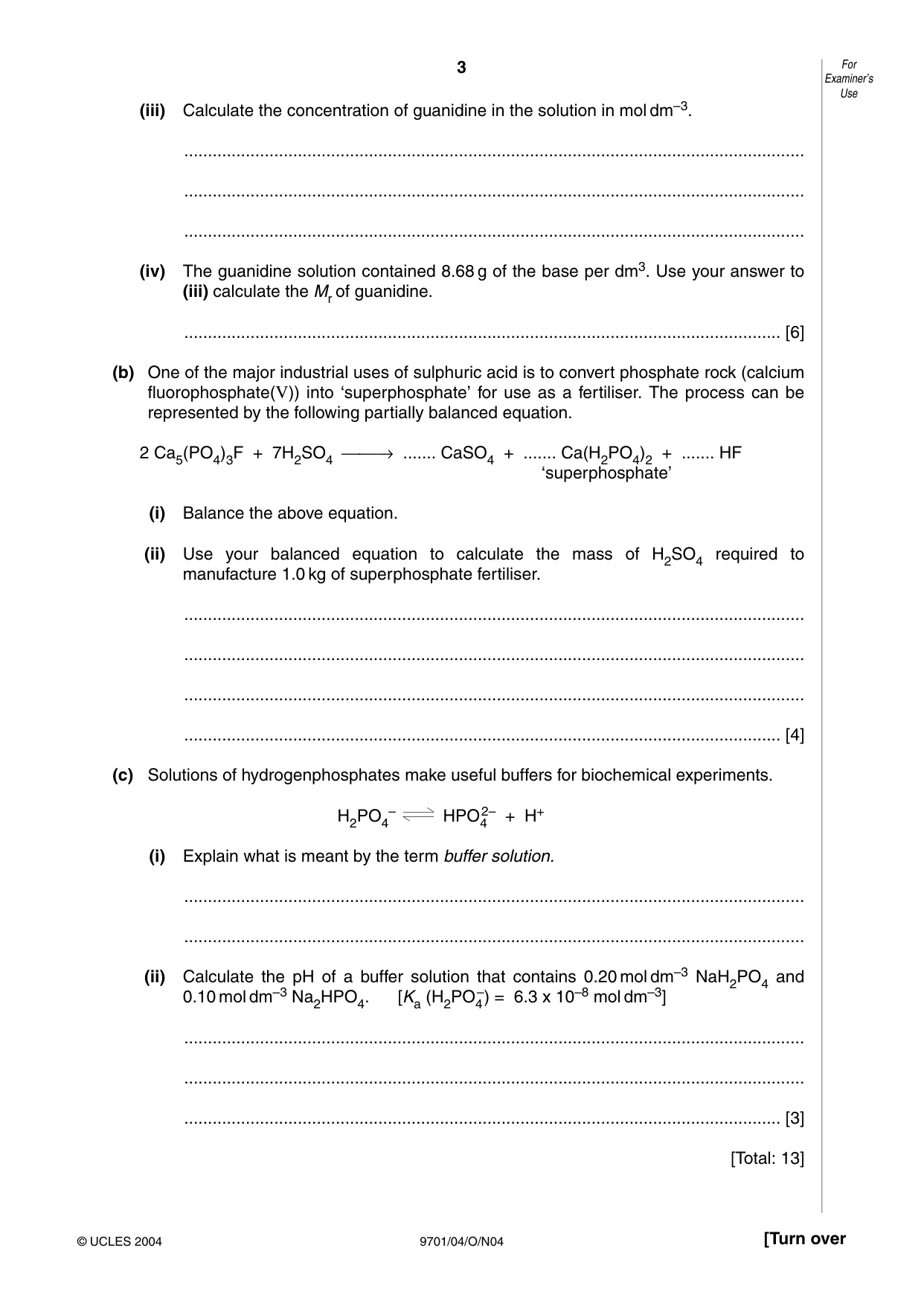
3 9701/04/O/N04 [Turn over (iii) Calculate the concentration of guanidine in the solution in mol dm–3. … … … (iv) The guanidine solution contained 8.68 g of the base per dm3. Use your answer to (iii) calculate the Mr of guanidine. … [6] (b) One of the major industrial uses of sulphuric acid is to convert phosphate rock (calcium fluorophosphate(V)) into ‘superphosphate’ for use as a fertiliser. The process can be represented by the following partially balanced equation. 2 Ca5(PO4)3F + 7H2SO4 →… CaSO4 + … Ca(H2PO4)2 + … HF ‘superphosphate’ (i) Balance the above equation. (ii) Use your balanced equation to calculate the mass of H2SO4 required to manufacture 1.0 kg of superphosphate fertiliser. … … … … [4] (c) Solutions of hydrogenphosphates make useful buffers for biochemical experiments. H2PO4 – HPO4 2– + H+ (i) Explain what is meant by the term buffer solution. … … (ii) Calculate the pH of a buffer solution that contains 0.20 mol dm–3 NaH2PO4 and 0.10 mol dm–3 Na2HPO4. [Ka (H2PO4 –) = 6.3 x 10⁻⁸ mol dm–3] … … … [3] [Total: 13] For Examiner’s Use © UCLES 2004
Question paper, page 4
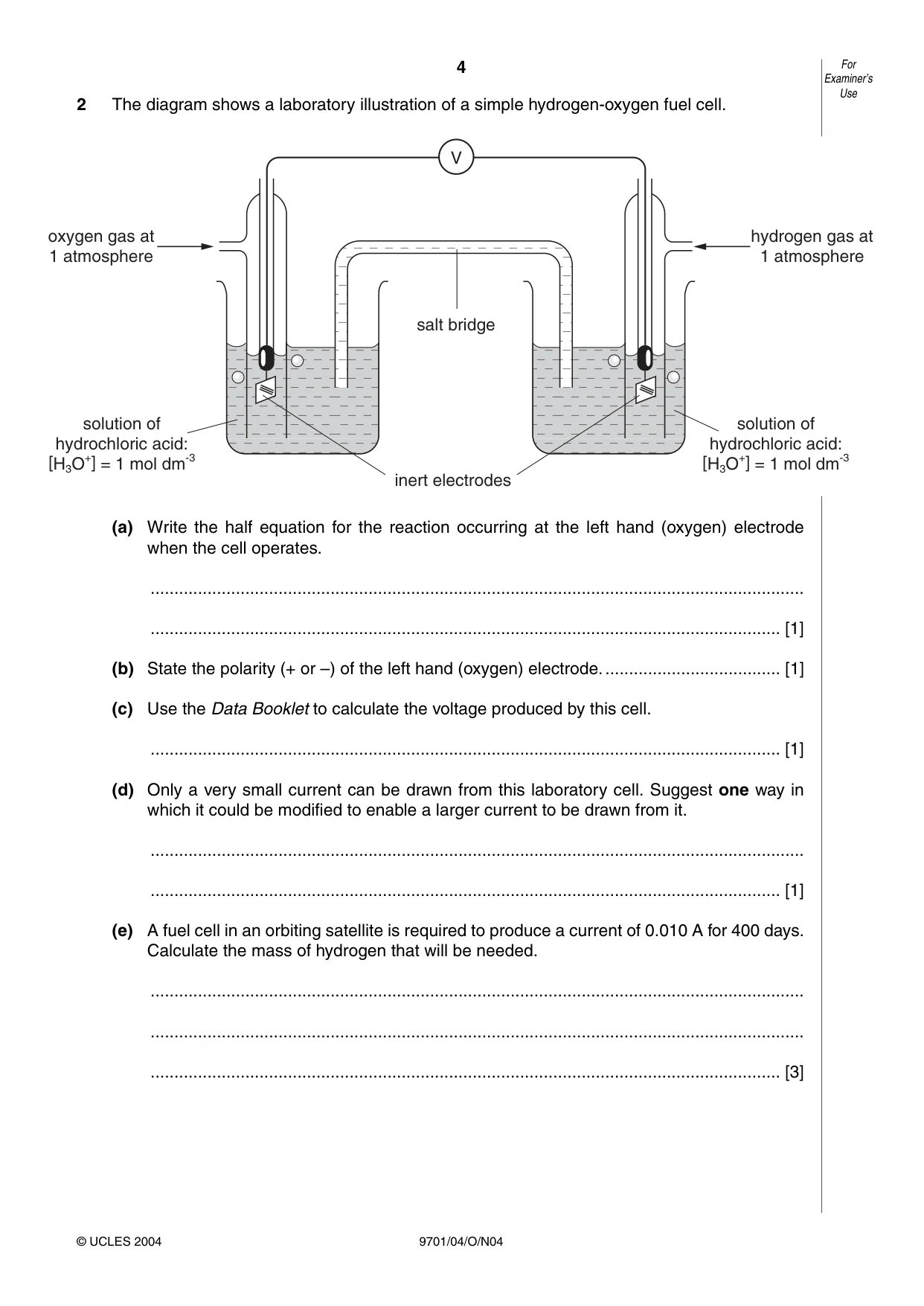
4 9701/04/O/N04 2 The diagram shows a laboratory illustration of a simple hydrogen-oxygen fuel cell. (a) Write the half equation for the reaction occurring at the left hand (oxygen) electrode when the cell operates. … … [1] (b) State the polarity (+ or –) of the left hand (oxygen) electrode… [1] (c) Use the Data Booklet to calculate the voltage produced by this cell. … [1] (d) Only a very small current can be drawn from this laboratory cell. Suggest one way in which it could be modified to enable a larger current to be drawn from it. … … [1] (e) A fuel cell in an orbiting satellite is required to produce a current of 0.010 A for 400 days. Calculate the mass of hydrogen that will be needed. … … … [3] For Examiner’s Use © UCLES 2004 salt bridge inert electrodes oxygen gas at 1 atmosphere hydrogen gas at 1 atmosphere solution of hydrochloric acid: [H3O+] = 1 mol dm-3 solution of hydrochloric acid: [H3O+] = 1 mol dm-3 V
Question paper, page 5
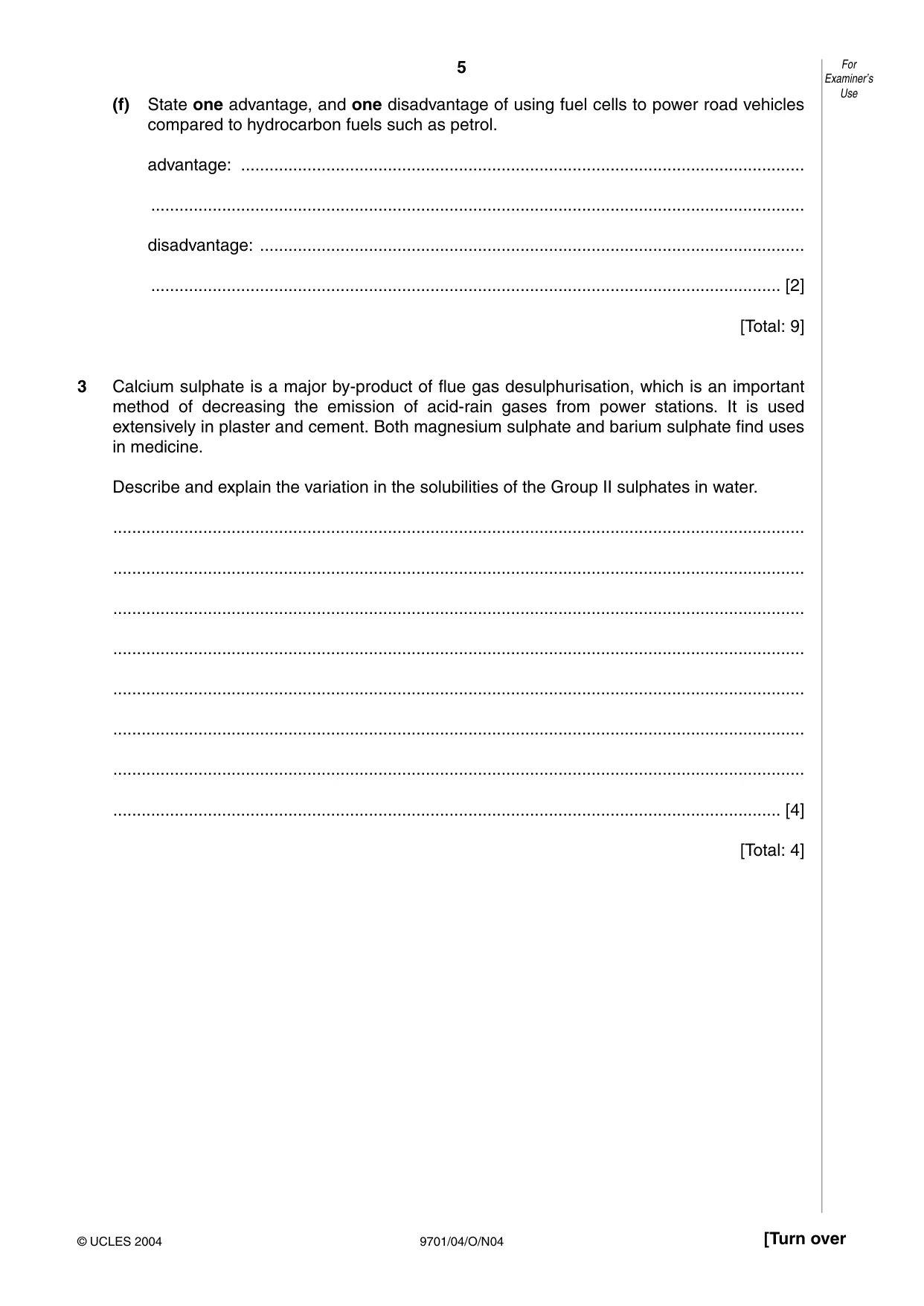
5 9701/04/O/N04 [Turn over (f) State one advantage, and one disadvantage of using fuel cells to power road vehicles compared to hydrocarbon fuels such as petrol. advantage: … … disadvantage: … … [2] [Total: 9] 3 Calcium sulphate is a major by-product of flue gas desulphurisation, which is an important method of decreasing the emission of acid-rain gases from power stations. It is used extensively in plaster and cement. Both magnesium sulphate and barium sulphate find uses in medicine. Describe and explain the variation in the solubilities of the Group II sulphates in water. … … … … … … … … [4] [Total: 4] For Examiner’s Use © UCLES 2004
Question paper, page 6
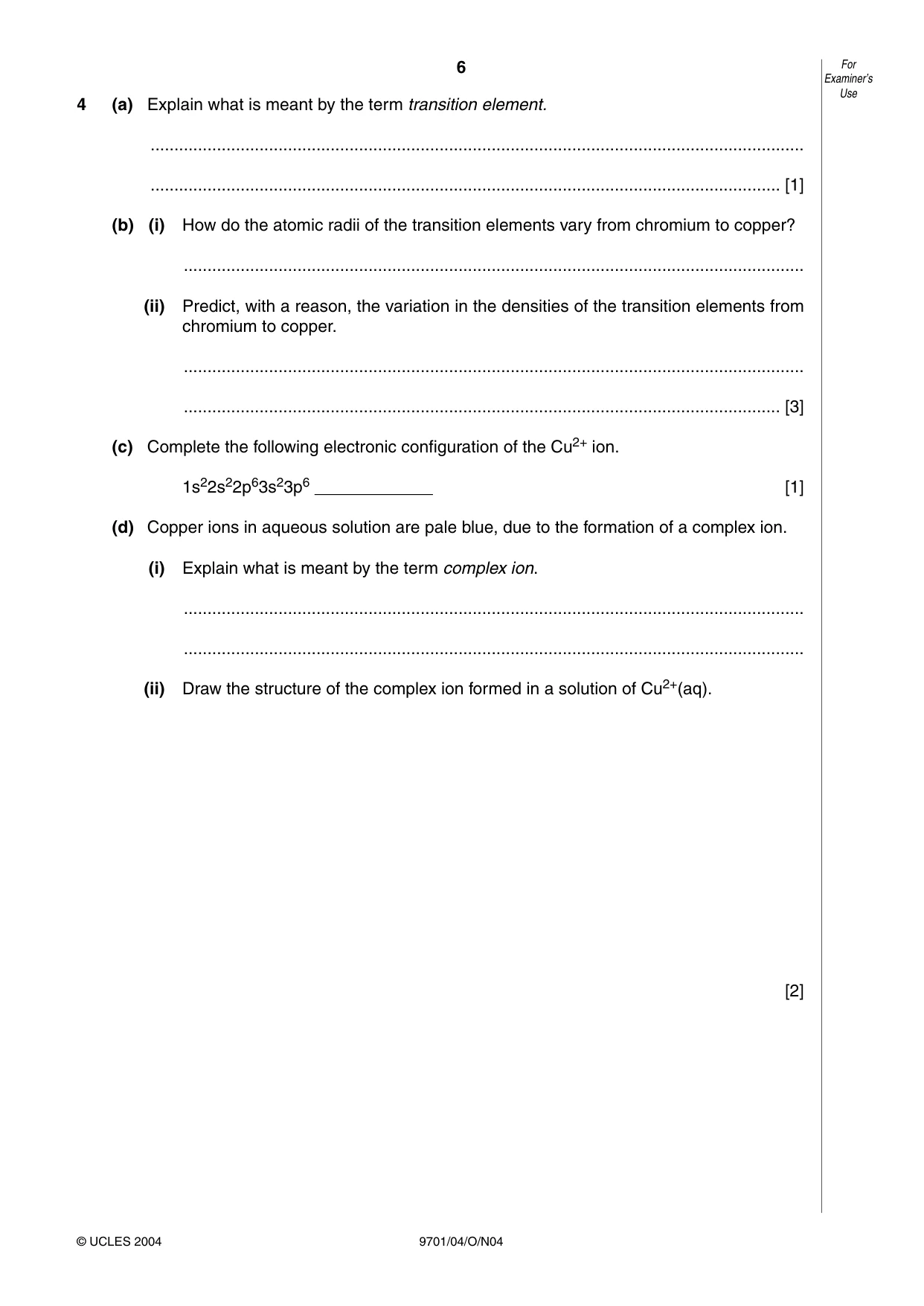
6 9701/04/O/N04 4 (a) Explain what is meant by the term transition element. … … [1] (b) (i) How do the atomic radii of the transition elements vary from chromium to copper? … (ii) Predict, with a reason, the variation in the densities of the transition elements from chromium to copper. … … [3] (c) Complete the following electronic configuration of the Cu2+ ion. 1s22s22p63s23p6 [1] (d) Copper ions in aqueous solution are pale blue, due to the formation of a complex ion. (i) Explain what is meant by the term complex ion. … … (ii) Draw the structure of the complex ion formed in a solution of Cu2+(aq). [2] For Examiner’s Use © UCLES 2004
Question paper, page 7
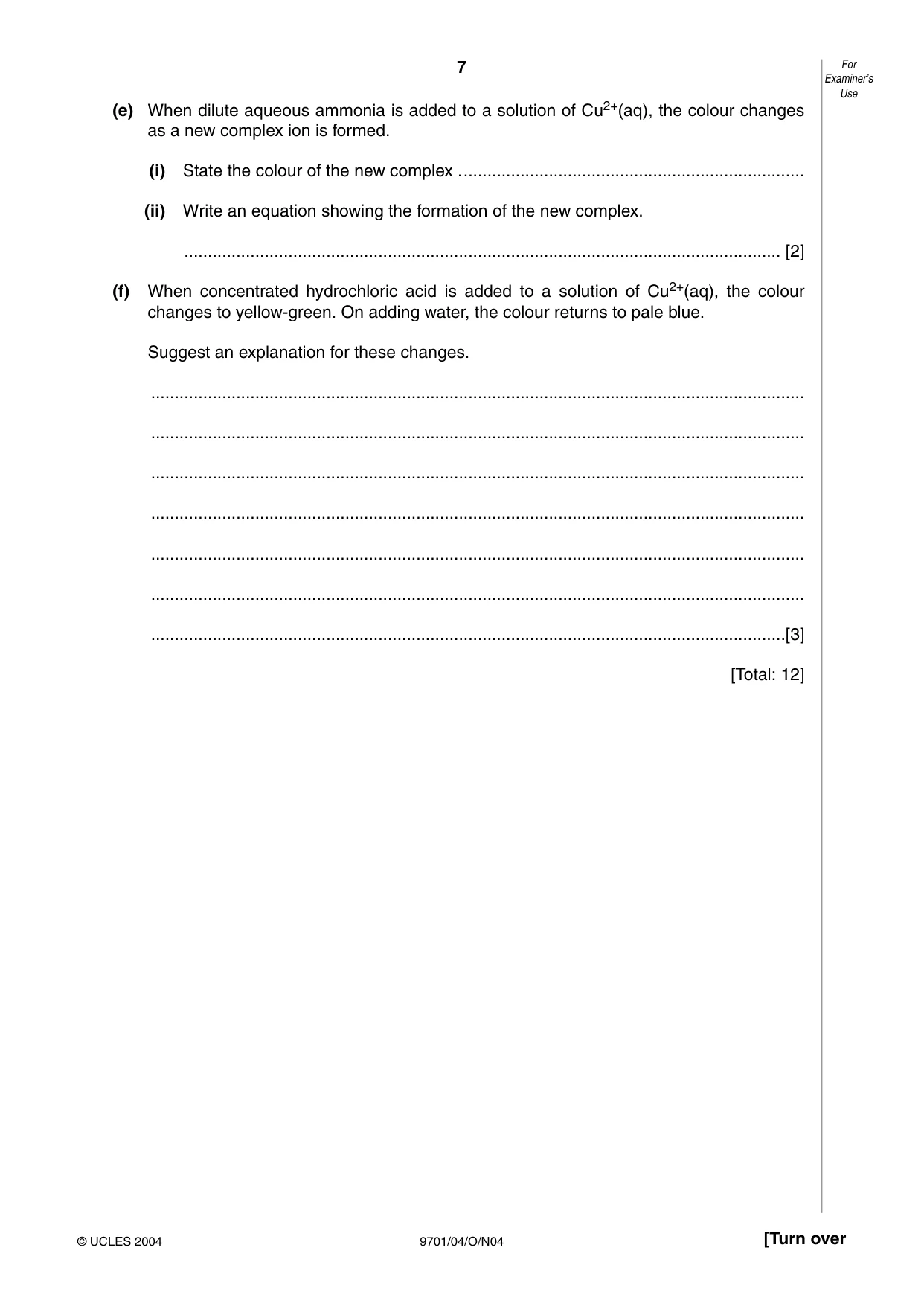
7 9701/04/O/N04 [Turn over (e) When dilute aqueous ammonia is added to a solution of Cu2+(aq), the colour changes as a new complex ion is formed. (i) State the colour of the new complex … (ii) Write an equation showing the formation of the new complex. … [2] (f) When concentrated hydrochloric acid is added to a solution of Cu2+(aq), the colour changes to yellow-green. On adding water, the colour returns to pale blue. Suggest an explanation for these changes. … … … … … … …[3] [Total: 12] For Examiner’s Use © UCLES 2004
Question paper, page 8
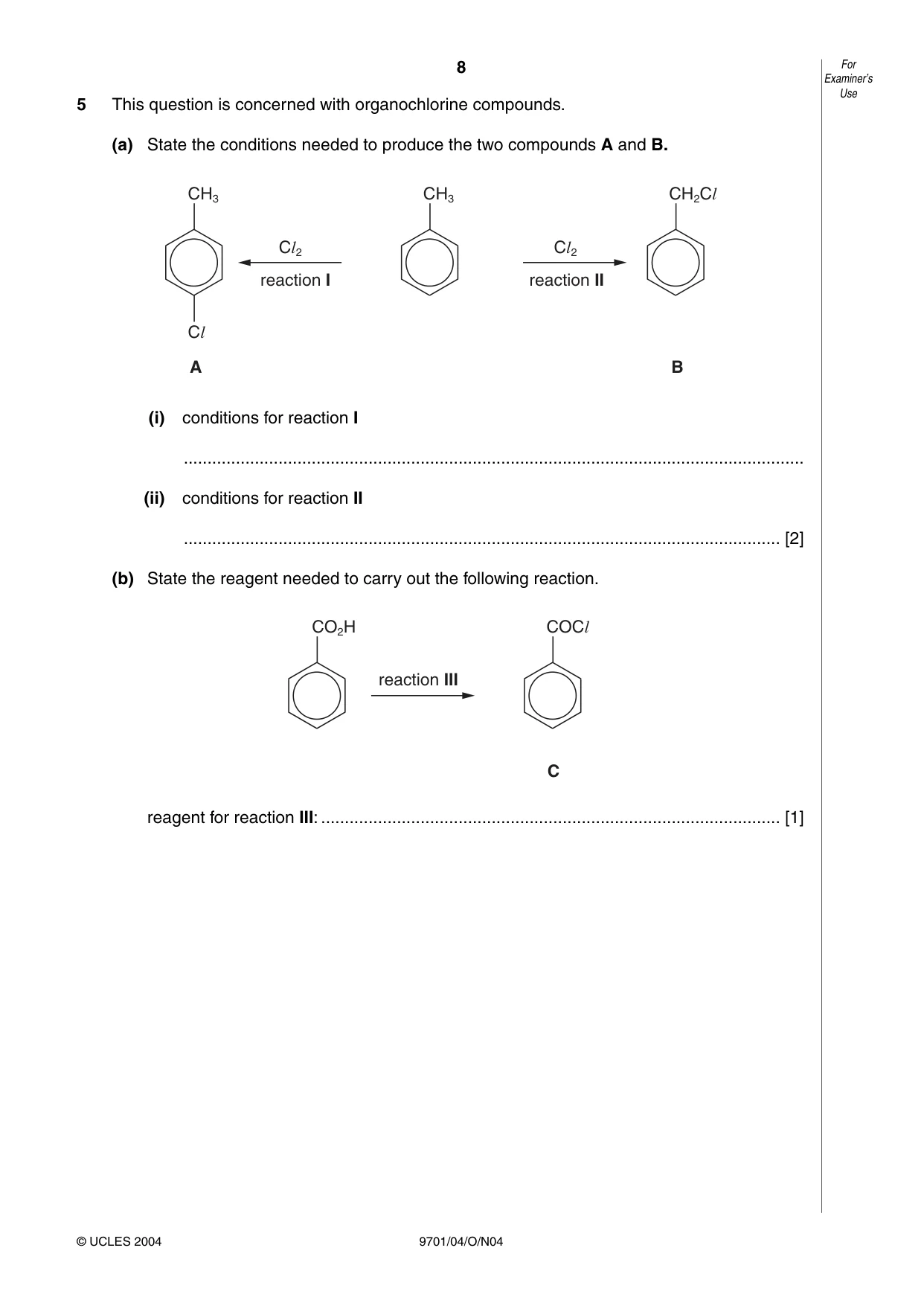
8 9701/04/O/N04 5 This question is concerned with organochlorine compounds. (a) State the conditions needed to produce the two compounds A and B. (i) conditions for reaction I … (ii) conditions for reaction II … [2] (b) State the reagent needed to carry out the following reaction. reagent for reaction III: … [1] CO2H COCl reaction III C CH3 CH3 CH2Cl reaction I reaction II Cl Cl2 Cl2 A B For Examiner’s Use © UCLES 2004
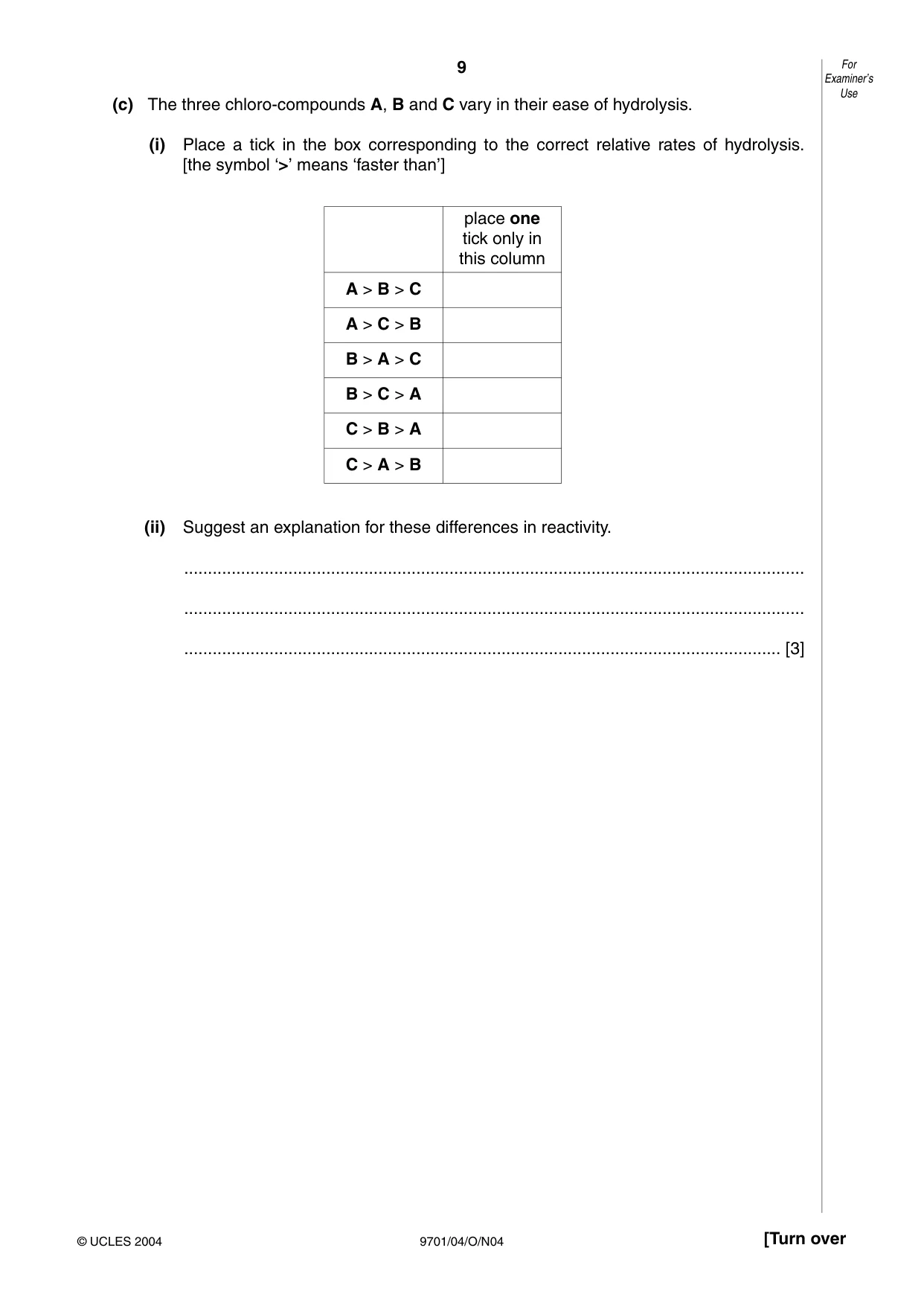
Question paper, page 9
9 9701/04/O/N04 [Turn over (c) The three chloro-compounds A, B and C vary in their ease of hydrolysis. (i) Place a tick in the box corresponding to the correct relative rates of hydrolysis. [the symbol ‘>’ means ‘faster than’] (ii) Suggest an explanation for these differences in reactivity. … … … [3] For Examiner’s Use © UCLES 2004 A > B > C A > C > B B > A > C B > C > A C > B > A C > A > B place one tick only in this column
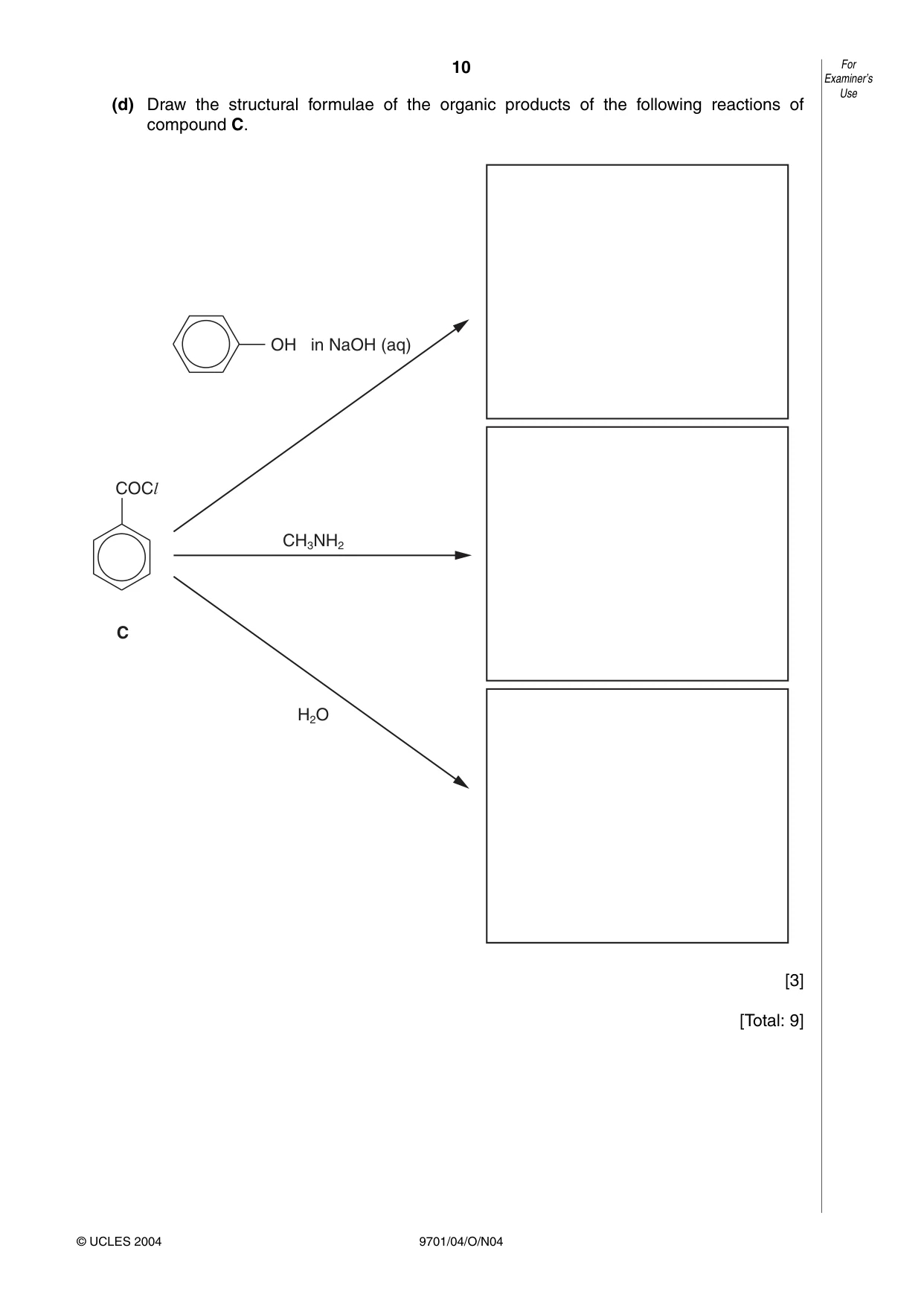
Question paper, page 10
10 9701/04/O/N04 (d) Draw the structural formulae of the organic products of the following reactions of compound C. [3] [Total: 9] COCl OH in NaOH (aq) C CH3NH2 H2O For Examiner’s Use © UCLES 2004
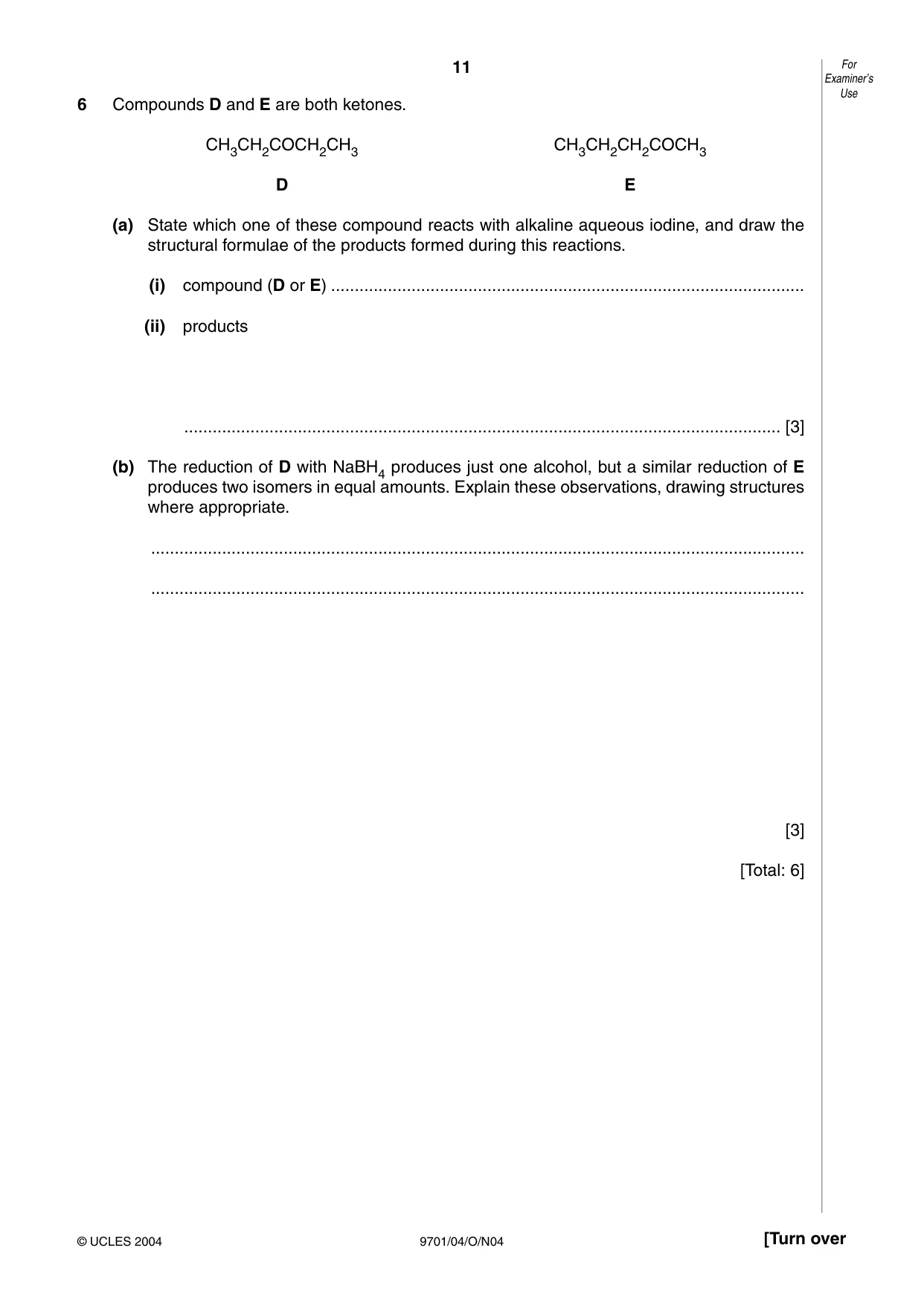
Question paper, page 11
11 9701/04/O/N04 [Turn over 6 Compounds D and E are both ketones. CH3CH2COCH2CH3 CH3CH2CH2COCH3 D E (a) State which one of these compound reacts with alkaline aqueous iodine, and draw the structural formulae of the products formed during this reactions. (i) compound (D or E) … (ii) products … [3] (b) The reduction of D with NaBH4 produces just one alcohol, but a similar reduction of E produces two isomers in equal amounts. Explain these observations, drawing structures where appropriate. … … [3] [Total: 6] For Examiner’s Use © UCLES 2004
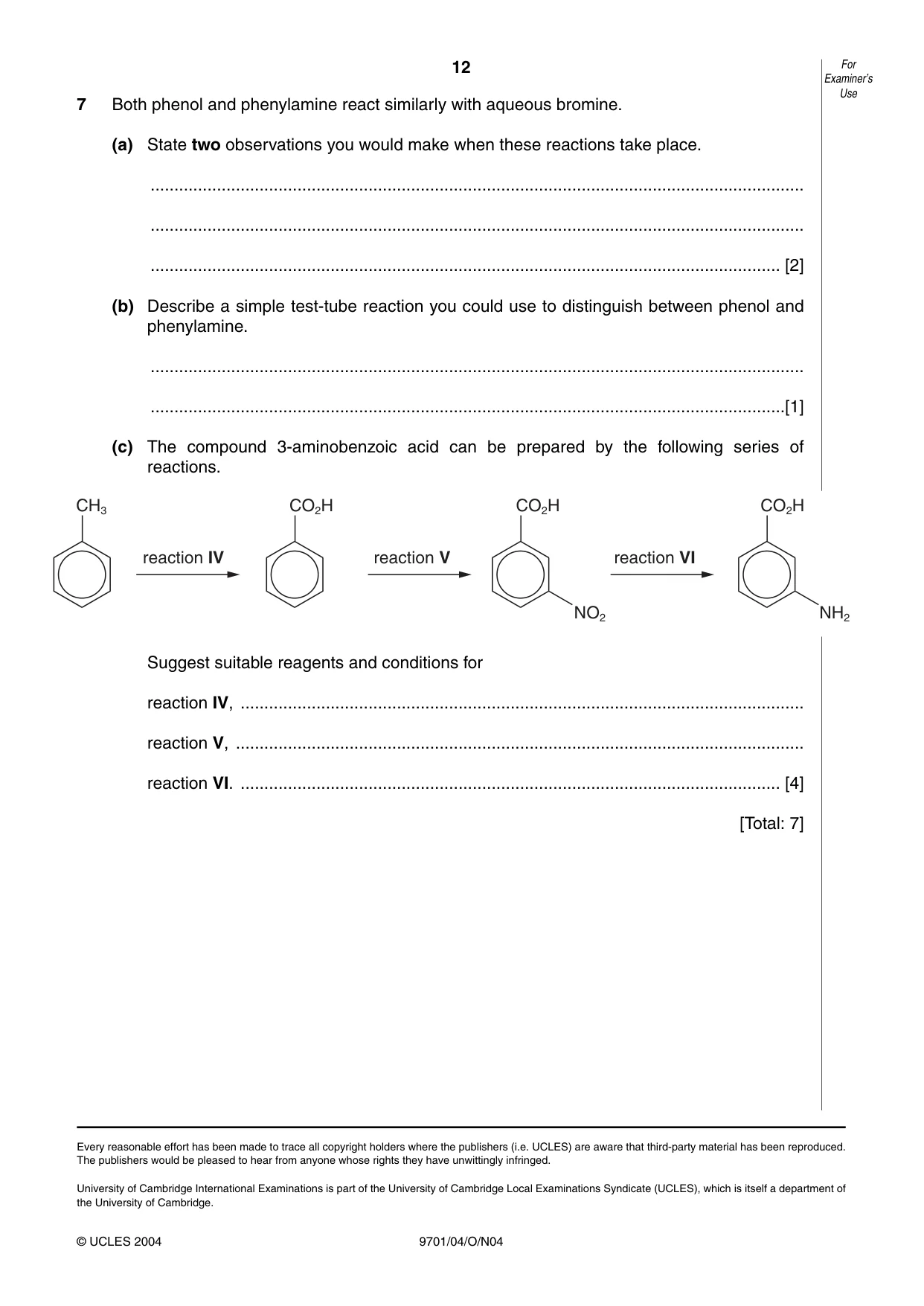
Question paper, page 12
12 9701/04/O/N04 7 Both phenol and phenylamine react similarly with aqueous bromine. (a) State two observations you would make when these reactions take place. … … … [2] (b) Describe a simple test-tube reaction you could use to distinguish between phenol and phenylamine. … …[1] (c) The compound 3-aminobenzoic acid can be prepared by the following series of reactions. Suggest suitable reagents and conditions for reaction IV, … reaction V, … reaction VI. … [4] [Total: 7] For Examiner’s Use © UCLES 2004 CH3 CO2H CO2H NO2 CO2H NH2 reaction IV reaction V reaction VI Every reasonable effort has been made to trace all copyright holders where the publishers (i.e. UCLES) are aware that third-party material has been reproduced. The publishers would be pleased to hear from anyone whose rights they have unwittingly infringed. University of Cambridge International Examinations is part of the University of Cambridge Local Examinations Syndicate (UCLES), which is itself a department of the University of Cambridge.
Mark scheme, page 1
UNIVERSITY OF CAMBRIDGE INTERNATIONAL EXAMINATIONS GCE Advanced Level MARK SCHEME for the November 2004 question paper 9701 CHEMISTRY 9701/04 Paper 4 (Structured Questions A2 Core), maximum raw mark 60 This mark scheme is published as an aid to teachers and students, to indicate the requirements of the examination. It shows the basis on which Examiners were initially instructed to award marks. It does not indicate the details of the discussions that took place at an Examiners’ meeting before marking began. Any substantial changes to the mark scheme that arose from these discussions will be recorded in the published Report on the Examination. All Examiners are instructed that alternative correct answers and unexpected approaches in candidates’ scripts must be given marks that fairly reflect the relevant knowledge and skills demonstrated. Mark schemes must be read in conjunction with the question papers and the Report on the Examination. • CIE will not enter into discussion or correspondence in connection with these mark schemes. CIE is publishing the mark schemes for the November 2004 question papers for most IGCSE and GCE Advanced Level syllabuses.
Mark scheme, page 2
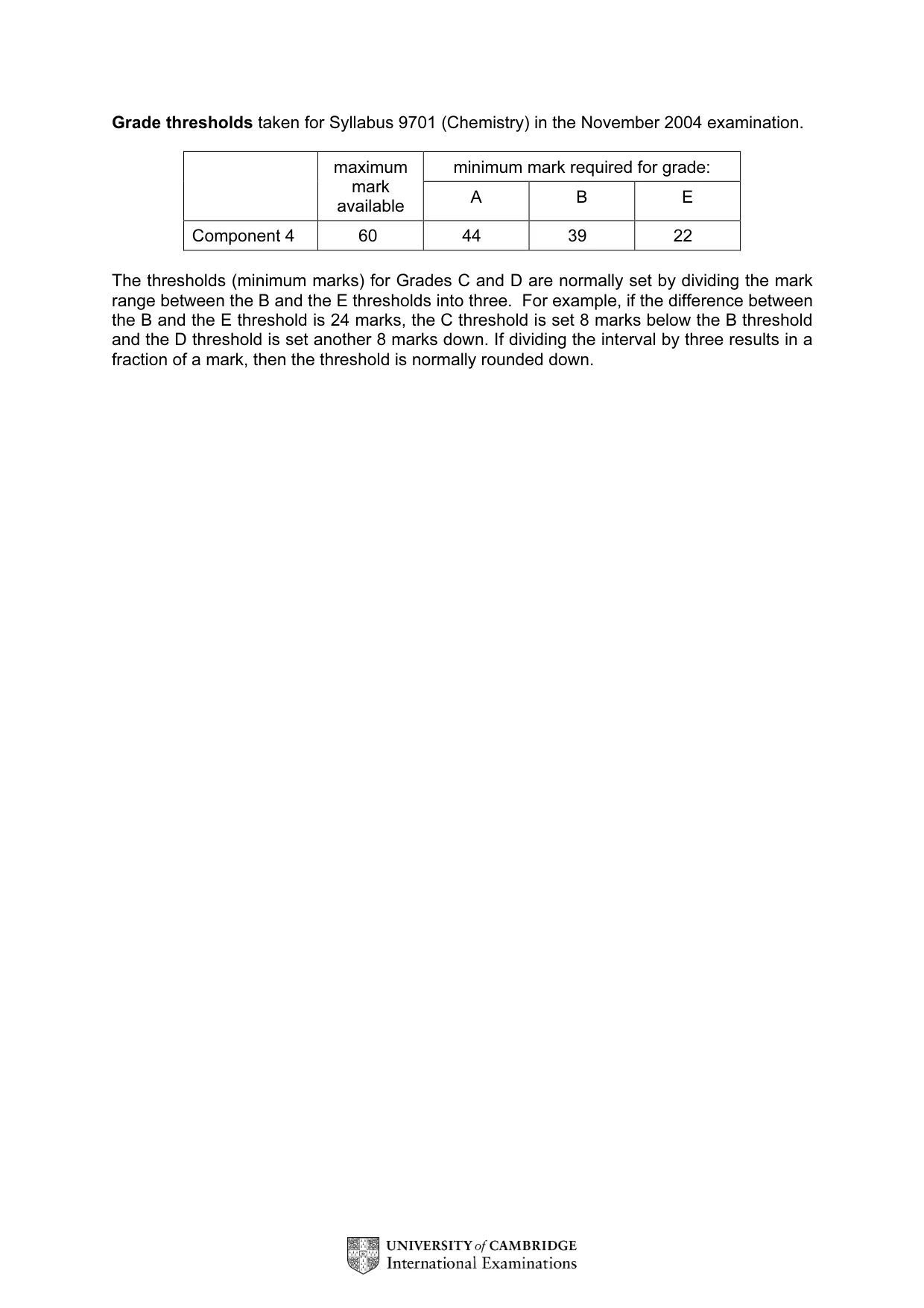
Grade thresholds taken for Syllabus 9701 (Chemistry) in the November 2004 examination. minimum mark required for grade: maximum mark available A B E Component 4 60 44 39 22 The thresholds (minimum marks) for Grades C and D are normally set by dividing the mark range between the B and the E thresholds into three. For example, if the difference between the B and the E threshold is 24 marks, the C threshold is set 8 marks below the B threshold and the D threshold is set another 8 marks down. If dividing the interval by three results in a fraction of a mark, then the threshold is normally rounded down.
Mark scheme, page 3
November 2004 GCE A LEVEL MARK SCHEME MAXIMUM MARK: 60 SYLLABUS/COMPONENT: 9701/04 CHEMISTRY Paper 4 (Structured Questions A2 Core)
Mark scheme, page 4
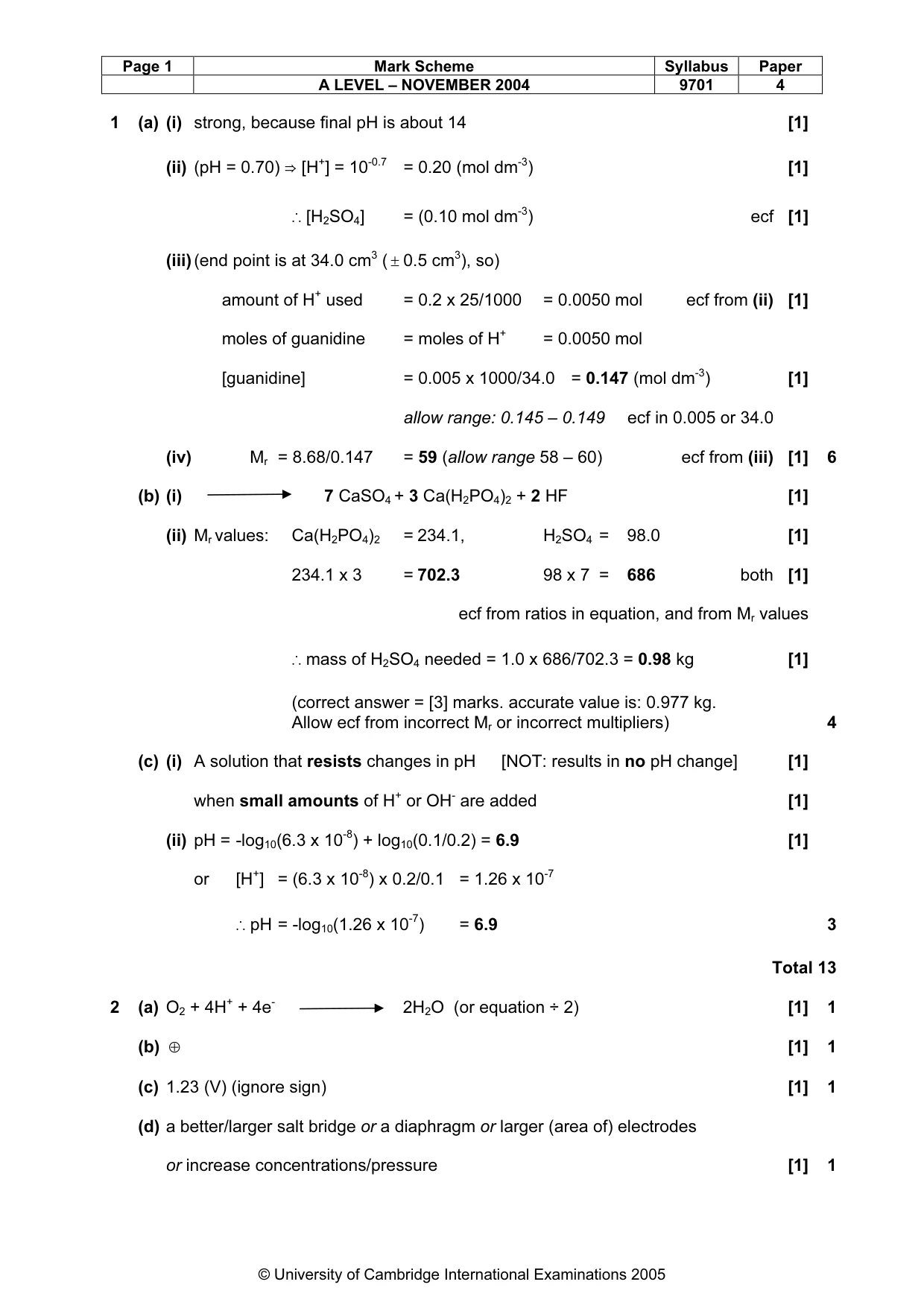
Page 1 Mark Scheme Syllabus Paper A LEVEL – NOVEMBER 2004 9701 4 © University of Cambridge International Examinations 2005 1 (a) (i) strong, because final pH is about 14 [1] (ii) (pH = 0.70) ⇒ [H+] = 10-0.7 = 0.20 (mol dm-3) [1] ∴ [H2SO4] = (0.10 mol dm-3) ecf [1] (iii) (end point is at 34.0 cm3 ( ± 0.5 cm3), so) amount of H+ used = 0.2 x 25/1000 = 0.0050 mol ecf from (ii) [1] moles of guanidine = moles of H+ = 0.0050 mol [guanidine] = 0.005 x 1000/34.0 = 0.147 (mol dm-3) [1] allow range: 0.145 – 0.149 ecf in 0.005 or 34.0 [1] (iv) Mr = 8.68/0.147 = 59 (allow range 58 – 60) ecf from (iii) [1] 6 (b) (i) 7 CaSO4 + 3 Ca(H2PO4)2 + 2 HF [1] (ii) Mr values: Ca(H2PO4)2 = 234.1, H2SO4 = 98.0 [1] 234.1 x 3 = 702.3 98 x 7 = 686 both [1] ecf from ratios in equation, and from Mr values ∴ mass of H2SO4 needed = 1.0 x 686/702.3 = 0.98 kg [1] (correct answer = [3] marks. accurate value is: 0.977 kg. Allow ecf from incorrect Mr or incorrect multipliers) 4 (c) (i) A solution that resists changes in pH [NOT: results in no pH change] [1] when small amounts of H+ or OH- are added [1] (ii) pH = -log10(6.3 x 10⁻⁸) + log10(0.1/0.2) = 6.9 [1] or [H+] = (6.3 x 10-8) x 0.2/0.1 = 1.26 x 10⁻⁷ ∴ pH = -log10(1.26 x 10⁻⁷) = 6.9 3 Total 13 2 (a) O2 + 4H+ + 4e- 2H2O (or equation ÷ 2) [1] 1 (b) ⊕ [1] 1 (c) 1.23 (V) (ignore sign) [1] 1 (d) a better/larger salt bridge or a diaphragm or larger (area of) electrodes or increase concentrations/pressure [1] 1
Mark scheme, page 5
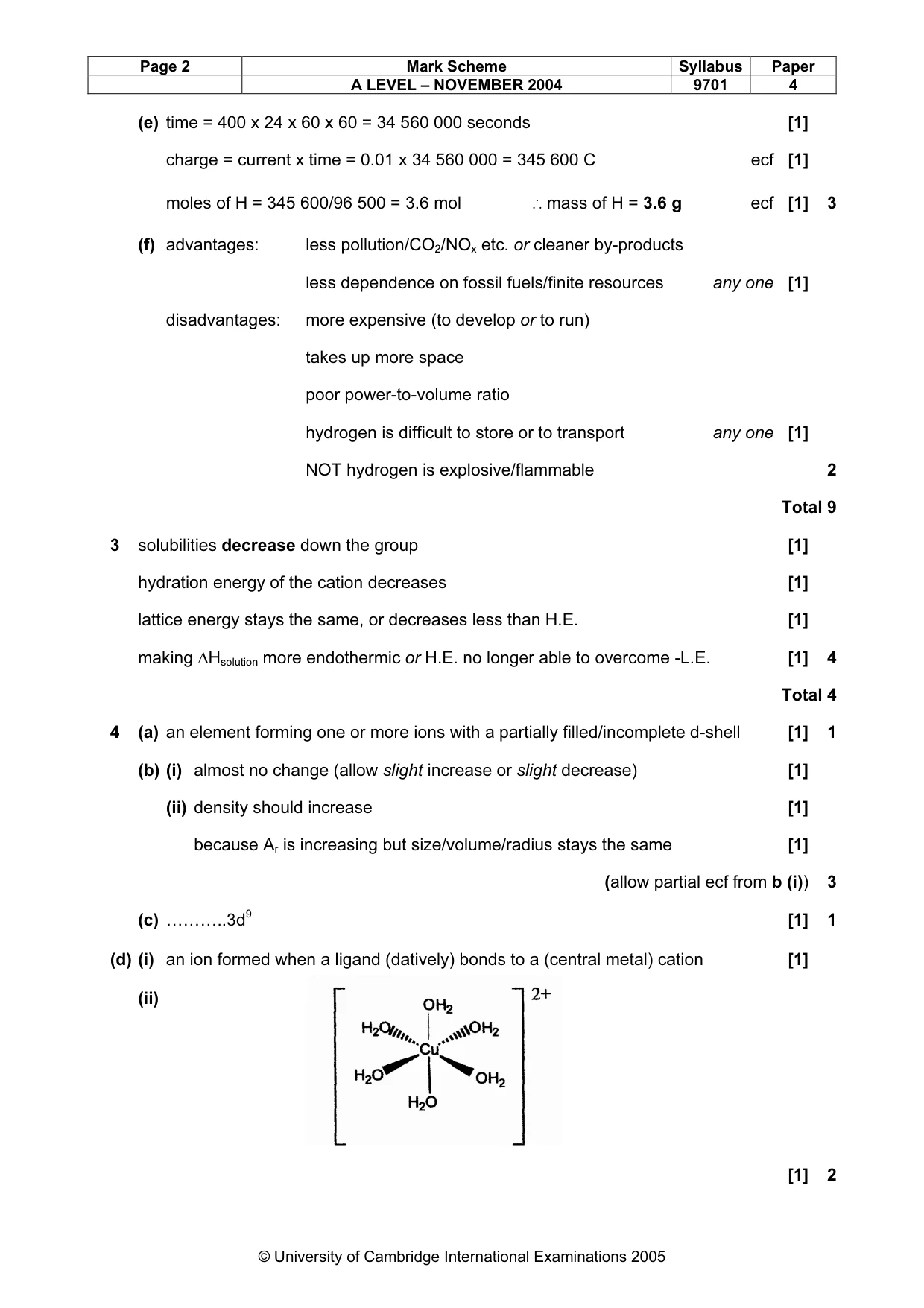
Page 2 Mark Scheme Syllabus Paper A LEVEL – NOVEMBER 2004 9701 4 © University of Cambridge International Examinations 2005 (e) time = 400 x 24 x 60 x 60 = 34 560 000 seconds [1] charge = current x time = 0.01 x 34 560 000 = 345 600 C ecf [1] moles of H = 345 600/96 500 = 3.6 mol ∴ mass of H = 3.6 g ecf [1] 3 (f) advantages: less pollution/CO2/NOx etc. or cleaner by-products less dependence on fossil fuels/finite resources any one [1] disadvantages: more expensive (to develop or to run) takes up more space poor power-to-volume ratio hydrogen is difficult to store or to transport any one [1] NOT hydrogen is explosive/flammable 2 Total 9 3 solubilities decrease down the group [1] hydration energy of the cation decreases [1] lattice energy stays the same, or decreases less than H.E. [1] making ∆Hsolution more endothermic or H.E. no longer able to overcome -L.E. [1] 4 Total 4 4 (a) an element forming one or more ions with a partially filled/incomplete d-shell [1] 1 (b) (i) almost no change (allow slight increase or slight decrease) [1] (ii) density should increase [1] because Ar is increasing but size/volume/radius stays the same [1] (allow partial ecf from b (i)) 3 (c) ………..3d9 [1] 1 (d) (i) an ion formed when a ligand (datively) bonds to a (central metal) cation [1] (ii) [1] 2
Mark scheme, page 6
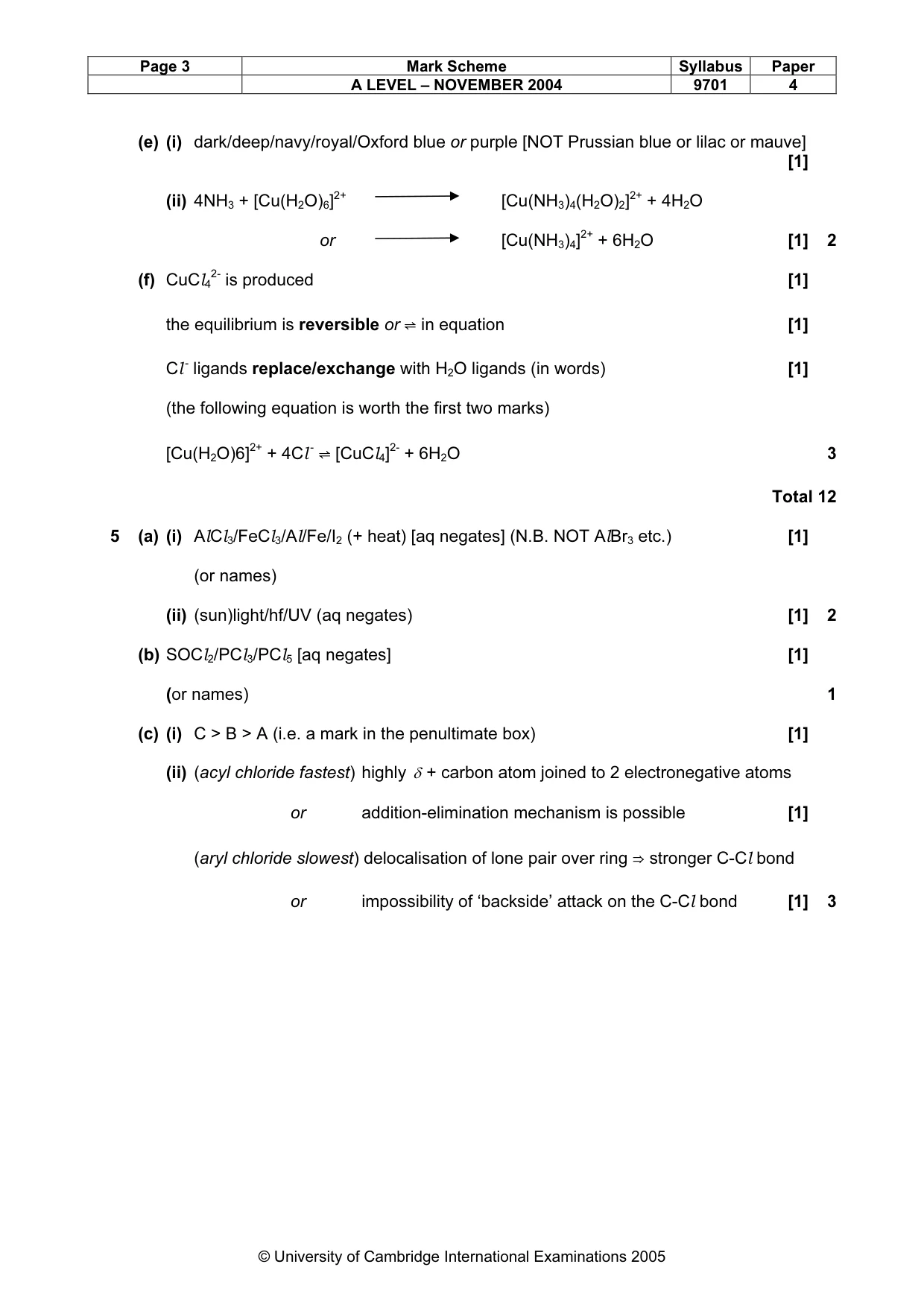
Page 3 Mark Scheme Syllabus Paper A LEVEL – NOVEMBER 2004 9701 4 © University of Cambridge International Examinations 2005 (e) (i) dark/deep/navy/royal/Oxford blue or purple [NOT Prussian blue or lilac or mauve] [1] (ii) 4NH3 + [Cu(H2O)6]2+ [Cu(NH3)4(H2O)2]2+ + 4H2O or [Cu(NH3)4]2+ + 6H2O [1] 2 (f) CuCl4 2- is produced [1] the equilibrium is reversible or ⇌ in equation [1] Cl - ligands replace/exchange with H2O ligands (in words) [1] (the following equation is worth the first two marks) [Cu(H2O)6]2+ + 4Cl - ⇌ [CuCl4]2- + 6H2O 3 Total 12 5 (a) (i) AlCl3/FeCl3/Al/Fe/I2 (+ heat) [aq negates] (N.B. NOT AlBr3 etc.) [1] (or names) (ii) (sun)light/hf/UV (aq negates) [1] 2 (b) SOCl2/PCl3/PCl5 [aq negates] [1] (or names) 1 (c) (i) C > B > A (i.e. a mark in the penultimate box) [1] (ii) (acyl chloride fastest) highly δ + carbon atom joined to 2 electronegative atoms or addition-elimination mechanism is possible [1] (aryl chloride slowest) delocalisation of lone pair over ring ⇒ stronger C-Cl bond or impossibility of ‘backside’ attack on the C-Cl bond [1] 3
Mark scheme, page 7
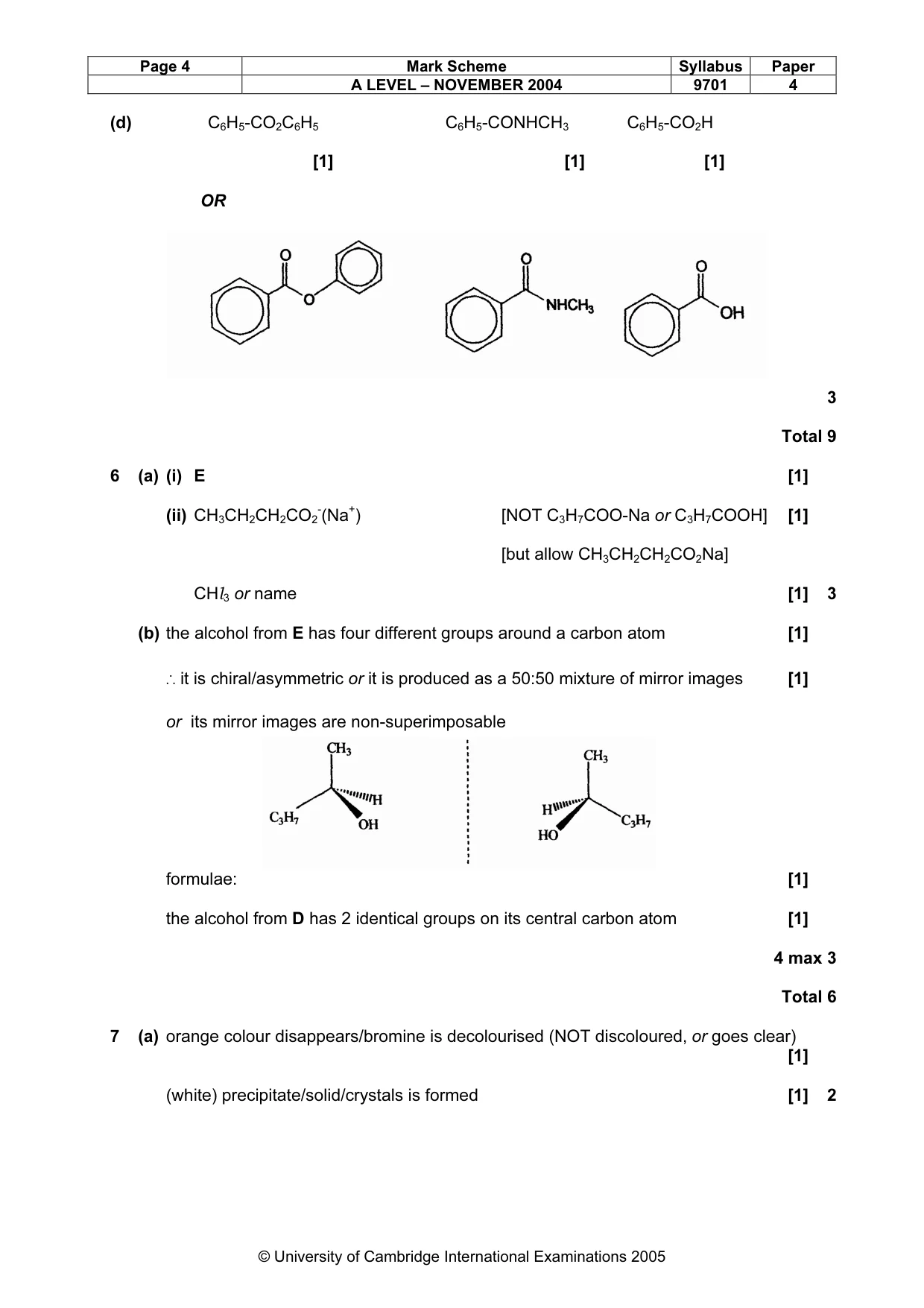
Page 4 Mark Scheme Syllabus Paper A LEVEL – NOVEMBER 2004 9701 4 © University of Cambridge International Examinations 2005 (d) C6H5-CO2C6H5 C6H5-CONHCH3 C6H5-CO2H [1] [1] [1] OR 3 Total 9 6 (a) (i) E [1] (ii) CH3CH2CH2CO2 -(Na+) [NOT C3H7COO-Na or C3H7COOH] [1] [but allow CH3CH2CH2CO2Na] CHl3 or name [1] 3 (b) the alcohol from E has four different groups around a carbon atom [1] ∴ it is chiral/asymmetric or it is produced as a 50:50 mixture of mirror images [1] or its mirror images are non-superimposable formulae: [1] the alcohol from D has 2 identical groups on its central carbon atom [1] 4 max 3 Total 6 7 (a) orange colour disappears/bromine is decolourised (NOT discoloured, or goes clear) [1] (white) precipitate/solid/crystals is formed [1] 2
Mark scheme, page 8
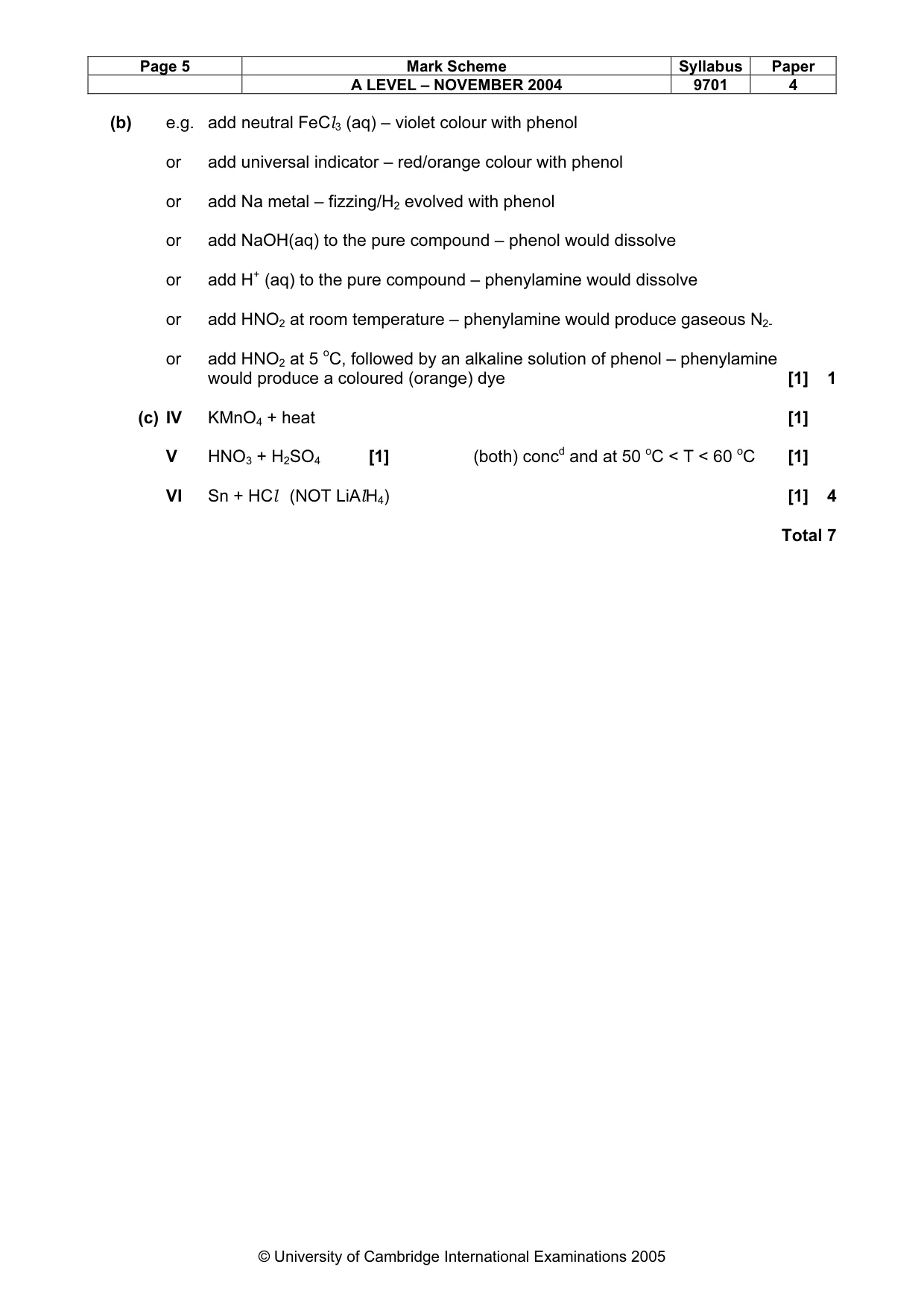
Page 5 Mark Scheme Syllabus Paper A LEVEL – NOVEMBER 2004 9701 4 © University of Cambridge International Examinations 2005 (b) e.g. add neutral FeCl3 (aq) – violet colour with phenol or add universal indicator – red/orange colour with phenol or add Na metal – fizzing/H2 evolved with phenol or add NaOH(aq) to the pure compound – phenol would dissolve or add H+ (aq) to the pure compound – phenylamine would dissolve or add HNO2 at room temperature – phenylamine would produce gaseous N2- or add HNO2 at 5 oC, followed by an alkaline solution of phenol – phenylamine would produce a coloured (orange) dye [1] 1 (c) IV KMnO4 + heat [1] V HNO3 + H2SO4 [1] (both) concd and at 50 oC < T < 60 oC [1] VI Sn + HCl (NOT LiAlH4) [1] 4 Total 7