Cambridge A Level Chemistry 9701 — 2002 Oct/Nov Paper 4 · Variant 1
9701/41/O/N/02
The question paper and its mark scheme, free to read here and free to download. This is Cambridge’s own paper, exactly as it was sat.
Question paper12 pages

Mark scheme7 pages
Answers below. Sit the paper first if you are practising.
Paper as text
Question paper, page 1
TIME 1 hour INSTRUCTIONS TO CANDIDATES Write your name, Centre number and candidate number in the spaces at the top of this page. Answer all questions. Write your answers in the spaces provided on the question paper. INFORMATION FOR CANDIDATES The number of marks is given in brackets [ ] at the end of each question or part question. You may lose marks if you do not show your working or if you do not use appropriate units. CAMBRIDGE INTERNATIONAL EXAMINATIONS General Certificate of Education Advanced Level CHEMISTRY 9701/4 PAPER 4 OCTOBER/NOVEMBER SESSION 2002 1 hour Candidates answer on the question paper. Additional materials: Data Booklet. This question paper consists of 11 printed pages and 1 blank page. (NH/CG) S14878/4 © CIE 2002 [Turn over FOR EXAMINER’S USE 3 2 1 4 TOTAL 6 5 Candidate Centre Number Number Candidate Name
Question paper, page 2
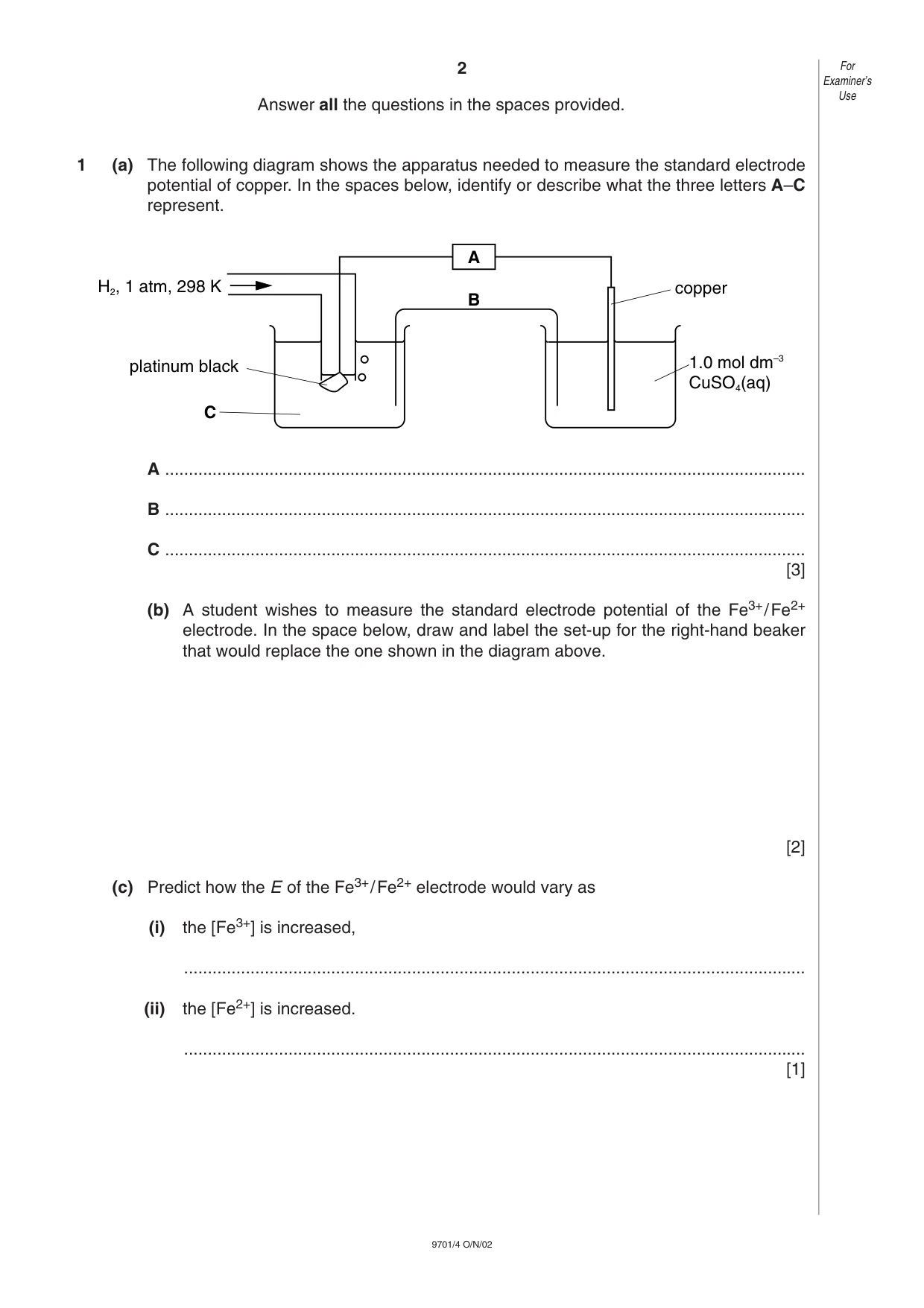
2 9701/4 O/N/02 Answer all the questions in the spaces provided. 1 (a) The following diagram shows the apparatus needed to measure the standard electrode potential of copper. In the spaces below, identify or describe what the three letters A–C represent. A … B … C … [3] (b) A student wishes to measure the standard electrode potential of the Fe3+/Fe2+ electrode. In the space below, draw and label the set-up for the right-hand beaker that would replace the one shown in the diagram above. [2] (c) Predict how the E of the Fe3+/Fe2+ electrode would vary as (i) the [Fe3+] is increased, … (ii) the [Fe2+] is increased. … [1] H2, 1 atm, 298 K platinum black copper 1.0 mol dm–3 CuSO4(aq) C A B For Examiner’s Use
Question paper, page 3
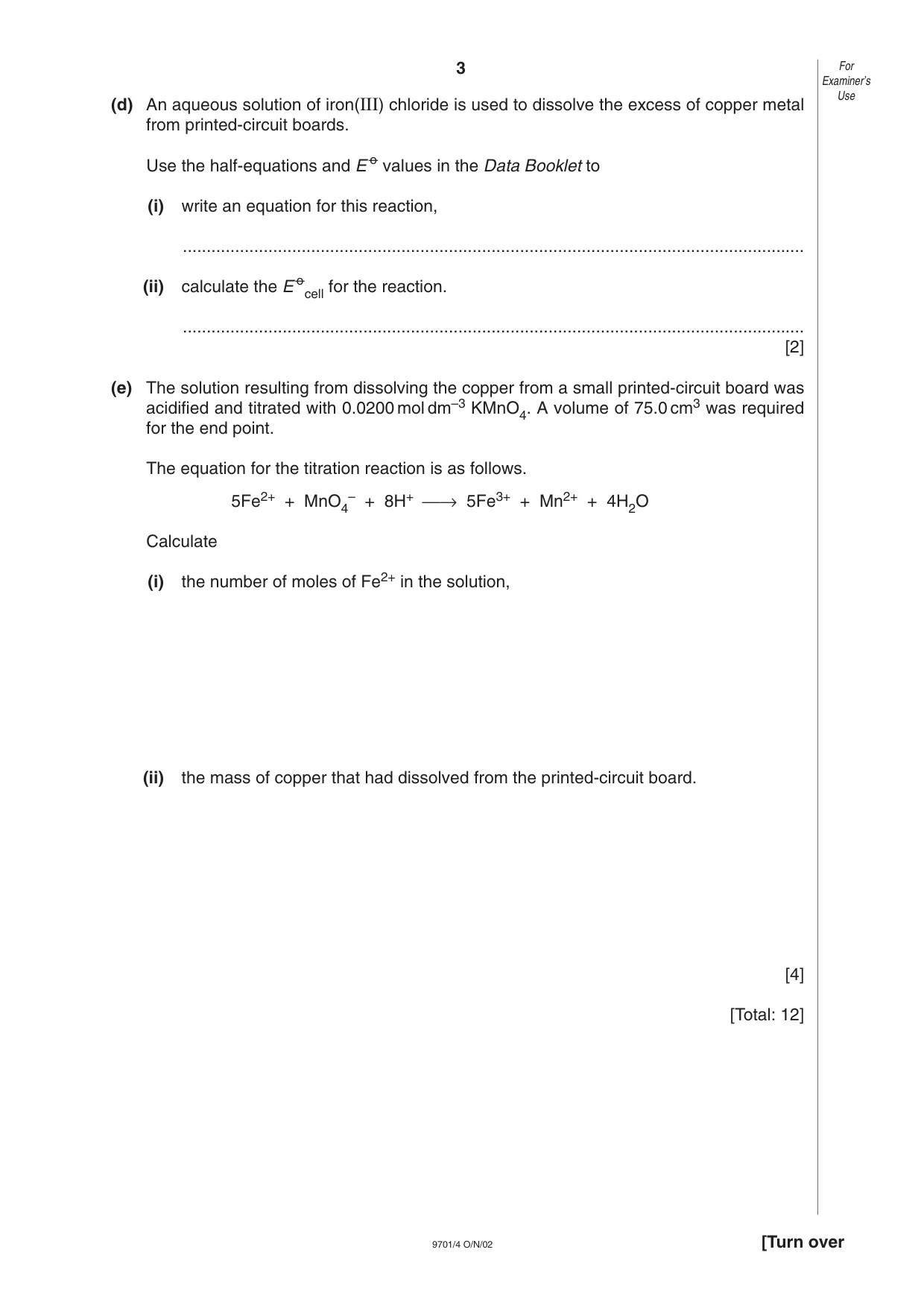
3 9701/4 O/N/02 [Turn over (d) An aqueous solution of iron(III) chloride is used to dissolve the excess of copper metal from printed-circuit boards. Use the half-equations and E o– values in the Data Booklet to (i) write an equation for this reaction, … (ii) calculate the E o– cell for the reaction. … [2] (e) The solution resulting from dissolving the copper from a small printed-circuit board was acidified and titrated with 0.0200 mol dm–3 KMnO4. A volume of 75.0 cm3 was required for the end point. The equation for the titration reaction is as follows. 5Fe2+ + MnO4 – + 8H+ →5Fe3+ + Mn2+ + 4H2O Calculate (i) the number of moles of Fe2+ in the solution, (ii) the mass of copper that had dissolved from the printed-circuit board. [4] [Total: 12] For Examiner’s Use
Question paper, page 4
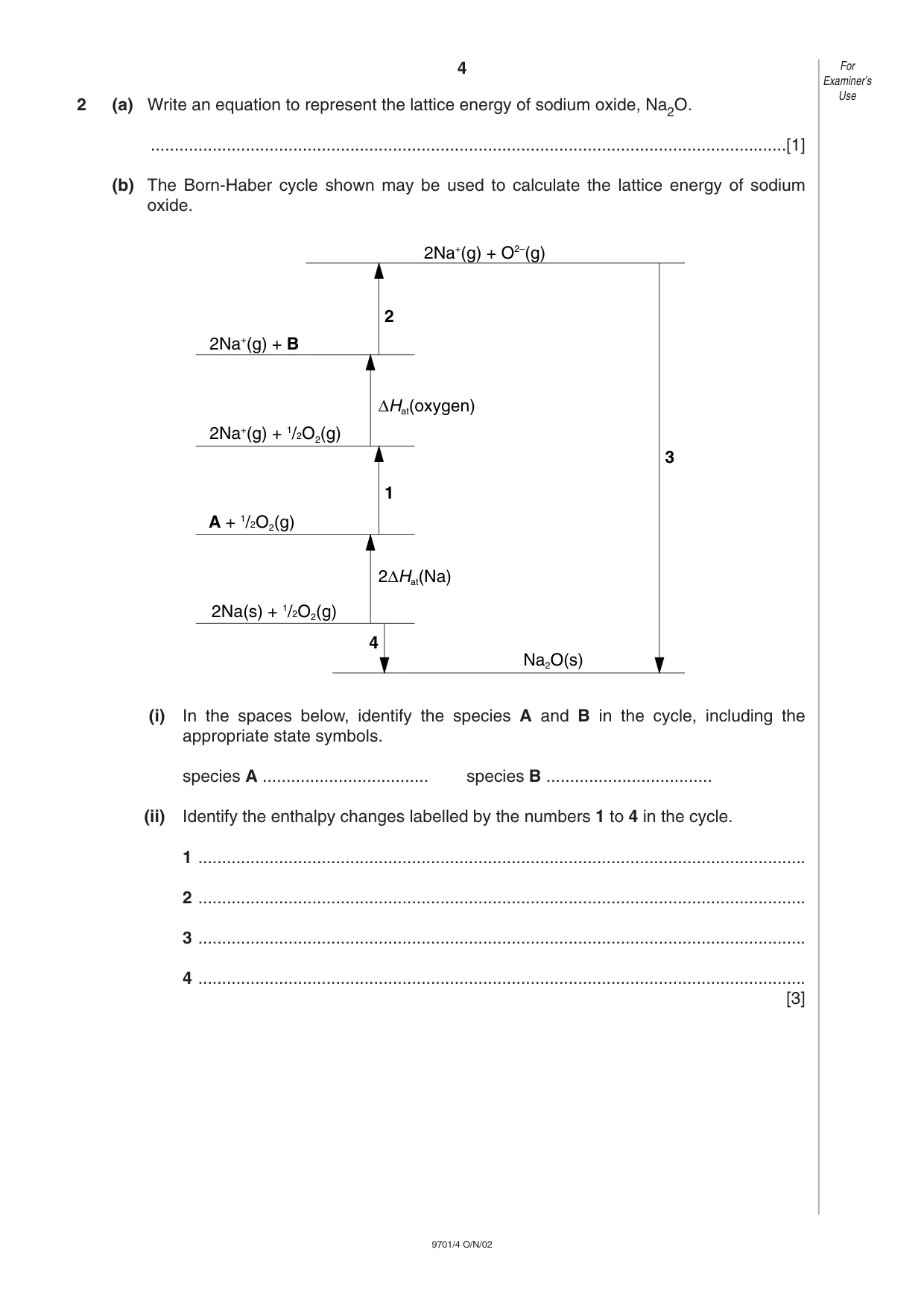
4 9701/4 O/N/02 2 (a) Write an equation to represent the lattice energy of sodium oxide, Na2O. …[1] (b) The Born-Haber cycle shown may be used to calculate the lattice energy of sodium oxide. (i) In the spaces below, identify the species A and B in the cycle, including the appropriate state symbols. species A … species B … (ii) Identify the enthalpy changes labelled by the numbers 1 to 4 in the cycle. 1 … 2 … 3 … 4 … [3] 2Na+(g) + O2–(g) 2Na+(g) + B 2 1 3 4 2Na+(g) + 1/2O2(g) A + 1/2O2(g) 2Na(s) + 1/2O2(g) 2∆Hat(Na) Na2O(s) ∆Hat(oxygen) For Examiner’s Use
Question paper, page 5
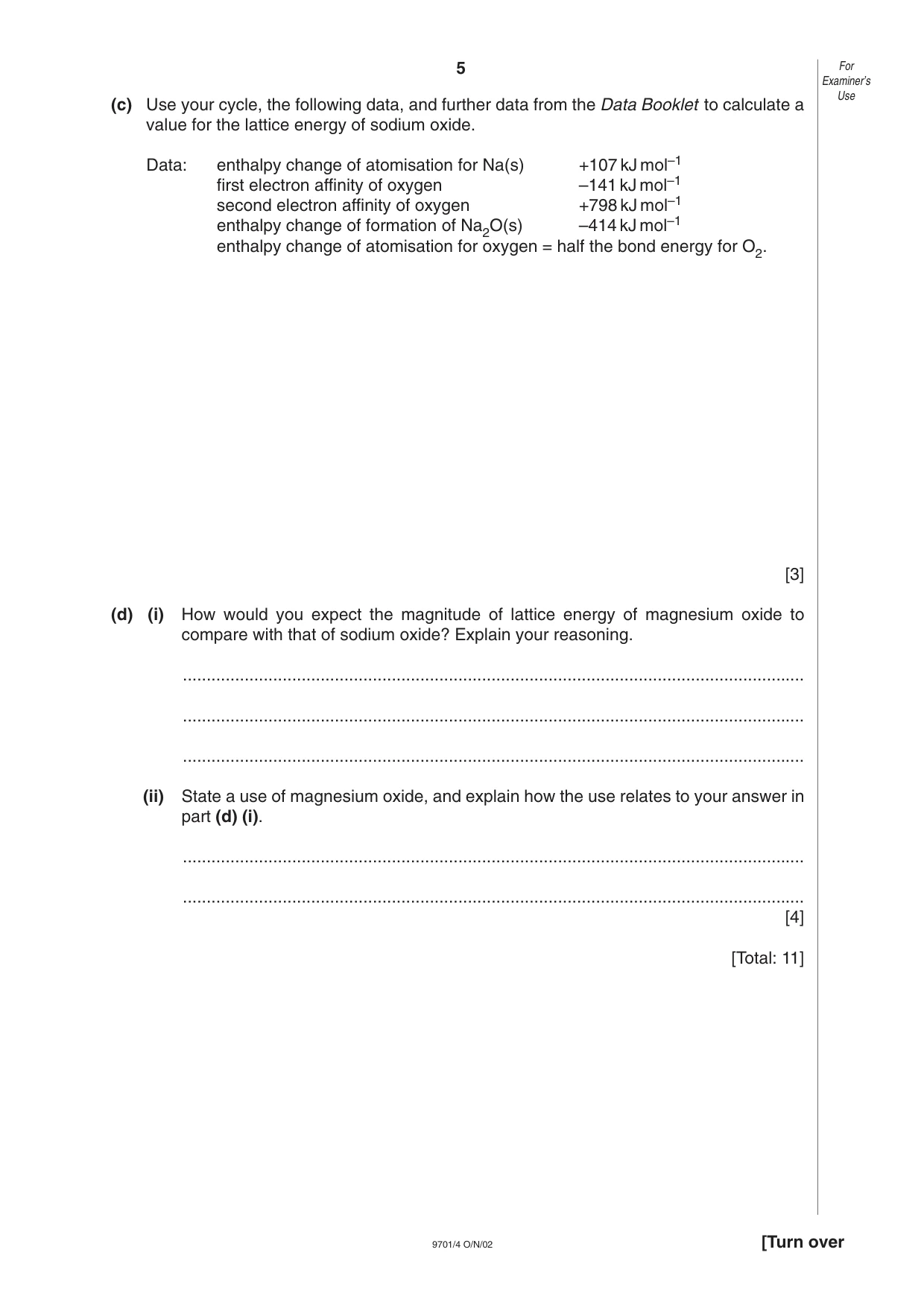
5 9701/4 O/N/02 [Turn over (c) Use your cycle, the following data, and further data from the Data Booklet to calculate a value for the lattice energy of sodium oxide. Data: enthalpy change of atomisation for Na(s) +107 kJ mol–1 first electron affinity of oxygen –141 kJ mol–1 second electron affinity of oxygen +798 kJ mol–1 enthalpy change of formation of Na2O(s) –414 kJ mol–1 enthalpy change of atomisation for oxygen = half the bond energy for O2. [3] (d) (i) How would you expect the magnitude of lattice energy of magnesium oxide to compare with that of sodium oxide? Explain your reasoning. … … … (ii) State a use of magnesium oxide, and explain how the use relates to your answer in part (d) (i). … … [4] [Total: 11] For Examiner’s Use
Question paper, page 6
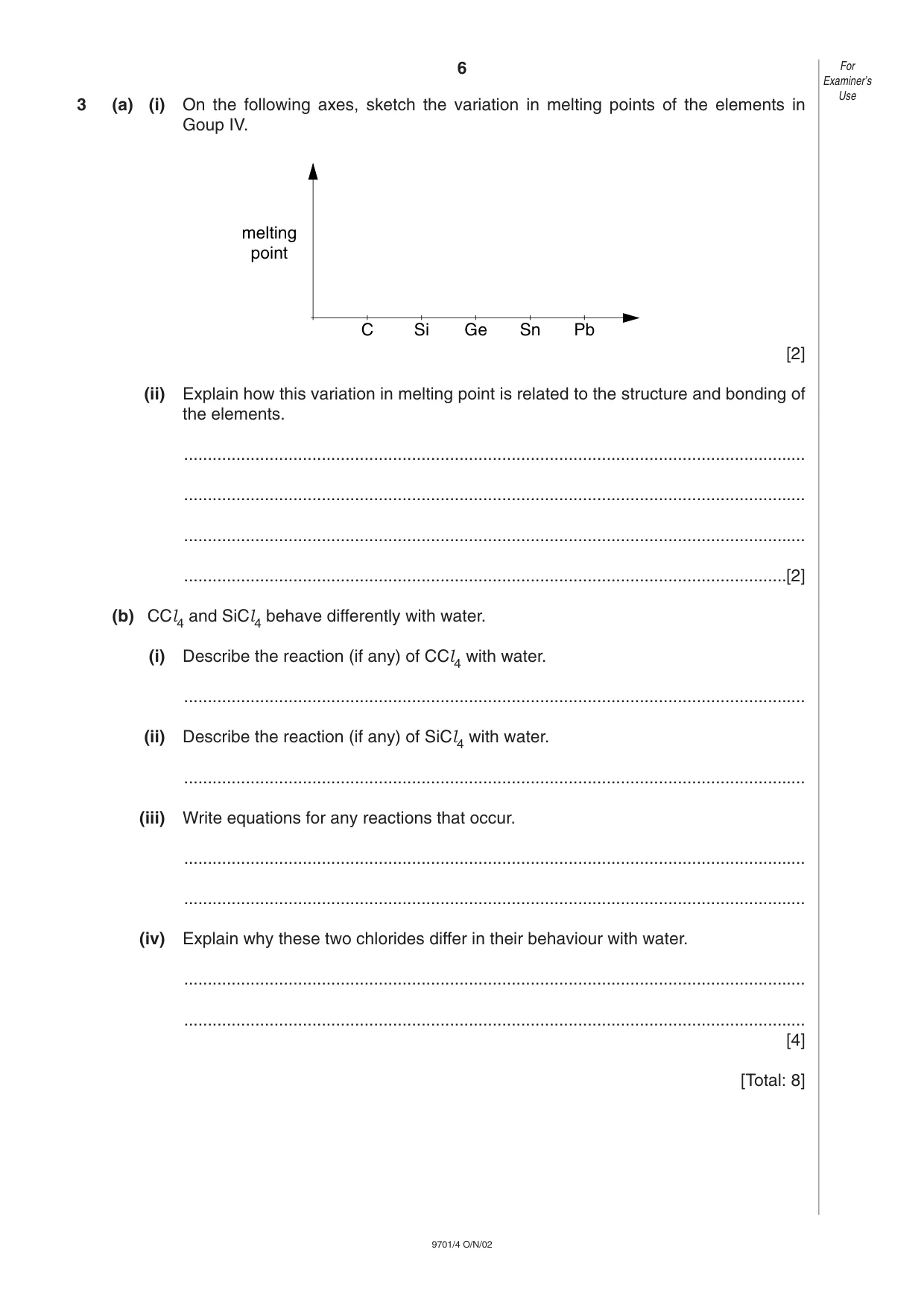
6 9701/4 O/N/02 3 (a) (i) On the following axes, sketch the variation in melting points of the elements in Goup IV. [2] (ii) Explain how this variation in melting point is related to the structure and bonding of the elements. … … … …[2] (b) CCl4 and SiCl4 behave differently with water. (i) Describe the reaction (if any) of CCl4 with water. … (ii) Describe the reaction (if any) of SiCl4 with water. … (iii) Write equations for any reactions that occur. … … (iv) Explain why these two chlorides differ in their behaviour with water. … … [4] [Total: 8] C Si Ge Sn Pb melting point For Examiner’s Use
Question paper, page 7
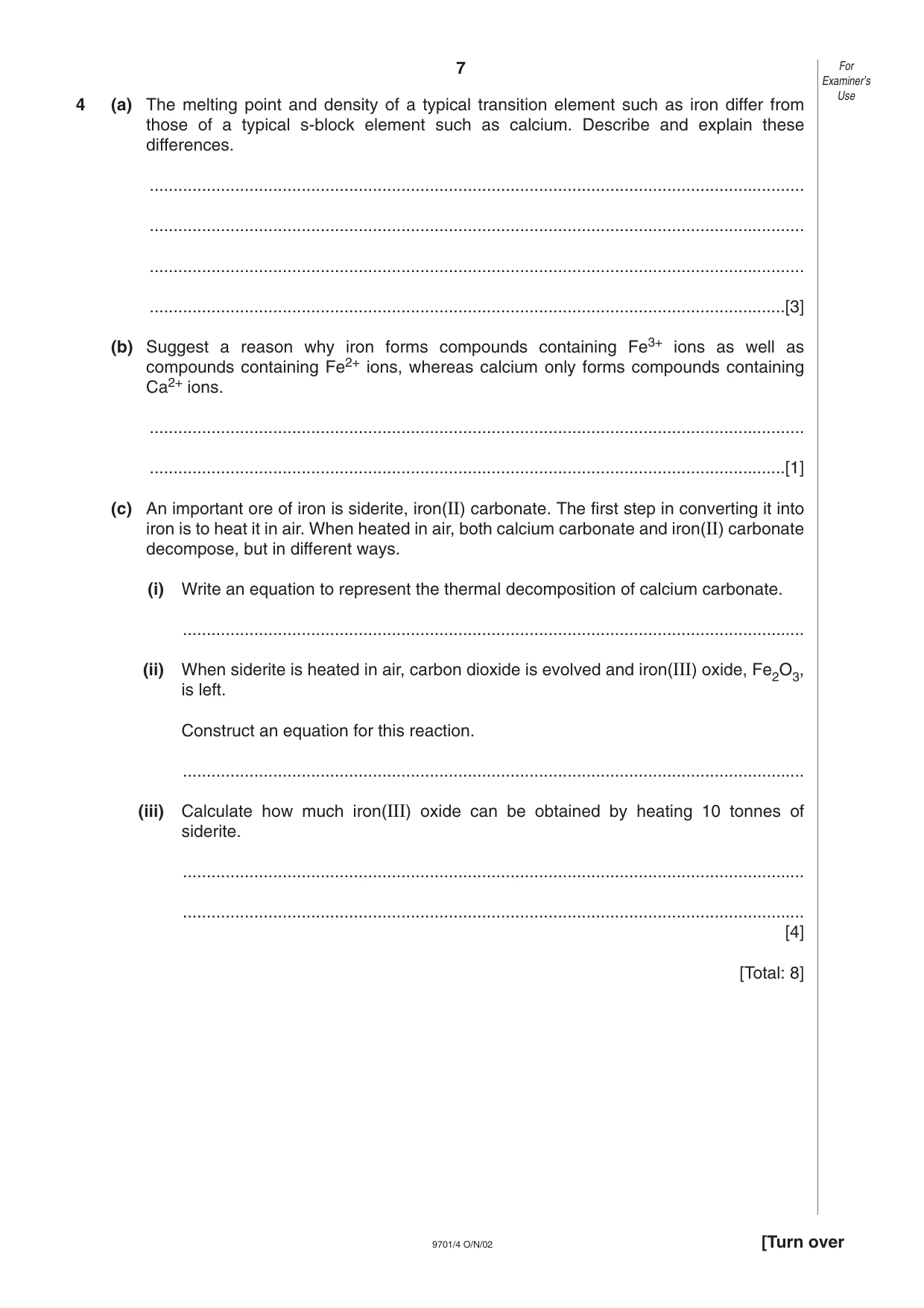
7 9701/4 O/N/02 [Turn over 4 (a) The melting point and density of a typical transition element such as iron differ from those of a typical s-block element such as calcium. Describe and explain these differences. … … … …[3] (b) Suggest a reason why iron forms compounds containing Fe3+ ions as well as compounds containing Fe2+ ions, whereas calcium only forms compounds containing Ca2+ ions. … …[1] (c) An important ore of iron is siderite, iron(II) carbonate. The first step in converting it into iron is to heat it in air. When heated in air, both calcium carbonate and iron(II) carbonate decompose, but in different ways. (i) Write an equation to represent the thermal decomposition of calcium carbonate. … (ii) When siderite is heated in air, carbon dioxide is evolved and iron(III) oxide, Fe2O3, is left. Construct an equation for this reaction. … (iii) Calculate how much iron(III) oxide can be obtained by heating 10 tonnes of siderite. … … [4] [Total: 8] For Examiner’s Use
Question paper, page 8
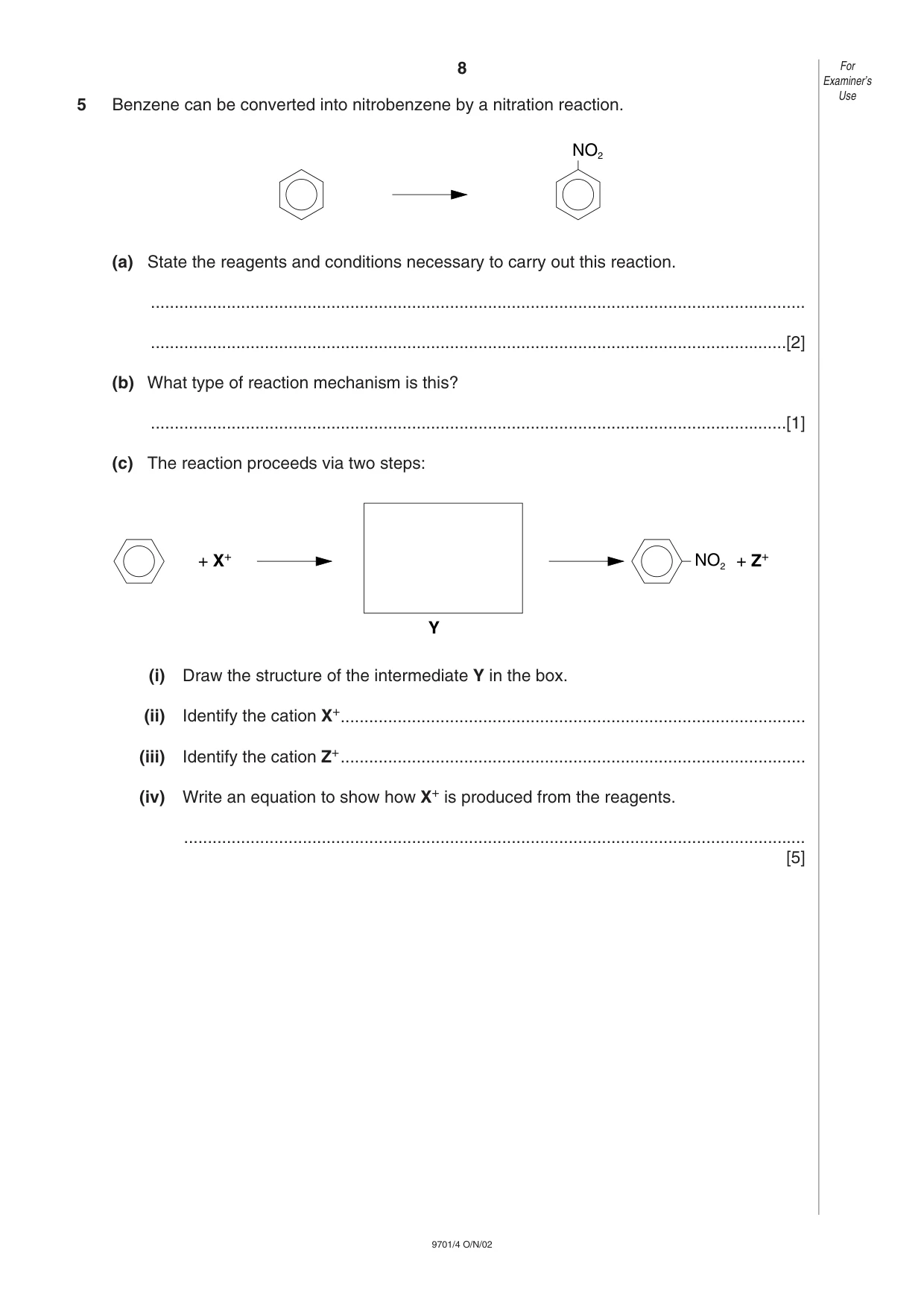
8 9701/4 O/N/02 5 Benzene can be converted into nitrobenzene by a nitration reaction. (a) State the reagents and conditions necessary to carry out this reaction. … …[2] (b) What type of reaction mechanism is this? …[1] (c) The reaction proceeds via two steps: (i) Draw the structure of the intermediate Y in the box. (ii) Identify the cation X+… (iii) Identify the cation Z+… (iv) Write an equation to show how X+ is produced from the reagents. … [5] NO2 + X+ Y + Z+ NO2 For Examiner’s Use
Question paper, page 9
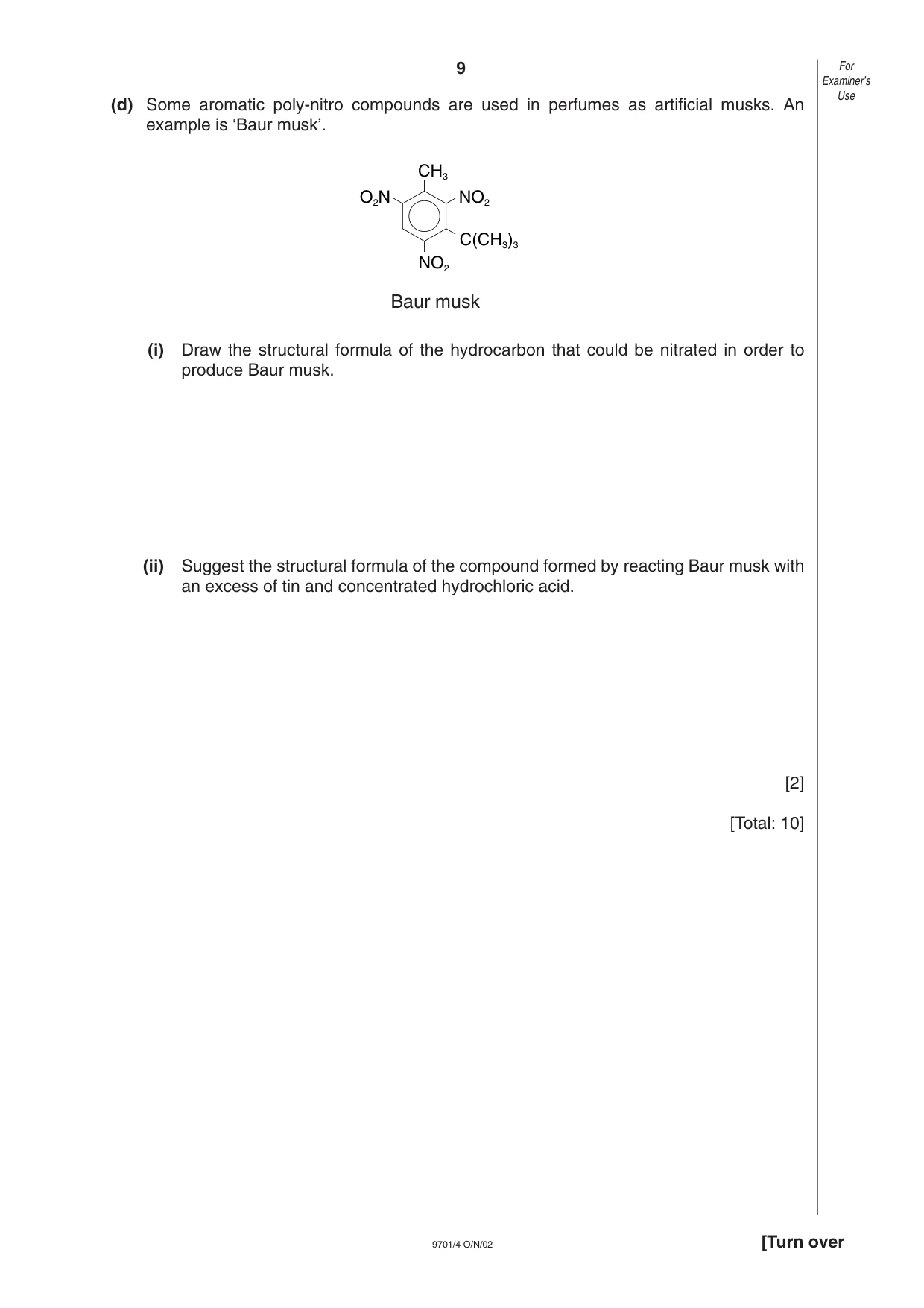
9 9701/4 O/N/02 [Turn over (d) Some aromatic poly-nitro compounds are used in perfumes as artificial musks. An example is ‘Baur musk’. (i) Draw the structural formula of the hydrocarbon that could be nitrated in order to produce Baur musk. (ii) Suggest the structural formula of the compound formed by reacting Baur musk with an excess of tin and concentrated hydrochloric acid. [2] [Total: 10] NO2 CH3 NO2 C(CH3)3 O2N Baur musk For Examiner’s Use
Question paper, page 10
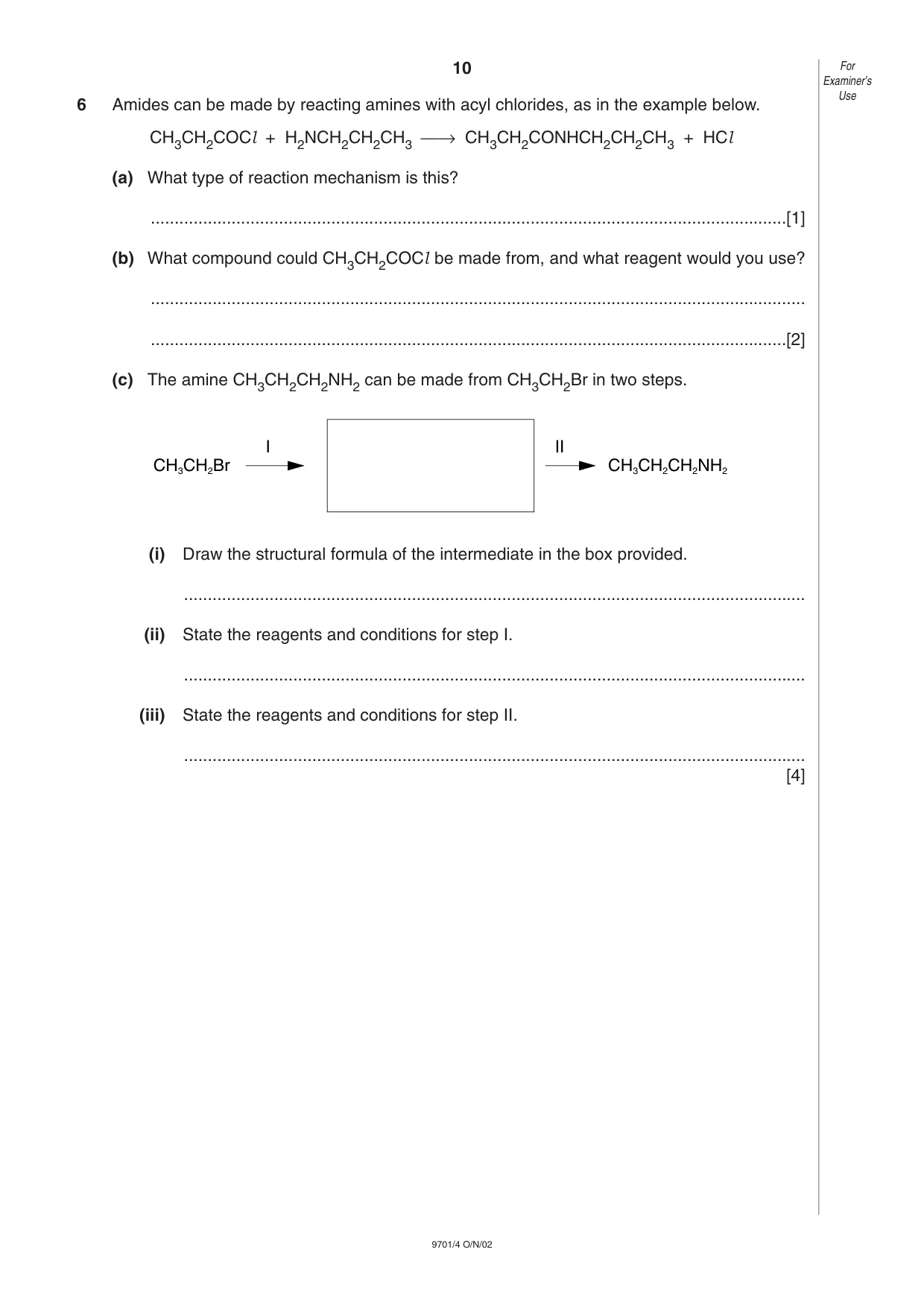
10 9701/4 O/N/02 6 Amides can be made by reacting amines with acyl chlorides, as in the example below. CH3CH2COCl + H2NCH2CH2CH3 →CH3CH2CONHCH2CH2CH3 + HCl (a) What type of reaction mechanism is this? …[1] (b) What compound could CH3CH2COCl be made from, and what reagent would you use? … …[2] (c) The amine CH3CH2CH2NH2 can be made from CH3CH2Br in two steps. (i) Draw the structural formula of the intermediate in the box provided. … (ii) State the reagents and conditions for step I. … (iii) State the reagents and conditions for step II. … [4] CH3CH2Br I II CH3CH2CH2NH2 For Examiner’s Use
Question paper, page 11
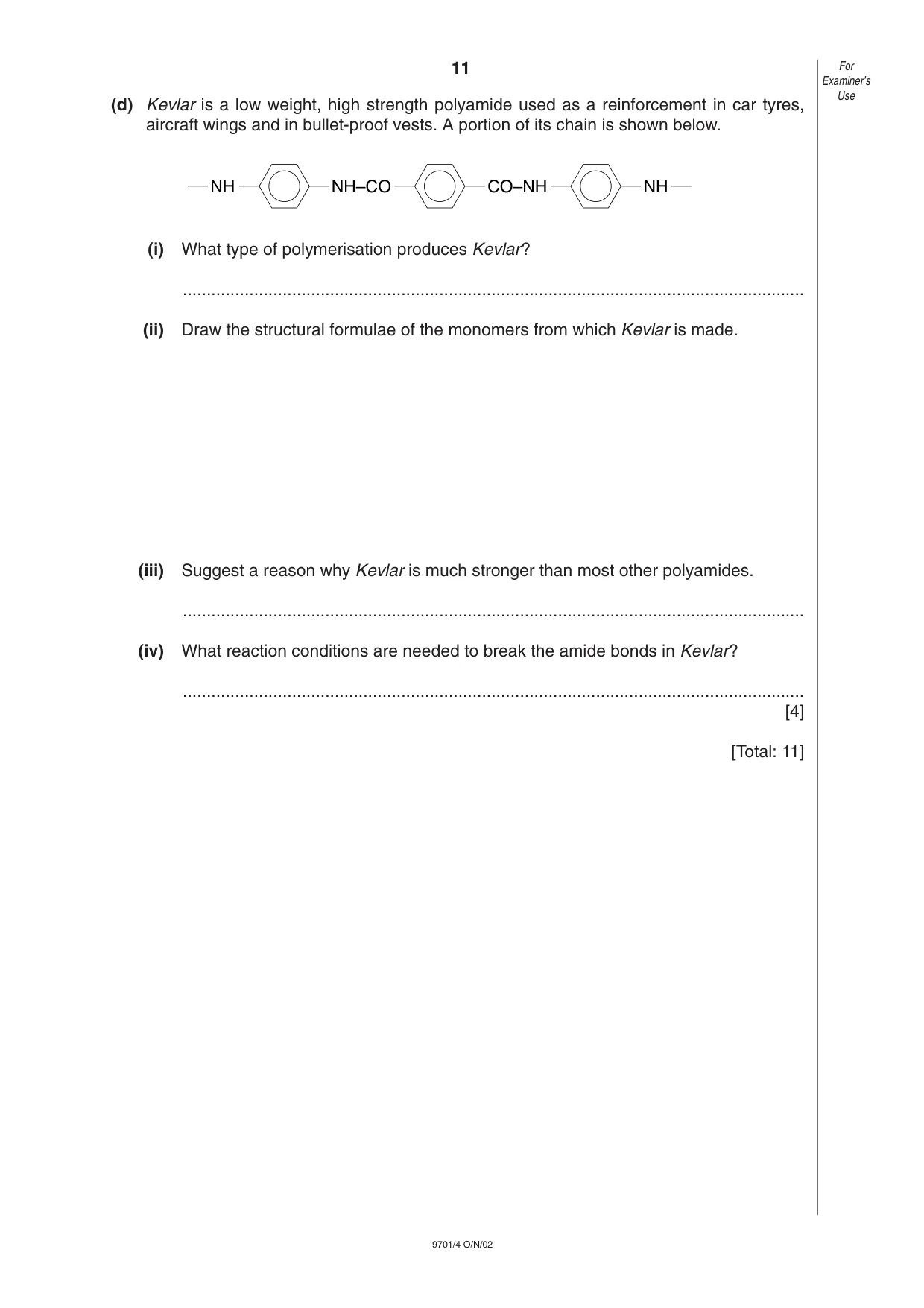
11 9701/4 O/N/02 (d) Kevlar is a low weight, high strength polyamide used as a reinforcement in car tyres, aircraft wings and in bullet-proof vests. A portion of its chain is shown below. (i) What type of polymerisation produces Kevlar? … (ii) Draw the structural formulae of the monomers from which Kevlar is made. (iii) Suggest a reason why Kevlar is much stronger than most other polyamides. … (iv) What reaction conditions are needed to break the amide bonds in Kevlar? … [4] [Total: 11] NH–CO NH CO–NH NH For Examiner’s Use
Mark scheme, page 1
CAMBRIDGE INTERNATIONAL EXAMINATIONS NOVEMBER 2002 GCE Advanced Level MARK SCHEME
Mark scheme, page 2
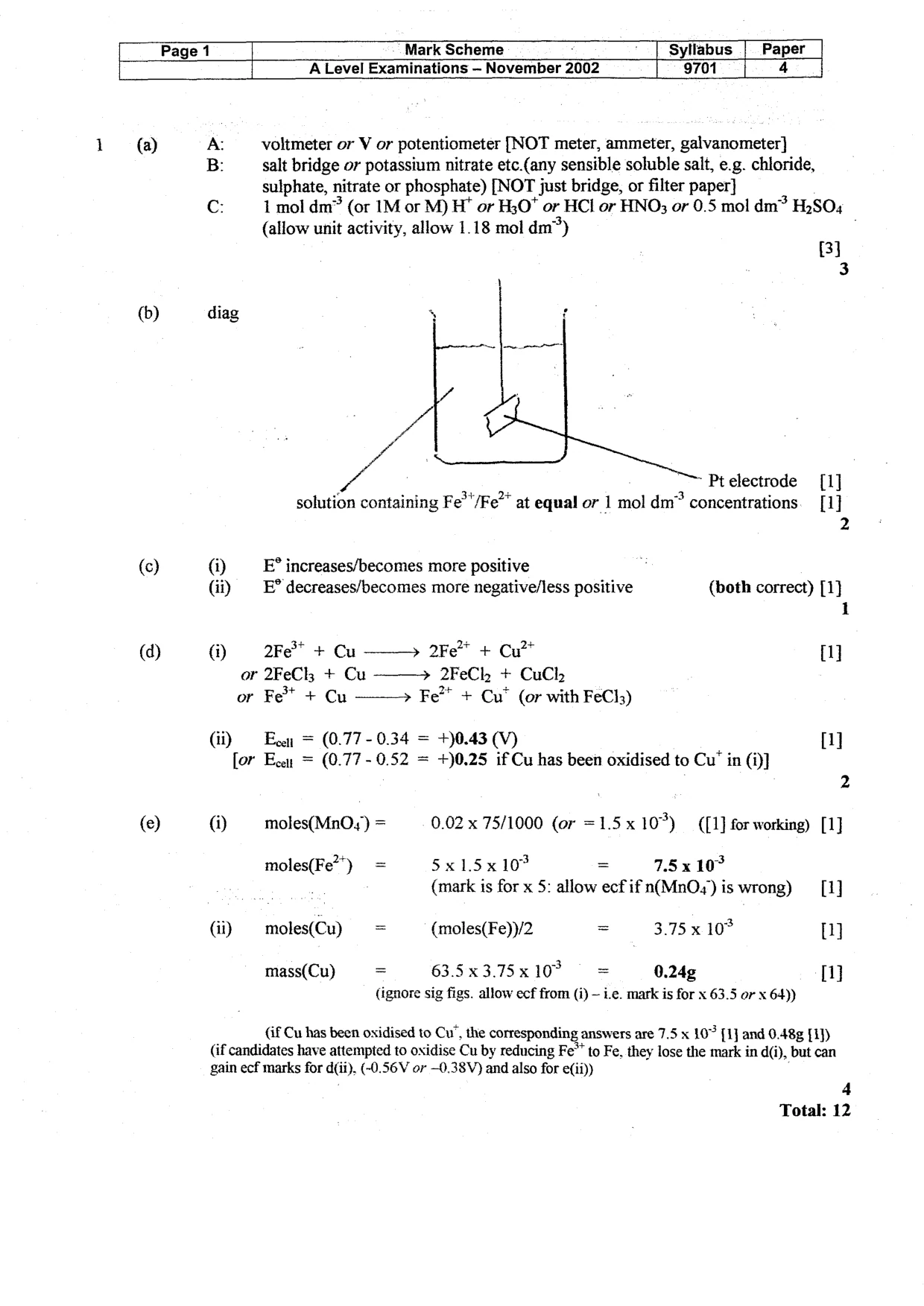
Page 1 Mark Scheme . Syllabus Paper A Level Examinations — November 2002 9701 4 (a) A: voltmeter or V or potentiometer [NOT meter, ammeter, galvanometer] B: salt bridge or potassium nitrate etc.(any sensible soluble salt, e.g. chloride, sulphate, nitrate or phosphate) [NOT just bridge, or filter paper] Cc: 1 mol dm® (or 1M or M) H* or H3O* or HCI or HNO; or 0.5 mol dm® H,SOz (allow unit activity, allow 1.18 mol dm) By 3 (b) diag ~ Ptelectrode [1] solution containing Fe*’/Fe”* at equal or 1 mol dm” concentrations. [1] 2 (c) (i) E’ increases/becomes more positive (ii) E® decreases/becomes more negative/less positive {both correct) [1} 1 (d) (@ — -2Fe** + Cu ——> 2Fe™* + Cu* (1) or 2FeClz + Cu ———> 2FeCh + CuCh or Fe* + Cu ———> Fe” + Cu’ (or with FeCl) (ii) Een = (0.77- 0.34 = +4)0.43 (V) ; ea [or Econ = (0.77 - 0.52 = +)0.25 if Cu has been oxidised to Cu’ in (i)] 2 (e) (i) moles(MnO,) = 0.02 x 75/1000 (or =1.5 x 10°) ([1] for working) [1] moles(Fe"*) = 5x 15x 10% = 7.5x 10° (mark is for x 5: allow ecfifn(MnO,) is wrong) [1] (ii) moles(Cu) = (moles(Fe))/2 = 3.75 x 10° 0] mass(Cu) = 63.5x3.75x10° = 0.24g 1] (ignore sig figs. allow ecf from (i) ~ i.e. mark is for x 63.5 or x 64)) (if Cu has been oxidised to Cu’, the corresponding answers are 7.5 x 10° [1] and 0.48g [1]) (if candidates have attempted to oxidise Cu by reducing Fe™ to Fe, they lose the mark in d(i), but can gain ecf marks for d(ii), (-0.56V or —0.38V) and also for e(ii)) 4 Total: 12
Mark scheme, page 3
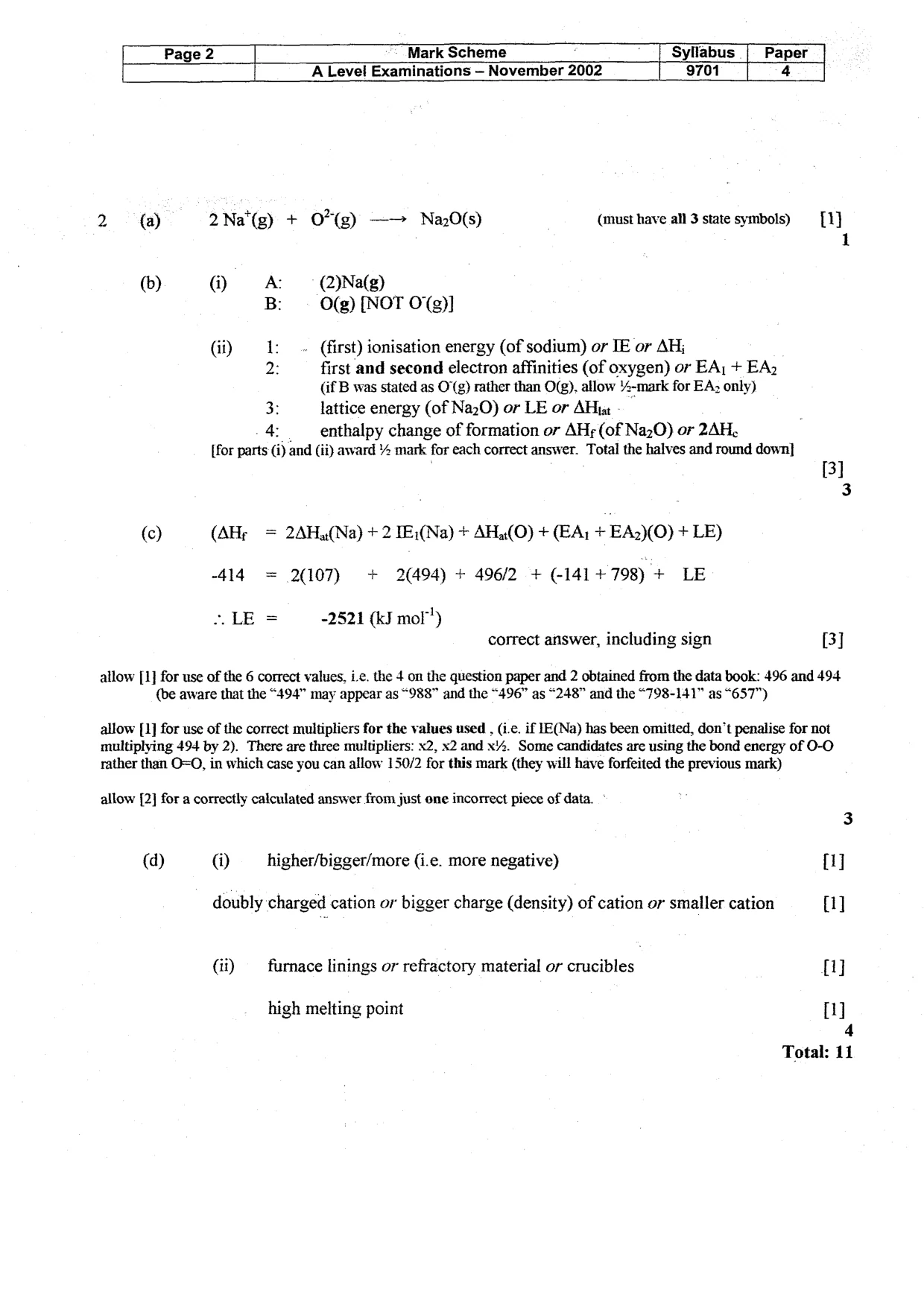
Page 2 Mark Scheme “_|_Syllabus | Paper A Level Examinations — November 2002 9701 2 (a) 2Na‘(g) + O*(g) —— Na,0(s) (must have all 3 state symbols) [1] 1 (b) @ A> Q@)Nag) B: — O(g) [NOT O(g)] (ii) 1: ~ (first) ionisation energy (of sodium) or IE or AH; : first and second electron affinities (of oxygen) or EA; + EA (if B was stated as O'(g) rather than O(g), allow '4-mark for EA; only) 3: lattice energy (of Na2O) or LE or AHist 4: enthalpy change of formation or AH (of NazO) or 2AH. [for parts (i) and (ii) award 14 mark for each correct answer. Total the halves and round down] [3] 3 (c) (AH = 2AHy(Na) + 2 IE;(Na) + AHx(O) + (EA; + EA2)(O) + LE) -414 = 2107) + 2(494) + 496/2 + (-141+798) + LE - LE = -2521 (kJ mol’) correct answer, including sign [3] allow [1] for use of the 6 correct values, i.e. the 4 on the question paper and 2 obtained from the data book: 496 and 494 (be aware that the “494” may appear as “988” and the “496” as “248” and the “798-141” as “657") allow [1] for use of the correct multipliers for the values used , (i.¢. if IE(Na) has been omitted, don’t penalise for not multiplying 494 by 2). There are three multipliers: x2, x2 and x4. Some candidates are using the bond energy of O-O rather than O=O, in which case you can allow 150/2 for this mark (they will have forfeited the previous mark) allow [2] for a correctly calculated answer from just one incorrect piece of data. 3 (d) (i) higher/bigger/more (i.e. more negative) {1] doubly charged cation or bigger charge (density) of cation or smaller cation 1] (ii) furnace linings or refractory material or crucibles {1] high melting point 0] 4 Total: 11
Mark scheme, page 4
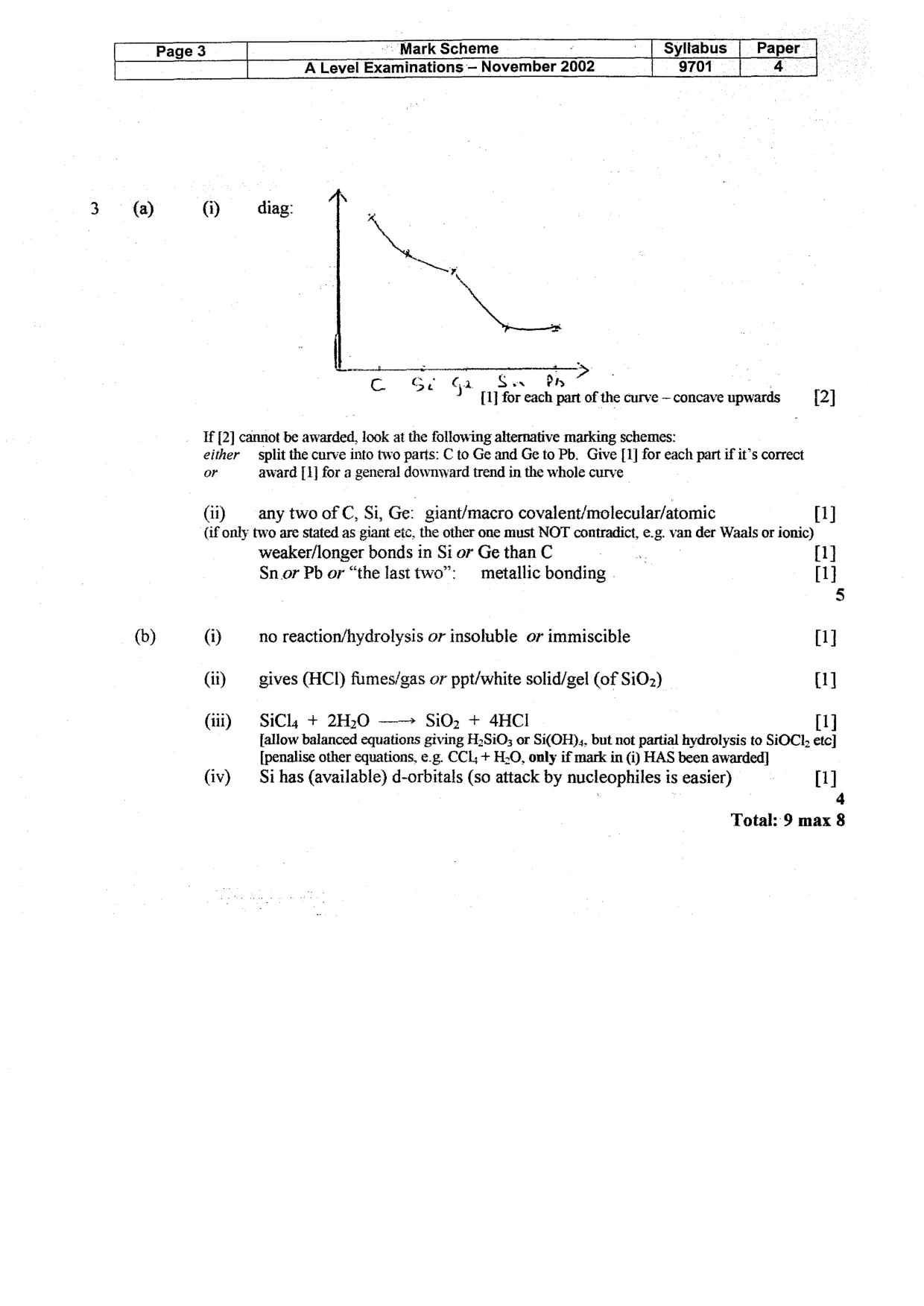
Page 3 Mark Scheme : Syllabus Paper A Level Examinations — November 2002 9701 4 (@) (b) (i) diag: NO Cc Gé gi Se on 7 [1] for each part of the curve — concave upwards [2] If [2] cannot be awarded, look at the following alternative marking schemes: either split the curve into two parts: C to Ge and Ge to Pb. Give [1] for each part if it’s correct or award [1] for a general downward trend in the whole curve (ii) any two of C, Si, Ge: giant/macro covalent/molecular/atomic fi] (if only two are stated as giant etc, the other one must NOT contradict, e.g. van der Waals or ionic) weaker/longer bonds in Si or Ge than C 0) Sn or Pb or “the last two”: metallic bonding [1} 5 (i) no reaction/hydrolysis or insoluble or immiscible fl] (ii) gives (HCI) fumes/gas or ppt/white solid/gel (of SiO02) a] (ii) SiCl, + 2H,O —— SiO, + 4HCI 1] [allow balanced equations giving H2SiO; or Si(OH),, but not partial hydrolysis to SiOCI, etc] [penalise other equations, e.g. CCL, + H:O, only if mark in (i) HAS been awarded] (iv) Si has (available) d-orbitals (so attack by nucleophiles is easier) 1] 4 Total: 9 max 8
Mark scheme, page 5
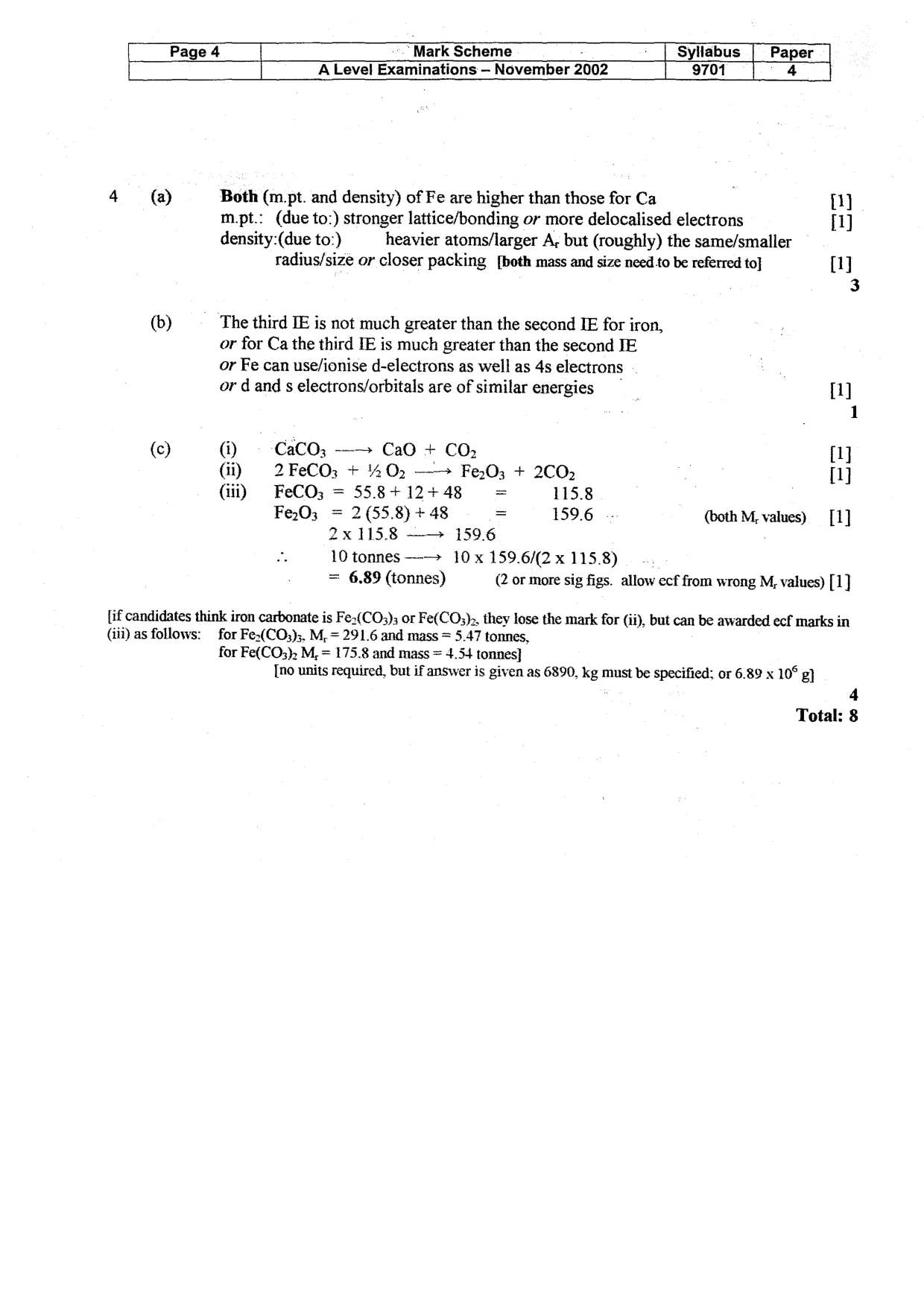
Page 4 Mark Scheme : Syllabus A Level Examinations — November 2002 9701 Paper 4 4 Both (m.pt. and density) of Fe are higher than those for Ca Bal m.pt.: (due to:) stronger lattice/bonding or more delocalised electrons {1] density:(due to:) heavier atoms/larger A, but (roughly) the same/smaller radius/size or closer packing [both mass and size need to be referred to} 0] 3 (b) The third IE is not much greater than the second IE for iron, or for Ca the third IE is much greater than the second IE or Fe can use/ionise d-electrons as well as 4s electrons or d and s electrons/orbitals are of similar energies fi] 1 (c) (i) CaCO; --—> CaO + CO; {1] (ii) = 2 FeCO3 + 402 ——> Fe,0; + 2CO2 [1] (iii) FeCO; = 55.8+ 12+ 48 = 115.8 Fe,03 = 2 (55.8) +48 = 159.6 (both M, values) [1] 2x 115.8 —— 159.6 10 tonnes ——> 10 x 159.6/(2 x 115.8) = 6.89 (tonnes) (2 or more sig figs. allow ecf from wrong M, values) [1] [if candidates think iron carbonate is Fe>(COs)3 or Fe(COs)z, they lose the mark for (ii), but can be awarded ecf marks in (iii) as follows: for Fe.(CO;);, M, = 291.6 and mass = 5.47 tonnes, for Fe(CO3)2 M, = 175.8 and mass = 4.54 tonnes} [no units required, but if answer is given as 6890, kg must be specified: or 6.89 x 10° 2) 4 Total: 8
Mark scheme, page 6
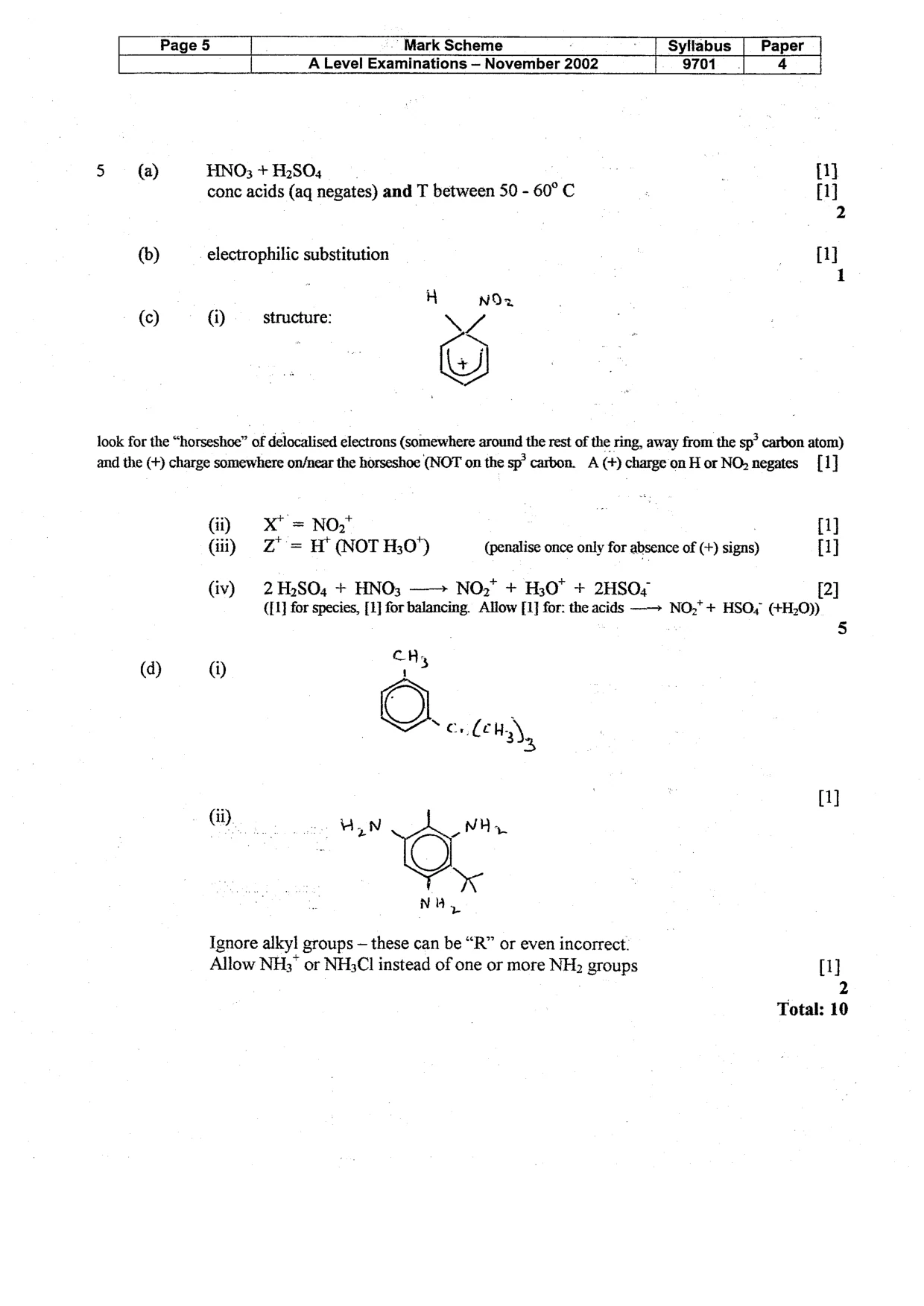
Page 5 Mark Scheme Syllabus Paper A Level Examinations — November 2002 9701 4 5 (a) HINO; + HySO4 . 0) conc acids (aq negates) and T between 50 - 60°C fi] 2 (b) electrophilic substitution 1] 1 4 NO (c) (i) structure: \ J look for the “horseshoe” of delocalised electrons (somewhere around the rest of the ring, away from the sp’ carbon atom) and the (+) charge somewhere on/near the horseshoe (NOT on the sp’ carbon. A (+) charge on H or NO} negates 1] @ (i) X" = No, , ( (iii) |Z = H’ (NOTH0') (penalise once only for absence of (+) signs) 1] (iv) 2H)SO, + HNO; ——> NO," + H;0* + 2HSOs [2] ({1) for species, [1] for balancing. Allow [1] for: the acids ——+ NO,*+ HSO, (+H20)) 5 a cH, @ .? O ‘ © Cehy\ .. 1] i) WN UNH Nw) Ignore alkyl groups — these can be “R” or even incorrect. Allow NH;” or NH3Cl instead of one or more NH2 groups 1] 2 Total: 10
Mark scheme, page 7
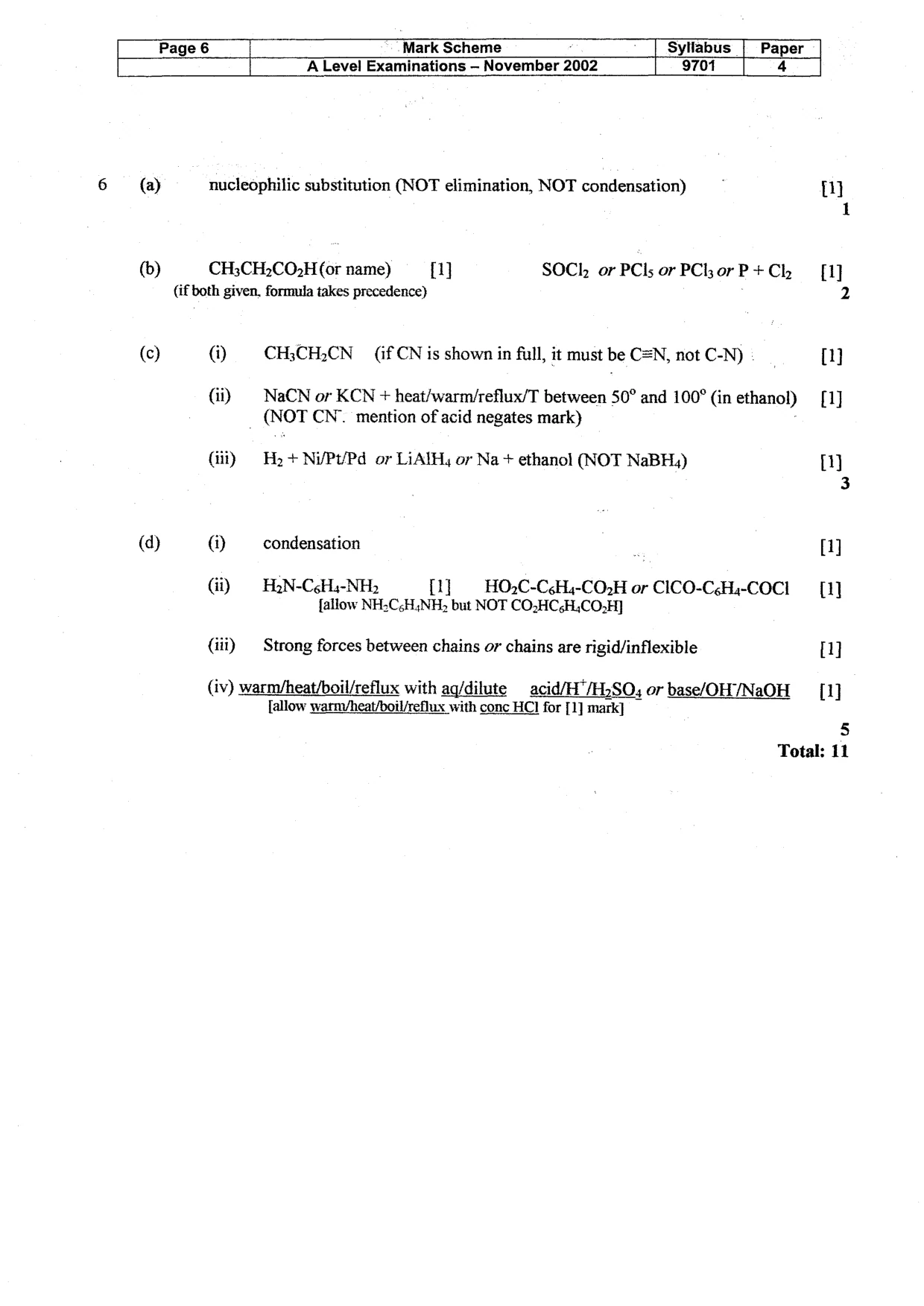
Page 6 Mark Scheme Syllabus | Paper A Level Examinations —- November 2002 9701 4 (a) nucleophilic substitution (NOT elimination, NOT condensation) ti] 1 (b) CH3CH2CO>H (or name) 1] (if both given, formula takes precedence) (c) (@d) (i) CH3CH2CN (if CN is shown in full, it must be C=N, not C-N) SOCI, or PCls or PClhorP+Cl [1] ie] (ii) | NaCN or KCN + heat/warm/reflux/T between 50° and 100° (in ethanol) 0] (NOT CN’. mention of acid negates mark) (iii) Hy + Ni/PU/Pd or LiAHy or Na + ethanol (NOT NaBH,) (i) condensation iB) 3 (1) Gi) HyN-C6H4-NH2 [1] | HO.C-CsHy-COzH or CICO-CeHa-COC! = [1] {allow NH2C;H;NH2 but NOT CO2HC.H,CO,H] (iii) Strong forces between chains or chains are rigid/inflexible 0) (iv) warm/heat/boil/reflux with aq/dilute _ acid/H“/H)SO, or base/(OH/NaOH [1] [allow warnvheat/boil/reflux with conc HCI for [1] mark] 5 Total: 11