Cambridge A Level Chemistry 9701 — 2002 May/June Paper 4 · Variant 1
9701/41/M/J/02
The question paper and its mark scheme, free to read here and free to download. This is Cambridge’s own paper, exactly as it was sat.
Question paper12 pages

Mark scheme7 pages
Answers below. Sit the paper first if you are practising.
Paper as text
Question paper, page 1
TIME 1 hour INSTRUCTIONS TO CANDIDATES Write your name, Centre number and candidate number in the spaces at the top of this page. Answer all questions. Write your answers in the spaces provided on the question paper. INFORMATION FOR CANDIDATES The number of marks is given in brackets [ ] at the end of each question or part question. You may lose marks if you do not show your working or if you do not use appropriate units. This question paper consists of 11 printed pages and 1 blank page. MML 1439 4/01 S16048/2 © CIE 2002 [Turn over CAMBRIDGE INTERNATIONAL EXAMINATIONS General Certificate of Education Advanced Level CHEMISTRY 9701/4 PAPER 4 MAY/JUNE SESSION 2002 1 hour Candidates answer on the question paper. Additional materials: Data Booklet UNIVERSITY of CAMBRIDGE Local Examinations Syndicate Candidate Centre Number Number Candidate Name FOR EXAMINER’S USE 1 2 3 4 5 6 7 TOTAL
Question paper, page 2
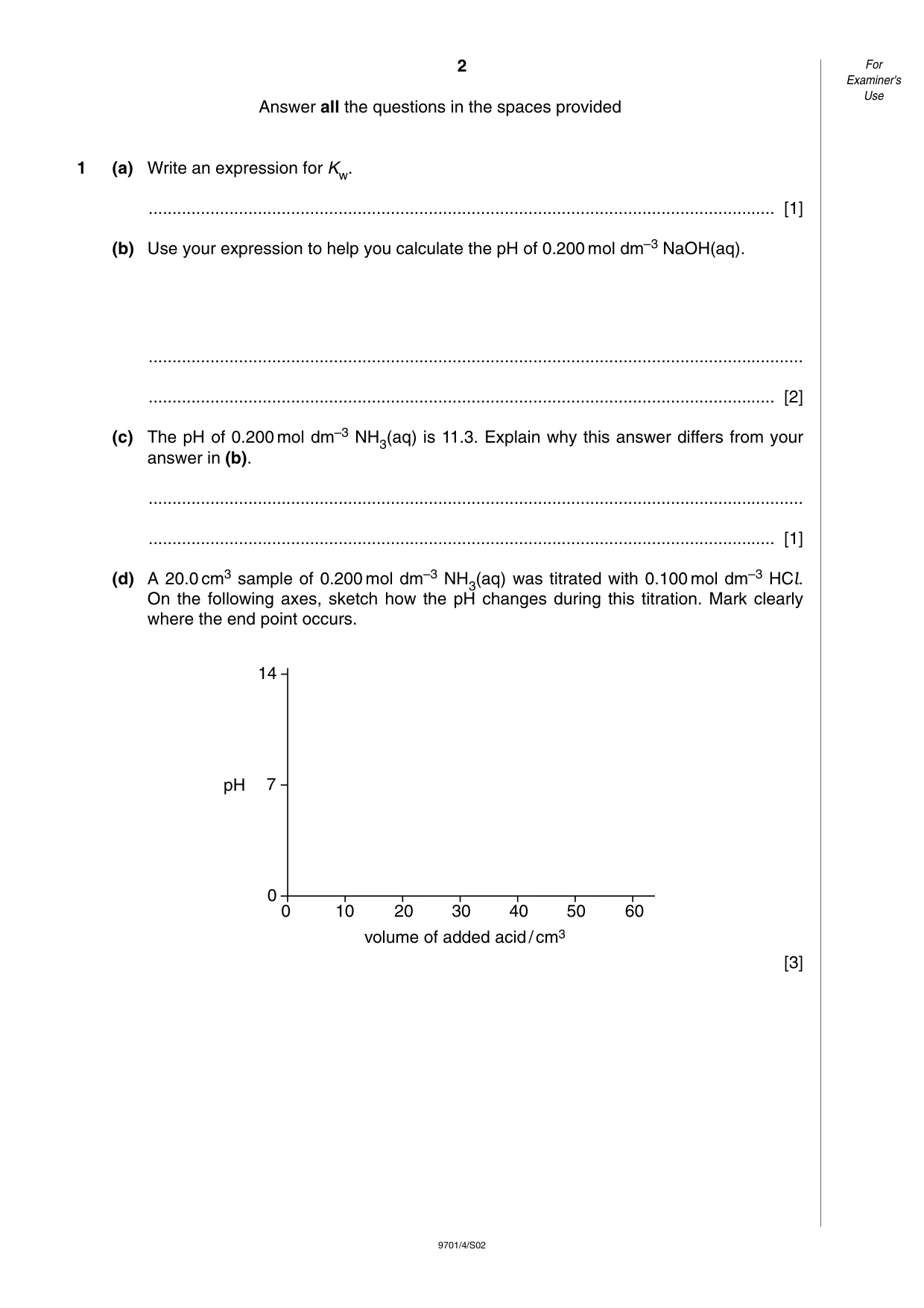
Answer all the questions in the spaces provided 1 (a) Write an expression for Kw. … [1] (b) Use your expression to help you calculate the pH of 0.200 mol dm–3 NaOH(aq). … … [2] (c) The pH of 0.200 mol dm–3 NH3(aq) is 11.3. Explain why this answer differs from your answer in (b). … … [1] (d) A 20.0 cm3 sample of 0.200 mol dm–3 NH3(aq) was titrated with 0.100 mol dm–3 HCl. On the following axes, sketch how the pH changes during this titration. Mark clearly where the end point occurs. [3] volume of added acid/cm3 pH 14 7 0 0 10 20 30 40 50 60 2 9701/4/S02 For Examiner's Use
Question paper, page 3
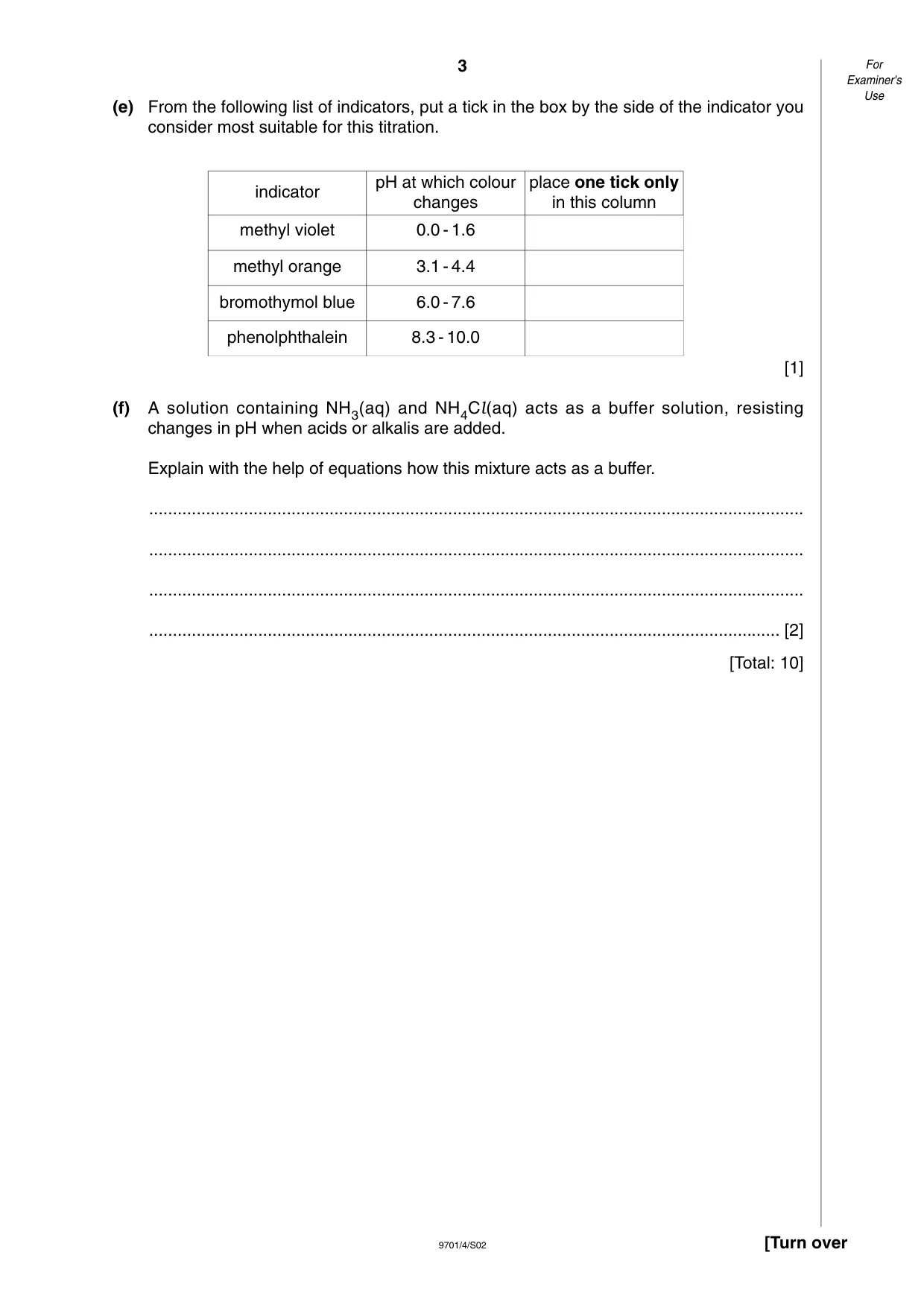
(e) From the following list of indicators, put a tick in the box by the side of the indicator you consider most suitable for this titration. [1] (f) A solution containing NH3(aq) and NH4Cl(aq) acts as a buffer solution, resisting changes in pH when acids or alkalis are added. Explain with the help of equations how this mixture acts as a buffer. … … … … [2] [Total: 10] 3 9701/4/S02 [Turn over For Examiner's Use indicator pH at which colour changes place one tick only in this column methyl violet methyl orange bromothymol blue phenolphthalein 0.0 - 1.6 3.1 - 4.4 6.0 - 7.6 8.3 - 10.0
Question paper, page 4
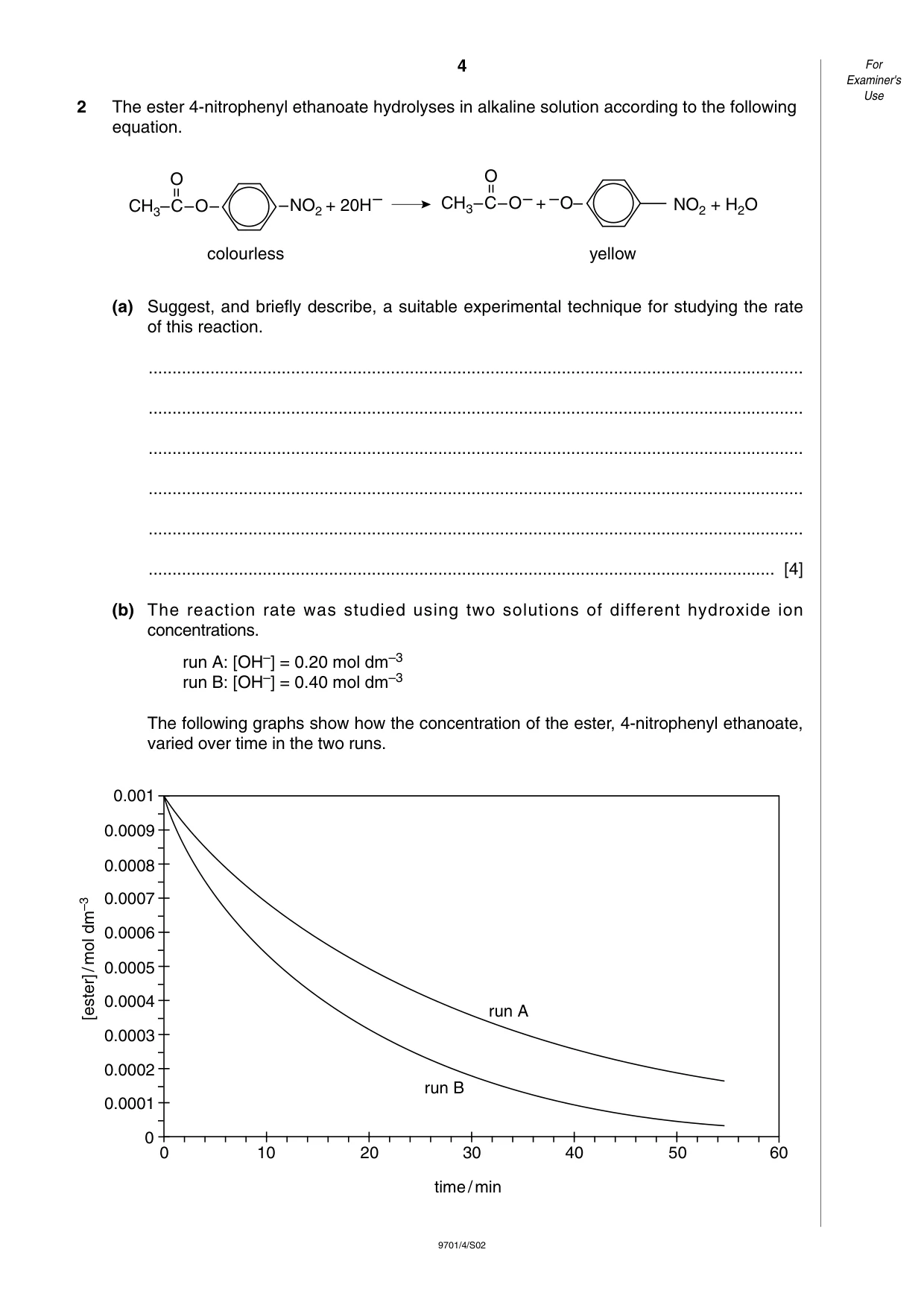
2 The ester 4-nitrophenyl ethanoate hydrolyses in alkaline solution according to the following equation. (a) Suggest, and briefly describe, a suitable experimental technique for studying the rate of this reaction. … … … … … … [4] (b) The reaction rate was studied using two solutions of different hydroxide ion concentrations. run A: [OH–] = 0.20 mol dm–3 run B: [OH–] = 0.40 mol dm–3 The following graphs show how the concentration of the ester, 4-nitrophenyl ethanoate, varied over time in the two runs. 0.001 0.0009 0.0008 0.0007 0.0006 0.0005 0.0004 0.0003 0.0002 0.0001 0 0 10 20 30 40 50 60 run A run B time/min [ester]/mol dm–3 CH3–C–O– O O –NO2 + 20H– CH3–C–O– + –O– NO2 + H2O colourless yellow 4 9701/4/S02 For Examiner's Use
Question paper, page 5
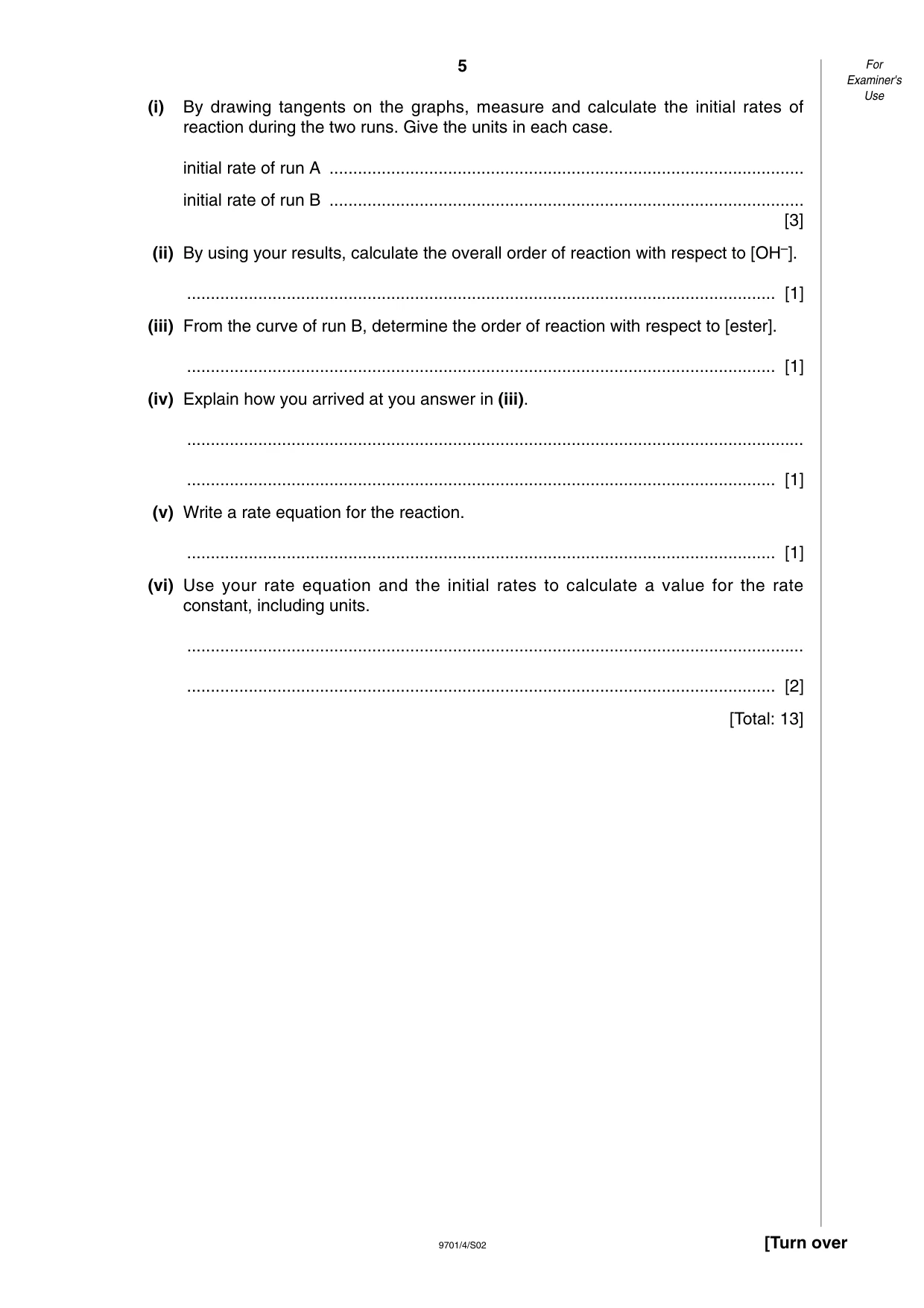
(i) By drawing tangents on the graphs, measure and calculate the initial rates of reaction during the two runs. Give the units in each case. initial rate of run A … initial rate of run B … [3] (ii) By using your results, calculate the overall order of reaction with respect to [OH–]. … [1] (iii) From the curve of run B, determine the order of reaction with respect to [ester]. … [1] (iv) Explain how you arrived at you answer in (iii). … … [1] (v) Write a rate equation for the reaction. … [1] (vi) Use your rate equation and the initial rates to calculate a value for the rate constant, including units. … … [2] [Total: 13] 5 9701/4/S02 [Turn over For Examiner's Use
Question paper, page 6
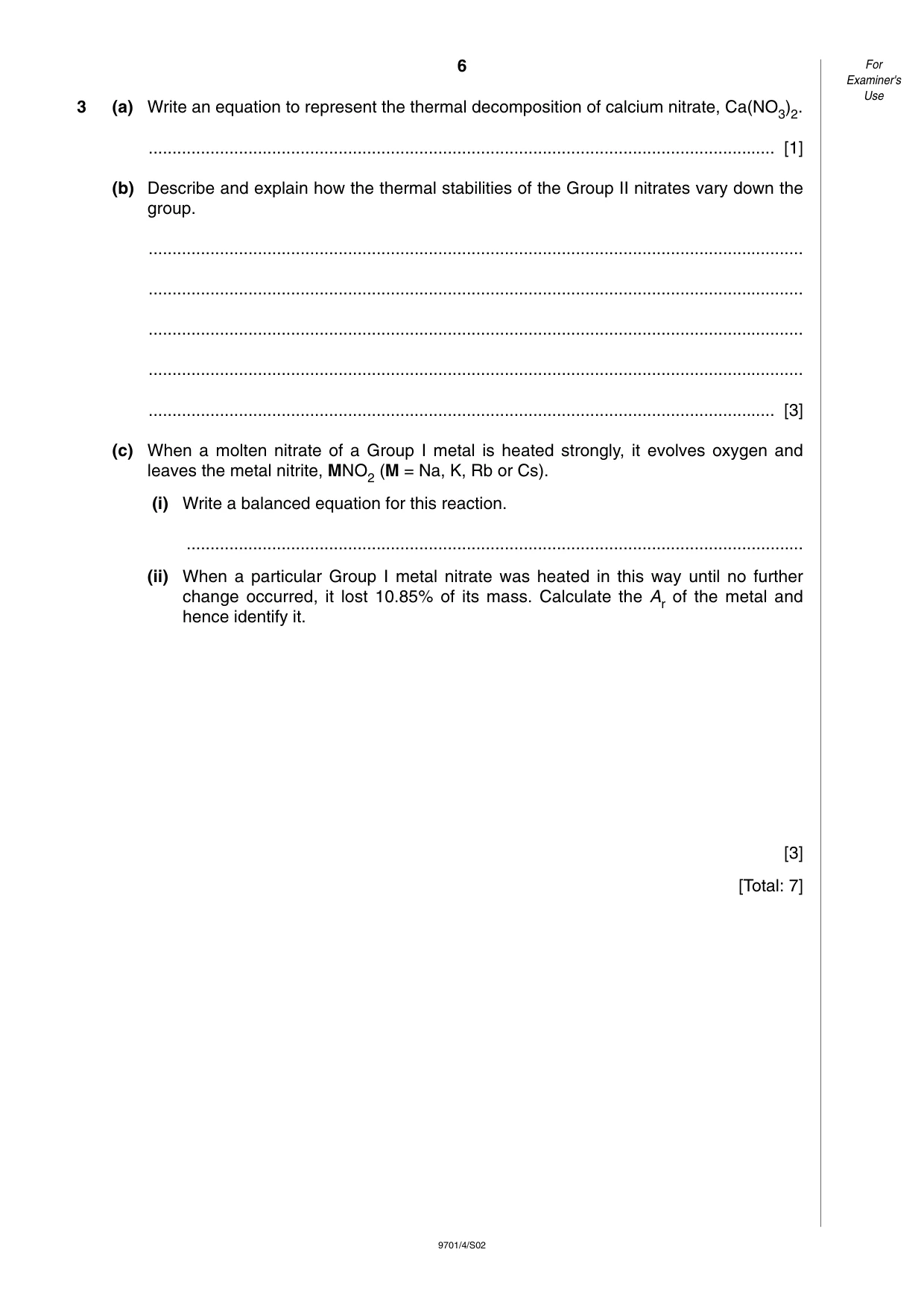
3 (a) Write an equation to represent the thermal decomposition of calcium nitrate, Ca(NO3)2. … [1] (b) Describe and explain how the thermal stabilities of the Group II nitrates vary down the group. … … … … … [3] (c) When a molten nitrate of a Group I metal is heated strongly, it evolves oxygen and leaves the metal nitrite, MNO2 (M = Na, K, Rb or Cs). (i) Write a balanced equation for this reaction. … (ii) When a particular Group I metal nitrate was heated in this way until no further change occurred, it lost 10.85% of its mass. Calculate the Ar of the metal and hence identify it. [3] [Total: 7] 6 9701/4/S02 For Examiner's Use
Question paper, page 7
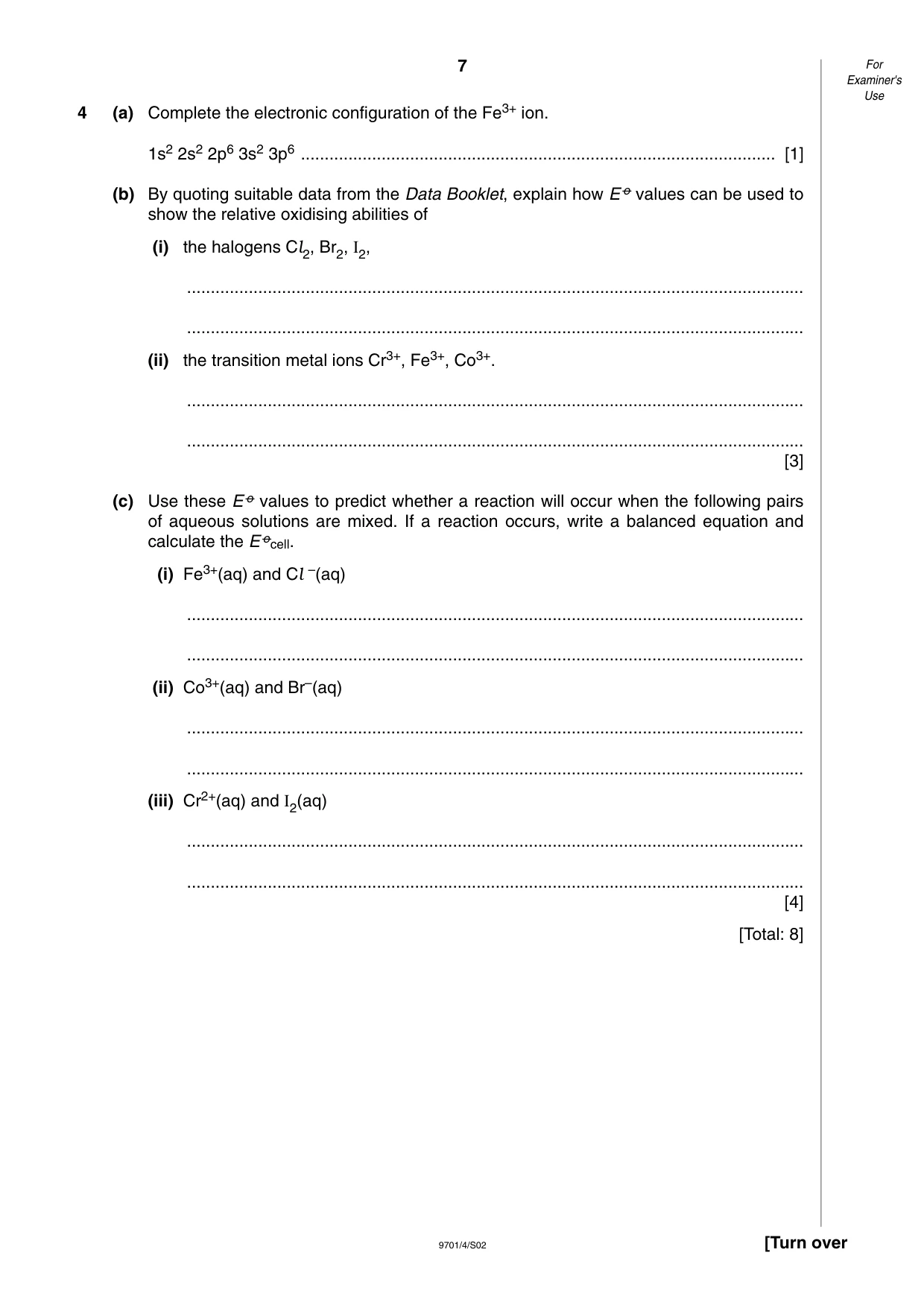
4 (a) Complete the electronic configuration of the Fe3+ ion. 1s2 2s2 2p6 3s2 3p6 … [1] (b) By quoting suitable data from the Data Booklet, explain how E o– values can be used to show the relative oxidising abilities of (i) the halogens Cl2, Br2, I2, … … (ii) the transition metal ions Cr3+, Fe3+, Co3+. … … [3] (c) Use these E o– values to predict whether a reaction will occur when the following pairs of aqueous solutions are mixed. If a reaction occurs, write a balanced equation and calculate the E o–cell. (i) Fe3+(aq) and Cl –(aq) … … (ii) Co3+(aq) and Br–(aq) … … (iii) Cr2+(aq) and I2(aq) … … [4] [Total: 8] 7 9701/4/S02 [Turn over For Examiner's Use
Question paper, page 8
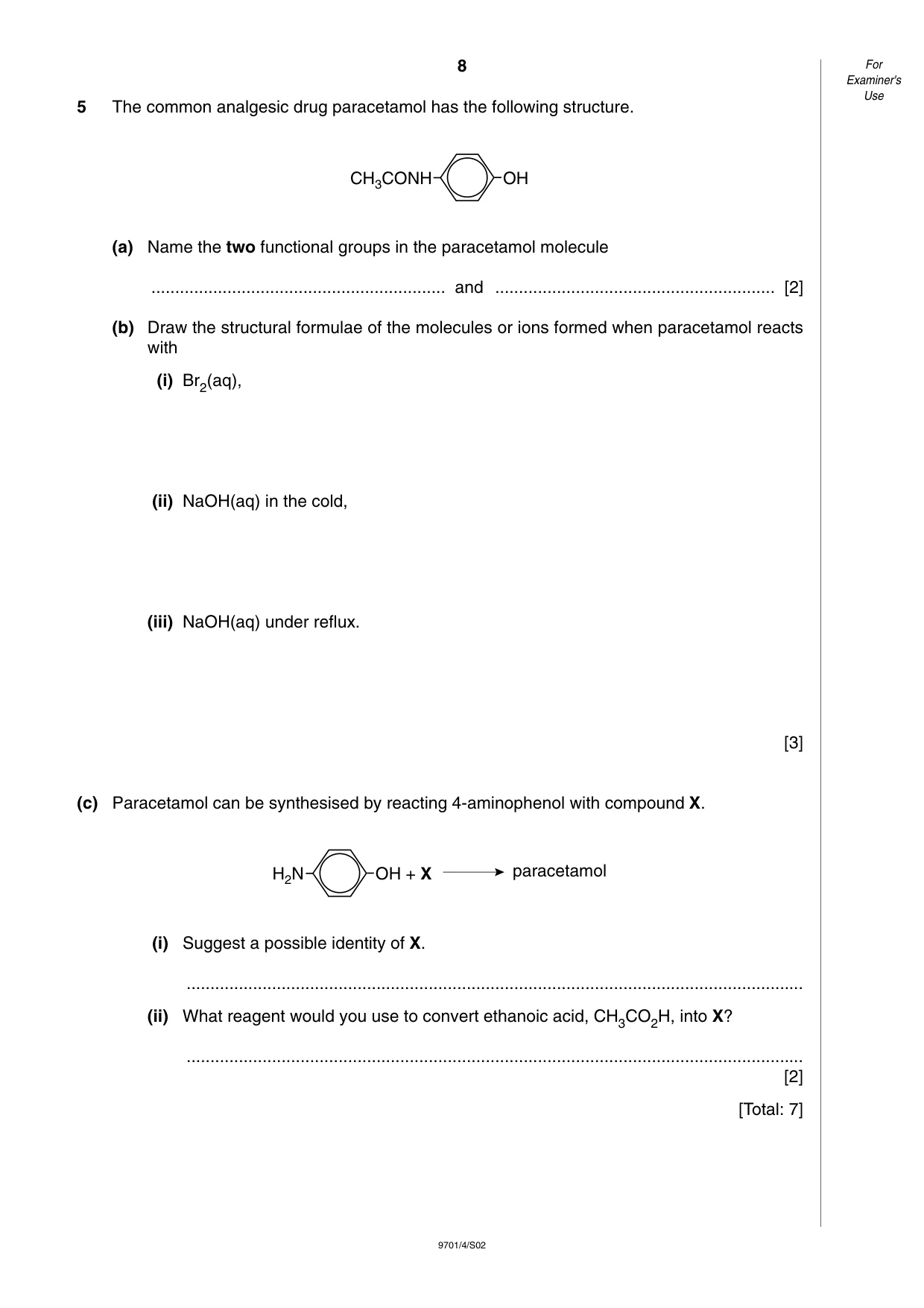
5 The common analgesic drug paracetamol has the following structure. (a) Name the two functional groups in the paracetamol molecule … and … [2] (b) Draw the structural formulae of the molecules or ions formed when paracetamol reacts with (i) Br2(aq), (ii) NaOH(aq) in the cold, (iii) NaOH(aq) under reflux. [3] (c) Paracetamol can be synthesised by reacting 4-aminophenol with compound X. (i) Suggest a possible identity of X. … (ii) What reagent would you use to convert ethanoic acid, CH3CO2H, into X? … [2] [Total: 7] OH + X H2N paracetamol CH3CONH OH 8 9701/4/S02 For Examiner's Use
Question paper, page 9
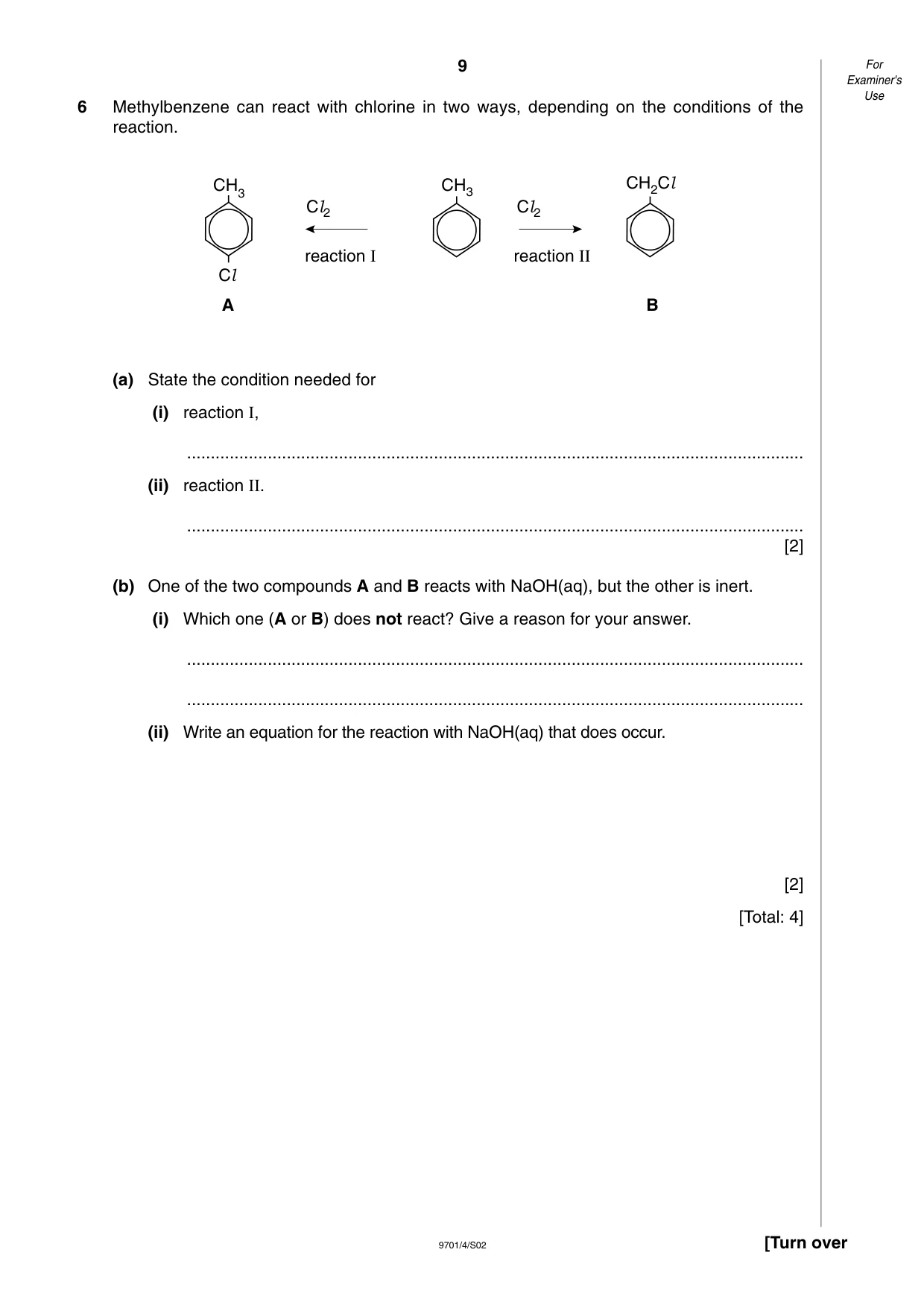
6 Methylbenzene can react with chlorine in two ways, depending on the conditions of the reaction. (a) State the condition needed for (i) reaction I, … (ii) reaction II. … [2] (b) One of the two compounds A and B reacts with NaOH(aq), but the other is inert. (i) Which one (A or B) does not react? Give a reason for your answer. … … (ii) Write an equation for the reaction with NaOH(aq) that does occur. [2] [Total: 4] CH3 Cl reaction I CH3 reaction II Cl2 Cl2 CH2Cl A B 9 9701/4/S02 [Turn over For Examiner's Use
Question paper, page 10
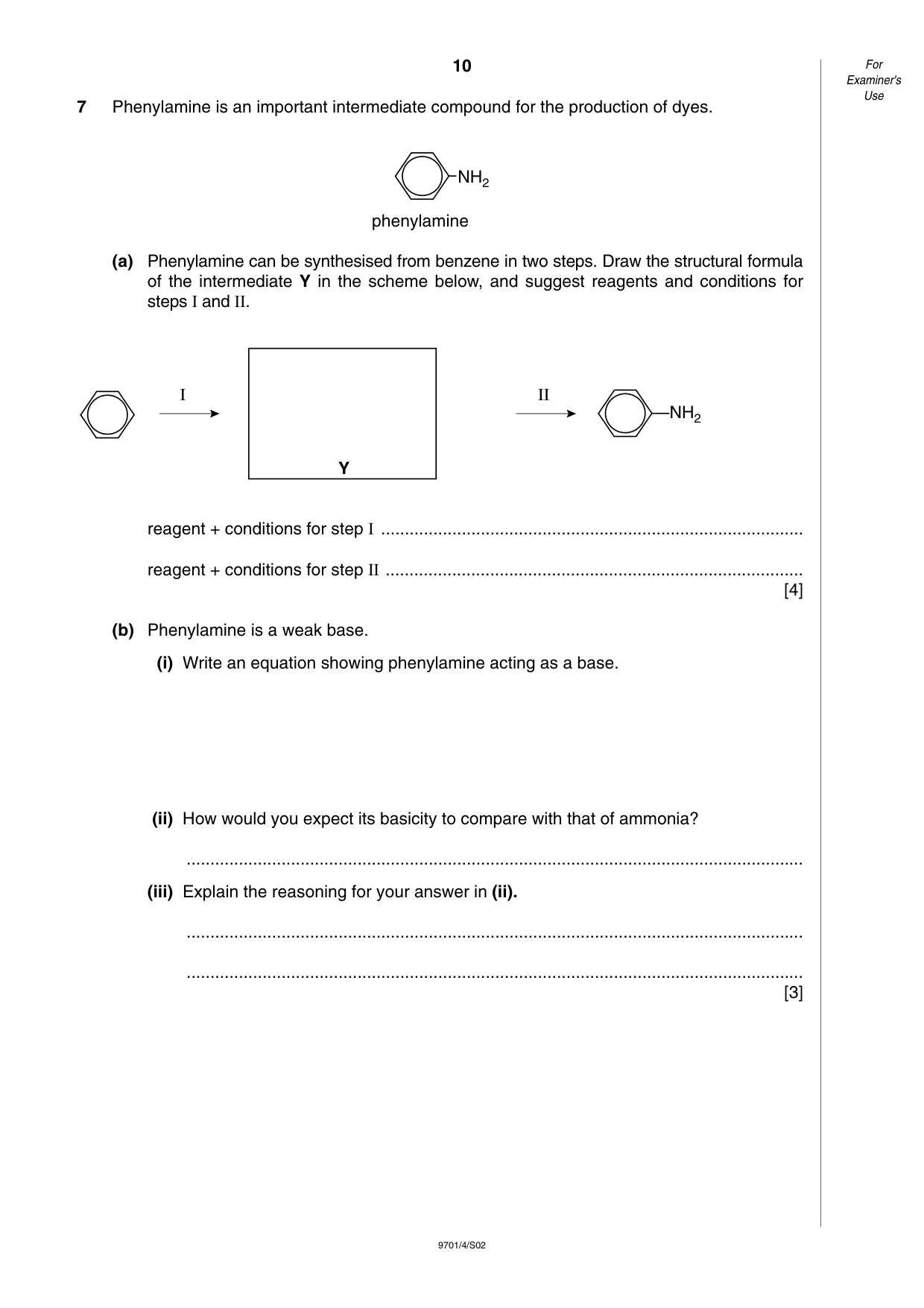
7 Phenylamine is an important intermediate compound for the production of dyes. phenylamine (a) Phenylamine can be synthesised from benzene in two steps. Draw the structural formula of the intermediate Y in the scheme below, and suggest reagents and conditions for steps I and II. reagent + conditions for step I … reagent + conditions for step II … [4] (b) Phenylamine is a weak base. (i) Write an equation showing phenylamine acting as a base. (ii) How would you expect its basicity to compare with that of ammonia? … (iii) Explain the reasoning for your answer in (ii). … … [3] I Y II —NH2 NH2 10 9701/4/S02 For Examiner's Use
Question paper, page 11
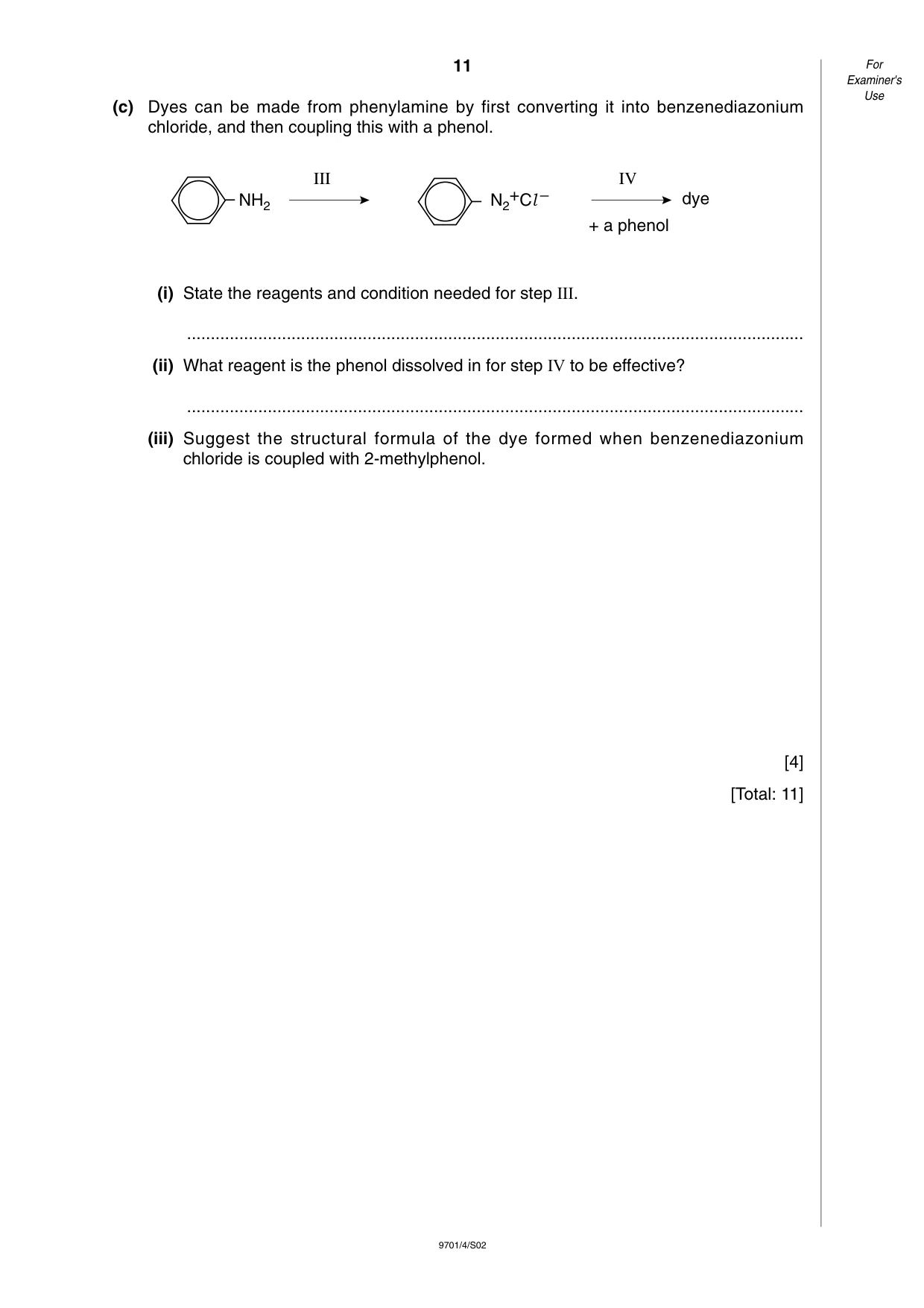
(c) Dyes can be made from phenylamine by first converting it into benzenediazonium chloride, and then coupling this with a phenol. (i) State the reagents and condition needed for step III. … (ii) What reagent is the phenol dissolved in for step IV to be effective? … (iii) Suggest the structural formula of the dye formed when benzenediazonium chloride is coupled with 2-methylphenol. [4] [Total: 11] NH2 N2+Cl– III IV dye + a phenol 11 9701/4/S02 For Examiner's Use
Mark scheme, page 1
CAMBRIDGE INTERNATIONAL EXAMINATIONS JUNE 2002 GCE Advanced Level MARK SCHEME MAXIMUM MARK : 60 SYLLABUS/COMPONENT :9701 /4 CHEMISTRY (STRUCTURED QUESTIONS (A2 CORE)) P8393 Universiry of CAMBRIDGE 2 Local Examinations Syndicate
Mark scheme, page 2
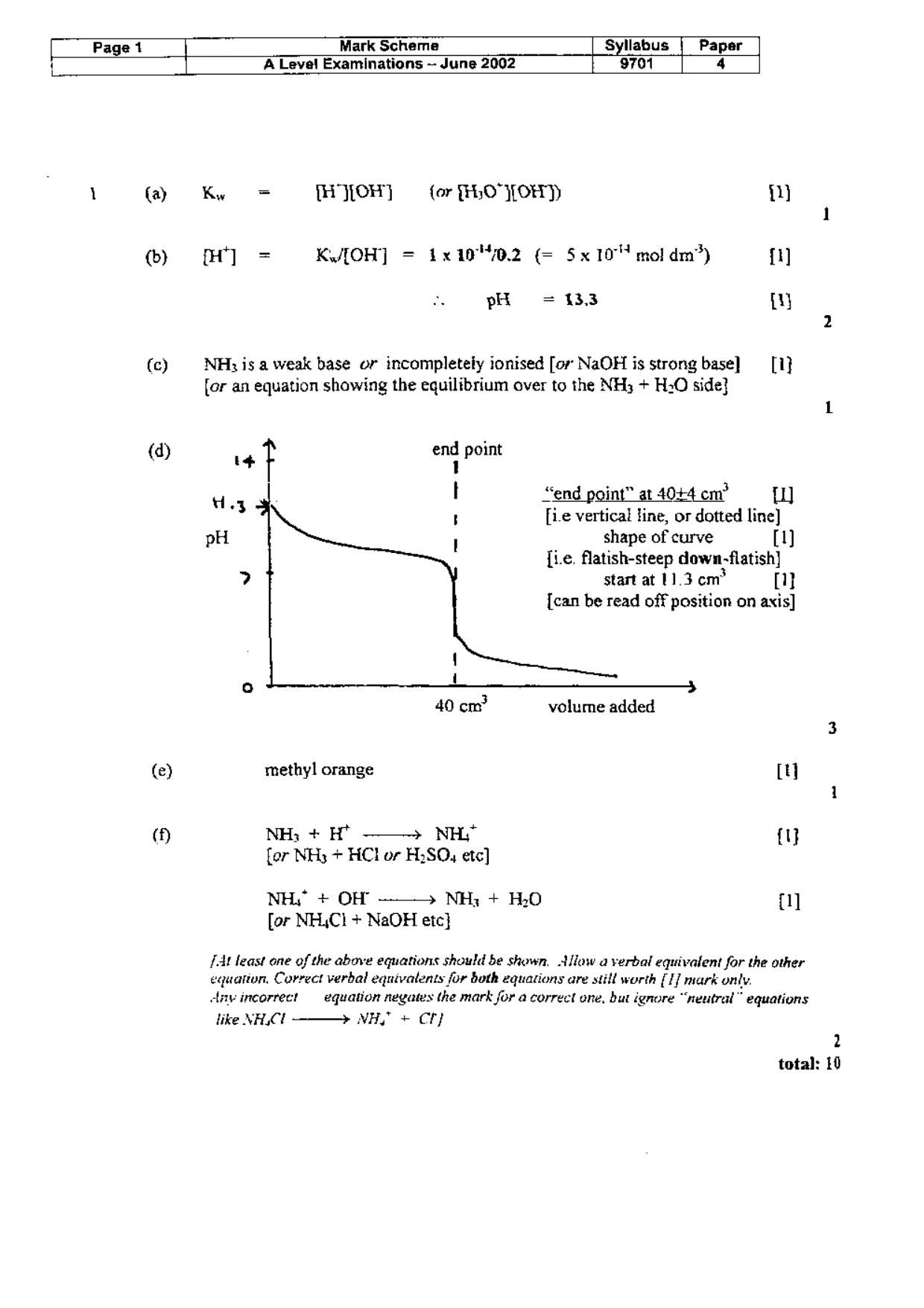
Page 1 Mark Scheme Syllabus | Paper A Level Examinations ~ June 2002 9701 4 1 (a) (b) (c) (4) (e) (f) Kw = {HYOH] {or FLO) sph) fH] = KV[OH] = 1x10%0.2 (= 5x10 mol dm?) {}] pH = 133 iy NH; is a weak base or incompletely ionised [or NaOH is strong base] —[1} {or an equation showing the equilibrium over to the NH + H20O side} 4 t end point t “end point” at 40+4 cm? Wg . ' [Le vertical line, or dotted line] pH shape of curve [1] [i.e. flatish-steep down-flatish] ? start at 11.3 cm? en [can be read off position on axis] ° 40 cm? volume added methyl orange [i NH; + Ht ———> NH,” {I} [er NHy + HCI! or H2SO, etc] NH,” + OH ——-> NH; + H,0 tl] [or NH,Cl + NaOH etc} [At least one of the above equations should be shown, Allow a verbal equivatent for the other equation, Correct verbal equivalents for both equations are still worth {1] mark only. clay incorrect equation negates the mark for a correct one, but ignore “neutral” equations like NHsCl ———> NH, + CT} 2 total: 10
Mark scheme, page 3
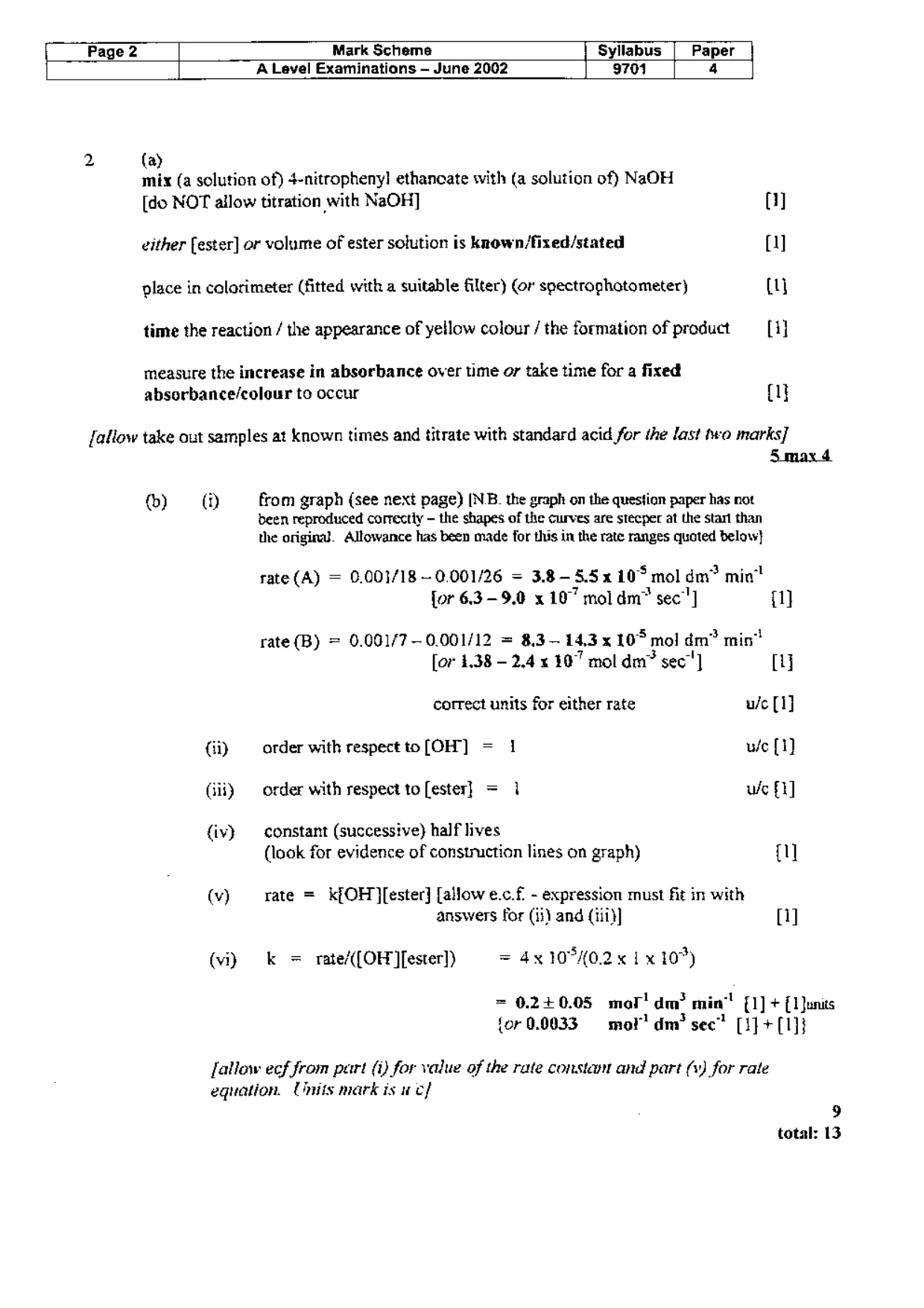
Page 2 Mark Scheme Syllabus Paper A Level Examinations — June 2002 9701 4 2 (a) mix (a solution of) 4-nitropheny! ethancate with (a solution of) NaOH [do NOT allow titration with NaOH] 0] either [ester] or volume of ester solution is known/fixed/stated (1) place in colorimeter (fitted with a suitable filter) (or spectrophotometer) (ty time the reaction / the appearance of yellow colour / the formation of product {i measure the increase in absorbance over time or take time for a fixed absorbance/colour to occur {ly fallow take out samples at known times and titrate with standard acid for the last tvo marks] Smaxd ob) (i from graph (see next page) [N.B. the graph on the question paper has not been reproduced correctly - the shapes of the curves are stecper at the start than the origina3. Allowance has been made for this in the rate ranges quoted below} rate (A) = 0.001/18 ~0.001/26 = 3.8—5.5x 10° mol dm? min™ {or 6.3-9.0 x 10⁷ mol dm”™ sec] {1} rate(B) = 0.001/7—0,001/12 = 8.3-—14,3 x 10° mol dm? min™ [or 1,38 - 2.4 x 10⁷ mol dm® sec] (y correct units for either rate u/c [1] (i) order with respect to[OH] = 1 u/c [1] (iii) order with respect to [ester] = 1 ue 1] {iv} constant (successive) half lives (look for evidence of construction lines on graph) tl (v) rate = k{OH][ester] [allow e.c.f. - expression must fit in with answers for (ii) and {iii}] Ui] (vi) =k O= = rate/([OH J[ester]) 4x 10°0.2 « 1 x 10⁷) = 0.20.05 mol! dm? min” [1] + {1 }units {or 0.0033 mot’ dm’ sec? [1] +(I]} {allow ecf from part (i) for value of the rate constem and part (x) for rate equation. Units mark is uc} 9 total: 13
Mark scheme, page 4
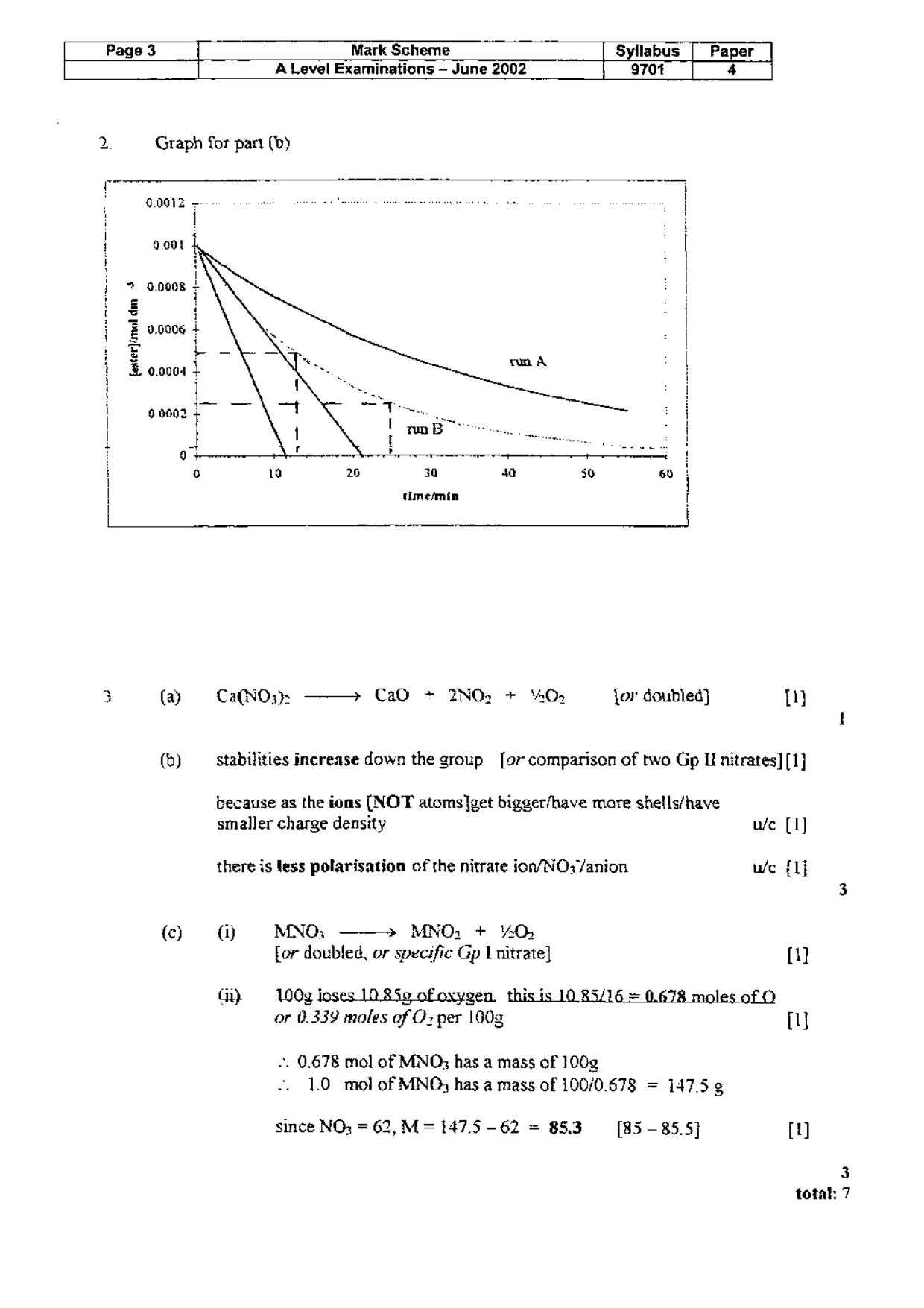
Page 3 { Mark Scheme Syllabus | Paper I A Level Examinations — June 2002 9701 4 2. Graph for part (b) fexterymol dm + e = 8 2 & 2 r= 3 s = a ee ae ! | @ 0002 + Bo YE XK RB ee 1 + \ ° 10 20 30 40 30 | timefnin i | 3 (a> Ca(NO3) ——> CaO + INQ. + “O02 jor doubled} 1 i (b) stabilities increase down the group [or comparison of two Gp I nitrates] (1] because as the ions (NOT atoms|get bigger/have mare shells/have smaller charge density u/e [1] there is less polarisation of the nitrate ion/NOy/anion u/c {lj 3 {c) fi) MNO, ———> MNO: + %O) for doubled, or specific Gp | nitrate} {i} G) 100g loses 1N 859 of oxygen. this is 10 85/16 = 0.678 moles of O or 0.339 moles of Oz per 100g ty -. 0.678 mol of MNO; has a mass of 100g 1.0 mol of MNO; has a mass of 100/0.678 = 147.59 since NOs = 62, M= 147.5-62 = 85.3 [85 — 85.5] ft] 3 total: 7
Mark scheme, page 5
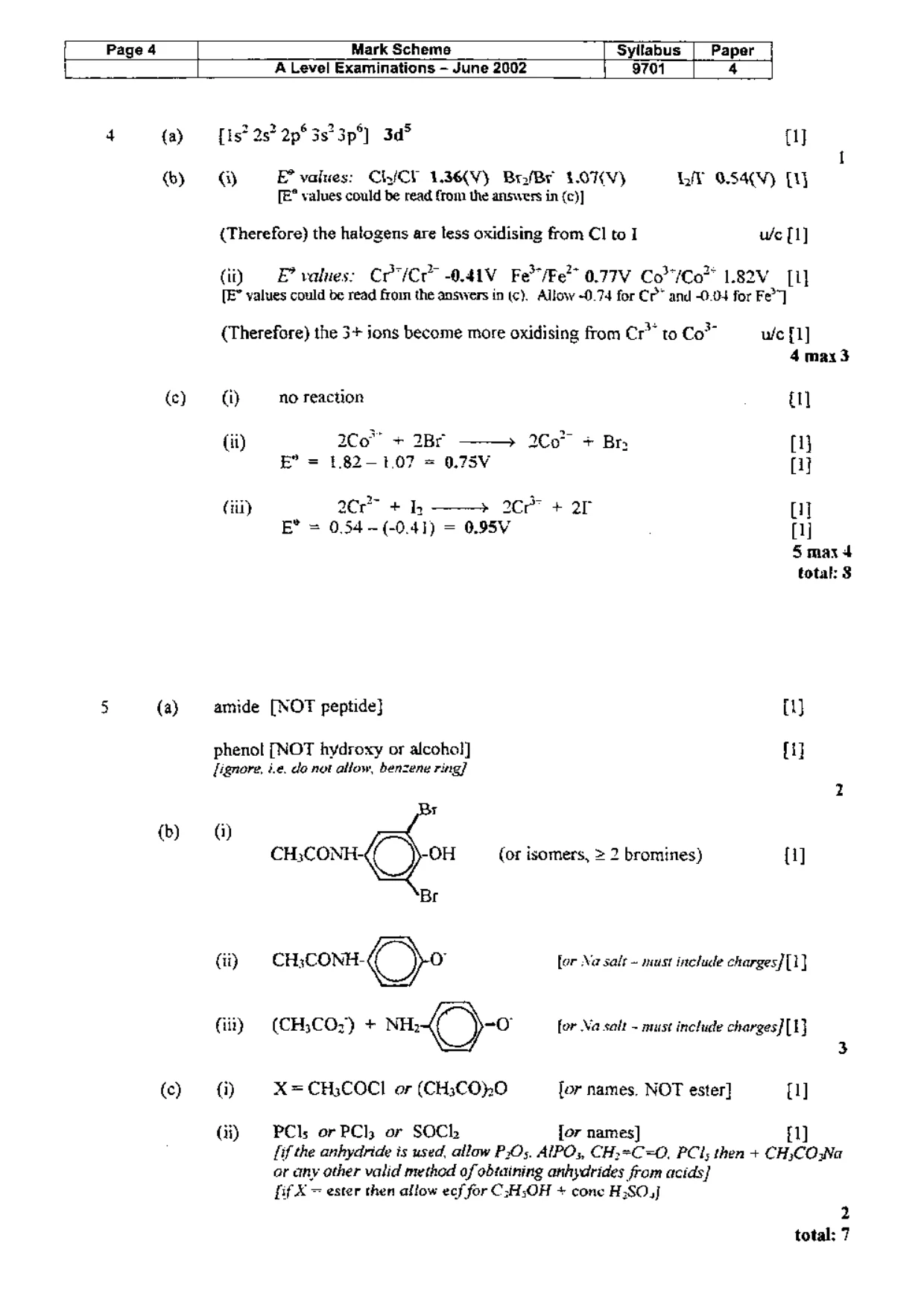
Page 4 Mark Scheme Syilabus | Paper L A Level Examinations -— June 2002 9701 4 4 {a) _[Is’ 2s" 2p°3s"3p°] 3d° ay 1 6) GE’ values: ClyCY 1.36(V) BrfBr 1.07(V) LA Os4¢y) [Yh [E° values could be read from the answers in (c)] {Therefore) the hatogens are tess oxidising from Cl to I ue [1] (ii) EP values: CVC -.41V_ Fe Fe 0.77V Co” /Co* 1.82V_ [1] [E” values could be read from the answers in (¢), Allow -0.74 for CP* and -0.04 for Fe] (Therefore) the 3+ ions become more oxidising from Cr** to Co” u/c [1] 4max3 (ce) ra) no reaction faa (ii) 2Co” + 2Br ——> 2Co” + Br (iy E* = 182-107 = 0.75V 3} (ii) 2Cr" + 1p ——> 2Cr + ar ie E® = 0.54-~(-0.41) = 0.95V fj Smax4 totak: 8 5 (a) amide [NOT peptide} {1} phenol [NOT hydroxy or alcohol] {1] lignore, i.e. do net allow, benzene ring] 2 TT {b) i) CH;CONH-: -OH (or isomers, > 2 bromines) {1] ‘Br (i) CHy;CONH- © for Na salt ~ must include charges}(1} (iii) = (CH3COz) + m“)-0 for Na salt ~ must include charges}[L} 3 (c) = fi) X=CH3COCI or (CH3CO):0 {or names. NOT ester] a] Gi) PCls or PCly or SOCh {or names] 1) [if the anhydride is used, allow POs. AIPO;, CH:=C=O, PCI; then + CHyCOWNa ar any other valid method of obtaining anhydrides from acids} fif X = ester then allow ecf for C3H,OH + cone H;SO.J total: 7
Mark scheme, page 6
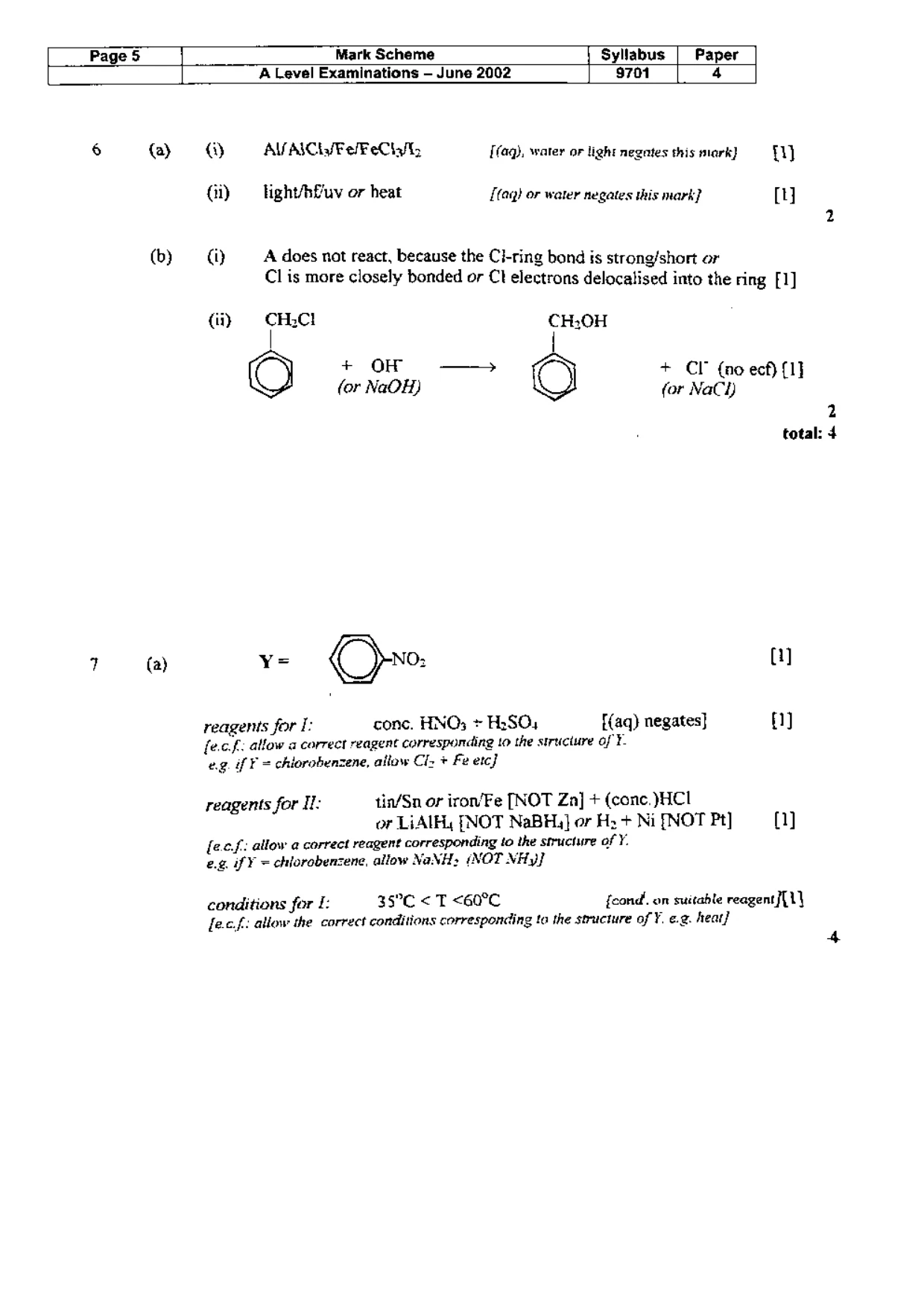
Page 5 Mark Scheme Syllabus Paper A Level Examinations - June 2002 9701 4 6 {a) Q) AVAICIVFelF eCity [(aq), water or light negates this mark} Wy Gi) light/hfuv or heat {faq} or water negates this mark} [t] 2 (b) ti) A does not react, because the Clring bond is strong/short or Cl is more closely bonded or Ct electrons delocatised into the ring [1] (i) CHCl CH.OH | ©) + OW —> + CY (no ecf {1] (or NaOH) for NaC) 2 total: 4 (a) Y= Ore: it reagents for I: conc. HNO; + H:SOy {(aq} negates} 0) fe.c.f: allow a correct reagent corresponding to the structure of ¥. eg. if ¥ = chlorobenzene, allow Cl: + Fe etc} reagents for Il: tin/Sn or iron/Fe [NOT Za] + (conc. HCI or LiAIHy [NOT NaBH,] or Hz + Ni [NOT Pt] Q)) fe.c.f: allow a correct reagent corresponding to the structure of Y. e.g, if ¥ = chlorobenzene, allow NaNi, (NOT NHty] conditions for I: 39°C < T <60°C feond. on suitable reagent}{1] fec.f: allow the correct conditions corresponding to the structure of ¥. e.g. heat}
Mark scheme, page 7
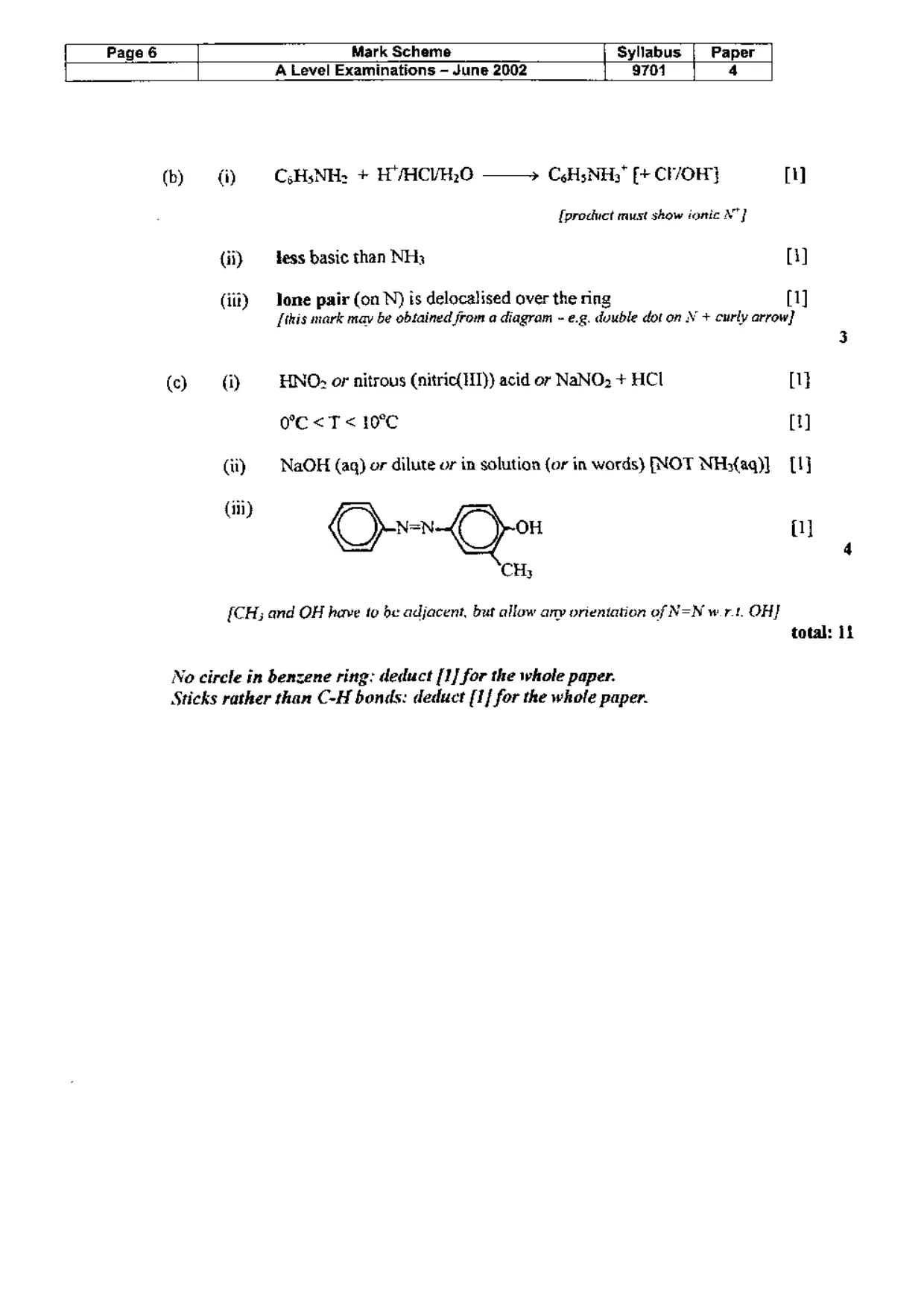
Page 6 Mark Scheme Syllabus Paper A Level Examinations — June 2002 9701 4 (b) {i) CsHsNH: + H’/ACVH,Q0 ——» CoH;NH;" [+ CH/OH} fi] {product must show ionic N”] (ii) tess basic than NH 0G) (iit) lone pair (on N) is delocatised over the ring 01] {this mark may be obtained from a diagram ~- e.g. double dot on N + curly arrow} 3 () @ HNO: or nitrous (nitric(HI)) acid or NaNO2 + HCI 0} OC <T< 10°C (y Gi) NaOH (aq) or dilute or in solution (or in words) [NOT NHs{aq)} [1] Gil) Or-Opo 0] 4 CH; {CH; and OH have to bc adjacent, but allow any orientation of N=N w.r.t, OH} total: 11 No circle in benzene ring: deduct [1] for the whole paper. Sticks rather than C-H bonds: deduct [1{ for the whole paper.