Cambridge A Level Business (for first examination in 2016) 9609 — 2022 Oct/Nov Paper 3 · Variant 3
9609/33/O/N/22 · 100 marks · ≈113 min
The question paper and its mark scheme, free to read here and free to download. This is Cambridge’s own paper, exactly as it was sat.
Question paper20 pages















Mark scheme22 pages
Answers below. Sit the paper first if you are practising.


Paper as text
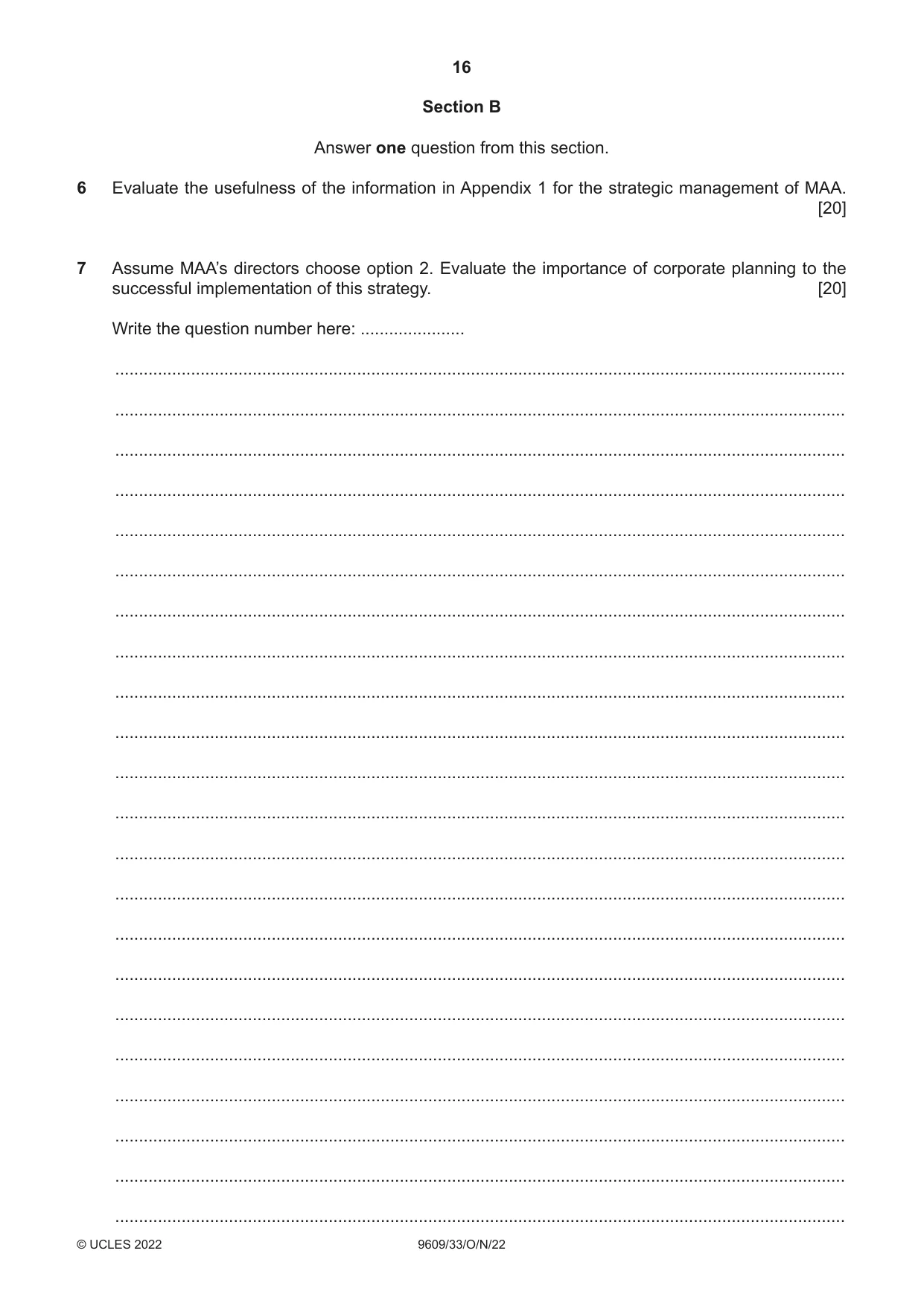
Question paper, page 1
This document has 20 pages. Any blank pages are indicated. [Turn over DC (RW) 302943/1 © UCLES 2022 * 1 7 0 7 8 1 2 5 9 1 * BUSINESS 9609/33 Paper 3 Case Study October/November 2022 3 hours You must answer on the question paper. You will need: Insert (enclosed) INSTRUCTIONS ● Section A: answer all questions. ● Section B: answer one question. ● Use a black or dark blue pen. ● Write your name, centre number and candidate number in the boxes at the top of the page. ● Write your answer to each question in the space provided. ● Do not use an erasable pen or correction fluid. ● Do not write on any bar codes. ● You may use an HB pencil for any diagrams, graphs or rough working. INFORMATION ● The total mark for this paper is 100. ● The number of marks for each question or part question is shown in brackets [ ]. ● The insert contains the case study. Cambridge International AS & A Level
Question paper, page 2
2 9609/33/O/N/22 © UCLES 2022 Answer all questions in Section A and answer one question in Section B. You are advised to spend no more than 40 minutes on Section B. Section A Answer all questions in this section. 1 Analyse two opportunities to MAA of the depreciation of country G’s currency against most major currencies (lines 11–14). … … … … … … … … … … … … … … … … … … … … … … …
Question paper, page 3
3 9609/33/O/N/22 © UCLES 2022 [Turn over … … … … … … … … … … … … … … … … … … … … … … … … … … … … [10]
Question paper, page 4
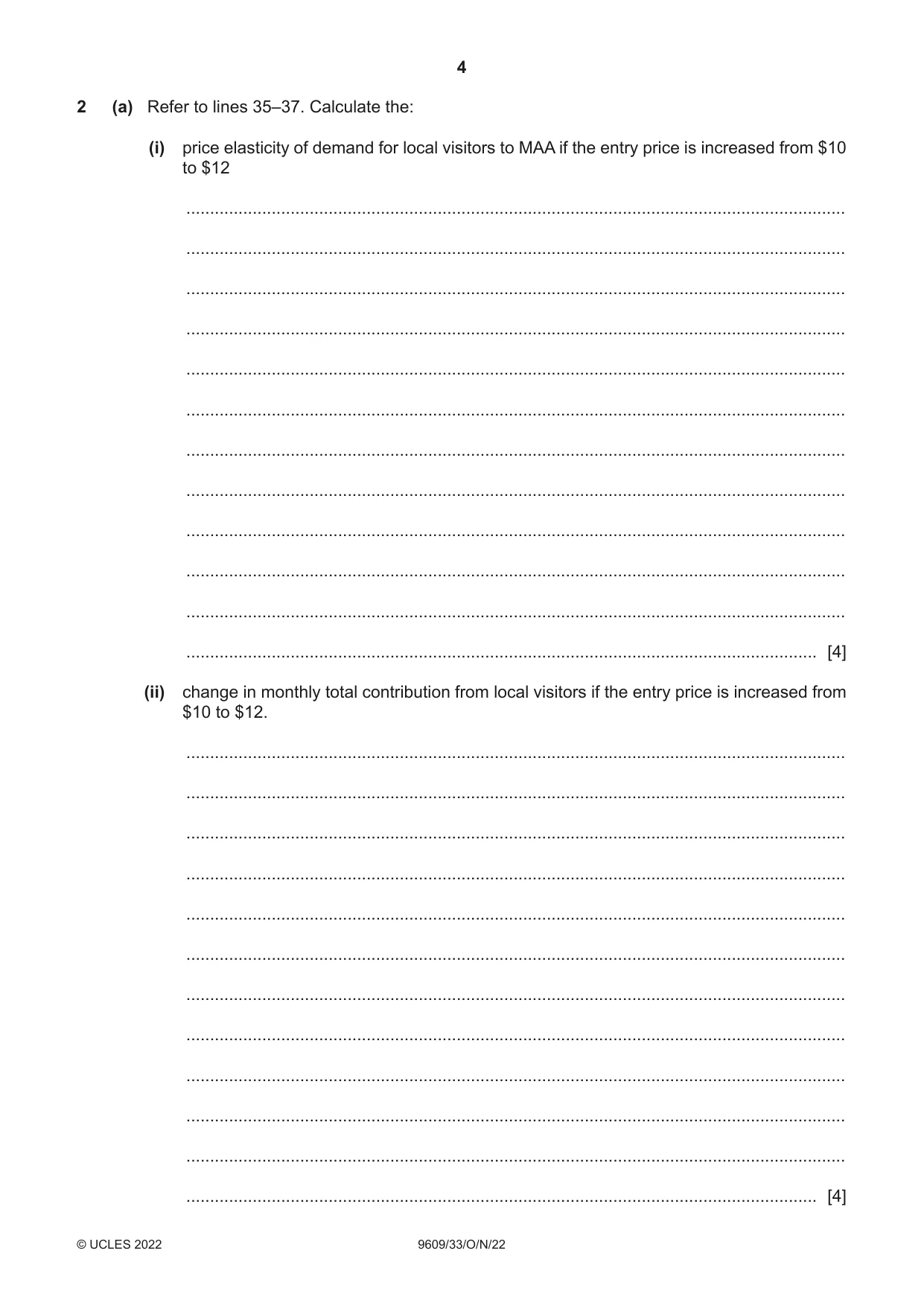
4 9609/33/O/N/22 © UCLES 2022 2 (a) Refer to lines 35–37. Calculate the: (i) price elasticity of demand for local visitors to MAA if the entry price is increased from $10 to $12 … … … … … … … … … … … … [4] (ii) change in monthly total contribution from local visitors if the entry price is increased from $10 to $12. … … … … … … … … … … … … [4]
Question paper, page 5
5 9609/33/O/N/22 © UCLES 2022 [Turn over (b) You may refer to your results from 2(a) and other information. Recommend whether MAA should change its entry price. Justify your recommendation. … … … … … … … … … … … … … … … … … … … … … … … … … … …
Question paper, page 6
6 9609/33/O/N/22 © UCLES 2022 … … … … … … … … … … … … … … … … … … … … … … … … … … … … [12]
Question paper, page 7
7 9609/33/O/N/22 © UCLES 2022 [Turn over 3 Evaluate the importance of social objectives as Muka prepares a 5‑year marketing plan for MAA. … … … … … … … … … … … … … … … … … … … … … … … … … … …
Question paper, page 8
8 9609/33/O/N/22 © UCLES 2022 … … … … … … … … … … … … … … … … … … … … … … … … … … … …
Question paper, page 9
9 9609/33/O/N/22 © UCLES 2022 [Turn over … … … … … … … … … … … … … … … … … … … … … … … … … … … … [16]
Question paper, page 10
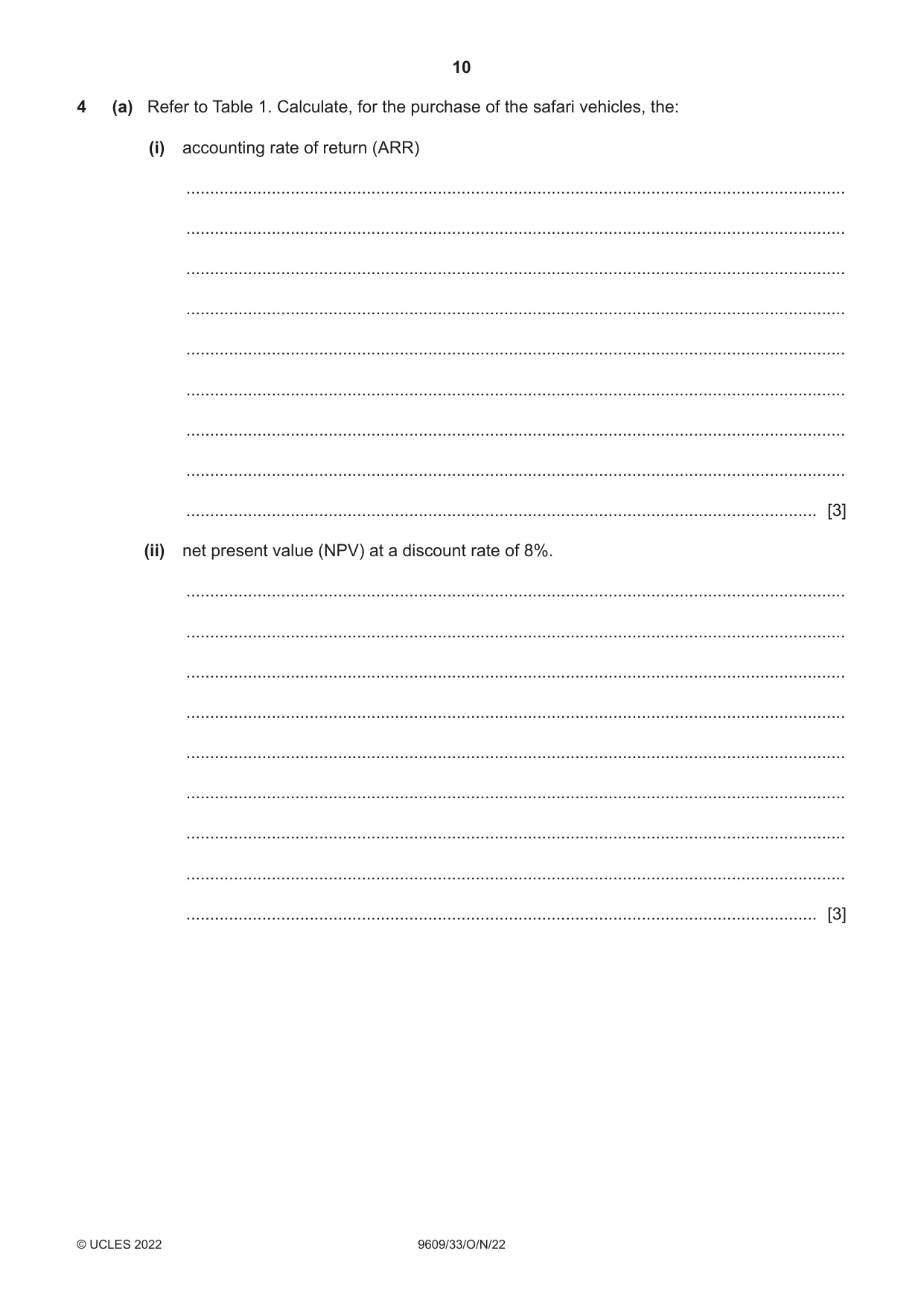
10 9609/33/O/N/22 © UCLES 2022 4 (a) Refer to Table 1. Calculate, for the purchase of the safari vehicles, the: (i) accounting rate of return (ARR) … … … … … … … … … [3] (ii) net present value (NPV) at a discount rate of 8%. … … … … … … … … … [3]
Question paper, page 11
11 9609/33/O/N/22 © UCLES 2022 [Turn over (b) You may refer to your results from 4(a) and other information. Recommend whether MAA should purchase the safari vehicles. Justify your recommendation. … … … … … … … … … … … … … … … … … … … … … … … … … … …
Question paper, page 12
12 9609/33/O/N/22 © UCLES 2022 … … … … … … … … … … … … … … … … … … … … … … … … … … … … [12]
Question paper, page 13
13 9609/33/O/N/22 © UCLES 2022 [Turn over 5 Evaluate the importance to Muka of workforce planning as she tries to reduce MAA’s total labour costs. … … … … … … … … … … … … … … … … … … … … … … … … … … …
Question paper, page 14
14 9609/33/O/N/22 © UCLES 2022 … … … … … … … … … … … … … … … … … … … … … … … … … … … …
Question paper, page 15
15 9609/33/O/N/22 © UCLES 2022 [Turn over … … … … … … … … … … … … … … … … … … … … … … … … … … … … [16]
Question paper, page 16
16 9609/33/O/N/22 © UCLES 2022 Section B Answer one question from this section. 6 Evaluate the usefulness of the information in Appendix 1 for the strategic management of MAA. [20] 7 Assume MAA’s directors choose option 2. Evaluate the importance of corporate planning to the successful implementation of this strategy. [20] Write the question number here: … … … … … … … … … … … … … … … … … … … … … … …
Question paper, page 17
17 9609/33/O/N/22 © UCLES 2022 [Turn over … … … … … … … … … … … … … … … … … … … … … … … … … … … …
Question paper, page 18
18 9609/33/O/N/22 © UCLES 2022 … … … … … … … … … … … … … … … … … … … … … … … … … … … …
Question paper, page 19
19 9609/33/O/N/22 © UCLES 2022 … … … … … … … … … … … … … … … … … … … … … … … … … … … …
Question paper, page 20
20 9609/33/O/N/22 © UCLES 2022 Permission to reproduce items where third‑party owned material protected by copyright is included has been sought and cleared where possible. Every reasonable effort has been made by the publisher (UCLES) to trace copyright holders, but if any items requiring clearance have unwittingly been included, the publisher will be pleased to make amends at the earliest possible opportunity. To avoid the issue of disclosure of answer‑related information to candidates, all copyright acknowledgements are reproduced online in the Cambridge Assessment International Education Copyright Acknowledgements Booklet. This is produced for each series of examinations and is freely available to download at www.cambridgeinternational.org after the live examination series. Cambridge Assessment International Education is part of Cambridge Assessment. Cambridge Assessment is the brand name of the University of Cambridge Local Examinations Syndicate (UCLES), which is a department of the University of Cambridge. BLANK PAGE
Mark scheme, page 1
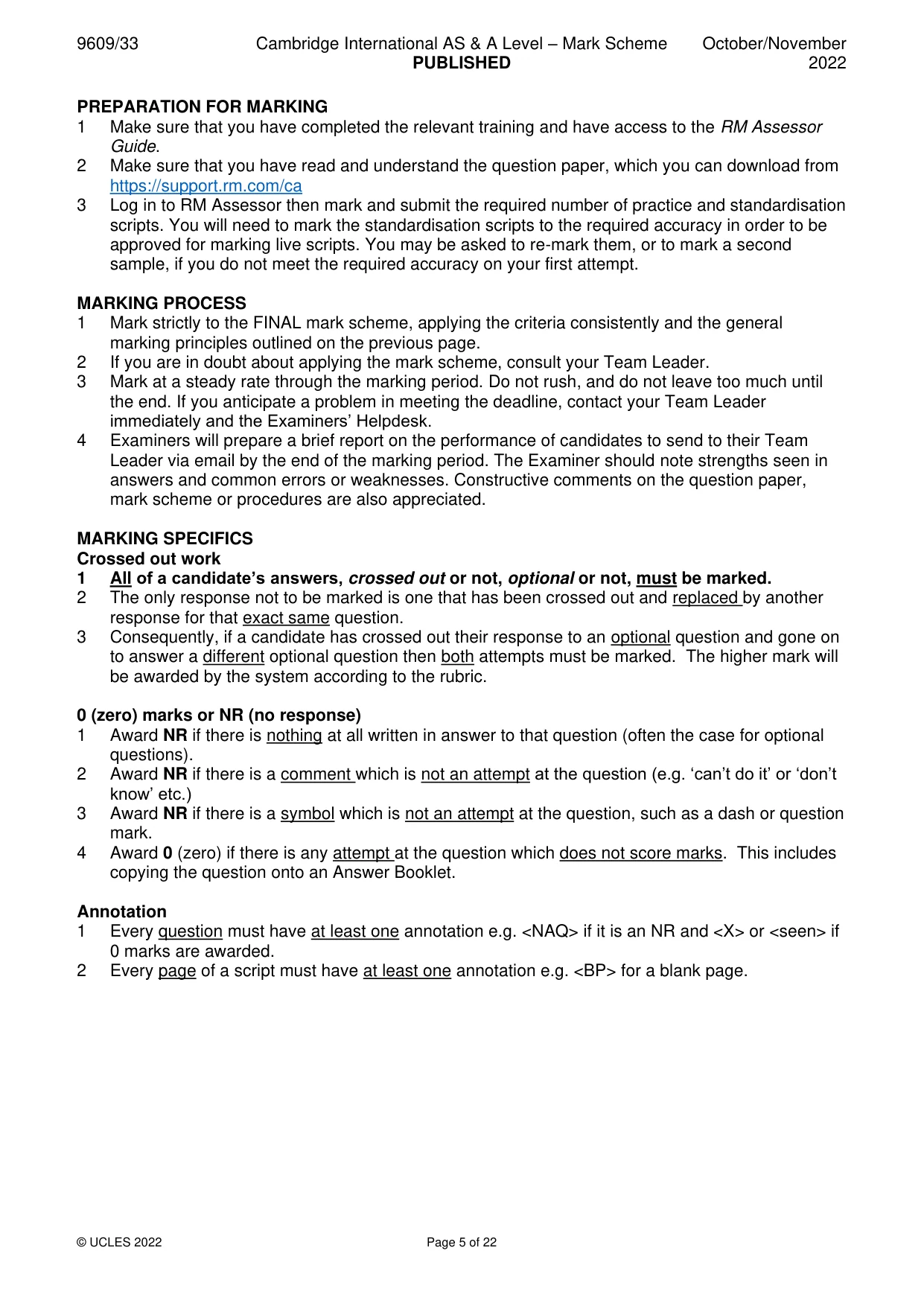
This document consists of 22 printed pages. © UCLES 2022 [Turn over Cambridge International AS & A Level BUSINESS 9609/33 Paper 3 Case Study October/November 2022 MARK SCHEME Maximum Mark: 100 Published This mark scheme is published as an aid to teachers and candidates, to indicate the requirements of the examination. It shows the basis on which Examiners were instructed to award marks. It does not indicate the details of the discussions that took place at an Examiners’ meeting before marking began, which would have considered the acceptability of alternative answers. Mark schemes should be read in conjunction with the question paper and the Principal Examiner Report for Teachers. Cambridge International will not enter into discussions about these mark schemes. Cambridge International is publishing the mark schemes for the October/November 2022 series for most Cambridge IGCSE™, Cambridge International A and AS Level components and some Cambridge O Level components.
Mark scheme, page 2
9609/33 Cambridge International AS & A Level – Mark Scheme PUBLISHED October/November 2022 © UCLES 2022 Page 2 of 22 Generic Marking Principles These general marking principles must be applied by all examiners when marking candidate answers. They should be applied alongside the specific content of the mark scheme or generic level descriptors for a question. Each question paper and mark scheme will also comply with these marking principles. GENERIC MARKING PRINCIPLE 1: Marks must be awarded in line with: • the specific content of the mark scheme or the generic level descriptors for the question • the specific skills defined in the mark scheme or in the generic level descriptors for the question • the standard of response required by a candidate as exemplified by the standardisation scripts. GENERIC MARKING PRINCIPLE 2: Marks awarded are always whole marks (not half marks, or other fractions). GENERIC MARKING PRINCIPLE 3: Marks must be awarded positively: • marks are awarded for correct/valid answers, as defined in the mark scheme. However, credit is given for valid answers which go beyond the scope of the syllabus and mark scheme, referring to your Team Leader as appropriate • marks are awarded when candidates clearly demonstrate what they know and can do • marks are not deducted for errors • marks are not deducted for omissions • answers should only be judged on the quality of spelling, punctuation and grammar when these features are specifically assessed by the question as indicated by the mark scheme. The meaning, however, should be unambiguous. GENERIC MARKING PRINCIPLE 4: Rules must be applied consistently, e.g. in situations where candidates have not followed instructions or in the application of generic level descriptors. GENERIC MARKING PRINCIPLE 5: Marks should be awarded using the full range of marks defined in the mark scheme for the question (however; the use of the full mark range may be limited according to the quality of the candidate responses seen). GENERIC MARKING PRINCIPLE 6: Marks awarded are based solely on the requirements as defined in the mark scheme. Marks should not be awarded with grade thresholds or grade descriptors in mind.
Mark scheme, page 3
9609/33 Cambridge International AS & A Level – Mark Scheme PUBLISHED October/November 2022 © UCLES 2022 Page 3 of 22 Social Science-Specific Marking Principles (for point-based marking) 1 Components using point-based marking: • Point marking is often used to reward knowledge, understanding and application of skills. We give credit where the candidate’s answer shows relevant knowledge, understanding and application of skills in answering the question. We do not give credit where the answer shows confusion. From this it follows that we: a DO credit answers which are worded differently from the mark scheme if they clearly convey the same meaning (unless the mark scheme requires a specific term) b DO credit alternative answers/examples which are not written in the mark scheme if they are correct c DO credit answers where candidates give more than one correct answer in one prompt/numbered/scaffolded space where extended writing is required rather than list-type answers. For example, questions that require n reasons (e.g. State two reasons …). d DO NOT credit answers simply for using a ‘key term’ unless that is all that is required. (Check for evidence it is understood and not used wrongly.) e DO NOT credit answers which are obviously self-contradicting or trying to cover all possibilities f DO NOT give further credit for what is effectively repetition of a correct point already credited unless the language itself is being tested. This applies equally to ‘mirror statements’ (i.e. polluted/not polluted). g DO NOT require spellings to be correct, unless this is part of the test. However spellings of syllabus terms must allow for clear and unambiguous separation from other syllabus terms with which they may be confused (e.g. Corrasion/Corrosion) 2 Presentation of mark scheme: • Slashes (/) or the word ‘or’ separate alternative ways of making the same point. • Semi colons (;) bullet points (•) or figures in brackets (1) separate different points. • Content in the answer column in brackets is for examiner information/context to clarify the marking but is not required to earn the mark (except Accounting syllabuses where they indicate negative numbers). 3 Calculation questions: • The mark scheme will show the steps in the most likely correct method(s), the mark for each step, the correct answer(s) and the mark for each answer • If working/explanation is considered essential for full credit, this will be indicated in the question paper and in the mark scheme. In all other instances, the correct answer to a calculation should be given full credit, even if no supporting working is shown. • Where the candidate uses a valid method which is not covered by the mark scheme, award equivalent marks for reaching equivalent stages. • Where an answer makes use of a candidate’s own incorrect figure from previous working, the ‘own figure rule’ applies: full marks will be given if a correct and complete method is used. Further guidance will be included in the mark scheme where necessary and any exceptions to this general principle will be noted.
Mark scheme, page 4
9609/33 Cambridge International AS & A Level – Mark Scheme PUBLISHED October/November 2022 © UCLES 2022 Page 4 of 22 4 Annotation: • For point marking, ticks can be used to indicate correct answers and crosses can be used to indicate wrong answers. There is no direct relationship between ticks and marks. Ticks have no defined meaning for levels of response marking. • For levels of response marking, the level awarded should be annotated on the script. • Other annotations will be used by examiners as agreed during standardisation, and the meaning will be understood by all examiners who marked that paper.
Mark scheme, page 5
9609/33 Cambridge International AS & A Level – Mark Scheme PUBLISHED October/November 2022 © UCLES 2022 Page 5 of 22 PREPARATION FOR MARKING 1 Make sure that you have completed the relevant training and have access to the RM Assessor Guide. 2 Make sure that you have read and understand the question paper, which you can download from https://support.rm.com/ca 3 Log in to RM Assessor then mark and submit the required number of practice and standardisation scripts. You will need to mark the standardisation scripts to the required accuracy in order to be approved for marking live scripts. You may be asked to re-mark them, or to mark a second sample, if you do not meet the required accuracy on your first attempt. MARKING PROCESS 1 Mark strictly to the FINAL mark scheme, applying the criteria consistently and the general marking principles outlined on the previous page. 2 If you are in doubt about applying the mark scheme, consult your Team Leader. 3 Mark at a steady rate through the marking period. Do not rush, and do not leave too much until the end. If you anticipate a problem in meeting the deadline, contact your Team Leader immediately and the Examiners’ Helpdesk. 4 Examiners will prepare a brief report on the performance of candidates to send to their Team Leader via email by the end of the marking period. The Examiner should note strengths seen in answers and common errors or weaknesses. Constructive comments on the question paper, mark scheme or procedures are also appreciated. MARKING SPECIFICS Crossed out work 1 All of a candidate’s answers, crossed out or not, optional or not, must be marked. 2 The only response not to be marked is one that has been crossed out and replaced by another response for that exact same question. 3 Consequently, if a candidate has crossed out their response to an optional question and gone on to answer a different optional question then both attempts must be marked. The higher mark will be awarded by the system according to the rubric. 0 (zero) marks or NR (no response) 1 Award NR if there is nothing at all written in answer to that question (often the case for optional questions). 2 Award NR if there is a comment which is not an attempt at the question (e.g. ‘can’t do it’ or ‘don’t know’ etc.) 3 Award NR if there is a symbol which is not an attempt at the question, such as a dash or question mark. 4 Award 0 (zero) if there is any attempt at the question which does not score marks. This includes copying the question onto an Answer Booklet. Annotation 1 Every question must have at least one annotation e.g. <NAQ> if it is an NR and <X> or <seen> if 0 marks are awarded. 2 Every page of a script must have at least one annotation e.g. <BP> for a blank page.
Mark scheme, page 6
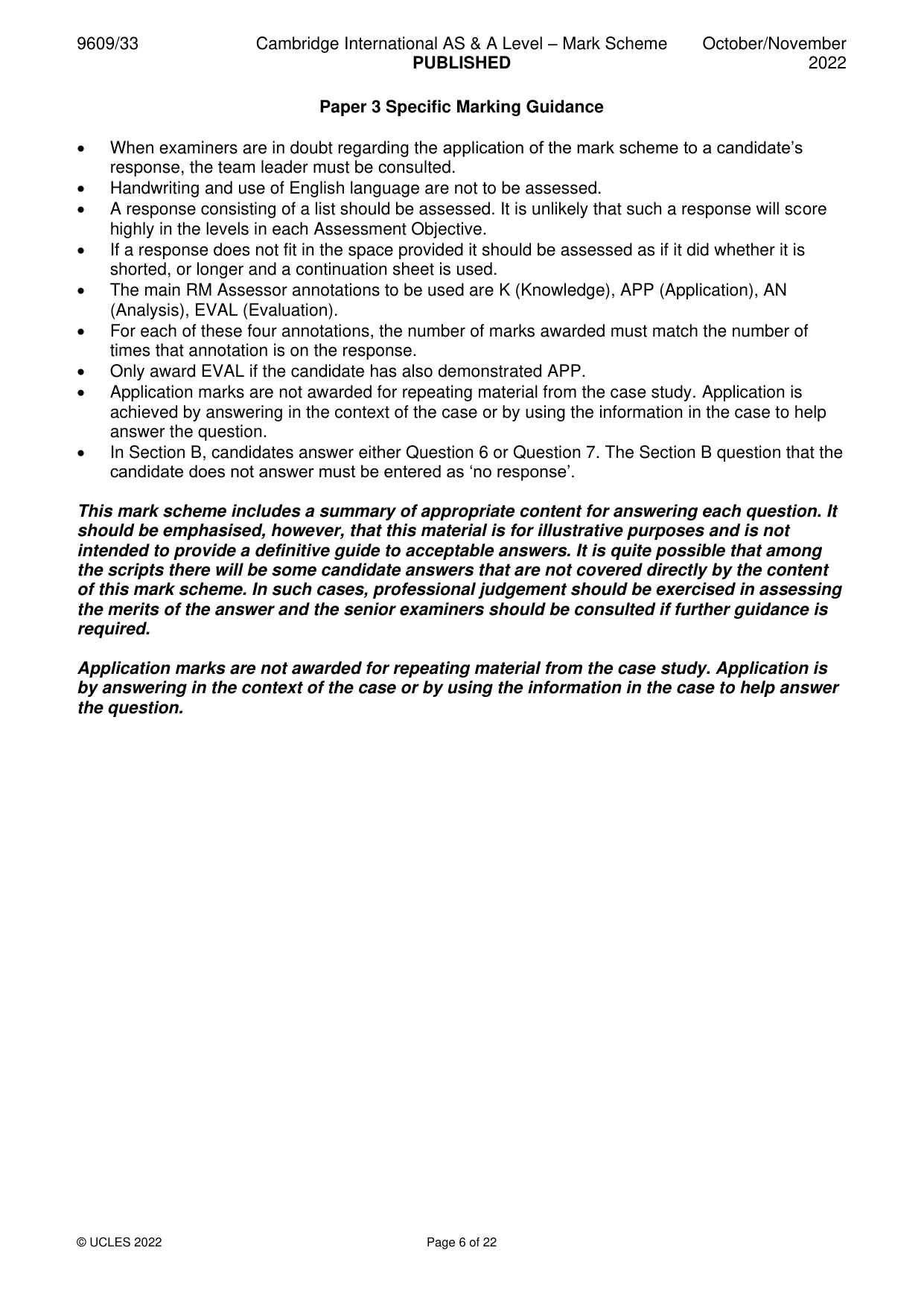
9609/33 Cambridge International AS & A Level – Mark Scheme PUBLISHED October/November 2022 © UCLES 2022 Page 6 of 22 Paper 3 Specific Marking Guidance • When examiners are in doubt regarding the application of the mark scheme to a candidate’s response, the team leader must be consulted. • Handwriting and use of English language are not to be assessed. • A response consisting of a list should be assessed. It is unlikely that such a response will score highly in the levels in each Assessment Objective. • If a response does not fit in the space provided it should be assessed as if it did whether it is shorted, or longer and a continuation sheet is used. • The main RM Assessor annotations to be used are K (Knowledge), APP (Application), AN (Analysis), EVAL (Evaluation). • For each of these four annotations, the number of marks awarded must match the number of times that annotation is on the response. • Only award EVAL if the candidate has also demonstrated APP. • Application marks are not awarded for repeating material from the case study. Application is achieved by answering in the context of the case or by using the information in the case to help answer the question. • In Section B, candidates answer either Question 6 or Question 7. The Section B question that the candidate does not answer must be entered as ‘no response’. This mark scheme includes a summary of appropriate content for answering each question. It should be emphasised, however, that this material is for illustrative purposes and is not intended to provide a definitive guide to acceptable answers. It is quite possible that among the scripts there will be some candidate answers that are not covered directly by the content of this mark scheme. In such cases, professional judgement should be exercised in assessing the merits of the answer and the senior examiners should be consulted if further guidance is required. Application marks are not awarded for repeating material from the case study. Application is by answering in the context of the case or by using the information in the case to help answer the question.
Mark scheme, page 7
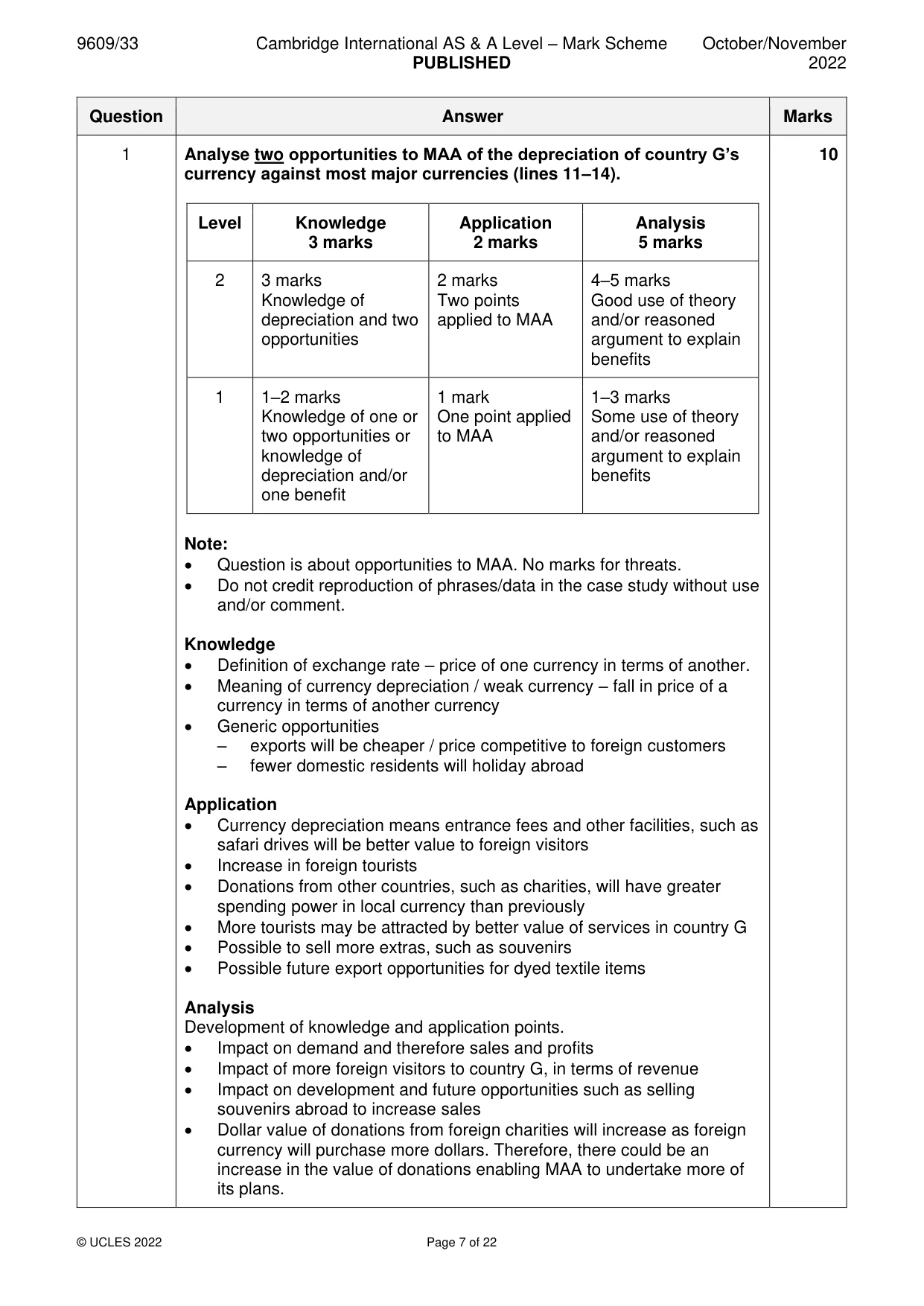
9609/33 Cambridge International AS & A Level – Mark Scheme PUBLISHED October/November 2022 © UCLES 2022 Page 7 of 22 Question Answer Marks 1 Analyse two opportunities to MAA of the depreciation of country G’s currency against most major currencies (lines 11–14). Level Knowledge 3 marks Application 2 marks Analysis 5 marks 2 3 marks Knowledge of depreciation and two opportunities 2 marks Two points applied to MAA 4–5 marks Good use of theory and/or reasoned argument to explain benefits 1 1–2 marks Knowledge of one or two opportunities or knowledge of depreciation and/or one benefit 1 mark One point applied to MAA 1–3 marks Some use of theory and/or reasoned argument to explain benefits Note: • Question is about opportunities to MAA. No marks for threats. • Do not credit reproduction of phrases/data in the case study without use and/or comment. Knowledge • Definition of exchange rate – price of one currency in terms of another. • Meaning of currency depreciation / weak currency – fall in price of a currency in terms of another currency • Generic opportunities – exports will be cheaper / price competitive to foreign customers – fewer domestic residents will holiday abroad Application • Currency depreciation means entrance fees and other facilities, such as safari drives will be better value to foreign visitors • Increase in foreign tourists • Donations from other countries, such as charities, will have greater spending power in local currency than previously • More tourists may be attracted by better value of services in country G • Possible to sell more extras, such as souvenirs • Possible future export opportunities for dyed textile items Analysis Development of knowledge and application points. • Impact on demand and therefore sales and profits • Impact of more foreign visitors to country G, in terms of revenue • Impact on development and future opportunities such as selling souvenirs abroad to increase sales • Dollar value of donations from foreign charities will increase as foreign currency will purchase more dollars. Therefore, there could be an increase in the value of donations enabling MAA to undertake more of its plans. 10
Mark scheme, page 8
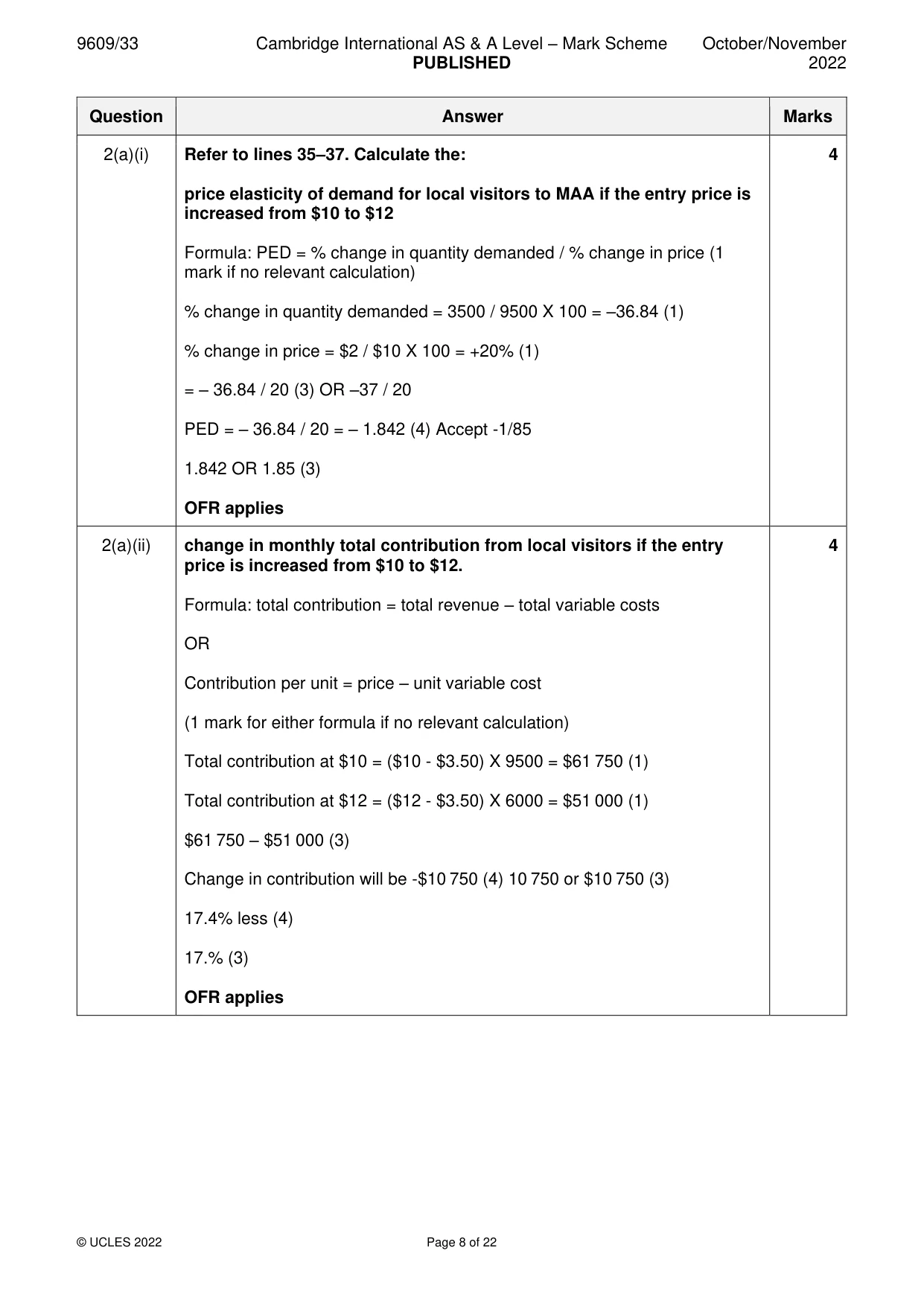
9609/33 Cambridge International AS & A Level – Mark Scheme PUBLISHED October/November 2022 © UCLES 2022 Page 8 of 22 Question Answer Marks 2(a)(i) Refer to lines 35–37. Calculate the: price elasticity of demand for local visitors to MAA if the entry price is increased from $10 to $12 Formula: PED = % change in quantity demanded / % change in price (1 mark if no relevant calculation) % change in quantity demanded = 3500 / 9500 X 100 = –36.84 (1) % change in price = $2 / $10 X 100 = +20% (1) = – 36.84 / 20 (3) OR –37 / 20 PED = – 36.84 / 20 = – 1.842 (4) Accept -1/85 1.842 OR 1.85 (3) OFR applies 4 2(a)(ii) change in monthly total contribution from local visitors if the entry price is increased from $10 to $12. Formula: total contribution = total revenue – total variable costs OR Contribution per unit = price – unit variable cost (1 mark for either formula if no relevant calculation) Total contribution at $10 = ($10 - $3.50) X 9500 = $61 750 (1) Total contribution at $12 = ($12 - $3.50) X 6000 = $51 000 (1) $61 750 – $51 000 (3) Change in contribution will be -$10 750 (4) 10 750 or $10 750 (3) 17.4% less (4) 17.% (3) OFR applies 4
Mark scheme, page 9
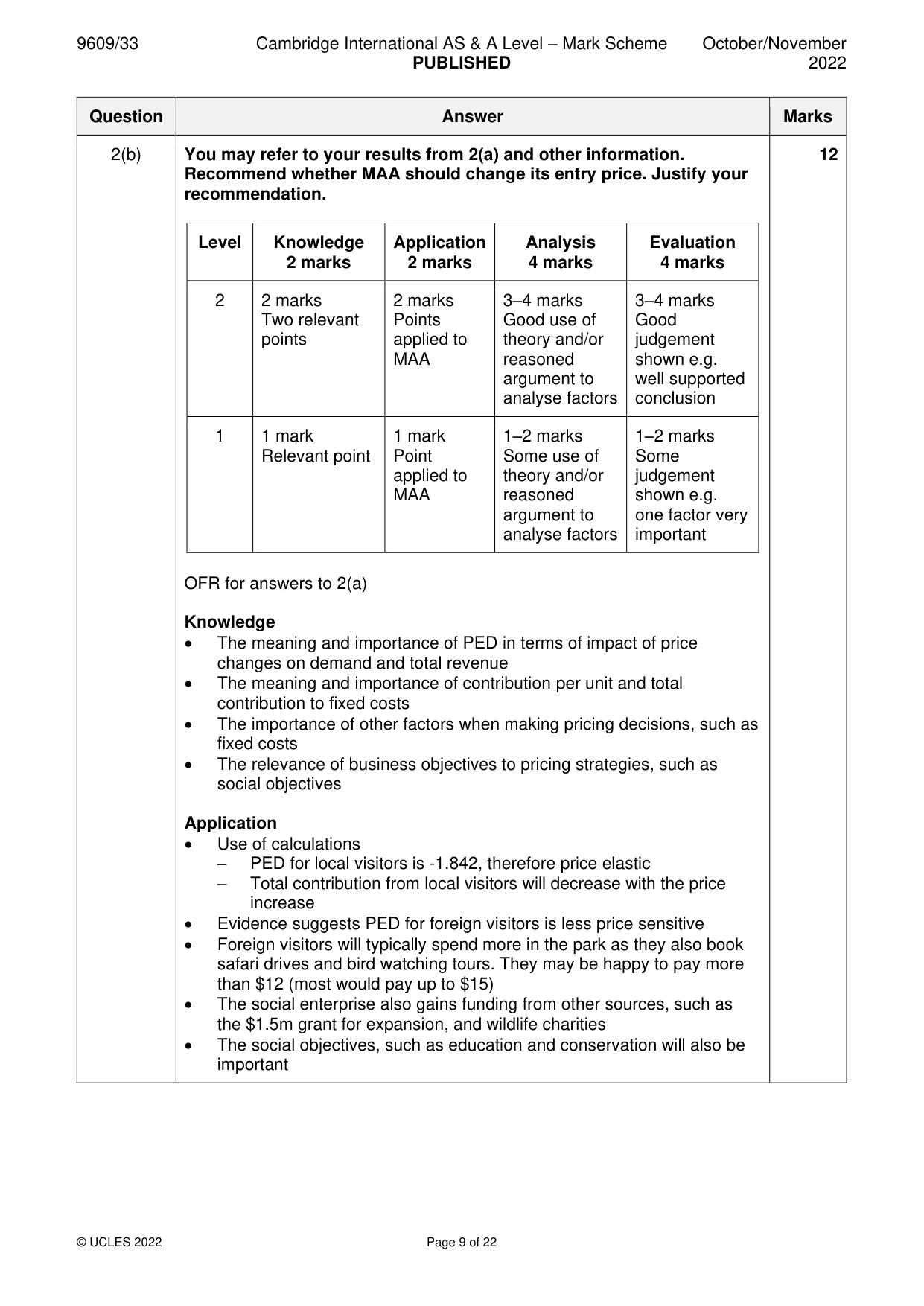
9609/33 Cambridge International AS & A Level – Mark Scheme PUBLISHED October/November 2022 © UCLES 2022 Page 9 of 22 Question Answer Marks 2(b) You may refer to your results from 2(a) and other information. Recommend whether MAA should change its entry price. Justify your recommendation. Level Knowledge 2 marks Application 2 marks Analysis 4 marks Evaluation 4 marks 2 2 marks Two relevant points 2 marks Points applied to MAA 3–4 marks Good use of theory and/or reasoned argument to analyse factors 3–4 marks Good judgement shown e.g. well supported conclusion 1 1 mark Relevant point 1 mark Point applied to MAA 1–2 marks Some use of theory and/or reasoned argument to analyse factors 1–2 marks Some judgement shown e.g. one factor very important OFR for answers to 2(a) Knowledge • The meaning and importance of PED in terms of impact of price changes on demand and total revenue • The meaning and importance of contribution per unit and total contribution to fixed costs • The importance of other factors when making pricing decisions, such as fixed costs • The relevance of business objectives to pricing strategies, such as social objectives Application • Use of calculations – PED for local visitors is -1.842, therefore price elastic – Total contribution from local visitors will decrease with the price increase • Evidence suggests PED for foreign visitors is less price sensitive • Foreign visitors will typically spend more in the park as they also book safari drives and bird watching tours. They may be happy to pay more than $12 (most would pay up to $15) • The social enterprise also gains funding from other sources, such as the $1.5m grant for expansion, and wildlife charities • The social objectives, such as education and conservation will also be important 12
Mark scheme, page 10
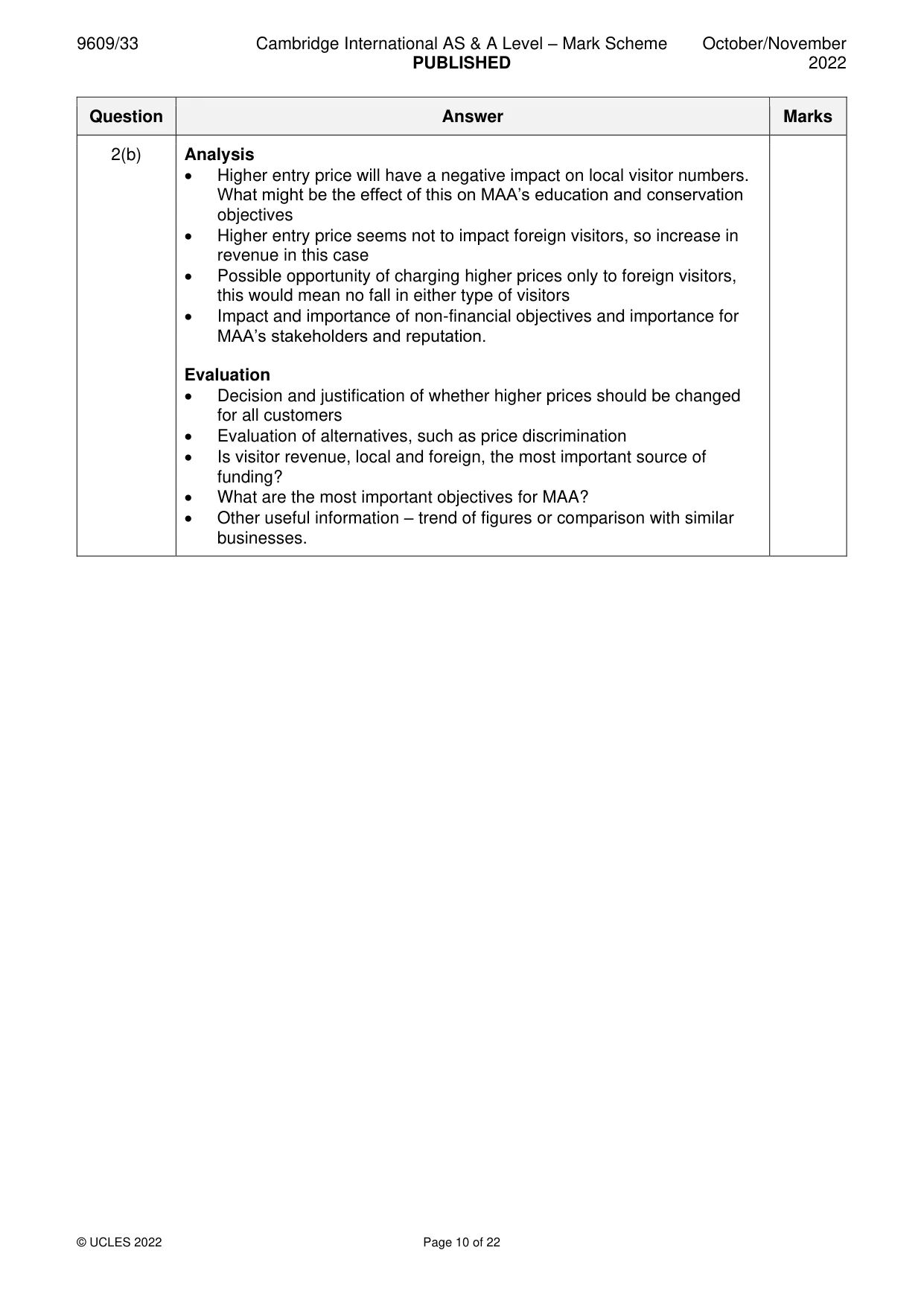
9609/33 Cambridge International AS & A Level – Mark Scheme PUBLISHED October/November 2022 © UCLES 2022 Page 10 of 22 Question Answer Marks 2(b) Analysis • Higher entry price will have a negative impact on local visitor numbers. What might be the effect of this on MAA’s education and conservation objectives • Higher entry price seems not to impact foreign visitors, so increase in revenue in this case • Possible opportunity of charging higher prices only to foreign visitors, this would mean no fall in either type of visitors • Impact and importance of non-financial objectives and importance for MAA’s stakeholders and reputation. Evaluation • Decision and justification of whether higher prices should be changed for all customers • Evaluation of alternatives, such as price discrimination • Is visitor revenue, local and foreign, the most important source of funding? • What are the most important objectives for MAA? • Other useful information – trend of figures or comparison with similar businesses.
Mark scheme, page 11
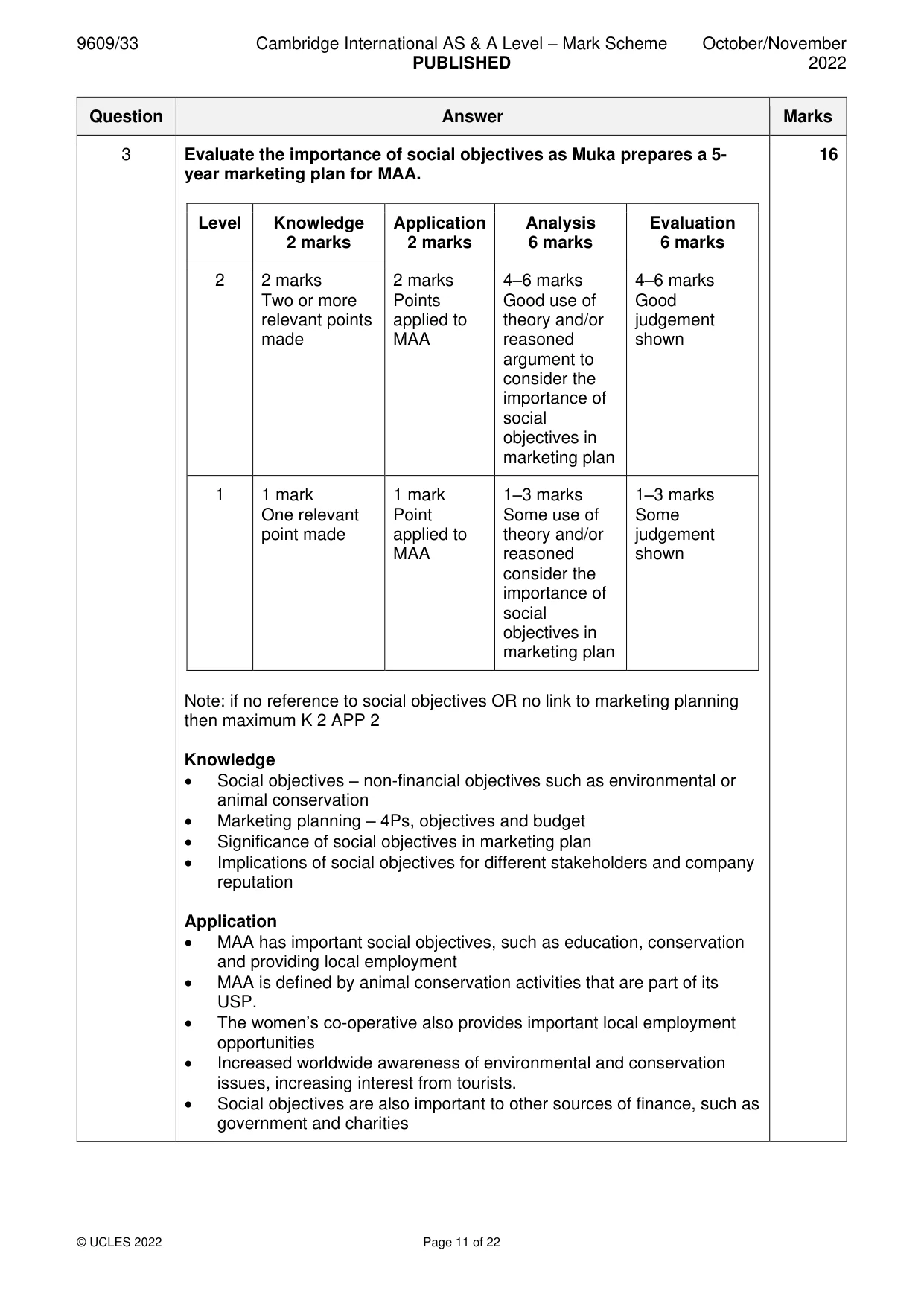
9609/33 Cambridge International AS & A Level – Mark Scheme PUBLISHED October/November 2022 © UCLES 2022 Page 11 of 22 Question Answer Marks 3 Evaluate the importance of social objectives as Muka prepares a 5- year marketing plan for MAA. Level Knowledge 2 marks Application 2 marks Analysis 6 marks Evaluation 6 marks 2 2 marks Two or more relevant points made 2 marks Points applied to MAA 4–6 marks Good use of theory and/or reasoned argument to consider the importance of social objectives in marketing plan 4–6 marks Good judgement shown 1 1 mark One relevant point made 1 mark Point applied to MAA 1–3 marks Some use of theory and/or reasoned consider the importance of social objectives in marketing plan 1–3 marks Some judgement shown Note: if no reference to social objectives OR no link to marketing planning then maximum K 2 APP 2 Knowledge • Social objectives – non-financial objectives such as environmental or animal conservation • Marketing planning – 4Ps, objectives and budget • Significance of social objectives in marketing plan • Implications of social objectives for different stakeholders and company reputation Application • MAA has important social objectives, such as education, conservation and providing local employment • MAA is defined by animal conservation activities that are part of its USP. • The women’s co-operative also provides important local employment opportunities • Increased worldwide awareness of environmental and conservation issues, increasing interest from tourists. • Social objectives are also important to other sources of finance, such as government and charities 16
Mark scheme, page 12
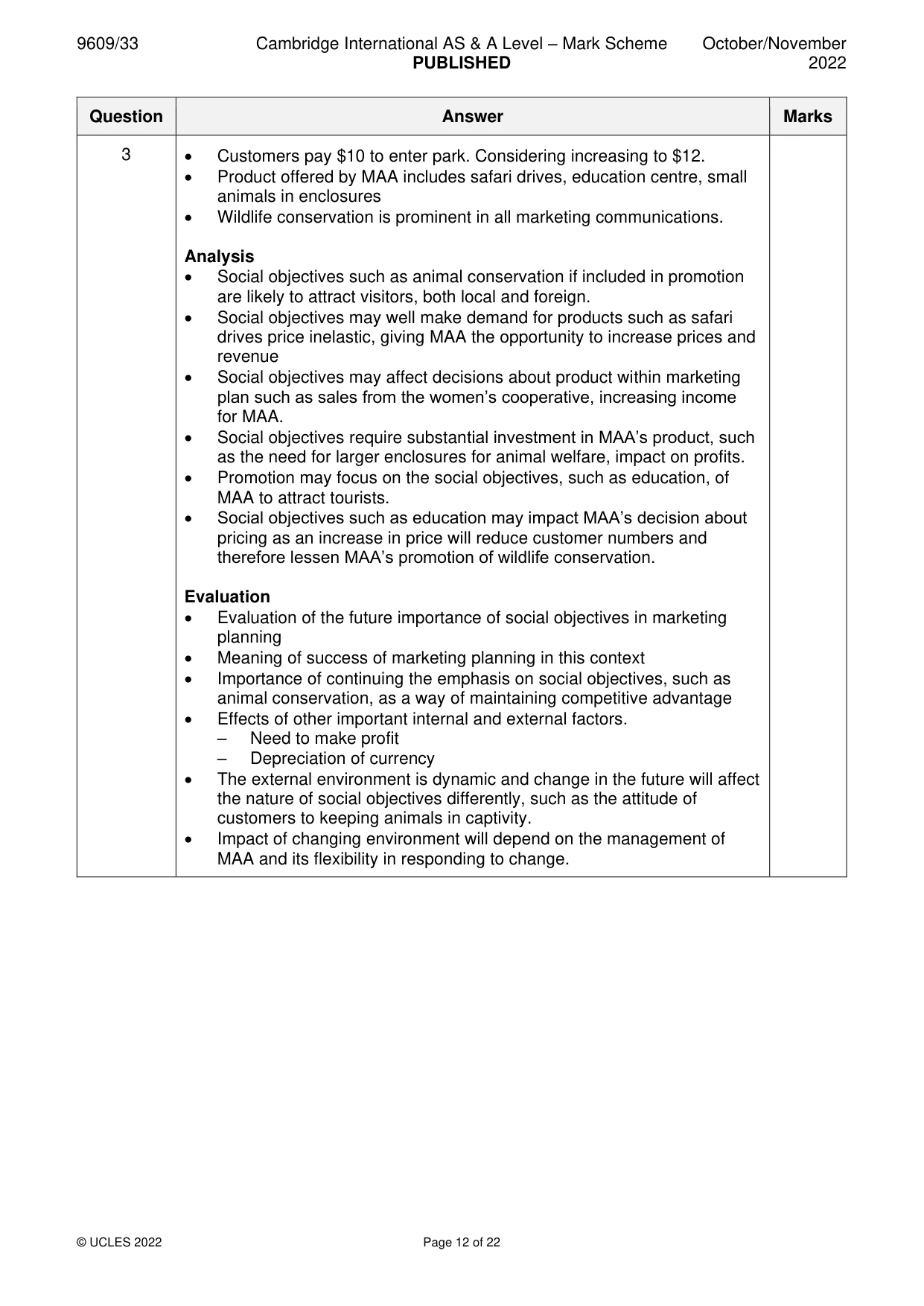
9609/33 Cambridge International AS & A Level – Mark Scheme PUBLISHED October/November 2022 © UCLES 2022 Page 12 of 22 Question Answer Marks 3 • Customers pay $10 to enter park. Considering increasing to $12. • Product offered by MAA includes safari drives, education centre, small animals in enclosures • Wildlife conservation is prominent in all marketing communications. Analysis • Social objectives such as animal conservation if included in promotion are likely to attract visitors, both local and foreign. • Social objectives may well make demand for products such as safari drives price inelastic, giving MAA the opportunity to increase prices and revenue • Social objectives may affect decisions about product within marketing plan such as sales from the women’s cooperative, increasing income for MAA. • Social objectives require substantial investment in MAA’s product, such as the need for larger enclosures for animal welfare, impact on profits. • Promotion may focus on the social objectives, such as education, of MAA to attract tourists. • Social objectives such as education may impact MAA’s decision about pricing as an increase in price will reduce customer numbers and therefore lessen MAA’s promotion of wildlife conservation. Evaluation • Evaluation of the future importance of social objectives in marketing planning • Meaning of success of marketing planning in this context • Importance of continuing the emphasis on social objectives, such as animal conservation, as a way of maintaining competitive advantage • Effects of other important internal and external factors. – Need to make profit – Depreciation of currency • The external environment is dynamic and change in the future will affect the nature of social objectives differently, such as the attitude of customers to keeping animals in captivity. • Impact of changing environment will depend on the management of MAA and its flexibility in responding to change.
Mark scheme, page 13
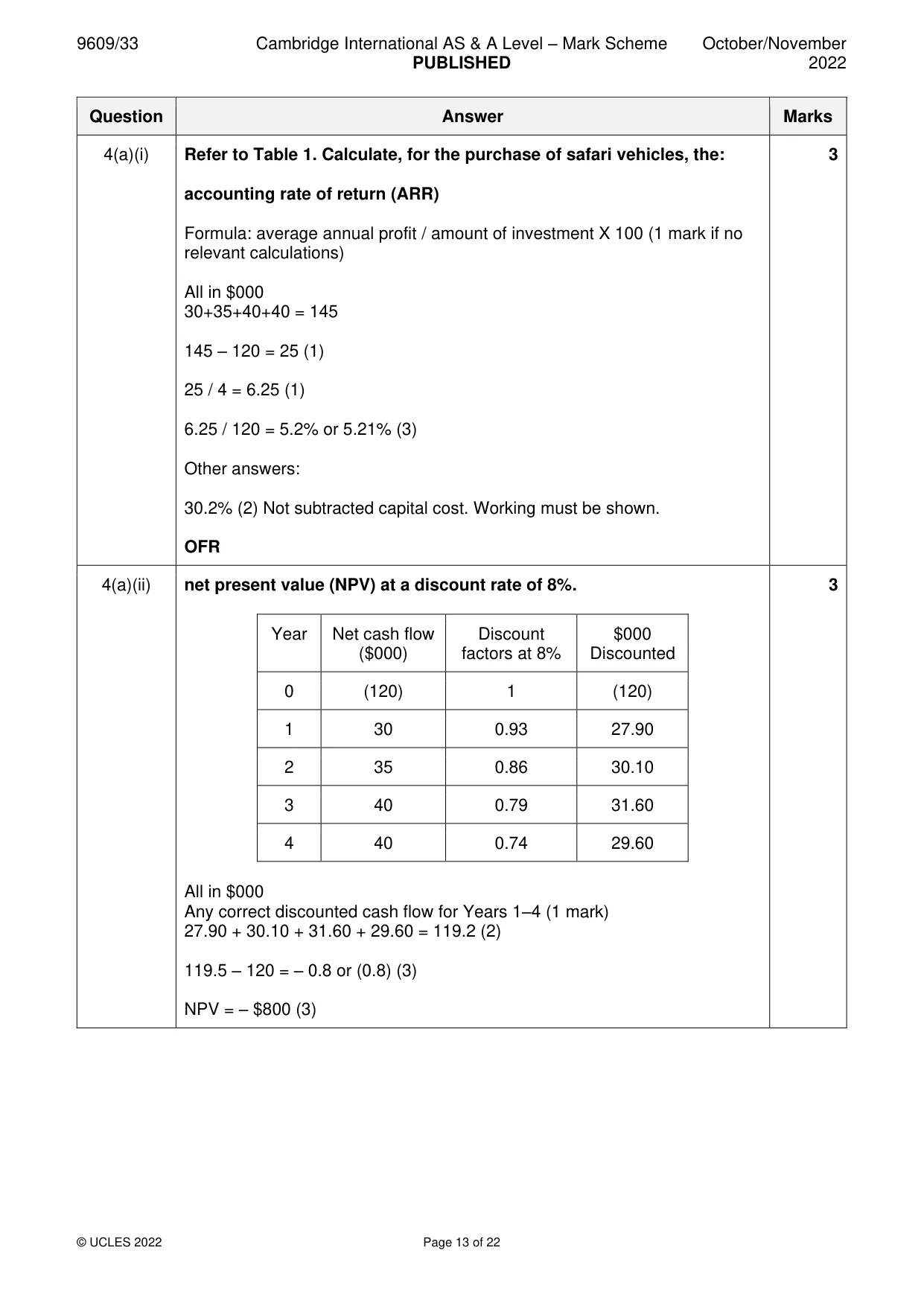
9609/33 Cambridge International AS & A Level – Mark Scheme PUBLISHED October/November 2022 © UCLES 2022 Page 13 of 22 Question Answer Marks 4(a)(i) Refer to Table 1. Calculate, for the purchase of safari vehicles, the: accounting rate of return (ARR) Formula: average annual profit / amount of investment X 100 (1 mark if no relevant calculations) All in $000 30+35+40+40 = 145 145 – 120 = 25 (1) 25 / 4 = 6.25 (1) 6.25 / 120 = 5.2% or 5.21% (3) Other answers: 30.2% (2) Not subtracted capital cost. Working must be shown. OFR 3 4(a)(ii) net present value (NPV) at a discount rate of 8%. Year Net cash flow ($000) Discount factors at 8% $000 Discounted 0 (120) 1 (120) 1 30 0.93 27.90 2 35 0.86 30.10 3 40 0.79 31.60 4 40 0.74 29.60 All in $000 Any correct discounted cash flow for Years 1–4 (1 mark) 27.90 + 30.10 + 31.60 + 29.60 = 119.2 (2) 119.5 – 120 = – 0.8 or (0.8) (3) NPV = – $800 (3) 3
Mark scheme, page 14
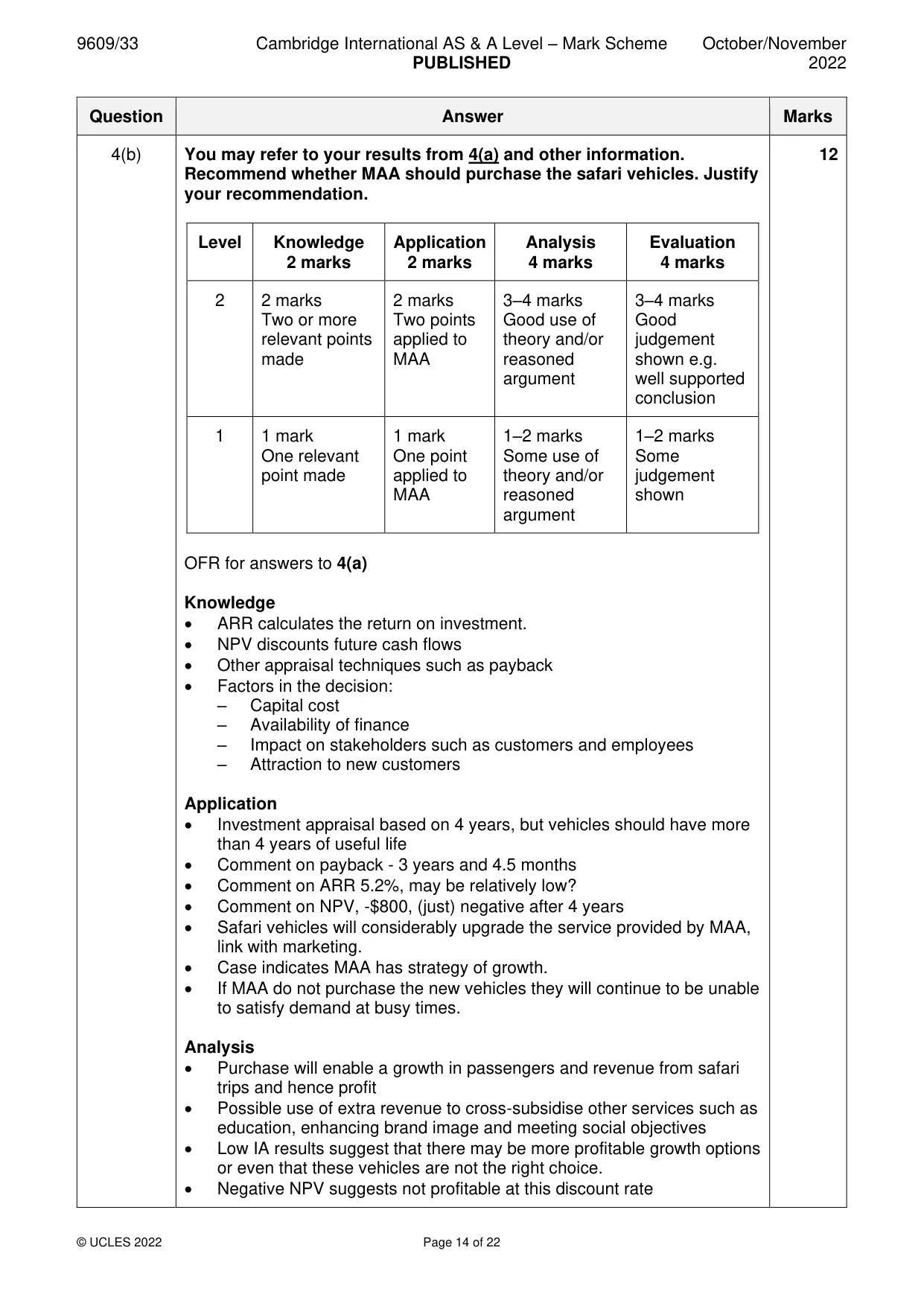
9609/33 Cambridge International AS & A Level – Mark Scheme PUBLISHED October/November 2022 © UCLES 2022 Page 14 of 22 Question Answer Marks 4(b) You may refer to your results from 4(a) and other information. Recommend whether MAA should purchase the safari vehicles. Justify your recommendation. Level Knowledge 2 marks Application 2 marks Analysis 4 marks Evaluation 4 marks 2 2 marks Two or more relevant points made 2 marks Two points applied to MAA 3–4 marks Good use of theory and/or reasoned argument 3–4 marks Good judgement shown e.g. well supported conclusion 1 1 mark One relevant point made 1 mark One point applied to MAA 1–2 marks Some use of theory and/or reasoned argument 1–2 marks Some judgement shown OFR for answers to 4(a) Knowledge • ARR calculates the return on investment. • NPV discounts future cash flows • Other appraisal techniques such as payback • Factors in the decision: – Capital cost – Availability of finance – Impact on stakeholders such as customers and employees – Attraction to new customers Application • Investment appraisal based on 4 years, but vehicles should have more than 4 years of useful life • Comment on payback - 3 years and 4.5 months • Comment on ARR 5.2%, may be relatively low? • Comment on NPV, -$800, (just) negative after 4 years • Safari vehicles will considerably upgrade the service provided by MAA, link with marketing. • Case indicates MAA has strategy of growth. • If MAA do not purchase the new vehicles they will continue to be unable to satisfy demand at busy times. Analysis • Purchase will enable a growth in passengers and revenue from safari trips and hence profit • Possible use of extra revenue to cross-subsidise other services such as education, enhancing brand image and meeting social objectives • Low IA results suggest that there may be more profitable growth options or even that these vehicles are not the right choice. • Negative NPV suggests not profitable at this discount rate 12
Mark scheme, page 15
9609/33 Cambridge International AS & A Level – Mark Scheme PUBLISHED October/November 2022 © UCLES 2022 Page 15 of 22 Question Answer Marks 4(b) Evaluation • Supported decision – to purchase or not? • Limited data – four years figures - but vehicles should last much longer • May need comparative quotes from other vehicle providers • Is the upgrading of services offered essential for MAA, due to changing consumer needs and expectations? • Other evidence needs to be considered, e.g. social objectives, would these be helped or hindered? • Need for more research on services offered in similar facilities.
Mark scheme, page 16
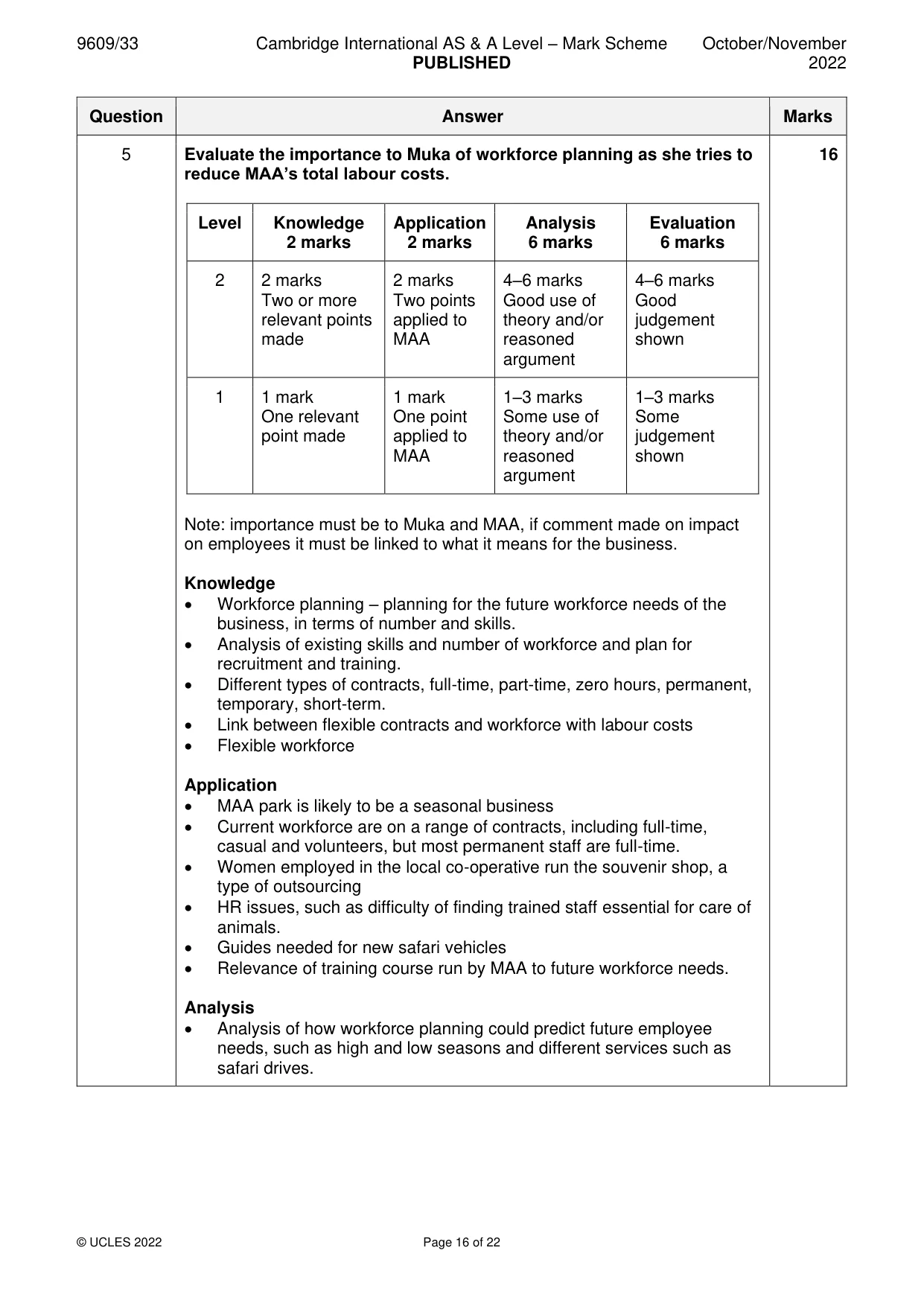
9609/33 Cambridge International AS & A Level – Mark Scheme PUBLISHED October/November 2022 © UCLES 2022 Page 16 of 22 Question Answer Marks 5 Evaluate the importance to Muka of workforce planning as she tries to reduce MAA’s total labour costs. Level Knowledge 2 marks Application 2 marks Analysis 6 marks Evaluation 6 marks 2 2 marks Two or more relevant points made 2 marks Two points applied to MAA 4–6 marks Good use of theory and/or reasoned argument 4–6 marks Good judgement shown 1 1 mark One relevant point made 1 mark One point applied to MAA 1–3 marks Some use of theory and/or reasoned argument 1–3 marks Some judgement shown Note: importance must be to Muka and MAA, if comment made on impact on employees it must be linked to what it means for the business. Knowledge • Workforce planning – planning for the future workforce needs of the business, in terms of number and skills. • Analysis of existing skills and number of workforce and plan for recruitment and training. • Different types of contracts, full-time, part-time, zero hours, permanent, temporary, short-term. • Link between flexible contracts and workforce with labour costs • Flexible workforce Application • MAA park is likely to be a seasonal business • Current workforce are on a range of contracts, including full-time, casual and volunteers, but most permanent staff are full-time. • Women employed in the local co-operative run the souvenir shop, a type of outsourcing • HR issues, such as difficulty of finding trained staff essential for care of animals. • Guides needed for new safari vehicles • Relevance of training course run by MAA to future workforce needs. Analysis • Analysis of how workforce planning could predict future employee needs, such as high and low seasons and different services such as safari drives. 16
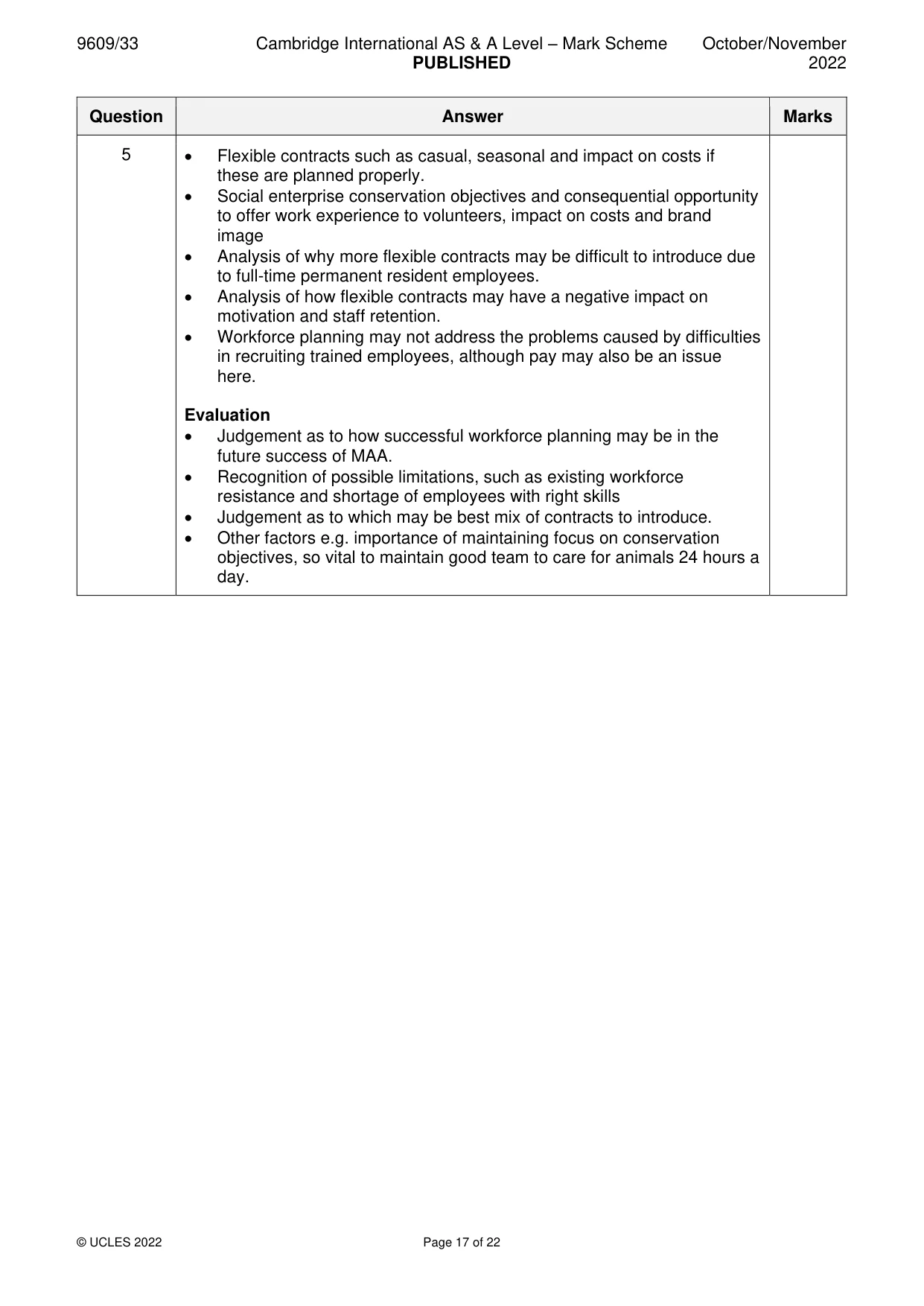
Mark scheme, page 17
9609/33 Cambridge International AS & A Level – Mark Scheme PUBLISHED October/November 2022 © UCLES 2022 Page 17 of 22 Question Answer Marks 5 • Flexible contracts such as casual, seasonal and impact on costs if these are planned properly. • Social enterprise conservation objectives and consequential opportunity to offer work experience to volunteers, impact on costs and brand image • Analysis of why more flexible contracts may be difficult to introduce due to full-time permanent resident employees. • Analysis of how flexible contracts may have a negative impact on motivation and staff retention. • Workforce planning may not address the problems caused by difficulties in recruiting trained employees, although pay may also be an issue here. Evaluation • Judgement as to how successful workforce planning may be in the future success of MAA. • Recognition of possible limitations, such as existing workforce resistance and shortage of employees with right skills • Judgement as to which may be best mix of contracts to introduce. • Other factors e.g. importance of maintaining focus on conservation objectives, so vital to maintain good team to care for animals 24 hours a day.
Mark scheme, page 18
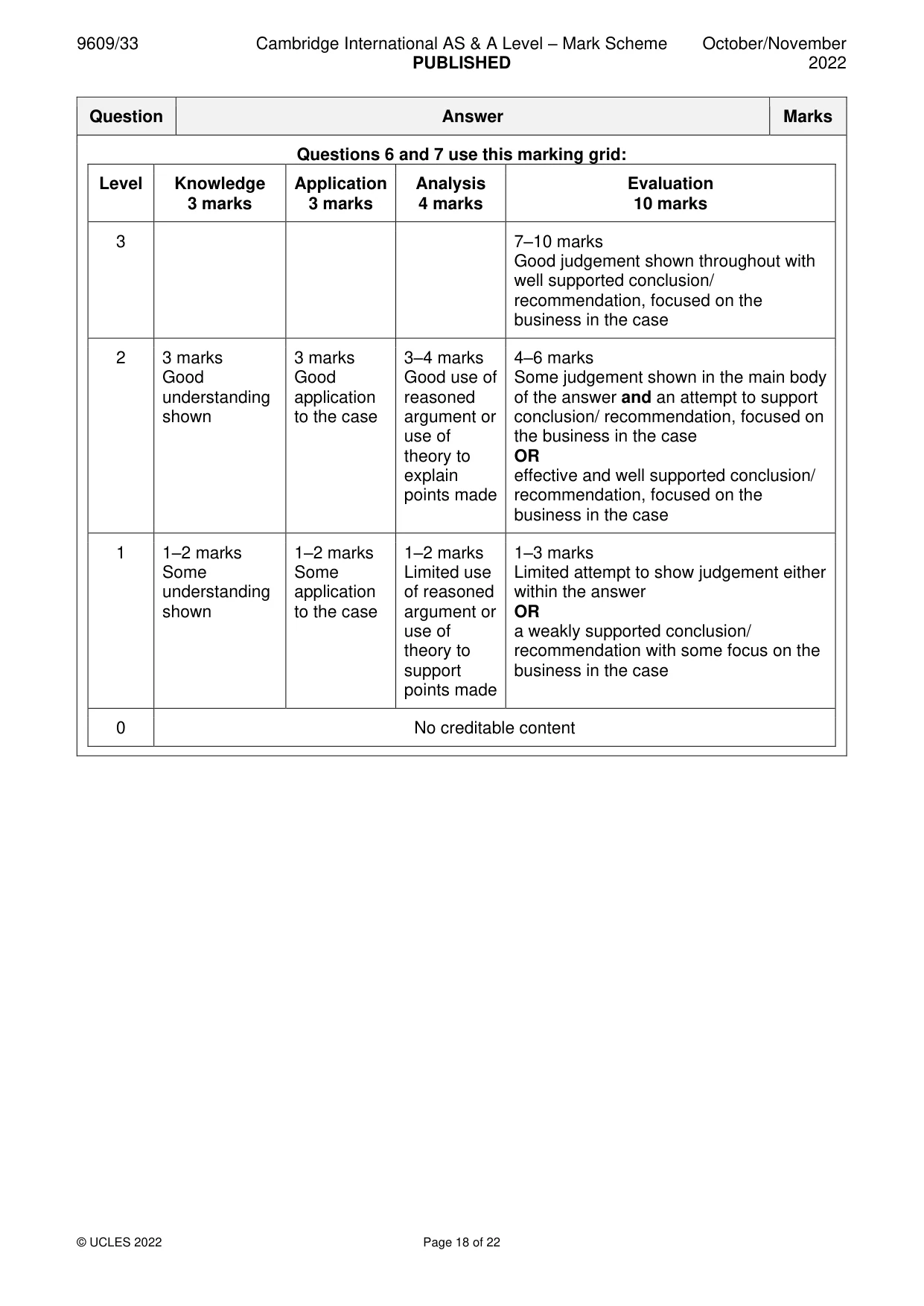
9609/33 Cambridge International AS & A Level – Mark Scheme PUBLISHED October/November 2022 © UCLES 2022 Page 18 of 22 Question Answer Marks Questions 6 and 7 use this marking grid: Level Knowledge 3 marks Application 3 marks Analysis 4 marks Evaluation 10 marks 3 7–10 marks Good judgement shown throughout with well supported conclusion/ recommendation, focused on the business in the case 2 3 marks Good understanding shown 3 marks Good application to the case 3–4 marks Good use of reasoned argument or use of theory to explain points made 4–6 marks Some judgement shown in the main body of the answer and an attempt to support conclusion/ recommendation, focused on the business in the case OR effective and well supported conclusion/ recommendation, focused on the business in the case 1 1–2 marks Some understanding shown 1–2 marks Some application to the case 1–2 marks Limited use of reasoned argument or use of theory to support points made 1–3 marks Limited attempt to show judgement either within the answer OR a weakly supported conclusion/ recommendation with some focus on the business in the case 0 No creditable content
Mark scheme, page 19
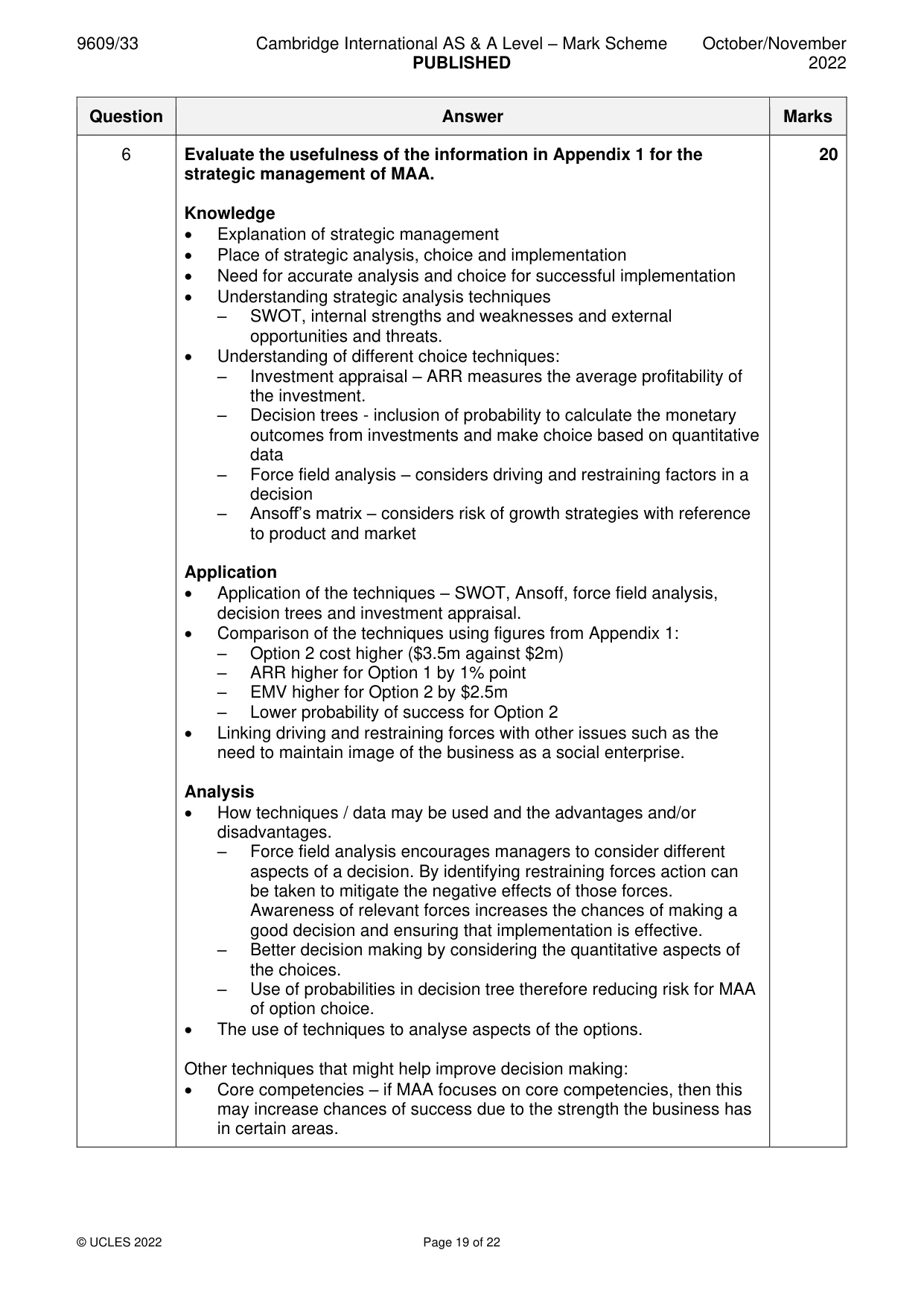
9609/33 Cambridge International AS & A Level – Mark Scheme PUBLISHED October/November 2022 © UCLES 2022 Page 19 of 22 Question Answer Marks 6 Evaluate the usefulness of the information in Appendix 1 for the strategic management of MAA. Knowledge • Explanation of strategic management • Place of strategic analysis, choice and implementation • Need for accurate analysis and choice for successful implementation • Understanding strategic analysis techniques – SWOT, internal strengths and weaknesses and external opportunities and threats. • Understanding of different choice techniques: – Investment appraisal – ARR measures the average profitability of the investment. – Decision trees - inclusion of probability to calculate the monetary outcomes from investments and make choice based on quantitative data – Force field analysis – considers driving and restraining factors in a decision – Ansoff’s matrix – considers risk of growth strategies with reference to product and market Application • Application of the techniques – SWOT, Ansoff, force field analysis, decision trees and investment appraisal. • Comparison of the techniques using figures from Appendix 1: – Option 2 cost higher ($3.5m against $2m) – ARR higher for Option 1 by 1% point – EMV higher for Option 2 by $2.5m – Lower probability of success for Option 2 • Linking driving and restraining forces with other issues such as the need to maintain image of the business as a social enterprise. Analysis • How techniques / data may be used and the advantages and/or disadvantages. – Force field analysis encourages managers to consider different aspects of a decision. By identifying restraining forces action can be taken to mitigate the negative effects of those forces. Awareness of relevant forces increases the chances of making a good decision and ensuring that implementation is effective. – Better decision making by considering the quantitative aspects of the choices. – Use of probabilities in decision tree therefore reducing risk for MAA of option choice. • The use of techniques to analyse aspects of the options. Other techniques that might help improve decision making: • Core competencies – if MAA focuses on core competencies, then this may increase chances of success due to the strength the business has in certain areas. 20
Mark scheme, page 20
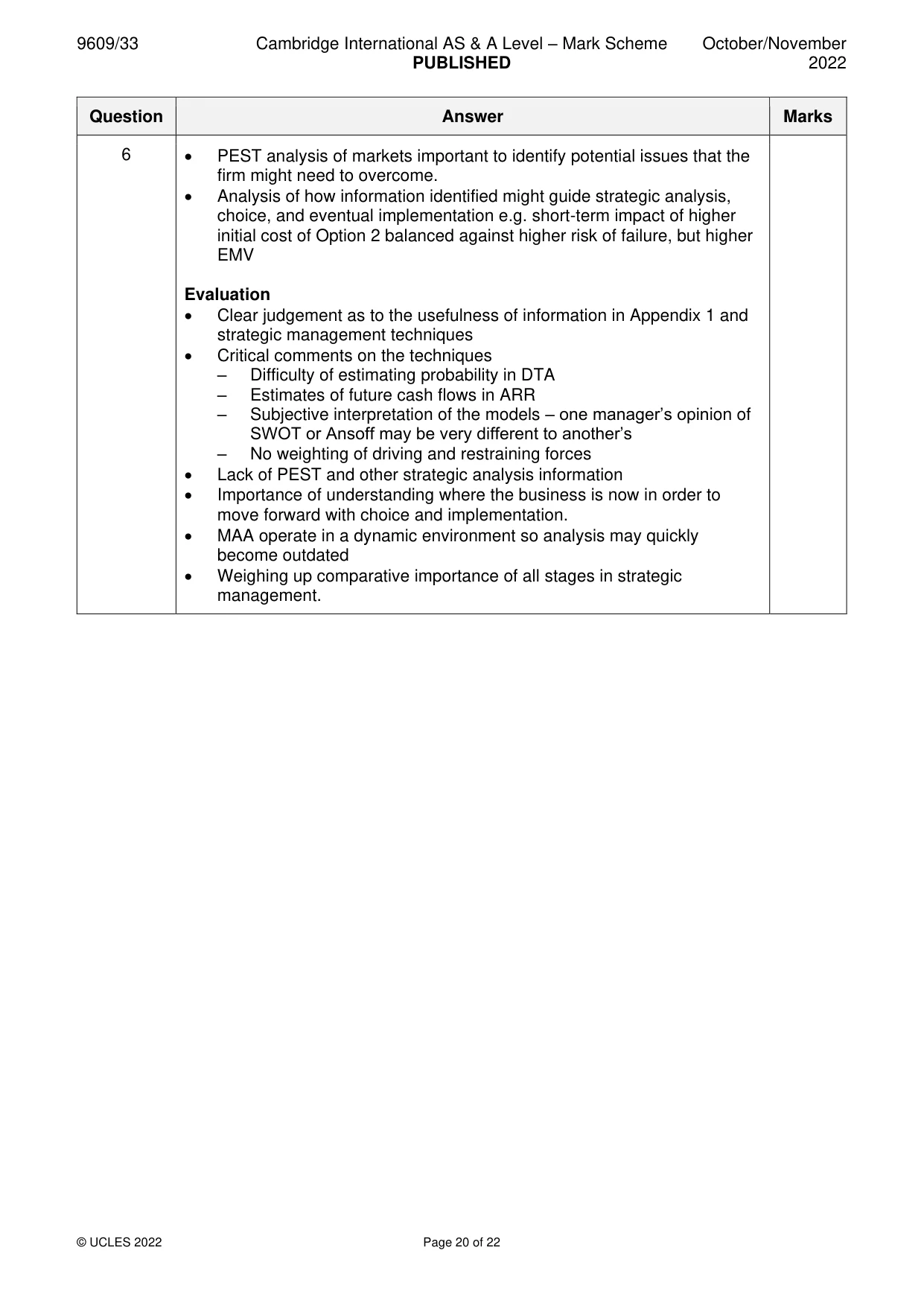
9609/33 Cambridge International AS & A Level – Mark Scheme PUBLISHED October/November 2022 © UCLES 2022 Page 20 of 22 Question Answer Marks 6 • PEST analysis of markets important to identify potential issues that the firm might need to overcome. • Analysis of how information identified might guide strategic analysis, choice, and eventual implementation e.g. short-term impact of higher initial cost of Option 2 balanced against higher risk of failure, but higher EMV Evaluation • Clear judgement as to the usefulness of information in Appendix 1 and strategic management techniques • Critical comments on the techniques – Difficulty of estimating probability in DTA – Estimates of future cash flows in ARR – Subjective interpretation of the models – one manager’s opinion of SWOT or Ansoff may be very different to another’s – No weighting of driving and restraining forces • Lack of PEST and other strategic analysis information • Importance of understanding where the business is now in order to move forward with choice and implementation. • MAA operate in a dynamic environment so analysis may quickly become outdated • Weighing up comparative importance of all stages in strategic management.
Mark scheme, page 21
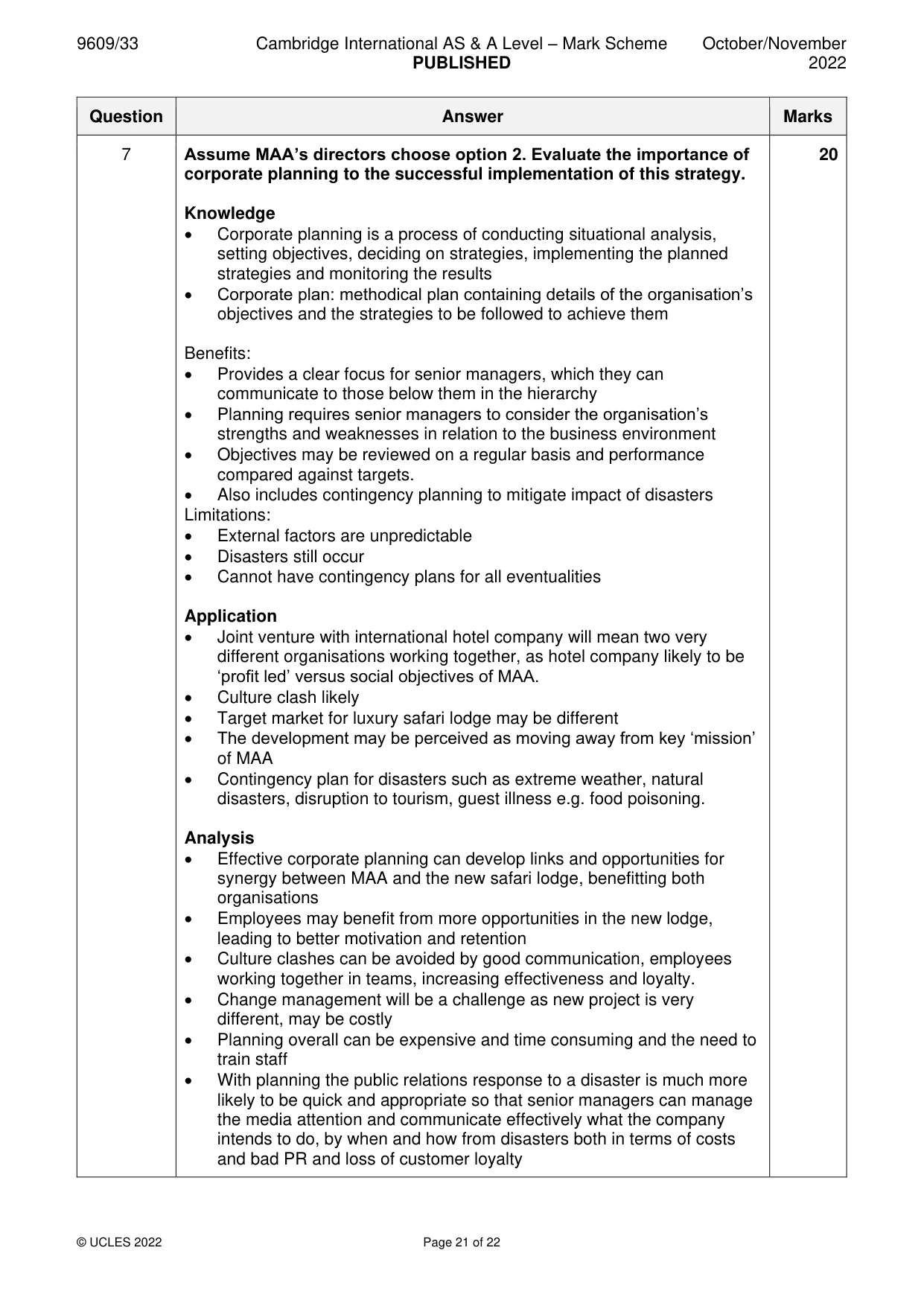
9609/33 Cambridge International AS & A Level – Mark Scheme PUBLISHED October/November 2022 © UCLES 2022 Page 21 of 22 Question Answer Marks 7 Assume MAA’s directors choose option 2. Evaluate the importance of corporate planning to the successful implementation of this strategy. Knowledge • Corporate planning is a process of conducting situational analysis, setting objectives, deciding on strategies, implementing the planned strategies and monitoring the results • Corporate plan: methodical plan containing details of the organisation’s objectives and the strategies to be followed to achieve them Benefits: • Provides a clear focus for senior managers, which they can communicate to those below them in the hierarchy • Planning requires senior managers to consider the organisation’s strengths and weaknesses in relation to the business environment • Objectives may be reviewed on a regular basis and performance compared against targets. • Also includes contingency planning to mitigate impact of disasters Limitations: • External factors are unpredictable • Disasters still occur • Cannot have contingency plans for all eventualities Application • Joint venture with international hotel company will mean two very different organisations working together, as hotel company likely to be ‘profit led’ versus social objectives of MAA. • Culture clash likely • Target market for luxury safari lodge may be different • The development may be perceived as moving away from key ‘mission’ of MAA • Contingency plan for disasters such as extreme weather, natural disasters, disruption to tourism, guest illness e.g. food poisoning. Analysis • Effective corporate planning can develop links and opportunities for synergy between MAA and the new safari lodge, benefitting both organisations • Employees may benefit from more opportunities in the new lodge, leading to better motivation and retention • Culture clashes can be avoided by good communication, employees working together in teams, increasing effectiveness and loyalty. • Change management will be a challenge as new project is very different, may be costly • Planning overall can be expensive and time consuming and the need to train staff • With planning the public relations response to a disaster is much more likely to be quick and appropriate so that senior managers can manage the media attention and communicate effectively what the company intends to do, by when and how from disasters both in terms of costs and bad PR and loss of customer loyalty 20
Mark scheme, page 22
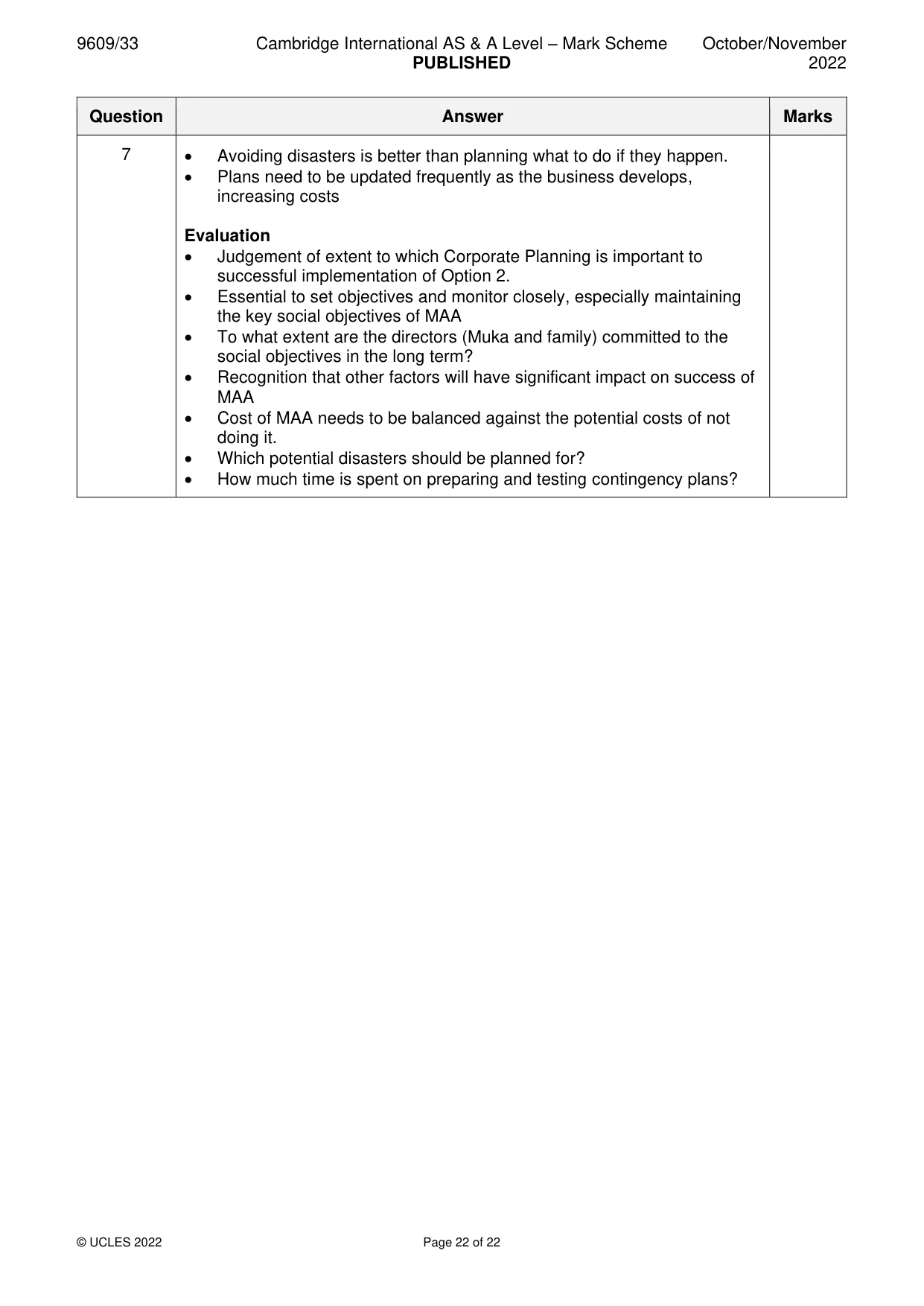
9609/33 Cambridge International AS & A Level – Mark Scheme PUBLISHED October/November 2022 © UCLES 2022 Page 22 of 22 Question Answer Marks 7 • Avoiding disasters is better than planning what to do if they happen. • Plans need to be updated frequently as the business develops, increasing costs Evaluation • Judgement of extent to which Corporate Planning is important to successful implementation of Option 2. • Essential to set objectives and monitor closely, especially maintaining the key social objectives of MAA • To what extent are the directors (Muka and family) committed to the social objectives in the long term? • Recognition that other factors will have significant impact on success of MAA • Cost of MAA needs to be balanced against the potential costs of not doing it. • Which potential disasters should be planned for? • How much time is spent on preparing and testing contingency plans?
What you needed in this session
Cambridge’s own grade thresholds for 2022 Oct/Nov, Paper 3 · Variant 3. A higher threshold means an easier paper — the bar moves with how the cohort did.