Cambridge A Level Business (for first examination in 2016) 9609 — 2022 Oct/Nov Paper 3 · Variant 1
9609/31/O/N/22 · 100 marks · ≈113 min
The question paper and its mark scheme, free to read here and free to download. This is Cambridge’s own paper, exactly as it was sat.
Question paper20 pages














Mark scheme21 pages
Answers below. Sit the paper first if you are practising.
Paper as text
Question paper, page 1
This document has 20 pages. [Turn over Cambridge International AS & A Level DC (PQ/SG) 302937/3 © UCLES 2022 BUSINESS 9609/31 Paper 3 Case Study October/November 2022 3 hours You must answer on the question paper. You will need: Insert (enclosed) INSTRUCTIONS ● Section A: answer all questions. ● Section B: answer one question. ● Use a black or dark blue pen. ● Write your name, centre number and candidate number in the boxes at the top of the page. ● Write your answer to each question in the space provided. ● Do not use an erasable pen or correction fluid. ● Do not write on any bar codes. ● You may use an HB pencil for any diagrams, graphs or rough working. INFORMATION ● The total mark for this paper is 100. ● The number of marks for each question or part question is shown in brackets [ ]. ● The insert contains the case study. * 4 3 5 1 2 2 1 0 8 0 *
Question paper, page 2
2 9609/31/O/N/22 © UCLES 2022 Answer all questions in Section A and answer one question in Section B. You are advised to spend no more than 40 minutes on Section B. Section A Answer all questions in this section. 1 Analyse two possible disadvantages to AP of a merger with SC. … … … … … … … … … … … … … … … … … … … … … … …
Question paper, page 3
3 9609/31/O/N/22 © UCLES 2022 [Turn over … … … … … … … … … … … … … … … … … … … … … … … … … … … … [10]
Question paper, page 4
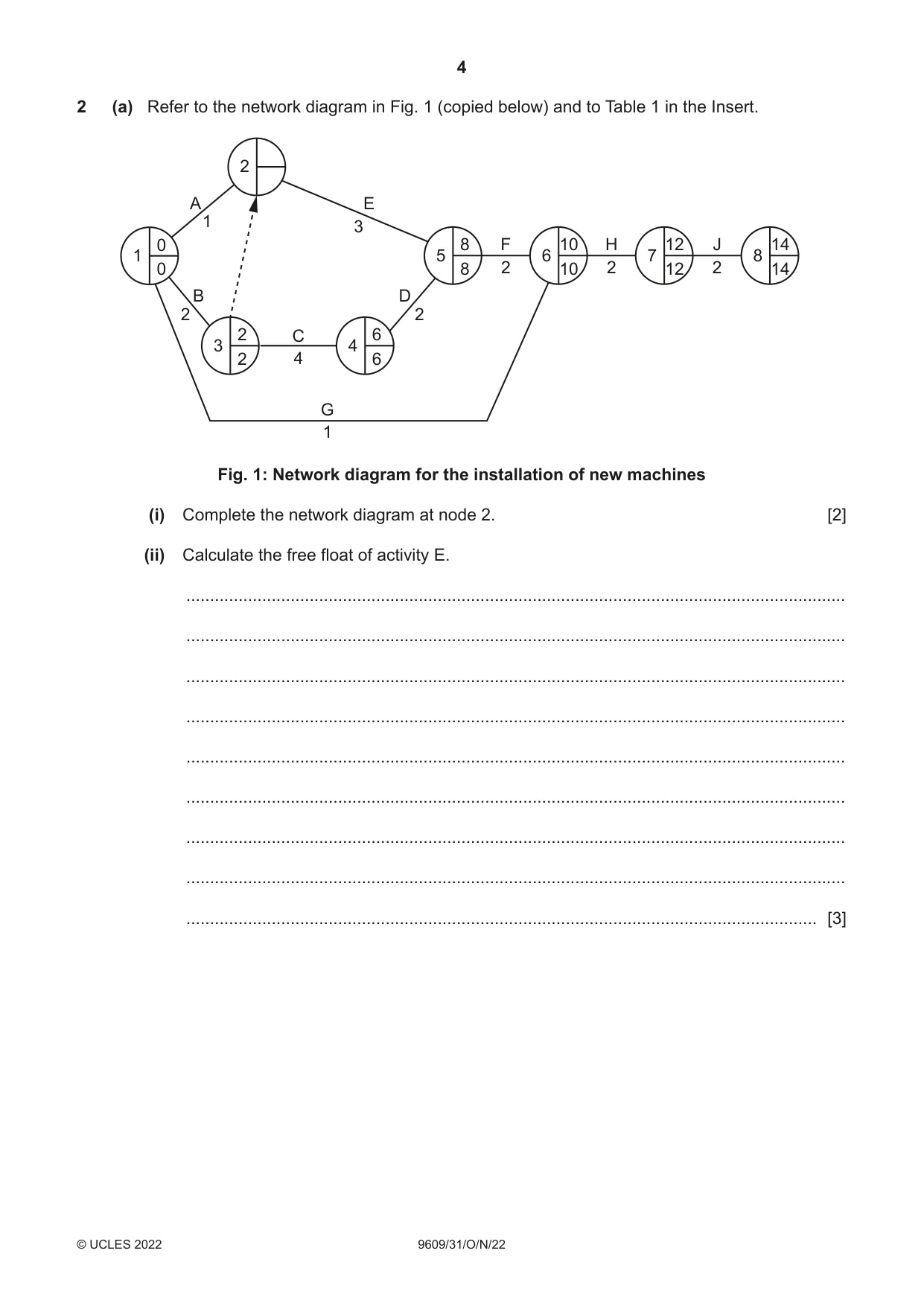
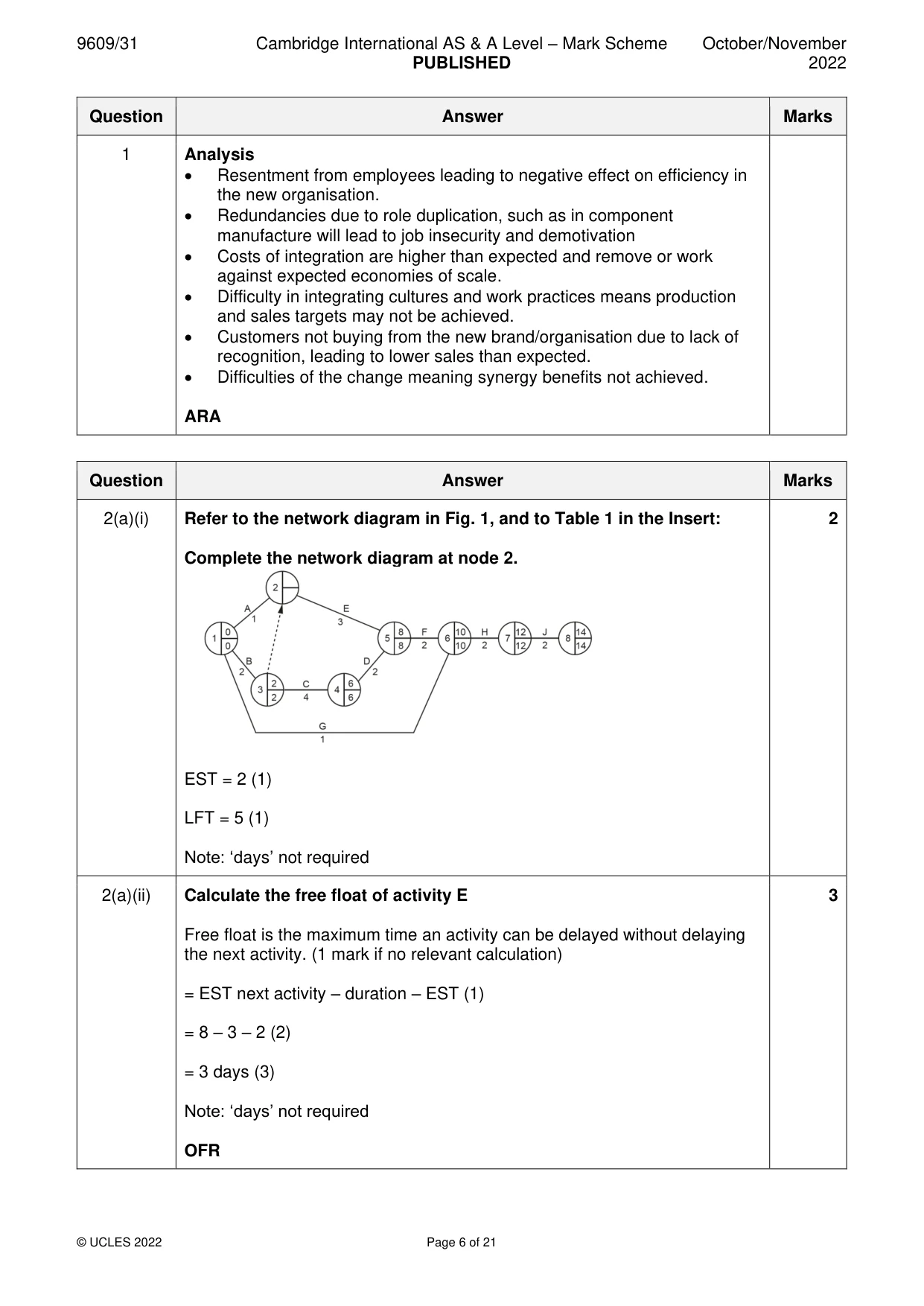
4 9609/31/O/N/22 © UCLES 2022 2 (a) Refer to the network diagram in Fig. 1 (copied below) and to Table 1 in the Insert. 1 0 0 3 2 2 4 6 6 5 8 8 6 10 10 7 12 12 8 14 14 2 F H J 2 G 1 C D E A 1 3 B 2 2 4 2 2 Fig. 1: Network diagram for the installation of new machines (i) Complete the network diagram at node 2. [2] (ii) Calculate the free float of activity E. … … … … … … … … … [3]
Question paper, page 5
5 9609/31/O/N/22 © UCLES 2022 [Turn over (iii) Calculate the total float of activity G. … … … … … … … … … [3]
Question paper, page 6
6 9609/31/O/N/22 © UCLES 2022 (b) Evaluate whether the Operations Manager is right to be confident that the new machines will be ready for production within the 14-day deadline. … … … … … … … … … … … … … … … … … … … … … … … … … … …
Question paper, page 7
7 9609/31/O/N/22 © UCLES 2022 [Turn over … … … … … … … … … … … … … … … … … … … … … … … … … … … … [12]
Question paper, page 8
8 9609/31/O/N/22 © UCLES 2022 3 Evaluate the likely impact on AP of the introduction of the new employment legislation (lines 58–62). … … … … … … … … … … … … … … … … … … … … … … … … … … …
Question paper, page 9
9 9609/31/O/N/22 © UCLES 2022 [Turn over … … … … … … … … … … … … … … … … … … … … … … … … … … … …
Question paper, page 10
10 9609/31/O/N/22 © UCLES 2022 … … … … … … … … … … … … … … … … … … … … … … … … … … … … [16]
Question paper, page 11
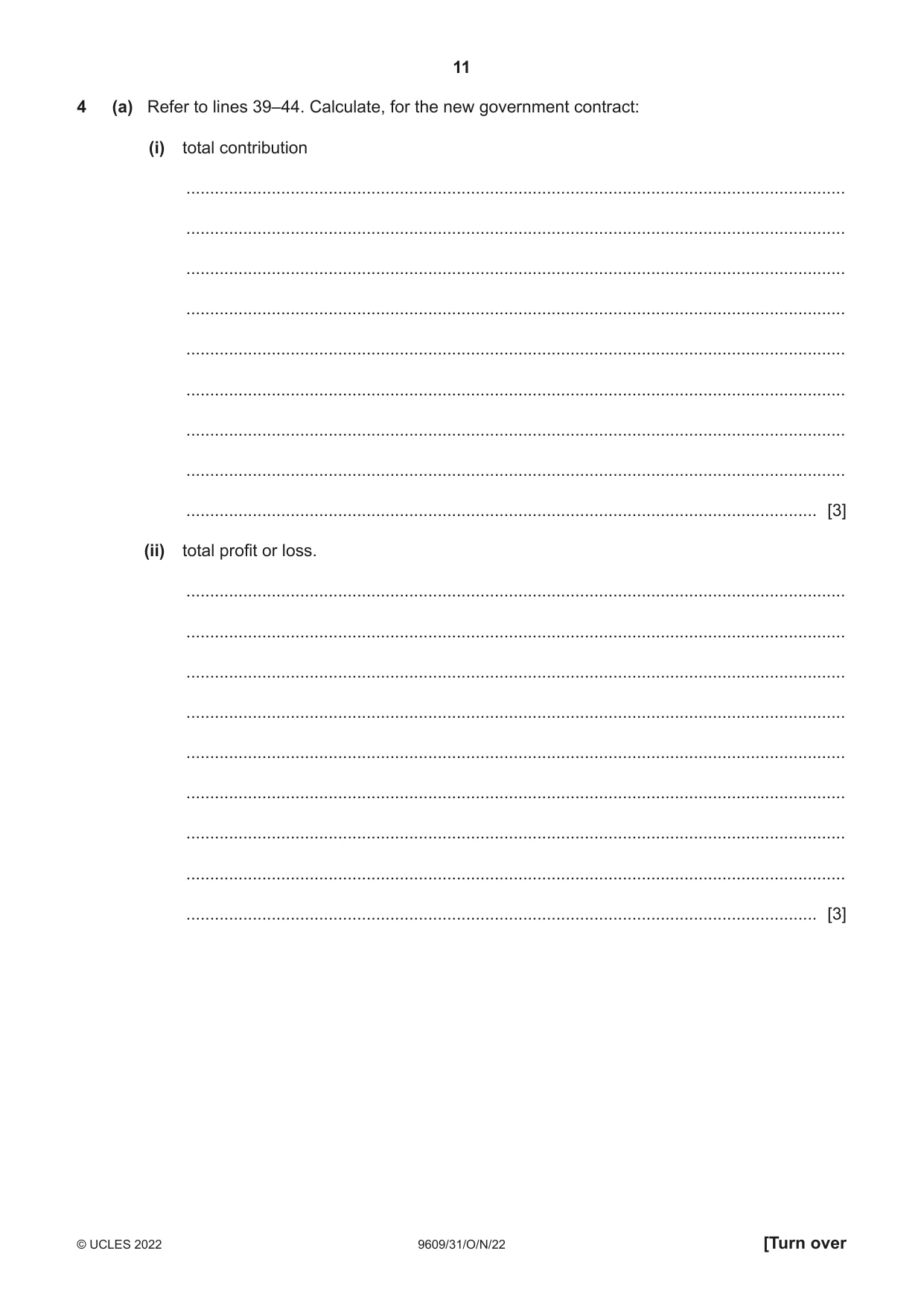
11 9609/31/O/N/22 © UCLES 2022 [Turn over 4 (a) Refer to lines 39–44. Calculate, for the new government contract: (i) total contribution … … … … … … … … … [3] (ii) total profit or loss. … … … … … … … … … [3]
Question paper, page 12
12 9609/31/O/N/22 © UCLES 2022 (b) You may refer to your answer to 4(a) and other information. Recommend how the Marketing Manager should respond to the proposed government contract. Justify your recommendation. … … … … … … … … … … … … … … … … … … … … … … … … … … …
Question paper, page 13
13 9609/31/O/N/22 © UCLES 2022 [Turn over … … … … … … … … … … … … … … … … … … … … … … … … … … … … [12]
Question paper, page 14
14 9609/31/O/N/22 © UCLES 2022 5 Recommend which international market AP should expand into, country P or country T. Justify your recommendation. … … … … … … … … … … … … … … … … … … … … … … … … … … …
Question paper, page 15
15 9609/31/O/N/22 © UCLES 2022 [Turn over … … … … … … … … … … … … … … … … … … … … … … … … … … … …
Question paper, page 16
16 9609/31/O/N/22 © UCLES 2022 … … … … … … … … … … … … … … … … … … … … … … … … … … … … [16]
Question paper, page 17
17 9609/31/O/N/22 © UCLES 2022 [Turn over Section B Answer one question in this section. 6 Evaluate whether decision tree analysis or force field analysis will be more useful to AP’s directors when making a strategic choice. 7 Evaluate the importance to AP of effective strategic management in an increasingly competitive world. Write the question number here … … … … … … … … … … … … … … … … … … … … … … …
Question paper, page 18
18 9609/31/O/N/22 © UCLES 2022 … … … … … … … … … … … … … … … … … … … … … … … … … … … …
Question paper, page 19
19 9609/31/O/N/22 © UCLES 2022 [Turn over … … … … … … … … … … … … … … … … … … … … … … … … … … … …
Question paper, page 20
20 9609/31/O/N/22 © UCLES 2022 … … … … … … … … … … … … … … … … … … … … … … … … [20] Permission to reproduce items where third-party owned material protected by copyright is included has been sought and cleared where possible. Every reasonable effort has been made by the publisher (UCLES) to trace copyright holders, but if any items requiring clearance have unwittingly been included, the publisher will be pleased to make amends at the earliest possible opportunity. To avoid the issue of disclosure of answer-related information to candidates, all copyright acknowledgements are reproduced online in the Cambridge Assessment International Education Copyright Acknowledgements Booklet. This is produced for each series of examinations and is freely available to download at www.cambridgeinternational.org after the live examination series. Cambridge Assessment International Education is part of Cambridge Assessment. Cambridge Assessment is the brand name of the University of Cambridge Local Examinations Syndicate (UCLES), which is a department of the University of Cambridge.
Mark scheme, page 1
This document consists of 21 printed pages. © UCLES 2022 [Turn over Cambridge International AS & A Level BUSINESS 9609/31 Paper 3 Case Study October/November 2022 MARK SCHEME Maximum Mark: 100 Published This mark scheme is published as an aid to teachers and candidates, to indicate the requirements of the examination. It shows the basis on which Examiners were instructed to award marks. It does not indicate the details of the discussions that took place at an Examiners’ meeting before marking began, which would have considered the acceptability of alternative answers. Mark schemes should be read in conjunction with the question paper and the Principal Examiner Report for Teachers. Cambridge International will not enter into discussions about these mark schemes. Cambridge International is publishing the mark schemes for the October/November 2022 series for most Cambridge IGCSE™, Cambridge International A and AS Level components and some Cambridge O Level components.
Mark scheme, page 2
9609/31 Cambridge International AS & A Level – Mark Scheme PUBLISHED October/November 2022 © UCLES 2022 Page 2 of 21 Generic Marking Principles These general marking principles must be applied by all examiners when marking candidate answers. They should be applied alongside the specific content of the mark scheme or generic level descriptors for a question. Each question paper and mark scheme will also comply with these marking principles. GENERIC MARKING PRINCIPLE 1: Marks must be awarded in line with: • the specific content of the mark scheme or the generic level descriptors for the question • the specific skills defined in the mark scheme or in the generic level descriptors for the question • the standard of response required by a candidate as exemplified by the standardisation scripts. GENERIC MARKING PRINCIPLE 2: Marks awarded are always whole marks (not half marks, or other fractions). GENERIC MARKING PRINCIPLE 3: Marks must be awarded positively: • marks are awarded for correct/valid answers, as defined in the mark scheme. However, credit is given for valid answers which go beyond the scope of the syllabus and mark scheme, referring to your Team Leader as appropriate • marks are awarded when candidates clearly demonstrate what they know and can do • marks are not deducted for errors • marks are not deducted for omissions • answers should only be judged on the quality of spelling, punctuation and grammar when these features are specifically assessed by the question as indicated by the mark scheme. The meaning, however, should be unambiguous. GENERIC MARKING PRINCIPLE 4: Rules must be applied consistently, e.g. in situations where candidates have not followed instructions or in the application of generic level descriptors. GENERIC MARKING PRINCIPLE 5: Marks should be awarded using the full range of marks defined in the mark scheme for the question (however; the use of the full mark range may be limited according to the quality of the candidate responses seen). GENERIC MARKING PRINCIPLE 6: Marks awarded are based solely on the requirements as defined in the mark scheme. Marks should not be awarded with grade thresholds or grade descriptors in mind.
Mark scheme, page 3
9609/31 Cambridge International AS & A Level – Mark Scheme PUBLISHED October/November 2022 © UCLES 2022 Page 3 of 21 Social Science-Specific Marking Principles (for point-based marking) 1 Components using point-based marking: • Point marking is often used to reward knowledge, understanding and application of skills. We give credit where the candidate’s answer shows relevant knowledge, understanding and application of skills in answering the question. We do not give credit where the answer shows confusion. From this it follows that we: a DO credit answers which are worded differently from the mark scheme if they clearly convey the same meaning (unless the mark scheme requires a specific term) b DO credit alternative answers/examples which are not written in the mark scheme if they are correct c DO credit answers where candidates give more than one correct answer in one prompt/numbered/scaffolded space where extended writing is required rather than list-type answers. For example, questions that require n reasons (e.g. State two reasons …). d DO NOT credit answers simply for using a ‘key term’ unless that is all that is required. (Check for evidence it is understood and not used wrongly.) e DO NOT credit answers which are obviously self-contradicting or trying to cover all possibilities f DO NOT give further credit for what is effectively repetition of a correct point already credited unless the language itself is being tested. This applies equally to ‘mirror statements’ (i.e. polluted/not polluted). g DO NOT require spellings to be correct, unless this is part of the test. However spellings of syllabus terms must allow for clear and unambiguous separation from other syllabus terms with which they may be confused (e.g. Corrasion/Corrosion) 2 Presentation of mark scheme: • Slashes (/) or the word ‘or’ separate alternative ways of making the same point. • Semi colons (;) bullet points (•) or figures in brackets (1) separate different points. • Content in the answer column in brackets is for examiner information/context to clarify the marking but is not required to earn the mark (except Accounting syllabuses where they indicate negative numbers). 3 Calculation questions: • The mark scheme will show the steps in the most likely correct method(s), the mark for each step, the correct answer(s) and the mark for each answer • If working/explanation is considered essential for full credit, this will be indicated in the question paper and in the mark scheme. In all other instances, the correct answer to a calculation should be given full credit, even if no supporting working is shown. • Where the candidate uses a valid method which is not covered by the mark scheme, award equivalent marks for reaching equivalent stages. • Where an answer makes use of a candidate’s own incorrect figure from previous working, the ‘own figure rule’ applies: full marks will be given if a correct and complete method is used. Further guidance will be included in the mark scheme where necessary and any exceptions to this general principle will be noted.
Mark scheme, page 4
9609/31 Cambridge International AS & A Level – Mark Scheme PUBLISHED October/November 2022 © UCLES 2022 Page 4 of 21 4 Annotation: • For point marking, ticks can be used to indicate correct answers and crosses can be used to indicate wrong answers. There is no direct relationship between ticks and marks. Ticks have no defined meaning for levels of response marking. • For levels of response marking, the level awarded should be annotated on the script. • Other annotations will be used by examiners as agreed during standardisation, and the meaning will be understood by all examiners who marked that paper. General Marking Guidance General Marking Guidance This mark scheme includes a summary of appropriate content for answering each question. It should be emphasised, however, that this material is for illustrative purposes and is not intended to provide a definitive guide to acceptable answers. It is quite possible that among the scripts there will be some candidate answers that are not covered directly by the content of this mark scheme. In such cases, professional judgement should be exercised in assessing the merits of the answer and the senior examiners should be consulted if further guidance is required. Any reasonable answer should be awarded marks. Application marks are not awarded for repeating material from the case study. Application is by answering in the context of the case or by using the information in the case to help answer the question.
Mark scheme, page 5
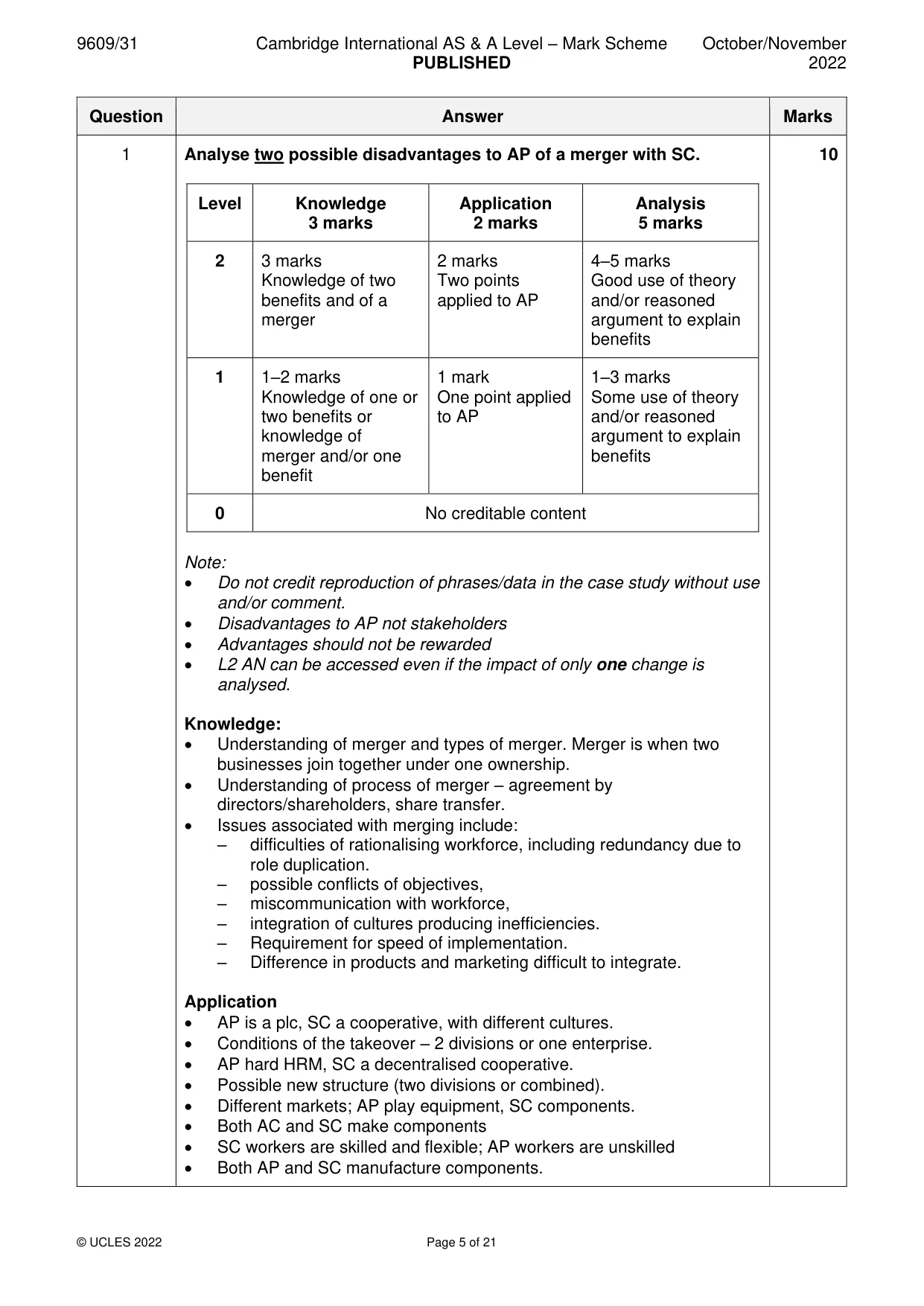
9609/31 Cambridge International AS & A Level – Mark Scheme PUBLISHED October/November 2022 © UCLES 2022 Page 5 of 21 Question Answer Marks 1 Analyse two possible disadvantages to AP of a merger with SC. Level Knowledge 3 marks Application 2 marks Analysis 5 marks 2 3 marks Knowledge of two benefits and of a merger 2 marks Two points applied to AP 4–5 marks Good use of theory and/or reasoned argument to explain benefits 1 1–2 marks Knowledge of one or two benefits or knowledge of merger and/or one benefit 1 mark One point applied to AP 1–3 marks Some use of theory and/or reasoned argument to explain benefits 0 No creditable content Note: • Do not credit reproduction of phrases/data in the case study without use and/or comment. • Disadvantages to AP not stakeholders • Advantages should not be rewarded • L2 AN can be accessed even if the impact of only one change is analysed. Knowledge: • Understanding of merger and types of merger. Merger is when two businesses join together under one ownership. • Understanding of process of merger – agreement by directors/shareholders, share transfer. • Issues associated with merging include: – difficulties of rationalising workforce, including redundancy due to role duplication. – possible conflicts of objectives, – miscommunication with workforce, – integration of cultures producing inefficiencies. – Requirement for speed of implementation. – Difference in products and marketing difficult to integrate. Application • AP is a plc, SC a cooperative, with different cultures. • Conditions of the takeover – 2 divisions or one enterprise. • AP hard HRM, SC a decentralised cooperative. • Possible new structure (two divisions or combined). • Different markets; AP play equipment, SC components. • Both AC and SC make components • SC workers are skilled and flexible; AP workers are unskilled • Both AP and SC manufacture components. 10
Mark scheme, page 6
9609/31 Cambridge International AS & A Level – Mark Scheme PUBLISHED October/November 2022 © UCLES 2022 Page 6 of 21 Question Answer Marks 1 Analysis • Resentment from employees leading to negative effect on efficiency in the new organisation. • Redundancies due to role duplication, such as in component manufacture will lead to job insecurity and demotivation • Costs of integration are higher than expected and remove or work against expected economies of scale. • Difficulty in integrating cultures and work practices means production and sales targets may not be achieved. • Customers not buying from the new brand/organisation due to lack of recognition, leading to lower sales than expected. • Difficulties of the change meaning synergy benefits not achieved. ARA Question Answer Marks 2(a)(i) Refer to the network diagram in Fig. 1, and to Table 1 in the Insert: Complete the network diagram at node 2. EST = 2 (1) LFT = 5 (1) Note: ‘days’ not required 2 2(a)(ii) Calculate the free float of activity E Free float is the maximum time an activity can be delayed without delaying the next activity. (1 mark if no relevant calculation) = EST next activity – duration – EST (1) = 8 – 3 – 2 (2) = 3 days (3) Note: ‘days’ not required OFR 3
Mark scheme, page 7
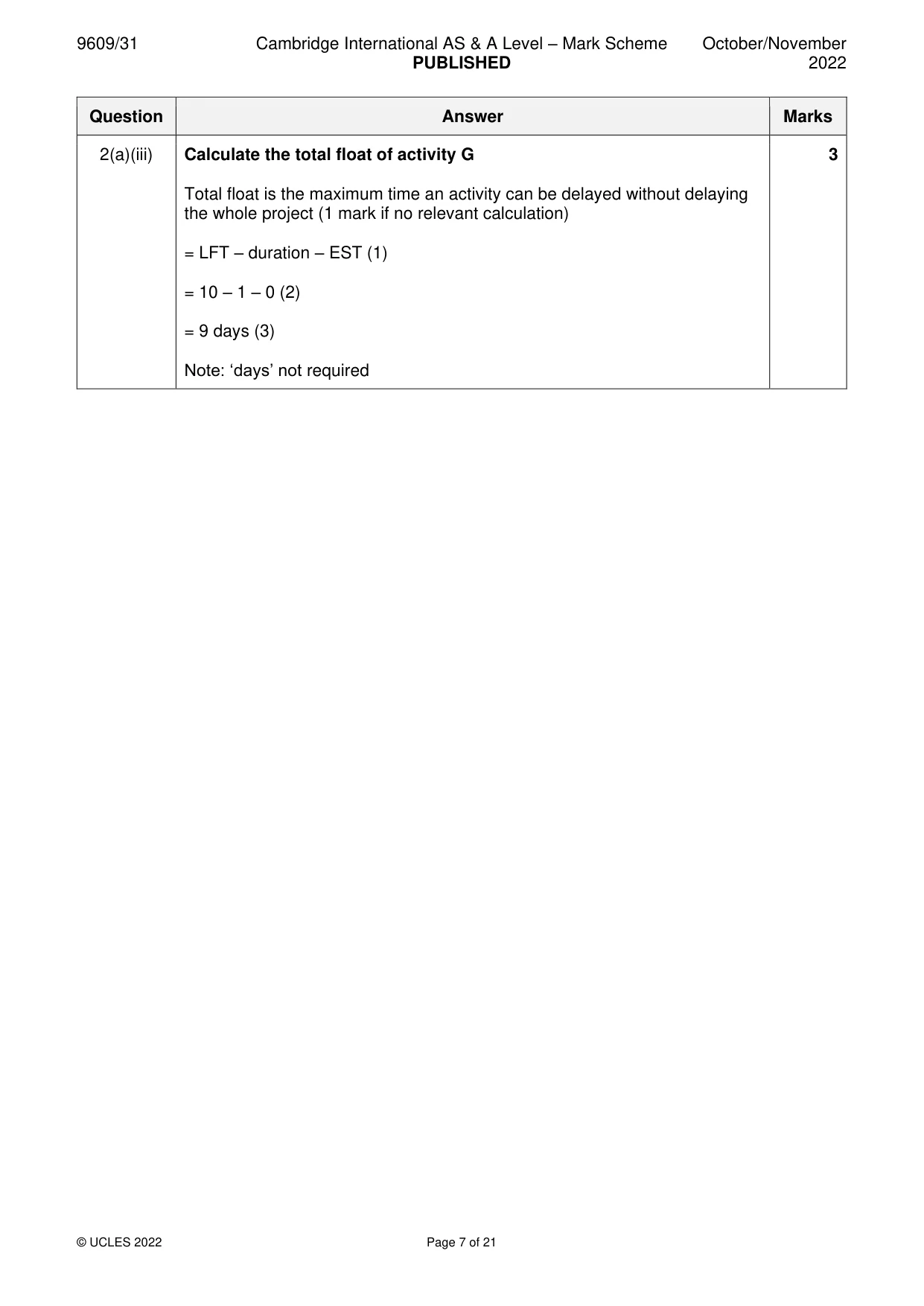
9609/31 Cambridge International AS & A Level – Mark Scheme PUBLISHED October/November 2022 © UCLES 2022 Page 7 of 21 Question Answer Marks 2(a)(iii) Calculate the total float of activity G Total float is the maximum time an activity can be delayed without delaying the whole project (1 mark if no relevant calculation) = LFT – duration – EST (1) = 10 – 1 – 0 (2) = 9 days (3) Note: ‘days’ not required 3
Mark scheme, page 8
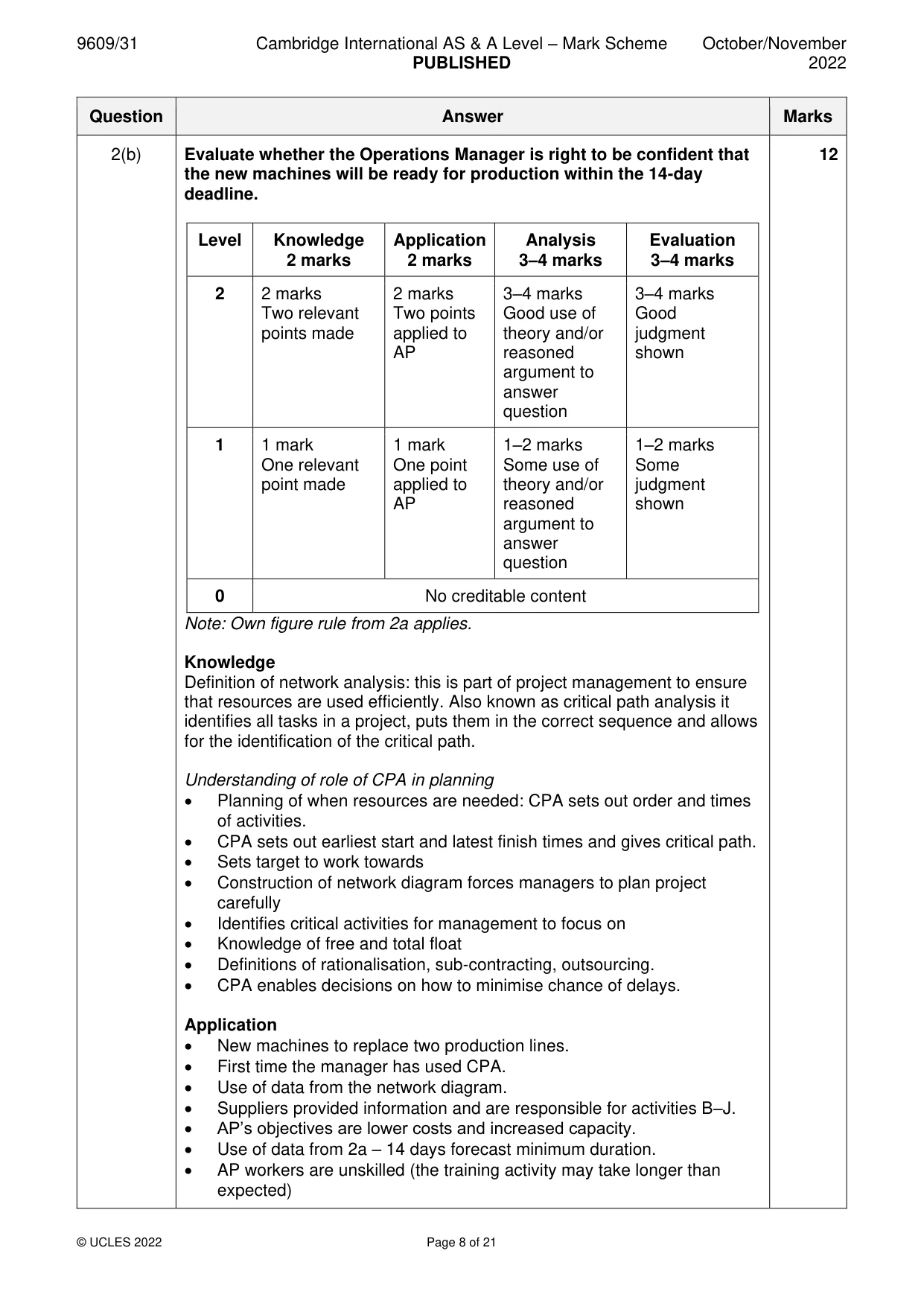
9609/31 Cambridge International AS & A Level – Mark Scheme PUBLISHED October/November 2022 © UCLES 2022 Page 8 of 21 Question Answer Marks 2(b) Evaluate whether the Operations Manager is right to be confident that the new machines will be ready for production within the 14-day deadline. Level Knowledge 2 marks Application 2 marks Analysis 3–4 marks Evaluation 3–4 marks 2 2 marks Two relevant points made 2 marks Two points applied to AP 3–4 marks Good use of theory and/or reasoned argument to answer question 3–4 marks Good judgment shown 1 1 mark One relevant point made 1 mark One point applied to AP 1–2 marks Some use of theory and/or reasoned argument to answer question 1–2 marks Some judgment shown 0 No creditable content Note: Own figure rule from 2a applies. Knowledge Definition of network analysis: this is part of project management to ensure that resources are used efficiently. Also known as critical path analysis it identifies all tasks in a project, puts them in the correct sequence and allows for the identification of the critical path. Understanding of role of CPA in planning • Planning of when resources are needed: CPA sets out order and times of activities. • CPA sets out earliest start and latest finish times and gives critical path. • Sets target to work towards • Construction of network diagram forces managers to plan project carefully • Identifies critical activities for management to focus on • Knowledge of free and total float • Definitions of rationalisation, sub-contracting, outsourcing. • CPA enables decisions on how to minimise chance of delays. Application • New machines to replace two production lines. • First time the manager has used CPA. • Use of data from the network diagram. • Suppliers provided information and are responsible for activities B–J. • AP’s objectives are lower costs and increased capacity. • Use of data from 2a – 14 days forecast minimum duration. • AP workers are unskilled (the training activity may take longer than expected) 12
Mark scheme, page 9
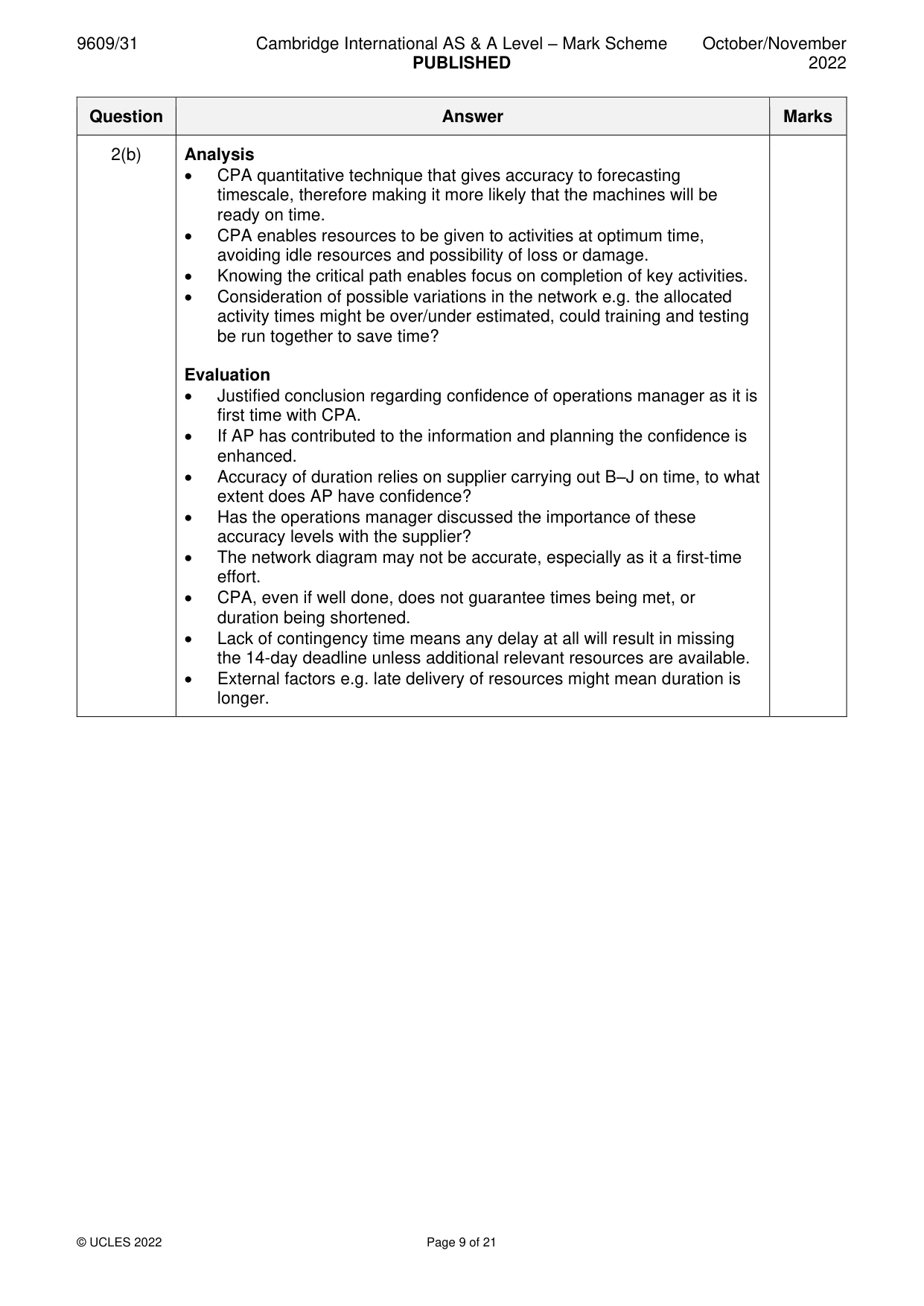
9609/31 Cambridge International AS & A Level – Mark Scheme PUBLISHED October/November 2022 © UCLES 2022 Page 9 of 21 Question Answer Marks 2(b) Analysis • CPA quantitative technique that gives accuracy to forecasting timescale, therefore making it more likely that the machines will be ready on time. • CPA enables resources to be given to activities at optimum time, avoiding idle resources and possibility of loss or damage. • Knowing the critical path enables focus on completion of key activities. • Consideration of possible variations in the network e.g. the allocated activity times might be over/under estimated, could training and testing be run together to save time? Evaluation • Justified conclusion regarding confidence of operations manager as it is first time with CPA. • If AP has contributed to the information and planning the confidence is enhanced. • Accuracy of duration relies on supplier carrying out B–J on time, to what extent does AP have confidence? • Has the operations manager discussed the importance of these accuracy levels with the supplier? • The network diagram may not be accurate, especially as it a first-time effort. • CPA, even if well done, does not guarantee times being met, or duration being shortened. • Lack of contingency time means any delay at all will result in missing the 14-day deadline unless additional relevant resources are available. • External factors e.g. late delivery of resources might mean duration is longer.
Mark scheme, page 10
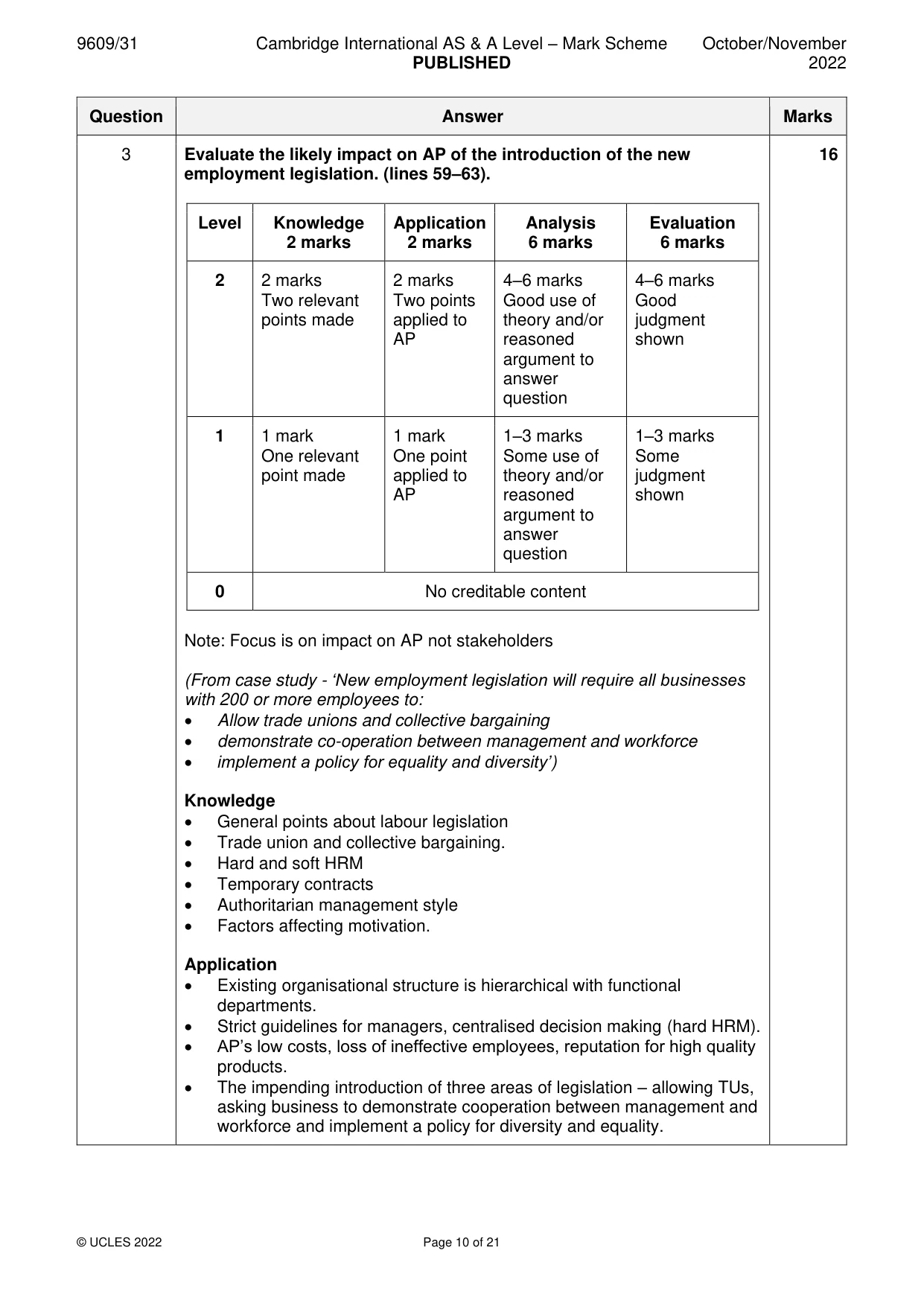
9609/31 Cambridge International AS & A Level – Mark Scheme PUBLISHED October/November 2022 © UCLES 2022 Page 10 of 21 Question Answer Marks 3 Evaluate the likely impact on AP of the introduction of the new employment legislation. (lines 59–63). Level Knowledge 2 marks Application 2 marks Analysis 6 marks Evaluation 6 marks 2 2 marks Two relevant points made 2 marks Two points applied to AP 4–6 marks Good use of theory and/or reasoned argument to answer question 4–6 marks Good judgment shown 1 1 mark One relevant point made 1 mark One point applied to AP 1–3 marks Some use of theory and/or reasoned argument to answer question 1–3 marks Some judgment shown 0 No creditable content Note: Focus is on impact on AP not stakeholders (From case study - ‘New employment legislation will require all businesses with 200 or more employees to: • Allow trade unions and collective bargaining • demonstrate co-operation between management and workforce • implement a policy for equality and diversity’) Knowledge • General points about labour legislation • Trade union and collective bargaining. • Hard and soft HRM • Temporary contracts • Authoritarian management style • Factors affecting motivation. Application • Existing organisational structure is hierarchical with functional departments. • Strict guidelines for managers, centralised decision making (hard HRM). • AP’s low costs, loss of ineffective employees, reputation for high quality products. • The impending introduction of three areas of legislation – allowing TUs, asking business to demonstrate cooperation between management and workforce and implement a policy for diversity and equality. 16
Mark scheme, page 11
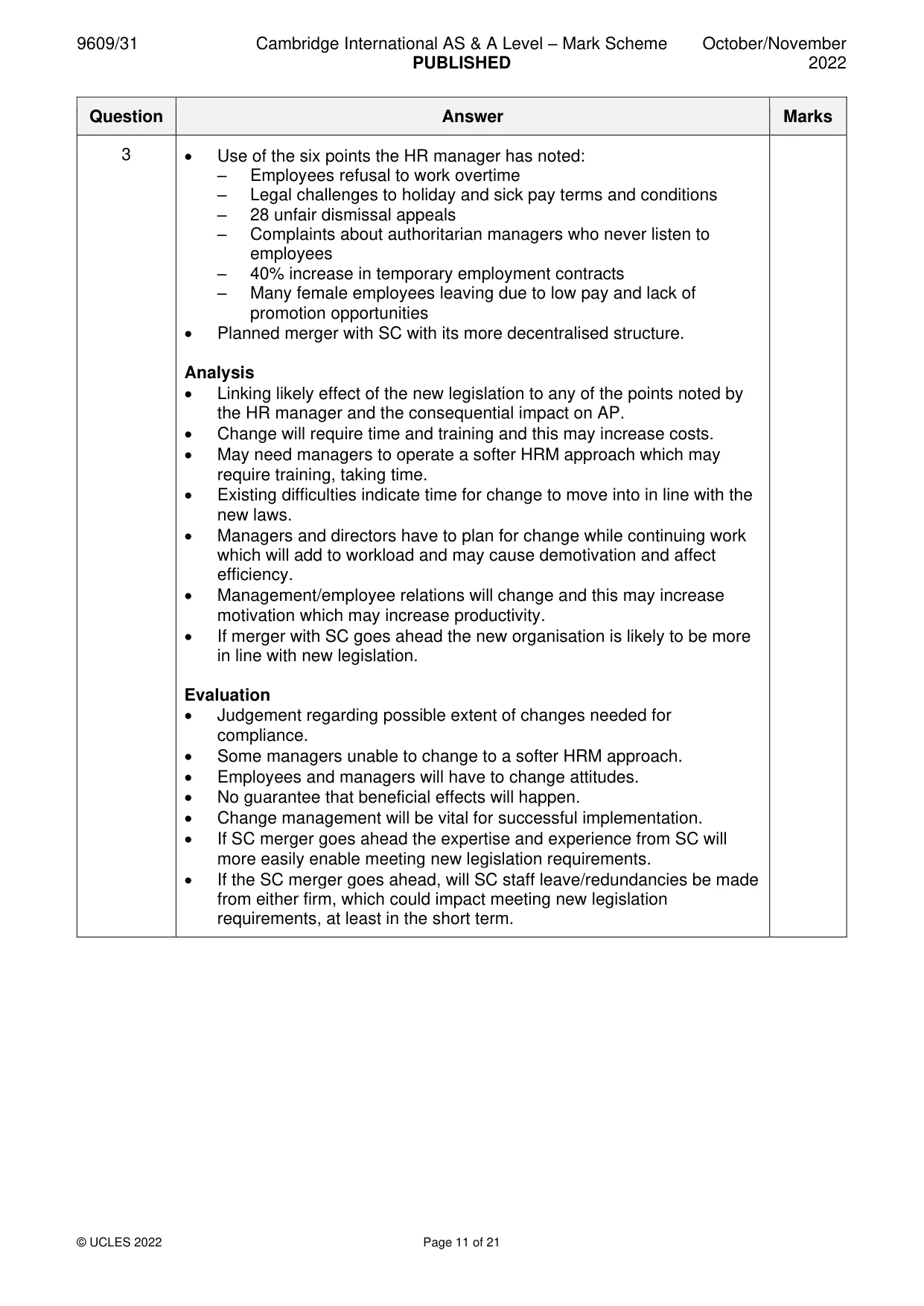
9609/31 Cambridge International AS & A Level – Mark Scheme PUBLISHED October/November 2022 © UCLES 2022 Page 11 of 21 Question Answer Marks 3 • Use of the six points the HR manager has noted: – Employees refusal to work overtime – Legal challenges to holiday and sick pay terms and conditions – 28 unfair dismissal appeals – Complaints about authoritarian managers who never listen to employees – 40% increase in temporary employment contracts – Many female employees leaving due to low pay and lack of promotion opportunities • Planned merger with SC with its more decentralised structure. Analysis • Linking likely effect of the new legislation to any of the points noted by the HR manager and the consequential impact on AP. • Change will require time and training and this may increase costs. • May need managers to operate a softer HRM approach which may require training, taking time. • Existing difficulties indicate time for change to move into in line with the new laws. • Managers and directors have to plan for change while continuing work which will add to workload and may cause demotivation and affect efficiency. • Management/employee relations will change and this may increase motivation which may increase productivity. • If merger with SC goes ahead the new organisation is likely to be more in line with new legislation. Evaluation • Judgement regarding possible extent of changes needed for compliance. • Some managers unable to change to a softer HRM approach. • Employees and managers will have to change attitudes. • No guarantee that beneficial effects will happen. • Change management will be vital for successful implementation. • If SC merger goes ahead the expertise and experience from SC will more easily enable meeting new legislation requirements. • If the SC merger goes ahead, will SC staff leave/redundancies be made from either firm, which could impact meeting new legislation requirements, at least in the short term.
Mark scheme, page 12
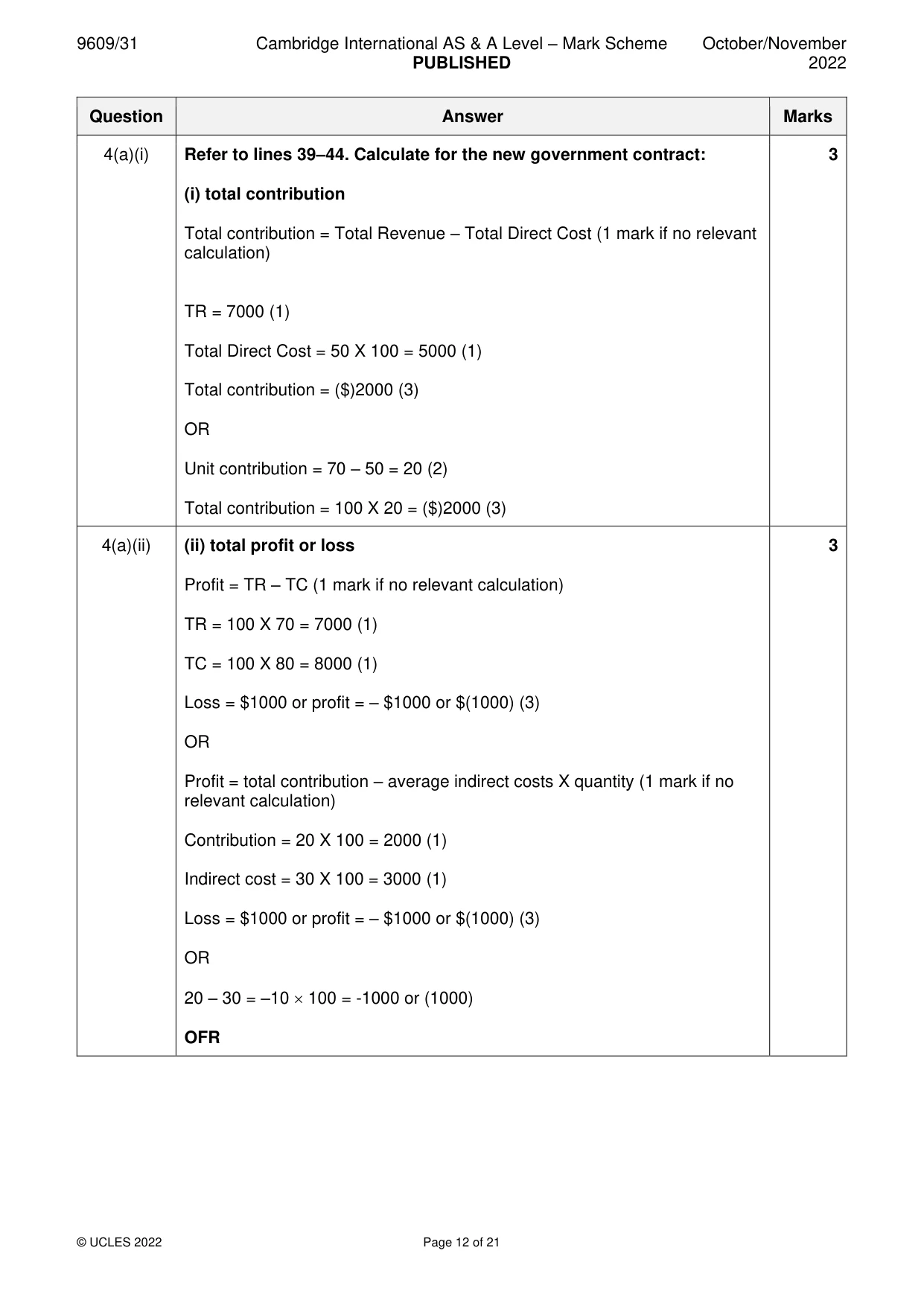
9609/31 Cambridge International AS & A Level – Mark Scheme PUBLISHED October/November 2022 © UCLES 2022 Page 12 of 21 Question Answer Marks 4(a)(i) Refer to lines 39–44. Calculate for the new government contract: (i) total contribution Total contribution = Total Revenue – Total Direct Cost (1 mark if no relevant calculation) TR = 7000 (1) Total Direct Cost = 50 X 100 = 5000 (1) Total contribution = ($)2000 (3) OR Unit contribution = 70 – 50 = 20 (2) Total contribution = 100 X 20 = ($)2000 (3) 3 4(a)(ii) (ii) total profit or loss Profit = TR – TC (1 mark if no relevant calculation) TR = 100 X 70 = 7000 (1) TC = 100 X 80 = 8000 (1) Loss = $1000 or profit = – $1000 or $(1000) (3) OR Profit = total contribution – average indirect costs X quantity (1 mark if no relevant calculation) Contribution = 20 X 100 = 2000 (1) Indirect cost = 30 X 100 = 3000 (1) Loss = $1000 or profit = – $1000 or $(1000) (3) OR 20 – 30 = –10 100 = -1000 or (1000) OFR 3
Mark scheme, page 13
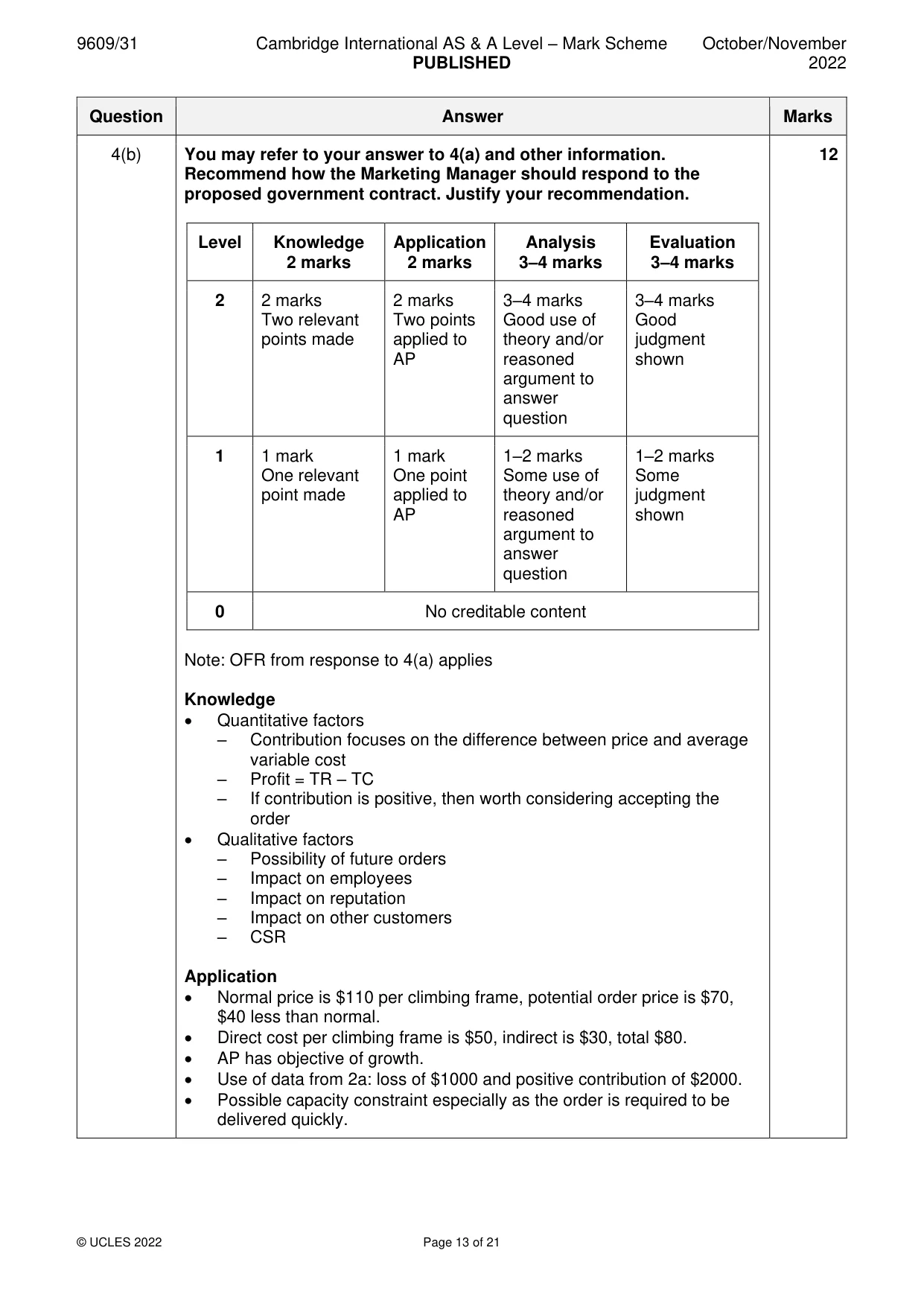
9609/31 Cambridge International AS & A Level – Mark Scheme PUBLISHED October/November 2022 © UCLES 2022 Page 13 of 21 Question Answer Marks 4(b) You may refer to your answer to 4(a) and other information. Recommend how the Marketing Manager should respond to the proposed government contract. Justify your recommendation. Level Knowledge 2 marks Application 2 marks Analysis 3–4 marks Evaluation 3–4 marks 2 2 marks Two relevant points made 2 marks Two points applied to AP 3–4 marks Good use of theory and/or reasoned argument to answer question 3–4 marks Good judgment shown 1 1 mark One relevant point made 1 mark One point applied to AP 1–2 marks Some use of theory and/or reasoned argument to answer question 1–2 marks Some judgment shown 0 No creditable content Note: OFR from response to 4(a) applies Knowledge • Quantitative factors – Contribution focuses on the difference between price and average variable cost – Profit = TR – TC – If contribution is positive, then worth considering accepting the order • Qualitative factors – Possibility of future orders – Impact on employees – Impact on reputation – Impact on other customers – CSR Application • Normal price is $110 per climbing frame, potential order price is $70, $40 less than normal. • Direct cost per climbing frame is $50, indirect is $30, total $80. • AP has objective of growth. • Use of data from 2a: loss of $1000 and positive contribution of $2000. • Possible capacity constraint especially as the order is required to be delivered quickly. 12
Mark scheme, page 14
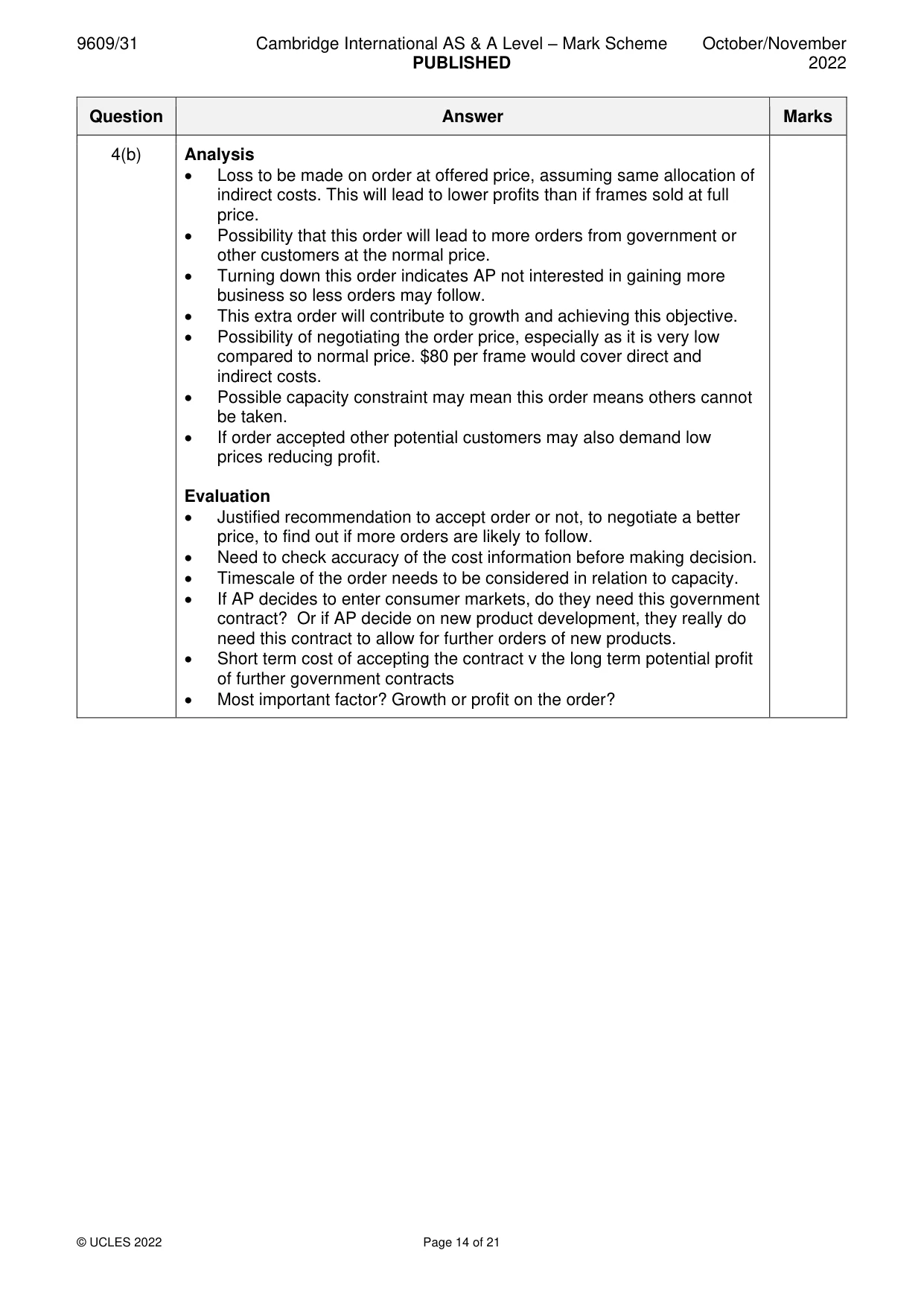
9609/31 Cambridge International AS & A Level – Mark Scheme PUBLISHED October/November 2022 © UCLES 2022 Page 14 of 21 Question Answer Marks 4(b) Analysis • Loss to be made on order at offered price, assuming same allocation of indirect costs. This will lead to lower profits than if frames sold at full price. • Possibility that this order will lead to more orders from government or other customers at the normal price. • Turning down this order indicates AP not interested in gaining more business so less orders may follow. • This extra order will contribute to growth and achieving this objective. • Possibility of negotiating the order price, especially as it is very low compared to normal price. $80 per frame would cover direct and indirect costs. • Possible capacity constraint may mean this order means others cannot be taken. • If order accepted other potential customers may also demand low prices reducing profit. Evaluation • Justified recommendation to accept order or not, to negotiate a better price, to find out if more orders are likely to follow. • Need to check accuracy of the cost information before making decision. • Timescale of the order needs to be considered in relation to capacity. • If AP decides to enter consumer markets, do they need this government contract? Or if AP decide on new product development, they really do need this contract to allow for further orders of new products. • Short term cost of accepting the contract v the long term potential profit of further government contracts • Most important factor? Growth or profit on the order?
Mark scheme, page 15
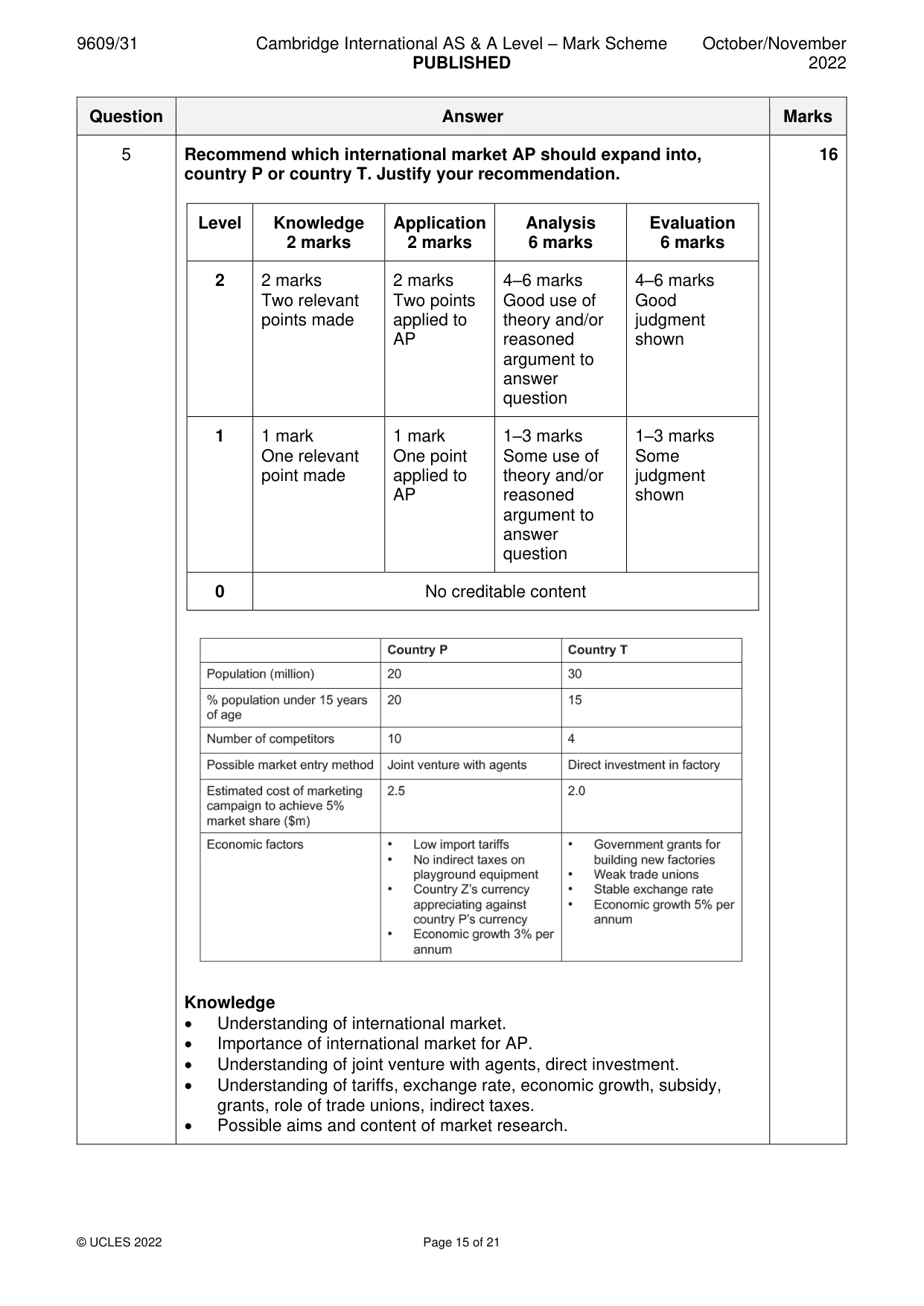
9609/31 Cambridge International AS & A Level – Mark Scheme PUBLISHED October/November 2022 © UCLES 2022 Page 15 of 21 Question Answer Marks 5 Recommend which international market AP should expand into, country P or country T. Justify your recommendation. Level Knowledge 2 marks Application 2 marks Analysis 6 marks Evaluation 6 marks 2 2 marks Two relevant points made 2 marks Two points applied to AP 4–6 marks Good use of theory and/or reasoned argument to answer question 4–6 marks Good judgment shown 1 1 mark One relevant point made 1 mark One point applied to AP 1–3 marks Some use of theory and/or reasoned argument to answer question 1–3 marks Some judgment shown 0 No creditable content Knowledge • Understanding of international market. • Importance of international market for AP. • Understanding of joint venture with agents, direct investment. • Understanding of tariffs, exchange rate, economic growth, subsidy, grants, role of trade unions, indirect taxes. • Possible aims and content of market research. 16
Mark scheme, page 16
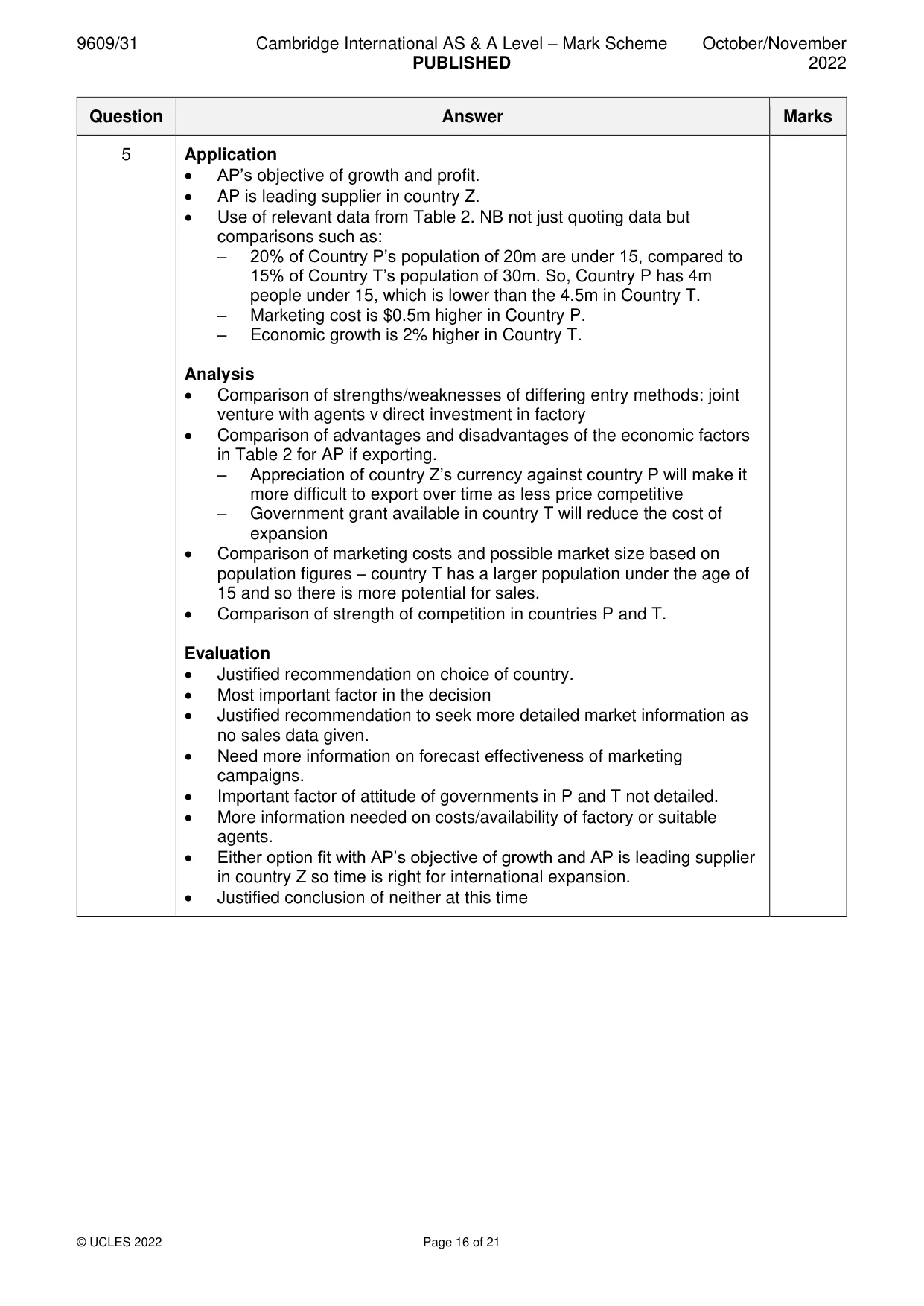
9609/31 Cambridge International AS & A Level – Mark Scheme PUBLISHED October/November 2022 © UCLES 2022 Page 16 of 21 Question Answer Marks 5 Application • AP’s objective of growth and profit. • AP is leading supplier in country Z. • Use of relevant data from Table 2. NB not just quoting data but comparisons such as: – 20% of Country P’s population of 20m are under 15, compared to 15% of Country T’s population of 30m. So, Country P has 4m people under 15, which is lower than the 4.5m in Country T. – Marketing cost is $0.5m higher in Country P. – Economic growth is 2% higher in Country T. Analysis • Comparison of strengths/weaknesses of differing entry methods: joint venture with agents v direct investment in factory • Comparison of advantages and disadvantages of the economic factors in Table 2 for AP if exporting. – Appreciation of country Z’s currency against country P will make it more difficult to export over time as less price competitive – Government grant available in country T will reduce the cost of expansion • Comparison of marketing costs and possible market size based on population figures – country T has a larger population under the age of 15 and so there is more potential for sales. • Comparison of strength of competition in countries P and T. Evaluation • Justified recommendation on choice of country. • Most important factor in the decision • Justified recommendation to seek more detailed market information as no sales data given. • Need more information on forecast effectiveness of marketing campaigns. • Important factor of attitude of governments in P and T not detailed. • More information needed on costs/availability of factory or suitable agents. • Either option fit with AP’s objective of growth and AP is leading supplier in country Z so time is right for international expansion. • Justified conclusion of neither at this time
Mark scheme, page 17
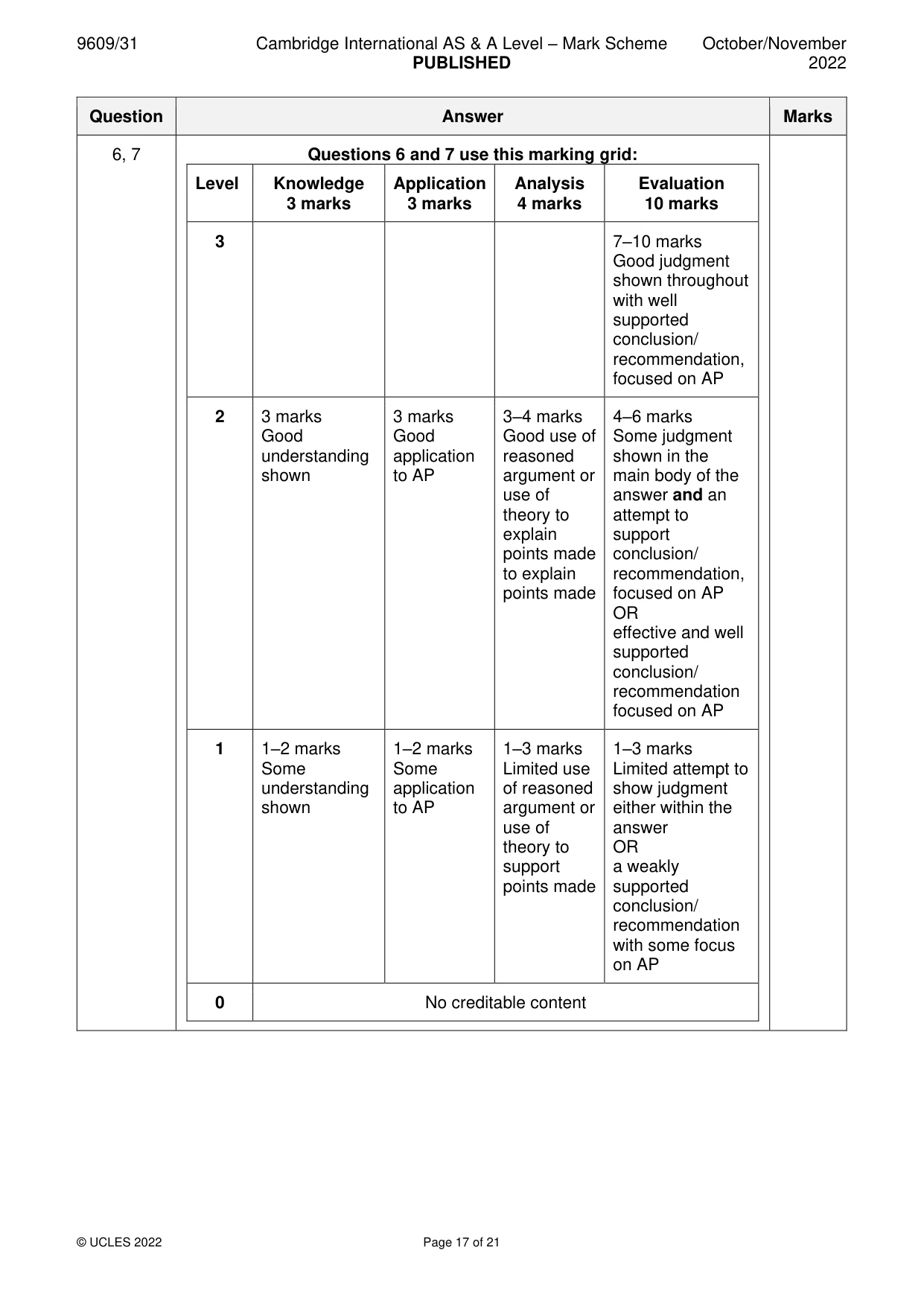
9609/31 Cambridge International AS & A Level – Mark Scheme PUBLISHED October/November 2022 © UCLES 2022 Page 17 of 21 Question Answer Marks 6, 7 Questions 6 and 7 use this marking grid: Level Knowledge 3 marks Application 3 marks Analysis 4 marks Evaluation 10 marks 3 7–10 marks Good judgment shown throughout with well supported conclusion/ recommendation, focused on AP 2 3 marks Good understanding shown 3 marks Good application to AP 3–4 marks Good use of reasoned argument or use of theory to explain points made to explain points made 4–6 marks Some judgment shown in the main body of the answer and an attempt to support conclusion/ recommendation, focused on AP OR effective and well supported conclusion/ recommendation focused on AP 1 1–2 marks Some understanding shown 1–2 marks Some application to AP 1–3 marks Limited use of reasoned argument or use of theory to support points made 1–3 marks Limited attempt to show judgment either within the answer OR a weakly supported conclusion/ recommendation with some focus on AP 0 No creditable content
Mark scheme, page 18
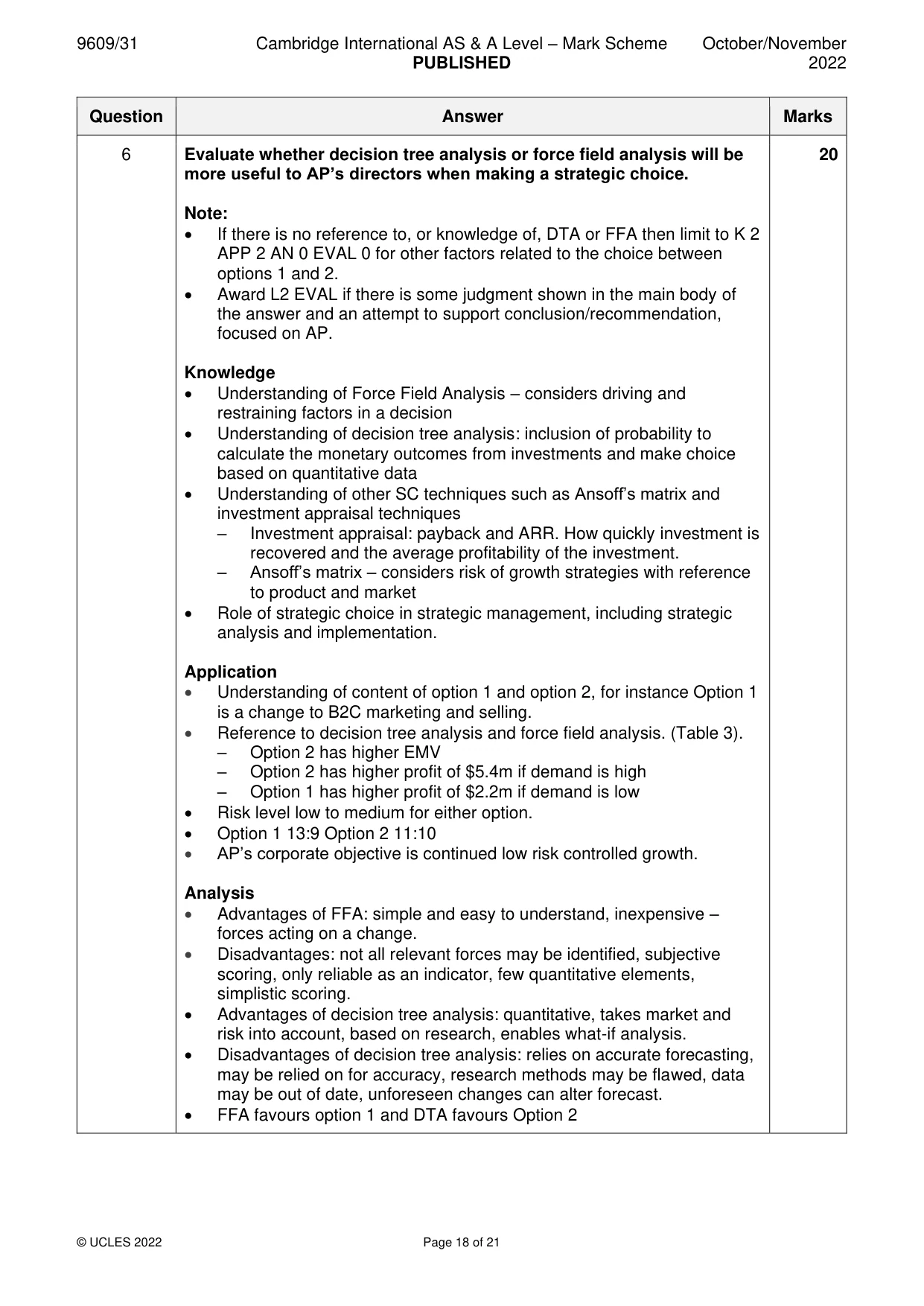
9609/31 Cambridge International AS & A Level – Mark Scheme PUBLISHED October/November 2022 © UCLES 2022 Page 18 of 21 Question Answer Marks 6 Evaluate whether decision tree analysis or force field analysis will be more useful to AP’s directors when making a strategic choice. Note: • If there is no reference to, or knowledge of, DTA or FFA then limit to K 2 APP 2 AN 0 EVAL 0 for other factors related to the choice between options 1 and 2. • Award L2 EVAL if there is some judgment shown in the main body of the answer and an attempt to support conclusion/recommendation, focused on AP. Knowledge • Understanding of Force Field Analysis – considers driving and restraining factors in a decision • Understanding of decision tree analysis: inclusion of probability to calculate the monetary outcomes from investments and make choice based on quantitative data • Understanding of other SC techniques such as Ansoff’s matrix and investment appraisal techniques – Investment appraisal: payback and ARR. How quickly investment is recovered and the average profitability of the investment. – Ansoff’s matrix – considers risk of growth strategies with reference to product and market • Role of strategic choice in strategic management, including strategic analysis and implementation. Application • Understanding of content of option 1 and option 2, for instance Option 1 is a change to B2C marketing and selling. • Reference to decision tree analysis and force field analysis. (Table 3). – Option 2 has higher EMV – Option 2 has higher profit of $5.4m if demand is high – Option 1 has higher profit of $2.2m if demand is low • Risk level low to medium for either option. • Option 1 13:9 Option 2 11:10 • AP’s corporate objective is continued low risk controlled growth. Analysis • Advantages of FFA: simple and easy to understand, inexpensive – forces acting on a change. • Disadvantages: not all relevant forces may be identified, subjective scoring, only reliable as an indicator, few quantitative elements, simplistic scoring. • Advantages of decision tree analysis: quantitative, takes market and risk into account, based on research, enables what-if analysis. • Disadvantages of decision tree analysis: relies on accurate forecasting, may be relied on for accuracy, research methods may be flawed, data may be out of date, unforeseen changes can alter forecast. • FFA favours option 1 and DTA favours Option 2 20
Mark scheme, page 19
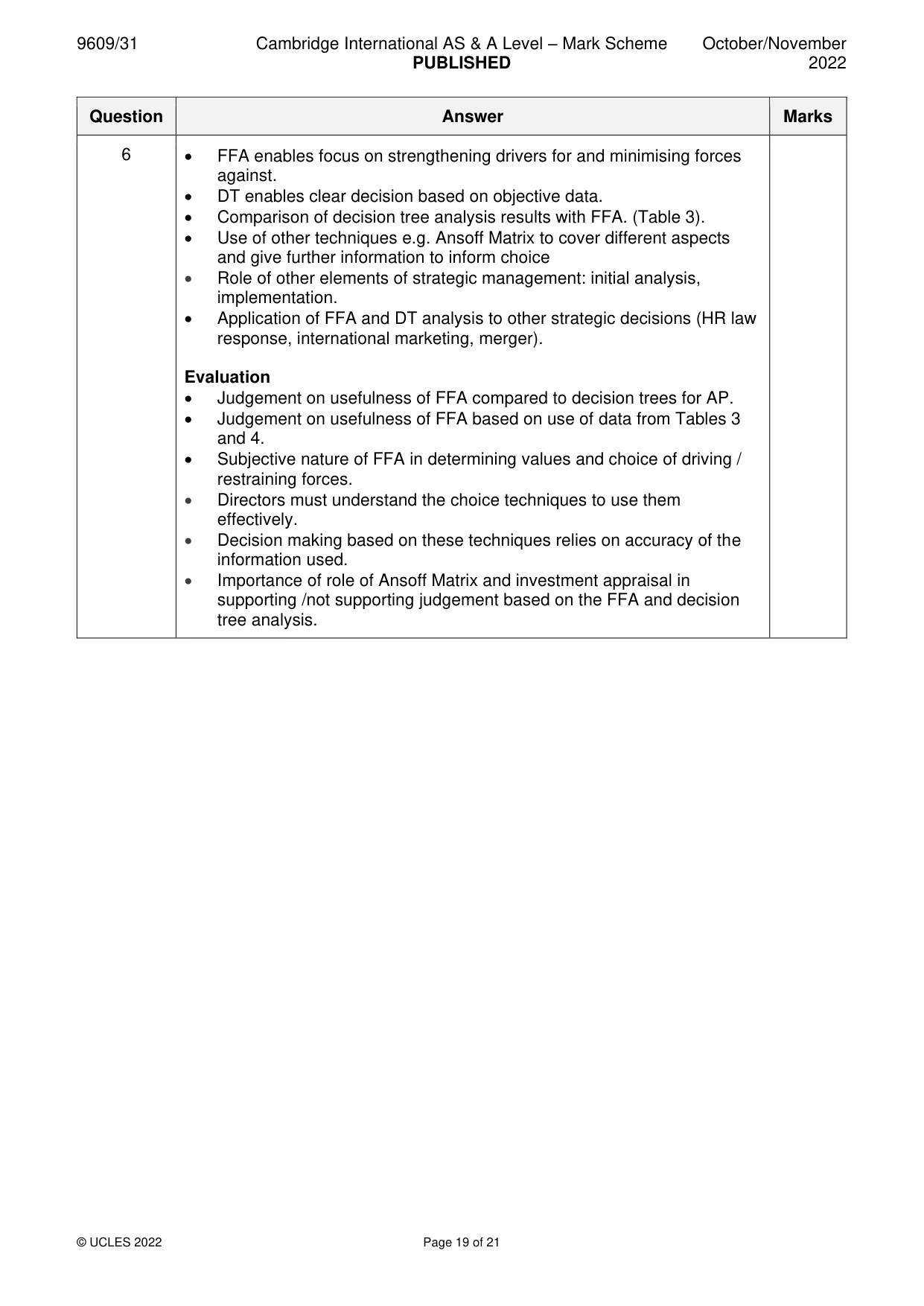
9609/31 Cambridge International AS & A Level – Mark Scheme PUBLISHED October/November 2022 © UCLES 2022 Page 19 of 21 Question Answer Marks 6 • FFA enables focus on strengthening drivers for and minimising forces against. • DT enables clear decision based on objective data. • Comparison of decision tree analysis results with FFA. (Table 3). • Use of other techniques e.g. Ansoff Matrix to cover different aspects and give further information to inform choice • Role of other elements of strategic management: initial analysis, implementation. • Application of FFA and DT analysis to other strategic decisions (HR law response, international marketing, merger). Evaluation • Judgement on usefulness of FFA compared to decision trees for AP. • Judgement on usefulness of FFA based on use of data from Tables 3 and 4. • Subjective nature of FFA in determining values and choice of driving / restraining forces. • Directors must understand the choice techniques to use them effectively. • Decision making based on these techniques relies on accuracy of the information used. • Importance of role of Ansoff Matrix and investment appraisal in supporting /not supporting judgement based on the FFA and decision tree analysis.
Mark scheme, page 20
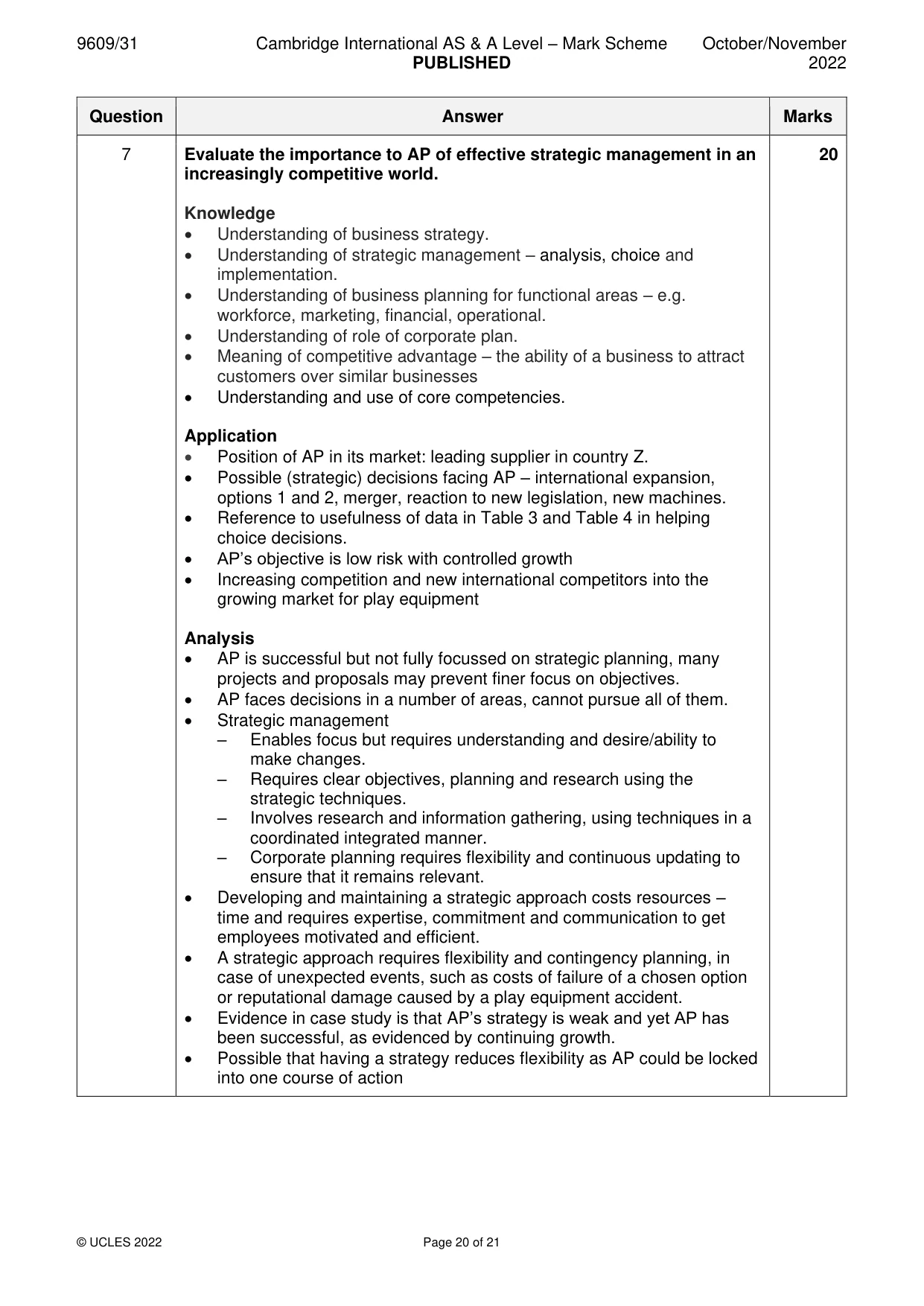
9609/31 Cambridge International AS & A Level – Mark Scheme PUBLISHED October/November 2022 © UCLES 2022 Page 20 of 21 Question Answer Marks 7 Evaluate the importance to AP of effective strategic management in an increasingly competitive world. Knowledge • Understanding of business strategy. • Understanding of strategic management – analysis, choice and implementation. • Understanding of business planning for functional areas – e.g. workforce, marketing, financial, operational. • Understanding of role of corporate plan. • Meaning of competitive advantage – the ability of a business to attract customers over similar businesses • Understanding and use of core competencies. Application • Position of AP in its market: leading supplier in country Z. • Possible (strategic) decisions facing AP – international expansion, options 1 and 2, merger, reaction to new legislation, new machines. • Reference to usefulness of data in Table 3 and Table 4 in helping choice decisions. • AP’s objective is low risk with controlled growth • Increasing competition and new international competitors into the growing market for play equipment Analysis • AP is successful but not fully focussed on strategic planning, many projects and proposals may prevent finer focus on objectives. • AP faces decisions in a number of areas, cannot pursue all of them. • Strategic management – Enables focus but requires understanding and desire/ability to make changes. – Requires clear objectives, planning and research using the strategic techniques. – Involves research and information gathering, using techniques in a coordinated integrated manner. – Corporate planning requires flexibility and continuous updating to ensure that it remains relevant. • Developing and maintaining a strategic approach costs resources – time and requires expertise, commitment and communication to get employees motivated and efficient. • A strategic approach requires flexibility and contingency planning, in case of unexpected events, such as costs of failure of a chosen option or reputational damage caused by a play equipment accident. • Evidence in case study is that AP’s strategy is weak and yet AP has been successful, as evidenced by continuing growth. • Possible that having a strategy reduces flexibility as AP could be locked into one course of action 20
Mark scheme, page 21
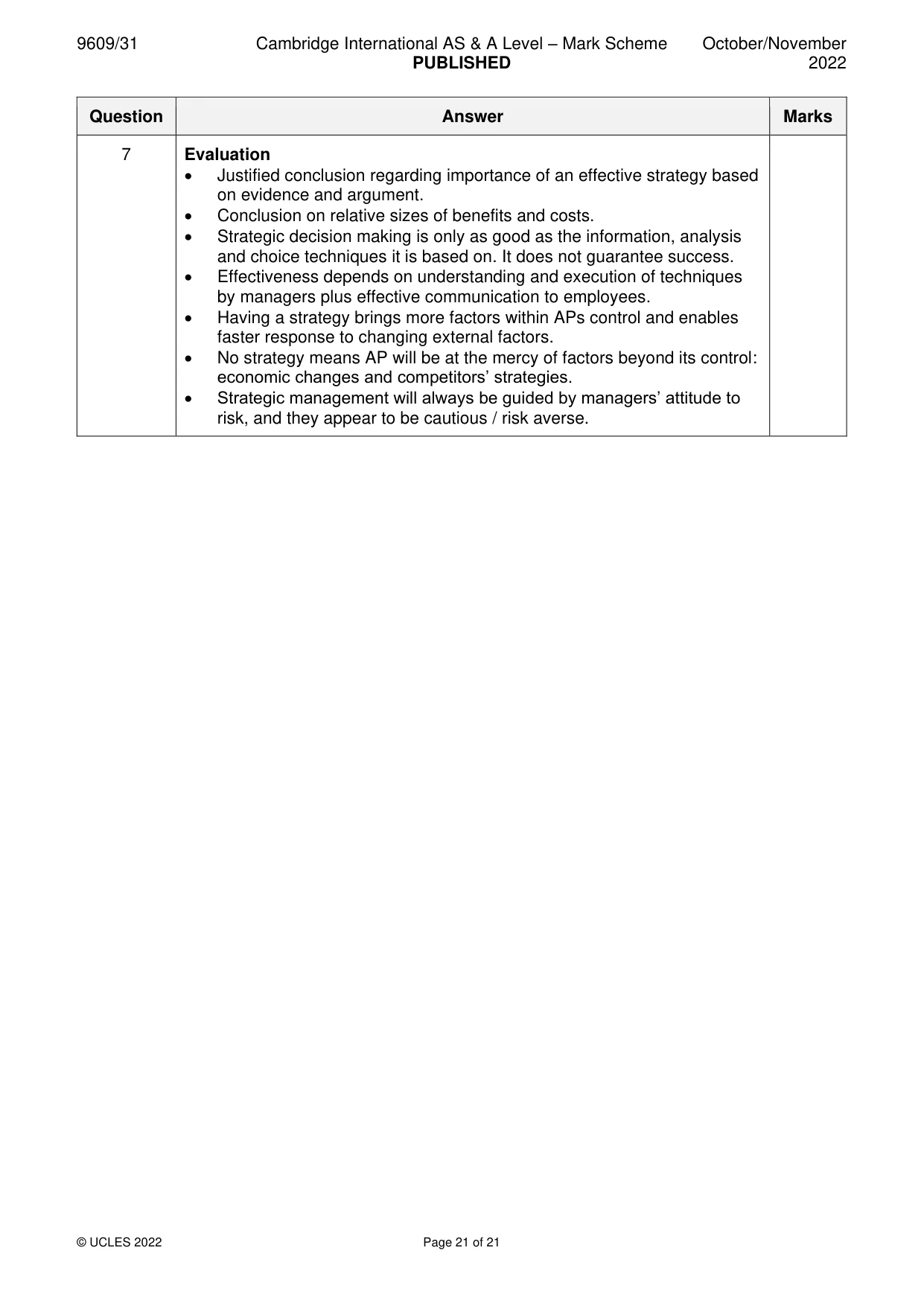
9609/31 Cambridge International AS & A Level – Mark Scheme PUBLISHED October/November 2022 © UCLES 2022 Page 21 of 21 Question Answer Marks 7 Evaluation • Justified conclusion regarding importance of an effective strategy based on evidence and argument. • Conclusion on relative sizes of benefits and costs. • Strategic decision making is only as good as the information, analysis and choice techniques it is based on. It does not guarantee success. • Effectiveness depends on understanding and execution of techniques by managers plus effective communication to employees. • Having a strategy brings more factors within APs control and enables faster response to changing external factors. • No strategy means AP will be at the mercy of factors beyond its control: economic changes and competitors’ strategies. • Strategic management will always be guided by managers’ attitude to risk, and they appear to be cautious / risk averse.
What you needed in this session
Cambridge’s own grade thresholds for 2022 Oct/Nov, Paper 3 · Variant 1. A higher threshold means an easier paper — the bar moves with how the cohort did.