Cambridge A Level Business (for first examination in 2016) 9609 — 2022 Feb/March Paper 3 · Variant 2
9609/32/F/M/22 · 100 marks · ≈113 min
The question paper and its mark scheme, free to read here and free to download. This is Cambridge’s own paper, exactly as it was sat.
Question paper20 pages















Mark scheme23 pages
Answers below. Sit the paper first if you are practising.

Paper as text
Question paper, page 1
This document has 20 pages. Any blank pages are indicated. [Turn over Cambridge International AS & A Level BUSINESS 9609/32 Paper 3 Case Study February/March 2022 3 hours You must answer on the question paper. You will need: Insert (enclosed) INSTRUCTIONS ● Section A: answer all questions. ● Section B: answer one question. ● Use a black or dark blue pen. ● Write your name, centre number and candidate number in the boxes at the top of the page. ● Write your answer to each question in the space provided. ● Do not use an erasable pen or correction fluid. ● Do not write on any bar codes. ● You may use an HB pencil for any diagrams, graphs or rough working. INFORMATION ● The total mark for this paper is 100. ● The number of marks for each question or part question is shown in brackets [ ]. ● The insert contains the case study. DC (MB) 304415/2 © UCLES 2022 * 9 2 0 8 2 5 4 4 8 0 *
Question paper, page 2
2 9609/32/F/M/22 © UCLES 2022 Answer all questions in Section A and answer one question in Section B. You are advised to spend no more than 40 minutes on Section B. Section A Answer all questions in this section. 1 Analyse two benefits to UBH of its approach to human resource management (HRM). … … … … … … … … … … … … … … … … … … … … … … …
Question paper, page 3
3 9609/32/F/M/22 © UCLES 2022 [Turn over … … … … … … … … … … … … … … … … … … … … … … … … … … … … [10]
Question paper, page 4
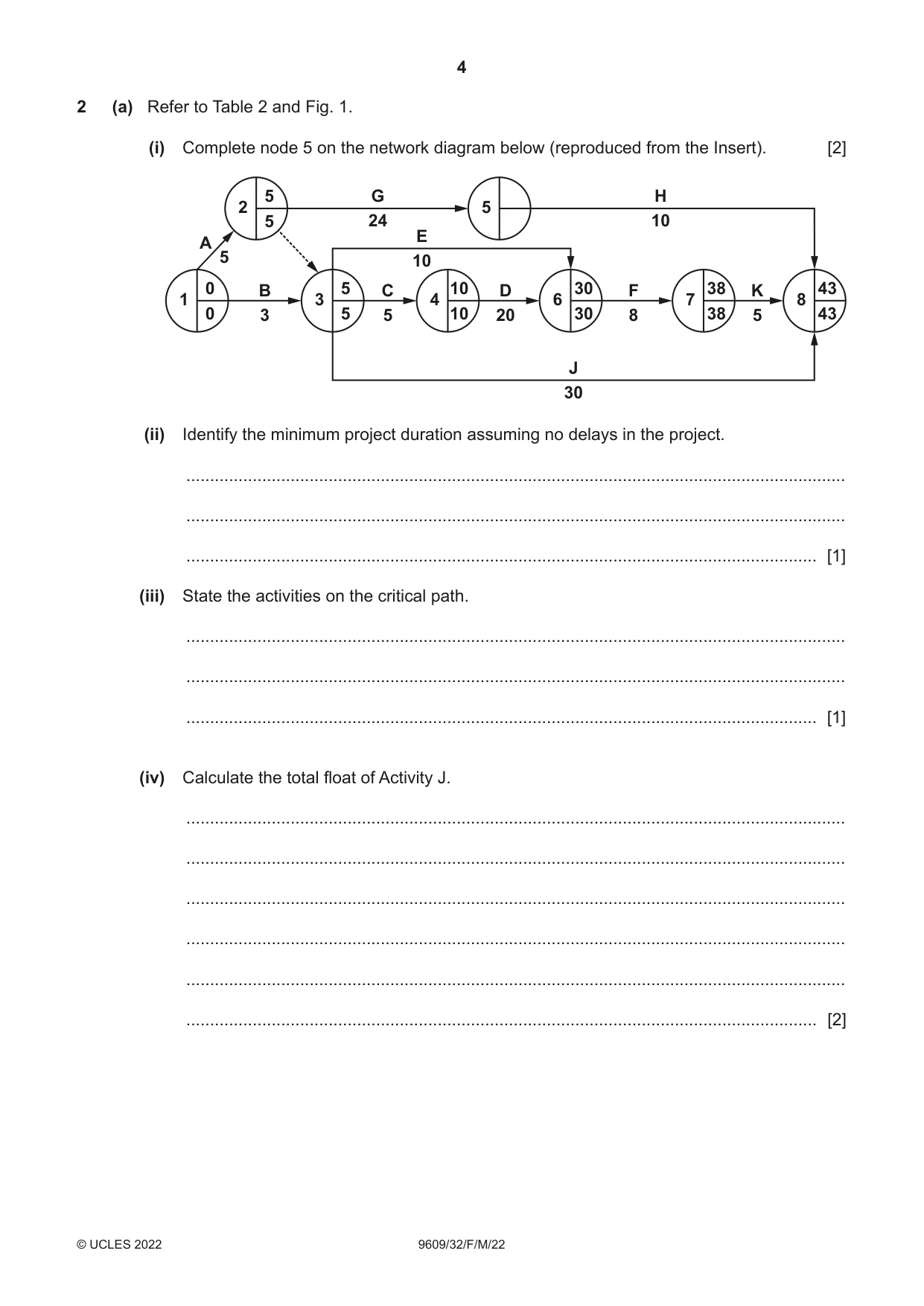
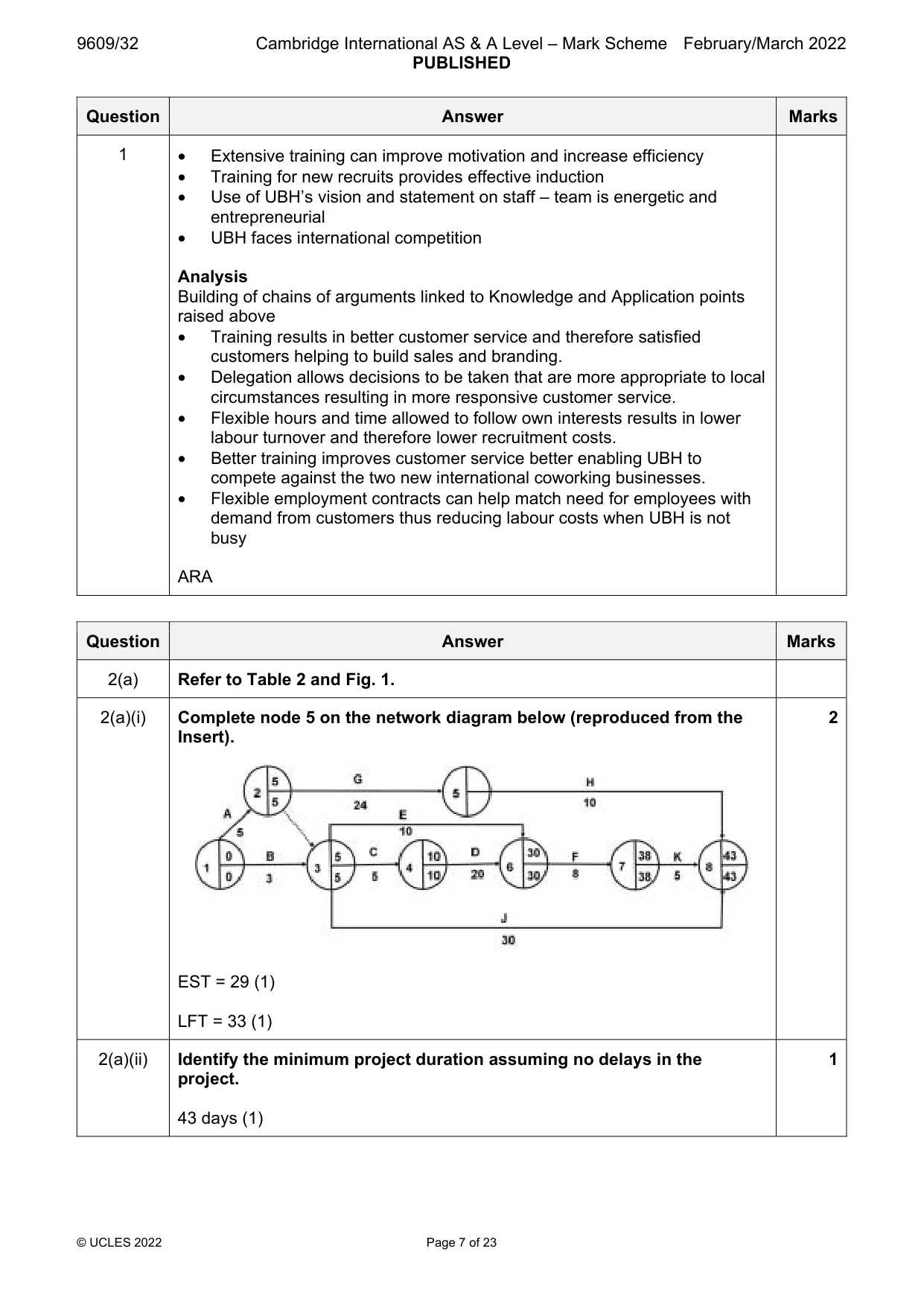
4 9609/32/F/M/22 © UCLES 2022 2 (a) Refer to Table 2 and Fig. 1. (i) Complete node 5 on the network diagram below (reproduced from the Insert). [2] 2 5 5 1 0 0 3 5 5 4 10 10 5 A B 3 C 5 D 20 J 30 F 8 K 5 E 10 G 24 H 10 5 6 30 30 7 38 38 8 43 43 (ii) Identify the minimum project duration assuming no delays in the project. … … … [1] (iii) State the activities on the critical path. … … … [1] (iv) Calculate the total float of Activity J. … … … … … … [2]
Question paper, page 5
5 9609/32/F/M/22 © UCLES 2022 [Turn over (b) You may refer to your answer to 2(a) and other information. Evaluate the usefulness of critical path analysis (CPA) to UBH in planning the opening of new centres. … … … … … … … … … … … … … … … … … … … … … … … … … … …
Question paper, page 6
6 9609/32/F/M/22 © UCLES 2022 … … … … … … … … … … … … … … … … … … … … … … … … … … … … [12]
Question paper, page 7
7 9609/32/F/M/22 © UCLES 2022 [Turn over 3 Evaluate the likely impact on UBH of the changes the government made to its economic policies in response to the recession. … … … … … … … … … … … … … … … … … … … … … … … … … … …
Question paper, page 8
8 9609/32/F/M/22 © UCLES 2022 … … … … … … … … … … … … … … … … … … … … … … … … … … … …
Question paper, page 9
9 9609/32/F/M/22 © UCLES 2022 [Turn over … … … … … … … … … … … … … … … … … … … … … … … … … … … … [16]
Question paper, page 10
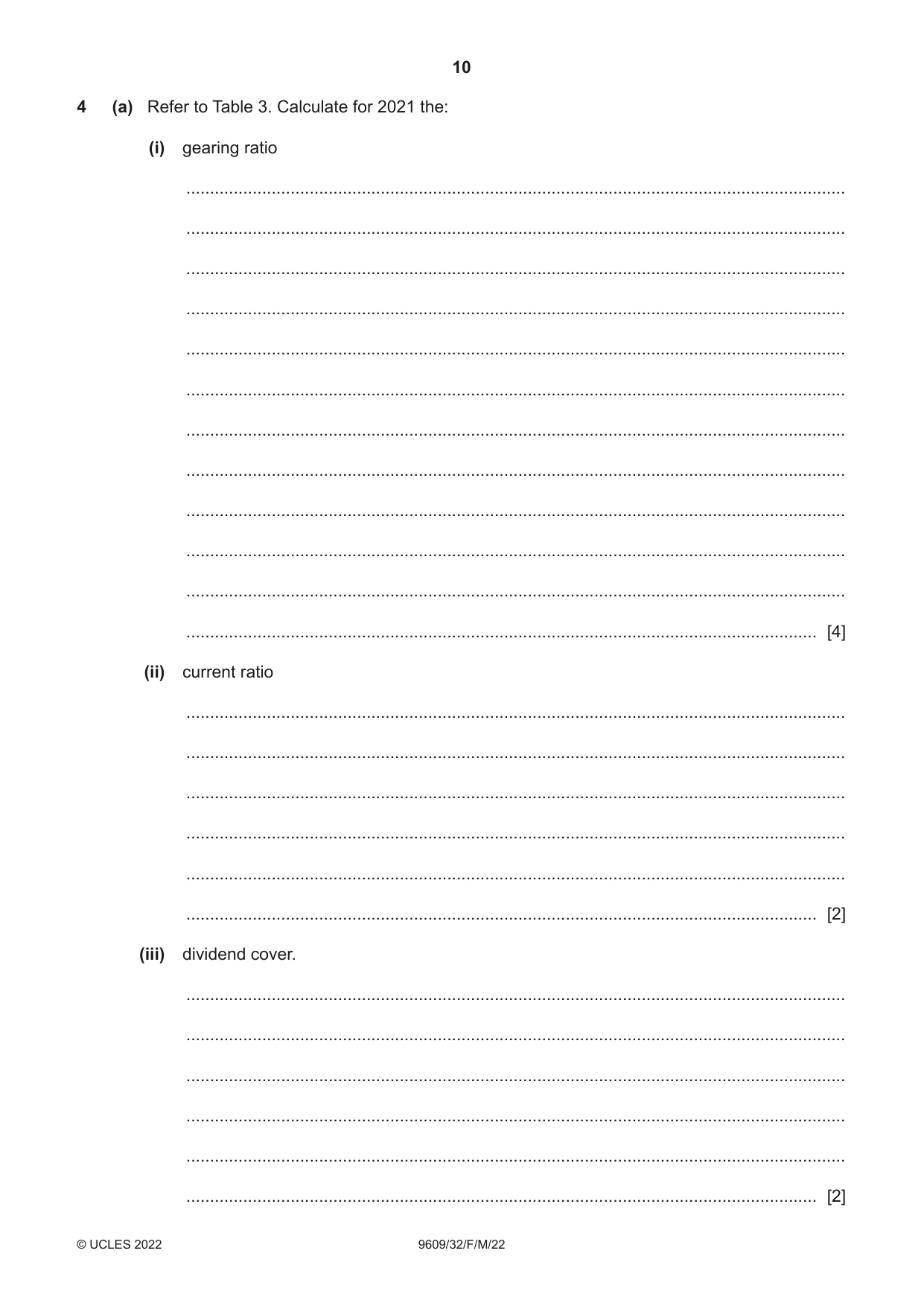
10 9609/32/F/M/22 © UCLES 2022 4 (a) Refer to Table 3. Calculate for 2021 the: (i) gearing ratio … … … … … … … … … … … … [4] (ii) current ratio … … … … … … [2] (iii) dividend cover. … … … … … … [2]
Question paper, page 11
11 9609/32/F/M/22 © UCLES 2022 [Turn over (b) You may refer to your answer to 4(a) and other information. Recommend whether UBH should change into a public limited company (plc). Justify your recommendation. … … … … … … … … … … … … … … … … … … … … … … … … … … …
Question paper, page 12
12 9609/32/F/M/22 © UCLES 2022 … … … … … … … … … … … … … … … … … … … … … … … … … … … … [12]
Question paper, page 13
13 9609/32/F/M/22 © UCLES 2022 [Turn over 5 Evaluate two changes that UBH could make to its current marketing strategy to increase sales and reach its target capacity utilisation. … … … … … … … … … … … … … … … … … … … … … … … … … … …
Question paper, page 14
14 9609/32/F/M/22 © UCLES 2022 … … … … … … … … … … … … … … … … … … … … … … … … … … … …
Question paper, page 15
15 9609/32/F/M/22 © UCLES 2022 [Turn over … … … … … … … … … … … … … … … … … … … … … … … … … … … … [16]
Question paper, page 16
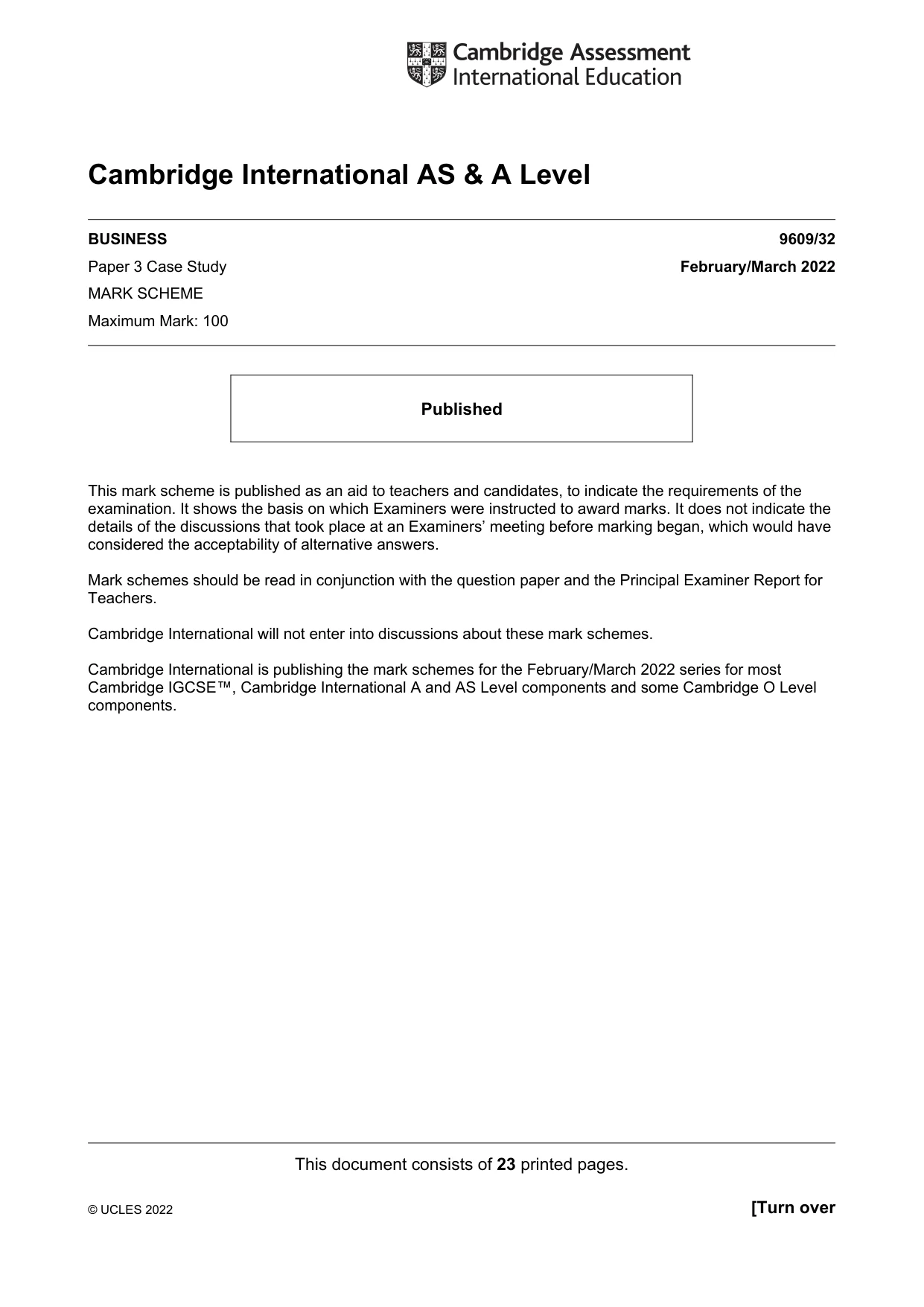
16 9609/32/F/M/22 © UCLES 2022 Section B Answer one question in this section. 6 Evaluate the usefulness to UBH of Porter’s Five Forces analysis as a framework for developing its business strategy. 7 Evaluate the strategic choice techniques that would be most useful to UBH when deciding between strategic option 1 and strategic option 2. Write the question number here: … … … … … … … … … … … … … … … … … … … … … … …
Question paper, page 17
17 9609/32/F/M/22 © UCLES 2022 [Turn over … … … … … … … … … … … … … … … … … … … … … … … … … … … …
Question paper, page 18
18 9609/32/F/M/22 © UCLES 2022 … … … … … … … … … … … … … … … … … … … … … … … … … … … …
Question paper, page 19
19 9609/32/F/M/22 © UCLES 2022 … … … … … … … … … … … … … … … … … … … … … … … … [20]
Question paper, page 20
20 9609/32/F/M/22 © UCLES 2022 Permission to reproduce items where third-party owned material protected by copyright is included has been sought and cleared where possible. Every reasonable effort has been made by the publisher (UCLES) to trace copyright holders, but if any items requiring clearance have unwittingly been included, the publisher will be pleased to make amends at the earliest possible opportunity. To avoid the issue of disclosure of answer-related information to candidates, all copyright acknowledgements are reproduced online in the Cambridge Assessment International Education Copyright Acknowledgements Booklet. This is produced for each series of examinations and is freely available to download at www.cambridgeinternational.org after the live examination series. Cambridge Assessment International Education is part of Cambridge Assessment. Cambridge Assessment is the brand name of the University of Cambridge Local Examinations Syndicate (UCLES), which is a department of the University of Cambridge. BLANK PAGE
Mark scheme, page 1
This document consists of 23 printed pages. © UCLES 2022 [Turn over Cambridge International AS & A Level BUSINESS 9609/32 Paper 3 Case Study February/March 2022 MARK SCHEME Maximum Mark: 100 Published This mark scheme is published as an aid to teachers and candidates, to indicate the requirements of the examination. It shows the basis on which Examiners were instructed to award marks. It does not indicate the details of the discussions that took place at an Examiners’ meeting before marking began, which would have considered the acceptability of alternative answers. Mark schemes should be read in conjunction with the question paper and the Principal Examiner Report for Teachers. Cambridge International will not enter into discussions about these mark schemes. Cambridge International is publishing the mark schemes for the February/March 2022 series for most Cambridge IGCSE™, Cambridge International A and AS Level components and some Cambridge O Level components.
Mark scheme, page 2
9609/32 Cambridge International AS & A Level – Mark Scheme PUBLISHED February/March 2022 © UCLES 2022 Page 2 of 23 Generic Marking Principles These general marking principles must be applied by all examiners when marking candidate answers. They should be applied alongside the specific content of the mark scheme or generic level descriptors for a question. Each question paper and mark scheme will also comply with these marking principles. GENERIC MARKING PRINCIPLE 1: Marks must be awarded in line with: • the specific content of the mark scheme or the generic level descriptors for the question • the specific skills defined in the mark scheme or in the generic level descriptors for the question • the standard of response required by a candidate as exemplified by the standardisation scripts. GENERIC MARKING PRINCIPLE 2: Marks awarded are always whole marks (not half marks, or other fractions). GENERIC MARKING PRINCIPLE 3: Marks must be awarded positively: • marks are awarded for correct/valid answers, as defined in the mark scheme. However, credit is given for valid answers which go beyond the scope of the syllabus and mark scheme, referring to your Team Leader as appropriate • marks are awarded when candidates clearly demonstrate what they know and can do • marks are not deducted for errors • marks are not deducted for omissions • answers should only be judged on the quality of spelling, punctuation and grammar when these features are specifically assessed by the question as indicated by the mark scheme. The meaning, however, should be unambiguous. GENERIC MARKING PRINCIPLE 4: Rules must be applied consistently, e.g. in situations where candidates have not followed instructions or in the application of generic level descriptors. GENERIC MARKING PRINCIPLE 5: Marks should be awarded using the full range of marks defined in the mark scheme for the question (however; the use of the full mark range may be limited according to the quality of the candidate responses seen). GENERIC MARKING PRINCIPLE 6: Marks awarded are based solely on the requirements as defined in the mark scheme. Marks should not be awarded with grade thresholds or grade descriptors in mind.
Mark scheme, page 3
9609/32 Cambridge International AS & A Level – Mark Scheme PUBLISHED February/March 2022 © UCLES 2022 Page 3 of 23 Social Science-Specific Marking Principles (for point-based marking) 1 Components using point-based marking: • Point marking is often used to reward knowledge, understanding and application of skills. We give credit where the candidate’s answer shows relevant knowledge, understanding and application of skills in answering the question. We do not give credit where the answer shows confusion. From this it follows that we: a DO credit answers which are worded differently from the mark scheme if they clearly convey the same meaning (unless the mark scheme requires a specific term) b DO credit alternative answers/examples which are not written in the mark scheme if they are correct c DO credit answers where candidates give more than one correct answer in one prompt/numbered/scaffolded space where extended writing is required rather than list-type answers. For example, questions that require n reasons (e.g. State two reasons …). d DO NOT credit answers simply for using a ‘key term’ unless that is all that is required. (Check for evidence it is understood and not used wrongly.) e DO NOT credit answers which are obviously self-contradicting or trying to cover all possibilities f DO NOT give further credit for what is effectively repetition of a correct point already credited unless the language itself is being tested. This applies equally to ‘mirror statements’ (i.e. polluted/not polluted). g DO NOT require spellings to be correct, unless this is part of the test. However spellings of syllabus terms must allow for clear and unambiguous separation from other syllabus terms with which they may be confused (e.g. Corrasion/Corrosion) 2 Presentation of mark scheme: • Slashes (/) or the word ‘or’ separate alternative ways of making the same point. • Semi colons (;) bullet points (•) or figures in brackets (1) separate different points. • Content in the answer column in brackets is for examiner information/context to clarify the marking but is not required to earn the mark (except Accounting syllabuses where they indicate negative numbers). 3 Calculation questions: • The mark scheme will show the steps in the most likely correct method(s), the mark for each step, the correct answer(s) and the mark for each answer • If working/explanation is considered essential for full credit, this will be indicated in the question paper and in the mark scheme. In all other instances, the correct answer to a calculation should be given full credit, even if no supporting working is shown. • Where the candidate uses a valid method which is not covered by the mark scheme, award equivalent marks for reaching equivalent stages. • Where an answer makes use of a candidate’s own incorrect figure from previous working, the ‘own figure rule’ applies: full marks will be given if a correct and complete method is used. Further guidance will be included in the mark scheme where necessary and any exceptions to this general principle will be noted.
Mark scheme, page 4
9609/32 Cambridge International AS & A Level – Mark Scheme PUBLISHED February/March 2022 © UCLES 2022 Page 4 of 23 4 Annotation: • For point marking, ticks can be used to indicate correct answers and crosses can be used to indicate wrong answers. There is no direct relationship between ticks and marks. Ticks have no defined meaning for levels of response marking. • For levels of response marking, the level awarded should be annotated on the script. • Other annotations will be used by examiners as agreed during standardisation, and the meaning will be understood by all examiners who marked that paper.
Mark scheme, page 5
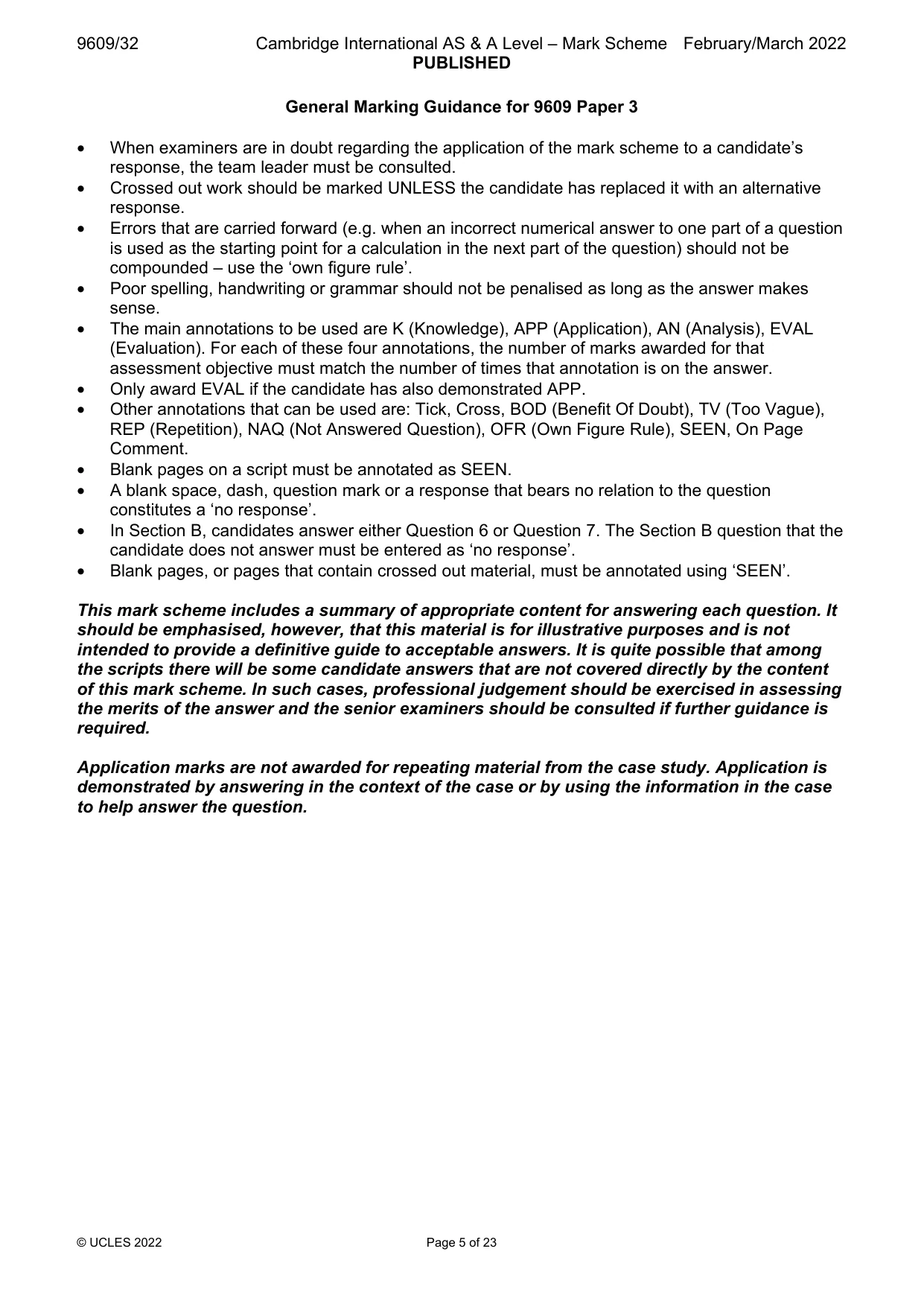
9609/32 Cambridge International AS & A Level – Mark Scheme PUBLISHED February/March 2022 © UCLES 2022 Page 5 of 23 General Marking Guidance for 9609 Paper 3 • When examiners are in doubt regarding the application of the mark scheme to a candidate’s response, the team leader must be consulted. • Crossed out work should be marked UNLESS the candidate has replaced it with an alternative response. • Errors that are carried forward (e.g. when an incorrect numerical answer to one part of a question is used as the starting point for a calculation in the next part of the question) should not be compounded – use the ‘own figure rule’. • Poor spelling, handwriting or grammar should not be penalised as long as the answer makes sense. • The main annotations to be used are K (Knowledge), APP (Application), AN (Analysis), EVAL (Evaluation). For each of these four annotations, the number of marks awarded for that assessment objective must match the number of times that annotation is on the answer. • Only award EVAL if the candidate has also demonstrated APP. • Other annotations that can be used are: Tick, Cross, BOD (Benefit Of Doubt), TV (Too Vague), REP (Repetition), NAQ (Not Answered Question), OFR (Own Figure Rule), SEEN, On Page Comment. • Blank pages on a script must be annotated as SEEN. • A blank space, dash, question mark or a response that bears no relation to the question constitutes a ‘no response’. • In Section B, candidates answer either Question 6 or Question 7. The Section B question that the candidate does not answer must be entered as ‘no response’. • Blank pages, or pages that contain crossed out material, must be annotated using ‘SEEN’. This mark scheme includes a summary of appropriate content for answering each question. It should be emphasised, however, that this material is for illustrative purposes and is not intended to provide a definitive guide to acceptable answers. It is quite possible that among the scripts there will be some candidate answers that are not covered directly by the content of this mark scheme. In such cases, professional judgement should be exercised in assessing the merits of the answer and the senior examiners should be consulted if further guidance is required. Application marks are not awarded for repeating material from the case study. Application is demonstrated by answering in the context of the case or by using the information in the case to help answer the question.
Mark scheme, page 6
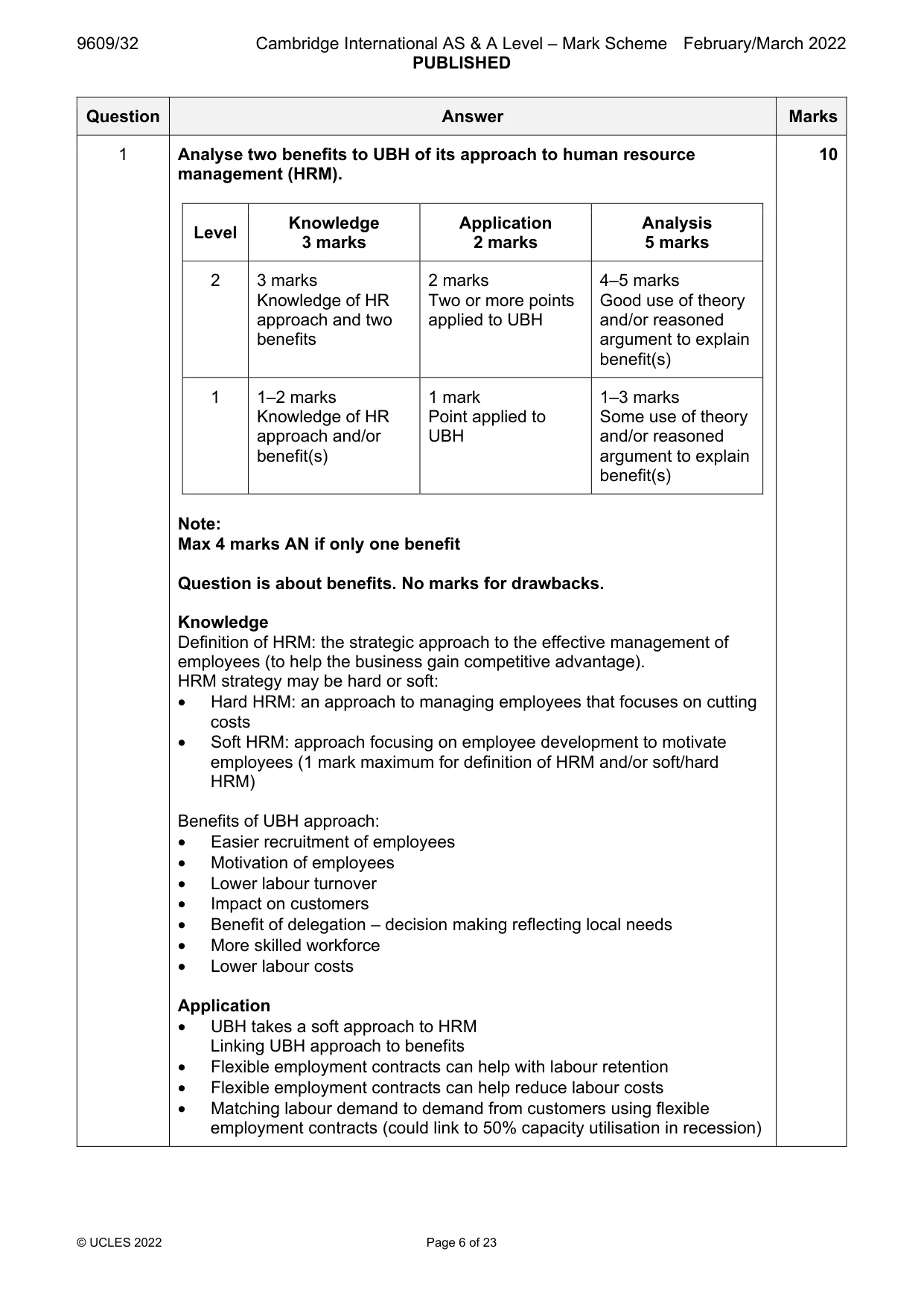
9609/32 Cambridge International AS & A Level – Mark Scheme PUBLISHED February/March 2022 © UCLES 2022 Page 6 of 23 Question Answer Marks 1 Analyse two benefits to UBH of its approach to human resource management (HRM). Level Knowledge 3 marks Application 2 marks Analysis 5 marks 2 3 marks Knowledge of HR approach and two benefits 2 marks Two or more points applied to UBH 4–5 marks Good use of theory and/or reasoned argument to explain benefit(s) 1 1–2 marks Knowledge of HR approach and/or benefit(s) 1 mark Point applied to UBH 1–3 marks Some use of theory and/or reasoned argument to explain benefit(s) Note: Max 4 marks AN if only one benefit Question is about benefits. No marks for drawbacks. Knowledge Definition of HRM: the strategic approach to the effective management of employees (to help the business gain competitive advantage). HRM strategy may be hard or soft: • Hard HRM: an approach to managing employees that focuses on cutting costs • Soft HRM: approach focusing on employee development to motivate employees (1 mark maximum for definition of HRM and/or soft/hard HRM) Benefits of UBH approach: • Easier recruitment of employees • Motivation of employees • Lower labour turnover • Impact on customers • Benefit of delegation – decision making reflecting local needs • More skilled workforce • Lower labour costs Application • UBH takes a soft approach to HRM Linking UBH approach to benefits • Flexible employment contracts can help with labour retention • Flexible employment contracts can help reduce labour costs • Matching labour demand to demand from customers using flexible employment contracts (could link to 50% capacity utilisation in recession) 10
Mark scheme, page 7
9609/32 Cambridge International AS & A Level – Mark Scheme PUBLISHED February/March 2022 © UCLES 2022 Page 7 of 23 Question Answer Marks 1 • Extensive training can improve motivation and increase efficiency • Training for new recruits provides effective induction • Use of UBH’s vision and statement on staff – team is energetic and entrepreneurial • UBH faces international competition Analysis Building of chains of arguments linked to Knowledge and Application points raised above • Training results in better customer service and therefore satisfied customers helping to build sales and branding. • Delegation allows decisions to be taken that are more appropriate to local circumstances resulting in more responsive customer service. • Flexible hours and time allowed to follow own interests results in lower labour turnover and therefore lower recruitment costs. • Better training improves customer service better enabling UBH to compete against the two new international coworking businesses. • Flexible employment contracts can help match need for employees with demand from customers thus reducing labour costs when UBH is not busy ARA Question Answer Marks 2(a) Refer to Table 2 and Fig. 1. 2(a)(i) Complete node 5 on the network diagram below (reproduced from the Insert). EST = 29 (1) LFT = 33 (1) 2 2(a)(ii) Identify the minimum project duration assuming no delays in the project. 43 days (1) 1
Mark scheme, page 8
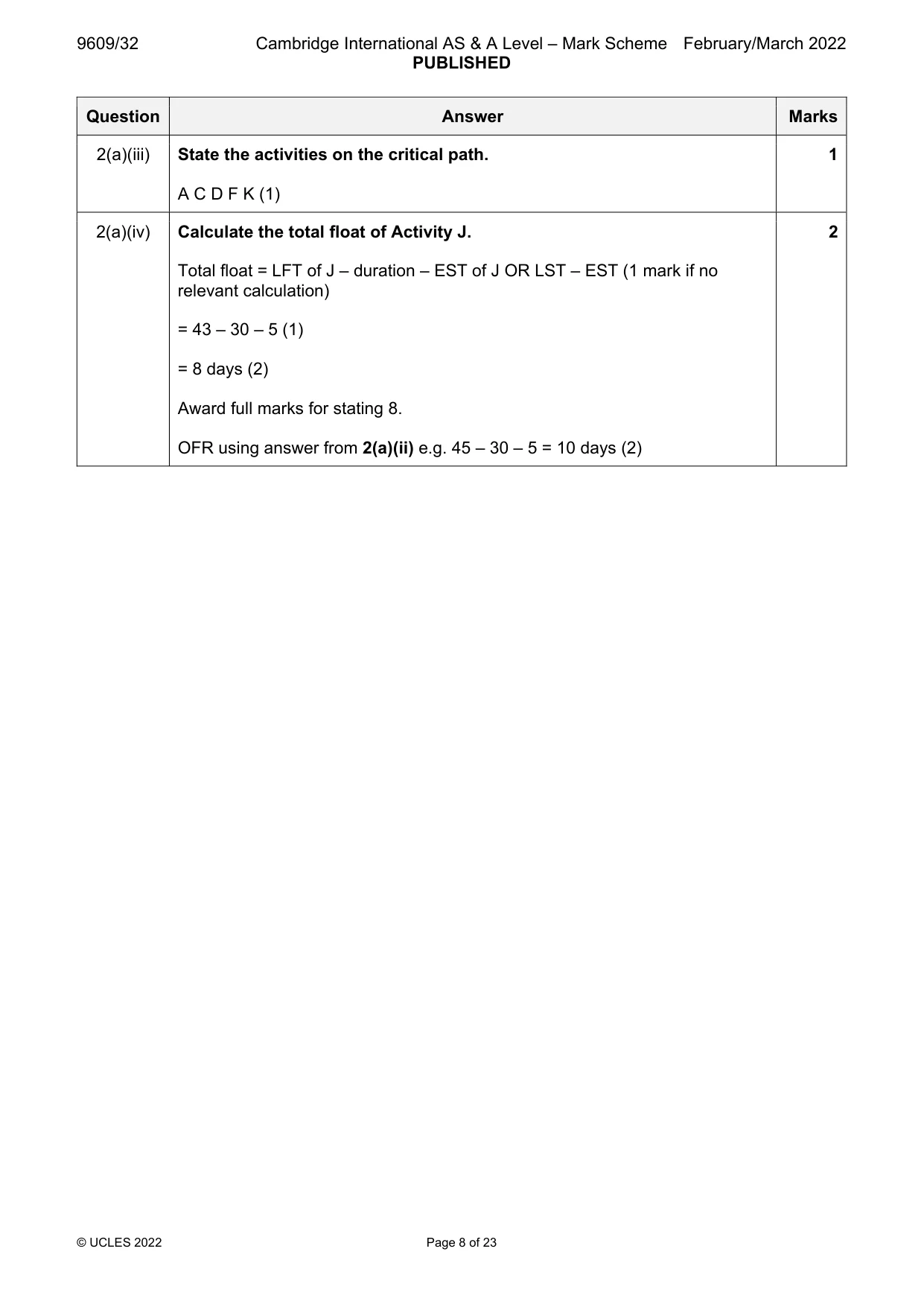
9609/32 Cambridge International AS & A Level – Mark Scheme PUBLISHED February/March 2022 © UCLES 2022 Page 8 of 23 Question Answer Marks 2(a)(iii) State the activities on the critical path. A C D F K (1) 1 2(a)(iv) Calculate the total float of Activity J. Total float = LFT of J – duration – EST of J OR LST – EST (1 mark if no relevant calculation) = 43 – 30 – 5 (1) = 8 days (2) Award full marks for stating 8. OFR using answer from 2(a)(ii) e.g. 45 – 30 – 5 = 10 days (2) 2
Mark scheme, page 9
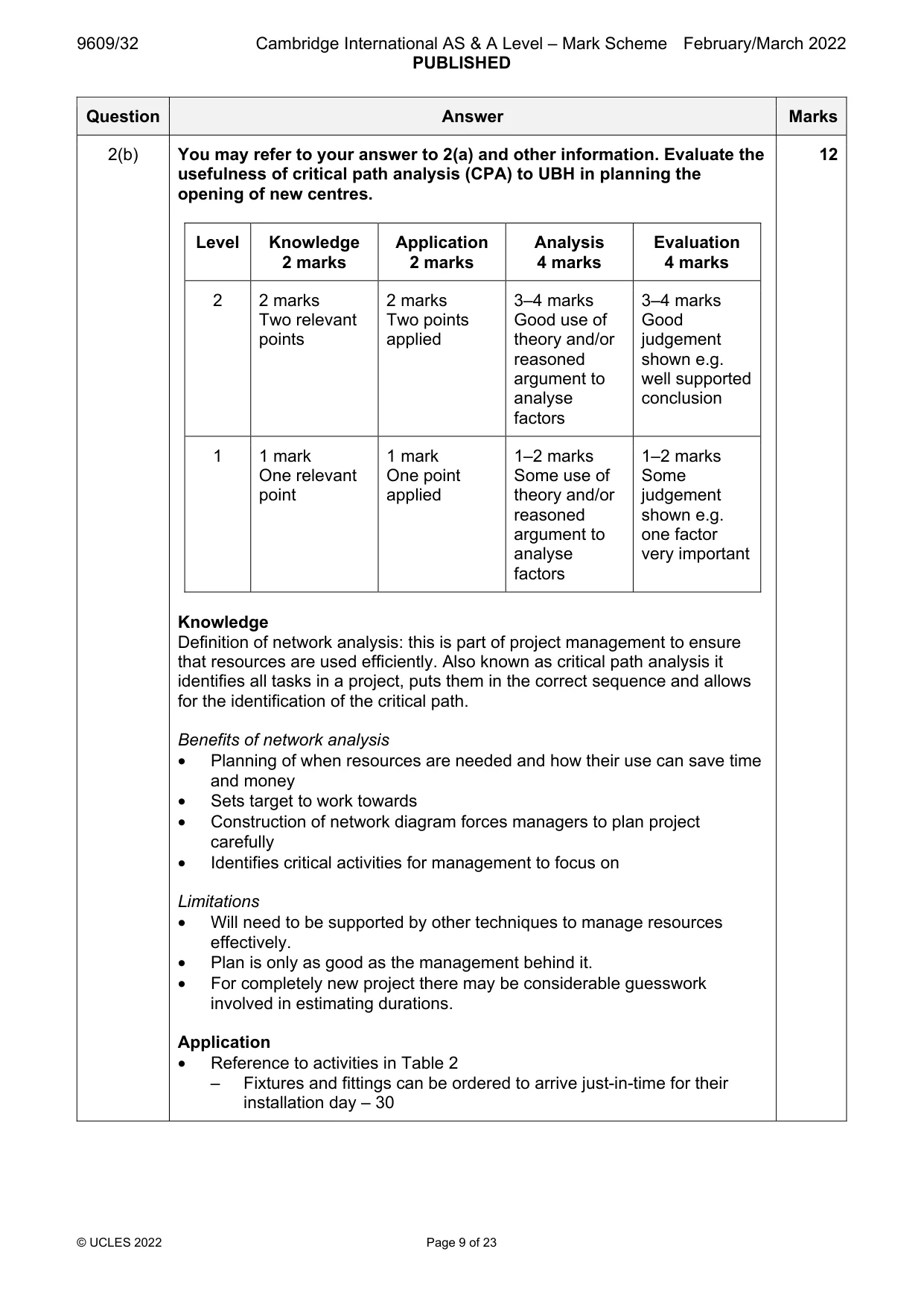
9609/32 Cambridge International AS & A Level – Mark Scheme PUBLISHED February/March 2022 © UCLES 2022 Page 9 of 23 Question Answer Marks 2(b) You may refer to your answer to 2(a) and other information. Evaluate the usefulness of critical path analysis (CPA) to UBH in planning the opening of new centres. Level Knowledge 2 marks Application 2 marks Analysis 4 marks Evaluation 4 marks 2 2 marks Two relevant points 2 marks Two points applied 3–4 marks Good use of theory and/or reasoned argument to analyse factors 3–4 marks Good judgement shown e.g. well supported conclusion 1 1 mark One relevant point 1 mark One point applied 1–2 marks Some use of theory and/or reasoned argument to analyse factors 1–2 marks Some judgement shown e.g. one factor very important Knowledge Definition of network analysis: this is part of project management to ensure that resources are used efficiently. Also known as critical path analysis it identifies all tasks in a project, puts them in the correct sequence and allows for the identification of the critical path. Benefits of network analysis • Planning of when resources are needed and how their use can save time and money • Sets target to work towards • Construction of network diagram forces managers to plan project carefully • Identifies critical activities for management to focus on Limitations • Will need to be supported by other techniques to manage resources effectively. • Plan is only as good as the management behind it. • For completely new project there may be considerable guesswork involved in estimating durations. Application • Reference to activities in Table 2 – Fixtures and fittings can be ordered to arrive just-in-time for their installation day – 30 12
Mark scheme, page 10
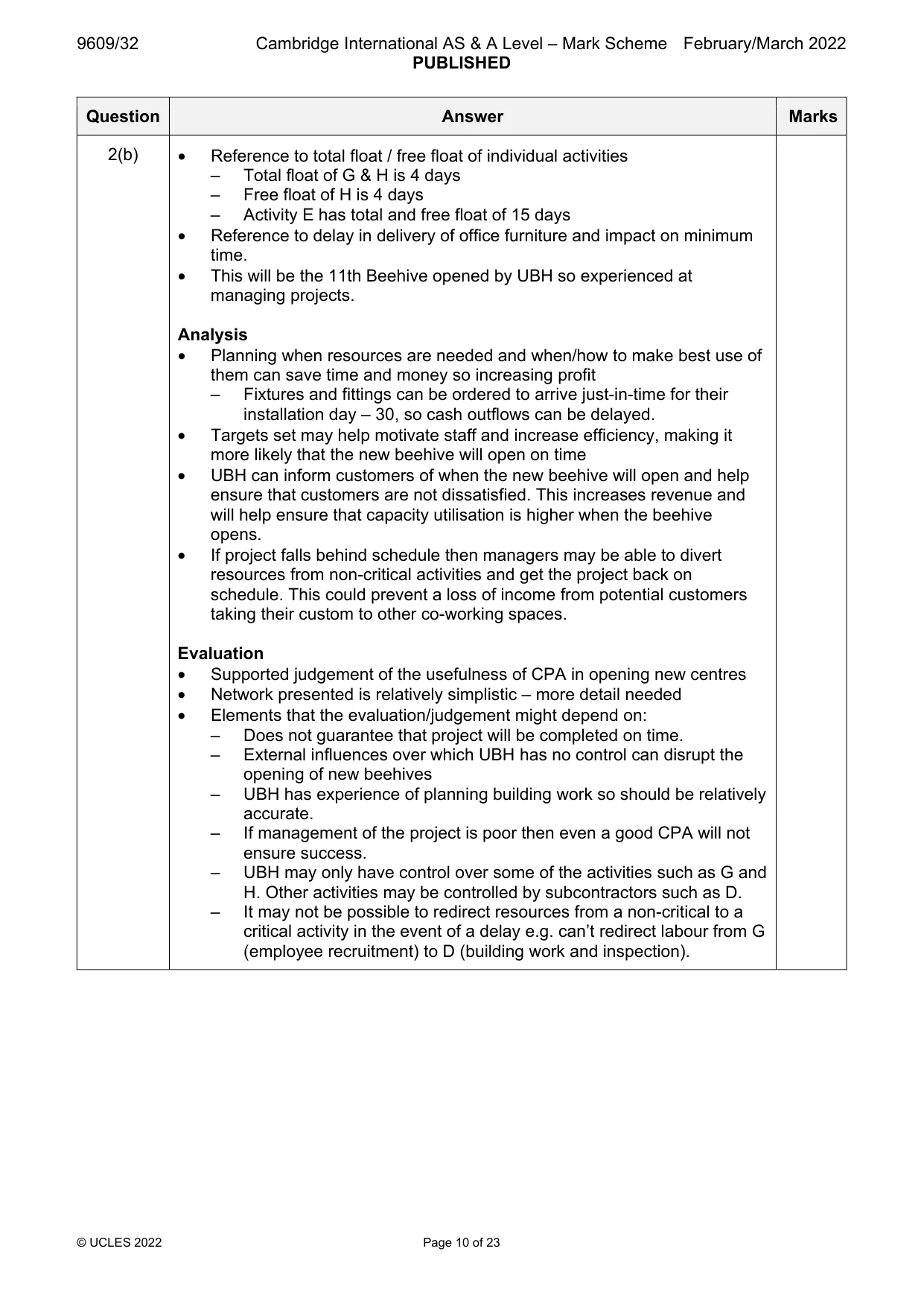
9609/32 Cambridge International AS & A Level – Mark Scheme PUBLISHED February/March 2022 © UCLES 2022 Page 10 of 23 Question Answer Marks 2(b) • Reference to total float / free float of individual activities – Total float of G & H is 4 days – Free float of H is 4 days – Activity E has total and free float of 15 days • Reference to delay in delivery of office furniture and impact on minimum time. • This will be the 11th Beehive opened by UBH so experienced at managing projects. Analysis • Planning when resources are needed and when/how to make best use of them can save time and money so increasing profit – Fixtures and fittings can be ordered to arrive just-in-time for their installation day – 30, so cash outflows can be delayed. • Targets set may help motivate staff and increase efficiency, making it more likely that the new beehive will open on time • UBH can inform customers of when the new beehive will open and help ensure that customers are not dissatisfied. This increases revenue and will help ensure that capacity utilisation is higher when the beehive opens. • If project falls behind schedule then managers may be able to divert resources from non-critical activities and get the project back on schedule. This could prevent a loss of income from potential customers taking their custom to other co-working spaces. Evaluation • Supported judgement of the usefulness of CPA in opening new centres • Network presented is relatively simplistic – more detail needed • Elements that the evaluation/judgement might depend on: – Does not guarantee that project will be completed on time. – External influences over which UBH has no control can disrupt the opening of new beehives – UBH has experience of planning building work so should be relatively accurate. – If management of the project is poor then even a good CPA will not ensure success. – UBH may only have control over some of the activities such as G and H. Other activities may be controlled by subcontractors such as D. – It may not be possible to redirect resources from a non-critical to a critical activity in the event of a delay e.g. can’t redirect labour from G (employee recruitment) to D (building work and inspection).
Mark scheme, page 11
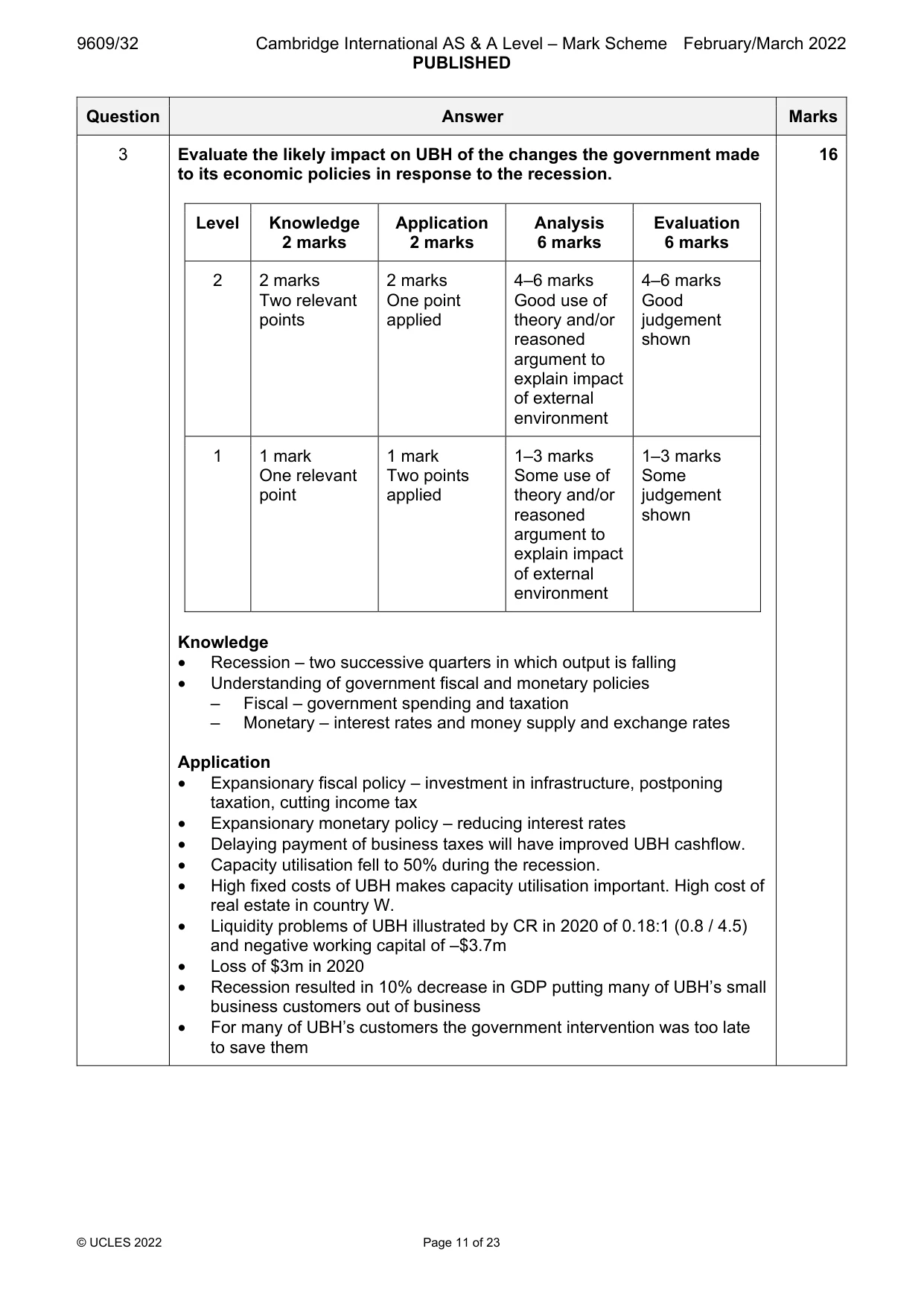
9609/32 Cambridge International AS & A Level – Mark Scheme PUBLISHED February/March 2022 © UCLES 2022 Page 11 of 23 Question Answer Marks 3 Evaluate the likely impact on UBH of the changes the government made to its economic policies in response to the recession. Level Knowledge 2 marks Application 2 marks Analysis 6 marks Evaluation 6 marks 2 2 marks Two relevant points 2 marks One point applied 4–6 marks Good use of theory and/or reasoned argument to explain impact of external environment 4–6 marks Good judgement shown 1 1 mark One relevant point 1 mark Two points applied 1–3 marks Some use of theory and/or reasoned argument to explain impact of external environment 1–3 marks Some judgement shown Knowledge • Recession – two successive quarters in which output is falling • Understanding of government fiscal and monetary policies – Fiscal – government spending and taxation – Monetary – interest rates and money supply and exchange rates Application • Expansionary fiscal policy – investment in infrastructure, postponing taxation, cutting income tax • Expansionary monetary policy – reducing interest rates • Delaying payment of business taxes will have improved UBH cashflow. • Capacity utilisation fell to 50% during the recession. • High fixed costs of UBH makes capacity utilisation important. High cost of real estate in country W. • Liquidity problems of UBH illustrated by CR in 2020 of 0.18:1 (0.8 / 4.5) and negative working capital of –$3.7m • Loss of $3m in 2020 • Recession resulted in 10% decrease in GDP putting many of UBH’s small business customers out of business • For many of UBH’s customers the government intervention was too late to save them 16
Mark scheme, page 12
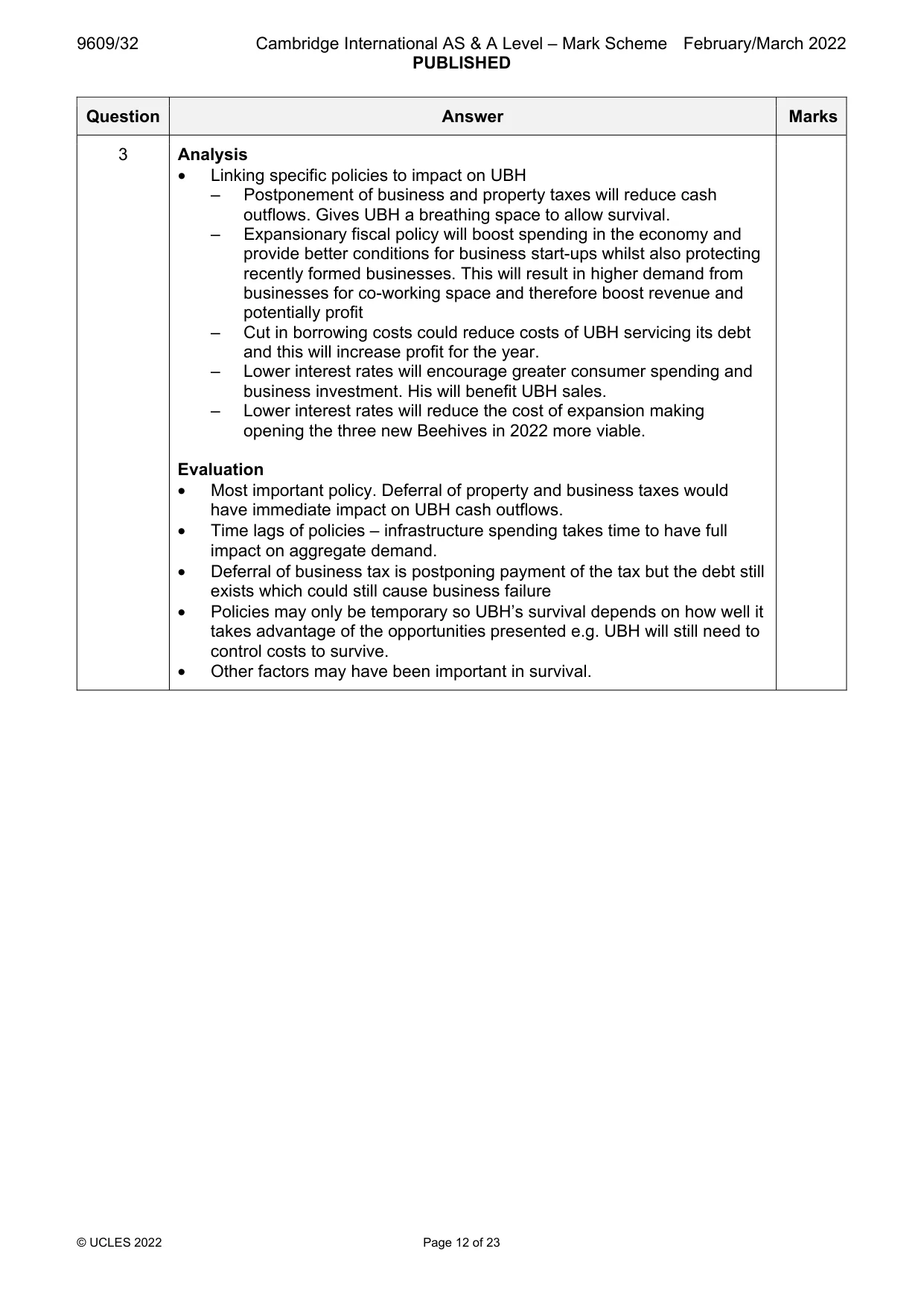
9609/32 Cambridge International AS & A Level – Mark Scheme PUBLISHED February/March 2022 © UCLES 2022 Page 12 of 23 Question Answer Marks 3 Analysis • Linking specific policies to impact on UBH – Postponement of business and property taxes will reduce cash outflows. Gives UBH a breathing space to allow survival. – Expansionary fiscal policy will boost spending in the economy and provide better conditions for business start-ups whilst also protecting recently formed businesses. This will result in higher demand from businesses for co-working space and therefore boost revenue and potentially profit – Cut in borrowing costs could reduce costs of UBH servicing its debt and this will increase profit for the year. – Lower interest rates will encourage greater consumer spending and business investment. His will benefit UBH sales. – Lower interest rates will reduce the cost of expansion making opening the three new Beehives in 2022 more viable. Evaluation • Most important policy. Deferral of property and business taxes would have immediate impact on UBH cash outflows. • Time lags of policies – infrastructure spending takes time to have full impact on aggregate demand. • Deferral of business tax is postponing payment of the tax but the debt still exists which could still cause business failure • Policies may only be temporary so UBH’s survival depends on how well it takes advantage of the opportunities presented e.g. UBH will still need to control costs to survive. • Other factors may have been important in survival.
Mark scheme, page 13
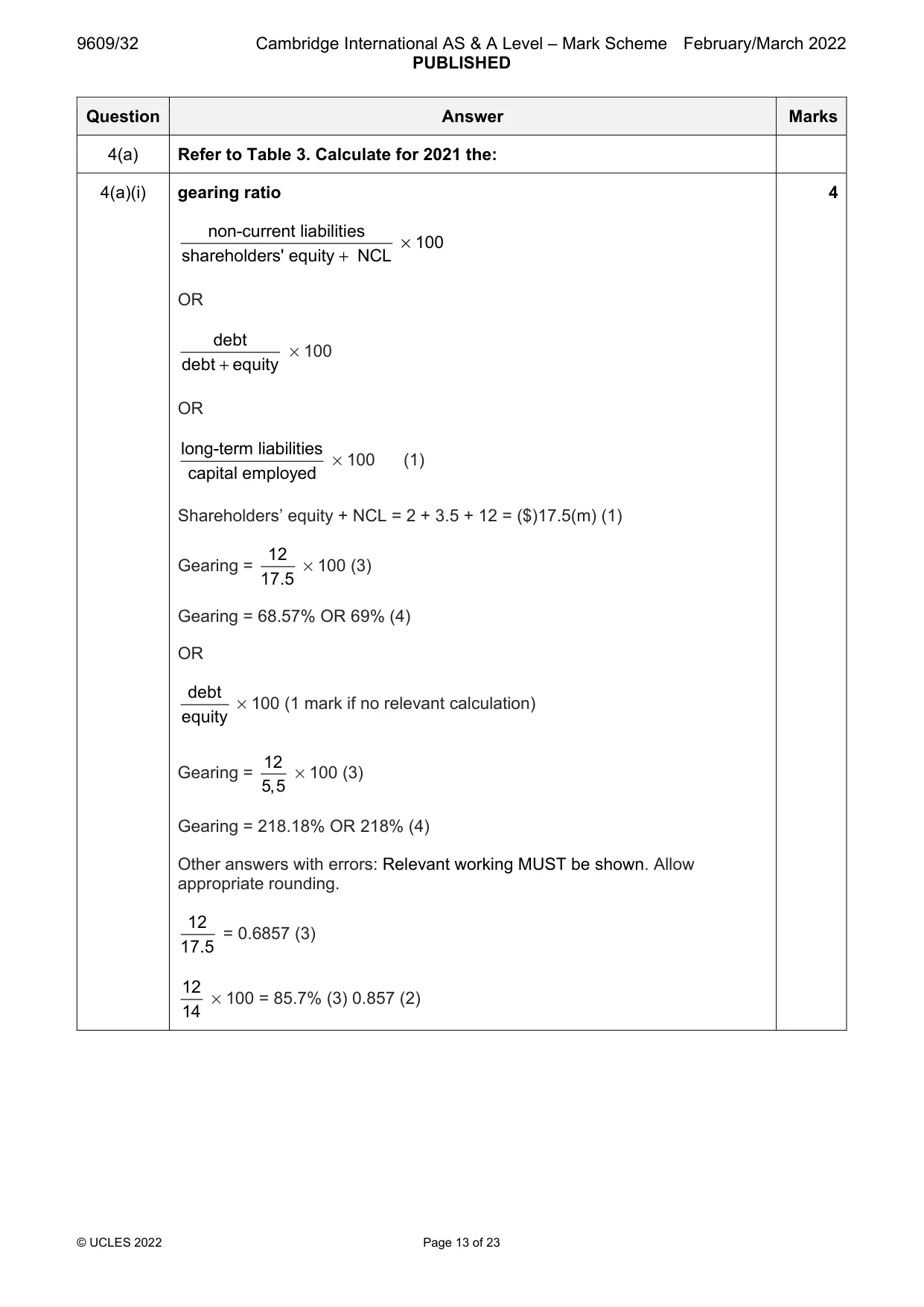
9609/32 Cambridge International AS & A Level – Mark Scheme PUBLISHED February/March 2022 © UCLES 2022 Page 13 of 23 Question Answer Marks 4(a) Refer to Table 3. Calculate for 2021 the: 4(a)(i) gearing ratio non-current liabilities shareholders' equity NCL + × 100 OR debt debt equity + × 100 OR long-term liabilities capital employed × 100 (1) Shareholders’ equity + NCL = 2 + 3.5 + 12 = ($)17.5(m) (1) Gearing = 12 17.5 × 100 (3) Gearing = 68.57% OR 69% (4) OR debt equity × 100 (1 mark if no relevant calculation) Gearing = 12 5,5 × 100 (3) Gearing = 218.18% OR 218% (4) Other answers with errors: Relevant working MUST be shown. Allow appropriate rounding. 12 17.5 = 0.6857 (3) 1 2 14 × 100 = 85.7% (3) 0.857 (2) 4
Mark scheme, page 14
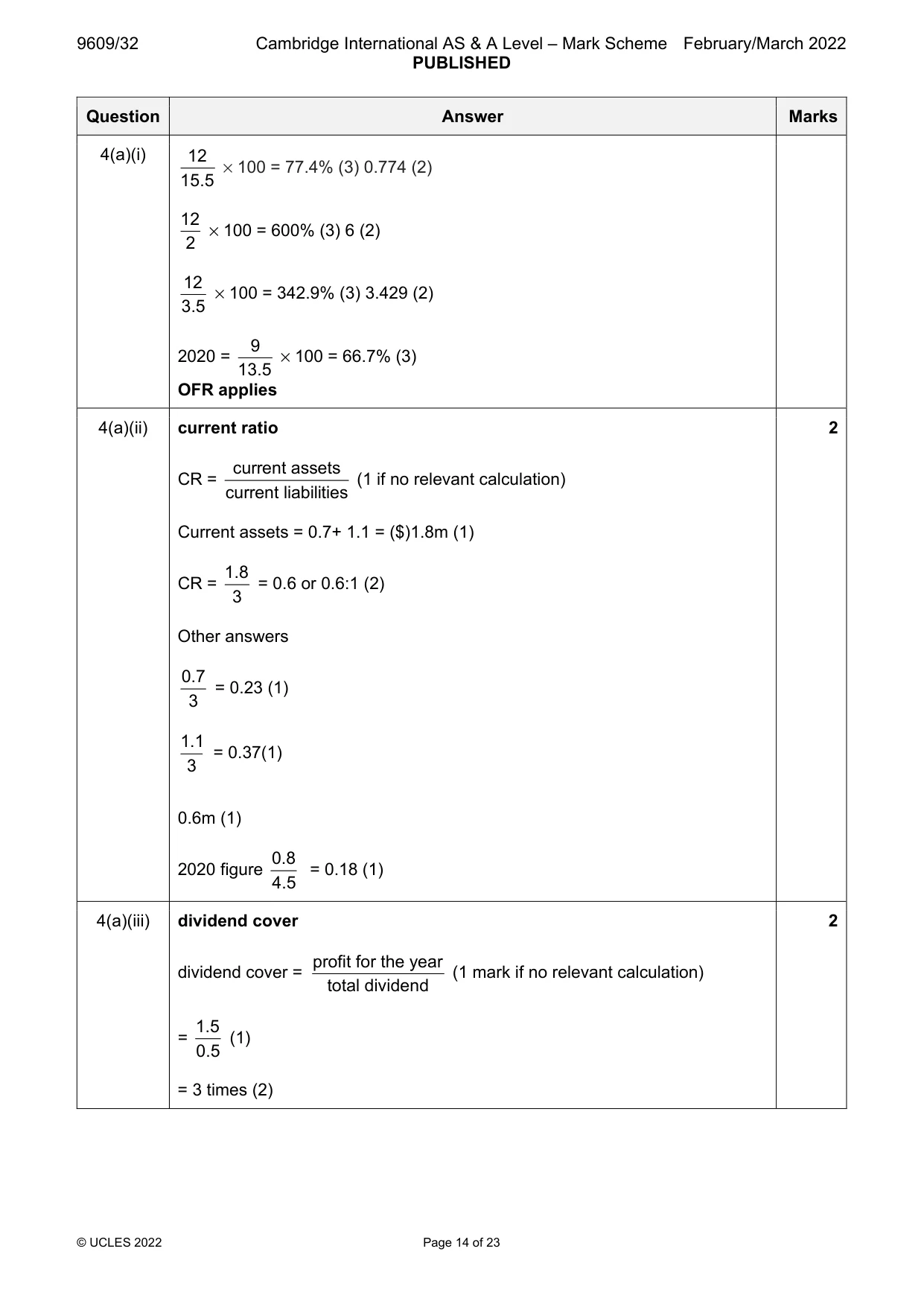
9609/32 Cambridge International AS & A Level – Mark Scheme PUBLISHED February/March 2022 © UCLES 2022 Page 14 of 23 Question Answer Marks 4(a)(i) 12 15.5 × 100 = 77.4% (3) 0.774 (2) 12 2 × 100 = 600% (3) 6 (2) 12 3.5 × 100 = 342.9% (3) 3.429 (2) 2020 = 9 13.5 × 100 = 66.7% (3) OFR applies 4(a)(ii) current ratio CR = current assets current liabilities (1 if no relevant calculation) Current assets = 0.7+ 1.1 = ($)1.8m (1) CR = 1.8 3 = 0.6 or 0.6:1 (2) Other answers 0.7 3 = 0.23 (1) 1.1 3 = 0.37(1) 0.6m (1) 2020 figure 0.8 4.5 = 0.18 (1) 2 4(a)(iii) dividend cover dividend cover = profit for the year total dividend (1 mark if no relevant calculation) = 1.5 0.5 (1) = 3 times (2) 2
Mark scheme, page 15
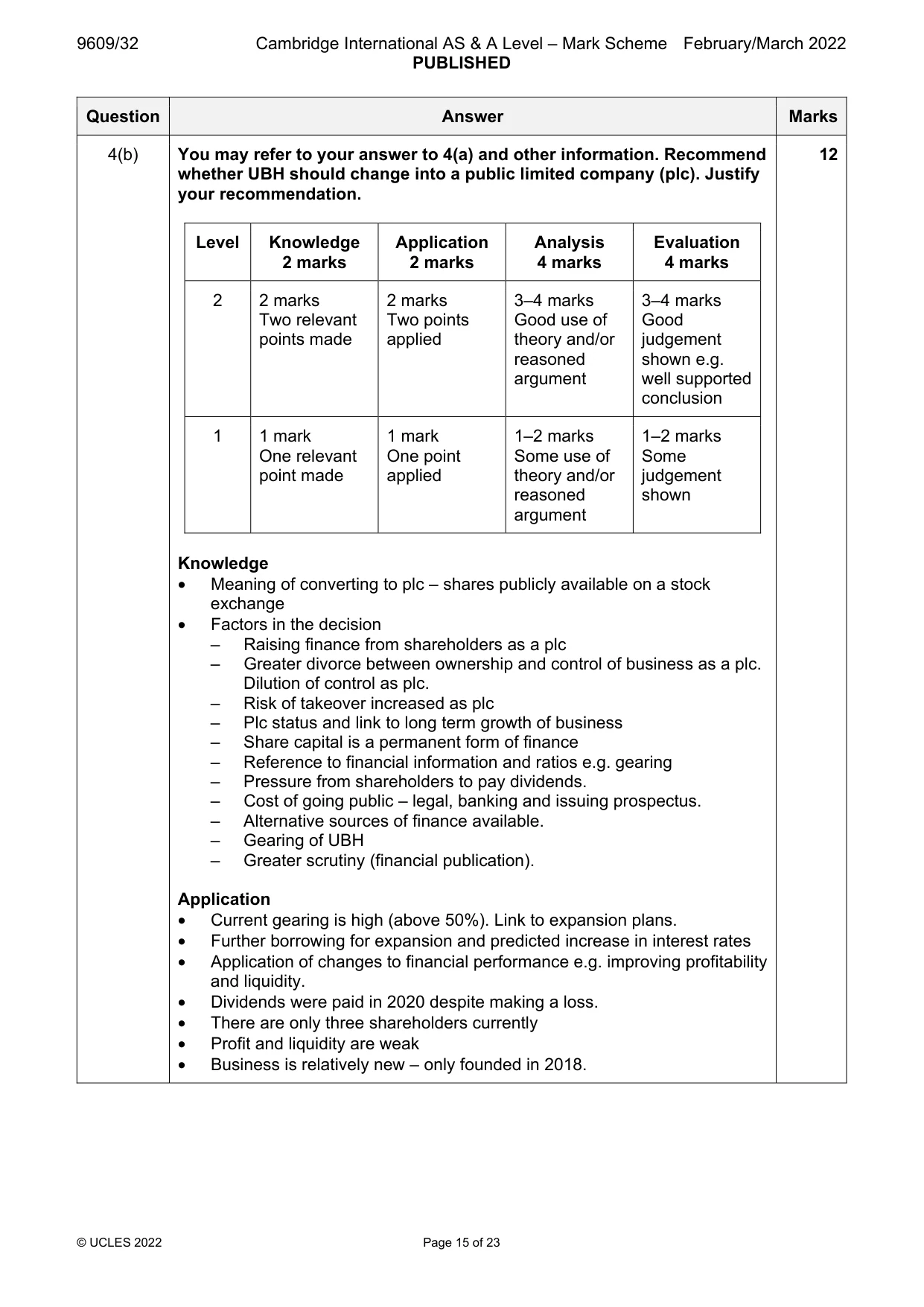
9609/32 Cambridge International AS & A Level – Mark Scheme PUBLISHED February/March 2022 © UCLES 2022 Page 15 of 23 Question Answer Marks 4(b) You may refer to your answer to 4(a) and other information. Recommend whether UBH should change into a public limited company (plc). Justify your recommendation. Level Knowledge 2 marks Application 2 marks Analysis 4 marks Evaluation 4 marks 2 2 marks Two relevant points made 2 marks Two points applied 3–4 marks Good use of theory and/or reasoned argument 3–4 marks Good judgement shown e.g. well supported conclusion 1 1 mark One relevant point made 1 mark One point applied 1–2 marks Some use of theory and/or reasoned argument 1–2 marks Some judgement shown Knowledge • Meaning of converting to plc – shares publicly available on a stock exchange • Factors in the decision – Raising finance from shareholders as a plc – Greater divorce between ownership and control of business as a plc. Dilution of control as plc. – Risk of takeover increased as plc – Plc status and link to long term growth of business – Share capital is a permanent form of finance – Reference to financial information and ratios e.g. gearing – Pressure from shareholders to pay dividends. – Cost of going public – legal, banking and issuing prospectus. – Alternative sources of finance available. – Gearing of UBH – Greater scrutiny (financial publication). Application • Current gearing is high (above 50%). Link to expansion plans. • Further borrowing for expansion and predicted increase in interest rates • Application of changes to financial performance e.g. improving profitability and liquidity. • Dividends were paid in 2020 despite making a loss. • There are only three shareholders currently • Profit and liquidity are weak • Business is relatively new – only founded in 2018. 12
Mark scheme, page 16
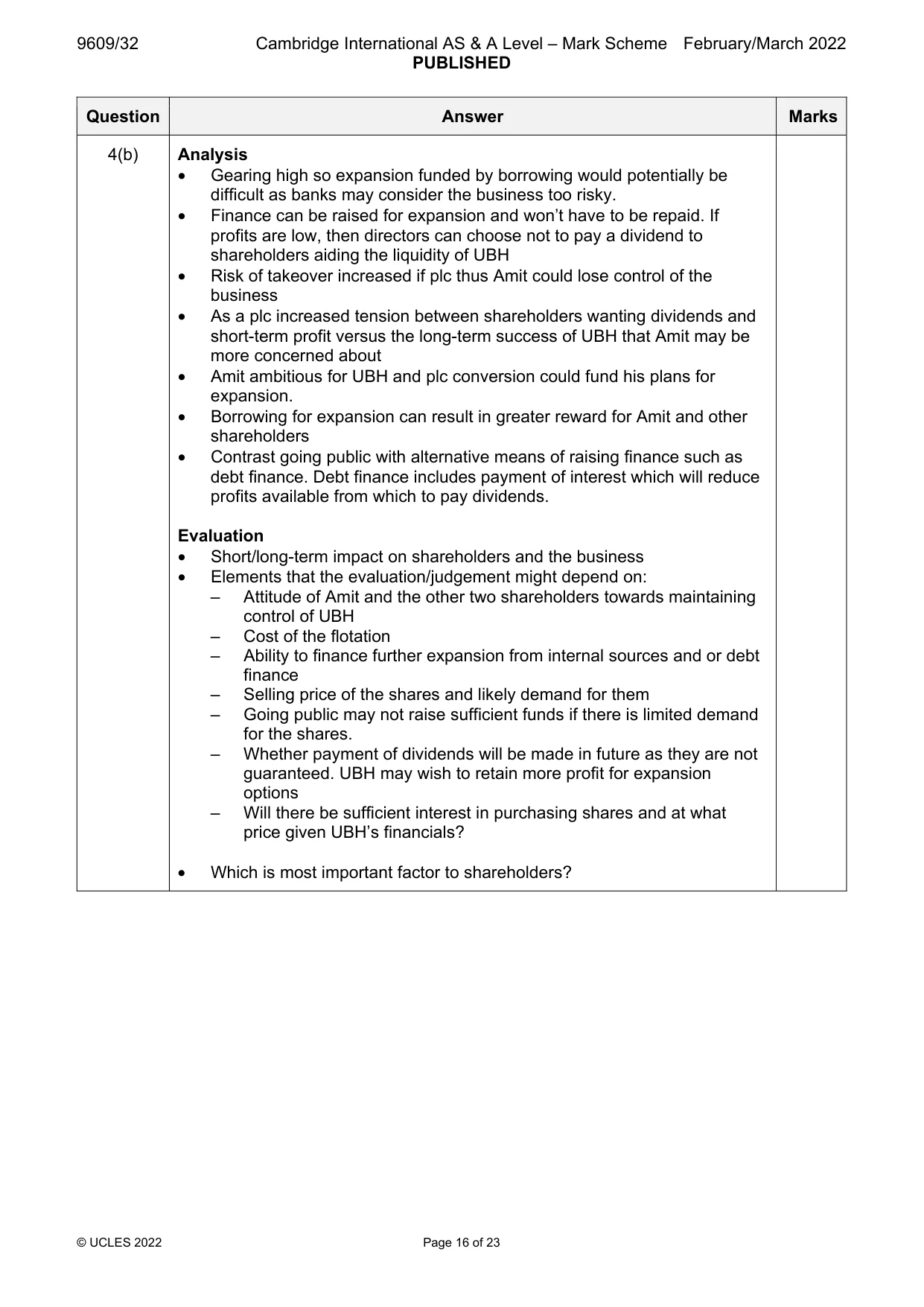
9609/32 Cambridge International AS & A Level – Mark Scheme PUBLISHED February/March 2022 © UCLES 2022 Page 16 of 23 Question Answer Marks 4(b) Analysis • Gearing high so expansion funded by borrowing would potentially be difficult as banks may consider the business too risky. • Finance can be raised for expansion and won’t have to be repaid. If profits are low, then directors can choose not to pay a dividend to shareholders aiding the liquidity of UBH • Risk of takeover increased if plc thus Amit could lose control of the business • As a plc increased tension between shareholders wanting dividends and short-term profit versus the long-term success of UBH that Amit may be more concerned about • Amit ambitious for UBH and plc conversion could fund his plans for expansion. • Borrowing for expansion can result in greater reward for Amit and other shareholders • Contrast going public with alternative means of raising finance such as debt finance. Debt finance includes payment of interest which will reduce profits available from which to pay dividends. Evaluation • Short/long-term impact on shareholders and the business • Elements that the evaluation/judgement might depend on: – Attitude of Amit and the other two shareholders towards maintaining control of UBH – Cost of the flotation – Ability to finance further expansion from internal sources and or debt finance – Selling price of the shares and likely demand for them – Going public may not raise sufficient funds if there is limited demand for the shares. – Whether payment of dividends will be made in future as they are not guaranteed. UBH may wish to retain more profit for expansion options – Will there be sufficient interest in purchasing shares and at what price given UBH’s financials? • Which is most important factor to shareholders?
Mark scheme, page 17
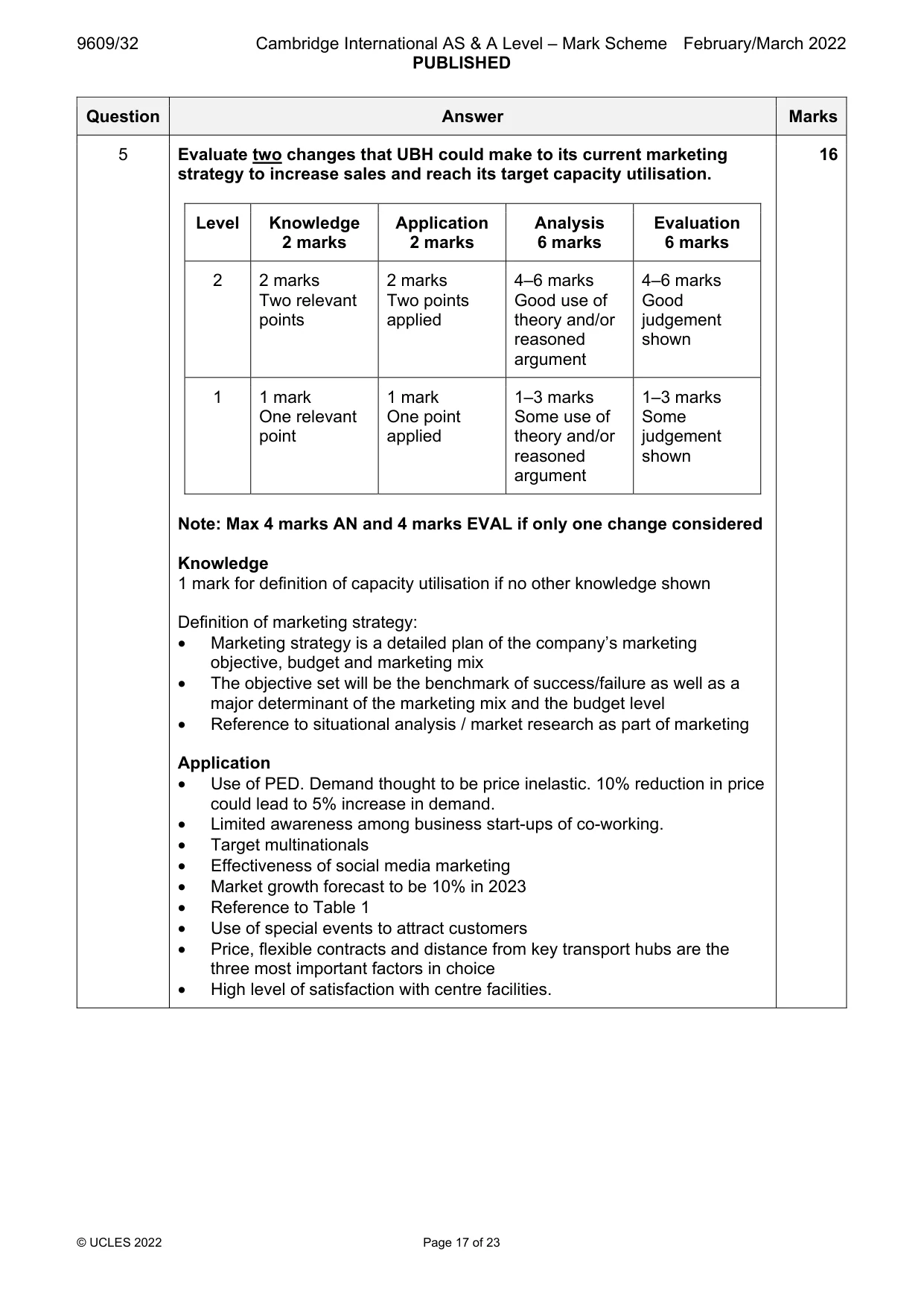
9609/32 Cambridge International AS & A Level – Mark Scheme PUBLISHED February/March 2022 © UCLES 2022 Page 17 of 23 Question Answer Marks 5 Evaluate two changes that UBH could make to its current marketing strategy to increase sales and reach its target capacity utilisation. Level Knowledge 2 marks Application 2 marks Analysis 6 marks Evaluation 6 marks 2 2 marks Two relevant points 2 marks Two points applied 4–6 marks Good use of theory and/or reasoned argument 4–6 marks Good judgement shown 1 1 mark One relevant point 1 mark One point applied 1–3 marks Some use of theory and/or reasoned argument 1–3 marks Some judgement shown Note: Max 4 marks AN and 4 marks EVAL if only one change considered Knowledge 1 mark for definition of capacity utilisation if no other knowledge shown Definition of marketing strategy: • Marketing strategy is a detailed plan of the company’s marketing objective, budget and marketing mix • The objective set will be the benchmark of success/failure as well as a major determinant of the marketing mix and the budget level • Reference to situational analysis / market research as part of marketing Application • Use of PED. Demand thought to be price inelastic. 10% reduction in price could lead to 5% increase in demand. • Limited awareness among business start-ups of co-working. • Target multinationals • Effectiveness of social media marketing • Market growth forecast to be 10% in 2023 • Reference to Table 1 • Use of special events to attract customers • Price, flexible contracts and distance from key transport hubs are the three most important factors in choice • High level of satisfaction with centre facilities. 16
Mark scheme, page 18
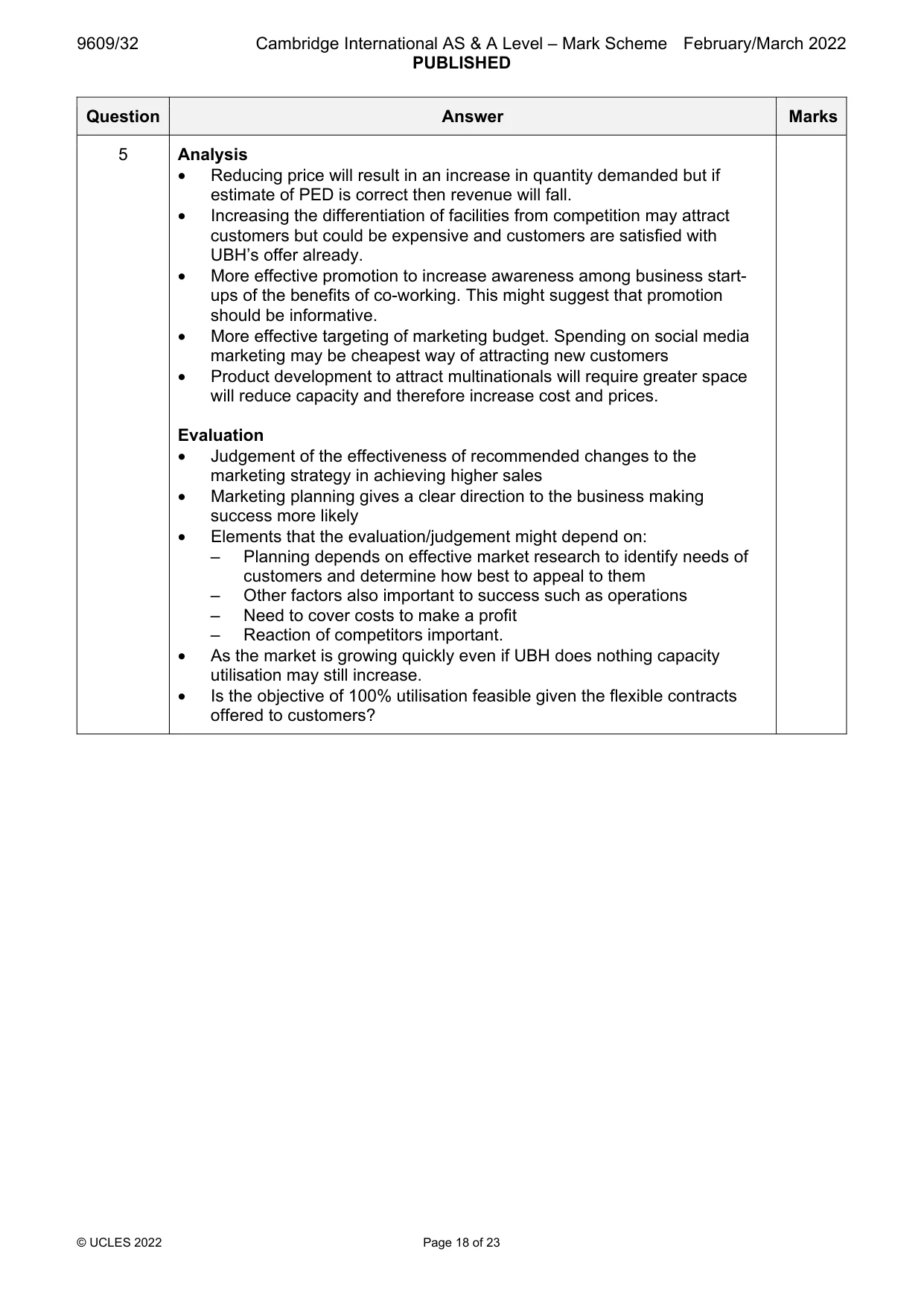
9609/32 Cambridge International AS & A Level – Mark Scheme PUBLISHED February/March 2022 © UCLES 2022 Page 18 of 23 Question Answer Marks 5 Analysis • Reducing price will result in an increase in quantity demanded but if estimate of PED is correct then revenue will fall. • Increasing the differentiation of facilities from competition may attract customers but could be expensive and customers are satisfied with UBH’s offer already. • More effective promotion to increase awareness among business start- ups of the benefits of co-working. This might suggest that promotion should be informative. • More effective targeting of marketing budget. Spending on social media marketing may be cheapest way of attracting new customers • Product development to attract multinationals will require greater space will reduce capacity and therefore increase cost and prices. Evaluation • Judgement of the effectiveness of recommended changes to the marketing strategy in achieving higher sales • Marketing planning gives a clear direction to the business making success more likely • Elements that the evaluation/judgement might depend on: – Planning depends on effective market research to identify needs of customers and determine how best to appeal to them – Other factors also important to success such as operations – Need to cover costs to make a profit – Reaction of competitors important. • As the market is growing quickly even if UBH does nothing capacity utilisation may still increase. • Is the objective of 100% utilisation feasible given the flexible contracts offered to customers?
Mark scheme, page 19
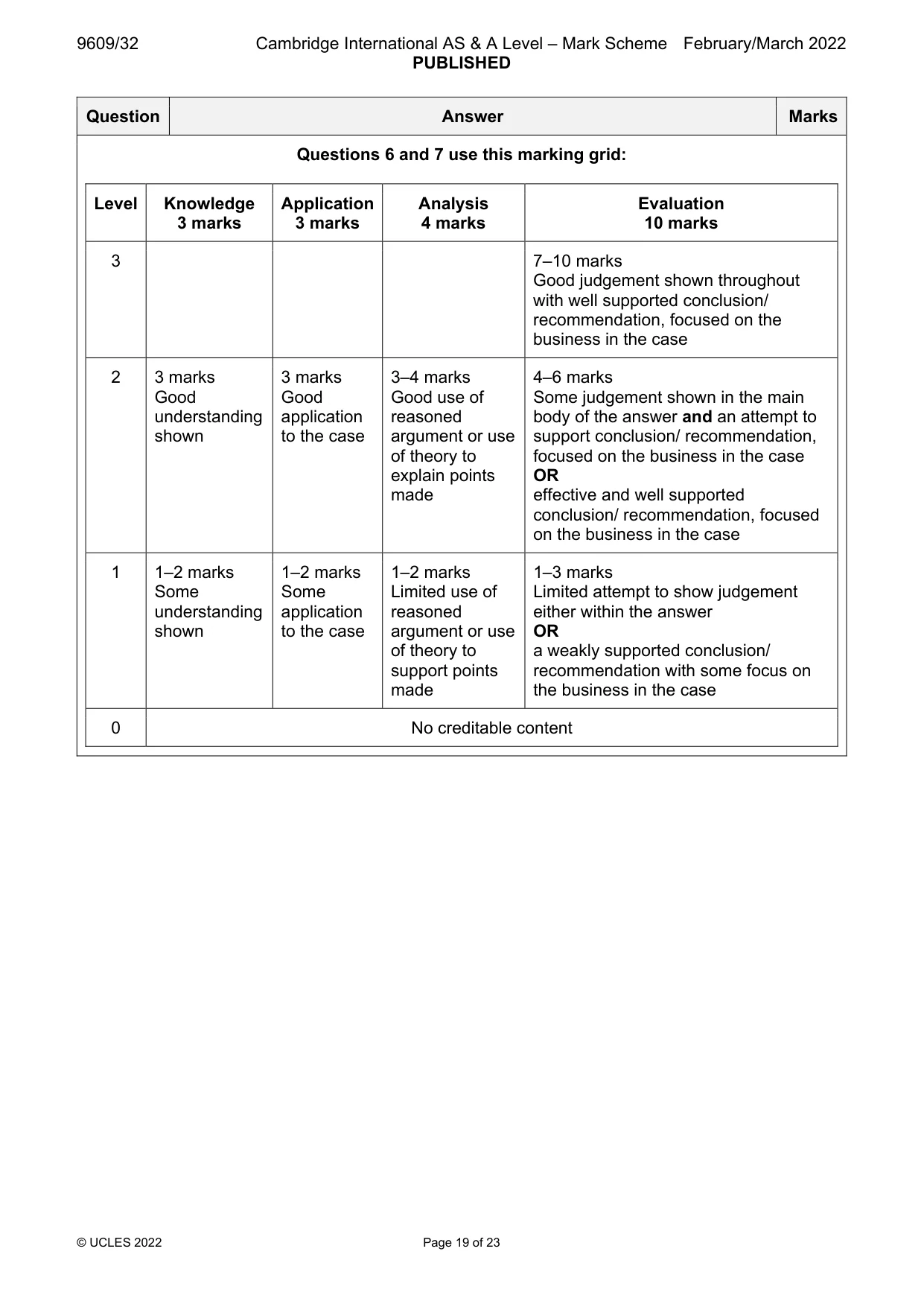
9609/32 Cambridge International AS & A Level – Mark Scheme PUBLISHED February/March 2022 © UCLES 2022 Page 19 of 23 Question Answer Marks Questions 6 and 7 use this marking grid: Level Knowledge 3 marks Application 3 marks Analysis 4 marks Evaluation 10 marks 3 7–10 marks Good judgement shown throughout with well supported conclusion/ recommendation, focused on the business in the case 2 3 marks Good understanding shown 3 marks Good application to the case 3–4 marks Good use of reasoned argument or use of theory to explain points made 4–6 marks Some judgement shown in the main body of the answer and an attempt to support conclusion/ recommendation, focused on the business in the case OR effective and well supported conclusion/ recommendation, focused on the business in the case 1 1–2 marks Some understanding shown 1–2 marks Some application to the case 1–2 marks Limited use of reasoned argument or use of theory to support points made 1–3 marks Limited attempt to show judgement either within the answer OR a weakly supported conclusion/ recommendation with some focus on the business in the case 0 No creditable content
Mark scheme, page 20
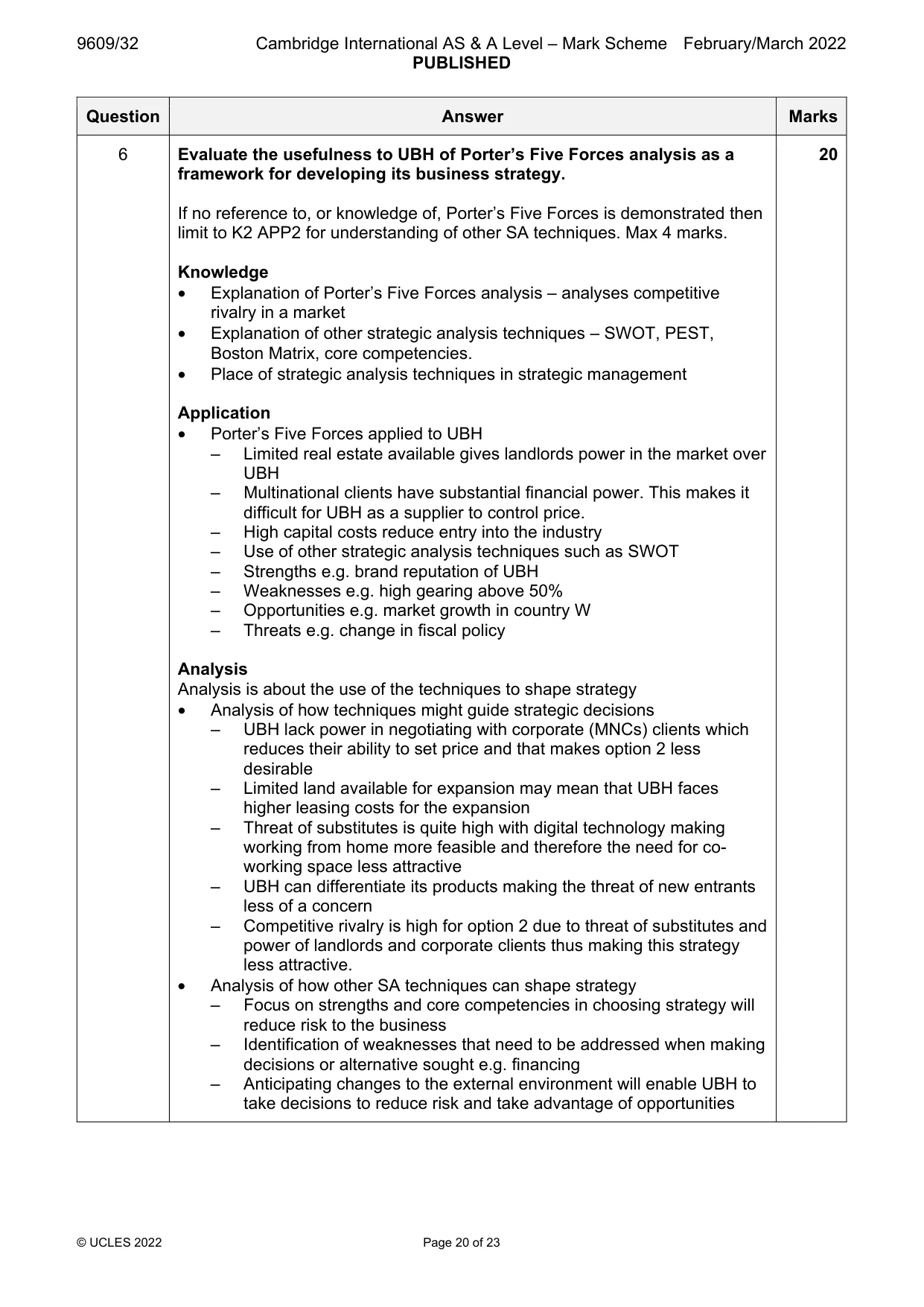
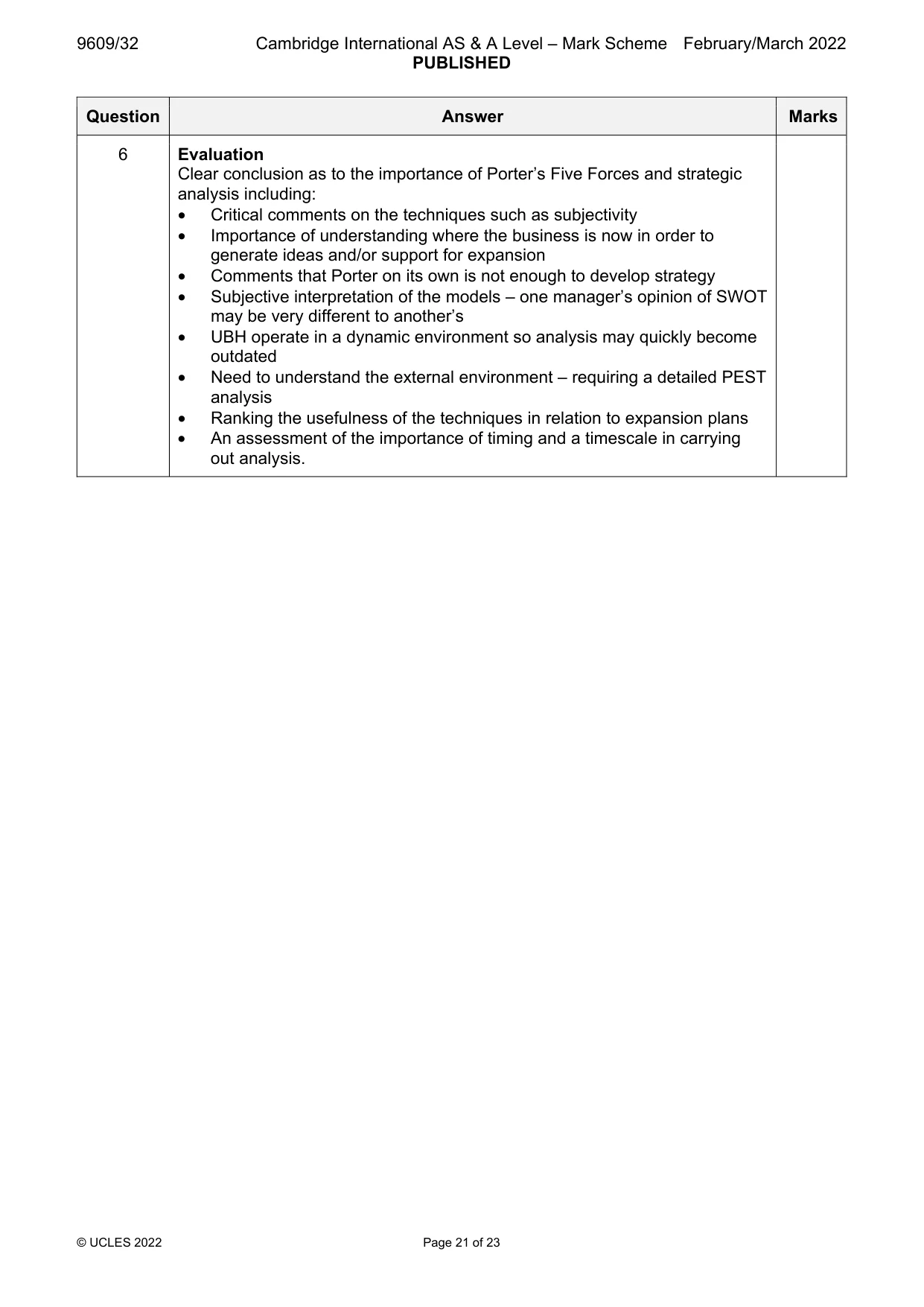
9609/32 Cambridge International AS & A Level – Mark Scheme PUBLISHED February/March 2022 © UCLES 2022 Page 20 of 23 Question Answer Marks 6 Evaluate the usefulness to UBH of Porter’s Five Forces analysis as a framework for developing its business strategy. If no reference to, or knowledge of, Porter’s Five Forces is demonstrated then limit to K2 APP2 for understanding of other SA techniques. Max 4 marks. Knowledge • Explanation of Porter’s Five Forces analysis – analyses competitive rivalry in a market • Explanation of other strategic analysis techniques – SWOT, PEST, Boston Matrix, core competencies. • Place of strategic analysis techniques in strategic management Application • Porter’s Five Forces applied to UBH – Limited real estate available gives landlords power in the market over UBH – Multinational clients have substantial financial power. This makes it difficult for UBH as a supplier to control price. – High capital costs reduce entry into the industry – Use of other strategic analysis techniques such as SWOT – Strengths e.g. brand reputation of UBH – Weaknesses e.g. high gearing above 50% – Opportunities e.g. market growth in country W – Threats e.g. change in fiscal policy Analysis Analysis is about the use of the techniques to shape strategy • Analysis of how techniques might guide strategic decisions – UBH lack power in negotiating with corporate (MNCs) clients which reduces their ability to set price and that makes option 2 less desirable – Limited land available for expansion may mean that UBH faces higher leasing costs for the expansion – Threat of substitutes is quite high with digital technology making working from home more feasible and therefore the need for co- working space less attractive – UBH can differentiate its products making the threat of new entrants less of a concern – Competitive rivalry is high for option 2 due to threat of substitutes and power of landlords and corporate clients thus making this strategy less attractive. • Analysis of how other SA techniques can shape strategy – Focus on strengths and core competencies in choosing strategy will reduce risk to the business – Identification of weaknesses that need to be addressed when making decisions or alternative sought e.g. financing – Anticipating changes to the external environment will enable UBH to take decisions to reduce risk and take advantage of opportunities 20
Mark scheme, page 21
9609/32 Cambridge International AS & A Level – Mark Scheme PUBLISHED February/March 2022 © UCLES 2022 Page 21 of 23 Question Answer Marks 6 Evaluation Clear conclusion as to the importance of Porter’s Five Forces and strategic analysis including: • Critical comments on the techniques such as subjectivity • Importance of understanding where the business is now in order to generate ideas and/or support for expansion • Comments that Porter on its own is not enough to develop strategy • Subjective interpretation of the models – one manager’s opinion of SWOT may be very different to another’s • UBH operate in a dynamic environment so analysis may quickly become outdated • Need to understand the external environment – requiring a detailed PEST analysis • Ranking the usefulness of the techniques in relation to expansion plans • An assessment of the importance of timing and a timescale in carrying out analysis.
Mark scheme, page 22
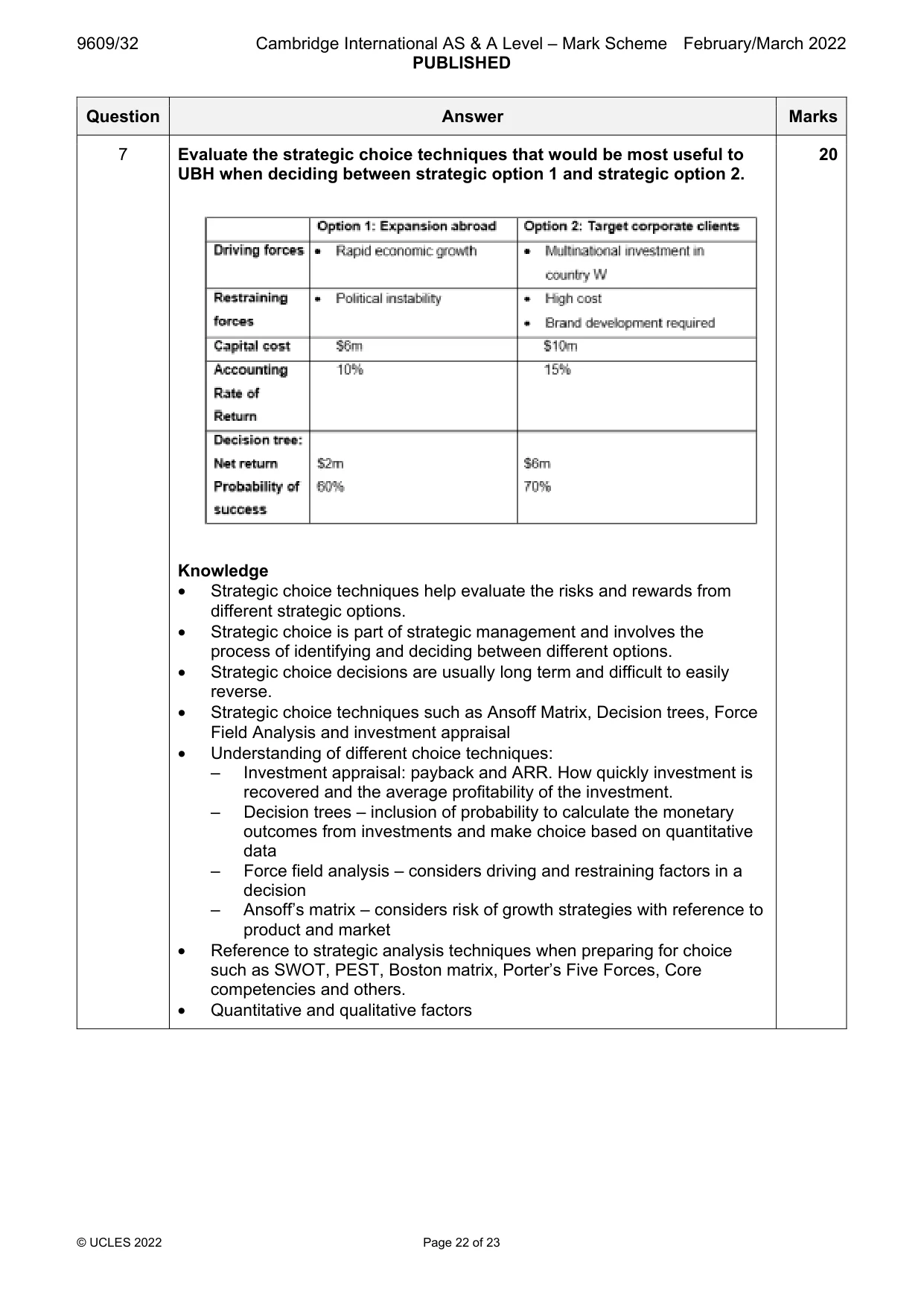
9609/32 Cambridge International AS & A Level – Mark Scheme PUBLISHED February/March 2022 © UCLES 2022 Page 22 of 23 Question Answer Marks 7 Evaluate the strategic choice techniques that would be most useful to UBH when deciding between strategic option 1 and strategic option 2. Knowledge • Strategic choice techniques help evaluate the risks and rewards from different strategic options. • Strategic choice is part of strategic management and involves the process of identifying and deciding between different options. • Strategic choice decisions are usually long term and difficult to easily reverse. • Strategic choice techniques such as Ansoff Matrix, Decision trees, Force Field Analysis and investment appraisal • Understanding of different choice techniques: – Investment appraisal: payback and ARR. How quickly investment is recovered and the average profitability of the investment. – Decision trees – inclusion of probability to calculate the monetary outcomes from investments and make choice based on quantitative data – Force field analysis – considers driving and restraining factors in a decision – Ansoff’s matrix – considers risk of growth strategies with reference to product and market • Reference to strategic analysis techniques when preparing for choice such as SWOT, PEST, Boston matrix, Porter’s Five Forces, Core competencies and others. • Quantitative and qualitative factors 20
Mark scheme, page 23
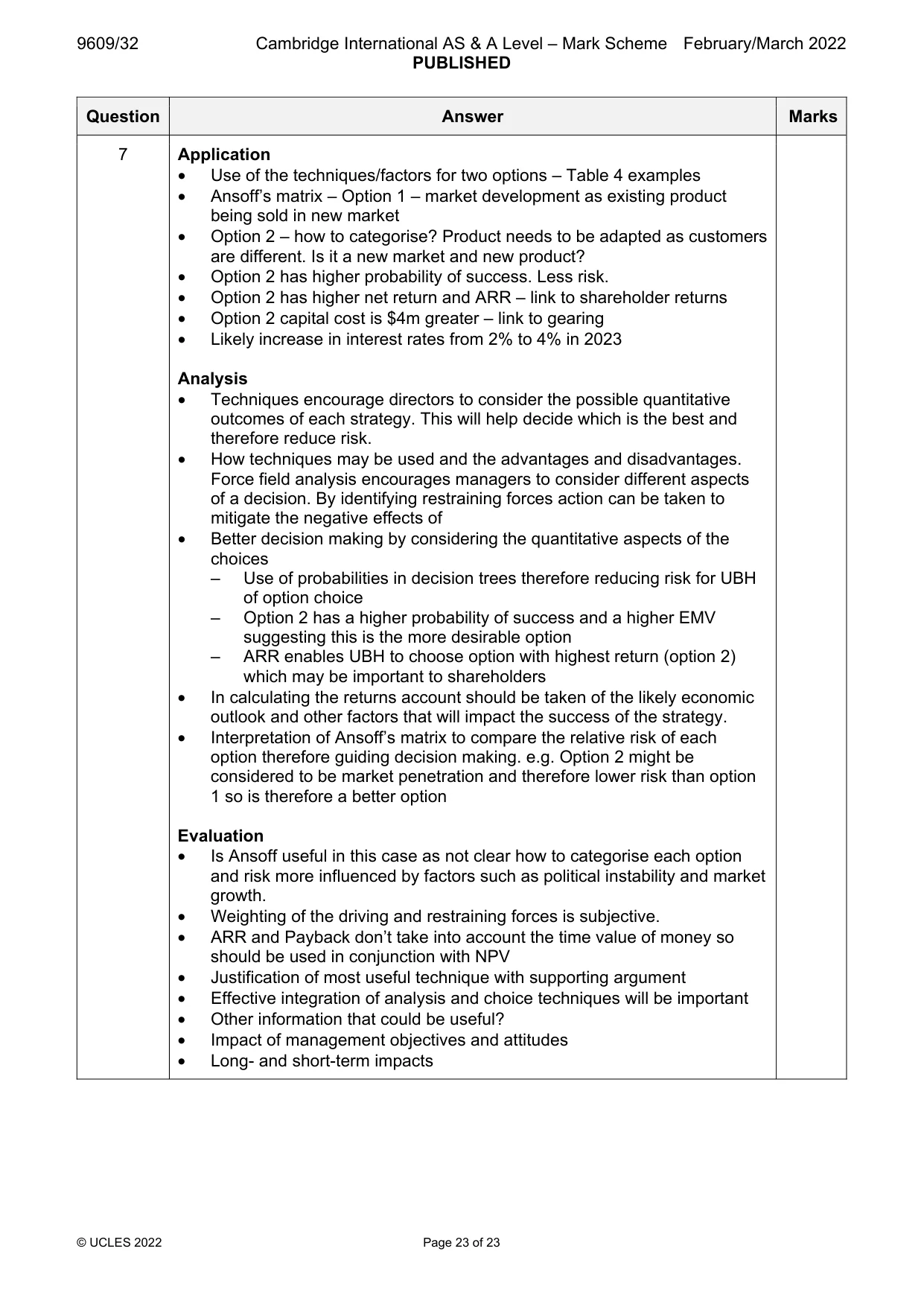
9609/32 Cambridge International AS & A Level – Mark Scheme PUBLISHED February/March 2022 © UCLES 2022 Page 23 of 23 Question Answer Marks 7 Application • Use of the techniques/factors for two options – Table 4 examples • Ansoff’s matrix – Option 1 – market development as existing product being sold in new market • Option 2 – how to categorise? Product needs to be adapted as customers are different. Is it a new market and new product? • Option 2 has higher probability of success. Less risk. • Option 2 has higher net return and ARR – link to shareholder returns • Option 2 capital cost is $4m greater – link to gearing • Likely increase in interest rates from 2% to 4% in 2023 Analysis • Techniques encourage directors to consider the possible quantitative outcomes of each strategy. This will help decide which is the best and therefore reduce risk. • How techniques may be used and the advantages and disadvantages. Force field analysis encourages managers to consider different aspects of a decision. By identifying restraining forces action can be taken to mitigate the negative effects of • Better decision making by considering the quantitative aspects of the choices – Use of probabilities in decision trees therefore reducing risk for UBH of option choice – Option 2 has a higher probability of success and a higher EMV suggesting this is the more desirable option – ARR enables UBH to choose option with highest return (option 2) which may be important to shareholders • In calculating the returns account should be taken of the likely economic outlook and other factors that will impact the success of the strategy. • Interpretation of Ansoff’s matrix to compare the relative risk of each option therefore guiding decision making. e.g. Option 2 might be considered to be market penetration and therefore lower risk than option 1 so is therefore a better option Evaluation • Is Ansoff useful in this case as not clear how to categorise each option and risk more influenced by factors such as political instability and market growth. • Weighting of the driving and restraining forces is subjective. • ARR and Payback don’t take into account the time value of money so should be used in conjunction with NPV • Justification of most useful technique with supporting argument • Effective integration of analysis and choice techniques will be important • Other information that could be useful? • Impact of management objectives and attitudes • Long- and short-term impacts
What you needed in this session
Cambridge’s own grade thresholds for 2022 Feb/March, Paper 3 · Variant 2. A higher threshold means an easier paper — the bar moves with how the cohort did.