Cambridge A Level Business (for first examination in 2016) 9609 — 2021 May/June Paper 3 · Variant 3
9609/33/M/J/21 · 100 marks · ≈113 min
The question paper and its mark scheme, free to read here and free to download. This is Cambridge’s own paper, exactly as it was sat.
Question paper20 pages
















Mark scheme22 pages
Answers below. Sit the paper first if you are practising.


Paper as text
Question paper, page 1
This document has 20 pages. Any blank pages are indicated. DC (RW) 207766/1 © UCLES 2021 [Turn over * 0 0 8 5 7 0 1 2 4 3 * BUSINESS 9609/33 Paper 3 Case Study May/June 2021 3 hours You must answer on the question paper. You will need: Insert (enclosed) INSTRUCTIONS ● Section A: answer all questions. ● Section B: answer one question. ● Use a black or dark blue pen. ● Write your name, centre number and candidate number in the boxes at the top of the page. ● Write your answer to each question in the space provided. ● Do not use an erasable pen or correction fluid. ● Do not write on any bar codes. ● You may use an HB pencil for any diagrams, graphs or rough working. INFORMATION ● The total mark for this paper is 100. ● The number of marks for each question or part question is shown in brackets [ ]. ● The insert contains the case study. Cambridge International AS & A Level
Question paper, page 2
2 9609/33/M/J/21 © UCLES 2021 Answer all questions in Section A and answer one question in Section B. You are advised to spend no more than 40 minutes on Section B. Section A Answer all questions in this section. 1 Analyse the opportunities to SBC of the current economic environment in country X. … … … … … … … … … … … … … … … … … … … … … … …
Question paper, page 3
3 9609/33/M/J/21 © UCLES 2021 [Turn over … … … … … … … … … … … … … … … … … … … … … … … … … … … … [10]
Question paper, page 4
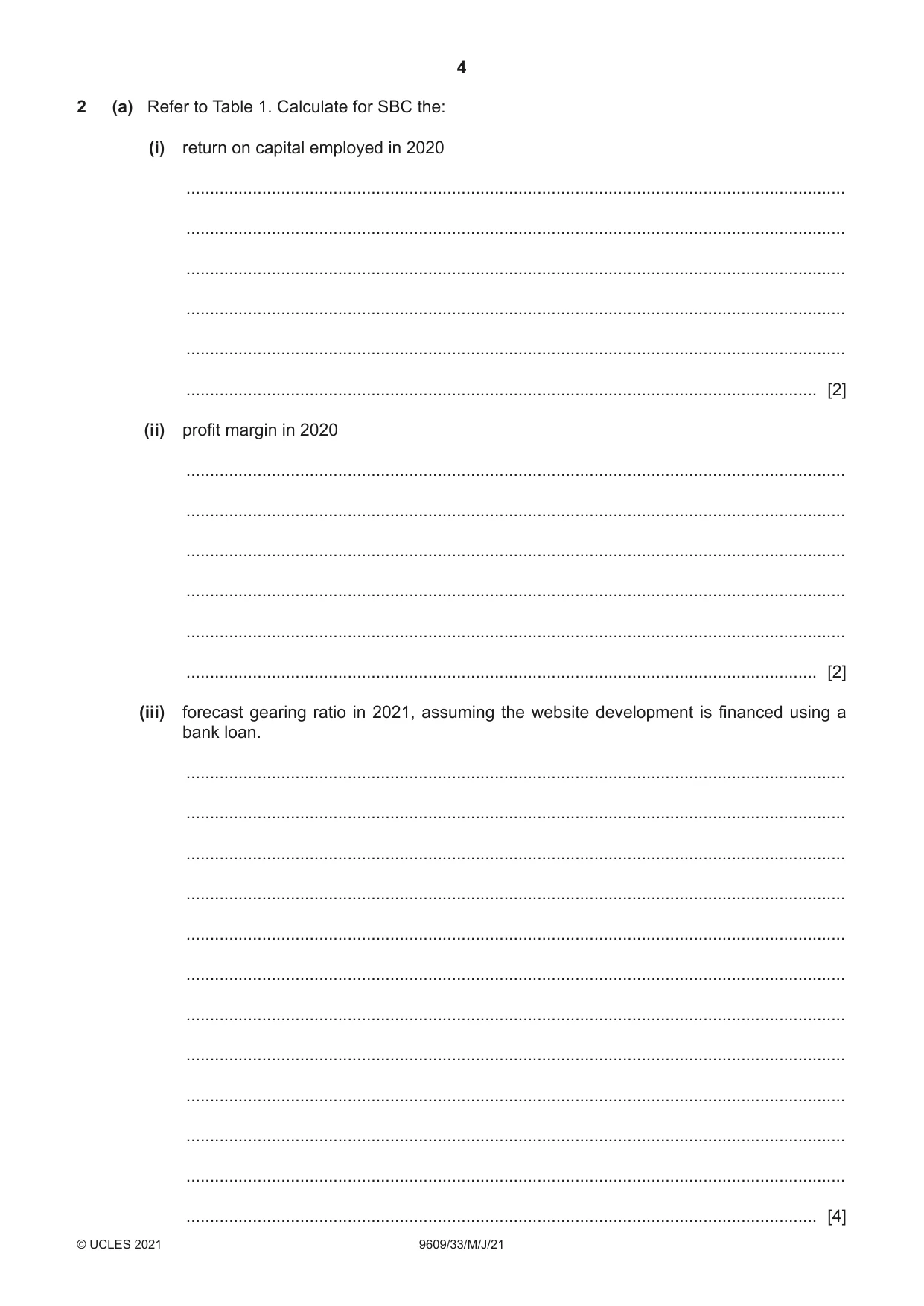
4 9609/33/M/J/21 © UCLES 2021 2 (a) Refer to Table 1. Calculate for SBC the: (i) return on capital employed in 2020 … … … … … … [2] (ii) profit margin in 2020 … … … … … … [2] (iii) forecast gearing ratio in 2021, assuming the website development is financed using a bank loan. … … … … … … … … … … … … [4]
Question paper, page 5
5 9609/33/M/J/21 © UCLES 2021 [Turn over (b) Assess whether SBC should change its legal structure to a public limited company. … … … … … … … … … … … … … … … … … … … … … … … … … … …
Question paper, page 6
6 9609/33/M/J/21 © UCLES 2021 … … … … … … … … … … … … … … … … … … … … … … … … … … … … [12]
Question paper, page 7
7 9609/33/M/J/21 © UCLES 2021 [Turn over 3 Evaluate the importance to SBC of using social media to maintain and increase customer loyalty. … … … … … … … … … … … … … … … … … … … … … … … … … … …
Question paper, page 8
8 9609/33/M/J/21 © UCLES 2021 … … … … … … … … … … … … … … … … … … … … … … … … … … … …
Question paper, page 9
9 9609/33/M/J/21 © UCLES 2021 [Turn over … … … … … … … … … … … … … … … … … … … … … … … … … … … … [16]
Question paper, page 10
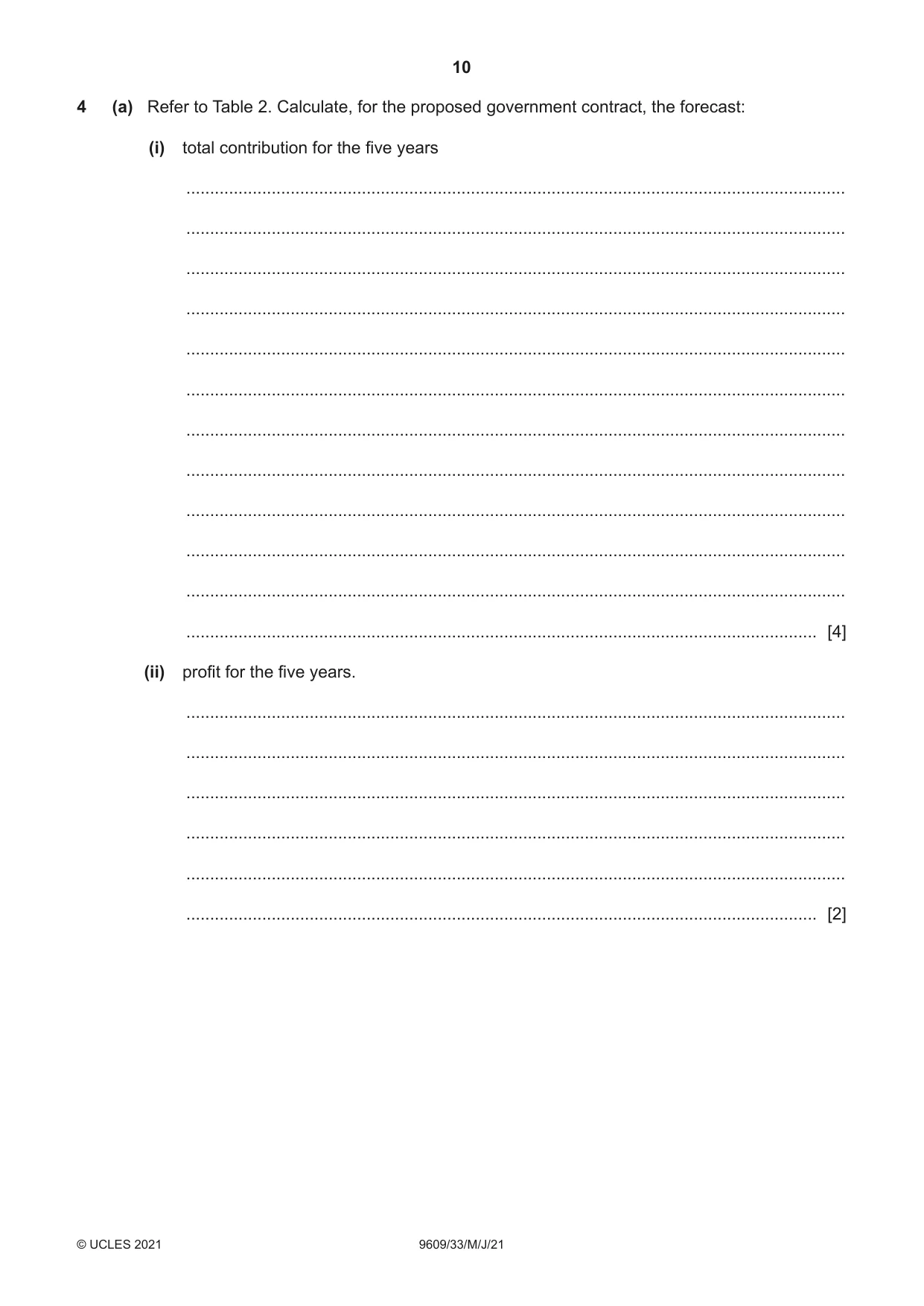
10 9609/33/M/J/21 © UCLES 2021 4 (a) Refer to Table 2. Calculate, for the proposed government contract, the forecast: (i) total contribution for the five years … … … … … … … … … … … … [4] (ii) profit for the five years. … … … … … … [2]
Question paper, page 11
11 9609/33/M/J/21 © UCLES 2021 [Turn over (b) You may refer to your results from 4(a) and other information. Recommend whether SBC should accept the government contract. Justify your recommendation. … … … … … … … … … … … … … … … … … … … … … … … … … … …
Question paper, page 12
12 9609/33/M/J/21 © UCLES 2021 … … … … … … … … … … … … … … … … … … … … … … … … … … … … [12]
Question paper, page 13
13 9609/33/M/J/21 © UCLES 2021 [Turn over 5 Evaluate the importance of workforce planning to the success of SBC. … … … … … … … … … … … … … … … … … … … … … … … … … … …
Question paper, page 14
14 9609/33/M/J/21 © UCLES 2021 … … … … … … … … … … … … … … … … … … … … … … … … … … … …
Question paper, page 15
15 9609/33/M/J/21 © UCLES 2021 [Turn over … … … … … … … … … … … … … … … … … … … … … … … … … … … … [16]
Question paper, page 16
16 9609/33/M/J/21 © UCLES 2021 Section B Answer one question from this section. 6 Evaluate the usefulness to SBC of force field analysis as a means of making the strategic choice between option A and option B. 7 Evaluate the importance to SBC of effective strategic implementation if option B is chosen. Write down the question number here: … … … … … … … … … … … … … … … … … … … … … … … …
Question paper, page 17
17 9609/33/M/J/21 © UCLES 2021 [Turn over … … … … … … … … … … … … … … … … … … … … … … … … … … … …
Question paper, page 18
18 9609/33/M/J/21 © UCLES 2021 … … … … … … … … … … … … … … … … … … … … … … … … … … … …
Question paper, page 19
19 9609/33/M/J/21 © UCLES 2021 … … … … … … … … … … … … … … … … … … … … … … … … … … … … [20]
Question paper, page 20
20 9609/33/M/J/21 © UCLES 2021 Permission to reproduce items where third-party owned material protected by copyright is included has been sought and cleared where possible. Every reasonable effort has been made by the publisher (UCLES) to trace copyright holders, but if any items requiring clearance have unwittingly been included, the publisher will be pleased to make amends at the earliest possible opportunity. To avoid the issue of disclosure of answer-related information to candidates, all copyright acknowledgements are reproduced online in the Cambridge Assessment International Education Copyright Acknowledgements Booklet. This is produced for each series of examinations and is freely available to download at www.cambridgeinternational.org after the live examination series. Cambridge Assessment International Education is part of the Cambridge Assessment Group. Cambridge Assessment is the brand name of the University of Cambridge Local Examinations Syndicate (UCLES), which itself is a department of the University of Cambridge. BLANK PAGE
Mark scheme, page 1
This document consists of 22 printed pages. © UCLES 2021 [Turn over Cambridge International AS & A Level BUSINESS 9609/33 Paper 3 Case Study May/June 2021 MARK SCHEME Maximum Mark: 100 Published This mark scheme is published as an aid to teachers and candidates, to indicate the requirements of the examination. It shows the basis on which Examiners were instructed to award marks. It does not indicate the details of the discussions that took place at an Examiners’ meeting before marking began, which would have considered the acceptability of alternative answers. Mark schemes should be read in conjunction with the question paper and the Principal Examiner Report for Teachers. Cambridge International will not enter into discussions about these mark schemes. Cambridge International is publishing the mark schemes for the May/June 2021 series for most Cambridge IGCSE™, Cambridge International A and AS Level components and some Cambridge O Level components.
Mark scheme, page 2
9609/33 Cambridge International AS & A Level – Mark Scheme PUBLISHED May/June 2021 © UCLES 2021 Page 2 of 22 Generic Marking Principles These general marking principles must be applied by all examiners when marking candidate answers. They should be applied alongside the specific content of the mark scheme or generic level descriptors for a question. Each question paper and mark scheme will also comply with these marking principles. GENERIC MARKING PRINCIPLE 1: Marks must be awarded in line with: • the specific content of the mark scheme or the generic level descriptors for the question • the specific skills defined in the mark scheme or in the generic level descriptors for the question • the standard of response required by a candidate as exemplified by the standardisation scripts. GENERIC MARKING PRINCIPLE 2: Marks awarded are always whole marks (not half marks, or other fractions). GENERIC MARKING PRINCIPLE 3: Marks must be awarded positively: • marks are awarded for correct/valid answers, as defined in the mark scheme. However, credit is given for valid answers which go beyond the scope of the syllabus and mark scheme, referring to your Team Leader as appropriate • marks are awarded when candidates clearly demonstrate what they know and can do • marks are not deducted for errors • marks are not deducted for omissions • answers should only be judged on the quality of spelling, punctuation and grammar when these features are specifically assessed by the question as indicated by the mark scheme. The meaning, however, should be unambiguous. GENERIC MARKING PRINCIPLE 4: Rules must be applied consistently, e.g. in situations where candidates have not followed instructions or in the application of generic level descriptors. GENERIC MARKING PRINCIPLE 5: Marks should be awarded using the full range of marks defined in the mark scheme for the question (however; the use of the full mark range may be limited according to the quality of the candidate responses seen). GENERIC MARKING PRINCIPLE 6: Marks awarded are based solely on the requirements as defined in the mark scheme. Marks should not be awarded with grade thresholds or grade descriptors in mind.
Mark scheme, page 3
9609/33 Cambridge International AS & A Level – Mark Scheme PUBLISHED May/June 2021 © UCLES 2021 Page 3 of 22 Social Science-Specific Marking Principles (for point-based marking) 1 Components using point-based marking: • Point marking is often used to reward knowledge, understanding and application of skills. We give credit where the candidate’s answer shows relevant knowledge, understanding and application of skills in answering the question. We do not give credit where the answer shows confusion. From this it follows that we: a DO credit answers which are worded differently from the mark scheme if they clearly convey the same meaning (unless the mark scheme requires a specific term) b DO credit alternative answers/examples which are not written in the mark scheme if they are correct c DO credit answers where candidates give more than one correct answer in one prompt/numbered/scaffolded space where extended writing is required rather than list-type answers. For example, questions that require n reasons (e.g. State two reasons …). d DO NOT credit answers simply for using a ‘key term’ unless that is all that is required. (Check for evidence it is understood and not used wrongly.) e DO NOT credit answers which are obviously self-contradicting or trying to cover all possibilities f DO NOT give further credit for what is effectively repetition of a correct point already credited unless the language itself is being tested. This applies equally to ‘mirror statements’ (i.e. polluted/not polluted). g DO NOT require spellings to be correct, unless this is part of the test. However spellings of syllabus terms must allow for clear and unambiguous separation from other syllabus terms with which they may be confused (e.g. Corrasion/Corrosion) 2 Presentation of mark scheme: • Slashes (/) or the word ‘or’ separate alternative ways of making the same point. • Semi colons (;) bullet points (•) or figures in brackets (1) separate different points. • Content in the answer column in brackets is for examiner information/context to clarify the marking but is not required to earn the mark (except Accounting syllabuses where they indicate negative numbers). 3 Calculation questions: • The mark scheme will show the steps in the most likely correct method(s), the mark for each step, the correct answer(s) and the mark for each answer • If working/explanation is considered essential for full credit, this will be indicated in the question paper and in the mark scheme. In all other instances, the correct answer to a calculation should be given full credit, even if no supporting working is shown. • Where the candidate uses a valid method which is not covered by the mark scheme, award equivalent marks for reaching equivalent stages. • Where an answer makes use of a candidate’s own incorrect figure from previous working, the ‘own figure rule’ applies: full marks will be given if a correct and complete method is used. Further guidance will be included in the mark scheme where necessary and any exceptions to this general principle will be noted.
Mark scheme, page 4
9609/33 Cambridge International AS & A Level – Mark Scheme PUBLISHED May/June 2021 © UCLES 2021 Page 4 of 22 4 Annotation: • For point marking, ticks can be used to indicate correct answers and crosses can be used to indicate wrong answers. There is no direct relationship between ticks and marks. Ticks have no defined meaning for levels of response marking. • For levels of response marking, the level awarded should be annotated on the script. • Other annotations will be used by examiners as agreed during standardisation, and the meaning will be understood by all examiners who marked that paper.
Mark scheme, page 5
9609/33 Cambridge International AS & A Level – Mark Scheme PUBLISHED May/June 2021 © UCLES 2021 Page 5 of 22 PREPARATION FOR MARKING 1 Make sure that you have completed the relevant training and have access to the RM Assessor Guide. 2 Make sure that you have read and understand the question paper, which you can download from https://support.rm.com/ca 3 Log in to RM Assessor then mark and submit the required number of practice and standardisation scripts. You will need to mark the standardisation scripts to the required accuracy in order to be approved for marking live scripts. You may be asked to re-mark them, or to mark a second sample, if you do not meet the required accuracy on your first attempt. MARKING PROCESS 1 Mark strictly to the FINAL mark scheme, applying the criteria consistently and the general marking principles outlined on the previous page. 2 If you are in doubt about applying the mark scheme, consult your Team Leader. 3 Mark at a steady rate through the marking period. Do not rush, and do not leave too much until the end. If you anticipate a problem in meeting the deadline, contact your Team Leader immediately and the Examiners’ Helpdesk. 4 Examiners will prepare a brief report on the performance of candidates to send to their Team Leader via email by the end of the marking period. The Examiner should note strengths seen in answers and common errors or weaknesses. Constructive comments on the question paper, mark scheme or procedures are also appreciated. MARKING SPECIFICS Crossed out work 1 All of a candidate’s answers, crossed out or not, optional or not, must be marked. 2 The only response not to be marked is one that has been crossed out and replaced by another response for that exact same question. 3 Consequently, if a candidate has crossed out their response to an optional question and gone on to answer a different optional question then both attempts must be marked. The higher mark will be awarded by the system according to the rubric. 0 (zero) marks or NR (no response) 1 Award NR if there is nothing at all written in answer to that question (often the case for optional questions). 2 Award NR if there is a comment which is not an attempt at the question (e.g. ‘can’t do it’ or ‘don’t know’.) 3 Award NR if there is a symbol which is not an attempt at the question, such as a dash or question mark. 4 Award 0 (zero) if there is any attempt at the question which does not score marks. This includes copying the question onto an Answer Booklet. Annotation 1 Every question must have at least one annotation e.g. <NAQ> if it is an NR and <X> or <seen> if 0 marks are awarded. 2 Every page of a script must have at least one annotation e.g. <BP> for a blank page.
Mark scheme, page 6
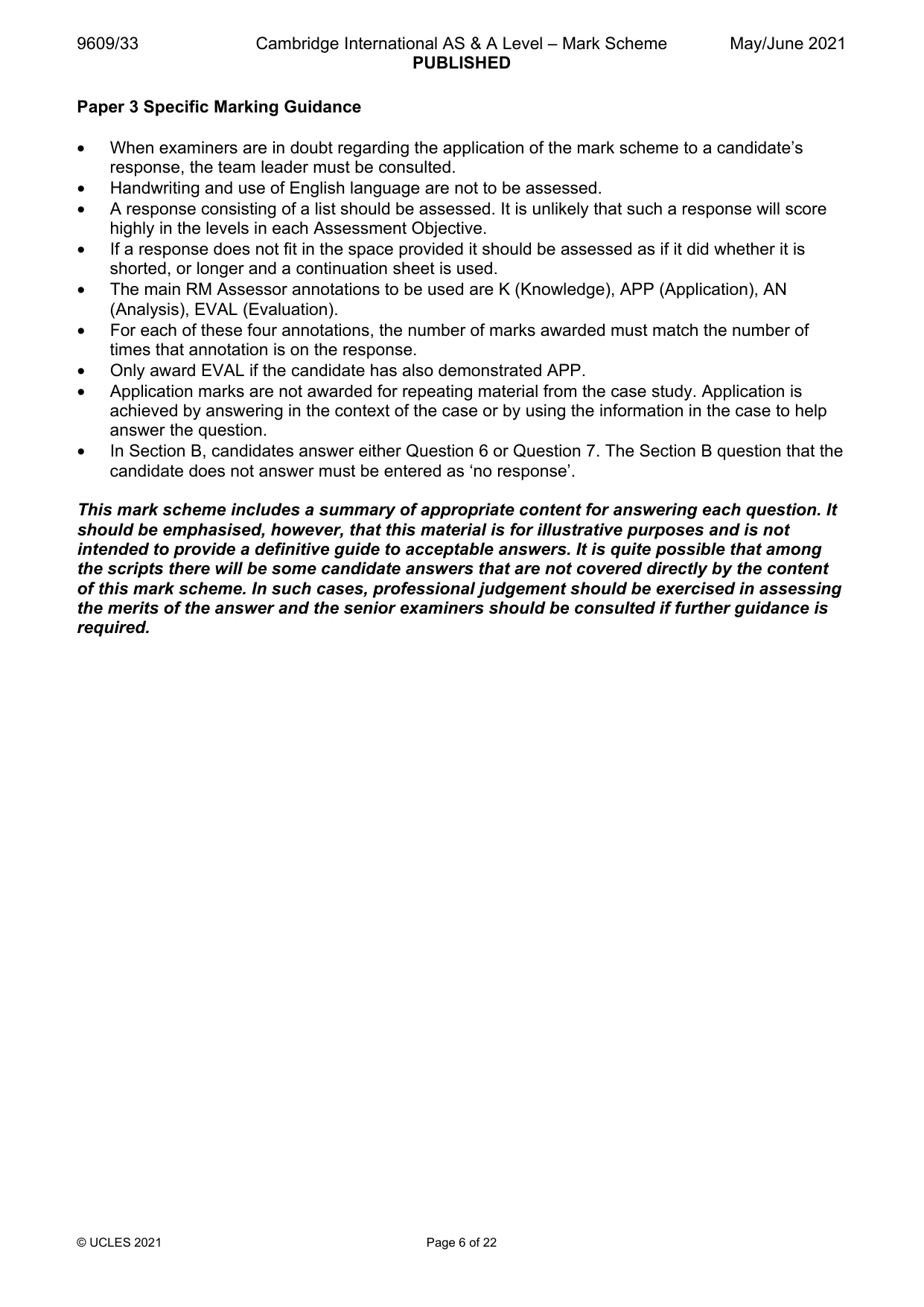
9609/33 Cambridge International AS & A Level – Mark Scheme PUBLISHED May/June 2021 © UCLES 2021 Page 6 of 22 Paper 3 Specific Marking Guidance • When examiners are in doubt regarding the application of the mark scheme to a candidate’s response, the team leader must be consulted. • Handwriting and use of English language are not to be assessed. • A response consisting of a list should be assessed. It is unlikely that such a response will score highly in the levels in each Assessment Objective. • If a response does not fit in the space provided it should be assessed as if it did whether it is shorted, or longer and a continuation sheet is used. • The main RM Assessor annotations to be used are K (Knowledge), APP (Application), AN (Analysis), EVAL (Evaluation). • For each of these four annotations, the number of marks awarded must match the number of times that annotation is on the response. • Only award EVAL if the candidate has also demonstrated APP. • Application marks are not awarded for repeating material from the case study. Application is achieved by answering in the context of the case or by using the information in the case to help answer the question. • In Section B, candidates answer either Question 6 or Question 7. The Section B question that the candidate does not answer must be entered as ‘no response’. This mark scheme includes a summary of appropriate content for answering each question. It should be emphasised, however, that this material is for illustrative purposes and is not intended to provide a definitive guide to acceptable answers. It is quite possible that among the scripts there will be some candidate answers that are not covered directly by the content of this mark scheme. In such cases, professional judgement should be exercised in assessing the merits of the answer and the senior examiners should be consulted if further guidance is required.
Mark scheme, page 7
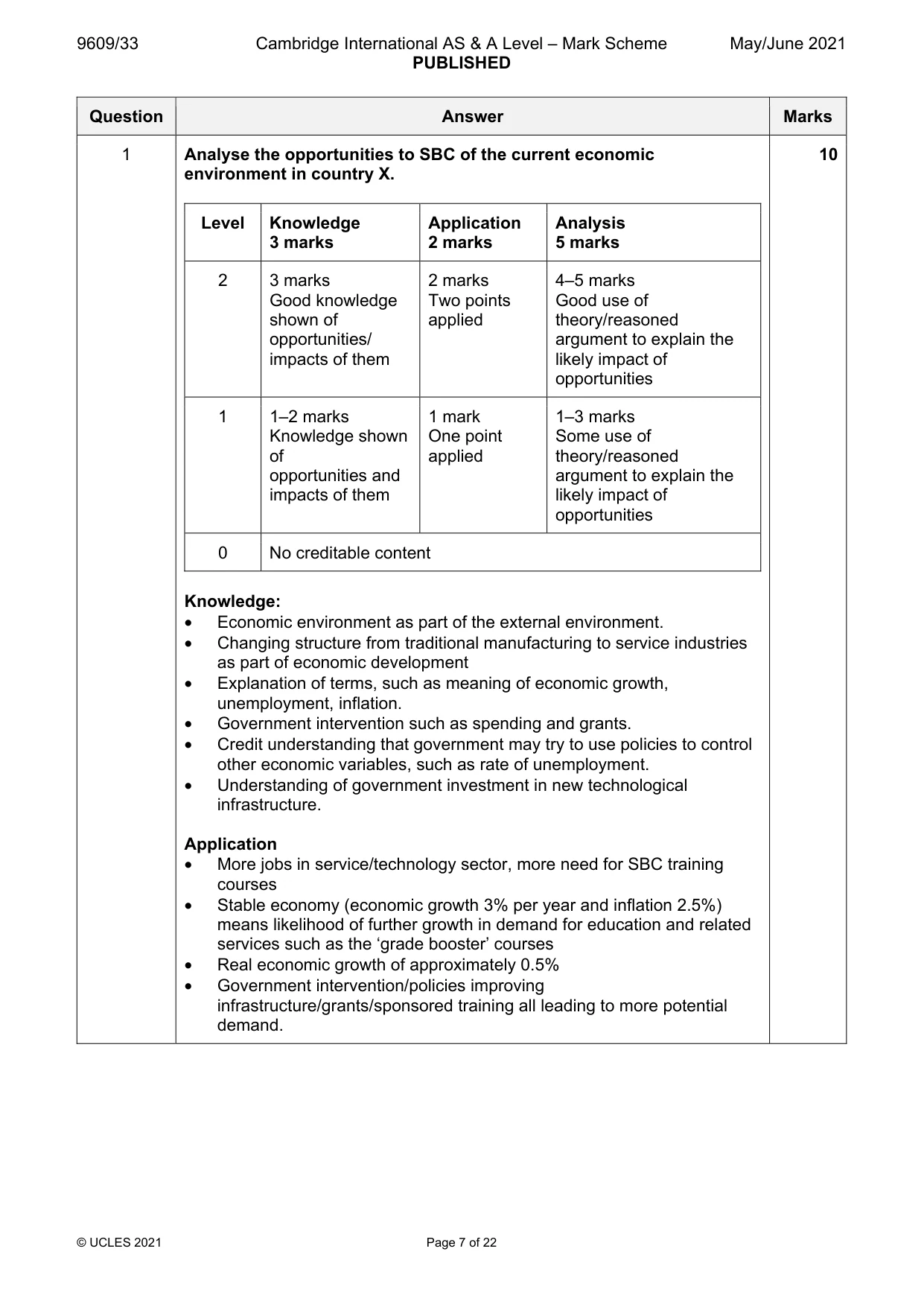
9609/33 Cambridge International AS & A Level – Mark Scheme PUBLISHED May/June 2021 © UCLES 2021 Page 7 of 22 Question Answer Marks 1 Analyse the opportunities to SBC of the current economic environment in country X. Level Knowledge 3 marks Application 2 marks Analysis 5 marks 2 3 marks Good knowledge shown of opportunities/ impacts of them 2 marks Two points applied 4–5 marks Good use of theory/reasoned argument to explain the likely impact of opportunities 1 1–2 marks Knowledge shown of opportunities and impacts of them 1 mark One point applied 1–3 marks Some use of theory/reasoned argument to explain the likely impact of opportunities 0 No creditable content Knowledge: • Economic environment as part of the external environment. • Changing structure from traditional manufacturing to service industries as part of economic development • Explanation of terms, such as meaning of economic growth, unemployment, inflation. • Government intervention such as spending and grants. • Credit understanding that government may try to use policies to control other economic variables, such as rate of unemployment. • Understanding of government investment in new technological infrastructure. Application • More jobs in service/technology sector, more need for SBC training courses • Stable economy (economic growth 3% per year and inflation 2.5%) means likelihood of further growth in demand for education and related services such as the ‘grade booster’ courses • Real economic growth of approximately 0.5% • Government intervention/policies improving infrastructure/grants/sponsored training all leading to more potential demand. 10
Mark scheme, page 8
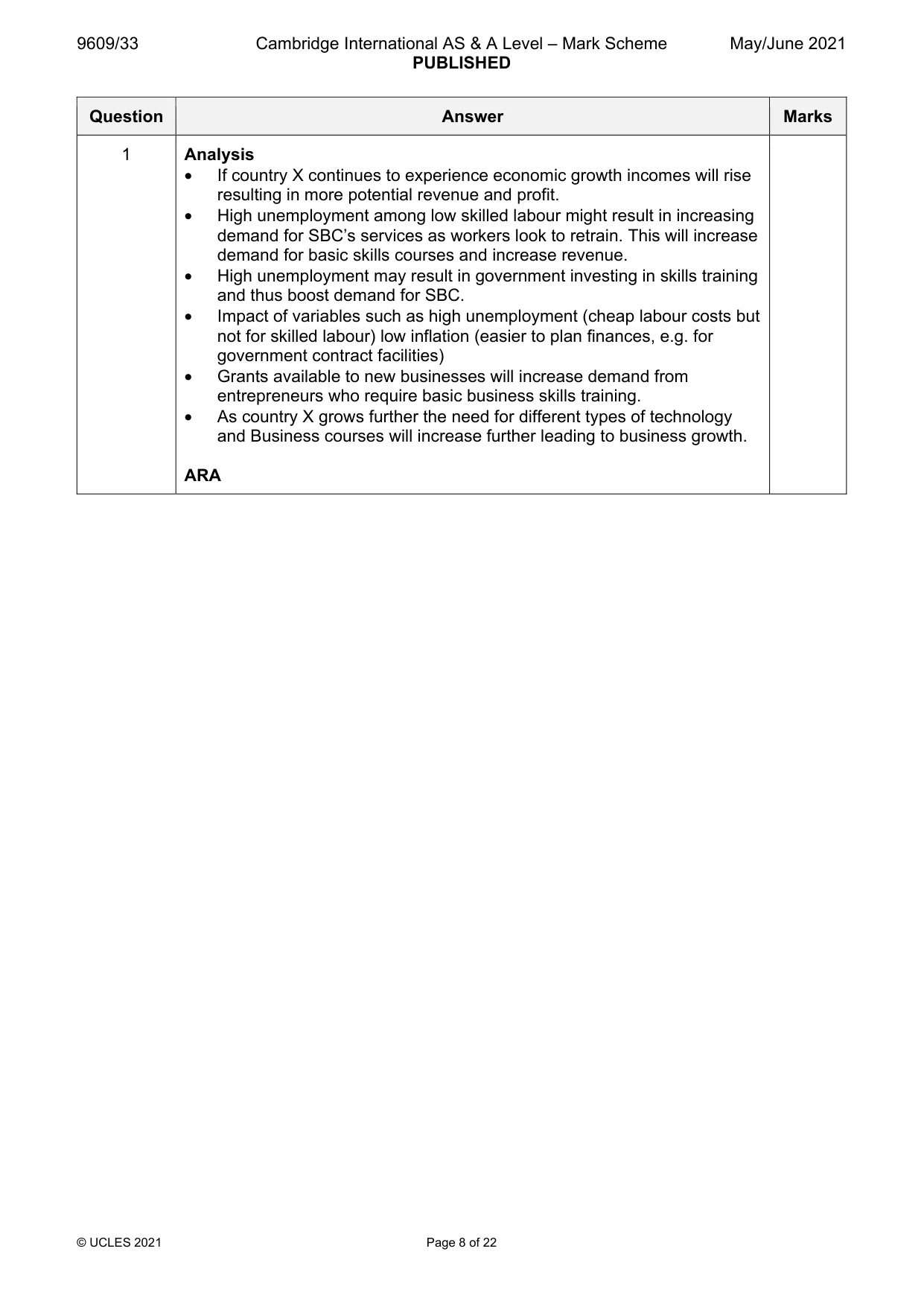
9609/33 Cambridge International AS & A Level – Mark Scheme PUBLISHED May/June 2021 © UCLES 2021 Page 8 of 22 Question Answer Marks 1 Analysis • If country X continues to experience economic growth incomes will rise resulting in more potential revenue and profit. • High unemployment among low skilled labour might result in increasing demand for SBC’s services as workers look to retrain. This will increase demand for basic skills courses and increase revenue. • High unemployment may result in government investing in skills training and thus boost demand for SBC. • Impact of variables such as high unemployment (cheap labour costs but not for skilled labour) low inflation (easier to plan finances, e.g. for government contract facilities) • Grants available to new businesses will increase demand from entrepreneurs who require basic business skills training. • As country X grows further the need for different types of technology and Business courses will increase further leading to business growth. ARA
Mark scheme, page 9
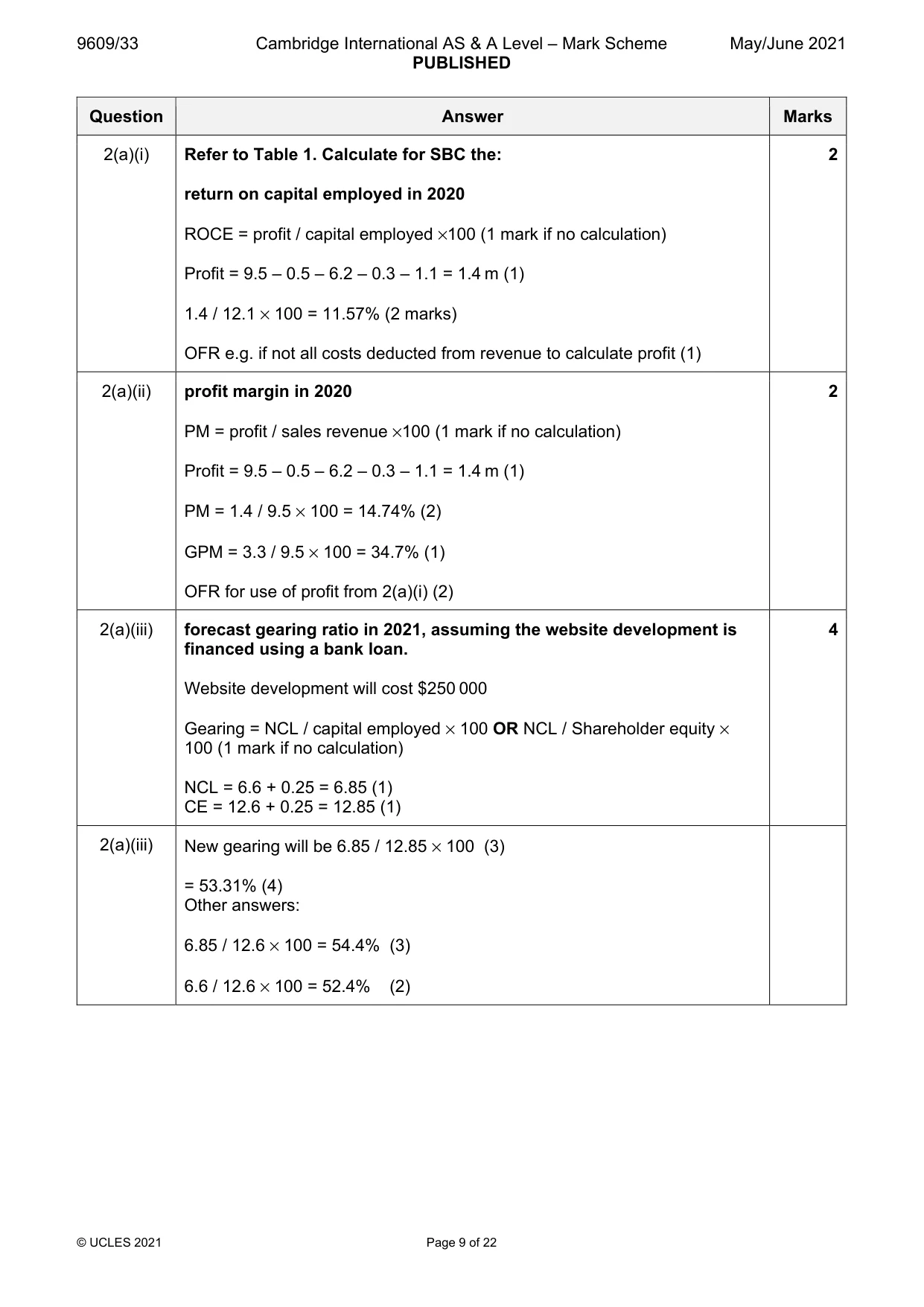
9609/33 Cambridge International AS & A Level – Mark Scheme PUBLISHED May/June 2021 © UCLES 2021 Page 9 of 22 Question Answer Marks 2(a)(i) Refer to Table 1. Calculate for SBC the: return on capital employed in 2020 ROCE = profit / capital employed ×100 (1 mark if no calculation) Profit = 9.5 – 0.5 – 6.2 – 0.3 – 1.1 = 1.4 m (1) 1.4 / 12.1 × 100 = 11.57% (2 marks) OFR e.g. if not all costs deducted from revenue to calculate profit (1) 2 2(a)(ii) profit margin in 2020 PM = profit / sales revenue ×100 (1 mark if no calculation) Profit = 9.5 – 0.5 – 6.2 – 0.3 – 1.1 = 1.4 m (1) PM = 1.4 / 9.5 × 100 = 14.74% (2) GPM = 3.3 / 9.5 × 100 = 34.7% (1) OFR for use of profit from 2(a)(i) (2) 2 2(a)(iii) forecast gearing ratio in 2021, assuming the website development is financed using a bank loan. Website development will cost $250 000 Gearing = NCL / capital employed × 100 OR NCL / Shareholder equity × 100 (1 mark if no calculation) NCL = 6.6 + 0.25 = 6.85 (1) CE = 12.6 + 0.25 = 12.85 (1) 4 2(a)(iii) New gearing will be 6.85 / 12.85 × 100 (3) = 53.31% (4) Other answers: 6.85 / 12.6 × 100 = 54.4% (3) 6.6 / 12.6 × 100 = 52.4% (2)
Mark scheme, page 10
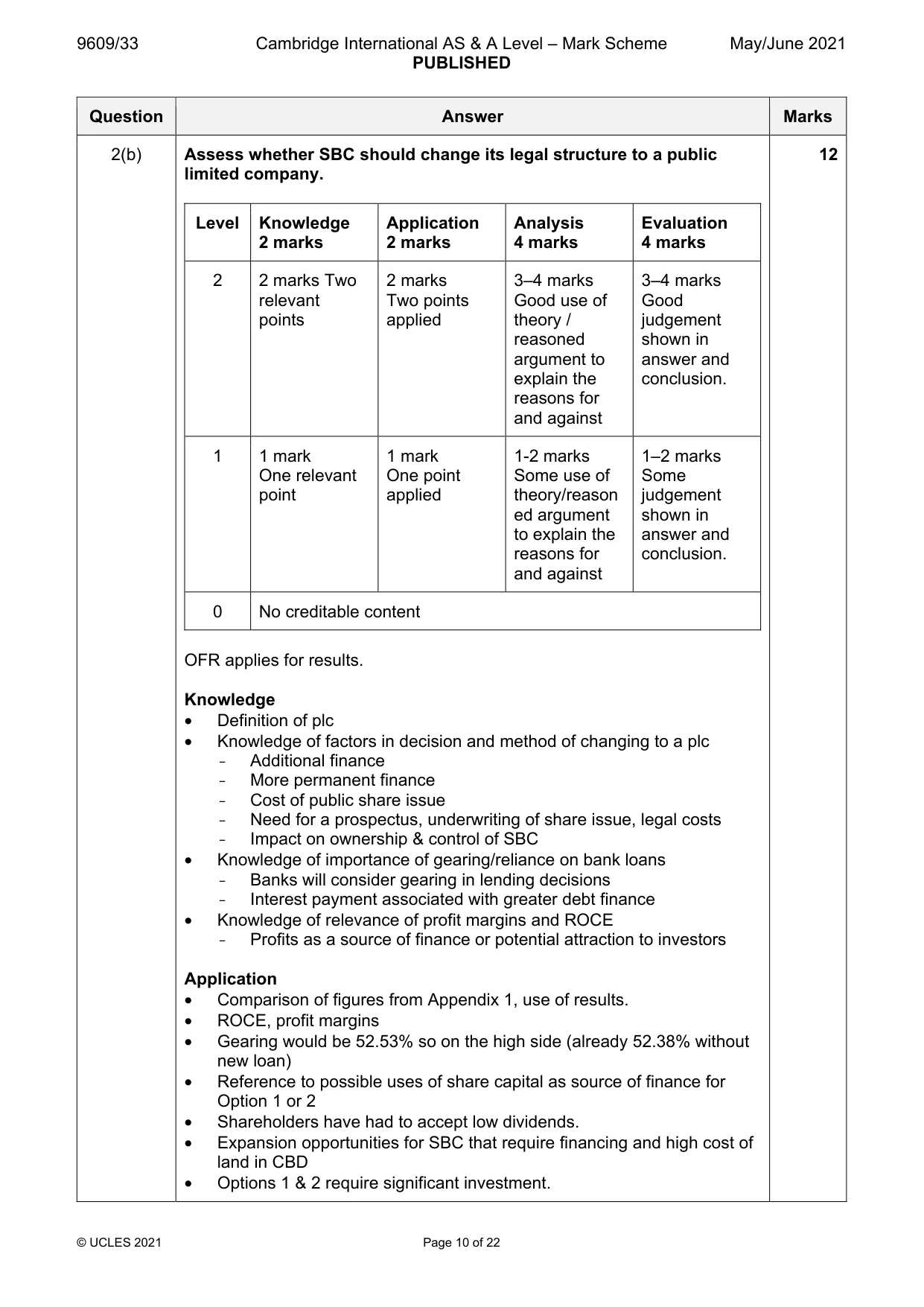
9609/33 Cambridge International AS & A Level – Mark Scheme PUBLISHED May/June 2021 © UCLES 2021 Page 10 of 22 Question Answer Marks 2(b) Assess whether SBC should change its legal structure to a public limited company. Level Knowledge 2 marks Application 2 marks Analysis 4 marks Evaluation 4 marks 2 2 marks Two relevant points 2 marks Two points applied 3–4 marks Good use of theory / reasoned argument to explain the reasons for and against 3–4 marks Good judgement shown in answer and conclusion. 1 1 mark One relevant point 1 mark One point applied 1-2 marks Some use of theory/reason ed argument to explain the reasons for and against 1–2 marks Some judgement shown in answer and conclusion. 0 No creditable content OFR applies for results. Knowledge • Definition of plc • Knowledge of factors in decision and method of changing to a plc - Additional finance - More permanent finance - Cost of public share issue - Need for a prospectus, underwriting of share issue, legal costs - Impact on ownership & control of SBC • Knowledge of importance of gearing/reliance on bank loans - Banks will consider gearing in lending decisions - Interest payment associated with greater debt finance • Knowledge of relevance of profit margins and ROCE - Profits as a source of finance or potential attraction to investors Application • Comparison of figures from Appendix 1, use of results. • ROCE, profit margins • Gearing would be 52.53% so on the high side (already 52.38% without new loan) • Reference to possible uses of share capital as source of finance for Option 1 or 2 • Shareholders have had to accept low dividends. • Expansion opportunities for SBC that require financing and high cost of land in CBD • Options 1 & 2 require significant investment. 12
Mark scheme, page 11
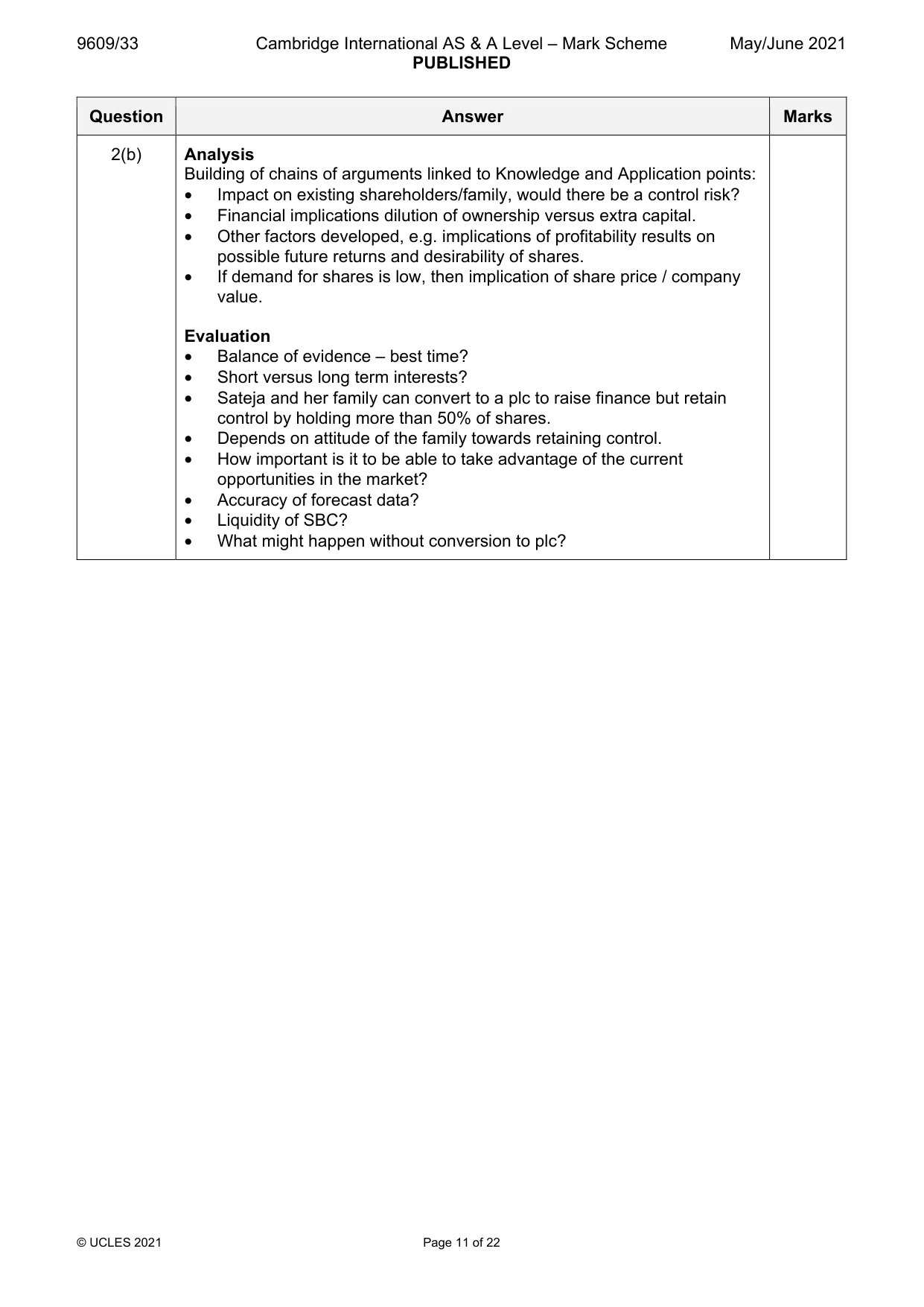
9609/33 Cambridge International AS & A Level – Mark Scheme PUBLISHED May/June 2021 © UCLES 2021 Page 11 of 22 Question Answer Marks 2(b) Analysis Building of chains of arguments linked to Knowledge and Application points: • Impact on existing shareholders/family, would there be a control risk? • Financial implications dilution of ownership versus extra capital. • Other factors developed, e.g. implications of profitability results on possible future returns and desirability of shares. • If demand for shares is low, then implication of share price / company value. Evaluation • Balance of evidence – best time? • Short versus long term interests? • Sateja and her family can convert to a plc to raise finance but retain control by holding more than 50% of shares. • Depends on attitude of the family towards retaining control. • How important is it to be able to take advantage of the current opportunities in the market? • Accuracy of forecast data? • Liquidity of SBC? • What might happen without conversion to plc?
Mark scheme, page 12
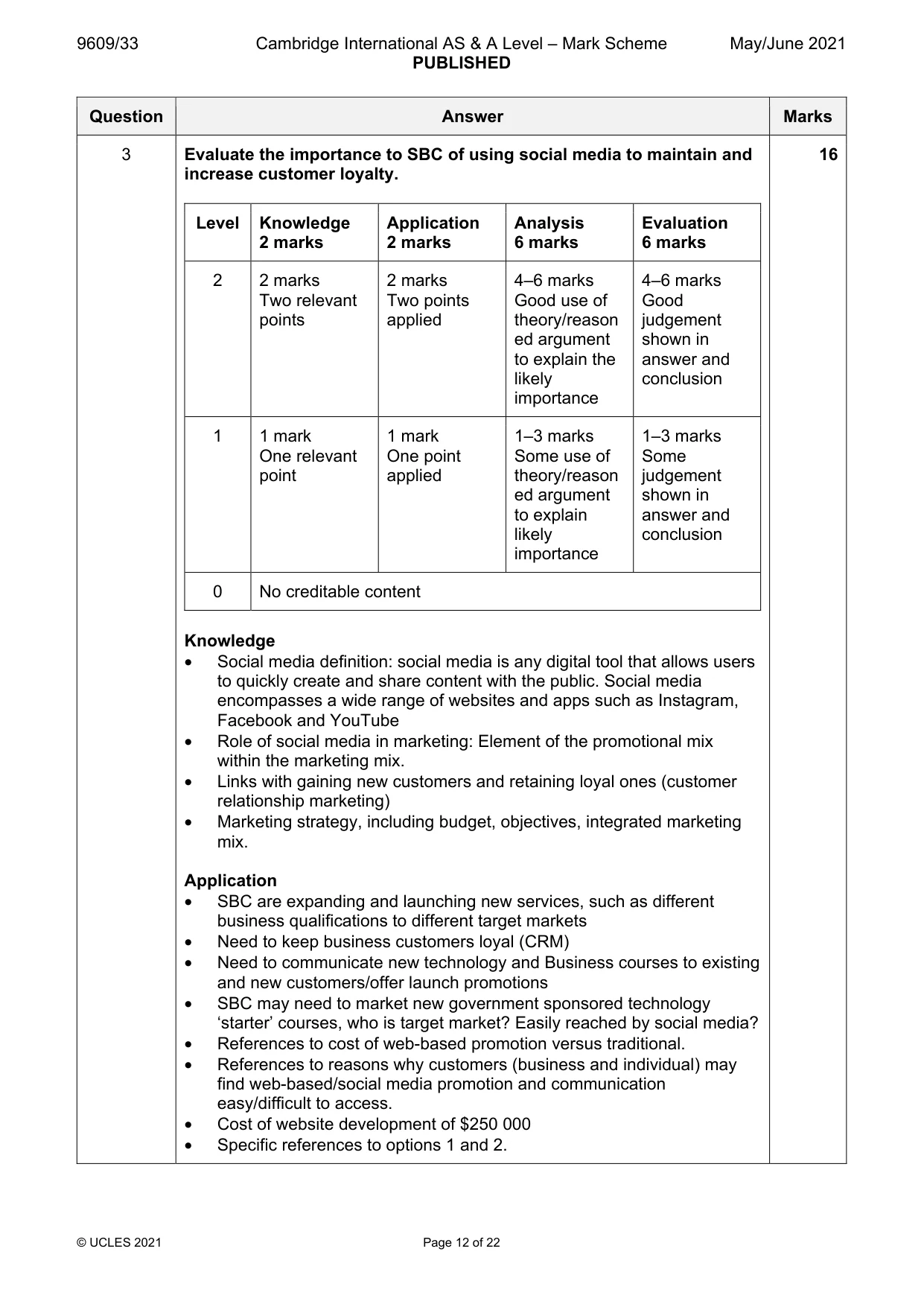
9609/33 Cambridge International AS & A Level – Mark Scheme PUBLISHED May/June 2021 © UCLES 2021 Page 12 of 22 Question Answer Marks 3 Evaluate the importance to SBC of using social media to maintain and increase customer loyalty. Level Knowledge 2 marks Application 2 marks Analysis 6 marks Evaluation 6 marks 2 2 marks Two relevant points 2 marks Two points applied 4–6 marks Good use of theory/reason ed argument to explain the likely importance 4–6 marks Good judgement shown in answer and conclusion 1 1 mark One relevant point 1 mark One point applied 1–3 marks Some use of theory/reason ed argument to explain likely importance 1–3 marks Some judgement shown in answer and conclusion 0 No creditable content Knowledge • Social media definition: social media is any digital tool that allows users to quickly create and share content with the public. Social media encompasses a wide range of websites and apps such as Instagram, Facebook and YouTube • Role of social media in marketing: Element of the promotional mix within the marketing mix. • Links with gaining new customers and retaining loyal ones (customer relationship marketing) • Marketing strategy, including budget, objectives, integrated marketing mix. Application • SBC are expanding and launching new services, such as different business qualifications to different target markets • Need to keep business customers loyal (CRM) • Need to communicate new technology and Business courses to existing and new customers/offer launch promotions • SBC may need to market new government sponsored technology ‘starter’ courses, who is target market? Easily reached by social media? • References to cost of web-based promotion versus traditional. • References to reasons why customers (business and individual) may find web-based/social media promotion and communication easy/difficult to access. • Cost of website development of $250 000 • Specific references to options 1 and 2. 16
Mark scheme, page 13
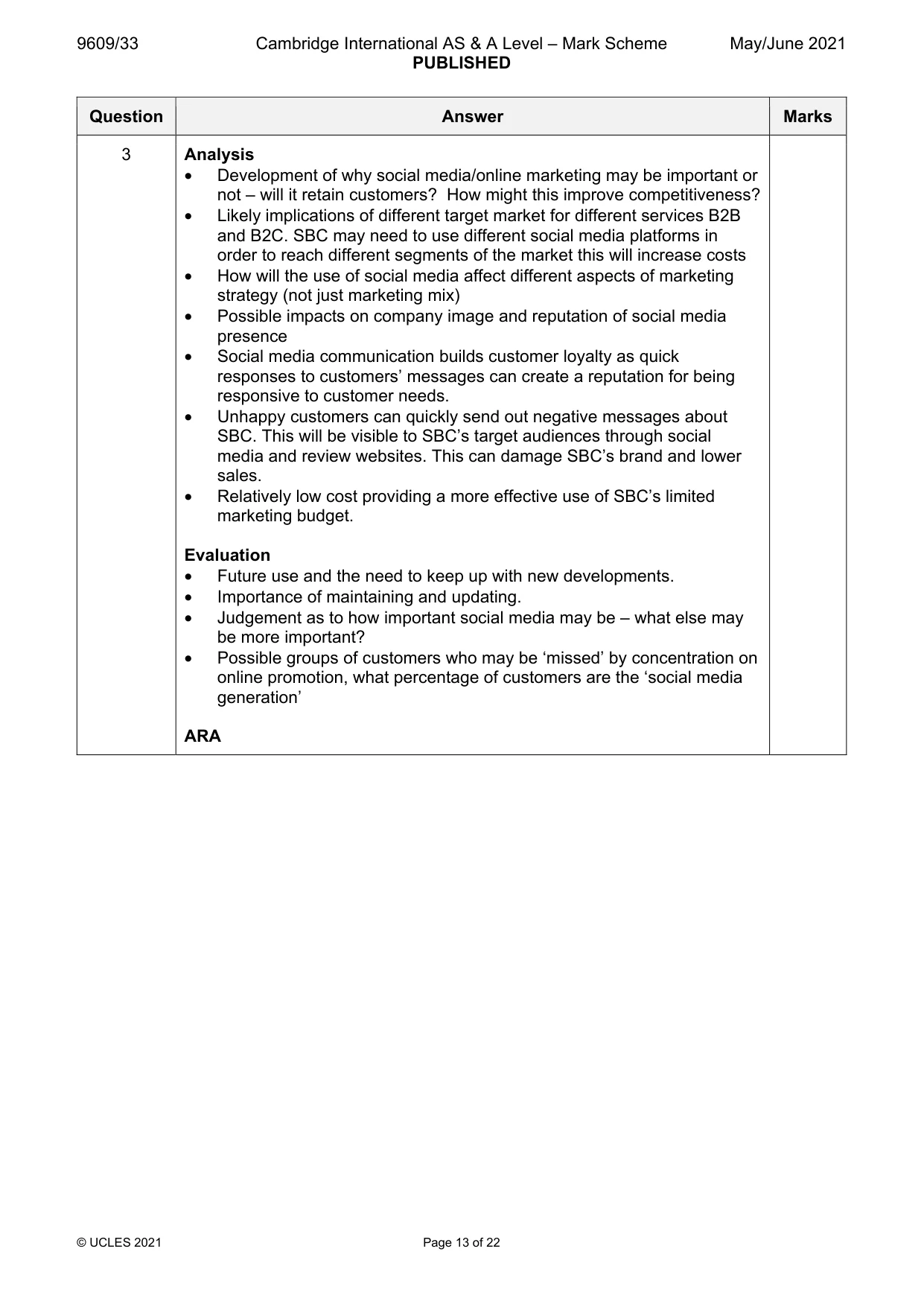
9609/33 Cambridge International AS & A Level – Mark Scheme PUBLISHED May/June 2021 © UCLES 2021 Page 13 of 22 Question Answer Marks 3 Analysis • Development of why social media/online marketing may be important or not – will it retain customers? How might this improve competitiveness? • Likely implications of different target market for different services B2B and B2C. SBC may need to use different social media platforms in order to reach different segments of the market this will increase costs • How will the use of social media affect different aspects of marketing strategy (not just marketing mix) • Possible impacts on company image and reputation of social media presence • Social media communication builds customer loyalty as quick responses to customers’ messages can create a reputation for being responsive to customer needs. • Unhappy customers can quickly send out negative messages about SBC. This will be visible to SBC’s target audiences through social media and review websites. This can damage SBC’s brand and lower sales. • Relatively low cost providing a more effective use of SBC’s limited marketing budget. Evaluation • Future use and the need to keep up with new developments. • Importance of maintaining and updating. • Judgement as to how important social media may be – what else may be more important? • Possible groups of customers who may be ‘missed’ by concentration on online promotion, what percentage of customers are the ‘social media generation’ ARA
Mark scheme, page 14
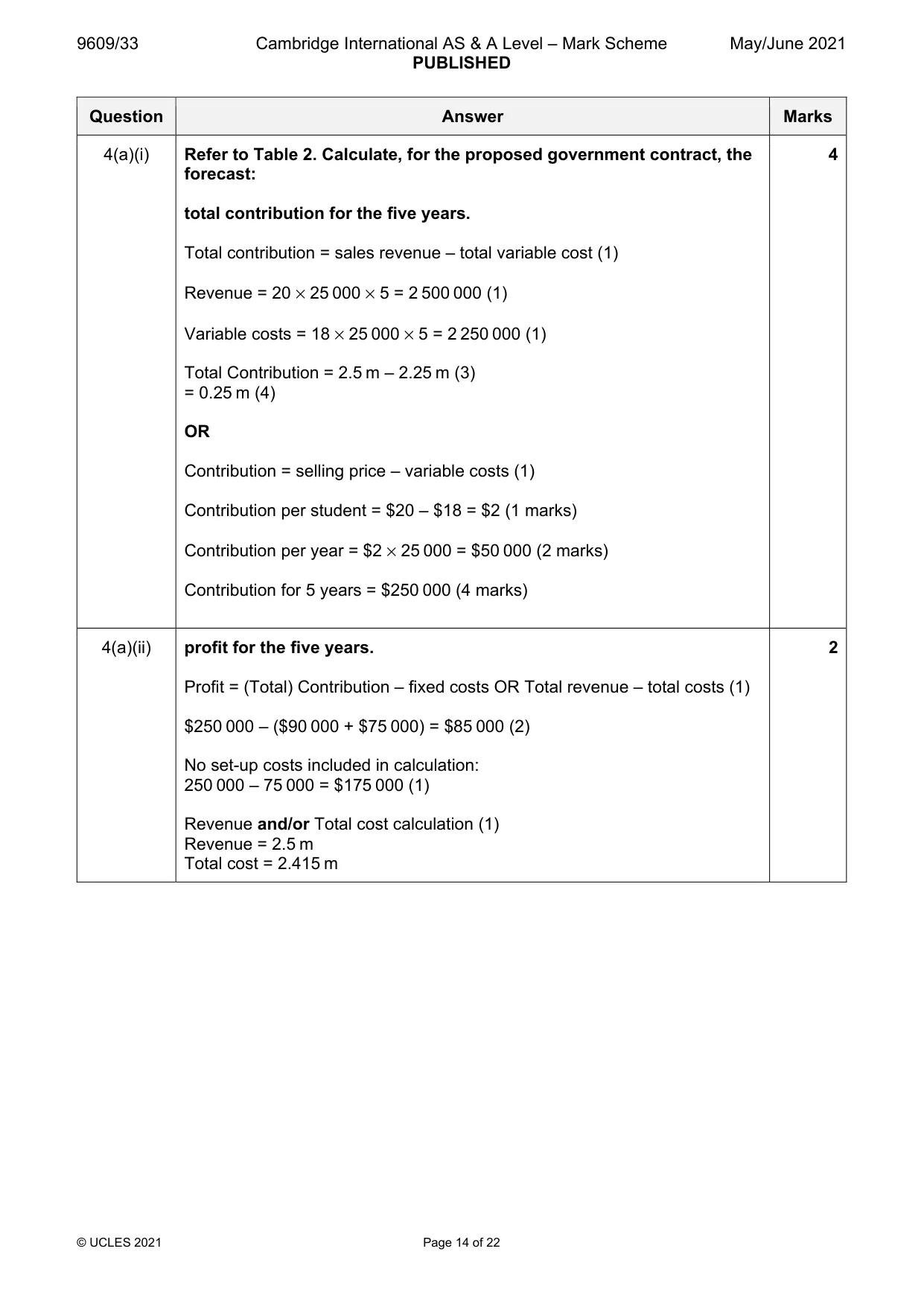
9609/33 Cambridge International AS & A Level – Mark Scheme PUBLISHED May/June 2021 © UCLES 2021 Page 14 of 22 Question Answer Marks 4(a)(i) Refer to Table 2. Calculate, for the proposed government contract, the forecast: total contribution for the five years. Total contribution = sales revenue – total variable cost (1) Revenue = 20 × 25 000 × 5 = 2 500 000 (1) Variable costs = 18 × 25 000 × 5 = 2 250 000 (1) Total Contribution = 2.5 m – 2.25 m (3) = 0.25 m (4) OR Contribution = selling price – variable costs (1) Contribution per student = $20 – $18 = $2 (1 marks) Contribution per year = $2 × 25 000 = $50 000 (2 marks) Contribution for 5 years = $250 000 (4 marks) 4 4(a)(ii) profit for the five years. Profit = (Total) Contribution – fixed costs OR Total revenue – total costs (1) $250 000 – ($90 000 + $75 000) = $85 000 (2) No set-up costs included in calculation: 250 000 – 75 000 = $175 000 (1) Revenue and/or Total cost calculation (1) Revenue = 2.5 m Total cost = 2.415 m 2
Mark scheme, page 15
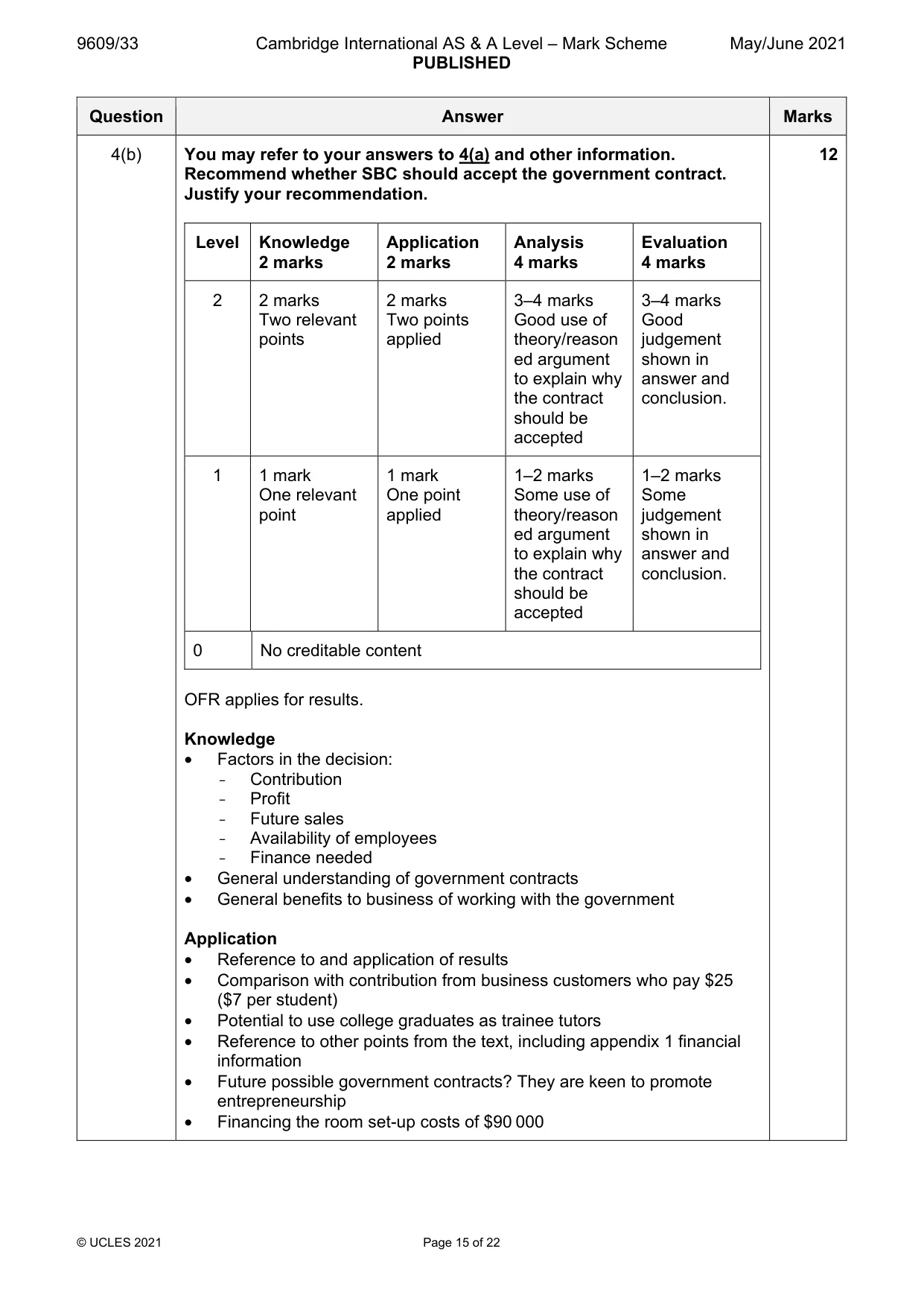
9609/33 Cambridge International AS & A Level – Mark Scheme PUBLISHED May/June 2021 © UCLES 2021 Page 15 of 22 Question Answer Marks 4(b) You may refer to your answers to 4(a) and other information. Recommend whether SBC should accept the government contract. Justify your recommendation. Level Knowledge 2 marks Application 2 marks Analysis 4 marks Evaluation 4 marks 2 2 marks Two relevant points 2 marks Two points applied 3–4 marks Good use of theory/reason ed argument to explain why the contract should be accepted 3–4 marks Good judgement shown in answer and conclusion. 1 1 mark One relevant point 1 mark One point applied 1–2 marks Some use of theory/reason ed argument to explain why the contract should be accepted 1–2 marks Some judgement shown in answer and conclusion. 0 No creditable content OFR applies for results. Knowledge • Factors in the decision: - Contribution - Profit - Future sales - Availability of employees - Finance needed • General understanding of government contracts • General benefits to business of working with the government Application • Reference to and application of results • Comparison with contribution from business customers who pay $25 ($7 per student) • Potential to use college graduates as trainee tutors • Reference to other points from the text, including appendix 1 financial information • Future possible government contracts? They are keen to promote entrepreneurship • Financing the room set-up costs of $90 000 12
Mark scheme, page 16
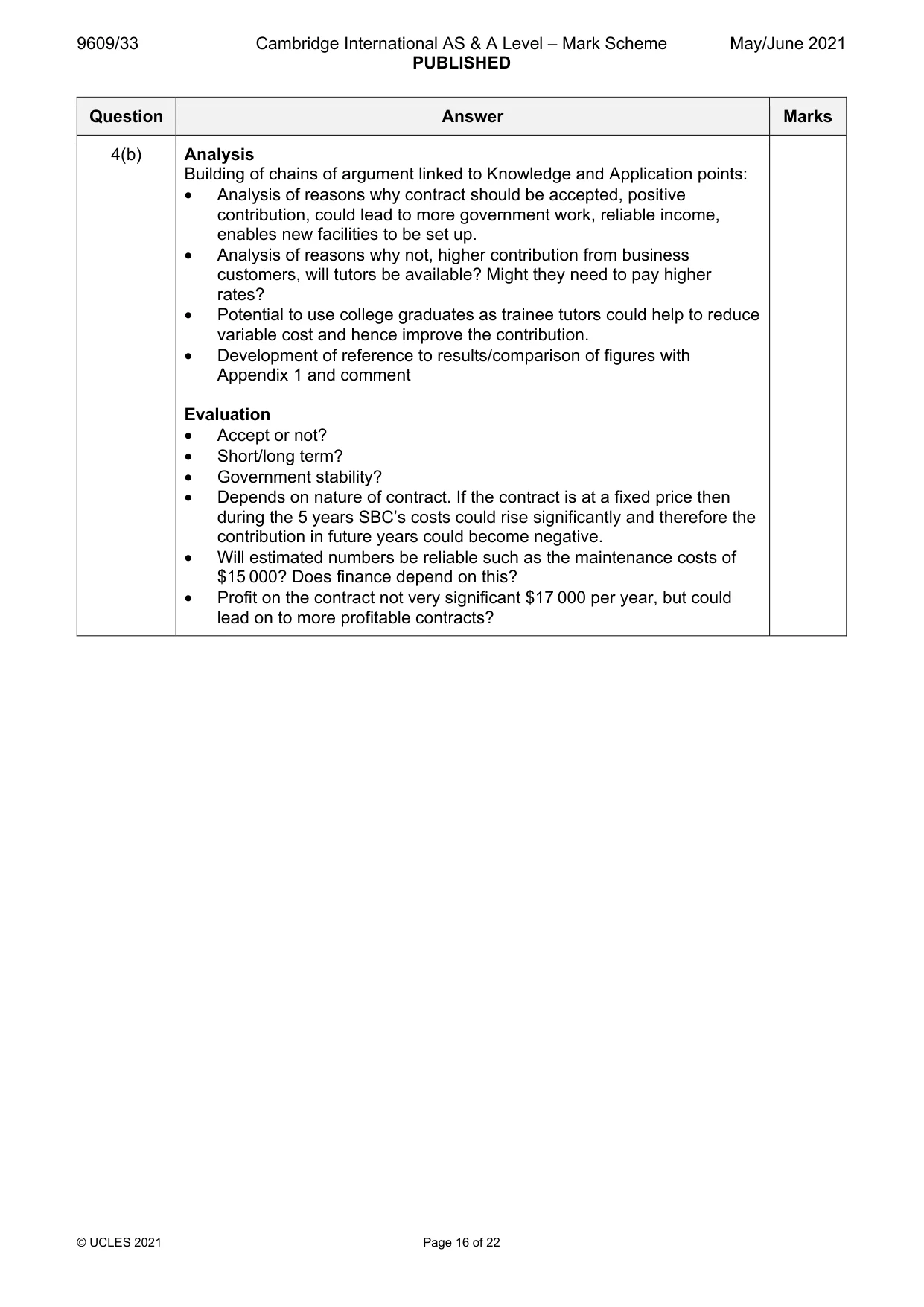
9609/33 Cambridge International AS & A Level – Mark Scheme PUBLISHED May/June 2021 © UCLES 2021 Page 16 of 22 Question Answer Marks 4(b) Analysis Building of chains of argument linked to Knowledge and Application points: • Analysis of reasons why contract should be accepted, positive contribution, could lead to more government work, reliable income, enables new facilities to be set up. • Analysis of reasons why not, higher contribution from business customers, will tutors be available? Might they need to pay higher rates? • Potential to use college graduates as trainee tutors could help to reduce variable cost and hence improve the contribution. • Development of reference to results/comparison of figures with Appendix 1 and comment Evaluation • Accept or not? • Short/long term? • Government stability? • Depends on nature of contract. If the contract is at a fixed price then during the 5 years SBC’s costs could rise significantly and therefore the contribution in future years could become negative. • Will estimated numbers be reliable such as the maintenance costs of $15 000? Does finance depend on this? • Profit on the contract not very significant $17 000 per year, but could lead on to more profitable contracts?
Mark scheme, page 17
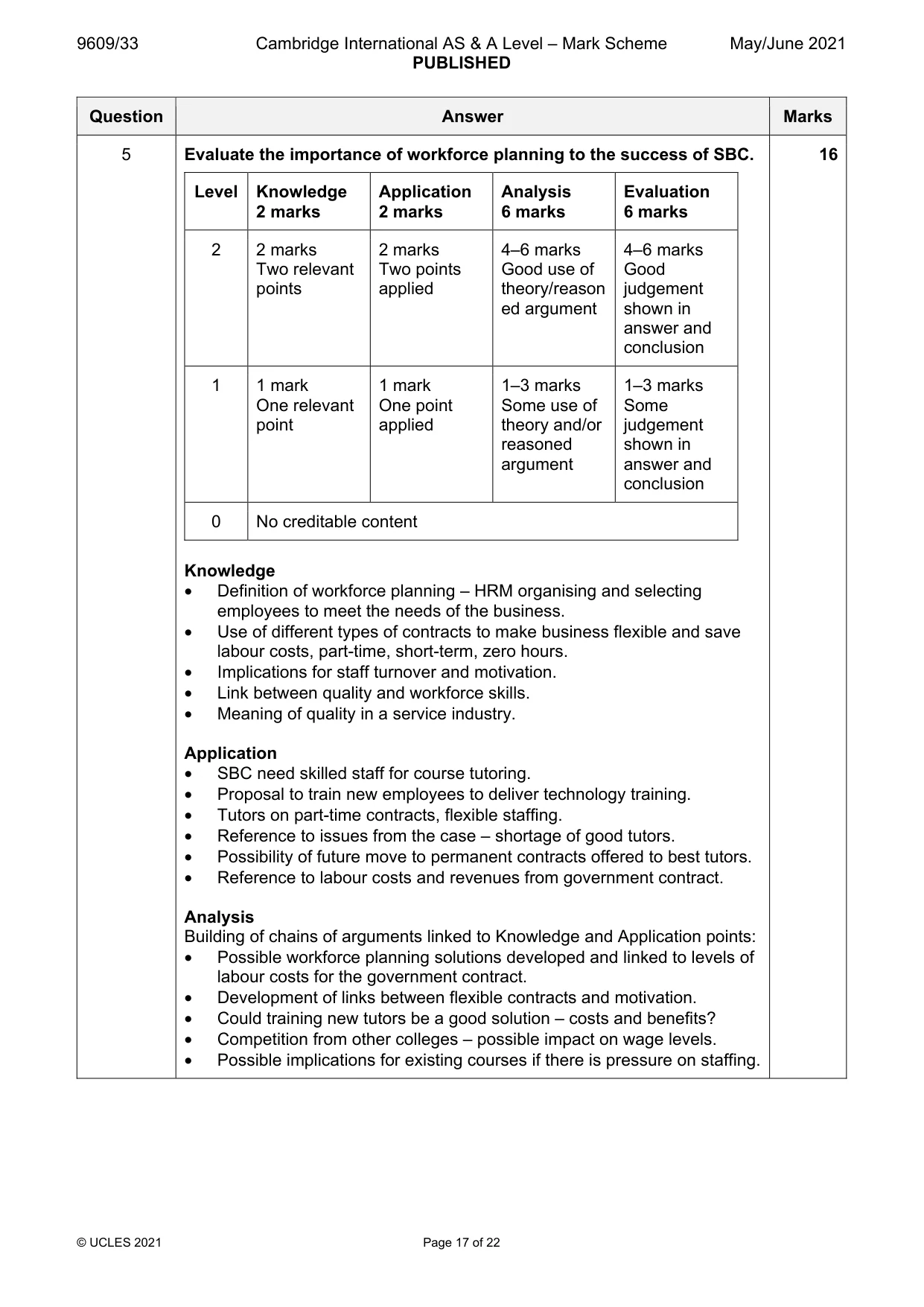
9609/33 Cambridge International AS & A Level – Mark Scheme PUBLISHED May/June 2021 © UCLES 2021 Page 17 of 22 Question Answer Marks 5 Evaluate the importance of workforce planning to the success of SBC. Knowledge • Definition of workforce planning – HRM organising and selecting employees to meet the needs of the business. • Use of different types of contracts to make business flexible and save labour costs, part-time, short-term, zero hours. • Implications for staff turnover and motivation. • Link between quality and workforce skills. • Meaning of quality in a service industry. Application • SBC need skilled staff for course tutoring. • Proposal to train new employees to deliver technology training. • Tutors on part-time contracts, flexible staffing. • Reference to issues from the case – shortage of good tutors. • Possibility of future move to permanent contracts offered to best tutors. • Reference to labour costs and revenues from government contract. Analysis Building of chains of arguments linked to Knowledge and Application points: • Possible workforce planning solutions developed and linked to levels of labour costs for the government contract. • Development of links between flexible contracts and motivation. • Could training new tutors be a good solution – costs and benefits? • Competition from other colleges – possible impact on wage levels. • Possible implications for existing courses if there is pressure on staffing. Level Knowledge 2 marks Application 2 marks Analysis 6 marks Evaluation 6 marks 2 2 marks Two relevant points 2 marks Two points applied 4–6 marks Good use of theory/reason ed argument 4–6 marks Good judgement shown in answer and conclusion 1 1 mark One relevant point 1 mark One point applied 1–3 marks Some use of theory and/or reasoned argument 1–3 marks Some judgement shown in answer and conclusion 0 No creditable content 16
Mark scheme, page 18
9609/33 Cambridge International AS & A Level – Mark Scheme PUBLISHED May/June 2021 © UCLES 2021 Page 18 of 22 Question Answer Marks 5 Evaluation • Essential to plan properly as government contract is important and could be lost if quality is not good. • How planning may / may not lead to profitability. • Difficult to predict future labour costs five years ahead. • Long term effect on staff motivation/turnover. • Management and delegation issues – can existing management cope?
Mark scheme, page 19
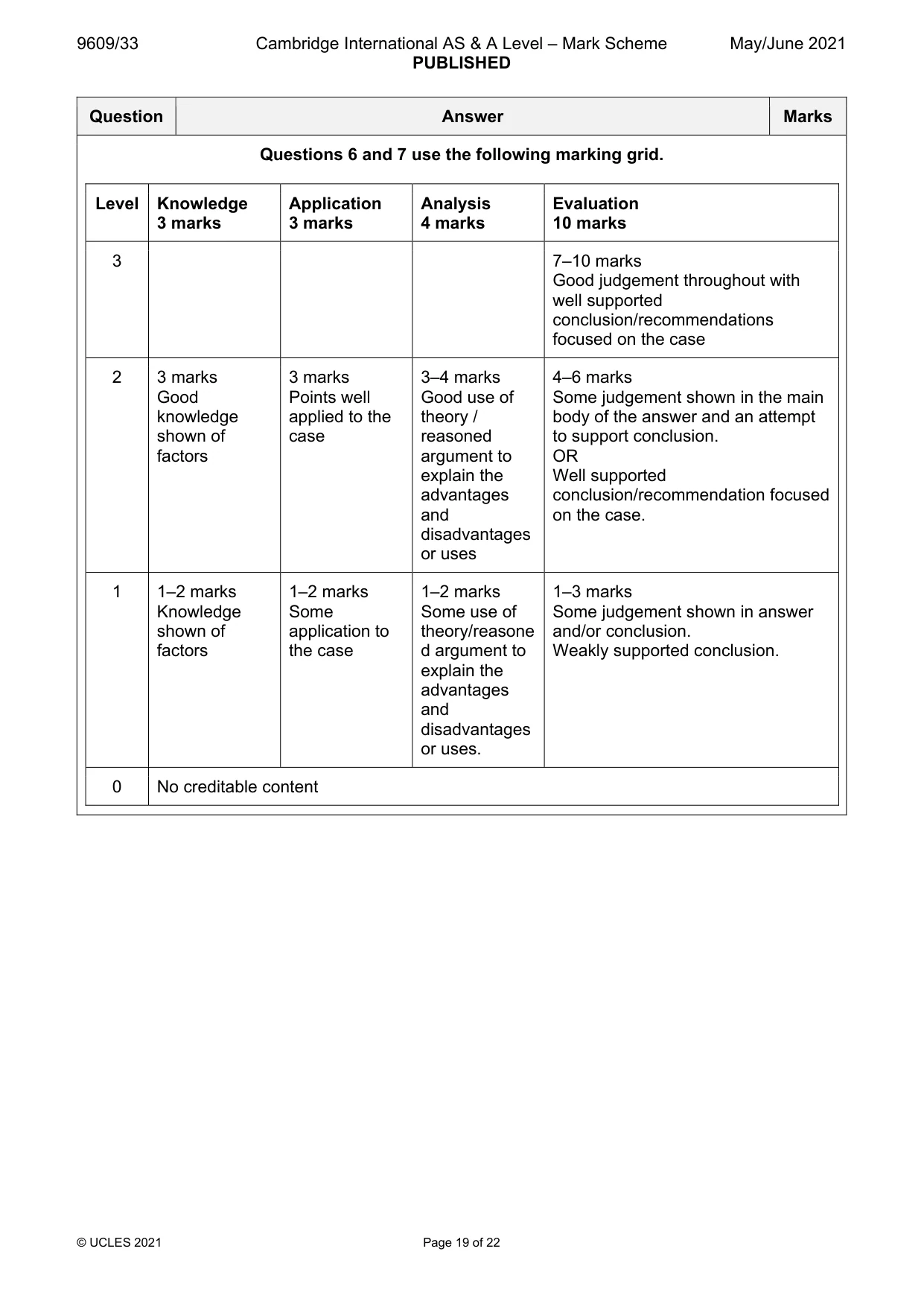
9609/33 Cambridge International AS & A Level – Mark Scheme PUBLISHED May/June 2021 © UCLES 2021 Page 19 of 22 Question Answer Marks Questions 6 and 7 use the following marking grid. Level Knowledge 3 marks Application 3 marks Analysis 4 marks Evaluation 10 marks 3 7–10 marks Good judgement throughout with well supported conclusion/recommendations focused on the case 2 3 marks Good knowledge shown of factors 3 marks Points well applied to the case 3–4 marks Good use of theory / reasoned argument to explain the advantages and disadvantages or uses 4–6 marks Some judgement shown in the main body of the answer and an attempt to support conclusion. OR Well supported conclusion/recommendation focused on the case. 1 1–2 marks Knowledge shown of factors 1–2 marks Some application to the case 1–2 marks Some use of theory/reasone d argument to explain the advantages and disadvantages or uses. 1–3 marks Some judgement shown in answer and/or conclusion. Weakly supported conclusion. 0 No creditable content
Mark scheme, page 20
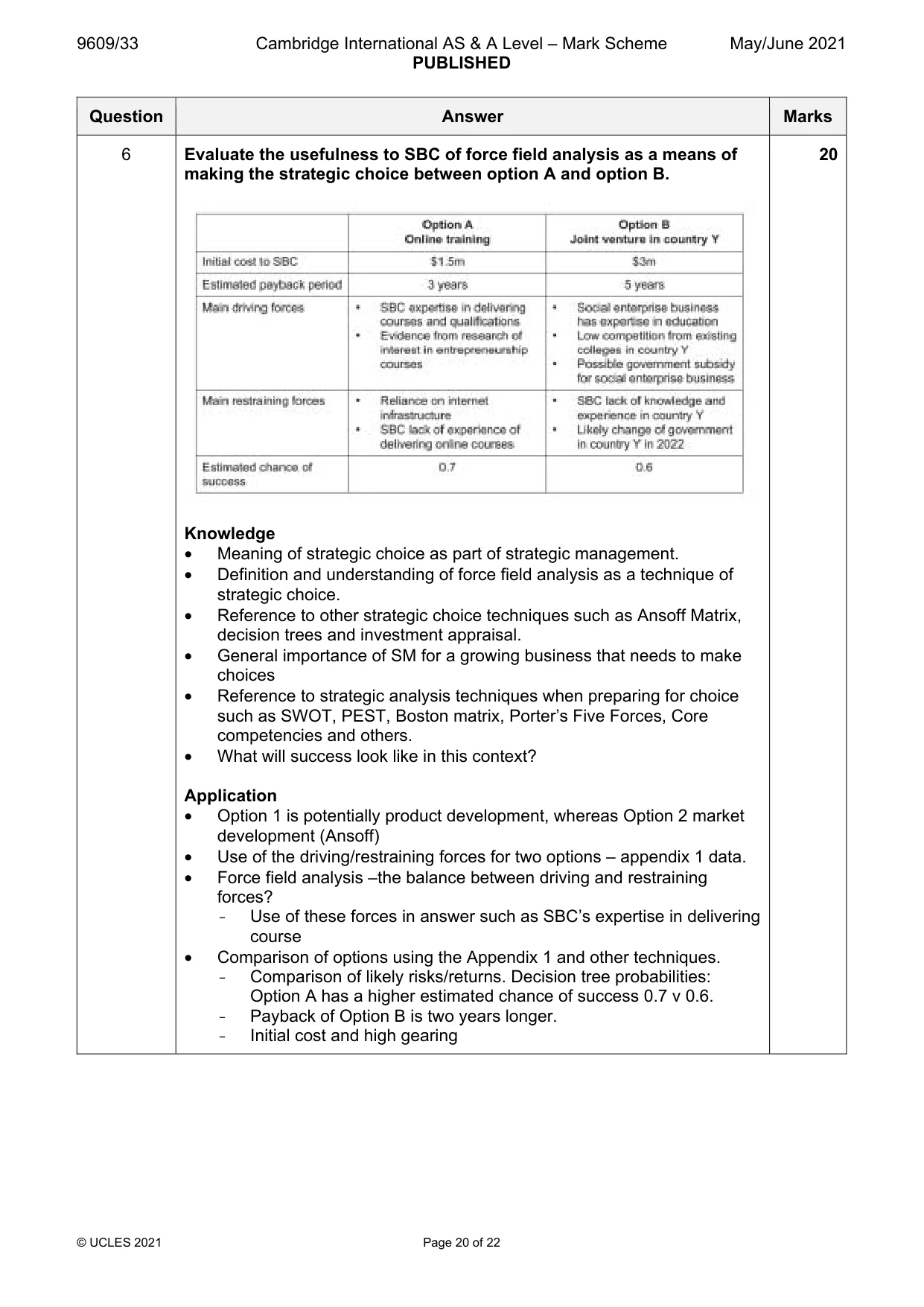
9609/33 Cambridge International AS & A Level – Mark Scheme PUBLISHED May/June 2021 © UCLES 2021 Page 20 of 22 Question Answer Marks 6 Evaluate the usefulness to SBC of force field analysis as a means of making the strategic choice between option A and option B. Knowledge • Meaning of strategic choice as part of strategic management. • Definition and understanding of force field analysis as a technique of strategic choice. • Reference to other strategic choice techniques such as Ansoff Matrix, decision trees and investment appraisal. • General importance of SM for a growing business that needs to make choices • Reference to strategic analysis techniques when preparing for choice such as SWOT, PEST, Boston matrix, Porter’s Five Forces, Core competencies and others. • What will success look like in this context? Application • Option 1 is potentially product development, whereas Option 2 market development (Ansoff) • Use of the driving/restraining forces for two options – appendix 1 data. • Force field analysis –the balance between driving and restraining forces? - Use of these forces in answer such as SBC’s expertise in delivering course • Comparison of options using the Appendix 1 and other techniques. - Comparison of likely risks/returns. Decision tree probabilities: Option A has a higher estimated chance of success 0.7 v 0.6. - Payback of Option B is two years longer. - Initial cost and high gearing 20
Mark scheme, page 21
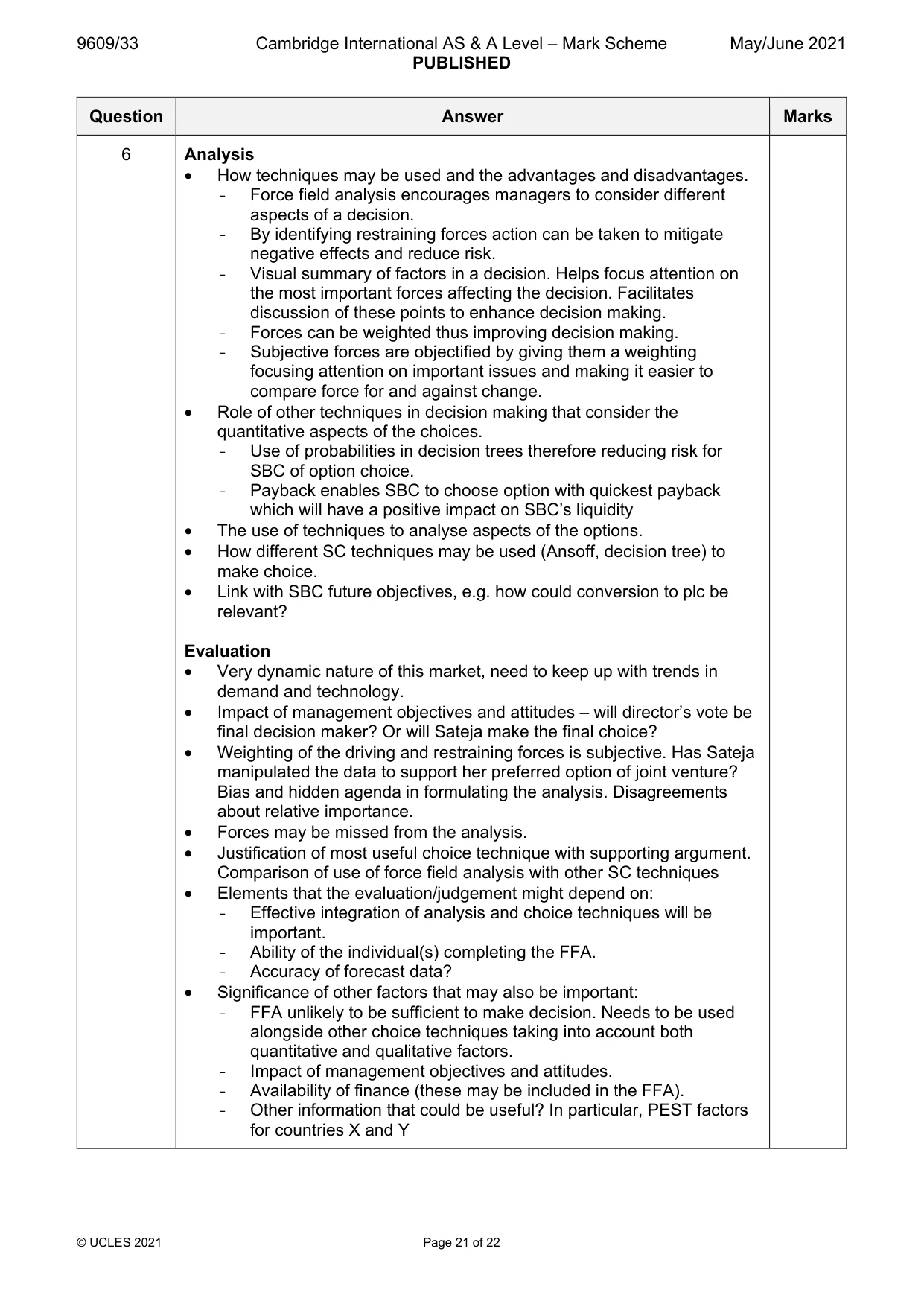
9609/33 Cambridge International AS & A Level – Mark Scheme PUBLISHED May/June 2021 © UCLES 2021 Page 21 of 22 Question Answer Marks 6 Analysis • How techniques may be used and the advantages and disadvantages. - Force field analysis encourages managers to consider different aspects of a decision. - By identifying restraining forces action can be taken to mitigate negative effects and reduce risk. - Visual summary of factors in a decision. Helps focus attention on the most important forces affecting the decision. Facilitates discussion of these points to enhance decision making. - Forces can be weighted thus improving decision making. - Subjective forces are objectified by giving them a weighting focusing attention on important issues and making it easier to compare force for and against change. • Role of other techniques in decision making that consider the quantitative aspects of the choices. - Use of probabilities in decision trees therefore reducing risk for SBC of option choice. - Payback enables SBC to choose option with quickest payback which will have a positive impact on SBC’s liquidity • The use of techniques to analyse aspects of the options. • How different SC techniques may be used (Ansoff, decision tree) to make choice. • Link with SBC future objectives, e.g. how could conversion to plc be relevant? Evaluation • Very dynamic nature of this market, need to keep up with trends in demand and technology. • Impact of management objectives and attitudes – will director’s vote be final decision maker? Or will Sateja make the final choice? • Weighting of the driving and restraining forces is subjective. Has Sateja manipulated the data to support her preferred option of joint venture? Bias and hidden agenda in formulating the analysis. Disagreements about relative importance. • Forces may be missed from the analysis. • Justification of most useful choice technique with supporting argument. Comparison of use of force field analysis with other SC techniques • Elements that the evaluation/judgement might depend on: - Effective integration of analysis and choice techniques will be important. - Ability of the individual(s) completing the FFA. - Accuracy of forecast data? • Significance of other factors that may also be important: - FFA unlikely to be sufficient to make decision. Needs to be used alongside other choice techniques taking into account both quantitative and qualitative factors. - Impact of management objectives and attitudes. - Availability of finance (these may be included in the FFA). - Other information that could be useful? In particular, PEST factors for countries X and Y
Mark scheme, page 22
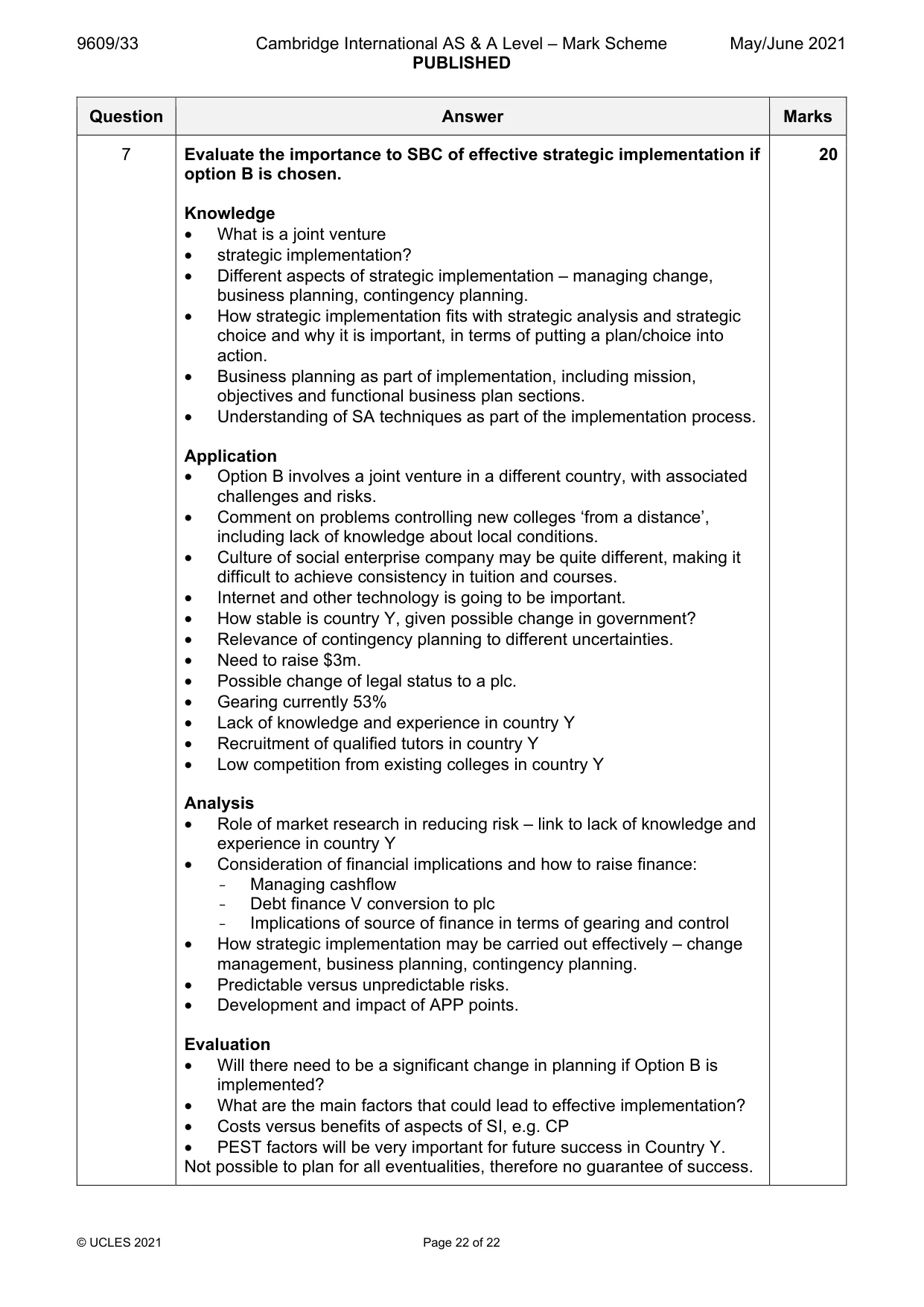
9609/33 Cambridge International AS & A Level – Mark Scheme PUBLISHED May/June 2021 © UCLES 2021 Page 22 of 22 Question Answer Marks 7 Evaluate the importance to SBC of effective strategic implementation if option B is chosen. Knowledge • What is a joint venture • strategic implementation? • Different aspects of strategic implementation – managing change, business planning, contingency planning. • How strategic implementation fits with strategic analysis and strategic choice and why it is important, in terms of putting a plan/choice into action. • Business planning as part of implementation, including mission, objectives and functional business plan sections. • Understanding of SA techniques as part of the implementation process. Application • Option B involves a joint venture in a different country, with associated challenges and risks. • Comment on problems controlling new colleges ‘from a distance’, including lack of knowledge about local conditions. • Culture of social enterprise company may be quite different, making it difficult to achieve consistency in tuition and courses. • Internet and other technology is going to be important. • How stable is country Y, given possible change in government? • Relevance of contingency planning to different uncertainties. • Need to raise $3m. • Possible change of legal status to a plc. • Gearing currently 53% • Lack of knowledge and experience in country Y • Recruitment of qualified tutors in country Y • Low competition from existing colleges in country Y Analysis • Role of market research in reducing risk – link to lack of knowledge and experience in country Y • Consideration of financial implications and how to raise finance: - Managing cashflow - Debt finance V conversion to plc - Implications of source of finance in terms of gearing and control • How strategic implementation may be carried out effectively – change management, business planning, contingency planning. • Predictable versus unpredictable risks. • Development and impact of APP points. Evaluation • Will there need to be a significant change in planning if Option B is implemented? • What are the main factors that could lead to effective implementation? • Costs versus benefits of aspects of SI, e.g. CP • PEST factors will be very important for future success in Country Y. Not possible to plan for all eventualities, therefore no guarantee of success. 20
What you needed in this session
Cambridge’s own grade thresholds for 2021 May/June, Paper 3 · Variant 3. A higher threshold means an easier paper — the bar moves with how the cohort did.