Cambridge A Level Business (for first examination in 2016) 9609 — 2020 Feb/March Paper 3 · Variant 2
9609/32/F/M/20 · 100 marks · ≈113 min
The question paper and its mark scheme, free to read here and free to download. This is Cambridge’s own paper, exactly as it was sat.
Question paper20 pages



















Mark scheme19 pages
Answers below. Sit the paper first if you are practising.


Paper as text
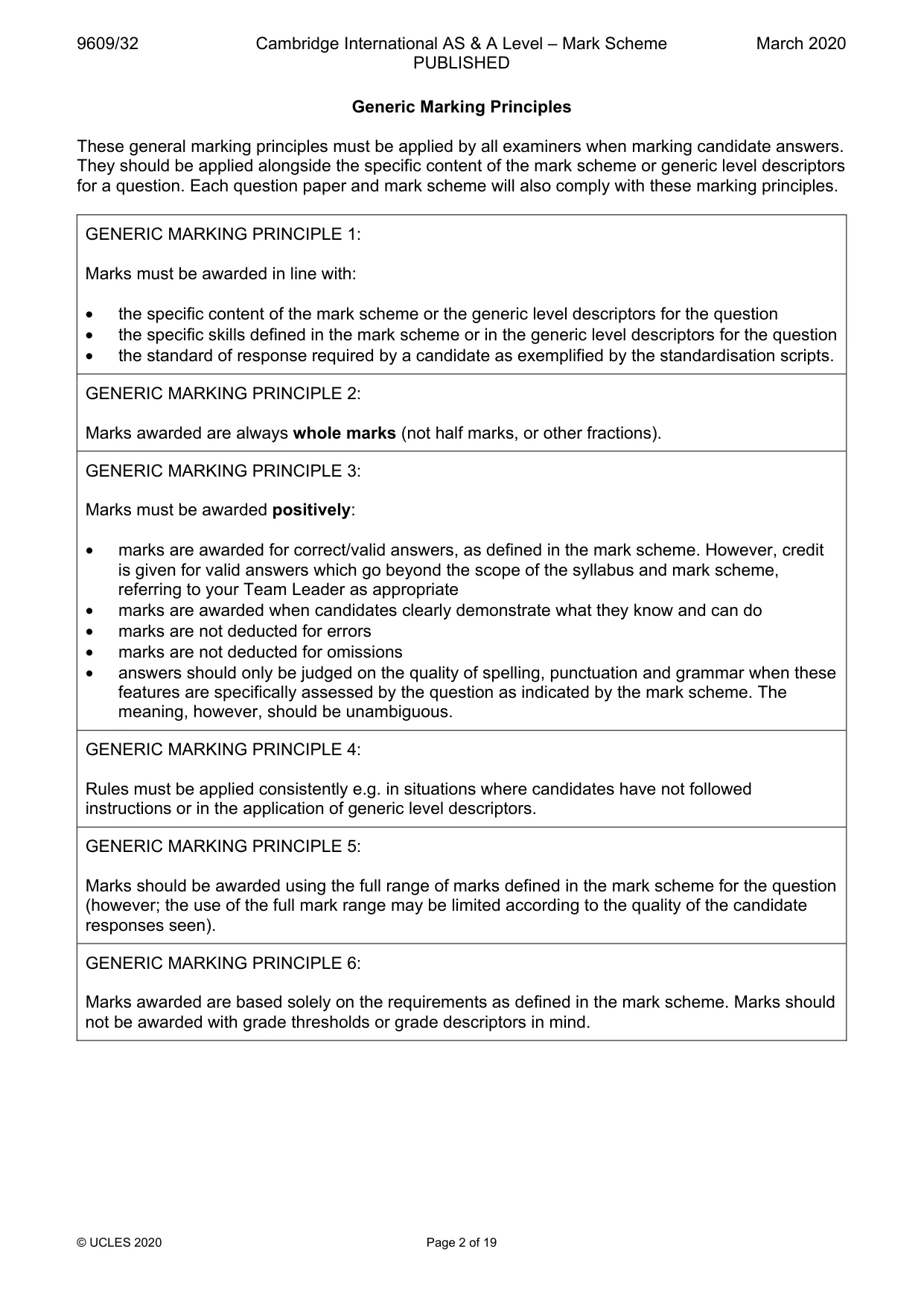
Question paper, page 1
Cambridge International AS & A Level DC (LEG) 180939/3 © UCLES 2020 [Turn over This document has 20 pages. Blank pages are indicated. * 0 7 9 2 0 8 9 0 7 1 * BUSINESS 9609/32 Paper 3 Case Study February/March 2020 3 hours You must answer on the question paper. You will need: Insert (enclosed) INSTRUCTIONS ● Section A: answer all questions. ● Section B: answer one question. ● Use a black or dark blue pen. ● Write your name, centre number and candidate number in the boxes at the top of the page. ● Write your answer to each question in the space provided. ● Do not use an erasable pen or correction fluid. ● Do not write on any bar codes. ● You may use an HB pencil for any diagrams, graphs or rough working. INFORMATION ● The total mark for this paper is 100. ● The number of marks for each question or part question is shown in brackets [ ]. ● The insert contains the case study.
Question paper, page 2
2 9609/32/F/M/20 © UCLES 2020 Answer all questions in Section A and answer one question in Section B. You are advised to spend no more than 40 minutes on Section B. Section A Answer all questions in this section. 1 Analyse the likely impact of changes in interest rates on FE. … … … … … … … … … … … … … … … … … … … … … … …
Question paper, page 3
3 9609/32/F/M/20 © UCLES 2020 [Turn over … … … … … … … … … … … … … … … … … … … … … … … … … … … … [10]
Question paper, page 4
4 9609/32/F/M/20 © UCLES 2020 2 (a) Refer to lines 29–31. Calculate the forecast capacity utilisation for 2020 in FE’s factory. … … … … … … … … [2] (b) Refer to Table 1. Calculate the difference in unit cost of towers produced by expanding the factory or outsourcing. … … … … … … … … … … … … [3]
Question paper, page 5
5 9609/32/F/M/20 © UCLES 2020 [Turn over (c) Refer to your results from 2(a) and 2(b) and other information. Recommend to FE’s directors whether to outsource production of the towers. … … … … … … … … … … … … … … … … … … … … … … … … … … …
Question paper, page 6
6 9609/32/F/M/20 © UCLES 2020 … … … … … … … … … … … … … … … … … … … … … … … … … … … … [12]
Question paper, page 7
7 9609/32/F/M/20 © UCLES 2020 [Turn over 3 Evaluate changes to the marketing strategy of FE needed to increase its market share of the household market for wind turbines. … … … … … … … … … … … … … … … … … … … … … … … … … … …
Question paper, page 8
8 9609/32/F/M/20 © UCLES 2020 … … … … … … … … … … … … … … … … … … … … … … … … … … … …
Question paper, page 9
9 9609/32/F/M/20 © UCLES 2020 [Turn over … … … … … … … … … … … … … … … … … … … … … … … … … … … … [16]
Question paper, page 10
10 9609/32/F/M/20 © UCLES 2020 4 (a) Refer to Tables 2 and 3. Calculate for 2019: (i) inventory turnover … … … … … … [2] (ii) gearing … … … … … … … … … … … [4] (iii) current ratio. … … … … … … … [3]
Question paper, page 11
11 9609/32/F/M/20 © UCLES 2020 [Turn over (b) Evaluate the usefulness of ratio analysis to FE’s managers when making decisions. … … … … … … … … … … … … … … … … … … … … … … … … … … …
Question paper, page 12
12 9609/32/F/M/20 © UCLES 2020 … … … … … … … … … … … … … … … … … … … … … … … … … … … … [12]
Question paper, page 13
13 9609/32/F/M/20 © UCLES 2020 [Turn over 5 Evaluate the significance of workforce planning to FE’s future success. … … … … … … … … … … … … … … … … … … … … … … … … … … …
Question paper, page 14
14 9609/32/F/M/20 © UCLES 2020 … … … … … … … … … … … … … … … … … … … … … … … … … … … …
Question paper, page 15
15 9609/32/F/M/20 © UCLES 2020 [Turn over … … … … … … … … … … … … … … … … … … … … … … … … … … … … [16]
Question paper, page 16
16 9609/32/F/M/20 © UCLES 2020 Section B Answer one question in this section. 6 Evaluate the usefulness of decision tree analysis to FE’s Directors when making the strategic choice between options A and B. 7 Discuss the importance of FE’s Directors developing a detailed corporate plan before implementing strategies for future growth. Write the question number here: … … … … … … … … … … … … … … … … … … … … … … …
Question paper, page 17
17 9609/32/F/M/20 © UCLES 2020 [Turn over … … … … … … … … … … … … … … … … … … … … … … … … … … … …
Question paper, page 18
18 9609/32/F/M/20 © UCLES 2020 … … … … … … … … … … … … … … … … … … … … … … … … … … … …
Question paper, page 19
19 9609/32/F/M/20 © UCLES 2020 … … … … … … … … … … … … … … … … … … … … … … … … … … … … [20]
Question paper, page 20
20 9609/32/F/M/20 © UCLES 2020 Permission to reproduce items where third-party owned material protected by copyright is included has been sought and cleared where possible. Every reasonable effort has been made by the publisher (UCLES) to trace copyright holders, but if any items requiring clearance have unwittingly been included, the publisher will be pleased to make amends at the earliest possible opportunity. To avoid the issue of disclosure of answer-related information to candidates, all copyright acknowledgements are reproduced online in the Cambridge Assessment International Education Copyright Acknowledgements Booklet. This is produced for each series of examinations and is freely available to download at www.cambridgeinternational.org after the live examination series. Cambridge Assessment International Education is part of the Cambridge Assessment Group. Cambridge Assessment is the brand name of the University of Cambridge Local Examinations Syndicate (UCLES), which itself is a department of the University of Cambridge. BLANK PAGE
Mark scheme, page 1
This document consists of 19 printed pages. © UCLES 2020 [Turn over Cambridge International AS & A Level BUSINESS 9609/32 Paper 3 Case Study March 2020 MARK SCHEME Maximum Mark: 100 Published This mark scheme is published as an aid to teachers and candidates, to indicate the requirements of the examination. It shows the basis on which Examiners were instructed to award marks. It does not indicate the details of the discussions that took place at an Examiners’ meeting before marking began, which would have considered the acceptability of alternative answers. Mark schemes should be read in conjunction with the question paper and the Principal Examiner Report for Teachers. Cambridge International will not enter into discussions about these mark schemes. Cambridge International is publishing the mark schemes for the March 2020 series for most Cambridge IGCSE™, Cambridge International A and AS Level components and some Cambridge O Level components.
Mark scheme, page 2
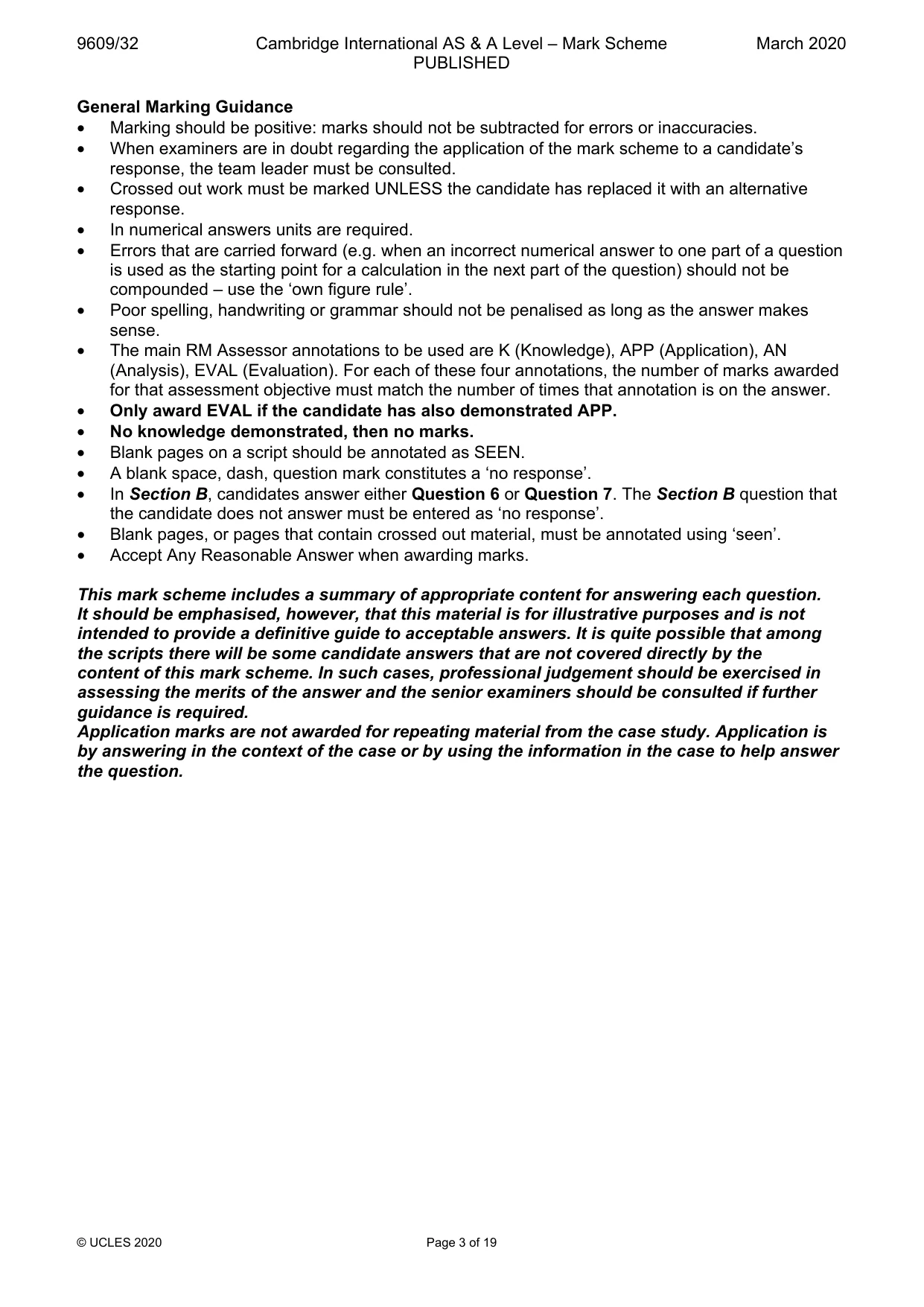
9609/32 Cambridge International AS & A Level – Mark Scheme PUBLISHED March 2020 © UCLES 2020 Page 2 of 19 Generic Marking Principles These general marking principles must be applied by all examiners when marking candidate answers. They should be applied alongside the specific content of the mark scheme or generic level descriptors for a question. Each question paper and mark scheme will also comply with these marking principles. GENERIC MARKING PRINCIPLE 1: Marks must be awarded in line with: • the specific content of the mark scheme or the generic level descriptors for the question • the specific skills defined in the mark scheme or in the generic level descriptors for the question • the standard of response required by a candidate as exemplified by the standardisation scripts. GENERIC MARKING PRINCIPLE 2: Marks awarded are always whole marks (not half marks, or other fractions). GENERIC MARKING PRINCIPLE 3: Marks must be awarded positively: • marks are awarded for correct/valid answers, as defined in the mark scheme. However, credit is given for valid answers which go beyond the scope of the syllabus and mark scheme, referring to your Team Leader as appropriate • marks are awarded when candidates clearly demonstrate what they know and can do • marks are not deducted for errors • marks are not deducted for omissions • answers should only be judged on the quality of spelling, punctuation and grammar when these features are specifically assessed by the question as indicated by the mark scheme. The meaning, however, should be unambiguous. GENERIC MARKING PRINCIPLE 4: Rules must be applied consistently e.g. in situations where candidates have not followed instructions or in the application of generic level descriptors. GENERIC MARKING PRINCIPLE 5: Marks should be awarded using the full range of marks defined in the mark scheme for the question (however; the use of the full mark range may be limited according to the quality of the candidate responses seen). GENERIC MARKING PRINCIPLE 6: Marks awarded are based solely on the requirements as defined in the mark scheme. Marks should not be awarded with grade thresholds or grade descriptors in mind.
Mark scheme, page 3
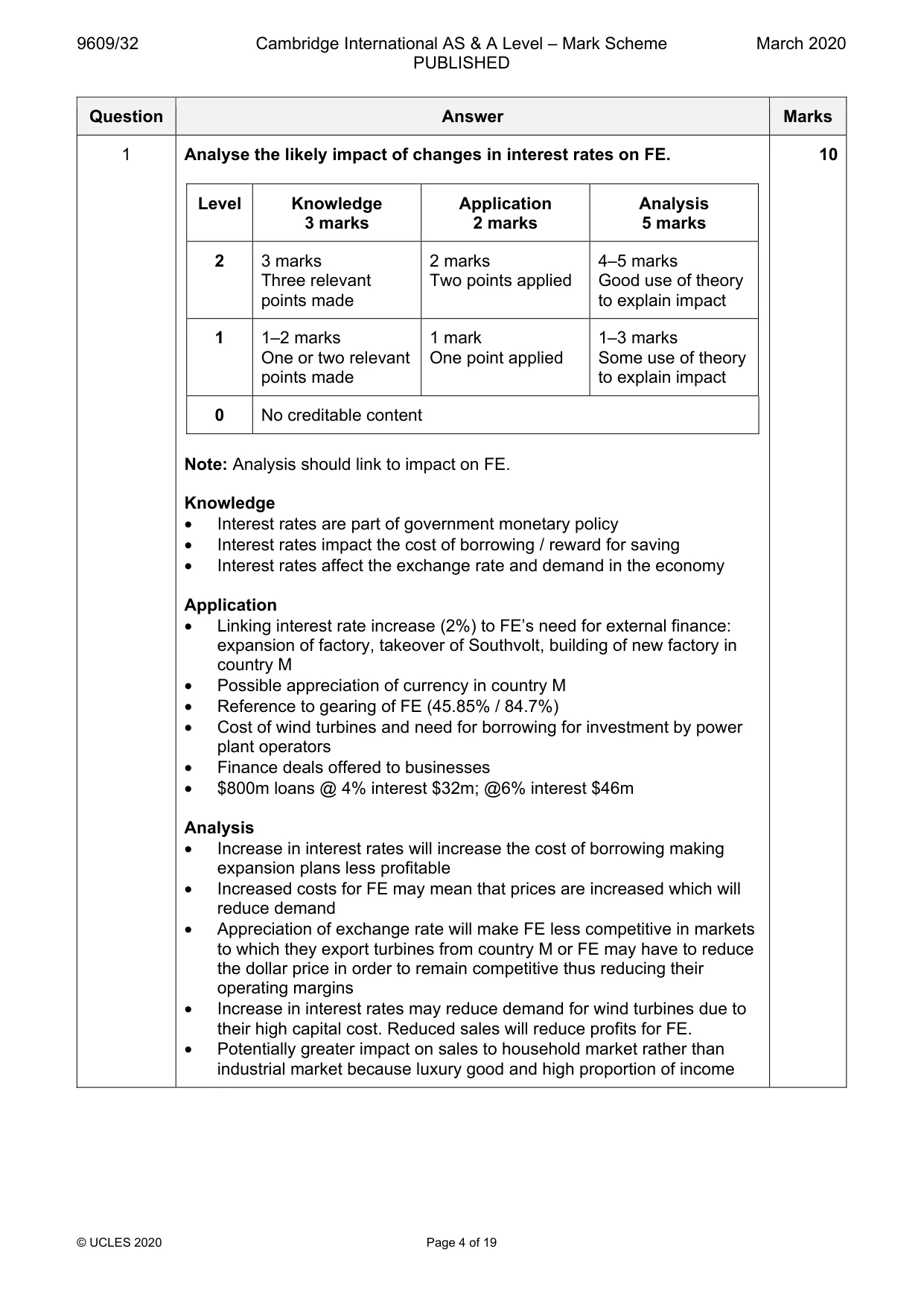
9609/32 Cambridge International AS & A Level – Mark Scheme PUBLISHED March 2020 © UCLES 2020 Page 3 of 19 General Marking Guidance • Marking should be positive: marks should not be subtracted for errors or inaccuracies. • When examiners are in doubt regarding the application of the mark scheme to a candidate’s response, the team leader must be consulted. • Crossed out work must be marked UNLESS the candidate has replaced it with an alternative response. • In numerical answers units are required. • Errors that are carried forward (e.g. when an incorrect numerical answer to one part of a question is used as the starting point for a calculation in the next part of the question) should not be compounded – use the ‘own figure rule’. • Poor spelling, handwriting or grammar should not be penalised as long as the answer makes sense. • The main RM Assessor annotations to be used are K (Knowledge), APP (Application), AN (Analysis), EVAL (Evaluation). For each of these four annotations, the number of marks awarded for that assessment objective must match the number of times that annotation is on the answer. • Only award EVAL if the candidate has also demonstrated APP. • No knowledge demonstrated, then no marks. • Blank pages on a script should be annotated as SEEN. • A blank space, dash, question mark constitutes a ‘no response’. • In Section B, candidates answer either Question 6 or Question 7. The Section B question that the candidate does not answer must be entered as ‘no response’. • Blank pages, or pages that contain crossed out material, must be annotated using ‘seen’. • Accept Any Reasonable Answer when awarding marks. This mark scheme includes a summary of appropriate content for answering each question. It should be emphasised, however, that this material is for illustrative purposes and is not intended to provide a definitive guide to acceptable answers. It is quite possible that among the scripts there will be some candidate answers that are not covered directly by the content of this mark scheme. In such cases, professional judgement should be exercised in assessing the merits of the answer and the senior examiners should be consulted if further guidance is required. Application marks are not awarded for repeating material from the case study. Application is by answering in the context of the case or by using the information in the case to help answer the question.
Mark scheme, page 4
9609/32 Cambridge International AS & A Level – Mark Scheme PUBLISHED March 2020 © UCLES 2020 Page 4 of 19 Question Answer Marks 1 Analyse the likely impact of changes in interest rates on FE. Level Knowledge 3 marks Application 2 marks Analysis 5 marks 2 3 marks Three relevant points made 2 marks Two points applied 4–5 marks Good use of theory to explain impact 1 1–2 marks One or two relevant points made 1 mark One point applied 1–3 marks Some use of theory to explain impact 0 No creditable content Note: Analysis should link to impact on FE. Knowledge • Interest rates are part of government monetary policy • Interest rates impact the cost of borrowing / reward for saving • Interest rates affect the exchange rate and demand in the economy Application • Linking interest rate increase (2%) to FE’s need for external finance: expansion of factory, takeover of Southvolt, building of new factory in country M • Possible appreciation of currency in country M • Reference to gearing of FE (45.85% / 84.7%) • Cost of wind turbines and need for borrowing for investment by power plant operators • Finance deals offered to businesses • $800m loans @ 4% interest $32m; @6% interest $46m Analysis • Increase in interest rates will increase the cost of borrowing making expansion plans less profitable • Increased costs for FE may mean that prices are increased which will reduce demand • Appreciation of exchange rate will make FE less competitive in markets to which they export turbines from country M or FE may have to reduce the dollar price in order to remain competitive thus reducing their operating margins • Increase in interest rates may reduce demand for wind turbines due to their high capital cost. Reduced sales will reduce profits for FE. • Potentially greater impact on sales to household market rather than industrial market because luxury good and high proportion of income 10
Mark scheme, page 5
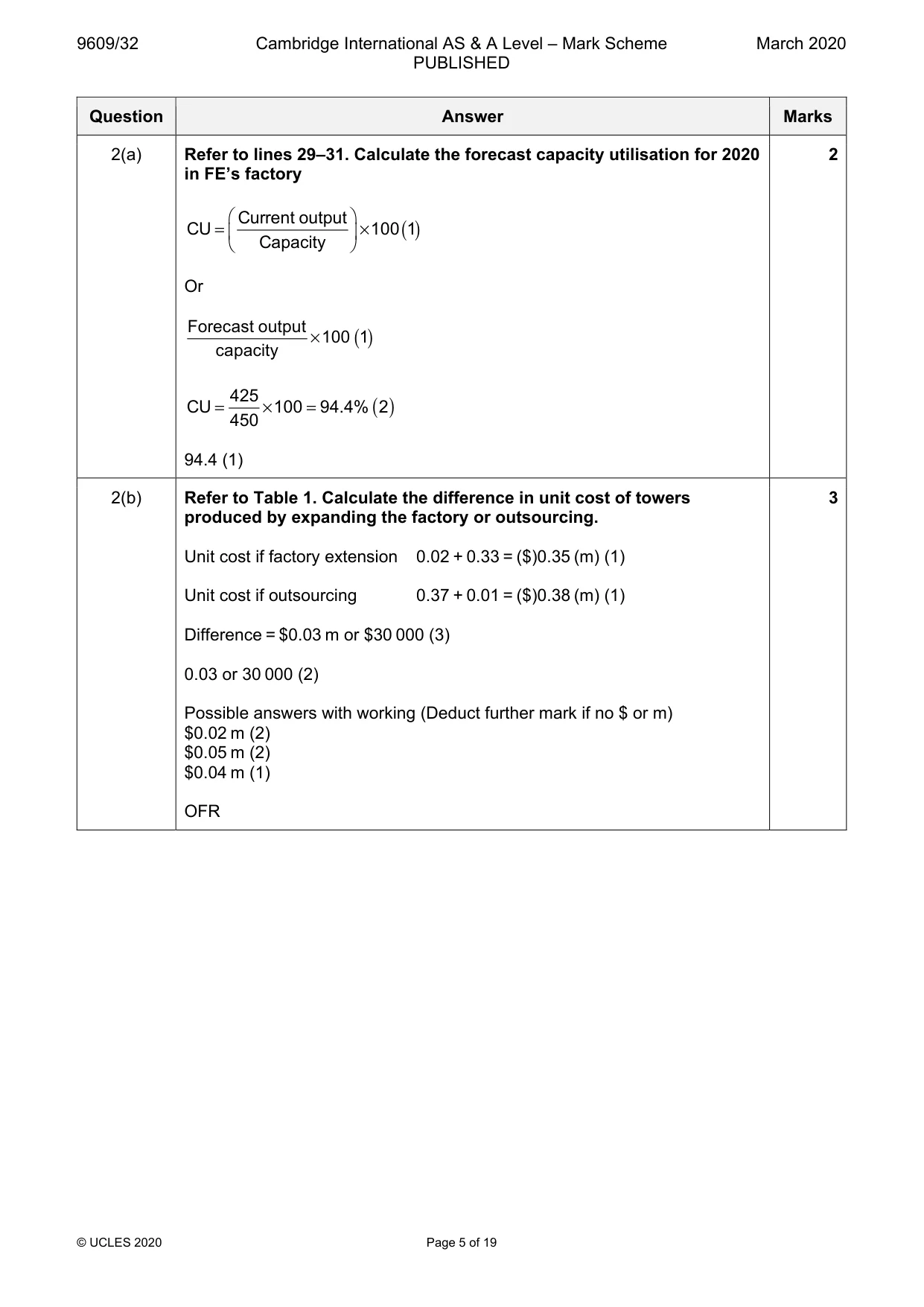
9609/32 Cambridge International AS & A Level – Mark Scheme PUBLISHED March 2020 © UCLES 2020 Page 5 of 19 Question Answer Marks 2(a) Refer to lines 29–31. Calculate the forecast capacity utilisation for 2020 in FE’s factory ( ) Current output CU 100 1 Capacity = × Or ( ) Forecast output 100 1 capacity × ( ) 425 CU 100 94.4% 2 450 = × = 94.4 (1) 2 2(b) Refer to Table 1. Calculate the difference in unit cost of towers produced by expanding the factory or outsourcing. Unit cost if factory extension 0.02 + 0.33 = ($)0.35 (m) (1) Unit cost if outsourcing 0.37 + 0.01 = ($)0.38 (m) (1) Difference = $0.03 m or $30 000 (3) 0.03 or 30 000 (2) Possible answers with working (Deduct further mark if no $ or m) $0.02 m (2) $0.05 m (2) $0.04 m (1) OFR 3
Mark scheme, page 6
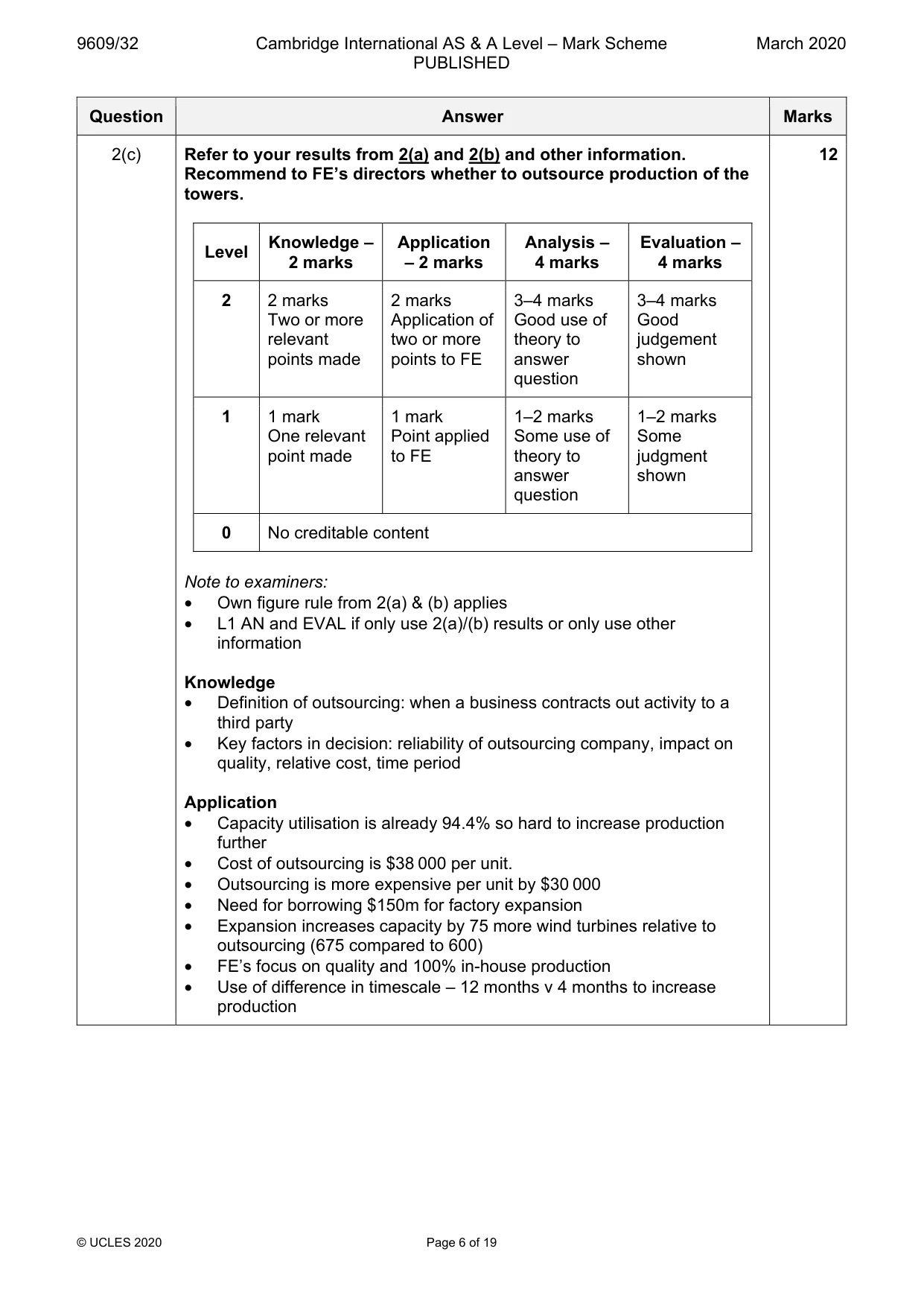
9609/32 Cambridge International AS & A Level – Mark Scheme PUBLISHED March 2020 © UCLES 2020 Page 6 of 19 Question Answer Marks 2(c) Refer to your results from 2(a) and 2(b) and other information. Recommend to FE’s directors whether to outsource production of the towers. Level Knowledge – 2 marks Application – 2 marks Analysis – 4 marks Evaluation – 4 marks 2 2 marks Two or more relevant points made 2 marks Application of two or more points to FE 3–4 marks Good use of theory to answer question 3–4 marks Good judgement shown 1 1 mark One relevant point made 1 mark Point applied to FE 1–2 marks Some use of theory to answer question 1–2 marks Some judgment shown 0 No creditable content Note to examiners: • Own figure rule from 2(a) & (b) applies • L1 AN and EVAL if only use 2(a)/(b) results or only use other information Knowledge • Definition of outsourcing: when a business contracts out activity to a third party • Key factors in decision: reliability of outsourcing company, impact on quality, relative cost, time period Application • Capacity utilisation is already 94.4% so hard to increase production further • Cost of outsourcing is $38 000 per unit. • Outsourcing is more expensive per unit by $30 000 • Need for borrowing $150m for factory expansion • Expansion increases capacity by 75 more wind turbines relative to outsourcing (675 compared to 600) • FE’s focus on quality and 100% in-house production • Use of difference in timescale – 12 months v 4 months to increase production 12
Mark scheme, page 7
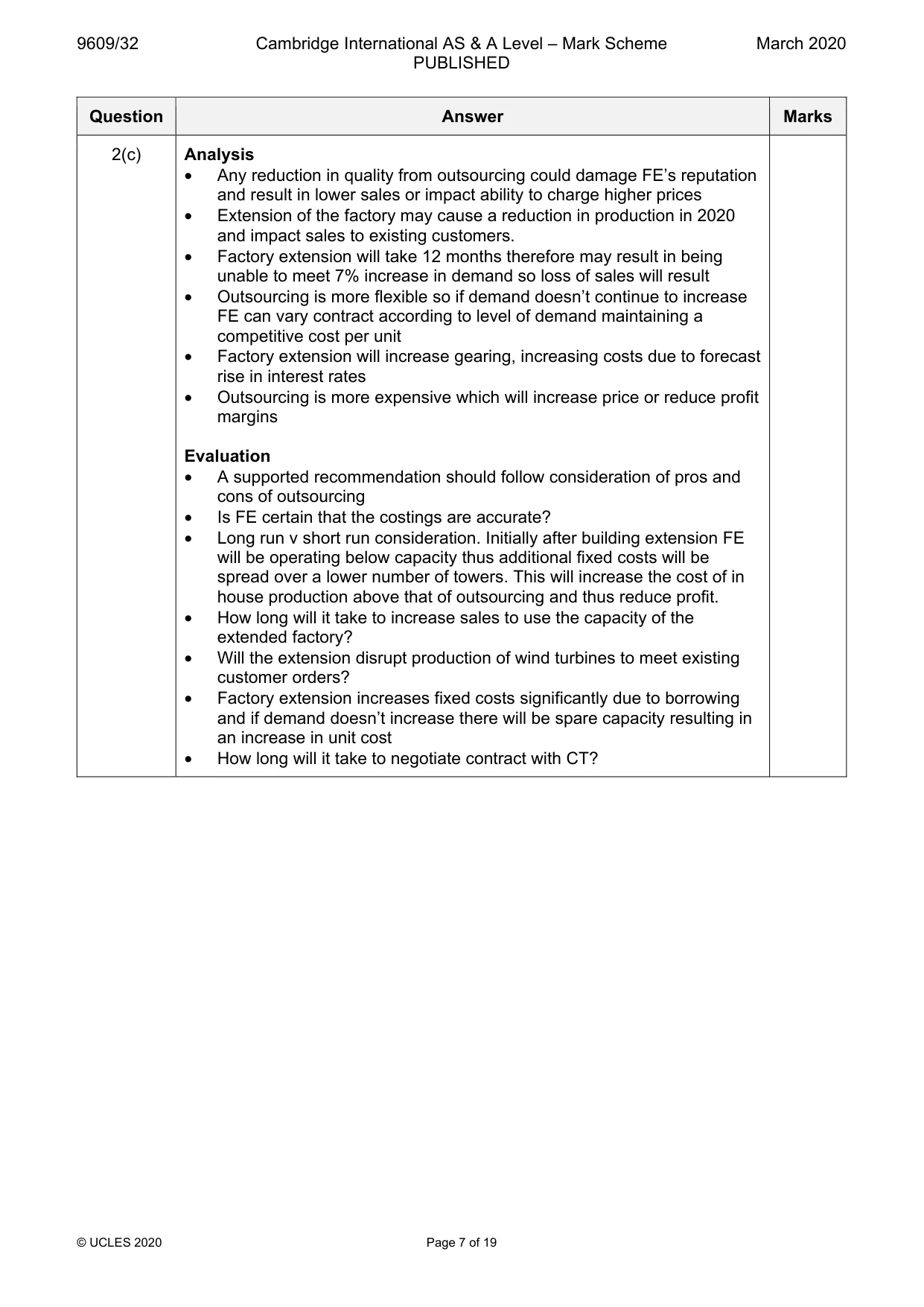
9609/32 Cambridge International AS & A Level – Mark Scheme PUBLISHED March 2020 © UCLES 2020 Page 7 of 19 Question Answer Marks 2(c) Analysis • Any reduction in quality from outsourcing could damage FE’s reputation and result in lower sales or impact ability to charge higher prices • Extension of the factory may cause a reduction in production in 2020 and impact sales to existing customers. • Factory extension will take 12 months therefore may result in being unable to meet 7% increase in demand so loss of sales will result • Outsourcing is more flexible so if demand doesn’t continue to increase FE can vary contract according to level of demand maintaining a competitive cost per unit • Factory extension will increase gearing, increasing costs due to forecast rise in interest rates • Outsourcing is more expensive which will increase price or reduce profit margins Evaluation • A supported recommendation should follow consideration of pros and cons of outsourcing • Is FE certain that the costings are accurate? • Long run v short run consideration. Initially after building extension FE will be operating below capacity thus additional fixed costs will be spread over a lower number of towers. This will increase the cost of in house production above that of outsourcing and thus reduce profit. • How long will it take to increase sales to use the capacity of the extended factory? • Will the extension disrupt production of wind turbines to meet existing customer orders? • Factory extension increases fixed costs significantly due to borrowing and if demand doesn’t increase there will be spare capacity resulting in an increase in unit cost • How long will it take to negotiate contract with CT?
Mark scheme, page 8
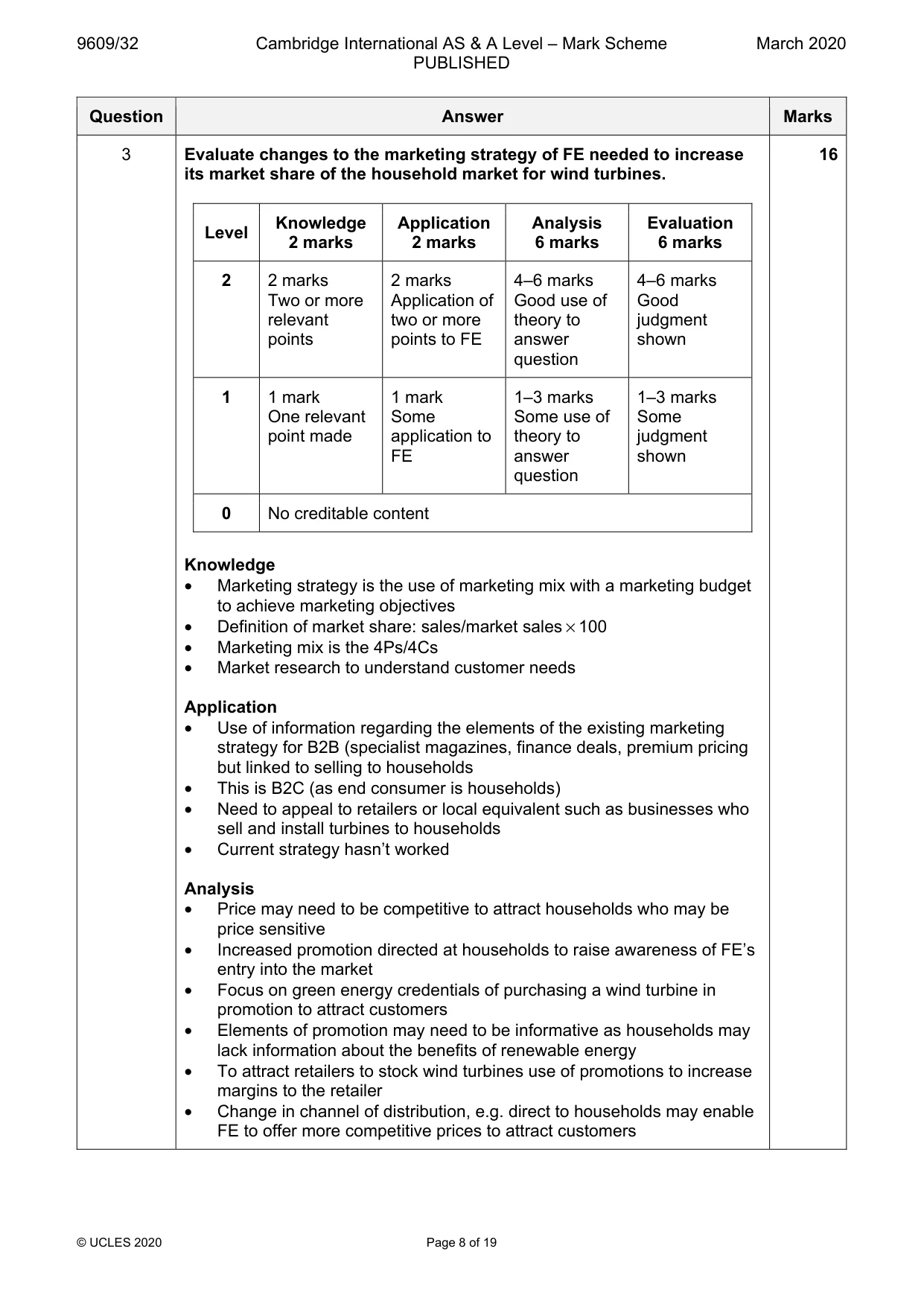
9609/32 Cambridge International AS & A Level – Mark Scheme PUBLISHED March 2020 © UCLES 2020 Page 8 of 19 Question Answer Marks 3 Evaluate changes to the marketing strategy of FE needed to increase its market share of the household market for wind turbines. Level Knowledge 2 marks Application 2 marks Analysis 6 marks Evaluation 6 marks 2 2 marks Two or more relevant points 2 marks Application of two or more points to FE 4–6 marks Good use of theory to answer question 4–6 marks Good judgment shown 1 1 mark One relevant point made 1 mark Some application to FE 1–3 marks Some use of theory to answer question 1–3 marks Some judgment shown 0 No creditable content Knowledge • Marketing strategy is the use of marketing mix with a marketing budget to achieve marketing objectives • Definition of market share: sales/market sales × 100 • Marketing mix is the 4Ps/4Cs • Market research to understand customer needs Application • Use of information regarding the elements of the existing marketing strategy for B2B (specialist magazines, finance deals, premium pricing but linked to selling to households • This is B2C (as end consumer is households) • Need to appeal to retailers or local equivalent such as businesses who sell and install turbines to households • Current strategy hasn’t worked Analysis • Price may need to be competitive to attract households who may be price sensitive • Increased promotion directed at households to raise awareness of FE’s entry into the market • Focus on green energy credentials of purchasing a wind turbine in promotion to attract customers • Elements of promotion may need to be informative as households may lack information about the benefits of renewable energy • To attract retailers to stock wind turbines use of promotions to increase margins to the retailer • Change in channel of distribution, e.g. direct to households may enable FE to offer more competitive prices to attract customers 16
Mark scheme, page 9
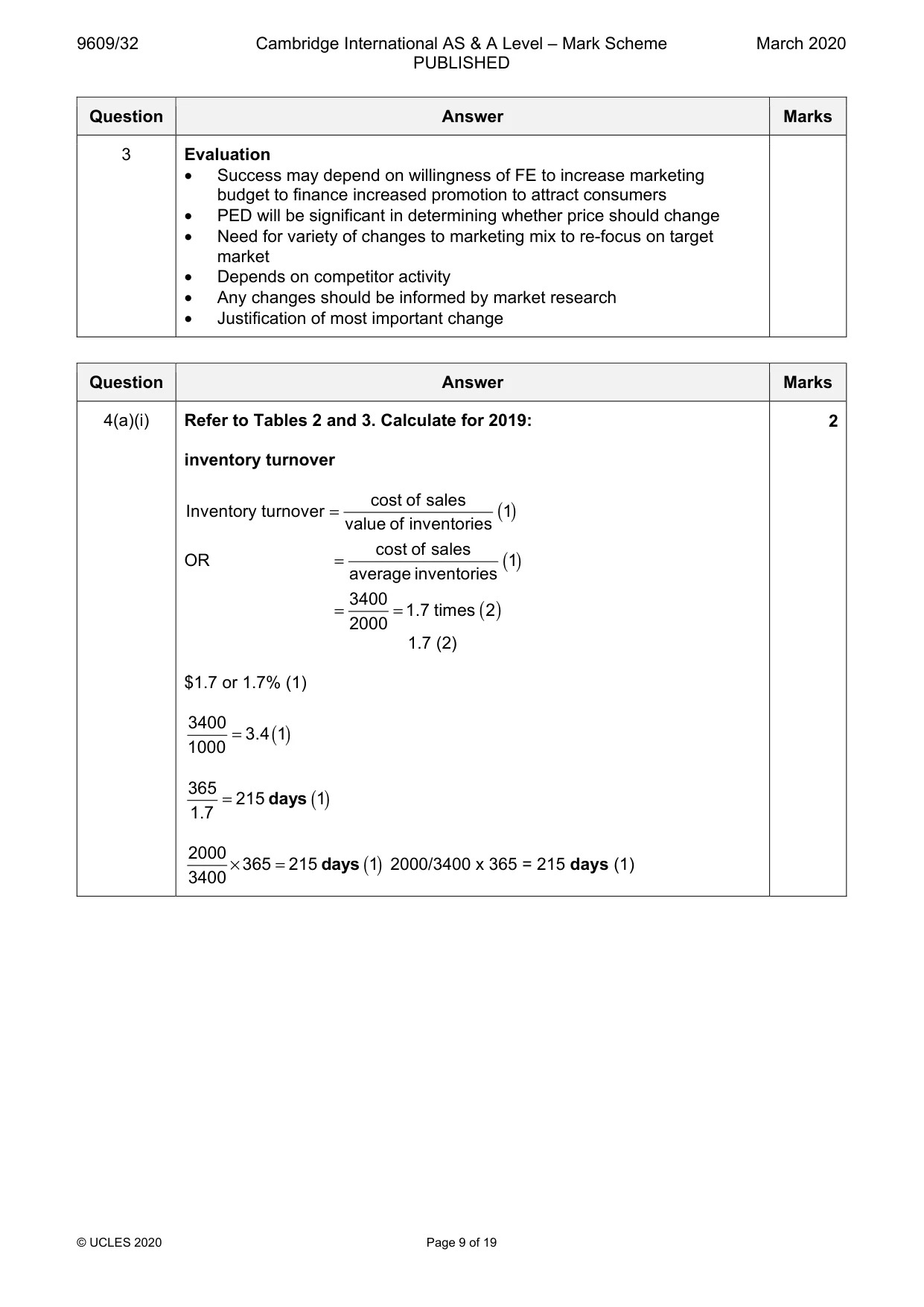
9609/32 Cambridge International AS & A Level – Mark Scheme PUBLISHED March 2020 © UCLES 2020 Page 9 of 19 Question Answer Marks 3 Evaluation • Success may depend on willingness of FE to increase marketing budget to finance increased promotion to attract consumers • PED will be significant in determining whether price should change • Need for variety of changes to marketing mix to re-focus on target market • Depends on competitor activity • Any changes should be informed by market research • Justification of most important change Question Answer Marks 4(a)(i) Refer to Tables 2 and 3. Calculate for 2019: inventory turnover ( ) cost of sales Inventory turnover 1 value of inventories = OR ( ) cost of sales 1 average inventories = ( ) 3400 1.7 times 2 2000 = = 1.7 (2) $1.7 or 1.7% (1) ( ) 3400 3.4 1 1000 = ( ) 365 215 1 1.7 = days ( ) 2000 365 215 1 3400 × = days 2000/3400 x 365 = 215 days (1) 2
Mark scheme, page 10
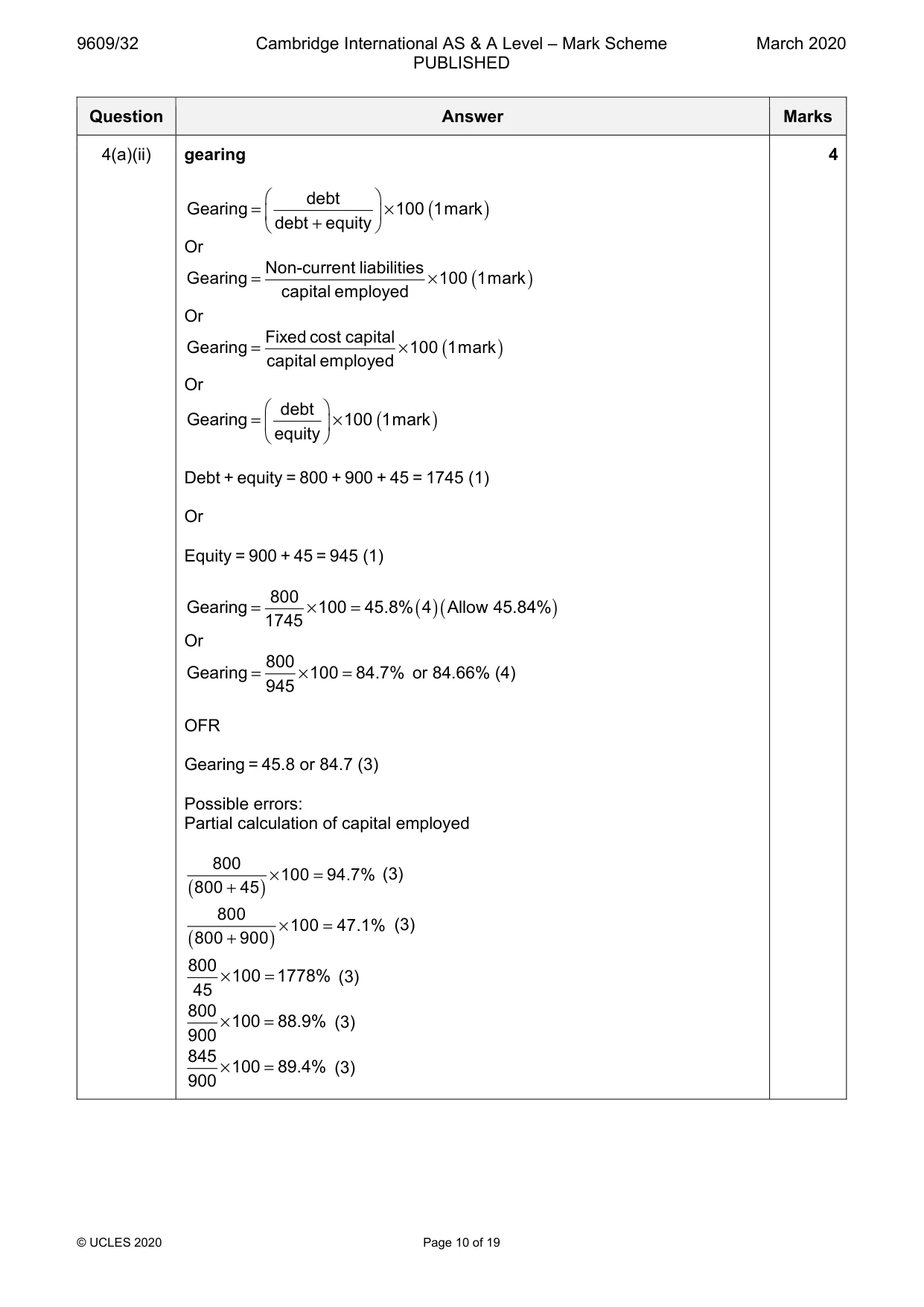
9609/32 Cambridge International AS & A Level – Mark Scheme PUBLISHED March 2020 © UCLES 2020 Page 10 of 19 Question Answer Marks 4(a)(ii) gearing ( ) debt Gearing 100 1mark debt equity = × + Or ( ) Non-current liabilities Gearing 100 1mark capital employed = × Or ( ) Fixed cost capital Gearing 100 1mark capital employed = × Or ( ) debt Gearing 100 1mark equity = × Debt + equity = 800 + 900 + 45 = 1745 (1) Or Equity = 900 + 45 = 945 (1) ( )( ) 800 Gearing 100 45.8% 4 Allow 45.84% 1745 = × = Or 800 Gearing 100 84.7% 945 = × = or 84.66% (4) OFR Gearing = 45.8 or 84.7 (3) Possible errors: Partial calculation of capital employed ( ) 800 100 94.7% 800 45 × = + (3) ( ) 800 100 47.1% 800 900 × = + (3) 800 100 1778% 45 × = (3) 800 100 88.9% 900 × = (3) 845 100 89.4% 900 × = (3) 4
Mark scheme, page 11
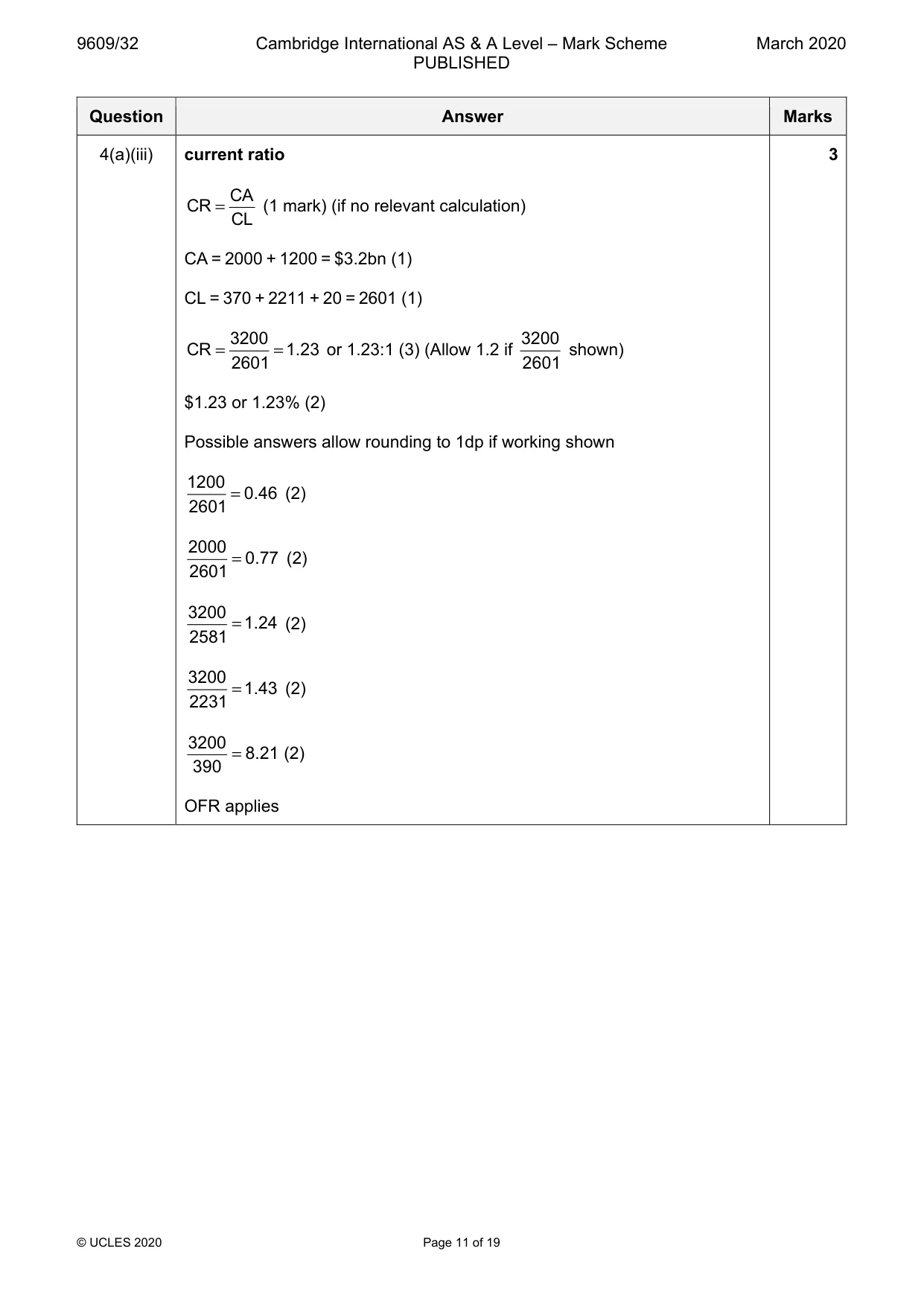
9609/32 Cambridge International AS & A Level – Mark Scheme PUBLISHED March 2020 © UCLES 2020 Page 11 of 19 Question Answer Marks 4(a)(iii) current ratio CA CR CL = (1 mark) (if no relevant calculation) CA = 2000 + 1200 = $3.2bn (1) CL = 370 + 2211 + 20 = 2601 (1) 3200 CR 1.23 2601 = = or 1.23:1 (3) (Allow 1.2 if 3200 2601 shown) $1.23 or 1.23% (2) Possible answers allow rounding to 1dp if working shown 1200 0.46 2601 = (2) 2000 0.77 2601 = (2) 3200 1.24 2581 = (2) 3200 1.43 2231 = (2) 3200 8.21 390 = (2) OFR applies 3
Mark scheme, page 12
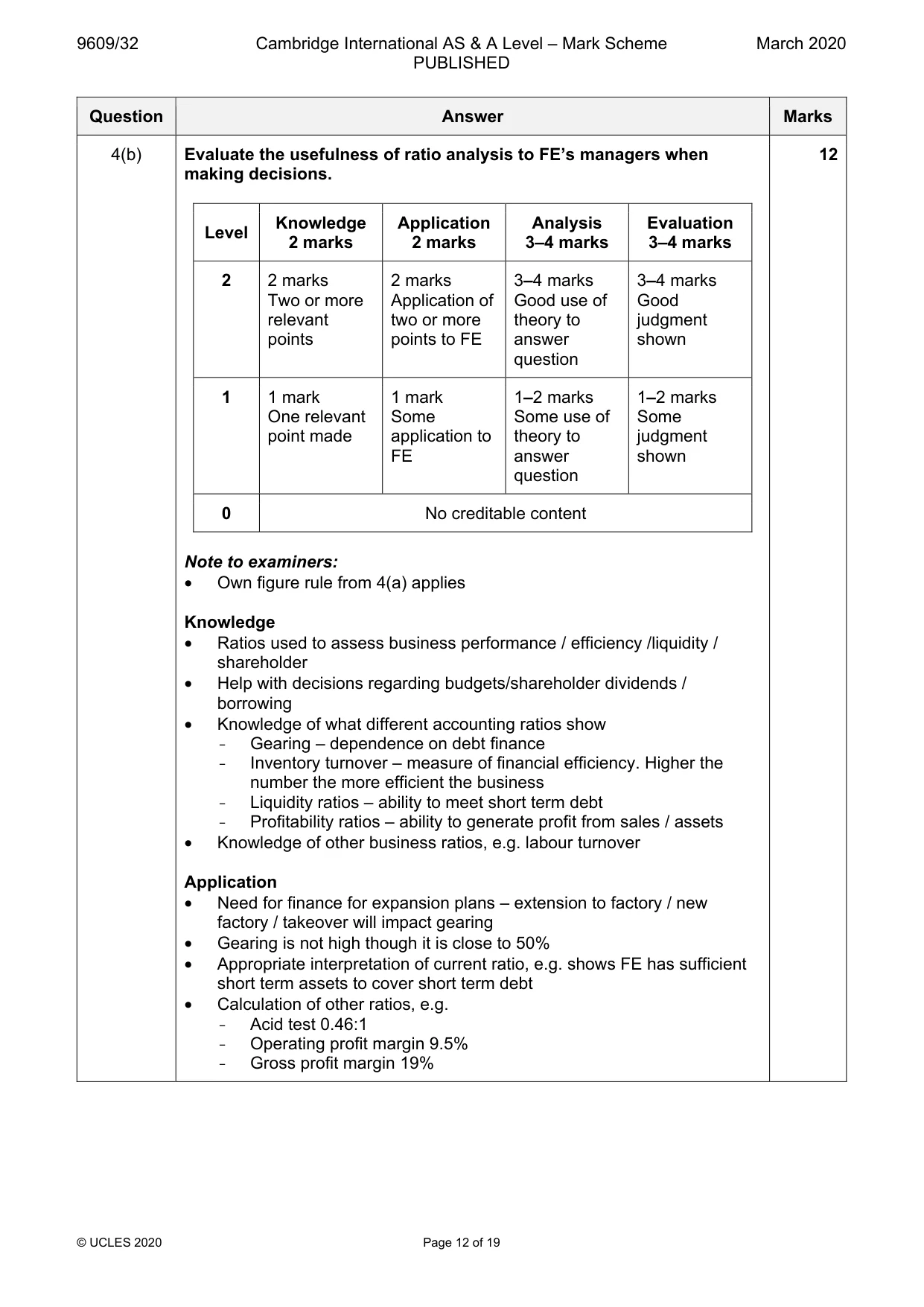
9609/32 Cambridge International AS & A Level – Mark Scheme PUBLISHED March 2020 © UCLES 2020 Page 12 of 19 Question Answer Marks 4(b) Evaluate the usefulness of ratio analysis to FE’s managers when making decisions. Level Knowledge 2 marks Application 2 marks Analysis 3–4 marks Evaluation 3–4 marks 2 2 marks Two or more relevant points 2 marks Application of two or more points to FE 3–4 marks Good use of theory to answer question 3–4 marks Good judgment shown 1 1 mark One relevant point made 1 mark Some application to FE 1–2 marks Some use of theory to answer question 1–2 marks Some judgment shown 0 No creditable content Note to examiners: • Own figure rule from 4(a) applies Knowledge • Ratios used to assess business performance / efficiency /liquidity / shareholder • Help with decisions regarding budgets/shareholder dividends / borrowing • Knowledge of what different accounting ratios show - Gearing – dependence on debt finance - Inventory turnover – measure of financial efficiency. Higher the number the more efficient the business - Liquidity ratios – ability to meet short term debt - Profitability ratios – ability to generate profit from sales / assets • Knowledge of other business ratios, e.g. labour turnover Application • Need for finance for expansion plans – extension to factory / new factory / takeover will impact gearing • Gearing is not high though it is close to 50% • Appropriate interpretation of current ratio, e.g. shows FE has sufficient short term assets to cover short term debt • Calculation of other ratios, e.g. - Acid test 0.46:1 - Operating profit margin 9.5% - Gross profit margin 19% 12
Mark scheme, page 13
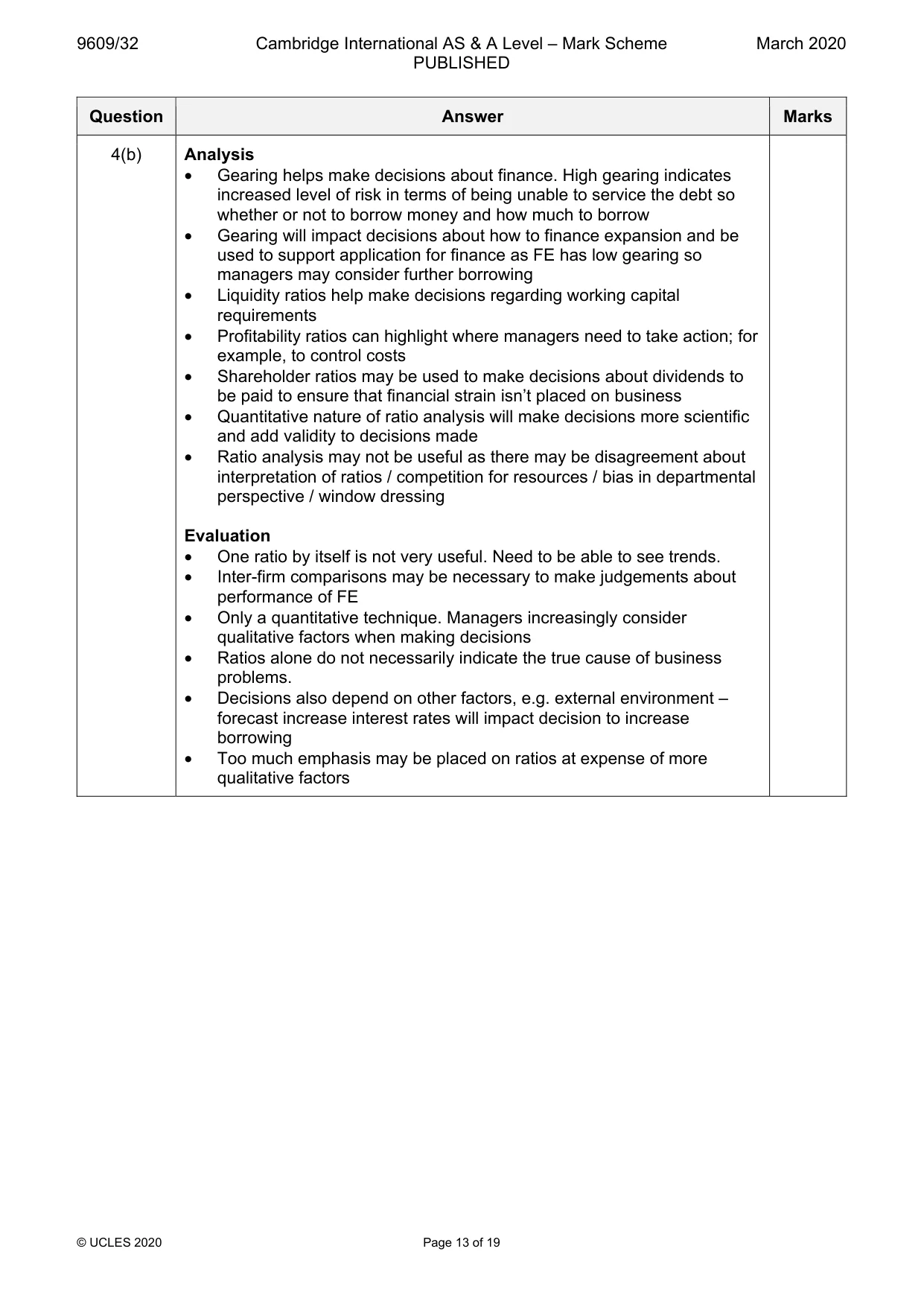
9609/32 Cambridge International AS & A Level – Mark Scheme PUBLISHED March 2020 © UCLES 2020 Page 13 of 19 Question Answer Marks 4(b) Analysis • Gearing helps make decisions about finance. High gearing indicates increased level of risk in terms of being unable to service the debt so whether or not to borrow money and how much to borrow • Gearing will impact decisions about how to finance expansion and be used to support application for finance as FE has low gearing so managers may consider further borrowing • Liquidity ratios help make decisions regarding working capital requirements • Profitability ratios can highlight where managers need to take action; for example, to control costs • Shareholder ratios may be used to make decisions about dividends to be paid to ensure that financial strain isn’t placed on business • Quantitative nature of ratio analysis will make decisions more scientific and add validity to decisions made • Ratio analysis may not be useful as there may be disagreement about interpretation of ratios / competition for resources / bias in departmental perspective / window dressing Evaluation • One ratio by itself is not very useful. Need to be able to see trends. • Inter-firm comparisons may be necessary to make judgements about performance of FE • Only a quantitative technique. Managers increasingly consider qualitative factors when making decisions • Ratios alone do not necessarily indicate the true cause of business problems. • Decisions also depend on other factors, e.g. external environment – forecast increase interest rates will impact decision to increase borrowing • Too much emphasis may be placed on ratios at expense of more qualitative factors
Mark scheme, page 14
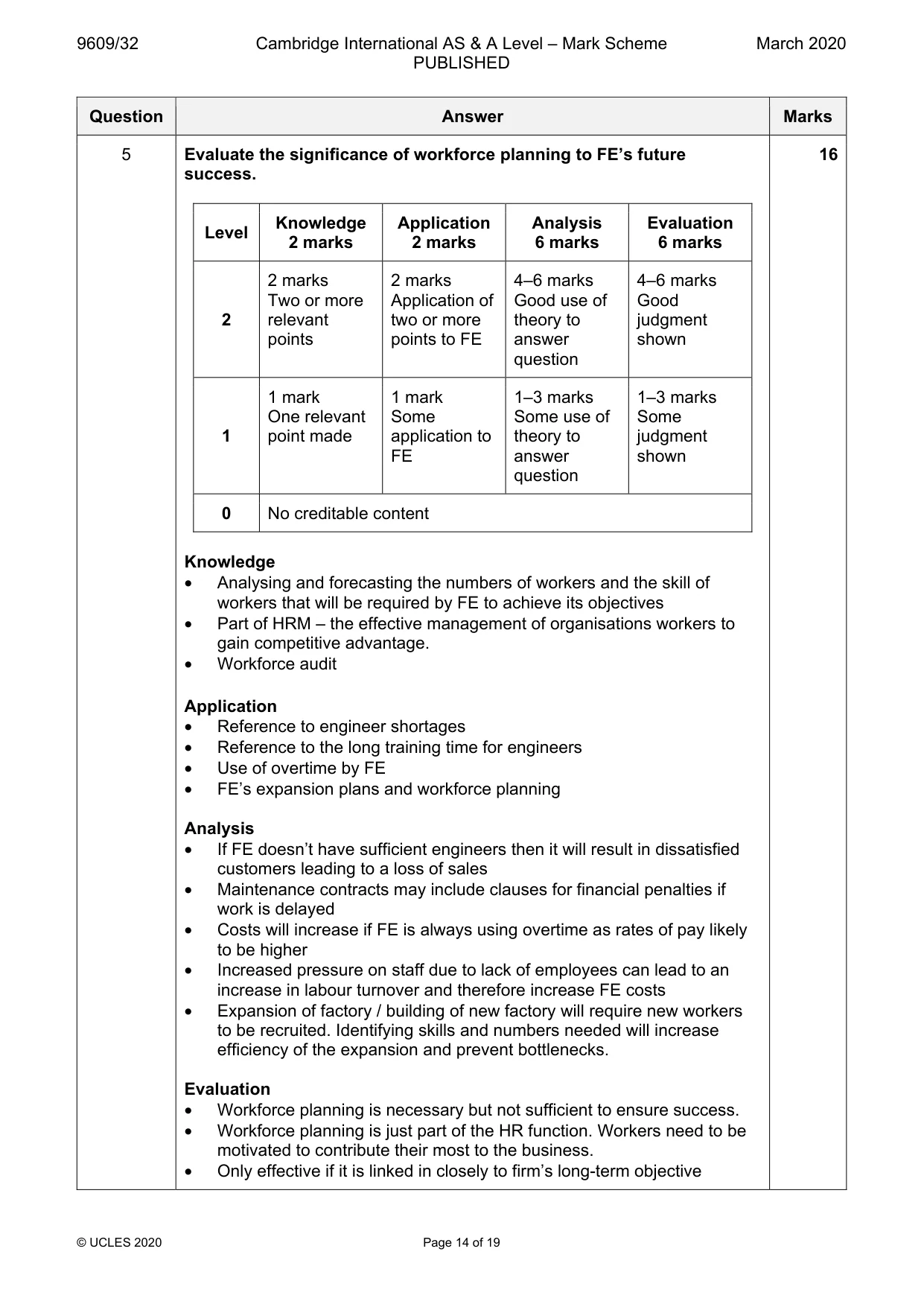
9609/32 Cambridge International AS & A Level – Mark Scheme PUBLISHED March 2020 © UCLES 2020 Page 14 of 19 Question Answer Marks 5 Evaluate the significance of workforce planning to FE’s future success. Level Knowledge 2 marks Application 2 marks Analysis 6 marks Evaluation 6 marks 2 2 marks Two or more relevant points 2 marks Application of two or more points to FE 4–6 marks Good use of theory to answer question 4–6 marks Good judgment shown 1 1 mark One relevant point made 1 mark Some application to FE 1–3 marks Some use of theory to answer question 1–3 marks Some judgment shown 0 No creditable content Knowledge • Analysing and forecasting the numbers of workers and the skill of workers that will be required by FE to achieve its objectives • Part of HRM – the effective management of organisations workers to gain competitive advantage. • Workforce audit Application • Reference to engineer shortages • Reference to the long training time for engineers • Use of overtime by FE • FE’s expansion plans and workforce planning Analysis • If FE doesn’t have sufficient engineers then it will result in dissatisfied customers leading to a loss of sales • Maintenance contracts may include clauses for financial penalties if work is delayed • Costs will increase if FE is always using overtime as rates of pay likely to be higher • Increased pressure on staff due to lack of employees can lead to an increase in labour turnover and therefore increase FE costs • Expansion of factory / building of new factory will require new workers to be recruited. Identifying skills and numbers needed will increase efficiency of the expansion and prevent bottlenecks. Evaluation • Workforce planning is necessary but not sufficient to ensure success. • Workforce planning is just part of the HR function. Workers need to be motivated to contribute their most to the business. • Only effective if it is linked in closely to firm’s long-term objective 16
Mark scheme, page 15
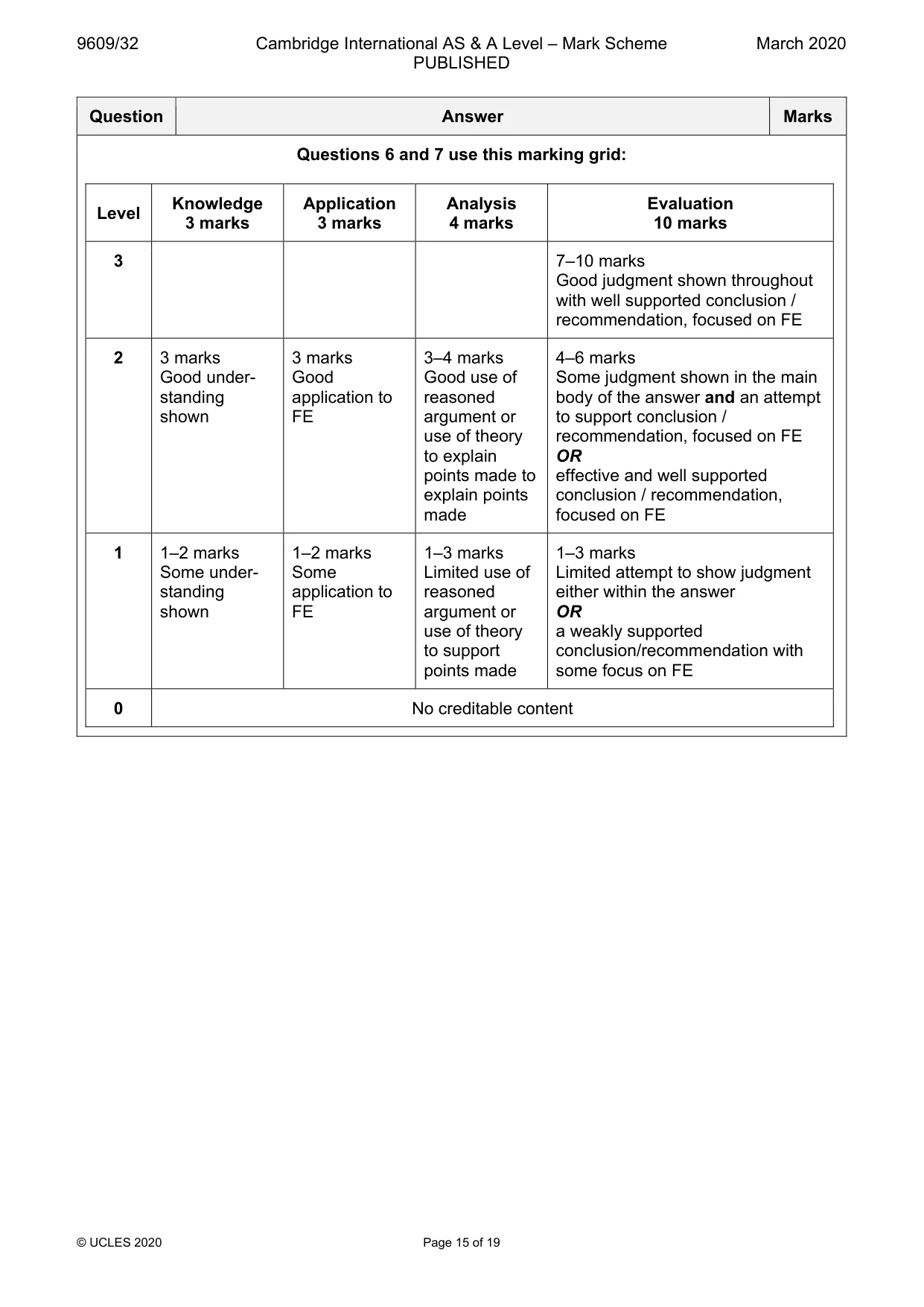
9609/32 Cambridge International AS & A Level – Mark Scheme PUBLISHED March 2020 © UCLES 2020 Page 15 of 19 Question Answer Marks Questions 6 and 7 use this marking grid: Level Knowledge 3 marks Application 3 marks Analysis 4 marks Evaluation 10 marks 3 7–10 marks Good judgment shown throughout with well supported conclusion / recommendation, focused on FE 2 3 marks Good under- standing shown 3 marks Good application to FE 3–4 marks Good use of reasoned argument or use of theory to explain points made to explain points made 4–6 marks Some judgment shown in the main body of the answer and an attempt to support conclusion / recommendation, focused on FE OR effective and well supported conclusion / recommendation, focused on FE 1 1–2 marks Some under- standing shown 1–2 marks Some application to FE 1–3 marks Limited use of reasoned argument or use of theory to support points made 1–3 marks Limited attempt to show judgment either within the answer OR a weakly supported conclusion/recommendation with some focus on FE 0 No creditable content
Mark scheme, page 16
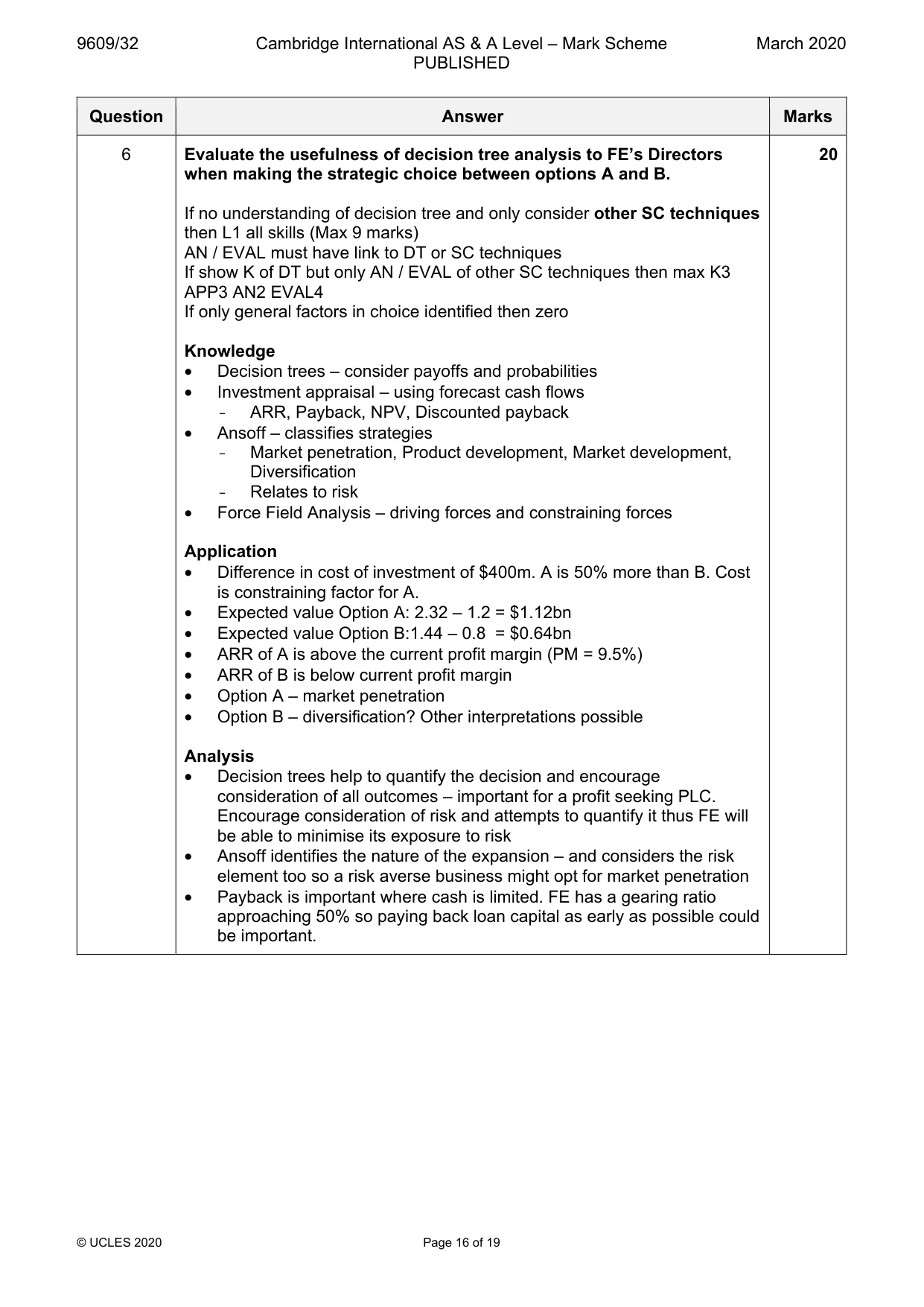
9609/32 Cambridge International AS & A Level – Mark Scheme PUBLISHED March 2020 © UCLES 2020 Page 16 of 19 Question Answer Marks 6 Evaluate the usefulness of decision tree analysis to FE’s Directors when making the strategic choice between options A and B. If no understanding of decision tree and only consider other SC techniques then L1 all skills (Max 9 marks) AN / EVAL must have link to DT or SC techniques If show K of DT but only AN / EVAL of other SC techniques then max K3 APP3 AN2 EVAL4 If only general factors in choice identified then zero Knowledge • Decision trees – consider payoffs and probabilities • Investment appraisal – using forecast cash flows - ARR, Payback, NPV, Discounted payback • Ansoff – classifies strategies - Market penetration, Product development, Market development, Diversification - Relates to risk • Force Field Analysis – driving forces and constraining forces Application • Difference in cost of investment of $400m. A is 50% more than B. Cost is constraining factor for A. • Expected value Option A: 2.32 – 1.2 = $1.12bn • Expected value Option B:1.44 – 0.8 = $0.64bn • ARR of A is above the current profit margin (PM = 9.5%) • ARR of B is below current profit margin • Option A – market penetration • Option B – diversification? Other interpretations possible Analysis • Decision trees help to quantify the decision and encourage consideration of all outcomes – important for a profit seeking PLC. Encourage consideration of risk and attempts to quantify it thus FE will be able to minimise its exposure to risk • Ansoff identifies the nature of the expansion – and considers the risk element too so a risk averse business might opt for market penetration • Payback is important where cash is limited. FE has a gearing ratio approaching 50% so paying back loan capital as early as possible could be important. 20
Mark scheme, page 17
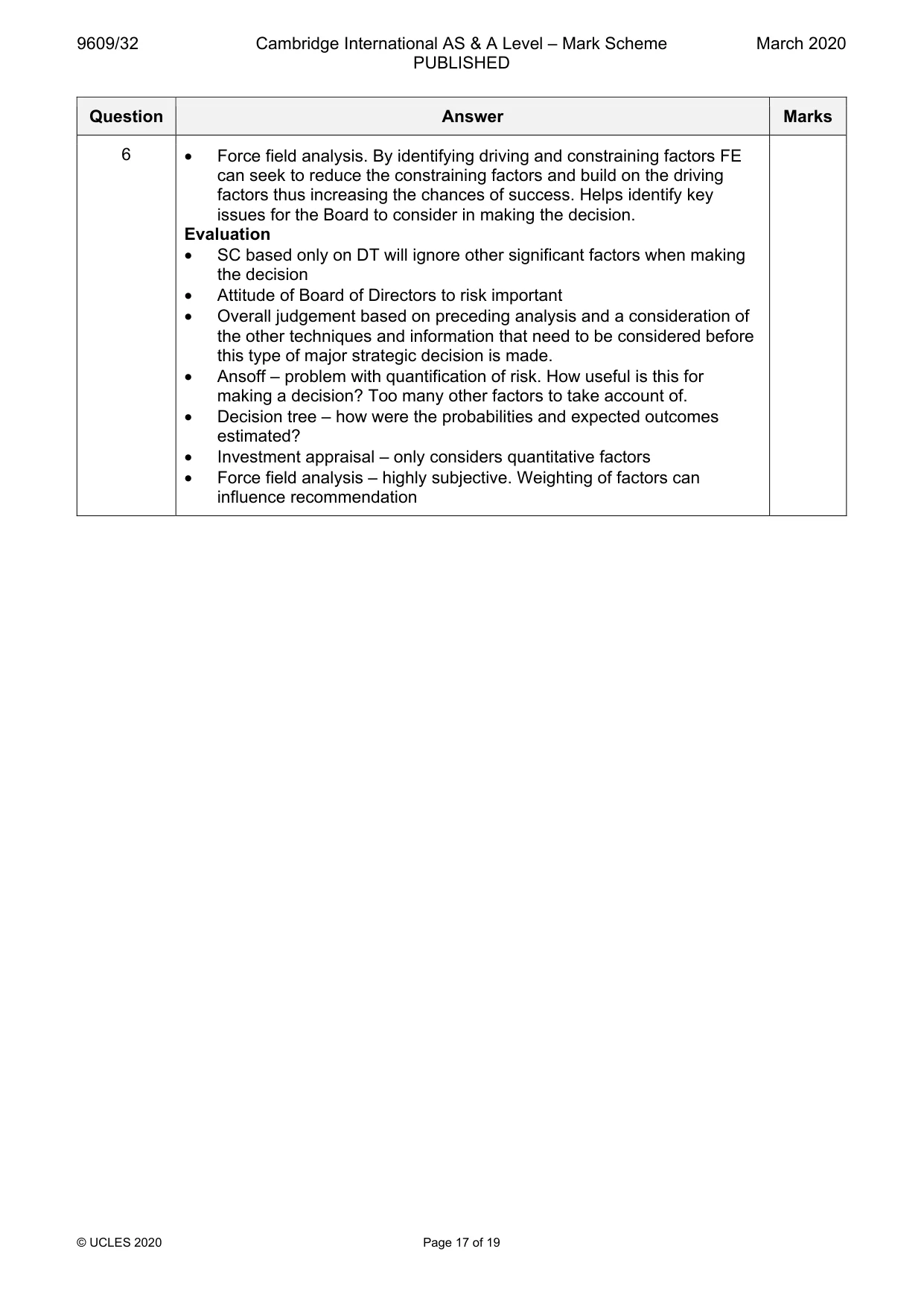
9609/32 Cambridge International AS & A Level – Mark Scheme PUBLISHED March 2020 © UCLES 2020 Page 17 of 19 Question Answer Marks 6 • Force field analysis. By identifying driving and constraining factors FE can seek to reduce the constraining factors and build on the driving factors thus increasing the chances of success. Helps identify key issues for the Board to consider in making the decision. Evaluation • SC based only on DT will ignore other significant factors when making the decision • Attitude of Board of Directors to risk important • Overall judgement based on preceding analysis and a consideration of the other techniques and information that need to be considered before this type of major strategic decision is made. • Ansoff – problem with quantification of risk. How useful is this for making a decision? Too many other factors to take account of. • Decision tree – how were the probabilities and expected outcomes estimated? • Investment appraisal – only considers quantitative factors • Force field analysis – highly subjective. Weighting of factors can influence recommendation
Mark scheme, page 18
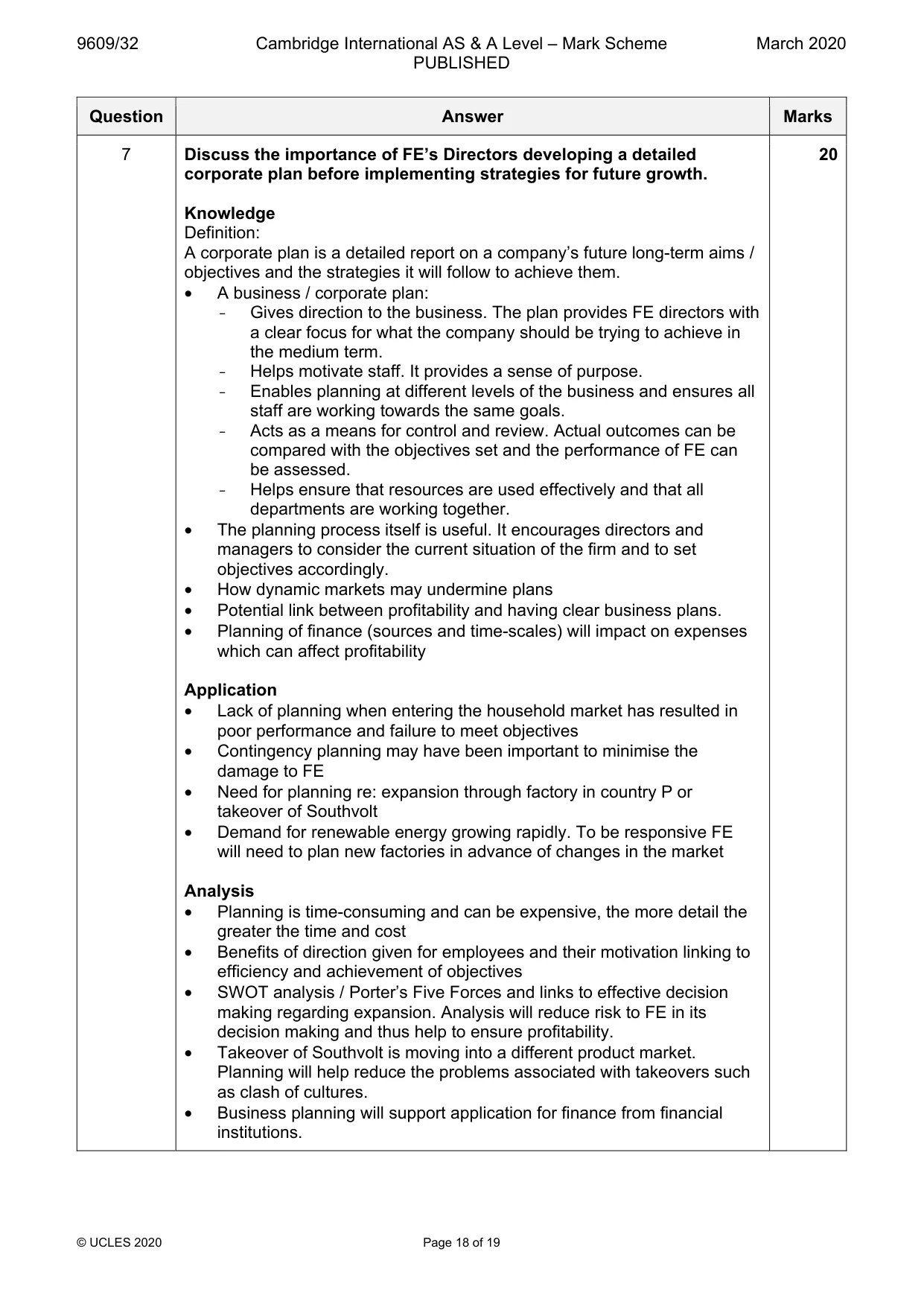
9609/32 Cambridge International AS & A Level – Mark Scheme PUBLISHED March 2020 © UCLES 2020 Page 18 of 19 Question Answer Marks 7 Discuss the importance of FE’s Directors developing a detailed corporate plan before implementing strategies for future growth. Knowledge Definition: A corporate plan is a detailed report on a company’s future long-term aims / objectives and the strategies it will follow to achieve them. • A business / corporate plan: - Gives direction to the business. The plan provides FE directors with a clear focus for what the company should be trying to achieve in the medium term. - Helps motivate staff. It provides a sense of purpose. - Enables planning at different levels of the business and ensures all staff are working towards the same goals. - Acts as a means for control and review. Actual outcomes can be compared with the objectives set and the performance of FE can be assessed. - Helps ensure that resources are used effectively and that all departments are working together. • The planning process itself is useful. It encourages directors and managers to consider the current situation of the firm and to set objectives accordingly. • How dynamic markets may undermine plans • Potential link between profitability and having clear business plans. • Planning of finance (sources and time-scales) will impact on expenses which can affect profitability Application • Lack of planning when entering the household market has resulted in poor performance and failure to meet objectives • Contingency planning may have been important to minimise the damage to FE • Need for planning re: expansion through factory in country P or takeover of Southvolt • Demand for renewable energy growing rapidly. To be responsive FE will need to plan new factories in advance of changes in the market Analysis • Planning is time-consuming and can be expensive, the more detail the greater the time and cost • Benefits of direction given for employees and their motivation linking to efficiency and achievement of objectives • SWOT analysis / Porter’s Five Forces and links to effective decision making regarding expansion. Analysis will reduce risk to FE in its decision making and thus help to ensure profitability. • Takeover of Southvolt is moving into a different product market. Planning will help reduce the problems associated with takeovers such as clash of cultures. • Business planning will support application for finance from financial institutions. 20
Mark scheme, page 19
9609/32 Cambridge International AS & A Level – Mark Scheme PUBLISHED March 2020 © UCLES 2020 Page 19 of 19 Question Answer Marks 7 Evaluation • As there is a dynamic business environment, there is a need to adjust plans accordingly • Needs to be flexible and adaptable to meet new situations. • Reliability of information – how much is spent on market research/data gathering and how relevant is it? Interpretation of information used in planning can be influenced by skills and training of leadership. • Monitoring and review essential to ensure costs are not increasing in this rapidly changing market.
What you needed in this session
Cambridge’s own grade thresholds for 2020 Feb/March, Paper 3 · Variant 2. A higher threshold means an easier paper — the bar moves with how the cohort did.