Cambridge A Level Business (for first examination in 2016) 9609 — 2018 May/June Paper 3 · Variant 3
9609/33/M/J/18 · 100 marks · ≈113 min
The question paper and its mark scheme, free to read here and free to download. This is Cambridge’s own paper, exactly as it was sat.
Question paper20 pages

















Mark scheme14 pages
Answers below. Sit the paper first if you are practising.

Paper as text
Question paper, page 1
This document consists of 19 printed pages, 1 blank page and 1 Insert. DC (RW) 156563/1 © UCLES 2018 [Turn over Cambridge International Examinations Cambridge International Advanced Level * 6 1 8 2 4 6 5 9 0 4 * BUSINESS 9609/33 Paper 3 Case Study May/June 2018 3 hours Candidates answer on the Question Paper. No Additional Materials are required. READ THESE INSTRUCTIONS FIRST Write your Centre number, candidate number and name in the spaces at the top of this page. If you need additional answer paper ask the invigilator for a continuation booklet. Write in dark blue or black pen. You may use an HB pencil for any diagrams, graphs or rough working. Do not use staples, paper clips, glue or correction fluid. DO NOT WRITE IN ANY BARCODES. Section A Answer all questions. Section B Answer one question. You are advised to spend no more than 40 minutes on Section B. Refer to the Insert for the case study for this Paper. At the end of the examination, fasten all your work securely together. The number of marks is given in brackets [ ] at the end of each question or part question.
Question paper, page 2
2 9609/33/M/J/18 © UCLES 2018 Section A Answer all questions in this section. 1 Analyse the likely benefits to RW of introducing Total Quality Management (TQM). … … … … … … … … … … … … … … … … … … … … … … … … …
Question paper, page 3
3 9609/33/M/J/18 © UCLES 2018 [Turn over … … … … … … … … … … … … … … … … … … … … … … … … … … … …[10]
Question paper, page 4
4 9609/33/M/J/18 © UCLES 2018 2 (a) Refer to Table 1 and line 39. Calculate: (i) profit margin of bicycle sales for 2017–18 … … … … … … … … … … … …[4] (ii) contribution per unit for the new university order … … … … … … … … … … … …[2]
Question paper, page 5
5 9609/33/M/J/18 © UCLES 2018 [Turn over (b) Refer to your results to 2(a) and any other information. Discuss whether RW should accept the new university order. … … … … … … … … … … … … … … … … … … … … … … … … … … …
Question paper, page 6
6 9609/33/M/J/18 © UCLES 2018 … … … … … … … … … … … … … … … … … … … … … … … … … … … …[12]
Question paper, page 7
7 9609/33/M/J/18 © UCLES 2018 [Turn over 3 Discuss whether introducing Management by Objectives (MBO) is the most effective way for RW to solve its human resource problems. … … … … … … … … … … … … … … … … … … … … … … … … … … …
Question paper, page 8
8 9609/33/M/J/18 © UCLES 2018 … … … … … … … … … … … … … … … … … … … … … … … … … … … …
Question paper, page 9
9 9609/33/M/J/18 © UCLES 2018 [Turn over … … … … … … … … … … … … … … … … … … … … … … … … … … … …[16]
Question paper, page 10
10 9609/33/M/J/18 © UCLES 2018 4 (a) Refer to Table 2. Calculate: (i) accounting rate of return … … … … … … … … … … … …[4] (ii) net present value (at 6% discount rate) … … … … … … … … … … … …[4]
Question paper, page 11
11 9609/33/M/J/18 © UCLES 2018 [Turn over (b) Refer to your results to 4(a) and any other information. Recommend whether or not RW should offer guided bicycle tours. Justify your decision. … … … … … … … … … … … … … … … … … … … … … … … … … … …
Question paper, page 12
12 9609/33/M/J/18 © UCLES 2018 … … … … … … … … … … … … … … … … … … … … … … … … … … … …[12]
Question paper, page 13
13 9609/33/M/J/18 © UCLES 2018 [Turn over 5 Discuss an appropriate marketing strategy RW could use if it decides to expand by offering guided bicycle tours. … … … … … … … … … … … … … … … … … … … … … … … … … … …
Question paper, page 14
14 9609/33/M/J/18 © UCLES 2018 … … … … … … … … … … … … … … … … … … … … … … … … … … … …
Question paper, page 15
15 9609/33/M/J/18 © UCLES 2018 [Turn over … … … … … … … … … … … … … … … … … … … … … … … … … … … …[16]
Question paper, page 16
16 9609/33/M/J/18 © UCLES 2018 Section B Answer one question from this section. 6 Evaluate the importance of using a strategic management approach to improve RW’s competitive advantage. 7 Discuss the importance of effective strategic implementation for the future success of RW. Write the question number here: … … … … … … … … … … … … … … … … … … … … … … …
Question paper, page 17
17 9609/33/M/J/18 © UCLES 2018 [Turn over … … … … … … … … … … … … … … … … … … … … … … … … … … … …
Question paper, page 18
18 9609/33/M/J/18 © UCLES 2018 … … … … … … … … … … … … … … … … … … … … … … … … … … … …
Question paper, page 19
19 9609/33/M/J/18 © UCLES 2018 … … … … … … … … … … … … … … … … … … … … … … … … … … … …[20]
Question paper, page 20
20 9609/33/M/J/18 © UCLES 2018 Permission to reproduce items where third-party owned material protected by copyright is included has been sought and cleared where possible. Every reasonable effort has been made by the publisher (UCLES) to trace copyright holders, but if any items requiring clearance have unwittingly been included, the publisher will be pleased to make amends at the earliest possible opportunity. To avoid the issue of disclosure of answer-related information to candidates, all copyright acknowledgements are reproduced online in the Cambridge International Examinations Copyright Acknowledgements Booklet. This is produced for each series of examinations and is freely available to download at www.cie.org.uk after the live examination series. Cambridge International Examinations is part of the Cambridge Assessment Group. Cambridge Assessment is the brand name of University of Cambridge Local Examinations Syndicate (UCLES), which is itself a department of the University of Cambridge. BLANK PAGE
Mark scheme, page 1
IGCSE™ is a registered trademark. This document consists of 14 printed pages. © UCLES 2018 [Turn over Cambridge Assessment International Education Cambridge International Advanced Level BUSINESS 9609/33 Paper 3 Case Study May/June 2018 MARK SCHEME Maximum Mark: 100 Published This mark scheme is published as an aid to teachers and candidates, to indicate the requirements of the examination. It shows the basis on which Examiners were instructed to award marks. It does not indicate the details of the discussions that took place at an Examiners’ meeting before marking began, which would have considered the acceptability of alternative answers. Mark schemes should be read in conjunction with the question paper and the Principal Examiner Report for Teachers. Cambridge International will not enter into discussions about these mark schemes. Cambridge International is publishing the mark schemes for the May/June 2018 series for most Cambridge IGCSE™, Cambridge International A and AS Level and Cambridge Pre-U components, and some Cambridge O Level components.
Mark scheme, page 2
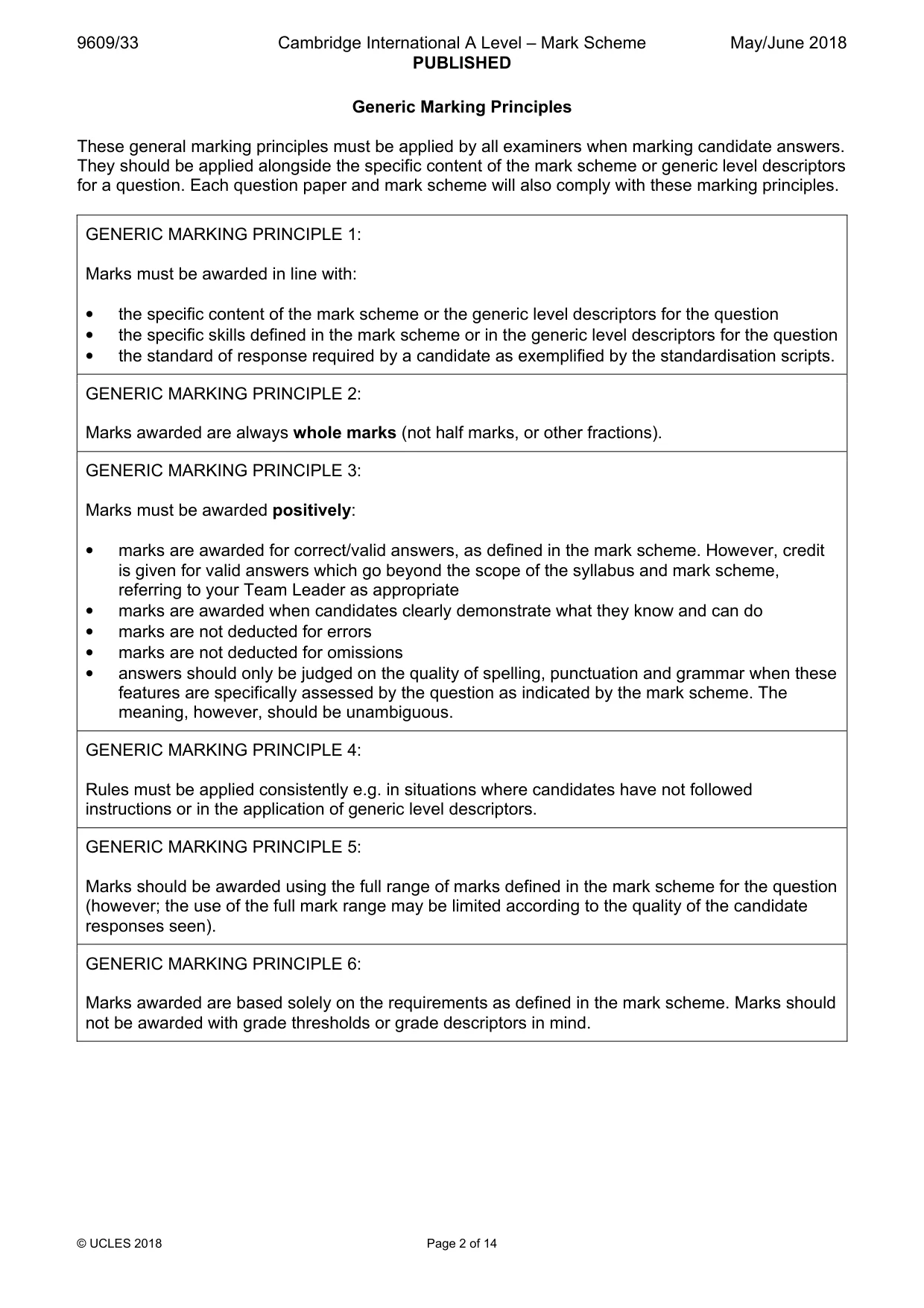
9609/33 Cambridge International A Level – Mark Scheme PUBLISHED May/June 2018 © UCLES 2018 Page 2 of 14 Generic Marking Principles These general marking principles must be applied by all examiners when marking candidate answers. They should be applied alongside the specific content of the mark scheme or generic level descriptors for a question. Each question paper and mark scheme will also comply with these marking principles. GENERIC MARKING PRINCIPLE 1: Marks must be awarded in line with: • the specific content of the mark scheme or the generic level descriptors for the question • the specific skills defined in the mark scheme or in the generic level descriptors for the question • the standard of response required by a candidate as exemplified by the standardisation scripts. GENERIC MARKING PRINCIPLE 2: Marks awarded are always whole marks (not half marks, or other fractions). GENERIC MARKING PRINCIPLE 3: Marks must be awarded positively: • marks are awarded for correct/valid answers, as defined in the mark scheme. However, credit is given for valid answers which go beyond the scope of the syllabus and mark scheme, referring to your Team Leader as appropriate • marks are awarded when candidates clearly demonstrate what they know and can do • marks are not deducted for errors • marks are not deducted for omissions • answers should only be judged on the quality of spelling, punctuation and grammar when these features are specifically assessed by the question as indicated by the mark scheme. The meaning, however, should be unambiguous. GENERIC MARKING PRINCIPLE 4: Rules must be applied consistently e.g. in situations where candidates have not followed instructions or in the application of generic level descriptors. GENERIC MARKING PRINCIPLE 5: Marks should be awarded using the full range of marks defined in the mark scheme for the question (however; the use of the full mark range may be limited according to the quality of the candidate responses seen). GENERIC MARKING PRINCIPLE 6: Marks awarded are based solely on the requirements as defined in the mark scheme. Marks should not be awarded with grade thresholds or grade descriptors in mind.
Mark scheme, page 3
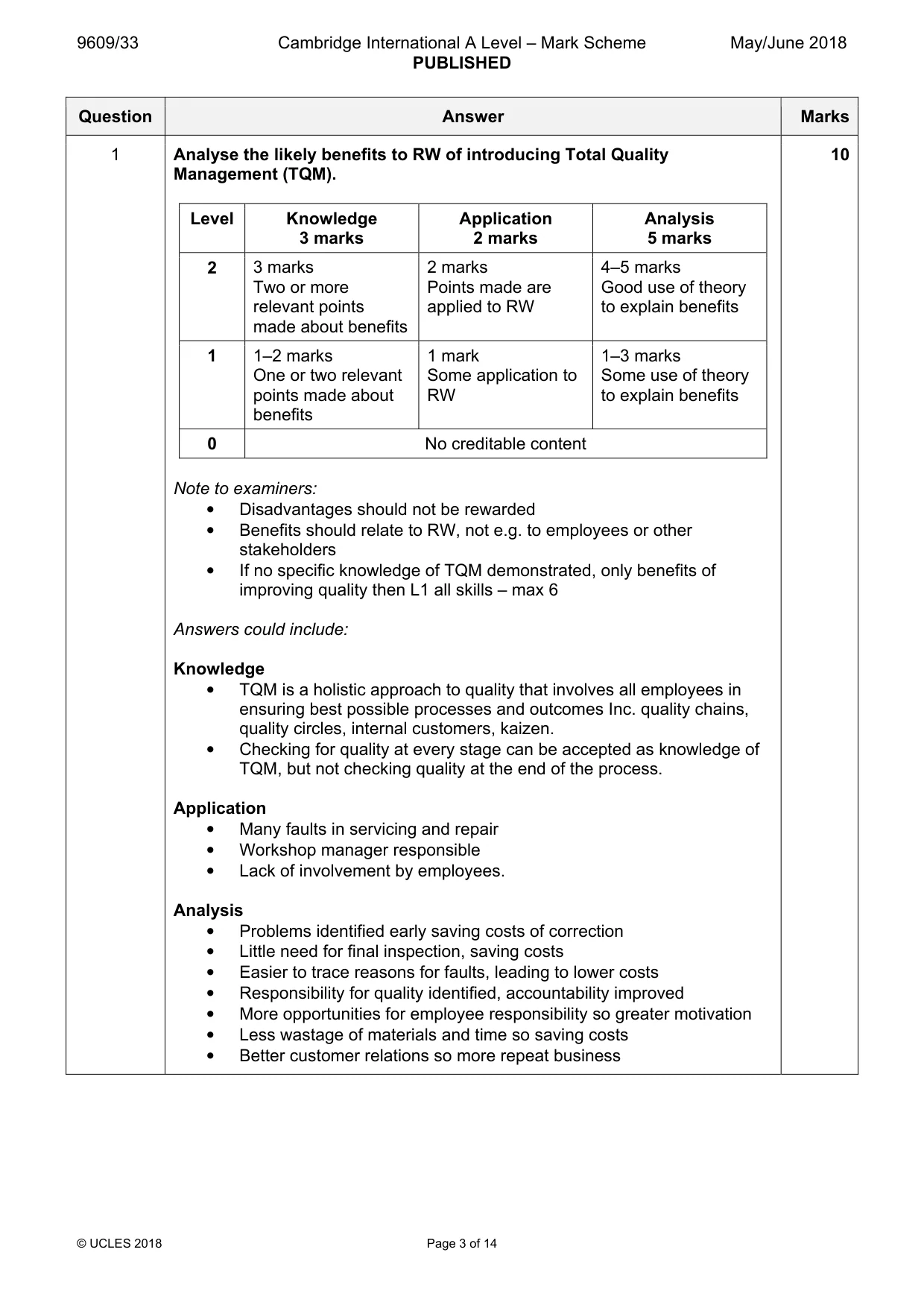
9609/33 Cambridge International A Level – Mark Scheme PUBLISHED May/June 2018 © UCLES 2018 Page 3 of 14 Question Answer Marks 1 Analyse the likely benefits to RW of introducing Total Quality Management (TQM). Level Knowledge 3 marks Application 2 marks Analysis 5 marks 2 3 marks Two or more relevant points made about benefits 2 marks Points made are applied to RW 4–5 marks Good use of theory to explain benefits 1 1–2 marks One or two relevant points made about benefits 1 mark Some application to RW 1–3 marks Some use of theory to explain benefits 0 No creditable content Note to examiners: • Disadvantages should not be rewarded • Benefits should relate to RW, not e.g. to employees or other stakeholders • If no specific knowledge of TQM demonstrated, only benefits of improving quality then L1 all skills – max 6 Answers could include: Knowledge • TQM is a holistic approach to quality that involves all employees in ensuring best possible processes and outcomes Inc. quality chains, quality circles, internal customers, kaizen. • Checking for quality at every stage can be accepted as knowledge of TQM, but not checking quality at the end of the process. Application • Many faults in servicing and repair • Workshop manager responsible • Lack of involvement by employees. Analysis • Problems identified early saving costs of correction • Little need for final inspection, saving costs • Easier to trace reasons for faults, leading to lower costs • Responsibility for quality identified, accountability improved • More opportunities for employee responsibility so greater motivation • Less wastage of materials and time so saving costs • Better customer relations so more repeat business 10
Mark scheme, page 4
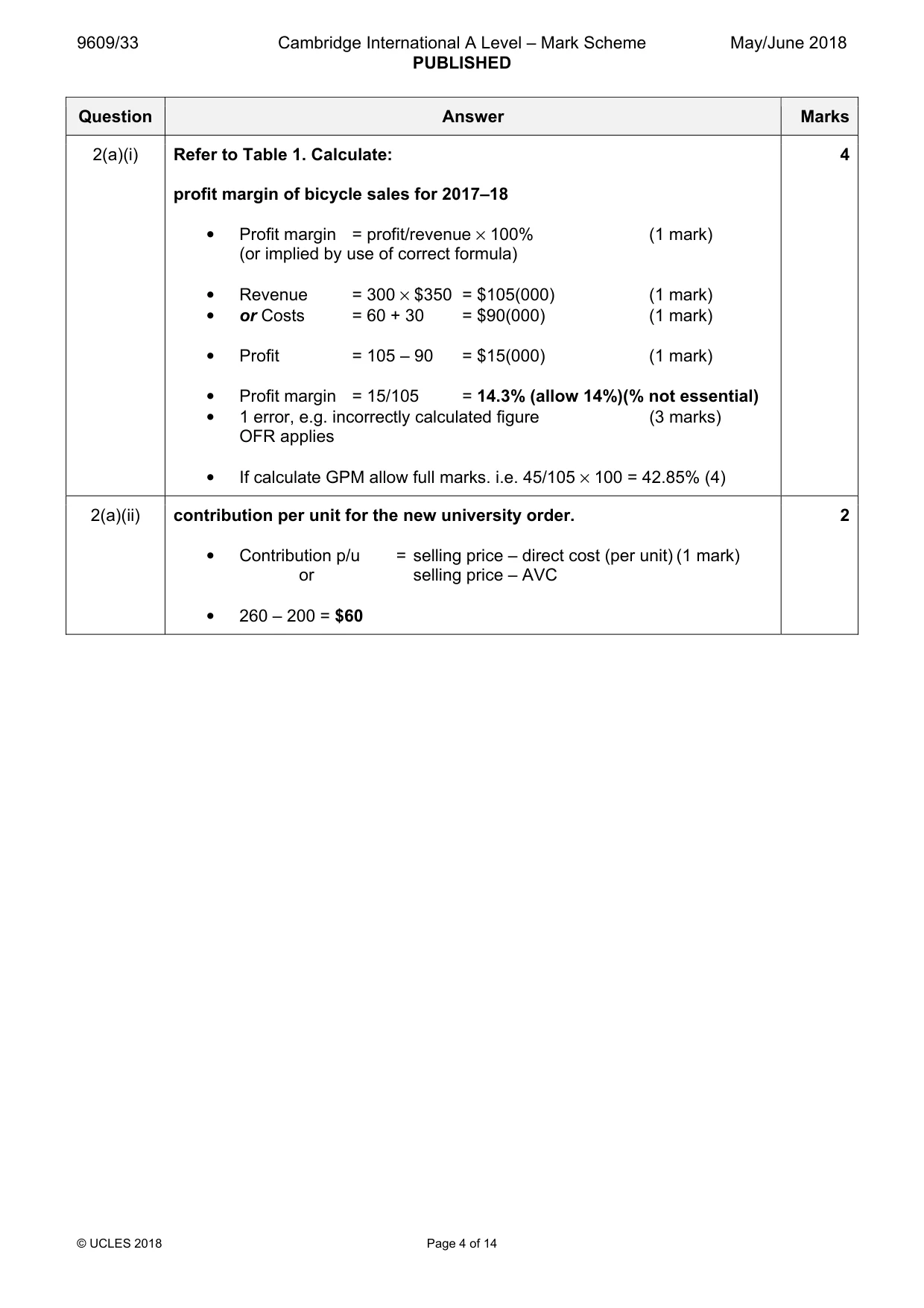
9609/33 Cambridge International A Level – Mark Scheme PUBLISHED May/June 2018 © UCLES 2018 Page 4 of 14 Question Answer Marks 2(a)(i) Refer to Table 1. Calculate: profit margin of bicycle sales for 2017–18 • Profit margin = profit/revenue × 100% (1 mark) (or implied by use of correct formula) • Revenue = 300 × $350 = $105(000) (1 mark) • or Costs = 60 + 30 = $90(000) (1 mark) • Profit = 105 – 90 = $15(000) (1 mark) • Profit margin = 15/105 = 14.3% (allow 14%)(% not essential) • 1 error, e.g. incorrectly calculated figure (3 marks) OFR applies • If calculate GPM allow full marks. i.e. 45/105 × 100 = 42.85% (4) 4 2(a)(ii) contribution per unit for the new university order. • Contribution p/u = selling price – direct cost (per unit) (1 mark) or selling price – AVC • 260 – 200 = $60 2
Mark scheme, page 5
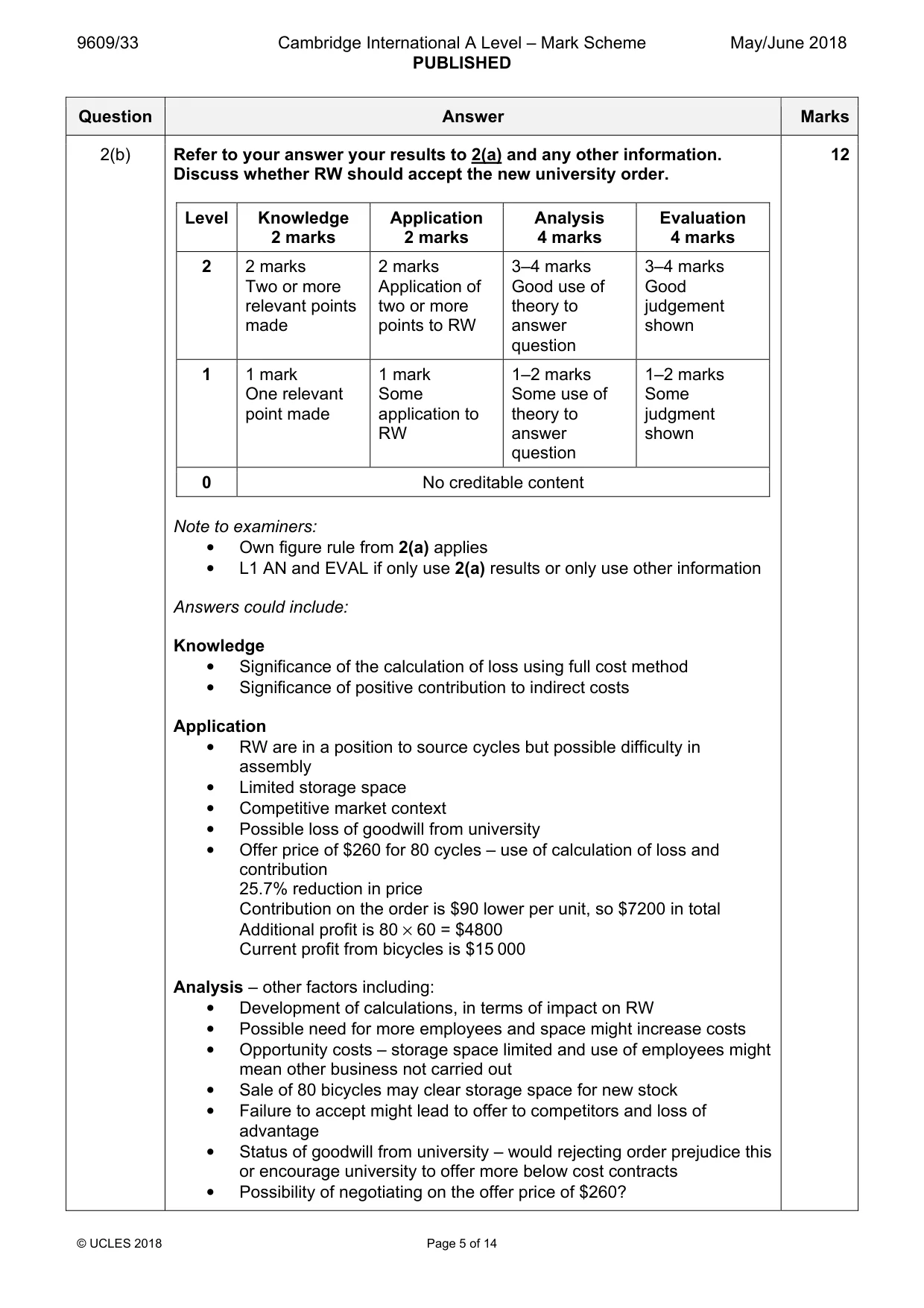
9609/33 Cambridge International A Level – Mark Scheme PUBLISHED May/June 2018 © UCLES 2018 Page 5 of 14 Question Answer Marks 2(b) Refer to your answer your results to 2(a) and any other information. Discuss whether RW should accept the new university order. Level Knowledge 2 marks Application 2 marks Analysis 4 marks Evaluation 4 marks 2 2 marks Two or more relevant points made 2 marks Application of two or more points to RW 3–4 marks Good use of theory to answer question 3–4 marks Good judgement shown 1 1 mark One relevant point made 1 mark Some application to RW 1–2 marks Some use of theory to answer question 1–2 marks Some judgment shown 0 No creditable content Note to examiners: • Own figure rule from 2(a) applies • L1 AN and EVAL if only use 2(a) results or only use other information Answers could include: Knowledge • Significance of the calculation of loss using full cost method • Significance of positive contribution to indirect costs Application • RW are in a position to source cycles but possible difficulty in assembly • Limited storage space • Competitive market context • Possible loss of goodwill from university • Offer price of $260 for 80 cycles – use of calculation of loss and contribution 25.7% reduction in price Contribution on the order is $90 lower per unit, so $7200 in total Additional profit is 80 × 60 = $4800 Current profit from bicycles is $15 000 Analysis – other factors including: • Development of calculations, in terms of impact on RW • Possible need for more employees and space might increase costs • Opportunity costs – storage space limited and use of employees might mean other business not carried out • Sale of 80 bicycles may clear storage space for new stock • Failure to accept might lead to offer to competitors and loss of advantage • Status of goodwill from university – would rejecting order prejudice this or encourage university to offer more below cost contracts • Possibility of negotiating on the offer price of $260? 12
Mark scheme, page 6
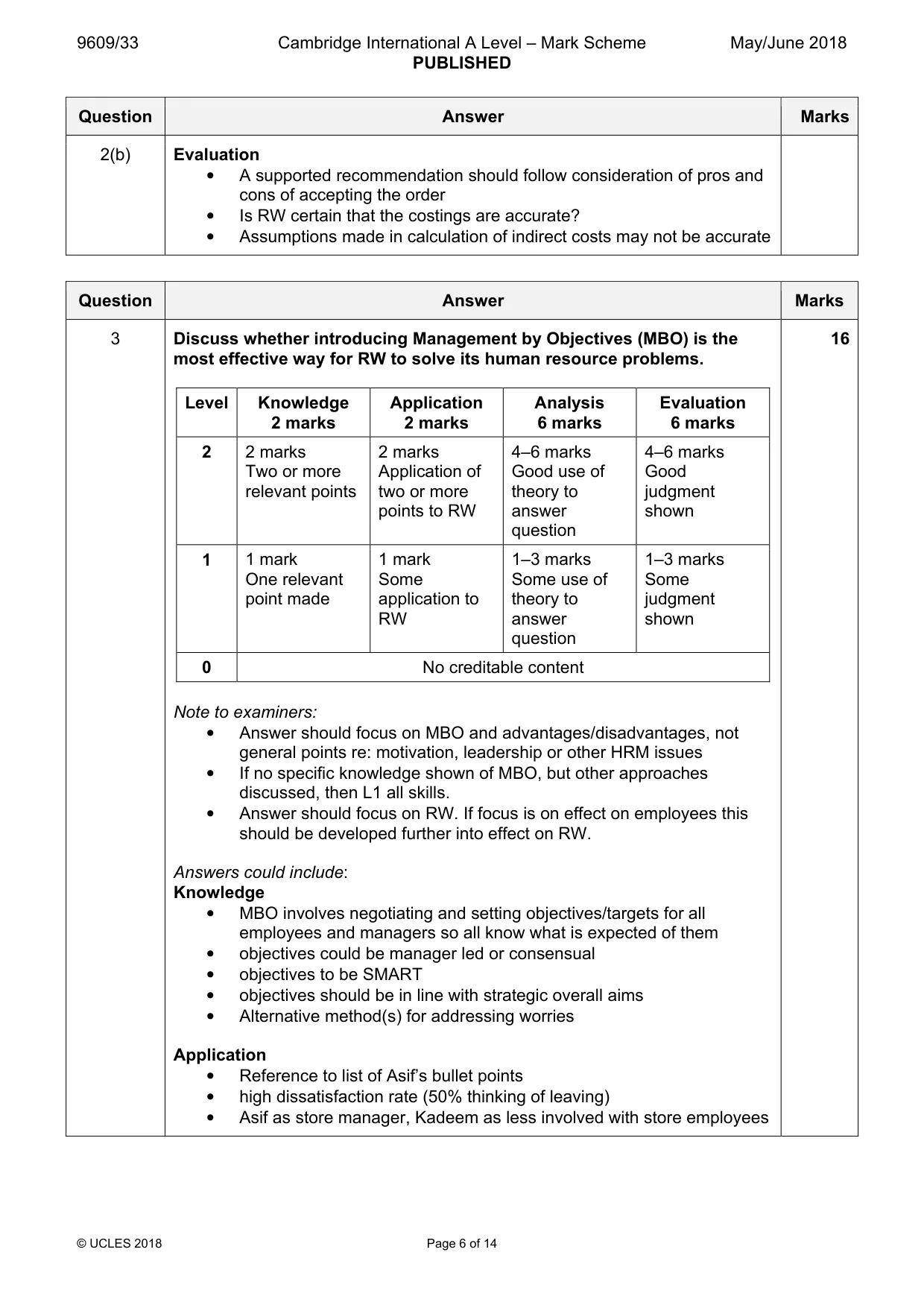
9609/33 Cambridge International A Level – Mark Scheme PUBLISHED May/June 2018 © UCLES 2018 Page 6 of 14 Question Answer Marks 2(b) Evaluation • A supported recommendation should follow consideration of pros and cons of accepting the order • Is RW certain that the costings are accurate? • Assumptions made in calculation of indirect costs may not be accurate Question Answer Marks 3 Discuss whether introducing Management by Objectives (MBO) is the most effective way for RW to solve its human resource problems. Level Knowledge 2 marks Application 2 marks Analysis 6 marks Evaluation 6 marks 2 2 marks Two or more relevant points 2 marks Application of two or more points to RW 4–6 marks Good use of theory to answer question 4–6 marks Good judgment shown 1 1 mark One relevant point made 1 mark Some application to RW 1–3 marks Some use of theory to answer question 1–3 marks Some judgment shown 0 No creditable content Note to examiners: • Answer should focus on MBO and advantages/disadvantages, not general points re: motivation, leadership or other HRM issues • If no specific knowledge shown of MBO, but other approaches discussed, then L1 all skills. • Answer should focus on RW. If focus is on effect on employees this should be developed further into effect on RW. Answers could include: Knowledge • MBO involves negotiating and setting objectives/targets for all employees and managers so all know what is expected of them • objectives could be manager led or consensual • objectives to be SMART • objectives should be in line with strategic overall aims • Alternative method(s) for addressing worries Application • Reference to list of Asif’s bullet points • high dissatisfaction rate (50% thinking of leaving) • Asif as store manager, Kadeem as less involved with store employees 16
Mark scheme, page 7
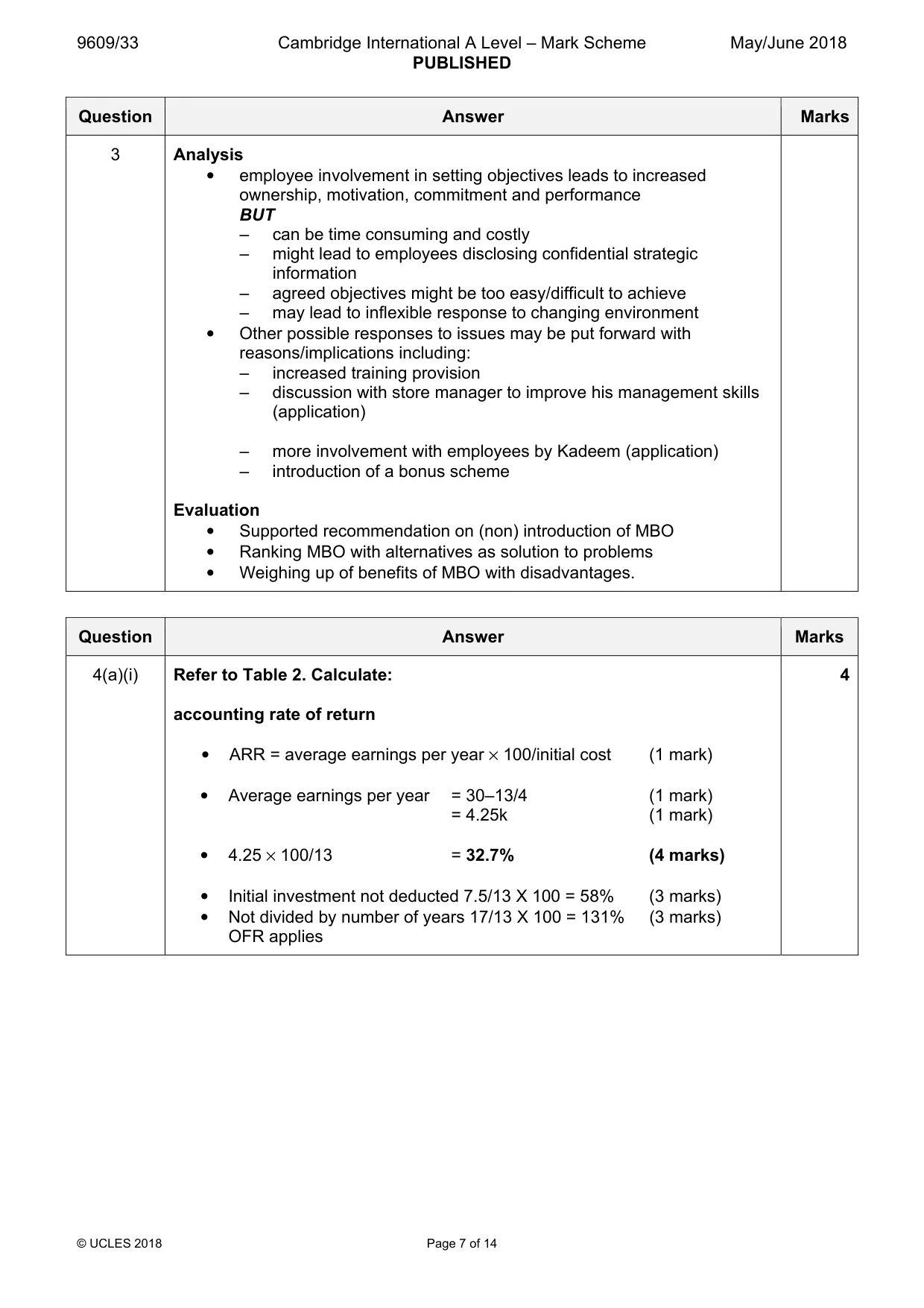
9609/33 Cambridge International A Level – Mark Scheme PUBLISHED May/June 2018 © UCLES 2018 Page 7 of 14 Question Answer Marks 3 Analysis • employee involvement in setting objectives leads to increased ownership, motivation, commitment and performance BUT – can be time consuming and costly – might lead to employees disclosing confidential strategic information – agreed objectives might be too easy/difficult to achieve – may lead to inflexible response to changing environment • Other possible responses to issues may be put forward with reasons/implications including: – increased training provision – discussion with store manager to improve his management skills (application) – more involvement with employees by Kadeem (application) – introduction of a bonus scheme Evaluation • Supported recommendation on (non) introduction of MBO • Ranking MBO with alternatives as solution to problems • Weighing up of benefits of MBO with disadvantages. Question Answer Marks 4(a)(i) Refer to Table 2. Calculate: accounting rate of return • ARR = average earnings per year × 100/initial cost (1 mark) • Average earnings per year = 30–13/4 (1 mark) = 4.25k (1 mark) • 4.25 × 100/13 = 32.7% (4 marks) • Initial investment not deducted 7.5/13 X 100 = 58% (3 marks) • Not divided by number of years 17/13 X 100 = 131% (3 marks) OFR applies 4
Mark scheme, page 8
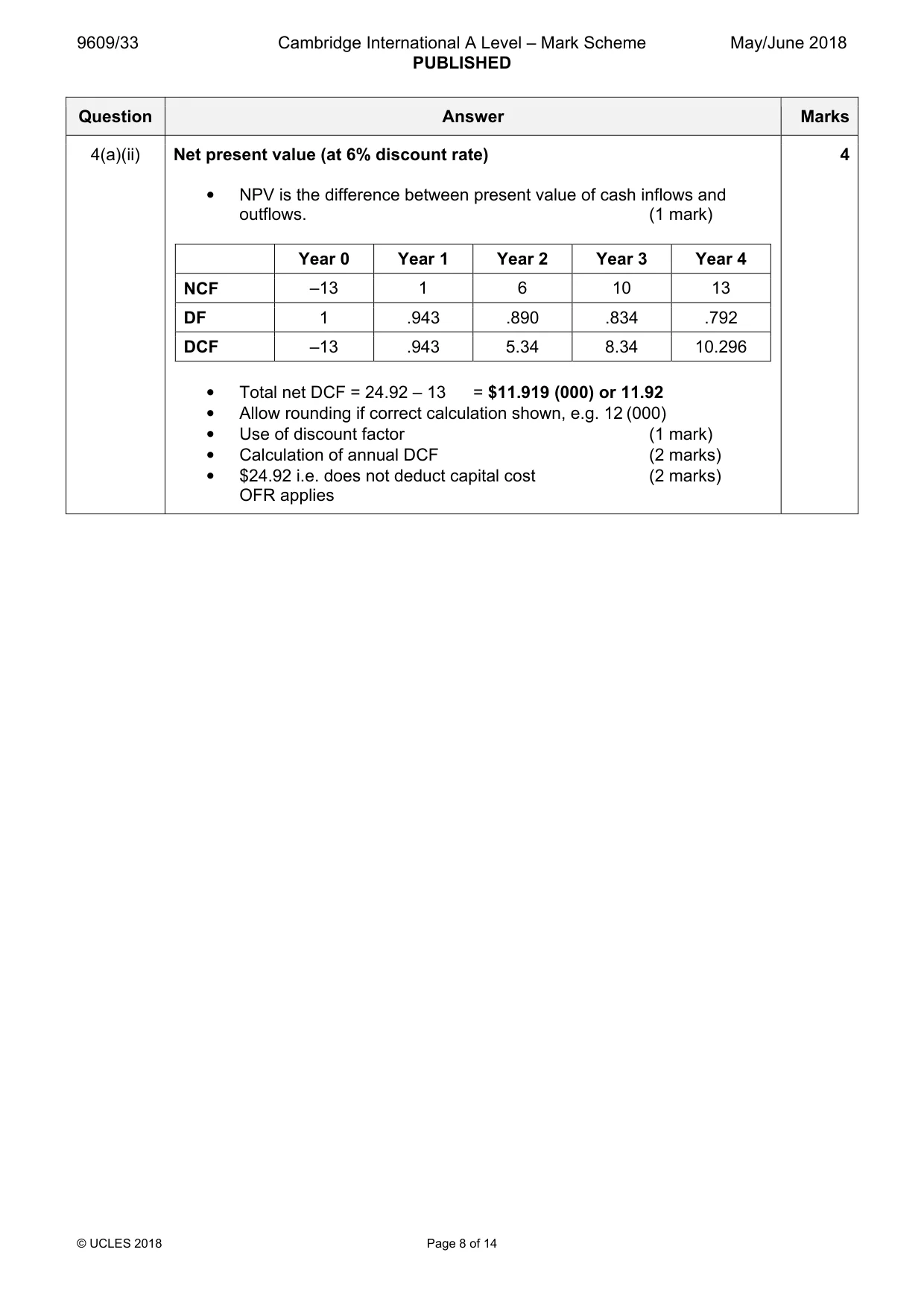
9609/33 Cambridge International A Level – Mark Scheme PUBLISHED May/June 2018 © UCLES 2018 Page 8 of 14 Question Answer Marks 4(a)(ii) Net present value (at 6% discount rate) • NPV is the difference between present value of cash inflows and outflows. (1 mark) Year 0 Year 1 Year 2 Year 3 Year 4 NCF –13 1 6 10 13 DF 1 .943 .890 .834 .792 DCF –13 .943 5.34 8.34 10.296 • Total net DCF = 24.92 – 13 = $11.919 (000) or 11.92 • Allow rounding if correct calculation shown, e.g. 12 (000) • Use of discount factor (1 mark) • Calculation of annual DCF (2 marks) • $24.92 i.e. does not deduct capital cost (2 marks) OFR applies 4
Mark scheme, page 9
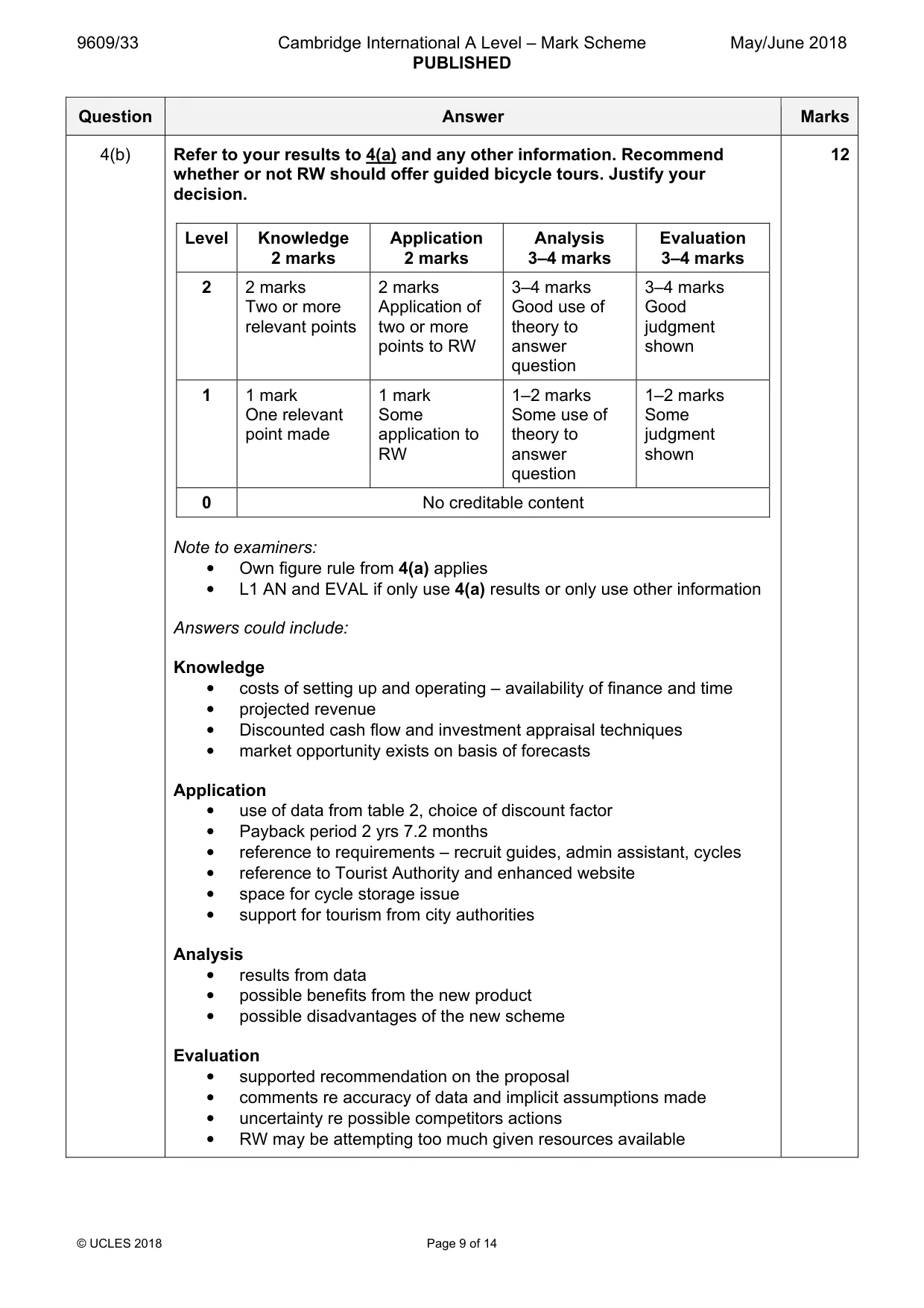
9609/33 Cambridge International A Level – Mark Scheme PUBLISHED May/June 2018 © UCLES 2018 Page 9 of 14 Question Answer Marks 4(b) Refer to your results to 4(a) and any other information. Recommend whether or not RW should offer guided bicycle tours. Justify your decision. Level Knowledge 2 marks Application 2 marks Analysis 3–4 marks Evaluation 3–4 marks 2 2 marks Two or more relevant points 2 marks Application of two or more points to RW 3–4 marks Good use of theory to answer question 3–4 marks Good judgment shown 1 1 mark One relevant point made 1 mark Some application to RW 1–2 marks Some use of theory to answer question 1–2 marks Some judgment shown 0 No creditable content Note to examiners: • Own figure rule from 4(a) applies • L1 AN and EVAL if only use 4(a) results or only use other information Answers could include: Knowledge • costs of setting up and operating – availability of finance and time • projected revenue • Discounted cash flow and investment appraisal techniques • market opportunity exists on basis of forecasts Application • use of data from table 2, choice of discount factor • Payback period 2 yrs 7.2 months • reference to requirements – recruit guides, admin assistant, cycles • reference to Tourist Authority and enhanced website • space for cycle storage issue • support for tourism from city authorities Analysis • results from data • possible benefits from the new product • possible disadvantages of the new scheme Evaluation • supported recommendation on the proposal • comments re accuracy of data and implicit assumptions made • uncertainty re possible competitors actions • RW may be attempting too much given resources available 12
Mark scheme, page 10
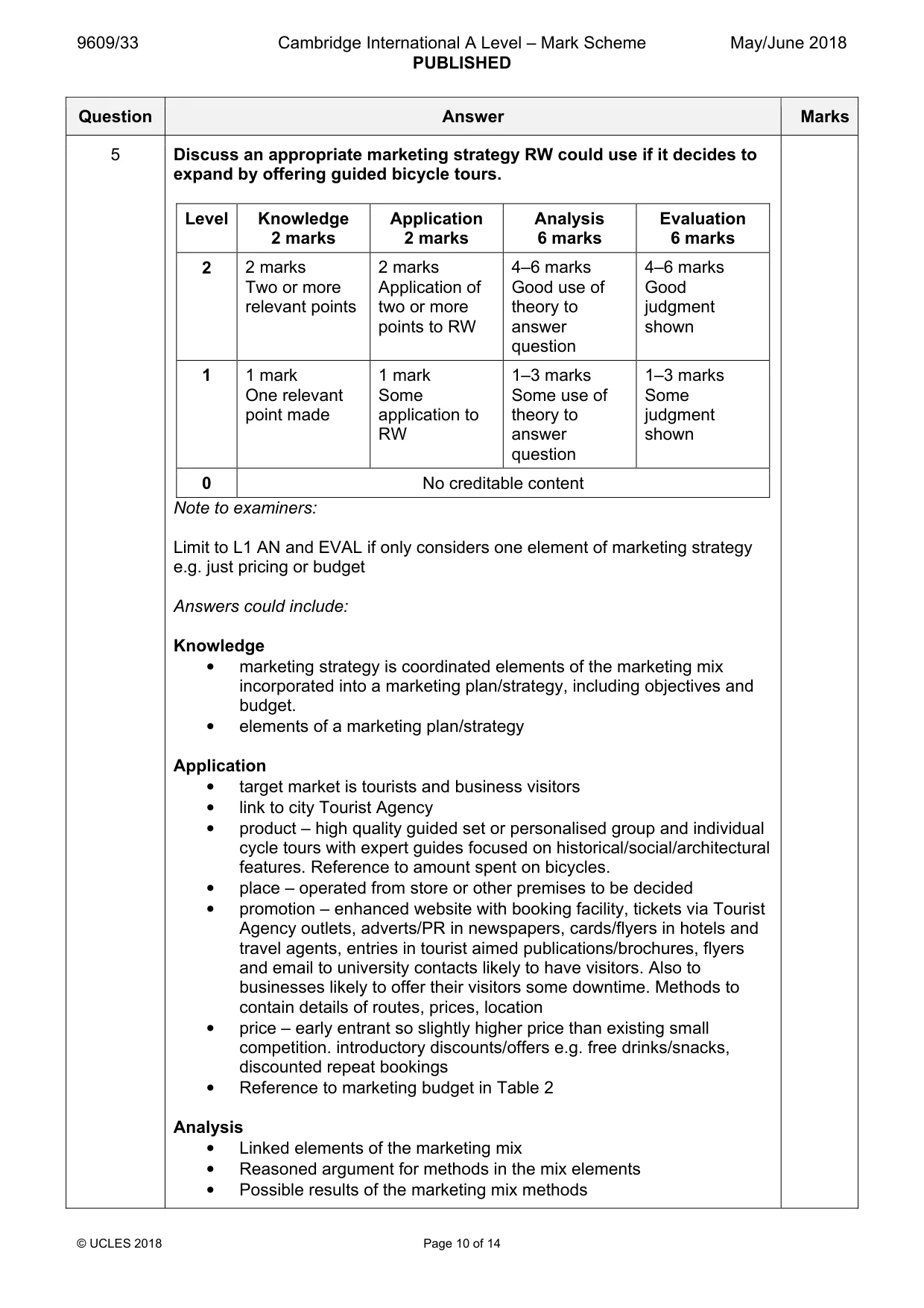
9609/33 Cambridge International A Level – Mark Scheme PUBLISHED May/June 2018 © UCLES 2018 Page 10 of 14 Question Answer Marks 5 Discuss an appropriate marketing strategy RW could use if it decides to expand by offering guided bicycle tours. Level Knowledge 2 marks Application 2 marks Analysis 6 marks Evaluation 6 marks 2 2 marks Two or more relevant points 2 marks Application of two or more points to RW 4–6 marks Good use of theory to answer question 4–6 marks Good judgment shown 1 1 mark One relevant point made 1 mark Some application to RW 1–3 marks Some use of theory to answer question 1–3 marks Some judgment shown 0 No creditable content Note to examiners: Limit to L1 AN and EVAL if only considers one element of marketing strategy e.g. just pricing or budget Answers could include: Knowledge • marketing strategy is coordinated elements of the marketing mix incorporated into a marketing plan/strategy, including objectives and budget. • elements of a marketing plan/strategy Application • target market is tourists and business visitors • link to city Tourist Agency • product – high quality guided set or personalised group and individual cycle tours with expert guides focused on historical/social/architectural features. Reference to amount spent on bicycles. • place – operated from store or other premises to be decided • promotion – enhanced website with booking facility, tickets via Tourist Agency outlets, adverts/PR in newspapers, cards/flyers in hotels and travel agents, entries in tourist aimed publications/brochures, flyers and email to university contacts likely to have visitors. Also to businesses likely to offer their visitors some downtime. Methods to contain details of routes, prices, location • price – early entrant so slightly higher price than existing small competition. introductory discounts/offers e.g. free drinks/snacks, discounted repeat bookings • Reference to marketing budget in Table 2 Analysis • Linked elements of the marketing mix • Reasoned argument for methods in the mix elements • Possible results of the marketing mix methods
Mark scheme, page 11
9609/33 Cambridge International A Level – Mark Scheme PUBLISHED May/June 2018 © UCLES 2018 Page 11 of 14 Question Answer Marks 5 Evaluation • supported assessment of likelihood of success • objectives are needed for strategy • availability of finance/resources for the strategy/plan • must build in review of strategy • strategy relies on reliability of data/research
Mark scheme, page 12
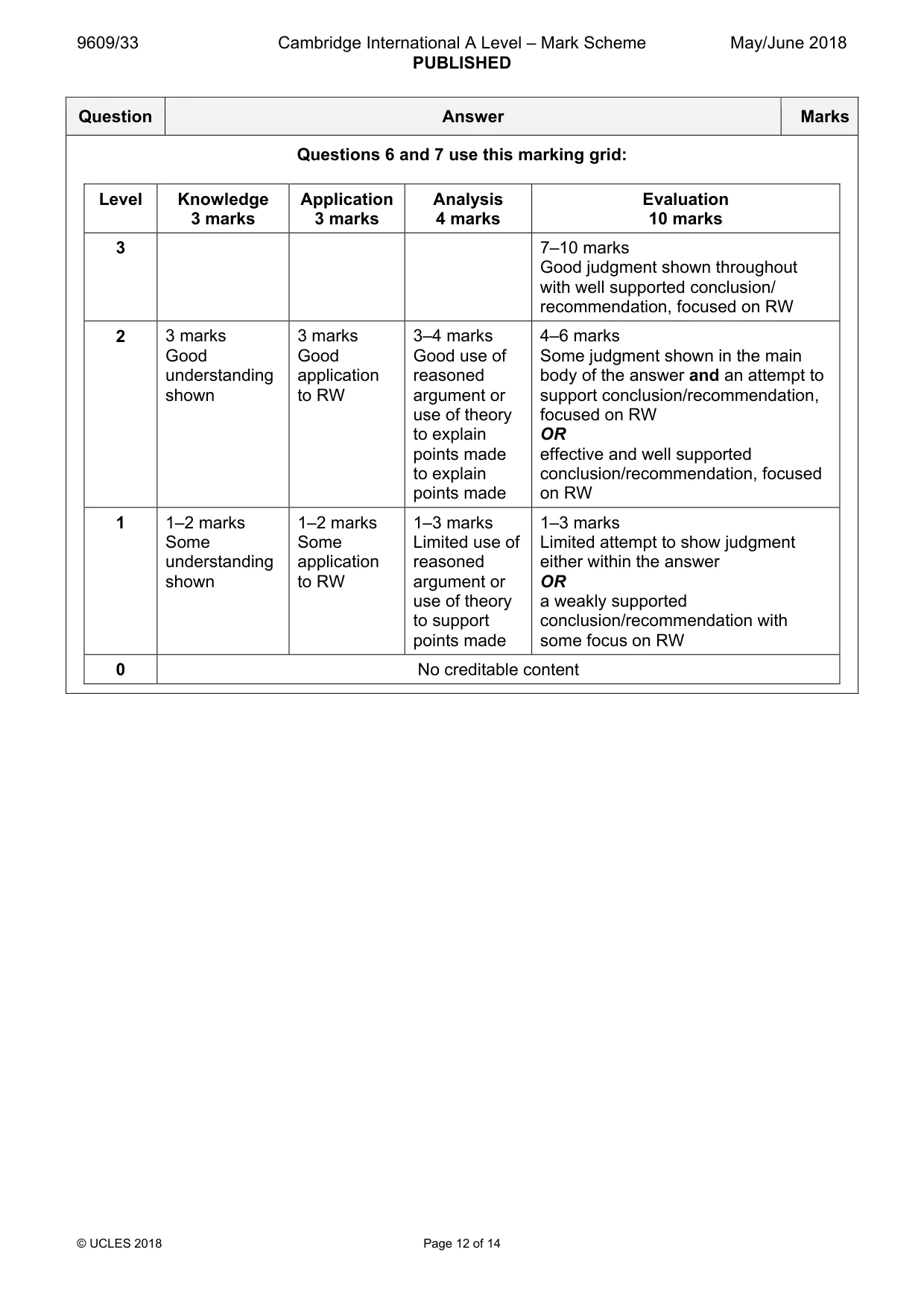
9609/33 Cambridge International A Level – Mark Scheme PUBLISHED May/June 2018 © UCLES 2018 Page 12 of 14 Question Answer Marks Questions 6 and 7 use this marking grid: Level Knowledge 3 marks Application 3 marks Analysis 4 marks Evaluation 10 marks 3 7–10 marks Good judgment shown throughout with well supported conclusion/ recommendation, focused on RW 2 3 marks Good understanding shown 3 marks Good application to RW 3–4 marks Good use of reasoned argument or use of theory to explain points made to explain points made 4–6 marks Some judgment shown in the main body of the answer and an attempt to support conclusion/recommendation, focused on RW OR effective and well supported conclusion/recommendation, focused on RW 1 1–2 marks Some understanding shown 1–2 marks Some application to RW 1–3 marks Limited use of reasoned argument or use of theory to support points made 1–3 marks Limited attempt to show judgment either within the answer OR a weakly supported conclusion/recommendation with some focus on RW 0 No creditable content
Mark scheme, page 13
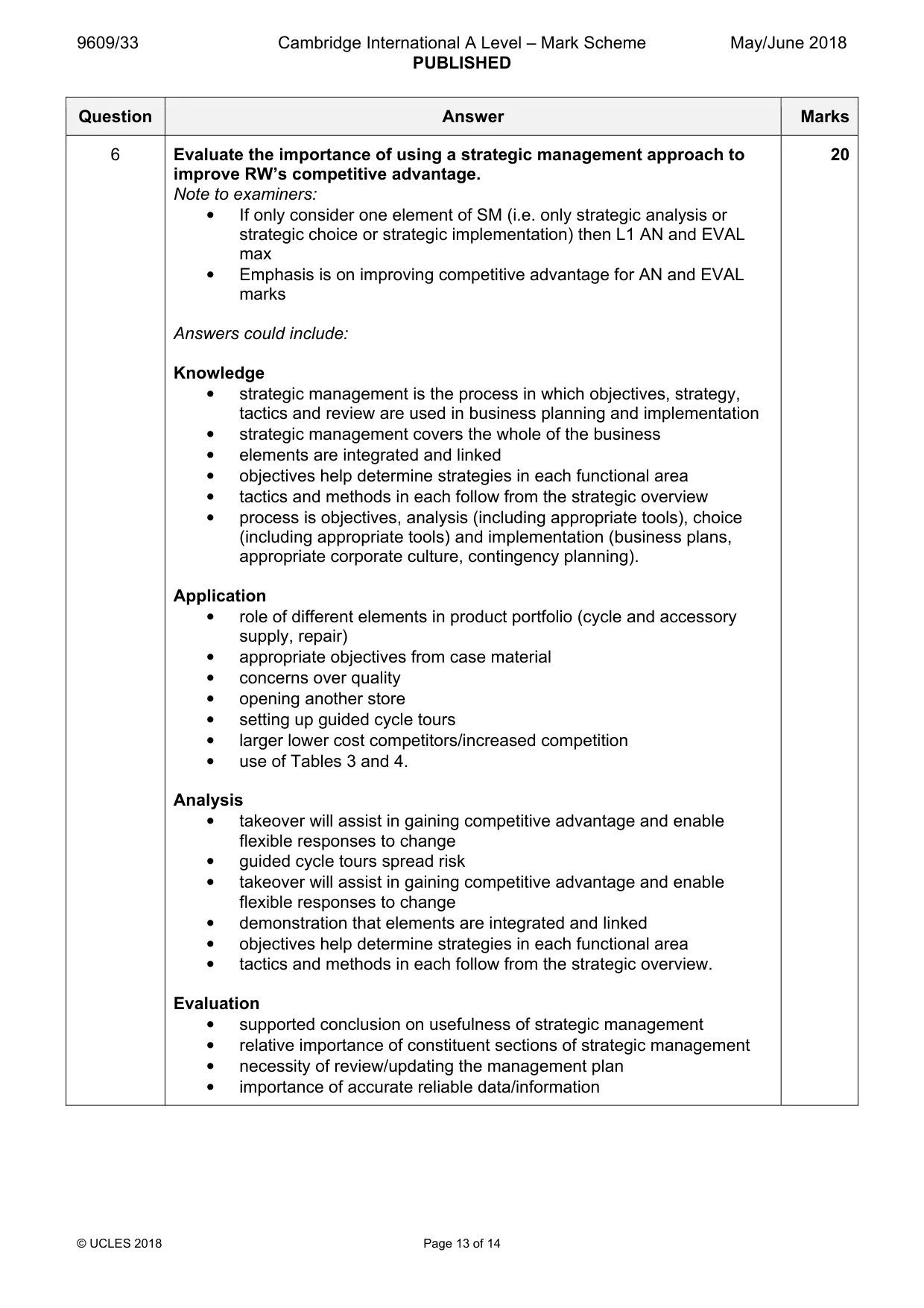
9609/33 Cambridge International A Level – Mark Scheme PUBLISHED May/June 2018 © UCLES 2018 Page 13 of 14 Question Answer Marks 6 Evaluate the importance of using a strategic management approach to improve RW’s competitive advantage. Note to examiners: • If only consider one element of SM (i.e. only strategic analysis or strategic choice or strategic implementation) then L1 AN and EVAL max • Emphasis is on improving competitive advantage for AN and EVAL marks Answers could include: Knowledge • strategic management is the process in which objectives, strategy, tactics and review are used in business planning and implementation • strategic management covers the whole of the business • elements are integrated and linked • objectives help determine strategies in each functional area • tactics and methods in each follow from the strategic overview • process is objectives, analysis (including appropriate tools), choice (including appropriate tools) and implementation (business plans, appropriate corporate culture, contingency planning). Application • role of different elements in product portfolio (cycle and accessory supply, repair) • appropriate objectives from case material • concerns over quality • opening another store • setting up guided cycle tours • larger lower cost competitors/increased competition • use of Tables 3 and 4. Analysis • takeover will assist in gaining competitive advantage and enable flexible responses to change • guided cycle tours spread risk • takeover will assist in gaining competitive advantage and enable flexible responses to change • demonstration that elements are integrated and linked • objectives help determine strategies in each functional area • tactics and methods in each follow from the strategic overview. Evaluation • supported conclusion on usefulness of strategic management • relative importance of constituent sections of strategic management • necessity of review/updating the management plan • importance of accurate reliable data/information 20
Mark scheme, page 14
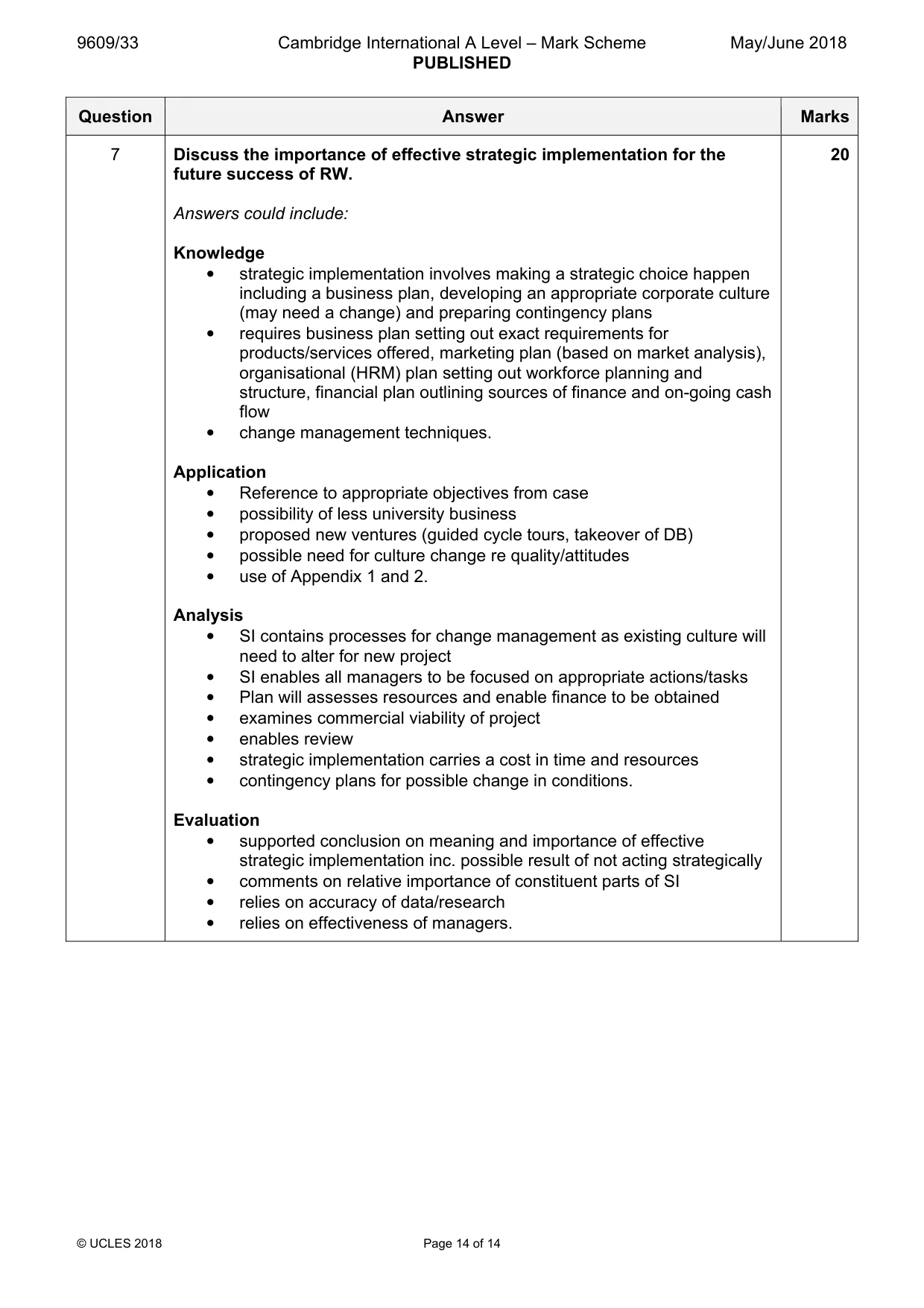
9609/33 Cambridge International A Level – Mark Scheme PUBLISHED May/June 2018 © UCLES 2018 Page 14 of 14 Question Answer Marks 7 Discuss the importance of effective strategic implementation for the future success of RW. Answers could include: Knowledge • strategic implementation involves making a strategic choice happen including a business plan, developing an appropriate corporate culture (may need a change) and preparing contingency plans • requires business plan setting out exact requirements for products/services offered, marketing plan (based on market analysis), organisational (HRM) plan setting out workforce planning and structure, financial plan outlining sources of finance and on-going cash flow • change management techniques. Application • Reference to appropriate objectives from case • possibility of less university business • proposed new ventures (guided cycle tours, takeover of DB) • possible need for culture change re quality/attitudes • use of Appendix 1 and 2. Analysis • SI contains processes for change management as existing culture will need to alter for new project • SI enables all managers to be focused on appropriate actions/tasks • Plan will assesses resources and enable finance to be obtained • examines commercial viability of project • enables review • strategic implementation carries a cost in time and resources • contingency plans for possible change in conditions. Evaluation • supported conclusion on meaning and importance of effective strategic implementation inc. possible result of not acting strategically • comments on relative importance of constituent parts of SI • relies on accuracy of data/research • relies on effectiveness of managers. 20
What you needed in this session
Cambridge’s own grade thresholds for 2018 May/June, Paper 3 · Variant 3. A higher threshold means an easier paper — the bar moves with how the cohort did.