Cambridge A Level Business (for first examination in 2016) 9609 — 2018 May/June Paper 3 · Variant 1
9609/31/M/J/18 · 100 marks · ≈113 min
The question paper and its mark scheme, free to read here and free to download. This is Cambridge’s own paper, exactly as it was sat.
Question paper20 pages















Mark scheme14 pages
Answers below. Sit the paper first if you are practising.

Paper as text
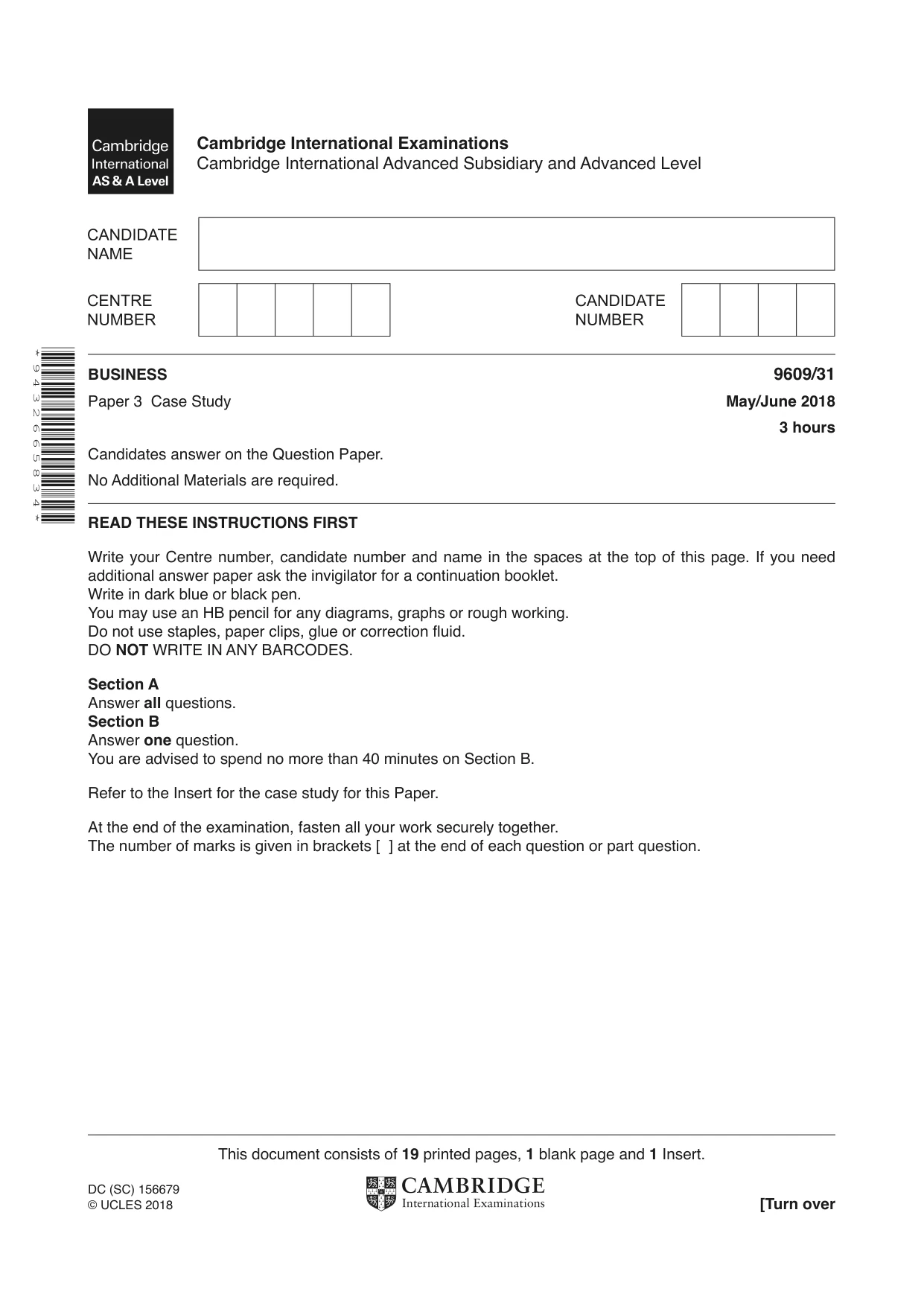
Question paper, page 1
This document consists of 19 printed pages, 1 blank page and 1 Insert. DC (SC) 156679 © UCLES 2018 [Turn over Cambridge International Examinations Cambridge International Advanced Subsidiary and Advanced Level * 9 4 3 2 6 6 5 8 3 4 * BUSINESS 9609/31 Paper 3 Case Study May/June 2018 3 hours Candidates answer on the Question Paper. No Additional Materials are required. READ THESE INSTRUCTIONS FIRST Write your Centre number, candidate number and name in the spaces at the top of this page. If you need additional answer paper ask the invigilator for a continuation booklet. Write in dark blue or black pen. You may use an HB pencil for any diagrams, graphs or rough working. Do not use staples, paper clips, glue or correction fluid. DO NOT WRITE IN ANY BARCODES. Section A Answer all questions. Section B Answer one question. You are advised to spend no more than 40 minutes on Section B. Refer to the Insert for the case study for this Paper. At the end of the examination, fasten all your work securely together. The number of marks is given in brackets [ ] at the end of each question or part question.
Question paper, page 2
2 9609/31/M/J/18 © UCLES 2018 Section A Answer all questions in this section. 1 Analyse the advantages and disadvantages of PGP’s privatisation for any one stakeholder group. … … … … … … … … … … … … … … … … … … … … … … … … …
Question paper, page 3
3 9609/31/M/J/18 © UCLES 2018 [Turn over … … … … … … … … … … … … … … … … … … … … … … … … … … … … [10]
Question paper, page 4
4 9609/31/M/J/18 © UCLES 2018 2 (a) Refer to Table 2. Calculate the difference between the annual cost of outsourcing the transport of fuel in country X and the existing annual cost of transport. … … … … … … … … … … … … … … … … … … … … … … … … … … … [8]
Question paper, page 5
5 9609/31/M/J/18 © UCLES 2018 [Turn over (b) Using your result to 2(a) and other relevant information, recommend to PGP’s directors whether the transport of fuel should be outsourced in country X. Justify your recommendation. … … … … … … … … … … … … … … … … … … … … … … … … … … …
Question paper, page 6
6 9609/31/M/J/18 © UCLES 2018 … … … … … … … … … … … … … … … … … … … … … … … … … … … … [12]
Question paper, page 7
7 9609/31/M/J/18 © UCLES 2018 [Turn over 3 Discuss the likely advantages and disadvantages to PGP of the proposed delayering of its organisational structure. … … … … … … … … … … … … … … … … … … … … … … … … … … …
Question paper, page 8
8 9609/31/M/J/18 © UCLES 2018 … … … … … … … … … … … … … … … … … … … … … … … … … … … …
Question paper, page 9
9 9609/31/M/J/18 © UCLES 2018 [Turn over … … … … … … … … … … … … … … … … … … … … … … … … … … … … [16]
Question paper, page 10
10 9609/31/M/J/18 © UCLES 2018 4 Refer to Table 3. (a) Calculate for PGP: (i) price earnings ratio … … … … … … … … … … … … [3] (ii) dividend yield. … … … … … … … … … … … … [3]
Question paper, page 11
11 9609/31/M/J/18 © UCLES 2018 [Turn over (b) Discuss two ways in which PGP could improve its accounting ratio results in future. … … … … … … … … … … … … … … … … … … … … … … … … … … …
Question paper, page 12
12 9609/31/M/J/18 © UCLES 2018 … … … … … … … … … … … … … … … … … … … … … … … … … … … … [12]
Question paper, page 13
13 9609/31/M/J/18 © UCLES 2018 [Turn over 5 Evaluate the usefulness of the moving average method to forecast sales of oil and gas to PGP. … … … … … … … … … … … … … … … … … … … … … … … … … … …
Question paper, page 14
14 9609/31/M/J/18 © UCLES 2018 … … … … … … … … … … … … … … … … … … … … … … … … … … … …
Question paper, page 15
15 9609/31/M/J/18 © UCLES 2018 [Turn over … … … … … … … … … … … … … … … … … … … … … … … … … … … … [16]
Question paper, page 16
16 9609/31/M/J/18 © UCLES 2018 Section B Answer one question in this section. 6 Evaluate the usefulness of any two techniques of strategic analysis to PGP’s Board of Directors. 7 Discuss whether the techniques referred to in Appendix 1 are sufficient to allow the directors to make the strategic choice between Option A and Option B. Write the question number here: … … … … … … … … … … … … … … … … … … … … … … …
Question paper, page 17
17 9609/31/M/J/18 © UCLES 2018 [Turn over … … … … … … … … … … … … … … … … … … … … … … … … … … … …
Question paper, page 18
18 9609/31/M/J/18 © UCLES 2018 … … … … … … … … … … … … … … … … … … … … … … … … … … … …
Question paper, page 19
19 9609/31/M/J/18 © UCLES 2018 … … … … … … … … … … … … … … … … … … … … … … … … … … … … [20]
Question paper, page 20
20 9609/31/M/J/18 © UCLES 2018 Permission to reproduce items where third-party owned material protected by copyright is included has been sought and cleared where possible. Every reasonable effort has been made by the publisher (UCLES) to trace copyright holders, but if any items requiring clearance have unwittingly been included, the publisher will be pleased to make amends at the earliest possible opportunity. To avoid the issue of disclosure of answer-related information to candidates, all copyright acknowledgements are reproduced online in the Cambridge International Examinations Copyright Acknowledgements Booklet. This is produced for each series of examinations and is freely available to download at www.cie.org.uk after the live examination series. Cambridge International Examinations is part of the Cambridge Assessment Group. Cambridge Assessment is the brand name of University of Cambridge Local Examinations Syndicate (UCLES), which is itself a department of the University of Cambridge. BLANK PAGE
Mark scheme, page 1
IGCSE™ is a registered trademark. This document consists of 14 printed pages. © UCLES 2018 [Turn over Cambridge Assessment International Education Cambridge International Advanced Level BUSINESS 9609/31 Paper 3 Case Study May/June 2018 MARK SCHEME Maximum Mark: 100 Published This mark scheme is published as an aid to teachers and candidates, to indicate the requirements of the examination. It shows the basis on which Examiners were instructed to award marks. It does not indicate the details of the discussions that took place at an Examiners’ meeting before marking began, which would have considered the acceptability of alternative answers. Mark schemes should be read in conjunction with the question paper and the Principal Examiner Report for Teachers. Cambridge International will not enter into discussions about these mark schemes. Cambridge International is publishing the mark schemes for the May/June 2018 series for most Cambridge IGCSE™, Cambridge International A and AS Level and Cambridge Pre-U components, and some Cambridge O Level components.
Mark scheme, page 2
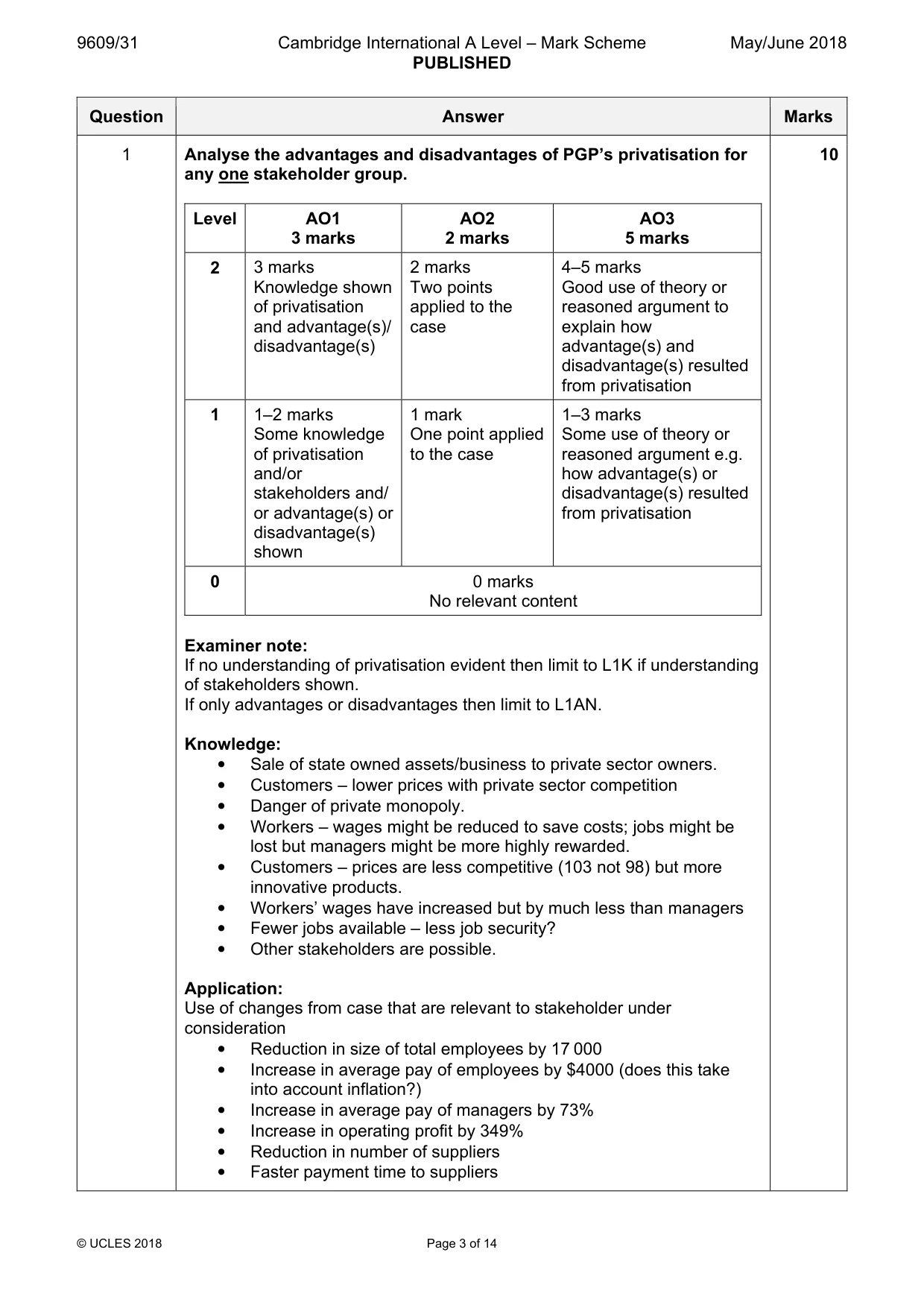
9609/31 Cambridge International A Level – Mark Scheme PUBLISHED May/June 2018 © UCLES 2018 Page 2 of 14 Generic Marking Principles These general marking principles must be applied by all examiners when marking candidate answers. They should be applied alongside the specific content of the mark scheme or generic level descriptors for a question. Each question paper and mark scheme will also comply with these marking principles. GENERIC MARKING PRINCIPLE 1: Marks must be awarded in line with: • the specific content of the mark scheme or the generic level descriptors for the question • the specific skills defined in the mark scheme or in the generic level descriptors for the question • the standard of response required by a candidate as exemplified by the standardisation scripts. GENERIC MARKING PRINCIPLE 2: Marks awarded are always whole marks (not half marks, or other fractions). GENERIC MARKING PRINCIPLE 3: Marks must be awarded positively: • marks are awarded for correct/valid answers, as defined in the mark scheme. However, credit is given for valid answers which go beyond the scope of the syllabus and mark scheme, referring to your Team Leader as appropriate • marks are awarded when candidates clearly demonstrate what they know and can do • marks are not deducted for errors • marks are not deducted for omissions • answers should only be judged on the quality of spelling, punctuation and grammar when these features are specifically assessed by the question as indicated by the mark scheme. The meaning, however, should be unambiguous. GENERIC MARKING PRINCIPLE 4: Rules must be applied consistently e.g. in situations where candidates have not followed instructions or in the application of generic level descriptors. GENERIC MARKING PRINCIPLE 5: Marks should be awarded using the full range of marks defined in the mark scheme for the question (however; the use of the full mark range may be limited according to the quality of the candidate responses seen). GENERIC MARKING PRINCIPLE 6: Marks awarded are based solely on the requirements as defined in the mark scheme. Marks should not be awarded with grade thresholds or grade descriptors in mind.
Mark scheme, page 3
9609/31 Cambridge International A Level – Mark Scheme PUBLISHED May/June 2018 © UCLES 2018 Page 3 of 14 Question Answer Marks 1 Analyse the advantages and disadvantages of PGP’s privatisation for any one stakeholder group. Level AO1 3 marks AO2 2 marks AO3 5 marks 2 3 marks Knowledge shown of privatisation and advantage(s)/ disadvantage(s) 2 marks Two points applied to the case 4–5 marks Good use of theory or reasoned argument to explain how advantage(s) and disadvantage(s) resulted from privatisation 1 1–2 marks Some knowledge of privatisation and/or stakeholders and/ or advantage(s) or disadvantage(s) shown 1 mark One point applied to the case 1–3 marks Some use of theory or reasoned argument e.g. how advantage(s) or disadvantage(s) resulted from privatisation 0 0 marks No relevant content Examiner note: If no understanding of privatisation evident then limit to L1K if understanding of stakeholders shown. If only advantages or disadvantages then limit to L1AN. Knowledge: • Sale of state owned assets/business to private sector owners. • Customers – lower prices with private sector competition • Danger of private monopoly. • Workers – wages might be reduced to save costs; jobs might be lost but managers might be more highly rewarded. • Customers – prices are less competitive (103 not 98) but more innovative products. • Workers’ wages have increased but by much less than managers • Fewer jobs available – less job security? • Other stakeholders are possible. Application: Use of changes from case that are relevant to stakeholder under consideration • Reduction in size of total employees by 17 000 • Increase in average pay of employees by $4000 (does this take into account inflation?) • Increase in average pay of managers by 73% • Increase in operating profit by 349% • Reduction in number of suppliers • Faster payment time to suppliers 10
Mark scheme, page 4
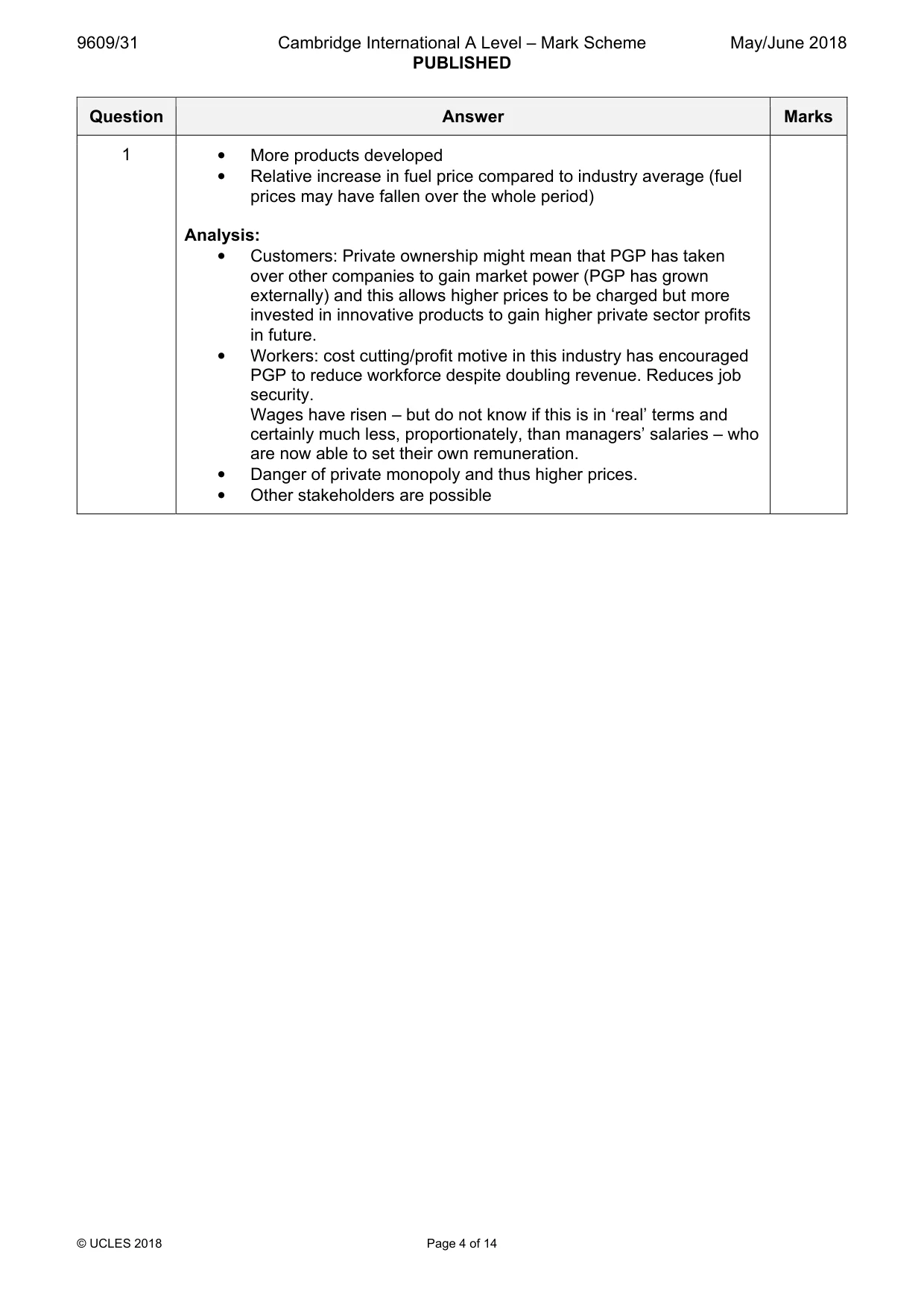
9609/31 Cambridge International A Level – Mark Scheme PUBLISHED May/June 2018 © UCLES 2018 Page 4 of 14 Question Answer Marks 1 • More products developed • Relative increase in fuel price compared to industry average (fuel prices may have fallen over the whole period) Analysis: • Customers: Private ownership might mean that PGP has taken over other companies to gain market power (PGP has grown externally) and this allows higher prices to be charged but more invested in innovative products to gain higher private sector profits in future. • Workers: cost cutting/profit motive in this industry has encouraged PGP to reduce workforce despite doubling revenue. Reduces job security. Wages have risen – but do not know if this is in ‘real’ terms and certainly much less, proportionately, than managers’ salaries – who are now able to set their own remuneration. • Danger of private monopoly and thus higher prices. • Other stakeholders are possible
Mark scheme, page 5
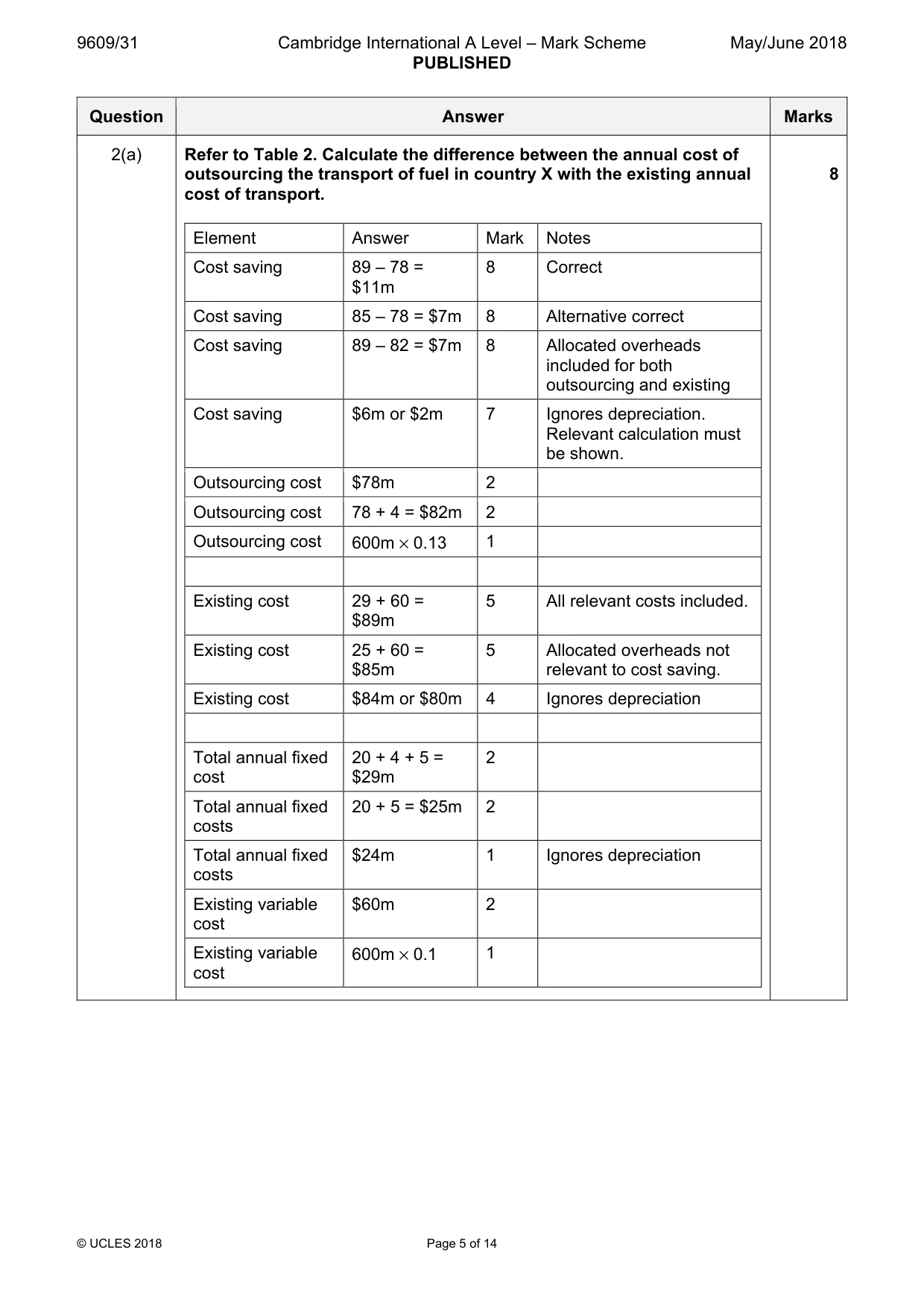
9609/31 Cambridge International A Level – Mark Scheme PUBLISHED May/June 2018 © UCLES 2018 Page 5 of 14 Question Answer Marks 2(a) Refer to Table 2. Calculate the difference between the annual cost of outsourcing the transport of fuel in country X with the existing annual cost of transport. Element Answer Mark Notes Cost saving 89 – 78 = $11m 8 Correct Cost saving 85 – 78 = $7m 8 Alternative correct Cost saving 89 – 82 = $7m 8 Allocated overheads included for both outsourcing and existing Cost saving $6m or $2m 7 Ignores depreciation. Relevant calculation must be shown. Outsourcing cost $78m 2 Outsourcing cost 78 + 4 = $82m 2 Outsourcing cost 600m × 0.13 1 Existing cost 29 + 60 = $89m 5 All relevant costs included. Existing cost 25 + 60 = $85m 5 Allocated overheads not relevant to cost saving. Existing cost $84m or $80m 4 Ignores depreciation Total annual fixed cost 20 + 4 + 5 = $29m 2 Total annual fixed costs 20 + 5 = $25m 2 Total annual fixed costs $24m 1 Ignores depreciation Existing variable cost $60m 2 Existing variable cost 600m × 0.1 1 8
Mark scheme, page 6
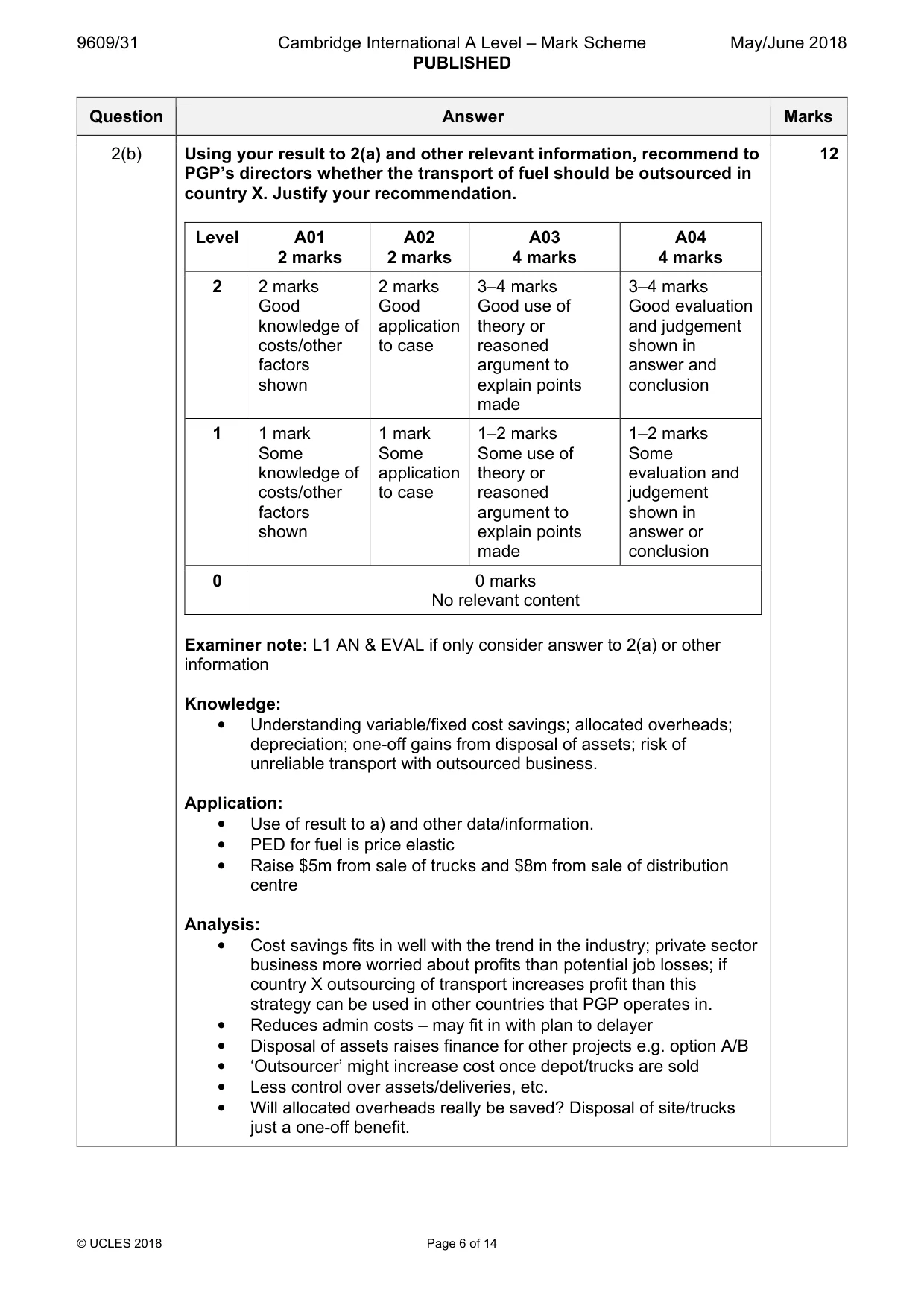
9609/31 Cambridge International A Level – Mark Scheme PUBLISHED May/June 2018 © UCLES 2018 Page 6 of 14 Question Answer Marks 2(b) Using your result to 2(a) and other relevant information, recommend to PGP’s directors whether the transport of fuel should be outsourced in country X. Justify your recommendation. Level A01 2 marks A02 2 marks A03 4 marks A04 4 marks 2 2 marks Good knowledge of costs/other factors shown 2 marks Good application to case 3–4 marks Good use of theory or reasoned argument to explain points made 3–4 marks Good evaluation and judgement shown in answer and conclusion 1 1 mark Some knowledge of costs/other factors shown 1 mark Some application to case 1–2 marks Some use of theory or reasoned argument to explain points made 1–2 marks Some evaluation and judgement shown in answer or conclusion 0 0 marks No relevant content Examiner note: L1 AN & EVAL if only consider answer to 2(a) or other information Knowledge: • Understanding variable/fixed cost savings; allocated overheads; depreciation; one-off gains from disposal of assets; risk of unreliable transport with outsourced business. Application: • Use of result to a) and other data/information. • PED for fuel is price elastic • Raise $5m from sale of trucks and $8m from sale of distribution centre Analysis: • Cost savings fits in well with the trend in the industry; private sector business more worried about profits than potential job losses; if country X outsourcing of transport increases profit than this strategy can be used in other countries that PGP operates in. • Reduces admin costs – may fit in with plan to delayer • Disposal of assets raises finance for other projects e.g. option A/B • ‘Outsourcer’ might increase cost once depot/trucks are sold • Less control over assets/deliveries, etc. • Will allocated overheads really be saved? Disposal of site/trucks just a one-off benefit. 12
Mark scheme, page 7
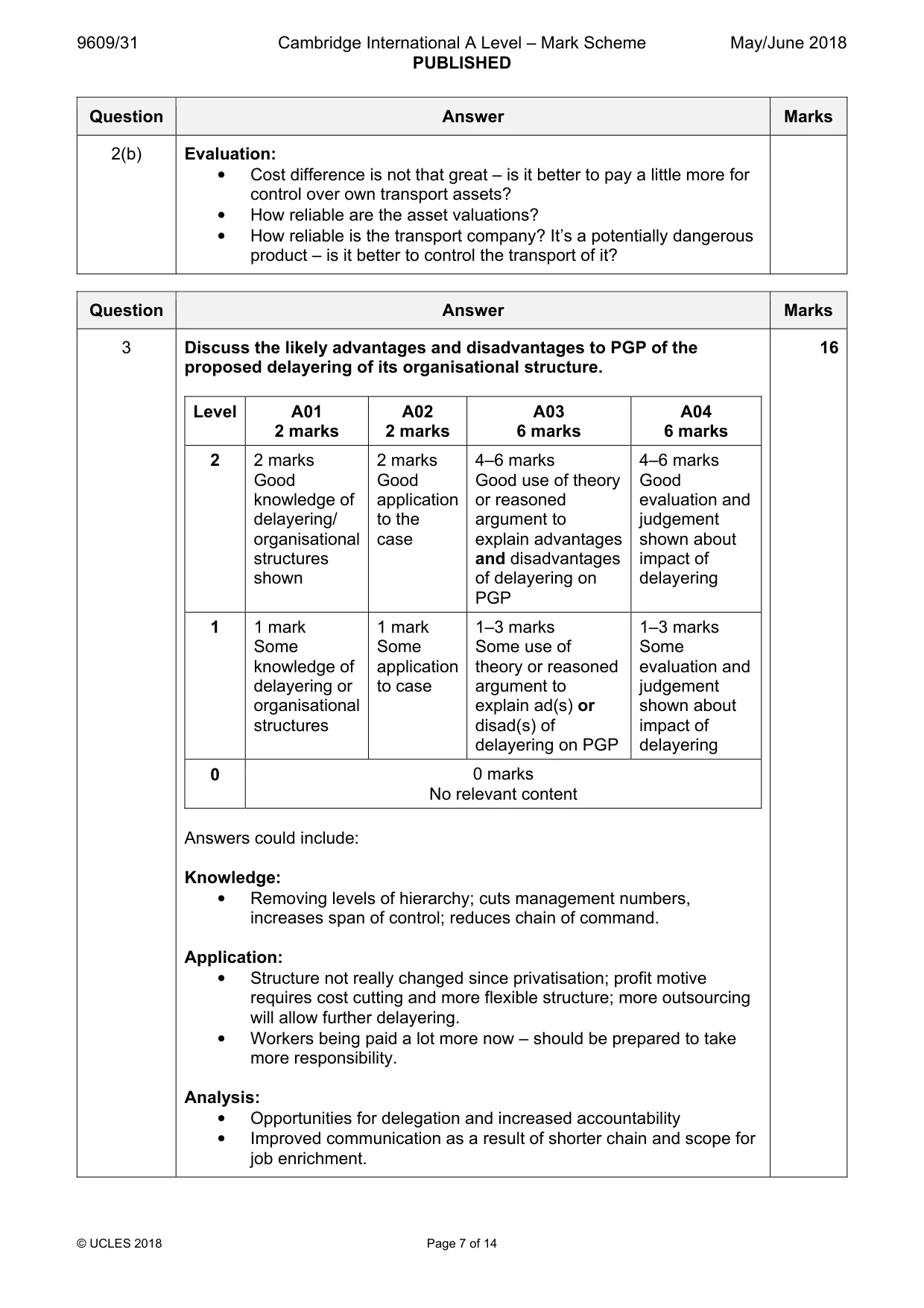
9609/31 Cambridge International A Level – Mark Scheme PUBLISHED May/June 2018 © UCLES 2018 Page 7 of 14 Question Answer Marks 2(b) Evaluation: • Cost difference is not that great – is it better to pay a little more for control over own transport assets? • How reliable are the asset valuations? • How reliable is the transport company? It’s a potentially dangerous product – is it better to control the transport of it? Question Answer Marks 3 Discuss the likely advantages and disadvantages to PGP of the proposed delayering of its organisational structure. Level A01 2 marks A02 2 marks A03 6 marks A04 6 marks 2 2 marks Good knowledge of delayering/ organisational structures shown 2 marks Good application to the case 4–6 marks Good use of theory or reasoned argument to explain advantages and disadvantages of delayering on PGP 4–6 marks Good evaluation and judgement shown about impact of delayering 1 1 mark Some knowledge of delayering or organisational structures 1 mark Some application to case 1–3 marks Some use of theory or reasoned argument to explain ad(s) or disad(s) of delayering on PGP 1–3 marks Some evaluation and judgement shown about impact of delayering 0 0 marks No relevant content Answers could include: Knowledge: • Removing levels of hierarchy; cuts management numbers, increases span of control; reduces chain of command. Application: • Structure not really changed since privatisation; profit motive requires cost cutting and more flexible structure; more outsourcing will allow further delayering. • Workers being paid a lot more now – should be prepared to take more responsibility. Analysis: • Opportunities for delegation and increased accountability • Improved communication as a result of shorter chain and scope for job enrichment. 16
Mark scheme, page 8
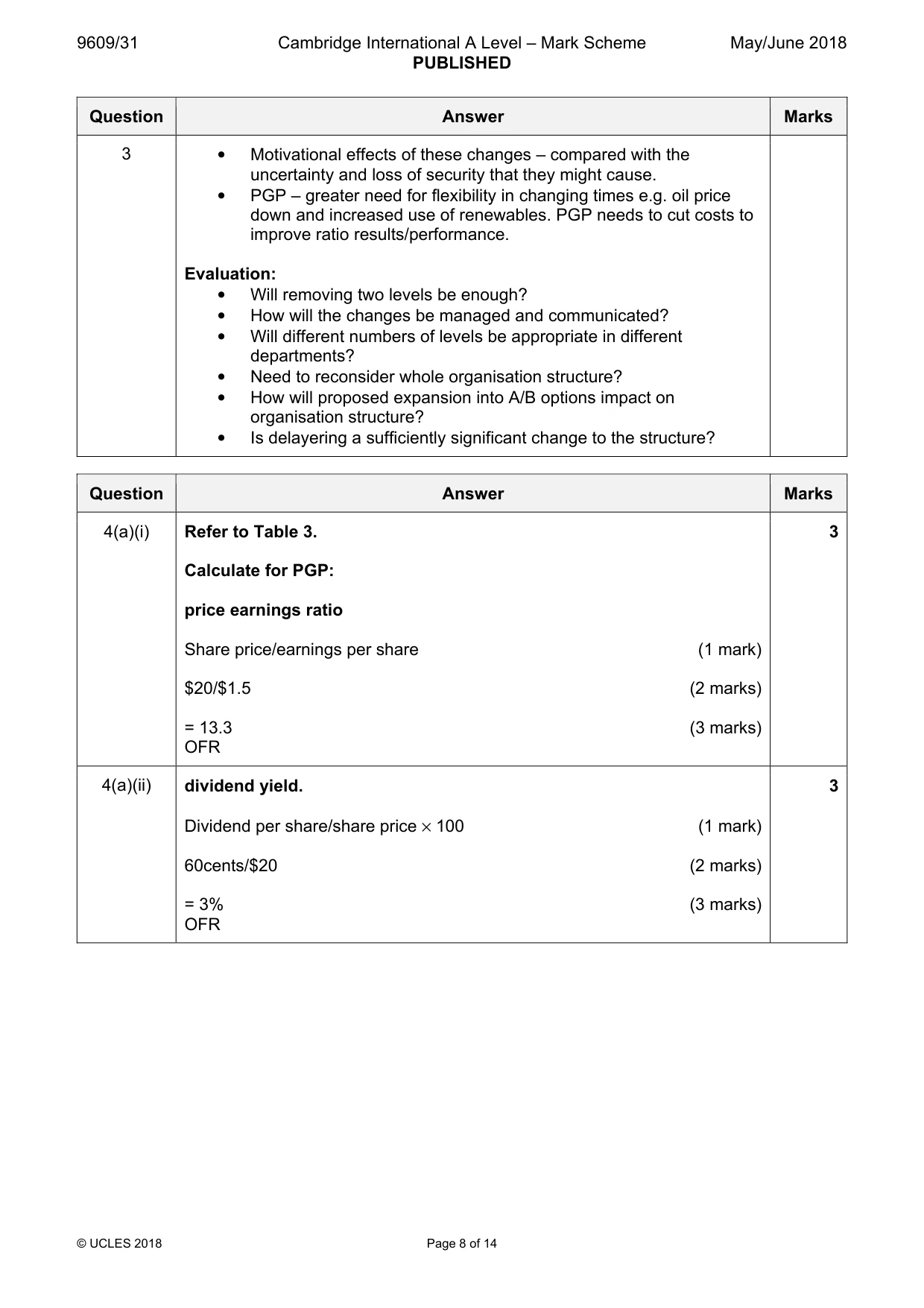
9609/31 Cambridge International A Level – Mark Scheme PUBLISHED May/June 2018 © UCLES 2018 Page 8 of 14 Question Answer Marks 3 • Motivational effects of these changes – compared with the uncertainty and loss of security that they might cause. • PGP – greater need for flexibility in changing times e.g. oil price down and increased use of renewables. PGP needs to cut costs to improve ratio results/performance. Evaluation: • Will removing two levels be enough? • How will the changes be managed and communicated? • Will different numbers of levels be appropriate in different departments? • Need to reconsider whole organisation structure? • How will proposed expansion into A/B options impact on organisation structure? • Is delayering a sufficiently significant change to the structure? Question Answer Marks 4(a)(i) Refer to Table 3. Calculate for PGP: price earnings ratio Share price/earnings per share (1 mark) $20/$1.5 (2 marks) = 13.3 (3 marks) OFR 3 4(a)(ii) dividend yield. Dividend per share/share price × 100 (1 mark) 60cents/$20 (2 marks) = 3% (3 marks) OFR 3
Mark scheme, page 9
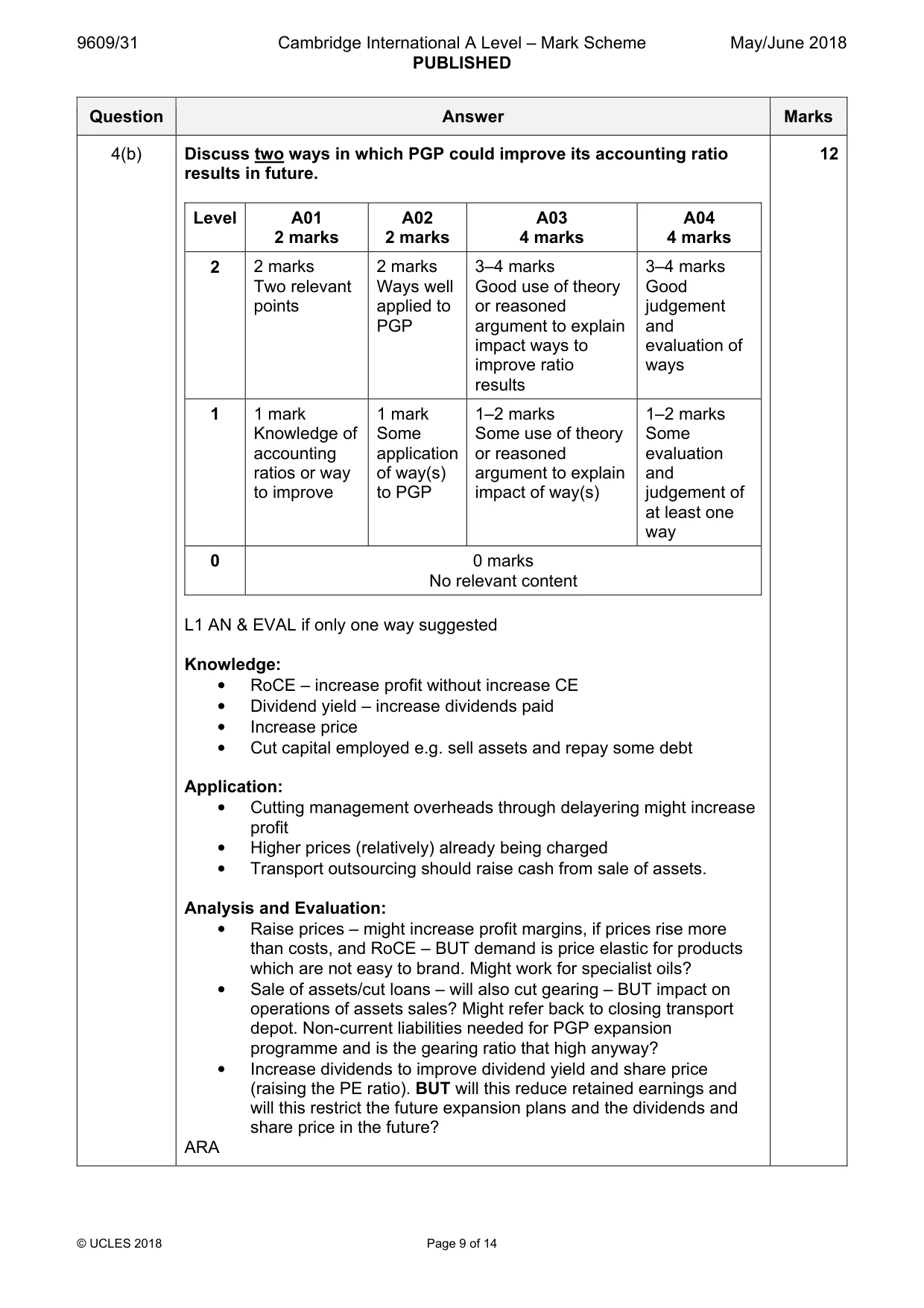
9609/31 Cambridge International A Level – Mark Scheme PUBLISHED May/June 2018 © UCLES 2018 Page 9 of 14 Question Answer Marks 4(b) Discuss two ways in which PGP could improve its accounting ratio results in future. Level A01 2 marks A02 2 marks A03 4 marks A04 4 marks 2 2 marks Two relevant points 2 marks Ways well applied to PGP 3–4 marks Good use of theory or reasoned argument to explain impact ways to improve ratio results 3–4 marks Good judgement and evaluation of ways 1 1 mark Knowledge of accounting ratios or way to improve 1 mark Some application of way(s) to PGP 1–2 marks Some use of theory or reasoned argument to explain impact of way(s) 1–2 marks Some evaluation and judgement of at least one way 0 0 marks No relevant content L1 AN & EVAL if only one way suggested Knowledge: • RoCE – increase profit without increase CE • Dividend yield – increase dividends paid • Increase price • Cut capital employed e.g. sell assets and repay some debt Application: • Cutting management overheads through delayering might increase profit • Higher prices (relatively) already being charged • Transport outsourcing should raise cash from sale of assets. Analysis and Evaluation: • Raise prices – might increase profit margins, if prices rise more than costs, and RoCE – BUT demand is price elastic for products which are not easy to brand. Might work for specialist oils? • Sale of assets/cut loans – will also cut gearing – BUT impact on operations of assets sales? Might refer back to closing transport depot. Non-current liabilities needed for PGP expansion programme and is the gearing ratio that high anyway? • Increase dividends to improve dividend yield and share price (raising the PE ratio). BUT will this reduce retained earnings and will this restrict the future expansion plans and the dividends and share price in the future? ARA 12
Mark scheme, page 10
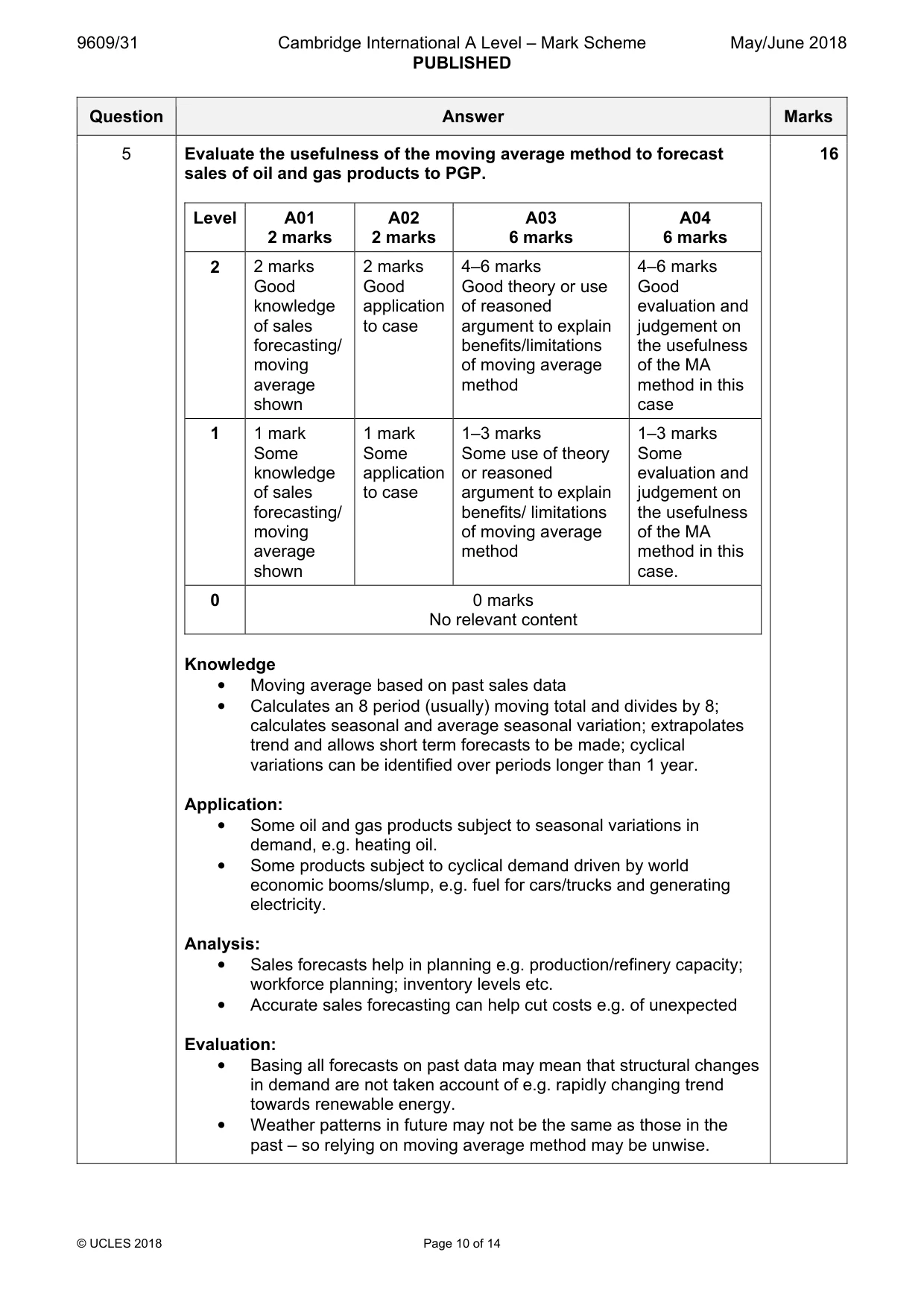
9609/31 Cambridge International A Level – Mark Scheme PUBLISHED May/June 2018 © UCLES 2018 Page 10 of 14 Question Answer Marks 5 Evaluate the usefulness of the moving average method to forecast sales of oil and gas products to PGP. Level A01 2 marks A02 2 marks A03 6 marks A04 6 marks 2 2 marks Good knowledge of sales forecasting/ moving average shown 2 marks Good application to case 4–6 marks Good theory or use of reasoned argument to explain benefits/limitations of moving average method 4–6 marks Good evaluation and judgement on the usefulness of the MA method in this case 1 1 mark Some knowledge of sales forecasting/ moving average shown 1 mark Some application to case 1–3 marks Some use of theory or reasoned argument to explain benefits/ limitations of moving average method 1–3 marks Some evaluation and judgement on the usefulness of the MA method in this case. 0 0 marks No relevant content Knowledge • Moving average based on past sales data • Calculates an 8 period (usually) moving total and divides by 8; calculates seasonal and average seasonal variation; extrapolates trend and allows short term forecasts to be made; cyclical variations can be identified over periods longer than 1 year. Application: • Some oil and gas products subject to seasonal variations in demand, e.g. heating oil. • Some products subject to cyclical demand driven by world economic booms/slump, e.g. fuel for cars/trucks and generating electricity. Analysis: • Sales forecasts help in planning e.g. production/refinery capacity; workforce planning; inventory levels etc. • Accurate sales forecasting can help cut costs e.g. of unexpected Evaluation: • Basing all forecasts on past data may mean that structural changes in demand are not taken account of e.g. rapidly changing trend towards renewable energy. • Weather patterns in future may not be the same as those in the past – so relying on moving average method may be unwise. 16
Mark scheme, page 11
9609/31 Cambridge International A Level – Mark Scheme PUBLISHED May/June 2018 © UCLES 2018 Page 11 of 14 Question Answer Marks 5 • Should be used – but with caution and with use of other methods too e.g. market research to assess demand for new products such as lubricants for jet engines. • Use as much past data as possible but most recent is most relevant. • Adjust for trends that did not appear in past data.
Mark scheme, page 12
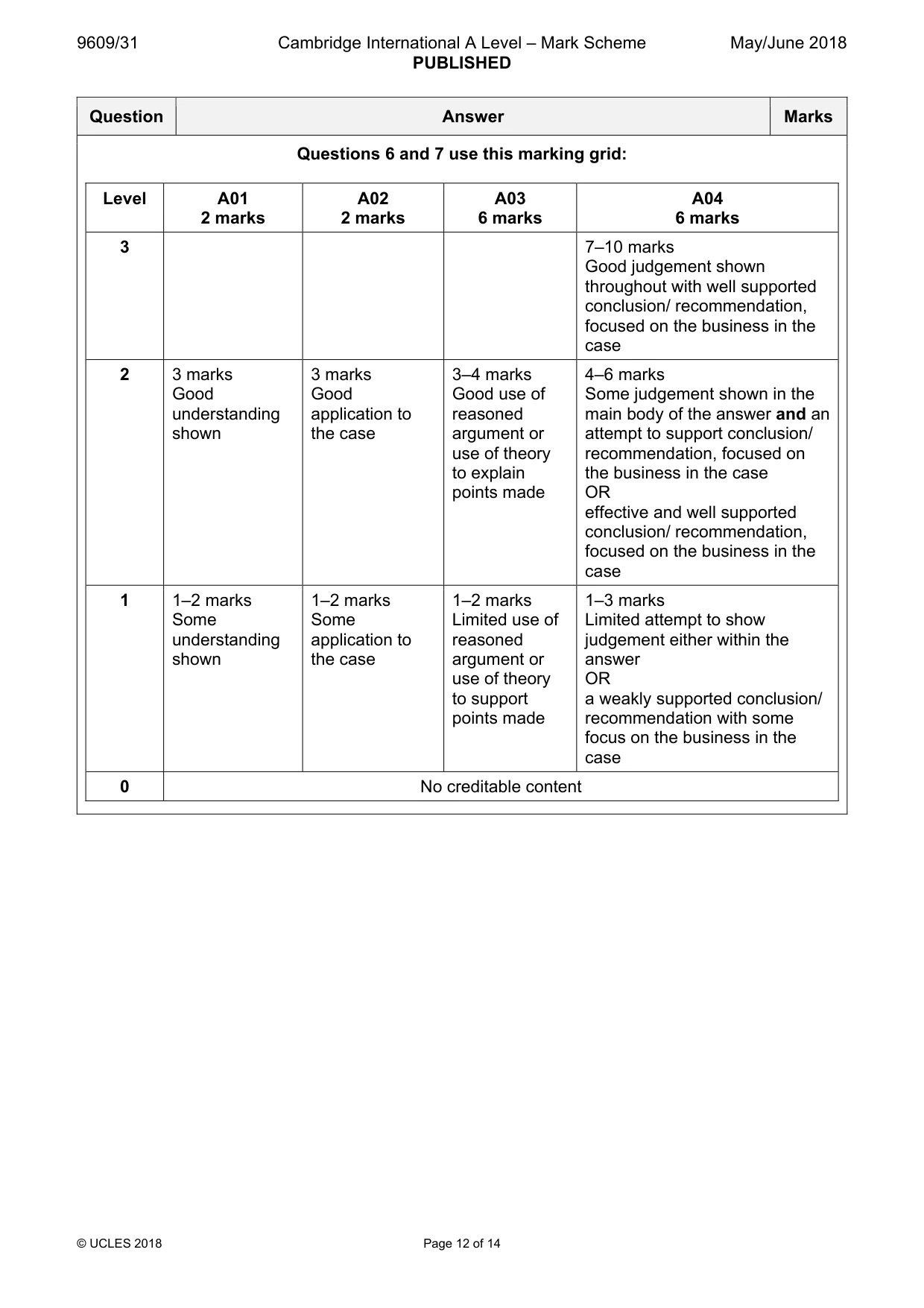
9609/31 Cambridge International A Level – Mark Scheme PUBLISHED May/June 2018 © UCLES 2018 Page 12 of 14 Question Answer Marks Questions 6 and 7 use this marking grid: Level A01 2 marks A02 2 marks A03 6 marks A04 6 marks 3 7–10 marks Good judgement shown throughout with well supported conclusion/ recommendation, focused on the business in the case 2 3 marks Good understanding shown 3 marks Good application to the case 3–4 marks Good use of reasoned argument or use of theory to explain points made 4–6 marks Some judgement shown in the main body of the answer and an attempt to support conclusion/ recommendation, focused on the business in the case OR effective and well supported conclusion/ recommendation, focused on the business in the case 1 1–2 marks Some understanding shown 1–2 marks Some application to the case 1–2 marks Limited use of reasoned argument or use of theory to support points made 1–3 marks Limited attempt to show judgement either within the answer OR a weakly supported conclusion/ recommendation with some focus on the business in the case 0 No creditable content
Mark scheme, page 13
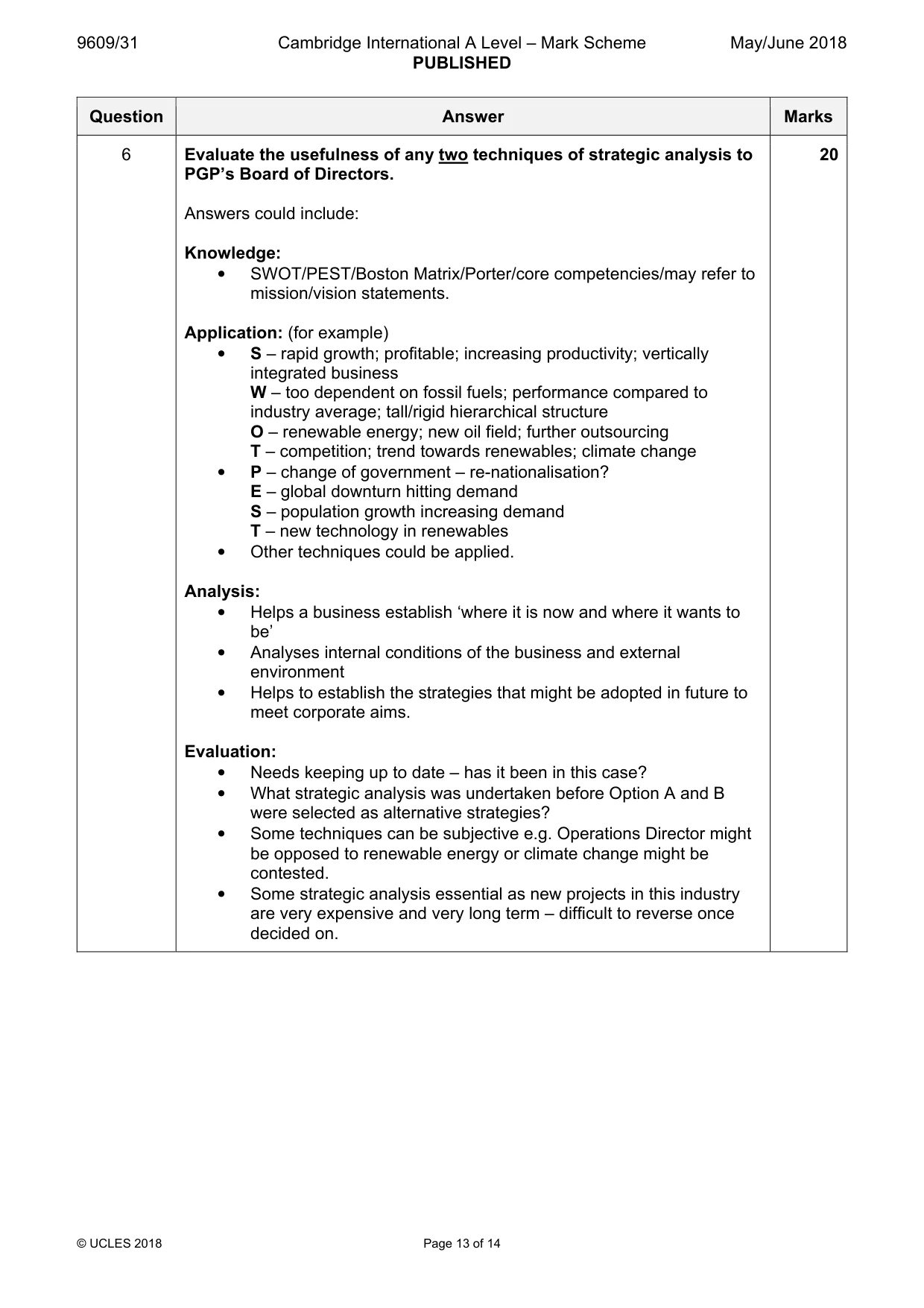
9609/31 Cambridge International A Level – Mark Scheme PUBLISHED May/June 2018 © UCLES 2018 Page 13 of 14 Question Answer Marks 6 Evaluate the usefulness of any two techniques of strategic analysis to PGP’s Board of Directors. Answers could include: Knowledge: • SWOT/PEST/Boston Matrix/Porter/core competencies/may refer to mission/vision statements. Application: (for example) • S – rapid growth; profitable; increasing productivity; vertically integrated business W – too dependent on fossil fuels; performance compared to industry average; tall/rigid hierarchical structure O – renewable energy; new oil field; further outsourcing T – competition; trend towards renewables; climate change • P – change of government – re-nationalisation? E – global downturn hitting demand S – population growth increasing demand T – new technology in renewables • Other techniques could be applied. Analysis: • Helps a business establish ‘where it is now and where it wants to be’ • Analyses internal conditions of the business and external environment • Helps to establish the strategies that might be adopted in future to meet corporate aims. Evaluation: • Needs keeping up to date – has it been in this case? • What strategic analysis was undertaken before Option A and B were selected as alternative strategies? • Some techniques can be subjective e.g. Operations Director might be opposed to renewable energy or climate change might be contested. • Some strategic analysis essential as new projects in this industry are very expensive and very long term – difficult to reverse once decided on. 20
Mark scheme, page 14
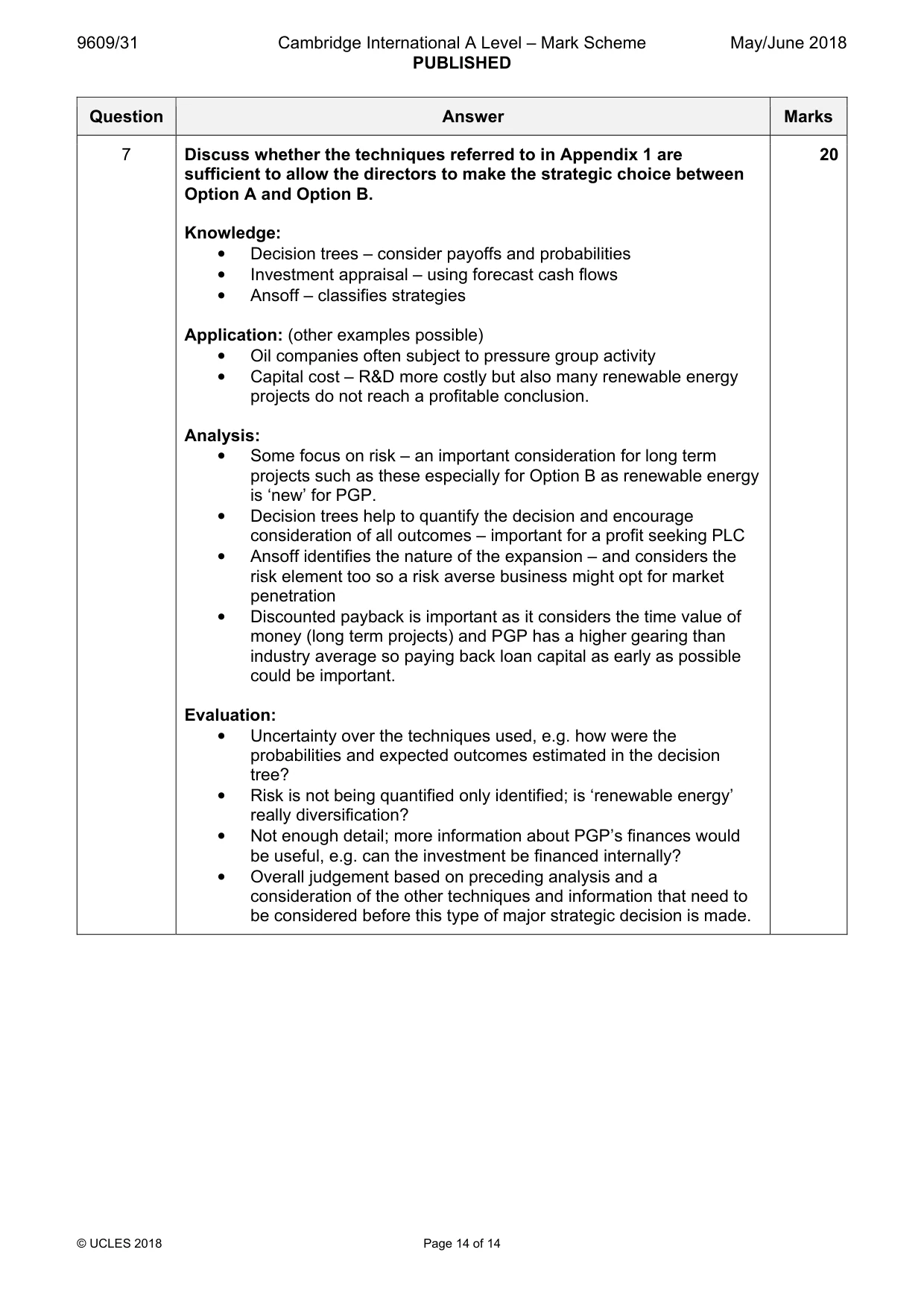
9609/31 Cambridge International A Level – Mark Scheme PUBLISHED May/June 2018 © UCLES 2018 Page 14 of 14 Question Answer Marks 7 Discuss whether the techniques referred to in Appendix 1 are sufficient to allow the directors to make the strategic choice between Option A and Option B. Knowledge: • Decision trees – consider payoffs and probabilities • Investment appraisal – using forecast cash flows • Ansoff – classifies strategies Application: (other examples possible) • Oil companies often subject to pressure group activity • Capital cost – R&D more costly but also many renewable energy projects do not reach a profitable conclusion. Analysis: • Some focus on risk – an important consideration for long term projects such as these especially for Option B as renewable energy is ‘new’ for PGP. • Decision trees help to quantify the decision and encourage consideration of all outcomes – important for a profit seeking PLC • Ansoff identifies the nature of the expansion – and considers the risk element too so a risk averse business might opt for market penetration • Discounted payback is important as it considers the time value of money (long term projects) and PGP has a higher gearing than industry average so paying back loan capital as early as possible could be important. Evaluation: • Uncertainty over the techniques used, e.g. how were the probabilities and expected outcomes estimated in the decision tree? • Risk is not being quantified only identified; is ‘renewable energy’ really diversification? • Not enough detail; more information about PGP’s finances would be useful, e.g. can the investment be financed internally? • Overall judgement based on preceding analysis and a consideration of the other techniques and information that need to be considered before this type of major strategic decision is made. 20
What you needed in this session
Cambridge’s own grade thresholds for 2018 May/June, Paper 3 · Variant 1. A higher threshold means an easier paper — the bar moves with how the cohort did.