Cambridge A Level Business (for first examination in 2016) 9609 — 2017 Feb/March Paper 3 · Variant 2
9609/32/F/M/17 · 100 marks · ≈113 min
The question paper and its mark scheme, free to read here and free to download. This is Cambridge’s own paper, exactly as it was sat.
Question paper8 pages

Mark scheme17 pages
Answers below. Sit the paper first if you are practising.
Paper as text
Question paper, page 1
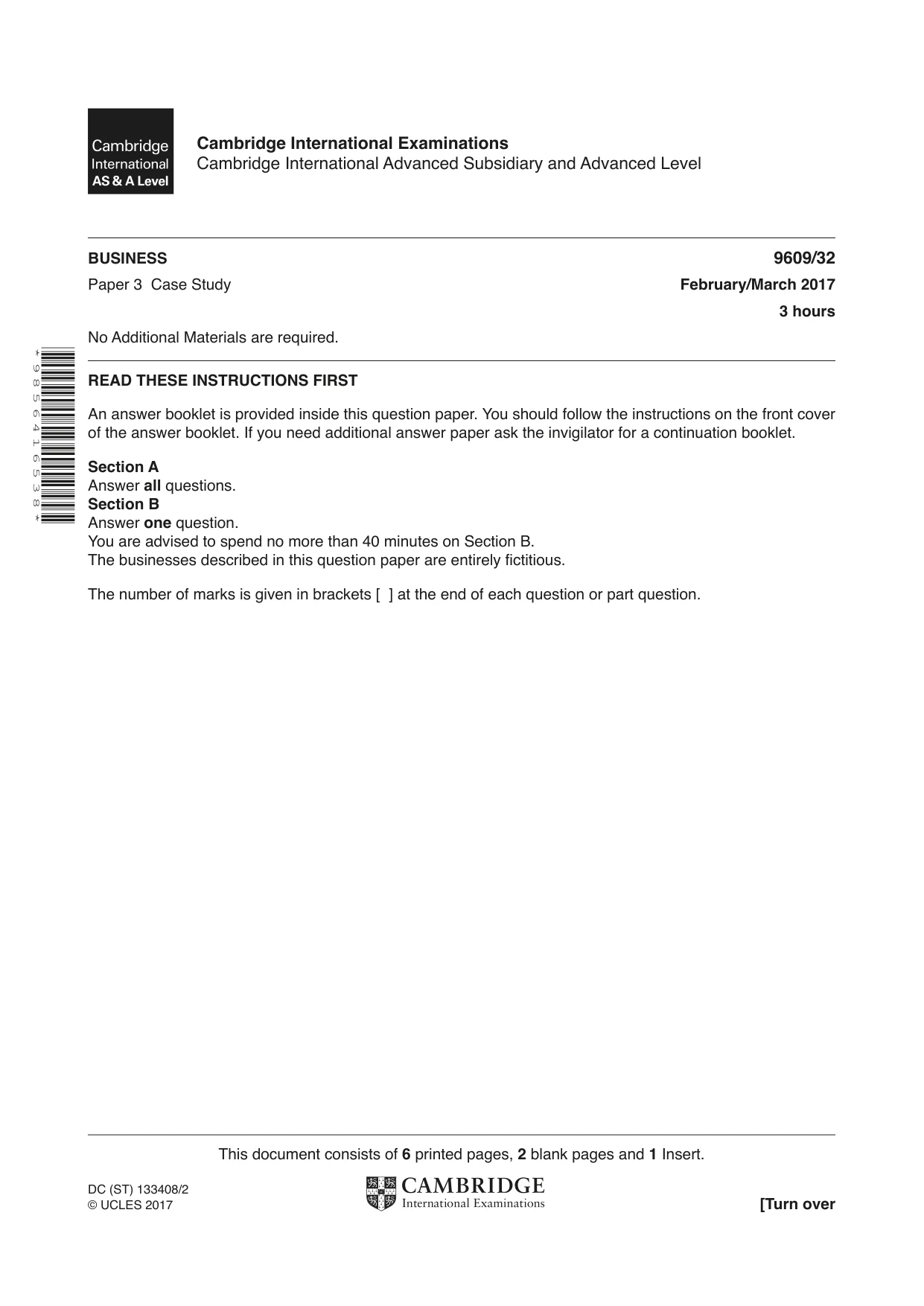
This document consists of 6 printed pages, 2 blank pages and 1 Insert. DC (ST) 133408/2 © UCLES 2017 [Turn over Cambridge International Examinations Cambridge International Advanced Subsidiary and Advanced Level * 9 8 5 6 4 1 6 5 3 8 * BUSINESS 9609/32 Paper 3 Case Study February/March 2017 3 hours No Additional Materials are required. READ THESE INSTRUCTIONS FIRST An answer booklet is provided inside this question paper. You should follow the instructions on the front cover of the answer booklet. If you need additional answer paper ask the invigilator for a continuation booklet. Section A Answer all questions. Section B Answer one question. You are advised to spend no more than 40 minutes on Section B. The businesses described in this question paper are entirely fictitious. The number of marks is given in brackets [ ] at the end of each question or part question.
Question paper, page 2
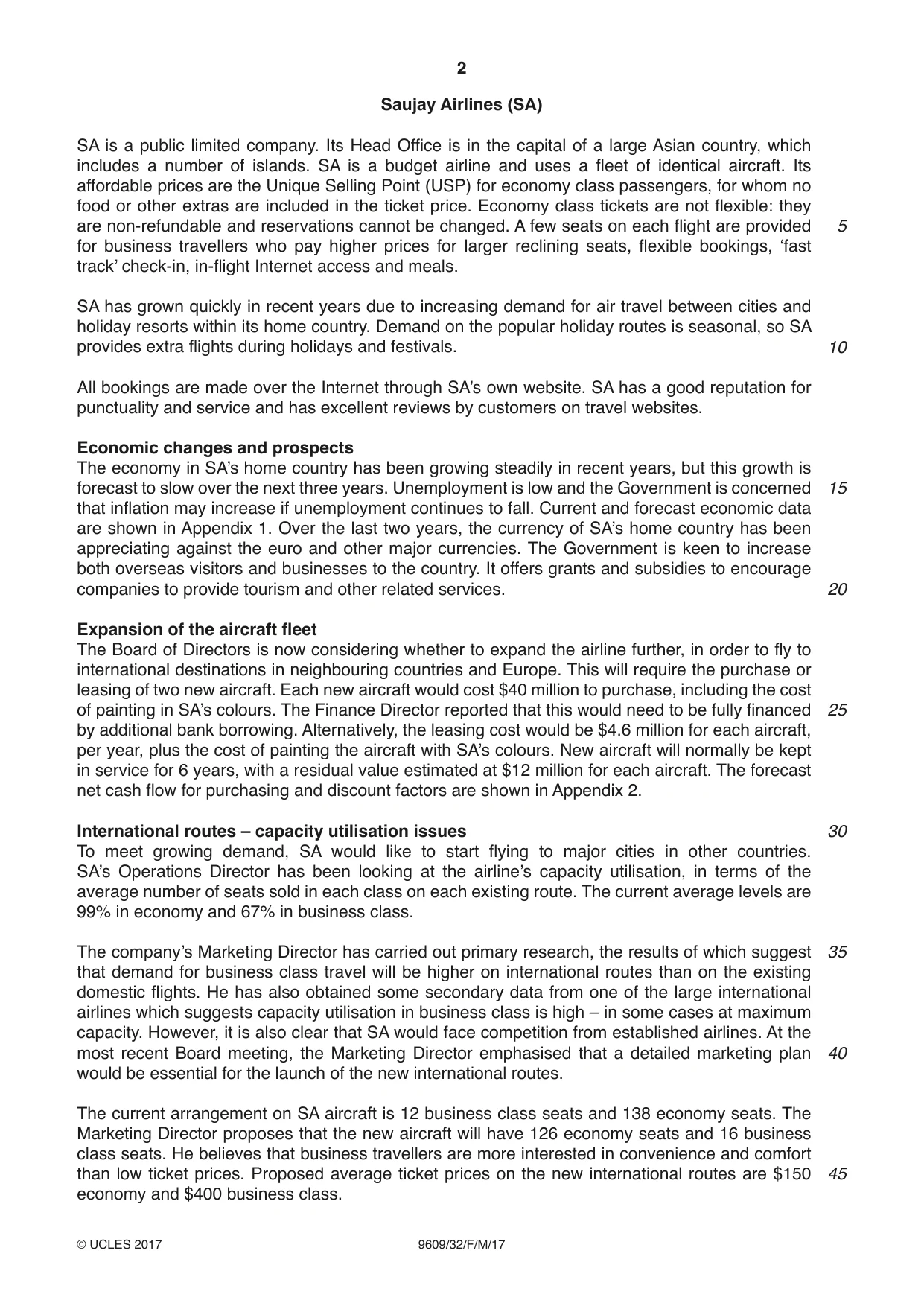
2 9609/32/F/M/17 © UCLES 2017 Saujay Airlines (SA) SA is a public limited company. Its Head Office is in the capital of a large Asian country, which includes a number of islands. SA is a budget airline and uses a fleet of identical aircraft. Its affordable prices are the Unique Selling Point (USP) for economy class passengers, for whom no food or other extras are included in the ticket price. Economy class tickets are not flexible: they are non-refundable and reservations cannot be changed. A few seats on each flight are provided for business travellers who pay higher prices for larger reclining seats, flexible bookings, ‘fast track’ check-in, in-flight Internet access and meals. SA has grown quickly in recent years due to increasing demand for air travel between cities and holiday resorts within its home country. Demand on the popular holiday routes is seasonal, so SA provides extra flights during holidays and festivals. All bookings are made over the Internet through SA’s own website. SA has a good reputation for punctuality and service and has excellent reviews by customers on travel websites. Economic changes and prospects The economy in SA’s home country has been growing steadily in recent years, but this growth is forecast to slow over the next three years. Unemployment is low and the Government is concerned that inflation may increase if unemployment continues to fall. Current and forecast economic data are shown in Appendix 1. Over the last two years, the currency of SA’s home country has been appreciating against the euro and other major currencies. The Government is keen to increase both overseas visitors and businesses to the country. It offers grants and subsidies to encourage companies to provide tourism and other related services. Expansion of the aircraft fleet The Board of Directors is now considering whether to expand the airline further, in order to fly to international destinations in neighbouring countries and Europe. This will require the purchase or leasing of two new aircraft. Each new aircraft would cost $40 million to purchase, including the cost of painting in SA’s colours. The Finance Director reported that this would need to be fully financed by additional bank borrowing. Alternatively, the leasing cost would be $4.6 million for each aircraft, per year, plus the cost of painting the aircraft with SA’s colours. New aircraft will normally be kept in service for 6 years, with a residual value estimated at $12 million for each aircraft. The forecast net cash flow for purchasing and discount factors are shown in Appendix 2. International routes – capacity utilisation issues To meet growing demand, SA would like to start flying to major cities in other countries. SA’s Operations Director has been looking at the airline’s capacity utilisation, in terms of the average number of seats sold in each class on each existing route. The current average levels are 99% in economy and 67% in business class. The company’s Marketing Director has carried out primary research, the results of which suggest that demand for business class travel will be higher on international routes than on the existing domestic flights. He has also obtained some secondary data from one of the large international airlines which suggests capacity utilisation in business class is high – in some cases at maximum capacity. However, it is also clear that SA would face competition from established airlines. At the most recent Board meeting, the Marketing Director emphasised that a detailed marketing plan would be essential for the launch of the new international routes. The current arrangement on SA aircraft is 12 business class seats and 138 economy seats. The Marketing Director proposes that the new aircraft will have 126 economy seats and 16 business class seats. He believes that business travellers are more interested in convenience and comfort than low ticket prices. Proposed average ticket prices on the new international routes are $150 economy and $400 business class. 5 10 15 20 25 30 35 40 45
Question paper, page 3
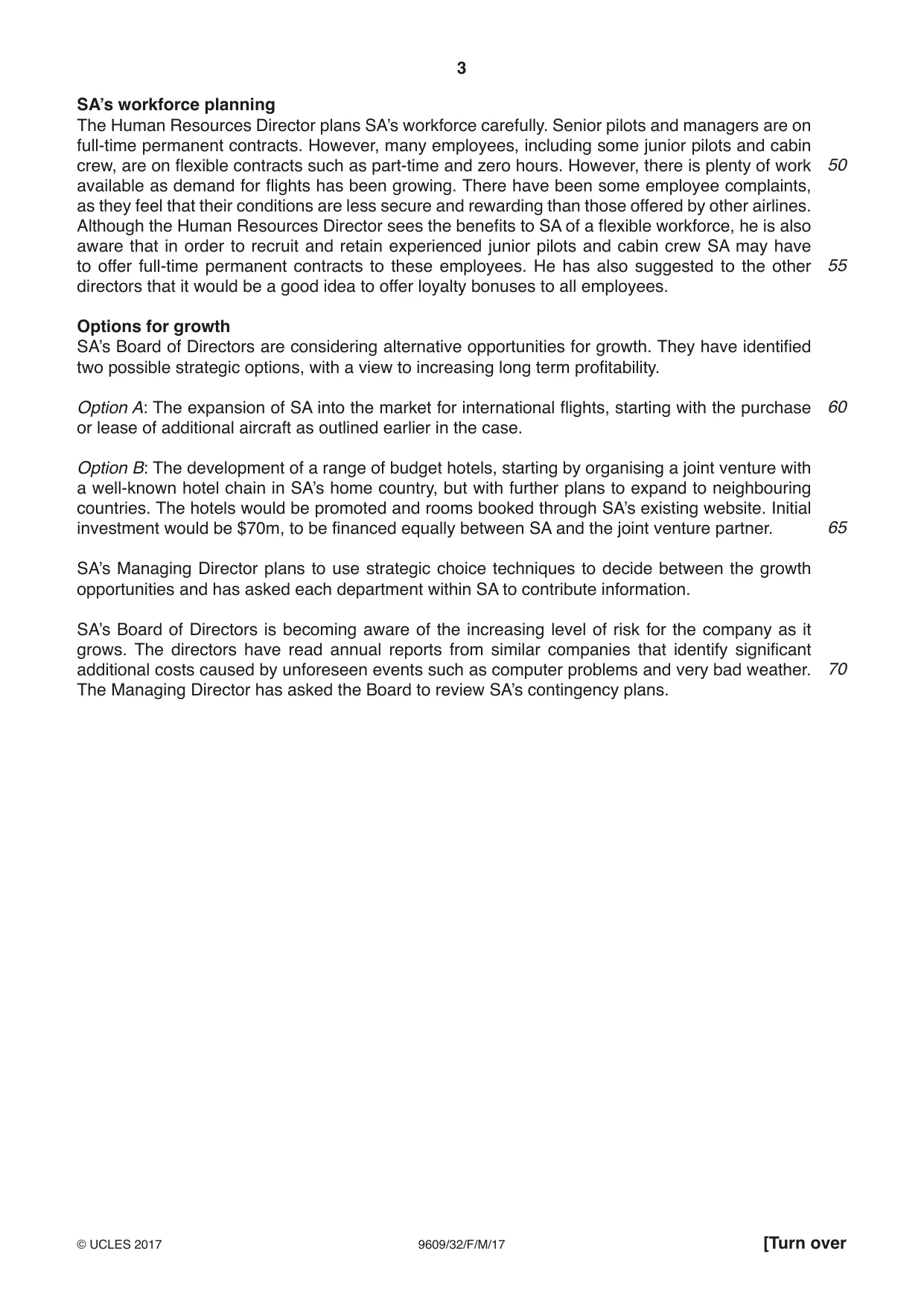
3 9609/32/F/M/17 © UCLES 2017 [Turn over SA’s workforce planning The Human Resources Director plans SA’s workforce carefully. Senior pilots and managers are on full-time permanent contracts. However, many employees, including some junior pilots and cabin crew, are on flexible contracts such as part-time and zero hours. However, there is plenty of work available as demand for flights has been growing. There have been some employee complaints, as they feel that their conditions are less secure and rewarding than those offered by other airlines. Although the Human Resources Director sees the benefits to SA of a flexible workforce, he is also aware that in order to recruit and retain experienced junior pilots and cabin crew SA may have to offer full-time permanent contracts to these employees. He has also suggested to the other directors that it would be a good idea to offer loyalty bonuses to all employees. Options for growth SA’s Board of Directors are considering alternative opportunities for growth. They have identified two possible strategic options, with a view to increasing long term profitability. Option A: The expansion of SA into the market for international flights, starting with the purchase or lease of additional aircraft as outlined earlier in the case. Option B: The development of a range of budget hotels, starting by organising a joint venture with a well-known hotel chain in SA’s home country, but with further plans to expand to neighbouring countries. The hotels would be promoted and rooms booked through SA’s existing website. Initial investment would be $70m, to be financed equally between SA and the joint venture partner. SA’s Managing Director plans to use strategic choice techniques to decide between the growth opportunities and has asked each department within SA to contribute information. SA’s Board of Directors is becoming aware of the increasing level of risk for the company as it grows. The directors have read annual reports from similar companies that identify significant additional costs caused by unforeseen events such as computer problems and very bad weather. The Managing Director has asked the Board to review SA’s contingency plans. 50 55 60 65 70
Question paper, page 4
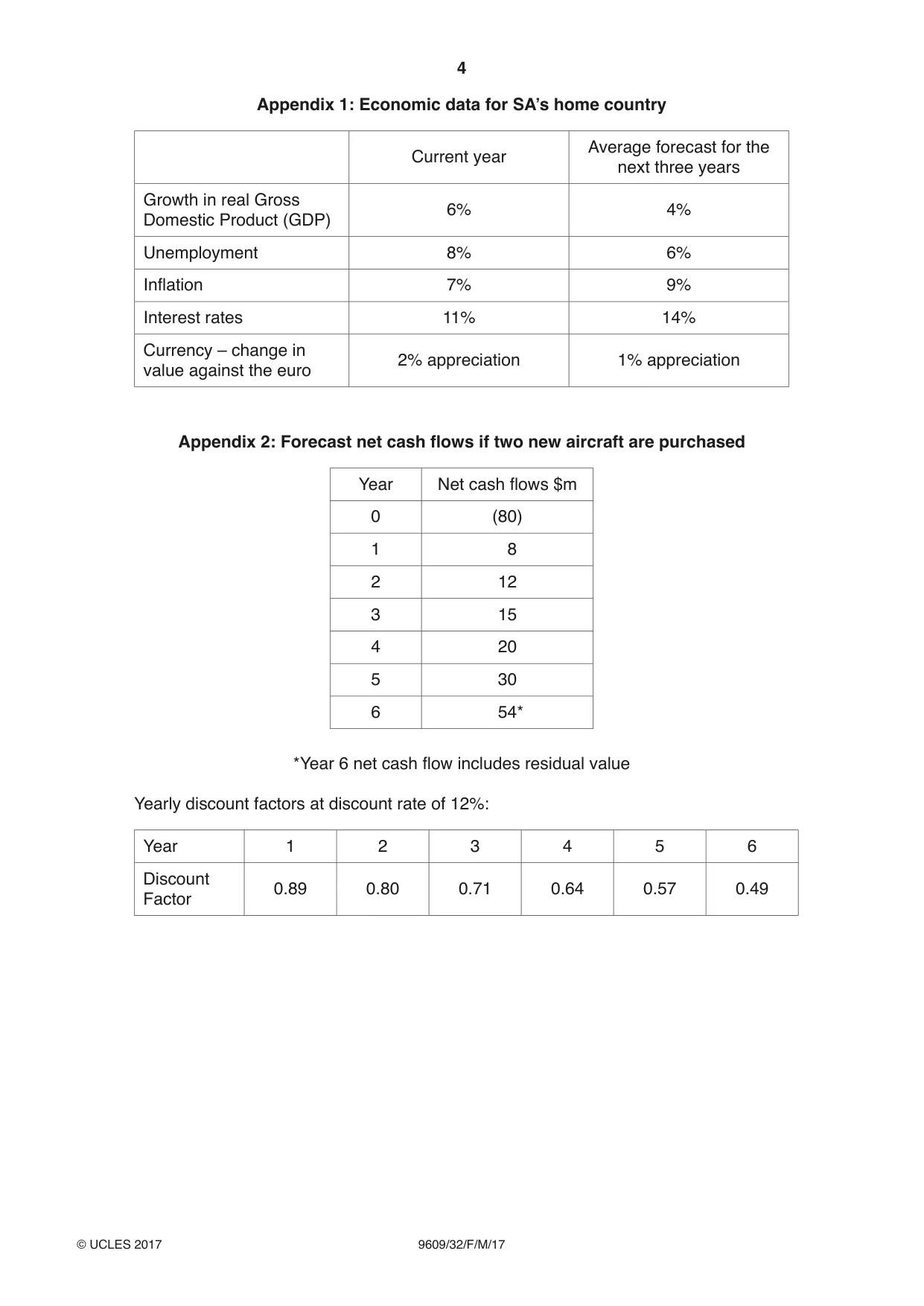
4 9609/32/F/M/17 © UCLES 2017 Appendix 1: Economic data for SA’s home country Current year Average forecast for the next three years Growth in real Gross Domestic Product (GDP) 6% 4% Unemployment 8% 6% Inflation 7% 9% Interest rates 11% 14% Currency – change in value against the euro 2% appreciation 1% appreciation Appendix 2: Forecast net cash flows if two new aircraft are purchased Year Net cash flows $m 0 (80) 1 8 2 12 3 15 4 20 5 30 6 54* *Year 6 net cash flow includes residual value Yearly discount factors at discount rate of 12%: Year 1 2 3 4 5 6 Discount Factor 0.89 0.80 0.71 0.64 0.57 0.49
Question paper, page 5
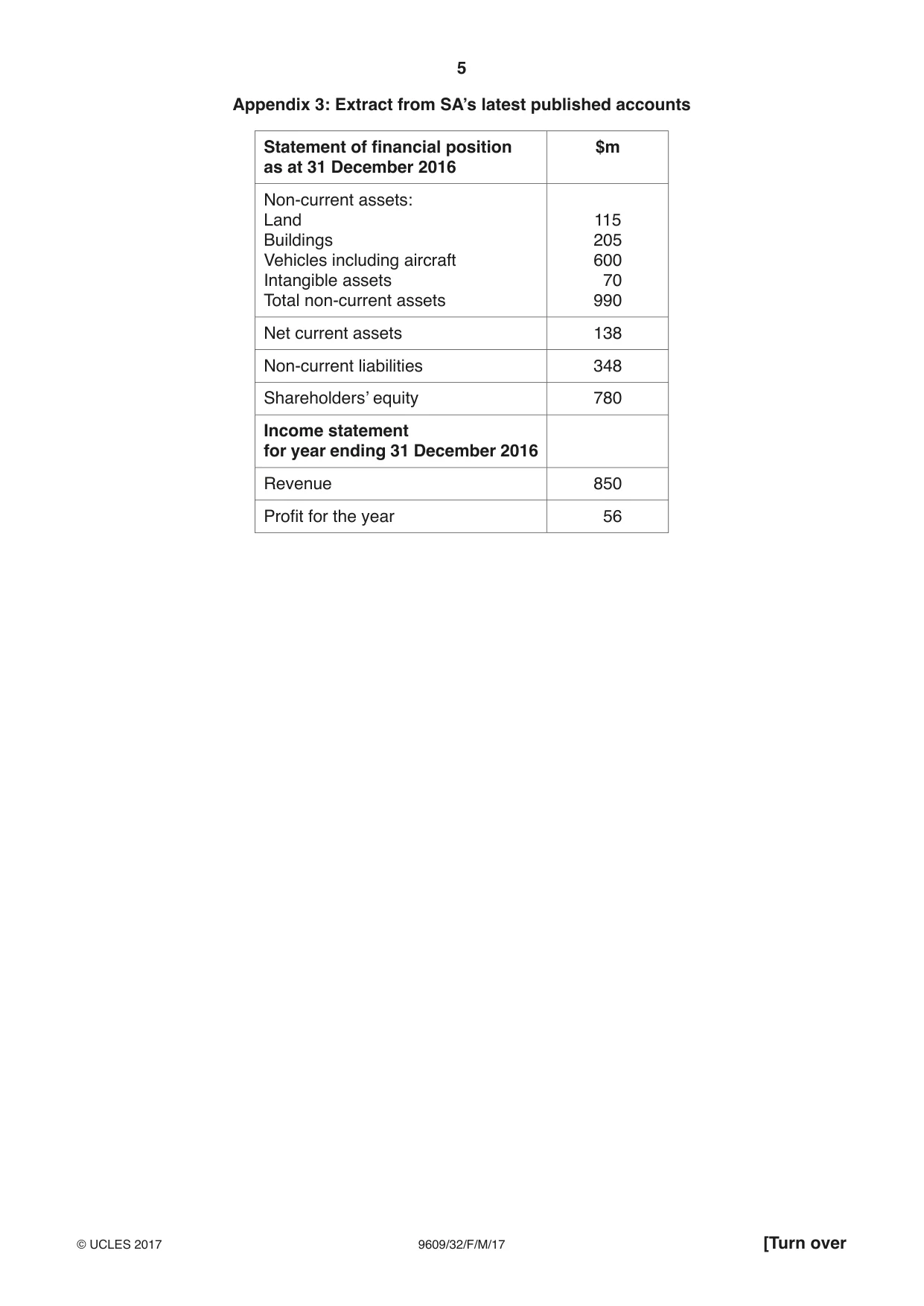
5 9609/32/F/M/17 © UCLES 2017 [Turn over Appendix 3: Extract from SA’s latest published accounts Statement of financial position as at 31 December 2016 $m Non-current assets: Land Buildings Vehicles including aircraft Intangible assets Total non-current assets 115 205 600 70 990 Net current assets 138 Non-current liabilities 348 Shareholders’ equity 780 Income statement for year ending 31 December 2016 Revenue 850 Profit for the year 56
Question paper, page 6
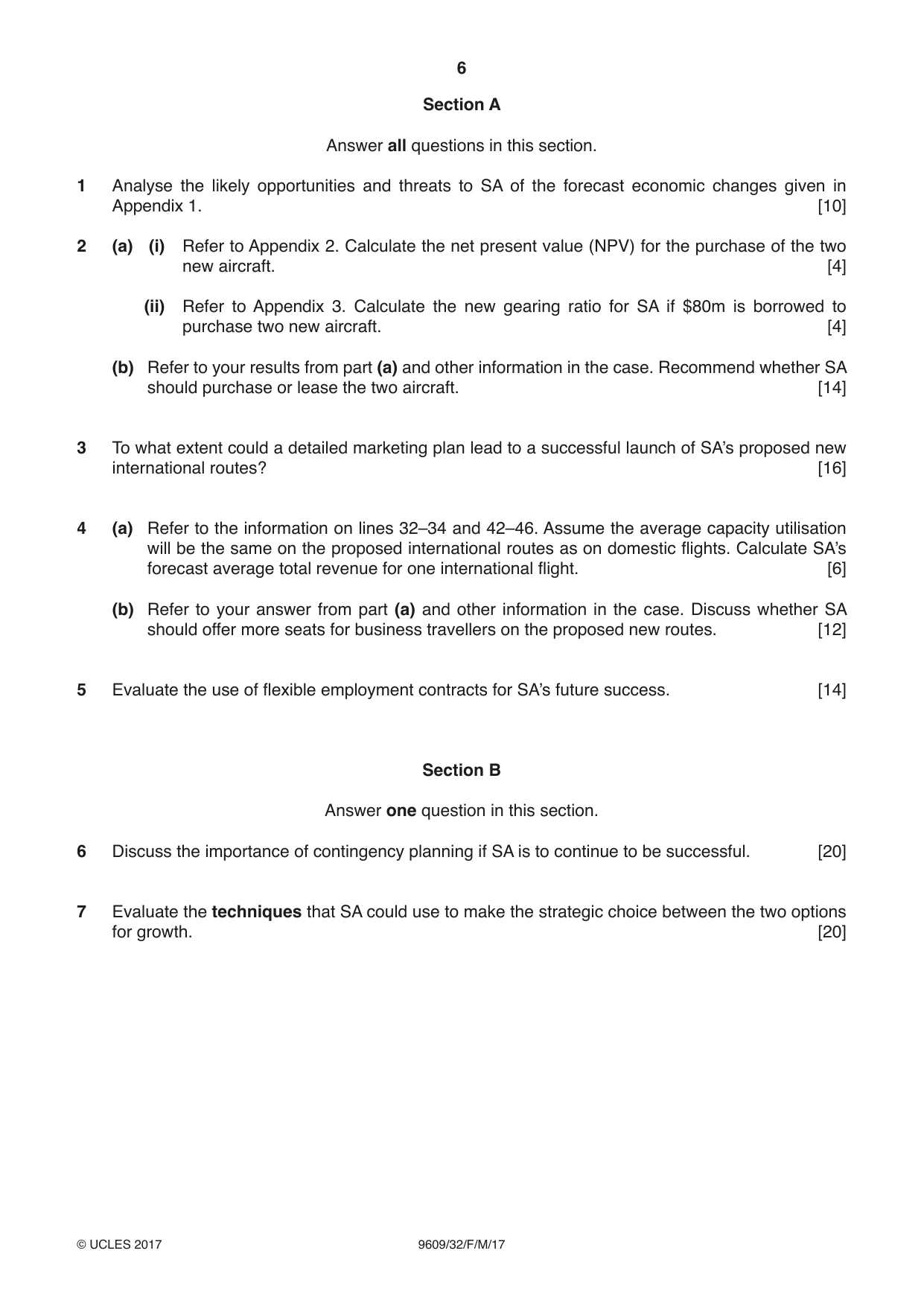
6 9609/32/F/M/17 © UCLES 2017 Section A Answer all questions in this section. 1 Analyse the likely opportunities and threats to SA of the forecast economic changes given in Appendix 1. [10] 2 (a) (i) Refer to Appendix 2. Calculate the net present value (NPV) for the purchase of the two new aircraft. [4] (ii) Refer to Appendix 3. Calculate the new gearing ratio for SA if $80m is borrowed to purchase two new aircraft. [4] (b) Refer to your results from part (a) and other information in the case. Recommend whether SA should purchase or lease the two aircraft. [14] 3 To what extent could a detailed marketing plan lead to a successful launch of SA’s proposed new international routes? [16] 4 (a) Refer to the information on lines 32–34 and 42–46. Assume the average capacity utilisation will be the same on the proposed international routes as on domestic flights. Calculate SA’s forecast average total revenue for one international flight. [6] (b) Refer to your answer from part (a) and other information in the case. Discuss whether SA should offer more seats for business travellers on the proposed new routes. [12] 5 Evaluate the use of flexible employment contracts for SA’s future success. [14] Section B Answer one question in this section. 6 Discuss the importance of contingency planning if SA is to continue to be successful. [20] 7 Evaluate the techniques that SA could use to make the strategic choice between the two options for growth. [20]
Question paper, page 7
7 9609/32/F/M/17 © UCLES 2017 BLANK PAGE
Question paper, page 8
8 9609/32/F/M/17 © UCLES 2017 Permission to reproduce items where third-party owned material protected by copyright is included has been sought and cleared where possible. Every reasonable effort has been made by the publisher (UCLES) to trace copyright holders, but if any items requiring clearance have unwittingly been included, the publisher will be pleased to make amends at the earliest possible opportunity. To avoid the issue of disclosure of answer-related information to candidates, all copyright acknowledgements are reproduced online in the Cambridge International Examinations Copyright Acknowledgements Booklet. This is produced for each series of examinations and is freely available to download at www.cie.org.uk after the live examination series. Cambridge International Examinations is part of the Cambridge Assessment Group. Cambridge Assessment is the brand name of University of Cambridge Local Examinations Syndicate (UCLES), which is itself a department of the University of Cambridge. BLANK PAGE
Mark scheme, page 1
® IGCSE is a registered trademark. This document consists of 17 printed pages. © UCLES 2017 [Turn over Cambridge International Examinations Cambridge International Advanced Level BUSINESS 9609/32 Paper 3 Case Study March 2017 MARK SCHEME Maximum Mark: 100 Published This mark scheme is published as an aid to teachers and candidates, to indicate the requirements of the examination. It shows the basis on which Examiners were instructed to award marks. It does not indicate the details of the discussions that took place at an Examiners’ meeting before marking began, which would have considered the acceptability of alternative answers. Mark schemes should be read in conjunction with the question paper and the Principal Examiner Report for Teachers. Cambridge will not enter into discussions about these mark schemes. Cambridge is publishing the mark schemes for the March 2017 series for most Cambridge IGCSE®, Cambridge International A and AS Level components and some Cambridge O Level components.
Mark scheme, page 2
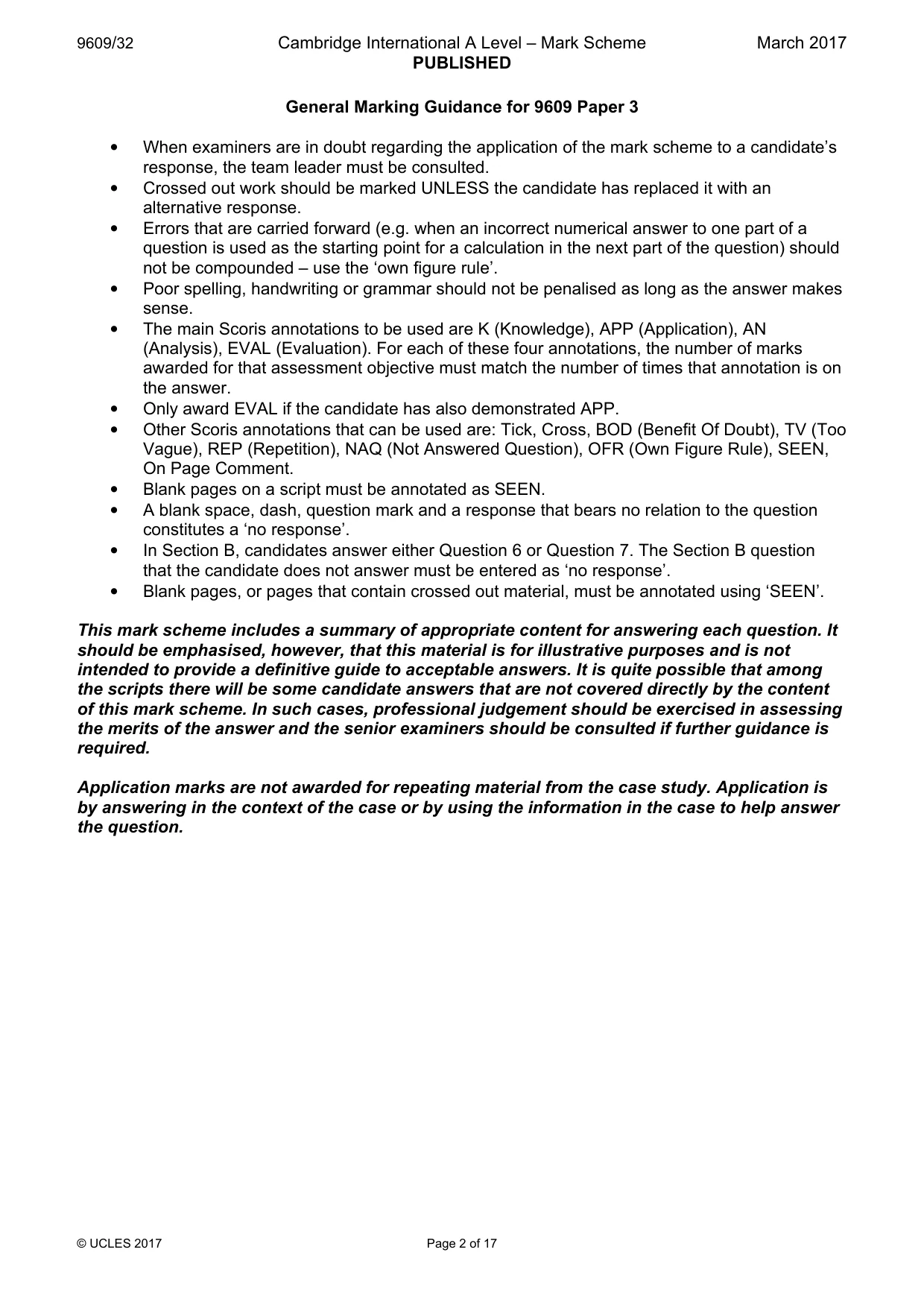
9609/32 Cambridge International A Level – Mark Scheme PUBLISHED March 2017 © UCLES 2017 Page 2 of 17 General Marking Guidance for 9609 Paper 3 • When examiners are in doubt regarding the application of the mark scheme to a candidate’s response, the team leader must be consulted. • Crossed out work should be marked UNLESS the candidate has replaced it with an alternative response. • Errors that are carried forward (e.g. when an incorrect numerical answer to one part of a question is used as the starting point for a calculation in the next part of the question) should not be compounded – use the ‘own figure rule’. • Poor spelling, handwriting or grammar should not be penalised as long as the answer makes sense. • The main Scoris annotations to be used are K (Knowledge), APP (Application), AN (Analysis), EVAL (Evaluation). For each of these four annotations, the number of marks awarded for that assessment objective must match the number of times that annotation is on the answer. • Only award EVAL if the candidate has also demonstrated APP. • Other Scoris annotations that can be used are: Tick, Cross, BOD (Benefit Of Doubt), TV (Too Vague), REP (Repetition), NAQ (Not Answered Question), OFR (Own Figure Rule), SEEN, On Page Comment. • Blank pages on a script must be annotated as SEEN. • A blank space, dash, question mark and a response that bears no relation to the question constitutes a ‘no response’. • In Section B, candidates answer either Question 6 or Question 7. The Section B question that the candidate does not answer must be entered as ‘no response’. • Blank pages, or pages that contain crossed out material, must be annotated using ‘SEEN’. This mark scheme includes a summary of appropriate content for answering each question. It should be emphasised, however, that this material is for illustrative purposes and is not intended to provide a definitive guide to acceptable answers. It is quite possible that among the scripts there will be some candidate answers that are not covered directly by the content of this mark scheme. In such cases, professional judgement should be exercised in assessing the merits of the answer and the senior examiners should be consulted if further guidance is required. Application marks are not awarded for repeating material from the case study. Application is by answering in the context of the case or by using the information in the case to help answer the question.
Mark scheme, page 3
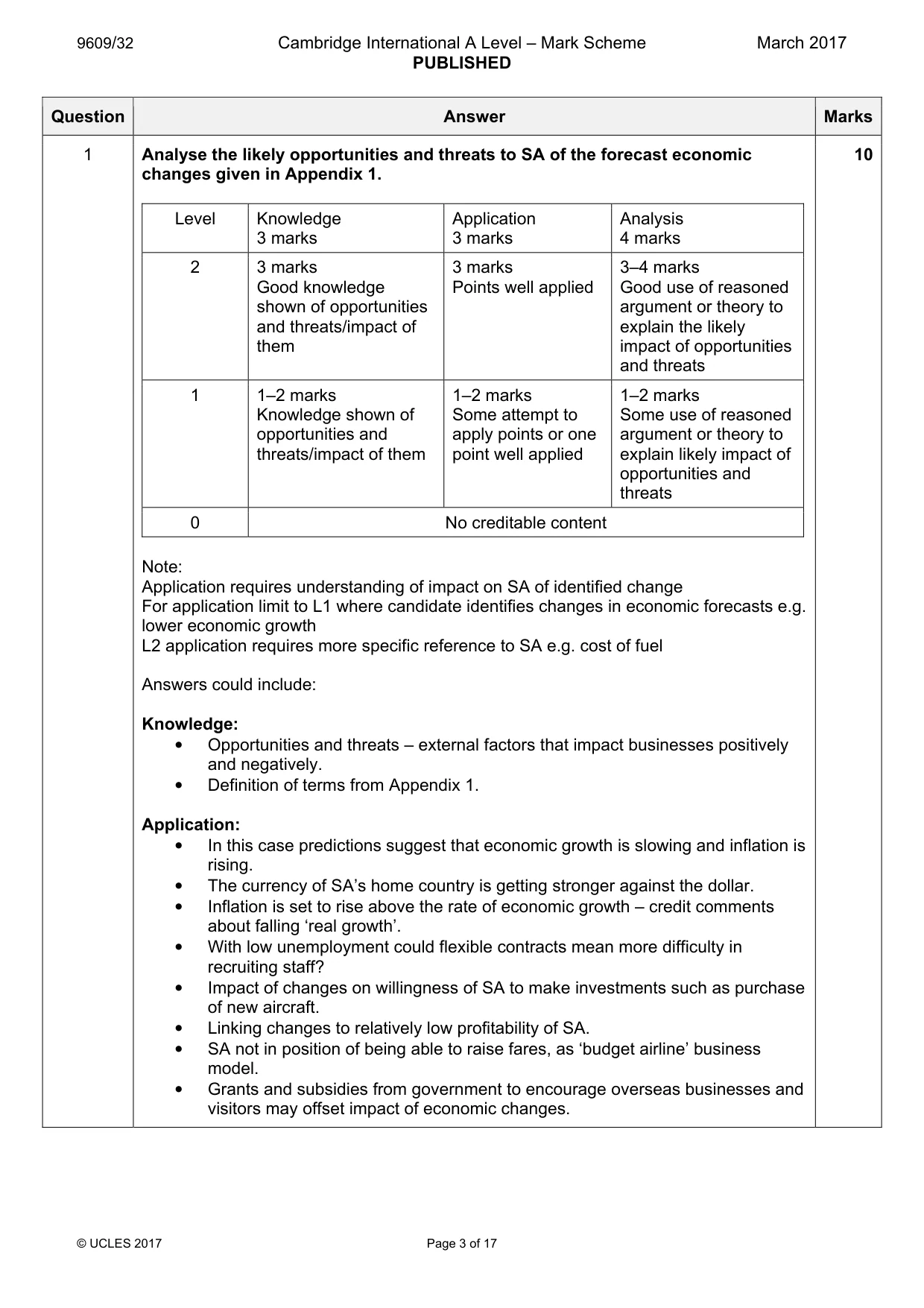
9609/32 Cambridge International A Level – Mark Scheme PUBLISHED March 2017 © UCLES 2017 Page 3 of 17 Question Answer Marks 1 Analyse the likely opportunities and threats to SA of the forecast economic changes given in Appendix 1. Level Knowledge 3 marks Application 3 marks Analysis 4 marks 2 3 marks Good knowledge shown of opportunities and threats/impact of them 3 marks Points well applied 3–4 marks Good use of reasoned argument or theory to explain the likely impact of opportunities and threats 1 1–2 marks Knowledge shown of opportunities and threats/impact of them 1–2 marks Some attempt to apply points or one point well applied 1–2 marks Some use of reasoned argument or theory to explain likely impact of opportunities and threats 0 No creditable content Note: Application requires understanding of impact on SA of identified change For application limit to L1 where candidate identifies changes in economic forecasts e.g. lower economic growth L2 application requires more specific reference to SA e.g. cost of fuel Answers could include: Knowledge: • Opportunities and threats – external factors that impact businesses positively and negatively. • Definition of terms from Appendix 1. Application: • In this case predictions suggest that economic growth is slowing and inflation is rising. • The currency of SA’s home country is getting stronger against the dollar. • Inflation is set to rise above the rate of economic growth – credit comments about falling ‘real growth’. • With low unemployment could flexible contracts mean more difficulty in recruiting staff? • Impact of changes on willingness of SA to make investments such as purchase of new aircraft. • Linking changes to relatively low profitability of SA. • SA not in position of being able to raise fares, as ‘budget airline’ business model. • Grants and subsidies from government to encourage overseas businesses and visitors may offset impact of economic changes. 10
Mark scheme, page 4
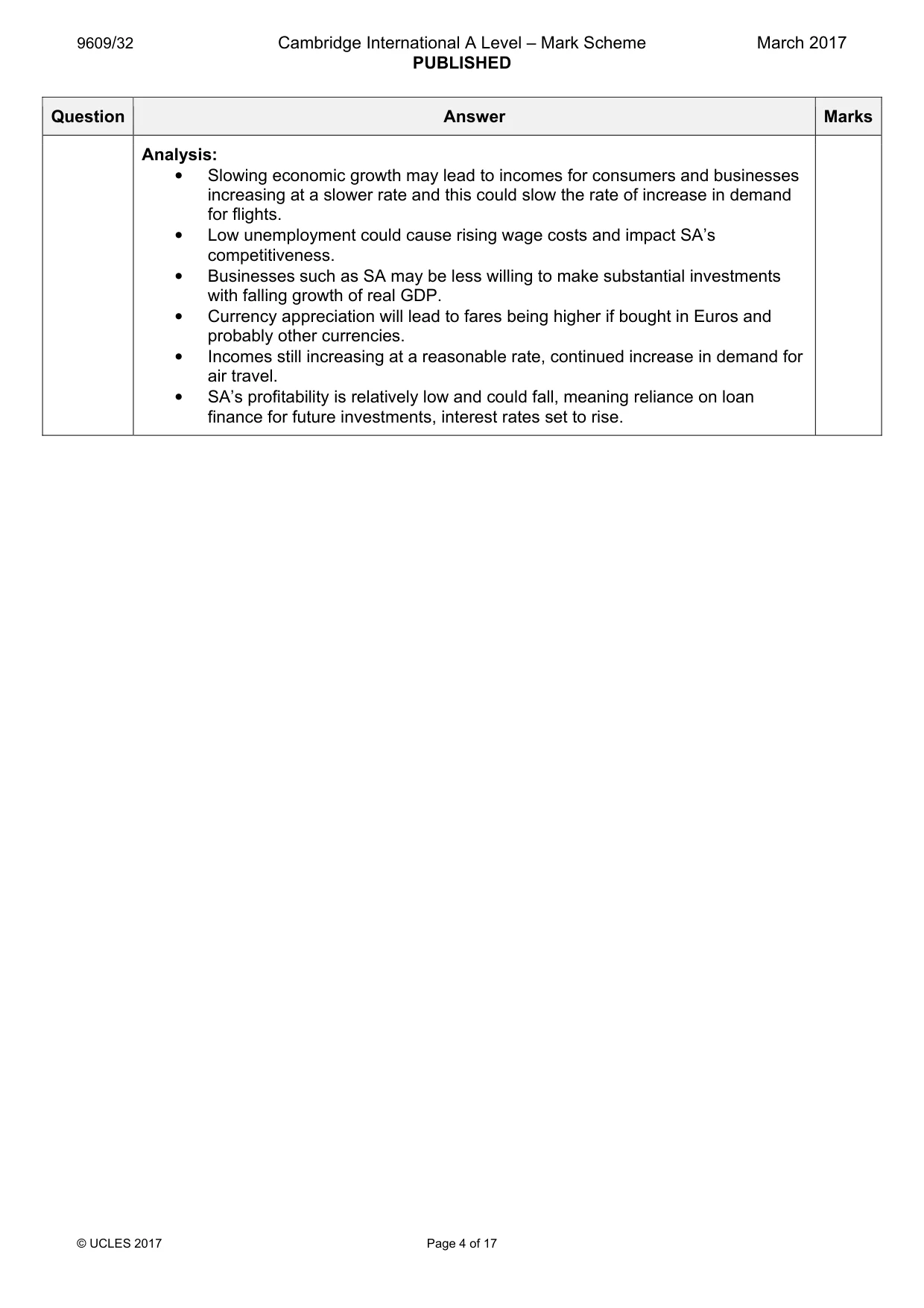
9609/32 Cambridge International A Level – Mark Scheme PUBLISHED March 2017 © UCLES 2017 Page 4 of 17 Question Answer Marks Analysis: • Slowing economic growth may lead to incomes for consumers and businesses increasing at a slower rate and this could slow the rate of increase in demand for flights. • Low unemployment could cause rising wage costs and impact SA’s competitiveness. • Businesses such as SA may be less willing to make substantial investments with falling growth of real GDP. • Currency appreciation will lead to fares being higher if bought in Euros and probably other currencies. • Incomes still increasing at a reasonable rate, continued increase in demand for air travel. • SA’s profitability is relatively low and could fall, meaning reliance on loan finance for future investments, interest rates set to rise.
Mark scheme, page 5
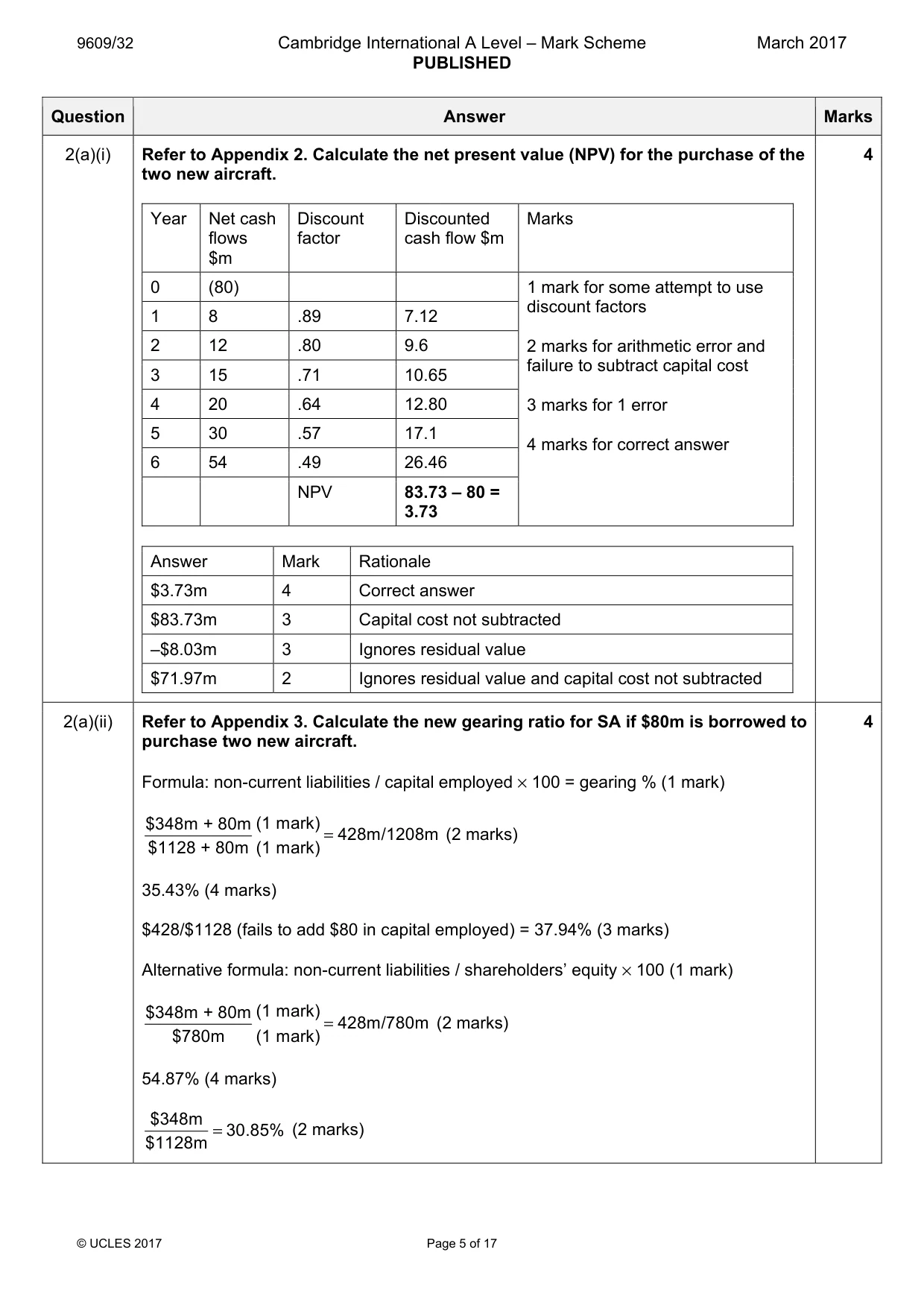
9609/32 Cambridge International A Level – Mark Scheme PUBLISHED March 2017 © UCLES 2017 Page 5 of 17 Question Answer Marks 2(a)(i) Refer to Appendix 2. Calculate the net present value (NPV) for the purchase of the two new aircraft. Year Net cash flows $m Discount factor Discounted cash flow $m Marks 0 (80) 1 mark for some attempt to use discount factors 2 marks for arithmetic error and failure to subtract capital cost 3 marks for 1 error 4 marks for correct answer 1 8 .89 7.12 2 12 .80 9.6 3 15 .71 10.65 4 20 .64 12.80 5 30 .57 17.1 6 54 .49 26.46 NPV 83.73 – 80 = 3.73 Answer Mark Rationale $3.73m 4 Correct answer $83.73m 3 Capital cost not subtracted –$8.03m 3 Ignores residual value $71.97m 2 Ignores residual value and capital cost not subtracted 4 2(a)(ii) Refer to Appendix 3. Calculate the new gearing ratio for SA if $80m is borrowed to purchase two new aircraft. Formula: non-current liabilities / capital employed × 100 = gearing % (1 mark) (1 mark) $348m + 80m 428m/1208m (1 mark) $1128 + 80m = (2 marks) 35.43% (4 marks) $428/$1128 (fails to add $80 in capital employed) = 37.94% (3 marks) Alternative formula: non-current liabilities / shareholders’ equity × 100 (1 mark) (1 mark) $348m + 80m 428m/780m (1 mark) $780m = (2 marks) 54.87% (4 marks) $348m 30.85% $1128m = (2 marks) 4
Mark scheme, page 6
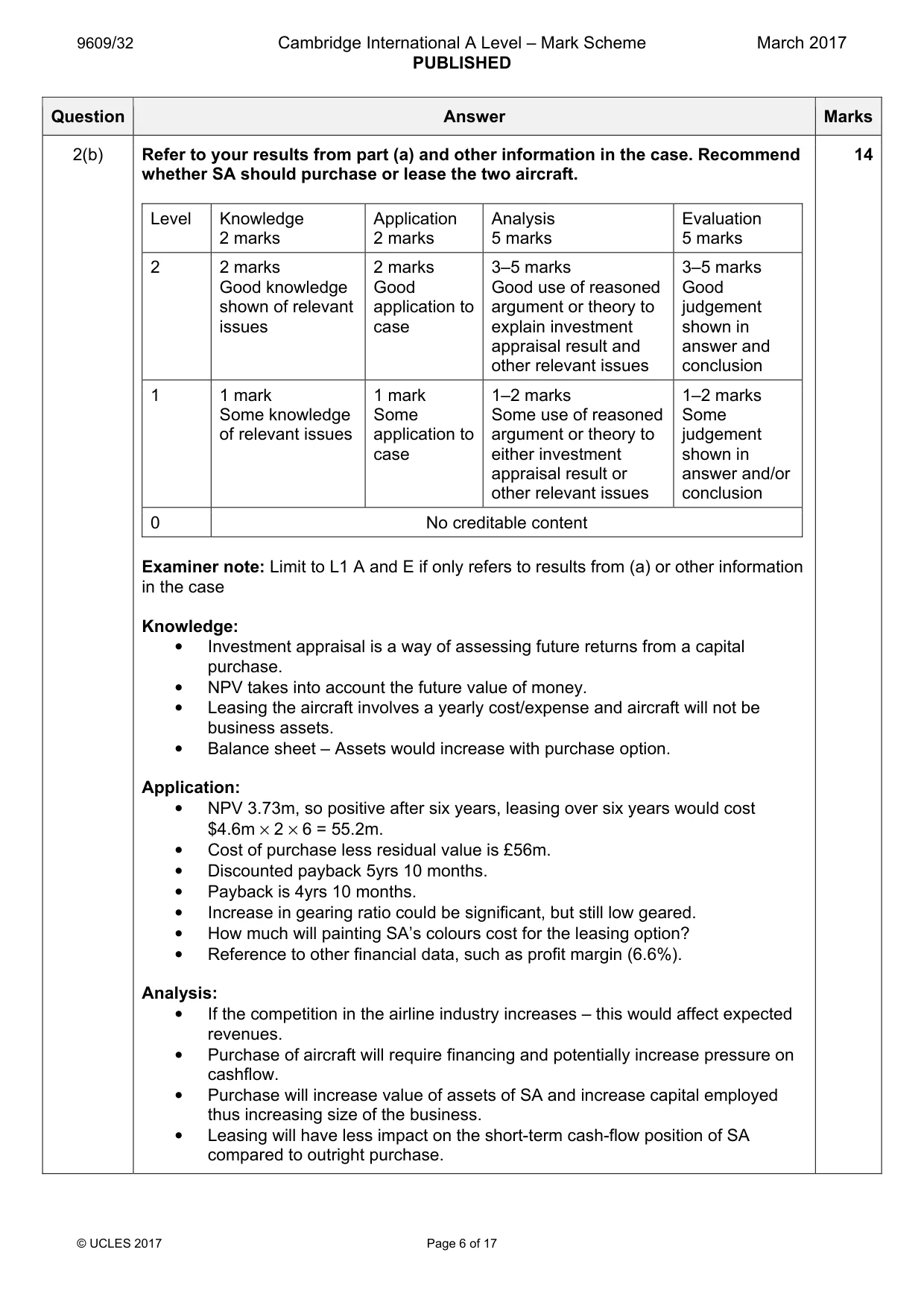
9609/32 Cambridge International A Level – Mark Scheme PUBLISHED March 2017 © UCLES 2017 Page 6 of 17 Question Answer Marks 2(b) Refer to your results from part (a) and other information in the case. Recommend whether SA should purchase or lease the two aircraft. Level Knowledge 2 marks Application 2 marks Analysis 5 marks Evaluation 5 marks 2 2 marks Good knowledge shown of relevant issues 2 marks Good application to case 3–5 marks Good use of reasoned argument or theory to explain investment appraisal result and other relevant issues 3–5 marks Good judgement shown in answer and conclusion 1 1 mark Some knowledge of relevant issues 1 mark Some application to case 1–2 marks Some use of reasoned argument or theory to either investment appraisal result or other relevant issues 1–2 marks Some judgement shown in answer and/or conclusion 0 No creditable content Examiner note: Limit to L1 A and E if only refers to results from (a) or other information in the case Knowledge: • Investment appraisal is a way of assessing future returns from a capital purchase. • NPV takes into account the future value of money. • Leasing the aircraft involves a yearly cost/expense and aircraft will not be business assets. • Balance sheet – Assets would increase with purchase option. Application: • NPV 3.73m, so positive after six years, leasing over six years would cost $4.6m × 2 × 6 = 55.2m. • Cost of purchase less residual value is £56m. • Discounted payback 5yrs 10 months. • Payback is 4yrs 10 months. • Increase in gearing ratio could be significant, but still low geared. • How much will painting SA’s colours cost for the leasing option? • Reference to other financial data, such as profit margin (6.6%). Analysis: • If the competition in the airline industry increases – this would affect expected revenues. • Purchase of aircraft will require financing and potentially increase pressure on cashflow. • Purchase will increase value of assets of SA and increase capital employed thus increasing size of the business. • Leasing will have less impact on the short-term cash-flow position of SA compared to outright purchase. 14
Mark scheme, page 7
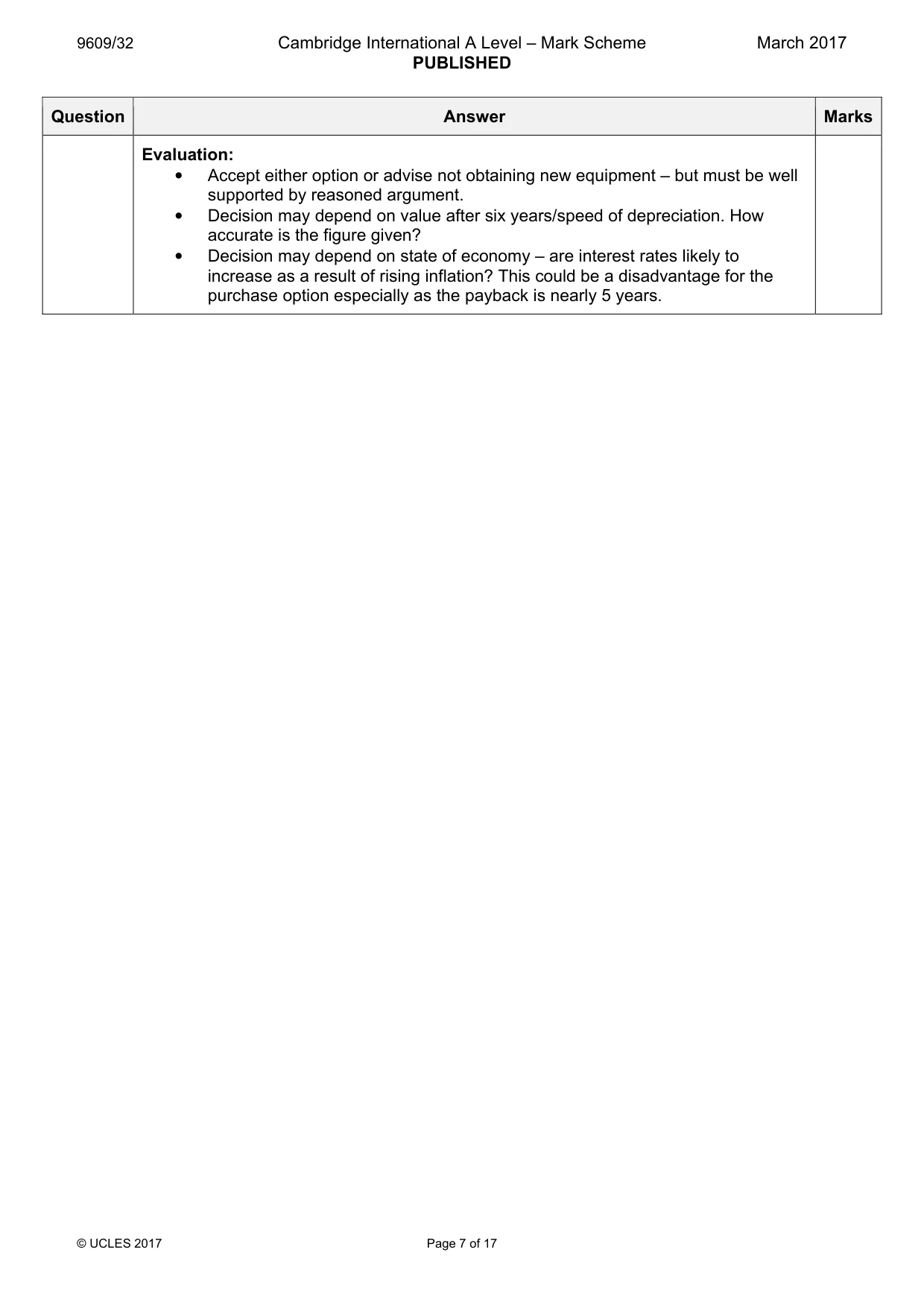
9609/32 Cambridge International A Level – Mark Scheme PUBLISHED March 2017 © UCLES 2017 Page 7 of 17 Question Answer Marks Evaluation: • Accept either option or advise not obtaining new equipment – but must be well supported by reasoned argument. • Decision may depend on value after six years/speed of depreciation. How accurate is the figure given? • Decision may depend on state of economy – are interest rates likely to increase as a result of rising inflation? This could be a disadvantage for the purchase option especially as the payback is nearly 5 years.
Mark scheme, page 8
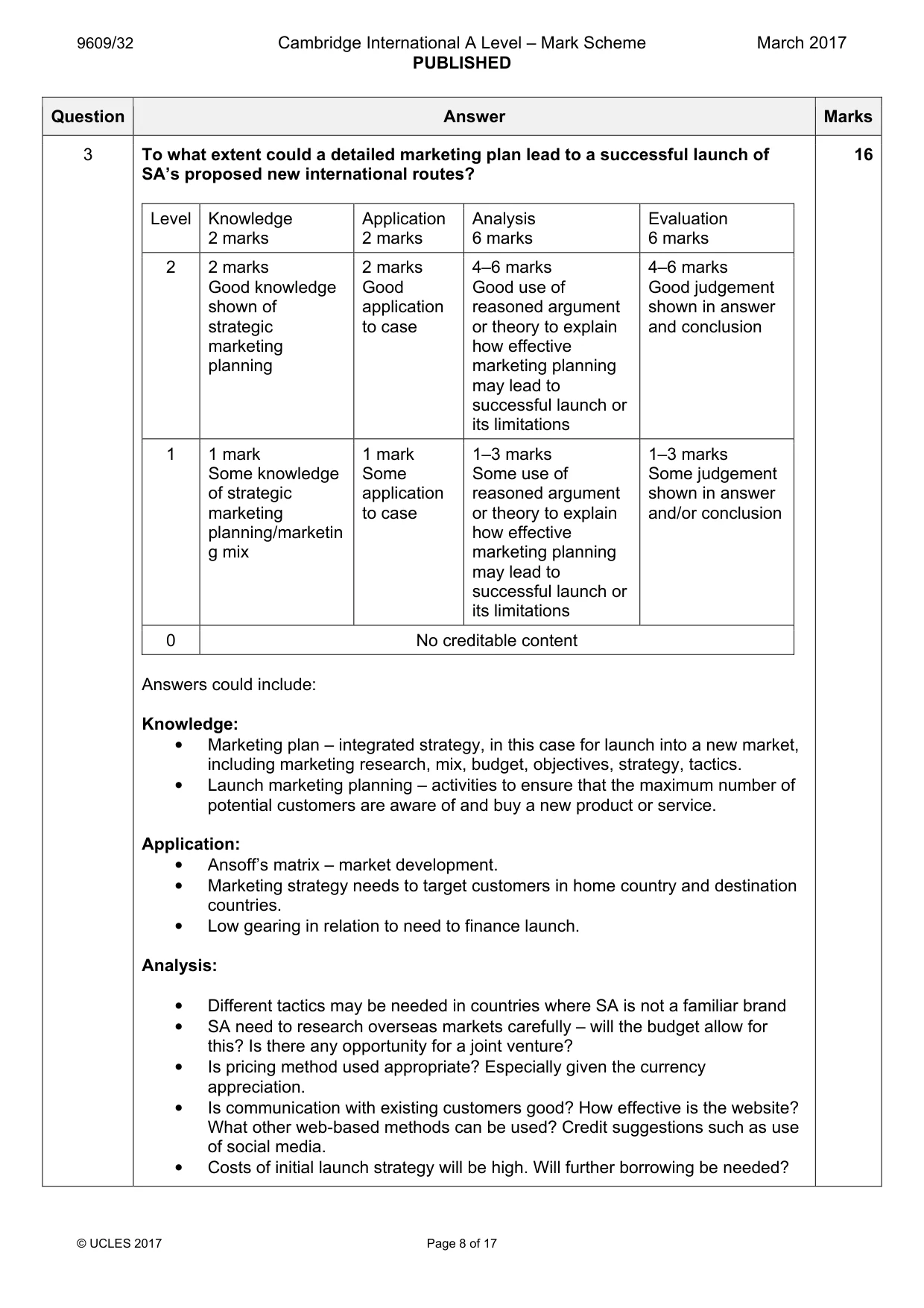
9609/32 Cambridge International A Level – Mark Scheme PUBLISHED March 2017 © UCLES 2017 Page 8 of 17 Question Answer Marks 3 To what extent could a detailed marketing plan lead to a successful launch of SA’s proposed new international routes? Level Knowledge 2 marks Application 2 marks Analysis 6 marks Evaluation 6 marks 2 2 marks Good knowledge shown of strategic marketing planning 2 marks Good application to case 4–6 marks Good use of reasoned argument or theory to explain how effective marketing planning may lead to successful launch or its limitations 4–6 marks Good judgement shown in answer and conclusion 1 1 mark Some knowledge of strategic marketing planning/marketin g mix 1 mark Some application to case 1–3 marks Some use of reasoned argument or theory to explain how effective marketing planning may lead to successful launch or its limitations 1–3 marks Some judgement shown in answer and/or conclusion 0 No creditable content Answers could include: Knowledge: • Marketing plan – integrated strategy, in this case for launch into a new market, including marketing research, mix, budget, objectives, strategy, tactics. • Launch marketing planning – activities to ensure that the maximum number of potential customers are aware of and buy a new product or service. Application: • Ansoff’s matrix – market development. • Marketing strategy needs to target customers in home country and destination countries. • Low gearing in relation to need to finance launch. Analysis: • Different tactics may be needed in countries where SA is not a familiar brand • SA need to research overseas markets carefully – will the budget allow for this? Is there any opportunity for a joint venture? • Is pricing method used appropriate? Especially given the currency appreciation. • Is communication with existing customers good? How effective is the website? What other web-based methods can be used? Credit suggestions such as use of social media. • Costs of initial launch strategy will be high. Will further borrowing be needed? 16
Mark scheme, page 9
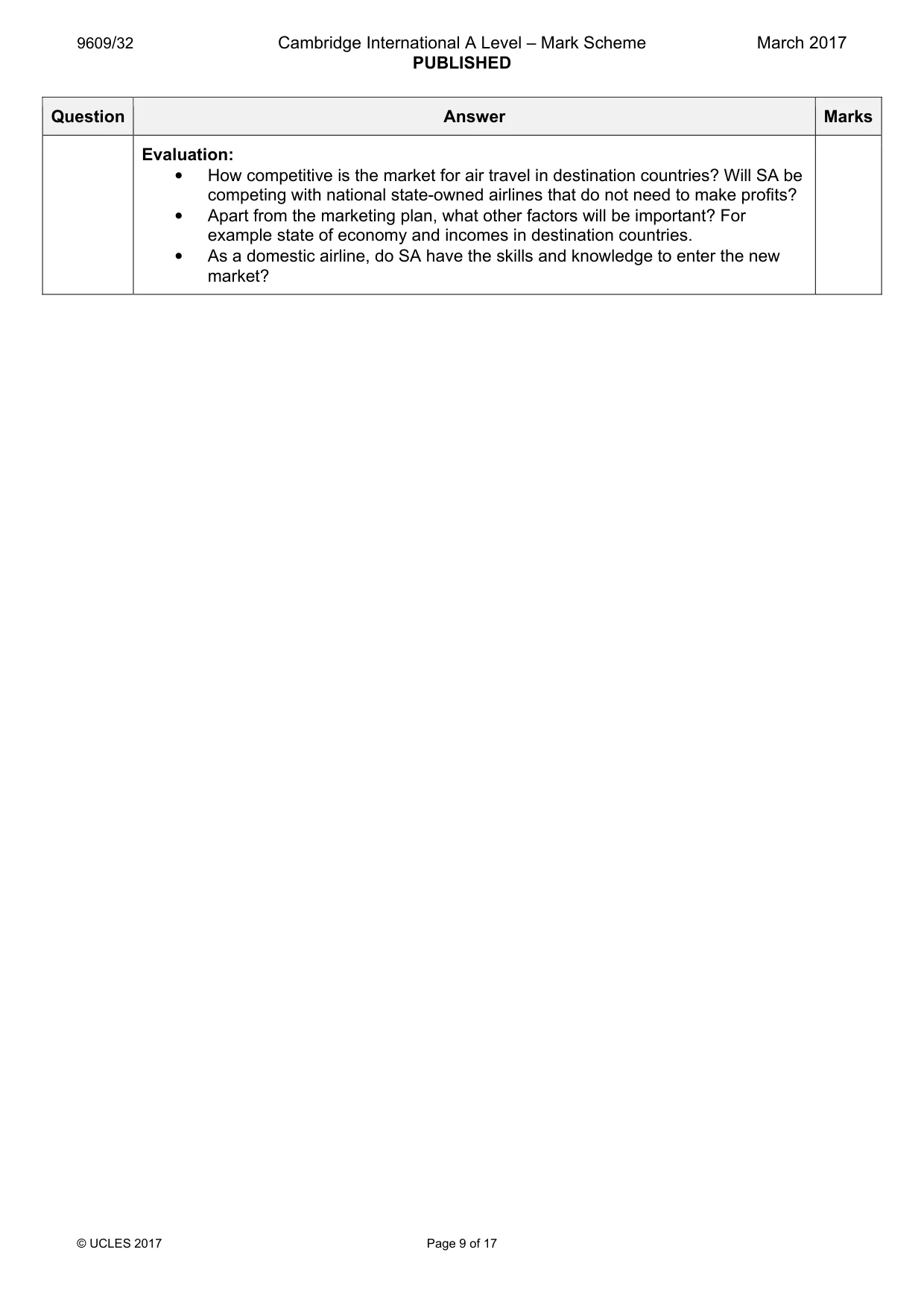
9609/32 Cambridge International A Level – Mark Scheme PUBLISHED March 2017 © UCLES 2017 Page 9 of 17 Question Answer Marks Evaluation: • How competitive is the market for air travel in destination countries? Will SA be competing with national state-owned airlines that do not need to make profits? • Apart from the marketing plan, what other factors will be important? For example state of economy and incomes in destination countries. • As a domestic airline, do SA have the skills and knowledge to enter the new market?
Mark scheme, page 10
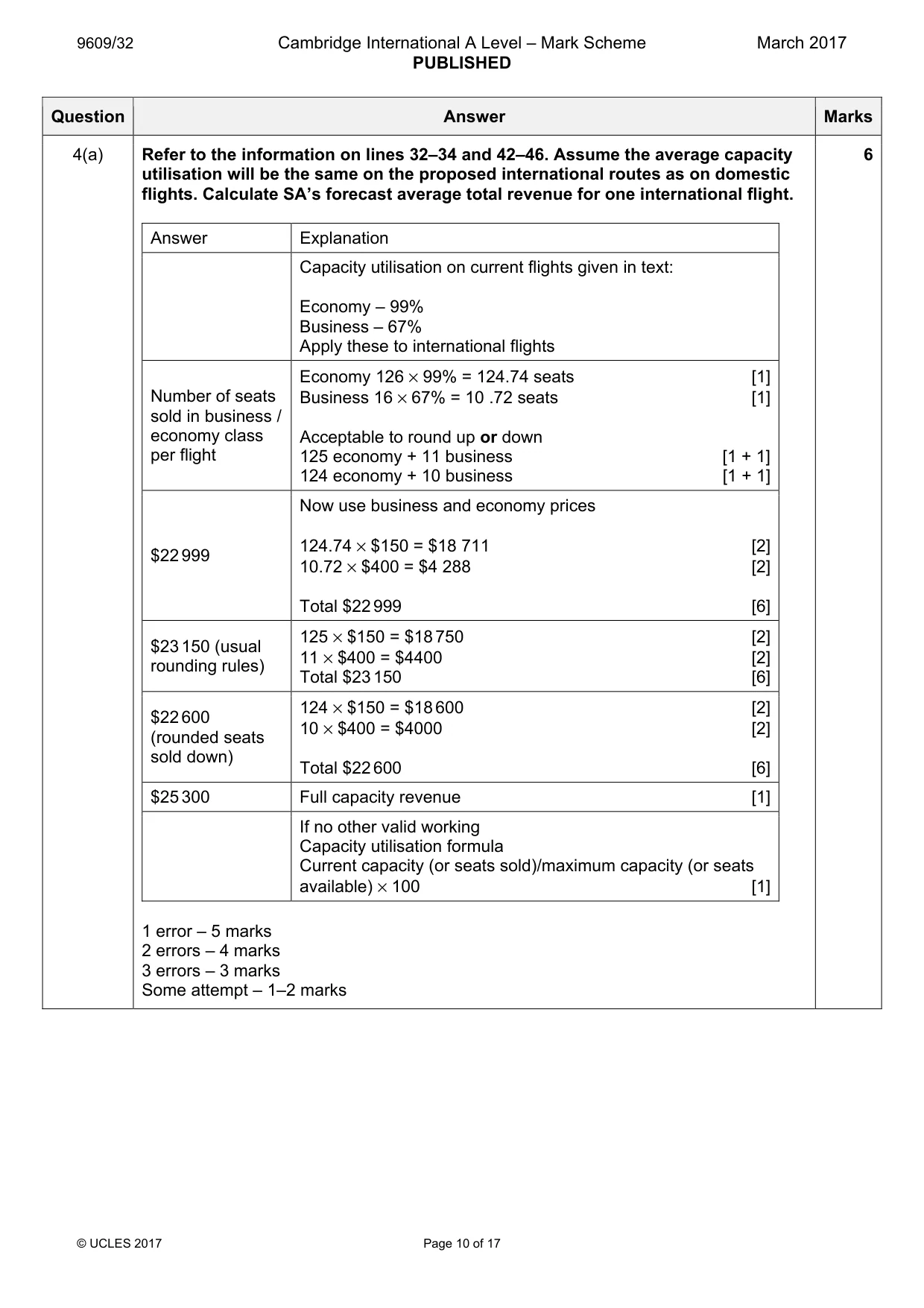
9609/32 Cambridge International A Level – Mark Scheme PUBLISHED March 2017 © UCLES 2017 Page 10 of 17 Question Answer Marks 4(a) Refer to the information on lines 32–34 and 42–46. Assume the average capacity utilisation will be the same on the proposed international routes as on domestic flights. Calculate SA’s forecast average total revenue for one international flight. Answer Explanation Capacity utilisation on current flights given in text: Economy – 99% Business – 67% Apply these to international flights Number of seats sold in business / economy class per flight Economy 126 × 99% = 124.74 seats [1] Business 16 × 67% = 10 .72 seats [1] Acceptable to round up or down 125 economy + 11 business [1 + 1] 124 economy + 10 business [1 + 1] $22 999 Now use business and economy prices 124.74 × $150 = $18 711 [2] 10.72 × $400 = $4 288 [2] Total $22 999 [6] $23 150 (usual rounding rules) 125 × $150 = $18 750 [2] 11 × $400 = $4400 [2] Total $23 150 [6] $22 600 (rounded seats sold down) 124 × $150 = $18 600 [2] 10 × $400 = $4000 [2] Total $22 600 [6] $25 300 Full capacity revenue [1] If no other valid working Capacity utilisation formula Current capacity (or seats sold)/maximum capacity (or seats available) × 100 [1] 1 error – 5 marks 2 errors – 4 marks 3 errors – 3 marks Some attempt – 1–2 marks 6
Mark scheme, page 11
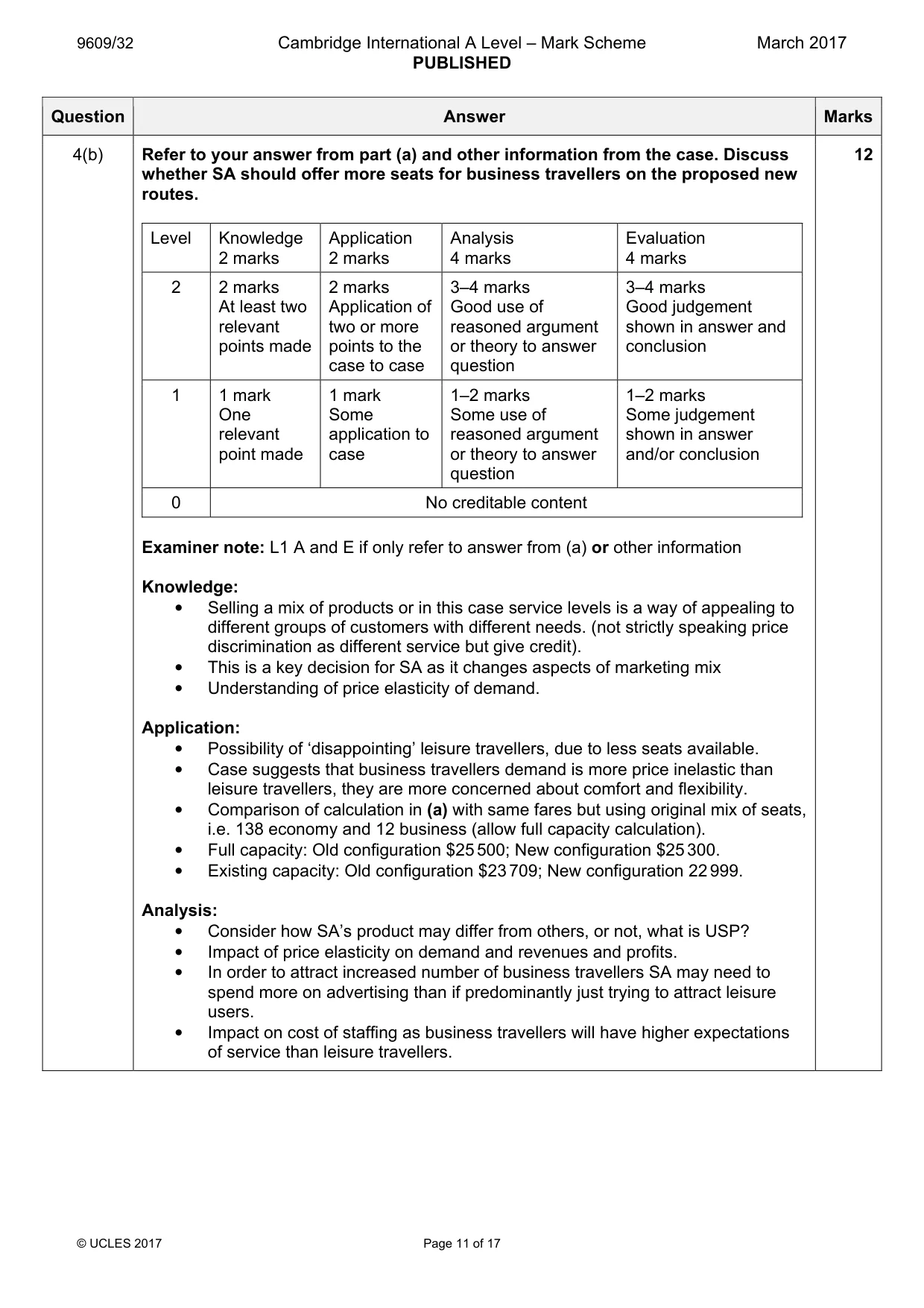
9609/32 Cambridge International A Level – Mark Scheme PUBLISHED March 2017 © UCLES 2017 Page 11 of 17 Question Answer Marks 4(b) Refer to your answer from part (a) and other information from the case. Discuss whether SA should offer more seats for business travellers on the proposed new routes. Level Knowledge 2 marks Application 2 marks Analysis 4 marks Evaluation 4 marks 2 2 marks At least two relevant points made 2 marks Application of two or more points to the case to case 3–4 marks Good use of reasoned argument or theory to answer question 3–4 marks Good judgement shown in answer and conclusion 1 1 mark One relevant point made 1 mark Some application to case 1–2 marks Some use of reasoned argument or theory to answer question 1–2 marks Some judgement shown in answer and/or conclusion 0 No creditable content Examiner note: L1 A and E if only refer to answer from (a) or other information Knowledge: • Selling a mix of products or in this case service levels is a way of appealing to different groups of customers with different needs. (not strictly speaking price discrimination as different service but give credit). • This is a key decision for SA as it changes aspects of marketing mix • Understanding of price elasticity of demand. Application: • Possibility of ‘disappointing’ leisure travellers, due to less seats available. • Case suggests that business travellers demand is more price inelastic than leisure travellers, they are more concerned about comfort and flexibility. • Comparison of calculation in (a) with same fares but using original mix of seats, i.e. 138 economy and 12 business (allow full capacity calculation). • Full capacity: Old configuration $25 500; New configuration $25 300. • Existing capacity: Old configuration $23 709; New configuration 22 999. Analysis: • Consider how SA’s product may differ from others, or not, what is USP? • Impact of price elasticity on demand and revenues and profits. • In order to attract increased number of business travellers SA may need to spend more on advertising than if predominantly just trying to attract leisure users. • Impact on cost of staffing as business travellers will have higher expectations of service than leisure travellers. 12
Mark scheme, page 12
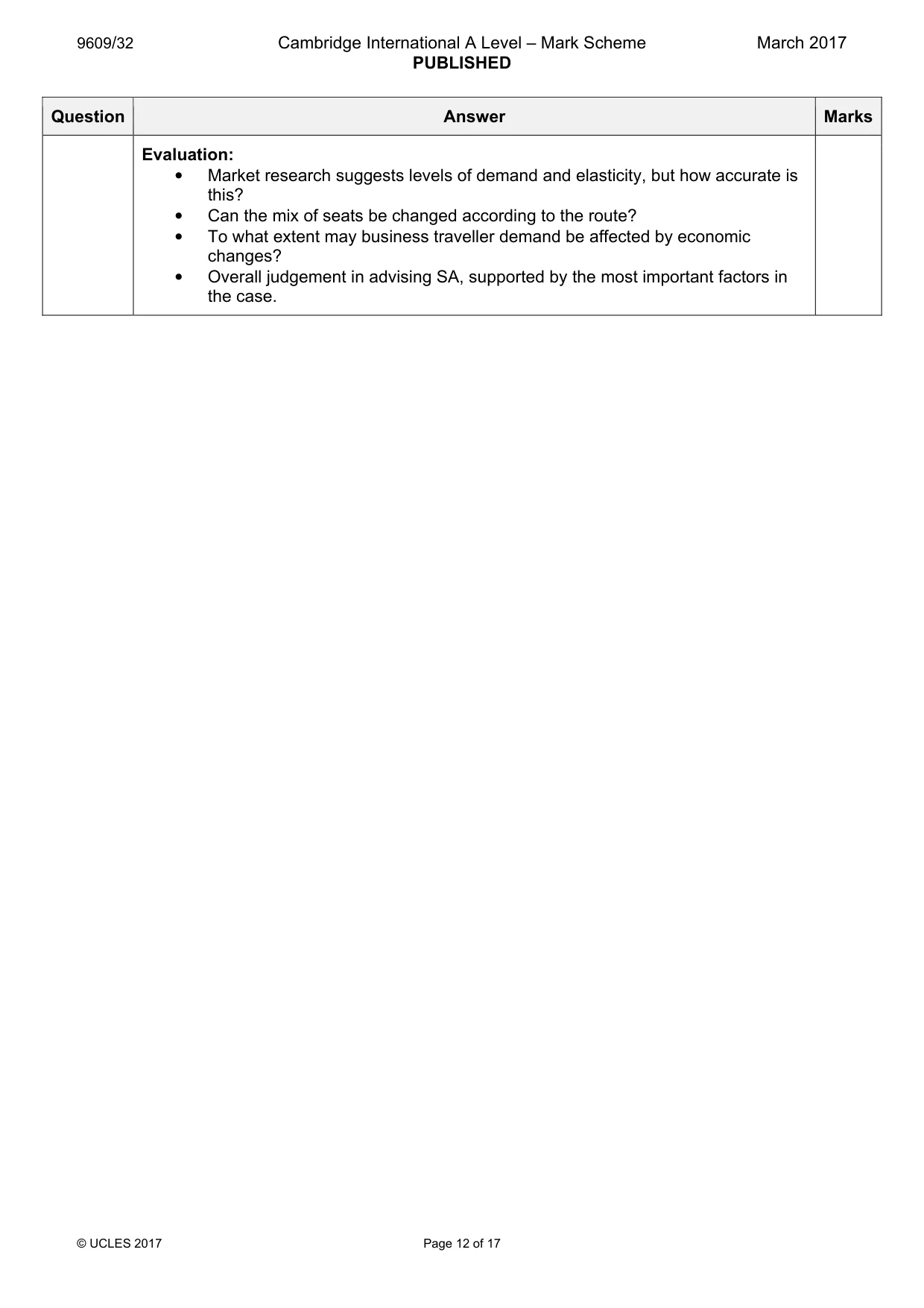
9609/32 Cambridge International A Level – Mark Scheme PUBLISHED March 2017 © UCLES 2017 Page 12 of 17 Question Answer Marks Evaluation: • Market research suggests levels of demand and elasticity, but how accurate is this? • Can the mix of seats be changed according to the route? • To what extent may business traveller demand be affected by economic changes? • Overall judgement in advising SA, supported by the most important factors in the case.
Mark scheme, page 13
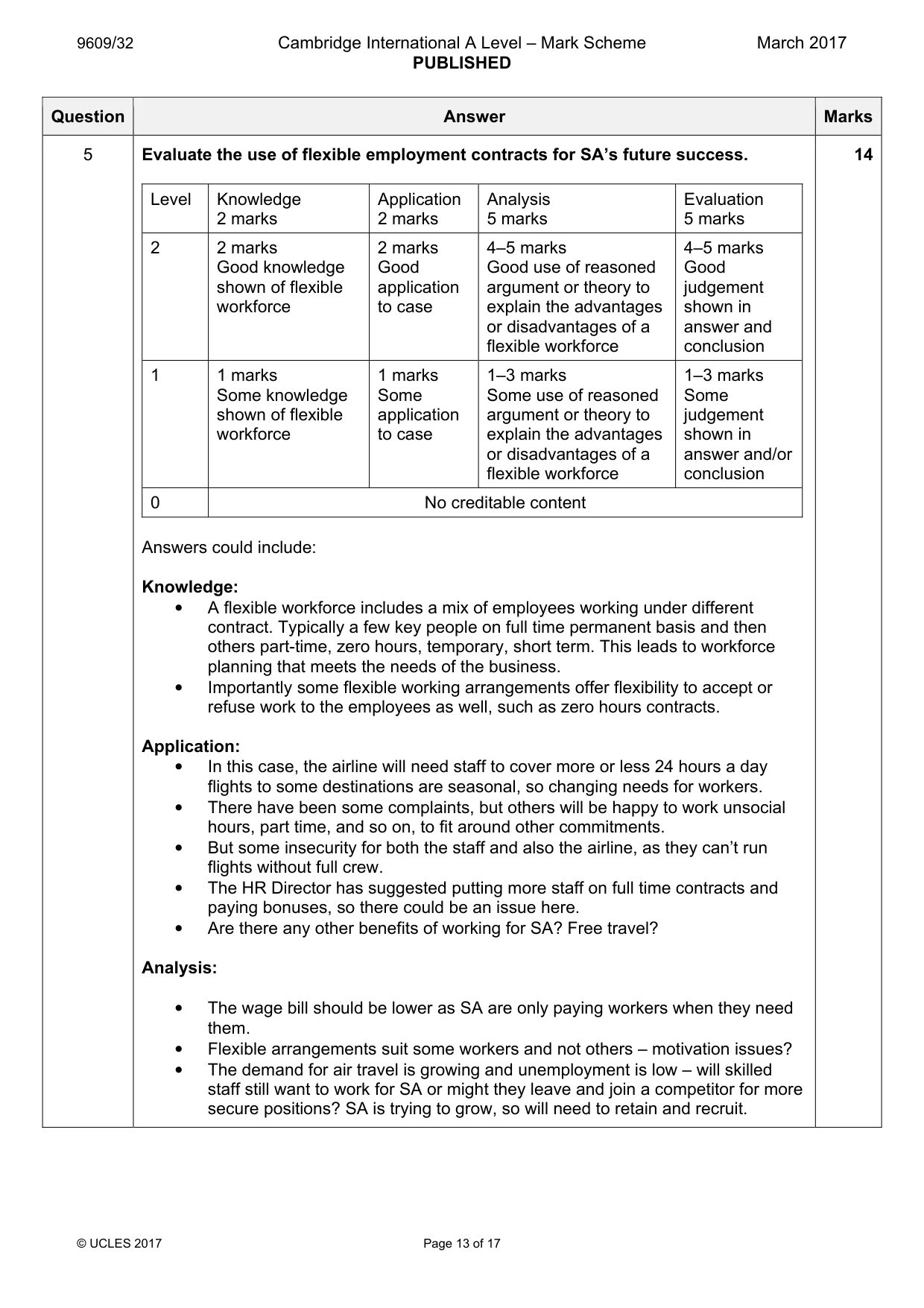
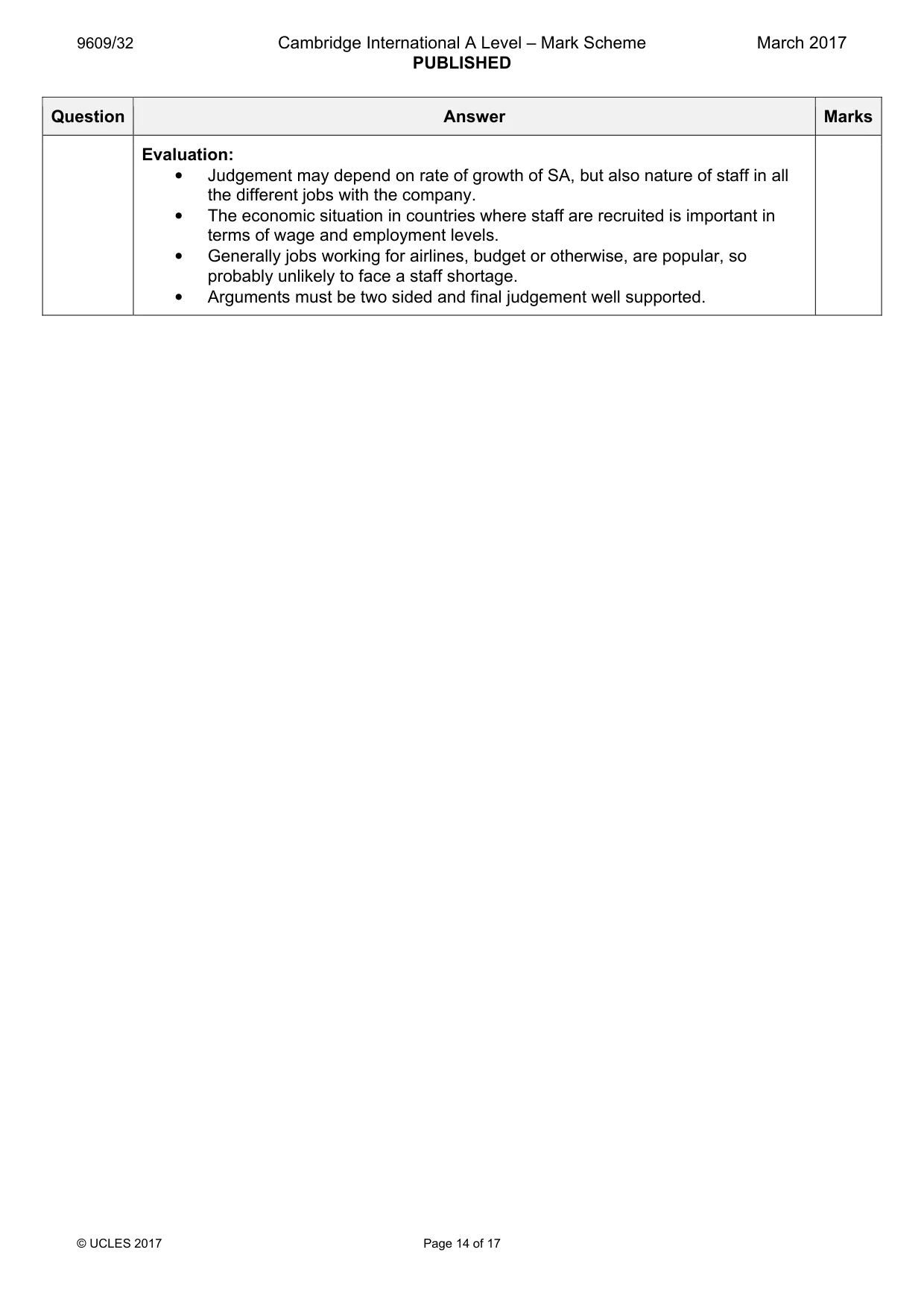
9609/32 Cambridge International A Level – Mark Scheme PUBLISHED March 2017 © UCLES 2017 Page 13 of 17 Question Answer Marks 5 Evaluate the use of flexible employment contracts for SA’s future success. Level Knowledge 2 marks Application 2 marks Analysis 5 marks Evaluation 5 marks 2 2 marks Good knowledge shown of flexible workforce 2 marks Good application to case 4–5 marks Good use of reasoned argument or theory to explain the advantages or disadvantages of a flexible workforce 4–5 marks Good judgement shown in answer and conclusion 1 1 marks Some knowledge shown of flexible workforce 1 marks Some application to case 1–3 marks Some use of reasoned argument or theory to explain the advantages or disadvantages of a flexible workforce 1–3 marks Some judgement shown in answer and/or conclusion 0 No creditable content Answers could include: Knowledge: • A flexible workforce includes a mix of employees working under different contract. Typically a few key people on full time permanent basis and then others part-time, zero hours, temporary, short term. This leads to workforce planning that meets the needs of the business. • Importantly some flexible working arrangements offer flexibility to accept or refuse work to the employees as well, such as zero hours contracts. Application: • In this case, the airline will need staff to cover more or less 24 hours a day flights to some destinations are seasonal, so changing needs for workers. • There have been some complaints, but others will be happy to work unsocial hours, part time, and so on, to fit around other commitments. • But some insecurity for both the staff and also the airline, as they can’t run flights without full crew. • The HR Director has suggested putting more staff on full time contracts and paying bonuses, so there could be an issue here. • Are there any other benefits of working for SA? Free travel? Analysis: • The wage bill should be lower as SA are only paying workers when they need them. • Flexible arrangements suit some workers and not others – motivation issues? • The demand for air travel is growing and unemployment is low – will skilled staff still want to work for SA or might they leave and join a competitor for more secure positions? SA is trying to grow, so will need to retain and recruit. 14
Mark scheme, page 14
9609/32 Cambridge International A Level – Mark Scheme PUBLISHED March 2017 © UCLES 2017 Page 14 of 17 Question Answer Marks Evaluation: • Judgement may depend on rate of growth of SA, but also nature of staff in all the different jobs with the company. • The economic situation in countries where staff are recruited is important in terms of wage and employment levels. • Generally jobs working for airlines, budget or otherwise, are popular, so probably unlikely to face a staff shortage. • Arguments must be two sided and final judgement well supported.
Mark scheme, page 15
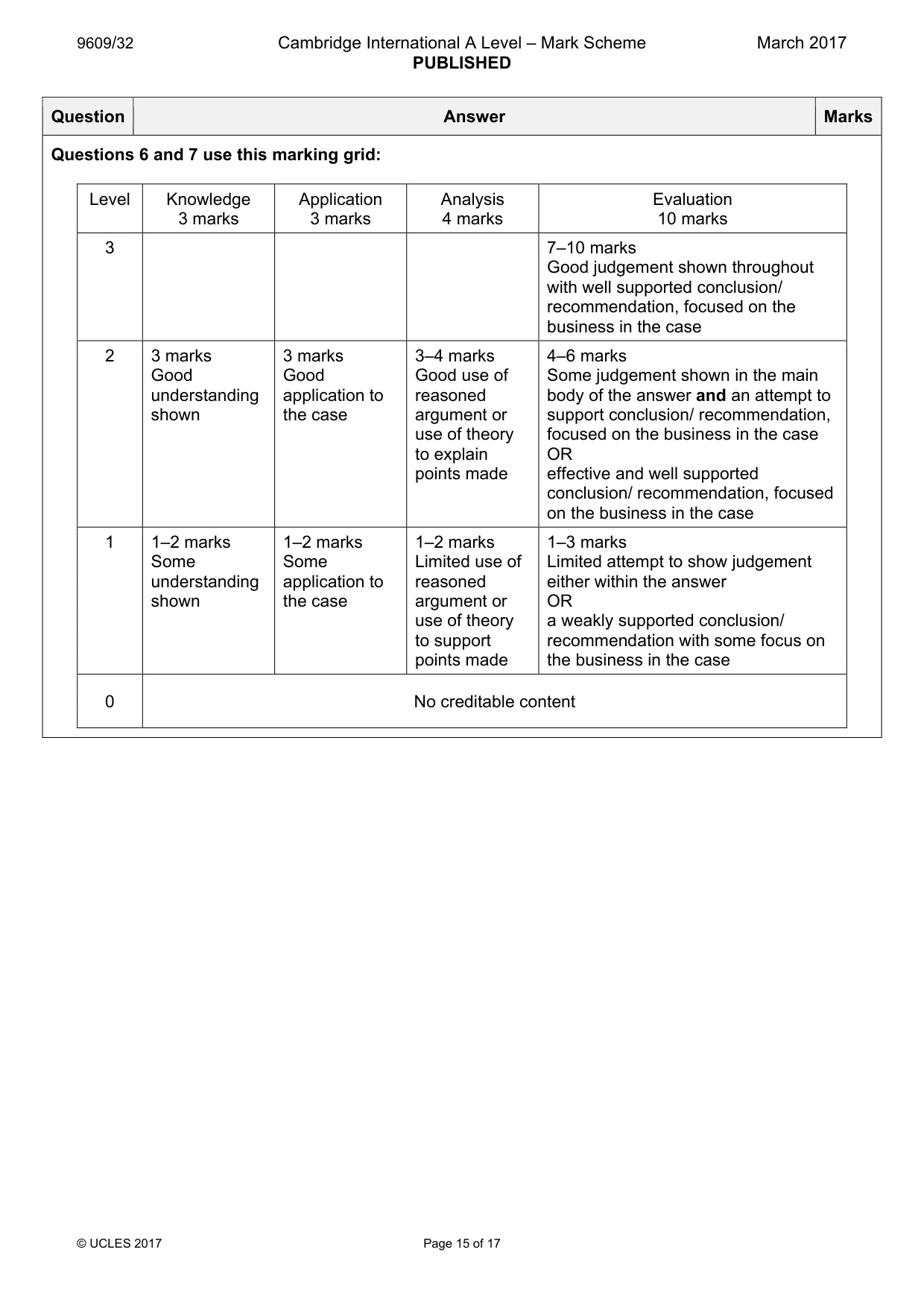
9609/32 Cambridge International A Level – Mark Scheme PUBLISHED March 2017 © UCLES 2017 Page 15 of 17 Question Answer Marks Questions 6 and 7 use this marking grid: Level Knowledge 3 marks Application 3 marks Analysis 4 marks Evaluation 10 marks 3 7–10 marks Good judgement shown throughout with well supported conclusion/ recommendation, focused on the business in the case 2 3 marks Good understanding shown 3 marks Good application to the case 3–4 marks Good use of reasoned argument or use of theory to explain points made 4–6 marks Some judgement shown in the main body of the answer and an attempt to support conclusion/ recommendation, focused on the business in the case OR effective and well supported conclusion/ recommendation, focused on the business in the case 1 1–2 marks Some understanding shown 1–2 marks Some application to the case 1–2 marks Limited use of reasoned argument or use of theory to support points made 1–3 marks Limited attempt to show judgement either within the answer OR a weakly supported conclusion/ recommendation with some focus on the business in the case 0 No creditable content
Mark scheme, page 16
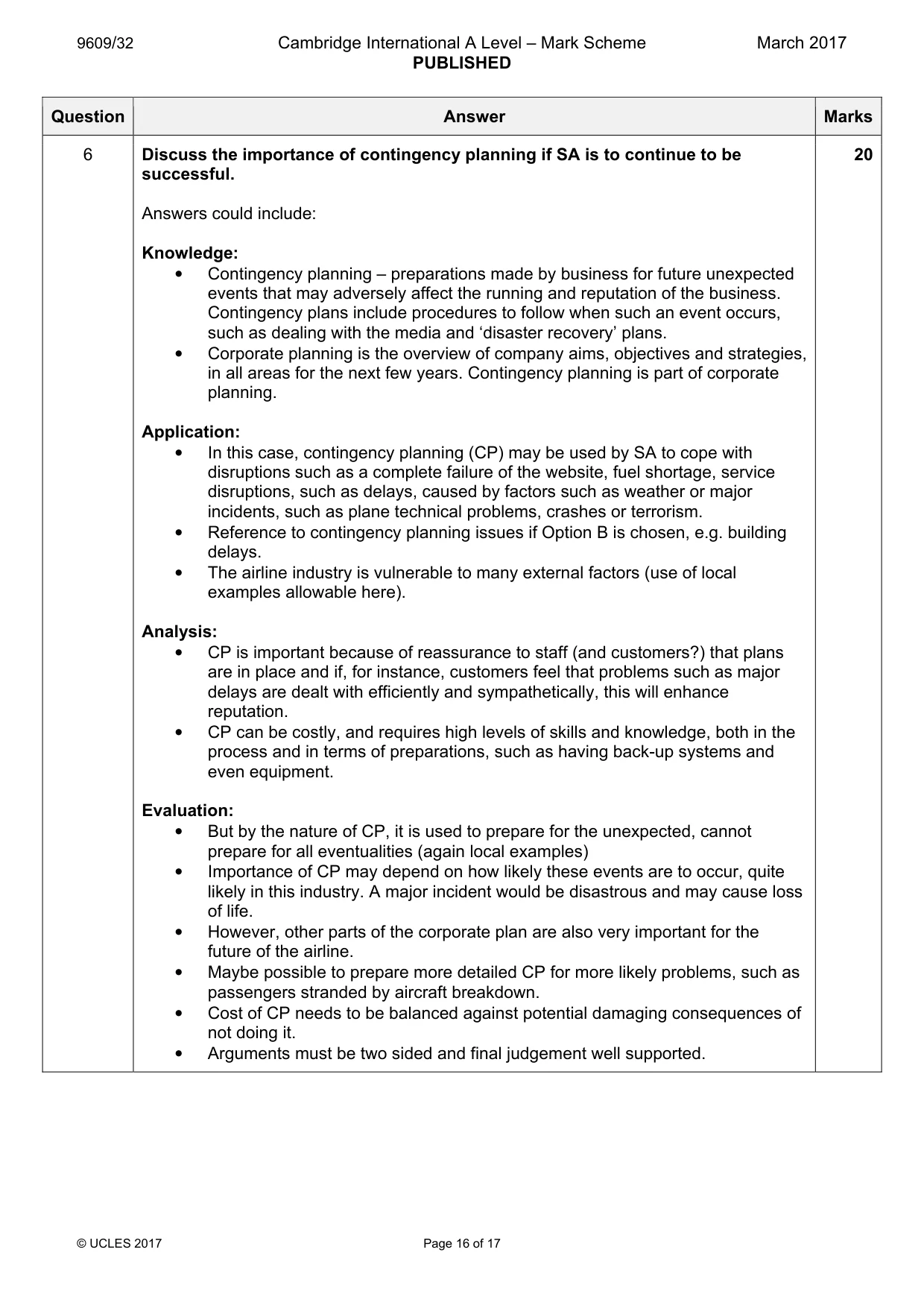
9609/32 Cambridge International A Level – Mark Scheme PUBLISHED March 2017 © UCLES 2017 Page 16 of 17 Question Answer Marks 6 Discuss the importance of contingency planning if SA is to continue to be successful. Answers could include: Knowledge: • Contingency planning – preparations made by business for future unexpected events that may adversely affect the running and reputation of the business. Contingency plans include procedures to follow when such an event occurs, such as dealing with the media and ‘disaster recovery’ plans. • Corporate planning is the overview of company aims, objectives and strategies, in all areas for the next few years. Contingency planning is part of corporate planning. Application: • In this case, contingency planning (CP) may be used by SA to cope with disruptions such as a complete failure of the website, fuel shortage, service disruptions, such as delays, caused by factors such as weather or major incidents, such as plane technical problems, crashes or terrorism. • Reference to contingency planning issues if Option B is chosen, e.g. building delays. • The airline industry is vulnerable to many external factors (use of local examples allowable here). Analysis: • CP is important because of reassurance to staff (and customers?) that plans are in place and if, for instance, customers feel that problems such as major delays are dealt with efficiently and sympathetically, this will enhance reputation. • CP can be costly, and requires high levels of skills and knowledge, both in the process and in terms of preparations, such as having back-up systems and even equipment. Evaluation: • But by the nature of CP, it is used to prepare for the unexpected, cannot prepare for all eventualities (again local examples) • Importance of CP may depend on how likely these events are to occur, quite likely in this industry. A major incident would be disastrous and may cause loss of life. • However, other parts of the corporate plan are also very important for the future of the airline. • Maybe possible to prepare more detailed CP for more likely problems, such as passengers stranded by aircraft breakdown. • Cost of CP needs to be balanced against potential damaging consequences of not doing it. • Arguments must be two sided and final judgement well supported. 20
Mark scheme, page 17
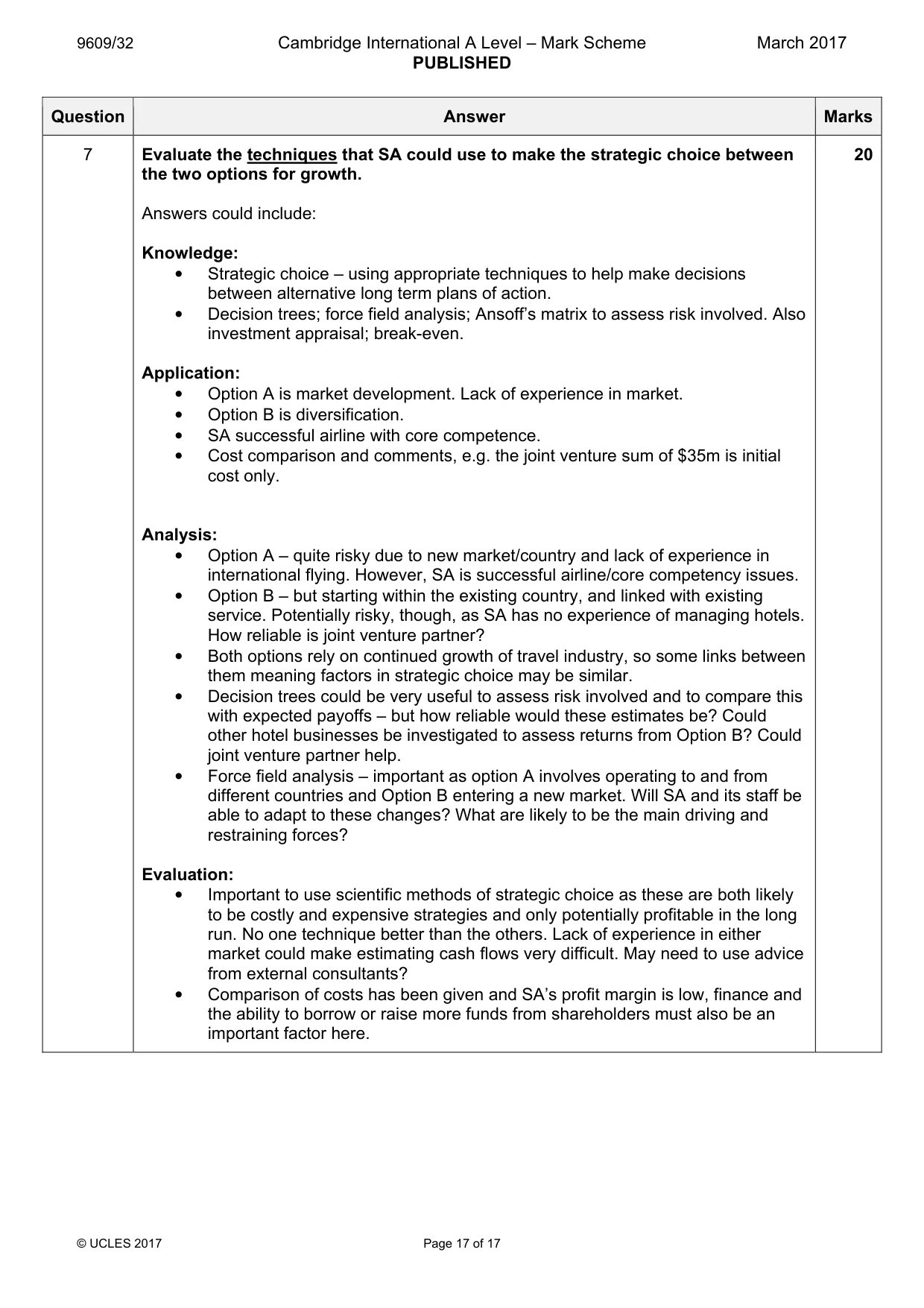
9609/32 Cambridge International A Level – Mark Scheme PUBLISHED March 2017 © UCLES 2017 Page 17 of 17 Question Answer Marks 7 Evaluate the techniques that SA could use to make the strategic choice between the two options for growth. Answers could include: Knowledge: • Strategic choice – using appropriate techniques to help make decisions between alternative long term plans of action. • Decision trees; force field analysis; Ansoff’s matrix to assess risk involved. Also investment appraisal; break-even. Application: • Option A is market development. Lack of experience in market. • Option B is diversification. • SA successful airline with core competence. • Cost comparison and comments, e.g. the joint venture sum of $35m is initial cost only. Analysis: • Option A – quite risky due to new market/country and lack of experience in international flying. However, SA is successful airline/core competency issues. • Option B – but starting within the existing country, and linked with existing service. Potentially risky, though, as SA has no experience of managing hotels. How reliable is joint venture partner? • Both options rely on continued growth of travel industry, so some links between them meaning factors in strategic choice may be similar. • Decision trees could be very useful to assess risk involved and to compare this with expected payoffs – but how reliable would these estimates be? Could other hotel businesses be investigated to assess returns from Option B? Could joint venture partner help. • Force field analysis – important as option A involves operating to and from different countries and Option B entering a new market. Will SA and its staff be able to adapt to these changes? What are likely to be the main driving and restraining forces? Evaluation: • Important to use scientific methods of strategic choice as these are both likely to be costly and expensive strategies and only potentially profitable in the long run. No one technique better than the others. Lack of experience in either market could make estimating cash flows very difficult. May need to use advice from external consultants? • Comparison of costs has been given and SA’s profit margin is low, finance and the ability to borrow or raise more funds from shareholders must also be an important factor here. 20
What you needed in this session
Cambridge’s own grade thresholds for 2017 Feb/March, Paper 3 · Variant 2. A higher threshold means an easier paper — the bar moves with how the cohort did.