Cambridge A Level Business (for first examination in 2016) 9609 — 2016 Feb/March Paper 3 · Variant 2
9609/32/F/M/16 · 100 marks · ≈113 min
The question paper and its mark scheme, free to read here and free to download. This is Cambridge’s own paper, exactly as it was sat.
Question paper8 pages


Mark scheme11 pages
Answers below. Sit the paper first if you are practising.
Paper as text
Question paper, page 1
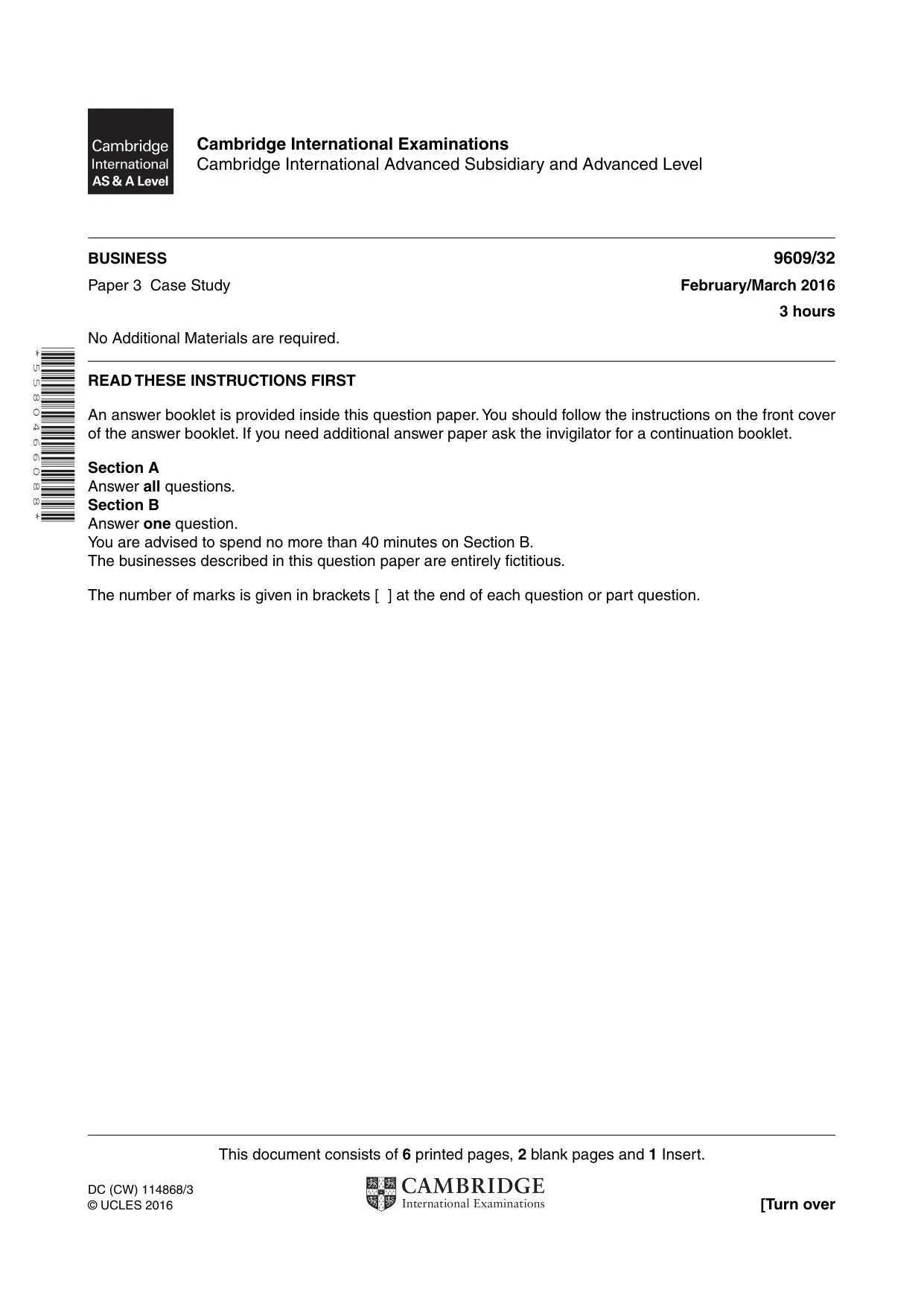
This document consists of 6 printed pages, 2 blank pages and 1 Insert. DC (CW) 114868/3 © UCLES 2016 [Turn over Cambridge International Examinations Cambridge International Advanced Subsidiary and Advanced Level * 5 5 8 0 4 6 6 0 8 8 * BUSINESS 9609/32 Paper 3 Case Study February/March 2016 3 hours No Additional Materials are required. READ THESE INSTRUCTIONS FIRST An answer booklet is provided inside this question paper. You should follow the instructions on the front cover of the answer booklet. If you need additional answer paper ask the invigilator for a continuation booklet. Section A Answer all questions. Section B Answer one question. You are advised to spend no more than 40 minutes on Section B. The businesses described in this question paper are entirely fictitious. The number of marks is given in brackets [ ] at the end of each question or part question.
Question paper, page 2
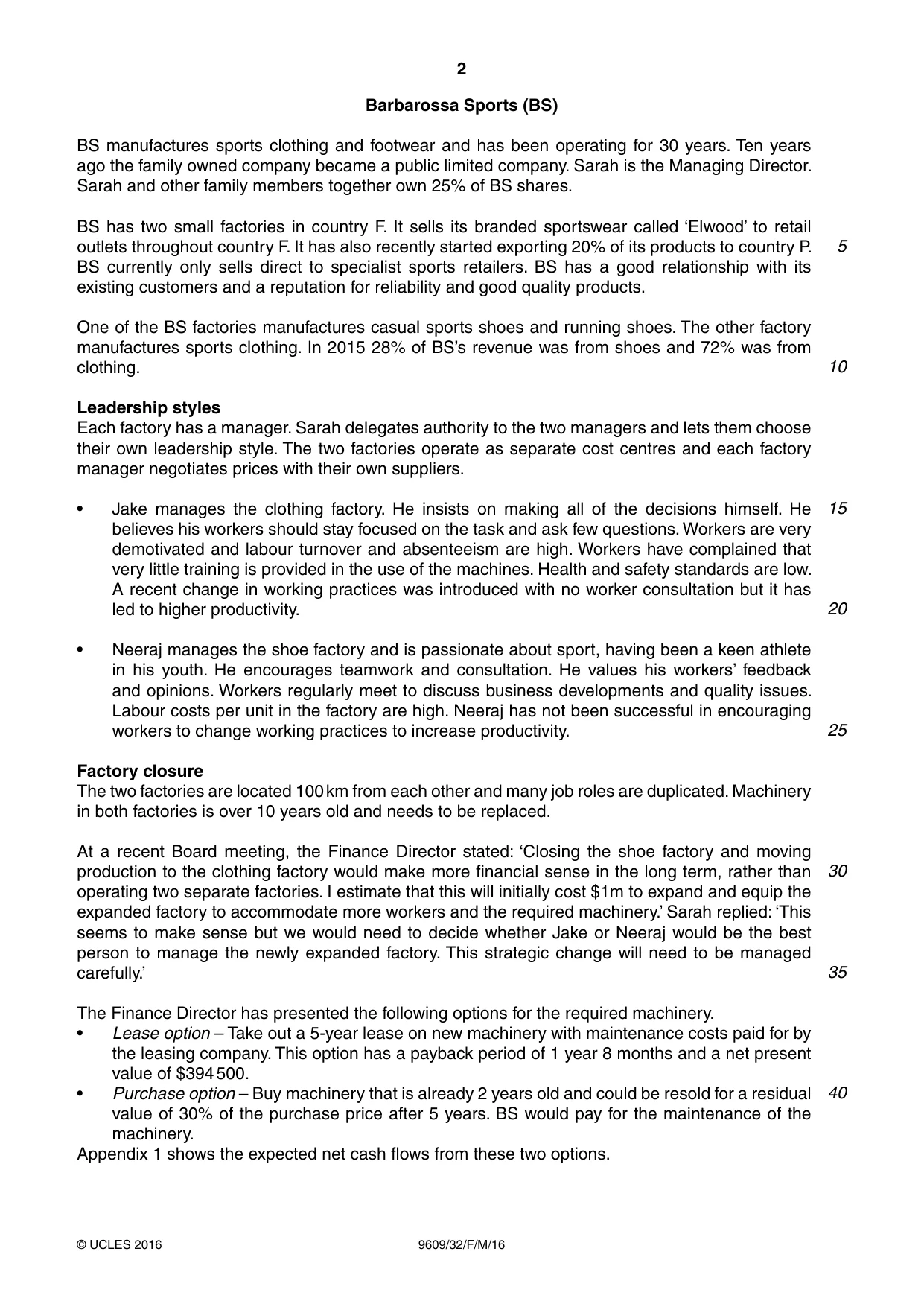
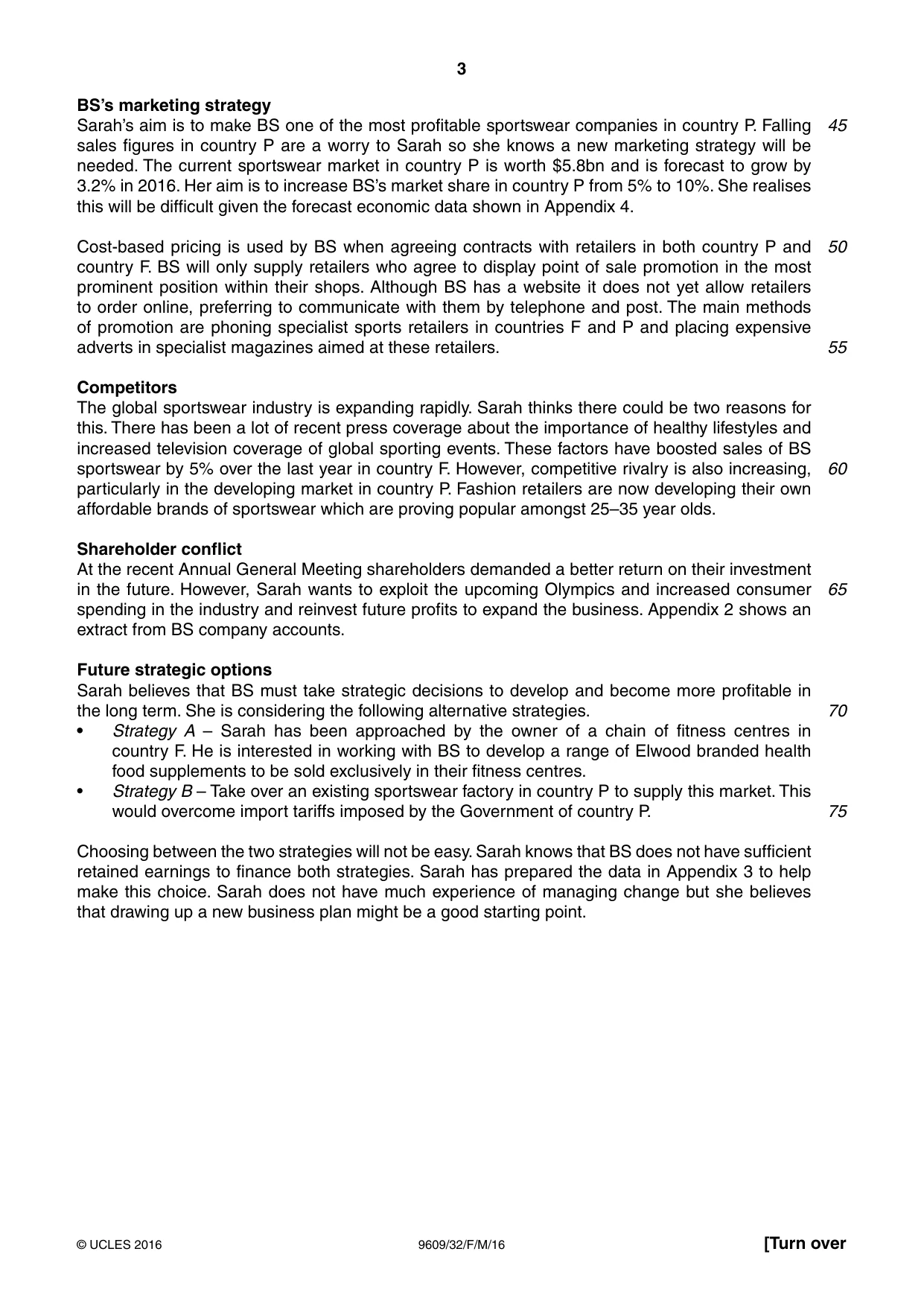
2 9609/32/F/M/16 © UCLES 2016 Barbarossa Sports (BS) BS manufactures sports clothing and footwear and has been operating for 30 years. Ten years ago the family owned company became a public limited company. Sarah is the Managing Director. Sarah and other family members together own 25% of BS shares. BS has two small factories in country F. It sells its branded sportswear called ‘Elwood’ to retail outlets throughout country F. It has also recently started exporting 20% of its products to country P. BS currently only sells direct to specialist sports retailers. BS has a good relationship with its existing customers and a reputation for reliability and good quality products. One of the BS factories manufactures casual sports shoes and running shoes. The other factory manufactures sports clothing. In 2015 28% of BS’s revenue was from shoes and 72% was from clothing. Leadership styles Each factory has a manager. Sarah delegates authority to the two managers and lets them choose their own leadership style. The two factories operate as separate cost centres and each factory manager negotiates prices with their own suppliers. • Jake manages the clothing factory. He insists on making all of the decisions himself. He believes his workers should stay focused on the task and ask few questions. Workers are very demotivated and labour turnover and absenteeism are high. Workers have complained that very little training is provided in the use of the machines. Health and safety standards are low. A recent change in working practices was introduced with no worker consultation but it has led to higher productivity. • Neeraj manages the shoe factory and is passionate about sport, having been a keen athlete in his youth. He encourages teamwork and consultation. He values his workers’ feedback and opinions. Workers regularly meet to discuss business developments and quality issues. Labour costs per unit in the factory are high. Neeraj has not been successful in encouraging workers to change working practices to increase productivity. Factory closure The two factories are located 100 km from each other and many job roles are duplicated. Machinery in both factories is over 10 years old and needs to be replaced. At a recent Board meeting, the Finance Director stated: ‘Closing the shoe factory and moving production to the clothing factory would make more financial sense in the long term, rather than operating two separate factories. I estimate that this will initially cost $1m to expand and equip the expanded factory to accommodate more workers and the required machinery.’ Sarah replied: ‘This seems to make sense but we would need to decide whether Jake or Neeraj would be the best person to manage the newly expanded factory. This strategic change will need to be managed carefully.’ The Finance Director has presented the following options for the required machinery. • Lease option – Take out a 5-year lease on new machinery with maintenance costs paid for by the leasing company. This option has a payback period of 1 year 8 months and a net present value of $394 500. • Purchase option – Buy machinery that is already 2 years old and could be resold for a residual value of 30% of the purchase price after 5 years. BS would pay for the maintenance of the machinery. Appendix 1 shows the expected net cash flows from these two options. 5 10 15 20 25 30 35 40
Question paper, page 3
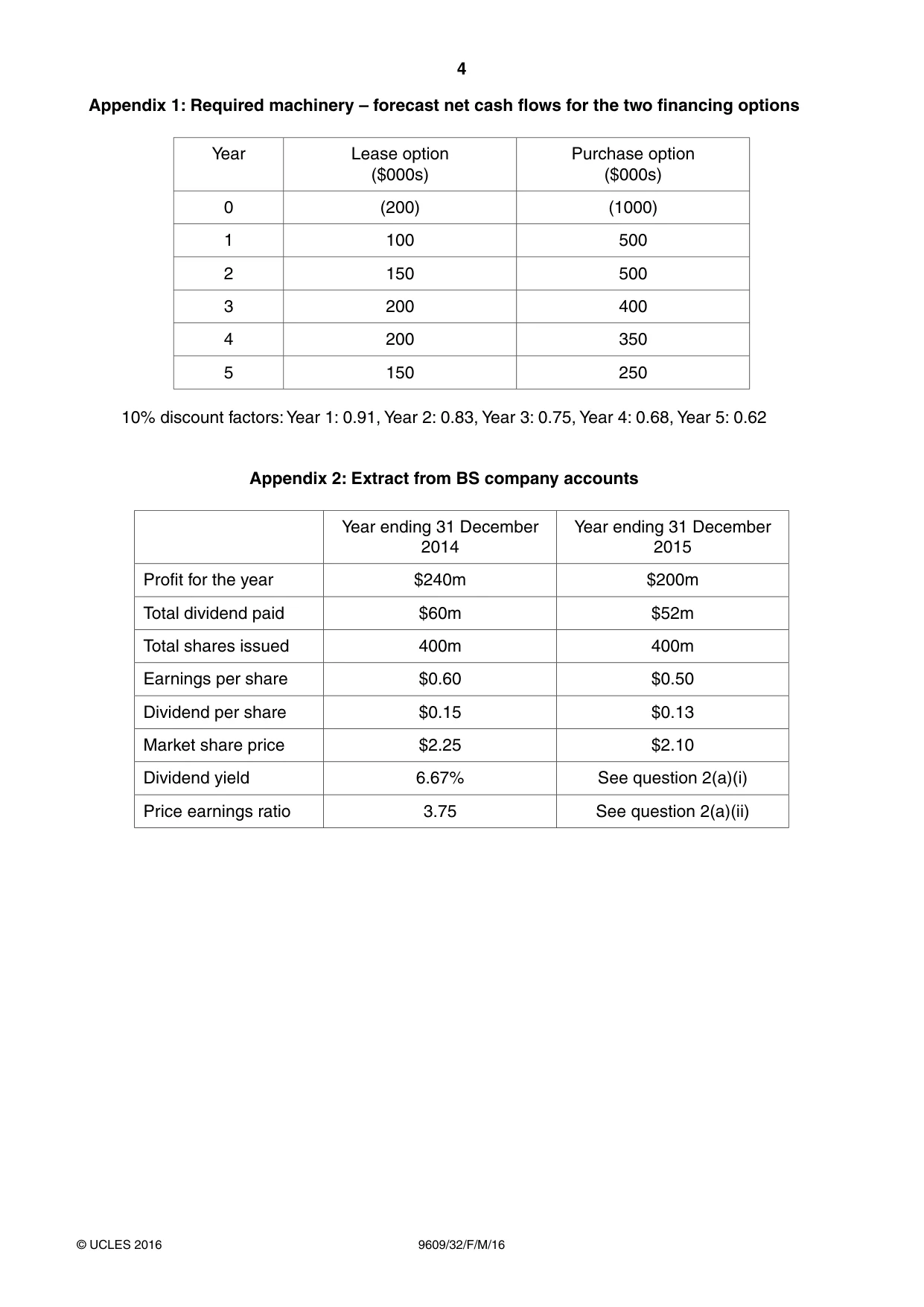
3 9609/32/F/M/16 © UCLES 2016 [Turn over BS’s marketing strategy Sarah’s aim is to make BS one of the most profitable sportswear companies in country P. Falling sales figures in country P are a worry to Sarah so she knows a new marketing strategy will be needed. The current sportswear market in country P is worth $5.8bn and is forecast to grow by 3.2% in 2016. Her aim is to increase BS’s market share in country P from 5% to 10%. She realises this will be difficult given the forecast economic data shown in Appendix 4. Cost-based pricing is used by BS when agreeing contracts with retailers in both country P and country F. BS will only supply retailers who agree to display point of sale promotion in the most prominent position within their shops. Although BS has a website it does not yet allow retailers to order online, preferring to communicate with them by telephone and post. The main methods of promotion are phoning specialist sports retailers in countries F and P and placing expensive adverts in specialist magazines aimed at these retailers. Competitors The global sportswear industry is expanding rapidly. Sarah thinks there could be two reasons for this. There has been a lot of recent press coverage about the importance of healthy lifestyles and increased television coverage of global sporting events. These factors have boosted sales of BS sportswear by 5% over the last year in country F. However, competitive rivalry is also increasing, particularly in the developing market in country P. Fashion retailers are now developing their own affordable brands of sportswear which are proving popular amongst 25–35 year olds. Shareholder conflict At the recent Annual General Meeting shareholders demanded a better return on their investment in the future. However, Sarah wants to exploit the upcoming Olympics and increased consumer spending in the industry and reinvest future profits to expand the business. Appendix 2 shows an extract from BS company accounts. Future strategic options Sarah believes that BS must take strategic decisions to develop and become more profitable in the long term. She is considering the following alternative strategies. • Strategy A – Sarah has been approached by the owner of a chain of fitness centres in country F. He is interested in working with BS to develop a range of Elwood branded health food supplements to be sold exclusively in their fitness centres. • Strategy B – Take over an existing sportswear factory in country P to supply this market. This would overcome import tariffs imposed by the Government of country P. Choosing between the two strategies will not be easy. Sarah knows that BS does not have sufficient retained earnings to finance both strategies. Sarah has prepared the data in Appendix 3 to help make this choice. Sarah does not have much experience of managing change but she believes that drawing up a new business plan might be a good starting point. 45 50 55 60 65 70 75
Question paper, page 4
4 9609/32/F/M/16 © UCLES 2016 Appendix 1: Required machinery – forecast net cash flows for the two financing options Year Lease option ($000s) Purchase option ($000s) 0 (200) (1000) 1 100 500 2 150 500 3 200 400 4 200 350 5 150 250 10% discount factors: Year 1: 0.91, Year 2: 0.83, Year 3: 0.75, Year 4: 0.68, Year 5: 0.62 Appendix 2: Extract from BS company accounts Year ending 31 December 2014 Year ending 31 December 2015 Profit for the year $240m $200m Total dividend paid $60m $52m Total shares issued 400m 400m Earnings per share $0.60 $0.50 Dividend per share $0.15 $0.13 Market share price $2.25 $2.10 Dividend yield 6.67% See question 2(a)(i) Price earnings ratio 3.75 See question 2(a)(ii)
Question paper, page 5
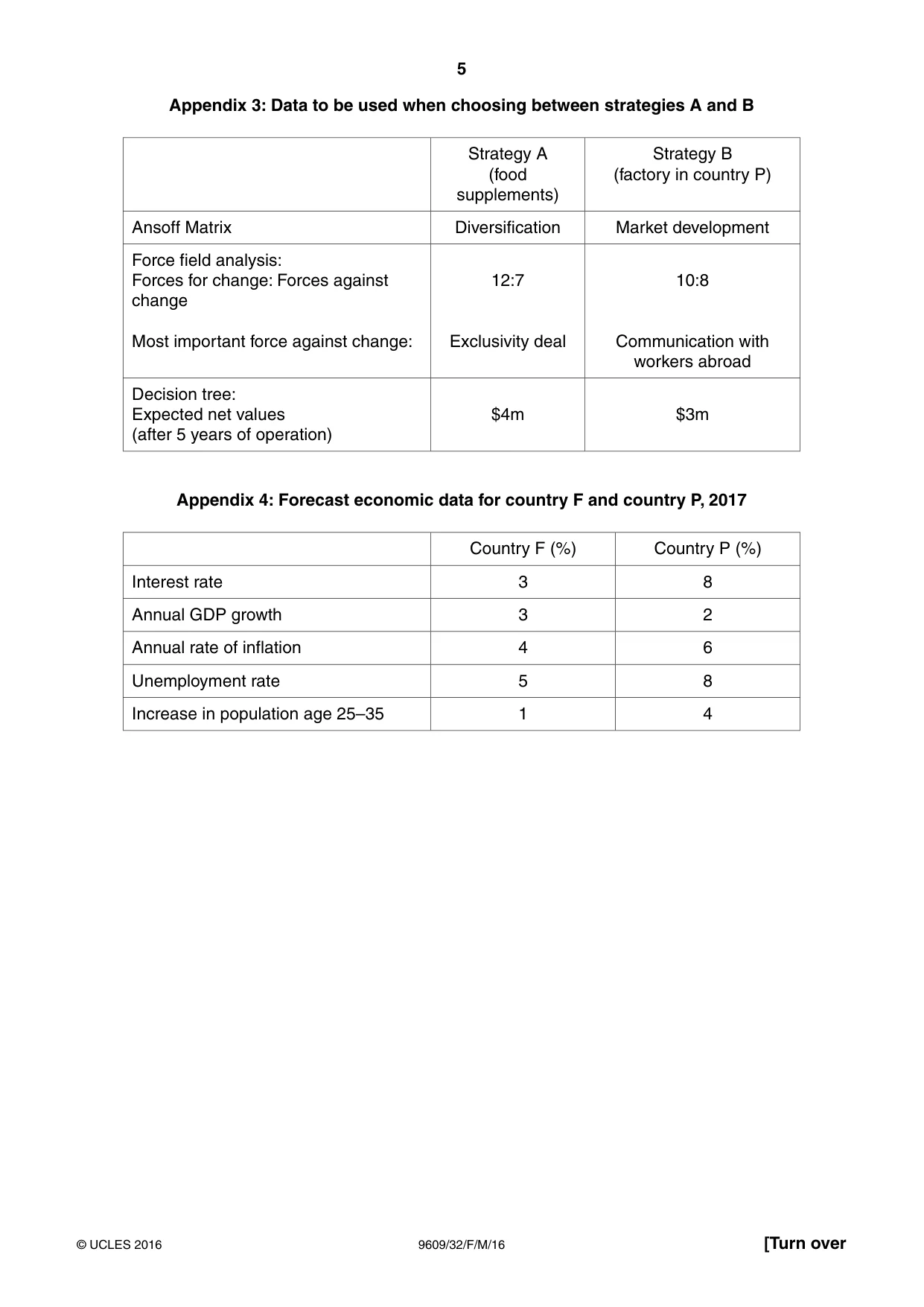
5 9609/32/F/M/16 © UCLES 2016 [Turn over Appendix 3: Data to be used when choosing between strategies A and B Strategy A (food supplements) Strategy B (factory in country P) Ansoff Matrix Diversification Market development Force field analysis: Forces for change: Forces against change Most important force against change: 12:7 Exclusivity deal 10:8 Communication with workers abroad Decision tree: Expected net values (after 5 years of operation) $4m $3m Appendix 4: Forecast economic data for country F and country P, 2017 Country F (%) Country P (%) Interest rate 3 8 Annual GDP growth 3 2 Annual rate of inflation 4 6 Unemployment rate 5 8 Increase in population age 25–35 1 4
Question paper, page 6
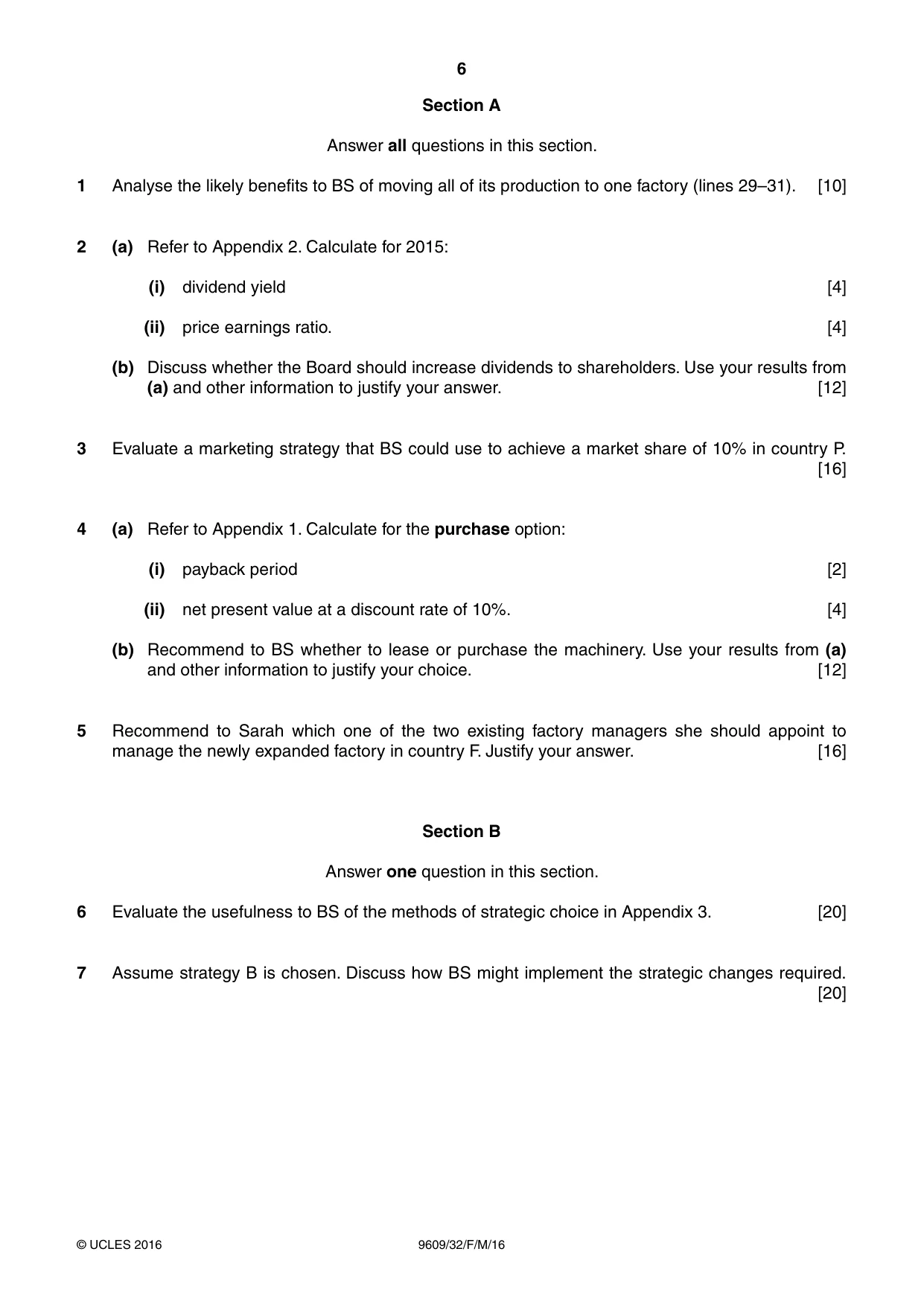
6 9609/32/F/M/16 © UCLES 2016 Section A Answer all questions in this section. 1 Analyse the likely benefits to BS of moving all of its production to one factory (lines 29–31). [10] 2 (a) Refer to Appendix 2. Calculate for 2015: (i) dividend yield [4] (ii) price earnings ratio. [4] (b) Discuss whether the Board should increase dividends to shareholders. Use your results from (a) and other information to justify your answer. [12] 3 Evaluate a marketing strategy that BS could use to achieve a market share of 10% in country P. [16] 4 (a) Refer to Appendix 1. Calculate for the purchase option: (i) payback period [2] (ii) net present value at a discount rate of 10%. [4] (b) Recommend to BS whether to lease or purchase the machinery. Use your results from (a) and other information to justify your choice. [12] 5 Recommend to Sarah which one of the two existing factory managers she should appoint to manage the newly expanded factory in country F. Justify your answer. [16] Section B Answer one question in this section. 6 Evaluate the usefulness to BS of the methods of strategic choice in Appendix 3. [20] 7 Assume strategy B is chosen. Discuss how BS might implement the strategic changes required. [20]
Question paper, page 7
7 9609/32/F/M/16 © UCLES 2016 BLANK PAGE
Question paper, page 8
8 9609/32/F/M/16 © UCLES 2016 BLANK PAGE Permission to reproduce items where third-party owned material protected by copyright is included has been sought and cleared where possible. Every reasonable effort has been made by the publisher (UCLES) to trace copyright holders, but if any items requiring clearance have unwittingly been included, the publisher will be pleased to make amends at the earliest possible opportunity. To avoid the issue of disclosure of answer-related information to candidates, all copyright acknowledgements are reproduced online in the Cambridge International Examinations Copyright Acknowledgements Booklet. This is produced for each series of examinations and is freely available to download at www.cie.org.uk after the live examination series. Cambridge International Examinations is part of the Cambridge Assessment Group. Cambridge Assessment is the brand name of University of Cambridge Local Examinations Syndicate (UCLES), which is itself a department of the University of Cambridge.
Mark scheme, page 1
® IGCSE is the registered trademark of Cambridge International Examinations. CAMBRIDGE INTERNATIONAL EXAMINATIONS Cambridge International Advanced Subsidiary and Advanced Level MARK SCHEME for the March 2016 series 9609 BUSINESS 9609/32 Paper 3 (Case Study), maximum raw mark 100 This mark scheme is published as an aid to teachers and candidates, to indicate the requirements of the examination. It shows the basis on which Examiners were instructed to award marks. It does not indicate the details of the discussions that took place at an Examiners’ meeting before marking began, which would have considered the acceptability of alternative answers. Mark schemes should be read in conjunction with the question paper and the Principal Examiner Report for Teachers. Cambridge will not enter into discussions about these mark schemes. Cambridge is publishing the mark schemes for the March 2016 series for most Cambridge IGCSE® and Cambridge International A and AS Level components.
Mark scheme, page 2
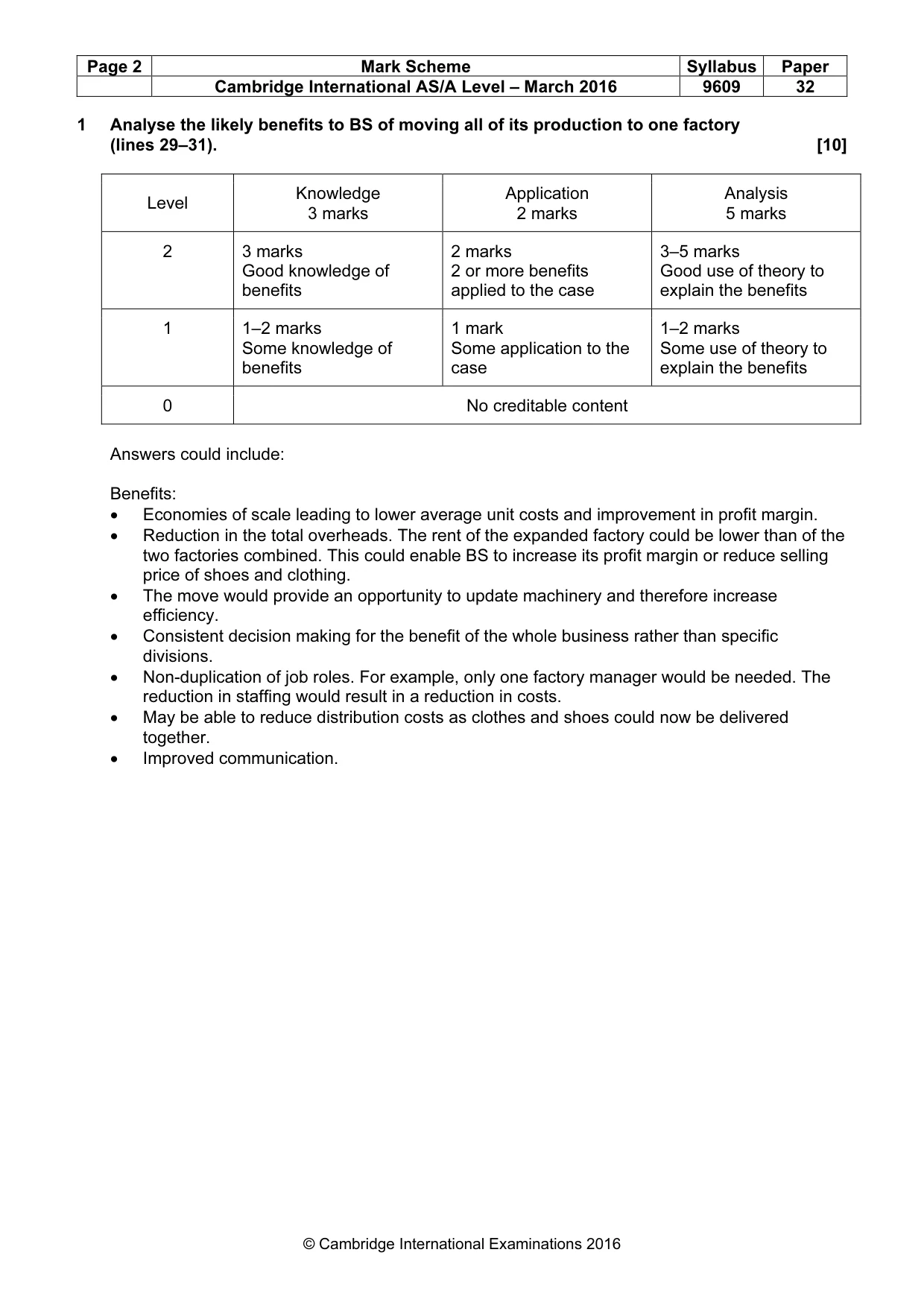
Page 2 Mark Scheme Syllabus Paper Cambridge International AS/A Level – March 2016 9609 32 © Cambridge International Examinations 2016 1 Analyse the likely benefits to BS of moving all of its production to one factory (lines 29–31). [10] Level Knowledge 3 marks Application 2 marks Analysis 5 marks 2 3 marks Good knowledge of benefits 2 marks 2 or more benefits applied to the case 3–5 marks Good use of theory to explain the benefits 1 1–2 marks Some knowledge of benefits 1 mark Some application to the case 1–2 marks Some use of theory to explain the benefits 0 No creditable content Answers could include: Benefits: • Economies of scale leading to lower average unit costs and improvement in profit margin. • Reduction in the total overheads. The rent of the expanded factory could be lower than of the two factories combined. This could enable BS to increase its profit margin or reduce selling price of shoes and clothing. • The move would provide an opportunity to update machinery and therefore increase efficiency. • Consistent decision making for the benefit of the whole business rather than specific divisions. • Non-duplication of job roles. For example, only one factory manager would be needed. The reduction in staffing would result in a reduction in costs. • May be able to reduce distribution costs as clothes and shoes could now be delivered together. • Improved communication.
Mark scheme, page 3
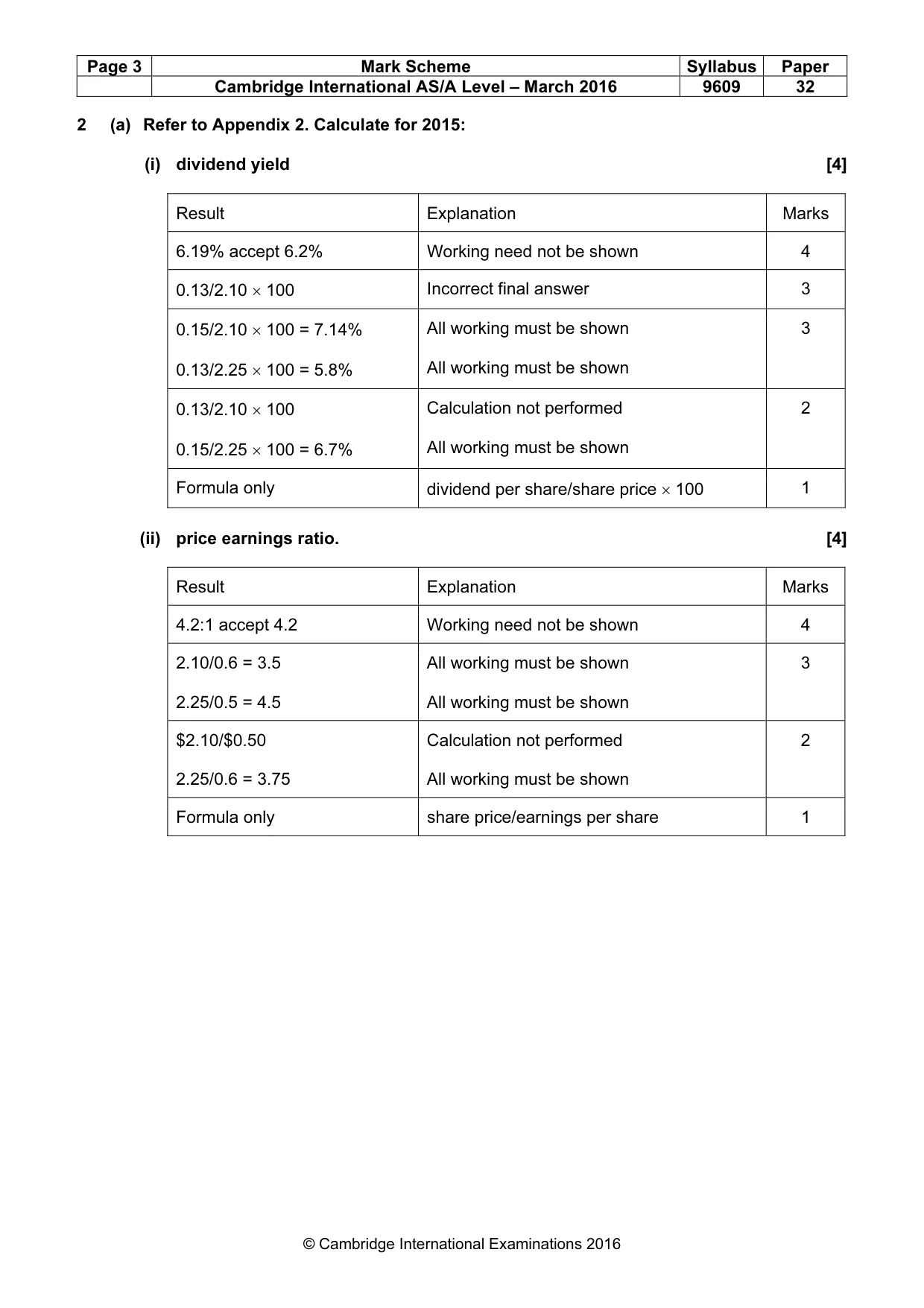
Page 3 Mark Scheme Syllabus Paper Cambridge International AS/A Level – March 2016 9609 32 © Cambridge International Examinations 2016 2 (a) Refer to Appendix 2. Calculate for 2015: (i) dividend yield [4] Result Explanation Marks 6.19% accept 6.2% Working need not be shown 4 0.13/2.10 × 100 Incorrect final answer 3 0.15/2.10 × 100 = 7.14% 0.13/2.25 × 100 = 5.8% All working must be shown All working must be shown 3 0.13/2.10 × 100 0.15/2.25 × 100 = 6.7% Calculation not performed All working must be shown 2 Formula only dividend per share/share price × 100 1 (ii) price earnings ratio. [4] Result Explanation Marks 4.2:1 accept 4.2 Working need not be shown 4 2.10/0.6 = 3.5 2.25/0.5 = 4.5 All working must be shown All working must be shown 3 $2.10/$0.50 2.25/0.6 = 3.75 Calculation not performed All working must be shown 2 Formula only share price/earnings per share 1
Mark scheme, page 4
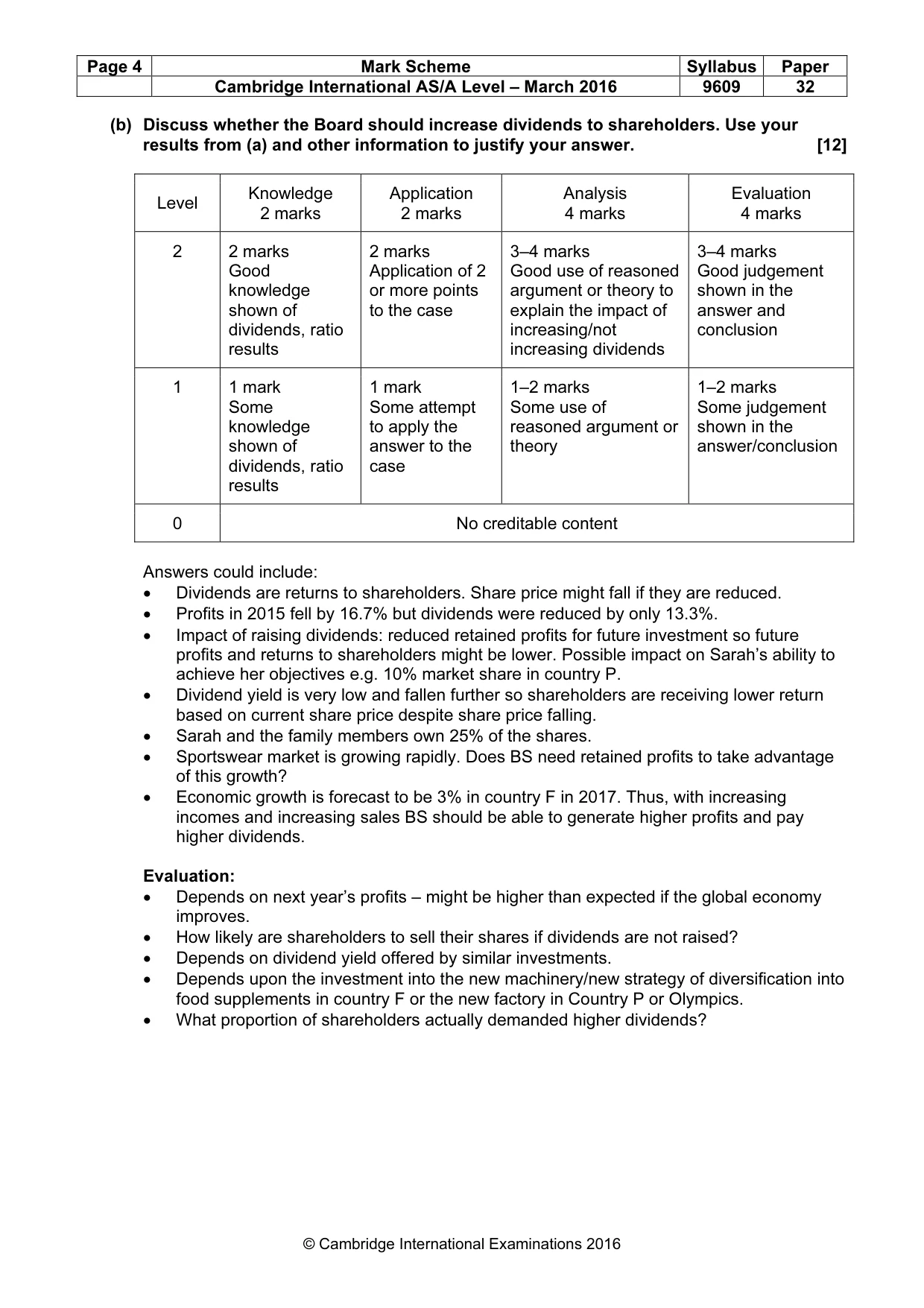
Page 4 Mark Scheme Syllabus Paper Cambridge International AS/A Level – March 2016 9609 32 © Cambridge International Examinations 2016 (b) Discuss whether the Board should increase dividends to shareholders. Use your results from (a) and other information to justify your answer. [12] Level Knowledge 2 marks Application 2 marks Analysis 4 marks Evaluation 4 marks 2 2 marks Good knowledge shown of dividends, ratio results 2 marks Application of 2 or more points to the case 3–4 marks Good use of reasoned argument or theory to explain the impact of increasing/not increasing dividends 3–4 marks Good judgement shown in the answer and conclusion 1 1 mark Some knowledge shown of dividends, ratio results 1 mark Some attempt to apply the answer to the case 1–2 marks Some use of reasoned argument or theory 1–2 marks Some judgement shown in the answer/conclusion 0 No creditable content Answers could include: • Dividends are returns to shareholders. Share price might fall if they are reduced. • Profits in 2015 fell by 16.7% but dividends were reduced by only 13.3%. • Impact of raising dividends: reduced retained profits for future investment so future profits and returns to shareholders might be lower. Possible impact on Sarah’s ability to achieve her objectives e.g. 10% market share in country P. • Dividend yield is very low and fallen further so shareholders are receiving lower return based on current share price despite share price falling. • Sarah and the family members own 25% of the shares. • Sportswear market is growing rapidly. Does BS need retained profits to take advantage of this growth? • Economic growth is forecast to be 3% in country F in 2017. Thus, with increasing incomes and increasing sales BS should be able to generate higher profits and pay higher dividends. Evaluation: • Depends on next year’s profits – might be higher than expected if the global economy improves. • How likely are shareholders to sell their shares if dividends are not raised? • Depends on dividend yield offered by similar investments. • Depends upon the investment into the new machinery/new strategy of diversification into food supplements in country F or the new factory in Country P or Olympics. • What proportion of shareholders actually demanded higher dividends?
Mark scheme, page 5
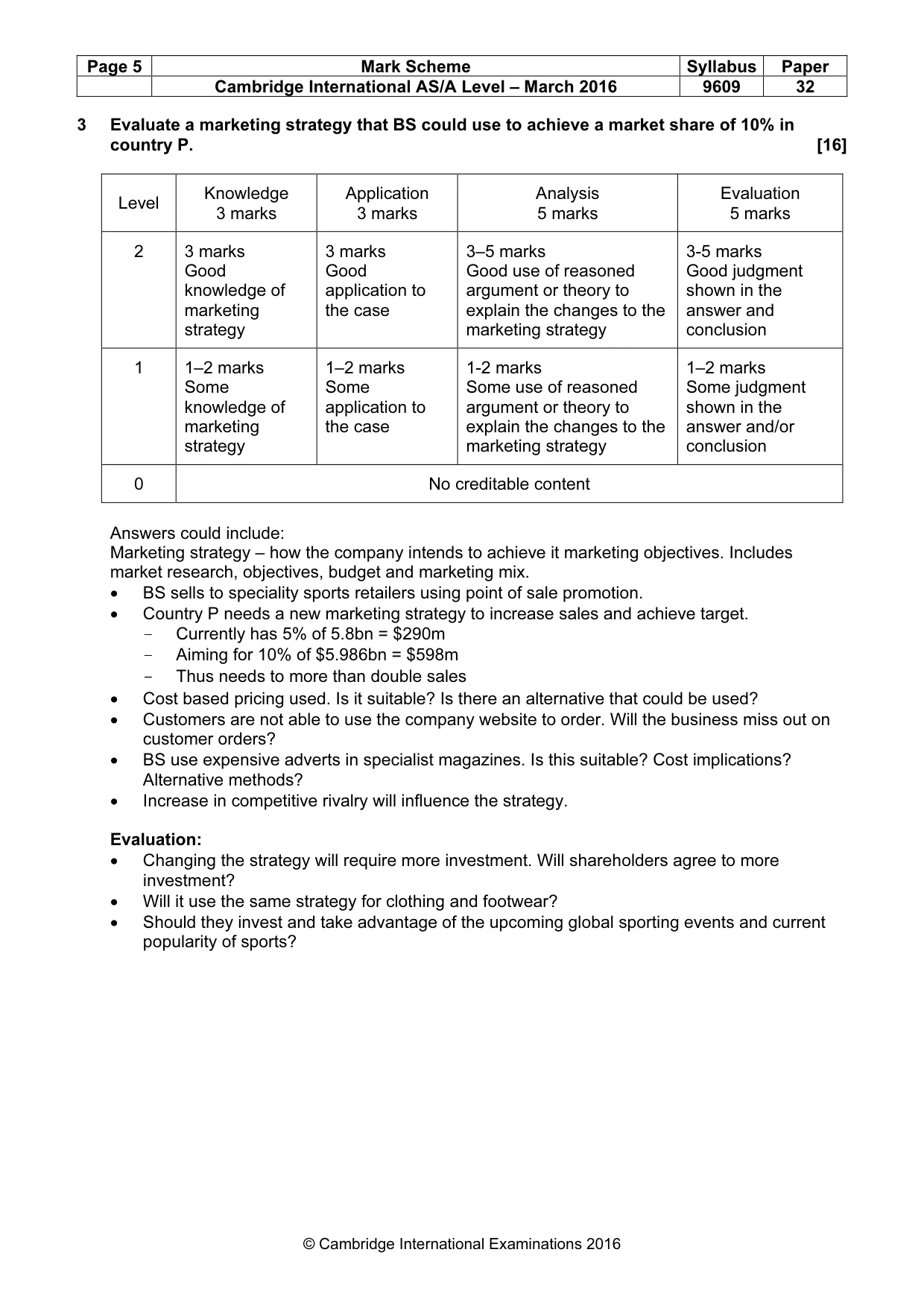
Page 5 Mark Scheme Syllabus Paper Cambridge International AS/A Level – March 2016 9609 32 © Cambridge International Examinations 2016 3 Evaluate a marketing strategy that BS could use to achieve a market share of 10% in country P. [16] Level Knowledge 3 marks Application 3 marks Analysis 5 marks Evaluation 5 marks 2 3 marks Good knowledge of marketing strategy 3 marks Good application to the case 3–5 marks Good use of reasoned argument or theory to explain the changes to the marketing strategy 3-5 marks Good judgment shown in the answer and conclusion 1 1–2 marks Some knowledge of marketing strategy 1–2 marks Some application to the case 1-2 marks Some use of reasoned argument or theory to explain the changes to the marketing strategy 1–2 marks Some judgment shown in the answer and/or conclusion 0 No creditable content Answers could include: Marketing strategy – how the company intends to achieve it marketing objectives. Includes market research, objectives, budget and marketing mix. • BS sells to speciality sports retailers using point of sale promotion. • Country P needs a new marketing strategy to increase sales and achieve target. – Currently has 5% of 5.8bn = $290m – Aiming for 10% of $5.986bn = $598m - Thus needs to more than double sales • Cost based pricing used. Is it suitable? Is there an alternative that could be used? • Customers are not able to use the company website to order. Will the business miss out on customer orders? • BS use expensive adverts in specialist magazines. Is this suitable? Cost implications? Alternative methods? • Increase in competitive rivalry will influence the strategy. Evaluation: • Changing the strategy will require more investment. Will shareholders agree to more investment? • Will it use the same strategy for clothing and footwear? • Should they invest and take advantage of the upcoming global sporting events and current popularity of sports?
Mark scheme, page 6
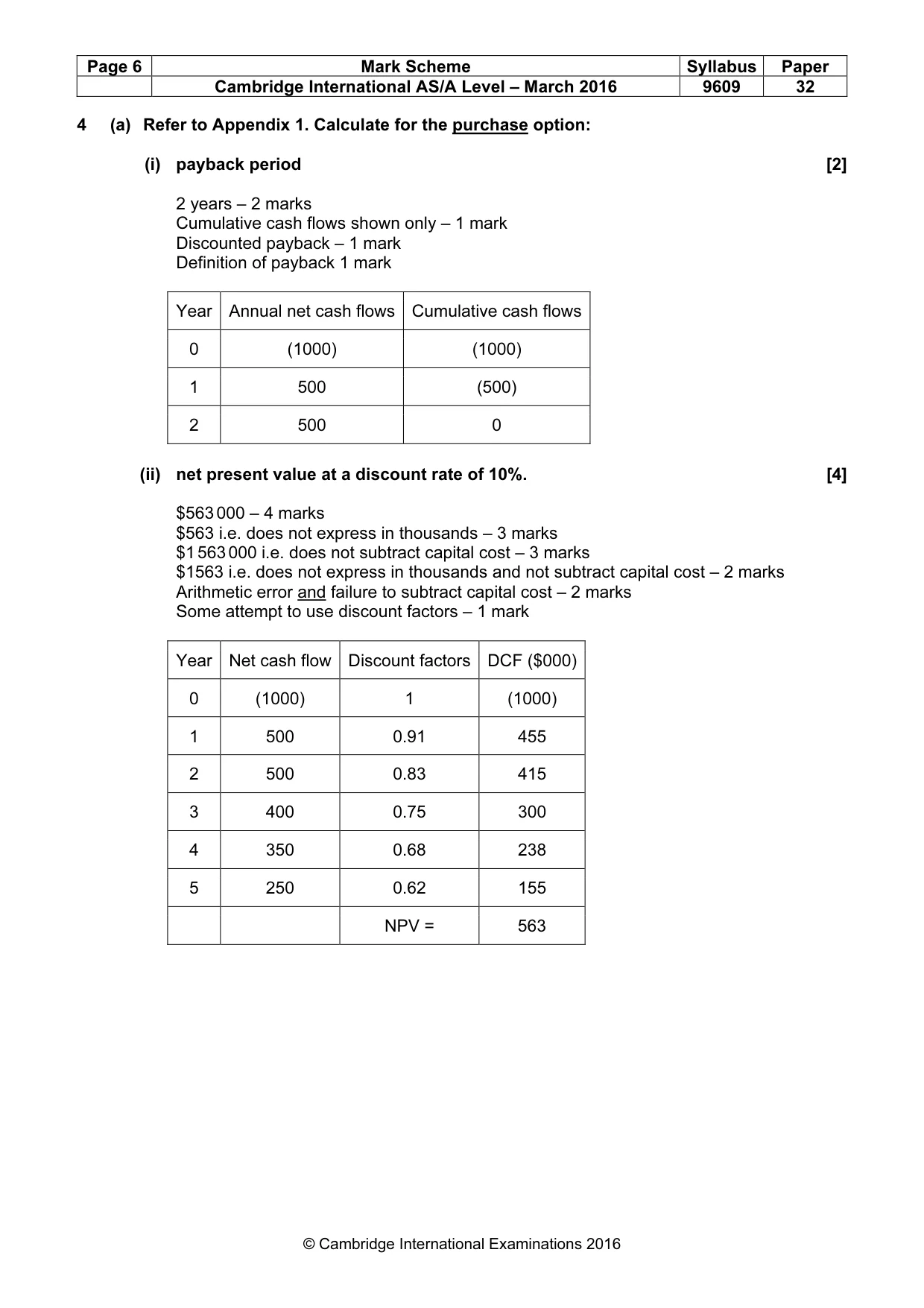
Page 6 Mark Scheme Syllabus Paper Cambridge International AS/A Level – March 2016 9609 32 © Cambridge International Examinations 2016 4 (a) Refer to Appendix 1. Calculate for the purchase option: (i) payback period [2] 2 years – 2 marks Cumulative cash flows shown only – 1 mark Discounted payback – 1 mark Definition of payback 1 mark Year Annual net cash flows Cumulative cash flows 0 (1000) (1000) 1 500 (500) 2 500 0 (ii) net present value at a discount rate of 10%. [4] $563 000 – 4 marks $563 i.e. does not express in thousands – 3 marks $1 563 000 i.e. does not subtract capital cost – 3 marks $1563 i.e. does not express in thousands and not subtract capital cost – 2 marks Arithmetic error and failure to subtract capital cost – 2 marks Some attempt to use discount factors – 1 mark Year Net cash flow Discount factors DCF ($000) 0 (1000) 1 (1000) 1 500 0.91 455 2 500 0.83 415 3 400 0.75 300 4 350 0.68 238 5 250 0.62 155 NPV = 563
Mark scheme, page 7
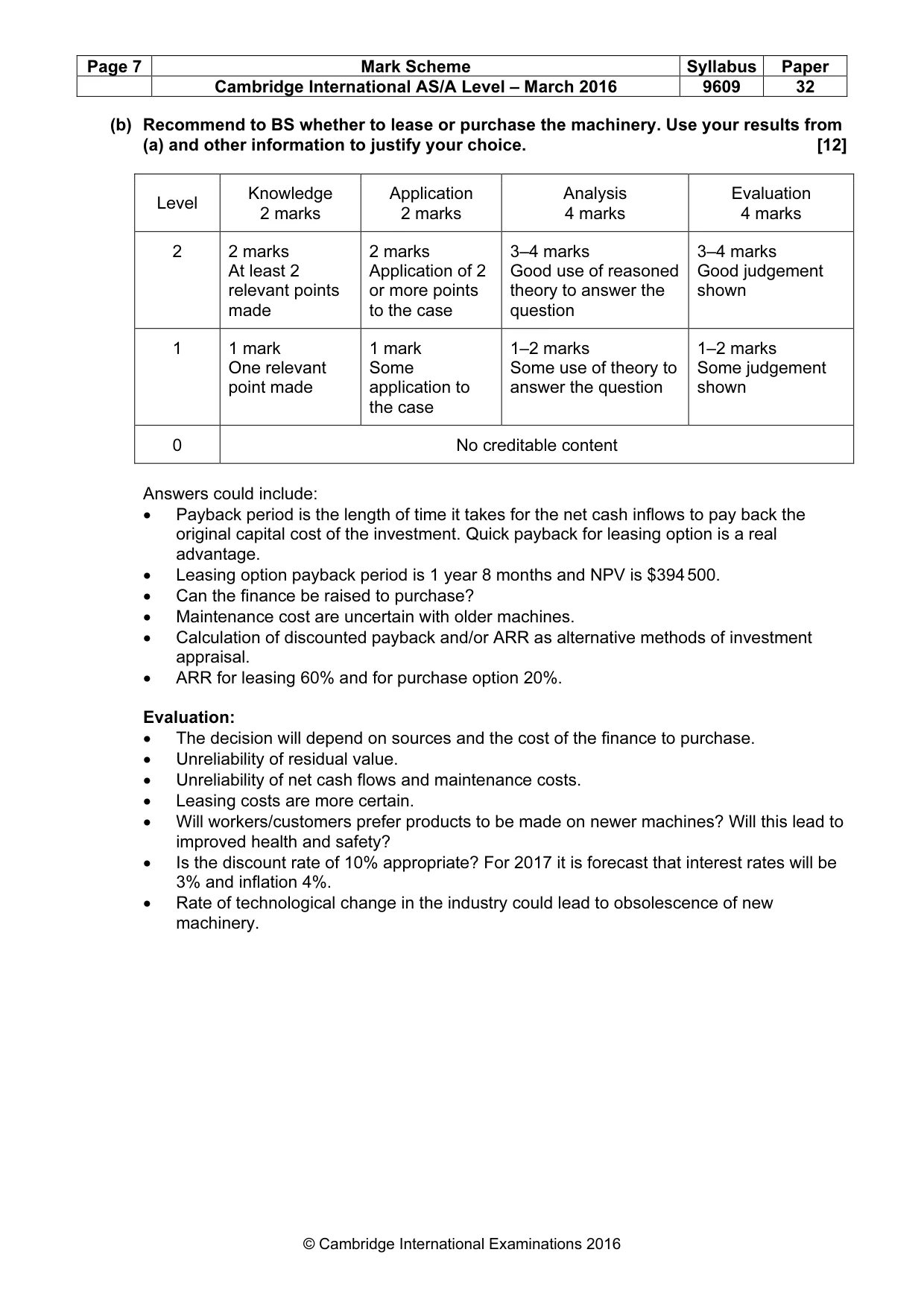
Page 7 Mark Scheme Syllabus Paper Cambridge International AS/A Level – March 2016 9609 32 © Cambridge International Examinations 2016 (b) Recommend to BS whether to lease or purchase the machinery. Use your results from (a) and other information to justify your choice. [12] Level Knowledge 2 marks Application 2 marks Analysis 4 marks Evaluation 4 marks 2 2 marks At least 2 relevant points made 2 marks Application of 2 or more points to the case 3–4 marks Good use of reasoned theory to answer the question 3–4 marks Good judgement shown 1 1 mark One relevant point made 1 mark Some application to the case 1–2 marks Some use of theory to answer the question 1–2 marks Some judgement shown 0 No creditable content Answers could include: • Payback period is the length of time it takes for the net cash inflows to pay back the original capital cost of the investment. Quick payback for leasing option is a real advantage. • Leasing option payback period is 1 year 8 months and NPV is $394 500. • Can the finance be raised to purchase? • Maintenance cost are uncertain with older machines. • Calculation of discounted payback and/or ARR as alternative methods of investment appraisal. • ARR for leasing 60% and for purchase option 20%. Evaluation: • The decision will depend on sources and the cost of the finance to purchase. • Unreliability of residual value. • Unreliability of net cash flows and maintenance costs. • Leasing costs are more certain. • Will workers/customers prefer products to be made on newer machines? Will this lead to improved health and safety? • Is the discount rate of 10% appropriate? For 2017 it is forecast that interest rates will be 3% and inflation 4%. • Rate of technological change in the industry could lead to obsolescence of new machinery.
Mark scheme, page 8
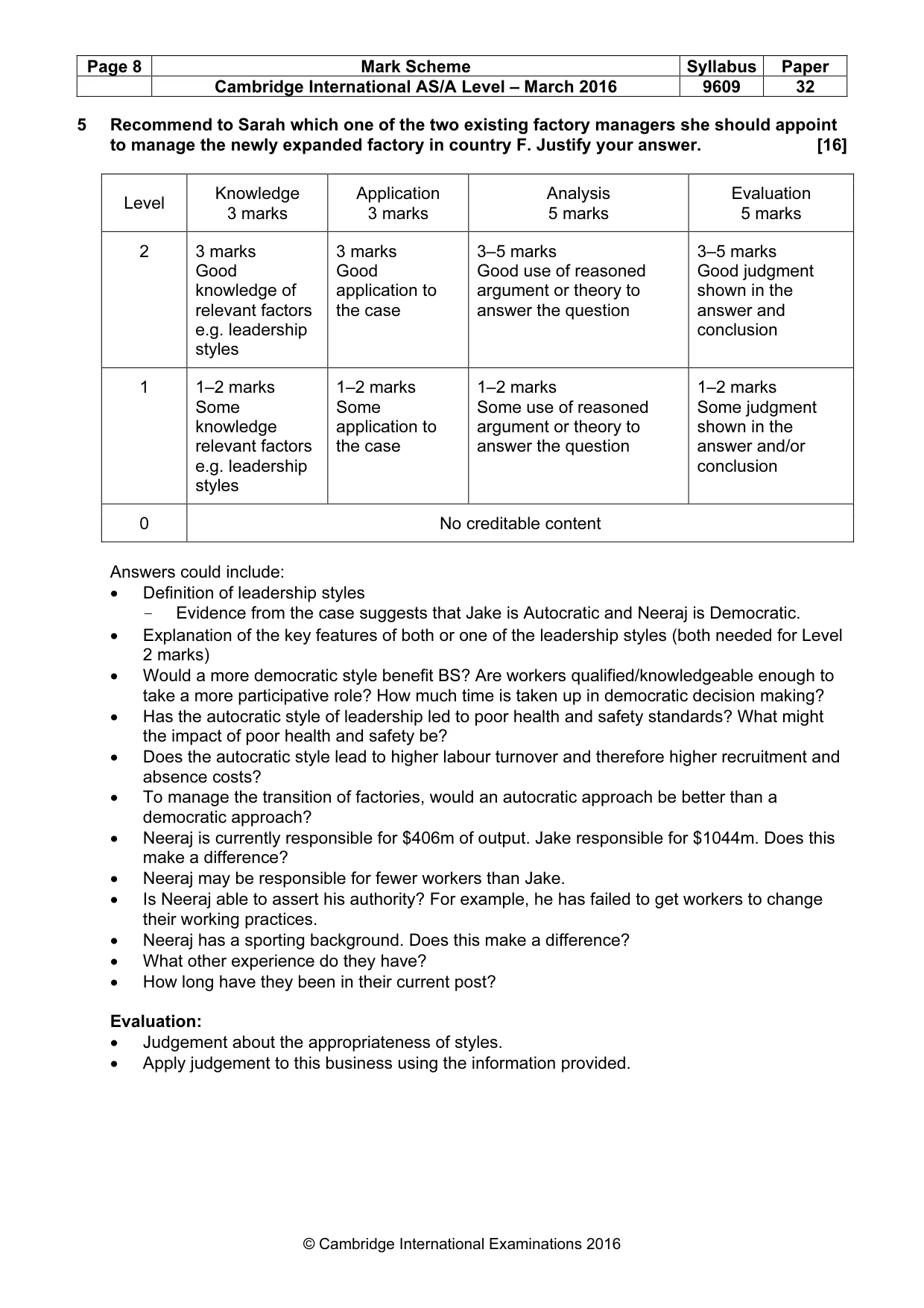
Page 8 Mark Scheme Syllabus Paper Cambridge International AS/A Level – March 2016 9609 32 © Cambridge International Examinations 2016 5 Recommend to Sarah which one of the two existing factory managers she should appoint to manage the newly expanded factory in country F. Justify your answer. [16] Level Knowledge 3 marks Application 3 marks Analysis 5 marks Evaluation 5 marks 2 3 marks Good knowledge of relevant factors e.g. leadership styles 3 marks Good application to the case 3–5 marks Good use of reasoned argument or theory to answer the question 3–5 marks Good judgment shown in the answer and conclusion 1 1–2 marks Some knowledge relevant factors e.g. leadership styles 1–2 marks Some application to the case 1–2 marks Some use of reasoned argument or theory to answer the question 1–2 marks Some judgment shown in the answer and/or conclusion 0 No creditable content Answers could include: • Definition of leadership styles – Evidence from the case suggests that Jake is Autocratic and Neeraj is Democratic. • Explanation of the key features of both or one of the leadership styles (both needed for Level 2 marks) • Would a more democratic style benefit BS? Are workers qualified/knowledgeable enough to take a more participative role? How much time is taken up in democratic decision making? • Has the autocratic style of leadership led to poor health and safety standards? What might the impact of poor health and safety be? • Does the autocratic style lead to higher labour turnover and therefore higher recruitment and absence costs? • To manage the transition of factories, would an autocratic approach be better than a democratic approach? • Neeraj is currently responsible for $406m of output. Jake responsible for $1044m. Does this make a difference? • Neeraj may be responsible for fewer workers than Jake. • Is Neeraj able to assert his authority? For example, he has failed to get workers to change their working practices. • Neeraj has a sporting background. Does this make a difference? • What other experience do they have? • How long have they been in their current post? Evaluation: • Judgement about the appropriateness of styles. • Apply judgement to this business using the information provided.
Mark scheme, page 9
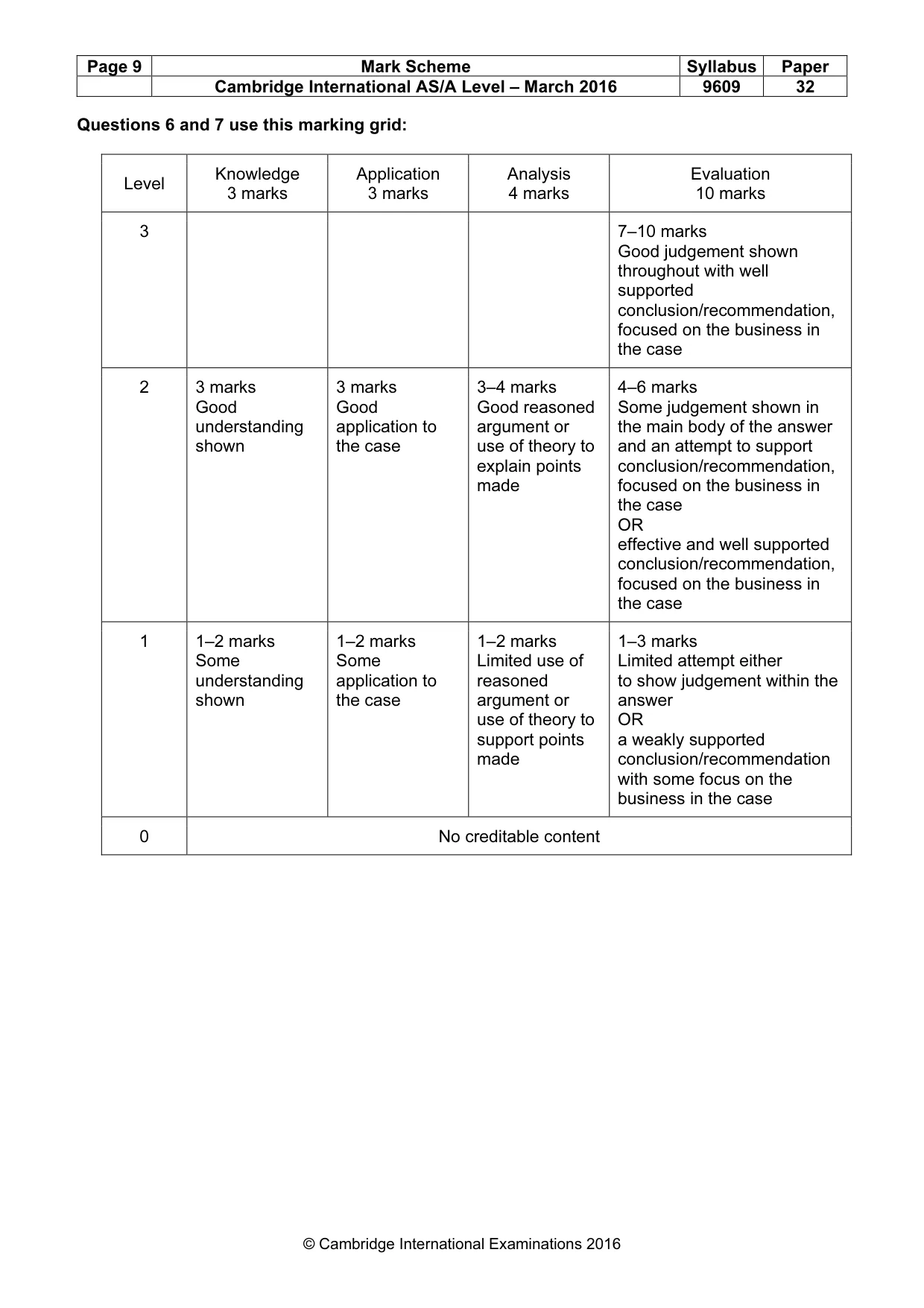
Page 9 Mark Scheme Syllabus Paper Cambridge International AS/A Level – March 2016 9609 32 © Cambridge International Examinations 2016 Questions 6 and 7 use this marking grid: Level Knowledge 3 marks Application 3 marks Analysis 4 marks Evaluation 10 marks 3 7–10 marks Good judgement shown throughout with well supported conclusion/recommendation, focused on the business in the case 2 3 marks Good understanding shown 3 marks Good application to the case 3–4 marks Good reasoned argument or use of theory to explain points made 4–6 marks Some judgement shown in the main body of the answer and an attempt to support conclusion/recommendation, focused on the business in the case OR effective and well supported conclusion/recommendation, focused on the business in the case 1 1–2 marks Some understanding shown 1–2 marks Some application to the case 1–2 marks Limited use of reasoned argument or use of theory to support points made 1–3 marks Limited attempt either to show judgement within the answer OR a weakly supported conclusion/recommendation with some focus on the business in the case 0 No creditable content
Mark scheme, page 10
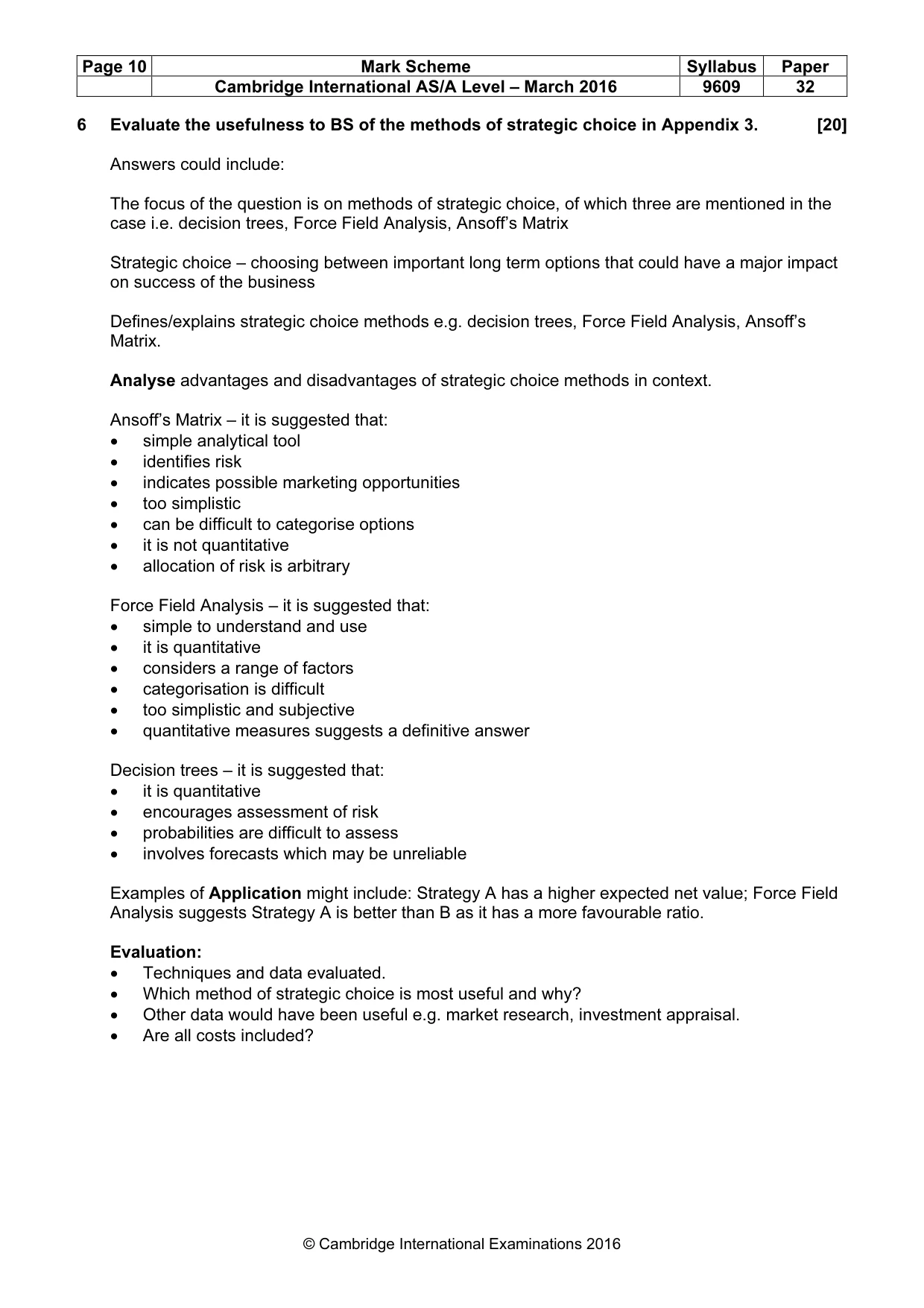
Page 10 Mark Scheme Syllabus Paper Cambridge International AS/A Level – March 2016 9609 32 © Cambridge International Examinations 2016 6 Evaluate the usefulness to BS of the methods of strategic choice in Appendix 3. [20] Answers could include: The focus of the question is on methods of strategic choice, of which three are mentioned in the case i.e. decision trees, Force Field Analysis, Ansoff’s Matrix Strategic choice – choosing between important long term options that could have a major impact on success of the business Defines/explains strategic choice methods e.g. decision trees, Force Field Analysis, Ansoff’s Matrix. Analyse advantages and disadvantages of strategic choice methods in context. Ansoff’s Matrix – it is suggested that: • simple analytical tool • identifies risk • indicates possible marketing opportunities • too simplistic • can be difficult to categorise options • it is not quantitative • allocation of risk is arbitrary Force Field Analysis – it is suggested that: • simple to understand and use • it is quantitative • considers a range of factors • categorisation is difficult • too simplistic and subjective • quantitative measures suggests a definitive answer Decision trees – it is suggested that: • it is quantitative • encourages assessment of risk • probabilities are difficult to assess • involves forecasts which may be unreliable Examples of Application might include: Strategy A has a higher expected net value; Force Field Analysis suggests Strategy A is better than B as it has a more favourable ratio. Evaluation: • Techniques and data evaluated. • Which method of strategic choice is most useful and why? • Other data would have been useful e.g. market research, investment appraisal. • Are all costs included?
Mark scheme, page 11
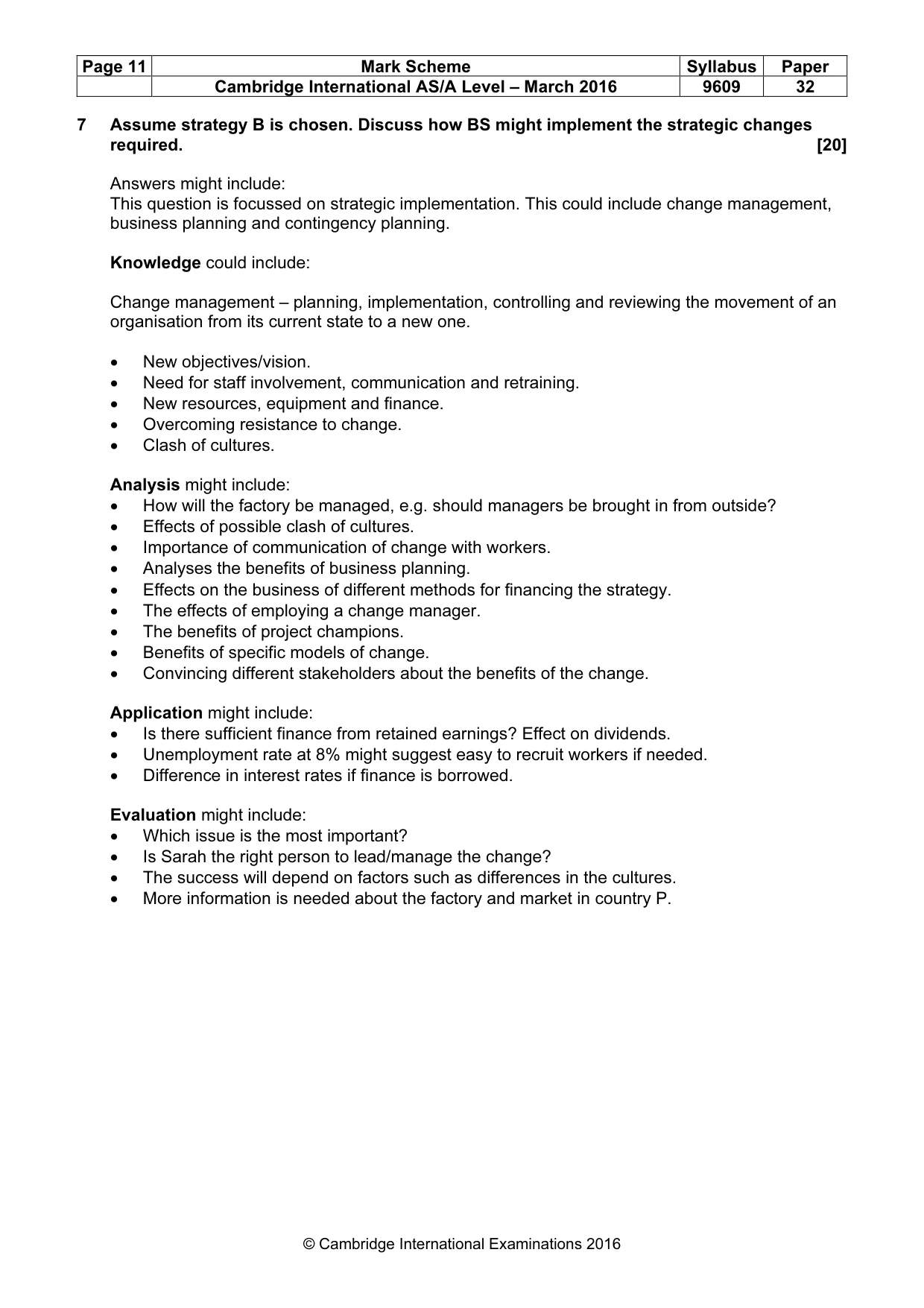
Page 11 Mark Scheme Syllabus Paper Cambridge International AS/A Level – March 2016 9609 32 © Cambridge International Examinations 2016 7 Assume strategy B is chosen. Discuss how BS might implement the strategic changes required. [20] Answers might include: This question is focussed on strategic implementation. This could include change management, business planning and contingency planning. Knowledge could include: Change management – planning, implementation, controlling and reviewing the movement of an organisation from its current state to a new one. • New objectives/vision. • Need for staff involvement, communication and retraining. • New resources, equipment and finance. • Overcoming resistance to change. • Clash of cultures. Analysis might include: • How will the factory be managed, e.g. should managers be brought in from outside? • Effects of possible clash of cultures. • Importance of communication of change with workers. • Analyses the benefits of business planning. • Effects on the business of different methods for financing the strategy. • The effects of employing a change manager. • The benefits of project champions. • Benefits of specific models of change. • Convincing different stakeholders about the benefits of the change. Application might include: • Is there sufficient finance from retained earnings? Effect on dividends. • Unemployment rate at 8% might suggest easy to recruit workers if needed. • Difference in interest rates if finance is borrowed. Evaluation might include: • Which issue is the most important? • Is Sarah the right person to lead/manage the change? • The success will depend on factors such as differences in the cultures. • More information is needed about the factory and market in country P.
What you needed in this session
Cambridge’s own grade thresholds for 2016 Feb/March, Paper 3 · Variant 2. A higher threshold means an easier paper — the bar moves with how the cohort did.