Cambridge A Level Accounting 9706 — 2021 May/June Paper 3 · Variant 3
9706/33/M/J/21 · 150 marks · ≈169 min
The question paper and its mark scheme, free to read here and free to download. This is Cambridge’s own paper, exactly as it was sat.
Question paper28 pages


Mark scheme22 pages
Answers below. Sit the paper first if you are practising.
Paper as text
Question paper, page 1
This document has 28 pages. Any blank pages are indicated. Cambridge International AS & A Level DC (DH) 203454/3 © UCLES 2021 [Turn over * 5 6 6 6 3 7 4 4 7 0 * ACCOUNTING 9706/33 Paper 3 Structured Questions May/June 2021 3 hours You must answer on the question paper. You will need: Insert (enclosed) INSTRUCTIONS ● Answer all questions. ● Use a black or dark blue pen. ● Write your name, centre number and candidate number in the boxes at the top of the page. ● Write your answer to each question in the space provided. ● Do not use an erasable pen or correction fluid. ● Do not write on any bar codes. ● You may use an HB pencil for any diagrams, graphs or rough working. ● You may use a calculator. ● International accounting terms and formats should be used as appropriate. ● You should show your workings. INFORMATION ● The total mark for this paper is 150. ● The number of marks for each question or part question is shown in brackets [ ]. ● The insert contains all of the required information and questions.
Question paper, page 2
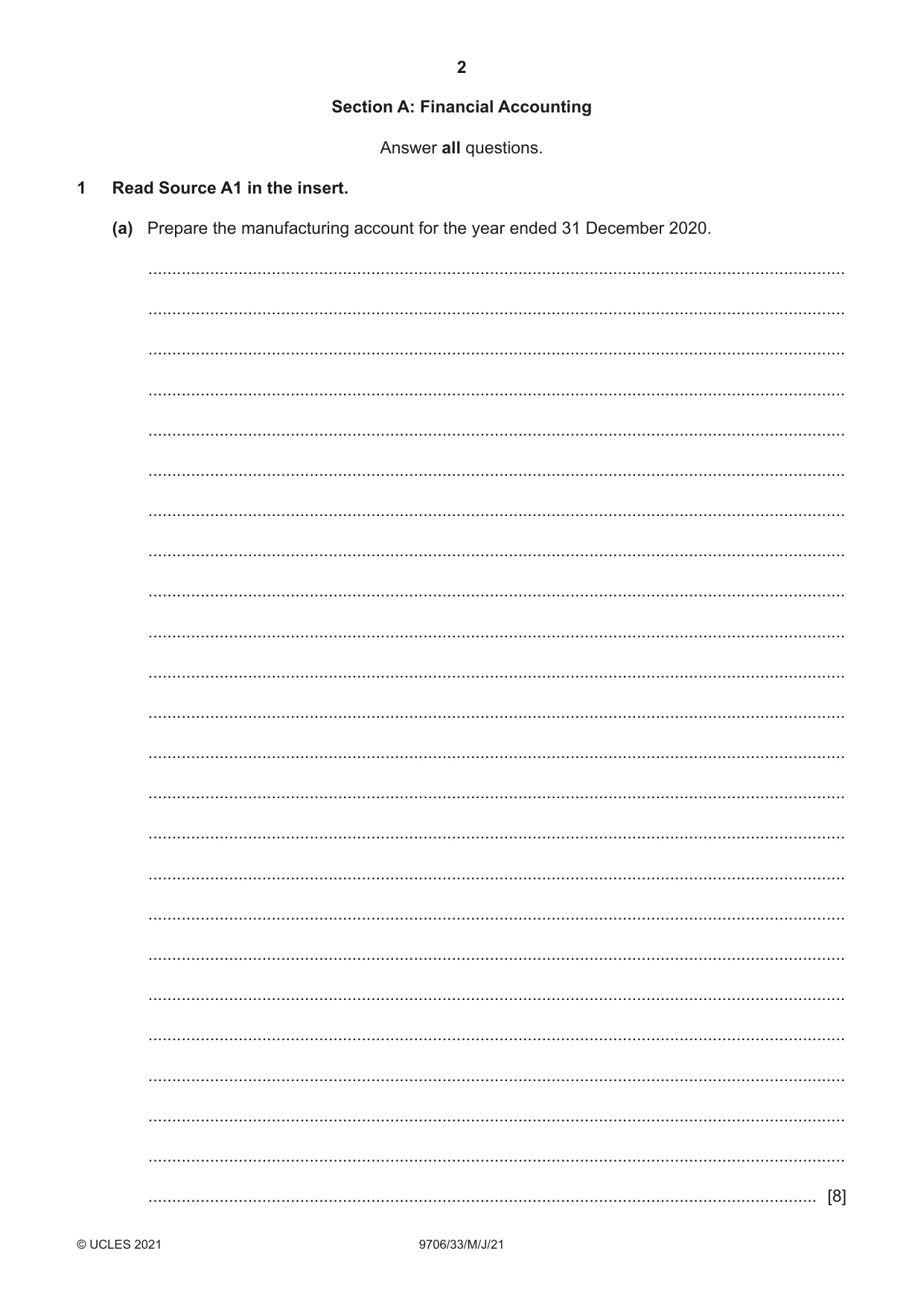
2 9706/33/M/J/21 © UCLES 2021 Section A: Financial Accounting Answer all questions. 1 Read Source A1 in the insert. (a) Prepare the manufacturing account for the year ended 31 December 2020. … … … … … … … … … … … … … … … … … … … … … … … … [8]
Question paper, page 3
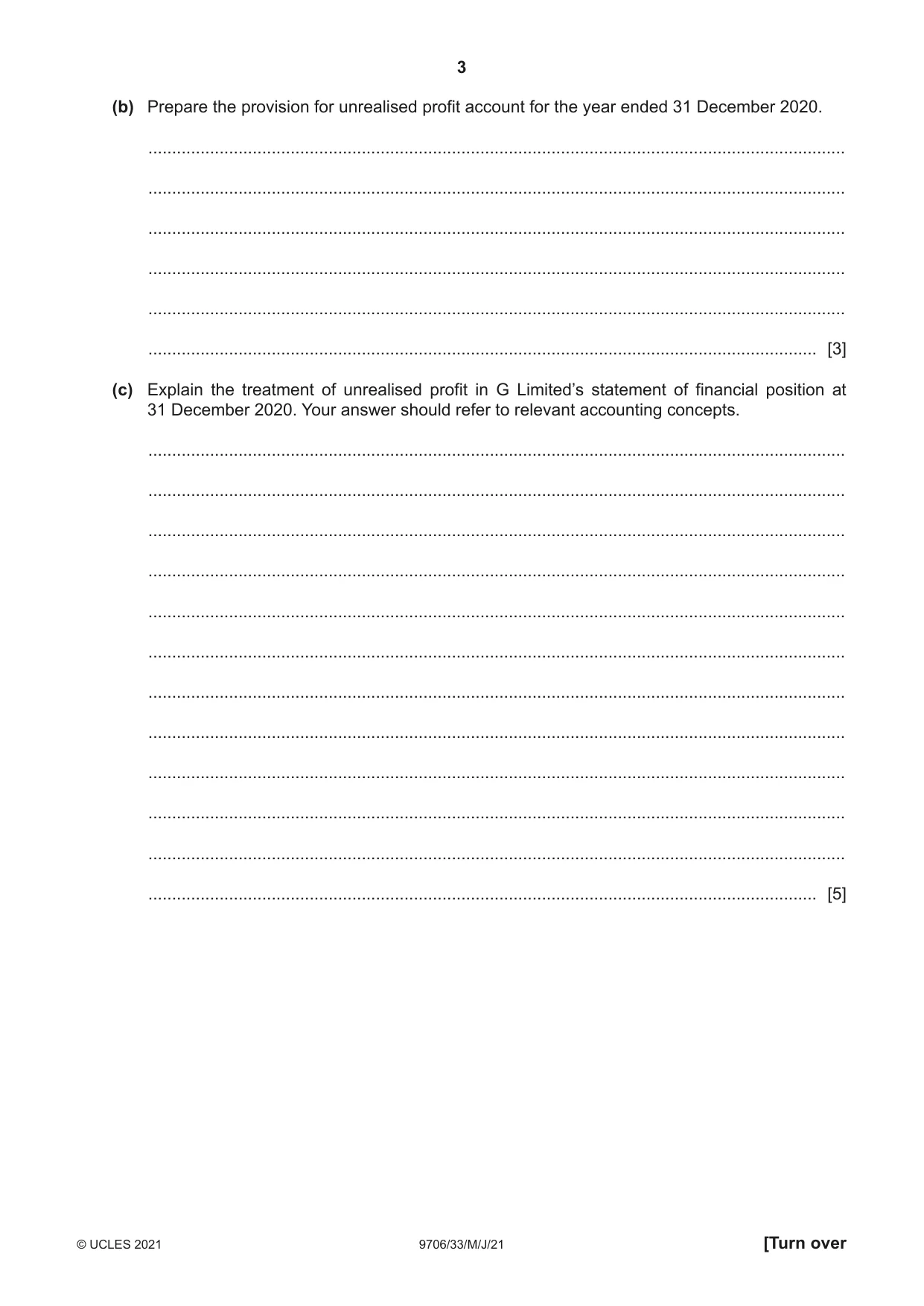
3 9706/33/M/J/21 © UCLES 2021 [Turn over (b) Prepare the provision for unrealised profit account for the year ended 31 December 2020. … … … … … … [3] (c) Explain the treatment of unrealised profit in G Limited’s statement of financial position at 31 December 2020. Your answer should refer to relevant accounting concepts. … … … … … … … … … … … … [5]
Question paper, page 4
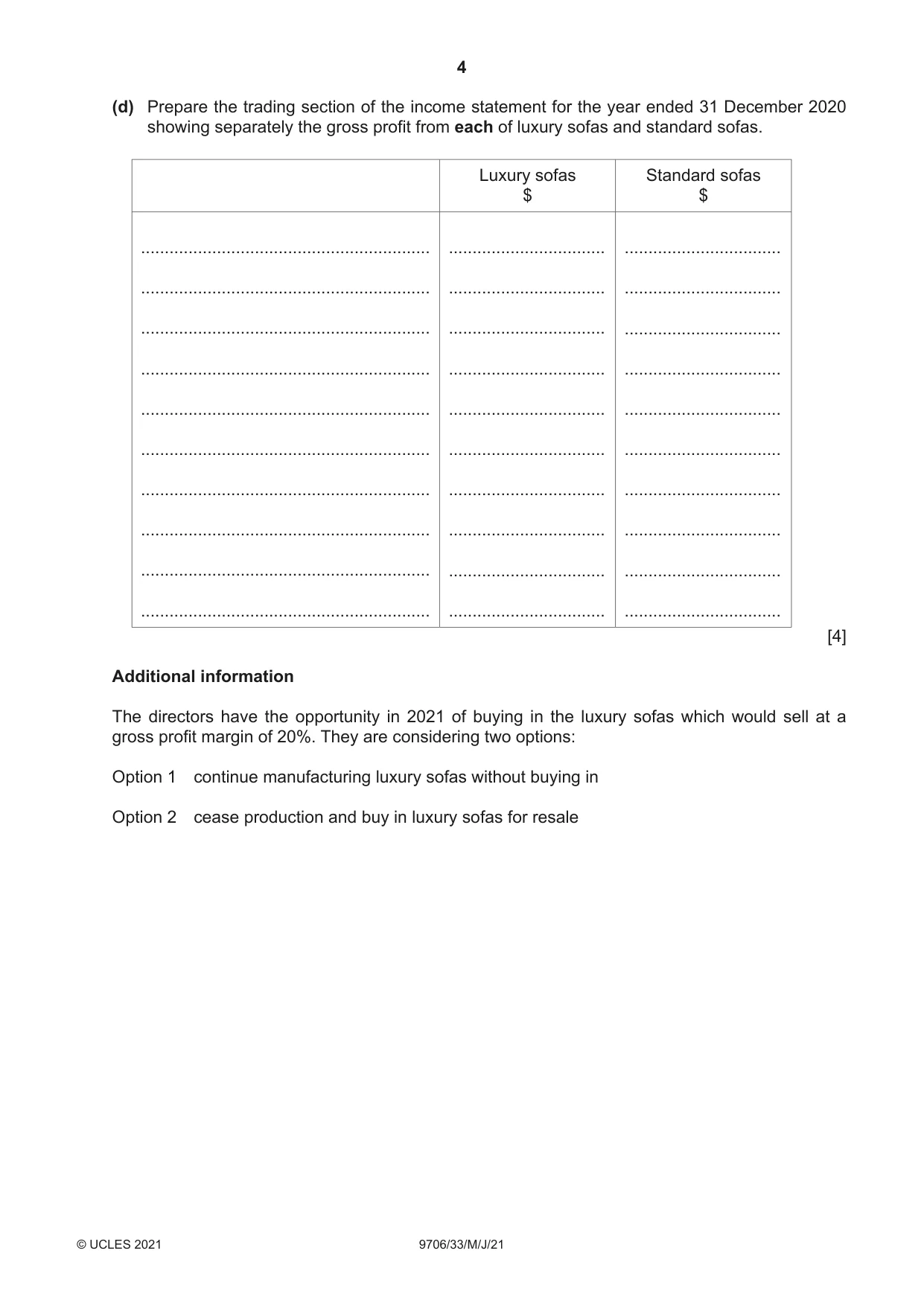
4 9706/33/M/J/21 © UCLES 2021 (d) Prepare the trading section of the income statement for the year ended 31 December 2020 showing separately the gross profit from each of luxury sofas and standard sofas. Luxury sofas $ Standard sofas $ … … … … … … … … … … … … … … … … … … … … … … … … … … … … … … [4] Additional information The directors have the opportunity in 2021 of buying in the luxury sofas which would sell at a gross profit margin of 20%. They are considering two options: Option 1 continue manufacturing luxury sofas without buying in Option 2 cease production and buy in luxury sofas for resale
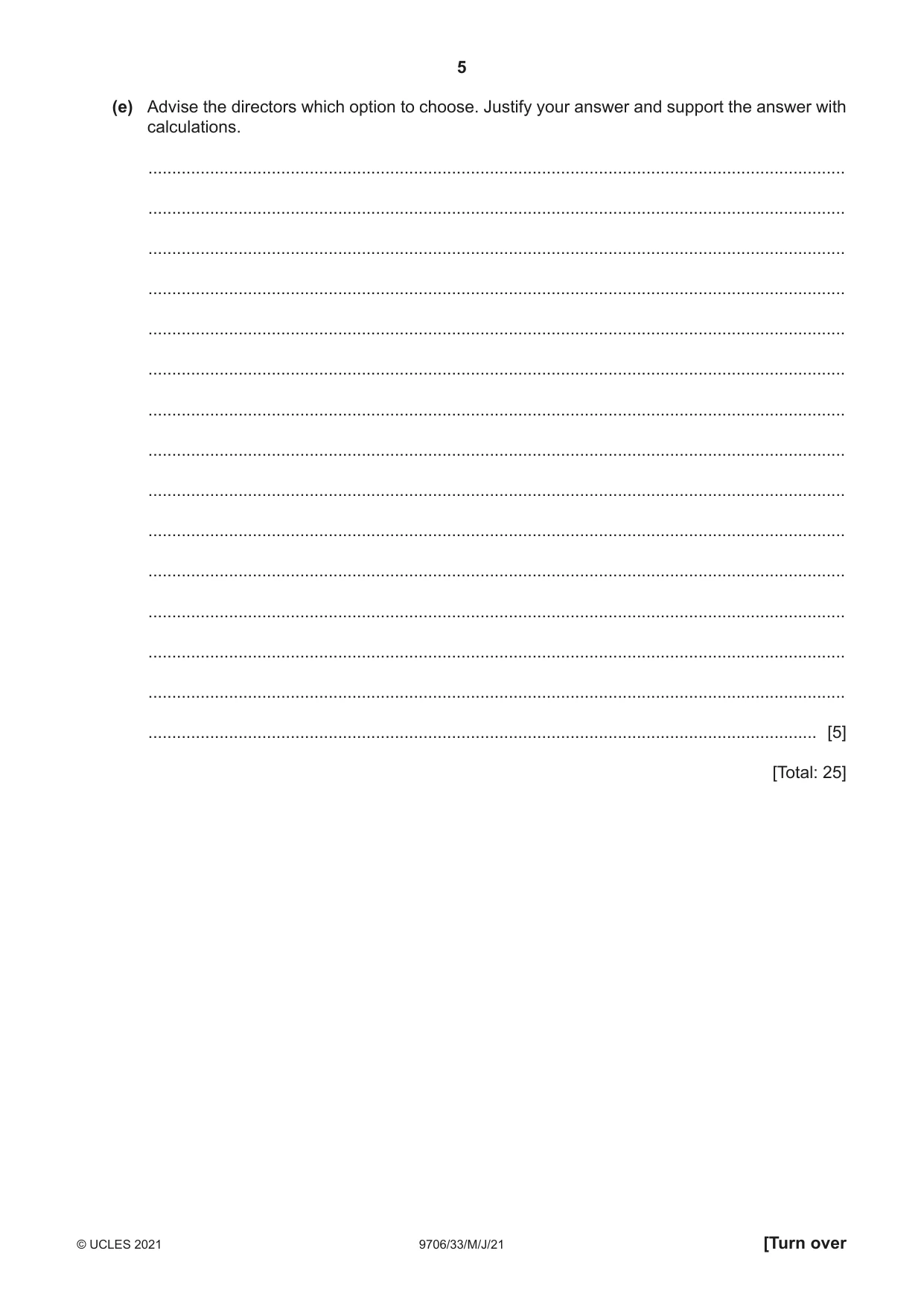
Question paper, page 5
5 9706/33/M/J/21 © UCLES 2021 [Turn over (e) Advise the directors which option to choose. Justify your answer and support the answer with calculations. … … … … … … … … … … … … … … … [5] [Total: 25]
Question paper, page 6
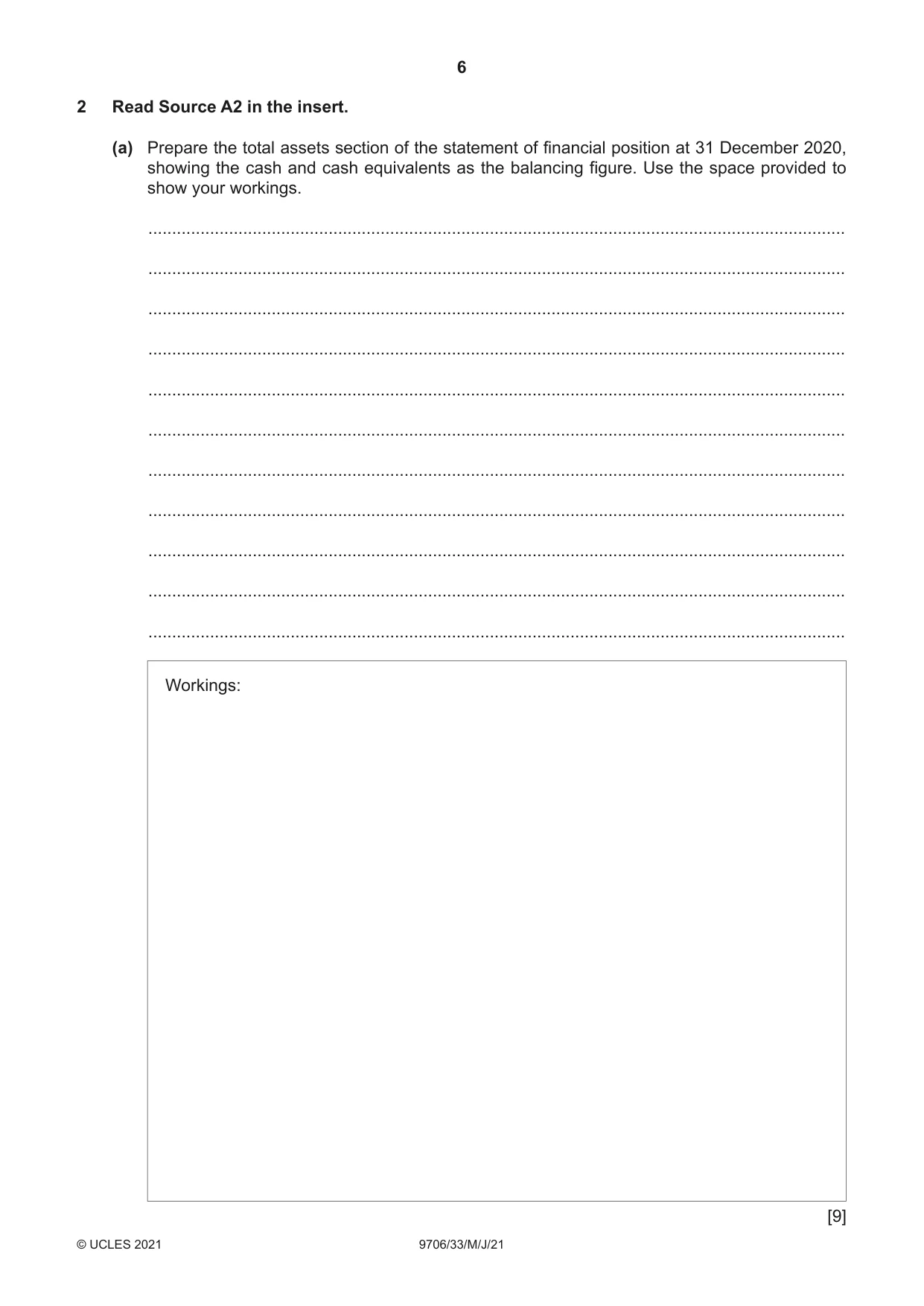
6 9706/33/M/J/21 © UCLES 2021 2 Read Source A2 in the insert. (a) Prepare the total assets section of the statement of financial position at 31 December 2020, showing the cash and cash equivalents as the balancing figure. Use the space provided to show your workings. … … … … … … … … … … … Workings: [9]
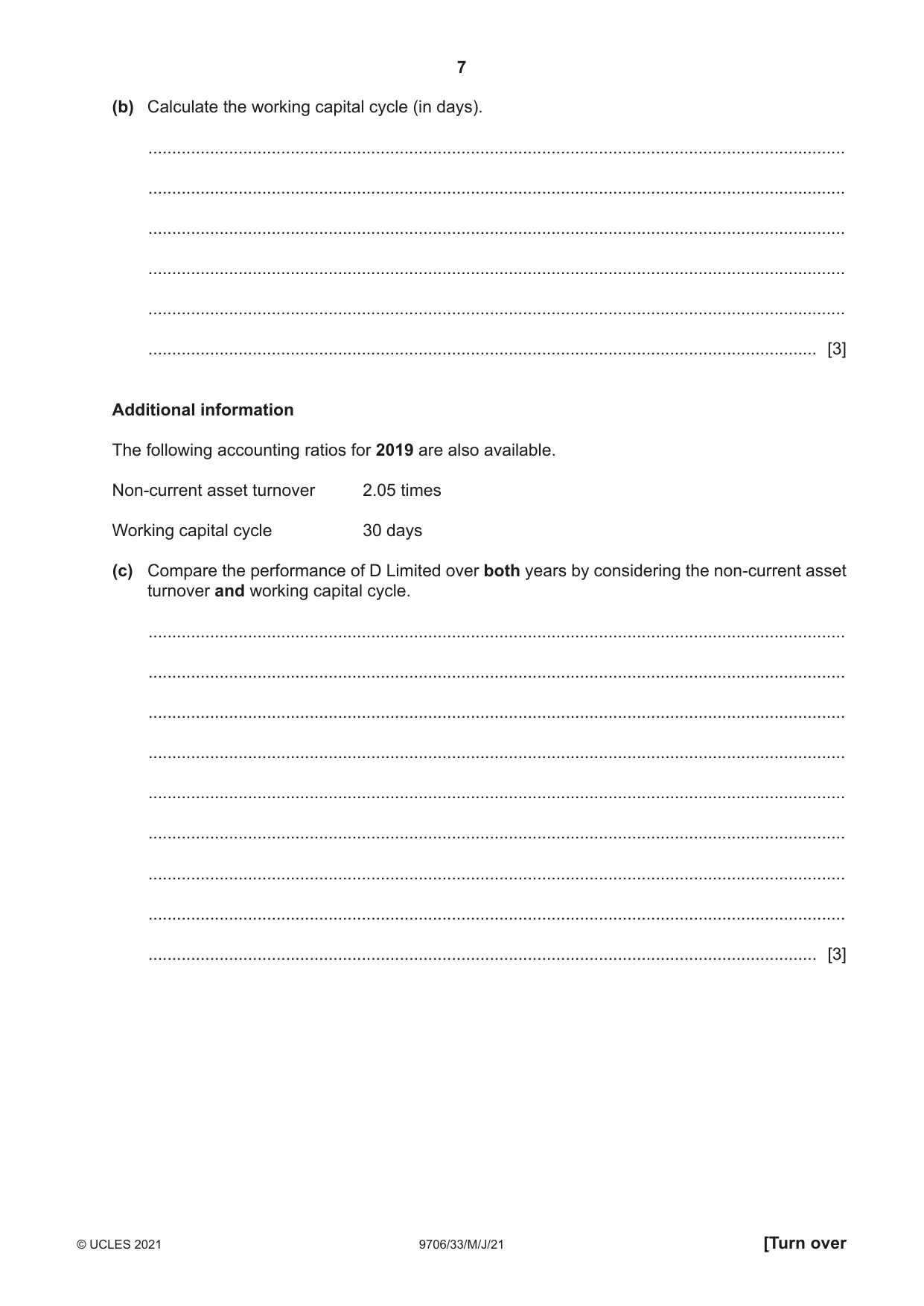
Question paper, page 7
7 9706/33/M/J/21 © UCLES 2021 [Turn over (b) Calculate the working capital cycle (in days). … … … … … … [3] Additional information The following accounting ratios for 2019 are also available. Non-current asset turnover 2.05 times Working capital cycle 30 days (c) Compare the performance of D Limited over both years by considering the non-current asset turnover and working capital cycle. … … … … … … … … … [3]
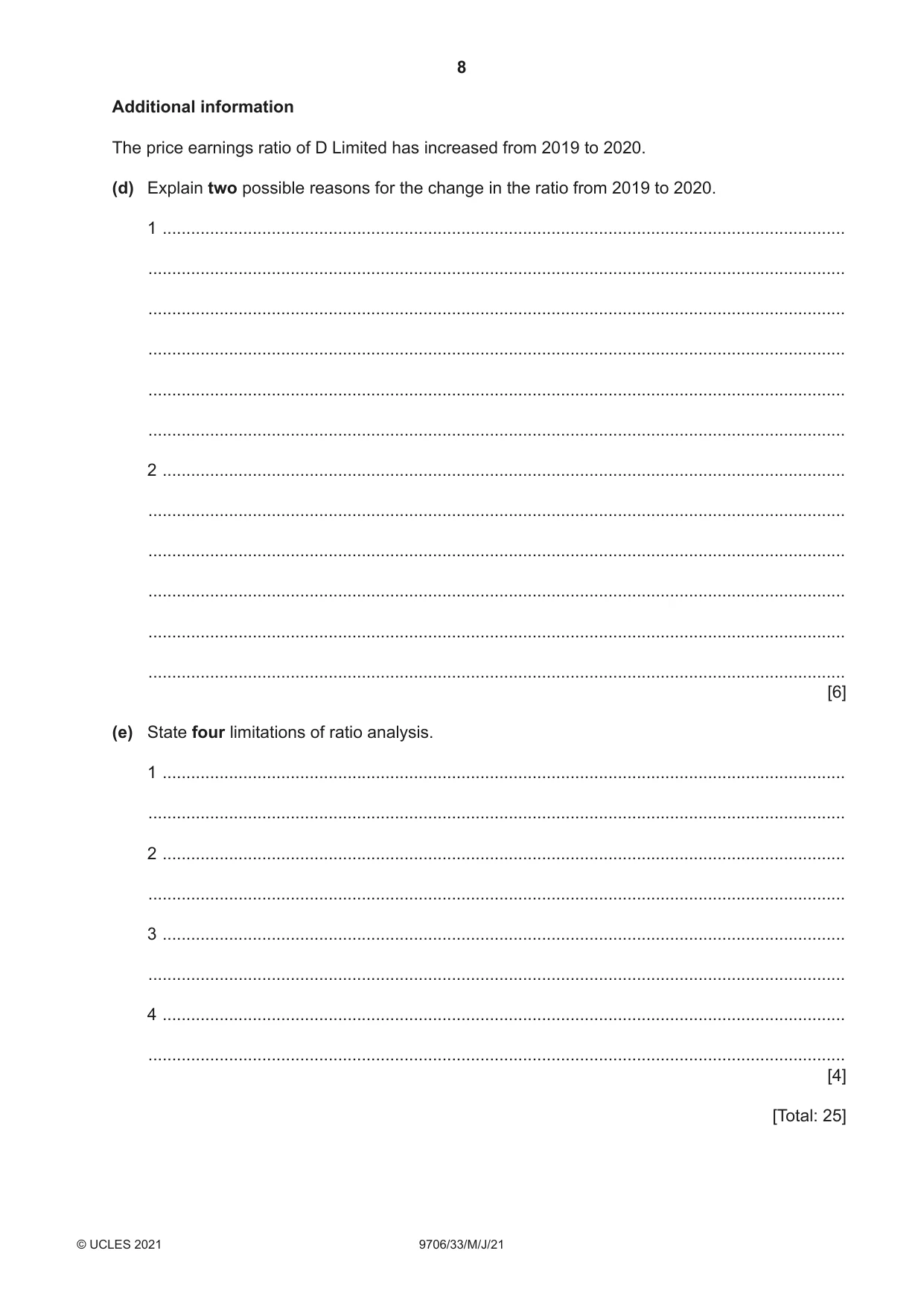
Question paper, page 8
8 9706/33/M/J/21 © UCLES 2021 Additional information The price earnings ratio of D Limited has increased from 2019 to 2020. (d) Explain two possible reasons for the change in the ratio from 2019 to 2020. 1 … … … … … … 2 … … … … … … [6] (e) State four limitations of ratio analysis. 1 … … 2 … … 3 … … 4 … … [4] [Total: 25]
Question paper, page 9
9 9706/33/M/J/21 © UCLES 2021 [Turn over PLEASE TURN OVER
Question paper, page 10
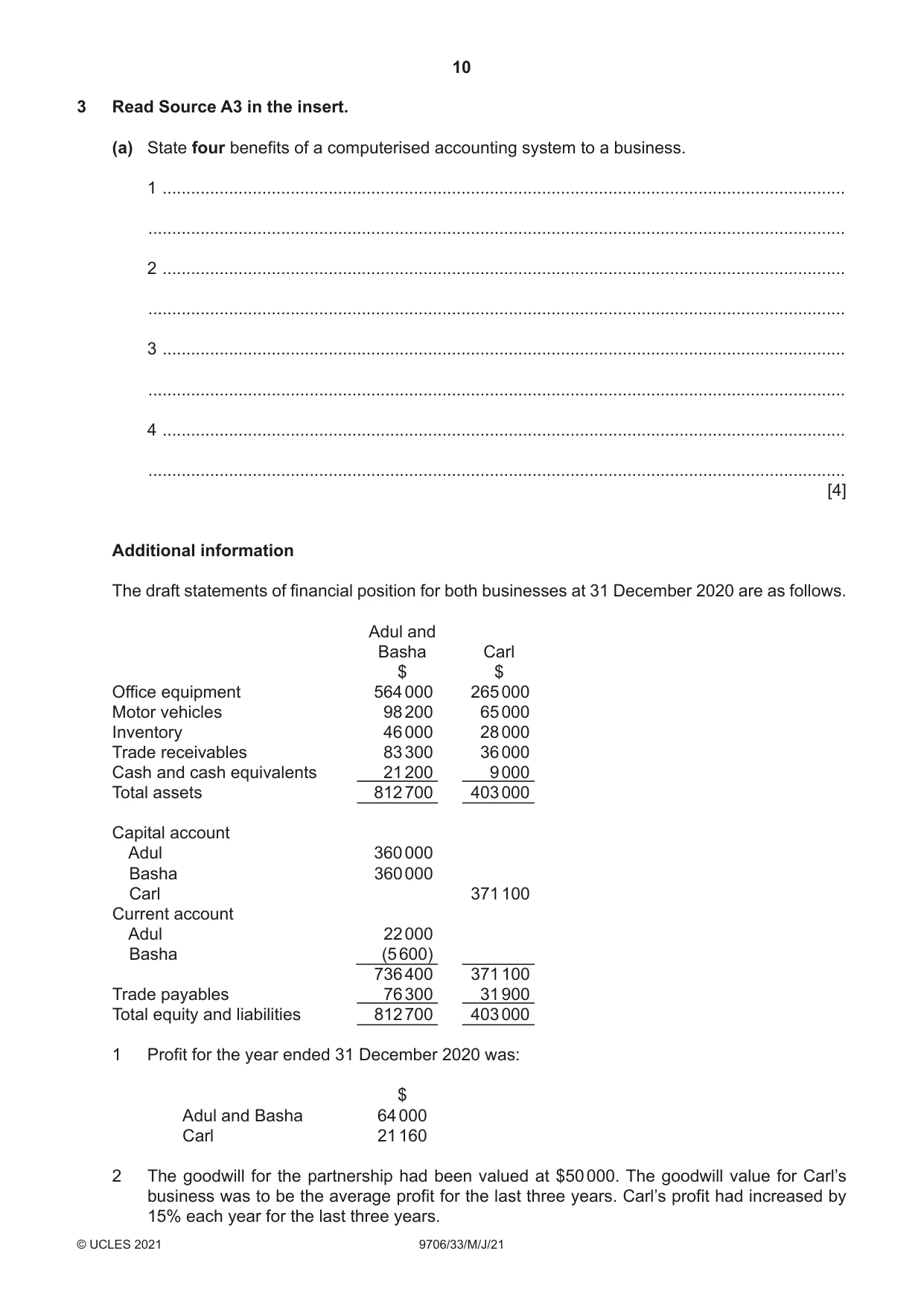
10 9706/33/M/J/21 © UCLES 2021 3 Read Source A3 in the insert. (a) State four benefits of a computerised accounting system to a business. 1 … … 2 … … 3 … … 4 … … [4] Additional information The draft statements of financial position for both businesses at 31 December 2020 are as follows. Adul and Basha Carl $ $ Office equipment 564 000 265 000 Motor vehicles 98 200 65 000 Inventory 46 000 28 000 Trade receivables 83 300 36 000 Cash and cash equivalents 21 200 9 000 Total assets 812 700 403 000 Capital account Adul 360 000 Basha 360 000 Carl 371 100 Current account Adul 22 000 Basha (5 600) 736 400 371 100 Trade payables 76 300 31 900 Total equity and liabilities 812 700 403 000 1 Profit for the year ended 31 December 2020 was: $ Adul and Basha 64 000 Carl 21 160 2 The goodwill for the partnership had been valued at $50 000. The goodwill value for Carl’s business was to be the average profit for the last three years. Carl’s profit had increased by 15% each year for the last three years.
Question paper, page 11
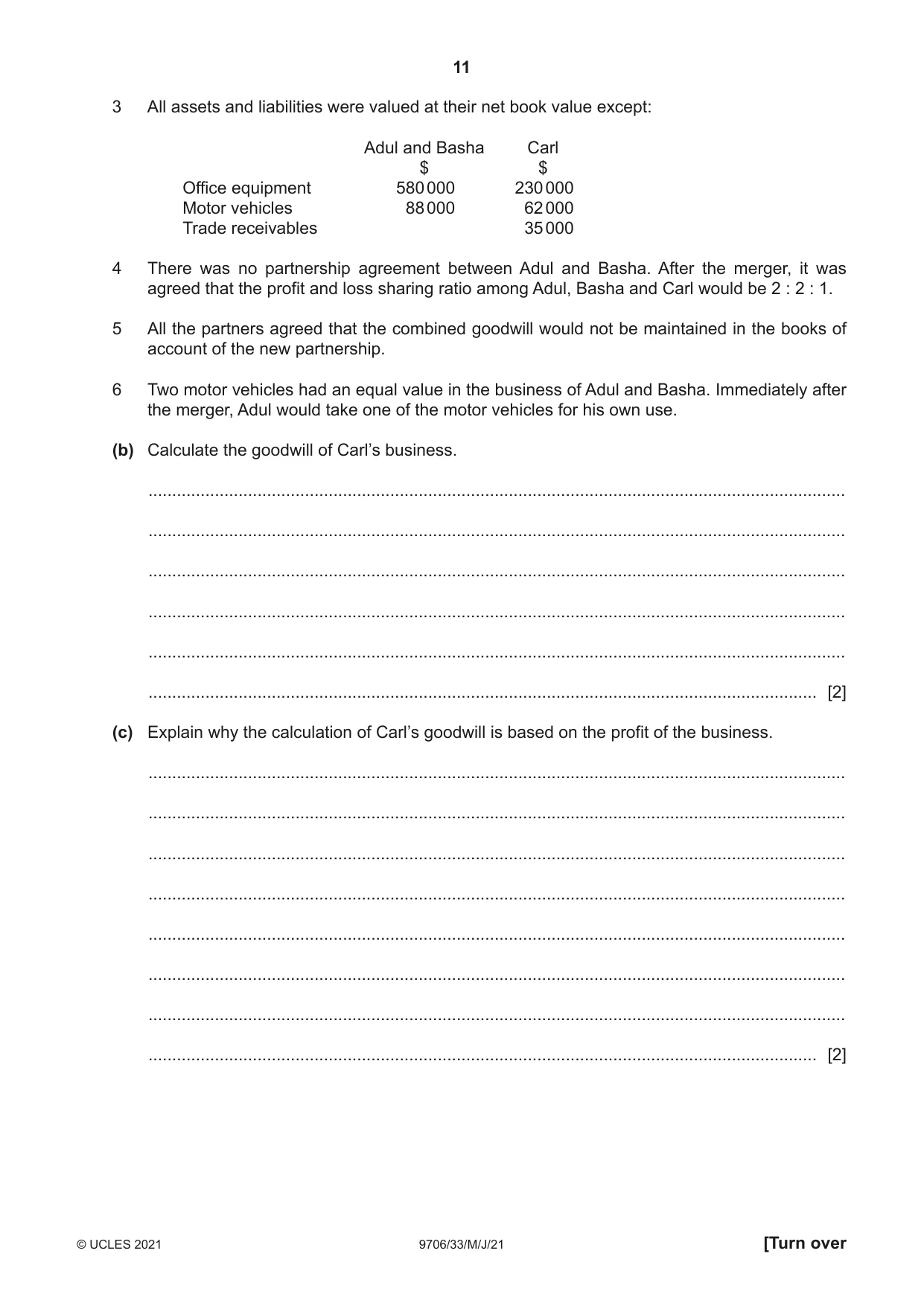
11 9706/33/M/J/21 © UCLES 2021 [Turn over 3 All assets and liabilities were valued at their net book value except: Adul and Basha Carl $ $ Office equipment 580 000 230 000 Motor vehicles 88 000 62 000 Trade receivables 35 000 4 There was no partnership agreement between Adul and Basha. After the merger, it was agreed that the profit and loss sharing ratio among Adul, Basha and Carl would be 2 : 2 : 1. 5 All the partners agreed that the combined goodwill would not be maintained in the books of account of the new partnership. 6 Two motor vehicles had an equal value in the business of Adul and Basha. Immediately after the merger, Adul would take one of the motor vehicles for his own use. (b) Calculate the goodwill of Carl’s business. … … … … … … [2] (c) Explain why the calculation of Carl’s goodwill is based on the profit of the business. … … … … … … … … [2]
Question paper, page 12
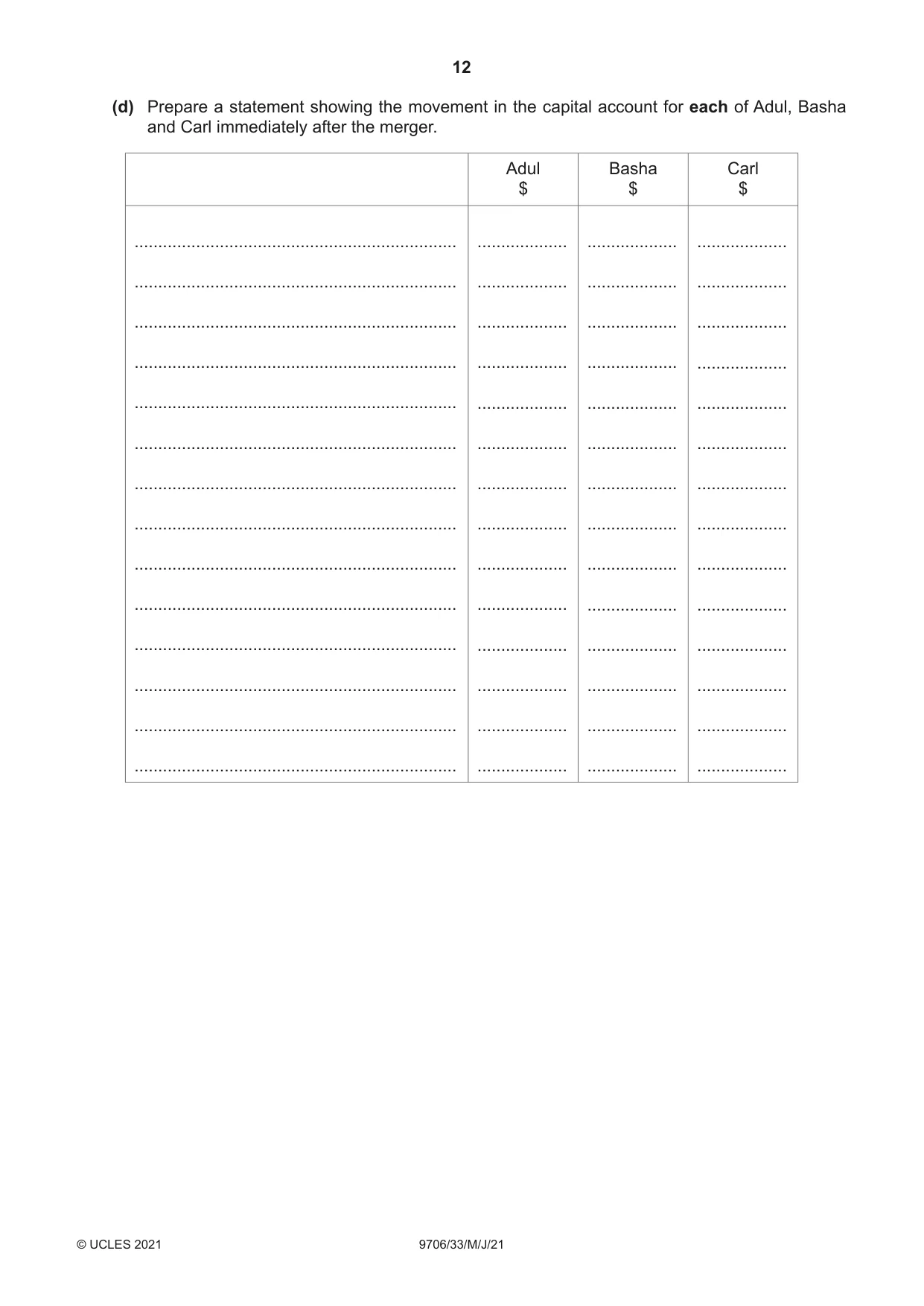
12 9706/33/M/J/21 © UCLES 2021 (d) Prepare a statement showing the movement in the capital account for each of Adul, Basha and Carl immediately after the merger. Adul $ Basha $ Carl $ … … … … … … … … … … … … … … … … … … … … … … … … … … … … … … … … … … … … … … … … … … … … … … … … … … … … … … … …
Question paper, page 13
13 9706/33/M/J/21 © UCLES 2021 [Turn over Workings: [6]
Question paper, page 14
14 9706/33/M/J/21 © UCLES 2021 (e) Calculate the value of the total assets of the new business immediately after the merger. Show your workings. … … … … … … … … … … … … [6]
Question paper, page 15
15 9706/33/M/J/21 © UCLES 2021 [Turn over Additional information Better profitability of the business of Adul and Basha is one of the reasons for Carl’s decision to merge. (f) Advise Carl whether or not he has made the correct decision to merge with the partnership business. Justify your answer using both financial and non-financial factors. … … … … … … … … … … … … … … … … … [5] [Total: 25]
Question paper, page 16
16 9706/33/M/J/21 © UCLES 2021 4 Read Source A4 in the insert. (a) State three features of a joint venture. 1 … … 2 … … 3 … … [3] (b) Prepare the following accounts: (i) the joint venture account … … … … … … … … … … … … … … … [7]
Question paper, page 17
17 9706/33/M/J/21 © UCLES 2021 [Turn over (ii) the joint venture with Tan account in Wang’s books … … … … … … … … … … … … [4] (iii) the joint venture with Wang account in Tan’s books … … … … … … … … … … … … [3]
Question paper, page 18
18 9706/33/M/J/21 © UCLES 2021 Additional information From Tan’s experience of the joint venture in the city festival market, she has found that the goods are well accepted by the city people. She now plans to sell the ornaments in the city through Wang as a consignee. (c) Explain two benefits to each of Tan and Wang of selling the ornaments in the city on consignment. … … … … … … … … … … … … … … … … … … … … [8] [Total: 25]
Question paper, page 19
19 9706/33/M/J/21 © UCLES 2021 [Turn over Section B: Cost and Management Accounting Answer all questions. 5 Read Source B1 in the insert. (a) State two benefits of preparing a cash budget. 1 … … … 2 … … … [2] (b) Prepare a production budget (in units) for each of the months July and August. … … … … … … … … [4]
Question paper, page 20
20 9706/33/M/J/21 © UCLES 2021 (c) Prepare a cash budget for each of the months July and August. … … … … … … … … … … … … … … … … … … … …
Question paper, page 21
21 9706/33/M/J/21 © UCLES 2021 [Turn over Workings: [11]
Question paper, page 22
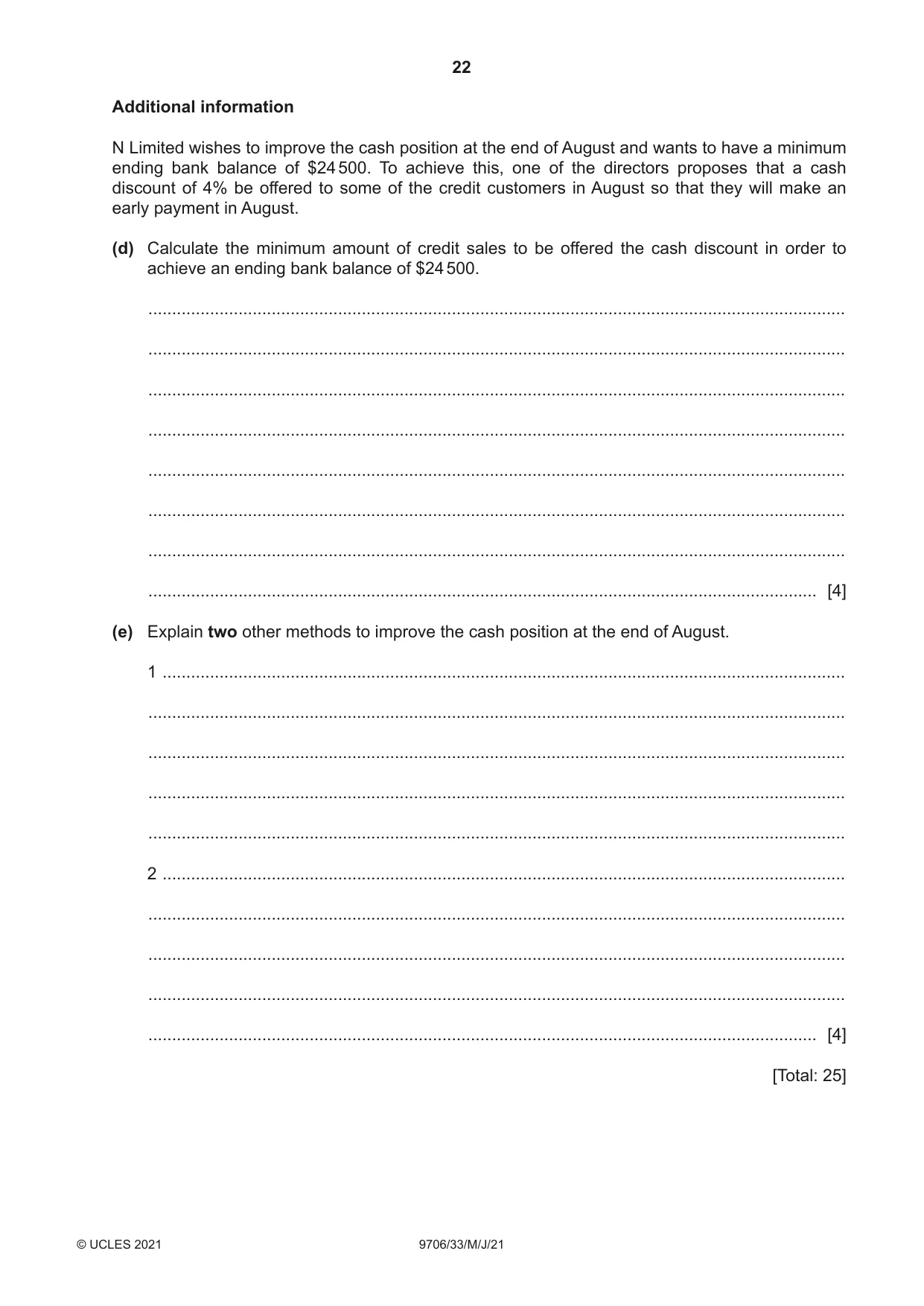
22 9706/33/M/J/21 © UCLES 2021 Additional information N Limited wishes to improve the cash position at the end of August and wants to have a minimum ending bank balance of $24 500. To achieve this, one of the directors proposes that a cash discount of 4% be offered to some of the credit customers in August so that they will make an early payment in August. (d) Calculate the minimum amount of credit sales to be offered the cash discount in order to achieve an ending bank balance of $24 500. … … … … … … … … [4] (e) Explain two other methods to improve the cash position at the end of August. 1 … … … … … 2 … … … … … [4] [Total: 25]
Question paper, page 23
23 9706/33/M/J/21 © UCLES 2021 [Turn over PLEASE TURN OVER
Question paper, page 24
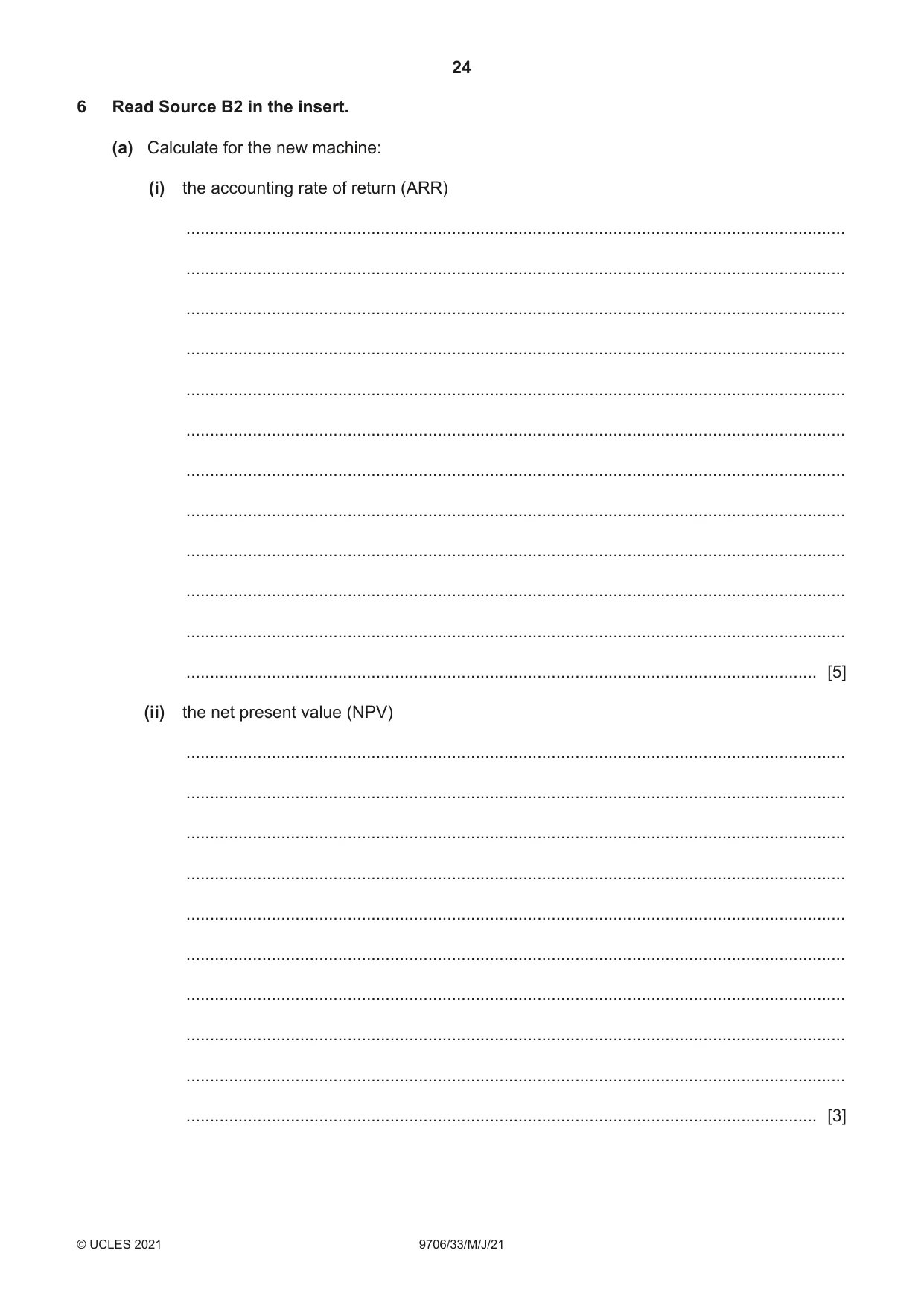
24 9706/33/M/J/21 © UCLES 2021 6 Read Source B2 in the insert. (a) Calculate for the new machine: (i) the accounting rate of return (ARR) … … … … … … … … … … … … [5] (ii) the net present value (NPV) … … … … … … … … … … [3]
Question paper, page 25
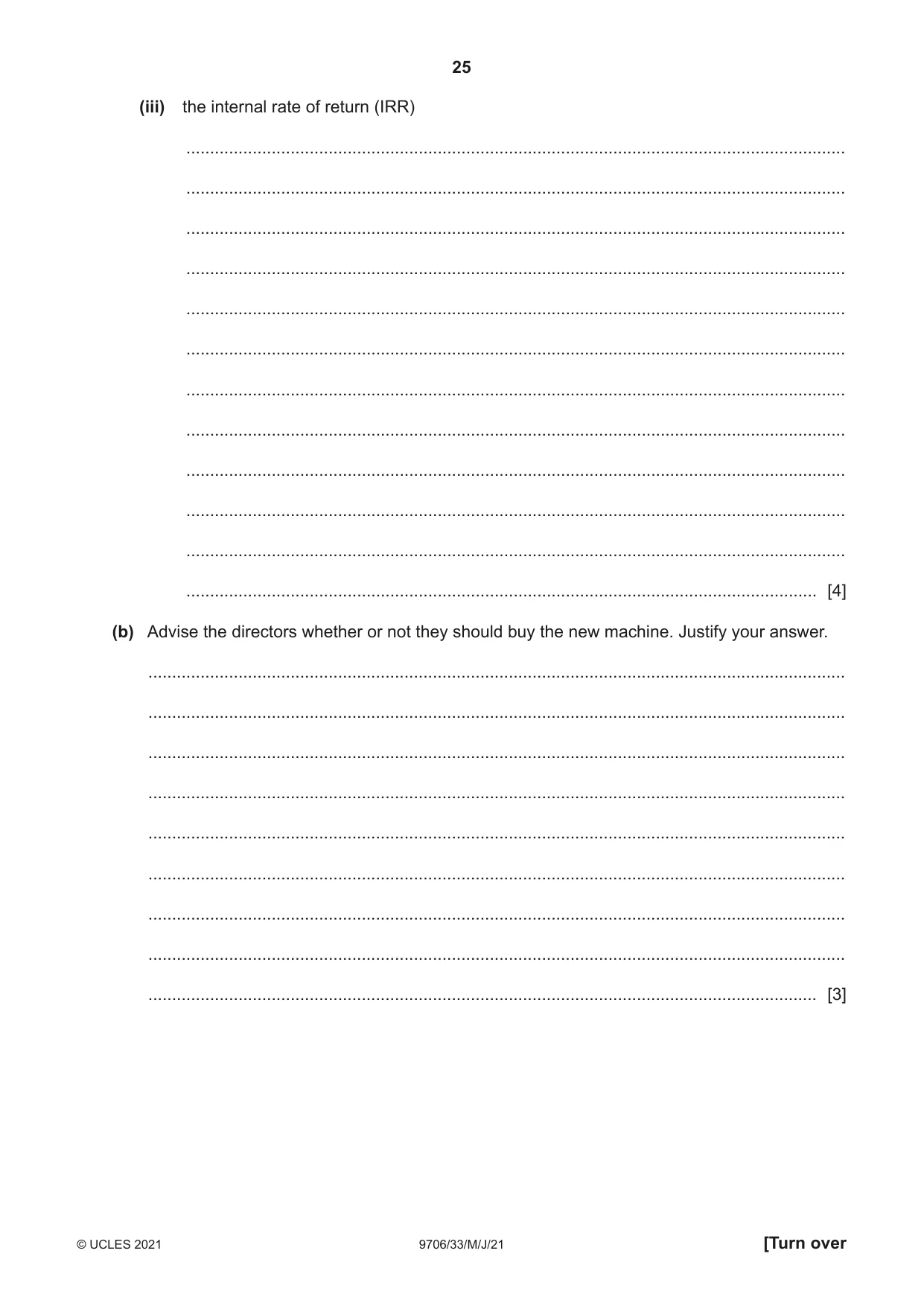
25 9706/33/M/J/21 © UCLES 2021 [Turn over (iii) the internal rate of return (IRR) … … … … … … … … … … … … [4] (b) Advise the directors whether or not they should buy the new machine. Justify your answer. … … … … … … … … … [3]
Question paper, page 26
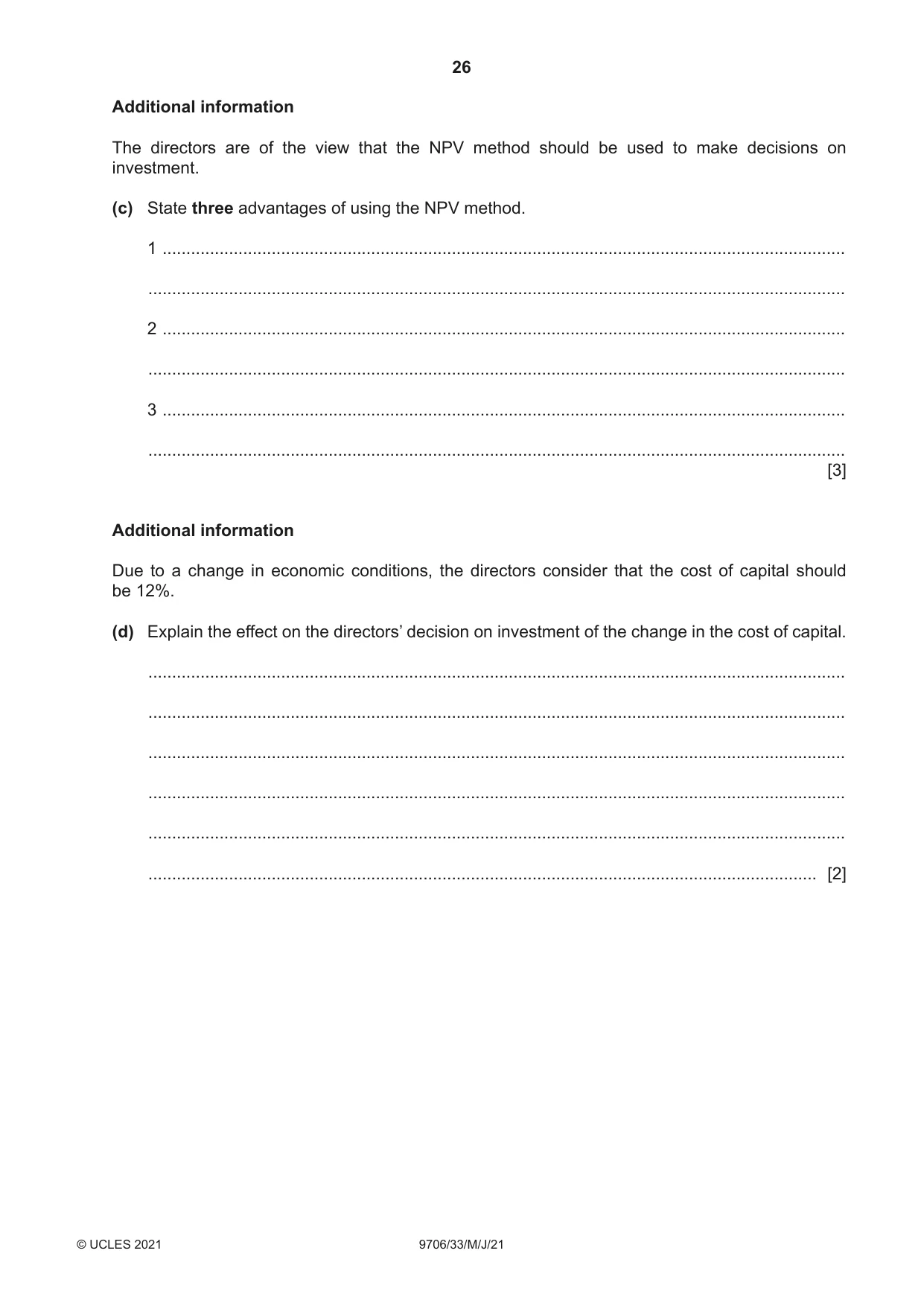
26 9706/33/M/J/21 © UCLES 2021 Additional information The directors are of the view that the NPV method should be used to make decisions on investment. (c) State three advantages of using the NPV method. 1 … … 2 … … 3 … … [3] Additional information Due to a change in economic conditions, the directors consider that the cost of capital should be 12%. (d) Explain the effect on the directors’ decision on investment of the change in the cost of capital. … … … … … … [2]
Question paper, page 27
27 9706/33/M/J/21 © UCLES 2021 Additional information The directors also consider that the negative impact from the increase of cost of capital can be offset by increasing the revenue. Additional advertising costing $20 000 incurred in year 1 can help increase the sales revenue in years 2 and 3. Year 2 sales revenue is expected to increase by $24 000. (e) Calculate the minimum increase in sales revenue in year 3 to justify the directors deciding to buy the new machine. … … … … … … … … … … … … [5] [Total: 25]
Question paper, page 28
28 9706/33/M/J/21 © UCLES 2021 Permission to reproduce items where third-party owned material protected by copyright is included has been sought and cleared where possible. Every reasonable effort has been made by the publisher (UCLES) to trace copyright holders, but if any items requiring clearance have unwittingly been included, the publisher will be pleased to make amends at the earliest possible opportunity. To avoid the issue of disclosure of answer-related information to candidates, all copyright acknowledgements are reproduced online in the Cambridge Assessment International Education Copyright Acknowledgements Booklet. This is produced for each series of examinations and is freely available to download at www.cambridgeinternational.org after the live examination series. Cambridge Assessment International Education is part of the Cambridge Assessment Group. Cambridge Assessment is the brand name of the University of Cambridge Local Examinations Syndicate (UCLES), which itself is a department of the University of Cambridge. BLANK PAGE
Mark scheme, page 1
This document consists of 22 printed pages. © UCLES 2021 [Turn over Cambridge International AS & A Level ACCOUNTING 9706/33 Paper 3 Structured Questions May/June 2021 MARK SCHEME Maximum Mark: 150 Published This mark scheme is published as an aid to teachers and candidates, to indicate the requirements of the examination. It shows the basis on which Examiners were instructed to award marks. It does not indicate the details of the discussions that took place at an Examiners’ meeting before marking began, which would have considered the acceptability of alternative answers. Mark schemes should be read in conjunction with the question paper and the Principal Examiner Report for Teachers. Cambridge International will not enter into discussions about these mark schemes. Cambridge International is publishing the mark schemes for the May/June 2021 series for most Cambridge IGCSE™, Cambridge International A and AS Level components and some Cambridge O Level components.
Mark scheme, page 2
9706/33 Cambridge International AS & A Level – Mark Scheme PUBLISHED May/June 2021 © UCLES 2021 Page 2 of 22 Generic Marking Principles These general marking principles must be applied by all examiners when marking candidate answers. They should be applied alongside the specific content of the mark scheme or generic level descriptors for a question. Each question paper and mark scheme will also comply with these marking principles. GENERIC MARKING PRINCIPLE 1: Marks must be awarded in line with: • the specific content of the mark scheme or the generic level descriptors for the question • the specific skills defined in the mark scheme or in the generic level descriptors for the question • the standard of response required by a candidate as exemplified by the standardisation scripts. GENERIC MARKING PRINCIPLE 2: Marks awarded are always whole marks (not half marks, or other fractions). GENERIC MARKING PRINCIPLE 3: Marks must be awarded positively: • marks are awarded for correct/valid answers, as defined in the mark scheme. However, credit is given for valid answers which go beyond the scope of the syllabus and mark scheme, referring to your Team Leader as appropriate • marks are awarded when candidates clearly demonstrate what they know and can do • marks are not deducted for errors • marks are not deducted for omissions • answers should only be judged on the quality of spelling, punctuation and grammar when these features are specifically assessed by the question as indicated by the mark scheme. The meaning, however, should be unambiguous. GENERIC MARKING PRINCIPLE 4: Rules must be applied consistently, e.g. in situations where candidates have not followed instructions or in the application of generic level descriptors.
Mark scheme, page 3
9706/33 Cambridge International AS & A Level – Mark Scheme PUBLISHED May/June 2021 © UCLES 2021 Page 3 of 22 GENERIC MARKING PRINCIPLE 5: Marks should be awarded using the full range of marks defined in the mark scheme for the question (however; the use of the full mark range may be limited according to the quality of the candidate responses seen). GENERIC MARKING PRINCIPLE 6: Marks awarded are based solely on the requirements as defined in the mark scheme. Marks should not be awarded with grade thresholds or grade descriptors in mind. Social Science-Specific Marking Principles (for point-based marking) 1 Components using point-based marking: • Point marking is often used to reward knowledge, understanding and application of skills. We give credit where the candidate’s answer shows relevant knowledge, understanding and application of skills in answering the question. We do not give credit where the answer shows confusion. From this it follows that we: a DO credit answers which are worded differently from the mark scheme if they clearly convey the same meaning (unless the mark scheme requires a specific term) b DO credit alternative answers/examples which are not written in the mark scheme if they are correct c DO credit answers where candidates give more than one correct answer in one prompt/numbered/scaffolded space where extended writing is required rather than list-type answers. For example, questions that require n reasons (e.g. State two reasons …). d DO NOT credit answers simply for using a ‘key term’ unless that is all that is required. (Check for evidence it is understood and not used wrongly.) e DO NOT credit answers which are obviously self-contradicting or trying to cover all possibilities f DO NOT give further credit for what is effectively repetition of a correct point already credited unless the language itself is being tested. This applies equally to ‘mirror statements’ (i.e. polluted/not polluted). g DO NOT require spellings to be correct, unless this is part of the test. However spellings of syllabus terms must allow for clear and unambiguous separation from other syllabus terms with which they may be confused (e.g. Corrasion/Corrosion)
Mark scheme, page 4
9706/33 Cambridge International AS & A Level – Mark Scheme PUBLISHED May/June 2021 © UCLES 2021 Page 4 of 22 2 Presentation of mark scheme: • Slashes (/) or the word ‘or’ separate alternative ways of making the same point. • Semi colons (;) bullet points (•) or figures in brackets (1) separate different points. • Content in the answer column in brackets is for examiner information/context to clarify the marking but is not required to earn the mark (except Accounting syllabuses where they indicate negative numbers). 3 Calculation questions: • The mark scheme will show the steps in the most likely correct method(s), the mark for each step, the correct answer(s) and the mark for each answer • If working/explanation is considered essential for full credit, this will be indicated in the question paper and in the mark scheme. In all other instances, the correct answer to a calculation should be given full credit, even if no supporting working is shown. • Where the candidate uses a valid method which is not covered by the mark scheme, award equivalent marks for reaching equivalent stages. • Where an answer makes use of a candidate’s own incorrect figure from previous working, the ‘own figure rule’ applies: full marks will be given if a correct and complete method is used. Further guidance will be included in the mark scheme where necessary and any exceptions to this general principle will be noted. 4 Annotation: • For point marking, ticks can be used to indicate correct answers and crosses can be used to indicate wrong answers. There is no direct relationship between ticks and marks. Ticks have no defined meaning for levels of response marking. • For levels of response marking, the level awarded should be annotated on the script. • Other annotations will be used by examiners as agreed during standardisation, and the meaning will be understood by all examiners who marked that paper.
Mark scheme, page 5
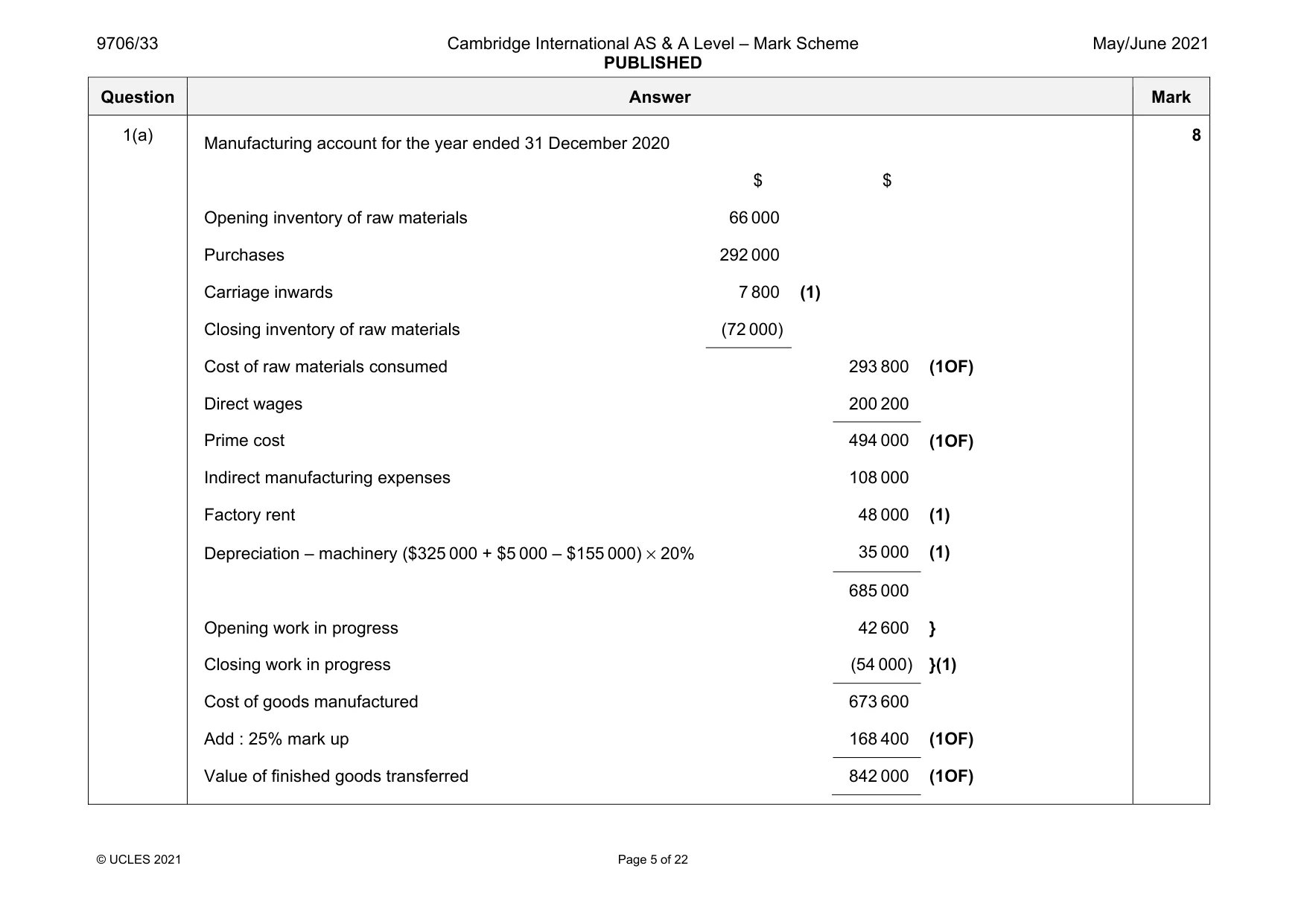
9706/33 Cambridge International AS & A Level – Mark Scheme PUBLISHED May/June 2021 © UCLES 2021 Page 5 of 22 Question Answer Mark 1(a) Manufacturing account for the year ended 31 December 2020 $ $ Opening inventory of raw materials 66 000 Purchases 292 000 Carriage inwards 7 800 (1) Closing inventory of raw materials (72 000) Cost of raw materials consumed 293 800 (1OF) Direct wages 200 200 Prime cost 494 000 (1OF) Indirect manufacturing expenses 108 000 Factory rent 48 000 (1) Depreciation – machinery ($325 000 + $5 000 – $155 000) × 20% 35 000 (1) 685 000 Opening work in progress 42 600 } Closing work in progress (54 000) }(1) Cost of goods manufactured 673 600 Add : 25% mark up 168 400 (1OF) Value of finished goods transferred 842 000 (1OF) 8
Mark scheme, page 6
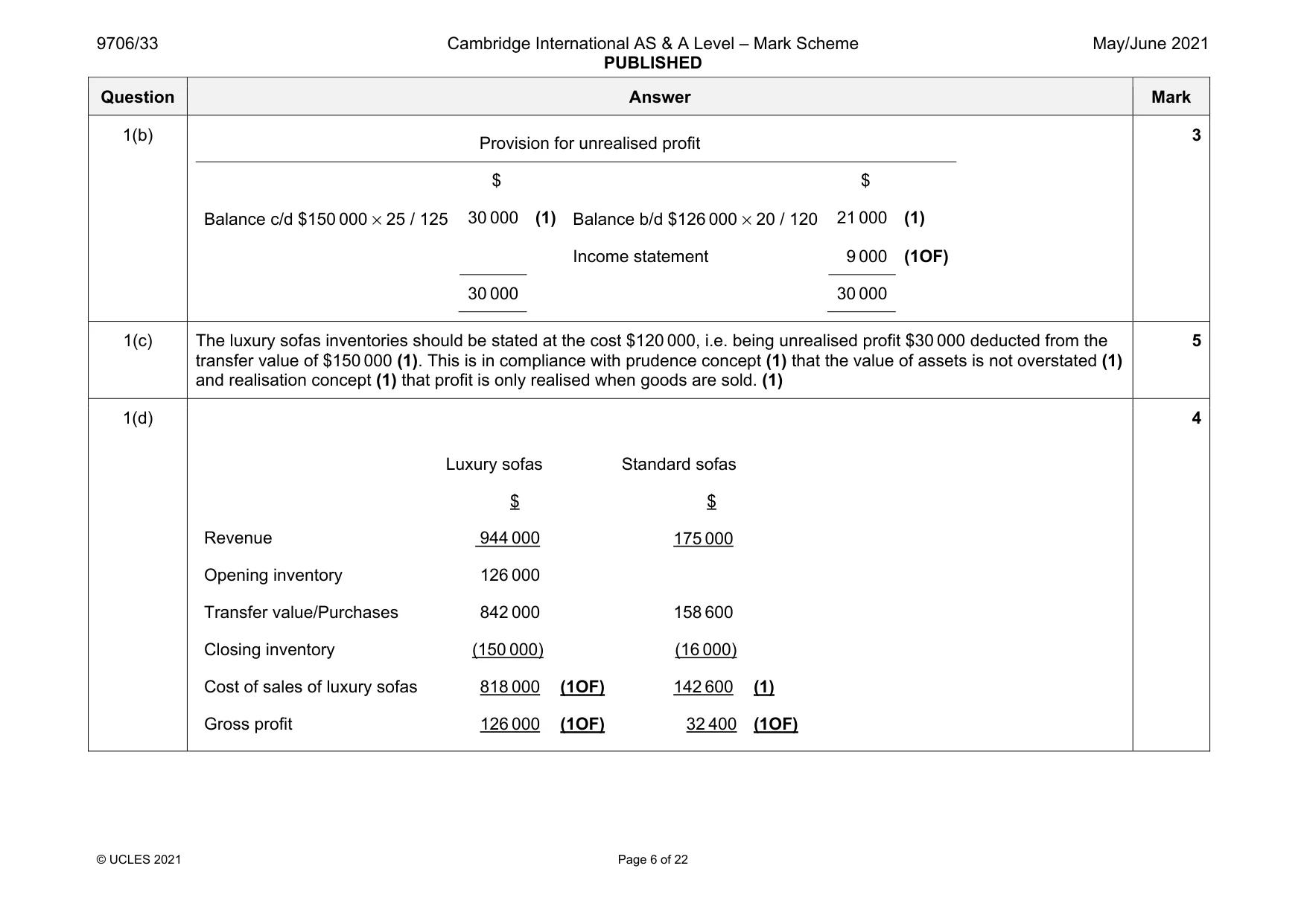
9706/33 Cambridge International AS & A Level – Mark Scheme PUBLISHED May/June 2021 © UCLES 2021 Page 6 of 22 Question Answer Mark 1(b) Provision for unrealised profit $ $ Balance c/d $150 000 × 25 / 125 30 000 (1) Balance b/d $126 000 × 20 / 120 21 000 (1) Income statement 9 000 (1OF) 30 000 30 000 3 1(c) The luxury sofas inventories should be stated at the cost $120 000, i.e. being unrealised profit $30 000 deducted from the transfer value of $150 000 (1). This is in compliance with prudence concept (1) that the value of assets is not overstated (1) and realisation concept (1) that profit is only realised when goods are sold. (1) 5 1(d) Luxury sofas Standard sofas $ $ Revenue 944 000 175 000 Opening inventory 126 000 Transfer value/Purchases 842 000 158 600 Closing inventory (150 000) (16 000) Cost of sales of luxury sofas 818 000 (1OF) 142 600 (1) Gross profit 126 000 (1OF) 32 400 (1OF) 4
Mark scheme, page 7
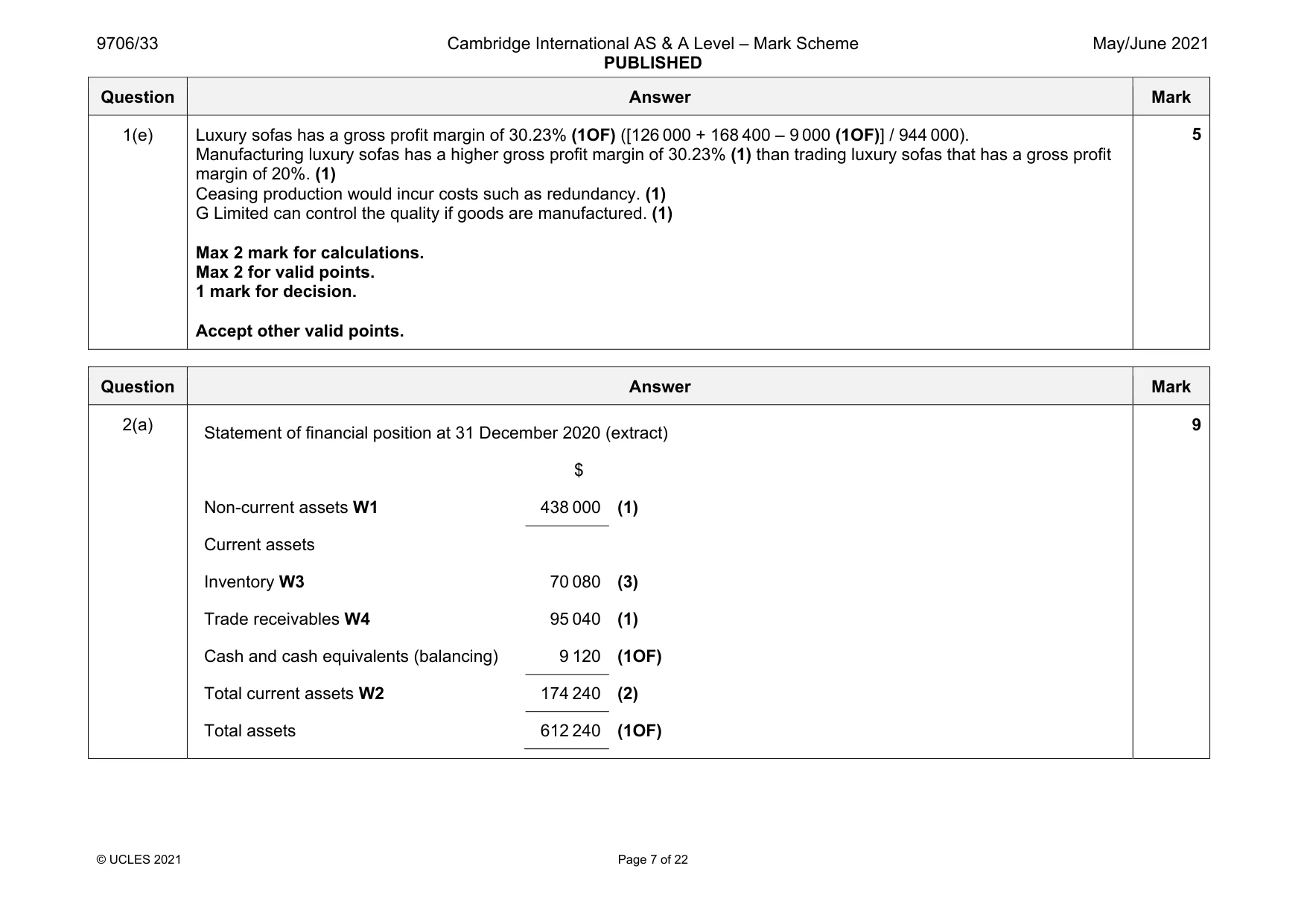
9706/33 Cambridge International AS & A Level – Mark Scheme PUBLISHED May/June 2021 © UCLES 2021 Page 7 of 22 Question Answer Mark 1(e) Luxury sofas has a gross profit margin of 30.23% (1OF) ([126 000 + 168 400 – 9 000 (1OF)] / 944 000). Manufacturing luxury sofas has a higher gross profit margin of 30.23% (1) than trading luxury sofas that has a gross profit margin of 20%. (1) Ceasing production would incur costs such as redundancy. (1) G Limited can control the quality if goods are manufactured. (1) Max 2 mark for calculations. Max 2 for valid points. 1 mark for decision. Accept other valid points. 5 Question Answer Mark 2(a) Statement of financial position at 31 December 2020 (extract) $ Non-current assets W1 438 000 (1) Current assets Inventory W3 70 080 (3) Trade receivables W4 95 040 (1) Cash and cash equivalents (balancing) 9 120 (1OF) Total current assets W2 174 240 (2) Total assets 612 240 (1OF) 9
Mark scheme, page 8
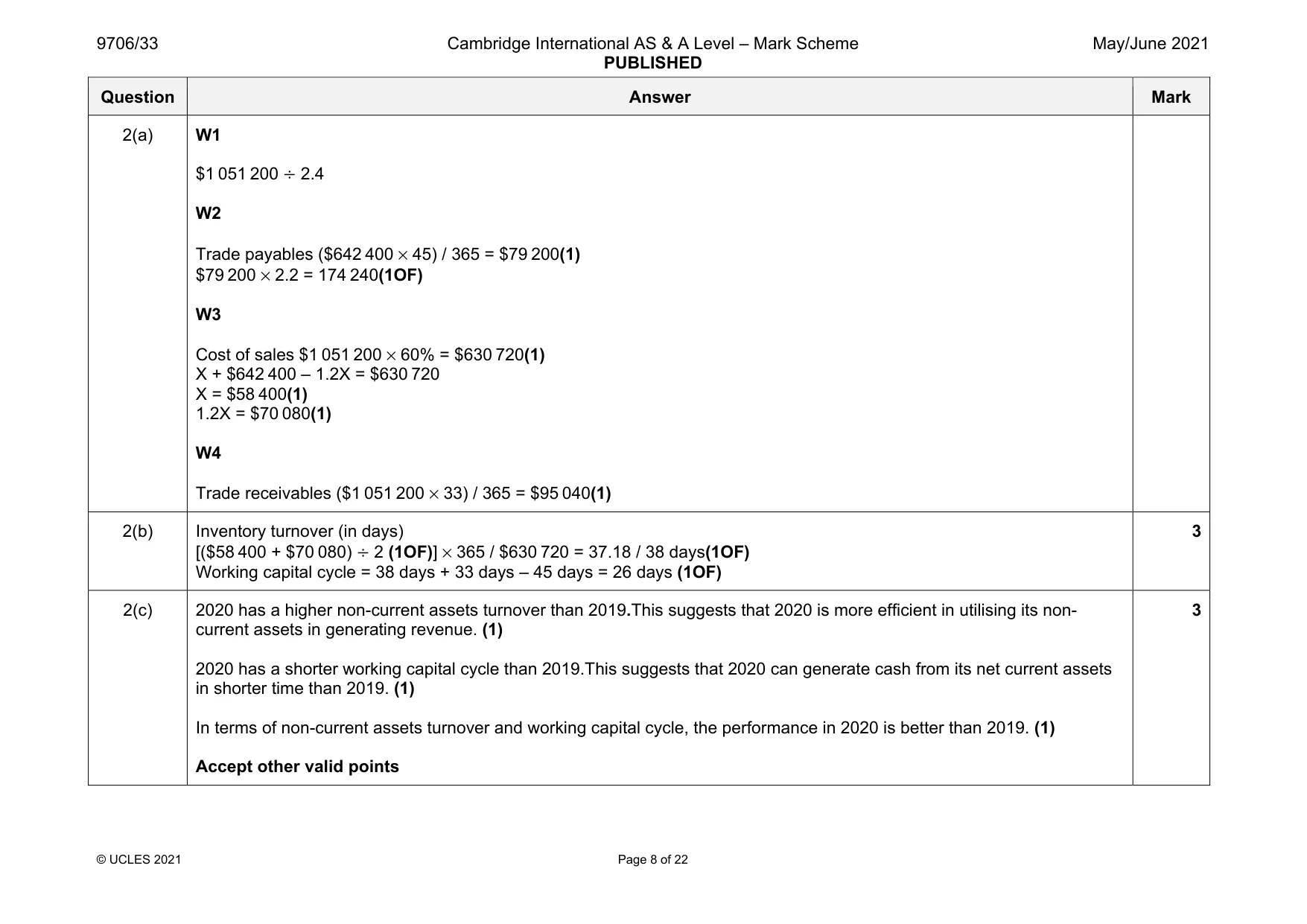
9706/33 Cambridge International AS & A Level – Mark Scheme PUBLISHED May/June 2021 © UCLES 2021 Page 8 of 22 Question Answer Mark 2(a) W1 $1 051 200 ÷ 2.4 W2 Trade payables ($642 400 × 45) / 365 = $79 200(1) $79 200 × 2.2 = 174 240(1OF) W3 Cost of sales $1 051 200 × 60% = $630 720(1) X + $642 400 – 1.2X = $630 720 X = $58 400(1) 1.2X = $70 080(1) W4 Trade receivables ($1 051 200 × 33) / 365 = $95 040(1) 2(b) Inventory turnover (in days) [($58 400 + $70 080) ÷ 2 (1OF)] × 365 / $630 720 = 37.18 / 38 days(1OF) Working capital cycle = 38 days + 33 days – 45 days = 26 days (1OF) 3 2(c) 2020 has a higher non-current assets turnover than 2019.This suggests that 2020 is more efficient in utilising its non- current assets in generating revenue. (1) 2020 has a shorter working capital cycle than 2019.This suggests that 2020 can generate cash from its net current assets in shorter time than 2019. (1) In terms of non-current assets turnover and working capital cycle, the performance in 2020 is better than 2019. (1) Accept other valid points 3
Mark scheme, page 9
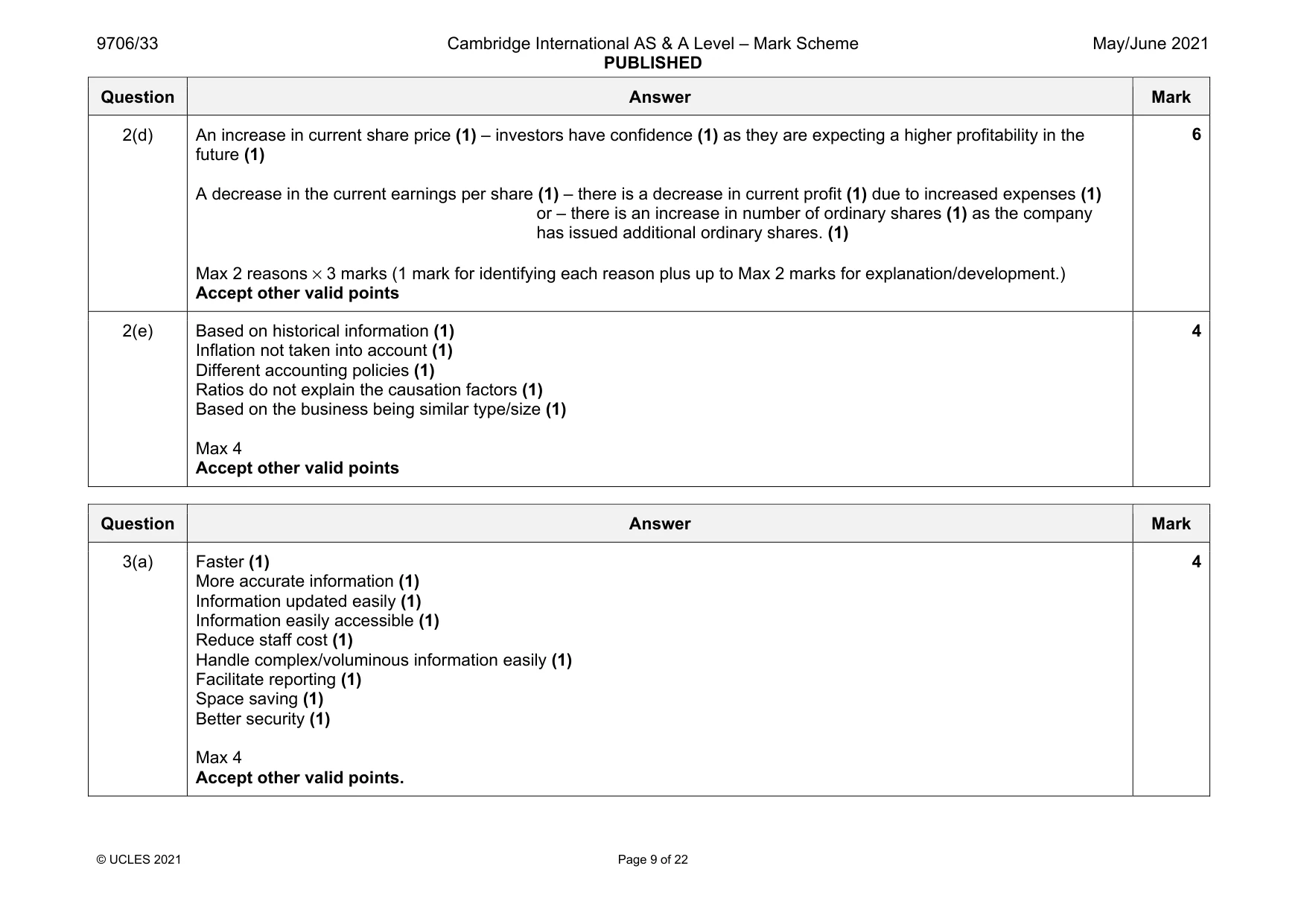
9706/33 Cambridge International AS & A Level – Mark Scheme PUBLISHED May/June 2021 © UCLES 2021 Page 9 of 22 Question Answer Mark 2(d) An increase in current share price (1) – investors have confidence (1) as they are expecting a higher profitability in the future (1) A decrease in the current earnings per share (1) – there is a decrease in current profit (1) due to increased expenses (1) or – there is an increase in number of ordinary shares (1) as the company has issued additional ordinary shares. (1) Max 2 reasons × 3 marks (1 mark for identifying each reason plus up to Max 2 marks for explanation/development.) Accept other valid points 6 2(e) Based on historical information (1) Inflation not taken into account (1) Different accounting policies (1) Ratios do not explain the causation factors (1) Based on the business being similar type/size (1) Max 4 Accept other valid points 4 Question Answer Mark 3(a) Faster (1) More accurate information (1) Information updated easily (1) Information easily accessible (1) Reduce staff cost (1) Handle complex/voluminous information easily (1) Facilitate reporting (1) Space saving (1) Better security (1) Max 4 Accept other valid points. 4
Mark scheme, page 10
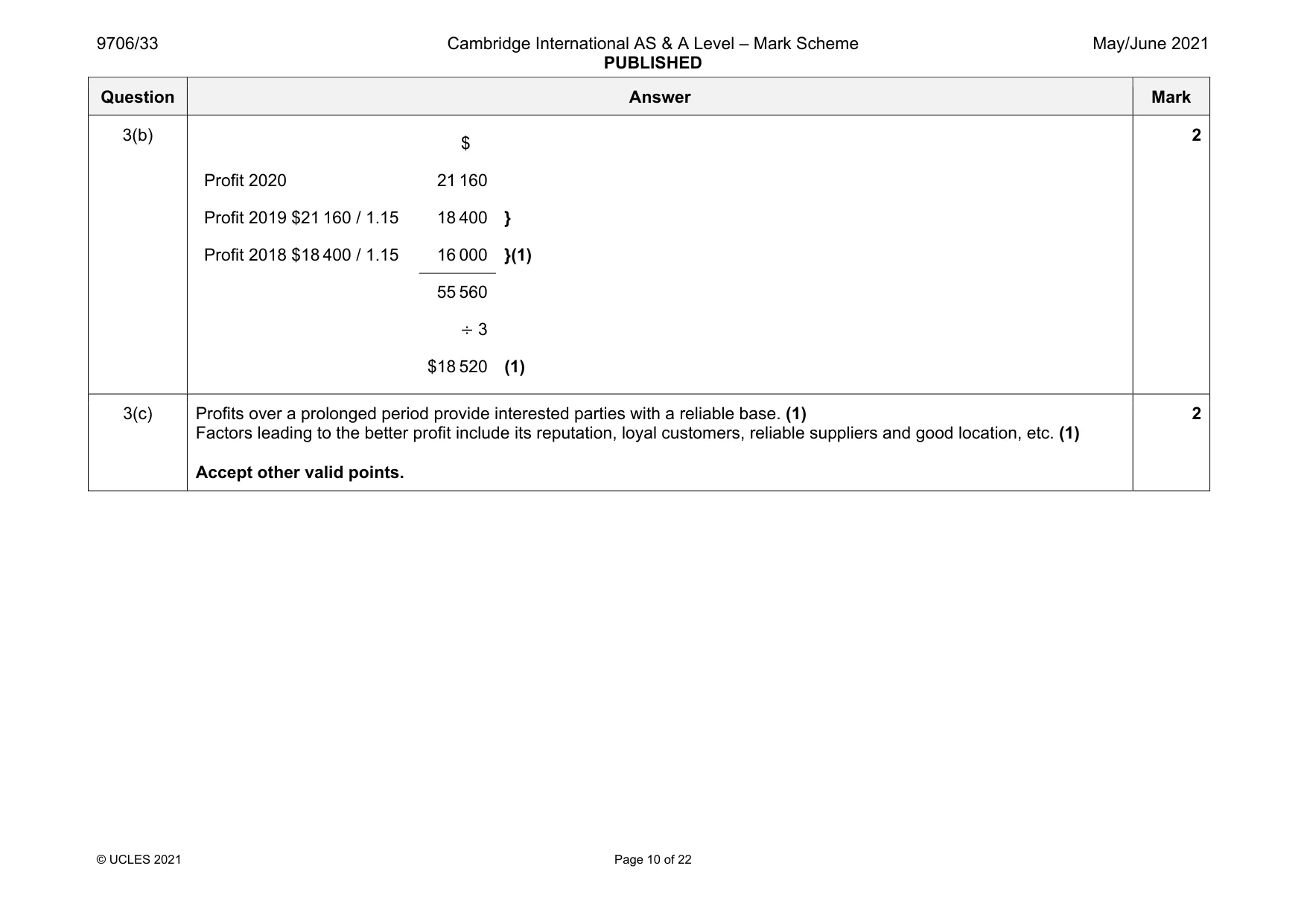
9706/33 Cambridge International AS & A Level – Mark Scheme PUBLISHED May/June 2021 © UCLES 2021 Page 10 of 22 Question Answer Mark 3(b) $ Profit 2020 21 160 Profit 2019 $21 160 / 1.15 18 400 } Profit 2018 $18 400 / 1.15 16 000 }(1) 55 560 ÷ 3 $18 520 (1) 2 3(c) Profits over a prolonged period provide interested parties with a reliable base. (1) Factors leading to the better profit include its reputation, loyal customers, reliable suppliers and good location, etc. (1) Accept other valid points. 2
Mark scheme, page 11
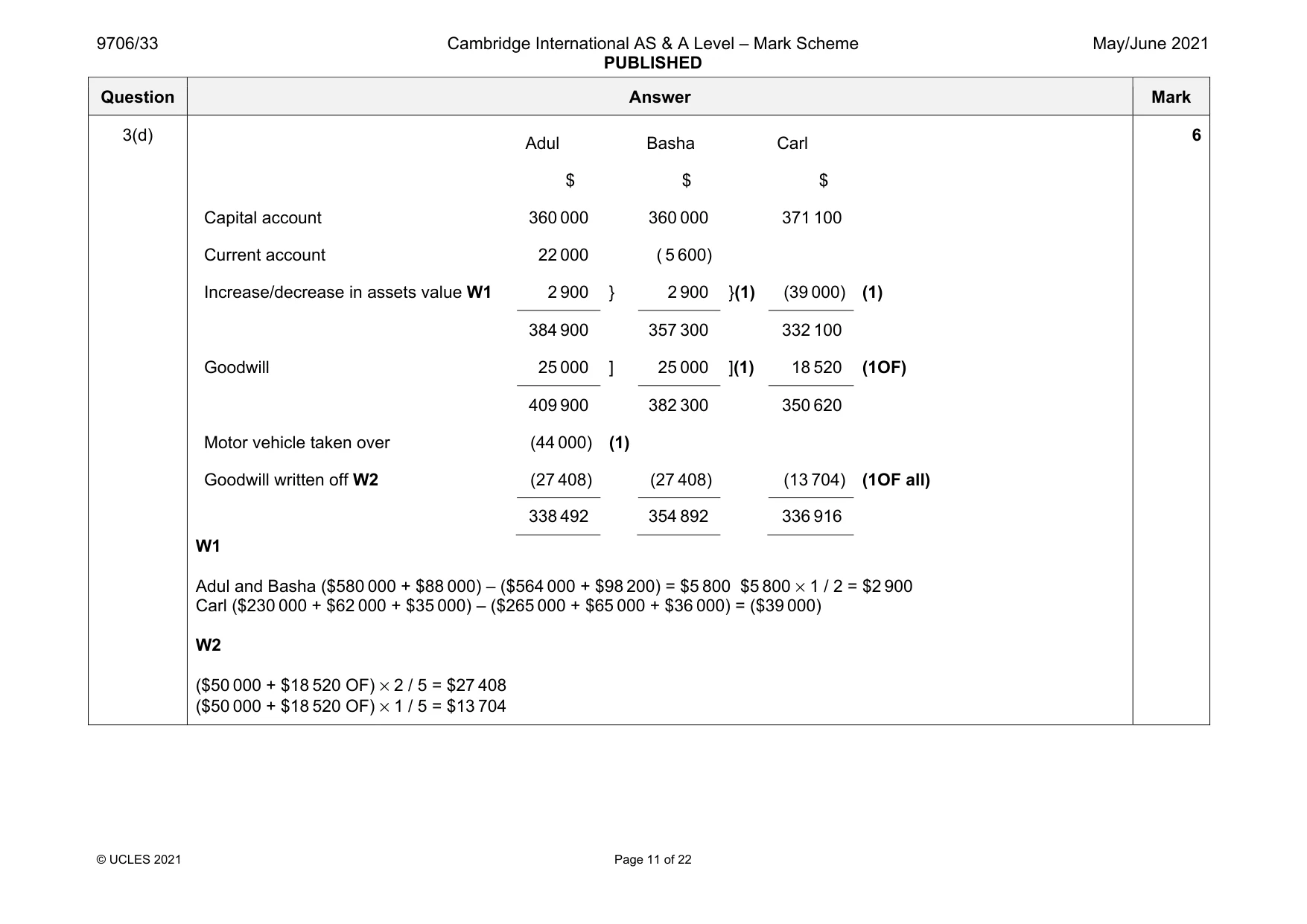
9706/33 Cambridge International AS & A Level – Mark Scheme PUBLISHED May/June 2021 © UCLES 2021 Page 11 of 22 Question Answer Mark 3(d) Adul Basha Carl $ $ $ Capital account 360 000 360 000 371 100 Current account 22 000 ( 5 600) Increase/decrease in assets value W1 2 900 } 2 900 }(1) (39 000) (1) 384 900 357 300 332 100 Goodwill 25 000 ] 25 000 ](1) 18 520 (1OF) 409 900 382 300 350 620 Motor vehicle taken over (44 000) (1) Goodwill written off W2 (27 408) (27 408) (13 704) (1OF all) 338 492 354 892 336 916 W1 Adul and Basha ($580 000 + $88 000) – ($564 000 + $98 200) = $5 800 $5 800 × 1 / 2 = $2 900 Carl ($230 000 + $62 000 + $35 000) – ($265 000 + $65 000 + $36 000) = ($39 000) W2 ($50 000 + $18 520 OF) × 2 / 5 = $27 408 ($50 000 + $18 520 OF) × 1 / 5 = $13 704 6
Mark scheme, page 12
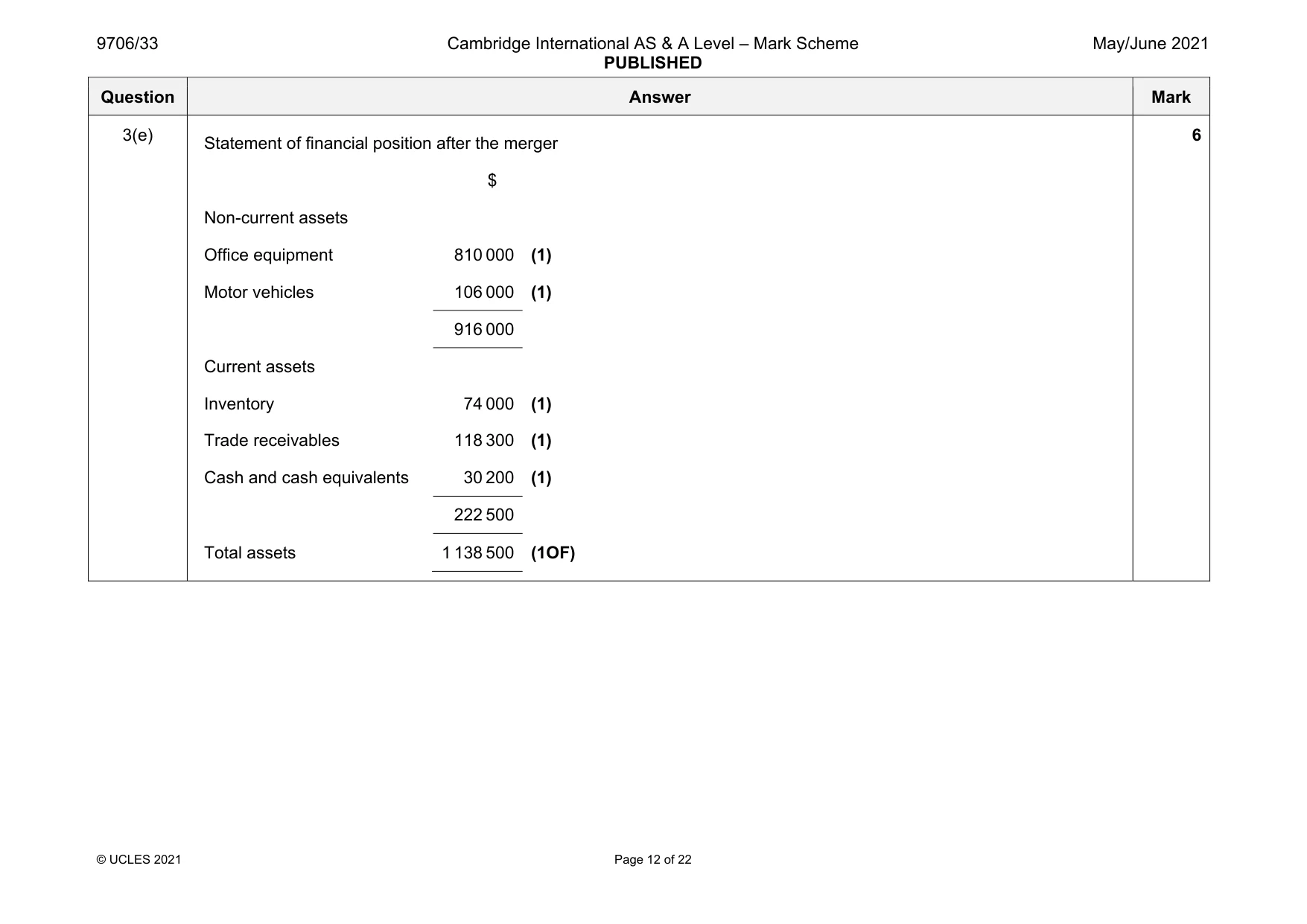
9706/33 Cambridge International AS & A Level – Mark Scheme PUBLISHED May/June 2021 © UCLES 2021 Page 12 of 22 Question Answer Mark 3(e) Statement of financial position after the merger $ Non-current assets Office equipment 810 000 (1) Motor vehicles 106 000 (1) 916 000 Current assets Inventory 74 000 (1) Trade receivables 118 300 (1) Cash and cash equivalents 30 200 (1) 222 500 Total assets 1 138 500 (1OF) 6
Mark scheme, page 13
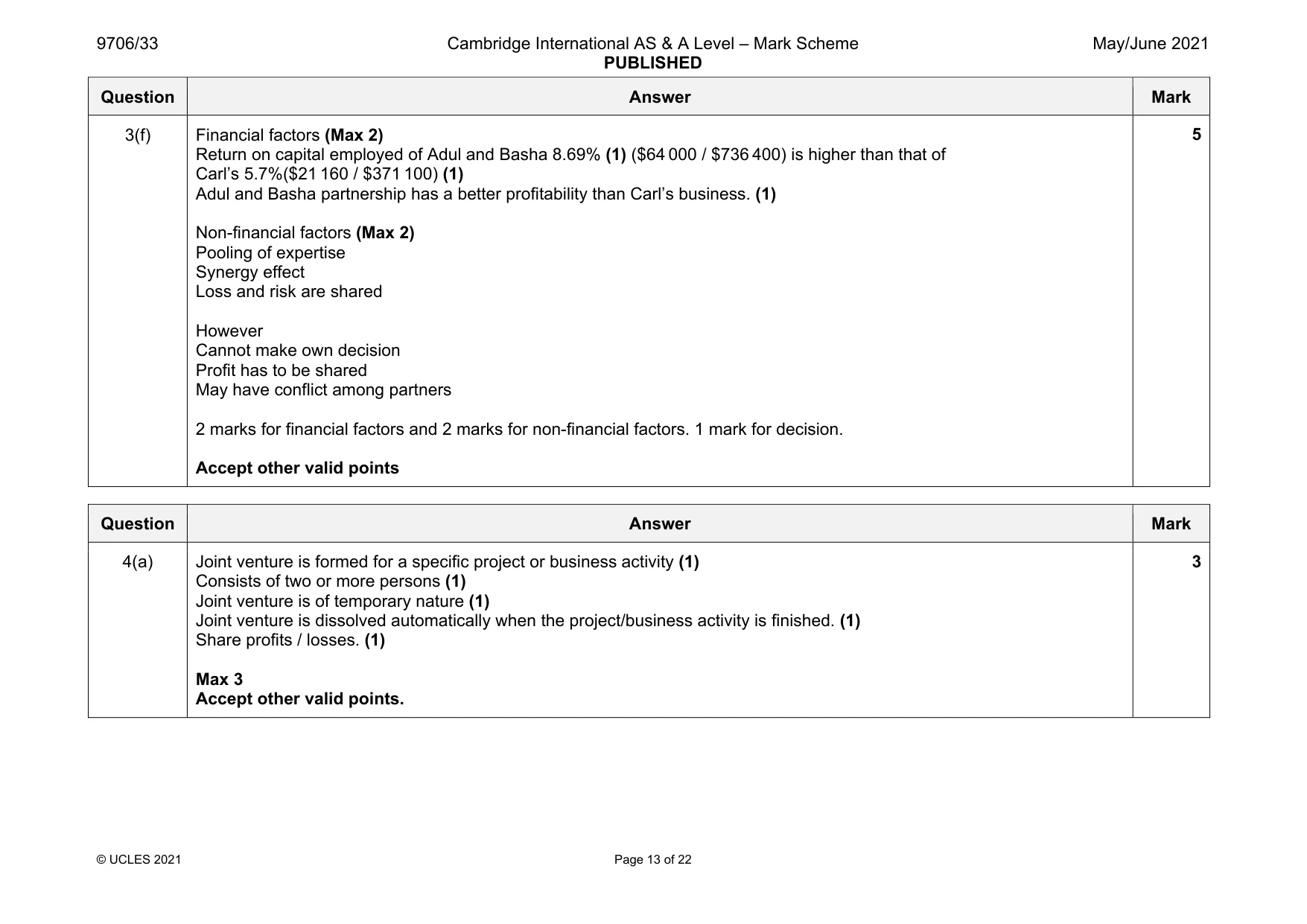
9706/33 Cambridge International AS & A Level – Mark Scheme PUBLISHED May/June 2021 © UCLES 2021 Page 13 of 22 Question Answer Mark 3(f) Financial factors (Max 2) Return on capital employed of Adul and Basha 8.69% (1) ($64 000 / $736 400) is higher than that of Carl’s 5.7%($21 160 / $371 100) (1) Adul and Basha partnership has a better profitability than Carl’s business. (1) Non-financial factors (Max 2) Pooling of expertise Synergy effect Loss and risk are shared However Cannot make own decision Profit has to be shared May have conflict among partners 2 marks for financial factors and 2 marks for non-financial factors. 1 mark for decision. Accept other valid points 5 Question Answer Mark 4(a) Joint venture is formed for a specific project or business activity (1) Consists of two or more persons (1) Joint venture is of temporary nature (1) Joint venture is dissolved automatically when the project/business activity is finished. (1) Share profits / losses. (1) Max 3 Accept other valid points. 3
Mark scheme, page 14
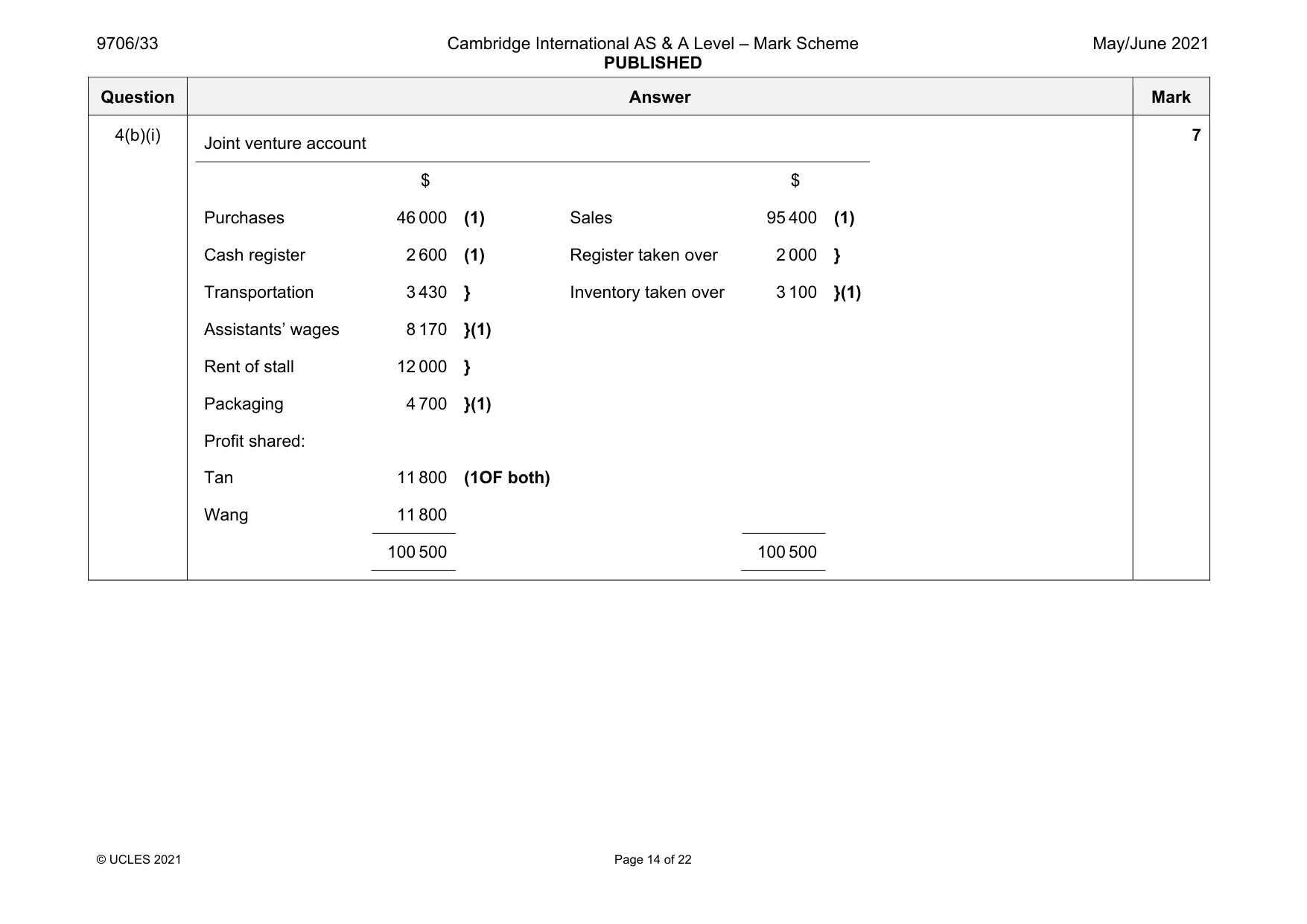
9706/33 Cambridge International AS & A Level – Mark Scheme PUBLISHED May/June 2021 © UCLES 2021 Page 14 of 22 Question Answer Mark 4(b)(i) Joint venture account $ $ Purchases 46 000 (1) Sales 95 400 (1) Cash register 2 600 (1) Register taken over 2 000 } Transportation 3 430 } Inventory taken over 3 100 }(1) Assistants’ wages 8 170 }(1) Rent of stall 12 000 } Packaging 4 700 }(1) Profit shared: Tan 11 800 (1OF both) Wang 11 800 100 500 100 500 7
Mark scheme, page 15
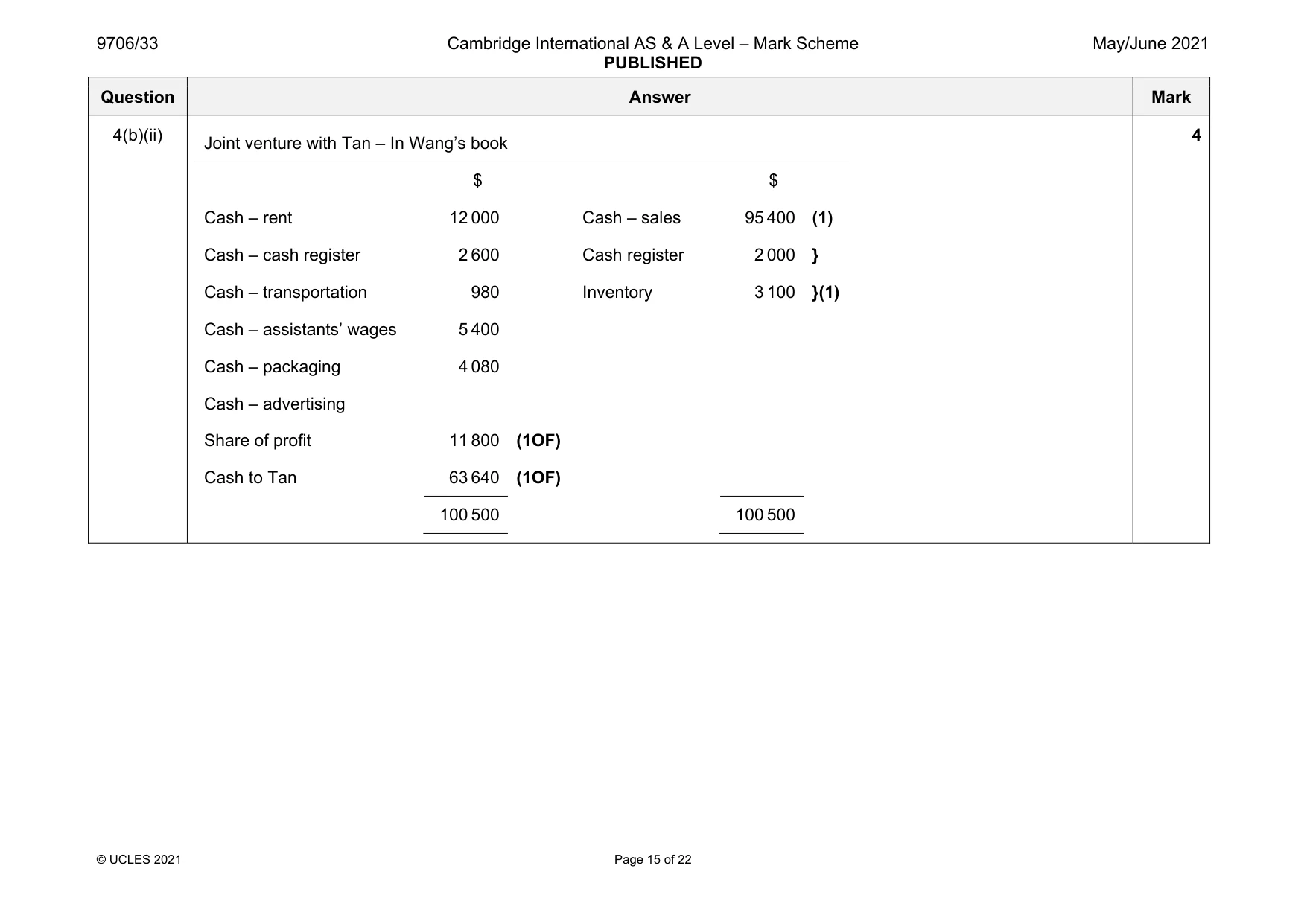
9706/33 Cambridge International AS & A Level – Mark Scheme PUBLISHED May/June 2021 © UCLES 2021 Page 15 of 22 Question Answer Mark 4(b)(ii) Joint venture with Tan – In Wang’s book $ $ Cash – rent 12 000 Cash – sales 95 400 (1) Cash – cash register 2 600 Cash register 2 000 } Cash – transportation 980 Inventory 3 100 }(1) Cash – assistants’ wages 5 400 Cash – packaging 4 080 Cash – advertising Share of profit 11 800 (1OF) Cash to Tan 63 640 (1OF) 100 500 100 500 4
Mark scheme, page 16
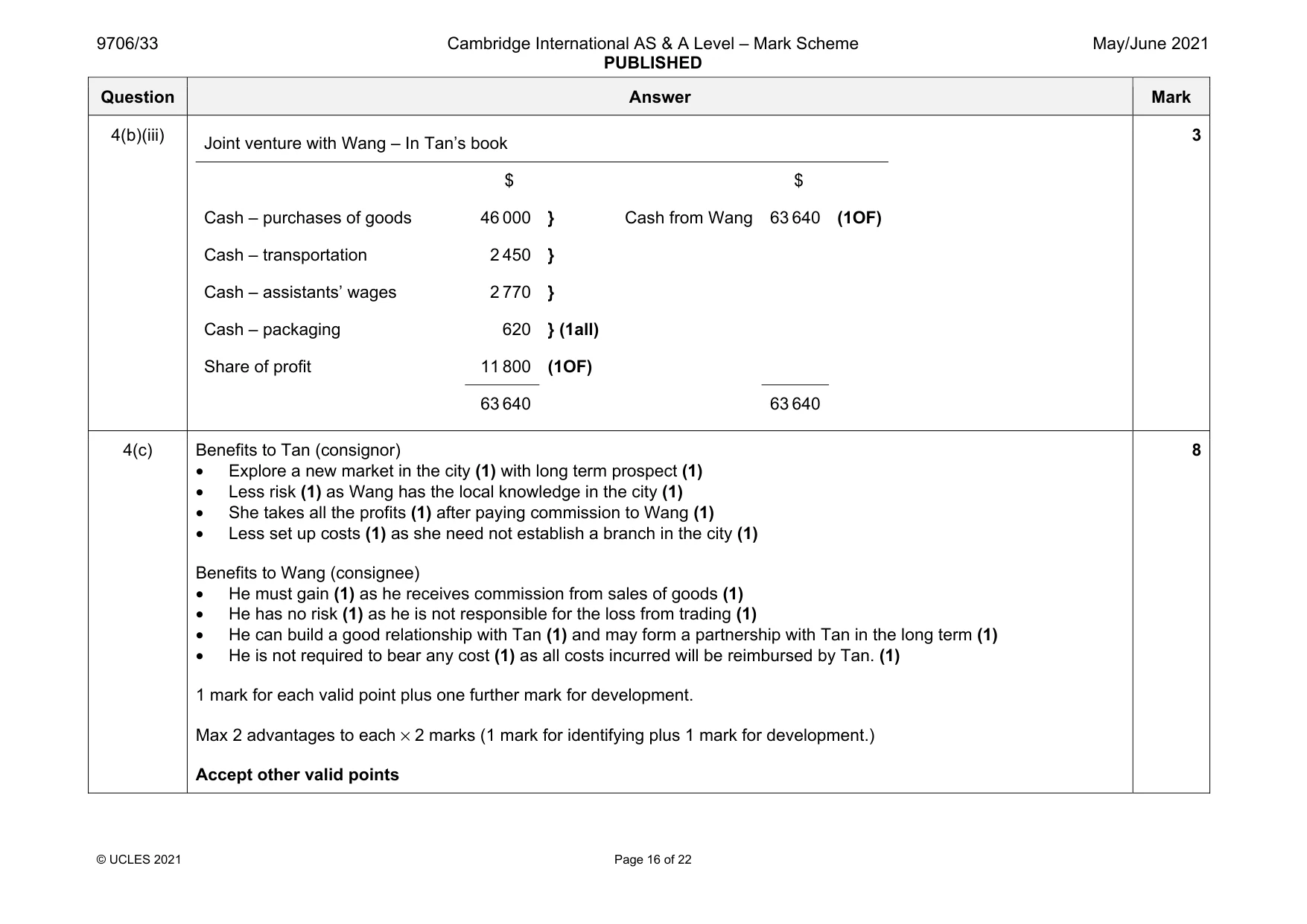
9706/33 Cambridge International AS & A Level – Mark Scheme PUBLISHED May/June 2021 © UCLES 2021 Page 16 of 22 Question Answer Mark 4(b)(iii) Joint venture with Wang – In Tan’s book $ $ Cash – purchases of goods 46 000 } Cash from Wang 63 640 (1OF) Cash – transportation 2 450 } Cash – assistants’ wages 2 770 } Cash – packaging 620 } (1all) Share of profit 11 800 (1OF) 63 640 63 640 3 4(c) Benefits to Tan (consignor) • Explore a new market in the city (1) with long term prospect (1) • Less risk (1) as Wang has the local knowledge in the city (1) • She takes all the profits (1) after paying commission to Wang (1) • Less set up costs (1) as she need not establish a branch in the city (1) Benefits to Wang (consignee) • He must gain (1) as he receives commission from sales of goods (1) • He has no risk (1) as he is not responsible for the loss from trading (1) • He can build a good relationship with Tan (1) and may form a partnership with Tan in the long term (1) • He is not required to bear any cost (1) as all costs incurred will be reimbursed by Tan. (1) 1 mark for each valid point plus one further mark for development. Max 2 advantages to each × 2 marks (1 mark for identifying plus 1 mark for development.) Accept other valid points 8
Mark scheme, page 17
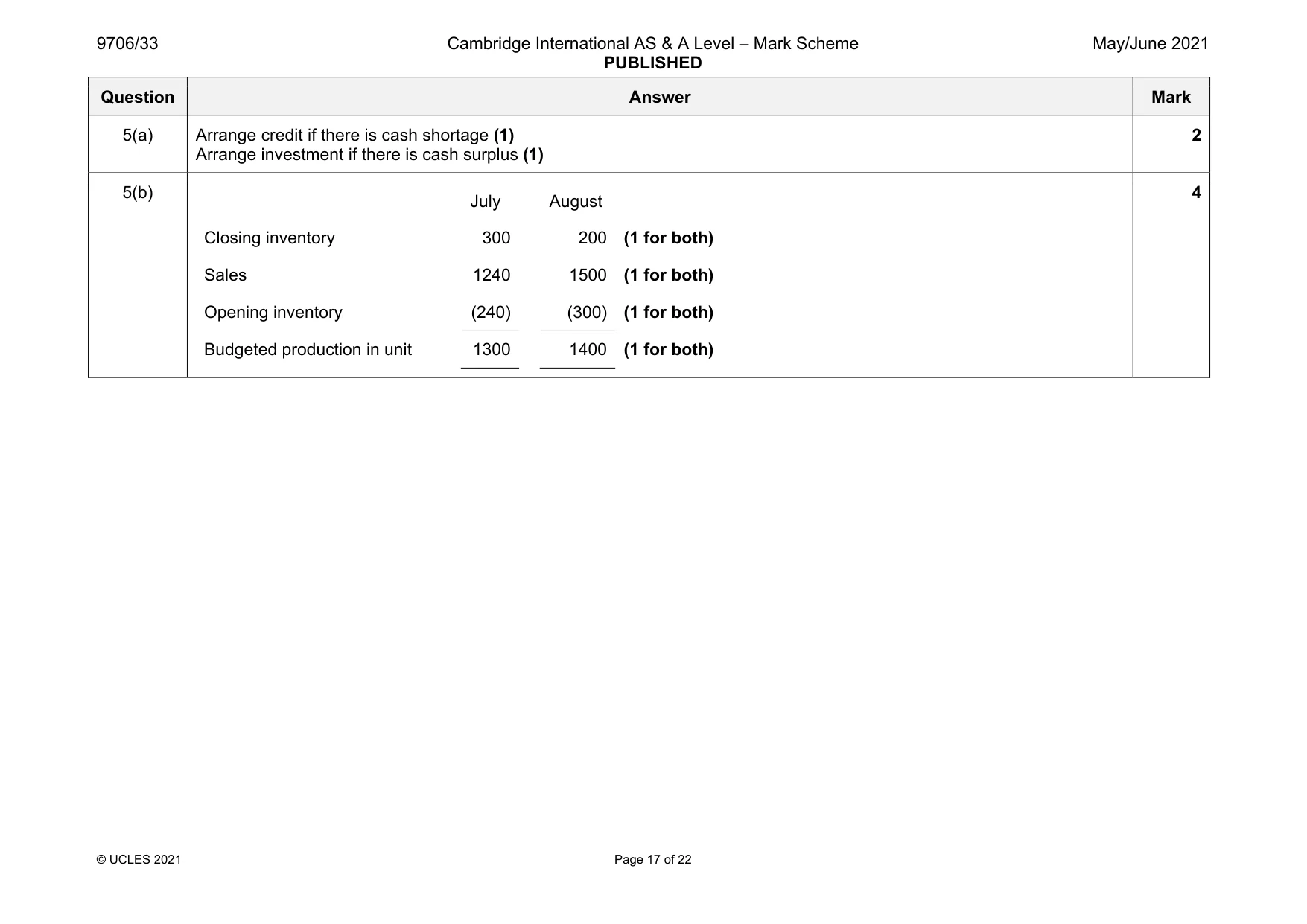
9706/33 Cambridge International AS & A Level – Mark Scheme PUBLISHED May/June 2021 © UCLES 2021 Page 17 of 22 Question Answer Mark 5(a) Arrange credit if there is cash shortage (1) Arrange investment if there is cash surplus (1) 2 5(b) July August Closing inventory 300 200 (1 for both) Sales 1240 1500 (1 for both) Opening inventory (240) (300) (1 for both) Budgeted production in unit 1300 1400 (1 for both) 4
Mark scheme, page 18
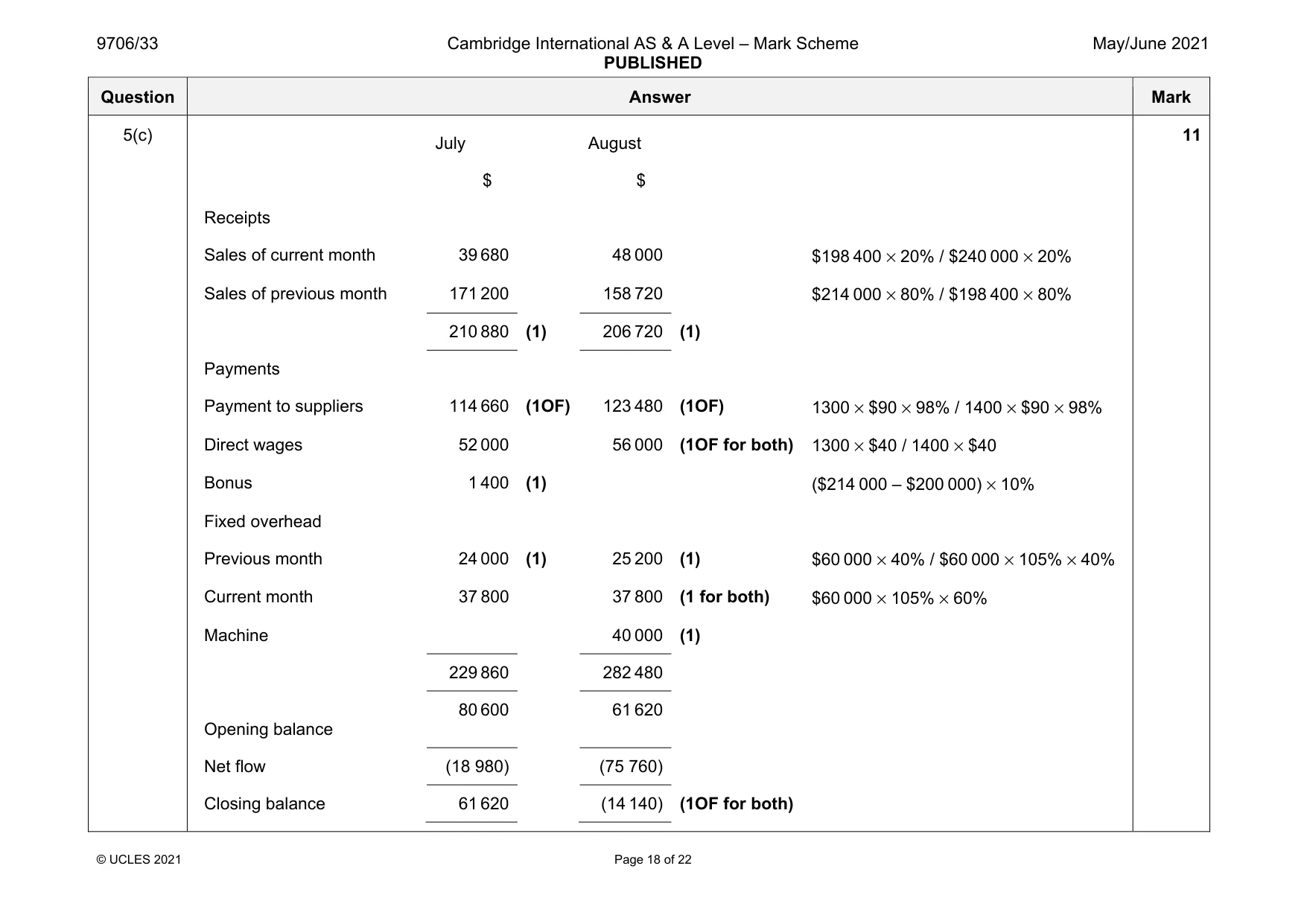
9706/33 Cambridge International AS & A Level – Mark Scheme PUBLISHED May/June 2021 © UCLES 2021 Page 18 of 22 Question Answer Mark 5(c) July August $ $ Receipts Sales of current month 39 680 48 000 $198 400 × 20% / $240 000 × 20% Sales of previous month 171 200 158 720 $214 000 × 80% / $198 400 × 80% 210 880 (1) 206 720 (1) Payments Payment to suppliers 114 660 (1OF) 123 480 (1OF) 1300 × $90 × 98% / 1400 × $90 × 98% Direct wages 52 000 56 000 (1OF for both) 1300 × $40 / 1400 × $40 Bonus 1 400 (1) ($214 000 – $200 000) × 10% Fixed overhead Previous month 24 000 (1) 25 200 (1) $60 000 × 40% / $60 000 × 105% × 40% Current month 37 800 37 800 (1 for both) $60 000 × 105% × 60% Machine 40 000 (1) 229 860 282 480 Opening balance 80 600 61 620 Net flow (18 980) (75 760) Closing balance 61 620 (14 140) (1OF for both) 11
Mark scheme, page 19
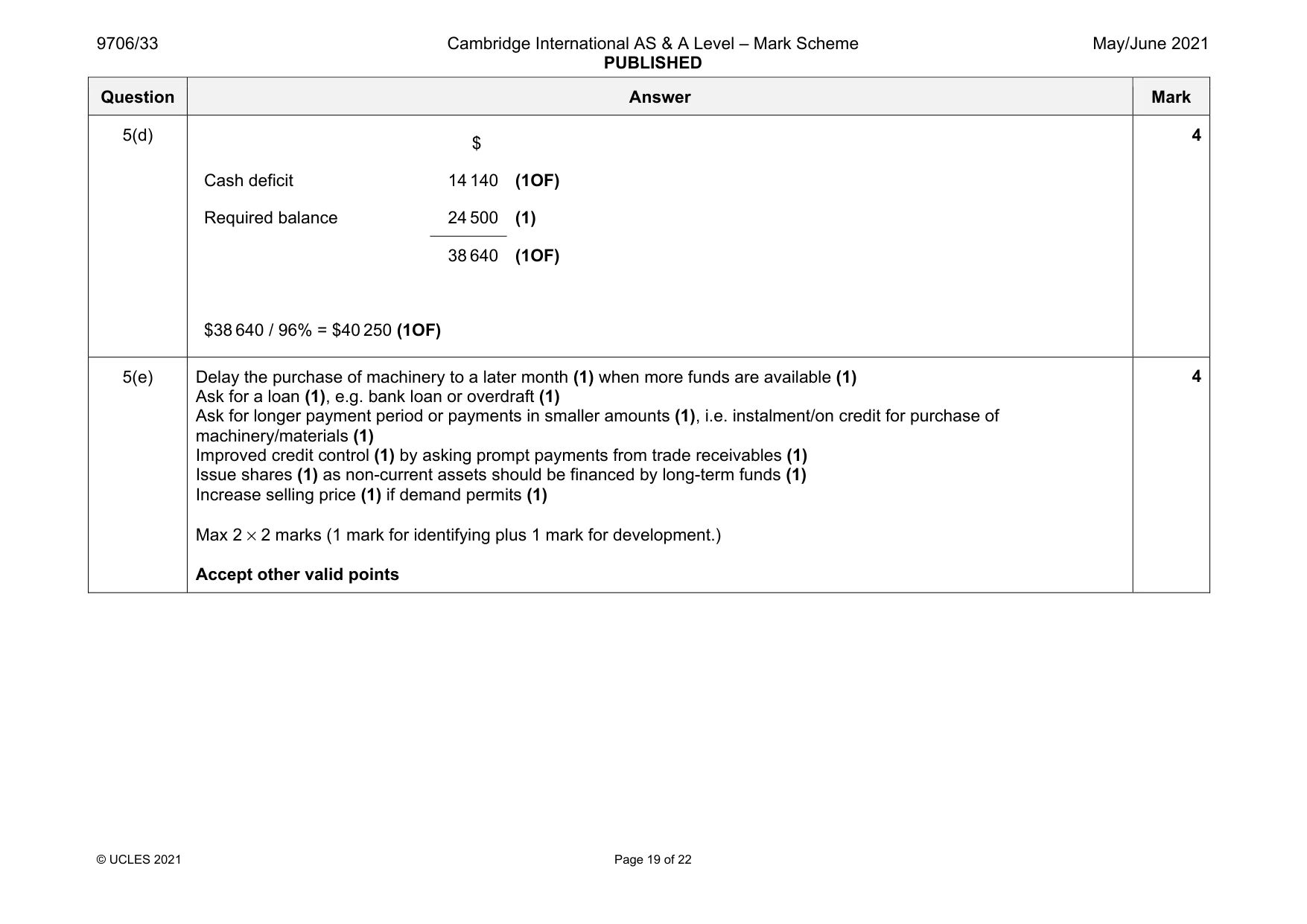
9706/33 Cambridge International AS & A Level – Mark Scheme PUBLISHED May/June 2021 © UCLES 2021 Page 19 of 22 Question Answer Mark 5(d) $ Cash deficit 14 140 (1OF) Required balance 24 500 (1) 38 640 (1OF) $38 640 / 96% = $40 250 (1OF) 4 5(e) Delay the purchase of machinery to a later month (1) when more funds are available (1) Ask for a loan (1), e.g. bank loan or overdraft (1) Ask for longer payment period or payments in smaller amounts (1), i.e. instalment/on credit for purchase of machinery/materials (1) Improved credit control (1) by asking prompt payments from trade receivables (1) Issue shares (1) as non-current assets should be financed by long-term funds (1) Increase selling price (1) if demand permits (1) Max 2 × 2 marks (1 mark for identifying plus 1 mark for development.) Accept other valid points 4
Mark scheme, page 20
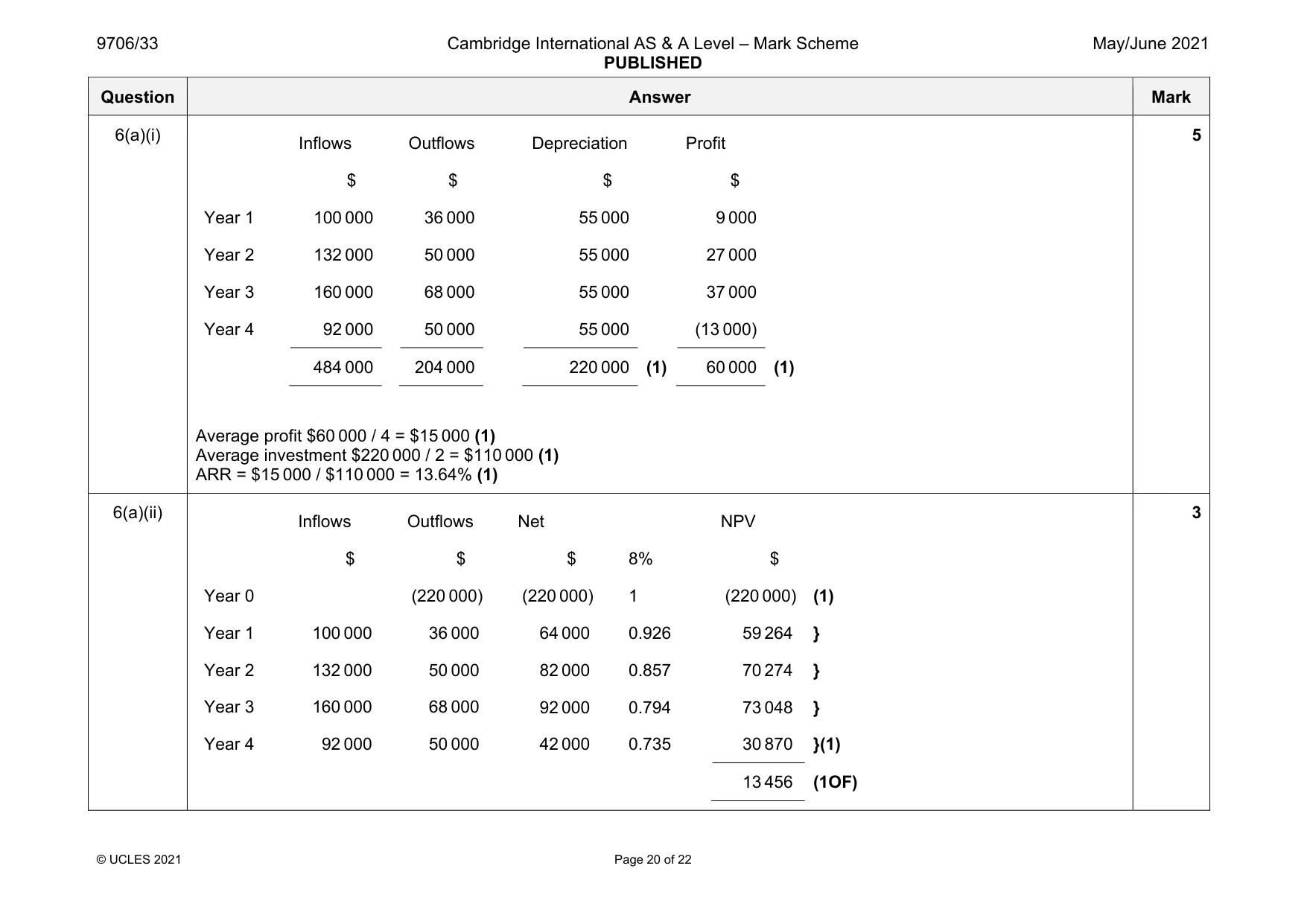
9706/33 Cambridge International AS & A Level – Mark Scheme PUBLISHED May/June 2021 © UCLES 2021 Page 20 of 22 Question Answer Mark 6(a)(i) Inflows Outflows Depreciation Profit $ $ $ $ Year 1 100 000 36 000 55 000 9 000 Year 2 132 000 50 000 55 000 27 000 Year 3 160 000 68 000 55 000 37 000 Year 4 92 000 50 000 55 000 (13 000) 484 000 204 000 220 000 (1) 60 000 (1) Average profit $60 000 / 4 = $15 000 (1) Average investment $220 000 / 2 = $110 000 (1) ARR = $15 000 / $110 000 = 13.64% (1) 5 6(a)(ii) Inflows Outflows Net NPV $ $ $ 8% $ Year 0 (220 000) (220 000) 1 (220 000) (1) Year 1 100 000 36 000 64 000 0.926 59 264 } Year 2 132 000 50 000 82 000 0.857 70 274 } Year 3 160 000 68 000 92 000 0.794 73 048 } Year 4 92 000 50 000 42 000 0.735 30 870 }(1) 13 456 (1OF) 3
Mark scheme, page 21
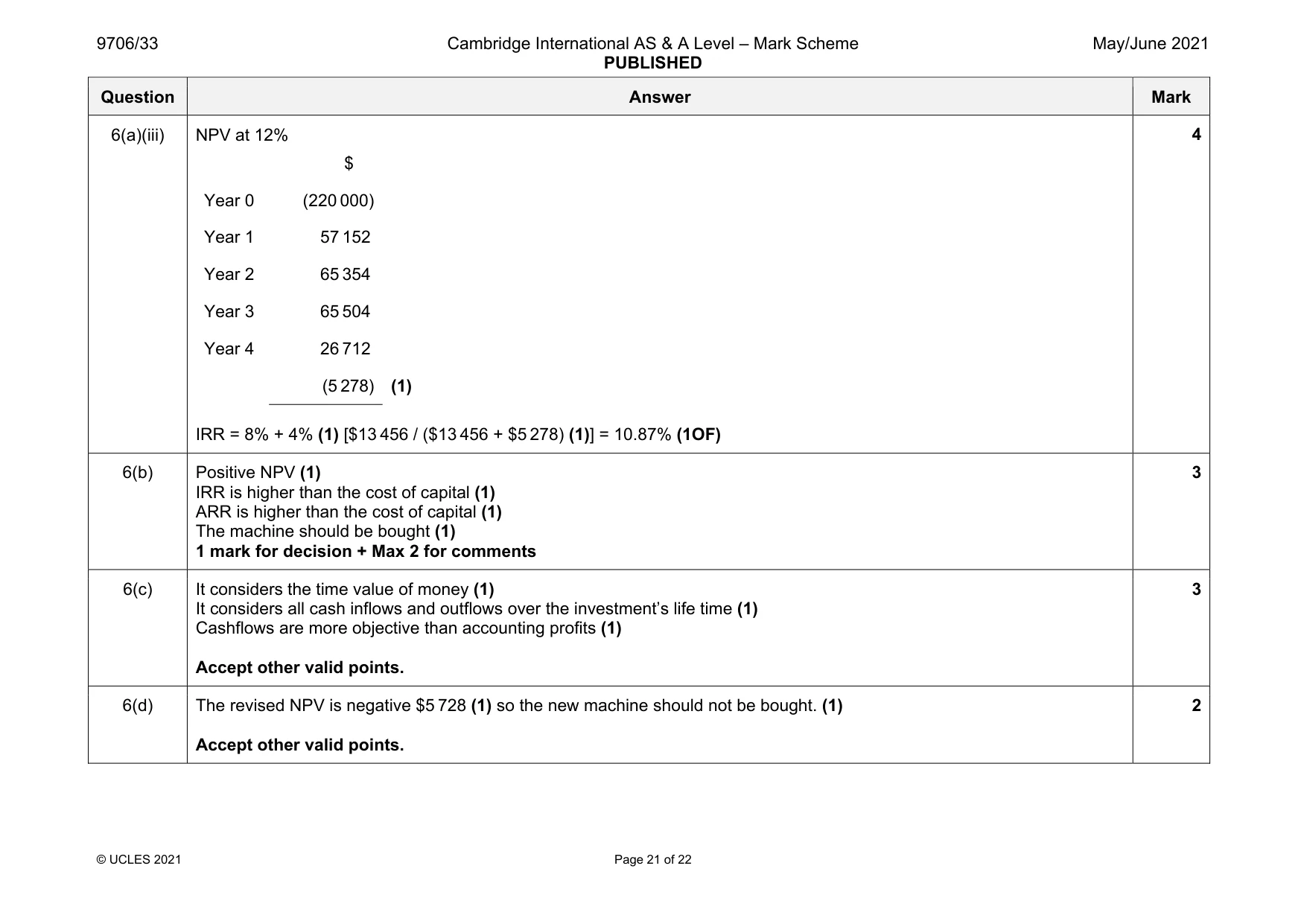
9706/33 Cambridge International AS & A Level – Mark Scheme PUBLISHED May/June 2021 © UCLES 2021 Page 21 of 22 Question Answer Mark 6(a)(iii) NPV at 12% $ Year 0 (220 000) Year 1 57 152 Year 2 65 354 Year 3 65 504 Year 4 26 712 (5 278) (1) IRR = 8% + 4% (1) [$13 456 / ($13 456 + $5 278) (1)] = 10.87% (1OF) 4 6(b) Positive NPV (1) IRR is higher than the cost of capital (1) ARR is higher than the cost of capital (1) The machine should be bought (1) 1 mark for decision + Max 2 for comments 3 6(c) It considers the time value of money (1) It considers all cash inflows and outflows over the investment’s life time (1) Cashflows are more objective than accounting profits (1) Accept other valid points. 3 6(d) The revised NPV is negative $5 728 (1) so the new machine should not be bought. (1) Accept other valid points. 2
Mark scheme, page 22
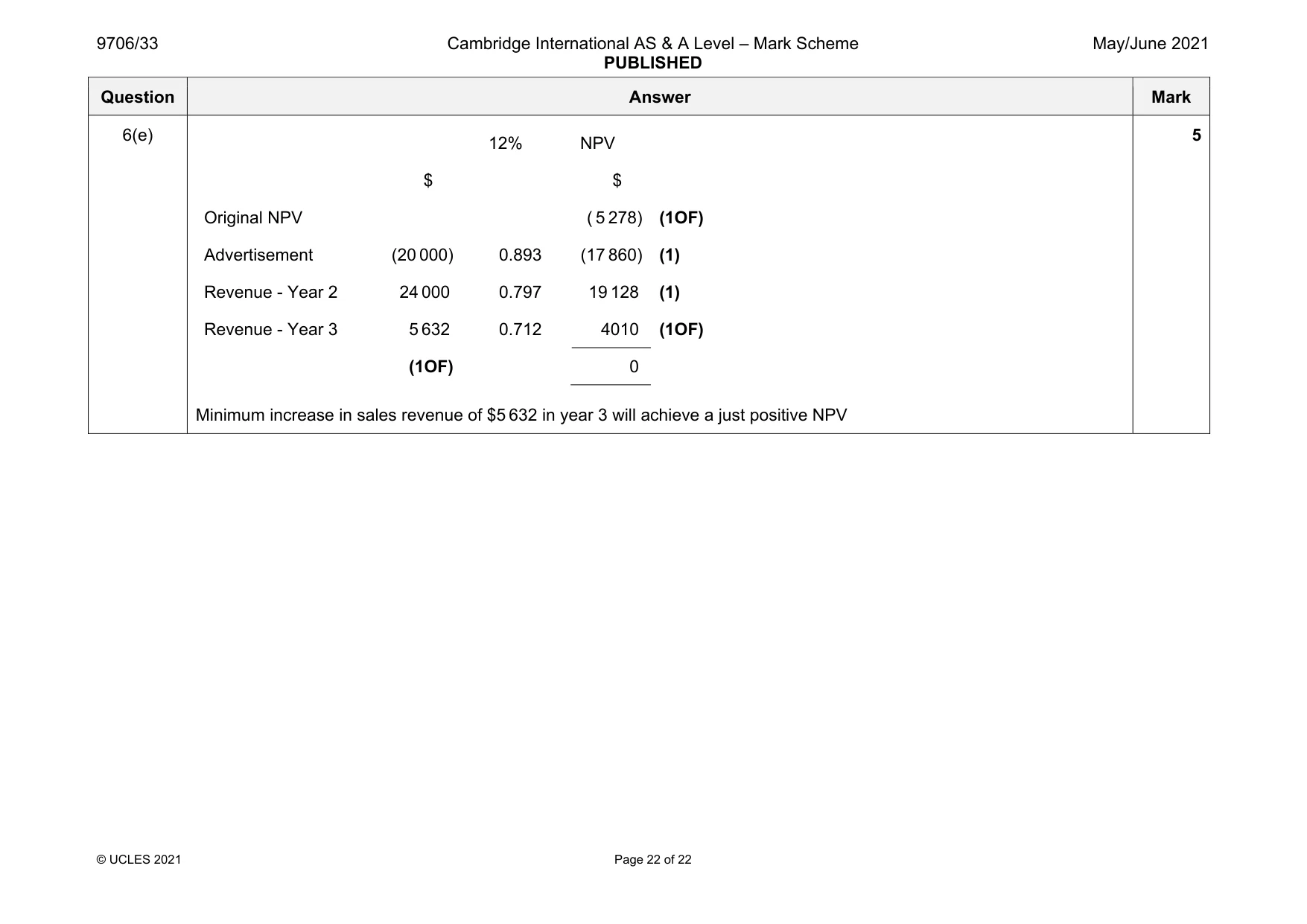
9706/33 Cambridge International AS & A Level – Mark Scheme PUBLISHED May/June 2021 © UCLES 2021 Page 22 of 22 Question Answer Mark 6(e) 12% NPV $ $ Original NPV ( 5 278) (1OF) Advertisement (20 000) 0.893 (17 860) (1) Revenue - Year 2 24 000 0.797 19 128 (1) Revenue - Year 3 5 632 0.712 4010 (1OF) (1OF) 0 Minimum increase in sales revenue of $5 632 in year 3 will achieve a just positive NPV 5
What you needed in this session
Cambridge’s own grade thresholds for 2021 May/June, Paper 3 · Variant 3. A higher threshold means an easier paper — the bar moves with how the cohort did.