Cambridge A Level Accounting 9706 — 2018 May/June Paper 3 · Variant 2
9706/32/M/J/18 · 150 marks · ≈169 min
The question paper and its mark scheme, free to read here and free to download. This is Cambridge’s own paper, exactly as it was sat.
Question paper12 pages


Mark scheme17 pages
Answers below. Sit the paper first if you are practising.
Paper as text
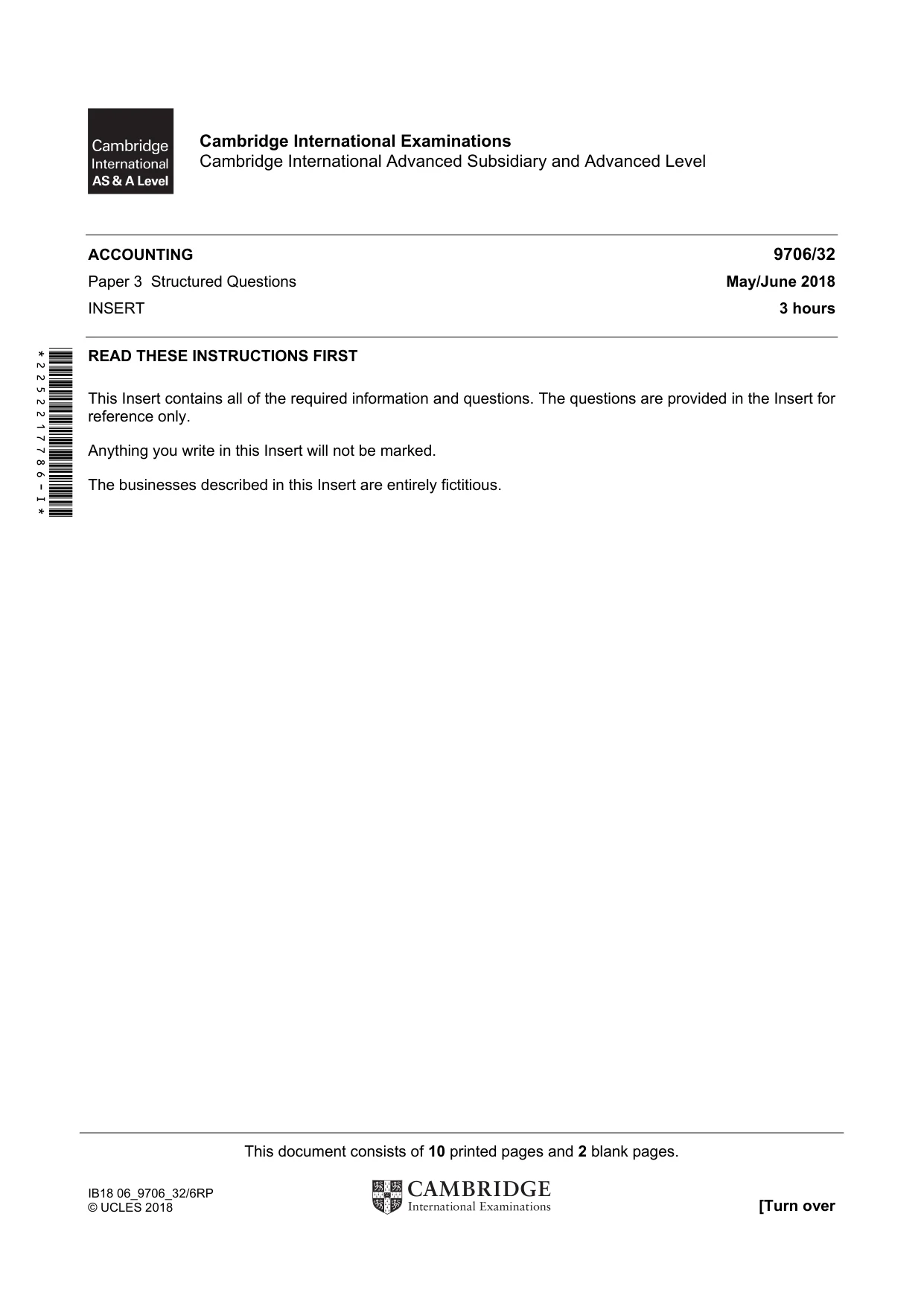
Question paper, page 1
This document consists of 10 printed pages and 2 blank pages. IB18 06_9706_32/6RP © UCLES 2018 [Turn over Cambridge International Examinations Cambridge International Advanced Subsidiary and Advanced Level ACCOUNTING 9706/32 Paper 3 Structured Questions May/June 2018 INSERT 3 hours READ THESE INSTRUCTIONS FIRST This Insert contains all of the required information and questions. The questions are provided in the Insert for reference only. Anything you write in this Insert will not be marked. The businesses described in this Insert are entirely fictitious.
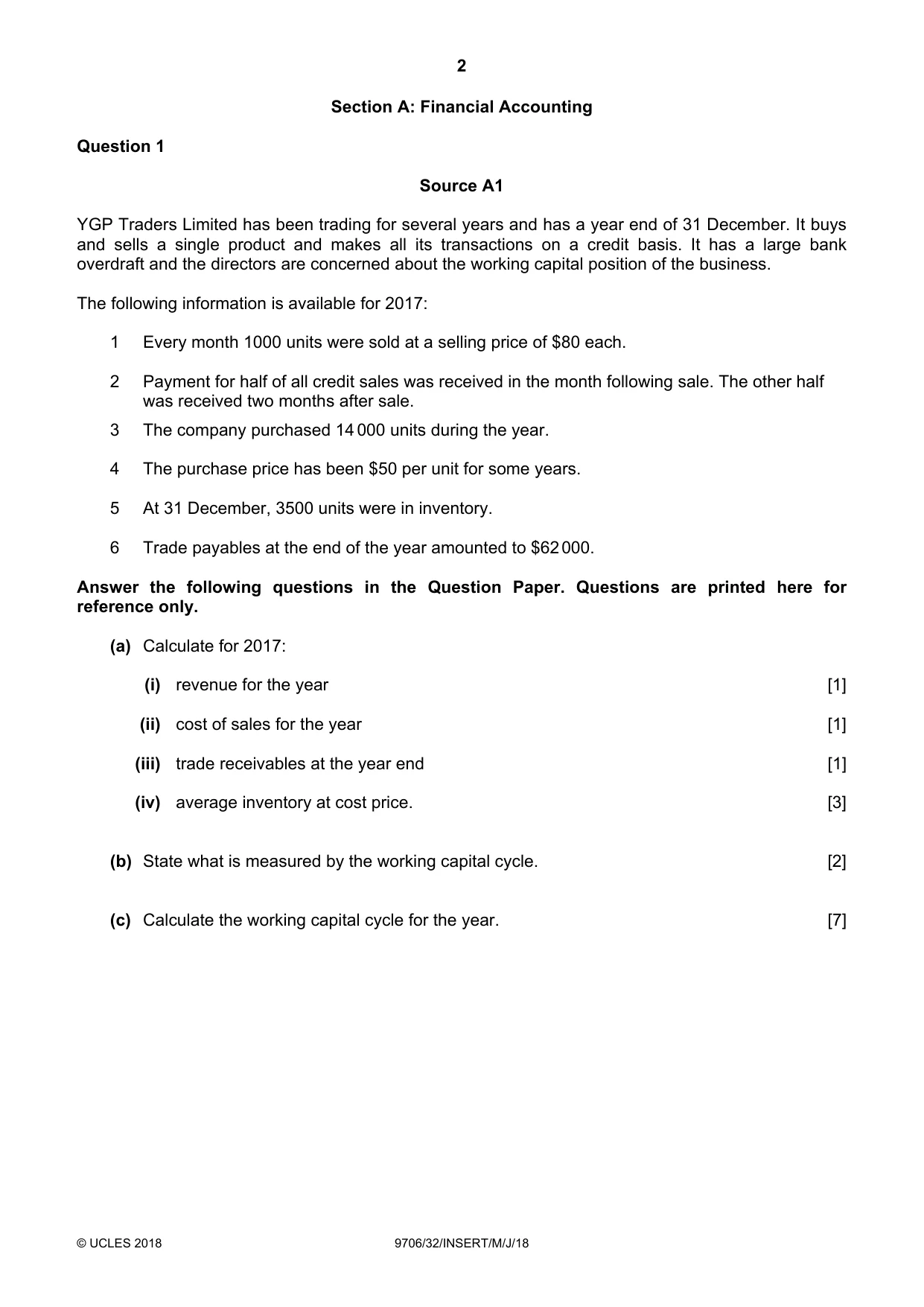
Question paper, page 2
2 © UCLES 2018 9706/32/INSERT/M/J/18 Section A: Financial Accounting Question 1 Source A1 YGP Traders Limited has been trading for several years and has a year end of 31 December. It buys and sells a single product and makes all its transactions on a credit basis. It has a large bank overdraft and the directors are concerned about the working capital position of the business. The following information is available for 2017: 1 Every month 1000 units were sold at a selling price of $80 each. 2 Payment for half of all credit sales was received in the month following sale. The other half was received two months after sale. 3 The company purchased 14 000 units during the year. 4 The purchase price has been $50 per unit for some years. 5 At 31 December, 3500 units were in inventory. 6 Trade payables at the end of the year amounted to $62 000. Answer the following questions in the Question Paper. Questions are printed here for reference only. (a) Calculate for 2017: (i) revenue for the year [1] (ii) cost of sales for the year [1] (iii) trade receivables at the year end [1] (iv) average inventory at cost price. [3] (b) State what is measured by the working capital cycle. [2] (c) Calculate the working capital cycle for the year. [7]
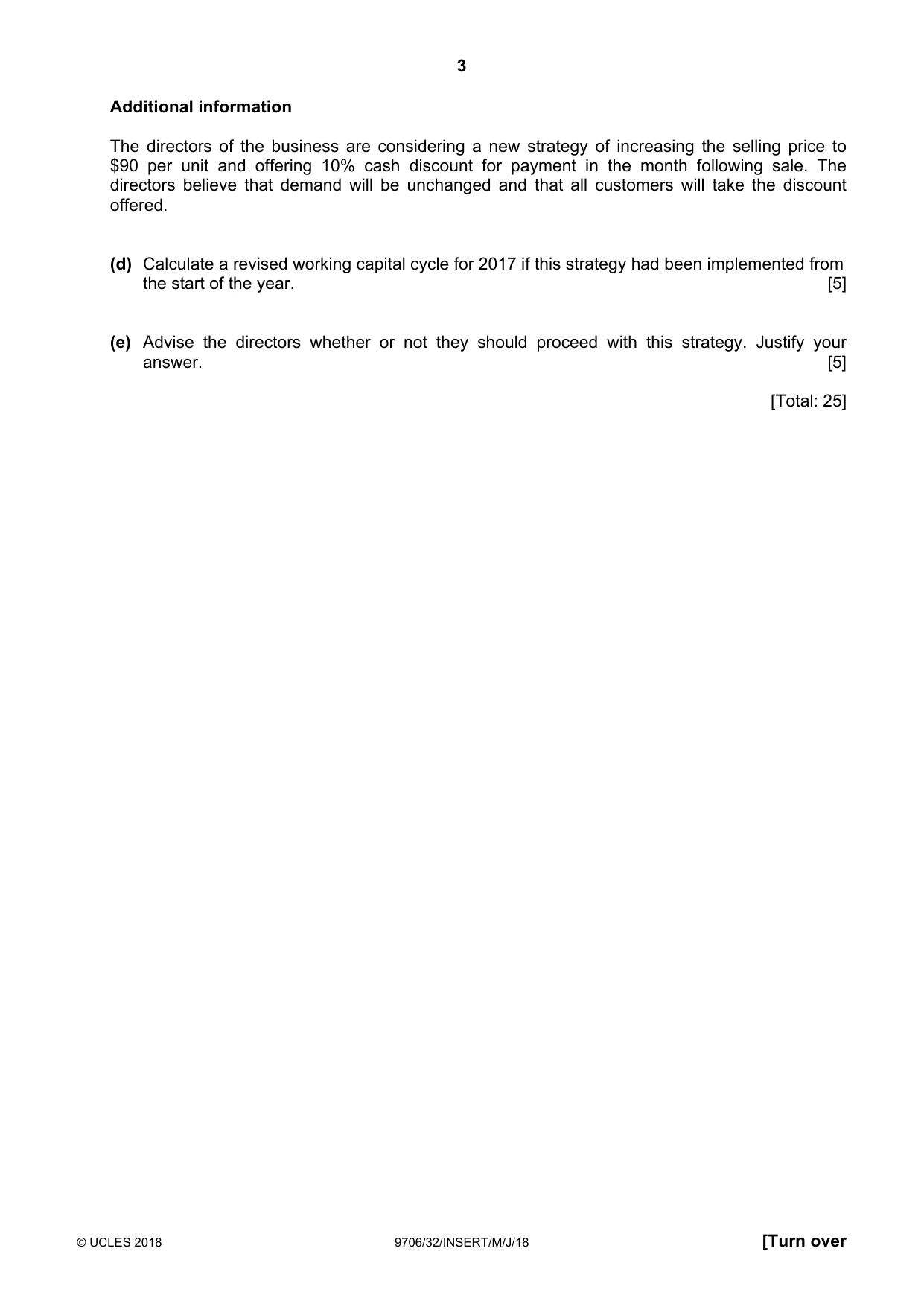
Question paper, page 3
3 © UCLES 2018 9706/32/INSERT/M/J/18 [Turn over Additional information The directors of the business are considering a new strategy of increasing the selling price to $90 per unit and offering 10% cash discount for payment in the month following sale. The directors believe that demand will be unchanged and that all customers will take the discount offered. (d) Calculate a revised working capital cycle for 2017 if this strategy had been implemented from the start of the year. [5] (e) Advise the directors whether or not they should proceed with this strategy. Justify your answer. [5] [Total: 25]
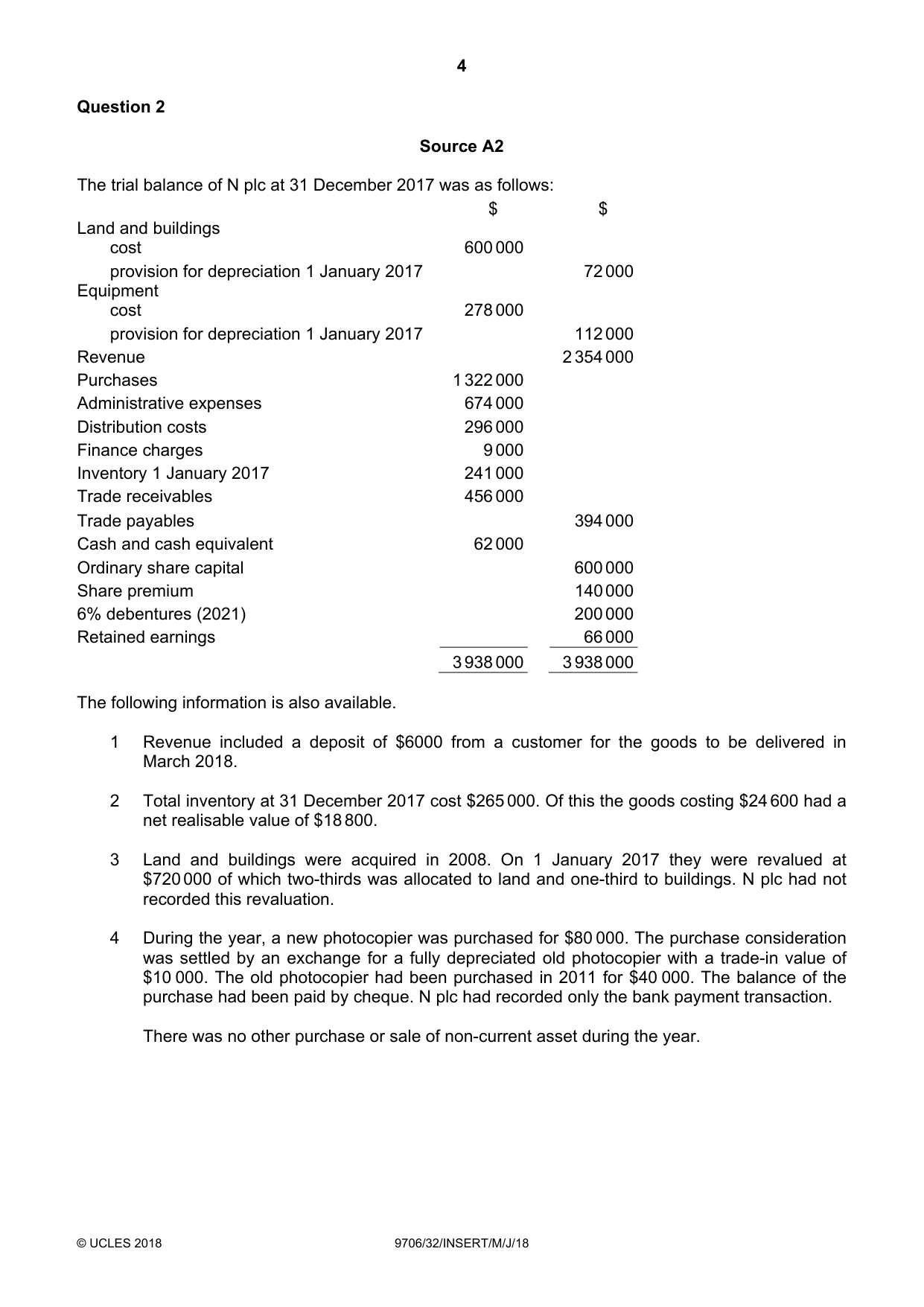
Question paper, page 4
4 © UCLES 2018 9706/32/INSERT/M/J/18 Question 2 Source A2 The trial balance of N plc at 31 December 2017 was as follows: $ $ Land and buildings cost 600 000 provision for depreciation 1 January 2017 72 000 Equipment cost 278 000 provision for depreciation 1 January 2017 112 000 Revenue 2 354 000 Purchases 1 322 000 Administrative expenses 674 000 Distribution costs 296 000 Finance charges 9 000 Inventory 1 January 2017 241 000 Trade receivables 456 000 Trade payables 394 000 Cash and cash equivalent 62 000 Ordinary share capital 600 000 Share premium 140 000 6% debentures (2021) 200 000 Retained earnings 66 000 3 938 000 3 938 000 The following information is also available. 1 Revenue included a deposit of $6000 from a customer for the goods to be delivered in March 2018. 2 Total inventory at 31 December 2017 cost $265 000. Of this the goods costing $24 600 had a net realisable value of $18 800. 3 Land and buildings were acquired in 2008. On 1 January 2017 they were revalued at $720 000 of which two-thirds was allocated to land and one-third to buildings. N plc had not recorded this revaluation. 4 During the year, a new photocopier was purchased for $80 000. The purchase consideration was settled by an exchange for a fully depreciated old photocopier with a trade-in value of $10 000. The old photocopier had been purchased in 2011 for $40 000. The balance of the purchase had been paid by cheque. N plc had recorded only the bank payment transaction. There was no other purchase or sale of non-current asset during the year.
Question paper, page 5
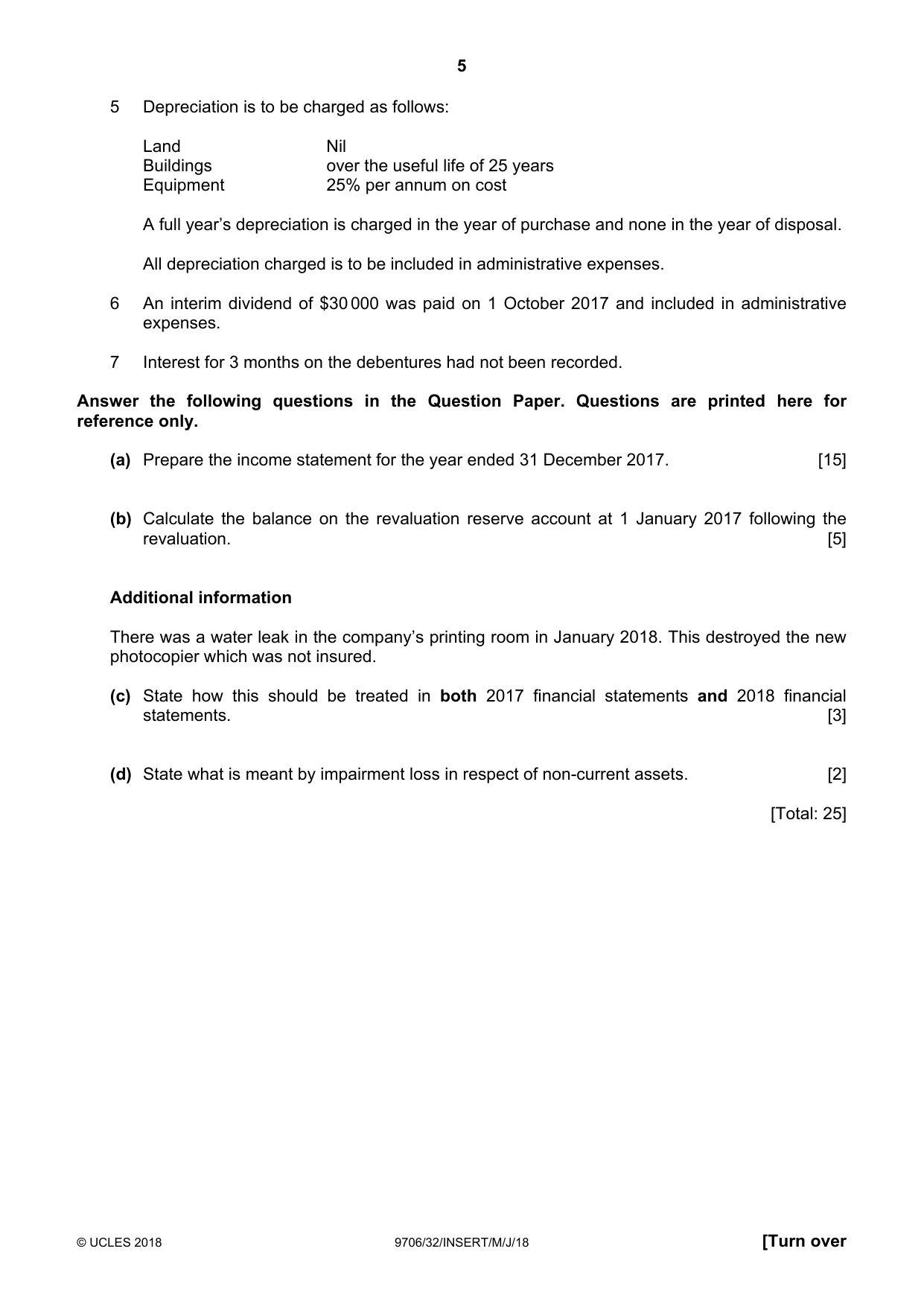
5 © UCLES 2018 9706/32/INSERT/M/J/18 [Turn over 5 Depreciation is to be charged as follows: Land Nil Buildings over the useful life of 25 years Equipment 25% per annum on cost A full year’s depreciation is charged in the year of purchase and none in the year of disposal. All depreciation charged is to be included in administrative expenses. 6 An interim dividend of $30 000 was paid on 1 October 2017 and included in administrative expenses. 7 Interest for 3 months on the debentures had not been recorded. Answer the following questions in the Question Paper. Questions are printed here for reference only. (a) Prepare the income statement for the year ended 31 December 2017. [15] (b) Calculate the balance on the revaluation reserve account at 1 January 2017 following the revaluation. [5] Additional information There was a water leak in the company’s printing room in January 2018. This destroyed the new photocopier which was not insured. (c) State how this should be treated in both 2017 financial statements and 2018 financial statements. [3] (d) State what is meant by impairment loss in respect of non-current assets. [2] [Total: 25]
Question paper, page 6
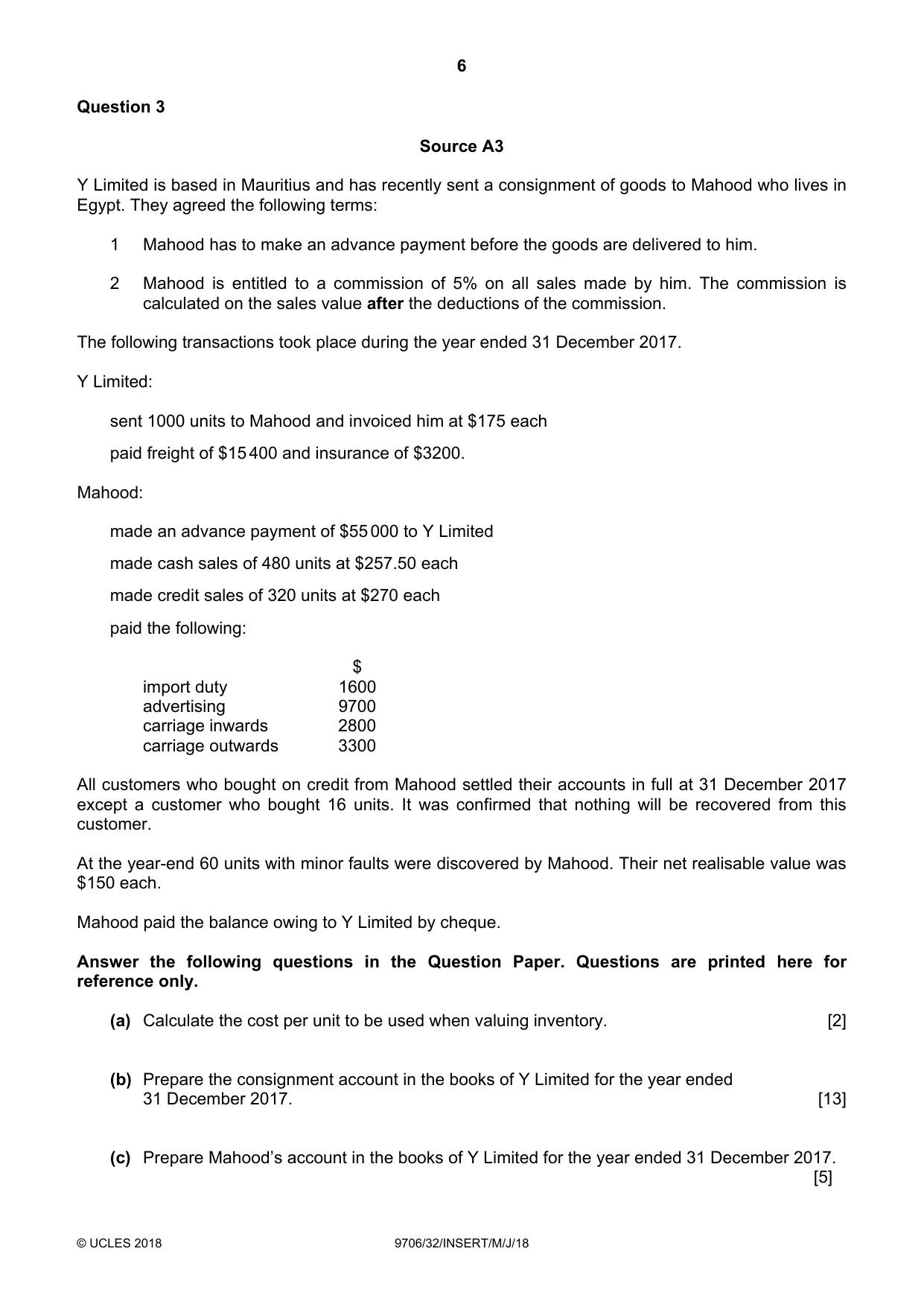
6 © UCLES 2018 9706/32/INSERT/M/J/18 Question 3 Source A3 Y Limited is based in Mauritius and has recently sent a consignment of goods to Mahood who lives in Egypt. They agreed the following terms: 1 Mahood has to make an advance payment before the goods are delivered to him. 2 Mahood is entitled to a commission of 5% on all sales made by him. The commission is calculated on the sales value after the deductions of the commission. The following transactions took place during the year ended 31 December 2017. Y Limited: sent 1000 units to Mahood and invoiced him at $175 each paid freight of $15 400 and insurance of $3200. Mahood: made an advance payment of $55 000 to Y Limited made cash sales of 480 units at $257.50 each made credit sales of 320 units at $270 each paid the following: $ import duty 1600 advertising 9700 carriage inwards 2800 carriage outwards 3300 All customers who bought on credit from Mahood settled their accounts in full at 31 December 2017 except a customer who bought 16 units. It was confirmed that nothing will be recovered from this customer. At the year-end 60 units with minor faults were discovered by Mahood. Their net realisable value was $150 each. Mahood paid the balance owing to Y Limited by cheque. Answer the following questions in the Question Paper. Questions are printed here for reference only. (a) Calculate the cost per unit to be used when valuing inventory. [2] (b) Prepare the consignment account in the books of Y Limited for the year ended 31 December 2017. [13] (c) Prepare Mahood’s account in the books of Y Limited for the year ended 31 December 2017. [5]
Question paper, page 7
7 © UCLES 2018 9706/32/INSERT/M/J/18 [Turn over Additional information The directors of Y Limited are thinking of opening a branch overseas to sell its goods rather than having a consignment agreement with Mahood. (d) Suggest whether Y Limited should continue consigning goods to Mahood or open a branch overseas. Justify your answer. [5] [Total: 25]
Question paper, page 8
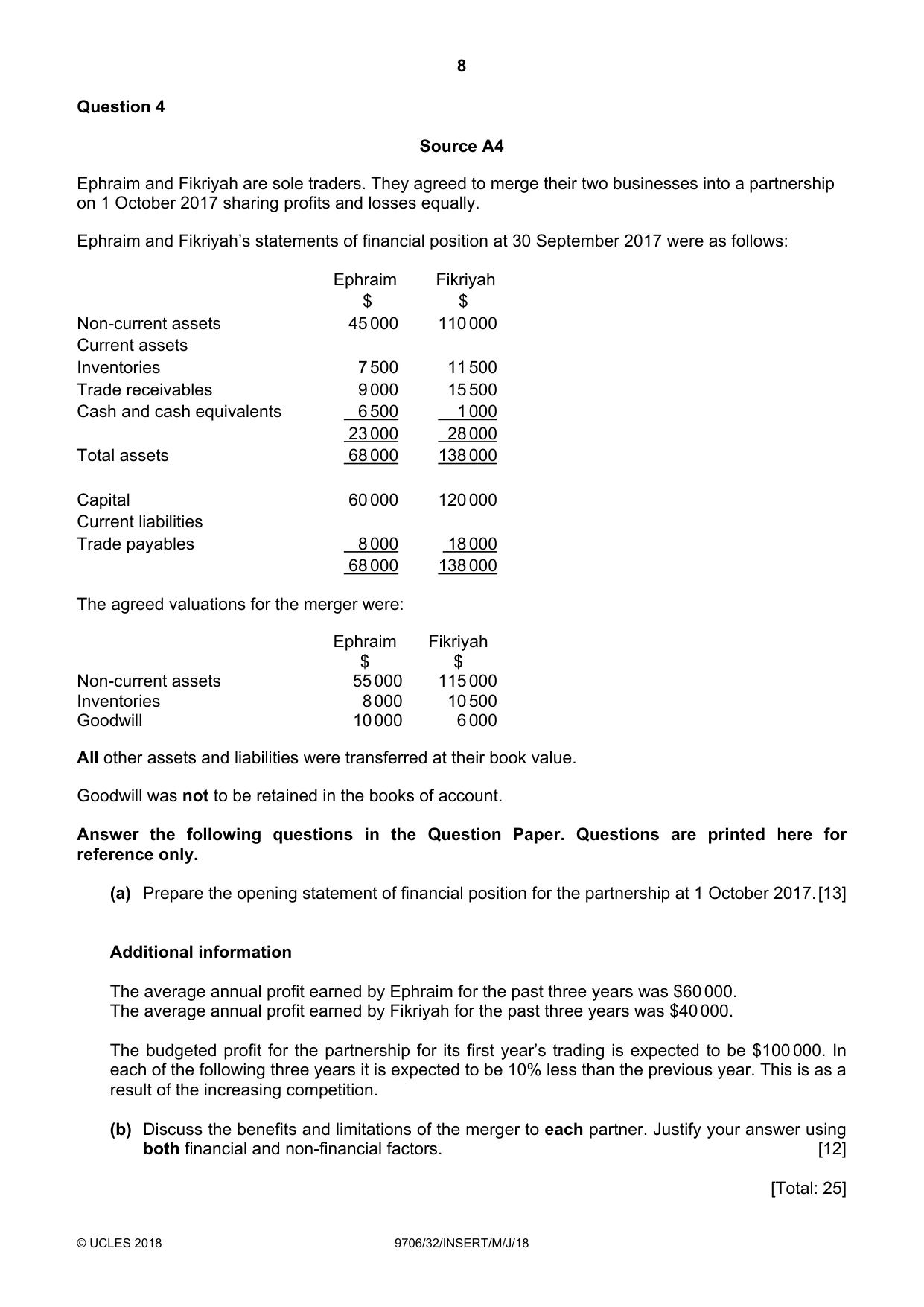
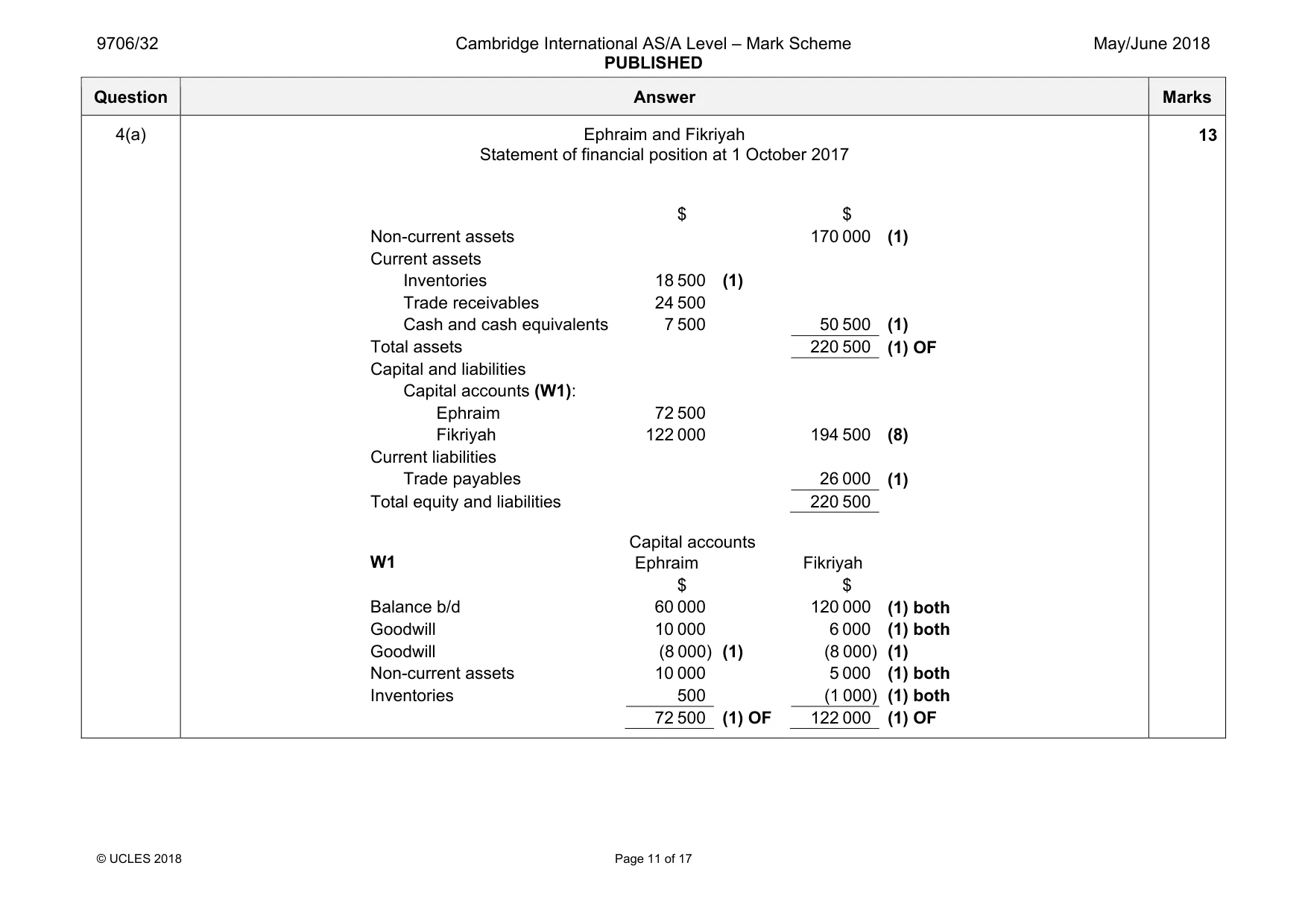
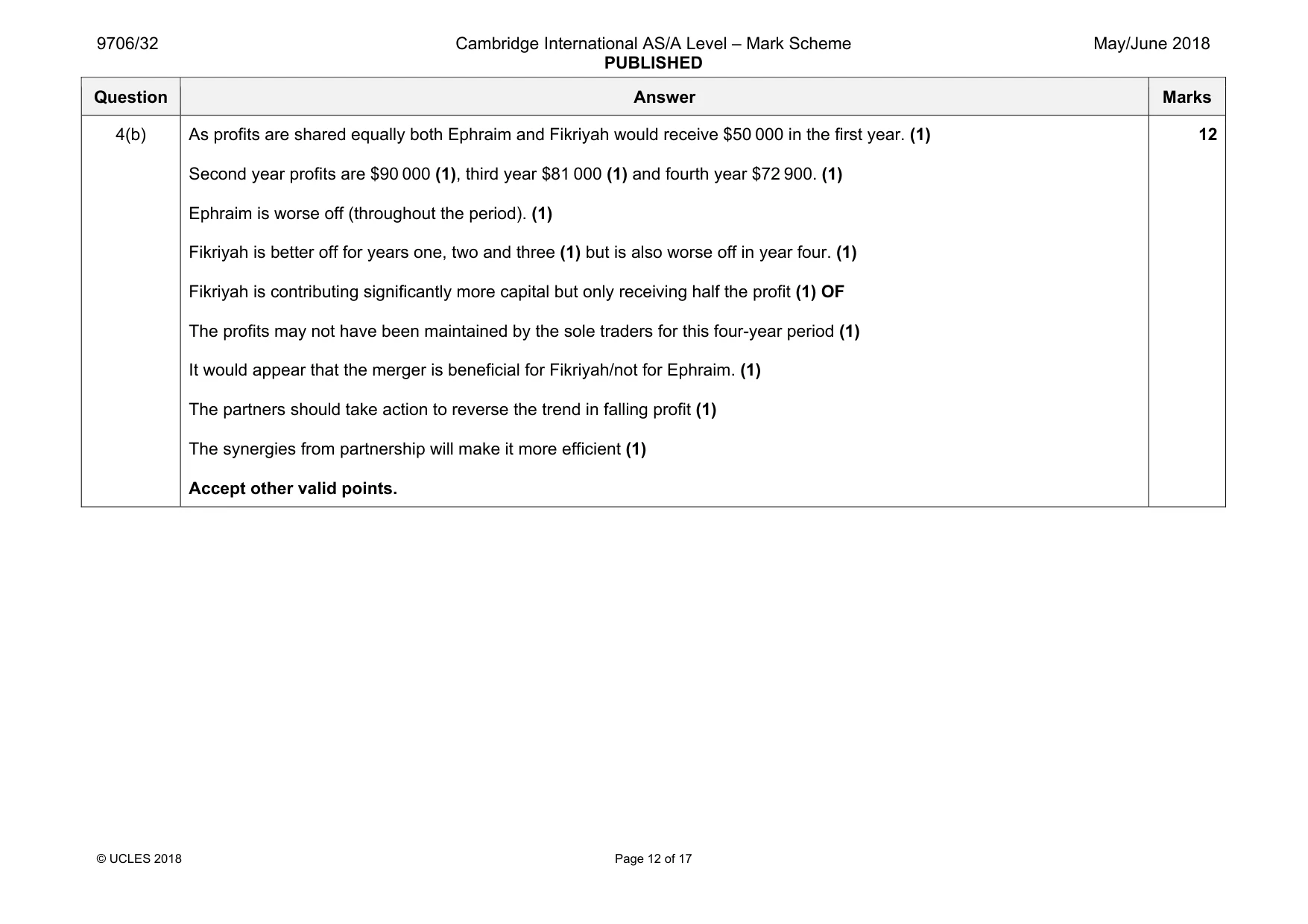
8 © UCLES 2018 9706/32/INSERT/M/J/18 Question 4 Source A4 Ephraim and Fikriyah are sole traders. They agreed to merge their two businesses into a partnership on 1 October 2017 sharing profits and losses equally. Ephraim and Fikriyah’s statements of financial position at 30 September 2017 were as follows: Ephraim Fikriyah $ $ Non-current assets 45 000 110 000 Current assets Inventories 7 500 11 500 Trade receivables 9 000 15 500 Cash and cash equivalents 6 500 1 000 23 000 28 000 Total assets 68 000 138 000 Capital 60 000 120 000 Current liabilities Trade payables 8 000 18 000 68 000 138 000 The agreed valuations for the merger were: Ephraim Fikriyah $ $ Non-current assets 55 000 115 000 Inventories 8 000 10 500 Goodwill 10 000 6 000 All other assets and liabilities were transferred at their book value. Goodwill was not to be retained in the books of account. Answer the following questions in the Question Paper. Questions are printed here for reference only. (a) Prepare the opening statement of financial position for the partnership at 1 October 2017. [13] Additional information The average annual profit earned by Ephraim for the past three years was $60 000. The average annual profit earned by Fikriyah for the past three years was $40 000. The budgeted profit for the partnership for its first year’s trading is expected to be $100 000. In each of the following three years it is expected to be 10% less than the previous year. This is as a result of the increasing competition. (b) Discuss the benefits and limitations of the merger to each partner. Justify your answer using both financial and non-financial factors. [12] [Total: 25]
Question paper, page 9
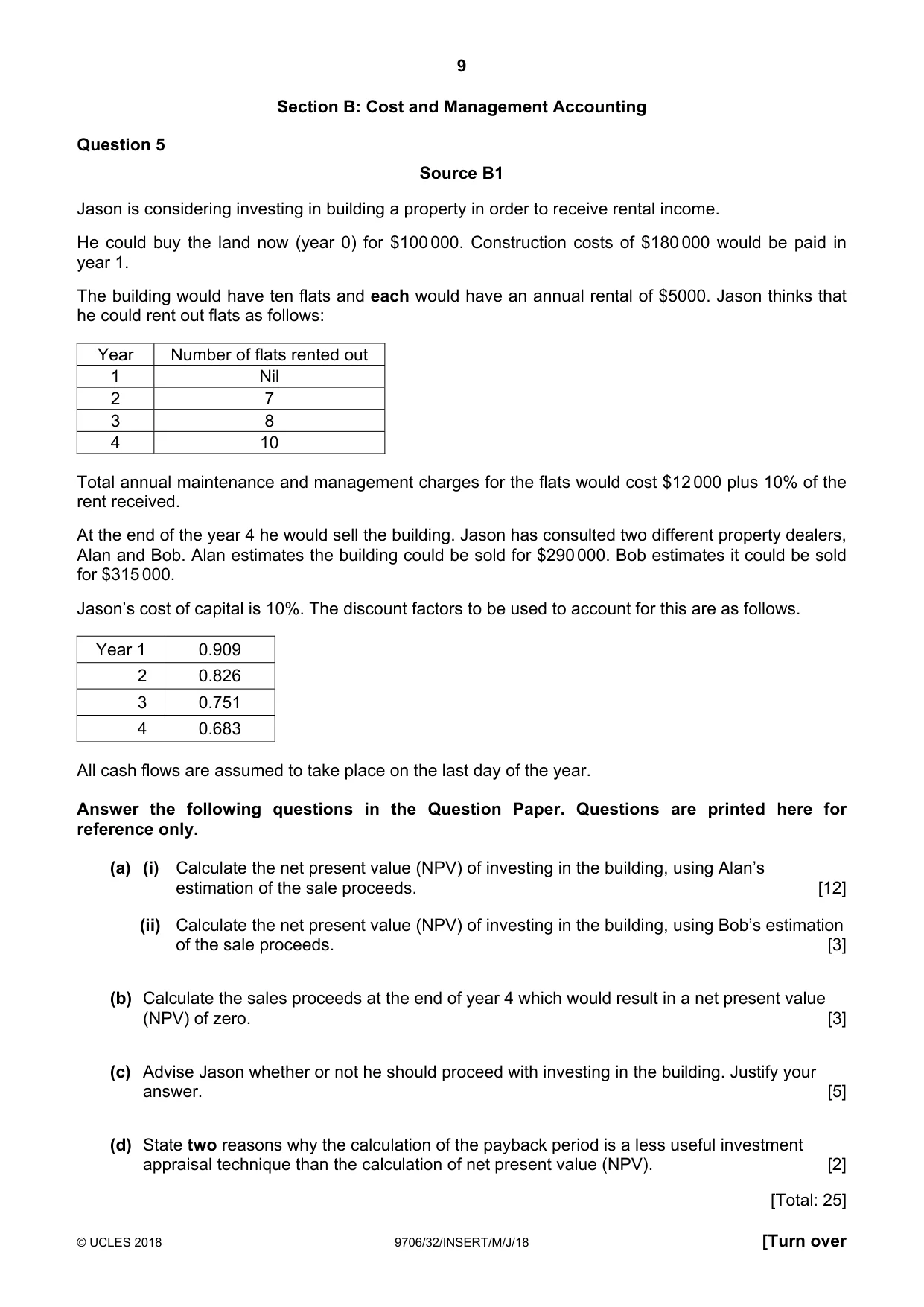
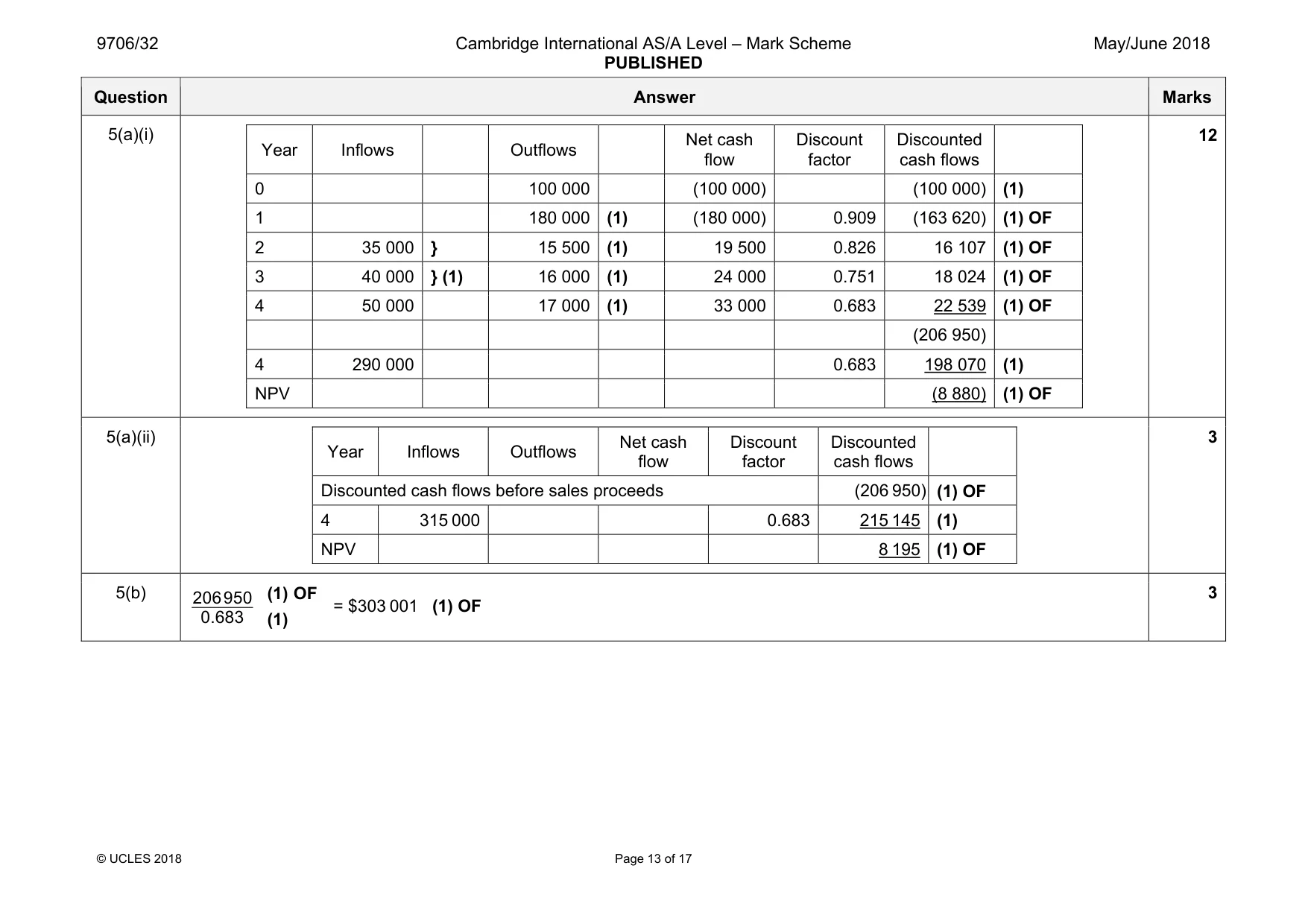
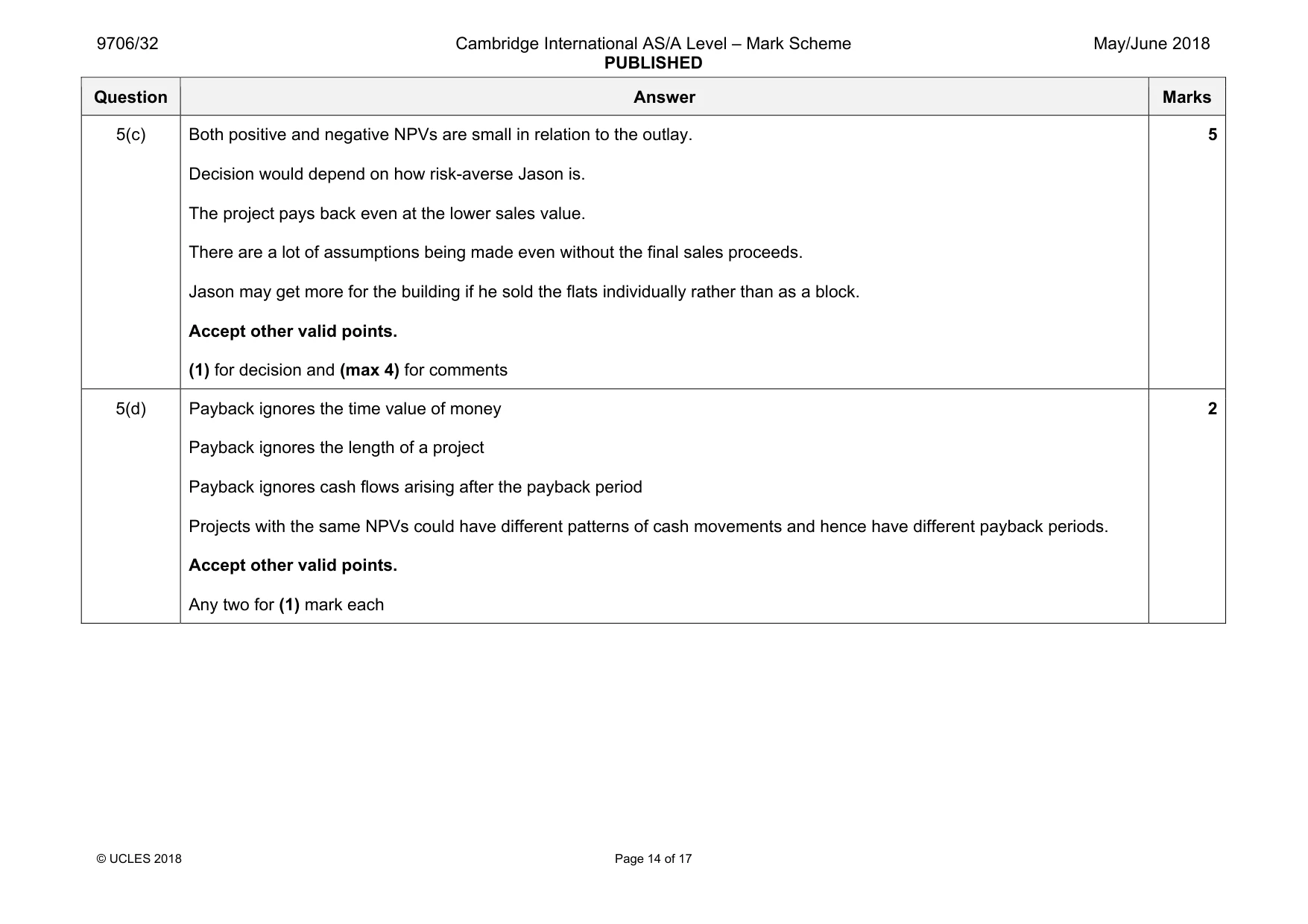
9 © UCLES 2018 9706/32/INSERT/M/J/18 [Turn over Section B: Cost and Management Accounting Question 5 Source B1 Jason is considering investing in building a property in order to receive rental income. He could buy the land now (year 0) for $100 000. Construction costs of $180 000 would be paid in year 1. The building would have ten flats and each would have an annual rental of $5000. Jason thinks that he could rent out flats as follows: Year Number of flats rented out 1 Nil 2 7 3 8 4 10 Total annual maintenance and management charges for the flats would cost $12 000 plus 10% of the rent received. At the end of the year 4 he would sell the building. Jason has consulted two different property dealers, Alan and Bob. Alan estimates the building could be sold for $290 000. Bob estimates it could be sold for $315 000. Jason’s cost of capital is 10%. The discount factors to be used to account for this are as follows. Year 1 0.909 2 0.826 3 0.751 4 0.683 All cash flows are assumed to take place on the last day of the year. Answer the following questions in the Question Paper. Questions are printed here for reference only. (a) (i) Calculate the net present value (NPV) of investing in the building, using Alan’s estimation of the sale proceeds. [12] (ii) Calculate the net present value (NPV) of investing in the building, using Bob’s estimation of the sale proceeds. [3] (b) Calculate the sales proceeds at the end of year 4 which would result in a net present value (NPV) of zero. [3] (c) Advise Jason whether or not he should proceed with investing in the building. Justify your answer. [5] (d) State two reasons why the calculation of the payback period is a less useful investment appraisal technique than the calculation of net present value (NPV). [2] [Total: 25]
Question paper, page 10
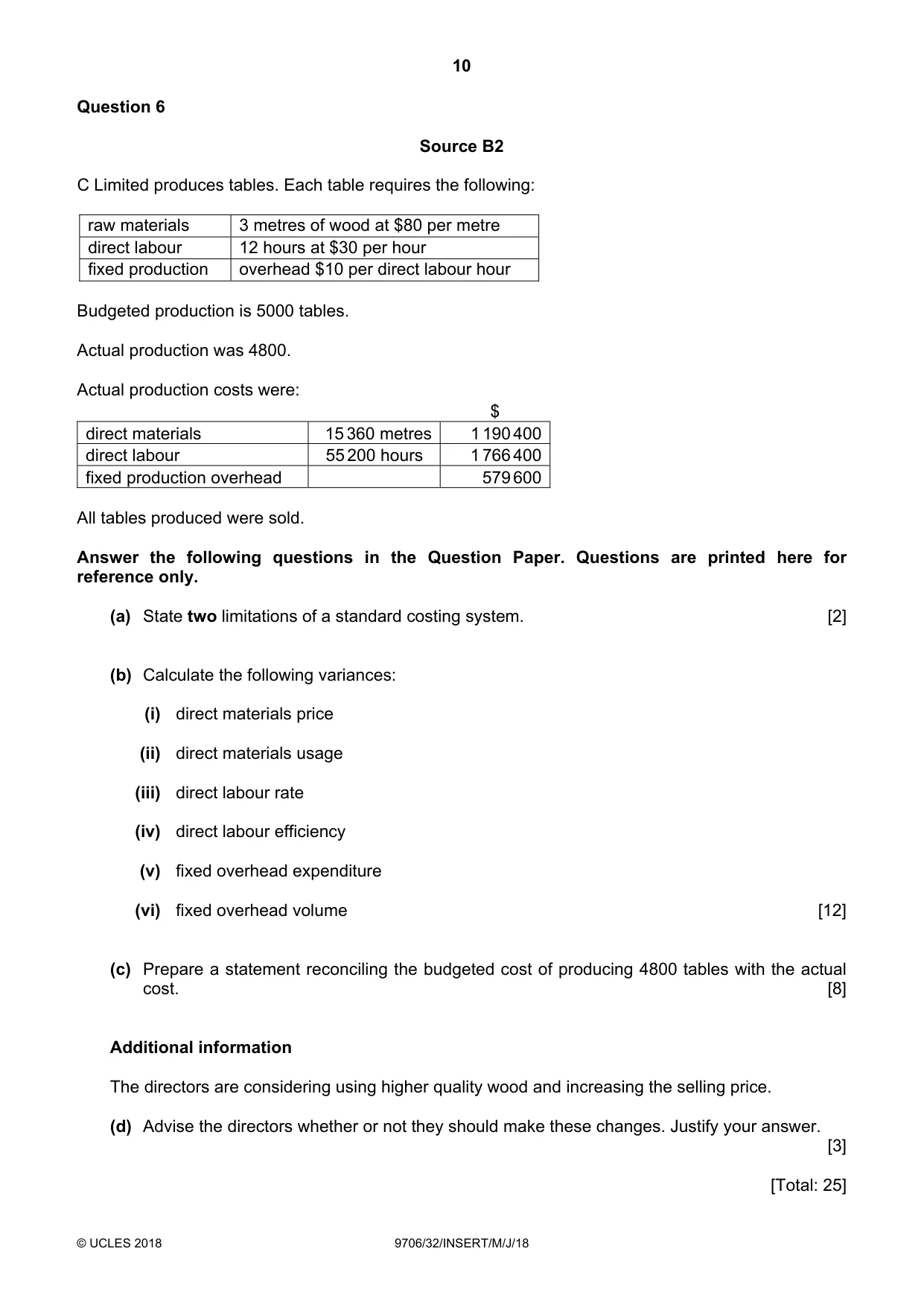
10 © UCLES 2018 9706/32/INSERT/M/J/18 Question 6 Source B2 C Limited produces tables. Each table requires the following: raw materials 3 metres of wood at $80 per metre direct labour 12 hours at $30 per hour fixed production overhead $10 per direct labour hour Budgeted production is 5000 tables. Actual production was 4800. Actual production costs were: $ direct materials 15 360 metres 1 190 400 direct labour 55 200 hours 1 766 400 fixed production overhead 579 600 All tables produced were sold. Answer the following questions in the Question Paper. Questions are printed here for reference only. (a) State two limitations of a standard costing system. [2] (b) Calculate the following variances: (i) direct materials price (ii) direct materials usage (iii) direct labour rate (iv) direct labour efficiency (v) fixed overhead expenditure (vi) fixed overhead volume [12] (c) Prepare a statement reconciling the budgeted cost of producing 4800 tables with the actual cost. [8] Additional information The directors are considering using higher quality wood and increasing the selling price. (d) Advise the directors whether or not they should make these changes. Justify your answer. [3] [Total: 25]
Question paper, page 11
11 © UCLES 2018 9706/32/INSERT/M/J/18 BLANK PAGE
Question paper, page 12
12 Permission to reproduce items where third-party owned material protected by copyright is included has been sought and cleared where possible. Every reasonable effort has been made by the publisher (UCLES) to trace copyright holders, but if any items requiring clearance have unwittingly been included, the publisher will be pleased to make amends at the earliest possible opportunity. To avoid the issue of disclosure of answer-related information to candidates, all copyright acknowledgements are reproduced online in the Cambridge International Examinations Copyright Acknowledgements Booklet. This is produced for each series of examinations and is freely available to download at www.cie.org.uk after the live examination series. Cambridge International Examinations is part of the Cambridge Assessment Group. Cambridge Assessment is the brand name of University of Cambridge Local Examinations Syndicate (UCLES), which is itself a department of the University of Cambridge. © UCLES 2018 9706/32/INSERT/M/J/18 BLANK PAGE
Mark scheme, page 1
IGCSE™ is a registered trademark. This document consists of 17 printed pages. © UCLES 2018 [Turn over Cambridge Assessment International Education Cambridge International Advanced Subsidiary and Advanced Level ACCOUNTING 9706/32 Paper 3 Structured Questions May/June 2018 MARK SCHEME Maximum Mark: 150 Published This mark scheme is published as an aid to teachers and candidates, to indicate the requirements of the examination. It shows the basis on which Examiners were instructed to award marks. It does not indicate the details of the discussions that took place at an Examiners’ meeting before marking began, which would have considered the acceptability of alternative answers. Mark schemes should be read in conjunction with the question paper and the Principal Examiner Report for Teachers. Cambridge International will not enter into discussions about these mark schemes. Cambridge International is publishing the mark schemes for the May/June 2018 series for most Cambridge IGCSE™, Cambridge International A and AS Level and Cambridge Pre-U components, and some Cambridge O Level components.
Mark scheme, page 2
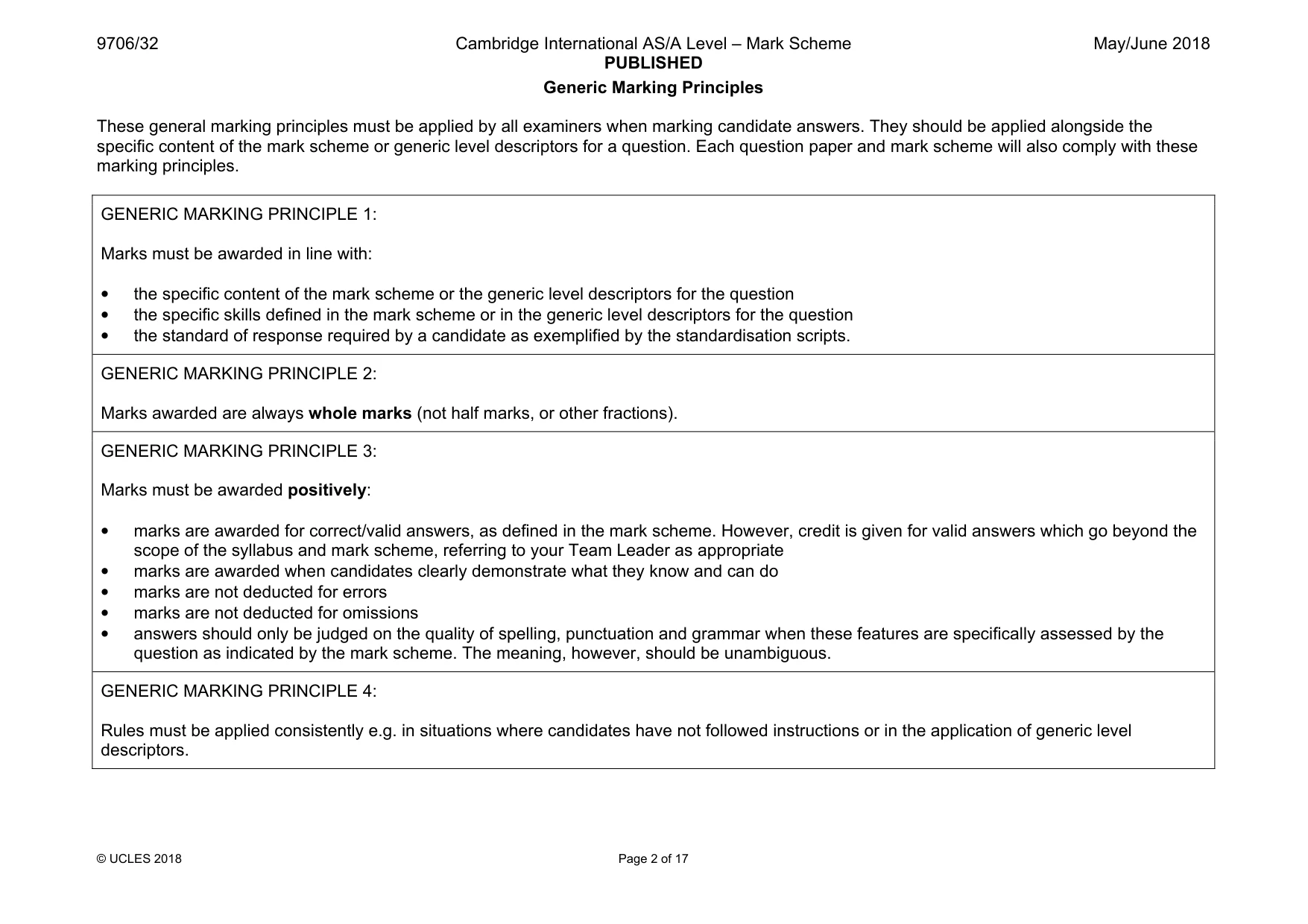
9706/32 Cambridge International AS/A Level – Mark Scheme PUBLISHED May/June 2018 © UCLES 2018 Page 2 of 17 Generic Marking Principles These general marking principles must be applied by all examiners when marking candidate answers. They should be applied alongside the specific content of the mark scheme or generic level descriptors for a question. Each question paper and mark scheme will also comply with these marking principles. GENERIC MARKING PRINCIPLE 1: Marks must be awarded in line with: • the specific content of the mark scheme or the generic level descriptors for the question • the specific skills defined in the mark scheme or in the generic level descriptors for the question • the standard of response required by a candidate as exemplified by the standardisation scripts. GENERIC MARKING PRINCIPLE 2: Marks awarded are always whole marks (not half marks, or other fractions). GENERIC MARKING PRINCIPLE 3: Marks must be awarded positively: • marks are awarded for correct/valid answers, as defined in the mark scheme. However, credit is given for valid answers which go beyond the scope of the syllabus and mark scheme, referring to your Team Leader as appropriate • marks are awarded when candidates clearly demonstrate what they know and can do • marks are not deducted for errors • marks are not deducted for omissions • answers should only be judged on the quality of spelling, punctuation and grammar when these features are specifically assessed by the question as indicated by the mark scheme. The meaning, however, should be unambiguous. GENERIC MARKING PRINCIPLE 4: Rules must be applied consistently e.g. in situations where candidates have not followed instructions or in the application of generic level descriptors.
Mark scheme, page 3
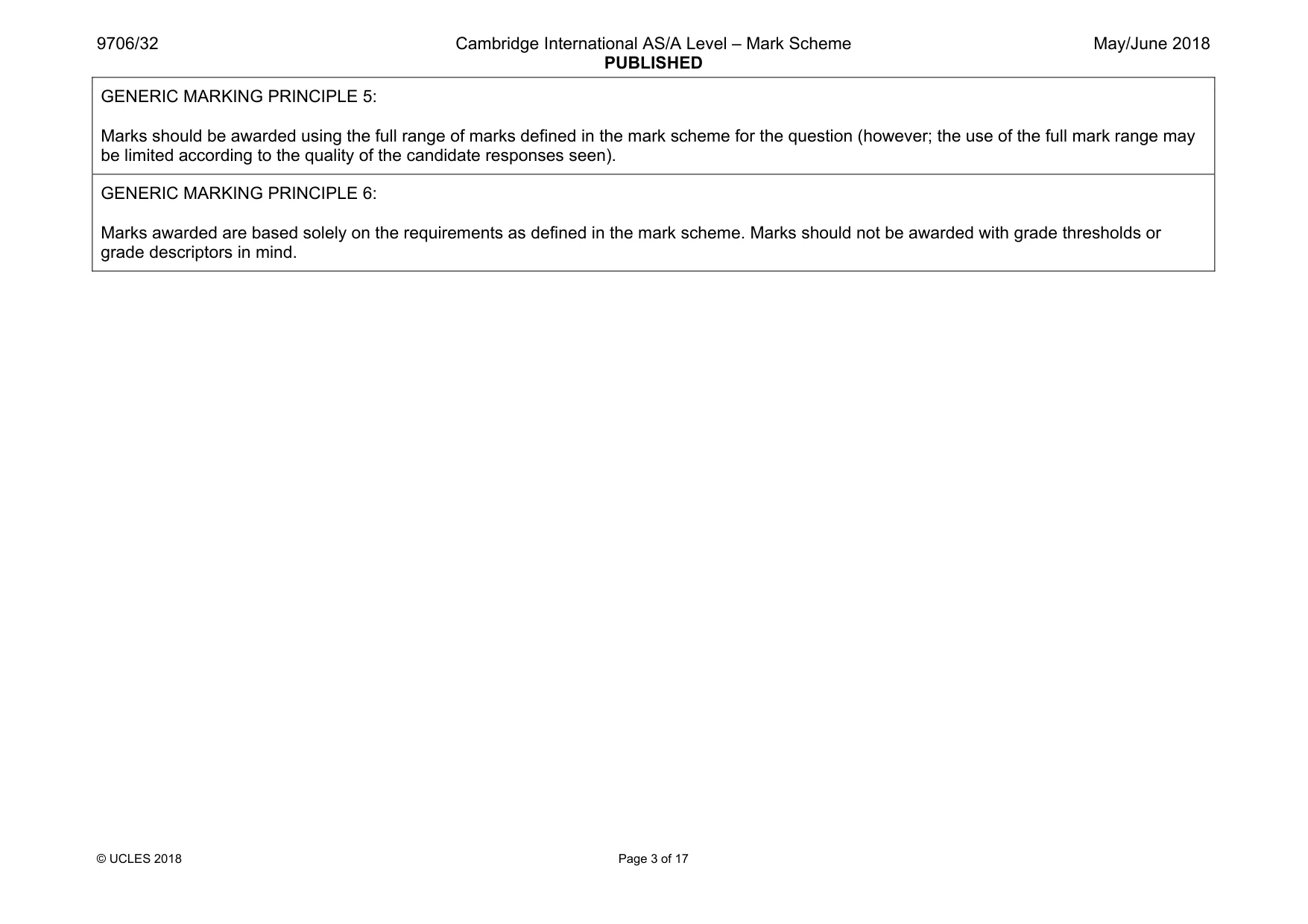
9706/32 Cambridge International AS/A Level – Mark Scheme PUBLISHED May/June 2018 © UCLES 2018 Page 3 of 17 GENERIC MARKING PRINCIPLE 5: Marks should be awarded using the full range of marks defined in the mark scheme for the question (however; the use of the full mark range may be limited according to the quality of the candidate responses seen). GENERIC MARKING PRINCIPLE 6: Marks awarded are based solely on the requirements as defined in the mark scheme. Marks should not be awarded with grade thresholds or grade descriptors in mind.
Mark scheme, page 4
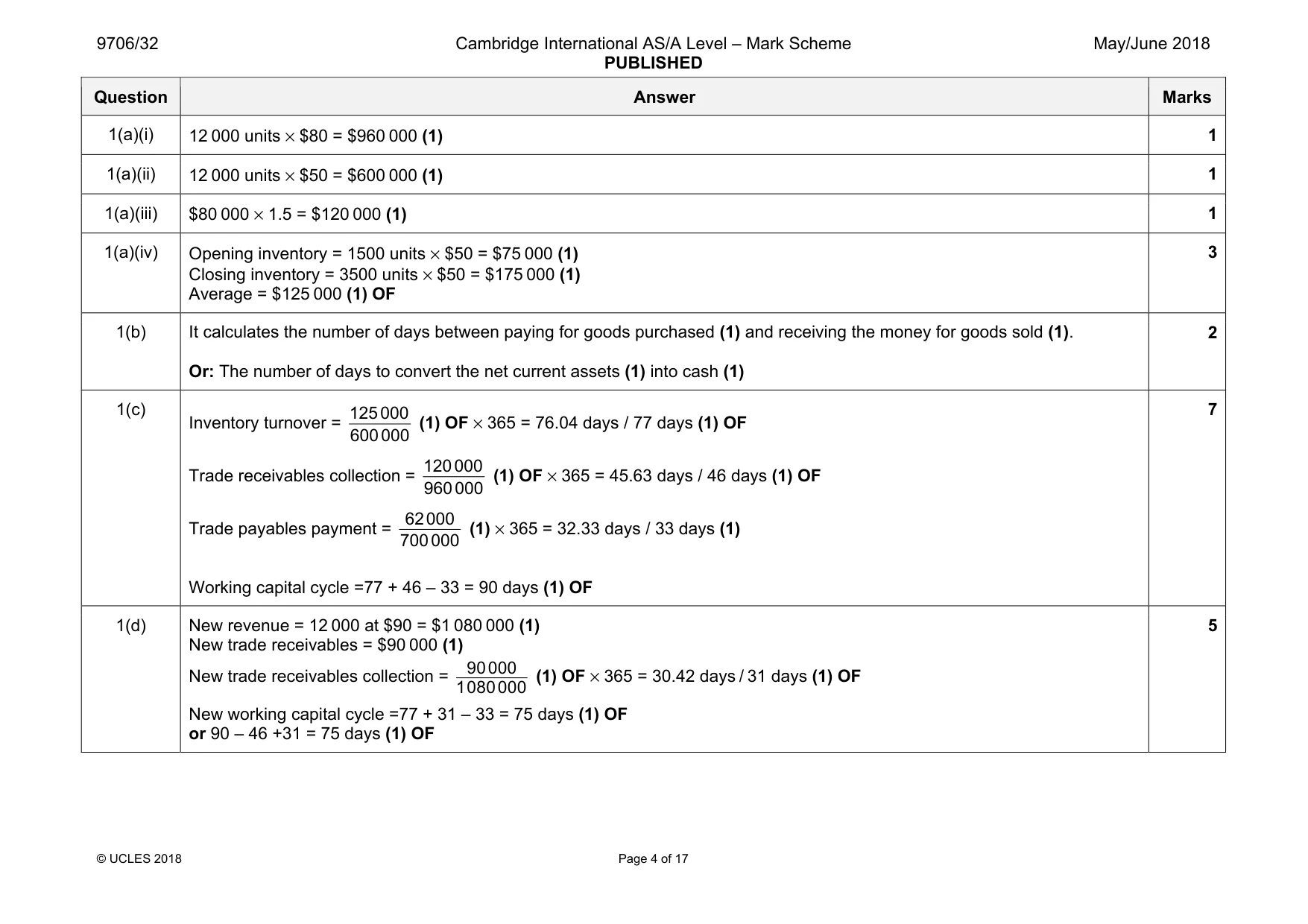
9706/32 Cambridge International AS/A Level – Mark Scheme PUBLISHED May/June 2018 © UCLES 2018 Page 4 of 17 Question Answer Marks 1(a)(i) 12 000 units × $80 = $960 000 (1) 1 1(a)(ii) 12 000 units × $50 = $600 000 (1) 1 1(a)(iii) $80 000 × 1.5 = $120 000 (1) 1 1(a)(iv) Opening inventory = 1500 units × $50 = $75 000 (1) Closing inventory = 3500 units × $50 = $175 000 (1) Average = $125 000 (1) OF 3 1(b) It calculates the number of days between paying for goods purchased (1) and receiving the money for goods sold (1). Or: The number of days to convert the net current assets (1) into cash (1) 2 1(c) Inventory turnover = 000 600 000 125 (1) OF × 365 = 76.04 days / 77 days (1) OF Trade receivables collection = 000 960 000 120 (1) OF × 365 = 45.63 days / 46 days (1) OF Trade payables payment = 000 700 000 62 (1) × 365 = 32.33 days / 33 days (1) Working capital cycle =77 + 46 – 33 = 90 days (1) OF 7 1(d) New revenue = 12 000 at $90 = $1 080 000 (1) New trade receivables = $90 000 (1) New trade receivables collection = 90000 1080000 (1) OF × 365 = 30.42 days / 31 days (1) OF New working capital cycle =77 + 31 – 33 = 75 days (1) OF or 90 – 46 +31 = 75 days (1) OF 5
Mark scheme, page 5
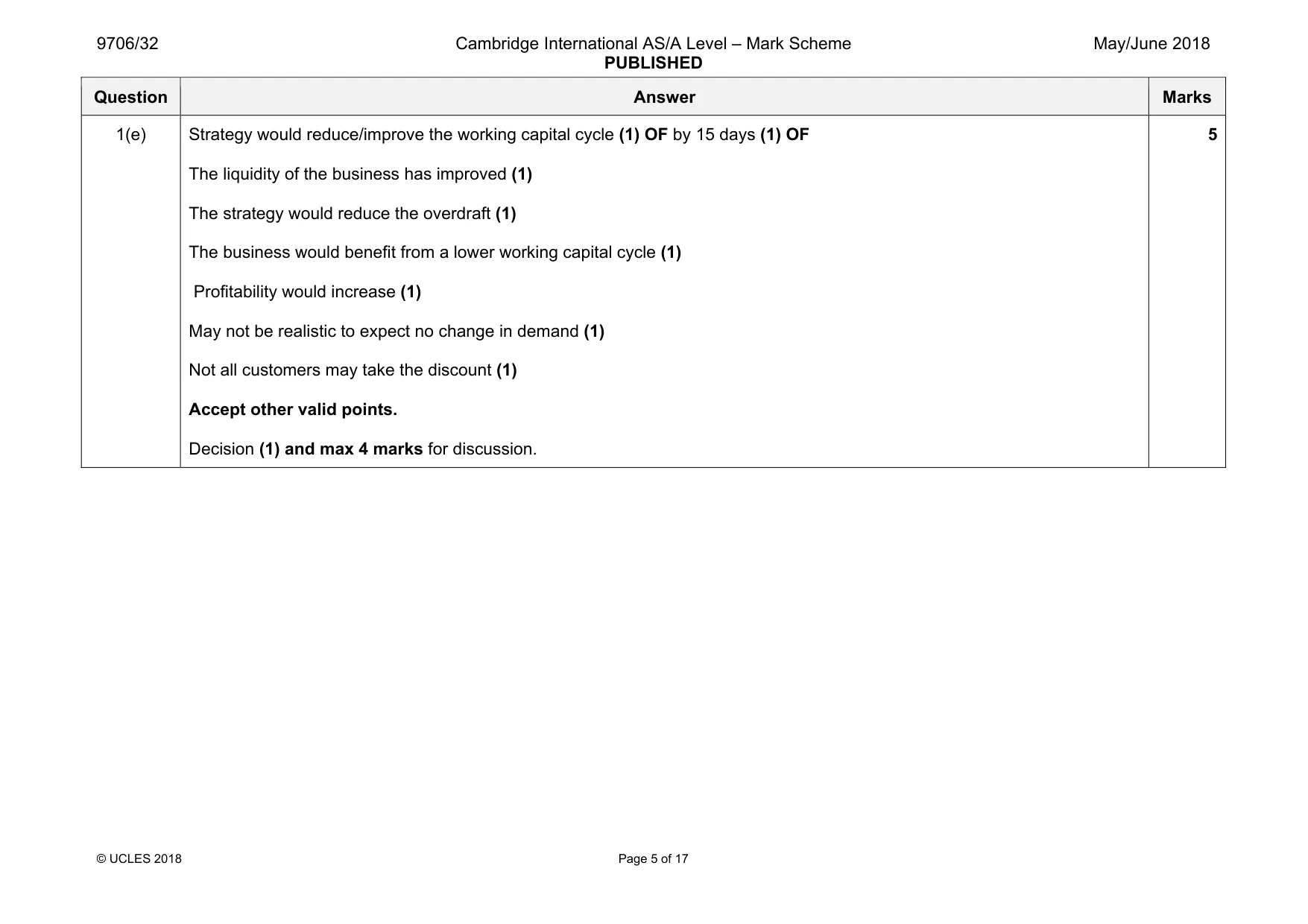
9706/32 Cambridge International AS/A Level – Mark Scheme PUBLISHED May/June 2018 © UCLES 2018 Page 5 of 17 Question Answer Marks 1(e) Strategy would reduce/improve the working capital cycle (1) OF by 15 days (1) OF The liquidity of the business has improved (1) The strategy would reduce the overdraft (1) The business would benefit from a lower working capital cycle (1) Profitability would increase (1) May not be realistic to expect no change in demand (1) Not all customers may take the discount (1) Accept other valid points. Decision (1) and max 4 marks for discussion. 5
Mark scheme, page 6
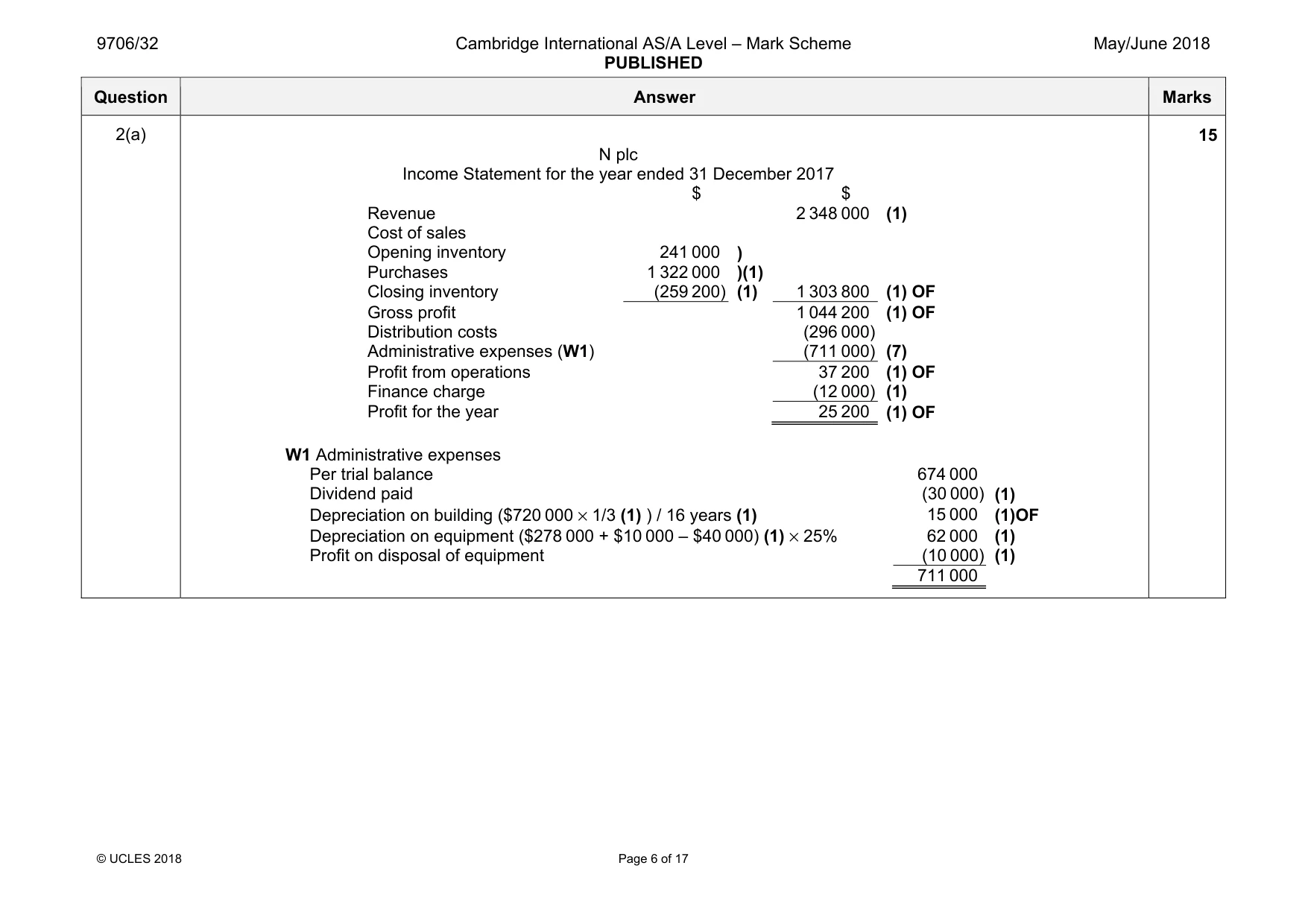
9706/32 Cambridge International AS/A Level – Mark Scheme PUBLISHED May/June 2018 © UCLES 2018 Page 6 of 17 Question Answer Marks 2(a) N plc Income Statement for the year ended 31 December 2017 $ $ Revenue 2 348 000 (1) Cost of sales Opening inventory 241 000 ) Purchases 1 322 000 )(1) Closing inventory (259 200) (1) 1 303 800 (1) OF Gross profit 1 044 200 (1) OF Distribution costs (296 000) Administrative expenses (W1) (711 000) (7) Profit from operations 37 200 (1) OF Finance charge (12 000) (1) Profit for the year 25 200 (1) OF W1 Administrative expenses Per trial balance 674 000 Dividend paid (30 000) (1) Depreciation on building ($720 000 × 1/3 (1) ) / 16 years (1) 15 000 (1)OF Depreciation on equipment ($278 000 + $10 000 – $40 000) (1) × 25% 62 000 (1) Profit on disposal of equipment (10 000) (1) 711 000 15
Mark scheme, page 7
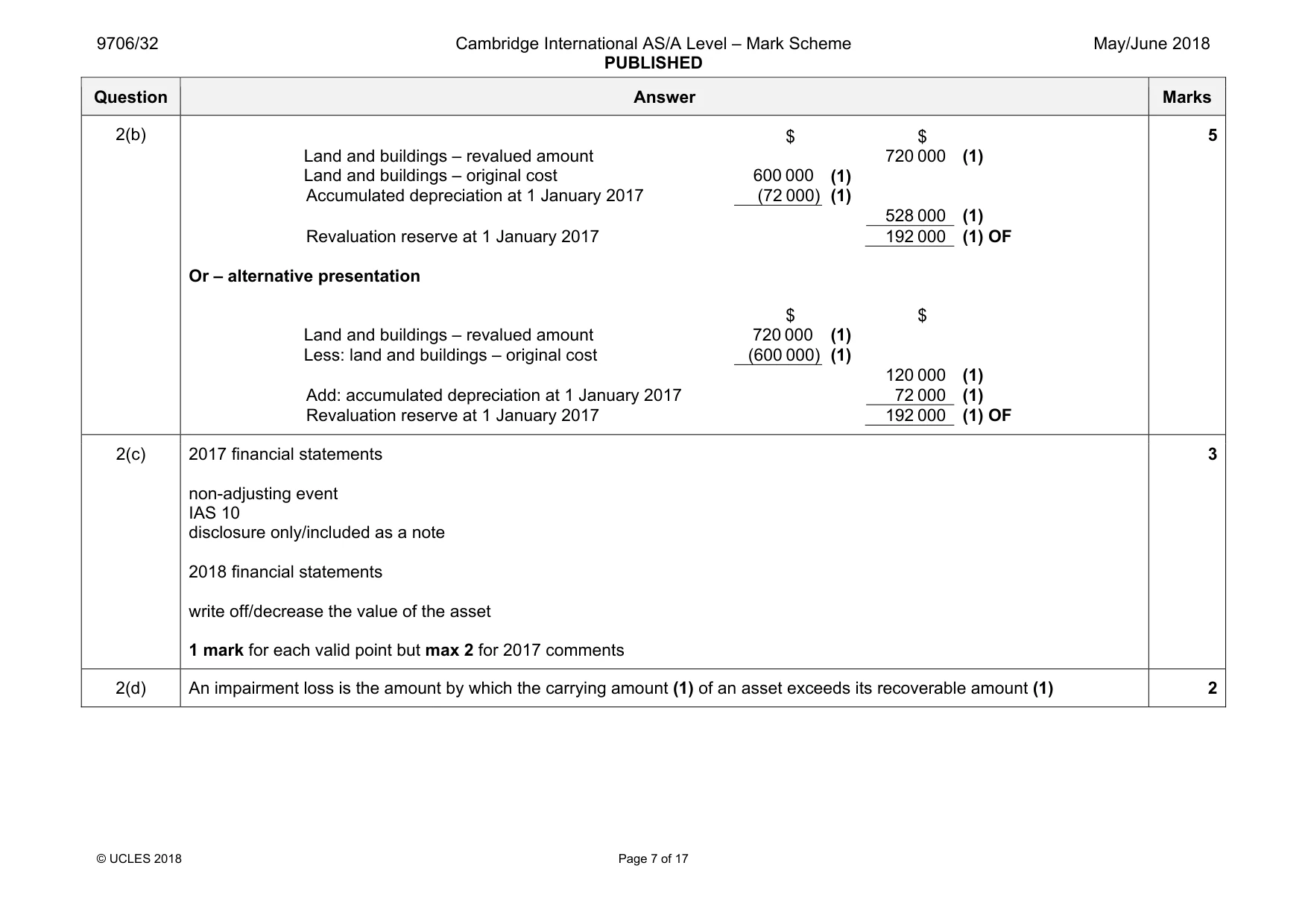
9706/32 Cambridge International AS/A Level – Mark Scheme PUBLISHED May/June 2018 © UCLES 2018 Page 7 of 17 Question Answer Marks 2(b) $ $ Land and buildings – revalued amount 720 000 (1) Land and buildings – original cost 600 000 (1) Accumulated depreciation at 1 January 2017 (72 000) (1) 528 000 (1) Revaluation reserve at 1 January 2017 192 000 (1) OF Or – alternative presentation $ $ Land and buildings – revalued amount 720 000 (1) Less: land and buildings – original cost (600 000) (1) 120 000 (1) Add: accumulated depreciation at 1 January 2017 72 000 (1) Revaluation reserve at 1 January 2017 192 000 (1) OF 5 2(c) 2017 financial statements non-adjusting event IAS 10 disclosure only/included as a note 2018 financial statements write off/decrease the value of the asset 1 mark for each valid point but max 2 for 2017 comments 3 2(d) An impairment loss is the amount by which the carrying amount (1) of an asset exceeds its recoverable amount (1) 2
Mark scheme, page 8
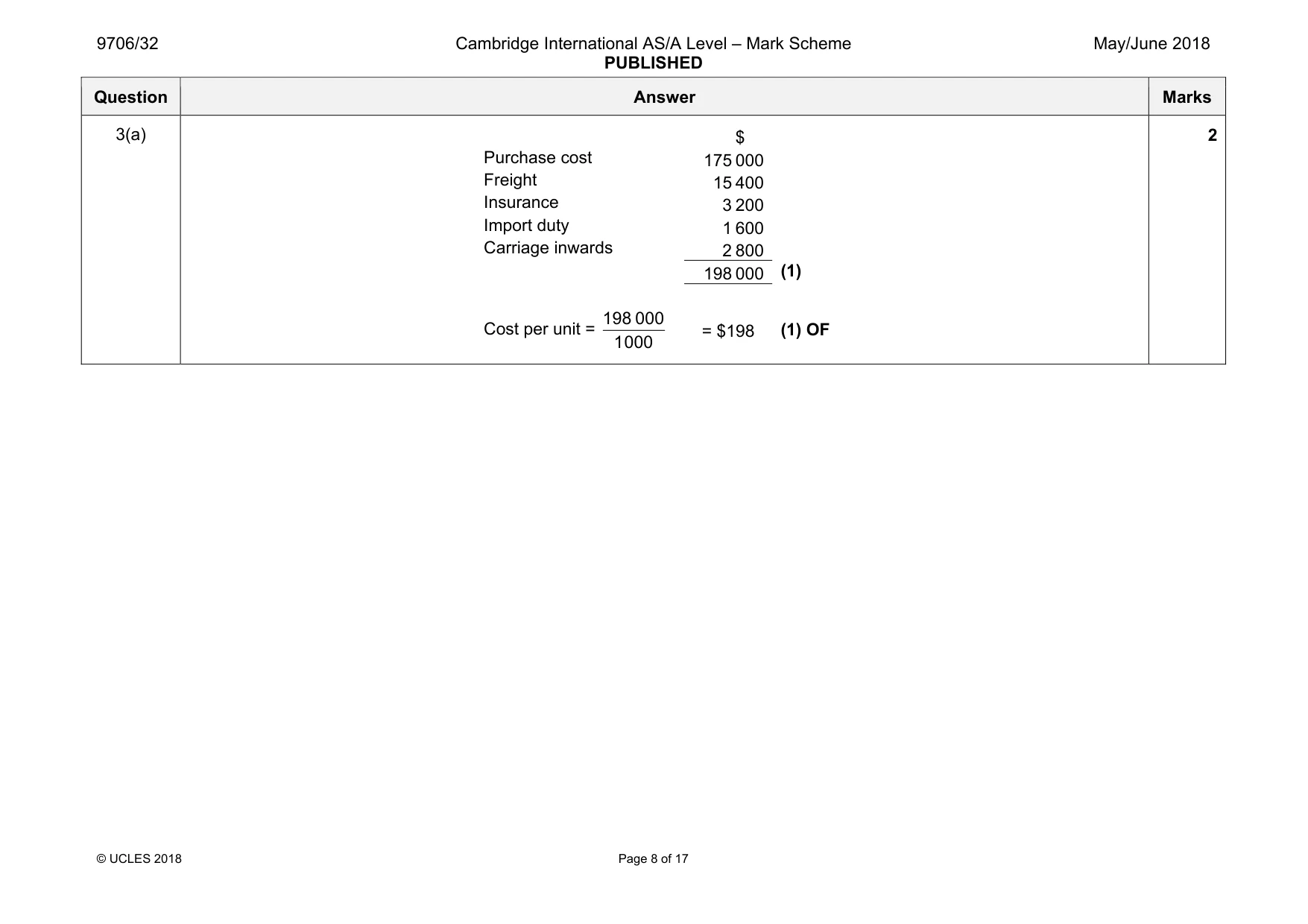
9706/32 Cambridge International AS/A Level – Mark Scheme PUBLISHED May/June 2018 © UCLES 2018 Page 8 of 17 Question Answer Marks 3(a) $ Purchase cost 175 000 Freight 15 400 Insurance 3 200 Import duty 1 600 Carriage inwards 2 800 198 000 (1) Cost per unit = 198 000 1000 = $198 (1) OF 2
Mark scheme, page 9
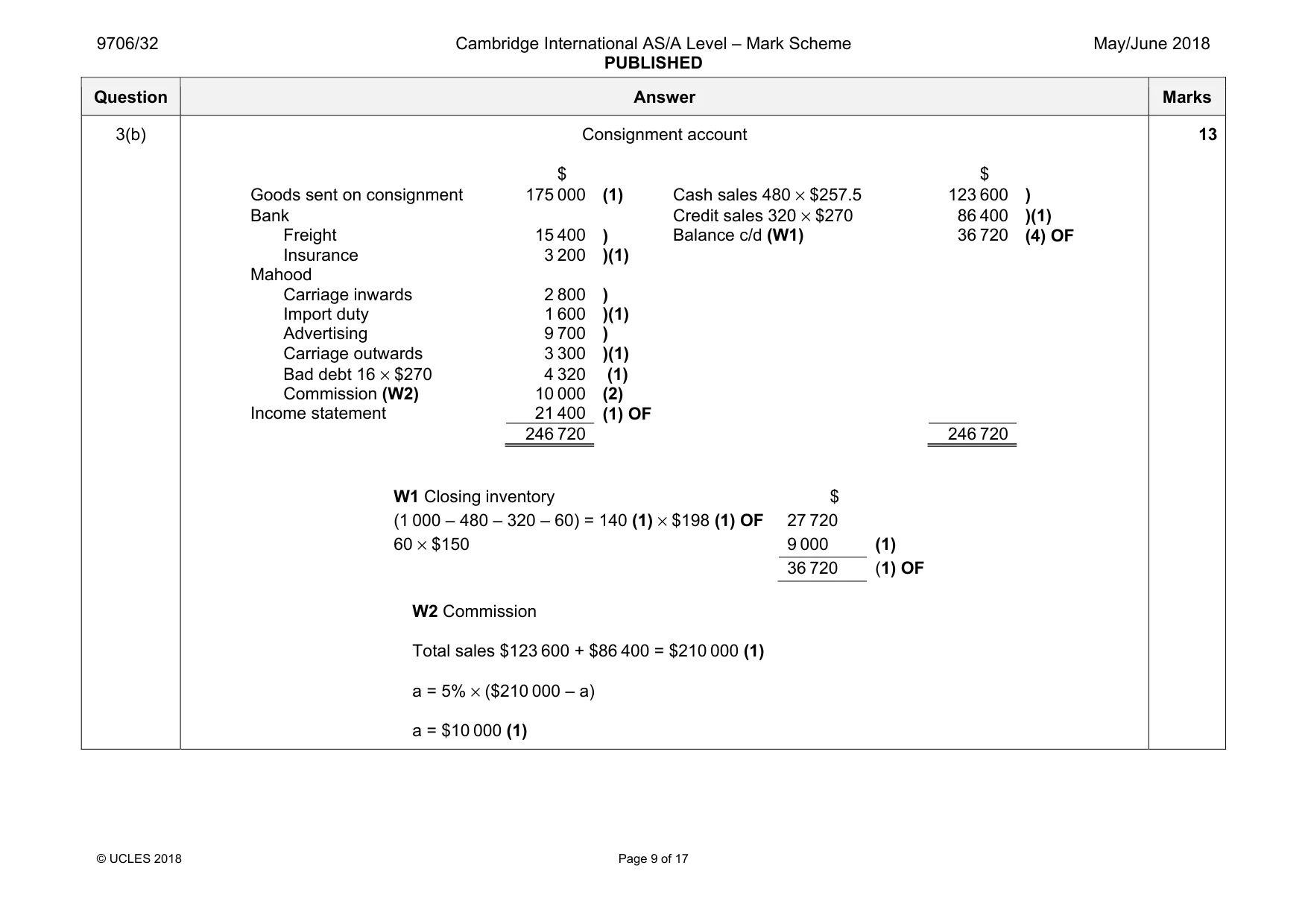
9706/32 Cambridge International AS/A Level – Mark Scheme PUBLISHED May/June 2018 © UCLES 2018 Page 9 of 17 Question Answer Marks 3(b) Consignment account $ $ Goods sent on consignment 175 000 (1) Cash sales 480 × $257.5 123 600 ) Bank Credit sales 320 × $270 86 400 )(1) Freight 15 400 ) Balance c/d (W1) 36 720 (4) OF Insurance 3 200 )(1) Mahood Carriage inwards 2 800 ) Import duty 1 600 )(1) Advertising 9 700 ) Carriage outwards 3 300 )(1) Bad debt 16 × $270 4 320 (1) Commission (W2) 10 000 (2) Income statement 21 400 (1) OF 246 720 246 720 W1 Closing inventory $ (1 000 – 480 – 320 – 60) = 140 (1) × $198 (1) OF 27 720 60 × $150 9 000 (1) 36 720 (1) OF W2 Commission Total sales $123 600 + $86 400 = $210 000 (1) a = 5% × ($210 000 – a) a = $10 000 (1) 13
Mark scheme, page 10
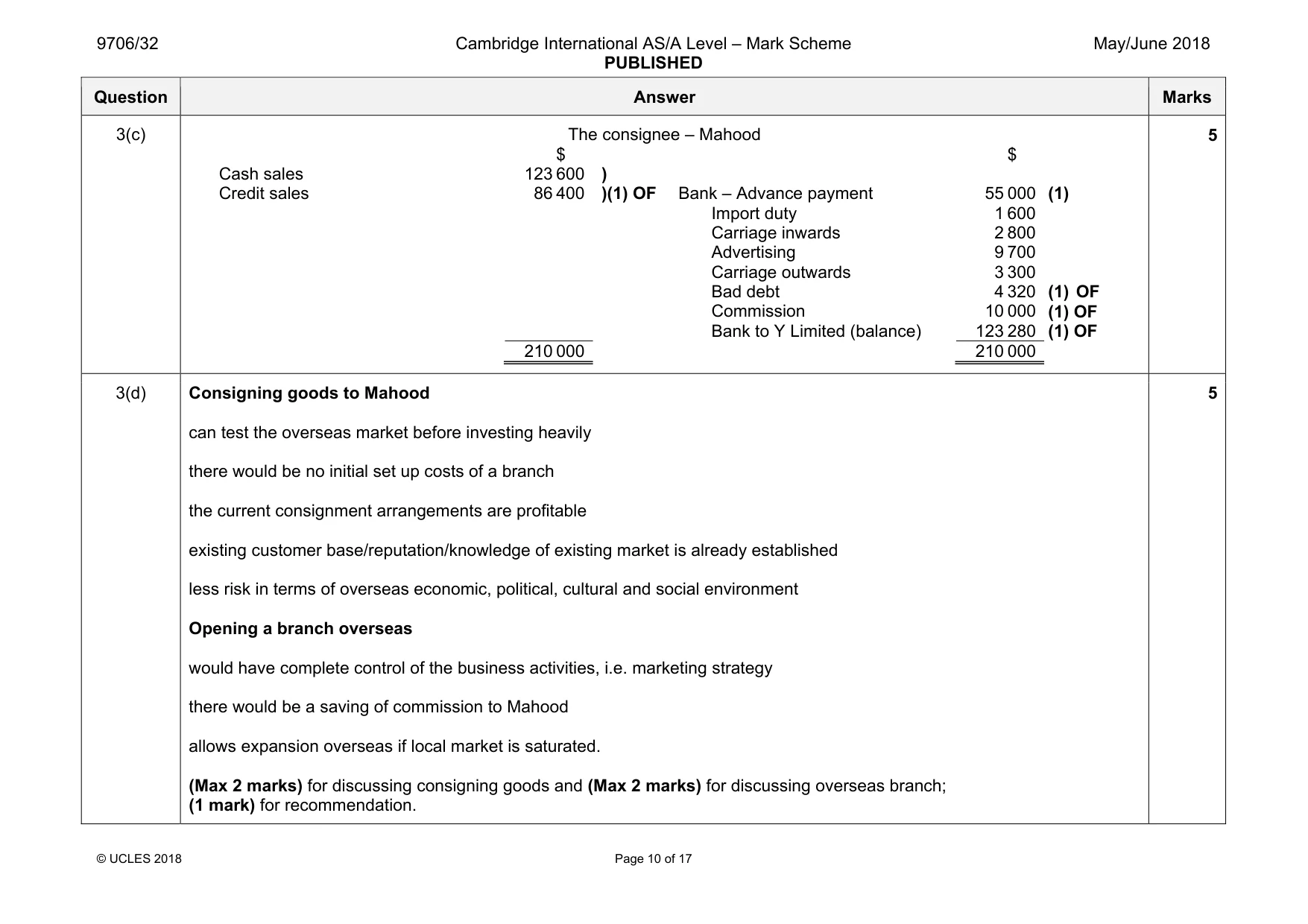
9706/32 Cambridge International AS/A Level – Mark Scheme PUBLISHED May/June 2018 © UCLES 2018 Page 10 of 17 Question Answer Marks 3(c) The consignee – Mahood $ $ Cash sales 123 600 ) Credit sales 86 400 )(1) OF Bank – Advance payment 55 000 (1) Import duty 1 600 Carriage inwards 2 800 Advertising 9 700 Carriage outwards 3 300 Bad debt 4 320 (1) OF Commission 10 000 (1) OF Bank to Y Limited (balance) 123 280 (1) OF 210 000 210 000 5 3(d) Consigning goods to Mahood can test the overseas market before investing heavily there would be no initial set up costs of a branch the current consignment arrangements are profitable existing customer base/reputation/knowledge of existing market is already established less risk in terms of overseas economic, political, cultural and social environment Opening a branch overseas would have complete control of the business activities, i.e. marketing strategy there would be a saving of commission to Mahood allows expansion overseas if local market is saturated. (Max 2 marks) for discussing consigning goods and (Max 2 marks) for discussing overseas branch; (1 mark) for recommendation. 5
Mark scheme, page 11
9706/32 Cambridge International AS/A Level – Mark Scheme PUBLISHED May/June 2018 © UCLES 2018 Page 11 of 17 Question Answer Marks 4(a) Ephraim and Fikriyah Statement of financial position at 1 October 2017 $ $ Non-current assets 170 000 (1) Current assets Inventories 18 500 (1) Trade receivables 24 500 Cash and cash equivalents 7 500 50 500 (1) Total assets 220 500 (1) OF Capital and liabilities Capital accounts (W1): Ephraim 72 500 Fikriyah 122 000 194 500 (8) Current liabilities Trade payables 26 000 (1) Total equity and liabilities 220 500 Capital accounts W1 Ephraim Fikriyah $ $ Balance b/d 60 000 120 000 (1) both Goodwill 10 000 6 000 (1) both Goodwill (8 000) (1) (8 000) (1) Non-current assets 10 000 5 000 (1) both Inventories 500 (1 000) (1) both 72 500 (1) OF 122 000 (1) OF 13
Mark scheme, page 12
9706/32 Cambridge International AS/A Level – Mark Scheme PUBLISHED May/June 2018 © UCLES 2018 Page 12 of 17 Question Answer Marks 4(b) As profits are shared equally both Ephraim and Fikriyah would receive $50 000 in the first year. (1) Second year profits are $90 000 (1), third year $81 000 (1) and fourth year $72 900. (1) Ephraim is worse off (throughout the period). (1) Fikriyah is better off for years one, two and three (1) but is also worse off in year four. (1) Fikriyah is contributing significantly more capital but only receiving half the profit (1) OF The profits may not have been maintained by the sole traders for this four-year period (1) It would appear that the merger is beneficial for Fikriyah/not for Ephraim. (1) The partners should take action to reverse the trend in falling profit (1) The synergies from partnership will make it more efficient (1) Accept other valid points. 12
Mark scheme, page 13
9706/32 Cambridge International AS/A Level – Mark Scheme PUBLISHED May/June 2018 © UCLES 2018 Page 13 of 17 Question Answer Marks 5(a)(i) Year Inflows Outflows Net cash flow Discount factor Discounted cash flows 0 100 000 (100 000) (100 000) (1) 1 180 000 (1) (180 000) 0.909 (163 620) (1) OF 2 35 000 } 15 500 (1) 19 500 0.826 16 107 (1) OF 3 40 000 } (1) 16 000 (1) 24 000 0.751 18 024 (1) OF 4 50 000 17 000 (1) 33 000 0.683 22 539 (1) OF (206 950) 4 290 000 0.683 198 070 (1) NPV (8 880) (1) OF 12 5(a)(ii) Year Inflows Outflows Net cash flow Discount factor Discounted cash flows Discounted cash flows before sales proceeds (206 950) (1) OF 4 315 000 0.683 215 145 (1) NPV 8 195 (1) OF 3 5(b) 206950 0.683 (1) OF (1) = $303 001 (1) OF 3
Mark scheme, page 14
9706/32 Cambridge International AS/A Level – Mark Scheme PUBLISHED May/June 2018 © UCLES 2018 Page 14 of 17 Question Answer Marks 5(c) Both positive and negative NPVs are small in relation to the outlay. Decision would depend on how risk-averse Jason is. The project pays back even at the lower sales value. There are a lot of assumptions being made even without the final sales proceeds. Jason may get more for the building if he sold the flats individually rather than as a block. Accept other valid points. (1) for decision and (max 4) for comments 5 5(d) Payback ignores the time value of money Payback ignores the length of a project Payback ignores cash flows arising after the payback period Projects with the same NPVs could have different patterns of cash movements and hence have different payback periods. Accept other valid points. Any two for (1) mark each 2
Mark scheme, page 15
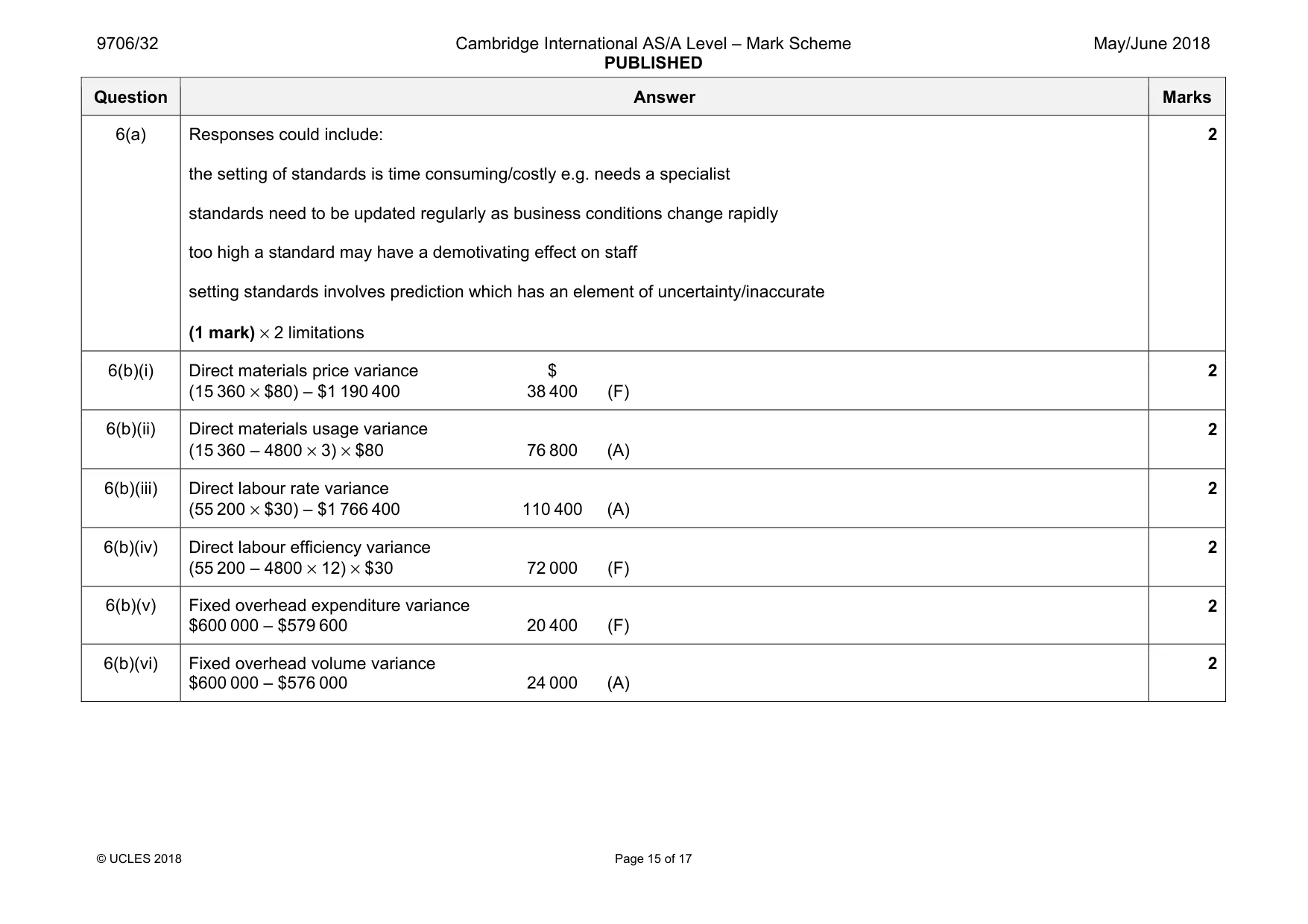
9706/32 Cambridge International AS/A Level – Mark Scheme PUBLISHED May/June 2018 © UCLES 2018 Page 15 of 17 Question Answer Marks 6(a) Responses could include: the setting of standards is time consuming/costly e.g. needs a specialist standards need to be updated regularly as business conditions change rapidly too high a standard may have a demotivating effect on staff setting standards involves prediction which has an element of uncertainty/inaccurate (1 mark) × 2 limitations 2 6(b)(i) Direct materials price variance $ (15 360 × $80) – $1 190 400 38 400 (F) 2 6(b)(ii) Direct materials usage variance (15 360 – 4800 × 3) × $80 76 800 (A) 2 6(b)(iii) Direct labour rate variance (55 200 × $30) – $1 766 400 110 400 (A) 2 6(b)(iv) Direct labour efficiency variance (55 200 – 4800 × 12) × $30 72 000 (F) 2 6(b)(v) Fixed overhead expenditure variance $600 000 – $579 600 20 400 (F) 2 6(b)(vi) Fixed overhead volume variance $600 000 – $576 000 24 000 (A) 2
Mark scheme, page 16
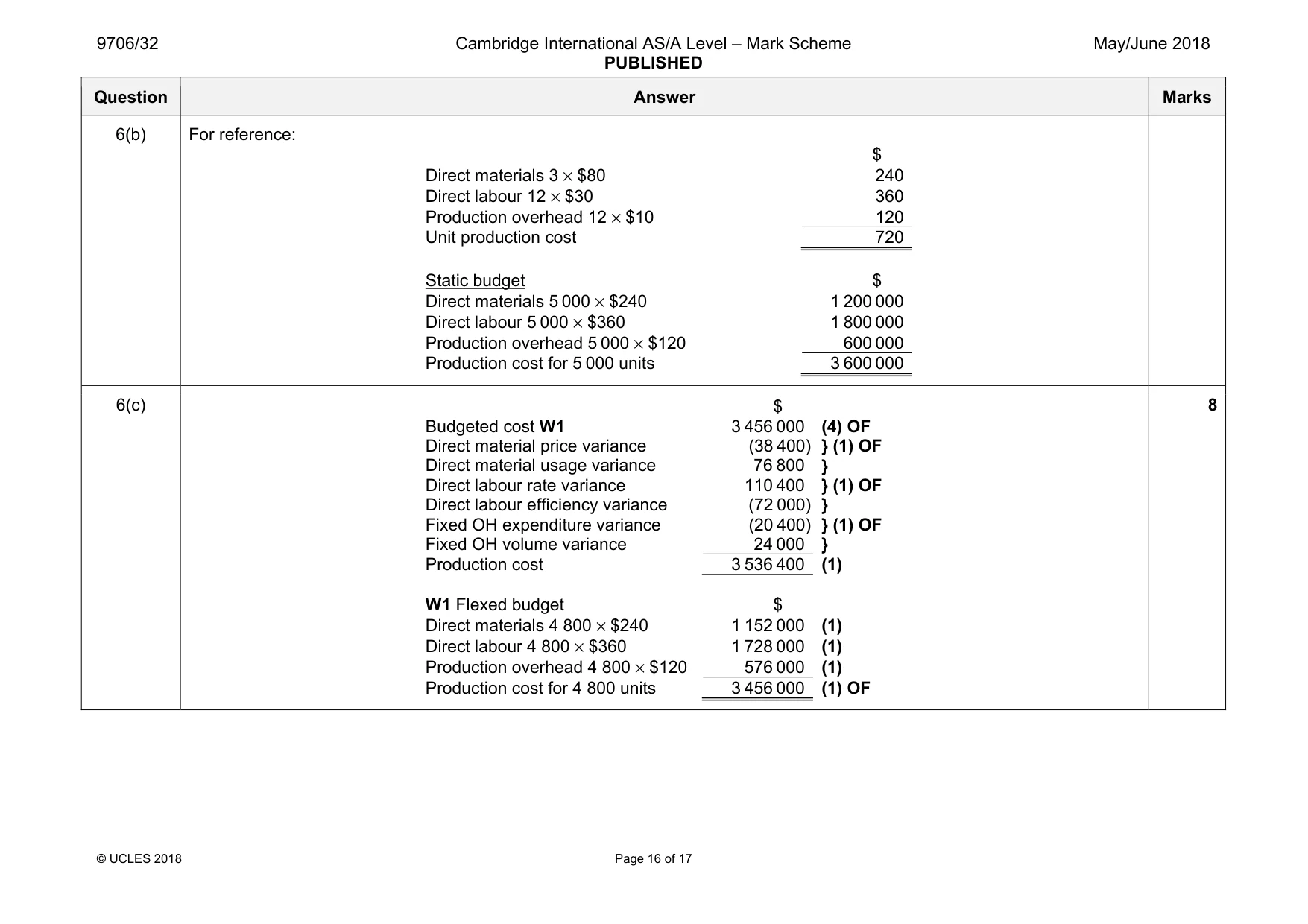
9706/32 Cambridge International AS/A Level – Mark Scheme PUBLISHED May/June 2018 © UCLES 2018 Page 16 of 17 Question Answer Marks 6(b) For reference: $ Direct materials 3 × $80 240 Direct labour 12 × $30 360 Production overhead 12 × $10 120 Unit production cost 720 Static budget $ Direct materials 5 000 × $240 1 200 000 Direct labour 5 000 × $360 1 800 000 Production overhead 5 000 × $120 600 000 Production cost for 5 000 units 3 600 000 6(c) $ Budgeted cost W1 3 456 000 (4) OF Direct material price variance (38 400) } (1) OF Direct material usage variance 76 800 } Direct labour rate variance 110 400 } (1) OF Direct labour efficiency variance (72 000) } Fixed OH expenditure variance (20 400) } (1) OF Fixed OH volume variance 24 000 } Production cost 3 536 400 (1) W1 Flexed budget $ Direct materials 4 800 × $240 1 152 000 (1) Direct labour 4 800 × $360 1 728 000 (1) Production overhead 4 800 × $120 576 000 (1) Production cost for 4 800 units 3 456 000 (1) OF 8
Mark scheme, page 17
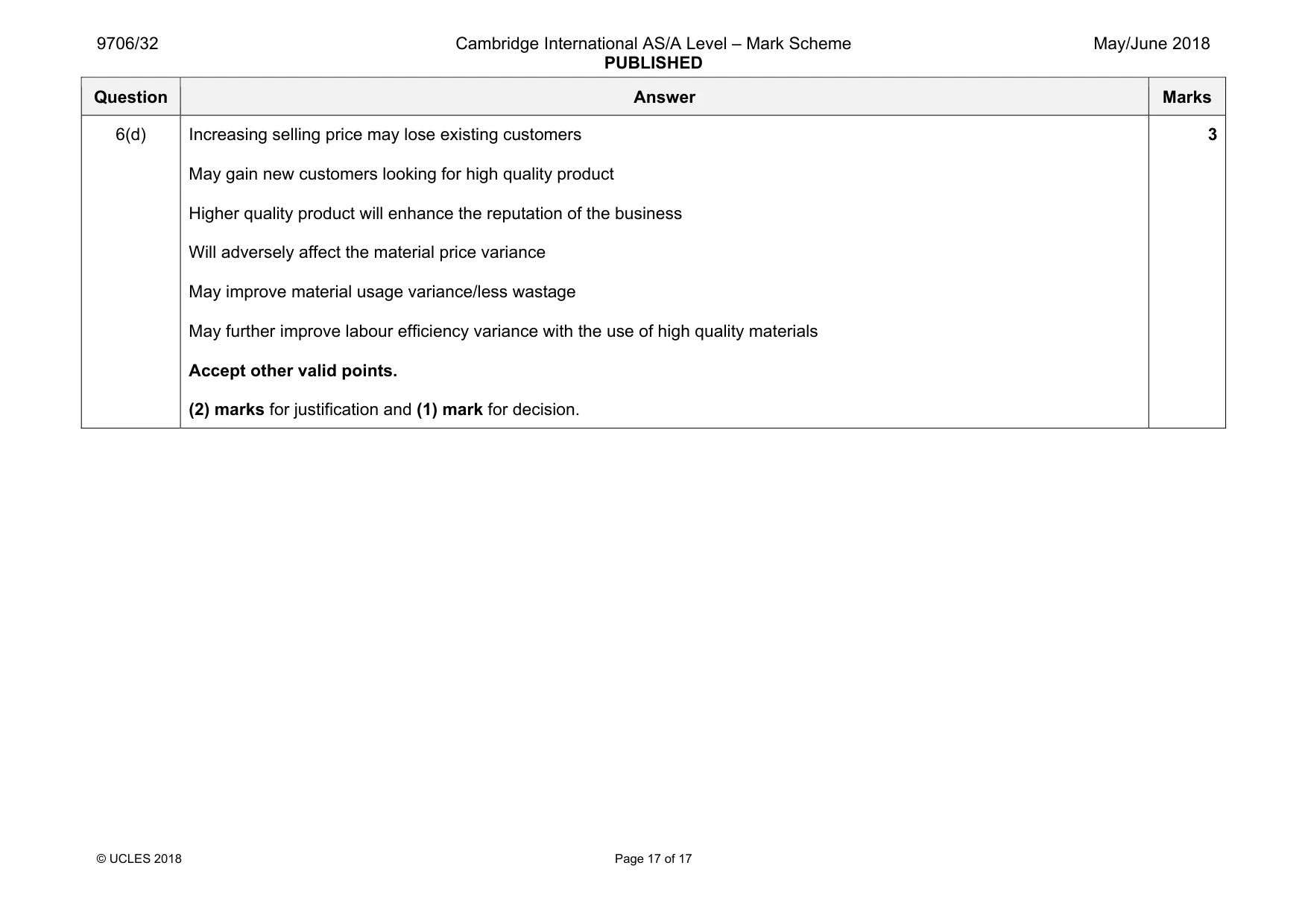
9706/32 Cambridge International AS/A Level – Mark Scheme PUBLISHED May/June 2018 © UCLES 2018 Page 17 of 17 Question Answer Marks 6(d) Increasing selling price may lose existing customers May gain new customers looking for high quality product Higher quality product will enhance the reputation of the business Will adversely affect the material price variance May improve material usage variance/less wastage May further improve labour efficiency variance with the use of high quality materials Accept other valid points. (2) marks for justification and (1) mark for decision. 3
What you needed in this session
Cambridge’s own grade thresholds for 2018 May/June, Paper 3 · Variant 2. A higher threshold means an easier paper — the bar moves with how the cohort did.