Cambridge A Level Accounting 9706 — 2018 May/June Paper 3 · Variant 1
9706/31/M/J/18 · 150 marks · ≈169 min
The question paper and its mark scheme, free to read here and free to download. This is Cambridge’s own paper, exactly as it was sat.
Question paper16 pages


Mark scheme18 pages
Answers below. Sit the paper first if you are practising.
Paper as text
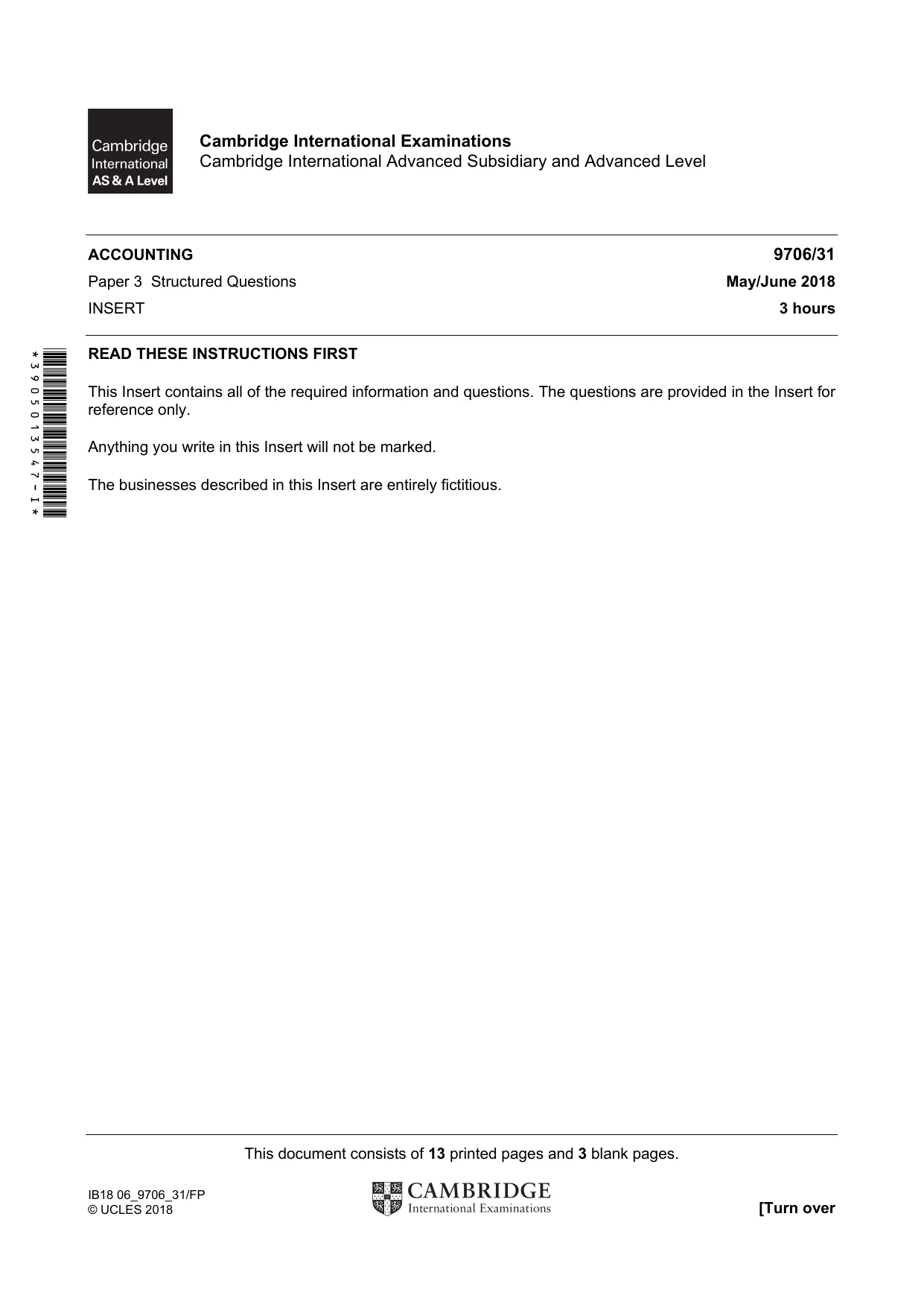
Question paper, page 1
This document consists of 13 printed pages and 3 blank pages. IB18 06_9706_31/FP © UCLES 2018 [Turn over Cambridge International Examinations Cambridge International Advanced Subsidiary and Advanced Level ACCOUNTING 9706/31 Paper 3 Structured Questions May/June 2018 INSERT 3 hours READ THESE INSTRUCTIONS FIRST This Insert contains all of the required information and questions. The questions are provided in the Insert for reference only. Anything you write in this Insert will not be marked. The businesses described in this Insert are entirely fictitious.
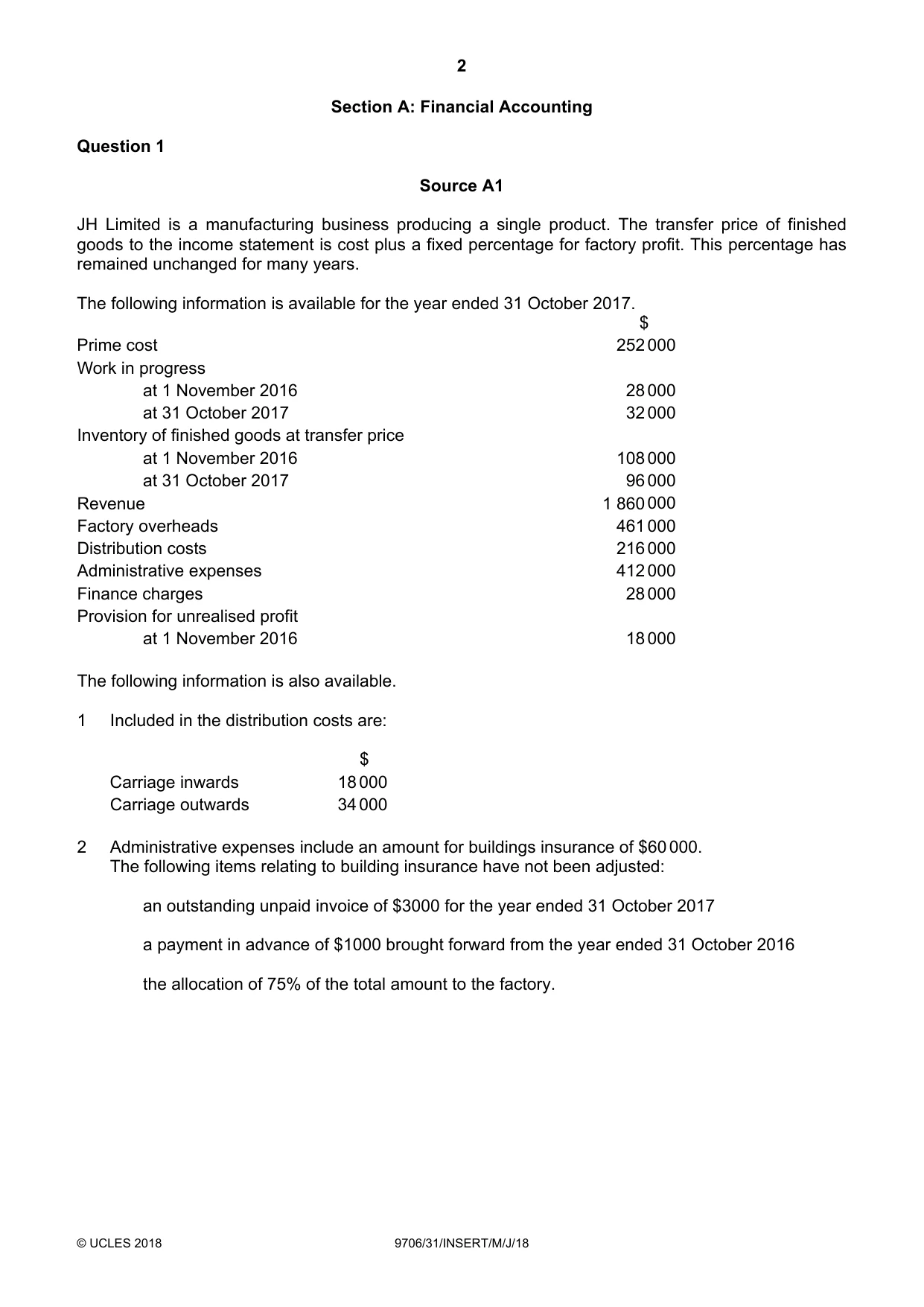
Question paper, page 2
2 © UCLES 2018 9706/31/INSERT/M/J/18 Section A: Financial Accounting Question 1 Source A1 JH Limited is a manufacturing business producing a single product. The transfer price of finished goods to the income statement is cost plus a fixed percentage for factory profit. This percentage has remained unchanged for many years. The following information is available for the year ended 31 October 2017. $ Prime cost 252 000 Work in progress at 1 November 2016 28 000 at 31 October 2017 32 000 Inventory of finished goods at transfer price at 1 November 2016 108 000 at 31 October 2017 96 000 Revenue 1 860 000 Factory overheads 461 000 Distribution costs 216 000 Administrative expenses 412 000 Finance charges 28 000 Provision for unrealised profit at 1 November 2016 18 000 The following information is also available. 1 Included in the distribution costs are: $ Carriage inwards 18 000 Carriage outwards 34 000 2 Administrative expenses include an amount for buildings insurance of $60 000. The following items relating to building insurance have not been adjusted: an outstanding unpaid invoice of $3000 for the year ended 31 October 2017 a payment in advance of $1000 brought forward from the year ended 31 October 2016 the allocation of 75% of the total amount to the factory.
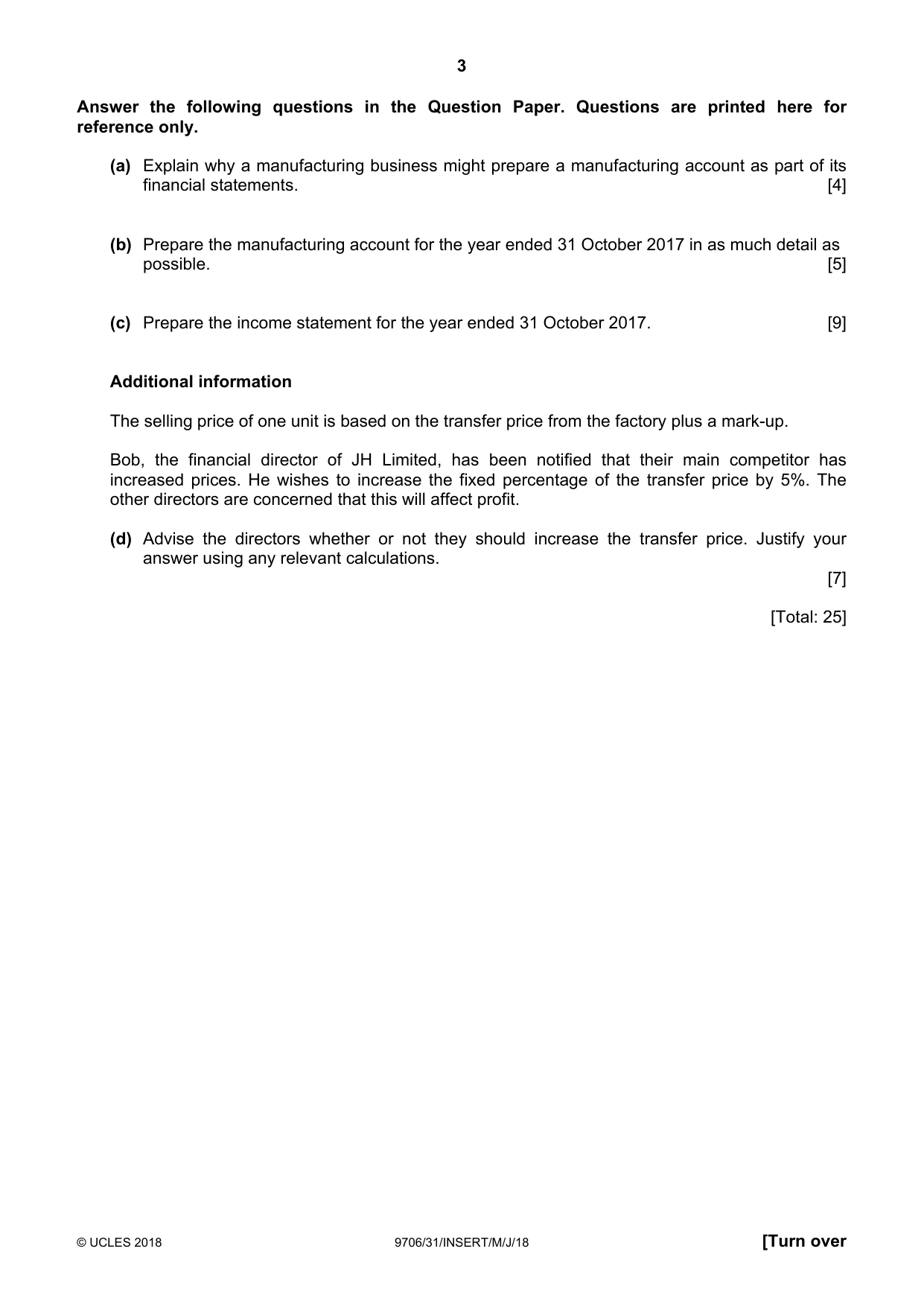
Question paper, page 3
3 © UCLES 2018 9706/31/INSERT/M/J/18 [Turn over Answer the following questions in the Question Paper. Questions are printed here for reference only. (a) Explain why a manufacturing business might prepare a manufacturing account as part of its financial statements. [4] (b) Prepare the manufacturing account for the year ended 31 October 2017 in as much detail as possible. [5] (c) Prepare the income statement for the year ended 31 October 2017. [9] Additional information The selling price of one unit is based on the transfer price from the factory plus a mark-up. Bob, the financial director of JH Limited, has been notified that their main competitor has increased prices. He wishes to increase the fixed percentage of the transfer price by 5%. The other directors are concerned that this will affect profit. (d) Advise the directors whether or not they should increase the transfer price. Justify your answer using any relevant calculations. [7] [Total: 25]
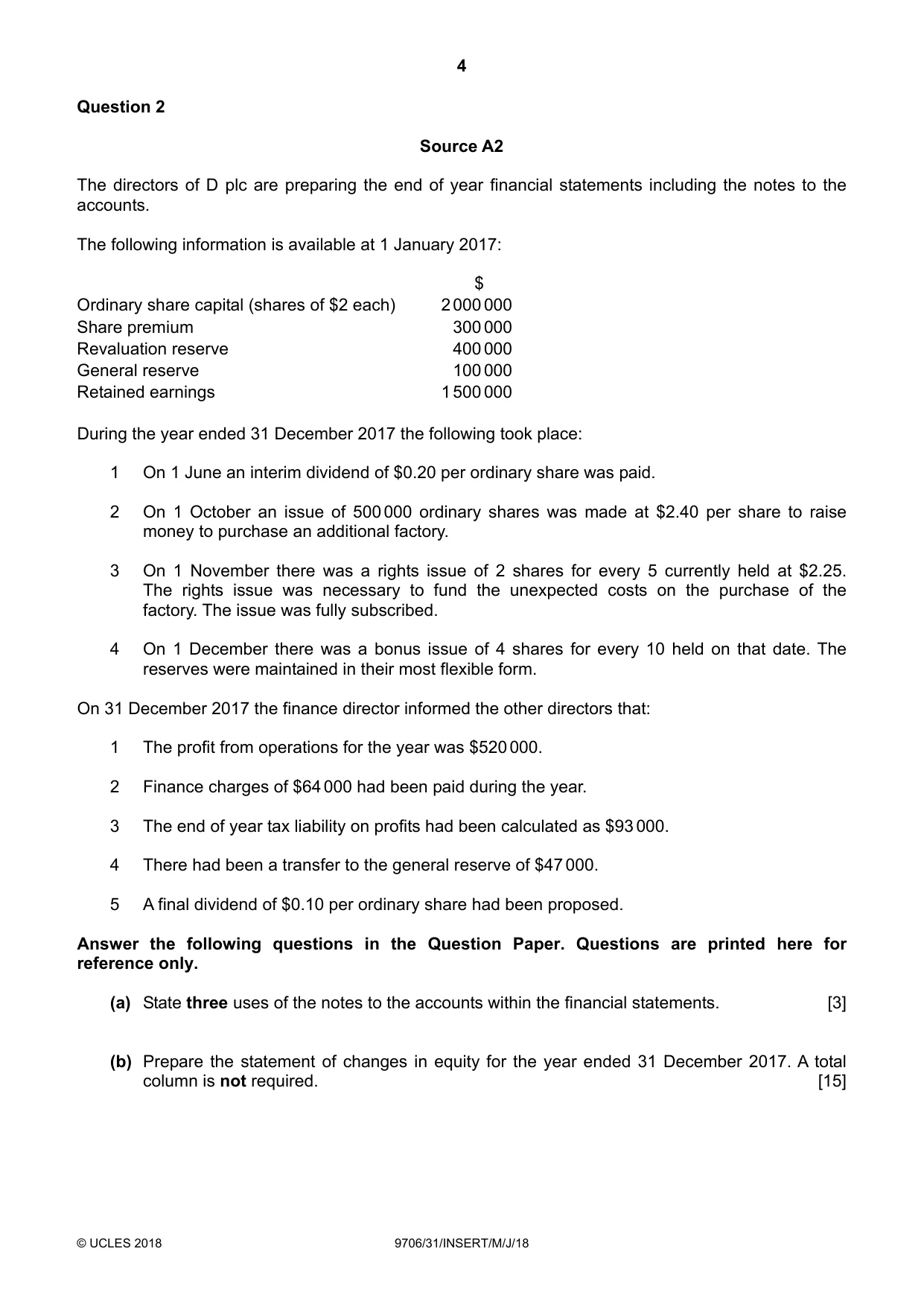
Question paper, page 4
4 © UCLES 2018 9706/31/INSERT/M/J/18 Question 2 Source A2 The directors of D plc are preparing the end of year financial statements including the notes to the accounts. The following information is available at 1 January 2017: $ Ordinary share capital (shares of $2 each) 2 000 000 Share premium 300 000 Revaluation reserve 400 000 General reserve 100 000 Retained earnings 1 500 000 During the year ended 31 December 2017 the following took place: 1 On 1 June an interim dividend of $0.20 per ordinary share was paid. 2 On 1 October an issue of 500 000 ordinary shares was made at $2.40 per share to raise money to purchase an additional factory. 3 On 1 November there was a rights issue of 2 shares for every 5 currently held at $2.25. The rights issue was necessary to fund the unexpected costs on the purchase of the factory. The issue was fully subscribed. 4 On 1 December there was a bonus issue of 4 shares for every 10 held on that date. The reserves were maintained in their most flexible form. On 31 December 2017 the finance director informed the other directors that: 1 The profit from operations for the year was $520 000. 2 Finance charges of $64 000 had been paid during the year. 3 The end of year tax liability on profits had been calculated as $93 000. 4 There had been a transfer to the general reserve of $47 000. 5 A final dividend of $0.10 per ordinary share had been proposed. Answer the following questions in the Question Paper. Questions are printed here for reference only. (a) State three uses of the notes to the accounts within the financial statements. [3] (b) Prepare the statement of changes in equity for the year ended 31 December 2017. A total column is not required. [15]
Question paper, page 5
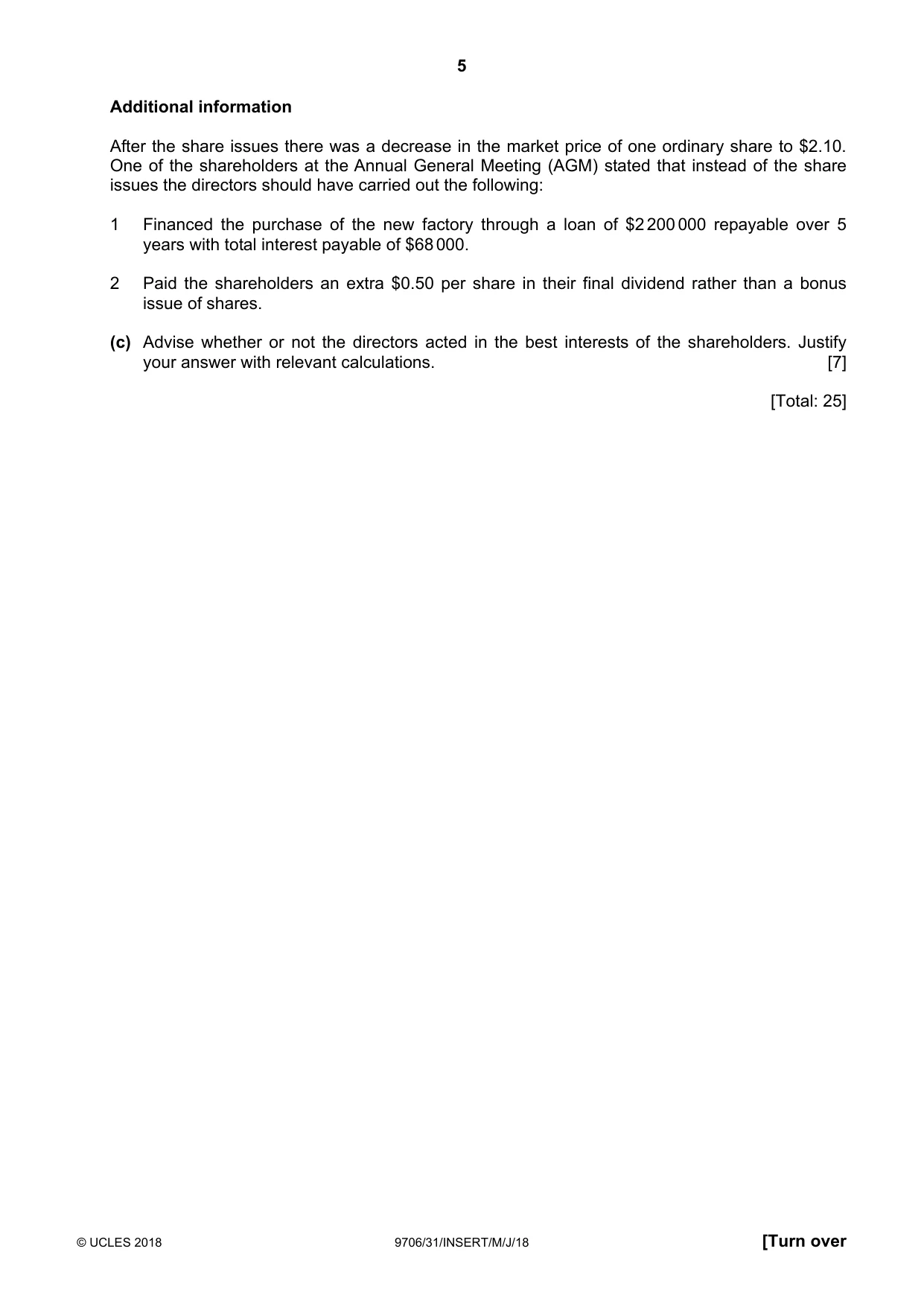
5 © UCLES 2018 9706/31/INSERT/M/J/18 [Turn over Additional information After the share issues there was a decrease in the market price of one ordinary share to $2.10. One of the shareholders at the Annual General Meeting (AGM) stated that instead of the share issues the directors should have carried out the following: 1 Financed the purchase of the new factory through a loan of $2 200 000 repayable over 5 years with total interest payable of $68 000. 2 Paid the shareholders an extra $0.50 per share in their final dividend rather than a bonus issue of shares. (c) Advise whether or not the directors acted in the best interests of the shareholders. Justify your answer with relevant calculations. [7] [Total: 25]
Question paper, page 6
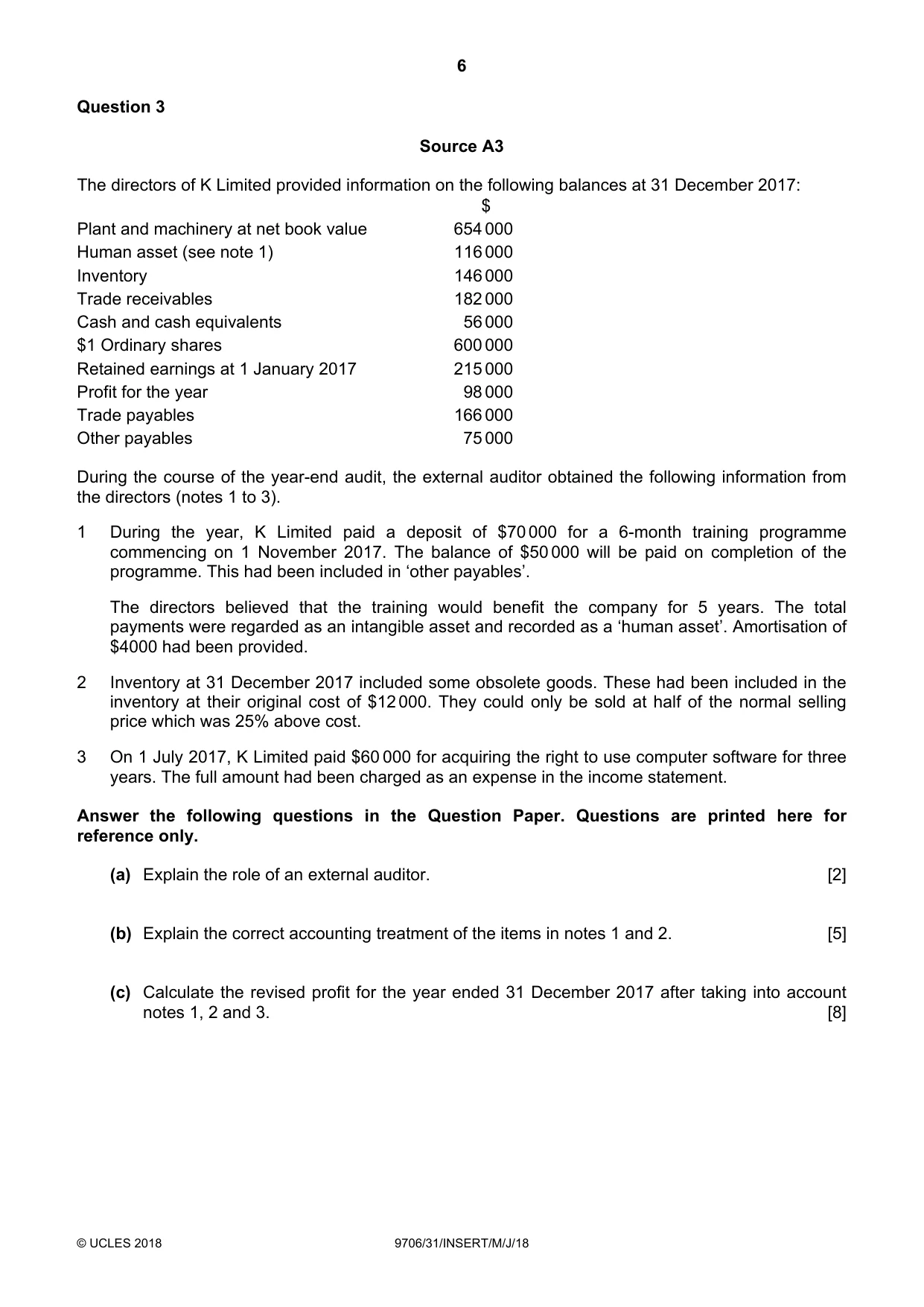
6 © UCLES 2018 9706/31/INSERT/M/J/18 Question 3 Source A3 The directors of K Limited provided information on the following balances at 31 December 2017: $ Plant and machinery at net book value 654 000 Human asset (see note 1) 116 000 Inventory 146 000 Trade receivables 182 000 Cash and cash equivalents 56 000 $1 Ordinary shares 600 000 Retained earnings at 1 January 2017 215 000 Profit for the year 98 000 Trade payables 166 000 Other payables 75 000 During the course of the year-end audit, the external auditor obtained the following information from the directors (notes 1 to 3). 1 During the year, K Limited paid a deposit of $70 000 for a 6-month training programme commencing on 1 November 2017. The balance of $50 000 will be paid on completion of the programme. This had been included in ‘other payables’. The directors believed that the training would benefit the company for 5 years. The total payments were regarded as an intangible asset and recorded as a ‘human asset’. Amortisation of $4000 had been provided. 2 Inventory at 31 December 2017 included some obsolete goods. These had been included in the inventory at their original cost of $12 000. They could only be sold at half of the normal selling price which was 25% above cost. 3 On 1 July 2017, K Limited paid $60 000 for acquiring the right to use computer software for three years. The full amount had been charged as an expense in the income statement. Answer the following questions in the Question Paper. Questions are printed here for reference only. (a) Explain the role of an external auditor. [2] (b) Explain the correct accounting treatment of the items in notes 1 and 2. [5] (c) Calculate the revised profit for the year ended 31 December 2017 after taking into account notes 1, 2 and 3. [8]
Question paper, page 7
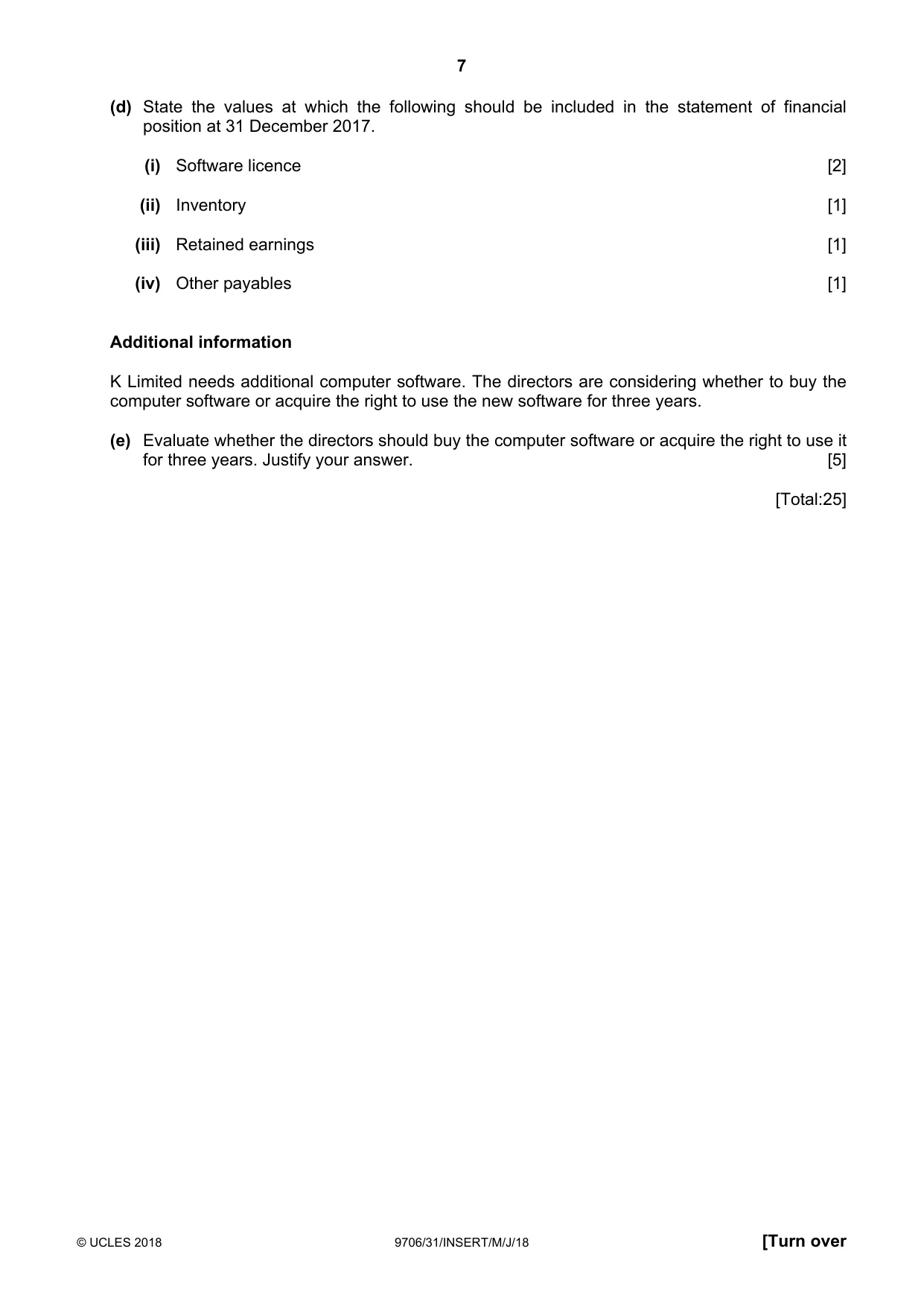
7 © UCLES 2018 9706/31/INSERT/M/J/18 [Turn over (d) State the values at which the following should be included in the statement of financial position at 31 December 2017. (i) Software licence [2] (ii) Inventory [1] (iii) Retained earnings [1] (iv) Other payables [1] Additional information K Limited needs additional computer software. The directors are considering whether to buy the computer software or acquire the right to use the new software for three years. (e) Evaluate whether the directors should buy the computer software or acquire the right to use it for three years. Justify your answer. [5] [Total:25]
Question paper, page 8
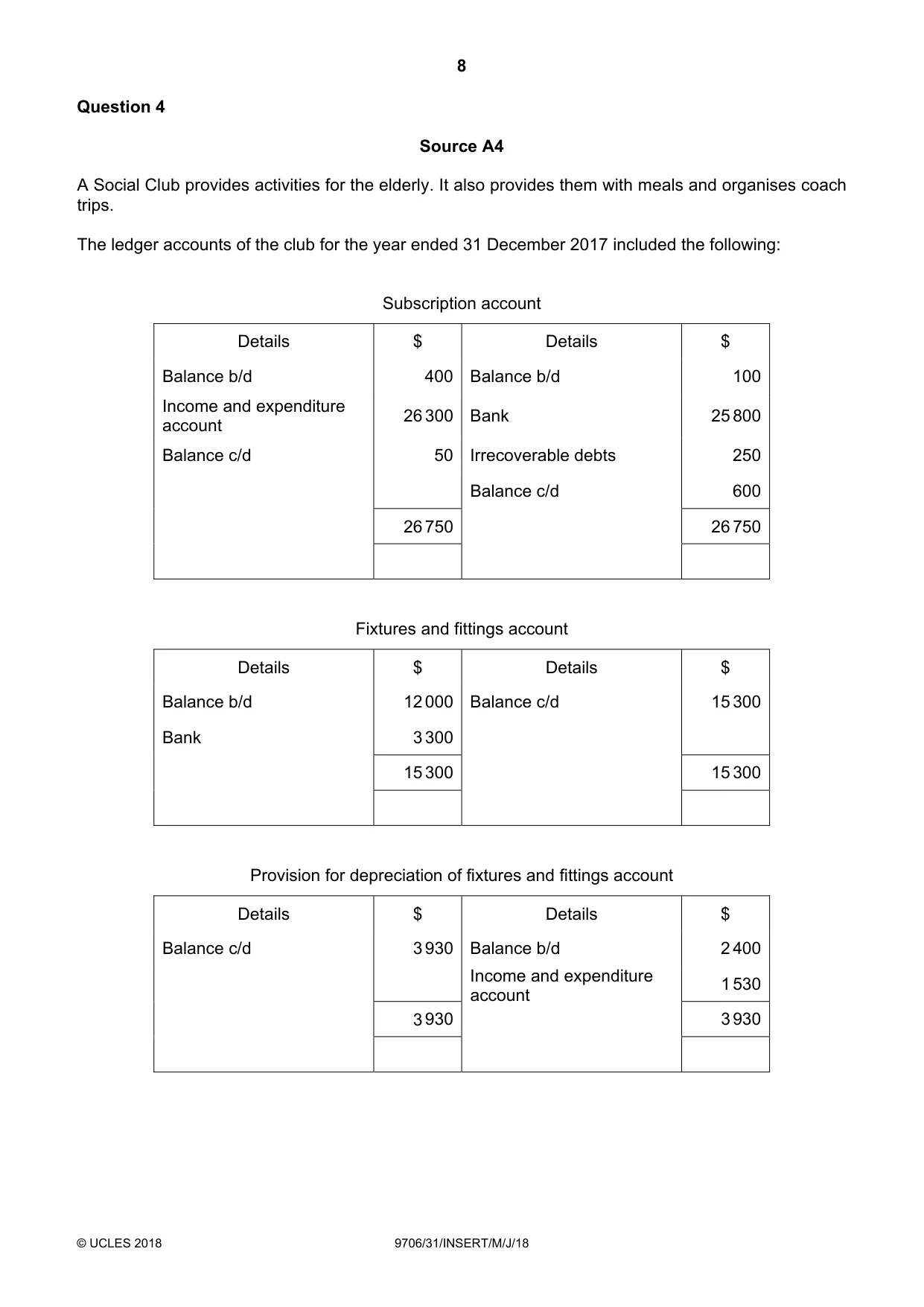
8 © UCLES 2018 9706/31/INSERT/M/J/18 Question 4 Source A4 A Social Club provides activities for the elderly. It also provides them with meals and organises coach trips. The ledger accounts of the club for the year ended 31 December 2017 included the following: Subscription account Details $ Details $ Balance b/d 400 Balance b/d 100 Income and expenditure account 26 300 Bank 25 800 Balance c/d 50 Irrecoverable debts 250 Balance c/d 600 26 750 26 750 Fixtures and fittings account Details $ Details $ Balance b/d 12 000 Balance c/d 15 300 Bank 3 300 15 300 15 300 Provision for depreciation of fixtures and fittings account Details $ Details $ Balance c/d 3 930 Balance b/d 2 400 Income and expenditure account 1 530 3 930 3 930
Question paper, page 9
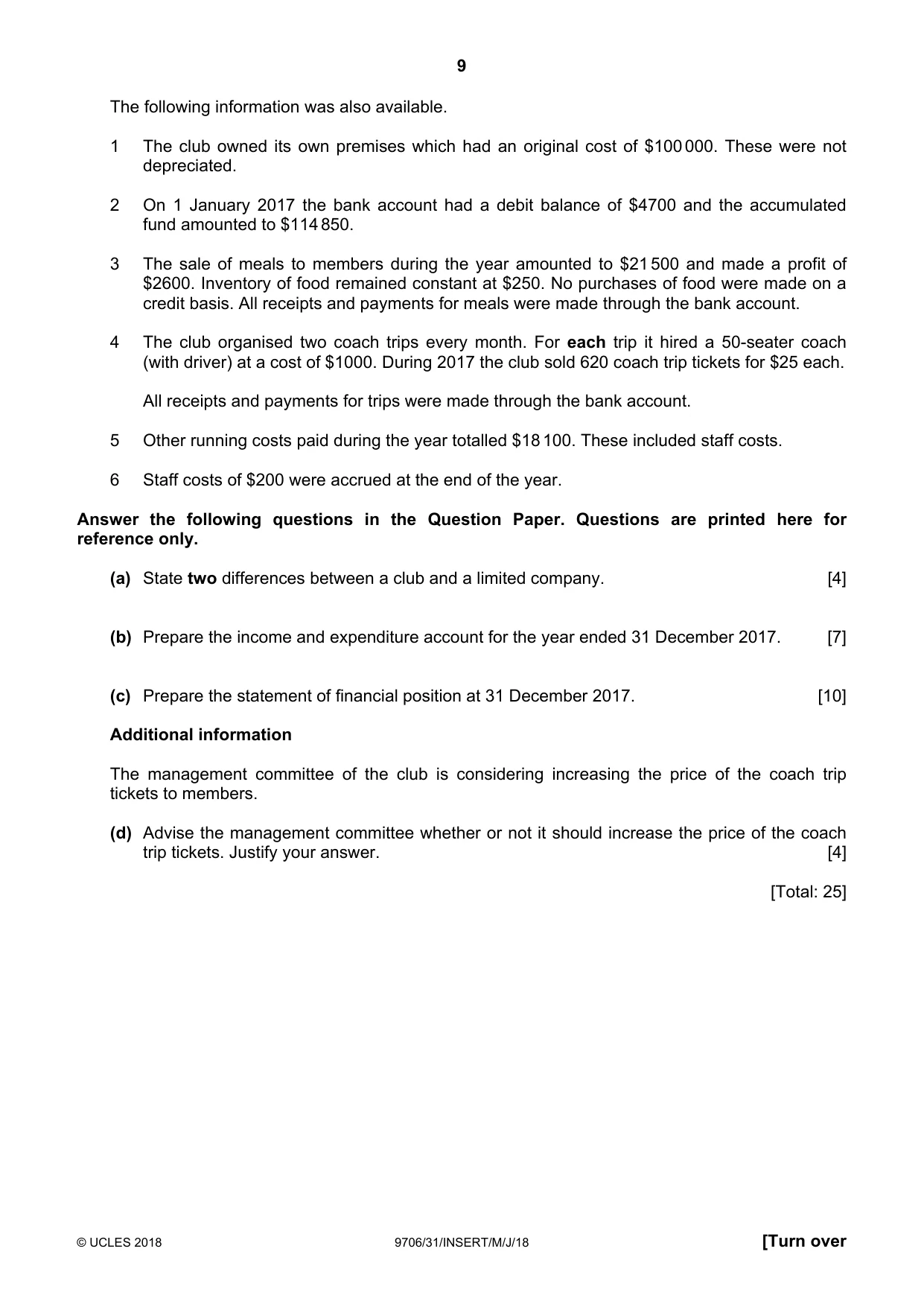
9 © UCLES 2018 9706/31/INSERT/M/J/18 [Turn over The following information was also available. 1 The club owned its own premises which had an original cost of $100 000. These were not depreciated. 2 On 1 January 2017 the bank account had a debit balance of $4700 and the accumulated fund amounted to $114 850. 3 The sale of meals to members during the year amounted to $21 500 and made a profit of $2600. Inventory of food remained constant at $250. No purchases of food were made on a credit basis. All receipts and payments for meals were made through the bank account. 4 The club organised two coach trips every month. For each trip it hired a 50-seater coach (with driver) at a cost of $1000. During 2017 the club sold 620 coach trip tickets for $25 each. All receipts and payments for trips were made through the bank account. 5 Other running costs paid during the year totalled $18 100. These included staff costs. 6 Staff costs of $200 were accrued at the end of the year. Answer the following questions in the Question Paper. Questions are printed here for reference only. (a) State two differences between a club and a limited company. [4] (b) Prepare the income and expenditure account for the year ended 31 December 2017. [7] (c) Prepare the statement of financial position at 31 December 2017. [10] Additional information The management committee of the club is considering increasing the price of the coach trip tickets to members. (d) Advise the management committee whether or not it should increase the price of the coach trip tickets. Justify your answer. [4] [Total: 25]
Question paper, page 10
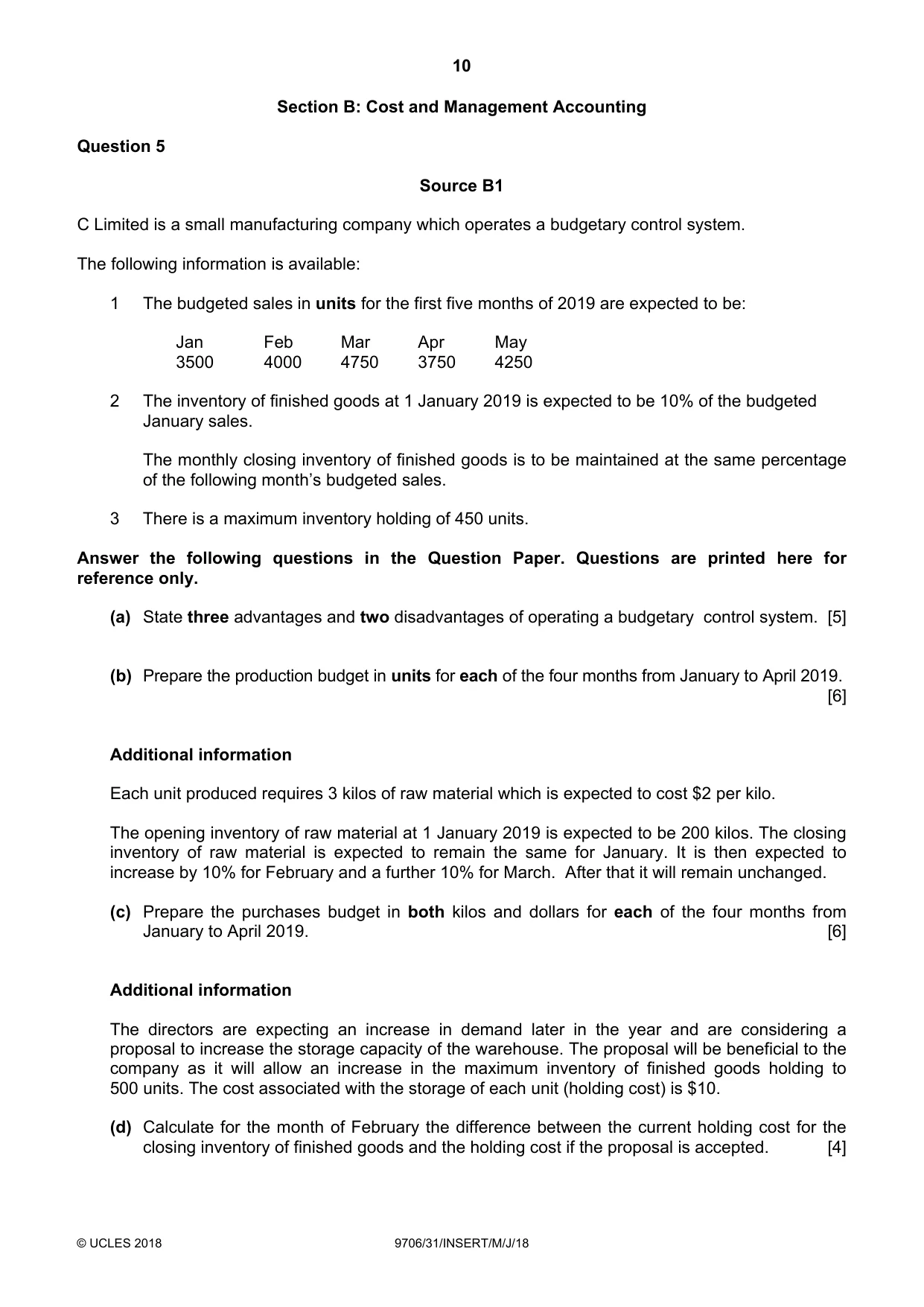
10 © UCLES 2018 9706/31/INSERT/M/J/18 Section B: Cost and Management Accounting Question 5 Source B1 C Limited is a small manufacturing company which operates a budgetary control system. The following information is available: 1 The budgeted sales in units for the first five months of 2019 are expected to be: Jan Feb Mar Apr May 3500 4000 4750 3750 4250 2 The inventory of finished goods at 1 January 2019 is expected to be 10% of the budgeted January sales. The monthly closing inventory of finished goods is to be maintained at the same percentage of the following month’s budgeted sales. 3 There is a maximum inventory holding of 450 units. Answer the following questions in the Question Paper. Questions are printed here for reference only. (a) State three advantages and two disadvantages of operating a budgetary control system. [5] (b) Prepare the production budget in units for each of the four months from January to April 2019. [6] Additional information Each unit produced requires 3 kilos of raw material which is expected to cost $2 per kilo. The opening inventory of raw material at 1 January 2019 is expected to be 200 kilos. The closing inventory of raw material is expected to remain the same for January. It is then expected to increase by 10% for February and a further 10% for March. After that it will remain unchanged. (c) Prepare the purchases budget in both kilos and dollars for each of the four months from January to April 2019. [6] Additional information The directors are expecting an increase in demand later in the year and are considering a proposal to increase the storage capacity of the warehouse. The proposal will be beneficial to the company as it will allow an increase in the maximum inventory of finished goods holding to 500 units. The cost associated with the storage of each unit (holding cost) is $10. (d) Calculate for the month of February the difference between the current holding cost for the closing inventory of finished goods and the holding cost if the proposal is accepted. [4]
Question paper, page 11
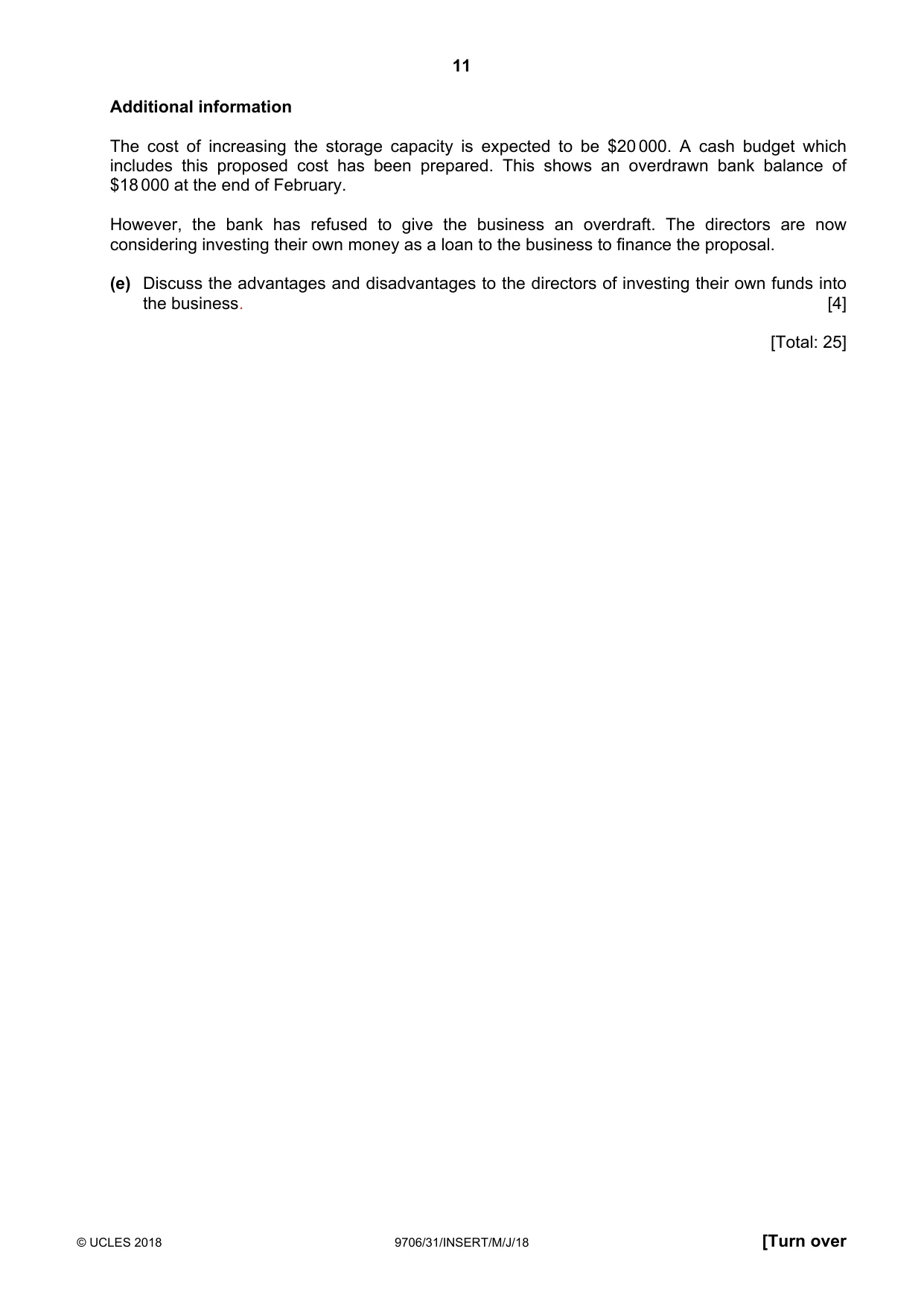
11 © UCLES 2018 9706/31/INSERT/M/J/18 [Turn over Additional information The cost of increasing the storage capacity is expected to be $20 000. A cash budget which includes this proposed cost has been prepared. This shows an overdrawn bank balance of $18 000 at the end of February. However, the bank has refused to give the business an overdraft. The directors are now considering investing their own money as a loan to the business to finance the proposal. (e) Discuss the advantages and disadvantages to the directors of investing their own funds into the business. [4] [Total: 25]
Question paper, page 12
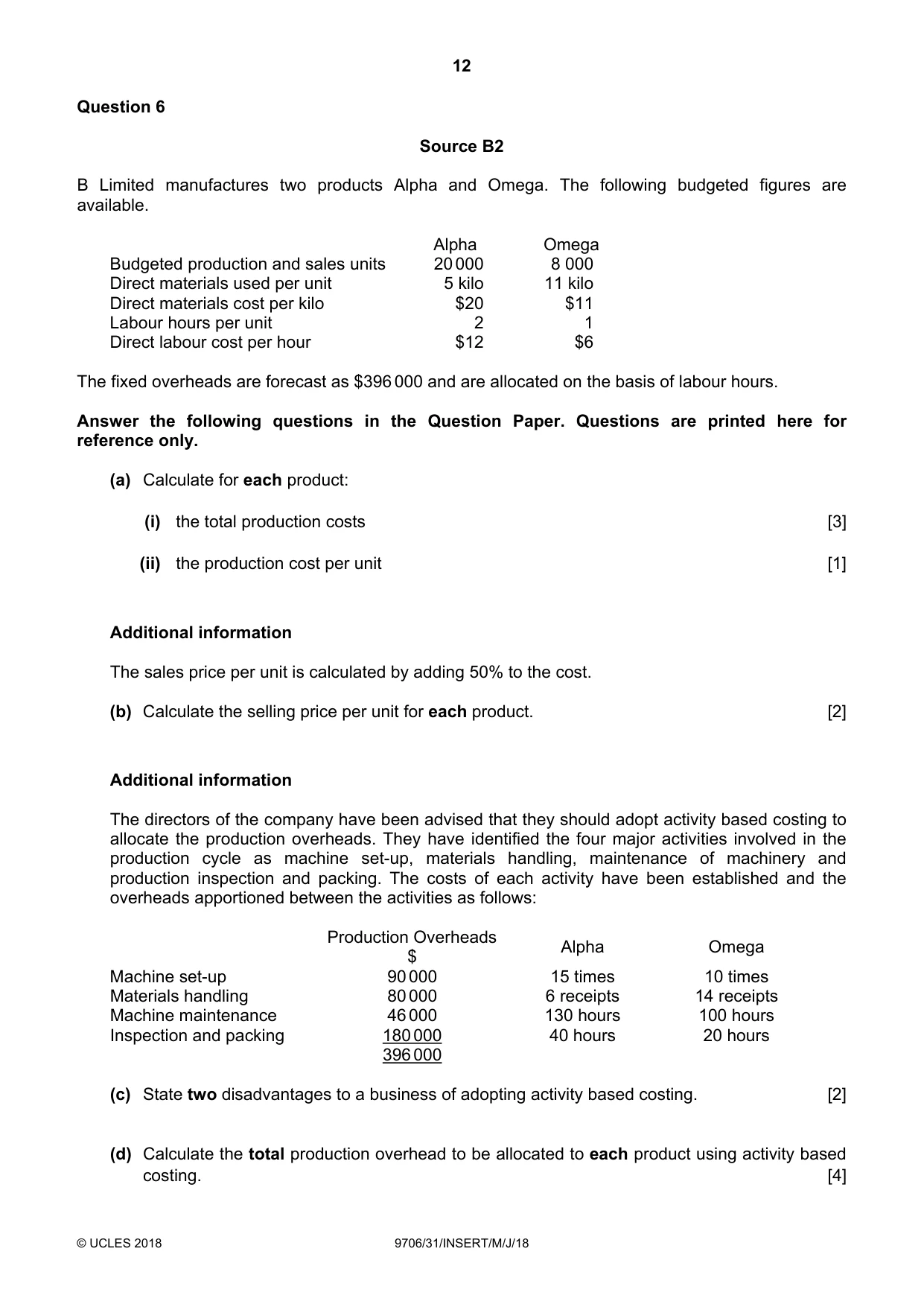
12 © UCLES 2018 9706/31/INSERT/M/J/18 Question 6 Source B2 B Limited manufactures two products Alpha and Omega. The following budgeted figures are available. Alpha Omega Budgeted production and sales units 20 000 8 000 Direct materials used per unit 5 kilo 11 kilo Direct materials cost per kilo $20 $11 Labour hours per unit 2 1 Direct labour cost per hour $12 $6 The fixed overheads are forecast as $396 000 and are allocated on the basis of labour hours. Answer the following questions in the Question Paper. Questions are printed here for reference only. (a) Calculate for each product: (i) the total production costs [3] (ii) the production cost per unit [1] Additional information The sales price per unit is calculated by adding 50% to the cost. (b) Calculate the selling price per unit for each product. [2] Additional information The directors of the company have been advised that they should adopt activity based costing to allocate the production overheads. They have identified the four major activities involved in the production cycle as machine set-up, materials handling, maintenance of machinery and production inspection and packing. The costs of each activity have been established and the overheads apportioned between the activities as follows: Production Overheads $ Alpha Omega Machine set-up 90 000 15 times 10 times Materials handling 80 000 6 receipts 14 receipts Machine maintenance 46 000 130 hours 100 hours Inspection and packing 180 000 40 hours 20 hours 396 000 (c) State two disadvantages to a business of adopting activity based costing. [2] (d) Calculate the total production overhead to be allocated to each product using activity based costing. [4]
Question paper, page 13
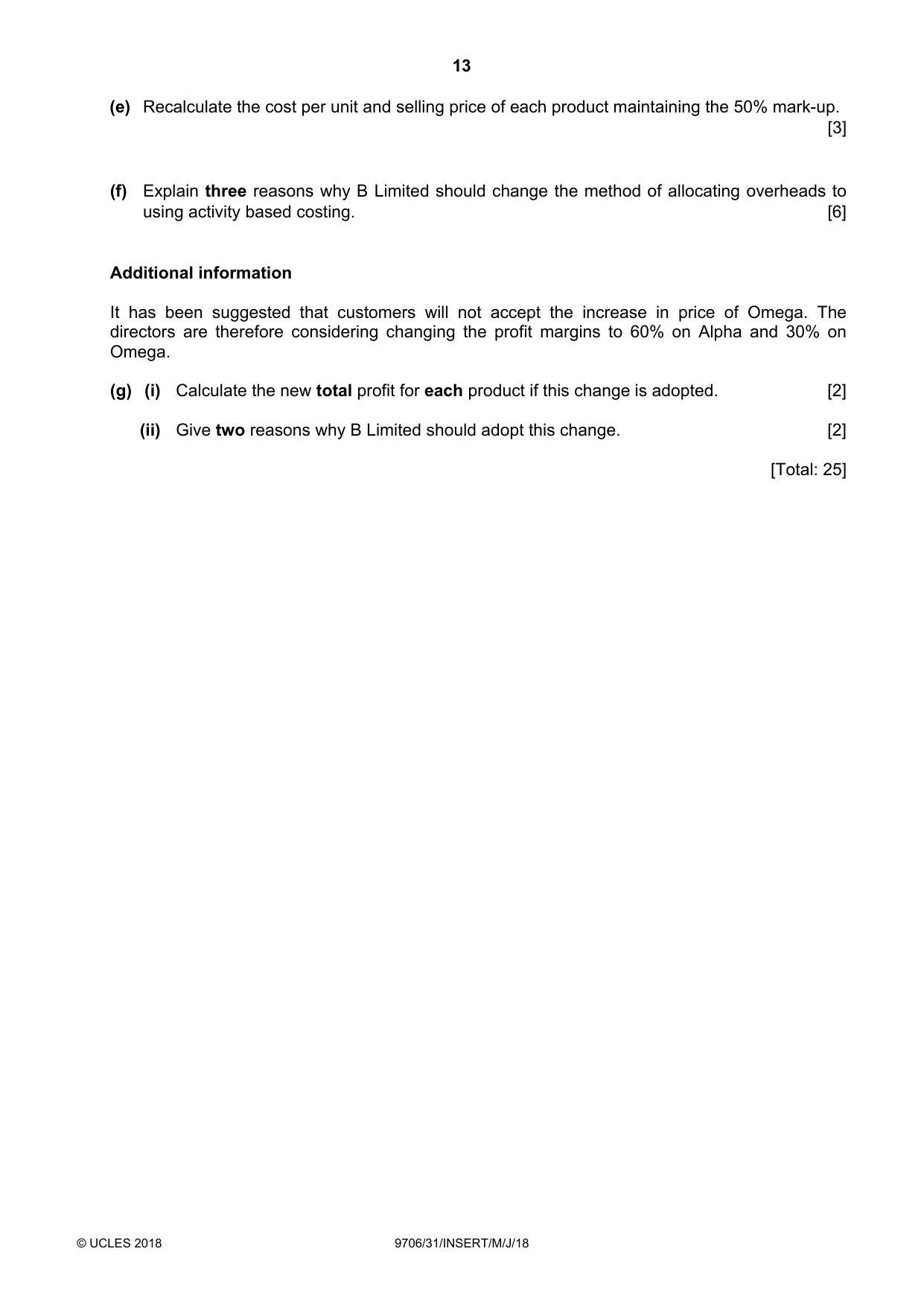
13 © UCLES 2018 9706/31/INSERT/M/J/18 (e) Recalculate the cost per unit and selling price of each product maintaining the 50% mark-up. [3] (f) Explain three reasons why B Limited should change the method of allocating overheads to using activity based costing. [6] Additional information It has been suggested that customers will not accept the increase in price of Omega. The directors are therefore considering changing the profit margins to 60% on Alpha and 30% on Omega. (g) (i) Calculate the new total profit for each product if this change is adopted. [2] (ii) Give two reasons why B Limited should adopt this change. [2] [Total: 25]
Question paper, page 14
14 © UCLES 2018 9706/31/INSERT/M/J/18 BLANK PAGE
Question paper, page 15
15 © UCLES 2018 9706/31/INSERT/M/J/18 BLANK PAGE
Question paper, page 16
16 Permission to reproduce items where third-party owned material protected by copyright is included has been sought and cleared where possible. Every reasonable effort has been made by the publisher (UCLES) to trace copyright holders, but if any items requiring clearance have unwittingly been included, the publisher will be pleased to make amends at the earliest possible opportunity. To avoid the issue of disclosure of answer-related information to candidates, all copyright acknowledgements are reproduced online in the Cambridge International Examinations Copyright Acknowledgements Booklet. This is produced for each series of examinations and is freely available to download at www.cie.org.uk after the live examination series. Cambridge International Examinations is part of the Cambridge Assessment Group. Cambridge Assessment is the brand name of University of Cambridge Local Examinations Syndicate (UCLES), which is itself a department of the University of Cambridge. © UCLES 2018 9706/31/INSERT/M/J/18 BLANK PAGE
Mark scheme, page 1
IGCSE™ is a registered trademark. This document consists of 18 printed pages. © UCLES 2018 [Turn over Cambridge Assessment International Education Cambridge International Advanced Subsidiary and Advanced Level ACCOUNTING 9706/31 Paper 3 Structured Questions May/June 2018 MARK SCHEME Maximum Mark: 150 Published This mark scheme is published as an aid to teachers and candidates, to indicate the requirements of the examination. It shows the basis on which Examiners were instructed to award marks. It does not indicate the details of the discussions that took place at an Examiners’ meeting before marking began, which would have considered the acceptability of alternative answers. Mark schemes should be read in conjunction with the question paper and the Principal Examiner Report for Teachers. Cambridge International will not enter into discussions about these mark schemes. Cambridge International is publishing the mark schemes for the May/June 2018 series for most Cambridge IGCSE™, Cambridge International A and AS Level and Cambridge Pre-U components, and some Cambridge O Level components.
Mark scheme, page 2
9706/31 Cambridge International AS/A Level – Mark Scheme PUBLISHED May/June 2018 © UCLES 2018 Page 2 of 18 Generic Marking Principles These general marking principles must be applied by all examiners when marking candidate answers. They should be applied alongside the specific content of the mark scheme or generic level descriptors for a question. Each question paper and mark scheme will also comply with these marking principles. GENERIC MARKING PRINCIPLE 1: Marks must be awarded in line with: • the specific content of the mark scheme or the generic level descriptors for the question • the specific skills defined in the mark scheme or in the generic level descriptors for the question • the standard of response required by a candidate as exemplified by the standardisation scripts. GENERIC MARKING PRINCIPLE 2: Marks awarded are always whole marks (not half marks, or other fractions). GENERIC MARKING PRINCIPLE 3: Marks must be awarded positively: • marks are awarded for correct/valid answers, as defined in the mark scheme. However, credit is given for valid answers which go beyond the scope of the syllabus and mark scheme, referring to your Team Leader as appropriate • marks are awarded when candidates clearly demonstrate what they know and can do • marks are not deducted for errors • marks are not deducted for omissions • answers should only be judged on the quality of spelling, punctuation and grammar when these features are specifically assessed by the question as indicated by the mark scheme. The meaning, however, should be unambiguous. GENERIC MARKING PRINCIPLE 4: Rules must be applied consistently e.g. in situations where candidates have not followed instructions or in the application of generic level descriptors.
Mark scheme, page 3
9706/31 Cambridge International AS/A Level – Mark Scheme PUBLISHED May/June 2018 © UCLES 2018 Page 3 of 18 GENERIC MARKING PRINCIPLE 5: Marks should be awarded using the full range of marks defined in the mark scheme for the question (however; the use of the full mark range may be limited according to the quality of the candidate responses seen). GENERIC MARKING PRINCIPLE 6: Marks awarded are based solely on the requirements as defined in the mark scheme. Marks should not be awarded with grade thresholds or grade descriptors in mind.
Mark scheme, page 4
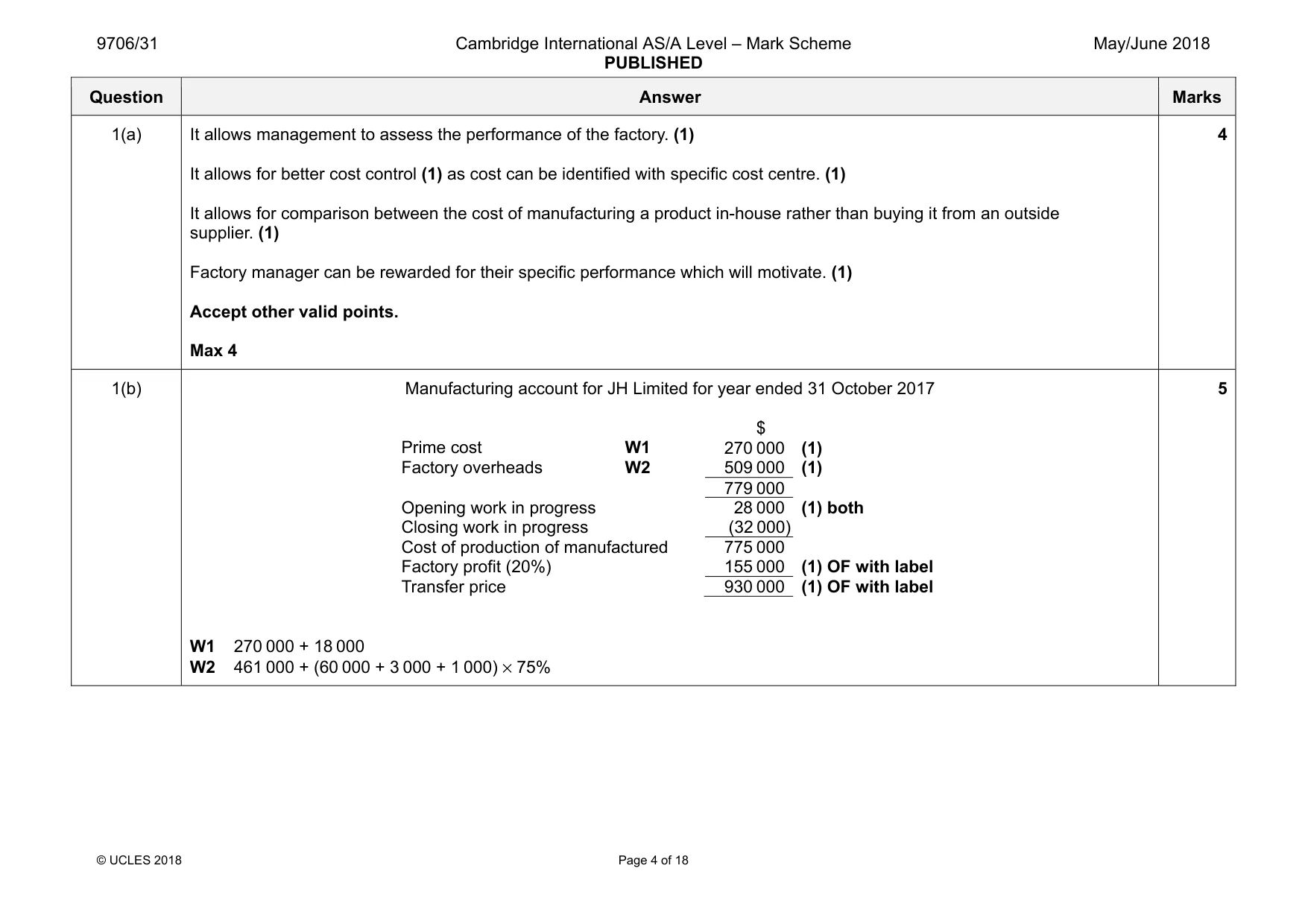
9706/31 Cambridge International AS/A Level – Mark Scheme PUBLISHED May/June 2018 © UCLES 2018 Page 4 of 18 Question Answer Marks 1(a) It allows management to assess the performance of the factory. (1) It allows for better cost control (1) as cost can be identified with specific cost centre. (1) It allows for comparison between the cost of manufacturing a product in-house rather than buying it from an outside supplier. (1) Factory manager can be rewarded for their specific performance which will motivate. (1) Accept other valid points. Max 4 4 1(b) Manufacturing account for JH Limited for year ended 31 October 2017 $ Prime cost W1 270 000 (1) Factory overheads W2 509 000 (1) 779 000 Opening work in progress 28 000 (1) both Closing work in progress (32 000) Cost of production of manufactured 775 000 Factory profit (20%) 155 000 (1) OF with label Transfer price 930 000 (1) OF with label W1 270 000 + 18 000 W2 461 000 + (60 000 + 3 000 + 1 000) × 75% 5
Mark scheme, page 5
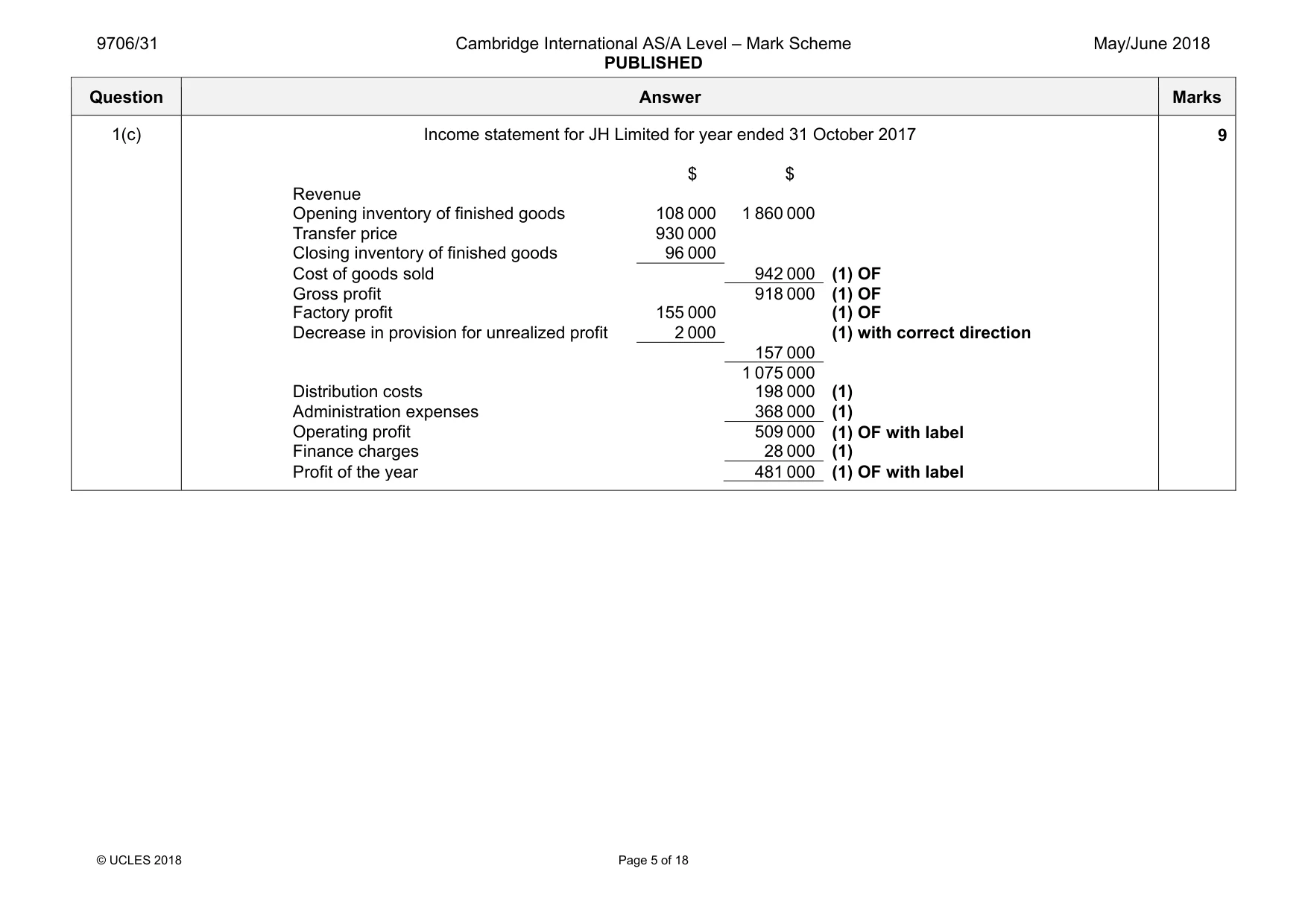
9706/31 Cambridge International AS/A Level – Mark Scheme PUBLISHED May/June 2018 © UCLES 2018 Page 5 of 18 Question Answer Marks 1(c) Income statement for JH Limited for year ended 31 October 2017 $ $ Revenue Opening inventory of finished goods 108 000 1 860 000 Transfer price 930 000 Closing inventory of finished goods 96 000 Cost of goods sold 942 000 (1) OF Gross profit 918 000 (1) OF Factory profit 155 000 (1) OF Decrease in provision for unrealized profit 2 000 (1) with correct direction 157 000 1 075 000 Distribution costs 198 000 (1) Administration expenses 368 000 (1) Operating profit 509 000 (1) OF with label Finance charges 28 000 (1) Profit of the year 481 000 (1) OF with label 9
Mark scheme, page 6
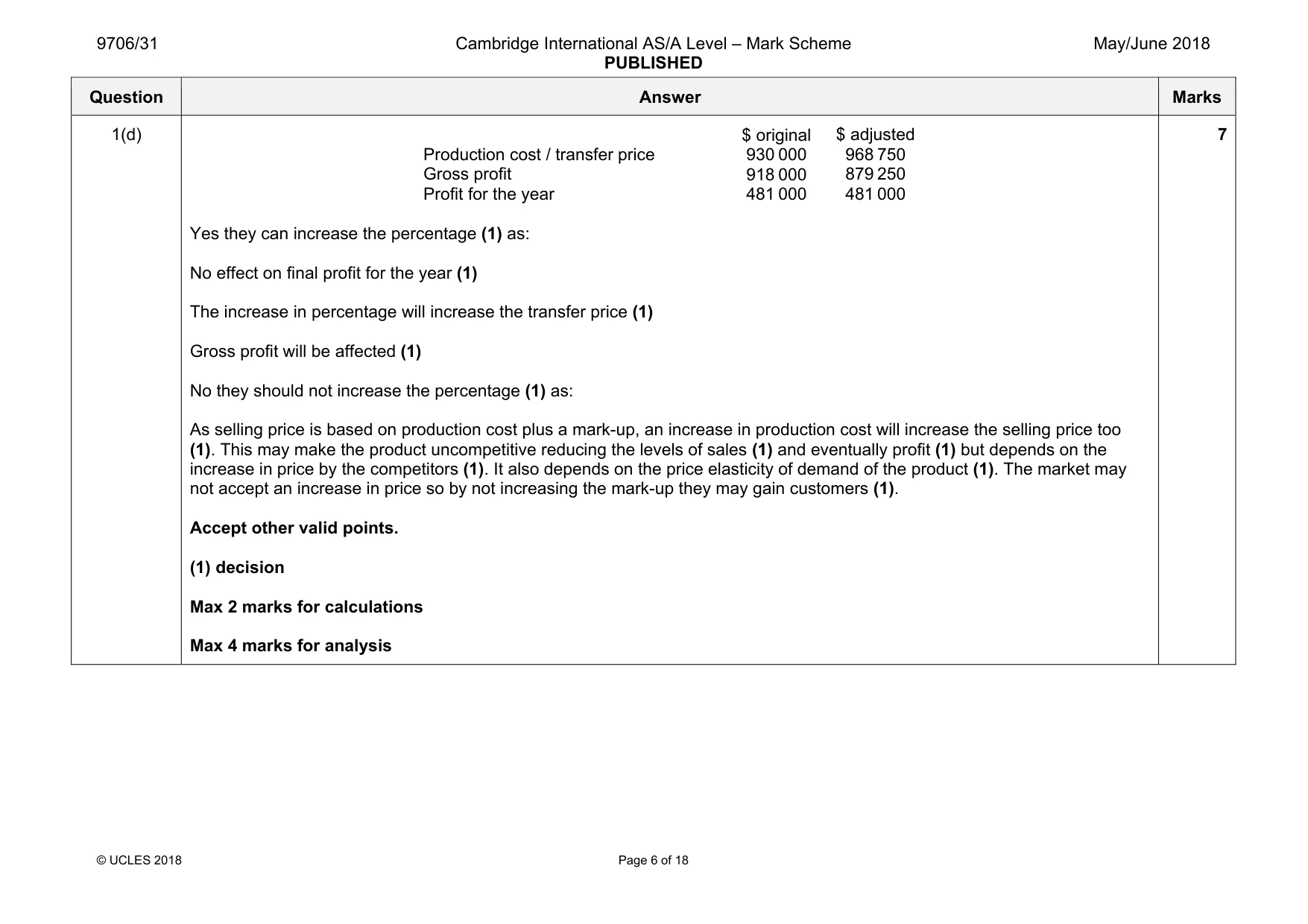
9706/31 Cambridge International AS/A Level – Mark Scheme PUBLISHED May/June 2018 © UCLES 2018 Page 6 of 18 Question Answer Marks 1(d) $ original $ adjusted Production cost / transfer price 930 000 968 750 Gross profit 918 000 879 250 Profit for the year 481 000 481 000 Yes they can increase the percentage (1) as: No effect on final profit for the year (1) The increase in percentage will increase the transfer price (1) Gross profit will be affected (1) No they should not increase the percentage (1) as: As selling price is based on production cost plus a mark-up, an increase in production cost will increase the selling price too (1). This may make the product uncompetitive reducing the levels of sales (1) and eventually profit (1) but depends on the increase in price by the competitors (1). It also depends on the price elasticity of demand of the product (1). The market may not accept an increase in price so by not increasing the mark-up they may gain customers (1). Accept other valid points. (1) decision Max 2 marks for calculations Max 4 marks for analysis 7
Mark scheme, page 7
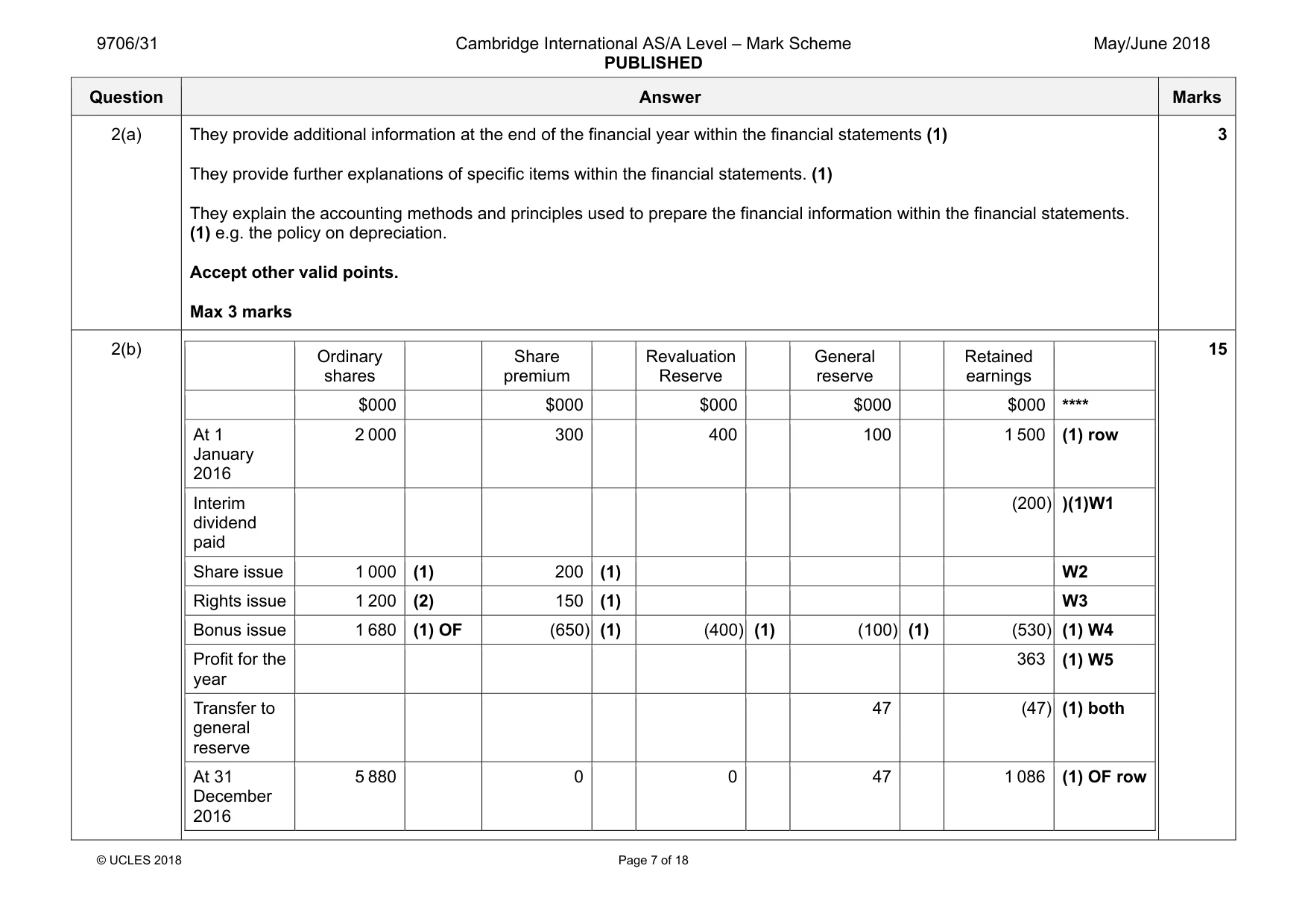
9706/31 Cambridge International AS/A Level – Mark Scheme PUBLISHED May/June 2018 © UCLES 2018 Page 7 of 18 Question Answer Marks 2(a) They provide additional information at the end of the financial year within the financial statements (1) They provide further explanations of specific items within the financial statements. (1) They explain the accounting methods and principles used to prepare the financial information within the financial statements. (1) e.g. the policy on depreciation. Accept other valid points. Max 3 marks 3 2(b) Ordinary shares Share premium Revaluation Reserve General reserve Retained earnings $000 $000 $000 $000 $000 **** At 1 January 2016 2 000 300 400 100 1 500 (1) row Interim dividend paid (200) )(1)W1 Share issue 1 000 (1) 200 (1) W2 Rights issue 1 200 (2) 150 (1) W3 Bonus issue 1 680 (1) OF (650) (1) (400) (1) (100) (1) (530) (1) W4 Profit for the year 363 (1) W5 Transfer to general reserve 47 (47) (1) both At 31 December 2016 5 880 0 0 47 1 086 (1) OF row 15
Mark scheme, page 8
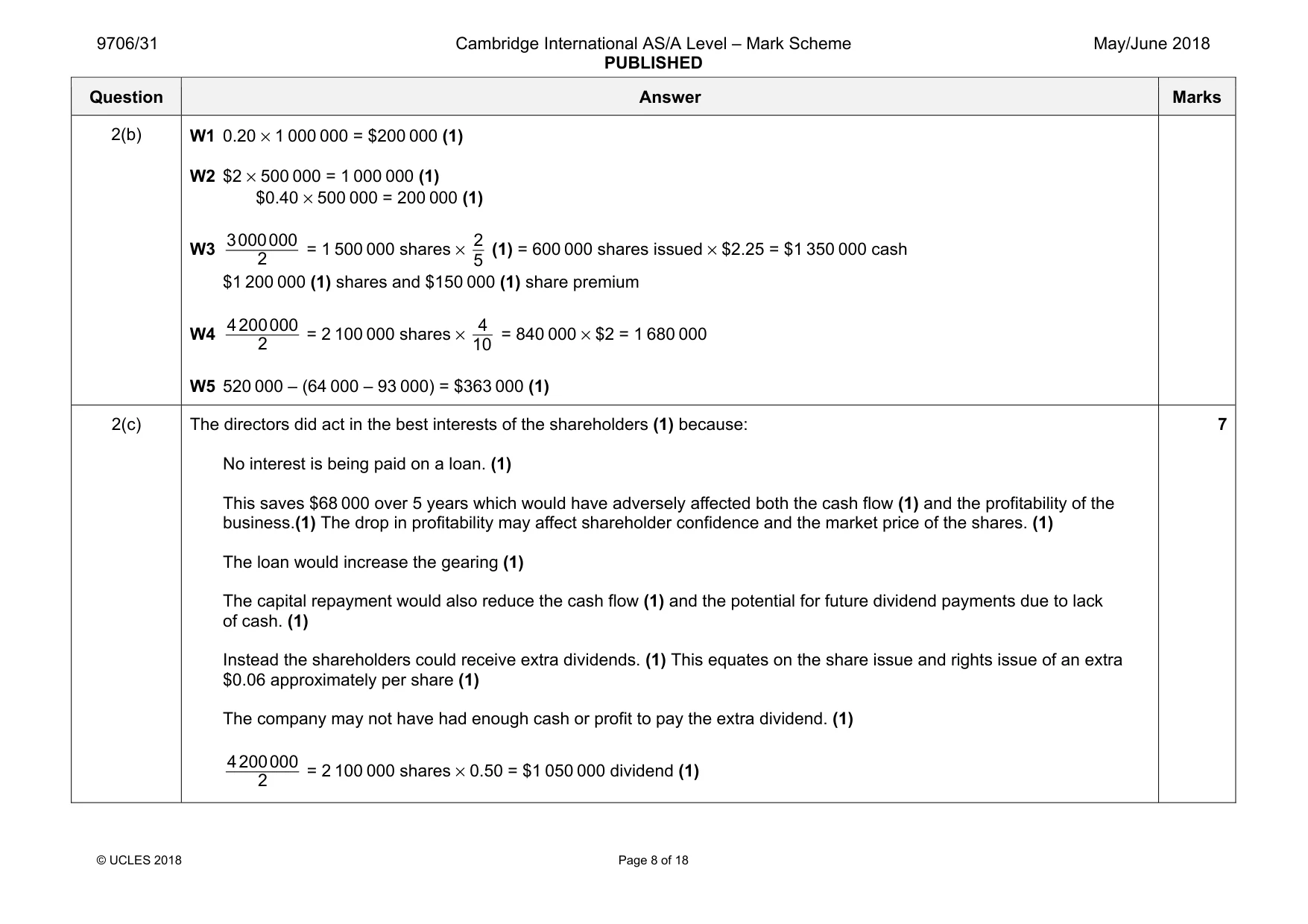
9706/31 Cambridge International AS/A Level – Mark Scheme PUBLISHED May/June 2018 © UCLES 2018 Page 8 of 18 Question Answer Marks 2(b) W1 0.20 × 1 000 000 = $200 000 (1) W2 $2 × 500 000 = 1 000 000 (1) $0.40 × 500 000 = 200 000 (1) W3 3000000 2 = 1 500 000 shares × 2 5 (1) = 600 000 shares issued × $2.25 = $1 350 000 cash $1 200 000 (1) shares and $150 000 (1) share premium W4 4200000 2 = 2 100 000 shares × 4 10 = 840 000 × $2 = 1 680 000 W5 520 000 – (64 000 – 93 000) = $363 000 (1) 2(c) The directors did act in the best interests of the shareholders (1) because: No interest is being paid on a loan. (1) This saves $68 000 over 5 years which would have adversely affected both the cash flow (1) and the profitability of the business.(1) The drop in profitability may affect shareholder confidence and the market price of the shares. (1) The loan would increase the gearing (1) The capital repayment would also reduce the cash flow (1) and the potential for future dividend payments due to lack of cash. (1) Instead the shareholders could receive extra dividends. (1) This equates on the share issue and rights issue of an extra $0.06 approximately per share (1) The company may not have had enough cash or profit to pay the extra dividend. (1) 4200000 2 = 2 100 000 shares × 0.50 = $1 050 000 dividend (1) 7
Mark scheme, page 9
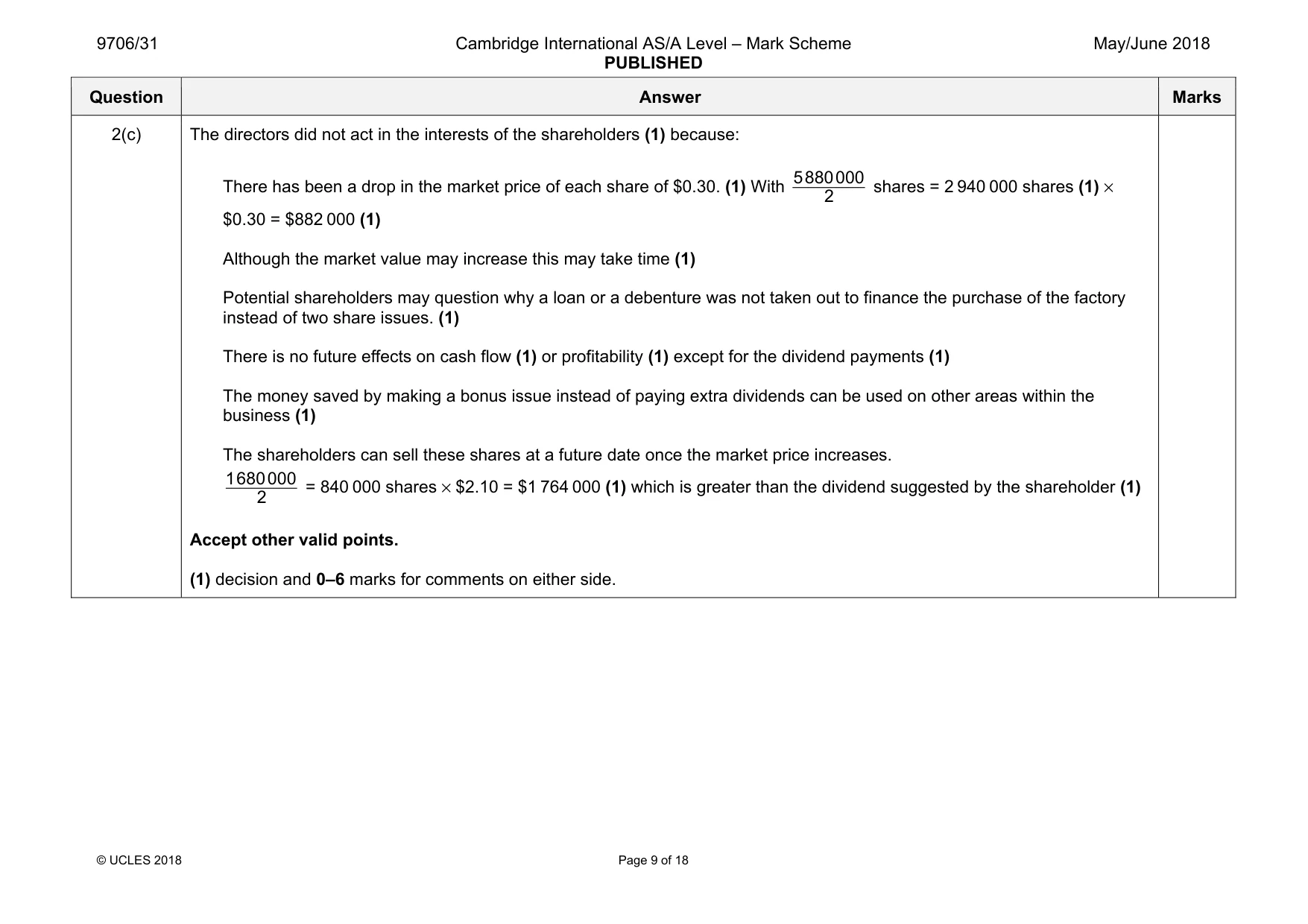
9706/31 Cambridge International AS/A Level – Mark Scheme PUBLISHED May/June 2018 © UCLES 2018 Page 9 of 18 Question Answer Marks 2(c) The directors did not act in the interests of the shareholders (1) because: There has been a drop in the market price of each share of $0.30. (1) With 5880000 2 shares = 2 940 000 shares (1) × $0.30 = $882 000 (1) Although the market value may increase this may take time (1) Potential shareholders may question why a loan or a debenture was not taken out to finance the purchase of the factory instead of two share issues. (1) There is no future effects on cash flow (1) or profitability (1) except for the dividend payments (1) The money saved by making a bonus issue instead of paying extra dividends can be used on other areas within the business (1) The shareholders can sell these shares at a future date once the market price increases. 1680000 2 = 840 000 shares × $2.10 = $1 764 000 (1) which is greater than the dividend suggested by the shareholder (1) Accept other valid points. (1) decision and 0–6 marks for comments on either side.
Mark scheme, page 10
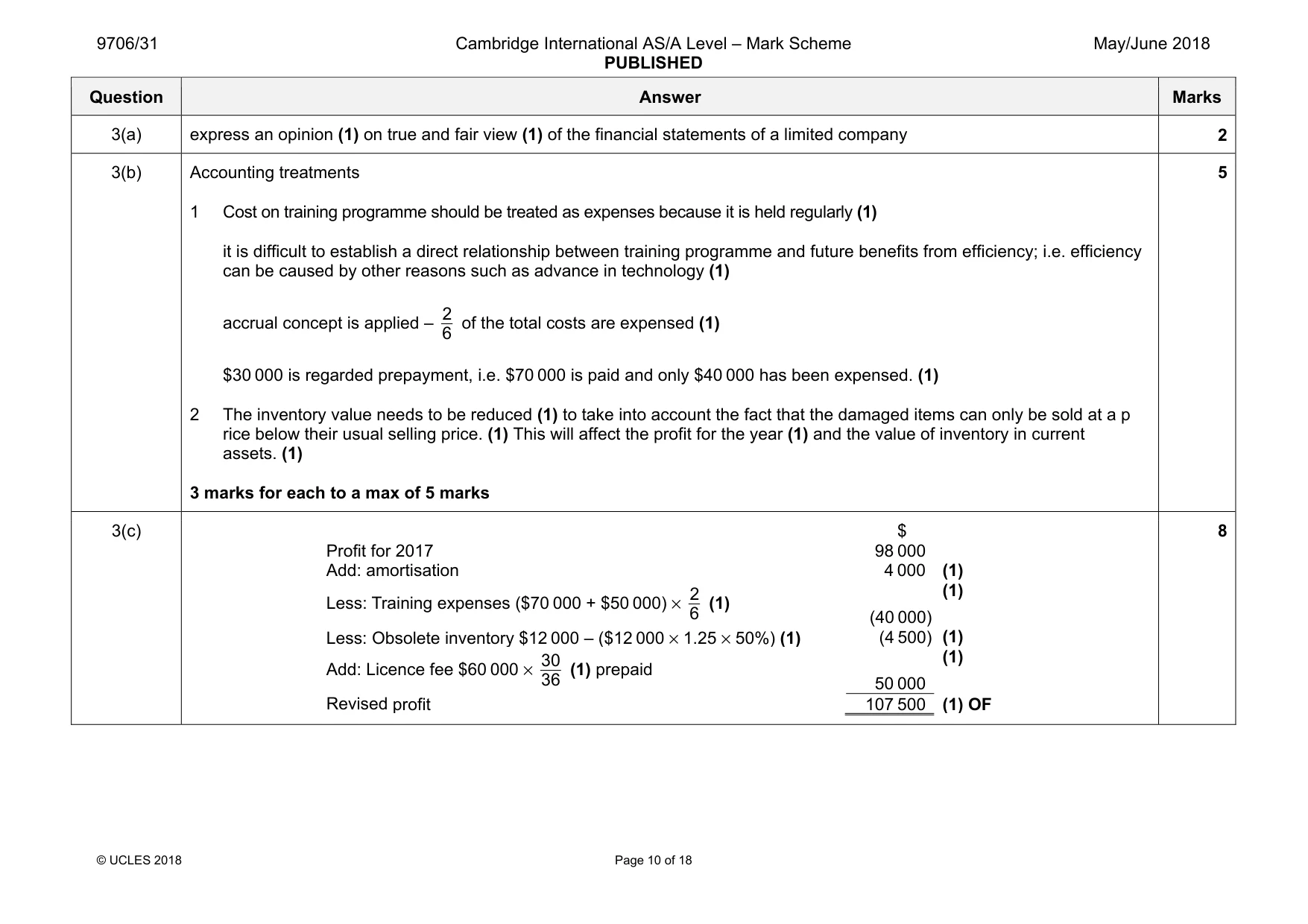
9706/31 Cambridge International AS/A Level – Mark Scheme PUBLISHED May/June 2018 © UCLES 2018 Page 10 of 18 Question Answer Marks 3(a) express an opinion (1) on true and fair view (1) of the financial statements of a limited company 2 3(b) Accounting treatments 1 Cost on training programme should be treated as expenses because it is held regularly (1) it is difficult to establish a direct relationship between training programme and future benefits from efficiency; i.e. efficiency can be caused by other reasons such as advance in technology (1) accrual concept is applied – 2 6 of the total costs are expensed (1) $30 000 is regarded prepayment, i.e. $70 000 is paid and only $40 000 has been expensed. (1) 2 The inventory value needs to be reduced (1) to take into account the fact that the damaged items can only be sold at a p rice below their usual selling price. (1) This will affect the profit for the year (1) and the value of inventory in current assets. (1) 3 marks for each to a max of 5 marks 5 3(c) $ Profit for 2017 98 000 Add: amortisation 4 000 (1) Less: Training expenses ($70 000 + $50 000) × 2 6 (1) (40 000) (1) Less: Obsolete inventory $12 000 – ($12 000 × 1.25 × 50%) (1) (4 500) (1) Add: Licence fee $60 000 × 30 36 (1) prepaid 50 000 (1) Revised profit 107 500 (1) OF 8
Mark scheme, page 11
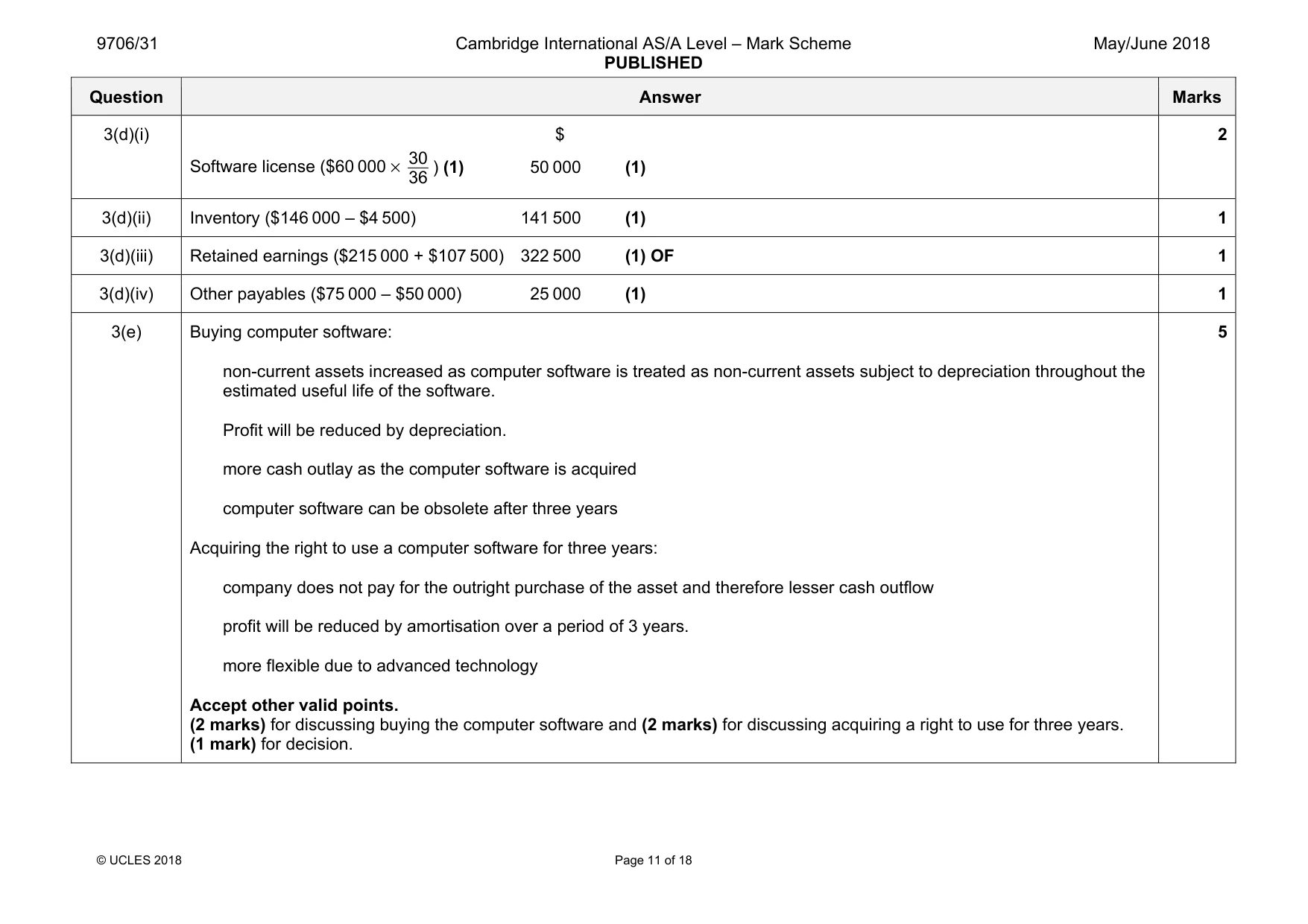
9706/31 Cambridge International AS/A Level – Mark Scheme PUBLISHED May/June 2018 © UCLES 2018 Page 11 of 18 Question Answer Marks 3(d)(i) $ Software license ($60 000 × 30 36 ) (1) 50 000 (1) 2 3(d)(ii) Inventory ($146 000 – $4 500) 141 500 (1) 1 3(d)(iii) Retained earnings ($215 000 + $107 500) 322 500 (1) OF 1 3(d)(iv) Other payables ($75 000 – $50 000) 25 000 (1) 1 3(e) Buying computer software: non-current assets increased as computer software is treated as non-current assets subject to depreciation throughout the estimated useful life of the software. Profit will be reduced by depreciation. more cash outlay as the computer software is acquired computer software can be obsolete after three years Acquiring the right to use a computer software for three years: company does not pay for the outright purchase of the asset and therefore lesser cash outflow profit will be reduced by amortisation over a period of 3 years. more flexible due to advanced technology Accept other valid points. (2 marks) for discussing buying the computer software and (2 marks) for discussing acquiring a right to use for three years. (1 mark) for decision. 5
Mark scheme, page 12
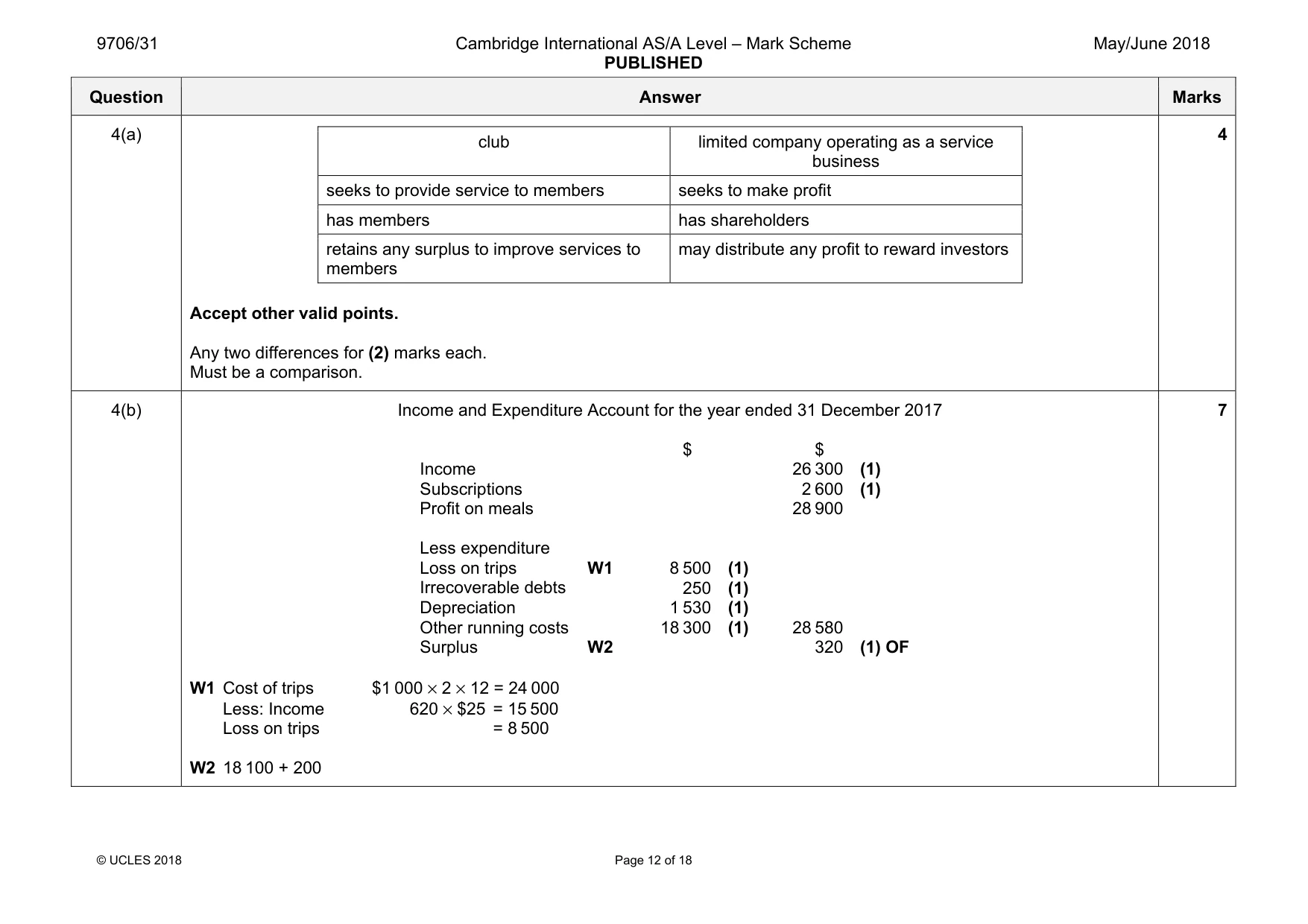
9706/31 Cambridge International AS/A Level – Mark Scheme PUBLISHED May/June 2018 © UCLES 2018 Page 12 of 18 Question Answer Marks 4(a) club limited company operating as a service business seeks to provide service to members seeks to make profit has members has shareholders retains any surplus to improve services to members may distribute any profit to reward investors Accept other valid points. Any two differences for (2) marks each. Must be a comparison. 4 4(b) Income and Expenditure Account for the year ended 31 December 2017 $ $ Income 26 300 (1) Subscriptions 2 600 (1) Profit on meals 28 900 Less expenditure Loss on trips W1 8 500 (1) Irrecoverable debts 250 (1) Depreciation 1 530 (1) Other running costs 18 300 (1) 28 580 Surplus W2 320 (1) OF W1 Cost of trips $1 000 × 2 × 12 = 24 000 Less: Income 620 × $25 = 15 500 Loss on trips = 8 500 W2 18 100 + 200 7
Mark scheme, page 13
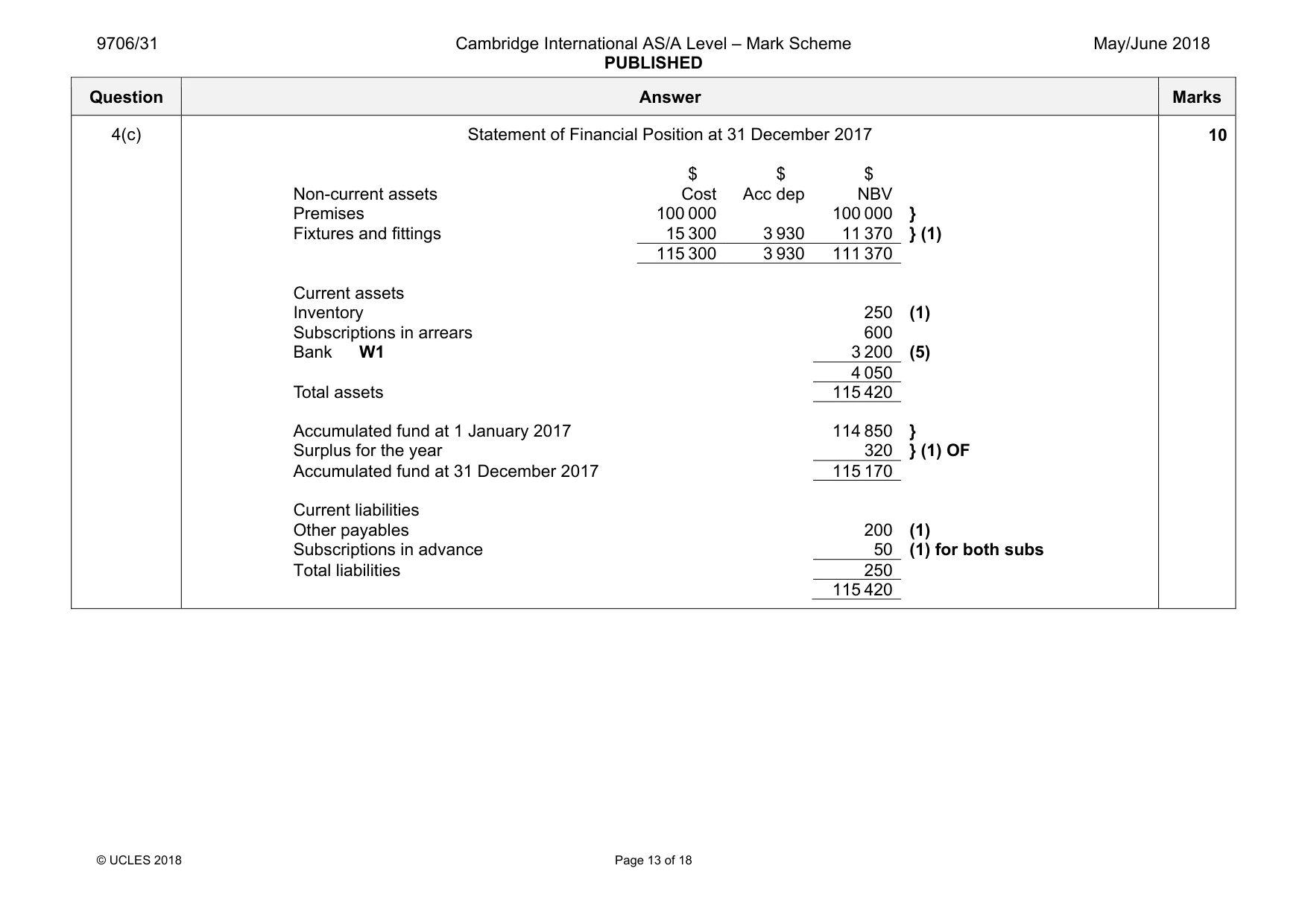
9706/31 Cambridge International AS/A Level – Mark Scheme PUBLISHED May/June 2018 © UCLES 2018 Page 13 of 18 Question Answer Marks 4(c) Statement of Financial Position at 31 December 2017 $ $ $ Non-current assets Cost Acc dep NBV Premises 100 000 100 000 } Fixtures and fittings 15 300 3 930 11 370 } (1) 115 300 3 930 111 370 Current assets Inventory 250 (1) Subscriptions in arrears 600 Bank W1 3 200 (5) 4 050 Total assets 115 420 Accumulated fund at 1 January 2017 114 850 } Surplus for the year 320 } (1) OF Accumulated fund at 31 December 2017 115 170 Current liabilities Other payables 200 (1) Subscriptions in advance 50 (1) for both subs Total liabilities 250 115 420 10
Mark scheme, page 14
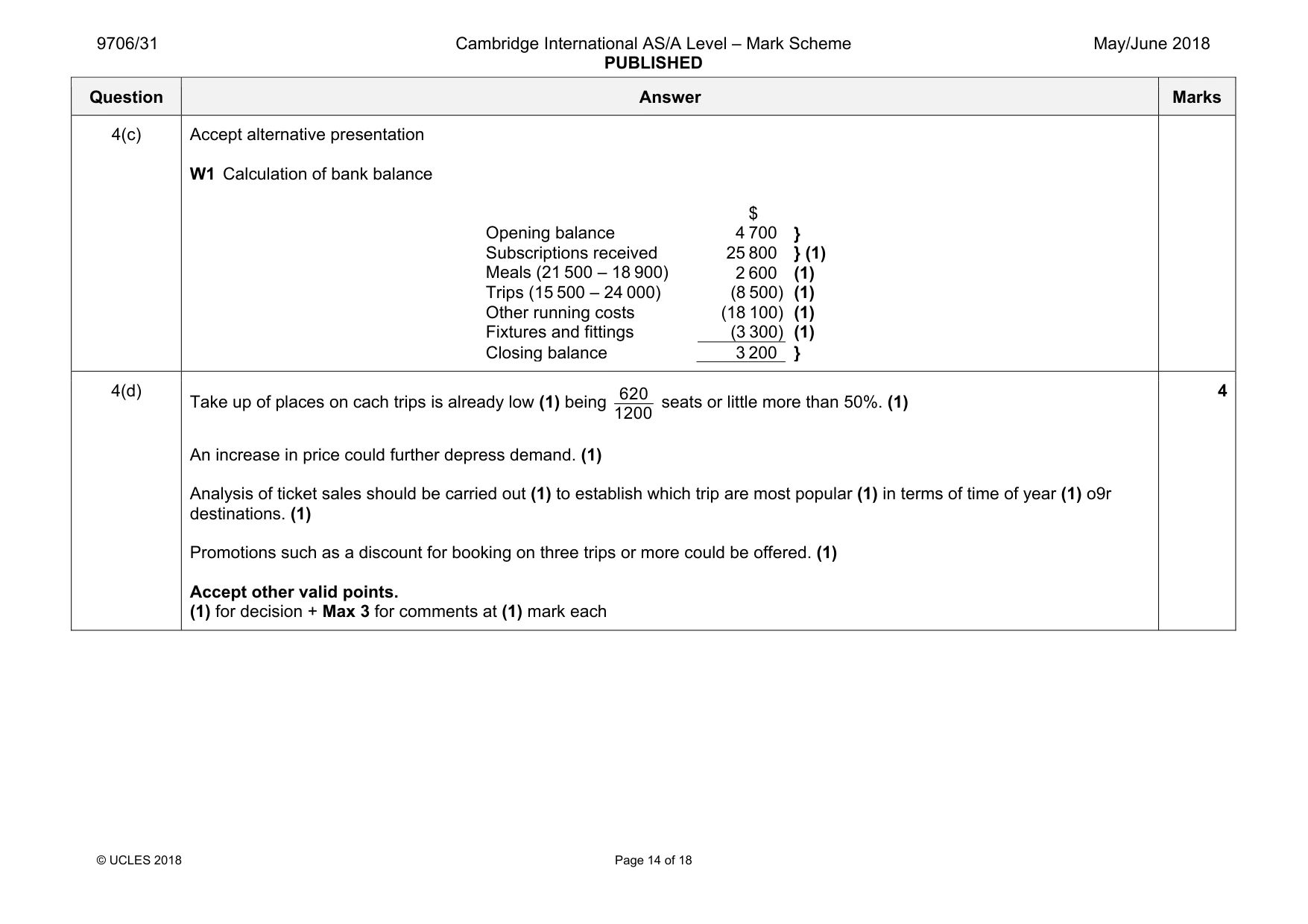
9706/31 Cambridge International AS/A Level – Mark Scheme PUBLISHED May/June 2018 © UCLES 2018 Page 14 of 18 Question Answer Marks 4(c) Accept alternative presentation W1 Calculation of bank balance $ Opening balance 4 700 } Subscriptions received 25 800 } (1) Meals (21 500 – 18 900) 2 600 (1) Trips (15 500 – 24 000) (8 500) (1) Other running costs (18 100) (1) Fixtures and fittings (3 300) (1) Closing balance 3 200 } 4(d) Take up of places on cach trips is already low (1) being 620 1200 seats or little more than 50%. (1) An increase in price could further depress demand. (1) Analysis of ticket sales should be carried out (1) to establish which trip are most popular (1) in terms of time of year (1) o9r destinations. (1) Promotions such as a discount for booking on three trips or more could be offered. (1) Accept other valid points. (1) for decision + Max 3 for comments at (1) mark each 4
Mark scheme, page 15
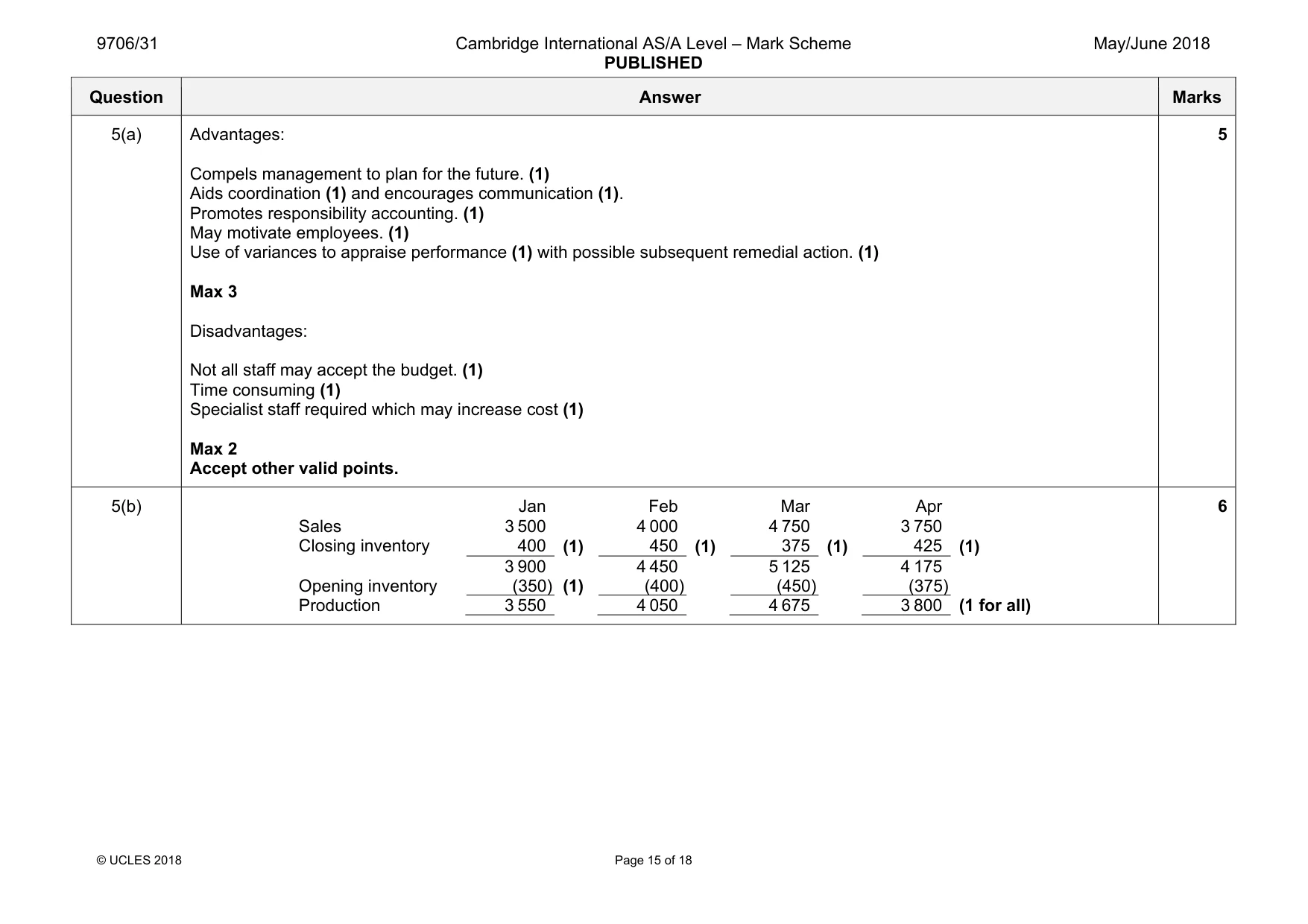
9706/31 Cambridge International AS/A Level – Mark Scheme PUBLISHED May/June 2018 © UCLES 2018 Page 15 of 18 Question Answer Marks 5(a) Advantages: Compels management to plan for the future. (1) Aids coordination (1) and encourages communication (1). Promotes responsibility accounting. (1) May motivate employees. (1) Use of variances to appraise performance (1) with possible subsequent remedial action. (1) Max 3 Disadvantages: Not all staff may accept the budget. (1) Time consuming (1) Specialist staff required which may increase cost (1) Max 2 Accept other valid points. 5 5(b) Jan Feb Mar Apr Sales 3 500 4 000 4 750 3 750 Closing inventory 400 (1) 450 (1) 375 (1) 425 (1) 3 900 4 450 5 125 4 175 Opening inventory (350) (1) (400) (450) (375) Production 3 550 4 050 4 675 3 800 (1 for all) 6
Mark scheme, page 16
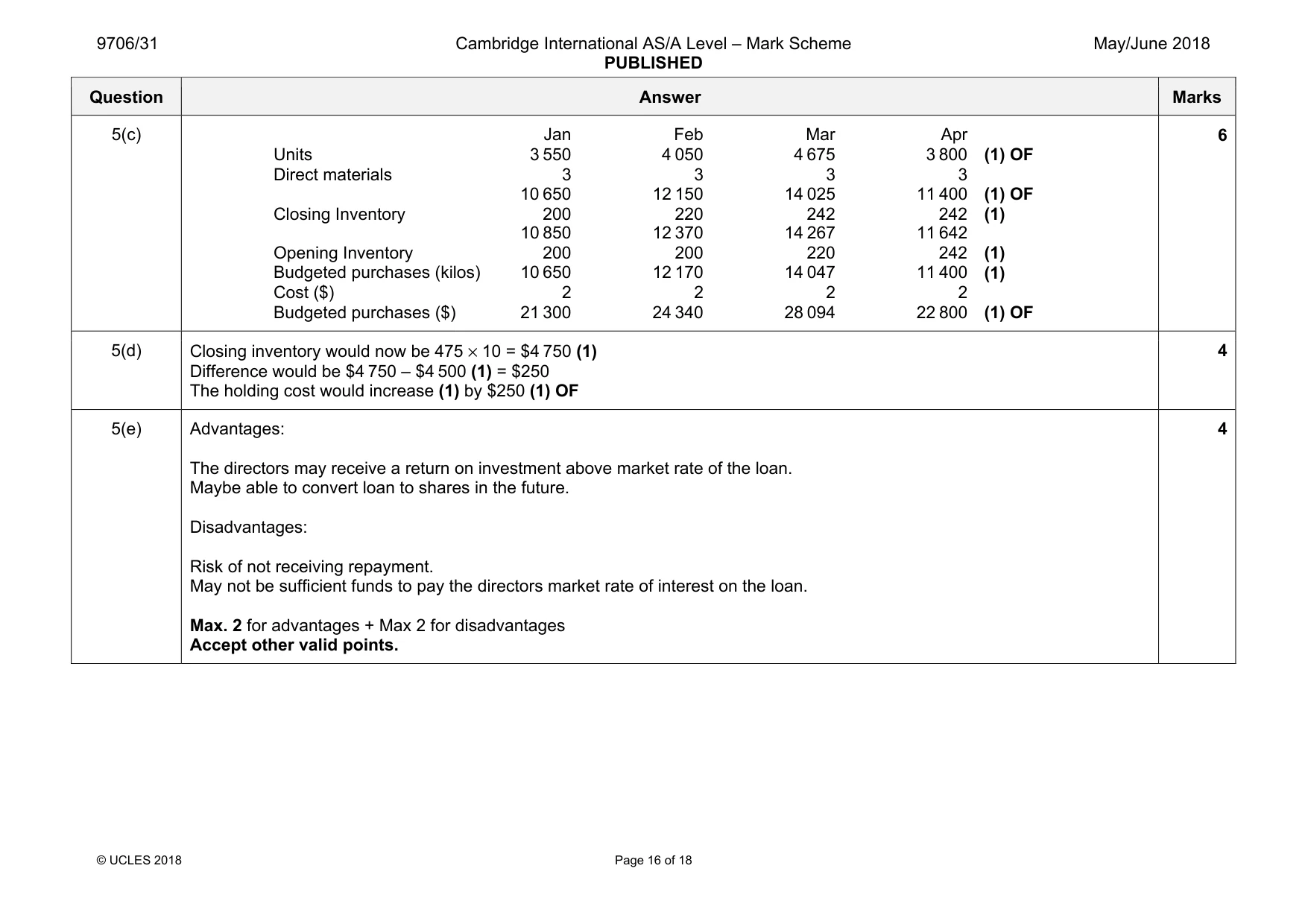
9706/31 Cambridge International AS/A Level – Mark Scheme PUBLISHED May/June 2018 © UCLES 2018 Page 16 of 18 Question Answer Marks 5(c) Jan Feb Mar Apr Units 3 550 4 050 4 675 3 800 (1) OF Direct materials 3 3 3 3 10 650 12 150 14 025 11 400 (1) OF Closing Inventory 200 220 242 242 (1) 10 850 12 370 14 267 11 642 Opening Inventory 200 200 220 242 (1) Budgeted purchases (kilos) 10 650 12 170 14 047 11 400 (1) Cost ($) 2 2 2 2 Budgeted purchases ($) 21 300 24 340 28 094 22 800 (1) OF 6 5(d) Closing inventory would now be 475 × 10 = $4 750 (1) Difference would be $4 750 – $4 500 (1) = $250 The holding cost would increase (1) by $250 (1) OF 4 5(e) Advantages: The directors may receive a return on investment above market rate of the loan. Maybe able to convert loan to shares in the future. Disadvantages: Risk of not receiving repayment. May not be sufficient funds to pay the directors market rate of interest on the loan. Max. 2 for advantages + Max 2 for disadvantages Accept other valid points. 4
Mark scheme, page 17
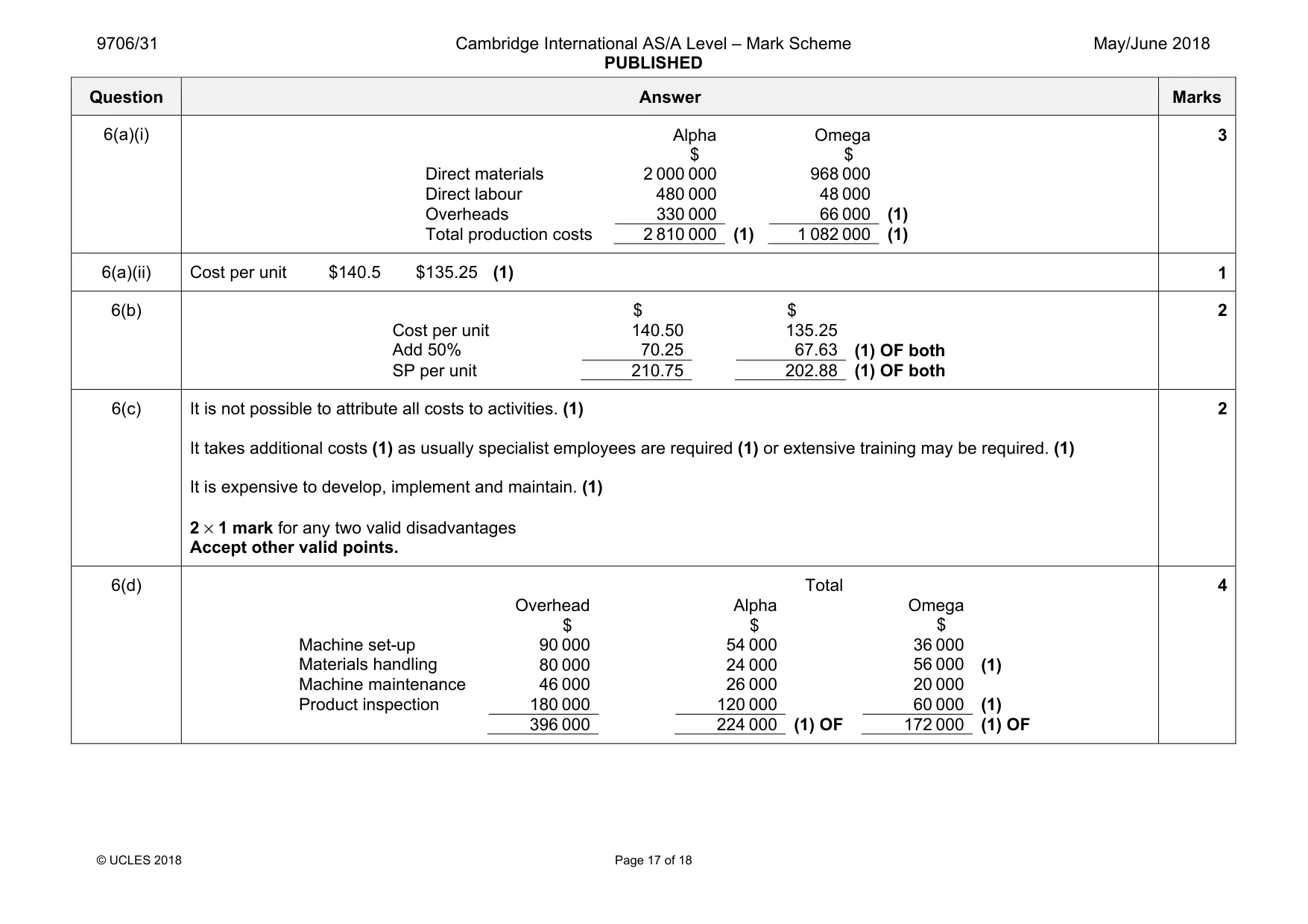
9706/31 Cambridge International AS/A Level – Mark Scheme PUBLISHED May/June 2018 © UCLES 2018 Page 17 of 18 Question Answer Marks 6(a)(i) Alpha Omega $ $ Direct materials 2 000 000 968 000 Direct labour 480 000 48 000 Overheads 330 000 66 000 (1) Total production costs 2 810 000 (1) 1 082 000 (1) 3 6(a)(ii) Cost per unit $140.5 $135.25 (1) 1 6(b) $ $ Cost per unit 140.50 135.25 Add 50% 70.25 67.63 (1) OF both SP per unit 210.75 202.88 (1) OF both 2 6(c) It is not possible to attribute all costs to activities. (1) It takes additional costs (1) as usually specialist employees are required (1) or extensive training may be required. (1) It is expensive to develop, implement and maintain. (1) 2 × 1 mark for any two valid disadvantages Accept other valid points. 2 6(d) Total Overhead Alpha Omega $ $ $ Machine set-up 90 000 54 000 36 000 Materials handling 80 000 24 000 56 000 (1) Machine maintenance 46 000 26 000 20 000 Product inspection 180 000 120 000 60 000 (1) 396 000 224 000 (1) OF 172 000 (1) OF 4
Mark scheme, page 18
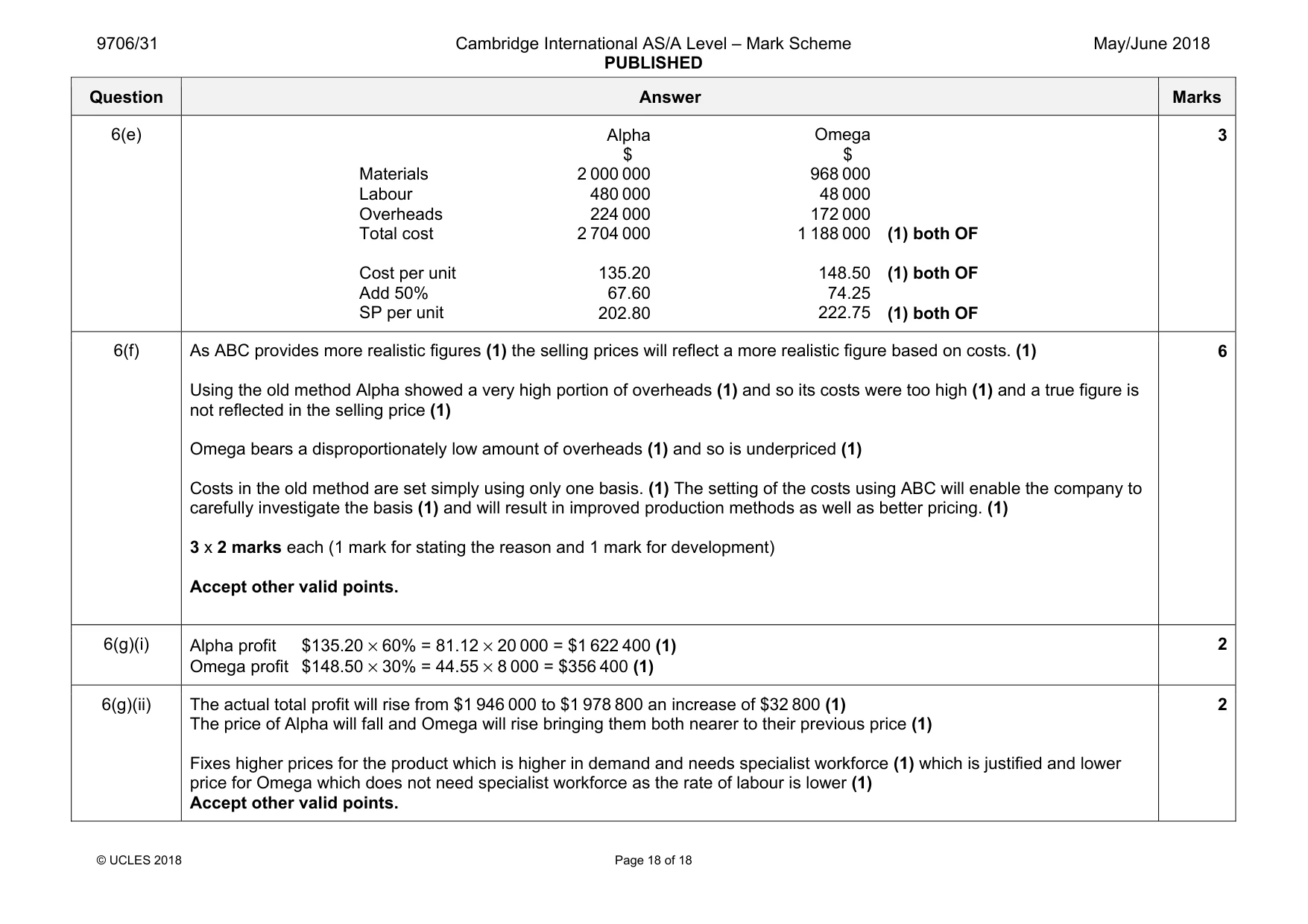
9706/31 Cambridge International AS/A Level – Mark Scheme PUBLISHED May/June 2018 © UCLES 2018 Page 18 of 18 Question Answer Marks 6(e) Alpha Omega $ $ Materials 2 000 000 968 000 Labour 480 000 48 000 Overheads 224 000 172 000 Total cost 2 704 000 1 188 000 (1) both OF Cost per unit 135.20 148.50 (1) both OF Add 50% 67.60 74.25 SP per unit 202.80 222.75 (1) both OF 3 6(f) As ABC provides more realistic figures (1) the selling prices will reflect a more realistic figure based on costs. (1) Using the old method Alpha showed a very high portion of overheads (1) and so its costs were too high (1) and a true figure is not reflected in the selling price (1) Omega bears a disproportionately low amount of overheads (1) and so is underpriced (1) Costs in the old method are set simply using only one basis. (1) The setting of the costs using ABC will enable the company to carefully investigate the basis (1) and will result in improved production methods as well as better pricing. (1) 3 x 2 marks each (1 mark for stating the reason and 1 mark for development) Accept other valid points. 6 6(g)(i) Alpha profit $135.20 × 60% = 81.12 × 20 000 = $1 622 400 (1) Omega profit $148.50 × 30% = 44.55 × 8 000 = $356 400 (1) 2 6(g)(ii) The actual total profit will rise from $1 946 000 to $1 978 800 an increase of $32 800 (1) The price of Alpha will fall and Omega will rise bringing them both nearer to their previous price (1) Fixes higher prices for the product which is higher in demand and needs specialist workforce (1) which is justified and lower price for Omega which does not need specialist workforce as the rate of labour is lower (1) Accept other valid points. 2
What you needed in this session
Cambridge’s own grade thresholds for 2018 May/June, Paper 3 · Variant 1. A higher threshold means an easier paper — the bar moves with how the cohort did.