Cambridge A Level Accounting 9706 — 2017 May/June Paper 3 · Variant 2
9706/32/M/J/17 · 150 marks · ≈169 min
The question paper and its mark scheme, free to read here and free to download. This is Cambridge’s own paper, exactly as it was sat.
Question paper12 pages
Mark scheme14 pages
Answers below. Sit the paper first if you are practising.
Paper as text
Question paper, page 1
This document consists of 12 printed pages and 1 Insert. IB17 06_9706_32/7RP © UCLES 2017 [Turn over Cambridge International Examinations Cambridge International Advanced Subsidiary and Advanced Level ACCOUNTING 9706/32 Paper 3 Structured Questions May/June 2017 3 hours No Additional Materials are required. READ THESE INSTRUCTIONS FIRST An answer booklet is provided inside this question paper. You should follow the instructions on the front cover of the answer booklet. If you need additional answer paper ask the invigilator for a continuation booklet. Answer all questions. All accounting statements are to be presented in good style. International accounting terms and formats should be used as appropriate. Workings should be shown. You may use a calculator. The number of marks is given in brackets [ ] at the end of each question or part question.
Question paper, page 2
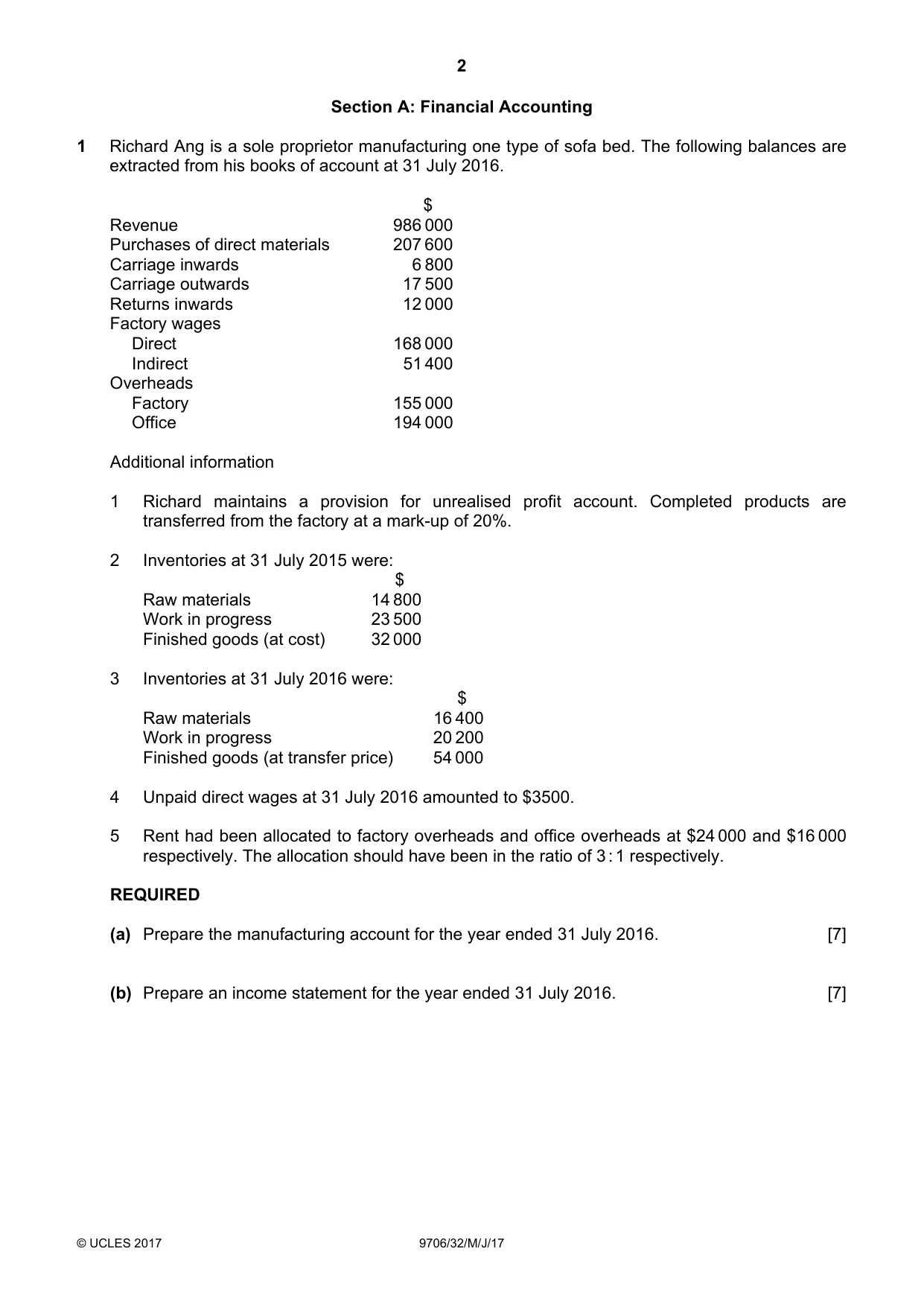
2 © UCLES 2017 9706/32/M/J/17 Section A: Financial Accounting 1 Richard Ang is a sole proprietor manufacturing one type of sofa bed. The following balances are extracted from his books of account at 31 July 2016. $ Revenue 986 000 Purchases of direct materials 207 600 Carriage inwards 6 800 Carriage outwards 17 500 Returns inwards 12 000 Factory wages Direct 168 000 Indirect 51 400 Overheads Factory 155 000 Office 194 000 Additional information 1 Richard maintains a provision for unrealised profit account. Completed products are transferred from the factory at a mark-up of 20%. 2 Inventories at 31 July 2015 were: $ Raw materials 14 800 Work in progress 23 500 Finished goods (at cost) 32 000 3 Inventories at 31 July 2016 were: $ Raw materials 16 400 Work in progress 20 200 Finished goods (at transfer price) 54 000 4 Unpaid direct wages at 31 July 2016 amounted to $3500. 5 Rent had been allocated to factory overheads and office overheads at $24 000 and $16 000 respectively. The allocation should have been in the ratio of 3 : 1 respectively. REQUIRED (a) Prepare the manufacturing account for the year ended 31 July 2016. [7] (b) Prepare an income statement for the year ended 31 July 2016. [7]
Question paper, page 3
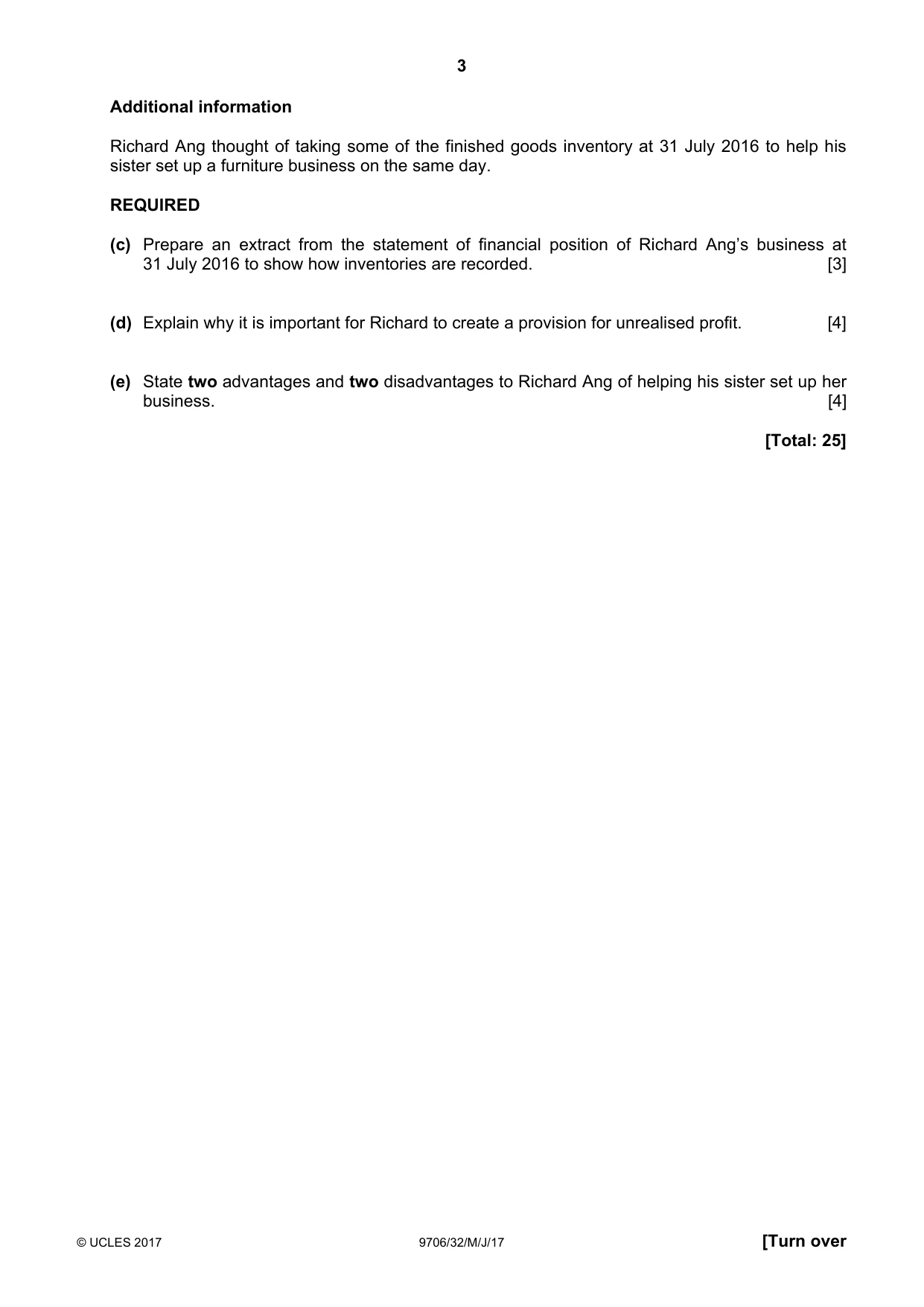
3 © UCLES 2017 9706/32/M/J/17 [Turn over Additional information Richard Ang thought of taking some of the finished goods inventory at 31 July 2016 to help his sister set up a furniture business on the same day. REQUIRED (c) Prepare an extract from the statement of financial position of Richard Ang’s business at 31 July 2016 to show how inventories are recorded. [3] (d) Explain why it is important for Richard to create a provision for unrealised profit. [4] (e) State two advantages and two disadvantages to Richard Ang of helping his sister set up her business. [4] [Total: 25]
Question paper, page 4
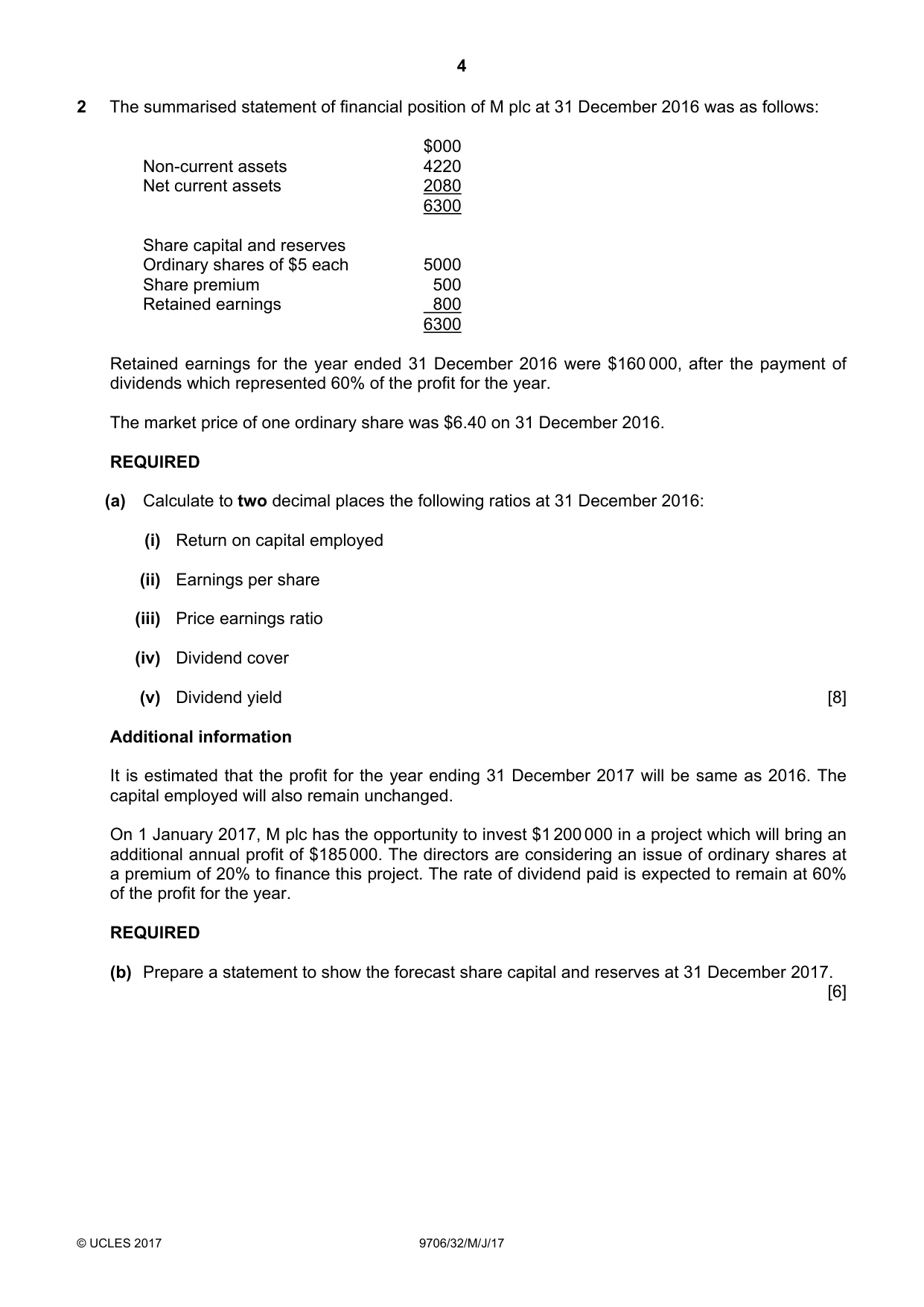
4 © UCLES 2017 9706/32/M/J/17 2 The summarised statement of financial position of M plc at 31 December 2016 was as follows: $000 Non-current assets 4220 Net current assets 2080 6300 Share capital and reserves Ordinary shares of $5 each 5000 Share premium 500 Retained earnings 800 6300 Retained earnings for the year ended 31 December 2016 were $160 000, after the payment of dividends which represented 60% of the profit for the year. The market price of one ordinary share was $6.40 on 31 December 2016. REQUIRED (a) Calculate to two decimal places the following ratios at 31 December 2016: (i) Return on capital employed (ii) Earnings per share (iii) Price earnings ratio (iv) Dividend cover (v) Dividend yield [8] Additional information It is estimated that the profit for the year ending 31 December 2017 will be same as 2016. The capital employed will also remain unchanged. On 1 January 2017, M plc has the opportunity to invest $1 200 000 in a project which will bring an additional annual profit of $185 000. The directors are considering an issue of ordinary shares at a premium of 20% to finance this project. The rate of dividend paid is expected to remain at 60% of the profit for the year. REQUIRED (b) Prepare a statement to show the forecast share capital and reserves at 31 December 2017. [6]
Question paper, page 5
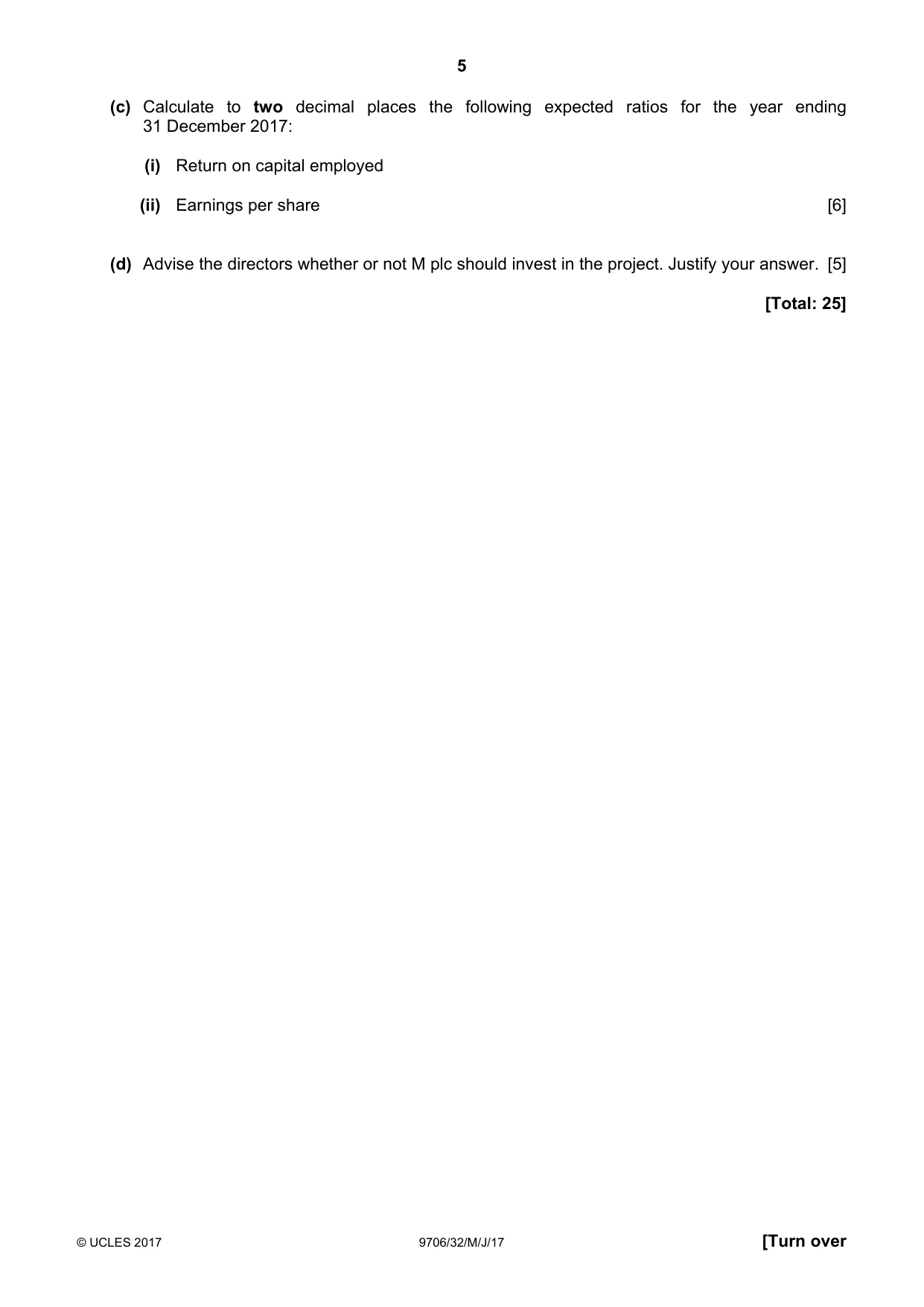
5 © UCLES 2017 9706/32/M/J/17 [Turn over (c) Calculate to two decimal places the following expected ratios for the year ending 31 December 2017: (i) Return on capital employed (ii) Earnings per share [6] (d) Advise the directors whether or not M plc should invest in the project. Justify your answer. [5] [Total: 25]
Question paper, page 6
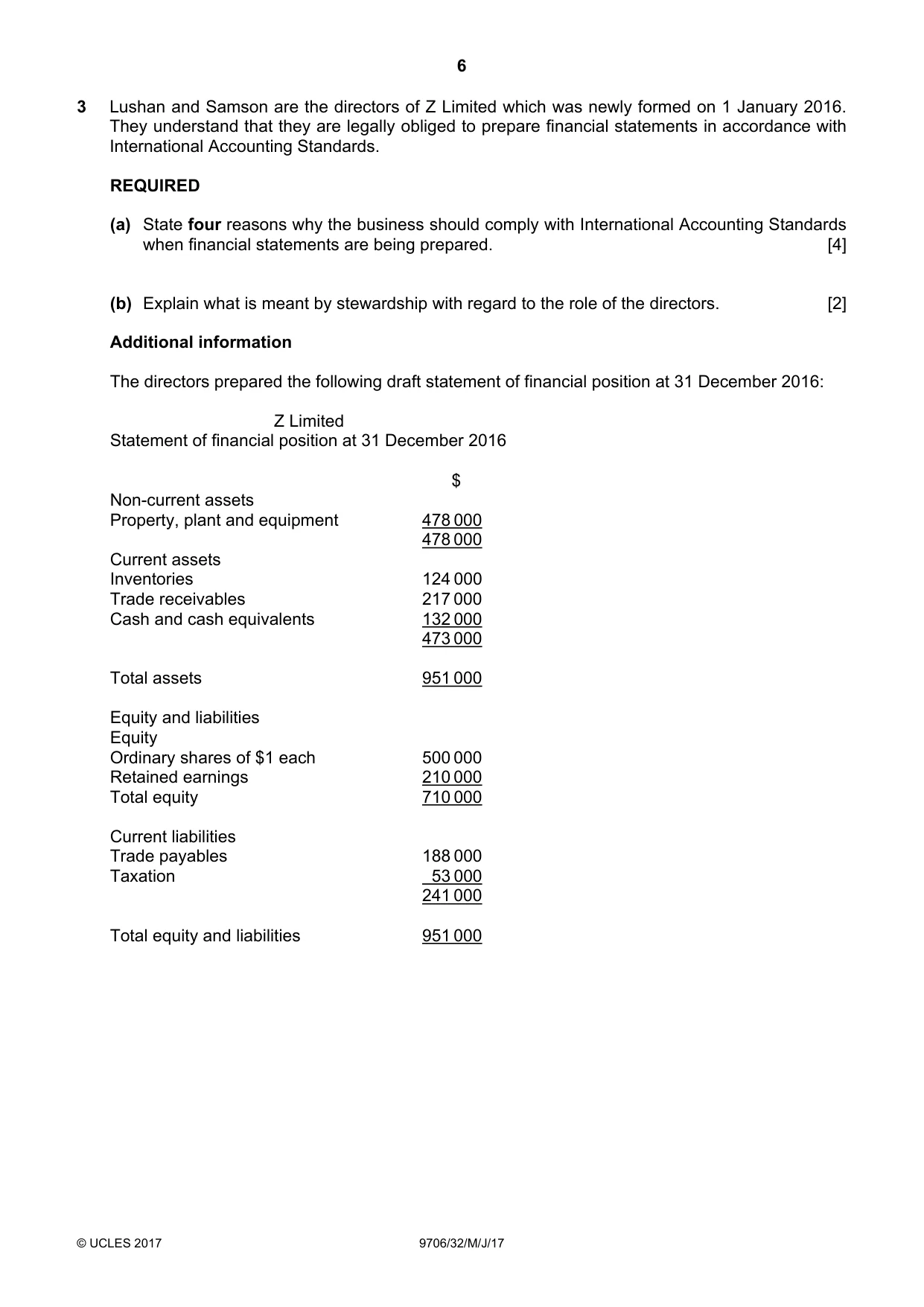
6 © UCLES 2017 9706/32/M/J/17 3 Lushan and Samson are the directors of Z Limited which was newly formed on 1 January 2016. They understand that they are legally obliged to prepare financial statements in accordance with International Accounting Standards. REQUIRED (a) State four reasons why the business should comply with International Accounting Standards when financial statements are being prepared. [4] (b) Explain what is meant by stewardship with regard to the role of the directors. [2] Additional information The directors prepared the following draft statement of financial position at 31 December 2016: Z Limited Statement of financial position at 31 December 2016 $ Non-current assets Property, plant and equipment 478 000 478 000 Current assets Inventories 124 000 Trade receivables 217 000 Cash and cash equivalents 132 000 473 000 Total assets 951 000 Equity and liabilities Equity Ordinary shares of $1 each 500 000 Retained earnings 210 000 Total equity 710 000 Current liabilities Trade payables 188 000 Taxation 53 000 241 000 Total equity and liabilities 951 000
Question paper, page 7
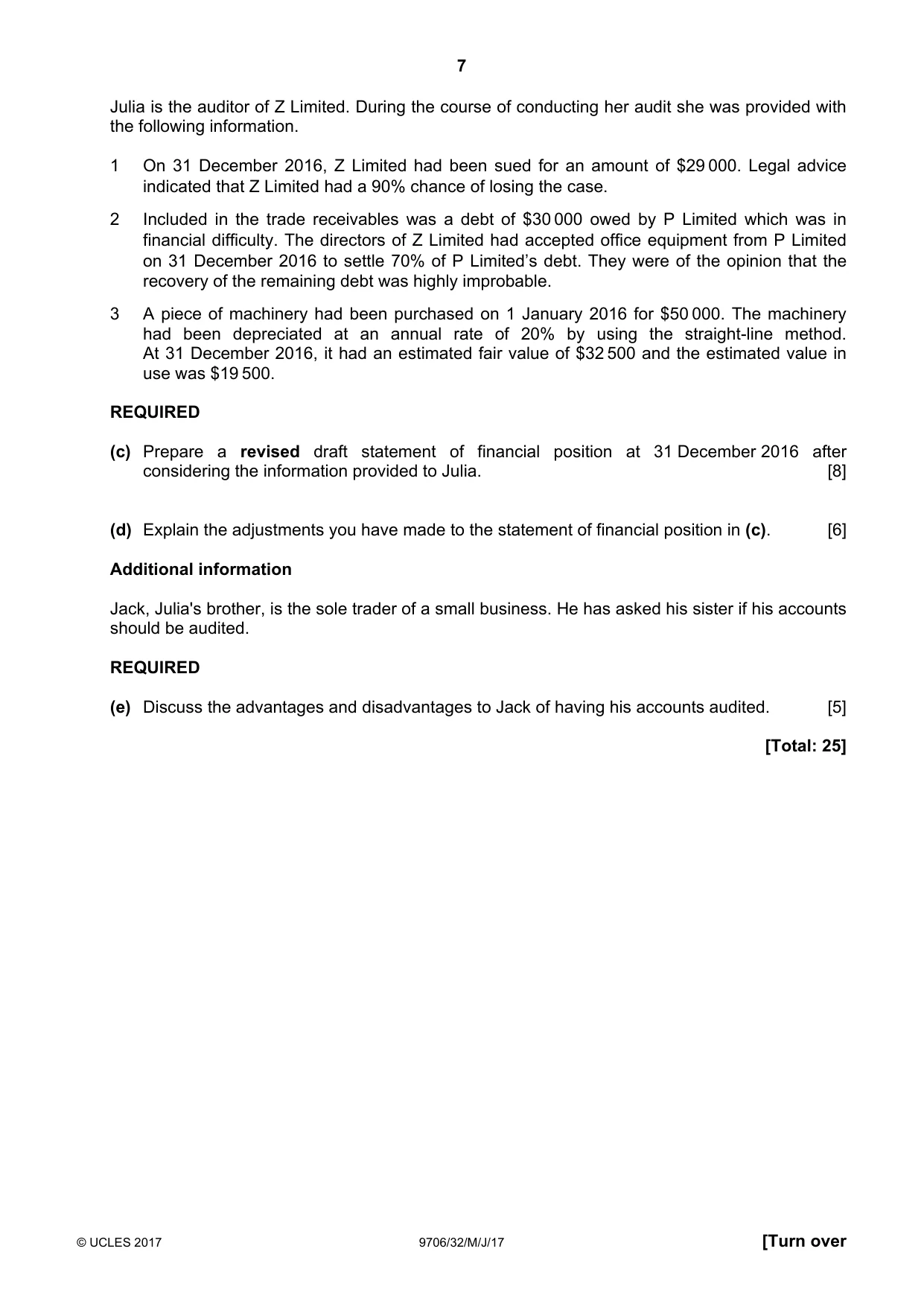
7 © UCLES 2017 9706/32/M/J/17 [Turn over Julia is the auditor of Z Limited. During the course of conducting her audit she was provided with the following information. 1 On 31 December 2016, Z Limited had been sued for an amount of $29 000. Legal advice indicated that Z Limited had a 90% chance of losing the case. 2 Included in the trade receivables was a debt of $30 000 owed by P Limited which was in financial difficulty. The directors of Z Limited had accepted office equipment from P Limited on 31 December 2016 to settle 70% of P Limited’s debt. They were of the opinion that the recovery of the remaining debt was highly improbable. 3 A piece of machinery had been purchased on 1 January 2016 for $50 000. The machinery had been depreciated at an annual rate of 20% by using the straight-line method. At 31 December 2016, it had an estimated fair value of $32 500 and the estimated value in use was $19 500. REQUIRED (c) Prepare a revised draft statement of financial position at 31 December 2016 after considering the information provided to Julia. [8] (d) Explain the adjustments you have made to the statement of financial position in (c). [6] Additional information Jack, Julia's brother, is the sole trader of a small business. He has asked his sister if his accounts should be audited. REQUIRED (e) Discuss the advantages and disadvantages to Jack of having his accounts audited. [5] [Total: 25]
Question paper, page 8
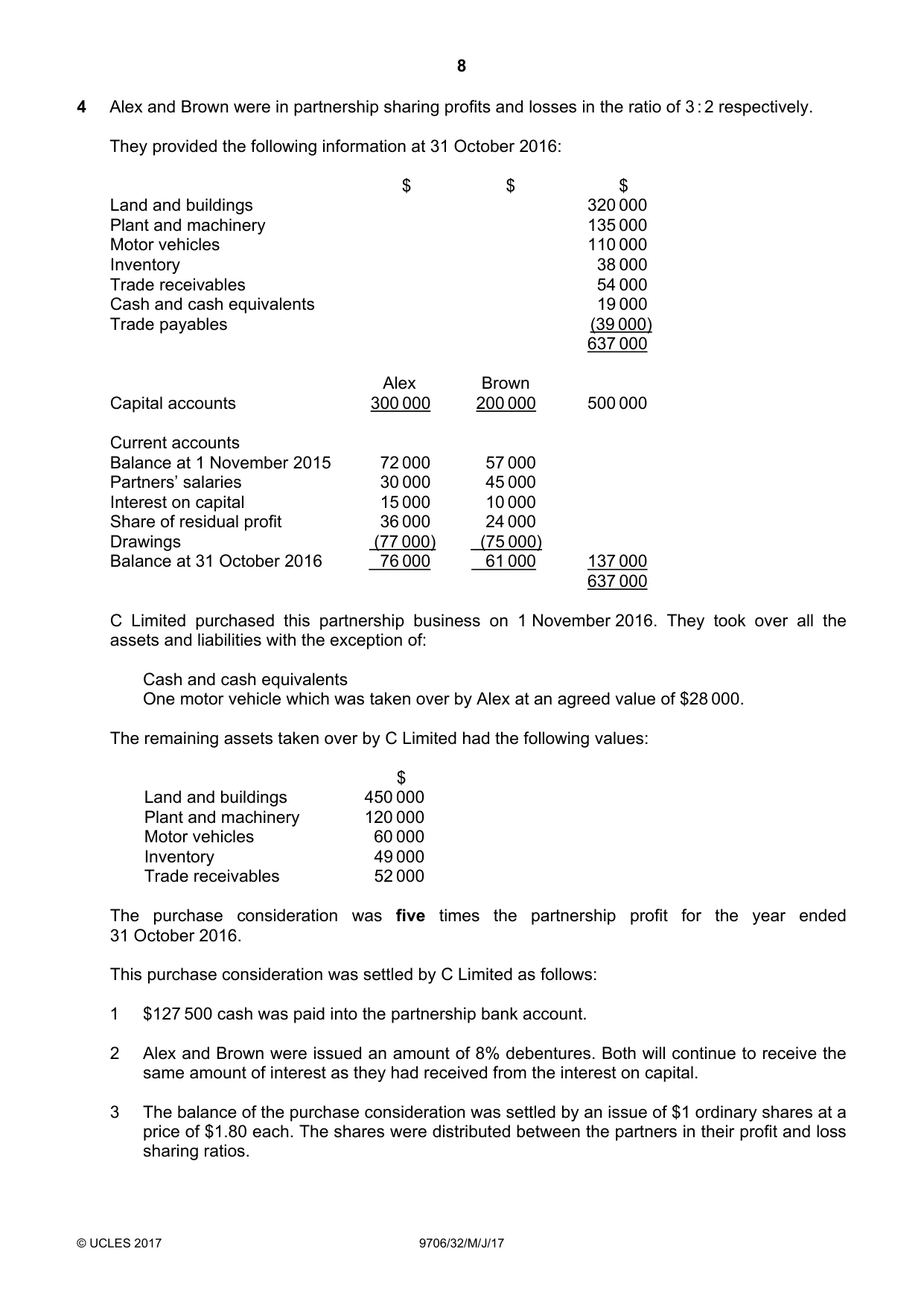
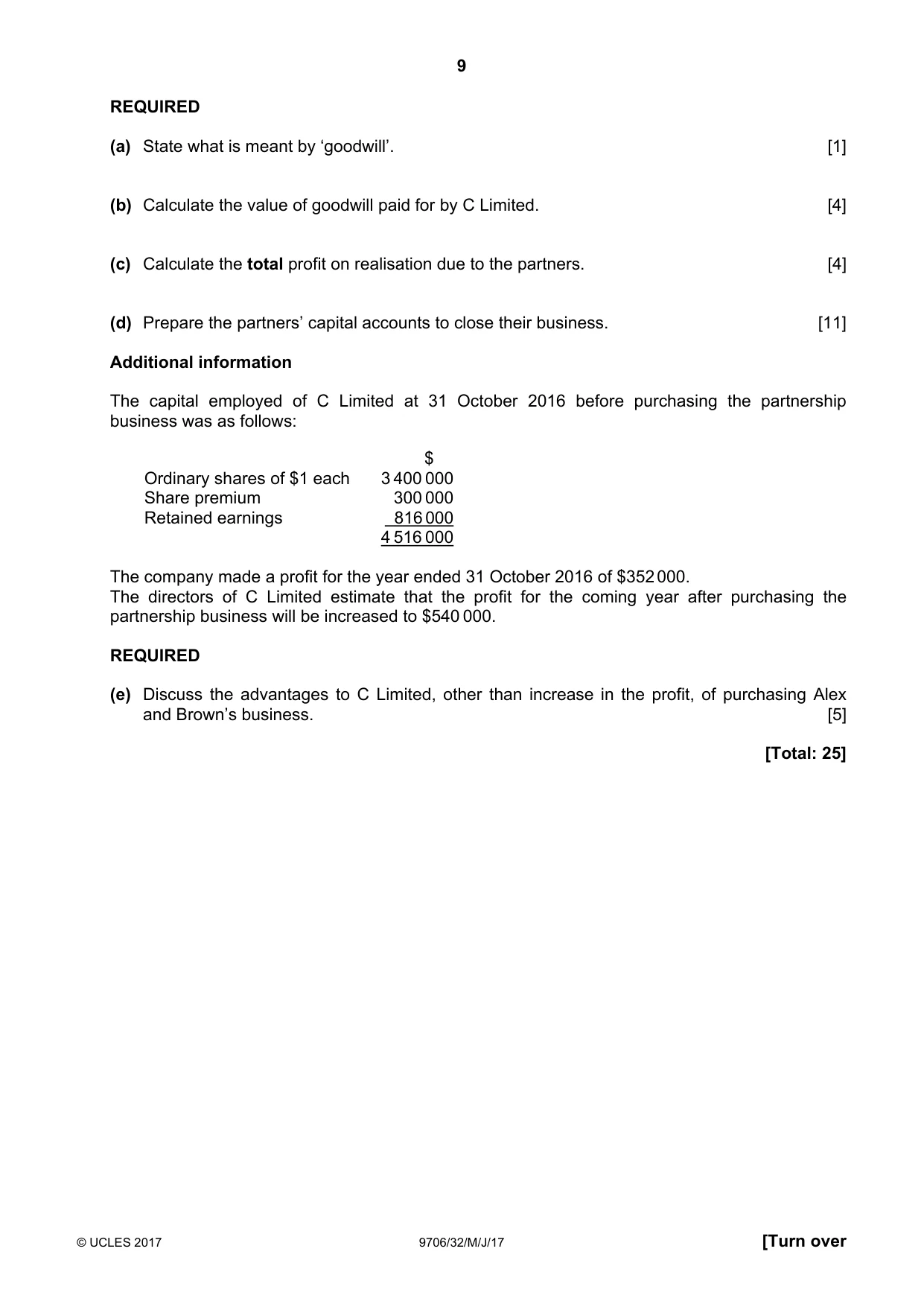
8 © UCLES 2017 9706/32/M/J/17 4 Alex and Brown were in partnership sharing profits and losses in the ratio of 3 : 2 respectively. They provided the following information at 31 October 2016: $ $ $ Land and buildings 320 000 Plant and machinery 135 000 Motor vehicles 110 000 Inventory 38 000 Trade receivables 54 000 Cash and cash equivalents 19 000 Trade payables (39 000) 637 000 Alex Brown Capital accounts 300 000 200 000 500 000 Current accounts Balance at 1 November 2015 72 000 57 000 Partners’ salaries 30 000 45 000 Interest on capital 15 000 10 000 Share of residual profit 36 000 24 000 Drawings (77 000) (75 000) Balance at 31 October 2016 76 000 61 000 137 000 637 000 C Limited purchased this partnership business on 1 November 2016. They took over all the assets and liabilities with the exception of: Cash and cash equivalents One motor vehicle which was taken over by Alex at an agreed value of $28 000. The remaining assets taken over by C Limited had the following values: $ Land and buildings 450 000 Plant and machinery 120 000 Motor vehicles 60 000 Inventory 49 000 Trade receivables 52 000 The purchase consideration was five times the partnership profit for the year ended 31 October 2016. This purchase consideration was settled by C Limited as follows: 1 $127 500 cash was paid into the partnership bank account. 2 Alex and Brown were issued an amount of 8% debentures. Both will continue to receive the same amount of interest as they had received from the interest on capital. 3 The balance of the purchase consideration was settled by an issue of $1 ordinary shares at a price of $1.80 each. The shares were distributed between the partners in their profit and loss sharing ratios.
Question paper, page 9
9 © UCLES 2017 9706/32/M/J/17 [Turn over REQUIRED (a) State what is meant by ‘goodwill’. [1] (b) Calculate the value of goodwill paid for by C Limited. [4] (c) Calculate the total profit on realisation due to the partners. [4] (d) Prepare the partners’ capital accounts to close their business. [11] Additional information The capital employed of C Limited at 31 October 2016 before purchasing the partnership business was as follows: $ Ordinary shares of $1 each 3 400 000 Share premium 300 000 Retained earnings 816 000 4 516 000 The company made a profit for the year ended 31 October 2016 of $352 000. The directors of C Limited estimate that the profit for the coming year after purchasing the partnership business will be increased to $540 000. REQUIRED (e) Discuss the advantages to C Limited, other than increase in the profit, of purchasing Alex and Brown’s business. [5] [Total: 25]
Question paper, page 10
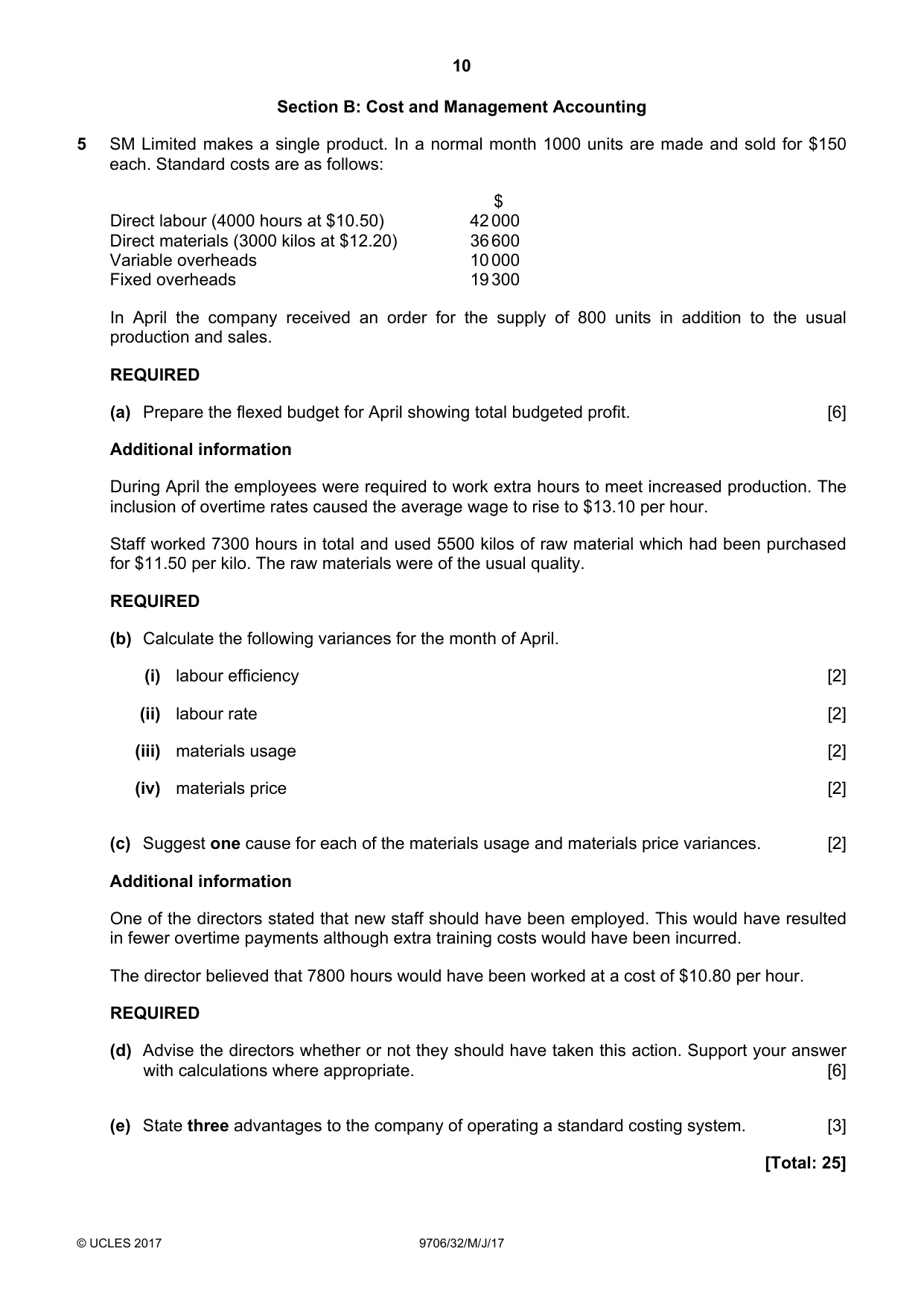
10 © UCLES 2017 9706/32/M/J/17 Section B: Cost and Management Accounting 5 SM Limited makes a single product. In a normal month 1000 units are made and sold for $150 each. Standard costs are as follows: $ Direct labour (4000 hours at $10.50) 42 000 Direct materials (3000 kilos at $12.20) 36 600 Variable overheads 10 000 Fixed overheads 19 300 In April the company received an order for the supply of 800 units in addition to the usual production and sales. REQUIRED (a) Prepare the flexed budget for April showing total budgeted profit. [6] Additional information During April the employees were required to work extra hours to meet increased production. The inclusion of overtime rates caused the average wage to rise to $13.10 per hour. Staff worked 7300 hours in total and used 5500 kilos of raw material which had been purchased for $11.50 per kilo. The raw materials were of the usual quality. REQUIRED (b) Calculate the following variances for the month of April. (i) labour efficiency [2] (ii) labour rate [2] (iii) materials usage [2] (iv) materials price [2] (c) Suggest one cause for each of the materials usage and materials price variances. [2] Additional information One of the directors stated that new staff should have been employed. This would have resulted in fewer overtime payments although extra training costs would have been incurred. The director believed that 7800 hours would have been worked at a cost of $10.80 per hour. REQUIRED (d) Advise the directors whether or not they should have taken this action. Support your answer with calculations where appropriate. [6] (e) State three advantages to the company of operating a standard costing system. [3] [Total: 25]
Question paper, page 11
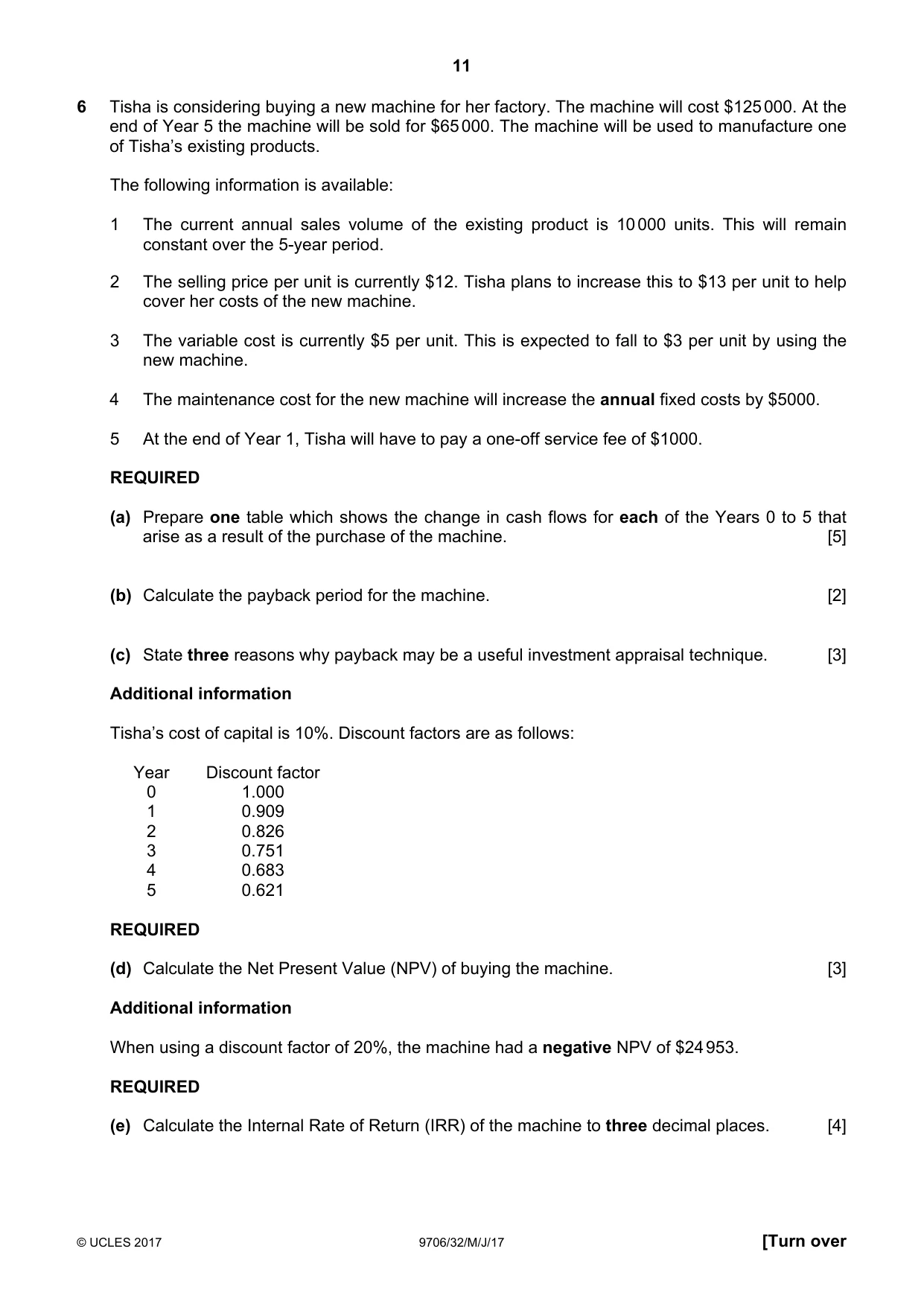
11 © UCLES 2017 9706/32/M/J/17 [Turn over 6 Tisha is considering buying a new machine for her factory. The machine will cost $125 000. At the end of Year 5 the machine will be sold for $65 000. The machine will be used to manufacture one of Tisha’s existing products. The following information is available: 1 The current annual sales volume of the existing product is 10 000 units. This will remain constant over the 5-year period. 2 The selling price per unit is currently $12. Tisha plans to increase this to $13 per unit to help cover her costs of the new machine. 3 The variable cost is currently $5 per unit. This is expected to fall to $3 per unit by using the new machine. 4 The maintenance cost for the new machine will increase the annual fixed costs by $5000. 5 At the end of Year 1, Tisha will have to pay a one-off service fee of $1000. REQUIRED (a) Prepare one table which shows the change in cash flows for each of the Years 0 to 5 that arise as a result of the purchase of the machine. [5] (b) Calculate the payback period for the machine. [2] (c) State three reasons why payback may be a useful investment appraisal technique. [3] Additional information Tisha’s cost of capital is 10%. Discount factors are as follows: Year Discount factor 0 1.000 1 0.909 2 0.826 3 0.751 4 0.683 5 0.621 REQUIRED (d) Calculate the Net Present Value (NPV) of buying the machine. [3] Additional information When using a discount factor of 20%, the machine had a negative NPV of $24 953. REQUIRED (e) Calculate the Internal Rate of Return (IRR) of the machine to three decimal places. [4]
Question paper, page 12
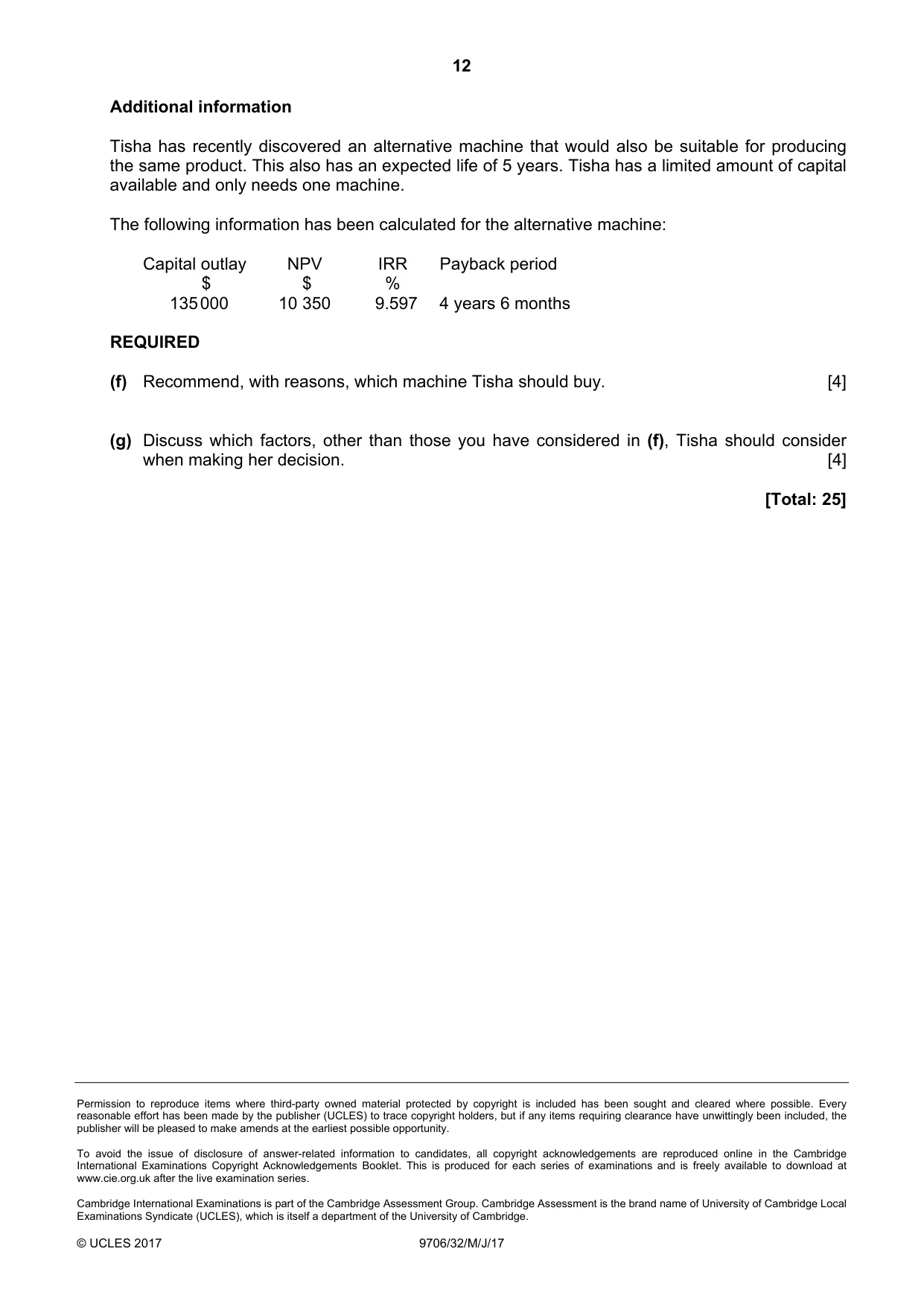
12 Permission to reproduce items where third-party owned material protected by copyright is included has been sought and cleared where possible. Every reasonable effort has been made by the publisher (UCLES) to trace copyright holders, but if any items requiring clearance have unwittingly been included, the publisher will be pleased to make amends at the earliest possible opportunity. To avoid the issue of disclosure of answer-related information to candidates, all copyright acknowledgements are reproduced online in the Cambridge International Examinations Copyright Acknowledgements Booklet. This is produced for each series of examinations and is freely available to download at www.cie.org.uk after the live examination series. Cambridge International Examinations is part of the Cambridge Assessment Group. Cambridge Assessment is the brand name of University of Cambridge Local Examinations Syndicate (UCLES), which is itself a department of the University of Cambridge. © UCLES 2017 9706/32/M/J/17 Additional information Tisha has recently discovered an alternative machine that would also be suitable for producing the same product. This also has an expected life of 5 years. Tisha has a limited amount of capital available and only needs one machine. The following information has been calculated for the alternative machine: Capital outlay NPV IRR Payback period $ $ % 135 000 10 350 9.597 4 years 6 months REQUIRED (f) Recommend, with reasons, which machine Tisha should buy. [4] (g) Discuss which factors, other than those you have considered in (f), Tisha should consider when making her decision. [4] [Total: 25]
Mark scheme, page 1
® IGCSE is a registered trademark. This document consists of 14 printed pages. © UCLES 2017 [Turn over Cambridge International Examinations Cambridge International Advanced Subsidiary and Advanced Level ACCOUNTING 9706/32 Paper 3 Structured Questions May/June 2017 MARK SCHEME Maximum Mark: 150 Published This mark scheme is published as an aid to teachers and candidates, to indicate the requirements of the examination. It shows the basis on which Examiners were instructed to award marks. It does not indicate the details of the discussions that took place at an Examiners’ meeting before marking began, which would have considered the acceptability of alternative answers. Mark schemes should be read in conjunction with the question paper and the Principal Examiner Report for Teachers. Cambridge will not enter into discussions about these mark schemes. Cambridge is publishing the mark schemes for the May/June 2017 series for most Cambridge IGCSE®, Cambridge International A and AS Level and Cambridge Pre-U components, and some Cambridge O Level components.
Mark scheme, page 2
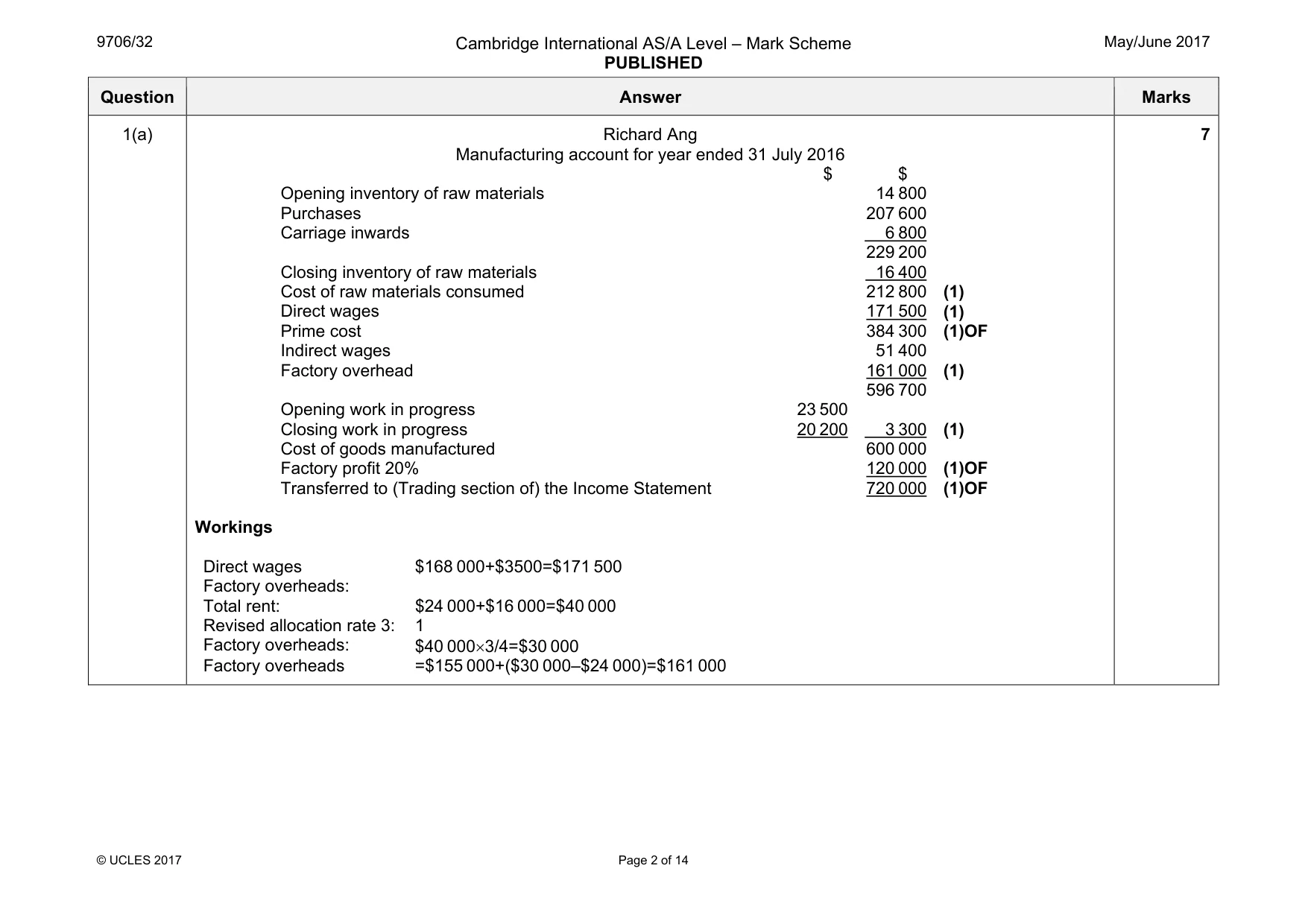
9706/32 Cambridge International AS/A Level – Mark Scheme PUBLISHED May/June 2017 © UCLES 2017 Page 2 of 14 Question Answer Marks 1(a) Richard Ang Manufacturing account for year ended 31 July 2016 $ $ Opening inventory of raw materials 14 800 Purchases 207 600 Carriage inwards 6 800 229 200 Closing inventory of raw materials 16 400 Cost of raw materials consumed 212 800 (1) Direct wages 171 500 (1) Prime cost 384 300 (1)OF Indirect wages 51 400 Factory overhead 161 000 (1) 596 700 Opening work in progress 23 500 Closing work in progress 20 200 3 300 (1) Cost of goods manufactured 600 000 Factory profit 20% 120 000 (1)OF Transferred to (Trading section of) the Income Statement 720 000 (1)OF Workings Direct wages $168 000+$3500=$171 500 Factory overheads: Total rent: $24 000+$16 000=$40 000 Revised allocation rate 3: 1 Factory overheads: $40 000×3/4=$30 000 Factory overheads =$155 000+($30 000–$24 000)=$161 000 7
Mark scheme, page 3
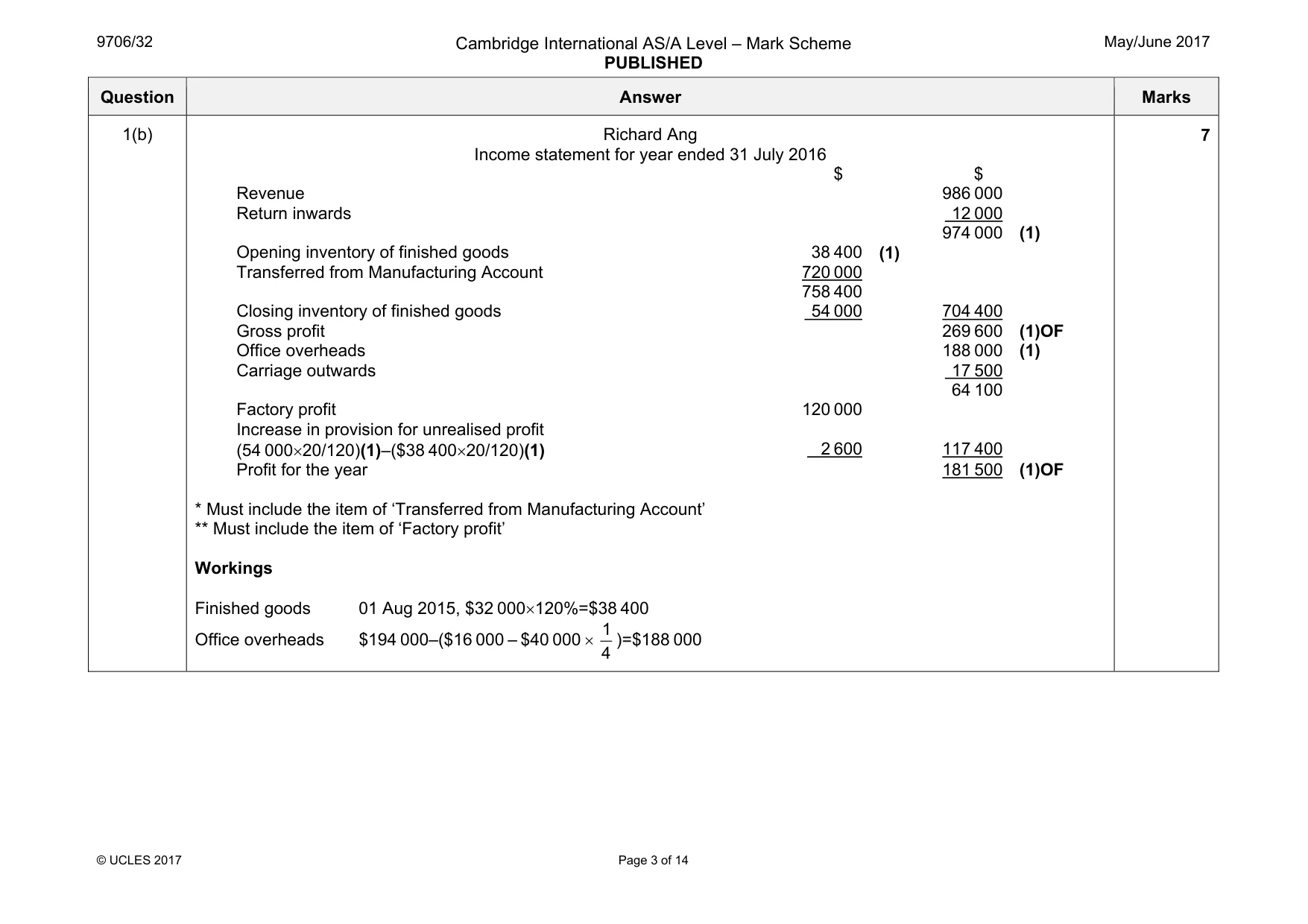
9706/32 Cambridge International AS/A Level – Mark Scheme PUBLISHED May/June 2017 © UCLES 2017 Page 3 of 14 Question Answer Marks 1(b) Richard Ang Income statement for year ended 31 July 2016 $ $ Revenue 986 000 Return inwards 12 000 974 000 (1) Opening inventory of finished goods 38 400 (1) Transferred from Manufacturing Account 720 000 758 400 Closing inventory of finished goods 54 000 704 400 Gross profit 269 600 (1)OF Office overheads 188 000 (1) Carriage outwards 17 500 64 100 Factory profit 120 000 Increase in provision for unrealised profit (54 000×20/120)(1)–($38 400×20/120)(1) 2 600 117 400 Profit for the year 181 500 (1)OF * Must include the item of ‘Transferred from Manufacturing Account’ ** Must include the item of ‘Factory profit’ Workings Finished goods 01 Aug 2015, $32 000×120%=$38 400 Office overheads $194 000–($16 000 – $40 000 × 1 4 )=$188 000 7
Mark scheme, page 4
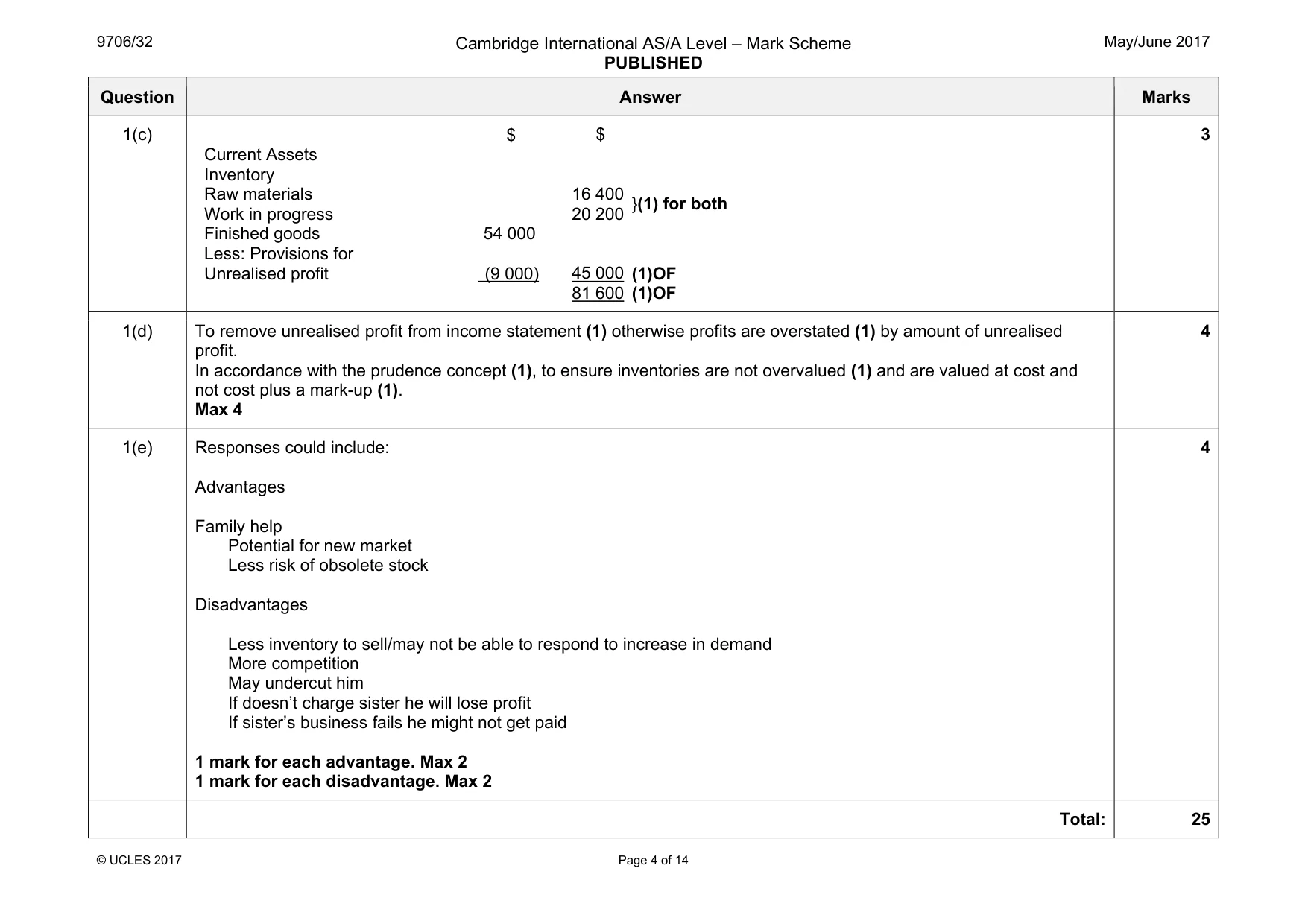
9706/32 Cambridge International AS/A Level – Mark Scheme PUBLISHED May/June 2017 © UCLES 2017 Page 4 of 14 Question Answer Marks 1(c) $ $ Current Assets Inventory Raw materials 16 400 }(1) for both Work in progress 20 200 Finished goods 54 000 Less: Provisions for Unrealised profit (9 000) 45 000 (1)OF 81 600 (1)OF 3 1(d) To remove unrealised profit from income statement (1) otherwise profits are overstated (1) by amount of unrealised profit. In accordance with the prudence concept (1), to ensure inventories are not overvalued (1) and are valued at cost and not cost plus a mark-up (1). Max 4 4 1(e) Responses could include: Advantages Family help Potential for new market Less risk of obsolete stock Disadvantages Less inventory to sell/may not be able to respond to increase in demand More competition May undercut him If doesn’t charge sister he will lose profit If sister’s business fails he might not get paid 1 mark for each advantage. Max 2 1 mark for each disadvantage. Max 2 4 Total: 25
Mark scheme, page 5
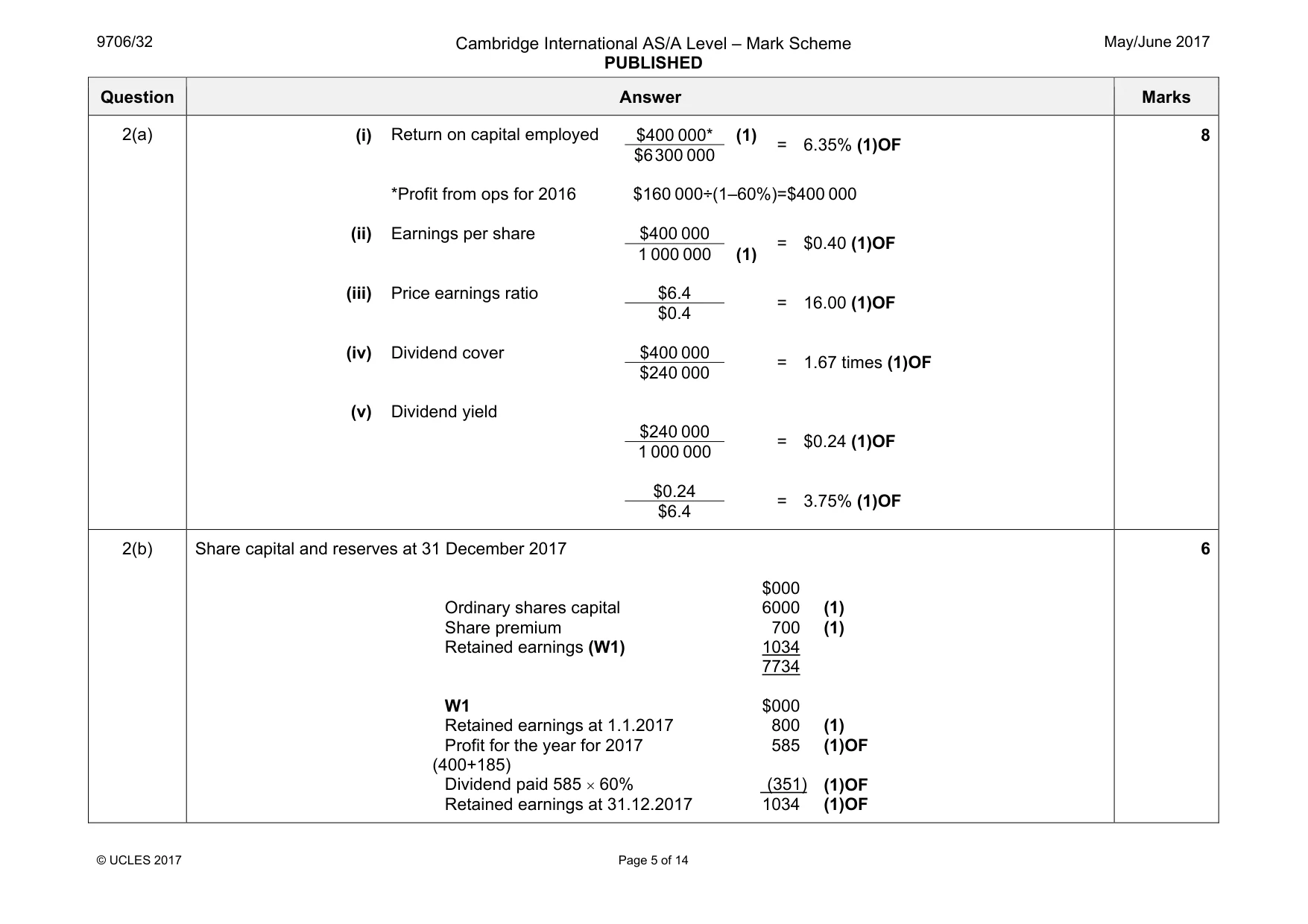
9706/32 Cambridge International AS/A Level – Mark Scheme PUBLISHED May/June 2017 © UCLES 2017 Page 5 of 14 Question Answer Marks 2(a) (i) Return on capital employed $400 000* (1) = 6.35% (1)OF $6 300 000 *Profit from ops for 2016 $160 000÷(1–60%)=$400 000 (ii) Earnings per share $400 000 = $0.40 (1)OF 1 000 000 (1) (iii) Price earnings ratio $6.4 = 16.00 (1)OF $0.4 (iv) Dividend cover $400 000 = 1.67 times (1)OF $240 000 (v) Dividend yield $240 000 = $0.24 (1)OF 1 000 000 $0.24 = 3.75% (1)OF $6.4 8 2(b) Share capital and reserves at 31 December 2017 $000 Ordinary shares capital 6000 (1) Share premium 700 (1) Retained earnings (W1) 1034 7734 W1 $000 Retained earnings at 1.1.2017 800 (1) Profit for the year for 2017 (400+185) 585 (1)OF Dividend paid 585 × 60% (351) (1)OF Retained earnings at 31.12.2017 1034 (1)OF 6
Mark scheme, page 6
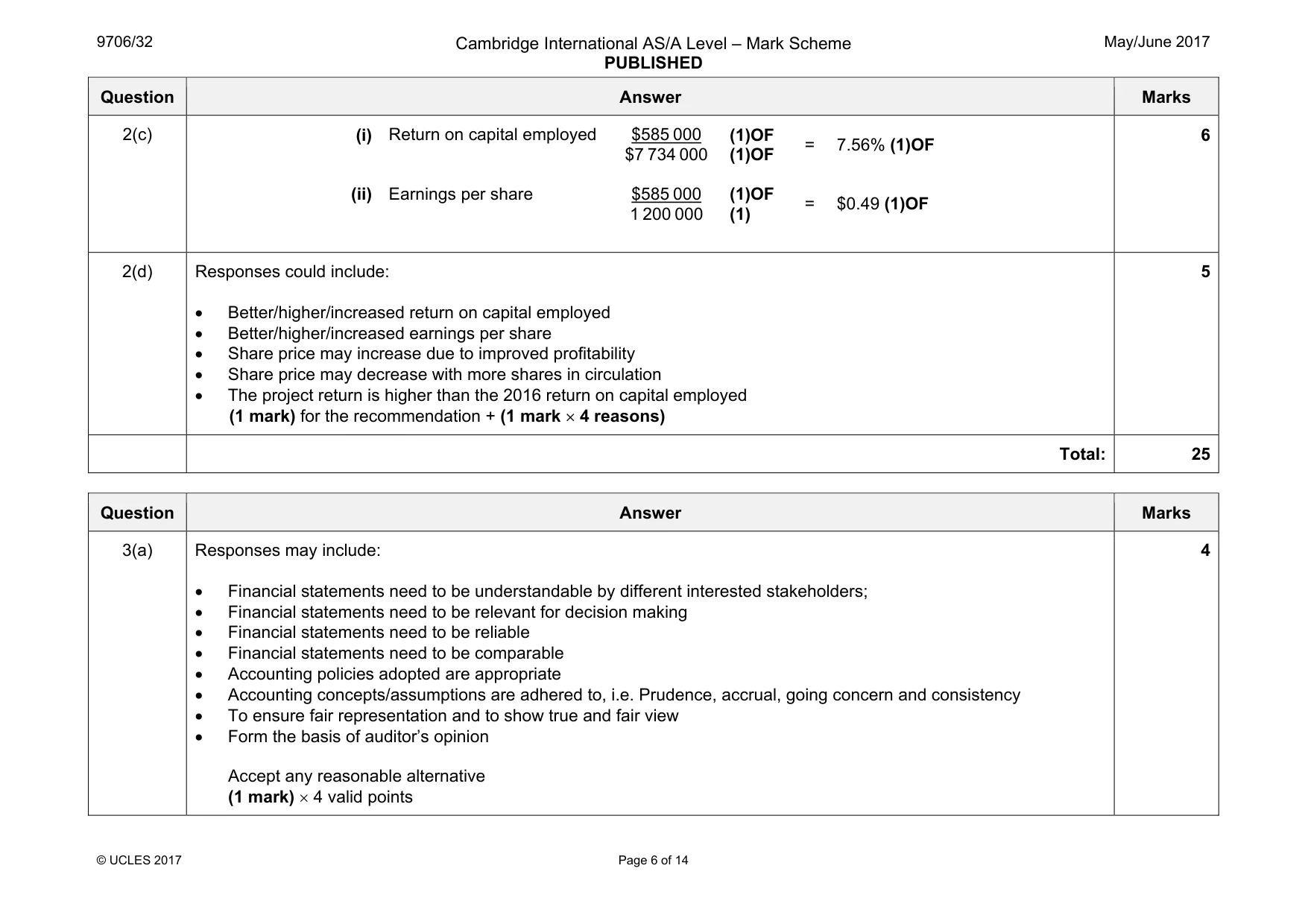
9706/32 Cambridge International AS/A Level – Mark Scheme PUBLISHED May/June 2017 © UCLES 2017 Page 6 of 14 Question Answer Marks 2(c) (i) Return on capital employed $585 000 (1)OF = 7.56% (1)OF $7 734 000 (1)OF (ii) Earnings per share $585 000 (1)OF = $0.49 (1)OF 1 200 000 (1) 6 2(d) Responses could include: • Better/higher/increased return on capital employed • Better/higher/increased earnings per share • Share price may increase due to improved profitability • Share price may decrease with more shares in circulation • The project return is higher than the 2016 return on capital employed (1 mark) for the recommendation + (1 mark × 4 reasons) 5 Total: 25 Question Answer Marks 3(a) Responses may include: • Financial statements need to be understandable by different interested stakeholders; • Financial statements need to be relevant for decision making • Financial statements need to be reliable • Financial statements need to be comparable • Accounting policies adopted are appropriate • Accounting concepts/assumptions are adhered to, i.e. Prudence, accrual, going concern and consistency • To ensure fair representation and to show true and fair view • Form the basis of auditor’s opinion Accept any reasonable alternative (1 mark) × 4 valid points 4
Mark scheme, page 7
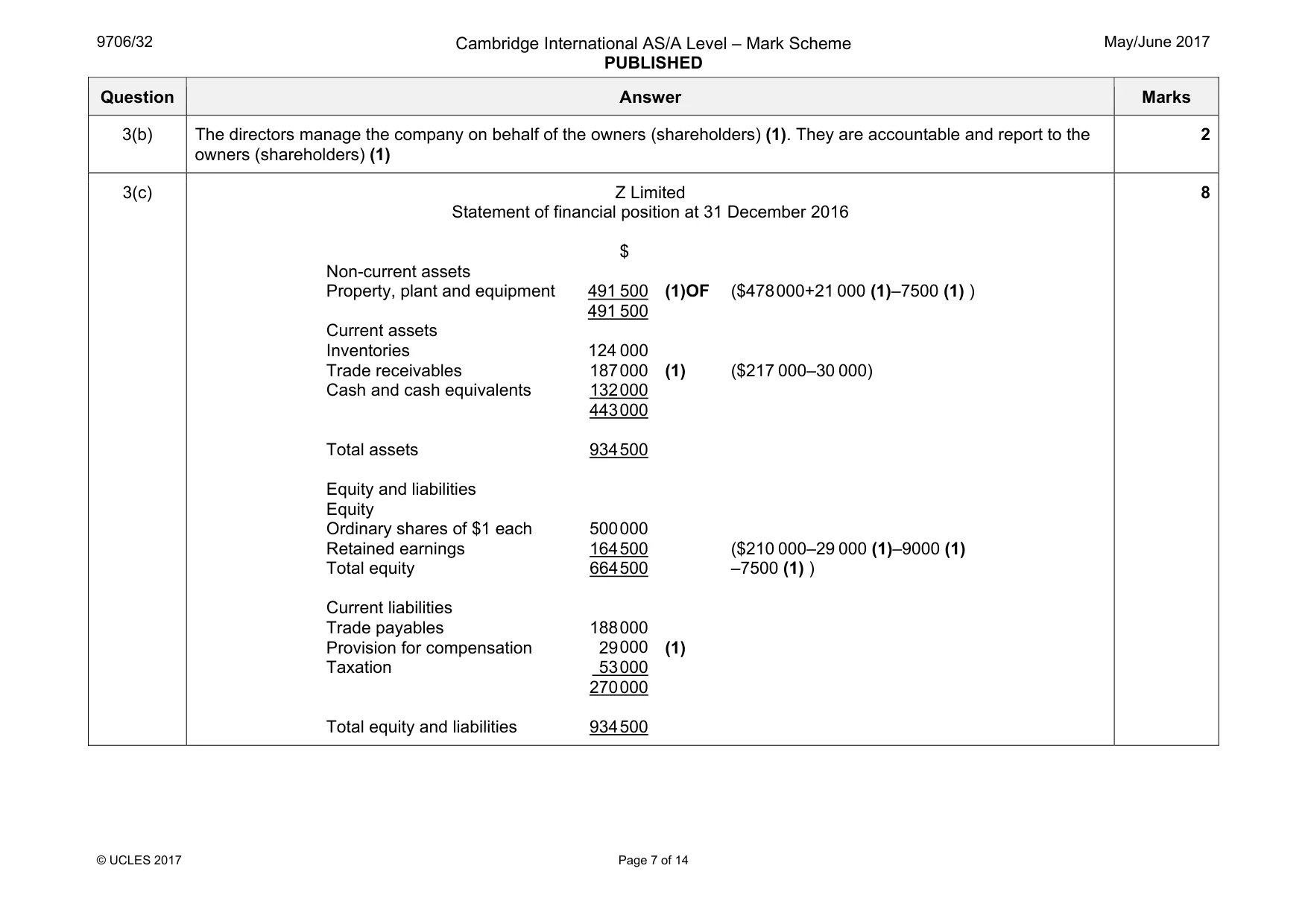
9706/32 Cambridge International AS/A Level – Mark Scheme PUBLISHED May/June 2017 © UCLES 2017 Page 7 of 14 Question Answer Marks 3(b) The directors manage the company on behalf of the owners (shareholders) (1). They are accountable and report to the owners (shareholders) (1) 2 3(c) Z Limited Statement of financial position at 31 December 2016 $ Non-current assets Property, plant and equipment 491 500 (1)OF ($478 000+21 000 (1)–7500 (1) ) 491 500 Current assets Inventories 124 000 Trade receivables 187 000 (1) ($217 000–30 000) Cash and cash equivalents 132 000 443 000 Total assets 934 500 Equity and liabilities Equity Ordinary shares of $1 each 500 000 Retained earnings 164 500 ($210 000–29 000 (1)–9000 (1) Total equity 664 500 –7500 (1) ) Current liabilities Trade payables 188 000 Provision for compensation 29 000 (1) Taxation 53 000 270 000 Total equity and liabilities 934 500 8
Mark scheme, page 8
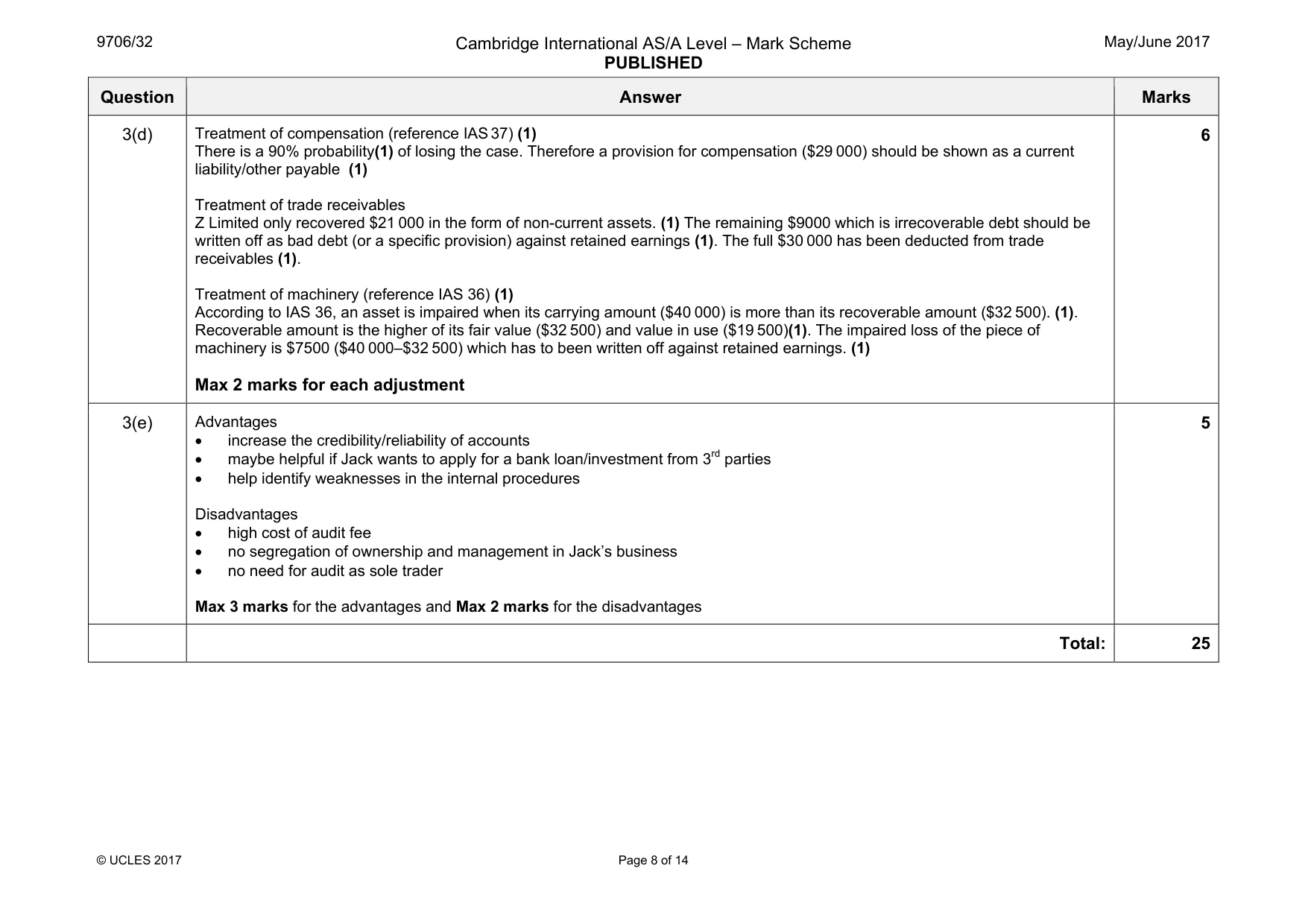
9706/32 Cambridge International AS/A Level – Mark Scheme PUBLISHED May/June 2017 © UCLES 2017 Page 8 of 14 Question Answer Marks 3(d) Treatment of compensation (reference IAS 37) (1) There is a 90% probability(1) of losing the case. Therefore a provision for compensation ($29 000) should be shown as a current liability/other payable (1) Treatment of trade receivables Z Limited only recovered $21 000 in the form of non-current assets. (1) The remaining $9000 which is irrecoverable debt should be written off as bad debt (or a specific provision) against retained earnings (1). The full $30 000 has been deducted from trade receivables (1). Treatment of machinery (reference IAS 36) (1) According to IAS 36, an asset is impaired when its carrying amount ($40 000) is more than its recoverable amount ($32 500). (1). Recoverable amount is the higher of its fair value ($32 500) and value in use ($19 500)(1). The impaired loss of the piece of machinery is $7500 ($40 000–$32 500) which has to been written off against retained earnings. (1) Max 2 marks for each adjustment 6 3(e) Advantages • increase the credibility/reliability of accounts • maybe helpful if Jack wants to apply for a bank loan/investment from 3rd parties • help identify weaknesses in the internal procedures Disadvantages • high cost of audit fee • no segregation of ownership and management in Jack’s business • no need for audit as sole trader Max 3 marks for the advantages and Max 2 marks for the disadvantages 5 Total: 25
Mark scheme, page 9
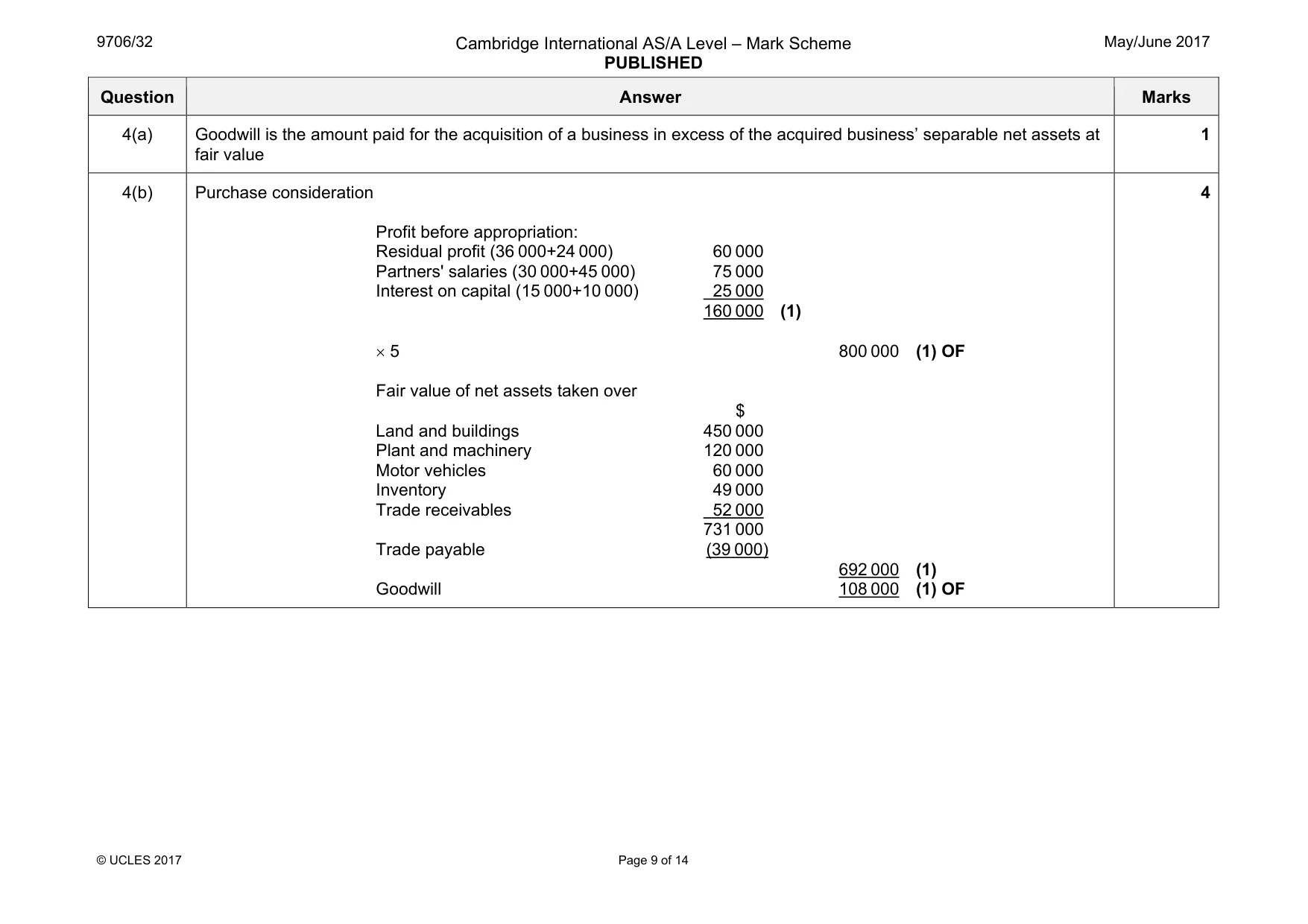
9706/32 Cambridge International AS/A Level – Mark Scheme PUBLISHED May/June 2017 © UCLES 2017 Page 9 of 14 Question Answer Marks 4(a) Goodwill is the amount paid for the acquisition of a business in excess of the acquired business’ separable net assets at fair value 1 4(b) Purchase consideration Profit before appropriation: Residual profit (36 000+24 000) 60 000 Partners' salaries (30 000+45 000) 75 000 Interest on capital (15 000+10 000) 25 000 160 000 (1) × 5 800 000 (1) OF Fair value of net assets taken over $ Land and buildings 450 000 Plant and machinery 120 000 Motor vehicles 60 000 Inventory 49 000 Trade receivables 52 000 731 000 Trade payable (39 000) 692 000 (1) Goodwill 108 000 (1) OF 4
Mark scheme, page 10
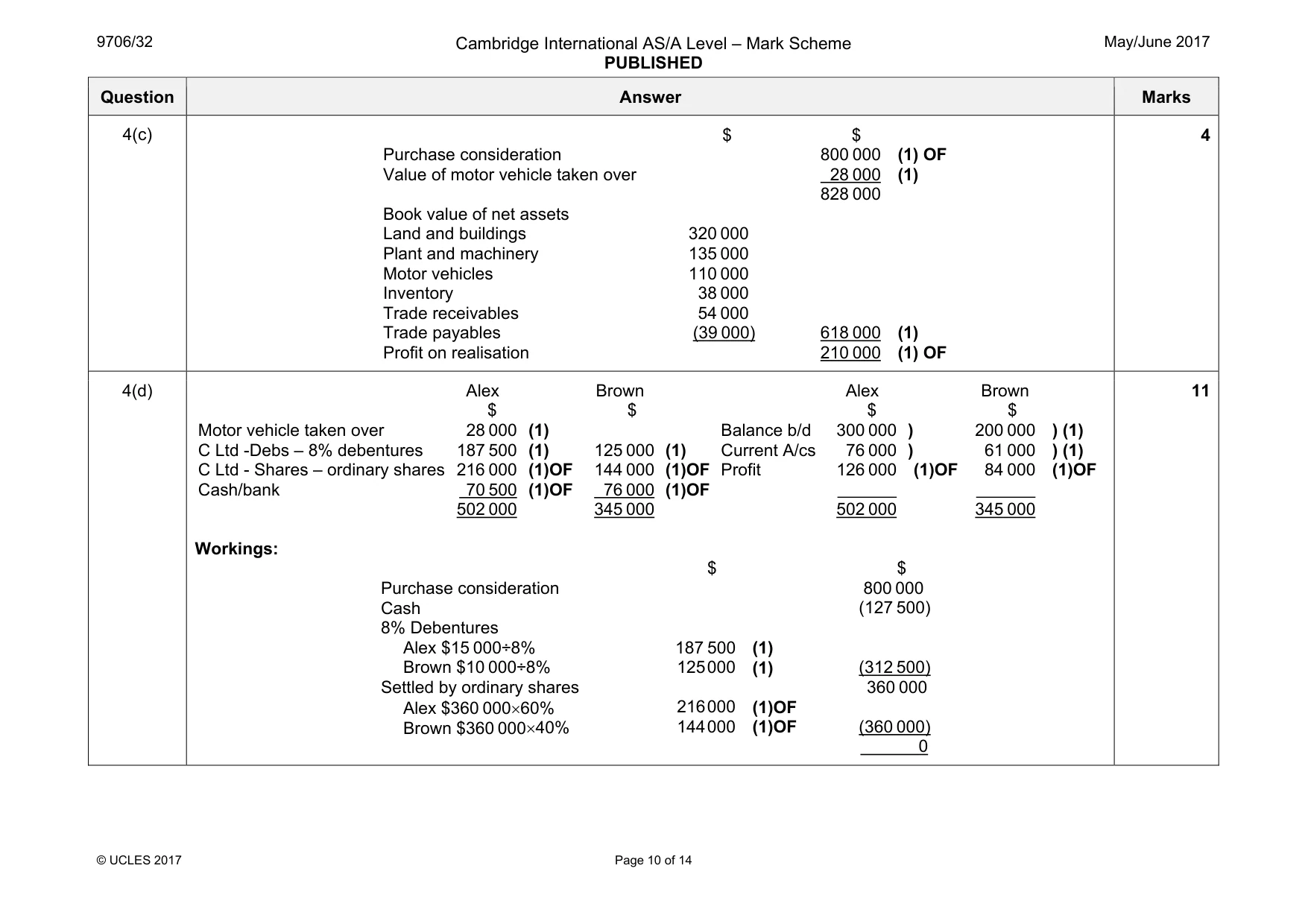
9706/32 Cambridge International AS/A Level – Mark Scheme PUBLISHED May/June 2017 © UCLES 2017 Page 10 of 14 Question Answer Marks 4(c) $ $ Purchase consideration 800 000 (1) OF Value of motor vehicle taken over 28 000 (1) 828 000 Book value of net assets Land and buildings 320 000 Plant and machinery 135 000 Motor vehicles 110 000 Inventory 38 000 Trade receivables 54 000 Trade payables (39 000) 618 000 (1) Profit on realisation 210 000 (1) OF 4 4(d) Alex Brown Alex Brown $ $ $ $ Motor vehicle taken over 28 000 (1) Balance b/d 300 000 ) 200 000 ) (1) C Ltd -Debs – 8% debentures 187 500 (1) 125 000 (1) Current A/cs 76 000 ) 61 000 ) (1) C Ltd - Shares – ordinary shares 216 000 (1)OF 144 000 (1)OF Profit 126 000 (1)OF 84 000 (1)OF Cash/bank 70 500 (1)OF 76 000 (1)OF 502 000 345 000 502 000 345 000 Workings: $ $ Purchase consideration 800 000 Cash (127 500) 8% Debentures Alex $15 000÷8% 187 500 (1) Brown $10 000÷8% 125 000 (1) (312 500) Settled by ordinary shares 360 000 Alex $360 000×60% 216 000 (1)OF Brown $360 000×40% 144 000 (1)OF (360 000) 0 11
Mark scheme, page 11
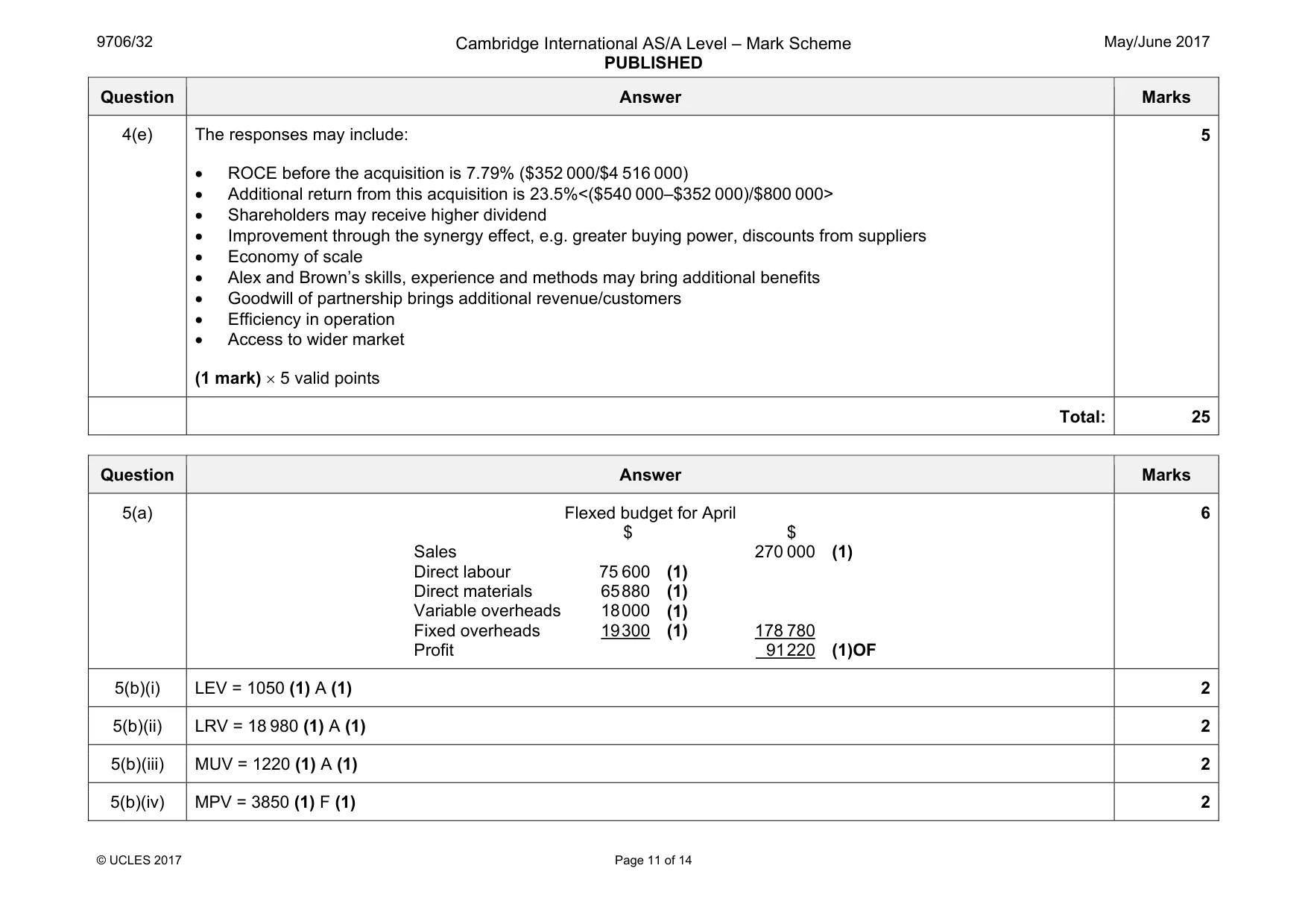
9706/32 Cambridge International AS/A Level – Mark Scheme PUBLISHED May/June 2017 © UCLES 2017 Page 11 of 14 Question Answer Marks 4(e) The responses may include: • ROCE before the acquisition is 7.79% ($352 000/$4 516 000) • Additional return from this acquisition is 23.5%<($540 000–$352 000)/$800 000> • Shareholders may receive higher dividend • Improvement through the synergy effect, e.g. greater buying power, discounts from suppliers • Economy of scale • Alex and Brown’s skills, experience and methods may bring additional benefits • Goodwill of partnership brings additional revenue/customers • Efficiency in operation • Access to wider market (1 mark) × 5 valid points 5 Total: 25 Question Answer Marks 5(a) Flexed budget for April $ $ Sales 270 000 (1) Direct labour 75 600 (1) Direct materials 65 880 (1) Variable overheads 18 000 (1) Fixed overheads 19 300 (1) 178 780 Profit 91 220 (1)OF 6 5(b)(i) LEV = 1050 (1) A (1) 2 5(b)(ii) LRV = 18 980 (1) A (1) 2 5(b)(iii) MUV = 1220 (1) A (1) 2 5(b)(iv) MPV = 3850 (1) F (1) 2
Mark scheme, page 12
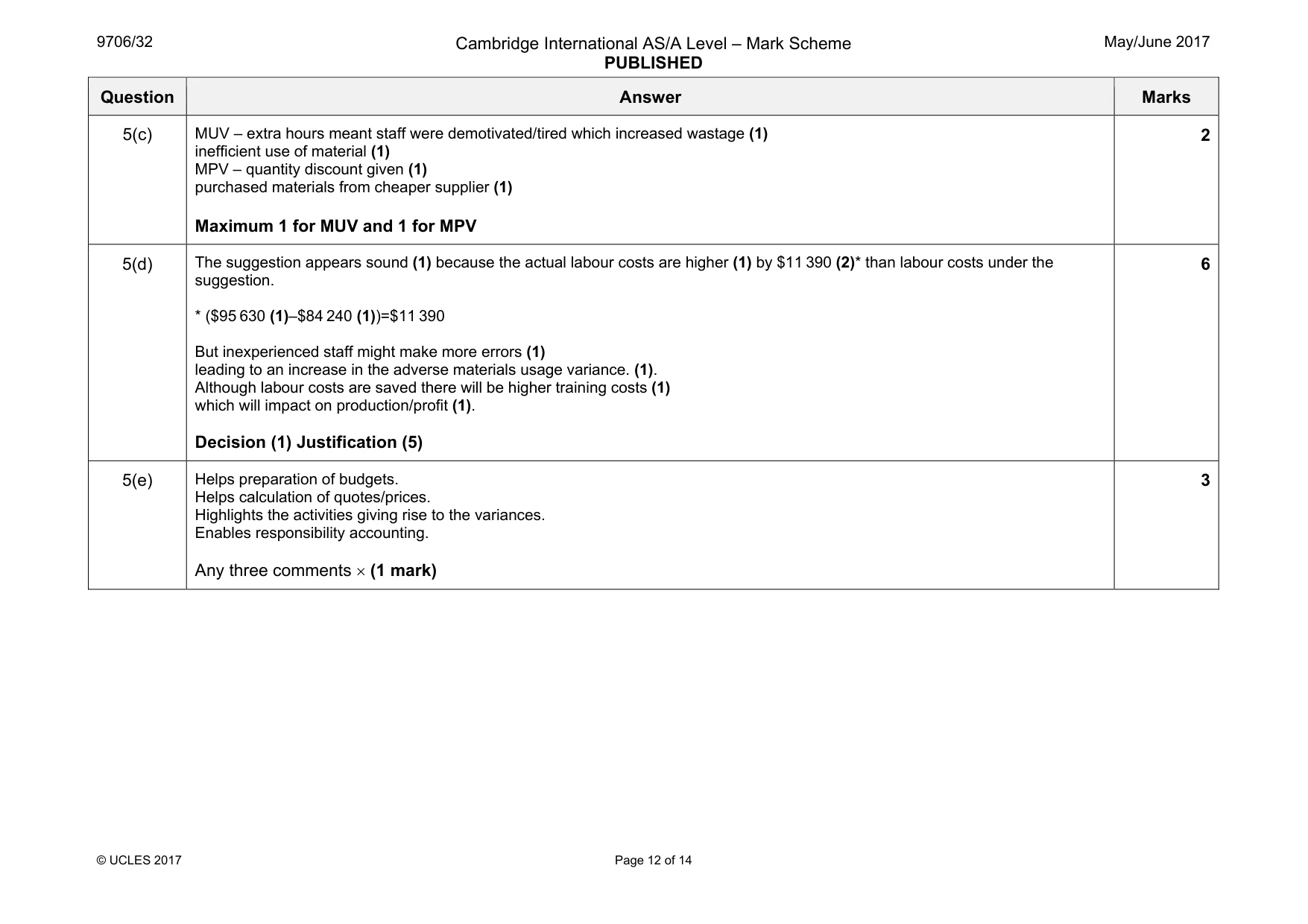
9706/32 Cambridge International AS/A Level – Mark Scheme PUBLISHED May/June 2017 © UCLES 2017 Page 12 of 14 Question Answer Marks 5(c) MUV – extra hours meant staff were demotivated/tired which increased wastage (1) inefficient use of material (1) MPV – quantity discount given (1) purchased materials from cheaper supplier (1) Maximum 1 for MUV and 1 for MPV 2 5(d) The suggestion appears sound (1) because the actual labour costs are higher (1) by $11 390 (2)* than labour costs under the suggestion. * ($95 630 (1)–$84 240 (1))=$11 390 But inexperienced staff might make more errors (1) leading to an increase in the adverse materials usage variance. (1). Although labour costs are saved there will be higher training costs (1) which will impact on production/profit (1). Decision (1) Justification (5) 6 5(e) Helps preparation of budgets. Helps calculation of quotes/prices. Highlights the activities giving rise to the variances. Enables responsibility accounting. Any three comments × (1 mark) 3
Mark scheme, page 13
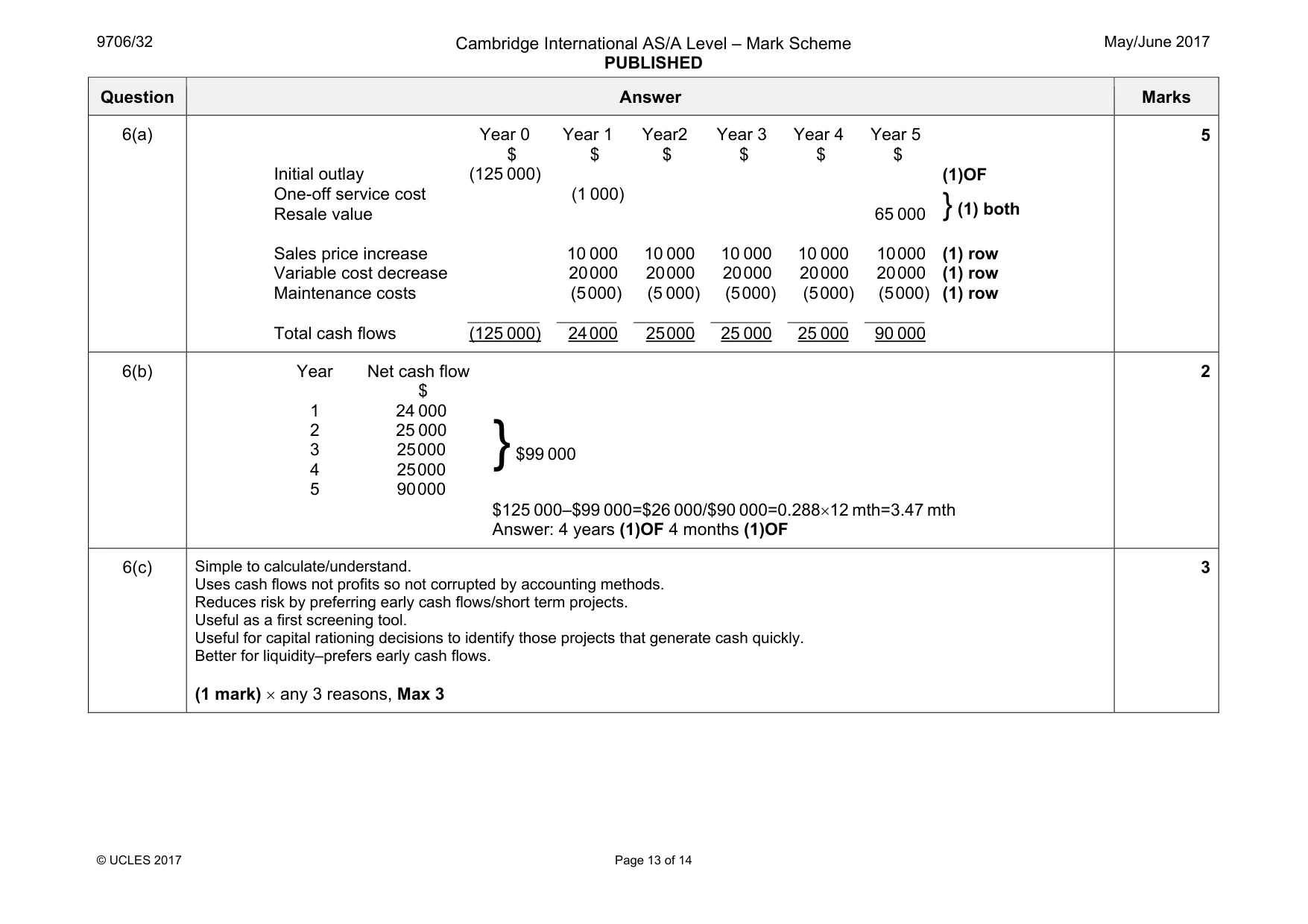
9706/32 Cambridge International AS/A Level – Mark Scheme PUBLISHED May/June 2017 © UCLES 2017 Page 13 of 14 Question Answer Marks 6(a) Year 0 Year 1 Year2 Year 3 Year 4 Year 5 $ $ $ $ $ $ Initial outlay (125 000) (1)OF One-off service cost (1 000) } (1) both Resale value 65 000 Sales price increase 10 000 10 000 10 000 10 000 10 000 (1) row Variable cost decrease 20 000 20 000 20 000 20 000 20 000 (1) row Maintenance costs (5 000) (5 000) (5 000) (5 000) (5 000) (1) row Total cash flows (125 000) 24 000 25 000 25 000 25 000 90 000 5 6(b) Year Net cash flow $ 1 24 000 } $99 000 2 25 000 3 25 000 4 25 000 5 90 000 $125 000–$99 000=$26 000/$90 000=0.288×12 mth=3.47 mth Answer: 4 years (1)OF 4 months (1)OF 2 6(c) Simple to calculate/understand. Uses cash flows not profits so not corrupted by accounting methods. Reduces risk by preferring early cash flows/short term projects. Useful as a first screening tool. Useful for capital rationing decisions to identify those projects that generate cash quickly. Better for liquidity–prefers early cash flows. (1 mark) × any 3 reasons, Max 3 3
Mark scheme, page 14
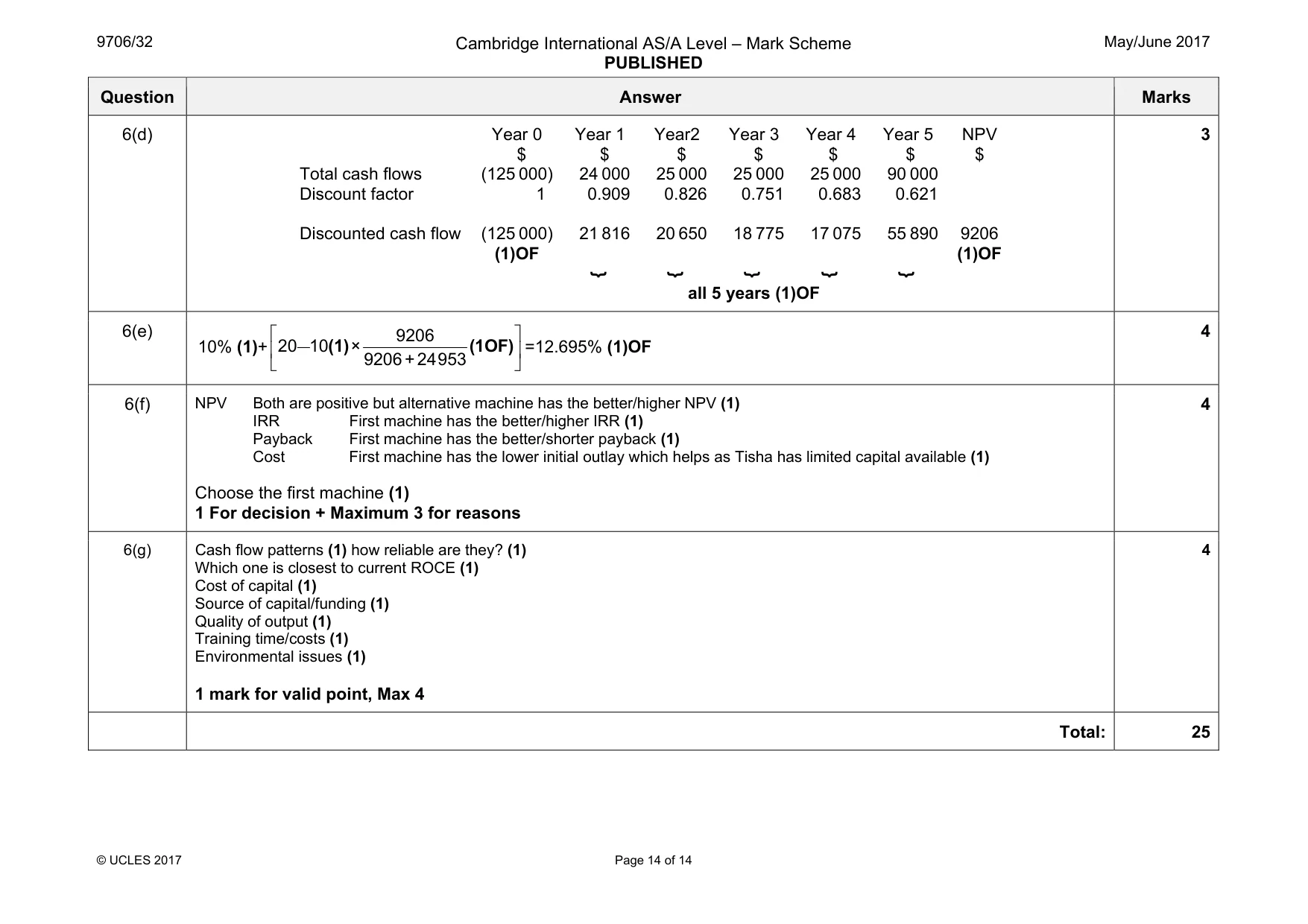
9706/32 Cambridge International AS/A Level – Mark Scheme PUBLISHED May/June 2017 © UCLES 2017 Page 14 of 14 Question Answer Marks 6(d) Year 0 Year 1 Year2 Year 3 Year 4 Year 5 NPV $ $ $ $ $ $ $ Total cash flows (125 000) 24 000 25 000 25 000 25 000 90 000 Discount factor 1 0.909 0.826 0.751 0.683 0.621 Discounted cash flow (125 000) (1)OF 21 816 20 650 18 775 17 075 55 890 9206 (1)OF } } } } } all 5 years (1)OF 3 6(e) 10% (1)+ 20 9206 10 × 9206+24953 (1) (1OF) =12.695% (1)OF 4 6(f) NPV Both are positive but alternative machine has the better/higher NPV (1) IRR First machine has the better/higher IRR (1) Payback First machine has the better/shorter payback (1) Cost First machine has the lower initial outlay which helps as Tisha has limited capital available (1) Choose the first machine (1) 1 For decision + Maximum 3 for reasons 4 6(g) Cash flow patterns (1) how reliable are they? (1) Which one is closest to current ROCE (1) Cost of capital (1) Source of capital/funding (1) Quality of output (1) Training time/costs (1) Environmental issues (1) 1 mark for valid point, Max 4 4 Total: 25
What you needed in this session
Cambridge’s own grade thresholds for 2017 May/June, Paper 3 · Variant 2. A higher threshold means an easier paper — the bar moves with how the cohort did.