Cambridge A Level Accounting 9706 — 2017 May/June Paper 3 · Variant 1
9706/31/M/J/17 · 150 marks · ≈169 min
The question paper and its mark scheme, free to read here and free to download. This is Cambridge’s own paper, exactly as it was sat.
Question paper12 pages

Mark scheme16 pages
Answers below. Sit the paper first if you are practising.
Paper as text
Question paper, page 1
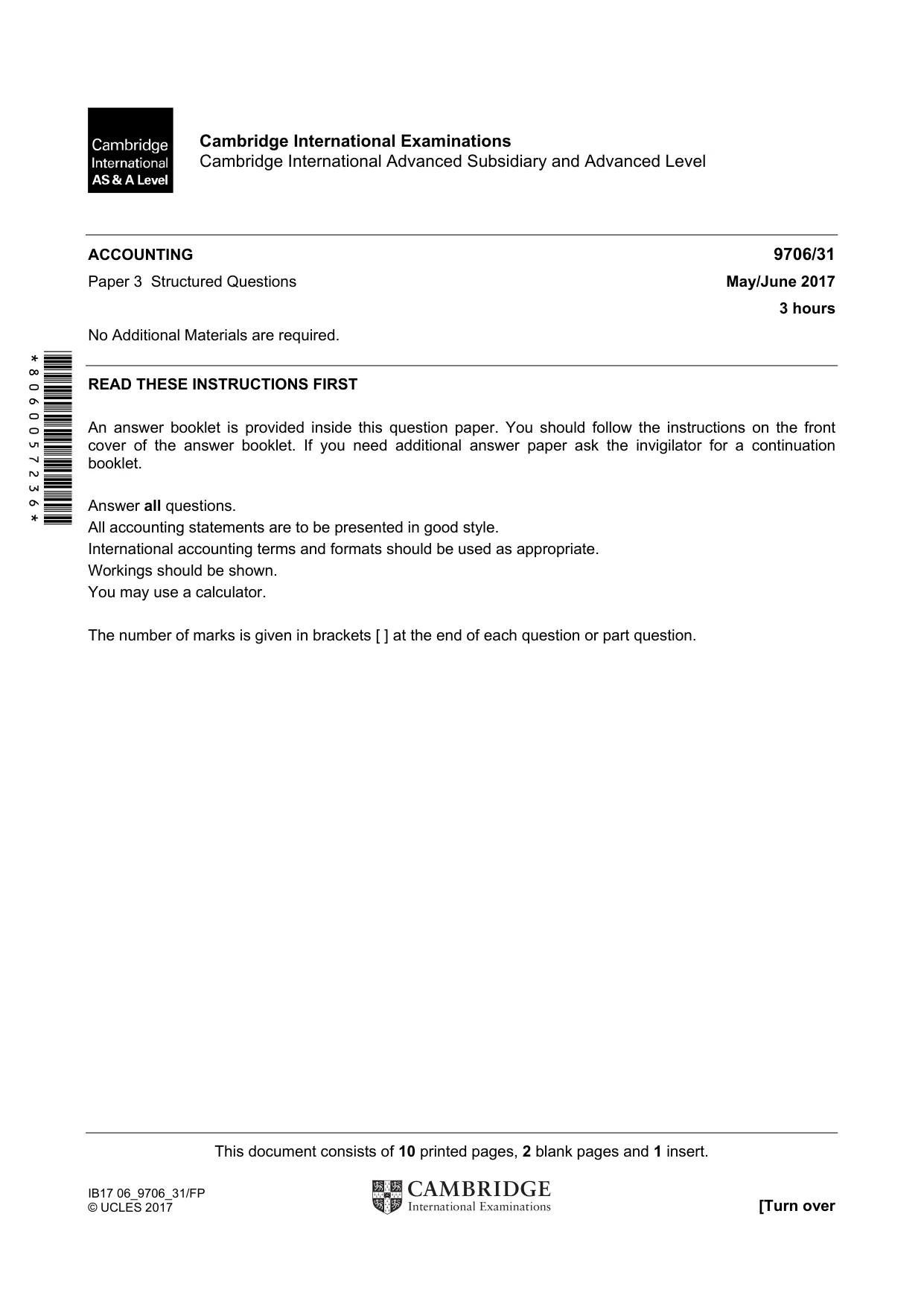
This document consists of 10 printed pages, 2 blank pages and 1 insert. IB17 06_9706_31/FP © UCLES 2017 [Turn over Cambridge International Examinations Cambridge International Advanced Subsidiary and Advanced Level ACCOUNTING 9706/31 Paper 3 Structured Questions May/June 2017 3 hours No Additional Materials are required. READ THESE INSTRUCTIONS FIRST An answer booklet is provided inside this question paper. You should follow the instructions on the front cover of the answer booklet. If you need additional answer paper ask the invigilator for a continuation booklet. Answer all questions. All accounting statements are to be presented in good style. International accounting terms and formats should be used as appropriate. Workings should be shown. You may use a calculator. The number of marks is given in brackets [ ] at the end of each question or part question.
Question paper, page 2
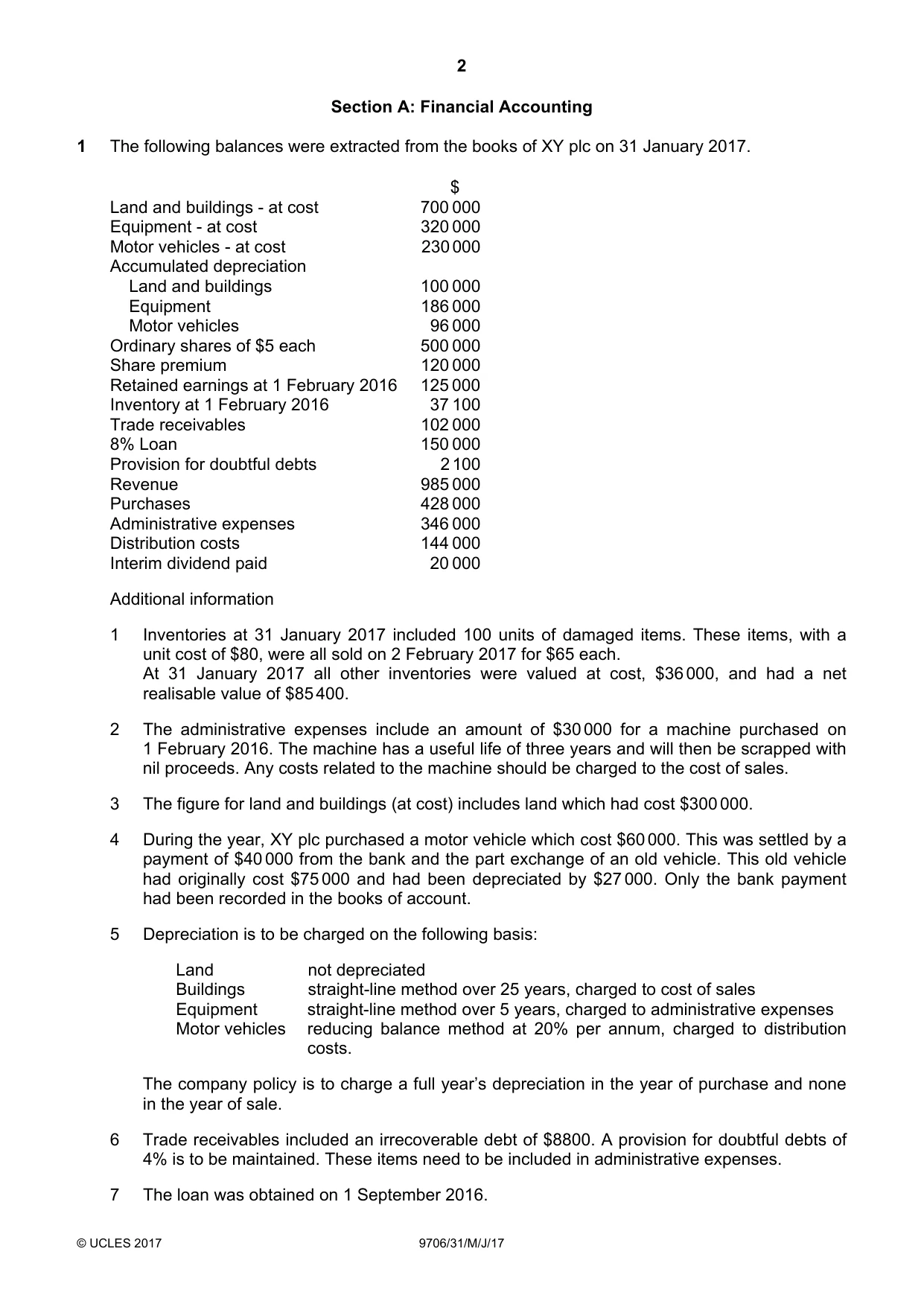
2 © UCLES 2017 9706/31/M/J/17 Section A: Financial Accounting 1 The following balances were extracted from the books of XY plc on 31 January 2017. $ Land and buildings - at cost 700 000 Equipment - at cost 320 000 Motor vehicles - at cost 230 000 Accumulated depreciation Land and buildings 100 000 Equipment 186 000 Motor vehicles 96 000 Ordinary shares of $5 each 500 000 Share premium 120 000 Retained earnings at 1 February 2016 125 000 Inventory at 1 February 2016 37 100 Trade receivables 102 000 8% Loan 150 000 Provision for doubtful debts 2 100 Revenue 985 000 Purchases 428 000 Administrative expenses 346 000 Distribution costs 144 000 Interim dividend paid 20 000 Additional information 1 Inventories at 31 January 2017 included 100 units of damaged items. These items, with a unit cost of $80, were all sold on 2 February 2017 for $65 each. At 31 January 2017 all other inventories were valued at cost, $36 000, and had a net realisable value of $85 400. 2 The administrative expenses include an amount of $30 000 for a machine purchased on 1 February 2016. The machine has a useful life of three years and will then be scrapped with nil proceeds. Any costs related to the machine should be charged to the cost of sales. 3 The figure for land and buildings (at cost) includes land which had cost $300 000. 4 During the year, XY plc purchased a motor vehicle which cost $60 000. This was settled by a payment of $40 000 from the bank and the part exchange of an old vehicle. This old vehicle had originally cost $75 000 and had been depreciated by $27 000. Only the bank payment had been recorded in the books of account. 5 Depreciation is to be charged on the following basis: Land not depreciated Buildings straight-line method over 25 years, charged to cost of sales Equipment straight-line method over 5 years, charged to administrative expenses Motor vehicles reducing balance method at 20% per annum, charged to distribution costs. The company policy is to charge a full year’s depreciation in the year of purchase and none in the year of sale. 6 Trade receivables included an irrecoverable debt of $8800. A provision for doubtful debts of 4% is to be maintained. These items need to be included in administrative expenses. 7 The loan was obtained on 1 September 2016.
Question paper, page 3
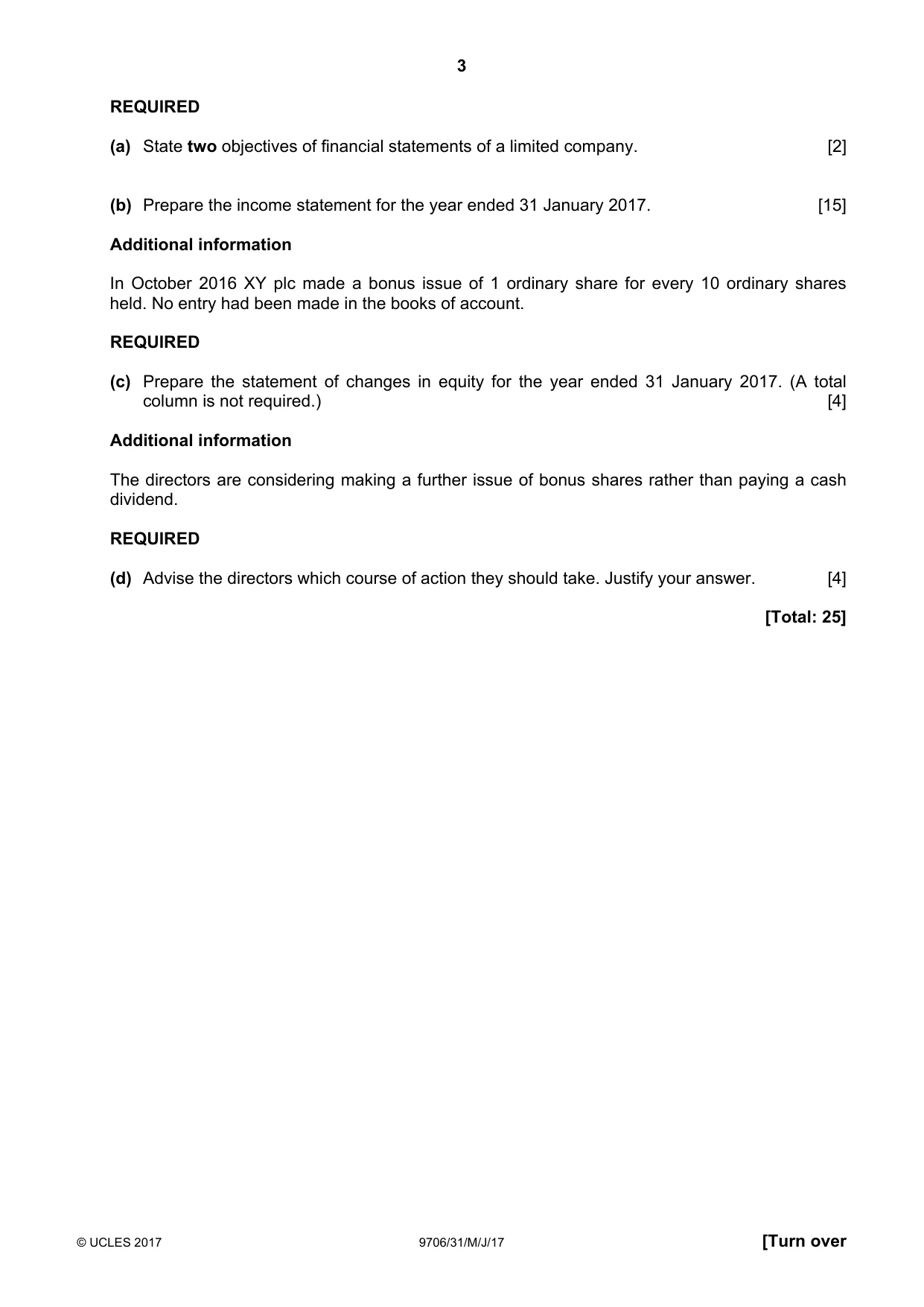
3 © UCLES 2017 9706/31/M/J/17 [Turn over REQUIRED (a) State two objectives of financial statements of a limited company. [2] (b) Prepare the income statement for the year ended 31 January 2017. [15] Additional information In October 2016 XY plc made a bonus issue of 1 ordinary share for every 10 ordinary shares held. No entry had been made in the books of account. REQUIRED (c) Prepare the statement of changes in equity for the year ended 31 January 2017. (A total column is not required.) [4] Additional information The directors are considering making a further issue of bonus shares rather than paying a cash dividend. REQUIRED (d) Advise the directors which course of action they should take. Justify your answer. [4] [Total: 25]
Question paper, page 4
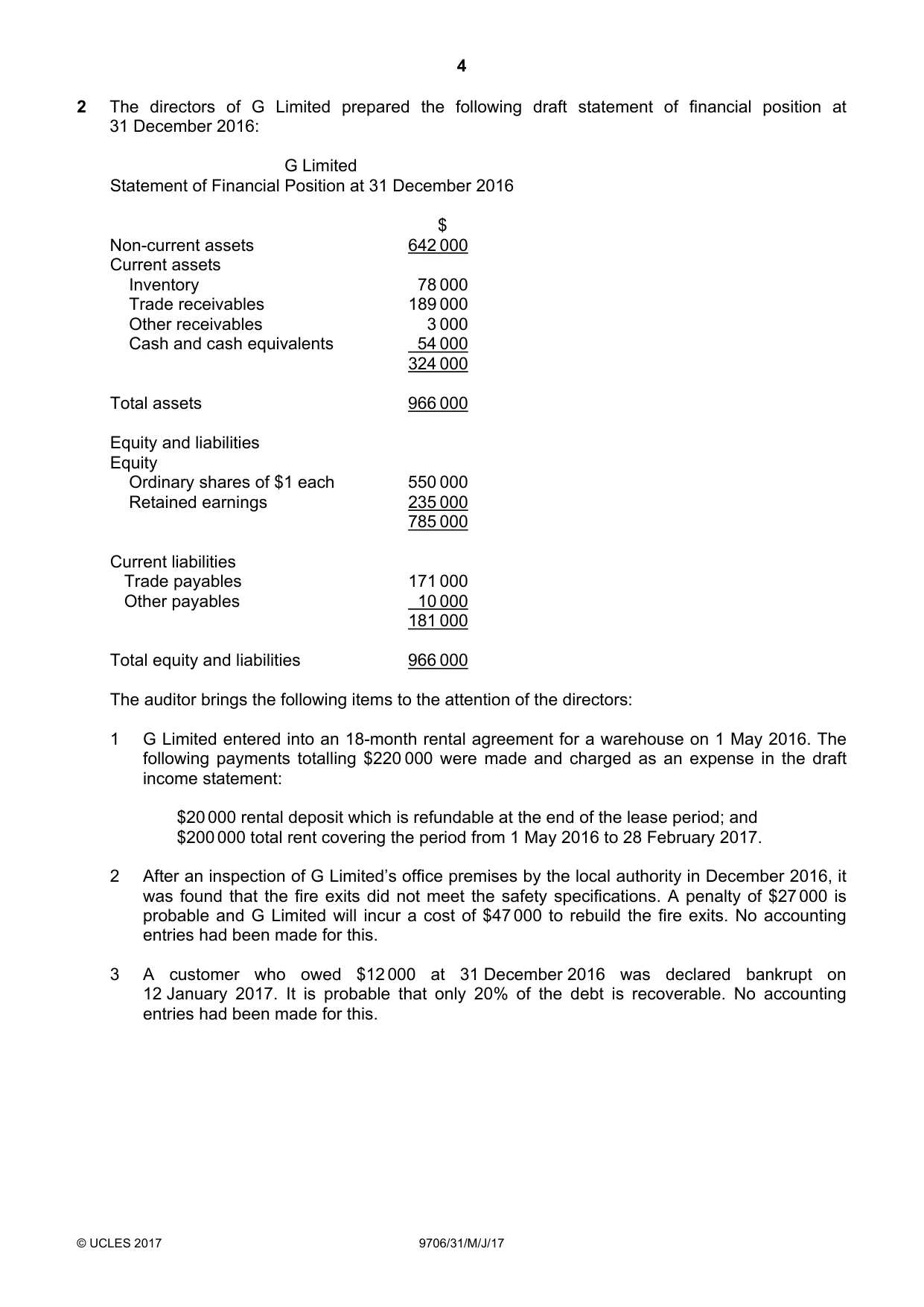
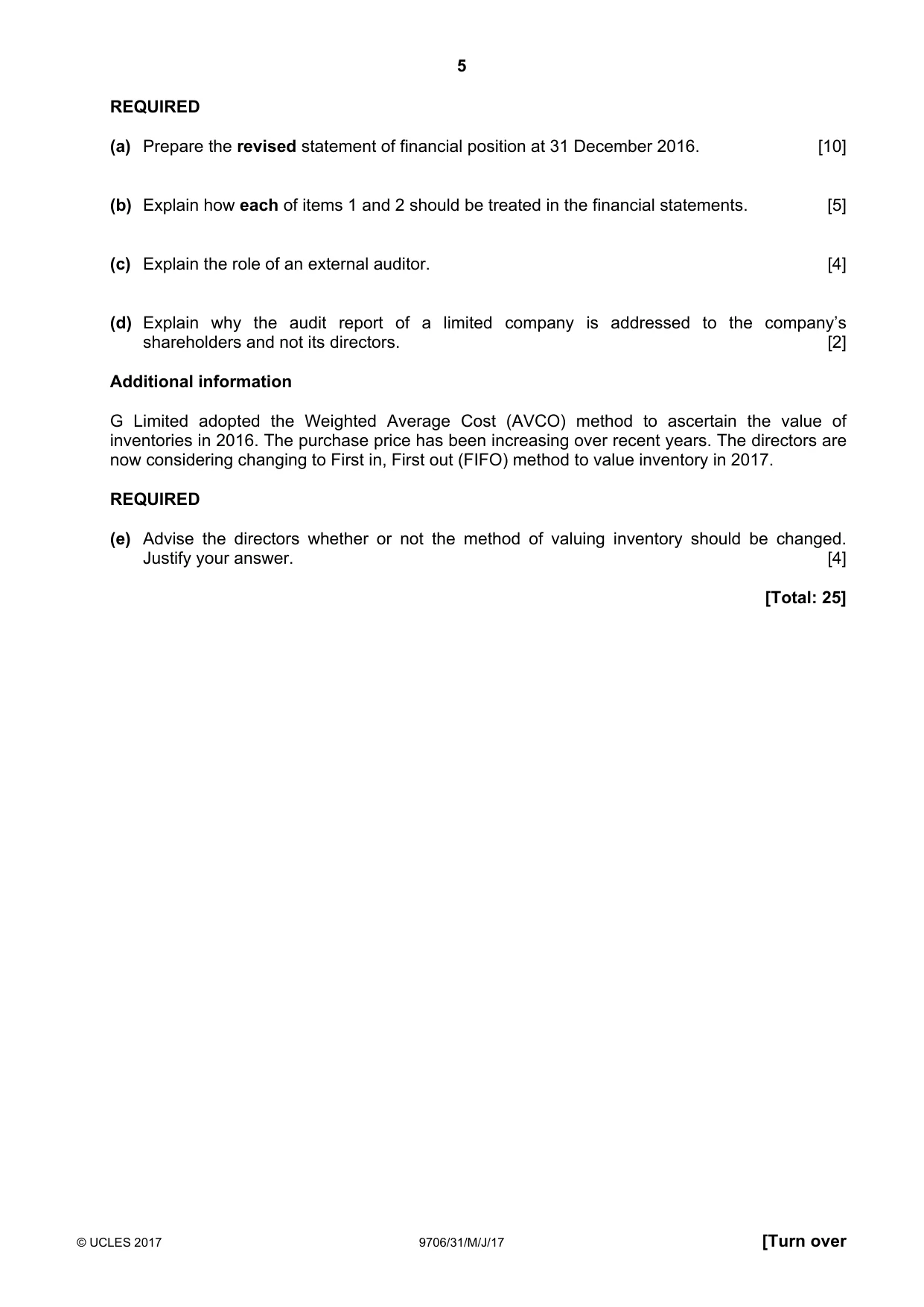
4 © UCLES 2017 9706/31/M/J/17 2 The directors of G Limited prepared the following draft statement of financial position at 31 December 2016: G Limited Statement of Financial Position at 31 December 2016 $ Non-current assets 642 000 Current assets Inventory 78 000 Trade receivables 189 000 Other receivables 3 000 Cash and cash equivalents 54 000 324 000 Total assets 966 000 Equity and liabilities Equity Ordinary shares of $1 each 550 000 Retained earnings 235 000 785 000 Current liabilities Trade payables 171 000 Other payables 10 000 181 000 Total equity and liabilities 966 000 The auditor brings the following items to the attention of the directors: 1 G Limited entered into an 18-month rental agreement for a warehouse on 1 May 2016. The following payments totalling $220 000 were made and charged as an expense in the draft income statement: $20 000 rental deposit which is refundable at the end of the lease period; and $200 000 total rent covering the period from 1 May 2016 to 28 February 2017. 2 After an inspection of G Limited’s office premises by the local authority in December 2016, it was found that the fire exits did not meet the safety specifications. A penalty of $27 000 is probable and G Limited will incur a cost of $47 000 to rebuild the fire exits. No accounting entries had been made for this. 3 A customer who owed $12 000 at 31 December 2016 was declared bankrupt on 12 January 2017. It is probable that only 20% of the debt is recoverable. No accounting entries had been made for this.
Question paper, page 5
5 © UCLES 2017 9706/31/M/J/17 [Turn over REQUIRED (a) Prepare the revised statement of financial position at 31 December 2016. [10] (b) Explain how each of items 1 and 2 should be treated in the financial statements. [5] (c) Explain the role of an external auditor. [4] (d) Explain why the audit report of a limited company is addressed to the company’s shareholders and not its directors. [2] Additional information G Limited adopted the Weighted Average Cost (AVCO) method to ascertain the value of inventories in 2016. The purchase price has been increasing over recent years. The directors are now considering changing to First in, First out (FIFO) method to value inventory in 2017. REQUIRED (e) Advise the directors whether or not the method of valuing inventory should be changed. Justify your answer. [4] [Total: 25]
Question paper, page 6
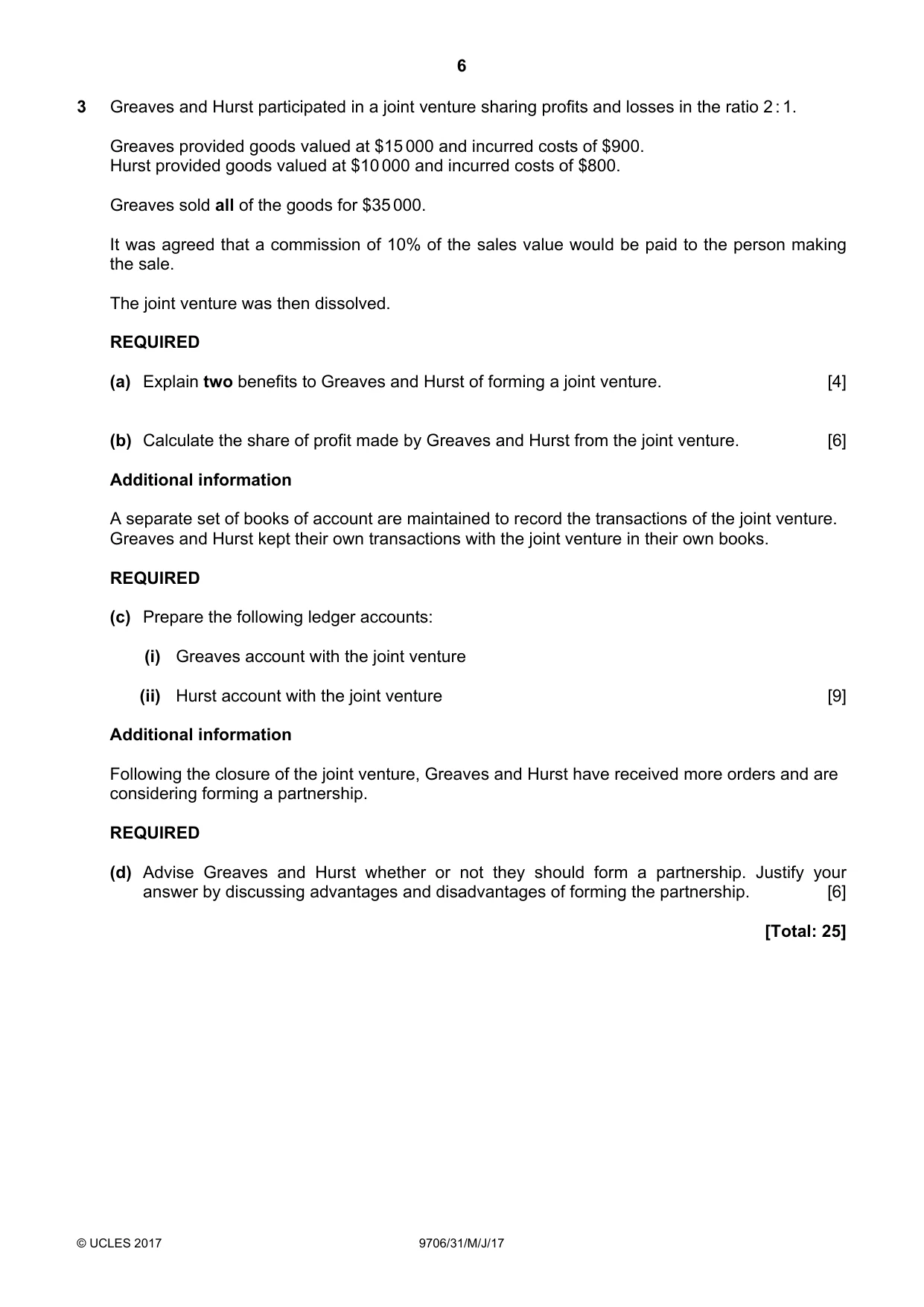
6 © UCLES 2017 9706/31/M/J/17 3 Greaves and Hurst participated in a joint venture sharing profits and losses in the ratio 2 : 1. Greaves provided goods valued at $15 000 and incurred costs of $900. Hurst provided goods valued at $10 000 and incurred costs of $800. Greaves sold all of the goods for $35 000. It was agreed that a commission of 10% of the sales value would be paid to the person making the sale. The joint venture was then dissolved. REQUIRED (a) Explain two benefits to Greaves and Hurst of forming a joint venture. [4] (b) Calculate the share of profit made by Greaves and Hurst from the joint venture. [6] Additional information A separate set of books of account are maintained to record the transactions of the joint venture. Greaves and Hurst kept their own transactions with the joint venture in their own books. REQUIRED (c) Prepare the following ledger accounts: (i) Greaves account with the joint venture (ii) Hurst account with the joint venture [9] Additional information Following the closure of the joint venture, Greaves and Hurst have received more orders and are considering forming a partnership. REQUIRED (d) Advise Greaves and Hurst whether or not they should form a partnership. Justify your answer by discussing advantages and disadvantages of forming the partnership. [6] [Total: 25]
Question paper, page 7
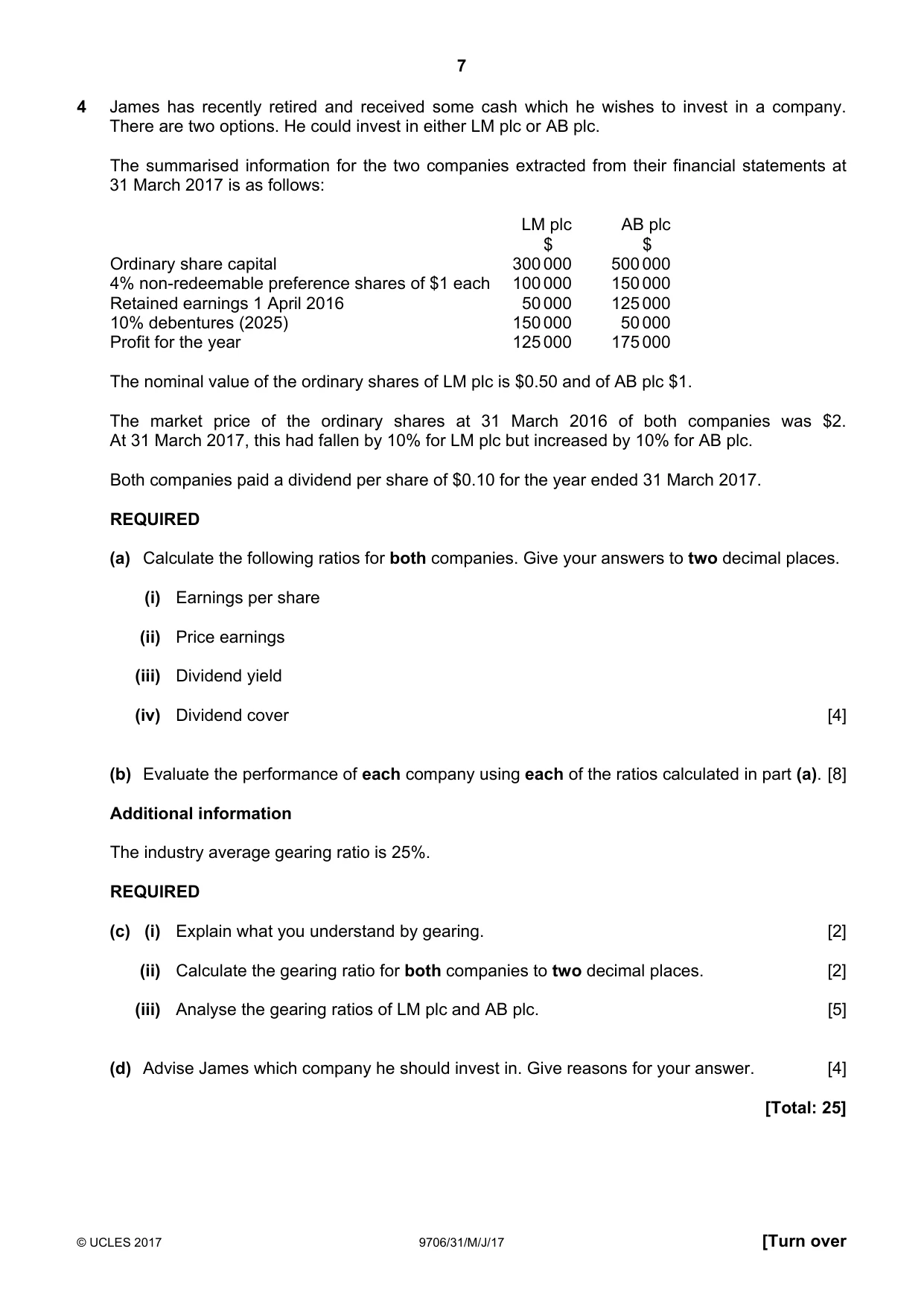
7 © UCLES 2017 9706/31/M/J/17 [Turn over 4 James has recently retired and received some cash which he wishes to invest in a company. There are two options. He could invest in either LM plc or AB plc. The summarised information for the two companies extracted from their financial statements at 31 March 2017 is as follows: LM plc AB plc $ $ Ordinary share capital 300 000 500 000 4% non-redeemable preference shares of $1 each 100 000 150 000 Retained earnings 1 April 2016 50 000 125 000 10% debentures (2025) 150 000 50 000 Profit for the year 125 000 175 000 The nominal value of the ordinary shares of LM plc is $0.50 and of AB plc $1. The market price of the ordinary shares at 31 March 2016 of both companies was $2. At 31 March 2017, this had fallen by 10% for LM plc but increased by 10% for AB plc. Both companies paid a dividend per share of $0.10 for the year ended 31 March 2017. REQUIRED (a) Calculate the following ratios for both companies. Give your answers to two decimal places. (i) Earnings per share (ii) Price earnings (iii) Dividend yield (iv) Dividend cover [4] (b) Evaluate the performance of each company using each of the ratios calculated in part (a). [8] Additional information The industry average gearing ratio is 25%. REQUIRED (c) (i) Explain what you understand by gearing. [2] (ii) Calculate the gearing ratio for both companies to two decimal places. [2] (iii) Analyse the gearing ratios of LM plc and AB plc. [5] (d) Advise James which company he should invest in. Give reasons for your answer. [4] [Total: 25]
Question paper, page 8
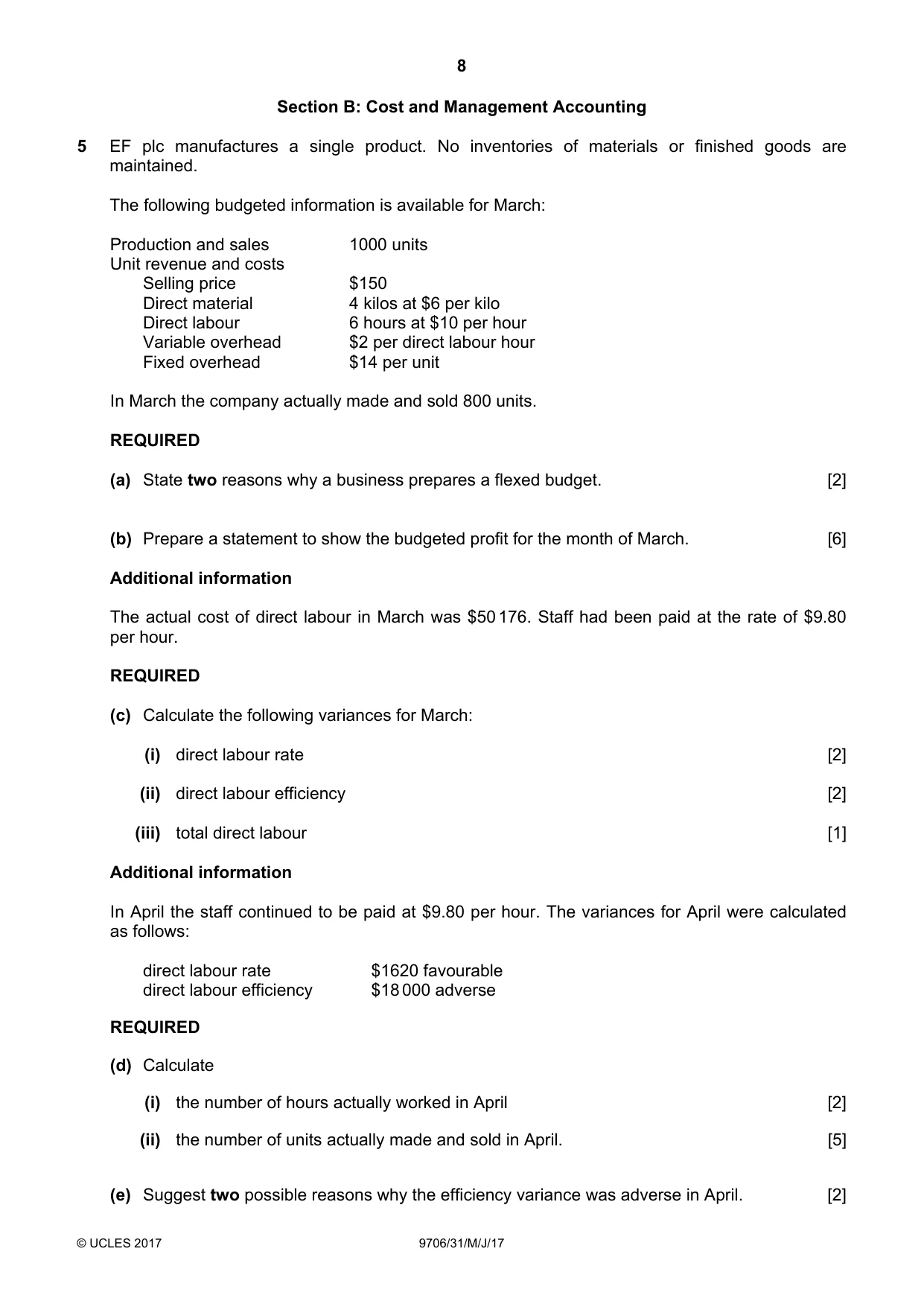
8 © UCLES 2017 9706/31/M/J/17 Section B: Cost and Management Accounting 5 EF plc manufactures a single product. No inventories of materials or finished goods are maintained. The following budgeted information is available for March: Production and sales 1000 units Unit revenue and costs Selling price $150 Direct material 4 kilos at $6 per kilo Direct labour 6 hours at $10 per hour Variable overhead $2 per direct labour hour Fixed overhead $14 per unit In March the company actually made and sold 800 units. REQUIRED (a) State two reasons why a business prepares a flexed budget. [2] (b) Prepare a statement to show the budgeted profit for the month of March. [6] Additional information The actual cost of direct labour in March was $50 176. Staff had been paid at the rate of $9.80 per hour. REQUIRED (c) Calculate the following variances for March: (i) direct labour rate [2] (ii) direct labour efficiency [2] (iii) total direct labour [1] Additional information In April the staff continued to be paid at $9.80 per hour. The variances for April were calculated as follows: direct labour rate $1620 favourable direct labour efficiency $18 000 adverse REQUIRED (d) Calculate (i) the number of hours actually worked in April [2] (ii) the number of units actually made and sold in April. [5] (e) Suggest two possible reasons why the efficiency variance was adverse in April. [2]
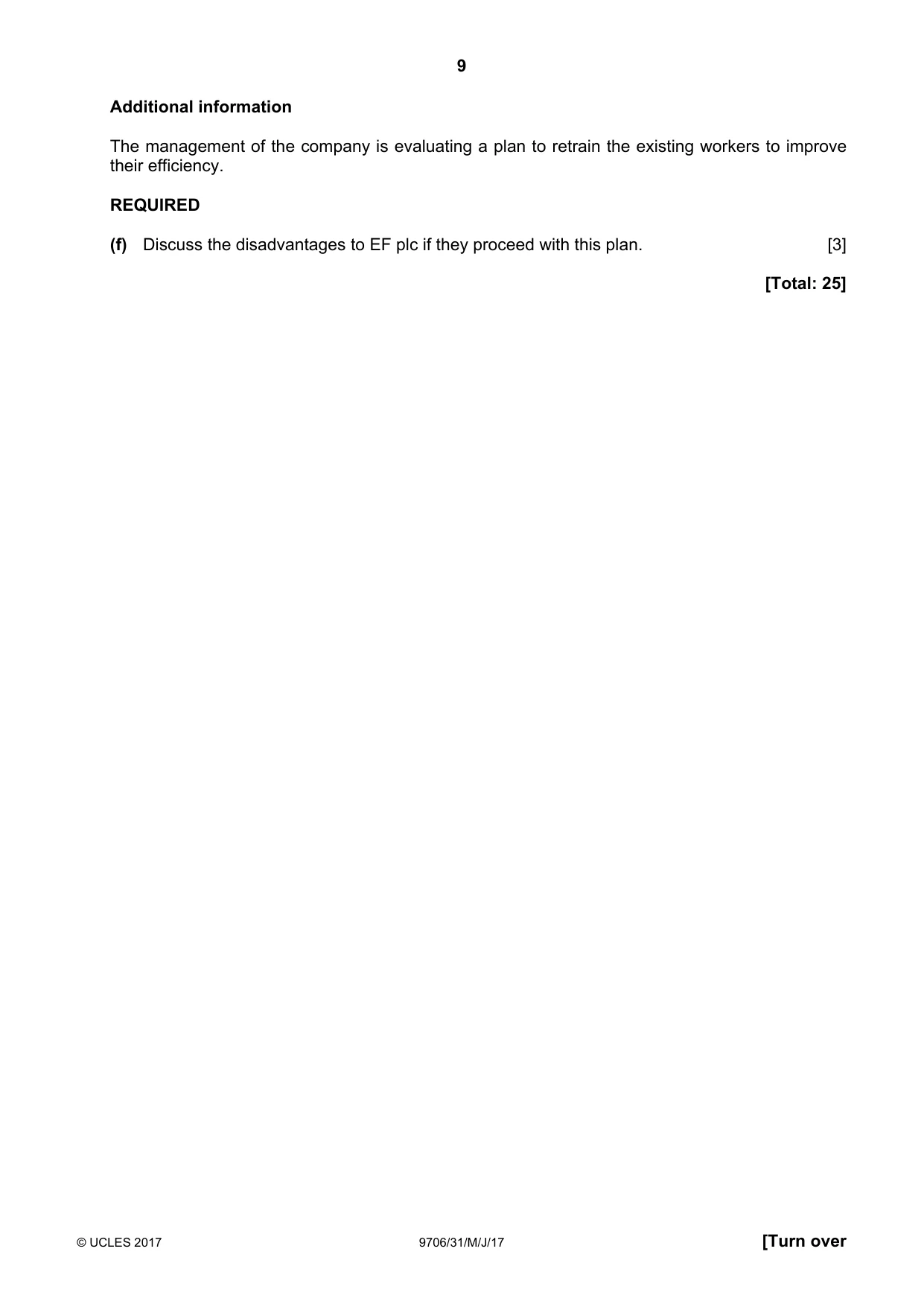
Question paper, page 9
9 © UCLES 2017 9706/31/M/J/17 [Turn over Additional information The management of the company is evaluating a plan to retrain the existing workers to improve their efficiency. REQUIRED (f) Discuss the disadvantages to EF plc if they proceed with this plan. [3] [Total: 25]
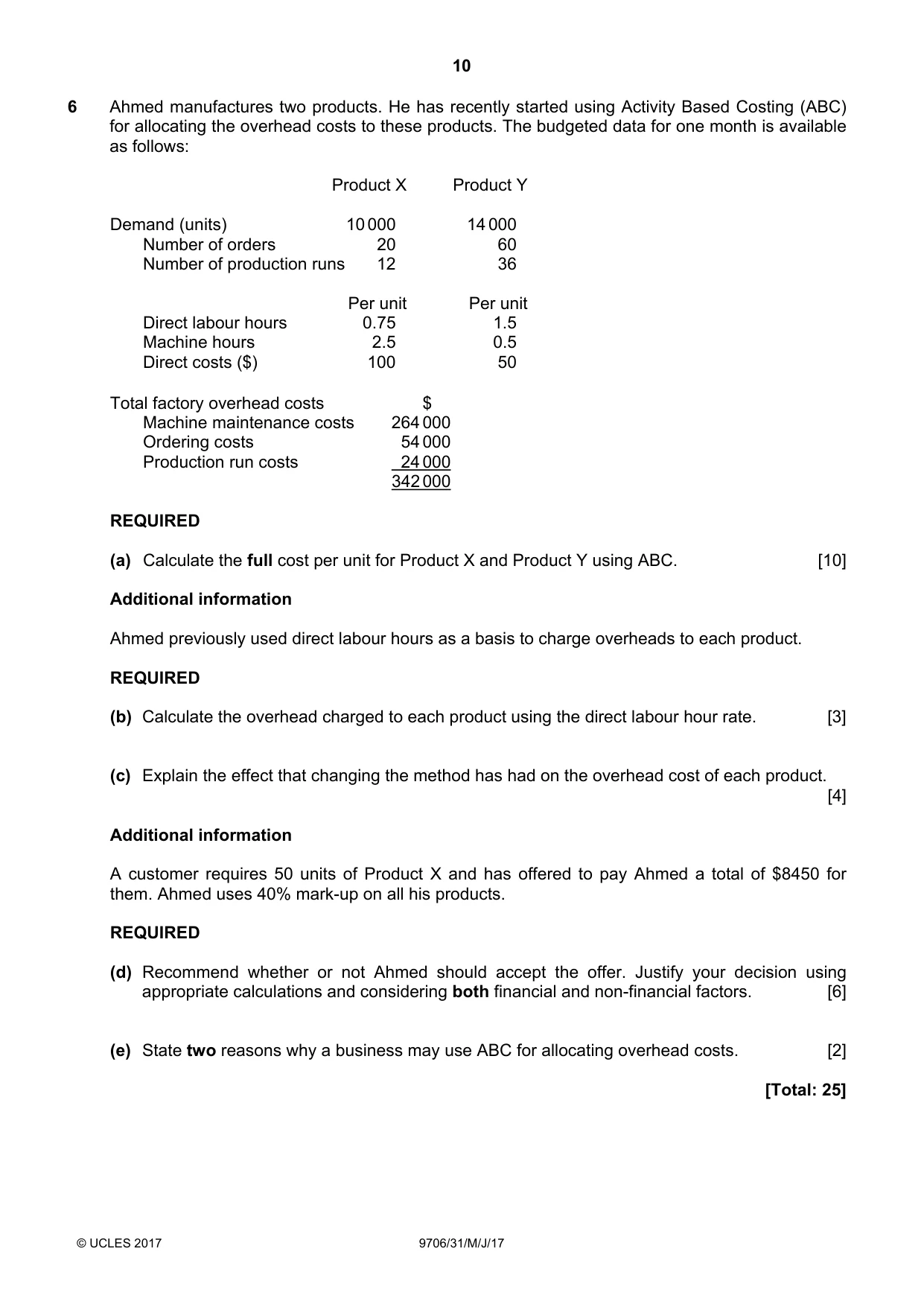
Question paper, page 10
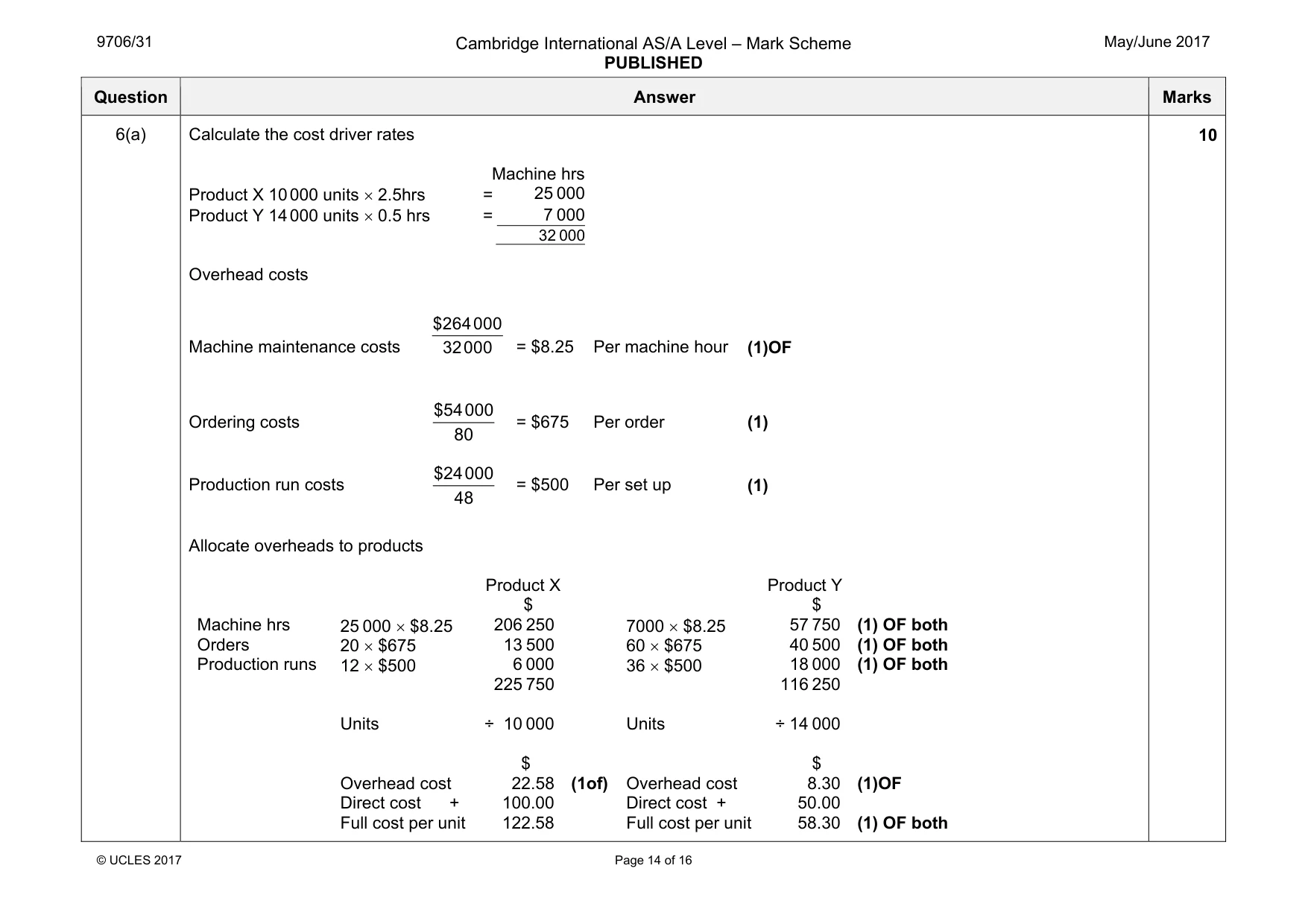
10 © UCLES 2017 9706/31/M/J/17 6 Ahmed manufactures two products. He has recently started using Activity Based Costing (ABC) for allocating the overhead costs to these products. The budgeted data for one month is available as follows: Product X Product Y Demand (units) 10 000 14 000 Number of orders 20 60 Number of production runs 12 36 Per unit Per unit Direct labour hours 0.75 1.5 Machine hours 2.5 0.5 Direct costs ($) 100 50 Total factory overhead costs $ Machine maintenance costs 264 000 Ordering costs 54 000 Production run costs 24 000 342 000 REQUIRED (a) Calculate the full cost per unit for Product X and Product Y using ABC. [10] Additional information Ahmed previously used direct labour hours as a basis to charge overheads to each product. REQUIRED (b) Calculate the overhead charged to each product using the direct labour hour rate. [3] (c) Explain the effect that changing the method has had on the overhead cost of each product. [4] Additional information A customer requires 50 units of Product X and has offered to pay Ahmed a total of $8450 for them. Ahmed uses 40% mark-up on all his products. REQUIRED (d) Recommend whether or not Ahmed should accept the offer. Justify your decision using appropriate calculations and considering both financial and non-financial factors. [6] (e) State two reasons why a business may use ABC for allocating overhead costs. [2] [Total: 25]
Question paper, page 11
11 © UCLES 2017 9706/31/M/J/17 BLANK PAGE
Question paper, page 12
12 Permission to reproduce items where third-party owned material protected by copyright is included has been sought and cleared where possible. Every reasonable effort has been made by the publisher (UCLES) to trace copyright holders, but if any items requiring clearance have unwittingly been included, the publisher will be pleased to make amends at the earliest possible opportunity. To avoid the issue of disclosure of answer-related information to candidates, all copyright acknowledgements are reproduced online in the Cambridge International Examinations Copyright Acknowledgements Booklet. This is produced for each series of examinations and is freely available to download at www.cie.org.uk after the live examination series. Cambridge International Examinations is part of the Cambridge Assessment Group. Cambridge Assessment is the brand name of University of Cambridge Local Examinations Syndicate (UCLES), which is itself a department of the University of Cambridge. © UCLES 2017 9706/31/M/J/17 BLANK PAGE
Mark scheme, page 1
® IGCSE is a registered trademark. This document consists of 16 printed pages. © UCLES 2017 [Turn over Cambridge International Examinations Cambridge International Advanced Subsidiary and Advanced Level ACCOUNTING 9706/31 Paper 3 Structured Questions May/June 2017 MARK SCHEME Maximum Mark: 150 Published This mark scheme is published as an aid to teachers and candidates, to indicate the requirements of the examination. It shows the basis on which Examiners were instructed to award marks. It does not indicate the details of the discussions that took place at an Examiners’ meeting before marking began, which would have considered the acceptability of alternative answers. Mark schemes should be read in conjunction with the question paper and the Principal Examiner Report for Teachers. Cambridge will not enter into discussions about these mark schemes. Cambridge is publishing the mark schemes for the May/June 2017 series for most Cambridge IGCSE®, Cambridge International A and AS Level and Cambridge Pre-U components, and some Cambridge O Level components.
Mark scheme, page 2
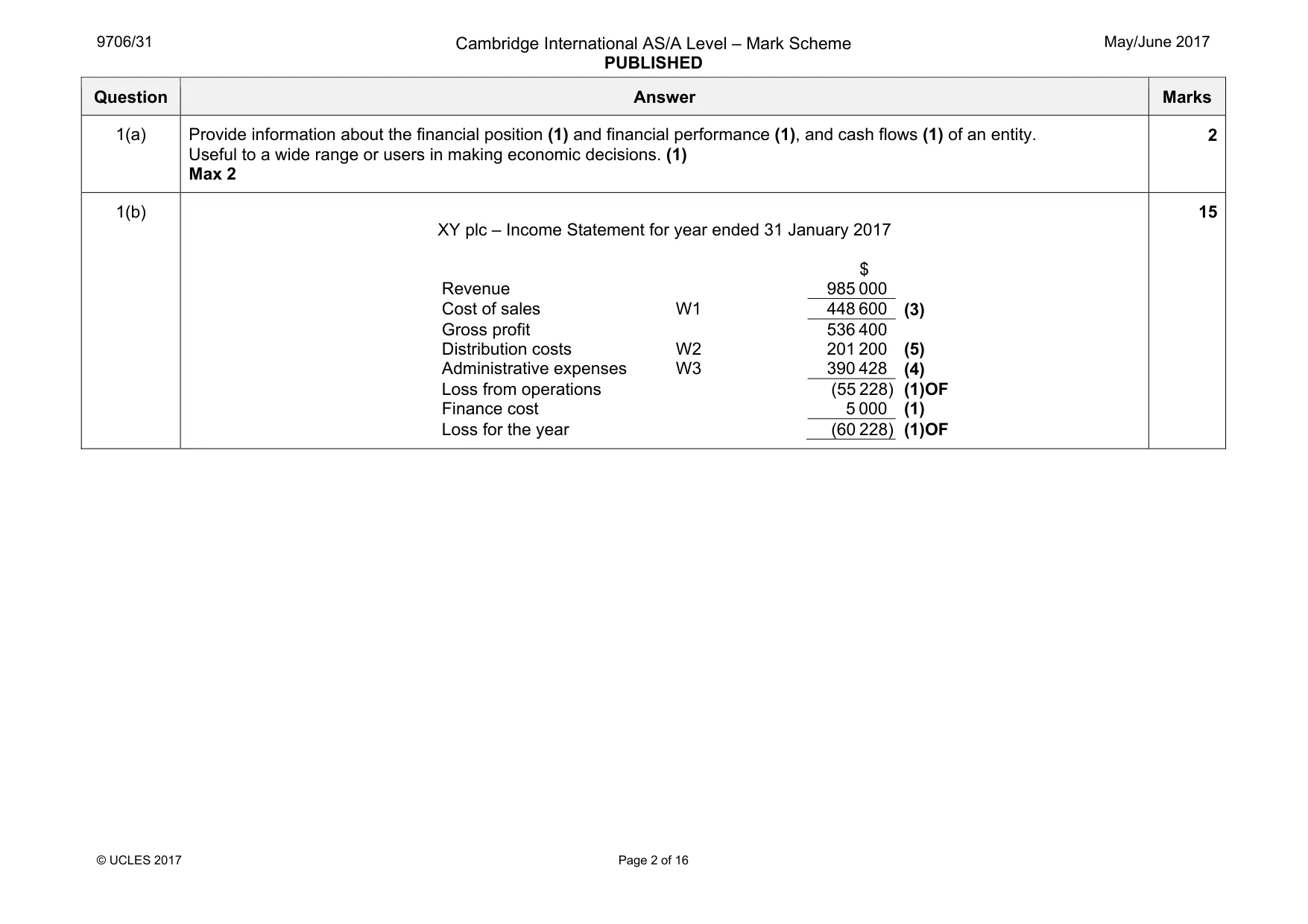
9706/31 Cambridge International AS/A Level – Mark Scheme PUBLISHED May/June 2017 © UCLES 2017 Page 2 of 16 Question Answer Marks 1(a) Provide information about the financial position (1) and financial performance (1), and cash flows (1) of an entity. Useful to a wide range or users in making economic decisions. (1) Max 2 2 1(b) XY plc – Income Statement for year ended 31 January 2017 $ Revenue 985 000 Cost of sales W1 448 600 (3) Gross profit 536 400 Distribution costs W2 201 200 (5) Administrative expenses W3 390 428 (4) Loss from operations (55 228) (1)OF Finance cost 5 000 (1) Loss for the year (60 228) (1)OF 15
Mark scheme, page 3
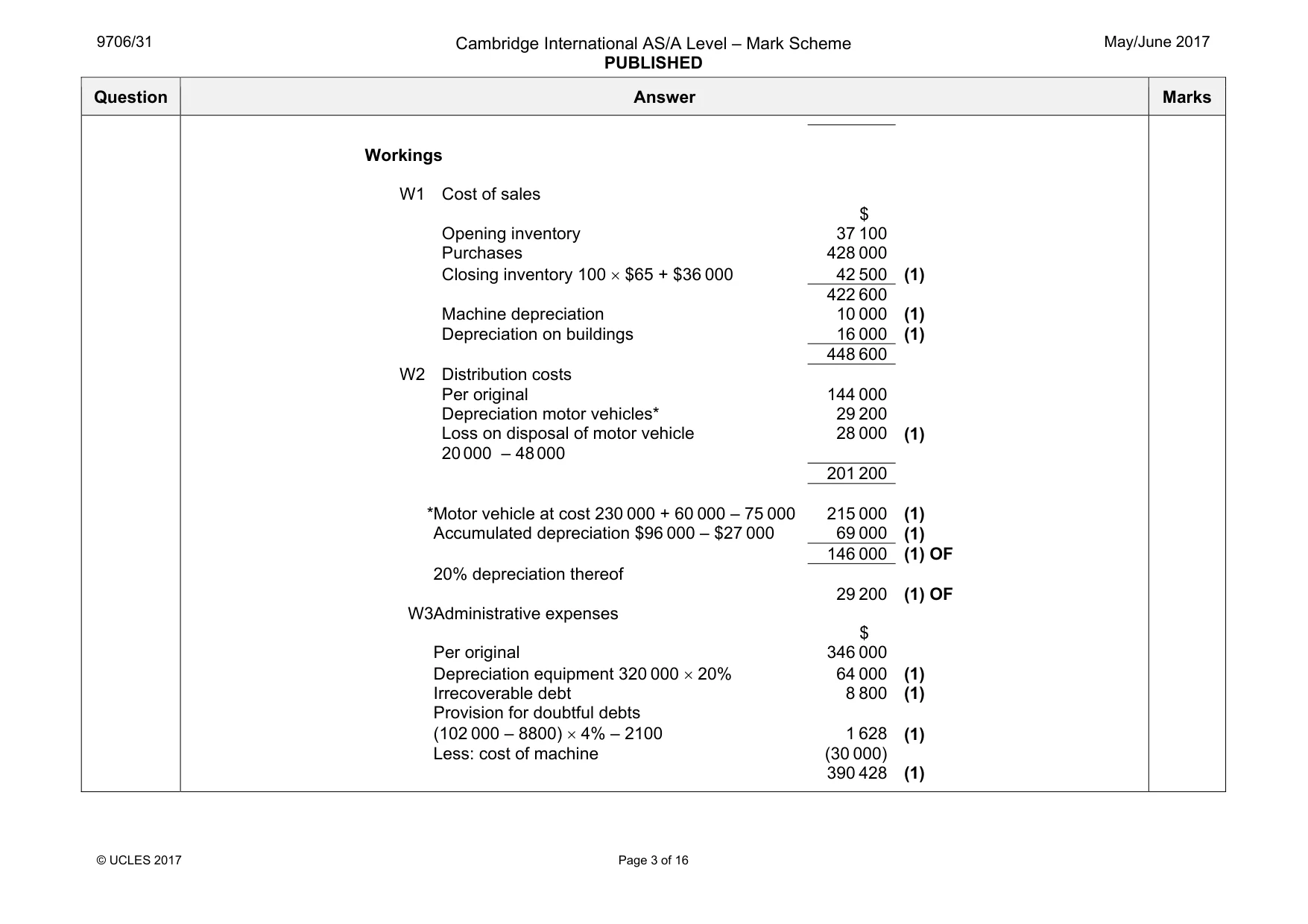
9706/31 Cambridge International AS/A Level – Mark Scheme PUBLISHED May/June 2017 © UCLES 2017 Page 3 of 16 Question Answer Marks Workings W1 Cost of sales $ Opening inventory 37 100 Purchases 428 000 Closing inventory 100 × $65 + $36 000 42 500 (1) 422 600 Machine depreciation 10 000 (1) Depreciation on buildings 16 000 (1) 448 600 W2 Distribution costs Per original 144 000 Depreciation motor vehicles* 29 200 Loss on disposal of motor vehicle 28 000 (1) 20 000 – 48 000 201 200 *Motor vehicle at cost 230 000 + 60 000 – 75 000 215 000 (1) Accumulated depreciation $96 000 – $27 000 69 000 (1) 146 000 (1) OF 20% depreciation thereof 29 200 (1) OF W3Administrative expenses $ Per original 346 000 Depreciation equipment 320 000 × 20% 64 000 (1) Irrecoverable debt 8 800 (1) Provision for doubtful debts (102 000 – 8800) × 4% – 2100 1 628 (1) Less: cost of machine (30 000) 390 428 (1)
Mark scheme, page 4
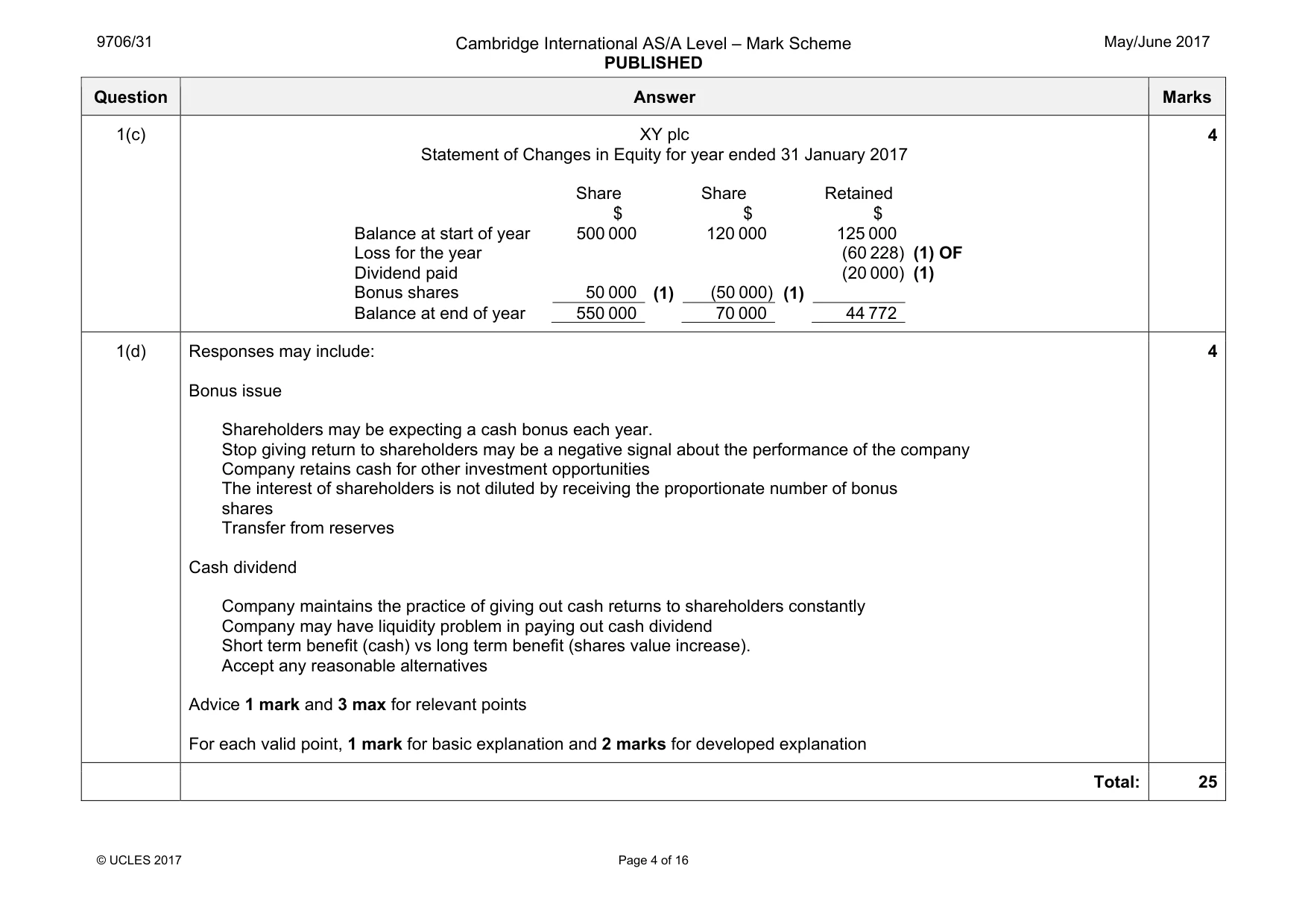
9706/31 Cambridge International AS/A Level – Mark Scheme PUBLISHED May/June 2017 © UCLES 2017 Page 4 of 16 Question Answer Marks 1(c) XY plc Statement of Changes in Equity for year ended 31 January 2017 Share Share Retained $ $ $ Balance at start of year 500 000 120 000 125 000 Loss for the year (60 228) (1) OF Dividend paid (20 000) (1) Bonus shares 50 000 (1) (50 000) (1) Balance at end of year 550 000 70 000 44 772 4 1(d) Responses may include: Bonus issue Shareholders may be expecting a cash bonus each year. Stop giving return to shareholders may be a negative signal about the performance of the company Company retains cash for other investment opportunities The interest of shareholders is not diluted by receiving the proportionate number of bonus shares Transfer from reserves Cash dividend Company maintains the practice of giving out cash returns to shareholders constantly Company may have liquidity problem in paying out cash dividend Short term benefit (cash) vs long term benefit (shares value increase). Accept any reasonable alternatives Advice 1 mark and 3 max for relevant points For each valid point, 1 mark for basic explanation and 2 marks for developed explanation 4 Total: 25
Mark scheme, page 5
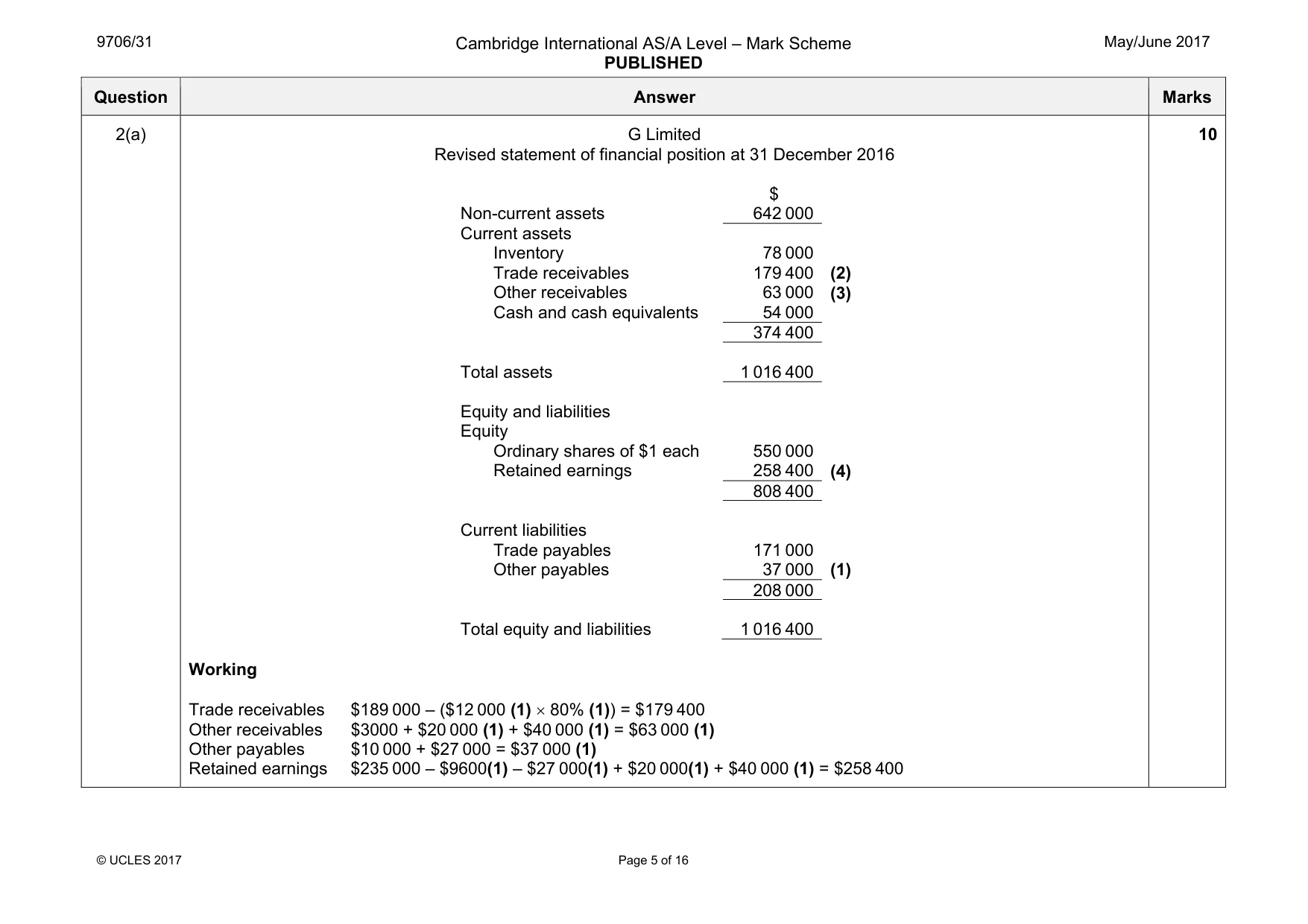
9706/31 Cambridge International AS/A Level – Mark Scheme PUBLISHED May/June 2017 © UCLES 2017 Page 5 of 16 Question Answer Marks 2(a) G Limited Revised statement of financial position at 31 December 2016 $ Non-current assets 642 000 Current assets Inventory 78 000 Trade receivables 179 400 (2) Other receivables 63 000 (3) Cash and cash equivalents 54 000 374 400 Total assets 1 016 400 Equity and liabilities Equity Ordinary shares of $1 each 550 000 Retained earnings 258 400 (4) 808 400 Current liabilities Trade payables 171 000 Other payables 37 000 (1) 208 000 Total equity and liabilities 1 016 400 Working Trade receivables $189 000 – ($12 000 (1) × 80% (1)) = $179 400 Other receivables $3000 + $20 000 (1) + $40 000 (1) = $63 000 (1) Other payables $10 000 + $27 000 = $37 000 (1) Retained earnings $235 000 – $9600(1) – $27 000(1) + $20 000(1) + $40 000 (1) = $258 400 10
Mark scheme, page 6
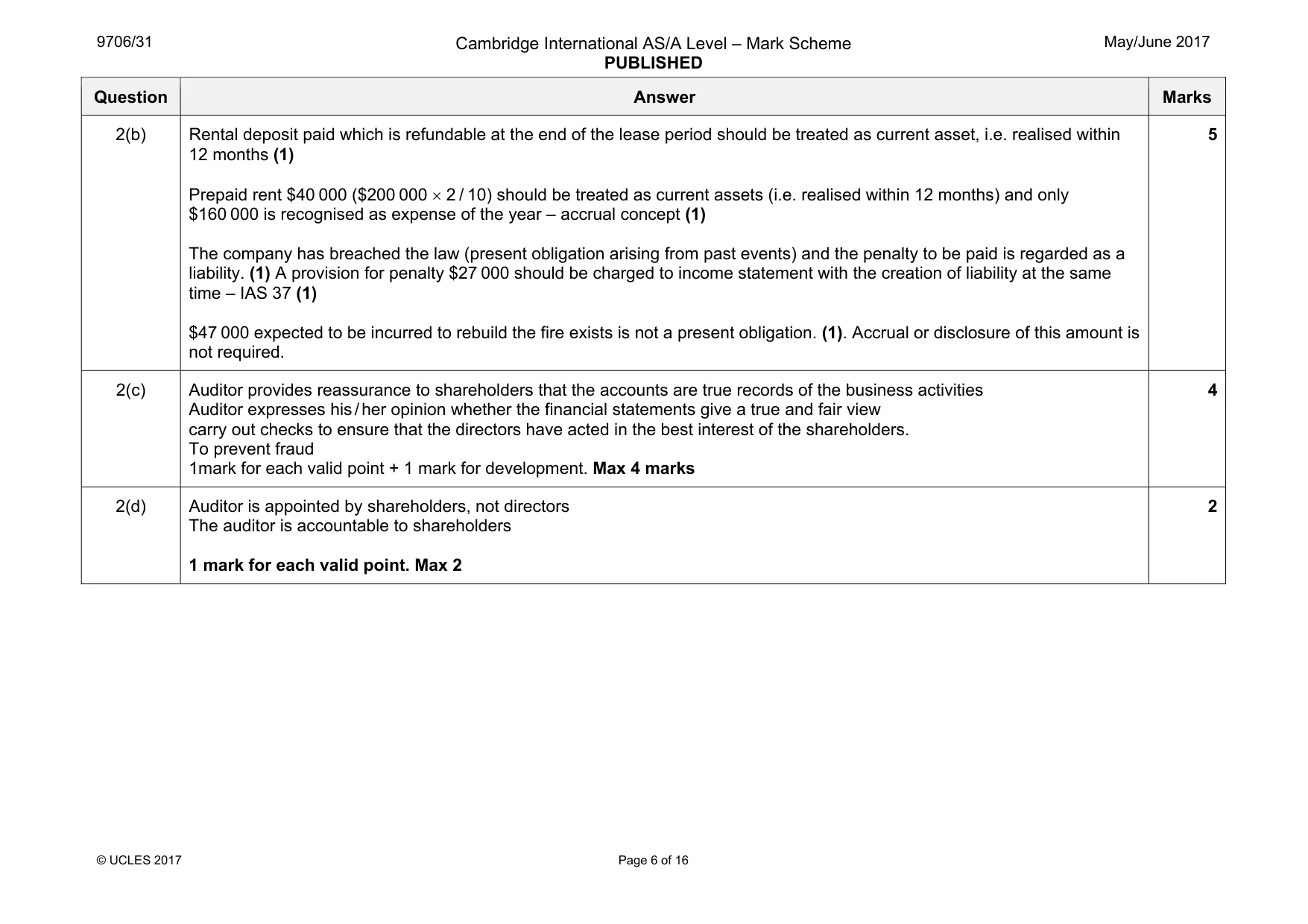
9706/31 Cambridge International AS/A Level – Mark Scheme PUBLISHED May/June 2017 © UCLES 2017 Page 6 of 16 Question Answer Marks 2(b) Rental deposit paid which is refundable at the end of the lease period should be treated as current asset, i.e. realised within 12 months (1) Prepaid rent $40 000 ($200 000 × 2 / 10) should be treated as current assets (i.e. realised within 12 months) and only $160 000 is recognised as expense of the year – accrual concept (1) The company has breached the law (present obligation arising from past events) and the penalty to be paid is regarded as a liability. (1) A provision for penalty $27 000 should be charged to income statement with the creation of liability at the same time – IAS 37 (1) $47 000 expected to be incurred to rebuild the fire exists is not a present obligation. (1). Accrual or disclosure of this amount is not required. 5 2(c) Auditor provides reassurance to shareholders that the accounts are true records of the business activities Auditor expresses his / her opinion whether the financial statements give a true and fair view carry out checks to ensure that the directors have acted in the best interest of the shareholders. To prevent fraud 1mark for each valid point + 1 mark for development. Max 4 marks 4 2(d) Auditor is appointed by shareholders, not directors The auditor is accountable to shareholders 1 mark for each valid point. Max 2 2
Mark scheme, page 7
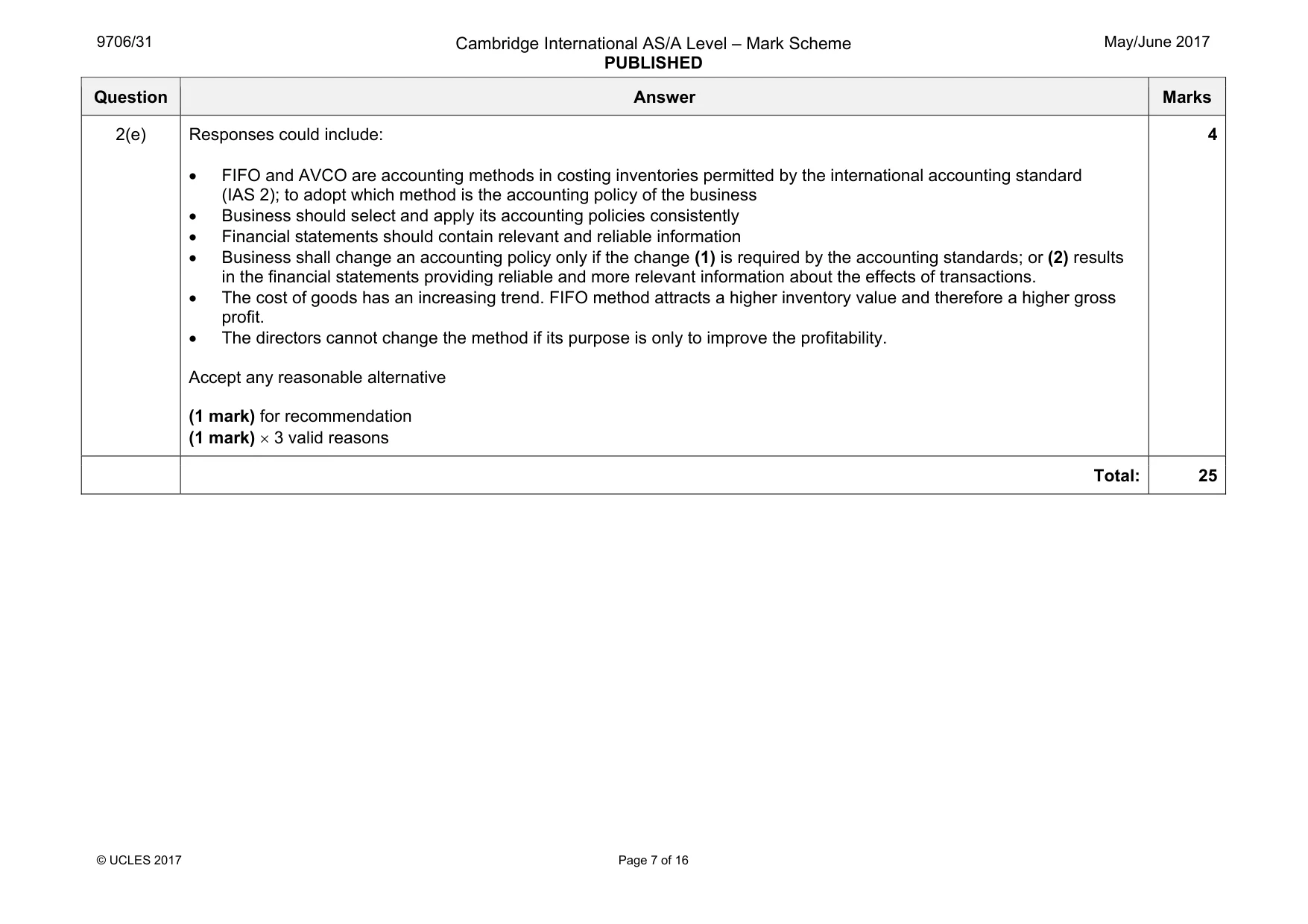
9706/31 Cambridge International AS/A Level – Mark Scheme PUBLISHED May/June 2017 © UCLES 2017 Page 7 of 16 Question Answer Marks 2(e) Responses could include: • FIFO and AVCO are accounting methods in costing inventories permitted by the international accounting standard (IAS 2); to adopt which method is the accounting policy of the business • Business should select and apply its accounting policies consistently • Financial statements should contain relevant and reliable information • Business shall change an accounting policy only if the change (1) is required by the accounting standards; or (2) results in the financial statements providing reliable and more relevant information about the effects of transactions. • The cost of goods has an increasing trend. FIFO method attracts a higher inventory value and therefore a higher gross profit. • The directors cannot change the method if its purpose is only to improve the profitability. Accept any reasonable alternative (1 mark) for recommendation (1 mark) × 3 valid reasons 4 Total: 25
Mark scheme, page 8
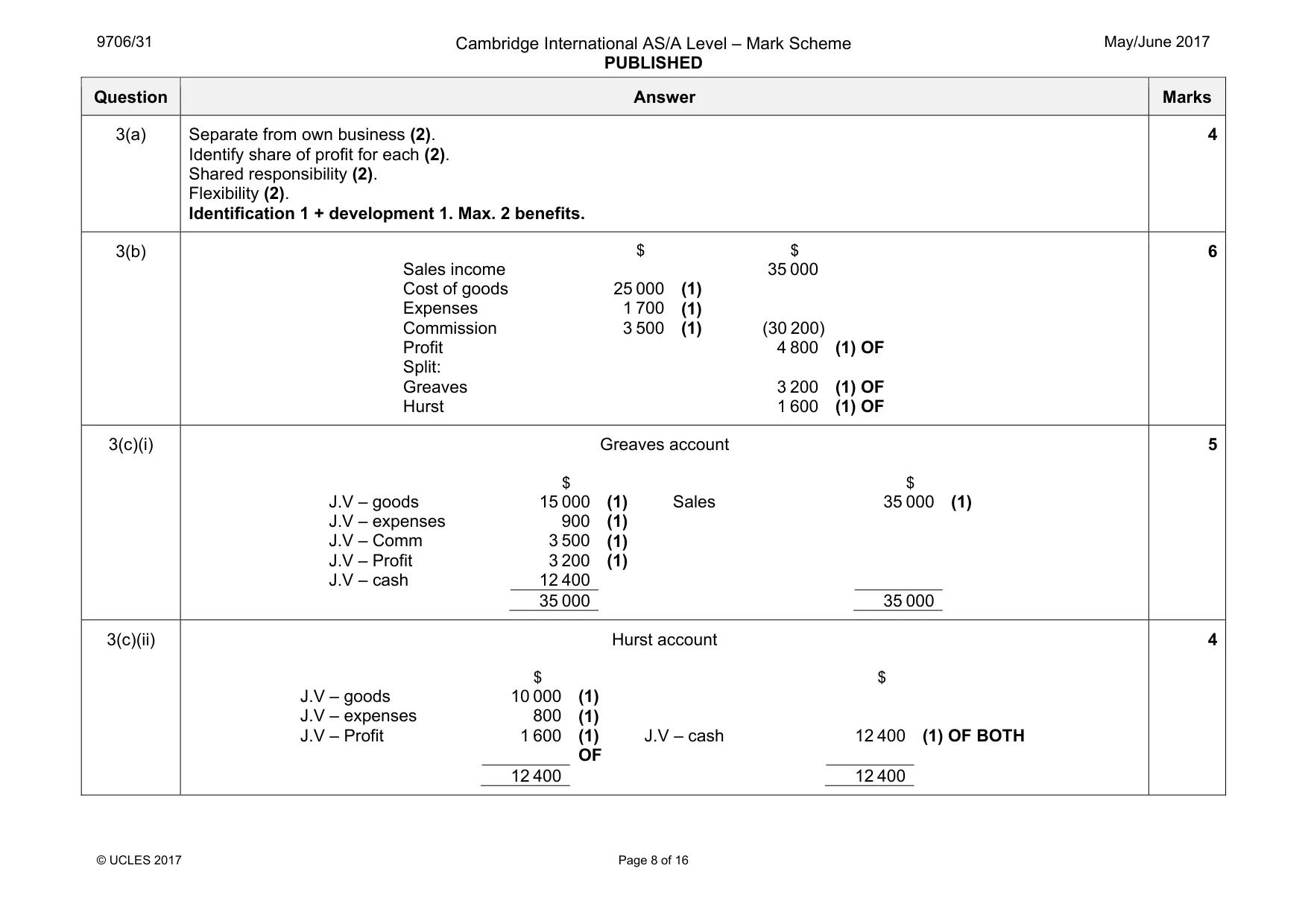
9706/31 Cambridge International AS/A Level – Mark Scheme PUBLISHED May/June 2017 © UCLES 2017 Page 8 of 16 Question Answer Marks 3(a) Separate from own business (2). Identify share of profit for each (2). Shared responsibility (2). Flexibility (2). Identification 1 + development 1. Max. 2 benefits. 4 3(b) $ $ Sales income 35 000 Cost of goods 25 000 (1) Expenses 1 700 (1) Commission 3 500 (1) (30 200) Profit 4 800 (1) OF Split: Greaves 3 200 (1) OF Hurst 1 600 (1) OF 6 3(c)(i) Greaves account $ $ J.V – goods 15 000 (1) Sales 35 000 (1) J.V – expenses 900 (1) J.V – Comm 3 500 (1) J.V – Profit 3 200 (1) J.V – cash 12 400 35 000 35 000 5 3(c)(ii) Hurst account $ $ J.V – goods 10 000 (1) J.V – expenses 800 (1) J.V – Profit 1 600 (1) OF J.V – cash 12 400 (1) OF BOTH 12 400 12 400 4
Mark scheme, page 9
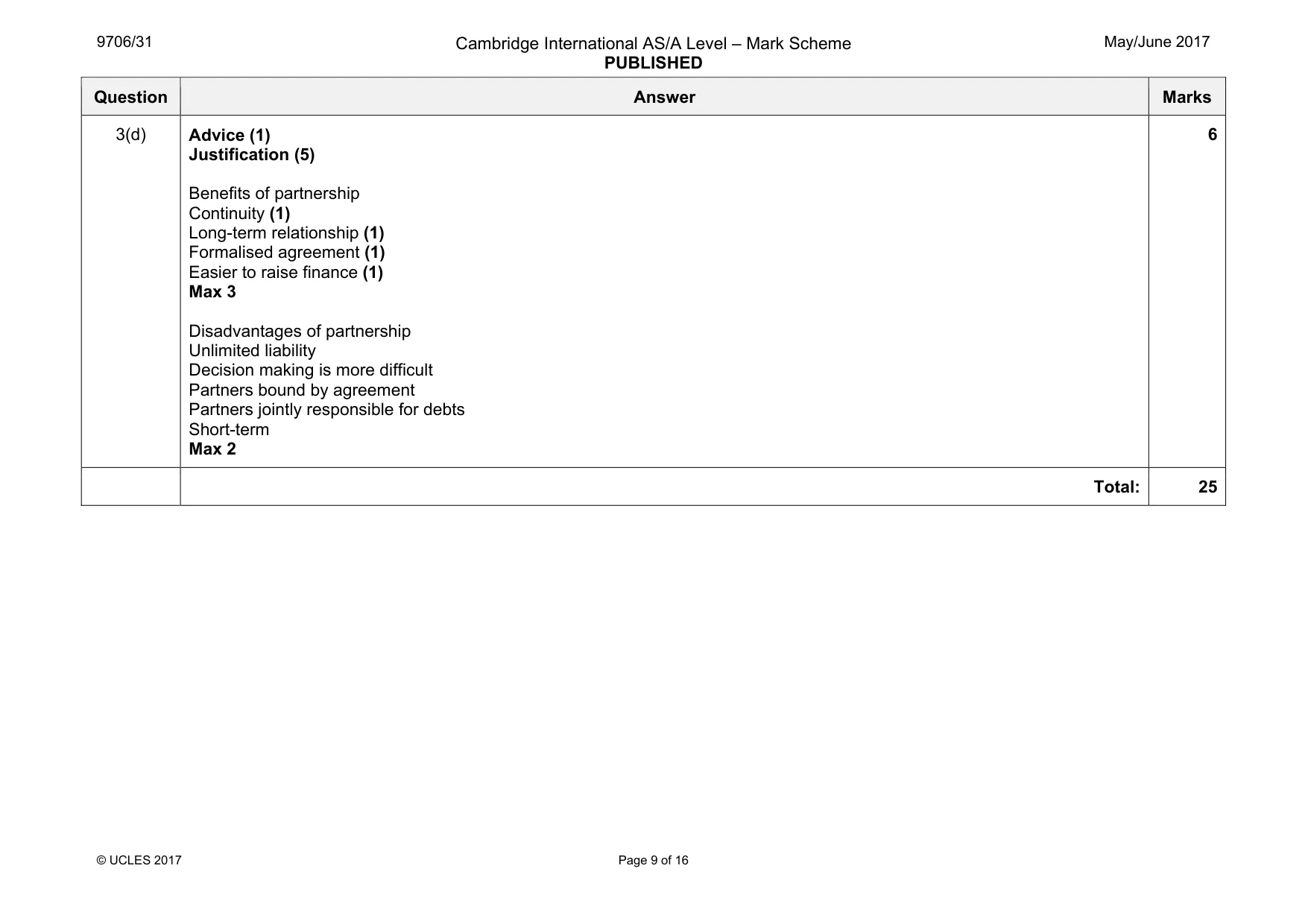
9706/31 Cambridge International AS/A Level – Mark Scheme PUBLISHED May/June 2017 © UCLES 2017 Page 9 of 16 Question Answer Marks 3(d) Advice (1) Justification (5) Benefits of partnership Continuity (1) Long-term relationship (1) Formalised agreement (1) Easier to raise finance (1) Max 3 Disadvantages of partnership Unlimited liability Decision making is more difficult Partners bound by agreement Partners jointly responsible for debts Short-term Max 2 6 Total: 25
Mark scheme, page 10
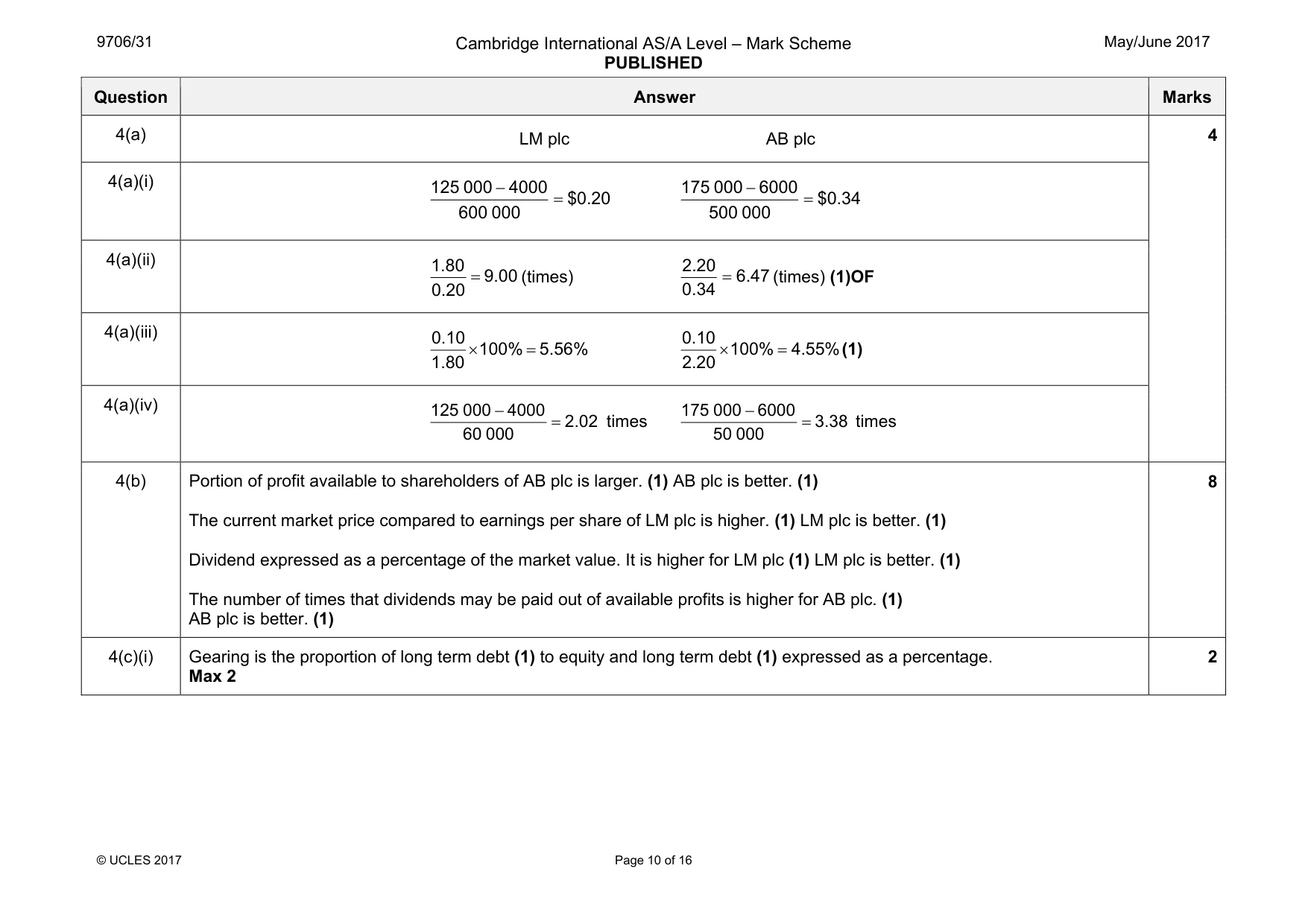
9706/31 Cambridge International AS/A Level – Mark Scheme PUBLISHED May/June 2017 © UCLES 2017 Page 10 of 16 Question Answer Marks 4(a) LM plc AB plc 4 4(a)(i) 20 0 000 600 4000 000 125 . $ = − 34 0 000 500 6000 000 175 . $ = − 4(a)(ii) 9.00 0.20 1.80 = (times) 47 6 34 0 20 2 . . . = (times) (1)OF 4(a)(iii) 5.56% 100% 1.80 0.10 = × % . % . . 55 4 100 20 2 10 0 = × (1) 4(a)(iv) 2.02 000 60 4000 000 125 = − times 3.38 000 50 6000 000 175 = − times 4(b) Portion of profit available to shareholders of AB plc is larger. (1) AB plc is better. (1) The current market price compared to earnings per share of LM plc is higher. (1) LM plc is better. (1) Dividend expressed as a percentage of the market value. It is higher for LM plc (1) LM plc is better. (1) The number of times that dividends may be paid out of available profits is higher for AB plc. (1) AB plc is better. (1) 8 4(c)(i) Gearing is the proportion of long term debt (1) to equity and long term debt (1) expressed as a percentage. Max 2 2
Mark scheme, page 11
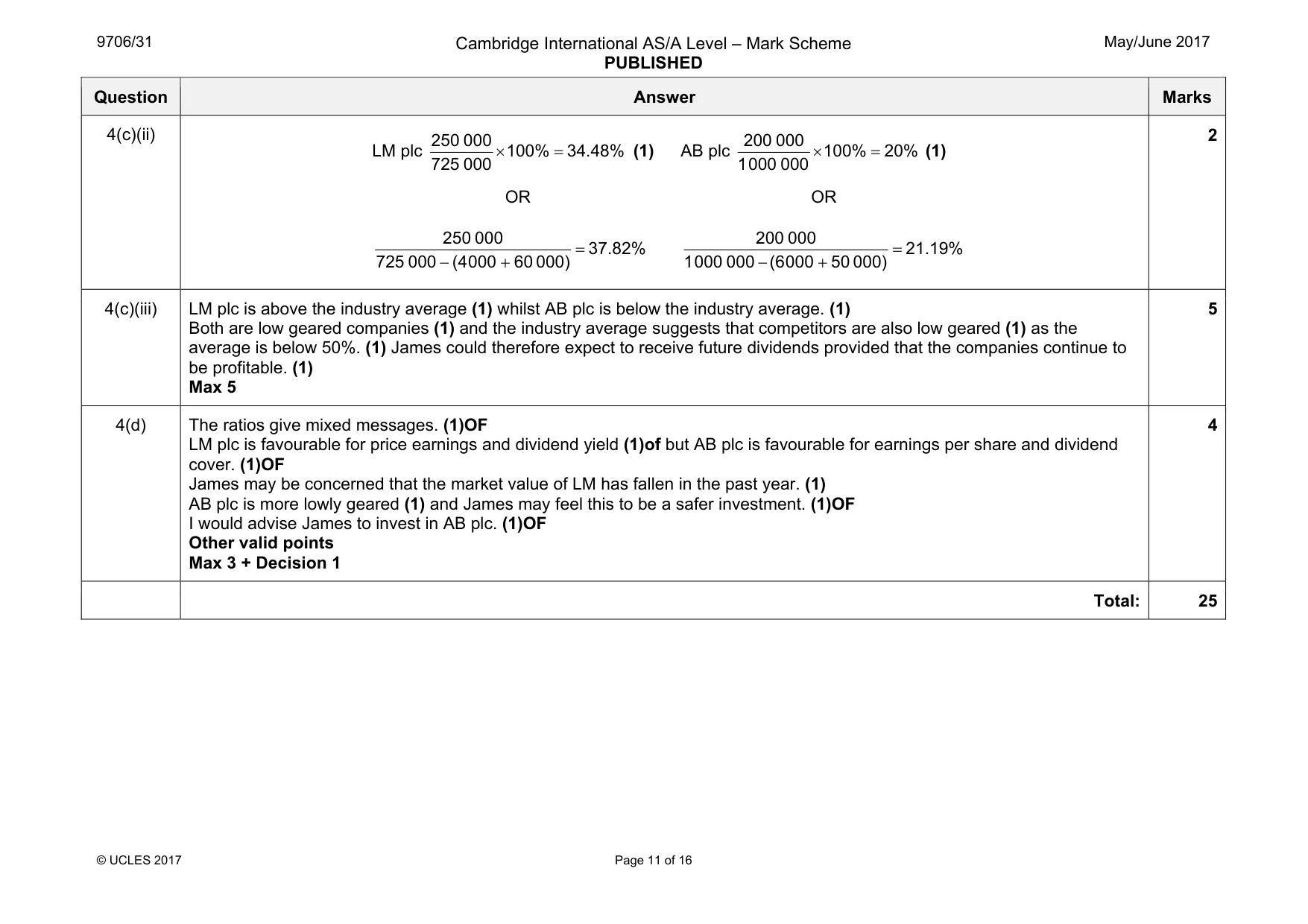
9706/31 Cambridge International AS/A Level – Mark Scheme PUBLISHED May/June 2017 © UCLES 2017 Page 11 of 16 Question Answer Marks 4(c)(ii) LM plc 34.48% 100% 000 725 000 250 = × (1) AB plc 20% 100% 000 000 1 000 200 = × (1) OR 37.82% 000) 60 000 (4 000 725 000 250 = + − OR 21.19% 000) 50 000 (6 000 000 1 000 200 = + − 2 4(c)(iii) LM plc is above the industry average (1) whilst AB plc is below the industry average. (1) Both are low geared companies (1) and the industry average suggests that competitors are also low geared (1) as the average is below 50%. (1) James could therefore expect to receive future dividends provided that the companies continue to be profitable. (1) Max 5 5 4(d) The ratios give mixed messages. (1)OF LM plc is favourable for price earnings and dividend yield (1)of but AB plc is favourable for earnings per share and dividend cover. (1)OF James may be concerned that the market value of LM has fallen in the past year. (1) AB plc is more lowly geared (1) and James may feel this to be a safer investment. (1)OF I would advise James to invest in AB plc. (1)OF Other valid points Max 3 + Decision 1 4 Total: 25
Mark scheme, page 12
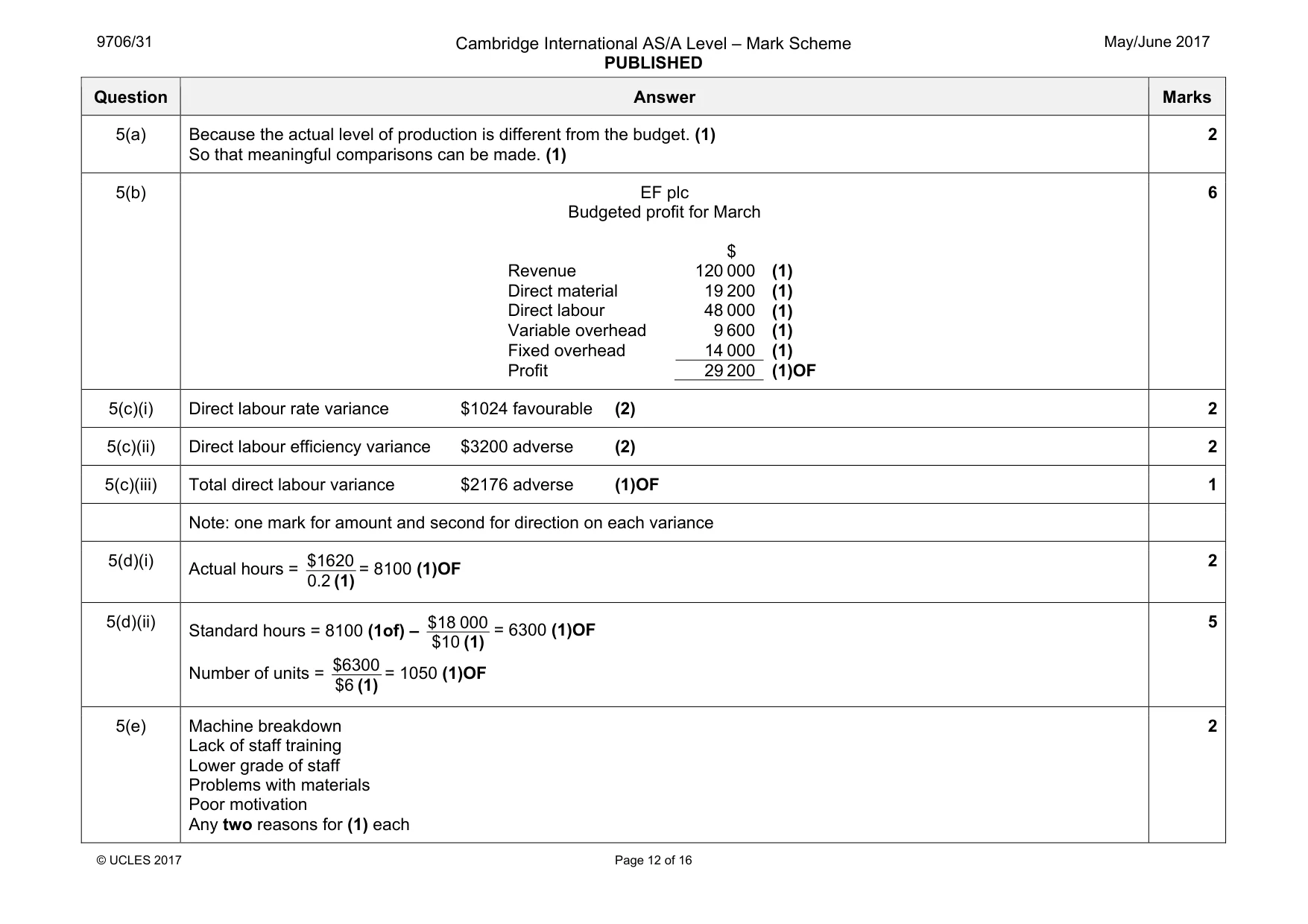
9706/31 Cambridge International AS/A Level – Mark Scheme PUBLISHED May/June 2017 © UCLES 2017 Page 12 of 16 Question Answer Marks 5(a) Because the actual level of production is different from the budget. (1) So that meaningful comparisons can be made. (1) 2 5(b) EF plc Budgeted profit for March $ Revenue 120 000 (1) Direct material 19 200 (1) Direct labour 48 000 (1) Variable overhead 9 600 (1) Fixed overhead 14 000 (1) Profit 29 200 (1)OF 6 5(c)(i) Direct labour rate variance $1024 favourable (2) 2 5(c)(ii) Direct labour efficiency variance $3200 adverse (2) 2 5(c)(iii) Total direct labour variance $2176 adverse (1)OF 1 Note: one mark for amount and second for direction on each variance 5(d)(i) Actual hours = (1) 0.2 $1620 = 8100 (1)OF 2 5(d)(ii) Standard hours = 8100 (1of) – (1) $10 000 $18 = 6300 (1)OF Number of units = (1) $6 $6300 = 1050 (1)OF 5 5(e) Machine breakdown Lack of staff training Lower grade of staff Problems with materials Poor motivation Any two reasons for (1) each 2
Mark scheme, page 13
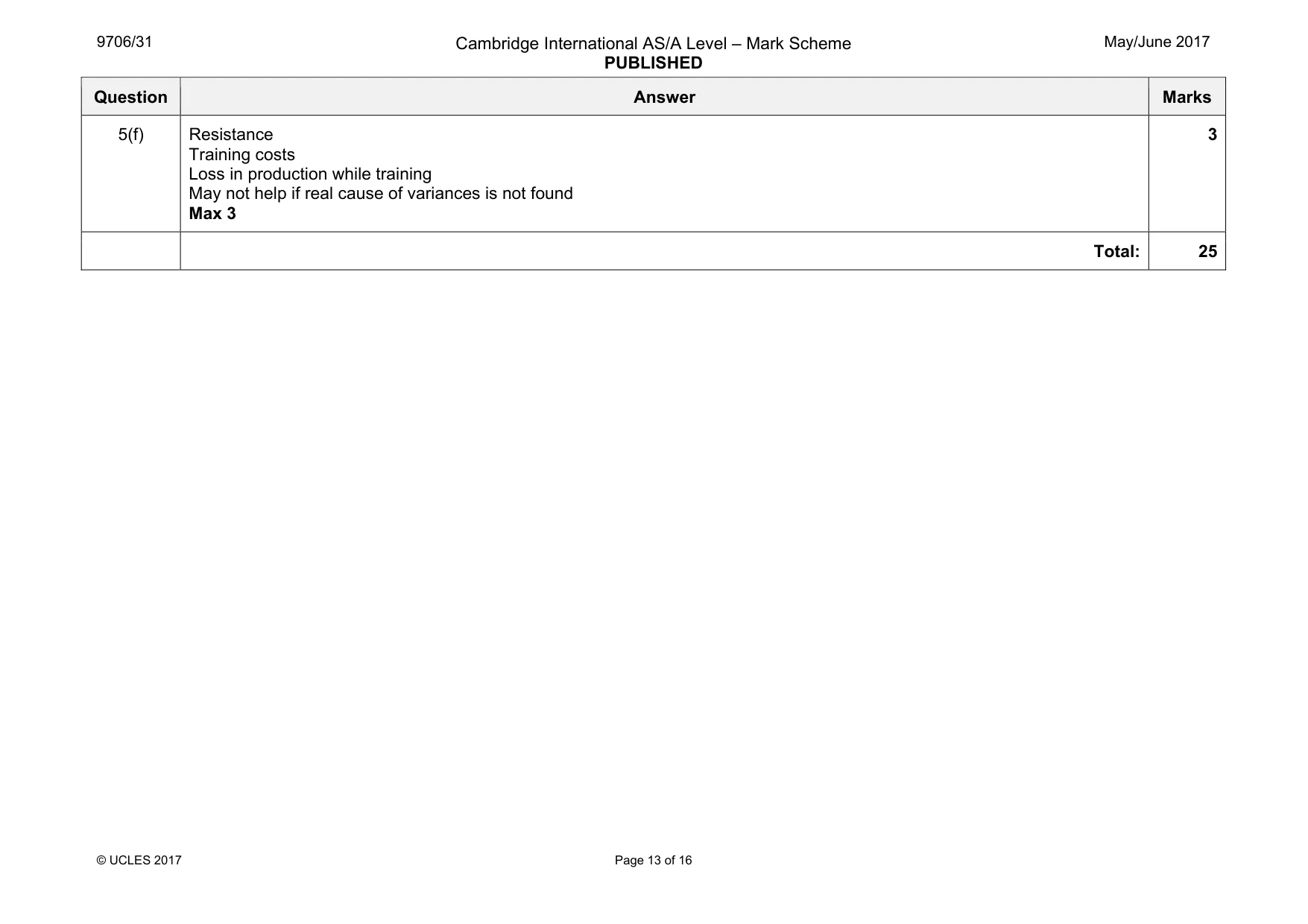
9706/31 Cambridge International AS/A Level – Mark Scheme PUBLISHED May/June 2017 © UCLES 2017 Page 13 of 16 Question Answer Marks 5(f) Resistance Training costs Loss in production while training May not help if real cause of variances is not found Max 3 3 Total: 25
Mark scheme, page 14
9706/31 Cambridge International AS/A Level – Mark Scheme PUBLISHED May/June 2017 © UCLES 2017 Page 14 of 16 Question Answer Marks 6(a) Calculate the cost driver rates Machine hrs Product X 10 000 units × 2.5hrs = 25 000 Product Y 14 000 units × 0.5 hrs = 7 000 32 000 Overhead costs Machine maintenance costs $264000 32000 = $8.25 Per machine hour (1)OF Ordering costs $54000 80 = $675 Per order (1) Production run costs $24000 48 = $500 Per set up (1) Allocate overheads to products Product X Product Y $ $ Machine hrs 25 000 × $8.25 206 250 7000 × $8.25 57 750 (1) OF both Orders 20 × $675 13 500 60 × $675 40 500 (1) OF both Production runs 12 × $500 6 000 36 × $500 18 000 (1) OF both 225 750 116 250 Units ÷ 10 000 Units ÷ 14 000 $ $ Overhead cost 22.58 (1of) Overhead cost 8.30 (1)OF Direct cost + 100.00 Direct cost + 50.00 Full cost per unit 122.58 Full cost per unit 58.30 (1) OF both 10
Mark scheme, page 15
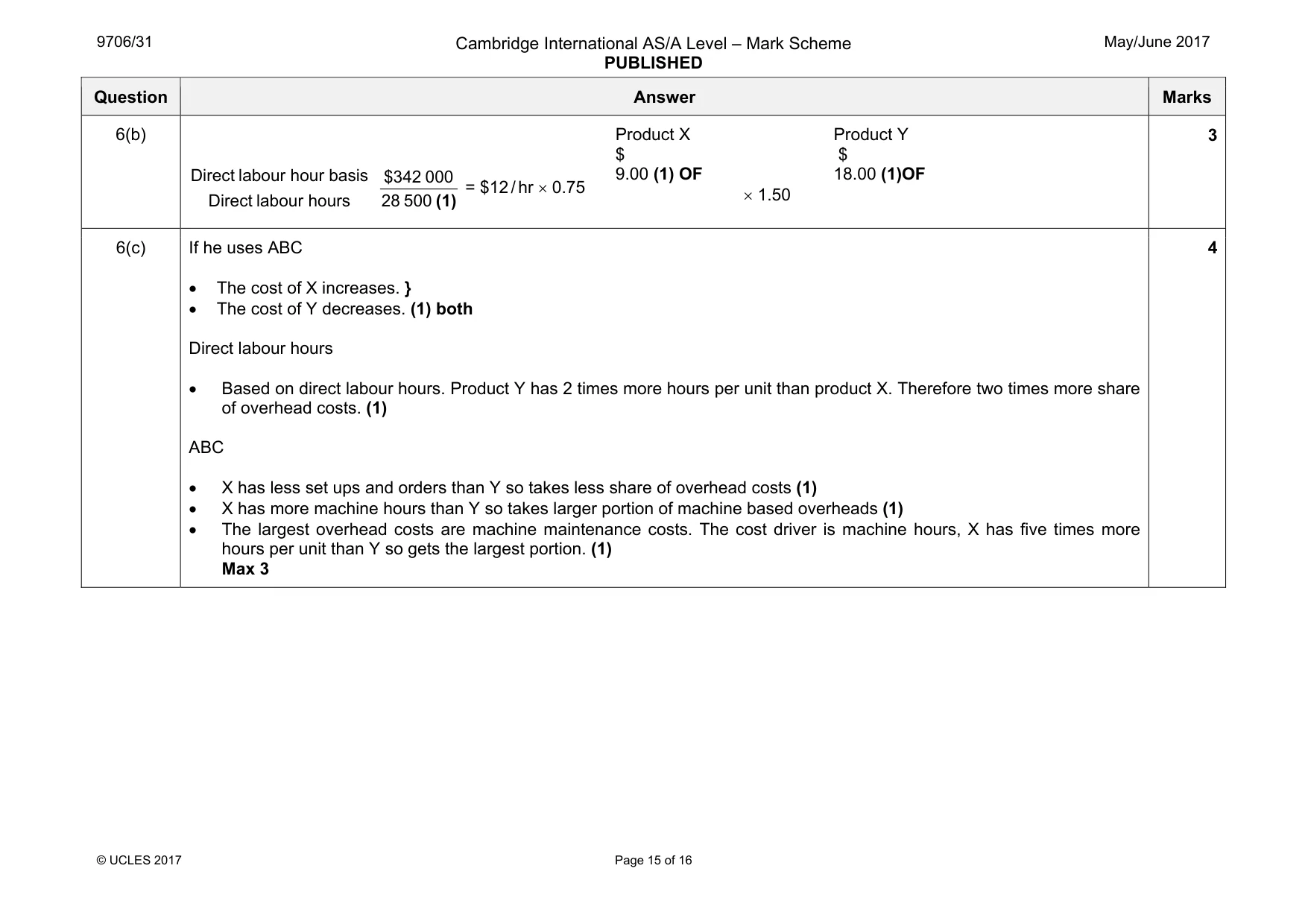
9706/31 Cambridge International AS/A Level – Mark Scheme PUBLISHED May/June 2017 © UCLES 2017 Page 15 of 16 Question Answer Marks 6(b) Product X Product Y $ $ (1) 500 28 000 $342 hours labour Direct basis hour labour Direct = $12 / hr × 0.75 9.00 (1) OF × 1.50 18.00 (1)OF 3 6(c) If he uses ABC • The cost of X increases. } • The cost of Y decreases. (1) both Direct labour hours • Based on direct labour hours. Product Y has 2 times more hours per unit than product X. Therefore two times more share of overhead costs. (1) ABC • X has less set ups and orders than Y so takes less share of overhead costs (1) • X has more machine hours than Y so takes larger portion of machine based overheads (1) • The largest overhead costs are machine maintenance costs. The cost driver is machine hours, X has five times more hours per unit than Y so gets the largest portion. (1) Max 3 4
Mark scheme, page 16
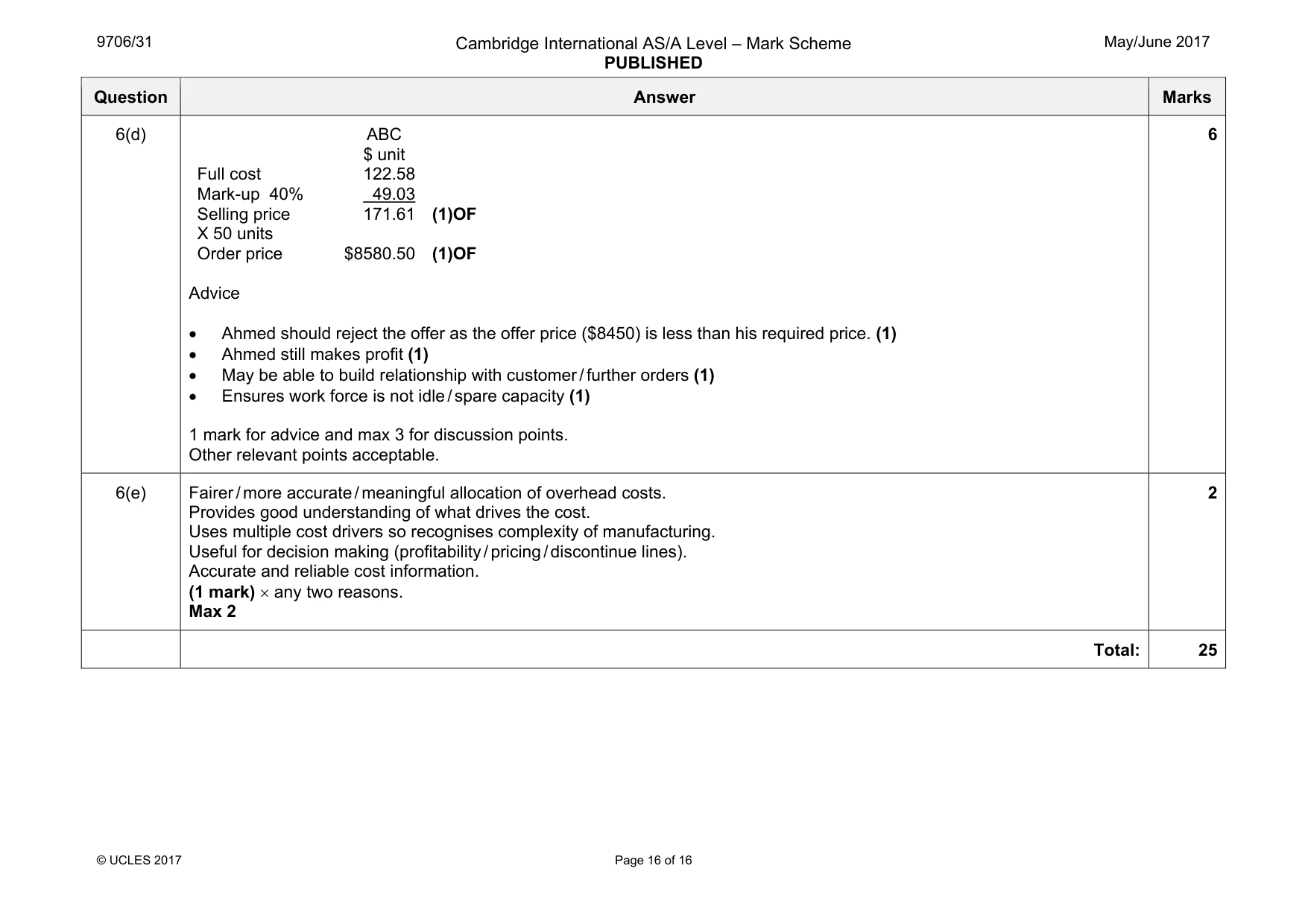
9706/31 Cambridge International AS/A Level – Mark Scheme PUBLISHED May/June 2017 © UCLES 2017 Page 16 of 16 Question Answer Marks 6(d) ABC $ unit Full cost 122.58 Mark-up 40% 49.03 Selling price 171.61 (1)OF X 50 units Order price $8580.50 (1)OF Advice • Ahmed should reject the offer as the offer price ($8450) is less than his required price. (1) • Ahmed still makes profit (1) • May be able to build relationship with customer / further orders (1) • Ensures work force is not idle / spare capacity (1) 1 mark for advice and max 3 for discussion points. Other relevant points acceptable. 6 6(e) Fairer / more accurate / meaningful allocation of overhead costs. Provides good understanding of what drives the cost. Uses multiple cost drivers so recognises complexity of manufacturing. Useful for decision making (profitability / pricing / discontinue lines). Accurate and reliable cost information. (1 mark) × any two reasons. Max 2 2 Total: 25
What you needed in this session
Cambridge’s own grade thresholds for 2017 May/June, Paper 3 · Variant 1. A higher threshold means an easier paper — the bar moves with how the cohort did.