Cambridge A Level Accounting 9706 — 2016 May/June Paper 3 · Variant 2
9706/32/M/J/16 · 150 marks · ≈169 min
The question paper and its mark scheme, free to read here and free to download. This is Cambridge’s own paper, exactly as it was sat.
Question paper12 pages
Mark scheme10 pages
Answers below. Sit the paper first if you are practising.
Paper as text
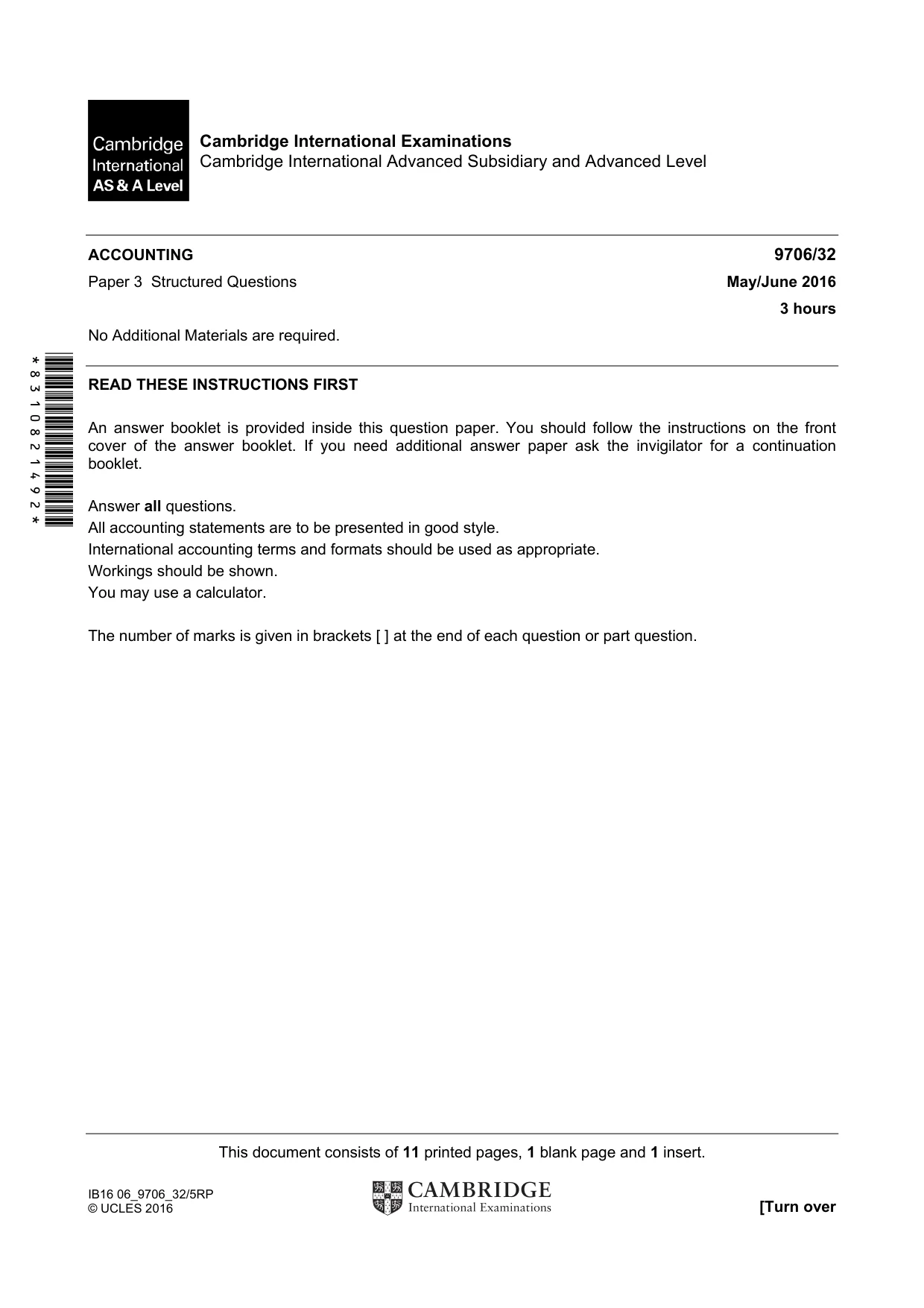
Question paper, page 1
This document consists of 11 printed pages, 1 blank page and 1 insert. IB16 06_9706_32/5RP © UCLES 2016 [Turn over *8310821492* Cambridge International Examinations Cambridge International Advanced Subsidiary and Advanced Level ACCOUNTING 9706/32 Paper 3 Structured Questions May/June 2016 3 hours No Additional Materials are required. READ THESE INSTRUCTIONS FIRST An answer booklet is provided inside this question paper. You should follow the instructions on the front cover of the answer booklet. If you need additional answer paper ask the invigilator for a continuation booklet. Answer all questions. All accounting statements are to be presented in good style. International accounting terms and formats should be used as appropriate. Workings should be shown. You may use a calculator. The number of marks is given in brackets [ ] at the end of each question or part question.
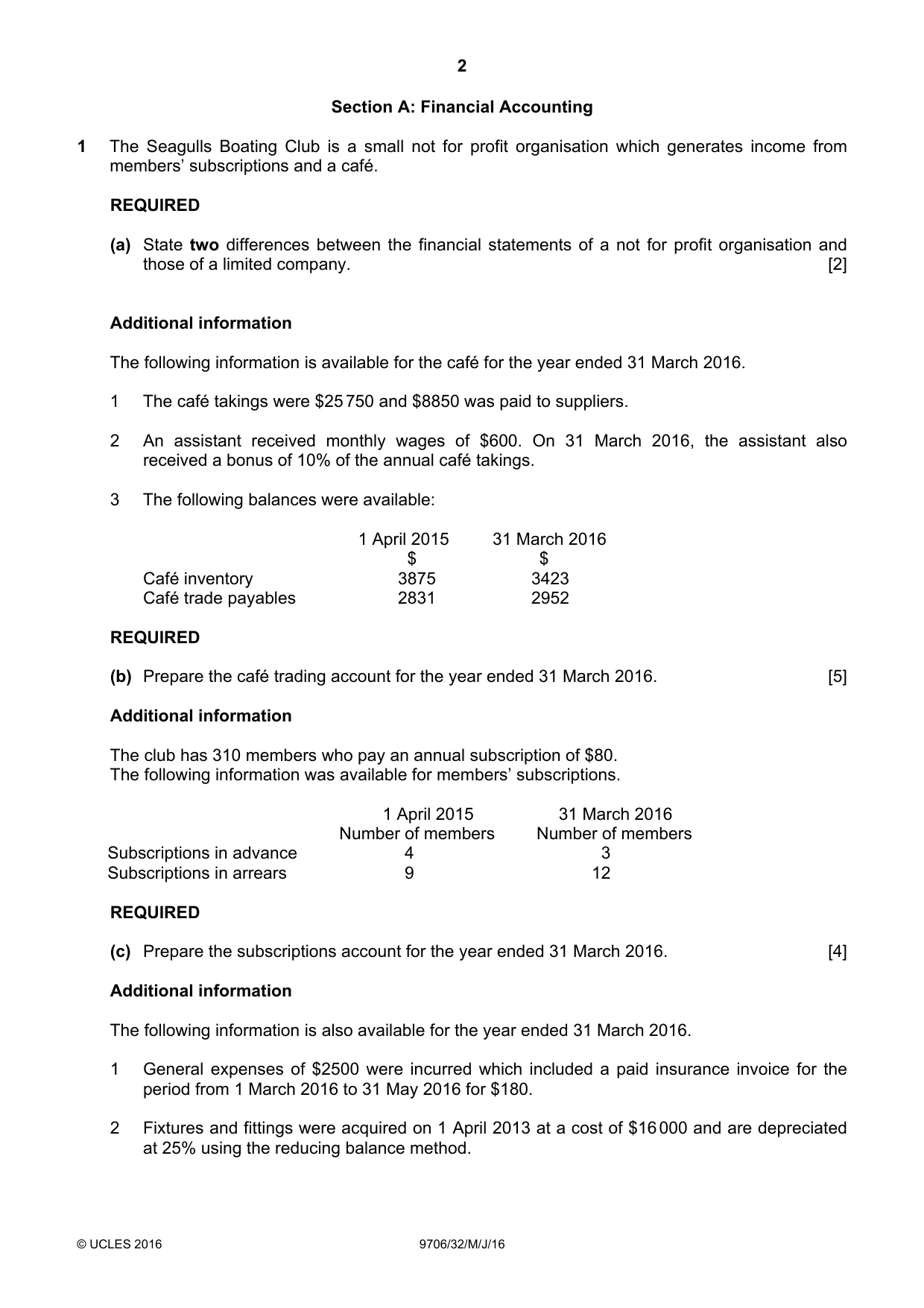
Question paper, page 2
2 © UCLES 2016 9706/32/M/J/16 Section A: Financial Accounting 1 The Seagulls Boating Club is a small not for profit organisation which generates income from members’ subscriptions and a café. REQUIRED (a) State two differences between the financial statements of a not for profit organisation and those of a limited company. [2] Additional information The following information is available for the café for the year ended 31 March 2016. 1 The café takings were $25 750 and $8850 was paid to suppliers. 2 An assistant received monthly wages of $600. On 31 March 2016, the assistant also received a bonus of 10% of the annual café takings. 3 The following balances were available: 1 April 2015 31 March 2016 $ $ Café inventory 3875 3423 Café trade payables 2831 2952 REQUIRED (b) Prepare the café trading account for the year ended 31 March 2016. [5] Additional information The club has 310 members who pay an annual subscription of $80. The following information was available for members’ subscriptions. 1 April 2015 31 March 2016 Number of members Number of members Subscriptions in advance 4 3 Subscriptions in arrears 9 12 REQUIRED (c) Prepare the subscriptions account for the year ended 31 March 2016. [4] Additional information The following information is also available for the year ended 31 March 2016. 1 General expenses of $2500 were incurred which included a paid insurance invoice for the period from 1 March 2016 to 31 May 2016 for $180. 2 Fixtures and fittings were acquired on 1 April 2013 at a cost of $16 000 and are depreciated at 25% using the reducing balance method.
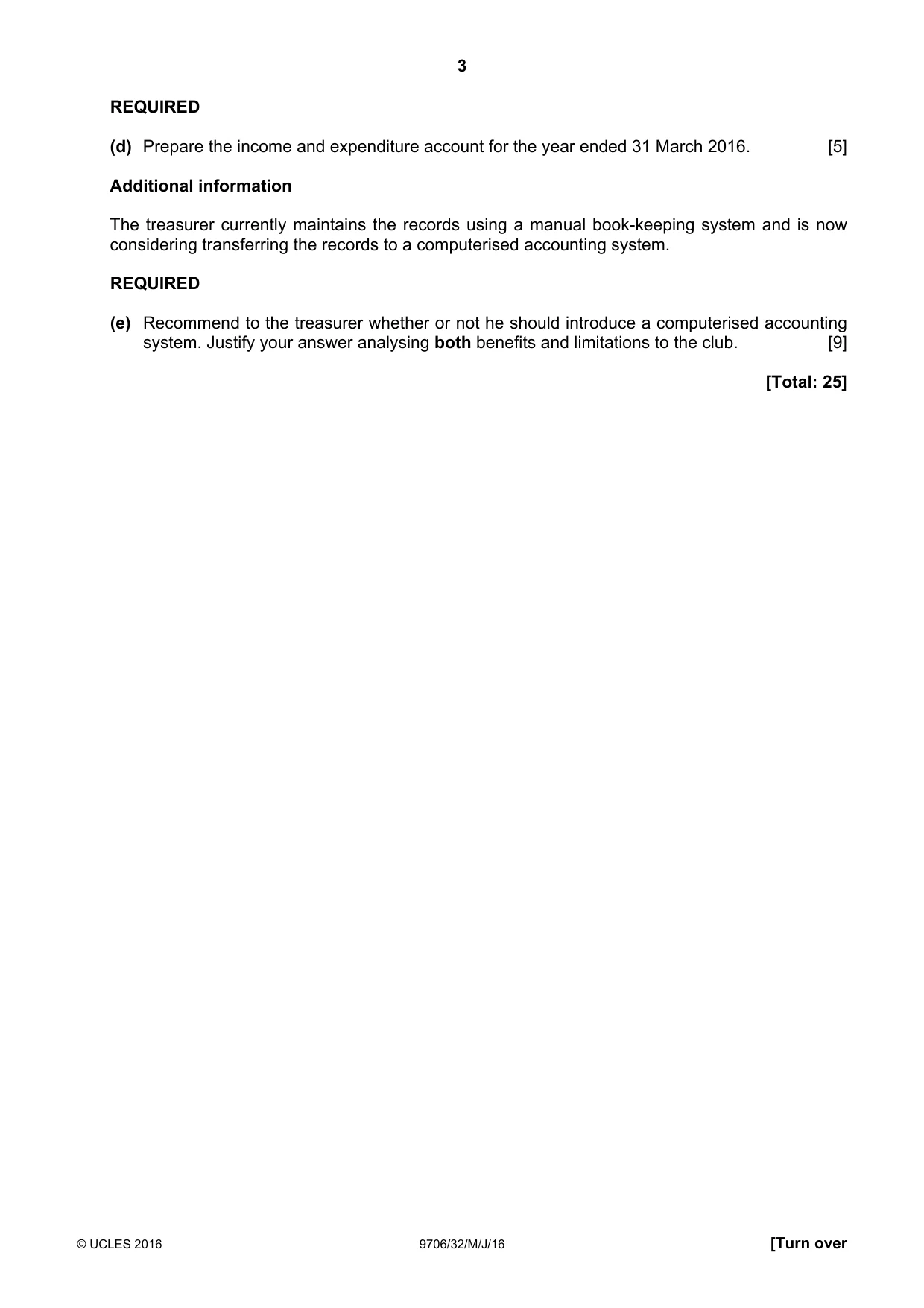
Question paper, page 3
3 © UCLES 2016 9706/32/M/J/16 [Turn over REQUIRED (d) Prepare the income and expenditure account for the year ended 31 March 2016. [5] Additional information The treasurer currently maintains the records using a manual book-keeping system and is now considering transferring the records to a computerised accounting system. REQUIRED (e) Recommend to the treasurer whether or not he should introduce a computerised accounting system. Justify your answer analysing both benefits and limitations to the club. [9] [Total: 25]
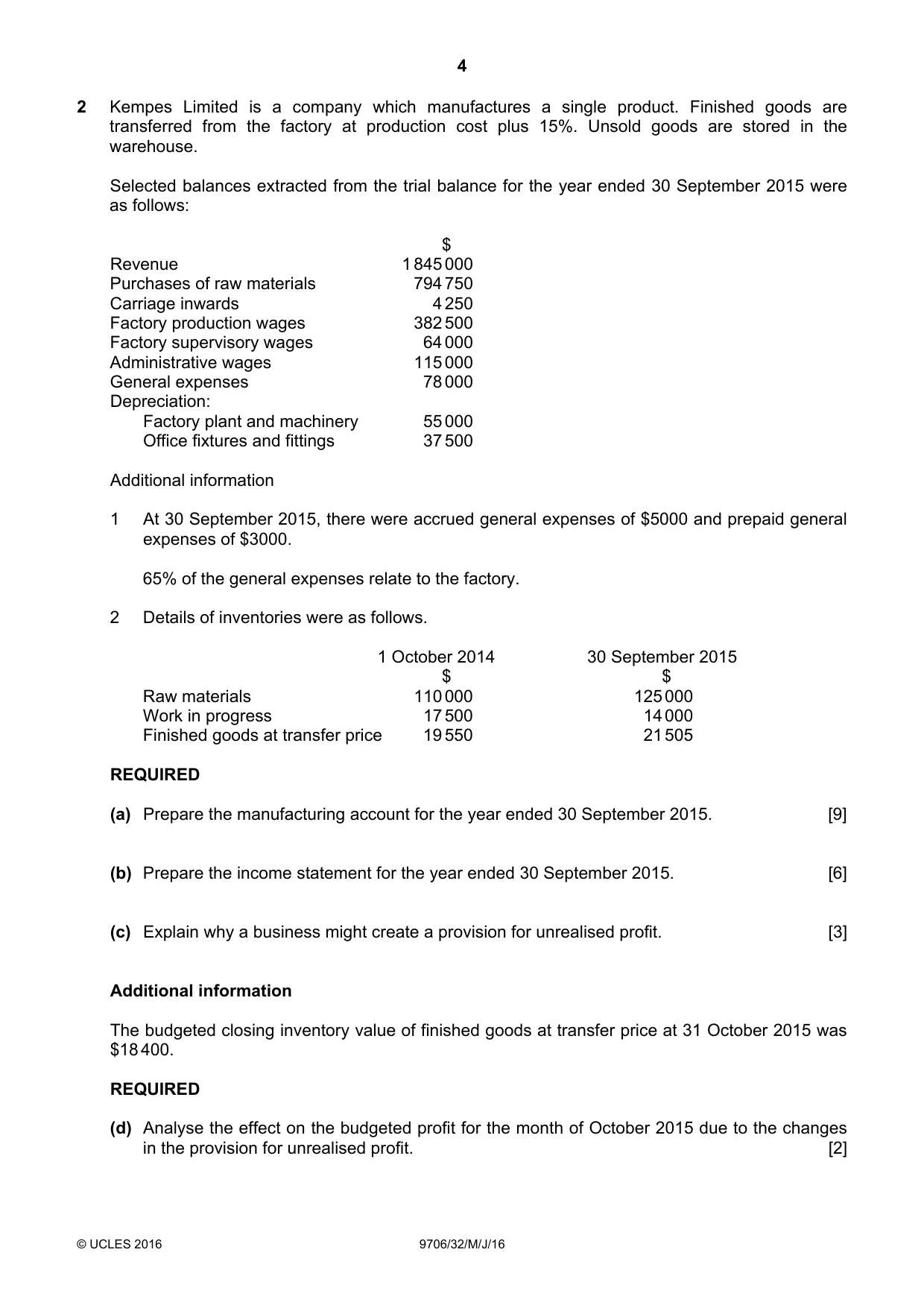
Question paper, page 4
4 © UCLES 2016 9706/32/M/J/16 2 Kempes Limited is a company which manufactures a single product. Finished goods are transferred from the factory at production cost plus 15%. Unsold goods are stored in the warehouse. Selected balances extracted from the trial balance for the year ended 30 September 2015 were as follows: $ Revenue 1 845 000 Purchases of raw materials 794 750 Carriage inwards 4 250 Factory production wages 382 500 Factory supervisory wages 64 000 Administrative wages 115 000 General expenses 78 000 Depreciation: Factory plant and machinery 55 000 Office fixtures and fittings 37 500 Additional information 1 At 30 September 2015, there were accrued general expenses of $5000 and prepaid general expenses of $3000. 65% of the general expenses relate to the factory. 2 Details of inventories were as follows. 1 October 2014 30 September 2015 $ $ Raw materials 110 000 125 000 Work in progress 17 500 14 000 Finished goods at transfer price 19 550 21 505 REQUIRED (a) Prepare the manufacturing account for the year ended 30 September 2015. [9] (b) Prepare the income statement for the year ended 30 September 2015. [6] (c) Explain why a business might create a provision for unrealised profit. [3] Additional information The budgeted closing inventory value of finished goods at transfer price at 31 October 2015 was $18 400. REQUIRED (d) Analyse the effect on the budgeted profit for the month of October 2015 due to the changes in the provision for unrealised profit. [2]
Question paper, page 5
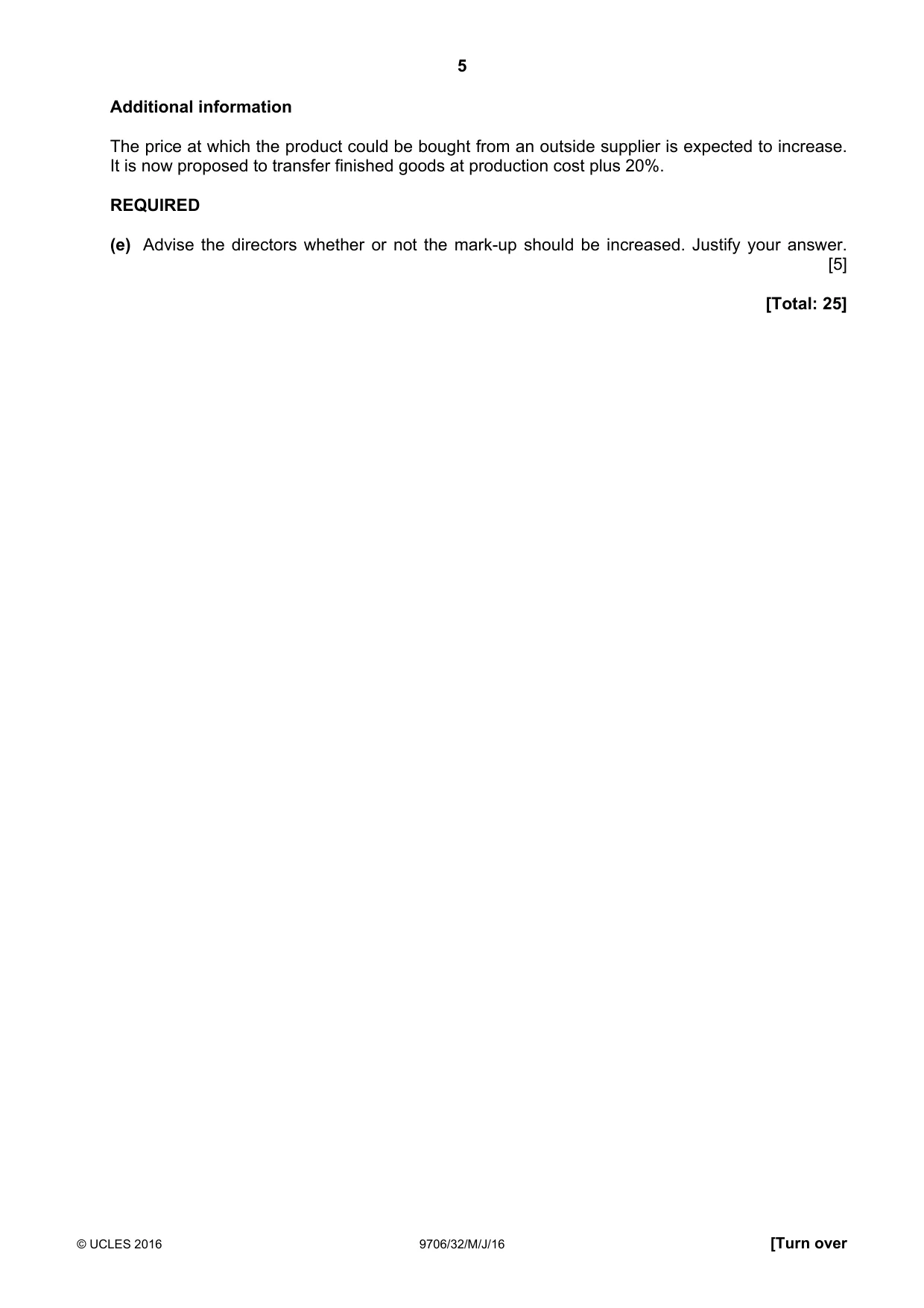
5 © UCLES 2016 9706/32/M/J/16 [Turn over Additional information The price at which the product could be bought from an outside supplier is expected to increase. It is now proposed to transfer finished goods at production cost plus 20%. REQUIRED (e) Advise the directors whether or not the mark-up should be increased. Justify your answer. [5] [Total: 25]
Question paper, page 6
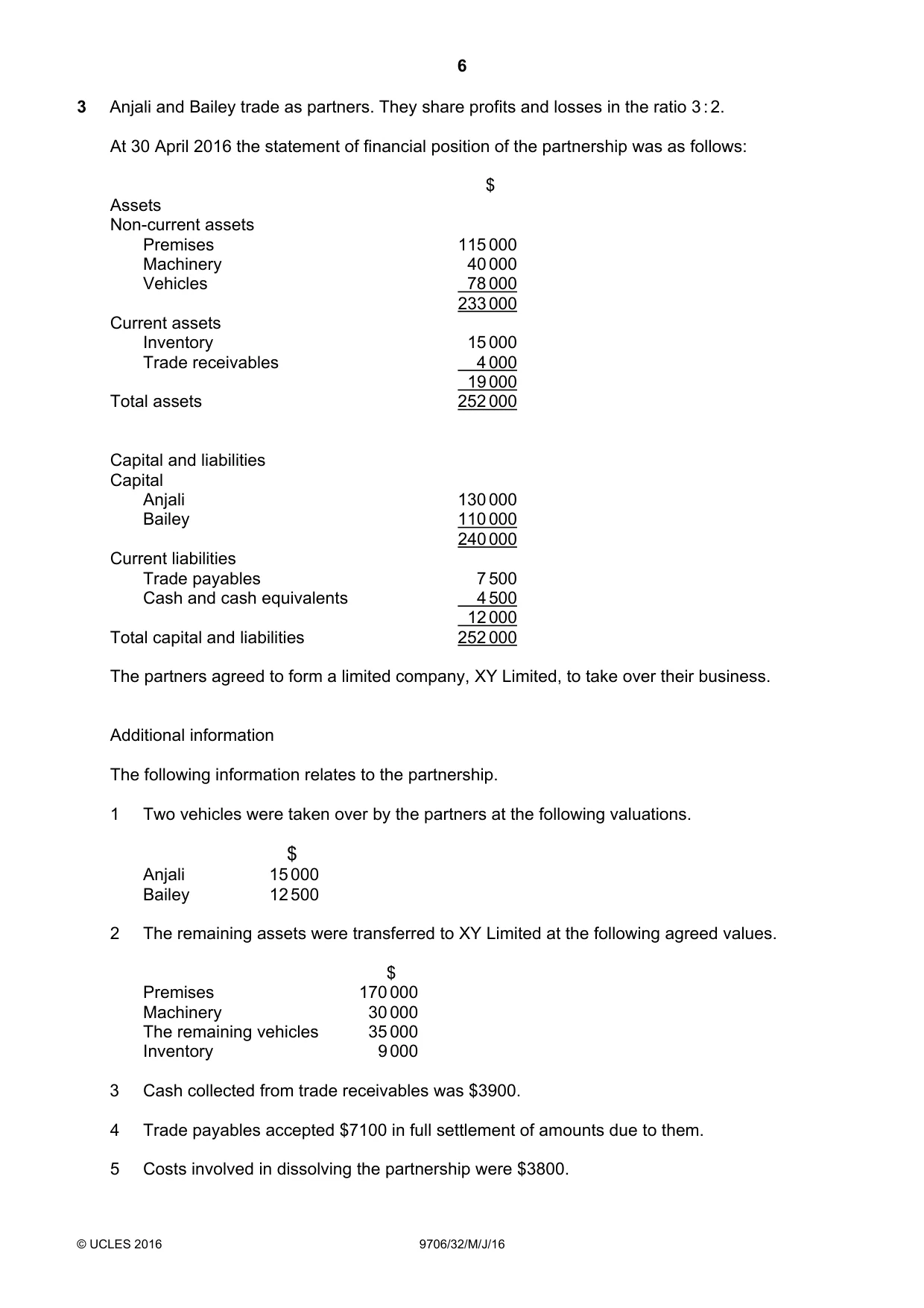
6 © UCLES 2016 9706/32/M/J/16 3 Anjali and Bailey trade as partners. They share profits and losses in the ratio 3 : 2. At 30 April 2016 the statement of financial position of the partnership was as follows: $ Assets Non-current assets Premises 115 000 Machinery 40 000 Vehicles 78 000 233 000 Current assets Inventory 15 000 Trade receivables 4 000 19 000 Total assets 252 000 Capital and liabilities Capital Anjali 130 000 Bailey 110 000 240 000 Current liabilities Trade payables 7 500 Cash and cash equivalents 4 500 12 000 Total capital and liabilities 252 000 The partners agreed to form a limited company, XY Limited, to take over their business. Additional information The following information relates to the partnership. 1 Two vehicles were taken over by the partners at the following valuations. $ Anjali 15 000 Bailey 12 500 2 The remaining assets were transferred to XY Limited at the following agreed values. $ Premises 170 000 Machinery 30 000 The remaining vehicles 35 000 Inventory 9 000 3 Cash collected from trade receivables was $3900. 4 Trade payables accepted $7100 in full settlement of amounts due to them. 5 Costs involved in dissolving the partnership were $3800.
Question paper, page 7
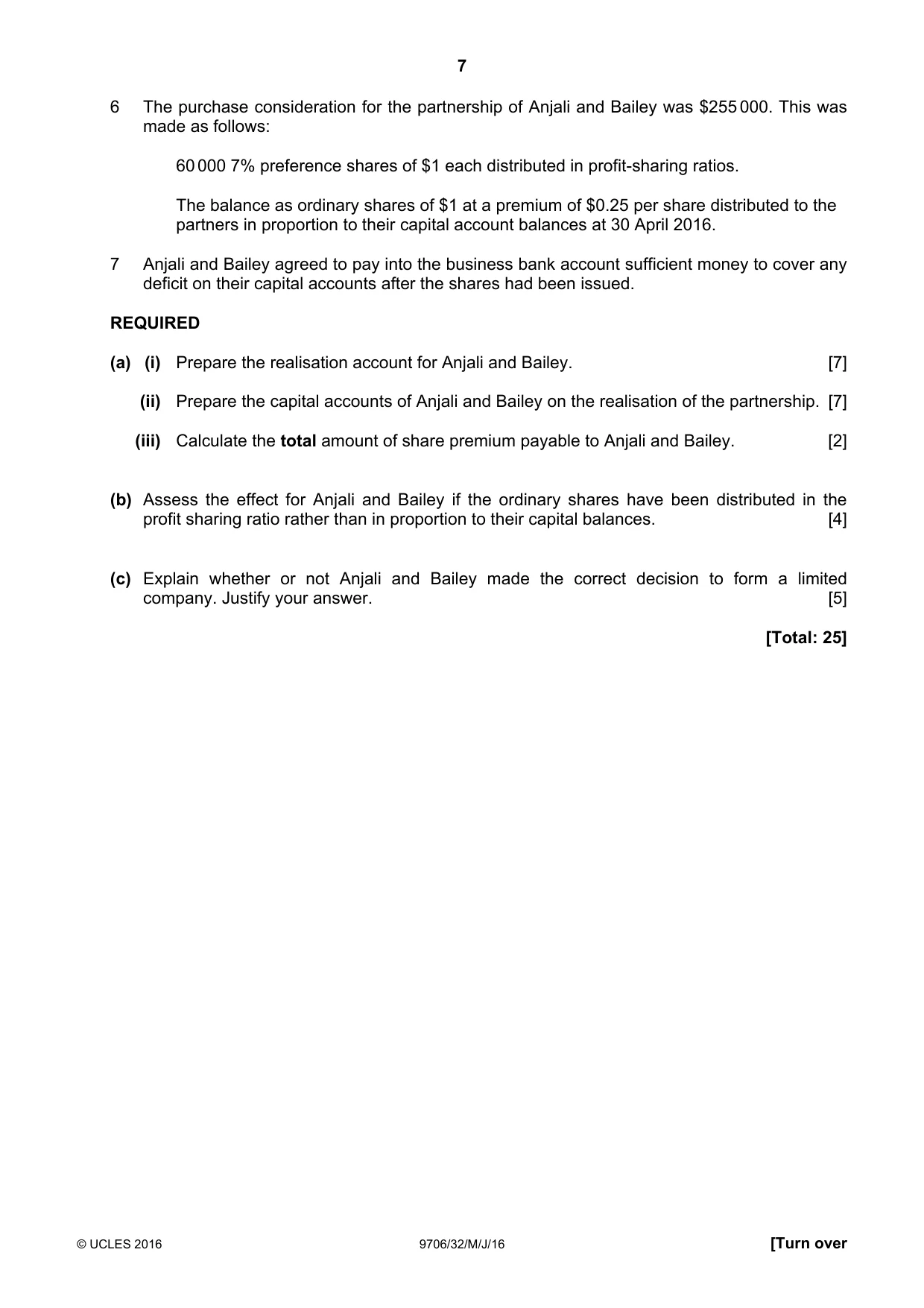
7 © UCLES 2016 9706/32/M/J/16 [Turn over 6 The purchase consideration for the partnership of Anjali and Bailey was $255 000. This was made as follows: 60 000 7% preference shares of $1 each distributed in profit-sharing ratios. The balance as ordinary shares of $1 at a premium of $0.25 per share distributed to the partners in proportion to their capital account balances at 30 April 2016. 7 Anjali and Bailey agreed to pay into the business bank account sufficient money to cover any deficit on their capital accounts after the shares had been issued. REQUIRED (a) (i) Prepare the realisation account for Anjali and Bailey. [7] (ii) Prepare the capital accounts of Anjali and Bailey on the realisation of the partnership. [7] (iii) Calculate the total amount of share premium payable to Anjali and Bailey. [2] (b) Assess the effect for Anjali and Bailey if the ordinary shares have been distributed in the profit sharing ratio rather than in proportion to their capital balances. [4] (c) Explain whether or not Anjali and Bailey made the correct decision to form a limited company. Justify your answer. [5] [Total: 25]
Question paper, page 8
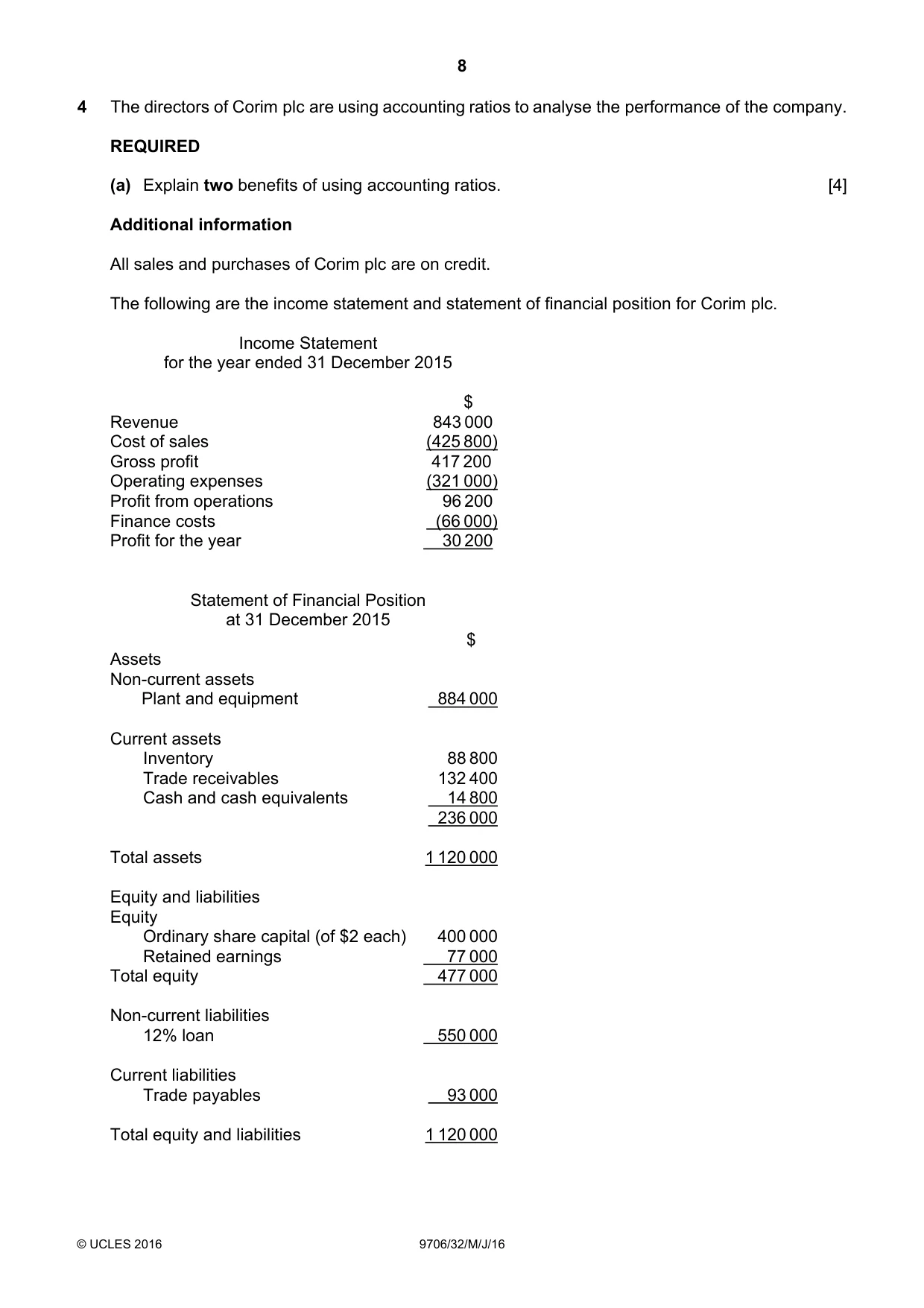
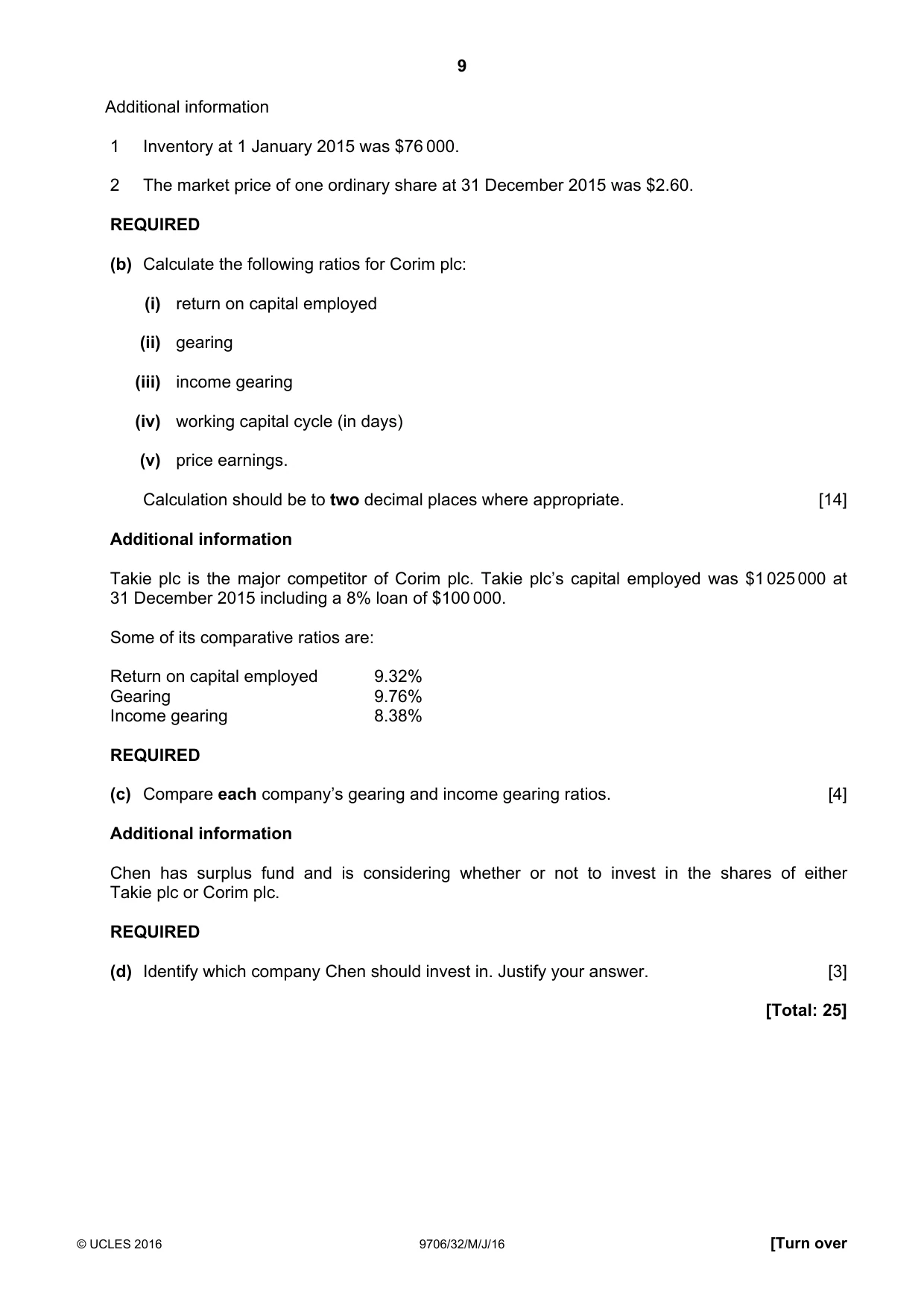
8 © UCLES 2016 9706/32/M/J/16 4 The directors of Corim plc are using accounting ratios to analyse the performance of the company. REQUIRED (a) Explain two benefits of using accounting ratios. [4] Additional information All sales and purchases of Corim plc are on credit. The following are the income statement and statement of financial position for Corim plc. Income Statement for the year ended 31 December 2015 $ Revenue 843 000 Cost of sales (425 800) Gross profit 417 200 Operating expenses (321 000) Profit from operations 96 200 Finance costs (66 000) Profit for the year 30 200 Statement of Financial Position at 31 December 2015 $ Assets Non-current assets Plant and equipment 884 000 Current assets Inventory 88 800 Trade receivables 132 400 Cash and cash equivalents 14 800 236 000 Total assets 1 120 000 Equity and liabilities Equity Ordinary share capital (of $2 each) 400 000 Retained earnings 77 000 Total equity 477 000 Non-current liabilities 12% loan 550 000 Current liabilities Trade payables 93 000 Total equity and liabilities 1 120 000
Question paper, page 9
9 © UCLES 2016 9706/32/M/J/16 [Turn over Additional information 1 Inventory at 1 January 2015 was $76 000. 2 The market price of one ordinary share at 31 December 2015 was $2.60. REQUIRED (b) Calculate the following ratios for Corim plc: (i) return on capital employed (ii) gearing (iii) income gearing (iv) working capital cycle (in days) (v) price earnings. Calculation should be to two decimal places where appropriate. [14] Additional information Takie plc is the major competitor of Corim plc. Takie plc’s capital employed was $1 025 000 at 31 December 2015 including a 8% loan of $100 000. Some of its comparative ratios are: Return on capital employed 9.32% Gearing 9.76% Income gearing 8.38% REQUIRED (c) Compare each company’s gearing and income gearing ratios. [4] Additional information Chen has surplus fund and is considering whether or not to invest in the shares of either Takie plc or Corim plc. REQUIRED (d) Identify which company Chen should invest in. Justify your answer. [3] [Total: 25]
Question paper, page 10
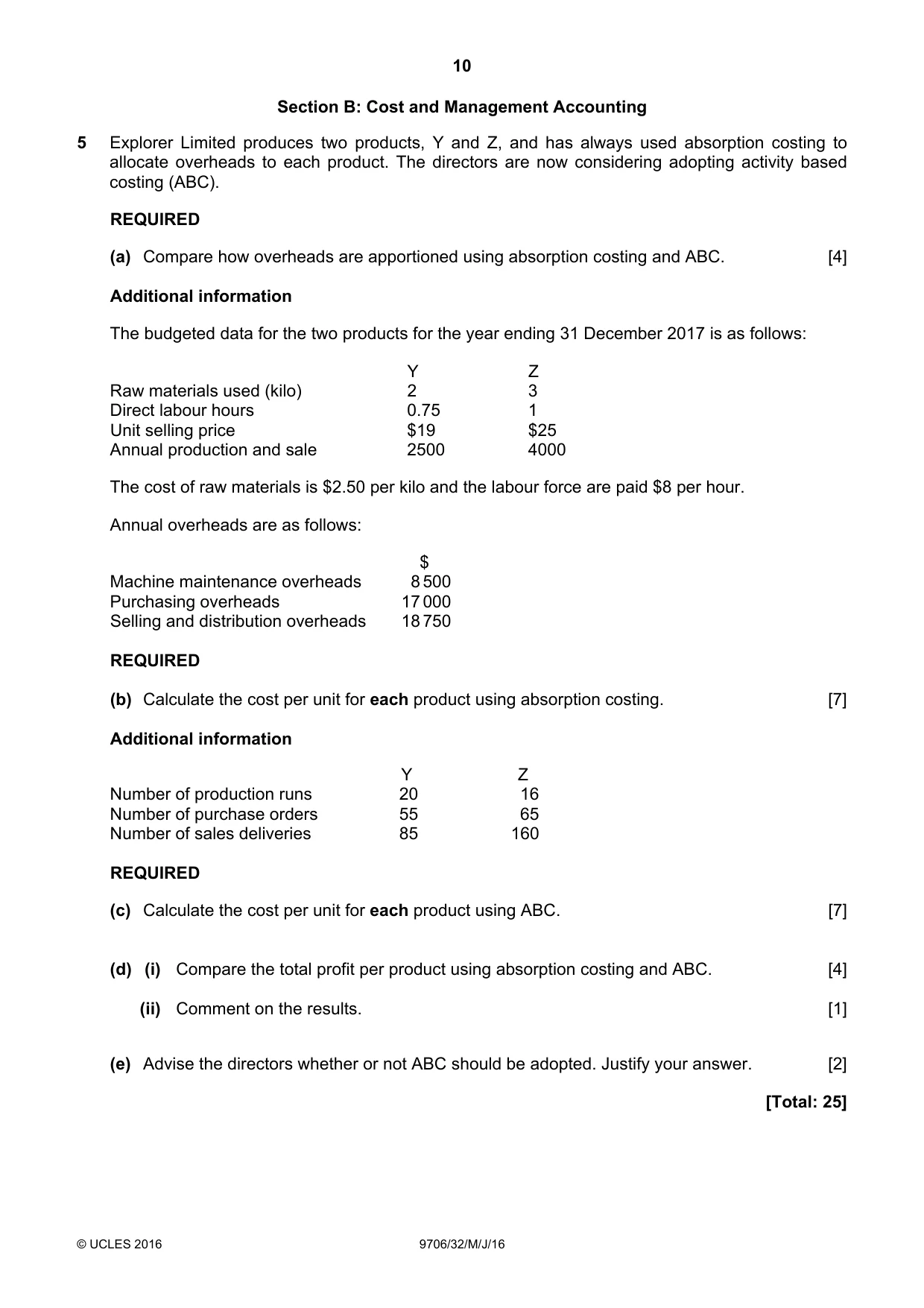
10 © UCLES 2016 9706/32/M/J/16 Section B: Cost and Management Accounting 5 Explorer Limited produces two products, Y and Z, and has always used absorption costing to allocate overheads to each product. The directors are now considering adopting activity based costing (ABC). REQUIRED (a) Compare how overheads are apportioned using absorption costing and ABC. [4] Additional information The budgeted data for the two products for the year ending 31 December 2017 is as follows: Y Z Raw materials used (kilo) 2 3 Direct labour hours 0.75 1 Unit selling price $19 $25 Annual production and sale 2500 4000 The cost of raw materials is $2.50 per kilo and the labour force are paid $8 per hour. Annual overheads are as follows: $ Machine maintenance overheads 8 500 Purchasing overheads 17 000 Selling and distribution overheads 18 750 REQUIRED (b) Calculate the cost per unit for each product using absorption costing. [7] Additional information Y Z Number of production runs 20 16 Number of purchase orders 55 65 Number of sales deliveries 85 160 REQUIRED (c) Calculate the cost per unit for each product using ABC. [7] (d) (i) Compare the total profit per product using absorption costing and ABC. [4] (ii) Comment on the results. [1] (e) Advise the directors whether or not ABC should be adopted. Justify your answer. [2] [Total: 25]
Question paper, page 11
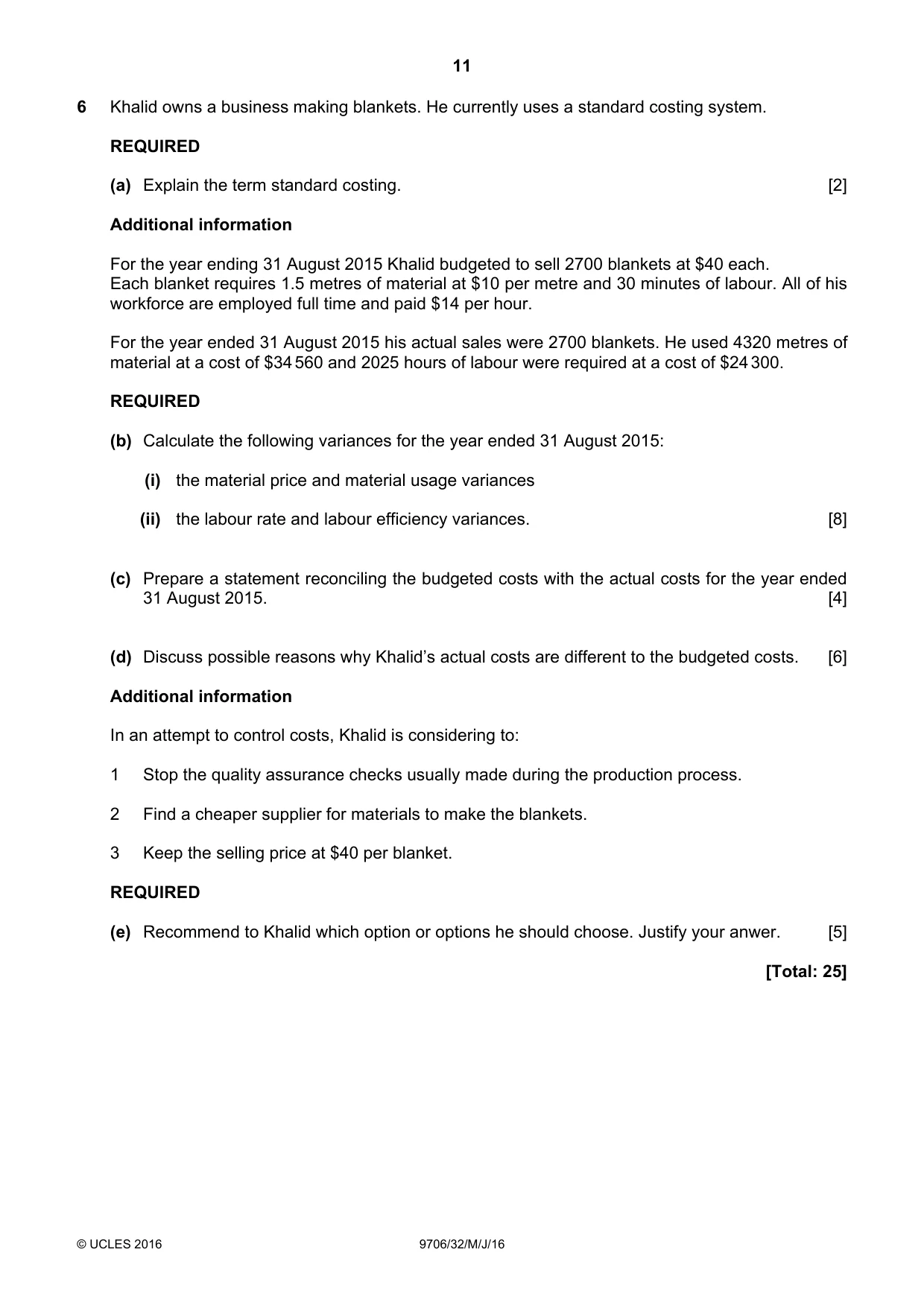
11 © UCLES 2016 9706/32/M/J/16 6 Khalid owns a business making blankets. He currently uses a standard costing system. REQUIRED (a) Explain the term standard costing. [2] Additional information For the year ending 31 August 2015 Khalid budgeted to sell 2700 blankets at $40 each. Each blanket requires 1.5 metres of material at $10 per metre and 30 minutes of labour. All of his workforce are employed full time and paid $14 per hour. For the year ended 31 August 2015 his actual sales were 2700 blankets. He used 4320 metres of material at a cost of $34 560 and 2025 hours of labour were required at a cost of $24 300. REQUIRED (b) Calculate the following variances for the year ended 31 August 2015: (i) the material price and material usage variances (ii) the labour rate and labour efficiency variances. [8] (c) Prepare a statement reconciling the budgeted costs with the actual costs for the year ended 31 August 2015. [4] (d) Discuss possible reasons why Khalid’s actual costs are different to the budgeted costs. [6] Additional information In an attempt to control costs, Khalid is considering to: 1 Stop the quality assurance checks usually made during the production process. 2 Find a cheaper supplier for materials to make the blankets. 3 Keep the selling price at $40 per blanket. REQUIRED (e) Recommend to Khalid which option or options he should choose. Justify your anwer. [5] [Total: 25]
Question paper, page 12
12 Permission to reproduce items where third-party owned material protected by copyright is included has been sought and cleared where possible. Every reasonable effort has been made by the publisher (UCLES) to trace copyright holders, but if any items requiring clearance have unwittingly been included, the publisher will be pleased to make amends at the earliest possible opportunity. To avoid the issue of disclosure of answer-related information to candidates, all copyright acknowledgements are reproduced online in the Cambridge International Examinations Copyright Acknowledgements Booklet. This is produced for each series of examinations and is freely available to download at www.cie.org.uk after the live examination series. Cambridge International Examinations is part of the Cambridge Assessment Group. Cambridge Assessment is the brand name of University of Cambridge Local Examinations Syndicate (UCLES), which is itself a department of the University of Cambridge. © UCLES 2016 9706/32/M/J/16 BLANK PAGE
Mark scheme, page 1
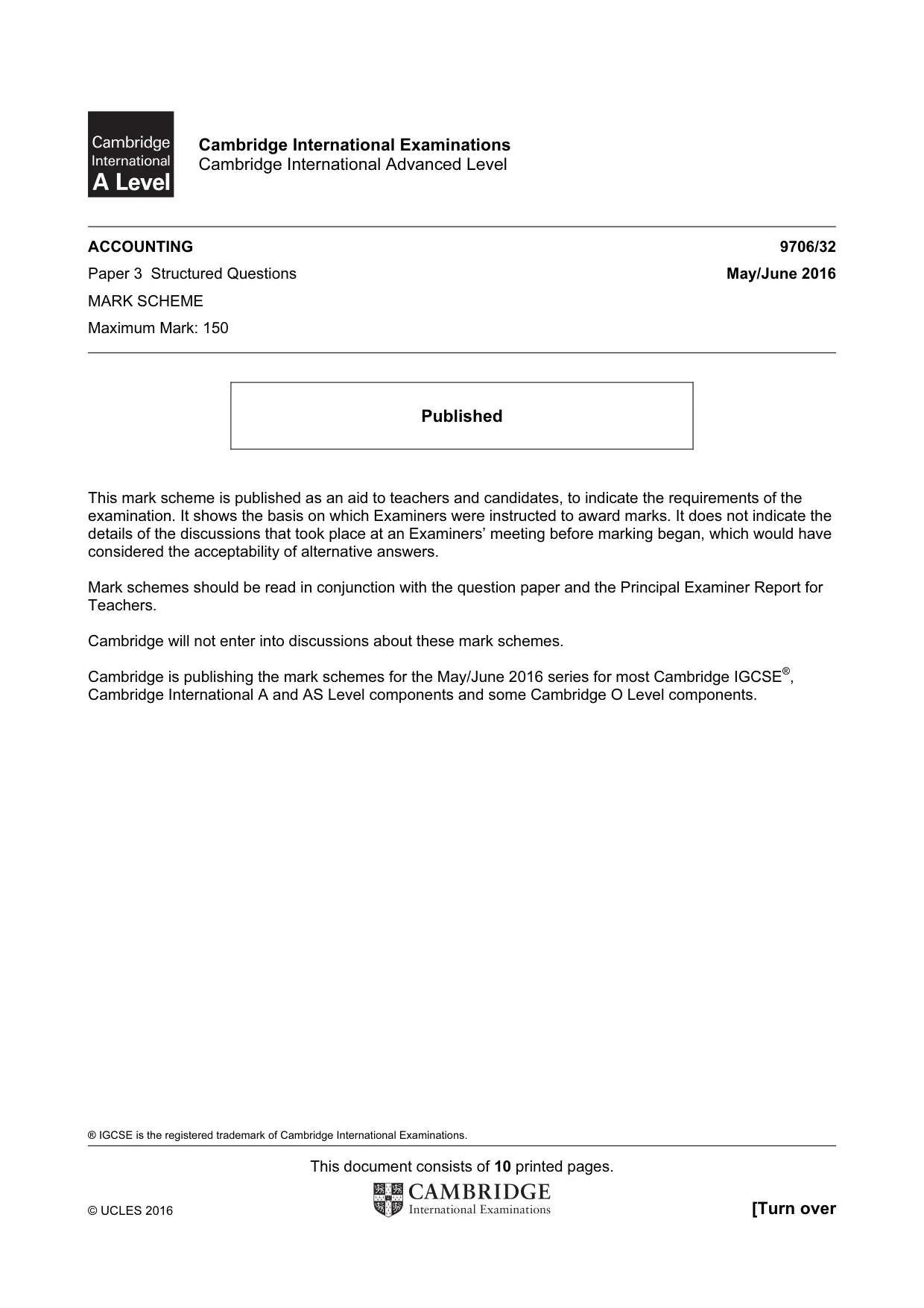
® IGCSE is the registered trademark of Cambridge International Examinations. This document consists of 10 printed pages. © UCLES 2016 [Turn over Cambridge International Examinations Cambridge International Advanced Level ACCOUNTING 9706/32 Paper 3 Structured Questions May/June 2016 MARK SCHEME Maximum Mark: 150 Published This mark scheme is published as an aid to teachers and candidates, to indicate the requirements of the examination. It shows the basis on which Examiners were instructed to award marks. It does not indicate the details of the discussions that took place at an Examiners’ meeting before marking began, which would have considered the acceptability of alternative answers. Mark schemes should be read in conjunction with the question paper and the Principal Examiner Report for Teachers. Cambridge will not enter into discussions about these mark schemes. Cambridge is publishing the mark schemes for the May/June 2016 series for most Cambridge IGCSE®, Cambridge International A and AS Level components and some Cambridge O Level components.
Mark scheme, page 2
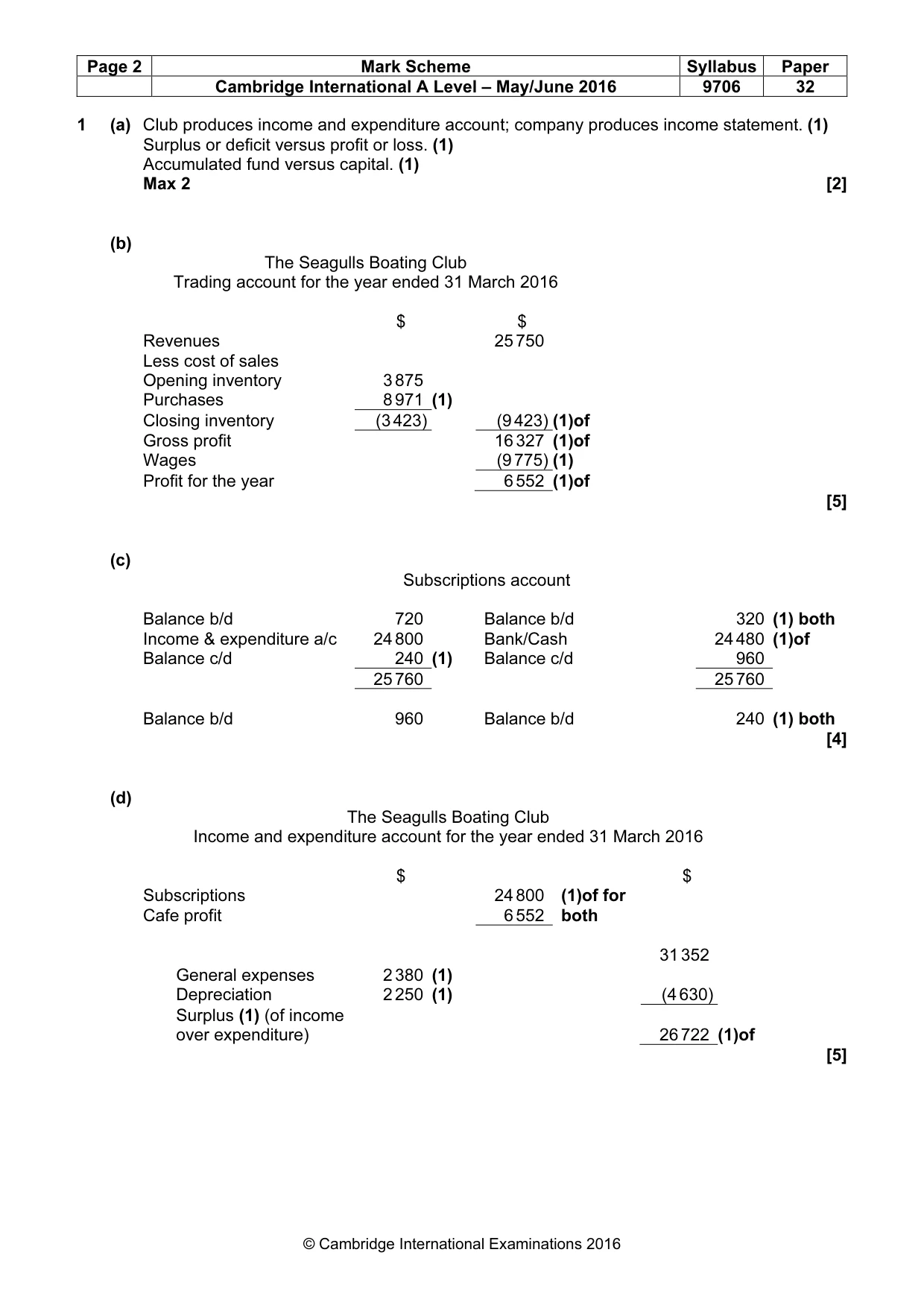
Page 2 Mark Scheme Syllabus Paper Cambridge International A Level – May/June 2016 9706 32 © Cambridge International Examinations 2016 1 (a) Club produces income and expenditure account; company produces income statement. (1) Surplus or deficit versus profit or loss. (1) Accumulated fund versus capital. (1) Max 2 [2] (b) The Seagulls Boating Club Trading account for the year ended 31 March 2016 $ $ Revenues 25 750 Less cost of sales Opening inventory 3 875 Purchases 8 971 (1) Closing inventory (3 423) (9 423) (1)of Gross profit 16 327 (1)of Wages (9 775) (1) Profit for the year 6 552 (1)of [5] (c) Subscriptions account Balance b/d 720 Balance b/d 320 (1) both Income & expenditure a/c 24 800 Bank/Cash 24 480 (1)of Balance c/d 240 (1) Balance c/d 960 25 760 25 760 Balance b/d 960 Balance b/d 240 (1) both [4] (d) The Seagulls Boating Club Income and expenditure account for the year ended 31 March 2016 $ $ Subscriptions 24 800 (1)of for Cafe profit 6 552 both 31 352 General expenses 2 380 (1) Depreciation 2 250 (1) (4 630) Surplus (1) (of income over expenditure) 26 722 (1)of [5]
Mark scheme, page 3
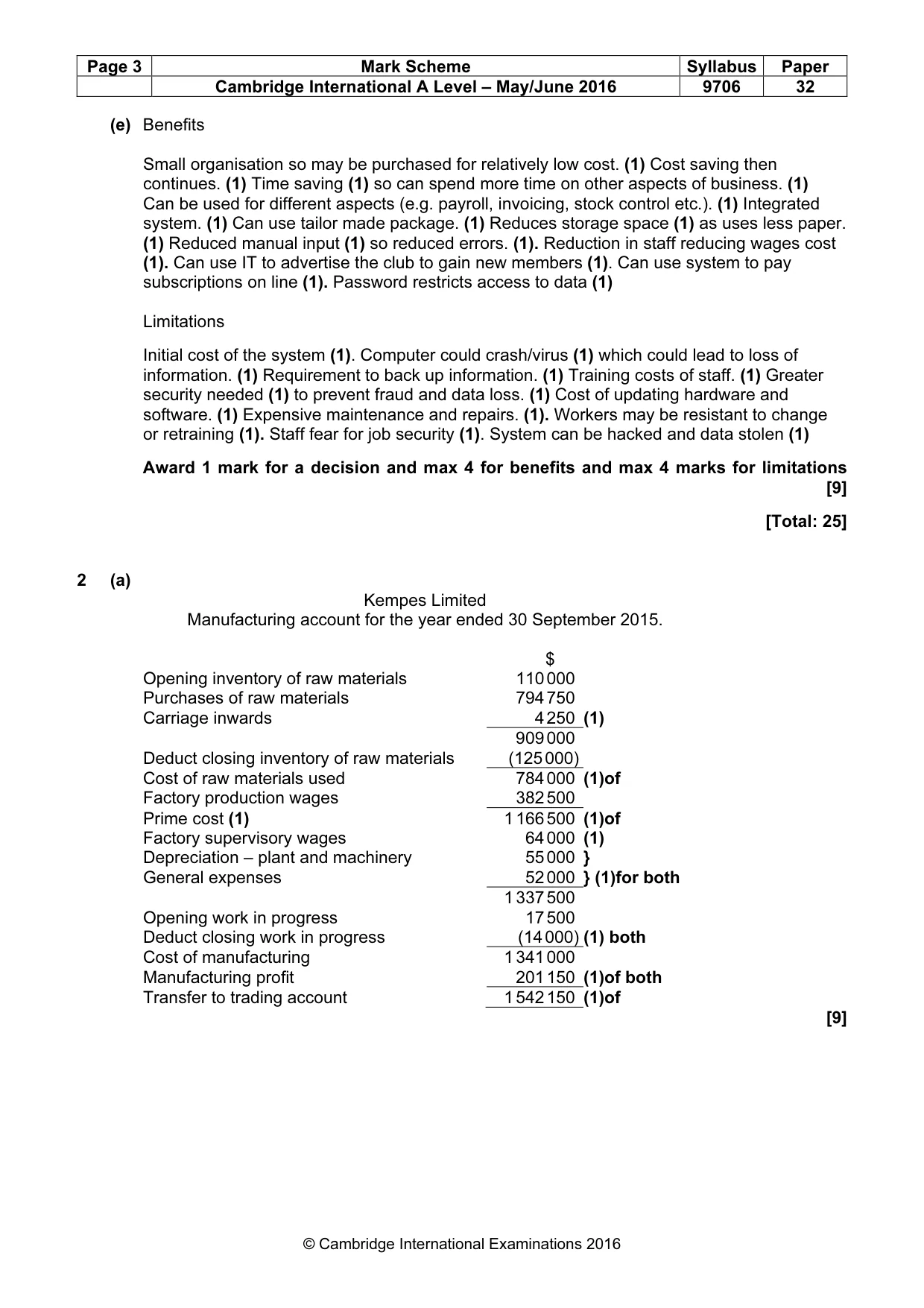
Page 3 Mark Scheme Syllabus Paper Cambridge International A Level – May/June 2016 9706 32 © Cambridge International Examinations 2016 (e) Benefits Small organisation so may be purchased for relatively low cost. (1) Cost saving then continues. (1) Time saving (1) so can spend more time on other aspects of business. (1) Can be used for different aspects (e.g. payroll, invoicing, stock control etc.). (1) Integrated system. (1) Can use tailor made package. (1) Reduces storage space (1) as uses less paper. (1) Reduced manual input (1) so reduced errors. (1). Reduction in staff reducing wages cost (1). Can use IT to advertise the club to gain new members (1). Can use system to pay subscriptions on line (1). Password restricts access to data (1) Limitations Initial cost of the system (1). Computer could crash/virus (1) which could lead to loss of information. (1) Requirement to back up information. (1) Training costs of staff. (1) Greater security needed (1) to prevent fraud and data loss. (1) Cost of updating hardware and software. (1) Expensive maintenance and repairs. (1). Workers may be resistant to change or retraining (1). Staff fear for job security (1). System can be hacked and data stolen (1) Award 1 mark for a decision and max 4 for benefits and max 4 marks for limitations [9] [Total: 25] 2 (a) Kempes Limited Manufacturing account for the year ended 30 September 2015. $ Opening inventory of raw materials 110 000 Purchases of raw materials 794 750 Carriage inwards 4 250 (1) 909 000 Deduct closing inventory of raw materials (125 000) Cost of raw materials used 784 000 (1)of Factory production wages 382 500 Prime cost (1) 1 166 500 (1)of Factory supervisory wages 64 000 (1) Depreciation – plant and machinery 55 000 } General expenses 52 000 } (1)for both 1 337 500 Opening work in progress 17 500 Deduct closing work in progress (14 000) (1) both Cost of manufacturing 1 341 000 Manufacturing profit 201 150 (1)of both Transfer to trading account 1 542 150 (1)of [9]
Mark scheme, page 4
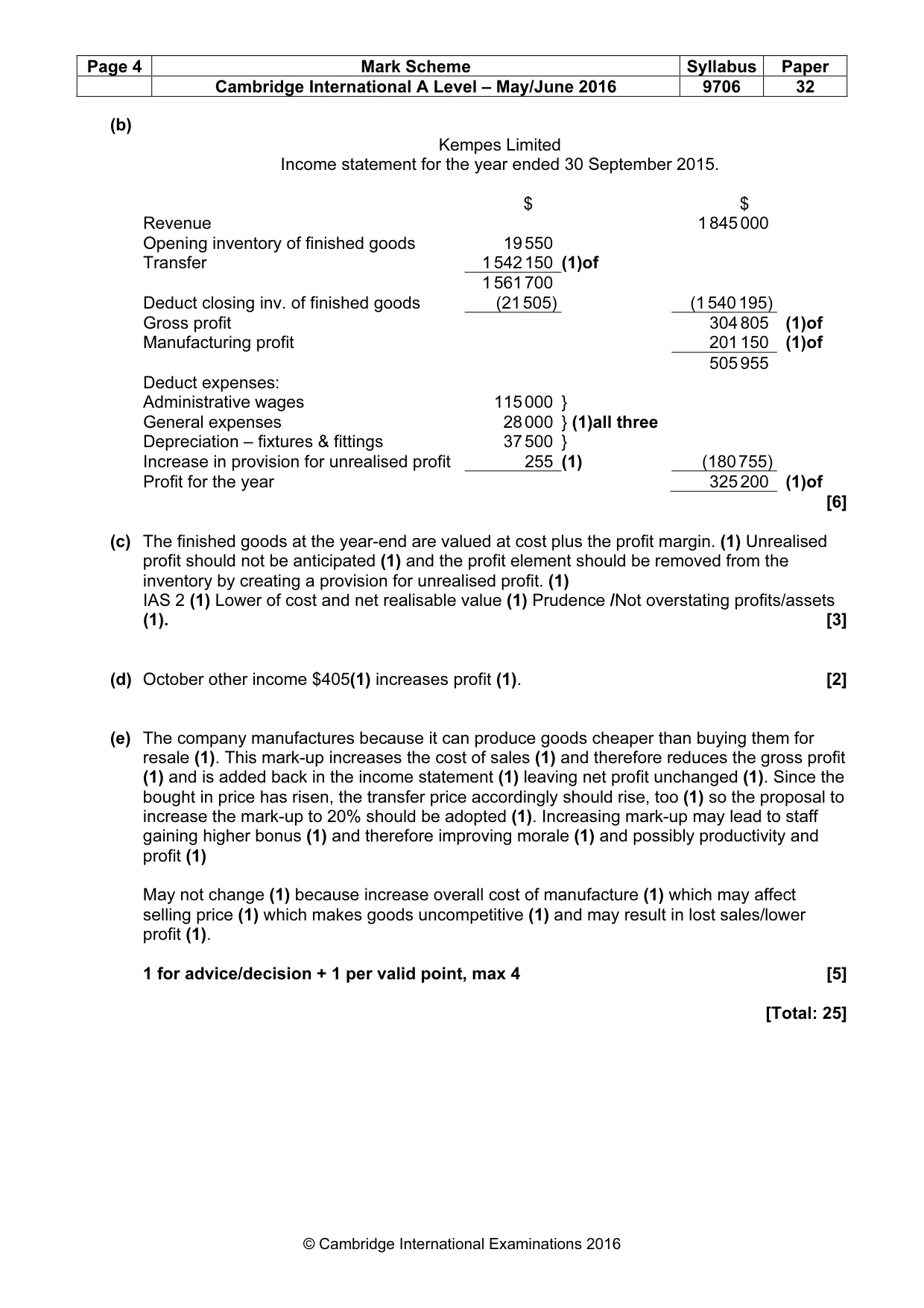
Page 4 Mark Scheme Syllabus Paper Cambridge International A Level – May/June 2016 9706 32 © Cambridge International Examinations 2016 (b) Kempes Limited Income statement for the year ended 30 September 2015. $ $ Revenue 1 845 000 Opening inventory of finished goods 19 550 Transfer 1 542 150 (1)of 1 561 700 Deduct closing inv. of finished goods (21 505) (1 540 195) Gross profit 304 805 (1)of Manufacturing profit 201 150 (1)of 505 955 Deduct expenses: Administrative wages 115 000 } General expenses 28 000 } (1)all three Depreciation – fixtures & fittings 37 500 } Increase in provision for unrealised profit 255 (1) (180 755) Profit for the year 325 200 (1)of [6] (c) The finished goods at the year-end are valued at cost plus the profit margin. (1) Unrealised profit should not be anticipated (1) and the profit element should be removed from the inventory by creating a provision for unrealised profit. (1) IAS 2 (1) Lower of cost and net realisable value (1) Prudence /Not overstating profits/assets (1). [3] (d) October other income $405(1) increases profit (1). [2] (e) The company manufactures because it can produce goods cheaper than buying them for resale (1). This mark-up increases the cost of sales (1) and therefore reduces the gross profit (1) and is added back in the income statement (1) leaving net profit unchanged (1). Since the bought in price has risen, the transfer price accordingly should rise, too (1) so the proposal to increase the mark-up to 20% should be adopted (1). Increasing mark-up may lead to staff gaining higher bonus (1) and therefore improving morale (1) and possibly productivity and profit (1) May not change (1) because increase overall cost of manufacture (1) which may affect selling price (1) which makes goods uncompetitive (1) and may result in lost sales/lower profit (1). 1 for advice/decision + 1 per valid point, max 4 [5] [Total: 25]
Mark scheme, page 5
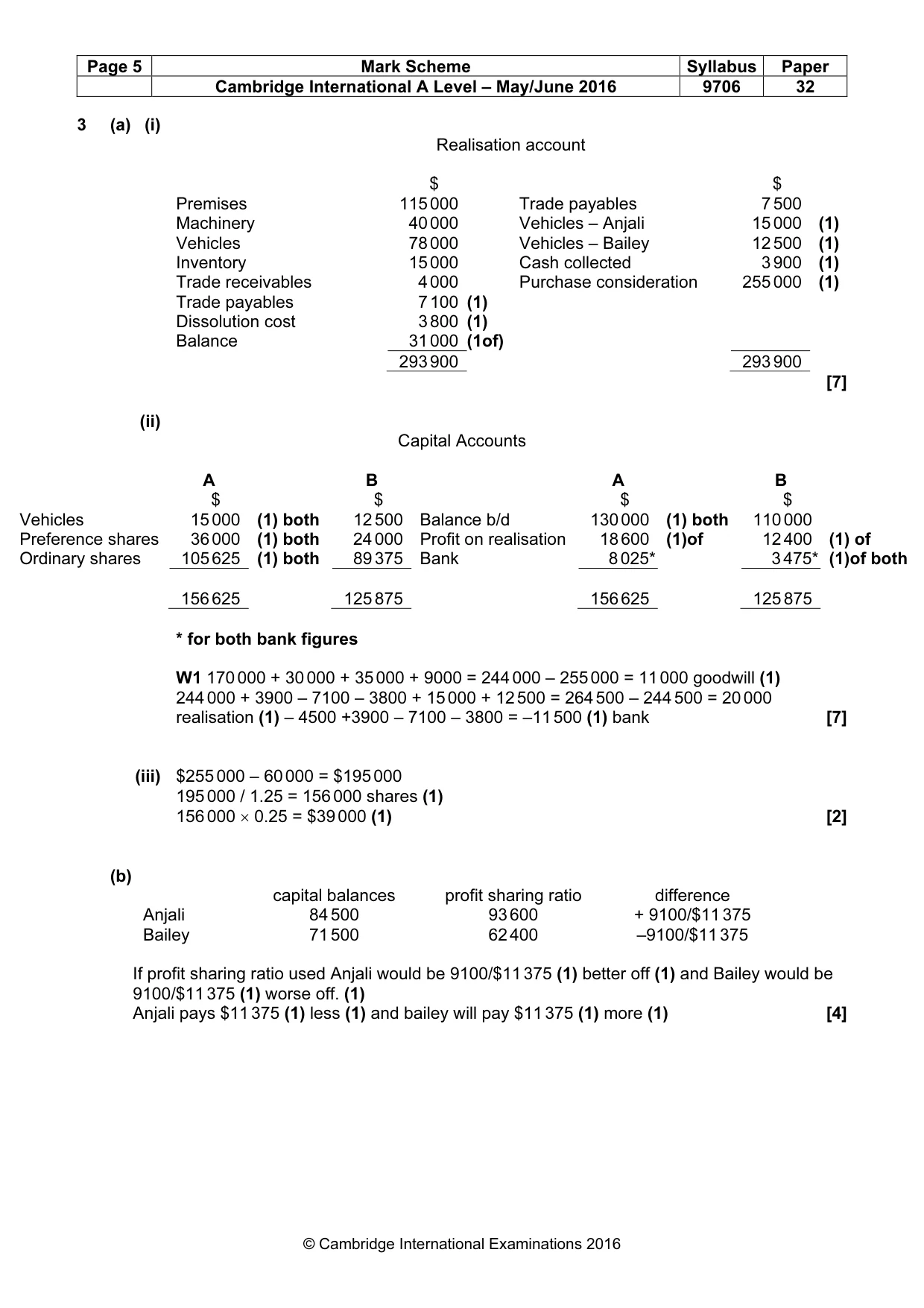
Page 5 Mark Scheme Syllabus Paper Cambridge International A Level – May/June 2016 9706 32 © Cambridge International Examinations 2016 3 (a) (i) Realisation account $ $ Premises 115 000 Trade payables 7 500 Machinery 40 000 Vehicles – Anjali 15 000 (1) Vehicles 78 000 Vehicles – Bailey 12 500 (1) Inventory 15 000 Cash collected 3 900 (1) Trade receivables 4 000 Purchase consideration 255 000 (1) Trade payables 7 100 (1) Dissolution cost 3 800 (1) Balance 31 000 (1of) 293 900 293 900 [7] (ii) Capital Accounts A B A B $ $ $ $ Vehicles 15 000 (1) both 12 500 Balance b/d 130 000 (1) both 110 000 Preference shares 36 000 (1) both 24 000 Profit on realisation 18 600 (1)of 12 400 (1) of Ordinary shares 105 625 (1) both 89 375 Bank 8 025* 3 475* (1)of both 156 625 125 875 156 625 125 875 * for both bank figures W1 170 000 + 30 000 + 35 000 + 9000 = 244 000 – 255 000 = 11 000 goodwill (1) 244 000 + 3900 – 7100 – 3800 + 15 000 + 12 500 = 264 500 – 244 500 = 20 000 realisation (1) – 4500 +3900 – 7100 – 3800 = –11 500 (1) bank [7] (iii) $255 000 – 60 000 = $195 000 195 000 / 1.25 = 156 000 shares (1) 156 000 × 0.25 = $39 000 (1) [2] (b) capital balances profit sharing ratio difference Anjali 84 500 93 600 + 9100/$11 375 Bailey 71 500 62 400 –9100/$11 375 If profit sharing ratio used Anjali would be 9100/$11 375 (1) better off (1) and Bailey would be 9100/$11 375 (1) worse off. (1) Anjali pays $11 375 (1) less (1) and bailey will pay $11 375 (1) more (1) [4]
Mark scheme, page 6
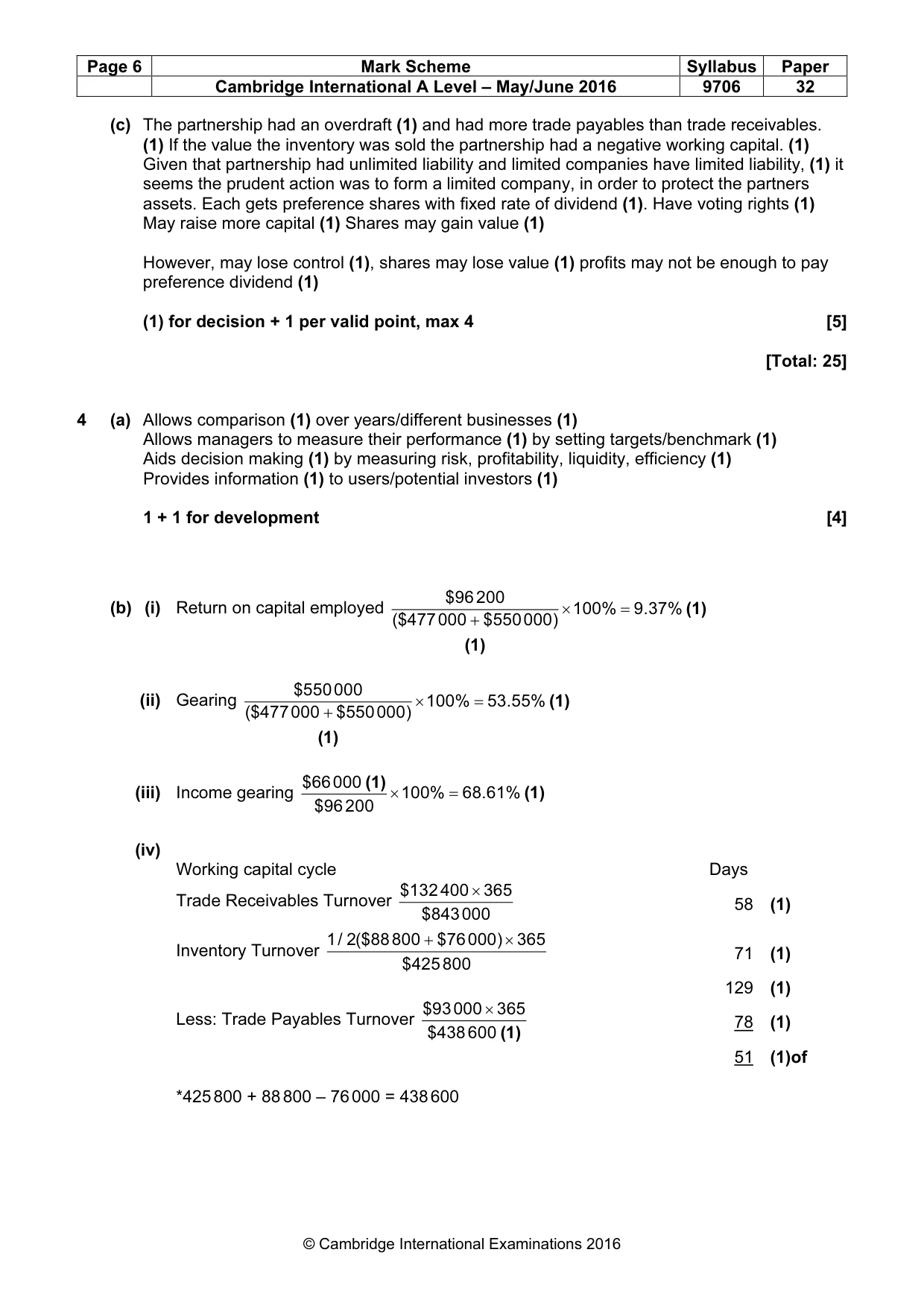
Page 6 Mark Scheme Syllabus Paper Cambridge International A Level – May/June 2016 9706 32 © Cambridge International Examinations 2016 (c) The partnership had an overdraft (1) and had more trade payables than trade receivables. (1) If the value the inventory was sold the partnership had a negative working capital. (1) Given that partnership had unlimited liability and limited companies have limited liability, (1) it seems the prudent action was to form a limited company, in order to protect the partners assets. Each gets preference shares with fixed rate of dividend (1). Have voting rights (1) May raise more capital (1) Shares may gain value (1) However, may lose control (1), shares may lose value (1) profits may not be enough to pay preference dividend (1) (1) for decision + 1 per valid point, max 4 [5] [Total: 25] 4 (a) Allows comparison (1) over years/different businesses (1) Allows managers to measure their performance (1) by setting targets/benchmark (1) Aids decision making (1) by measuring risk, profitability, liquidity, efficiency (1) Provides information (1) to users/potential investors (1) 1 + 1 for development [4] (b) (i) Return on capital employed $96200 100% 9.37% ($477000 $550000) × = + (1) (1) (ii) Gearing $550000 100% 53.55% ($477000 $550000) × = + (1) (1) (iii) Income gearing $66000 100% 68.61% $96200 × = (1) (1) (iv) Working capital cycle Days Trade Receivables Turnover $132400 365 $843000 × 58 (1) Inventory Turnover 1/ 2($88800 $76000) 365 $425800 + × 71 (1) 129 (1) Less: Trade Payables Turnover $93000 365 $438600 × (1) 78 (1) 51 (1)of *425 800 + 88 800 – 76 000 = 438 600
Mark scheme, page 7
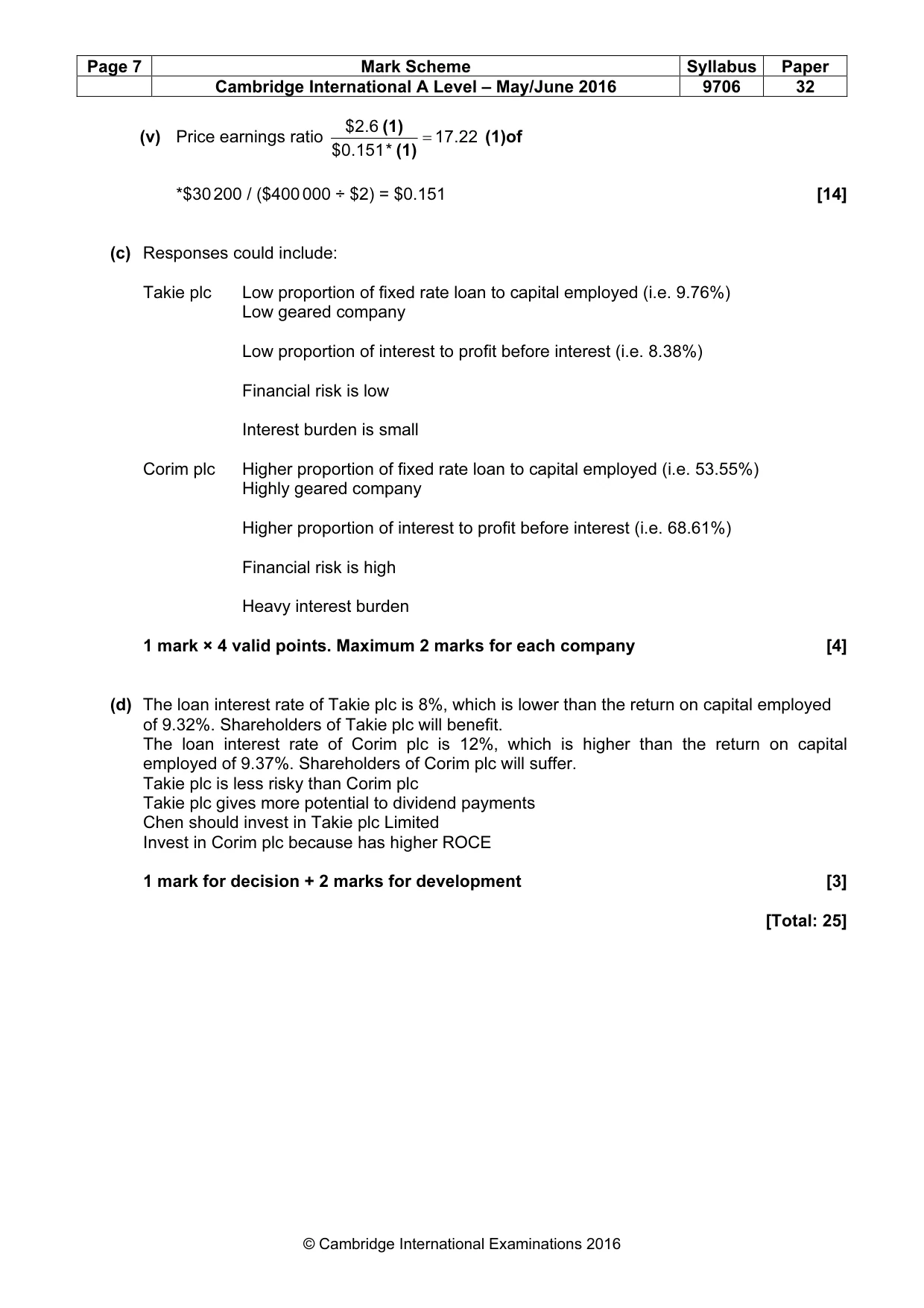
Page 7 Mark Scheme Syllabus Paper Cambridge International A Level – May/June 2016 9706 32 © Cambridge International Examinations 2016 (v) Price earnings ratio $2.6 17.22 $0.151* = (1) (1) (1)of *$30 200 / ($400 000 ÷ $2) = $0.151 [14] (c) Responses could include: Takie plc Low proportion of fixed rate loan to capital employed (i.e. 9.76%) Low geared company Low proportion of interest to profit before interest (i.e. 8.38%) Financial risk is low Interest burden is small Corim plc Higher proportion of fixed rate loan to capital employed (i.e. 53.55%) Highly geared company Higher proportion of interest to profit before interest (i.e. 68.61%) Financial risk is high Heavy interest burden 1 mark × 4 valid points. Maximum 2 marks for each company [4] (d) The loan interest rate of Takie plc is 8%, which is lower than the return on capital employed of 9.32%. Shareholders of Takie plc will benefit. The loan interest rate of Corim plc is 12%, which is higher than the return on capital employed of 9.37%. Shareholders of Corim plc will suffer. Takie plc is less risky than Corim plc Takie plc gives more potential to dividend payments Chen should invest in Takie plc Limited Invest in Corim plc because has higher ROCE 1 mark for decision + 2 marks for development [3] [Total: 25]
Mark scheme, page 8
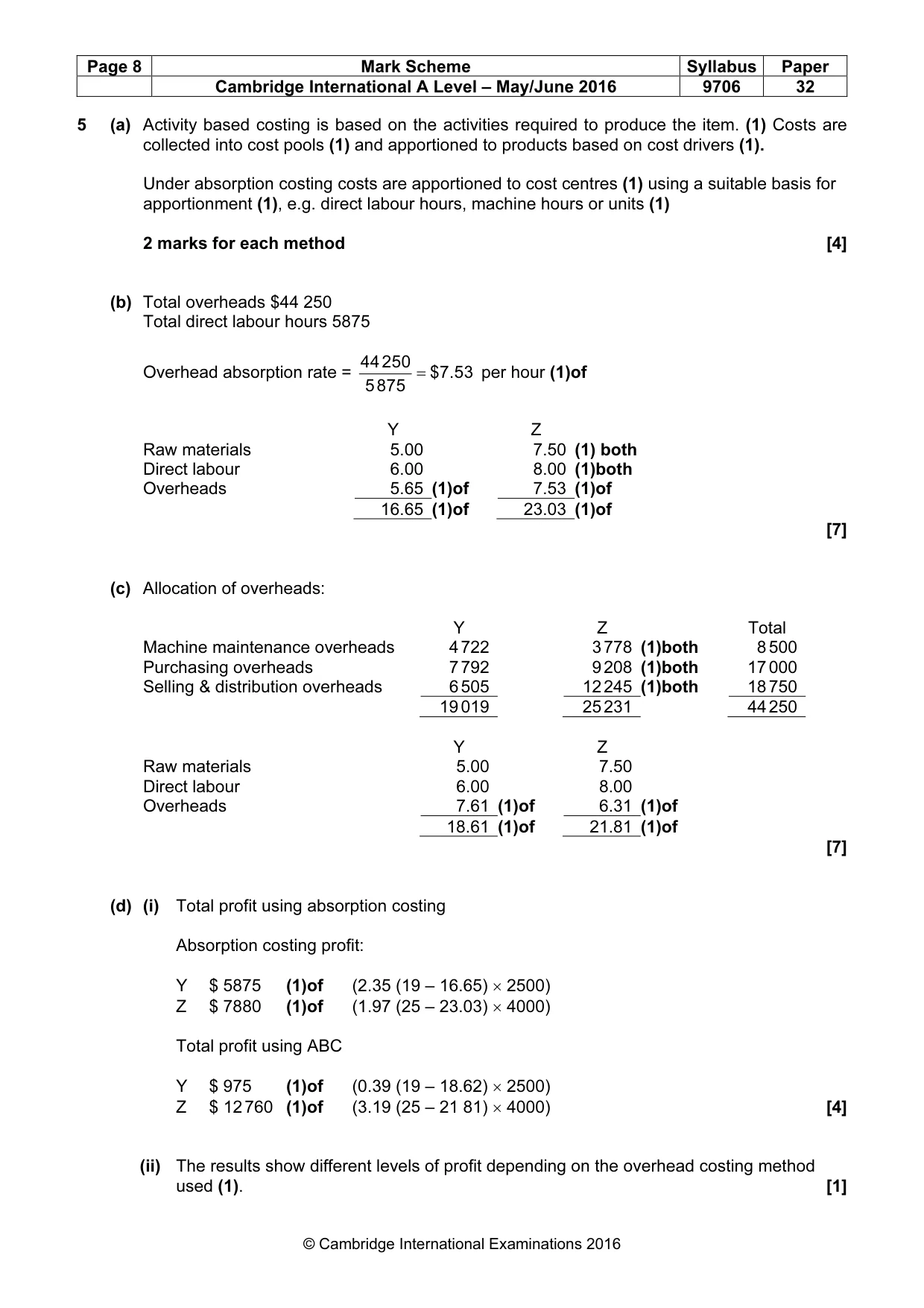
Page 8 Mark Scheme Syllabus Paper Cambridge International A Level – May/June 2016 9706 32 © Cambridge International Examinations 2016 5 (a) Activity based costing is based on the activities required to produce the item. (1) Costs are collected into cost pools (1) and apportioned to products based on cost drivers (1). Under absorption costing costs are apportioned to cost centres (1) using a suitable basis for apportionment (1), e.g. direct labour hours, machine hours or units (1) 2 marks for each method [4] (b) Total overheads $44 250 Total direct labour hours 5875 Overhead absorption rate = 44250 $7.53 5875 = per hour (1)of Y Z Raw materials 5.00 7.50 (1) both Direct labour 6.00 8.00 (1)both Overheads 5.65 (1)of 7.53 (1)of 16.65 (1)of 23.03 (1)of [7] (c) Allocation of overheads: Y Z Total Machine maintenance overheads 4 722 3 778 (1)both 8 500 Purchasing overheads 7 792 9 208 (1)both 17 000 Selling & distribution overheads 6 505 12 245 (1)both 18 750 19 019 25 231 44 250 Y Z Raw materials 5.00 7.50 Direct labour 6.00 8.00 Overheads 7.61 (1)of 6.31 (1)of 18.61 (1)of 21.81 (1)of [7] (d) (i) Total profit using absorption costing Absorption costing profit: Y $ 5875 (1)of (2.35 (19 – 16.65) × 2500) Z $ 7880 (1)of (1.97 (25 – 23.03) × 4000) Total profit using ABC Y $ 975 (1)of (0.39 (19 – 18.62) × 2500) Z $ 12 760 (1)of (3.19 (25 – 21 81) × 4000) [4] (ii) The results show different levels of profit depending on the overhead costing method used (1). [1]
Mark scheme, page 9
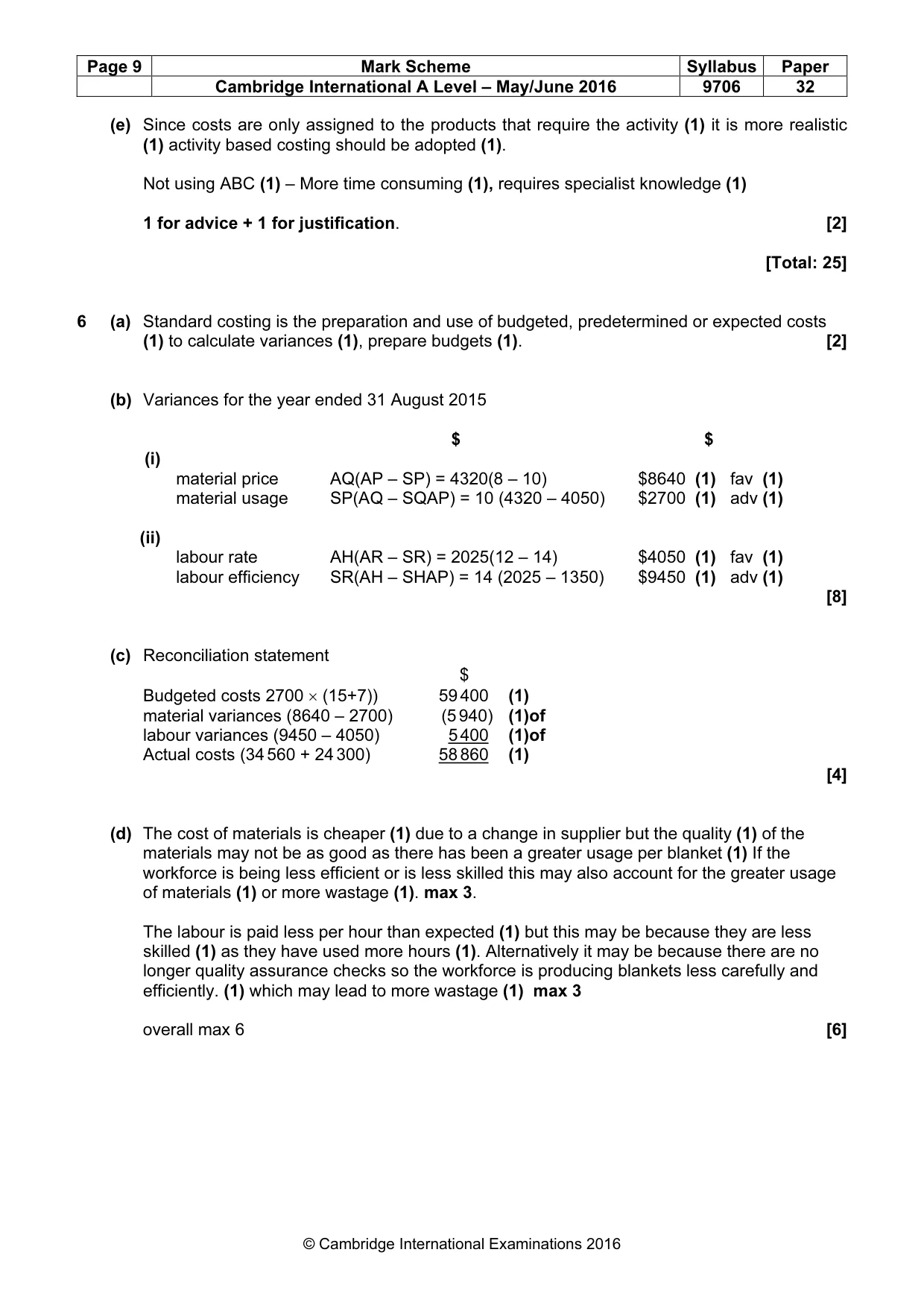
Page 9 Mark Scheme Syllabus Paper Cambridge International A Level – May/June 2016 9706 32 © Cambridge International Examinations 2016 (e) Since costs are only assigned to the products that require the activity (1) it is more realistic (1) activity based costing should be adopted (1). Not using ABC (1) – More time consuming (1), requires specialist knowledge (1) 1 for advice + 1 for justification. [2] [Total: 25] 6 (a) Standard costing is the preparation and use of budgeted, predetermined or expected costs (1) to calculate variances (1), prepare budgets (1). [2] (b) Variances for the year ended 31 August 2015 $ $ (i) material price AQ(AP – SP) = 4320(8 – 10) $8640 (1) fav (1) material usage SP(AQ – SQAP) = 10 (4320 – 4050) $2700 (1) adv (1) (ii) labour rate AH(AR – SR) = 2025(12 – 14) $4050 (1) fav (1) labour efficiency SR(AH – SHAP) = 14 (2025 – 1350) $9450 (1) adv (1) [8] (c) Reconciliation statement $ Budgeted costs 2700 × (15+7)) 59 400 (1) material variances (8640 – 2700) (5 940) (1)of labour variances (9450 – 4050) 5 400 (1)of Actual costs (34 560 + 24 300) 58 860 (1) [4] (d) The cost of materials is cheaper (1) due to a change in supplier but the quality (1) of the materials may not be as good as there has been a greater usage per blanket (1) If the workforce is being less efficient or is less skilled this may also account for the greater usage of materials (1) or more wastage (1). max 3. The labour is paid less per hour than expected (1) but this may be because they are less skilled (1) as they have used more hours (1). Alternatively it may be because there are no longer quality assurance checks so the workforce is producing blankets less carefully and efficiently. (1) which may lead to more wastage (1) max 3 overall max 6 [6]
Mark scheme, page 10
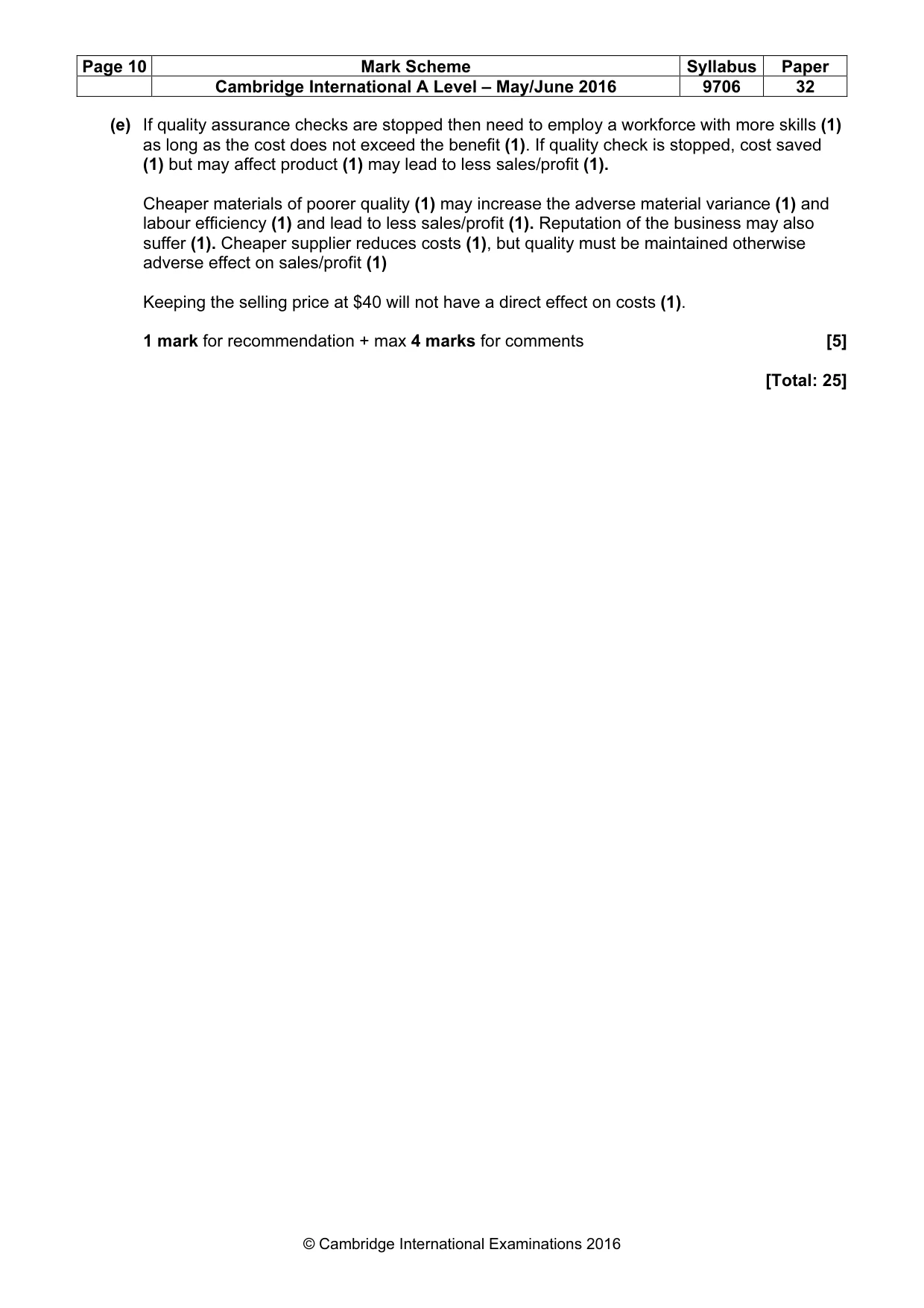
Page 10 Mark Scheme Syllabus Paper Cambridge International A Level – May/June 2016 9706 32 © Cambridge International Examinations 2016 (e) If quality assurance checks are stopped then need to employ a workforce with more skills (1) as long as the cost does not exceed the benefit (1). If quality check is stopped, cost saved (1) but may affect product (1) may lead to less sales/profit (1). Cheaper materials of poorer quality (1) may increase the adverse material variance (1) and labour efficiency (1) and lead to less sales/profit (1). Reputation of the business may also suffer (1). Cheaper supplier reduces costs (1), but quality must be maintained otherwise adverse effect on sales/profit (1) Keeping the selling price at $40 will not have a direct effect on costs (1). 1 mark for recommendation + max 4 marks for comments [5] [Total: 25]
What you needed in this session
Cambridge’s own grade thresholds for 2016 May/June, Paper 3 · Variant 2. A higher threshold means an easier paper — the bar moves with how the cohort did.