Cambridge A Level Accounting 9706 — 2016 May/June Paper 3 · Variant 1
9706/31/M/J/16 · 150 marks · ≈169 min
The question paper and its mark scheme, free to read here and free to download. This is Cambridge’s own paper, exactly as it was sat.
Question paper12 pages


Mark scheme9 pages
Answers below. Sit the paper first if you are practising.
Paper as text
Question paper, page 1
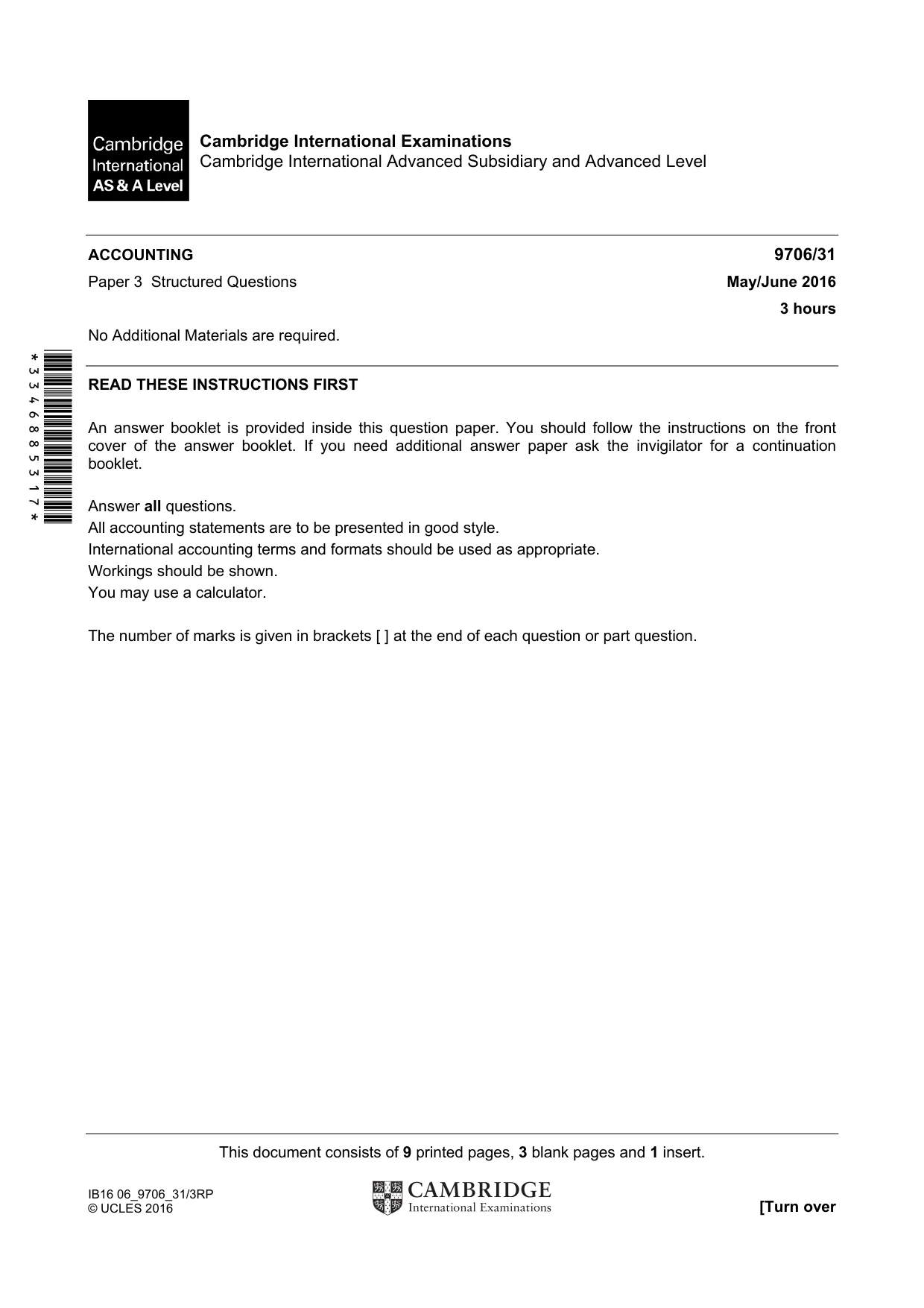
This document consists of 9 printed pages, 3 blank pages and 1 insert. IB16 06_9706_31/3RP © UCLES 2016 [Turn over *3346885317* Cambridge International Examinations Cambridge International Advanced Subsidiary and Advanced Level ACCOUNTING 9706/31 Paper 3 Structured Questions May/June 2016 3 hours No Additional Materials are required. READ THESE INSTRUCTIONS FIRST An answer booklet is provided inside this question paper. You should follow the instructions on the front cover of the answer booklet. If you need additional answer paper ask the invigilator for a continuation booklet. Answer all questions. All accounting statements are to be presented in good style. International accounting terms and formats should be used as appropriate. Workings should be shown. You may use a calculator. The number of marks is given in brackets [ ] at the end of each question or part question.
Question paper, page 2
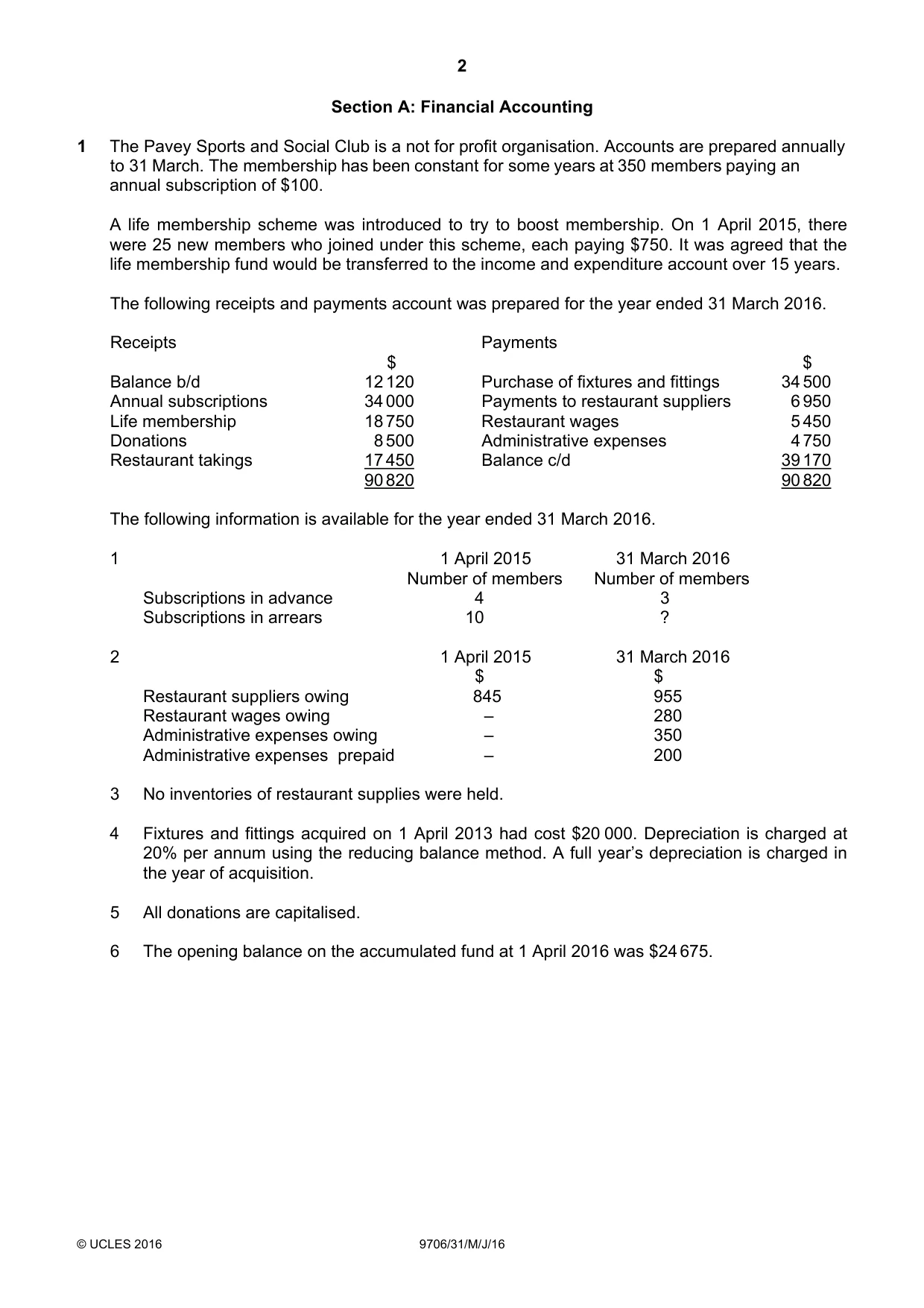
2 © UCLES 2016 9706/31/M/J/16 Section A: Financial Accounting 1 The Pavey Sports and Social Club is a not for profit organisation. Accounts are prepared annually to 31 March. The membership has been constant for some years at 350 members paying an annual subscription of $100. A life membership scheme was introduced to try to boost membership. On 1 April 2015, there were 25 new members who joined under this scheme, each paying $750. It was agreed that the life membership fund would be transferred to the income and expenditure account over 15 years. The following receipts and payments account was prepared for the year ended 31 March 2016. Receipts Payments $ $ Balance b/d 12 120 Purchase of fixtures and fittings 34 500 Annual subscriptions 34 000 Payments to restaurant suppliers 6 950 Life membership 18 750 Restaurant wages 5 450 Donations 8 500 Administrative expenses 4 750 Restaurant takings 17 450 Balance c/d 39 170 90 820 90 820 The following information is available for the year ended 31 March 2016. 1 1 April 2015 31 March 2016 Number of members Number of members Subscriptions in advance 4 3 Subscriptions in arrears 10 ? 2 1 April 2015 31 March 2016 $ $ Restaurant suppliers owing 845 955 Restaurant wages owing – 280 Administrative expenses owing – 350 Administrative expenses prepaid – 200 3 No inventories of restaurant supplies were held. 4 Fixtures and fittings acquired on 1 April 2013 had cost $20 000. Depreciation is charged at 20% per annum using the reducing balance method. A full year’s depreciation is charged in the year of acquisition. 5 All donations are capitalised. 6 The opening balance on the accumulated fund at 1 April 2016 was $24 675.
Question paper, page 3
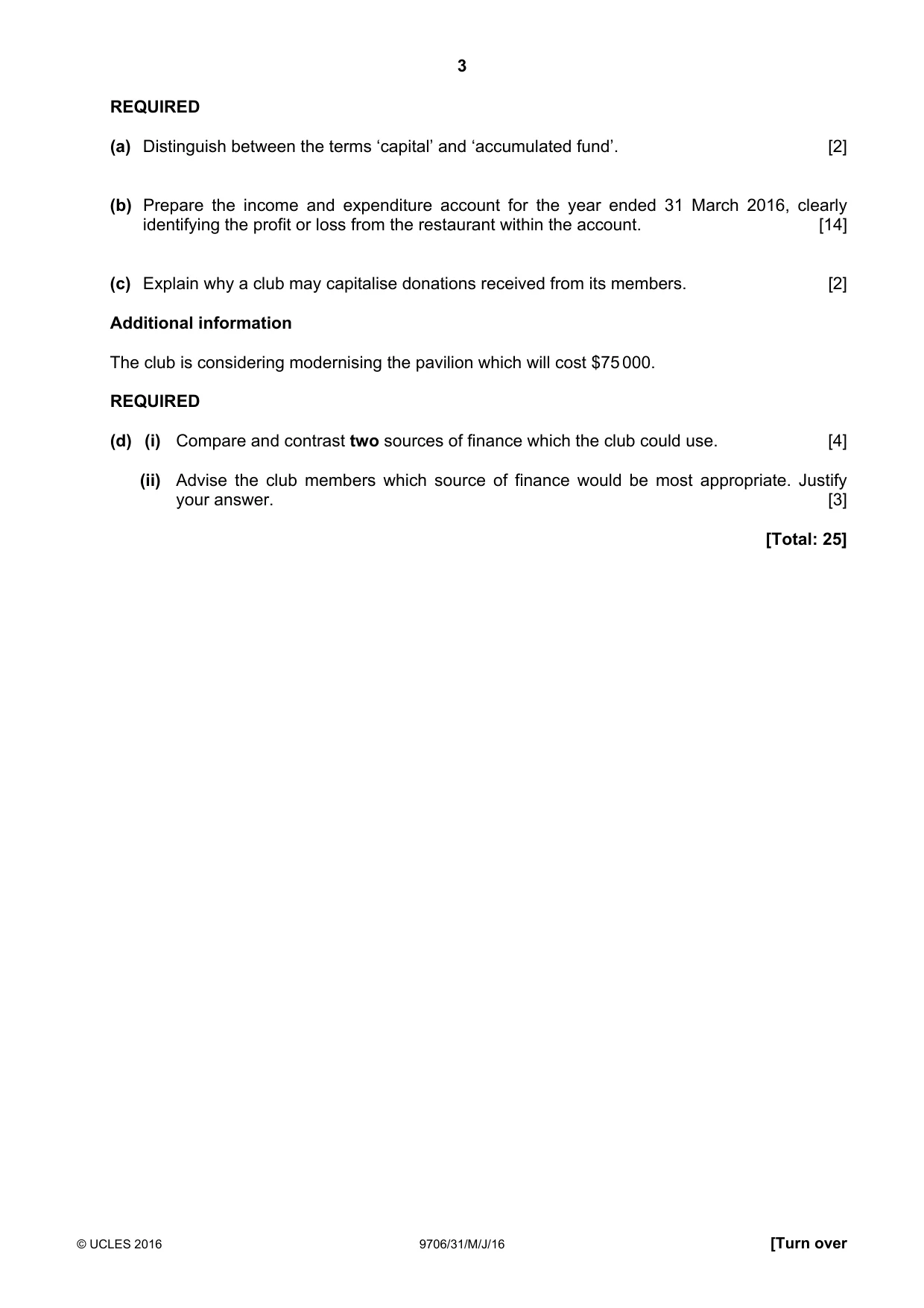
3 © UCLES 2016 9706/31/M/J/16 [Turn over REQUIRED (a) Distinguish between the terms ‘capital’ and ‘accumulated fund’. [2] (b) Prepare the income and expenditure account for the year ended 31 March 2016, clearly identifying the profit or loss from the restaurant within the account. [14] (c) Explain why a club may capitalise donations received from its members. [2] Additional information The club is considering modernising the pavilion which will cost $75 000. REQUIRED (d) (i) Compare and contrast two sources of finance which the club could use. [4] (ii) Advise the club members which source of finance would be most appropriate. Justify your answer. [3] [Total: 25]
Question paper, page 4
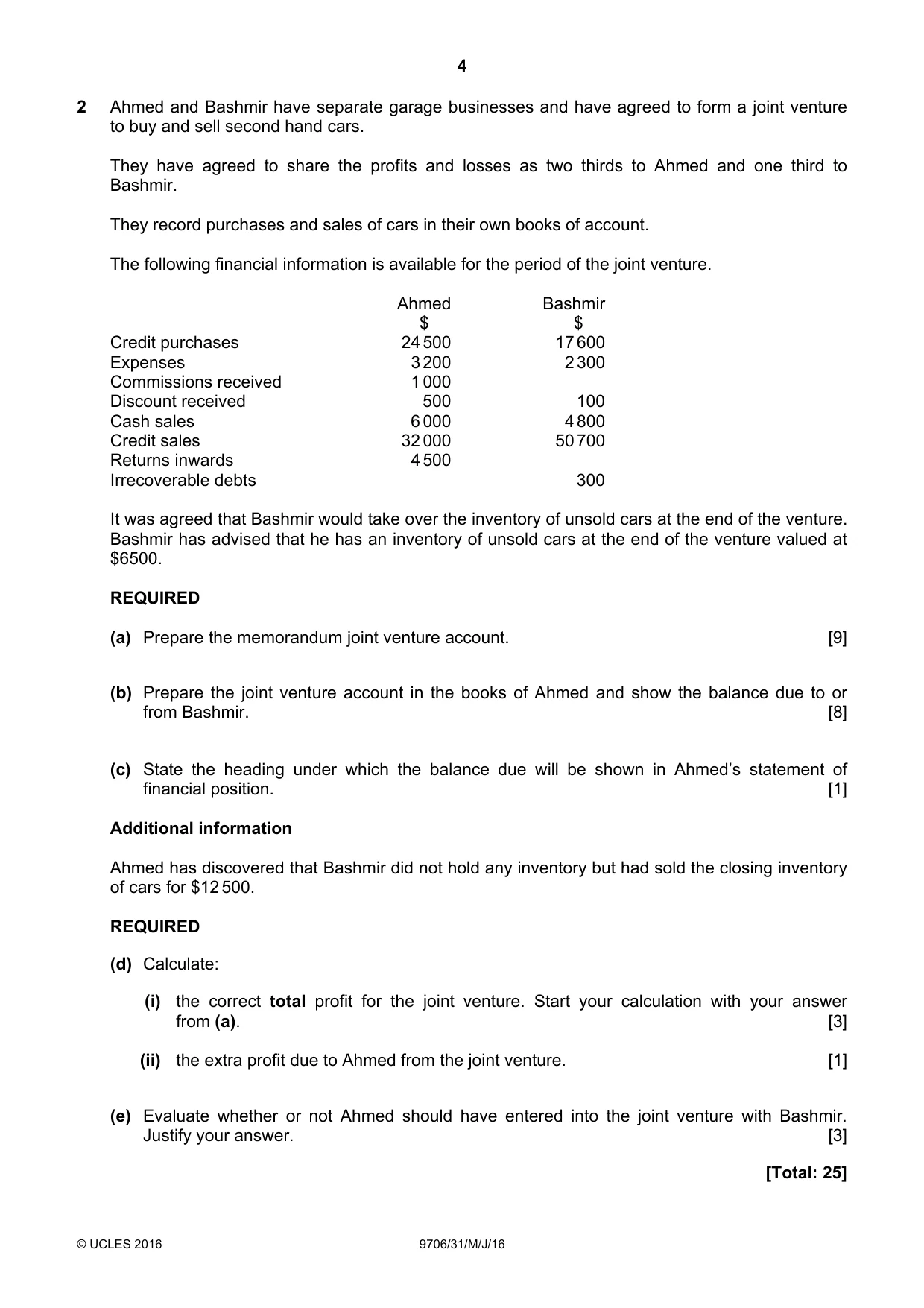
4 © UCLES 2016 9706/31/M/J/16 2 Ahmed and Bashmir have separate garage businesses and have agreed to form a joint venture to buy and sell second hand cars. They have agreed to share the profits and losses as two thirds to Ahmed and one third to Bashmir. They record purchases and sales of cars in their own books of account. The following financial information is available for the period of the joint venture. Ahmed Bashmir $ $ Credit purchases 24 500 17 600 Expenses 3 200 2 300 Commissions received 1 000 Discount received 500 100 Cash sales 6 000 4 800 Credit sales 32 000 50 700 Returns inwards 4 500 Irrecoverable debts 300 It was agreed that Bashmir would take over the inventory of unsold cars at the end of the venture. Bashmir has advised that he has an inventory of unsold cars at the end of the venture valued at $6500. REQUIRED (a) Prepare the memorandum joint venture account. [9] (b) Prepare the joint venture account in the books of Ahmed and show the balance due to or from Bashmir. [8] (c) State the heading under which the balance due will be shown in Ahmed’s statement of financial position. [1] Additional information Ahmed has discovered that Bashmir did not hold any inventory but had sold the closing inventory of cars for $12 500. REQUIRED (d) Calculate: (i) the correct total profit for the joint venture. Start your calculation with your answer from (a). [3] (ii) the extra profit due to Ahmed from the joint venture. [1] (e) Evaluate whether or not Ahmed should have entered into the joint venture with Bashmir. Justify your answer. [3] [Total: 25]
Question paper, page 5
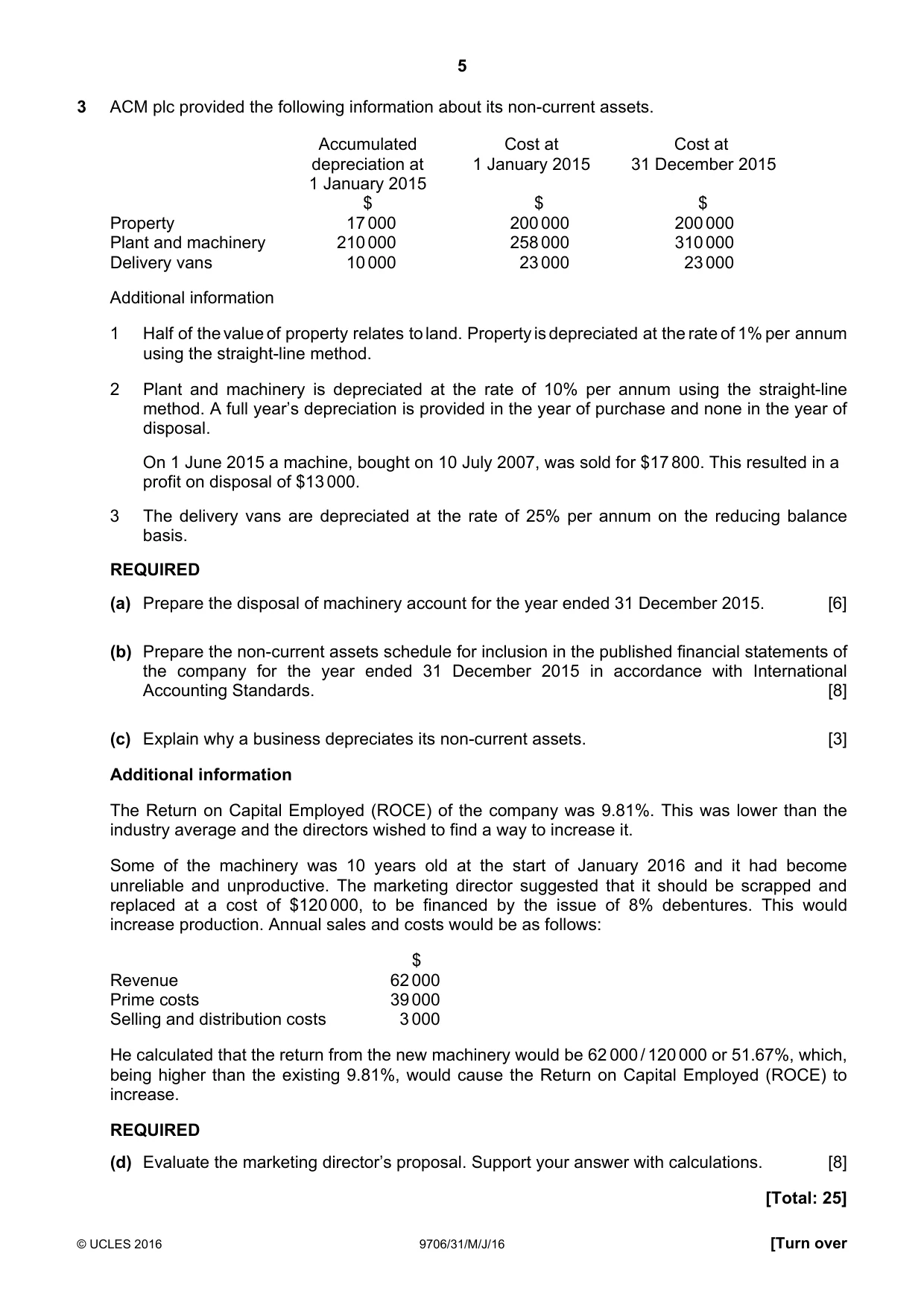
5 © UCLES 2016 9706/31/M/J/16 [Turn over 3 ACM plc provided the following information about its non-current assets. Accumulated depreciation at 1 January 2015 Cost at 1 January 2015 Cost at 31 December 2015 $ $ $ Property 17 000 200 000 200 000 Plant and machinery 210 000 258 000 310 000 Delivery vans 10 000 23 000 23 000 Additional information 1 Half of the value of property relates to land. Property is depreciated at the rate of 1% per annum using the straight-line method. 2 Plant and machinery is depreciated at the rate of 10% per annum using the straight-line method. A full year’s depreciation is provided in the year of purchase and none in the year of disposal. On 1 June 2015 a machine, bought on 10 July 2007, was sold for $17 800. This resulted in a profit on disposal of $13 000. 3 The delivery vans are depreciated at the rate of 25% per annum on the reducing balance basis. REQUIRED (a) Prepare the disposal of machinery account for the year ended 31 December 2015. [6] (b) Prepare the non-current assets schedule for inclusion in the published financial statements of the company for the year ended 31 December 2015 in accordance with International Accounting Standards. [8] (c) Explain why a business depreciates its non-current assets. [3] Additional information The Return on Capital Employed (ROCE) of the company was 9.81%. This was lower than the industry average and the directors wished to find a way to increase it. Some of the machinery was 10 years old at the start of January 2016 and it had become unreliable and unproductive. The marketing director suggested that it should be scrapped and replaced at a cost of $120 000, to be financed by the issue of 8% debentures. This would increase production. Annual sales and costs would be as follows: $ Revenue 62 000 Prime costs 39 000 Selling and distribution costs 3 000 He calculated that the return from the new machinery would be 62 000 / 120 000 or 51.67%, which, being higher than the existing 9.81%, would cause the Return on Capital Employed (ROCE) to increase. REQUIRED (d) Evaluate the marketing director’s proposal. Support your answer with calculations. [8] [Total: 25]
Question paper, page 6
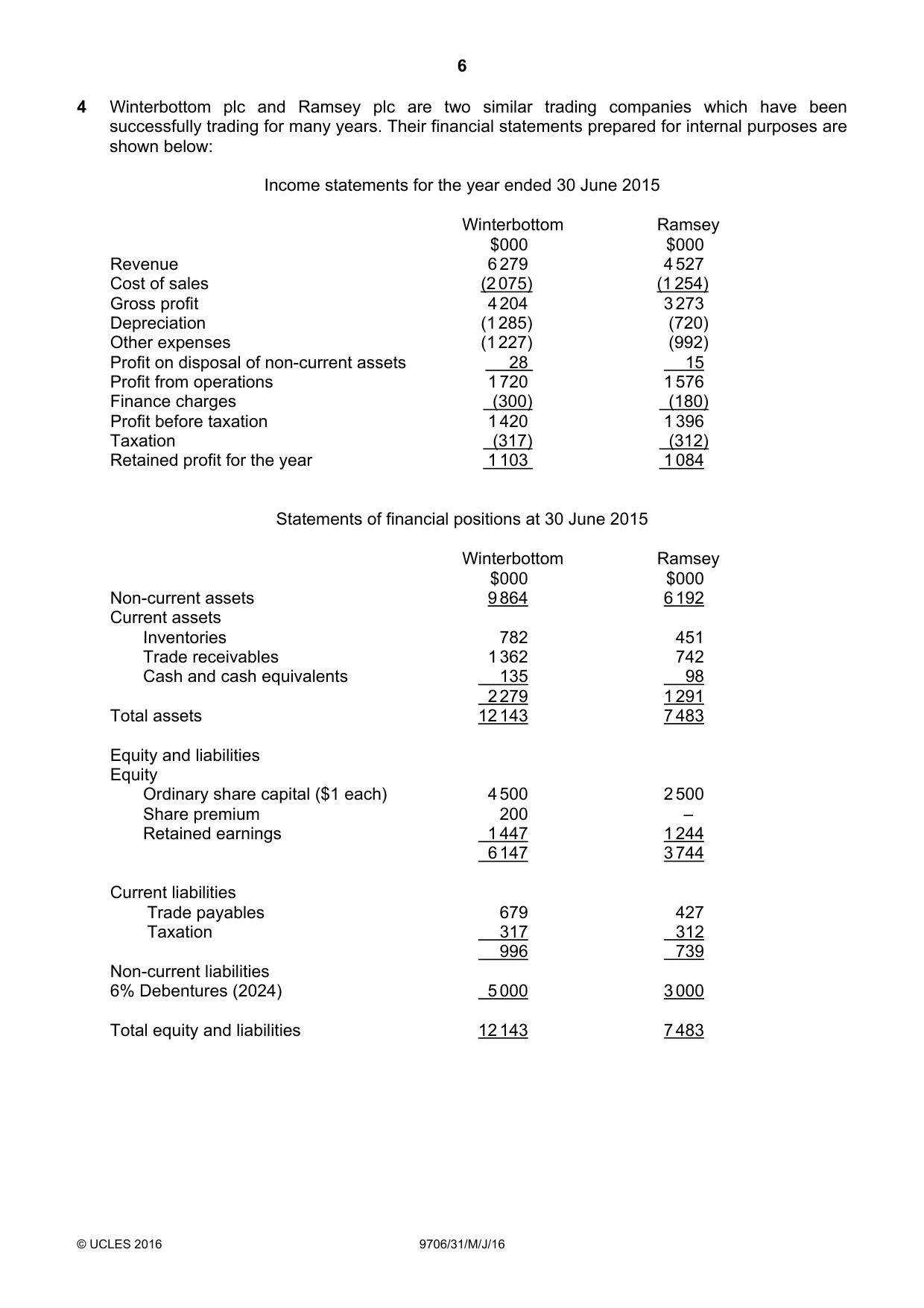
6 © UCLES 2016 9706/31/M/J/16 4 Winterbottom plc and Ramsey plc are two similar trading companies which have been successfully trading for many years. Their financial statements prepared for internal purposes are shown below: Income statements for the year ended 30 June 2015 Winterbottom Ramsey $000 $000 Revenue 6 279 4 527 Cost of sales (2 075) (1 254) Gross profit 4 204 3 273 Depreciation (1 285) (720) Other expenses (1 227) (992) Profit on disposal of non-current assets 28 15 Profit from operations 1 720 1 576 Finance charges (300) (180) Profit before taxation 1 420 1 396 Taxation (317) (312) Retained profit for the year 1 103 1 084 Statements of financial positions at 30 June 2015 Winterbottom Ramsey $000 $000 Non-current assets 9 864 6 192 Current assets Inventories 782 451 Trade receivables 1 362 742 Cash and cash equivalents 135 98 2 279 1 291 Total assets 12 143 7 483 Equity and liabilities Equity Ordinary share capital ($1 each) 4 500 2 500 Share premium 200 – Retained earnings 1 447 1 244 6 147 3 744 Current liabilities Trade payables 679 427 Taxation 317 312 996 739 Non-current liabilities 6% Debentures (2024) 5 000 3 000 Total equity and liabilities 12 143 7 483
Question paper, page 7
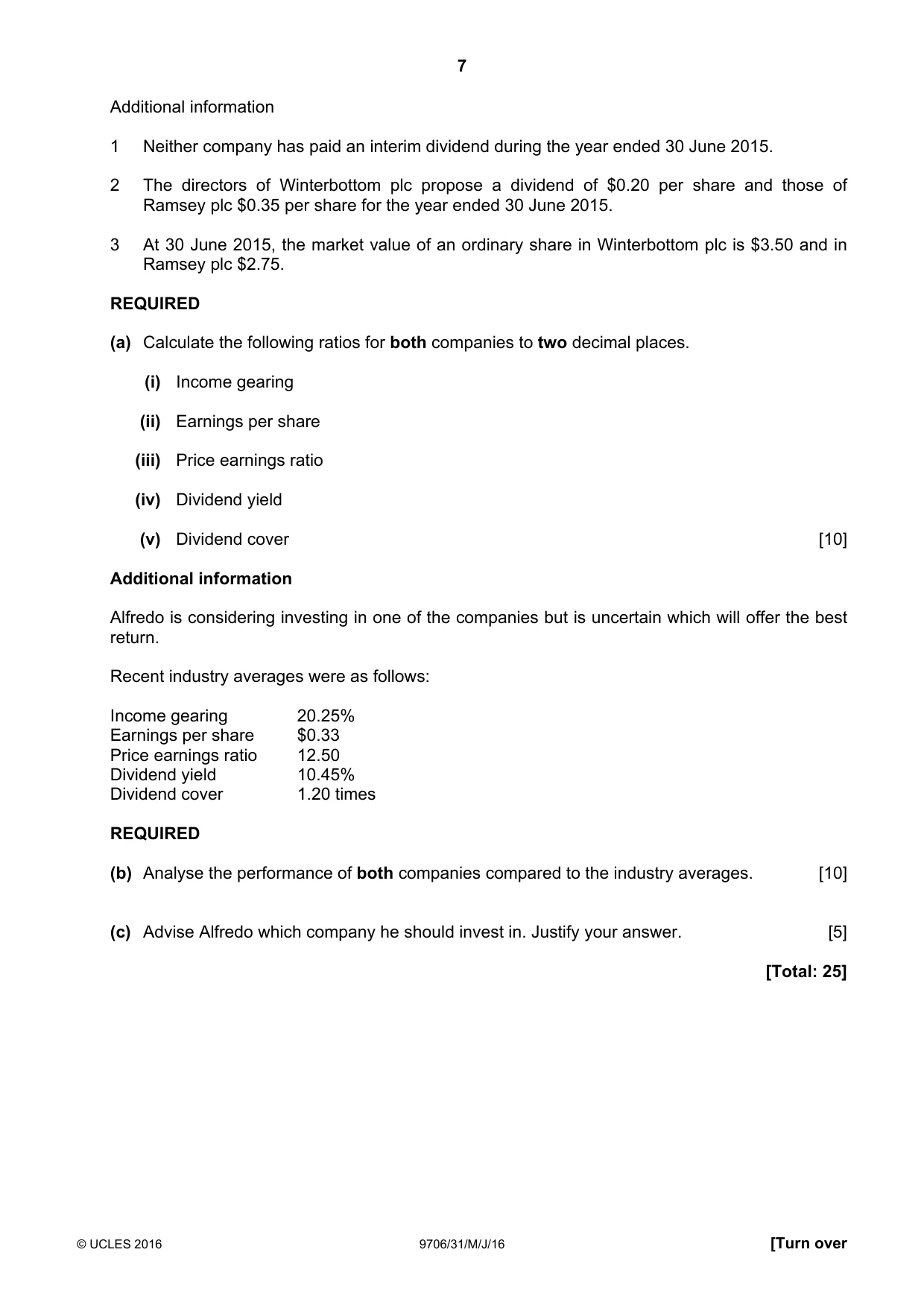
7 © UCLES 2016 9706/31/M/J/16 [Turn over Additional information 1 Neither company has paid an interim dividend during the year ended 30 June 2015. 2 The directors of Winterbottom plc propose a dividend of $0.20 per share and those of Ramsey plc $0.35 per share for the year ended 30 June 2015. 3 At 30 June 2015, the market value of an ordinary share in Winterbottom plc is $3.50 and in Ramsey plc $2.75. REQUIRED (a) Calculate the following ratios for both companies to two decimal places. (i) Income gearing (ii) Earnings per share (iii) Price earnings ratio (iv) Dividend yield (v) Dividend cover [10] Additional information Alfredo is considering investing in one of the companies but is uncertain which will offer the best return. Recent industry averages were as follows: Income gearing 20.25% Earnings per share $0.33 Price earnings ratio 12.50 Dividend yield 10.45% Dividend cover 1.20 times REQUIRED (b) Analyse the performance of both companies compared to the industry averages. [10] (c) Advise Alfredo which company he should invest in. Justify your answer. [5] [Total: 25]
Question paper, page 8
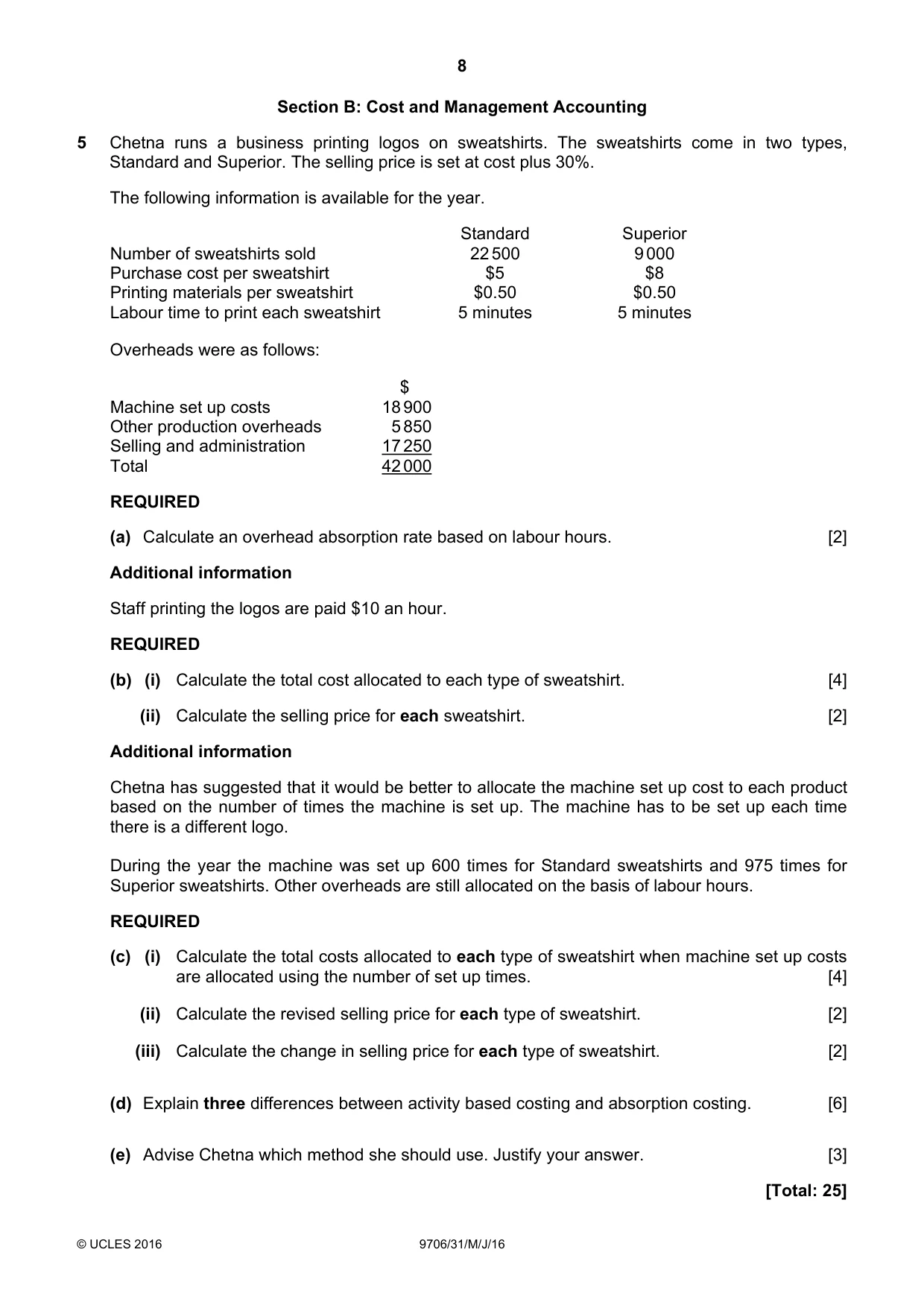
8 © UCLES 2016 9706/31/M/J/16 Section B: Cost and Management Accounting 5 Chetna runs a business printing logos on sweatshirts. The sweatshirts come in two types, Standard and Superior. The selling price is set at cost plus 30%. The following information is available for the year. Standard Superior Number of sweatshirts sold 22 500 9 000 Purchase cost per sweatshirt $5 $8 Printing materials per sweatshirt $0.50 $0.50 Labour time to print each sweatshirt 5 minutes 5 minutes Overheads were as follows: $ Machine set up costs 18 900 Other production overheads 5 850 Selling and administration 17 250 Total 42 000 REQUIRED (a) Calculate an overhead absorption rate based on labour hours. [2] Additional information Staff printing the logos are paid $10 an hour. REQUIRED (b) (i) Calculate the total cost allocated to each type of sweatshirt. [4] (ii) Calculate the selling price for each sweatshirt. [2] Additional information Chetna has suggested that it would be better to allocate the machine set up cost to each product based on the number of times the machine is set up. The machine has to be set up each time there is a different logo. During the year the machine was set up 600 times for Standard sweatshirts and 975 times for Superior sweatshirts. Other overheads are still allocated on the basis of labour hours. REQUIRED (c) (i) Calculate the total costs allocated to each type of sweatshirt when machine set up costs are allocated using the number of set up times. [4] (ii) Calculate the revised selling price for each type of sweatshirt. [2] (iii) Calculate the change in selling price for each type of sweatshirt. [2] (d) Explain three differences between activity based costing and absorption costing. [6] (e) Advise Chetna which method she should use. Justify your answer. [3] [Total: 25]
Question paper, page 9
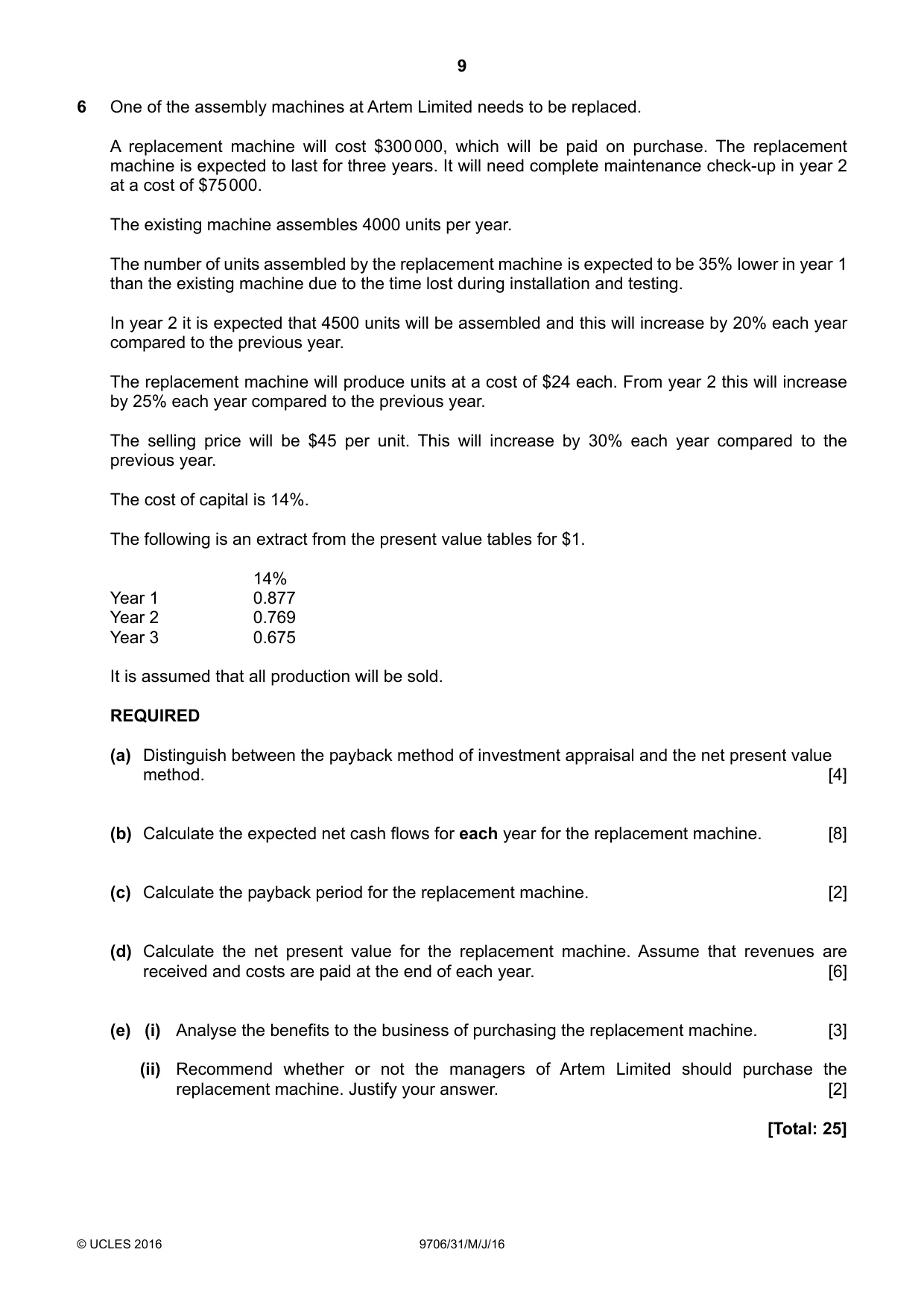
9 © UCLES 2016 9706/31/M/J/16 6 One of the assembly machines at Artem Limited needs to be replaced. A replacement machine will cost $300 000, which will be paid on purchase. The replacement machine is expected to last for three years. It will need complete maintenance check-up in year 2 at a cost of $75 000. The existing machine assembles 4000 units per year. The number of units assembled by the replacement machine is expected to be 35% lower in year 1 than the existing machine due to the time lost during installation and testing. In year 2 it is expected that 4500 units will be assembled and this will increase by 20% each year compared to the previous year. The replacement machine will produce units at a cost of $24 each. From year 2 this will increase by 25% each year compared to the previous year. The selling price will be $45 per unit. This will increase by 30% each year compared to the previous year. The cost of capital is 14%. The following is an extract from the present value tables for $1. 14% Year 1 0.877 Year 2 0.769 Year 3 0.675 It is assumed that all production will be sold. REQUIRED (a) Distinguish between the payback method of investment appraisal and the net present value method. [4] (b) Calculate the expected net cash flows for each year for the replacement machine. [8] (c) Calculate the payback period for the replacement machine. [2] (d) Calculate the net present value for the replacement machine. Assume that revenues are received and costs are paid at the end of each year. [6] (e) (i) Analyse the benefits to the business of purchasing the replacement machine. [3] (ii) Recommend whether or not the managers of Artem Limited should purchase the replacement machine. Justify your answer. [2] [Total: 25]
Question paper, page 10
10 © UCLES 2016 9706/31/M/J/16 BLANK PAGE
Question paper, page 11
11 © UCLES 2016 9706/31/M/J/16 BLANK PAGE
Question paper, page 12
12 Permission to reproduce items where third-party owned material protected by copyright is included has been sought and cleared where possible. Every reasonable effort has been made by the publisher (UCLES) to trace copyright holders, but if any items requiring clearance have unwittingly been included, the publisher will be pleased to make amends at the earliest possible opportunity. To avoid the issue of disclosure of answer-related information to candidates, all copyright acknowledgements are reproduced online in the Cambridge International Examinations Copyright Acknowledgements Booklet. This is produced for each series of examinations and is freely available to download at www.cie.org.uk after the live examination series. Cambridge International Examinations is part of the Cambridge Assessment Group. Cambridge Assessment is the brand name of University of Cambridge Local Examinations Syndicate (UCLES), which is itself a department of the University of Cambridge. © UCLES 2016 9706/31/M/J/16 BLANK PAGE
Mark scheme, page 1
® IGCSE is the registered trademark of Cambridge International Examinations. This document consists of 9 printed pages. © UCLES 2016 [Turn over Cambridge International Examinations Cambridge International Advanced Level ACCOUNTING 9706/31 Paper 3 Structured Questions May/June 2016 MARK SCHEME Maximum Mark: 150 Published This mark scheme is published as an aid to teachers and candidates, to indicate the requirements of the examination. It shows the basis on which Examiners were instructed to award marks. It does not indicate the details of the discussions that took place at an Examiners’ meeting before marking began, which would have considered the acceptability of alternative answers. Mark schemes should be read in conjunction with the question paper and the Principal Examiner Report for Teachers. Cambridge will not enter into discussions about these mark schemes. Cambridge is publishing the mark schemes for the May/June 2016 series for most Cambridge IGCSE®, Cambridge International A and AS Level components and some Cambridge O Level components.
Mark scheme, page 2
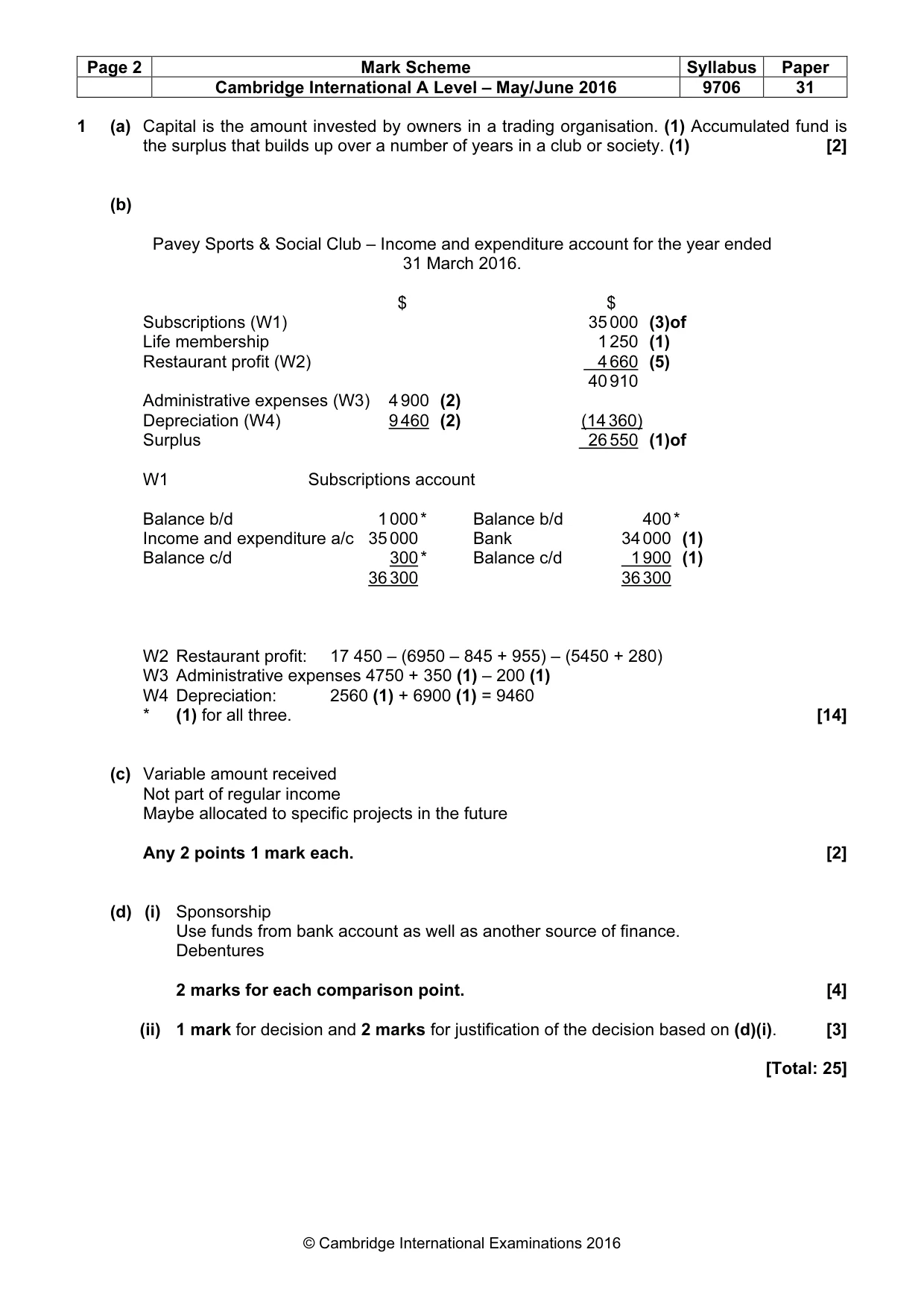
Page 2 Mark Scheme Syllabus Paper Cambridge International A Level – May/June 2016 9706 31 © Cambridge International Examinations 2016 1 (a) Capital is the amount invested by owners in a trading organisation. (1) Accumulated fund is the surplus that builds up over a number of years in a club or society. (1) [2] (b) Pavey Sports & Social Club – Income and expenditure account for the year ended 31 March 2016. $ $ Subscriptions (W1) 35 000 (3)of Life membership 1 250 (1) Restaurant profit (W2) 4 660 (5) 40 910 Administrative expenses (W3) 4 900 (2) Depreciation (W4) 9 460 (2) (14 360) Surplus 26 550 (1)of W1 Subscriptions account Balance b/d 1 000 * Balance b/d 400 * Income and expenditure a/c 35 000 Bank 34 000 (1) Balance c/d 300 * Balance c/d 1 900 (1) 36 300 36 300 W2 Restaurant profit: 17 450 – (6950 – 845 + 955) – (5450 + 280) W3 Administrative expenses 4750 + 350 (1) – 200 (1) W4 Depreciation: 2560 (1) + 6900 (1) = 9460 * (1) for all three. [14] (c) Variable amount received Not part of regular income Maybe allocated to specific projects in the future Any 2 points 1 mark each. [2] (d) (i) Sponsorship Use funds from bank account as well as another source of finance. Debentures 2 marks for each comparison point. [4] (ii) 1 mark for decision and 2 marks for justification of the decision based on (d)(i). [3] [Total: 25]
Mark scheme, page 3
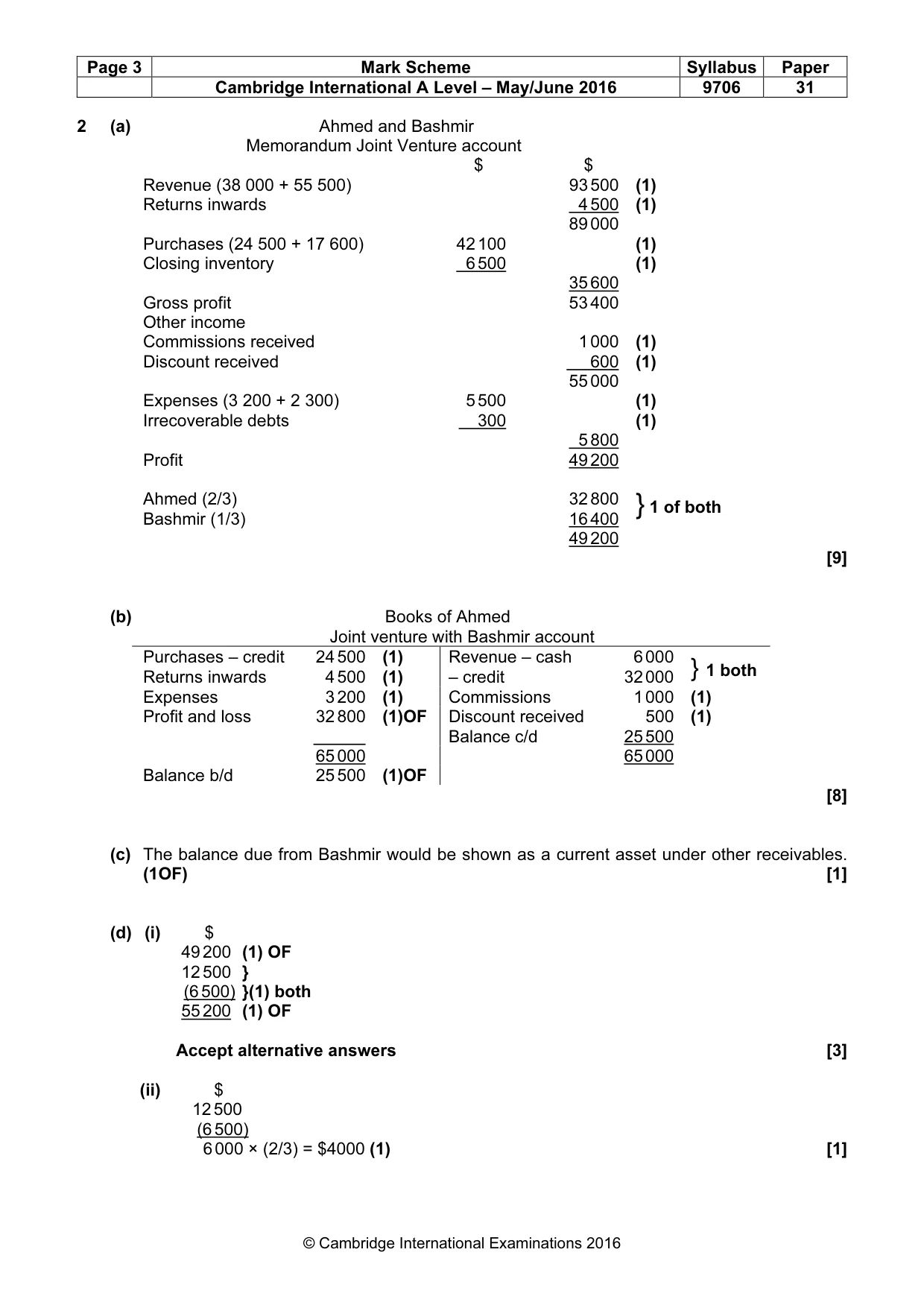
Page 3 Mark Scheme Syllabus Paper Cambridge International A Level – May/June 2016 9706 31 © Cambridge International Examinations 2016 2 (a) Ahmed and Bashmir Memorandum Joint Venture account $ $ Revenue (38 000 + 55 500) 93 500 (1) Returns inwards 4 500 (1) 89 000 Purchases (24 500 + 17 600) 42 100 (1) Closing inventory 6 500 (1) 35 600 Gross profit 53 400 Other income Commissions received 1 000 (1) Discount received 600 (1) 55 000 Expenses (3 200 + 2 300) 5 500 (1) Irrecoverable debts 300 (1) 5 800 Profit 49 200 Ahmed (2/3) 32 800 } 1 of both Bashmir (1/3) 16 400 49 200 [9] (b) Books of Ahmed Joint venture with Bashmir account Purchases – credit 24 500 (1) Revenue – cash 6 000 } 1 both Returns inwards 4 500 (1) – credit 32 000 Expenses 3 200 (1) Commissions 1 000 (1) Profit and loss 32 800 (1)OF Discount received 500 (1) Balance c/d 25 500 65 000 65 000 Balance b/d 25 500 (1)OF [8] (c) The balance due from Bashmir would be shown as a current asset under other receivables. (1OF) [1] (d) (i) $ 49 200 (1) OF 12 500 } (6 500) }(1) both 55 200 (1) OF Accept alternative answers [3] (ii) $ 12 500 (6 500) 6 000 × (2/3) = $4000 (1) [1]
Mark scheme, page 4
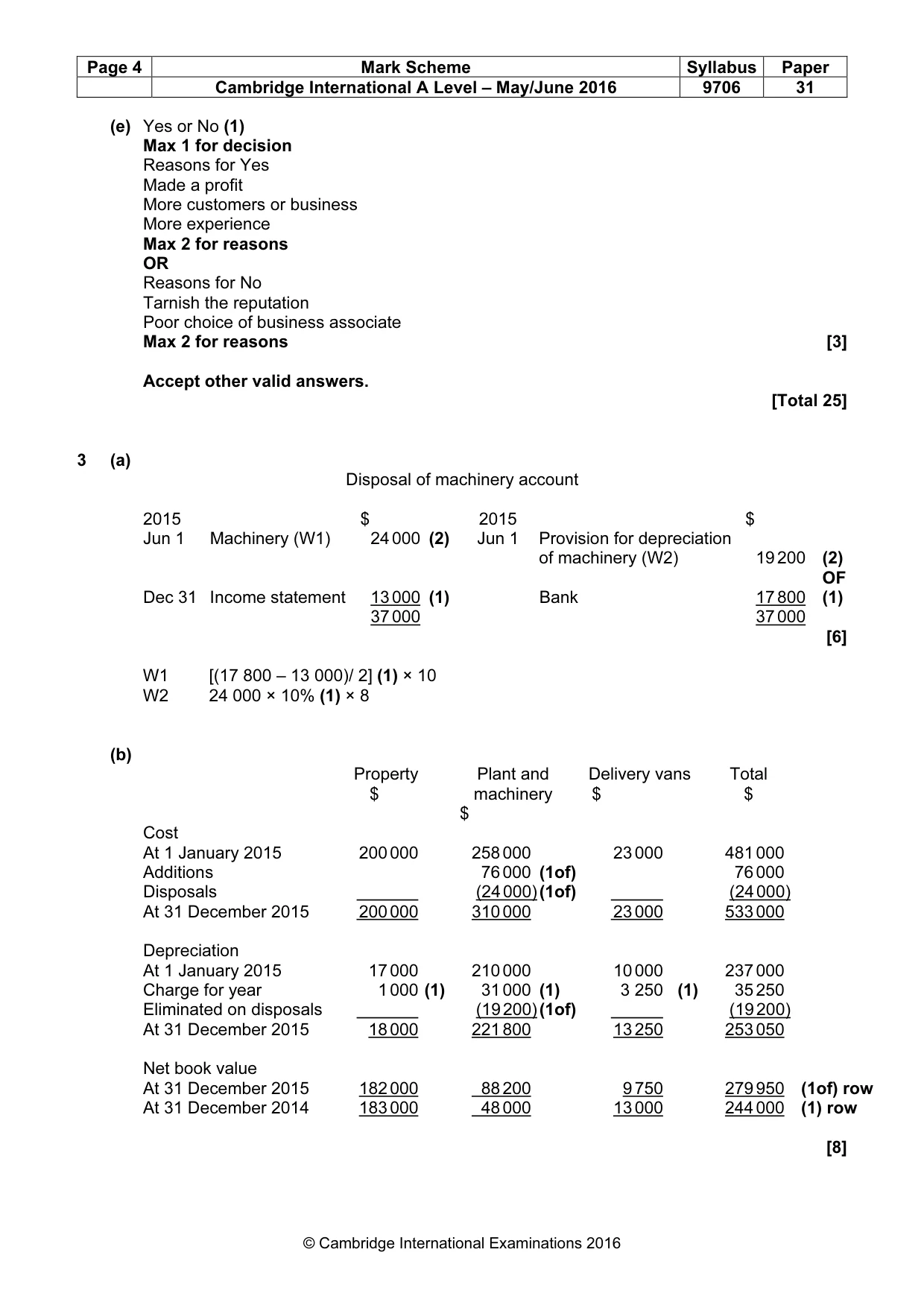
Page 4 Mark Scheme Syllabus Paper Cambridge International A Level – May/June 2016 9706 31 © Cambridge International Examinations 2016 (e) Yes or No (1) Max 1 for decision Reasons for Yes Made a profit More customers or business More experience Max 2 for reasons OR Reasons for No Tarnish the reputation Poor choice of business associate Max 2 for reasons [3] Accept other valid answers. [Total 25] 3 (a) Disposal of machinery account 2015 $ 2015 $ Jun 1 Machinery (W1) 24 000 (2) Jun 1 Provision for depreciation of machinery (W2) 19 200 (2) OF Dec 31 Income statement 13 000 (1) Bank 17 800 (1) 37 000 37 000 [6] W1 [(17 800 – 13 000)/ 2] (1) × 10 W2 24 000 × 10% (1) × 8 (b) Property $ Plant and machinery $ Delivery vans $ Total $ Cost At 1 January 2015 200 000 258 000 23 000 481 000 Additions 76 000 (1of) 76 000 Disposals (24 000) (1of) (24 000) At 31 December 2015 200 000 310 000 23 000 533 000 Depreciation At 1 January 2015 17 000 210 000 10 000 237 000 Charge for year 1 000 (1) 31 000 (1) 3 250 (1) 35 250 Eliminated on disposals (19 200) (1of) (19 200) At 31 December 2015 18 000 221 800 13 250 253 050 Net book value At 31 December 2015 182 000 88 200 9 750 279 950 (1of) row At 31 December 2014 183 000 48 000 13 000 244 000 (1) row [8]
Mark scheme, page 5
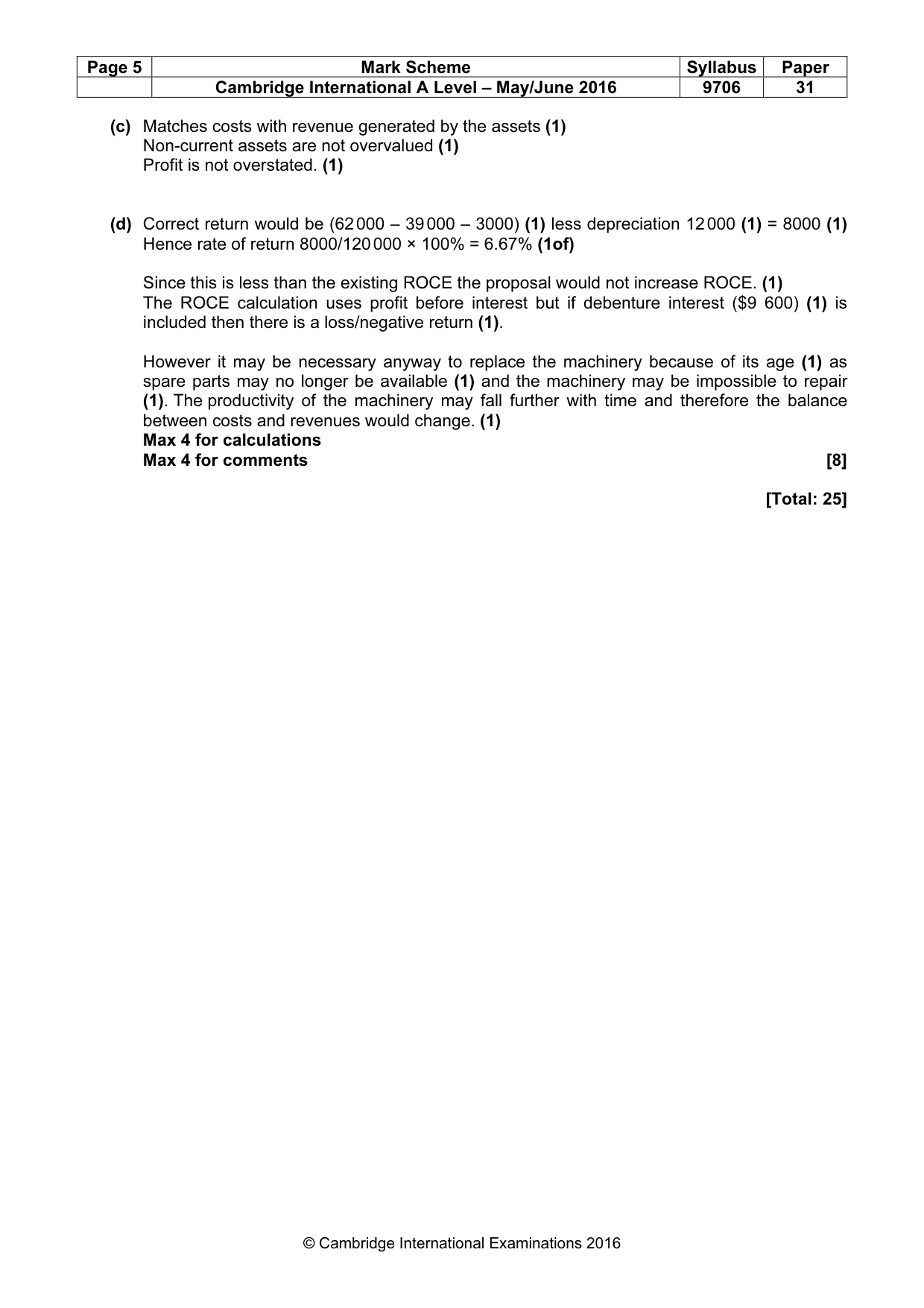
Page 5 Mark Scheme Syllabus Paper Cambridge International A Level – May/June 2016 9706 31 © Cambridge International Examinations 2016 (c) Matches costs with revenue generated by the assets (1) Non-current assets are not overvalued (1) Profit is not overstated. (1) (d) Correct return would be (62 000 – 39 000 – 3000) (1) less depreciation 12 000 (1) = 8000 (1) Hence rate of return 8000/120 000 × 100% = 6.67% (1of) Since this is less than the existing ROCE the proposal would not increase ROCE. (1) The ROCE calculation uses profit before interest but if debenture interest ($9 600) (1) is included then there is a loss/negative return (1). However it may be necessary anyway to replace the machinery because of its age (1) as spare parts may no longer be available (1) and the machinery may be impossible to repair (1). The productivity of the machinery may fall further with time and therefore the balance between costs and revenues would change. (1) Max 4 for calculations Max 4 for comments [8] [Total: 25]
Mark scheme, page 6
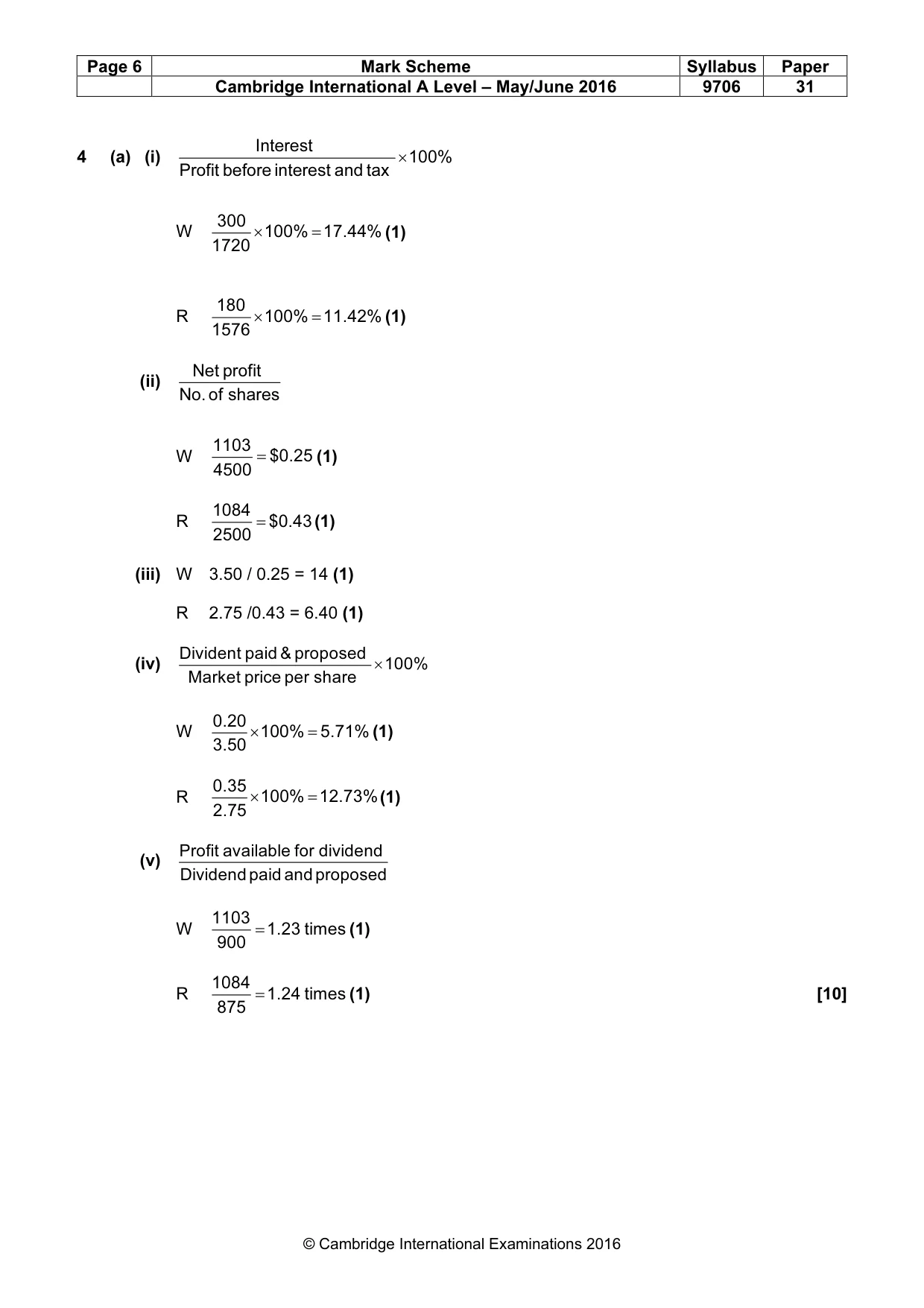
Page 6 Mark Scheme Syllabus Paper Cambridge International A Level – May/June 2016 9706 31 © Cambridge International Examinations 2016 4 (a) (i) × Interest 100% Profit before interest and tax W × = 300 100% 17.44% 1720 (1) R × = 180 100% 11.42% 1576 (1) (ii) Net profit No. of shares W = 1103 $0.25 4500 (1) R = 1084 $0.43 2500 (1) (iii) W 3.50 / 0.25 = 14 (1) R 2.75 /0.43 = 6.40 (1) (iv) × Divident paid & proposed 100% Market price per share W × = 0.20 100% 5.71% 3.50 (1) R × = 0.35 100% 12.73% 2.75 (1) (v) Profit available for dividend Dividend paid and proposed W = 1103 1.23 times 900 (1) R = 1084 1.24 times 875 (1) [10]
Mark scheme, page 7
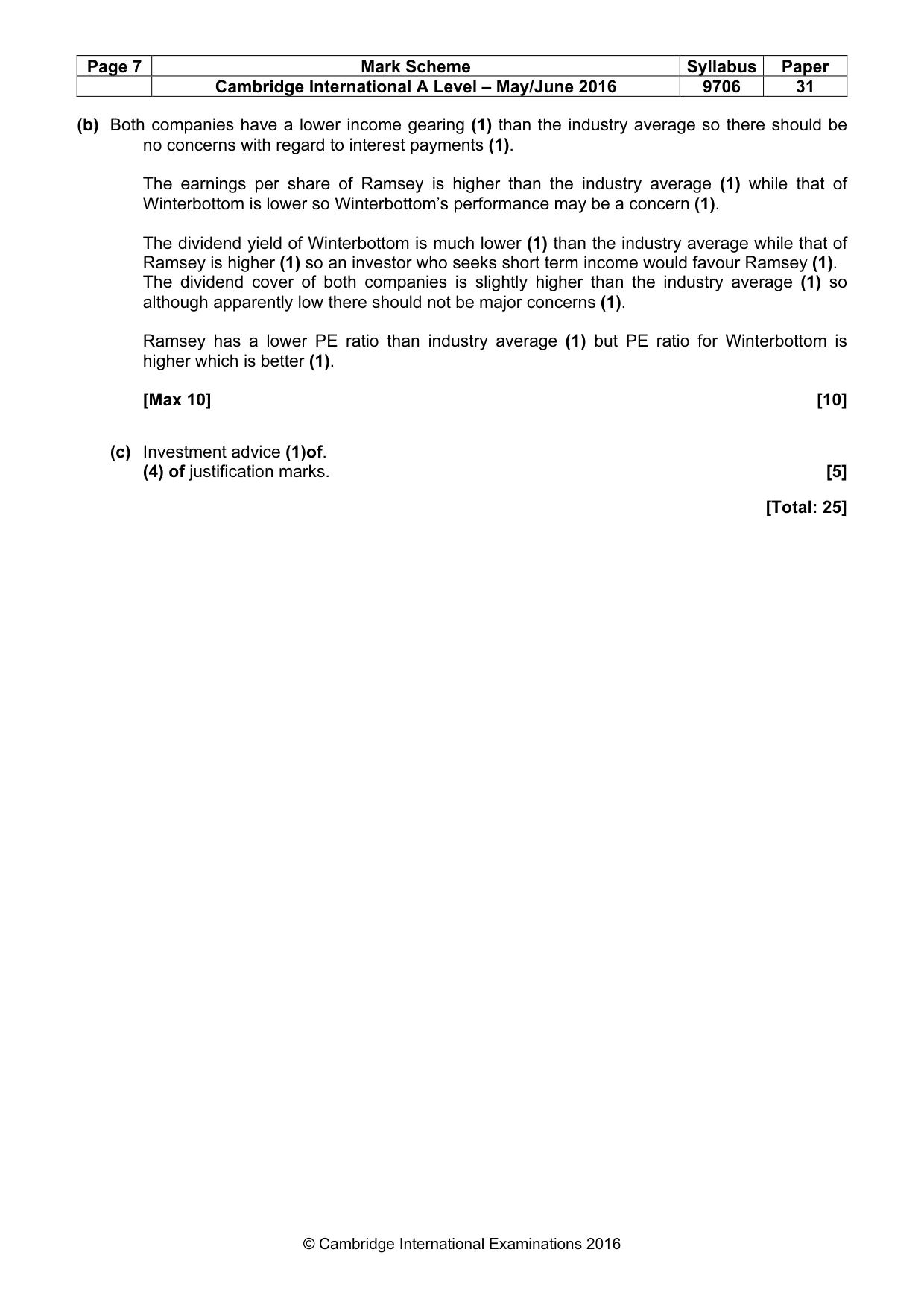
Page 7 Mark Scheme Syllabus Paper Cambridge International A Level – May/June 2016 9706 31 © Cambridge International Examinations 2016 (b) Both companies have a lower income gearing (1) than the industry average so there should be no concerns with regard to interest payments (1). The earnings per share of Ramsey is higher than the industry average (1) while that of Winterbottom is lower so Winterbottom’s performance may be a concern (1). The dividend yield of Winterbottom is much lower (1) than the industry average while that of Ramsey is higher (1) so an investor who seeks short term income would favour Ramsey (1). The dividend cover of both companies is slightly higher than the industry average (1) so although apparently low there should not be major concerns (1). Ramsey has a lower PE ratio than industry average (1) but PE ratio for Winterbottom is higher which is better (1). [Max 10] [10] (c) Investment advice (1)of. (4) of justification marks. [5] [Total: 25]
Mark scheme, page 8
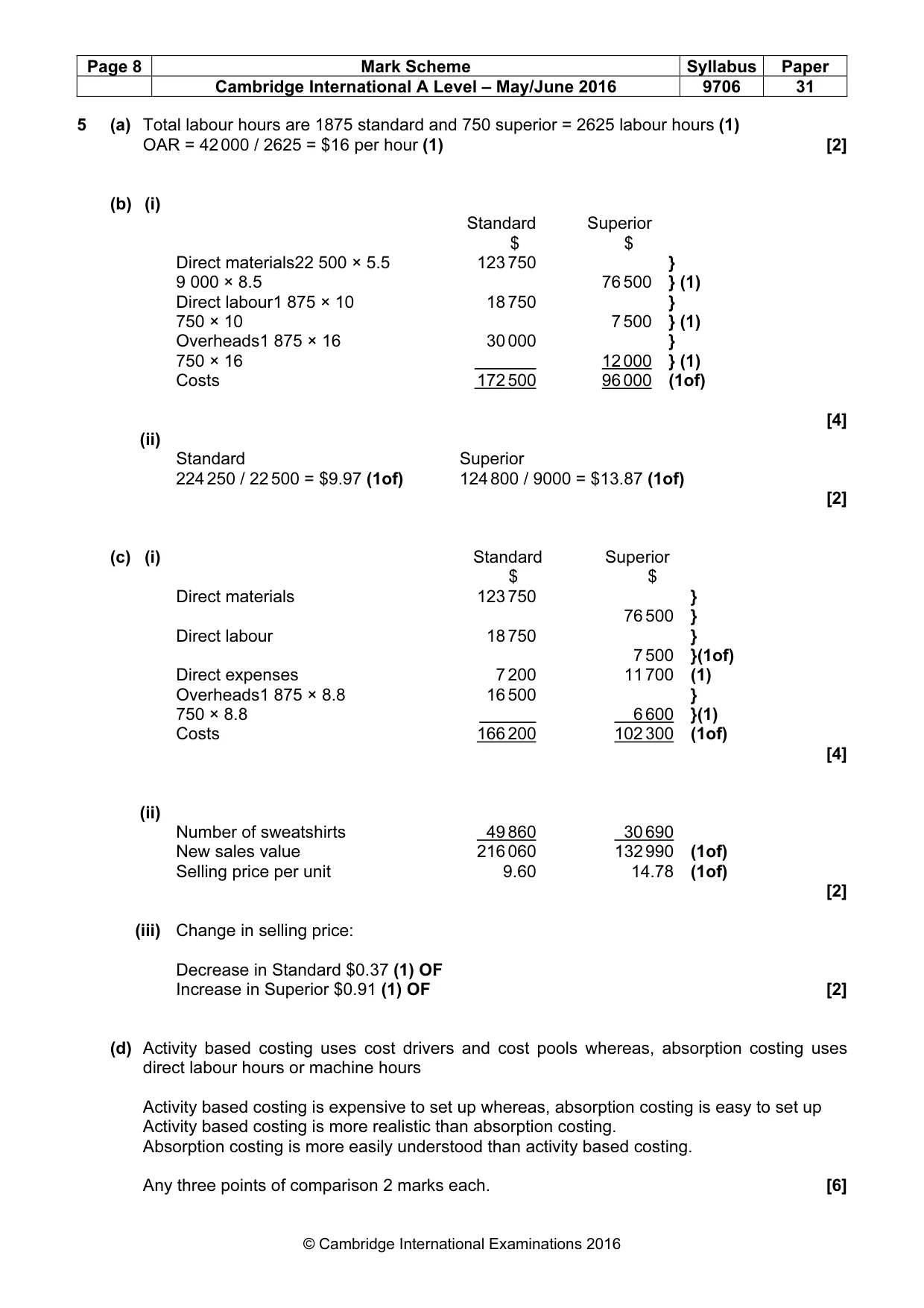
Page 8 Mark Scheme Syllabus Paper Cambridge International A Level – May/June 2016 9706 31 © Cambridge International Examinations 2016 5 (a) Total labour hours are 1875 standard and 750 superior = 2625 labour hours (1) OAR = 42 000 / 2625 = $16 per hour (1) [2] (b) (i) Standard Superior $ $ Direct materials22 500 × 5.5 9 000 × 8.5 123 750 76 500 } } (1) Direct labour1 875 × 10 750 × 10 18 750 7 500 } } (1) Overheads1 875 × 16 750 × 16 30 000 12 000 } } (1) Costs 172 500 96 000 (1of) [4] (ii) Standard Superior 224 250 / 22 500 = $9.97 (1of) 124 800 / 9000 = $13.87 (1of) [2] (c) (i) Standard Superior $ $ Direct materials 123 750 76 500 } } Direct labour 18 750 7 500 } }(1of) Direct expenses 7 200 11 700 (1) Overheads1 875 × 8.8 750 × 8.8 16 500 6 600 } }(1) Costs 166 200 102 300 (1of) [4] (ii) Number of sweatshirts 49 860 30 690 New sales value 216 060 132 990 (1of) Selling price per unit 9.60 14.78 (1of) [2] (iii) Change in selling price: Decrease in Standard $0.37 (1) OF Increase in Superior $0.91 (1) OF [2] (d) Activity based costing uses cost drivers and cost pools whereas, absorption costing uses direct labour hours or machine hours Activity based costing is expensive to set up whereas, absorption costing is easy to set up Activity based costing is more realistic than absorption costing. Absorption costing is more easily understood than activity based costing. Any three points of comparison 2 marks each. [6]
Mark scheme, page 9
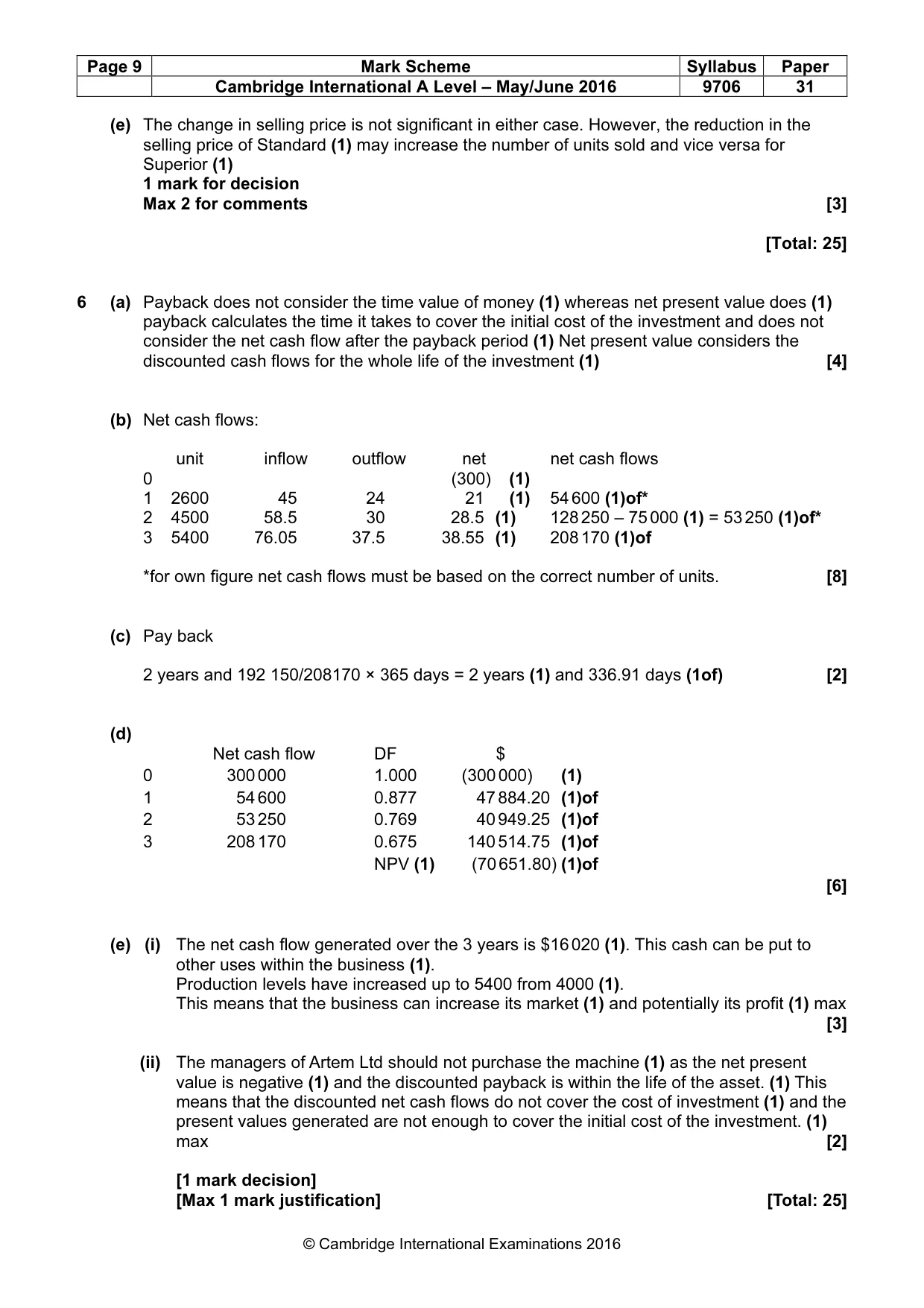
Page 9 Mark Scheme Syllabus Paper Cambridge International A Level – May/June 2016 9706 31 © Cambridge International Examinations 2016 (e) The change in selling price is not significant in either case. However, the reduction in the selling price of Standard (1) may increase the number of units sold and vice versa for Superior (1) 1 mark for decision Max 2 for comments [3] [Total: 25] 6 (a) Payback does not consider the time value of money (1) whereas net present value does (1) payback calculates the time it takes to cover the initial cost of the investment and does not consider the net cash flow after the payback period (1) Net present value considers the discounted cash flows for the whole life of the investment (1) [4] (b) Net cash flows: unit inflow outflow net net cash flows 0 (300) (1) 1 2600 45 24 21 (1) 54 600 (1)of* 2 4500 58.5 30 28.5 (1) 128 250 – 75 000 (1) = 53 250 (1)of* 3 5400 76.05 37.5 38.55 (1) 208 170 (1)of *for own figure net cash flows must be based on the correct number of units. [8] (c) Pay back 2 years and 192 150/208170 × 365 days = 2 years (1) and 336.91 days (1of) [2] (d) Net cash flow DF $ 0 300 000 1.000 (300 000) (1) 1 54 600 0.877 47 884.20 (1)of 2 53 250 0.769 40 949.25 (1)of 3 208 170 0.675 140 514.75 (1)of NPV (1) (70 651.80) (1)of [6] (e) (i) The net cash flow generated over the 3 years is $16 020 (1). This cash can be put to other uses within the business (1). Production levels have increased up to 5400 from 4000 (1). This means that the business can increase its market (1) and potentially its profit (1) max [3] (ii) The managers of Artem Ltd should not purchase the machine (1) as the net present value is negative (1) and the discounted payback is within the life of the asset. (1) This means that the discounted net cash flows do not cover the cost of investment (1) and the present values generated are not enough to cover the initial cost of the investment. (1) max [2] [1 mark decision] [Max 1 mark justification] [Total: 25]
What you needed in this session
Cambridge’s own grade thresholds for 2016 May/June, Paper 3 · Variant 1. A higher threshold means an easier paper — the bar moves with how the cohort did.