Cambridge IGCSE Travel and Tourism 0471 — 2022 May/June Paper 1 · Variant 3
0471/13/M/J/22 · 100 marks · ≈113 min
The question paper and its mark scheme, free to read here and free to download. This is Cambridge’s own paper, exactly as it was sat.
Question paper12 pages



Mark scheme12 pages
Answers below. Sit the paper first if you are practising.

Paper as text
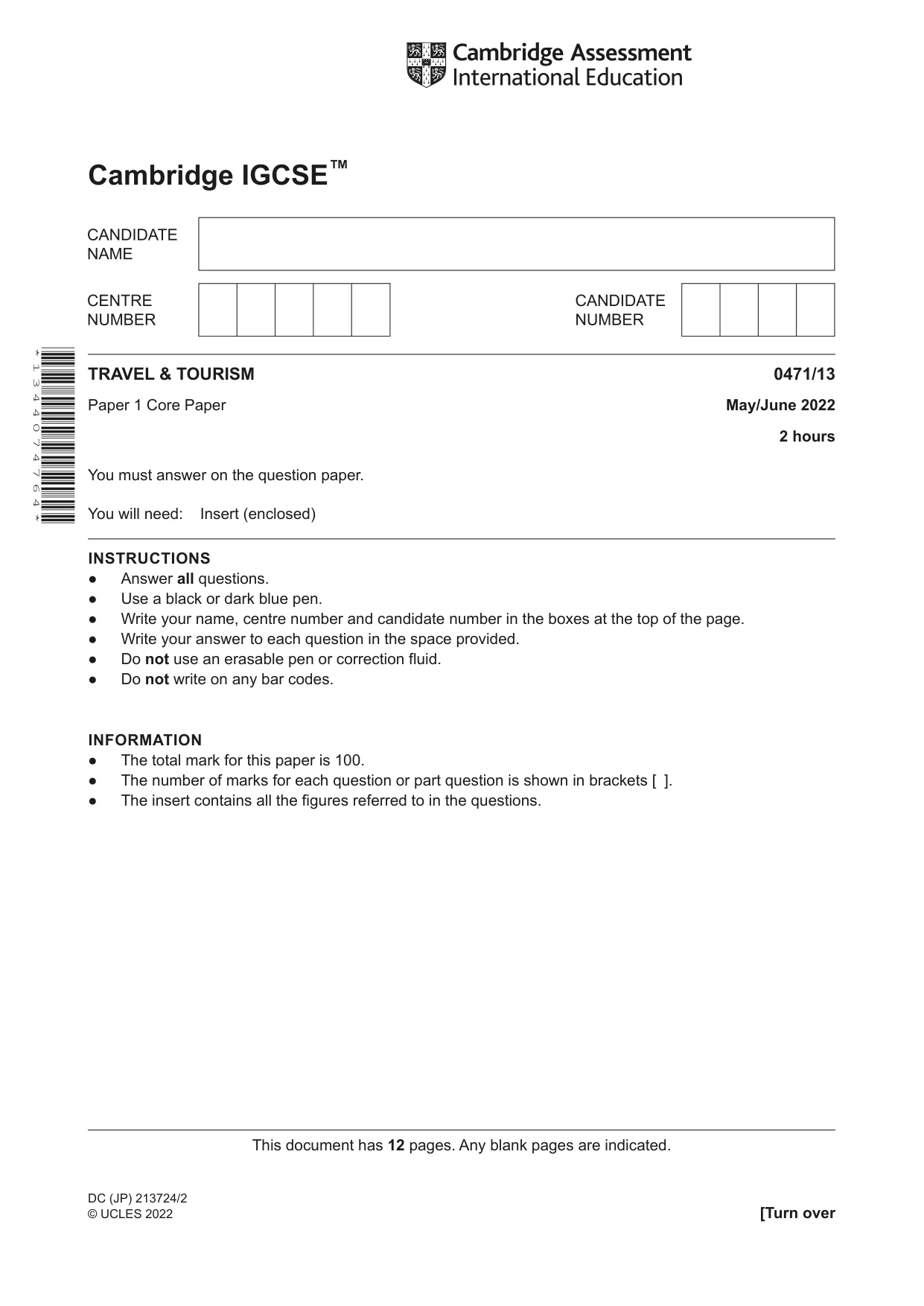
Question paper, page 1
This document has 12 pages. Any blank pages are indicated. [Turn over DC (JP) 213724/2 © UCLES 2022 * 1 3 4 4 0 7 4 7 6 4 * TRAVEL & TOURISM 0471/13 Paper 1 Core Paper May/June 2022 2 hours You must answer on the question paper. You will need: Insert (enclosed) INSTRUCTIONS ● Answer all questions. ● Use a black or dark blue pen. ● Write your name, centre number and candidate number in the boxes at the top of the page. ● Write your answer to each question in the space provided. ● Do not use an erasable pen or correction fluid. ● Do not write on any bar codes. INFORMATION ● The total mark for this paper is 100. ● The number of marks for each question or part question is shown in brackets [ ]. ● The insert contains all the figures referred to in the questions. Cambridge IGCSE™
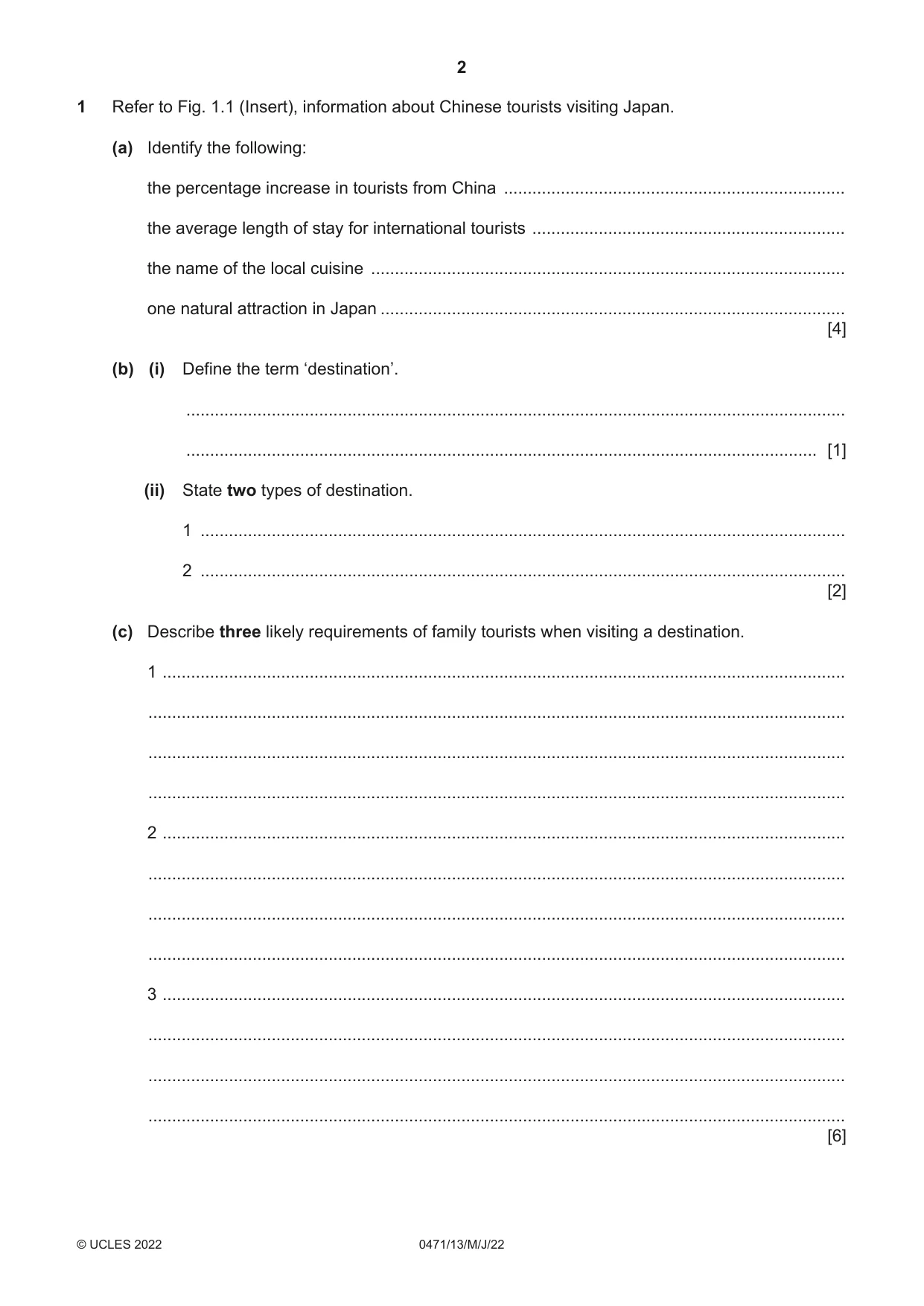
Question paper, page 2
2 0471/13/M/J/22 © UCLES 2022 1 Refer to Fig. 1.1 (Insert), information about Chinese tourists visiting Japan. (a) Identify the following: the percentage increase in tourists from China … the average length of stay for international tourists … the name of the local cuisine … one natural attraction in Japan … [4] (b) (i) Define the term ‘destination’. … … [1] (ii) State two types of destination. 1 … 2 … [2] (c) Describe three likely requirements of family tourists when visiting a destination. 1 … … … … 2 … … … … 3 … … … … [6]
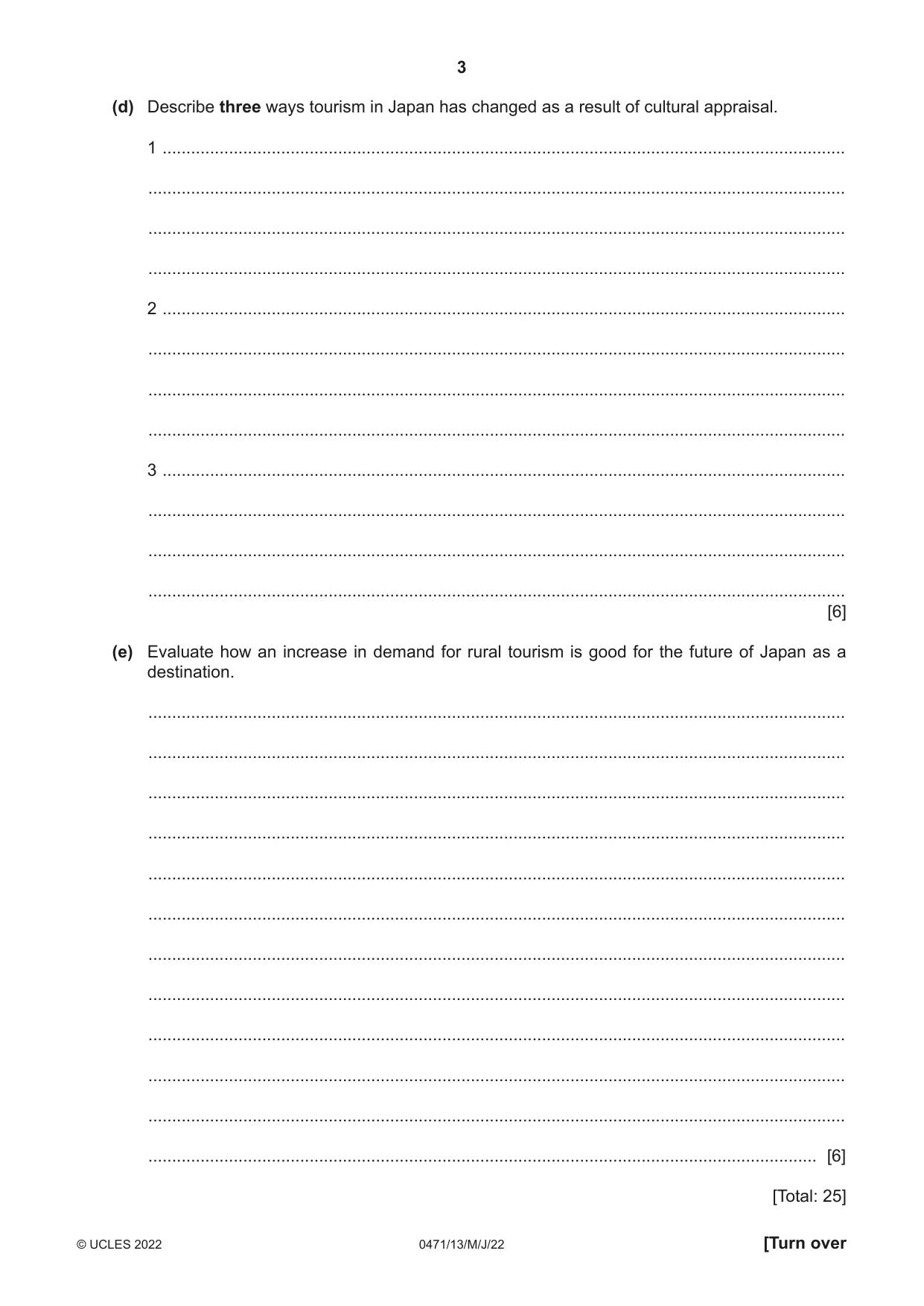
Question paper, page 3
3 0471/13/M/J/22 © UCLES 2022 [Turn over (d) Describe three ways tourism in Japan has changed as a result of cultural appraisal. 1 … … … … 2 … … … … 3 … … … … [6] (e) Evaluate how an increase in demand for rural tourism is good for the future of Japan as a destination. … … … … … … … … … … … … [6] [Total: 25]
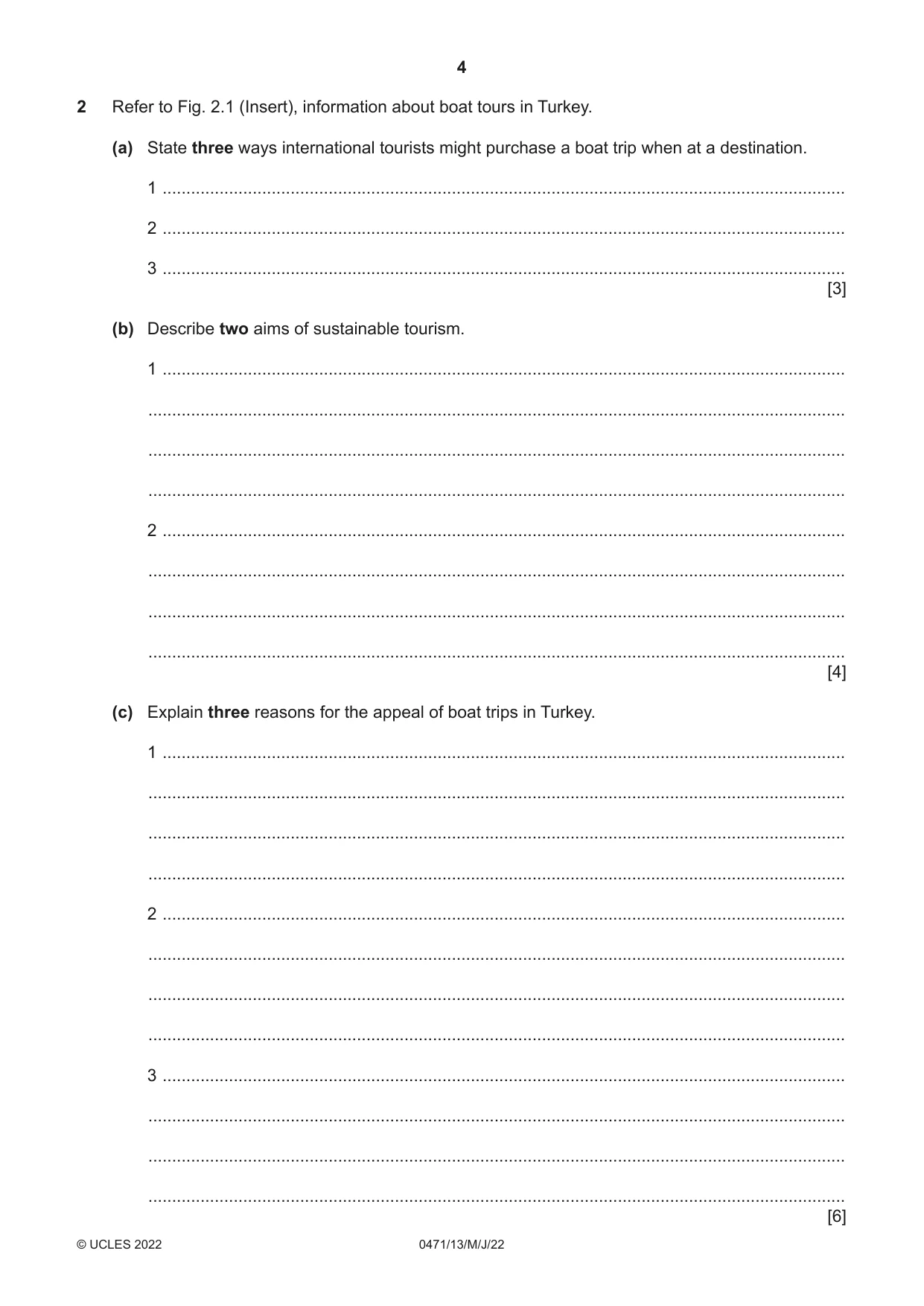
Question paper, page 4
4 0471/13/M/J/22 © UCLES 2022 2 Refer to Fig. 2.1 (Insert), information about boat tours in Turkey. (a) State three ways international tourists might purchase a boat trip when at a destination. 1 … 2 … 3 … [3] (b) Describe two aims of sustainable tourism. 1 … … … … 2 … … … … [4] (c) Explain three reasons for the appeal of boat trips in Turkey. 1 … … … … 2 … … … … 3 … … … … [6]
Question paper, page 5
5 0471/13/M/J/22 © UCLES 2022 [Turn over (d) Explain three negative environmental impacts of boats trips. 1 … … … … 2 … … … … 3 … … … … [6] (e) Assess the benefits to local communities of boat tour providers acting more sustainably. … … … … … … … … … … … … [6] [Total: 25]
Question paper, page 6
6 0471/13/M/J/22 © UCLES 2022 3 Refer to Fig. 3.1 (Insert), a photograph of a bus station in Thailand. (a) State three types of public transport. 1 … 2 … 3 … [3] (b) Explain two benefits to tourists of transport hubs providing ancillary services. 1 … … … … 2 … … … … [4] (c) Explain three reasons for the appeal to tourists of using local public transport when visiting a destination. 1 … … … … 2 … … … … 3 … … … … [6]
Question paper, page 7
7 0471/13/M/J/22 © UCLES 2022 [Turn over (d) Explain tourism’s contribution to each of the following: balance of payments … … … … employment … … … … inflation … … … … [6] (e) Assess the role of catering outlets in tourism. … … … … … … … … … … … … [6] [Total: 25]
Question paper, page 8
8 0471/13/M/J/22 © UCLES 2022 4 Refer to Fig. 4.1 (Insert), a photograph of restaurant waiting staff receiving training. (a) Identify three personal presentation requirements being met by the staff shown in Fig. 4.1. 1 … 2 … 3 … [3] (b) State four topics included in training for restaurant staff. 1 … 2 … 3 … 4 … [4] (c) Explain three reasons why personal presentation requirements are so important for waiting staff. 1 … … … … 2 … … … … 3 … … … … [6]
Question paper, page 9
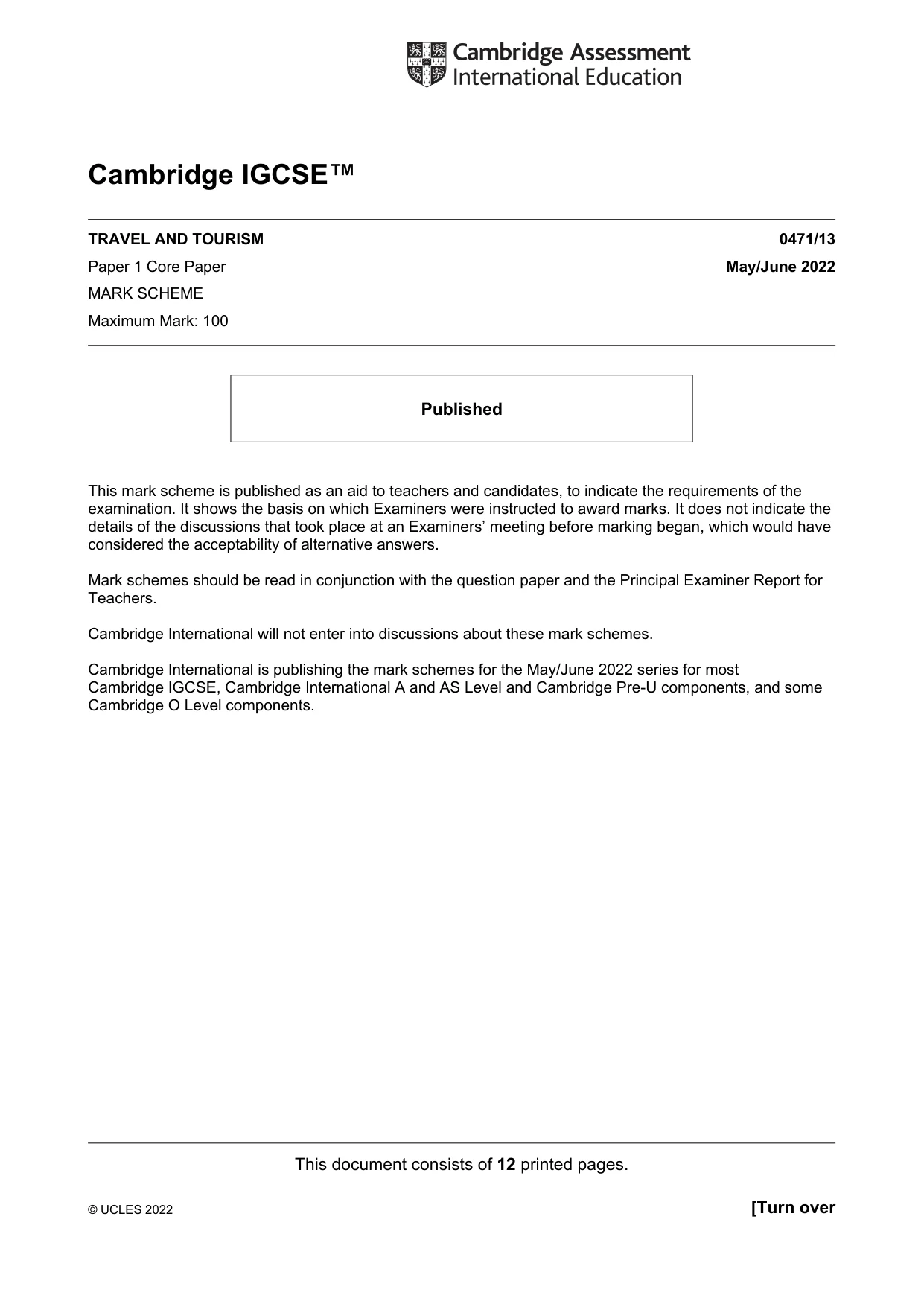
9 0471/13/M/J/22 © UCLES 2022 (d) Describe three ways waiting staff can ensure they have interpreted customer requirements correctly. 1 … … … … 2 … … … … 3 … … … … [6] (e) Assess the importance of customer care policies in maintaining restaurant standards. … … … … … … … … … … … … [6] [Total: 25]
Question paper, page 10
10 0471/13/M/J/22 © UCLES 2022 BLANK PAGE
Question paper, page 11
11 0471/13/M/J/22 © UCLES 2022 BLANK PAGE
Question paper, page 12
12 0471/13/M/J/22 © UCLES 2022 The boundaries and names shown, the designations used and the presentation of material on any maps contained in this question paper/insert do not imply official endorsement or acceptance by Cambridge Assessment International Education concerning the legal status of any country, territory, or area or any of its authorities, or of the delimitation of its frontiers or boundaries. Permission to reproduce items where third-party owned material protected by copyright is included has been sought and cleared where possible. Every reasonable effort has been made by the publisher (UCLES) to trace copyright holders, but if any items requiring clearance have unwittingly been included, the publisher will be pleased to make amends at the earliest possible opportunity. To avoid the issue of disclosure of answer-related information to candidates, all copyright acknowledgements are reproduced online in the Cambridge Assessment International Education Copyright Acknowledgements Booklet. This is produced for each series of examinations and is freely available to download at www.cambridgeinternational.org after the live examination series. Cambridge Assessment International Education is part of Cambridge Assessment. Cambridge Assessment is the brand name of the University of Cambridge Local Examinations Syndicate (UCLES), which is a department of the University of Cambridge. BLANK PAGE
Mark scheme, page 1
This document consists of 12 printed pages. © UCLES 2022 [Turn over Cambridge IGCSE™ TRAVEL AND TOURISM 0471/13 Paper 1 Core Paper May/June 2022 MARK SCHEME Maximum Mark: 100 Published This mark scheme is published as an aid to teachers and candidates, to indicate the requirements of the examination. It shows the basis on which Examiners were instructed to award marks. It does not indicate the details of the discussions that took place at an Examiners’ meeting before marking began, which would have considered the acceptability of alternative answers. Mark schemes should be read in conjunction with the question paper and the Principal Examiner Report for Teachers. Cambridge International will not enter into discussions about these mark schemes. Cambridge International is publishing the mark schemes for the May/June 2022 series for most Cambridge IGCSE, Cambridge International A and AS Level and Cambridge Pre-U components, and some Cambridge O Level components.
Mark scheme, page 2
0471/13 Cambridge IGCSE – Mark Scheme PUBLISHED May/June 2022 © UCLES 2022 Page 2 of 12 Generic Marking Principles These general marking principles must be applied by all examiners when marking candidate answers. They should be applied alongside the specific content of the mark scheme or generic level descriptors for a question. Each question paper and mark scheme will also comply with these marking principles. GENERIC MARKING PRINCIPLE 1: Marks must be awarded in line with: the specific content of the mark scheme or the generic level descriptors for the question the specific skills defined in the mark scheme or in the generic level descriptors for the question the standard of response required by a candidate as exemplified by the standardisation scripts. GENERIC MARKING PRINCIPLE 2: Marks awarded are always whole marks (not half marks, or other fractions). GENERIC MARKING PRINCIPLE 3: Marks must be awarded positively: marks are awarded for correct/valid answers, as defined in the mark scheme. However, credit is given for valid answers which go beyond the scope of the syllabus and mark scheme, referring to your Team Leader as appropriate marks are awarded when candidates clearly demonstrate what they know and can do marks are not deducted for errors marks are not deducted for omissions answers should only be judged on the quality of spelling, punctuation and grammar when these features are specifically assessed by the question as indicated by the mark scheme. The meaning, however, should be unambiguous. GENERIC MARKING PRINCIPLE 4: Rules must be applied consistently, e.g. in situations where candidates have not followed instructions or in the application of generic level descriptors. GENERIC MARKING PRINCIPLE 5: Marks should be awarded using the full range of marks defined in the mark scheme for the question (however; the use of the full mark range may be limited according to the quality of the candidate responses seen). GENERIC MARKING PRINCIPLE 6: Marks awarded are based solely on the requirements as defined in the mark scheme. Marks should not be awarded with grade thresholds or grade descriptors in mind.
Mark scheme, page 3
0471/13 Cambridge IGCSE – Mark Scheme PUBLISHED May/June 2022 © UCLES 2022 Page 3 of 12 Social Science-Specific Marking Principles (for point-based marking) 1 Components using point-based marking: Point marking is often used to reward knowledge, understanding and application of skills. We give credit where the candidate’s answer shows relevant knowledge, understanding and application of skills in answering the question. We do not give credit where the answer shows confusion. From this it follows that we: a DO credit answers which are worded differently from the mark scheme if they clearly convey the same meaning (unless the mark scheme requires a specific term) b DO credit alternative answers/examples which are not written in the mark scheme if they are correct c DO credit answers where candidates give more than one correct answer in one prompt/numbered/scaffolded space where extended writing is required rather than list-type answers. For example, questions that require n reasons (e.g. State two reasons …). d DO NOT credit answers simply for using a ‘key term’ unless that is all that is required. (Check for evidence it is understood and not used wrongly.) e DO NOT credit answers which are obviously self-contradicting or trying to cover all possibilities f DO NOT give further credit for what is effectively repetition of a correct point already credited unless the language itself is being tested. This applies equally to ‘mirror statements’ (i.e. polluted/not polluted). g DO NOT require spellings to be correct, unless this is part of the test. However spellings of syllabus terms must allow for clear and unambiguous separation from other syllabus terms with which they may be confused (e.g. Corrasion/Corrosion) 2 Presentation of mark scheme: Slashes (/) or the word ‘or’ separate alternative ways of making the same point. Semi colons (;) bullet points (•) or figures in brackets (1) separate different points. Content in the answer column in brackets is for examiner information/context to clarify the marking but is not required to earn the mark (except Accounting syllabuses where they indicate negative numbers). 3 Calculation questions: The mark scheme will show the steps in the most likely correct method(s), the mark for each step, the correct answer(s) and the mark for each answer If working/explanation is considered essential for full credit, this will be indicated in the question paper and in the mark scheme. In all other instances, the correct answer to a calculation should be given full credit, even if no supporting working is shown. Where the candidate uses a valid method which is not covered by the mark scheme, award equivalent marks for reaching equivalent stages. Where an answer makes use of a candidate’s own incorrect figure from previous working, the ‘own figure rule’ applies: full marks will be given if a correct and complete method is used. Further guidance will be included in the mark scheme where necessary and any exceptions to this general principle will be noted.
Mark scheme, page 4
0471/13 Cambridge IGCSE – Mark Scheme PUBLISHED May/June 2022 © UCLES 2022 Page 4 of 12 4 Annotation: For point marking, ticks can be used to indicate correct answers and crosses can be used to indicate wrong answers. There is no direct relationship between ticks and marks. Ticks have no defined meaning for levels of response marking. For levels of response marking, the level awarded should be annotated on the script. Other annotations will be used by examiners as agreed during standardisation, and the meaning will be understood by all examiners who marked that paper.
Mark scheme, page 5
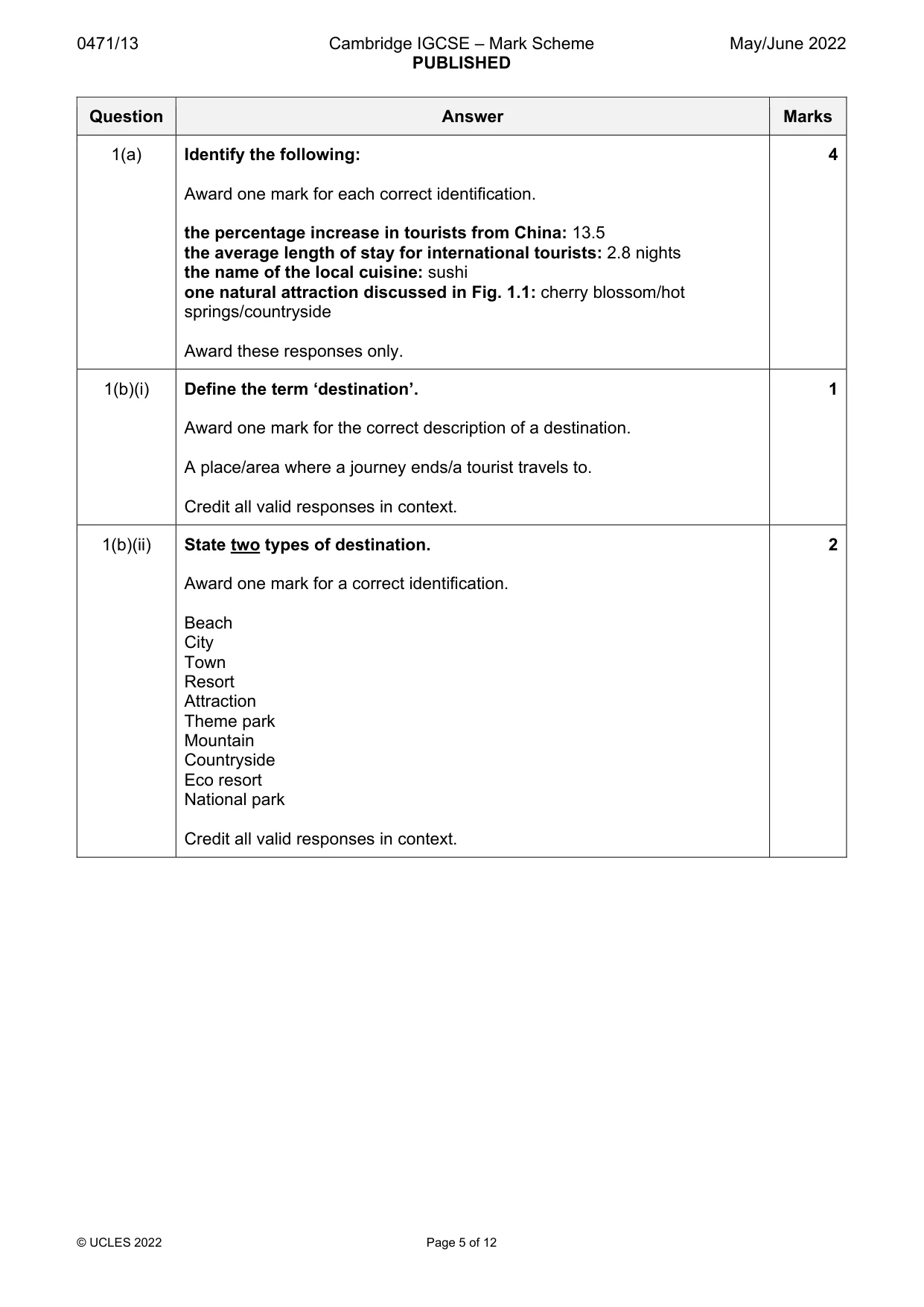
0471/13 Cambridge IGCSE – Mark Scheme PUBLISHED May/June 2022 © UCLES 2022 Page 5 of 12 Question Answer Marks 1(a) Identify the following: Award one mark for each correct identification. the percentage increase in tourists from China: 13.5 the average length of stay for international tourists: 2.8 nights the name of the local cuisine: sushi one natural attraction discussed in Fig. 1.1: cherry blossom/hot springs/countryside Award these responses only. 4 1(b)(i) Define the term ‘destination’. Award one mark for the correct description of a destination. A place/area where a journey ends/a tourist travels to. Credit all valid responses in context. 1 1(b)(ii) State two types of destination. Award one mark for a correct identification. Beach City Town Resort Attraction Theme park Mountain Countryside Eco resort National park Credit all valid responses in context. 2
Mark scheme, page 6
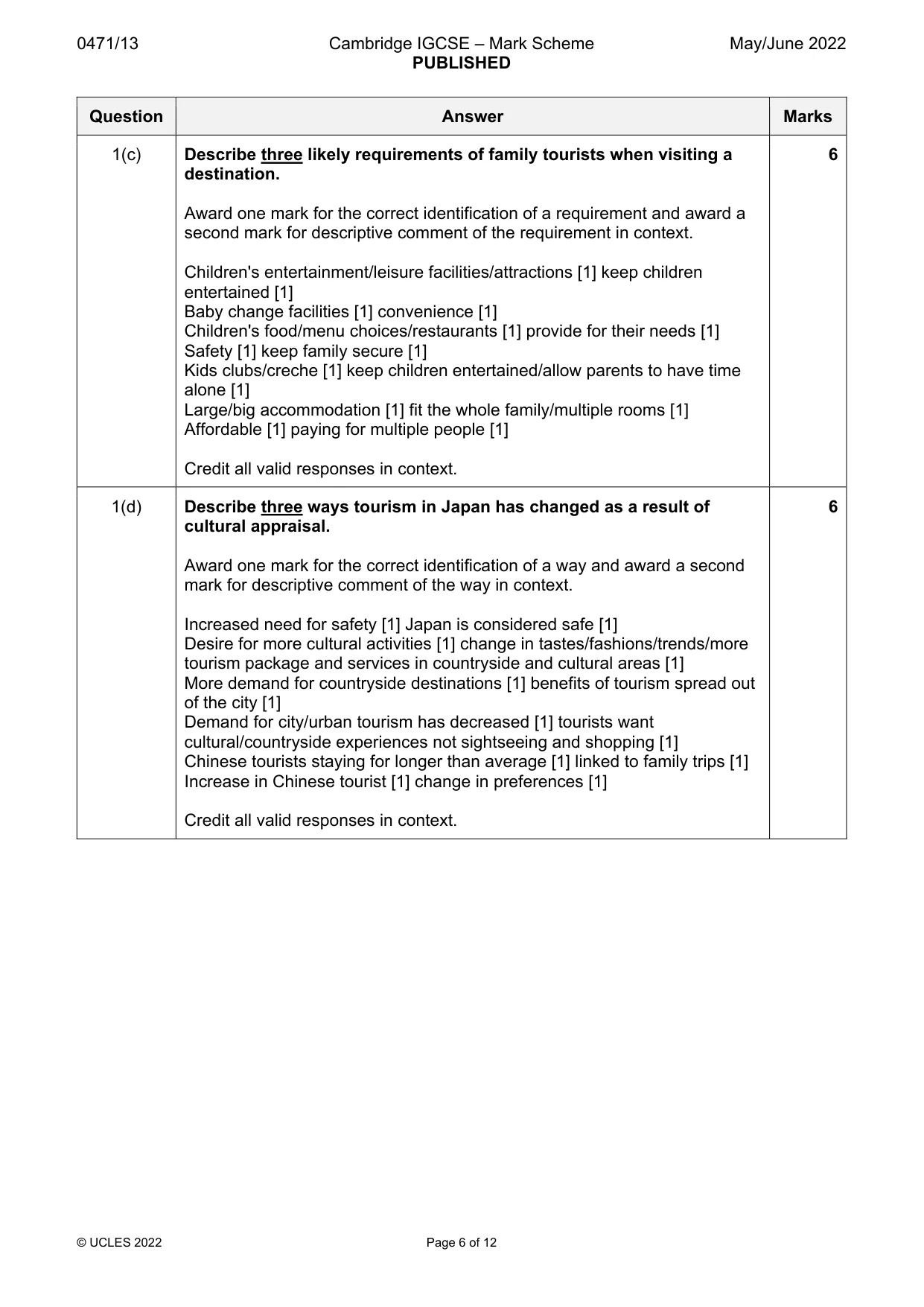
0471/13 Cambridge IGCSE – Mark Scheme PUBLISHED May/June 2022 © UCLES 2022 Page 6 of 12 Question Answer Marks 1(c) Describe three likely requirements of family tourists when visiting a destination. Award one mark for the correct identification of a requirement and award a second mark for descriptive comment of the requirement in context. Children's entertainment/leisure facilities/attractions [1] keep children entertained [1] Baby change facilities [1] convenience [1] Children's food/menu choices/restaurants [1] provide for their needs [1] Safety [1] keep family secure [1] Kids clubs/creche [1] keep children entertained/allow parents to have time alone [1] Large/big accommodation [1] fit the whole family/multiple rooms [1] Affordable [1] paying for multiple people [1] Credit all valid responses in context. 6 1(d) Describe three ways tourism in Japan has changed as a result of cultural appraisal. Award one mark for the correct identification of a way and award a second mark for descriptive comment of the way in context. Increased need for safety [1] Japan is considered safe [1] Desire for more cultural activities [1] change in tastes/fashions/trends/more tourism package and services in countryside and cultural areas [1] More demand for countryside destinations [1] benefits of tourism spread out of the city [1] Demand for city/urban tourism has decreased [1] tourists want cultural/countryside experiences not sightseeing and shopping [1] Chinese tourists staying for longer than average [1] linked to family trips [1] Increase in Chinese tourist [1] change in preferences [1] Credit all valid responses in context. 6
Mark scheme, page 7
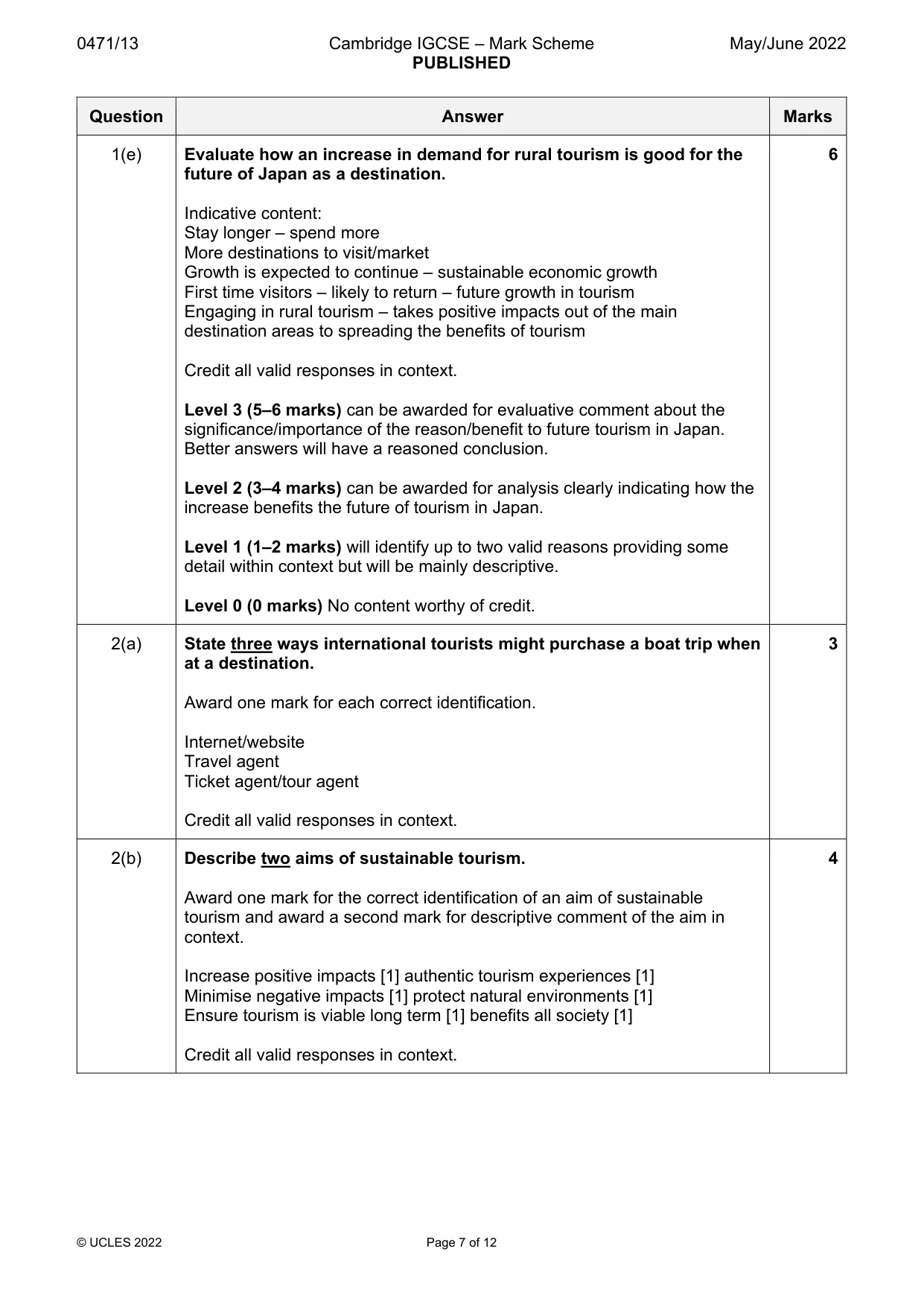
0471/13 Cambridge IGCSE – Mark Scheme PUBLISHED May/June 2022 © UCLES 2022 Page 7 of 12 Question Answer Marks 1(e) Evaluate how an increase in demand for rural tourism is good for the future of Japan as a destination. Indicative content: Stay longer – spend more More destinations to visit/market Growth is expected to continue – sustainable economic growth First time visitors – likely to return – future growth in tourism Engaging in rural tourism – takes positive impacts out of the main destination areas to spreading the benefits of tourism Credit all valid responses in context. Level 3 (5–6 marks) can be awarded for evaluative comment about the significance/importance of the reason/benefit to future tourism in Japan. Better answers will have a reasoned conclusion. Level 2 (3–4 marks) can be awarded for analysis clearly indicating how the increase benefits the future of tourism in Japan. Level 1 (1–2 marks) will identify up to two valid reasons providing some detail within context but will be mainly descriptive. Level 0 (0 marks) No content worthy of credit. 6 2(a) State three ways international tourists might purchase a boat trip when at a destination. Award one mark for each correct identification. Internet/website Travel agent Ticket agent/tour agent Credit all valid responses in context. 3 2(b) Describe two aims of sustainable tourism. Award one mark for the correct identification of an aim of sustainable tourism and award a second mark for descriptive comment of the aim in context. Increase positive impacts [1] authentic tourism experiences [1] Minimise negative impacts [1] protect natural environments [1] Ensure tourism is viable long term [1] benefits all society [1] Credit all valid responses in context. 4
Mark scheme, page 8
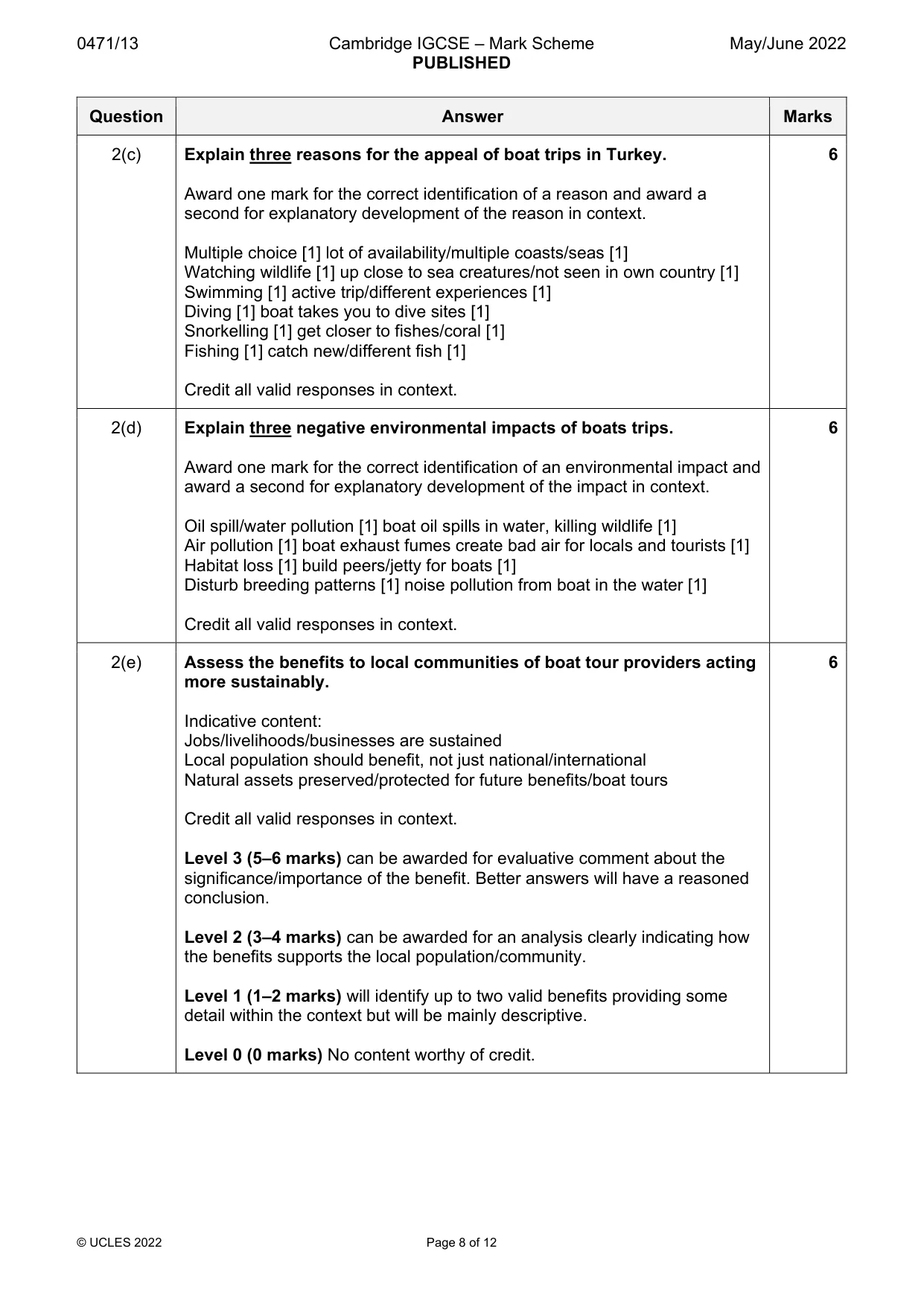
0471/13 Cambridge IGCSE – Mark Scheme PUBLISHED May/June 2022 © UCLES 2022 Page 8 of 12 Question Answer Marks 2(c) Explain three reasons for the appeal of boat trips in Turkey. Award one mark for the correct identification of a reason and award a second for explanatory development of the reason in context. Multiple choice [1] lot of availability/multiple coasts/seas [1] Watching wildlife [1] up close to sea creatures/not seen in own country [1] Swimming [1] active trip/different experiences [1] Diving [1] boat takes you to dive sites [1] Snorkelling [1] get closer to fishes/coral [1] Fishing [1] catch new/different fish [1] Credit all valid responses in context. 6 2(d) Explain three negative environmental impacts of boats trips. Award one mark for the correct identification of an environmental impact and award a second for explanatory development of the impact in context. Oil spill/water pollution [1] boat oil spills in water, killing wildlife [1] Air pollution [1] boat exhaust fumes create bad air for locals and tourists [1] Habitat loss [1] build peers/jetty for boats [1] Disturb breeding patterns [1] noise pollution from boat in the water [1] Credit all valid responses in context. 6 2(e) Assess the benefits to local communities of boat tour providers acting more sustainably. Indicative content: Jobs/livelihoods/businesses are sustained Local population should benefit, not just national/international Natural assets preserved/protected for future benefits/boat tours Credit all valid responses in context. Level 3 (5–6 marks) can be awarded for evaluative comment about the significance/importance of the benefit. Better answers will have a reasoned conclusion. Level 2 (3–4 marks) can be awarded for an analysis clearly indicating how the benefits supports the local population/community. Level 1 (1–2 marks) will identify up to two valid benefits providing some detail within the context but will be mainly descriptive. Level 0 (0 marks) No content worthy of credit. 6
Mark scheme, page 9
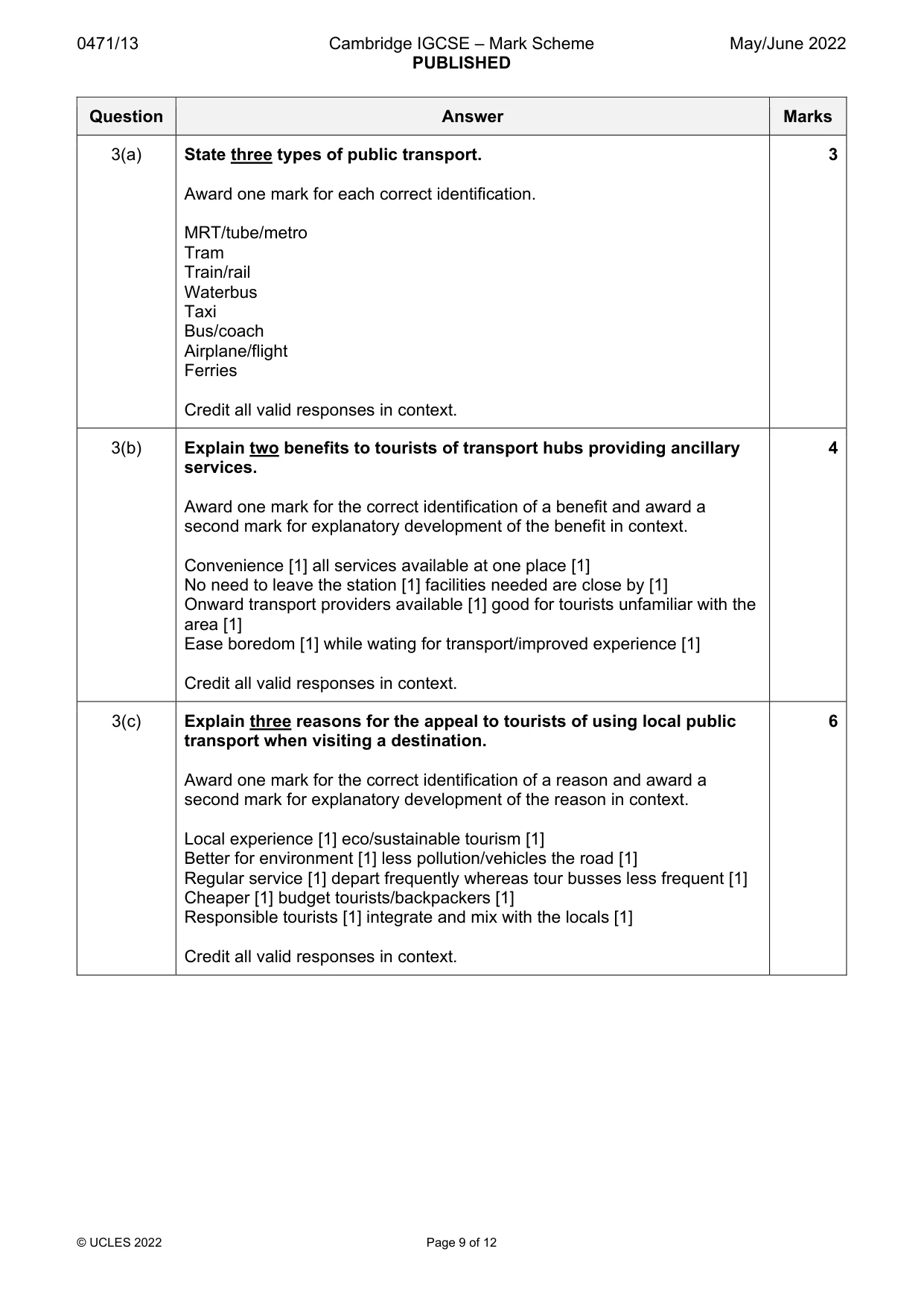
0471/13 Cambridge IGCSE – Mark Scheme PUBLISHED May/June 2022 © UCLES 2022 Page 9 of 12 Question Answer Marks 3(a) State three types of public transport. Award one mark for each correct identification. MRT/tube/metro Tram Train/rail Waterbus Taxi Bus/coach Airplane/flight Ferries Credit all valid responses in context. 3 3(b) Explain two benefits to tourists of transport hubs providing ancillary services. Award one mark for the correct identification of a benefit and award a second mark for explanatory development of the benefit in context. Convenience [1] all services available at one place [1] No need to leave the station [1] facilities needed are close by [1] Onward transport providers available [1] good for tourists unfamiliar with the area [1] Ease boredom [1] while wating for transport/improved experience [1] Credit all valid responses in context. 4 3(c) Explain three reasons for the appeal to tourists of using local public transport when visiting a destination. Award one mark for the correct identification of a reason and award a second mark for explanatory development of the reason in context. Local experience [1] eco/sustainable tourism [1] Better for environment [1] less pollution/vehicles the road [1] Regular service [1] depart frequently whereas tour busses less frequent [1] Cheaper [1] budget tourists/backpackers [1] Responsible tourists [1] integrate and mix with the locals [1] Credit all valid responses in context. 6
Mark scheme, page 10
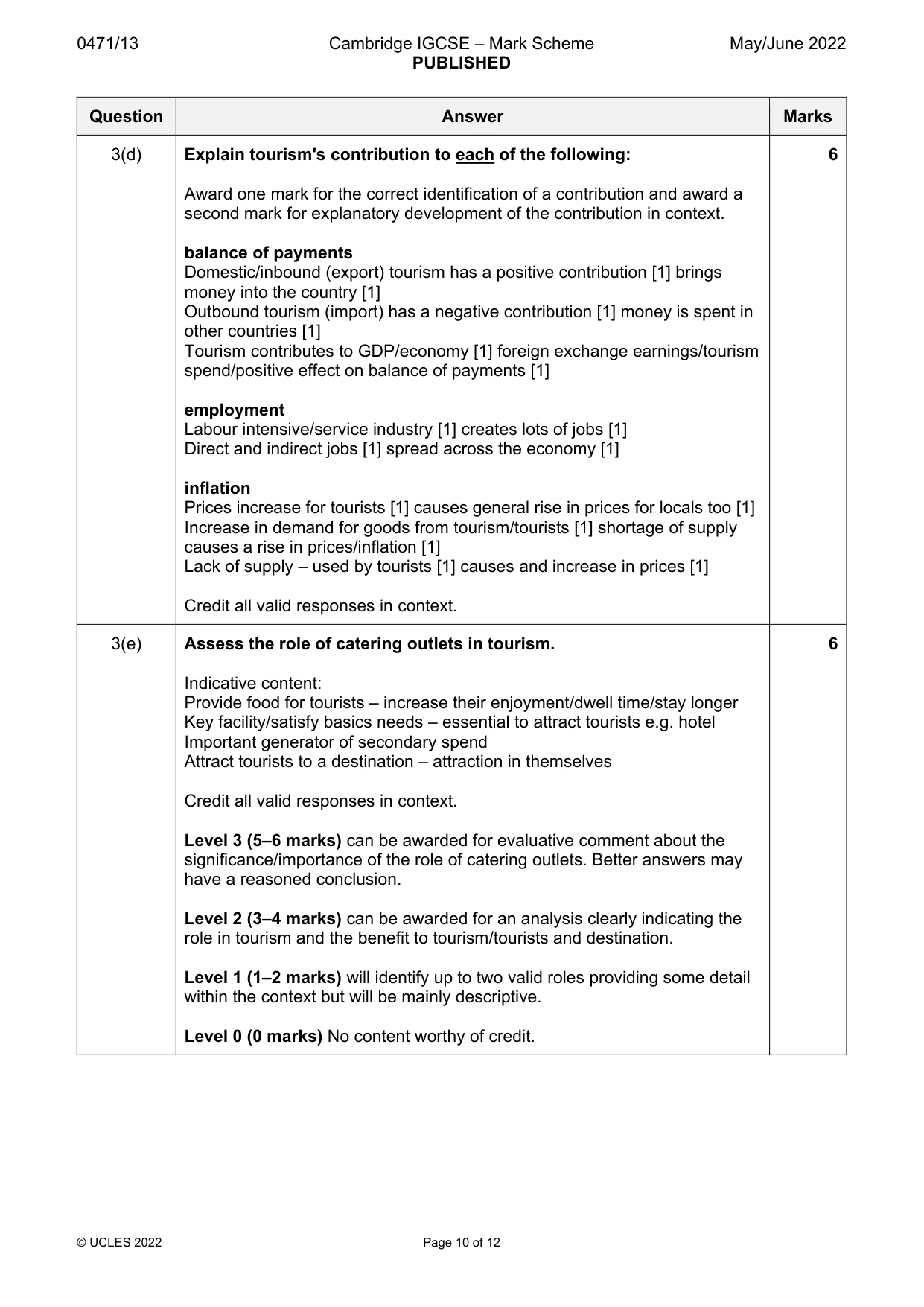
0471/13 Cambridge IGCSE – Mark Scheme PUBLISHED May/June 2022 © UCLES 2022 Page 10 of 12 Question Answer Marks 3(d) Explain tourism's contribution to each of the following: Award one mark for the correct identification of a contribution and award a second mark for explanatory development of the contribution in context. balance of payments Domestic/inbound (export) tourism has a positive contribution [1] brings money into the country [1] Outbound tourism (import) has a negative contribution [1] money is spent in other countries [1] Tourism contributes to GDP/economy [1] foreign exchange earnings/tourism spend/positive effect on balance of payments [1] employment Labour intensive/service industry [1] creates lots of jobs [1] Direct and indirect jobs [1] spread across the economy [1] inflation Prices increase for tourists [1] causes general rise in prices for locals too [1] Increase in demand for goods from tourism/tourists [1] shortage of supply causes a rise in prices/inflation [1] Lack of supply – used by tourists [1] causes and increase in prices [1] Credit all valid responses in context. 6 3(e) Assess the role of catering outlets in tourism. Indicative content: Provide food for tourists – increase their enjoyment/dwell time/stay longer Key facility/satisfy basics needs – essential to attract tourists e.g. hotel Important generator of secondary spend Attract tourists to a destination – attraction in themselves Credit all valid responses in context. Level 3 (5–6 marks) can be awarded for evaluative comment about the significance/importance of the role of catering outlets. Better answers may have a reasoned conclusion. Level 2 (3–4 marks) can be awarded for an analysis clearly indicating the role in tourism and the benefit to tourism/tourists and destination. Level 1 (1–2 marks) will identify up to two valid roles providing some detail within the context but will be mainly descriptive. Level 0 (0 marks) No content worthy of credit. 6
Mark scheme, page 11
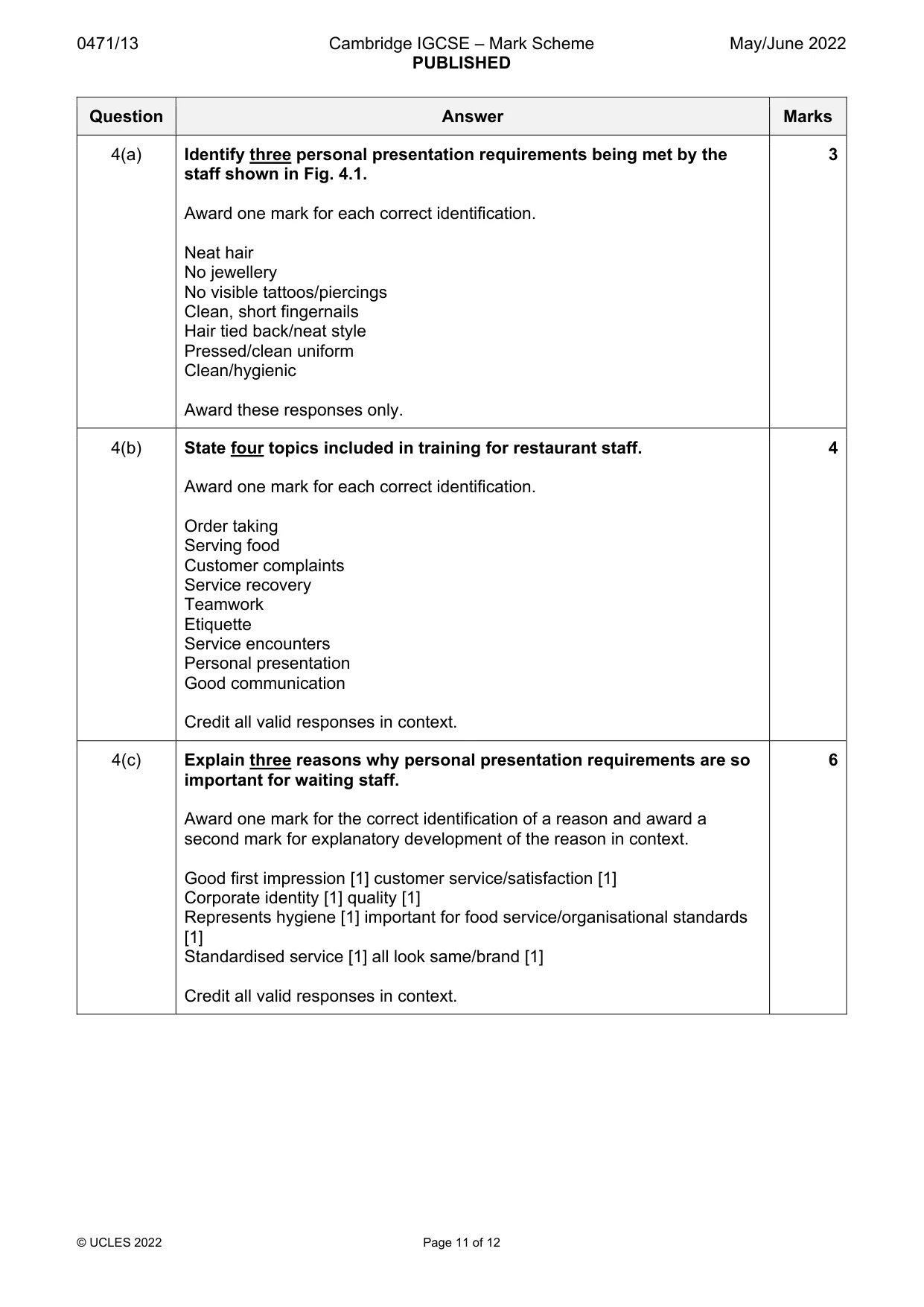
0471/13 Cambridge IGCSE – Mark Scheme PUBLISHED May/June 2022 © UCLES 2022 Page 11 of 12 Question Answer Marks 4(a) Identify three personal presentation requirements being met by the staff shown in Fig. 4.1. Award one mark for each correct identification. Neat hair No jewellery No visible tattoos/piercings Clean, short fingernails Hair tied back/neat style Pressed/clean uniform Clean/hygienic Award these responses only. 3 4(b) State four topics included in training for restaurant staff. Award one mark for each correct identification. Order taking Serving food Customer complaints Service recovery Teamwork Etiquette Service encounters Personal presentation Good communication Credit all valid responses in context. 4 4(c) Explain three reasons why personal presentation requirements are so important for waiting staff. Award one mark for the correct identification of a reason and award a second mark for explanatory development of the reason in context. Good first impression [1] customer service/satisfaction [1] Corporate identity [1] quality [1] Represents hygiene [1] important for food service/organisational standards [1] Standardised service [1] all look same/brand [1] Credit all valid responses in context. 6
Mark scheme, page 12
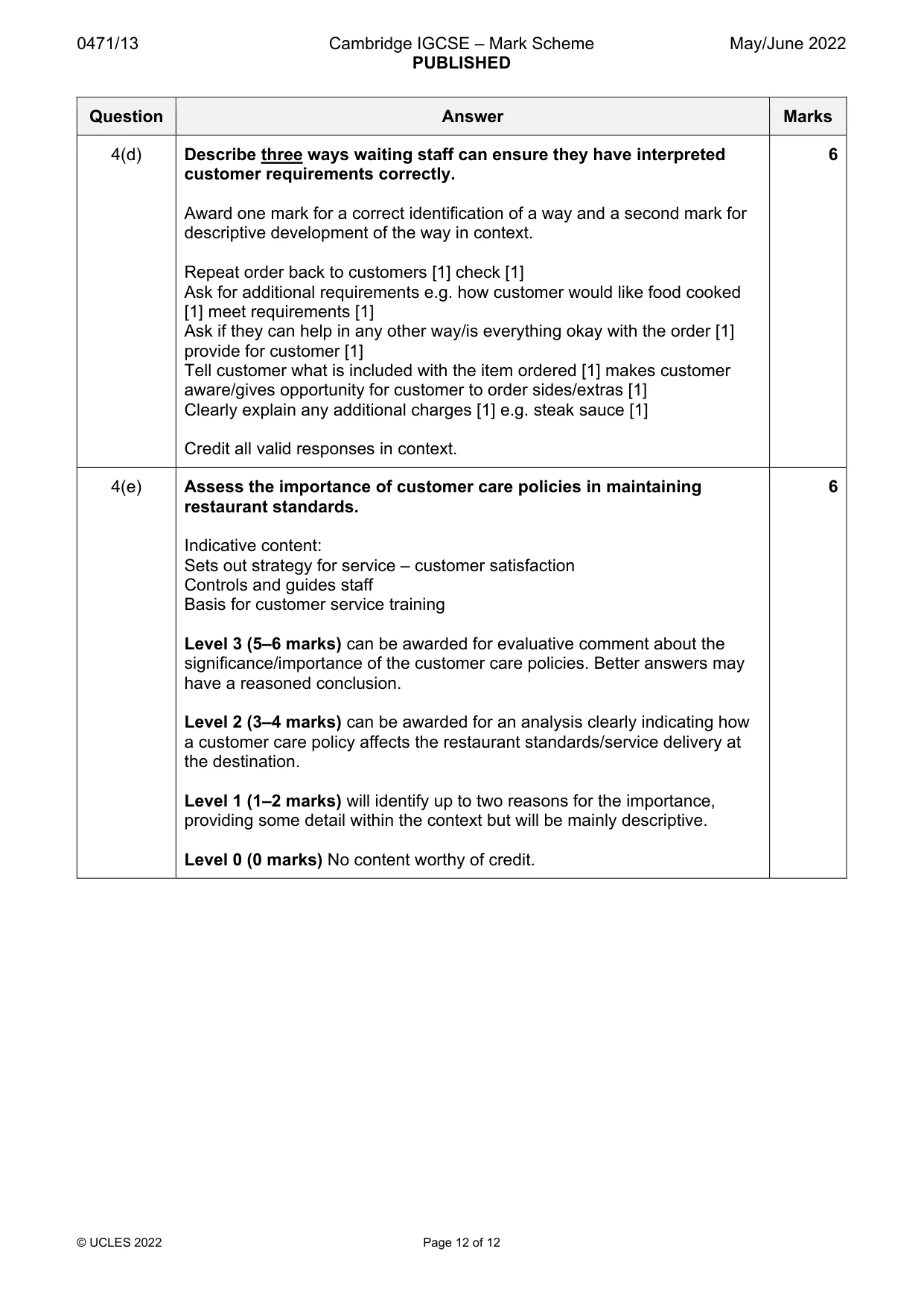
0471/13 Cambridge IGCSE – Mark Scheme PUBLISHED May/June 2022 © UCLES 2022 Page 12 of 12 Question Answer Marks 4(d) Describe three ways waiting staff can ensure they have interpreted customer requirements correctly. Award one mark for a correct identification of a way and a second mark for descriptive development of the way in context. Repeat order back to customers [1] check [1] Ask for additional requirements e.g. how customer would like food cooked [1] meet requirements [1] Ask if they can help in any other way/is everything okay with the order [1] provide for customer [1] Tell customer what is included with the item ordered [1] makes customer aware/gives opportunity for customer to order sides/extras [1] Clearly explain any additional charges [1] e.g. steak sauce [1] Credit all valid responses in context. 6 4(e) Assess the importance of customer care policies in maintaining restaurant standards. Indicative content: Sets out strategy for service – customer satisfaction Controls and guides staff Basis for customer service training Level 3 (5–6 marks) can be awarded for evaluative comment about the significance/importance of the customer care policies. Better answers may have a reasoned conclusion. Level 2 (3–4 marks) can be awarded for an analysis clearly indicating how a customer care policy affects the restaurant standards/service delivery at the destination. Level 1 (1–2 marks) will identify up to two reasons for the importance, providing some detail within the context but will be mainly descriptive. Level 0 (0 marks) No content worthy of credit. 6
What you needed in this session
Cambridge’s own grade thresholds for 2022 May/June, Paper 1 · Variant 3. A higher threshold means an easier paper — the bar moves with how the cohort did.