Cambridge IGCSE Spanish - First Language 0502 — 2005 May/June Paper 3 · Variant 1
0502/31/M/J/05
The question paper and its mark scheme, free to read here and free to download. This is Cambridge’s own paper, exactly as it was sat.
Question paper4 pages
Mark scheme10 pages
Answers below. Sit the paper first if you are practising.
Paper as text
Question paper, page 1
UNIVERSITY OF CAMBRIDGE INTERNATIONAL EXAMINATIONS International General Certificate of Secondary Education FIRST LANGUAGE SPANISH 0502/03 Paper 3 Directed Writing and Composition May/June 2005 2 hours Additional Materials: Answer Booklet/Paper READ THESE INSTRUCTIONS FIRST If you have been given an Answer Booklet, follow the instructions on the front cover of the Booklet. Write your Centre number, candidate number and name on all the work you hand in. Write in dark blue or black pen on both sides of the paper. Do not use staples, paper clips, highlighters, glue or correction fluid. Answer Question 1 and either Question 2 or Question 3 or Question 4. All the questions in this paper carry equal marks. At the end of the examination, fasten all your work securely together. EN PRIMER LUGAR, LEA ESTAS INSTRUCCIONES Si se le ha dado un Cuadernillo de Respuestas, siga las instrucciones de la tapa del Cuadernillo. Escriba el número del Centro, el número de estudiante que se le ha adjudicado y su nombre en cada hoja de examen. Use tinta azul oscura o negra y escriba en ambos lados de la hoja. No use grapas, ni clips, ni rotulador, ni goma de pegar, ni corrector líquido. Conteste la Pregunta 1 y la Pregunta 2 o la Pregunta 3 o la Pregunta 4. Todas las preguntas en este examen tienen el mismo valor. Al terminar el examen, si usa más de una hoja, átelas bien. This document consists of 4 printed pages. IB05 06_0502_03/3RP UCLES 2005 [Turn over www.XtremePapers.com
Question paper, page 2
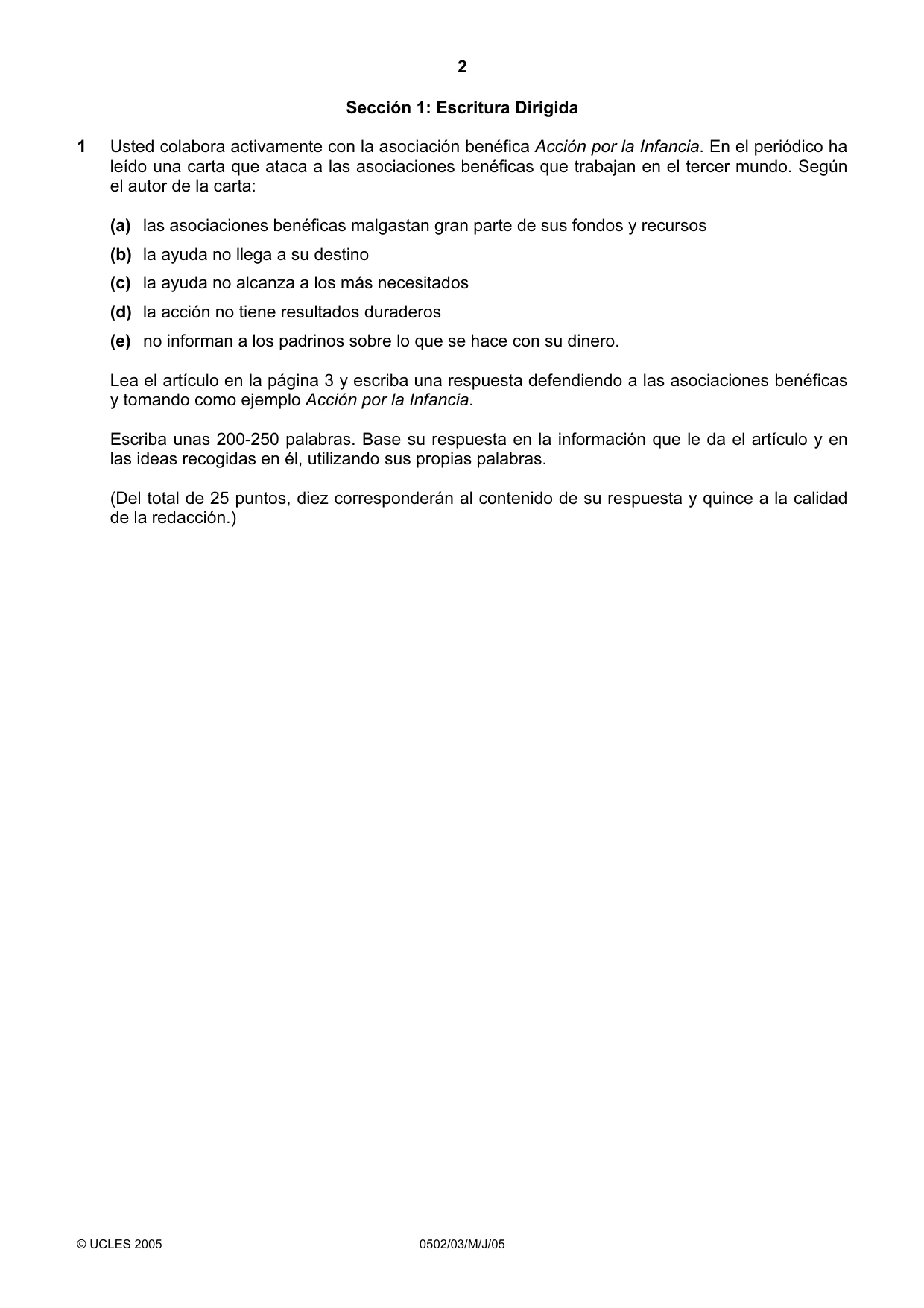
2 © UCLES 2005 0502/03/M/J/05 Sección 1: Escritura Dirigida 1 Usted colabora activamente con la asociación benéfica Acción por la Infancia. En el periódico ha leído una carta que ataca a las asociaciones benéficas que trabajan en el tercer mundo. Según el autor de la carta: (a) las asociaciones benéficas malgastan gran parte de sus fondos y recursos (b) la ayuda no llega a su destino (c) la ayuda no alcanza a los más necesitados (d) la acción no tiene resultados duraderos (e) no informan a los padrinos sobre lo que se hace con su dinero. Lea el artículo en la página 3 y escriba una respuesta defendiendo a las asociaciones benéficas y tomando como ejemplo Acción por la Infancia. Escriba unas 200-250 palabras. Base su respuesta en la información que le da el artículo y en las ideas recogidas en él, utilizando sus propias palabras. (Del total de 25 puntos, diez corresponderán al contenido de su respuesta y quince a la calidad de la redacción.)
Question paper, page 3
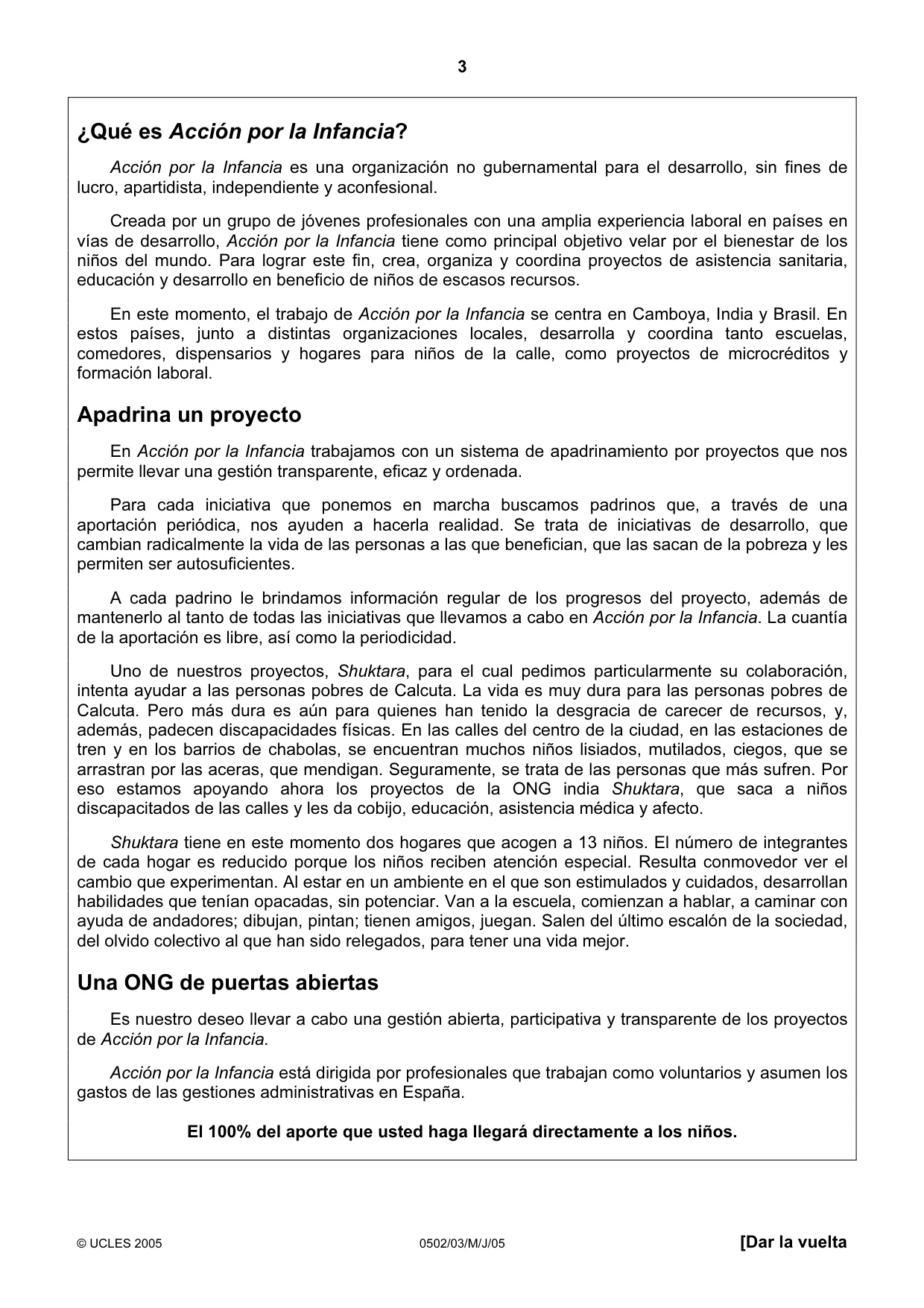
3 © UCLES 2005 0502/03/M/J/05 [Dar la vuelta ¿Qué es Acción por la Infancia? Acción por la Infancia es una organización no gubernamental para el desarrollo, sin fines de lucro, apartidista, independiente y aconfesional. Creada por un grupo de jóvenes profesionales con una amplia experiencia laboral en países en vías de desarrollo, Acción por la Infancia tiene como principal objetivo velar por el bienestar de los niños del mundo. Para lograr este fin, crea, organiza y coordina proyectos de asistencia sanitaria, educación y desarrollo en beneficio de niños de escasos recursos. En este momento, el trabajo de Acción por la Infancia se centra en Camboya, India y Brasil. En estos países, junto a distintas organizaciones locales, desarrolla y coordina tanto escuelas, comedores, dispensarios y hogares para niños de la calle, como proyectos de microcréditos y formación laboral. Apadrina un proyecto En Acción por la Infancia trabajamos con un sistema de apadrinamiento por proyectos que nos permite llevar una gestión transparente, eficaz y ordenada. Para cada iniciativa que ponemos en marcha buscamos padrinos que, a través de una aportación periódica, nos ayuden a hacerla realidad. Se trata de iniciativas de desarrollo, que cambian radicalmente la vida de las personas a las que benefician, que las sacan de la pobreza y les permiten ser autosuficientes. A cada padrino le brindamos información regular de los progresos del proyecto, además de mantenerlo al tanto de todas las iniciativas que llevamos a cabo en Acción por la Infancia. La cuantía de la aportación es libre, así como la periodicidad. Uno de nuestros proyectos, Shuktara, para el cual pedimos particularmente su colaboración, intenta ayudar a las personas pobres de Calcuta. La vida es muy dura para las personas pobres de Calcuta. Pero más dura es aún para quienes han tenido la desgracia de carecer de recursos, y, además, padecen discapacidades físicas. En las calles del centro de la ciudad, en las estaciones de tren y en los barrios de chabolas, se encuentran muchos niños lisiados, mutilados, ciegos, que se arrastran por las aceras, que mendigan. Seguramente, se trata de las personas que más sufren. Por eso estamos apoyando ahora los proyectos de la ONG india Shuktara, que saca a niños discapacitados de las calles y les da cobijo, educación, asistencia médica y afecto. Shuktara tiene en este momento dos hogares que acogen a 13 niños. El número de integrantes de cada hogar es reducido porque los niños reciben atención especial. Resulta conmovedor ver el cambio que experimentan. Al estar en un ambiente en el que son estimulados y cuidados, desarrollan habilidades que tenían opacadas, sin potenciar. Van a la escuela, comienzan a hablar, a caminar con ayuda de andadores; dibujan, pintan; tienen amigos, juegan. Salen del último escalón de la sociedad, del olvido colectivo al que han sido relegados, para tener una vida mejor. Una ONG de puertas abiertas Es nuestro deseo llevar a cabo una gestión abierta, participativa y transparente de los proyectos de Acción por la Infancia. Acción por la Infancia está dirigida por profesionales que trabajan como voluntarios y asumen los gastos de las gestiones administrativas en España. El 100% del aporte que usted haga llegará directamente a los niños.
Question paper, page 4
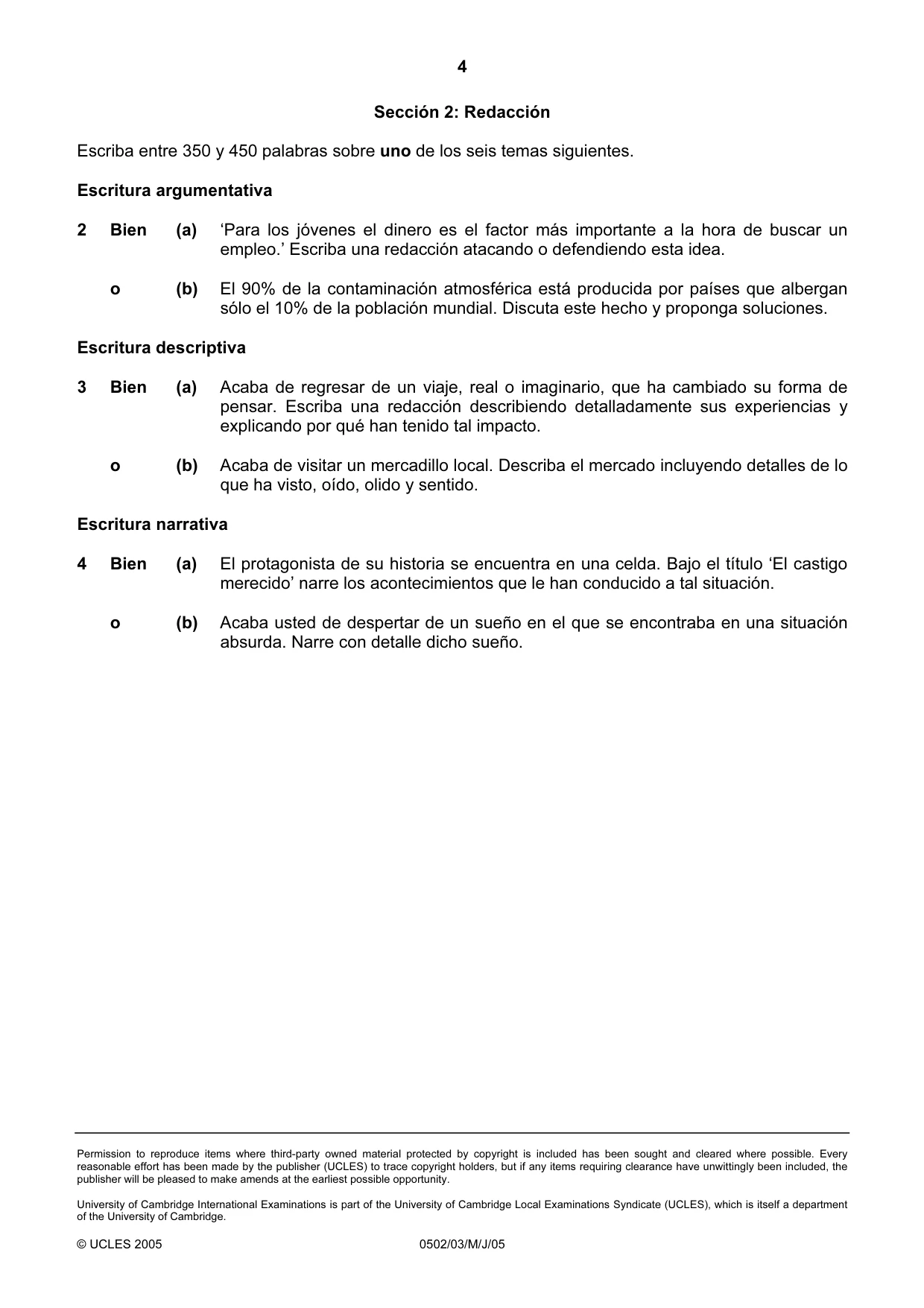
4 Permission to reproduce items where third-party owned material protected by copyright is included has been sought and cleared where possible. Every reasonable effort has been made by the publisher (UCLES) to trace copyright holders, but if any items requiring clearance have unwittingly been included, the publisher will be pleased to make amends at the earliest possible opportunity. University of Cambridge International Examinations is part of the University of Cambridge Local Examinations Syndicate (UCLES), which is itself a department of the University of Cambridge. © UCLES 2005 0502/03/M/J/05 Sección 2: Redacción Escriba entre 350 y 450 palabras sobre uno de los seis temas siguientes. Escritura argumentativa 2 Bien (a) ‘Para los jóvenes el dinero es el factor más importante a la hora de buscar un empleo.’ Escriba una redacción atacando o defendiendo esta idea. o (b) El 90% de la contaminación atmosférica está producida por países que albergan sólo el 10% de la población mundial. Discuta este hecho y proponga soluciones. Escritura descriptiva 3 Bien (a) Acaba de regresar de un viaje, real o imaginario, que ha cambiado su forma de pensar. Escriba una redacción describiendo detalladamente sus experiencias y explicando por qué han tenido tal impacto. o (b) Acaba de visitar un mercadillo local. Describa el mercado incluyendo detalles de lo que ha visto, oído, olido y sentido. Escritura narrativa 4 Bien (a) El protagonista de su historia se encuentra en una celda. Bajo el título ‘El castigo merecido’ narre los acontecimientos que le han conducido a tal situación. o (b) Acaba usted de despertar de un sueño en el que se encontraba en una situación absurda. Narre con detalle dicho sueño.
Mark scheme, page 1
UNIVERSITY OF CAMBRIDGE INTERNATIONAL EXAMINATIONS International General Certificate of Secondary Education MARK SCHEME for the June 2005 question paper 0502 FIRST LANGUAGE SPANISH 0502/03 Paper 3 (Directed Writing & Composition), maximum mark 50 These mark schemes are published as an aid to teachers and students, to indicate the requirements of the examination. They show the basis on which Examiners were initially instructed to award marks. They do not indicate the details of the discussions that took place at an Examiners’ meeting before marking began. Any substantial changes to the mark scheme that arose from these discussions will be recorded in the published Report on the Examination. All Examiners are instructed that alternative correct answers and unexpected approaches in candidates’ scripts must be given marks that fairly reflect the relevant knowledge and skills demonstrated. Mark schemes must be read in conjunction with the question papers and the Report on the Examination. • CIE will not enter into discussion or correspondence in connection with these mark schemes. CIE is publishing the mark schemes for the June 2005 question papers for most IGCSE and GCE Advanced Level and Advanced Subsidiary Level syllabuses and some Ordinary Level syllabuses www.XtremePapers.com
Mark scheme, page 2
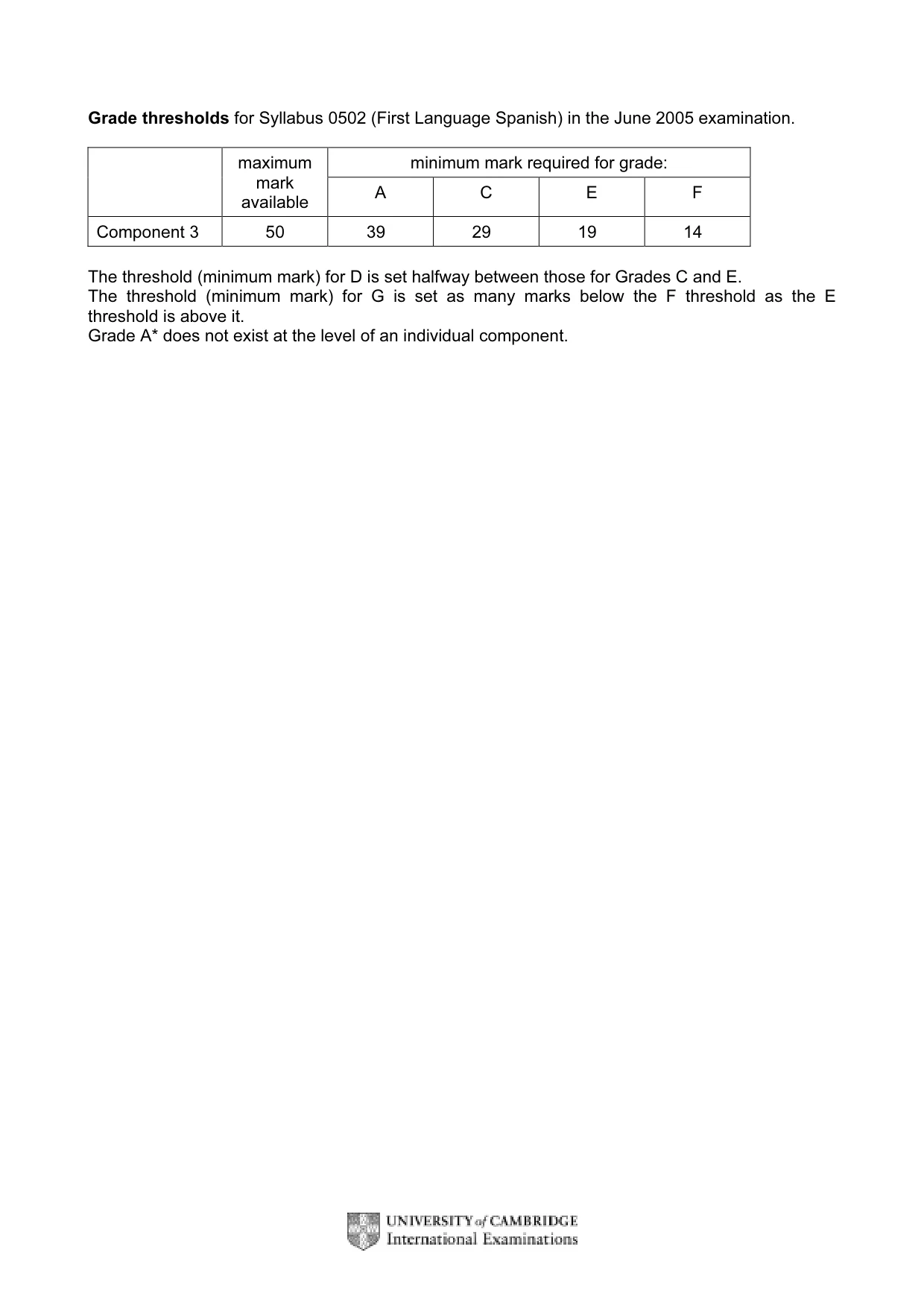
Grade thresholds for Syllabus 0502 (First Language Spanish) in the June 2005 examination. minimum mark required for grade: maximum mark available A C E F Component 3 50 39 29 19 14 The threshold (minimum mark) for D is set halfway between those for Grades C and E. The threshold (minimum mark) for G is set as many marks below the F threshold as the E threshold is above it. Grade A* does not exist at the level of an individual component.
Mark scheme, page 3
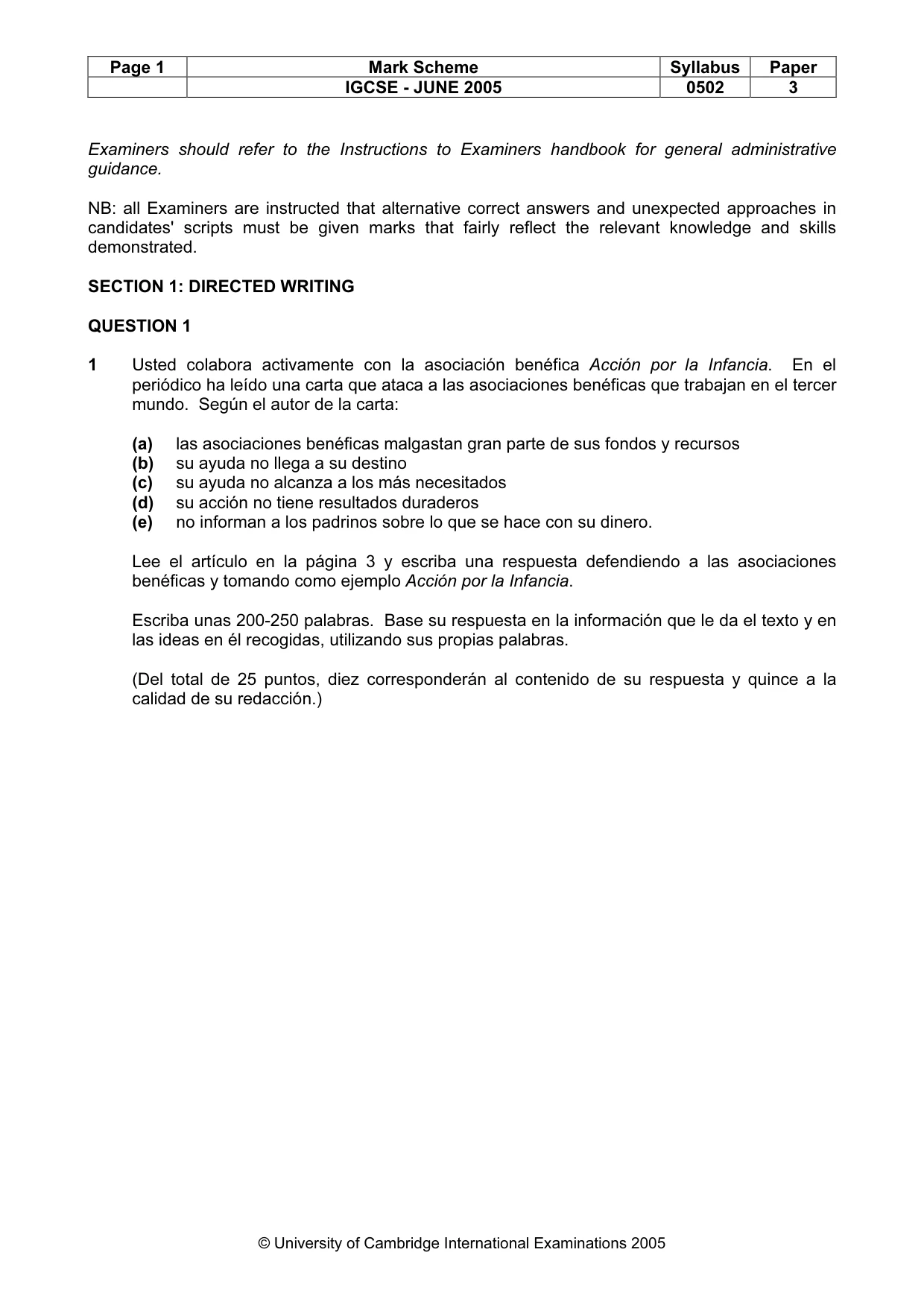
Page 1 Mark Scheme Syllabus Paper IGCSE - JUNE 2005 0502 3 © University of Cambridge International Examinations 2005 Examiners should refer to the Instructions to Examiners handbook for general administrative guidance. NB: all Examiners are instructed that alternative correct answers and unexpected approaches in candidates' scripts must be given marks that fairly reflect the relevant knowledge and skills demonstrated. SECTION 1: DIRECTED WRITING QUESTION 1 1 Usted colabora activamente con la asociación benéfica Acción por la Infancia. En el periódico ha leído una carta que ataca a las asociaciones benéficas que trabajan en el tercer mundo. Según el autor de la carta: (a) las asociaciones benéficas malgastan gran parte de sus fondos y recursos (b) su ayuda no llega a su destino (c) su ayuda no alcanza a los más necesitados (d) su acción no tiene resultados duraderos (e) no informan a los padrinos sobre lo que se hace con su dinero. Lee el artículo en la página 3 y escriba una respuesta defendiendo a las asociaciones benéficas y tomando como ejemplo Acción por la Infancia. Escriba unas 200-250 palabras. Base su respuesta en la información que le da el texto y en las ideas en él recogidas, utilizando sus propias palabras. (Del total de 25 puntos, diez corresponderán al contenido de su respuesta y quince a la calidad de su redacción.)
Mark scheme, page 4
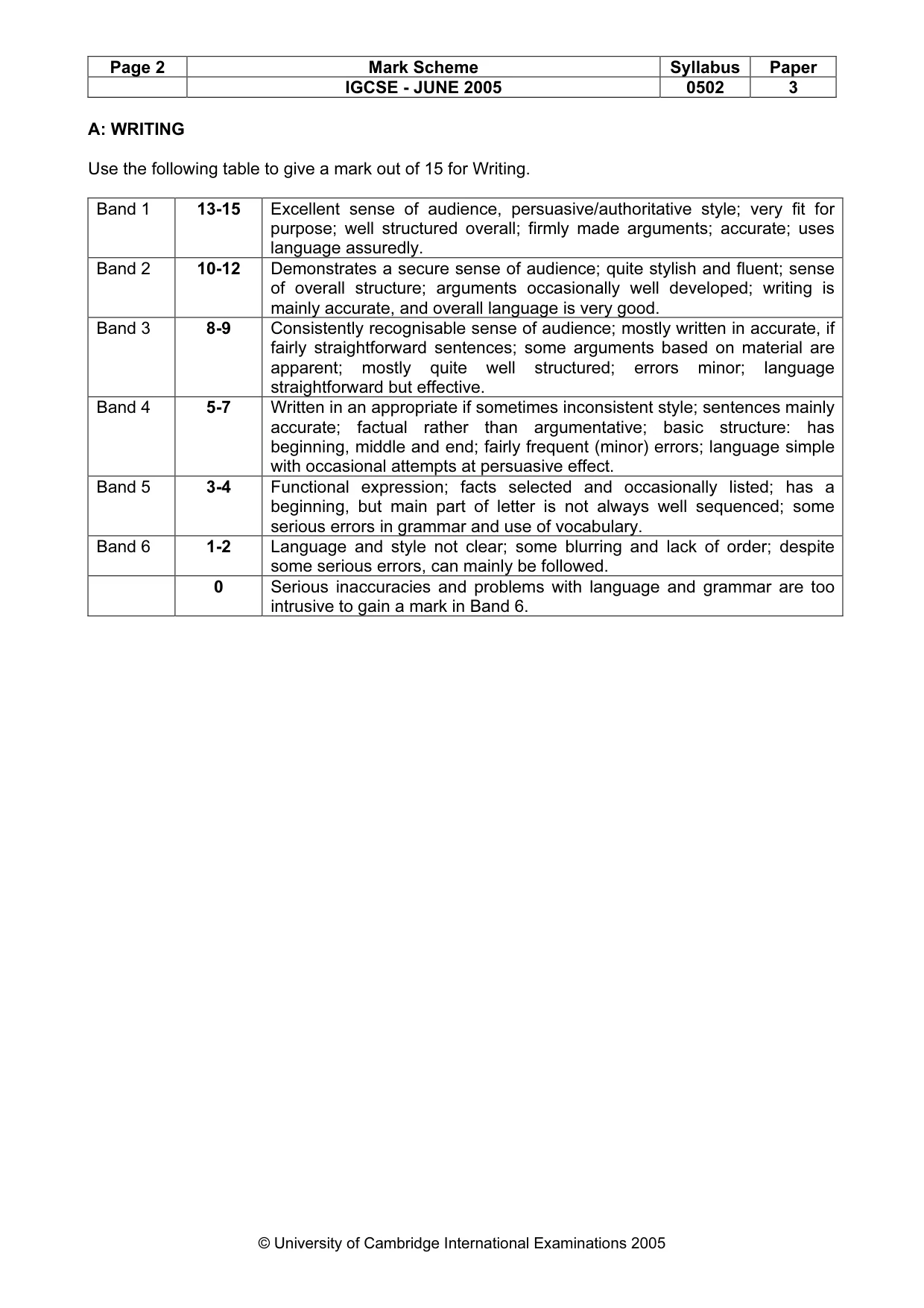
Page 2 Mark Scheme Syllabus Paper IGCSE - JUNE 2005 0502 3 © University of Cambridge International Examinations 2005 A: WRITING Use the following table to give a mark out of 15 for Writing. Band 1 13-15 Excellent sense of audience, persuasive/authoritative style; very fit for purpose; well structured overall; firmly made arguments; accurate; uses language assuredly. Band 2 10-12 Demonstrates a secure sense of audience; quite stylish and fluent; sense of overall structure; arguments occasionally well developed; writing is mainly accurate, and overall language is very good. Band 3 8-9 Consistently recognisable sense of audience; mostly written in accurate, if fairly straightforward sentences; some arguments based on material are apparent; mostly quite well structured; errors minor; language straightforward but effective. Band 4 5-7 Written in an appropriate if sometimes inconsistent style; sentences mainly accurate; factual rather than argumentative; basic structure: has beginning, middle and end; fairly frequent (minor) errors; language simple with occasional attempts at persuasive effect. Band 5 3-4 Functional expression; facts selected and occasionally listed; has a beginning, but main part of letter is not always well sequenced; some serious errors in grammar and use of vocabulary. Band 6 1-2 Language and style not clear; some blurring and lack of order; despite some serious errors, can mainly be followed. 0 Serious inaccuracies and problems with language and grammar are too intrusive to gain a mark in Band 6.
Mark scheme, page 5
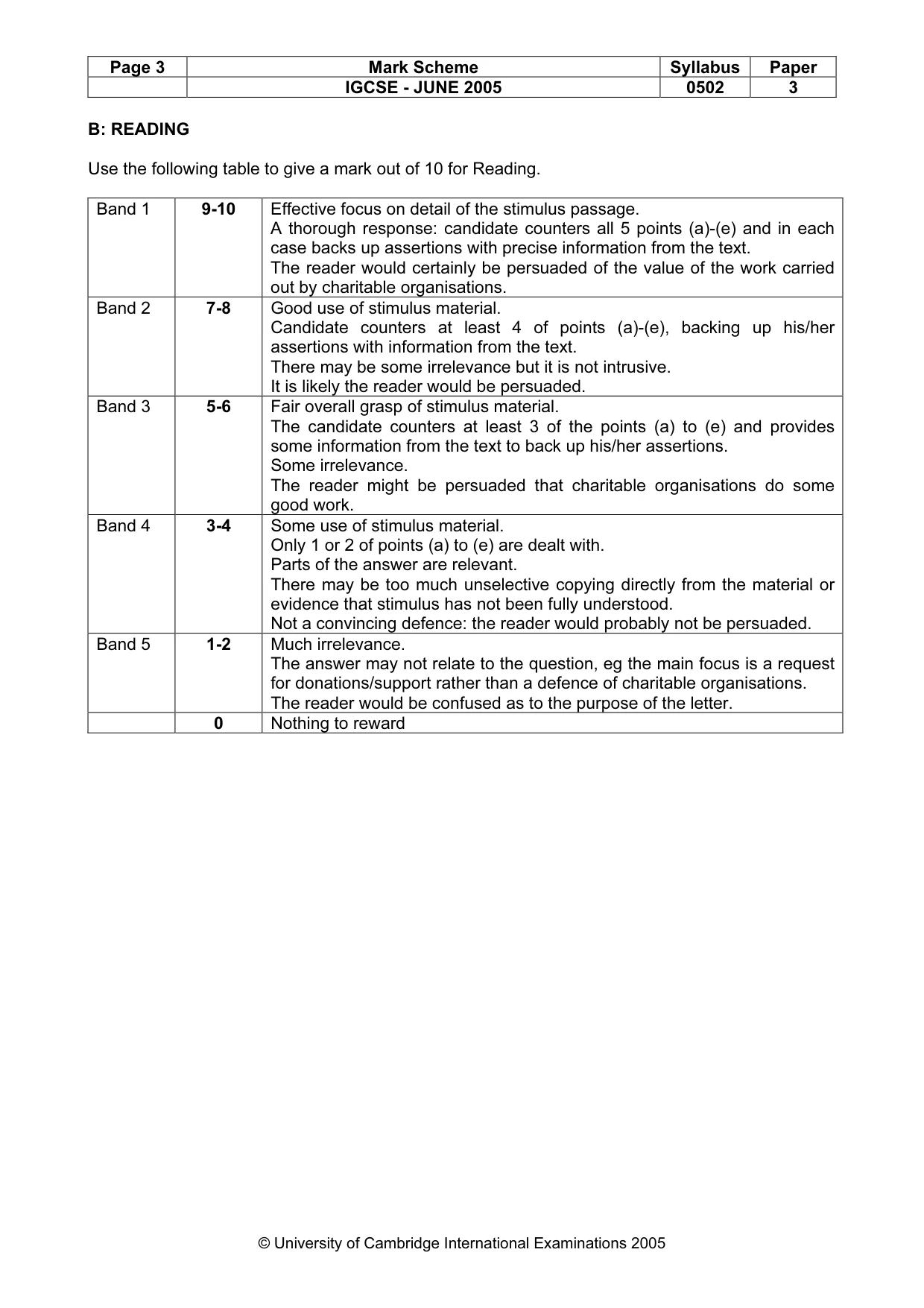
Page 3 Mark Scheme Syllabus Paper IGCSE - JUNE 2005 0502 3 © University of Cambridge International Examinations 2005 B: READING Use the following table to give a mark out of 10 for Reading. Band 1 9-10 Effective focus on detail of the stimulus passage. A thorough response: candidate counters all 5 points (a)-(e) and in each case backs up assertions with precise information from the text. The reader would certainly be persuaded of the value of the work carried out by charitable organisations. Band 2 7-8 Good use of stimulus material. Candidate counters at least 4 of points (a)-(e), backing up his/her assertions with information from the text. There may be some irrelevance but it is not intrusive. It is likely the reader would be persuaded. Band 3 5-6 Fair overall grasp of stimulus material. The candidate counters at least 3 of the points (a) to (e) and provides some information from the text to back up his/her assertions. Some irrelevance. The reader might be persuaded that charitable organisations do some good work. Band 4 3-4 Some use of stimulus material. Only 1 or 2 of points (a) to (e) are dealt with. Parts of the answer are relevant. There may be too much unselective copying directly from the material or evidence that stimulus has not been fully understood. Not a convincing defence: the reader would probably not be persuaded. Band 5 1-2 Much irrelevance. The answer may not relate to the question, eg the main focus is a request for donations/support rather than a defence of charitable organisations. The reader would be confused as to the purpose of the letter. 0 Nothing to reward
Mark scheme, page 6
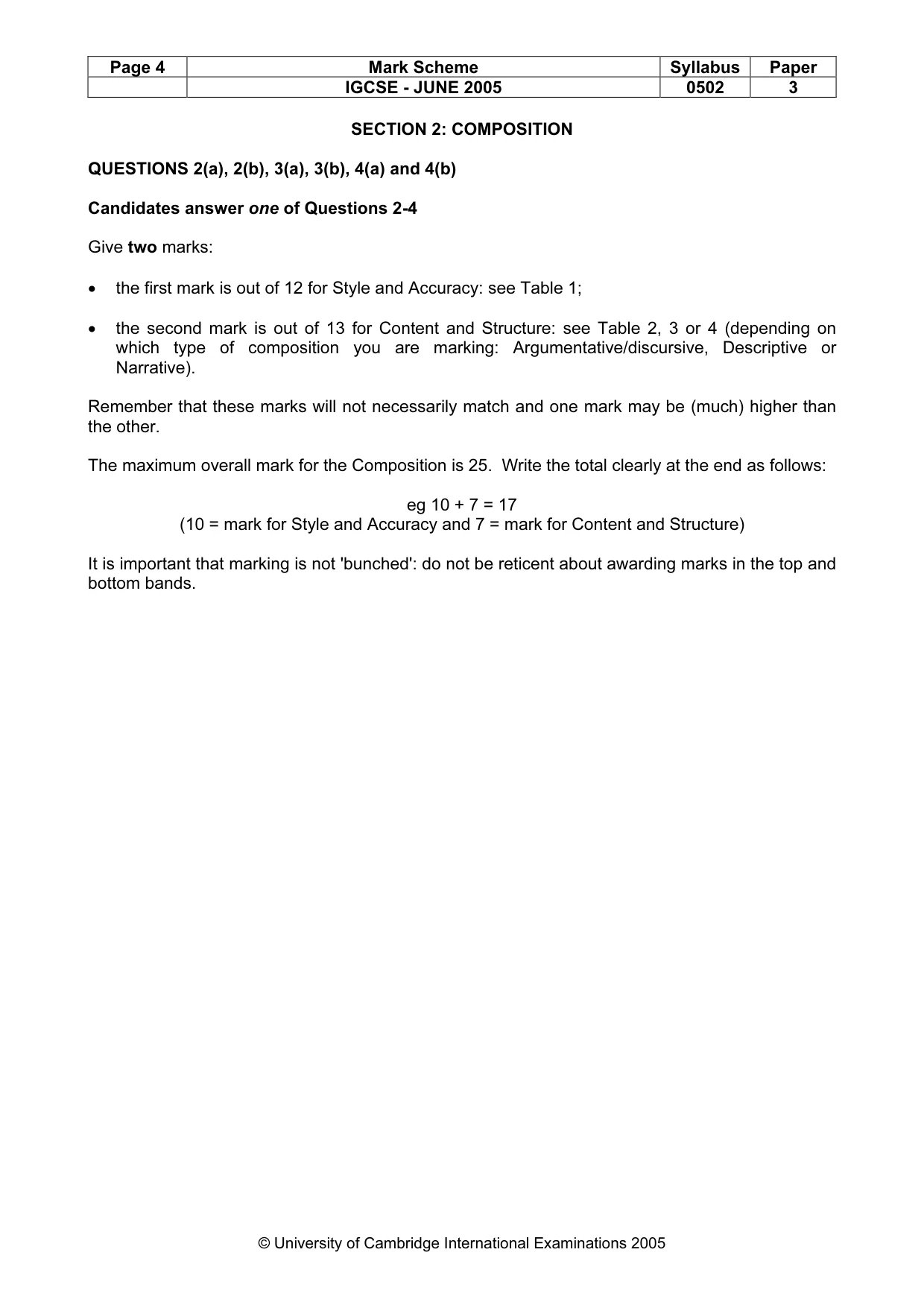
Page 4 Mark Scheme Syllabus Paper IGCSE - JUNE 2005 0502 3 © University of Cambridge International Examinations 2005 SECTION 2: COMPOSITION QUESTIONS 2(a), 2(b), 3(a), 3(b), 4(a) and 4(b) Candidates answer one of Questions 2-4 Give two marks: • the first mark is out of 12 for Style and Accuracy: see Table 1; • the second mark is out of 13 for Content and Structure: see Table 2, 3 or 4 (depending on which type of composition you are marking: Argumentative/discursive, Descriptive or Narrative). Remember that these marks will not necessarily match and one mark may be (much) higher than the other. The maximum overall mark for the Composition is 25. Write the total clearly at the end as follows: eg 10 + 7 = 17 (10 = mark for Style and Accuracy and 7 = mark for Content and Structure) It is important that marking is not 'bunched': do not be reticent about awarding marks in the top and bottom bands.
Mark scheme, page 7
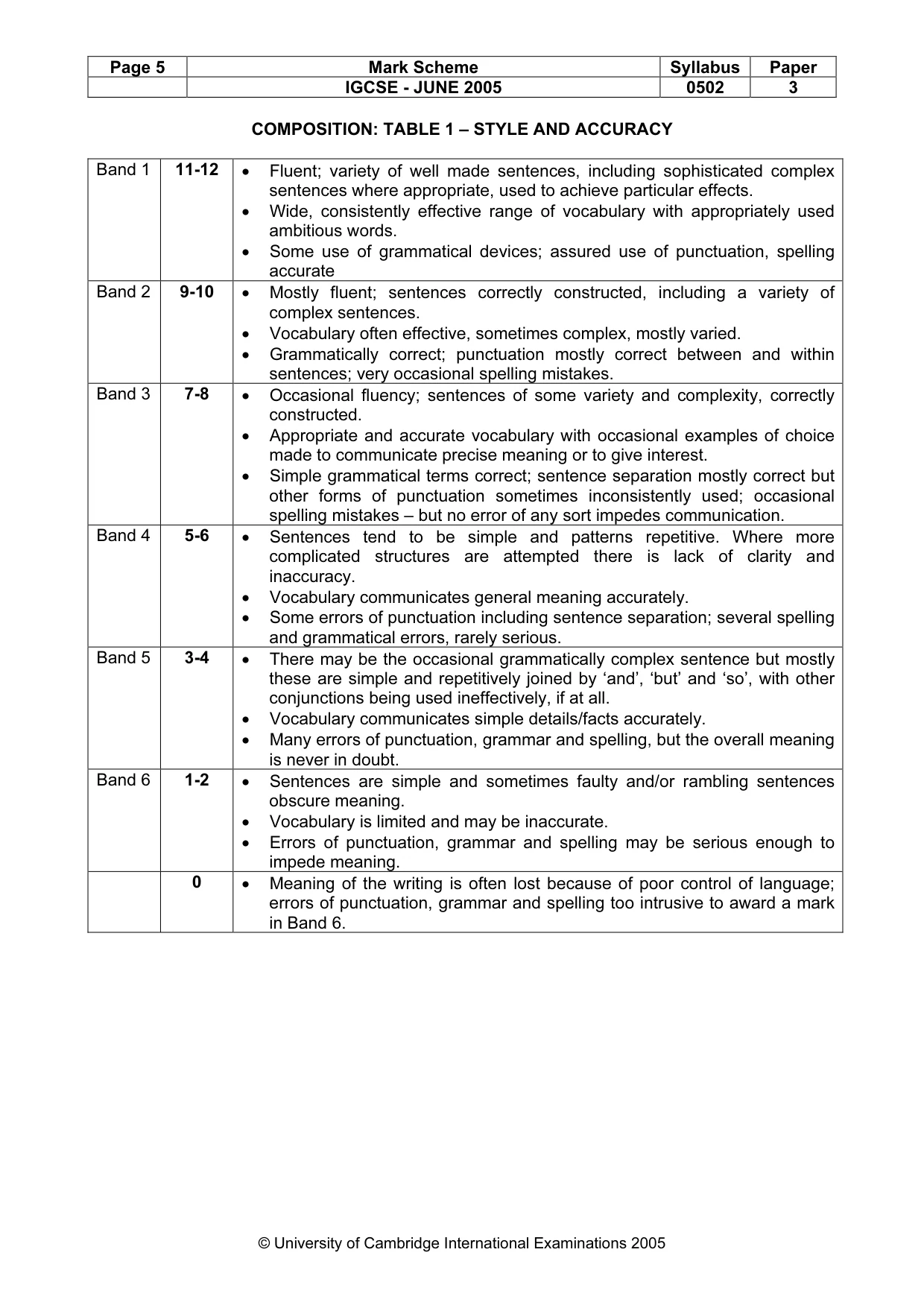
Page 5 Mark Scheme Syllabus Paper IGCSE - JUNE 2005 0502 3 © University of Cambridge International Examinations 2005 COMPOSITION: TABLE 1 – STYLE AND ACCURACY Band 1 11-12 • Fluent; variety of well made sentences, including sophisticated complex sentences where appropriate, used to achieve particular effects. • Wide, consistently effective range of vocabulary with appropriately used ambitious words. • Some use of grammatical devices; assured use of punctuation, spelling accurate Band 2 9-10 • Mostly fluent; sentences correctly constructed, including a variety of complex sentences. • Vocabulary often effective, sometimes complex, mostly varied. • Grammatically correct; punctuation mostly correct between and within sentences; very occasional spelling mistakes. Band 3 7-8 • Occasional fluency; sentences of some variety and complexity, correctly constructed. • Appropriate and accurate vocabulary with occasional examples of choice made to communicate precise meaning or to give interest. • Simple grammatical terms correct; sentence separation mostly correct but other forms of punctuation sometimes inconsistently used; occasional spelling mistakes – but no error of any sort impedes communication. Band 4 5-6 • Sentences tend to be simple and patterns repetitive. Where more complicated structures are attempted there is lack of clarity and inaccuracy. • Vocabulary communicates general meaning accurately. • Some errors of punctuation including sentence separation; several spelling and grammatical errors, rarely serious. Band 5 3-4 • There may be the occasional grammatically complex sentence but mostly these are simple and repetitively joined by ‘and’, ‘but’ and ‘so’, with other conjunctions being used ineffectively, if at all. • Vocabulary communicates simple details/facts accurately. • Many errors of punctuation, grammar and spelling, but the overall meaning is never in doubt. Band 6 1-2 • Sentences are simple and sometimes faulty and/or rambling sentences obscure meaning. • Vocabulary is limited and may be inaccurate. • Errors of punctuation, grammar and spelling may be serious enough to impede meaning. 0 • Meaning of the writing is often lost because of poor control of language; errors of punctuation, grammar and spelling too intrusive to award a mark in Band 6.
Mark scheme, page 8
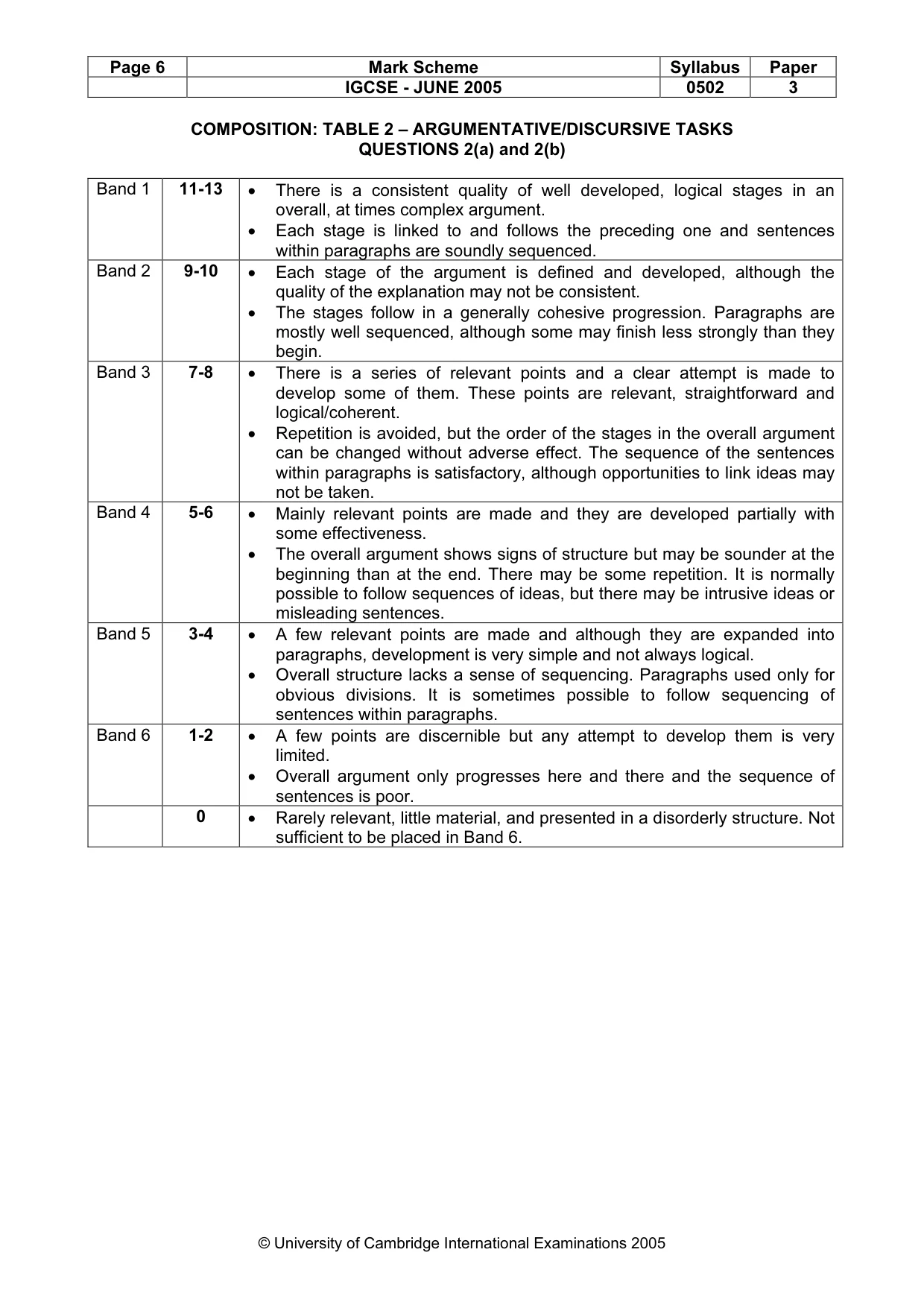
Page 6 Mark Scheme Syllabus Paper IGCSE - JUNE 2005 0502 3 © University of Cambridge International Examinations 2005 COMPOSITION: TABLE 2 – ARGUMENTATIVE/DISCURSIVE TASKS QUESTIONS 2(a) and 2(b) Band 1 11-13 • There is a consistent quality of well developed, logical stages in an overall, at times complex argument. • Each stage is linked to and follows the preceding one and sentences within paragraphs are soundly sequenced. Band 2 9-10 • Each stage of the argument is defined and developed, although the quality of the explanation may not be consistent. • The stages follow in a generally cohesive progression. Paragraphs are mostly well sequenced, although some may finish less strongly than they begin. Band 3 7-8 • There is a series of relevant points and a clear attempt is made to develop some of them. These points are relevant, straightforward and logical/coherent. • Repetition is avoided, but the order of the stages in the overall argument can be changed without adverse effect. The sequence of the sentences within paragraphs is satisfactory, although opportunities to link ideas may not be taken. Band 4 5-6 • Mainly relevant points are made and they are developed partially with some effectiveness. • The overall argument shows signs of structure but may be sounder at the beginning than at the end. There may be some repetition. It is normally possible to follow sequences of ideas, but there may be intrusive ideas or misleading sentences. Band 5 3-4 • A few relevant points are made and although they are expanded into paragraphs, development is very simple and not always logical. • Overall structure lacks a sense of sequencing. Paragraphs used only for obvious divisions. It is sometimes possible to follow sequencing of sentences within paragraphs. Band 6 1-2 • A few points are discernible but any attempt to develop them is very limited. • Overall argument only progresses here and there and the sequence of sentences is poor. 0 • Rarely relevant, little material, and presented in a disorderly structure. Not sufficient to be placed in Band 6.
Mark scheme, page 9
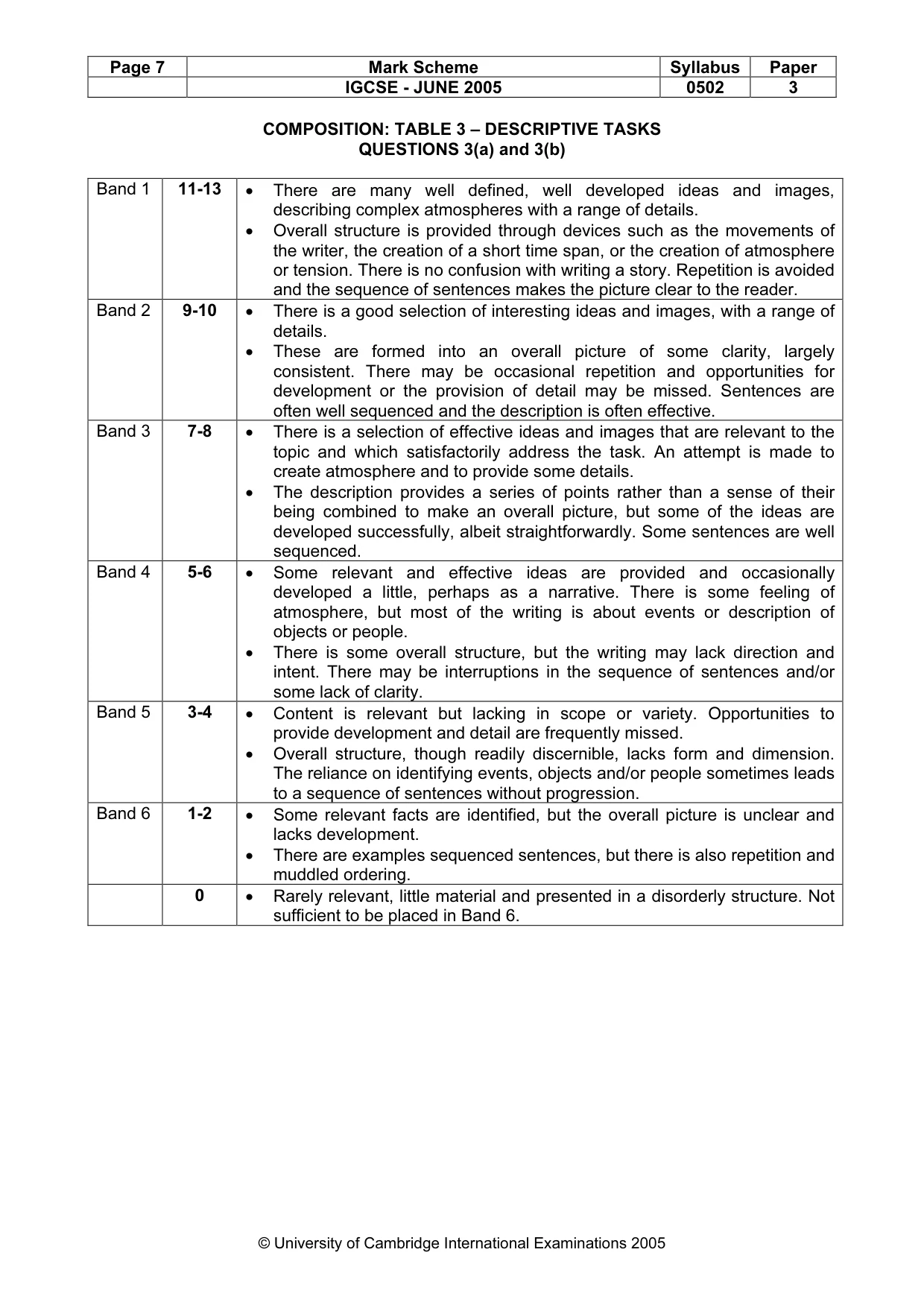
Page 7 Mark Scheme Syllabus Paper IGCSE - JUNE 2005 0502 3 © University of Cambridge International Examinations 2005 COMPOSITION: TABLE 3 – DESCRIPTIVE TASKS QUESTIONS 3(a) and 3(b) Band 1 11-13 • There are many well defined, well developed ideas and images, describing complex atmospheres with a range of details. • Overall structure is provided through devices such as the movements of the writer, the creation of a short time span, or the creation of atmosphere or tension. There is no confusion with writing a story. Repetition is avoided and the sequence of sentences makes the picture clear to the reader. Band 2 9-10 • There is a good selection of interesting ideas and images, with a range of details. • These are formed into an overall picture of some clarity, largely consistent. There may be occasional repetition and opportunities for development or the provision of detail may be missed. Sentences are often well sequenced and the description is often effective. Band 3 7-8 • There is a selection of effective ideas and images that are relevant to the topic and which satisfactorily address the task. An attempt is made to create atmosphere and to provide some details. • The description provides a series of points rather than a sense of their being combined to make an overall picture, but some of the ideas are developed successfully, albeit straightforwardly. Some sentences are well sequenced. Band 4 5-6 • Some relevant and effective ideas are provided and occasionally developed a little, perhaps as a narrative. There is some feeling of atmosphere, but most of the writing is about events or description of objects or people. • There is some overall structure, but the writing may lack direction and intent. There may be interruptions in the sequence of sentences and/or some lack of clarity. Band 5 3-4 • Content is relevant but lacking in scope or variety. Opportunities to provide development and detail are frequently missed. • Overall structure, though readily discernible, lacks form and dimension. The reliance on identifying events, objects and/or people sometimes leads to a sequence of sentences without progression. Band 6 1-2 • Some relevant facts are identified, but the overall picture is unclear and lacks development. • There are examples sequenced sentences, but there is also repetition and muddled ordering. 0 • Rarely relevant, little material and presented in a disorderly structure. Not sufficient to be placed in Band 6.
Mark scheme, page 10
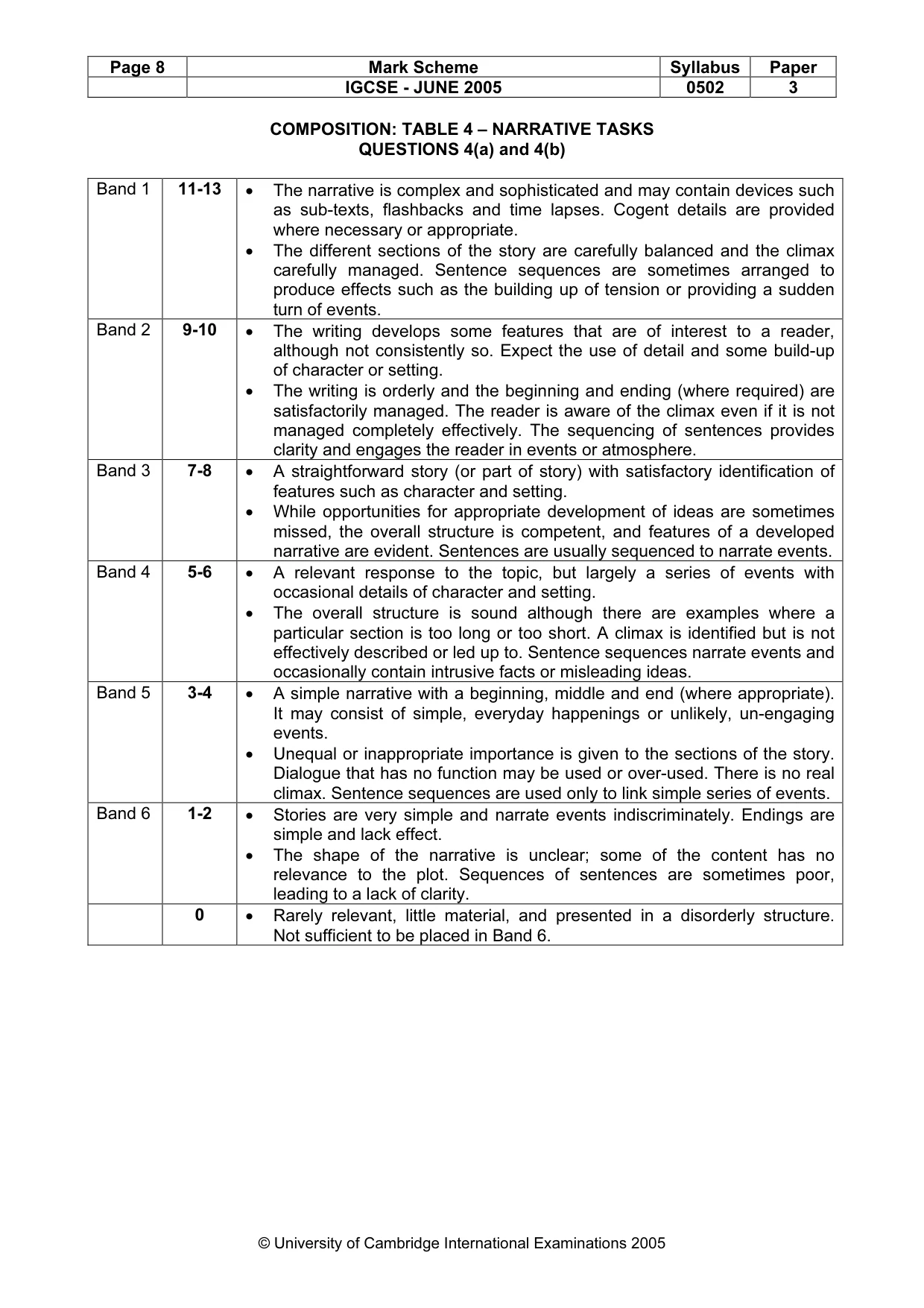
Page 8 Mark Scheme Syllabus Paper IGCSE - JUNE 2005 0502 3 © University of Cambridge International Examinations 2005 COMPOSITION: TABLE 4 – NARRATIVE TASKS QUESTIONS 4(a) and 4(b) Band 1 11-13 • The narrative is complex and sophisticated and may contain devices such as sub-texts, flashbacks and time lapses. Cogent details are provided where necessary or appropriate. • The different sections of the story are carefully balanced and the climax carefully managed. Sentence sequences are sometimes arranged to produce effects such as the building up of tension or providing a sudden turn of events. Band 2 9-10 • The writing develops some features that are of interest to a reader, although not consistently so. Expect the use of detail and some build-up of character or setting. • The writing is orderly and the beginning and ending (where required) are satisfactorily managed. The reader is aware of the climax even if it is not managed completely effectively. The sequencing of sentences provides clarity and engages the reader in events or atmosphere. Band 3 7-8 • A straightforward story (or part of story) with satisfactory identification of features such as character and setting. • While opportunities for appropriate development of ideas are sometimes missed, the overall structure is competent, and features of a developed narrative are evident. Sentences are usually sequenced to narrate events. Band 4 5-6 • A relevant response to the topic, but largely a series of events with occasional details of character and setting. • The overall structure is sound although there are examples where a particular section is too long or too short. A climax is identified but is not effectively described or led up to. Sentence sequences narrate events and occasionally contain intrusive facts or misleading ideas. Band 5 3-4 • A simple narrative with a beginning, middle and end (where appropriate). It may consist of simple, everyday happenings or unlikely, un-engaging events. • Unequal or inappropriate importance is given to the sections of the story. Dialogue that has no function may be used or over-used. There is no real climax. Sentence sequences are used only to link simple series of events. Band 6 1-2 • Stories are very simple and narrate events indiscriminately. Endings are simple and lack effect. • The shape of the narrative is unclear; some of the content has no relevance to the plot. Sequences of sentences are sometimes poor, leading to a lack of clarity. 0 • Rarely relevant, little material, and presented in a disorderly structure. Not sufficient to be placed in Band 6.