Cambridge IGCSE Spanish - First Language 0502 — 2004 Oct/Nov Paper 2 · Variant 1
0502/21/O/N/04
The question paper and its mark scheme, free to read here and free to download. This is Cambridge’s own paper, exactly as it was sat.
Question paper8 pages



Mark scheme9 pages
Answers below. Sit the paper first if you are practising.
Paper as text
Question paper, page 1
This document consists of 5 printed pages and 3 blank pages. SP (SM) S66206/4 © UCLES 2004 [Turn over UNIVERSITY OF CAMBRIDGE INTERNATIONAL EXAMINATIONS International General Certificate of Secondary Education FIRST LANGUAGE SPANISH 0502/02 Paper 2 Reading and Directed Writing October/November 2004 2 hours 15 minutes Additional Materials: Answer Booklet/Paper READ THESE INSTRUCTIONS FIRST If you have been given an Answer Booklet, follow the instructions on the front cover of the Booklet. Write your Centre number, candidate number and name on all the work you hand in. Write in dark blue or black pen on both sides of the paper. Do not use staples, paper clips, highlighters, glue or correction fluid. Answer all questions. The number of marks is given in brackets [ ] at the end of each question or part question. At the end of the examination, fasten all your work securely together. EN PRIMER LUGAR, LEA ESTAS INSTRUCCIONES Si se le ha dado un Cuadernillo de Respuestas, siga las instrucciones de la tapa del Cuadernillo. Escriba el número del Centro, el número de estudiante que se le ha adjudicado y su nombre en cada hoja de examen. Use tinta azul oscura o negra y escriba en ambos lados del papel. No use grapas, ni clips, ni rotulador, ni goma de pegar, ni corrector líquido. Conteste todas las preguntas. El número de puntos se da entre paréntesis [ ] después de cada pregunta y sus apartados. Al terminar el examen, si usa más de una hoja, átelas bien. www.XtremePapers.com
Question paper, page 2
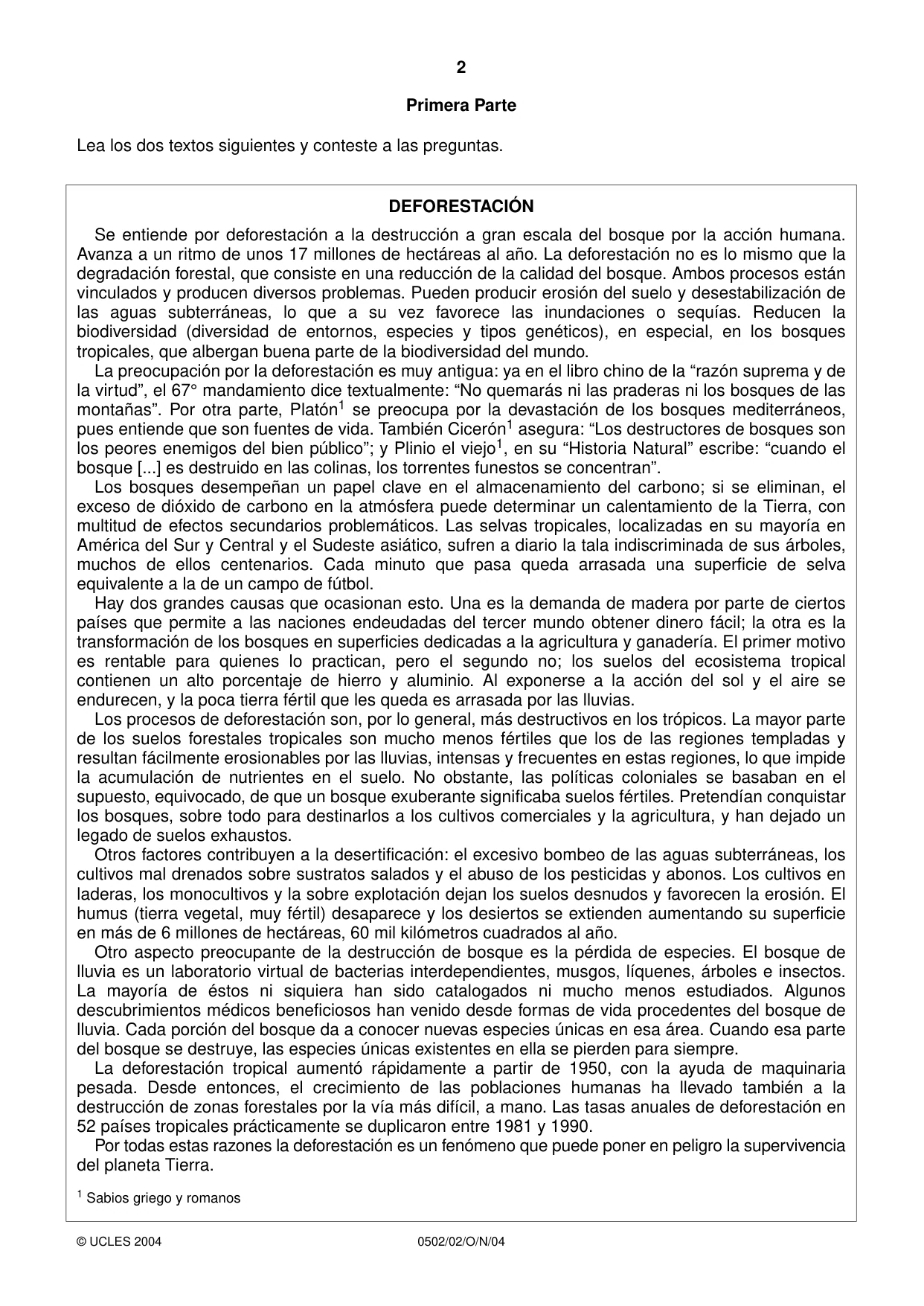
2 0502/02/O/N/04 Primera Parte Lea los dos textos siguientes y conteste a las preguntas. DEFORESTACIÓN Se entiende por deforestación a la destrucción a gran escala del bosque por la acción humana. Avanza a un ritmo de unos 17 millones de hectáreas al año. La deforestación no es lo mismo que la degradación forestal, que consiste en una reducción de la calidad del bosque. Ambos procesos están vinculados y producen diversos problemas. Pueden producir erosión del suelo y desestabilización de las aguas subterráneas, lo que a su vez favorece las inundaciones o sequías. Reducen la biodiversidad (diversidad de entornos, especies y tipos genéticos), en especial, en los bosques tropicales, que albergan buena parte de la biodiversidad del mundo. La preocupación por la deforestación es muy antigua: ya en el libro chino de la “razón suprema y de la virtud”, el 67° mandamiento dice textualmente: “No quemarás ni las praderas ni los bosques de las montañas”. Por otra parte, Platón1 se preocupa por la devastación de los bosques mediterráneos, pues entiende que son fuentes de vida. También Cicerón1 asegura: “Los destructores de bosques son los peores enemigos del bien público”; y Plinio el viejo1, en su “Historia Natural” escribe: “cuando el bosque [...] es destruido en las colinas, los torrentes funestos se concentran”. Los bosques desempeñan un papel clave en el almacenamiento del carbono; si se eliminan, el exceso de dióxido de carbono en la atmósfera puede determinar un calentamiento de la Tierra, con multitud de efectos secundarios problemáticos. Las selvas tropicales, localizadas en su mayoría en América del Sur y Central y el Sudeste asiático, sufren a diario la tala indiscriminada de sus árboles, muchos de ellos centenarios. Cada minuto que pasa queda arrasada una superficie de selva equivalente a la de un campo de fútbol. Hay dos grandes causas que ocasionan esto. Una es la demanda de madera por parte de ciertos países que permite a las naciones endeudadas del tercer mundo obtener dinero fácil; la otra es la transformación de los bosques en superficies dedicadas a la agricultura y ganadería. El primer motivo es rentable para quienes lo practican, pero el segundo no; los suelos del ecosistema tropical contienen un alto porcentaje de hierro y aluminio. Al exponerse a la acción del sol y el aire se endurecen, y la poca tierra fértil que les queda es arrasada por las lluvias. Los procesos de deforestación son, por lo general, más destructivos en los trópicos. La mayor parte de los suelos forestales tropicales son mucho menos fértiles que los de las regiones templadas y resultan fácilmente erosionables por las lluvias, intensas y frecuentes en estas regiones, lo que impide la acumulación de nutrientes en el suelo. No obstante, las políticas coloniales se basaban en el supuesto, equivocado, de que un bosque exuberante significaba suelos fértiles. Pretendían conquistar los bosques, sobre todo para destinarlos a los cultivos comerciales y la agricultura, y han dejado un legado de suelos exhaustos. Otros factores contribuyen a la desertificación: el excesivo bombeo de las aguas subterráneas, los cultivos mal drenados sobre sustratos salados y el abuso de los pesticidas y abonos. Los cultivos en laderas, los monocultivos y la sobre explotación dejan los suelos desnudos y favorecen la erosión. El humus (tierra vegetal, muy fértil) desaparece y los desiertos se extienden aumentando su superficie en más de 6 millones de hectáreas, 60 mil kilómetros cuadrados al año. Otro aspecto preocupante de la destrucción de bosque es la pérdida de especies. El bosque de lluvia es un laboratorio virtual de bacterias interdependientes, musgos, líquenes, árboles e insectos. La mayoría de éstos ni siquiera han sido catalogados ni mucho menos estudiados. Algunos descubrimientos médicos beneficiosos han venido desde formas de vida procedentes del bosque de lluvia. Cada porción del bosque da a conocer nuevas especies únicas en esa área. Cuando esa parte del bosque se destruye, las especies únicas existentes en ella se pierden para siempre. La deforestación tropical aumentó rápidamente a partir de 1950, con la ayuda de maquinaria pesada. Desde entonces, el crecimiento de las poblaciones humanas ha llevado también a la destrucción de zonas forestales por la vía más difícil, a mano. Las tasas anuales de deforestación en 52 países tropicales prácticamente se duplicaron entre 1981 y 1990. Por todas estas razones la deforestación es un fenómeno que puede poner en peligro la supervivencia del planeta Tierra. 1 Sabios griego y romanos © UCLES 2004
Question paper, page 3
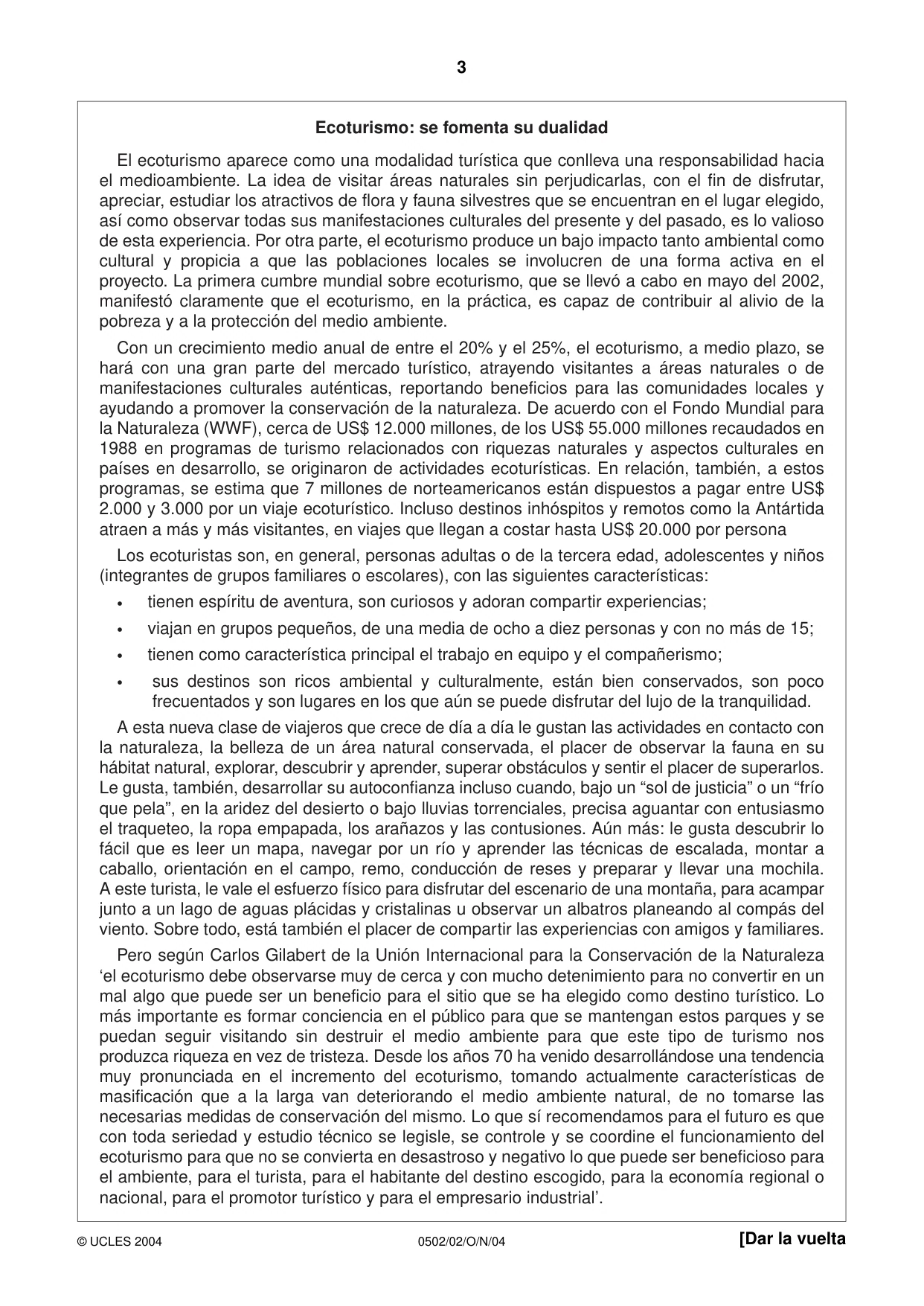
Ecoturismo: se fomenta su dualidad El ecoturismo aparece como una modalidad turística que conlleva una responsabilidad hacia el medioambiente. La idea de visitar áreas naturales sin perjudicarlas, con el fin de disfrutar, apreciar, estudiar los atractivos de flora y fauna silvestres que se encuentran en el lugar elegido, así como observar todas sus manifestaciones culturales del presente y del pasado, es lo valioso de esta experiencia. Por otra parte, el ecoturismo produce un bajo impacto tanto ambiental como cultural y propicia a que las poblaciones locales se involucren de una forma activa en el proyecto. La primera cumbre mundial sobre ecoturismo, que se llevó a cabo en mayo del 2002, manifestó claramente que el ecoturismo, en la práctica, es capaz de contribuir al alivio de la pobreza y a la protección del medio ambiente. Con un crecimiento medio anual de entre el 20% y el 25%, el ecoturismo, a medio plazo, se hará con una gran parte del mercado turístico, atrayendo visitantes a áreas naturales o de manifestaciones culturales auténticas, reportando beneficios para las comunidades locales y ayudando a promover la conservación de la naturaleza. De acuerdo con el Fondo Mundial para la Naturaleza (WWF), cerca de US$ 12.000 millones, de los US$ 55.000 millones recaudados en 1988 en programas de turismo relacionados con riquezas naturales y aspectos culturales en países en desarrollo, se originaron de actividades ecoturísticas. En relación, también, a estos programas, se estima que 7 millones de norteamericanos están dispuestos a pagar entre US$ 2.000 y 3.000 por un viaje ecoturístico. Incluso destinos inhóspitos y remotos como la Antártida atraen a más y más visitantes, en viajes que llegan a costar hasta US$ 20.000 por persona Los ecoturistas son, en general, personas adultas o de la tercera edad, adolescentes y niños (integrantes de grupos familiares o escolares), con las siguientes características: • tienen espíritu de aventura, son curiosos y adoran compartir experiencias; • viajan en grupos pequeños, de una media de ocho a diez personas y con no más de 15; • tienen como característica principal el trabajo en equipo y el compañerismo; • sus destinos son ricos ambiental y culturalmente, están bien conservados, son poco frecuentados y son lugares en los que aún se puede disfrutar del lujo de la tranquilidad. A esta nueva clase de viajeros que crece de día a día le gustan las actividades en contacto con la naturaleza, la belleza de un área natural conservada, el placer de observar la fauna en su hábitat natural, explorar, descubrir y aprender, superar obstáculos y sentir el placer de superarlos. Le gusta, también, desarrollar su autoconfianza incluso cuando, bajo un “sol de justicia” o un “frío que pela”, en la aridez del desierto o bajo lluvias torrenciales, precisa aguantar con entusiasmo el traqueteo, la ropa empapada, los arañazos y las contusiones. Aún más: le gusta descubrir lo fácil que es leer un mapa, navegar por un río y aprender las técnicas de escalada, montar a caballo, orientación en el campo, remo, conducción de reses y preparar y llevar una mochila. A este turista, le vale el esfuerzo físico para disfrutar del escenario de una montaña, para acampar junto a un lago de aguas plácidas y cristalinas u observar un albatros planeando al compás del viento. Sobre todo, está también el placer de compartir las experiencias con amigos y familiares. Pero según Carlos Gilabert de la Unión Internacional para la Conservación de la Naturaleza ‘el ecoturismo debe observarse muy de cerca y con mucho detenimiento para no convertir en un mal algo que puede ser un beneficio para el sitio que se ha elegido como destino turístico. Lo más importante es formar conciencia en el público para que se mantengan estos parques y se puedan seguir visitando sin destruir el medio ambiente para que este tipo de turismo nos produzca riqueza en vez de tristeza. Desde los años 70 ha venido desarrollándose una tendencia muy pronunciada en el incremento del ecoturismo, tomando actualmente características de masificación que a la larga van deteriorando el medio ambiente natural, de no tomarse las necesarias medidas de conservación del mismo. Lo que sí recomendamos para el futuro es que con toda seriedad y estudio técnico se legisle, se controle y se coordine el funcionamiento del ecoturismo para que no se convierta en desastroso y negativo lo que puede ser beneficioso para el ambiente, para el turista, para el habitante del destino escogido, para la economía regional o nacional, para el promotor turístico y para el empresario industrial’. 3 0502/02/O/N/04 [Dar la vuelta © UCLES 2004
Question paper, page 4
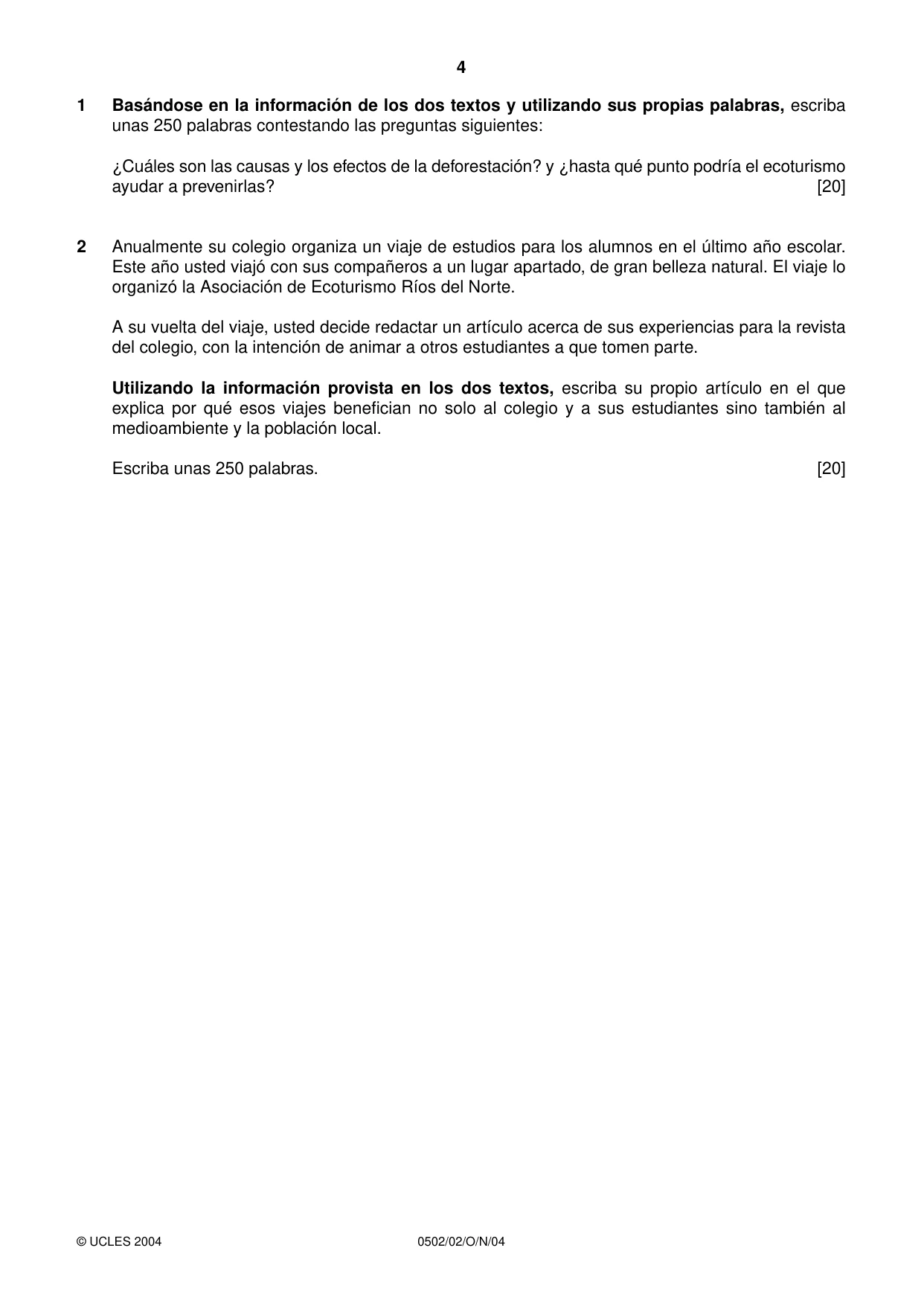
4 0502/02/O/N/04 1 Basándose en la información de los dos textos y utilizando sus propias palabras, escriba unas 250 palabras contestando las preguntas siguientes: ¿Cuáles son las causas y los efectos de la deforestación? y ¿hasta qué punto podría el ecoturismo ayudar a prevenirlas? [20] 2 Anualmente su colegio organiza un viaje de estudios para los alumnos en el último año escolar. Este año usted viajó con sus compañeros a un lugar apartado, de gran belleza natural. El viaje lo organizó la Asociación de Ecoturismo Ríos del Norte. A su vuelta del viaje, usted decide redactar un artículo acerca de sus experiencias para la revista del colegio, con la intención de animar a otros estudiantes a que tomen parte. Utilizando la información provista en los dos textos, escriba su propio artículo en el que explica por qué esos viajes benefician no solo al colegio y a sus estudiantes sino también al medioambiente y la población local. Escriba unas 250 palabras. [20] © UCLES 2004
Question paper, page 5
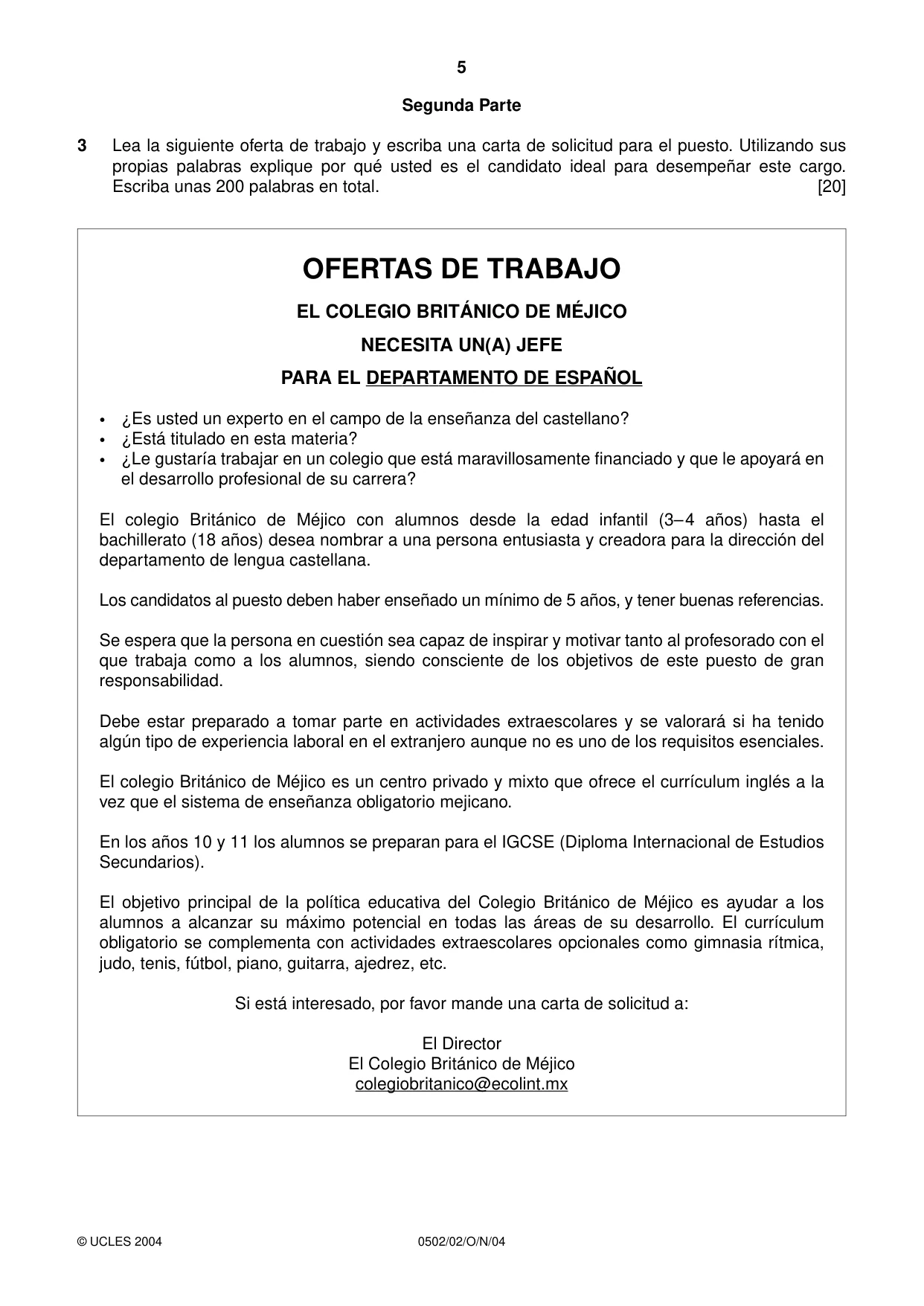
5 0502/02/O/N/04 Segunda Parte 3 Lea la siguiente oferta de trabajo y escriba una carta de solicitud para el puesto. Utilizando sus propias palabras explique por qué usted es el candidato ideal para desempeñar este cargo. Escriba unas 200 palabras en total. [20] OFERTAS DE TRABAJO EL COLEGIO BRITÁNICO DE MÉJICO NECESITA UN(A) JEFE PARA EL DEPARTAMENTO DE ESPAÑOL • ¿Es usted un experto en el campo de la enseñanza del castellano? • ¿Está titulado en esta materia? • ¿Le gustaría trabajar en un colegio que está maravillosamente financiado y que le apoyará en el desarrollo profesional de su carrera? El colegio Británico de Méjico con alumnos desde la edad infantil (3–4 años) hasta el bachillerato (18 años) desea nombrar a una persona entusiasta y creadora para la dirección del departamento de lengua castellana. Los candidatos al puesto deben haber enseñado un mínimo de 5 años, y tener buenas referencias. Se espera que la persona en cuestión sea capaz de inspirar y motivar tanto al profesorado con el que trabaja como a los alumnos, siendo consciente de los objetivos de este puesto de gran responsabilidad. Debe estar preparado a tomar parte en actividades extraescolares y se valorará si ha tenido algún tipo de experiencia laboral en el extranjero aunque no es uno de los requisitos esenciales. El colegio Británico de Méjico es un centro privado y mixto que ofrece el currículum inglés a la vez que el sistema de enseñanza obligatorio mejicano. En los años 10 y 11 los alumnos se preparan para el IGCSE (Diploma Internacional de Estudios Secundarios). El objetivo principal de la política educativa del Colegio Británico de Méjico es ayudar a los alumnos a alcanzar su máximo potencial en todas las áreas de su desarrollo. El currículum obligatorio se complementa con actividades extraescolares opcionales como gimnasia rítmica, judo, tenis, fútbol, piano, guitarra, ajedrez, etc. Si está interesado, por favor mande una carta de solicitud a: El Director El Colegio Británico de Méjico colegiobritanico@ecolint.mx © UCLES 2004
Question paper, page 8
8 0502/02/O/N/04 BLANK PAGE Every reasonable effort has been made to trace all copyright holders where the publishers (i.e. UCLES) are aware that third-party material has been reproduced. The publishers would be pleased to hear from anyone whose rights they have unwittingly infringed. University of Cambridge International Examinations is part of the University of Cambridge Local Examinations Syndicate (UCLES), which is itself a department of the University of Cambridge.
Mark scheme, page 1
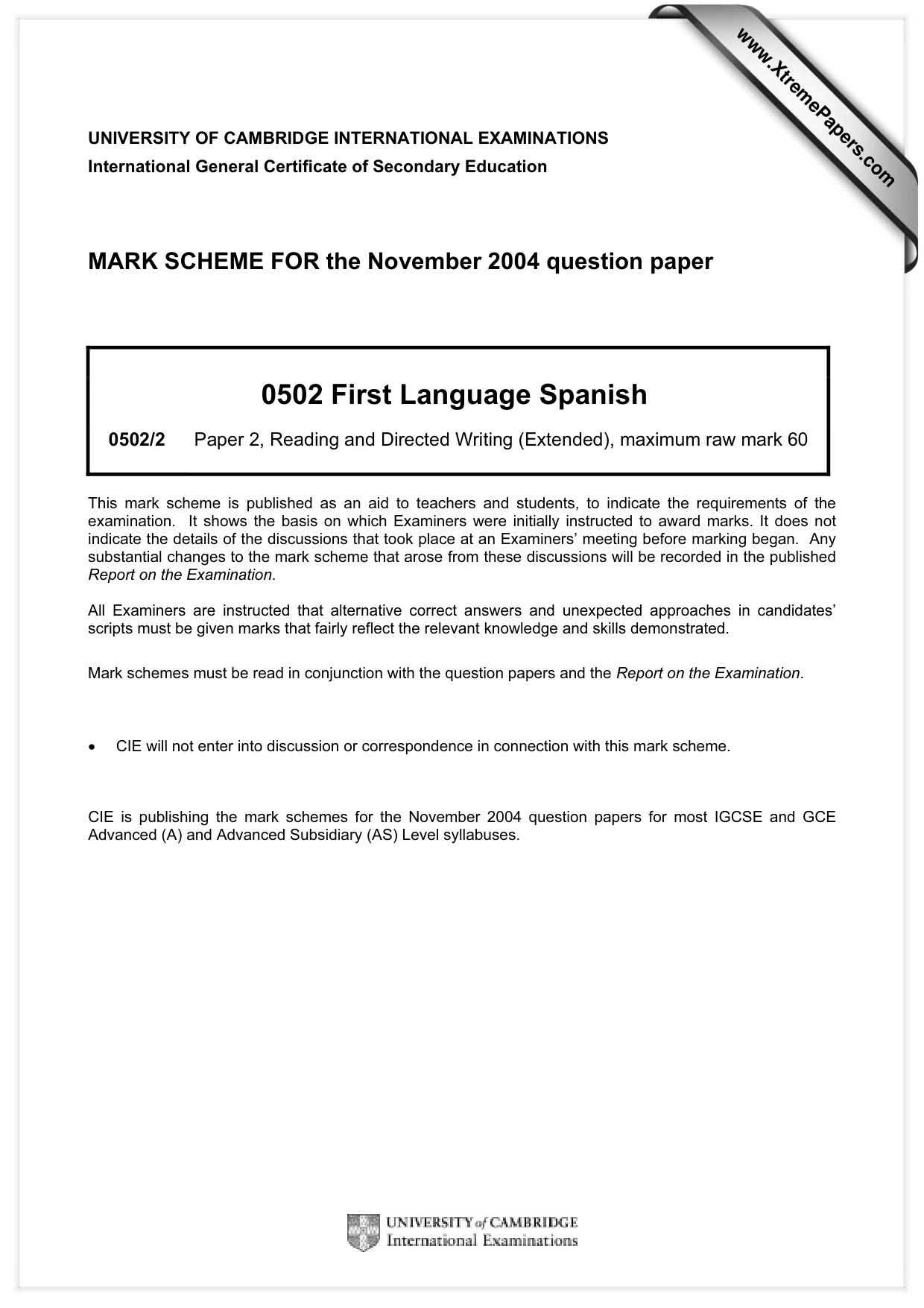
UNIVERSITY OF CAMBRIDGE INTERNATIONAL EXAMINATIONS International General Certificate of Secondary Education MARK SCHEME FOR the November 2004 question paper 0502 First Language Spanish 0502/2 Paper 2, Reading and Directed Writing (Extended), maximum raw mark 60 This mark scheme is published as an aid to teachers and students, to indicate the requirements of the examination. It shows the basis on which Examiners were initially instructed to award marks. It does not indicate the details of the discussions that took place at an Examiners’ meeting before marking began. Any substantial changes to the mark scheme that arose from these discussions will be recorded in the published Report on the Examination. All Examiners are instructed that alternative correct answers and unexpected approaches in candidates’ scripts must be given marks that fairly reflect the relevant knowledge and skills demonstrated. Mark schemes must be read in conjunction with the question papers and the Report on the Examination. • CIE will not enter into discussion or correspondence in connection with this mark scheme. CIE is publishing the mark schemes for the November 2004 question papers for most IGCSE and GCE Advanced (A) and Advanced Subsidiary (AS) Level syllabuses. www.XtremePapers.com
Mark scheme, page 2
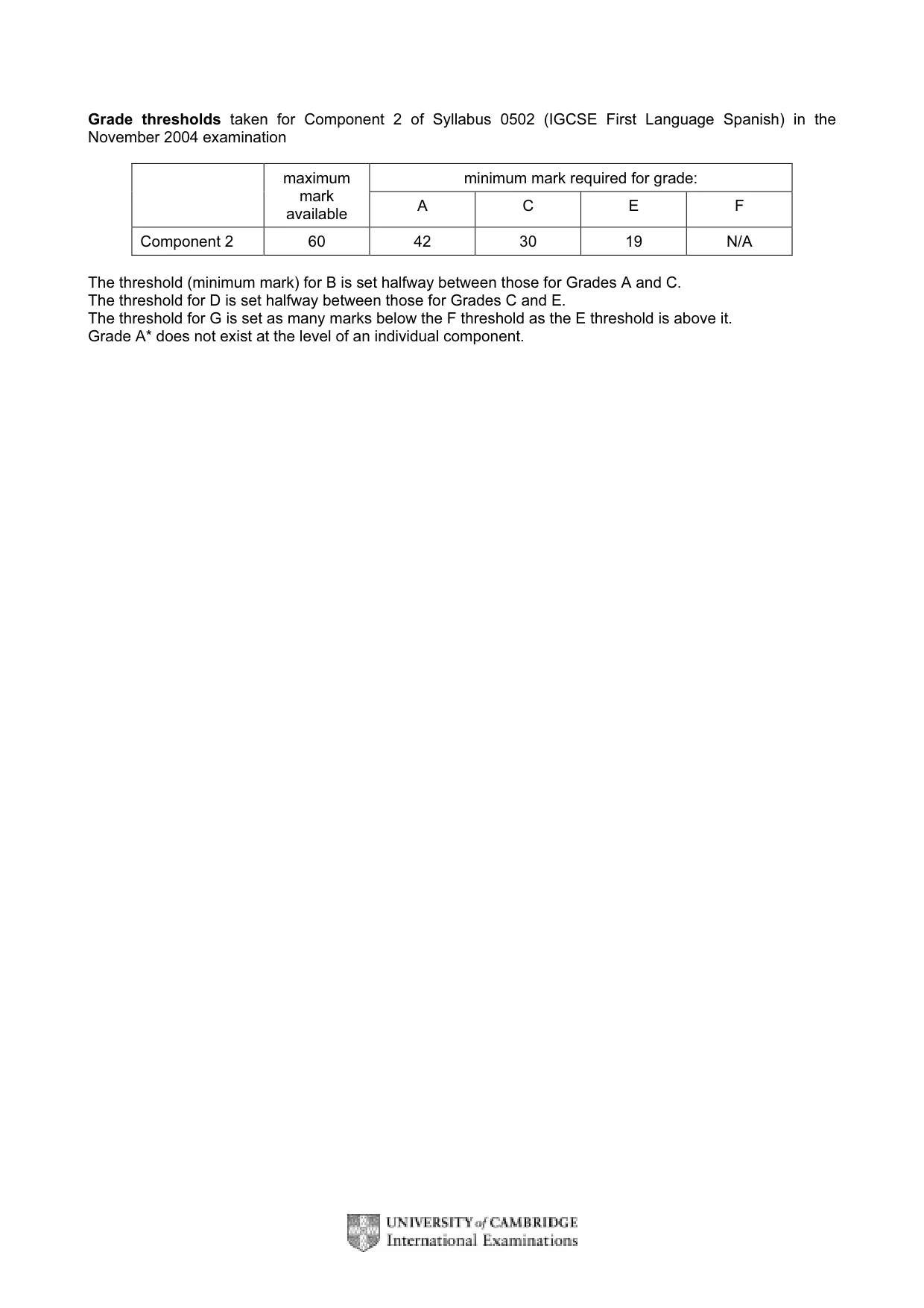
Grade thresholds taken for Component 2 of Syllabus 0502 (IGCSE First Language Spanish) in the November 2004 examination minimum mark required for grade: maximum mark available A C E F Component 2 60 42 30 19 N/A The threshold (minimum mark) for B is set halfway between those for Grades A and C. The threshold for D is set halfway between those for Grades C and E. The threshold for G is set as many marks below the F threshold as the E threshold is above it. Grade A* does not exist at the level of an individual component.
Mark scheme, page 3
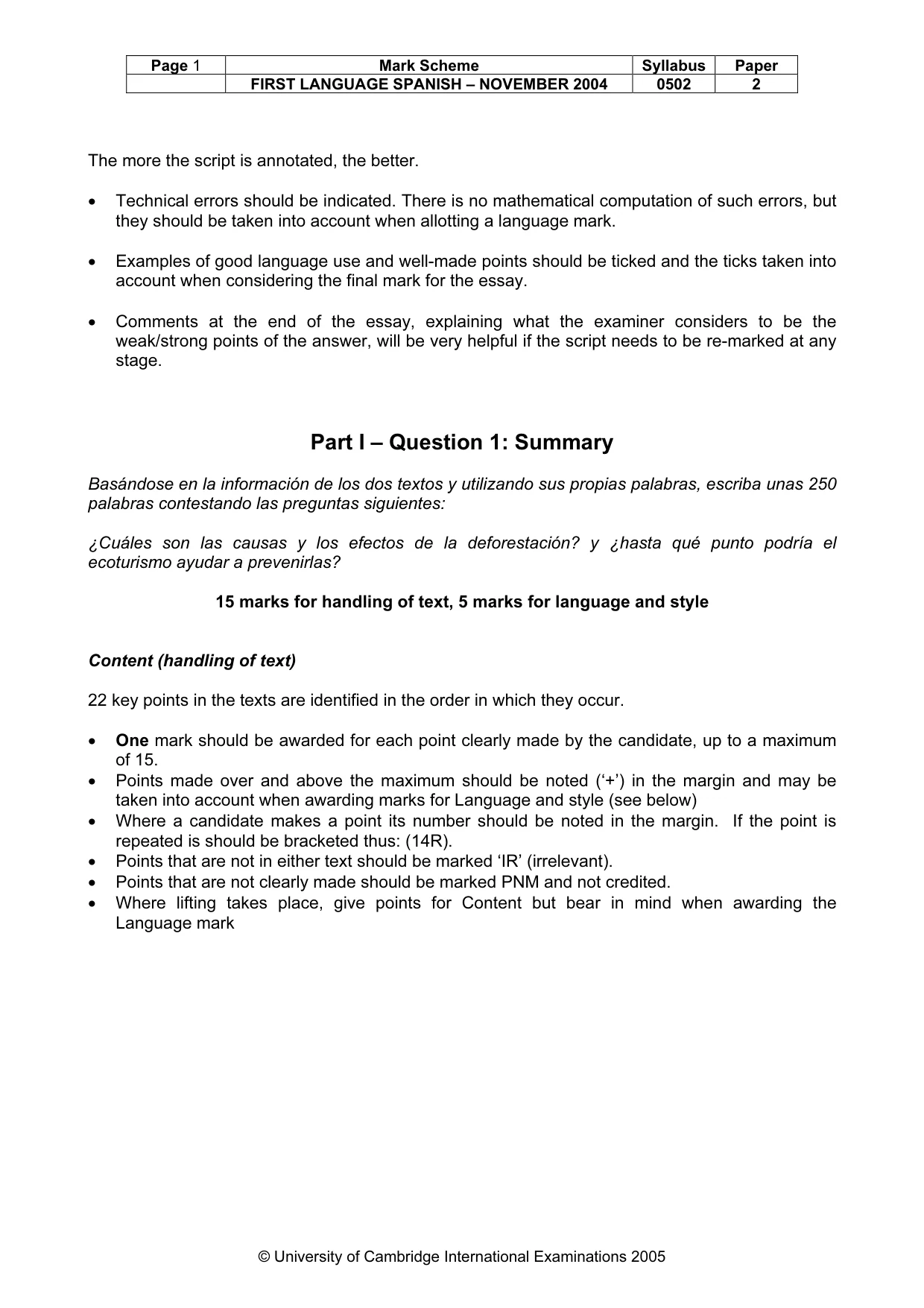
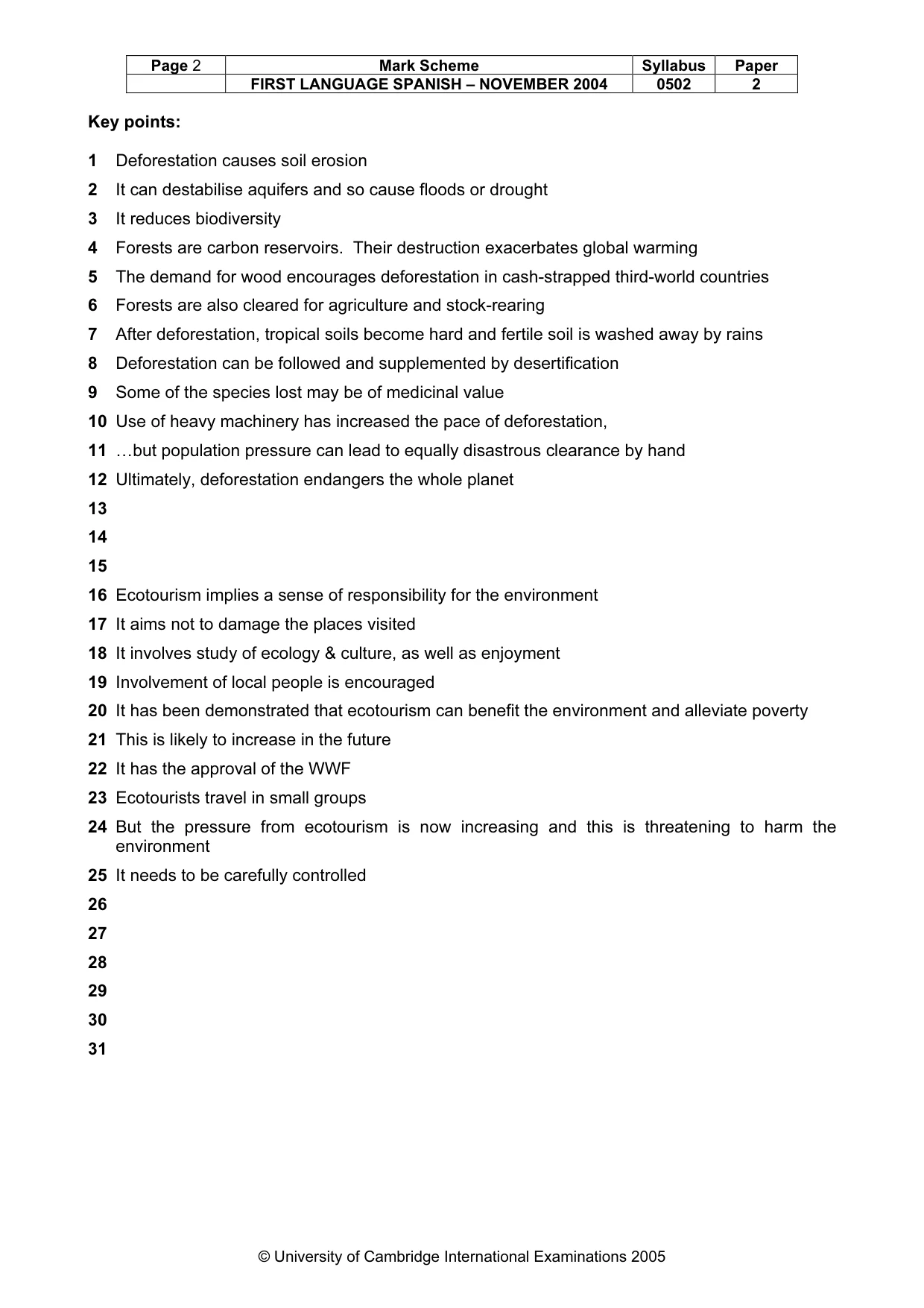
Page 1 Mark Scheme Syllabus Paper FIRST LANGUAGE SPANISH – NOVEMBER 2004 0502 2 © University of Cambridge International Examinations 2005 The more the script is annotated, the better. • Technical errors should be indicated. There is no mathematical computation of such errors, but they should be taken into account when allotting a language mark. • Examples of good language use and well-made points should be ticked and the ticks taken into account when considering the final mark for the essay. • Comments at the end of the essay, explaining what the examiner considers to be the weak/strong points of the answer, will be very helpful if the script needs to be re-marked at any stage. Part I – Question 1: Summary Basándose en la información de los dos textos y utilizando sus propias palabras, escriba unas 250 palabras contestando las preguntas siguientes: ¿Cuáles son las causas y los efectos de la deforestación? y ¿hasta qué punto podría el ecoturismo ayudar a prevenirlas? 15 marks for handling of text, 5 marks for language and style Content (handling of text) 22 key points in the texts are identified in the order in which they occur. • One mark should be awarded for each point clearly made by the candidate, up to a maximum of 15. • Points made over and above the maximum should be noted (‘+’) in the margin and may be taken into account when awarding marks for Language and style (see below) • Where a candidate makes a point its number should be noted in the margin. If the point is repeated is should be bracketed thus: (14R). • Points that are not in either text should be marked ‘IR’ (irrelevant). • Points that are not clearly made should be marked PNM and not credited. • Where lifting takes place, give points for Content but bear in mind when awarding the Language mark
Mark scheme, page 4
Page 2 Mark Scheme Syllabus Paper FIRST LANGUAGE SPANISH – NOVEMBER 2004 0502 2 © University of Cambridge International Examinations 2005 Key points: 1 Deforestation causes soil erosion 2 It can destabilise aquifers and so cause floods or drought 3 It reduces biodiversity 4 Forests are carbon reservoirs. Their destruction exacerbates global warming 5 The demand for wood encourages deforestation in cash-strapped third-world countries 6 Forests are also cleared for agriculture and stock-rearing 7 After deforestation, tropical soils become hard and fertile soil is washed away by rains 8 Deforestation can be followed and supplemented by desertification 9 Some of the species lost may be of medicinal value 10 Use of heavy machinery has increased the pace of deforestation, 11 …but population pressure can lead to equally disastrous clearance by hand 12 Ultimately, deforestation endangers the whole planet 13 14 15 16 Ecotourism implies a sense of responsibility for the environment 17 It aims not to damage the places visited 18 It involves study of ecology & culture, as well as enjoyment 19 Involvement of local people is encouraged 20 It has been demonstrated that ecotourism can benefit the environment and alleviate poverty 21 This is likely to increase in the future 22 It has the approval of the WWF 23 Ecotourists travel in small groups 24 But the pressure from ecotourism is now increasing and this is threatening to harm the environment 25 It needs to be carefully controlled 26 27 28 29 30 31
Mark scheme, page 5
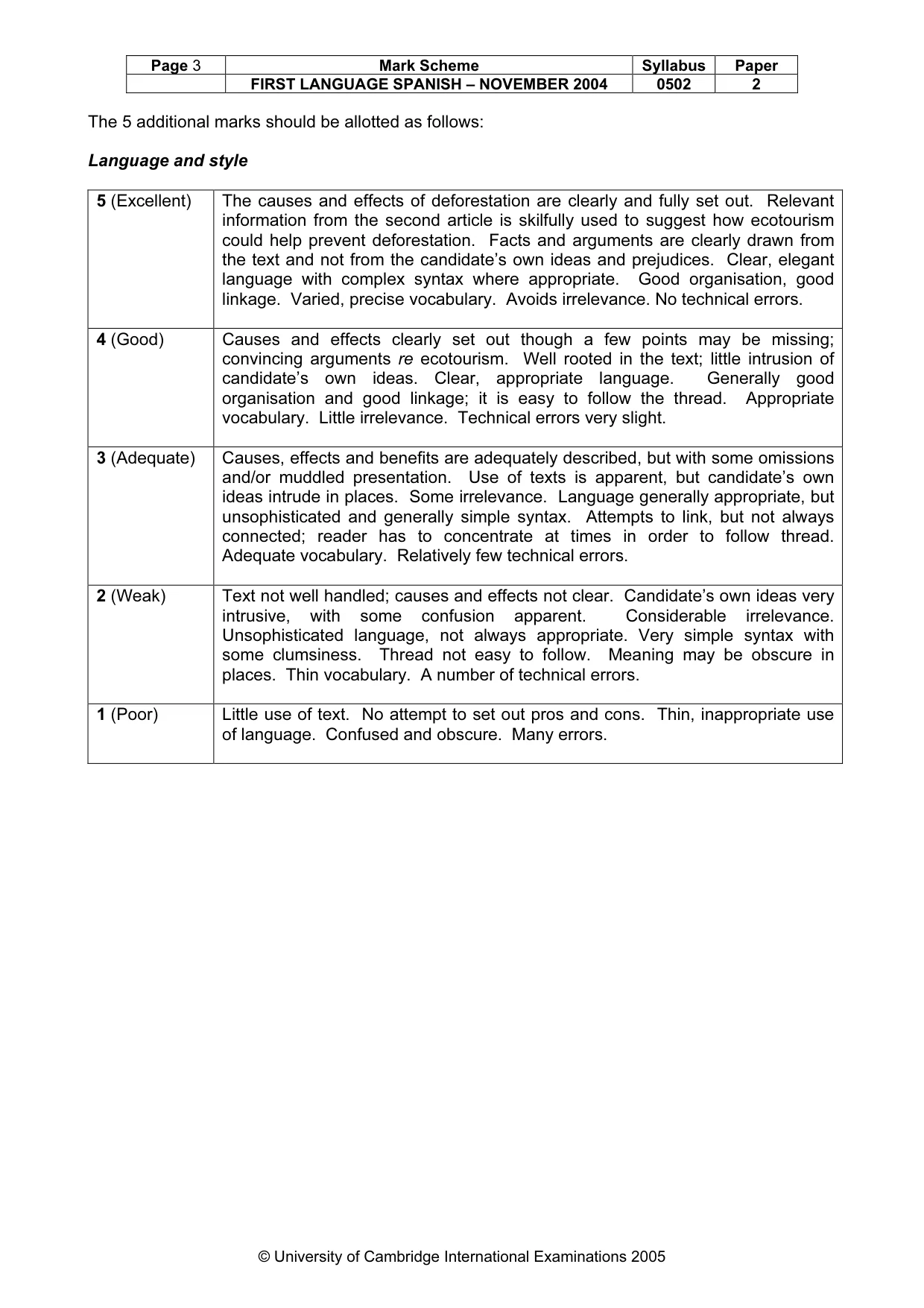
Page 3 Mark Scheme Syllabus Paper FIRST LANGUAGE SPANISH – NOVEMBER 2004 0502 2 © University of Cambridge International Examinations 2005 The 5 additional marks should be allotted as follows: Language and style 5 (Excellent) The causes and effects of deforestation are clearly and fully set out. Relevant information from the second article is skilfully used to suggest how ecotourism could help prevent deforestation. Facts and arguments are clearly drawn from the text and not from the candidate’s own ideas and prejudices. Clear, elegant language with complex syntax where appropriate. Good organisation, good linkage. Varied, precise vocabulary. Avoids irrelevance. No technical errors. 4 (Good) Causes and effects clearly set out though a few points may be missing; convincing arguments re ecotourism. Well rooted in the text; little intrusion of candidate’s own ideas. Clear, appropriate language. Generally good organisation and good linkage; it is easy to follow the thread. Appropriate vocabulary. Little irrelevance. Technical errors very slight. 3 (Adequate) Causes, effects and benefits are adequately described, but with some omissions and/or muddled presentation. Use of texts is apparent, but candidate’s own ideas intrude in places. Some irrelevance. Language generally appropriate, but unsophisticated and generally simple syntax. Attempts to link, but not always connected; reader has to concentrate at times in order to follow thread. Adequate vocabulary. Relatively few technical errors. 2 (Weak) Text not well handled; causes and effects not clear. Candidate’s own ideas very intrusive, with some confusion apparent. Considerable irrelevance. Unsophisticated language, not always appropriate. Very simple syntax with some clumsiness. Thread not easy to follow. Meaning may be obscure in places. Thin vocabulary. A number of technical errors. 1 (Poor) Little use of text. No attempt to set out pros and cons. Thin, inappropriate use of language. Confused and obscure. Many errors.
Mark scheme, page 6
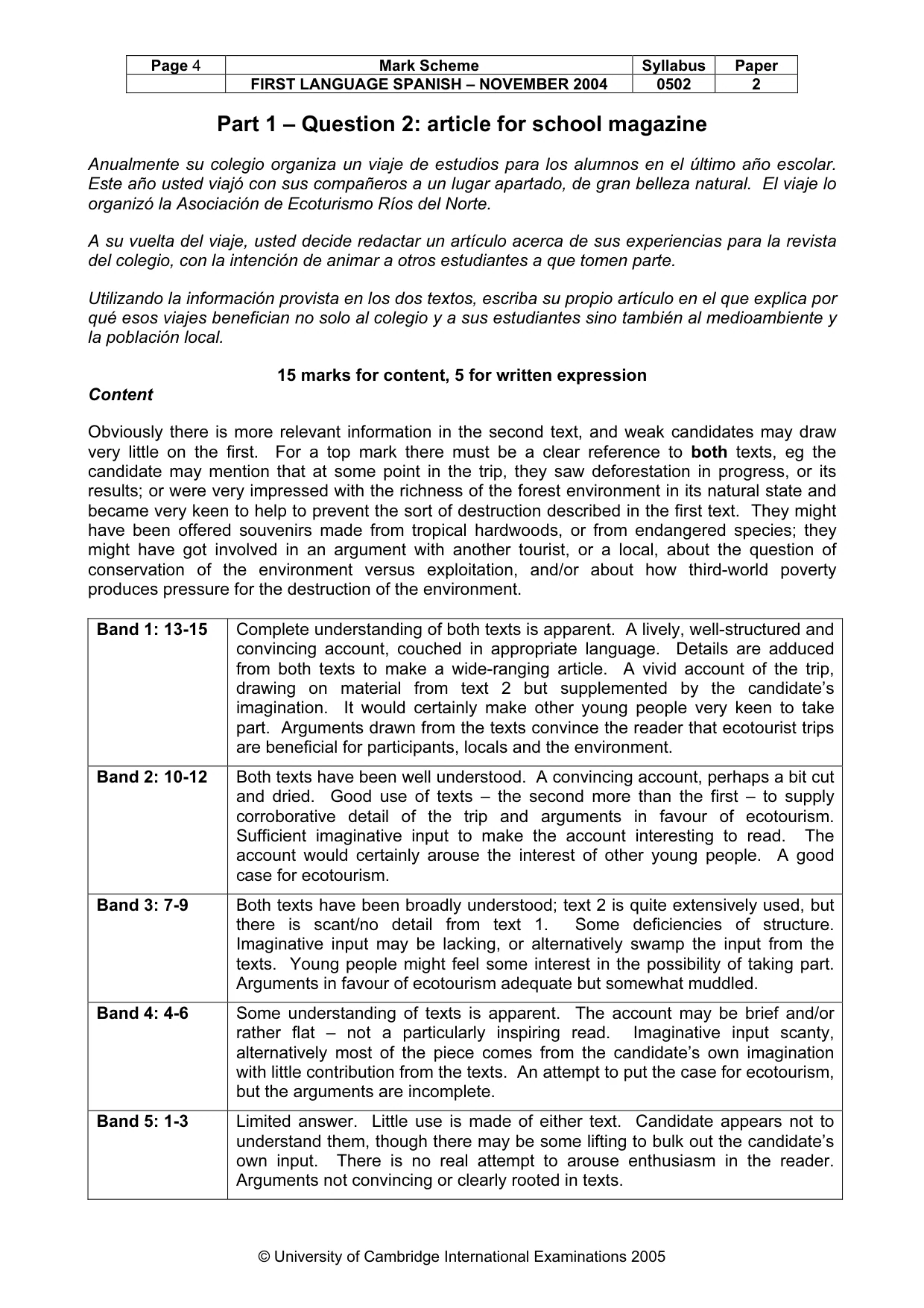
Page 4 Mark Scheme Syllabus Paper FIRST LANGUAGE SPANISH – NOVEMBER 2004 0502 2 © University of Cambridge International Examinations 2005 Part 1 – Question 2: article for school magazine Anualmente su colegio organiza un viaje de estudios para los alumnos en el último año escolar. Este año usted viajó con sus compañeros a un lugar apartado, de gran belleza natural. El viaje lo organizó la Asociación de Ecoturismo Ríos del Norte. A su vuelta del viaje, usted decide redactar un artículo acerca de sus experiencias para la revista del colegio, con la intención de animar a otros estudiantes a que tomen parte. Utilizando la información provista en los dos textos, escriba su propio artículo en el que explica por qué esos viajes benefician no solo al colegio y a sus estudiantes sino también al medioambiente y la población local. 15 marks for content, 5 for written expression Content Obviously there is more relevant information in the second text, and weak candidates may draw very little on the first. For a top mark there must be a clear reference to both texts, eg the candidate may mention that at some point in the trip, they saw deforestation in progress, or its results; or were very impressed with the richness of the forest environment in its natural state and became very keen to help to prevent the sort of destruction described in the first text. They might have been offered souvenirs made from tropical hardwoods, or from endangered species; they might have got involved in an argument with another tourist, or a local, about the question of conservation of the environment versus exploitation, and/or about how third-world poverty produces pressure for the destruction of the environment. Band 1: 13-15 Complete understanding of both texts is apparent. A lively, well-structured and convincing account, couched in appropriate language. Details are adduced from both texts to make a wide-ranging article. A vivid account of the trip, drawing on material from text 2 but supplemented by the candidate’s imagination. It would certainly make other young people very keen to take part. Arguments drawn from the texts convince the reader that ecotourist trips are beneficial for participants, locals and the environment. Band 2: 10-12 Both texts have been well understood. A convincing account, perhaps a bit cut and dried. Good use of texts – the second more than the first – to supply corroborative detail of the trip and arguments in favour of ecotourism. Sufficient imaginative input to make the account interesting to read. The account would certainly arouse the interest of other young people. A good case for ecotourism. Band 3: 7-9 Both texts have been broadly understood; text 2 is quite extensively used, but there is scant/no detail from text 1. Some deficiencies of structure. Imaginative input may be lacking, or alternatively swamp the input from the texts. Young people might feel some interest in the possibility of taking part. Arguments in favour of ecotourism adequate but somewhat muddled. Band 4: 4-6 Some understanding of texts is apparent. The account may be brief and/or rather flat – not a particularly inspiring read. Imaginative input scanty, alternatively most of the piece comes from the candidate’s own imagination with little contribution from the texts. An attempt to put the case for ecotourism, but the arguments are incomplete. Band 5: 1-3 Limited answer. Little use is made of either text. Candidate appears not to understand them, though there may be some lifting to bulk out the candidate’s own input. There is no real attempt to arouse enthusiasm in the reader. Arguments not convincing or clearly rooted in texts.
Mark scheme, page 7
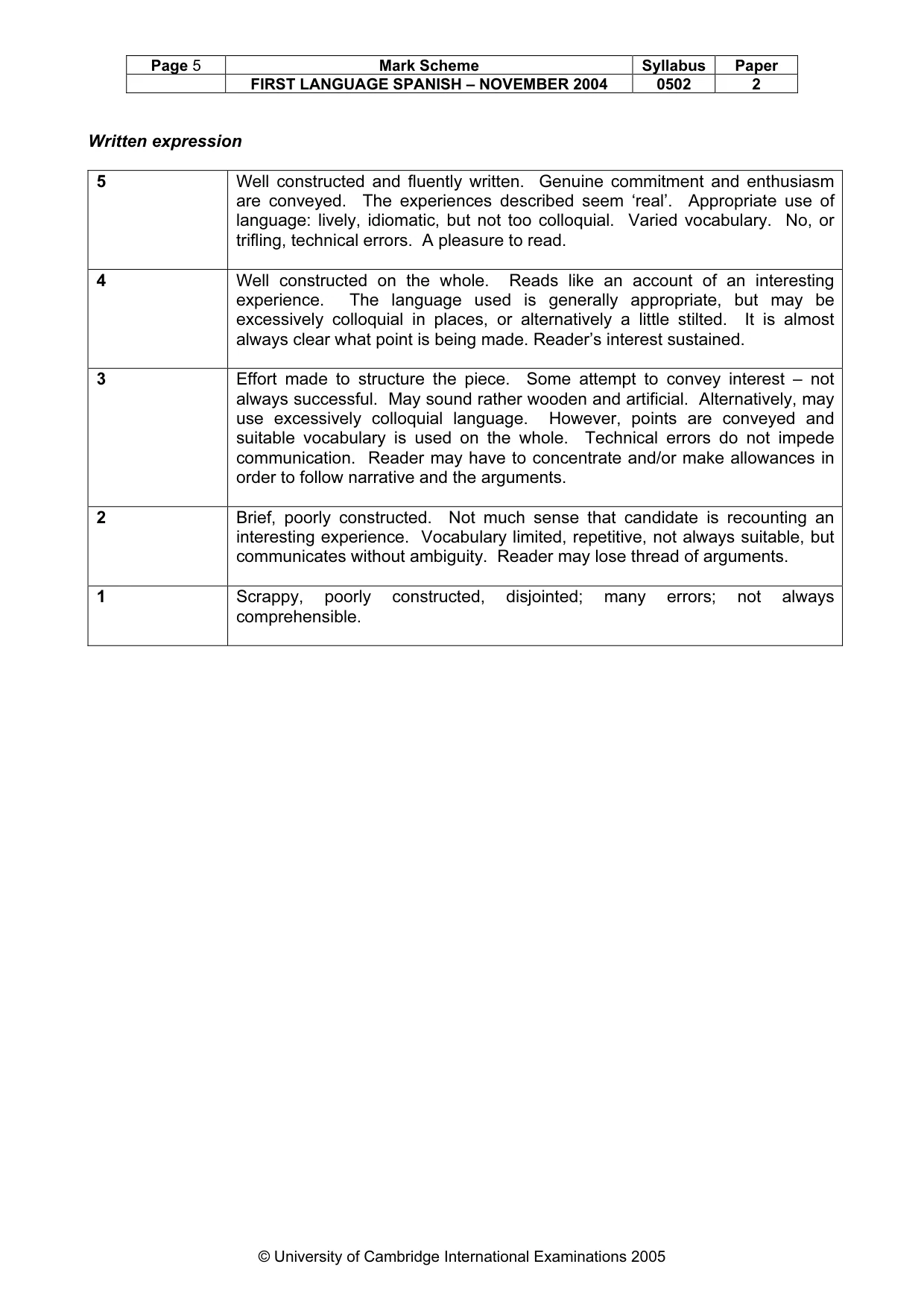
Page 5 Mark Scheme Syllabus Paper FIRST LANGUAGE SPANISH – NOVEMBER 2004 0502 2 © University of Cambridge International Examinations 2005 Written expression 5 Well constructed and fluently written. Genuine commitment and enthusiasm are conveyed. The experiences described seem ‘real’. Appropriate use of language: lively, idiomatic, but not too colloquial. Varied vocabulary. No, or trifling, technical errors. A pleasure to read. 4 Well constructed on the whole. Reads like an account of an interesting experience. The language used is generally appropriate, but may be excessively colloquial in places, or alternatively a little stilted. It is almost always clear what point is being made. Reader’s interest sustained. 3 Effort made to structure the piece. Some attempt to convey interest – not always successful. May sound rather wooden and artificial. Alternatively, may use excessively colloquial language. However, points are conveyed and suitable vocabulary is used on the whole. Technical errors do not impede communication. Reader may have to concentrate and/or make allowances in order to follow narrative and the arguments. 2 Brief, poorly constructed. Not much sense that candidate is recounting an interesting experience. Vocabulary limited, repetitive, not always suitable, but communicates without ambiguity. Reader may lose thread of arguments. 1 Scrappy, poorly constructed, disjointed; many errors; not always comprehensible.
Mark scheme, page 8
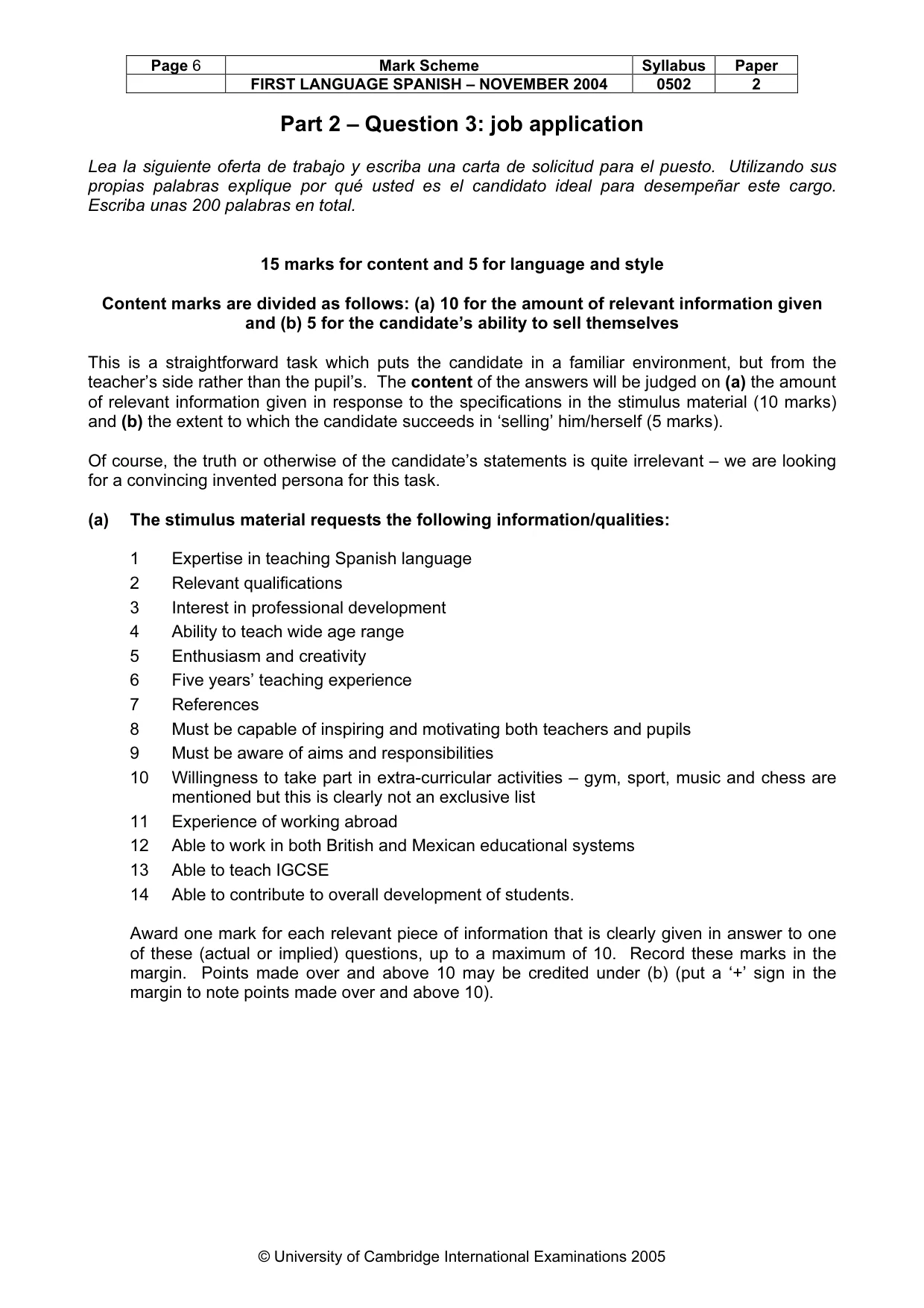
Page 6 Mark Scheme Syllabus Paper FIRST LANGUAGE SPANISH – NOVEMBER 2004 0502 2 © University of Cambridge International Examinations 2005 Part 2 – Question 3: job application Lea la siguiente oferta de trabajo y escriba una carta de solicitud para el puesto. Utilizando sus propias palabras explique por qué usted es el candidato ideal para desempeñar este cargo. Escriba unas 200 palabras en total. 15 marks for content and 5 for language and style Content marks are divided as follows: (a) 10 for the amount of relevant information given and (b) 5 for the candidate’s ability to sell themselves This is a straightforward task which puts the candidate in a familiar environment, but from the teacher’s side rather than the pupil’s. The content of the answers will be judged on (a) the amount of relevant information given in response to the specifications in the stimulus material (10 marks) and (b) the extent to which the candidate succeeds in ‘selling’ him/herself (5 marks). Of course, the truth or otherwise of the candidate’s statements is quite irrelevant – we are looking for a convincing invented persona for this task. (a) The stimulus material requests the following information/qualities: 1 Expertise in teaching Spanish language 2 Relevant qualifications 3 Interest in professional development 4 Ability to teach wide age range 5 Enthusiasm and creativity 6 Five years’ teaching experience 7 References 8 Must be capable of inspiring and motivating both teachers and pupils 9 Must be aware of aims and responsibilities 10 Willingness to take part in extra-curricular activities – gym, sport, music and chess are mentioned but this is clearly not an exclusive list 11 Experience of working abroad 12 Able to work in both British and Mexican educational systems 13 Able to teach IGCSE 14 Able to contribute to overall development of students. Award one mark for each relevant piece of information that is clearly given in answer to one of these (actual or implied) questions, up to a maximum of 10. Record these marks in the margin. Points made over and above 10 may be credited under (b) (put a ‘+’ sign in the margin to note points made over and above 10).
Mark scheme, page 9
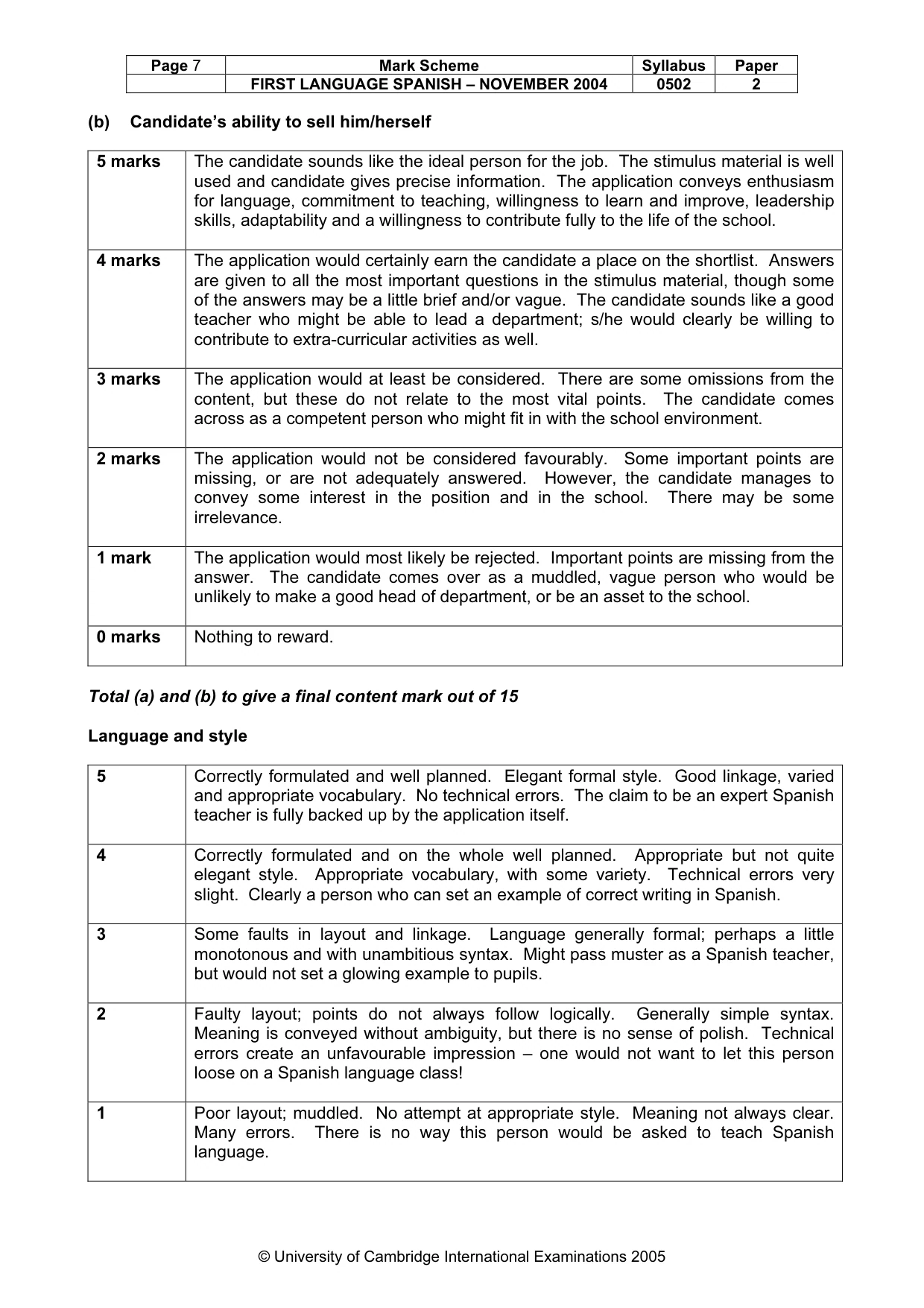
Page 7 Mark Scheme Syllabus Paper FIRST LANGUAGE SPANISH – NOVEMBER 2004 0502 2 © University of Cambridge International Examinations 2005 (b) Candidate’s ability to sell him/herself 5 marks The candidate sounds like the ideal person for the job. The stimulus material is well used and candidate gives precise information. The application conveys enthusiasm for language, commitment to teaching, willingness to learn and improve, leadership skills, adaptability and a willingness to contribute fully to the life of the school. 4 marks The application would certainly earn the candidate a place on the shortlist. Answers are given to all the most important questions in the stimulus material, though some of the answers may be a little brief and/or vague. The candidate sounds like a good teacher who might be able to lead a department; s/he would clearly be willing to contribute to extra-curricular activities as well. 3 marks The application would at least be considered. There are some omissions from the content, but these do not relate to the most vital points. The candidate comes across as a competent person who might fit in with the school environment. 2 marks The application would not be considered favourably. Some important points are missing, or are not adequately answered. However, the candidate manages to convey some interest in the position and in the school. There may be some irrelevance. 1 mark The application would most likely be rejected. Important points are missing from the answer. The candidate comes over as a muddled, vague person who would be unlikely to make a good head of department, or be an asset to the school. 0 marks Nothing to reward. Total (a) and (b) to give a final content mark out of 15 Language and style 5 Correctly formulated and well planned. Elegant formal style. Good linkage, varied and appropriate vocabulary. No technical errors. The claim to be an expert Spanish teacher is fully backed up by the application itself. 4 Correctly formulated and on the whole well planned. Appropriate but not quite elegant style. Appropriate vocabulary, with some variety. Technical errors very slight. Clearly a person who can set an example of correct writing in Spanish. 3 Some faults in layout and linkage. Language generally formal; perhaps a little monotonous and with unambitious syntax. Might pass muster as a Spanish teacher, but would not set a glowing example to pupils. 2 Faulty layout; points do not always follow logically. Generally simple syntax. Meaning is conveyed without ambiguity, but there is no sense of polish. Technical errors create an unfavourable impression – one would not want to let this person loose on a Spanish language class! 1 Poor layout; muddled. No attempt at appropriate style. Meaning not always clear. Many errors. There is no way this person would be asked to teach Spanish language.